Charles Van Martyr of New Brunswick, a musician in the 35th New Jersey, Co. A. (Rick Brown Collection)
The following letter was written by 39 year-old Enoch Carkhuff (1824-1881), the son of Jacob Quick Carkhuff (1786-1865) and Catharine Cole (1793-1862). Enoch was married in 1844 to Mary Reed (b. 1825) of Somerset county, New Jersey. Their only child was George Van Nest Carkhuff (b. 1850).
It was in late August 1862 when Enoch volunteered to serve as a private in Co. E, 30th New Jersey Infantry—a nine-month’s regiment. He mustered out of the service on 27 June 1863. At the time that Enoch wrote this letter in March 1862, the regiment had already participated in the “Mud March” and were awaiting orders that would eventually take them to the Battlefield at Chancellorsville, their only major engagement, but they escaped with little exposure and no casualties. They had 64 deaths from disease and 14 desertions during their nine months service.
Transcription
Belle Plain Landing, Virginia March 7th 1863
Mary and George Carkhuff,
Dear friends—I take the opportunity to let you know that I am well and hope these few lines will find you the same. I have no news to write about the move for all is quiet here now. We have plenty of work to do now days but we ain’t going to work very hard for the pay we get.
The mud is drying up a little but it is bad enough yet. I got my box last Sunday the 1st of March and it was all first rate. There was four loaves of bread and four good pies, ginger and doughnuts, and a fine big pound cake and cheese and butter and apples and two first rate pair of stockings. I tell you that I live bully now days. You must let us know who sent us our night caps. You must tell them we are very much obliged to them for their present. They are very nice to wear in our tents or outdoors, either. The boys wonder who made them. Some of the stuff they did know and some they did not know where it came from but they are very much pleased with them.
I suppose you are thinking about moving pretty soon. George, you must work smart and help mother get ready to move. You must let me know who moves where you are. They say that we will get some more pay this month. I hope they will pay us some so that you can pay doctor all his rent before you move. Maybe he will let you stay yet for 4 dollars a month if he don’t rent it soon. You must let me know who bought Dunman’s houses and whether they are all rented or not. Give my respects to Mr. Ore’s folks. Tell Mr. Ore he will have to come down to Old Virginna and see the elephant and then they will know how it goes to have a box.
You must let me know whether Tunis is home yet or not. Mr. John Whitenack and Sherfeherder and Mr. Hope has been down here this week and they said that John Davis and Ellis Porter is coming down next week. But the boys don’t think that they will come. Our young boys is getting tired of the business. Samuel Davis is not very well. He don’t do much duty now nor hain’t for some time. He has got plenty of the war. If he gets back, he won’t come again. But I must close for it is most time for the mail to go. But you must write soon for I have not heard from you since I wrote the other letter. Goodbye mother and George. Your dear husband and father, — Enoch Carkhuff
An unidentified private believed to be from the 2nd Michigan Infantry (Dale Niesen Collection)
This letter was written by Myron Harvey Skinner (1842-1904), the son of Adolphus Harvey Skinner (1811-1892) and Mary Angeline Fuller (1811-1893) of Walled Lake, Oakland county, Michigan. Myron enlisted on 25 May 1861 in Co. G (“Constantine Union Guards”), 2nd Michigan Infantry. He was transferred out of the regiment on 21 January 1863 into Battery H, 1st US Light Artillery. Myron datelined his letter on 19 December 1862, just days after the Battle of Fredericksburg when the regiment was encamped near Falmouth, Virginia
Myron wrote of visiting the encampment of his older brother, Dolphus Skinner (1835-1903) who had been serving as a private in Co. F, 10th US Regular Infantry since March 1858 and had only recently been attached to the Army of the Potomac. Previous to, and in the early part of the war, Co. F of the US Regulars had seen duty in the far west but in late November they were sent to Aquia Creek, Virginia, and were attached to Sykes Division of Butterfield’s 5th Corps during the Battle of Fredericksburg. During the battle, Sykes’ regulars moved up after darkness on the 13th and spent the night on the field. The Regulars were significantly engaged during the day of the 14th, with fighting around the Tannery on the northern end of the line.
Myron addressed the letter to “Jule” whom I’m guessing was his cousin—Juliann Hubbel Skinner (1831-1922), a daughter of Hiram and Elizabeth (Otto) Skinner of Oakland county, Michigan.
[Note: This letter is from the private collection of Dale Niesen and was transcribed and published on Spared & Shared by express consent.]
Transcription
[Camp near Falmouth, Virginia] December 19th 1862
Dear Jule,
I received yours some days since. I will endeavor to answer it. I learned by letters from home that Dolphus was in the Army of the Potomac and yesterday he came to my camp. I knew him just the minute I set my eyes on him. He don’t look as he used to but the longer I am with him, I see more of his old looks. He was glad to see me, I tell you, and I was glad to see him as he was to see me and this morning I came over to his camp and seen him. They are camped about 6 miles from my camp. But 6 miles hant much for a soldier to walk to see his brother that he hant seen in 5 years. You know he is well and doing well.
I would have answered your letter before this but I didn’t have a sheet of paper or couldn’t get any so I couldn’t write. So you must excuse me this time. I will try to do better next. You must excuse a short letter this time for I have got to write two more today.
The following letter was only signed “B. B.” so it is difficult to say with certainly who he was. He addressed the letter to “Doctor” who seems to have been from the same area of Virginia as “Capt. F” of his regiment. Since the author describes the recent action known as the Battle of Haulover Cut on James Island and the only Virginia troops participating in the fight were from the 26th Virginia Infantry, my hunch is that the author served in that regiment. The only “Captain F.” in the 26th Virginia was Capt. Patrick H. Fitzhugh (1818-1864) of Co. B who would later be mortally wounded in the 17th June 1864 Battle of Petersburg. Additionally, the 26th Virginia was assigned to the 1st Military Sub District which is how this letter was datelined.
I could not find a “B. B.” serving in Co. B of the 26th Virginia but it isn’t clear from the letter that the author was necessarily from the same company as the captain mentioned. In fact, there were several companies recruited from the same general area of Virginia. Three possible candidates Are Benjamin Boughton of Co. C who was later killed at the Battle of Nottoway Bridge; Benjamin Booker of Co. H who was captured on 17 June 1864 and died at Elmira in October 1864; and Benjamin Broach of Co. H who was captured at High Bridge on 14 April 1865 and died on 2 May 1865. I can’t be certain that it was any one of these three; they are only possibilities. Whomever he was, he had excellent handwriting which would indicate an advanced education and suggest a position of higher rank. None of the possibilities mentioned above fit that description.
[Note: This letter is from the private collection of Greg Herr and was transcribed and published on Spared & Shared by express consent.]
Transcription
Headquarters, 1st [Military] Sub. District February 12, 1864
Dear Doctor,
It has been a long time since I have heard from you and I feel real anxious to get a letter from you. Captain F got a letter from your father a few weeks ago. I frequently make inquiries whether or not the Yankees occupy your part of the country but no one seems to know anything about it. I have experienced some pretty hard times during the past Spring & Summer. When we returned to Yorktown, our tents were sent to Petersburg. We have no wall tents. The only tents we have here are fly tents. And they only issue 5 to a company. We have had very poor rations. Fatty meat to eat the most of the time and nothing other but crackers.
The fight at Richmond I was the only one in the battle, our regiment not being called into action till the last day of the fight. The Captain acted very bravely and came out of the fight without a scratch. I got a slight wound in my head. The ball struck me on top of the head, cutting through the skin. I fear that many of my friends have been killed in the later fighting in Virginia. You have a better opportunity of hearing from the army that I have. We have no other than river water to drink. The gnats & horseflies are already great pests. There is a great many alligators visible every day. We captured one yesterday and had his tail for supper. I understand we are to commence on hardtack in a few days. They look like all jawbones.
I used to think I could see some end to the war. I don’t see any chance now for it to close at all. I know the Yankees cannot, nor ever will, whip us. I do think it depends entirely on the election of the next President of Yankeedom whether we will have any peace for the next 5 years to come.
In our latest skirmish, I am happy to say that the Yankees retreated in great haste, leaving their dead on the field. They had burned the houses at Haulover and retreated to their gunboats. Our losses were 10 from Jenkin’s Cavalry and 1 wounded from the 59th North Carolina. I must close right now. I pray God for the success of our righteous cause and that He protect our brave men. Your friend, — B. B.
I could not find an image of Joseph but here is one of Samuel W. Jennings who was a corporal i nCo. K, 161st NY Vols.(Photo Sleuth)
These letters were written by Cpl. Joseph Francis Philp of Company B [later C], 161st New York Infantry. The regiment was organized in the fall of 1862 and transported to Louisiana where they participated in the siege and attack on Port Hudson, at the battle at Donaldson, Louisiana, and on the unsuccessful Sabine Pass expedition to Texas. It then participated on Banks’ Red River campaign in the spring of 1864 before being stationed at Columbus, Kentucky. He was mustered out of the service at Fort Jefferson in Florida in September 1865.
Joseph Francis Philp (1843-1920) was born in Crediton, Devon, England, the son of Joseph Philp (1793-1872) and Ellen Ann Hutchinson (1816-1884) who emigrated to the United States in the mid 1840s. In 1867, Joseph (Jr.) married Sophronia Abigail Knapp (1843-1916) in Reading, Schuyler County, New York.
Letter 1
Addressed to Mr. Joseph Philp, Altay, Schuyler county, New York(Note Confederate Stamp!)
Algiers, Louisiana Monday, September 14th 1863
Dear Father & Mother,
It is with a great deal of pleasure that I sit down to answer your kind letter of August 30th which came to hand today. I was glad to find you all well & I hope these few lines will find you the same. I am well as usual & in the best of spirits. D. W. C. [David W. Chapman] is the same. He is now writing home. I think we have good times together talking of olden times now past & gone forever, perhaps never to return, but we hope for the best.
I heard today that three of our boys died since we left Baton Rouge. I will give you the names for you might know some of them. Edward Matson ¹ — I do not know exactly where he is from. Edmond [Edgar W.] Ballard ² — that fellow that married Kate Perrigo of Havana. Also Savallen A. Whitehead ³ of Altay — a young fellow. His brother Freeman died a few days before we left there. There is two brothers gone to eternity, never to return; both sinners, but the first had time to repent, the latter was taken so sudden he was a sinner, I am sorry to say.
You thought I had of forgotten you but it was not through the cause that I could not send a letter just when I saw fit. I had to wait for the mail to take it. Do not neglect writing for not knowing where I am for they will come to us wherever we are. I wish I could come back to spend the winter with you & cut your wood but it is impossible to think of, There is no such good luck for the 161st [New York Infantry] — especially Co. B — but there is some lucky ones so far. It is better born lucky than rich as you have told me in times gone by forever.
I am very thankful for the things you sent me. You need not of sent me the shirts for I can get more than I can carry. I had rather of Father to of had them. They would of done him good this next winter but I will make it all up many times if God spares me to come home.
I am glad that Mr. Clark is so kind to you. If you get in need of anything, you know where to go & it will not seem so hard to you if you do not have hard times to have a safe to call on in time of need. Do not be afraid. I will do all I can. You told me not to send you any money when I wanted it myself. Do not be alarmed. I always take care of myself, then you. I look a little the farthest for you for I can do without it & you can’t so I will endeavor to send you $2.00 for this time. We got our pay today — four month’s pay. I got $12.00 & an allotment of $40.00. Please keep count of all I send to you [and] also what I send to Clark & Jackson. I do not know as you can of the latter so you need not. I send in a letter to them today a check of $20.00 of my last pay at Donaldsonville so you see I ain’t spending all my pay. If I do most all I guess I send as much as anyone of that section & have money every pay day. Today I had nearly $3.00 dollars left while many were out & had been for a month. I do more with one dollar than some do with five. One thing is I do not use tobacco & drink. I use my money when I feel as if I needed something in the way of eatables. D. C. & I have money to lend and a plenty to spare, but do not intend to get out of. We are brothers & to remain so we do for each other & help each other when we can enjoy ourselves first rate. Old age & hardships will bring many to failure.
I am sorry to hear that William Brien is so near death by consumption. I am feared in my next letter I will hear of his death. We are all subject to death. Perhaps in the next letter you will hear of my being near death, but thanks to yourselves, it is God’s will must be done & think we will meet again in a few days so trust in God. Your advice is good. I see by recollecting what my Ma used to tell me when I were a boy if you call me a man now. She used to tell me look to God. It will come good to you when you come to die. I do not know if I am doing right in saying what I am, so goodbye.
Give my love to all the girls & old folks & remember me to all. Please write soon & often so good bye. From your son, — Joseph F. Philp
From the collection of Al & Claudia Niemiec
¹ Regimental records indicate that Edward Matson (1844-1863) was discharged for disability on 29 August 1863 at Baton Rouge, prematurely ending his three years commitment to service in Co. B, 161st New York Infantry. A different record indicates he died on 6 September 1863 at Baton Rouge. Pvt. Matson was from Catlin, Chemung County, New York, the son of Dennis and Mary Matson.
² Edgar N. Ballard (1837-1863) enlisted at Reading to serve three years in Company B, 161st New York Infantry. He died on 4 September 1863 at Baton Rouge. An affidavit in Edgar’s pension file signed by Charles B. Kress of Company B attests to the death of Ballard at Camp Convalescent at Academy Hall Hospital in Baton Rouge on 6 September 1863 from what the attending physician pronounced as heart disease. He further stated that he saw Ballard’s body placed in a coffin and knew him to be married to Catharine Ballard.
³ Savallen A. Whitehead (1844-18xx) enlisted to serve three years in Co. B, 161st New York Infantry. Regimental records do not indicate that he died at Baton Rouge; rather, they indicate he was discharged for disability on 24 August 1863 and that he survived the war. His older brother, Freeman Frazier Whitehead (1844-1874), was discharged for disability on 17 August 1863 at Baton Rouge.
Letter 2
Near New Iberia, La. Tuesday, December 25, 1863
Dear Parents,
It is with pleasure that I endeavor to answer your kind letter of December 6th. I was glad to find by its contents that you were all well excepting Maria & she is about the same. I am in hopes she is better before this time. I am well as usual & enjoying myself first rate. David C. is the same.
You will see by this that we are still in our old camp ground but I do not think we will remain here all winter for they are drawing the force from here day after day. All there is here at present is two Divisions of the 19th Army Corps. It will not number 4,000. It is a small force, I think, to leave here where there is so much danger of being attacked any day at any moment.
You say there will be a plenty of youngsters left for to meet my return, if such is my lot. I do not doubt it but if not, I will be contented. I used to think when I were about 14 years of age what a nice thing it would be to get married. Do I think so now? No. It is something does not trouble me any. I may get one in time, but I fear it will be a good long time ere such a thing transpires in my behalf. At any rate, it will not do as a young man of R. Center did a short time ago to try to get married before I get the consent of the lady a pretty pass in this day and age of the world; pretty hard up for a wife, what do you say?
I am glad to think that some of our ladies have someone to wait on them. It makes me glad to hear of it. I do love to hear of their enjoying themselves for it is not a very easy matter to enjoy themselves when their comrades and friends are in the army serving their country. They should be willing to be deprived of some of it in the opinion of some. I say enjoy themselves as best they can. In one of my letters of today I found that Wallace Alderman of Tyrone died not long ago—a member of the 141st. He was a comrade of mine. He first enlisted in Co. B of the 161st. He took a notion to go in that regiment (141st) and so he went. Where is he now? Is he with his God? I fear not for he was careless & reckless of future happiness. It is so with thousands of others. It makes me sad indeed & it has been a happy Christmas too [for] I and D. C.—not in the way it is with a good many officers by getting drunk.
P. S. Please give my love to all. Please tell me in your next letter how much money you have received from me in different times & see if you have got all I have sent you. I do not recollect how many different times I have sent to you…
Letter 3
Camp Harrower, Franklin, LA. Sabbath, February 28, 1864
Dear Parents,
It is with pleasure that I endeavor to say a few words in answer to your most welcome letter of January 24th. I found by its contents that you were well as usual. It found me the same. I am well as usual and enjoying myself first rate. You will be surprised to hear that we are again under marching orders, again to make our way up through to Red River. I do not know how soon we will leave this place but I presume in less than ten days as we are ordered to pack our knapsacks so that they can be sent back to Brashear City or New Orleans. I think they have given us a short rest but it is time if we should have this rebellious war brought to a close, the sooner the better for both sides.
They commonly begin to work here the 10th March or thereabouts. It is a good deal like summer here — only very cool nights [and] very foggy, making it rather damp to stay out. But you know a soldier must be able to endure almost anything or go in the hospital and of course that is not a very desirable place. But we are all subject to going there. Still we must submit if necessary. You know I have seen many go there and many that have been there have never returned to the camp, and I have been spared thus far. I have seen a good part of my time pass away and if it be God’s will, I will see it all pass by. It is but 18 months yet to stay. It will soon pass if I can but have my health. Every day is one less to spend — not only in this war, but in our lives. Every hour is one less.
All of the boys are well as common, I believe. Our camp have increased since we got back here. We have now with us 42 men — all good for duty. Some days one or two get excused from duty but that is nothing. It does not stop the progress of the days work. Even if death takes a comrade, it is not noticed in our duty. It is one thing over and over. The first thing reveille in morning, then have roll all, next is Dr. call, next you will hear the cups & plates rattle getting their morning meal. Next it will be guard mounting. Perhaps it will be on parade ground. Next will be camp drill from 9 until 11. Next will be cups & plates for dinner. Next will be fall in for battalion drill, perhaps drilled by Col. or Major from 2 until 4. Next will be dress parade. Come out in the nicest you have got — brasses all scoured up — buttons like gold. Next will be tattoo at 8, calling roll which composes the exercises of the day. We have every Saturday afternoon for washing. Sabbath is only an inspection of guns, camps &c. which takes perhaps an hour. Our guard duty is light — only have to go on about every 6 or 8 days. I would not of written to you today but I thought perhaps you would leave before I could get another chance. Direct your letters as usual until further ordered from me. Do not go by anyone else for a good many has different ways. I must close for the present hoping to hear from you soon and often. Give my love to all enquiring friends.
From your son, — J. F. Philp
Letter 4
Camp Harrower Franklin, La. Monday, March 14th 1864
Dear Parents,
It is with pleasure that I endeavor to reply to your most welcome letter of February 21st which came to hand a few days since. I was glad to find by its contents that you were well as normal. It found me the same.
I am well as usual and enjoying myself first-rate. I told you in my last letter of the 7th that I expected we would be on a march again in a short time. You will see by this that we are still here but we expect to leave tomorrow. We are to be ready at a minute’s notice after reveille tomorrow morning with two days rations in haversacks. The cavalry went out this morning (as the niggars say — a real host of ’em). the report is that they captured 480 prisoners but I do not believe it. It is too good news to be true.
The weather is beautiful. The nights are rather cool with heavy fogs making it very unhealthy.
Dear parents, do not be disheartened if you do not hear from me in a good while for I expect all communications will be cut off in a few days. I will endeavor to write once a week whether it goes directly or not. I wish you to do the same.
In your letter you said you sent me a lot od writing paper & envelopes — also a couple of papers. I did not get either of them. Also 4 postage stamps. They were not to be found. The paper may come after a spell but I doubt it. We must expect to have some things lose the way by evil hands. I would advise you not to send me anymore writing paper for I can generally get it here but do not neglect sending some postage stamps whenever I send for such. If you will, I would like to have you send some at times for I may need them by the time I get them.
We have not got paid off in a good while so I could not send you any but will as soon as it is possible. There is four months pay due us by the time it is paid. I do not complain as far as I am concerned — only for you. I can get along without money for a good while but it is not a great many that say thus. One thing I do not use — tobacco nor intoxicating drink. Therefore, all I spend is in useful things to support the family. What I mean by family is I supply them in writing paper. Do not take me that I have a family in this southern clime. I do not intend to have one as long as a soldier I am. When I am clear from military discipline, then I can talk with some of the young gals either north or south. I do not intend to say I will get a wife north, but I will say it may be here in this state that I find a suitor. You know a person should not be bound to his own state for a lover. There is too much deceit afloat.
Capt. George Morton Tillson (1841-1907), 161st NY Vols. George mustered in as Captain of Co. K and remained with the company until 8 April 1864 when he was severely wounded at the Battle of Sabine Cross Roads in Louisiana and had his arm amputated. (Al & Claudia Niemiec Collection)
We have a great deal of sport here about the gals all wanting to get married so bad. I feel sorry for them — poor creatures. They all should be united to someone if it is to the lowest of the low for the war will take a good many of the poor soldiers lives. So I would advise them if they get married to marry a man that is exempt for he may have to go & leave their honeymoon and perhaps will lose his life. I would — if I were a gal — wait until after this cruel war is over. I could have a better choice though. I do not know. These soldiers are a hard lot of men but there is exceptions, I hope, in this as well as anything else.
D. W. Chapman is not very well but intends to start on the march but he will not go farther than New ____. There he will be brought back to this place, thence to convalescent camp to remain for we know not how long. Perhaps he will get a furlough to go home. He has been sick so long. He is very poor. He is not able to walk a mile. All the way he can get from here is in the ambulance. I hope he will be taken to New Orleans where he can be taken care of. I hope I never may be sick.
You will think it strange if I tell you I am writing this by the light of the fire only because the bugle has blown for us to put out lights. I must put this in the office tonight for the orders have just come to start at 7 in the morning. So this will be the last letter I will write in this place. I must close hoping to hear from you soon and often. Give my love to all enquiring friends. Give my love to Mr. & Mrs. Dillistin. So goodbye. From your affectionate son, — J. F. Philp
To Parents, Joseph & E. A. W. Philp
Letter 5
Camp of 161st New York Vols. White River Landing, Arkansas Sabbath morning, July 31st 1864
Dear Parents,
It is with pleasure that I endeavor to say a few words in answer to your most welcome letters of July 10th. Also one bearing date of 17th. I was glad to find by both of them that you were well and gettin along as could be expected in these hard times. They both found me well & enjoying myself as well as can be expected in this hot climate. It is pretty warm but not as much as it was in the Department of the Gulf. D. C. has not got here as yet. I am looking for him on every boat coming from New Orleans. I am anxious to see him. I was sorry to hear of his feeling so bad when leaving home. I will use all in my power to make him happy knowing his folks are friends to me.
The boys are all well as usual and in good spirits but they complain some of staying here for it is about the same as being in the wilderness. We can get nothing in the way of vegetables. I do not know how long we will remain here. The other regiment (6th Michigan) that belongs to this Brigade has gone up White River. The General Headquarters are here as yet. Perhaps we (161st) will remain here & build a small fort as there is to be one built here.
Dear parents, is it possible that Phrona Knapp is of that disposition? I could hardly believe [it] but as it is from a reliable source, I cannot help but believe it. I can hardly tell my thoughts. I wrote to her last—the 16th of April—[but] I never got a word from her. I could not tell what was the matter. I would of written to her in a day or two but as it is, I am out done. I never will renew my correspondence. She should not blame me. I am in a distant clime. I cannot hardly tell what I am writing to. I will stop writing entirely if one young lady is jealous over another or because she does not like her that I should be the same? No, that is not my disposition. I could not harbor one thought of it. If it were concerning love or something in that way, it would be different. But as it was there a friendly correspondence were friendship. Well, well, what is the world coming to. I used to think differently of Phrone. We will see the fall of the Vanduzer Family yet. Let them work. Of course they will try & do all the hurt they can to us. You may Phrone wrote to me again. I have not got the letter as yet. I have not from Amelia Laney as yet. I wrote a letter yesterday & addressed it to Tyrone instead, State of Michigan. I must close my hasty letter hoping to hear from you soon and often/ So goodbye. From your son, — Frank J. Philp
Letter 6
Camp 161st New York Volunteers White River Landing, Arkansas August 5th 1864
Dear Parents,
As we (161st) are about to leave here for a different part of the Mississippi, I thought I could but sit down & let you know that I am well as usual and enjoying myself first rate considering the warmth of the weather. Perhaps you will think it warm when you can put matches out in the sun & they will catch fire with the warmth of the sun. Why it is enough to melt a person right down. It affects everyone this summer. I know it does me for one. It never troubled me as it does this summer but I can work it through if it does not get any warmer & I have my health. The prickly heat bothers me now but not so as to make me sick.
The Altay boys are all well as common. I am glad we are agoing to leave here but I do not like the idea of going down the river. The gen[eral] opinion is that we are agoing to Morganza [Louisiana] to build an arsenal. I can hardly believe it. They only will tell a soldier. Of course our General knows our destination.
The 6th Michigan has got back from up White River. Some say we (161st) are agoing to join the 19th Army Corps on the Potomac. I do not believe it. They cannot spare us from here. They have got about all of the forces along the river now down there & at Mobile. There is but a few troops along this river to what there should be. It is stated Gen. Dick Taylor (C. S. A.) is threatening Morganza now. I guess it is a good deal like all other rumors we hear false.
I have had to write this in a great hurry but you will excuse haste. We expect to leave in about 30 minutes. As we are encamped by the side of a cotton field, I will endeavor to send you a blossom which resembles a hollyhock somewhat others red. The stalk grows about five feet high. ¹
Give my love to all enquiring friends. So goodbye. From your son— F. J. Philp
P. S. Address your letters to Vicksburg as before ________ for we know not how we are a going. — Frank
¹ “The cotton plant belongs to the family known as the mallows. It is related to the hollyhock and the cotton blossom bears a close resemblance to that of the hollyhocks. The technical name for cotton is gossypium.” [Source: The Cotton Industry of the United States, by Allen Douglas Cook, 1920]
The General Store in Altay, Schuyler County, New York
Letter 7
Camp of 161st New York Vols. Morganzia, La. Friday, August 12, 1864
Dear Parents,
It is with the utmost pleasure that I seat myself to say a few words to you by way of letter. I am well as usual & enjoying myself first rate. I hope this will find you the same. you will see by this that we are still in Louisiana. I do not know how long we will remain here but I should [not think] very long. I have got so that I do not care where they take us. If we are soldiers, let us be such. If it is tough, it is for such. We must expect in this time of war.
The boys are all well as common and all in good spirits. D. C. has not got here as yet. It will be some time before he comes, I presume, for he was in Washington D. C. by last accounts as they would not give him transportation for New Orleans as the 29th Corps was on the Potomac. I was in hopes he would of been along ere this time for I do wish to see him & have a long talk with him.
The other regiment (6th Michigan) that belongs to this Brigade is now getting on boats for to go to New Orleans or some other place unknown by any of us—perhaps Mobile. I presume you have heard of our having Fort Gaines & Fort (well I have forgot the name in that Bay, & Fort Morgan invested. I presume it will be ours in a few days. I think all or nearly all of the troops here will start for Mobile in a few days.
Last night there was five regiments came down from White River. They are still in the boats. They have stopped here to get rations, then will proceed in their journey. Now is the time to go to work at such places while all of the army are engaged with our forces at Richmond and Atlanta. Now is the time to make a strike if ever. I do hope Grant & Sherman will be successful. It will be the winding up of the Rebellion if both are successful. If bother are unsuccessful, then look out for the war lasting seven years. It will encourage the enemy more than anything else. But I do not look at the dark side of the picture. Time only will tell. I look forward with hopes of success.
There is not much said in regard to reenlisting as yet—only among the boys all say right up and down I will not reenlist for I think if I serve out my time, it will be enough for me. I am sorry that they this but if I had no parents, I should stay with the army as long as the war lasts but for your sake, I will not reenlist. I wrote to Maria some time ago. Has she ever got it? I wrote a note to you on the 9th. Have you ever got it?
P. S. Please address your letters to New Orleans. Give my love to all enquiring friends. So goodbye for this time. From your son, — Frank J. Philp
Letter 8
Camp of 161st New York Vols. Columbus, Kentucky Tuesday, November 2, 1864
Dear Parents,
Again I seat myself to say a few words to you. I am well as usual & enjoying myself first rate considering the duty we have to do. Since coming here, it is every other day with the privates & every third & fourth day with the non-commissioned officers. I do not know how long we will remain here but I presume all winter as there is plenty of duty to do. All the white troops there is here is our regiment & one small battery & there is one colored regiment.
We left Paducah on the 25th for this place. The rest of our brigade is there or was by last account. I am in hopes we will stay here all winter as it is getting cool weather. It is time if we are to go into winter quarters this winter. We got all fixed up at Paducah but it was of no use. We have got fixed up here with our fireplaces & stoves — those that have any ambition at all. A little fire comes good these cool nights. It will be cooler to us this winter than it was last as we are a good deal farther north, but it will be healthier for us than it was. The weather does not go by fits & starts.
We will be apt to get letters a good deal sooner. It has been a good while since I last got a letter from you. Your last letter was dated September 18th. I got it October 13th — almost a month. Should it take so long? I should think not.
Capt. [William H.] Clark got back here on the 30 of last month. He looked first rate. He is well. So are all the Altay boys that are here. The new recruits has not got here as yet. There is one squad at Memphis of 80 men, I believe. I do not know whether the Altay boys are there or not. I heard David Chapman ¹ was at Columbus, Ohio, on the way to the regiment. He was taken sick there I heard by a fellow that was with David on his way to regiment. He got here a few days ago.
Dear parents, I have almost come to the conclusion to stop writing to everyone but you as one is jealous over another. I have not written to anyone with any idea of marriage. It was done with friendship merely because it was a request of them once in awhile. It is not such an awful thing to get a letter from a young lady. They tell you nothing but what you know already or some slander of some near neighbor. Any young lady desiring to write to me must think on this before writing to me. I have no idea of getting a woman in less than ten years & perhaps twenty. ² It will not happen until I have a home to go to & live in happiness. As you say, without money, love is nothing. I believe it to be true.
In being a soldier I have learned the disposition of many. I have learned a great deal that it would take thousands to deprive it of me to take it from. I see I must close as time draws near. Hoping to hear from you soon & often. From your son, — Corp. Joseph F. Philp
P.S. Address your letters to Cairo, Illinois. Give my love to all enquiring friends. Adieu. — Joseph
¹ David W. Chapman enlisted at the age of 21 on 15 August 1862 at Elmira, NY, to serve three years. He was mustered in as private on 9 September 1862. He mustered out with Company B on 20 September 1865 at Fort Jefferson, Florida.
² Joseph was married three years later to Sophronia Abigail Knapp (1843-1916) in Reading, Schuyler County, New York.
Letter 9
Camp of 161st New York Vols. Columbus, Kentucky Wednesday, November 9, 1864
Dear Parents,
Again I seat myself to say a few words to you in answer to your most welcome letters of October 2nd & 9th which came to hand a few days since. I was glad to find by them that you were both & all well as the times will admit. I did not know the reason of not getting a letter from you in so long a time but as it seems they were stopped at White River [Landing] where part of our regiment is waiting for us to come back. One of our company got transportation to Cairo to join his regiment & so he brought all of the mail along for the regiment. By him I learn that David C. is there. He will be here in a few days with the rest of the boys. We left 12 there so you may now our company is rather small — only 17 privates, six corporals, three sergeants, including orderly. The major [Charles Strawn] of the regiment has gone after the boys [and] also the new recruits which are at Memphis, Tennessee. Also one squad at Vickburg, Mississipp. When we get all of these, our duty will not be as hard as it is now.
A rough plan of town & fortifications of Columbus KY drawn on 10 November 1864
Dear parents, do not let it trouble you about our coming to Elmira [New York] to provost guard duty. It will never be until we are there to get mustered out of service. I would not wish to come there either as we have a good name now. I would wish to keep it. If we were to go there, the boys would steal everything, do everything that would condemn them. I would be ashamed to see any of them doing as they done at Paducah ¹ — even go into a man’s barn & take the floor right out, go into a man’s dooryard & kill poultry & take it off as if though it was in a rebel state. But we know this state [Kentucky] never did turn against the Union. Then should such absurd actions be allowed? Even one young man went so far as to tell a respectable woman to kiss his —–. Is this not harmful for ____ man?
The boys are all well as common. I am well as common & enjoying myself first rate. I am tough, tough, & rugged & more so than when I enlisted. Perhaps you will think it strange but it is true. I only weight 160 pounds [and] look about the same as ever.
You done just right in substituting one dollar for me. I would send you the money now but it has been some time since we have had our pay. Money is getting short with me. Only one dollar left. The talk is that we will get our pay in a few days. I hope we will as I want some things here. The scurvy has left me, I believe. Onions is what done it. I see I must close.
Hoping to hear from you soon & often. From your son, — Joseph F. Philp
¹ I believe this is a reference to the reported atrocities carried out under the command of Brig. Gen. Eleazer Arthur Paine (1815-1882) in the District of Western Kentucky headquartered at Paducah in 1864. A newspaper account at the time claimed that General Paine had swindled the people in the vicinity of Paducah out of $150,000 and that at the time he was relieved of command, it took eight army wagons to haul away “his private effects, besides six large boxes shipped by steamboat.” Major Bartling, the Provost Marshal was also implicated in the charges. In committee of inquiry found the charges against Paine to be sufficient to warrant a formal reprimand for brutality towards citizens and violating their civil rights.
Letter 10
Camp of 161st New York Vols. Memphis, Tennessee Friday, December 2nd 1864
Dear Parents,
Again I seat myself to say a few words to you. I am well as usual & in the best of spirits & I hope this will find you the same. You will see by this that we have again moved southward. I am not sorry as I know s of for it is a good deal warmer here than at Columbus [Kentucky]. But the worst of it was that we had to leave our good quarters & again rebuild.
We got here on the 30th & now all — or nearly all — have good tents as we all went to the different saw mills & purchased to suit our taste for a house paying $40.00 dollars per thousand. It is poor stuff at that. It is the opinion that we stay here for some time now. If not here, at Columbus. I do hope we will stay here now as we have got all fixed up again.
There is quite a good many troops here but they are all under marching orders to be ready to leave after the 4th of this month — I believe to go to Nashville, Tennessee to reinforce Gen. Thomas. I hope our luck has changed after so long a time.
The boys are all in good spirits. The weather is very warm considering the time of year. Time goes fast & I am glad to see it thus.
We got pay again. I expressed $50.00 to Clark & Jackson yesterday. $40.00 to be credited to me & $10.00 I make a present to you in time of need. Do as you see fit with it. I got $76.00 but as I have to buy a considerable of articles to eat &c. &c. I saved $26.00 for it may be a good while before pay day again. If you want any money, please send to me at any time. If I have it, I will send it to you. If not, I will send you an order on Clark & Jackson. I close for this time.
From your son, — Jos. F. Philp
P. S. I told Marin to tell you that I was now a private as I was reduced on the 20th by an order issued by Com. Gen. of Department. Capt. Clark told me I would be put back as soon as he could put me back. I would not of been reduced only he had to reduce two of us. So good night. — Joseph
Letter 11
Camp of 161st New York Vols. Infantry White River Landing, Arkansas Friday, December 23rd 1864
Dear Parents,
Another week has passed since last I wrote to you. I am now well as usual & in the best of spirits considering that I have the rheumatism a considerable in one of my legs. It is not serious. I am always ready for duty. I have got over the cold I had when I last wrote. The boys are all well as common. D. C. is well & in good spirits.
You will see that we are in the same old regiment as we are all on the move continually. I do not know how long we will remain here but I should think not long. We brought our lumber along with us from Memphis so we had a better chance to get up tents again. We went into an old camp that had of been left by some other regiment so it was not so bad as it might be. I had lumber enough to build a house to suit myself so I did so — I and my tent mate — as two in a tent is enough to be comfortable. We have got a nice little fire place as usual. I have got so that I do not care how long they stay in a place. I am ready to go any minute. It is tough but fair. It will not last always I hope on my part or anyone else’s either, as we have but a few more months at most. Three years is long enough for me at one time. Let some one else try it.
The war looks better to me now than it has before in regard to coming to a close. I do not think it will close in less than one year but I hope it will come sooner. I would like to see it close while I am a soldier. Time will tell the story how soon it closes.
The weather is rather cool. We have had a considerable rainy weather fork six or eight days back. Nothing I hate to see worse than a cold rain — especially when on the move. There was rain all the time while on the move from Memphis. I could not dislike anything worse. We left there last Monday. We were three days on the boat [with] little or no shelter to lay our feeble bones to rest unless to get wet. Well it done me good to get wet as I got better right off in one sense & in another it was worse as my cold settled in one of my legs.
I am still a private. I do not know how long I will remain thus — perhaps some time. It does not hurt me to be a private. I have always been one. I was not reduced through disgrace. In my last letter to you I sent you $1.00 to pay for the flag. I got two Havana Journals from you tonight but no letter. It has been some time since last I got a letter from you. I see I must close as it is getting late in ___. Give my love to all.
From your son, — Joseph F. Philp
P. S. Good news come to us yesterday of the capture of Hood’s Army by Thomas. The capture as I heard was 23,000 men, 100 pieces of cannon, 140,000 stands of arms, 200 wagons, 1200 horses & the complete route of the army. There was a salute fired of 30 guns here yesterday at noon. Bully for Thomas. The news Sherman got Savannah. Bully for him.
Letter 12
Camp of 161st New York Volunteers Apalachicola, Florida Sabbath Eve, July 23d 1865
Dear Parents,
Again I seat myself to say a few words to you hoping to hear from you soon and of hearing that you are well. I am well as usual and in the best of spirits considering the heat of he climate for it is most awful warm. The boys are in pretty good health — a good deal better than when we first came here. A good many of them have been sent to New Orleans. There is but 30 men in the hospital at present. I do not know when there is any more agoing. The Dr. sends them off as fast as he can get them away. The Col. commanding here does not like to send them off for some reason or other or else they would go as fast as they become sick.
Time goes on and still we remain in this southern climate. I do not know how long we will remain here. Nothing looks like our going to our homes much before our times expire but it will not be long at longest. Still we are all anxious to leave.
We have not heard from David Ellison as yet so we do not know whether he has left New Orleans or not yet but we all think he is home by this time. David C. is well as common. I have had a boil on my arm for a few days back or I would of written to you ‘ere this time.
Everything is going on nice in this place. The wharfs are covered with cotton, the old store houses a being filled up with goods of various kinds, the stores are open that have been closed for the past four years, the citizens are coming in on every boat & there is four boats going up & down the river everyday fetching in peaches, apples, & melons, green corn &c. &c. &c. &c. and everything looks like peace once more. Everywhere the yanks goes, there comes peace and good will towards men. The soldiers are thought a considerable of here by a good many and not so much by some as there is always some that still hold fast to their evil wars but they will come to it in course of time.
Well, I do not know what I can say to you that would interest you. Everyday is the same old thing (for soldiers) so I will close for this time.
From your affectionate son, — Joseph F. Philp
Letter 13
Note Confederate Stamp on Envelope
Fort Jefferson, Florida August 14, 1865
Dear Parents,
Again I seat myself to say a few words to you hoping to find you well and in the best of spirits looking forward to the time of my being home once more to enjoy your company.
Well I am looking forward to that time to come as it has been almost three long years since last you saw me. I have been a soldier three kong years the 10th of this month. I should by rights be out of the service by this time but no, it is not thus and it does not look as if though we would be out much before our time is out as a regiment (27th October next). There is no signs of the one-year men going home before the old men. They do take on like a wet rag. It is useful to be kept over their time. Some say they will not do duty after their time is out and as old soldiers do not say a word but be content [and] let what will come, and they to keep finding fault all of the time. Come for money, and you will dislike to be a soldier. A man that comes for nothing, he is constant. So goes the world.
The other regiment (110th New York) has not left here as yet nor do they know when they will go. Perhaps we will go as soon as they? We should by rights.
The boys are all well as common and in the best of spirits considering all in all & it is a good healthy place here. We get fresh beef three times in ten days and that is more than we have been in the habit of getting unless we were on the march. Then we got it all the time.
The prisoners like our regiment first rate. They treat a prisoners as he should — not as a lot of hogs — because they stumbled on their way and fell on this island. I do not believe in misusing a person because he is under your hands because you have power to do as you see fit.
I do not know what to say to you but would interest you so I will close for today. Give my love to all enquiring friends. So goodbye for today. From your son, — Joseph F. Philp
These letters were written by James Forsaith Grimes (1835-1910), the son of Hiram Grimes (1798-1885) and Clarissa Forsaith (1799-1873) of Hillsborough Center, New Hampshire. He was married on 8 February 1864 to Sarah Ann Jones (1834-1906), the daughter of Ebenezer and Mary (Carr) Jones of Hillsborough. The following biographical sketch was summarized from Find-A-Grave:
James Forsaith, a resident of Hillsborough, spent his youth on his family’s farm and received education from district schools and various academies. He worked as a teacher during the winters, gaining a reputation for discipline. In 1859, he began studying law but interrupted it to volunteer for the Union army during the War of the Rebellion. He was commissioned as a captain and served in the Seventeenth Regiment of the United States Infantry, participating in significant battles and sustaining injuries. Following the war, he continued his military service, gaining promotions and commendations for his bravery. Notably, he married Sarah Ann in 1864, enduring the challenges of army life with her by his side. His health declined, leading to his resignation from the service in 1871 after nearly ten years of dedicated military duty.
Addressed to Miss Sarah A. Jones, Hillsborough Centre, New Hampshire
Ogdensburgh, New York March 25th 1863
My dear Sarah,
Your letter was duly received yesterday afternoon and perused with much satisfaction. I am happy to know that you have adopted your present form of writing for it truly seems so much better than the “old style.” You need not entertain any fear of your letters becoming in any way troublesome. When they do, you will be sure to know it. Therefore, you can write just as often as you like for they will always be gladly received. It is not very probable that I shall be able to visit Hillsborough again until I am ordered from this place. Therefore, do not delay your visit to New York on that account. Although I should [be] most happy to see you there, and most sincerely wish I was so situated as to be able to spend an evening in your society [even] if it was only one evening, should feel very thankful for the privilege. But as that will be impossible at present, I will endeavor to content myself where I am.
You judge me justly when you say I would not ask you to come to Ogdensburgh unless I thought it was proper. No, Sarah, I would not. But as I do not see anything that is improper about it, I shall hope—earnestly hope—you will not disappoint me for I should truly be disappointed.
You say Mrs. Mary Jones has been telling you come news in relation to Rev. Mr. Hatfield. I heard the same a very long time ago and supposed at first it was true but I have changed my views. When I was at home I also heard that you was engaged to Lieut. Charles Wilkins. How long since the engagement?
I hear a great many strange things when I came to Hillsboro and if I believed everything, think my head would be full. My cold has got entirely well, and my face is doing finely, but it will be some time before I shall have perfect control over it as my jaw troubles me considerably yet. However, it may be a good thing for I shall not have quite as much of the article as heretofore. Still I never thought I could spare any. I will send you a photograph of my humble self as soon as I have some taken.
“Canada is filled with deserters & secessionists—many of them from the Southern states. They talk like mad men and fools.”
— James F. Grimes, 17th US Regulars, 25 March 1863
I was obliged to leave my writing yesterday as my friend Mr. Lawrence called to have me accompany him to Canada having enjoyed to go with him some time previous. We had a very pleasant time upon the whole, but I tell you Sarah, Canada is filled with deserters & secessionists—many of them from the Southern states. They talk like mad men and fools. We had quite an exciting discussion upon the various questions which agitate the mind of our American people. I do not claim any honor for myself, but my friend Lawrence done nobly. He did not get very much excited but used sound, logical reasoning to refute their argument which is the best means employed by man. They were not able to reply by way of argument and therefore were compelled to keep quiet most of the time, much against their inclinations however.
I am doing very little by way of recruiting this month—as yet have not enlisted but one man. All of the army officers have been ordered away from here except myself so you see I have plenty of time to be lonesome. Wish you might [be] here for I really think your presence would drive away all such feelings. I have been at Ogdensburgh since the tenth of June 1862 and during all that period, have never been so lonesome or felt the need of someone to cheer me as now. Why it is, is more than I can tell. Surely the people are just as friendly.
I may not always be so prompt in replying to your letters but that need not make any difference with you for rest assured, I will always write when I find time and opportunity. I have no doubts but that you will enjoy your visit to New York [City]. Wish I could be there also but that is not likely at present although the will is good enough.
You will greatly please me if you take all the exercise out of doors that you can. I think you will be much benefitted thereby. I would not have you think by any means that I am of the opinion that you are sick. But I think exercise will do you a great deal of good. When you come to Ogdensburgh, I shall want you to ride on horseback with me. Not however, upon the same horse. Yours truly, — James
Letter 2
Thursday afternoon June 11th [1863]
Dear Sarah,
Being our quite late last night, did not wake up in season to finish my letter for this morning’s mail as I intended. Therefore, I have concluded to do so this afternoon.
We had a splendid time last night and as I might say, “didn’t get home until morning.” Think it was one of the finest parties I have ever attended. They have a nice supper of everything which the market affords including all kinds of choice wines which I think played a prominent part. I would not have you infer that the wines were in any way used with indiscretion or that anyone became intoxicated for that would be as injust as it is untrue. We had a magnificent time “and all went merry as a marriage bell.”
Hon. Preston King was among the guests. Also Dr. Peters & Miss Fanny. There was quite a display of brass button, including Colonels, Majors, Captains & Lieutenants, but there was but one General present to take command. That was Gen. Good Time. However, he is a fine officer and executed justice upon this occasion according to my judgement. If you had been here, you must have enjoyed yourself.
It is very warm here this afternoon and Shad Flies [mayflies] are so very thick you cannot hardly see across the street. It reminds me of a snowstorm in winter season. No one can go out without being completely covered with them. Yesterday morning I should think at least six quarts were taken out of my rooms. The windows had been left open during the night, when the gentlemen stepped in and seemed to take possession. I enclose a scrap from the morning Journal which will perhaps give you something of an idea how thick they are.
I was somewhat disappointed in not getting a letter from you this afternoon but hope to receive one tomorrow. I am thinking that your pen is not a good one, else you would use it more. Am I right in so thinking? I know you have a great many things to do, and it is not always convenient for you to write so I will not censure you severely, as I think you will always write when you have opportunity.
Remember me to all and believe me yours truly, — James
P. S. If nothing happens, I think I can get permission to come home in about three weeks.
Letter 3
Camp 17th US Infantry Near Catlett’s Station, Virginia February 2, 1864
Dear Sarah,
Uncle Sam has been kind enough to furnish me with a supply of stationery this afternoon, and I thought best to try its quality this evening.
Received your letter Saturday afternoon and can assure you I was glad to hear from you but sorry to learn that you was not feeling well. Hope it will not prove anything serious for I should feel very unhappy to be away from you and should feel that in case of sickness I was by duty bound to come to you which I fear would be impossible at present and this feeling would indeed make me most miserable.
I have made arrangements for a leave of absence but it is very uncertain when it will be granted (if at all). I think, however, I shall be home before the Spring Campaign opens, or in other words, before the birds eat the snow up in New Hampshire. By the way, we have had none to speak of here. Have not seen any but once, and then there was hardly enough to snow ball.
Last night the quiet of our camp was somewhat disturbed by an alarm (supposed to be by guerrillas) about ten o’clock. The regiment fell in under arms in a little less than no time. I had the guard stationed in front of the camp all ready for action, but no enemy advanced upon us, and you may rest assured we would not advance to meet them upon such a night, for by so doing it would give them a great advantage, whereas by our remaining perfectly quiet, we would have a decided advantage as it was impossible for them to ascertain either our position or strength, The night was very dark and it was impossible to tell an object the size of a man until you came in contact with it. Besides, the air was filled with a heavy fog, making it very difficult to see even a light at any distance.
Tomorrow, Gen. Ayres sends out a large scouting party consisting of several companies cavalry with about as many infantry. I don’t think Johnny Reb means to attack us upon our ground, but tries now and then to draw us out in the night. Yet he has not been very successful thus far.
Am happy to learn that you have made my folks a visit and also that you enjoyed it so well. I received a letter from home a few days ago in which they mentioned you in the kindest terms, and also informed me of your visit. You say you think my mother thinks a great deal of you. I don’t think you have any reason to harbor doubts upon that subject for I trust she is not deceitful. I found it very hard once, I recollect, to make you think she even thought well of you. But my dear Sarah, you dwelt upon imagination in those days and turned small hills into unsurpassable mountains.
I will not have time to write more tonight for some of my fellow officers are coming to my tent to play whist after Tattoo and that has already sounded. Therefore, I bid you good night & pleasant dreams. Affectionately your own, — James [Grimes]
The following sad Pennsylvania home front letter was written by 26 year-old Sarah Lucas (Sleek) Harbaugh (1836-1918), the wife of Amos Harbaugh (1838-1874) of Pleasantville township, Bedford county, Pennsylvania. She was the barely literate daughter of Samuel Mettler Sleek (1807-1873) and Lillianna Lucas (1807-1873) of Bedford county.
Sarah (or “Sallie”) wrote the letter to her brother-in-law, Jason Samuel Harbaugh (1843-1904) who was serving as a private in Co. A, 84th Pennsylvania who enlisted on 9 September 1861 and served until 24 October 1864.
Sarah’s husband, Amos Harbaugh served as a private in Co. I, 121st Pennsylvania from 16 October 1862 until 8 August 1863.
Transcription
Addressed to Mr. Jason Harbaugh, USA General Hospital, Little York, Pennsylvania
Pleasantville [Bedford county, Pennsylvania] December 16, [1862]
Dear brother,
I take up my pen to drop you a line to let you know that we are all well [at] present, hoping the same to you. I have the sad news to tell you that Lib was buried today and Nate’s wife was buried last Sunday and now Nate is left alone with his little family. He is as bad off as I am. I tell you Jason, it is hard. All my company is gone. I am left here alone. Lib got a letter from you last mail but she was not able to write. She sat up and read it. I said at the last of it don’t live and I suppose you didn’t think of her dying. And Mary has got it bad at this time and mother and Nat’s children had it but they are getting better. I don’t know where to go to first to wait on them. I am at Nate’s now. The good man is still gaining me my health. I still think he will not put more on us that we are all to care for. I don’t know what would become of me if me and [ ] were to get it. I tell you, it was a dar scene to see Libby and Becky buried both in one week. If Amos were here I wouldn’t get so lonesome. Agnes is up at your mother’s. Sophia too. Her up yesterday morning and I hant seen her since. It’s some lonesome without her. I think I must go up and see her today.
You must excuse me not writing sooner. The way things was here, I could not. I didn’t want to write till I could tell you about Lil. I can’t write much at this time. I hope I may be able to write more the next time. I am much obliged to you for your kind offer. I think I must bring my letter to a close. With these few lines, you have my best wishes. Write as soon as this comes to hand. — Sarah L. Harbaugh
The following letter was written by 2nd Lt. Hillary Kinkade Beyer (1837-1907) of Co. A, 90th Pennsylvania Volunteers. Hillary wrote his letter from the regimental encampment near Sharpsburg some three weeks after the Battle of Antietam. His letter contains a synopsis of the casualties sustained by the company and his cryptic characterization of the battle—“a hard fight and bloody one—such a field I never wish to see another like it.”
For a great article describing the role played at Antietam by the 90th Pennsylvania, readers are referred to David Welker’s “The 90th Pennsylvania Infantry in the Cornfield: ‘Solitary and alone, we gave and took our medicine.'” For his bravery on the field at Antietam, Hillary was later (1896) decorated with the Medal of Honor. His citation read: “After his command had been forced to fall back, Second Lieutenant Beyer remained alone on the line of battle, caring for his wounded comrades and carrying one of them to a place of safety.” The wounded soldier carried to safety was James H. Gouldy—one of the men mentioned in this letter. Gouldy had lain severely wounded in an artillery swept field, and Lieutenant Beyer braved a hail of cannon and rifle fire from the Confederates to drag him to safety (Private Gouldey would survive the war and live for many years after).
Hillary was the son of Francis Taney Beyer (1817-1838) and Mary Kinkade (1819-Bef1850) of Montgomery county, Pennsylvania. Hillary first enlisted in May 1861 in Co. A, 19th Pennsylvania (3-month) and was at the Battle of Bull Run. He reenlisted in the 90th Pennsylvania and was commissioned a 2nd Lieutenant in September 1861. Hillary was wounded in May 1864 during the Battle of the Wilderness but recovered and mustered out of the service in late November 1864.
Hillary’s letter contains a marvelous handwritten muster roll of Co. A and the status of each member.
Your favor of 23rd I received last evening and was pleased to hear from you. The cause of me not answering your letter, Lieut. [Edmund J.] Gorgas informed me that he had written to you and mentioned the whereabouts of your trunk &c. and I thought it useless to say anything further.
We have passed through both battles [S. Mountain & Antietam] with the loss of 4 men—[John] Ruhl, [Augustus M.] Theiss, [George W.] Sutton, and [James H.] Gouldy, & [Albert] Ozias bruised in arm but with the company. I will give you an account of every man that is in the company—present and absent. We have some deserters—men that I expected more from but on the eve of an action, cowards will show themselves such and fall out of line with all kinds of excuse. The last fight, Co. A went on the field with 15 men all told [and] 1 Lieutenant—that is, the Battle of Antietam. A hard fight and bloody one—such a field I never wish to see another like it.
Our regiment is hard up for clothing and have quite a number sick. This day we sent three to the hospital—Rood, Schwartz, & Rutner. None of the recruits have reported to the company except [Emile] Coblentz. If you come soon, bring nothing but what you can carry in a valise. Don’t forget a tin cup and plate. We have none but what are old and in use. Do not encumber yourself with too many clothing is my idea. The officers tell me that a valise is all they are allowed to carry. Gorgas sends his respects. Trunk he does not know where it is. Expect in Washington somewhere.
— Hillary Beyer
Corp. Paul is at home so I have been informed. Richard Sanders was taken prisoner on the way to hospital at Manassas with a number of others. Brinker & Major are accounted for as present. We had not received official notice of discharge. John Anderson deserted in August and reported as such on 31st.
The state of Company A, 30th September. Rendered to Adjutant of Regiment. [Handwritten Roster]
The following letter was written by William Semple Ryland (1836-1906), an 1858 A.M. graduate of Richmond College where his father presided. William’s father, Rev. Robert Ryland, was a “prominent leader in Virginia and pastor of the large First African Baptist Church. He believed all people deserved equal access to biblical teaching while at the same time he enslaved people and hired them out to Richmond College and others in the region. He was in many ways a paradox, embracing spiritual equality while rejecting racial equality.” [Source: University of Richmond]
During the Civil War, William served the Confederacy as a Chaplain of the 13th Virginia Infantry. He later held pastorates in Frederick County, Virginia, Winchester, Virginia, Logan County, Kentucky, and Lexington, Kentucky. He was president of Lexington Female College 1877-1880 and of Bethel College 1889-1898 where he also was professor of natural science and chairman of the faculty.
William wrote this letter to Miss Evalina Peale (b. @ 1820) who lived four miles east of Staunton, Rockingham county, Virginia. She was the spinster daughter of Bernard Peale (1762-1818) and Catharine Newman (1776-1866). Her house burned down in 1867. Her brother, Jonathan Peale, had a home nearby (still standing) that served as Stonewall Jackson’s headquarters in the spring of 1862.
Transcription
Addressed to Miss Evelina Peel, Harrisburg, Va.
Harrisonburg [Virginia] November 29th 1864
Miss Evelina Peel,
I am informed by Mr. John T. Harris, lawyer of this place, that it is likely that you have in your employ a servant woman of Col. Wager’s, formerly of Culpeper county. The said woman, Martha Ann by name, was formerly living in this place, Col. Wager informs me, and requested me to learn what I could about her as he lost sight of her entirely some time ago. I would not intrude this matter upon you but for the Colonel’s being confined in camp & my having the opportunity to do him a favor so easily. Allow me to renew the expression of thanks to you for the kindness you exhibited to me last summer while the army was en route for Brown’s Gap and assure you that the good things you sent the wounded were highly appreciated and relished by them.
I am, Miss, with sentiments of high esteem, your obedient servant, — W. S. Ryland, Chaplain 13th Virginia Infantry
N. B. Col. Wager’s address is Co. B, 13th Va. Infantry, Pegram’s Brigade, Early’s Division.
The following letter was written by Wealthy Ann (Winchester) Anthony (1819-1886), the wife of Pvt. Francis Preceptor Anthony (1809-1884) of Co. L, 8th New York Heavy Artillery. 53 year-old Preceptor was working as a carpenter in Attica, Wyoming county, New York at the time of the 1860 US Census. The family must have relocated to Baltimore early in the Civil War, however, as Emily datelined her letter from Baltimore and the couple were enumerated there in subsequent census records. Preceptor began his service in Co. A, 105th New York Infantry but was discharged in February 1863 for disability. The 8th New York Heavy Artillery manned the Baltimore defenses; companies L & M joining the regiment in February 1864. In May 1864, the regiment was ordered to join the Army of the Potomac in the Overland Campaign and my hunch is that many members of the company left clothing and other unnecessary articles at the Anthony residence in Baltimore for safekeeping before going to the front.
The letter was directed to Emily (Seevey) Youngs (1823-1883), the wife of Isaac Youngs (1817-1904), of Le Roy, Genesee county, New York. Emily’s oldest child, Charles J. Youngs (1844-1864) enlisted on 4 January 1864 as a private in Co. L, 8th New York Heavy Artillery, but became ill in before Petersburg and was sent to a Washington hospital where he died on 3 August 1864.
Transcription
Addressed to Emily Yonges, Leroy, Genesee County, New York
Baltimore, Maryland October 12, 1864
Dear Friend.
After this length of time, I will answer yours and Deliom’s letter that came to hand informing me of Charles’ death in which I deeply sympathize with you in that great affliction. God only knows how soon I may have the same trials. God has promised to support us if we put our trust in Him & I hope we do. It is my desire to live for God.
You wrote for Charles’ things—his coat that was left here, but just before the regiment [left] that morning, the company was sent here to get their dress coats & hats. There was no hats left here but was some coats. But in Charles’ knapsack there was only one coat and one pair of pants. And in the little box there was nothing but straps and brasses and the Captain took them when he come here about 5 weeks ago. The coat & pants was the only kind of clothing they had here unless packed with some other mens for I can’t find any marked with Charles’ nor other name so I don’t know. But if you learn there is any amongst the others, you will surely get them. What there was I sent to Mrs. Smith but have not heard from her since I sent them.
We are all well as usual & hope this will find you in good health. I have not heard from my husband nor son for some time. They was well then. It is hard times here for everything is very high & I have not got any money from my husband since he left. I have been away to work by the day & got home so late at night I could not get time to write you before. My work has been putting up fruit for the soldiers this winter. There was 200 women to work at it. Now, Mrs. Youngs, if I find there is anything here, you shall surely have them & I will enquire of everyone that comes for their things. So I bid you good morning with respect & friendship, — Mrs. W. A. Anthony
Please remember me & write for I like to hear from friends. yours truly, — W. A. Anthony
The following letters were written by Edward H. Wade (1836-1897), the son of Amasa Dwight Wade (1795-1870 and Nancy A. Wait (1798-1859) of Northampton, Hampshire county, Massachusetts. Edward wrote the letters to his younger sister, Ellen Nancy Wade (1838-1887), while serving as a corporal in Co. F, 14th Connecticut Infantry.
Edward was working as a printer in Northampton when he enlisted as a private in the 14th Connecticut on 8 August 1862. He was promoted to corporal in early February 1863 and survived the war, mustering out at Alexandria, Virginia, on 31 May 1865. Following his discharge, Edward returned to Northampton, Massachusetts, and resumed his career as a printer.
[Edward’s account of the Battle of Chancellorsville. April 28th the regiment moved with the army on the Chancellorsville campaign, in which it saw hard service and lost seriously. At night, May 2d, it was sent with the brigade to the right to check the enemy and hold the ground after the disaster of the Eleventh Corps.]
Monday morning [4 May 1863]
Dear Ellen,
How can I write? Here I am beside the dead and wounded and I don’t know what to write. I sent you a letter Saturday and told you that need not worry about me that we should probably not go into the fight. But the rebels were strongly reinforced from Richmond that day, and so about 4 o’clock we had orders to go right off. We started and went right up to the point where our forces were fighting hard. We was not needed there, and so we went a little to the right in a field of woods. Here we staid all night and about once an hour, the rebels would fire a terrible volley into us. At one o’clock at night, however, they stopped and we had a chance to sleep about two hours.
Before we knew it, the Holy Sabbath sun dawned upon us. Oh, I cannot write about this day’s proceedings as I a want to—it was too horrible to relate. But I must let you know how it was.
We had just got up, and begun to make some tea, when all at once the rebels came down upon our Brigade and fired into us most terribly. We stood our ground well, and fired into them about a dozen times each when we had to retreat for they would have captured us all in 5 minutes if we hadn’t. Then the firing commenced from both sides and it was sad to see them fall on all sides of us. We formed again in a line and went into it once more, and give them all they wanted. We fought them hard and they got the worst of it all day. But think of the thousands killed today. While you at home are in the sanctuary worshipping God, you little imagine that we are on the bloody field of battle fighting.
I can’t write—tears are in my eyes. The 20th C. Volunteers are all cut up. Twelve of my best friends from New Britain were in it and eight are killed. Oh God, when will it be over with. We have had two wounded in our own company but 10 are missing and we cannot find any sign of them. The firing stopped [ ] o’clock last night and they have not commenced as yet this morning. Whether they will or not, I can’t tell. I think there will be more fighting yet but I don’t believe this regiment will go in again for they are badly cut up. I don’t know as I will have a chance to send this today. If I can’t, I will write again. Don’t fear for me. I am all right so far, Goodbye, — Edward
I can send this now so goodbye. I will write again soon.
Letter 2
Camp near Falmouth Va. May 21st 1863
Friend Nellie,
For as such I take the liberty to address you for I have heard your brother, who is a dear friend of mine, speak of you so often that I feel as though I had been acquainted with you for years, you must pardon me for thus intruding upon your time and attention. I should not have presumed upon the thought of writing to you but with the consent of your brother by whom I feel proud to be called friend. Yes, he is one whom anyone might feel proud to call him friend, and of whom any young lady might feel proud of as a brother. And I am glad to say that he is one who faithfully discharges his duties both to his God and his country, and the prayer of his humble friend is that he may be spared through all the trials and dangers of a soldiers life to return to his dear father and sisters and once more bring joy and happiness to their now lonely fireside. But if God should not see fit to reunite you on earth, may you all live so that at the judgement day you may meet an unbroken family around the mercy seat of God on high and may I be so happy as to be permitted to witness your joy. Such is the prayer and hope of your humble friend, — L. F. Norton
[In different hand]
Dear Nell: — Such are the remarks of a kind friend of mine who sat at my side this morning while I read part of the letter which I received from you last night, written on your birthday. After I read what I chose, he took a sheet of paper and asked what I wanted he should write to you. I told him anything he chose, when he took this sheet and wrote what is on it. It is very flattering to me, I think, but of course it is all the truth—it must be. Hain’t I a love of a feller! The writer is a mighty good fellow, and is now acting Orderly Sergeant of the company. I was not much acquainted with him in Connecticut but since we have come out here, we have tented together, and are now fast friends. I hope we may both live to return home, withal he may be enabled to visit us at our home, and then we will have a good old fashioned time. I calculate if I ever get home to have a good many friends who are with me here to make me a visit. I want to show you what the 14th is composed of and the first to visit me will be Lucius F. Norton.
Well, what shall I write to you about this time? I wrote to you the first of the week but I got a good letter from you last night and I cannot but answer it this morning. We are now in our new camp but probably shall not be here a week from today. Our Corp have orders from Gen. Hooker to do guard duty on the railroad running from Falmouth to Acquia Creek. We expect to go every day but we do not know the exact day we shall go. I hope it will be a good job for I am getting tired of this life while we are having such hot weather. We have to drill in the morning and afternoon and I think it is a little too hot for such work.
How do you think I look this morning? Well. I am loafing around the camp barefoot, shoes off, and pants and thin blouse on. We drew some nice summer blouses the other day and I got one of them. It is tremendous hot and I don’t know what we shall do this summer. We have drawn new knapsacks, blankets, overcoats, and shirts, and in fact everything that we lost—except Hepze. 1 I never shall see one that will equal her. I don’t feel reconcided at all. On the contrary, I am afraid it is wearing upon me. If I was sure that my loss would be her gain, I should feel a little better. But we know that the rebels hain’t got no hard tack nor coffee and so the poor little girl will have to suffer and perhaps die in the “Sunny South.” Tell Jennie not to mourn but keep up good courage. I suppose she is anxiously waiting for the 52nd to come home, ain’t she?
Remnant of the 14th Connecticut Battle Flag
Oh, the [blue] trefoil [badge] has come and suits me to a charm. I thank Mrs. Stone very kindly indeed for making it and I hope that all our friends will be rewarded greatly. When you get time, please make the others. I have placed it on my cap and it looks first rate—tip top—capital good! I am very glad and amply repaid in knowing that my letters reach you safely and that you think so much of them. I simply do what I consider my duty and I am glad that you appreciate my kind efforts.
But I have got to go to drilling now, and must close till night. I guess I will write another sheet. I will say that the envelopes came all right and shall be used. I last night got a Flag of the Union for which I thank you kindly. I shall mail you a Chronicle in the morning. Goodbye.
Thursday evening. Well, it is evening and I will now write you a few more lines. I have been made glad this afternoon in receiving a letter from our cousin Marietta at Florence. She writes a capital good letter and I shall answer it soon although I don’t know whether to direct it to Easthampton, Florence, Northampton, or Pugs Hole. Which is it? Won’t you let me know in your next? Ellen, I have had the best cup of coffee tonight that I ever drank. I want you and Jennie to try it and see if it isn’t beautiful. Fill your cup with coffee, then put in a piece of butter about as big as a walnut, then some milk, then break an egg, and put it in. Then sweeten it to your taste. Put in the old crusts and go ahead a drink it down. By jolly, ain’t it good! If eggs weren’t 80 cents a dozen, butter 70 cents a pound, and sugar 18 cents, a soldier even might enjoy himself. But no, it won’t do for them to enjoy themselves. They must be content with salt pork and hard tack. Well, it will all come out right after a while.
“The [Rappahannock] river is very narrow, and, if you believe it, the rebels and our men go in the water to bathe together. They enjoy themselves first rate and both parties are of the same opinion—that if they could decide this war there never would be a man shot.”
— Edward H. Wade, Co. F, 14th Connecticut, 21 May 1863
We now have to go on picket every other day and that with our guard and fatigue duty make it hard for us. We do not go now where we did before the recent battle. Where we go, however, is close to the [Rappahannock] river’s edge and the rebels are on the opposite side doing the same business that we are doing—picketing. The river is very narrow, and, if you believe it, the rebels and our men go in the water to bathe together. They enjoy themselves first rate and both parties are of the same opinion—that if they could decide this war there never would be a man shot. Some of our men went over to their side the other day, eat dinner with them, and then swam back. You can make up your minds that not much ill-feeling exists between two parties when such things can be done by these same parties. Then think of these same men going into battle together and shooting each other down—not because they want to, but because they are obliged to do so by their commanders. Nell, don’t you think it is high time that such a war should be stopped. I would as soon go across the river and make those men a visit as to go to the 37th Massachusetts or 20th Connecticut.
I have heard that Oliver is all right and glad am I to hear of it. Our two men who are missing have been heard from. They are paroled prisoners at Annapolis, Maryland. They were taken prisoners and have been paroled and can no longer fight till they are exchanged. There are seventeen of them that belong to this regiment. Most of the regiment that are here are well. A few are ailing. One has passed away this afternoon. He was a Sergeant. While over the river, he caught a hard cold which resulted in the Typhoid Fever of which he died today. He was an excellent soldier and beloved by his comrades and friends. But he has gone and friends must mourn but not without hope, for he was a devoted Christian. Such are the scenes we pass through on our onward march. God grant that when our turn shall come, we may be prepared to go even if it is on the battlefield.
I suppose Minyon’s folks are in deep affliction. It will be a sad blow to Alanson and Alfred. If I mistake not, it was four years today since we laid our mother in the grave. How many times I have thought of it the past week, I cannot tell, but her sickness and death has been in my mind lately a great deal. I wish I was where I could visit her grave occasionally. But dear Ellen, I know you will not forsake that sacred spot. Visit it often. Place fresh flowers on her grave and keep the grave in nice shape. Is that rosebush alive yet?
But I declare, Ellen, it is time I was to bed. Tomorrow I am to be on guard and I must have a little sleep. I will try and write again in a week. I wrote to Ivy a few days since and also Dwight. I am glad to hear that he still continues in his good resolution. I am sorry that father is not very well but I hope he will be careful of his health and soon be entirely well. Don’t forget to tell me Marietta’s address. Give my love to Jennie and your new friend Mrs. Stone. I shiould be glad to make her acquaintance and will if she will only come down here. But I cannot come there—that is certain. Give my kind regards to all the neighbors and tell them I am as well as ever and tough as a log. I saw a good notice in the paper about Edward B. Strong. I suppose that means Esther’s boy. How heroic he must be. Poor George Perigo. He is gone. We are losing friends fast on all sides. God grant that we may meet them safe in Heaven. Excuse all mistakes, Answer soon. And accept with great love. From your affectionate brother, — Edward H. Wade, Co. F, 14th Reg. Conn. Vols. Washington D. C.
Friday morning. It is a lovely morning and I have just had my breakfast. We had boiled potatoes and pork, and some more of that bully coffee. I declare, isn’t it good. It is 6 o’clock and I can imagine you in the garden making some flower beds or tending the garden. I would like to be with you but you will have to get along without me this year. Perhaps I will be with you next fall to help pull the cabbages and turnips.
We are going to have another hot day. I wish you would send me a half dozen needle fulls of thread, and a needle or so. I lost all mine, you know, at Chancellorsville. Our cavalry are doing dreadful damage to the rebel [ ] down south and I hope will continue so, and my earnest wish is that this wicked war may be wound up speedily. Write soon and give me all the news. Yours lovingly, — Edward
1 Possibly a dog mascot adopted by the company.
Letter 3
Louden Mills near Rapidan River, Va. Sunday, Sept. 20 [1863]
Dear Nell,
I now seat myself to answer your kind letter that I haven’t received lately. We do not get any mail at all now. Why, I cannot tell. Since writing last, we have moved from Slaughter Mountain and are nearer the rebels by 5 miles than we were then. We left that morning about 9 o’clock and came right here. We expected that the rebels would open a fire upon us, but they did not. We halted in a lot but before we had time to put up our shelter tents, it commenced to rain and you can just believe that it did rain for about an hour. It then slackened and we put up our tents, but we had no more than got them up when it commenced again and it rained hard and steady all night.
Now I come to a sad part of my letter, but it must be told. Friday, two men belonging to the 14th Regiment were shot for the crime of desertion. 1 They were two of the new men and were brought here about 6 weeks ago, but deserted in two days after they came here. They were found dressed in rebel clothes and after they had had a court martial, were sentenced to be shot on Friday, Sept. 18th in the presence of the Division to which they belonged. I did not wish to see it, but I could not help myself. At 3 o’clock in the afternoon, the whole Division, containing 12 regiments of infantry and two batteries of 6 guns each, were marched into a large open lot. Here we formed a hollow square. About 4 o’clock the guards who were detailed to shoot these poor men came marching along slowly, the two prisoners in the middle of the guard, and the 14th Band playing a funeral dirge. They reached the graves where the coffins were placed by the side of them. The Officer of the Guard then read the sentence of the court-marshal to the prisoners. The Chaplains of the 12th New Jersey and 14th talked and prayed with them and bid them a last farewell. The Officer of the Guard then stepped to them, tied a white handkerchief over their eyes, and shook hands with them, each on his own coffin. He then went to his guard, and gave them these orders: Ready, Aim, Fire! Owing to the terrible storm the night before, the powder in the guns was very wet and only two guns out of the twenty went off. One of the men was only shot in the arm and the other slightly in the head. But they must be shot, and so they fired again, and they had to shoot 12 different times before the poor men were killed. Oh it was dreadful to see the agony the poor men were in. One of them got off from his coffin, took off his handkerchief from his eyes and wanted to shoot himself, he was in so much misery.
After they were pronounced dead, the Division had to march past them and look at them. They were mangled terribly and I hope never to see another such a sight. The men were young—one of them being 22, the other 18. One of the men was a substitute, and the other—a nice looking young man of 19 who was unable to pay his $300—was drafted and had to come. This is what comes of the [ ] of the North, for if they would have been brave enough to come, there would have been no need of a draft, and no substitutes to hire, and there would have been two men more in the Union army.
But I will stop writing on this subject for it makes me sick at heart. When will the North open their eyes and see their danger. Well, we moved our camp from the wet lot to the woods and yesterday our Brigade were detailed to come out on picket and we are the outposts. The Rebel cavalry are close to us on picket also, and ew can talk to them if we choose. I don’t hardly think we shall fight here for the Rebels have a large force here, or across the river rather. They have got an excellent position and have got their rifle pits dug so that if we fought them, we should have to run a great deal of danger and I don’t believe that our Generals will be so foolish as to undertake to get them out of their rifle pits just now. We must flank them or they will give us fits. But I don’t know what they will do althoigh I hope they won’t try it in here.
I am very well. We had a cold night last night and fall is fast coming upon us. I guess we should have to stay here one winter more but I hope not. How do you all do? Oh, I wish I could see you and have a good talk. Wouldn’t our tongues go for a while? I bet you one thing is certain, if I am around here next winter, I shall get a furlough if it is possible. Oh, in my last letter I sent home a picture of a friend of mine who belongs to our company and who is now at home after conscripts. His name is Danford J. Davis. 2 Please save it for me for I want to keep it safe. Capt. [Samuel A.] Moore is going to give me his when he comes back and I shall then send that home. I wish I could get where I could have mine taken.
But I must close. The mail has come and brought me a letter from Marietta. None from you yet. I hope to hear from you soon. Give me all the news. Give my love to all the neighbors, to father and Suzy and Dwight and Olly. Excuse all mistakes and answer soon. I suppose Jennie has got my letter before this, has she not? I would write to Mr. Gus if I had time and could write as I wanted to and give him a description of the shooting of of those two men but it would take more time than I have to spare and I guess I will let it go. Tell father to give my love to Mr. Axtell and tell him I would like to hear from him. And give my love to all the neighbors. From your brother, — Edmund H. Wade
1 The two men from the 14th Connecticut executed on 18 September 1863 were Edward Elliott and George Layton.Their execution were described: Of all the executions, the ones that killed Privates George Layton and Edward Elliott produced the most irritation. It took several tries for the ill-prepared firing squad to deliver the killing blow. The two soldiers, Layton and Edwards, had the shortest terms of service of any of the condemned men. Both had mustered into the ranks of 14th Connecticut on July 18, 1863. Elliott was a twenty-two-year-old draftee and Layton (sometimes written as Laton) was a twenty-year-old substitute who often went by a fake name (either George Joy or Charles Eastman). Late in the afternoon, the 3rd Division, 2nd Corps, formed up to witness Elliott’s and Layton’s deaths. Major General William French, who normally commanded the 3rd Corps, held temporary command of the 3rd Division’s execution proceedings. What historians know about the debacle comes from The Valiant Hours, a memoir written by Private Thomas F. Galwey of 8th Ohio. According to him, the firing squads botched the execution horribly. When all was ready, the two firing parties took position in front of Layton and Elliott. At a command from the provost marshal, the squads pulled their triggers. The first volley struck one of the two deserters (Galwey did not say which one), wounding him slightly. He fell over, bleeding on his coffin. The other condemned man did not receive a scratch. In fact, after he heard the volley, he broke loose from his pinion and snatched the handkerchief from his eyes. Galwey remembered, “A murmur of mingled pity and disgust ran through the division. Most of the pieces had only snapped caps. Here was either wanton carelessness in the Provost Guard or a Providential interposition to save the lives of the men.” General French fumed at the firing squads’ failure. He ordered the un-wounded deserter rebound and re-blindfolded and instructed the squads to reload. In a few minutes, a second volley rang out, but with no different result. This time, the firing squads wounded the injured man a second time (but did not kill him), and they completely missed the un-wounded man, driving him—as Galwey described it—“into a paroxysm of fear and trembling without even hitting him!” Now, an audible groan passed through the division, revealing the soldiers’ abhorrence of the proceedings. Galwey narrated the conclusion: The left-hand squad fired once more, killing the wounded deserter, for he fell back upon his coffin and never stirred again. But the right-hand squad only wounded the unhit man at the next volley. He continued to struggle to free himself of his pinions. The guns had evidently been loaded the evening before and become wet from the rains which fell during the night. The Provost Marshal now brought up his men, one by one, and made them pull the trigger with the muzzle almost touching the unfortunate devil’s head! But strange to relate, they only snapped caps, the victim shivering visibly each time. At last the Provost Marshal himself, drawing his revolver, placed the muzzle at the man’s head and discharged all the barrels of it! This finished the man and he fell over into his coffin and never moved again. General French rode up. As we could plainly see, he was indignant at this clumsy butchery. Artists representing the New York newspapers or magazines made on-the-spot sketches of this horrid affair.” [Source: Tales from the Army of the Potomac, April 21, 2016.]
2 Danford J. Davis was from Berlin, Connecticut. He was killed in the Battle of Morton’s Ford in February 1864.
Letter 4
Reconnoissance at Morton’s Ford by Alfred Waud (LOC)
I must write you a few lines, sad as I feel. Oh, Ellen, yesterday was a sad, sad day for the 14th Regiment. I mailed you a letter Saturday morning and stated to you that we were to go on a reconnoissance. We started at 8 o’clock and after marching 2 miles, came to the Rapidan. We did not cross for about an hour, and finally our Division—the Third—were ordered to ford the river, which was four feet deep. Oh, how cold it was! Then before we got to the top of the bank, we had to go about ten feet in mud 2 feet deep. Oh, it was dreadful. But this was but the commencement.
We had just crossed the river, and then had to run about a half mile up a steep hill to get out of the range of the enemy’s guns as they could shell us easy where they were. As it was, they threw a few shells into us, killing a few men. One of the shells hit one man in the centre of the body, cut him in two, threw his head, one leg, and his gun 30 feet in the air. Well, we got by there, and after going another half mile, stopped at the foot of a high hill. Right ahead of us, about a half mile, were the enemy heavily entrenched, and between them and us, at the top of the hill, were 3 large houses all together—in fact, a large Southern plantation. 1
We lay there all the rest of the day, and as near as I can learn, we were going to retreat again across the river, as soon as it became dark. But about 5 o’clock, while we were busily getting our coffee, the enemy threw a few shells right into our midst and immediately sent out skirmishers. We did the same, but they drove them back, and just at dusk, they sent out two Brigades to drive us back and take us prisoners. Our General immediately sent out the 39th New York, but after they had got to the top of the hill, the rebels fired a charge into them and they—like a pack of fools—broke and run. Upon this, the Gen. came down to our Brigade commander in an awful rage and says, “General, for God’s sake, give me the 14th Regiment up here. They wont run!”
So Col. Moore, started us off. We got as far up as the houses, but within 300 years of the houses on the right hand side, when the order was given to take those houses at any cost, oh! how the old 14th charged. Then those houses were full of rebels and the enemy were 6 to l of us, but forward was the word, and we went ahead, the enemy firing their bullets into us like hail. Dozens by dozens fell on our side, and when we came within about 40 feet of the houses, we had but three captains, and 30 or 40 men with us. But we kept on, and finally went into one of the houses. About the same number of rebels were there, but they would not surrender, and neither would we, and then we had a hand to hand fight. But finally the rebels run off, and by this time the 1st Brigade relieved us, and we went to work carrying off our dead and wounded.
Capt. Frederick Bartlett Doten pf Co. F, 14th Connecticut, was taken prisoner At Morton’s Ford and sent to Libby Prison. He wears the blue trefoil Corps badge on his chest.
Now for our loss in that terrible hour’s work. Oh, Ellen we have lost dreadfully. Our major is wounded. Two captains have each lost a part of their hand, one Captain had a ball shot through his foot, our fine Capt. Fred B. Doten is a prisoner in their hands, two lieutenants are wounded, and as for enlisted men, non-commissioned officers, and privates over one hundred and forty are either killed, wounded and missing. Just think of it, dear Nellie. We went into the fight with 350, and we have come out with just over half the number. Every company has lost one or more sergeants, and our company has lost my chum and bed fellow, Sergeant Myers. He was shot through the side, and probably died on the field. He was a noble soldier and the tears start when I think of his poor family. Co. I lost four sergeants, Co. C three, 2 Co. F two, and so [on] through all the companies.
But there is no use in enumerating our loss. It is over and we are back to camp—a little band of broken-hearted men. I am now alone in my tent, both of my tent mates being shot. Charles Scovill, Corp. is wounded and gone to Washington. Oh, it is lonesome, lonesome, and no mistake and I am broken-hearted.
Why I was not shot is a mystery to me, but it is the goodness of God. One bullet came along and hit me on the left foot, but its force had been spent and did me no damage, although my foot aches once in a while. We have lost in our company 12 men and our captain. But I have got to write to the friends of some of the boys who are wounded and must stop. I will write again soon. I feel bad though that it don’t seem as i f I could write a line. I could go to bed and cry like a child all day if it might do any good. I am well as can be expected, although I have got a bad cold. But do not worry for I shall be well soon. I will write again soon. Please let Lucy read this. Thank God I am well. Goodbye. From — Edward

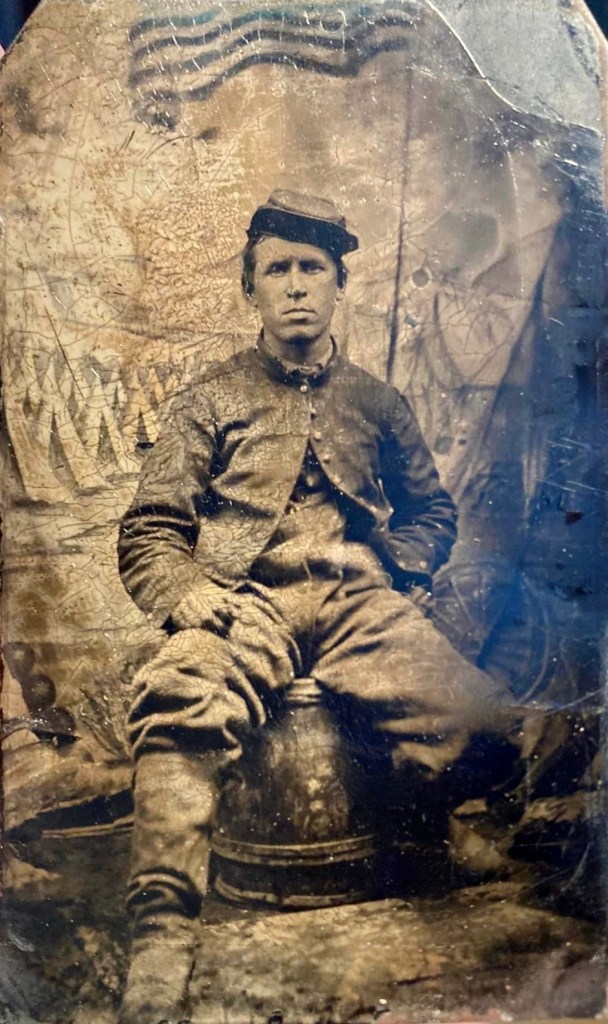
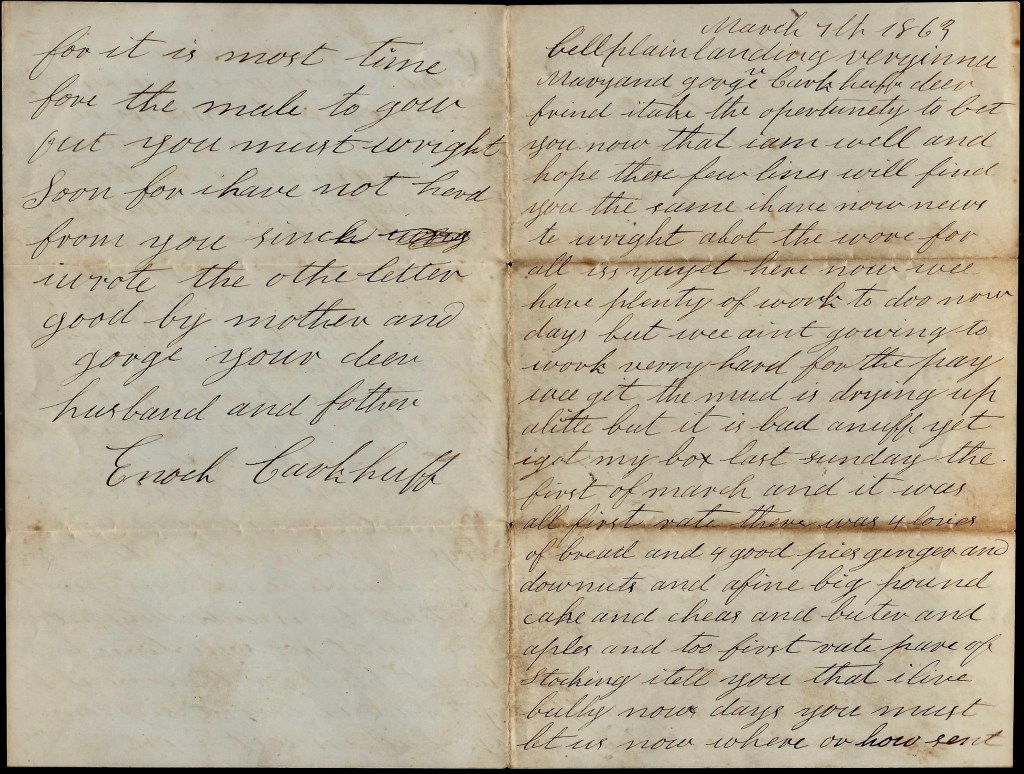
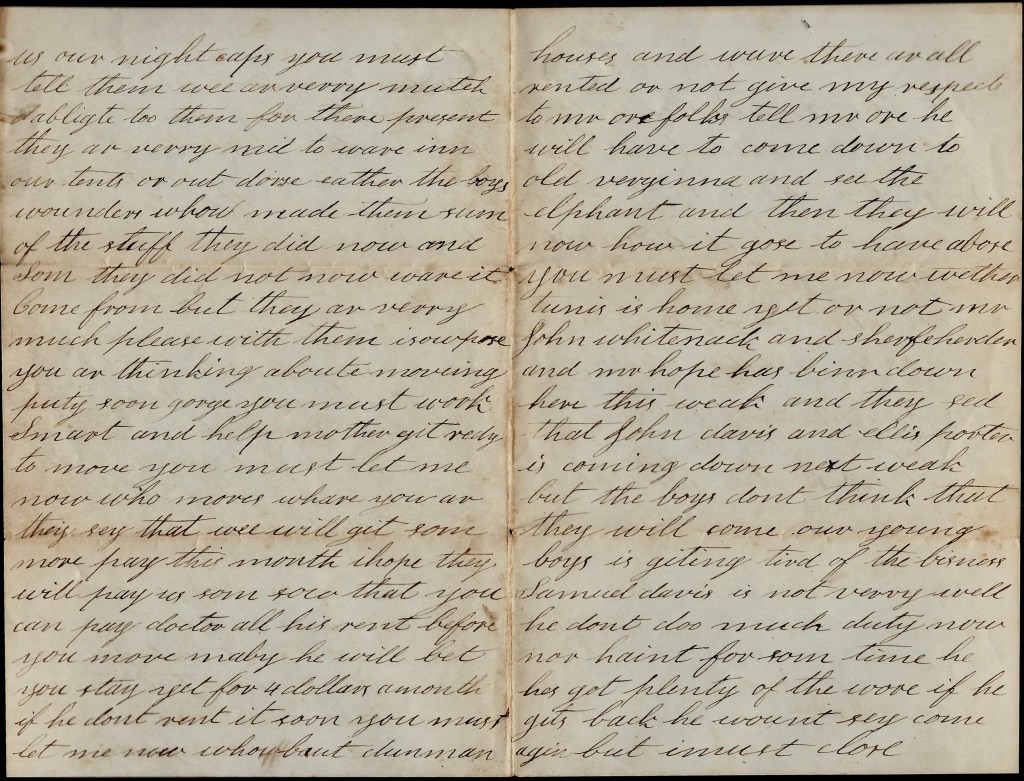

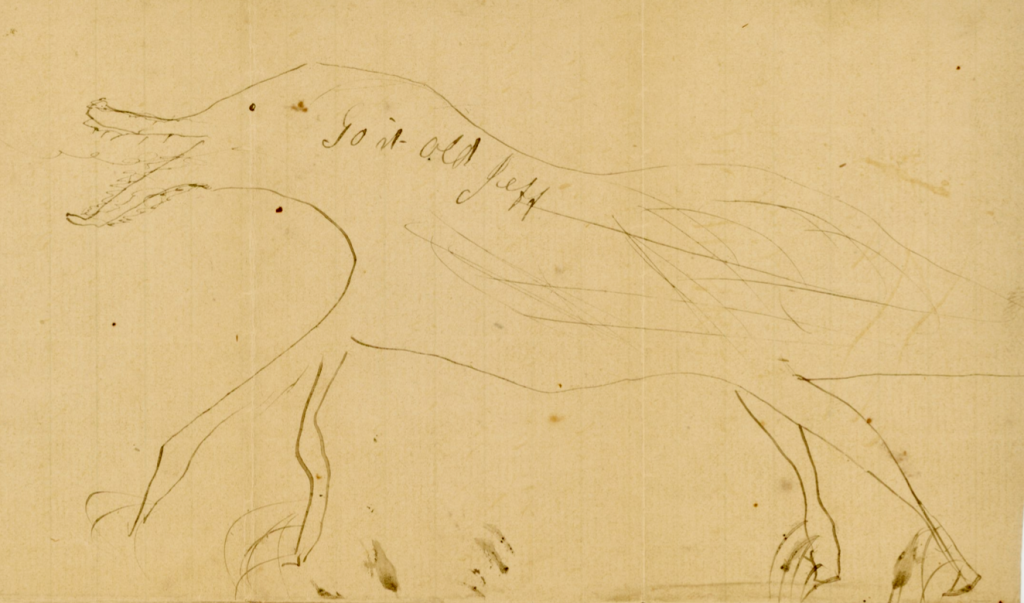

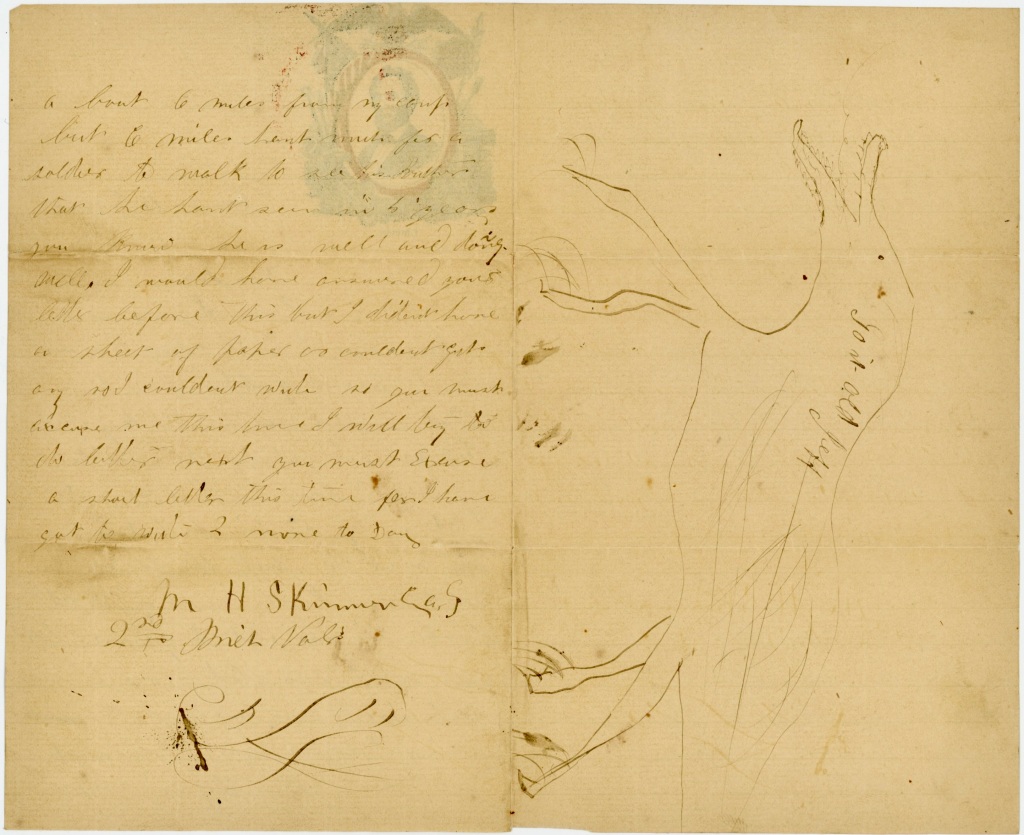
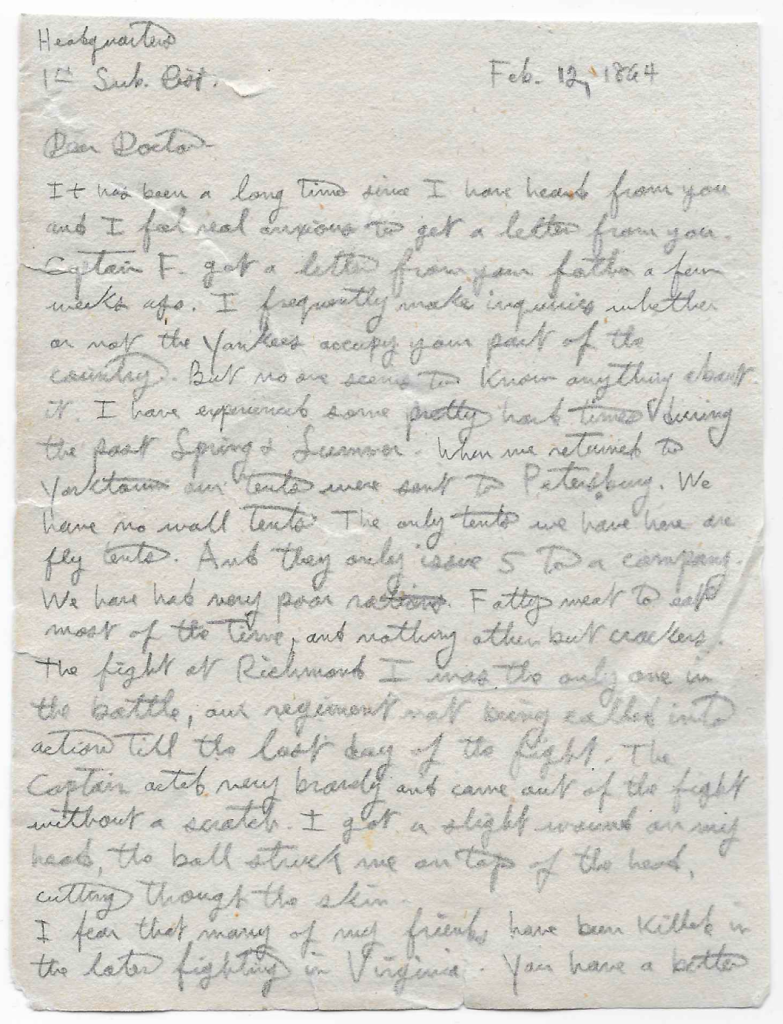

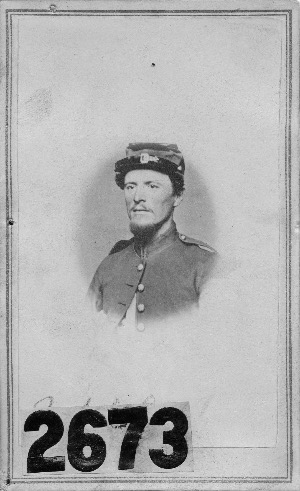


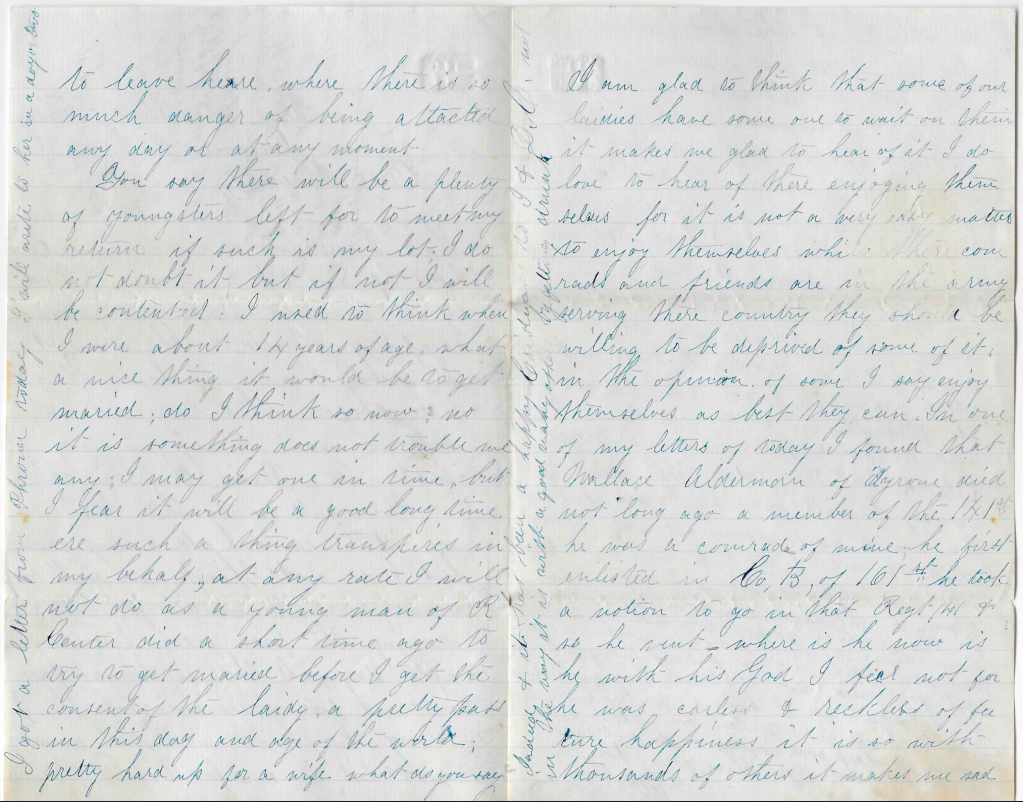
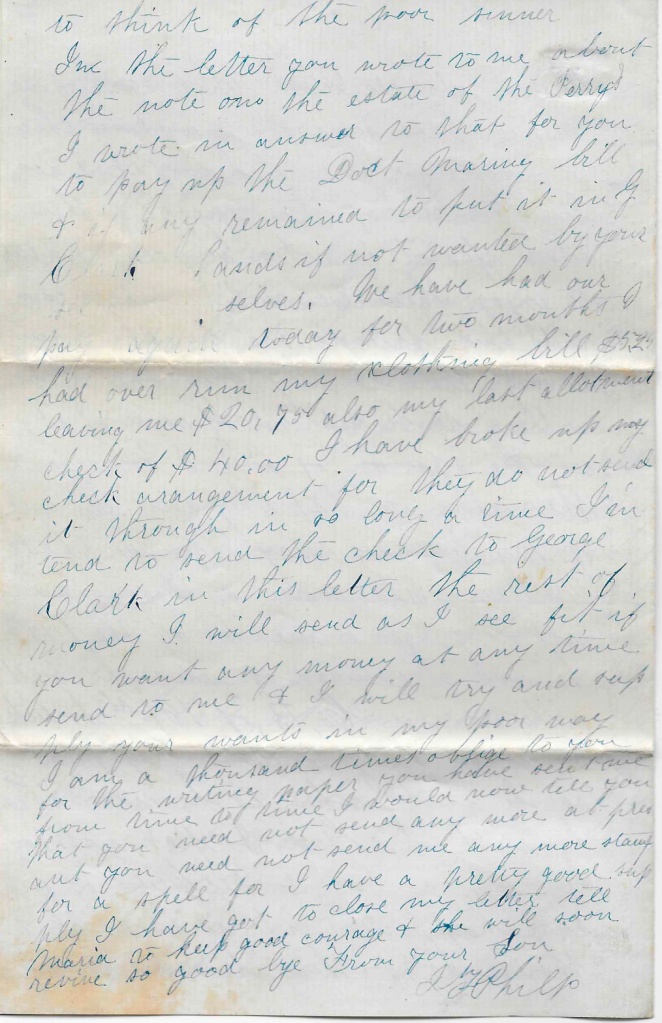

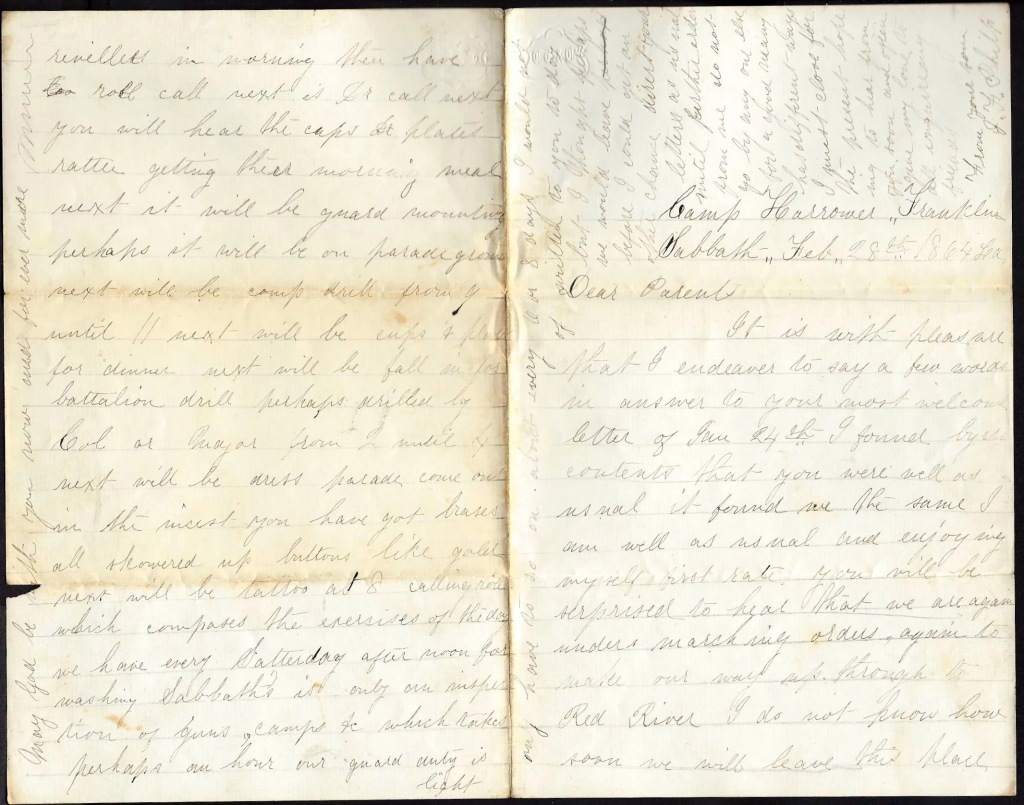

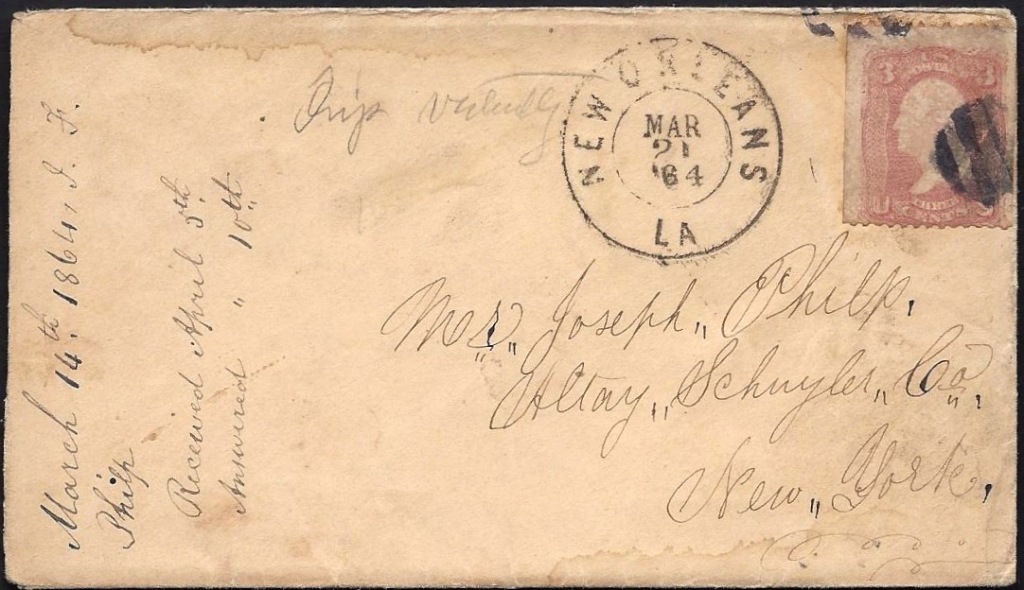


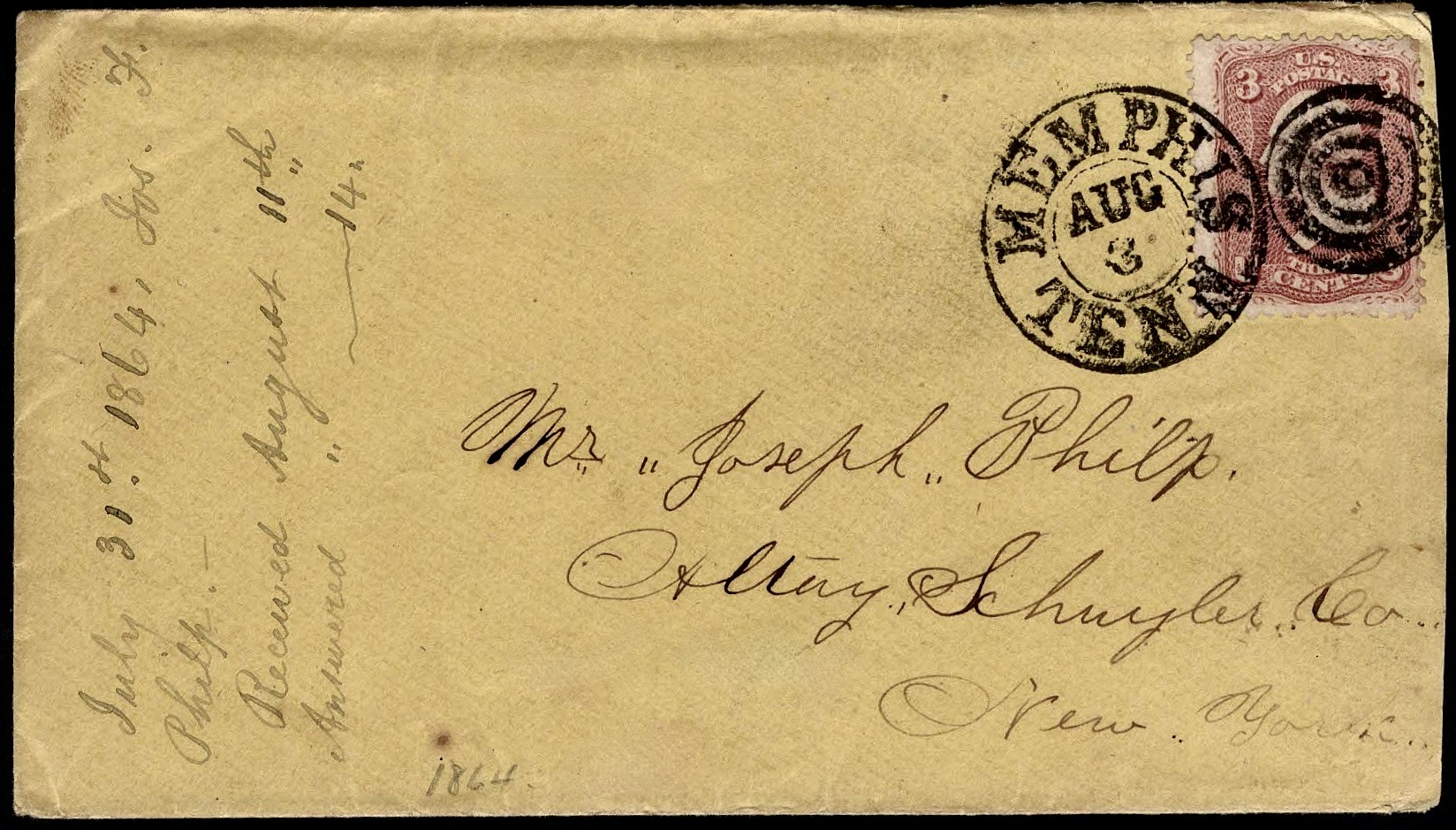
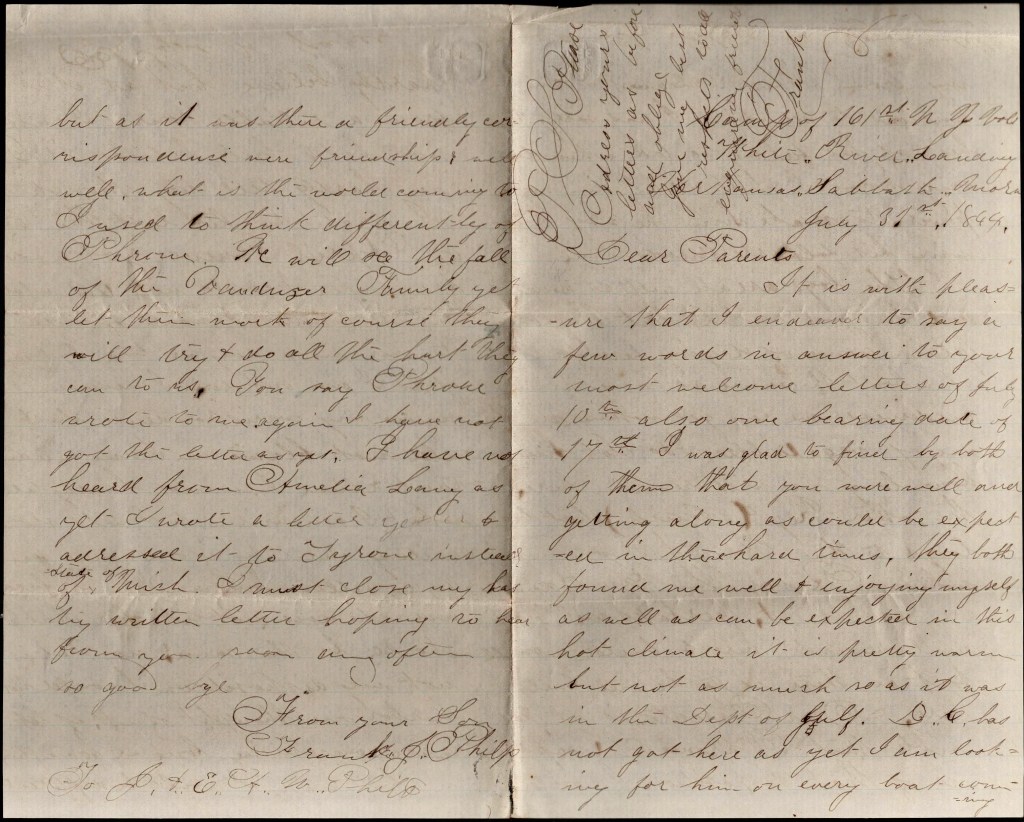

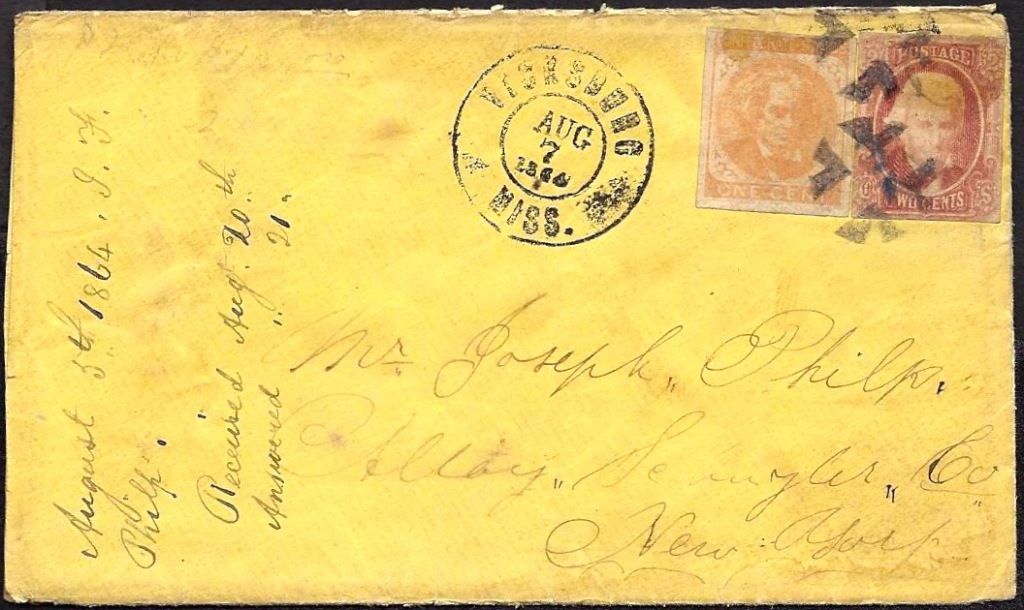


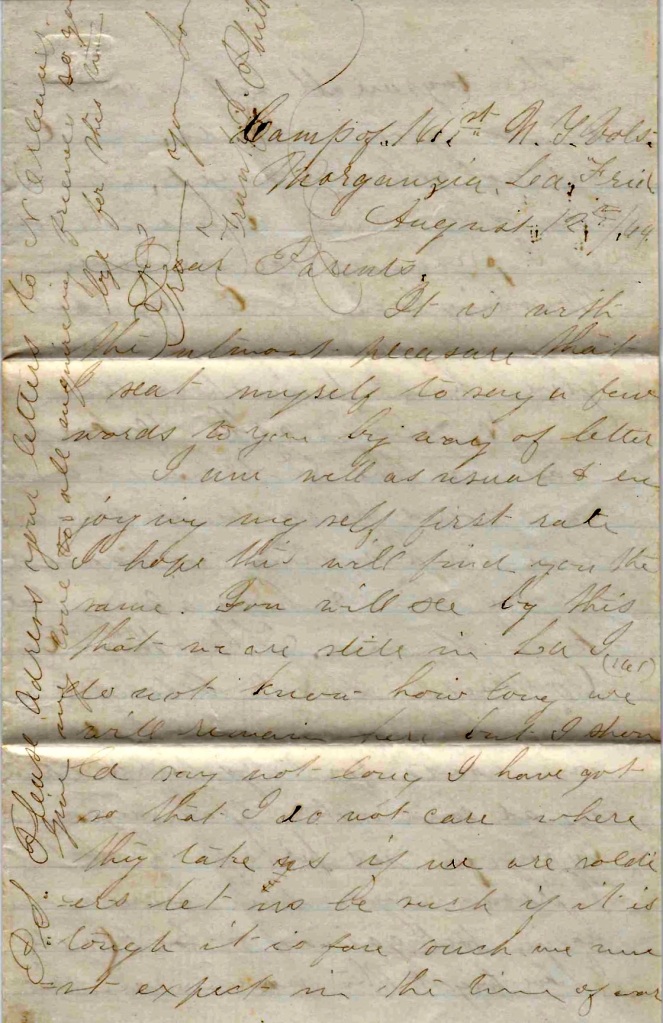


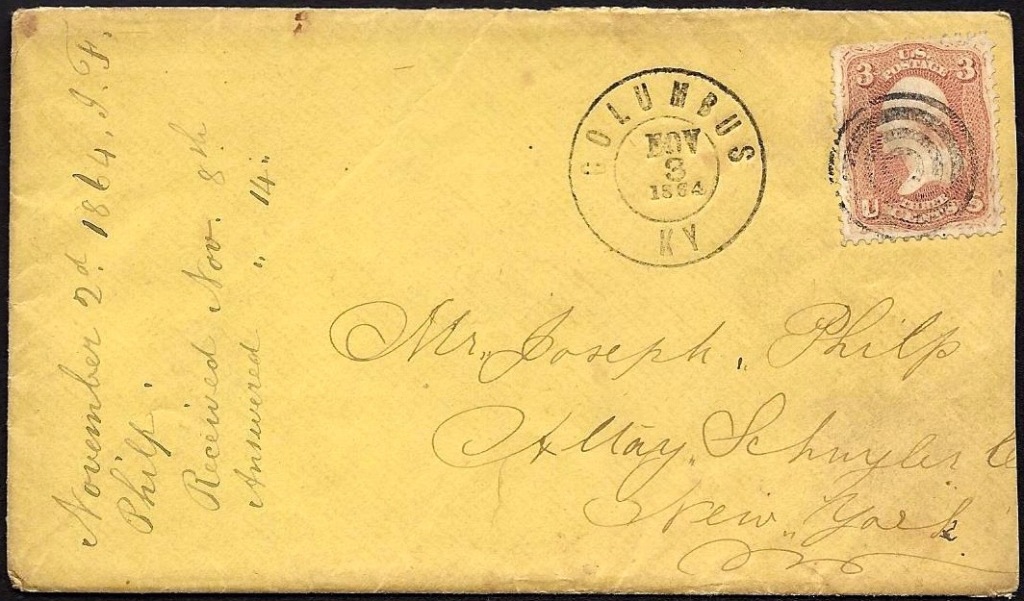
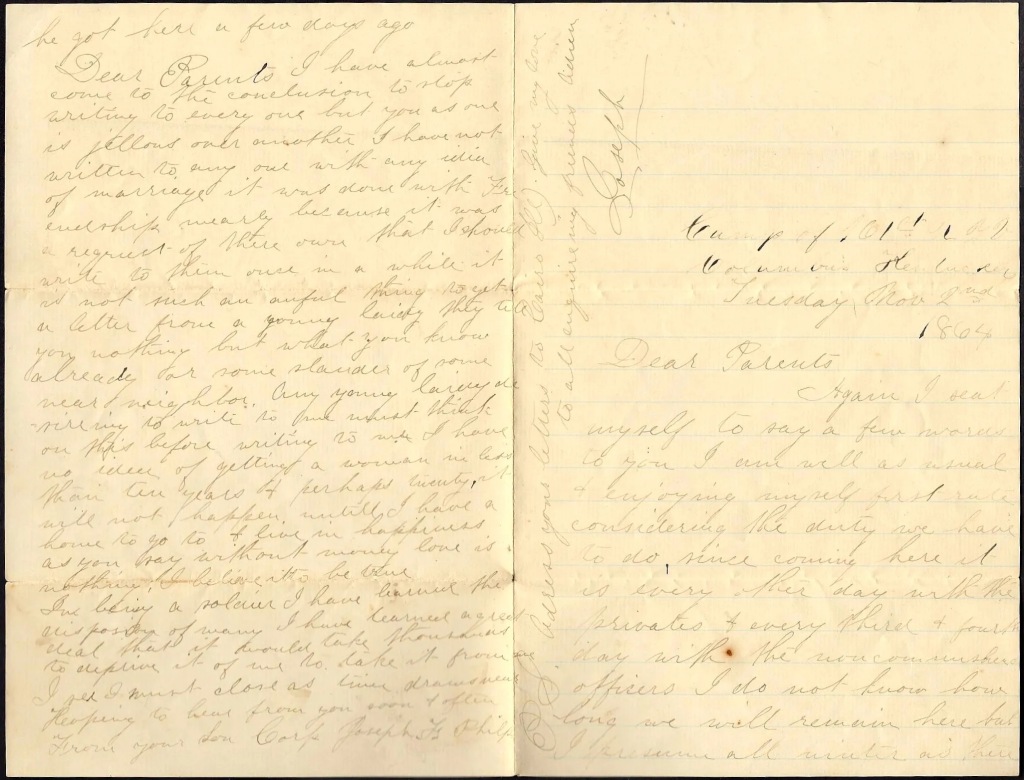


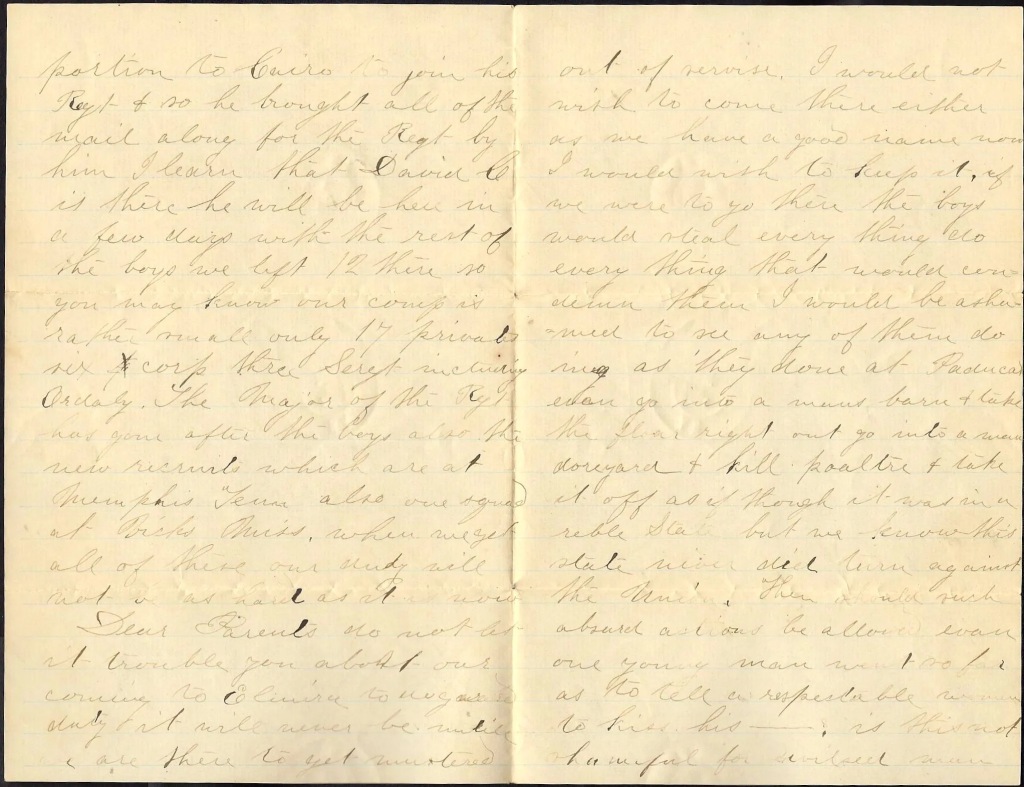
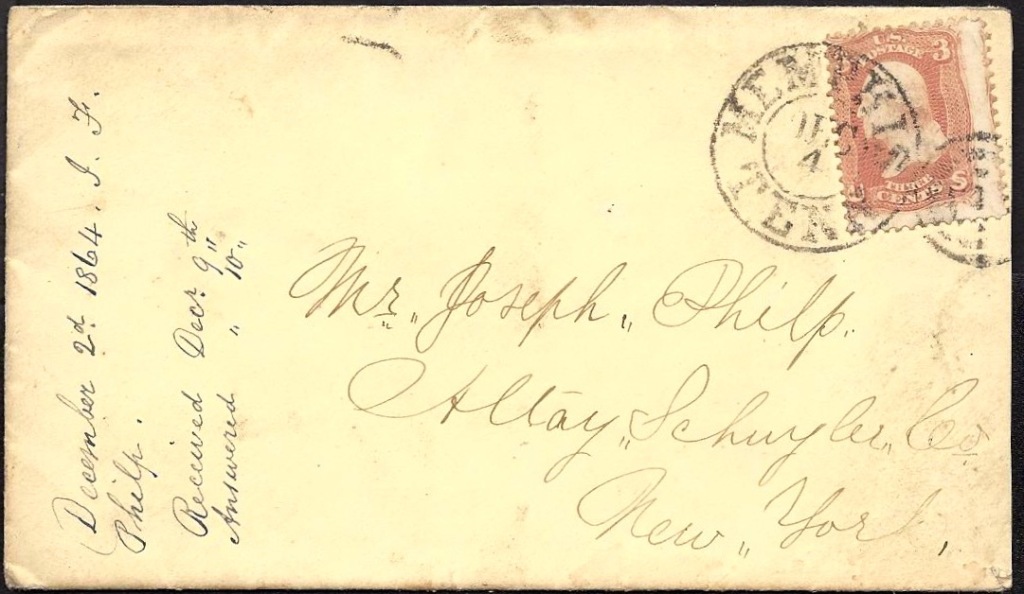

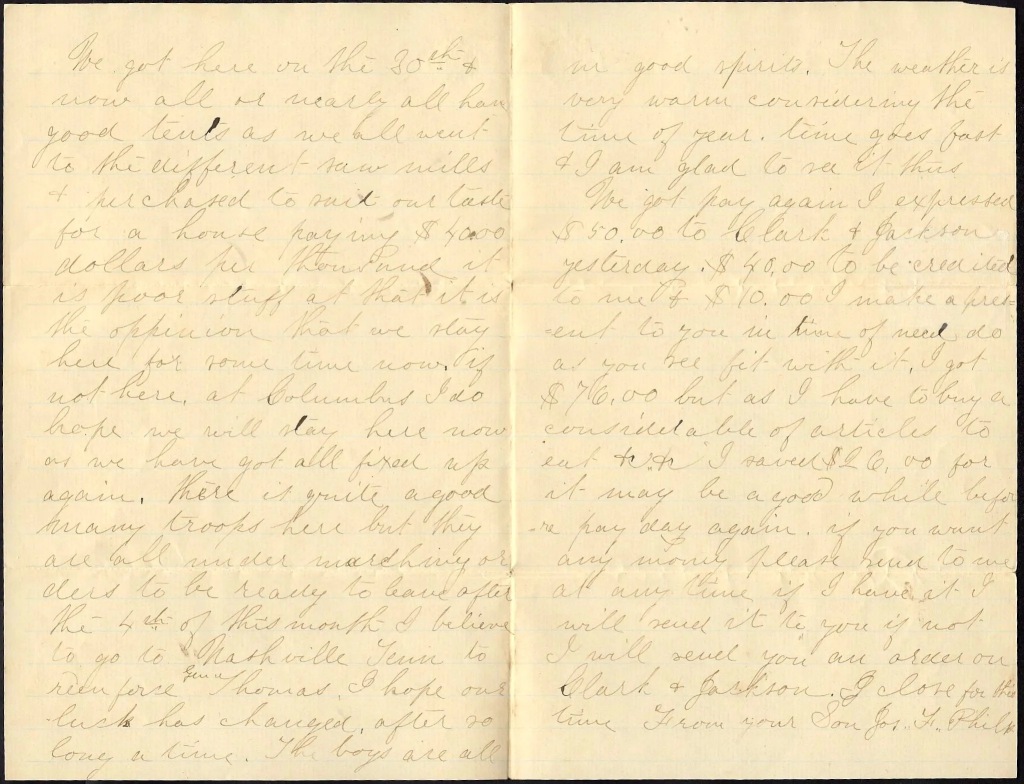


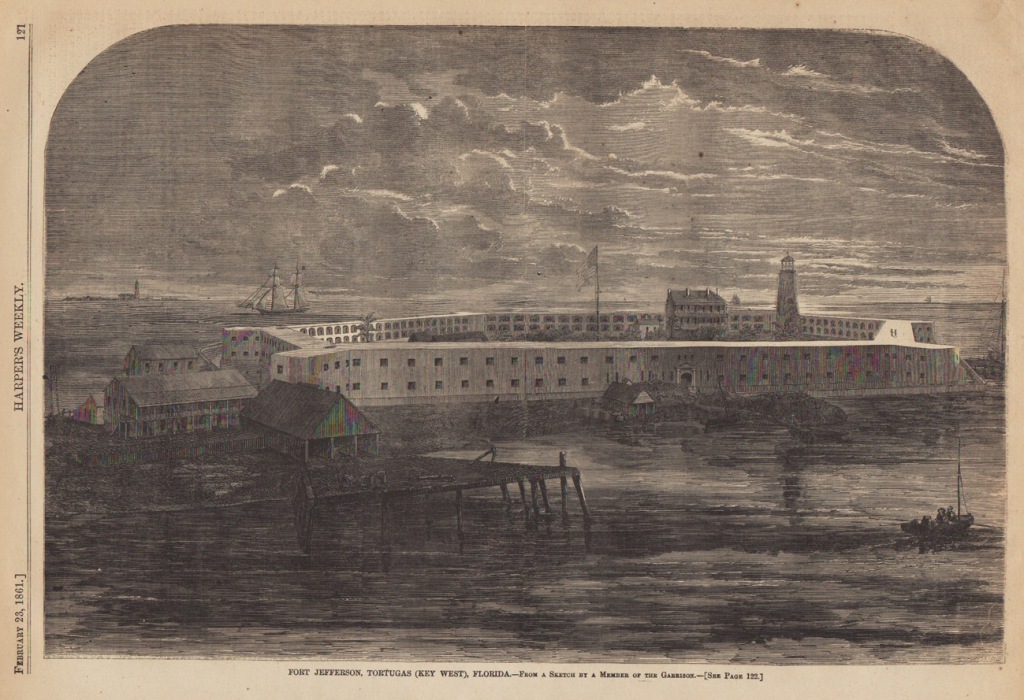

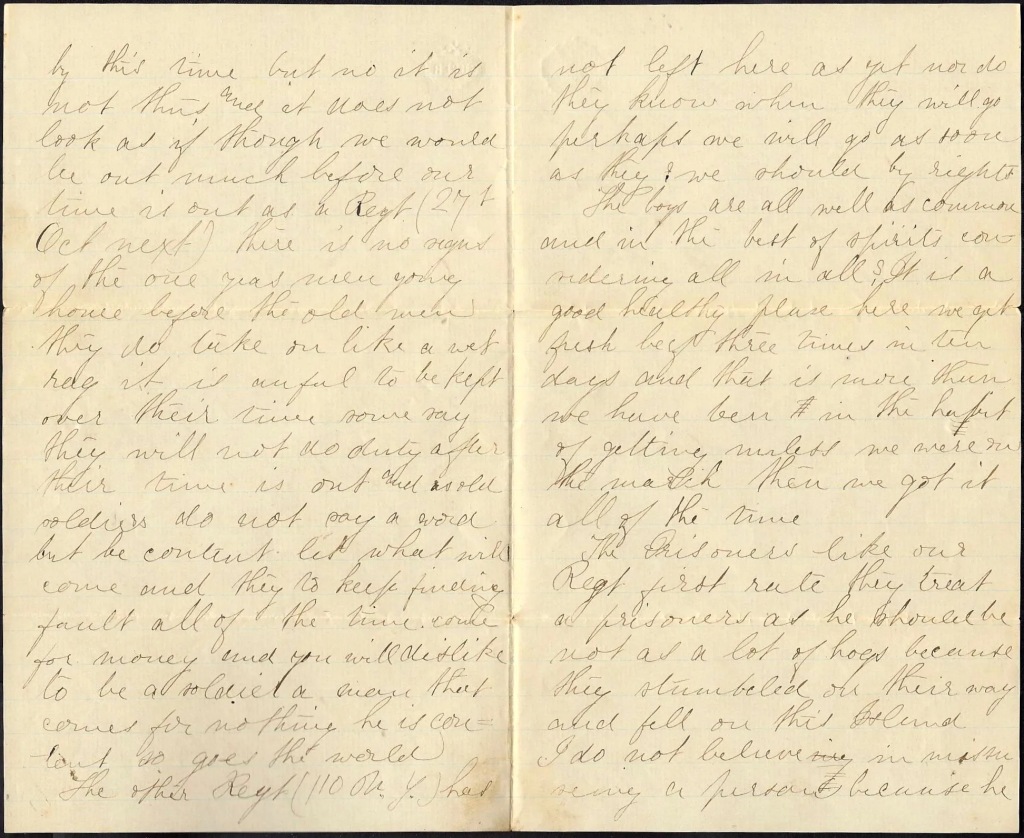
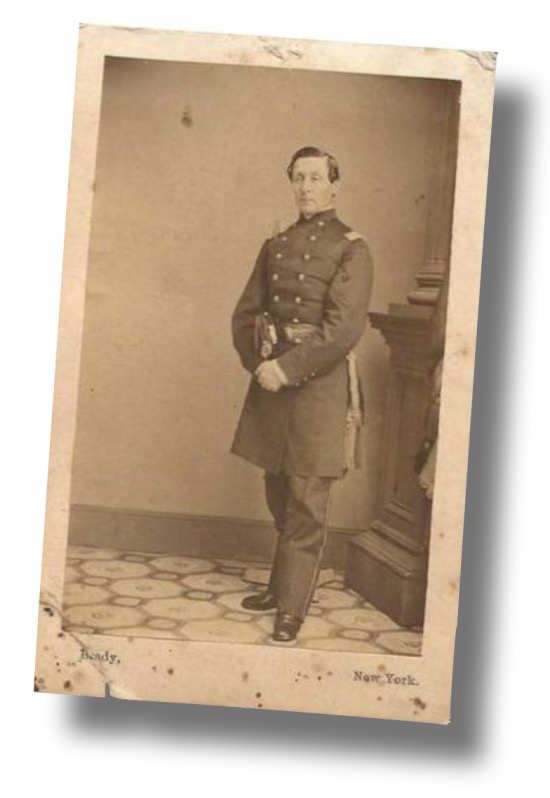
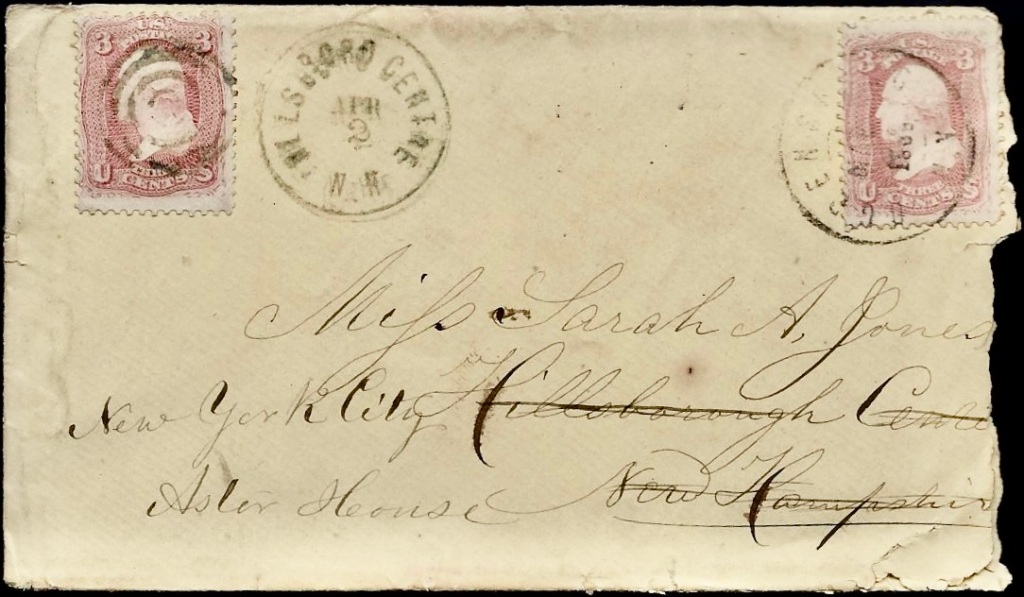
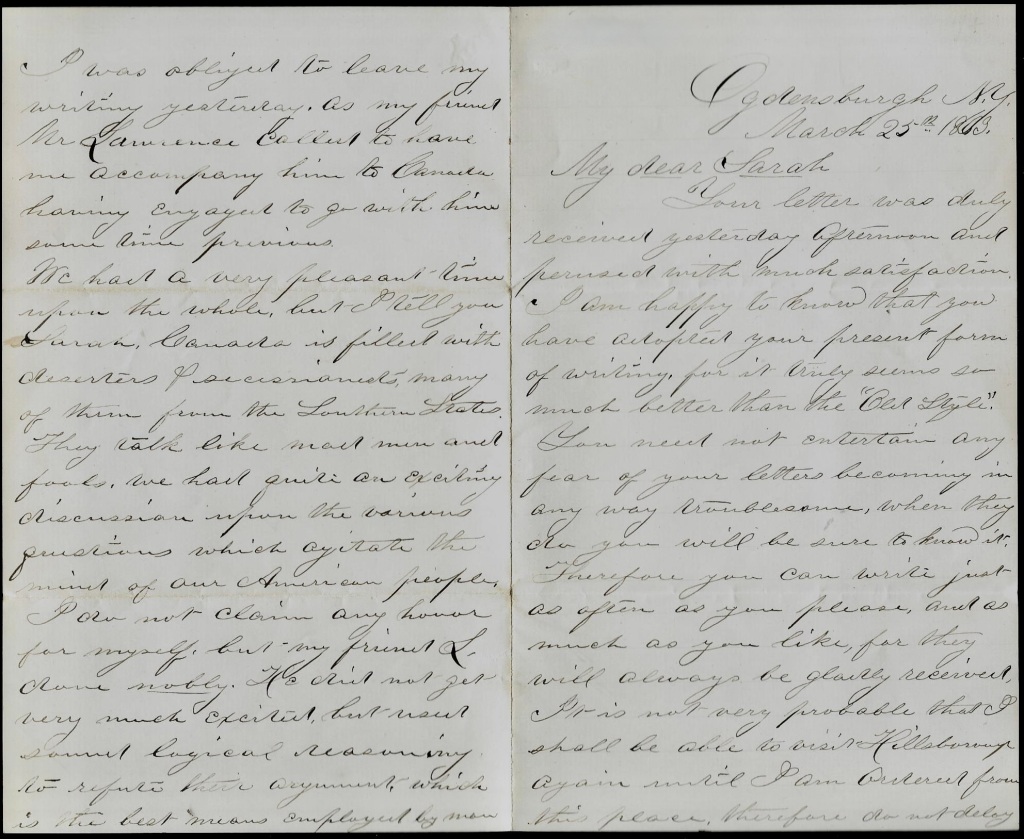
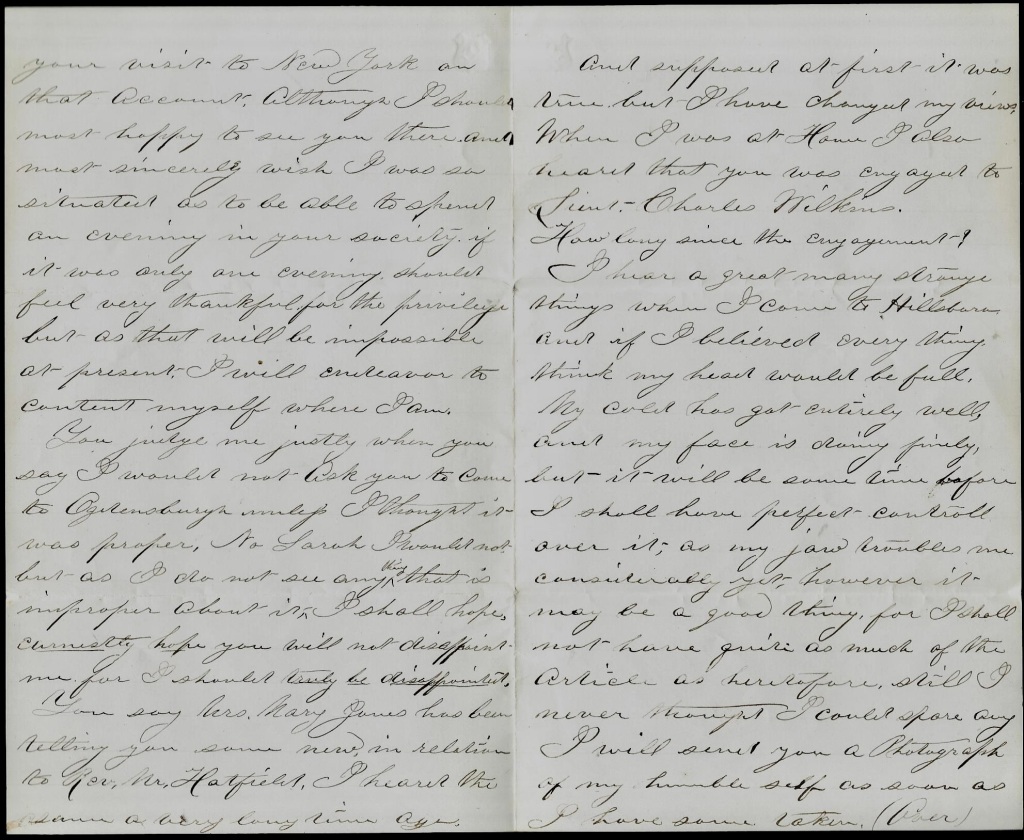
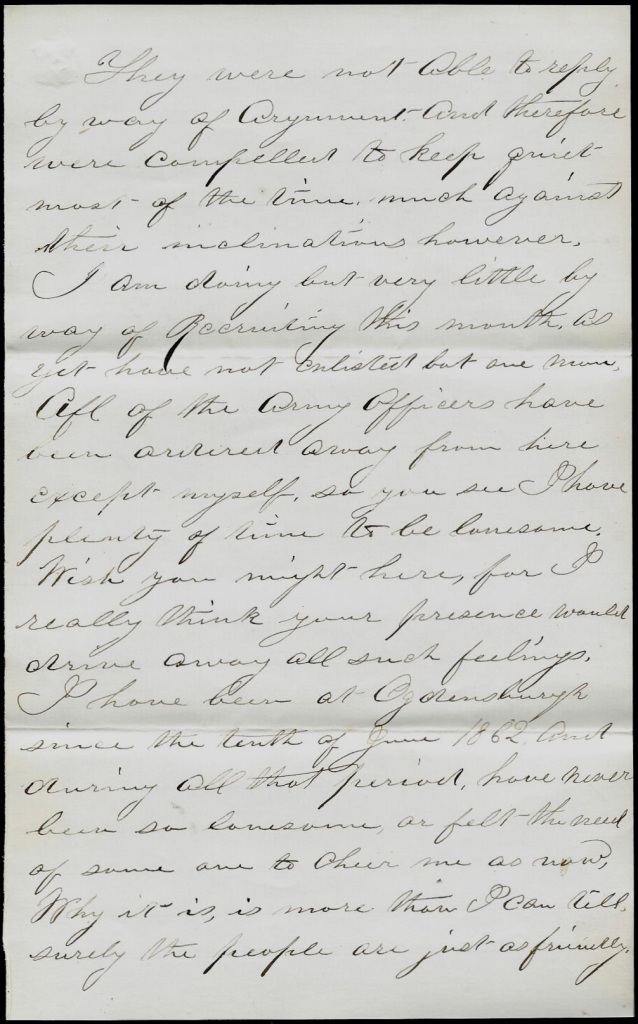
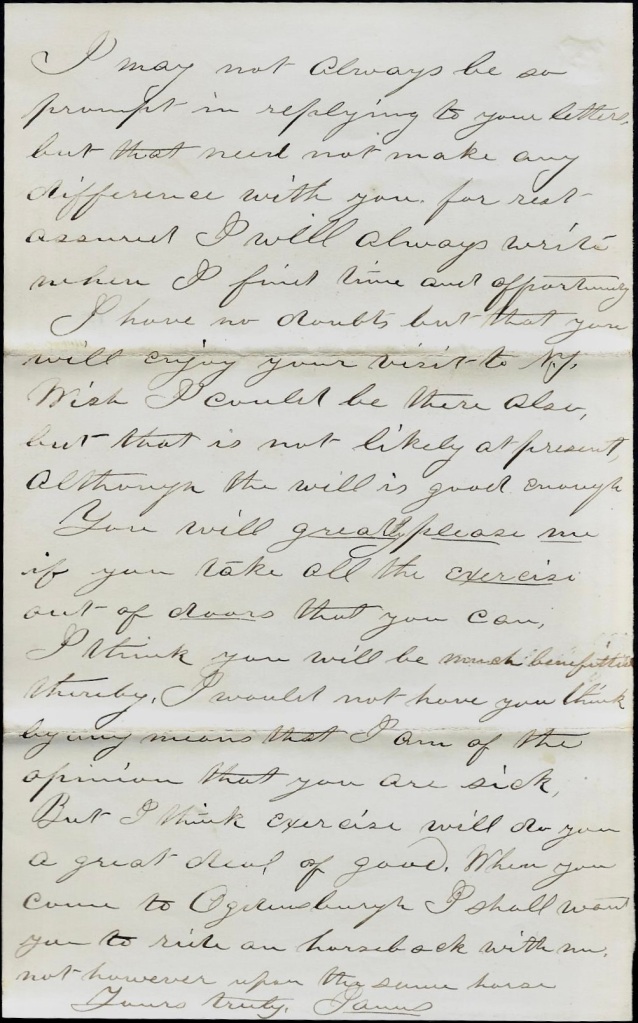
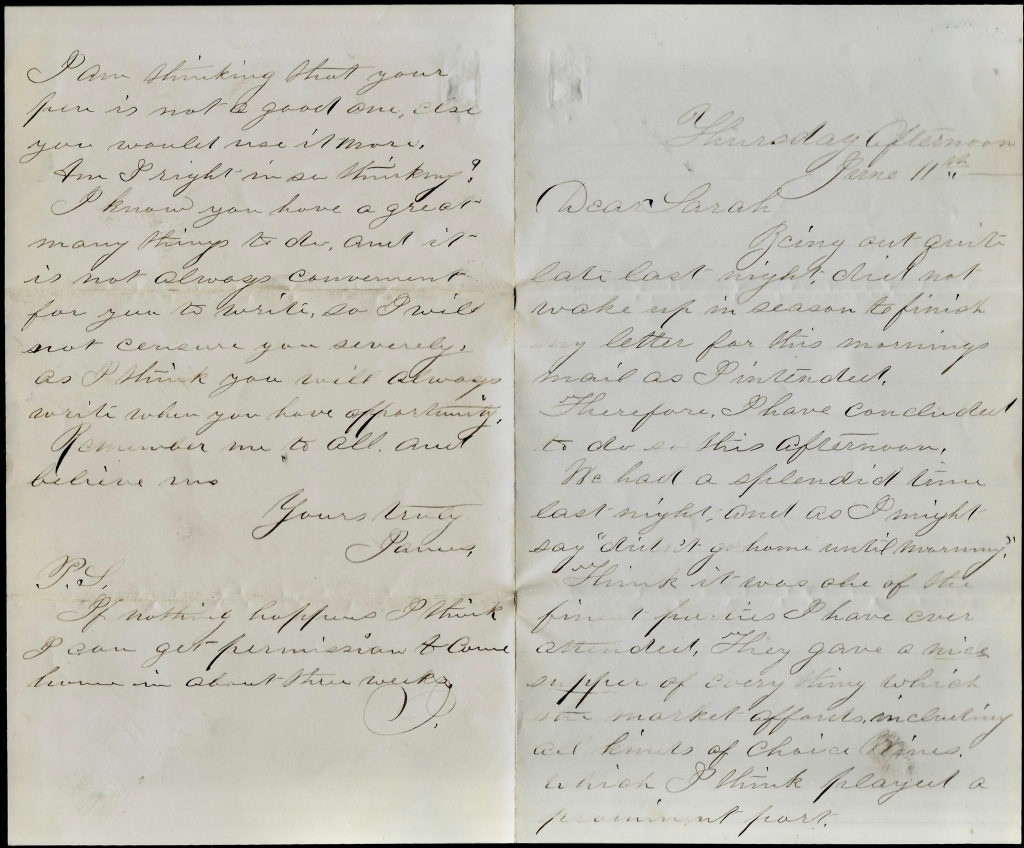
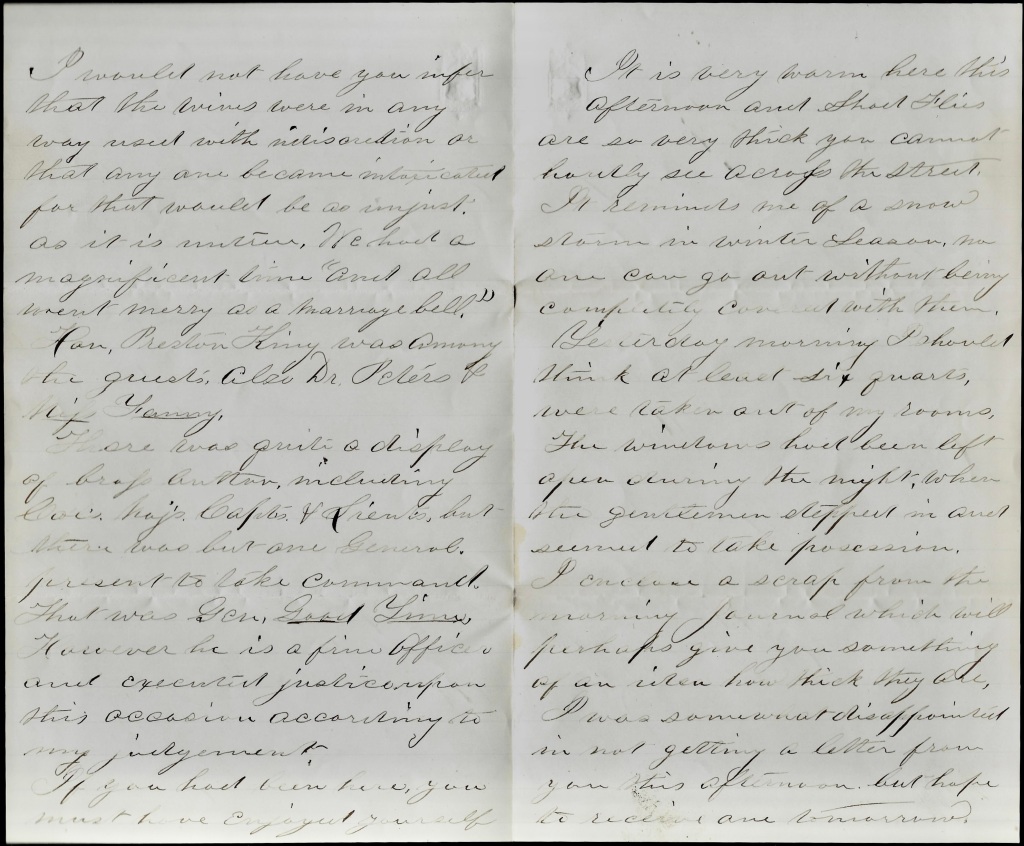
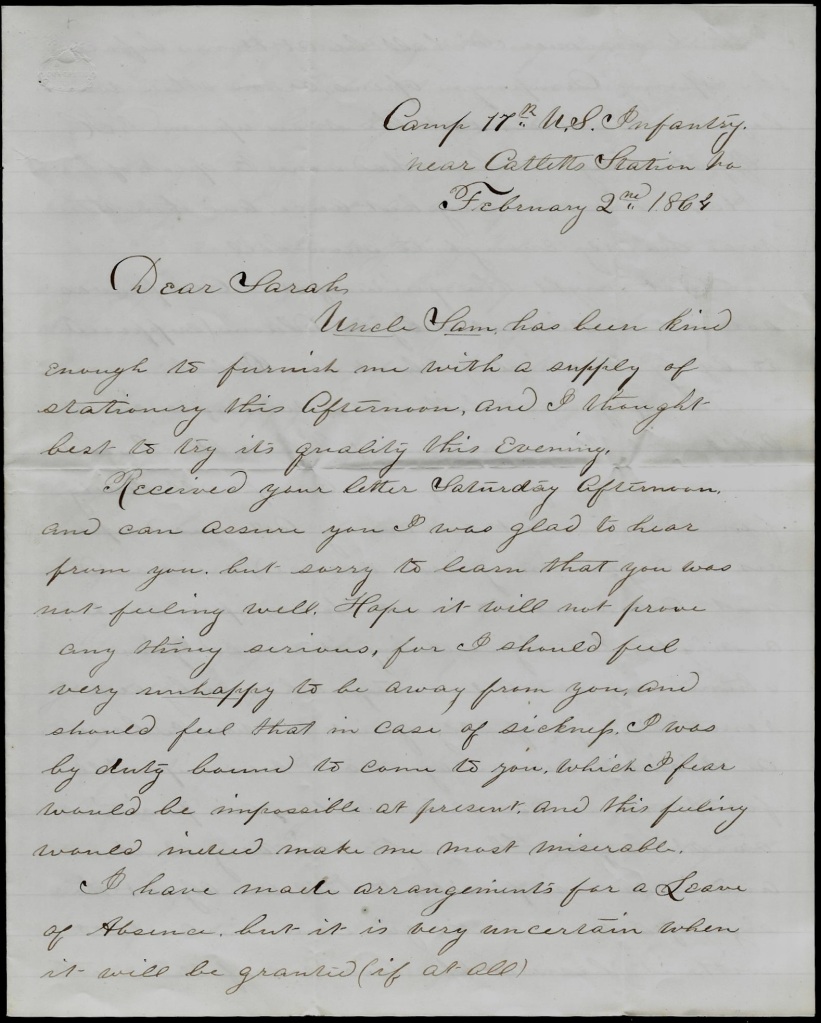
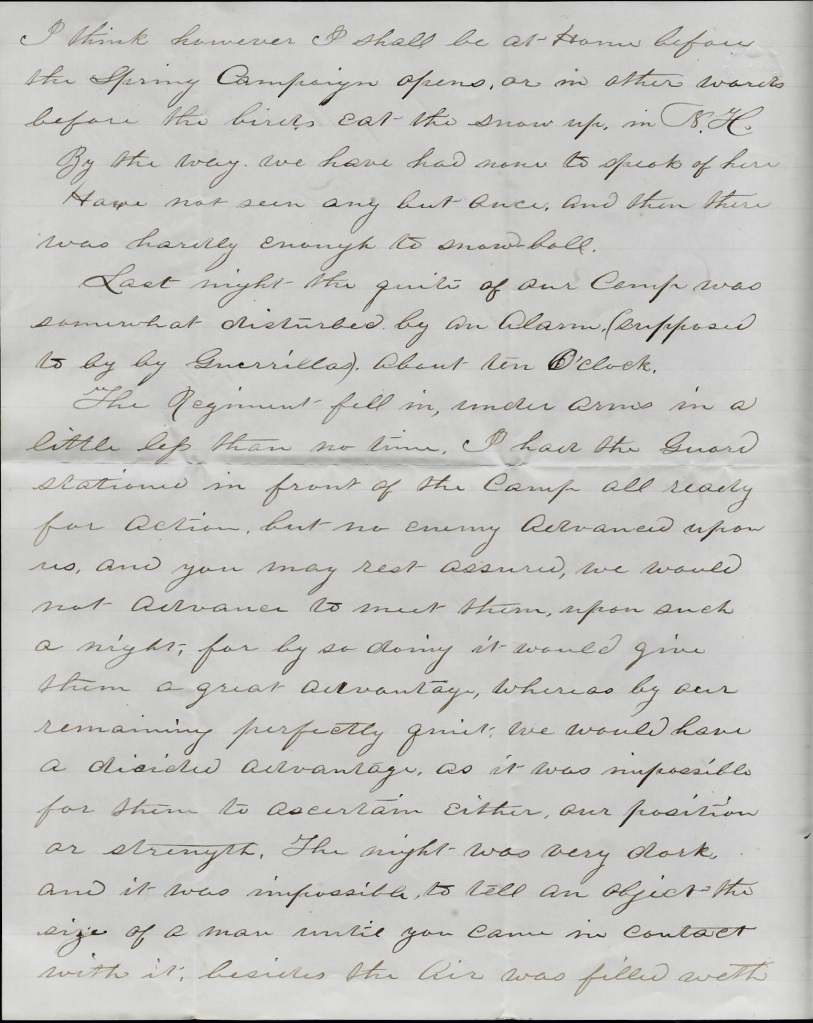
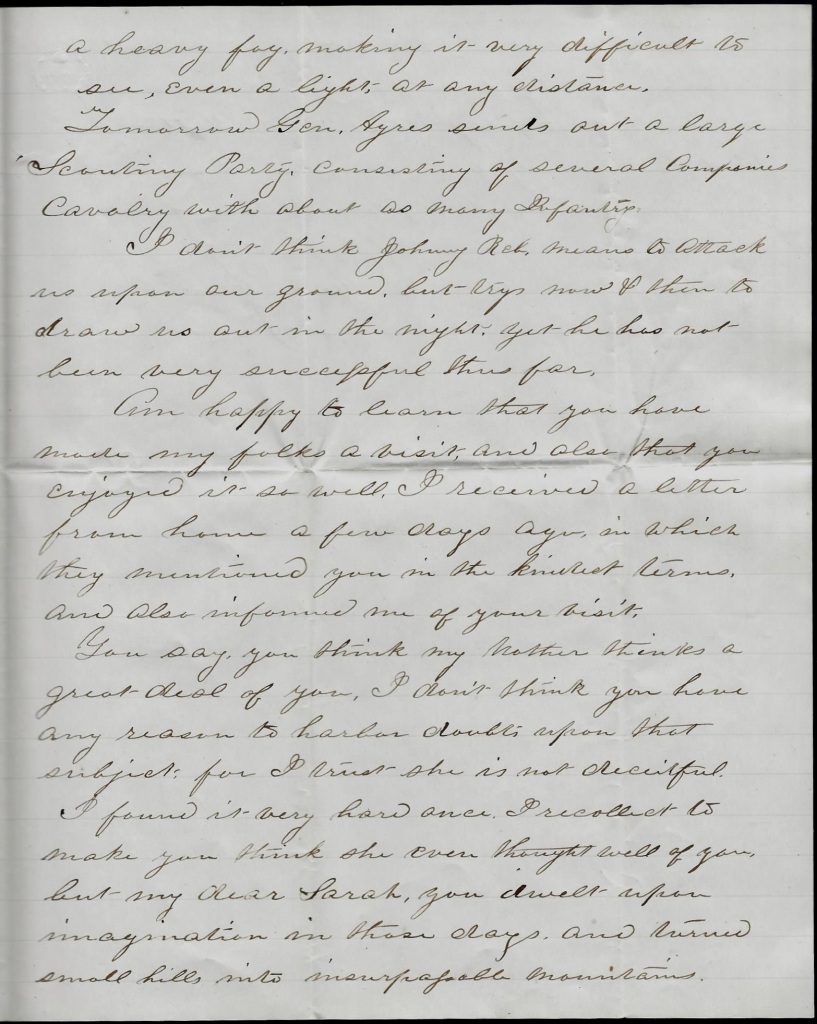
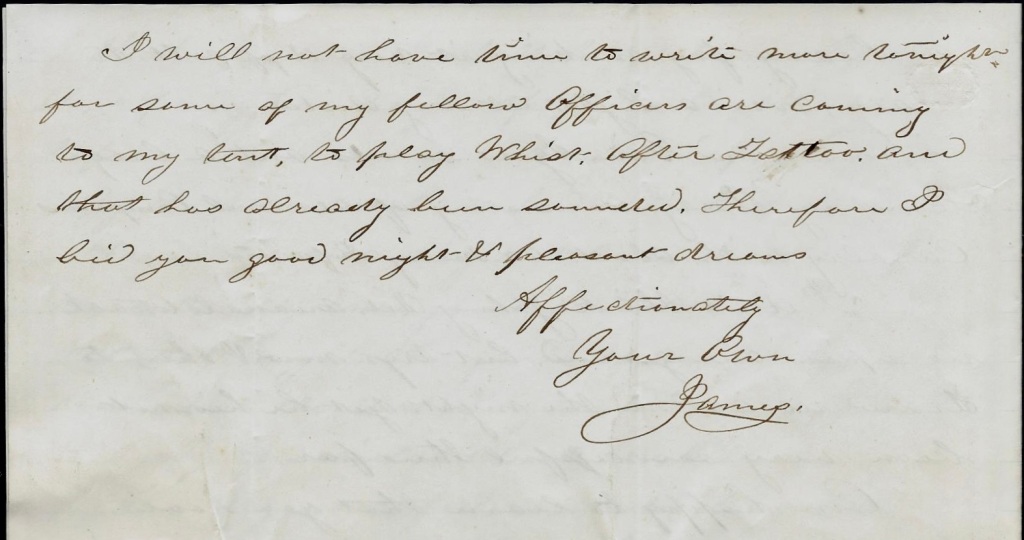


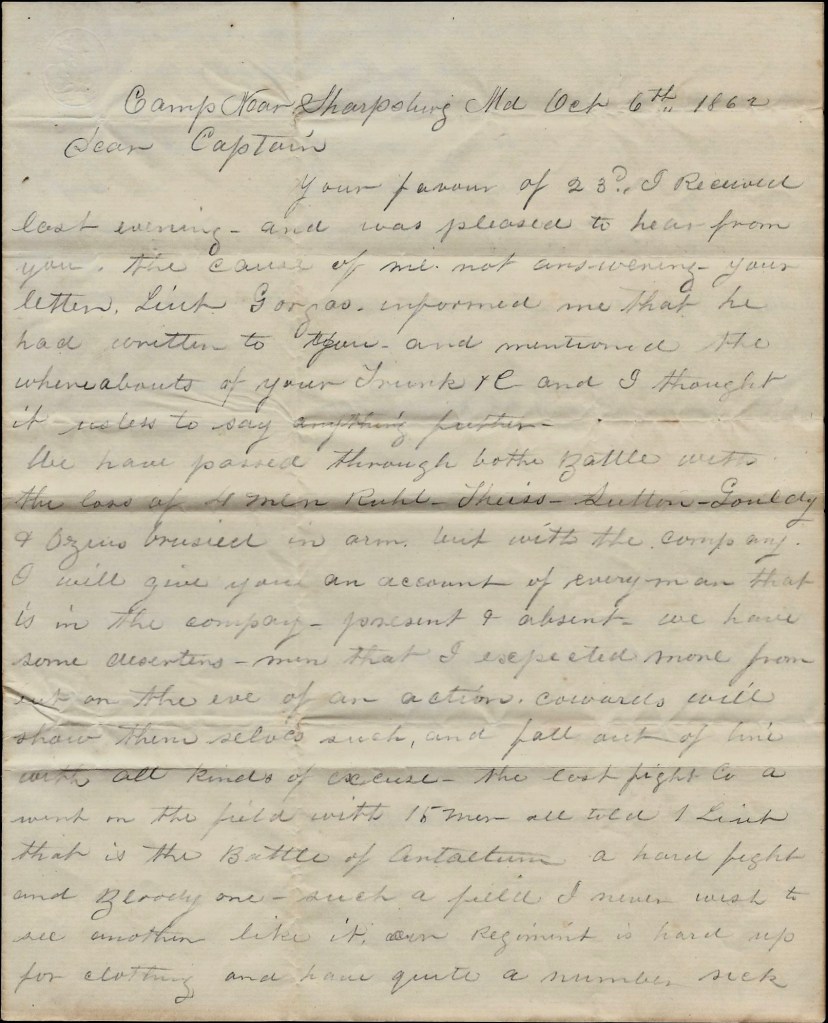


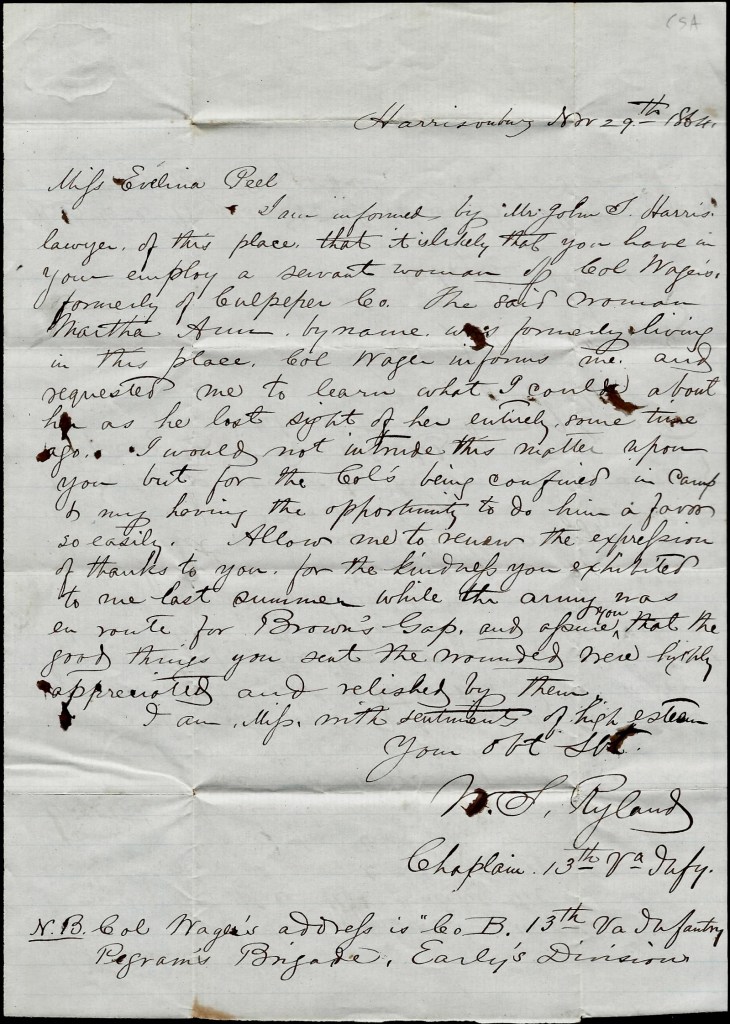
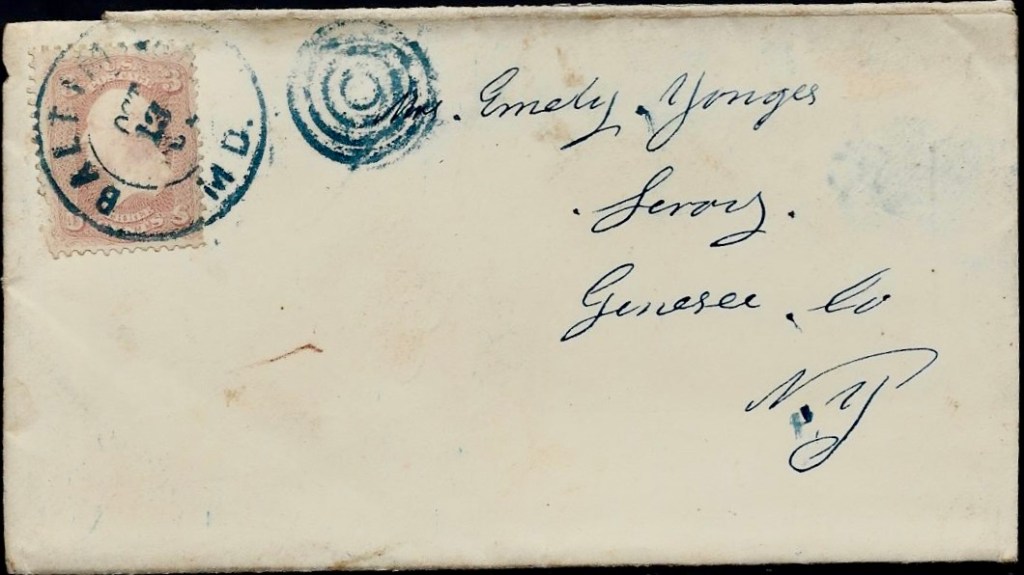
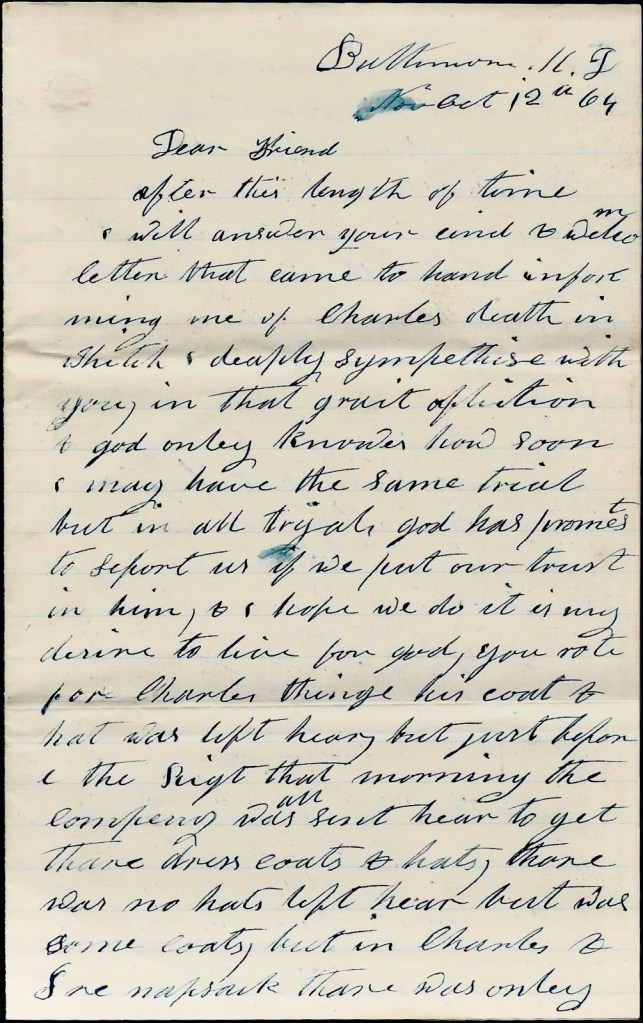
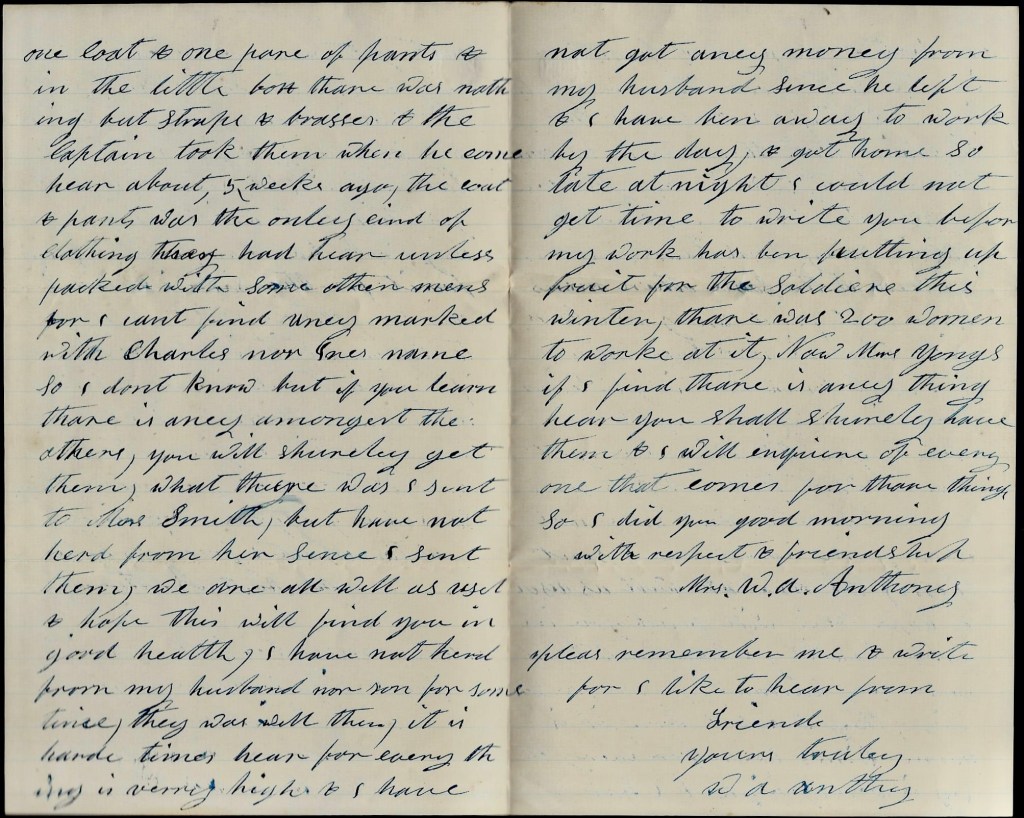
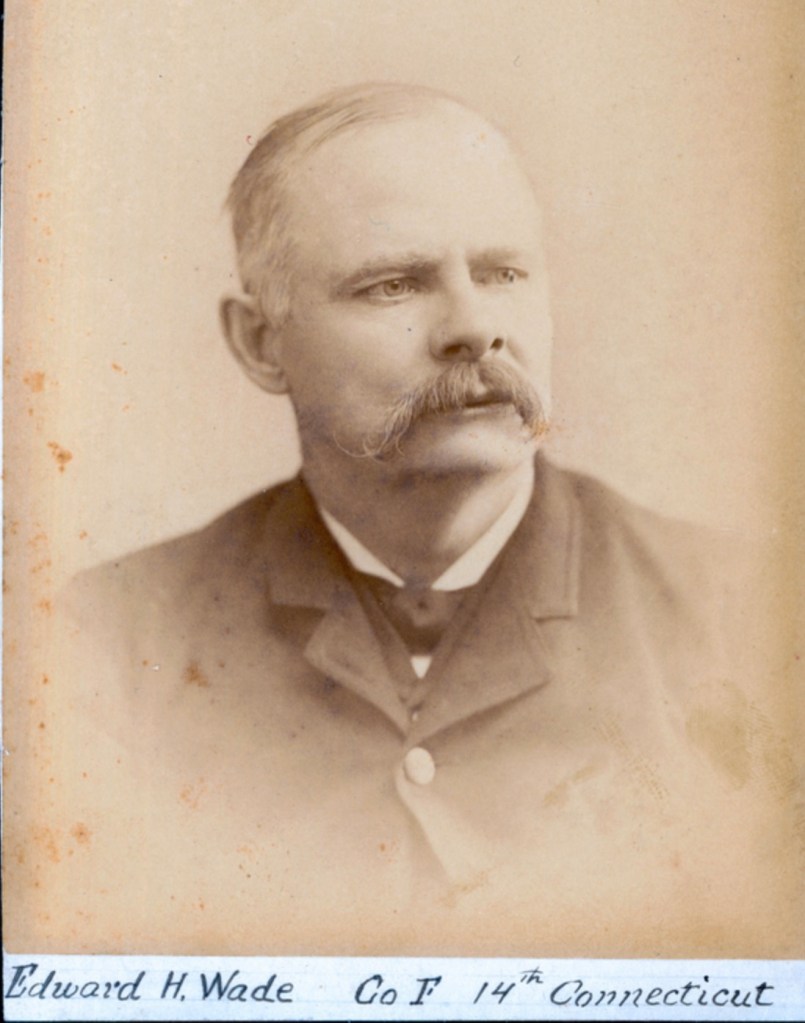

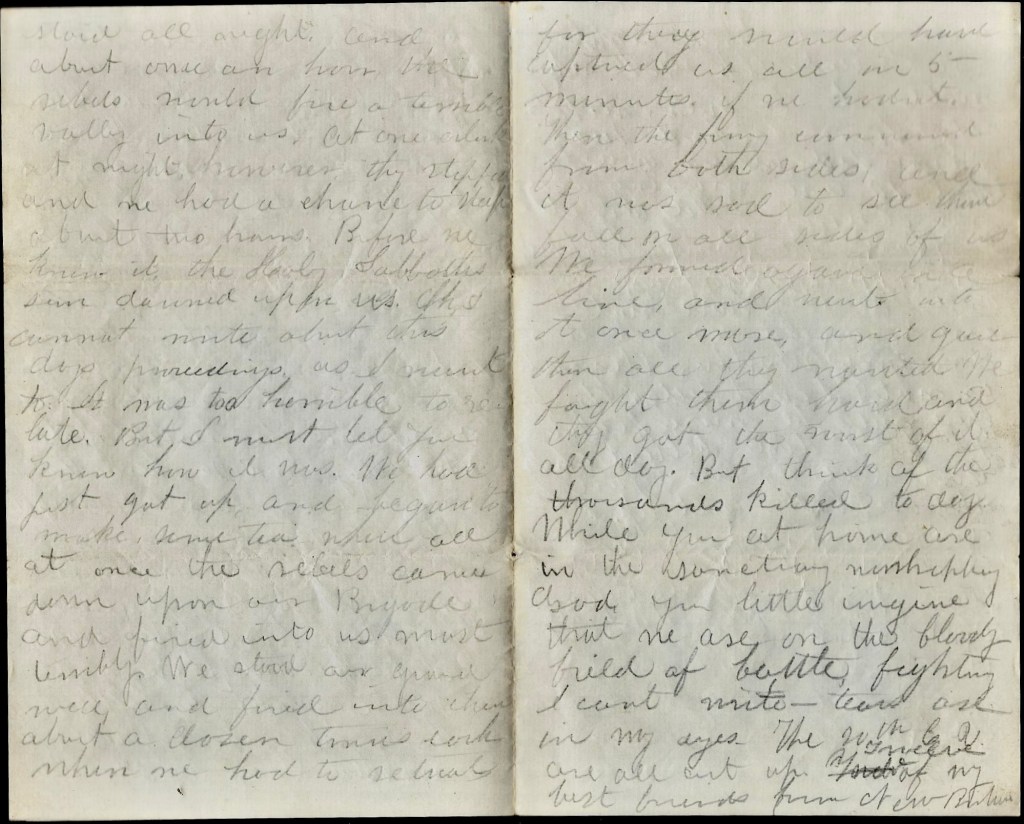


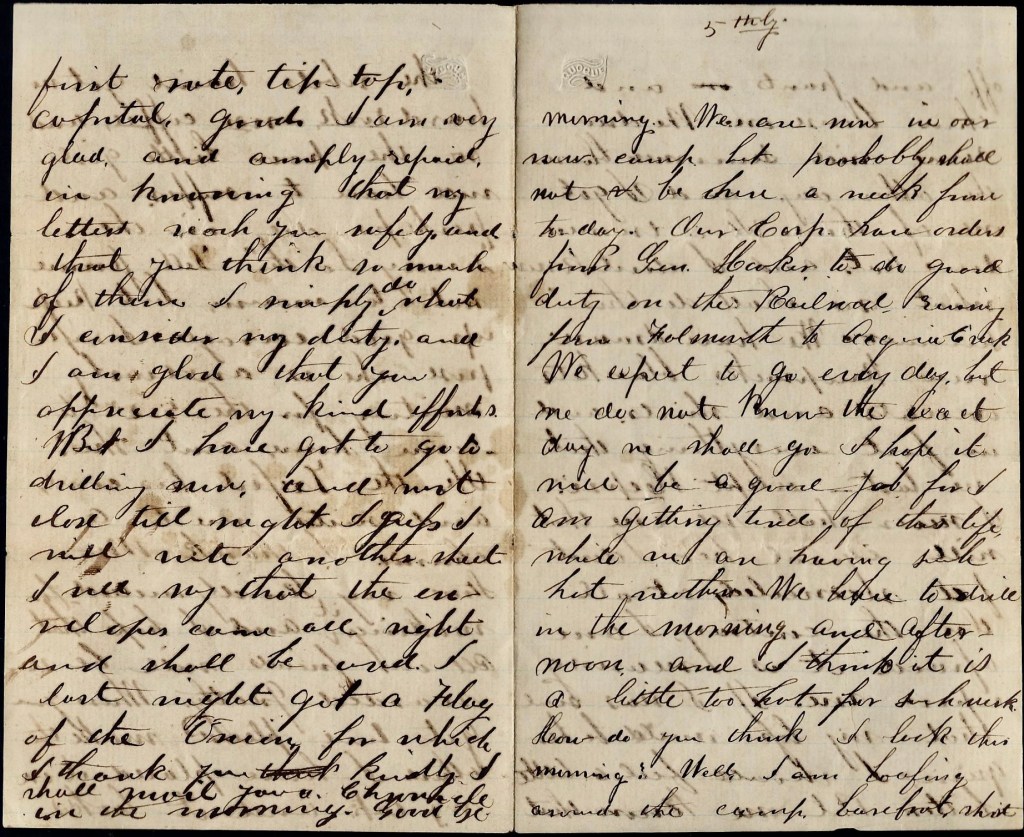


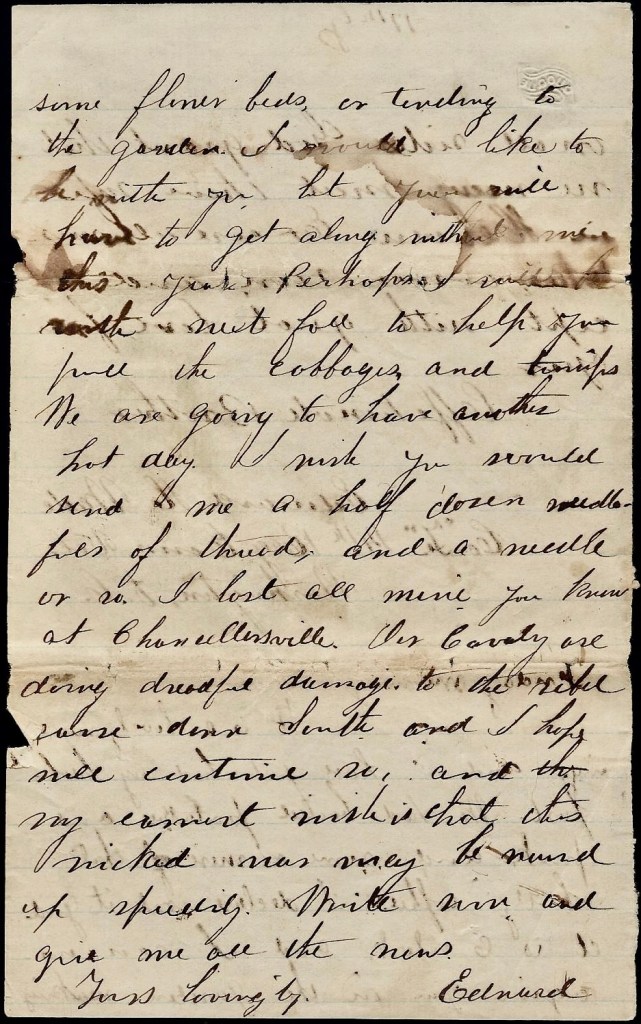
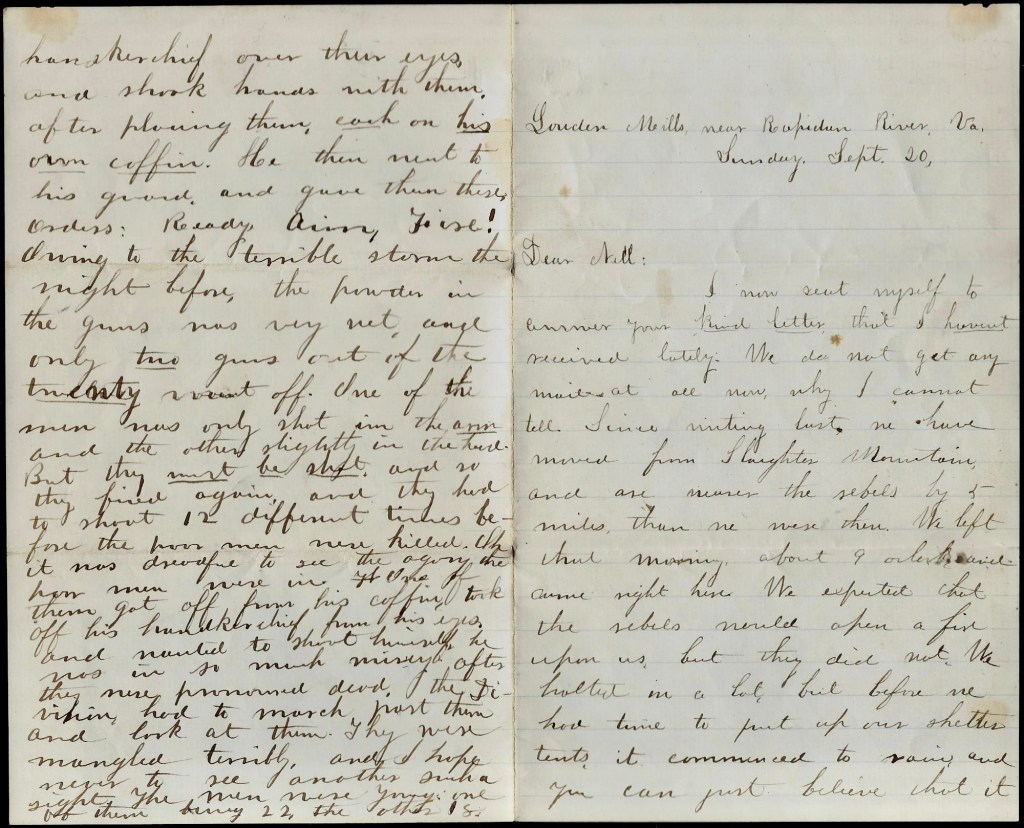

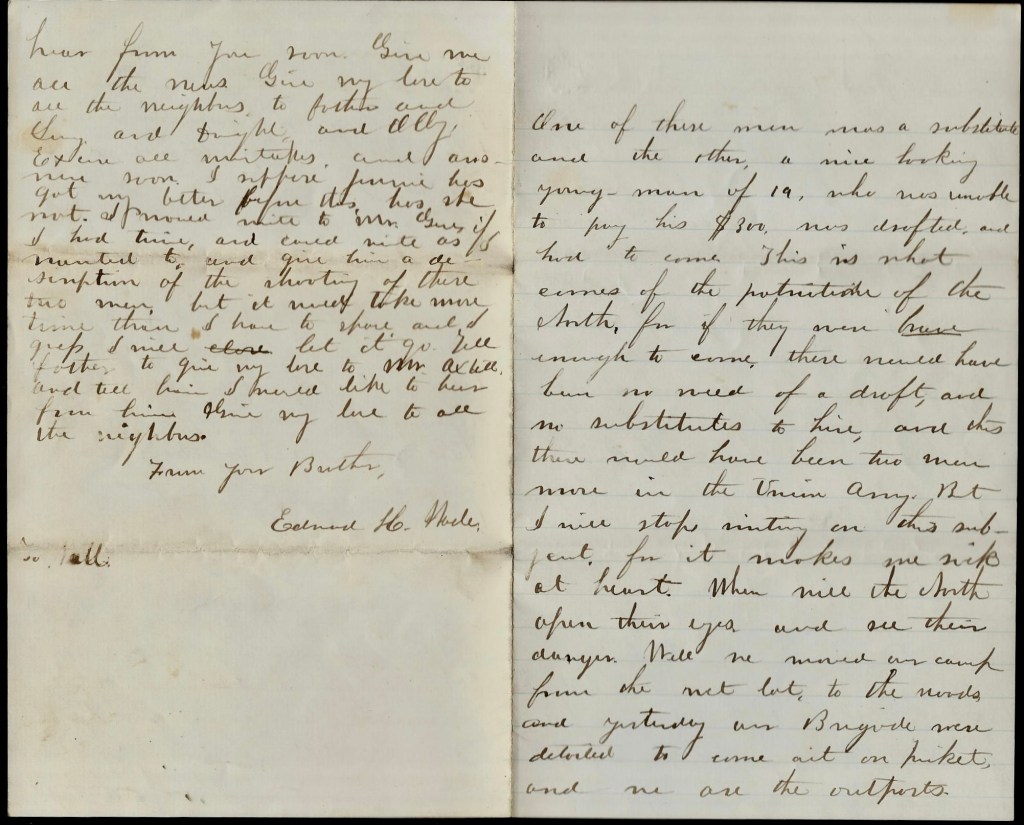

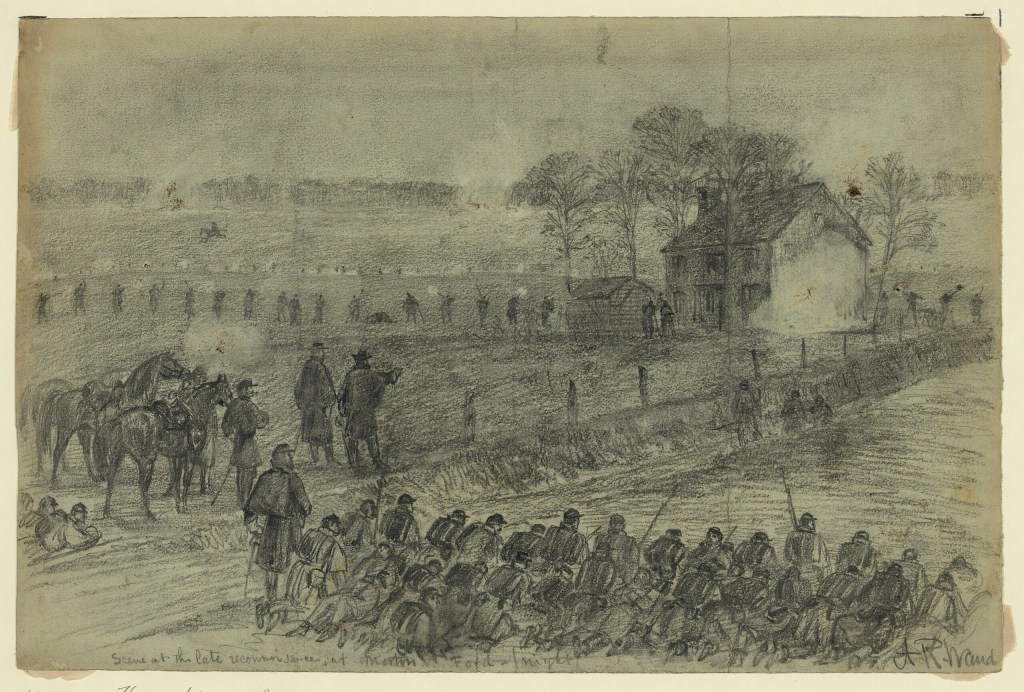
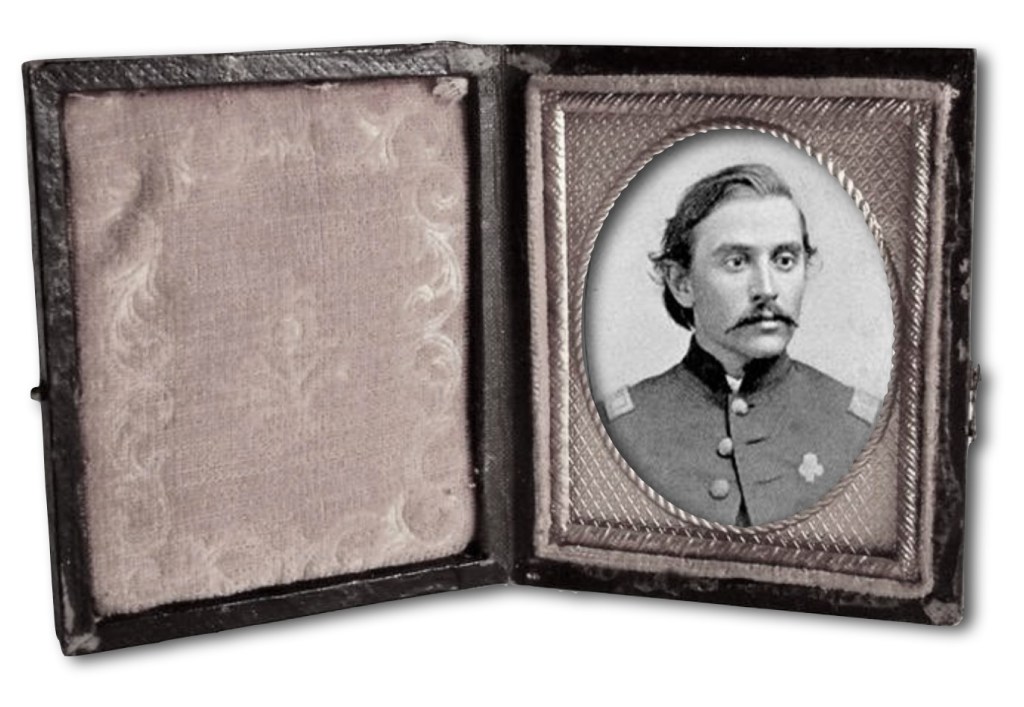


 Spared & Shared 23