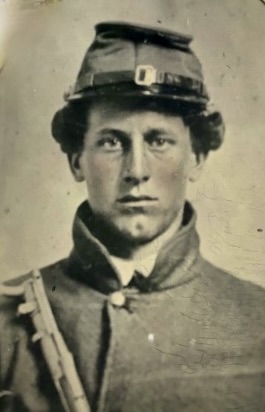
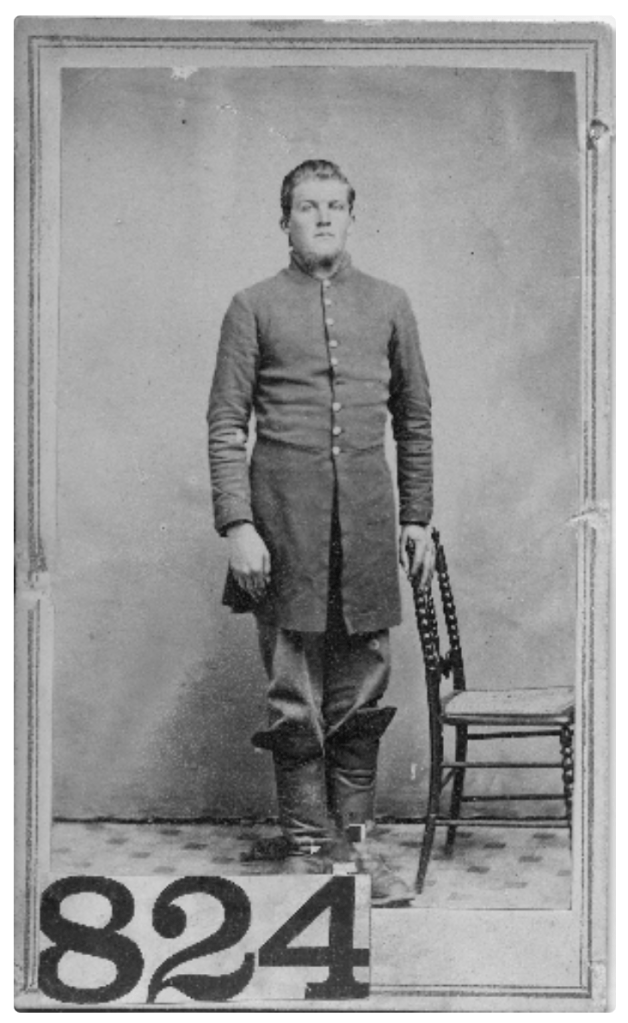
I could not find an image of Hiram but here is one of Pvt. Abraham Neidigh of Co. D, 59th Indiana (Photo Sleuth)
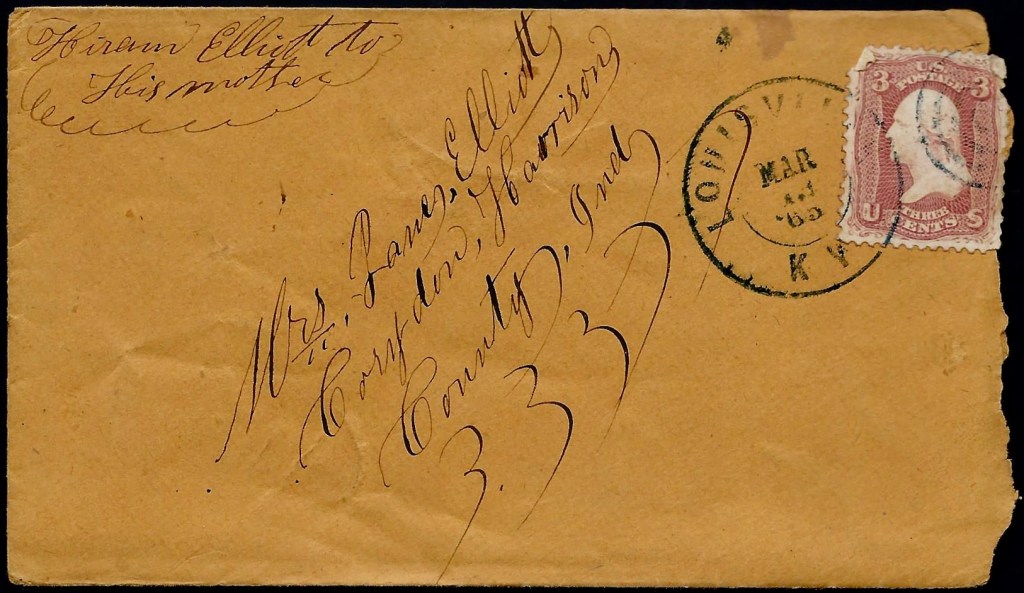
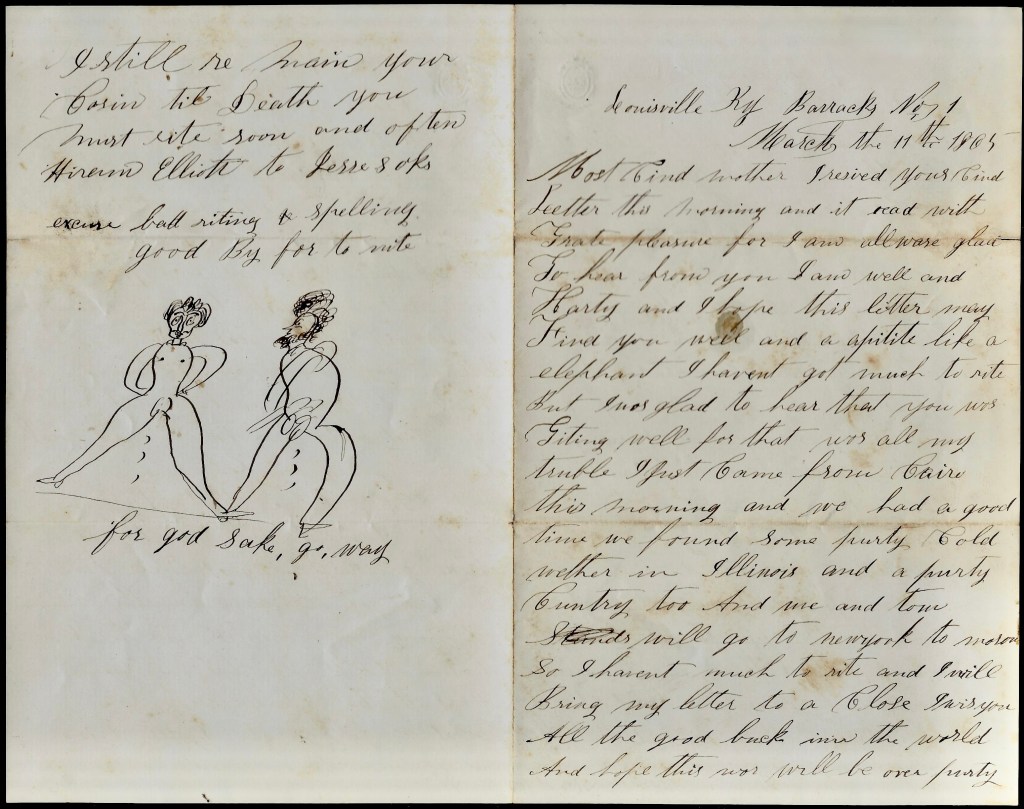
The following letter was written by Hiram Elliott (1843-1926), the son of Nathaniel Elliott (1802-1846) and Jane May (1803-1885) of Corydon, Harrison county, Indiana. Hiram wrote the letter in March 1865 while serving in Co. K, 59th Indiana Volunteers. He addressed to the letter to his mother but also included messages to his sister Martha (“Mat”) Elliott (1826-Aft1903), the wife of William A. Davis (1830-1865) and his cousin Jesse.
Jesse was living at home and working as a carpenter/house joiner in Harrison county, Indiana, at the time of the 1863 Draft Registration. He enlisted on 19 February 1864 as a recruit and was mustered out of the regiment on 17 July 1865. Hiram mentions his brother, Pleasant Elliott, who was drafted into Co. G, 9th Indiana Infantry in September 1864. Pleasant was mustered out of the regiment on 8 June 1865.
Transcription
Addressed to Mrs. Jane Elliott. Corydon, Harrison county, Indiana
Barracks No. 1 Louisville, Kentucky March the 11th 1865
Most kind Mother,
I received your kind letter this morning and it [was] read with great pleasure for I am always glad to hear from you. I am well and hearty and I hope this letter may find you well and [with] an appetite like a elephant.
I haven’t got much to write but I was glad to hear that you was getting well for that was all my trouble. I just came from Cairo this morning and we had a good time. we found some pretty cold weather in Illinois and a pretty country too. And me and Tom will go to new York tomorrow so I haven’t much to write and I will bring my letter to a close. I wish you all the good luck in the world and hope this war will be over pretty soon and we can see a good time. Give [my respects to] all enquiring friends, if any there be. I still remain your son and friend until death, — H. Elliott
To his mother, Mrs. Jane Elliott
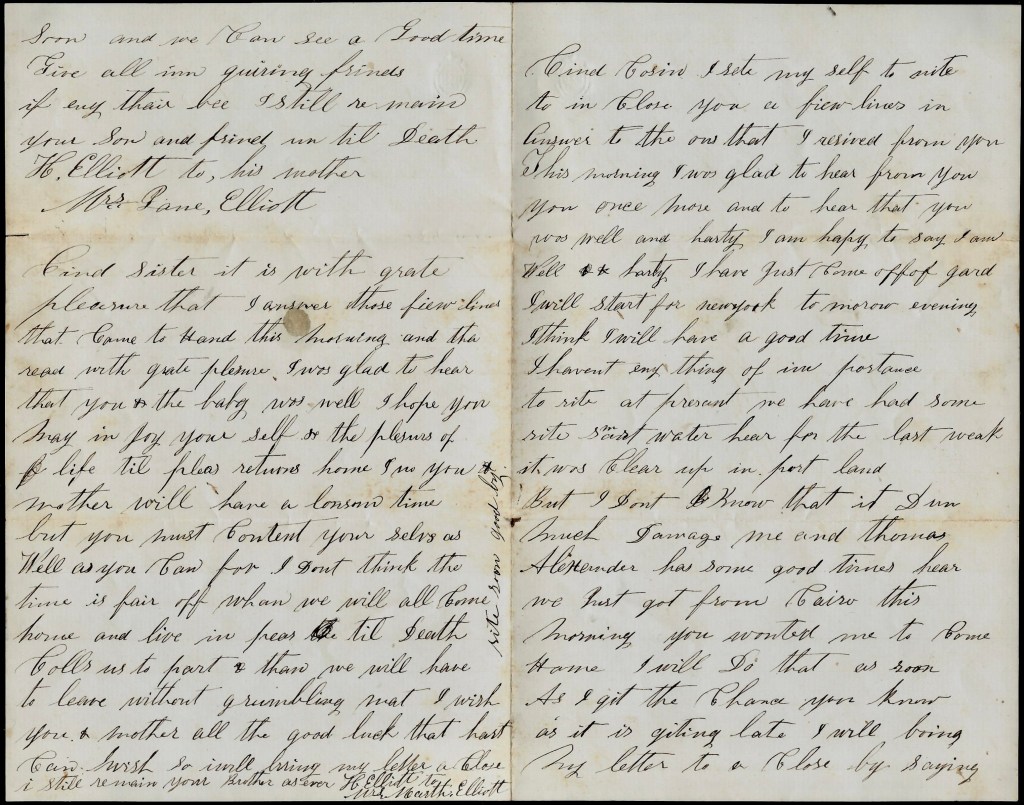
Kind sister, it is with great pleasure that I answer those few lines that came to hand this morning and that [were] read with great pleasure. I was glad to hear that you and the baby was well. I hope you may enjoy yourself and the pleasure of life till [brother] Pleas[ant] returns home. I know you and mother will have a lonesome time but you must content yourselves as well as you can for I don’t think the time is far off when we will all come home and live in peace till death calls us to part. Then we will have to leave without grumbling. Mat, I wish you and mother all the good luck that heart can wish.
So I will bring my letter to a close. I still remain your brother as ever, — H. Elliott
[to] Mrs. Martha Elliott
Write soon. Goodbye.
Kind Cousin, I seat myself tonight to enclose you a few lines in answer to the one that I received from you this morning. I was glad to hear from you once more and to hear that you was well and hearty. I am happy to say I am well and hearty. I have just come off of guard. I will start for New York tomorrow evening. I think I will have a good time. I haven’t anything of importance to write at present. We have had some right smart water here for the last week. It was clear up in port land but I don’t know that it done much damage. Me and Thomas Alexander has some good times here. We just got [here] from Cairo this morning.
You wanted me to come home. I will do that as soon as I get the chance, you know. As it is getting late, I will bring my letter to a close by saying I still remain your cousin till death. You must write soon and often. — Hiram Elliott
to Jesse Soks
Excuse bad writing & spelling. Goodbye for tonight.
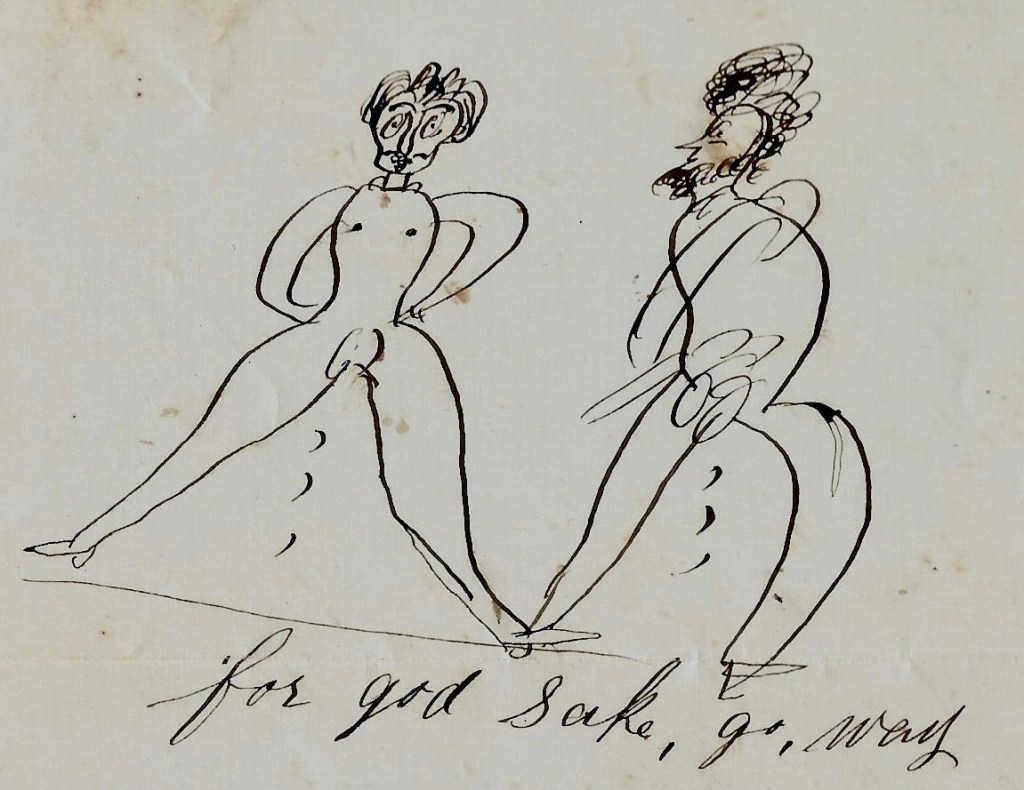
Not sure what to make of this sketch—“For God’s sake, go away!”
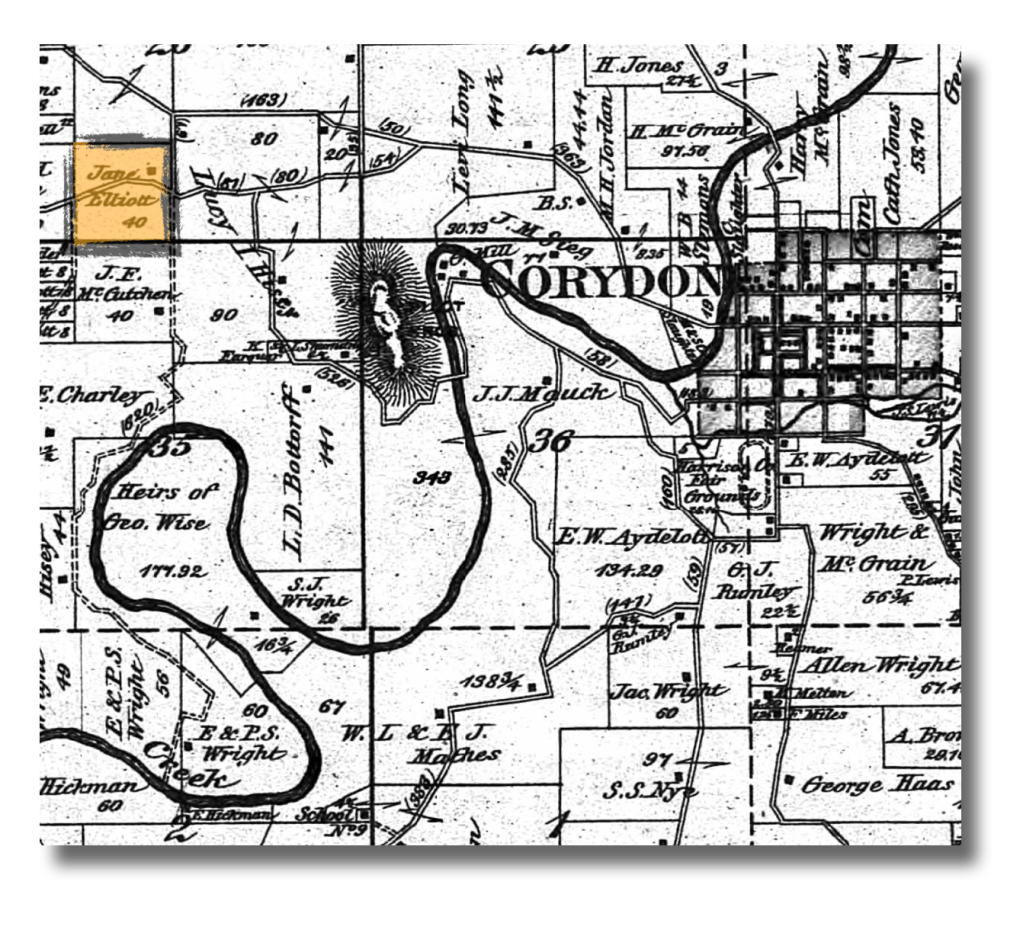
The location of Mrs. Jane Elliott’s farm west of Corydon, Harrison county, Indiana.
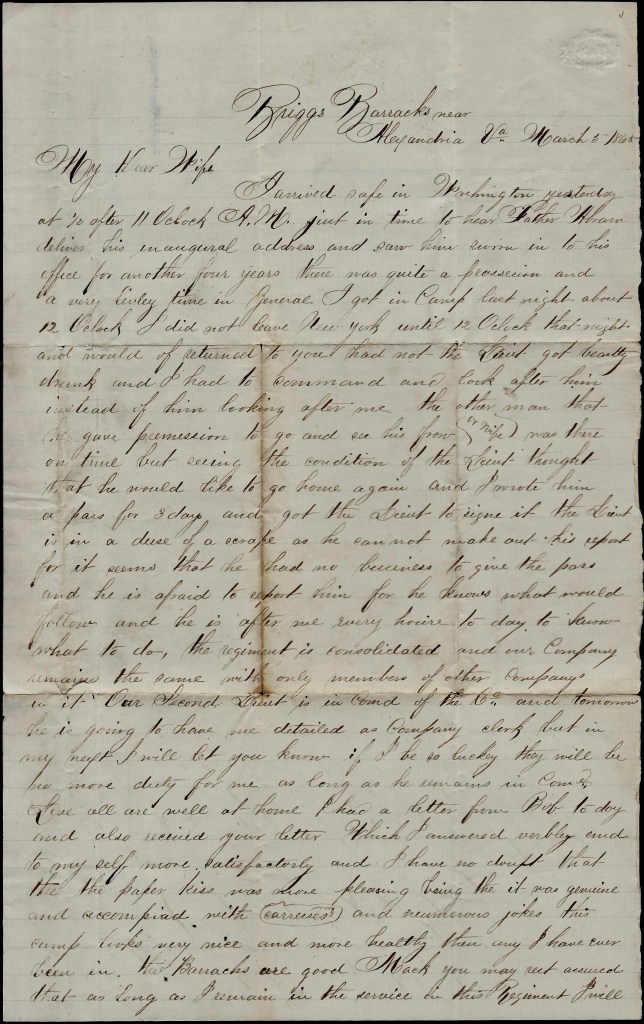
The following letter was written by Adam Moses Hallidy (1837-1910) of Whippany, New Jersey to his wife of almost a year, Margaret (“Mack”) McClelland (1839-1920). Adam was the son of David Hallidy (1804-1856) and Maria Ann Gamble (1813-Aft1865).
Adam enlisted on 26 February 1862 as a private in Co. K, 2nd District of Columbia Infantry.
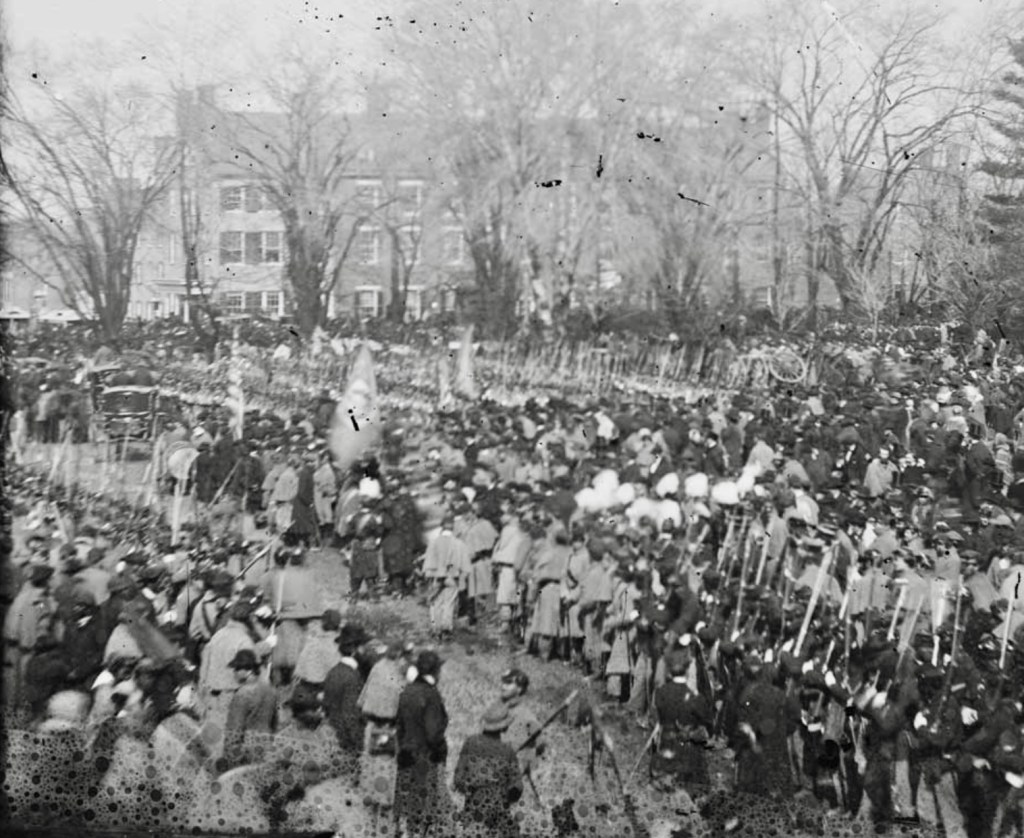
Union Black Soldiers marching in Procession of Lincoln’s Second Inaugural on 4 March 1865
Transcription
Briggs Barracks 1 near Alexandria, Va. March 5th 1865
My dear wife,
I arrived safe in Washington yesterday at half after 11 o’clock A.M. just in time to hear Father Abram deliver his inaugural address and saw him sworn in to his office for another four years. There was quite a procession and a very lively time in general.
I got in camp last night about 12 o’clock. I did not leave New York until 12 o’clock that night and would of returned to you had not the Lieutenant got beastly drunk and I had to command and look after him instead of him looking after me. The other man that he gave permission to go and see his frau (or wife) was there on time but seeing the condition of the Lieutenant, thought that he would like to go home again and I wrote him a pass for three days and got the Lieutenant to sign it. The Lieutenant is in a deuce of a scrape as he cannot make out his report for it seems that he had no business to give the pass and he is afraid to report him for he knows what would follow and he is after me every hour today to know what to do.
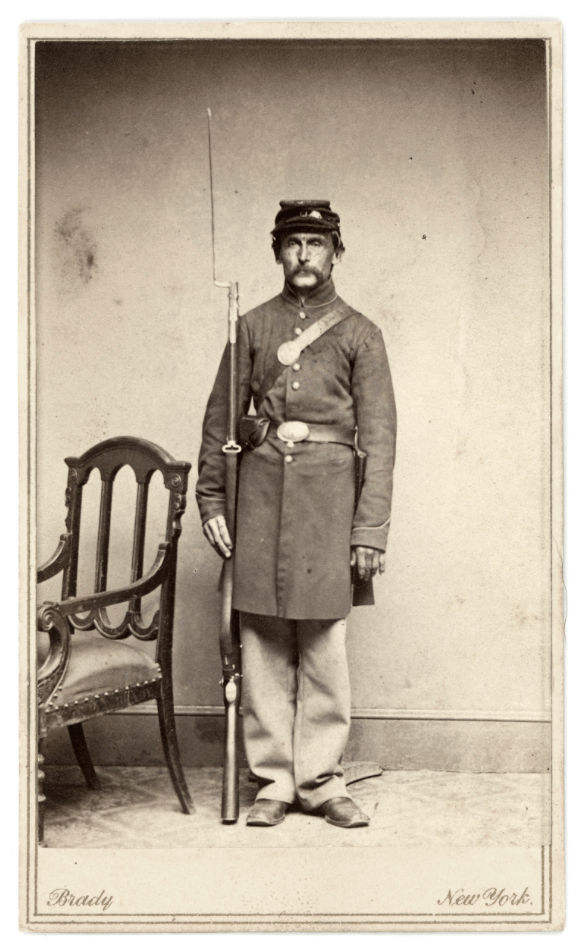
I could not find an image of Adam but here is a CDV of Mark R. Earl, a private in Co. A of the 2nd D. C. Infantry.(Photo Sleuth)
The regiment is consolidated and our company remains the same with only members of other companies in it. Our 2nd Lieutenant is in command of the company and tomorrow he is going to have me detailed as company clerk, but in my next I will let you know if I be so lucky. There will be no more duty for me as long as he remains in command.
All are well at home. I had a letter from [brother] Bob today and also received your letter which I answered verbally and to myself more satisfactorily and I have no doubt that the paper kiss was more pleasing being that it was genuine and accompanied with caresses and numerous jokes.
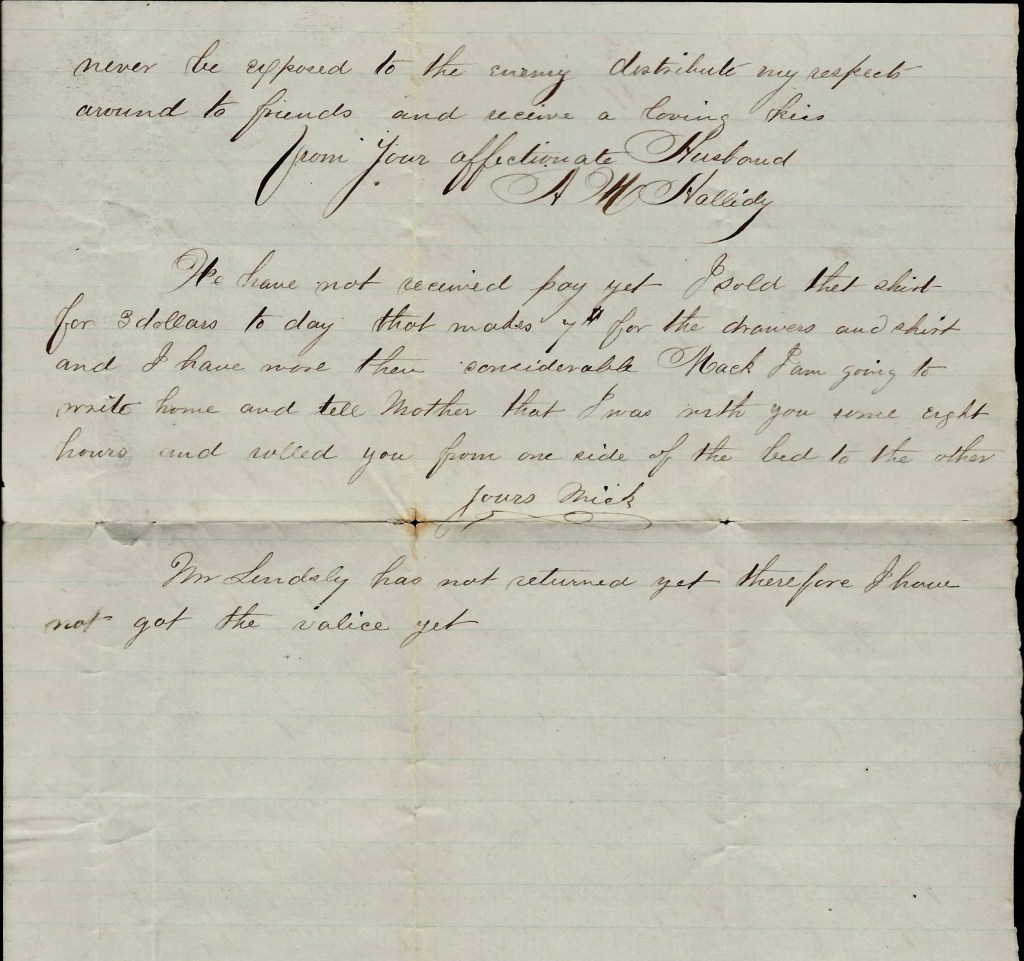
This camp looks very nice and more healthy than any I have ever been in. The barracks are good. Mack, you may rest assured that as long as I remain in the service of the regiment, I will never be exposed to the enemy. Distribute my respects around to friends and receive a loving kiss from your affectionate husband, — A. M. Hallidy
We have not received pay yet. I sold that shirt for three dollars today, That made $7 for the drawers and shirt and I have more than considerable. Mack, I am going to write home and tell mother that I was with you some eight hours and rolled you from one side of the bed to the other. Yours– Mick
Mr. Lindsly has not returned yet. Therefore, I have not got the valise yet.
1 Brigg’s Barracks were sold at public auction at Alexandria on 2 November 1865. They were described by the quartermaster as five barracks, each 20 by 100 feet; one mess house, 26 by 140 feet; two officers’ quarters, each 16 by 24 feet; one officers’ quarters 16 by 39 feet; one headquarters, 20 by 30 feet; one adjutant’s office, 16 by 30 feet; two stables, guard house, and outhouses.The Barracks were first mentioned in period newspapers in July 1864.
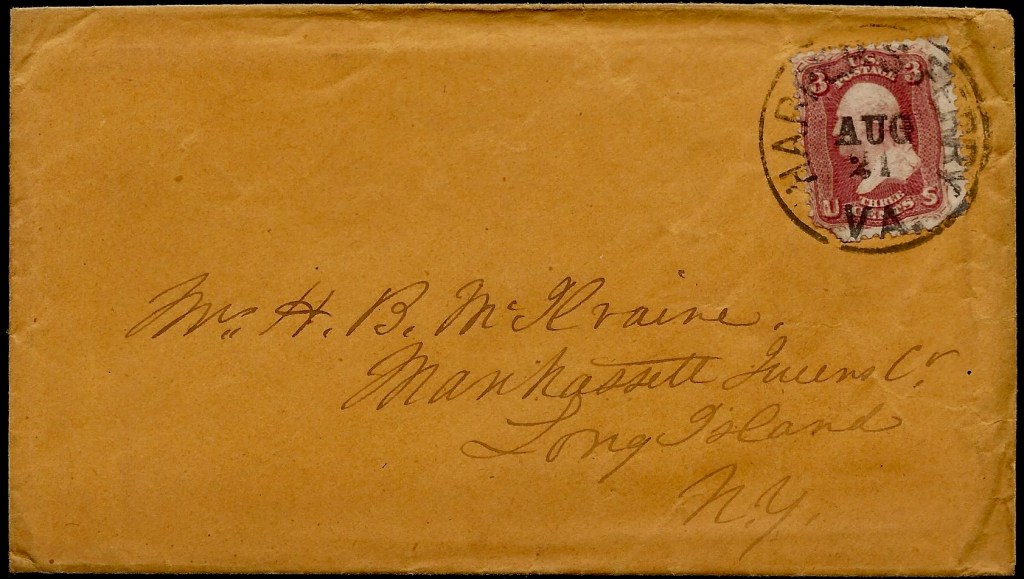
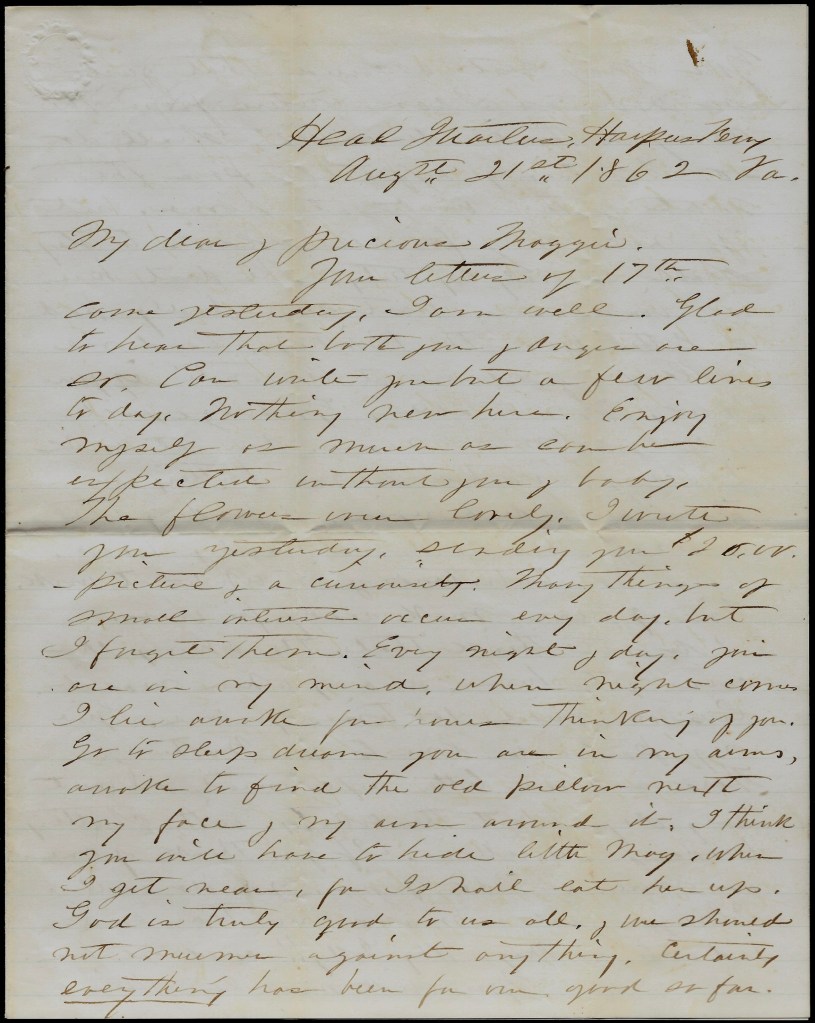
The following letter was written by Major Henry Bloomfield McIlvaine (1828-1883) of the 5th New York Heavy Artillery. Henry enlisted on 2 December 1861 at New York City as a 1st Lieutenant in Co. A, 5th New York Heavy Artillery and was promoted to Major in March 1862. He was married to Margaret (“Maggie’) J. Mitchell (1840-1920).
Henry wrote this letter from Harpers Ferry, Virginia, some three weeks prior to the Stonewall Jackson’s attack on the town during the Maryland Campaign. At the time, Henry was serving as Chief of Artillery and clearly overconfident in his assessment of their readiness to defend the strategically important town. “I do not think that the enemy can ever get here, or anywhere near it,” he wrote his wife. The town and Union garrison of 13,000 men were surrendered to Stonewall Jackson on 15 September 1862—the largest single Union surrender of the war.
Transcription
Mrs. H. B. McIlvaine, Manhassett, Queens county, Long Island, N. Y.
Headquarters, Harpers Ferry, Va. August 21st 1862
My dear precious Maggie,
Your letter of 17th came yesterday. I am well. Glad to hear that both you and Angie are so. Can write you but a few lines today. Nothing new here. Enjoy myself as much as can be expected without you and baby. The flowers were lovely. I wrote you yesterday sending you $20, picture and a curiosity. Many things of small interest occur every day but I forget them. Every night and day, you are in my mind. When night comes, I lie awake for hours thinking of you. Go to sleep—dream you are in my arms. Awake to find the old pillow next my face & my arm around it. I think you will have to hide little Mag when I get near for I shall eat her up. God is truly good to us all. We should not murmur against anything. Certainly everything has been for our good so far. You may rest assured that just so soon as I can retire from the army without discredit, shall do so. I certainly expect to pass the most of this winter at home, but if necessary for all soldiers to stay, shall do only my duty.
The dust here is immense. Want rain badly. Had a letter from the Bishop. Send me Mr. Cox’s address at Cincinnati if you know. Love to all. Goodbye. Will write you more soon.
Am at work placing another two gun battery on the Shenandoah River defending the arsenal, the ford, railroad & road. Have 30 contrabands & 5 whites at work. Time of peace, make ready for war. I do not think that the enemy can ever get here, or anywhere near it.
Kiss our child 100 times for me. Give my particular love to your mother.
There is some excitement almost every day about the country with strolling bands of guerrillas. If you think of me as much as I do of you, you do well. I love you just as must or more than ever and as to our Mag—Why Golly!! could eat her.
Yours with much love, — H
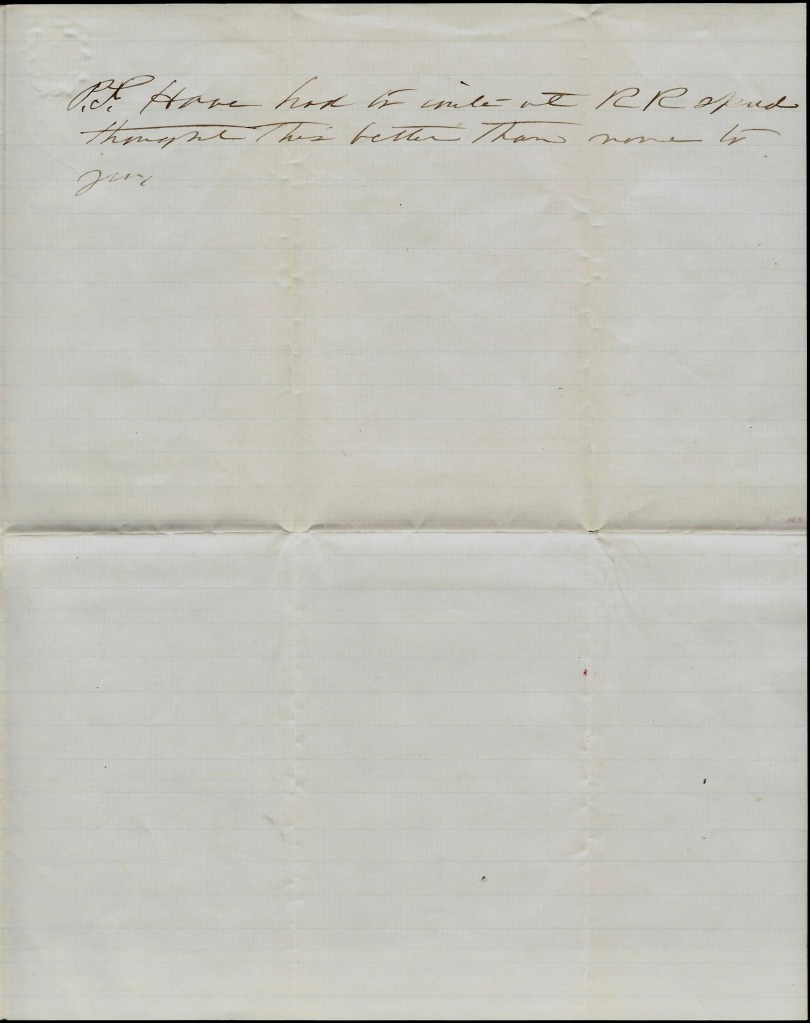
P. S. Have had to write at railroad speed. Thought this better than none to you.
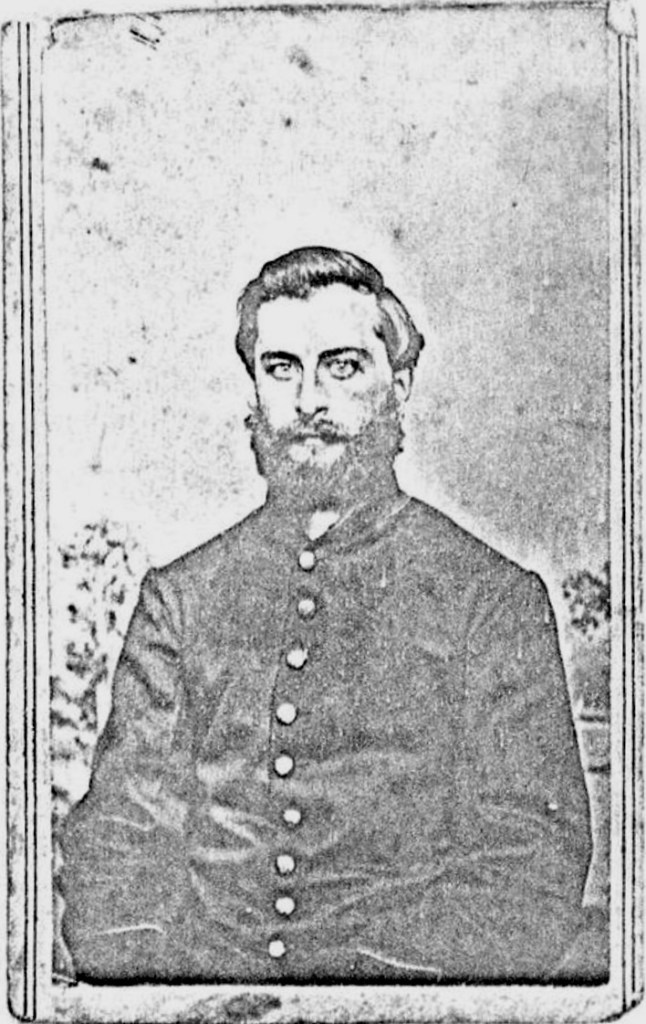
I could not find an image of John but here is one of Lucius Hagadorn who also served in the 7th New York Heavy Artillery (Photo Sleuth)
The following letters were written by John W. Oliver (1842-1895), the son of William Oliver (1815-1886) and Elizabeth Clute (1820-1888) of Union Church, Albany county, New York.
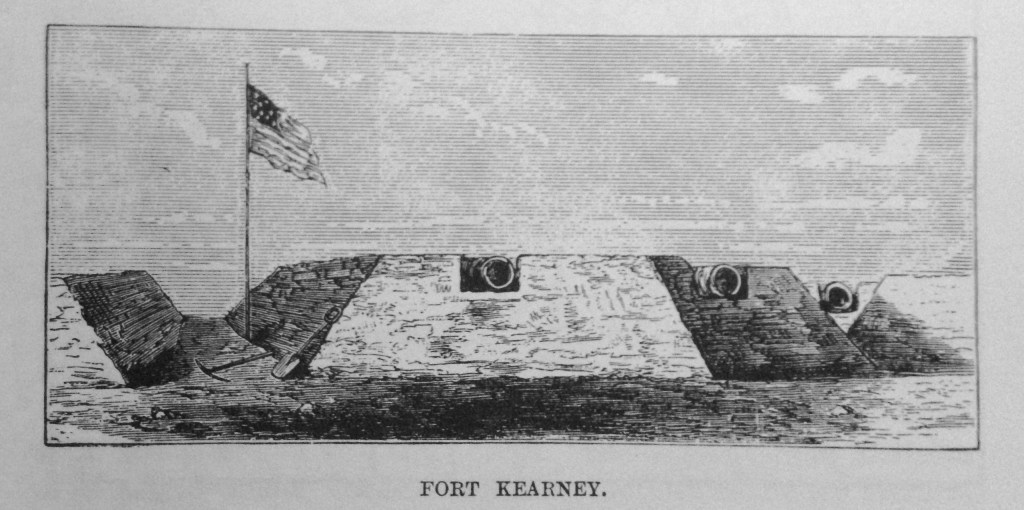
When he was 19 years old, John enlisted at Albany as private in Co. D, 113th New York Infantry on August 18, 1862, to serve three years. Before the end of 1862, the regiment had been reorganized as the 7th New York Heavy Artillery and garrisoned at Fort Kearney near Washington D. C. When the regiment was taken to the front and used as infantrymen in the spring of 1864, John was captured on June 16, 1864, at Petersburg, Va.; held at Andersonville prison for several months; paroled, December 6, 1864, at Charleston, S. C; returned to duty, April 5, 1865; promoted corporal, May 25, 1865; reduced, date not stated; mustered out with detachment June 16, 1865, at Fort Federal Hill, Baltimore, Md.
After the war, John married Mary E. Cady (1846-1881) and resided in Watervliet, Albany county, New York.
[Note: Three of the letters presented here are from the collection of Richard Weiner and were transcribed and published by express consent on Spared & Shared.]
Letter 1
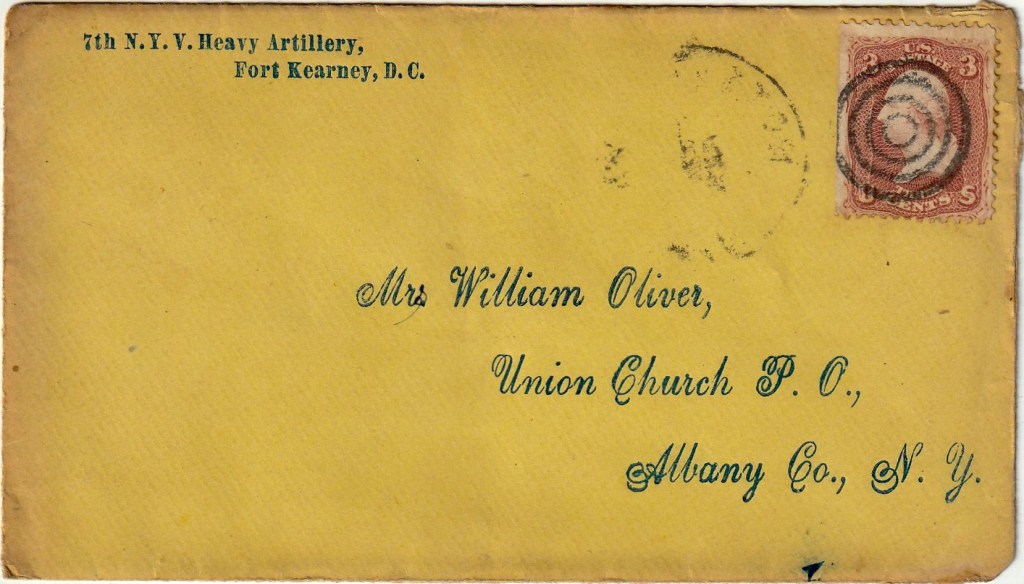
Addressed to Mr. William Oliver, Union Church, Albany Co., New York
Fort Kearney Tuesday, February 3rd 1863
Dear Parents and Brother,
I now take the opportunity to answer your letter that I received yesterday. It found us all well and I hope this will find you the same. I received your letter with the postage stamps. The one had six in it and this last letter had 3 in so it is all right.
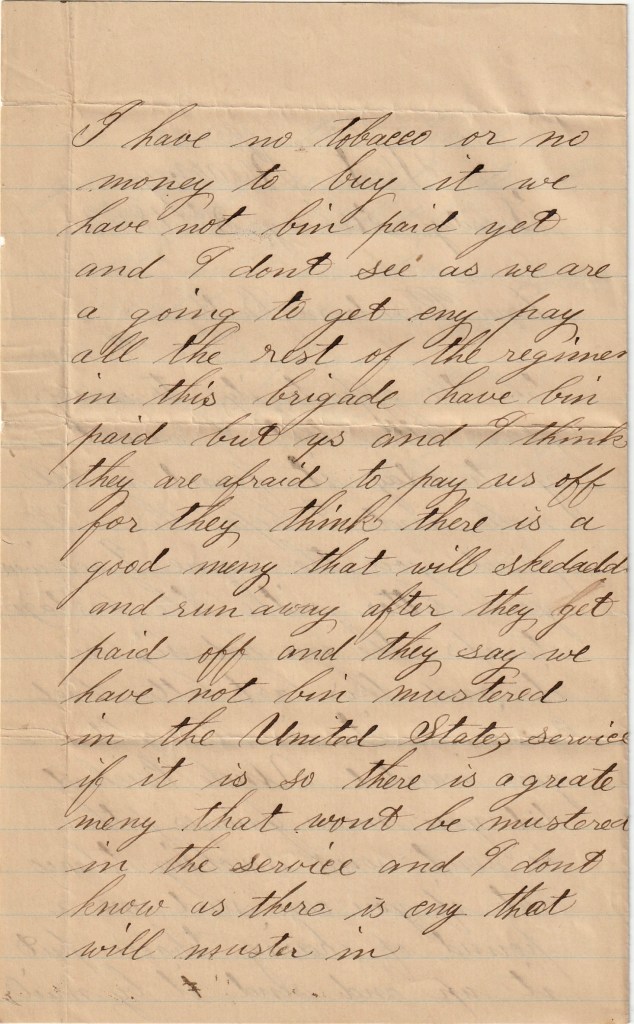
You wanted Uncle Richard. Did you mean James’ father? He sent some smoking tobacco but if you can send me a pound of chewing tobacco, put it up and send it by mail. I have no tobacco or no money to buy it. We have not been paid yet and I don’t see as we are a going to get any pay. All the rest of the regiments in this brigade have been paid but us and I think they are afraid to pay us off for they think there is a god many that will skedaddle and run away after they get paid off. And they say we have not been mustered in the United States service. If it is so, there is a great many that won’t be mustered in the service adn I don’t know as there is any that will muster in.
You said you hoped we would stay at this place. I think we will stay here this winter at least and then perhaps we will go to North Carolina. That is the talk some around camp. I hope it will come to a close soon so that we can come home.
Oh, how is Uncle Coon’s folks getting along? I have not heard you say anything about them. And what is John Jo a doing? Is he home now? You must tell him I have not had an answer from the letter I sent to him yet.
Brother, you must write every week and I will answer it if I can. No more at this time. Give my respects to all. Tell Grammy that I am well and send my respects. Write soon as you get this. From your son and brother, — John W. Oliver
Letter 2
Fort Kearney Sunday, February 22nd, 1863
Dear Parents and Brother,
I now take my pen in hand to inform you that we are all well and I hope this will find you the same. I received your letter in due time but have neglected to answer it until now.
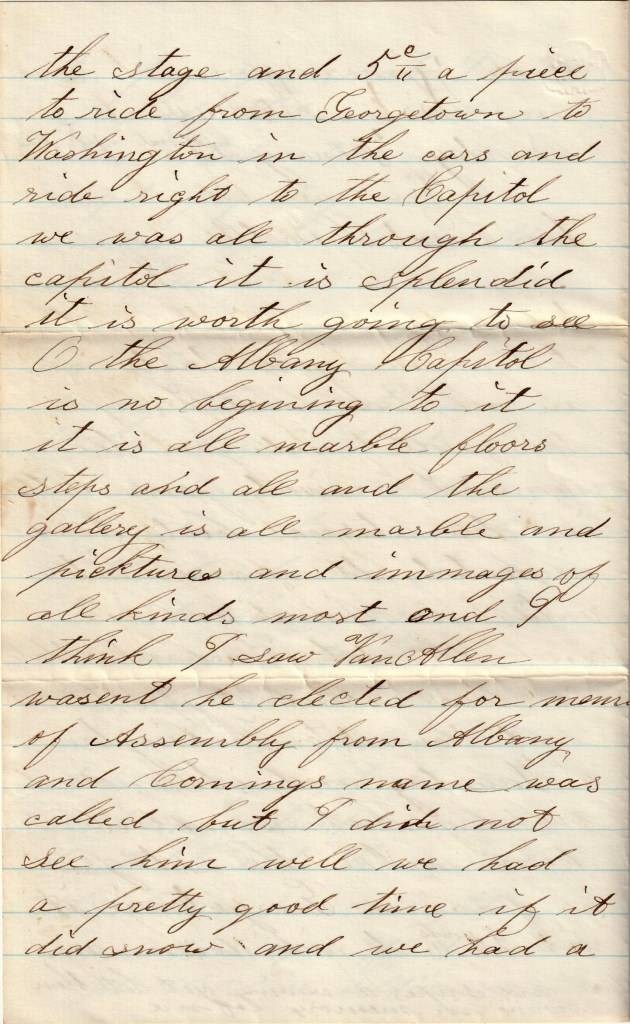
James and me and Sergeant [Edward S.] Burbanks that is our 2nd Sergeant went down to Washington a Tuesday and it snowed all day but we went down with the stage as far as Georgetown. It cost 25 cents to ride down in the stage and 5 cents apiece to ride from Georgetown to Washington in the cars and ride right to the Capitol. We was all through the Capitol. It is splendid. It is worth going to see. The Albany Capitol is no beginning to it. It is all marble floors, steps, and all, and the gallery is all marble and pictures and images of all kinds most, and I think I saw Van Allen. Wasn’t he elected for Member of Assembly from Albany. And Corning’s name was called but I did not see him.
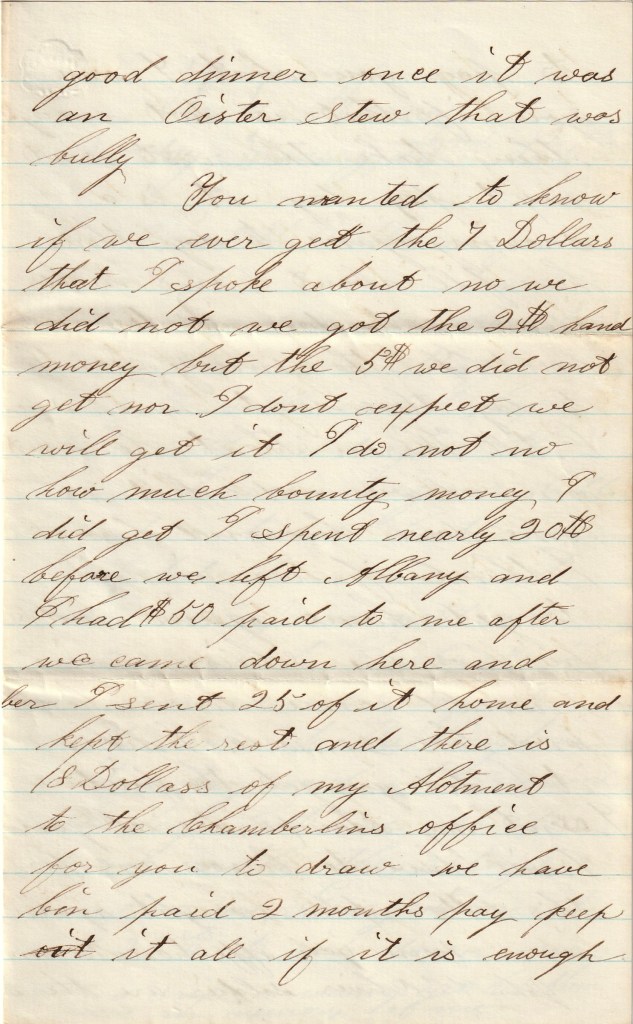
Well, we had a pretty good time [even] if it did snow, and we had a good dinner once. It was an oyster stew that was bully.
You wanted to know if we ever got the 7 dollars that I spoke about. No, we did not. We got the $2 hard money but the $5 we did not get nor I don’t expect we will get it. I do not know how much bounty money I did get. I spent nearly $20 before we left Albany and I had $50 paid to me after we came down here and I sent $25 of it home and kept the rest. And there is 18 dollars of my Allotment to the Chamberlin’s office for you to draw. We have been paid two months pay. Keep it all if it is enough to pay you what I owe you. If that is not enough, then take the rest out next pay day.
It is a snowing again today. There has fell about 6 or 8 inches of snow today. It does not look like the Sunny South today. There is too much snow.
Oh, tell Warren that he must come down and enlist or come down here and work. I think if ever I live to get home again and be free from a soldier again, I would come down here and live so well I like it. Did you get the picture I sent? My stamps are all gone. I will have to borrow one for this letter. Please write again soon. From your affectionate son, — John W. Oliver
Letter 3
[Note: The following letter was found in an antique store at Chickamauga, Georgia by Marilyn J, McCartney.]
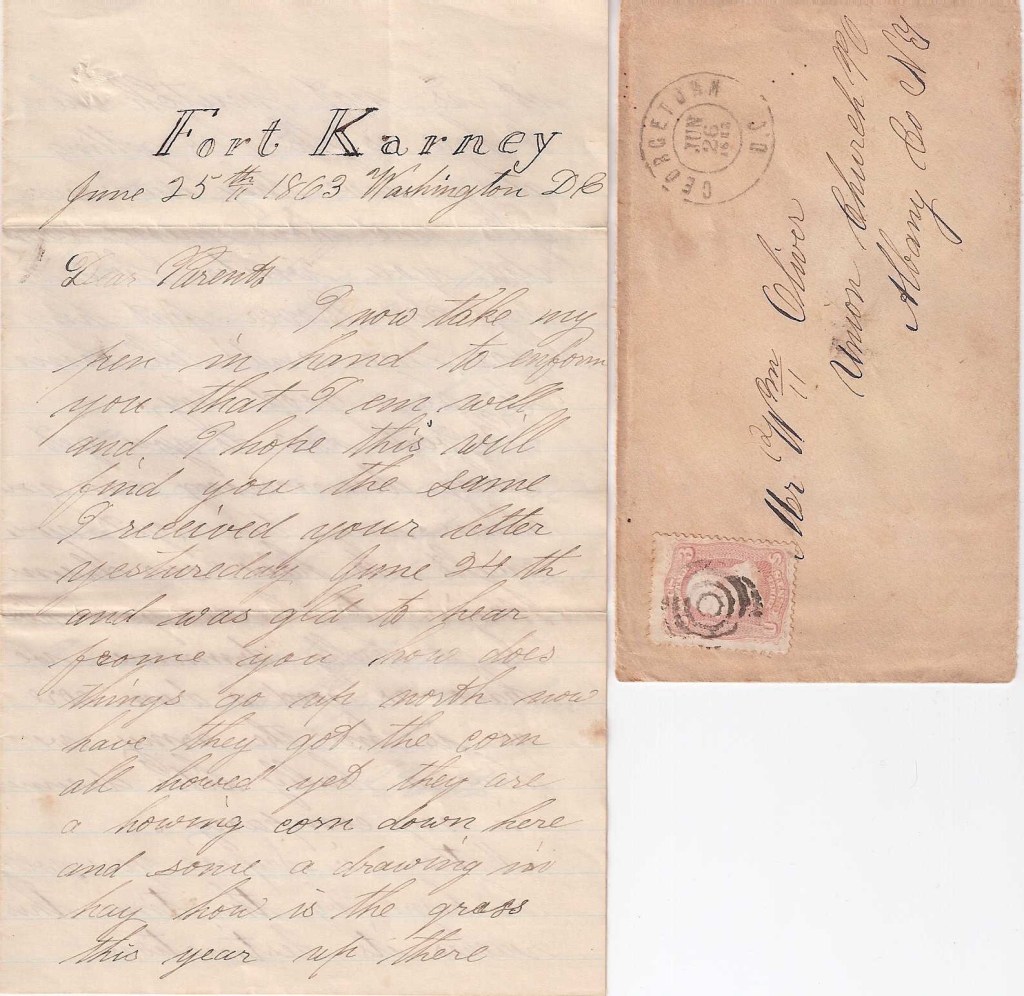
Fort K[e]arney Washington D. C. June 25th 1863
Dear Parents,
I now take my pen in hand to inform you that I am well and I hope this will find you the same. I received your letter yesterday, June 24th, and was glad to hear from you. How does things go up North now? Have they got the corn all hoed up yet? They are a hoeing corn down here and some a drawing in hay. How is the grass this year up there? It is not much here. How is the bees getting along? Have they swarmed yet? And how many swarms did you winter?
How is my dog Rover? Pat him for me and tell him to be a good boy.
Robert, how do you get along drumming? Can you drum any tune yet? You ought to have your drum major to learn you. He is a bully drummer. We have as good a drum corps as is in the army. We have a bully little drummer in our company.
Mother, I suppose you will be home by the time this reaches its destination. I hope you have had a good time or visit rather. Did you go to Uncle John’s? What for a woman is she, do you think? I would think enough of her to call her Aunt. That is all. Tell Mrs. Cole that I answered her letter as soon as I got it. Did you get the papers I sent? No more at present. I remain your affectionate son, — John W. Oliver
To his parents.
Letter 4
Fort Kearney Washington D. C. February 24th 1864
Dear Parents,
I received your letter last week but have not had much time to write since until this morning. It found us all well and I hope this will find you all the same. I and James [Vanderbilt] was away Sunday all day down to Chain Bridge and Monday was Washington’s Birthday so we did not have any drill and we went down to the Potomac. We came home in time for dress parade and yesterday Corporal McCullic [McCollock], William J. Stalker and me went down to Washington after two of the boys that went off day before yesterday without permission and was not back yesterday morning when we started.
You spoke about writing two letters to my one. I have answered every letter you sent. Then you could not have got my one letter. And about Rachel Oliver, I sent the last letter to her. Oh, tell Rob I have not seen that picture yet. That one he sent was not the genuine article. Then they are all a selling out around there? Tell Father he must sell out and move to Albany or come down to New Jersey. I don’t intend to live up there anymore, if I had my discharge tomorrow.
Give my respects to all enquiring friends. No more at present. From your son, — John W. Oliver
The following letter was written by 20 year-old James V. Vanderbilt of Co. D, 7th New York Heavy Artillery. James enlisted as a private in Co. D (originally the 113th New York Infantry) on 18 August 1862 to serve three years. At the time of his enlistment, his residence was given as Corymans, New York. He was described as a blue-eyed, dark-haired farmer who stood 5 foot 6 inches in height. He was promoted to corporal on 1 March 1863 and again to sergeant on 29 December 1863.
The letter was written from Ft. Kearny just outside Washington, D.C. during the early, passive phase of the regiment’s service, while they were part of the D. C. defensive ring. However, beginning mid-way through 1864, the unit was sent to the front as infantrymen and were heavily involved in battles, with much loss. James was killed in action on 3 June 1864 at the Battle of Cold Harbor, Virginia.
During the action on Petersburg on 16 June 1864, James’ cousin, John W. Oliver—who served with him in the regiment, was captured and sent to Andersonville prison, where he stayed until being paroled on 12/6/64. He is listed as having ‘returned’ to his unit on 4/8/65.
[Note: This letter is from the private collection of Richard Weiner and was transcribed ands published on Spared & Shared by express consent.]
7th New York Heavy Artillery (serving as infantry) preparing to leave the trenches and charge the Confederate line in Barlows charge near Cold Harbor Friday June 3rd, 1864, sketched by Alfred Waud.
Transcription
Fort Kearney December 30th 1862
To Uncle & Aunt, Cousin, and Libbie too.
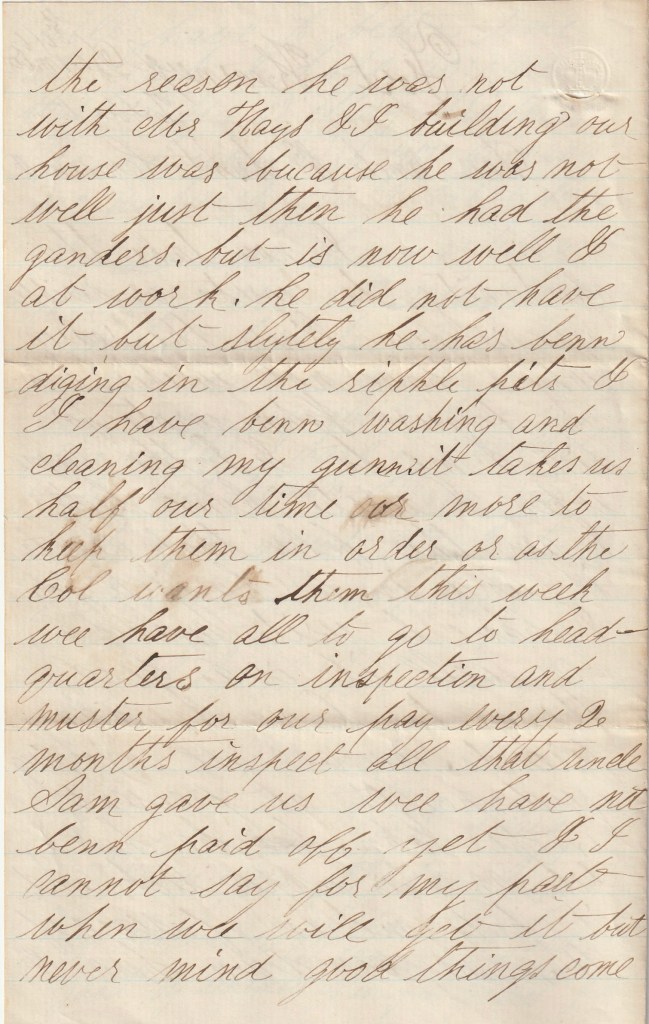
I now take the opportunity to write or scribble you a few lines. The reason why I have not written before was because [Cousin] John [Oliver] wrote for him & me too & I the same when I write home. But I am the feller that can do it and in a hurry too for I have to write many a one. Well, it is a good thing to have so many friends. We are all enjoying good health at present except John. He has a boil on his upper lip and it puts me in [mind] of some of those negroes down here and the reason he was not with Mr. Hayes & I building out house was because he was not well just thern. He had the ganders [jaundice]. But he is now well and at work. He did not have it but slightly.
He has been digging rifle pits & I have been washing and cleaning my gun. It takes us half our time or more to keep them in order as the Colonel wants them. This week we have all to go to headquarters on inspection and muster for our pay. Every two months [they] inspect all that Uncle Sam gave us. We have not been paid off yet and I cannot say for my part when we will get it. But never ind, good things come slow.
You spoke about that money John signed off. You cannot get it until we get paid here. When we get paid, we will let you know. Then go and try him. Some think it was a smart game but I think that it is alright.
We have our house done and are living like pigs in the clover and have bunks & floor and roof & window & stove. I tell you, we live good. Sometimes we have cabbage soup [or] stewed apples. If we only have money, we can live good as any of them. But we are close up for money. I never see a Christmas before but what I had 3 cents to my name. We did not have much Christmas but I hope we will have a better time—at least I hope so. You wished us a merry Christmas. Thank you. [We] wish you a merry one [too]. We wish you a happy new year.
We are now a Heavy Artillery [regiment] and the boys are all satisfied. We will not have to go in the field or have to march far at a time now. We will have to have other clothes. I have a new coat with red trimming. When you write, you must direct to the 7th New York Heavy Artillery, N. Y. S. Vol.,, Co. D, Washington D. C., Fort Kearney
From your nephew, — James V. Vanderbilt
Our respects to all enquiring friends. Goodbye. Remember us in your prayers. I hope to meet you all again if not in this world, in the world to come. Tell the rest to direct the same.
Fort Kearney as built by the 15th New Jersey Infantry in September 1862
The following letter was written by Watson Asbury Cleveland (1837-1915), the son of Josiah Douglas Cleveland (1792-1851) and Lucy Bryan (1794-1873) on Masonville, New York. He wrote the letter to his brother, William Bryan Cleveland (1820-1883).
Watson resided in Berrien county, Michigan, when he enlisted on 28 July 1861 as a private in Co. B, 6th Michigan Infantry. He mustered out of the regiment on 23 August 1864 at Kalamazoo, Michigan. At the time this letter was written in May 1864, during the Red River Campaign, the few remaining members of the original regiment (just 160 men and officers) were converted into the 6th Michigan Heavy Artillery and posted at Port Hudson, Louisiana. In June 1864, the regiment moved from Port Hudson to Morganza, Louisiana.
Watson was married to Jennie Atkinson of Sycamore, Illinois, in December 1867. They settled with other members of the religious sect known as the “Christophers” near Abilene, Kansas in 1872.
[Note: This letter was provided for transcription and publication on Spared & Shared by Denise Hill, a descendant relative of the author.]
Transcription
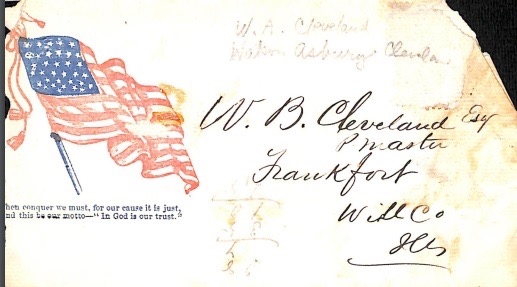
Addressed to W. B. Cleveland, Postmaster, Frankfort, Will county, Illinois
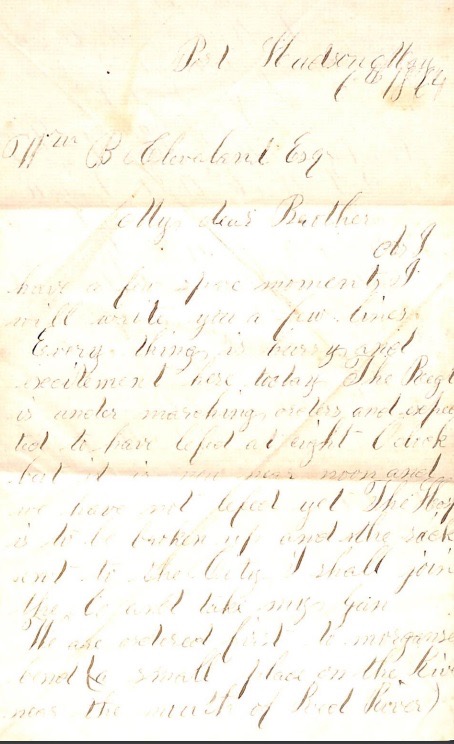
Port Hudson [Louisiana] May 6, 1864
Wm. B. Cleveland Esq. My dear Brother,
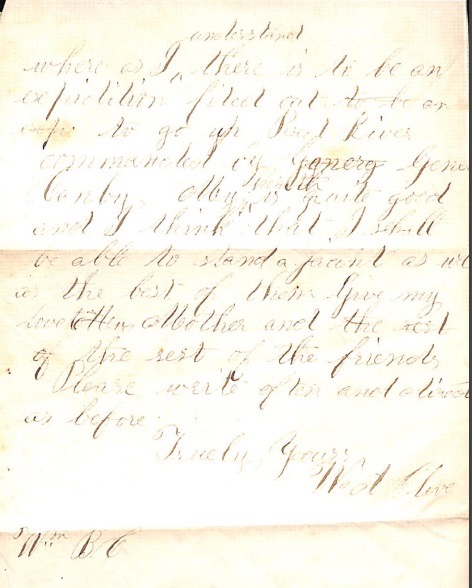
As I have a few spare moments, I will write you a few lines. Everything is busy and excitement here today. The Regiment is under marching orders and expected to have left at eight o’clock, but it is now near noon and we have not left yet. The Hospital is to be broken up and the sick sent to the City. I shall join the company and take my gun. We are ordered first to Morganza Bend (a small place on the river near the mouth of Red River) where as I understand there to be an expedition fitted out to go up Red River commanded by [Brig.] General [Edward] Canby.
My health is quite good and I think that I shall be able to stand a jaunt as well as the best of them. Give my love to mother and the rest of the friends. Please write often and direct as before. Truly yours, — W. A. Cleveland
The following letter was written by Franklin Darius Sizer (1840-1862), the son of Luther Sizer (1798-1877) and Perlina Barnum (1802-1873) of Western, Oneida county, New York. Frank enlisted on 12 October 1861 to serve in Co. I, 81st New York Infantry. He died of disease on 29 December 1862 at Yorktown, Virginia.
He wrote the letter to his younger sister, Julia Ann Sizer (1842-1926).
Transcription
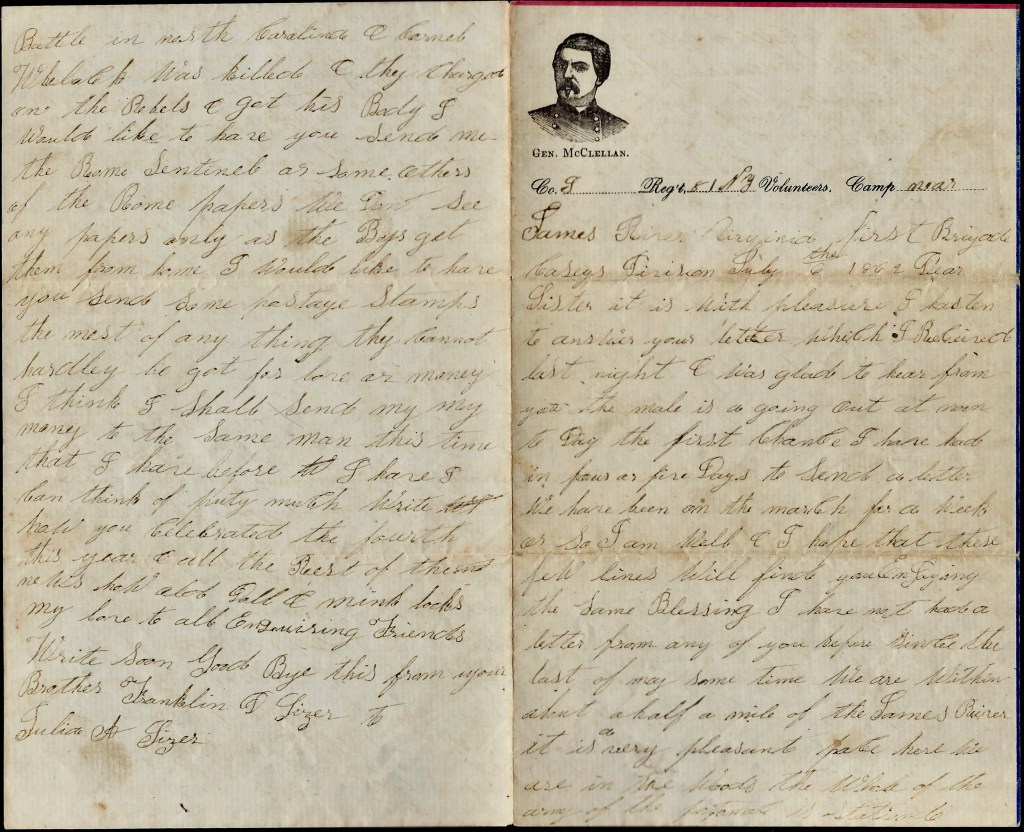
Co. I, 81st New York Volunteers Camp near James River, Virginia July 6th 1862
Dear Sister,
It is with pleasure I hasten to answer your letter which I received last night. I was glad to hear from you. The mail is a going out at noon today, the first chance I have had in four or five days to send a letter. We have been on the march for a week or so. I am well & I hope that these few lines will find you enjoying the same blessing. I have not had a letter from any of you before since the last of May some time.
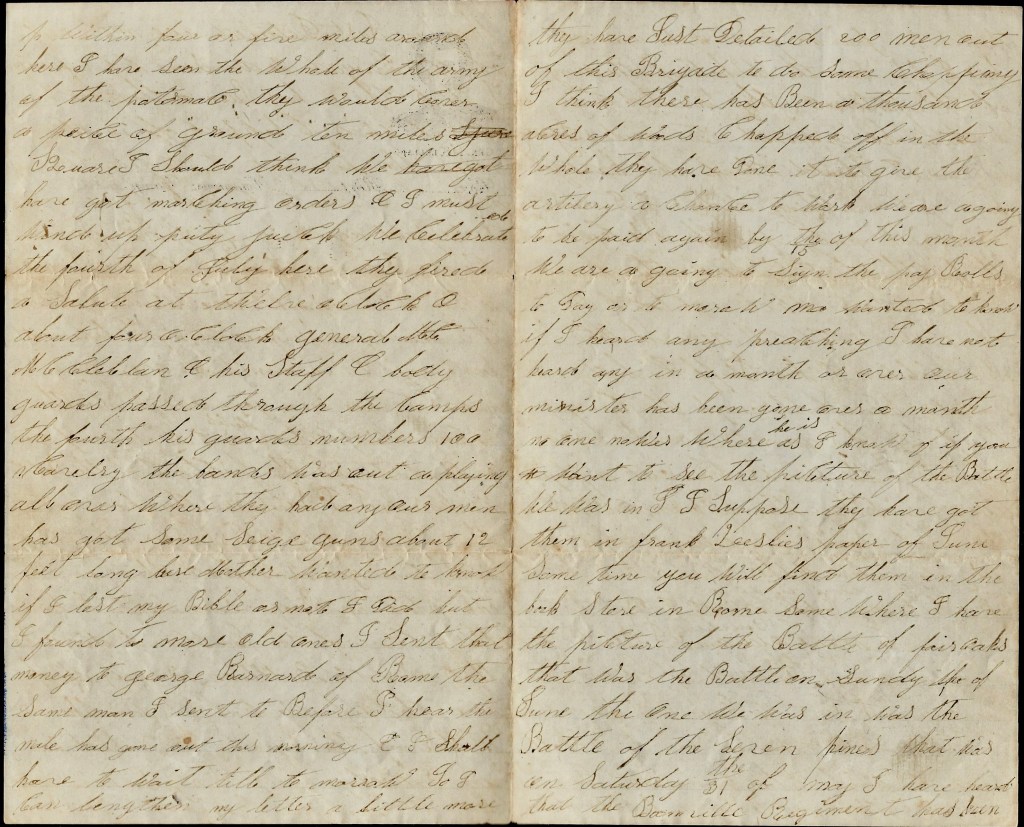
We are within about a half a mile of the James River. It is a very pleasant place here. We are in the woods. The whole of the Army of the Potomac is stationed within four or five miles around here. I have seen the whole of the Army of the Potomac. They would cover a parcel of ground ten miles square, I should think. We have got marching orders & I must wind up pretty quick.
We celebrated the 4th of July here. They fired a salute at twelve o’clock and about four o’clock. General McClellan and his staff & bodyguards passed through the camps on the 4th. His guards numbers 100 cavalry. The bands was out a playing all over where they had any. Our men has got siege guns about 12 feet long here.
Mother wanted to know if I lost my bible or not. I did but I found two more old ones. I sent that money to George Barnard of Rome—the same man I sent to before. I hear the mail has gone out this morning & I shall have to wait till tomorrow so I can lengthen my letter a little more.
They have just detailed 200 men out of this brigade to so some chopping. I think there has been a thousand acres of woods chopped off in the whole. They have done it to give the artillery a chance to work.
We are a going to be paid again by the 15th of this month. We are a going to sign the pay rolls today or tomorrow. Ma wanted to know if I heard any preaching. I have not heard any in a month or over a month. No one knows where he is as I know of.
If you want to see the picture of the battle we was in, I suppose they have got them in Frank Leslie’s paper of June some time. You will find them in the book store in Rome somewhere. I have the picture of the Battle of Fair Oaks. That was the battle on Sunday of June the 1st. We was in the battle of the Seven Pines. That was on Saturday, 31st of May. I have heard that the Boonville Regiment [Third Oneida] has been battle in North Carolina & Colonel [Charles] Wheelock was killed & they charged on the rebels and got his body.
I would like to have you send me the Rome Sentinel or some others of the Rome papers. We don’t see any papers—only as the boys get them from home. I would like to have you send some postage stamps the most of anything. They cannot hardly be got for love or money. I think I shall send my money to the same man this time that I have before. I have [written all] I can think of pretty much. Write how you celebrated the 4th this year & all the rest of the news, how Old Doll & Mink looks. My love to all enquiring friends. Write soon. Goodbye. This from your brother, — Franklin D. Sizer
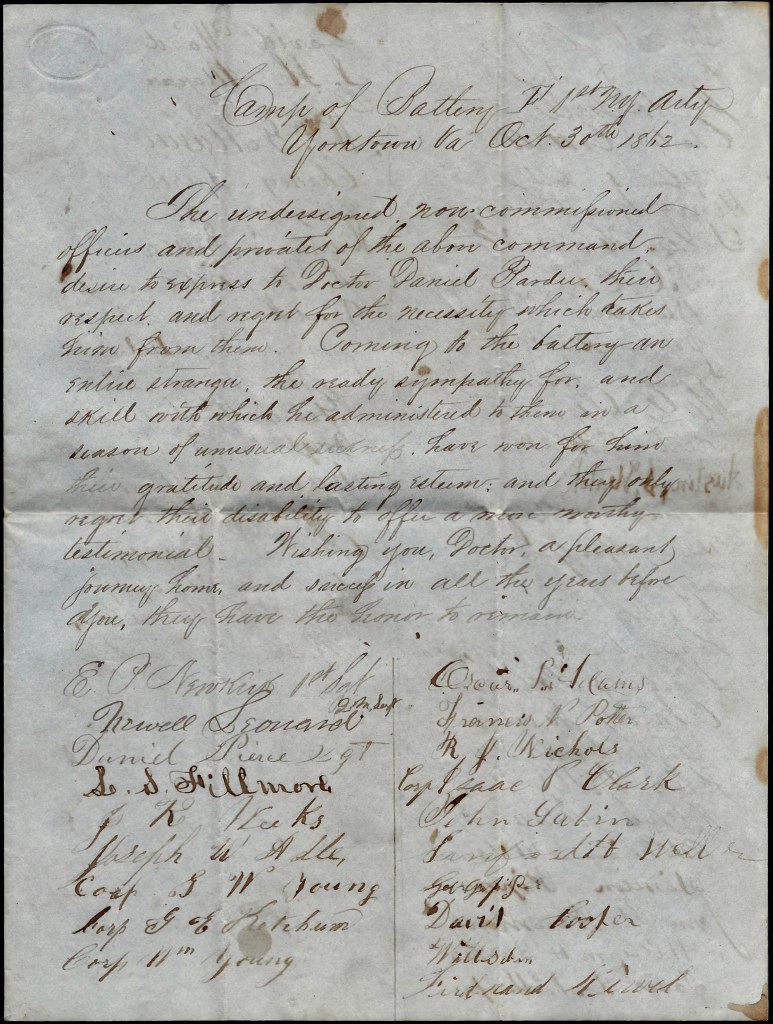
The following testimonial of appreciation by the privates and non-commissioned officers of Battery F. 1st New York (Light) Artillery (a. k. a. Morgan’s Light Artillery) was tendered to Assistant Surgeon Daniel [Dane] Pardee who served the battery for a couple of months in the fall of 1862.
Battery F, Capt. W. R. Wilson, was recruited at Oswego, Southport and Elmira and there mustered into the U. S. service on Sept. 14, 1861. In Oct., 1863, some of its members were transferred to the 2nd regiment of artillery. It was chiefly employed in garrison duty, being stationed at Washington during the winter of 1861-2, and the remainder of 1862 was with Franklin’s division, 1st corps, and the 1st division, 6th corps. It was at the White House in June, 1862, and at Yorktown, in the 4th corps, from July, 1862, to July, 1863. The remainder of its term it was stationed in the Department of Washington with the 22nd corps. It was mustered out under Capt. Wilson, June 17, 1865, at Elmira. It had no casualties in action, but lost during service 14 men who died of disease and other causes.
Transcription
Camp of Battery F, 1st New York Artillery Yorktown, Va. October 30th 1862
The undersigned non-commissioned officers and privates of the above command desire to express to Doctor Daniel Pardee their respect and regret for the necessity which takes him from them. Coming to the battery an entire stranger, the ready sympathy for, and skill with which he administered to them in a season of unusual sickness, have won for him their gratitude and lasting esteem: and they only regret their disability to offer a more worthy testimonial. Wishing you, Doctor, a pleasant journey home, and success in all the years before you, they have the honor to remain—
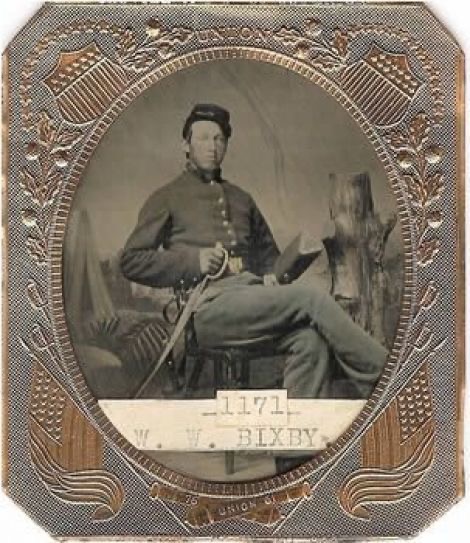
Pvt. William W. Bixby, Battery F. 1st New York Light Artillery
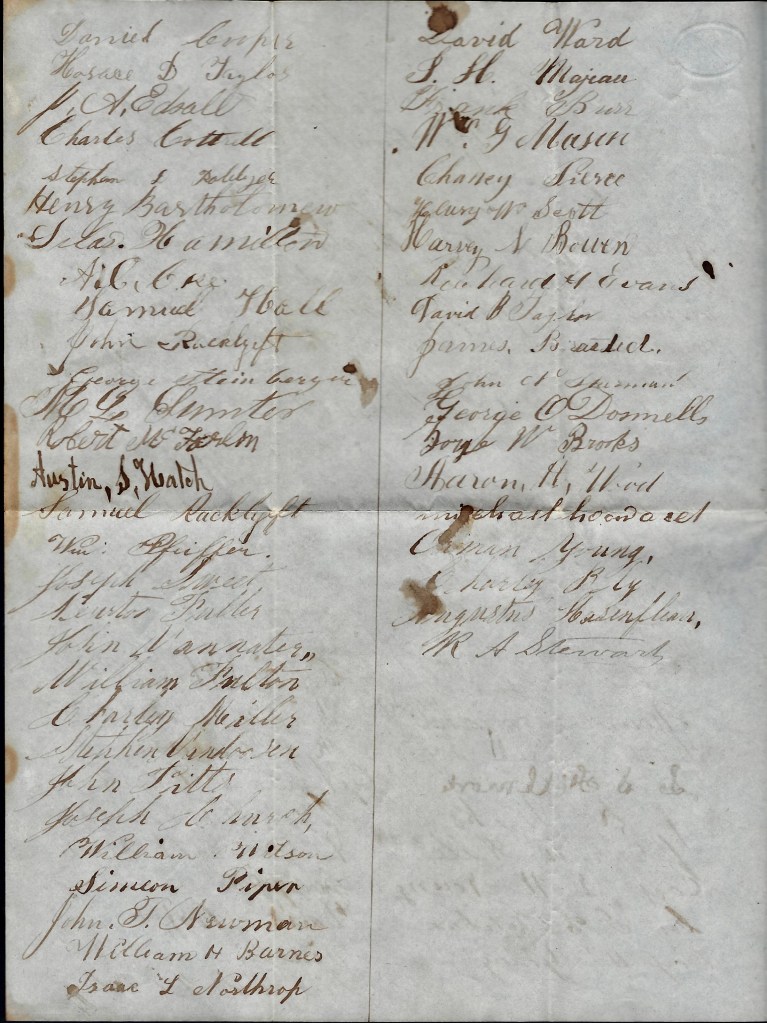
E. P. Newkirk, 1st Sergt. Newell Leonard, QM Sgt. Daniel Pierce, Sgt. L. S. Fillmore J. K. Weeks Joseph W. Adle Corp. G. W. Young Corp. G. E. Ketchum Corp. Wm. Young etc.
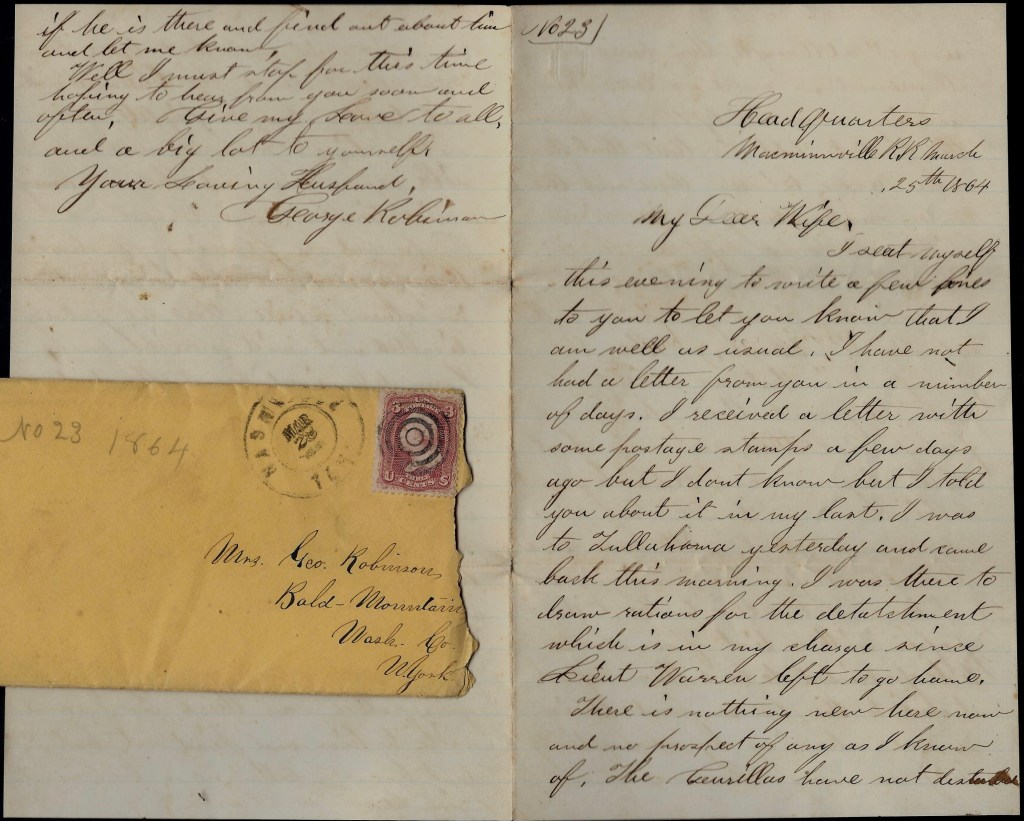
The following letter was written by George Robinson (1829-1885) who enlisted at the age of 31 as a 1st Sergeant in Co. A, 123rd New York Infantry. He was promoted to a 2nd Lieutenant on 4 September 1862 and to a 1st Lieutenant on 18 July 1863. He mustered out of the regiment as Captain (by Brevet) of Company A on 13 March 1865.
George wrote the letter to his wife, Elizabeth (Wright) Robinson (1838-1912). The couple lived in Greenwich, Washington county, New York. After the war, George worked in the Coal industry.
I seat myself this evening to write a few lines to you to let you know that I am well as usual. I have not had a letter from you in a number of days. I received a letter with some postage stamps a few days ago but I don’t know but I told you about it in my last. I was to Tullahoma yesterday and came back this morning. I was there to draw rations for the detachment which is in my charge since Lieut. Warren left to go home.
There is nothing new here now and no prospect of any as I know of. The guerrillas have not disturbed us yet although they have been all around us more or less. This morning when we left Tullahoma, the pickets told us that that there were Rebels between there and the water tank about four or five miles out, so we kept a sharp lookout for them but we did not see any, so we got down without any disturbance. The prospect is that we shall not go to the front this spring and perhaps not this summer but will stay on some RR to guard. I think we will not stay where we are now but will have some other road for our division.
I have sent a letter to the village paper with a list of our absentees to be published to have them report at once to the company or send their excuse, showing by what authority they are away. There are quite a number of men that have been absent since the Chancellorsville and Gettysburg fights—some with slight wounds and others with severe ones, and they are having a nice time at some convalescent camp and are playing off, claiming their pay regular, and doing nothing in return while others are probably disabled and will never be back. I am determined to get the dead beats back if there is any such thing. If you hear anything about any of them anywhere laying off, let me know and I will take measures to bring them back. I have heard that Caleb Tefft was in New York and I don’t know what he is doing there and I would like to know for certain if he is there. If I knew your father was there now I would write to him and find out but I don’t know whether he is there or not. I wish you would write to your Father if he is there and find out about him and let me know.
Well, I must stop for this time hoping to hear from you soon and often. Give my love to all, and a big lot to yourself. Your loving husband, —George Robinson
Like his dreams for Cuban statehood, William’s headstone lies shattered in Yazoo County, MS
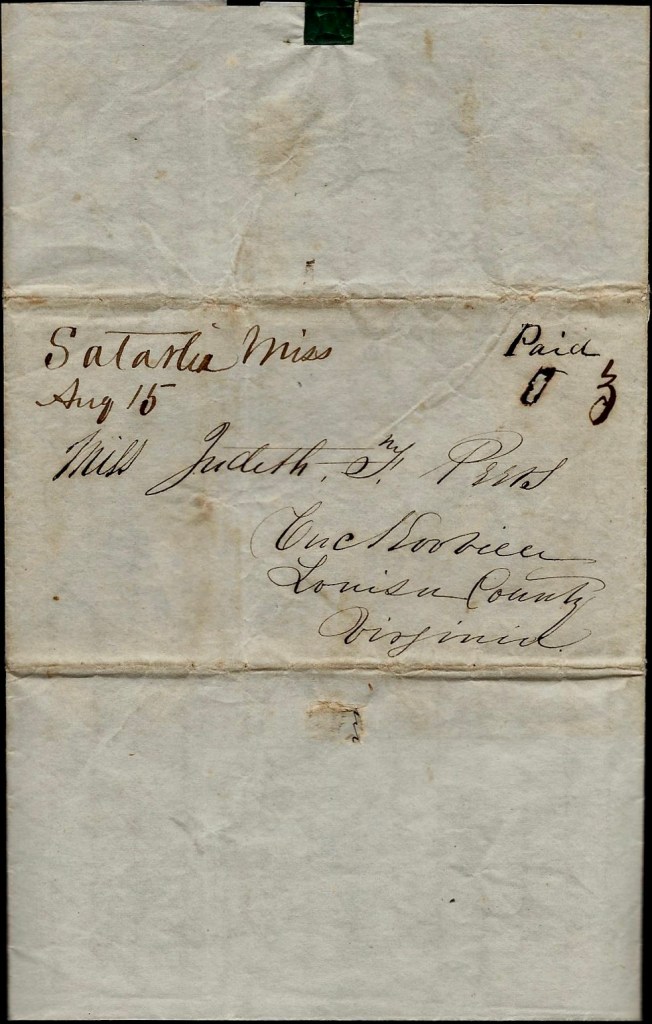
The following letter was written by William N. Alexander Peers, the son of Thomas Peers Jr. and Elly Parsons, both of whom were also from Louisa, Virginia. He married Sarah Ann Sturdivant about 1838 in Mechanicsburg, Yazoo County, Mississippi. They had four children born to their marriage. Sarah Ann died at the birth of their last child, William Henry Peers, born about 1815, Louisa, Louisa, Virginia. William died on 20 November 1855, Yazoo, Mississippi. William was a planter in Yazoo county and of course owned many slaves.
In his letter, datelined from Yazoo county in August 1851, William informs his sister that “our country is under some excitement now about the great slave question but I hope it will be settled in a way which may add honor and strength to all. I am anxiously waiting for the time to roll around when we can make one more stripe out of Cuba and then I am bound for her shores, as a place where I should like to live & die.” Of course William is referring to the agitation of the slavery question brought on by the admission of more states into the Union which resulted in the Compromise of 1850, temporarily suspending threats of secession. Plantation owners were particularly optimistic and enchanted with the idea of acquiring Cuba from Spain and making it a new state in the Union. Hopes for wrestling Cuba from Spains’s control by the Lopez Expedition were soon dashed when Lopez was taken prisoner and garroted not long after this letter was penned.
Transcription
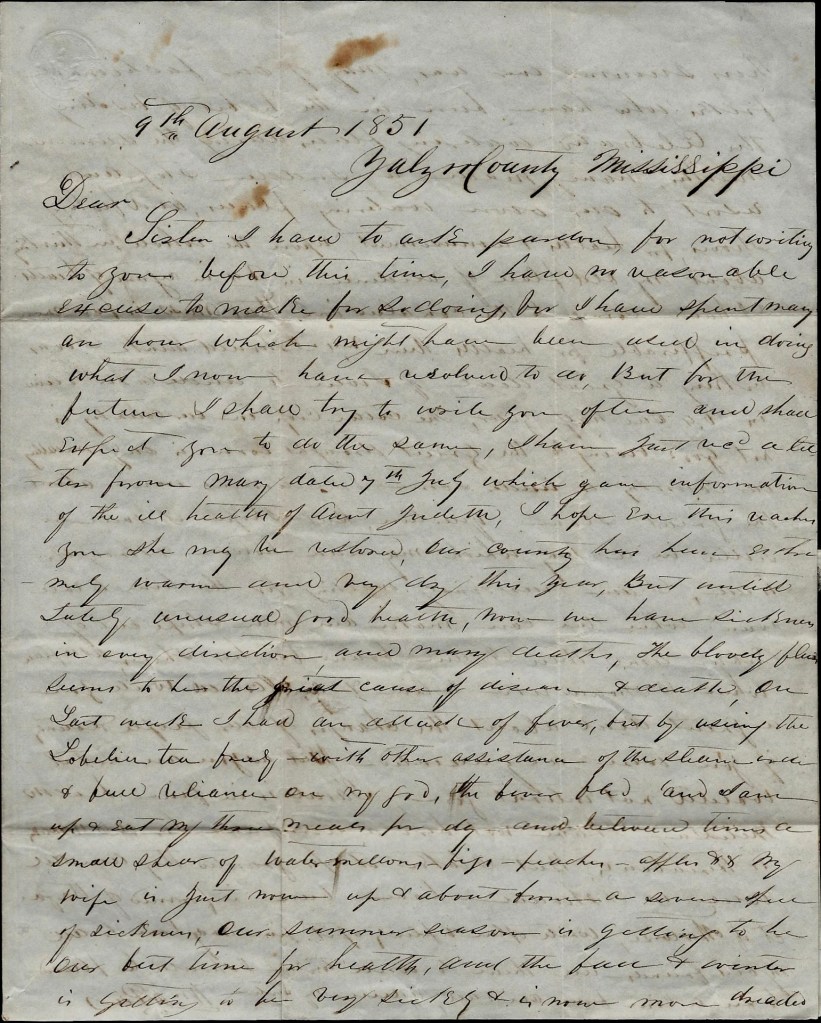
Yazoo County, Mississippi 9th August 1851
Dear Sister,
I have to ask pardon for not writing to you before this time. I have no reasonable excuse to make for so doing for I have spent many an hour which might have been used in doing what I now have resolved to do. But for the future I shall try to write you often and shall expect you to do the same. I have just received a letter from Mary dated 7th July which gave information of the ill health of Aunt Judeth. I hope ere this reaches you, she may be restored.
Our county has been extremely warm and very dry this year but until lately, unusual good health. Now we have sickness in every direction and many deaths. The bloody flux seems to be the great cause of disease and death. On last week I had an attack of fever, but by using the Lobelier tea freely—with other assistance of the steam [ ] and full reliance on my God, the fever fled and I am up and eat my three meals per day, and between times a small share of watermelons, figs, peaches, apples, &c. &c. My wife is just now up & about from a severe spell of sickness. Our summer season is getting to be our best time for health, and the fall and winter is getting to be very sick & is now more dreaded than summer ever was.
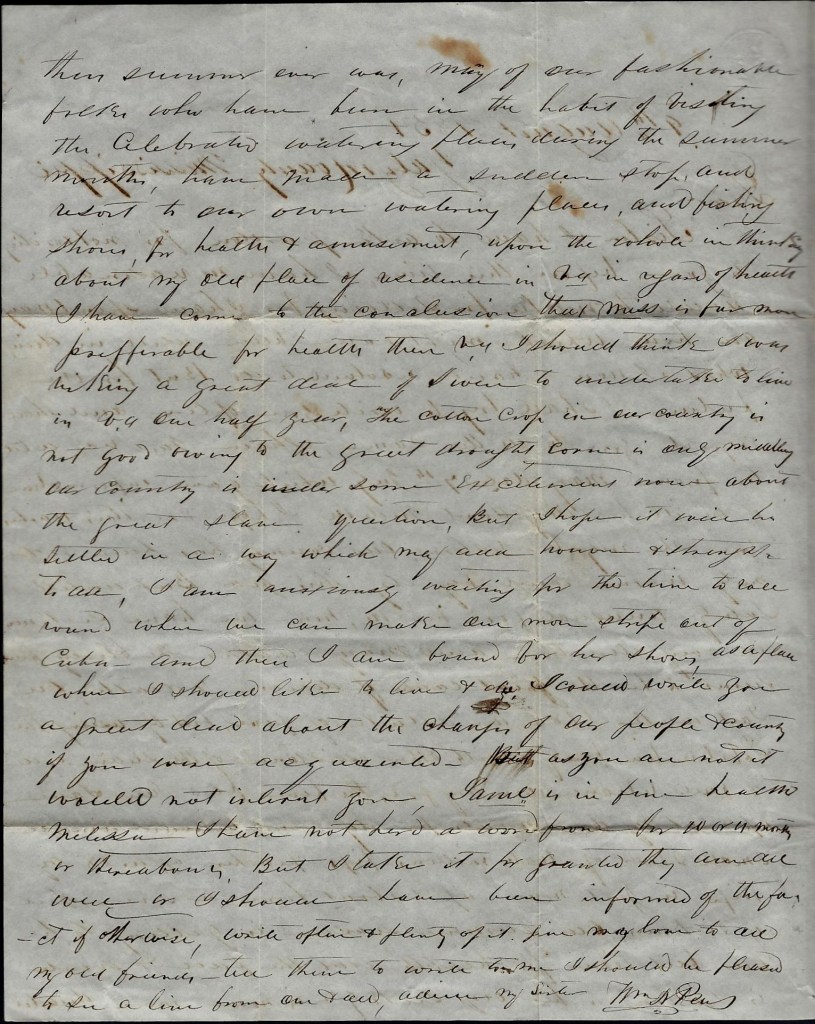
Many of our fashionable folks who have been in the habit of visiting the celebrated watering places during the summer months have made a sudden stop, and resort to our own watering places, and fishing shores for health and amusement. Upon the whole, in thinking about my old place of residence in Virginia in regard of health, I have come to the conclusion that Mississippi is far more preferable for health than Virginia. I should think I was risking a great deal if I were to undertake to live in Virginia one half year. The cotton crop in our country is not good owing to the great drought. Corn in only middling.
Our country is under some excitement now about the great slave question but I hope it will be settled in a way which may add honor and strength to all. I am anxiously waiting for the time to roll around when we can make one more stripe out of Cuba and then I am bound for her shores, as a place where I should like to live & die. I could write you a great deal about the changes of our people & country if you were acquainted but as you are not, it would not interest you.
James is in fine health. Melissa I have not heard a word from for 3 or 4 months or thereabouts. But I take it for granted they are all well or I should have been informed of the fact if otherwise. Write often and plenty of it. My love to all my old friends. Tell them to write to me. I should be pleased to see a line from one and all. Adieu my sister, — Wm. N. Peers

















 Spared & Shared 23