The following letter was written by Enos Ayres Axtell (1843-1906), the son of Timothy Clark Axtell (1796-1869) and Rachel DeBow (1808-1888) of Nassau county, New York. Axtell entered the service in April 1861 as a private in the “14th Brooklyn,” a State militia united that was later designated the 84th New York Infantry. He was later promoted to a corporal. He also served in the Navy for three years as an Engineer. At the battle of Fall’s Church in 1861 he was on the skirmish line that ran across a yard where a Southern home had just been wrecked by the explosion of a shell. Axtell stopped long enough to help a 17-year-old girl who was fleeing from the home. Here a romance began, and in spite of parental opposition, it resulted in an elopement and a marriage after the close of the war. Catherine Taylor of Fairfax, Virginia (a cousin of Zachary Taylor) and Enos’ dramatic battlefield meeting and romance furnished the basis for Marie Correlli’s “A Romance of Two Worlds.” The couple lived in Kansas City for 35 years and Enos became an influential Republican Ward Leader. He was killed by a street car in front of his own home in Kansas City on April 5, 1906. Catherine died in Kansas City in March 1925.
But the story of Axtell’s life doesn’t end there, according to the Regimental history, he was taken prisoner on 1 July 1863 as his regiment retreated through the town of Gettysburg. He was caught with a number of his comrades in a “high-walled yard” but before capture, he tore the guidon he was carrying from its pole and wound it around his leg inside of his stocking so that it would not be taken, and kept it on his person during his 6-month stay at Belle Isle prison in Richmond. [Axtell’s story can be found in “The History of the Fighting Fourteenth” with a section called “The Guidon in Prison and Enos A. Axtell“, page 198]
Once Axtell’s enlistment ran out in 1864—not long after the following letter was written—he joined the Navy and served as a 3rd class Ships Engineer on a number of steamers. By 1870 he and Katie were living in Kansas City.
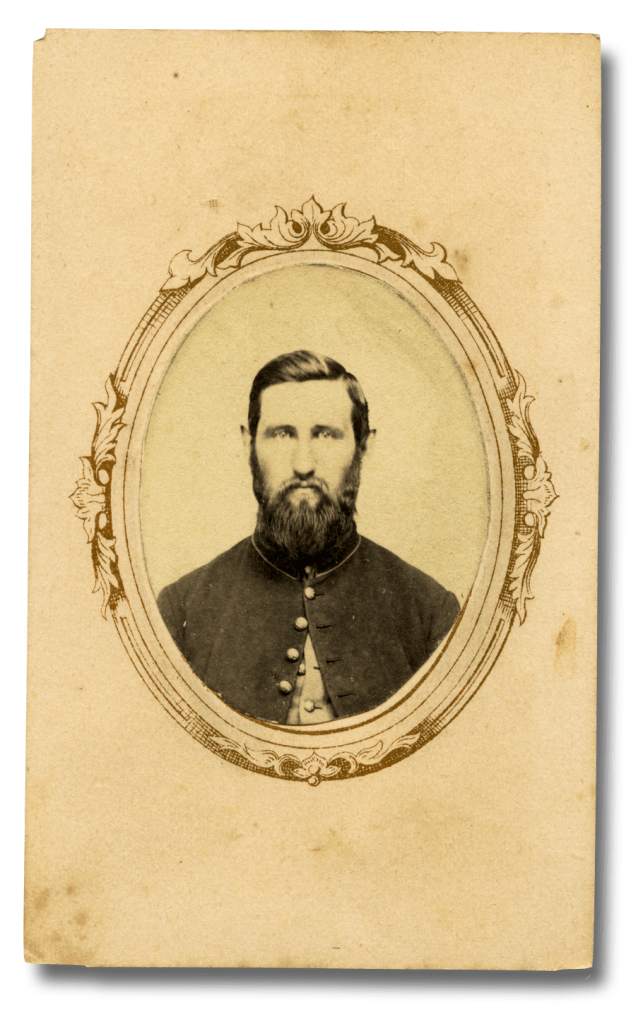
This letter and Axtell’s image (a period clear ambrotype copy of a tintype of him in his uniform) surfaced at a Riverside, California, flea market a short while ago, along with some late 19th Century tintypes and letters from a James R. Oldham. Oldham married Enos and Katie Axtell’s daughter, Amelia Elizabeth Axtell, in 1909 at Katie’s home in Kansas City, then moved to Whittier California later in the century. Amelia passed away in 1943, James lived until 1965.
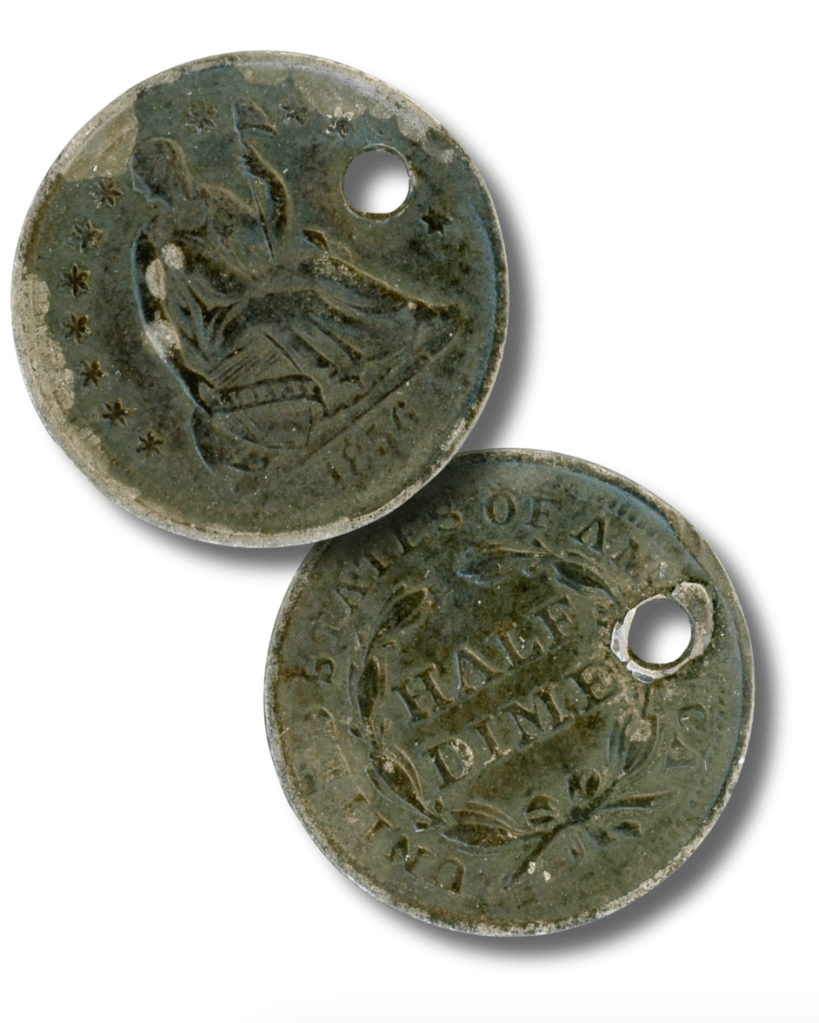
1856 Seated Liberty Half Dime
In addition to the 1864 letter, there are two letters from 1882—one of which speaks of his plans to go and see bank robber Frank James in prison—and an 1856 Seated Liberty half dime Enos or Katie might have worn as a pendant.
Of the men Axtell mentions in his March 1864 letter home, “John Cook” is likely “John E. Cook,” Co. D; “John Brown” is “John C. Brown,” Co. D, and William Smith is “William W. Smith,” Co. D who was later WIA at Spotsylvania Court House. They all appear to have transferred to the 5th New York Veteran Infantry except Axtell, who was discharged and went into the Navy.
This letter and the other items mentioned are from the collection of Charles Joyce who gave his consent to have it transcribed and published on Spared & Shared. He informs me that the grouping is available for trade or sale if any readers are interested in it.
Transcription
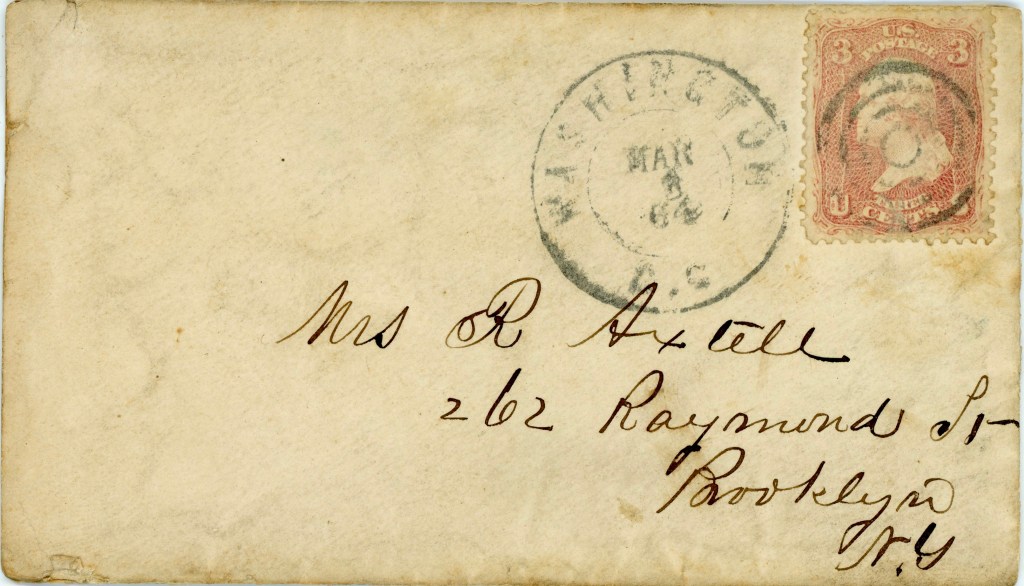
Addressed to Mrs. R. Axtell, 262 Raymond Street, Brooklyn, New York
Headquarters 14th Regt. N. Y. S. M., Culpeper, Va. Sunday morning, March 6th 1864
Dear Mother,
Two months and seventeen day. Oh dear, it seems a long time ahead, but not near so long as three years. Well, I am endeavoring to worry it out to the best of my ability. What a day it will be to the citizens of Brooklyn and also what a day it will be to the scums of (B) the demoralized scum.
I received a letter from John Brown am pleased to hear he has been to see you. Also that he is having a good time. I sent him a recommend for a commission approved by the Captain and Colonel. I hope he may be successful in procuring it. I am sure I have done all in my poor power to assist him. He is a good boy in camp or on the Field of Action. He is also a friend of mine for whom I would do almost anything. Tell the girls to handle him careful.
I was a little surprised to hear of Tillie’s wedding coming off so soon. I would dearly love to be there but as the thing now stands, I am to consume nearly 80 loaves of bread, several barrels of pork, and other articles too numerous to mention before I can again visit home. But as you see as I can not be present, at least I trust it will pass off pleasant. She has my best wishes. By the time you get this, she will be in a home of her own. Mother, you are too well aware of the past for me to say anything but for Tillie’s sake, and in fact for the future happiness of the family. Let it pass. We will all look forward to I hope a brighter and more happy life. I hope everything hereafter will pass off smooth. Hannah spoke of Mrs. Brown thinking I would reenlist. Although I think a great deal of Johnny yet, I will not reenlist just for the very reasons. I will not break my promise to you all. Tell Hannah if I am not mistaken I have my senses yet.
I have nothing to say concerning your not answering my letters. I see you have as usual been on an errand of what shall I call it. I am sorry that he—Mr. Ely, although I was not acquainted with him, is dead. I have been expecting to hear from you. I also want you to send me one of those cards as I want it for a special purpose. I am going to send in a few days a parcel to you and by all means, don’t let anyone take it. Keep it for me as I value it very highly. The field glass was found here in town and in all probability it was the property of some Confederate officer. But I don’t value it so much for that as I do for its real value. The revolver is also valued by me at $40. Keep them where they will be safe. Wm. Smith will bring them on, he having reenlisted.
The day is beautiful. I never heard of such weather before in March. I have no news to write—only there are flying rumors as to Kilpatrick’s whereabouts. He has gone somewhere, that is certain, and I bet the Rebels will find him when he strikes a blow.
Remember me to all my friends, Hattie, and Mary Bennett. I guess I will not mention names as you may tell the parties and there I would be in a fix. I mean Hattie and Mary’s brother. My love to all the folks with much love to you. I remain your son, — Enos A. Axtell
John Cook has arrived. He gave me the letter. I am pleased to hear you are all well. John feels sick since he has come back.
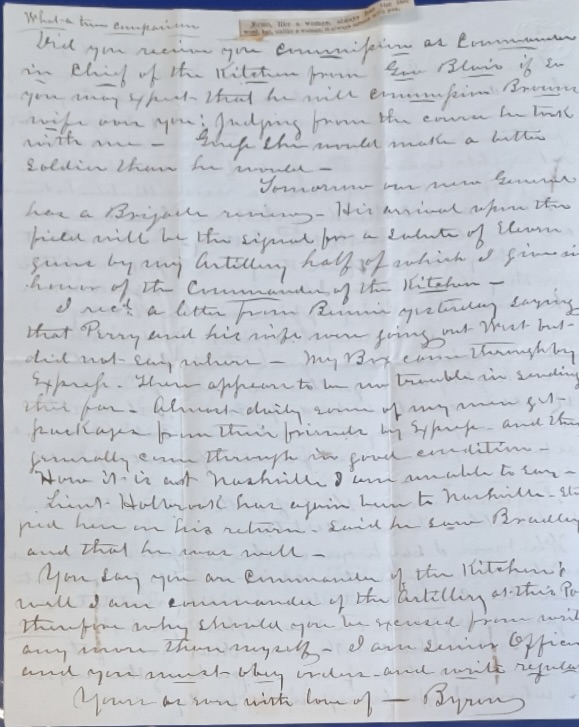
The following letter was written by Byron Densmore Paddock (1833-1920), the son Henry Paddock, Jr. (1791-1854) and Silence Hard (1800-1850). He wrote the letter to Harriet A. Crippen (1839-1903) with whom he would marry on 27 December 1865.
Byron enlisted in the 1st Michigan Light Artillery Regiment, Battery F, at Coldwater, Michigan, in October 1861. He was formally mustered into the Union Army on January 9, 1862, and served with the regiment until receiving his discharge on April 6, 1865. Paddock was promoted to quartermaster sergeant, lieutenant, and captain during the course of his service.
[Note: This letter is the property of Michigan’s Military Heritage Museum and was transcribed and published on Spared & Shared by express consent.]
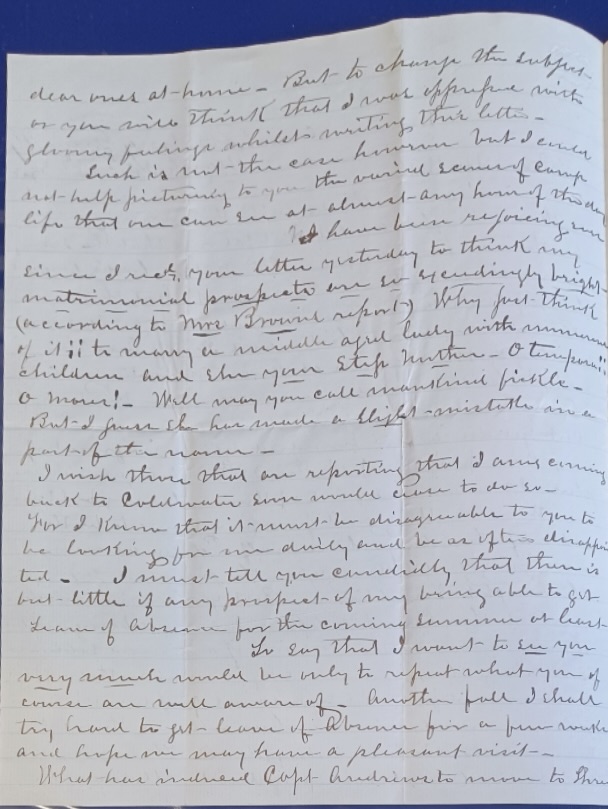
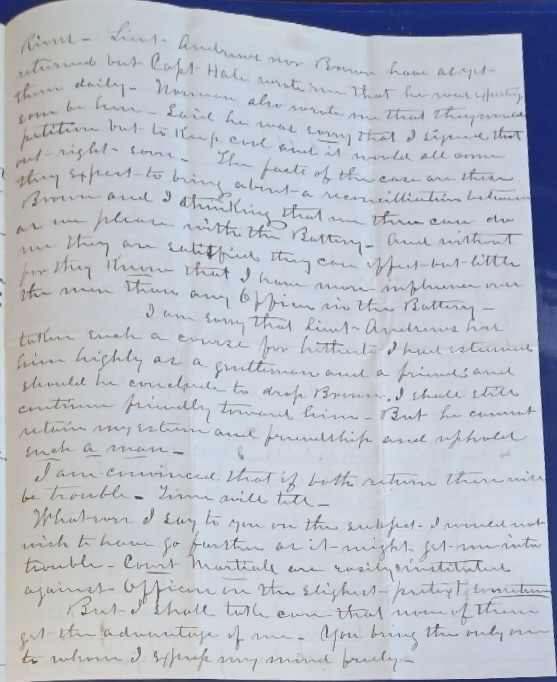
TRANSCRIPTION
Bowling Green, Kentucky March 22nd 1863
Dear Hattie,
It is Sabbath morning and one of those bright and beautiful ones that the Sunny South is so famous for. All nature looks gay, and seems striving to make me for get that this once happy country is now involved in a civil war. But I have only to listen and can hear the beating of the drums at guard mounting. Have only to look around me and can see the tents of the soldiers scattered in all directions.
Out yonder a few hundred yards from out in front of my camp is that of the 25th Michigan [Infantry]. 1 In one place I can see a squad of them playing ball. In another wrestling and jumping seems to be the order of the day. Then half a dozen or more are lying and sitting upon the ground enjoying the bright sunshine. But yonder in another part of the camp a different scene is being enacted. A hearse bearing the remains of a deceased soldier is moving along proceeded by a band with muffled drums and followed by a squad of soldiers with their guns reversed who are thus following their late comrade to his last resting place. Thus numbers are buried and soon forgotten by all save some dear ones at home.
But to change the subject or you will think that I was oppressed with gloomy feelings whilst writing this letter. Such is not the case, however, but I could not help picturing to you the varied scenes of camp life that one can see at almost any hour of the day.
I have been rejoicing ever since I received your letter yesterday to think my matrimonial prospects are so exceedingly bright (according to Mrs. Brown’s report). Why just think of it—to marry a middle aged lady with numerous children and she your step mother. O tempora!! O mores! 2 Well, may you call mankind fickle. But I guess she has made a slight mistake in a part of the name.
I wish those that are reporting that I am coming back to Coldwater soon would cease to do so, for I know that it must be disagreeable to you to be looking for me daily and be as often disappointed. I must tell you candidly that there is but little if any prospect of my being able to get leave of absence for the coming summer at least.
To say that I want to see you very much would be only to repeat what you of course are well aware of. Another fall I shall try hard to get leave of absence for a few weeks and hope we may have a pleasant visit.
What has induced Capt. Andrews to move to Three Rivers? Lieut. Andrews nor Brown have as yet returned but Capt. Hale wrote me that he was expecting them daily. Norman also wrote me that they would come here. Said he was sorry that I signed that petition but to keep cool and it would all come out right soon. The facts of the case are these. They expect to bring about a reconciliation between Brown and I thinking that we three can do as we please with the Battery. And without me they are satisfied they can effect but little for they know that I have more influence over the men than any officer in the Battery.
I am sorry that Lieut. Andrews has taken such a course for hitherto I had esteemed him highly as a gentleman and a friend and should he conclude to drop Brown, I shall still continue friendly toward him. But he cannot return my esteem and friendship and uphold such a man.
I am convined that if both return there will be trouble. Time will tell.
Whatever I say to you on the subject I would not wish to have go farther as it might get me into trouble. Court martials are easily instituted against officers in the slightest pretext sometimes. But I shall take care that none of them get the advantage of me—you being the only one to whom I express my mind freely.
Did you receive your commission as commander in chief of the kitchen from Gov. Blair. If so, you may expect that he will commission Brown’s wife over you, judging from the course he took with me. Guess the world would make a better soldier than he would.
Tomorrow our new General has a Brigade Review. His arrival upon the field will be the signal for a salute of eleven guns by my artillery, half of which I give in honor of the commander of the kitchen.
I received a letter from Bennie yesterday saying that Perry and his wife were going out West but did not say where. My box came through by express. There appears to be no trouble in sending that far. Almost daily some of my men get packages from their friends by express and they generally come through in good condition. How is it at Nashville, I am unable to say. Lieut. Holbrook has again been to Nashville. Stopped here on his return. Said he saw Bradley and that he was well.
You say you are commander of the kitchen? Well I am commander of the artillery at this post. Therefore, why should you be excused from writing any more than myself? I am Senior Officer and you must obey orders and write regularly. Yours as ever with love of—Byron
1 The 25th Michigan Infantry was posted at Bowling Green, Kentucky from 8 January 1863 to 26 March 1863.
2 O tempora, o mores is a Latin phrase that translates literally as “Oh the times! Oh the customs!” first recorded to have been spoken by Cicero.
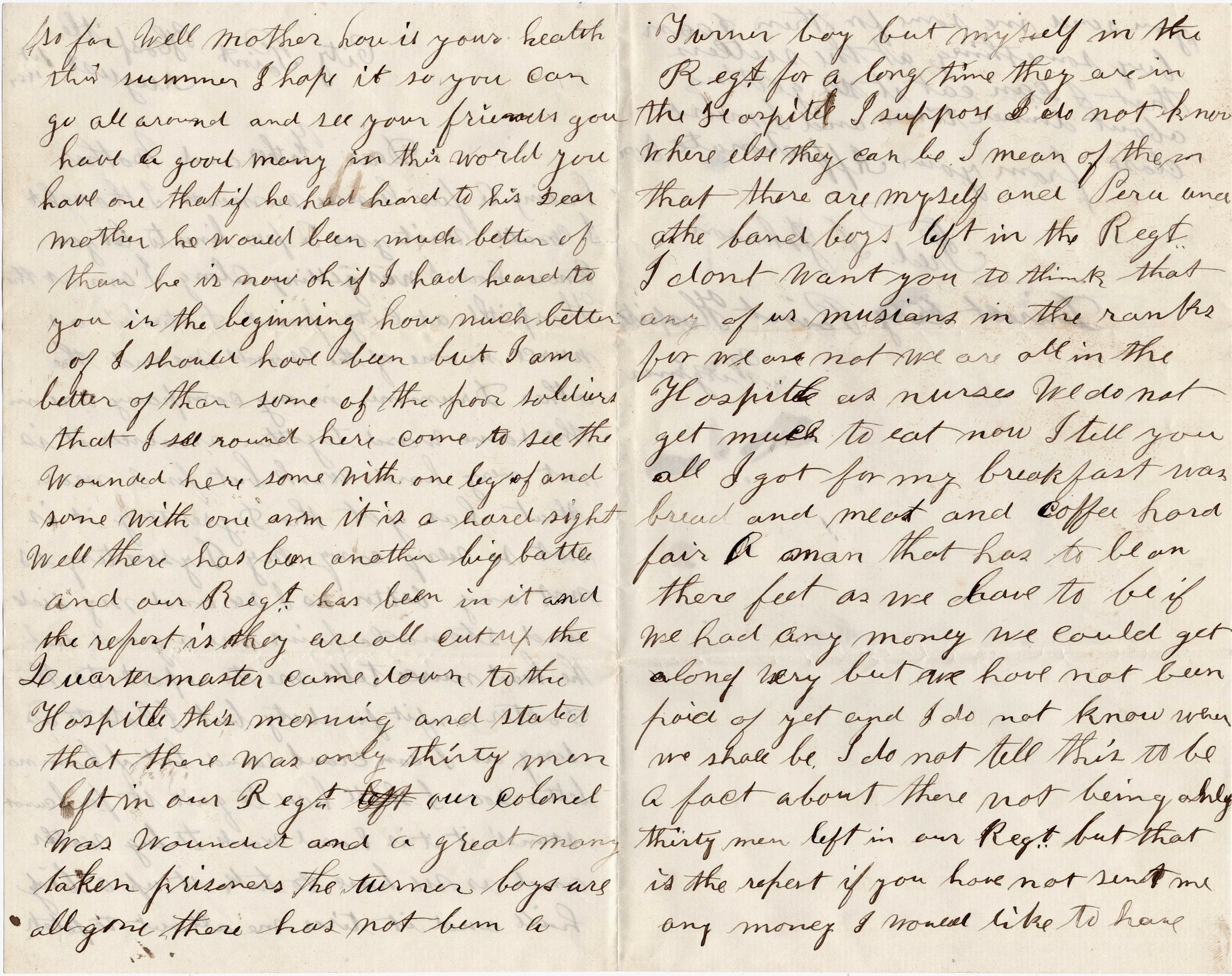
The following letters were written by Frederick I. Johnson (1848-1875), the son of Abizer Johnson (1806-1893) and Sarah Woodward (1816-1865) of Turner, Androscoggin county, Maine.
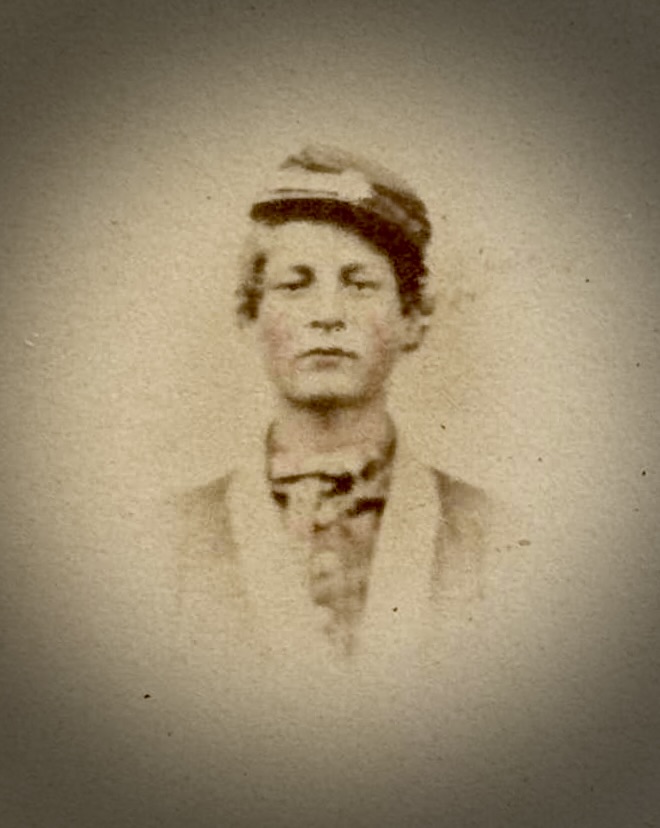
I could not find an image of Frederick but here is an unidentified drummer boy posted by Kevin Canberg recently.
Frederick was only 16 when he enlisted to serve as a drummer boy in Co. D, 31st Maine Infantry. He enlisted 19 February 1864 at the formation of the regiment and was not discharged until 27 July 1865. Though he entered the war as a musician, it seems clear from his letters that illness disabled him for periods of time and he was detailed as a cook’s assistant and a hospital nurse on occasions. One of his letters suggests that he had either damaged or lost his drum which may also account for his duty elsewhere.
Though he survived the war and returned home to work as a shoe salesman, he continued to have poor health and he was admitted to the Home for Disabled Soldiers in Togus, Kennebec county, Maine, in October 1871 suffering from “paralysis” and he died on 23 April 1875.
Letter 1
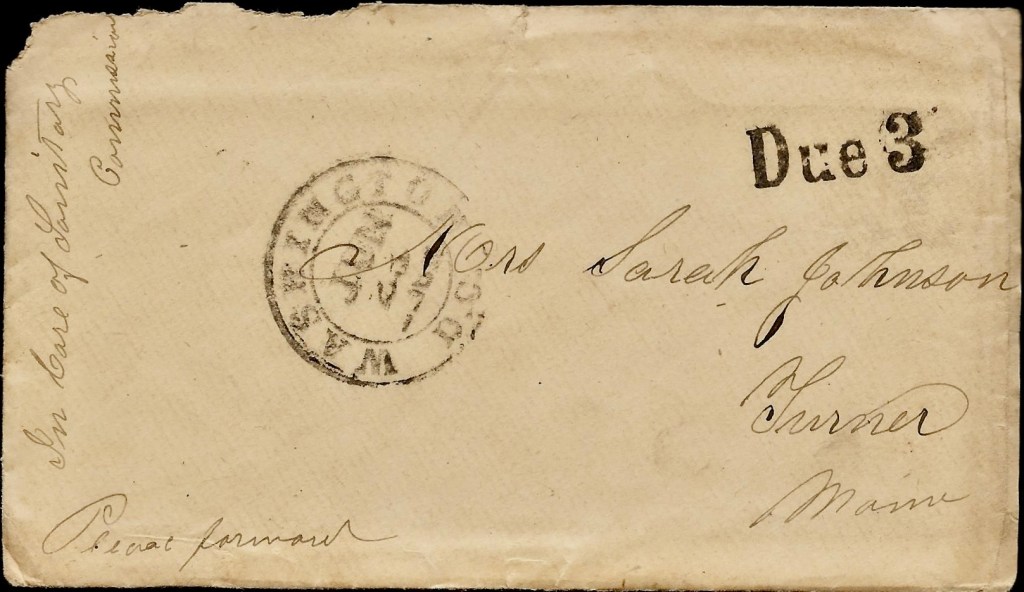
Addressed to Mrs. Sarah Johnson, Turner, Maine
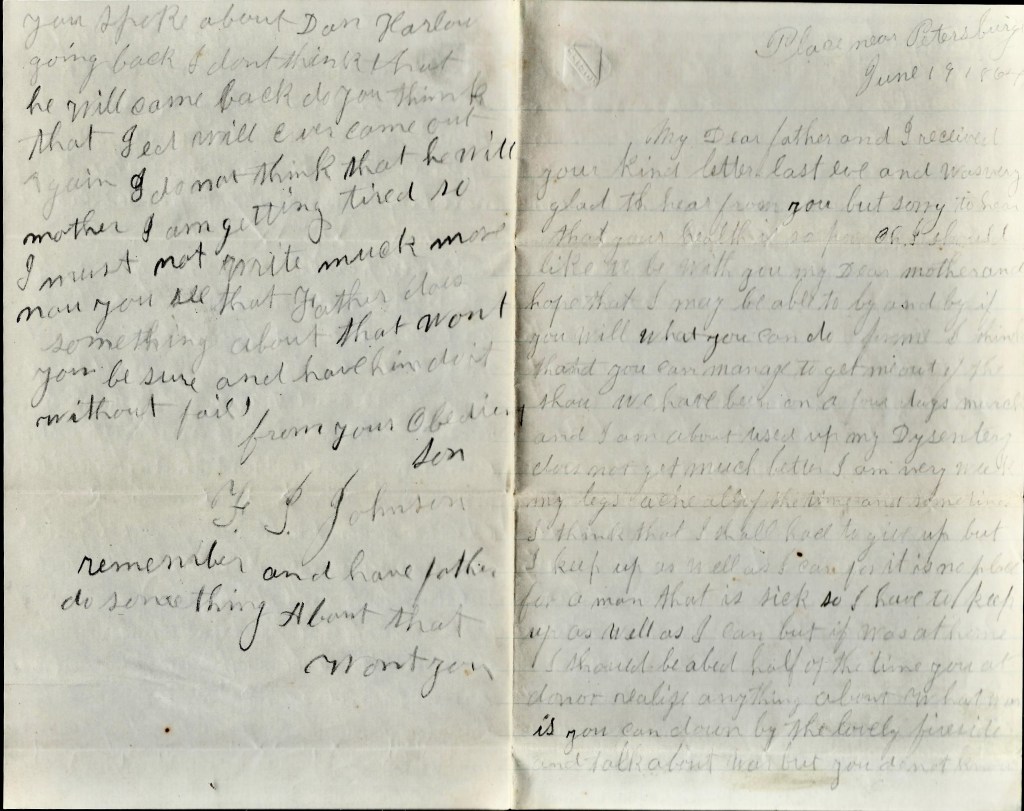
Place near Petersburg [Virginia] June 19, 1864
My dear Father and [Mother],
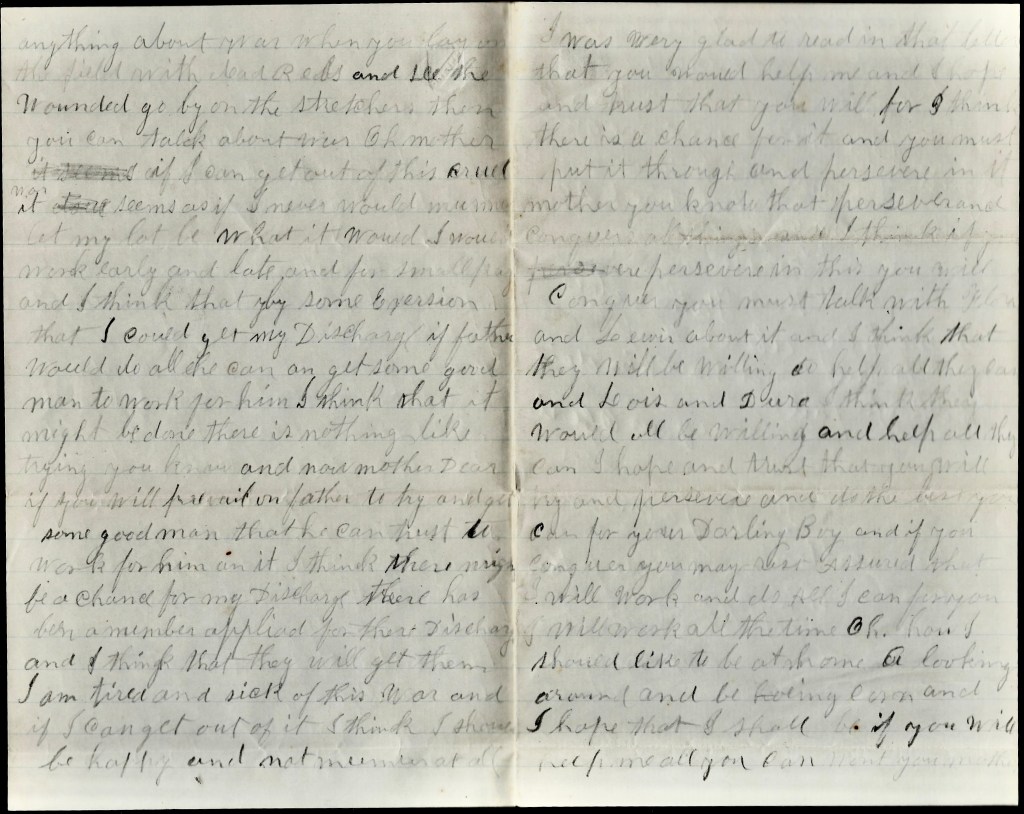
I received your kind letter last eve and was very glad to hear from you but sorry to hear that your health is so poor. Oh, I should like to be with you, my dear Mother and hope that I may be able to by and by. If you will [do] what you can do for me, I think that you can manage to get me out of the show. We have been on a four days march and I am about used up, My dysentery does not get much better. I am very well. My leg aches all of the time and sometimes I think that I shall have to give it up but I keep up as well as I can for it is no place for a man that is sick, so I have to keep up as well as I can. But if I was at home, I should be abed half of the time. You at [home] do not realize anything about what war is. You can [sit] down by the lovely fireplace and talk about war, but you do not know anything about war when you lay on the field with dead Rebs and see the wounded go by on the stretchers. Then you can talk about war.
Oh Mother, if I can get out of this cruel war, it seems as if I never would murmur, let my lot be what it would. I would work early and late and for small pay and I think that by some exertion that I could get my discharge if Father would do all he can and get some good man to work for him. I think that it might be done. There is nothing like trying, you know. And now Mother dear, if you will prevail on Father to try and get some good man that he can trust to work for him on it, I think there might be a chance for my discharge. There was been a number applied for their discharge and I think that they will get them. I am tired and sick of this war and if I can get out of it, I think I should be happy and not murmur at all.
I was glad to read in that letter that you would help me and I hope and trust that you will for I think there is a chance for it and you must put it through and persevere in it. Mother, you know that perseverance conquers all things and I think if you persevere in this, you will conquer, You must talk with Flora and Lewis about it and I think that they will be willing to help all they can. And Lois and Dura, I think they would be willing all be willing and help all they can. I hope and trust that you will try and persevere and do the best you can for your darling boy. And if you conquer, you may rest assured that I will work and do all I can for you. I will work all the time. Oh, how I should like to be at home a looking around and hoeing corn and I hope that I shall be if you will help me all you can.
You spoke about Dan Harlow going back. I don’t think that he will come back. Do you think that Jed will ever come out again? I do not think that he will. Mother, I am getting tired so I must not write much more. Now you see that Father does something about that, won’t you? Be sure and have him do it without fail. From your obedient son, — F. I. Johnson
Remember and have Father do something about that, won’t you?
Letter 2
Addressed to Mrs. Sarah W. Johnson, Turner, Maine
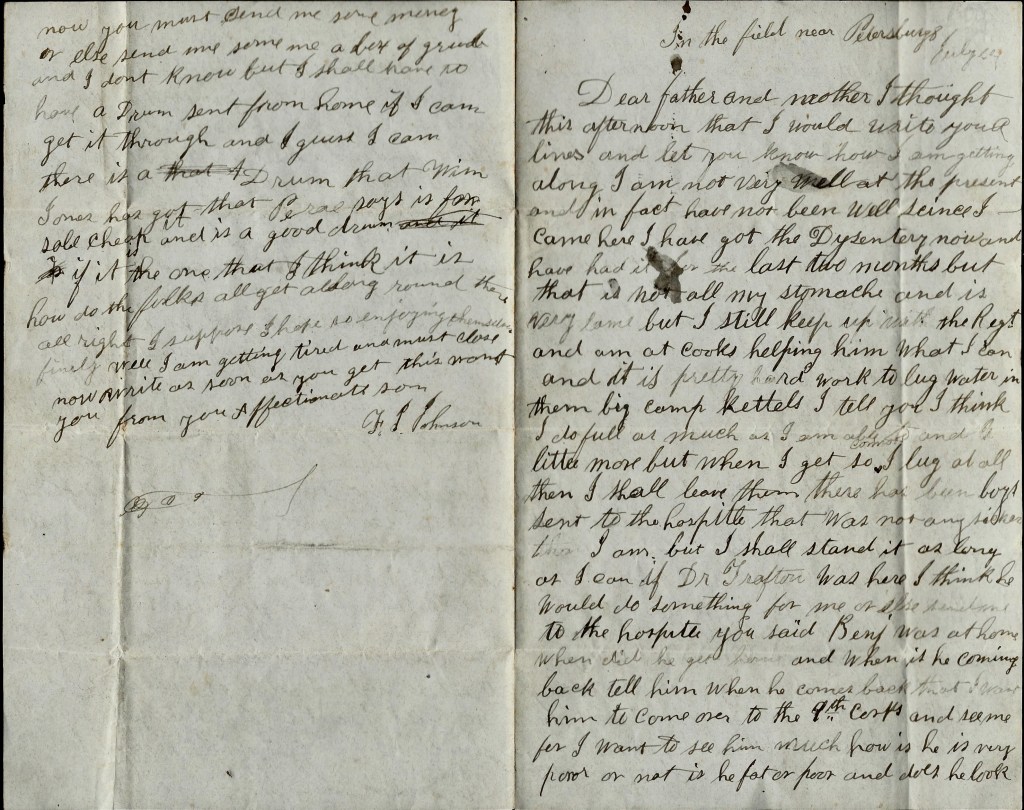
In the Field near Petersburg [Virginia] July 24, [1864]
Dear Father and Mother,
I thought this afternoon that I would write you a [few] lines and let you know how I am getting along. I am not very well at the present and in facts have not been well since I came here. I have got the dysentery now and have had it for the last two months, but that is not all. My stomach is very lame but I still keep up with the regiment and am at cooks helping him what I can and it is pretty hard work to lug water in them big camp kettles, I tell you. I think I do full as much as I am able to and a little more. But when I get so I cannot lug at all, then I shall leave them.
There has been boys sent to the hospital that was not any sicker than I am but I shall stand it as long as I can. If Dr. Trafton was here, I think he would do something for me or else send me to the hospital. You said Benj. was at home. When did he get home and when is he coming back? Tell him when he comes back that I want him to come over to the 9th Corps and see me for I want to see him much. How is he—very poor or not? Is he fat or poor? and does he look just as he always did? I hope he does and I hope he feels better than I do too. If he does not, he does not feel very well nor I can assure you for I feel very poorly.
You said in your last letter that Father was at work down to Auburn. Who is he to work for down there? Is he able to [go] out haying? If he is not able to work, he had better not work much. Oh I wish I could be there at work in haying. I understand that Hiram Conant is at home at work out haying for three dollars a day.
Well there has got to be some more come out of Old Turner yet. This last call will take about all of them that is able bodied and I should not wonder it took [ ] and Lewis. If Lewis is drafted, what will Flora do? She will feel bad, won’t she. Anyone must feel bad to have their friends come into this awful war.
I received in your last letter a two dollar bill and I tell you, it done my soul good. But two dollars does not go very far here now I can tell you. I bought me a little butter and made me a little toast and I tell you it tasted good. Things are most high out here. If it was so you could send me a box, I should like [it] but I do not know as you could without costing considerable. But they say that a box will come right through straight to City Point and then come up on the teams, There has been boxes come. If you do not send a box. Please send me a five dollar bill and I will send you back as much more when we get paid off. They say we shall get paid now pretty soon and I shall send some home. I think you will get some anyhow on the allotment roll.
Ted Chase has come on and I thought strange that either you nor Lizzie did not send me anything to eat. I tell you that a biscuit from Maine would taste good or anything else, it would not matter much. I wonder if I would not like a piece of Flora’s cheese and a good piece of brown bread? If it would not, I do not know what would. When a man has money, he can make out to live. You can get cheese here but it is no such cheese as Flora makes now, I tell you. I should like to have a piece of her cheese to eat tonight. I believe it would taste good, but I can’t eat fat boiled pork and hard bread as I am now. That is decided. If I can’t get money nor grub from home, I will have to go without eating. Now you must send me some money or else send me a box of grub and I don’t know but I shall have to have a drum esnt from home if I can get it through and I guess I can. There is a drum that William Jones has got that Peroe says is sold cheap and is a good drum if it’s the one that I think it is.
How do the folks all get along round there? All right I suppose. I hope so enjoying themselves. Well, I am getting tired and must close. Now write as soon as you get this, won’t you? From your affectionate son, — F. I. Johnson
Letter 3
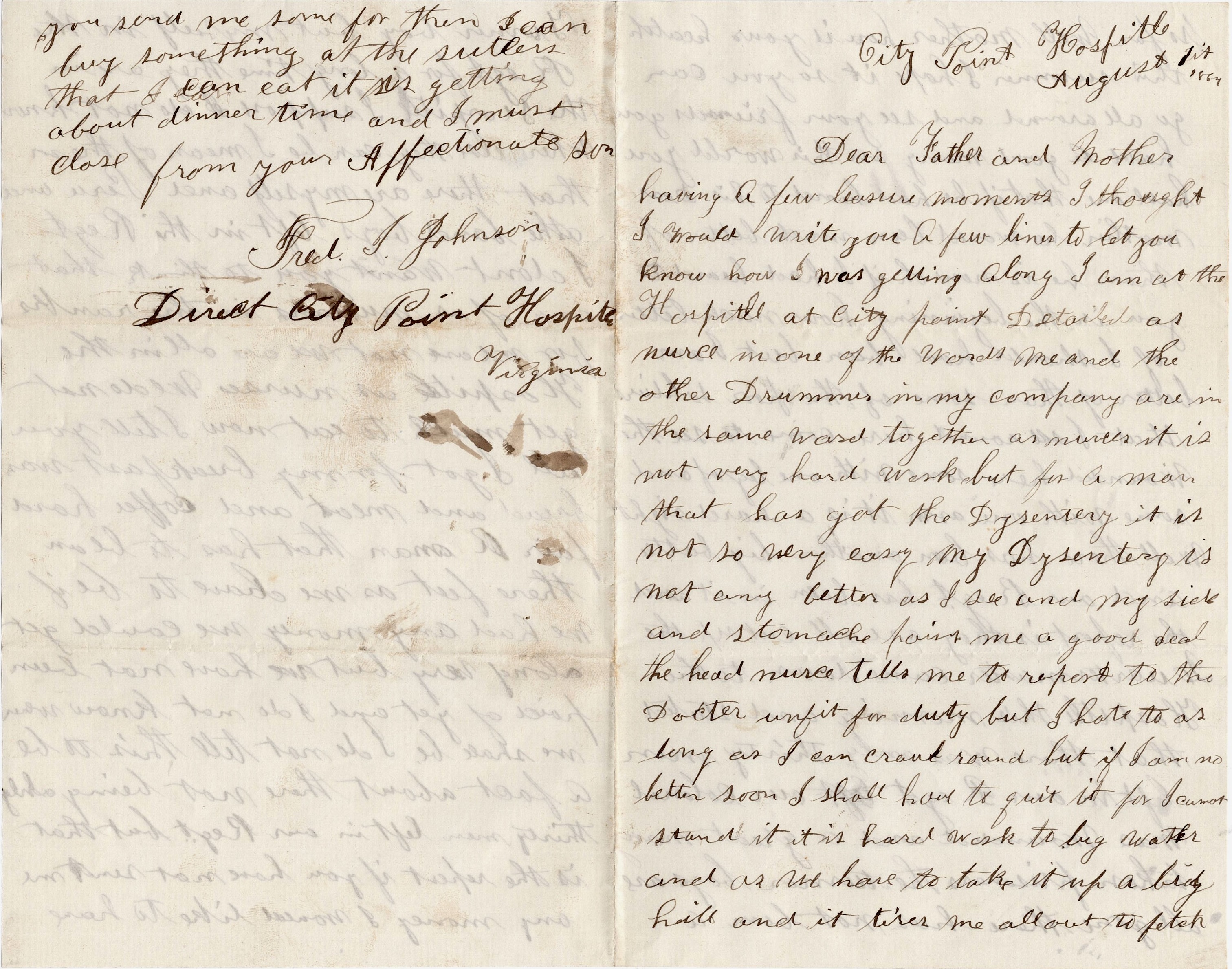
City Point Hospital August 1, 1864
Dear Father and Mother,
Having a few leisure moments I thought I would write you a few lines to let you know how I was getting along. I am at the hospital at City Point, detailed as nurse in one of the wards. Me and the other drummer in my company are in the same ward together as nurses. It is not very hard work but for a man that has got the dysentery, it is not so very easy. My dysentery is not any better as I see and my side and stomach pains me a good deal. The head nurse tells me to report to the doctor unfit for duty but I hate to as long as I can crawl round. But if I am no better soon, I shall have to quit it for I cannot stand it. It is hard work to lug water and as we have to take it up a big hill, it tires me all out to fetch so far.
Well mother, how is your health this summer. I hope it is so you can go around and see your friends. You have a good many in this world. You have one that if he had heard [listened] to his dear mother, he would been much better off than he is now. Oh, if I had heard to you in the beginning, how much better off that some of the poor soldiers that I see round here [who] come to see the wounded here—some with one leg off and some with one arm. It is a hard sight.
Well, there has been another big battle and our regiment has been in it and the report is they are all cut up. The quartermaster came down to the hospital this morning and stated that there was only thirty men left in our regiment. Our colonel was wounded and a great many taken prisoners. 1
The Turner boys are all gone. There has not been a Turner boy but myself in the regiment for a long time. They are in the hospital, I suppose. I do not know where else they can be, I mean of them that there are myself and Peru and other band boys left in the regiment. I don’t want you to think that any of us musicians [are] in the ranks for we are not. We are all in the hospital as nurses.
We do not get much to eat now, I tell you. All I got for my breakfast was bread and meat and coffee—hard fare [for] a man that has to be on their feet as we have to be. If we had any money, we could get along very [well] but we have not been paid off yet and I do not know when we shall be. I do not tell this to be a fact about there not being only thirty men left in our regiment, but that is the report.
If you have not sent me any money, I would like to have you send me some for then I can buy something at the sutlers that I can eat. It is getting about dinner time and I must close.
From your affectionate son, — Fred I. Johnson
Direct to City Point Hospital, Virginia
1 The “big battle” Fred refers to was the Battle of the Crater which took place on 30 July 1864. The 31st Maine was given the task of leading the initial charge into the Confederate works after the massive mine explosion. They sustained numerous casualties and a large number of them were taken prisoners—their colonel, Daniel White, among them.
Letter 4
Addressed to Mrs. Sarah W. Johnson, Turner, Maine
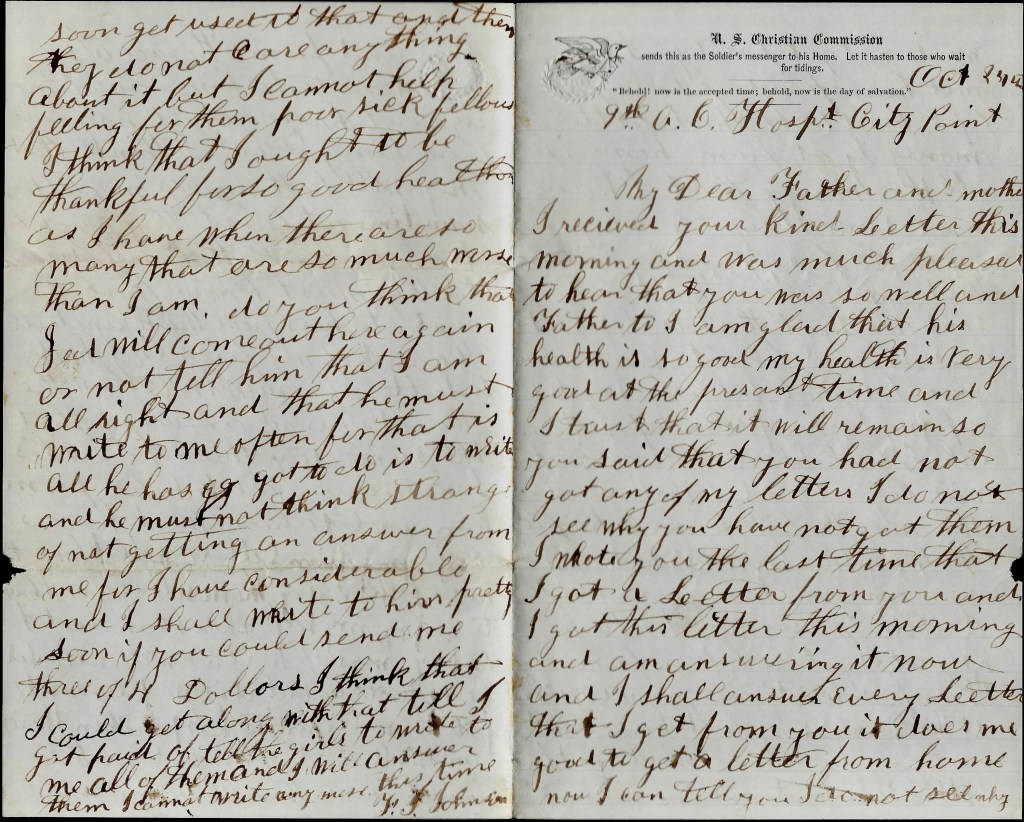
9th Army Corps Hospital City Point, [Virginia] October 24th [1864]
My dear Father and Mother,
I received your kind letter this morning and was much pleased to hear that you was so well and Father too. I am glad that his health is so good. My health is very good at the present time and I trust that it will remain so.
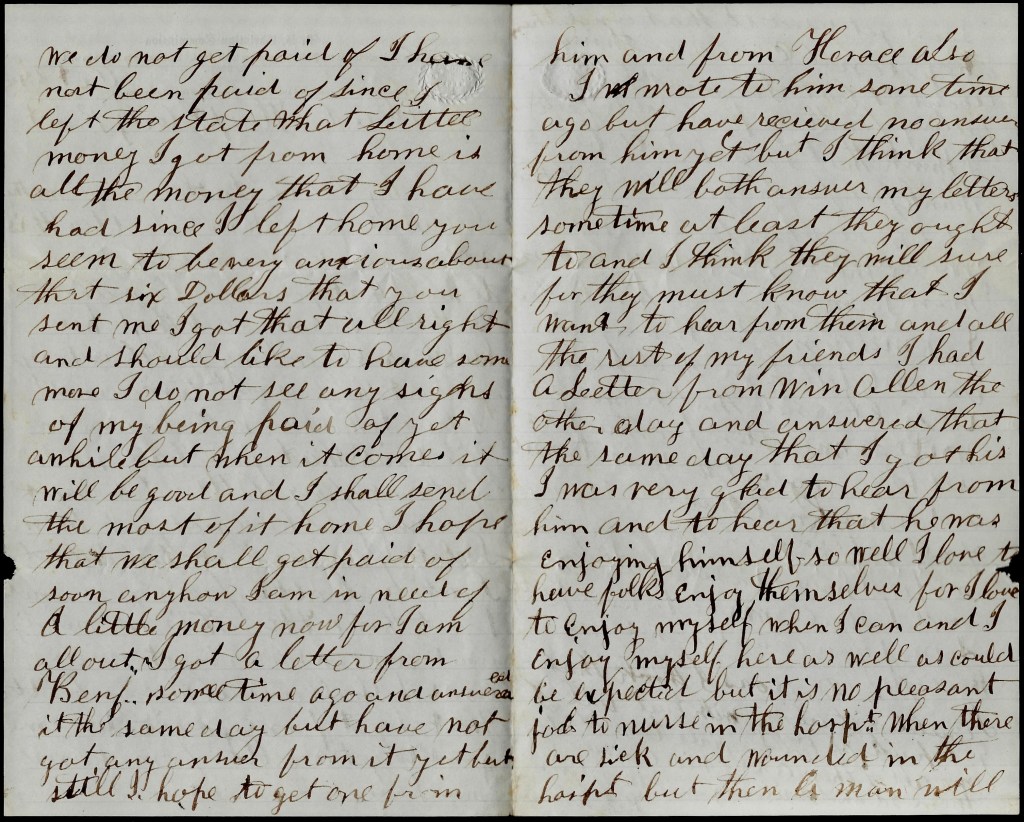
You said that you had not got any of my letters. I do not see why you have not got them. I wrote you the last time that I got a letter from you and I got his letter this morning and am answering it now and I shall answer every letter that I get from you. It does me good to he a letter from home now, I can tell you. I do not see why we do not get paid off. I have not been paid off since I left the state. What little money I got from home is all the money that I have had since I left home. You seem to be very anxious about that six dollars that you sent me, I got that all right and should like to have some more. I do not see any signs of my being paid off yet awhile but when it comes, it will be good and I shall send the most of it home. I hope that we shall get paid off soon anyhow. I am in need of a little money now for I am all out.
I got a letter from Benj. some time ago and answered it the same day but have not got an answer from it yet but still I hope o get one from him and from Horace also. I wrote to him some time ago but have received no answer from him but I think that they will both answer my letters sometime—at least they ought to. And I think they will sure for they must know that I want to hear from them and all the rest of my friends. I had a letter from Win Allen the other day and answered that the same day that I got his. I was very glad to hear from him and to hear that he was enjoying himself so well. I love to enjoy myself when I can and I enjoy myself here as well as could be expected but it is no pleasant job to nurse in the hospital when there are sick and wounded in the hospital. But then a man will soon get used to that and then they do not care anything about it. But I cannot help feeling for them poor sick fellows. I think that I ought to be thankful for so good health as I have where there are so many that are so much worse than I am.
Do you think that Jed will come out here again or not? Tell him that I am alright and that he must write to me often for that is all he has got to do is to write. And he must not think strange of not getting an answer from me for I have considerable and I shall write to him pretty soon. If you could send me three or four dollars, I think that I could get along with that till I get paid off. Tell the girls to write to me, all of them, and I will answer them. I cannot write any more this time. — F. J. Johnson
I want you to give this little book to Charlie and read it to him and let him read it too. Tell him that he must be a good boy and ming his mother and do all that he can to help her and he will be rewarded. I am going to send another one of these books in the next letter. I wrote to Lois the other day and expect to have one by and by. I guess that she is a good sister and she will write to her brother in the army, I know.
Well, mother, I must not write anymore this morning for it is getting late and I am getting tired so I guess I must close. So goodbye for the present. From your son, — F. J. Johnson
The following letters were written by Benson Miles Jones (1843-1876), the son of Lambert Jefferson Jones (1813-1894) and Mary Eliza McHardy (1822-1894) of Newberry county, South Carolina. It does not appear that Benson ever served in the Confederate army. We learn that he was working as a Government clerk in Richmond in 1863 and such personnel were routinely drilled with the local militia.
Benson wrote the letters to his cousin, Belton Oscar Mauldin (1839-1874), son of Samuel Easley Mauldin and Caroline McHardy Mauldin. Belton attended Furman University from 1852 to 1859. Belton’s orphaned mother and her siblings fell under the guardianship of John Belton O’Neall (1793-1863)—a chief justice of the South Carolina Supreme Court. At the beginning of the Civil War, Belton enlisted 12 June 1861 and was mustered into Co B, South Carolina (Hampton’s Legion Cavalry) and transferred 15 Aug 1862 to Co I, 2nd South Carolina Cavalry.
Letter 1
Addressed to Mr. B. O. Mauldin, Signal Corps, Care of General J. E. B. Stuart
Richmond [Virginia] August 9th 1863
My Dear Cousin:
A few days ago I was very much delighted to receive a letter from you as it had been a very long time since I had that pleasure before. But I thought the reason you did not write was because you were always on the march and could not write or could not get our letters. I am sorry you have been changed from your position, both on your account because you wished to remain, and on my own for I was in hopes I could get with you and I do not wish to go anywhere unless you are there. Can you not get me on the Signal Corps of Gen’l Stuart? I would like so much to be with you and in fact I do not want to go anywhere but with you if I can help it. I would not care if you were in a company just so I could be with you & have you as my bed fellow, &c.
I suppose you have written to Willie and told him not to come on as he intended riding his horse here. I saw Billy Maudin here about three weeks ago. He has left now tho’ with his brigade. I see by the papers that Gen’l Hampton is to be made Major Gen’l, and it is likely your former Major Butler will be Brig’ in his stead. I saw Butler when he was here. He did not seem to mind his foot being amputated for he said he always did suffer with cold feet, and now he would only have one foot to keep warm. I suppose it will be sometime before he can return. 1
How is Capt. Williams getting along? Col. Butler spoke very well of him to me. I asked him if he saw Pa to try & persuade him to let me go to the army in the cavalry. Thought he might have some place he could give me. Gen’l Hampton has also gone home wounded.
Tell Jno. Willingham I still have his overcoat in my room and if he wishes it this winter, he will know where to send for it. I also have your old sword still. Do you think you can get off any time and come down to see me? I would like very much to see you. Am living finely now, keeping Bachelors Hall. Jack & I [are] alone now and we live very well. Can get something to eat now—plenty of vegetables, &c. I have not received a letter from home this week but have heard through Joe Ward [that] all [are] well. I am standing this summer finely. Have not got sick yet and do not think I will. Hoping soon to hear from you, I remain as ever your loving cousin, — Benson
1 Colonel Matthew Caldwell Butler of Hampton’s Legion Cavalry Battalion was wounded in the Battle of Brandy Station on 9 June 1863 and had his foot amputated.
Letter 2
Addressed to Mr. Bo. O. Mauldin, Signal Corps, Care of Gen’l J. E. B. Stuart
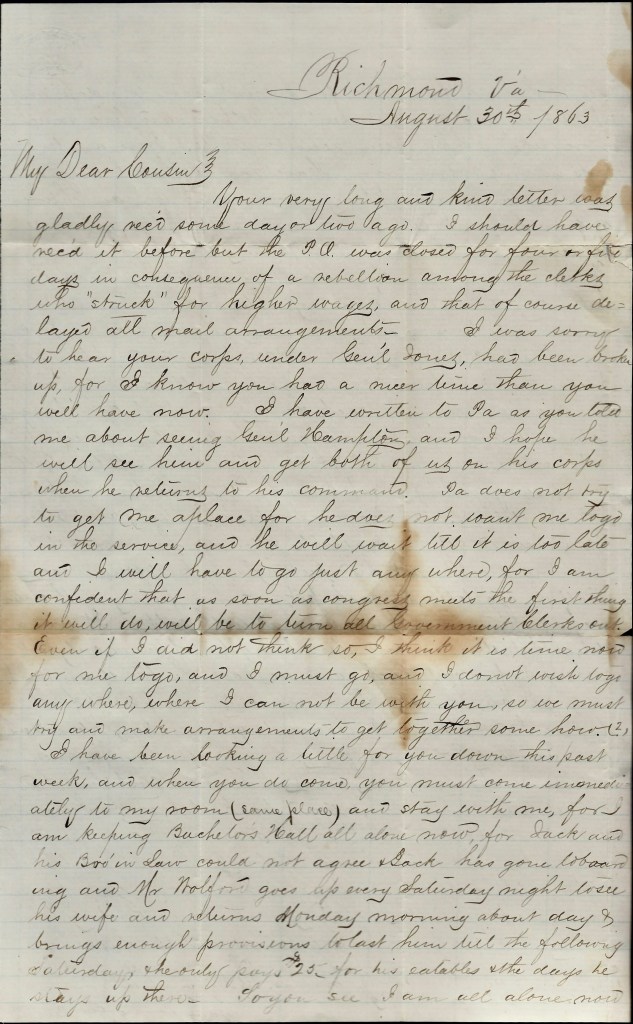
Richmond, Virginia August 30, 1863
My Dear Cousin,
Your very long and kind letter was gladly received some day or two ago. I should have received it before but the P. O. was closed for four or five days in consequence of a rebellion among the clerks who “struck” for higher wages and that of course delayed all mail arrangements.
I was sorry to hear your corps, under Gen’l Jones, had been broken up, for I know you had a nicer time than you will have now. I have written to Pa as you told me about seeing Gen’l Hampton and I hope he will see him and get both of us on his corps when he returns to his command. Pa does not try to get me a place for he does not want me to go in the service, and he will wait till it is too late and I will have to go just any where, for I am confident that as soon as Congress meets, the first thing it will do will be to turn all Government Clerks out. Even if I did not think so, I think it is time now for me to go, and I must go, and I don’t wish to go any where, where I cannot be with you. So we must try and make arrangements to get together somehow.
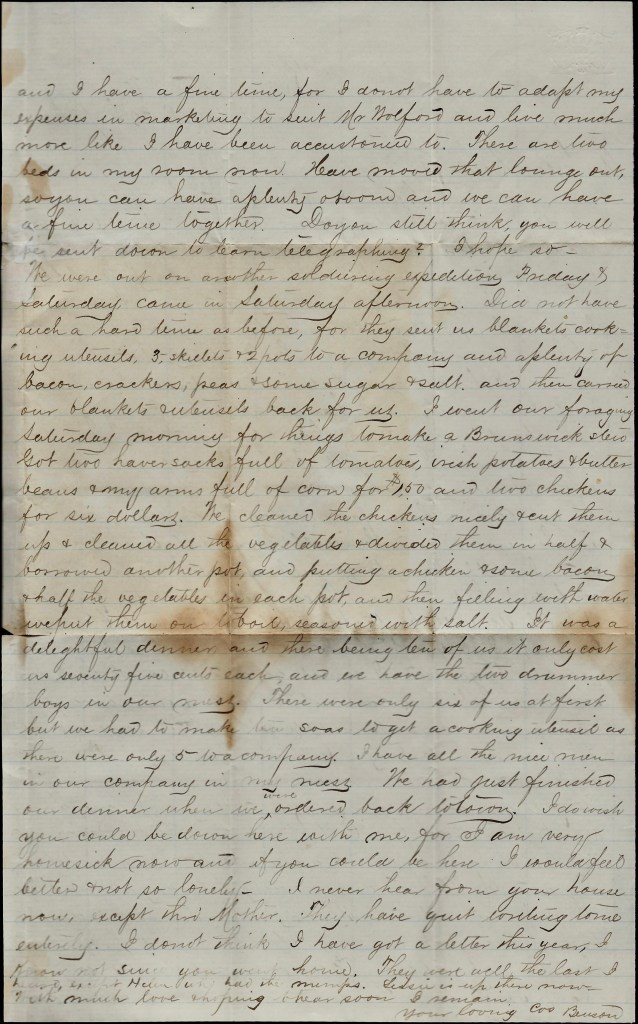
I have been looking a little for you down this past week, and when you do come, you must come immediately to my room (same place) and stay with me, for I am keeping Bachelor’s Hall all alone now, for Jack and his brother-in-law could not agree & Jack has gone to boarding and Mr. Wolford goes up every Saturday night to see his wife and returns Monday morning about day & brings enough provisions to last him till the following Saturday and he only pays $25 for his eatables & the days he stays up there. So you see I am all alone now and I have a fine time, for I do not have to adapt my expenses in marketing to suit Mr. Wolford and live much more like I have been accustomed to. There are two beds in my room now. Have moved that lounge out, so you can have aplenty of room and we can have a fine time together.
Do you still think you will be sent down to learn telegraphing? I hope so. We were out on another soldering expedition Friday & Saturday. Came in Saturday afternoon. Did not have such a hard time as before, for they sent us blankets, cooking utensils, 3 skillets & 2 pots to a company and aplenty of bacon, crackers, peas & some sugar & salt and then carried our blankets & utensils back for us. I went out foraging Saturday morning for things to make a Brunswick stew. Got two haversacks full of tomatoes, irish potatoes & butter beans & my arms full of corn for $1.50 and two chickens for six dollars. We cleaned the chickens nicely & cut them up & cleaned all the vegetables & divided them in half & borrowed another pot, and putting a chicken & some bacon & half the vegetables in each pot, and then filling with water, we put them on to boil, seasoned with salt. It was a delightful dinner and there being ten of us, it only cost us seventy five cents each, and we have the two drummer boys in our mess. There were only six of us at first but we had to make ten so as to get a cooking utensil as there were only 5 to a company. I have all the nice men in our company in my mess. We had just finished our dinner when we were ordered back to town.
I do wish you could be down here with me, for I am very homesick now and if you could be here I would feel better & not so lonely. I never hear from your house now except through Mother. They have quit coming to town entirely. I don’t think I have got a letter this year—I know not since you went home. They were well the last I heard, except Helen who had the mumps. Sissie is up there now. With much love & hoping I hear soon, I remain your loving cousin, — Benson
The following letter was written by John Smith Carter (1823-1905) while serving in Co. F, 89th Ohio Volunteer Infantry (OVI). John enlisted in the regiment in August 1862 and served through the end of the war, mustering out on 7 June 1865 was Washington D. C.
John wrote the letter to his wife of twenty years, Sabrina Butler (Barton) Carter and three children, Martha (b. 1848), Charles (b. 1855), and Anna (b. 1857). Before and after his service, John worked as a teamster and lived in Cincinnati’s 16th Ward.
Transcription
Addressed to Mrs. Sabrina B. Carter, Cincinnati, Ohio
Camp five miles south of Holly Springs, North Carolina April 24, 1865
My dear wife & children,
This is a pleasant Sabbath morning. It finds me in good health. Hostilities has ceased and Johnston’s army is surrounded and it is reported that he has surrendered—not only him but the entire force from the Potomac to Rio Grande rivers in Mexico. And I think in the course of 10 days, we will be on our way towards home. It is said that the 14th [Army] Corps goes to Hagerstown, Maryland, to be mustered out so I suppose in the course of one month or 6 weeks, I will be at home.
We have a yellow boy that lives one mile from here to cook for our mess. He is a good boy. Bakes cornbread almost every meal so we have plenty of sugar and coffee. If you only had part of the coffee, I should be glad for we have got more than we hardly know what to do with it.
Our camp is in a nice pine forest rolling ground so if it rains, the water will run off. We have a good bunk made with pine boards about 16 inches from the ground and two dog tents over the bunk. Mr. Cal[vin W.] Vance & Preston Bishop & myself sleeps together in this tent. I have nothing more to write that I think will interest or amuse you so I send you three leaflets for letters sent to the soldiers by the American Tract Society to be sent in letters to his friends so each one of you can take your choice of them. So I bid you good morning trusting it will not be long that we shall see each other face to face.
From your affectionate husband and father, — John S. Carter
The following letters were written by George Henry Hilton (1831-1901), the son of Dearborn Henry Hilton (1803-1860) and Eliza Ann Cummings of Chester, Windsor, Vermont. He was married in November 1853 to Miriam Helen Lowell (1833-1911) and had one child named George Lowell Hilton (b. 1856) at the time these letters were written in 1863.
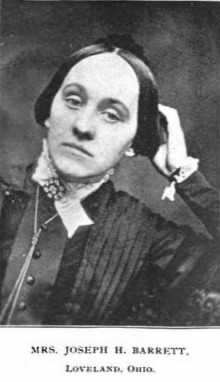
George was employed as a clerk in the office of Mr. Joseph Hartwell Barrett (1824-1910) who was the Commissioner of the Pension Bureau in Washington D. C. in 1863. The Evening Post (New York) described Barrett as one of “the few bold, radical and consistent anti-slavery men at the head of bureaus in Washington.” Barrett grew up in Windsor county, Vermont, and graduated from Middlebury College (Vermont) in 1845. He entered the printing and publishing business and by 1860 he was living and working at his trade in Cincinnati. He is best known for having written a biographical sketch on Abraham Lincoln when he was running for President in 1860 and when Lincoln was elected, he was rewarded with the patronage job. Barrett was married to Harriet Whiting Lowell in 1853 so Hilton and Barrett would have been brothers-in-law, having married the Lowell sisters.
In the years following the Civil War, George worked in the dry goods business in Chester. In 1872 he had his business in the new Fullerton Block on Main Street in Chester where he offered “ready made clothing” and groceries.
Letter 1
Washington D. C. April 13, 1863
My dear wife Han,
Joseph Hartwell Barrett, Commissioner of Pensions
Han, I am writing to you so that you may get it as soon as possible for I know (or think at least) you will miss the letter at the usual time & perhaps be disappointed if you do not get it, I did not write you & mother as usual yesterday for I was at Fortress Monroe & Norfolk all day. Mr. Barrett asked me on Friday if I dare go with him if he would get passes. I told him yes, but did not suppose he could get passes for since they commenced fighting, they issued orders not to grant them to anybody. Well. I thought no more of it until Saturday morning at 10 a.m. [when] he came in the room and said he was ready I dare risk it. Well, I dare and started.
We went to Baltimore, waited and went all over the city (beautiful warm day) until 5 p.m., then went on board the steamer & had a beautiful ride. Had supper and went to bed at 9. Got up about 5 a.m. and looked the country over until 6:30. We had breakfast and at 7:30 landed under the guns of Fort Monroe. Went about the fort and down on the beach. Picked up a lot of shells &c. &c. (as usual). Saw the big Lincoln Gun, the largest one ever made. We stayed about till 11 a.m. then took steamer (government transport) down to Norfolk. Went past Sewell’s Point, rip raps, Newport News, &c. as you can see by the map to Norfolk. Arrived at 12:20. Went all about town. The citizens—women and children—were leaving according to orders issued after we got there. The rebs were expected every minute—were fighting only 17 miles below all Saturday & Sunday up to 12 noon, so we went on board of boat again. 1 Saw the Monticello & Juniata (gunboats) swing out into the steam and open their port holes and point their guns on the town, ready to shell it at any moment the rebs should come in sight. It tell you, it was quite exciting. We left directly after that with a load of refugees and secesh ladies. Came on to where the Merrimack gave the Monitor battle. Saw the Cumberland was sunk with her two masts just sticking out of the mud & water. Back to the Fortress at 3:30 p.m. All along up the Elizabeth river saw peach orchards in full bloom & the lilacs just filled the air with the sweetest odor from the land I ever smelt.
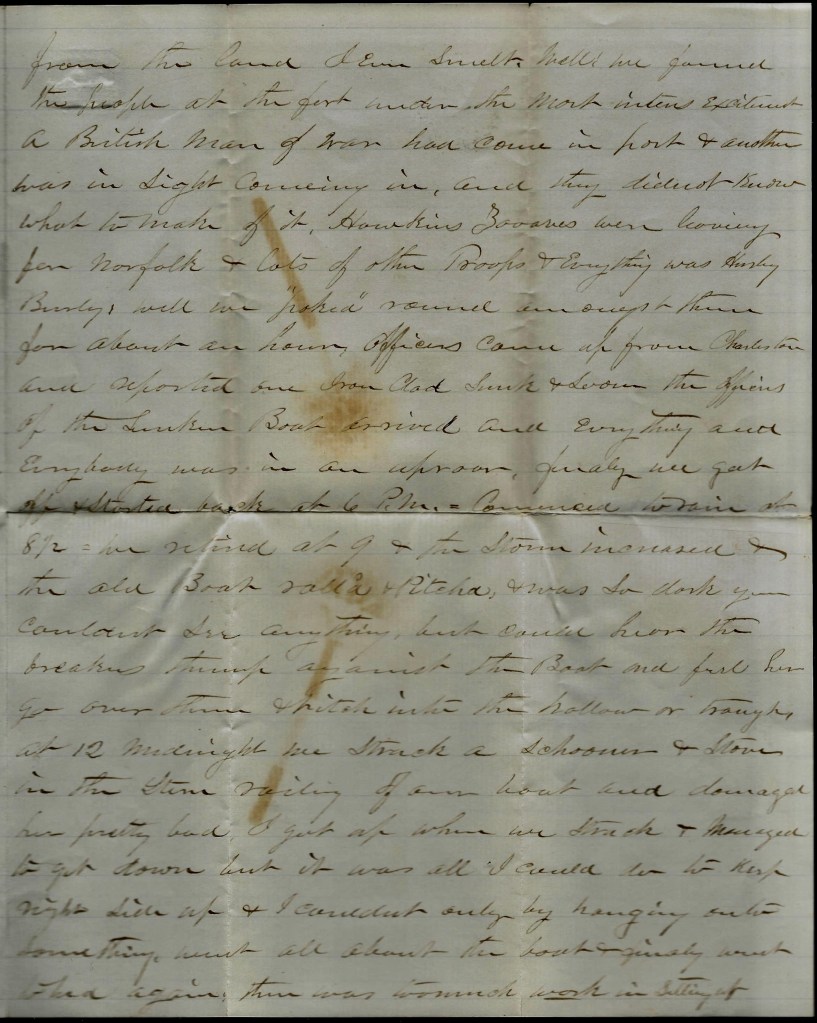
Well, we found the people of the fort under the most intense excitement. A British Man-of-War had come in port and another was in sight coming in, and they didn’t know what to make of it. Hawkins Zouaves 3 were leaving for Norfolk and lots of other troops & everything was hurly burly. Well we “poked” round amongst them for about an hour. Officers came up from Charleston and reported one ironclad sunk & soon the officers of the sunken boar arrived and everything and everybody was in an uproar. Finally we got off and started back at 6 p.m. Commenced to rain at 8:30. We retired at 9 & the storm increased & the old boat rolled and pitched & was so dark you couldn’t see anything but could hear the breakers thump against the boat and feel her go over them & pitch in the hollow or trough. At 12 midnight we struck a schooner and stove in the stern railing of our boat and damaged her pretty bad. I got up when we struck and managed to get down but it was all I could do to keep right side up and I couldn’t only by hanging onto something, Went all about the boat and finally went to bed again. There was too much work in sitting up although I wasn’t a bit sick nor Barrett either.
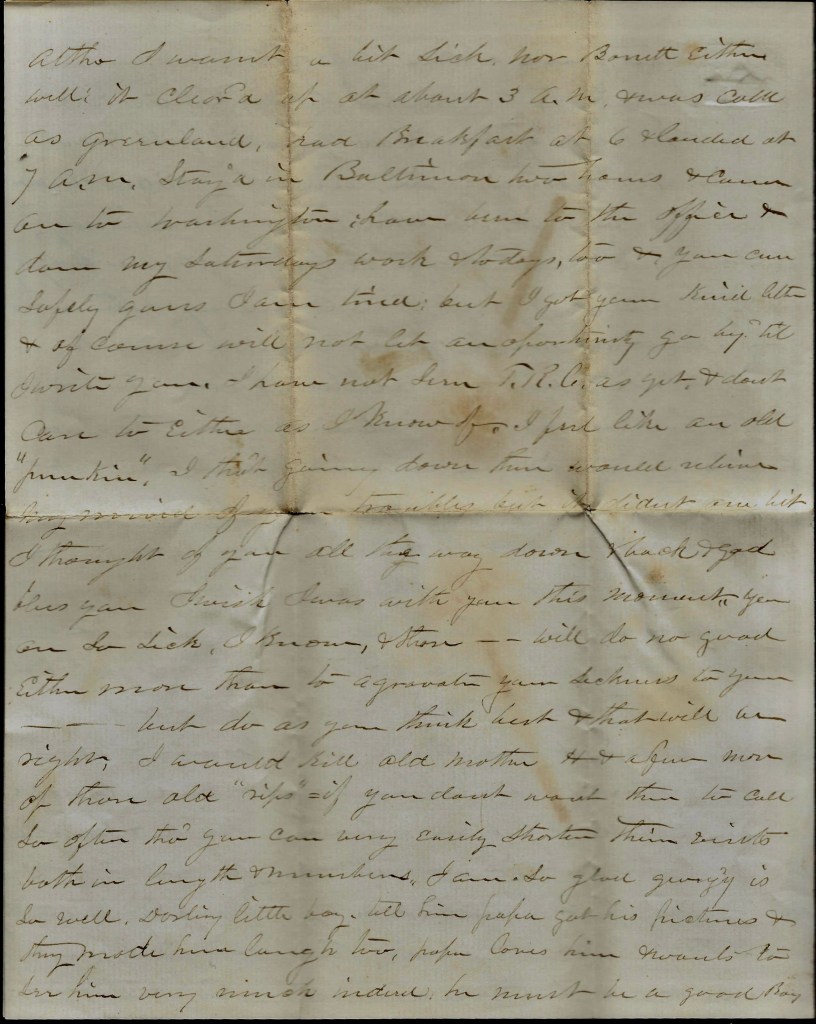
Well, it cleared up at about 3 a.m. and was calm as Greenland. Had breakfast at 6 and landed at 7 a.m. Stayed in Baltimore two hours and came on to Washington. Have been to the office and done my Saturday’s work & today’s too and you can safely guess I am tired. But I got your kind letter and of course will not let an opportunity go by till I write you. I have not seen R. R. C. as yet & don’t care to either as I know of. I feel liker an old “punkin.” I thought going down there would relieve my mind of your troubles but it didn’t one bit. I thought of you all the way down & back & God bless you, I wish I was with you this moment. You are so sick, I know, & those —– —- will do no good either more than to aggravate your sickness to your —- —- but do as you think best and that will be right. I would kill Old Mother H. and a few more of those old “rips” = if you don’t want them to call so often though you can very easily shorten their visits both in length and numbers. I am so glad Georgie is so well. Darling little boy, tell him papa got his pictures & they made him laugh too. Papa loves him & wants to see him very much indeed. He must be a good boy.
I want to write you lots more but I han’t got strength & am so sleepy I can hardly keep my eyes open & “spose” I must write Mother or there will be an “orfull” howl. So I will bid you goodbye for now & write you again & send some papers tomorrow. With much love for you, — George
1 The excitement in Norfolk was due to Gen. Longstreet’s investment of Suffolk in April 1863.
2 The two British ships anchored in Hampton Rodes were the Vesuvius and Petrel. There was speculation that the Brits were there as part of a plot to recapture Norfolk that was being threatened by land by Longstreet’s men.
3 The 9th New York Volunteers (“Hawkins Zouaves” ) were ordered from Falmouth, Virginia, to Norfolk where they remained until May 1863.
Letter 2
Washington D. C. June 3rd 1863
My blessed wife,
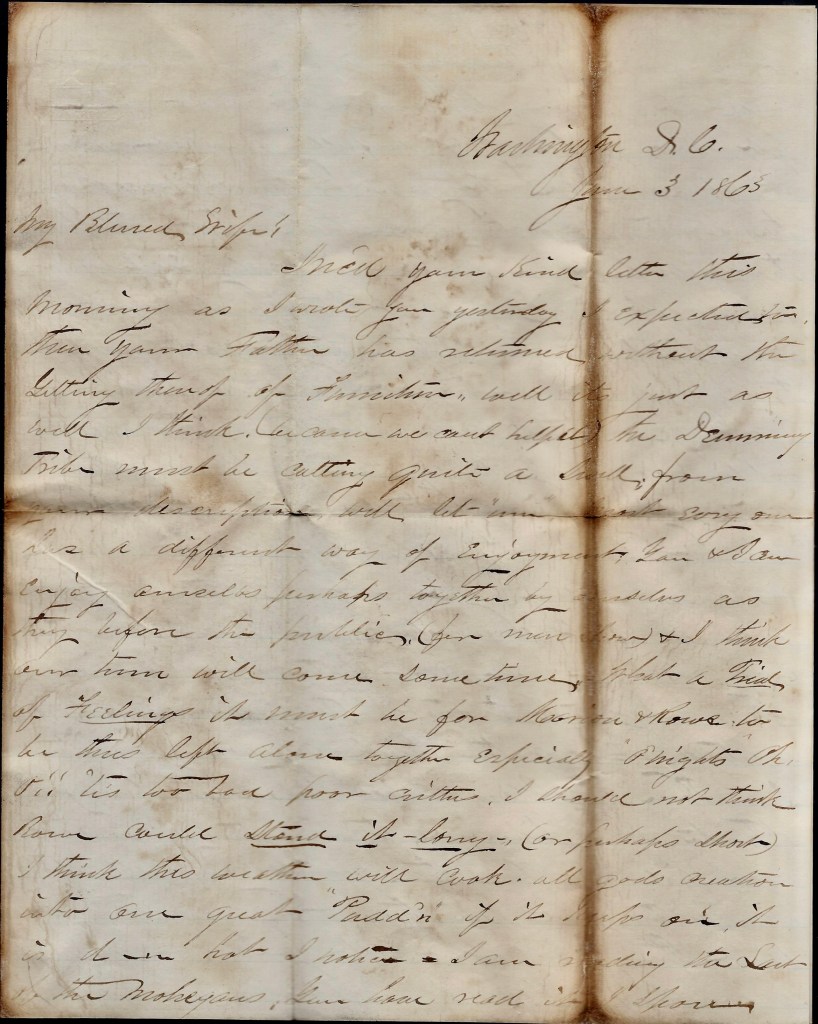
I received your kind letter this morning. As I wrote you yesterday, I expected then your Father has returned without the [ ]. Well, it’s just as well, I think (because we can’t help it). The Demming tribe must be cutting quite a [ ] from your description. Well, let [ ] has a different way of enjoyment. You & I can enjoy ourselves perhaps together by ourselves as they before the public and I think our turn will come some time. What a trial of feelings it must be for Marion & Rowe to be thus left alone together especially o’nights. Oh, oh tis too bad poor critters. I should not think Rowe could stand it long (or perhaps short).
I think this weather will cook all God’s creation into one great “Pudd’n” if it keeps on. It is damn hot, I notice. I am reading the Last of the Mohicans. You have read it, I suppose. It is quite interesting to me as I never read it before.
“Mrs. Comish”, wife of Commissioner Barrett
This town is not taken yet, 1 but people get awfully frightened and at Alexandria they are today barricading the streets expecting an attack through the lines. That place you know is only eight miles from here. If we get “tuck” all right. I would like to have them try it once. Perhaps they wouldn’t get in.
Mrs. “Comish” called the carriage & she and Mrs. Duvall went out to the Soldier’s Home yesterday evening. She is getting quite gay since the Comish has been absent. From the late order just issued, no person can go out of the city limits now on foot, horseback, or in carriages without being searched. So our little Mrs. Comish was subjected to that little inconvenience.
I rather think my bringing the Long Tom Spy Glass to bear upon the ladies opposite has silenced their Battery of Flirtation as I did not see them yesterday at all. That was pretty good on them & I guess they will mind their “Biz” now. Do you hear anything more about Henry’s drinking? I have not heard from him since I came back either by letter or paper or anybody but Fitch. I have the B. F. Times regularly from the office. I should like to go home very well as you say, but I think I shall stay here for the present if I can possibly stand it. You know you are and have so exposed yourself very much opposed to my going into troth [?] again or making an investment in the hotel and Mother too is very anxious that I should remain in Chester son on the whole, I think, unless sickness should call me home, I shall stay through the month of July. At least ’tis true I would like to be with my family & be at Chester, but can stay here a while I guess. How does the little Hiffins? He is happy I hope. He has got quite a notion of stooping over and if he is not checked and made to stand straight, he will grow up round shouldered & have the consumption. I don’t think you can too strongly impress that upon his mind—to stand straight. Poor little fellow. I do want to see him very much indeed. Kiss him for me & tell his papa gives him and thinks of him very much. He must be good too and mind Mama till papa comes home and then we will have grand times.
Saw Abel Putnam here yesterday. The [ ] said Tom Clark was well and doing well. Hope he will continue so….
With much love for you, my own little wife. Goodbye, – George
1 The “scare” was over the advance of Lee’s army that was once again making a push toward and beyond the Potomac River without a clear understanding of which way he was headed.
The following letter was written by Marshall McMurran (1842-1910) of Centre, Vanderburgh county, Indiana, who first enrolled in Co. H, 65th Indiana Infantry. He was later transferred to Co. H, 120th Indiana Infantry.
Transcription
Camp of the 129th [120th] Indiana Raleigh, North Carolina August 26th 1865
Dear Father and Mother.
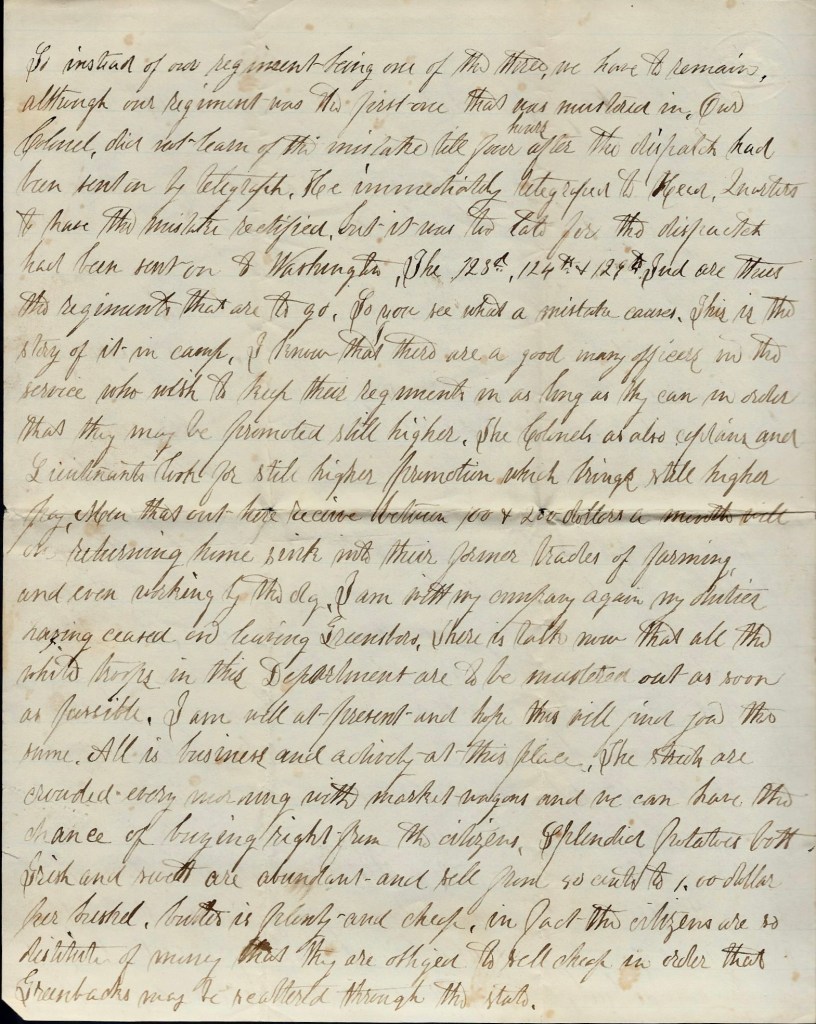
After the lapse of several days, I sit down to answer you letter of August 9th which I received August 16th. I delayed in answering it immediately for several reasons. We had just been paid off and I wished to write you in this letter that I would send you some money and I also wished to wait till we arrived at this place. We left Greensboro August 19th arriving here the same night. Today just makes one week that we have been here and I have concluded not to send money home by express because there are so many risks that the company will not be liable for it. Most of our company sent their money by express the first part of this week, the captain tending to the business. When the captain brought down the receipts to the boys, I saw some of them and they were not liable for a great many risks that might occur. So as there is a talk that the regiment will not have to stay much longer, I thought I would keep it with me. I do not know why it is that we have been brought here, for we have not yet been detailed out through the city. While at Greensboro orders came from the Headquarters of Gen. Ruger for each of the six Indiana regiments to send on the date of their muster as a regiment, as three regiments were to be sent home. The three were to be those whose organization was the oldest. The adjutant of our regiment whose business it was to forward the date, sent on our date as being the 15th of March 1864 when it was the 2nd of March 1864. So instead of our regiment being one of the three, we have o remain although our regiment was the first one that was mustered in. Our Colonel did not learn of the mistake till four hours after the dispatch had been sent in by telegraph. He immediately telegraphed to Headquarters to have the mistake rectified, but it was too late for the dispatch had been sent pn to Washington. The 23rd, 124th, and 129th are thus the regiments that are to go. So you see what a mistake causes. This is the story of it in camp. I know that there are a good many officers in the service who wish to keep their regiments in as long as they can in order that they may be promoted still higher. The Colonels as also Captains and Lieutenants look for still higher promotion which brings still higher pay. Men that here receive between 100 and 200 dollars a month will on returning home sink into their former trades of farming and even working by the day.
I am with my company again, my duties having ceased on leaving Greensboro. There is talk now that all the white troops in this Department are to be mustered out as soon as possible. I am well at present and hope this will find you the same. All is business and a activity at this place. The streets are crowded every morning with market wagons and we can have the chance of buying right from the citizens. Splendid potatoes, both Irosh and sweet, are abundant and sell from 80 cents to $1 per bushel. Butter is plenty and cheap. In fact, the citizens are so destitute of money that they are obliged to sell cheap in order that Greenbacks may be realtered through the state.
Our regiment is camped on the very same camp that the 65th was while here and I cannot refrain from thinking of my old messmates every time I pass over the ground. It was while the 65th lay here that Johnston surrendered and Sherman’s army started on its march for Washington. It was three months and a half from the time we left here till we came back. I wrote to you last on the 30th of July which I expect you have long ere this received. I also sent word by William A. Holcomb, a mess mate of mine, of how I was getting along. He started for home on furlough on August 4th and he knew you, as you worked on a mill in his neighborhood. I am looking for him to come back soon as his furlough expires on the 3rd of September. I though that he would be as good a letter as I could send to you and I think that he will be a good envelope for you to send your letter to me in—at least I am looking for him to tell me all about you as he promised to go and see you.
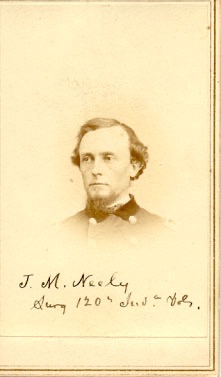
John Marshall Neely (1836-1897)
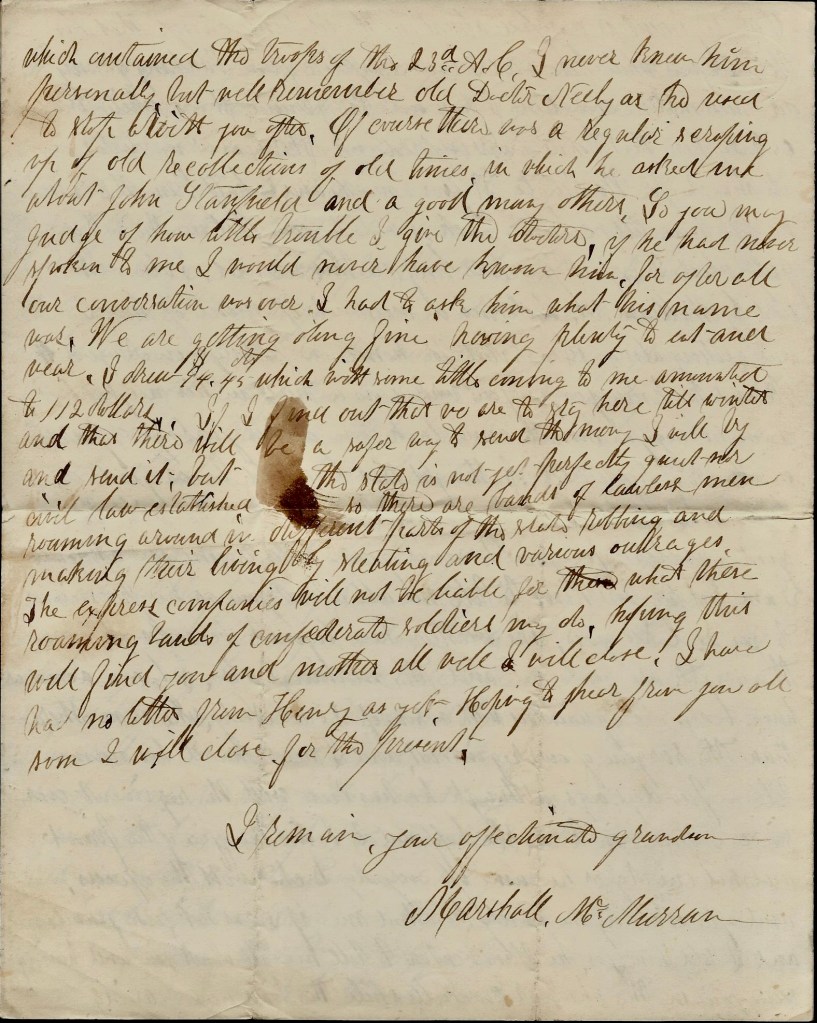
The weather here begins to be cooler. The nights are quite cool and the mornings also. I, by an accident, became acquainted with a son of Doctor [Joseph] Neely who is no other than the surgeon of our regiment, and I never heard his name till a few days ago, although he has been with the regiment ever since I came into it. He happened to be in the office of the Provost Marshal one day as he came up every day to chat with the officers, and after observing me closely he asked me if I was not your grandson and I told him yes. He then went on to tell me all about you and having seen you on the wharf at Evansville while the boats were passing which contained the troops of the 23rd Army Corps. I never knew him personally but well remember Old Doctor Neely as he used to stop with you often. Of course there was a regular scraping up of old recollections of old times in which he asked me what John Stanfield and a good many others. So you may judge of how little trouble I give the doctor. If he had never spoken to me, I would never have known him for after all our conversation was over. I had to ask him what hi name was.
We are getting along fine, having plenty to eat and wear. I drew $94.45 which with some little coming to me amounted to 112 dollars. If I find out that we are to be here till winter and that there will be a safer way to send the money, I will try and send it, but the state is not yet perfectly quiet nor civil law established so there are bands of lawless men roaming around in different parts of the state robbing and making their living by stealing and various outrages. The express companies will not be liable for what these roaming bands of Confederate soldiers may do.
Hoping his will find you and mother all well, I will close. I have had no letter from Henry as yet. Hoping to hear from you all soon, I will close for the present. I remain your affectionate grandson, — Marshall McMurran
Almon Joel Pierce’s Diaries. His Civil War diaries alone are nearly 200,000 words! For comparison, if we were to add Almon’s missing diary of 5.5 months duration, the amount of material describing his Civil War experience would be equal to the size of Gen. Grant’s 2-Volume Memoirs (whichwere not confined to the Civil War alone).
What follows is an astonishing collection of diaries that has captivated me like no other in my journey through primary source materials. These diaries, the gripping tales of Almon Joel Pierce (1842-1900), son of Clark Pierce (1814-1900) and Mary Serepta Royce (1822-1888) from South Haven, Van Buren County, Michigan, beckon with their incredible detail. Almon wasn’t just a writer; he was a relentless chronicler of life. For nearly the entire second half of the 19th Century, he penned daily entries that reveal his deepest thoughts and experiences. I have poured over ten of these diaries, starting in April 1861 and wrapping up in March 1865—a staggering four-year chronicle. Yet, I have chosen to transcribe and unveil only those written during his time in the 19th Michigan Infantry and the Mississippi Marine Brigade, totaling seven diaries. Devoting my spare moments to this labor, I have poured almost seven months into transcribing these seven diaries, which amount to a formidable 190,215 words—an achievement that would demand nearly 17 hours of an average reader’s time to absorb. I hate to think how many hours it took me to transcribe them.
I wish to acknowledge the Michigan’s Military Heritage Museum, and Scott Gerych in particular, for bringing these diaries to my attention and offering me the opportunity to transcribe and publish them on Spared & Shared. They were donated to the museum in December 2022.
Apparently Almon was often asked about his interest in keeping a journal, which prompted him to record the following:
“It might be asked by some whether I ever get tired or feel an inclination to abandon or discontinue this habit which I had begun? I answer that I have not yet, but, on the contrary feel more obliged than ever to continue the practice as long as I can hold the pen. It seems absolutely necessary & unavoidable. I first began the practice on a smaller scale on the first day when we started for Illinois in the spring of 1855…”
The three sons of Clark and Serepta Pierce; Almon (b. 1842), Irving (b. 1844), and Quincy b. 1846). This image would have been taken in the latter half of the 1850s.
In his diary of 1861 we learn that Almon’s younger brother, 15 year-old Quincy, had his leg amputated by Dr. Bolivar Barnum in Schoolcraft, Michigan on June 4th, 1861. He does not reveal how it was that Quincy had injured his leg. An earlier diary would surely contain the answer to this question. It apparently shortened his life, however. Quincy died in 1872.
Almon’s first mention of the war in his diary was on 26 April 1861: “Great war news. Fort Sumpter is in the hands of the South. It was taken 12th and 13th of April. The President of the U. S. has called for 75,000 men to protect the city of Washington.”
Almon reveals his first thoughts of military service in an entry on Sunday, September 22, 1861: “I don’t think there will be much danger of drafting, but if they do, I believe I shall volunteer my precious self. I don’t think that I am qualified for such a glorious duty but I can do something. Oh, if I was only a full grown man.”
Finally, on 14 August 1862, Almon recorded the following: “This day! What shall I say of it? I am on the eve of an epoch, a turning point in my life & which way the scales will turn, the morrow will decide. What stirring, thrilling scenes are just now transpiring throughout the land! how many family ties are and are about to be severed! I introduced the subject of enlisting to Pa for the first time. I wanted to know what his individual opinion was, if he had any. He has been mum, formant, or non curative concerning my liability of having to go. When I introduced the subject & he asked me if I wanted to go, I said yes. He then said that if I want to go that he shouldn’t hinder e, but thought if I wasn’t fit to go, could not stand it, &c. We did not come to any definite conclusion but I took that I shall perform something of the sort in the morn if nothing happens…Mother gives me all the encouragement possible. It’s a holy cause & I should bear my share. Perhaps after I get a thousand miles from home, Father will come to his senses.“
The following day he records:
Almon J. Pierce and his wife Annie in 1888
August 15th 1862. Well the fearful ordeal is past. The first step is taken!! I am now a U. S. man of war! We got underway for South Haven about half past 12 o’clock. Pa and Ma, Al. and Q. in company. Got there just before noon. I went directly to the tavern at the headquarters of the War Department & had not been there two minutes before the two chief officers, Captain [Charles W.] Bigelow and Mr. [Archibald] McLachlin attacked me with a broadside & in about two minutes more, they had me encaptured. They didn’t ask me half a dozen questions. First my age & if I was round, then if I could stand it to travel to which I replied that I once walked 110 miles in one day and went to work again the next. That was enough. Then followed the usual preliminaries of enlistment. I am obliged to sign my name twice. Father stood nearby but did not say a word. He was also required to sign his name. He had some talk with the captain then. Pa had Al. go along to see if he get in as cook but they would not take him. He is bound to go anyhow. He is going to quit work and get ready to go to Rhode Island. I wish that he would go along with us as he would be so much company. I couldn’t get lonesome then. He don’t fancy going as cook anyway… The captain appears a smart energetic man & guess pretty well qualified for the responsible office. I like his appearance. They say that he has served five years in the standing army. I took dinner with the rest at the tavern on Uncle Sam’s expense. The news spread like wild fire about the town that I had enlisted….”
ABOUT THE MISSISSIPPI MARINE BRIGADE
“The concept of a mobile force of mixed combat arms troops borne by modified river boats belonged to BG Alfred W. Ellet Jr. The commander of the Union’s brown water ram fleet had grown disenchanted with the routine duties that were assigned to the surviving rams by the end of 1862 and wanted to move on.
Brig. Gen. Alfred W. Ellet (Dennis Hood Collection)
Wanting to be more actively engaged in the war effort along the river Ellet proposed the formation of the Mississippi Marine Brigade as a means to subdue guerrilla activity along the inland waterways. The idea was accepted by Admiral David Porter and forwarded to Washington for consideration. Desperate for a means to secure extended lines of communication the idea found favor at the War Department. When personal recruiting efforts for his new force lagged Ellet petitioned his old ram fleet benefactor, Secretary of War Stanton, for authority to recruit convalescents from the Union hospitals around St. Louis. As before, Ellet’s radical proposal appealed to Stanton and in December of 1862 he granted the requested permission. Ellet immediately sent two recruiters, CPT James Crandall and CPT William Wright, to scour military hospitals in hopes of filling the unit with recovering soldiers announcing in a recruiting poster that recruits could “become famous in the annals of the Mississippi River warfare.” Pvt. Allan McNeal, writing to his father from the hospital in St. Louis on 15 January 1863, noted the excitement caused by these recruiting efforts. He explained that there was “some excitement about volunteering on board of a fleet” and describing that “they got about 50 out of this hospital.” McNeal, himself, was unconvinced and told his father that “I have no notion of going in to it.” Many others remained unconvinced as well. Despite promises of “no hard marching” and “no carrying knapsacks” and a $100 recruitment bonus the two men failed to attract the necessary manpower to establish the unit. With the idea of the innovative new unit threatened by lack of personnel Stanton again came to the rescue. Responding to a request from Ellet that active duty soldiers be assigned, Stanton used his authority to transfer the 59th Illinois, 63rd Illinois, and Company K 18th Illinois (previously on ram boat duty) to service in the brigade. The recruited men and transfers gathered at Benton Barracks in St Louis to begin their training as “horse marines” under the tutelage of LTC George Currie.
One of the modified steamers used by the Mississippi Marine Brigade, the USS Baltic (Paul Russinoff Collection)
Ellet, meanwhile, concentrated on the other necessary component of his plan; the boats needed to transport the unit. CPT James Brooks, with financing made available through the War Department, was able to purchase seven large steam packets at Louisville and New Albany for a total of $350,000. Five of the new craft, Autocrat, B. J. Adams, Baltic, Diana, and John Raine, were significantly modified for the expected duty. The boats were stripped down to carry 125 cavalry and 250 infantry each. They were given expanded fuel capacity by enlarging the coal bunkers, the boilers were encased in heavy timbers, the pilot houses were clad in boiler plate, and a crane operated gangway capable of disgorging the mounted troops two abreast was fitted out. Of the two remaining boats, the E. H. Fairchild was to serve as a supply vessel and the Woodford as a hospital ship.
On 21 February 1863 all arrangements, except the retrofitting of the Woodford, were complete. The Brigade was mustered for review by Ellet at the Fairgrounds. A total of 527 infantrymen, 368 cavalrymen, and 140 artillerymen stood inspection in standard army uniforms with a distinctive hat complete with a wide green band trimmed with gold lace signifying the special service on which they were about to embark. While still considerably short of the recruiting goal the Mississippi Marine Brigade was declared ready to begin operations.” — Dan O’Connell [Mississippi Marine Brigade]
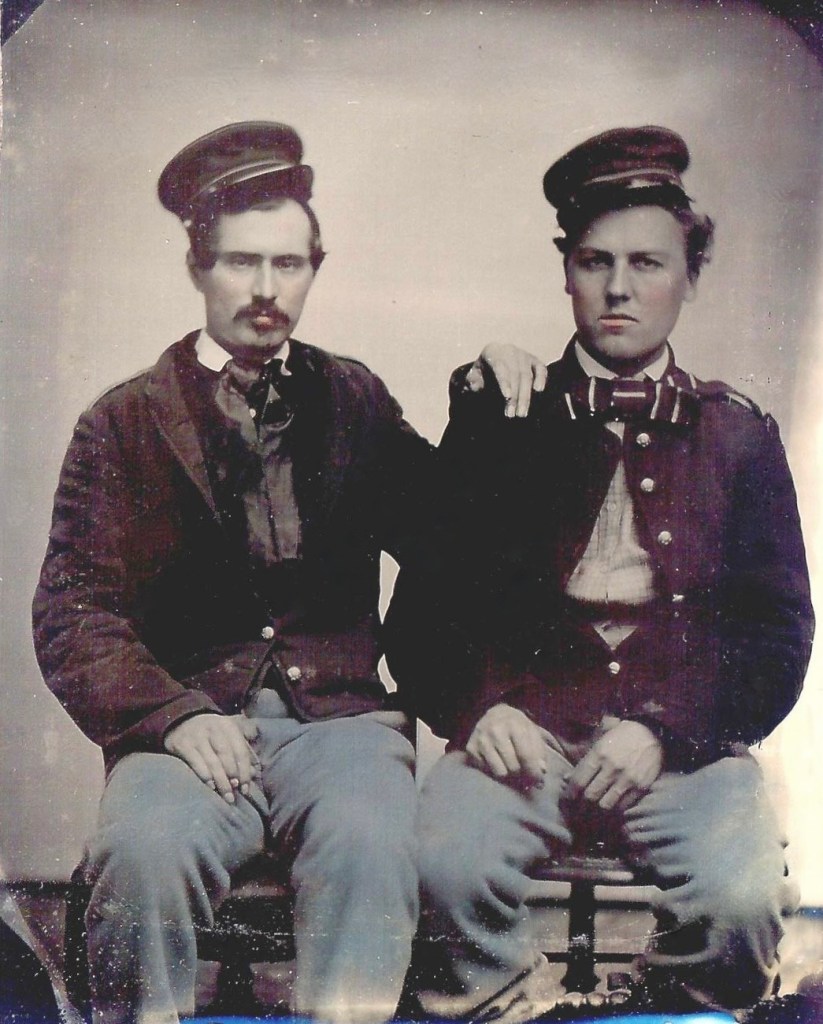
In this tintype Josiah Goodwin (l) sits with a companion wearing the distinctive headgear of the Mississippi Marine Brigade. This consisted of a cap made with full round top, broad straight visor, and a broad green band trimmed with gold lace. The rest of the brigade member’s attire consisted of various army uniforms – reflecting their recruitment from a number of different units. Goodwin served as a musician on the flagship USS Autocrat which was the headquarters for the Mississippi Marine Brigade. The brigade was a U.S. Army unit created to serve the needs of the Ram Fleet. They became controversial due to their seizures of property along the river and were disbanded in August of 1864. (Al Luckenbach Collection)
There are relatively few books on the Mississippi Marine Brigade (MMB). Official records for their activities seem to be lacking and this may be because they were a new branch of service—neither Navy nor Army—and were not compelled at all times to file the same kinds of traditional reports. Lieut. Colonel George E. Curie of the MMB summed it up best when he wrote, “This you see makes us in the military parlance neither Army or Navy, the one or the other, and yet both.”
Readers looking for more material on the MMB may find information from the following published sources:
Ellet’s Brigade. The Strangest Outfit of All, by Chester G. Hearn, 2000. An excellent relatively recent book describing both the Ram Fleet and the MMB.
Warfare Along the Mississippi, The Letters of Lieutenant Colonel George E. Currie, by George E. Currie; edited by Norman E. Clarke, Sr. 1961. Curie was the first officer selected by Capt. Alfred W. Ellet to join the MMB.
Life in the Mississippi Marine Brigade, the Civil War Diary of George Painter, Edited by Beverly Kerr, 2021 Painter was a private in the cavalry aboard one of the MMB’s vessels. Unfortunately his diary entries are cryptic and do not reveal the details of operations that Almon’s diaries do.
MMB: A concise history of the unconventional, untethered and unruly warriors of the Mississippi Marine Brigade, by Paul Rusinoff, Military Images, June 2021. A great recent article summarizing the activities of the Brigade and highlighting a chapter of their history from the one piece of Almon’s diaries that is missing (the diary from mid-April through September 1863).
History of the Ram Fleet and the Mississippi Marine Brigade in the war for the Union on the Mississippi and its tributaries, by Warren D. Crandall and Isaac D. Newell, 1907. In writing his book, Capt. Crandall quoted Almon’s diaries and from one diary in particular which I think Almon may have sent to him which was never returned. In the description of Warren Daniel Crandall’s papers at the Illinois State Historical Library in Springfield are the letters and diaries of several members of the MMB, including the “Letters and Diary” of Almon J. Pierce. It may be that the missing diary is housed in Springfield.
During the fall of 2024, I reached out to Christopher Schnell at the Lincoln Library (repository for the former collections held at the Illinois Historical Library in Springfield). Christopher informed me that there were no diaries of Almon J. Pierce’s within the Crandall collection; however, the log book of the Diana contained handwritten extracts from Pierce’s diary which he agreed to send to me and I intend to transcribe these as I have time. I also enquired about a letter in the Crandall Collection that was supposed to have been written by Pierce, entitled “The Raid Upon Port Gibson and What Caused It.” This three and a half page typed “story” was attached to a cover letter written by Pierce dated 8 December 1899 in which he makes it quite clear he was not author of this story and yet sometime since it has been repeated and attributed. He, in fact, denies any truthfulness in the story. The story claims that the MMB was ordered to “capture and carry back to Vicksburg as prisoners fifty of the most aristocratic Confederate young ladies” of Port Gibson to be held as hostages until they could be exchanged for Northern women school teachers taken prisoners by Confederates. The story was retold recently in the June 2021 issue of the Military Images magazine (see The Mississippi Marine Brigade was a novel Civil War force) and after transcribing Pierce’s diaries, I was left wondering why the episode was not even mentioned, let alone described in great detail as was his custom. To read Pierce’s letter (and scans of it), go to “The Raid Upon Port Gibson.” Since Pierce clearly informed Warren Crandall of the “hostage story” prior to the publication the publication of his book on the Mississippi Marine Brigade in 1907, either Crandall agreed with Pierce that that the story was a wild fabrication or he chose not to include it. I’m inclined to agree with Pierce, “that it’s a huge fake.”
See also previously published letters on Spared & Shared:
Diaries Transcribed & Published on Spared & Shared
(Click on the active link for each diary to go to the transcriptions)
14 September 1862 to 13 October 1862“This book contains just one month of time….There isn’t another one in the company nor the regiment as I can learn that is keeping so extensive & complete an account of daily transactions as myself. There are a few who occasionally make short notes of the most important events only. I don’t think after this that I shall have so much opportunity for writing as I have had but I shall do the best I can. It’s more important I think, or as much so at least, as letter writing.”
14 October 1862 to 26 November 1862“Containing the accounts of our march from Covington to Lexington, Kentucky, & my entry into the hospital at Lexington. The events recorded in this book were written or sketched down generally under trying circumstances & when laboring under oppressive difficulties. The fore part contains the occurrences attending the march & was for the most part written late at night by the campfire or early in the morn, or sometimes I would snatch a few moments of leisure in the day. Then after the 1st f November, I continued the task under the disadvantage of disability. Here I ran up a big batch of sketching.”
1 February 1863 to 6 March 1863“This book is peculiarly interesting as it contains the account of my exit from the hospital where I had been confined for over three months & my introduction into the “Marine Service,” there to lead an altogether new & different life, form new acquaintances & associations, & behold sights and scenes never before conjectured. I think I may safely say it has proved more advantageous to me in more ways than one.”
Other images of members in The Mississippi Marine Brigade
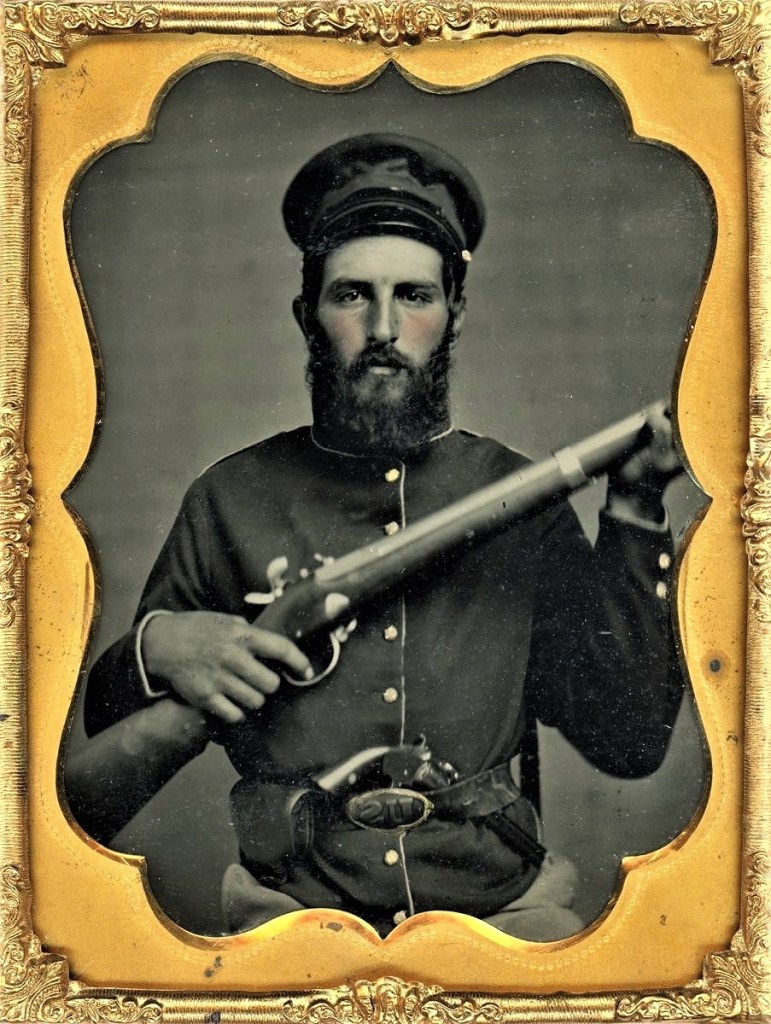
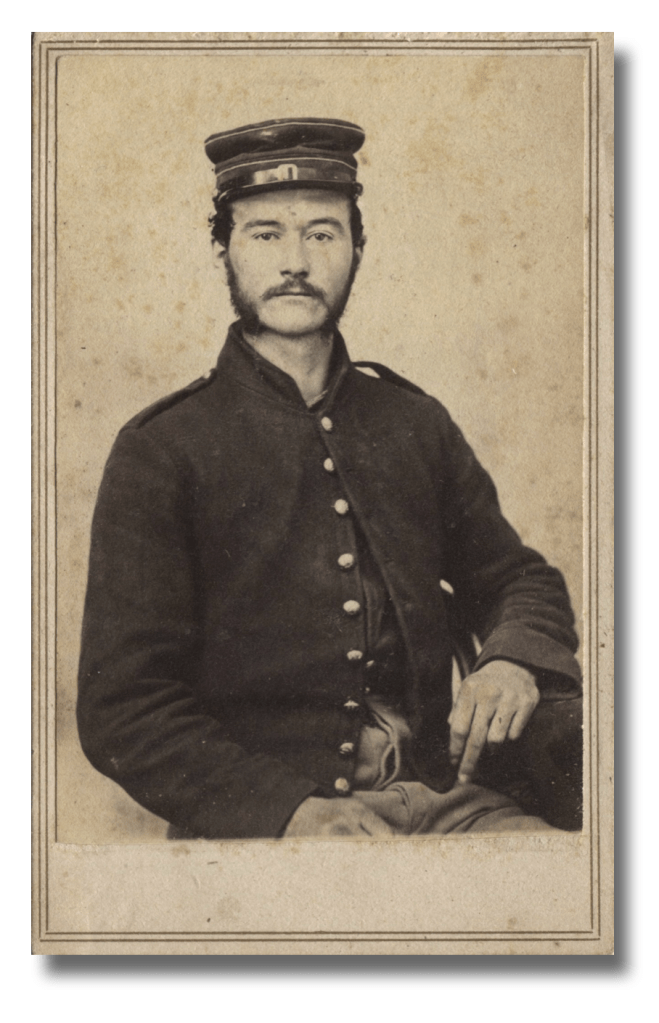
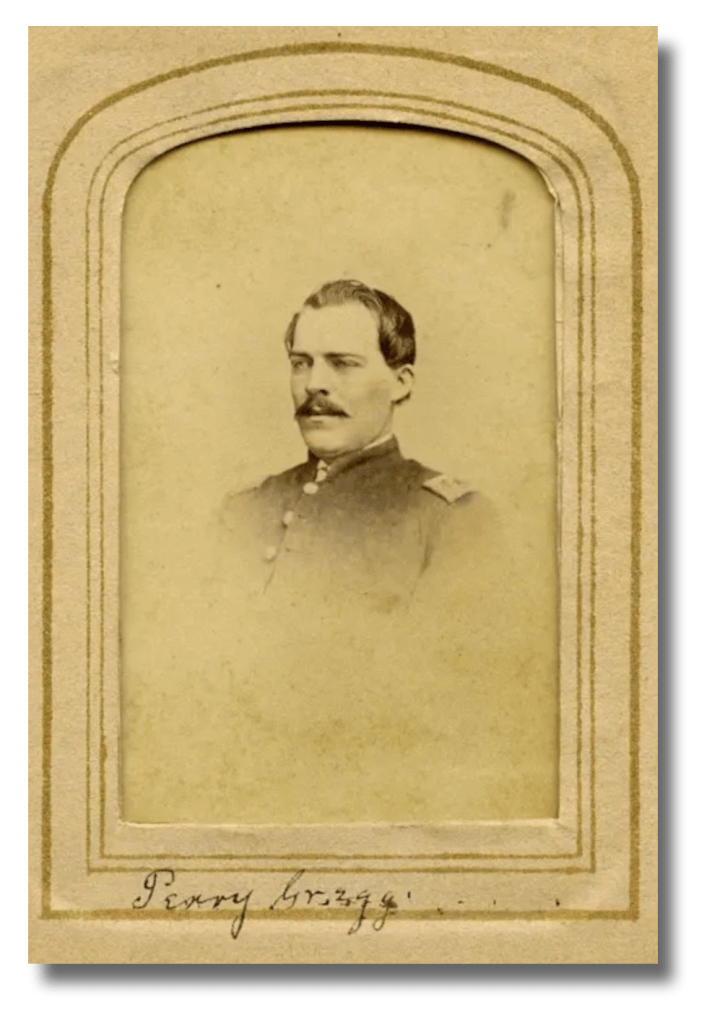
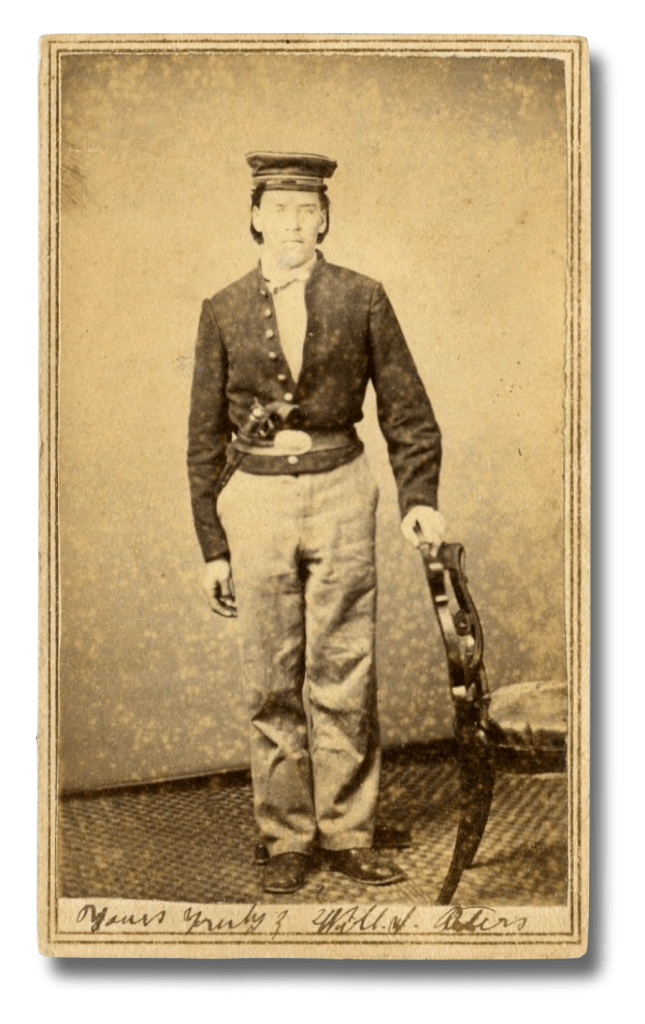
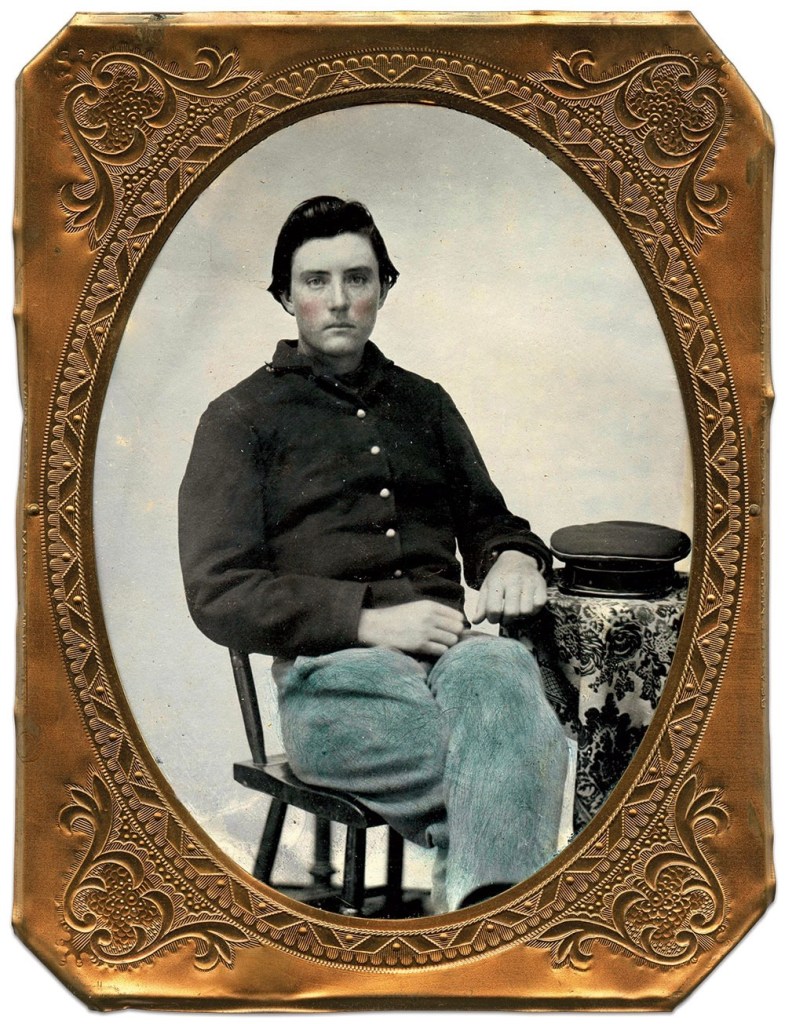
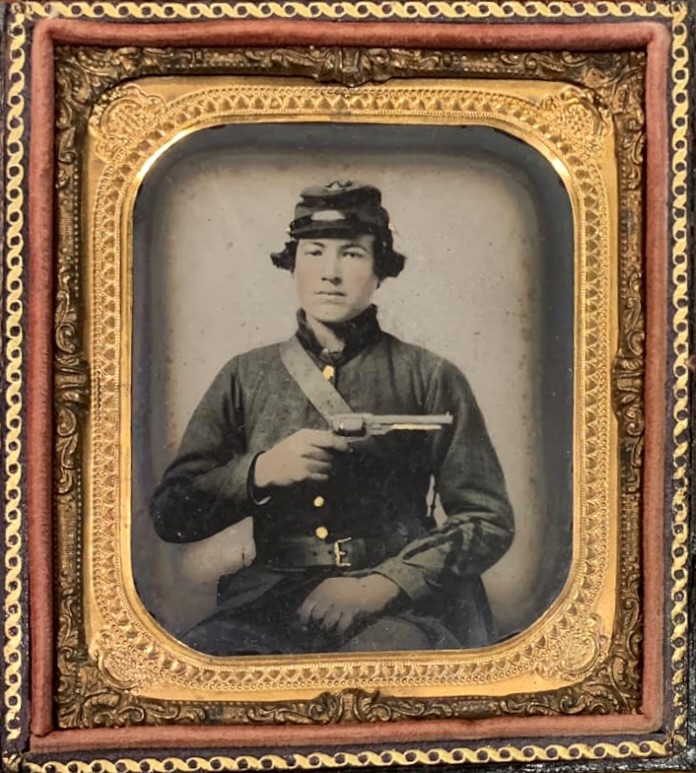
Two unidentified member of the MMB, believed to be descended from the Brown Family in Missouri. (Dennis Hood Collection)James M. VanCamp of Branch Co., MI. Co. B, 11th Michigan; later in Co. E, 1st Mounted Infantry, MMB.(Dale Niesen Collection)Wellington Peck, Co. E, 1st Mounted Infantry, MMB. (Dennis Hood Collection)Possibly a member of MMB. (Sara Thompson Collection)Possibly a member of the MMB. (Dan Binder Collection)An unidentified member of the Mississippi Marine Brigade(Chris Magewick Collection)Capt. John R. Crandall, Co. A, 1st Battalion Cavalry, MMB. (Dennis Hood Collection)Lt. Perry Gregg, Co. A, 1st Battalion Cavalry, MMB (Dennis Hood Collection)Capt. Oscar F. Brown, Co. E, 1st Mounted Infantry, MMB.William Peters, Co. D, 1st Battalion Cavalry, MMB (Lawrence T. Jones III Collection)Three CDV’s of Hiram G. Parker of Jacksonville, Illinois, who served in Co. B, 10th Illinois Infantry, and then in Co. B, Cavalry, MMB; served on the Baltic & Autocrat. (Cowan’s Auctions)
An unidentified member of the Mississippi Marine Brigade, or Ellet’s Brigade (Paul Russinoff Collection)
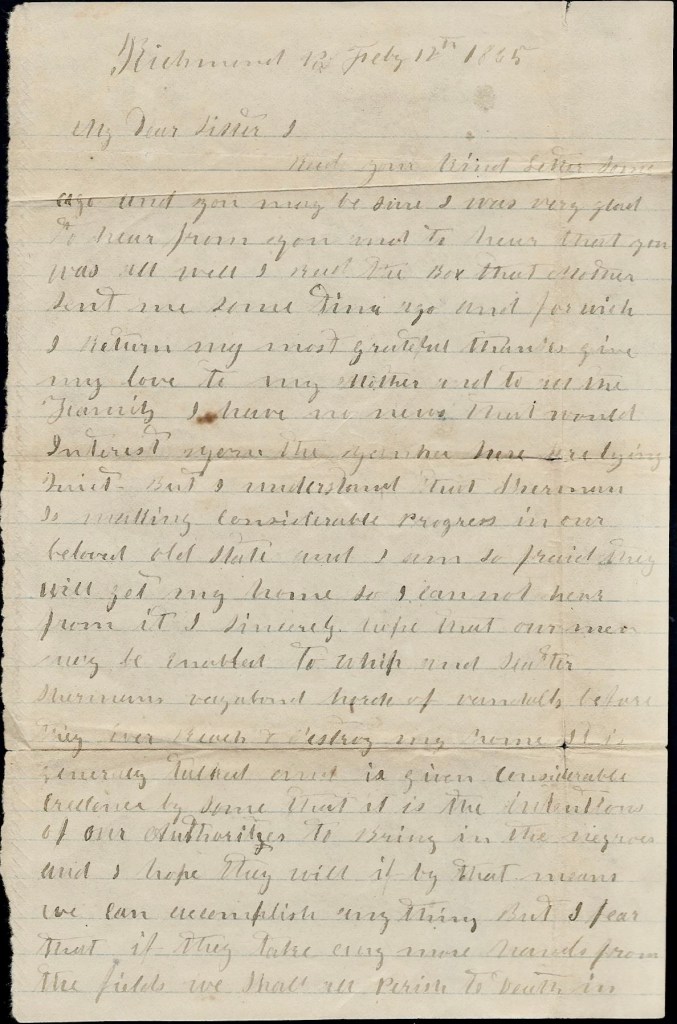
The following letter was written by 21 year-old Henry Gray (1844-1900), the son William T. Gray (1814-1856) and Gracy Ann Bates (1815-Aft1865) of Gadsden, South Carolina. He wrote the letter to 18 year-old Unity Anne Gray (1846-1927), one of nine siblings ranging in age from 10 to 32 in 1865.
This unidentified South Carolina corporal has a Palmetto Tree embroidered on the top of his kepi. (Larry Munther Collection)
Not certain which South Carolina regiment Henry served in, I looked for Henry’s obituary, and found it published in a Columbia newspaper in July 1900. It informs us that “Mr. Henry Gray of lower Richland, a prominent citizen and successful planter, after a brief illness, died at his home in Gadsden…aged 56….He was a gallant soldier in the Confederate army…” No specific regiment identified. Since he mentioned a comrade named Frank Joiner in his letter. I searched for him and found Frank Joyner (1842-1910) of Gadsden whose obituary in 1910 claimed he was “a brave Confederate soldier and was wounded once during the war but fought until the surrender,” but again, no regiment was identified. Finally, in Fold3, I found J. F. Joyner, who enlisted on 8 April 1861 at Gadsden, So. Carolina, in Capt. Ray’s Co. H, 6th South Carolina Infantry. I could not find Henry on the roster with Frank so concluded they were not in the same regiment but obviously serving near each other in the Richmond defenses. By process of elimination, I concluded that Henry Gray must have served in Co. I, 1st South Carolina Infantry (Haygood’s) who manned the Confederate lines below Richmond—quartered in their log huts for winter at the time—but who fought to the bitter end at Appomattox. [See—Memoirs of the First South Carolina Regiment of Volunteer Infantry in the Confederate War for Independence from April 12, 1861 to April 10, 1865.]
In his letter, Henry expresses grave concern for his property in Richland county—some twenty miles southeast of Columbia, fearing that Sherman’s army might pass through there and “destroy my home.” While a portion of Sherman’s army marched through Orangeburg, they remained west of the Congaree river as they converged on Columbia. Henry also shares his thoughts on the Confederate Congress’s proposal to add Negroes to the ranks of their regiments and the dilemma it posed.
Transcription
Addressed to Miss Unity Ann Gray, Gadsden (P.O.) Richland District, South Carolina
Richmond, Virginia February 12th 1865
My dear sister,
Received your kind letter some [days] ago and you may be sure I was very glad to hear from you and to hear that you was all well. I received the box that mother sent me some time ago and for which I return my most grateful thanks. Give my love to my mother and to all of the family.
I have no news that would interest you. The Yankees here are lying quiet, but I understand that Sherman is making considerable progress in our beloved old state and I am so afraid they will get my home so l cannot hear from it. I sincerely hope that our men can be enabled to whip and [ ] Sherman’s vagabond horde of vandals before they ever reach and destroy my home.
It is generally talked and is given considerable credence by some that it is the intentions of our authorities to bring in the negroes and I hope they will if by that means we can accomplish anything. But I fear that if they take any more hands from the fields we shall all perish to death in a heap together for I have not drawn but one quarter of a pound of meat in the last six days and the commissary says he does not know when we will get any more. If we cannot get enough to eat now, what will we do if they bring in the negroes? At that rate, it will all be the consumers & no producers. And again, if we do not bring the negroes in, the Yankees will overrun our country and destroy everything so that we would be forced to surrender.
I will let this dark matter rest and bring my short letter to a close by saying write soon while you have the chance to your affectionate brother, — Henry Gray
(P. S.) Frank Joiner is a going to have a box sent him from home and can you send me anything you wish by or in his box. I would be glad for you to send me a chicken or two anyhow. Nothing more. Write soon. — H. G.
The poignant letter was penned by Robert Wilson Sherrod (1827-1887), a native of Virginia, but a physician practicing in Raleigh, Saline county, Illinois prior to the Civil War. As stated by himself in this letter, Robert volunteered and was offered a commission as surgeon on the US Gunboat Tyler—a “timber-clad”—which saw lots of action in the western waters early in the Civil War. By early 1864 he had resigned his commission in the Navy and volunteers as a hospital steward in Co. D, 29th Illinois Infantry. Later that same year he was commissioned a 1st Lieutenant in his company.
The letters bears intelligence of the death of Sherrod’s first-born child, Susan Anneliza Sherrod (1853-1862), who was born in Medora, Macoupin county, Illinois, but died at the age of 9 in Rockbridge county, Virginia in July 1862—two and a half years before this letter was received. Sherrod’s wife—the mother of Anneliza—was the former Susannah P. Hileman, the daughter of Daniel & Clerinda (Trevey) Hileman of Centreville, Rockbridge county. Susannah died in December 1853 when Anneliza was but 9 months old and Sherrod returned her body to Virginia to be buried, at the same time delivering Anneliza to be raised by her grandparents (a customary practice in those days).
The Hileman family were avid supporters of the rebellion and two of Susannah’s brothers—Daniel J. Hileman and Phillip C. Hileman served in the “Bloody” 27th Virginia Infantry of Stonewall Jackson’s Brigade. As might be expected, the stoppage of the mails between family members who were on opposite sides of the war made communication difficult, if not impossible, particularly if one was not inclined to correspond with in-laws who held political views that were diametrically opposed. [See A House Divided: The Civil War Letters of a Virginia Family, by W. G. Bean published in 1951, The Virginia Magazine of History & Biography, pp 397-422]
Sherrod wrote the letter from Kennerville, Louisiana, where the regiment remained a few days before marching off to New Orleans and then on to Mobile Bay.
The timber-clad US Gunboat Tyler
Transcription
Kennerville, Louisiana—18 miles Above New Orleans January 30th 1865
Dear Brother,
I have just received a letter from Mrs. Housh enclosing one from you, in which was the painful and heart-rending intelligence of the death of my child. This blow falls heavily upon me and breaks one of the strongest ties that bound me to this world. But it becomes us as intelligent beings to submit to the Devine will of our Maker without a murmur, however hard it may seem. And I can do so the better feeling confident as I do that she has gone to join her sainted Mother in that abode of peace and happiness prepared for the righteous from the foundation.
I have not heard from any of you before in some three years and upwards. I have been in the U.S. Navy and Army ever since the rebellion began. I was surgeon of the U.S. Gunboat Tyler for a long time. I have been in several hard-fought battles—viz: Fort Henry, Fort Donelson, Shiloh, Corinth, Haines Bluff, Vicksburg, & Helena—and so far it has pleased God to let me escape unhurt. At this time I am 1st Lieutenant of Co. D, 29th Reg. Illinois Vols. If I live, I will likely remain in the service until the close of the war.
I am sorry that you and I do not see this wicked rebellion in the same light, but be that as it may, I hope the time is not far distant when the sweet harbinger of Peace will spread his golden wings over our entire country. I want you to remember me kindly to your Father and family. Also to your brother Phillip. Tell him to write to me. And I wish you to write as soon as you receive this, Please let me know what is the date of Anneliza’s death and if she had a protracted illness and all the particulars of the sad occurrence.
Hoping to hear from you soon, I subscribe myself your brother, — R. W. Sherrod