The following letter was written by Thomas Elvanslow Kearns (1831-1903), the son of Isaac Kearns (1800-1886) and Polly Steed (1803-1883) of Randolph county, North Carolina. At the age of 33, Thomas enlisted in the Confederate army as a private on 19 August 1864 at Camp Holmes, North Carolina. He was assigned to serve in Co. H, 38th North Carolina Infantry. During the Union break-out of the Richmond-Petersburg siege, he was captured near Sutherland, Virginia, on 3 April, 1865. He was then transferred to City Point, Virginia on 6 April, 1865, where he was held until he was released in June 1865.
Thomas was married to Rebecca Kindley (1840-1911) in September 1860. His sister, the recipient of this letter, was Adline Norwood (Kearns) Adderton (1829-1918), the wife of George R. Adderton (1830-1893). George served the Confederacy as a member of Co. K, 5th North Carolina Cavalry from March 1823 until at least late October 1864.
T R A N S C R I P T I O N
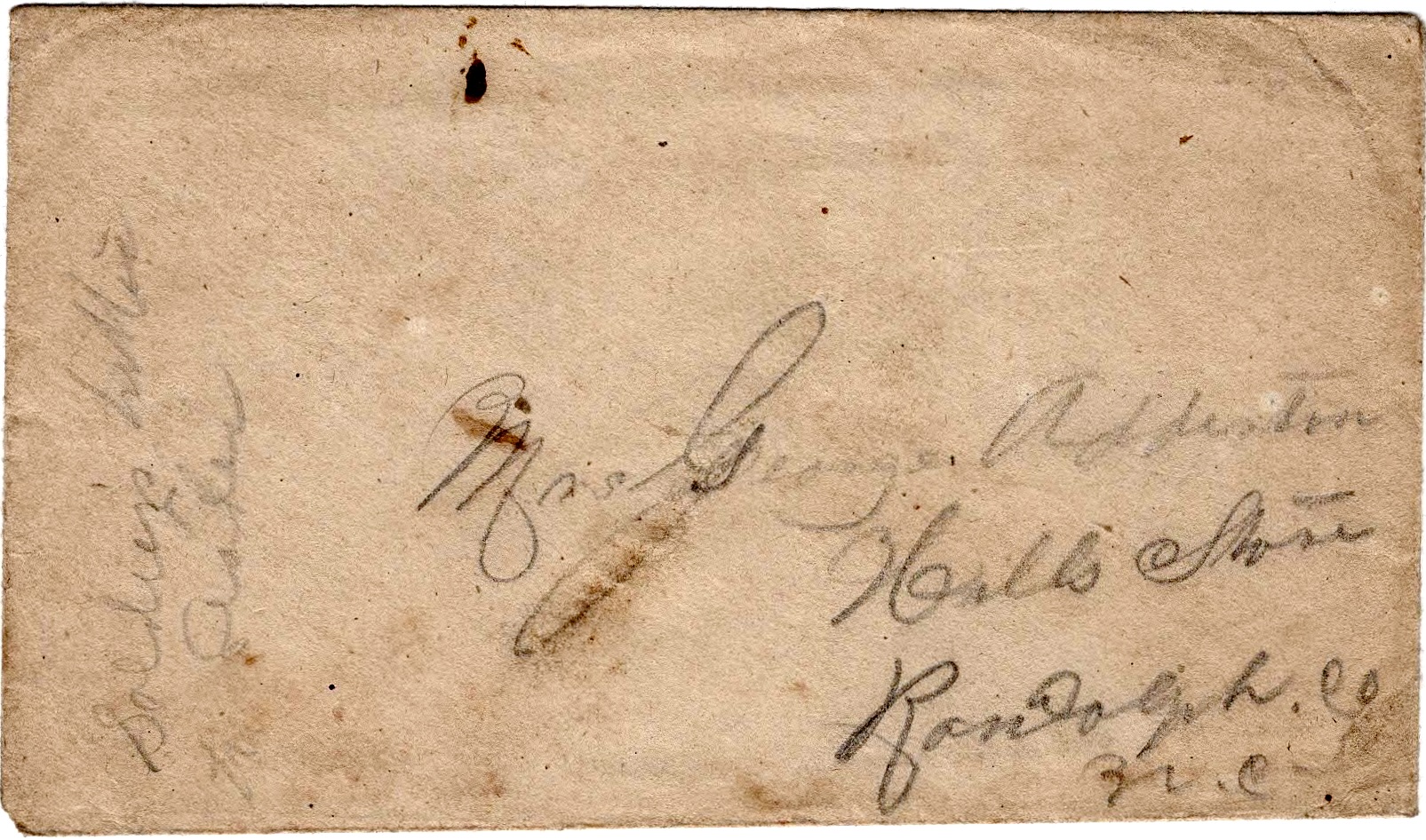
Mrs. George Adderton, Hall’s Store, Randolph county, North Carolina
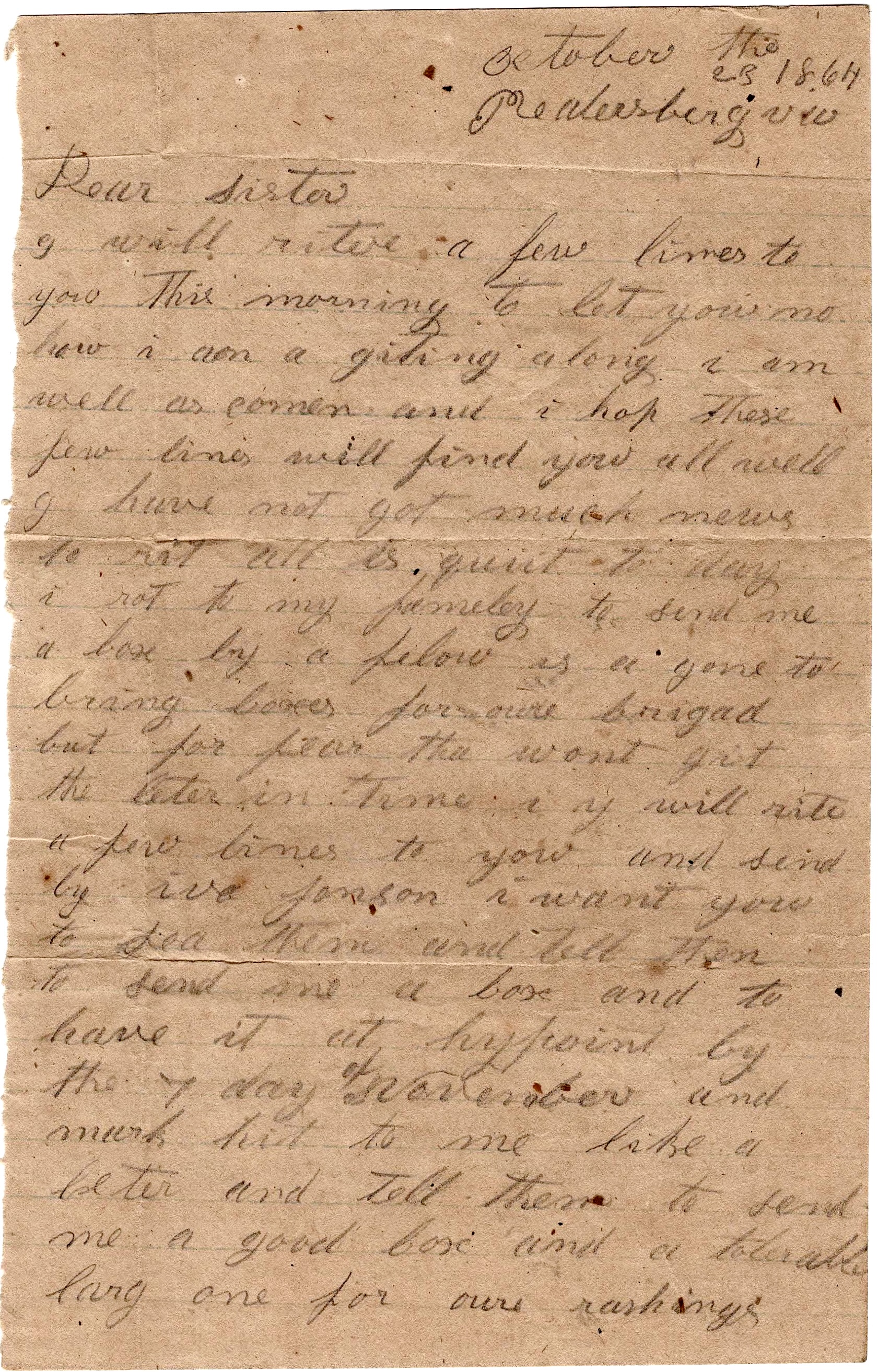
Petersburg, Va. October 23, 1864
Dear sister,
I will write a few lines to you this morning to let you know how I am a getting along. I am well as common and I hope these few lines will find you all well.
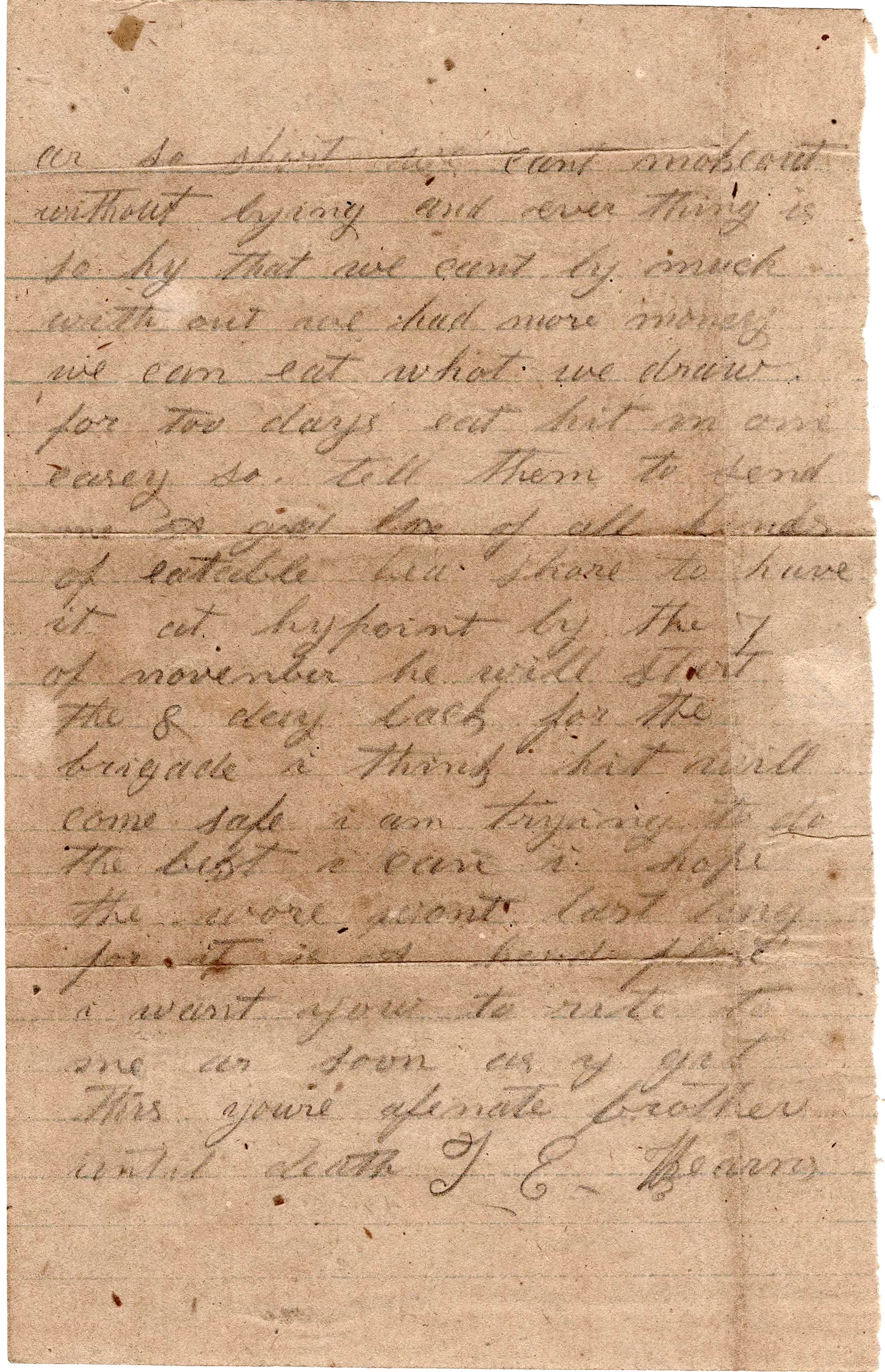
I have not got much news to write. All is quiet today. I wrote to my family to send me a box by a fellow [that] is going to bring boxes for our brigade but for fear they won’t get the letter in tie, I will write a few lines to you and send by Ive Johnson. I want you to see them and tell them to send me a box and to have it at High Point by the 7th day of November and mark it to me like a letter. And tell them to send me a good box and a tolerable large one for our rations are so short, we can’t make out without buying and everything is so high that we can’t buy much without we had more money. We can eat what we draw for two days in one easy, so tell them to send me a good box of all kinds of eatables. Be sure to have it at High Point by the 7th of November. He will start the 8th day back for the brigade. I think it will come safe.
I am trying to do the best I can. I hope the war won’t last long for it is a hard place. I want you to write me as soon as you get this. Your affectionate brother until death, — T. E. Kearns
The following letter was written by William Harris of Camden, New Jersey, who was among the first wave of settlers belonging to the “Western Farm & Village Association,” organized in NYC in 1852 for the settlement of farm land in the West. The leaders of this association settled on Minnesota Territory and let a party of farmers and mechanics with their families by rail and steamboat via Lake Erie, across Ohio from Cleveland to Cincinnati, then down the Ohio and up the Mississippi rivers to a place called Wahbasha’s Prairie, a landing on the upper Mississippi, 150 miles below St. Paul.
William’s letter informs us that the organizers of the caravan of settlers led them to a site six miles overland to “a most beautiful opening of comparatively high table-land covered with oak” near a stream named Rolling Stone Creek, an Indian trail, and a couple of abandoned squatters cabins where they decided to establish their village plot. The association promised the settlers mutual assistance and protection in their efforts to find homes in the West where land could be purchased at government prices.
T R A N S C R I P T I O N
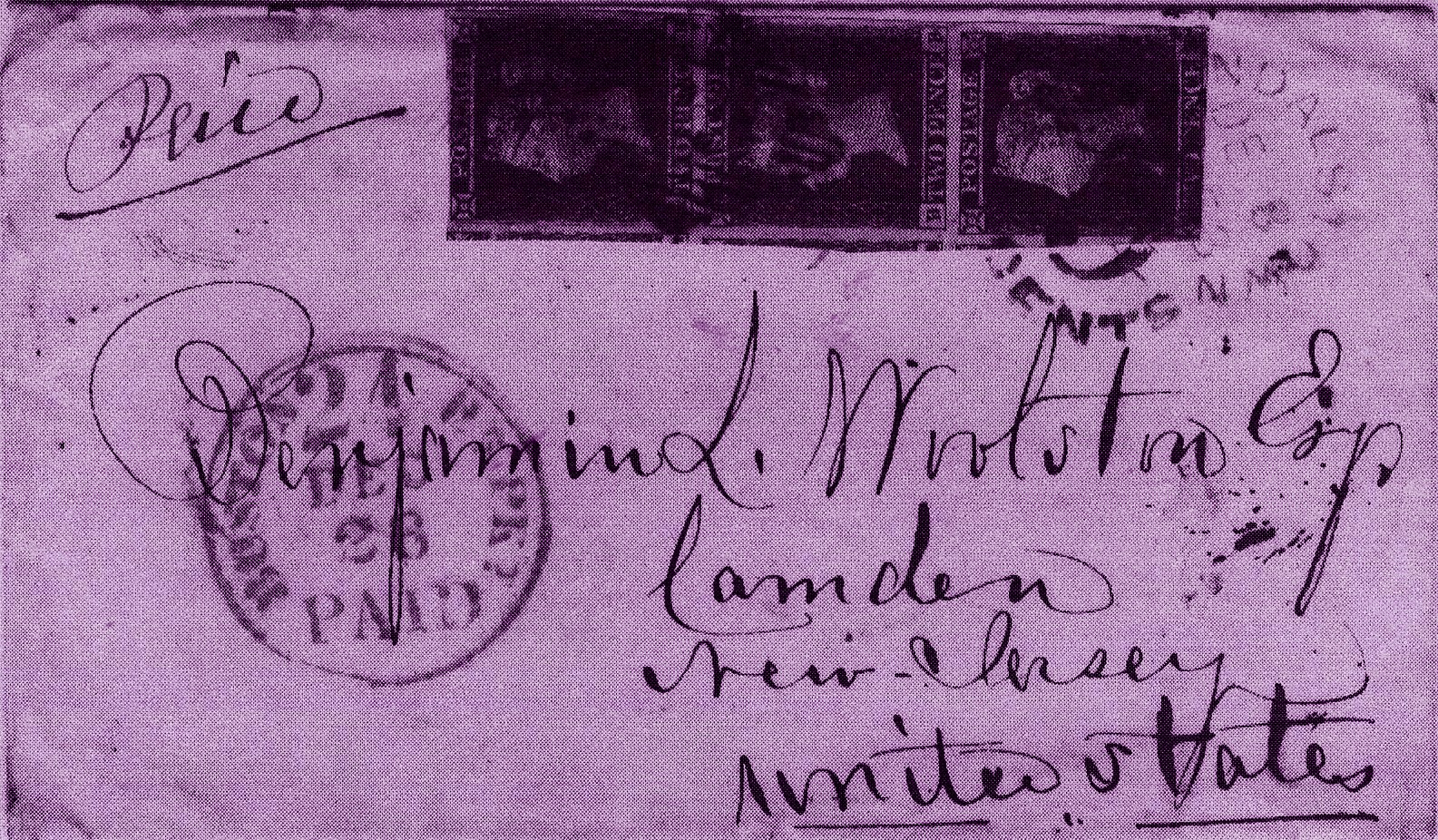
Addressed to Benjamin L. Woolston, Esq., Camden, New Jersey, United States
St. Louis [Missouri] September 16, 1852
To Mr. Benjamin L. Woolston
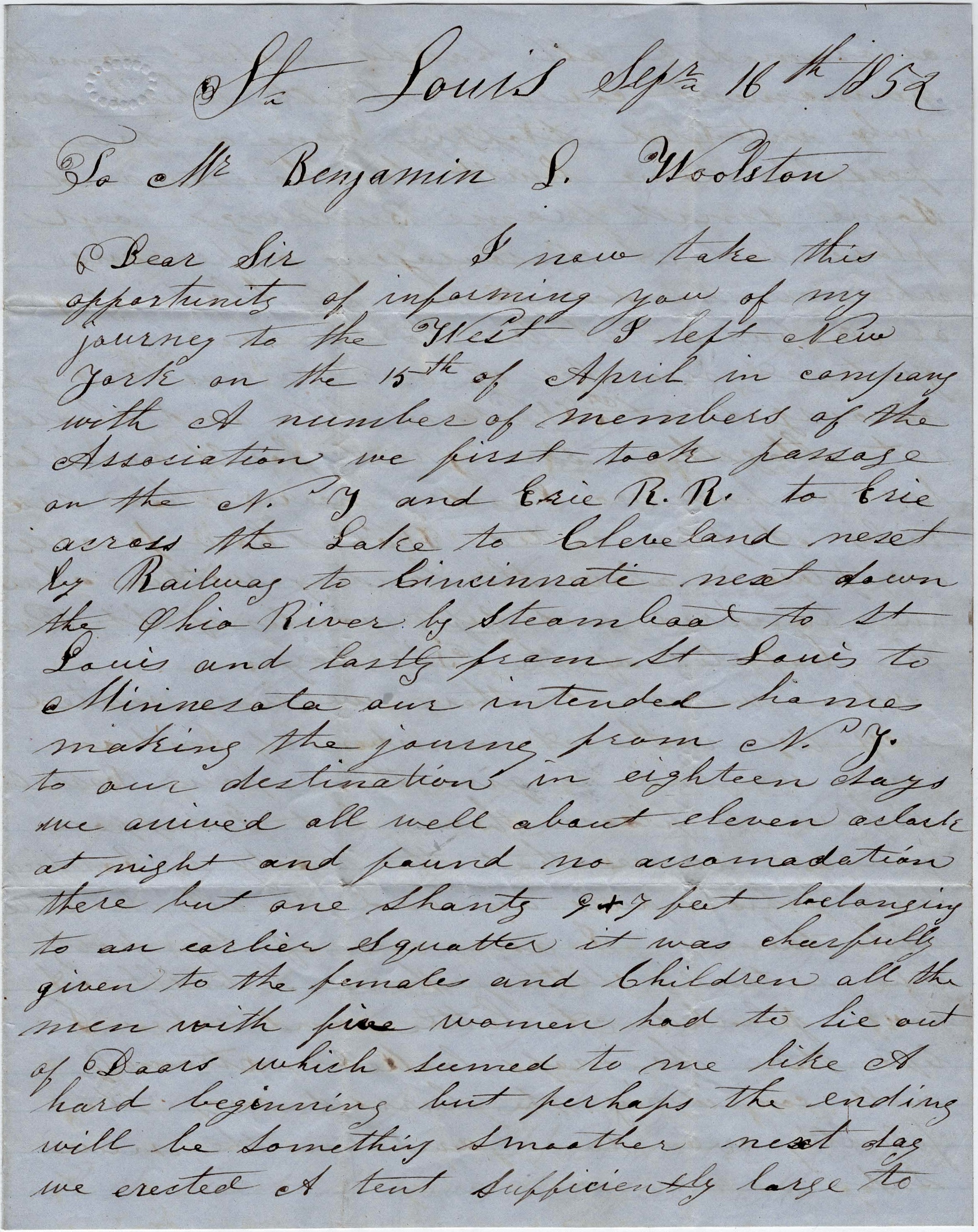
Dear Sir—I now take this opportunity of informing you of my journey to the West. I left New York on the 15th of April in company with a number of members of the Association. we first took passage on the New York and Erie Railroad to Erie, across the Lake to Cleveland. Next by railway to Cincinnati, next down the Ohio river by steamboat to St. Louis, and lastly from St. Louis to Minnesota—our intended homes—making the journey from New York to our destination in eighteen days. We arrived all well about 11 o’clock at night and found no accommodation there but one shanty 9 x 7 feet belonging to an earlier squatter. It was cheerfully given to the females and children. All the men with five women had to lie out of doors which seemed to me like a hard beginning but perhaps the ending will be something smoother.
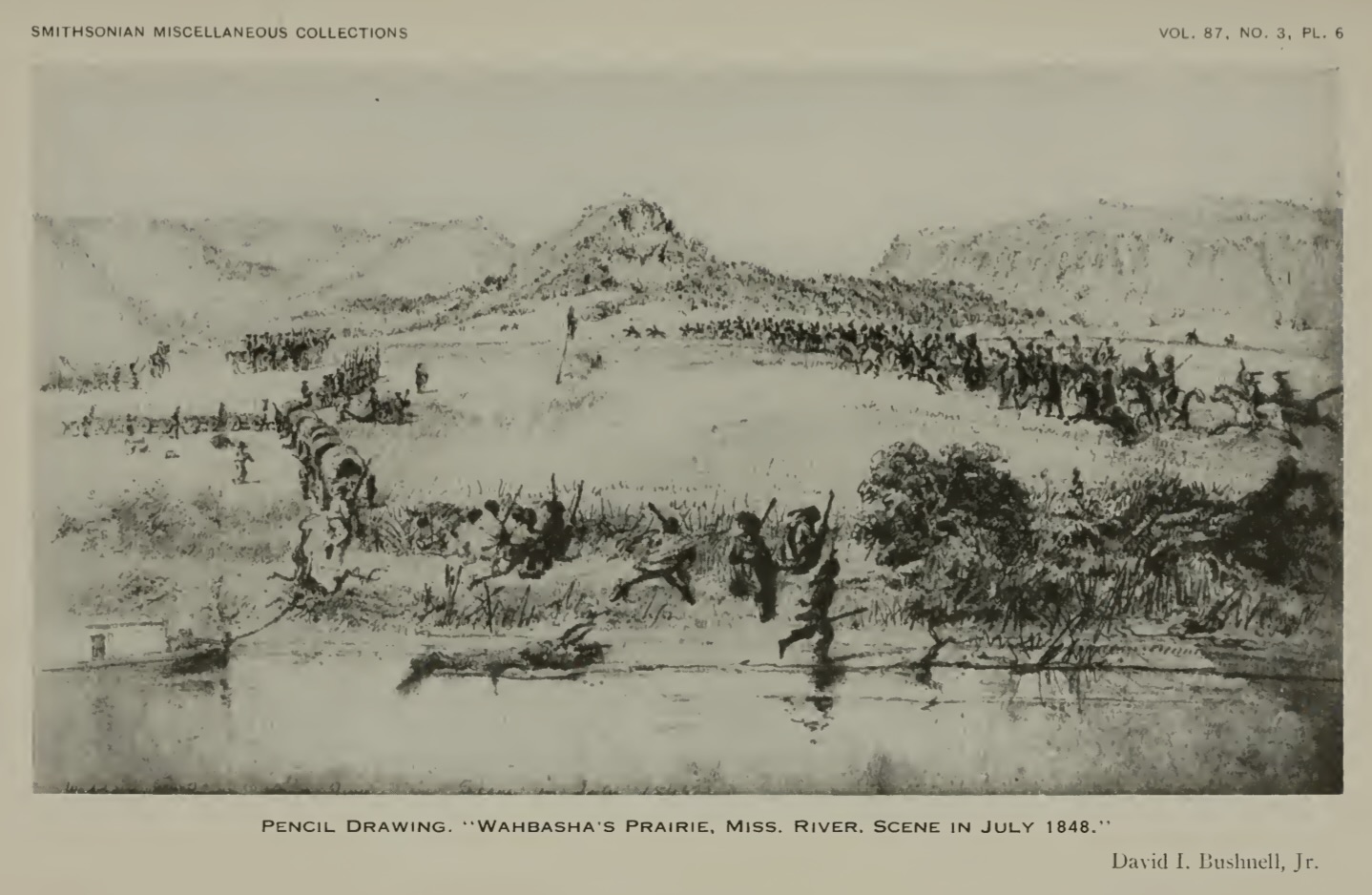
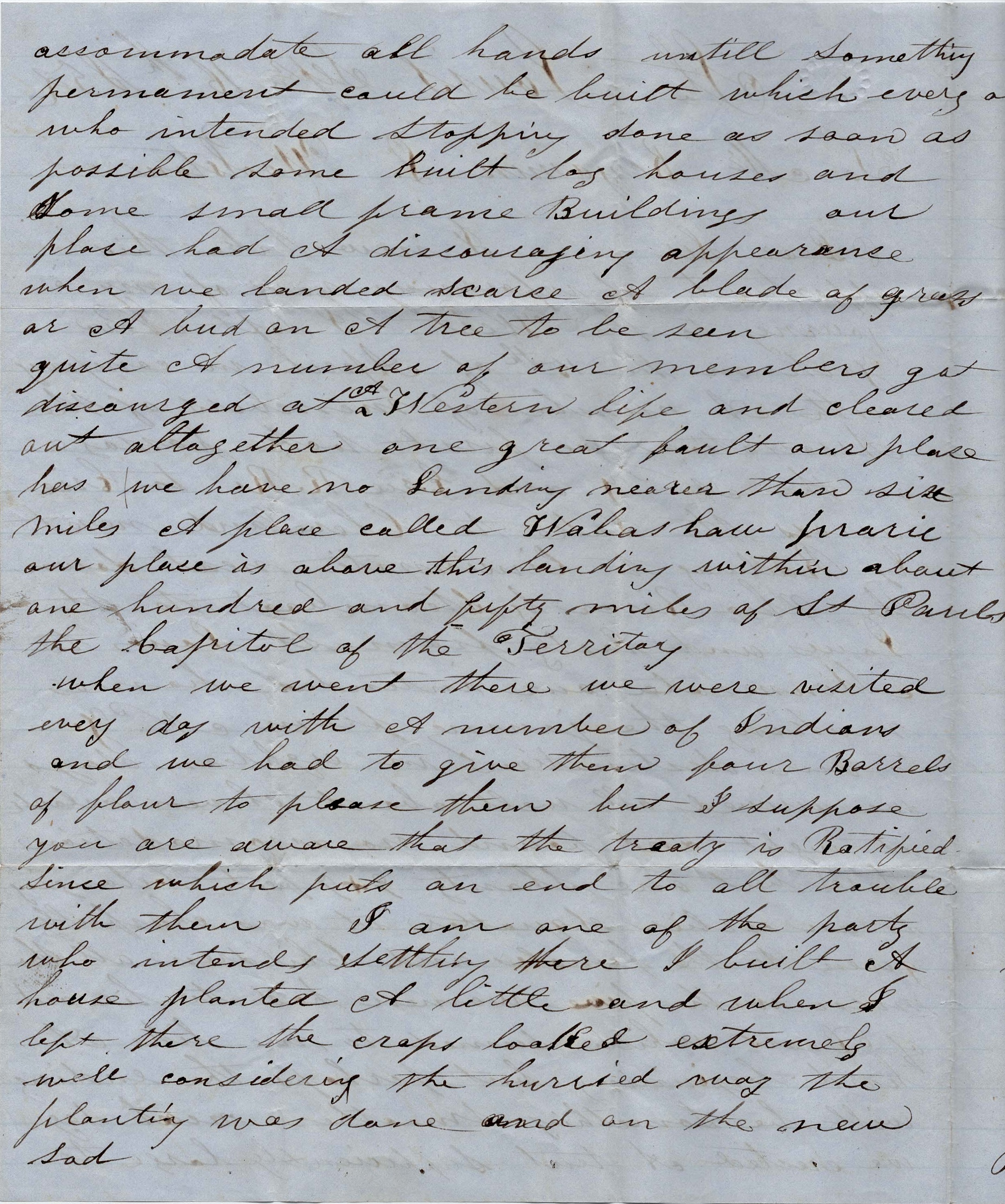
Next day we erected a tent sufficiently large to accommodate all hands until something permanent could be built which everyone who intended stopping done as soon as possible. Some built log houses and some small frame buildings. Our place had a discouraging appearance when we landed—scarce of blade of grass or a bud on a tree to be seen. Quite a number of our members got discouraged at a western life and cleared out altogether. One great fault—our place has no landing nearer than six miles—a place called Wahbasha’s Prairie [now Winona county, Minn.]. Our place is above this landing within about one hundred and fifty miles of St. Paul—the Capitol of the Territory.
A sketch of the landing at Wahbasha’s Prairie by Seth Eastman in 1848.
When we went there, we were visited every day with a number of Indians and we had to give them four barrels of flour to please them but I suppose you are aware that the treaty is ratified since which puts an end to all trouble with them. I am one of the party who intends settling there. I built a house, planted a little, and when I left there, the crops looked extremely well considering the hurried way the planting was done and on the new sod.
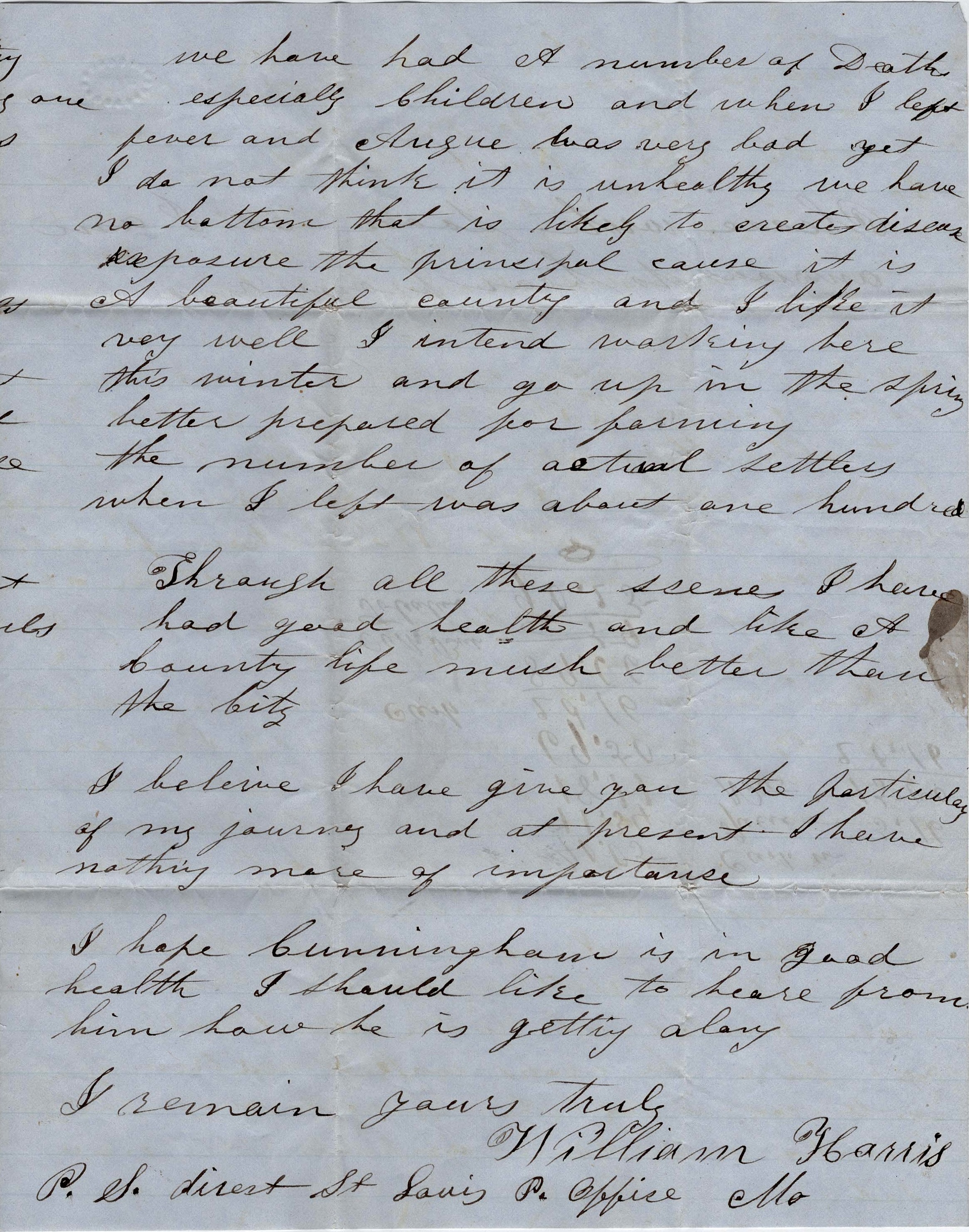
We have had a number of deaths—especially children, and when I left fever and ague was very bad yet. I do not think it is unhealthy. We have no bottom that is likely to create disease. Exposure [is] the principal cause. It is a beautiful country and I like it very well. I intend working here this winter and go up in the spring better prepared for farming. The number of actual settlers when I left was about one hundred.
Through all these scenes, I have had good health and like a country life much better than the city. I believe I have given you the particulars of my journey and at present I have nothing more of importance. I hope Cunningham is in good health. I should like to hear from him. How is he getting along? I remain yours truly, — William Harris
The following letter was written by Ralph Ashley (1797-1852) to his eldest son, Rollin Mallory Asley (1827-1911). Father and son were partners in a general store in Port Republic, New Jersey under the name “R. and R. T. Ashley” until 1833, when the partnership was discontinued and Ralph carried on the business alone until about 1848. Ralph also ventured into ship building, the marketing of wood and charcoal to New York City. Ralph Ashley was married to Sarah Blackman (1803-1879) in 1826.
The nature of Ralph’s trip to the coastal port of Edenton, North Carolina, is not stated explicitly but seems to have been connected with the salvage or selling of a vessel and/or cargo, and perhaps a reconnoissance trip to look for timber to purchase and sell to the New York City market. Ralph’s impression of slavery is consistent with the views of most Northern businessmen who visited the Antebellum South.
T R A N S C R I P T I O N
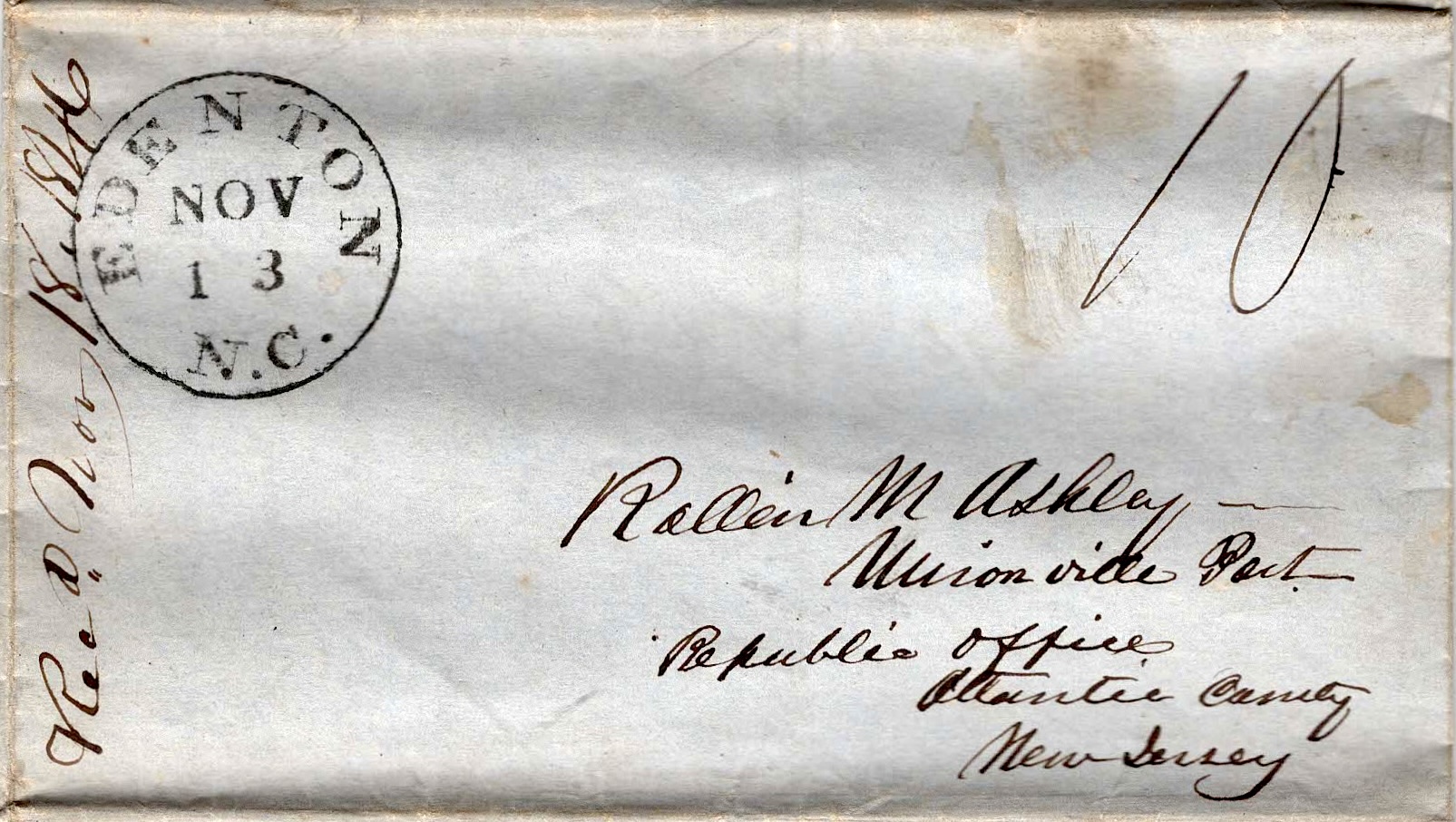
Addressed to Rollin M. Ashley, Unionville, Post Republic Office, Atlantic county, New Jersey
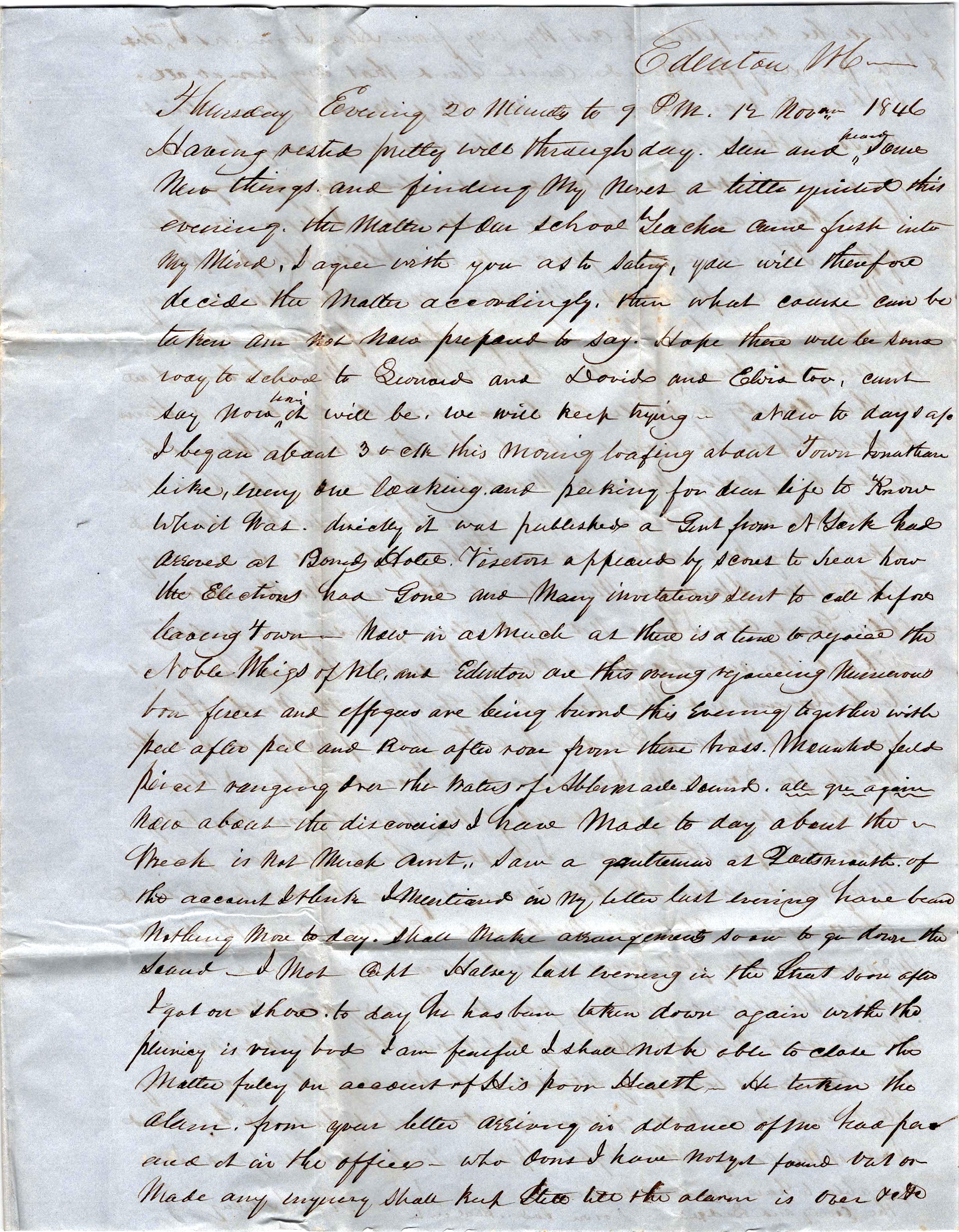
Edenton, North Carolina Thursday evening, 20 minutes to 9 p.m., 12 November 1846
Having rested pretty well through day, saw and heard some new things and finding my nerves a little quieted this evening, the matter of our school teacher came fresh into my mind. I agree with you as to salary. You will therefore decide the matter accordingly. Then what course can be taken, am not prepared to say. Hope there will be some way to school to Leonard and David and Eliza too. 1 Can’t say now how it will be. We will keep trying.
Now today as I began about 3 o’clock this morning loafing about town, Jonathan-like, everyone looking and peeking for dear life to know who I was, directly it was published a Gent from York had arrived at Bond’s Hotel. Visitors appeared by scores to hear how the elections had gone and many invitations sent to call before leaving town. Now inasmuch as there is a time to rejoice the Noble Whigs of North Carolina and Edenton, on this evening together with peel after peel, and roar after roar from the brass-mounted field pieces ranging over the waters of Albemarle Sound, all qu again.
Now, about the discoveries I have made today about — the wreck is not much [ ]. Saw a gentleman at Portsmouth of the account I think I mentioned in my letter last evening. Have been nothing more today. Shall make arrangements soon to go down the Sound. I met Capt. Halsey last evening in the street soon after I got on shore today. He was taken down again with the pleurisy [and] is very bad. I am fearful I shall not be able to close the matter fully on account of his poor health. He taken the Alum. From your letter arriving in advance of me had [ ] and it in the office. Who [ ] I have noted found out on. Many any enquiry. Shall keep still till the alarm is over, &c.
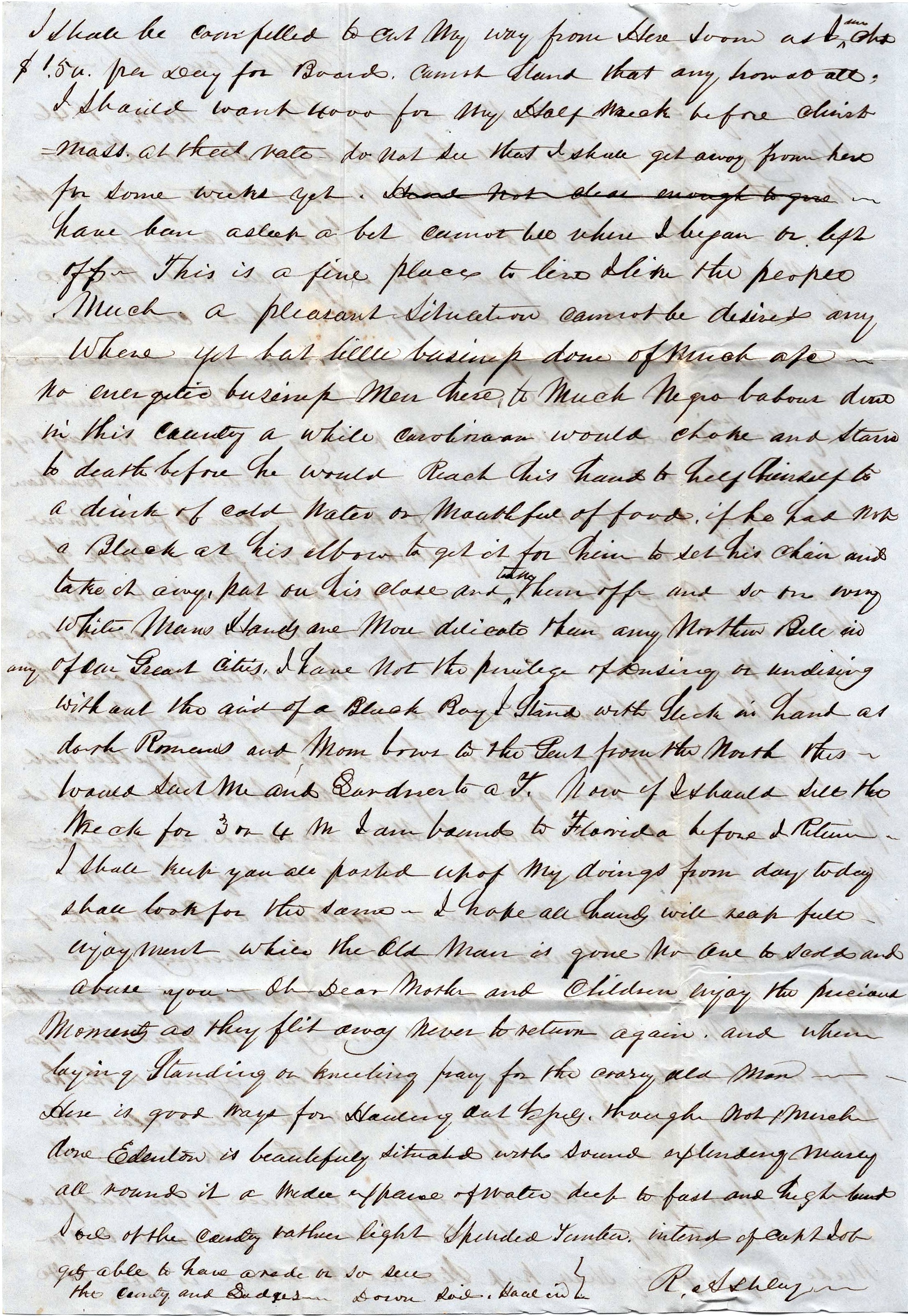
I shall be compelled to cut my way from here soon as I am charged $1.50 per day for board. [ ] stand that any [ ]. I should want 4000 for my half week before Christmas at that rate. Do not see that I shall get away from here for some weeks yet. Have been asleep a bit. Cannot tell where I began or left off.
This is a fine place to live. I like the people much. A [more] pleasant situation cannot be desired anywhere yet but little business done of much account. [There are] no energetic business men here. Too much Negro labor done in this country. A white Carolinian would choke and starve to death before he would reach his hand to help himself to a drink of cold water or a mouthful of food if he had not a Black at his elbow to get it for him, to set the chair and take it away, put on his clothes and take them off, and so on. Every white man’s hands are more delicate than any Northern belle in any of the great cities. I have not the privilege of dressing or undressing without the aid of a Black boy. I stand with stick in hand as dark Romans and Mom bows to the Gent from the North. This would suit me and Gardner to a T.
Now if I should sell the wreck for 3 or 4 M, I am bound to Florida before I return. I shall keep you all posted up of my doings from day to day. Shall look for the same. I hope all hands will reap full enjoyment while the Old Man is gone. No one to scold and abuse you. Oh dear Mother and children, enjoy the precious moments as they flit away, never to return again. And when laying, standing, or kneeling, pray for the crazy old man. Here is good ways for hauling out vessels, though not much done. Edenton is beautifully situated with Sound extending marly all round it. A wide expanse of water, deep too, and high coast. Soil of the country rather light. Splendid timber. Intend if Capt. Job gets able to have a ride to see he country and ledges. — R. Ashley
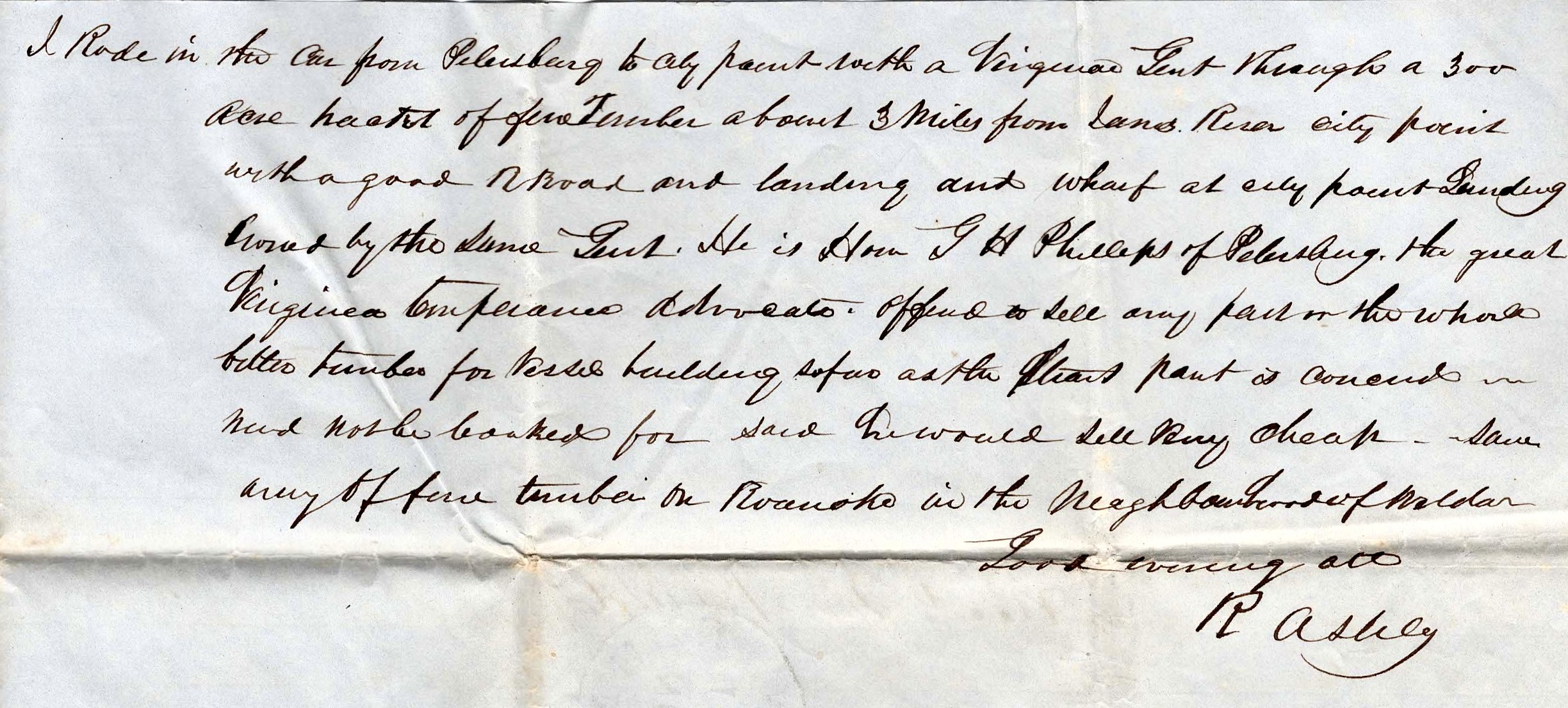
I rode in the car from Petersburg to City Point with a Virginia Gent through a 300-acre [ ] of fine timber about 3 miles from James River. City Point with a good railroad and landing and wharf at City Point Landing owned by the same Gent. He is Hon. G. H. Phillips of Petersburg—the great Virginia temperance advocate. Offered to sell any part or the whole. Better timber for vessel building so far as the strait part is concerned. Need [ ] [ ] for said he would sell buy cheap. Saw [ ] of fine timber on Roanoke in the neighborhood of [ ].
Good evening all, — R. Ashley
1 Ralph’s youngest children were Ann Eliza Ashley (b. 1835), Leonard (b. 1837), and David (b. 1840).
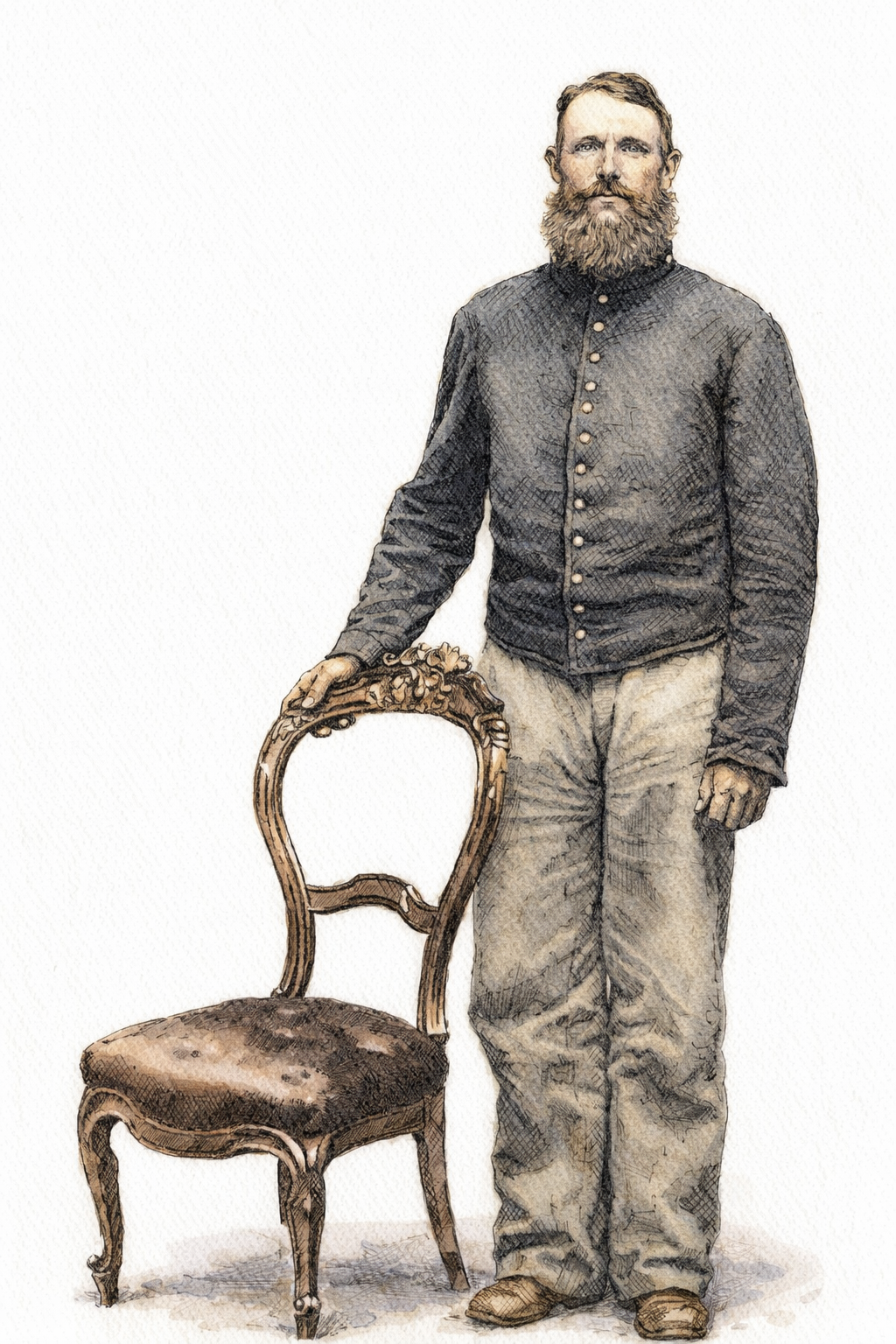
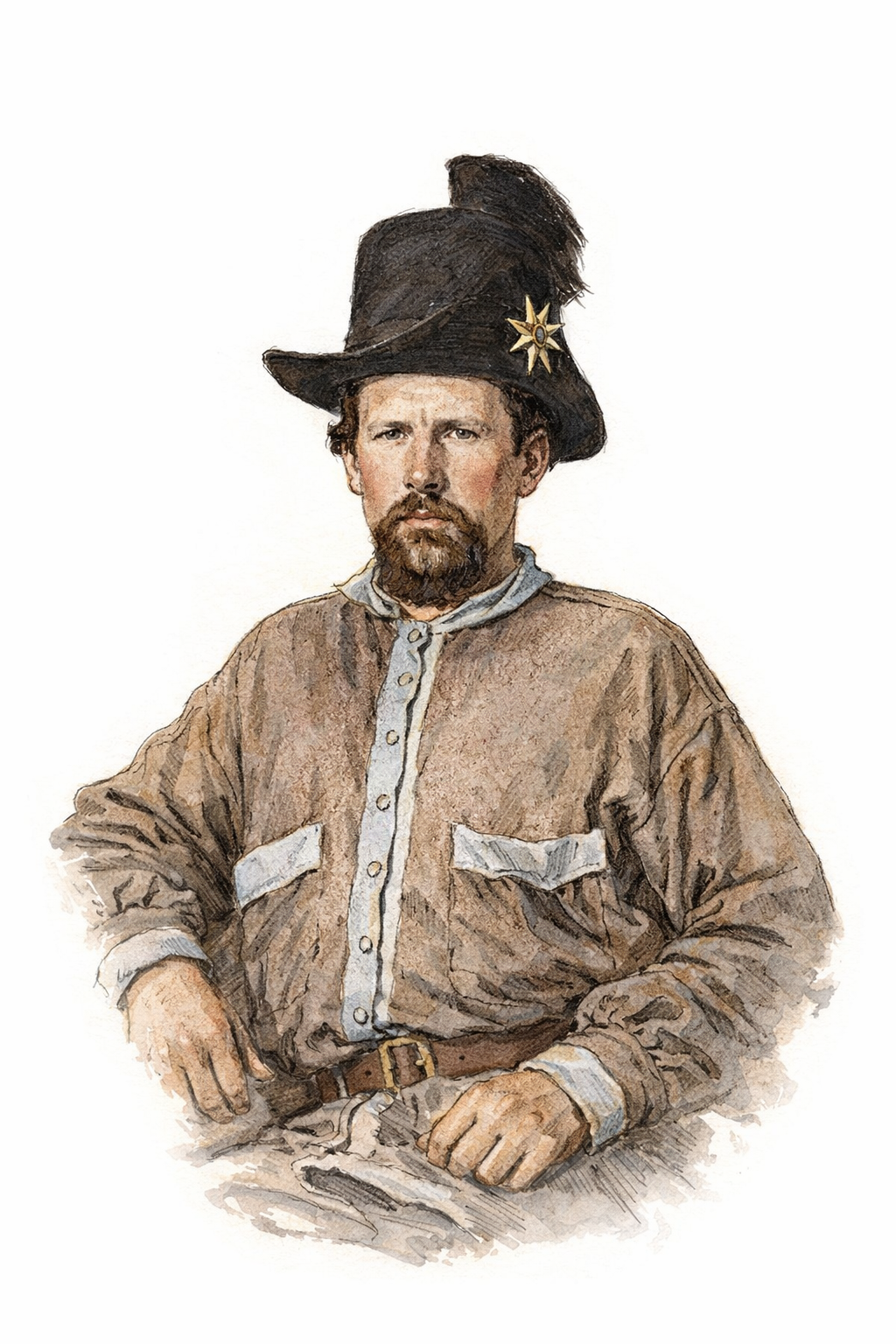
I could not find an image of Samuel but here is a sketch of Luther L. Haas who served in the 46th Pennsylvania (Josh Branham’s Collection)
The following letter was written by Samuel Thoman (1813-1862), the son of Johann Heinrich Thoman (1757-1835) and Magdalena Fredrika Hoffman (1769-1856) of Perry county, Pennsylvania. Samuel married Sarah Novinger (1820-1893) in 1839 and moved to Dauphin County, Pennsylvania, where he was employed as a miller. In September 1861, at the age of 48, Samuel enlisted in Co. D, 46th Pennsylvania Infantry. He was killed in the First Battle of Winchester in May 1862 in which Gen. Banks’ troops were heavily outnumbered and forced to retreat 35 miles to Williamsport, Maryland.
In his letter, Samuel speaks of the construction of a log shanty for winter quarters at Camp Mathews and of his hope that his wife might come and visit him. Samuel and his wife had only one son—Emanuel Thoman (1844-1915).
T R A N S C R I P T I O N
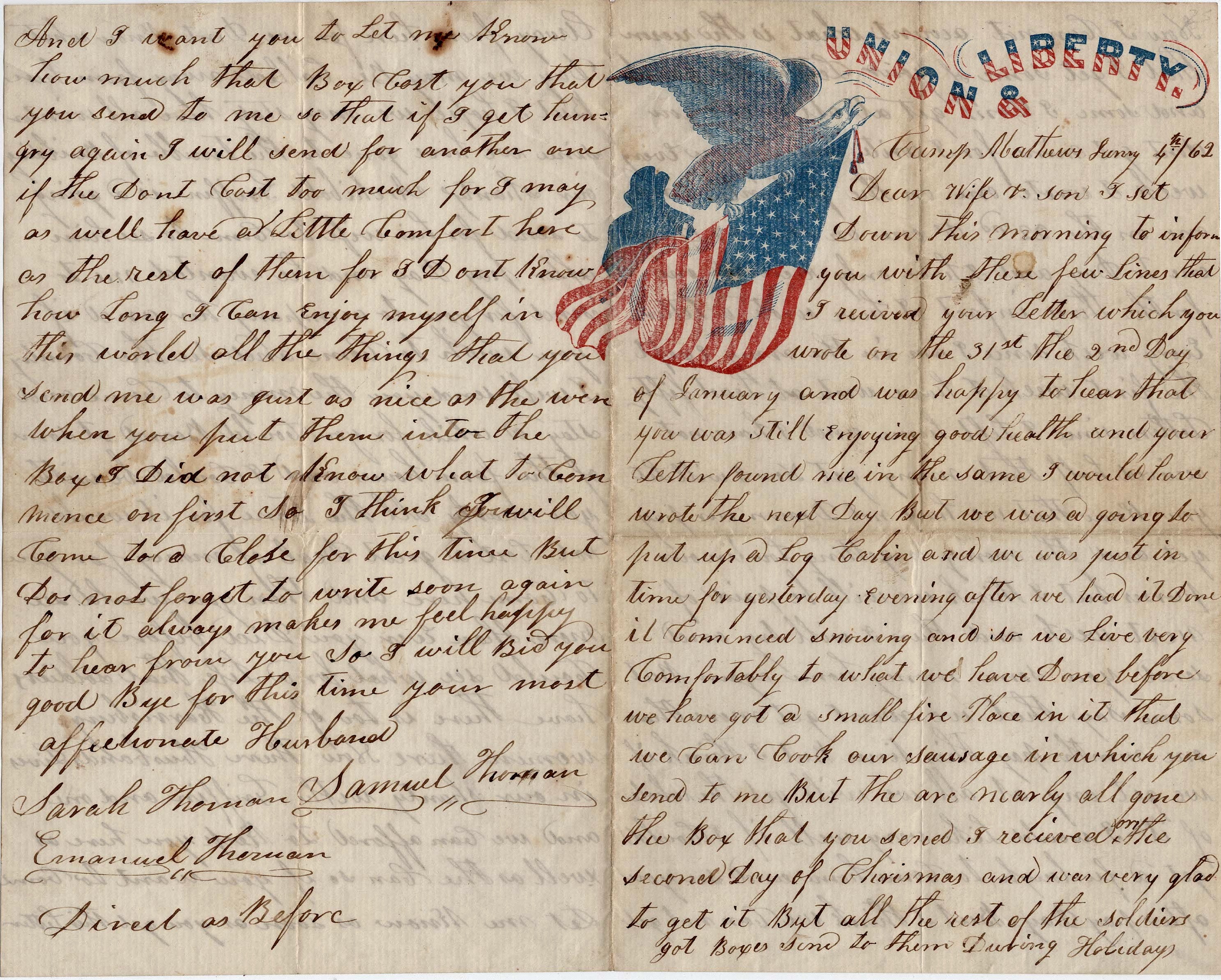
Camp Mathews [on the Upper Potomac in Maryland] January 4th 1862
Dear wife & son,
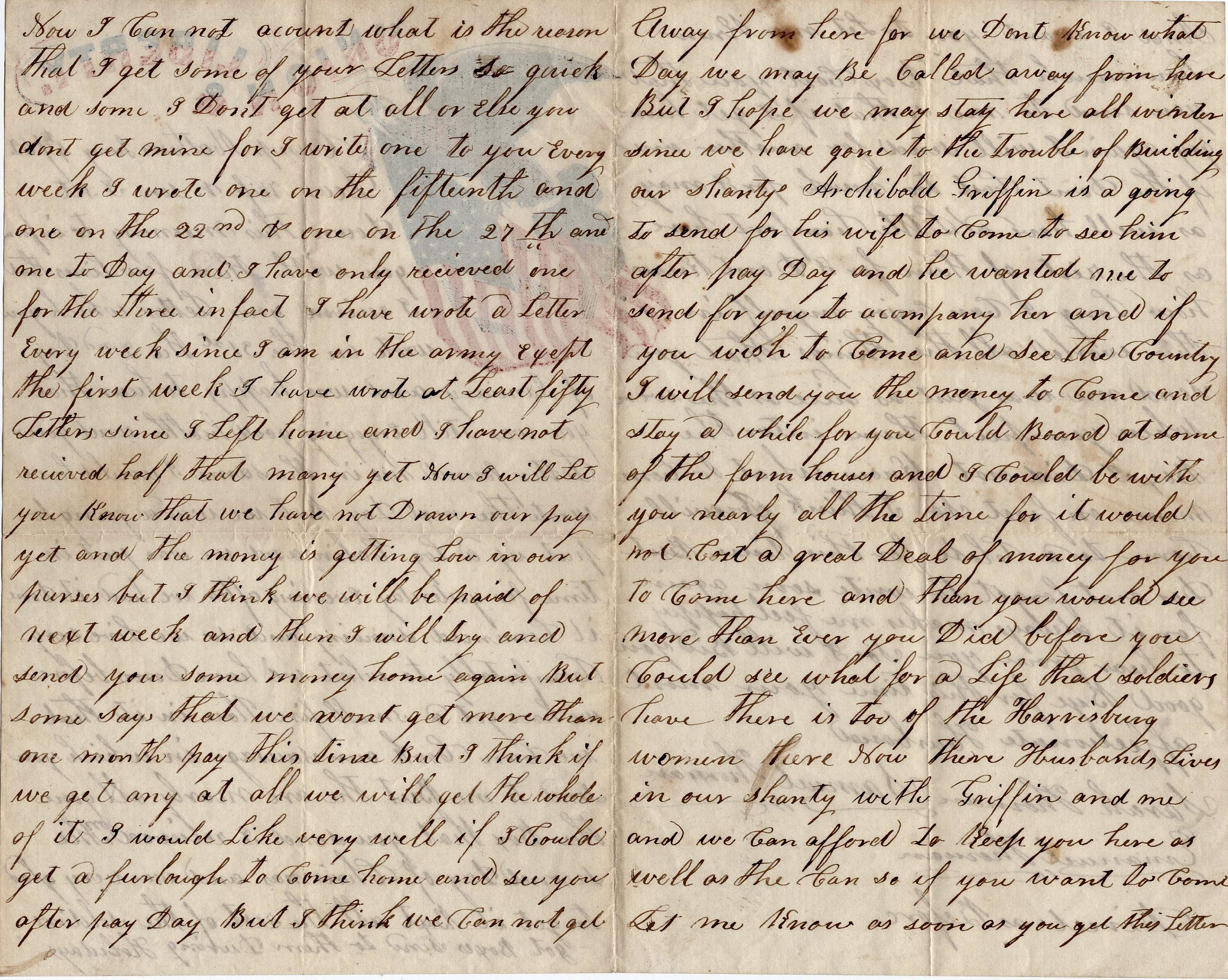
I sit down this morning to inform you with these few lines that I received your letter which you wrote on the 31st the 2nd day of January and was happy to hear that you was still enjoying good health and your letter found me in the same. I would have wrote the next day but we was going to put up a log cabin and we were just in time for yesterday evening after we had it done, it commenced snowing and so we live very comfortably to what we have done before. We have got a small fire place in it that we can cook our sausage in which you send to me, but they are nearly all gone. The box that you send I received the second day of Christmas and was very glad to get it. But all the rest of the soldiers got boxes sent to them during the Holidays. Now I cannot account what is the reason that I get some of your letters so quick and some I don’t get at all, or else you don’t get mine for I write to you every week. I wrote one on the 15th and one on the 22nd & one on the 27th and one today, and I have only received one for the three. In fact, I have wrote a letter every week since I am in the army except the first week. I have wrote at least 50 letters since I left home and I have not received half that many yet
Now I will let you know that we have not drawn our pay yet and the money is getting low in our purses but I think we will be paid off next week and then I will try and send you some money home again. But some says that we won’t get more than one month’s pay this time. But I think if we get any at all, we will get the whole of it. I would like very well if I could get a furlough to come home and see you after pay day but I think we can not get away from here for we don’t know what day we may be called away from here. But I hope we may stay here all winter since we have gone to the trouble of building our shanties.
Archibald Griffin is a going to send for his wife to come to see him after pay day and he wanted me to send for you to accompany her and if you wish to come and see the country, I will send you the money to come and stay a while for you could board at some of the farm houses and I could be with you nearly all the time for it would not cost a great deal of money for you to come here and then you would see more than ever you did before. You could see what for a life that soldiers have. There is two of the Harrisburg women here now. Their husbands live in our shanty with Griffin and me and we can afford to keep you here as well as they can so if you want to come, let me know as soon as you get this letter.
And I want you to let me know how much that box cost you that you sent to me so that if I get hungry again, I will send for another one if they don’t cost too much for I may as well have a little comfort here as the rest of them for I don’t know how long I can enjoy myself in this world. All the things that you sent me was just as nice as they were when you put them into the box. I did not know what to commence on first.
So I think I will come to a close for this time but do not forget to write soon again for it always makes me feel happy to hear from you so I will bid you goodbye for this time. Your most affectionate husband. — Samuel Thoman
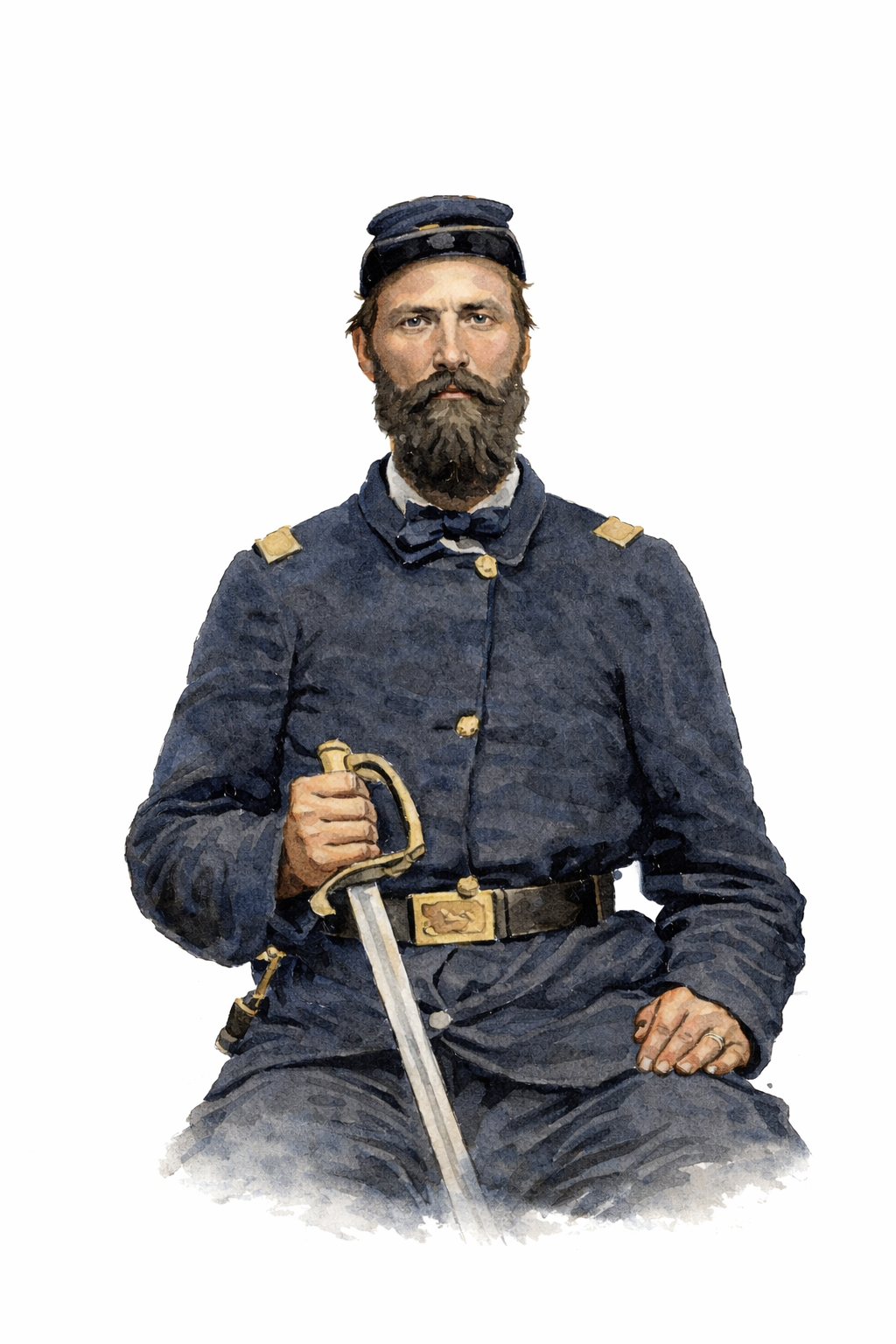
The following letter was written by Abijah S. Jackson (1825-1868), a native of Wilmington, Delaware, and a 38 year-old when he first volunteered to serve as the Orderly Sergeant in Co. E, 1st Nebraska Cavalry. He was promoted to 2nd Lieutenant in August 1862 and resigned his commission at Pilot Knob in July 1863, giving the reason that he was suffering from bronchitis and “unfit for duty.”
After returning East to Philadelphia, and only a month later in August 1863, Abijah enrolled in the service again, returning to the ranks as a private in Co. E, 3rd Pennsylvania Heavy Artillery. He served with them until 6 April 1864 when he accepted a commission as 2nd lieutenant of Co. E, 188th Pennsylvania Infantry. He was subsequently promoted to 1st Lieutenant in September 1864 and to Captain in January 1865. Service records indicate he stood just shy of 5′ 9″ and had black hair and hazel eyes.
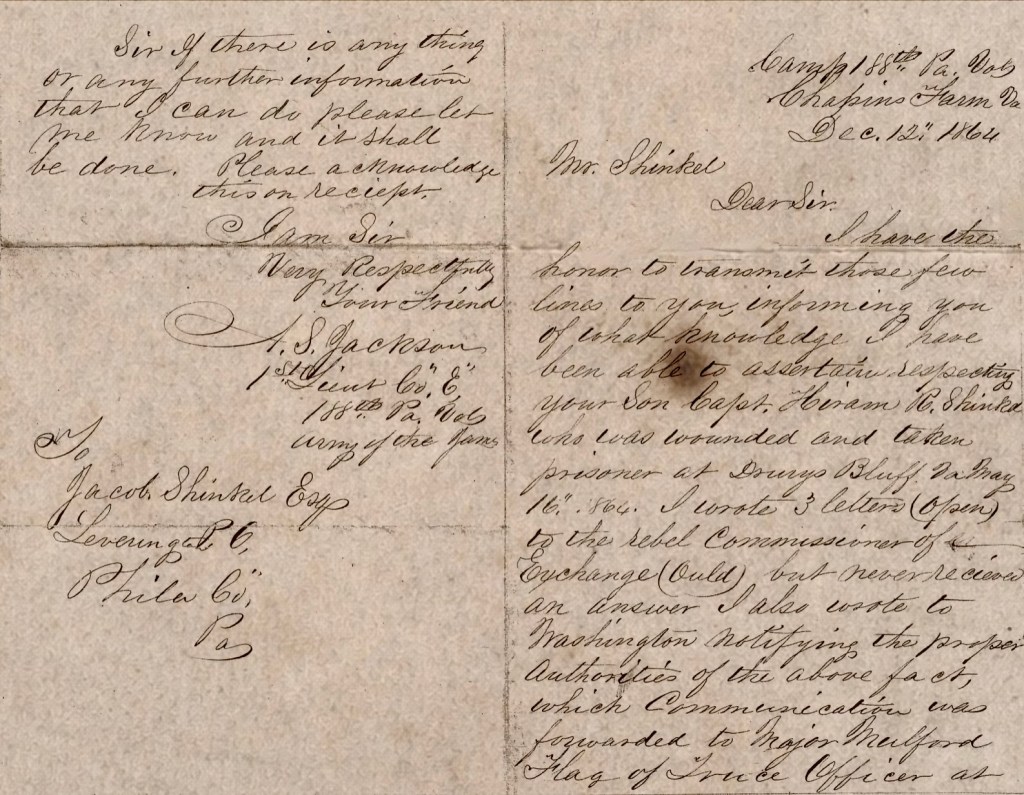
Abijah’s letter provides us with the details of the wounding and death of Hiram Root Shinkel (1840-1864), captain of Co. E, 188th Pennsylvania Infantry. He was wounded in the Battle of Drewry’s Bluff on 16 May 1864 and died at Richmond. The letter was addressed to Jacob Shinkel (1814-1889) of Leverington P. O., Philadelphia county, Pennsylvania.
[Note: This letter is from the private collection of Keith Fleckner and was made available for transcription and publication on Spared & Shared by express consent.]
T R A N S C R I P T I O N
Camp 188th Pennsylvania Vols. Chapins Farm, Virginia Dec. 12, 1864
Mr Shinkel
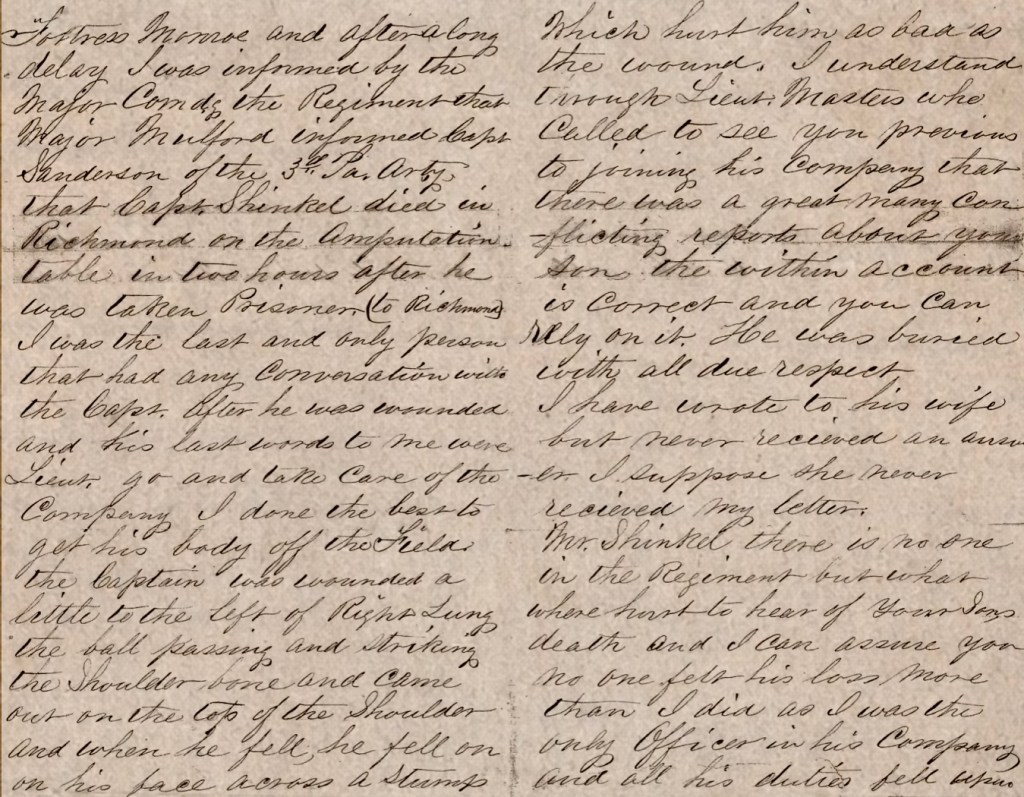
Dear Sir—I have the honor to transmit these few lines to you informing you of what knowledge I have been able to ascertain respecting your son, Capt. Hiram R. Shinkel, who was wounded and taken prisoner at Drewry’s Bluff, Virginia, May 16, 1864. I wrote 3 letters (open) to the rebel Commissioner of Exchange ([Robert] Ould) but never received an answer. I also wrote to Washington notifying the proper authorities of the above fact, which communication was forwarded to Major [John E.] Mulford, Flag of Truce Officer at Fortress Monroe, and after a long delay I was informed by the Major commanding the Regiment, that Major Mulford informed Capt. [Joseph Warner] Sanderson of the 3rd Pennsylvania Artillery that Capt. Shinkel died in Richmond on the amputation table [with]in two hours after he was taken prisoner (to Richmond).
I was the last and only person that had any conversation with the captain after he was wounded and his last words to me were, “Lieutenant, go and take care of the company.” I done the best to get his body off the field. The captain was wounded a little to the left of [his] right lung—the ball passing and sticking the shoulder bone and came out on the top of the shoulder. And when he fell, he fell on his face across a stump which hurt him as bad as the wound. I understand through Lieutenant [Andrew] Masters, who called to see you previous to joining his company, that there was a great many conflicting reports about your son. The within account is correct and you can rely on it. He was buried with all due respect.
I have wrote to his wife but never received an answer. I suppose she never received my letter.
Mr. Shinkel, there is no one in the regiment but what were hurt to hear of your son’s death and I can assure you no one felt his loss more than I did as I was the only officer in his company and all his duties fell upon me.
Sir, if there is anything or any further information that I can do, please let me know and it shall be done. Please acknowledge this on receipt. I am, Sir, very respectfully, your friend — A. S. Jackson, 1stLieut. Co. E, 188thPa Vols., Army of the James
To: Jacob Shinkel Esq. Leverintgon P. O., Philadelphia Co. PA
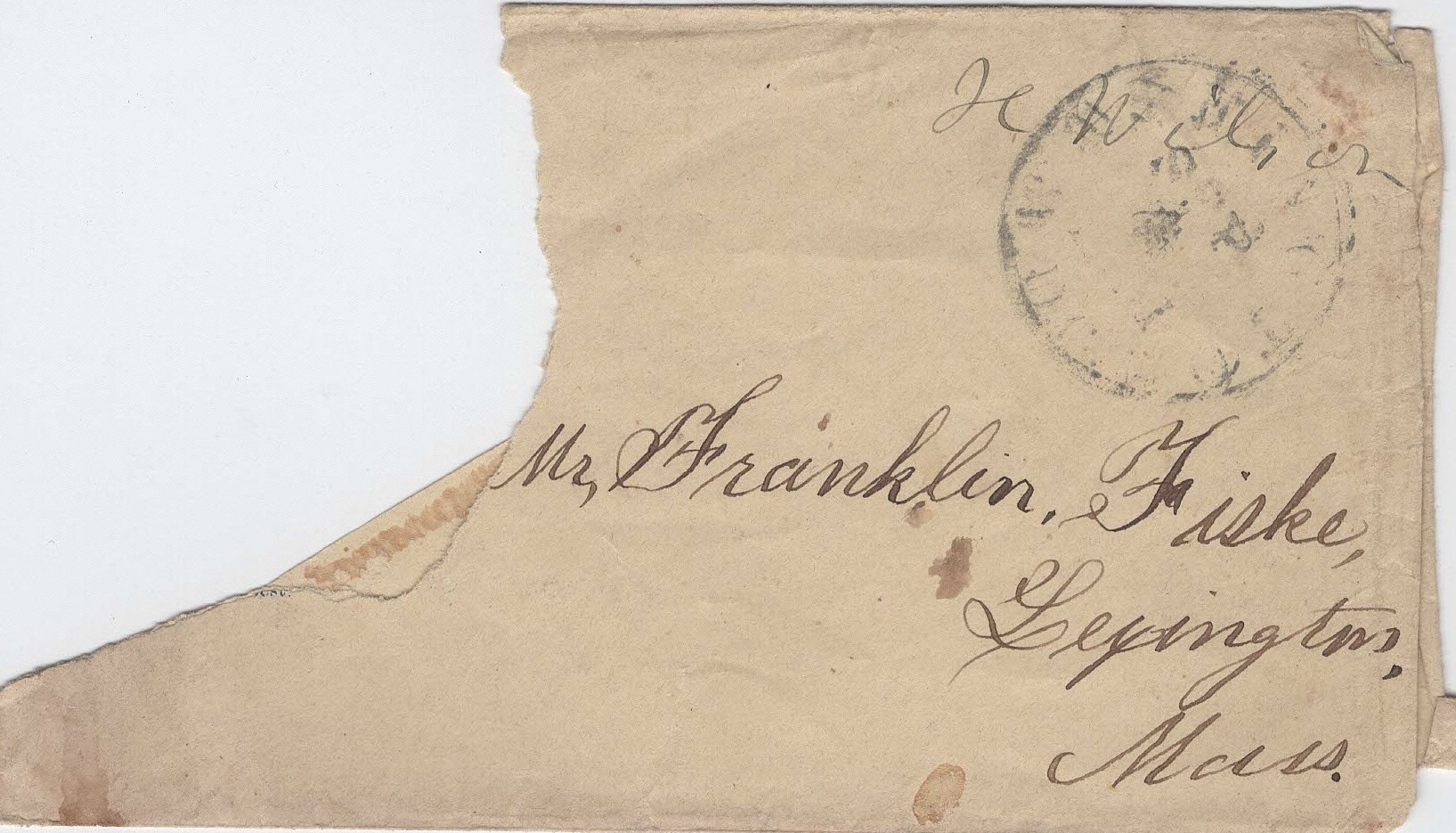
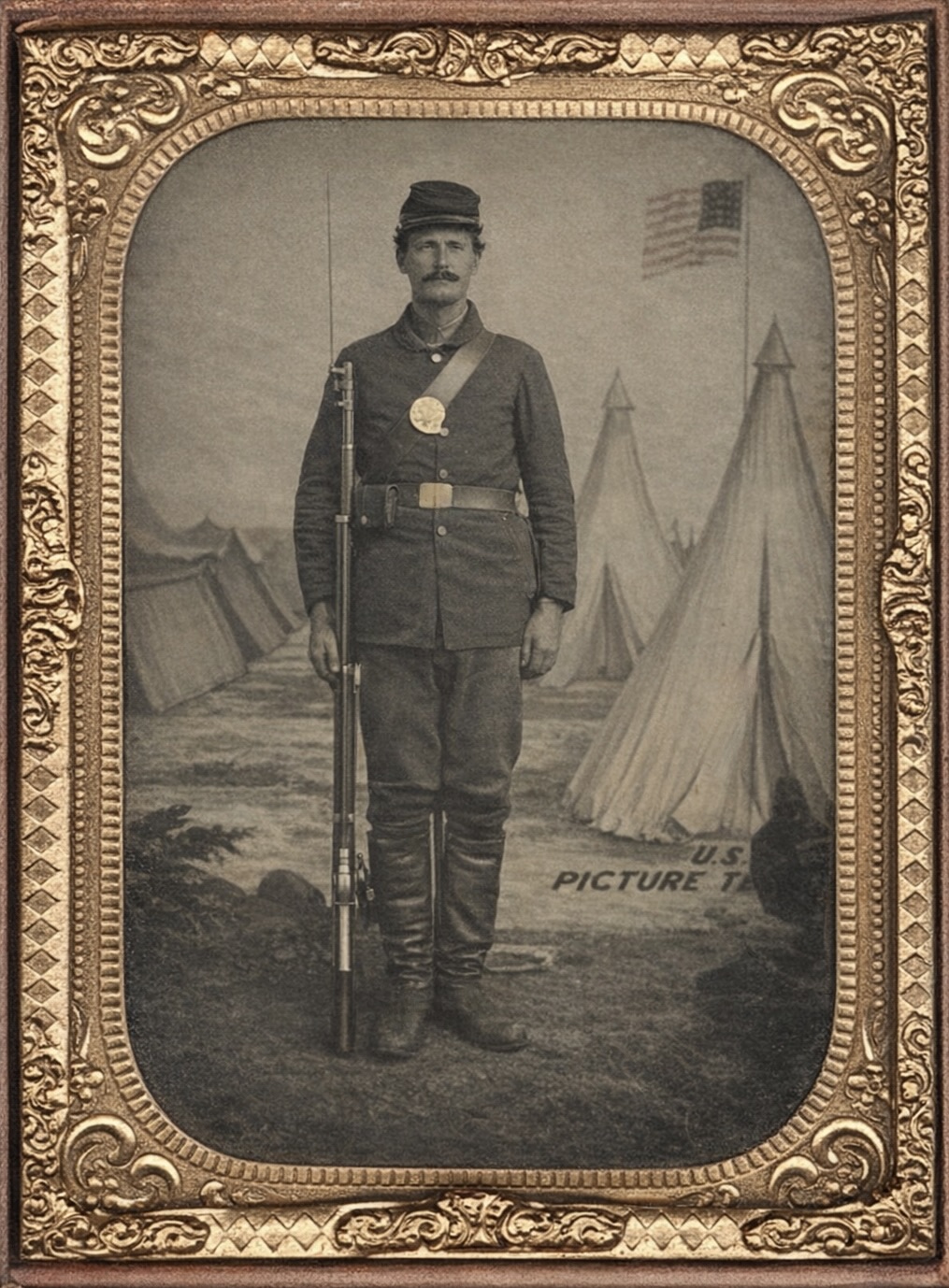
The following letter was written by Joseph Henry Peters Fiske (1843-1870), the son of Franklin Fiske (1804-1868) and Hannah Peters (1801-Aft1868) of Lexington, Middlesex, Massachusetts. He enlisted on 13 June 1861 at Lexington, Massachusetts in Co. G, 11th Massachusetts, at the same time as his older brother Charles Albert Bowers Fiske (1842-1910) who served in Co. K. Joseph was discharged for disability on 20 May 1863. The Register of Enlistments informs us that Joseph died in February 1870 and that he suffered from rheumatism.
T R A N S C R I P T I O N
Chicamuxen, Maryland March 9, 1862
Dear Father & Mother,
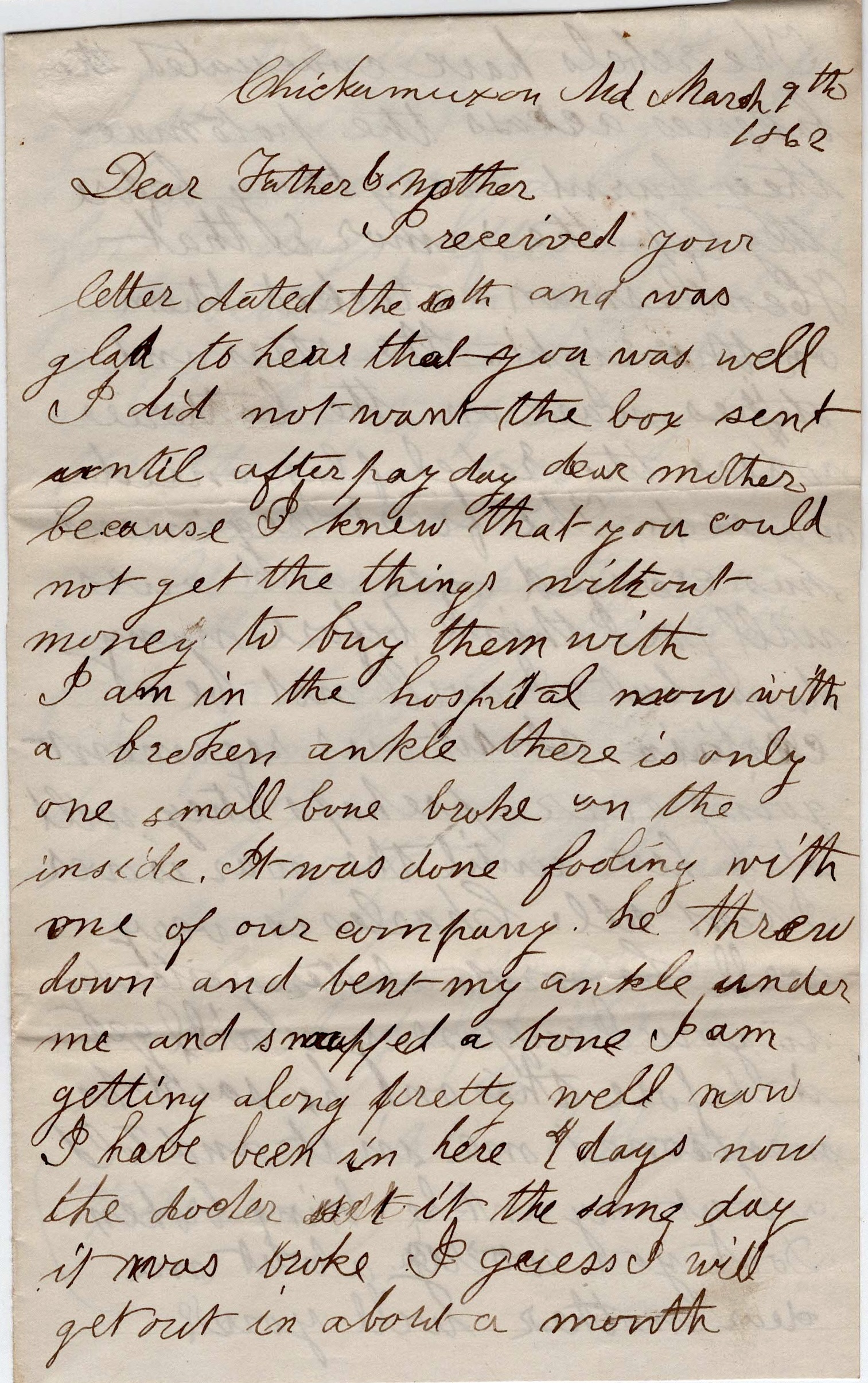
I received your letter dated the 6th and was glad to hear that you was well. I did not want the box sent until after pay day, dear Mother, because I knew that you could not get the things without money to buy them with.
I am in the hospital now with a broken ankle. There is only one small bone broke on the inside. It was done fooling with one of our company. He threw [me] down and bent my ankle under me and snapped a bone. I am getting along pretty well now. I have been in here four days now. The doctor set it the same day it was broke. I guess I will get out in about a month.
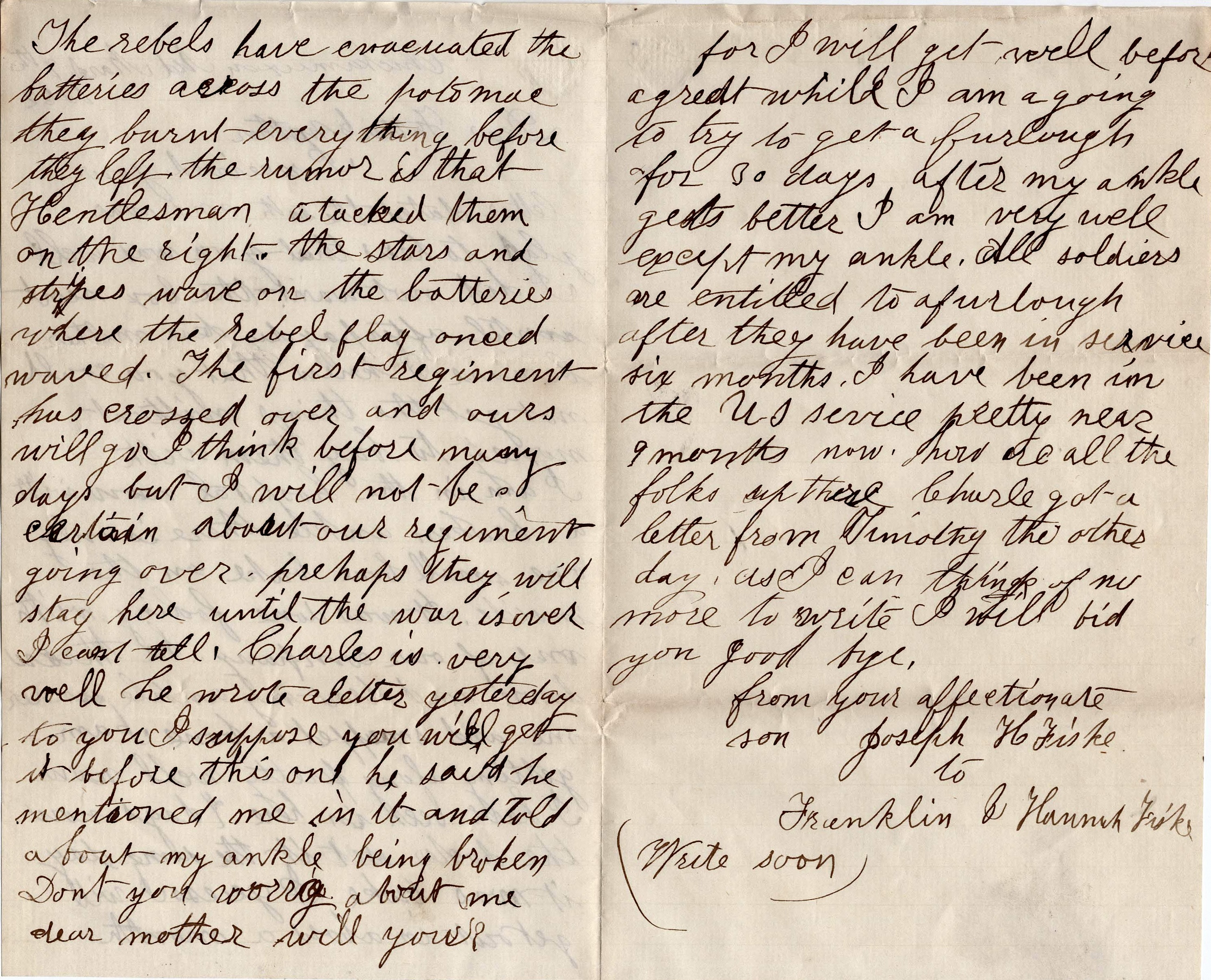
The rebels have evacuated the batteries across the Potomac. They burnt everything before they left. The rumor is that Heintzelman attacked them on the right. The stars and stripes wave on the batteries where the rebel flag once waved. The first regiment has crossed over and ours will go, I think, before many days. But I will not be certain about our regiment going over. Perhaps they will stay here until the war is over. I can’t tell.
Charles is very well. He wrote a letter yesterday to you. I suppose you will get it before this one. He said he mentioned me in it and told about my ankle being broken. Don’t you worry about me, dear Mother, will you? for I will get well before a great while. I am a going to try to get a furlough for thirty days after my ankle gets better. I am very well except my ankle. All soldiers are entitled to a furlough after they have been in the service six months. I have been in the service pretty near nine months now.
How are all the folks up there? Charlie got a letter from Timothy the other day. As I can think of no more to write, I will bid you goodbye. From your affectionate son, Joseph H. Fiske
The following letters were written by Henry Randall Dunham (1838-1877), the son of John Levi Dunham (1811-1861) and Laura Melvina Cheney (1812-1894) of LaPorte, Sullivan county, Pennsylvania. Henry was “a rising young lawyer” when he enlisted in Co. K, 141st Pennsylvania Infantry and was promoted soon after to 1st Lieutenant for his efforts in raising the company. However, ill health resulted in his resigning his commission after 4 months service in late December 1862 and returning home to LaPorte. In January 1865, Henry returned to the service in late December 1864, receiving a commission by order of the President, as 2nd Lieutenant of Co. F of the Thirteenth Regiment, United States Colored Troops. Though he was only a 2nd Lieutenant, his muster rolls indicate that he drew pay for commanding Co. H from 15 February to 15 June 1865. After hostilities ended, he was assigned duty as the Acting Commissary of Subsistence at Fort Macon, North Carolina, and was mustered in as 1st Lieutenant of Co. E in late July 1865. He mustered out of the service on 10 December 1865 at Roanoke Island, returned home, and was for a time in the employ of Welles, Ackley & Company, a mercantile establishment in Dushore, Sullivan county, Pennsylvania. He afterward went to Kansas, returned to his home in Laporte where he died September 5, 1877, at the age of thirty-nine years.
Henry’s brother, Benjamin M. Dunham (1840-1863), served with him in the 141st Pennsylvania but was killed at the battle of Chancellorsville on May 3, 1863.
[Note: These letters are from the personal collection of Keith Fleckner and were offered for transcription and publication on Spared & Shared by express consent.]
Letter 1
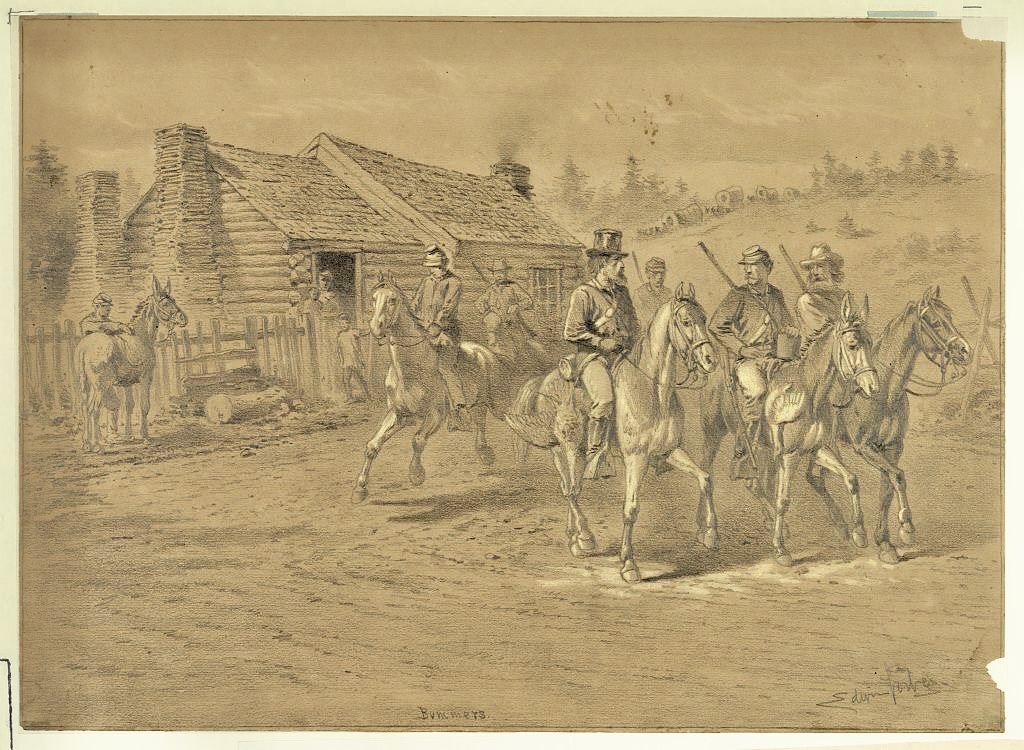
Sherman’s Bummers foraging in advance of his army.
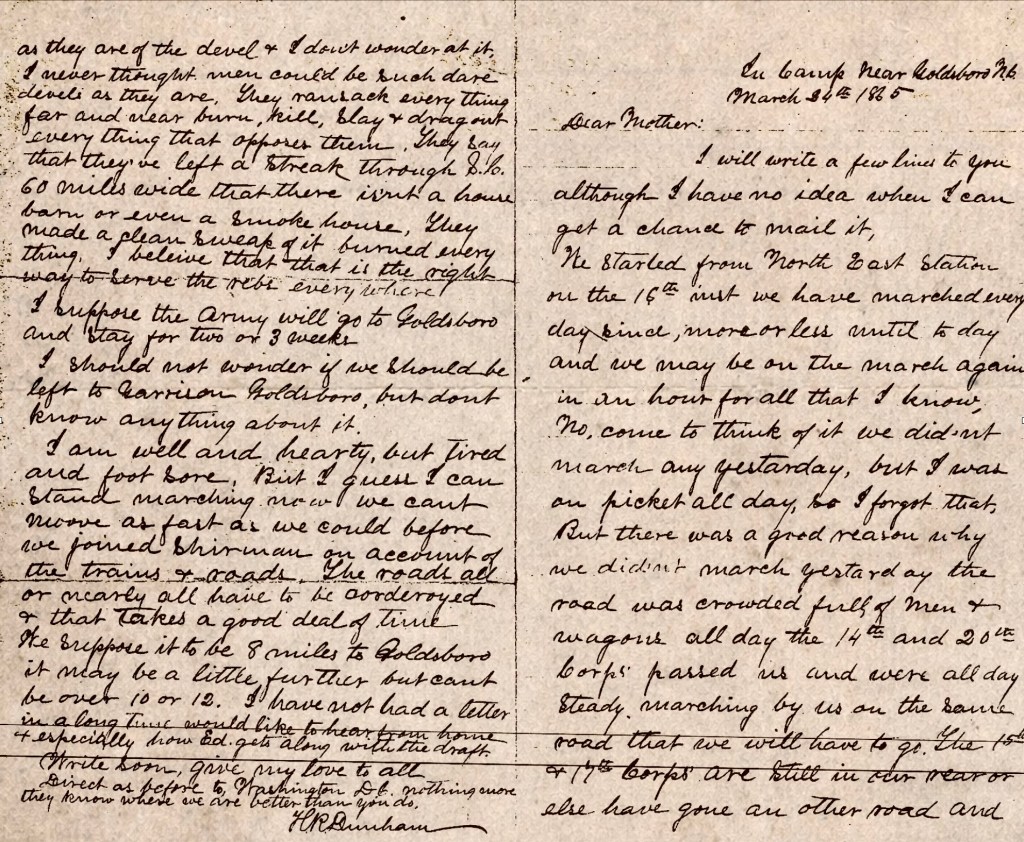
In Camp Near Goldsboro, N. C. March 24th 1865
Dear Mother,
I will write a few lines to you although I have no idea when I can get a chance to mail it.
We started from North East Station on the 16th inst. We have marched every day since—more or less—until today, and we may be on the march again in an hour for all that I know. No, come to think of it, we didn’t march any yesterday, but I was on picket all day so I forgot that. But there was a good reason why we didn’t march yesterday—the road was crowded full of men and wagons all day. The 14th and 20th Corps passed us and were all day steady marching by us on the same road that we will have to go. The 15th and 17 Corps are still in our rear, or else have gone on another road and not far off.
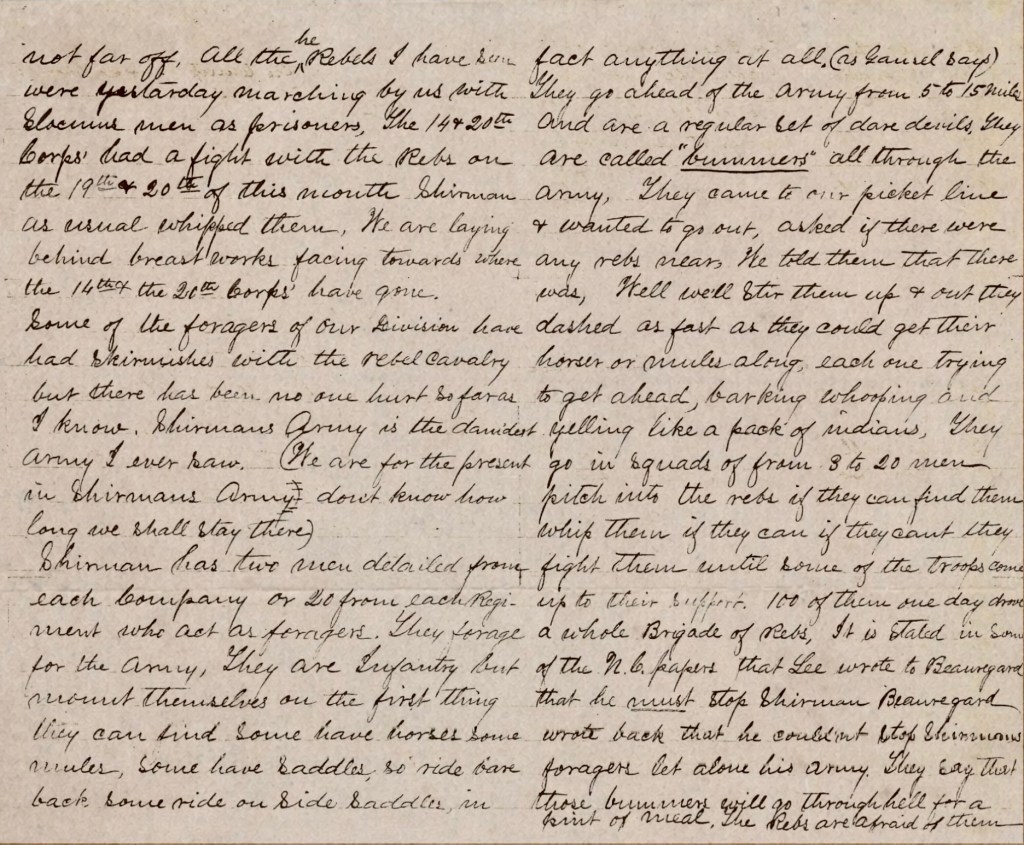
All the Rebels I have seen were yesterday marching by us with Slocum’s men as prisoners. The 14th and 20th Corps had a fight with the Rebs on the 19th and 20th of this month. Sherman as usual whipped them. We are [now] laying behind breast works facing towards where the 14th and the 20th Corps have gone. Some of the foragers of our division have had skirmishes with the rebel cavalry but there has been no one hurt so far as I know.
Sherman’s Army is the damnedest army I ever saw. (We are for the present in Sherman’s Army—don’t know how long we shall stay there). Sherman has two men detailed from each company or 20 from each regiment who act as foragers. They forage for the army. They are infantry but mount themselves on the first thing they can find. Some have horses, some mules, some have saddles, so[me] ride bare back, some ride on side saddles—in fact, anything at all (as Gaurel [?] says). They go ahead of the army from 5 to 15 miles and are a regular set of dare devils. They are called “bummers” all through the army. They came to our picket line and wanted to go out. [When they] asked if there were any rebs near, we told them that there was. “Well, we’ll stir them up and out!” [Then] they dashed as fast as they could get their horses or mules along, each one trying to get ahead, barking, whooping, and yelling like a pack of Indians. They go in squads of from 3 to 20 men, pitch into the rebs if they can find them, [and] whip them if they can. If they can’t, they fight them until some of the troops come up to their support. One hundred of them one day drove a whole brigade of rebs.
It is stated in some of the N.C. papers that Lee wrote to Beauregard that he must stop Sherman. Beauregard wrote back that he couldn’t stop Sherman’s foragers, let alone his army. They say that those bummers will go through hell for a pint of meal. The rebs are afraid of them as they are of the devil and I don’t wonder at it. I never thought men could be such dare devils as they are. They ransack everything far and near, burn, kill, slay, and drag out everything that opposes them. They say that they’ve left a streak through S. C. 60 miles wide—that there isn’t a house, barn, or even a smoke house [left standing]. They made a clean sweep of it—burned everything. I believe that that is the right way to serve the rebs everywhere.
I suppose the army will go to Goldsboro and stay for two or 3 weeks. I should not wonder if we should be left to garrison Goldsboro, but don’t know anything about it.
I am well and hearty, but tired and foot sore. But I guess I can stand marching now. We can’t move as fast as we could before we joined Sherman on account of the trains and roads. The roads all or nearly all have to be corduroyed and that takes a good deal of time. We suppose it to be 8 miles to Goldsboro. It may be a little further but can’t be over 10 or 12. I have not had a letter in a long time. Would like to hear from home and especially how Ed gets along with the draft. Write soon, give my love to all.
Direct as before to Washington D. C. Nothing more. They know where we are better than you do. — H. R. Dunham
Letter 2
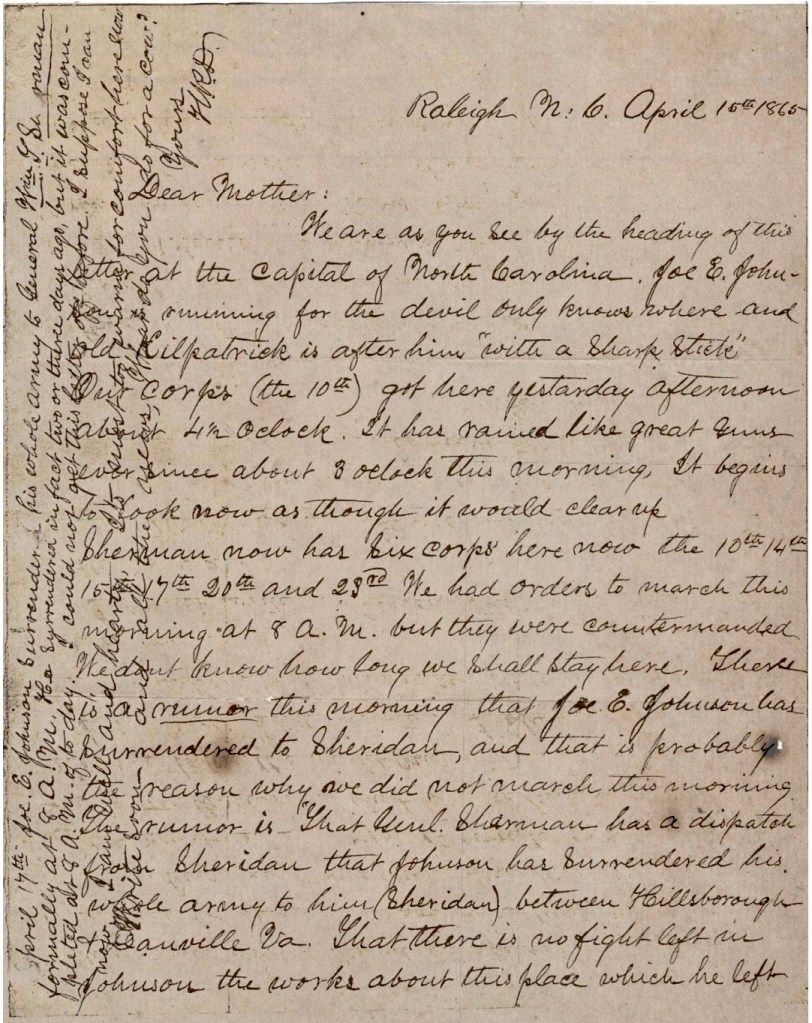
Raleigh, N.C. April 15th 1865
Dear Mother:
We are as you see by the heading of this letter at the Capital of North Carolina. Joe E. Johnston is running for the devil only knows where and old Kilpatrick is after him “with a sharp stick.” Our Corps (the 10th) 1 got here yesterday afternoon about 4.30 o’clock. It has rained like great guns ever since about 3 o’clock this morning. It begins to look now as though it would clear up.
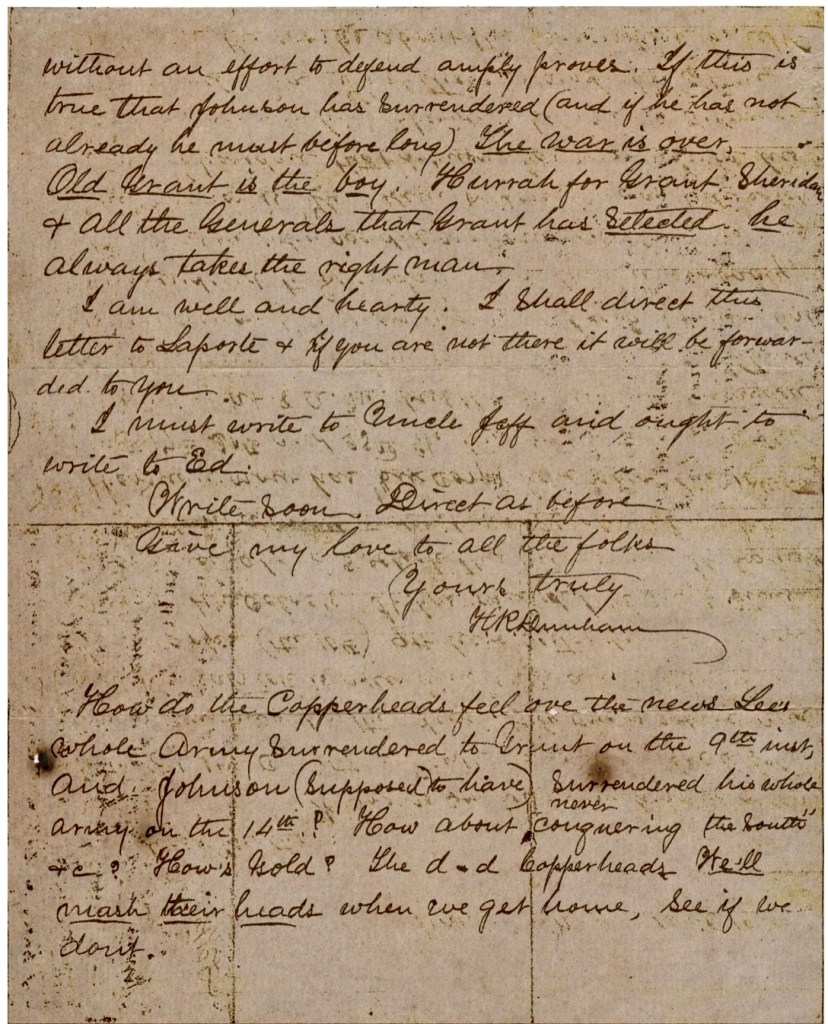
Sherman has six corps here now—the 10th, 14th, 15th, 17th, 20th, and 23rd. We had orders to march this morning at 8 a.m. but they were countermanded. We don’t know how long we shall stay here. There is a rumor this morning that Joe E. Johnston has surrendered to Sheridan, and that is probable the reason why we did not march this morning. The rumor is, “That General Sherman has a dispatch from Sheridan that Johnston has surrendered his whole army to him (Sheridan) between Hillsborough and Danville, Va. That there is no fight left in Johnston.” The works about this place which he left without an effort to defend amply proves. If this is true—that Johnston has surrendered (and if he has not already, he must before long)—the war is over. Old Grant is the boy. Hurrah for Grant, Sheridan, and all the generals that Grant has selected. He always takes the right man.
I am well and hearty. I shall direct this letter to Laporte and if you are not there, it will be forwarded to you. I must write to Uncle Jeff and ought to write to Ed. Write soon. Direct as before. Give my love to all the folks. Yours truly — H. R. Dunham
How do the Copperheads feel over the news [that] Lee’s whole army surrendered to Grant on the 9th inst., and Johnston (supposed to have) surrendered his whole army on the 14th? How about “never conquering the South” &c.? How’s Gold? The damned Copperheads—we’ll mash their heads when we get home. See if we don’t.
April 17th. Joe E. Johnston surrendered his whole army to General Wm. T. Sherman formally at 8 a.m. He surrendered in fact two or three days ago, but it was completed at 8 a.m. of today. I could not get this letter off before. I suppose I can now. I am well and hearty. It’s most too warm for comfort here now. Write soon and all the news. What do you do for a cow? Yours, — H. R. D.
1 The 30th USCT was part of the 25th Corps until March 1865 when it was reassigned to the 1st Brigade, 3rd Division, 10th Corps, Department of North Carolina. It remained a part of the Department of North Carolina until December 1865 when it was mustered out of service.
The following letter was written by Robert G. Tucker (b. 1834) of Co. G, 13th Tennessee Infantry. Tucker enlisted in the spring of 1862 at Columbus, Kentucky. He was wounded twice during the war—at Shiloh and again at LaGrange, Tennessee. In December 1863, he was identified as a “teamster” with his regiment. He was wounded (gunshot to the chest and scapula) and taken prisoner during the Battle of Franklin in Tennessee on 17 December 1864 and sent to Camp Chase in Ohio. He was later transferred to Point Lookout from which place he was paroled.
After the Battle of Missionary Ridge in late November 1863, the 13th Tennessee retreated to Dalton, Georgia, where on February 20, 1864, the brigade was placed in Cheatham’s Division where it remained until the end of the war. The 13th/154th remained at Dalton until the resumption of fighting in May, 1864, except for one brief expedition in February to Demopolis, Alabama, and return, when they had started out to reinforce General Leonidas Polk in Mississippi, but were recalled on reaching Demopolis. From here on the regiment participated in the retreat to Atlanta, the return to Tennessee, and the final journey to join General Joseph E. Johnston at Bentonville, North Carolina.
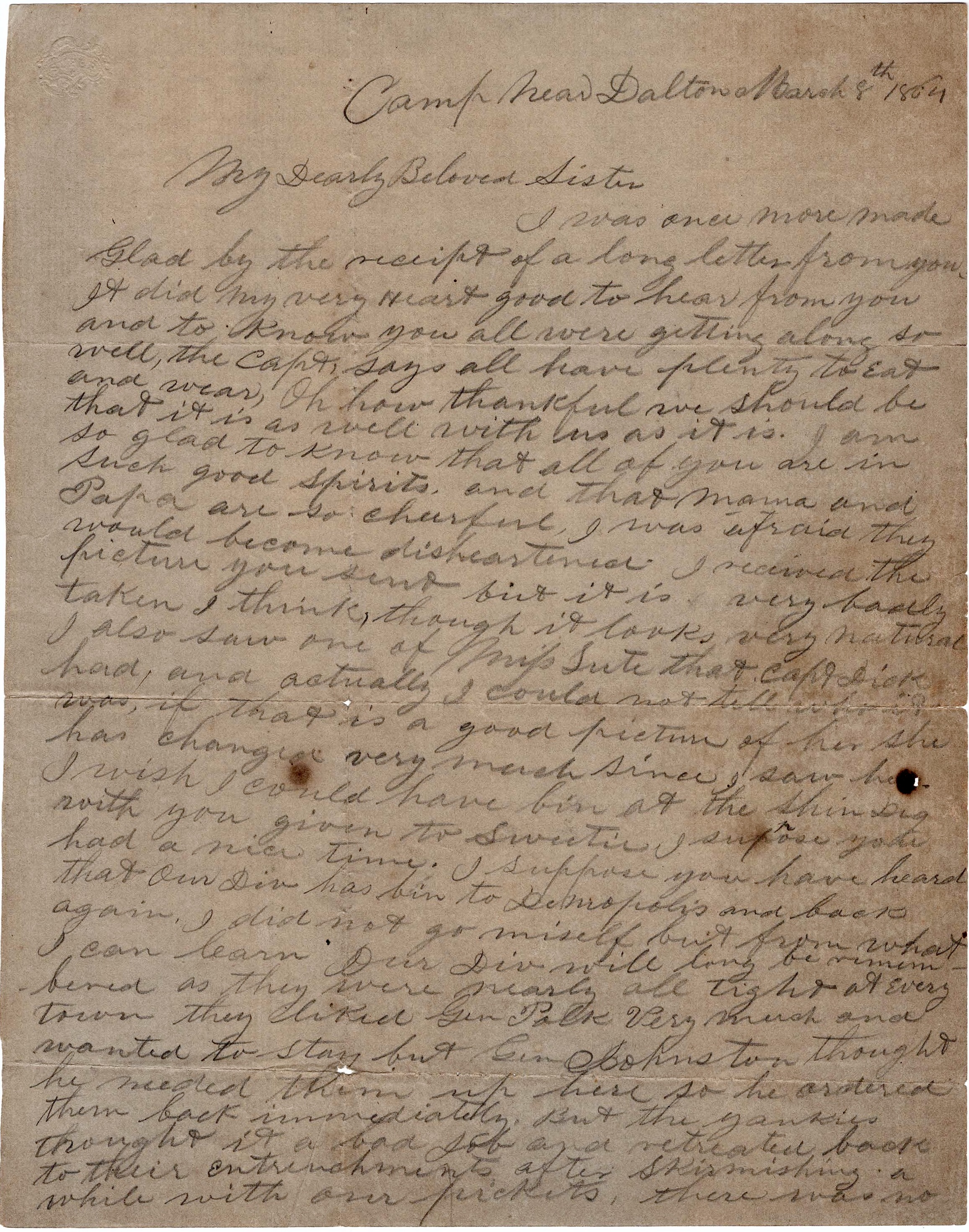
T R A N S C R I P T I O N
Camp near Dalton March 8th 1864
My dearly beloved sister,
I was once more made glad by the receipt of a long letter from you. It did my very heart good to hear from you and to know you all were getting along so well. The Captain says all have plenty to eat and wear. Oh how thankful we should be that it is as well with us as it is. I am so glad to know that all of you are in such good spirits and that Mama and Papa are so cheerful. I was afraid they would become disheartened.
I received the picture you sent but it is very badly taken, I think, though it looks very natural. I also saw one of Miss Lute that Captain Dick had, and actually I could not tell who it was. If that is a good picture of her, she has changed very much since I saw her.
I wish I could have been at the shin dig with you given to Sweetie. I suppose you had a nice time.
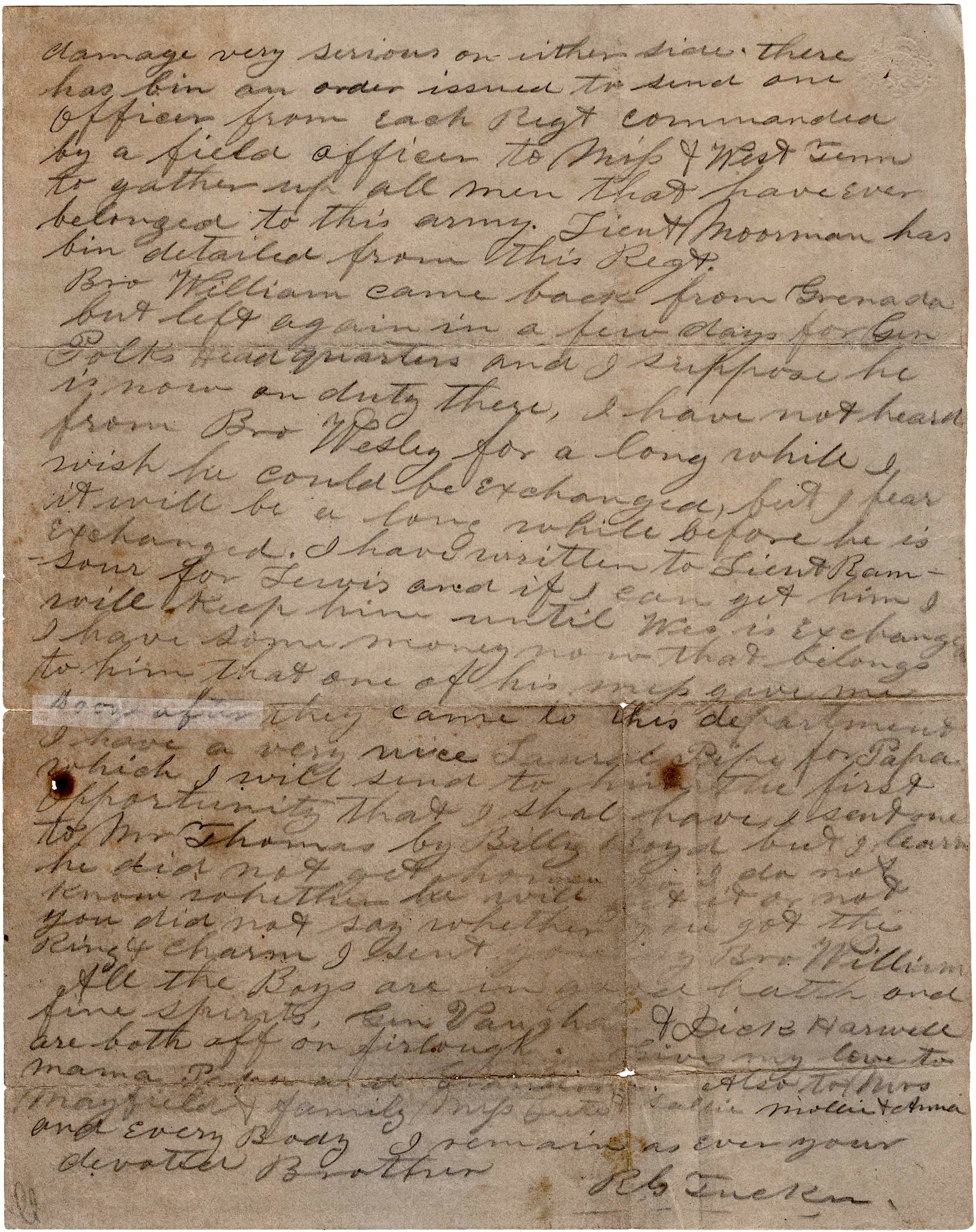
I suppose you have heard that our Division has been to Demopolis and back again. I did not go myself but from what I can learn, our Division will long be remembered as they were nearly all tight [drunk] at every town. They liked Gen. Polk very much and wanted to stay but Gen. Johnston thought he needed them up here so he ordered them back immediately. But the Yankees thought it a bad job and retreated back to their entrenchments after skirmishing a while with our pickets. There was no damage very serious on either side.
There has been an order issued to send one officer from each regiment commanded by a field officer to Mississippi & Western Tennessee to gather up all men that have ever belonged to this army. Lieut. [H. C.] Moorman has been detailed from this regiment.
Brother William came back from Grenada but left again in a few days for Gen. Polk’s Headquarters and I suppose he is now on duty there. I have not heard from Bro. Wesley for a long while. I wish he could be exchanged but I fear it will be a long while before he is exchanged. I have written to Lieutenant Ramseur for Lewis and if I can get him, I will keep him until Wes is exchanged. I have some money now that belongs to him that one of his mess gave me soon after they came to this department. I have a very nice laurel pipe for Papa which I will send to him the first opportunity that U shall have. I sent one to Mr. Thomas by Billy Boyd but I learn he did not get home so I do not know whether he will get it or not.
You did not say whether you got the ring and charm I sent you by brother William.
All the boys are in good health and fine spirits. Gen. [Alfred J.] Vaughan & Dick Harwell are both off on furlough. Give my love to Mama and Papa and Grandma. Also to Mrs. Mayfield & family, Miss Lute & Sallie, Mollie & Anna, and everybody. I remain as ever your devoted brother, — R. G. Tucker
The following diary was kept by William Bennett Morton (1844-1902), the son of Harrison Grey Otis Morton (1810-1891) and Theodate Helena Gibson (1819-1897) of Fryeburg, Oxford county, Maine. William enlisted on 20 July 1862 and mustered into the service on 18 August 1862 as a private in Co. B, 17th Maine Infantry. He participated in 19 battles. He was detailed on 11 August 1864 as chief clerk under Capt. Bronson, commander of musters 2nd Army Corps. He mustered out of the service on 4 June 1865.
William had two older twin brothers who also served in the Civil War. Both are mentioned from time to time in this diary. They were Sidney Gibson Morton (1842-1897) who enlisted at the same time as William and served with him in Co. B, 17th Maine. Sidney was wounded at Gettysburg on 3 July 1863 and transferred to the veteran reserve corps. The other brother was Harry Gray Morton (1842-1883) who enlisted in December 1863 in Co. E, 1st Maine Heavy Artillery. Used as infantrymen in the Battle of the Wilderness, they suffered a 75% casualty rate on 5 May 1864. Harry survived the Wilderness and was detailed on 9 May 1864 to serve under Quartermaster General Ingalls. He was later transferred to Gen. Grant’s headquarters and mustered out in June 1865.
This diary is from the personal collection of Keith Fleckner and was made available for publication in Spared & Shared by express consent. The transcription was done by Keith as the diary was too fragile to make scanned images.
I have previously transcribed numerous letters by members of the 17th Maine Infantry, but this is the first diary. There are letters below from four comrades in Co. B listed below. For active links to all the letters of the 17th Maine, see:
Co. Inspection. Dress parade. Rec. this diary by mail. Drew two day soft bread, coffee, & sugar.
Wednesday 10
Co. inspection. On fatigue. Drew ration of meat, pork, beans, dried apple and molasses, pepper and candles. Dress parade. Rec a letter from Sidney and one from home.
Thursday 11
Co. drill inspection. Batt drill. Dress parade. Drew two days soft bread. Wrote to Sidney, also home. Rec. a letter from Harry. Mailed old diary.
Friday. February 12, 1864
Co. drill and inspection. Drew two days soft bread. Pickets came in last night. Batt. drill and dress parade. Rec. by mail three papers.
Saturday 13
Cleaning insp. Dress parade. Drew pork & beef. Played a game of football. Rec. a letter from home with $1.00 enclosed
Sunday 14
Regular inspection, Wrote home. Dress parade.
Monday February 15, 1864
Co. drill & inspection. On fatigue. Drew two days soft bread. Ordered to be ready to move at a moments notice. Drew five days coffee & sugar, pork.
Tuesday 16
Snowed yesterday. Brigade inspection. Very windy and cold. Wrote to Harry.
Wednesday 17
Co. inspection. Very cold. Rec. three papers by mail.
Thursday, February 18, 1864
Reg’tal inspection & drill. Sent to guard Brig. train. Signed the pay rolls. Co. paid off. Rec. a letter from Sidney.
Friday 19
Off guard. Wrote to Sidney. Rec. a letter from home and papers. Drew hard bread, sugar & coffee. 2 loaves soft bread. Detailed for picket.
Saturday 20
Washed shirt & socks yesterday. On reserve.
Sunday, February 21, 1864
Still on picket. Rather lonesome….
Monday 22
On picket…..
Tuesday 23
Came off picket. Found a letter from Harry. Drew two days rations coffee & sugar & soft bread. Wrote to Harry. Reg. Co.
Wednesday February 24, 1864
Co. drill and inspection. Review by Gen. French in the afternoon. Drew two days soft breed and beef,
Thursday 25
Co. drill (no) inspection. Mailed Com. recorded. Wrote an advertisement for the Waverly. Rec. by mail two letters, one from home & one from Sidney, also papers @ $1.00
Friday 26
Co. drill & insp. Brig. drill. Wrote home. Sent for book. Drew rations. Sidney arrived.
Saturday. February 27, 1864
Co. insp. Drew three days rations.
Sunday 28
Left camp and marched to James City. Opposite Thoroughfarm Mt. Rec. a letter from Harry. The distance 15 miles beyond Culpeper.
Monday 29
Still here. Commenced raining guard night. Mustered for pay.
Tuesday, March 1, 1864
Rained all night & day. Turned to snow. Went on picket.
Wednesday 2
Left here for camp, got here at about 2 o’clock. Rec. a letter from home.
Thursday 3
Co. inspection & dress parade. Drew two day coffee & sugar, soft bread. Rec. a letter from Aunt Mary & Harriet.
Friday 4
Co. inspection & drill. Dress parade. Drew ration of candles, soap, dried apples & beans. Got four rolls of tickets at Bakers.
Saturday 5
On fatigue. Drew two days soft bread. Dress parade. Wrote to Aunt Harriet. Sidney received a letter. I received my book & two papers.
Sunday 6
Brig. insp. Quarters insp. Wrote to Uncle Oren. Dress parade. Divine services in the afternoon with a prayer meeting appointed. Rec. a letter from home.
Monday, March 6, 1864
Co. insp. & drill. Drew 2 days coffee, sugar. 2 days soft bread. Also pork, beans, soap, & candles. Wrote home.
Tuesday 8
Dress parade. Drew ration for picket. Detailed for picket.
Wednesday 9
Reached the line at about noon. On reserve.
Thursday, March 10, 1864
Commenced raining and kept on til near mid-night. Very uncomfortable and wet. Spent the night better than I expected.
Friday 11
Cloudy, but no rain. It is quite muddy. A thunder storm. Cleared off. Letter from home.
Saturday 12
Quite pleasant, seems quite like spring. Relieved by the 3d. Michigan Regt. Arrived in camp at 10 o’clock.
Sunday, March 13, 1864
Services ordered. Very high wind. We left for the ground at 2 o’clock. We were the first off. We inaugurated two new banners. They look very well. Dress parade.
Monday 14
Co. insp. Division drill in the afternoon. Drew two days soft bread.
Tuesday 15
Detailed for guard. 3d relief.
Wednesday 16
Co. insp. after 9 o’clock followed by a Corps review. Did not get relieved till about 7 p.m. One prisoner confined to the guard house. Drew two days soft bread.
Thursday 17
Drew general rations. Co. drill & insp. Dress parade. Rec. two letters, one from home, one from mother. Gary Ansonia CT. in answer to advertisement.
Friday 18
Co. drill. Drew two days soft bread. Wrote home. Brig. drill. Ordered to hold ourselves in readiness to move. Wrote to mother.
Saturday, March 19, 1864
Regular monthly insp. by Houghton. Dress parade. Drew meat. Received three new recruits—one is an Indian.
Sunday 20
Brig. insp. Our regiment disciplined, probably on account of their neatness, before the others. Dress parade.
Monday 21
Co. drill & insp. Co. drill in the afternoon. Drew rations. Dress parade. Detailed for fatigue.
Tuesday, March 22, 1864
Detail went to Brandy Station, worked on the corduroy. Rec. a letter from home. It is snowing.
Wednesday 23
Cleared off. Got wood for Captain. Detailed picked out of the regt. Drew soft bread.
Thursday 24
Batt. drill. Dress parade. Wrote home. Quite pleasant. Rec. two letters from Wm. Bennett. Wrote home.
Friday, March 25, 1864
Batt. drill. On police. Answered one letter. Commenced to rain in afternoon. Rec. a letter from home with $2.00 in. Wrote to Carrie Brown.
Saturday 26
Clear & windy. Detailed on guard. Rained some during the night. Rec. a letter from Harry.
Sunday 27
Off guard. Got rations at about 2 p.m. Answered Miss Bailey’s letter.
Monday, March 28, 1864
Co. insp. & drill. Drew two days of soft bread. Div. drills.
Tuesday 29
Grand Review ordered, but was stopped on account of rain. We are in the 2nd brigade. Drew pork. Wrote to Harry.
Wednesday 30
Windy. Drew two days hard bread. Drew two days soft bread. Dress parade. Rec. a letter from home.
Thursday, March 31, 1864
Broke camp at about 8 o’clock a.m. Charged with the 3d Div. Our huts are built of oak, with rift staves covering the roof. The hut in which we are holds eight.
Friday, April 1
Rec. this morning two packages of paper with two slices of wedding cake, probably those of Mrs. Weeks. On fatigue. Received the Congregationalist. It has stormed most of the day.
Saturday 2
Rain & hail. Drew 2 days of beef. Wrote home. Rec. a letter from home.
Sunday, April 3, 1864
Regimental inspection. Cloudy with some wind.
Monday 4
Co. insp. and drill. Drew one days. Stormed in the afternoon.
Tuesday 5
Skirmishing. Drew one loaf bread, also meat, rice. A letter from Harry.
Wednesday, April 6, 1864
Drew general assortment of rations. Wrote home.
Thursday 7
On fatigue. Rec. a letter from home, also 2 packages of papers.
Friday 8
Co. drill in the forenoon & in the afternoon. Rec. a letter from Aunt Eliza. Wrote to Col. Ingalls. Drew 2 loaves of soft bread.
Saturday, April 9, 1864
Raining & drew ration. Detail was picked, went around 9 a.m. Was rough a time as the 137th I think I ever saw. Went a roundabout way. Very wet and muddy. Near Pony Mt.
Sunday 10
Rained all day till 10 p.m. Very disagreeable. Sidney’s birthday. Drew blouse.
Monday 11
Relieved, went back to reserve. Cloudy, Foster killed a rabbit.
Tuesday, April 12, 1864
Relieved from picket at about noon, and did not get into camp till 5 p.m. Found ration of soft bread etc. There has not been any mail on account of the bridges having been carried away.
Wednesday 13
Div. review by Gen. Meade, Birney, Humphries, Hayes. Brig. dress parade. Rec. two packages of papers, two letters—one from home, one from Harry. Drew 1 pr. shoes.
Thursday 14
Brig. insp. by a new inspector. Co. drill. Brig. dress parade. Rec. a letter from Aunt Harriet. Also three papers.
Friday, April 15, 1864
Signed the payroll. Co. drill. Dress parade.
Saturday 16
Got paid off. Quite a noisy time. Drew soft bread, pork & beef. Rec. a letter from Harry.
Sunday 17
Regimental inspection. Rec. a letter from home with $5.00 enclosed, also one from Miss Bailey. Baked a mess of beans. Wrote to Harry.
Monday, April 18, 1864
Co. drill & insp. a.m. Brig. drill p.m. The beans came out first rate.
Tuesday 19
Div. review, preparatory to Corps review. Challenge drill to come off between the 17th [Maine] and another regiment. Gen. Hayes gives the challenge. Brig. dress parade. Drew meat and bread.
Wednesday 20
Co. insp. and drill. Batt. drill. Brig. dress parade. Rec. two packages of papers.
Thursday, April 21, 1864
Co. drill and insp. F. Chase buried. Brig. dress parade. Rec. a letter from home. Wrote home. Mailed letter to Miss Bailey.
Friday 22
Corps. review by Gens. Grant, Meade, &c. at Stevensburg Plain. Rec. a letter from Harry. Gen. Grant is a plain man with dark whiskers & hair, in stature short, unassuming in appearance.
Saturday 23
On guard, 1st relief. E. Holt corporal. The day pleasant, with a brisk south wind. Rec. a letter from home, with a letter from [Quartermaster] Gen. Ingalls enclosed.
Sunday, April 24, 1864
The day has opened finely. Brig. insp. It is rumored that there is to be a general move Tuesday. We have drawn 3 days rations.
Monday 25
Co. drill and inspection. Batt. drill, dress parade. Drew three days rations. The day has been very hot.
Tuesday 26
Broke camp. Our camp is on Stevensburg Plains about [ ] in distance. Drew 2 days rations potatoes, etc. Wrote home.
Wednesday, April 27, 1864
Co. drill. Batt. insp. Drew one days ration. Rec. a letter from Nellie L. Downing. Wrote to her. Raining.
Thursday 28
Co. insp. Drew one day rations. Rec. three packages of papers. Dress parade.
Friday 29
Co. insp. & drill. Div drill. Drew one day ration. Sidney ordered to be ready to leave.
Saturday, April 30, 1864
To be a mustering in insp. at 10 a.m. Sidney has left. We have been mustered in. Drew one days ration. Wm. Adams tents with me. Raining.
Sunday, May 1, 1864
Brig. insp. Drew one days ration. Dress parade. Rec. one letter from home with stamps enclosed also two papers. Wrote home.
Monday 2
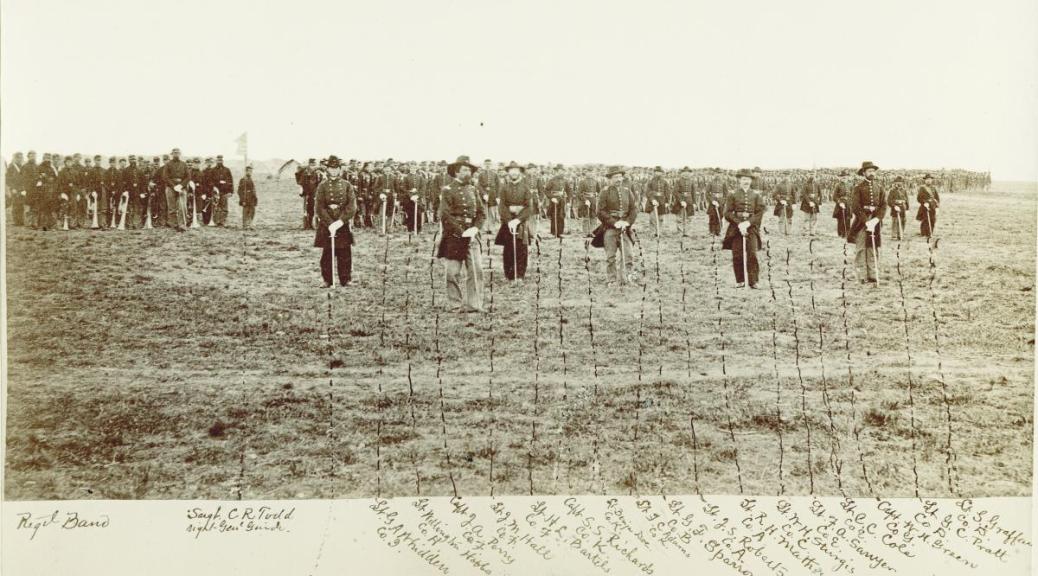
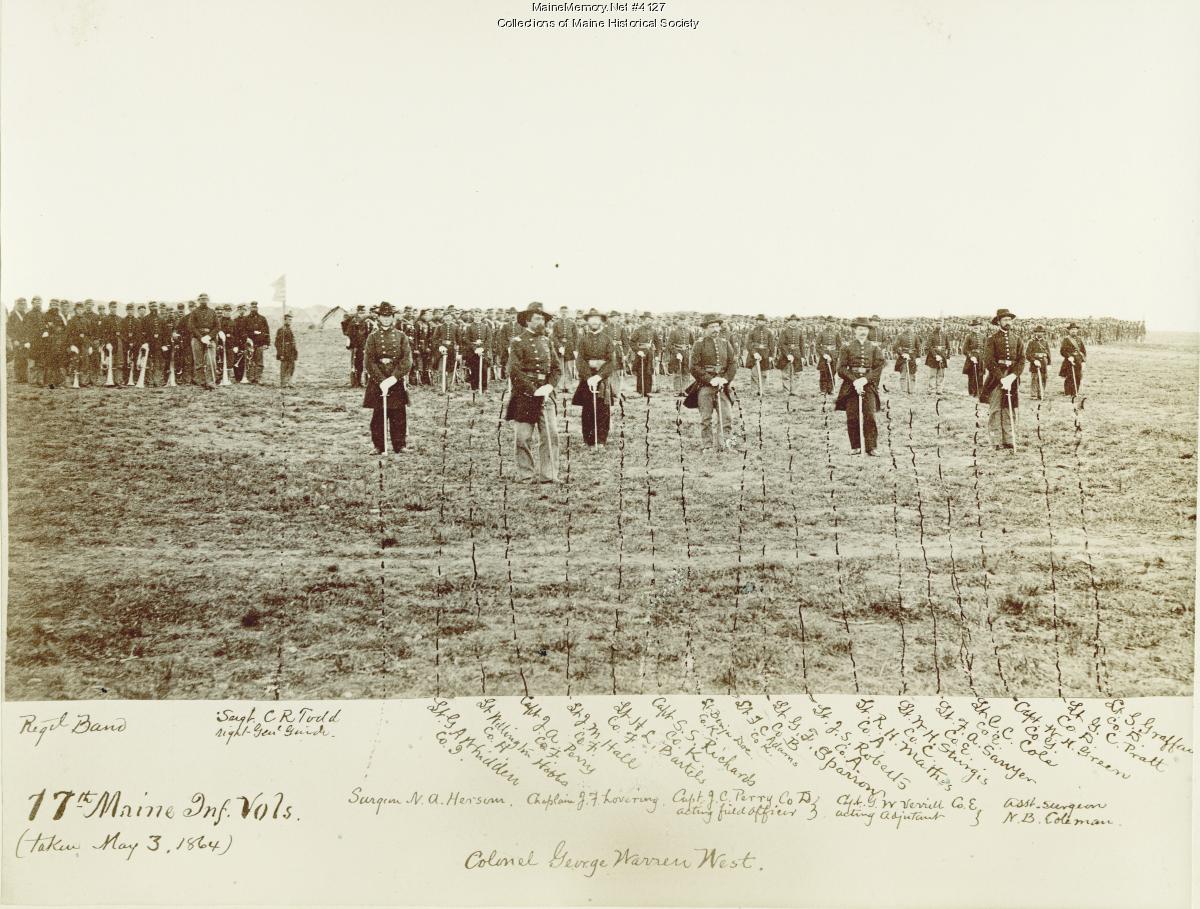
Co. insp. and drill. A view [photograph] is taken of the regiment. A tornadomade its appearance. It came rather curiously. The clouds were charged with sand. It was [ ].
Maine Historical Society
Tuesday, May 3, 1864
Detailed for picket.Arrived at the camp at about noon. Returned about dark, got into camp at near 10 o’clock. Left at about 11 o’clock.
Wednesday 4
Marched all night until 2 p.m. Crossed the Rapidan. We are now on the old battle field of Chancellorsville. Most of the traces [of battle] have disappeared.
Thursday 5
Passed through the battle ground of the Cedars. Pork dinner at Todd’s Tavern. Went in at about the middle of the afternoon [and] had a brisk fight. Relieved at dark by the 57th Massachusetts.
Friday, May 6, 1864
Went in again about daylight. Very hot. Col. wounded. Got quite a number of prisoners towards night. Our regiment’s loss severe.
Saturday 7
All night laid in breastwork. Then after were sent out to feel the enemy. Found it rather warm.
Sunday 8
Had a hard tramp. Quite well worn out. Been sun struck. Laid in breastwork waiting for an attack. Left here and went into some other work. Drew 5 days rations.
Monday, May 9, 1864
Left the work in the afternoon, crossed the creek. Went on picket. Up most of the night.
Tuesday 10
Pickets were out to reconnoiter. Went 3 miles or so beyond support. Had to run for it to avoid being taken. A narrow escape.
Wednesday 11
Rejoined the regiment. Laid in the trenches most of the day. Amazed [?] by sharpshooter. Abandoned the works in the afternoon.
Thursday, May 12, 1864
Marched all night. At about 5 a.m., made a charge, took many prisoners, some ?. Laid in front of the trenches in the afternoon. Went with a detail to build works.
Friday 13
Laid all day in the breastworks. Rainy and cold, still most of the day.
Saturday 14
Left the works & massed in front of the works at 1 p.m. At about dark went to build breastworks.
Sunday, May 15, 1864
Up at 3 – 1 – 2. Marched to where the 31st & 32nd lay. Thunderstorm.
Monday 16
Nearly on the same ground we were yesterday. Drew meat. Detailed to act as skirmisher in front of the works. [ ] by this [ ] or legion.
Tuesday 17
Left here & massed. Got shelled. Harry came over to see me. Slept here for the night. Threw up works. Turned down but had to be awake at 9 a.m.
Wednesday, May 18, 1864
We marched quickly to some pits by a house. Left here at 2 a.m. Marched to where we now are. We have left the woods. The enemy here is firm. Left here as the enemy have made a raid. Had a large mail. (Note in memorandum: I received one letter from home. One from Miss Downing Raily.)
Thursday 19
We got back to camp. Drew rations. Orders to pack up. Wrote home.
Friday 20
We went to our camp. Drew two days rations. Left in about 1 or 2 hr. Marched around Gen. Grant’s Hd. Qrs. Remained in the woods till midnight when we left. We captured about 500 men.
Saturday May 21, 1864
Left Spotsylvania. Marched till near noon when we ate breakfast. Passed through some fine plantations. Passed through Bowling Green. This place is quite large. Passed Milford Station. (Note in memorandum: Which looks quite neat for a [ ].Crossed the South Army (as some call it) [North Anna River] late in the afternoon after which we filed into the fields when we now are now cannonading here.)
Sunday 22
We left our camp in the morning, marched about 1 mi. Filed in and commenced to build breastworks. Saw Harry. Rec. two batches of mail, one letter from home. One from Sidney. Drew rations.
Monday 23
Left in the morning. Marched about 12 miles. Did not get hardly time to get coffee. Towards night we are ordered to charge the enemy’s pits. Had a brisk fight. Threw up rifle pits in the night. We are on the bank of the river near Hanover Junction.
Tuesday, May 24, 1864
In the morning the Rebels shelled us quite heavily. Along in the afternoon we crossed the river on the run, under a heavy shelling. Threw up breastworks. The boys have ransacked a handsome dwelling. Distributed the library, &c. A heavy thunderstorm.
Wednesday 25
Remained here till afternoon, then left for another part of the line. Had a shower. Drew a ration of beef. Out of rations.
Thursday 26
Laid here most of the day. Pitched tents. Detailed to go for pickets. Drew rations. Considerable firing as soon as we got well established. Wrote home.
Friday, May 27, 1864
Pickets quietly drawn in at about dawn. We rejoined the regt. after a short march. We got breakfast and then started again. We marched till 1-2 a.m. of the 28th. Passed through Concord. We are near the river. We passed a handsome dwelling—the largest I have seen South. The peas are in bloom and the garden looked nice.
Saturday 28
Co. insp. at 11 o’clock. Ordered to leave at 12 a.m. Marched for short distance, built breastworks. Left again, marched a few miles, build more breastworks. Out of rations but meat. No salt.
Monday, May 30, 1864
Remained here all day. Drew three days rations. Rec. two letters—one from home [and] one from Uncle Oren. Also five papers. Towards night our batteries opened. The mortars threw quite a number of shells.
Tuesday 31
Left here and marched to where the rebels had had their rifle pits. Quite a number of shells threw over as we crossed an open field. Harry came to see me just before he left. He is with [Quartermaster] General Ingalls. We are now in a line of our own pits fronting three of the rebels which we had taken.
Wednesday, June 1 1864
Wrote to Sidney. Drew meat. Remained here till dust, then joined the 1st Brig. to which we have been assigned. We were marched about all night. Quite heavy skirmishing all day.
Thursday, June 2, 1864
Marched all night and part of the day. Lost my roll. A severe storm. Drew two days rations. Stormed easily during the night.
Friday 3
Shelled in the forenoon. Left for the right. Saw Jason Holt. We are now in breastworks. Drew fresh beef. The rebels charged on the 18th Corps last night and were repulsed. Our rest was disturbed during the night of the firing.
Saturday 4
Left here in the afternoon and went back to the same where we spent Thursday night. Rained all night. Turned out in the night to go for rations. Wrote to Nellie L. Ganning. [ ] Holt came to see me.
Sunday, June 5, 1854
Threw up earthworks. Went on picket. Drizzling. Rec. three letters and a paper. One of the letters was from home, one from Sidney, the other from Aunt Eliza. The paper was from L. Perham, M.C. The M.I. Consolidated. Wrote to mother and Sidney. Left here to go farther to the front. We marched all day into the night.
Monday 6
Got relieved in the morning. Got a lot of sweet and Irish potatoes which made a very good dinner. Drew beef in time for the potatoes. Heavy picket firing created an alarm, but subsided. Wrote Uncle Oren. (Note in Memorandum: Pickets opposite our side to be on friendly terms. Trading tobacco etc. They are the 28th N. C.)
Tuesday 7
Drew four rations with one of port. Got very hard bread. Detailed for fatigue to cut logs for breastworks. A flag of truce said to have been sent out. Truce to end at 8 p.m. Very quiet day. Night quite cool.
Wednesday, June 8, 1864
Went for fresh beef. We now recaptured and hold another line of works, commencing from the left wing. Rec. two papers from Mr. Sewall. On guard during the night. Still another line thrown out.
Thursday 9
Drew beef. Drew one pair socks, canteen, hard bread, coffee, and sugar, pork, soap. Routed out at 3 am. but alarm soon subsided.
Friday 10
The day thus far passed quietly. Received by mail the Congregationalist and Independent. Rec. a letter from home, also 2 papers.
Saturday, June 11, 1864
Drew beef, also 2 days rations of hard bread, coffee and sugar. Washed shirt for the second time since this campaign. Excusable on account of the want of soap. Drew rations, cornbread, &c.
Sunday 12
Wrote home. Left here at 8 p.m. Marched till 2 a.m. Monday when we got coffee. The country seems to be quite poor, soil sandy.
Monday 13
Left just after day break. Marched from Cold Harbor to within a short distance of the river (James). We crossed the Chickahominy River at 12 a.m. We marched and marched after the usual fashion till near 9 or 10 p.m. when we turned down.
Tuesday, June 14, 1864
Marched out a short distance, commenced to build breastworks. Had to base here (Charles City) and march down to Windmill Point where we crossed in transports. One of them (Thos. Powell) with a [ ] in civilian attire. Halted on the bank of the river. Went in bathing from here we went about a mile or more. The river is wide at this place. We left this place and went about one mile farther.
Wednesday 15
Left here and marched till long in the night, weary, hot, and dusty. We are now within two miles of Petersburg. Saw some of the colored troops. They had taken two forts with artillery and did well.
Thursday 16
Shelled while getting breakfast. Formed and charged the rebel lines, but they were too much for us. Fell back a short distance and then went back again. The sharpshooters made it hot. The 2d Div. made a charge in the p.m.
Friday, June 17, 1864
Remained here in the breastworks during the day. Capt. Pennell shot. Detailed for picket. Threw up a sort of redoubt, using a rebel hut to form the sides of it. We are under quite heavy firing.
Saturday 18
Joined the regt. at about noon. Threw up breastworks. Left here late in the afternoon, massed for a charge upon the rebel works, but did not for certain reason—whiskey. Went back to the rifle pits. Rec. three letters—one from home and two from Sidney, with papers. Threw up breastworks in open field in front.
Sunday 19
The rebels threw over rifle bullets quite thickly, killing one and wounding several. Drew two days rations, also dried apples.
Monday, June 20, 1864
Remained here all night. Relieved by the 57th U.S. Colored. They appear very well & quite orderly; reflect credit to themselves. One of the color guard killed. Left here in the night.
Tuesday 21
Left here and marched back a mile or so. Remained here till morning when we left for a new direction. We crossed the Suffolk & P.R.R. struck the Wilmington N.C. turnpike. Remained here all night.
Wednesday 22
We moved up the right farther, fixed up the works. In the afternoon the 2d Brig. which had moved in our front after having partly built breastworks, got flanked and had to leave them. We expected an attack, butthere was none.
Thursday, June 23, 1864
Drew rations. Left here early in the morning. Went into the rifle pits which the rebels had taken. Strengthened them. Two men hit. Left at about sundown. Were sent to relieve a Brigade of Barlow’s. Occupied their pits. Got one of the new rifles. Rec. a letter from home.
Friday 24
Left here in the morning. Went to the left. Got the frame work up for a breastwork, but it is now at a stand still as we have been ordered to stop work. I wrote home, got it ready to go in the morning mail. The day has been very hot and sultry. On guard.
Saturday 25
Remained here all day. Very hot. Drew rations of the usual kind with pickles. Wrote Sidney. Had some lemonade. Firing in the night created quite a disturbance.
Sunday, June 26, 1864
Remained here till evening, having been previously been ordered to fix up to make ourselves comfortable. Very hot. Detailed for picket. We are on the left of the line in front of the outer line of works.
Monday 27
We passed very quietly with no firing where we were. We could hear the Johnnies singing, their bugles and drum calls, &c. The day was very hot. Drew rations as soon as I got back.
Tuesday 28
The day has been very cool, quiet. A detail has been out in the woods to fix a place for a camp. My chin is swelled very much by a boil.
Wednesday, June 29, 1864
Received a letter from home, also two papers—the Congregationalist & Independent. Drew fresh meet. Changed camp, got it laid out and tent up when we had to leave again. We are now in another line of breastworks, very strong.
Thursday 30
Mustered for pay by Maj. Gilbraith. The day passed very quietly. Wrote home. The band is with us. Harry has got back [and] came over to see me. Co. insp. Policing co. grounds.
Friday, July 1
Rec. a letter from home. We are to have two roll calls—night & morning, together with an inspection every afternoon.
Saturday, July 2, 1864
The day passed very quietly. Harry and a man by the name of Lincoln came to see me. The day was quite cool towards night, though very hot in the middle of the day.
Sunday 3
Drew rations of sugar, coffee, pork, dried apples, bread, vinegar. In the afternoon the chaplain of the 20th Indiana preached. He is a fine, gentlemanly appearing man. Wrote home. Co. inspection.
Monday 4
The day passed very quietly. I saw but two whom I thought to be “sprung.” I have again one pair pants and one shirt. Company insp.
Tuesday, July 5, 1864
Roll call. Detailed to act as corporal of the guard. I have 1st relief. Castle one of Co. H’s men and another on my relief. Drew cucumbers & cabbage (fresh) one days soft bread in addition.
Wednesday 6
Relieved from guard at 9 a.m. Had a short nap. Detailed corporal of the picket. Have three posts under my charge. Did not get any rest until morning.
Thursday 7
The night was very still for a picket line. Scarcely a gun fired. I had to be awake all night. The sergeant’s name is John Hendricks—a very good fellow. Got relieved about 5 o’clock.
Friday, July 8, 1864
Received a letter from home of July 1st. Also three papers. Wrote to Sidney. Our regiment has dug a well of about 8 ft. diameter @ 15 ft. The water appears to be good. Quite a fracas this afternoon. The rebels shelled our line pretty briskly. A captain of the 20th Indiana wounded.
Saturday 9
Drew rations of pork & beans, &c. I stewed the beans. Detailed for picket. The rebels threw over quite a number of shells. 6th Corps left during the night.
Sunday 10
The rebels fired some shots. Two deserted. The middle next to me, got them. Rec. two papers. Washed shirt. Services in the evening by the chaplain of the 20th Indiana.
Monday, July 11, 1864
Rec. a letter from Sidney. Drew fresh meat. Drew two days rations, beans, picked onions, etc. Towards night we packed up at midnight. We were ordered to destroy the breastworks, which we did. We had a splendid well here @ 20ft. deep with 2 well sweep.
Tuesday 12
Left here in the morning. Marched back a mile or two. When we stopped, it was not far from the old line. Pickets came in the afternoon. The day was very hot. It has looked showery all day.
Wednesday 13
Bathed. We left here in the morning, marched about four miles. It was very hot—as much as I could bear without a stroke. We are now nine miles from City Point. Drew rations.
Thursday, July 14, 1864
Detailed for fatigue. We were turned out without our breakfast, ordered to only carry our haversack, whereas we ought to have taken our knapsacks. We are slashing in front of where rifle pits are now dug. The colored troops are at work upon the trenches & fort. They work, I think, better than the white troops. We work by reliefs. Got quite a good night’s rest.
Friday 15
Detailed divided up into reliefs. The colored men have built the walls of the fort. The pit connects with an angle of the fort & runs across the railroad. Ben Maxim went back to camp for pork & sugar. Night quite cool.
Saturday 16
Awoke in the morning to find ourselves alone. Started for camp. Got here in the morning. Passed the fort. It is about ready for the guns.Harry came down. Rec. a letter from Sidney & one from Aunt Mary.
Sunday, July 17, 1864
Inspection ordered. Drew two days rations. Had a shave. Wrote to Aunt Mary & Harriet. Inspection came off. Went to see Harry, but found him on Brigade guard. Changed shirt.
Monday 18
Wrote home. Got poles & fixed up our tent, which makes it quite comfortable.
Tuesday 19
Detailed for fatigue. The whole Div. is on. We are building a covered way. I went over to see the fort which was built on the old line. Got back at 7 p.m. Drew rations. Rec. five papers. Rained all night & day.
Wednesday, July 20, 1864
Rec. three papers. Washed shirt. Harry is doing company writing. The day has been quite showery. Rained in the night. Company inspection.
Thursday 21
Two years ago today since I entered the service. Drew two days rations. We got a few new potatoes with the old. Company inspection. The 3d Maine joined with our regt. Cut my hand.
Friday 22
Regt. on fatigue. Got excused by the Dr. on account of my hand being wounded. Fatigue duty. Drew fresh meat. Boiled the meat for the men. Carried Lieut. Pratt’s meat up to him. The covered way progresses quite well. The night quite cold.
Saturday, July 23, 1864
The 2d Brigade has moved, but where? I have not yet ascertained. Drew two days rations, pickle, [ ]. Co. inspection. Received a letter from home and 5 papers, two from Mr. Sewall.
Sunday 24
The Brigade on fatigue duty, but I do not think that they accomplished much. Saw a trained mule who could perform quite a variety of feats. Commenced to rain before we got through, and rained all night. Windy.
Monday 25
Wind without rain, quite cold. Changed shirt, washed. Wrote to Sidney. Answered the letter from home. Went over to the 2d Brigade, found Harry ready to leave, having been detailed as clerk at Corps Hd. Qrs.
Tuesday, July 26, 1864
Ordered to be ready to move at 1-2p.m. Left in the afternoon, marched across the Appomattox [River]. Very hot, feet sore, had to wrap up with Habbard & Alden. Rested until morning.
Wednesday 27
Caught up with the regt. at noon. Were quite near them, but did not find them. We are out in front as pickets. Saw a monitor gunboat in the James River. We are across the Deep Bottom. There Elias came to see me, but I was not here.
Thursday 28
Left to go on picket far out to the front. The rebel homes were in full view. Relieved by Barlow’s men. Recrossed the James [River], had to stop. Arch Berry was with me.
Friday, July 29, 1864
Started at daybreak. Caught up with the regt. about the middle of the afternoon. Had a hard time of it as my feet were blistered badly, besides being chafed. The day very hot.
Saturday 30
The rebel suddenly opened at daylight and there was a brisk cannonade for a while. Our folks blew up a fort and charged, but as it is said failed [on] account of the colored troops. Relieved by the 10th Army Corps. Went back to our old camp. Pretty well played out. Got three papers.
Sunday 31
Drew days rations. Regt. inspection. Drew fresh meat. Quite warm. Received a letter from home and some envelope paper. [ ] in the night. $1.00-letter.
Monday, August 1, 1864
But little going on. Washed & changed stockings. Paymaster paying the 3d Brigade. Wrote to Sidney & also home. Co. inspection. Drew rations.
Tuesday 2
Roll call, signed the pay rolls. Paymaster paying the 40th N.Y.; to pay our regiment next. Weinburg up with some goods. Rained some in the afternoon & evening. Rec. a letter from Sidney with $2.00 enclosed.
Wednesday 3
Paymaster here. Got paid off, received four months pay. Sent Harry ten dollars. It has seemed more like the 4th of July than anything else. Drew two soft bread, salt-fish, sugar & coffee.
Thursday, August 4, 1864
The usual amount of gambling and drunkenness consigned to payday. Paid for gold per with G. Ballard. Harry came down. The usual company inspection.
Friday 5
Wrote home. Drew one days ration of coffee & sugar, turnips. There was a little disturbance in the evening. We were got under arms and marched 1 or 2 miles toward the right, when we about face & came back here.
Saturday 6
We drew one days soft bread. Harry came down. Wrote to Sidney. Co. inspection. Rec. by mail, the Congregationalist and Independent.
Sunday, August 7, 1864
Company inspection. Weinburg has come up with two loads of goods.
Monday 8
Company inspection.
Tuesday 9
Drew ration. Co. Inspection or rather a Regt. one by Capt. Moore.
Wednesday, August 10, 1864
Wrote to Sidney. Harry came down for me to go up to Corps Hd. Qrtrs. as the Capt. wishes to see me. I carried the Co. Officer’s consent up and the Capt’s. Also wrote one half page. Rec. a letter from home.
Thursday 11
Drew rations. Not much of importance going on. Harry has sent for a blouse for me.
Friday 12
Three p.m. trained till about 10 p.m. Order came for me to report to Corps Hd. Qrtrs. Made a desk in the forenoon. Order to move in the afternoon, packed up the papers. Closed in about the middle.
Saturday, August 13, 1864
We waited the progress of events till the afternoon, when hearing that No. 3 was at City Point, but when we got there, no wagon was to be seen. We spent the night here. We got soda crackers & pickles of C Co. for the supplies. Bathed in the river.
Sunday 14
After trying some time to get something to eat, we came to the conclusion that we had better try and get back to the Corps. 2 Hd. Qrs. We got on the train going to the station. When we got back, we found the wagon and the rest of the clerks.
Monday 15
Washed shirt, socks, and towel. Harry went down to the Point. Got me a blouse and drawers. Wrote home.
Tuesday, August 16, 1864
Wrote some for Harry. Washed his pants, shirt, [ ]. Harry got a letter from Lily.
Wednesday 17
Not much going on. Went on an excursion after apples, but did not succeed in my attempts. Harry got down to the Point.
Thursday 18
Two years in the service. Had green corn for dinner.
Friday, August 19, 1864
Things move in the usual way. Harry went down to the Point. Rained some.
Saturday 20
Raining. Harry got a letter and three papers. Wrote home.
Sunday 21
Left here and came here. We are at the old 2d Hd. Qrs.
Monday, August 22, 1864
Not much going on.
Tuesday 23
Wrote to Uncle Oren. Made a desk.
Wednesday, October 26, 1864
Left here at about noon and set our faces towards the [City] Point. We arrived here at dusk. I rode most of the way in an ambulance. Harry rode a horse down.
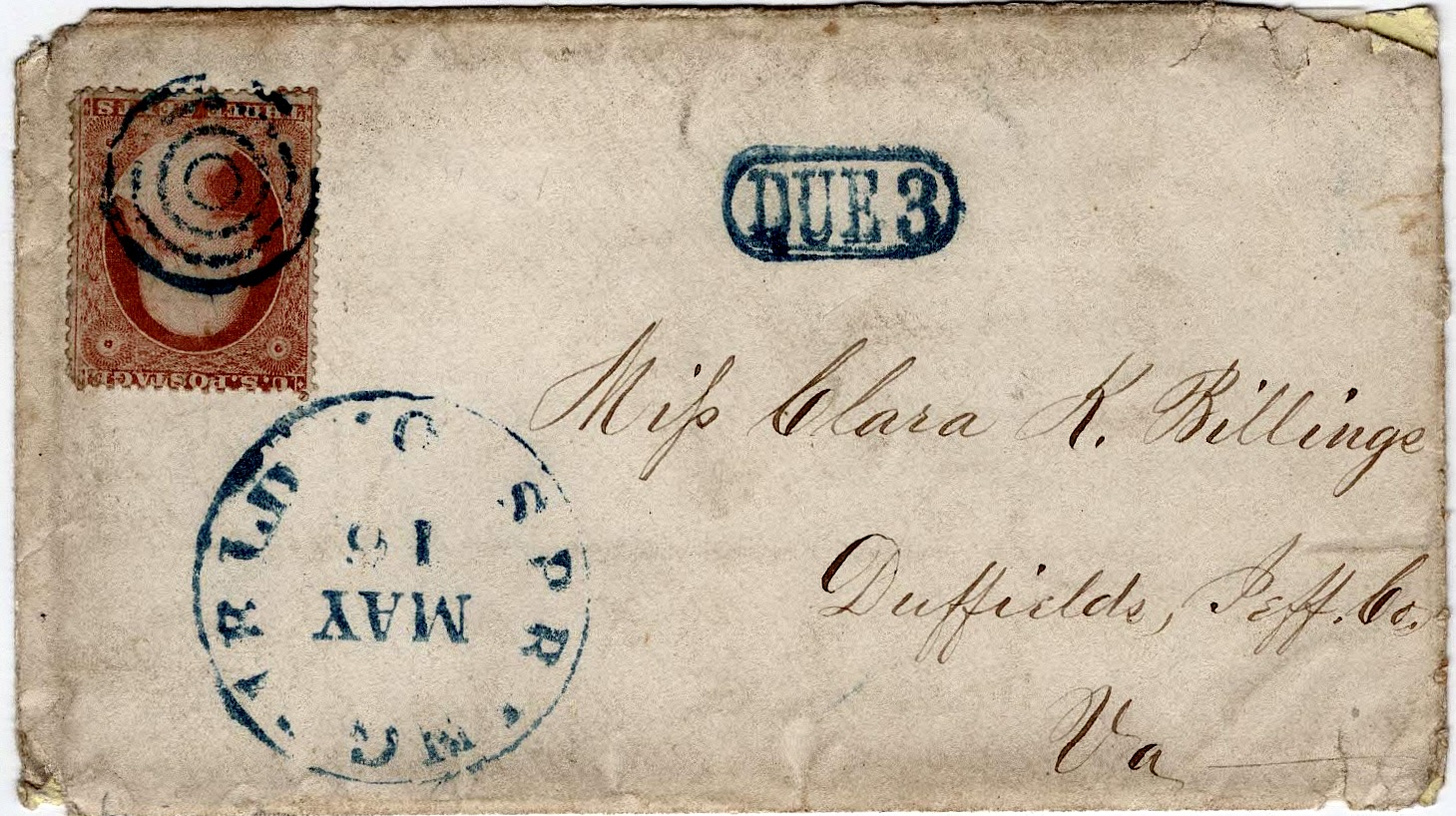
The following letter was written by George Carpenter Shepard (1840-1919), the son of Erastus Shepard (1794-1850) and Eliza Matthews Carpenter (1797-1872) of Rochester, Monroe county, New York.
At the time of the 1863 Draft Registration, 23 year-old George was enumerated in Rochester where he identified himself as a “student” and unmarried. He was married the following year, in February 1864, to Clarissa (“Clara”) Kibbie Billings (1841-1908) in Kenton, Kentucky. In 1870, George was enumerated in South Charleston, Clark county, Ohio, where he was employed as a “Druggist.” George and his son Clarence, conducted Fairfax Hall, a girls school, in Winchester, Virginia, in the 1880s and 1890s. The school was established in 1869 by Rev. Silas Billings, Clara’s father.
Though he claimed in his letter that he would not enlist, Civil War Muster Roll Abstracts inform us that he did so on 10 October 1861 at Rochester for a period of three years. He was mustered into the 8th New York Cavalry as Chief Bugler on 23 November 1861 and was mustered out a year later on 16 October 1862 at Hagerstown, Maryland. His muster roll indicates he was taken prisoner on 14 September 1862 and paroled twelve days later.
T R A N S C R I P T I O N
Rochester, New York May 13th 1861
Dear Clara,
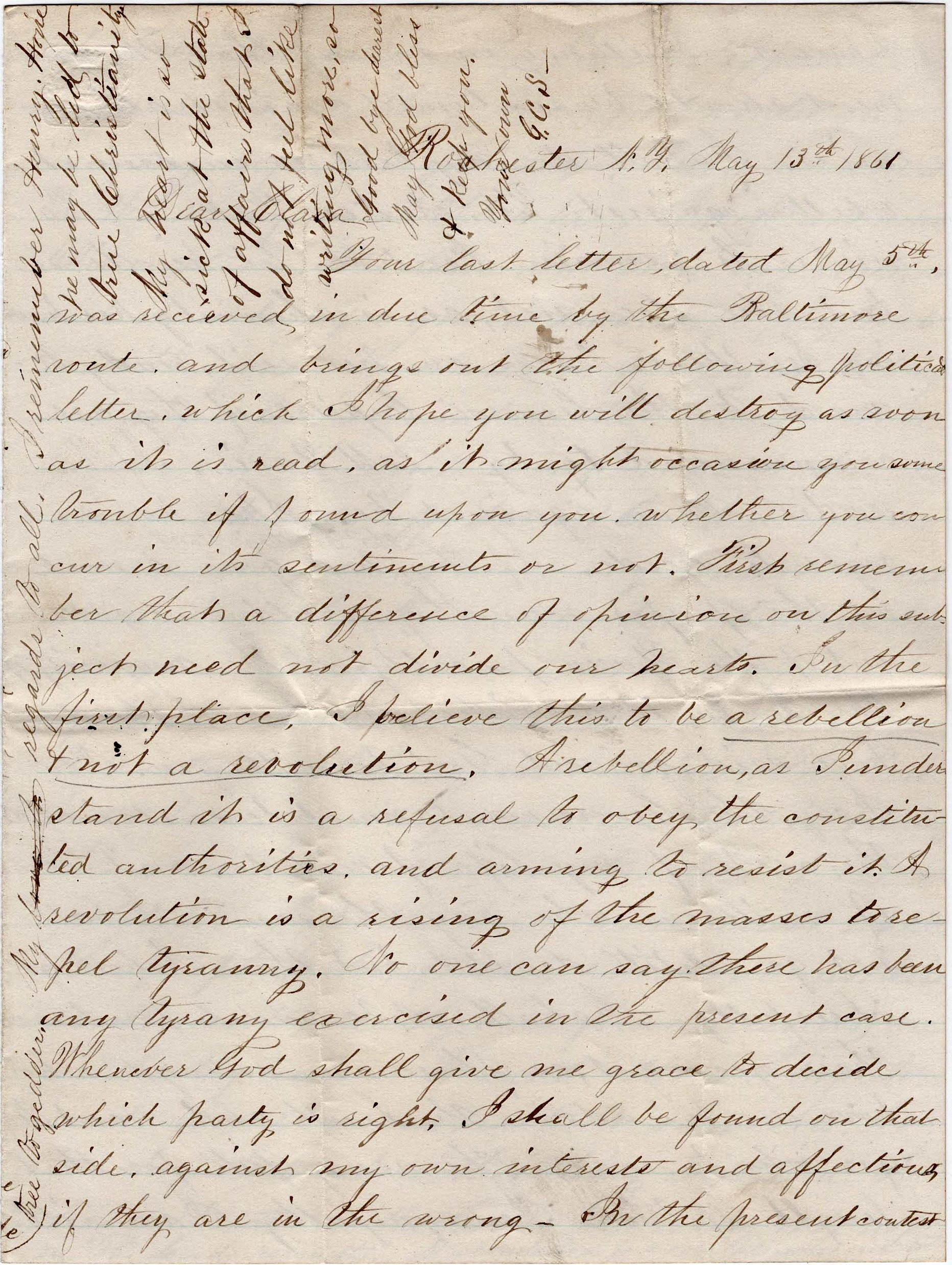
Your later letter, dated ay 5th, was received in due time by the Baltimore route and brings out the following political letter which I hope you will destroy as soon as it is read as it might occasion you some trouble if found upon you, whether you concur in its sentiments or not. First, remember that a difference of opinion on this subject need not divide our hearts. In the first place, I believe this to be a rebellion and not a revolution. A rebellion, as I understand it, is a refusal to obey the constituted authorities, and aiming to resist it. A revolution is a rising of the masses to repel tyranny exercised in the present case. Whenever God shall give me grace to decide which party is right, I shall be found on that side, against my own interests and affections, if they are in the wrong.
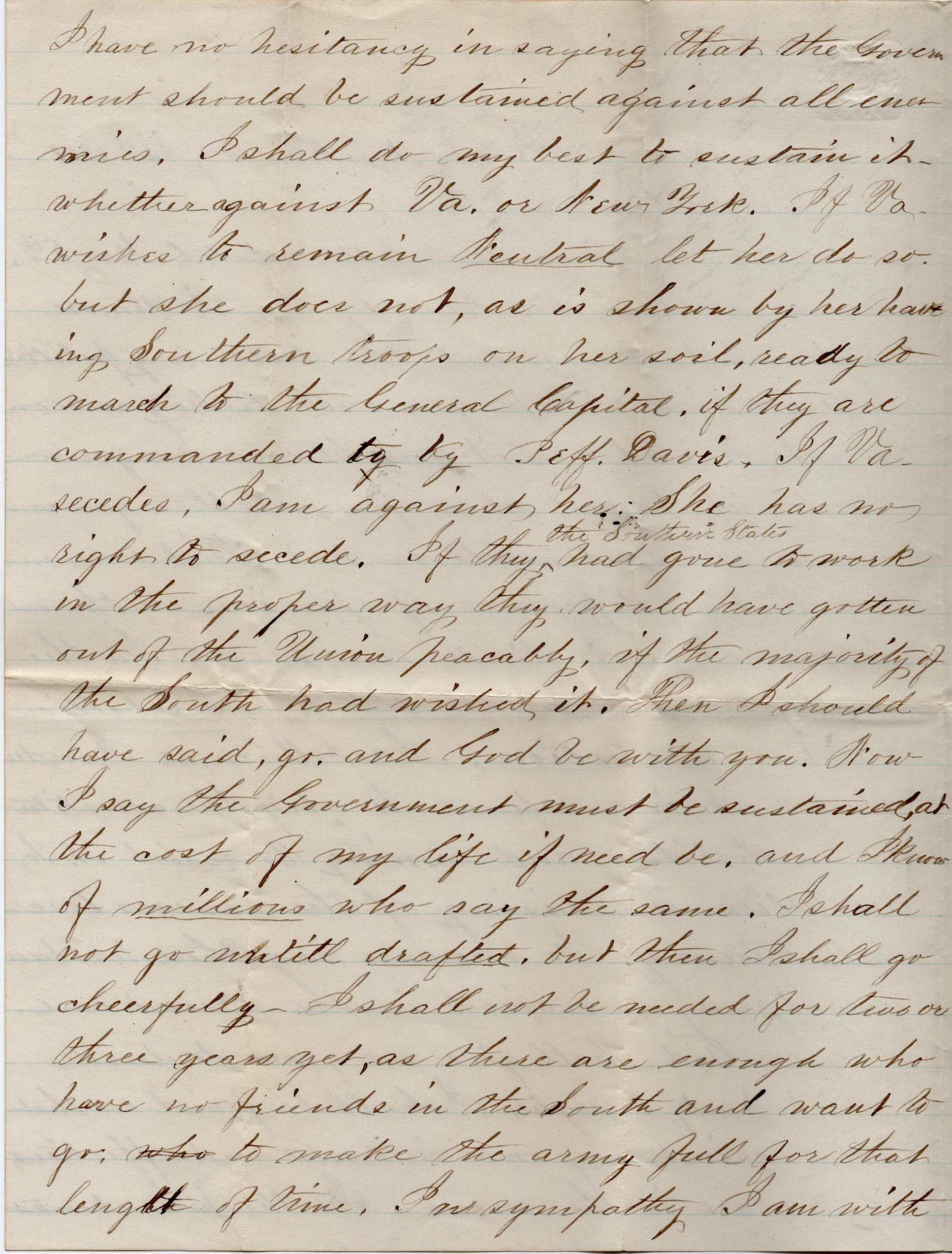
In the present contest, I have no hesitancy in saying that the Government should be sustained against all enemies. I shall do my best to sustain it, whether against Virginia or New York. In Virginia wishes to remain neutral, let her do so. But she does not, as is shown by her having Southern troops on her soil ready to march to the General Capitol, if they are commanded to by Jeff Davis. If Virginia secedes, I am against her. She has no right to secede. If they—the Southern States—had gone to work in the proper way, they would have gotten out of the Union peaceably, if the majority of the South had wished it. Then I should have said, “Go, and God be with you.” Now I say the Government must be sustained at the cost of my life, if need be, and I know of millions who say the same.
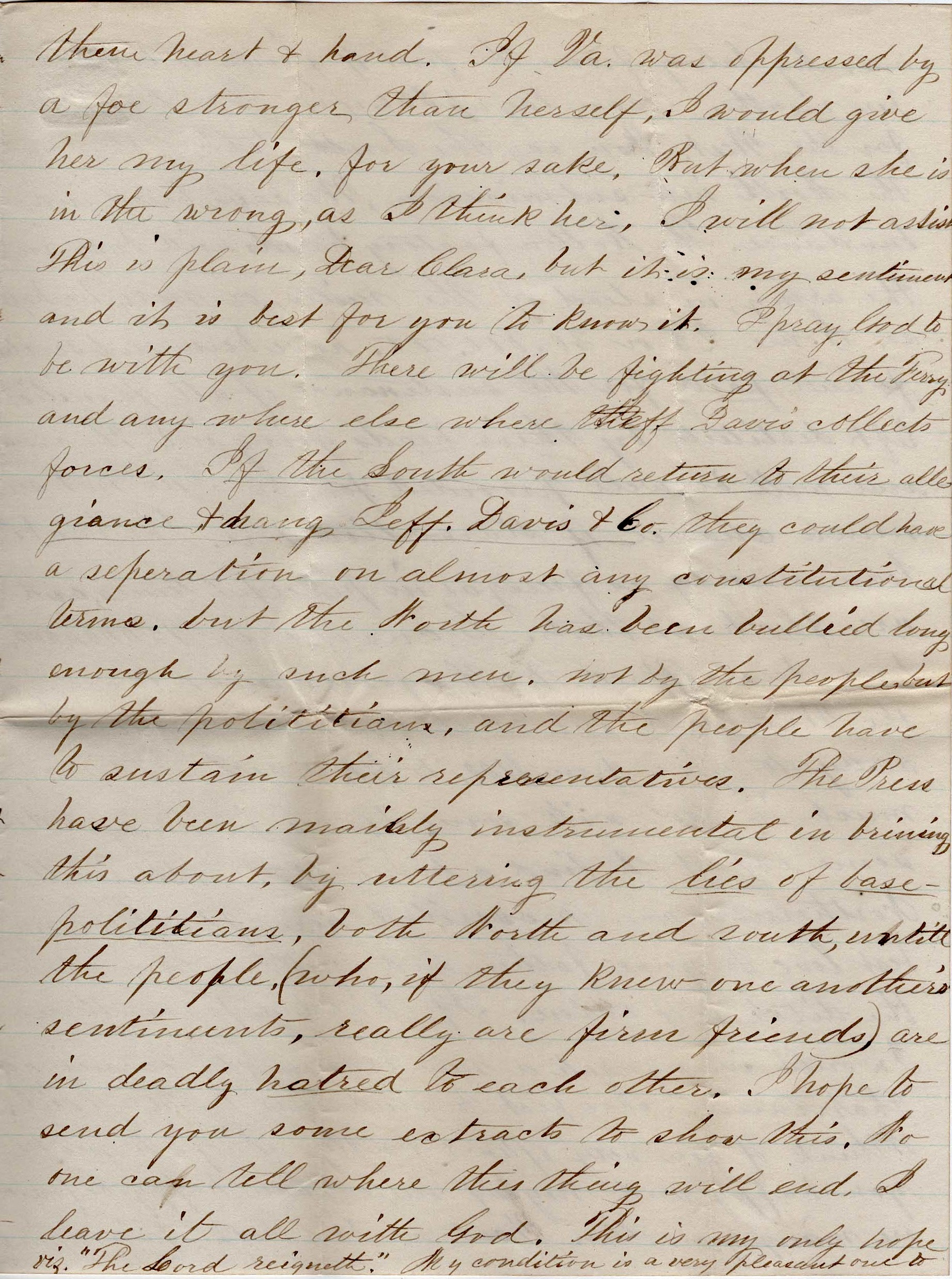
I shall not go until drafted, but then I shall go cheerfully. I shall not be needed for two or three years yet, as there are enough who have no friends in the South and want to go to make the army full for that length of time. In sympathy, I am with them heart & hand. If Virginia was oppressed by a foe stronger than herself, I would give her my life for your sake. But when she is in the wrong, as I think her, I will not assist. This is plain, dear Clara, but it is my sentiment and it is best for you to know it. I pray God to be with you.
There will be fighting at the Ferry, and anywhere else where Jeff Davis collects forces. If the South would return to their allegiance & hang Jeff Davis & Co., they could have a separation on almost any constitutional terms. But the North has been bullied long enough by such men—not by the people, but the politicians—and the people have to sustain their representatives. The Press have been mainly instrumental in bringing this about, by uttering the lies of base politicians, both North and South, until the people (who, if they knew one another’s sentiments, really are firm friends) are in deadly hatred to each other. I hope to send you some extracts to show this.
No one can tell where this thing will end. I leave it all with God. This is my only hope—viz: “The Lord Reigneth.”
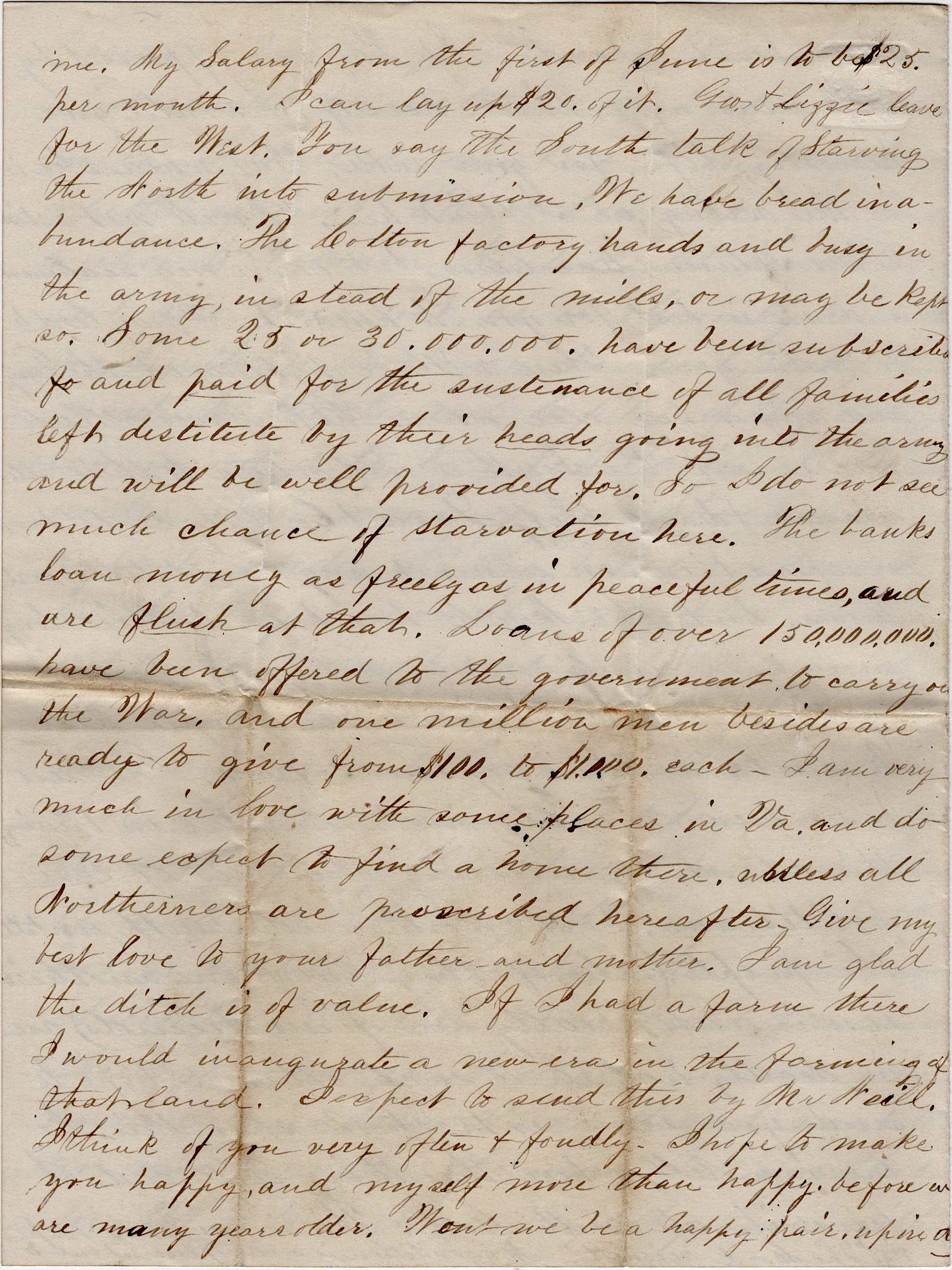
My condition is a very pleasant one to me. My salary from the first of June is to be $25 per month. I can lay up $20 of it. George & Lizzie leave for the West. You say the South talk of starving the North into submission. We have bread in abundance. The Cotton factory hands are busy in the army instead of the mills, or may be kept so. Some 25 or 30,000,000 have been subscribed and paid for the sustenance of all families left destitute by their heads going into the army and will be well provided for. So I do not see much chance of starvation here. The banks loan money as freely as in peaceful times and are flush at that. Loans of over 150,000,000 have been offered to the government to carry on the war, and one million men besides are ready to give from $100 to $1,000 each.
I am very much in love with some places in Virginia and do some expect to find a home there unless all Northerners are proscribed hereafter. Give my best love to your father and mother. I am glad the ditch is of value. If I had a farm there, I would inaugurate a new era in the farming of that land. I expect to send this my Mr. Neill. I think of you very often and fondly. I hope to make you happy and myself more than happy before we are many years older. Won’t we be a happy pair up in a tree togedder?
My regards to all. I remember Henry Hine. He may be led to true Christianity. My heart is so sick at the state of affairs that I do not feel like writing more, so goodbye, dearest. May God bless you & keep you. Your own, — G. C. S.

 Spared & Shared 23