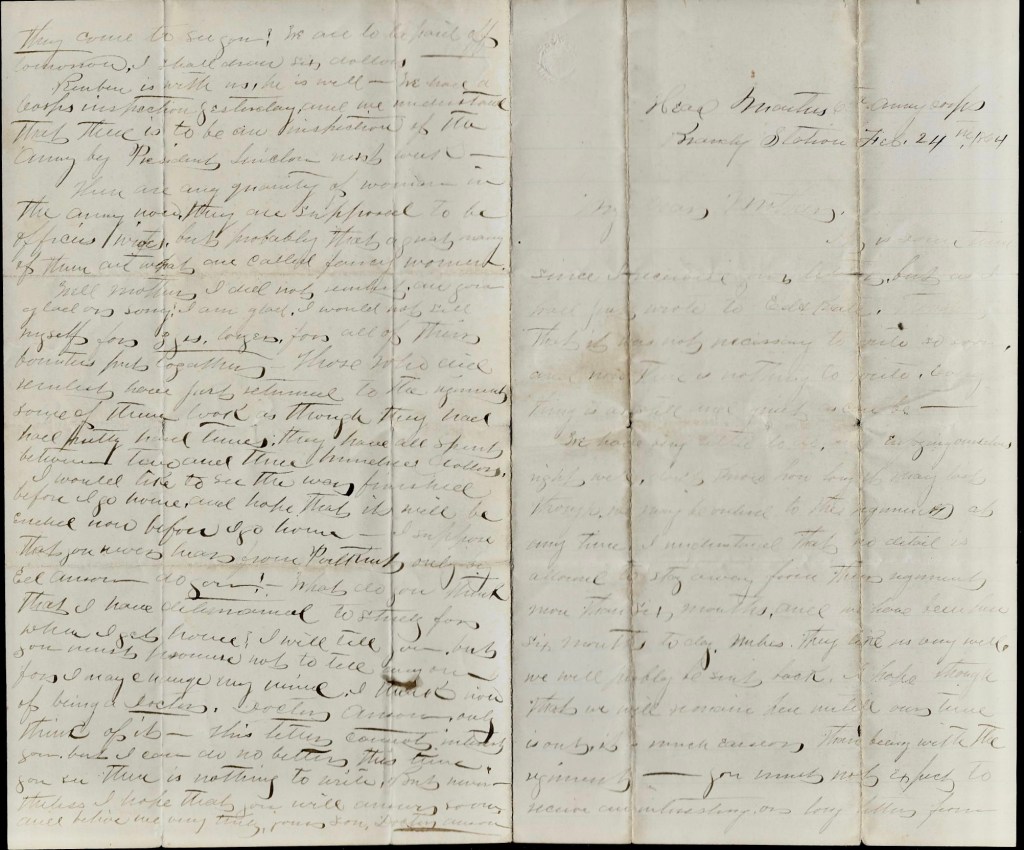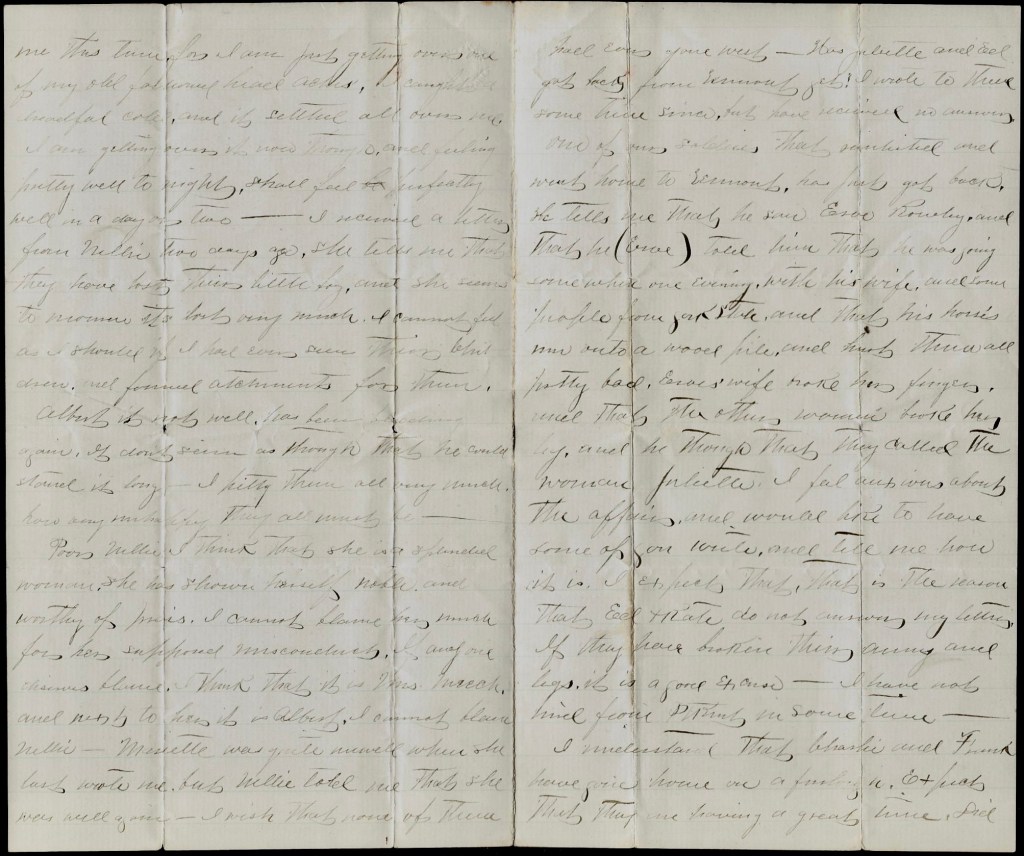
1863 Diary of Edwin Elliot Richardson, Co. A, 46th Massachusetts Volunteers

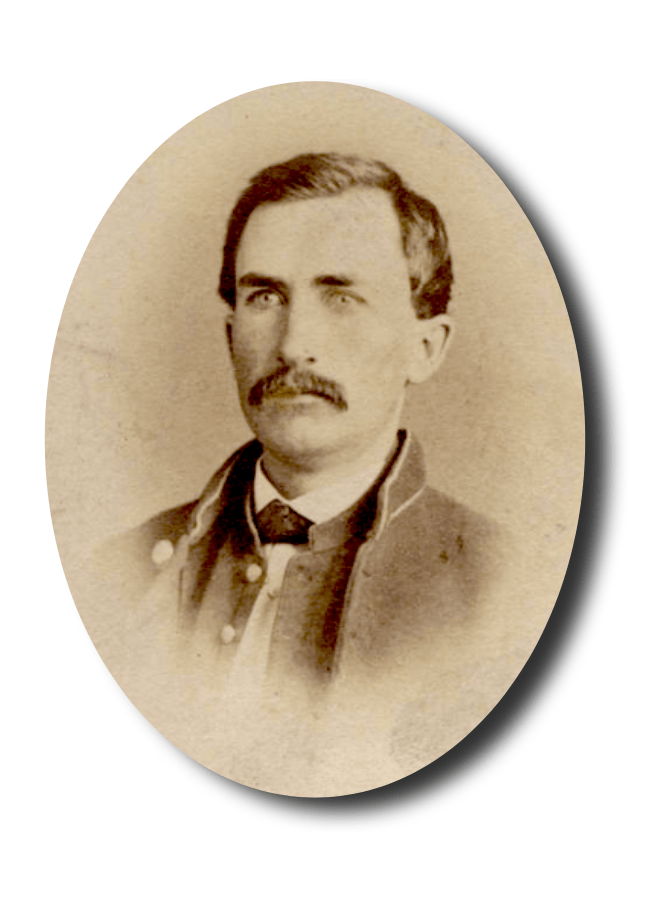
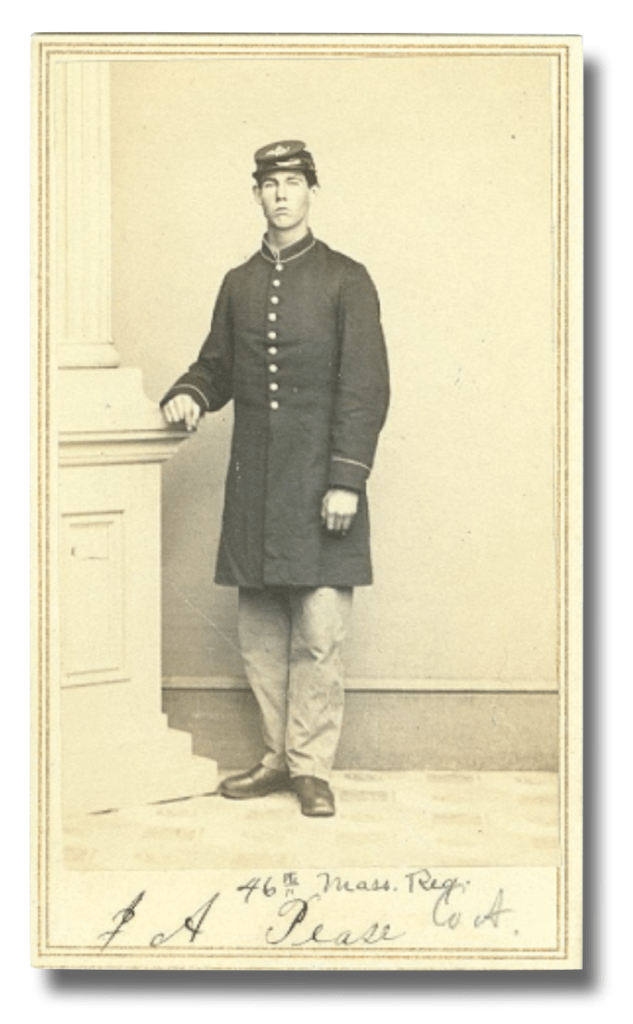
I could not find an image of Edwin but here is a cdv of John A. Pease who served in the same company and regiment with him. (Photo Sleuth)

This 1863 diary was kept by Pvt. Edwin Elliot Richardson (1839-1915), the son of Winthrop Richardson (1804-1877) and Fannie Dwight Thompson (1806-1869). Edwin enlisted on 20 August 1862 and was mustered into the service on 25 September 1862, becoming a member of Co. A, 46th Massachusetts Volunteers—a nine months organization.

The following summary of the regimental history comes from Massachusetts Soldiers, Sailors, and Marines in the Civil War. Activities of Co. A are highlighted in bold font.

The regiment left camp Nov. 5 and proceeded to Boston where it took transports for North Carolina. Newbern was reached Nov. 15, and here the regiment was assigned to Col. H. C. Lee’s Brigade. The regimental camp was established on the banks of the Neuse River near the city. Companies “A” and “K” were soon assigned to the duty of guarding the railroad station at Newport Barracks on the railroad from Newbern to Beaufort.

The first active duty of the regiment was during the Goldsboro expedition. Starting Dec. 11, it was present at the battles of Kinston, Whitehall, and Goldsboro, Dec. 14, 16, and 17, but was only slightly engaged and suffered little loss. Returning to Newbern, Dec. 20, the regiment was soon established in a new camp near the confluence of the Neuse and the Trent. Colonel Bowler who, though ill, had accompanied the regiment to Kinston, now resigned, and Lieut. Col. Shurtleff was promoted to colonel. Co. “A” now returned from detached duty, and Co. “F” under Capt. Russell H. Conwell took its place.
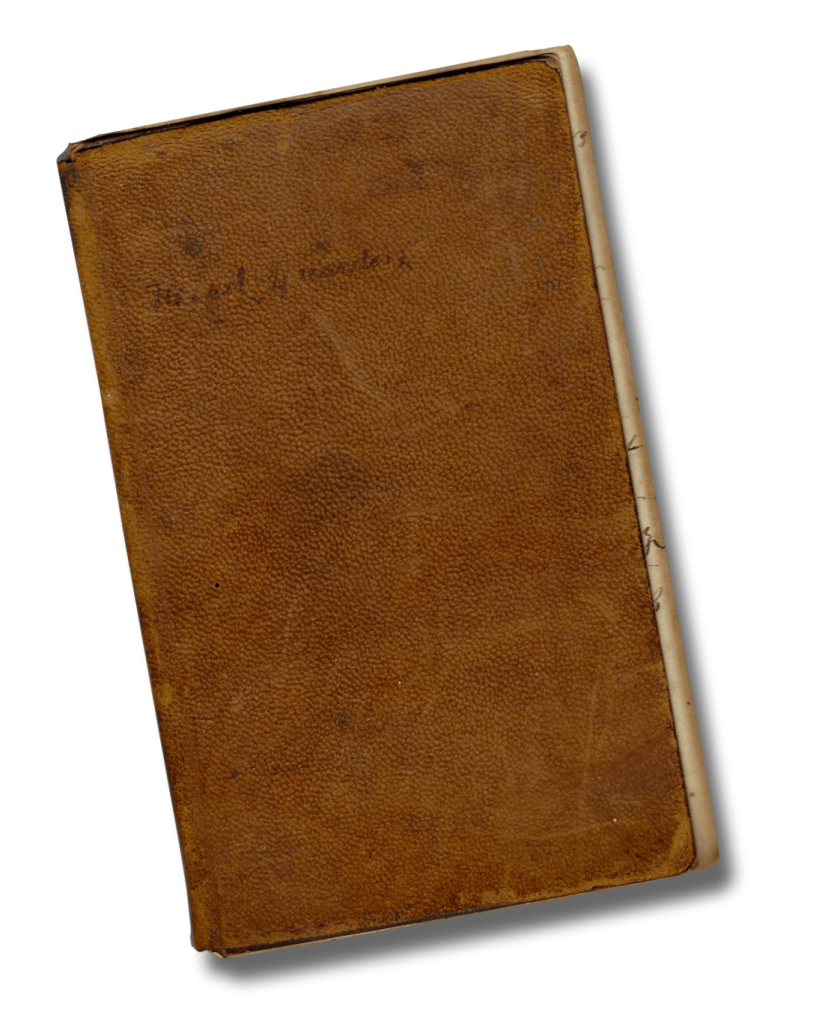
Edwin pocket diary measures 4 x 6.5 inches and contains @ 75 ledger-style stitched pages.

On March 13 and 14, 1863, the regiment took part in the defense of Newbern against a Confederate force under General Pettigrew who sought to recapture it on the first anniversary of its occupation by the Union forces. Ten days later the six companies which comprised the main part of the regiment were sent to Plymouth, where from March 26 to May 8 they formed apart of the garrison of that place. Companies “F” and “K” I it will be remembered, were absent on detached duty, and Companies “A” and “I” were left behind at Newbern. Soon after May 8 the six companies returned to Newbern, and the regiment was now quartered in barracks.

May 21 the regiment with the rest of Col. Lee’s Brigade took part in an expedition to Gum Swamp, about eight miles from Kinston, where it was engaged May 22, returning to Newbern the following day without loss. Early in May Companies “A” and “I”, which had been left behind when the regiment went to Plymouth, were sent to Batchelder’s Creek to do outpost duty under Colonel Jones of the 58th Pa. Here, May 23, when their position was heavily assaulted by the enemy, Capt. Tifft with these two companies hold an advanced redoubt long after the rest of the command had retired. For exceptional bravery on this occasion Sergt. A. S. Bryant of Co. “A” was promoted to sergeant major and received a Congressional Medal of Honor. Early in June, as the term of the 46th was drawing to a close, over 100 members re-enlisted in the 2d Mass. Vol. Heavy Artillery which was then being organized. The remainder of the regiment embarked, June 24, for Fort Monroe.

On its way home the regiment volunteered for service with the Army of the Potomac during the emergency caused by Lee’s invasion of Pennsylvania. It served doing patrol and guard duty in or near Baltimore, Md., from July 1 to 6, and was stationed on Maryland Heights near Harper’s Ferry from the 7th to the 12th. On the 12th as a part of the brigade of Genl. Henry S. Briggs it joined the 1st Corps, Army of the Potomac, at Funkstown, Md., in front of the Confederate position at Falling Waters. After Lee’s retreat into Virginia the regiment was ordered to Massachusetts, reaching Springfield, Mass., July 21. Here the men were furloughed for one week, re-assembling at Hampden Park, July 29, when they were mustered out of the service.

Edwin later served as a corporal in Co. A, 8th Massachusetts Infantry from which regiment he mustered out of the service on 10 November 1864 as a veteran. He married Eliza J. Bull on 31 December 1863 at Springfield, Massachusetts.

Note: This diary is from the personal collection of Greg Herr and is published on Spared & Shared by express consent.

Front page of Edwin Elliot Richardson’s 1863 Diary kept while serving in Co. A, 46th Massachusetts Infanry

Transcription

JANUARY 1863

E. E. Richardson, Co. A, 46th Regt. M. V. M., New Bern, N. C.

Thursday, January 1, 1863. Newport Barracks. New Years I went to Bogue Sound with H[enry] O. Davidson. Went across over to the island & went across to the sea shore gathering a few shells & brought them to camp. We was over 2 hours rowing to the Block House. got back to camp after dark, wet and tired. Do not think I shall go again very soon. I dit up till 11 o’clock to write an answer to a letter from E. J. B. [Eliza J. Bull] & then went to bed & slept sound till morning.

Friday, January 2, 1863. Went on picket with H. O. Davidson. It was a cold night. I did not suffer so much with the cold as I have other nights. Our captain [Russell H. Conwell] came up to see us on horse back. was thrown off when near us. A fair day.

Saturday, 3rd Came off from picket. Did not feel much like work. Cleaned up my gun and went to bed and slept awhile. Felt better. Went up to Newport and got some molasses. It was a fair day.

Sunday 4th 1863. I went & got an axe & chopped up our log of wood in the morning. After that I washed up & Banks & I mixed up some thin cakes & we had them for supper. It was a fair day.

5th (Monday). Went on picket with E[lijah] A. Newell & E[phraim] A. Perkins on No. 5 in the railroad. It was cloudy. I was sick in the night. Did not eat any breakfast. The 69th Ohio Regt. went up to New Bern. received a letter from my sister.

Tuesday 6th 1863. Came off picket. Cloudy & foggy. Have not done much but clean my gun & went to bed & went up to where my brother was on picket. We did not have any dress parade. Received a paper from E. J. B. Rainy day. “Quebeck” [probably the password for the day]

Wednesday 7th 1863. It is cooler today. Did not feel so well today. A[rthur] H. Fay gave me some cough candy. A fair day. “Montreal” [probably the password for the day]

Thursday, 8th January 1863. I went on picket with my brother & A[lbert] H. Moore. It is not quite so cold today. Sent a letter to E. J. B. “Yorktown” [probably password of the day]

Friday, 9th 1863. Came off picket this morning. Is nothing new atall nowdays. The report is that we stay here and are not to go on the expedition.

Saturday, 10th. Another blowless victory fought last night. The long roll was beat about quarter of 12 & we tumbled out. Co. K was on picket in the woods. They shot a cow. We stayed about half an hour & then we went to bed but I did not sleep very sound. Cludy and rainy.

Sunday 11th. Did not go on picket. Was sick this morning. There was a thunder shower last night—the first we have had since we have been down here. Fair day.

Monday, January 12, 1863. Went on picket with [Charles M.] Hosford & [Charles M.] Stimson on No. 2 in the woods. It was warm all night. Nothing extra happened. Captain [Russell H.] Conwell came down to see us. A fair day.

Tuesday, 13th 1863. Came off picket in the morning. Went om p.m. down the railroad on a hand car and back again. There was two trains of troops went to Morehead. No mail come yet.

Wednesday, 14th. Got a pass and went outside of the lines about two miles. A deserter was caught. He belongs to the 9th N. J. Regt. They put him in the guard house. I do not know what they will do with him. A fair day. “Camden” [password of the day]

Thursday, 15th 1863. Went on picket with W[illis] G. Jones & C[harles] M. Stimson on No. 2 on the railroad. It rained hard most all night. Received a letter from Springfield [E. J. B.] & answered it & sent up on the cars. The 9th New Jersey went up to New Bern. “Blackwater” [password of the day]

Friday, 16th 1863. Came off picket this morning. Cleaned my gun and done some washing. Loafed around the rest of the day. Nothing going on. The same old routine. Received a letter from home, answered it, and sent it up on the train. A fair day.

Saturday, 17th. We went out in the morning and cut down two trees and then got the team & drew them up & in the p.m. I got a pass to Newbern on the cars. Stayed with William Helman, Co. D. Had a good time. They are all paid off.

Sunday, 18th. Took the cars at Newbern and came down here. Arrived about half past 10 . as soon as I got back I went on picket with C[harles] M. Hosford and W[illie] G. Jones on No. 2 in the woods. Never have been on [with] them before.

Monday, 19th. Came off picket this morning. cut my finger yesterday. 30 contrabands came in tonight. I guess they will get the place soon full.

Tuesday, 20th. Went on picket with [Charles] Sikes and [Charles] Stimson on No. 7 in the woods. It was rainy in the daytime. It commenced to rain at 5 o’clock. It rained hard till 11 o’clock. Then it cleared off.

Wednesday, 21st. Came off picket with a wet skin. Gun would not go off. Woe to the Rebs. Nothing new going to today.

Thursday, 22nd. Nothing new. Some cavalry came in to camp. We had a skirmishing drill tonight. Cloudy day.

Friday, 23rd 1863. Rushed n picket with Stimson and Hosford on No, 6 railroad. The 27th Mass. V. M. went to Morehead last night. Nothing new.

Saturday, 27th 1863. Came off picket. 74 horses for the battery went up to Newbern. The 44th [Mass.] Regt. went down to Morehead. I guess they are going on the expedition. There is a flying report that [we] are going to Newbern. Don’t believe it.

Sunday, January 25th. Stimson and I got a pass to go outside of the lines about 4 miles to Porters. we got a dinner. Two regiments went down to Morehead. It was a nice fair day. 4 months today since we were sworn into the service of the U. S.

Monday, 26th 1863. On picket with Jones & Stimson on No. 1 in the woods. had a pleasant time. troops are going back & forth. Grand rounds came along half past 3.

Tuesday, 27th 1863. came off picket. Nothing going on. The same old routine of duty & once in awhile a train of cars comes down from Newbern & then we run down to the depot.

Wednesday, 28th. We had a mail come and sealed orders for us to go to Newbern to the regiment. Another engagement last night. None killed but the only meeting house in the place was burned to ashes. Sad catastrophe.

Thursday, 29th. Went on picket on No. 6 on the railroad with [Thomas M.] Hazelton & [Richard] Ryan. Co. F came down to relieve us & we went down & packed our knapsacks & got ready to start for Newbern. Took the cars about 3 o’clock & got to camp about sundown. went into Co. F’s tents and slept on the straw. We have been down almost two months. We have had a good time.

Friday, 30th 1863. A good, nice day. Went out on battalion drill. They gave us blank cartridges to drill with. quite exciting times. We made a terrific charge on the enemy [in sham battle]. They were repulsed of course.

Saturday, 31st 1863. A nice day. We had a Battalion [drill] in knapsacks. We were inspected by the Col. & Major afterwards. We had a dress parade.

FEBRUARY 1863

Sunday, Feb. 1st 1863. There was a squad went down town to church. Went to the Methodist. Co. D squad was put in the guard house. We got along all right.

Monday, Feb. 2nd 1863. We went over on our old parade ground on a brigade drill. We fired blank cartridges. We made the poorest show we ever have since we have been in the service.

Tuesday, Feb. 3rd 1863. Thunderstorm in the night & it flew around cold quite sudden & when we got up there was an inch of snow. Only think—the Sunny South. went on guard. Snowed till a.m.

Wednesday, 4th Feb. Came off guard this morning. Had a tough night of it. I had to run most all of the time. I was on guard to keep warm. It was the coldest time [since] I have been in the service. We were relieved once in an hour in the daytime. I had much rather be on picket at Newport Barracks.

Thursday, Feb. 5th 1863. It rained all day and night. There is nothing new except there is an election of officers. Lieut. Col. Shurtliff is elected Col.

Friday, 6th 1863. Rainy today. Again there was an election in our company. 1 Lieut. [Lewis A.] Tifft is Captain. G[ideon] Wells is 1st Lieutenant, and Ed Rodgers is acting 2nd Lieutenant.

Saturday 7th 1863. No drill today. It has cleared off & it seems quite refreshing. We had a dress parade.

Sunday, 8th 1863. Went down town to church. Went to the Presbyterian church. It seemed the most like home of anyplace I have been since. Dress parade.

Monday, 9th 1863. Went on guard the 2nd [time] I have been on since I came up here. I had a good time to be on guard.

Tuesday 10th. My brother & I got a pass and went down town for the first time since I have been in Newbern. Went down to the wharf and around the city.

Wednesday, 11th 1863. Today we received our long looked for mail. I received two letters, two papers—one from Springfield, one from my brother. A J. A. Sturtevant called to see us. He is going to carry our letters fo us when he goes home. we had a brigade drill in the p.m. over on the parade ground.

Thursday, 12th 1863. It is a pleasant dat. We had a company drill in the morning & in the p.m. we had a battalion drill & dress parade. They are putting us through now.

Friday, 13th 1863. A nice day. Had company drill in the morning. Went on Brigade Drill in the p.m. Sent a letter to Springfield.

Saturday. 14th 1863. I went on guard for 3rd time since I have been up here. Had a good time to be on guard.

Sunday, Feb. 15. Came off guard this morning. Did not go down to church. Did not feel well.

Monday, 16th 1863. Had a company drill in the morning. Had a brigade drill. I did not go out. I went & shoveled. Had a good time.

Tuesday, 17th 1863. We had a battalion drill in the rain. Jas. A. Sturtevant started for the North.

Wednesday, 18th. Rainy. Did not have any drill. I went over to the 25th [Mass.] to see Charley Wetherell. He was from New Braintree.

Academy Green Hospital in New Bern, N. C. (1862)

Thursday, 19th 1863. Went on Battalion drill in the morning. Went down to the hospital to see D. J. Thomas. He is in the Academy Green Hospital. He has got the consumption I think.

Friday, 20th 1863. I went to cook house to work all day. The company had battalion drill in the a.m and in the p.m. brigade drill.

Saturday, Feb. 21st 1863. We drill all day long. Had a dress parade at night. There was a matched game of Ball played between our regiment and the 25th [Mass.] I did not learn which regiment played the best.

Sunday 22nd 1863. Rainy all day. No services in the camp. No dress parade. It was a lonesome day. It was the anniversary of the birth of Washington. A year ago I was in Springfield. Went down town to see the illumination of the city. There was a fire on Howard Street.

Monday, 23rd 1863. We had a company drill in the morning. In the p.m. we had battalion drill. We marched at slow time.

Tuesday, 24th 1863. Went on guard instead of going on general inspection over he river. Received a paper from Springfield.

Wednesday, 25 Feb. Came off guard this morning. Hosford & i got a pass & went down town. they were raising a flag pole in front of Gen. Foster’s headquarters. Rained hard all the morning.

Thursday, 26th 1863. Had a battalion drill in the p.m. and in the morning had a company drill. Sent a letter home.

Friday, 27th 1863. The company went on drill in the morning. I did not go. We received our greenbacks after so long a time. I had began to think we should never get it.

Saturday, 28th. We went out with out knapsack and equipments for inspection to be mustered in for our next 2 month pay.

MARCH 1863

Sunday, March 1st 1863. I wrote a letter to Charles Flagg. I also sent another to Springfield. Rainy day. Did not go to church.

Monday, 2nd. We heard that Companies F & K were coming up & the 51st [Mass.] is going on picket duty.

Tuesday, 3rd 1863. Went on guard for H. O. D. Our company moved their quarters onto the left of the regiment.

Wednesday, 4th 1863. Came off guard. Hosford & I got a pass & went down town. I got my profile taken. It was not good. I reckoned they though because I was down in North Carolina they would make a negro of me. It is my sister’s birthday.

Thursday, 5th 1863. Had a company drill in the morning. The cooks had orders to cook 3 days rations so as to be ready at any time to leave.

Friday 6th 1863. Had company drill in the morning & battalion drill in the p.m. & to top off with had a dress parade.

Saturday, 7th 1863. We did not have any drill at all. The regiment played ball & more. I went over to the fort to see how things looked. Had a dress parade.

Sunday, 8th 1863. We are still under marching orders. 15 men out of this regiment went out to escort some wagons up to the 25th regiment. Had a dress parade.

Monday, 9th 1863. Had a company drill in the morning and battalion drill in the p.m. and dress parade afterward.

Tuesday, 10th. Had a company drill in the a.m. ad the boys that went off with the 25th Sunday came back & the 25th came back from the expedition.

Wednesday, March 11th 1863. We did not have any drill all day. The 5th came over on our parade ground & drilled. Had a dress parade. No mail in yet.

Thursday, arch 12th 1863. Had a company drill in the morning and battalion drill in the p.m. and also dress parade. There was an express came for the regiment. Some of them had a little too much to be joyful and got into the guard house. No mail in.

Friday, March 13th 1863. Had a company drill in the a.m. It is very cold. I washed in ice water this morning. No drill in the p.m. Had dress parade.

Saturday, March 14th 1863. It is the anniversary of the Battle of Newbern. I finished last night’s report with dress parade. Well, just as we got most through, 2nd Lieut. [Daniel J.] Marsh came with orders for the 46th to get ready as quick as possible for a march. The 25th went before us and started. We went right away. We went on a quick march up about 9 miles where the 25th was on picket. We were drawn up in line of battle and spread our blankets and laid down to sleep. We got up early & slung our blankets ready for business, About 7 o’clock, we fell in to line & marched down toward the woods where the Rebs was. Our Colonel got us in position & ordered us to lay down. We had been there half and hour when orders came for us to march back to Newbern because the Rebs were shelling Newbern. We arrived here at 11 o’clock. The Rebs had not got in yet. Newport Barracks was taken early this morning. I do not expect it is all over yet. We started again at 5 o’clock back on the same road that we went before. It seemed as though Ic could not hardly put one foot before the other but after I got out two miles I could go quite easy. We encamped about 6 miles out from Newbern.

Sunday, 15th. Morning we got up early and got our breakfast of hard tacks and salt horse and done up our blankets ready for orders. The 43rd [Mass.] was encamped near us. About 5 o’clock orders came for us to push on. The 43rd took the lead and we supported the Battery. Went on two miles and encamped for the night. Company A and H went on picket. Our company in the rear and the other in the advance, I went on picket the first two hours and then came in and went to bed. About 5 o’clock we were all waked up to get our breakfast and be ready for the march.

Monday 16th. We started on for the Rebs. We went 6 miles in the advance and then we were drawn up in line of battle about an hour and then we were received orders to march back. We marched back to where the 25th were stationed. Our pickets and Companies A, K, I, & F went on picket and the rest of the regiment went in to Newbern.

Tuesday, 17th. We stayed there till 3 o’clock when we started again for Newbern. We arrived here about half past 5, foot sore and weary. I expect the next orders will be for Plymouth.

Wednesday, 18th. Had a good night’s sleep. Wrote a letter to Springfield. A cold, rainy day. No dress parade or drill.

Thursday, 19th 1863. A cold rainy day. Put two letters—one to Springfield and another Westboro. Cold and rainy.

Friday 20th. A cold rainy day. Nothing going on. Dull as ever. Expect orders every hour to go to Plymouth. Brother [Alfred] went on guard.

Saturday, 2nd 1863. Went on guard. A cold, rainy day. Have not had orders to go to Plymouth yet.

Sunday, 22, 1863. Did not go to church. There was no passes given out. Expecting orders all day to leave but they did not come. Cleared off.

Monday, 23rd 1863. A nice fair day. I played a game of Ball. We had a dress parade. I wrote a letter to Springfield. Two companies of our regiment started for Plymouth this morning. They went on the steamer Escort. I don’t know ow soon we shall go.

Tuesday, 24th 1863. Had a company drill in the morning and battalion drill in the p.m. and dress parade. I had a letter from Charles Flagg.

Wednesday 25 1863. Today is the anniversary of the 46th Regiment being 6 month from the 25th of June. We had a battalion drill and dress parade with our new hats on.

Thursday, 26th 1863. Had a company drill in the morning. In the p.m. orders came for the rest of the regiment to go to Plymouth. Co. A & I did not go. We are always at the tail end of the heap.

Friday, 27th 1863. Had a company drill. In [p.m.] played New York game. It is hard work to play that game. Had dress parade.

Saturday, 28th 1863. Played the New York game all day. There was not ay drill for a wonder. No dress parade.

Sunday 29th 1863. I was on guard. It rained all day as usual. Orders came for us to pack up and get ready to go to Plymouth but it was countermanded.

Monday 30th 1863. Had a p.m. drill out of 2 companies regular Newport Barracks style. I did not drill. I got a pass to go down street and saw J. Kilmer.

Tuesday, 31st 1863. Had a company drill in the morning. In the p.m. Alfred & I went down to see John Kilmer of the 27th. He is teamster. He is down on the river.

APRIL 1863

Wednesday, April 1st 1863. We had a company drill in the morning, No drill in the p.m. We received orders to have everything ready in at a moment’s notice. Firing was heard in the distance.

Thursday, 2nd April. It is fast day in Mass. We had battalion drill in the morning. In the p.m. had a company drill in firing and loading on our knees. Had a dress parade. Had a letter from E. J. B.

Friday, April 3rd 1963. We had a battalion drill in the morning & dress parade at night. I commenced a letter to Springfield but the wind blew the dust & it was so cold I gave it up for another day.

Saturday, 4th 1863. No drill today. The wind blew so hard last night that I thought the tent would come down. I finished my letter & mailed it. I went over to the 25th to see Charley Wetherell. Stayed till 10 o’clock talking over old times.

Sunday, April 5th 1863. We had a company inspection in the morning. We went down town to church in the p.m. It has been a nice, pleasant day. The 3rd Mass. M. V. received orders to march for Washington. Various reports are flying as to position of our army at Washington.

Monday, 6th April 1863. Had a company drill in the morning & then played ball in the p.m. Had a dress parade to top off with.

Tuesday, 7th April. Ditto.

Wednesday, 8th April 1863. Had a battalion drill in the a.m. of two hours & over a big thing on [ ] dress parade to top off with.

Thursday, 9th. Went on guard i the morning. About 10 o’clock orders came for us to pack our knapsacks and march over the river. we started about 12 o’clock and marched down to the boat. When we got there, orders came for us to leave our knapsacks on the boat and proceed with baggage train as guards. We started about 3 o’clock with the train and arrived with main body of the army at 2 in the morning and such a march and a bad place I never saw to get wagons through. There was two wagons in the train that our two companies & one company of the 175th Pennsylvania that we had charge of. We were surprised that we sought so soon. Come to find out they had a brush with the enemy & had retreated back 12 miles & were going back to Newbern in the morning. We encamped out in the woods till morning. I did not go to sleep all the while I was gone.

Friday, 10th 1863. We started about 7 o’clock to retreat back. I kept back with the company for the first few miles & then I went on ahead till I was within a mile of the river. Then I waited for the company to come up. Then we went down to the house we started from & stayed there till sundown when we started for this side of the river when we got here at 9 o’clock, tired and weary and glad to go to bed I’ll bet.

Saturday 11th 1863. I wrote a letter & put it in the office. I did not have time to write what I wanted to. Major he had to get us out into line and march us over to the river so as to get our regular drill out of us.

Sunday, 12th 1863. They had a company inspection in the morning, of guns in the p.m. We were called out & the roll was called of both companies by the Major. Had a dress parade.

Monday, 13th April 1863. I did not answer to roll call. Felt quite unwell. They had a battalion drill and dress parade.

Tuesday, April 14th 1863. Had a company drill in the morning. In the p.m., dress parade. They fixed the cook house. There was a mail in. I did not get any letters.

Wednesday, April 15th. Rainy. There was a lot of rain fell. Thunder showers in the day time. Our tent leaked like a sieve. No drill. Had a dress parade.

Thursday, 16th 1863. Had a battalion drill in the morning. Had a dress parade at night/ I had a letter from Springfield in the evening.

Friday, 17th 1863. Orders came for us to be ready to march so we started to the wharf where we waited about an hour when we took the boat Allison & went across the river where we encamped for the night. Made our coffee and laid down to sleep. I had a rubber blanket and my overcoat.

Saturday, 18th April 1863. We stayed till 8 o’clock before we pushed on. There was Hickman’s Brigade in the advance and Wesley’s Brigade was in the rear with the baggage wagons. We marched on stopping over in a while for them to fix roads in the middle of the day. they did not stop much of any. We marched till 7 o’clock when we came up to the place where they had the battle when we went up before. Here we encamped till morning.

Sunday, 29th April. When we started again. We marched till 10 o’clock when we stopped in the woods about an hour when we went on a little ways farther & were drawn up in line of battle for half hour. we found out that they had skedaddled. It was here that 9th N. J. Vols. & 23rd Mass. V. M. took a boat and went up to Washington & we went within two miles of and encamped for the night and the next morning we started for Washington. Here we stopped till Wednesday morning when we took steamer Thomas Collier for Newbern. We had a pleasant ride down the river & through the Pamlico Sound, up the Neuse as far as Newbern which place we reached at 12 o’clock at night. We were glad to get home to camp again.

Thursday, April23rd 1863. I feel today as though I had been on a march. It commenced to rain about 10 and rained all day. Thunder showers. Our tent leaks like a sieve.

Friday, April 24th 1863. It is just 7 months ago today since we went into camp. It seems hardly possible. So swift does time fly.

Saturday, April 25th. It is 7 months ago today since we were sworn into the service of the United States. We got our greenbacks and also a mail. I got a letter from Springfield.

Sunday 26th 1863. I finished writing a letter to Springfield and Westboro to the 27th Mass M. V, and to H. H. B. 8 at night we had a dress parade at night and sent a letter to my sister L J. Richardson. Orders came for us to start off on another expedition but we did not know it till morning, The cooks sat up all night and cooked for us so we could have things to carry with us.

Monday, April 27, 1863. Had orders to take 3 days rations & 100 rounds cartridges & start again. Started again at 10 for the depot. Waited till 1 o’clock and then took the cars for Batchelor’s Creek with the 43rd [Mass]. Our two companies and two of the 5th. We stopped there until 9 p.m. During that time the remainder of the 5th and 27th came up [ ] We started with the 5th and 27th at a [ ] which we kept up until I should think we had been 12 miles. It had been raining for an hour. I had slackened up at this place. We went into camp. My brother and i were detailed to go on picket at 3 in the a.m. About 4 it commenced raining again & rained till daylight when it stopped an hour or two and then there came up a heavy thunder shower. It rained hard for two hours. I sat down on my canteen and three my rubber blanket over my head and did not get much wet. At one o’clock, the 22nd and 85th started out 12 miles and found the rebs and drove them out of their breastworks with the loss of 1 killed in the 85th and several wounded. The 22nd came back at at midnight tired out and foot sore with their forced march which did not amount to [ ] this.

April 29, 1863. This a.m., two cavalry pickets were shot—killed one and badly wounded the other. The rest of the cavalry went out and caught 6 guerrillas supposed to be the ones that shot the cavalry at night. Two days rations were dealt out. Hart tack and coffee. We stayed here all night. It rained again in the night. In the morning, April 30th, it was clear. About 10, orders came up to fall in, Our two companies went on picket and the 27th and 5th M. V. M. went out on a scout. The 27th got back about 5 o’clock and the 5th did not get in till dark. They went in dark.

MAY 1863

Friday, May 1, 1863. We stayed all night and laid around till 11 when orders came for us to go back to Newbern. We went about 4 miles through the woods to the railroad when we took the 2 o’clock train of cars and came into Newbern. Got to camp at 5 o’clock and we had not been here 3 hours when orders came for us to go out on picket. I think that is rough.

Saturday, May 2nd. the companies started at 10 o’clock for Batchelor’s Creek with knapsacks and shelter tents. They were carried in wagons. I did not go or my brother.

Sunday, May 3d 1863. I went over to the 27th and to the 5th after some medicine. H. H. Bush came over to see me and we went over to the fort and down town and at night I went and saw the 27th dress parade. It was good.

Monday, May 4th 1863. At night I got letters—one from my sister and the other was from L. I had also began two letters and I finished them and sent them the next day. I went over to the 27th regiment that night and gave Alfred a sweat to try to break up his cold.

Tuesday, May 5, 1863. I went over to the 27th a little while and received a Springfield paper. Mt brother went to the hospital. He is sick with the measles.

Wednesday, May 6th 1863. Three of our boys went up to the company on picket this morning. I did not go till my brother is better. Got a pass and went down town.

Thursday, May 7th 1863. I went over to the 27th regiment. They have moved into barracks where the 10th Conn. were. I have been mending my clothes and cleaning up my gun and equipments so as to be ready to go on picket.

Friday, 8th May 1863. On guard on second relief. The report is that we are going into barracks. I presume we shall have to somewhere because we have got fixed up. The rest of the regiment arrived from Plymouth.

Saturday, May 9th 1863. Went this morning slept till I lost my breakfast and then went over and got some oysters. The regiment is in the 44th barracks. They are moving the things. My brother has gone over to the hospital. I have been over and carried his gun and equipments.

Sunday, May 10, 1863. I came over to camp to see my brother and went to the 27th Co. B and got my hair cut. A hot day.

Monday, 11th 1863. They sent over men from the barracks to tear down the tents that were left. We packed our things over to the barracks. Did not get over till night.

Tuesday, May 12, 1863. I worked in the a.m. fixing our quarters. There was a mail in a. m. Got a letter from A. N. C. I did not get any letter.

Wednesday, May 13, 1863. I sent my things up on picket and at 3 p.m. started with others for the picket station. Arrived about six o’clock.

Thursday, May 14th. I went on picket with J. Weld and Kakin. I had the ache so that I got a pass to go down to Jones’ camp to have my tooth pulled but did not have any [m ].

Friday, May 15, 1863. It is 9 months today since I enlisted in the service. I passed a sleepless night with the toothache. Had visitors from Newbern. Col., Quartermaster, and Adjutant. Hot day.

Saturday, May 16, 1863. I felt better this a.m. Went on picket with G[eorge] A. Tappan and W[illiam] A. Withey. More visitors from Newbern. Lieut. Col., Major and Adjutant. I had the toothache in the night. Rainy.

Sunday, May 17th 1863. A fair day. Received a letter and paper from home. I commenced a letter to L. The chaplain came up and I sent the letter. I wrote home by him to Newbern.

Monday, May 18th 1863. I received a letter from L. last night and I finished the letter I had began and sent it down to Newbern.

Tuesday, 19th. I went on picket down to the breastwork about 3 miles from camp. It was a pleasant night and day. “Brandywine” [password]

Wednesday, 20th. My brother came up from Newbern. Nothing new going on that I knew of.

Thursday, 21st. Alfred and I wrote a letter to Mag. The rest of the 46th regiment started on an expedition last night. I am glad we were not there to go. I have seen all the marching I want to see this campaign.

Friday, May 22nd 1863. Very warm. Went on picket down to Paradise Lost with Newton, Tevoille, Newell Corporal Warner of Co. I was with us. There was a expedition went up on the train to Tuscarora and drove the rebs and captured 200 prisoners adn came back and went to Newbern.

Saturday, 23rd May 1863. Came off picket this a.m. Some of the regiment came through here on the way back to Newbern. All was quiet till 2 o’clock p.m. when I was down in bathing when I heard firing in the direction of the outside post. Soon I heard the drum calling us together to go out there. I scrambled out and put my clothes on and started for camp. When I got there, the company had gone. I put on my things and started with a number of others for the breastworks. The company was only 30 minutes going over there. There was only 16 men, a sergeant, and a corporal when they first fired. We had not been there long when 4 companies of the 58th [Pennsylvania] came up, Col. [John Richter] Jones in command.
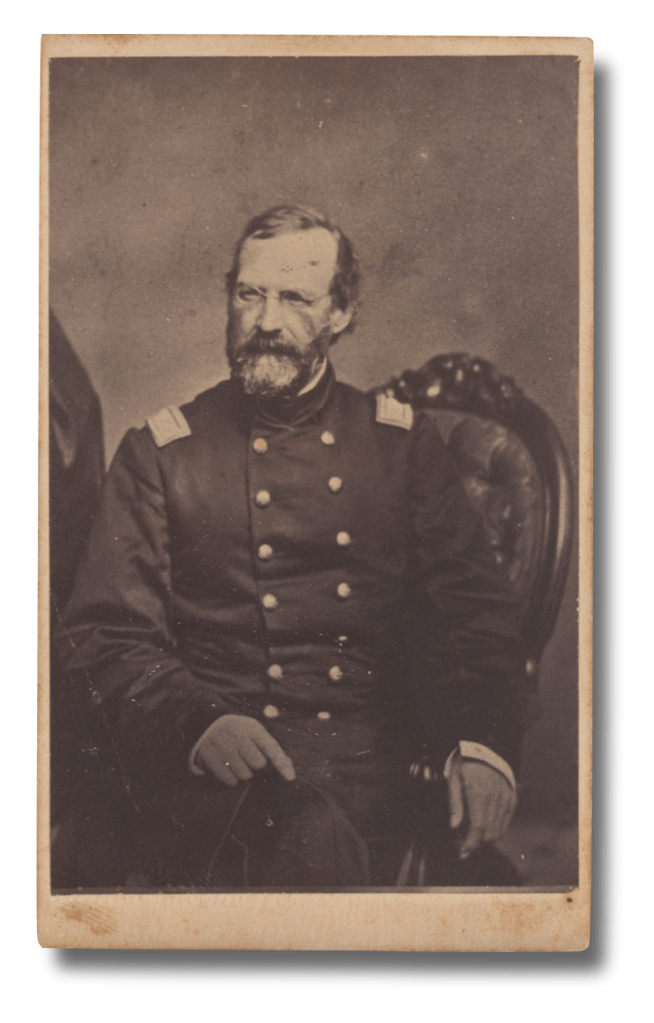
Col. John Richtor Jones, 58th Pennsylvania, was killed on 23 May 1863 at Bachelor’s Creek Station, North Carolina (LOC)

He immediately sent over two companies of skirmishers. A number of our boys went over with them. Soon after the enemy commenced firing and the bullets whistled around us and every little while a shell would come over from their howitzer. Our forces charged on them but Col. Jones was killed and that demoralized the 58th Pennsylvania. They did not know what to do and they retreated across the creek. One company came across the bridge behind the breastworks and when the hottest firing was, they started to leave. But Capt. Tifft said not a man leave this place until they had orders. Soon after this our artillery came up and sent a few shell and shot amongst them and they thought it was most time to leave so they began to retreat. The 58th left for camp and we stayed behind the works till morning when two companies of the 132nd New York relieved us and we came into camp and did not find anyone here. They had orders to fall back to Newbern so we got some coffee and some breakfast and washed up.
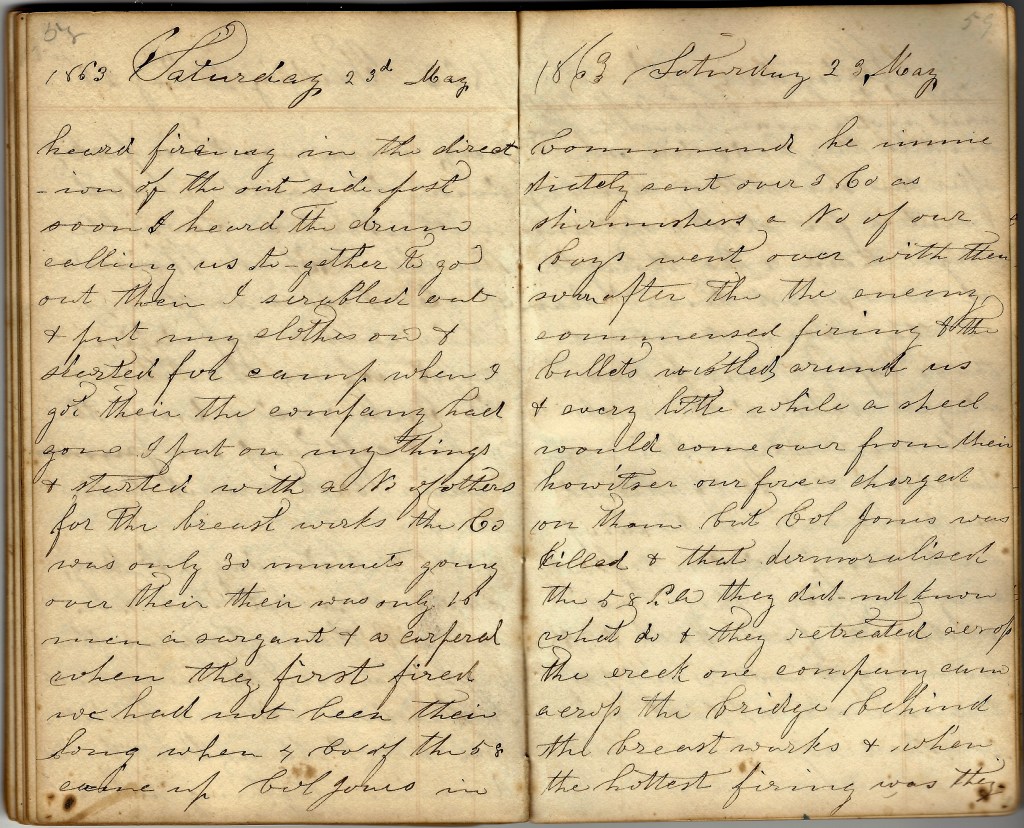
A sample of Edwin’s handwriting

Sunday, 24th May 1863. We had hardly got rested when orders came for us to fall in and go over to the breastworks and relieve the company that was there so we started and went over. After I got there, I was detailed to go on picket with others on the place called Paradise Lost. Co. I furnished 16 men for that post and our company came back to camp and that ended the entertainment for the present.

Monday, 25 May 1863. Came off picket. Went over to the brick house after some milk. A mail was in. The boys came back for Newbern. Had to fight mosquitoes all of the fore part of the night. Did not get much sleep. Moore and I went over to Mr. Richardson’s and got some milk and had some bread and milk.

Tuesday, May 26. Went up on a scout in the a.m. to where the Reb pickets were. Stayed some time. Had a good long talk with them. Some citizens were sent out of Newbern and [ ] at the picket post last night. That is the way the war is carried on.

Wednesday, May 27. Went on picket down to the breastworks. Nothing new. All quiet on the creek.

Thursday 28th. Came off picket. Went over to Hertisum and got my washing. Did not have any breakfast. good for anything.

Friday, May 29, 1863. Went and carried my pants to have them washed today. The scouting party that went out were all taken prisoners. Two of our men, C, M. N. and W. A. W., one of the 27th Regiment, and 7 men of Co. I, 46th Regiment, 4 sergeants and three privates.

Saturday, 30 May 1863. Went on picket down to the spring with J. Miller Pease. It was rainy some during the day and night.

Sunday, 31 May. Went and got my pants. Came off picket. Did not sleep much. They are enlisting in the battery. Quite a number. Going to get two companies. A number went on the Dudly Buck home on a furlough. I can’t see it [but] perhaps I shall.

JUNE 1863

Monday, June 1, 1863. Today we were relieved about 2 o’clock p.m Two companies, C & H, relieved us. We march over to Batchelor’s Creek 3 miles, waited till sundown when we came back up to barracks. Got here 8 o’clock.

Tuesday, June 2, 1863. We fixed our bunks and cleaned up the barracks. 10 are detailed for shoveling every day and 2 for guard. Nothing new.

Wednesday, 3rd June. Went on guard on 3rd relief. It was warm day with showers in the distance. Did not rain much here. Countersign was “Raymond.”

Thursday 4th June. Went on guard around camp. It was raining a little. Did not have any dress parade.

Friday, June 5th. Went out shoveling on the entrenchments. Went on dress parade.

Saturday, 6th. Shoveled again today. 44th [Mass.] started for home. The 27th took their place.

Sunday, June 7, 1863. I got a pass & went over to the 51st camp to the Westboro boys. I saw all that I knew. Had quite a pleasant chat.

Monday, June 8th. Went out shoveling on the entrenchments. Worked hard.

Tuesday, June 9, 1863. Went on guard No. 4 beat in front of the officers’ quarters.

Wednesday, 10th 1862. Came off guard. Caught cold last night. Do not feel well. Headache.

Thursday, 11th 1863. Got excused from duty. Various stories are afloat about the companies going home so as to be in Mass. on the 25th June. Our company voted to stay.

Friday, June 12th 1863. Excused from duty taking medicine.

Saturday, 13th. Sick

Sunday, 14th. Sent to the hospital.

Monday, 22nd June. Came out of the hospital.

Tuesday, 23rd. Wrote a letter and put it in the office. Feel a little better today.

Wednesday, June 24. Today the regiment received orders to start for Fortress Monroe. Started 7 for the wharf. Commenced to rain soon after regiment fell in to line & rained all night. It was hard parting with my brother.

Thursday, June 25. I went down to the city to the 27th Regiment. Got back at 1 p.m. It rained all of the time I was going and coming back.

Friday, June 26th. I went down to the city. E. A. Newell and H[enry] O. Davidson were carried down to the Stanley Hospital.

Saturday, 27th. I went down town to see Newell and Davidson & carried Newell’s things.

Sunday, 28th. I went down town to see Henry. He is busy writing for the company.

Monday, 29th June. I went down a little while. It rained last [night]. 124 Penn. were quartered in the barracks. We invalids had to move into another place.

Tuesday, 30th. I went down in the a.m. and in the p.m. went down to see J. Kilmer.

JULY 1863

Wednesday, July 1st 1863. I went down town with King & in the p.m. I went down to see J. Kilmer. The boys had a lot of boxes come that were with the regiment. I wish that they had them for I think they need them.

Thursday, July 2, 1863. Went down town & called to see John. The report is another expedition is going out soon. 29th, 9th New Jersey, and 81st New York are here.

Friday, July3rd 1863. I went down town to see Henry. They are under marching orders. He came up to camp with me. I gave knapsack & a number of other things.

Saturday, July 4th. The 81st New York & 9th New Jersey started on the expedition at 7:30. I went down to see John. They fired a salute in the morning & at noon.

Sunday, 5th July 1863. Went down to church. Heard long sermon. 9th New Jersey chaplain preached from the Psalms. It was very warm day. I cannot walk out in the sun.

Monday, July 6th. Went down town two times. Orders came at night for us to start for Morehead at 7 in the morning.

Tuesday, 7 July. Got up early, packed my things and I went down to the depot to help load the things. Started at 7 for Morehead. We are now at Newport Barracks waiting for the train to come up…arrived at Morehead 10 o’clock. Got the goods all down in the hold at 2 o’clock The 51st came down on the cars at 6 p.m.. got their things aboard. We lay at the wharf till half past 8 when we started. I stayed on an hour after we got outside, then I had to go to bed seasick full before this.

Friday noon Josiah Rhoads of Co. F died this a.m. He had been sick all the time he was in Newbern. Passed Nantucket Island at 4 p.m. Passed Cape Cod Light House at 12 at night. Passed Fort Warren at 5 a.m.. Arrived at Long Wharf at 7 a.m. Helped get out the luggage and came to Park at Barracks. Stayed till 2 o’clock, then took the train for Springfield. Got off at Westboro and took the stage for Ware. Arrived at home 10 o’clock. Found the folks well as usual. The end.

A cure for a diarrhea. Take the inside bark of a gum tree and steep it till it is quite strong and drink it and it is a sure cure.
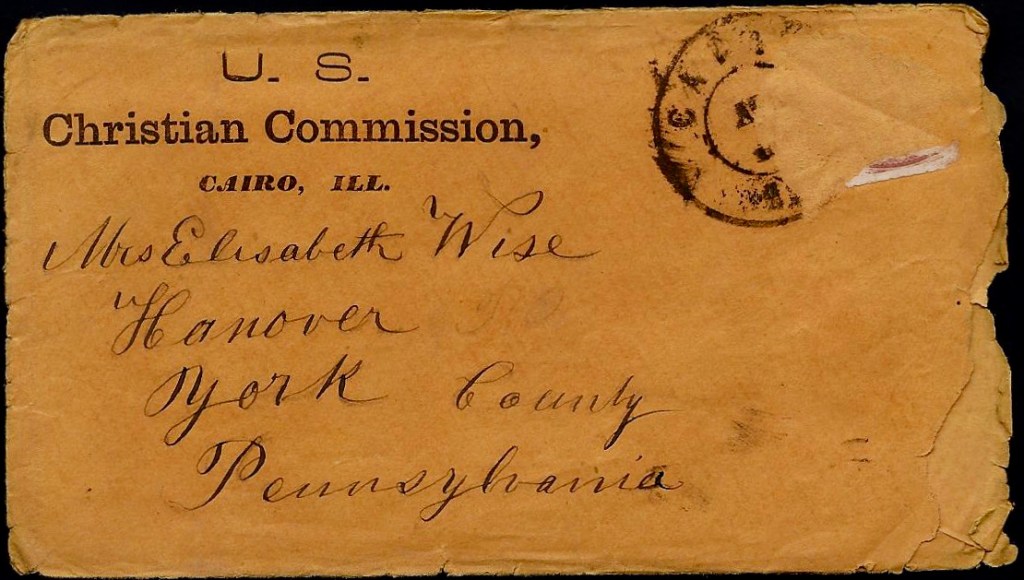
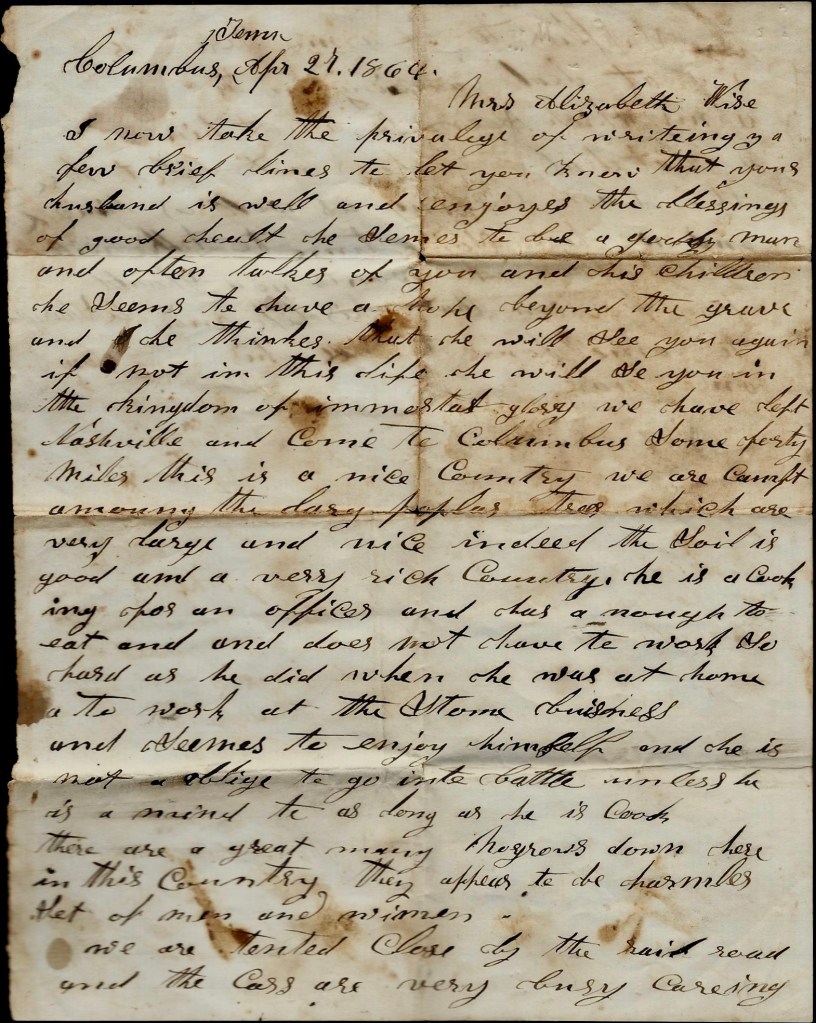
1864: Charles A. Marvin to Mrs. Elizabeth Wise

This letter was written by 35 year-old Charles A. Marvin (1829-1898), the son of Tilly Marvin (1793-1864) and Camilla Clemons (1797-1837) of Tioga county, Pennsylvania. Charles was married to Olive Walker (1832-1913) in 1852 and had at least five children by the time this letter was written in 1864 while serving in Co. L, 7th Pennsylvania Cavalry. Prior to his enlistment in February 1864, Charles was a farmer in Cherry Flats in Tioga county. He mustered out of the regiment on 23 August 1865.

Charles wrote the letter at the request of an apparently illiterate comrade in the regiment to his wife, Mrs. Elizabeth (Snyder) Wise (1832-1880) of Hanover, York county, Pennsylvania. I discovered through census records that 18 year-old Elizabeth was living in 1860 with 20 year-old Michael Wise (Weise) in the household of his parents, Frederick and Catherine Wise of Hanover, Pennsylvania, in the 1850 and 1860 census. I also discovered that Michael had enlisted in April 1861 as a private in Co. G, 16th Pennsylvania Volunteers and that he died on 20 August 1861 from an acute attack of gastroenteritis. In filing for a widow’s pension, Elizabeth submitted a certificate of marriage by the justice of the peace dated 6 August 1860 that informs us the couple were finally married after at least a decade of living together when she filed a charge of “Fornication and Bastardy” again Michael claiming he was the father of their yet unborn child. Dragged into court, Michael agreed to marry Elizabeth which resulted in the marriage certificate. Elizabeth gave birth to the child on 3 November 1860, two and a half months after the marriage, and named him Charles James Wise.

For Michael’ service, Elizabeth began receiving a widow’s pension in the amount of $8 per month beginning on 20 August 1861 and an additional $2 per month for her son Charlie until he reached maturity on his birthday in 1877. In October 1864, we learn from pension records that Elizabeth resided in Littlestown, Adams county, Pennsylvania.

So who was the “husband” who “often speaks of you and his children” that Charles Marvin referred to in his letter? Could it be that Elizabeth had taken up living with another man out of wedlock? Under the terms of her pension, she would have had to forfeit her monthly allotment if she remarried and so she may, perhaps, have wanted to avoid marriage and to change her name. It should be noted that Elizabeth was also illiterate as she could only make her mark in pension papers so apparently the mystery soldier “husband” and Mrs. Wise could only carry on their correspondence through the courtesy of others.

Transcription

Columbus, Tennessee
April 27, 1864

Mrs. Elizabeth Wise,

I now take the privilege of writing you a few brief lines to let you know that your husband is well and enjoys the blessings of good health. He seems to be a Godly man and often talks of you and his children. He seems to have a hope beyond the grave and he thinks that he will see you again, if not in this life, he will see you in the Kingdom of Immortal Glory.

We have left Nashville and come to Columbus some forty miles. This is a nice country. We are camped among the lazy poplar trees which are very large and nice indeed. The soil is good and a very rich country. He is a cooking for an officer and has enough to eat and does not have to work so hard as he did when he was at home at work at the stone business and seems to enjoy himself, and he is not obliged to go onto battle unless he is a mind to as long as he is cook.

There is a great many negroes down here in this country. They appear to be [a] harmless set of men and women.

We are tented close by the railroad and the cars are very busy carrying supplies to the army. There is a great deal of cursing in the army which seems to affect him a great deal. He does not like to hear it. I am cooking as well as himself and we have some time to talk with each other. He wants you should pray for him that his life may be spared to come home to see his family once more. He wants you to send him some postage stamps for they are hard to get here. You can send him one or two in each letter. He says that he received a letter from Charley Burns and he said that if I would write him, I should receive a speedy answer. I wrote him a letter but he thinks it was not directed right.

We are under marching orders and expect to move again right away. — Charles A. Marvin

1861: W. A. S. to Martha C. Harris

Regrettably I have not been able to determine the identity of the author of this letter whose initials appear to be “W. A. S.” I searched the 1860 US Census for Lynchburg, Virginia, page by page but could not find any person fitting the profile of this person.

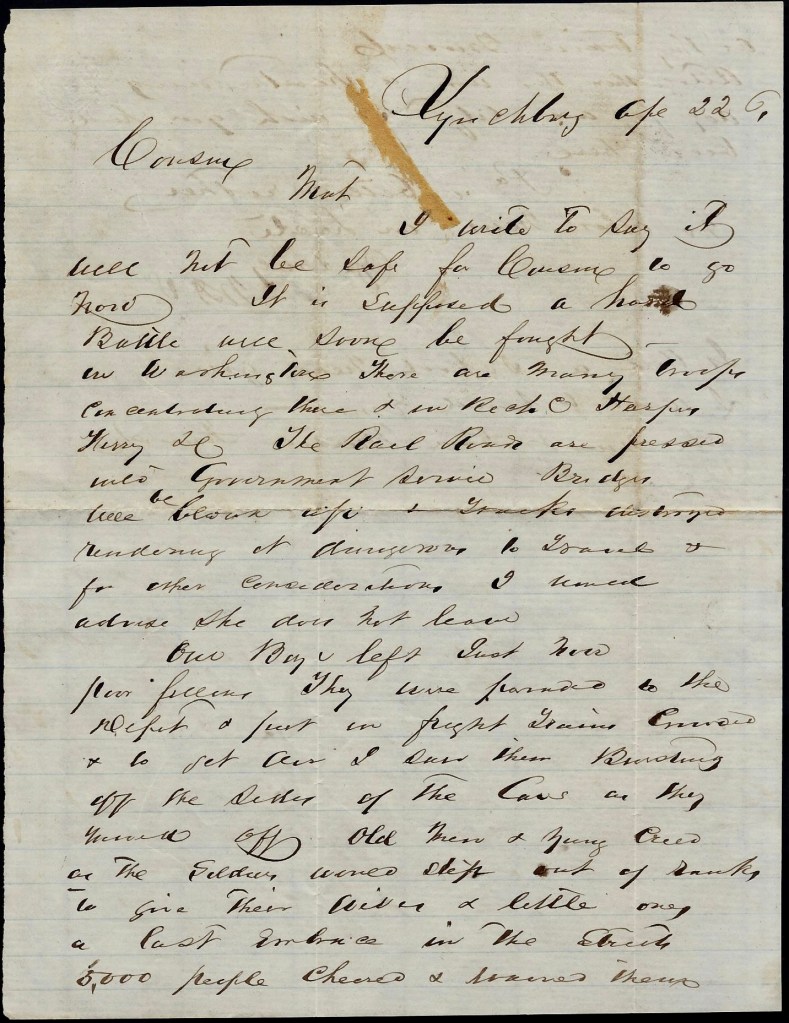
In any event, it’s a great letter written from Lynchburg, Virginia, just days after the firing on Fort Sumter and Lincoln’s call for troops. The letter captures the excitement and pathos associated with the scenes just experienced by the author as the first wave of soldiers head to war amidst the cheers of 5,000 residents.

Transcription

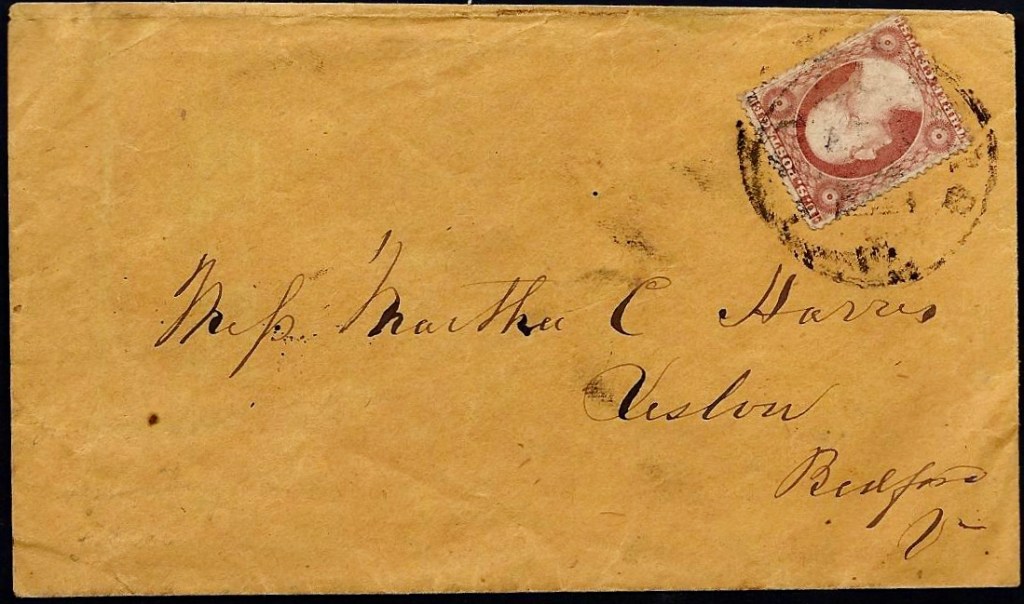
Addressed to Miss Martha C. Harris, Lisbon, Bedford County, Virginia

Lynchburg [Virginia]
April 22, 1861

Cousin Mat,

I write to say it will not be safe for cousin to go now. It is supposed a hard battle will soon be fought in Washington. There are many troops concentrating there & in reach & Harper’s Ferry, &c. The railroads are pressed into government service. Bridges will be blown up & tracks destroyed rendering it dangerous to travel & for other considerations I would advise she does not leave.

Our Boys left just now—poor fellows. They were paraded to the depot and put on fright trains crowded & to get air, I saw them bursting off the sides of the cars as they moved off. Old men & young cried as the soldiers would step out of ranks to give their wives & little ones a last embrace in the streets. 5,000 people cheered & praised them as the train moved.

Altogether this was a heartrending day for our city. I wish you had been here.

Pa is better rather. No other news. In haste. Yours truly, — W. A. S.

Is there a school near you. I want to send Ema. She must have music, French, &c.

1865: Wesley Blanchard to Eldora M. Webster

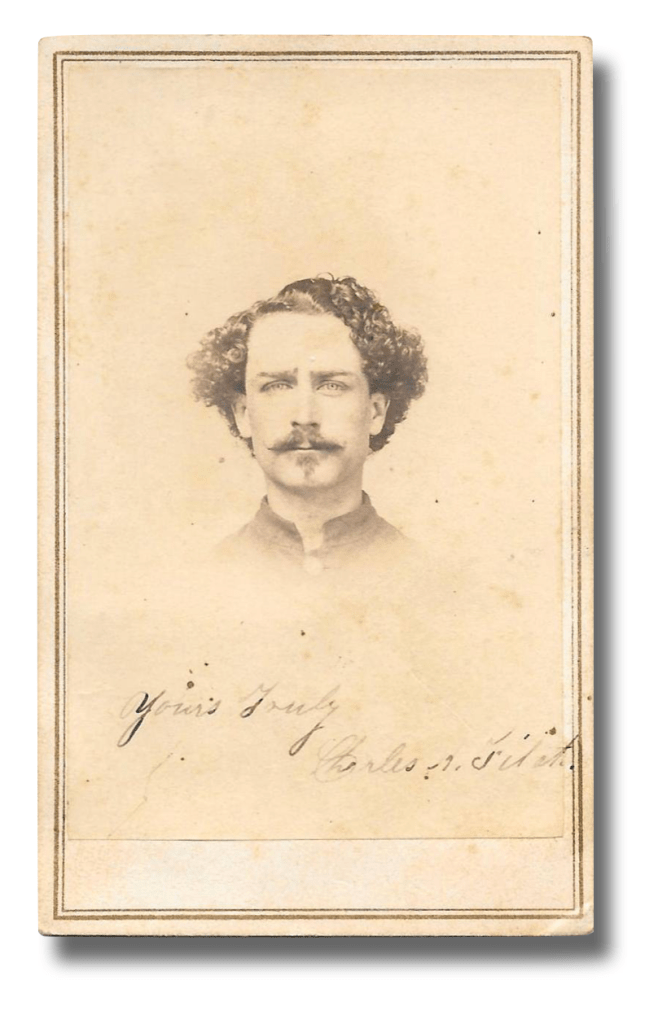
I could not find an image of Wesley but here is one of Charles Asbury Fitch who was the same age and also served in the 24th Massachusetts Infantry (Dave Morin Collection)

This letter was written by 21 year-old Wesley Blanchard (1844-1908) , a grocer from Lewiston, Maine, who enlisted in October 1861 to serve in Co. H, 24th Massachusetts Infantry. He reenlisted in January 1864 and did not muster out of the service until 20 January 1866 at Richmond, Virginia. His military records indicates that he was wounded sometime in 1864 but there are no specifics. The 1900 US Census gives Wesley’s birth date as May 1844 which means he would have only been 17 when he enlisted,

Wesley was the son of Joseph Knapp Blanchard (1820-1885) and Elizabeth Thayer (1824-1884) of Freeman, Franklin county, Maine. Hw wrote the letter to Eldora M. Webster (1846-1913) who became his wife on 5 August 1866. In 1870, the Wesley and Eldora lived in Lewiston where Wesley earned his living as a store clerk. By 1900 he had become an oil merchant.

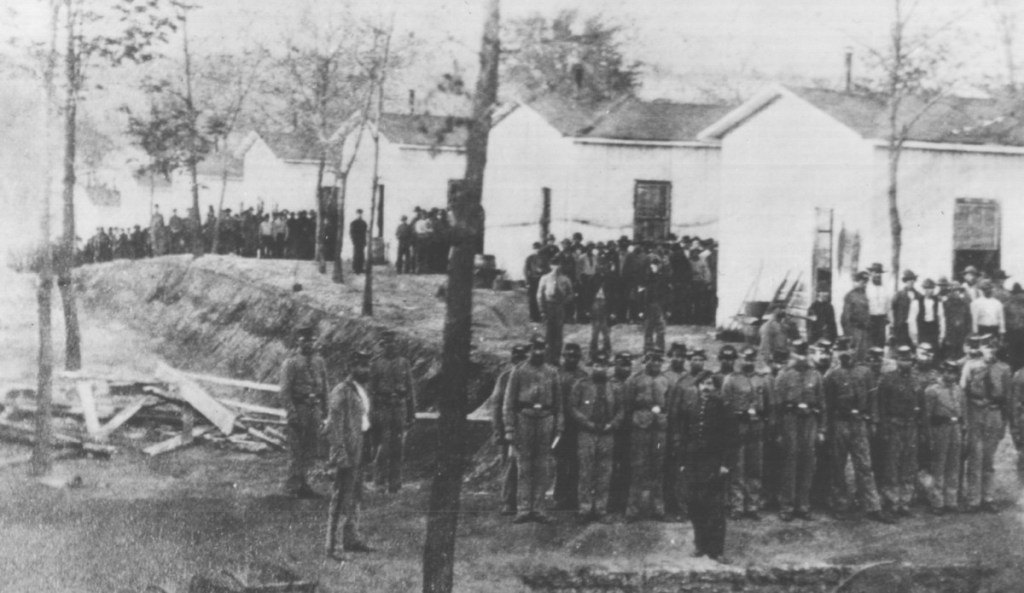
After the fall of Richmond, the 24th Massachusetts was ordered to the city to preserve order. They set up camp on the corner of Franklin and Nineteenth Streets in Wright’s Tobacco Factory. They were placed as guards at Libby Prison and Castle Thunder where ex-rebels were detained.

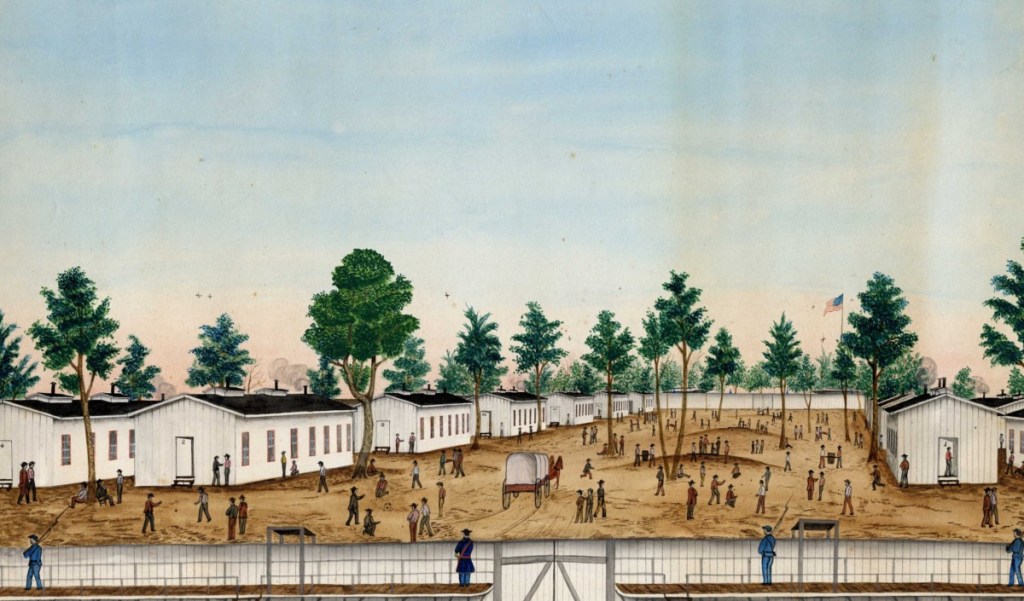
A colored lithograph of Castle Thunder Prison on Cary Street in Richmond where Wesley penned his letter while on guard duty. (Virginia Historical Society)

To read other letters written by soldiers of the 24th Massachusetts that I have transcribed and published in Spared & Shared, see:

Unidentified Soldier, 24th Massachusetts (1 Letter)
Alexander M. Hayward, Co. C, 24th Massachusetts (1 Letter)
Josiah Alonzo Osgood, Co. C, 24th Massachusetts (20 Letters)
William Hunt Goff, Co. H, 24th Massachusetts (43 Letters)

Transcription

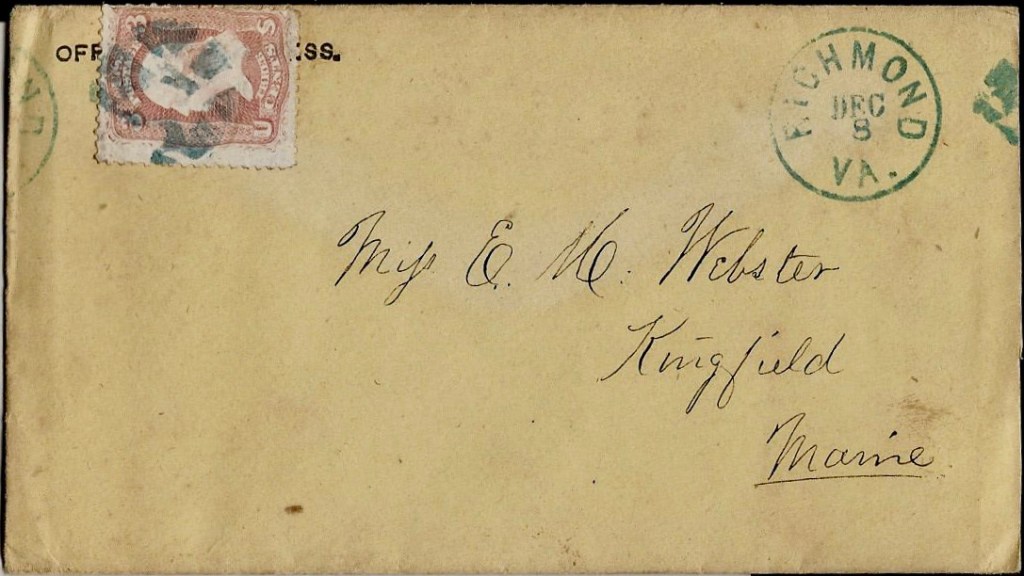
Addressed to Miss E. M. Webster, Kingfield, Maine

Castle Thunder
[Richmond, Virginia]
December 6, 1865

My most true friend,

It is a very rainy night. I am lonely sitting here as all of the boys have gone away to spend the evening. As I was telling—thinking—my thoughts roam back to you and those happy hours we passed together one year ago. Little did we think then that the present time I should be so far away (while Thanksgiving was so nigh I had promised myself a pleasant time with you) but luck does not always favor our expectations. So it seems in the present case.

I have not received any letter from you for three weeks. Do you think that you are forgotten by me? It cannot be! for you have heard my true declaration of my trust. I cannot think so but the withdrawal of your letters show that there is a withdrawal or a misunderstanding. Can it be because of my own neglect in writing? If so, it is my own fault. The blame is on myself. For the future I will try and do better. You have heard in my last my prior reasons. It would not be worthwhile to repeat them, but you have no cause to harbor a single thought but that I am true to you and ever shall be till death.

We have not moved yet but shall soon take up our abode at Libby Prison as it is nearly complete for our admittance. We have at present 59 prisoners of all classes. We have had a slight fall of snow which soon left us. Otherwise we are enjoying an Indian summer.

“Military law yet rules in the city. Ben. Butler is expected here to take command of this department. There will be sport then. Many secesh will feel what it is to come down. They have not had a very strict man to control them.”

—Wesley Blanchard, 24th Massachusetts, 6 December 1865

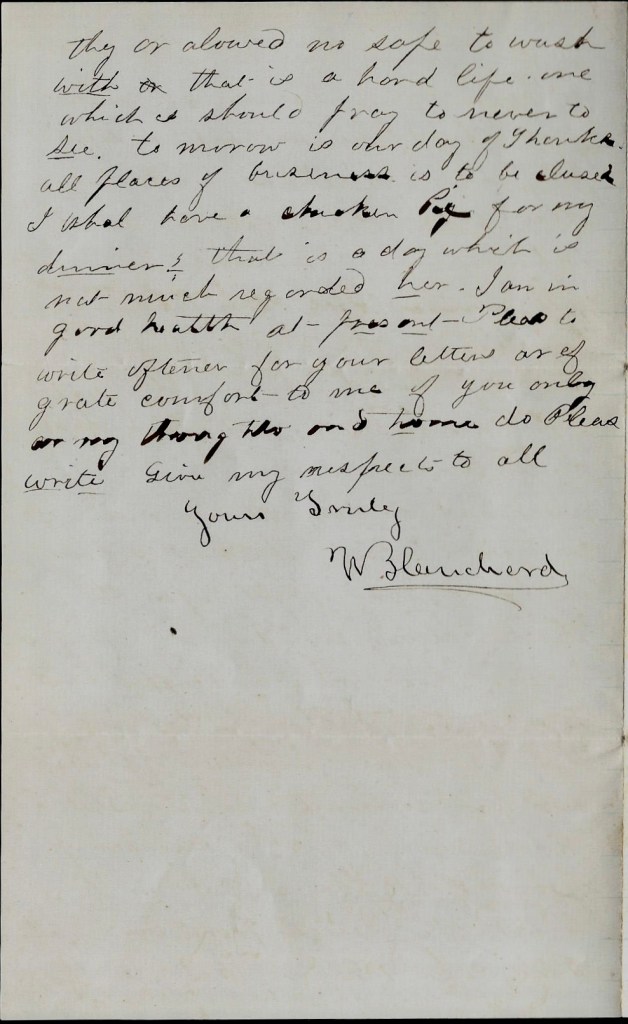
Military law yet rules in the city. Ben. Butler is expected here to take command of this department. There will be sport then. Many secesh will feel what it is to come down. They have not had a very strict man to control them. There is robbing done here every night upon the streets. Nearly every day we see pass by our door men handcuffed and tied to the saddle of the Orderly men who have committed offenses and are committed to the State penitentiary for a number of years. Of all places, that is the worst. they receive hard bread and pork, coffee & sugar. That is all they are allowed. No soap to wash with. That is a hard life—one which I should pray to never to see.

Tomorrow is our day of thanks. All places of business is to be closed. I shall have a chicken pie for my dinner. That is a day which is not much regarded here. I am in good health at present. Please to write oftener for your letters are of great comfort to me—of you only and my thoughts of home/ Do please write. Give m respects to all.

Yours truly, — W. Blanchard

1864: John McGill to Mrs. Buckley

This letter was written by John McGill of Co I, 197th Pennsylvania Infantry (100 days, 1864) who entered the service in July 1864 and mustered out on 11 November 1863. The regiment was recruited in Philadelphia, Delaware and Lancaster counties and was sometimes called the 3rd Coal Exchange Regiment, In September and October 1864 they served as prison guards at Rock Island, Illinois.

John was from Media, Delaware county, Pennsylvania, like many others in his company.

Rock Island Prison

Transcription

Rock Island, Illinois
September 4, 1864

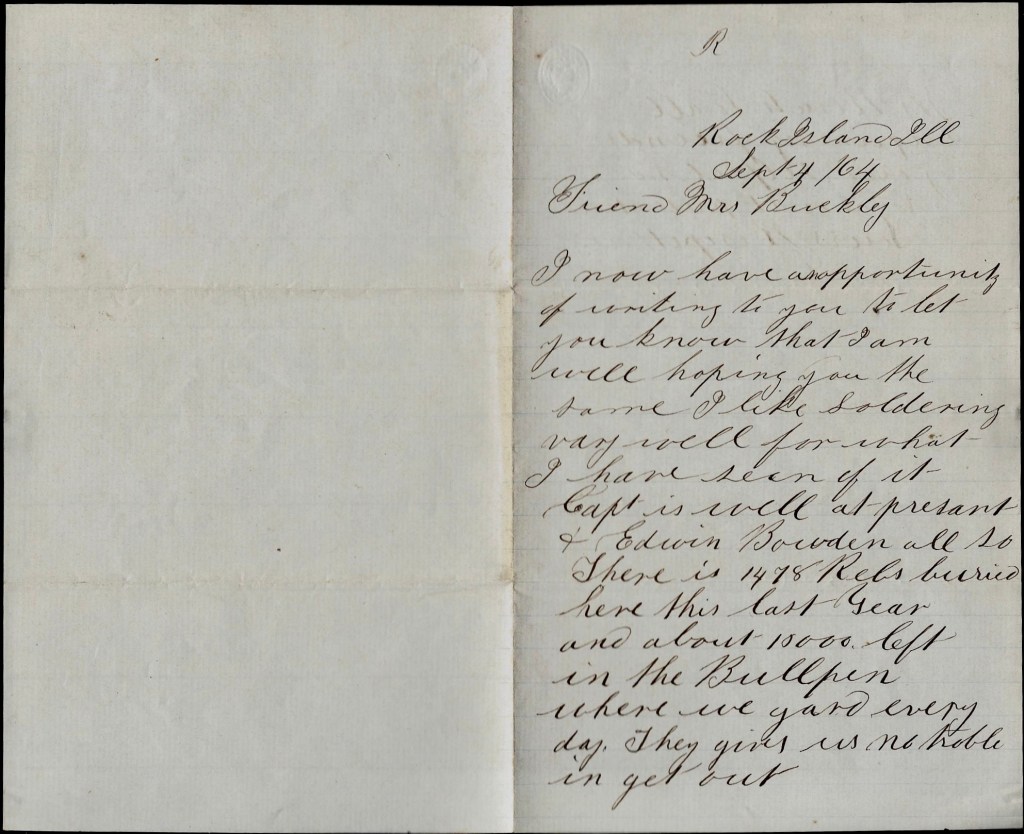
Friend Mrs. Buckley,

I now have an opportunity of writing to you to let you know that I am well hoping you [are] the same. I like soldiering very well for what I have seen of it. Capt. [Ralph Buckley] is well at present and [1st Sergt.] Edwin Bowden also.

There is 1478 Rebs buried here this last year 1 and about 10,000 left in the Bullpen where we guard every day. They give us no trouble in get[ting] out.

My respects to all enquiring friends. Yourself also. No more at present.

Yours respectfully, — J. McGill


Rock Island Prisoners

1 During the summer of 1863, prison camps in the North were overflowing with Confederate soldiers captured in battle.  As a result, Union troops began construction of a new prison camp on an island in the Mississippi River then known as Rock Island, now called Arsenal Island.  The camp opened in December 1863 with the arrival of the first prisoners captured at the Battle of Lookout Mountain.  The Rock Island Prison Camp was designed to hold more than 10,000 inmates at any one time, and over the final 18 months of the war, more than 12,000 Confederate prisoners passed through its gates. The deplorable conditions at the camp led some to call it the “Andersonville of the North,” a reference to the infamous prison in Georgia.  Disease, including smallpox and pneumonia, ran rampant through the prison claiming many lives, while others died from exposure to the elements and the unsanitary conditions of the camp.  During the first four months alone, more than 950 Confederate soldiers died.  Initially, the dead were buried in a plot located 400 yards south of the prison, but on advice from the prison surgeon, a new cemetery, one that would become Rock Island Confederate Cemetery, was established in 1864, located 1,000 yards southeast of the prison.  In March 1864, the remains of 671 Confederate dead were reinterred in the new burial grounds.  In all, approximately 1,950 Confederate prisoners were buried in the cemetery, with the last burial occurring on July 11, 1865.  All structures related to the prison were transferred to the Rock Island Arsenal and were subsequently demolished, leaving the Confederate Cemetery as the camp’s only remaining feature. [NPS].
1863: William Taylor Humphreys to John Alsop Yarborough Humphreys

Morgan’s Raiders in Indiana & Ohio, July 1863

This letter was written by William (“Willie”) Taylor Humphreys (1844-1873), the son of John Alsop Yarborough Humphreys (1802-1873) and Rebecca Delph Carpenter (1820-1848) of Bardstown, Nelson county, Kentucky. Willie’s maternal grandparents were Samuel Carpenter and Margaret Slaughter. Willie’s siblings included Margaret (b. 1842), John S. (b. 1843), Samuel (b. 1846), and Thomas J. (b. 1847), all of whom are mentioned in his letter.

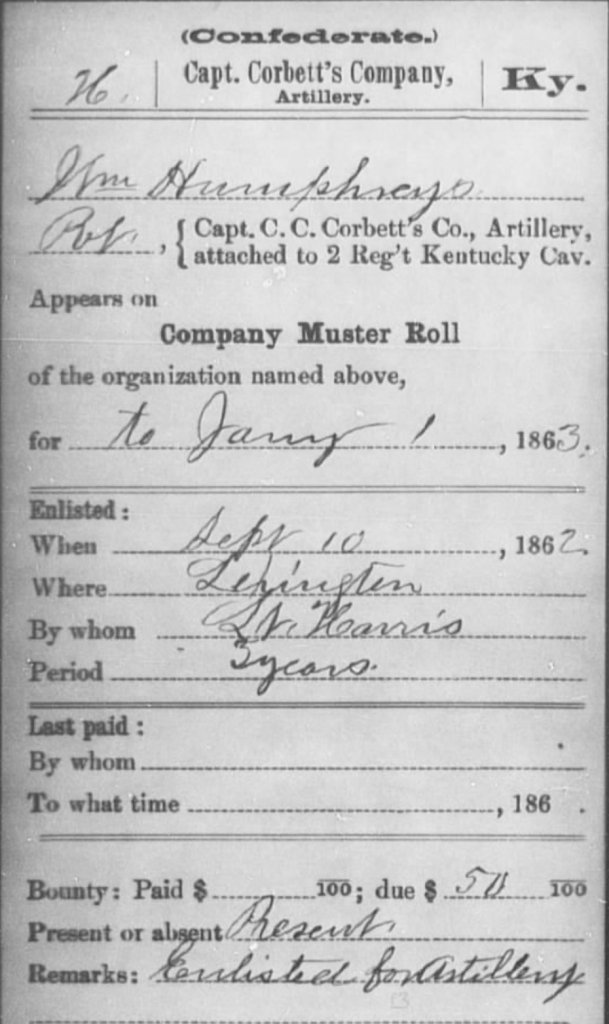
Willie enlisted in September 1862 in Capt. C. C. Corbett’s Company of Light Artillery that was attached to the 2nd Regiment of Kentucky Cavalry. This battery may have broken up before the summer of 1863 but it’s likely the remnants continued to ride with Morgan’s Kentucky Cavalry Squadron on its raid through Indiana and Ohio in July 1863. In the letter, “Willie” described his hairbreadth escape from capture by hiding out on the river bank for two days, swimming across the Ohio at night with the aide of a fence rail, and then outrunning Union pursuers in West Virginia as he walked 200 miles to get back to Confederate lines.

Willie’s enlistment in Capt. C. C. Corbett’d Company of Artillery

Willie wrote the letter on 30 September 1863 from Demopolis, Alabama, where he had joined his uncle—James Slaughter Carpenter (1840-1915), who was originally a member of the Orphan Brigade, a native of Bardstown, Kentucky. Carpenter served in the 9th Kentucky Infantry until detached to serve as principal clerk in the commissary subsistence department of Major Thomas K. Jackson under General Albert S. Johnston.

On January 1, 1863, from Ringgold, Georgia, James Slaughter Carpenter wrote to James Seddon, Secretary of War, seeking an appointment to the position of Asst. Commissary of Subsistence. The letter provides a good synopsis of his service up to that date. It reads in part:

“I am a Kentuckian by birth and have been in the service eighteen months, during which period I was ten months principal clerk of Major Thos. K. Jackson, Commissary Subsistence.”

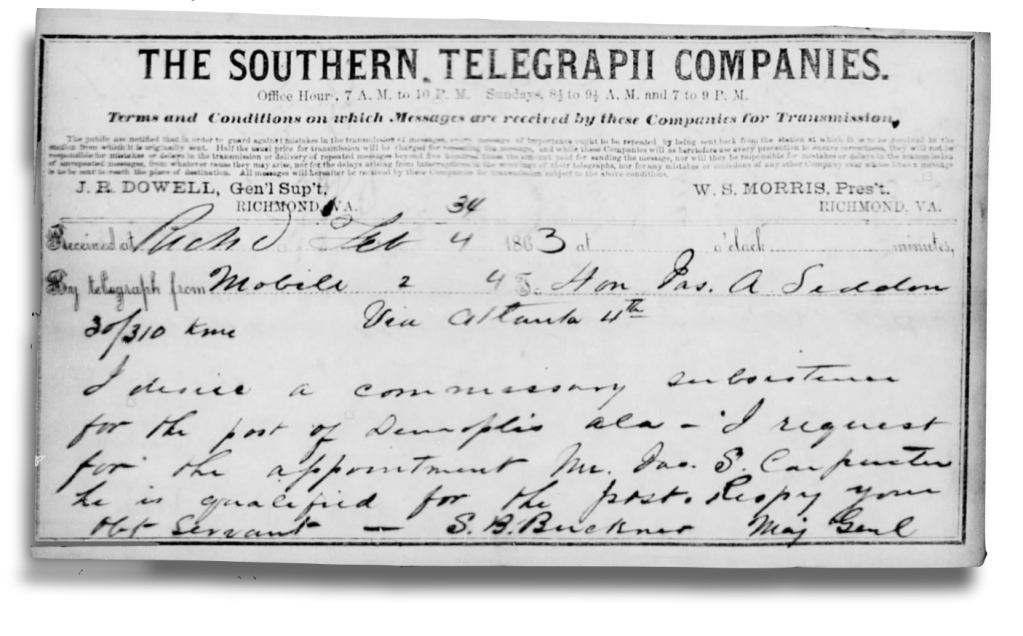
Two months later, Maj. Gen. Simon B. Buckner sent a telegram from Mobile to the Seddon requesting the appointment of Carpenter. It read:

“I desire a commissary subsistence for the post of Demopolis, Ala. I request for the appointment Mr. Jas. S. Carpenter. He is qualified for the post. Respectfully your obedient servant, — S. B. Buckner, Maj. Gen’l”

Maj. Gen. Simon B. Buckner’s Telegram to Secretary of War Seddon

[My thanks to Daniel Crone for helping to confirm Willie’s identity and his connection to Morgan’s Raid.]

Transcription

Office of Subsistence
Demopolis, Alabama
September 30, 1863

Dear Pa,

I am here with Jim Carpenter who is commissary of the post at this place. I am having a very nice time. Plenty of everything to eat and a good house to stay in. The people around here are very wealthy and of course have plenty of pretty daughters & if it was not for seeing soldiers, I would not know the war was going on. The Capt. has plenty of good clothes & I supply myself from his wardrobe as I had to leave all my clothes in Ohio.

I wrote to you just after I crossed the Ohio river when I told you I thought I was safe but I was bushwhacked on my road when I got [with]in about fifty miles of our lines. There was some 12 or 15 of them fired on me from the bushes [with]in about 30 yards from me. I was standing still at the time & I cannot imagine how they come to miss me, but I was not hurt at all—only one ball passed through my coat. I was too fast on foot for them after they missed their aim. I was going along not thinking about them as the citizens all told me I was clear out of danger. There was 9 of us when they fired on us. The rest were behind [me] and they caught six of them and killed them. I escaped with the loss of a fine pair of boots which I abandoned in the retreat.

I laid on the banks of the Ohio for two nights & days thinking of the awful task before me—that of swimming the river, which after two days and nights deliberation and starvation, I concluded to risk my chances on a rail & swim the river which I accomplished in about twenty minutes. I would have surrendered had it not been for you, for I know you would have been almost distressed to death to hear that I was in prison. Poor Capt. [James] McClain 1 was drowned in crossing the river. I wrote to you that he escaped but it was another man.

We have given the Yankees an awful whipping at Chattanooga. Our Kentucky Brigade lost very severe. I have not heard the loss yet. John Wisotzki 2 just just left here yesterday. He is clerking in the Adjutant General’s Office of Gen. Joe Johnston’s. He promised to send this letter through for me. Farewell. Yours, — W
Dear Brother John, Sam, Tom & sister Maggie,

I have been through the different departments of the Confederate Army since I saw you all last and thank heaven I am well and in better spirits than ever I was. This place is full of beautiful young ladies & all are as rich as cream & you know Jim’s partiality for the ladies & he has just any quantity of good clothes. I have not been here long enough to have me some made for you know I do not like to go to see the young ladies with my soldier clothes. I have found it a military necessity to appropriate the Captain’s broad & gray cloth and ruffled shorts.

They do not call a man wealthy in this country if he has not got about a thousand negroes & two or three plantations. There is more corn raised in this county than any place I have ever been. Jim and myself have just returned from the country. We have been out to Col. [James Innes] Thornton’s, a relative of Mrs. Slaughter’s. He is very wealthy & has three beautiful daughters. 3

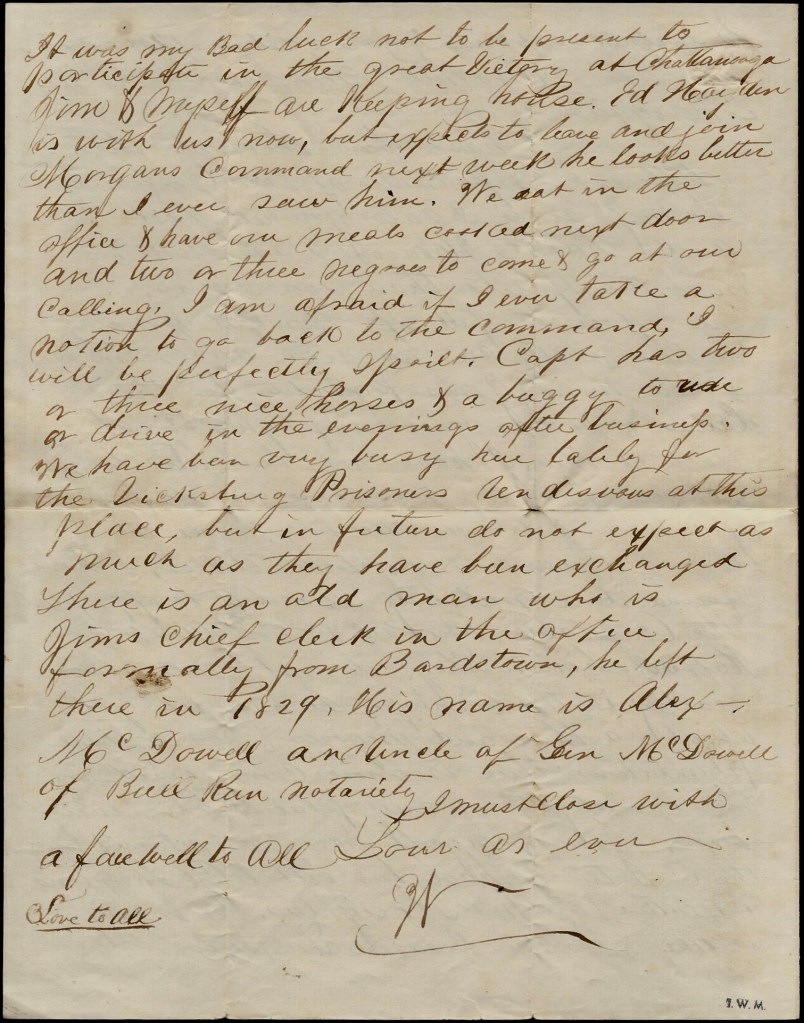
It was my bad luck not to be present to participate in the great victory at Chattanooga. Jim & myself are keeping house. Ed Hayden 4 is with us now but expects to leave and join Morgan’s command next week. He looks better than I ever saw him. We eat in the office & have our meals cooked next door and two or three negroes to come & go at our calling. I am afraid if I ever take a notion to go back to the command, I will be perfectly spoilt. Capt. has two or three nice horses & a buggy to ride or drive in the evening after business.

1885 Gelatin Photograph of Alexander Keith Marshall McDowell (UK Libraries)

We have been very busy here lately for the Vicksburg prisoners rendezvous at this place but in future do not expect as much as they have been exchanged. There is an old man who is Jim’s chief clerk in the office formally from Bardstown. He left there in 1829. His name is Alexander McDowell, an uncle of Gen. [Irvin] McDowell of Bull Run notoriety. 5

I must close with a farewell to all. Love as ever, — W

Love to all.

P. S. I walked across Western Virginia a distance of 200 miles to our lines.

[in a different hand]

I will keep Willie with me all winter if I can. I am doing first rate. Don’t be astonished if you would hear of my marrying some rich planter’s daughter. I am very anxious to hear from you. Write if you can. Love to all. — J. S. Carpenter


1 Capt. James McClain (1837-1863) served in Forrest’s 3rd Tennessee Cavalry (Co. A) until 1862 when he was promoted and transferred to the 10th Kentucky Partison Rangers as assistant commissary of subsistence. He drowned while trying to cross the Ohio river during the Ohio Raid at Buffington Island.

2 John Wisotzki served in Co. B, 1st (Butler’s) Kentucky Cavalry. He enlisted at Chattanooga on 11 November 1862 and was immediately detailed as clerk by Gen. Joseph E. Johnston. John gave his residence as Jefferson county, Kentucky. In 1865 he was described as 5 and a half feet tall with brown hair and hazel eyes.

Catherine Marshall Thornton (1842-1870)

3 Col. James Innes Thornton (1800-1877) was born in Fredericksburg, Virginia, educated at Washington College, and came to Huntsville, Alabama where he practiced law and served as Alabama’s 3rd Secretary of State. He then purchased his 2600 acre plantation “Thornhill” in Greene county, Alabama, that was worked by 150 slaves. Col. Thornton did not support the was philosophically but gave financially. His youngest daughter, Cathrine Marshall Thornton (1842-1870) was no doubt one of the “young ladies” Willie spoke of.

4 Edward Mortimer Hayden (1835-1872) was a native of Bardstown, Kentucky, who enlisted a private in Co. D, 18th Mississippi Volunteers in the summer of 1861. He was taken prisoner at Elizabethtown, Kentucky, in November 1862 and sent to the military prison at Aton, Illinois until paroled and exchanged at City Point, Virginia, on 1 April 1863.

5 Judge Alexander Keith Marshall McDowell (1806-1892) purchased a plantation in Demopolis, Alabama, in the late 1830s. After the Civil War—in 1868—he sold out in Alabama and relocated to Cynthiana, Kentucky. Judge McDowell’s daughter, Louise Irvine McDowell (1840-1915) was probably one of the “young ladies” that Willie referred to in his letter. She married in 1869.

1863: John T. Pool to Joseph O. Jones

This letter was written by 57 year-old John T. Pool of Terre Haute (1806-Aft1875) who was identified as a “Temperance Lecturer” and enumerated in the 1860 US Census with his much younger wife Nancy D. Castro (b. 1819) and five children.

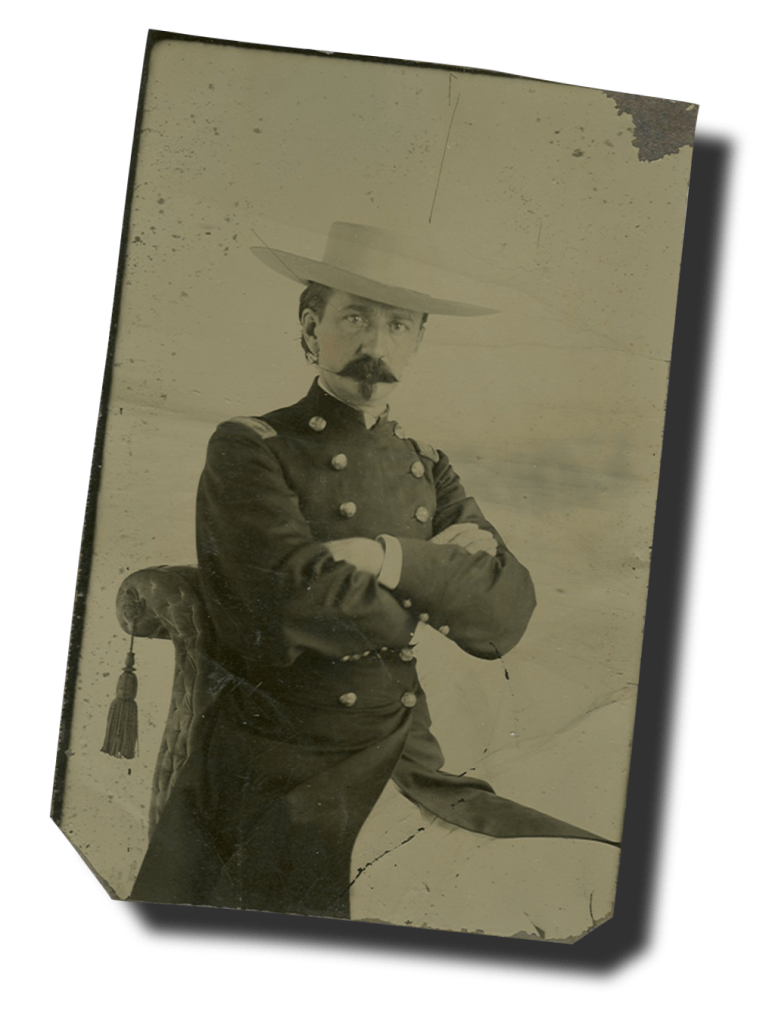
How Pool might have looked

In November 1862, John enlisted as a nurse in Co. G, 6th Indiana Cavalry. Less than a year later he was hospitalized at Mt. Sterling, Kentucky, suffering from rheumatism and partial deafness which enabled him to be discharged from the regiment and transferred to the 2nd Battalion Veteran Reserve Corps. Later in the war he reenlisted in the 71st Indiana Volunteers but then was transferred to the Reserve Corps again. Several years after the war, John was admitted to a Home for Disabled Soldiers at Dayton, Ohio, in June 1872 and discharged on his request in February 1875.

John wrote the letter to his friend Joseph O. Jones (1814-1899) of Terre Haute. Joseph was married to Persis A. Holmes (1820-1908). He was a merchant, volunteer fireman, town clerk, and post master under four different presidents who stood firm as a temperance Democrat. During the Civil War, Joseph served in the “Silver Grays” — a home guard unit whose members were all in their fifties and sixties.

John’s letter speaks of the 2 December 1863 raid on Mt. Sterling by Capt. Peter M. Everett (1839-1900), a native of Mt. Sterling, who resided in Texas just before the war and led Confederate raids in Kentucky. His father was a former governor of Kentucky.

Mt. Sterling served as base for the Union Army operating in the Eastern Kentucky mountain counties, as well as a supply depot. Between October 1863 and May 1864, the US military forces, consisting of troops belonging to the 21st MA Infantry and troops under Asst. Quartermaster J. M. Mattingly, 37th KY Infantry, took possession of and occupied a two-story brick house, a frame building, log house and shed, all situated on Main Street, the property of John Lindsey & Son, manufacturers of furniture and coffins. The buildings were utilized as an office and depot for QM stores and commissary supplies, and as quarters for the troops. The Ascension Protestant Episcopal Church, a well-constructed and well-finished brick building, as well as the grounds, were also occupied by the military and the church used for “Camping and hospital purposes.” The Montgomery County Courthouse was utilized as headquarters. Mount Sterling served as a point of safety for Union refugees from the mountains of Eastern Kentucky who had been driven from their homes by rebel forces and guerrillas. [Mt. Sterling–An important Military Base During the Civil War]

Everett was able to “skedaddle” from Mt. Sterling and avoid detection by using the Rebel Trace—a trail that he was intimately familiar with and only accessible by foot or horseback. His use of the trail is described in the following article:

In December of 1863, Captain Peter Everett CSA used the trail to escape Yankee pursuers after his raid on Mt. Sterling. The captain left Abingdon, Virginia, with the 1st Battalion Kentucky Cavalry, 10th Kentucky Mounted Rifles, and 7th Confederate Cavalry. The Confederates rode rapidly along the Mt. Sterling-Pound Gap Road, stopping long enough in Salyersville to rout a small Union garrison. Later that night, the Rebel raiders successfully attacked a Union force, much larger than their own, that was garrisoned in Mt. Sterling. The raiders captured a large number of horses and supplies, while destroying a large Union commissary stored in the town. Knowing that the Yankees would be expecting them to return to Virginia by the Mt. Sterling-Pound Gap Road, the young captain allowed some of the men of the 10th Kentucky Mounted Rifles to lead the raiding party back along the Rebel Trace. The majority of the men of this regiment was from the mountains of Eastern Kentucky and knew the trail by heart. Upon arriving in Whitesburg, the captain left the 10th Kentucky there to check on their families and continued with the remainder of the raiding party back through Pound Gap. [The Rebel Trace: The Forgotten Mountain Road by Richard G. Brown, et al.]

See also—1862: John T. Pool to Joseph O. Jones published on Spared & Shared 7 in October 2014.

Transcription

General Hospital
Lexington, Kentucky
December 13, 1863

J. O. Jones, Esq.
Sir,

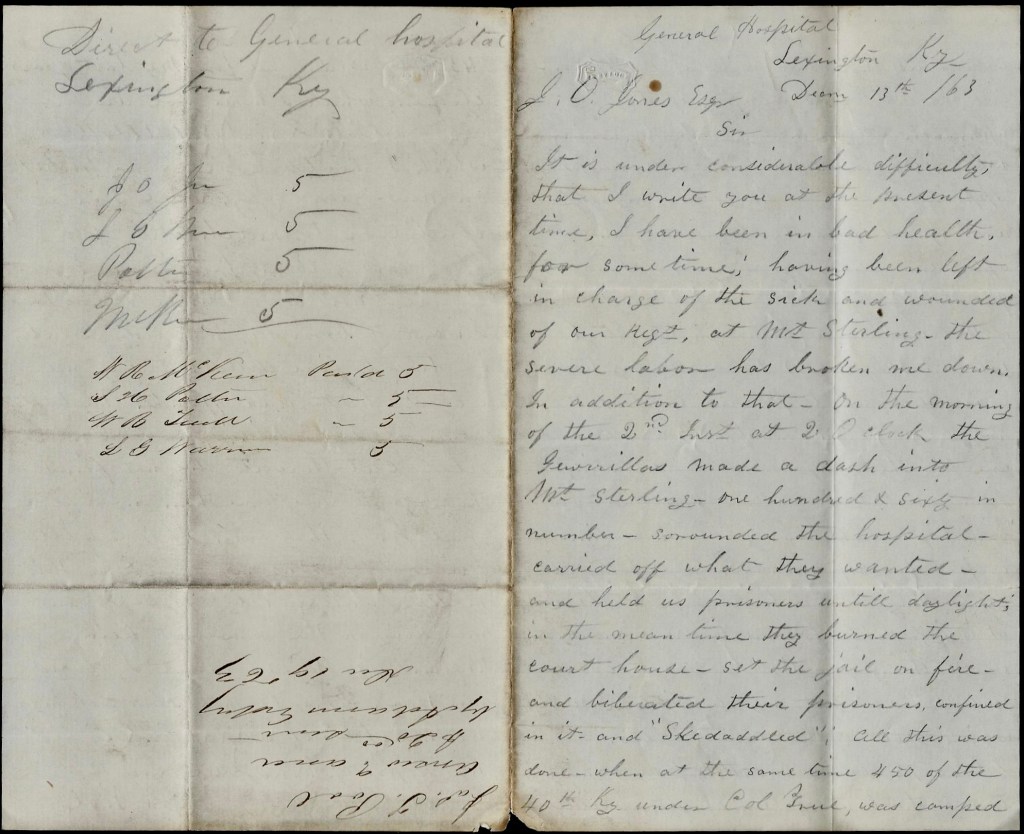
It is under considerable difficulty that I write you at the present time. I have been in bad health for some time having been left in charge of the sick and wounded of our regiment at Mt. Sterling. The severe labor has broken me down. In addition to that, on the morning of the 2nd inst. at 2 o’clock, the guerrillas made a dash into Mt. Sterling—one hundred and sixty in number—surrounded the hospital, carried off what they wanted, and held us prisoners until daylight. In the meantime they burned the court house, set the jail on fire, and liberated their prisoners confined in it, and “skedaddled.” All this was done when at the same time 450 of the 40th Kentucky [Mounted Infantry Regiment] under Col. [Clinton Jones] True was camped within less than two miles of the town and the Colonel had warning of their approach at seven o’clock the evening before.

Col. Clinton Jones True, 40th Kentucky Mounted Infantry Regiment (UK Libraries)

As soon as we were released, I applied for a discharge for myself and squad from the hospital and after some delay, got it—Col. True positively refusing to allow us the use of the ambulance (although two stood idle in the yard) to convey my two wounded me to Paris. We took the rough road wagons for it and here we are for the purpose of recuperating.

I am in what we call in Terre Haute, a “bad fix.” Not having drawn a dime of pay for six months, my clothes all gone, my descriptive roll no where [and] it is impossible for me to draw money or clothing for two months to come unless I can get my descriptive roll which is one of the uncertainties. I have 78 dollars monthly pay coming to me the last of this month, besides 43 dollars due me for my last year’s clothing which I have not drawn—all of which makes 121 dollars which I should have in my pocket on New Year’s day, were I in a condition to reach it.

If I have got any friends in Terre Haute, now is the time to show hands. I want to borrow of somebody twenty or twenty-five dollars to buy me a coat, hat, and pants. My boots I succeeded in hiding so that the rebel cut-throats did not find them and now have them on—and a good pair they are. If you will please to act as my agent in this matter and send by express, you may rely on the amount being refunded the moment I draw my pay. It may be that I am asking too much but a man in my “fix” has a pretty hard face and that must be my excuse. — John T. Pool

Direct to General Hospital, Lexington, Ky.

1862: Unidentified Author to George D. Anson

Unfortunately the author of this letter is lost to history but the content is worth preserving. The author captures a general sentiment held in the North that the Lincoln Administration was moving away from its original intent to preserve “the Union as it was and the Constitution as it is” to one in which slaves were to be liberated and made equals to the whites which many Federal soldiers and their families back home objected to.

The letter was addressed to George D. Anson who was a private in Co. A, 1st Vermont Cavalry from November 1861 to November 1864.

Transcription

Keeseville P. O. [Vermont]
July 7th 1862

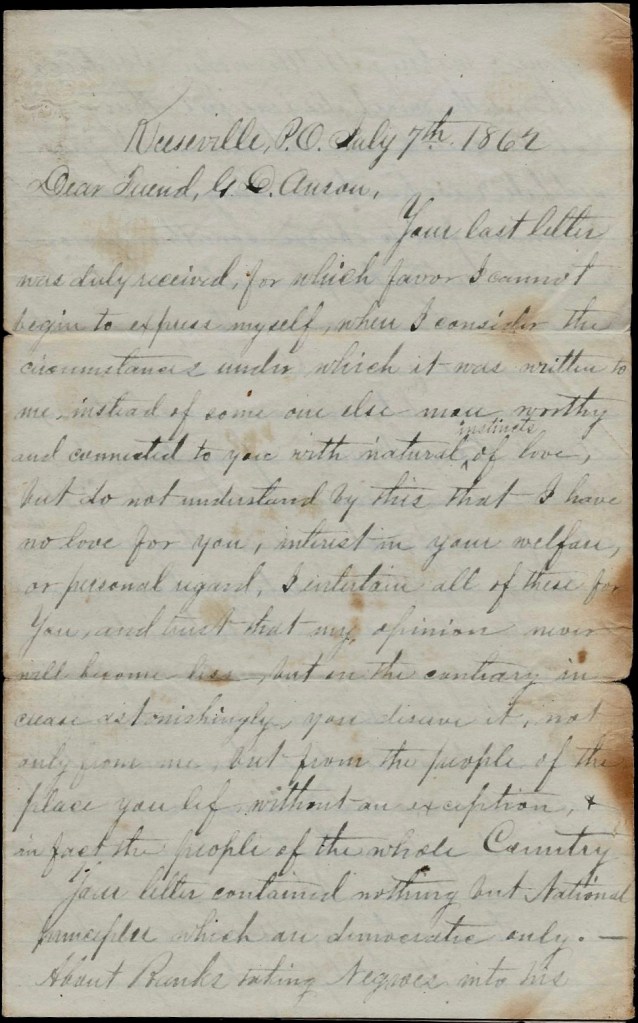
Dear Friend G. D. Anson,

Your last letter was duly received for which favor I cannot begin to express myself when I consider the circumstances under which it was written to me, instead of someone else more worthy and connected to you with natural instincts of love, but do not understand by this that I have no love for you, interest in your welfare, or personal regard. I entertain all of these for you, and trust that my opinion never will become less, but in the contrary, increase astonishingly. You deserve it, not only from me but from the people of the place you left without an exception, & in fact the people of the whole country.

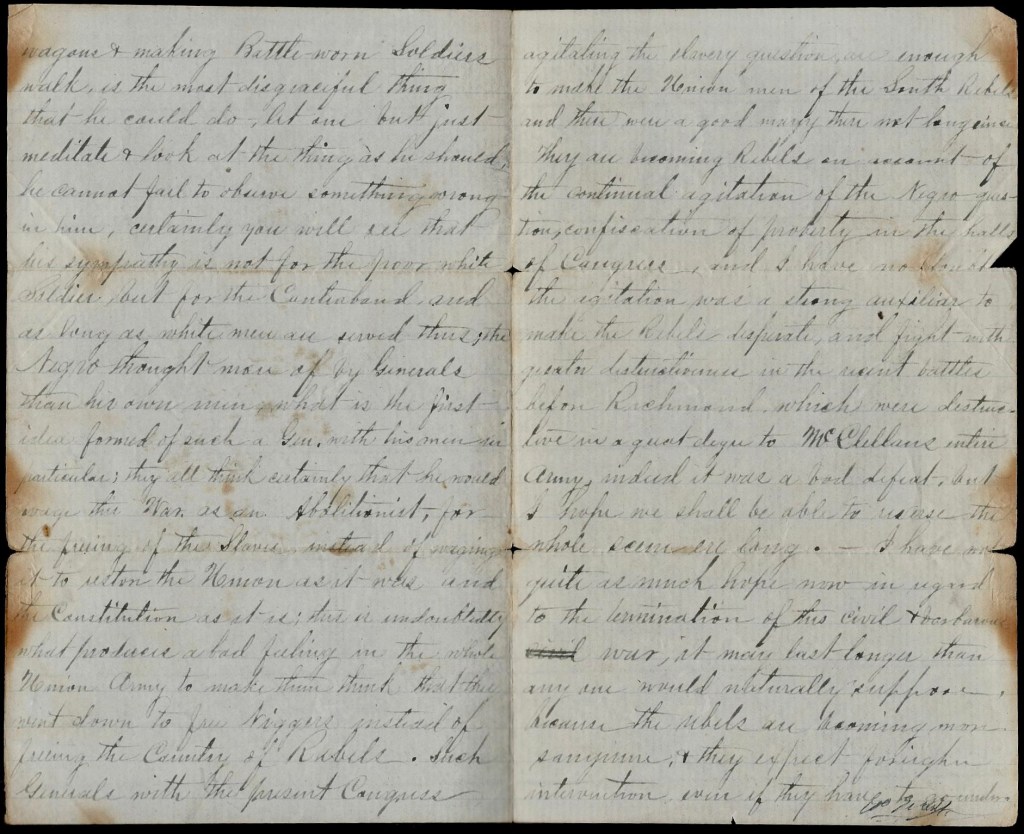
Your letter contained nothing but National principles which are democratic only. About Banks taking Negroes into his wagons and making battle-worn soldiers walk, is the most disgraceful thing that he could do, let one but just meditate & look at the thing as he should, he cannot fail to observe something wrong in him. Certainly you will see his sympathy is not for the poor white soldier but for the contraband and as long as white men are served thus, the Negro thought more of by Generals than his own men, what is the first idea formed of such a General with his men in particular. They all think certainly he would wage the war as an abolitionist for the freeing of the slaves instead of waging it to restore the Union as it was and the Constitution as it is. This is undoubtedly what produces a bad feeling in the whole Union army to make them think that they went down to free Niggers instead of freeing the country of rebels.

Such generals with the present Congress agitating the slavery question are enough to make the Union men of the South rebels and there were a good many there not long since. They are becoming rebels on account of the continual agitation of the Negro question, confiscation of property in the halls of Congress, and I have no doubt the agitation was a strong auxiliar to make the rebels desperate and fight with greater determination in the recent battles befre Richmond which were destructive in a great degree to McClellan’s entire army. Indeed, it was a bad defeat, but I hope we shall be able to reverse the whole scene ere long.

I have not quite as much hope now in regard to the termination of this civil & barbarous war. It may last longer than anyone would naturally suppose because the rebels are becoming more sanguine & they expect foreign intervention even if they have to go under… [rest of letter missing]

1863-65: Horace Benjamin Ensworth Letters

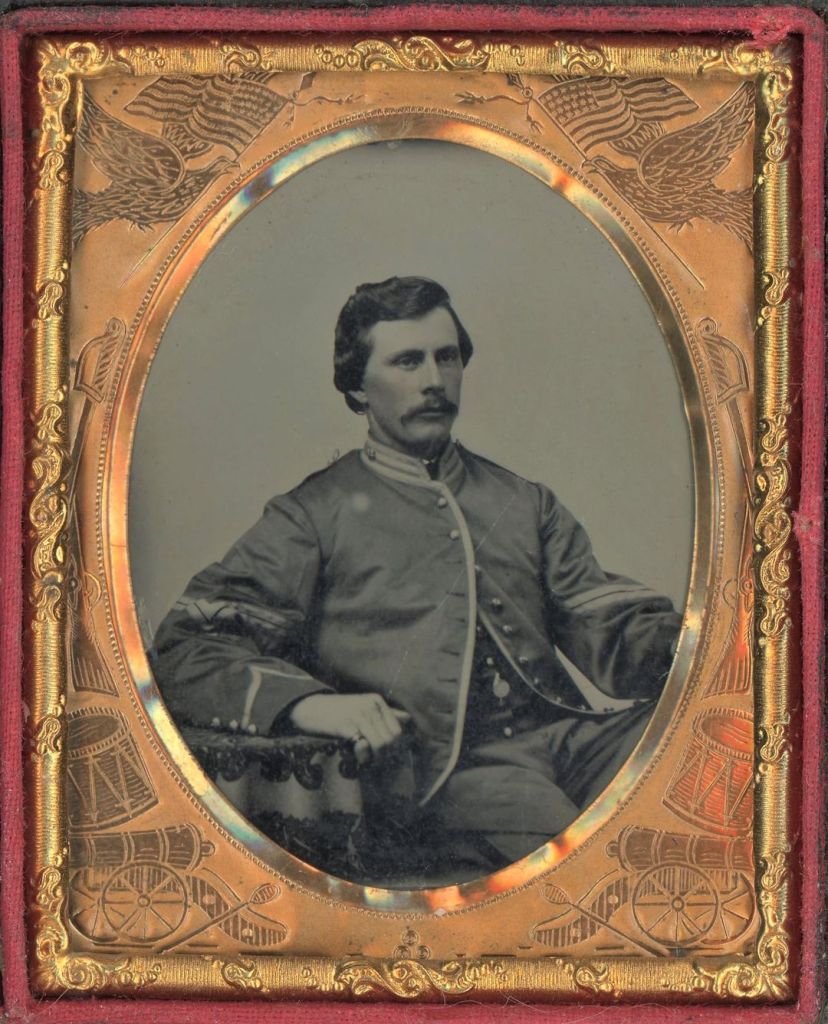
I could not find an image of Horace in uniform but here is one of Dorance Ferris who served in Co. K, 81st New York Infantry (Photo Sleuth)

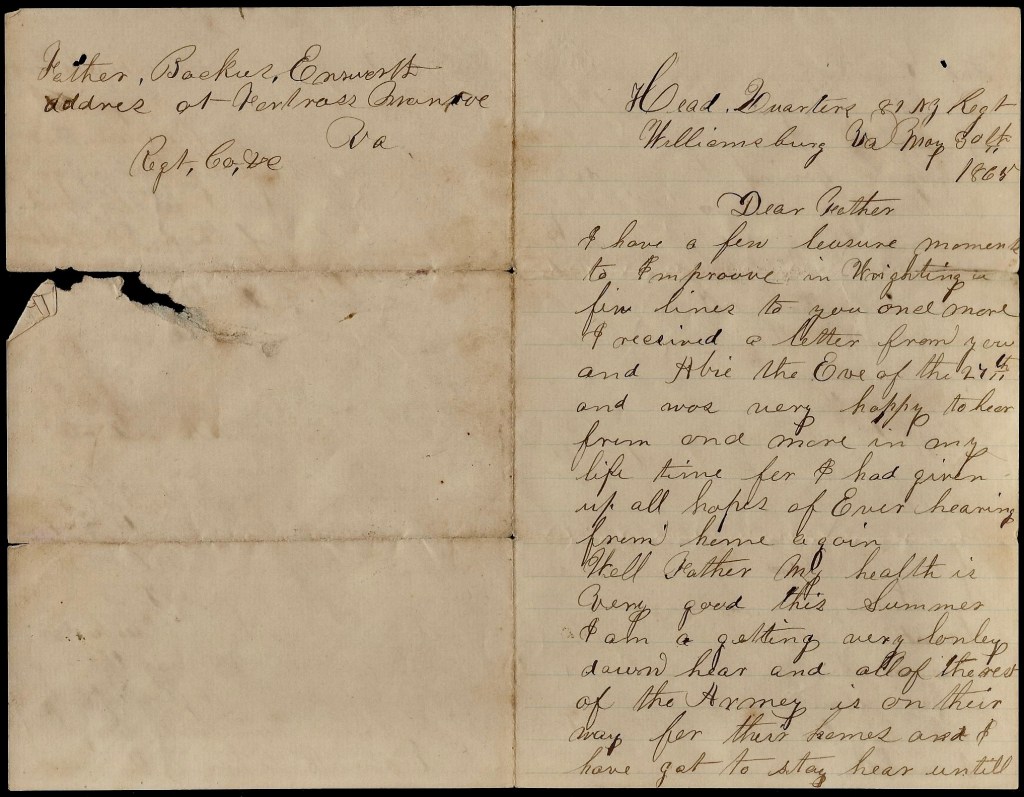
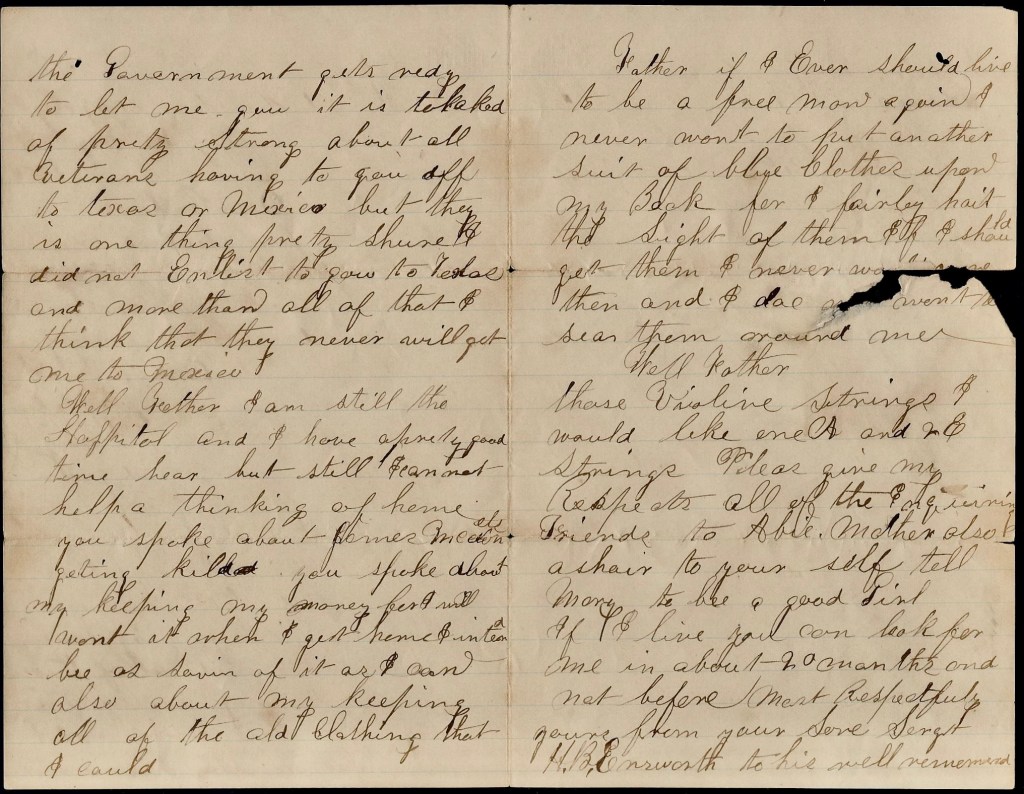
These four letters were written by Horace B. Ensworth (1842-Aft1870) who enlisted at the age of 21 at Oswego to serve three years in Co. B, 81st New York Infantry in late September 1861. He reenlisted in January 1864 and mustered out as a veteran on 31 August 1865 at Fortress Monroe.

In his enlistment records, Horace was described as standing 5 feet 5 inches tall, with gray eyes, and brown hair. He entered the service as a private and mustered out as a sergeant.

Horace was the son of Backus Ensworth (1812-1882) and his first wife, Hannah, who died in 1856. The Ensworth family were farmers in Mexico, Oswego county, New York.

See also—1862: Horace Benjamin Ensworth to Backus Ensworth published on Spared & Shared 22 on 2 May 2022.


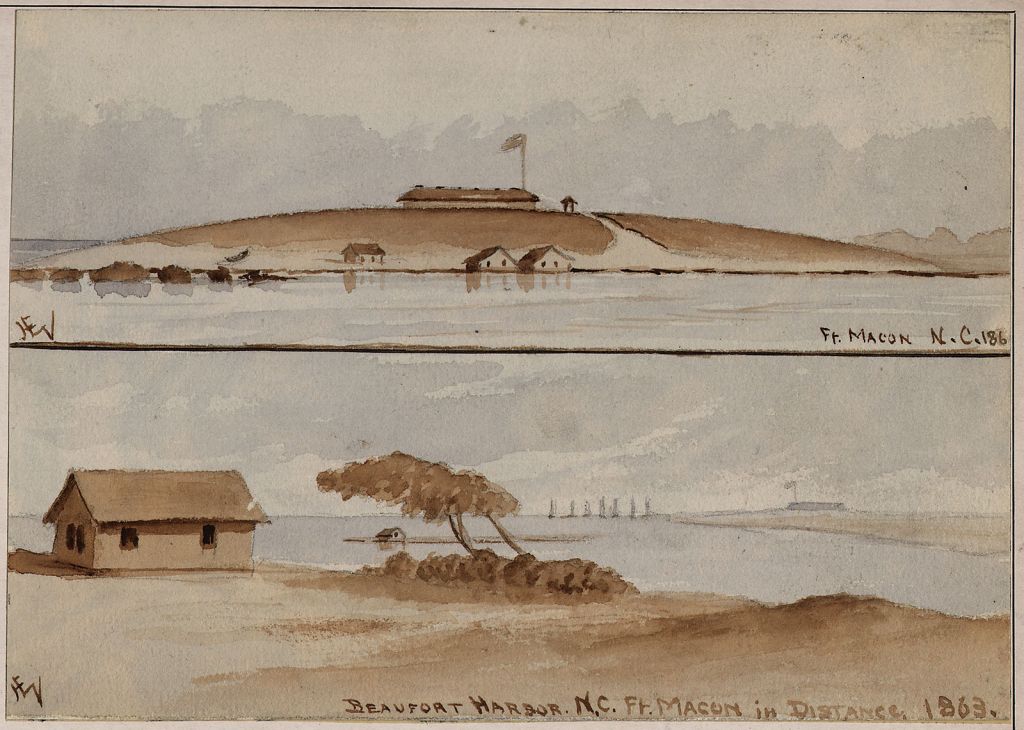
Fort Macon in Beaufort Harbor, North Carolina, 1863

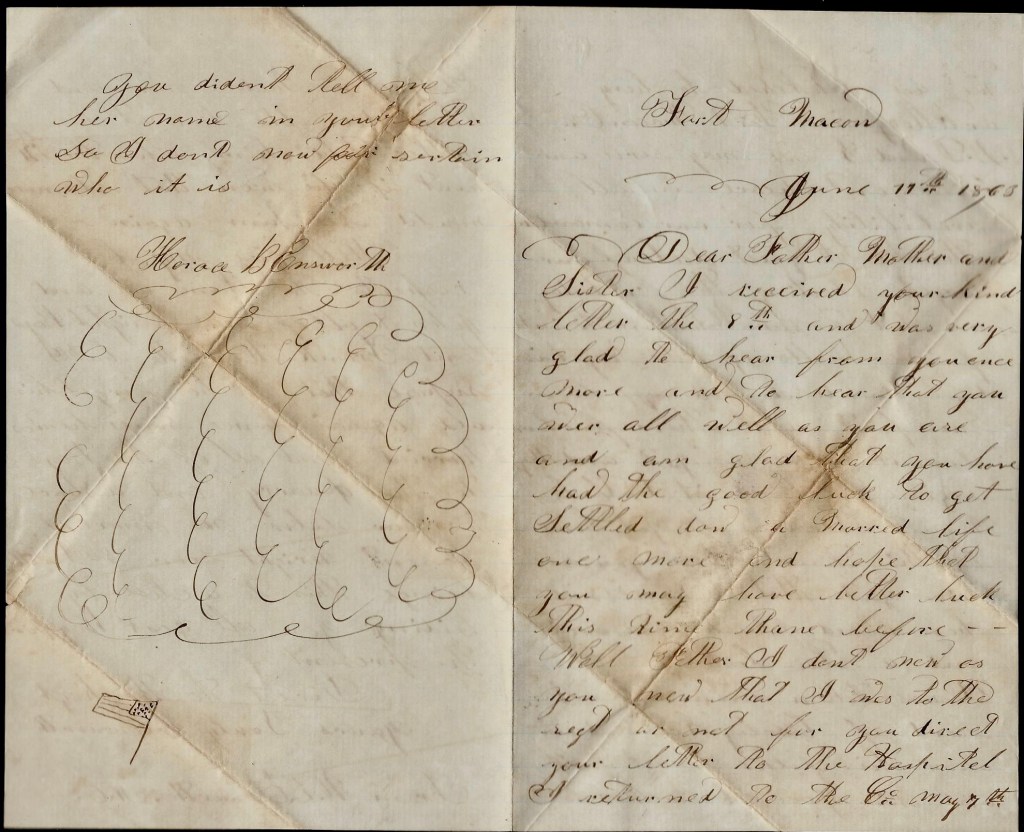
Letter 1

Fort Macon
June 11, 1863

Dear Father, Mother and Sister,

I received your kind letter the 8th and was very glad to hear from you once more and to hear that you were all well as you are and am glad that you have had the good luck to get settled down to a married life once more and hope that you may have better luck this time than before.

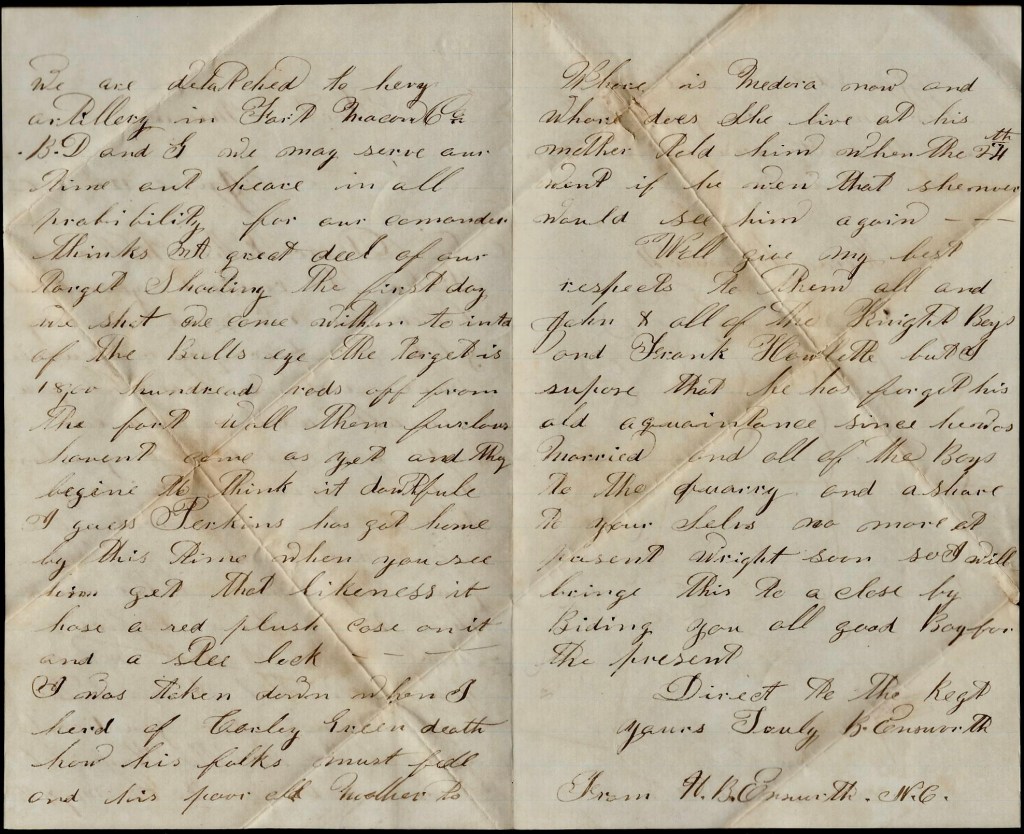
Well Father, I don’t know as you know that I was to the regiment or not for you directed your letter to the hospital. I returned to the company May 7th. We are detached to heavy artillery in Fort Macon—companies B. D, and G. We may serve our time and leave in all probability for our commander thinks a great deal of our target shooting. The first day we shot we came within two inches of the bulls eye. The target is 1800 rods off from the fort.

Well them furloughs haven’t come as yet and they begin to think it doubtful. I guess Perkins has got home by this time. When you see him, get that likeness. It has a red lush case on it and a steel lock.

I was taken down when I heard of Charley Green’s death. How his folks must feel and his poor old Mother too. Where is Medera now and where does she live at? His mother told him when the 24th went if he went that she never would see him again.

Well, give my best respects to them all and John and all of the Knight boys and Frank Howlette—but I suppose that he has forgot his old acquaintance since he was married—and all of the boys to the quarry, and a share to yourselves. No more at present. Write soon. So I will bring this to a close by bidding you all goodbye for the present.

Direct to the regiment. Yours truly, — B. Ensworth

From H. B. Ensworth, W. C.

You didn’t tell me her name in your letter so I don’t know for certain who it is.


Letter 2

Fort Macon
Beaufort, North Carolina
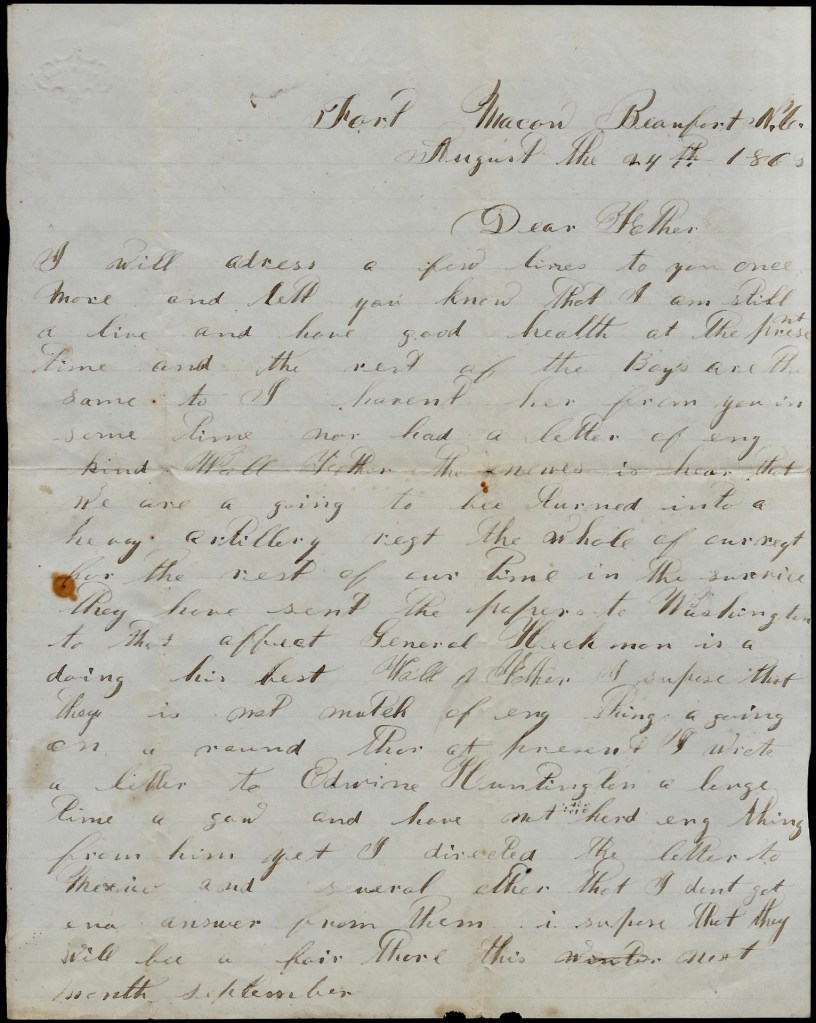
August 24, 1863

Dear Father

I will address a few lines to you once more and tell you now that I am still alive and have good health at the present time and the rest of the boys are the same to. I haven’t heard from you in some time nor had a letter of any kind.

Well, Father, the news is here that we are a going to be turned into a heavy artillery regiment—the whole of our regiment for the rest of our time in the service. They have sent the papers to Washington to that effect. General Heckman is a doing his best.

Well, Father, I suppose that there is not much of anything on around there at present. I wrote a letter to Edwin Huntington a long time ago and have not heard anything form him yet. I directed the letter to Mexico and several others that I don’t get any answer from them. I suppose that they will be a fair there this next month September.

Well, Father, I am a going to send home money soon and I want you to buy me a thrifty three-year old colt and take care of it for me if you will. If ever I should get home, I want some another to start a living. Have some $130 dollars a lending out now and more payday. I am a going to collect it all and send it off. I think that if I get $200 home, that will be better than nothing. You hadn’t let anyone see this letter around here.

Well I haven’t much more to write at present. Write soon. Direct as before and tell me the news of the day. My respects to all and a share to yourself. I still remain H. B. E.

To mother to write some of these fine days.


Letter 3

Camp 81st Regt. N. Y. State Volunteers
March 4th 1865

Friend F. D. Myers,

As I have a few leisure moments, I will improve them in scribbling a few lines to you once more. I hope that these few lines will reach you in as good health as yours of the 15th of February found me and the rest of the lads from the Quarry & Texas also.

Well, Fraid, there has been a great change in this regiment for the last four months. Almost all of the old veterans are promoted to non-commissioned officers all through the regiment. Marshall Mattison is sergeant in D Company. He was promoted the first of February. Also I was made sergeant in B. Company at the same time but Fraid, we have earned all that we have got since 1861 and allowing me to be the judge, we should of had it before. But still the officers that use to be in the regiment all had friends and of course they would look out for their friends before all of anyone else.

Well, Fraid, what is a going on around there in Mexico and Oswego City? What is the general opinion of the people around there? Where are you now about this war question? Do they think that it will be settled or will we have to fight it out till the very last? Sometimes I think that it will be settled without anymore fighting and then I think that it will be fight till the last. But I hope not.

Well Fraid, I suppose that you remember James Gant, that little sergeant of B Co.? He is here yet and sends his compliments to you.

Well, Fraid, when you see any of my folks, tell them that I am well as usial. Also give my compliments to all of my acquaintances and a share to yourself. From your old friend, — Horace B. Ensworth, Sergt. Company B, 81st N. Y. Vol.

To his friends as usual. Frasier D. Myers, Esq. Please write soon as convenient.

Address to:

Sergt. H. B. Ensworth
Co. B, 81st Regt. N. Y. S. Col.
1st Brigade, 3rd Division, 24th A. C.
Washington D. C.


Letter 4

Headquarters 81st N. Y. Regt.
Williamsburg, Va.
May 30th 1865

Dear Father,

I have a few leisure moments to improve in writing a few lines to you once more. I received a letter from you and Abbie the eve of the 27th and was very happy to hear from you once more in my life time for I had given up all hopes of ever hearing from home again.

Well, Father, my health is very good this summer. I am a getting very lonely down here and all of the rest of the army is on their way home and I have got to stay here until the government gets ready to let me go. It is talked of pretty strong about all veterans having to go off to Texas or Mexico but there is one thing pretty sure, I did not enlist to go to Texas and more than all of that, I think that they never will get me to Mexico.

Well, Father, I am still in the hospital and I have a pretty good time here but still I cannot help a thinking of home. You spoke about James Mc____ getting killed. You spoke about my keeping my money for I will want it when I get home. I intend to be as saving of it as I can. Also, about my keeping all of the old clothing that I could.

Father, if I ever should live to be a free man again, I never want to put on another suit of blue clothes upon my back for I fairly hate the sight of them. If I should get them, I never would wear them and I do not want them to see them around me.

Well Father, those violin strings I would like one.

Please give my respects to all of he enquiring friends, to Abbie, to Mother, also a share to yourself. Tell Mary to be a good girl. If I live you can look for me in about 20 months and not before.

Most respectfully yours. From your son, — Sergt. H. B. Ensworth

To his well remembered Father, Backus Ensworth.

Address at Fortress Monroe, Va.

1864: George D. Anson to Serena (Spear) Anson

I could not find an image of George but here’s a great ninth-plate tintype of Henry A. Burr of Co. H, 1st Vermont Cavalry (Dan Binder Collection)

This letter was written by George D. Anson (1839-1902) of Essex county, New York, who enlisted on 17 September 1861 to serve three years in Co. A, 1st Vermont Cavalry. He was take prisoner by Mosby at Broad Run, Virginia, on 1 April 1863 but was paroled a week later. He mustered out of the service in November 1864.

George was the son of Amos Anson (1786-1842) and Serena Spear (1800-1807). After George returned from the war he married first Caroline Margaret Stower (184701877), and second Etta J. Anson (1860-1931). Though he told his mother he thought of studying to be a doctor after the war, I don’t see any evidence that he did. He was a merchant in 1880.

See also—1863: George D. Anson to Serena (Spear) Anson published on Spared & Shared 22 in November 2020.

Transcription

Head Quarters 6th Army Corps
Brandy Station
February 24, 1864

My dear mother,

It is some time since I received a letter but as I had just wrote to Ed Anson, I didn’t think that it was necessary to write so soon and now there is nothing to write. Everything is as still here as can be.

We have very little to do and are enjoying ourselves right well. Don’t know how long it may last though. We may be ordered to the regiment at any time. I understand that no detail is allowed to stay away more than six months and we been here six months today. They like us very well. We will probably be sent back. I hope though that we will remain here until our time is out. It is much easier than being with the regiment.

You must not expect to receive an interesting or long letter from me this time for I am just getting over one of my old fashioned headaches. I caught a dreadful cold and it settled all over me. I am getting over it now though and feeling pretty well tonight. Shall feel perfectly well in a day or two.

I received a letter from Nellie two days ago. She tells me that they have lost their little boy and she seems to mourn its loss very much. I cannot feel as I should if I had ever seen their children and formed attachments for them. Albert is not well. Has been bleeding again. It don’t seem as though that he could stand it long. I pity them all very much. How very unhappy they all must be. Poor Nellie, I think that she is a splendid woman. She has shown herself noble and worthy of praise. I cannot blame her much for her supposed misconduct. If anyone deserves blame, I think that it is Mrs. Meech and next to her it is Albert. I cannot blame Nellie. Mariette was quite unwell when she last wrote me but Nellie told me that she was well again. I wish that none of them had ever gone west.

Has Juliette and Ed got back from Vermont yet? I wrote to them some time since but have received no answer.

One of our soldiers that reenlisted and went home to Vermont has just got back. He tells me that he was Erv Rowley and that he (Erv) told him that he was going somewhere one evening with his wife and saw people from York State and that his horses run onto a wood pile and hurt them all pretty bad—Erv’s wife broke her fingers—and that the other woman broke her leg, and he thought that they called the woman Juliette. I feel anxious about the affair and would like to have some of you write and tell me how it is. I expect that that is the reason that Ed & Kate do not answer my letters. If they have broken their arms and legs, it is a good excuse. I have not heard from [ ] in some time.

I understand that Charlie and Frank have gone home on a furlough. Expect that they are having a great time. Did they come to see you? We are to be paid off tomorrow. I shall draw six dollars.

Reuben is with us. He is well. We had a Corps inspection yesterday and we understand that there is to be an inspection of the army by President Lincoln next week.

There are any quantity of women in the army now. They are supposed to be officer’s wives, but probably that a great many of them are what are called fancy women.

Well, Mother, I did not reenlist. Are you glad or sorry? I am glad. I would not sell myself for 3 years longer for all of their bounties put together. Those who did reenlist have just returned to the regiment. Some of them look as though they had had pretty hard times. They have all spent between two and three hundred dollars. I would like to see the war finished before I go home and hope that it will be ended now before I go home. I suppose that you never hear from P____, only by Ed Anson, do you. What do you think that I have determined to study for when I get home? I will tell you but for I may change my mind. I think now of being a doctor. Doctor Anson. Only think of it. This letter cannot interest you but I can do no better this time. you see there is nothing to write but nevertheless I hope that you will answer soon and believe me very truly your son, — Doctor Anson