1863: Samuel W. Madison to Nancy Madison

I could not find an image of Samuel but here is an unidentified Union private approximately Samuel’s age.

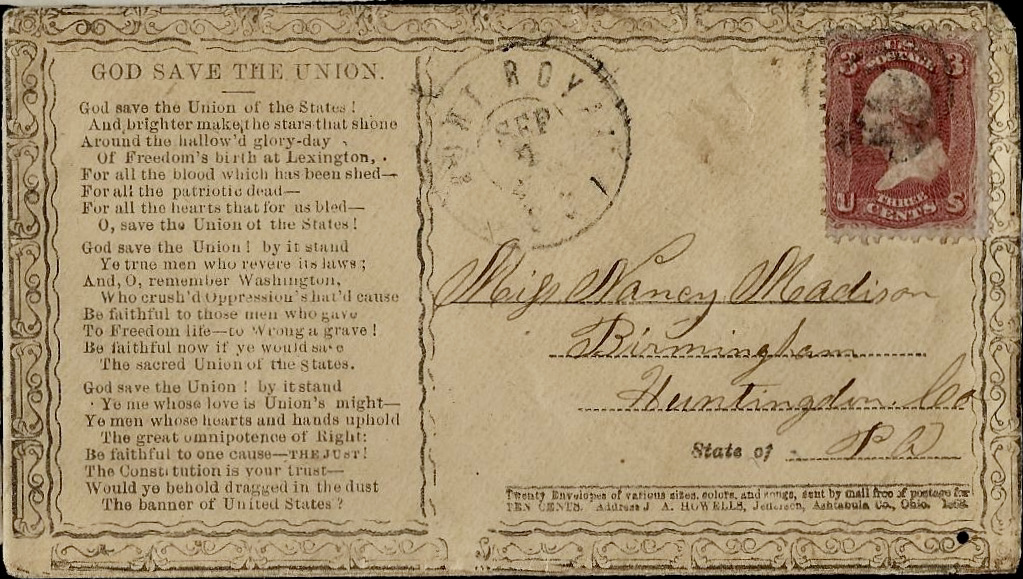
This letter was written by Samuel W. Madison (1840-1864) while serving in Co. F, 13th Indiana Infantry. According to muster records, Samuel enlisted as a private on 19 June 1861 and he died of chronic dysentery at Davids Island, New York, on 14 February 1864.

A claim for a widow’s pension was filed by Samuel’s mother, Elizabeth, after she received word of his death. She contended that relied upon the wages of her son, her husband Robert having died in 1853.

The 13th Indiana Volunteer Infantry Regiment was originally accepted for state service for one year and was organized at Indianapolis for the U.S. service by volunteers from the companies in camp. It was one of the first four regiments volunteering from the state for three years.

Transcription

Camp 13th Regiment
Folly Island, South Carolina
September 8, 1863

Dear Sister,

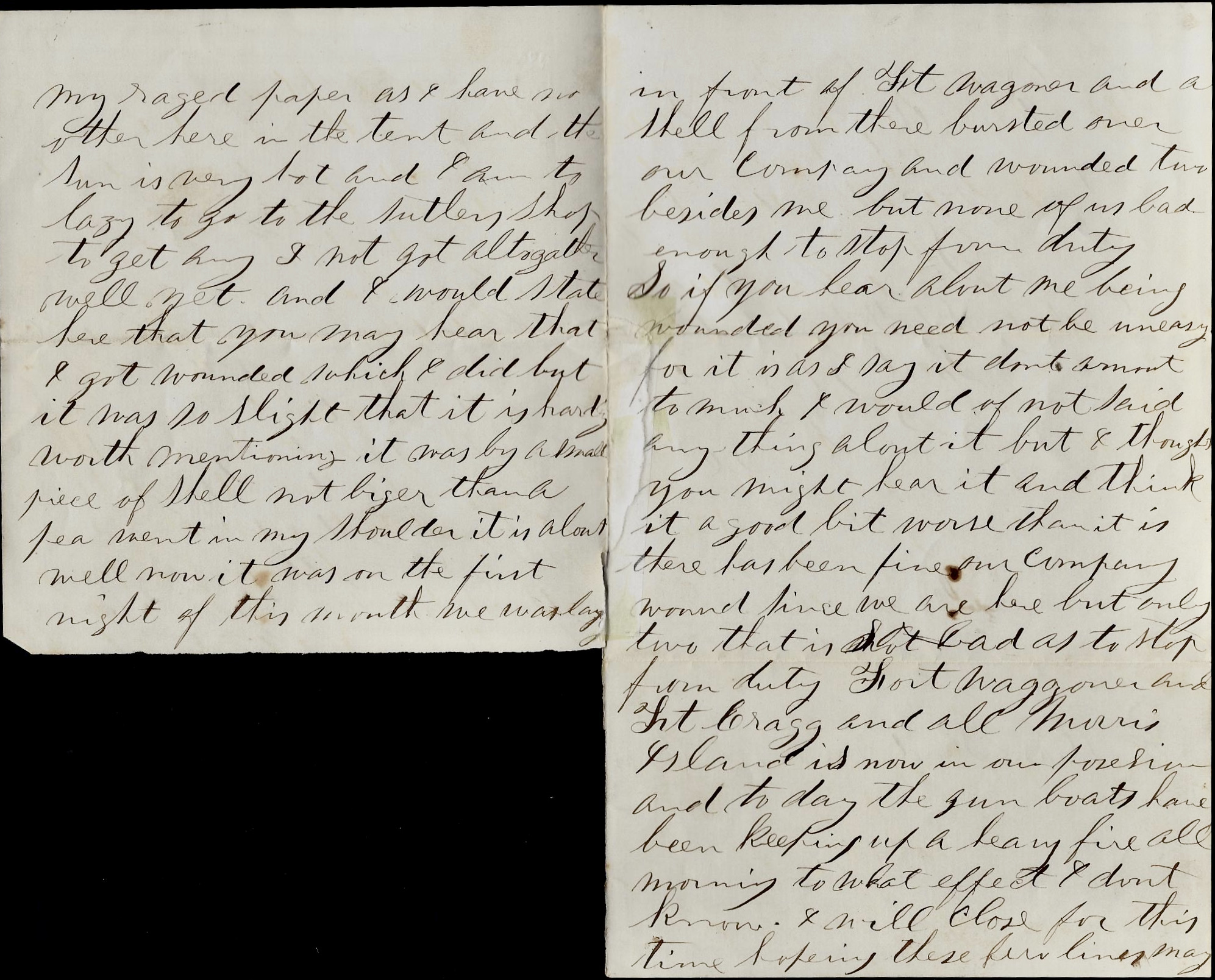
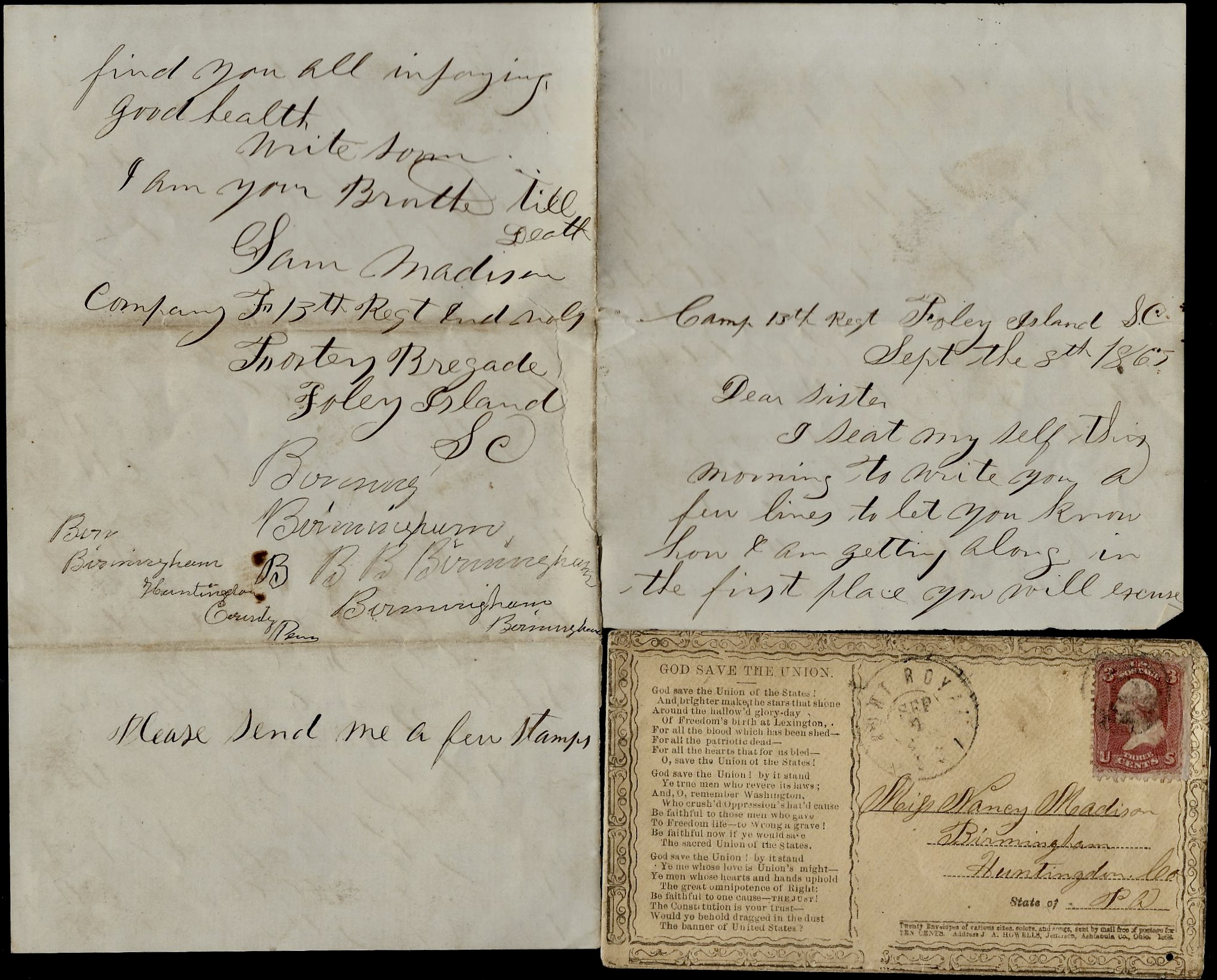
I seat myself this morning to write you a few lines to let you know how I am getting along. In the first place, you will excuse my ragged paper as I have no other here in the tent and the sun is very hot and I am too lazy to go to the sutler’s shop to get any.

I have not got altogether well yet and I would state here that you may hear that I got wounded which I did but it was so slight that it is hardly worth mentioning. It was by a small piece of shell—not bigger than a pea. Went in my shoulder. It is about well now. It was on the first night of this month. We was laying in front of Fort Wagner and a shell from there burst over our company and wounded two besides me, but none of us bad enough to stop from duty. So if you hear about me being wounded, you need not be uneasy for it is as I say. It don’t amount to much. I would of not said anything about it but I thought you might hear it and think it is a good bit worse than it is.

There has been five in our company wounded since we are here but only two that is shot bad as to stop from duty. Fort Wagner and Fort Gregg and all Morris Island is now in our possession and today the gunboats have been keeping up a heavy fire all morning—to what effect, I don’t know.

I will close for this time hoping these few lines may find you all enjoying good health. Write soon. I am your brother till death. — Sam Madison

Company F, 13th Regiment, Indiana Volunteers
Foster’s Brigade, Folly Island, S. C.

Please send me a few stamps.
1862: Albert Clarence Aubery to Cullen Bullard

This letter was written by 17 year-old Albert Clarence Aubery (1844-1932), the son of Harvey F. Aubery and Annabella Dodge of Brooklyn. In 1860, Albert’s father was a liquor dealer in NYC. After preparatory school, Albert attended the University of Vermont and then graduated from Columbia College in 1867 and became a lawyer.

Albert wrote the letter to his cousin, Cullen Bullard, Jr., the son of Cullen Bullard (1806-1883) and Wealthy Bullard Aubrey (1812-1894) of Weybridge, Vermont.

Albert’s letter informs his cousin of the grand welcoming party sent to greet Gen. Michael Corcoran—a favorite Irish son of NYC—who had recently been released from Rebel prison where he had been confined for over a year.

Transcription

Addressed to Master Cullen Bullard, Weybridge, Vermont

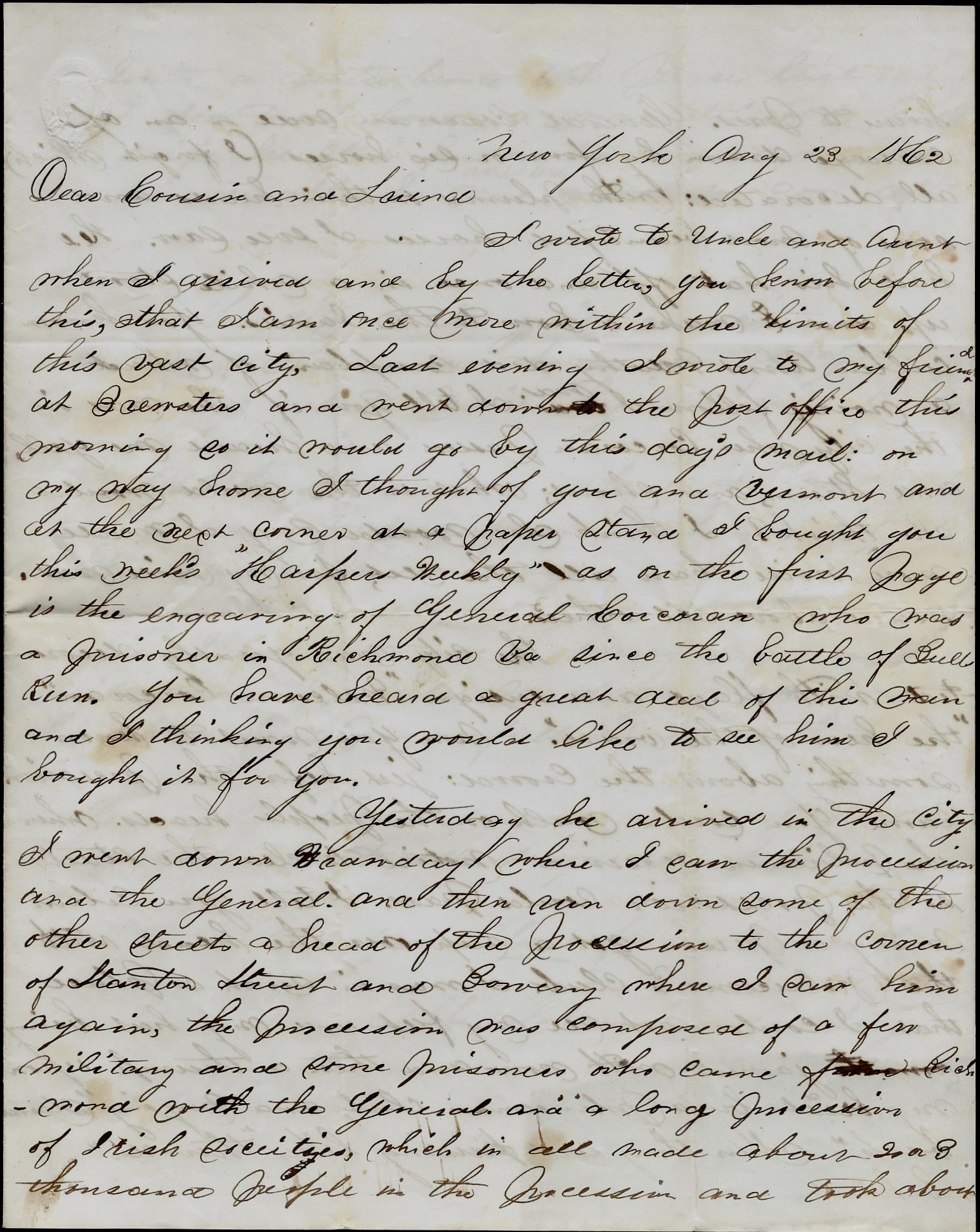
New York
August 23, 1862

Dear Cousin and Friend,

I wrote to Uncle and Aunt when I arrived and by the letter, you know before this, that I am once more within the limits of this vast city. Last evening I wrote to my friend at __emsters and went down to the post offie this morning so it would go by this day’s mail. On my way home, I thought of you and Vermont and at the next corner at a paper stand, I bought you this week’s Harpers Weekly as on the first page is the engraving of General [Michael] Corcoran who was a prisoner in Richmond, Va., since the Battle of Bulls Run. You have heard a great deal of this man and I thinking you would like to see him, I bought it for you.

Gen. Michael Corcoran’s lithograph in Harper’s Weekly, August 1862

Yesterday he arrived in the city. I went down Friday where I saw the procession and the General and then run down some of the other streets ahead of the procession to the corner of Stanton Street and Bowery where I saw him again. The procession was composed of a few military and some prisoners who came from Richmond with the General and a large procession of Irish societies which in all made about 2 or 3 thousand people in the procession and took about an hour to pass. General Corcoran rode in an open carriage drawn by four or six horses (I forget which), all decorated (with plumes on their heads and some of the most beautiful horses I ever saw. He had his hat off and once in awhile stood up to make a bow to the ladies. You know, Cullen, Aunt Wealthy did complain of what a noisy fellow I was. I tell you, if she was in the city when Corcoran passed and heard me yell and scream and shout, what in the world would she think? I think she would say I made more noise than all the rest for my voice was heard above all others.

The city was greatly decorated with flags and ensigns, “Welcome Corcoran—the Hero of the Brave.” Now you want to know something about the crowd? Just before the procession came, you could walk on the people’s heads, when the policemen received notice to clear the streets so the procession could pass. I tell you, Cullen, many a person got a sap over he head with the policeman’s club. I was in such a place that I could not see my feet and my hat being jammed with now and then a thump upon my breast by a policeman’s club and begging, “Stand Back!” when they are pushing like “thunder” behind.

Quite a disturbance took place last evening next door to our house. A man tried to kill his wife. He stabbed her in the head and cut her considerable. He was arrested soon after.

The city is in quite an excitement about the war and the rumor of Gen. Pope being cut to pieces by “Stonewall” Jackson.

Tell Mother I received the letter she sent which came from Danbury. I go to Danbury on Wednesday. Cullen, I am in a great hurry and would write more. I would send and write you the whole four pages full if I had time. You will please excuse all imperfections. Remember me to all enquiring friends. I remain your close friend and cousin, — Albert Clarence Aubery