1862: Ferdinand Dreher to John W. Le Barns

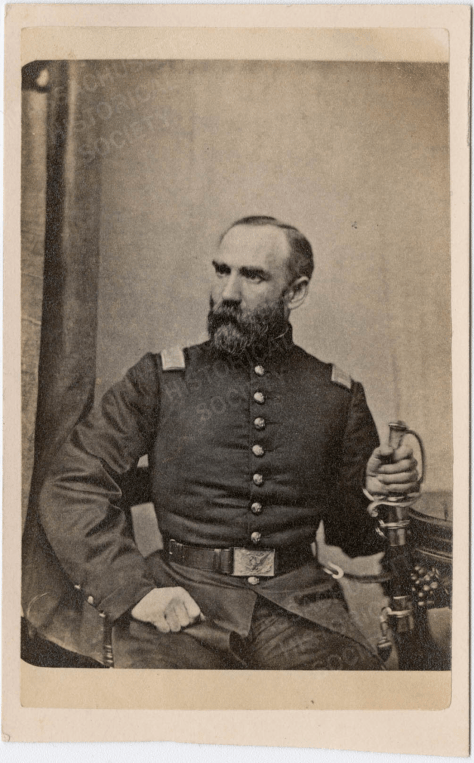
Capt. Ferdinand Dreher, Co. C. 20th Massachusetts (Mass. Historical Society)

The following letter was penned by Capt. Ferdinand Dreher (1821-1863) of Co. C, 20th Massachusetts Infantry. Ferdinand was an emigrant from Germany who married in Boston, Massachusetts, in 1857 to Margaret Lacroix. He was badly wounded at the Battle of Balls Bluff but returned to the regiment in time for the Peninsula Campaign. He was wounded again in the Battle of Fredericksburg and never recovered. He died of his wounds on 1 May 1863 as the Lieutenant Colonel of the regiment. Prior to his enlistment, Ferdinand was employed in Boston as a carriage painter.

Ferdinand wrote the letter to a former lieutenant of the regiment, John W. Le Barnes. He shares with him some of the internal politics and jealousies that were common in many regiments, but particularly in the 20th Massachusetts, sometimes called the “Harvard Regiment” because so many of its officers and enlisted men were Harvard men or from the privileged class of Boston society.

[Note: This letter is from the private collection of Greg Herr and was made available for transcription and publication on Spared & Shared by express consent.]

T R A N S C R I P T I O N

Bolivar Heights, Va.
October 8, 1862

Mr. Le Barns, dear sir!

When I joined the regiment in the month of March last, it was in Bolivar and I did find you there in some disagreeable position which was anyhow honorable for you. Since that time I had to go home again to restore myself for another warfare, came back to the regiment, had to march to fight again and at present I find myself on the same place on which I have been six months ago. I suppose it would have been the same profit for me and the country if I had stopped in Boston, waited and then come to Bolivar. What a history we have to make about this war and our regiment. Colonel [William Raymond] Lee is an old, out-played and out-worn sick man but still he is commanding our Brigade.

Lieut. Col. [Francis Winthrop] Palfrey who had the unwise taste to interfere with the Governor’s doings about the officer’s commissions and through that nonsense brought himself into blame and who did trouble you about the negro to whom you gave the liberty, the same Mr. Palfrey is now at home wounded and very likely he has yet not the power to overjump the experienced & brave Lieut. Murphy again as he used to do tree times.

William Francis Bartlett—“the soul & real commander of our 20th” [Massachusetts Historical Society]

Major [Paul J.] Revere who is wounded too has become a Lieut. Colonel in Sumner’s staff and doesn’t belong anymore to our regiment. Capt. [William F.] Bartlett, the soul & real commander of our 20th is at home a cripple. Capt. [William Lowell] Putnam a cripple too, is recruiting at home and does not want to come back to the regiment, neither as a Major. Then it is to me who comes in the next & so I am commanding—since the last battle—the regiment. But how long will it go so. Why they don’t make a Major, and then, who will it be? Am I in the way? If they know a good, brave man, a abolitionist & a free Republican, I feel proud to serve under such an officer as subaltern and let us have such a one. But if they choose a Beacon Street boy or a Harvard College youth, or overjump me, then I wish you would help me that I will get my discharge as a cripple.

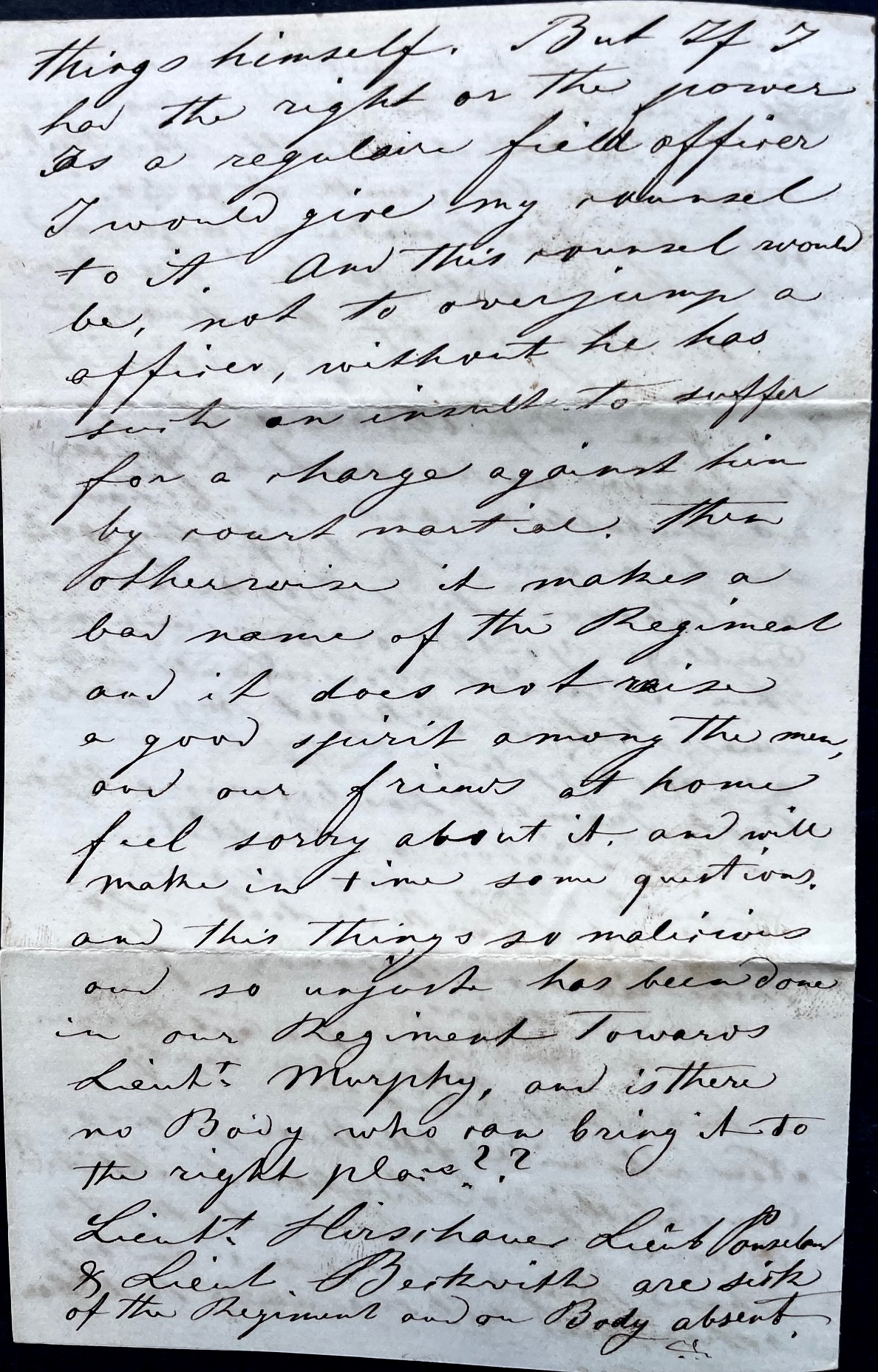
Capt. [Henry Martyn Tremlett has become a Major. Lieut. [Charles Lawrence] Pierson a Lieutenant-Colonel. Lieut. [George E.] Perry has resigned. Lieut. [James Jackson] Lowell is dead. So there are now vacancies for one Major; one Captain, or if Capt. becomes Major, two Captains; two First Lieutenants. Now who will fill those places? Cousinship or business relations? Of course I have nothing to say to those things because I am only acting, and Colonel Lee wants to do the things himself. But if I had the right or the power as a regular field officer, I would give my counsel to it. And this counsel would be not to overjump an officer without he has such an insult to suffer for a charge against him by court martial. Then, otherwise, it makes a bad name of the regiment and it does not raise a good spirit among the men and our friends at home feel sorry about it and will make in time some questions. And this thing so malicious and so unjust has been done in our regiment towards Lieut. Murphy and is there no body who can bring it to the right place??

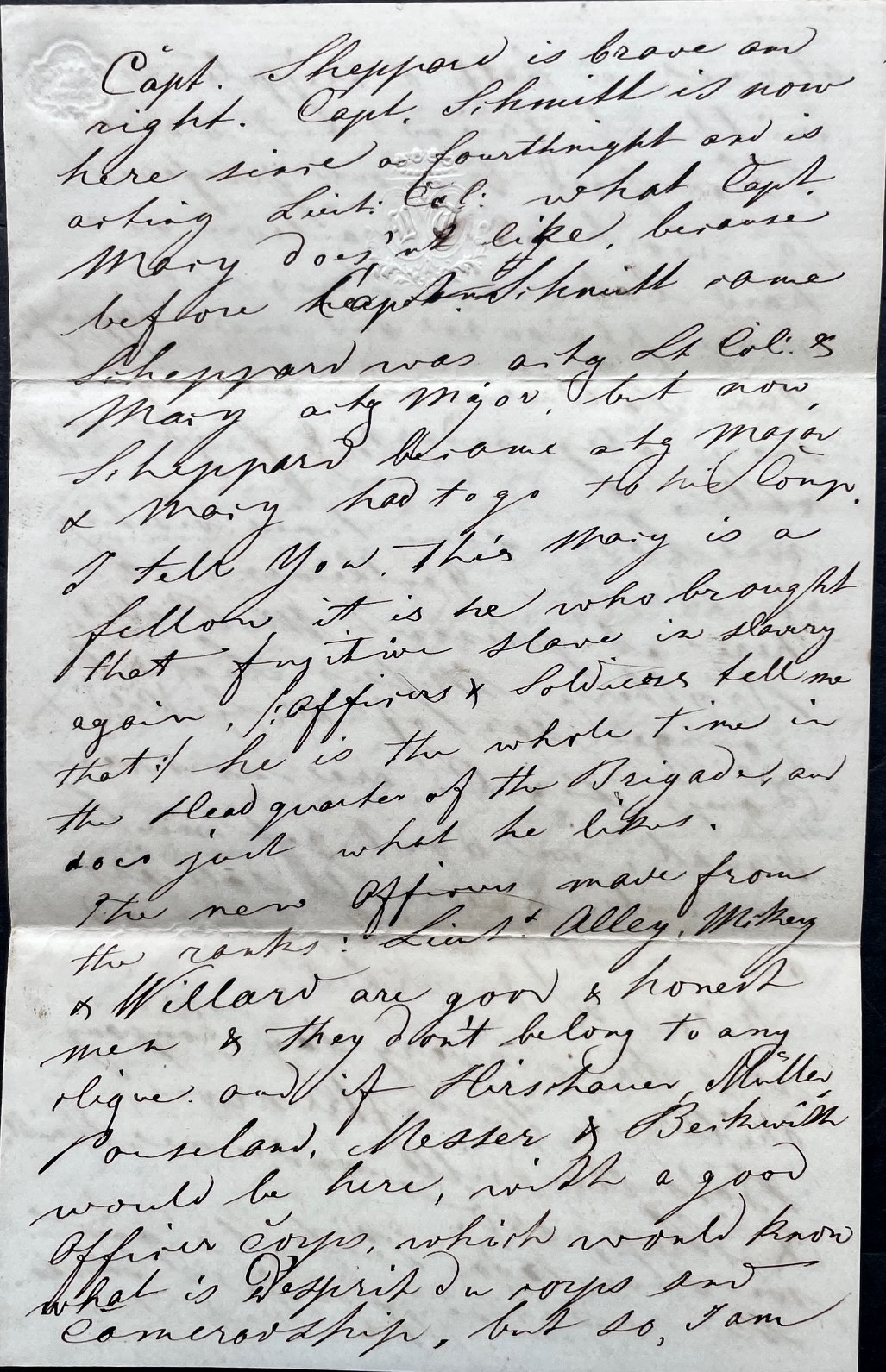
Lieut. Hirsthaver, Lieut. Panselar & Lieut. Berkwith are sick of the regiment and in body absent. Capt. [Allen] Shephard is brave and right. Capt. [George Adam] Schmitt is now here since a fortnight and is acting Lieut. Colonel. What Capt. [George N.] Macy doesn’t like because before Capt. Schmitt came, Shephard was acting Lieut. Colonel & Macy acting Major. But now Shephard became acting Major and Macy had to go to his company. I tell you, this Macy is a fellow. It is he who brought that fugitive slave in slavery again. Officers and soldiers tell me that he is the whole time in headquarters of the Brigade and does just what he likes.

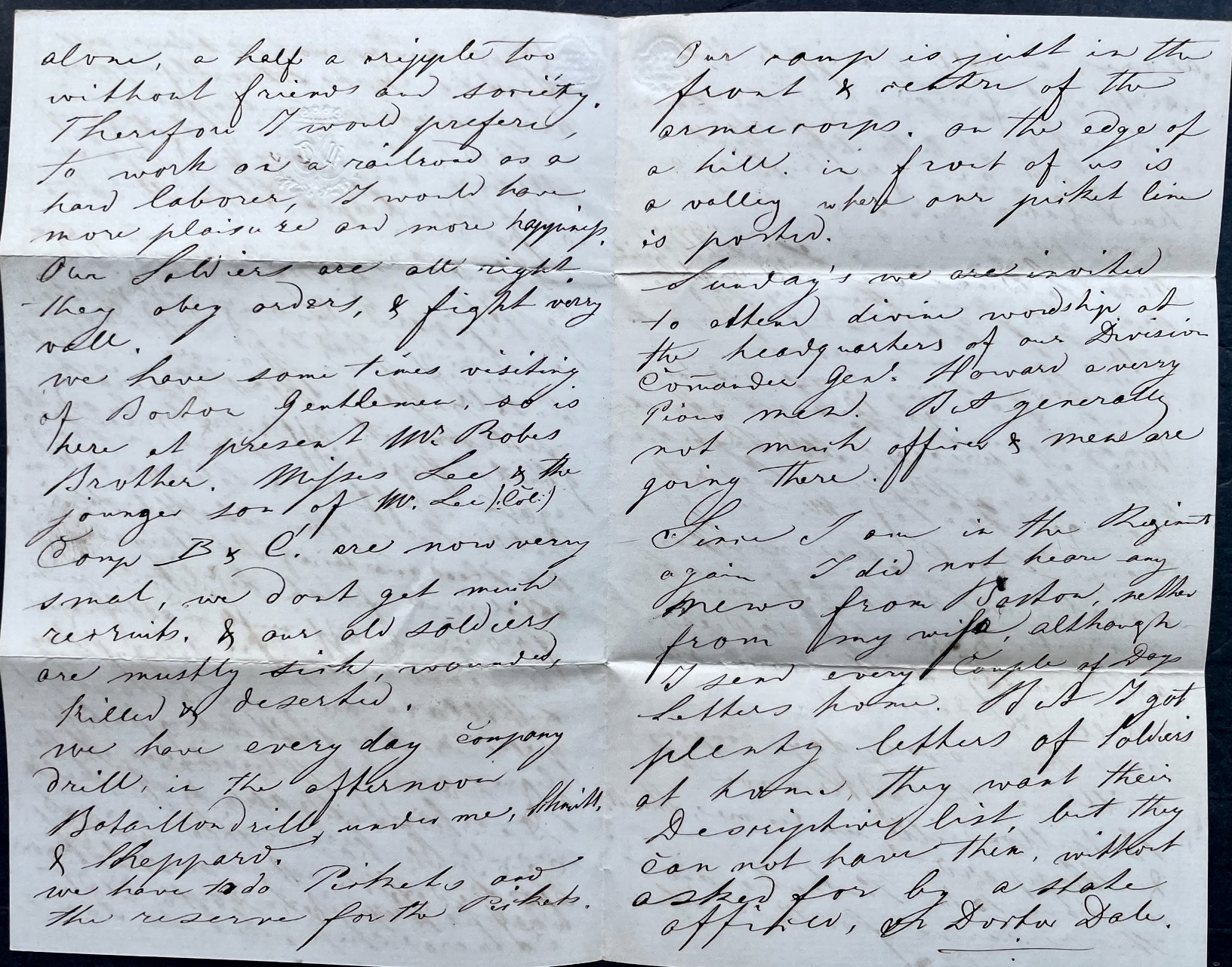
The new officers made from the ranks—Lieut’s. Alley, Mikey & Willard are good & honest men and they don’t belong to any clique. And if Hirsthouer, Miller, and Panselar, Messer & Beckwith would be here with a good officer corps, which would know what is d’esprit de corps and comradeship, but so I am alone, a half a cripple too with no friends and society. Therefore, I would prefer to work on a railroad as hard laborer. I would have more pleasure and more happiness. Our soldiers are all right. They obey orders & fight very well.

We have sometimes visiting of Boston gentlemen, so is here at present Mr. Rope’s brother, Misses Lee & the younger son of Mr. Lee (Col.)

Company B & C are now very small. We don’t get much recruits & our old soldiers are mostly sick, wounded, killed & deserted. we have every day company drill in the afternoon, Battalion drill under me, [ ] and Shephard. we have to do pickers and the reserve for the pickets.

Our camp is just in the front & centre of the Army Corps. On the edge of a hill in front of us is a valley where our picket line is posted. Sundays we are invited to attend divine worship at the headquarters of our Division Commander Gen. [O. O.] Howard—a very pious man. But generally not much officers & men are going there.

Since I am in the regiment again, I did not hear any news from Boston, neither from my wife, although I send every couple of days letters home. But I got plenty letters of soldiers at home. They want their Descriptive List but they cannot have them without asked for by a state officer or Doctor [William Johnson] Dale.

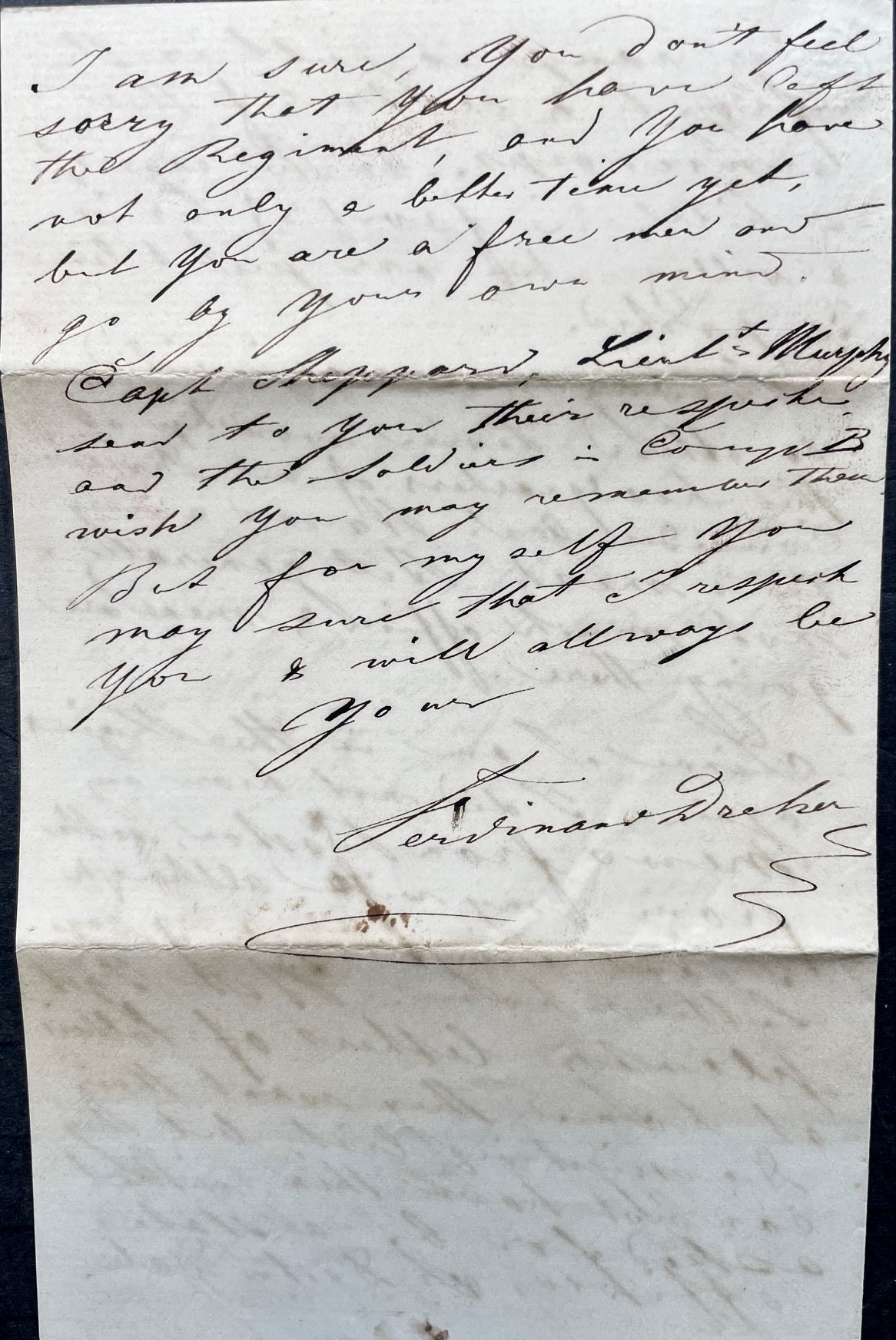
I am sure you don’t feel sorry that you have left the regiment and you have not only a better time yet, but you are a free man and go by your own mind.

Capt. [Allen] Shephard & Lieut. Murphy send to you their respects and the soldiers in Co. B wish you may remember them. But for myself, you may be sure that I respect you and will always be your, — Ferdinand Dreher

1861: John Pfeifer to Sallie (Strucker) Pfeifer

This letter was written by John Pfeifer (1837-1898), alias John Fifer, who served early in the Civil War as a private in Co. C, 8th Indiana Infantry—a three month’s organization. When he mustered out of the regiment on 6 August 1861, he gave his residence place as Delaware county, Indiana. John wrote the letter to his wife, Sarah (“Sallie”) Strucker with whom he married in January 1848 in Ripley, Indiana. John was a German emigrant and a boot/shoemaker by trade. After he was discharged from the 8th Indiana, he returned to Muncie, Indiana, but a year later enlisted again for three years as a sergeant in Co. D, 84th Indiana. He lived out his days in Muncie.

The 8th Indiana Volunteer Infantry was organized at Indianapolis, Indiana, on April 21, 1861, for a three-month enlistment. The regiment was assigned quarters in Camp Morton initially where they drilled and they remained there until 1 June when they moved to an ecampment five miles east of Indianapolis called Camp McClellan. Named for Major General George B. McClellan, commander of the Department of the Ohio, the camp was sited on the Jacob Sandusky farm, future site of Irvington. They remained there until mid June when they were ordered to Clarksburg, West Virginia, and attached to William Rosecrans’ Brigade, in George B. McClellan’s Provisional Army of West Virginia. They fought in the Battle of Rich Mountain on July 11, 1861 and returned to Indianapolis in August to be mustered out.

T R A N S C R I P T I O N

Camp McClellan
Indianapolis
5th [June 1861]

Dear Sallie,

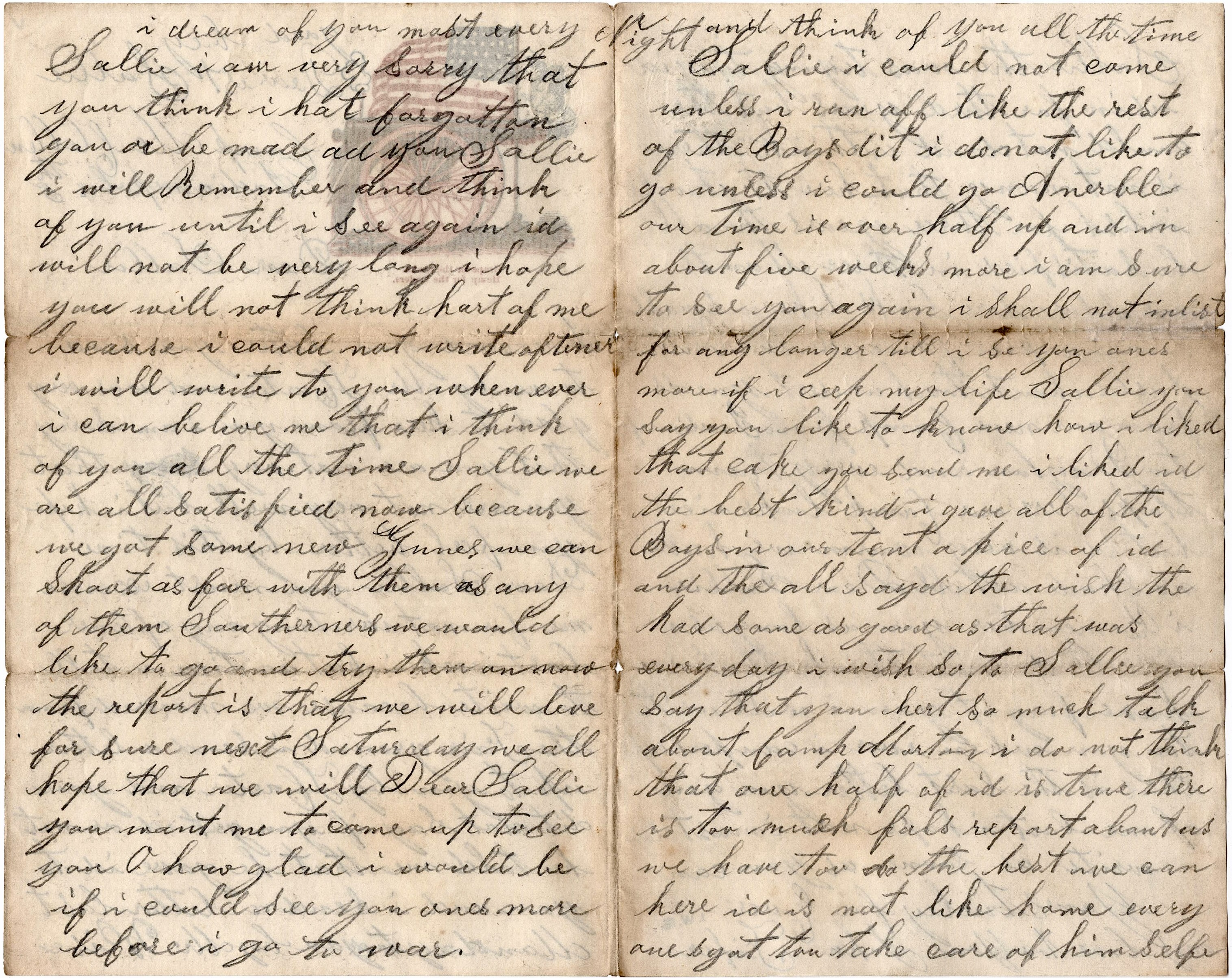
I received your letter you sent to me by Mr. Harter and was very glad to hear from you. I am sorry that you are not very well but I hope you feel better by this time. Dear Sallie, you must excuse me for not writing any oftener. Last week I had no time atall to write because we moved from the fairgrounds. I sent a letter up to you by Harter and you did not say if you got it or not. He told me that he gave it to you and I sent a letter last Monday to you by Mr. Wise.

Sallie, I am very sorry that you think I had forgotten you or be mad at you. Sallie, I will remember and think of you until I see you again. I will not be very long. I hope you will not think hard of me because I could not write oftener. I will write to you whenever I can. Believe me that I think of you all the time.

Sallie, we are all satisfied now because we got some new guns. We can shoot as far with them as any of them Southerners. We would like to go and try them on now. The report is that we will leave for sure next Saturday. We all hope that we will.

Dear Sallie, you want me to come up to see you. Oh how glad I would be if I could see you and more before I go to war. [But] Sallie, I could not come unless I run off like the rest of the Boys did. I do not like to go unless I could go honorable. Our time is over half up and in about five weeks more I am sure to see you again. I shall not enlist for any longer till I see you and more if I keep my life.

Sallie, you say you like to know how I liked that cake you sent me. I liked it the best kind. I gave all the Boys in our tent a piece of it and they all said they wished they had some as good as that was every day. I wish so too. Sallie, you say that you heard so much talk about Camp Morton. I do not think that one half of it is true. There is too much false reports about us. We have to do the best we can here. It is not like home. Everyone’s got to take care of himself.

Sallie, they was trying to get us in for three years but they could not do it. I think there is not many that [are] here that would enlist for three years. They’ll be satisfied in three months. Our place here looks like a small town, a [ ] from all the railroads pass about two hundred yards from our new camp from Indianapolis to Dayton and every train stops here. Our camp looks nice but it is very warm. We have no shade at all.

Dear Sallie, I’ll remember you as long as I live. Do not think that I have forgot you. I will write to you whenever I can. Perhaps this is the last letter you get from me but I hope not. I must close. Write as soon as you can. Yours truly forever. My love to you, — John Fifer

Goodbye dearest Sallie. I dream of you most every night and think of you all the time.

1864: Stephen Manchester to Mary E. Manchester

This letter was written by Stephen Somes Manchester (1831-1914), the son of Stephen Manchester (1800-Aft1880) and Hannah Somes (1806-1858) of Solon, Somerset county, Maine. He wrote the letter to his sister, Mary E. Manchester (1842-1935).

Stephen wrote the letter from Camp Berry near Washington City, D. C. after his enlistment in January 1864 as a private in the 2nd Independent Battery, Maine Light Artillery. He remained in the service until 16 June 1865.

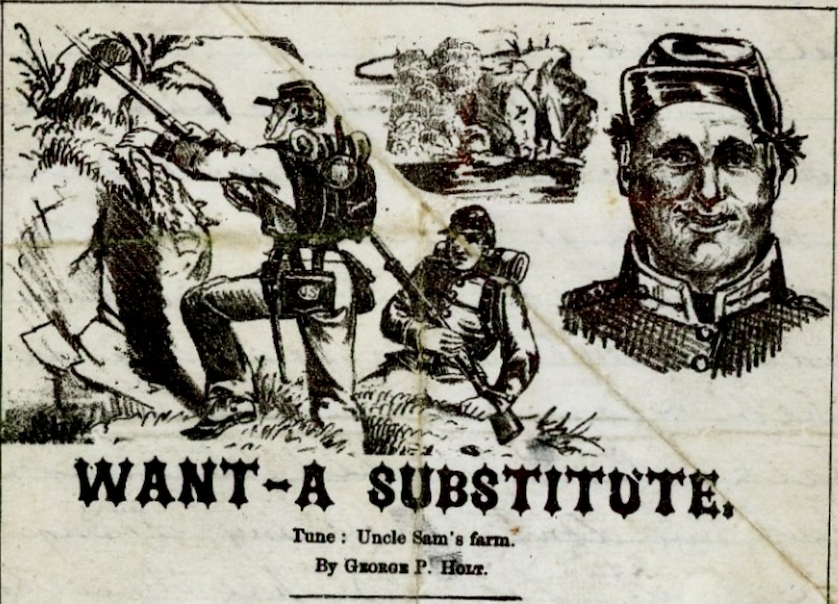
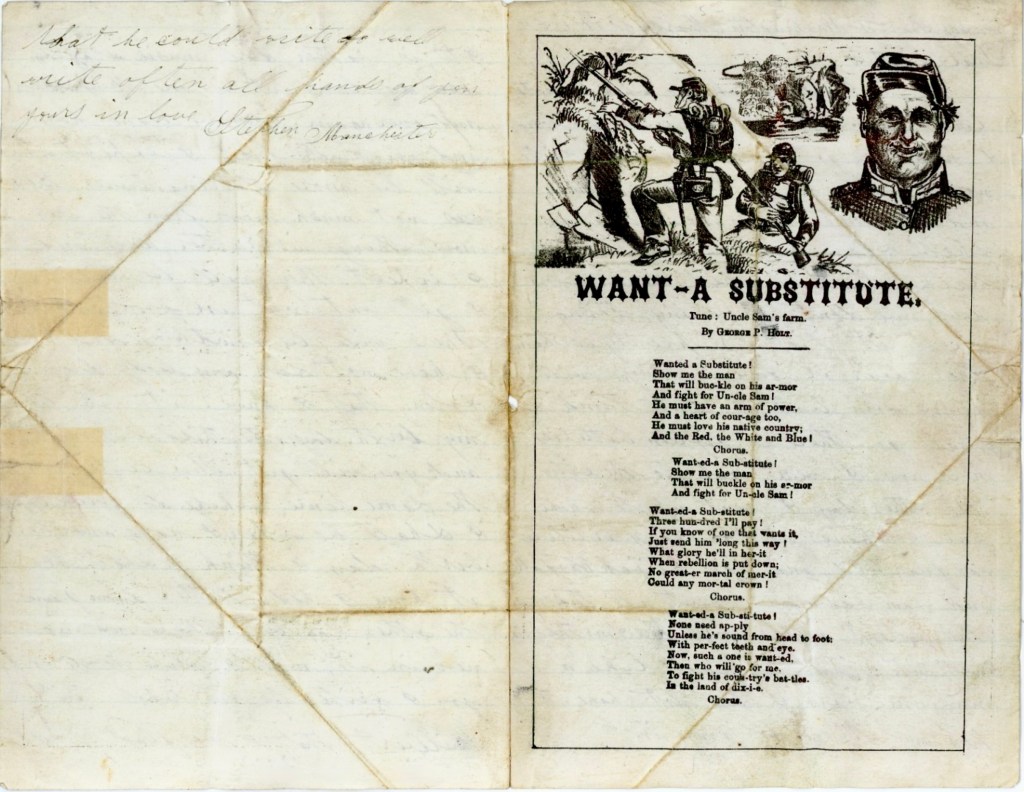
Stephen enlisted rather late in the war for a man his age and there’s a strong possibility he went as a substitute since his stationery pays tribute to substitutes.
T R A N S C R I P T I O N

Camp Barry
Washington
March 30th 1864

Dear Sister,

I don’t know which wrote last—you or I. it has been so long I have forgot, but I will write now. I am well yet. We are here and I don’t know how long we shall stay here. There is some talk that we shall leave soon but we don’t know anything about it. It is pretty certain that four or five batteries will leave soon but I don’t think we shall go. There is fifteen batteries here now.

I went out to the City the other day. I went up to where four companies of the heavy artillery was quartered and saw Elijah Wasgatt and Sam Savage [1st Main Heavy Artillery]. I went all through the Patent Office and the Smithsonian Institute that is just like a museum—only I did not have to pay anything for going in.
It is rather dull music staying here so long. It is one thing over and over again. When we leave here and go to the front, I expect it will be more stirring times there. Sis, not much news from the war now. Things is rather dull and I expect they will be till I get out in front. Then there will be something did.

I have not seen anybody from Solon that I knew. It will be my birthday the third of April and you will get this letter about the same time. Where do you suppose I shall be when I have another birthday? I think I shall be at home. I had a letter from James the other day but there was no news in it. When I write to one of you, I write to the whole. Tell Wilbert that I was glad to see that he could write so well. Write often—all hands of you. Yours in love, — Stephen Manchester

1862-63: Hosea B. Williams to Olivia Williams

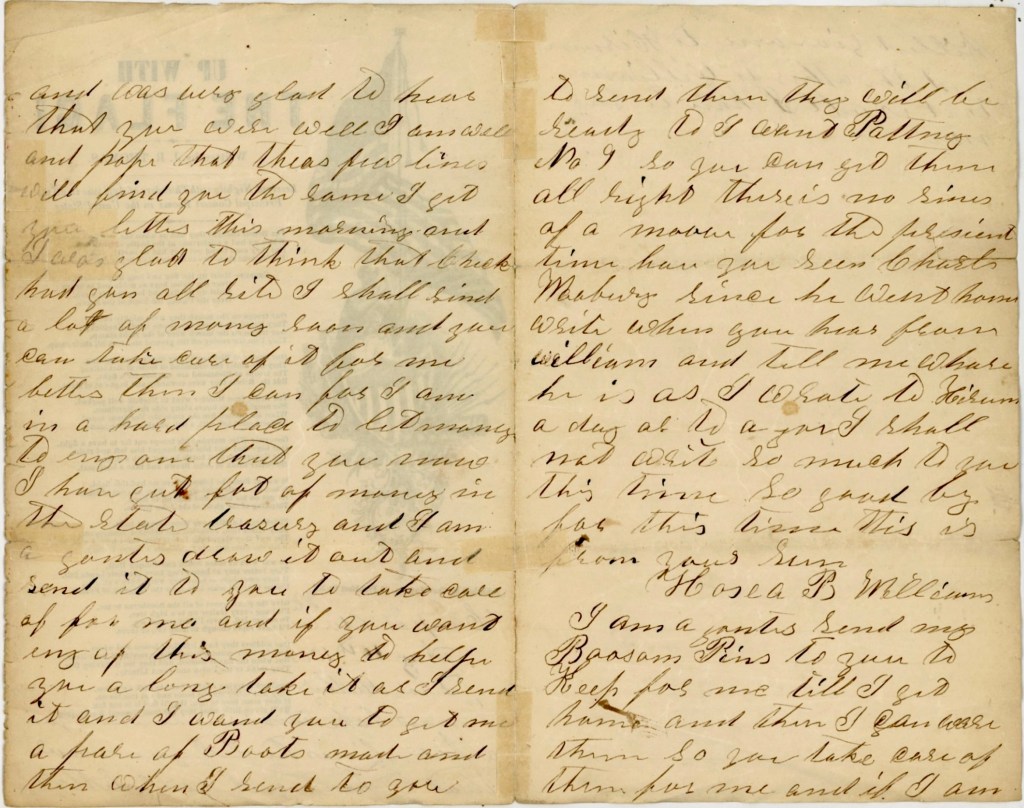
The following letters were written by Hosea B. Williams (1841-1864) who served in Co. C, 3rd Vermont Infantry. He enlisted on 16 July 1861 and was killed in the fighting at Spotsylvania Court House on 12 May 1864. Hosea wrote the letters to his mother, Olivia, in Concord, Vermont. The first letter was found in Hosea’s Pension File in Washington D. C.; the second letter is in private hands.

Hosea’s second letter refers to “bosom pins” that he opted to send home for safekeeping. Unfortunately he was no more specific as to the nature of these pins, but promised one to each of two older brothers, Hiram (b. 1836) and William (b. 1837), if he did not return home from the war.

Letter 1

Camp near Herson [Harrison] Landing
August 1, 1862

Dear Mother,

I received your letter and I was very glad to hear that you were as you were. I am well and I hope that these few lines will find you the same. Dan is well and he is a going to write a few lines to Father.

We have not had a battle since the Battle of Malvern Hill till last night the rebels drawed up some artillery and began to shell our troops but they were sorry that they ever come down there for we drawed out our siege guns and gunboats and give them hell to hteir own satisfaction so they left the ground. But it was a noisy time, I tell you.

Now I want you to write to me often as you can. You tell William to write and Hiram too. I have not much to write now. I want you to write whether John Morse has paid that money to your or not. I have got two hundred dollars in the State Treasury and I have put it so that you can draw it if I should be killed here for I stand a fair chance to be killed every day or so far it is shell and shot all the time. But Iam happy as a clam in deep water, Write to me often as you can. — Hosea B. Williams, Co. C, 3rd Vermont Volunteer Militia, Washington D. C.

I will send you a paper that [shows] where we fought the rebels at Savage Station and the battle elsewhere too on the retreat.


Letter 2

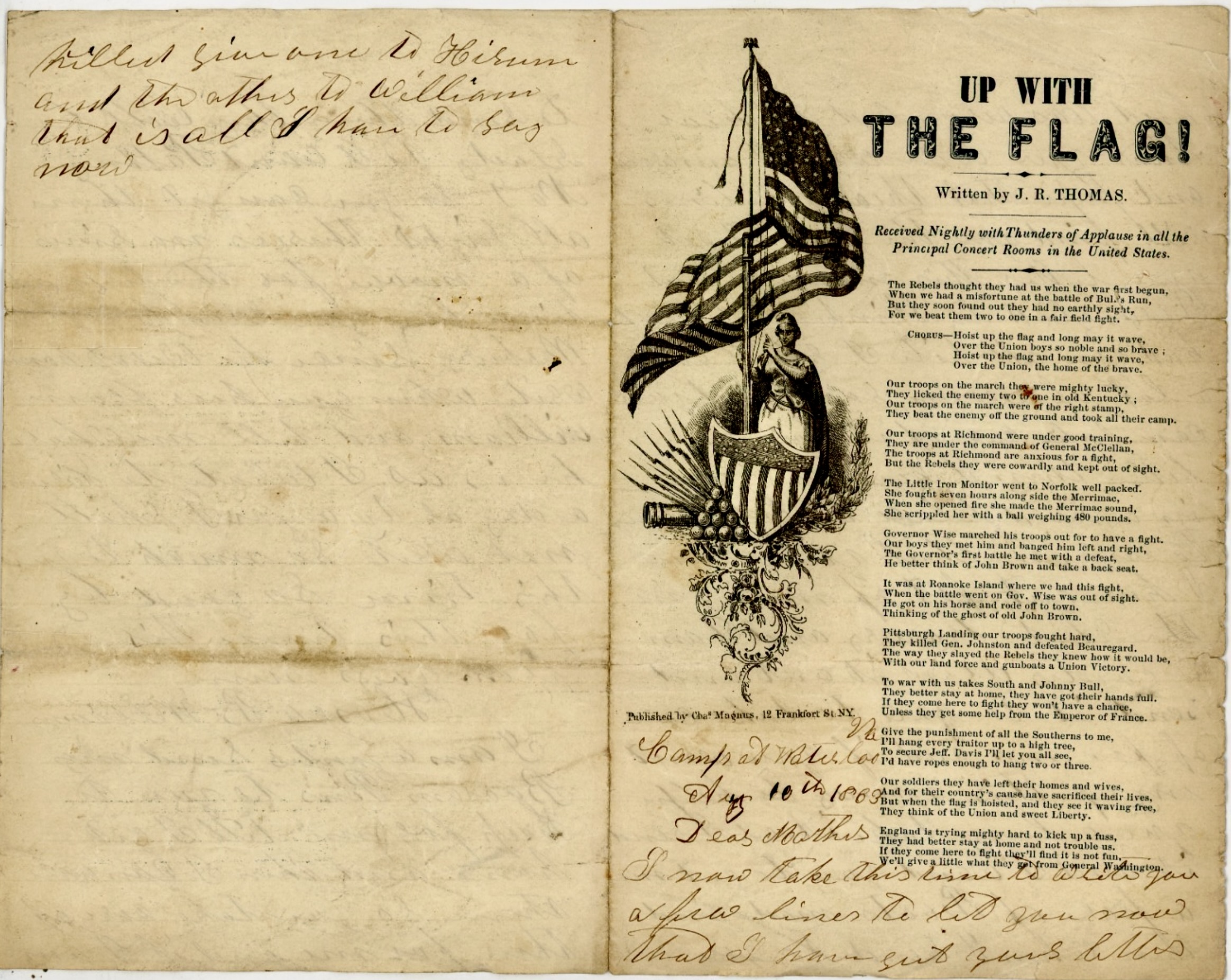
Patriotic stationery used in Hosea’s Letter

Camp at Waterloo, [Fauquier Co.] Virginia
August 10, 1863

Dear Mother,

I now take this time to write you a few lines to let you know that I have got your letter and was very glad to hear that you were well. I am well and hope that these few lines will find you the same. I got your letter this morning and was glad to think that check had gone alright. I shall send a lot of money soon and you can take care of it for me better than I can for I am in a hard place to let money in the State Treasury and I am a going to draw it out and send it to you to take care of for me. And if you want any of this money to help you along, take it as I send it and I want you to get me a pair of boots made and then when I send to to send them, they will be ready. I want Patent No. 9 so you can get them alright.

There is no signs of a move for the present time. Have you seen Charles Mabury since he went home? Write when you hear from William and tell me where he is. As I wrote to Hiram a day or two ago, I shall not write so much to you this time. So goodbye for this time. This is from your son, — Hosea B. Williams

I am a going to send my Bosom Pins to you to keep for me till I get home and then I can wear them so you take care of them for me and if I am killed, give one to Hiram and the other to William. That is all I have to say now.

1862: Henry Lauren Lane to his Parents

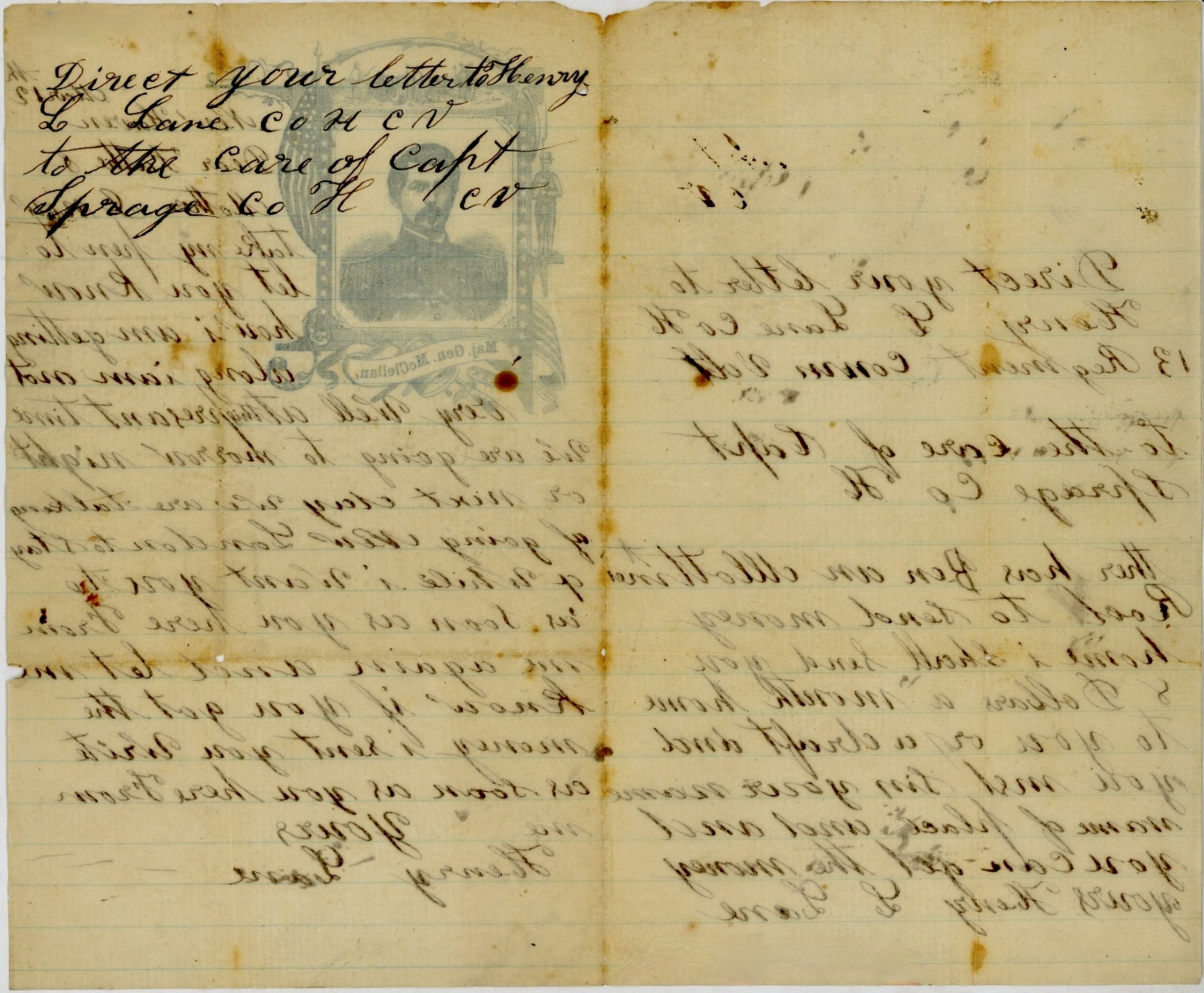
The following letter was written by Henry Lauren Lane of Plymouth, Connecticut, who enlisted in February 1862 as a private in Co. H, 13th Connecticut Infantry. He died of chronic diarrhea while in the service on 5 May 1863 at New Orleans.

Letterhead of patriotic stationery featuring lithograph of Maj. Gen. McClellan

T R A N S C R I P T I O N

New Haven [Connecticut]
March 12th [1862]

Dear Father & Mother,

I now take my pen to let you know how I am getting along. I am not very well at this present time. We are going tomorrow night or next day. We are talking of going [to] New London to stay a while. I want you to [write] as soon as you hear from me again and let me know if you got the money I sent you. Write as soon as you hear from me. Yours, — Henry Lane

Direct your letter to Henry L. Lane, Co. H, 13th Regiment, Conn. Vols. To the care of Capt. [Homer Baxter] Sprague, Co. H.

There has been an allotment roll to send money home. I shall send you 8 dollars a month home to you or a draft. You must sign your name, name of place, and you can get the money. Yours, Henry L. Lane

1865: David Wakefield Haight to Judy Minerva (Horton) Haight

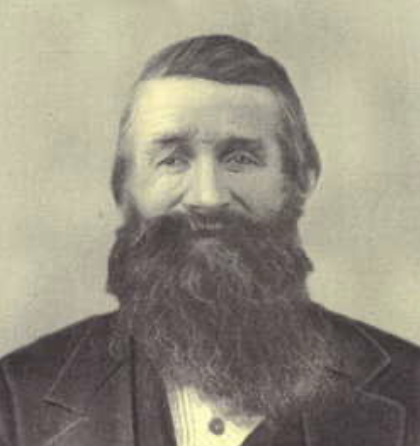
A post war image of David Haight

These letters were written by David Wakefield Haight (1841-1906), the son of Joel Albert Haight (1810-1886) and Rebecca Anne Stewart (1821-1859). David was married in March 1864 to Judy Minerva Horton (1845-1925) and their first child—the baby mentioned in this letter—was Ethel M. G. Haight (1865-1869).

David enlisted as a private in Co. E, 57th Pennsylvania Infantry on 28 July 1864. He was later transferred to Co. K and was mustered out of the service on 29 June 1865. Prior to serving in the 57th Pennsylvania, David served in Co. D, 2nd Battalion Pennsylvania Infantry. It’s noted that his headstone in the Clarington Methodist Cemetery spells his name “Hait.”

Letter 1

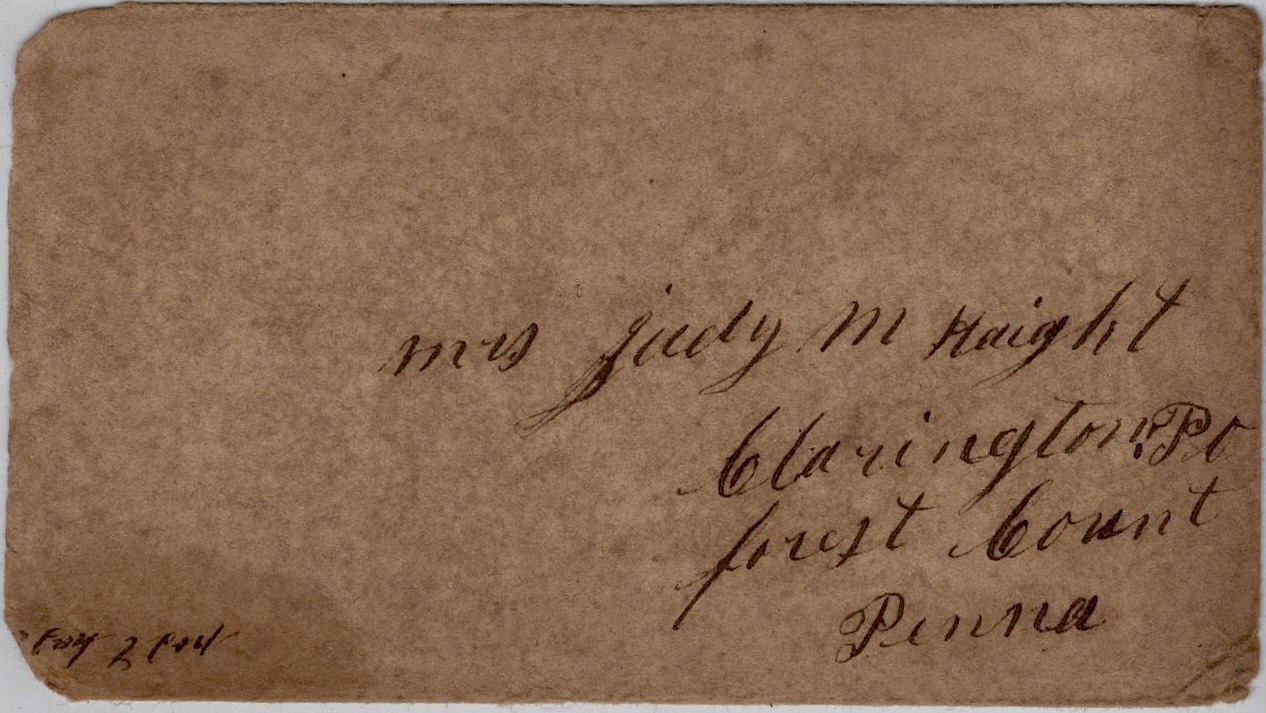
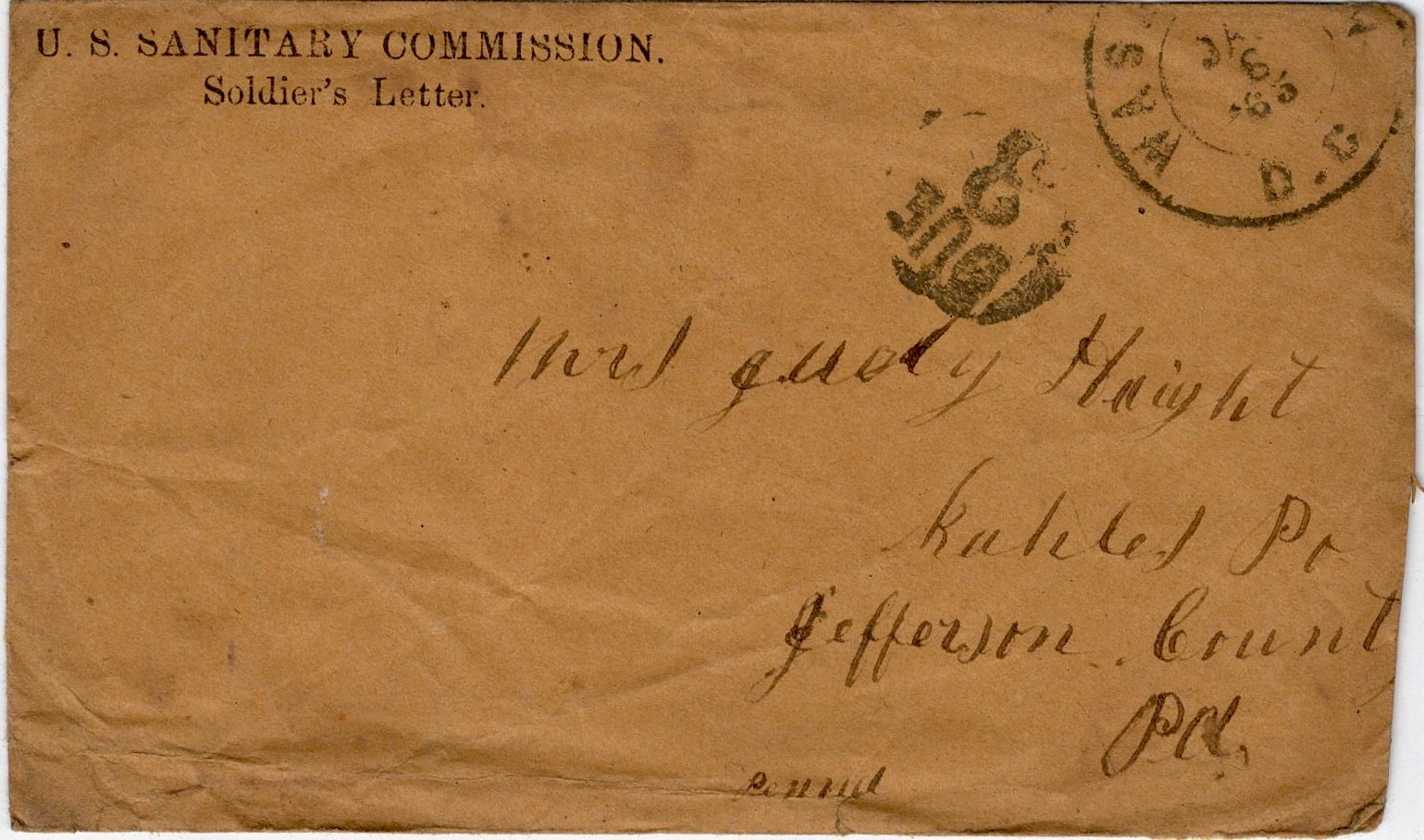
Addressed to Mrs Judy M. Haight, Clarington Pt. Forest county, Pennsylvania

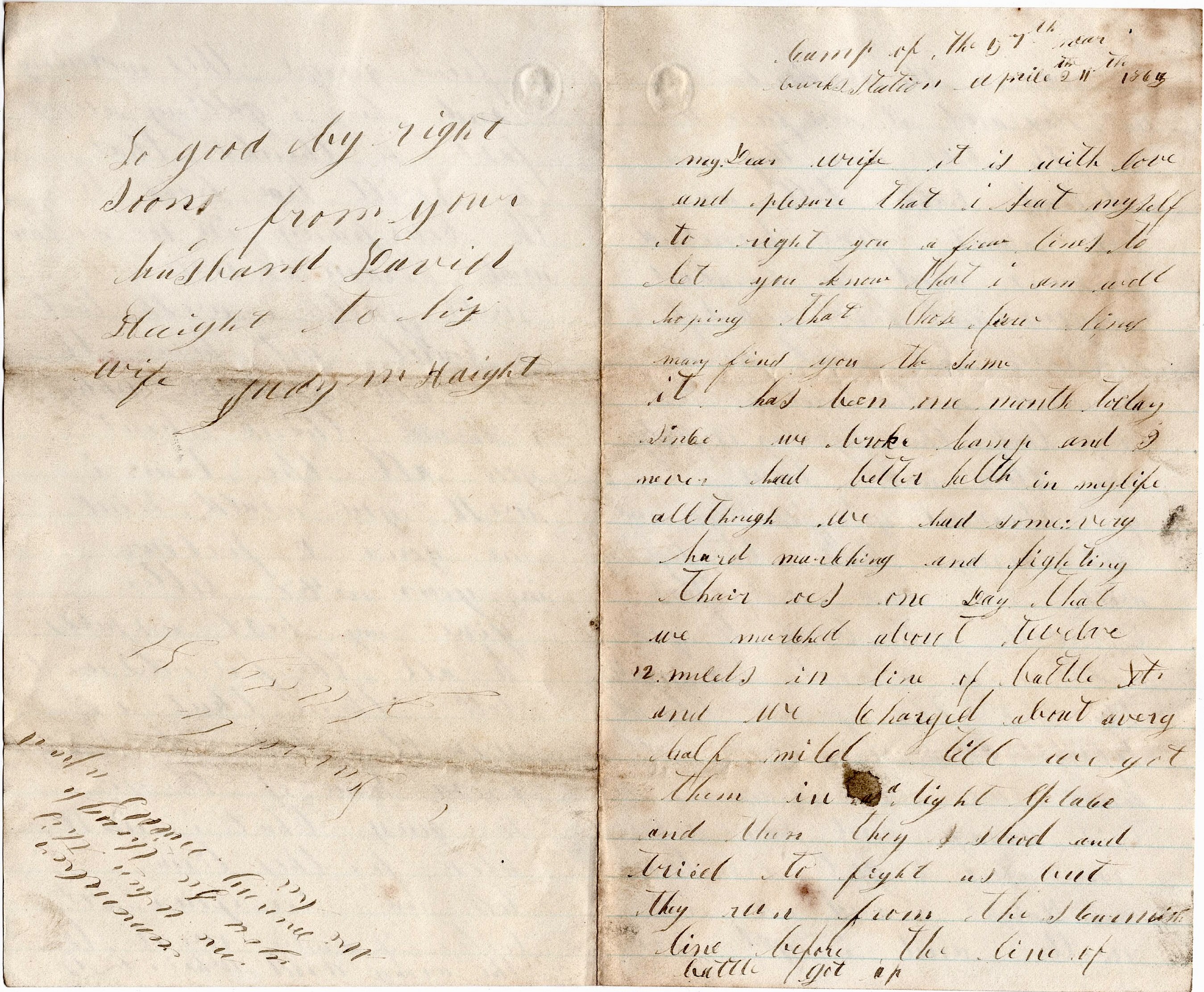
Camp of the 57th [Pennsylvania]
Near Burke’s Station
April 24, 1865

My dear wife,

It is with love and pleasure that I seat myself to write you a few lines to let you know that I am well, hoping that these few lines may find you the same.

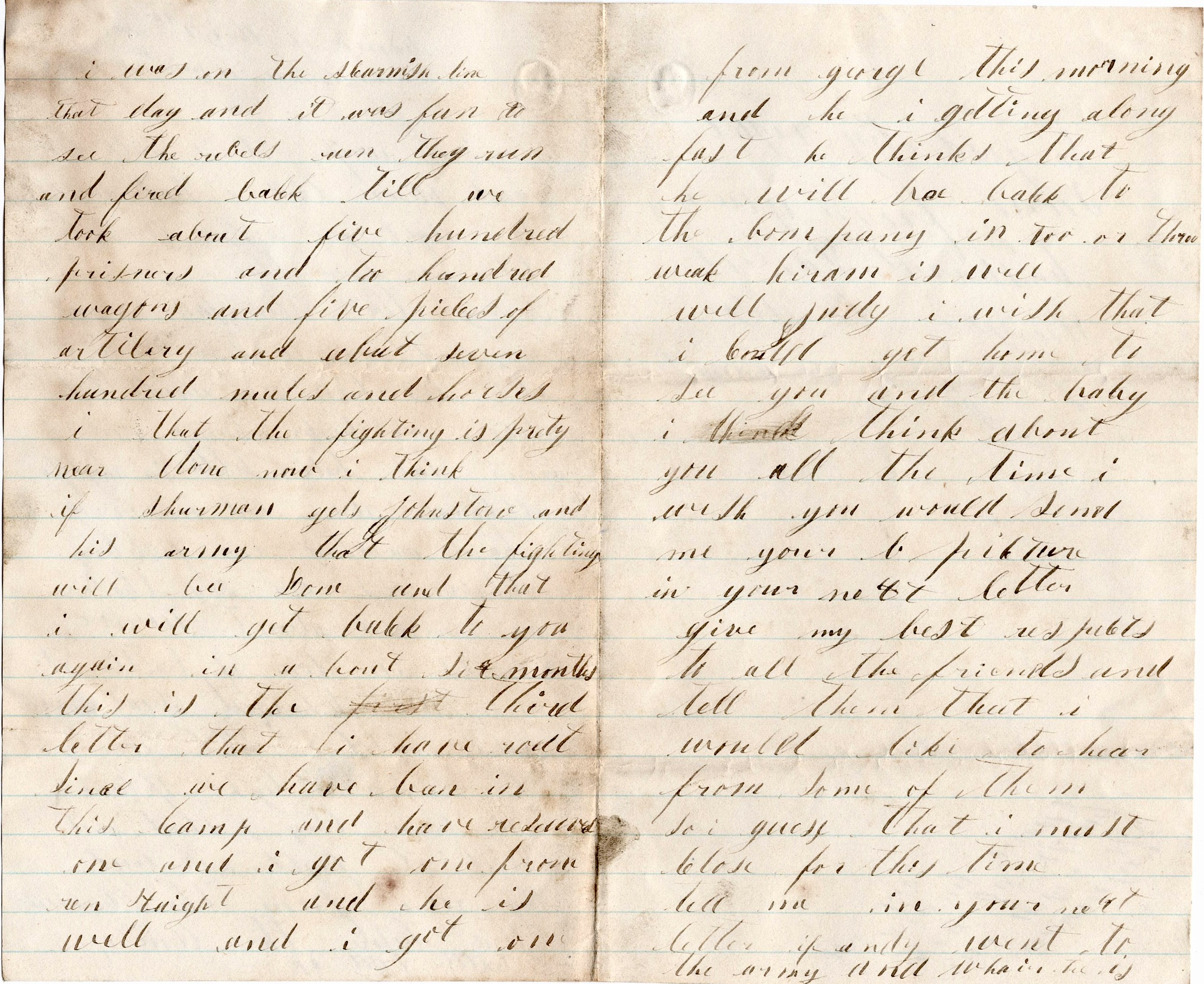
It has been one month today since we broke camp and I never had better health in my life although we had some very hard marching and fighting. There was one day that we marched about twelve miles in line of battle and we charged about every half mile till we got them in a tight place and then they stood and tried to fight us but they run from the skirmish line before the line of battle got up. I was in the skirmish line that day and it was fun to see the rebels run. They run and fired back till we took about five hundred prisoners and two hundred wagons and five pieces of artillery and about seven hundred mules and horses. I [think] that the fighting is pretty near done now. If Sherman gets Johnston and his army, the fighting will be done and I will get back to you again in about six months.

This is the third letter that I have wrote since we have been in this camp and have received one and I got one from Ren Haight and he is well. And I got one from George this morning and he is getting along fast. He thinks that he will be back to the company in two or three weeks. Hiram is well.

Well, Judy, I wish that I could get home to see you and the baby. I think about you all the time. I wish you would send me your picture in your next letter. Give my best respects to all the friends and tell them that I would like to hear from some of them. So I guess that I must close for this time. Tell me in your next letter if Andy went to the army and here he is.

So goodbye. Write soon. From your husband, — David Haight

To his wife, Judy M. Haight

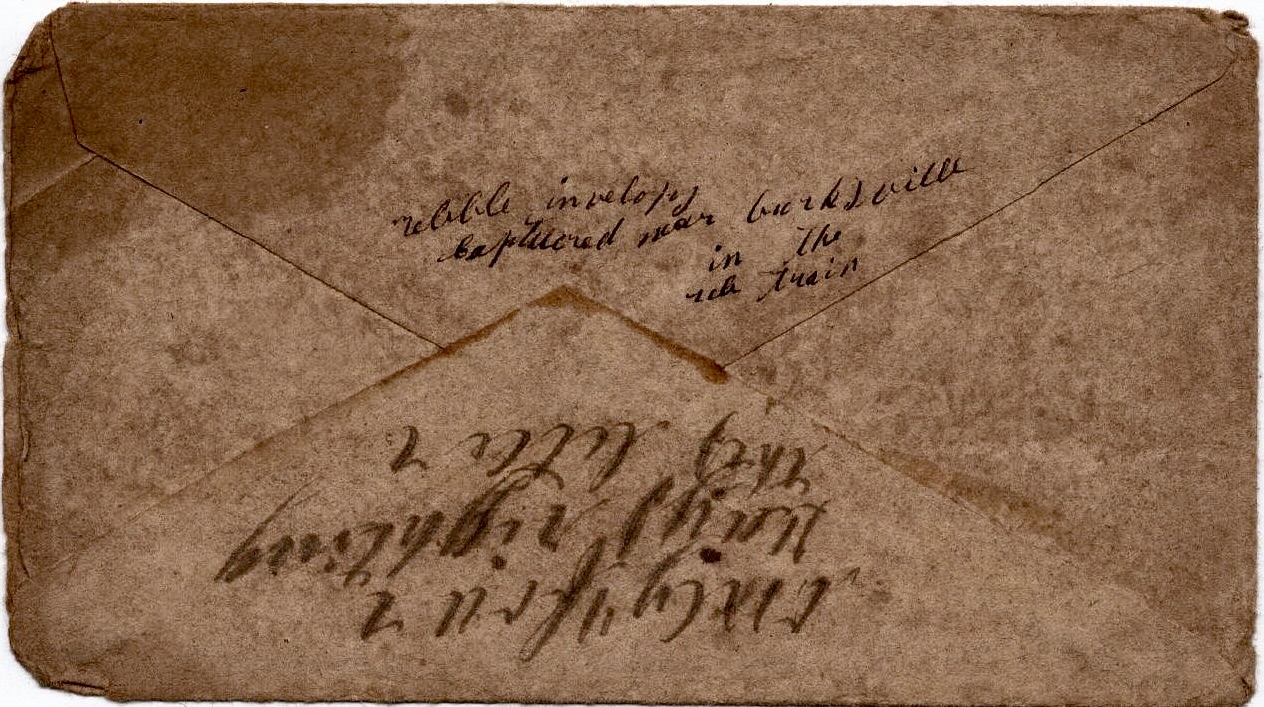
The reverse side of the envelope says, “Rebel envelope captured near Burksville in the Reb train.”

Letter 2

Washington D. C.
June 22, 1865

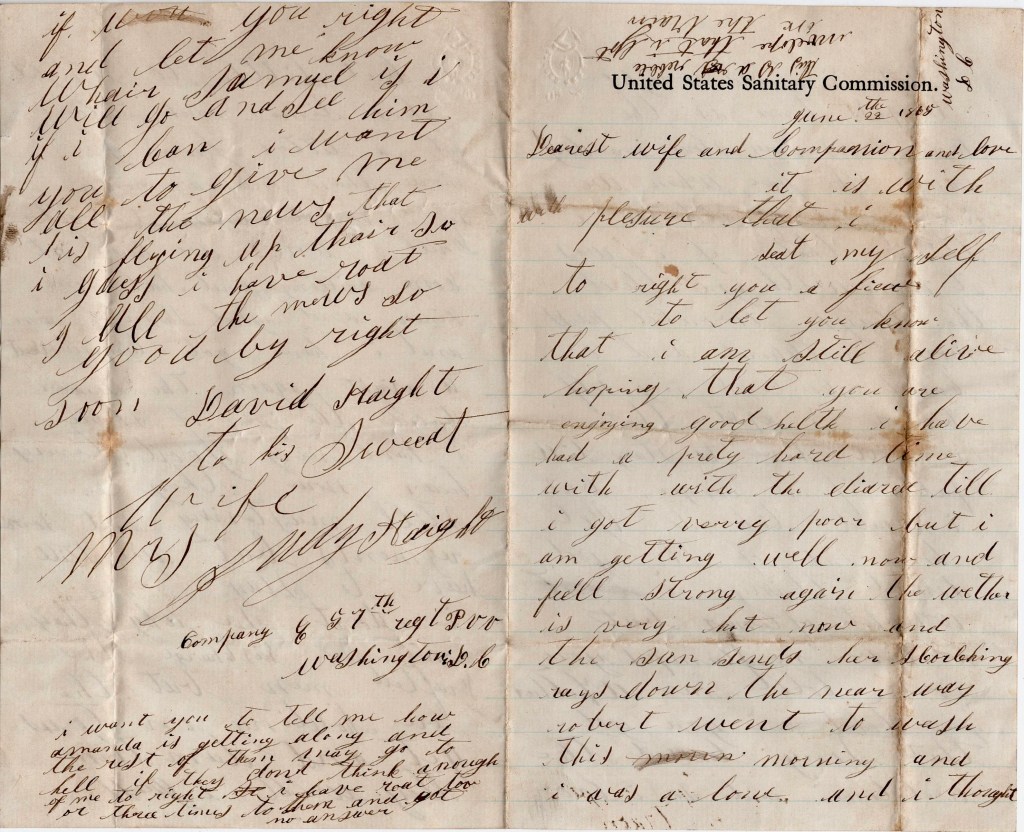
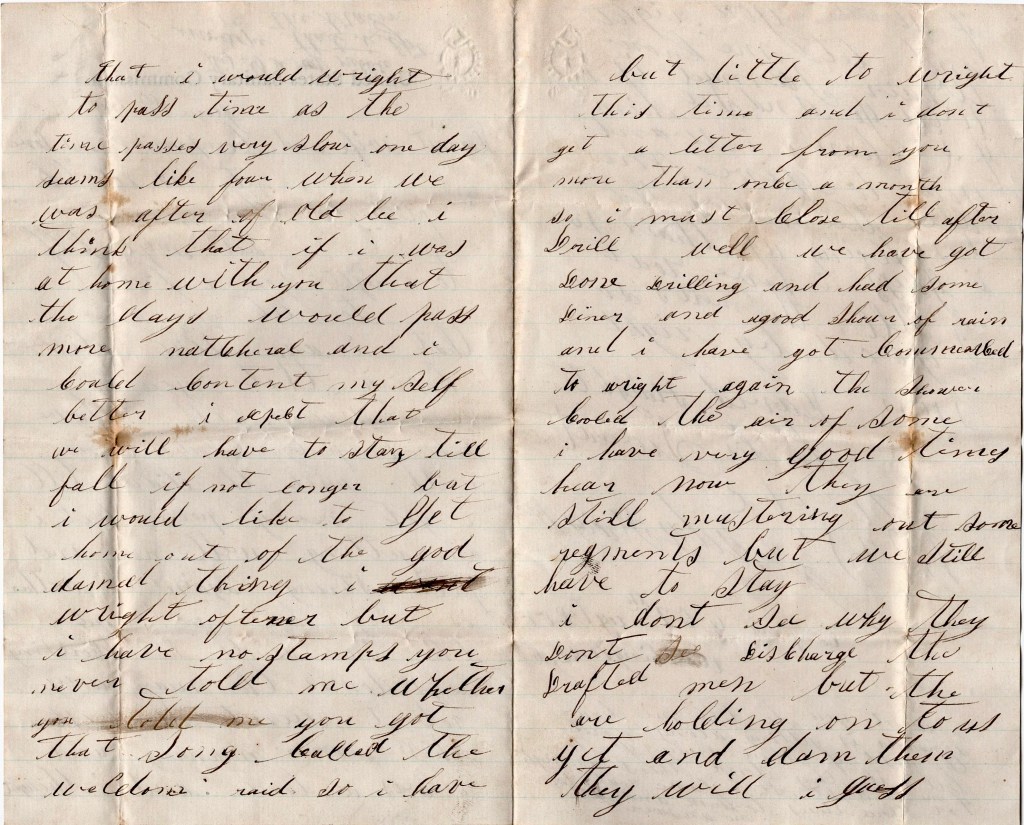
Dearest Wife & Companion & Love,

It is with pleasure that I seat myself to write you a few [lines] to let you know that I am still alive, hoping that you are enjoying good health. I have had a pretty hard time with the diarrhea till I got very poor. But I am getting well now and feel strong again. The weather is very hot now and the sun send her scorching rays down the near way. Robert went to wash this morning and was alone and I thought that I would write to pass time as the time passes very slowly. One day seems like four when we was after Old Lee. I think that if I was at home with you that the days would pass more natural and I could content myself better.

I expect that we will have to stay till fall if not longer but I would like to get home out of the God damned thing. I would write oftener but I have no stamps. you never told me whether you got that song ballad [on] the Weldon Raid so I have but little write this time and I don’t get a letter from you more than one a month. So I must close till after drill.

Well, we have got done drilling and had some dinner and a good shower of rain and I have got commenced to write again. The showers cooled the air off some. I have very good times here now. They are still mustering out some regiments but we still have to stay. I don’t see why they don’t discharge the drafted men but they are holding on to us yet and damn them, they will I guess.

If you write and let e know where Samuel is, I will go and see him if I can. I want you to give me all the news that is flying up there. So I guess I have wrote all the news. So goodbye. Write soon. — David Haight

To his sweet wife, Mrs. Judy Haight

Company E, 57th Regt. P. V. V. , Washington D. C.

I want you to tell me how Amanda is getting along and the rest of them may go to hell if they don’t think enough of me to write. I have wrote two or three times to them and got no answer.

1861: Nathan Dresher to Mary (Zeller) Dresher

This letter was penned by Nathan Dresher (1815-1900), the son of Phillip Dresher (1785-1828) and Anna Trexler (1791-1855). He was married to Mary Elizabeth Zeller (1819-1908) and had two children—Daniel Dresher (1843-1868) and Anna D. Dresher (1845-1927). Nathan was born in Longswamp township, Berks county. He attended school at Doylestown and the Allentown Academy. He was proficient in music and a violinist. After his father died, the family moved to Allentown where Nathan went into the lumber business with various partners through the years. He retired from the business in 1860 and lived comfortably off his real estate holdings. His wife was the daughter of Rev. Daniel Zeller. Nathan was a staunch Republican.

The letter was datelined from Lancaster, Pennsylvania, where 46 year-old Nathan and his 18 year-old son Daniel were apparently sightseeing as nothing in the letter suggests that they were conducting business there and Nathan was in early retirement.

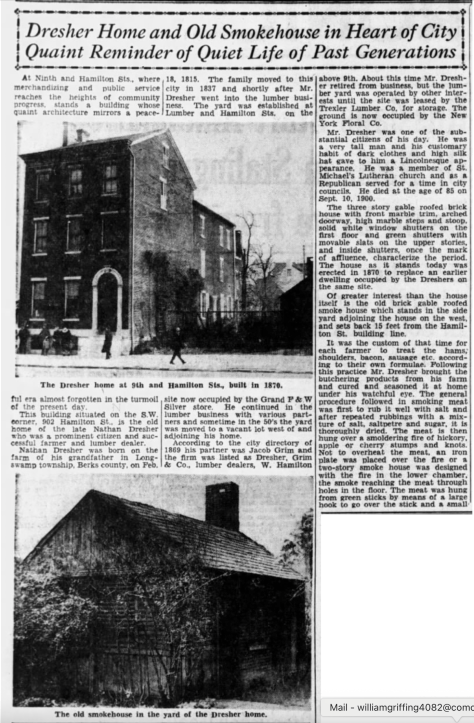
The Dresher Home in Allentown, Pennsylvania

The Martin House, or sometimes referred to as the Dresher-Martin Mansion was a home built at 902 Hamilton Street., the southwest corner of Hamilton and Ninth Street. The home was originally owned by Nathan Dresher, a prominent citizen of early Allentown and a successful lumber dealer. The Dresher family moved to Allentown from Berks Country in 1837 and shortly afterwards opened the lumber buisness. The origional home was built sometime after that on a large lot at It consisted of a three story gable roof brick home with front marble trim, arched doorway, high marble steps and stoop. It also had solid white window shutters on the first floor and green shutters with moveable slats on the upper stories. Along with the home was a wooden smokehouse at the rear of the property for preparing meat, and a washhouse with heated bathrubs and clothes washing facilities. In 1870/71, the home was expanded by Nathan Dresher for his daughter Anna Dresher and her husband Dr. Henry Martin. Dr Martin had been a surgeon for the Union Army during the Civil War. The addition consisted of a large 3-story section in the rear along South Ninth Street. This expanded the home to a a 20-room mansion. The home included a walnut staircase, eight marble fireplace mantles and a large library. The estate also had a glass greenhouse in a large yard. The block between Ninth and Tenth streets, between Hamilton and south to Walnut at the time was the home of Allentown’s lumber and building buisnesses. To the west was a large lumber yard of Edwin and Jonas Trexler, the father and uncle of later General Harry C. Trexler. The Trexlers were in buisness with the Dresher family at the time the home was expanded in 1870.

T R A N S C R I P T I O N

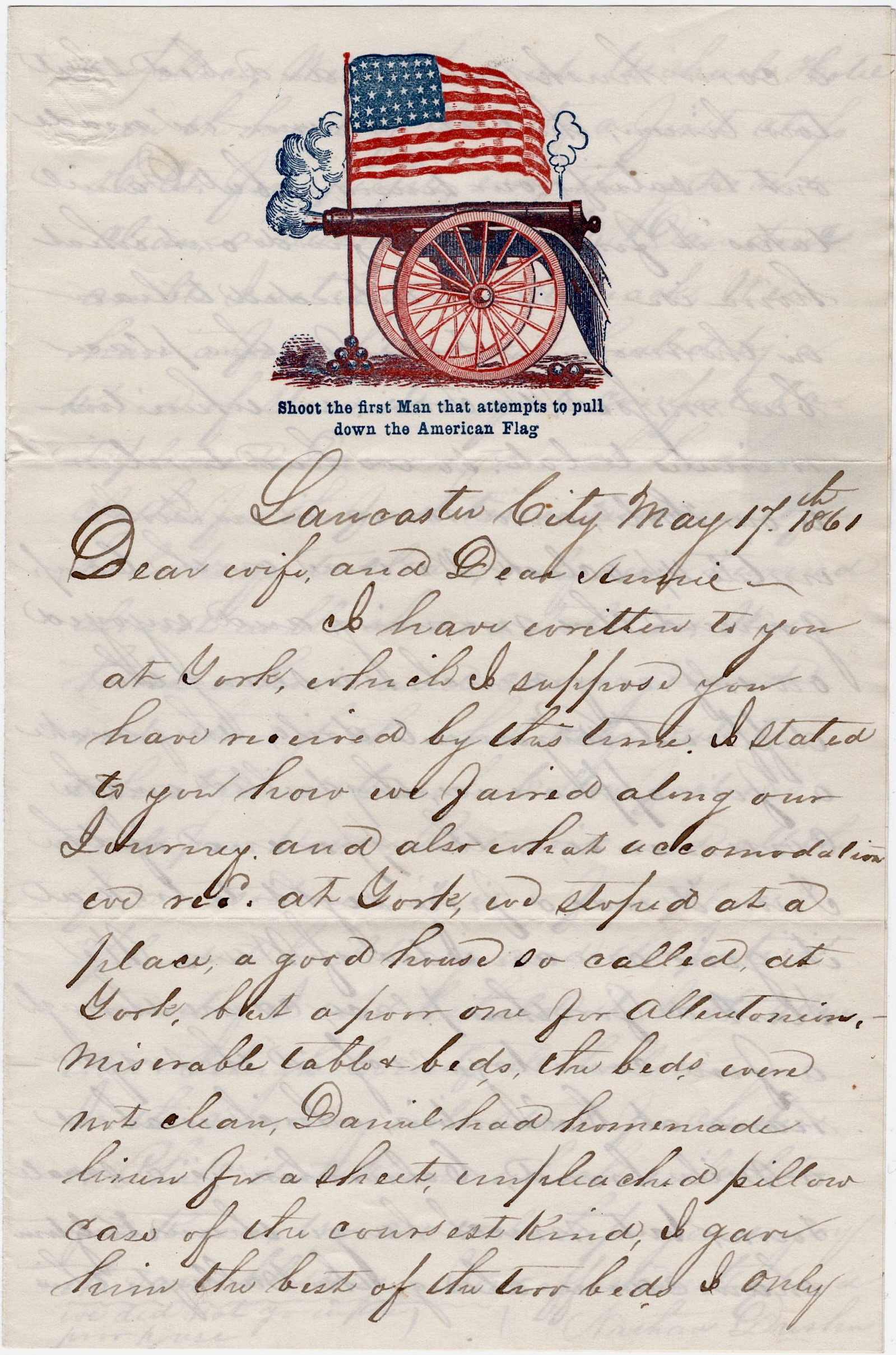
Lancaster City
May 17, 1861

Dear wife and dear Annie,

I have written to you at York which I suppose you have received by this time. I stated to you how we fared along our journey and also what accommodation we received at York. We stopped at a place—a good house, so called, at York, but a poor one for Allentownians. Miserable table & beds. The beds were not clean. Daniel had homemade linen for a sheet, unbleached pillow case of the coarsest kind. I gave him the best of the two beds. I only had a corn husk mattress and bed sheet tow linen. The table common. We made out to satisfy our hunger but Daniel takes it first rate. He finds out what home is.

We had intended to leave in the morning train for this place but missed the train. We were two minutes too late so we had to return to our hotel and remain in York until 11.30 o’clock. We were on the camp ground this morning and enjoyed ourselves very much in seeing the different regiments to drill. They make a fine appearance. They drilled on the commence [common] in the upper end of the town. It was a fine sight to look at. Gives one an idea of war. We started for this place, came through a fine country, crossed the Susquehanna at Columbia which is about a mile broad. Columbia is a small town but much larger than Kutztown. Then came along the valley to this place.

We stopped at Michael’s Hotel 1 in the heart of the city—a first class hotel. Fine people, everything nice & clean. A number one table. Dan does ample justice to his stomach. We have a fine bed room heated by a kind of stove. It is quite comfortable. It pleased Dan very much. He changed clothes for the first time since we left. He looks quite clean, only sunburned almost as black as a soldier.

We hired a horse and carriage and rode through the whole city, out to Wheatland 2, Camp, Cotton factories 3, Jail 4, Poor house, Reservoir, and all the fine residences. It is a fine place, splendid buildings, and the prettiest country I ever beheld. It beats Allentown & Lehigh county all hollow.

In the morning will start for Chester or Philadelphia, don’t know which. Will let you know. We are well. Hope you enjoy the same blessing. Your affectionate husband, — Nathan Dresher

We did not go in the poor house.

North Queen Street in Lancaster, Pennsylvania

1 Michael’s Hotel was the establishment of John Michael. It stood at 17 North Queen Street in Lancaster, Pa. The name was later changed to the American House, and then again to “The Grape.” Michael’s Hotel sign had grapes on it, hence the name.

2 Wheatland was the home of James Buchanan.

3 In 1860, Lancaster, PA, was home to the Conestoga Steam Mills, a significant industrial complex that was the county’s first steam-powered cotton mill, established in the mid-1840s. The city also had other mills, including the Baumgardner’s Mill, though the primary source of cotton in the region around 1860 was centered at the Conestoga Steam Mills, which became the city’s largest industry and employer by the 1880s.

4 The Lancaster County Prison was built in the 1850s and designed to resemble a medieval castle to instill public confidence in its security.

1862: John W. McCleary to Hattie Sering

The following letter was written by John W. McCleary who enlisted in the fall of 1861 as First Sergeant in the 4th Independent Battery Indiana Light Artillery. He was promoted to 2nd Lieutenant some six weeks after this letter was written and remained with the battery until early March 1863 when he resigned. At the time the letter was written on 2 February 1862, the 4th Indiana Battery occupied the heights above the Green river at Munfordville, Kentucky—an elevation which commanded the important bridge over the river. They would later join the march to Nashville and lay siege to Corinth. McCleary was presumably with the regiment in the battles of Perryville (Chaplin Hills) and Stones River before he resigned.

The battery was commanded by Capt. Asahel Kidder Bush and was sometimes referred to as “Bush’s Battery.” Bush proudly boasted that, “No Battery in the field stands higher in the estimation of those who have witnessed its part in the Battle of ‘Chaplin Hills’ and ‘Stones River’ than this.”

See also: Reminders of the 4th Indiana Battery’s Fight along the Wilkinson Pike, by Dan Masters, Civil War Chronicles, 12 March 2024.

[Note: This letter is from the private collection of Greg Herr and was made available for transcription and publication on Spared & Shared by express consent.]

T R A N S C R I P T I O N

Addressed to Miss Hattie Sering, Care John G. Sering, Esq., Madison, Jefferson county, Indiana

Advance Division
Camp Wood [near Munfordville, Kentucky]
February 2, 1862

Dear Hattie,

I suppose you have been looking for a letter from me for some time and now I am determined you shall not be disappointed and I presume Mother will want to hear from me also. I am getting along admirably, the weather to the contrary notwithstanding. It was raining here during the whole month of January. We did not have but two sunshiny days and at no time has the ground been dry since the 1st of January. It has been raining every day since this month set in. Tonight it is raining hard. Still it does not discommode us soldiers much as most of the regiments have been receiving the new Sibley tents. Of course this weather comes very hard on the infantry who have to go out on picket duty but we—that is, the artillery—do not have any of that duty save around our own park. As for myself, I do not have to do any guard duty—only to detail the guard every morning and sometimes I act officer of the day in the absence of the commissioned officers.

I am now acting 2nd Lieutenant in place of one of the lieutenants having been under arrest for drunkenness. He is to be court martialed and no doubt he will be cashiered. Consequently he will be broke of his commission. I have not seen Ruf since i wrote to you last. I did not know until today that his Regiment was camped so near to us, or I should have been over to see him. The 6th [Indiana] Regiment is within a stone’s throw of our camp. Their baker bakes the bread for our company so we have fresh bread every day. I get plenty to eat and drink and on the whole I must say I have enjoyed myself very much during my enlistment so far.

I wish you could see this camp with its thousands of tents at night when the lights are all burning in their tents. It looks like a large city—as large as Cincinnati and New York put together. The camp is situated on rolling ground and from the mound on which our company is situated you can see all over the camp. We are situated on the left of Green river bridge and our guns command the approach to it for miles around. We are situated upon a high bluff on the river bank and some 300 feet high above the river and the bank is so steep that neither man no beast could approach us from the river front.

The Chief of Artillery is building a fort for our guns. Besides the guns we have now, there is to be placed behind it a number of heavy siege guns. We are afraid that when this Division moves that our company will be left behind to protect the bridge and in case the army should have to fall back on this point, to be ready to assist them. We are anxious to move on with this Division when the advance is made for I have no idea we will ever have a chance to shoot at the rebels should we remain here. Still this point has to be protected for should the rebels get hold of this place, it would be of great importance to them for this is the grand depot for the Department of the Ohio. Large warehouses have been built here to hold the provisions, camp equipage, &c. &c. for this army. If you could but see the piles of ammunition, ordnance, and quartermaster’s stores here, you would think they could not be used up in ten years.

The flag of truce with the remains of Gen. Zollicoffer and Lt. Peyton left here a day or two ago. It was under escort of our generals and Chief of Artillery adnd 25 cavalry. As they approached Cave City, they discovered several of the rebel cavalry at a distance who, not discovering the flag, run off in double quick time. 1

There was a slight skirmish today between some of our pickets and the rebel pickets. One of our men was shot. I did not learn any other particulars.

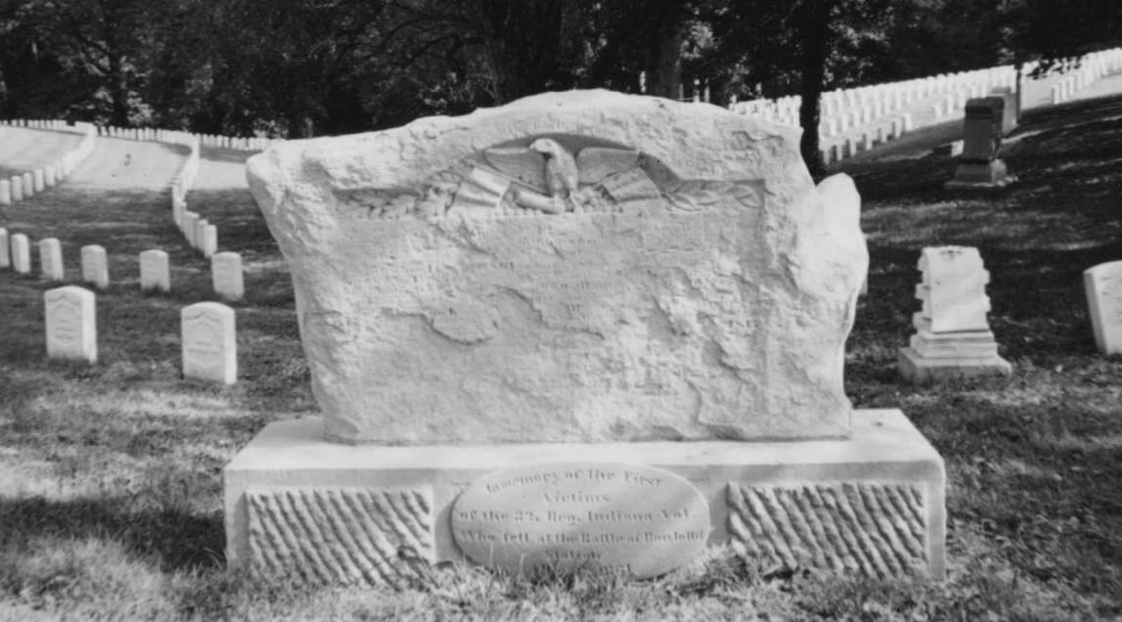
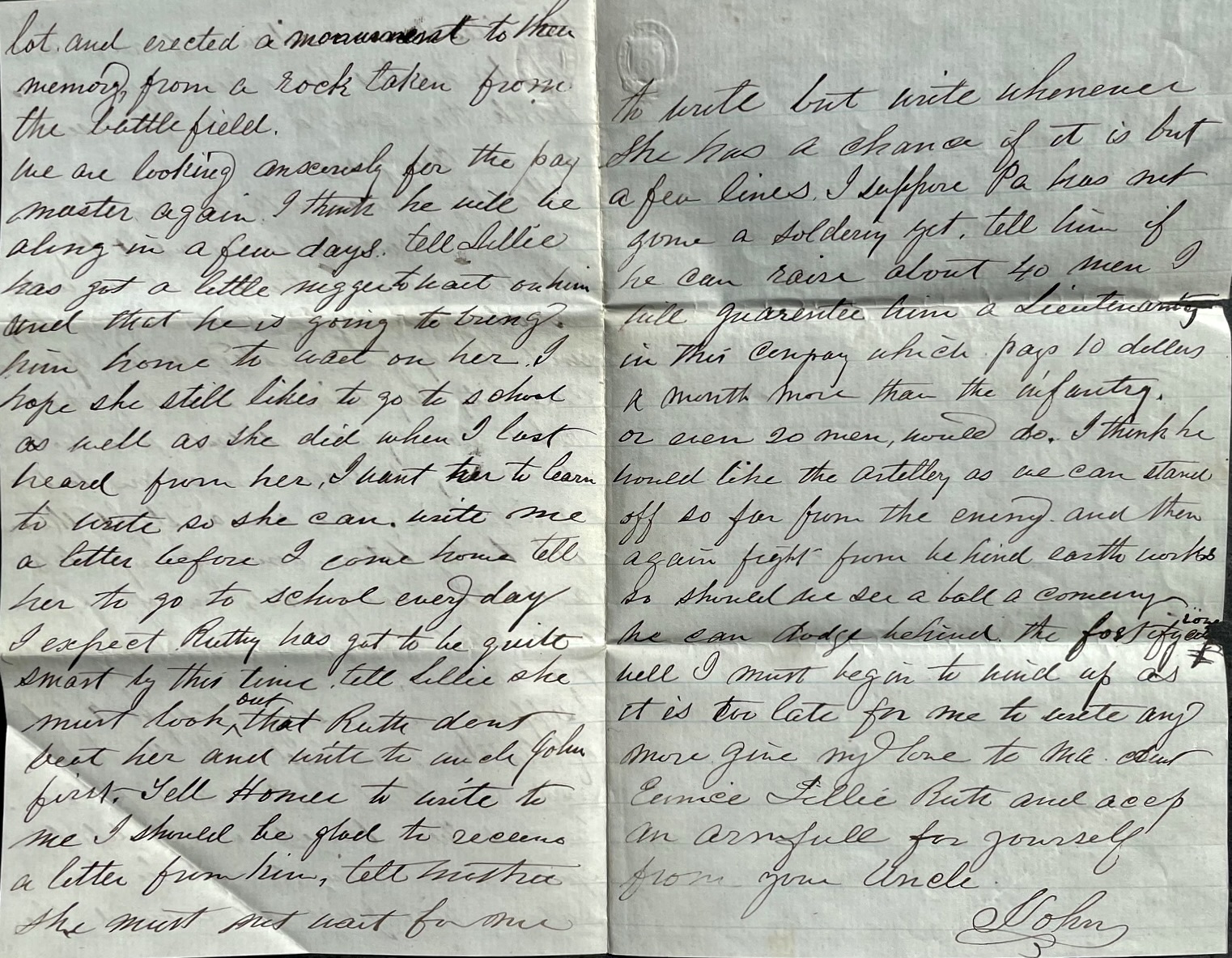
I suppose you heard of the fight [Battle of Rowlett’s Station] a part of the Willit’s [Willich’s] men had with the rebels and that Willit [Col. August Willich] had 11 men killed. He had them buried in a beautiful spot on a mound and he has put a nice fence all around the lot and erected a monument to their memory from a rock taken from the battlefield. 2, 3

We are looking anxiously for the pay master again. I think he will be along in a few days. Tell Lillie has got a little nigger to wait on him and that he is going to bring him home to wait on her. I hope she still likes to go to school as well as she did when I last heard from her. I want her to learn to write so she can write me a letter before I come home. Tell her to go to school everyday. I expect Ruthy has got to be quite smart by this time. Tell Lillie she must look out that Ruth don’t beat her and write to Uncle John first. Tell Horace to write to me. I should be glad to receive a letter from him. Tell Mother she must not wait for me to write but write whenever she has a chance if it is but a few lines. I suppose Pa has not gone a soldiering yet. Tell him if he can raise about 40 men, I will guarantee him a lieutenancy in this company which pays 10 dollars a month more than the infantry, or even 20 men would do. I think he would like the artillery as we can stand off so far from the enemy and then again fight from behind earth works so should we see a ball a coming, we can dodge behind the fortifications.

Well, I must begin to wind up as it is too late for me to write any more. Give my love to ma, Aunt Eunice, Lillie, Ruth, and accept an armful for yourself. from your uncle, — John


1 “The bodies of Gen. Zollicoffer and Peyton reached this point, per Railroad, on the 30th, encased in splendid coffins, labeled and directed to the care of Gen. McCook, for the same to forward under an escort of flag of truce to some place. Early on the morning of the 31st two ambulances, with four horses attached to each, moved from headquarters with the mortal remains of Zollicoffer and Peyton. The procession was headed by Gens. Johnson and Negley, of this division of the army, with a host of Colonels and Orderlies of the two staffs, and one of Frank Leslie’s artists. Then followed the ambulances, and in the rear twenty-five of Graham’s Cavalry, your humble servant one of the number. We crossed Green River in safety on the pontoon bridge, took the Glasgow road as far as Horse Cave, a small village, situated on the Railroad, which has lost most of its houses by the lighted torch of the infuriated “secesh,” who have to let go and give back as our army increases or advances. This place is noted for the great cave here, from which it derives its name. We had no opportunity to examine the cave only as we passed by near its mouth-we could see far into it. From this point we turned to our left, and took the Louisville and Nashville pike-a good road-but every place where timber has stood upon its borders it has been felled across it to obstruct our march.” [Letter in the Indianapolis Daily Journal, 6 February 1862, by Pvt. Mastin Dashiell, 3rd Indiana Cavalry.]

2 “We are now at Camp George Wood right where they had their fight last week. Me and George was down and saw the place where our men was buried. There was ten of our men killed and about 75 of the rebels killed.” James H. Smith, 4th Indiana Battery, letter of 27 December 1861 at Camp George Wood, KY. Spared & Shared 23.

3 “As a final tribute to the slain patriots, Private Adolph Bloettner of Company F chose a piece of local limestone and sculpted a beautiful monument in their honor. Bloettner carved an eagle with outstretched wings in relief on the top of the marker, adorning the face of the stone with cannon, American flags, an oak sprig and an olive branch. Names of the dead and their birth dates were inscribed on the tablet along with an inscription in German that translated into English reads: “Here rest the first martyrs of the Thirty-second, the first German regiment of Indiana. They were fighting nobly in defense of the free Constitution of the United States of America. They fell on the 17th day of December, 1861, in the battle at Rowlett’s Station, in which one regiment of Texas rangers, two regiments of infantry, and six pieces of artillery, in all over three thousand men, were defeated by five hundred German soldiers.” The stone survives as the oldest Civil War memorial marker.” [Source: Battle of Rowlett’s Station, KY by David T. Dixon, Emerging Civil War, 17 December 2021]

1864: E. B. Butler to Harriet N. (Downing) Tylee

The following letter was penned by a hospital nurse, identified solely as “E. B. Butler,” likely a fellow soldier who had fallen ill or was wounded and spent considerable time at the hospitals in Murfreesboro and Chattanooga, where he formed an acquaintance with Festus G. Tylee of Co. C, 125th Ohio Volunteer Infantry (OVI). Festus endured several months of hospitalization in Murfreesboro during the autumn of 1863 due to a severe inflammation in his leg. He subsequently rejoined his regiment in 1864; however, this letter reveals that he succumbed to dysentery, which necessitated his admission to the hospital at Chattanooga for treatment. Unfortunately, he was too gravely affected to regain his health and quickly passed away after his admittance.

Festus and his wife had only one child names Lyman E. Tylee, born 7 October 1859 at Lafayette, Medina county, Ohio. Harriet was remarried in 1869 to Charles A. Goodwin, 26 years her senior.

T R A N S C R I P T I O N

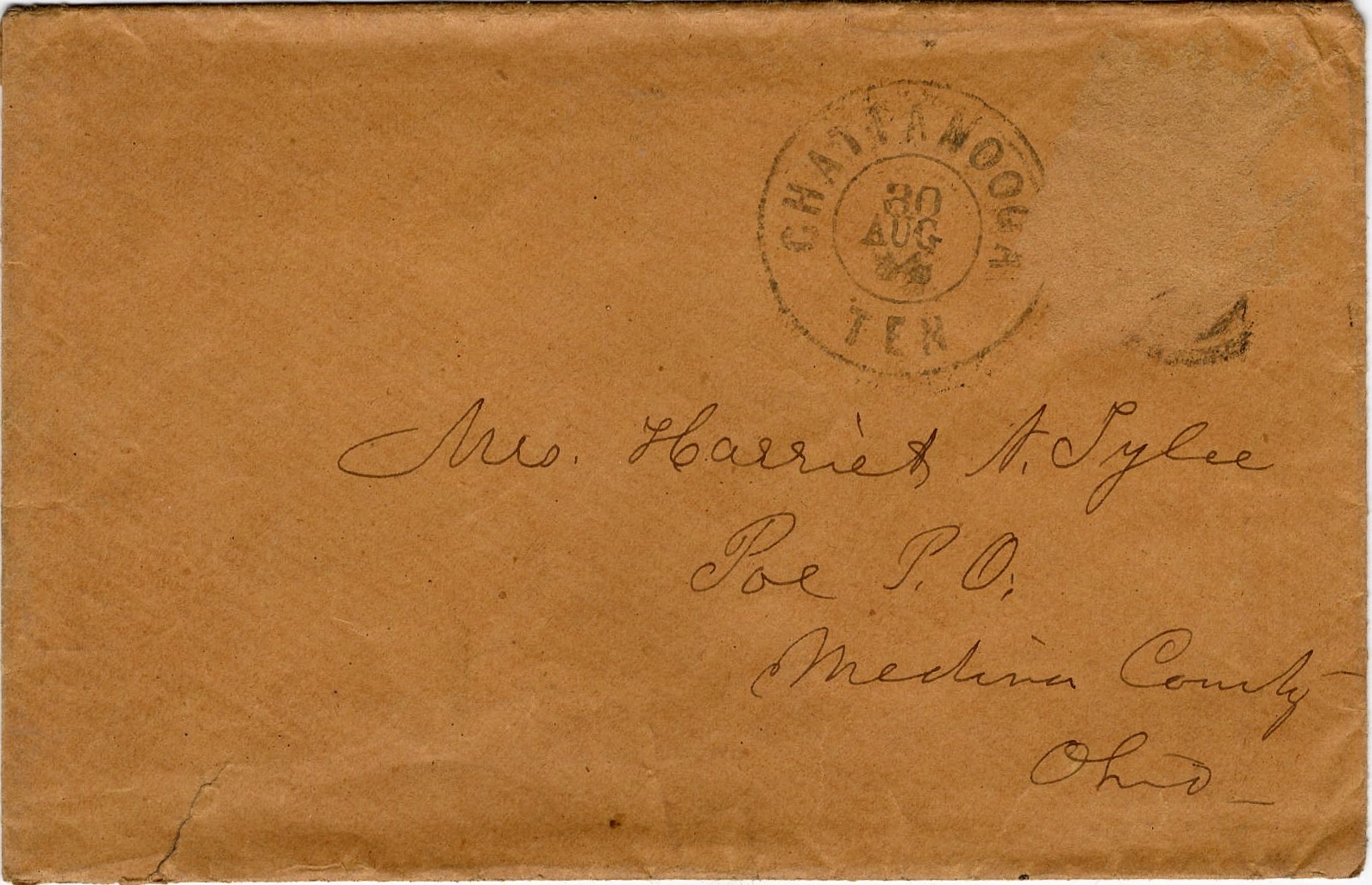
Addressed to Mrs. Harriet N. Tylee, Poe P. O., Medina county, Ohio

Hospital No. 2
Chattanooga, Tennessee
August 27, 1864

Mrs. Harriet N. Tylee
Dear friend,

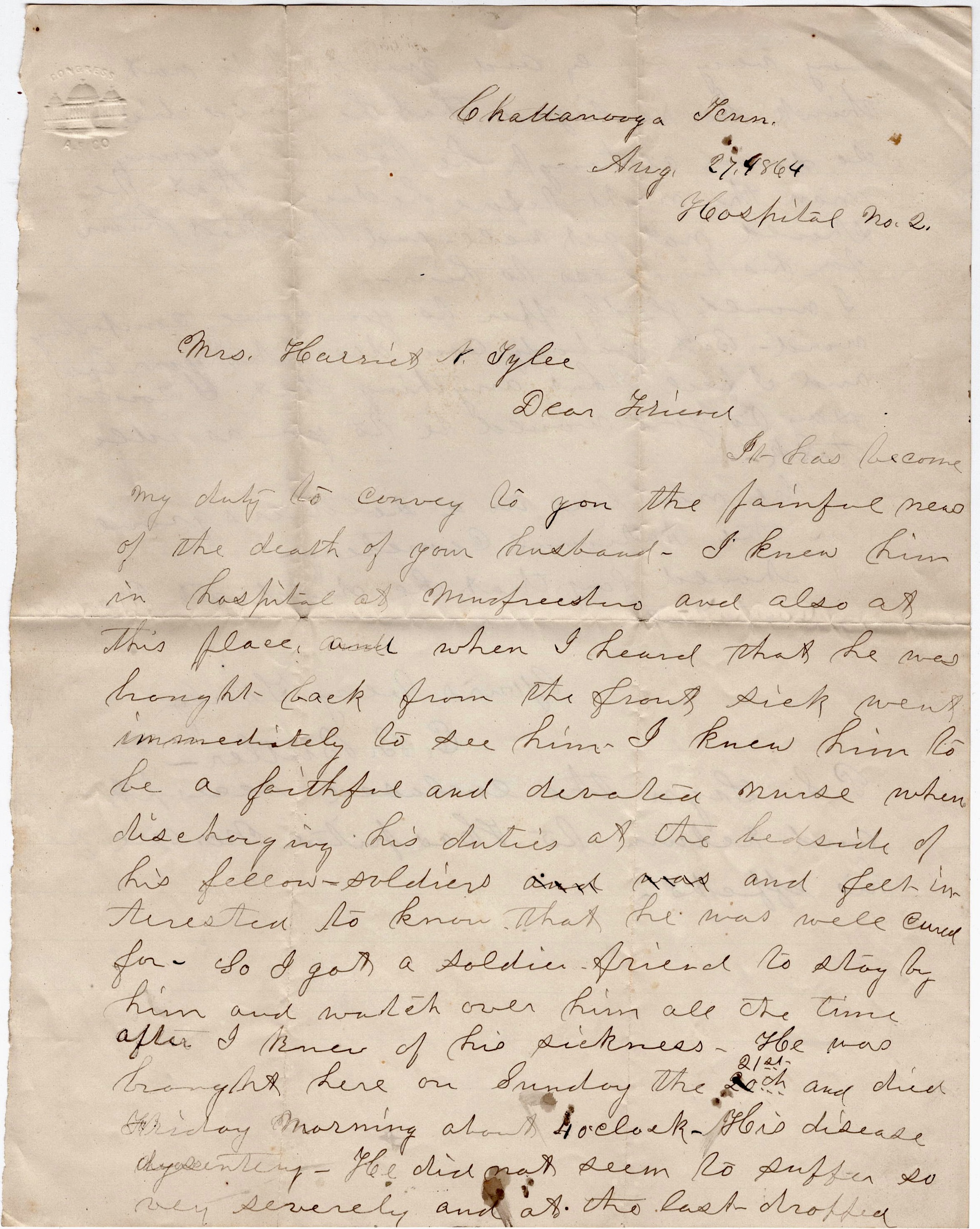
It has become my duty to convey to you the painful news of the death of your husband. I knew him in hospital at Murfreesboro and also at this place, and when I heard that he was brought back from the front sick, went immediately to see him. I knew him to be a faithful and devoted nurse when discharging his duties at the bedside of his fellow soldiers and felt interested to know that he was well cared for. So I got a soldier friend to stay by him and watch over him all the time after I knew of his sickness.

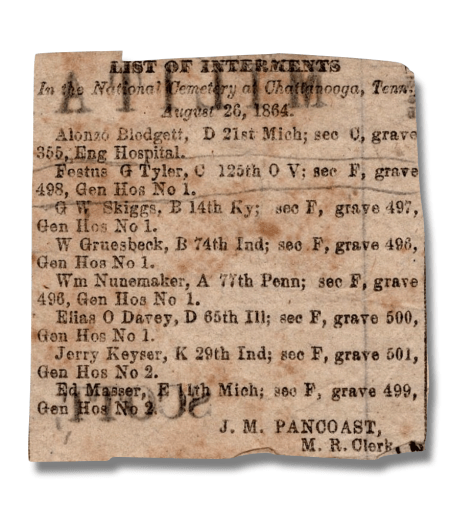
List of Interments clipped from newspaper

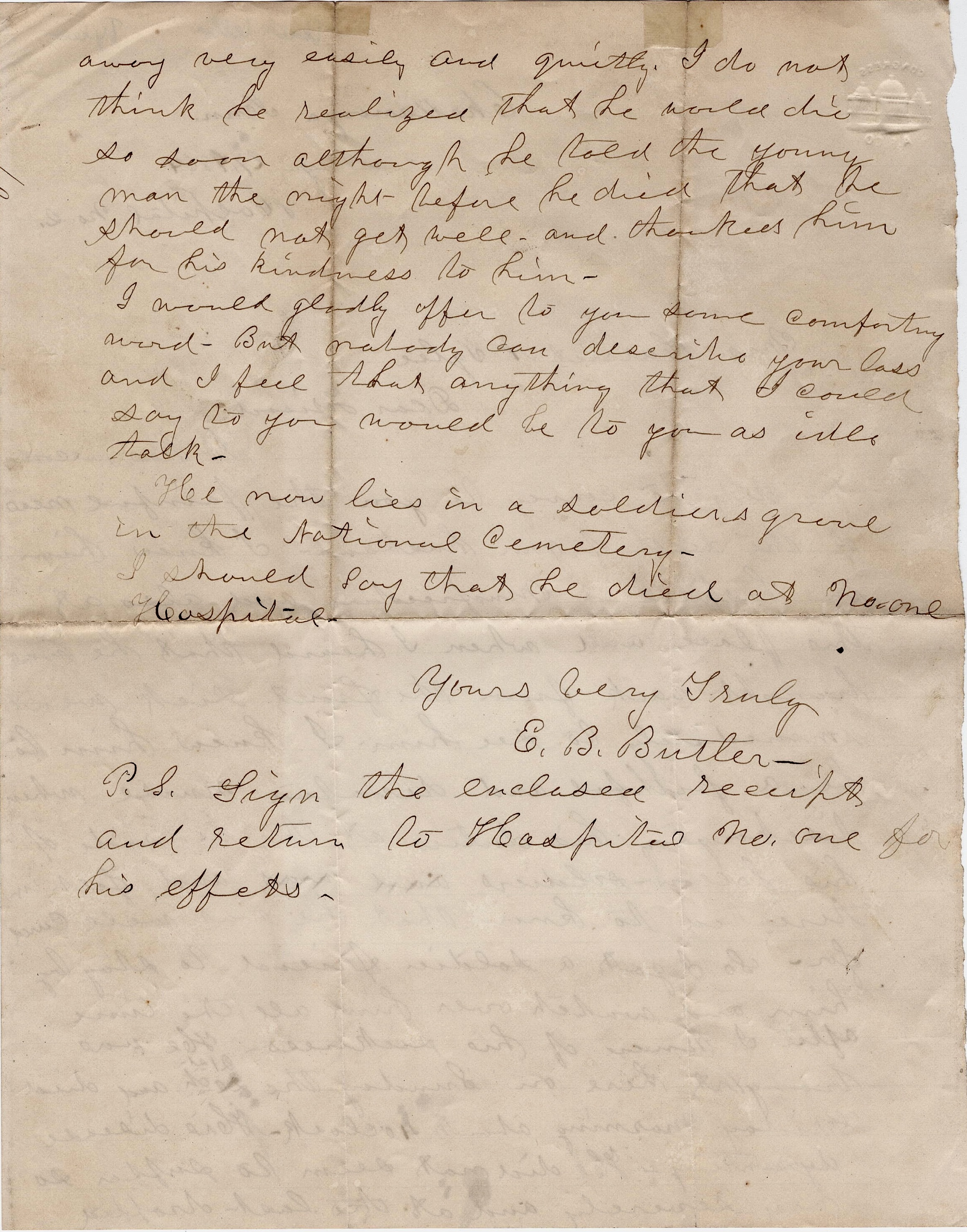
He was brought here on Sunday the 21st and died Friday morning at 4 o’clock. His disease [was] dysentery. He did not seem to suffer so very severely and at the last dropped away very easily and quietly. I do not think he realized that he would die so soon although he told the young man the night before he died that he should not get well and thanked him for his kindness to him.

I would gladly offer to you some comforting word but nobody can describe your loss and I feel that anything that I could say to you would be to you as idle talk. He now lies in a soldier’s grave in the National Cemetery. I should say that he died at No. 1 Hospital.

Yours very truly, — E. B. Butler

P. S. Sign the enclosed receipt and return to Hospital No. 1 for his effects.

Personal effects included a pocket book [with] 15 cents, knapsack, shirt, socks, Bible, Ambrotype.

1863: Festus Giddings Tylee to Harriet (Downing) Tylee

The following letters were written by Festus Giddings Tylee (1834-1864), the son of Samuel Tylee (179801875) and Harriet Giddings (1805-1860) of Hubbard, Trumbull county, Ohio. Festus was married to Harriet Muriel Downing in 1858 and was farming in Poe, Medina county, Ohio, at the time of his enlistment in Co. C, 125th Ohio Volunteer Infantry (OVI) in October 1862. He did not survive the war. He died of disease on 25 August 1864 at a Chattanooga Hospital.

Festus composed all three of these letters to his wife during his convalescence in a hospital located in Murfreesboro, Tennessee, where he was treated for a condition that resulted in significant swelling and severe pain in his leg. He remained there for several months in the autumn of 1863, serving as a nurse, which led to his absence from the combat at Chickamauga and the ensuing engagements around Chattanooga later that year.

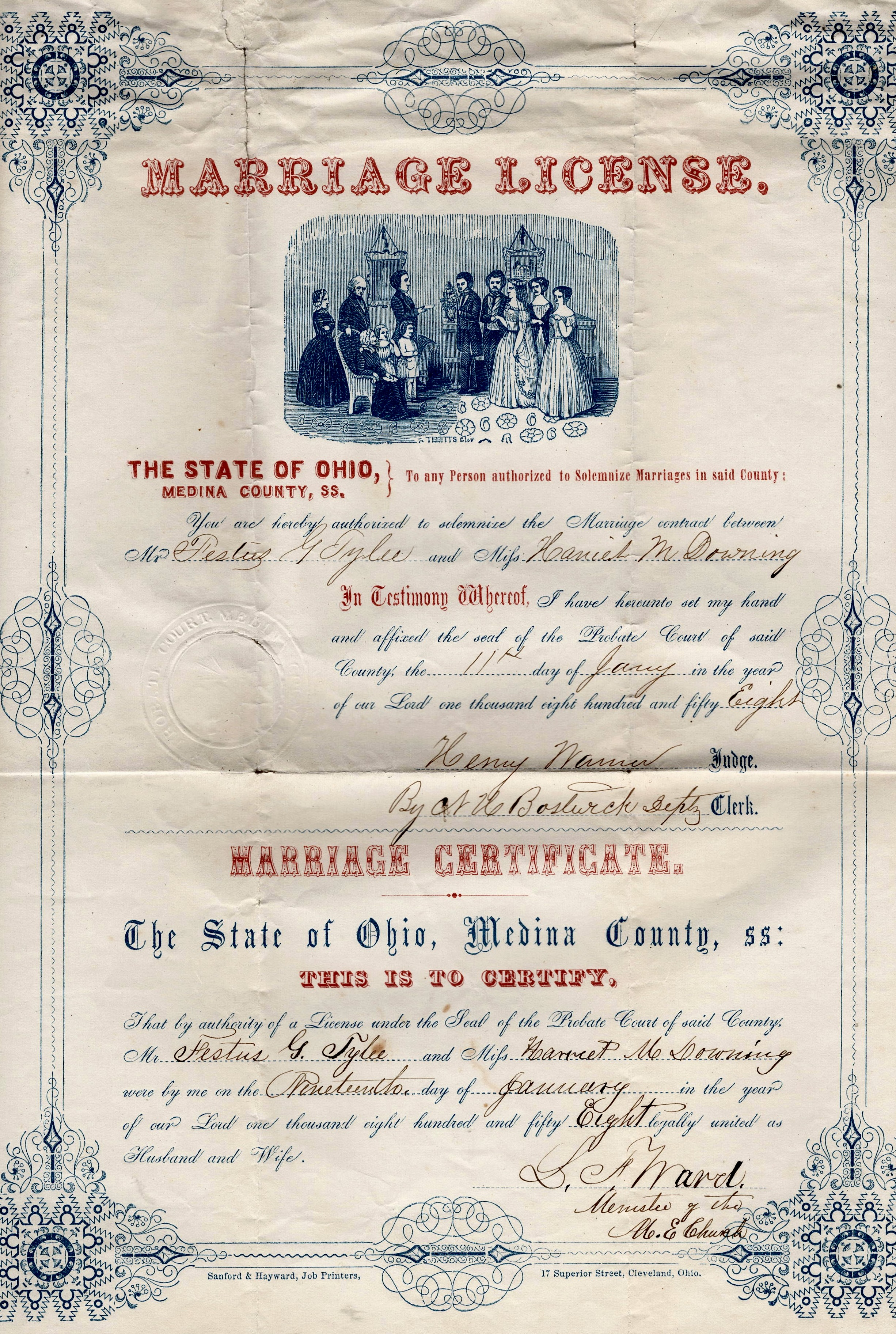
Marriage Certificate of Festus G. Tylee and Harriet M. Downing, dated 19 January 1858 in Medina county, Ohio

Letter 1

Addressed to Mrs. Harriet Tylee, Poe, Medina county, Ohio

Murfreesboro, Tennessee
September 14, 1863

My dear companion,

I received a letter from you and Daniel today and glad to hear from you both. I got such a good letter from brother Daniel. I shall answer it immediately. I am gaining slowly but am not well yet. My back is weak and my left leg is swelled up yet. Some say it will not get well for a long time but I am in hopes it will. It is some like Thomas Heath’s. It is very weak in the ankle joint. It had been over two months since it first swelled up but the swelling has gone down some. I was swelled clear to the thigh at first and was very painful. I don’t know whether I told you anything about it or not. I can’t remember from one week to another what I do write hardly but my dear Hat, I do not intend to deceive you in anything.

The first letter I wrote to you I could not think what I wanted to write. You spoke about me laying on my back so long and not being changed nor taken care of. But you are mistaken. I was changed twice a week and my nurse was good and kind to me but he had 16 to tend to and it kept him pretty busy. He failed to see my sore but i never asked him for anything but he would run and do whatever I wanted. He said he would rather tend a docsin like me that one like some he had to send for I would take anything he brought to me and never grumble at anything. I think I had good care to go through what I did. I know that I have had the best of care since I came to myself and what I have seen take care of others.

There was a man came here that was just like I was and he was changed every two days and was washed with a sponge so you see that I know I had good care. Because I did not write it to you, you must not think I tried to deceive you because I did not. When I am writing, I want to write so much that I can’t think of it all at once but I hope I have given you a full detail of my sickness. You need not look for me home this fall for they don’t give sick men furloughs if they think he will get well. But wounded men will get furloughs. The surgeon in charge received a letter from Governor [David] Tod but he said that I was doing so well that he thought best to keep me here. I have the best of care here and they won’t let me go to my regiment till I am well. You and Daniel wrote about a murder in Medina. I want you to write me all the particulars about it—who was murdered and where. I never heard anything about it…

I wrote you a letter this week with twenty dollars in it. You must write and let me know whether you get it or not. I shall send you as much more when I hear from that. How does your corn so and the cows? I must know all the particulars you know. How is my little heiffer looking and how do you expect to get along with her when she come in? You must be careful and not get hurt with her. Take care of yourself and Jenia and mother tell her I should like to see her but it is otherwise ordered. But I hope and pray for the best. I think of you often but I shall not worry. They tell me I am the most contented of any of them and that is the reason I get along so well. My love to all. From your husband, — Fet


Letter 2

Murfreesboro, Tennessee
October 25, 1863

My dear companion,

I received your letter of 14th last Friday. I was a little disappointed to hear that my box could not come but I shall be contented as it is. You done the best you could, I am sorry to put you to so much trouble for nothing. I shall not try to have one sent now for it is too much for you to do. If we had a horse of our own it would be different and then you live so far from the station that it is too hard for a woman to go so far. you must not worry about me for I shall get along first rate. I should liked to have had that box come through for there was several things that I wanted such as the paper and envelopes and the tobacco, besides the other things that is too numerous to mention. I think you had a very nice box full for me if it had come but you must not feel bad about it for it is no account anyway. Maybe I will come home some day and then we can take comfort together and that will be better than sending me a box.

I hope this terrible war will close before long so that the soldiers can go home and see their families and take comfort. It seems that it was so ordered that we should be separated. I can lay here and think over the many happy days and years that we enjoyed together but we are separated now and it makes me think of the past, But if God wills it, we will meet again and then we can take comfort again and I hope we shall.

I have written to Sam some time ago but have not heard any answer yet. I do not know what is the reason for the last time I wrote to him he answered it right off. I have written to Nat and I hope to get a letter from her before long. I have not got an answer from brother Nichols. He had better write to me, you can tell him, or I will have a settlement to make with him. I saw Mono Bushon yesterday. His regiment left here yesterday. He said he would write to me when they halted. He is as fat and chubby as ever. It does me good to see anyone that I was acquainted with and I like to hear from those that are at home. You know I like to get letters from your own experience and good long ones too. I have several letters do me from friends and I am waiting with patience to get them. I have not heard from the regiment for a long time. Communication has been cut off and we cannot write to the regiment so I do not know how they got along in the fight [at Chickamauga]. If you can get hold of a paper that has an account of the battle with our regiment in, I wish you would send it to me for I should like tp know how they got along.

The Chaplain of the 124th Regiment preached here last Sabbath. He preached a good sermon. I asked him if he knew anything about the regiment and he said that they was in the fight and lost two captains and a good many men. The Colonel of the 124th was wounded and several of the officers. I do not know who is going to preach today but we expect to have preaching at two o’clock. We have a first rate Chaplain here. He went out as a private in the 49th Pennsylvania Regiment and was promoted to Corporal and after that they sent him a Chaplain’s commission. He is a good preacher and tends to his business.

There is not much news to write about. I want you to write me a good long letter and give all the particulars. How is all those newcomers getting along? When did you hear from Morgan’s folks last? When you see them again, give my love to them. How I should like to get home and visit my old friends. I could take comfort this winter if I was at home but here I lie some six hundred miles from home and no telling when I shall get home. You must do the best you can and if I ever get home and have any health, I will take better care of you. It seems hard to me to think how you have to do but I can’t help it now. I don’t see how you can take care of three cows this winter and do all the rest that has to be done. Be careful of yourself and health and take good care of my boy for I think a great deal of him. I have been showing his picture to the boys and they say he is a pretty smart looking boy. You must kiss him for me and have him kiss you for me.

Tell Mother I have been bragging up her cheese and was going to let them see for themselves but I was disappointed in the cheese and cake. But it is all for the best and I shall be contented with my lot. Give my love to all inquiring friends and write soon and give good long letters. From your husband, – F. G. Tylee


Letter 3

Murfreesboro, Tenn.
November 13th 1863

My dear companion,

I received your welcome letter yesterday and was glad to hear from you. I am pretty well now, My leg is getting a great deal better and I am gaining strength pretty fast. I am nursing yet. It is not very hard. There is two of us to a room and only eight to take care of and most of them can wait upon themselves so you see that it is not very hard for us. I have to carry the victuals around in this ward. That is the hardest work I have to do.

I received a letter from Ira and a paper from you. It had an account of my regiment in the Battle of Chickamauga. They done well for a new regiment but how could they help it with such a man as Col. Opdycke for their leader. I have heard him say many a time that if the boys would stick to him, he would lead them to a glorious victory or an honorable grave and I guess that the boys stuck to him pretty well for they were in the hottest of the fight. There was but one boy killed in my company. He was a good little boy. There [were] several wounded in my company—some of the best boys we had. I am glad I was not in the fight for it was terrible to see the wounded come in the hospital. It is enough to make a man sick to think about it. To think how much they have to suffer on the field before they are taken care of, I should think more would die than does. They have to lay sometimes two or three days before they are taken up off the damp ground.

There is some talk of another big fight down here soon. I hope they will drive them this time into the Gulf below. I should like to see this rebellion crushed so that I could come home to my family. How I should like to get home. But we must have patience and hope for the best. There is one year of my time in and I am in a good place so I must be contented.

If I could only get a box from you it would seem so good. I was down to the Express office yesterday and they told me boxes come through now. Several of the boys got boxes here since you tried to send mine. But it will be too much trouble for you and maybe they would not let it come. You need not worry about me. I do not want my drawers anyway for I have two pairs and when I am in the hospital, they furnish drawers and shirts and socks too so you see that I do not want much. Your socks I would not wear as long as I am in the hospital, I have got my woolen shirts on and wear a white shirt over and then they have woolen gowns to wear in place of a blouse. They almost furnish a man here. All I wear that don’t belong to the hospital is my shoes, shirts and pants [and] hat—that is woolen shorts. They will last me all winter. The owe me almost 16 dollars this year for clothing and they will owe me more next year if I stay here for I have clothes enough to last me six months yet for I do not wear out clothes very fast here. I have had but two pairs of pants and these that I have now will last me a good while and my blouse is very good and I have had that over a year. It was a first rate one. I have a very good hat—almost new. It did not cost me anything. I got it over to the field hospital, They had a lot that they did not know what to do with.

If you take a notion to send me a box, you need not send my drawers and you may make three or four mince pies—good ones—and whatever you think best. Some paper and envelopes—we get such poor paper down here and it costs 50 cents a quire, envelopes 25 cents a package. I would think more of some good paper and envelopes than anything else. I will send you some money before long. How much have you got all together now? I want you to tell me. I don’t want you to be afraid to spend it for you. Get what ever you want while you have the money for maybe you won’t have the opportunity after a while. I spend a good deal more than I had orta but if I have enough for you to live on it is all I care for.

What is the reason I do not hear from my folks? It is over two months since I heard from Mat and I wrote her two letters and Sam one and father one. I want you to write to them and let me know if you hear from them. I did not get that letter that you spoke about in this letter about the Medina murder. I have never heard anything about it. Who was murdered? and what did they do with the man that they had in jail? Write soon. My love to all. Kiss Jemy for me and have him kiss you for me. Tell him to be a good boy and mind his manners. From your husband, — F. G. Tylee