Diantha (Keep) Blodgett (1807-1884) was 22 years old and just two weeks married when she wrote this letter to her mother, Alice (Goodall) Keep, wife of Simeon Keep of Monson, Massachusetts. Her new husband, Harvey Blodgett (1802-1850), was an 1829 graduate of Amherst College and we learn he was employed teaching school at Whitesboro. He may have been teaching at the Oneida Institute which was a short-lived Presbyterian school in that village, and the first to accept both Black and White students in the United States. His first appointment to the ministry in the Presbytery was at Euclid (East Cleveland, OH) in 1837. After a few years he left the ministry and returned to teaching at Newton Falls, Ohio, and later at Jackson, Illinois, where he died of typhoid fever in 1850. The couple had several children, one of who was James Harvey Blodgett (1832-1916) who was Captain of Co. E, 75th Illinois Infantry during the Civil War.
Diantha’s letter gives us a glimpse of what travel was like in 1830 in New England. Her journey from her birthplace in Monson, Massachusetts, to her new home in Whitesboro, New York, takes us on two stage rides, two steamboats, and two boats on the Erie Canal—a journey she claimed was 450 miles.
T R A N S C R I P T I O N
Addressed to Mrs. Alice G. Keep, Monson, Massachusetts
Whitesboro [New York] September 13th 1830
My dear mother,
Aware of the deep solicitude which a tender mother ever feels for her absent children, I gladly resume my pen to give you an imperfect sketch of the scenes which I have participated since I left my parental abode. As you have probably had the particulars of our ride to Springfield, I shall pass over that and commence my narrative with what transpired after those of our company left who returned to Monson.
In the afternoon on Monday all of our company who remained in P___ walked to Mr. C where we spent a short time very pleasantly after which we scurried to the public house where we spent the evening with Parson Ames. We retired about the usual hour but not to receive our usual share of repose. Expecting to take the stage at an early hour for Hartford the recollection of the scenes of the past day and the anticipation of the future quite unqualified me for refreshing slumber. At 5 in the morn we took the stage accompanied by three entire strangers, one of which proved to be a gentleman from Ohio who seemed a fine man as his conversation was highly interesting. The others were ladies who had been to Palmer on a visit, one of which is a resident of the City of New York, the other of the county of Oneida. These ladies were our company until we arrived in New York.
On the way to Hartford, another gentleman took a seat in the stage with us who was going to New Haven to attend commencement. He remarked that he fitted for college in part at Monson Academy a few years since. John accompanied us to Hartford and we had had a very pleasant and sociable ride. On our arrival there, we met Dr. White and Mr. R. Flynt at the public house. There Mr. Blodgett wrote a line to send to Monson by them which I suppose you have long ere this received. As the stage in which John took passage for P___ was soon to leave, we were obliged to part with him sooner than he or any of the company wished. However, we had not much time to spend in unpleasant reflections about anything.
Our stay in Hartford was so short that we had little opportunity to see the numerous interesting objects which the city presents. We looked in some of the shops for such articles as we wished to purchase, and I found a large shell comb which smited me so well that I bought it. As soon as we had dined, we hastened on board the steamboat Victory where our fare from Hartford to New York was one dollar each and we found our accommodations answerable to the price. The boat McDonough left Hartford for New York at the same time with the Victory and both were crowded with passengers. As we passed down the river, numbers were often collected on the bank to take passage on the boat for Saybrook where they were going to attend a camp meeting. Small boats were frequently sent to the shore to bring them on board and it was stated that about four hundred Methodists entered the Victory, many of whom were landed that dark, rainy evening as was stated as much as three miles from any dwelling. It was stated that there were more than 7 hundred passengers on the Victory, some part of the way from Hartford to New York.
We spent most of the afternoon upon the deck which was defended from sun and rain by an extended awning. Here we had an opportunity for viewing the scenery upon each side of the river. We passed nothing very wonderful by daylight, at least no land prospect interested my feelings half as much as the variety of character which the company on board presented, If I may judge from appearances, we had some from almost every class of society, from the highest to the lowest, not excepting variety in color.
We not only had our passage but our board for the above named price. When tea was ready, we rushed down into the dining room where we found the table spread very sparingly, but the company did not seem disposed to have anything spared after it came in their reach, for it was evident that most individuals wished to take good care of self even if it must be done at the expense of the good of others. This being the case, it seemed necessary that self interest should become a general spring to action or a part would leave the table as hungry as they came. However, we got through with this meal tolerable comfortable, at least for one was able to satisfy the demands of nature with weather bread and butter, and this was the only article which came in my way that I had any disposition to eat. Being this refreshed, we returned to the ladies sleeping cabin which was crowded with women and children. Here we considered ourselves highly favored if we could find a place to sit down. I soon went to my basket which I had left in one of the berths and found to my no small surprise that someone fond of trade and so well skilled in the business as to make a bargain alone had taken my silk pocket handkerchief and it its place left one very much worn and so dirty as to be unfit for use. This discovery was somewhat trying to patience at first, but judging from the appearance of persons and things that I might as well look for a needle in a hay mow as to think of seeing my handkerchief again. I concluded that it was best to give myself no uneasiness and say nothing about it, but merely to take a practical lesson and be more upon my guard for the future. I was told that another lady on board had ten dollars taken from her basket.
Steam boating on the Connecticut River in 1830.
When the hour for sleep arrived, the ladies began to repair to the berths. I don’t know whether you have ever seen anything of the kind. They are built upon each side of the cabin, one above another of sufficient length and width for a person to lie down on them. The sides of the cabin are wholly occupied with them as they are separated from each other only by a petition [partition?]. Each is furnished with a mattress, pillow, &c. for one individual. These berths were all occupied after which the chamber maids (who were two colored girls) fitted up beds in the middle of the cabin by throwing mattresses &c. upon the settees which had been occupied for seats. These beds were fitted up upon the floor and the cabin was so completely filled that we could not pass through it without often stepping over ladies. But notwithstanding the multitude of beds, there was as yet nothing of the kind for Miss Crane and myself. But instead of mourning over our own misfortune, we sat and smiled at what we considered the imaginary troubles of those around us.
There was a child in a cradle by my side which I rocked occasionally while its wearied mother tried to get a little rest upon a mattress on the floor before me. There was an almost constant change of position in the cabin and berths during the night, and notwithstanding all the selfishness here manifested, some of the ladies deserve much credit for their politeness in offering their berths for a part of the night to those who were not so fortunate as to secure one before they were all taken up. Miss Crane improved an opportunity for occupying a berth the latter part of the night but found little benefit from this attempt for repose as the state of the air increased her cough. The air in the cabin was so impure from the crowd which occupied it that I thought it best to avoid anything worse, of course kept clear of the berths and sat up all night. Mr. Blodgett was furnished with a good berth in the gentleman’s cabin and was thus refreshed with sleep.
We arrived in New York [City] Wednesday forenoon. Here we left the Victory and went on board the Constitution for Albany. After we had chosen our berths and made pther arrangements for our ride in the boat, we went to a public house in the City where we dined, after which we visited the [Peale’s New York] Museum where we saw many wonderful curiosities, both of nature and of art. But as we were to leave the city in the afternoon, we did not have sufficient time to examine them as we wished. However, we were highly gratified with our short visit. We called at some of the shops in New York in one of which I purchased a white Moreno shawl about the size of Miss Crane’s but much cheaper. In another a half mourning fancy handkerchief.
After this we found ourselves pleasantly situated compared with what we were in the Victory. The boat [Constitution] itself was pleasanter, was less crowded with passengers, and furnished with a better chamber maid. Here we paid for meals exclusive of way bills and had things in decent order. I was furnished with a good berth and succeeded in getting some sleep, but the mode of sleeping was so novel to me that I did not get near my usual share of repose. We arrived in Albany Thursday morning. Here we made no stay but took the stage immediately after leaving the boat which carried us to Schenectady. A minister with his wife and daughter from New Jersey took seats in the stage with us and accompanied us to Utica where the daughter anticipated spending considerable time at school. By this time Miss Crane and myself suffered much from a loss of sleep and fatigue both in our feelings and looks. From the first of our experiencing these evils we thought it not best to make any delay with the hope of being relieved from them but rather to pursue our journey as expeditiously as possible.
We arrived in Schenectady a little past noon. Here we left the stage and took a canal boat. Here our situation was in some respects pleasanter than on board the steam boats as there was no clatter of machinery and much less motion of the boat. We had good company tables, well furnished, and in general everything was calculated to render the situation of passengers agreeable as fair as they themselves were in a right state to enjoy a ride. We had some pleasant views of the Mohawk and of neighboring natural scenery. At length, night came on and we again sought repose in berths and to my agreeable surprise, I slept more than I had any preceding night since I commenced the journey.
A humorous sketch of passengers scrambling to avoid hitting their heads on a bridge over the Erie Canal.Source: Bottoming Out, Vol 1, No 3-4, July 1957.
In the morning the passengers arose early to avail themselves of a view of an interesting place called the Little Falls. By keeping a good look out at the bridges, we could stay up on deck with frequent low stooping. Here we had a much better opportunity of seeing the surrounding country than from the cabin windows. While the above named minister and wife were in this situation, the boat approached a bridge which they discovered and for which they stooped as they suppose sufficiently low to avoid a blow from it, but to her surprise the bridge took her Navarino [bonnet with a large crown] from her head and folded it tolerably closely, throwing so much dirt between the folds as to nearly ruin the bonnet. After it was restored to its former perch, the lady perceived no personal injury but seemed rather to lament the loss of her bonnet. Her husband seemed disposed to take a different view of the subject. Never mind for the bonnet, says he, we all need to learn to stoop low for we have frequent occasion for this exercise in the various concerns of life.
We arrived in Utica a little before noon. We spent but a short time in this place, took passage on a packet boat bound for Rochester which stopped and landed us safe in Whitesboro on Friday p.m. Thus ended our fatiguing though pleasant journey of 450 miles and we were gladly received into a pleasant family in a pleasant village though I had little reason to think it a pleasant village from what I saw of it as I entered, as the road by which we came from the canal seemed like a lane leading to a distant part of a farm or something of the kind, and the buildings which we passed were of a very inferior order.
On seating myself in my new habitation, I was ready to enquirer, where us that famous Whitesboro of which I have heard so much. However, I concluded that it was best to say nothing about present appearances but to wait until I had been favored with a better opportunity for seeing the village before I questioned the truth of former reports. And indeed, I was so glad to find a resting place after such a tour that I did not feel much disposed to find fault with its location even if it did not answer my expectations. Our things came without any material injury except my ban box which was pretty thoroughly jammed and the lid badly broken without its contents being injured. Since our arrival, agreeable to the wishes of the family, we have purchased one dozen chairs, one pair of glass lamps, some curtains for our chamber, and we’ll be purchasing a looking glass when we find one whose size, price and quality suits us. We purchased the above named articles at Utica. Mr. Blodgett paid one dollar 25 cents a piece for the chairs. They are very pretty, cane bottomed chairs and considered very cheap indeed for the quality.
Mr. Blodgett and myself went to Utica this afternoon.m. in a private carriage. During this ride I had a better opportunity to see our village than I had before enjoyed. It is indeed a very pleasant place. I have seen some Whitesboro people. Several have called to see their new inhabitant and I am much pleased with them from so short an acquaintance. And now, going to Whitesboro to live is no longer an anticipation but a reality. Yes, I am actually here, far from the friends of my childhood and upper years and I can assure my dear mother that the reality is far pleasanter than the anticipation.
We were so much affected by the motion of the boats that after we came on land and had seated ourselves in the house, we seemed to ourselves as though we were still riding upon the water. We suffered so much from this imaginary motion of the water and the fatigue of the journey that we found ourselves ill prepared for any business the next day after we arrived. We now have less of such unnatural feelings and trust we shall soon be wholly freed from them. We think that when Miss Crane has recovered from her fatigue, she will find that her journey has benefitted her health. Her society, by the way, was a favor for which I feel that I cannot be sufficiently grateful. From what I have learned of journeying during this tour, I think that I should have more fortitude to commence out without any female acquaintance to accompany me than before.
Since I left Monson, I have though much of the inmates of the parental abode and wished that they might have an opportunity to see the different parts of the country and numerous other objects upon which I have had an opportunity to cast a momentary gaze. Should our lives be spared, I trust that the period is not far distant when some of your number will visit this region. I hope that I have not given so dark a coloring to the journey as to discourage others from attempting it. Let me assure you that with equal prosperity on the way to what we have enjoyed, you will find that the greatest difficulties respecting such a journey are those which lie in the way of commencing it. I have written this letter all under the same date but have been writing it at different times. It is now Thursday. Mr. Blodgett commenced his school this morn under flattering prospects for the term. Miss Crane sends love to the whole family. Please to accept the same from Mr. Blodgett and myself, and remember us affectionately to all others who feel sufficiently interested in our welfare to enquire after us. Do not let us be disappointed by expecting a letter from Monson soon, but be sure and have some of the family write without delay, — Diantha H. Blodgett
Charles Austin Lawrence (1828-1894) was 33 years old, a husband and the father of three children, when he left his home in Nashua, New Hampshire to enlist as a sergeant in Co. B, 7th New Hampshire Infantry in late September 1861. In July 1863, following the Battle of Fort Wagner where he was wounded, he was transferred to Co. D and commissioned a Lieutenant. He was wounded twice more—on June 18, 1864 at Bermuda Hundred, Virginia and on September 15, 1864 at Petersburg, Virginia—before mustering out with his regiment at Goldsboro, North Carolina in 20 July 1865.
Charles was the son of Nicholas Lawrence (1802-1877) and Olive Moors (1809-1861) of Hillsborough, New Hampshire. He was married in 1852 to Mary Farwell Patterson (1834-1914) and his children included, Marietta (“Etta”) Perkins Lawrence (1853-1924), Charles Edward Lawrence (1857-1930) and Clara Belle Lawrence (b. 1860). Prior to the Civil War, Charles worked as a “bedstead maker.” After the war he worked as “Photographic Artist” in Nashua.
[Note: This letter is from the personal collection of Greg Herr and was offered for transcription and publication on Spared & Shared by express consent.]
T R A N S C R I P T I O N
Addressed to Mrs. Charles A. Lawrence, Nashua, New Hampshire
Camp near Jacksonville, Florida Wednesday, March 30th 1864
My dear Mary,
I am sitting this evening in my tent without any other employment and therefore idle and so I thought that I would write you a few lines or at the least that I would begin a letter to you for you know that Satan finds some mischief still for idle hands to do. I do not like to have my hands get into any of that sort of stuff. But what shall I write about. I do not know. Everything has a sameness that I do not like to write. But then here goes.
To begin with, you say that Mrs. Cobb does not get any letters from him. He told me today that he had written three or four to her since the fight at Olustee and that was the 20th day of February and one of them has his miniature in it.
Now as to that watch that was sent by Mr. Griffin to Gordon, at that time that you first mentioned it, it was in my trunk and I was away in the wilds of the most swampy, dry, barren, rich, flowery and any amount of contraiettes of states from the most loveliest flowers to the most dismal of swamps that ever were seen. And I have not heard a word from him yet. And so as soon as I got to my trunk, I just put it in the mail and sent it to him in care of my friend, Lewis Kimbal, taking Capt. Chase for a witness that I did out it in the office as I thought that the best thing that I could do with it.
But it is time for me to go to bed and so I will say goodnight.
Thursday evening. Well, Mary, this is the last day of the month, one month and ten days since the disastrous affair at Olustee. But why let that take such a prominent place in my thoughts? Simply because it is a day to be remembered by all of us who were there. And many a New England home has reason to remember that day and to look at it as one of the landmarks in their family. And let what will happen, my children can look back to that day and say with pride, my father was there with the 7th New Hampshire and they never need to blush that it was so.
Today has been a very busy day for me. Very early this morning, Colonel Abbott sent for me to appear at his quarters. Of course I reported there at once and he then ordered me to move my company tents up onto the right of the regimental line which we have been doing today. The weather has been very fine today and therefore very much in our favor. My present ground is very good—far better than where we moved from as it is dry whereas the other was very damp and very close to a frog pond so that we were put to sleep every night, especially the warm nights, by their continual croaking.
And so brother and sister Shepard are going to Boston to live you say. But you did not tell me what he was intending to do there. Has he got a place so that he can make money fast, or has the main chance at last made its appearance and so he takes the tide? I suppose so. Well, I wish him prosperity in all of his undertaking. I hope for your sake that Wallace and Carrie will move to Vermont for if they do, you can visit them better than at Philadelphia.
I should like to see you very much this evening and have a good talk with you for I have many things to say and I know that you have the same and a long chat would be the consequence. Well, three years will soon pass and then we shall meet if God is willing. But if it is His will that it should be otherwise, let us try and say truly thy will be done, not mine. But as it is rather late, I must say good night.
Monday, April 4th. Well, Mary, I think that I will just write you a few lines at this time. I have but very little to add that will be news to you. The government transport, Maple Leaf, was sunk Saturday morning by a torpedo in the river about twelve miles from here on her way to Pilatka. She was loaded with camp & garrison equipage for the troops at that place; also the officer’s private baggage. There was two women on board and a child—the wife of one of the officers and child and a number of officers, none of whom were lost that I can hear of which was very fortunate as the boat sunk at once. 1
Wreck of Transport Steamers “Maple leaf” and “Genl. Hunter”. St. Johns river. Florida, Sunk by torpedoes. Alfred Waud, artist, LOC.
That same afternoon, General Ames took a small force and went out to reconnoiter the enemy’s position at camp Finnegan and he had a brisk skirmish with the rebels. Our loss as far as I can learn was four or five wounded, some say seven. The firing lasted some 30 minutes in all.
I was disappointed last evening when the mail arrived and i did not get a letter from home or a paper. But I hope for better luck next time. I am in command of the company and have been for the last month as Capt. Chase is judge advocate of the court martial here in our division. The 3rd New York Vols. have arrived here. They disembarked this morning. I have not had the opportunity of visiting them as yet but shall do so at the earliest opportunity. Give my respects to all of my friends, Mrs. Cummings, and Sarah & tell A. O. Miles that he had better answer my letter soon. Give my regards to Kimball and wife, Rev. Eaton and Lady, Mr. and Mrs. Baldwin and anyone else that enquires for me. Kiss my Etta & Charley and do not forget Belle. How I should like to see them, you can easily imagine. God grant that we may all meet again in peace is the prayer of your husband, — Charles A. Lawrence, Lt. Commanding, Co. D, 7th N. H. Vols.
1 The Maple Leaf sank quickly in twenty feet of water. Fifty eight passengers and the crew climbed into three lifeboats with only the clothes on their backs and rowed off to Jacksonville, fifteen miles away. Four African-American crewmen were killed in the forecastle by the explosion, and four Confederate prisoners were left behind, perched on the hurricane deck which was above water, because there was not room for them in their life boats. The captain and some of the ship’s officers returned to the wreck later that day on a Navy gunboat to survey the damage and retrieve what little they could of their belongings. The crew of the gunboat removed the prisoners from the wreck. The next day the Rebel soldiers who had mined the river boarded the Maple Leaf and set fire to the part of it that was above water.
1st Sergt. Jesse Harrison, Co. I, 143rd Pennsylvania Infantry
The following letters were written by Jesse Harrison (1818-1863), the son of Stephen Harrison, Jr. (1777-1865) and Mary Dodson (1779-1859). He was married to Phoebe Tubbs (1818-1881) and was the father of five children prior to his entering into the service. His children were Daniel W. Harrison (1839-1901), Antrim Byrd (“Brice” or “Bird”) Harrison (1842-1893), Mary Elizabeth Harrison (1844-1935), Martha Ann Harrison (1846-1927), and Samuel Herbert (“Herb”) Harrison (1846-1931).
Jesse was 44 years old when he enlisted on 20 September 1862 to serve three years in Co. I, 143rd Pennsylvania Infantry. He was mustered in as 1st Sergeant on 18 October 1862 under the command of Col. Edmund L. Dana. He remained with his company until he was mortally wounded in the 1st day’s fighting at Gettysburg. He died at Camp Letterman—the field hospital set up near Gettysburg—on 20 August 1863 from the wound of his shattered right thigh. His 19 year-old daughter Mary came to the camp hospital to care for her father but could not save him. Her letter to her mother is the last letter in this collection. Curiously, Mary mentions having become acquainted with Julia Culp of Gettysburg fame while staying in Gettysburg in the weeks following the battle.
Letter 1
[Editor’s Note: The 143rd Pennsylvania Infantry was organized at Wilkes-Barre in October 1862 and left Pennsylvania for Washington, D.C. in November 7th. They served duty in the defenses of that city until January 17, 1863 when they were ordered to join the Army of the Potomac in the field January 1863 following the Battle of Fredericksburg.]
Camp Slocum [northern defenses of Washington D. C.] November 30, 1862
My dear friends, wife, children, father and all,
It is Sabbath morn and very pleasant though it was very cold through the night that is past and gone. Yet we fared tolerable well considering all things. And having performed the duties of the morning, I have seated myself by the side of a board to write a few of my unconnected thoughts to you that you may know of my welfare, my whereabouts &c. &c.
And to commence, I am well—perfectly well, never having enjoyed better health in my life. And our Boys are generally well though some of them complain of colds and I often wonder that we are not all sick, or where sickness never comes. But we have been wonderfully preserved for which we should have been wonderfully preserved for which we should be more thankful than we are. Yet I do try to remember from where the many blessings arise which I enjoy from day to day and from time to time and although many complain of the exposure and hardships to which our regiment has been subject (for which no one can blame them), yet I try to look on the bright side of the picture and to be content with my lot. And I do hope this may find you all enjoying the greatest of blessings—viz, health, prosperity, and contented minds, which rightly appreciated are continual feasts.
I promised to write to Mary some days ago but have not had time untill today and today I am hurried and interrupted so much and often that I shall not be able to write anything interesting for which you must excuse me this time.
I received your kind and thrice letters in due time and there is no use of my telling you that I was pleased and that I would like to answer each one separate and singly, but have not time at present. Perhaps in a few days I may be differently situated and have more time. Then look out, though I think I have done pretty well—at least better than you could expect of me.
Yesterday for the first time since we left Virginia I went out of our camp to visit the Boys who lie in the hospitals in and around the City of Washington. Charles Wm. Betzenberger, a very worthy young man, sergeant of our company, and I left about half past 7 a.m. and in one hour we were in the City, when having to get some blank certificates struck (one of which I enclose) and our motto being business first and then pleasure, we found a printing office and go the blanks, then went to Armory Square in which are encamped the company enlisted under Capt. [Edmund Osborne [Co. F, 149th Pennsylvania]. I soon met Charles Wilson, Wm. & Ezra Zimmer and many others of my acquaintance. Weston [D.] Millard in particular I would mention as he looks remarkably well and appears to enjoy himself well as do all who are reported for duty. They number 56 at present. I stayed a few minutes with them and then Charles Wilson and I left for Emory Hospital to see D. K. Harrison [56th Pennsylvania], some two miles distant where we soon arrived when the surgeon told us that he had just gone to the City. About march was the word and back we came to the camp [of the 149th Penn] which is situated near the centre of the City, only a short distance from the Capitol.
Dinner being ready, I dined with the Boys in Charles Wilson’s tent. Had good fare. I then went to the Armory Hospital where I found Caleb McCafferty. Though not looking very well, yet he thinks that he is improving. Dr. Culver was there also and looks very bad. I then returned to quarters and found [Sergt.] D[aniel] K. Harrison and I don’t have to guess that I was pleased. I was confident of the fact, and if appearances indicate anything he was equally gratified. We were together some two hours during which you may rest assured there was some talking done. He looks very well and expects to go to his regiment this week. He says [our son] D. W. [Daniel W. Harrison, 56th Penn.] was all right when he left but how the poor boy is by this time we know not. Many skirmishes have taken place since he left. I have written to him but have received no answer. If you hear from him, let me know immediately.
At 3 o’clock we parted regretting very much the shortness of the time but such is the life of a soldier—we meet to part, and often to meet no more on Earth. May my God grant that we all may meet in heaven. My friend, Milton Laycock and I then went to the Mount Pleasant Hospital, visited Isaac Tubbs who talks of joining his regiment this week. I took supper with him, about 1,000 of us sitting at one table, the most of whom were unfit for duty. We then returned to our camp. If I had room and time I could write all night but I have neither and consequently must come to a close by subscribing myself your dutiful son, husband, father, brother & friend. The enclosed certificate is for mother. The $100 for Bird. The $20 for Herb. The two Bills cost me five cents.
I had not told you that a man by the name of [George] Platt of our regiment died last Friday night in the hospital. He was much thought of in his company [Co. C].
Letter 2
Camp near Fort Slocum December 5th 1862
My Dear Mary,
Having promised in Frank’s letter of last evening to write an answer to your blessed, kind letter of the 29th ult., I embrace the present opportunity for so doing. And once more, through the mercy of Divine Providence, I can say that I am well and I do sincerely hope this may find you all enjoying the greatest of blessings conferred upon us while in this world. You stated in yours that it was storming. Also that you were all busy. If I could have dropped in just one moment I think we could have had a good time. Don’t you? But that privilege is denied me and I have to be content, though I may disappoint you some of these days and drop in before you are aware. Then we will have a time, won’t we, eating buckwheat cakes & sausage.
You stated that you expected visitors. I received a letter from one of them last night—Sylvina K. She wrote that whe was much pleased with her visit. I answered her letter today. You spoke about your bonnets, the price, &c. Get those that suits you. Otherwise go bare-headed. Don’t stint yourselves in anything though it stands us all in hand to be economical. You ask about Wesley Hoyt. He has seen some hard times with the rest of us but has lived through. He was in this morning and looks very well. The guard house knows him well.
In regard to the beef cattle, I think with father’s consent, they had better be sold if it can be done to advantage. Tell Bird to consult with Hat about it and submit to father’s decision. You say that father has a great deal of trouble about Dan and I. You must take my place. Be all the comfort you can to him. Counsel with the boys and have them try to please him. He will not expect anything unreasonable of any of you. He never has of me and I have lived with him longer than you have. Tell him that I seen Ezekiel’s Dan, that he had week in the hospital on account of rheumatism, but is better now. He says our Dan is fat as a pig, that he enjoys himself well, and that he has a situation as Provost Guard, and consequently is not exposed as much as he used to be.
Frank Koons has not got back yet. Where is he? And where is Will Monroe? Write and tell me everything that I want to know. You can guess some. Tell Bird to keep his fingers in his pocket and he would not get them marked. If you had let me known in time, I would have tried to come up and helped you to eat that Rib. But so it is. I am always behind though I have the advantage in one thing—the coffee line. I don’t have to drink shuck, but have good strong coffee three times a day with plenty of good sugar. Ain’t that Bully. Our company draws more than they can use and we have towards a hundred pound on hand. Don’t you wish you had some of it?
Simon Hubler has not been very well for some days though he is better now so as to be on duty today. Our Boys are generally well though I had ten of them in the hospital today, none of them seriously sick excepting Thomas Devenport who looks bad though I think he is better than he was yesterday. He is not very tough. The jerk of a lamb’s tail you may omit.
It grieved me to hear of the death of our friend Trescott. He was well and hearty when I left. We have lost but one man since we left Camp Luzerne, he belonging to Company C of the 143rd.
You say Ad. Watson has got home. Give him my best respects and tell him to write to me. About your prayers for me and [Warren H.] Crego, if you are sincere, you will be heard. Tell Mat I want her to be a good girl and not to indulge too much in frivolous expressions, and the same to you. You spoke about Matilda’s account. She had ought to pay it is all I can say. One thing more and [ ]. I think I have answered your letter pretty well. You were seriously mistaken when you guessed I would not want any more such letters. I want you to write often and much. I wrote to your Aunt Betsy Bacon and Carrie this week. They will write to father. I want you to see the letter and answer it for him. If he cannot write, sit by him and write at his dictation and send me a copy. You have not answered Crego’s letter yet. Perhaps you had better on my account. He might prove a dangerous enemy though we are on the best of terms.
Well Mary, I have filled my sheet and I hardly know how to quit. Thomas Devenport just came into my quarters have got smoked out of his own. He has a furnace in his and we have a stove which is much better.
My love to all and to some in particular. Write.
Letter 3
Camp near Fort Slocum December 19th 1862
Much esteemed and dear gals,
As I have a few moments leisure I have, after ruminating over many scenes and transactions of my past life, made up my mind that I cannot pass the time in a more profitable way to me than to converse with you, though I may not write anything that will interest you. Yet to think of th many pleasant hours we have passed together in singing and other past times is one of my chief amusements while thus separated from those whom I highly esteem and respect. You may think from my writing so often and the tone of my letters that I am down in the mouth or homesick or something else. But I can assure you that I never—-I was a going to say, but I can safely and truthfully say, that I have not enjoyed life as well in many years as for the past three months. Though as a source of consolation & pleasure I often reflect on many scenes of my past life and it is indeed a pleasure when I can banish unpleasant transactions from my mind to think of the past.
But enough of this, as it brings scenes and pleasures to memory that I may never again enjoy. Though I live in hopes. And you are both old enough to realize and know that hope maketh the heart whole. I enjoy the best of health for which I try in all sincerity to be thankful as it is a hard place here to be sick. Though we try to make them as comfortable as we can, we have 17 of our company on the sick list today—the largest number at any time yet. Three of them are not long for this world according to the opinion of the attending surgeons. Thomas Devenport is also very sick.
My best love to all of you. Remember me to father, Write soon.
Letter 4
Camp near Fort Slocum December—no, January 2, 1863
To Martha,
And 9 o’clock p.m. at that. But as I don’t feel like going to bed yet, I thought I would commence a letter though I am so confused that I hardly know what to write. My mess have gone to bed. All of us are well an I am better, still regaining my health in the superlative degree. We have had our New Year and our Christmas and two busier days I have not had since I came into the army.
I had writing, making and closing up accounts to do, all of both days and between times, and am not done yet though I think I can finish tomorrow. I received yours & Sarah’s letter in due time and was much pleased to hear from you though I wish you had written more. You can’t imagine how much good news from home does me. I hope those that went visiting enjoyed themselves ad I have no doubt they did. Though I had rather been at home with you, I want you and Sarah to be very particular as to what schools you teach. I think if I were you, I would not take a country school on any conditions as the country people are country people are generally very vulgar and sometimes lousy.
You say that you had heard from Dan. He has not written to me yet. Did he send my letter home? Was the cider you drank for me good? And did you go to Shickshinny with Frank? I was glad to hear that father is so smart. Do him all the good you can. You never will be sorry. You may tell your Aunt Matilda that what news and complaints she writes west comes direct back to [me]. I have a telegraph up all the way out. A word to the wise is sufficient. I wrote to Mary last night and I have already forgotten what I wrote and perhaps will write the same again. But here goes. I hope the goose grease will cure your mother’s sore throat and that Bird will get back from Melick’s in time to do the chores. She said Clint was sober from the fact that he had nothing to get otherwise on, just like one of his speeches. Soon as I get time, I am going to write to him. Mary says Dan swears like a trooper about our generals. I don’t blame him if they are as ignorant and tyrannical as some of our officers are, though I have had no trouble with them. But others have. I will tell the particulars some time.
A cdv of Generals Franklin and Hancock contained in Jesse Harrison’s archives.
Remember me to little George Hoyt. I will send him a photograph of generals in this.
Mary said her pen had a coniption [?] jet and I guess by the looks of this scribbling you will think mine is worse. But excuse me this time. Give my respects to Ad Watson and get him to help you sing the tune I have transcribed for you.
I received your kind & good letter mailed January 1st today at 10 o’clock. You spoke about Dan’s having the dropsy. He is well now so I hear though he has not written to me yet. I want you to tell Chris Gramps that I received the apple he sent me and that I thank him kindly for it. I could sell if I was so disposed for 20 cents. Wes Hoyt has been in the Gen. Hospital so much that I have not found out particulars about the Joe Lockard matter yet. I have written so often that I have spun out and I guess you will think so when you read this. I believe I will send grand pap my picture in this and if you are a good girl, you shall have one too if you want it. Write and tell me. Mary spoke about my not writing to mother. I have written three times to her and received no answer and have concluded to drop the correspondence if it has to be all on one side.
I like the style of your dress first rate. I was in such a hurry when I bought those I sent you being afraid of the patrol or I might have done better. But I will close for tonight and finish tomorrow so good night.
I have had a good nights rest. Been out to hear the reveille, called the roll, and have got back to my [writing]. It is now five o’clock in the morning and I would mail this but I want to send Grand pap my picture which is beautiful I expect but I have not got it yet. They could not finish it until today. Tell Bird that I have a splendid sheet of paper and an envelope for him which I will send when he writes to me. I want him to write all the particulars how you all get [along], stock and all. My love to all. The pictures are for father. The other for Phebe. Yours will come soon.
Letter 5
Camp near Fort Slocum Sunday Eve, January 11th 1862 [should be 1863]
To Mary and all from Jesse Harrison
My dear girl, I received your very kind letter this afternoon. It was not dated but it was mailed the 9th. It grieved me to hear that your mother is sick and would to God that I could drop in according to your wish. I feel that I would try to comfort her in her afflictions. You must fill my place. Do all you can for her. She has suffered much for you. And a mother. Oh, Mary, the value of ones’ own mother, we never appreciate. We never realize their worth until we are deprived of their kindness, of their faithfulness towards us, of their oft repeated kindly admonitions, and of the benefits we receive through the many sacrifice, both of health and comfort for us. And now my dear children each and all of you, I ask of you (and I feel that my request will be complied with), be kind to your mother; she hath ever labored faithfully for you, even to the sacrificing of her health which should not have been. But now you have the opportunity of returning those kindnesses and of repaying her for the many hours of toil and suffering for your sake.
And now, to Phebe I would say the image of your pensive face is continually before my eyes and I feel that for your sake I had ought to be with you and had I the wings of a dove, how soon would I use and soar above the pickets and guards with which we are now surrounded, though I would not desert. I would drop back in the morning, but this is only fancy. I know not what to say about my coming home now though I am going to make an effort. If Col. Dana and Capt. Hughes had the authority, I could start tonight. But they are like the boy that you know, neither can thy have anything to say. Even our commissioned officers can very seldom get a pass to go to Washington. Yet I will try to get a furlough for a few days though I have but faint hopes that I shall succeed. But if I do, you will see me early.
And now to close. Cast your burden on Him who is able to sustain you. With patience and resignation, abide the will of heaven, and may the Father of Mercies support you and pour into your bosom the rich consolations of His grace and preserve and strengthen you for your family. May God bless you and breathe into your bosom peace and cheerful resignation is the prayer of your absent one.
I received a letter from Daniel day before yesterday and one from Wm. R. Monroe yesterday and have answered both of them. They said they were both well and enjoying themselves first rate, though they were not anxious to see any more fighting. They are about 2 and a half miles apart. Will said in his letter that on Christmas day, he was over to see Dan and had a good visit. He also said that he had just received a letter from Frank enclosing a dollar bill and that the talk was that the Division in which he is are about to remove to Pennsylvania to recruit and he hoped to God they would.
Did Martha tell you that [Warren H.] Crego was dead? If I wrote anything of the kind, I must have been asleep when I wrote. He is not dead but has been on the sick list for several days. Tell Aunt Patty to do as she agreed to before I left, and if I don’t live to reward her, my prayers are that heaven’s choicest blessings may rest upon her and that she will be rewarded by Him who is a Father to the Fatherless and the Widow’s God. Tell Matilda that I feel grateful for her kindness. Tell Lib Hubler that I consider her extremely lucky. Simon Hubler is getting along fine though he came very near committing a grave error by deserting with Pealer &c, But as luck for him would have it, I had him detailed as Corporal of the Fatigue Party on the day they left. He himself told me the arrangement. I wish Lib would write to him and advise him.
I received Frank’s letter and answered it. Did he receive my answer? Albert says he has answered yours. I have sent each of you my photograph and one to Father. Have you received them? Write to me soon. Write to me often. I will come home if I can but don’t be disappointed if you don’t see me. Did Sarah K M get her ring? I sent it in a letter by Joseph Moss. Write and tell me everything. Remember me to ll enquiring friends, To Dr. Warner and family in particular & to Jarius Hoyt. I would like first rate to see you all just a minute anyhow. I am perfectly well and like the service better every day. Give my best love to grandpap and reserve each of a good share. But I must close. Excuse this scribbling as I wished to send by this evening’s mail which is called for at half past eight. Good night. Good night.
Letter 6
Camp near Fort Slocum February 11th 1862 [should be 1863]
My dear father, wife, children, and all,
Having a little spare time this evening after the confusion and tedious duties of the day, I will improve it in writing to you though I have no news of particular interest to write. But as I know not how soon or how long it may be ere I again shall have the conveniences for writing that I now have, I will improve the present by just saying that I am well. And when I say well, I include the whole, never having enjoyed better health.
I sent father a letter yesterday and I want you in your next to tell me if you or he received it. Be particular. I feel quite an interest in knowing. But oh! dear, I was just called to assist in opening a box in which they said I had an interest and what shall I say in regard to its contents. I have no language with which I can express my thanks or feelings. The large apple received from father was excellent and could I only have sat by his side and divided it with him, giving him the largest share, I should feel—but I cannot tell what my feelings would be. I only know that my prayer to God is that I may once more enjoy that privilege. And I do feel that I shall be heard in my petition. It is only the hopes of seeing you all once more that encourages me and keeps me healthy. Smile if you choose, but I believe it.
And, as for the rest in the box, I know not what to say. It is all good, all acceptable. If we were only allowed to enjoy it. But tomorrow we march and have to leave only what we can carry. I don’t know what to do, tell me, all are in the same fix. I ate a sheep nose, a rusty coat, and a Laubach apple and I hardly know which was the best. The cakes, the chicken, the butter, especially, and the hickory nuts are fine. All is getting our suppers and after eating we shant have so much to pack, at least in our knapsacks, and as I go along, I might as well tell you what I have to carry. Though I must first thank you for your kind wishes expressed in the little notes written and enclosed. And I hardly know how to do it. I have no language to express them. Suffice it to say that I feel that I still have a few friends left in old Huntington and ready as soon as reverses come to dive for the last copper left for the Widow. No, no, I mean those who express a heart felt sympathy when I am in trouble.
But to my object. In the first place (and I am going to write nothing but truth), I have what is already on my back, consisting of 2 shirts, 1 pair drawers, 1 pair pants, 1 vest, 1 dress coat, 1 pair socks, and a noble pair of boots, for which I a also indebted to you. Also my old hat which I wear yet as a general thing, though I have Lieutenant’s cap on tonight. You would smile to see me.
A small, brass, portable stove (4″ in diameter and 5.25 inches high) that might have carried originally some whale oil or kerosene with a wick, and light enough to carry in a knapsack.
But the carrying I want to get at. I have a good Enfield rifle with fixed bayonet and 60 rounds of cartridge, 16 of which will weigh a pound, then cartridge box, cap box, belt, shoulder belt, sword and sword belt, revolver, haversack with five days rations, canteen filled with coffee 3 pints, and last of all that I can carry is my knapsack in which I now have 6 shirts, two pair drawers, a lot of bandages to up wounds if I happen to have courage enough to get close enough to to the enemy to receive them, one woolen blanket—a mate to the one I sent home, one excellent oiled rubber blanket, one blouse, and then paper, ink, pens, plate, knife and fork, and I don’t know but I will take a stove along—we have them that only weights 2 lbs., a patented portable soldiers stove, which answers a very good purpose. In addition to the above, I have my carpet sack which I will enclose in a box and send home. Al[bert] Earls & I in partnership will fill the box. You will find it at Shickshinny.
But I had for gotten to tell you that this is the morning of the 12th of February, half past 4. But that is the very case and the orders received yesterday are countermanded for the present so you see I have been making a lot about nothing. Still our orders are to keep our moveables packed and now I must come to a close as my left eye is still too weak to write much by candle light. Still I hate to pay postage and not have the sheet full so I will scratch a little more.
I attended meeting last Sabbath at the Soldier’s home about one mile from here and a more interesting service I never witnessed though it was rather lengthy, lasting three hours. The denomination is styled the Protestant Episcopal Church [see St. Paul’s Episcopal Church, Rock Creek Parish]. The building was erected in the year 1719 and is still a splendid structure though it was repaired in 1790. The interior is decked with evergreens throughout, crosses, wreaths, and emblems of all descriptions cover the walls. They have an organ from which many beautiful strains of music was drawn and when accompanied by the soldier like voices of our old Colonel [Dana] and Lieutenants [C. C.] Plotz, [Charles W.] Betzenberger, and my humble self, the effect was highly imposing. The oldest marble in the yard to the memory of the departed was dated 1775 [see Robert Cramphin, died April 1775]. The building is situated in a beautiful park, interspersed with evergreens. The Mountain Ash through which the gravel walks wind most beautifully. There are several family vaults in which the coffins of the dead are visible and had I time I would give you an outline of services but I have not as the reveille is beating and I must attend. Hoping this may find you all in health and good spirits, I subscribe myself yours in love & affection, — Jesse Harrison
To all of you.
Ellis [B.] Gearhart & Z[ebulon] S. Rhone deserted last Monday. We had treated them too well though their father are more to blame than them.
Letter 7
Camp Dana King George county, Va. Saturday, February 7th 1863
My dearest friends, father, wife, children and all,
Once more through the mercy of Divine Providence I have the privilege of seating myself by the side of an old valise in an enviable state of mind indeed. Any why, says you. I will answer. I received two letters last night, one from mother dated March 1st, and one from Mary dated February [January] 25th & 26th, and you may rely upon it, I was pleased. If that little word can convey my feelings, and although I just [illegible] indebted to you and will hasten to answer though I have so much to do and so little time to write that I hardly know how to commence. And of the multitude of incidents, transactions, and eventful events of the last two weeks, I hardly know which to relate, or what would be the most interesting to you though as I sit in our little log tent, the dimensions of which are 12 [?] feet by 14 feet and the height 3 and a half feet, on the top of which our canvas is fastened, I feel that the scenes of my childhood, the transactions of my boyhood’s early days, and then the more eventful career of my early manhood almost swallows up and erases all else, from my mind, even so far has it an influence that I forget the rapid flight of time.
It is night, it is morning, and I heed it not. A week seems but as a day, and in this I feel that a blessing is conferred upon me. You will no doubt wonder how I can take things so coolly. And I am often at a loss how to account for the indifference (I know not what else to call it.) I feel not but what I dearly love all, and everything connected with my home. No! far from it. I cherish ever association of the many happy days I have passed in Old Luzerne, and I am perfectly contented when off duty, and have leisure to ruminate and even when on duty, which is almost constantly, I enjoy it seldom getting weary, often relieving my comrades by carrying in addition to my own load, a portion of theirs.
But I commenced this letter intending to answer yours which I shall fail in doing if I continue in this strain. So here goes. To mother, I was glad that you came to the conclusion to answer my letter and as for the interesting portion of it, I perused it over & again and still hold it in my hands. All is interesting except the blank portion of the sheet. I was glad to hear you were getting along so well. As for the box you and Frank sent, Dan or I will never see, the regiment which Capt. Spoce is attached having gone to Alexandria. But it makes but little difference. We have all we can enjoy though if it had come through, no doubt we could have done justice to it, or its contents, and enjoyed ourselves thinking and talking of you. As for my meeting with him, your imagination was correct. It was a happy meeting.
Though one thing I have already written concerning and that is the borrowing of trouble in your despair of ever seeing either of us again. Remember, there is one who hath said that not even a sparrow shall fall to the ground without His notice, and I have confidence in His promises, and also that He will do all things well, and in His confidence, I can enjoy all things both sweet and bitter, and since I have withdrawn from certain influences, and have abandoned bad habits, everything goes well, and it does really seem at times that my cup of blessings is running over. My prayers also coincide with yours. That we may ever be found faithful in the performance of our duty and at the close of this unnatural strife be permitted to return and enjoy the close of life in peace.
I was glad to hear of the prosperity of the livestock and as for the prices of such articles as you may need, in all probability there will be but little change for some time to come. As for Herbert’s watch, it may be a lesson by which he may profit. You get the Old Introduction and have him read the story of Benjamin Franklin buying the whistle. I think it is quite appropriate.
As for Bird, I think he and Herbert had ought and can do as much as I used to, which if they do, you can all have as much of everything as you want and something left. I will write to Bird in regard to it, though I had rather he would write and let me know how he wants to manage. Have him write immediately. And now, I must answer Mary’s letter in this which if I do, I will have to commence soon.
And to commence. There os no use of my telling you I was pleased to hear from you once more. How was it that you neglected writing so long? You ask me if I have seen Wood yet. I have not though I intend to soon if I get time. I wish you would write to him, that you would tell him of my location, and perhaps he has more time to visit than I have and would come and see us.
This post-war cabinet card is a photograph of an original tintype that was taken during the Civil War. The one of the right is identified as Jesse Harrison; the one on the left is not identified but appears to be much younger and could well be Jesse’s son who served in the 56th Pennsylvania. It might have been taken during the winter of 1862-63 when father & sons regiments were camped near each other. This photo was with Jesse’s collection of letters.
As for your parties, you already know my opinion in regard to them. Though I do not wish you to let them interfere with your duties or studies—-but I am called [away]
Sunday afternoon. You will see that I am a good while writing this letter. The reason for which is I was kept in duty yesterday and last night until half past nine, and this morning after roll call, morning reports, and inspection, I went over to see Dan. I met him coming over to see me and as I had not been over to his camp, he turned round and we went over to the camp of the 7th Indiana & 56th [Pennsylvania], who are together. Though Dan’s tent is nearly a half mile farther in to which we went, to give you a description of it would require language of which I am not master. Though as a sample, or to give you a little insight, just imagine a hole dug in the ground about 6 feet long, 5 feet wide, and three feet deep, over which is spread two shelter tents stretch on a pole sustained by two crutches. In addition to this, he has three other pieces of canvas, two stretched so as to lap on the others, the other for the gable end under this last. The earth has not been disturbed and it serves for a table, a shelf, a seat, a closet and many other purposes. Then from the first apartment you will see a hole dug straight out from the bottom near three feet which then turns up and opens on the outside, thus forming both fireplace & chimney and makes it comfortable. He has a good berth.
Most likely exaggerated in size, this Winslow Homer sketch of winter quarters appeared in the January 24, 1863 edition of Harper’s Weekly.
I stayed about two hours, ate some bread and butter, crackers, onions, and drank some whiskey, and then he came over with me and is here now. Though by the way he ready my letters and I read his, he has all he needs—that is, to live on, though he had to pay 50 cents per pound for the butter. But as I must soon close this letter, I would just say that we are both of us well and enjoying ourselves well.
Yesterday there was heavy firing on our picket lines some three miles distant. All was excitement in our camp. Troops of cavalry were passing us all the time. Soon orders came for us to empty out all our cartridges which being done, each man was furnished with 60 rounds of new ones. The firing lasted about two hours. I have not heard the particulars. One thing I know, I had no fear. I still retained my indifference though I know not what my feelings may be when brought before the enemy face to face. But I expect soon to know. Dan says I will be as cool as a cucumber.
I want you to excuse this miserable sheet. You must not expect any more fancy writing from me. I have none of the conveniences or materials.
Letter 8
[Editor’s Note: On the 20th of April, the 143rd Pennsylvania accompanied the division on an expedition to Port Royal, below Fredericksburg, where a feint was made of crossing the river. They did not cross and returned to their camp on the 22d.]
Camp Dana April 23, 1863
My dear friends, father, wife, children and all,
According to a promise made in the two last little notes I wrote to you since my return, I seat myself for the purpose of giving you a little history of my journey from home to this place. As you are all aware, with a sad heart on the morning of the 16th inst., I left the hallowed associations of my early days on an expedition fraught with interest, and the result of which is unknown. I said with a sad heart I left. And you may infer from the expression that I regret the steps I have taken, but I can assure you that knowing what I have already learned, and after the hard experience of the past few months, were I free, I would again enlist. Yes, my friends, I feel that I am in the line of duty from which I would not swerve and my regrets are only the being deprived of the society of my family and friends and of trying to be a comfort to the few remaining days or years, I hope, of one to whom I owe all I have, or am.
But to my sojourn, I left Shickshinny 15 minutes to ten and after a pleasant ride, arrived at Northumberland 15 minutes to 1 p.m. We lay there about one hour and then went over to Sunbury which lay in sight, halted, and soon learned that we would have to remain there until 11 o’clock at night. And what do you suppose were my feelings at that time. One whole day, as it were, lost in my existence. I might have stayed at home and been just as far on our journey on the day following. But I was there and had ample time for reflection. My thoughts were not controllable and tears would flow, though I comforted myself with the maxim or saying, that the brave are tenderhearted, and I suffered them to flow. I only got out of the car for a few moments once, and then to get shaved. Could I find language to tell you what my feelings were for those longest ten hours I ever passed, I would, but language fails me and I must forbear.
At half past 11 we started and arrived at Harrisburg at 3 o’clock morning 17th. Halted a few moments and then on to York where we arrived at the break of day. Thus passing along, we arrived at Baltimore half past 10 a.m. and to Washington at noon. Took dinner, went to the Provost Marshal, got our passes for the Army of the Potomac, which it was said was on the move, but we were there and could not go until the next day. We went to the Carer Barracks Hospital near Fort Slocum and seen our Boys that had been left sick. We found them looking well and anxious to go with us but could not until a regular transfer could be made. Benjamin Belles & Edward Traxler were the only ones you would know. At night we went to the theatre, though I had rather went to bed. Still the Boys insisting so hard, I went. The plays were very good but at times my thoughts would be so engrossed with home, that when asked is not that splendid. I would have to ask what. I will enclose a programme that you may see the names & of the actors.
At 11 we returned to our lodgings, slept until morning, eat breakfast, and at 7.30 o’clock set sail. Touched at Alexandria at half past eight, at Aqua Creek 11 a.m., saw Capt, Tubbs who with many others had been sent to the General Hospital, arrived at Belle Plain Landing at 3 p.m. where if appearances indicate anything, they were as glad to see us as we were to see them. Daniel came over in the evening. Was right well. My trunk I had to leave at the Landing and he said he would come over the next day since which time I have not seen him though he sent word that he would have to march the next day.
And now I must say something about the marching, &c. &c. When I arrived in camp, I found all things packed. Each one having 8 days rations with 60 rounds cartridge. I called on the Colonel and other Field Officers and I never experienced a more cordial or warmer reception than on that occasion. They were all pleased, both officers and men. After reporting myself, I drew my rations and prepared for marching as the orders were to hold ourselves in readiness to form at a moment’s notice. Many regiments had already gone. Deserted camps were on every hand, and the appearance was gloomy indeed. But night came on apace and I had a good night’s rest.
Sunday morning was beautifully warm and pleasant though much here was to do. I had but little time to think of home and no doubt it was all the better for me. But the day passed along. Drill, reveille, inspection, dress parade, all passed along in a satisfactory manner. Night came and we all retired with the expectation of being called, perhaps within an hour. But we were not disturbed and at daybreak the reveille awoke us and we found the rain pouring down in torrents. Still the orders came to us to be in line of battle in half an hour, and at 2 o’clock the regiment started, marched out of camp, and formed Division, composed of 5 regiments, viz—143rd, 149th, 150th, 135th, 151st, marched to our picket lines about three miles and halted a half hour. It being near five o’clock, we started and did not halt again until half past ten at night when we had orders to rest one hour, at the expiration of which we again fell in and marched until half past 3 in the morning. Built fires out of secesh fence and then laid down in the mud until the break of day when we were again ordered to march. We traveled east of south and at 12 noon arrived in sight of Port Royal [below Fredericksburg], having traveled 26 miles of the worst roads I ever saw, the most of the way in the night, raining hard from time to time. We started [halted] until near daylight in the morning. But more of this anon.
The Division formed by regiments sharp shooters were selected from different companies, the command of which was given to Capt. [Chester] Hughes [of Co. I]. I was also placed on the right of the same. The Colonel came to us after we had taken our positions and gave us our instructions which was to protect the pontoon bridge builders from the enemy’s fire by popping off all who should appear or molest us. We were then near three miles distant their flags and signal flags waving gracefully or I should say disgracefully in the hill back of the town. After these dispositions were made, our Colonel rode up to us and says, “Boys, you have an honorable position and a dangerous one though I have all confidence in your courage and have no doubt you will perform your duty. We then started about one mile towards town, halted, built fires of secesh fence, cutting off posts and burning rails, thus destroying miles of fence which enclosed the most beautiful plantation I ever saw. But more of this anon.
The Boys were then ordered to rest and those that wished it to make coffee and it would have done you good to have seen us flying around. We had a good cup of coffee while the Officers reconnoitered. They soon returned. Orders were given to get in ranks and load our rifles which was soon done. We then marched toward the town until we arrived within 30 rods [165 yards] of the bank of the river when we were halted. Skirmishers were thrown out on either side, regiments filed out by divisions and placed in order of battle. Gen. Doubleday then gave notice to the inhabitants that they might have two hours to remove the women and children and you would have smiled to have seen them skedaddle over the hill back of the town. Our little army was all on tiptoe expecting a shell or ball to commence the picnic but none came. We then waved the red flag of defiance which was not answered. Our generals then surveyed the defenses of the town and with the help of glasses soon found that appearances were deceitful. Instead of a town nearly deserted except by women and children, they found that the houses and the rifle pits, besides a battery, were filled with men ready to pour a deadly fire upon us as soon as we undertook to cross the river.
A council of war was held, the decision of which was to keep up appearances until after dark and then to fall back, though we knew it not at the tie. Skirmishers were then thrown out to build fires on each side and in our read and soon a line of fires some [rest of letter is missing]
Letter 9
Camp near Falmouth or Fredericksburg In the woods near the Rappahannock May 12, 1863
My dear son,
I seat myself this beautiful morning to answer your very kind and welcome letter which I received in due time, and you may rest assured I was pleased. I had waited long and anxiously for a line from you and at last it came. But you never will know the pleasure until you are situated just as I am which I pray God may never be. But to answer yours, you spoke of planting potatoes. Be careful and select the best seed as some we have been planting hardly pays. You are full early for corn. But perhaps not too early. I was glad to hear that you got along with your work so well. Don’t work too hard—only be steady and you can so all that is necessary.
You spoke of laying up some stone fence. There is nearly stone enough between Fritz and us for a wall and he told me if I got the stone he would get it laid up. Try him. Hat said the same of the little strip by the same field. If they do anything, you must have the line established between Fritz, Uncle Mat, Williams & us. If you think best you may get some good hand to lay up the strip you spoke of between us and J. E. and along the lane up by the woods as that fence will have to be repaired otherwise.
Telle got with us last Saturday and looks well. He is on picket. I wish you had thought a little sooner about the tobacco though what Herbert sent came first rate, I tell you. About the calf, you know my opinion. I disapprove of raising it as it will fetch more at five weeks of age than one year.
As for your coming down, I should like very much to see you but even if you started, you could not get here now as our sutlers, one of whom is here and the other in Washington, cannot get back and firth. Daniel is here or close by and was here last night. He is right well. I bought him a good ham yesterday for 10.5 cents per lb. he could not get off their commissary. I was glad to hear Ezekiel was better. Give my love to him. I was glad to hear that things look well. You must get the cattle in pasture over by the Mill Brook as early as you can before the wild grass gets tough, If Frank wants to sow the field you spoke of, have him do so. What have you done with the red oxen? I would liked very much to have been at J. Hoyts party but could not come.
Daniel got a letter from William R. Monroe yesterday. I read it. He is well and says he is enjoying himself first rate. As for myself, I feel first rate again though I never was so near used up in my life as I was the few days past, the particulars of which I have already written. Many times I thought of you and would ask the question, what would become of Bird if he was here. Our generals will say that our Brigade has done the hardest marching that has been done since the retreat of the French from Moscow.
The weather is very warm here now, seemingly as much so as our harvest weather. Our camp is situated on a rise of ground on which the Oak [illegible] has been suffered to grow. The leaves of the trees are nearly half size and I seen timothy and clover over a foot high one week ago. This is a beautiful country—no stone, soil rich & loose, though I would rather live in Old Luzerne. Simon Hubler just came and wanted a pass to go and get some tobacco. I gave him one. 39 of our men are out on picket. Capt. Hughes is laying on our bunk. He is not well. Has a touch of the fever and expects to be sent to the general hospital and then what will become of me, I know not. But as you say, my sheet is full and I must close. My best love to you all. Remember me to Grand Pap and read this to him.
Jesse Harrison to Bird & all.
Write soon and write everything.
Letter 10
Camp Letterman near Gettysburg where more than 14,000 Union and 6,800 Confederate wounded were treated after of the battle.
[Note: This letter was written from Camp Letterman near Gettysburg where Jesse Harrison was being treated for his leg wound sustained in the fighting on Day 1 at Gettysburg. His oldest daughter, Mary, wrote the letter to her mother, updating her on her father’s status.]
Gettysburg [Pennsylvania] July 17, 1863
My dear mother,
Again I seat myself to let you know of father’s welfare. And I am happy to state that he is much better. The Doctor said today that his leg was closing much better than he had anticipated. If he keeps doing so well, all will be right. He may take a turn but I guess not though it will take a long time for it to get well and I expect it will be a long time before I can get home & I do not want you to work yourself down before I come. Let the work go until I do get home. Have Mat do her part & if you cannot get along, hire Mrs. Cook. How is Aunt Pattie & Dan and all of the folks? I suppose our Dan is with you. I hope so.
I have it very nice here and wish I could have time to tell you how nice I have it but I cannot tonight. Perhaps I will soon. We have many friends here and form new ones every day—and kind ones too. There is one in particular, her name is Julia Culp. 1 I will tell you more of her next time.
Hattie is sitting before, almost asleep. Telle came to see Father today. They both cried when they met. If I stay, you will have to send by someone me an apron or two, a chemise, &c. One of father’s wounds is beginning to heal. You must not be too flattered for he is not out of danger yet. Byrd is writing some and I guess I will close for tonight. Love to all—Carrie Sue, Dan, Aunt Tilder’s folks, Aunt Pettie. Tell Grand Pap I hope he is better & that I am all right. Now goodbye.
Pap sends kisses to all, Aunt Pettie, you ,Mat, and all. He is in good spirits. Excuse haste this time. From your daughter, — Mary
Men are dying off fast in the hospital. There was one died tonight.
To Herb, Pap said I should tell you to be a good boy. Don’t work too hard. I do not know when Byrd can leave to get home. Give our love to Mat’s folks. — Mary
1 Julia Culp has been forever immortalized in Gettysburg’s history as the sister of John Wesley Culp who hailed from Gettysburg but fought for the Confederacy. 16 year-old Julia was the youngest of the Esaias Jesse Culp family. Her brother, John Wesley Culp, was killed on Culp’s Hill on the morning of July 3, 1863 – fighting for the Confederacy. Another brother, William, fought for the Union but was not present at Gettysburg. Julia and her sister, Annie, lent their aid in nursing the wounded after the battle. Julia spent many hours assisting in amputations and the strong odor of ether, used to render the wounded soldier unconscious, soon made her ill. She also worked with embalming the dead, and that fluid also released toxicity. Julia was one of the Gettysburg women who soon became seriously ill from the effects of both liquids, which affected her nervous system and her circulatory system. She was never in good health after Gettysburg. Julia moved to New Jersey and married John Willever, but died soon afterward, in 1868, at the age of 21. Her death certificate marks the cause of death as “ the effects of embalming fluid that she was exposed to while serving as a nurse after the Battle of Gettysburg.”
This letter was written by Sgt. John Caskey (1834-1924) of Co. F, 126th Ohio Volunteer Infantry (OVI). He enlisted in August 1862 and mustered out of the service three years later on 16 June 1865.
John was the son of Joseph Caskey (1808-1898) and Christena Sham (1809-1889) of Augusta, Carroll county, Ohio. He was married to Margaret Hyett (1833-1913) in 1856.
A photograph from the 1860s of a house in Augusta, Carroll county, Ohio. It later served as the town’s post office. (Carroll County Ohio History & Genealogical Group)
T R A N S C R I P T I O N
New Creek Stations, Virginia May 17, 1863
Sister Lena,
This afternoon I seat myself to answer your letter which I received a few days since while we was at Greenland and I am glad to hear that you all was in the enjoyment of good health. I still am well and hardy as usual. When I received your last letter, I also received a likeness of Marg’s, Hattie’s & Jerome’s on a place. On another plate in the same envelope was a likeness of yours and Mag Day’s addressed to Thomas Crawford. I sent it to him the first opportunity I had and he now has it.
The boys of our company are all here with us excepting some of the ailing with their nurses which is still at Martinsburg. I have not seen Sam Iden since he has returned from home. He is nursing in the hospital at Martinsburg.
I could not find an image of John but here is one of William Wirt Groves who served in Co. B, 126th OVI. (Ancestry.com)
Tis thought we will leave here about the middle of this week. Some say we will go back to Martinsburg. Others say to Parkersburg, and some say to Wheeling though I think twill be to Martinsburg. For my part, I do not want to go to Parkersburg but then I will do as commanded. About the middle of the last week we had one desertion from our company which was Harry [Harrison] Herrington, or at least we think he has deserted. Was he seen about Augusta or not? I at the present time think I would like to go to Wheeling to spend a short time there where I could get to see the banks of the old Ohio once more.
I suppose Margaret got the two letters I sent her giving a description of our journey while we were out. Tell Margaret I have not got a letter from her for near four weeks though I suppose she has written. But the letters have been detained along the road some place. I received one letter which was a month coming after it had been mailed but I would like a letter from home. But I still will write whenever I get a letter or not to let them or you know where we are. I would like much to be at home to tend the Quarterly Meeting at Mt. Zion [Methodist Church] though at the present time I see but little sight and again I could only get a furlough for ten days at farthest, then two days to go home and two back would only leave 6 days which is too little. If I don’t apply for a furlough this spring, I will in the fall.
I have written [to brother] Reason three letters since I have got one from him without receiving an answer. I have not got a letter from him since he was at home last winter. I have no particular news this time to write. The weather is quite warm. Did Father get the blouse I sent home with Sam Iden? When you write, direct your letter to Martinsburg as heretofore and to follow the regiment. The boys are all in good health.
I seen a man a few days ago belonging to the 1st New York Cavalry that was shot at Greenland since we left there. He was brought here to be sent home. I will now close. Will write a letter to Mary so she can get it by Saturday, Mail will close. Write soon. From your brother, — John Caskey
William Tooley of Granville, NY, enlisted in Company K of the 123rd New York Volunteer Infantry Regiment in the summer of 1862, just after turning 21. His older brother Horace joined the regiment as well. The 123rd fought at Chancellorsville, VA in 1863, where William was captured and then paroled. After the Battle of Gettysburg, the 123rd was sent west to join General William T. Sherman’s Atlanta Campaign and March to the Sea. William lost his older brother at the Battle of New Hope Church, GA, on May 25, 1864. By the time William and the 123rd reached North Carolina in early 1865, they began to sense that the end of the war was near. On April 1st, William penned a letter to his brother Eber back home in which he expressed his anticipation of being soon “done with Uncle Sam” and pursuing a girl he liked when he returned home. General Lee surrendered to General Grant on April 9th, but word did not immediately reach Sherman’s troops. On the 10th, the 123rd was engaged in fighting in the swamps near Goldsboro, NC, where the final casualty of the regiment would fall, it was 23-year-old William Tooley. It was a couple of days later that the regiment would learn of the great surrender in Virginia and celebrate the impending end of the war and return to home and loved ones. It is for soldiers like William and his brother Horace, who gave the last full measure of devotion, that we celebrate Memorial Day. [Source: The Last to Fall]
William’s letter provides us with a first account of Burnside’s Mud March in mid-January 1863.
A stencil belonging to Horace H. Tooley who served with his brother William in Co. K, 123rd New York State Volunteers (Horse Soldier)
T R A N S C R I P T I O N
Camp near Stafford Court House Sunday, February 1, 1863
Eber Tooley,
Dear brother, your letter came to hand Friday night and I was very glad to hear from you. I am well and should have written before but have been waiting to get my dog type [photograph] taken to send to you. Went over to the Court House yesterday to get it but there were so many there waiting that I came back to camp. This morning, F. Cook and myself were the first ones there and got them taken. It is just as well that you did not send that money for we were paid Thursday. I received eight dollars and twenty cents which pays us up to the first of November.
We left Fairfax on the 19th of January which was Monday. The roads were then in fine condition and [made] splendid marching. We arrived at Dumfries Tuesday night—a small village which looks as if it may have seen better days before the war. But like all the villages in Virginia, it shows too plainly the effects of the war on individual property as well as national. Most of them have but one street left, building blackened with smoke, some burned, some torn down, others without any roof, &c. But I will not attempt to describe it with pen and ink. It is too tedious for me. But I had began to give you a description of the march.
As I said before, the roads continued to be in good condition until Tuesday night. We encamped half a mile south of Dumfries. Soon after we halted for the night, it commenced to rain and rained all night. All we had to shelter us was our little shelter tents which we always carry with us. Even the officers did not fare any too well, but better than they did the next night. Well, in the morning we were marched off in the mud and rain, for one night’s rain makes it very muddy here. It did not rain much in the afternoon. We marched four or five miles when they found the train so far in the rear that we were obliged to halt for the night. But the roads were so bad that the train could not get up with us until the day at noon. Consequently we were obliged to go without supper and breakfast and the officers had to take their chances on the ground with the rest of us, their baggage being with the wagons. And so it kept on raining nights for three days. But, however, we managed to get through the mud somehow and arrived at our present camp which is situated half a mile north of the Court House. In the whole, it was a very hard march for both man and Jackass. Several mules and horses were left dead on the road.
The Army of the Potomac’s doomed winter campaign across the Rappahannock River would become known as the Mud March. Alfred Waud, Library of Congress
Eber, I wish you would send me some stamps. I thought I wrote to you for some in my last letter but I must have forgotten it as you did not send them. I had my picture taken twice for you and once for mother. I do not know which one would suit her the best. I think of sending them by Asa Fish. He is going to start home tomorrow. If he carries them, you will find them at the office. Yours truly, — William
Eber, I cannot write any more until I get some stamps. Mother, I have not written to you in a good while for I have not had much time to write but I think of you very often. I received a letter from Mary last night. She said her folks were over to see you and that you were going over there. You will see by my picture that I am not very thin in flesh yet. If I had money to spare, I would send enough to get a case but I have not. Write soon, mother. — William
Surgeon William M. Smith, 85th New York (M. Brady)
This letter was written by Dr. William Merwin Smith, Surgeon of the 85th New York Infantry, relaying to a friend at home in western NY his experiences and his analysis of the Battle of Fair Oaks on May 31 where the 85th took heavy losses. Born in Patterson, NJ, the son of a physician, Smith was already a twice widowed general practitioner living in Elmira, New York with his two young children when he enlisted as surgeon on 10/29/61. Smith remained with the 85th until 17 June 1863 when he resigned.
Fair Oaks represented the first significant battle experience for the 85th. As he describes in his letter (and consistent with what appears elsewhere), the 85th (at the time part of Casey’s Division) heroically held off a much larger Confederate force until they were forced to retreat, in the process losing most of their camp possessions, along with 34 killed or wounded. A substantial portion of the letter deals with Smith’s frustration and anger with top leadership, particularly McClellan, who he despised (for reasons similar to those expressed by other Union soldiers at the time).
Dr. Smith’s annotated diary, actually his second diary—the first being lost at Fair Oaks, was published in 2001 by Dr. Thomas P. Lowry (Stackpole Books). This highly detailed and very thoughtful diary begins in the aftermath of Fair Oaks (several days after the present letter was written). This letter, the only one cited in the book, is included within Appendix A, because of its contextual importance to the diary’s early content (as far as I know, the letter has so far never been posted on the web).
[Note: This letter was provided to me from a private collection (RW) for transcription and publication on Spared & Shared by express consent.]
T R A N S C R I P T I O N
Camp near Long Bridge, Virginia June 11th 1862
My dear sir,
Your favor of the 20th ult., came to hand in due time. Since that time you know we have had a terrible collision with the rebels. Much has been said of Casey’s Division by the jealousy of generals chiefly, & correspondents who are the hangeron’s of these generals & who were not on the battle ground of Casey’s Division, nor indeed dare be, with one exception—Bulkley of the Herald, & he gives a very different story to the public. It is sufficient for imported men to know what they will know despite misrepresentation, that the battle commenced between 12 and 1 p.m. and that the less than six thousand men of Casey’s command held a force, never estimated less that forty thousand men, until nearly four o’clock p.m.; certainly three hours & without a regiment to reinforce & sustain them, although Couches line of battle was less than 200 rods behind us, sustaining a loss in killed and wounded of fully one fourth the number with which they went into battle.
I remained under fire in the immediate vicinity of the ranks, dressing the wounded until the overwhelming force of the enemy had out flanked right and left our line of battle and wounded men were struck a second time while being dressed and several horses had been shot down near the orderly who was holding my own. Consequently I know the tenacity & bravery with which most of the regiments of this Division fought. The 103rd Pennsylvania broke early in the action 7 rushed pell mell on Couch’s line. They did not receive or give a single volley. Their conduct gave character to the whole. The 85th [New York] in particular fought until enveloped by the columns of the enemy. The character of the remarks by the Press and McClellan’s first telegram has greatly discouraged the brave men in this and other regiments composing this Division. No Division has suffered half as much since they landed at Fortress Monroe from neglect & exposure as this. They landed with 13,000 men. Today cannot bring into line 5,000 effective men. If ever a truthful history of the campaign shall be written, a dark responsibility and disgraceful neglect will be laid at the door of some of the managers.
My health is very poor. I have worked myself threadbare in trying to keep my Department shipshape amid all the disadvantages of my want of means, help, &c. And now, after struggling with my ailment through the dank swamps, pestiferous malaria, weary marches, long days and nights of labor with the sick and wounded, my health does not improve within a few days, I shall return for a short time to see if the free bracing air of my native hills will not restore me to myself.
McClellan waits for reinforcements. Unless the gunboats achieve a signal and unexpected success, the battle of Richmond yet remains to be fought. Give my regards to friends. Yours truly, — W. M. Smith
The following letter was written by a cotton merchant named P. W. Brown to a friend in New Hampshire where he too was probably raised. His letter is almost wholly devoted to poking fun at the former slaves he encountered in the vicinity of Beaufort, South Carolina.
T R A N S C R I P T I O N
Beaufort, South Carolina December 9, 1866
Friend Smith,
It is some time since I promised to write but pardon the omission. Well here I am in the same place waiting for the last picking of cotton which will be about the last of this month. A great many have had cotton on the train. Some few will make money but the most experience will do them good and cotton will be cotton still, with money out of pocket unless the price advances. The Negroes are expert in stealing and generally secure the pound of flesh. This is quite a smart place with 30 or more stores, two hotels and on Saturdays (which is the great day for trade) you would think if let down here that a mighty black cloud was moving to and fro through the principal street, say 20 Negroes to one white. Some of the women with hats and men coats while on some of the plantation the children are bare as the day they were born, but seem to enjoy themselves basking in the sun while some of the elder are not much better off. But time will make it all right. But it will be in the next generation—that is, after being educated. It costs something for a white person to live here among the gentry—$45 per month. But a Negro can live on a crab for a week and take boarders for a month at that.
I stopped about 10 days in the place where I am interested and boarded with them but took my station in the cotton house which is about equal to a stable, but concluded city life was best, so I returned.
Perhaps a short description might be interesting. Well in going over, I got all wet through as the thundering old mule would only walk. Having taken my bed & board with me, of course that did not escape, so I had and excellent bed, little wet though, but never mind that. Did not catch cold so the Negroes went to work & got supper which took about 3 hours. Being a white man, was treated with the greatest of respect and the table was loaded with the best the house afforded. Bill of fare, 1st coffee without milk, 2nd corn bread without butter, 3rd sweet potatoes without anything else. 4th, done and move back. The tables probably had never been washed since Noah went into the ark. The floors of a description not to be mentioned, & for seats, boxes, benches, or perhaps an old chair, old-fashioned fireplaces without andirons & everything cooked in pitch wood smoke. Oh! you ought to have some of their fritters. They are so good with nothing on them.
And then the cooking too. How nice. They will keep dogs. Someone has to watch them so as not to lose it while cooking. After it is taken out of the kettle, the dog licks it out so as to have it clean for the next fritter. The more good things the better you know. The house is in the modern style, standing about 6 feet above ground making an excellent pig pen, hen roost, & privy, for which it is used. Being two story, it accommodates 25 or 30 Negroes of all sorts which sleep on the floor under the bed or anywhere. While the windows are all out which makes it so pleasant during the summer weather. Only the heads of families have beds and but few of them. But I like very well & tell Joseph Burly I think he wouldn’t be homesick if here. Am well. My regards to the young folks and all the rest. Write soon.
The following letter was written by 35 year-old John W. Ross (1826-1880) who served as the red-headed Captain of Co. F, 83rd Ohio Volunteer Infantry (OVI). John entered the serve and was commissioned on 29 July 1862 expecting to serve three years but he had to resign his commission on 2 January 1864 on Surgeon’s certificate of disability. John was engineer who later worked for the Delphos Iron Works in Delphos, Van Wert county, Ohio. His wife, Elizabeth (1830-1879) preceded him in death by one year.
The 83rd Ohio Infantry was organized at Camp Dennison near Cincinnati, Ohio August through September 1862 and mustered in for three years service under the command of Colonel Frederick William Moore.
A pencil drawing of a Civil War soldier labeled “self portrait of Capt. J Ross.” I wasn’t certain this was the captain of the 83rd Ohio until I noticed the “83 O.” on the tent in the background. According to a web page on Delphos County, Ross was born in 1826 and died in 1880. An 1877 Delphos Herald article told of a Mr. John W. Ross, the general agent and hydraulic engineer for the Delphos Iron Works, who held a patent for the “Delphos Turbine” water wheel which runs on a horizontal shaft. He had recently traveled to a paper mill in Massachusetts to install what was probably the most powerful water wheel in America at that time. Another article told of a German visitor who, after looking at many different turbine water wheels around the country, was most impressed with the Delphos Turbine and ordered several to be shipped back to Germany. Our talented artist was also a very good engineer. The Delphos Iron Works were located on the corner of Water (now 4th) and Franklin Streets in Delphos. Printed in the Delphos Herald, November 12, 2011.
T R A N S C R I P T I O N
At Milliken’s Bend, La. 30 miles above Vicksburg Gen. A. J. Smith’s Headquarters On Board the Steamer Des Arc January 3, 1863
Mrs, Elizabeth Ross Cincinnati, Ohio
Dear Lizzie,
I sit down now to write under different circumstances than last time for when I wrote then (a very few days ago) about the 27th or 28th ulto., I was elated by our brilliant exploits in cutting the “Vicksburg and Shreveport Railroad” and were disembarking at the mouth of the Yazoo Pass with our whole force of near 40,000 men preparatory to attacking the enemy above Vicksburg. All was life and hope and military display!
The next morning after our arrival there before day in the morning, after a rapid night march of seven miles through a swamp, the boom of our cannon was to be heard all along our lines in front of the enemy’s fortifications at Walnut Hills. Oh did not the roar of artillery shake the very earth, while the shell of the enemy came crashing and exploding on our every side.
I was detailed immediately by Col. Moore to take my company to the very front to deploy them as skirmishers [and] to shoot the enemy’s sharpshooters who were picking off our artillery men whenever they attempted to load their cannon. My brave boys did it nobly too. They stood up under the fire and within two hundred yards of the enemy who were entrenched in rifle pits. We silenced their sharpshooters at least.
I must say here that I do not begrudge the cost of my carbine now for I am now able to say without any doubt that I have killed my man; and more than one cursed rebel fell from the fire of that precious little fellow.
We lay in front of the enemy until the 1st inst., and after several times attempting to cross the “Bayou Chickasaw,” we were forced to retire from the overwhelming fire of the enemy batteries and their superior force and advantage of position. And on the night of the 1st of January, our forces were all withdrawn back to our boats and reembarked, and on the 2nd we retraced our steps to Milliken’s Bend where I now write.
In the engagement I lost none of my men and but one was touched by a bullet. Leonidas Latta had his wrist slightly wounded and his gun shot to pieces. None of our regiment were killed that I have heard of. Where we are going to steer now, I am unable to say or what we are going to do is more than I can find out. But I think we will go ashore here somewhere while the boats go up for more troops. In the meantime we perhaps will amuse the enemy as we best can.
It commenced raining last night and it still rains and you know well enough how it can rain down here. One thing is certain—that had we been still in that swamp under this torrent, we would have all perished by drowning.
I often wonder how my dear Lizzie is getting along. Perhaps I think too much about you as it makes me almost homesick. Oh how I would like to see you, my dearest. I hope, however, that the God who protects the shorn lamb and feeds the sparrows will stretch out his hand and guard you, my dearest, from all har,
We are today finishing up our muster roll. We expect to be paid without fail on or before the 10th inst. If we do, I shall forthwith send my money to you by Express to Cincinnati. We have seen hard times here since our arrival and expect to see more, but don’t let that trouble you. I shall continue to do my duty under all circumstances and if my health gives way under it, I shall go home to you, my dearest.
Note. Our boat is under way going somewhere. I have no time to ask. One thing is sure, the boat shakes so that I can scarcely write at all.
January 4th Sunday. Quiet enough for any Sunday. Still at Milliken’s Bend. Still I am undecided as to our destination or purpose but my opinion is that we will retire farther up the river. Gen. Grant with our expected reinforcement is supposed to be defeated or driven back.
We are now drawing 5 days rations for to eat, I suppose. We take it cooly and don’t care what turns up—only that as nearly half of my company are complaining sick this morning, they cannot expect much service out of them. I stop writing by saying farewell at present, my dearest Lizzie. May God bless and protect you. From your loving husband, — John W. Ross
P. S. We are said to be going up the river. — J. W. R. Goodbye dearest.
The following letter was written by Basil H. Maxwell (1837-1916) of Steubenville, Jefferson county, Ohio, who enlisted on 13 August 1862 as a private in Co. E, 52nd Ohio Volunteer Infantry (OVI) He served three years, mustering out on 3 June 1865.
Recruiting bonus advertisement for enlistment in the 52nd OVI
Basil was the son of William and Sophia (Dural) Maxwell. He did not marry until 1872 when he took Emily Catherine Urquhart (1847-1899) as his wife.
The 52nd Ohio was commanded by Col. Daniel McCook. They began their training at Columbus but completed it at Camp Dennison near Cincinnati. They were mustered into service on 23 August 1862, the day before this letter was penned. Two days later they were marched to Cincinnati and crossed the Ohio River to Covington, Kentucky, where the command boarded railroad cars for Lexington, Kentucky. They were there assigned to the 36th Brigade, 11th Division, Army of Ohio. Their first engagement was in the Battle of Perryville on 8 October 1862.
T R A N S C R I P T I O N
[Camp Dennison, Ohio] August 24, 1862
Dear Friend,
I again take the privilege of addressing you a few lines to let you know how I like the look of things by this time. Well as it regards camping, I like it very well. But when it comes to stand guard, I don’t think it is so nice as sitting in the parlor beside of a nice little woman like I have seen not long ago. I think I can tell about the time the moon gets up now without an almanac.
Well, Mattie, this is Sunday and it is awful to think how men that has been born and raised in a civilized nation will carry on ,swear and dance, and do everything that is unbecoming for a civil man to be guilty of. Well this [is] a gay place and gay people here. The women are no ways backward. They just walk past the guard as though they had a right to. But you know that the women are as independent as a hog on ice.
If you was here and could see this camp (which you could), I know you would say it was the grandest thing you ever saw. It is a beautiful place most assuredly. Well, there was a man got on a drunk and went to a little town below the camp and got a gun and broke in a drug store through the window and played thunder. Col. [Daniel] McCook ordered the guard to take him so they went down, brought him up, and the Colonel said that he would have to walk around the pump for five days with a guard around him and I tell you, the Colonel made things go just as he says.
We are uniformed and equip[ped] and we have as much harness on us as would harness two horses. If we ever get back, we will be good to peddle table cloths or pack salt. Well, I sent you a few lines by Hastings and I suppose you got them. I wish you could just see Miller and I. You would laugh I know for my pants are big enough for Old Jimmy Anderson and the legs are wide enough for wool sacks. The balance of our suit does very well. We have tolerable good grub but no variety.
Well, I want you to write to me as soon as you can and give me every particular and tell me what has been going on since we left and what is the prospect for volunteers. So nothing more at this time but remain as ever your true friend, — B. H. Maxwell
to Mattie M. [ ]
Don’t let any person read this letter if you please.
Pvt. Raymond Gause of Co. B, 22nd Pennsylvania Cavalry (LOC)
The following letter was written by Pvt. Joseph A. Nicholls (1843-1899) of the Washington Cavalry, Pennsylvania. This unit was organized in August 1861 and was attached to the Army of Occupation, West Virginia, until November 1861. Later in the war, they were merged into the 22nd Pennsylvania Cavalry along with the Ringgold Battalion and the LaFayette Cavalry Company.
Joseph was the son of William and Rebecca (Smith) Nichols of West Bethlehem, Washington county, Pennsylvania. He served in the cavalry with several of his brothers during the Civil War.
T R A N S C R I P T I O N
Washington County, Pa. October 11, 1861
Dear sir,
I take my pen in hand to let you know that I am well at present. I have never been sick one day since I been in the service. I am going to tell you some war news. I was over at Cheat Mountain one day last week and then come back to camp and then the orders came that we would have to go to Cheat Mountain that same day. Our company got ready and started and when we got there, they was fighting. The secesh had six thousand and we had ten thousand. Two thousands of their men come out about two miles from camp and formed themselves into a battle line, shot one of our men. Our artillery fired and killed one hundred men and they ran and we followed up after them till we was only about three hundred yards from their battery. The come out and shot for one hour and then went in and our men and artillery kept it us for four hours. But they would not come out. Firing was ceased and then the 3rd Ohio and the 9th Indiana Regiment countermarched up and down before their battery only three hundred yards from their battery. They got two thousand in reinforcement. We got some of their horses and cattle and sheep and hogs. Their loss was five hundred. Our loss was ten men. We heard the cannon balls singing over our heads. I got one that lit in the bank right above me. It was a six pounder. It was metal. Another one cut a limb of a tree about 15 feet above our Captain’s head.
We are going back to start them in a few days or else they will start us. My horse died this morning with the glanders. The Captain said that he was the best horse in the company. He was a jet black about 14 hands high. I am clear of duty till I get another one. I have been out on duty for two weeks hand running. I have gained ten pounds since I left Washington County. The Governor of Virginia wanted the Ringgold and this company to go into a Virginia regiment but we hain’t going into one. The Governor wrote to our Captain that if he didn’t send his muster roll to him in a few days, that he would send a man to take charge of the company. Captain wrote to him to go to hell—that henever would get it because he had sent the muster roll to[Gov.] Curtin and was taken into a Pennsylvania regiment. Our company is not quite full.
I am in Camp Elkwater now. Nothing more at present. I would like for you to write to me and let me know how all the folks are. Tell Lib that I hope that her and Lime will get along all right. Direct your letter to Beverly, Randolph county, Virginia

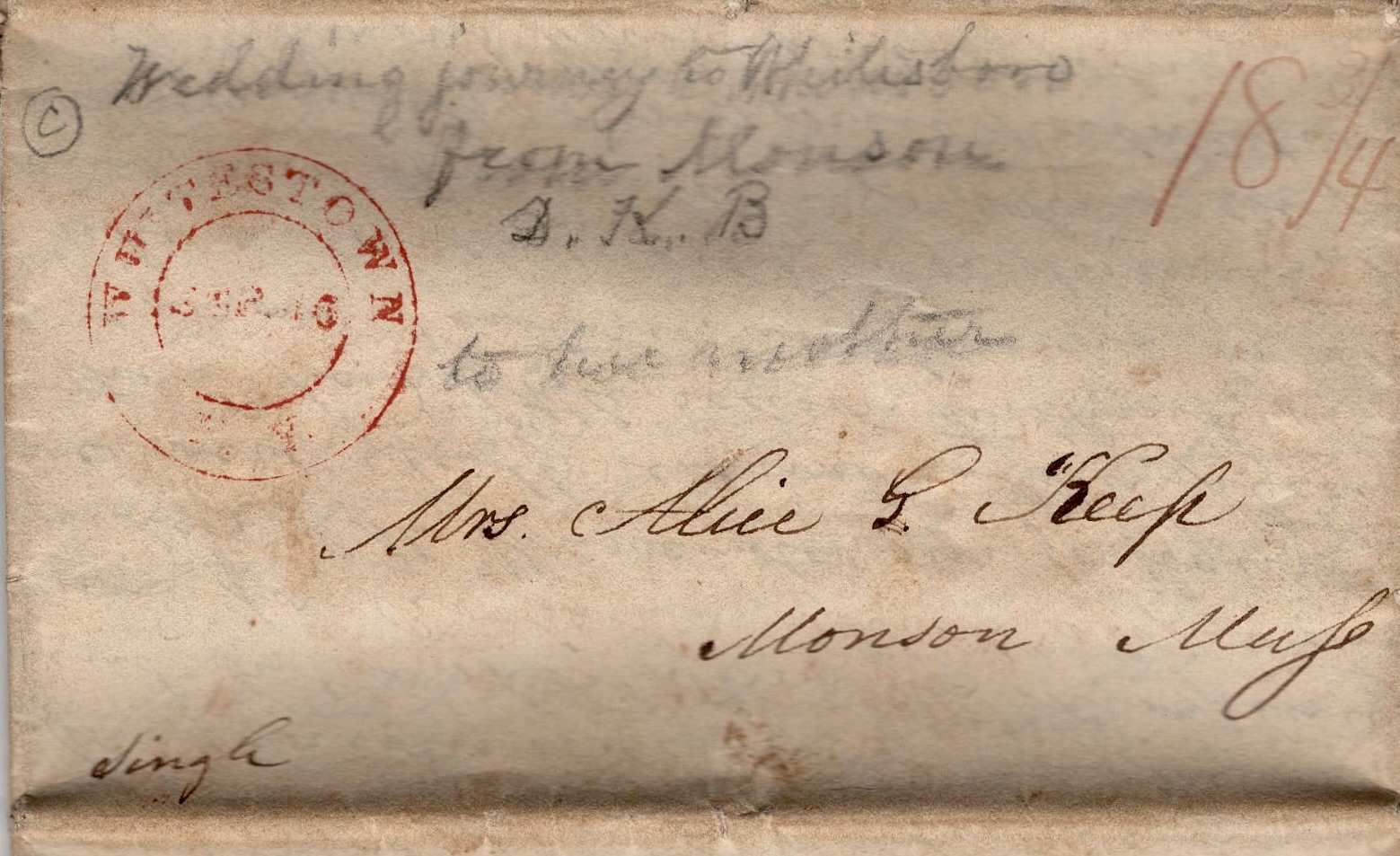
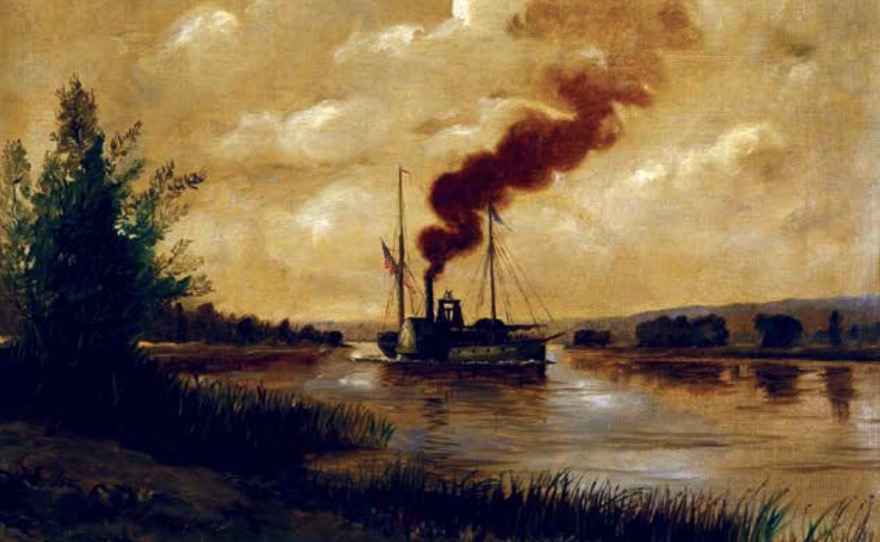
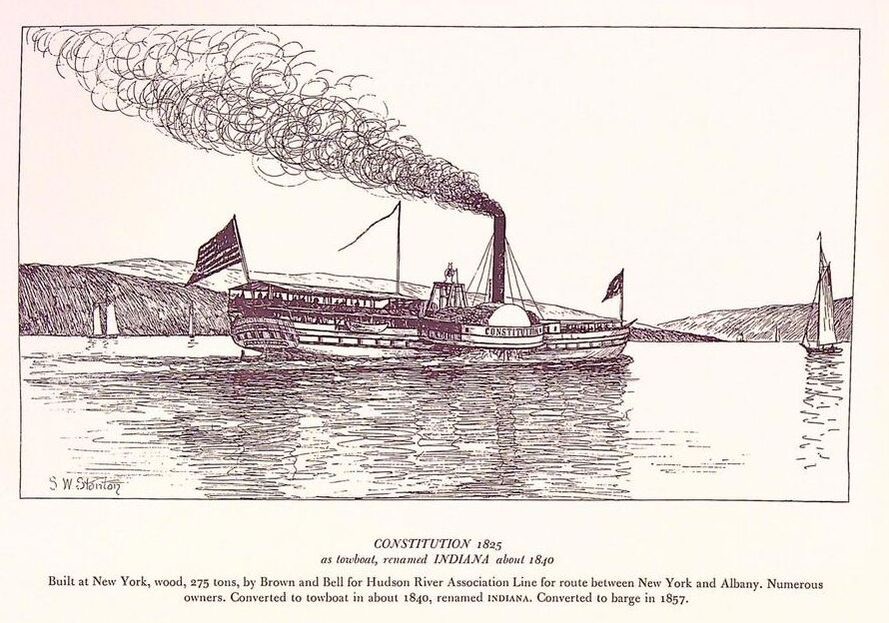


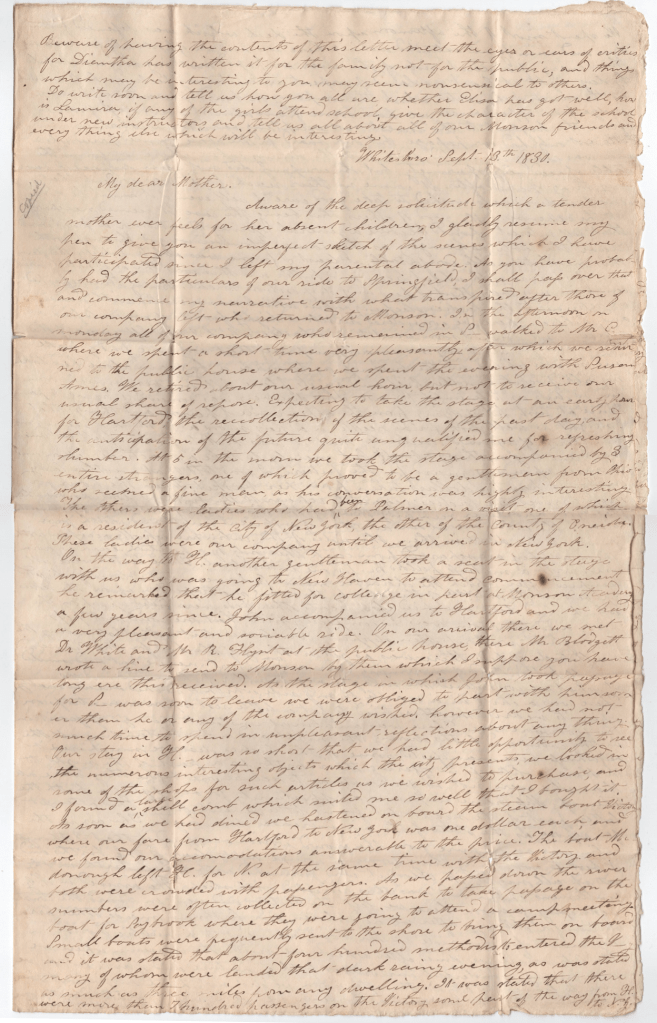
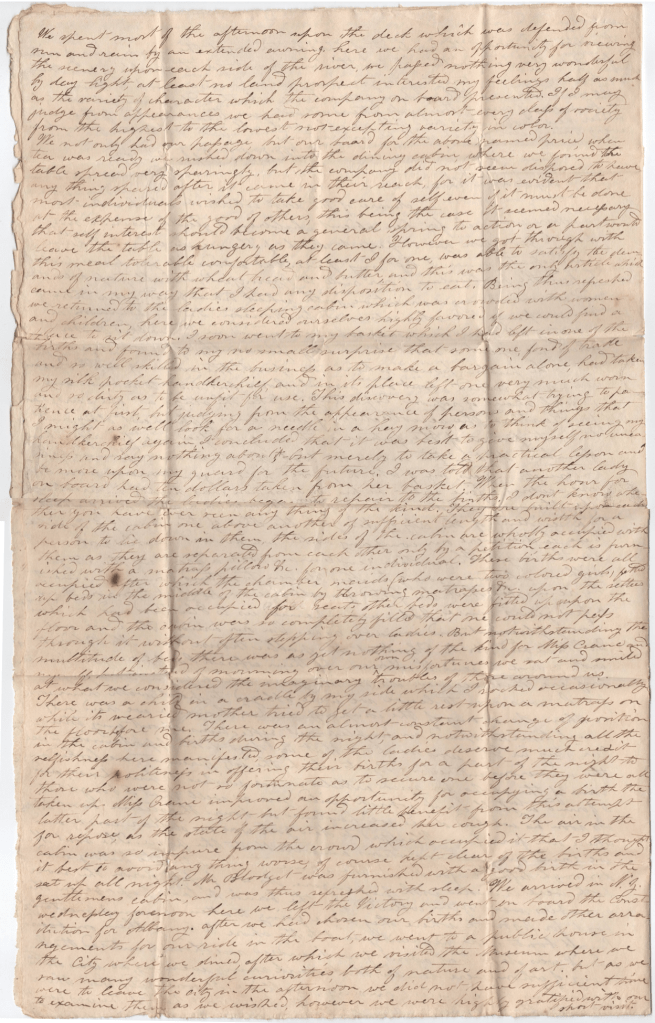


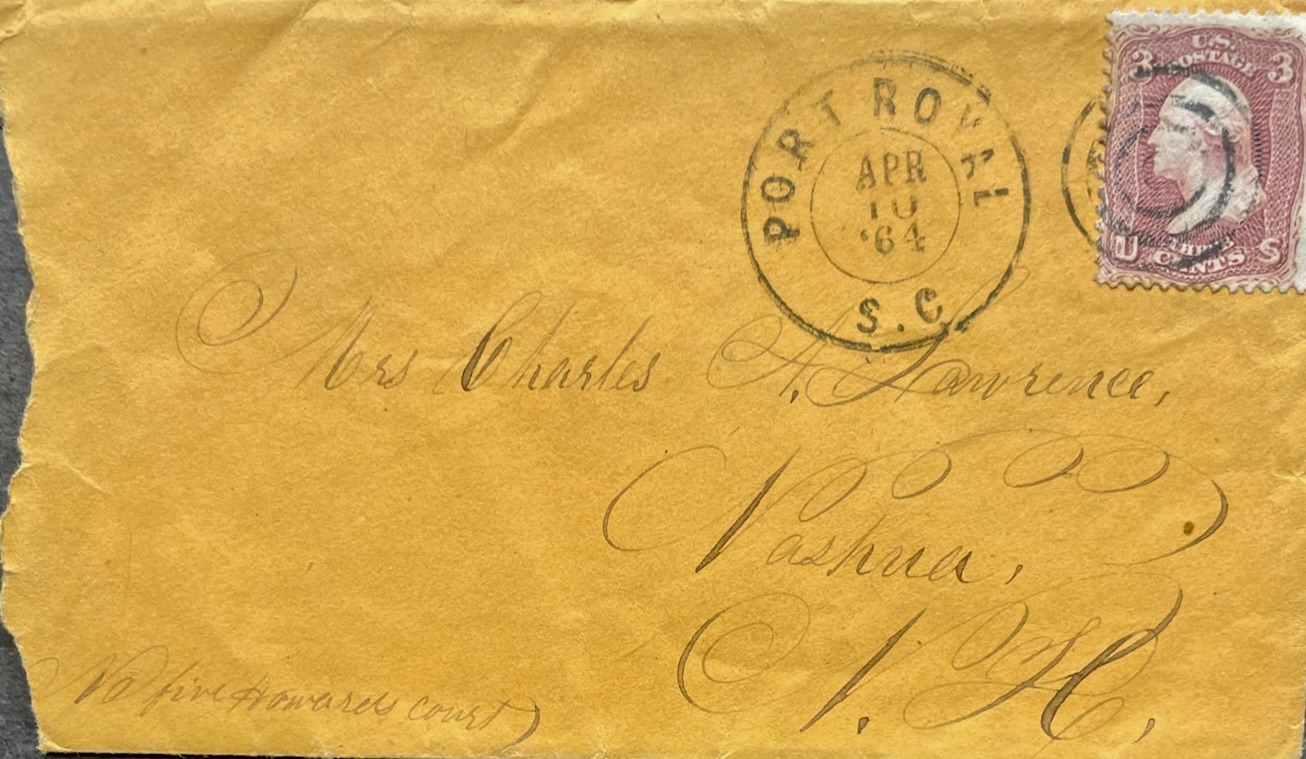
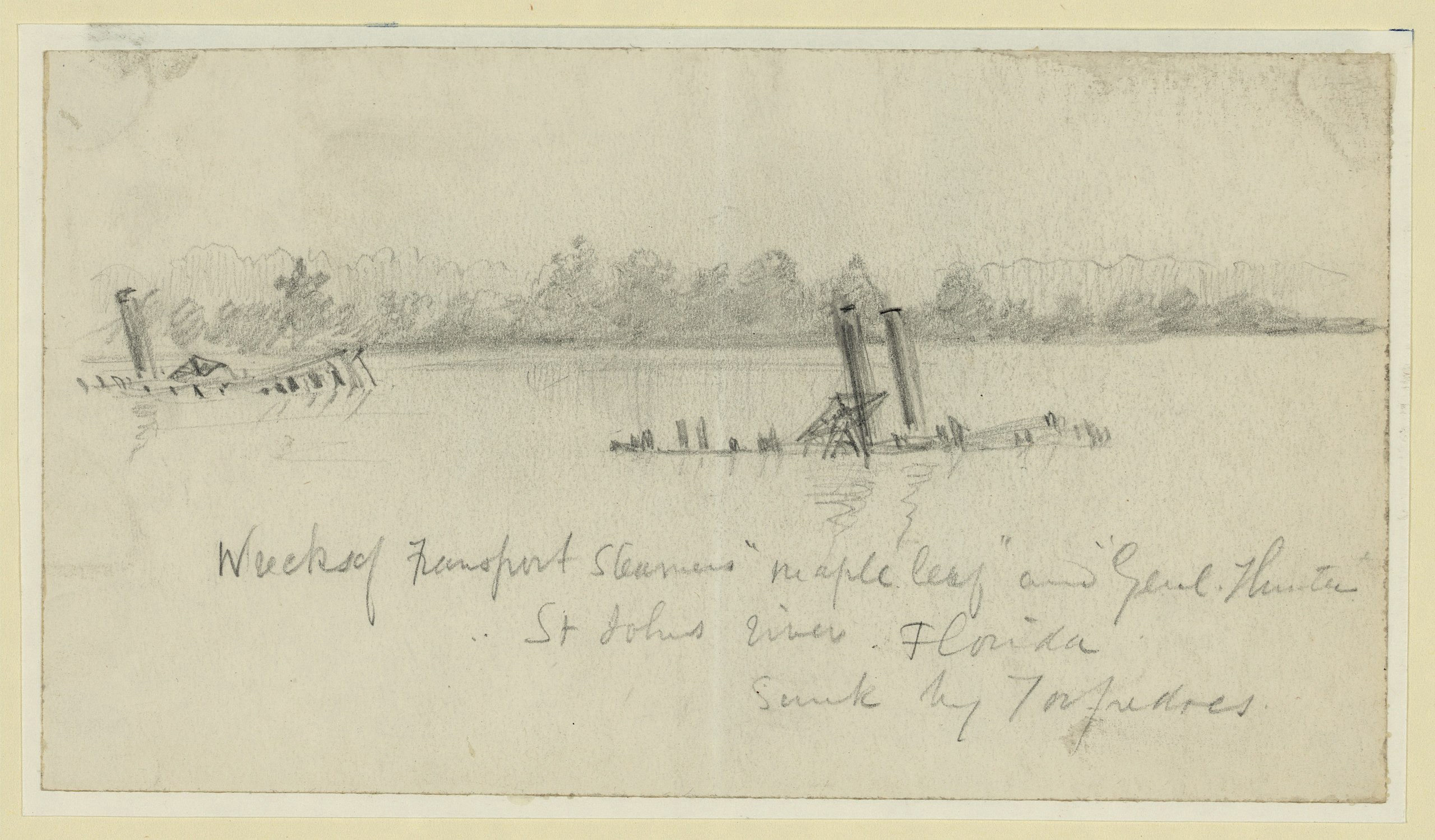

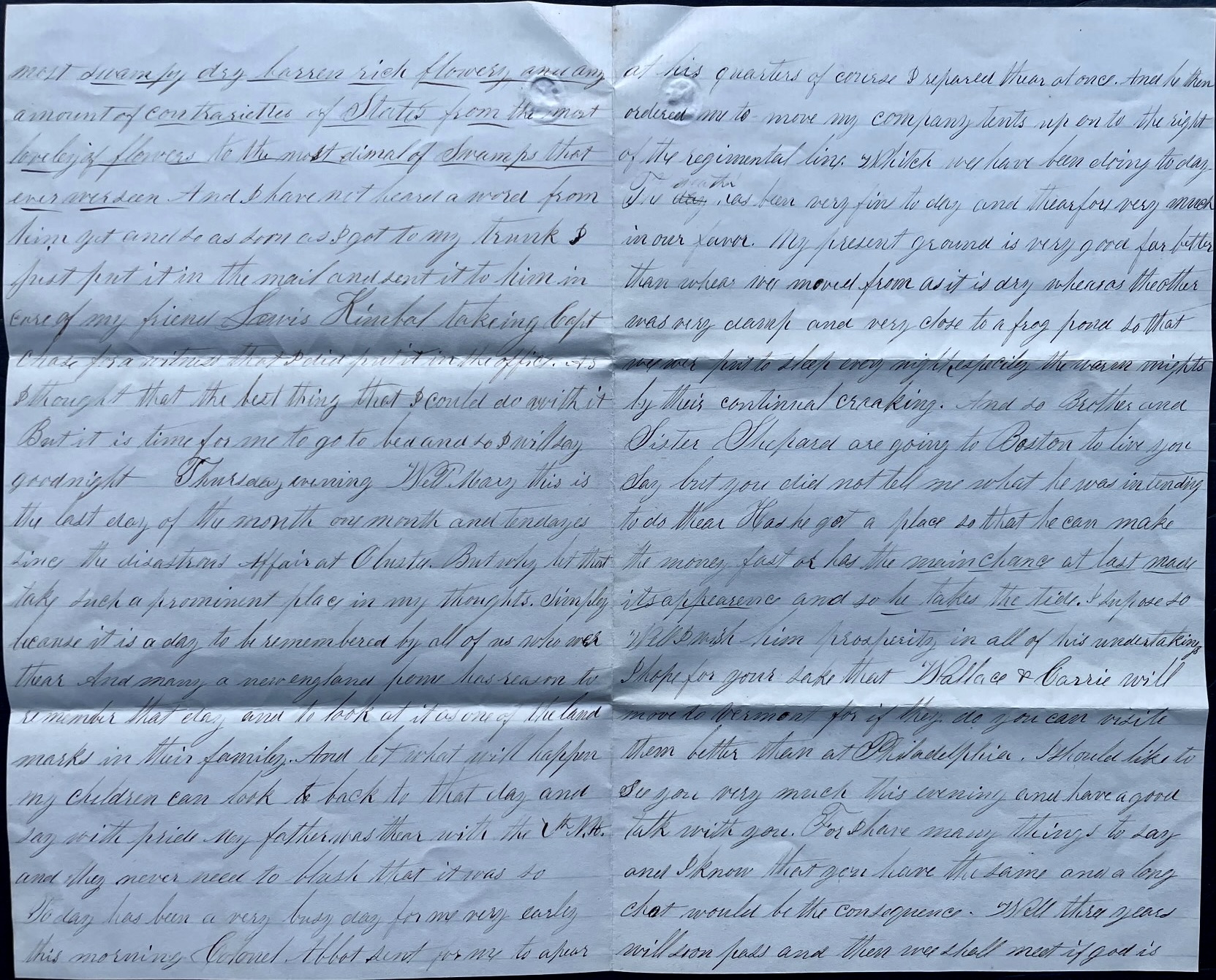
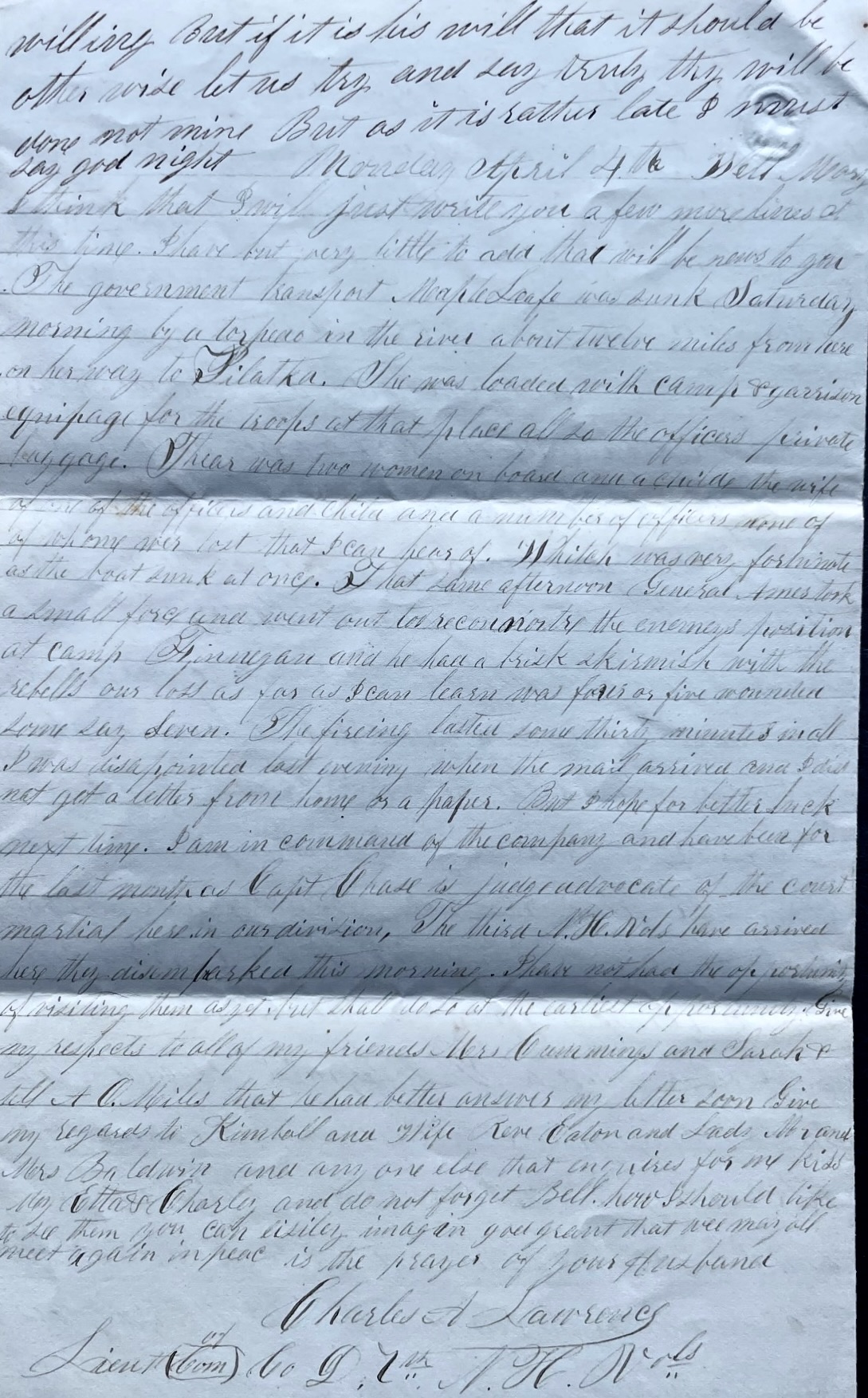


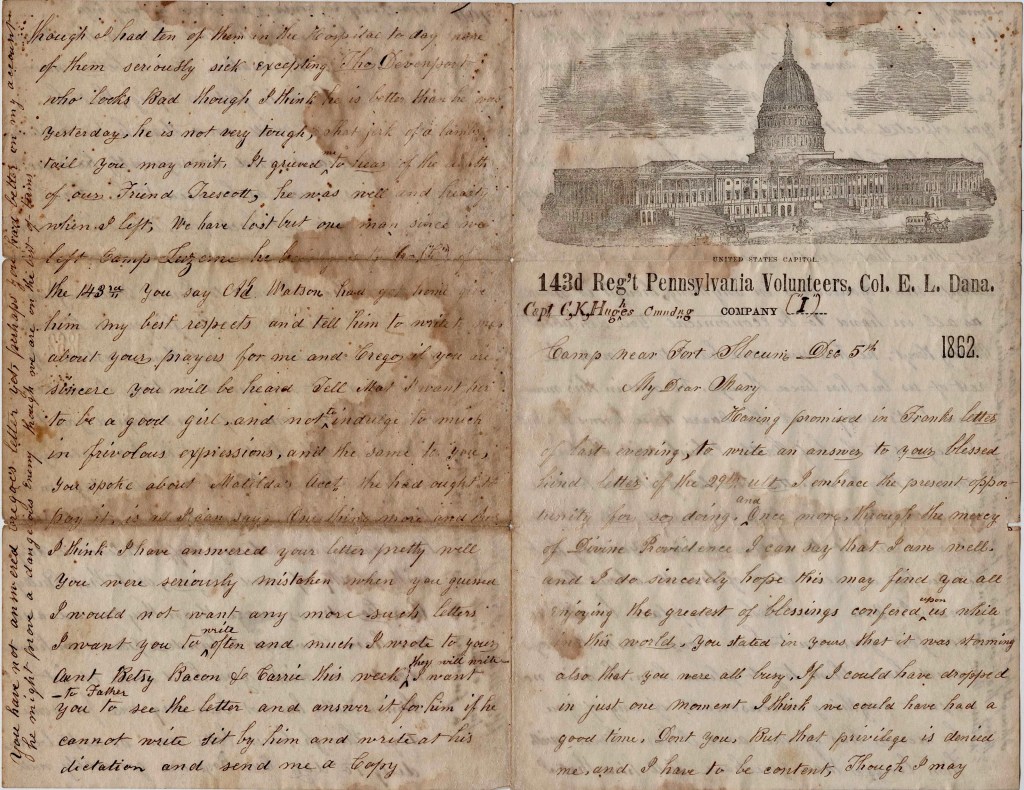



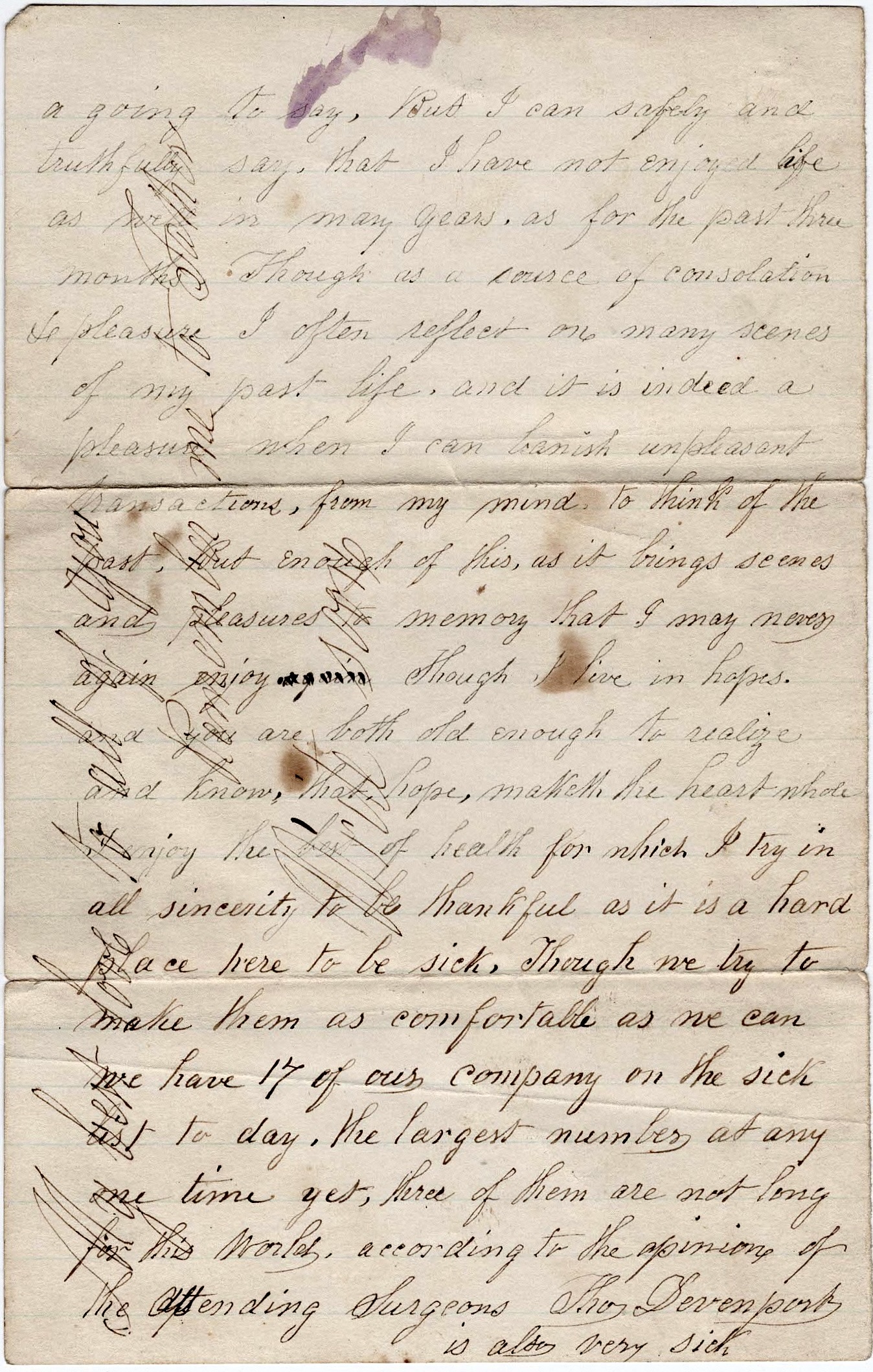

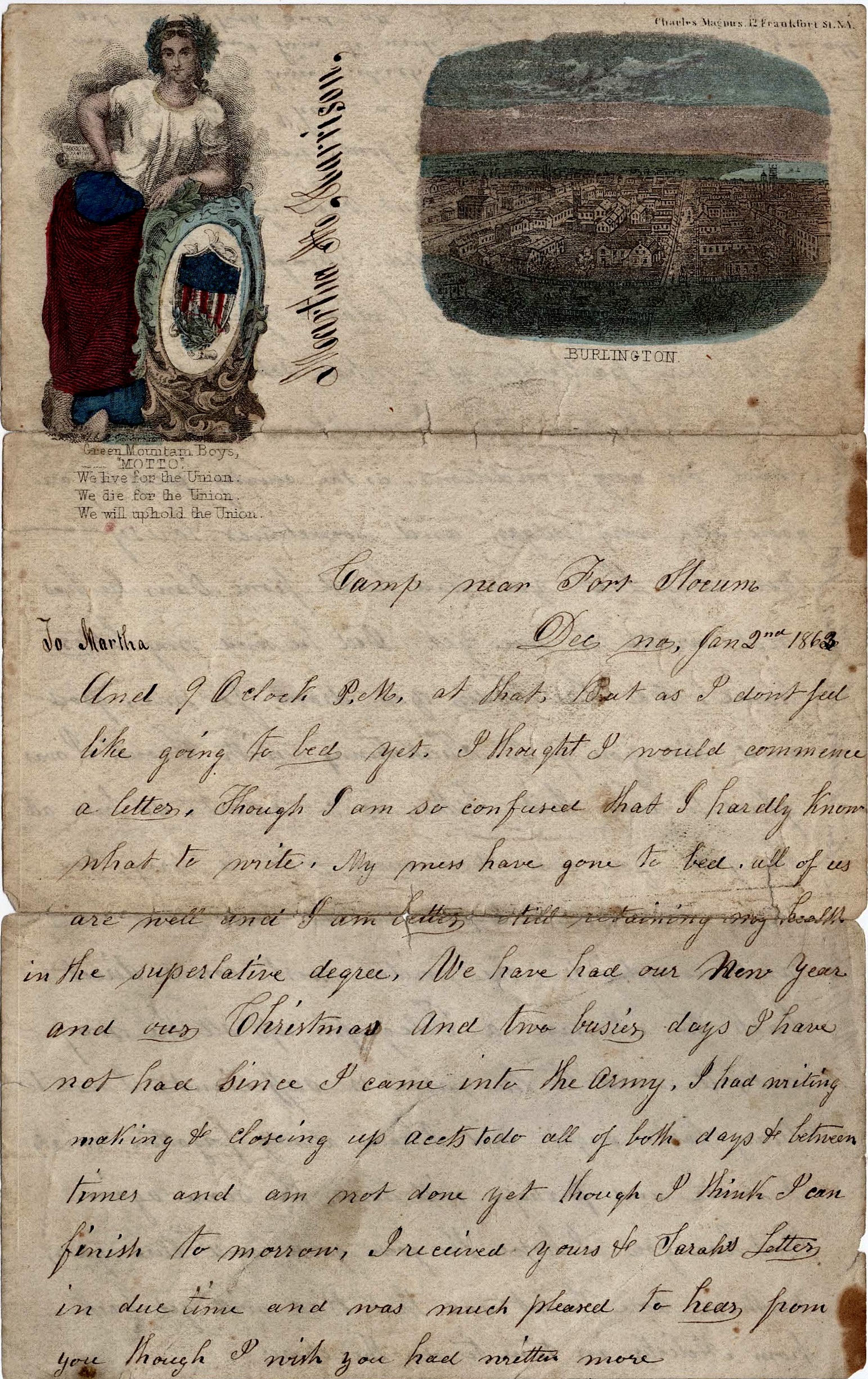

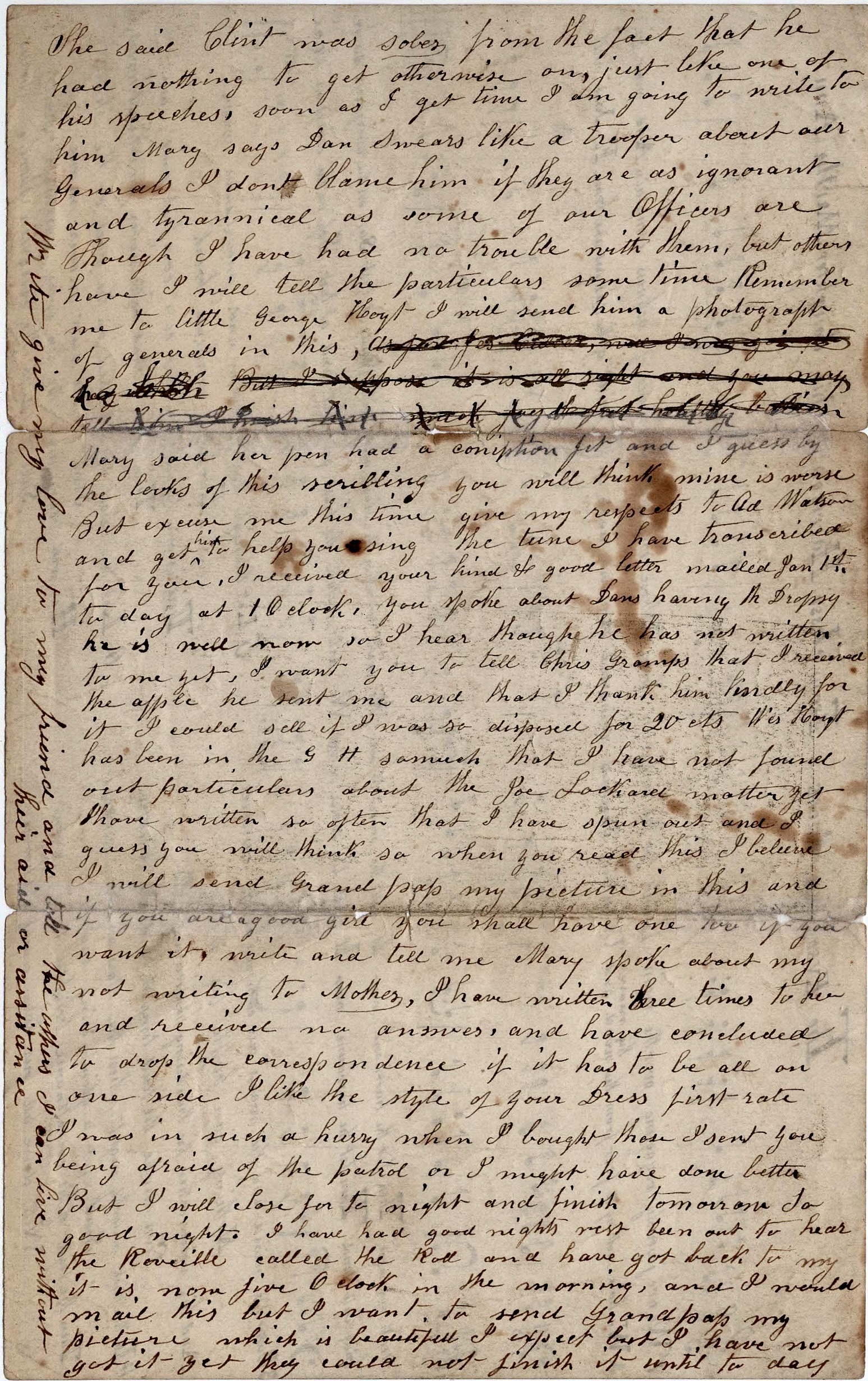
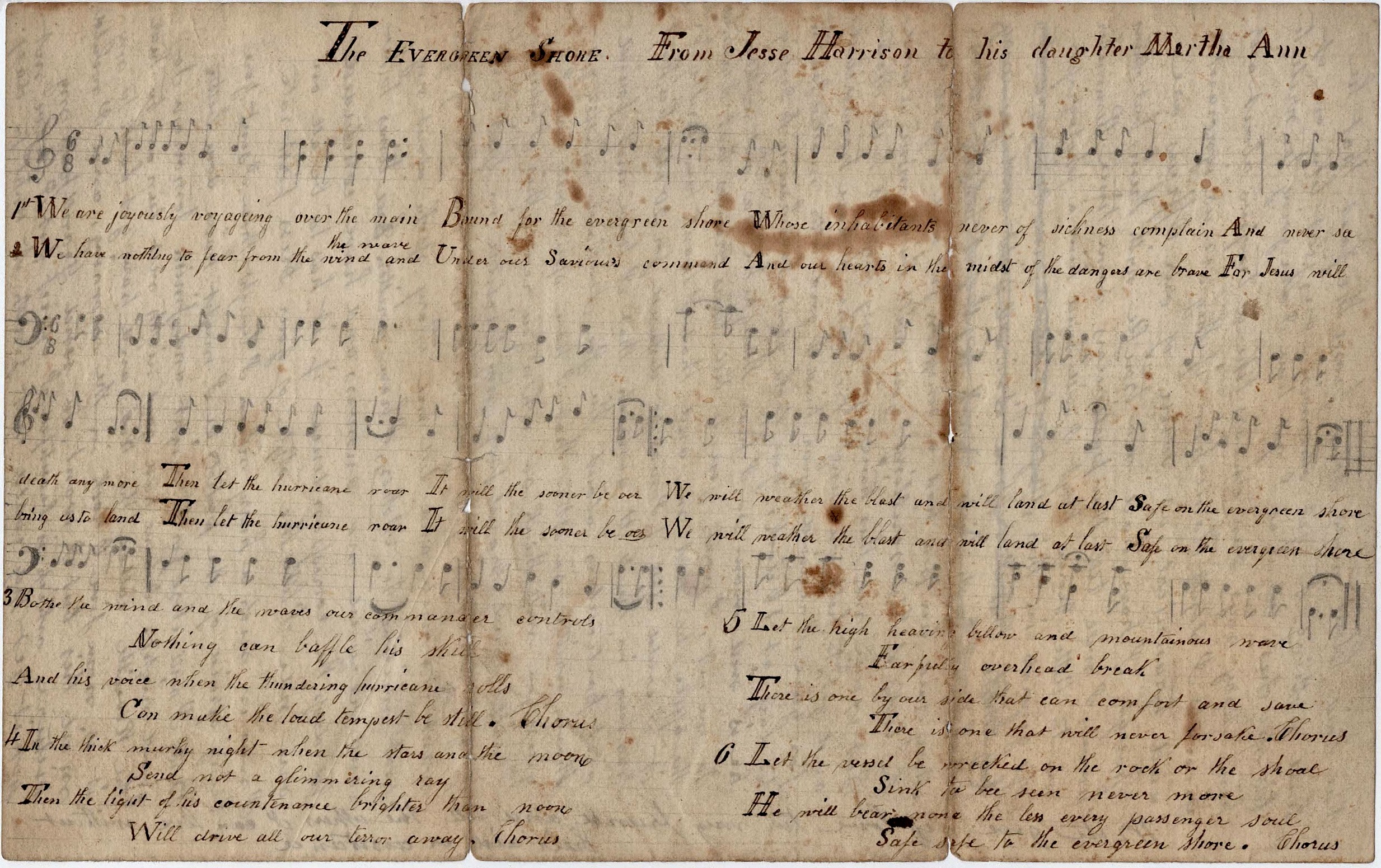


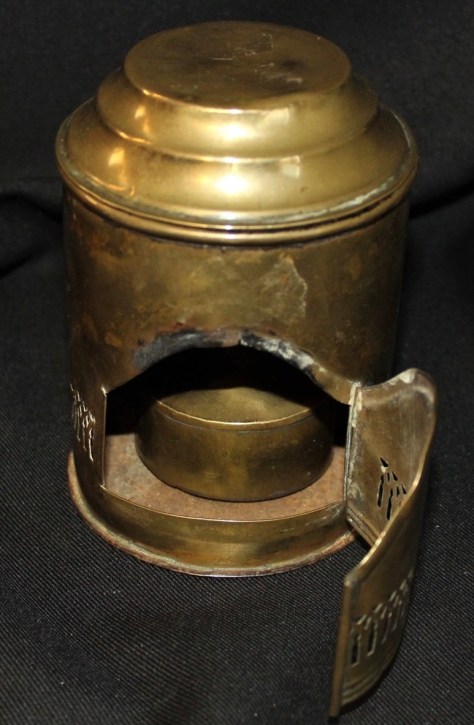
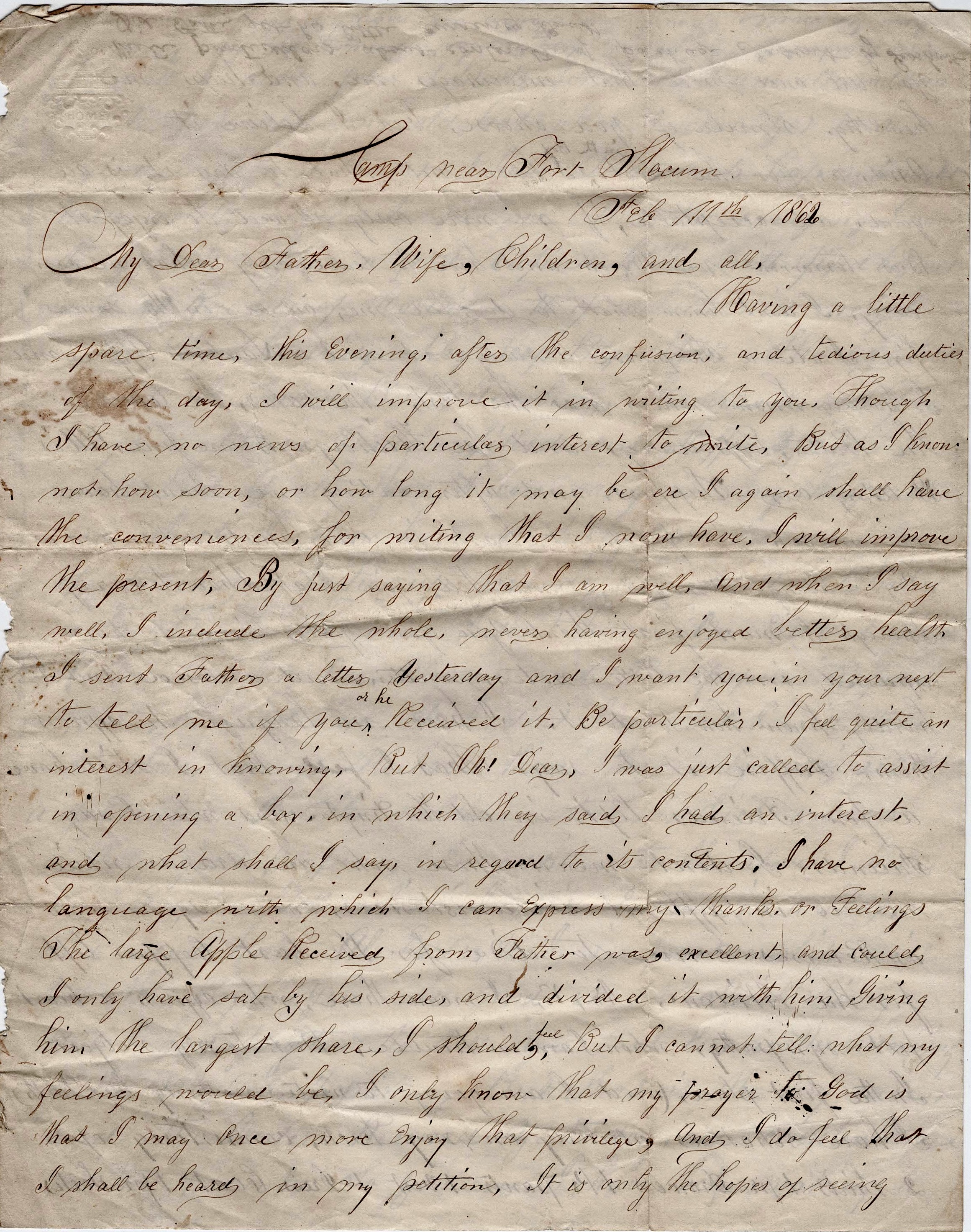


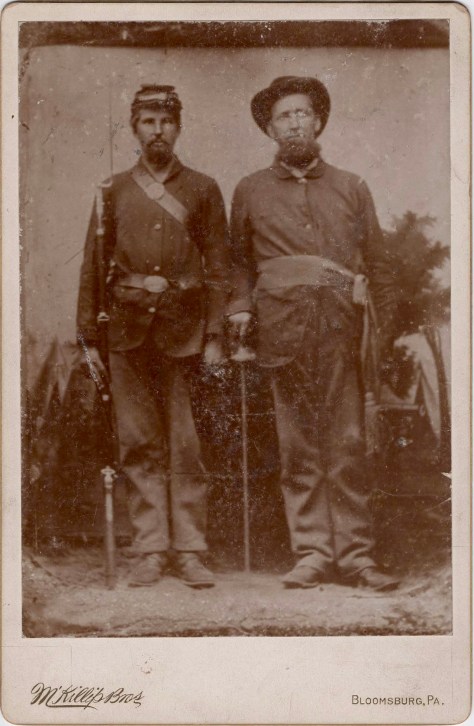

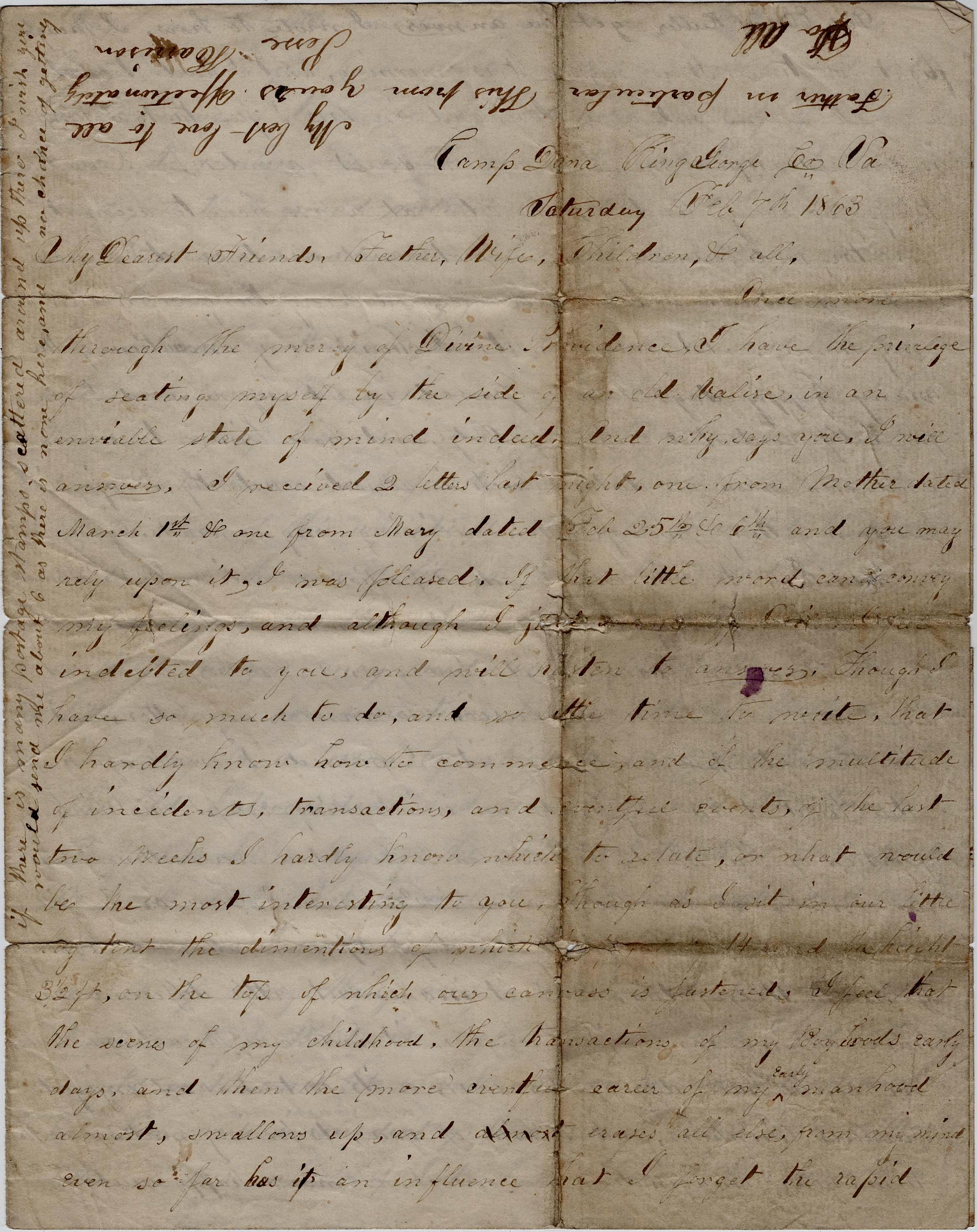

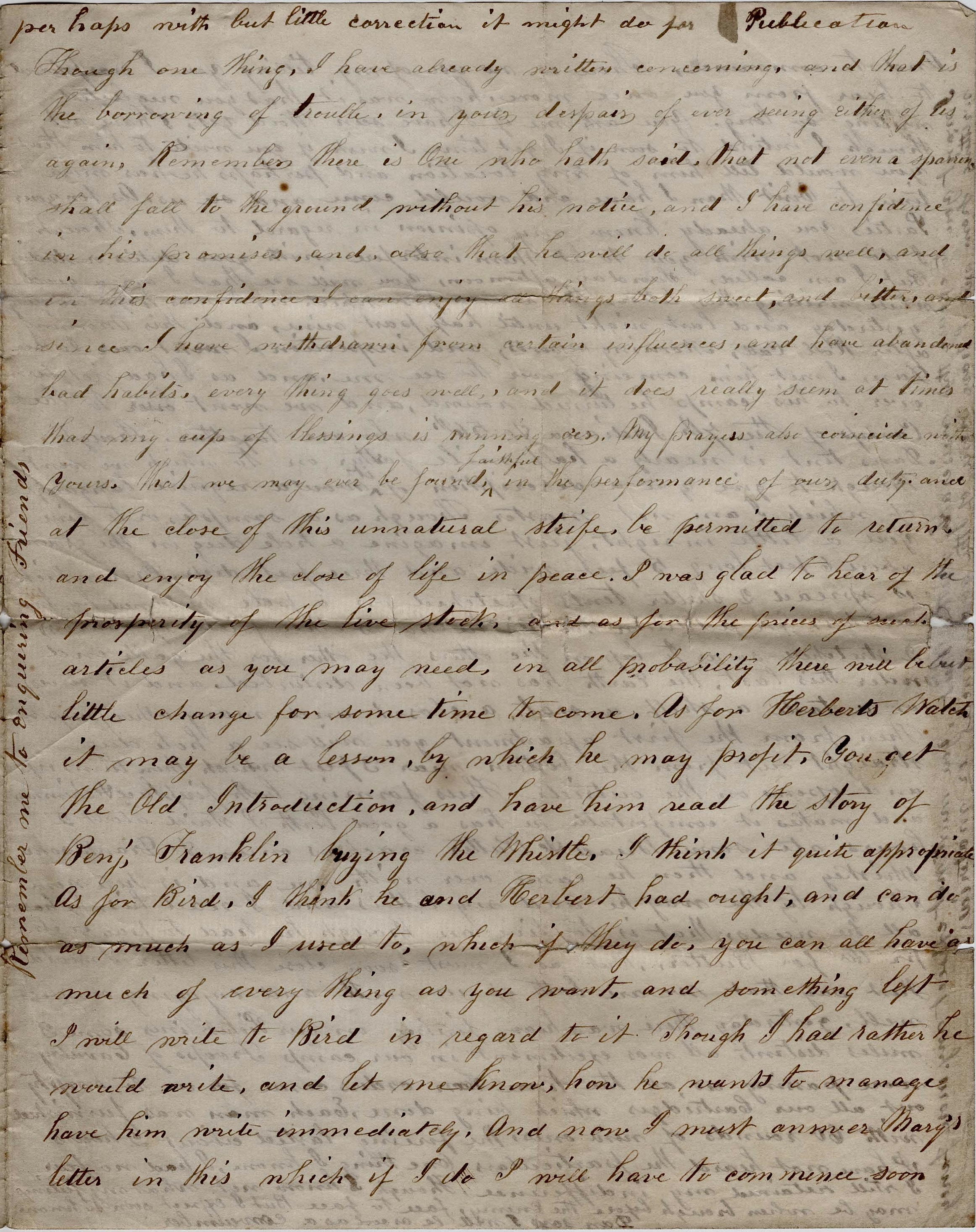

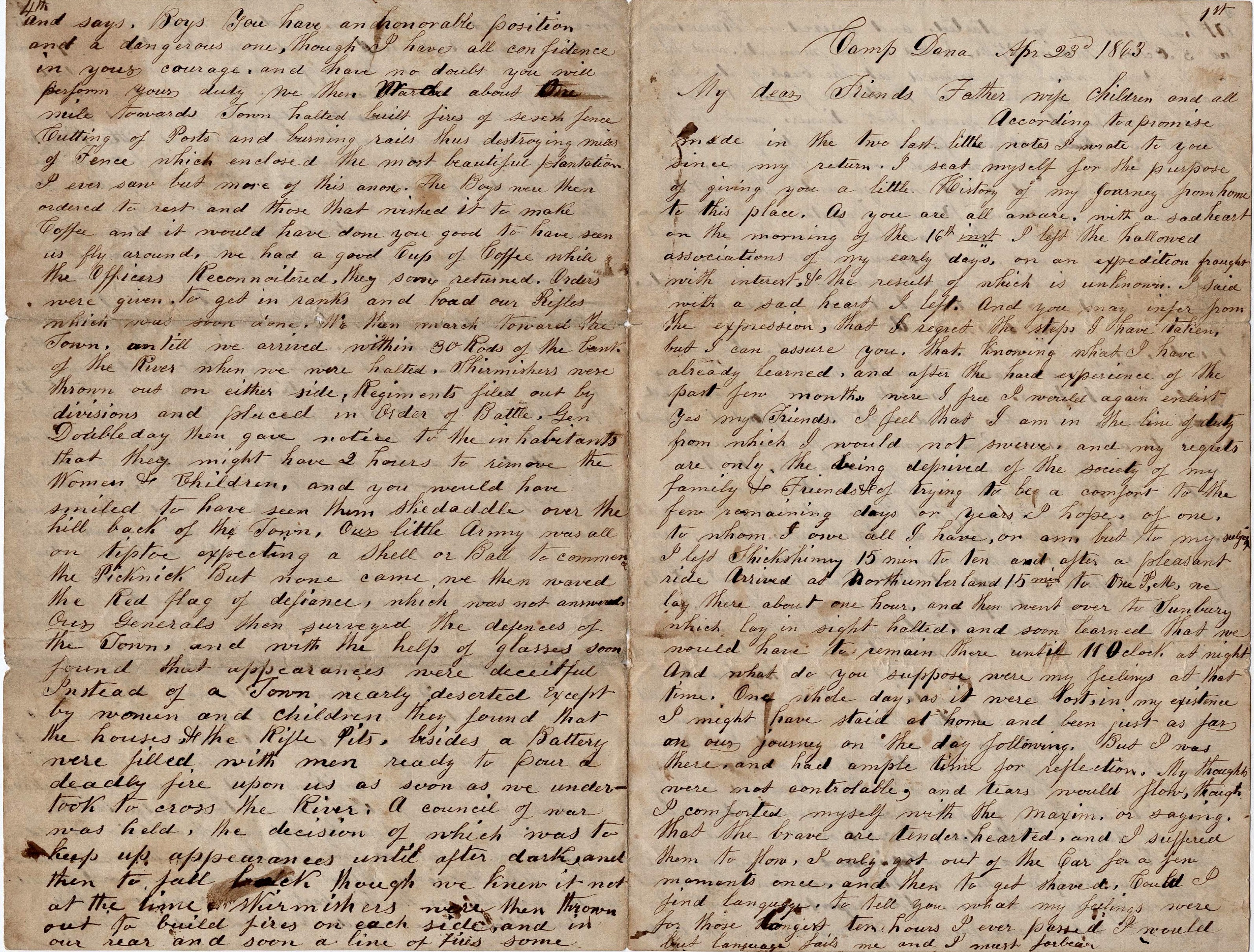

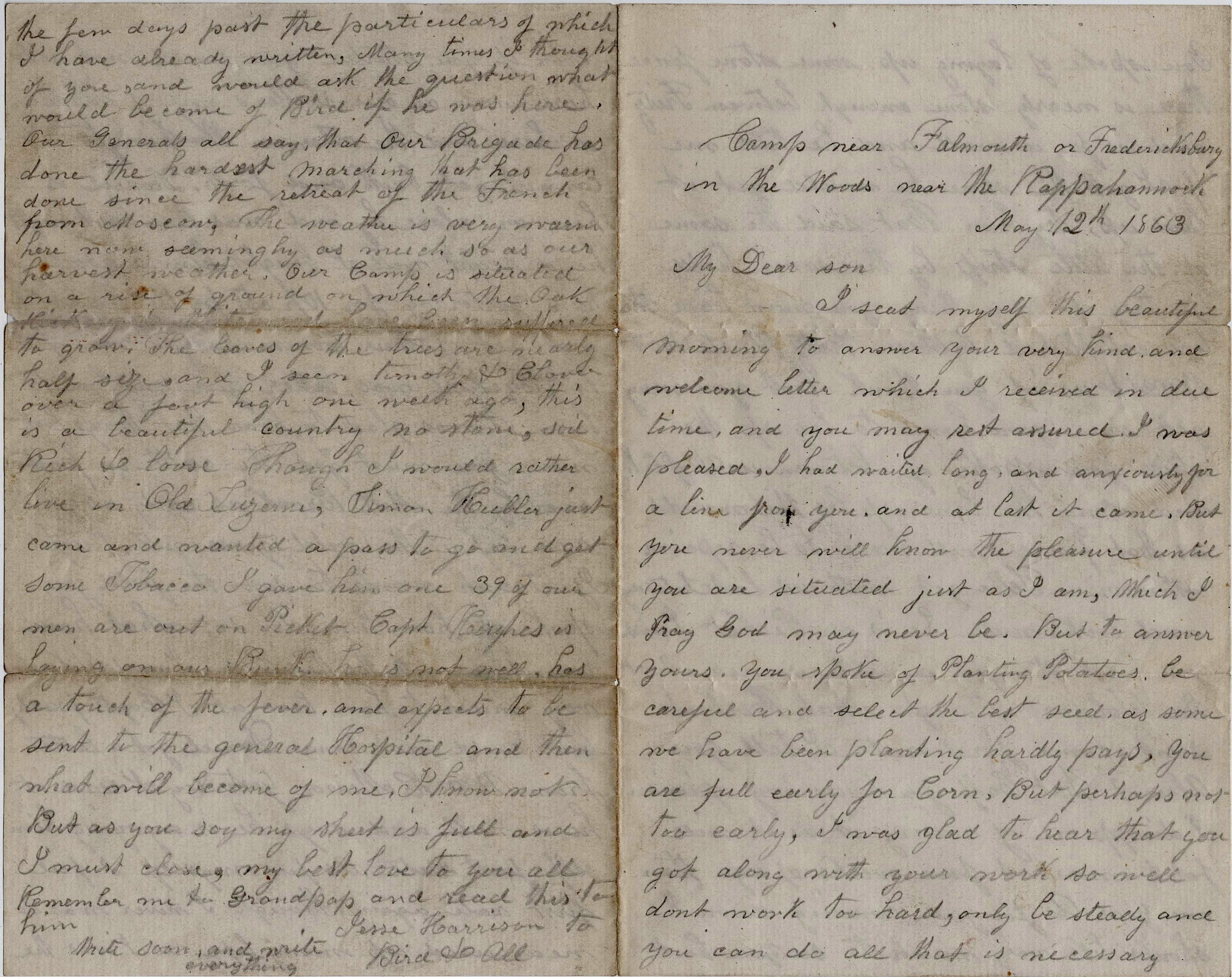

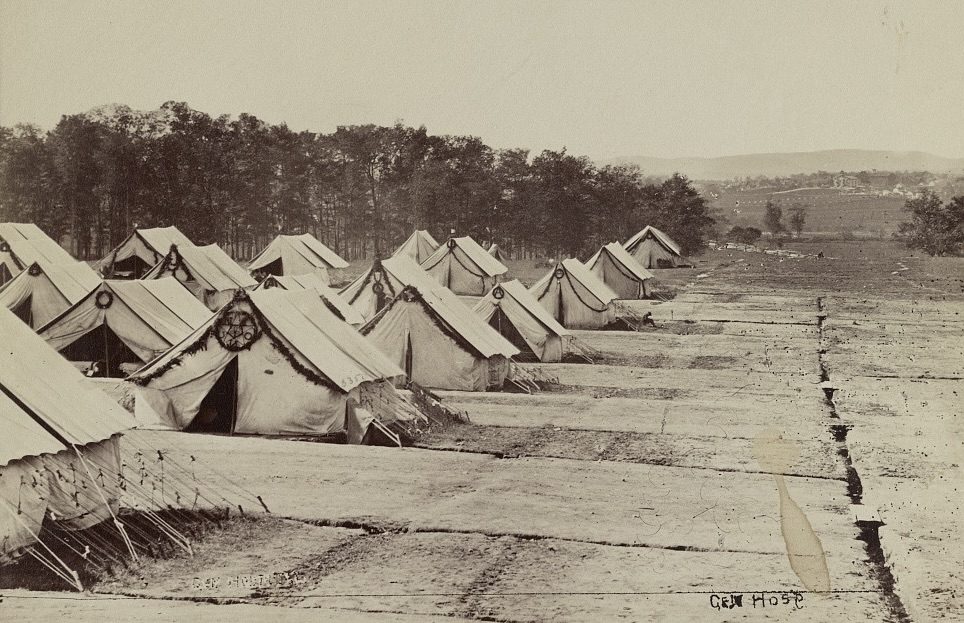
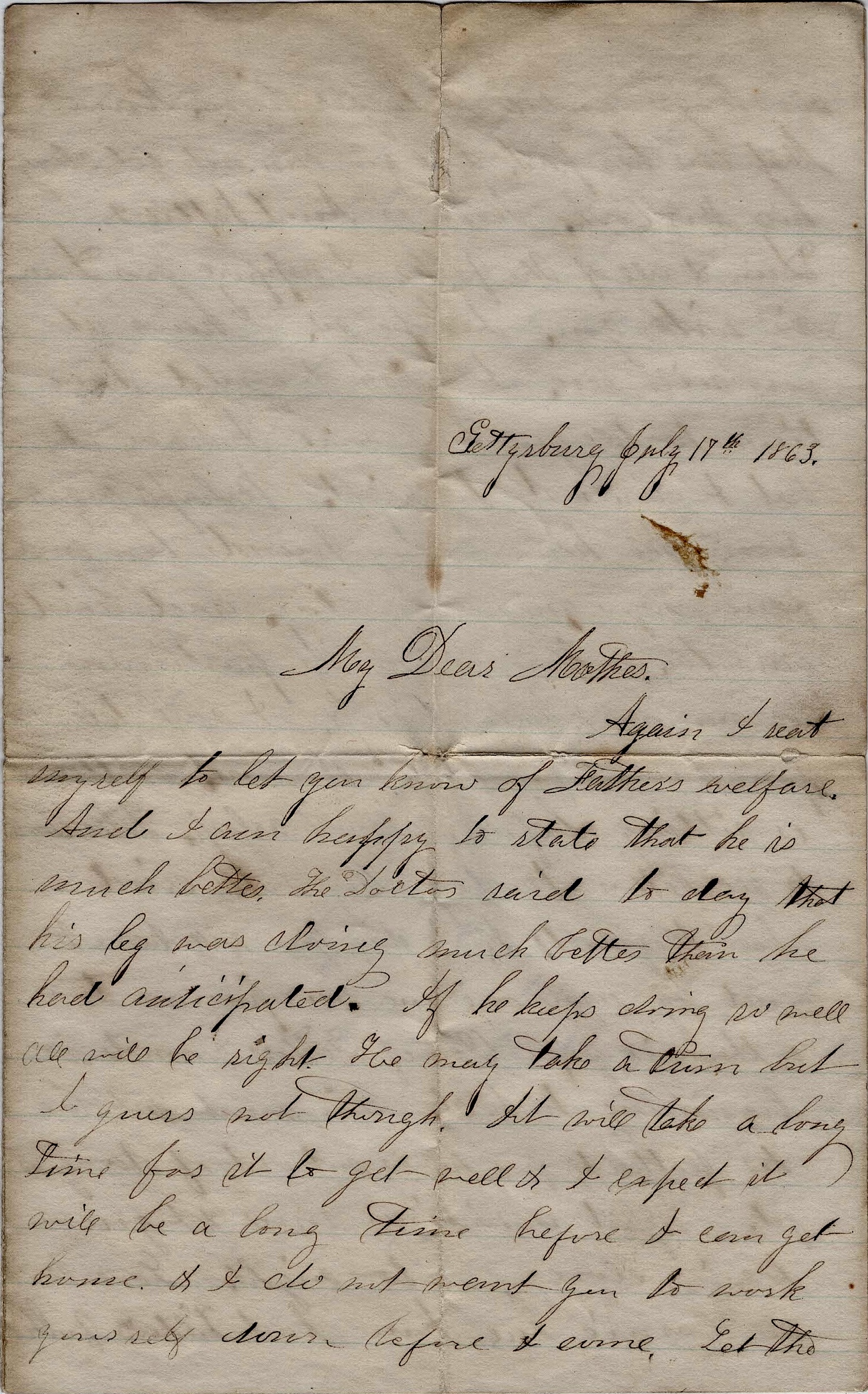
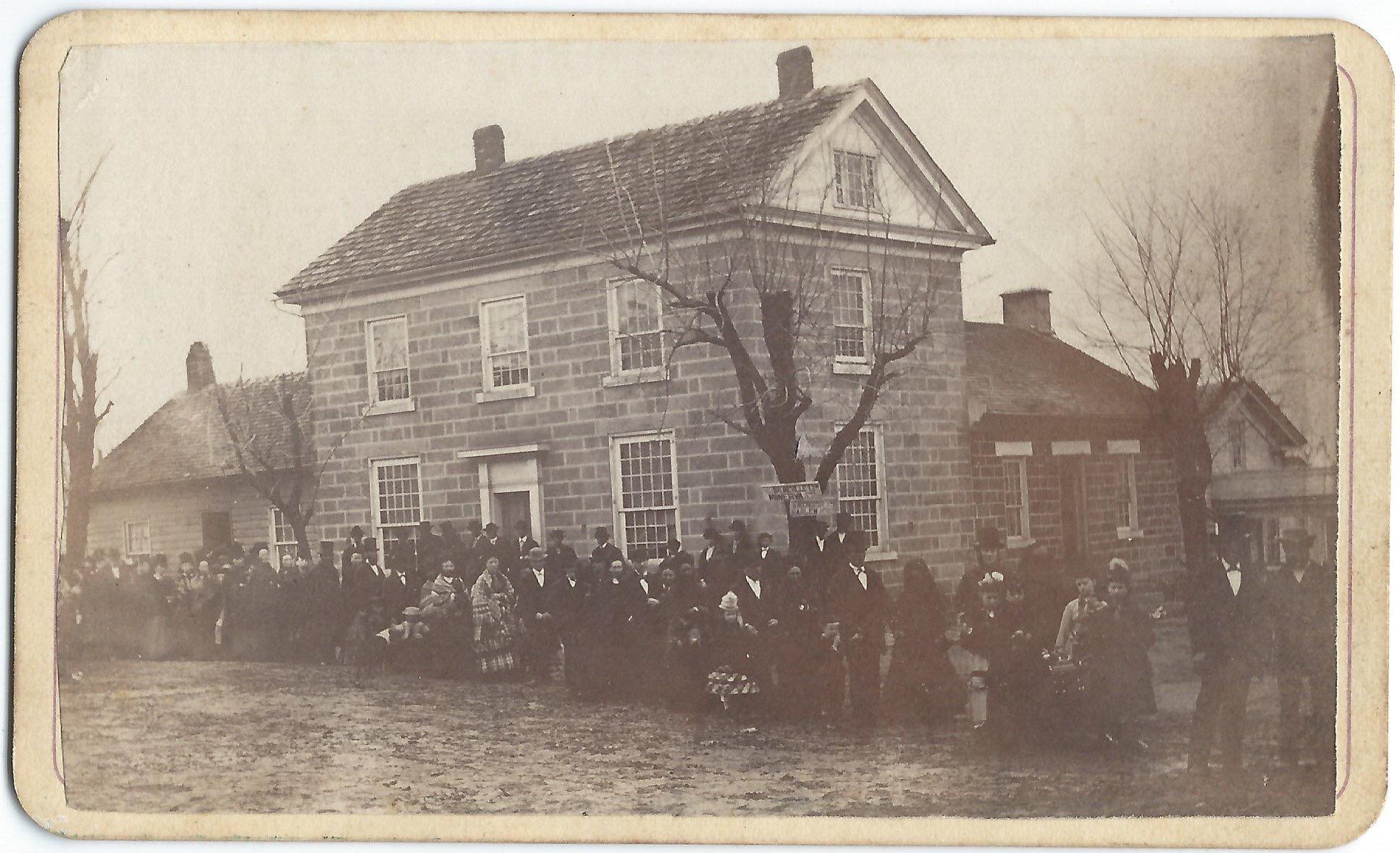
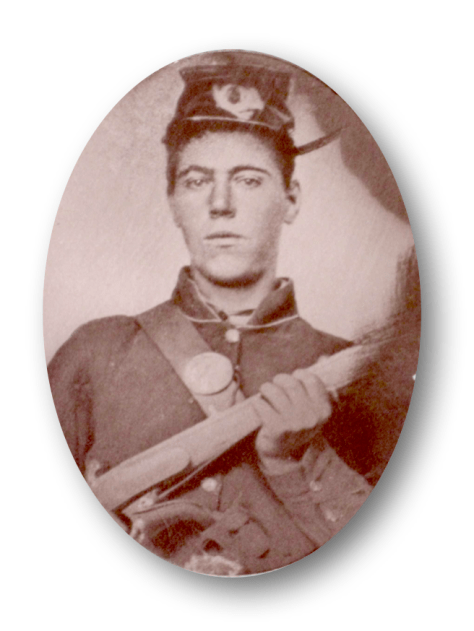






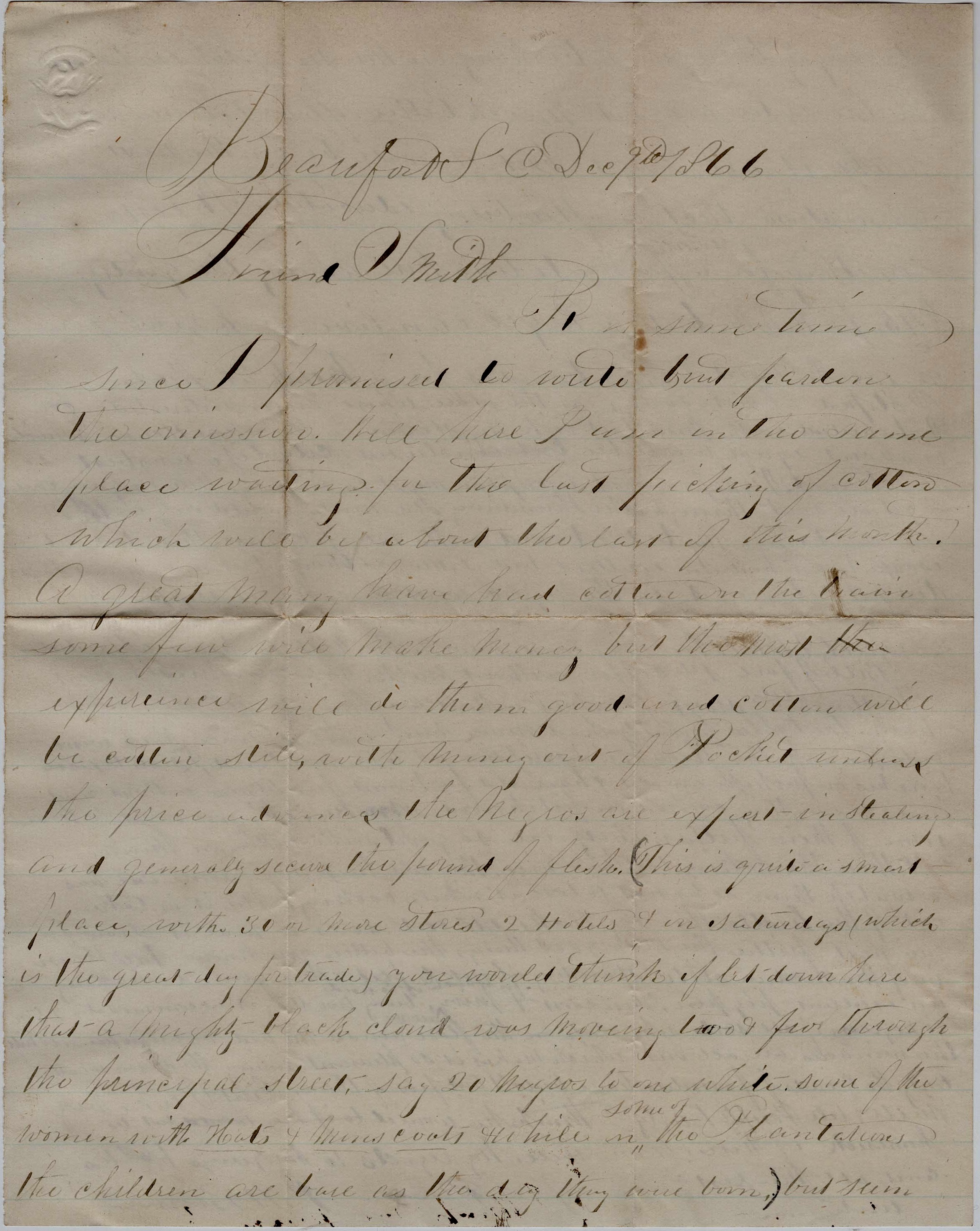
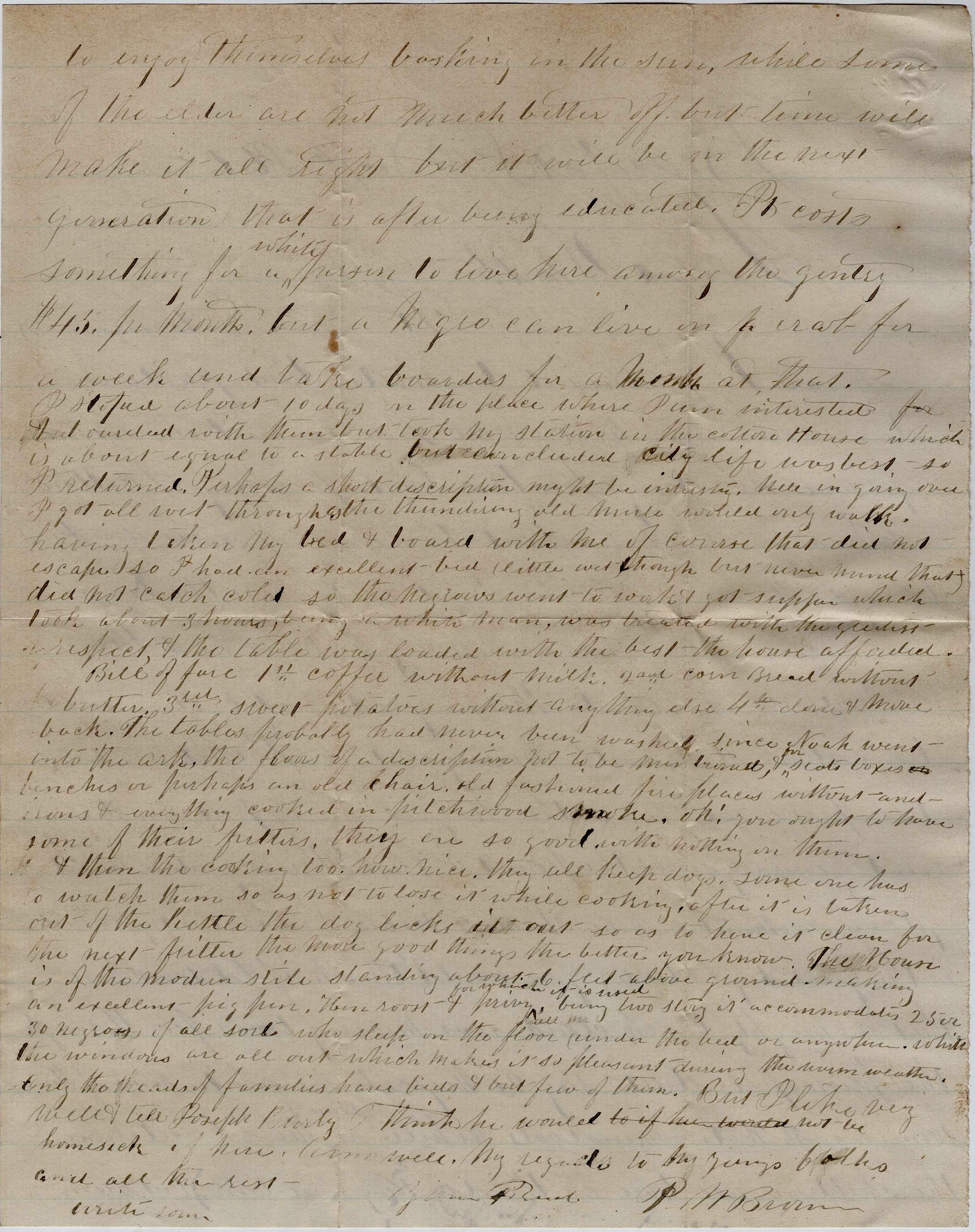





 Spared & Shared 23