1861: Aaron Kirt Ellenwood to Friend Hattie

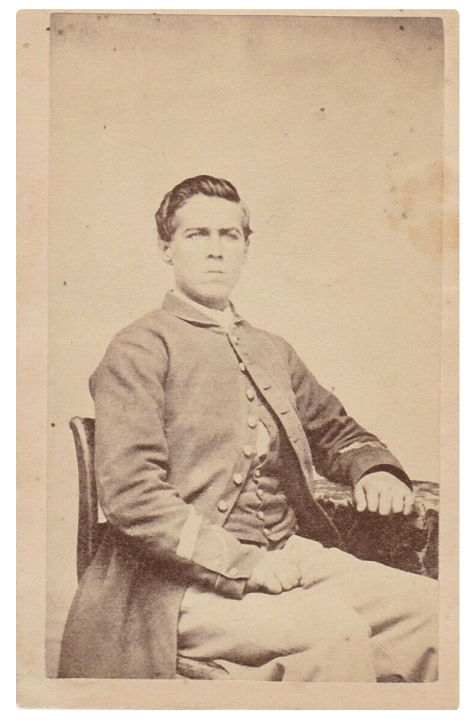
I could not find an image of Aaron, but here is James M. Stewart of Salem who served in Co. E, 19th Indiana. He was killed in the fighting at Brawner’s Farm in August 1862. (Ancestry.com)

The following letter was written by Pvt. Aaron Kirt Ellenwood (1842-1872) of Co. H, 19th Indiana Infantry. Aaron was the son of Adolphus Ellenwood (1796-1858) and Fanny Hendrix (1802-Aft1850) of Jennings county, Indiana. Aaron’s muster in date is given as 29 July 1861 but there are no other remarks in his military record. The 19th Indiana Brigade website states that Aaron was discharged early in the war because of disability but does not provide the date.

Most history buffs will recognize the 19th Indiana as part of the famed Iron Brigade who saw action in many of the Army of Potomac’s largest battles—Gainesville, Antietam, Gettysburg, and Petersburg. It isn’t known whether Aaron participated in any of these, however.

After the war, in 1866, Aaron married Mary Kiger (1846-1913) in Shelby county, Indiana. Aaron was buried in Crown Hill Cemetery in 1872; reinterred from Greenlawn Cemetery. No headstone marks in gravesite.

T R A N S C R I P T I O N

Camp Advance,
September 22nd 1861

Dear friend Hattie,

As I have been writing letters to nearly everybody today, I thought that I would write to you. I am tolerable well & hope you are the same. We have had tolerable hard times since we came over on this side of the Potomac. One night when I was on guard, the long roll beat and we did not know where we had to go so we did not bring any clothes with us here. We had to lay on the cold ground some two weeks without tents. All we had was our oil cloth and blanket for bed and cover. It was on a side hill and it rained nearly every night and the water running under us. But now we have our tents which is better for us. Tomorrow I understand that we go back on the other side of the river. That will suit me the best kind.

Capt. Johnson was here today. He looks fine. All of his boys are well. I think that we will be in the same brigade that he is in so there will be a good many of us boys from Edinburgh here now and all together. I suppose that [you] heard all the news from here by someone else. We have been in one little fight already. 1 Did not lose many of our men. I believe they killed five of our men and wounded two out of our regiment. Most of the Edinburgh boys are all well. Dude Gray is sick in the hospital.

I have received several letters since I have been here. Mag has written to me several times. She said in her last letter that you was well. Gave me your respects also. This is the first time that I ever wrote to you and likely I have taxed your patience already. I will stop by giving you my best respects. Give them to all the family and friends. — A. K. Elenwood

Co. H, 19th Regt. Indiana Volunteers, Washington City, D. C.

You would laugh to hear the boys singing this evening. This is Sunday here, I believe, judging by not having to work today. Our preacher preached a good sermon today. His name is Rev. [Lewis] Dale


1 Aaron is probably referring to the minot skirmish at Lewinsville that took place on 11 September, 1861.

1862: Unidentified Soldier in Co. D, 121st Ohio Infantry

Unfortunately there is no signature on the following letter and I have not been able to identify him based on the content except to note that he addressed it to someone named “Adah” and we can also confirm that he served in Co. D, 121st Ohio Infantry. His writing skills were subpar so I would not think him highly educated. No doubt he worked at a trade with his hands, not his pen.

His letter is dated 8 [or 9th] October 1862, coinciding with the day of [or day after] the Battle of Perryville that he recounts. The regiment had served for scarcely a month when they were hastily dispatched to Cincinnati to defend against Bragg’s impending invasion, armed with antiquated Prussian muskets and lacking adequate training in their usage. Their subpar performance at Perryville is not unexpected, and morale sank further when assigned the grim task of remaining in Perryville to inter the fallen soldiers from both sides. For an in-depth exploration of the 121st Ohio’s experience at Perryville, I recommend the article, “Wipe out Perryville!” The 121st Ohio’s Redemption at Chickamauga by Dan Masters.

T R A N S C R I P T I O N

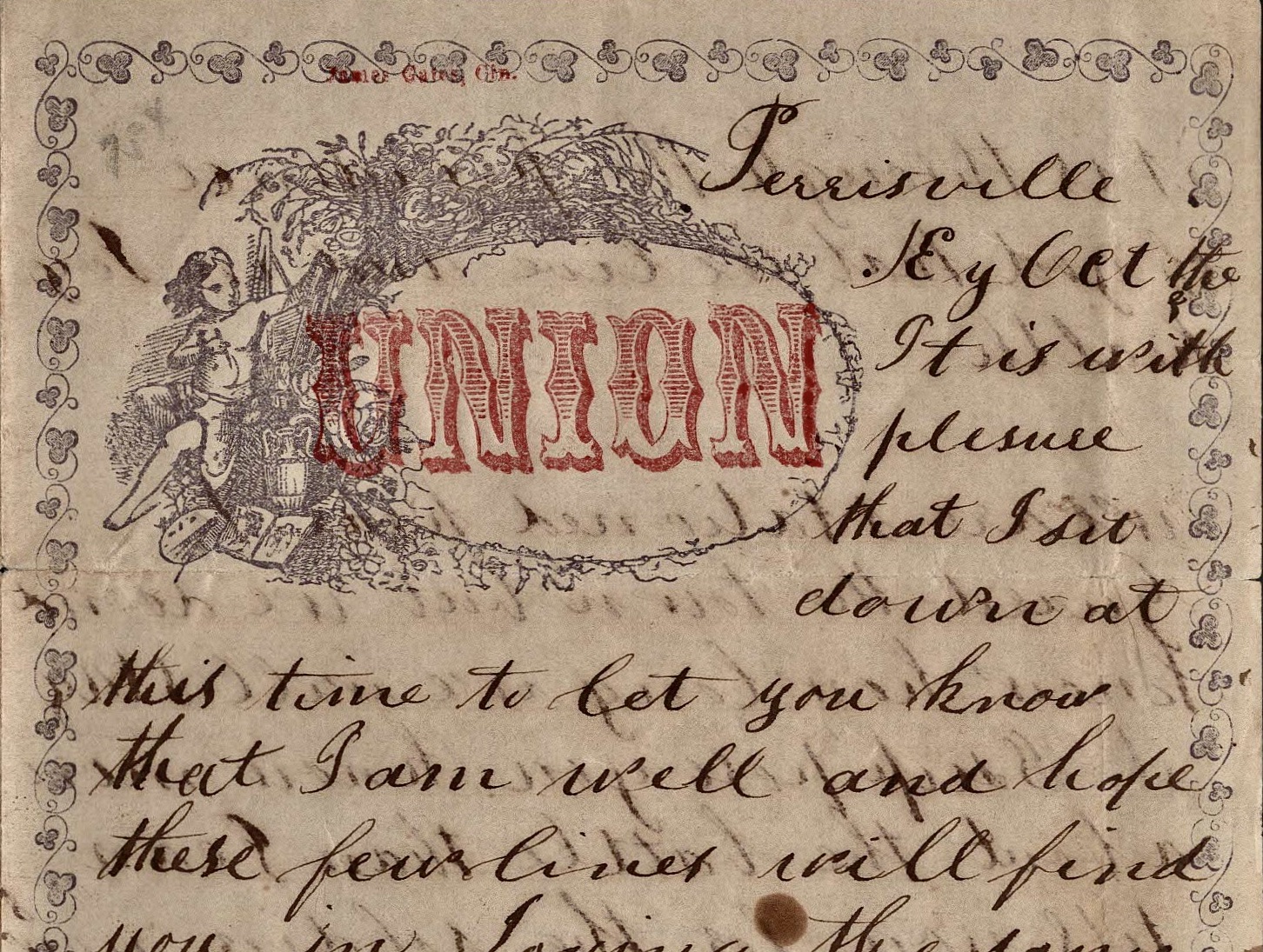
Patriotic letterhead of soldier’s letter.

Perryville, Kentucky
October 8, [1862]

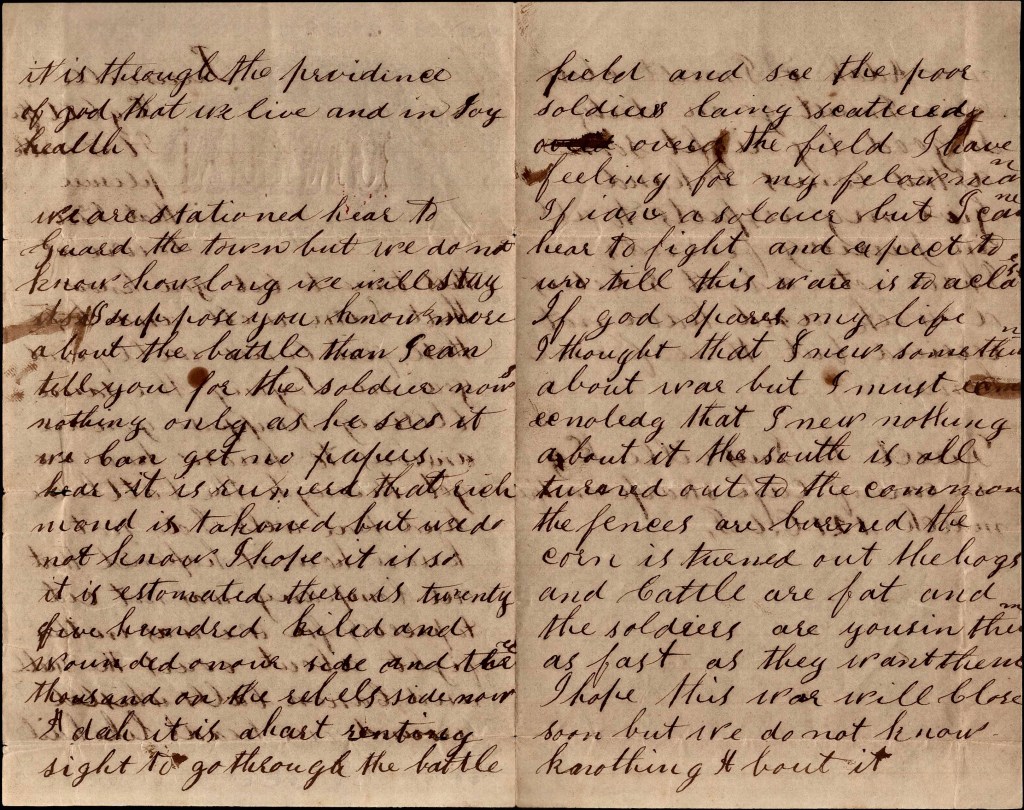
It is with pleasure that I sit down at this time to let you know that I am well and hope these few lines will find you enjoying the same blessing. I suppose you are anxious to know how we got through the battle we had here. Well, I do not know how it happened that our company was not cut to pieces for we was in the fight about six hours. The shell and cannon balls whistled over our heads like hail. It is through the Providence of God that we live and enjoy health.

We are stationed here to guard the town but we do not know how long we will stay. I suppose you know more about the battle than I can tell you for the soldier knows nothing—only as he sees it. We can get no papers here. It is rumored that Richmond is taken but we do not know. I hope it is so.

It is estimated there is twenty-five hundred killed and wounded on our side and three thousand on the Rebel’s side. Adah, it is a heart-rending sight to go through the battlefield and see the poor soldiers laying scattered over the field. I have feeling for my fellow man. I am a soldier but I came here to fight and expect to until this war is [brought] to a close, if God spares my life. I thought that I knew something about war but I must acknowledge that I knew nothing about it.

The South is all turned out to the common. The fences are burned, the corn is turned out, the hogs and cattle are fat and the soldiers are using them as fast as they want them. I hope this war will close soon but we do not know nothing about it.

Now Adah, I must close soon. I must go on duty. So goodbye. Write soon as this comes to hand. Give my respects to all inquiring friends. I have wrote about three letters a week and have not received but three from home. Direct to Louisville, Kentucky, in care of Capt. [Samuel L.] Sharp on the march. 121st OVI

1862: Albert L. Henry to Milo B. Sharp

The following letter was written by Albert L. Henry (18xx-1863) of Scotland, Windham county, Connecticut, who served in Co. B, 5th Connecticut Volunteers. Albert enlisted on 29 June 1861 and died of disease on 25 March 1863 while in the service.

In his letter, Albert speaks of the First Battle of Kernstown (23 March 1862) and the carnage witnessed following the battle. It was just the opening act of Stonewall Jackson’s 1862 Valley Campaign.

“We have got them Started. Come On! Come On!” The Union breakthrough at First Kernstown. Artwork by Keith Rocco

T R A N S C R I P T I O N

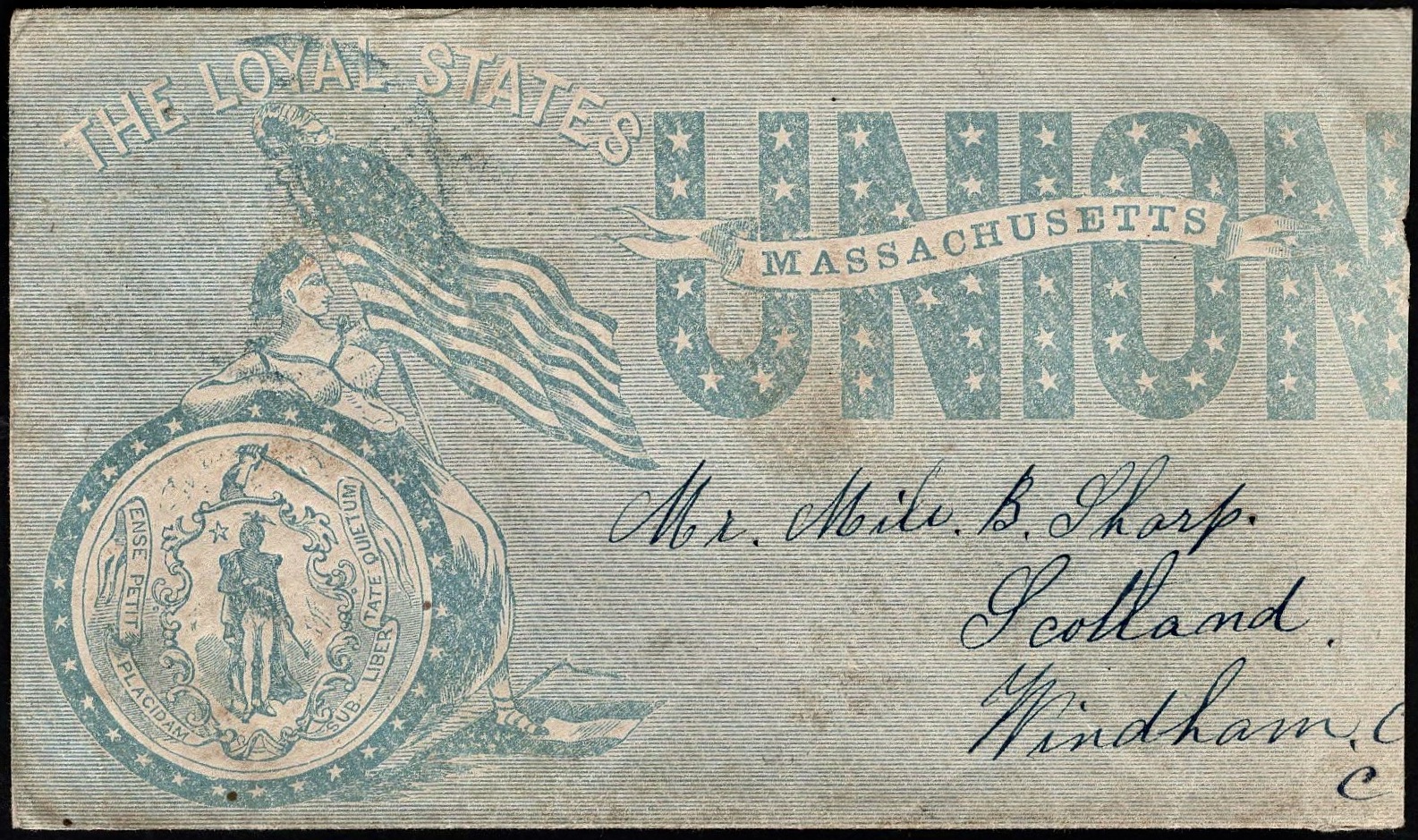
Addressed to Mr. Milo B. Sharp, Scotland, Windham county, Connecticut

Camp near Edinburg, Va.
April 8, 1862

Friend Milo,

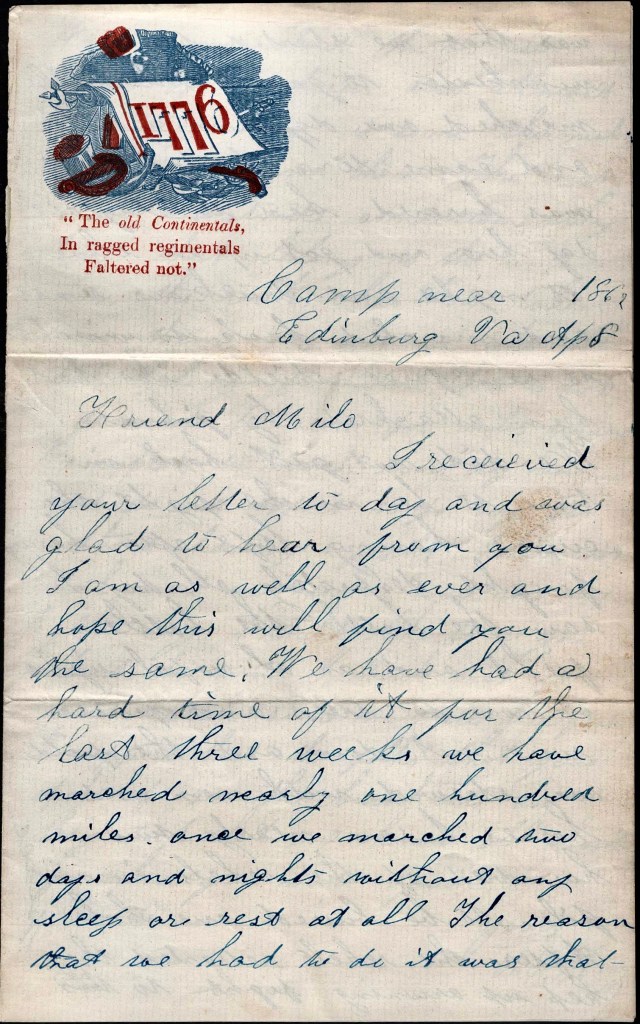
I received your letter today and was glad to hear from you. I am as well as ever and hope this will find you the same.

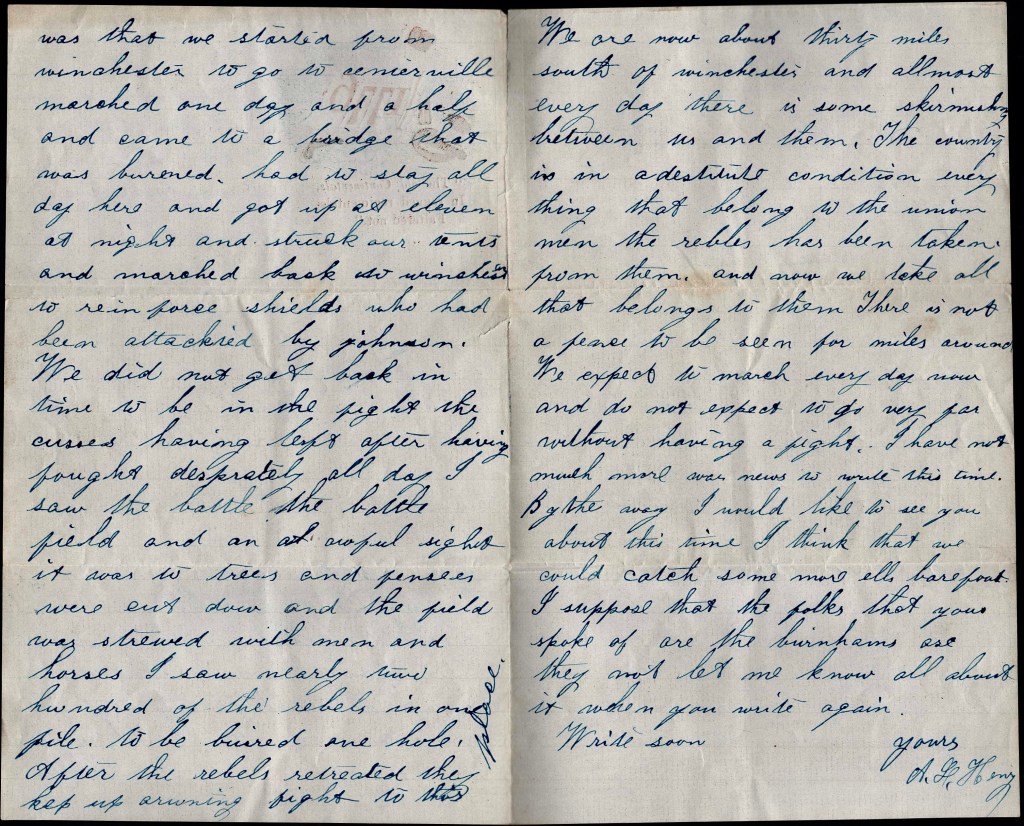
We have had a hard time of it for the last three weeks. We have marched nearly one hundred miles. Once we marched two days and nights without any sleep or rest at all. The reason that we had to do it was that we started from Winchester to go to Centerville, marched one day and a half, and came to a bridge that was burned. Had to stay all day here and got up at eleven at night and struck our tents and marched back to Winchester to reinforce Shields who had been attacked by Johnson [Jackson]. We did not get back in time to be in the fight, the cusses having left after having fought desperately all day. I saw the battlefield and an awful sight it was too. Trees and fences were cut down and the field was strewed with men and horses. I saw nearly two hundred of the rebels in one pile to be buried in one hole. After the rebels retreated, they kept up a running fight to this place.

We are now about thirty miles south of Winchester and almost every day there is some skirmishing between us and them. The country is in a destitute condition. Everything that belong to the Union men, the rebels has been taken from them. And now we take all that belongs to them. There is not a fence to be seen for miles around. We expect to march every day now and do not expect to go very far without having a fight.

I have not much more war news to write this time. By the way, I would like to see you about this time. I think that we could catch some more ells barefoot. I suppose that the folks that you spoke of are the Burnhams, are they not? Let me know all about it when you. write again. Write soon. Yours, — A. L. Henry

1862: William Henry Rinehart to Joseph K. Miller

The following letter was written by William Henry Rinehart of Co. I, 6th Pennsylvania Cavalry. At age 20, he enlisted in the company on 26 September 1861 as a private and mustered out of the regiment on 17 June 1865 as a sergeant. He was described as standing 5′ 6″ tall, with brown hair, hazel eyes, and the dark complexion of a farmer. He was born in Chester county, Pennsylvania, probably the son of Joshua Rinehart (1813-1899) and Amelia Sheppard Dare (1809-1891) of East Coventry.

After the war he married and moved to Leavenworth, Kansas, where he became an agent for a company making lightning rods. He married the daughter of an Irish emigrant named Fanny (1843-Bef1900) who died prior to 1900 when he was enumerated in a home for disabled veterans.

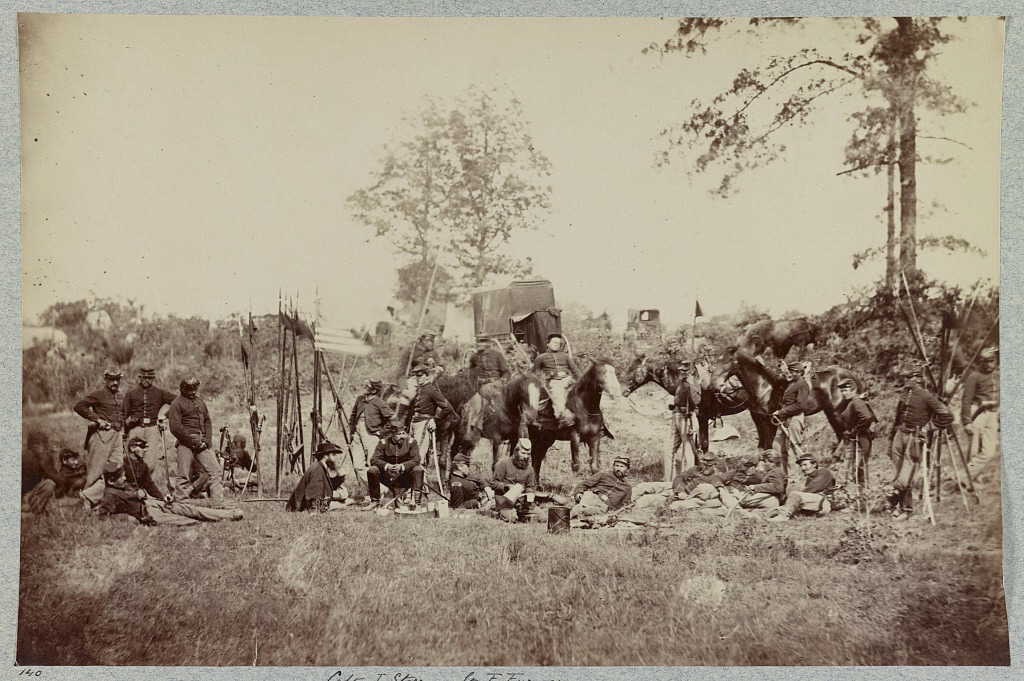
The 6th Pennsylvania Cavalry (“Rush’s Lancers”) were equipped with lances as shown in this image.

T R A N S C R I P T I O N

Addressed to Mr. Joseph K. Miller, Limerick Bridge, Montgomery county, Pennsylvania

Near Hampton, Virginia
April 21st 1862

Esteemed Friend,

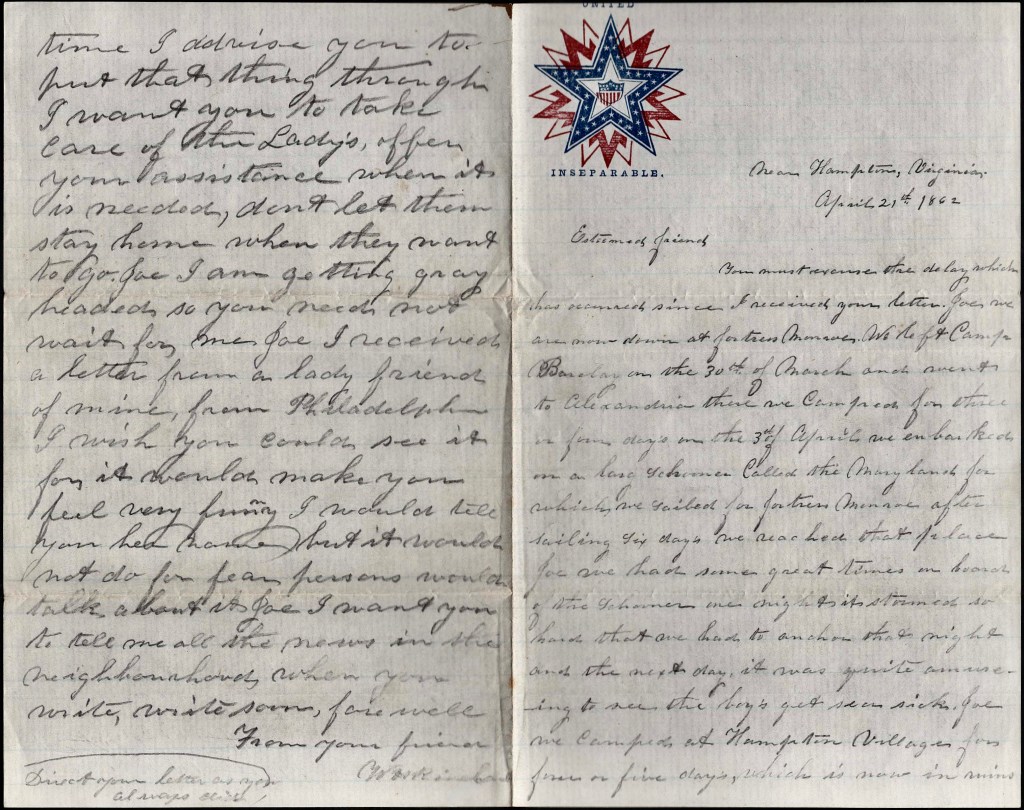
You must excuse the delay which has occurred since I received your letter. Joe, we are now down at Fortress Monroe. We left Camp Barclay on the 30th of March and went to Alexandria. There we camped for three or four days. On the 3rd of April we embarked on a large schooner called the Maryland for which we sailed for Fortress Monroe. After sailing six days we reached that place.

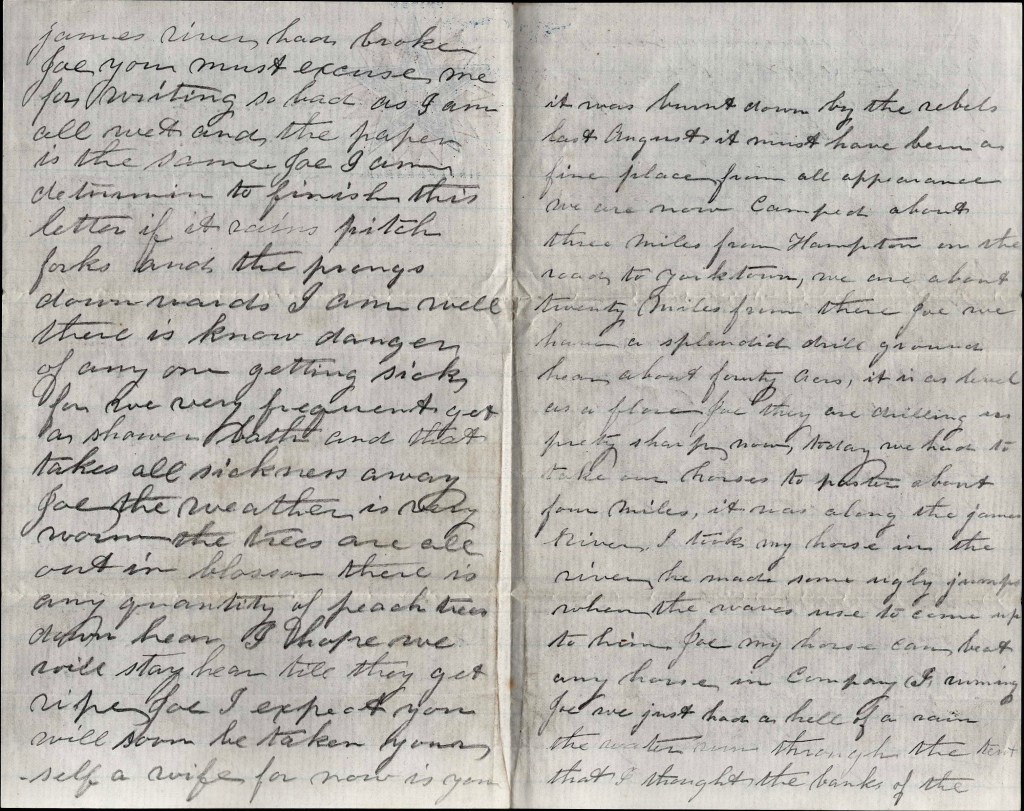
Joe, we had some great times on board of the schooner. One night it stormed so hard that we had to anchor that night and the next day. It was quite amusing to see the boys get seasick. Joe, we camped at Hampton village for four or five days, which is now in ruins. It was burnt down by the rebels last August. It must have been a fine place from all appearance. We are now camped about three miles from Hampton on the road to Yorktown. We are about twenty miles from there.

Joe, we have a splendid drill ground here [of] about forty acres. It is as level as a floor. Joe, they are drilling us pretty sharp now. Today we had to take our horses to pasture about four miles. It was along the James River. I took my horse in the river. He made some ugly jumps when the waves use to come up to him. Joe, my horse can beat any horse in Company I running. Joe, we just had a hell of a rain. The water run through the tent [such] that I thought the banks of the James river had broken. Joe, you must excuse me for writing so bad as I am all wet and the paper is the same.

Joe, I am determined to finish this letter if it rains pitch forks and the prongs downwards. I am well. There is no danger of anyone getting sick for we very frequently get a shower bath and that takes all sickness away. Joe, the weather is very warm. The trees are all out in blossom. There is any quantity of peach trees down here. I hope we will stay here till they get ripe. Joe, I expect you will soon be taking yourself a wife for now is your time I advise you to put that thing through. I want you to take care of the Ladies. Offer your assistance when it is needed. Don’t let them stay home when they want to go.

Joe, I am getting grey-headed so you need not wait for me. Joe, I received a letter from a lady friend of mine from Philadelphia. I wish you could see it for it would make you feel very funny. I would tell you her name but it would not do for fear persons would talk about it. Joe, I want you to tell me all the news in the neighborhood when you write. Write soon. Farewell. From your friend, — W. H. Rinehart

Direct your letter as you always did.

1861: Edward French Hall to Susan (Blood) Hall

The following letter was written by Edward French Hall (1824-1903) of Co. B, 3rd New Hampshire Infantry. The 3rd New Hampshire was a three year’s regiment who members were mostly recruited in New Hampshire, but there were also 116 men from Ireland, 81 from Vermont, 70 from Maine, and 31 from New York. 

Edward wrote the letter to his wife, Susan (Blood) Hall (1822-Aft1900) with whom he married in 1847. Edward was a native of Epping, New Hampshire. His parents were Samuel Hall. and Elizabeth Lee. Edward and Susan lived in Haverhill, Essex county, Massachusetts in 1860 where Edward was employed as a shoemaker.

Edward was 37 years old when he enlisted in August 1861 as a private. He was severely wounded on 16 August 1864 at Deep Bottom Run which resulted in the amputation of his left arm.

The Steamer Atlantic transported the 3rd New Hampshire on the Expedition to Port Royal.

T R A N S CR I P T I O N

Hilton Head, South Carolina
Dec 11th 1861

Dear Susan,

I received your letter dated Exeter, Nov 30th, last night and take the first opportunity to answer it. Those money letters are all accounted for except one with $10 in it and $15 which I sent to Mary by Express. Two letters I sent from Fortress Monroe, each containing five dollars, and directed to Oxford. The next two were written on the Steamer Atlantic, directed to Bradford, $10 in one and $20 in the other, and put in the [Post] Office before we landed. Then after we had got ashore, I got a letter from you written at Orford so I found out you had not returned to Bradford. (and the next two money letters were directed to /this is a mistake, one letter instead of two/ Orford each containing $10. I don’t remember the dates but they were both written after we landed and before the 20th of November. The fifteen dollars I sent by Express was given to the Chaplain on the 20th November and he said a receipt for it would be sent back from Fortress Monroe soon as they could have time to make them out and a boat was coming this way. This receipt is given so that in case the money is lost we can have something to show that we have sent it and the company makes it good. But I have not seen the receipt or heard from the money yet.

I sent a letter to Mary directly after telling her I had sent it and have not heard from her since. There don’t seem to be much regularity about letters going or coming. Some go or come quicker than others. There is no regular Mail Boat but the Mail is sent or brought whenever there is a chance. If you write a letter and it gets to N Y just before a boat leaves for this place, it will come very direct. But if it gets there a week before the boat leaves, of course it will take so much longer for it to reach here. Sometimes letters lay in the Office here some time before there is a chance to send a Mail to N. Y.

You ask me if I have clothes enough. Yes, with the exception of a pair of gloves. I have two coats and an overcoat, two woolen shirts, two pairs of drawers. The cold weather here is only once in a while. A good deal of the time it is too warm for comfort in the day time, a little chilly nights.

When you get to Haverhill, I think you will find some letters there from me. I think the missing letter with $10 in it must have reached Orford after you left unless it is lost. But I don’t understand why I have not heard from the $15 sent by Express. I write so many letters that I can’t keep the run of them and I think it will be a good plan to number them, and I will commence with this and call it Letter No 1. The next will be No two and so on. And when you get one, you can acknowledge the receipt of No one or two as the case may be. Then if any are missing, we can tell where the gap is.

I believe I have written about all of consequence, and will bring my letter to a close. Please write and tell me all the news when you get to Haverhill and tell Mary to write often. My love to all and believe me I think of you much and often. Good by, — Edward F. Hall

1862: John Wells Sanborn to Friend Luther

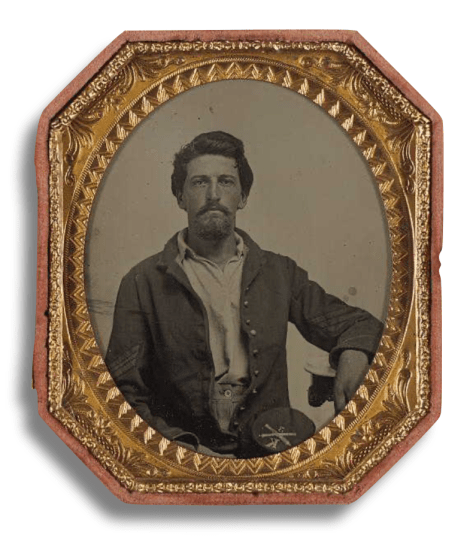
I could not find an image of John but here is one of George Rumsey who served in the same company (Photo Sleuth)

The following letter was written by John Wells Sanborn (1843-1930) of Co. D, 4th New Hampshire Infantry. An obituary, published in the Palm Beach Post of 29 July 1930, reports that John was born in Sanbornton, Belknap county, New Hampshire on 7 May 1843. “He saw three years active service and during the capture of Morris Island was wounded and spent the remainder of the war in hospitals, being honorably discharged in September 1864.” After the war, John left New Hampshire to drive a bull team from Kansas City to Denver and enjoy life in Colorado. In 1874 he started a sheep ranch and eventually settled in Greeley, Colorado in 1884 where he lived until 1912. He then relocated to Lake City, Florida where he died in 1930. Census records reveal that John was the son of Christopher Sanborn (1803-1902) and his second wife, Mehitable Philbrick (1809-1883)

In this letter, John. gives a good description of Ferandina, Jacksonville and St. Augustine as the 4th New Hampshire made its way to Fort Marion where they would remain in garrison until October 1862.

T R A N S C R I P T I O N

Fort Marion
St. Augustine, Florida
May 3, 1862

Friend Luther,

I received your letter yesterday and was mighty glad to hear from you. I reckon there was no one in Co. D that felt any better than I did when I got your letter and papers and the same from home. I had been looking for news from you for some time and well I know I should get something worth reading.

Well about Governor [Nathaniel S.] Berry’s paying us our state pay, I guess if you could hear the tall swearing some of the soldiers get off about him you would think he had not payed us nor has he yet. Nor is there any prospect of his doing so very soon. So for once the Democrats don’t blow for nothing.

Ruth Smith’s marriage was news to me. What does King David think to have his boys leaving him so in his old age? I delivered the tobacco you sent to Horace who I guess thought it was a curious present. He had some bad spells of bleeding at the nose a few days ago but is now doing well.

When we went to Fernandina, we were all well pleased for although it is not so large or wealthy a place as this place, or Jacksonville, yet there is something about it that seems more like our pleasant hills in New Hampshire. The buildings and land look much more like those at home. The streets are of good width, well laid out, and a little sandy with many fine shade trees. In going up the river to Jacksonville, interesting sights presented themselves all of the way. Most of the way the banks are thickly wooded. Now and then you see cleared spots with a few negro huts here. You always see the occupants with flags of some kinds raised and waving handkerchiefs and showing every demonstrations of joy. On a little farther you see a good building looking out from some remote spot among the trees—also the negro shanties scattered around it. At these places you generally see white women, but not a man, if any there be dare show their heads. Corn was just large enough to be plainly seen. All these things with the expectation of being saluted with a ball or shell kept up quite an excitement.

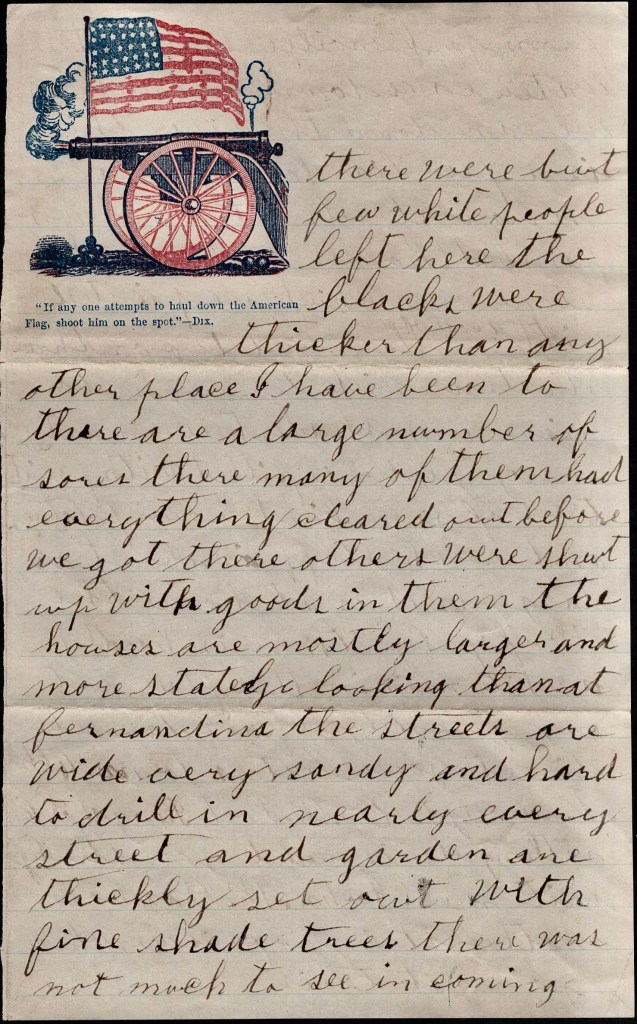
Nearing Jacksonville, clouds of smoke could be seen rising on both sides of the river. This was the rebels last work before leaving. They burned a lot of sawmills, foundries, machine shops and a large hotel. Nearly everything on shore seemed to be on fire. There were but few white people left here. The Blacks were thicker than any other place I have been to. There are a large number of stores there [but] many of them had everything cleared out before we got there. Others were shut up with goods in them. The houses were mostly larger and more stately looking than at Fernandina. The streets are wide, very sandy, and hard to drill in. Nearly every street and garden are thivkly set out with fine shade trees.

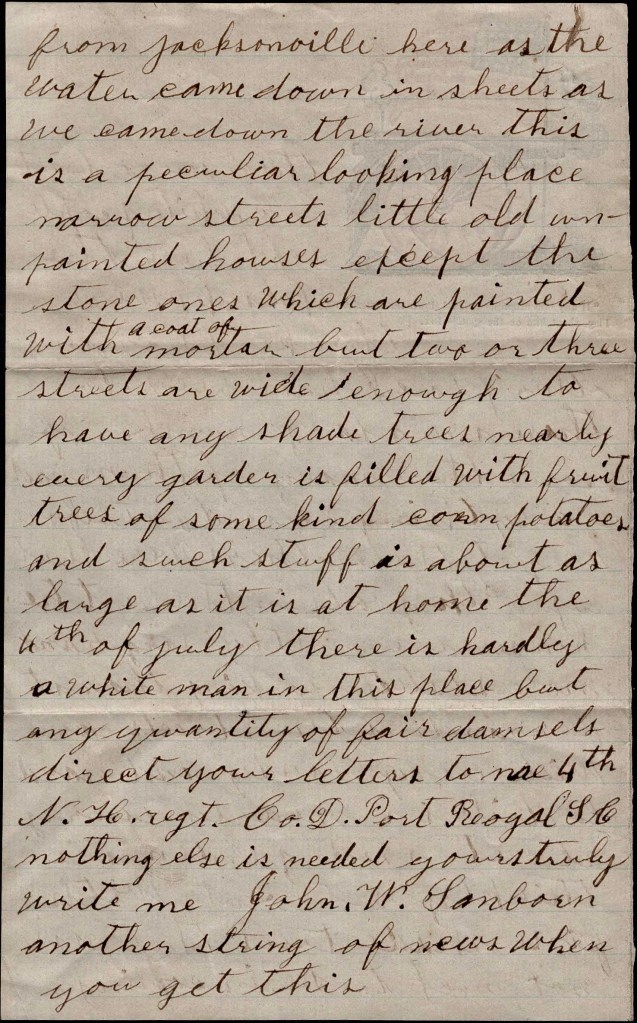
There was no much to see in coming from Jacksonville here as the water came down in sheets as we came down the river. This is a peculiar looking place—narrow streets, little old unpainted houses except the stone ones which are painted with a coat of mortar. But two or three streets are wide enough to have any shade trees. Nearly every garden is filled with fruit trees of some kind, corn, potatoes, and such stuff is about as large as it is at home [by] the 4th of July. There is hardly a white man in this place but any quantity of fair damsels. 1

Direct your letters to me, 4th N. H. Regt., Co. D, Port Royal, S. C. Nothing else is needed. Yours truly, — John W. Sanborn

Write me another string of news when you get this.


1 To the annoyance of the soldiers of the 4th New Hampshire, the young damsels would often gather at the Plaza in St. Augustine, visibly chipping off pieces from the flagpole stump as souvenirs. This was from the flagpole that once waved the Confederate standard before they cut down the pole to prevent Union troops from flying the Stars and Stripes from it. [Source: St. August During the Civil War by Omega G. East, Florida Historical Quarterly, 1952.]

1863: Alfred Orlo Smith to Cousin Nellie

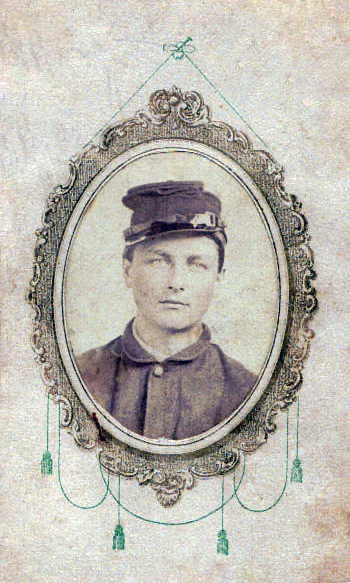
I could not find an image of Alfred but here is Phillip Faatz of Co. K, 3rd New York Light Artillery (ancestry.com)

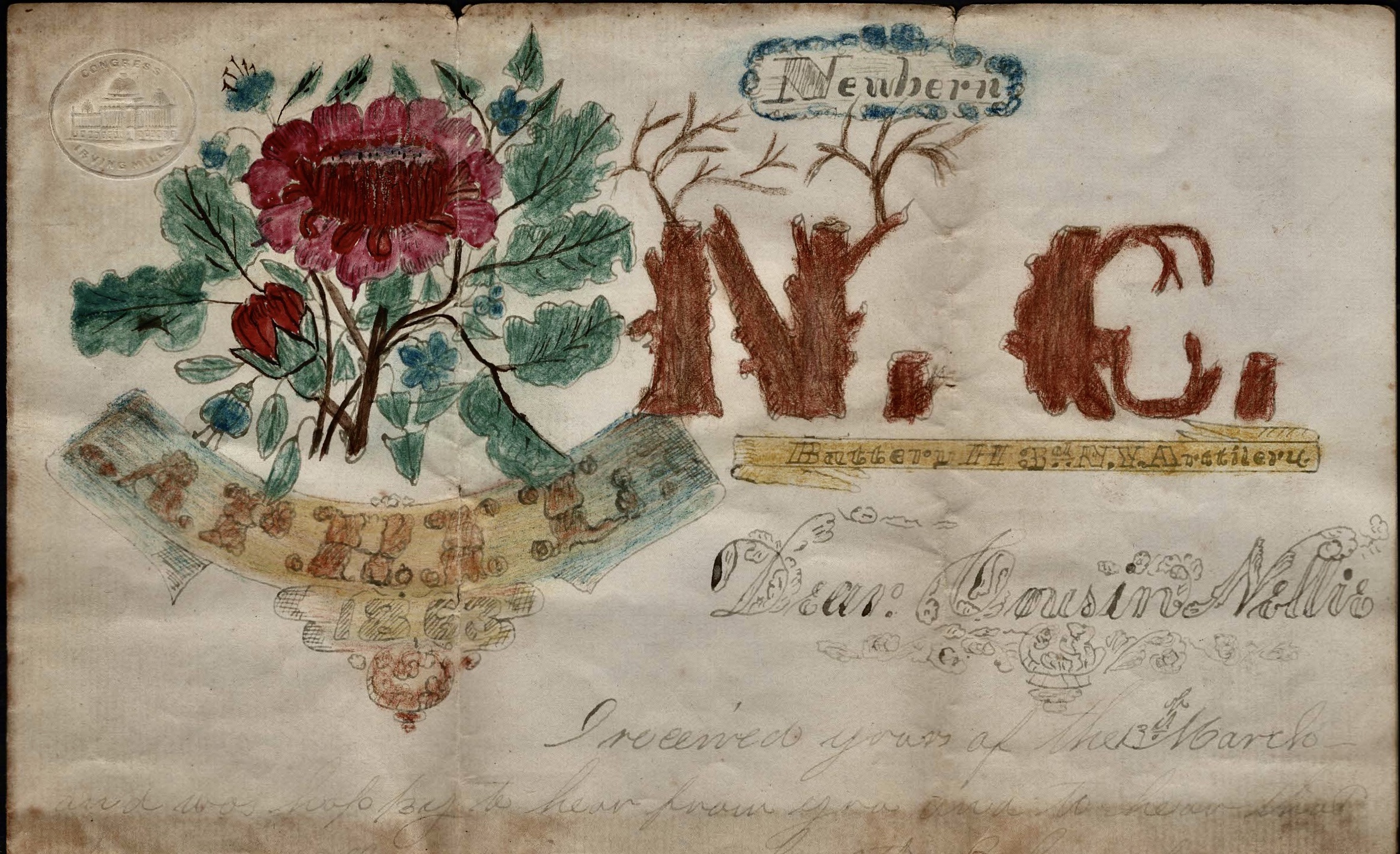
This letter was written by Alfred Orlo Smith (1841-1912), the son of Norman Smith (1806-1865) and Emily L. Smith (1816-1892) of Rome, Oneida county, New York. Battery H, 3rd New York Artillery, was organized at Rome, New York in February 1862. They were sent to New Bern, North Carolina, in late March 1862, and were still garrisoned there a year later when this letter was penned. Alfred entered the service as a private and was appointed corporal on 1 September 1863—his highest rank.

Alfred’s obituary was published in the Democrat and Chronicle of Rochester, New York, on 12 October 1912, asserting that he “took an active part in the second battle of Bull Run and was also involved in the battles of Missionary Ridge and Antietam. He participated in twenty-eight battles, in addition to numerous skirmishes. He sustained a bullet wound in the leg during the battle of Missionary Ridge, which resulted in a lifelong disability.” However, an examination of Alfred’s military record indicates that he spent the entirety of his service along the eastern coastal seaboard, never once nearing the aforementioned battlefields, nor was he ever wounded in combat. These fabricated accounts likely originated during the post-war glory days of the GAR, an organization with which he was proudly associated.

In the 1890 Veteran’s Schedule, Alfred claimed he held the rank of 1st Lieutenant and served from mid-August 1862 to 24 June 1865 (2 years, 9 mo., 26 days). In the disability column of this record, he suggests periodic lung difficulty but says nothing of any wounds or having been lamed by a bullet.

In his letter, Alfred informs his cousin of the recent skirmish at Deep Gully that occurred in mid-March 1863, a segment of a poorly orchestrated Confederate assault on New Bern, aimed at regaining control of the city from Union forces. Concurrently, a less effective attack was launched against Fort Anderson, situated on the bank of the Neuse River, directly across from New Bern.

T R A N S C R I P T I O N

Hand drawn letterhead by Alfred

New Bern, North Carolina
April 1863

Dear Cousin Nellie,

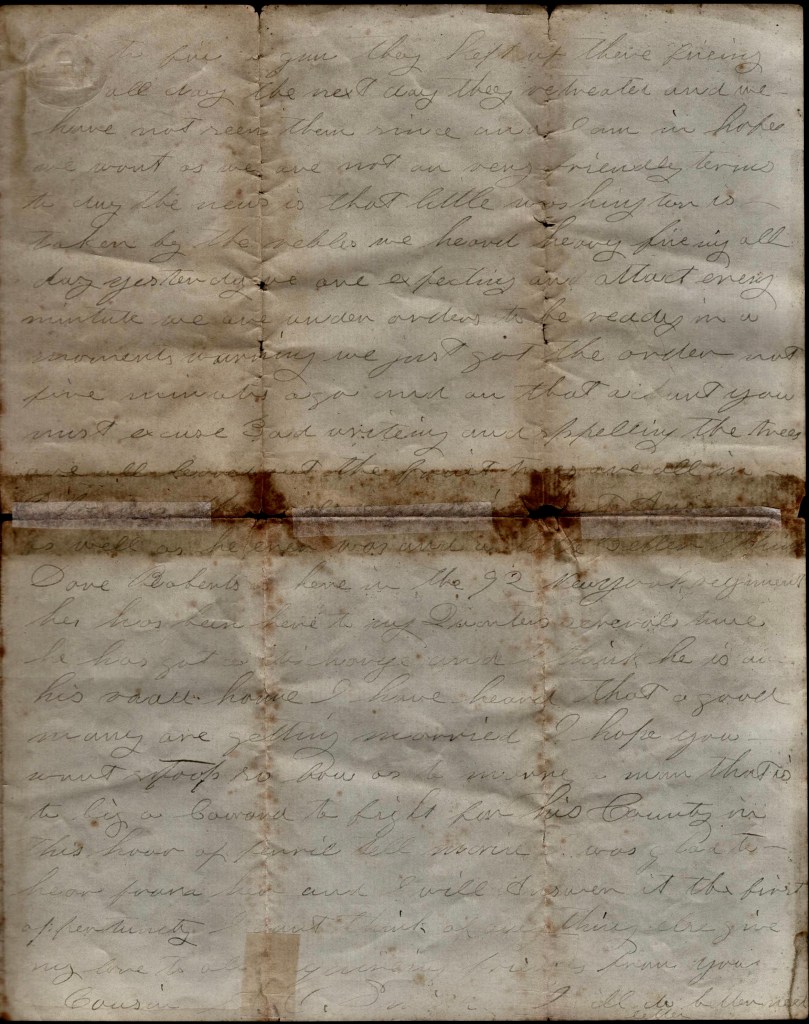
I received yours of the 13th March and was happy to hear from you and to hear that you was well and in good health. I had begun to think that you had forgotten me but the letter came at last. We are having pleasant weather here at present and I hope these few lines that I write will find you enjoying good health as they leave me with a bad cold. We have been out on an expedition since I last wrote to you. We went into Onslow County within 8 miles of Jacksonville. We see nothing worthy of note. We captured some [ ] and prisoners of war. We arrived here on the 10th of March, safe and sound.

We were attacked here on the evening of the 13th by the Rebels at a place called Deep Gully, distance nine miles from New Bern. We got orders just as we were getting supper. We marched five miles double quick and come to a halt in Battery for the night. We lay by our guns all night in the chilly night air. In the morning we advanced two miles to the front. The Rebel skirmishers commenced firing on our advance. We were there to a halt about twenty minutes when we heard heavy firing in ythe direction of New Bern. We then could see what was up. The Rebels had come down on this road so as to decoy us out of New Bern. We got orders to counter march back to New Bern.

We arrived in New Bern about 10 o’clock a.m. When we got here, we could see the shells of the Rebels guns burst over our camp and around our gunboats. We were ordered to be ready at a moment’s warning but we did not get a chance to fire a gun. They kept up their firing all day. The next day they retreated and we have not seen them since and I am in hopes we won’t as we are not on very friendly terms.

Today the news is that Little Washington is taken by the Rebels. We heard heavy firing all day yesterday. We are expecting an attack every minute. We are under orders to be ready in a moment’s warning. We just got the order not five minutes ago and on that account, you. must excuse bad writing and spelling.

The trees are all leafed out, the fruit trees are all in [illegible due to repair tape]…as well as he ever was and a little better, I think. Dave Roberts is here in the 92nd New York Regiment. He has been here to my quarters several times. He has got a discharge and I think he is on his road home. I have heard that a good many are getting married. I hope you won’t stoop so low as to marry a man that is too big a coward to fight for his country in this hour of peril. Tell Marie I was glad to hear from her and I will answer it the first opportunity. I can’t think of anything else. Give my love to all enquiring friends. From your cousin, — O. Smith

I’ll do better next letter.

1863: James M. Higgins to James Emery

Martin Pence of Co. I, 96th OVI also died of disease at St. Louis in February 1863.

This letter was written by James M. Higgins (1835-1863) of Co. H, 96th Ohio Volunteer Infantry. He wrote the letter to James Emery (1818-1888) of Bellfontaine, Logan county, Ohio, regarding the death of his son, Cyrus Eagle Emery, who enlisted when he was 19 years old on 8 August 1862 to serve in Co. H, 96th Ohio. We learn from the letter that Cyrus died on a hospital boat on the Arkansas River while en route to Memphis. What is most unusual about this letter is that less than a month later, James was also dead. His military record indicates that he died of chronic diarrhea on 15 February 1863 at the Jefferson Barracks Hospital in St. Louis, leaving a grieving wife and child back home in Bellfontaine, Ohio.

T R A N S C R I P T I O N

January 16, 1863

Mr. James Emery—dear sir,

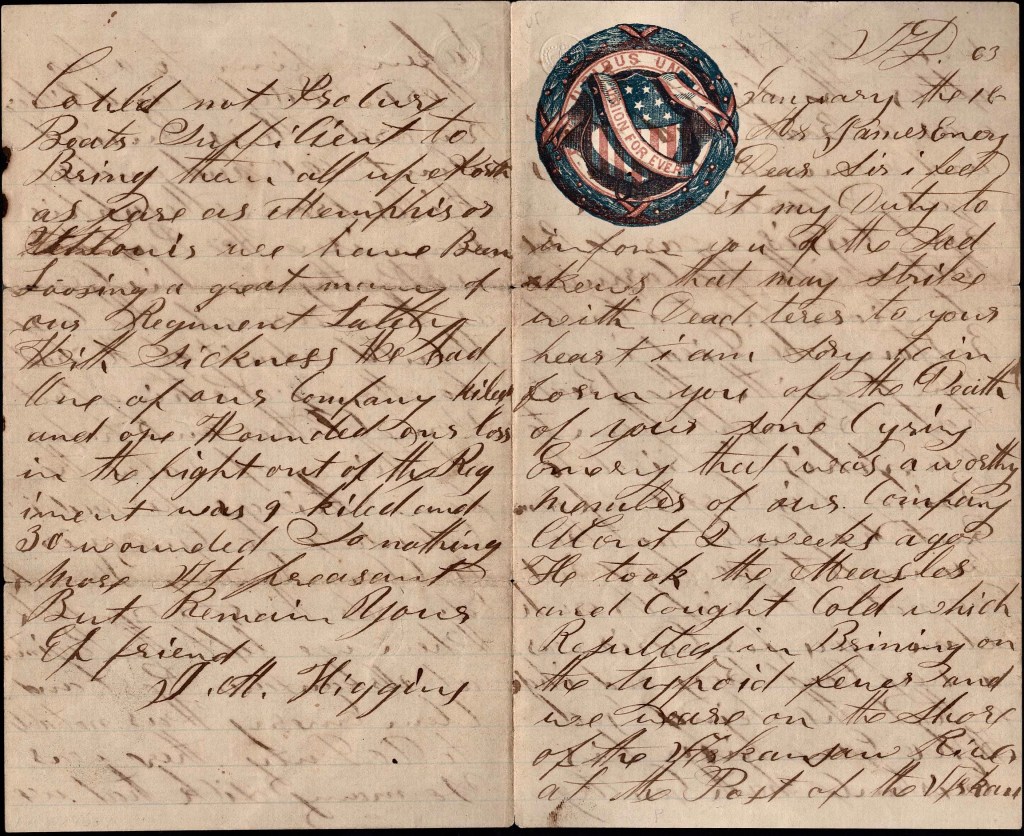
It is my duty to inform you of the sad news that may strike with dead tears to your heart. I am sorry to inform you of the death of your son Cyrus Emery that was a worthy member of our company. Most two weeks ago he took the measles and caught cold which resulted in bringing on the Typhoid Fever [when] we were on the shore of the Arkansas River at the Post of the Arkansas and fight.

Soon after the fight there was a boat load of sick and wounded soldiers was started North but Cyrus was too bad that [even] with the carefullest attention that I could bestow, he died. I was sent with the boat that brought them to Memphis. I tried to bring his corpse up home but he could not be brought so far.

But do not grief overwhelm you for Cyrus was a very good boy and I hope that the kind God who gave him his existence hath gently taken him to a far more peaceful and richer reward. He is buried about 140 miles from Memphis, Tennessee. We put him as neatly in his grave as the nature of the case would admit of. He had no money—nothing but some clothes and paper. Nothing of value. The few things he had I calculate to give over to Clem Emery.

Frank [J.] Edwards was very sick when we left the regiment at Arkansas Post and [John] Clem Emery was not able to do. duty. There was so many sick that we could not procure boats sufficient. to bring them all up North as far as Memphis or St, Louis. We have been losing a great many of our regiment lately with sickness.

We had one of our company killed [possibly James Stanton?] and one wounded [Henry Harbaugh]. Our loss in the fight out of the regiment was 9 killed and 30 wounded. So nothing more at present but remain your friend, — J. M. Higgins

1863: George T. Conklin to Friend Emma

Pvt. Philip Daniel Hublitz of Co. D, 48th NY Infantry

The following letter was written by George T. Conklin (1839-1863) of Co. K of the 48th New York Infantry. The regiment was organized at Brooklyn in September 1861 and participated in Sherman’s South Carolina Expeditionary Corps in the spring of 1862. They began siege operations of Fort Pulaski, Georgia, that led to the bombardment and capture of the Confederate stronghold until May 1863 when this letter was penned.

George appears erroneously in the regimental roster as “George A. Conklin.” That record states that he was 22 years old when he enlisted on 9 August 1861 at Galeville to serve three years. He was initially mustered into Co. D as a private but later transferred to Co. K. That same record states that George was captured in action during the assault on Fort Wagner, South Carolina, on 18 July 1863, and that he died of disease on 11 December 1863. His father made a pension claim in 1879 for his son’s service but there was no other information provided on-line.

The history of the 48th New York says that the regiment (with the exception of Cos. G and I) left Fort Pulaski and were transported to Hilton Head where they were attached to Strong’s Brigade, 10th Corps. In the assault on Fort Wagner, the loss of the 48th was 242 killed, wounded and missing, including Col. Barton wounded and Lieut.-Col. Green killed. The regiment received high praise from the commanding officers for its gallantry in this action. Strong’s Brigade included the Black troops of the 54th Massachusetts. How poignant that George would close his letter with: “And some of us may kiss the sod before long and I might be the first. Is it not enough to make you feel sad?”

T R A N S C R I P T I O N

Fort Pulaski [Georgia]
May 3rd 1863

Dear Emma,

Once more I have the pleasure of answering one of your kind and welcome letters. Emma, I will send you my picture as quick as I can get it taken and I would like to have you to do the same for I would like to see your dear face once more. But would rather see the owner of the picture than the picture itself.

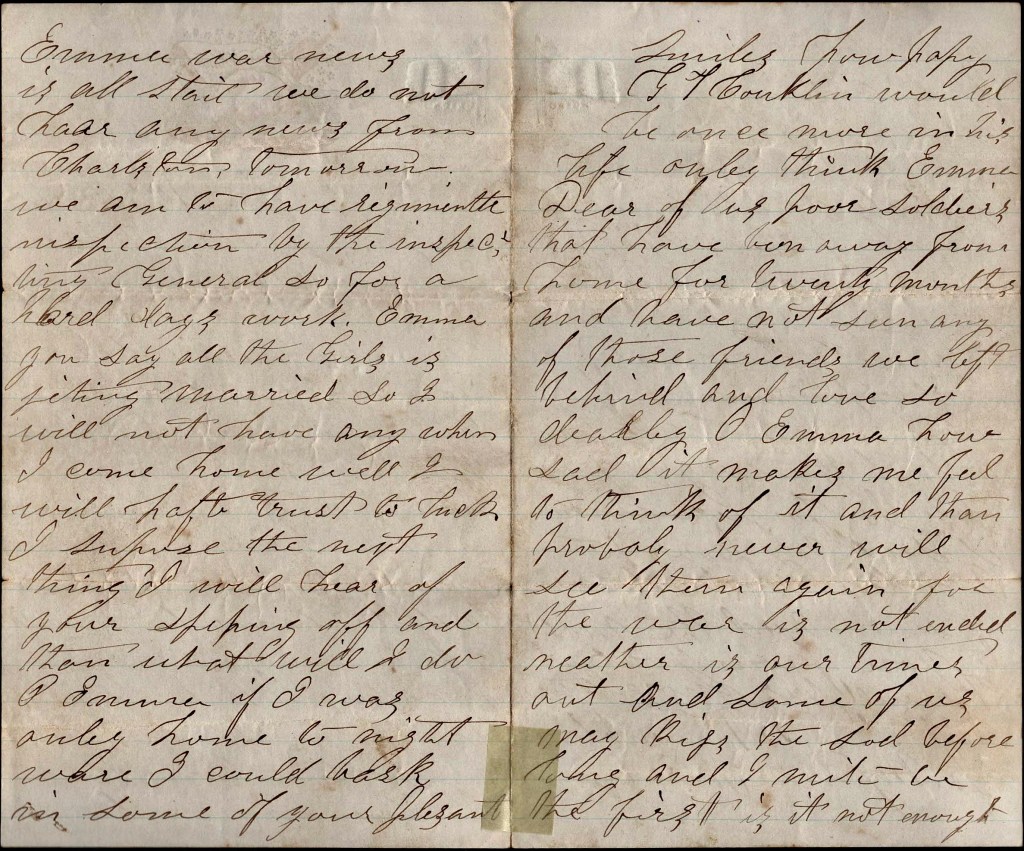
Emma, war news is all stale. We do not hear any news from Charleston. Tomorrow we are to have regimental inspection by the Inspector General so for a hard day’s work.

Emma, you say all the girls is getting married so I will not have any when I come home. Well I will have to trust to luck. I suppose the next thing I will hear of your stepping off and then what will I do? Oh, Emma, if I was only home tonight where I could bask in some of your pleasant smiles, how happy G. T. Conklin would be once more in his life. Only think, Emma dear, of us poor soldiers that have been away from home for twenty months and have not seen any of those friends we left behind and love so dearly. Emma, how sad it makes me feel to think of it and then probably never will see them again for the war is not ended. Neither is our times out. And some of us may kiss the sod before long and I might be the first. Is it not enough to make you feel sad?

Well, Emma, you must tell me in your letter who is getting married. Probably I will know some of them. Well, Emma, I will have to close my short letter. Excuse the writing and spelling and if I have said anything out of the way, I pray you to forgive me. I send my love to Amelia and all my friends and the most to you. From your friend—yes, more than friend, — G. T. Conklin

To my dear Miss Emma

1861: Harrison Guiles to Annis Dillon

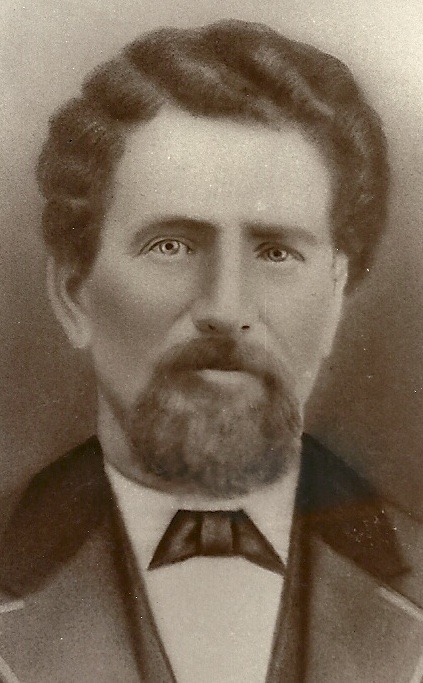
A post war image of Harrison Guiles (Find-A-Grave)

The following letter was written by Harrison Guiles (1841-1896) who was born at at Charleston, Montgomery County, New York, on 17 January 1841, the son of William Guiles (1810-1877) and Margaret Rulison (1822-1916) of Conklin, Broome county, New York. At the age of twenty he enlisted (May 1861) in Co. F (the “Broom County Volunteers”), 27th New York Infantry and served two years when he was honorably discharged in 1863. This incredible letter was written on 6 August 1861, a couple weeks after the Battle of Manassas or 1st Bull Run in which the 27th New York Infantry participated, led by their Colonel Henry W. Slocum who was wounded in the day’s action. The regiment’s losses included 1 officer and 25 men killed; two officers and 42 enlisted men wounded. There were 60 reported missing.

Returning home after his term of service had ended, Harrison was married on the 12th of March 1864 to Miss Emma Jane Darling.

I can’t be certain but suspect the letter was written to Annis Dillon (1844-1926), the 15 year-old daughter of Hamlet Dillon (1812-1890) and Adelia Chapman (1817-1889) who lived in the same village as Harrison, Conklin, New York. She later married William Alexander Bowman (1829-1898)

T R A N S C R I P T I O N

Washington [D. C.]
August 6, 1861

My friend,

I now take my pen in hand to tell you about those friends but I am sorry that I have bad news for you. The report that I received when I wrote before is all false—a [ ] rumor. Our friend [Frank] Gunther I think is a prisoner and for all that I know, it not in the land of the living now but I hope he is. He has not been heard from since he was seen at Fairfax and the probability is that he is now in their doctor’s hands and the others. [Sidney A.] McKune has not been heard from since the battle. Tybe [?] is here but not very well at present. And Spencer Whipple I heard that he is wounded but how true it is is more than I can tell. And myself, I am well and hope these [lines] will find you the same.

I received your letter yesterday and you may be assured that it come welcome too. And so they all will be that you write. I am having a very good time now, not having to drill much since we returned from the battlefield. My friend, that was a hard time. We was almost tired out and then marched clear back to Washington. I traveled 60 miles and never tasted food and fought four hours besides. It was enough to make one think of home. We expect to leave here before long. I hope so.

Annis, you must excuse my poor writing for I have been on duty the last twenty-four hours and you must know how one feels after being out all night. I think you do it. It’s very warm here and what is worse, the flies is very troublesome here. I am eating here in our old shanty and have nothing but a rough board to write on at that. I would like to be home to go to camp meeting this fall but I hardly think I will sometimes. I have had no [ ] and the time we had the fourth I feel like flying. But never mind. It will come out all right by and by. I wish that you could be here just to see the cavalry and soldiers perform. They have great old times. But it is no sport for me to settle from them.

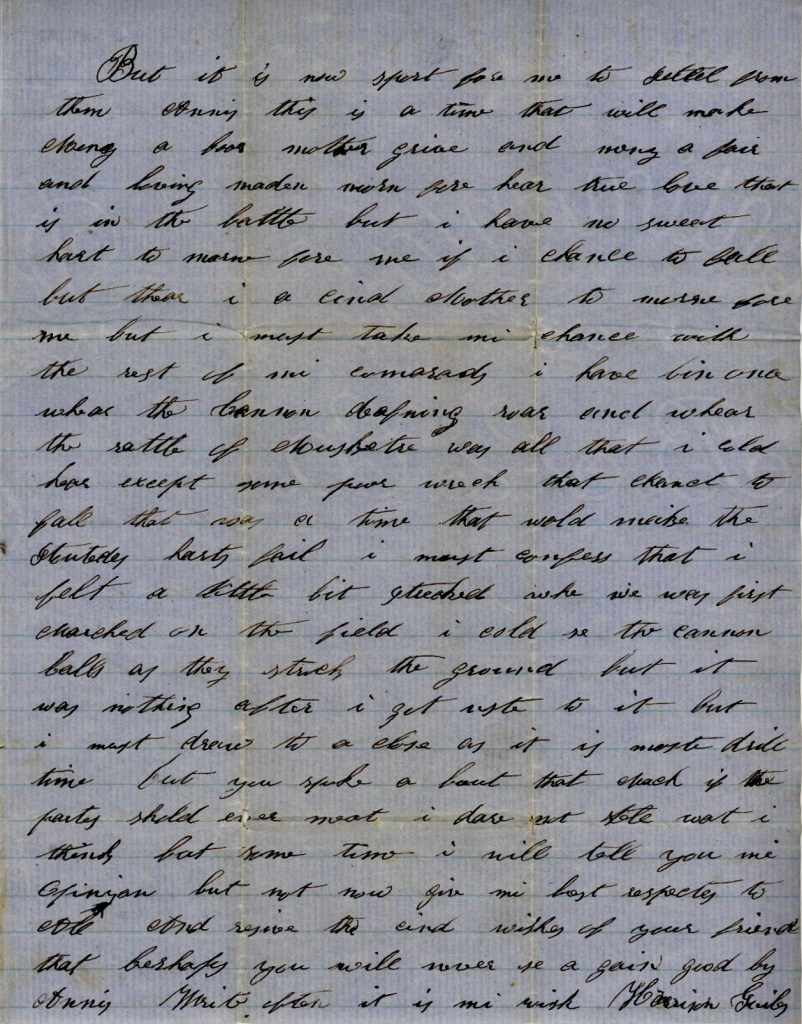
Annis, this is a time that will make many a poor mother grieve and many a fair and loving maiden mourn for her true love that is in the battle. But I have no sweetheart to mourn for me if I chance to fall. But there is a kind mother to mourn for me but I must take my chance with the rest of my comrades. I have been once where the cannon’s deafening roar and where the rattle of musketry was all that I could hear except some poor wretch that chanced to fall. That was a time that would make the sturdy hearts fail. I must confess that I felt a little bit wretched when we first marched on the field. I could see the cannon balls as they struck the ground but it was nothing after I got used to it.

But I must draw to a close as it is most drill time. But you spoke about that speech. If the party should ever meet, I dare not state what I think. But some time I will tell you my opinion. But now give my best respects to [ ] and receive the kind wishes of your friend that perhaps you will never see again. Goodbye Annis. Write Often. It is my wish. — Harrison Guiles