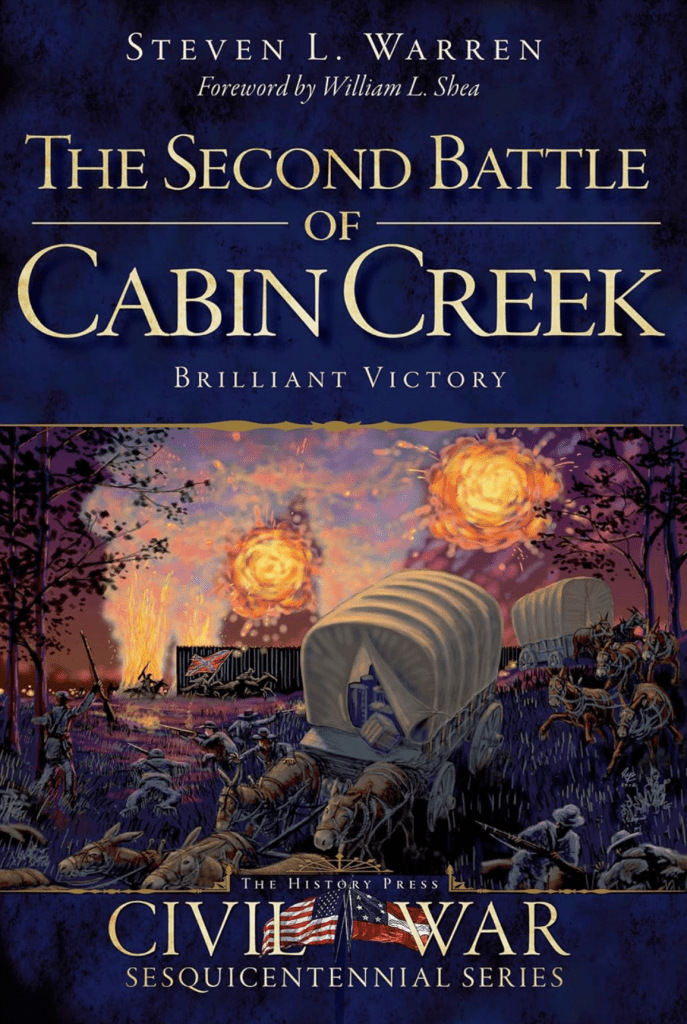
Jacket Cover of Steven L. Warren’s book, “The Second Battle of Cabin Creek.”
The following rare letter was penned by John M. Davis while serving in Gano’s Brigade in the fall of 1864. He datelined his letter from their encampment near Boggy Depot following a raid north of the Arkansas River to capture a federal supply train from Fort Scott. The combined Confederate force of Texans and Native Americans found and captured the train after a pitched night battle at Cabin Creek, Cherokee Nation on Sept. 19, 1864.
“Watie’s mounted infantry and cavalry excelled at conducting raids on Federal supply lines and outposts. As time went on, Watie’s command included pro southern members of other tribes along with Cherokees. On September 19th, 1864, Watie’s command, along with some white Texas cavalry units under Brigadier General Richard Gano, teamed up to carry out an attack on a large Federal supply train and haying operation that was gathering forage for horses. The train consisted of 205 wagons, and left Fort Scott, Kansas on September 12th, bound for Fort Gibson, Indian Territory, and Fort Smith, Arkansas. It was escorted by both white cavalrymen from Kansas cavalry units as well as Union Cherokee cavalry. This successful and destructive raid occurred near Cabin Creek in the Indian Territory, and is often referred to as the Second Battle of Cabin Creek.” [Source: Iron Brigadier]
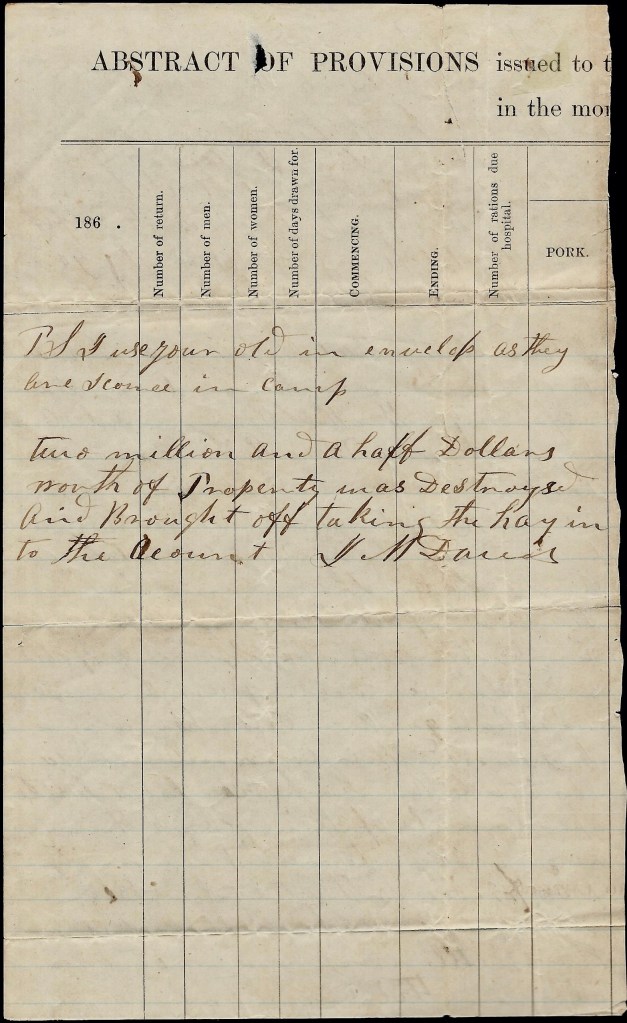
The letter was written on scraps of CSA Provision Forms, further evidence of the scarcity of paper. In his letter, Davis claims that “The boys are [now] dressed in Federal uniforms which saves our women a good deal of hard labor,” after raiding the federal stores.
Transcription
Near Boggy Depot, Choctaw Nation 1 October 6th 1864
Dear sir, I received your favor of the 1st September and I hasten to respond grateful for the blessings of Almighty God in being able so to do.
In relation to your inquiries, I am sorry that I am not situated to answer your questions satisfactory. Mr. Huddleston made a crop on the place this year. It produced good wheat every year it has been sown and made a good corn crop this year I am told by a neighbor that came from there a few days ago.
I went into the war the spring of ’62 and served one year and was discharged and last November I joined this command—Gano’s Brigade 2—and have had but little opportunity of seeing anything about your timber, but my impression is that it has been but little disturbed as there is but little improvement going on in the country.
This Brigade is moving toward Red River now, their horses being worn down by hard service. When we get to Red River I may get to go home. Then I will take a pleasure in giving you any information I can. Excuse this scribble. I am writing you on my mess box with a bad pen and am tired having marched 12 miles today. This Brigade is just off a heavy tour north of Arkansas River where we broke up two Federal stations, killing about 100 Indians and Federals, wounding a good many, taking 111 prisoners, destroying and bring off two million and a half of property wagons, mules, and supplies generally. The boys are dressed in Federal uniforms which saves our women a good deal of hard labor.
I would give you a full detail but duty calls me. I will frank this as I have no stamps. Yours, — John M. Davis
P. S. I use your old envelope as they are scarce in camp. Two million and a half dollars worth of property was destroyed and brought off taking in hay to the account. — J. M. Davis
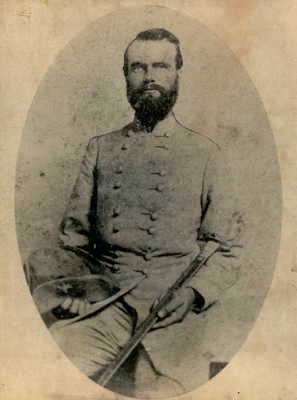
Richard Montgomery Gano (1830-1917)
1Boggy Depot was the location of the first Chickasaw agency in the West and served sometimes as the capital of the Choctaw Nation from 1858 to 1860. During the Civil War it housed the principal Confederate supply depot in Indian Territory. After the war a flour mill and a cotton gin operated northeast of town, and a salt works was established along nearby Salt Creek.
2 Gano’s Brigade existed from its formation in the summer of 1863 to its reassignment under Gen.Hamilton Bee in early 1865. Though the units that composed the brigade changed throughout its existence, they were the Twenty-ninth Texas Cavalry Regiment, the Thirtieth Texas Cavalry Regiment, the First Regiment Arizona Brigade, theFifth Texas Partisan Rangers, the Thirty-third Texas Cavalry Regiment, Welch’s Texas Cavalry Company, Wells’s Texas Battalion, the Eleventh Texas Field Artillery Battery, and the Seventeenth Texas Field Artillery Battery. Throughout its history Gano’s Brigade fought alongside Confederate Indians, led by Gen. Stand Watie. The brigade’s actions mainly consisted of raids on Union supply trains and troops maneuvering in Arkansas and the Indian Territory.
The following letters were written by Pvt. Adin F. Cowles (1831-1914) of Co. B, 8th Illinois Cavalry. In the 1860 US Census, 23 year-old Adin Cowles was enumerated in the household of John Gilkerson of Genoa in DeKalb county where he was identified as a farmhand. When he enlisted at ST. Charles, Illinois, as a corporal in September 1861, he gave his birth state as New York and he was described as standing 5′ 7.5″ tall, with black hair and grey eyes. He was the son of William and Caroline Cowles of Ithaca, Tomkins county, New York.
I could not find an image of Adin but here is Charles Henry Palmer of Pecatonica, Illinois, who served in Co. M, 8th Illinois Cavalry.
The 8th Illinois Cavalry served the duration of the war, and was the only Illinois cavalry regiment to serve the entire war in the Army of the Potomac. They also aided in the hunt for John Wilkes Booth and served as President Lincoln’s honor guard while he lay in state under the rotunda. Lincoln gave them the nickname of “Farnsworth’s Abolitionist Regiment” when he watched them march past the White House.
During the Gettysburg Campaign, the 8th Illinois Cavalry was in the division of Brig. Gen. John Buford. They deployed west of Gettysburg on June 30, 1863, under the command of Colonel William Gamble, and waited for oncoming Confederates that arrived early the following morning. The first shot of the subsequent battle was fired by Lieutenant Marcellus E. Jones of Company E, who borrowed a carbine from Sergeant Levi Shafer and fired at an unidentified officer on a gray horse over a half-mile away. The 8th, along with the rest of the brigade, performed a fighting withdrawal toward McPherson’s Ridge, delaying the Confederate division of Henry Heth for several hours and allowing the Union I Corps to arrive.
Letter 1
Headquarters Alexandria, [Virginia] February 11, 1862
Dear Brother,
Yours dated the 3rd reached its destination the 8th to find me still enjoying good health as usual… There is a good deal of sickness among the soldiers and there is some regiments that the whole of them are reported on the sick list with the measles and small pox and typhoid fever, &c. I can assure you that it is hard times &c. There is not a day passes but there is someone laid in their last resting place, &c. If the weather don’t change soon, there will [be] hard times for the sick for every place is full and they have had to remove the sick from here to Philadelphia to make room for others.
It has rained or snowed most evert day for the past month and I think that I never see such times since I can remember. And was I to tell you one half the suffering that I have sen, you would hardly believe what I say and had I not witnessed [it] myself, I could not believe that there was half the suffering that there is among our men. And I tell you that it looks hard to see men in the prime of life sink to the grave and many a poor fellow has given his life for his country with regret that they was not permitted to fill a soldier grave on a field of battle. And if I am called on to give my life, I hope that it may be where the balls fly the thickest. Then if I lose my life, I am content. There is nothing that I dread as sickness for if a soldier once gets in the hospital, he gets completely discouraged and gives up entirely and that is one reason that so many die.
You spoke of some of the regiments being discharged. That was the report here but I don’t think that they will disband our regiment for the reason that ours is considered the best and the only one that has got the complement of arms and they expect big things from us. And another reason is that we are the only drilled cavalry here so they say. Everyone that I have heard give us the praise of being the best men that has been here.
There is considerable excitement here on account of a minister that preached here last Sunday and he was requested to pray for the Union and he refused to so our men arrested him as a traitor. There was a good deal of stir here last night as near as I can learn. Our men set fire to the printing office & burnt it up. They tried to make the soldiers work the fire engines but they run off in another direction and let it burn. The cut the hose a’most to pieces and refused to put it out and if the folks in Alexandria don’t keep still of their disunion talk, there [will] be an example of some of them. There has been an order full to arrest anyone that speaks disrespectful to our soldiers or against the Union. I expect that the whole town will be burnt if they don’t keep still. There is lots of traitors here and we intend to clean them out.
I was out on a scout yesterday and we went within hearing of the enemy’s camps and we could hear their drums beat for reveille. Our pickets have been advanced of late. I don’t think that there will [be] anything done for some time for it would be almost impossible to move our artillery in this mud for I could hardly get through a horse back. I heard from [brother] Dexter 1 a few days ago. He said that [his wife] Ellens’ health was very poor and he did not expect that she would live long. And as near as I can learn by what he wrote, that he was having hard times. My sheet admonishes me that I must close. Give my love to Caroline and Ida and accept a share from me and please answer with speed. Give my likeness to Ida if you receive it in this and tell her that I shall try and come and see her if my life is spared.
Love, from your affectionate brother, — A. F. Cowles
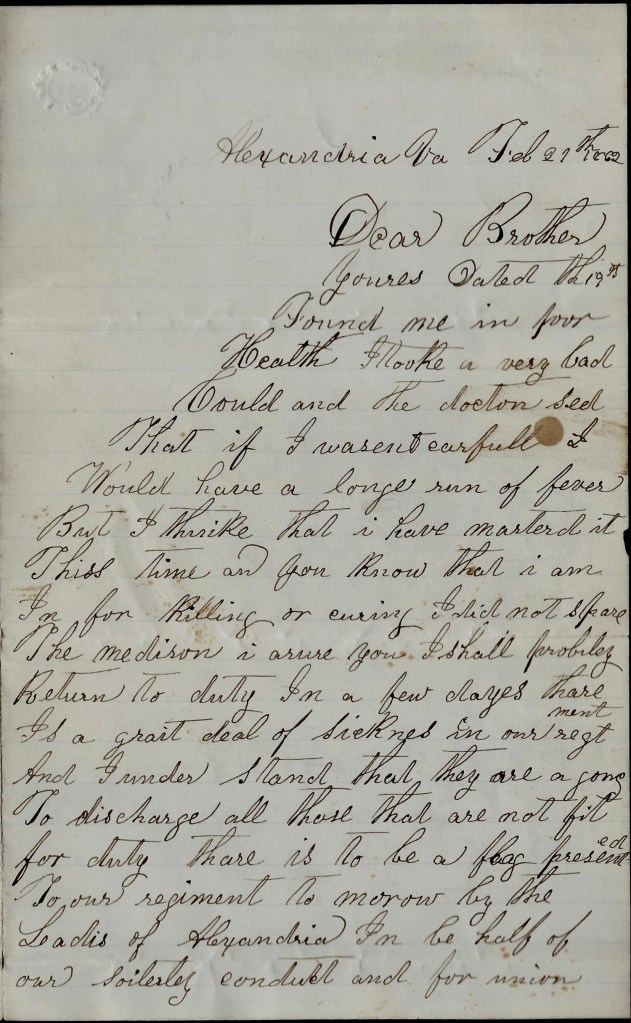
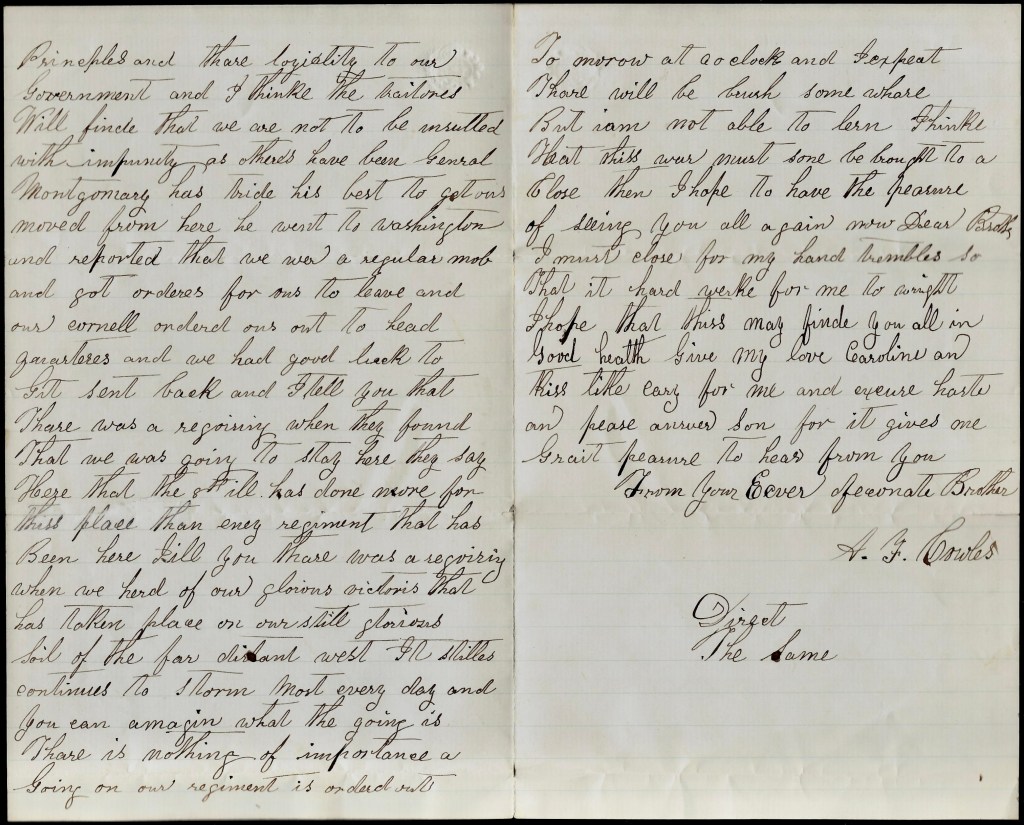
Yours found me in poor health. I took a very bad cold and the doctor said that if I wasn’t careful, I would have a longer run of fever. But I think that I have mastered it this time and you know that I am in for killing or curing. I did not spare the medicine, I assure you. I shall probably return to duty in a few days. There is a great deal of sickness in our regiment and I understand that they are a going to discharge all those that are not fit for duty. There is to be a flag presented to our regiment tomorrow by the Ladies of Alexandria in behalf of our soldierly conduct and for Union principles and their loyalty to our government and I think the traitors will find that we are not to be insulted with impunity as others have been.
General ontgomery had tried his best to get us moved from here. He went to Washington and reported that we were a regular mob and got orders for us to leave and our Colonel ordered us out to headquarters and we had good luck to get sent back and I tell you that there was a rejoicing when they found that we was going to stay here. They say here that the 8th Illinois has done more for this place than any regiment that has been here. I tell you, there was a rejoicing when we heard of our glorious victories that has taken place on our still glorious soil of the far distant West [of Tennessee]. It still continues to storm most every day and you can imagine what the going is. There is nothing of importance a going on. Our regiment is ordered out tomorrow at 6 o’clock and I expect there will be [a] brush somewhere but I am not able to learn.
I think that this war must soon be brought to a close. Then I hope to have the pleasure of seeing you all again. Now dear brother, I must close for my hand trembles so that it [is] hard work for me to write. I hope that this may find you all in good health. Give my love [to] Caroline and kill little Cary for me and excuse haste and please answer soon for it gives me great pleasure to hear from you.
From your ever affectionate brother, — A. F. Cowles
Direct the same.
Letter 3
Brooks Station, Virginia May 30, 1863
Dear Brother,
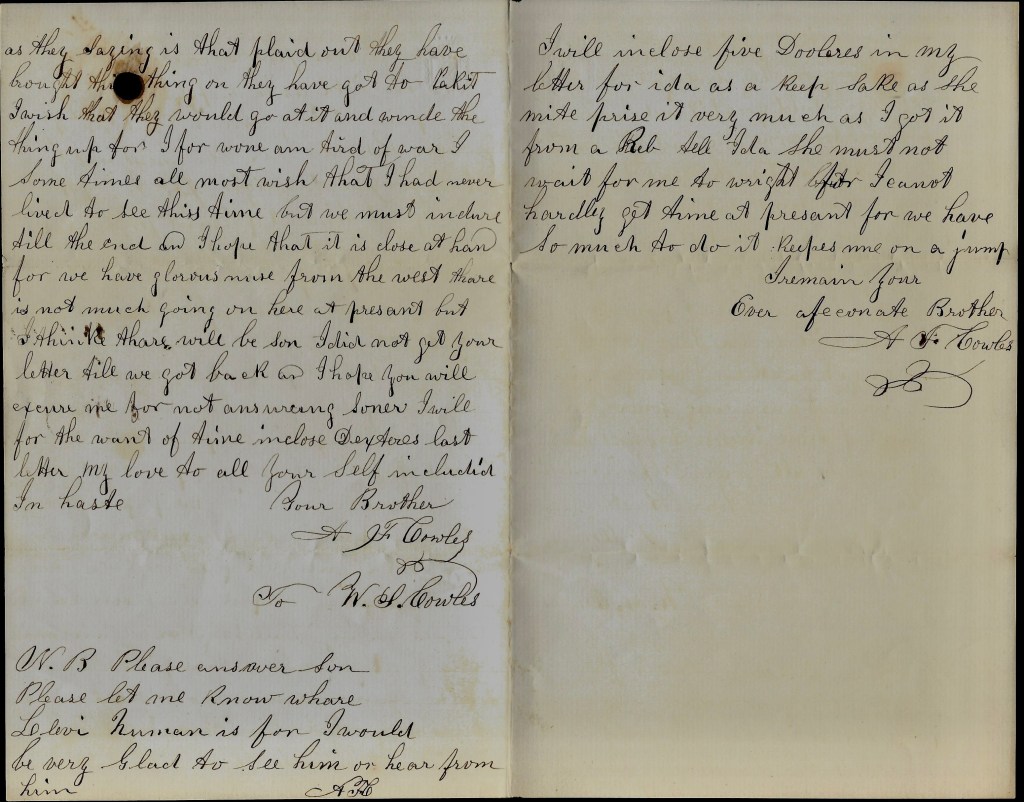
I take my pen in hand to again scribble a few lines to you hoping that they may find you all well. My health is first rate. I haven’t felt so well in a long time as I do at present. We have been very busy lately. We have not stayed any two days in a place for the past fifteen days. You probably have seen the mention in the papers of our raid. 1 We captured lots of horses & mules and took over a hundred prisoners & a number of smugglers and shipped over seven hundred negroes. Taking it all together, we have made a very good drive. We naturally made the secesh squirm when we took their negroes. It does me good to hear them beg, I tell you. We did not handle them with kid gloves, as the saying is. That played out. They have brought this thing on. They have got to take it. I wish they would go at it and wind the thing up for I for one am tired of war. I sometimes almost wish that I had never lived to see this time but we must endure till the end and I hope that it is close at hand for we have glorious news from the West.
There is not much going on here at present but I think thre will be soon. I did not get your letter till we got back and I hope you wil excuse me for not answering sooner. I will for the want of time enclose Dexter’s last letter.
My love to all, yourself included. In haste. Your brother, — A. F. Cowles
To W. S. Cowles
N. B. Please answer soon. Please let me know where Levi Newman is for I would be very glad to see him or hear from him. — A. F.
I will enclose five dollars in my letter for Ida as a keepsake as she might prize it very much as I got it from a Reb. Tell Ida she must not wait for me to write for I cannot hardly get time at present for we have so much to do, it keeps me on a jump. I remain your ever affectionate brother, — A. F. Cowles
1 This is probably a reference to Stoneman’s 1863 raid that was conducted in conjunction with the Chancellorsville Campaign.






 Spared & Shared 23