Tag Archives: family-history

1863: Mary Henrietta Miller to Peter Henry Hulst

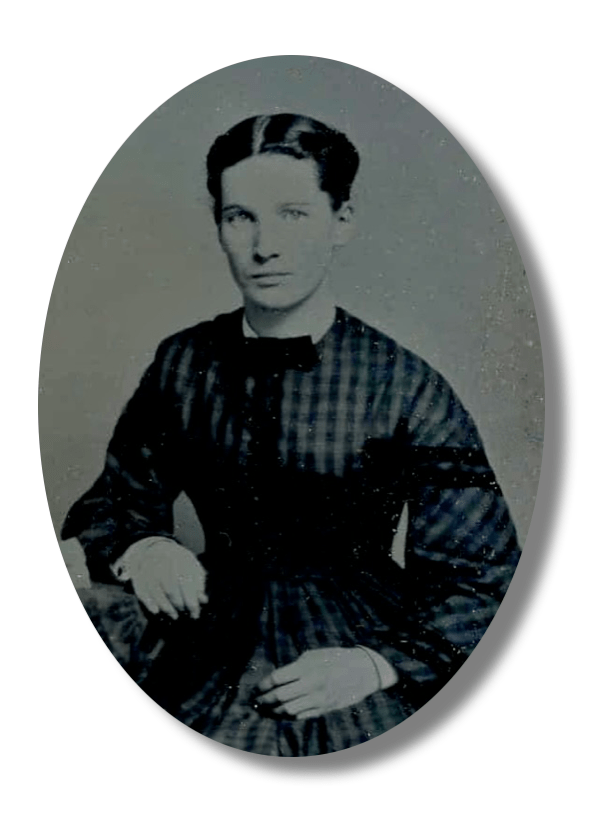
How Henrietta might have looked in 1863 (Megan Kemble Collection)

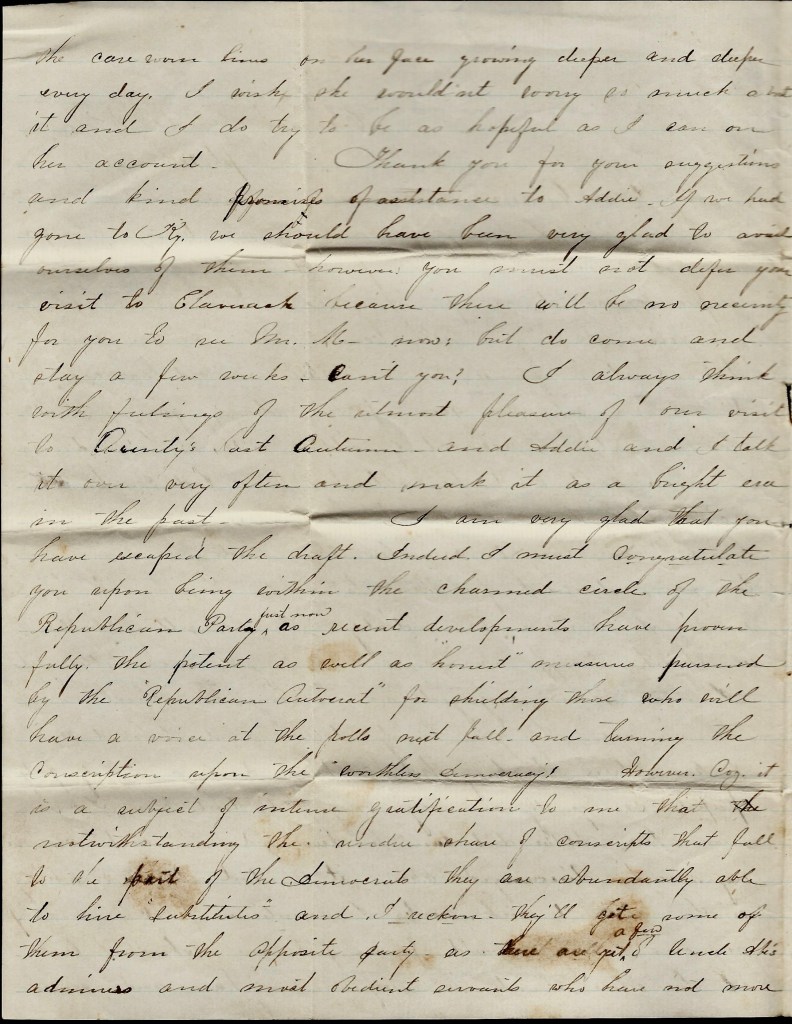
What a pleasure it is to read the words that spill from the glib tongue of an intelligent young woman. What follows is a letter composed in the midst of the American Civil War by 24 year-old Mary “Henrietta” Miller (1839-1912) of Claverack, Columbia county, New York, the daughter of William Albertson Miller (1813-1872) and Mary Hulst (1816-1883). Henrietta was an 1860 graduate of the Hudson Valley River School in Claverack (later renamed Claverack College).

Henrietta wrote the letter to her cousin, Peter Henry Hulst (1841-1926). Peter “spent his earlier years in Fishkill-on-the-Hudson and at Carthage Landing. He later moved to Jonesville in Saratoga county where he taught school and began the study of medicine (Homeopathy), graduating from the Albany Medical College in 1866. He then practiced medicine in Schuylerville for a short time, moving to Greenwich in 1869.” [Obituary, Glens Falls, The Post Star, 28 October 1926]

In her letter, Henrietta suggests that she and her younger sister Adriana (“Addie”) Miller (1846-1905) had intended to relocate to Kentucky to teach school but decided against it when Addie fell ill. She did eventually move to Kentucky where she met James Solomon Crumbaugh in Scott county and after their marriage in December 1866, they settled in Old Crossing, Kentucky, where James ran a mill and Henrietta taught European Literature. In 1900 they moved to Kaufman county, Texas with their two children.

Henrietta’s letter dares to express her thoughts on politics, a subject rarely broached by women except in private conversation in mid 19th Century. She observes the political nature and consequences of the Conscription Act of 1863 and refers to President Lincoln as the “Republican Autocrat”—a sentiment shared by a great many Americans, particularly New Yorkers.

Transcription
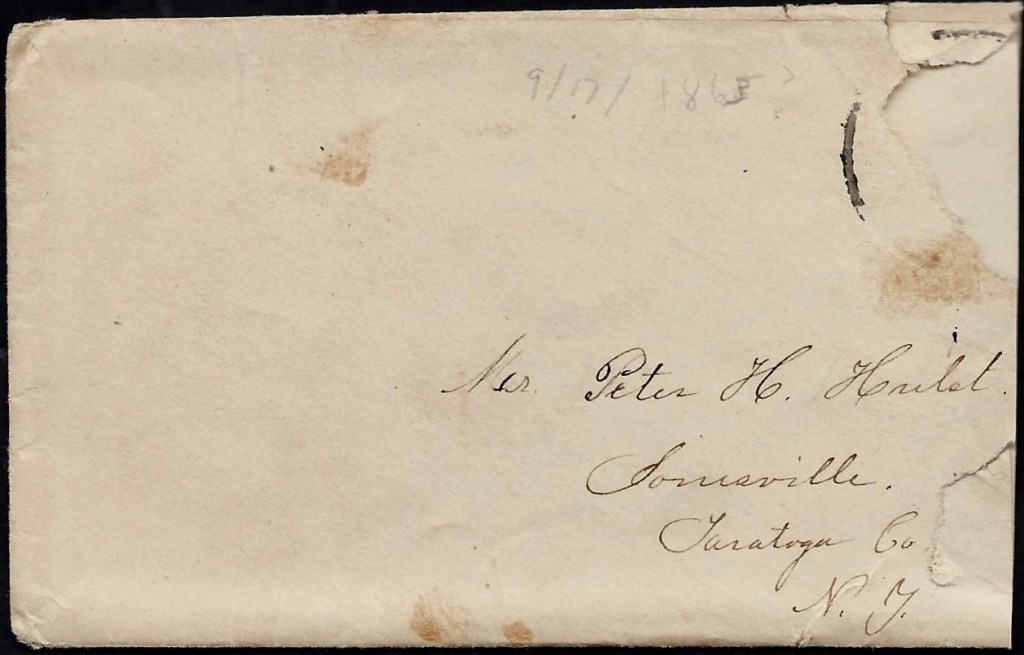
Addressed to Mr. Peter H. Hulet, Jonesville, Saratoga county, New York

Clarverack, Columbia county, New York
September 17th 1863

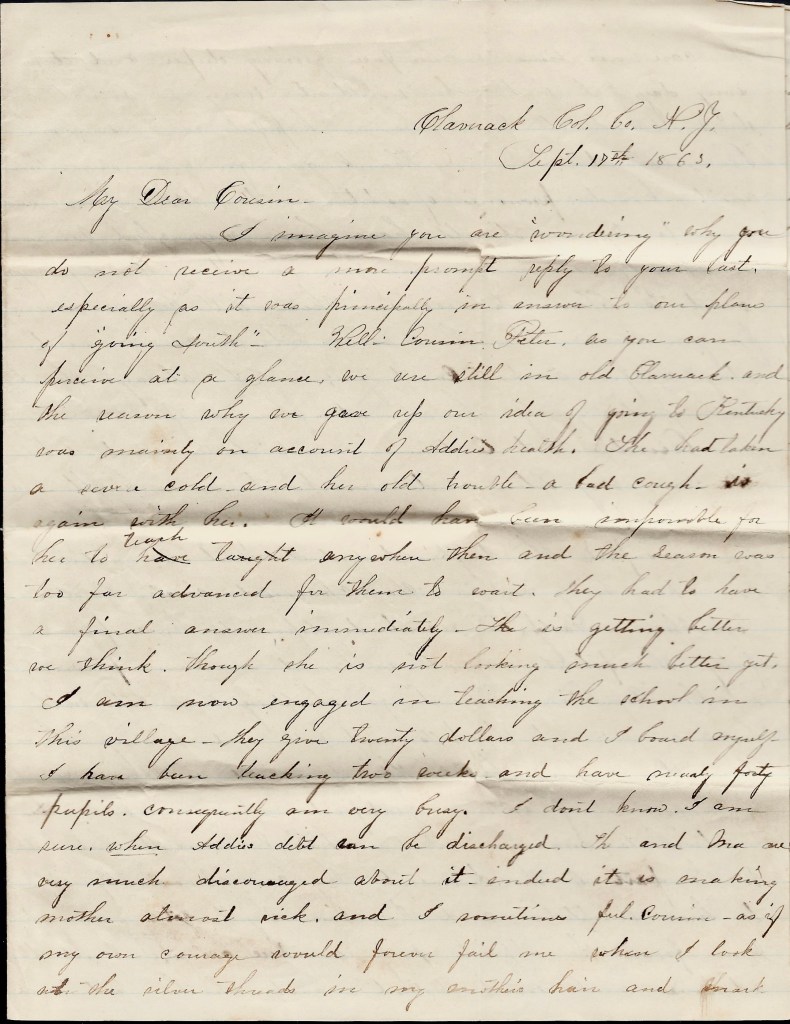
My dear cousin,

I imagine you are “wondering” why you do not receive a more prompt reply to your last—especially as it was principally in answer to our plan of “going South.” Well, Cousin Peter, as you can perceive at a glance, we are still in old Claverack and the reason why we gave up our idea of going to Kentucky was mainly on account of Addie’s health. She had taken a severe cold and her old trouble—a bad cough—is again with her. It would have been impossible for her to teach anywhere then and the season was too far advanced for them to wait. They had to have a final answer immediately. She is getting better we think though she is not looking much better yet.

I am now engaged in teaching the school in this village. They give twenty dollars and I board myself. I have been teaching two weeks and have nearly forty pupils; consequently am very busy. I don’t know, I am sure, when Addie’s debt can be discharged. She and Ma are very much discouraged about it. Indeed, it is making mother almost sick, and I sometimes feel, cousin, as if my own courage would forever fail me when I look at the silver threads in my mother’s hair and mark the careworn lines on her face growing deeper and deeper every day. I wish she wouldn’t worry so much about it and I do try to be as hopeful as I can on her account.

Thank you for your suggestions and kind promises of assistance to Addie. If we had gone to Kentucky, we should have been very glad to avail ourselves of them. However, you must not defer your visit to Claverack because there will be no necessity for you to see Mr. M[iller] now; but do come and stay a few weeks, can’t you? I always think with feelings of the utmost pleasure of our visit to Aunty’s last autumn and Addie and I talk it over very often and mark it as a bright era in the past.

I am very glad that you have escaped the draft. Indeed, I must congratulate you upon being within the charmed circle of the Republican Party just now as recent developments have proven fully, the potent as well as “honest” measures pursued by the “Republican Autocrat” for shielding those who will have a voice at the polls next fall and turning the conscription upon the worthless democracy. However, coz., it is a subject of intense gratification to me that notwithstanding the undue share of conscripts that fall to the part of the Democrats, they are abundantly able to hire “substitutes” and I reckon they’ll get some of them from the opposite party as there are yet a few of Uncle Abe’s admirers and most obedient servants who have not more of the “green” currency than they know what to do with. But perhaps you are like some of the gentlemen that I know; “you do not like to hear a lady talk politics.” If no, pardon me and I will change the subject. Nonetheless, “them’s my sentiments.”

Ma has been up to see Grandma this fall. Went a few weeks ago. She made a very short visit as she was expecting us to go to Kentucky. The weather here has been very warm and pleasant. Now it is cloudy and cold. I have to walk about a mile to my schoolroom and I should like it to be pleasant weather all the time if it could be so, but I anticipate many a cold, wet walk this winter. School has just opened at the Seminary and I dare say Mr. [Alonzo] Flack 1 has begin again upon his well beaten track of—I guess I won’t say it after all, for I could not say any good of him so it is better to leave the sentence unfinished.

I am glad your health is improved. Are you taking vocal or instrumental music, or both? Pa and Ella have the whooping cough. They have been very bad but seem to be getting over it now somewhat. Dear cousin, I must beg your kind indulgence for this disconnected and ill written missive. I am not very well nor very much in the mood for writing tonight so I will close. Please write me soon and accept the love & best wishes of your affectionate cousin, — Henrietta


1 Alonzo Flack was born in Argyle, New York on September 19, 1823. While attending Union College (1845-1849), Flack joined the Methodist Episcopal Church and received a license as a preacher. He subsequently studied theology at the Concord Biblical Institute in New Hampshire and was recrutied by Bishop Osman C. Baker in 1854 to serve as principal for a new school at Charlotte. In 1855, Flack became principal of the Claverack College and Hudson River Institute. He later assumed the presidency of Claverack College in 1869. Flack was noted for his deep belief in the reform movements of the period, including temperance reform, the enfranchisment of women and ecclesiastical reform. He was granted a Doctor in Philosophy degree by the University of the State of New York in 1875. Much esteemed by his students, Flack served for thirty years as a teacher and administrator at the school, until his death in 1885. He was succeeded by his son, Rev. Arthur H. Flack, who occupied the position until 1900. The College, located in Claverack, New York, offered academic and classical studies to ladies and gentlemen and was very highly regarded. Alumni included author Stephen Crane, feminist Margaret Sanger, and President Martin van Buren. [sources consulted: Minutes of the annual conferences of the Methodist Episcopal Church: Spring conferences of 1885. (p. 97)]

In 2011 I transcribed a letter by Alonzo Flack and posted it on Spared & Shared 1. See—1842: Alonzo Flack to Nathan Henry Bitely.
1845: Aaron Moore to Jeptha Norton

The following letter was written by Aaron J. Moore (1792-1862), a native of South Carolina and of partial Choctaw descent, who married Jane Tally (1796-1839) and relocated to Autauga county, Alabama by 1820, and then to Winston county, Mississippi, prior to the 1840 US Census. Known children by his first wife included: Aaron Tally Moore (1817-1860) who married a woman named Mary E. Burnside [?] the year before the date of this letter; Jeptha Norton Moore (1820-1886); Sarah Ann Moore (1821-1860) who married William J. Hickman (b. 1819) in February 1842; Martha Jane Moore (1834-1853); and Alexander Travis Moore (1836-1884). In the 1850 Slave Schedule, Aaron is recorded owning 11 slaves ranging in age from 2 to 45, mostly male.

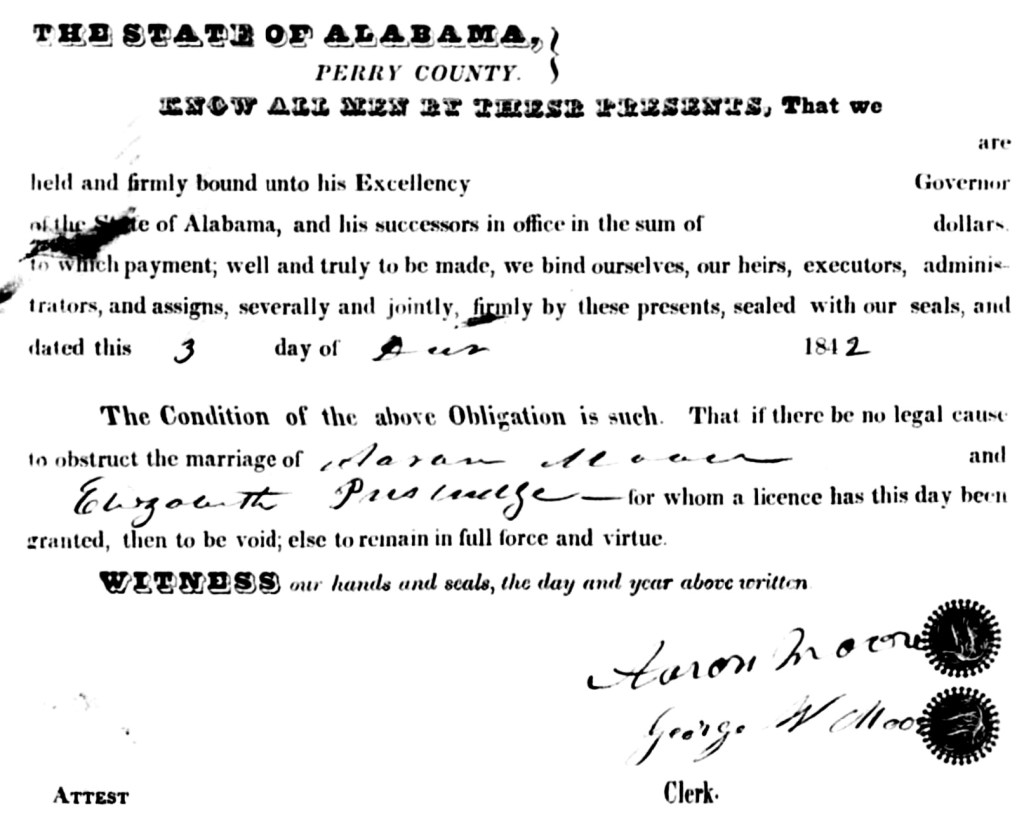
We learn from Aaron’s letter that he was remarried after the death of his first wife but that she had abandoned him and gone to Alabama—presumably her home, for we find that an Aaron Moore was married to Elizabeth Prestridge (1797-1874) on 3 December 1842 in Perry, Alabama. Elizabeth was the widow of Joseph W. Prestridge (1794-1836). Her maiden name was Bagley and they had married in 1812. Her youngest child with Joseph was George Harper Prestridge (1832-1863), a member of Co. A, 6th Arkansas (Confederate) Cavalry. It does not appear that Elizabeth ever remarried after leaving Aaron. She was enumerated in the household of her younger brother, a slaveholder named Berton Rucker Prestridge at Oakmulgee, Perry county, Alabama, in 1850. Today her remains lie buried under a smashed tombstone in Balch Cemetery, Alvarado, Texas.

Marriage Record in Perry County, Alabama, dated 3 December 1842.

Transcription

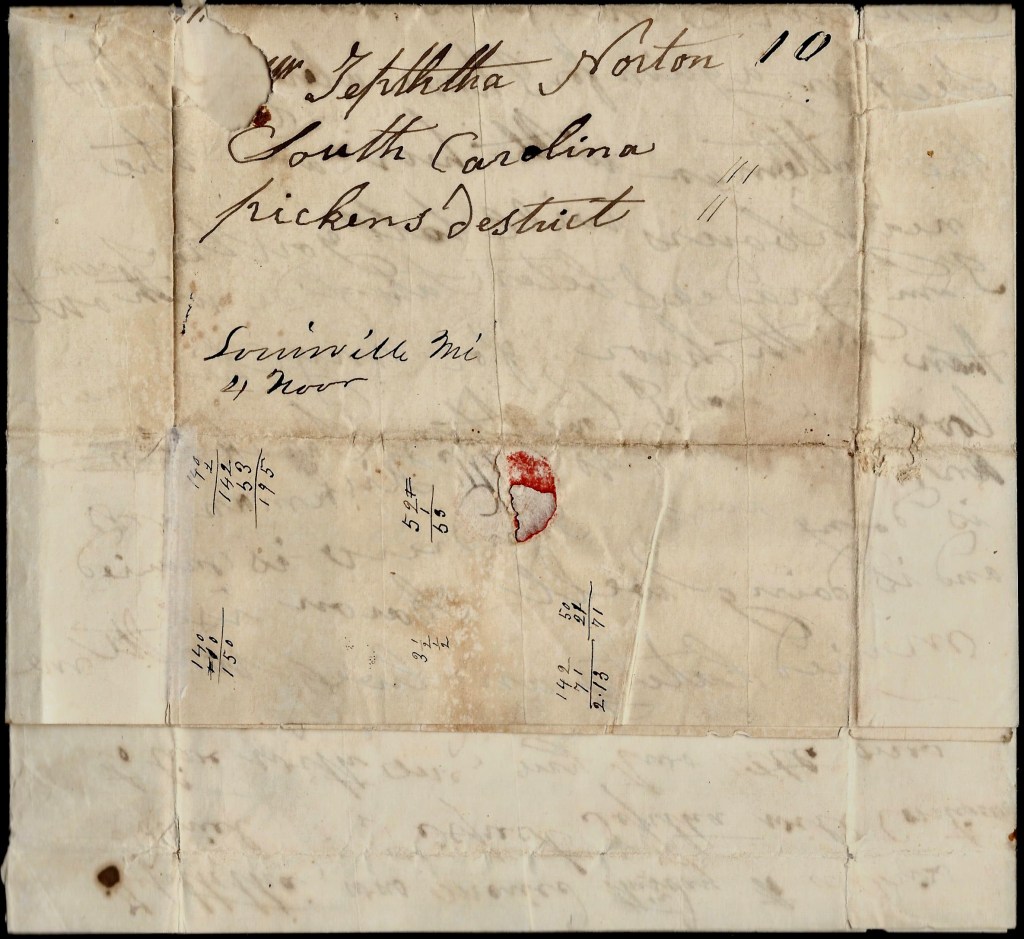
Stampless letter addressed to Jeptha Norton, South Carolina, Pickens District

[Louisville] Winston county, Mississippi
November 1, 1845

Dear Brother, Sister & Children,

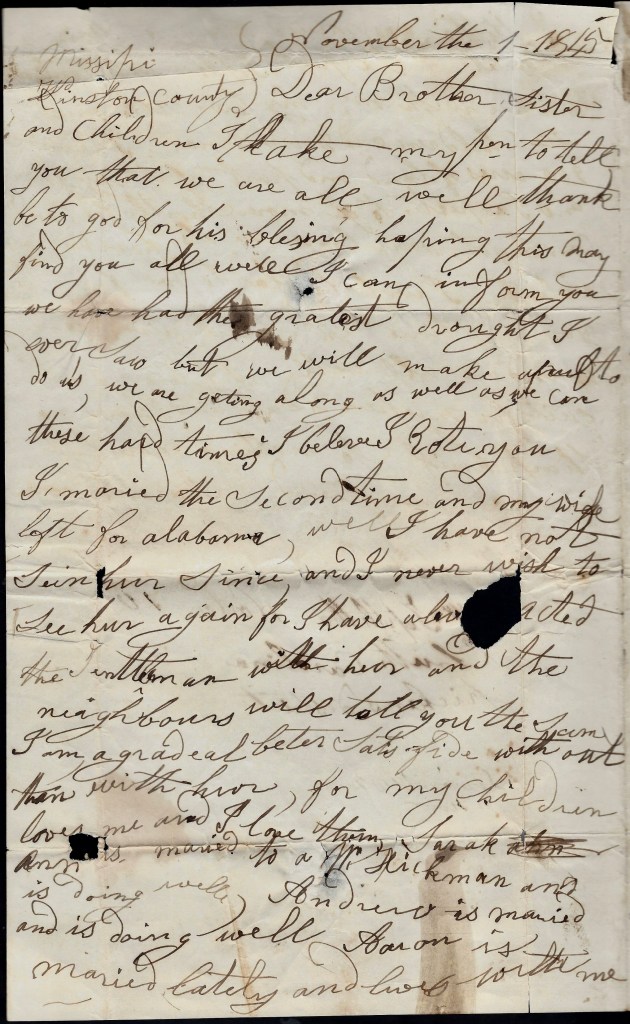
I take my pen to tell you that we are all well, thanks be to God for His blessing, hoping this may find you all well. I can inform you we have had the greatest drought I ever saw but we will make enough to do us. We are getting along as well as we can these hard times. I believe I wrote you I married the second time and my wife left for Alabama. Well I have not seen her since and I never wish to see her again for I have always acted the gentleman with her and the neighbors will tell you the same. I am a great deal better satisfied without than with her for my children loves me and I love them. Sarah Ann is married to a W. Hickman and is doing well. Andrew is married and is doing well. Aaron is married lately and lives with me.

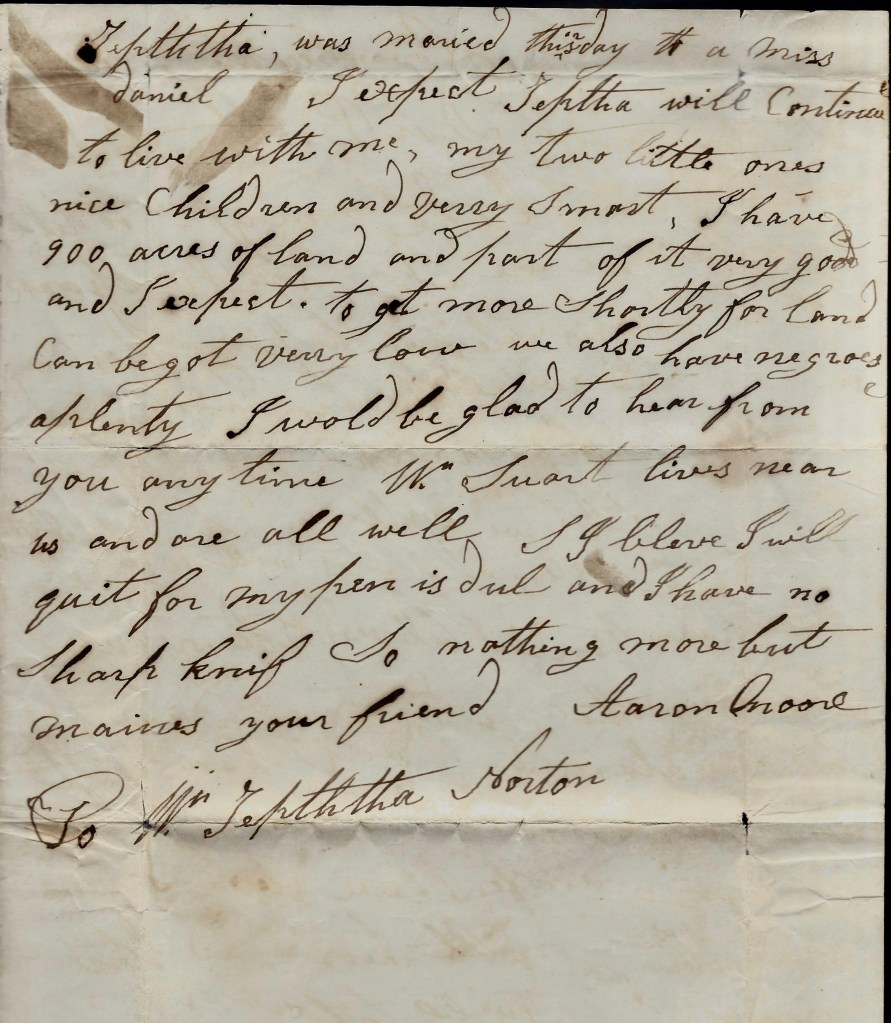
Jeptha was married Thursday to a Miss Daniel. I expect Jeptha will continue to live with me. My two little ones are nice children and very smart. I have 900 acres of land and part of it very good and I expect to get more shortly for land can be got very low. We also have negroes aplenty. I would be glad to hear from you anytime. W. Smart lives near us and are all well. I believe I will quit for my pen is dull and I have no sharp knife so nothing more but remain your friend, — Aaron Moore

To W. Jeptha Norton

1862: William Daniel Henry Covington to his Aunt & Uncle

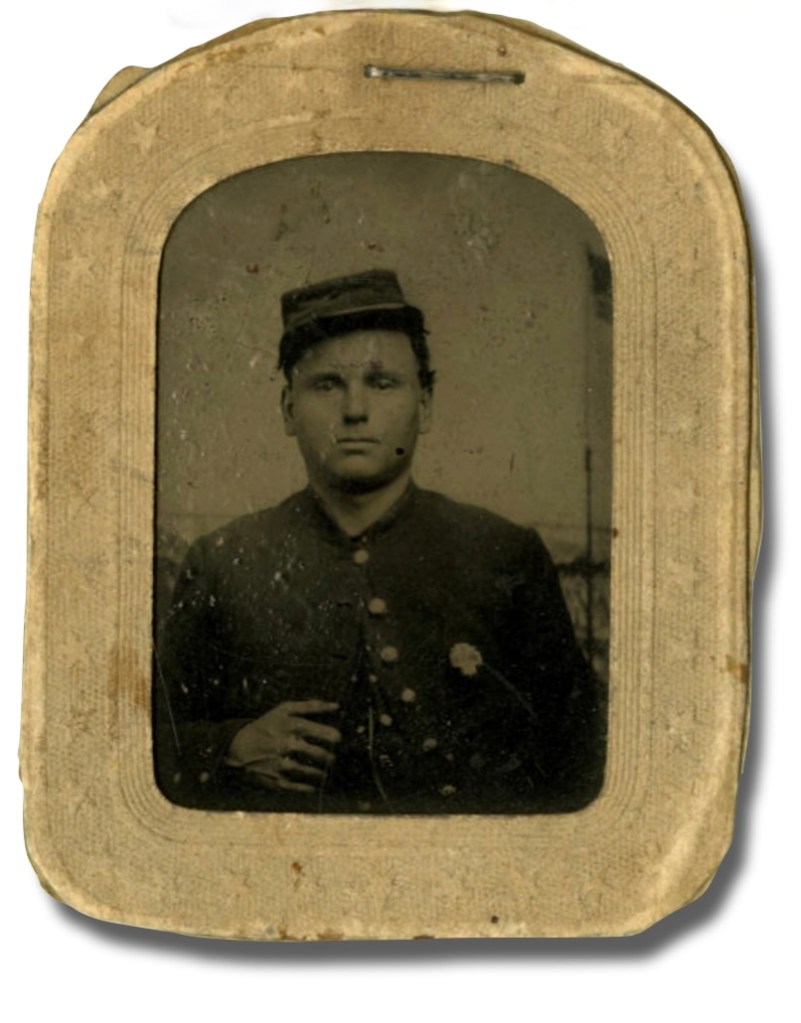
I could not find an image of William but here is one of Sgt. Samuel Hamrick of Co. I, 38th North Carolina.

The following letter was written by William Daniel Henry Covington (1842-1927), a farmer from Cleveland, Rutherford county, North Carolina, who enlisted in late December 1861 to serve in Co. I, 38th North Carolina Infantry. He and Jacob Childers of the same company (mentioned in the letter) were both admitted into Hospital No. 2 at Petersburg on 31 January 1862 suffering from illness. Though Jacob returned to his regiment before the end of March and was subsequently killed in action at the Battle of Ellison’s Mill (Mechanicsville) on 26 June 1862, William was sent home on furlough shortly after this letter (with proper authority). Muster rolls do not indicate when he returned to his company though he was certainly with them by January 1863. He was sent to a hospital again in June 1863 suffering from rheumatism and was absent without leave from 25 July 1863 to 25 October 1863 at which time he returned again to his regiment. Despite his spotty service record, he was promoted to corporal in 1864.

On 8 May 1864, when the 38th North Carolina was fighting in Scales’ Brigade in the Wilderness, he suffered a severe concussion and was admitted to Jackson Hospital in Richmond.

William was the son of William Horace Covington (1775-1861) and Mary Rincie Green (1811-1902).

Transcription

Petersburg, Virginia
March 29th 1862

Dear Uncle and Aunt,

It is with pleasure that I drop you a few lines to inform you that I am about well, hoping those lines may find you and family well. I am at Petersburg, Va., in the 2nd N. C. Hospital. There is only 12 of our company here and Jacob Childers just left. Uncle Howell is here. He is getting well. [Francis] Marion Hord is here. He has been very low but he is on the mend. I am going to the regiment in a few days if I don’t get no worse. I can’t get a drop of liquor here by no means at all. I have got use to doing without it and I don’t care now.

Tell Mother that I am about well. I am well treated here. I had rather stay here than anyplace I have been since I left home. I have no more news to write to you at this time. John Lattimore and Dick Wiggins is in the 1st North Carolina Hospital close to us. There is a Divins from the Burnt Chimney Company in the same hospital that I am in. He came here when Walker was at home.

You need not write to me until I get to the regiment for I expect to leave here in a few days. I will write you as soon as I get to the regiment. Then I will thankfully receive a letter from you at any time when you are disposed to send me one.

Your affectionate nephew, — W. D. H. Covington to his Uncle & Aunt.

Excuse this paper for it is cheap.

1863: Jesse W. Shaw to his Cousin

The following letters were written by Pvt. Jesse W. Shaw who enlisted when he was 20 years old in Co. F, 126th Ohio Volunteer Infantry (OVI) on 15 August 1862 for three years. He was discharged on 26 April 1865 for wounds received 11 months earlier in the Wilderness.

I could not find an image of Jesse but here is Joseph Whetstone of Co. A, 126th OVI (Ohio History Connection)

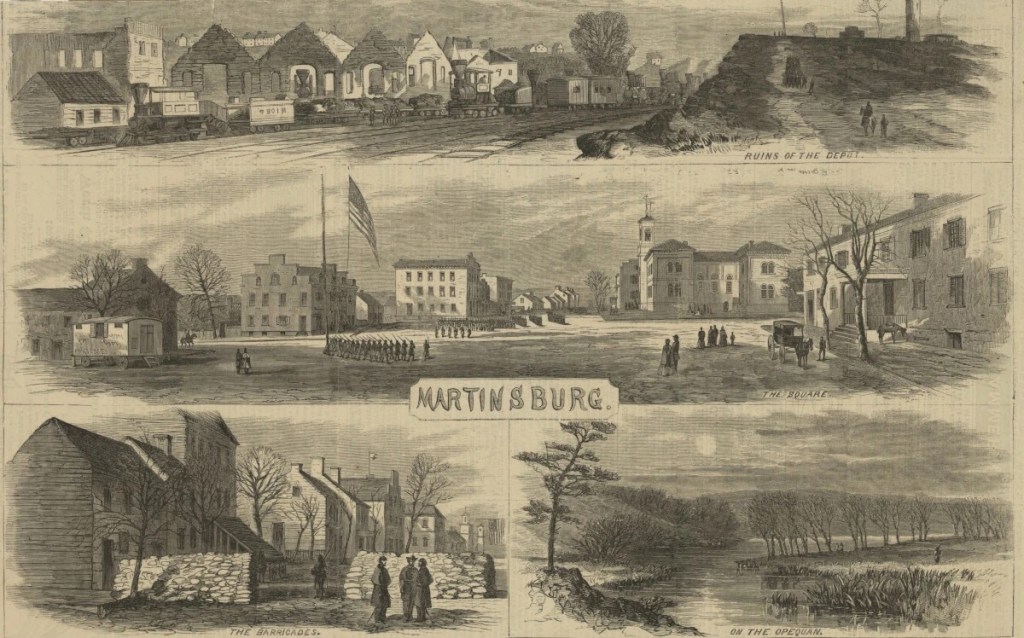
The 126th OVI was organized in September under Colonel Benjamin F. Smith and moved the same month to Parkersburg, West Virginia, and then to Cumberland, Md. It guarded the B&O Railroad during the winter, and in the spring of 1863 operated against guerrillas in West Virginia. In June the Regiment returned to the vicinity of Martinsburg and was severely pressed by the advance of Lee’s army, but escaped to Harper’s Ferry and afterwards moved to Washington City. It soon re-joined the Army of the Potomac and operated in Virginia under Grant. It took part in the battles of Snicker’s Gap, Opequan, Fisher’s Hill, the Wilderness and Petersburg, and joined the pursuit of Lee until the surrender. The Regiment was mustered out June 25, 1865, and lost during its term of service over 500 men in battle.

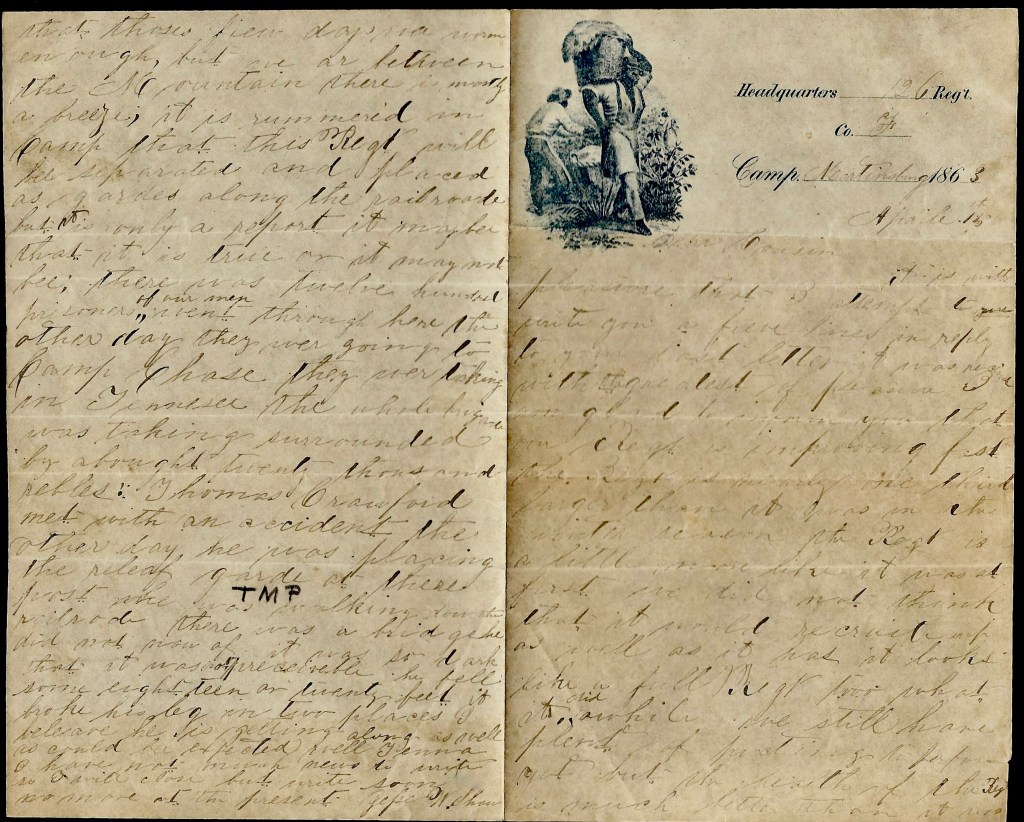
Letter 1

Headquarters 126th [Ohio] Regt., Co. F
Camp Martinsburg
April 15, 1863

Dear Cousin,

It is with pleasure that I attempt to write you a few lines in reply to your last letter. It was received with the greatest of pleasure. I am glad to inform you that our regiment is improving fast. The regiment is nearly one third larger than it was in the winter season. The regiment is a little more like it was at first. We did not think that it would recruit up as well as it has. It looks like a full regiment to what it did a while [ago]. We still have plenty of picketing to perform yet but the health of the regiment is much better than it was, so we have not quite so much guard [duty] to perform as we had some time past. But I must say that there is plenty of it yet. But there was a while that were on every other day. That, I think, is often enough. But the guard [duty] has been reduced a little. That is alright for there were more guards than there was any use of. There is too much duty at this place for one regiment to perform. There is no infantry troops here but the 126th. It is the only regiment that performs the duty.

We have begun to drill this spring so I suppose they will have us to drill this summer also but I think we will not keep it up quite so regular as we did the last summer. I suppose it will be kept up as long as we stay at this place.

The town ladies come to camp every nice evening to see us on dress parade. There is most sure to be some every evening of dress parade. The citizens want this regiment to stay here all summer. We have had several pretty nice days this spring but we have had a good little bit of rain this spring. This is a very wet day here and it appears as though it will remain ugly weather for a while but it is very changeable here. It is hard to tell one day what it will be like the next one. It being close to the mountains, is very changeable weather. There was one or two days that was very hot but the people say that it will get five times as hot after a while. If it does, it will be pretty warm weather for us soldiers for we thought that those few days was warm enough, but we are between the mountains [and] there is mostly a breeze.

It is rumored in camp that this regiment will be separated and placed as guards along the railroads but it is only a report. It may be that it is true or it may not be. There was twelve hundred prisoners of our men went through here the other day. They were going to Camp Chase. They were taken in Tennessee. The while brigade was taken—surrounded by about twenty thousand rebels. 1

Thomas Crawford met with an accident the other day [when] he was placing the relief guard at their post. He was walking down the railroad. There was a bridge he did not know of. It was so dark that it was imperceivable. He fell some eighteen or twenty feet. It broke his leg in two places. I believe he is getting along as well as could be expected.

Well, Tenna, I have not much news to write so I will close but write soon. No more at the present. — Jesse W. Shaw


1 These paroled Union soldiers being transported by traIn to Camp Chase to await exchange were surrendered to Brig. Gen. Nathan Bedford Forrest near Brentwood, Tennessee on 25 March 1863. The Union forces were commanded by Lt. Col. Edward Bloodgood who surrendered 800 men with very little resistance. Major General William S. Rosecrans was disgusted with the lack of fight and had Bloodgood court-martialed for cowardice. In a letter dated 9 April 1863 at Martinsburg, Lt. Rufus Ricksecker of the 126th OVI, wrote his folks that “Day before yesterday there was a long train went by of ‘Paroled Prisoners’ passed here; they stopped about half an hour; after the train had left I understood some of the 51st Ohio were along, I did not get to see any of them. This evening another one passed coming the other way with Rebels. I suppose they are going to be exchanged, they did not appear to like the idea very much, as they said they were so much better fed in the North.” [Source: The 126th Ohio Volunteer Infantry]


Letter 2

New Creek, Virginia
May 17, 1863

Miss Tenna Caskey

Well Tenna, I thought that I would answer your letter which I received some time ago. We left Martinsburg April 26th. We took the train and rode to New Creek. There we stayed until morning and then was ordered to march to Greenland Gap. We went within 7 miles from the Gap the first day. We were all pretty well tired out [after] the first day’s march. There was 50 or more fell back and come up on the wagon train. We had the creek to cross about 30 times. It kept us wet all the time but we at last stopped for the night. We then got our supper and laid down to sleep. But we did not sleep very much for we were all wet.

We were ordered to march at four o’clock. We then proceeded for the Gap. We arrived at the Gap about 5 o’clock but found no rebels there. They had left but they had a pretty smart fight with 80 of [James Adelbert] Mulligan’s men. They fought 21 hundred of the rebels for five hours. The rebels charged on them three times but were repulsed every time. The 80 men were in a little fort. The rebs dismounted and went around the mountain and come down on them from the top and run them out but they were too spunky to give up so they run to an old Meeting House that stood close by. The rebs set the house on fire but they kept them away as long as they had plenty of ammunition but they run out. The last load they shot was their ramrods. Then threw their guns in the fire and surrendered. 1

The dead was all buried when we got there. The dead horses was lying around plenty. I saw the graves of part of the dead. There was two houses that stood close by that had 25 wounded and killed. They [the rebels] lost 80 killed and wounded. Only one of Mulligan’s men was killed at the time but there was two or three wounded and one died since. There was guns lying around on the ground but I did not pick any of them up. I thought that I had enough to carry for fifty cents per day.

Then we were ordered to follow them. We then proceeded 8 miles farther up the Alleghany Mountains. We arrived at a place by the name of Mt. Storm. There we lay two days. We had not been there long before we heard that the rebs was marching that way. Then the next thing was to prepare for them. We fortified with logs and stone the best we could and waited awhile for them but they did not come. We were then ordered back to New Creek. We had not got quite there until we received the dispatches that the rebs was going through the Gap. Then come the hard times. It was a pretty hard march in the forenoon but it was a harder one in the afternoon. We then started back to the Gap. We were as tired a lot of boys as ever I saw but we arrived there about sundown. We then formed our regiment in as good a position as we could which did not take no little time for they were pretty well scattered along the ways. We then built some fires and got our suppers.

Then come the time for picket to go out and we had already marched 30 miles. I for one had to go on picket. So had John. We were on the same post. I presume if the rebels had come we would not have run very much for we were too tired but we were not disturbed. We were there three or four days and then were ordered back to New Creek. But we had another hard march to perform. We marched 16 miles in the afternoon. We camped for the night 7 miles from New Creek Station. It was then raining. I used to think it was pretty hard for the soldiers to pay out after night in snow or rain but I have experienced right smart of it myself the last month. We are now at New Creek.

Well, I will have to close for this time. Write soon. Direct to New Creek Station, Va., Co. F, 126th Regt. O. V. I., in care of corporal Walton.

— Jesse W. Shaw


1 On April 25, 1863, about 1,500 Confederate soldiers under General William “Grumble” Jones advanced through Greenland Gap, a scenic 820-foot-deep pass in New Creek Mountain in Grant County. Jones’s Confederates clashed with 87 Union soldiers, who’d taken positions in a local church and cabins. The Northern troops held off several assaults over four hours of fighting. After the church was set on fire, the Union forces finally surrendered. The Union side lost two killed and six wounded, while the Confederates lost seven killed and 35 wounded. It was the beginning of what would become known as the Jones-Imboden Raid, an ambitious but ultimately unsuccessful bid by Confederates to disrupt the Baltimore and Ohio Railroad and weaken Union control in what would soon become the new state of West Virginia. For a good summary of this engagement at Greenland Gap, readers are referred to an article by George Skotch (2018) entitled, “To the Last Crust and Cartridge.”

1864: William Bredow to a Friend

The following brief letter was written by 35 year-old 1st Sergeant William Bredow of Waterville, Oneida county, New York, who enlisted in Co. E, 81st New York Infantry to serve three years. He was promoted from private to corporal in February 1862, to sergeant in July 1862, and to 1st Sergeant in January 1864 when he re-enlisted as a veteran. In February 1865 he was commissioned a 1st Lieutenant and he mustered out as the Captain of Co. H in August 1865.

I believe that William Bredow was born in Germany in 1836 and came to the United States in 1843 when he was seven years old.

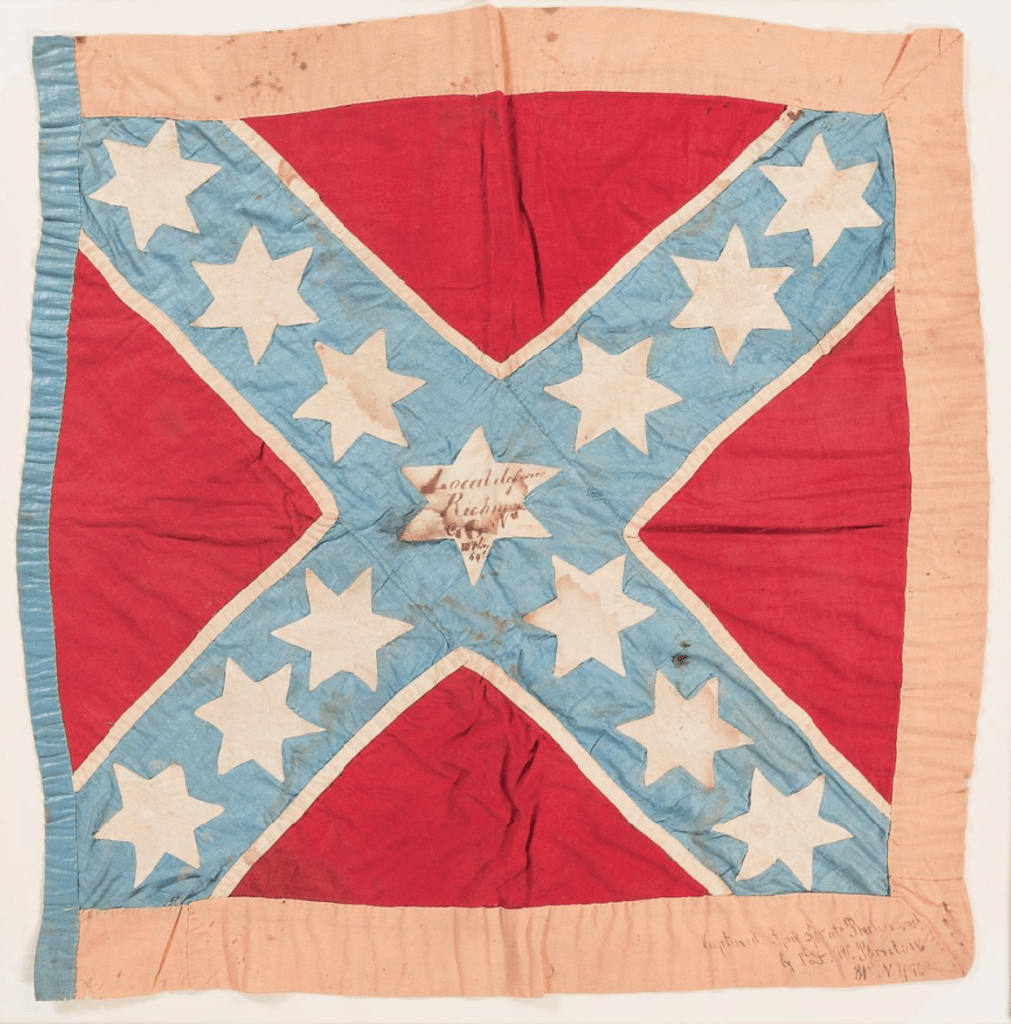
A small Confederate battle flag (24 inches by 25 inches) marked “Local defence/Richmond/Co. G/10th Va/10th May 1864″ and marked, Captured April 3rd 65 at Richmond by 1st Lt. W. Bredow, 81st NY Vols.” sold at auction recently for $55,000.

Note: This letter is from the personal collection of Greg Herr and was made available for transcription and publication on Spared & Shared by express consent.

Transcription

In front of Petersburg, Virginia
near Bermuda Hundred
September 16th 1864

Friend Tailiur!

I received your letter dated the 14th this month and am very much surprised to learn that you got no letter from me. I wrote one the next day as your brother-in-law Mr. Day in Hampton. The other I wrote the 11th this month. In the latter I answered you all the questions about payroll and so on and told you the news about our regiment. I hope you got both letters by this time. Your trunk is left by Captain [Lewis B.] Porter 1 in the storehouse in Norfolk.

I hope your leg will get well pretty soon and will not trouble you much. Everything is quiet here since you left. No excitement at all except this morning a couple boys were shot on picket by fooling with their guns. [John] Daily 2 out of Company B was brought in this morning about 5 o’clock shot through his buttocks, and now about half hour ago, [Francis P.] Graves 3 of Company I shot by Thomas McDonald 4 through the bowels.

Lieutenant [Maurice P.] Tidd joined the regiment yesterday. The boys sent their love to you. Hoping you got my letter by this time. I remain your friend, — W. Bredow


1 Lewis B. Porter was 30 years old when he enlisted on 5 September 1861 at Oswego to serve three years in Co. D, 81st New York Infantry. He was promoted to 1st Sergeant in August 1862, commissioned a 2nd Lt. in November 1862, and made Captain of Co. K in June 1864. He was wounded in action at Chaffin’s Farm, Va. two weeks after this letter was written and died of his wounds on 15 November 1864 at Fort Monroe, Va.

2 John Daly [or Dailey] was 36 years old when he enlisted at Oswego as a private in Co. B. in the fall of 1861. He was wounded “while on picket near Bermuda Hundred” and mustered out on 25 May 1865.

3 Francis (“Frank”) P. Graves of Rome, New York, was 19 when he enlisted in August 1862 to serve in Co. I with his brothers. He was wounded in action on 23 June 1864 at Cold Harbor but was standing duty on picket at Bermuda Hundred when he was “accidentally killed.”

4 Thomas McDonald was 18 when he enlisted on 14 December 1861 at Rome, New York to serve in Co. I. He was wounded in action at Cold Harbor on 3 June 1864 but survived the war.

1862: William J. Clark to his Cousin Tom

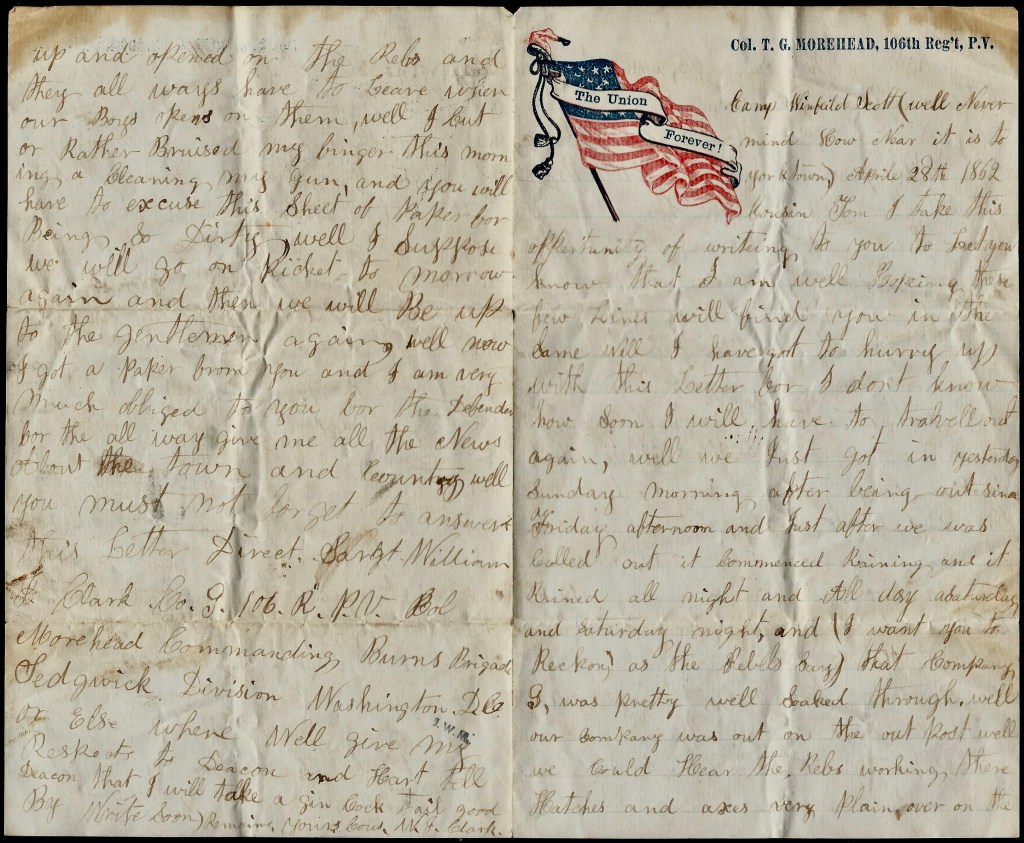
The following letter was written by 1st Sgt. William J. Clark (1839-1870) who mustered into Co. G, 106th Pennsylvania Volunteers on 27 August 1861 and was discharged for disability on 25 July 1862. After he was discharged from the service, William returned to Norristown where he became a railroad worker. He died of dropsy in 1870.

William was probably the son of David H. Clark and his wife Letitia, emigrants from Ireland who resided in Norristown, Pennsylvania. David was a weaver by trade.

Transcription

Addressed to Mr. Thomas C. S____, No. 160 Main Street, Norristown, Montgomery county, Pennsylvania

Camp Winfield Scott (well never mind how near it is to Yorktown)
April 28th 1862

Cousin Tom,

I take this opportunity of writing to you to let you know that I am well, hoping these few lines will find you in the same. Well, I have got to hurry up with this letter for I don’t know how soon I will have to travel out again.

Well, we just got in yesterday, Sunday morning, after being out since Friday afternoon and just after we was called out it commenced raining and it rained all night and all day a Saturday and Saturday night and (I want you to reckon, as the Rebels say) that Company G was pretty well soaked through. Well our company was out on the outpost. Well we could hear the rebs working their hatchets and axes very plain over on the other side of the swamp.

Well they have batteries all along but our boys keep them very busy minding themselves and jumping and dodging our shell and bullets. Well Saturday night was the longest night I ever saw or ever put in I will tell you for our regiment was called out on last Friday afternoon and we was out all night Friday night and all day Saturday and then our company was put on the outpost at night. Well, that is nothing for we have just the little bit the best-looking company that I see about in this part of the country. Well we could hear the Rebels a working all night and then every one of their pickets carries a dark lantern and they tried their best to throw the light into the face of two of my men that I had on post for I had two posts with 12 men and a corporal for them both. But the secesh could not make anything out of the Blazers, as our boys call themselves.

Well, Tom, there is nothing but a continual roar of musketry and artillery a going on all the time. But we have got so used to it that we don’t mind it any more. Only once the week before last when our company and company D & F & K—four companies—got saluted by four shells from the Rebel’s batteries. Well, I will tell you how that happened. We were all out working at a fort all night and in the morning after we had finished the fort, we was a going back through the woods to our camp and we got out on a road that was clear and right on our right was a big open field with a Rebel battery. Well they opened on us of course. But they are very bad gunners for their shells all went over our heads. But we had to get out of the road as quick as we could for our artillery come up and opened on the Rebs and they always have to leave when our boys open on them,

Well, I cut or rather bruised my finger this morning a cleaning my gun and you will have to excuse this sheet of paper for being so dirty, Well, I suppose we will go on picket tomorrow again and then we will be up to the gentlemen again. Well, now I got a paper from you and I am very much obliged to you for The Defender for they always give me all the news about the town and country.

Well, you must not forget to answer this letter. Direct to Sergeant William J. Clark, Co. G, 106th Regiment P. V., Col. Morehead Commanding, Burns Brigade, Sedgwick’s Division, Washington D. C. or elsewhere.

Well, give my respects to Deacon and Hart. Tell Deacon that I will take a gin cocktail. Goodbye. Write son. I remain yours, Cousin W. J. Clark

1862: George Richmond to Sibble (Gillett) Richmond

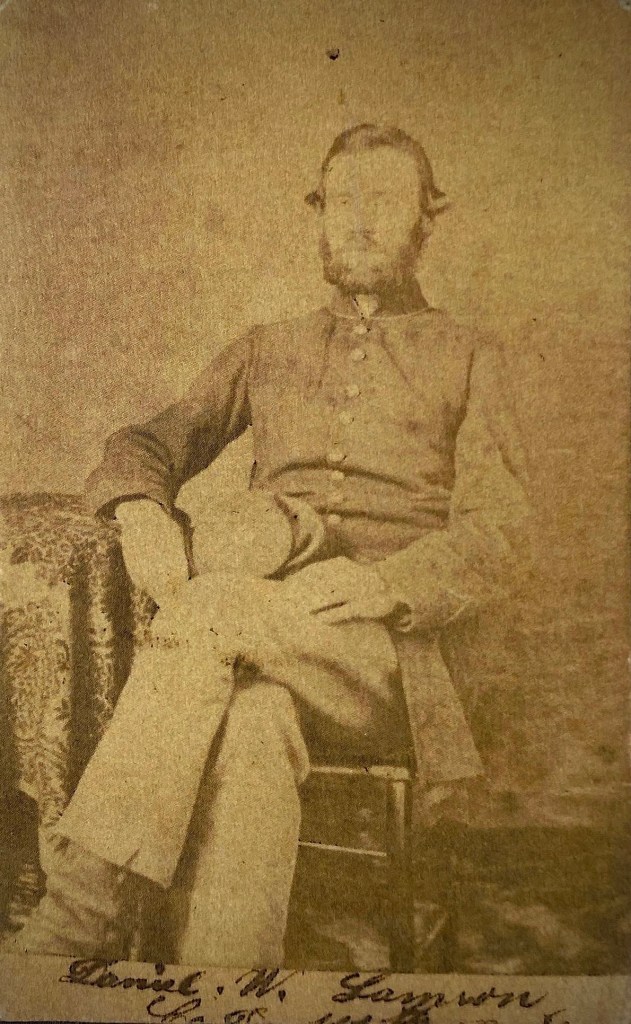
I could not find an image of George but here is Daniel W. Lamson who also served in Co. D, 111th New York. He was wounded by a shell at Gettysburg and taken captive at Cold Harbor where he would die a POW. (Cole Rutkowski Collection)

The following letter was written by 36 year-old George Richmond (1827-1863) of Sodus, New York, who enlisted on 28 July 1862 to serve three years as a private in Co. D, 111th New York Infantry. George wrote the letter to his wife from Camp Douglas near Chicago, Illinois, where he was a paroled prisoner of war awaiting exchange. He and most of his regiment had been taken prisoner at Harper’s Ferry when that government stronghold was surrendered to Stonewall Jackson’s men during the Maryland Campaign in September 1862. George would later be exchanged, survive two days of fighting at Gettysburg, but be wounded in action on 14 October 1863 at Bristoe Station, Virginia. According to Lieutenant Augustus Green, who was in command of Co. D at the time, George “was wounded through the calf of the left leg.” Taken from the field when the regiment retreated closer to Washington, DC, George was admitted to the Grosvenor Branch Hospital (Lee-Fendall House) in Alexandria. It was there that he died of traumatic gangrene on October 21st.

George’s wife was Sibble Gillett (1818-1883). When he left to join the 111th, George and Sibble had two living children—Samuel S. Richmond (1854-1926) and Harry O. Richmond (1857-1903). Two other children died young.

Transcription

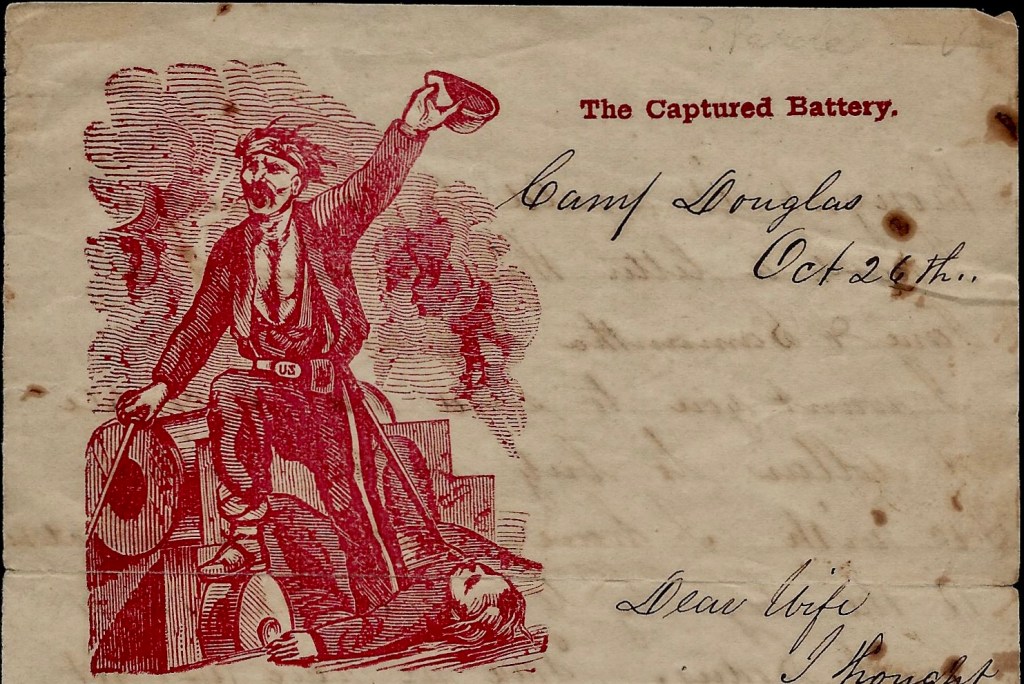
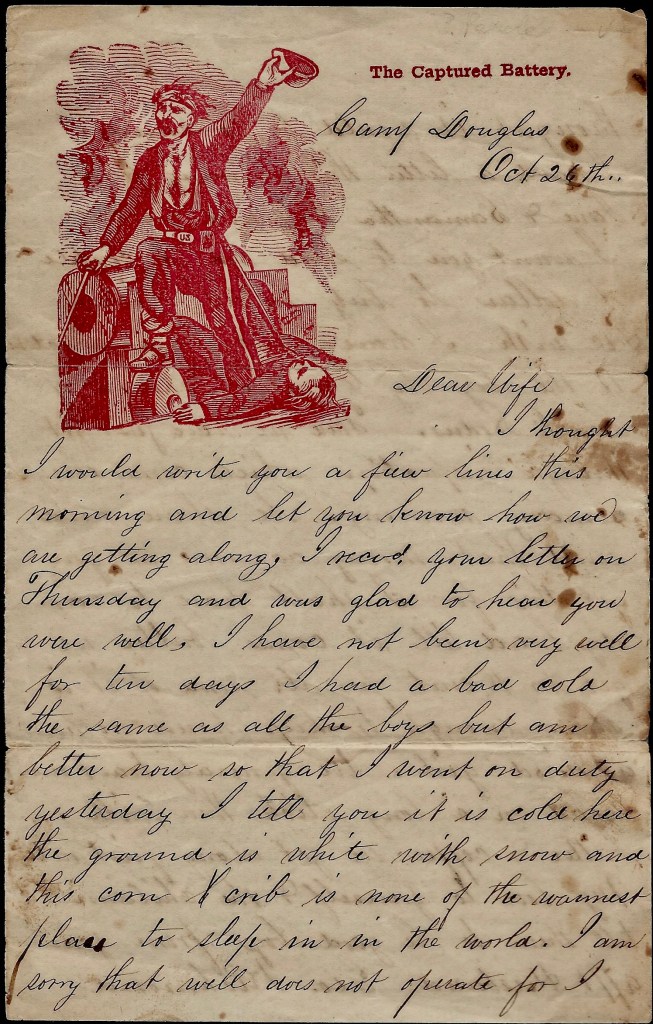
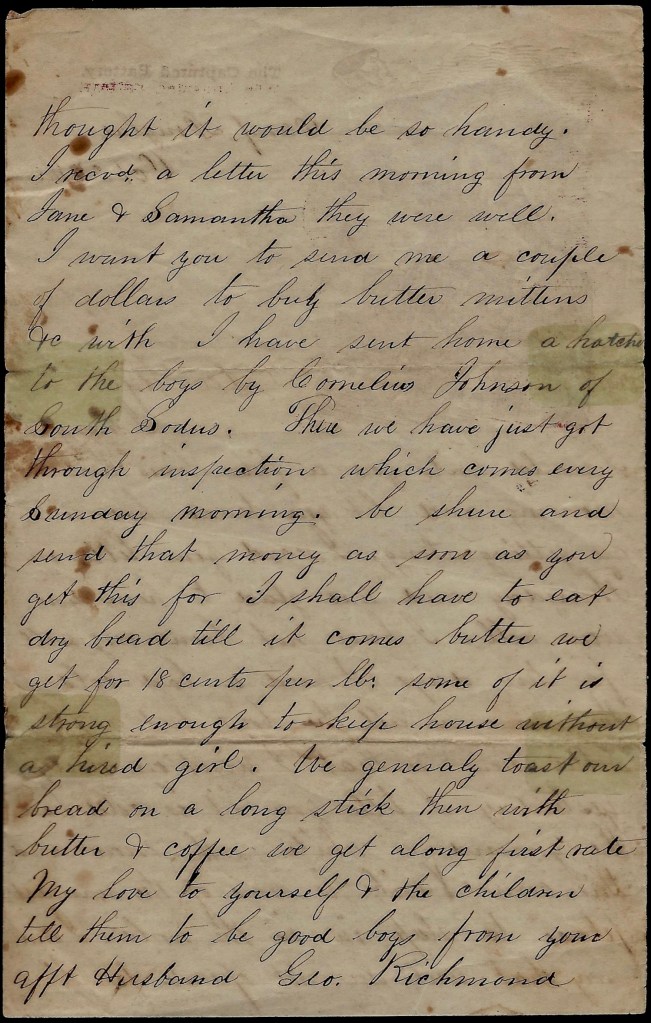
Patriotic Stationery “The Captured Battery”

Camp Douglas [near Chicago, Illinois]
Oct 26th [1862]

Dear Wife,

I thought I would write you a few lines this morning and let you know how we are getting along. I received your letter on Thursday and was glad to hear you were well. I have not been very well for ten days. I had a bad cold the same as all the boys but am better now so that I went on duty yesterday. I tell you, it is cold here. The ground is white with snow and this corn crib is none of the warmest place to sleep in the world. I am sorry that well does not operate for I thought it would be so handy.

I received a letter this morning from Jane & Samantha. They were well.

I want you to send me a couple of dollars to buy butter, mittens, &c. with. I have sent home a hatchet to the boys by Cornelius Johnson of South Sodus.

There, we have just got through inspection which comes every Sunday morning. Be sure and send that money as soon as you get this for I shall have to eat dry bread till it comes. Butter we get for 18 cents per lb. Some of it is strong enough to keep house without a hired girl. We generally toast our bread on a long stick, then with butter & coffee, we get along first rate.

My love to yourself & the children. Tell them to be good boys. From your affectionate husband, — George Richmond