Tag Archives: war

1862: Ferdinand Fitch Fobes to Catherine (Fitch) Fobes

The following letter was written by Pvt. Ferdinand Fitch Fobes (1842-1863) of Co. I, 105th Ohio Volunteer Infantry (OVI). Ferdinand was the son of Simon Perkins Fobes (1815-1891) and Catherine A. Fitch (1815-1901) of Wayne, Ashtabula county, Ohio. He died of disease while in the service on 4 September 1863 at Murfreesboro, Tennessee. He is buried in the Stones River National Cemetery.

Ferdinand wrote his letter in late November 1862, several weeks after the Battle of Perryville where they had their baptism of fire. Of the men from the regiment who were engaged in the battle, one-third were killed or wounded. Following the battle, the regiment moved to Danville and then to Munfordville where they garrisoned the town and guarded the bridges.

Transcription

Camp near Munfordville, Kentucky
November 29th 1862

Mother Fobes,

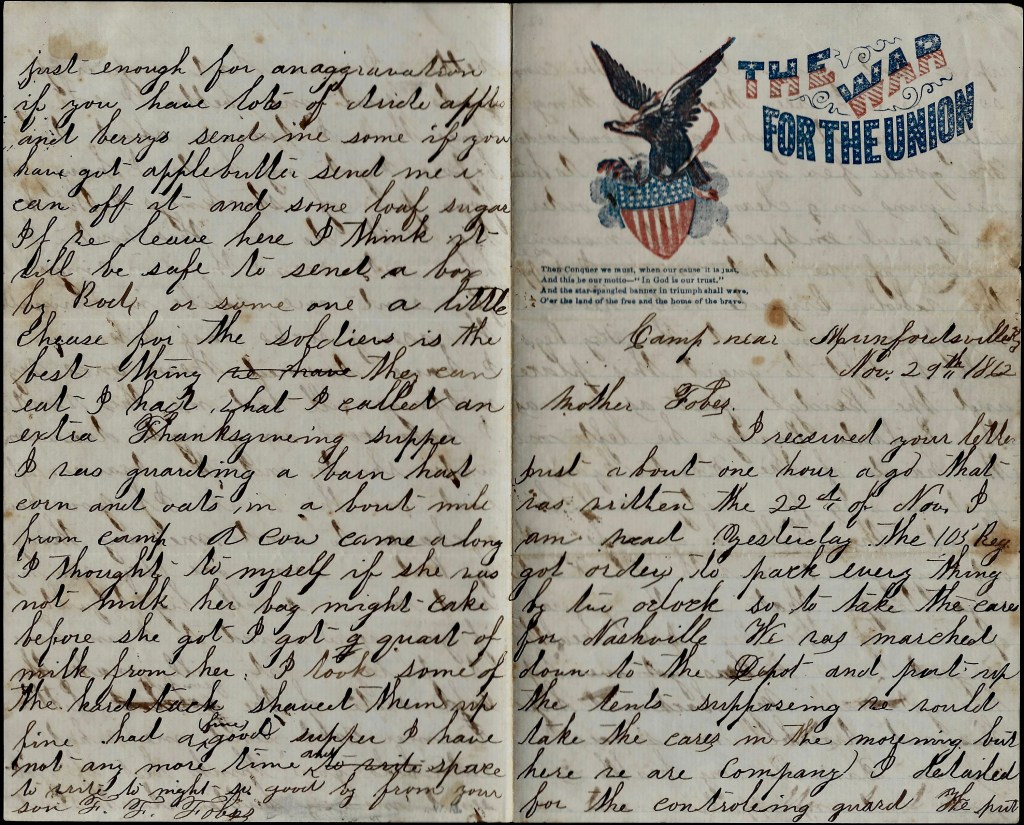
I received your letter just about one hour ago that was written the 22nd of November. I am well.

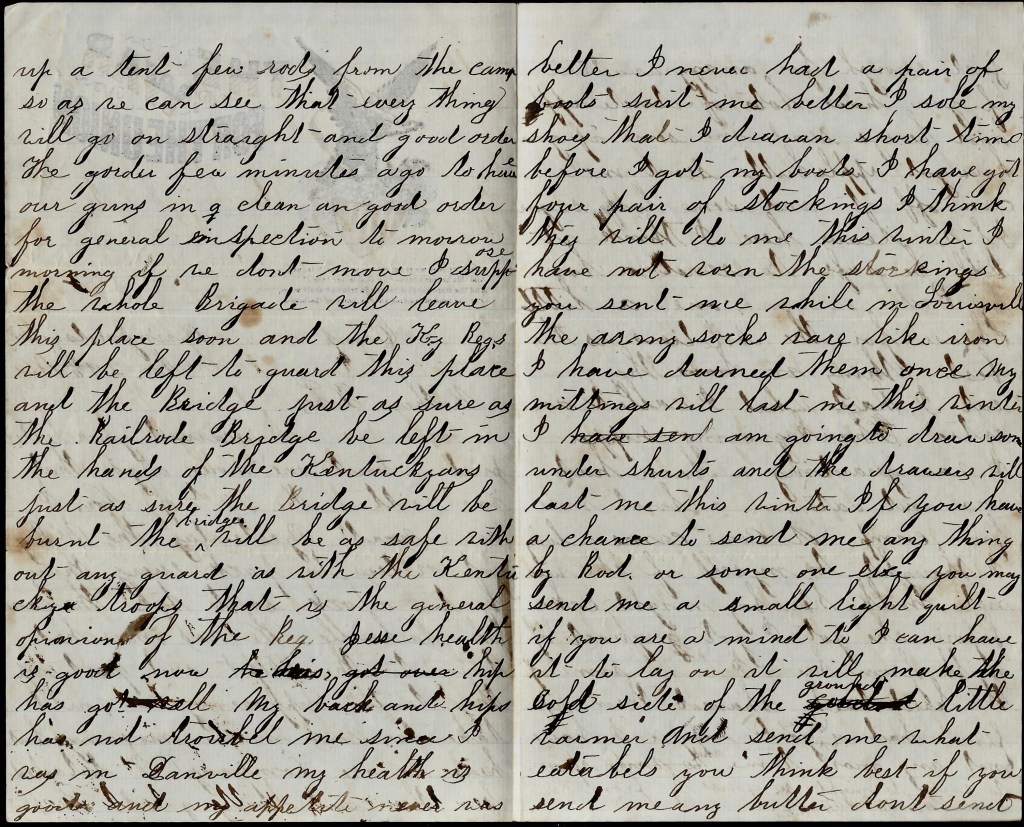
Yesterday the 105th Regiment got orders to pack everything by two o’clock so to take the cars for Nashville. We was marched down to the depot and put up the tents supposing we would take the cars in the morning but here we are. Company I [was] detailed for the controlling guard. We put up a tent a few rods from the camp so as we can see that everything will go on straight and good order. The order [came] a few minutes ago to have our guns in a clean and good order for general inspection tomorrow morning if we don’t move. I suppose the whole Brigade will leave this place soon and the Kentucky regiments will be left to guard this place and the bridge just as sure as the railroad bridge be left in the hands of the Kentuckians just as sure the bridge will be burnt. The bridges will be as safe without any guard as with the Kentucky troops. That is the general opinion of the regiment.

Jesse’s health is good now. Hip has got well. My back and hips has not troubled me since i was in Danville. My health is good and my appetite never was better. I never had a pair of boots suit me better. I sold my shoes that I [had] drawn a short time before I got my bboots. I have got four pair of stockings. I think they will do me this winter. I have not worn the stockings you sent me while in Louisville. The army socks wear like iron. I have darned them once. My mittens will last me this winter. I am going to draw some undershirts and the drawers will last me this winter. If you have a chance to send me anything by Rod or someone else, you may send me a small light quilt if you are a mind to. I can have it to lay on. It will make the cold side of the ground a little warmer. And send me what eatables you think best. If you send me any butter, don’t send just enough for an aggravation. If you have lots of dried apples and berries, send me some. If you have got apple butter, send me. I can off it and some loaf sugar.

If we leave here, I think it will be safe to send a box by Rod, or someone. A little cheese for the soldiers is the best thing they can eat. I had what I called an extra Thanksgiving supper. I was guarding a barn [that] had corn and oats in about a mile from camp. A cow came along [and] I thought to myself, if she was not milk[ed], her bag might cake before she got. I got a quart of milk from her. I took some of the hard tack, shaved them up fine, had a fine, good supper. I have not any more time and space to write tonight so goodbye from your son, — F. F. Fobes
1861: James F. Salley to Mary F. Salley

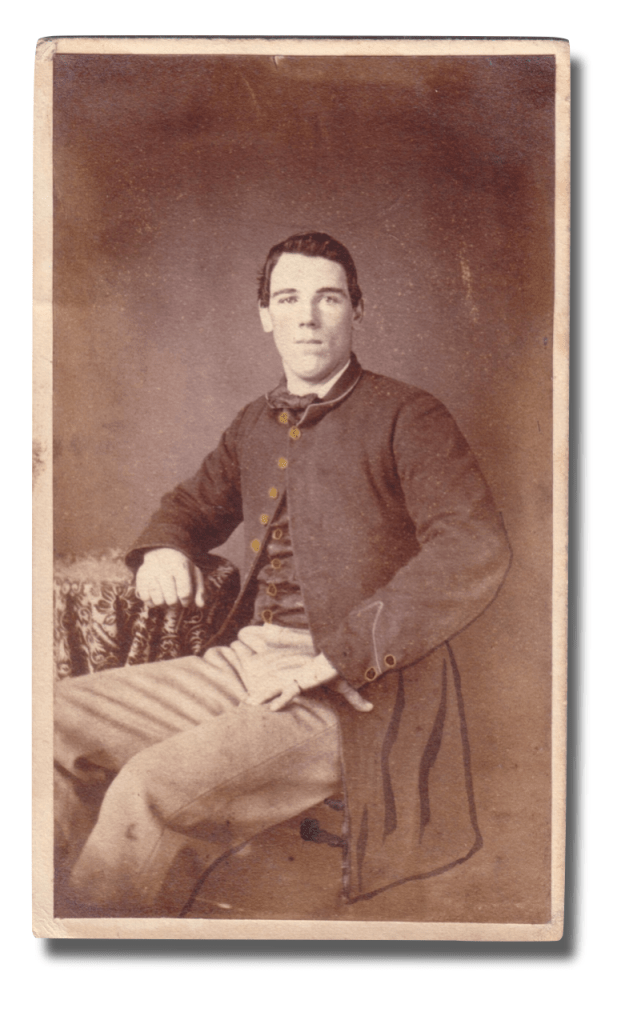
James F. Salley, 2nd US Sharpshooters, Co. D, Maine. (Brian White Collection)

This letter was written by James F. Salley (1843-1864), the son of Ephraim Salley and Mary F. [Liniston] of Madison, Somerset county, Maine. James enlisted on 2 November 1861 when he was 19 years old in the 2nd United States Sharpshooters, Co. D (Maine). This regiment was placed in the defenses of Washington D. C. until April 1862 and were part of the “First Iron Brigade.” The regiment was broken up on February 20, 1865, and Company “D” transferred to the 17th Maine Volunteer Infantry Regiment. The regiment suffered loss of 8 officers and 117 enlisted men who were killed in action or mortally wounded and 2 officers and 123 enlisted men who died of disease, for a total of 250 fatalities.

James was one of those who did not return home. He was killed in action on 9 June 1864 in the multi-day Battle of Cold Harbor. He was initially buried on McGhee’s Farm (at the intersection of Gaines’ Mill and Cold Harbor) but later moved to the Cold Harbor National Cemetery.

Note: This letter is from the personal collection of Greg Herr and was made available for transcription and publication on Spared & Shared by express consent.

Transcription

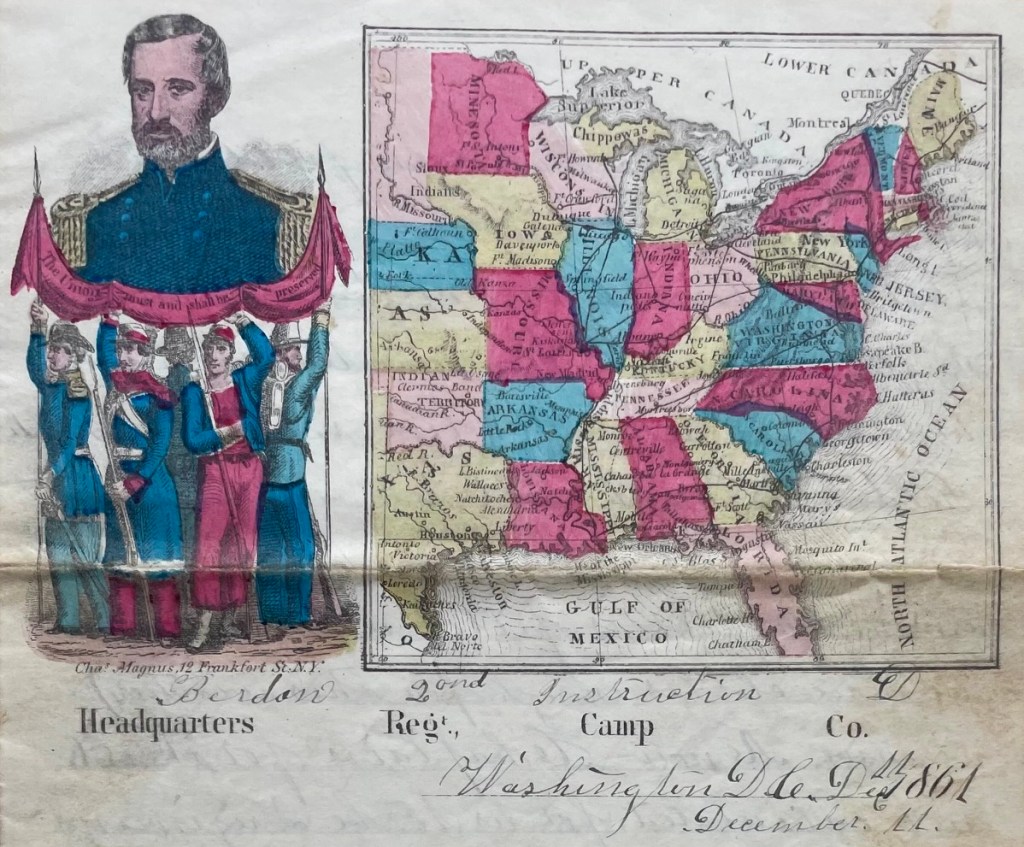
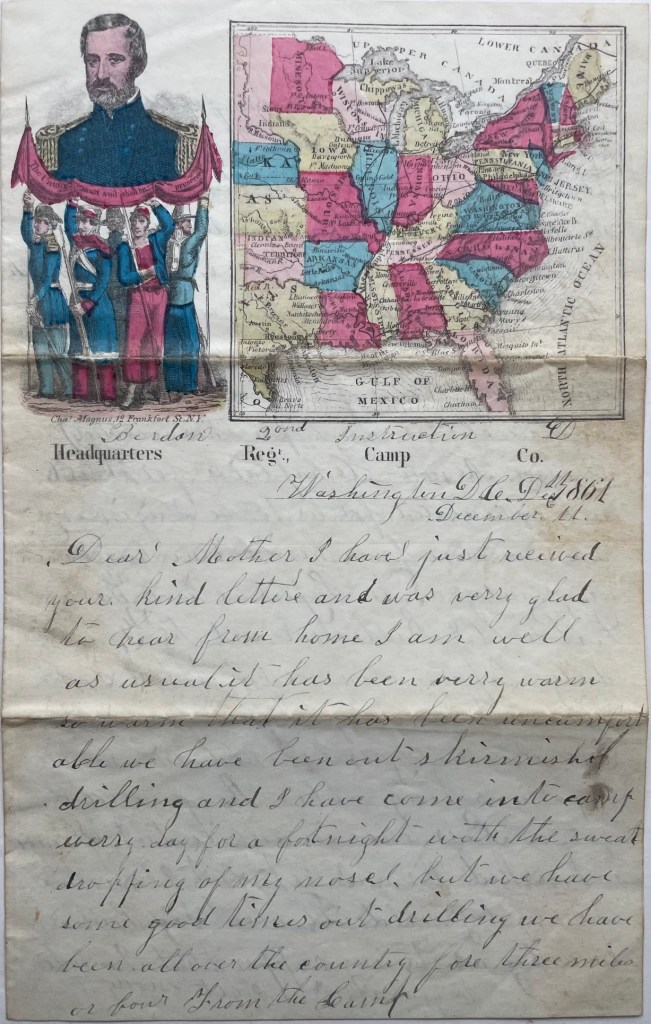
Patriotic letterhead “The Union Must & Shall be Preserved” on Salley’s letter.

Washington D. C.
December 11, 1861

Dear Mother,

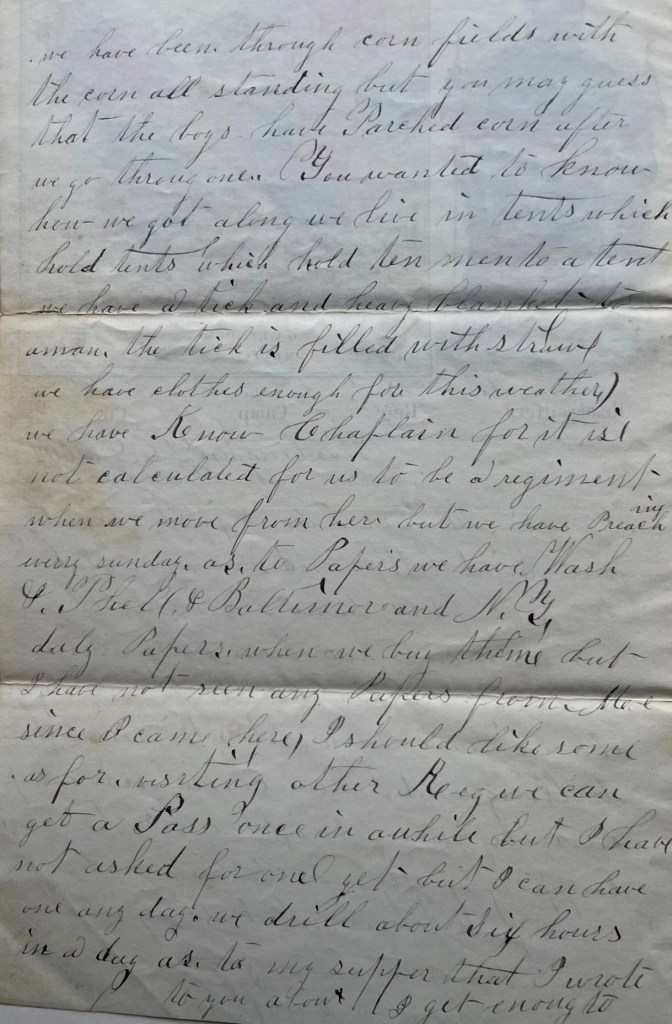
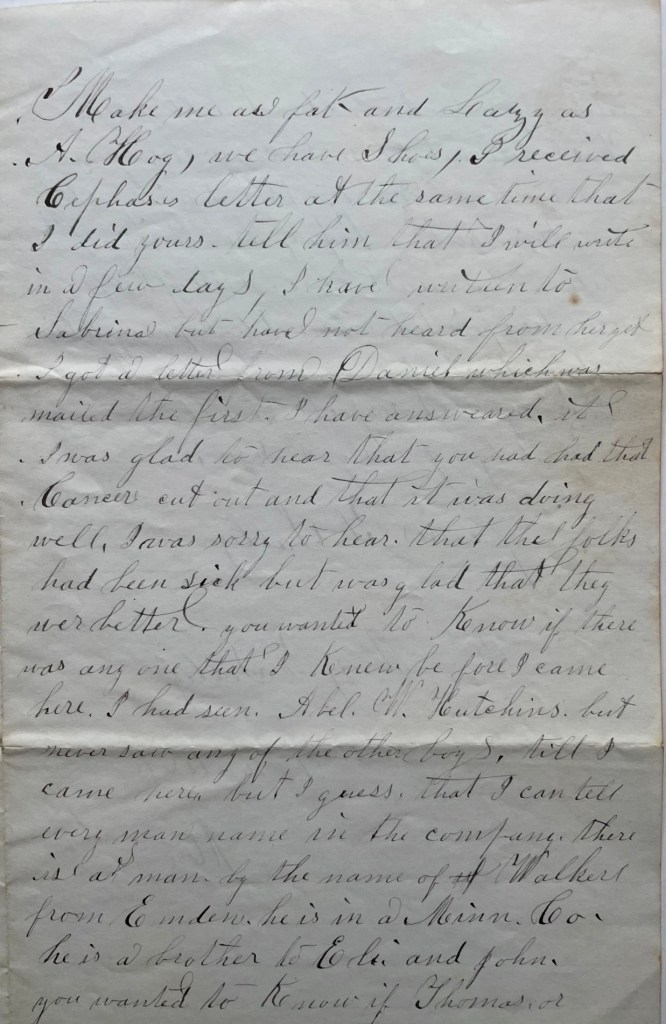
I have just received your kind letter and was very glad to hear from home. I am well as usual. It has been very warm—so warm that it has been uncomfortable. We have been out skirmish drilling and I have come into camp every day for a fortnight with the sweat dropping off my nose. But we have some good times out drilling. We have been all over the country for three miles or four from the camp. We have been through cornfields with the corn all standing but you may guess that the boys have parched corn after we go through one.

You wanted to know how we got along. We live in tents which hold ten men to a tent. We have a tick and heavy blanket to a man. The tick is filled with straw. We have clothes enough for this weather. We have no chaplain for it is not calculated for us to be a regiment when we move from here but we have preaching every Sunday. As to papers we have Washington & Philadelphia & Baltimore and New York daily papers when we buy them but I have not seen any papers from Maine since I came here. I should like some.

As for visiting other regiments, we can get a pass once in a while but I have not asked for one yet. But I can have one any day. We drill about six hours in a day. As to my supper that I wrote to you about, I get enough to make me as fat and lazy as a hog. We have shoes. I received Cephas’s letter at the same time that I did yours. Tell him that I will write in a few days. I have written to Sabrina but I have not heard from her yet.

I got a letter from Daniel which was mailed the first. I have answered it. I was glad to hear that you had had that cancer cut out and that it was doing well. I was sorry to hear that the folks had been sick but was glad that they were better. You wanted to know if there was anyone that I knew before I came here. I had seen Abel W. Hutchins but never saw any of the other boys till I came here but I guess that I can tell every man name in the company. There is a man by the name of Walker from Emden. He is in a Minn. Co. He is a brother to Eli and John.

You wanted to know if Thomas or Thompson. I could not tell which was here but I do not know who you meant. Tell Amelia that I will give her this sheet of paper. But it is getting late and I must close. Write often for I am disappointed when I look for a letter and it does not come. Write all the news. Give my best respects to all. Goodbye from your son, — James T. Salley

To Mary F. Salley of Madison, Maine