
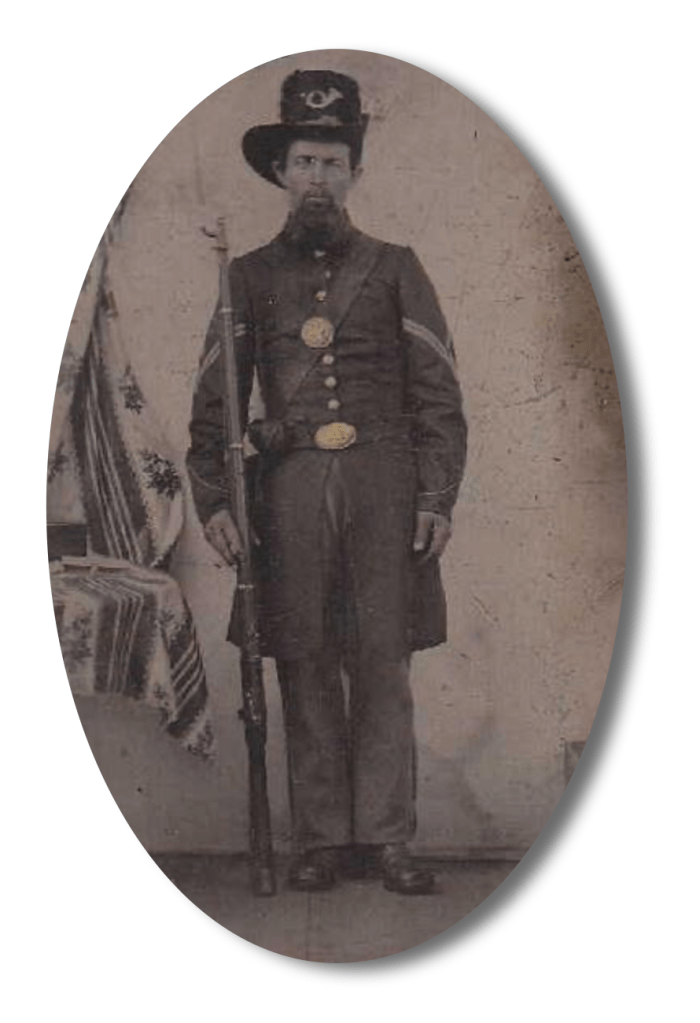
This letter was written by 43 year-old James Thomas Dakin (1821-1886), a farmer from Amity, Aroostook county, Maine, who was drafted into the army in the fall of 1864 and served in Co. G, 20th Maine before transferring to Co. K, 16th Maine Infantry in December 1864. When in the 20th Maine, he fought on Little Round Top and the following day against Pickett’s charge.
James wrote the letter to his wife, Louisa Estabrook (1817-1884), the aunt of George Franklin Estabrook (1845-1865) whose death was disclosed in this letter.
To read more letters that I have transcribed by members of the 16th Maine Infantry and published on Spared & Shared, see:
Albert Church Brown, Co. C, 16th Maine (38 Letters)
William Henry Broughton, Co. D, 16th Maine (1 Letter)
John F. Robinson, Co. E, 16th Maine (1 Letter)
John H. Fraine, Co. G, 16th Maine (8 Letters)
Transcription
Hatcher’s Run, Virginia
March 27, 1865
Dear wife and friends at home,
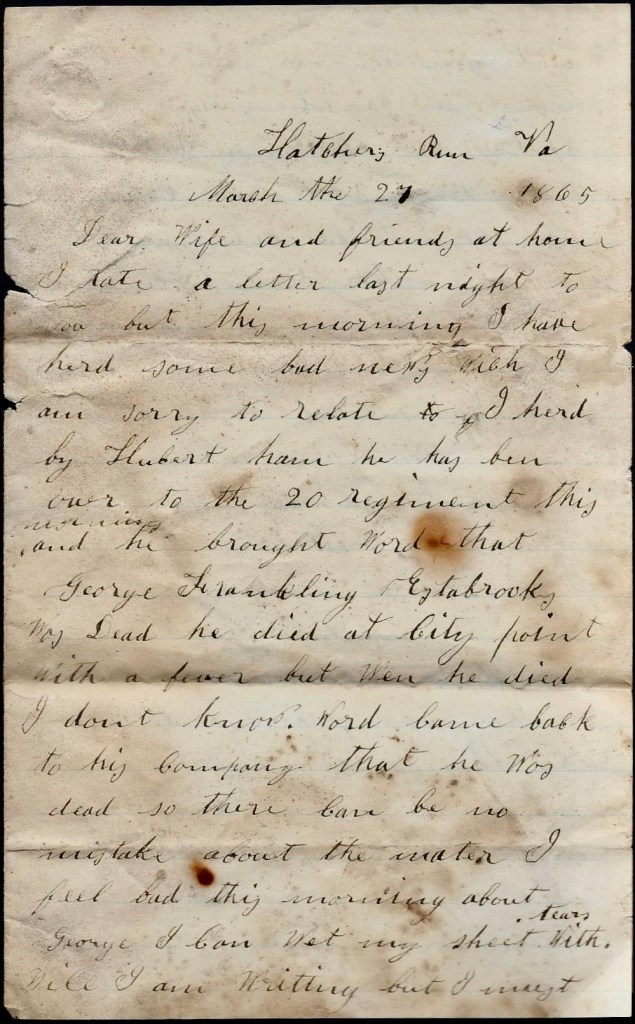
I wrote a letter last night to you but this morning I have heard some bad news which I am sorry to relate. I heard by Hubert [J.] Hamm—he has been over the 20th [Maine] Regiment this morning—and he brought word that George Franklin Estabrook was dead. 1 He died at City Point with a fever but when he died I don’t know. Word came back to his company that he was dead so there can be no mistake about he matter. I feel bad this morning about George. I can wet my sheet with tears. I am writing but I must not give away to my feelings here. You can tell [your brother] George what I have told you. I was a going to write to him but I thought I would let you or some other one tell him so I have told you all I know about the matter so I will stop.
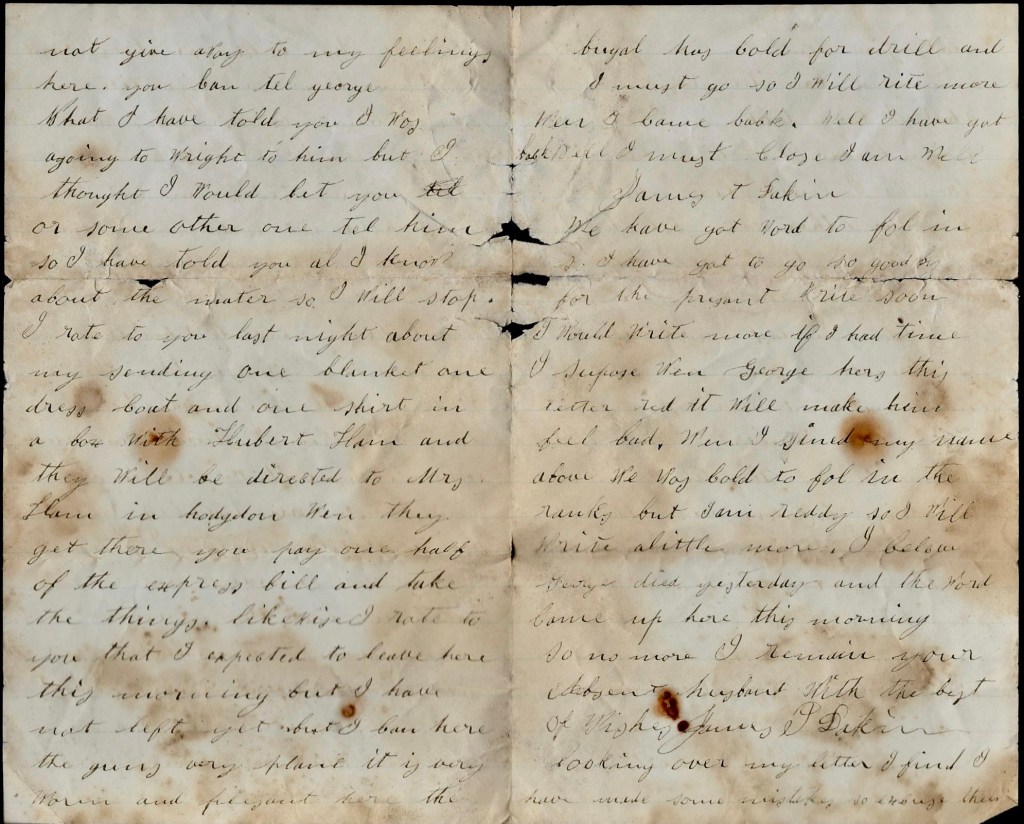
I wrote to you last night about my sending one blanket, one dress coat, and one shirt in a box with Hubert [J.] Hamm and they will be directed to Mrs. Hamm in Hodgdon. When they get there, you pay one half of the express bill and take the things likewise. I wrote to you that I expected to leave here this morning but I have not left yet but I can hear the guns very plain. It is very warm and pleasant here. The bugle has called for drill and I must go so I will write more when I come back.
Well, I have got back. Well, I must close. I am well. — James T. Dakin
We have got word to fall in so I have got to go, so goodbye for the present. Write soon. I would write more if I had time. I suppose when [your brother] George hears this letter read, it will make him feel bad. When I signed my name above, we was called to fall in the ranks but I am ready so I will write a little more. I believe George died yesterday and the word came up here this morning. So no more. I remain your absent husband with the best of wishes, — James T. Dakin
Looking over my letter I find I have made some mistakes so excuse these.
1 George Franklin Estabrook, Jr. (1845-1865) died on 21 March 1865 and is buried in Arlington National Cemetery, Section 13, Site 9700. George was the son of George Frederick Estabrook (son of Hammond and Catherine Estabrook) and Frances Ann Estabrooks. He enlisted in the 20th Maine Infantry Volunteers, Co. H. He fought at the Battle of Gettysburg—saving Little Round Top—along with his uncle Glazier Estabrook and two cousins, Jewett Williams and Albert Hartford Williams. He was 19 years old when he was killed in the Civil War. Before his death, he was promoted to Sergeant.


I received the following e-mail from John M. Simpson regarding this letter:
I was delighted to find your archive. Thanks for all you do.
There has been a bit of a family mystery which this letter has shed a bit of light on. We’d been wondering how Little George Estabrook(s) actually died, and this says of camp fever, which makes sense. My father has the letter from the day before, which says that James had dined with George a week previously and he’d been fine.
I’ve seen Little George’s grave in the Estabrook Cemetery in Amity, Maine, and heard also that he was in Arlington but until recently had never been able to locate the plot. Presumably he can’t be in both places, but there’s nothing that says he can’t have two stones. My understanding is that this arrangement was quite common.
A word on James Dakin: Previous to his service in the 16th, he had been with the 20th Maine, and he fought alongside George and Glazier on Little Round Top, and the following day against Pickett. He volunteered both times.
The hundreds of Dakin letters, along with his uniform and gear, were abandoned by the family in his son’s house until it was torn down. Only a few survived, I believe because someone was in the habit of using the paper for wadding their shot. My understanding of the letter you transcribed is that it was found inside the butt of a muzzle loader.
About the letter:
In the transcription, the name of the friend is actually Hubert J. Hamm of Foxcroft, who survived the war by virtue of being constantly ill and missing half of the fighting. Little George’s middle name was Franklin, like George Sr. Little George was actually not the son of George Sr., but his mother was Frances Ann, George Sr.’s sister, by her first husband, prior to her marriage to Caleb Hall. The “Junior” was more a convenience than actual literal reality, since they all ended up living next door to one another. Frances (Mary) Ann Estabrooks was my great-great grandmother.
Most of that’s immaterial, but the spelling of their names may be worth noting, if you get a moment and want to adjust it on the page. Entirely up to you.
Thank you for your time!
John M. Simpson
LikeLike