
The following letter was written by Andrew Clarkson Dunn (1834-1918), the son of Nathaniel Dunn (1808-1889) and Charlotte Leonard Tillinghast (1798-1838). Andrew’s father was for forty years an eminent educator, being the first principal of the Wilbraham Academy of Massachusetts, and for many years Professor of Chemistry in Rutger Female College in New York city.
Andrew was educated by his father, and commenced reading law at an early age, under the instructions of Edward Sanford, Esq., and also Judge Campbell, of New York city, and for some time taught school at Fordham, New York. In April, 1854, he came to Minnesota, and was admitted to the bar in the autumn of that year, at a term of Territorial Supreme Court held at St. Paul. He practiced his profession for a few months at Sauk Rapids, and then located in St. Paul, where he was in practice for nearly two years.
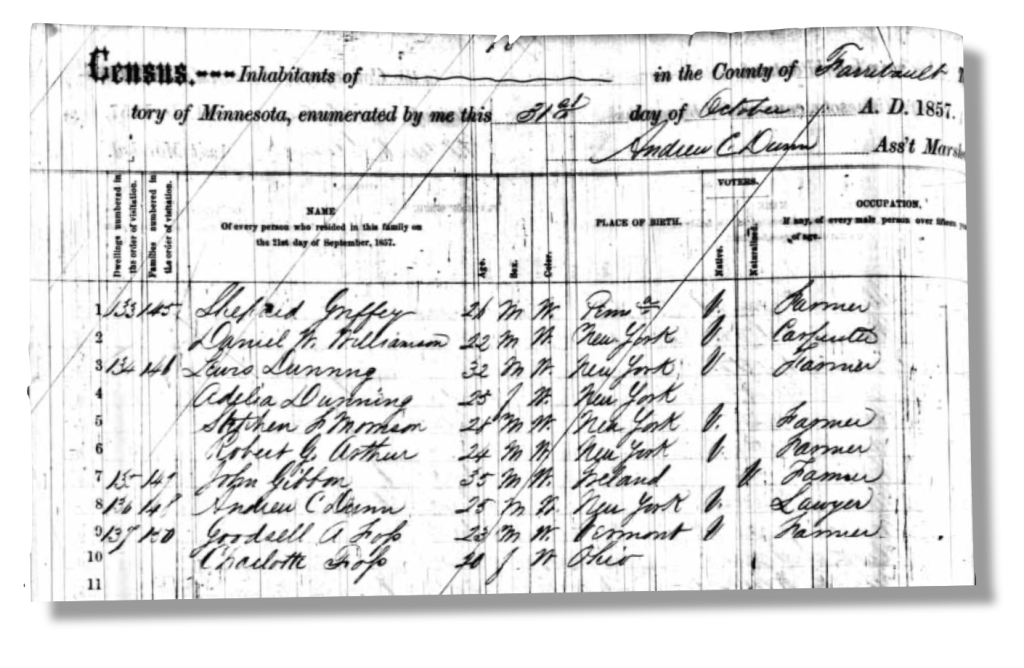
In the 1860 US Census, Andrew was enumerated in Verona, Faribault county, Minnesota, making a living as a lawyer. He was married on 1 January 1859 to Diana Jane Smith (1836-1913) and they had an 8 months old daughter named Mary born in late 1859. He was living in Winnebago, Faribault county in 1900, enumerated as a 65 year-old lawyer. According to State history, Andrew is credited with having been the founder of the town of Winnebago. He served as Clerk in the House of Representatives (1864-1866) and as a State Representative (1881-1882. His home in Winnebago is on the National Register of Historic Places.
Transcription

Benton county, Sauk Rapids, M. T.
June 14th 1854
My Dear Father,
I was just lying down here on a lounge in this wild northwest country when the thought struck me that as the ail went out on Friday (day after tomorrow), that I would write you a few lines, thinking doubtless that you would be glad to hear from me. You will see by the above that I am in “Sauk Rapids” now. “S.R.” be it known to you is as yet merely a town in name—a few houses & few people, and the noble Mississippi flowing at our very feet. S. R. is about 100 miles above St. Paul and about 90 above the Falls of St. Anthony by the course of the river, but somewhat nearer by land as the river is very circuitous in its course.
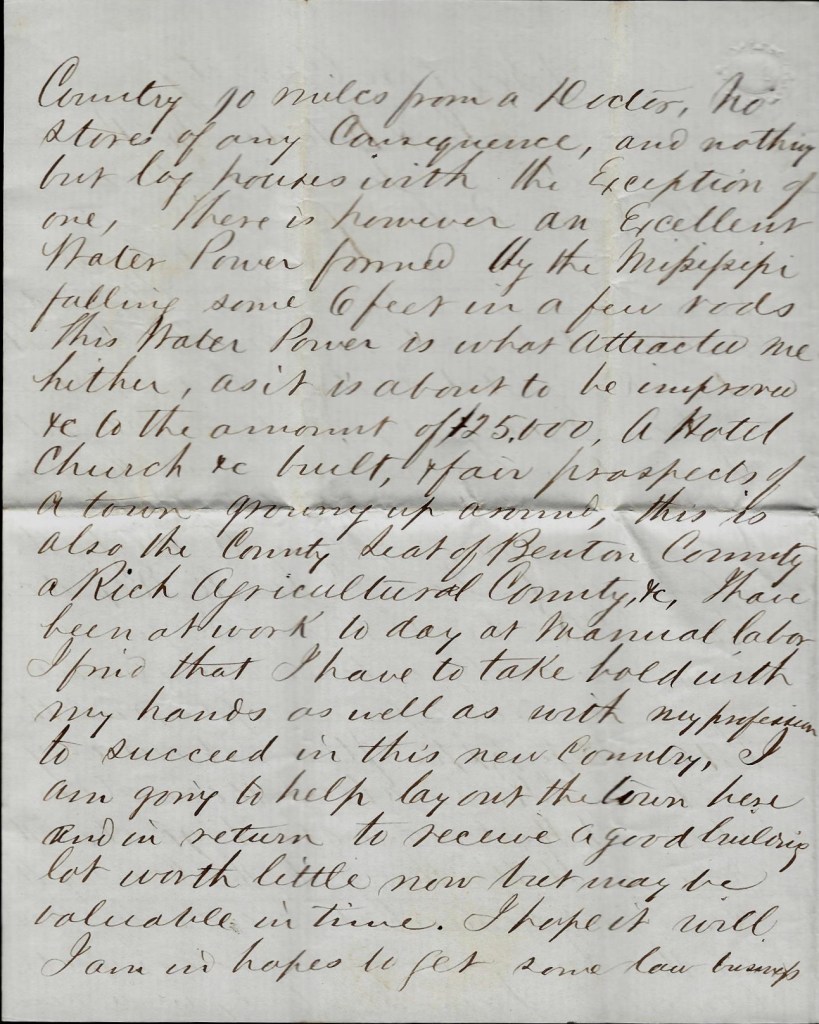
I am now truly in a new country, 90 miles from a doctor, no stores of any consequence, and nothing but log houses with the exception of one. There is, however, and excellent water power formed by the Mississippi falling some 6 feet in a few rods. This water power is what attracted me hither as it is about to be improved, &c. to the amount of $25,000. A hotel, church, &c. built, and fair prospects of a town growing up around. This is also the county seat of Benton county—a rich agricultural county, &c.
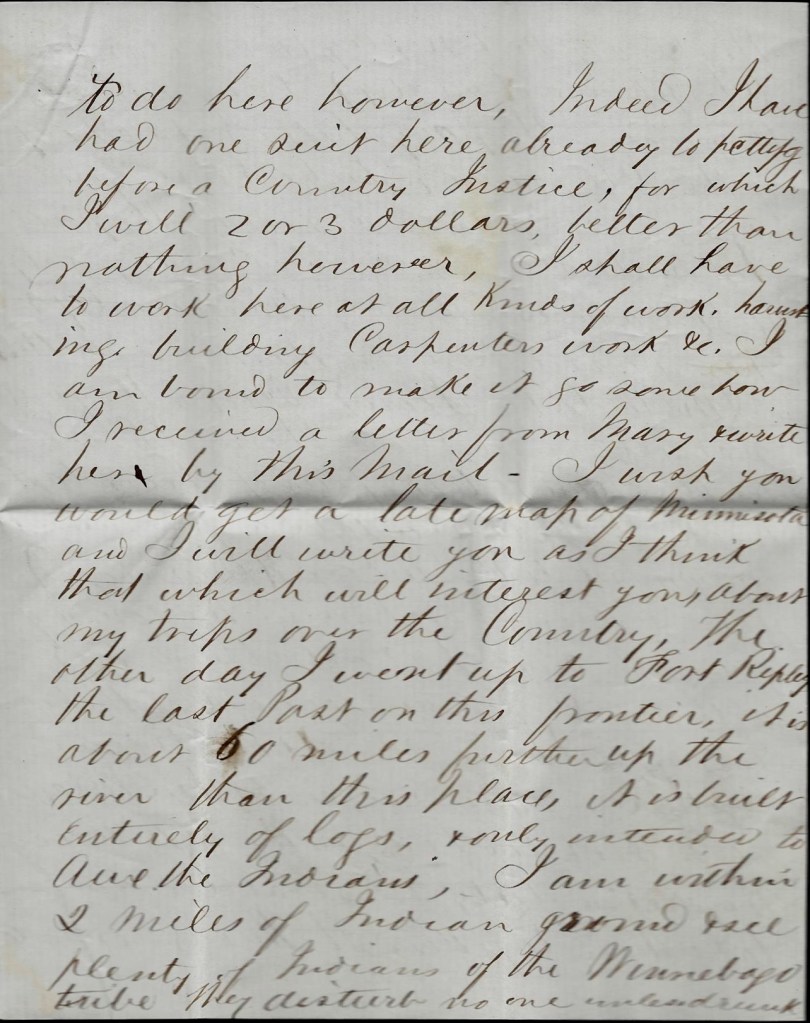
I have been at work today at manual labor. I find that I have to take hold with my hands as well as with my profession to succeed in this new country. I am going to help lay out the town here and in return to receive a good building lot worth little now but may be valuable in time. I hope it will. I am in hopes to get some law business to do here, however. Indeed, I have had one suit here already to [ ] before a county justice for which I will receive] 2 or 3 dollars—better than nothing however. I shall have to work here at all kinds of work—harvesting, building, carpenter’s work, &c. I am bound to make it go somehow.

I received a letter from Mary & write her by this mail. I wish you would get a late map of Minnesota and I will write you as I think that which will interest you about my trips over the country. The other day I went up to Fort Ripley, the last post on this frontier. It is about 60 miles further up the river than this place. It is built entirely of logs & only intended to awe the Indians. I am within 2 miles of Indian ground & see plenty of Indians of the Winnebago tribe. They disturb no one unless drunk.
While at Fort Ripley (which is in Chippewa country), I enquired about “Copway.” They say he is not a chief of the Chippewa tribe & they don’t acknowledge him as such. They all know him, however. A war party of 30 canoes & seventy warriors passed here in their canoes this a.m. to take “Sioux” scalps. They will not return without them, I know, as the “Sioux” took four of theirs last week.
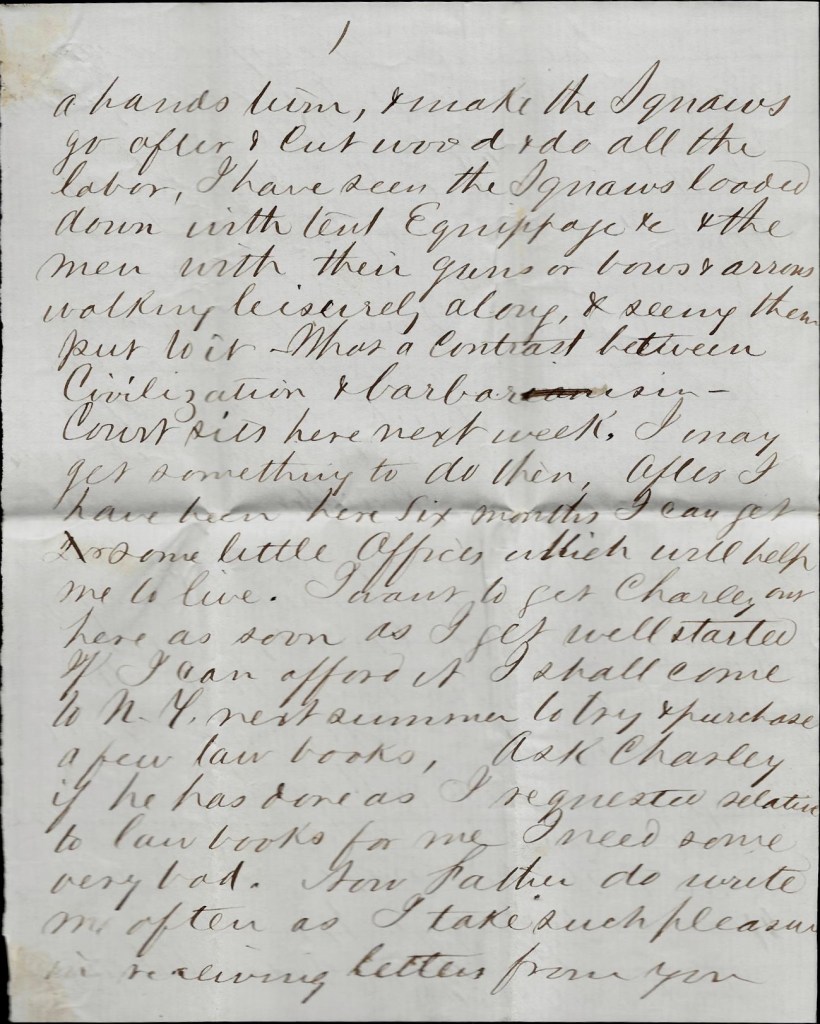
There is to be a government payment to the Indians (Winnebagos) four miles above here in the course of a week or two. I shall attend it & will write you an account of the proceedings. I have seen 2,000 Indians together in their lodges at their villages 40 miles below here on the Elk River. They are a dirty, miserable race, take them together. The men won’t do a hand’s turn & make the squaws go after & cut wood & do all the labor. I have see the squaws loaded down with tent equipage &c. and the men with their guns or bows and arrows walking leisurely along & seeing them put to it. What a contrast between civilization and barbarism.
Court sits here next week. I may get something to do then. After I have been here six months, I can get some little offices which will help me o live. I want to get Charley out here as soon as I get well started. If I can afford it, I shall come to New York next summer to try and purchase a few law books. Ask Charley if he has done as I requested relative to law books for me. I need some very bad.
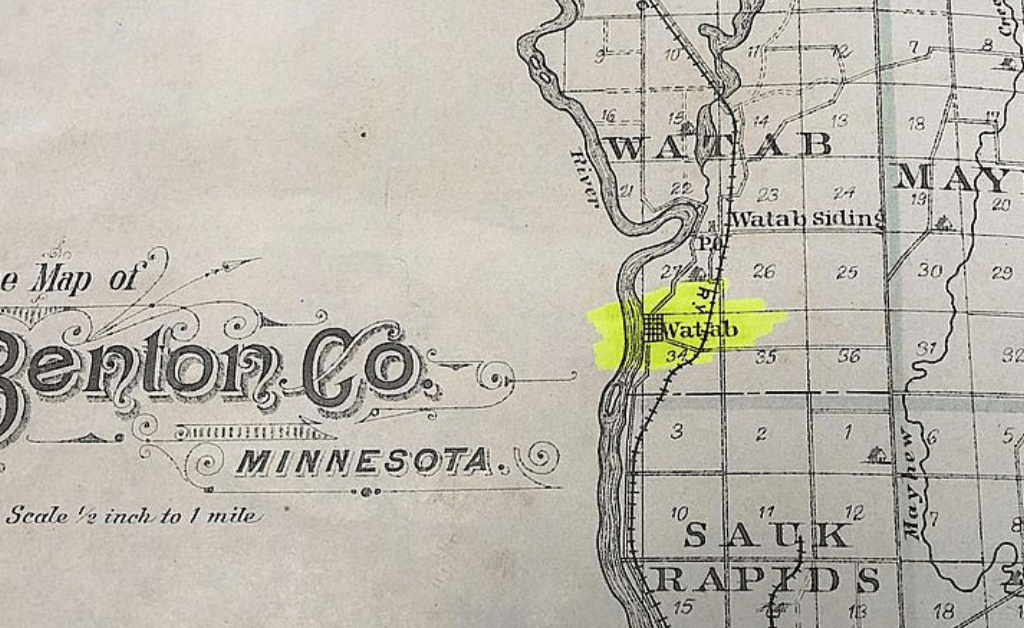
Now father, do write me often as I take such pleasure in receiving letters from you. Make them as cheerful as you can as I want encouraging letters so far from home. Tell Mary to get the son, “Do they miss me at home?” & sing it for me. I sing it sometimes here and it makes me sad to think I am so far from home. But all young men that come here do well and I think I can. If you get the map, you will find on it instead of Sauk Rapids “Watab” but it is a late one. You may find Sauk Rapids laid down.
Direct me at Sauk Rapids, Benton county, M. T. Now goodnight, fear father. My love to mother, Lotty, Ginny, and all. Bless them and keep them for me. Write soon. I never have received the letter with the money in it as yet. I fear it is lost.
Your affectionate son, — Andrew C. Dunn
I’m broke to $1.50.



 Spared & Shared 23