
The following letters were written by 21 year-old Detroit native Henry Martyn Duffield (1842-1912), the son of Rev. George Duffield (1794-1868) and Isabella Graham Bethune (1799-1871). Henry attended public school in Detroit, the University of Michigan and Williams College. He married Frances Pitts (1844-1906) on December 29, 1863. It was to his wife “Fannie” that he wrote both letters.
Duffield entered service in the Civil War on September 10, 1861 as a private. He was soon promoted to the post of Adjutant in the 9th Michigan Infantry. He was made acting Assistant Adjutant General of the 23rd Brigade on March 18, 1862. Duffield was taken prisoner at Murfreesboro, Tennessee on July 13, 1862. He was exchanged on December 3, 1862 and returned to his regiment. He commanded the mounted Provost Guard for the 14th Army Corps from June to August, 1863. Duffield was wounded in action at Chickamauga, Georgia on September 30, 1863. He was made acting Provost Marshal General from February to May, 1864 and Assistant Provost Marshal General for the Department of Cumberland from May to October, 1864. He was discharged at the end of his service on October 14, 1864.
Duffield returned to Detroit and his law practice. He was an active Republican and took part in politics at every level but did not seek office. In 1898, Colonel Duffield volunteered for the military service and was commissioned Brigadier General. During the Spanish American War, he participated in the siege of Santiago. While in Cuba, he contracted yellow fever and recovered after many months of nursing care. In 1903, he was brevetted the rank of Major General.
Duffield’s letters describe surviving not one, but two separate train accidents while returning from a Veteran’s furlough to the battle front in February 1864 reminding us of the uncertain and precarious state of 19th century transportation.
A third letter was sent to me for transcription from the private collection of Gregory Fried. It is the one written in April 1864 and includes the story of the death of the Union scout (or spy) named William J. Lawton in late March or early April 1864 (dates vary, see Jessie Scouts). Lawton’s image can be found in the Library of Congress. We learn from Henry’s letter that he accompanied another scout to the scene of Lawton’s death, buried the body, and retrieved Lawton’s personal effects.

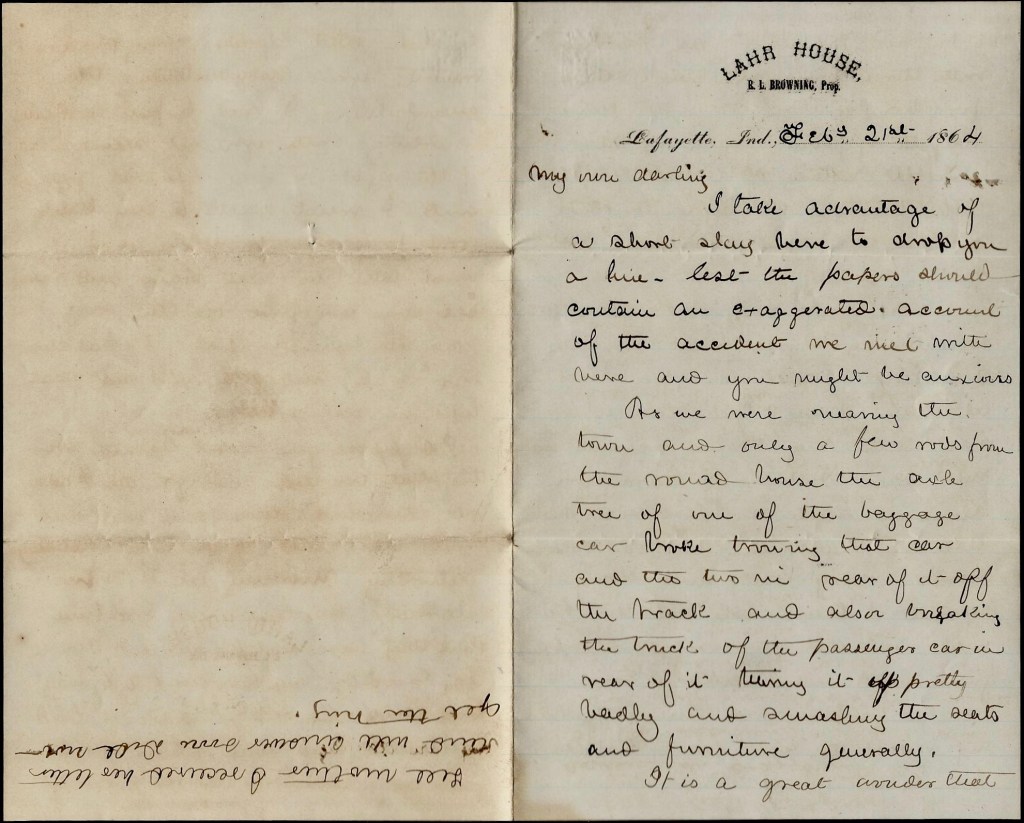
Letter 1

Lahr House
Lafayette, Indiana
February 21, 1864
My own darling,
I take advantage of a short stay here to drop you a line lest the papers should contain an exaggerated account of the accident we met with here and you might be anxious.
As we nearing the town and only a few rods from the round house, the axle tree of one of the baggage cars broke throwing that car and the two in the rear of it off the track and also breaking the truck of the passenger car in the rear of it, tearing it up pretty badly and smashing the seats and furniture generally. It is a great wonder that no one was injured as we run with three cars off the track for two or three rods the entire length of our very long train. I felt nothing of it but slept right through although the others in the car said they were jerked pretty severely.
Mrs. Bangs and Hull are with us intending to go as far as Nashville, I believe. Sometimes when I look at them, I am selfish enough to wish that my darling was with me but when I think of leaving you alone in such a bleak, miserable hole as Nashville to [ ] backwards, weary, lonely, and down-hearted, I cannot but think that I was right, and that it would be sacrificing your comfort and health to have brought you along with me. You know my sweetest how dearly I should love to have you with me and how desolate and cheerless every place is without you. Notwithstanding, the cheerfulness I tried to put on while parting with you, it seemed as if the light of my life was gone and I went back to my lonely room to pack up feeling as if I must take the next train and again see you. Our time on the cars was so hurried that it cut short our adieus and they did not seem like a real goodbye.
I suppose you must have learned ere this that we did not go on Friday but marched down and were met with orders not to go until Saturday. Saturday morning at 11:00 we started, making very good time. But they have sent for me, and I must go. Goodbye my own sweet wife. May God bless and keep you safe, well, and contented, and soon return me to your loving arms is the prayer of your own, — Harry
Tell mother I received her letter and will answer soon. Did not get the ring.

Letter 2

Headquarters 9th Regiment Michigan Infantry Veteran Vols.
Nashville, Tennessee
February 24, 1864
My darling Fannie,
I fully intended writing to you at Louisville but we passed directly through, not stopping any time at all. I was going to telegraph you of our second railroad accident but the cars ran into the telegraph pole and broke the communication which was not repaired until we got to Jeffersonville and there I telegraphed General Robertson knowing he would publish it and you would feel no anxiety about your waif. It is a wonder that none were killed and so few injured seriously. Seven cars were all broken including the car in which I was which finally brought up on its side sliding us all down into one indiscriminate huddle after jerking and jumping about at a fearful rate. The boys were crowded up with the cars that were overturned and some of which the floors were all stove out and the seats shattered to pieces and yet with two exceptions, neither of which was fatal, there was no one seriously injured. The wreck of the cars though gave me the idea that the majority of those in the car were killed or badly injured.
I thought of you my darling the first idea I had on feeling the car jump and bolt like a vicious horse and was so thankful that you were not in the car with me. I had been feeling lonely all the day and night (the break occurred about 12 at night on the 21st) and wishing I had brought you along with me as Bangs and Hull had their wives. But when I felt the danger we were in, my selfish wishes fled away and I hardly felt the danger we were in. The glad consciousness that you at least were safe at home and that come what might, my darling would not suffer thereby, and much better still be left to me, for the only way I can endure your absence is by recollecting that soon I will no longer be a soldier and separated from you, but a citizen and my own master with no one to tear me away from you and home where you know, my darling wife, my heart longs to be and remain.
Recollect one thing though, my Pet, that if you need me—if circumstances make my absence unendurable, all you need do is send me word and I come. You have the right now to ask of it of me and I have the wish to grant it. Your family may break up or scatter and the now pleasant home circle grow lonely and cheerless, and then it is your husband’s duty to come to you and [ ] you from your loneliness. And you know, my darling, that he will gladly fly to you at your call for his heart is always with you…God knows I would give anything to be with you save the one thing that keeps me away—that is a feeling of duty.
I dined today with Mrs. Irwin and her husband. We shall leave here for Chattanooga tomorrow or the day after. I will let you know of our arrival thre by letter. Give my love to all the family, mother, sisters, and Tom. Keep a brave heart, my darling and trust for the best. you can be assured of one thing to comfort you and that is that I love you if possible better more truly than ever. — Harry


Letter 3
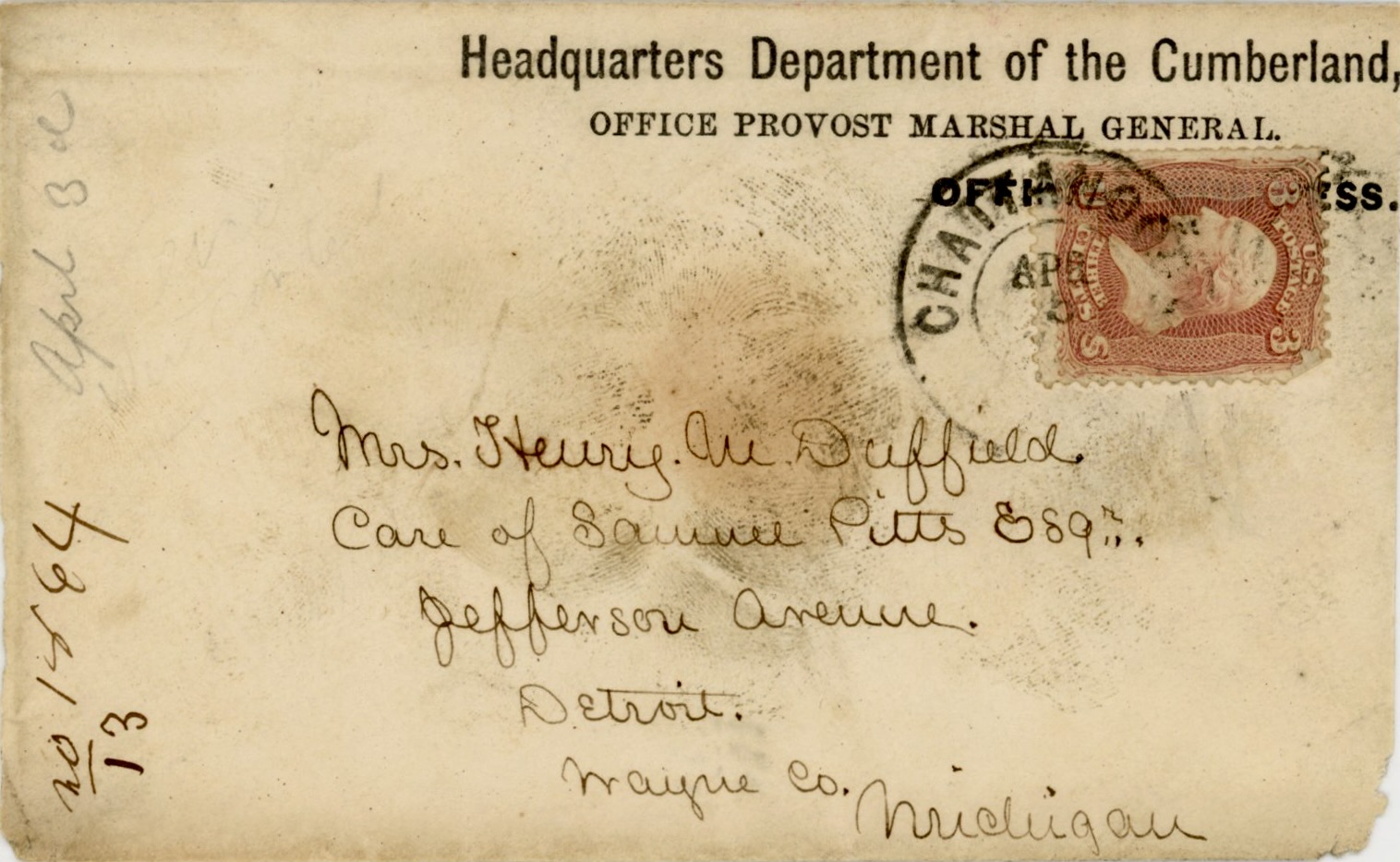
Headquarters, Dept. of the Cumberland
Office provost Marshal General
Chattanooga, Tennessee [April] 1864
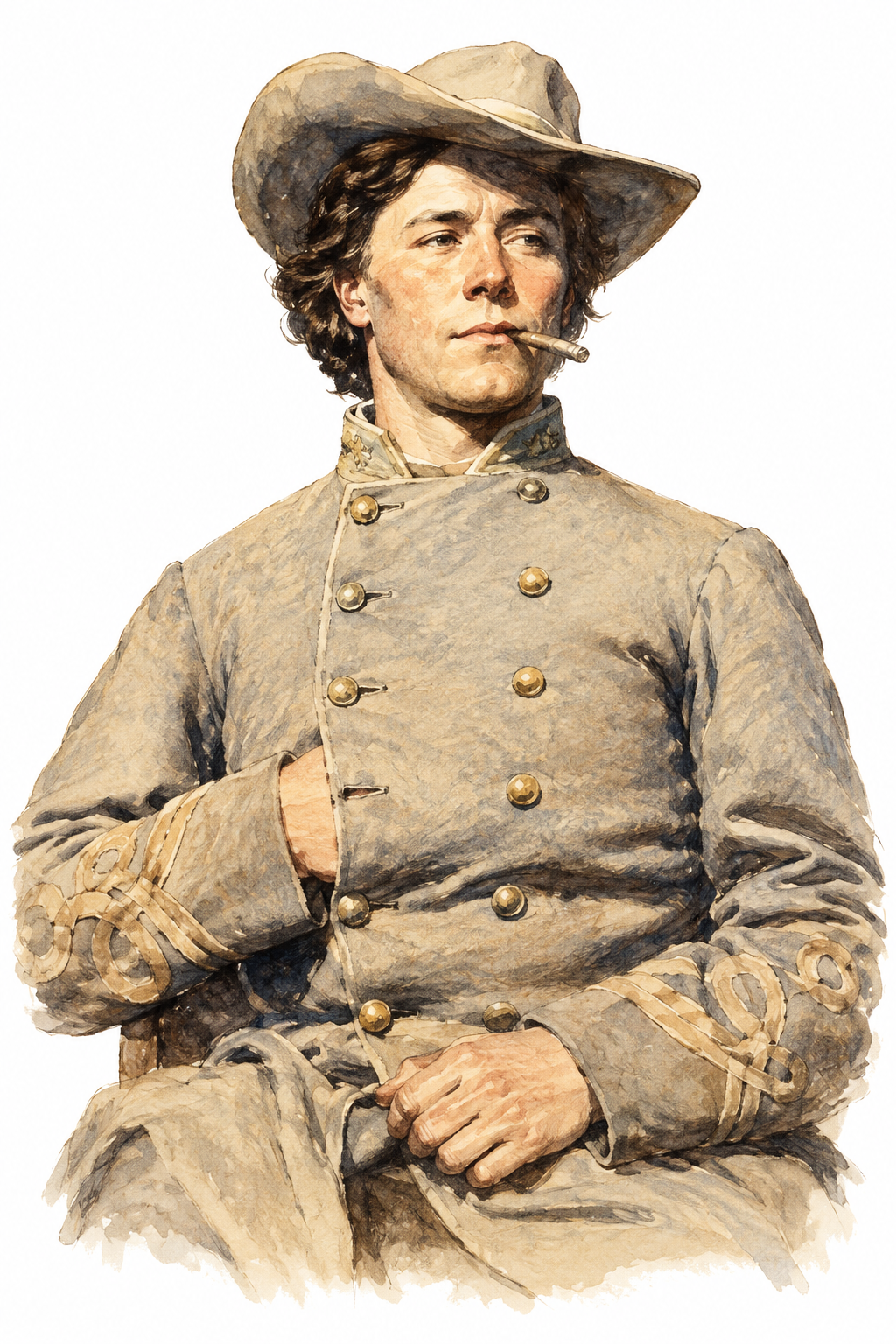
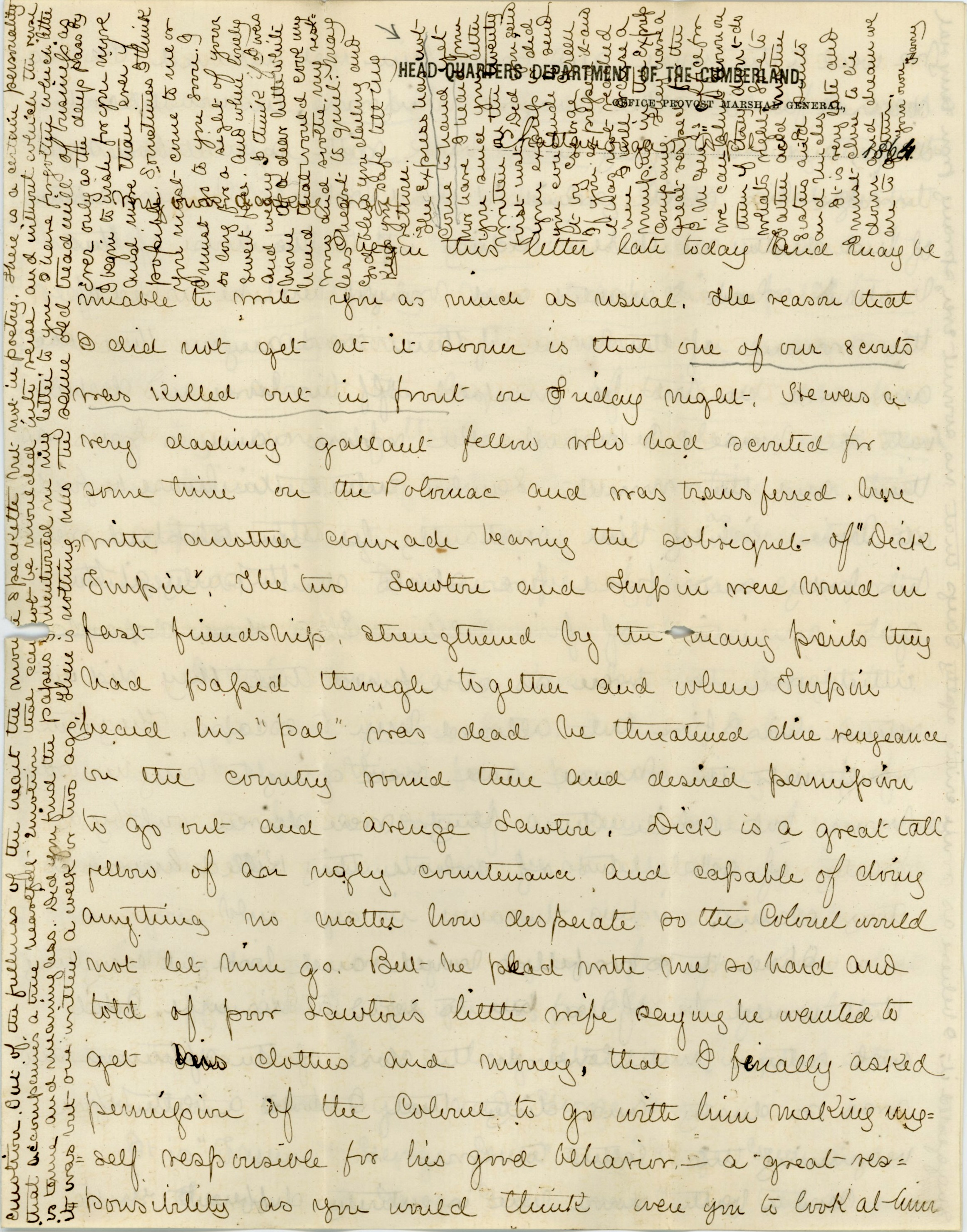
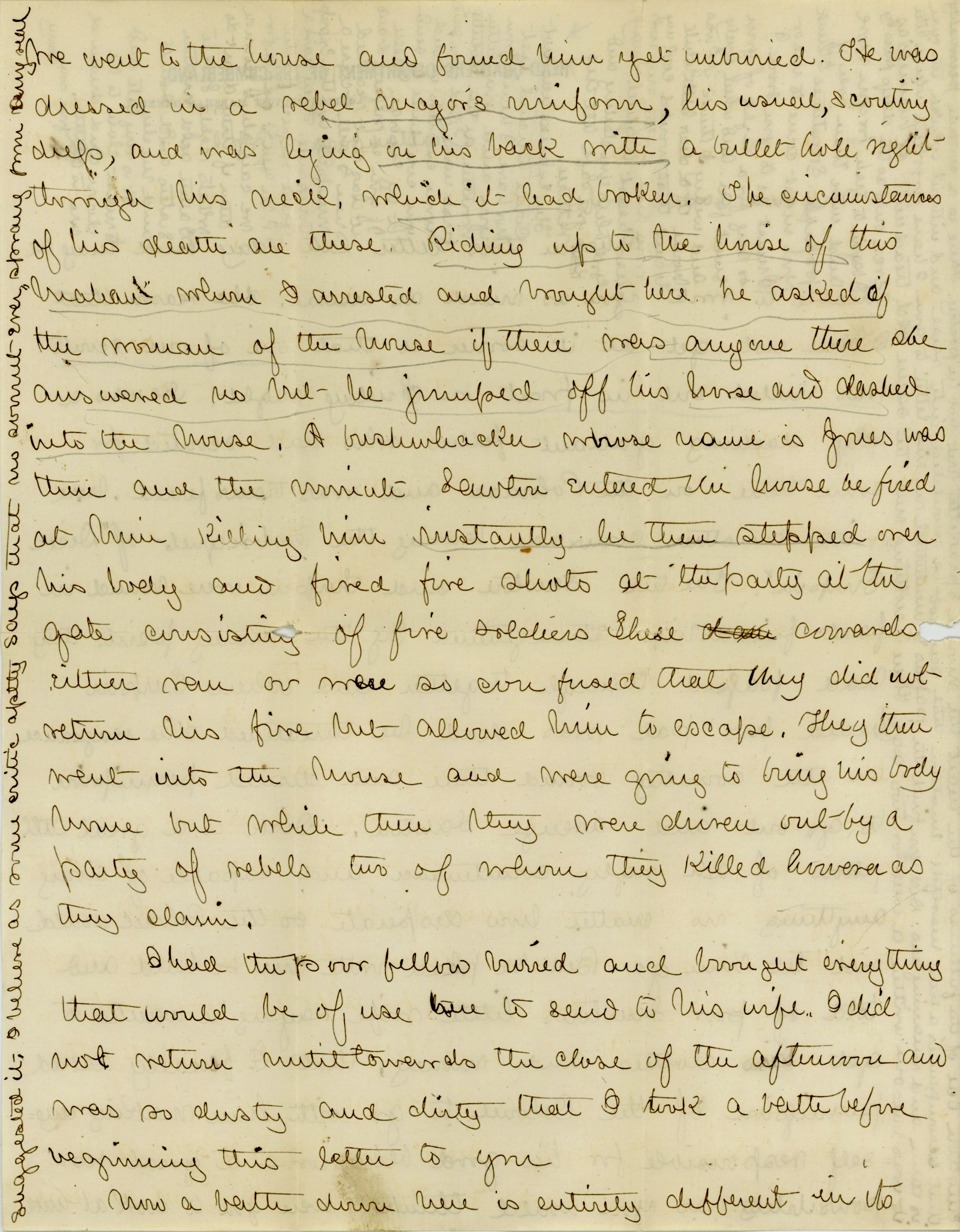
I write this letter late today since I may be unable to write you as much as usual. The reason that I did not get at it sooner is that one of our eight scouts was killed out in front on Friday night. He was a very dashing gallant fellow who had scouted for some time on the Potomac and was transferred here with another comrade bearing the sobriquet of “Dick Turpin.” The two—Lawton and Turpin—were joined in fast friendship, strengthened by the many perils they had passed through together and when Turpin heard his “pal” was dead, he threatened dire vengeance on the country round there and desired permission to go out and avenge Lawton. Dick is a great tall fellow of an ugly countenance and capable of doing anything no matter how desperate, so the Colonel would not let him go. But he plead with me so hard and told of poor Lawton’s little wife saying he wanted to get his clothes and money, that I finally asked permission of the Colonel to go with him making myself responsible for his good behavior—a great responsibility as you would think, even you, to look at him.
We went to the house and found him yet unburied. He was dressed in a rebel major’s uniform—his usual scouting dress—and was lying on his back with a bullet hole right through his neck, which it had broken. The circumstances of his death are these. Riding up to the house of this citizen whom I arrested and brought here, he asked of the woman of the house if there was anyone there. She answered no [whereupon] he jumped off his horse and dashed into the house. A bushwhacker whose name is Jones [Calvin Jones Andrews] was there and the minute Lawton entered the house, he fired at him killing him instantly. He then stepped over his body and fired five shots at the party at the gate consisting of five soldiers. These cowards either ran or were so confused that they did not return his fire, but allowed him to escape. They then went into the house and were going to bring his body home but while there, they were driven out by a party of rebels, two of whom they killed however—as they claim.
I had the poor fellow buried and brought everything that would be of use here to send to his wife. I did not return until towards the close of the afternoon and was so dusty and dirty that I took a bath before beginning this letter to you. 1
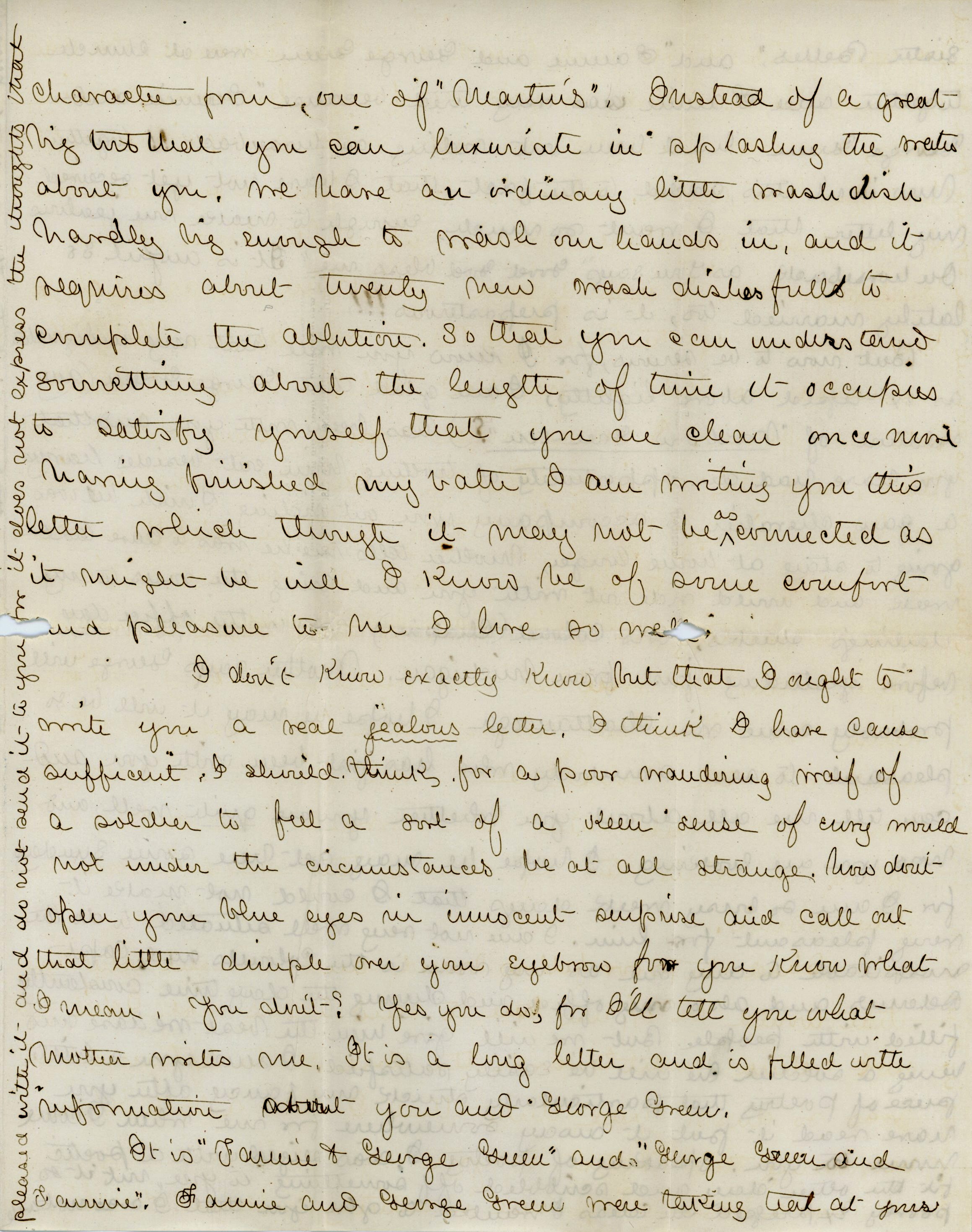
Now a bath down here is entirely different in its character from one of “Martin’s.” Instead of a great big tub where you can luxuriate in splashing the water about you, we have an ordinary little wash dish hardly big enough to wash our hands in, and it requires about twenty new wash dishes full to complete the ablution. So that you can understand something about the length of time it occupies to satisfy yourself that you are clean once more.
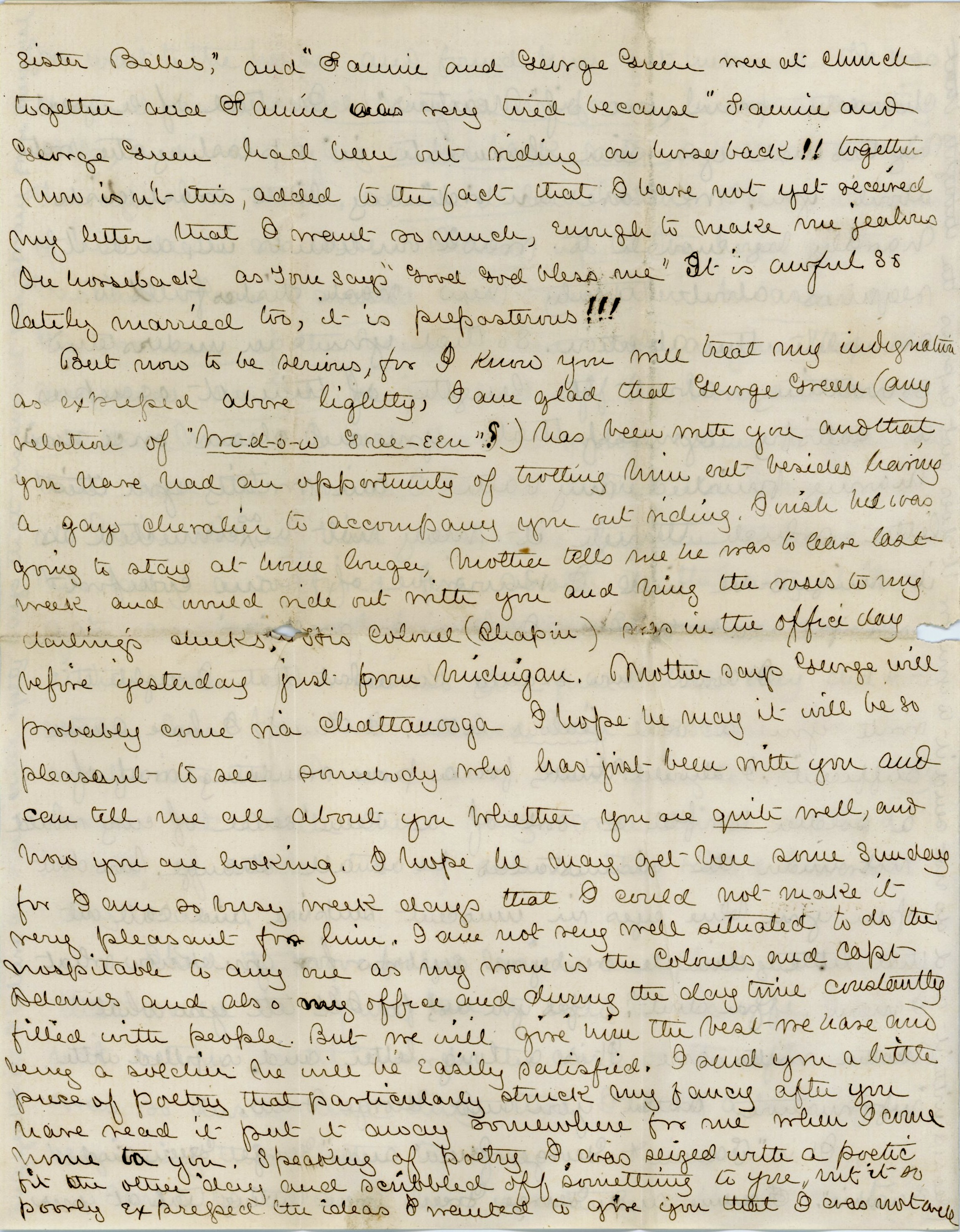
Having finished my bath, I am writing you this letter which though it may not be as connected as it might be, will I know be of some comfort and pleasure to one I love so well. I don’t exactly know but that I ought to write you a real jealous letter. I think I have cause sufficient, I should think, for a poor wandering waif of a soldier to feel a sort of a keen sense of envy would not under the circumstances be at all strange. Now don’t open your blue eyes in innocent surprise and call out that little dimple over your eyebrow for you know what I mean. You don’t? Yes you do, for I’ll tell you what Mother writes me. It is a long letter and is filled with information about you and George Green. It is “Fannie & George Green” and “George Green and Fannie.” “Fannie and George Green were taking tea at your sister Belle’s,” and “Fannie and George Green were at church together,” and “Fannie was very tried because Fannie and George Green had been out riding on horseback!! together.” Now isn’t this, added to the fact that I have not yet received my letter that I want so much, enough to make me jealous? On horseback, as you say—-“Good Lord bless me.” It is awful & lately married too, it is preposterous!!!
But now to be serious, for I know you will treat my indignation as expressed above lightly. I am glad that George Green (any relation of “Wid-o-w Gree-een”?) has been with you and that you have had an opportunity of trotting him out besides having a gay chevalier to accompany you out riding. I wish he was going to stay at home longer. Mother tells me he was to leave last week and would ride out with you and bring the roses to my darling’s cheeks. His Colonel (Chapin) was in the office day before yesterday just from Michigan. Mother says George will probably come via Chattanooga. I hope he may. It will be so pleasant to see somebody who has just been with you and can tell me all about you—whether you are quite well, and how you are looking. I hope he may get here some Sunday for I am so busy week days that I could not make it very pleasant for him. I am not very well situated to do the hospitable to any one as my room is the Colonel’s and Capt. Adams’s and also my office and during the day time constantly filled with people. But we will give him the best we have and being a soldier he will be easily satisfied.
I send you a little piece of poetry that particularly struck my fancy. After you have read it, put it away somewhere for me when I come home to you. Speaking of poetry, I was seized with a poetic fit the other day and scribbled off something to you, but it so poorly expressed—the ideas I wanted to give you—that I was not able to send it to you for it does not express the thoughts that agitate my mind. I am…your own, Harry
1 There are variations on the story of Will Lawton and the circumstances surrounding his death. Some refer to him as a Union Scout, some a Union spy; some that he fought early in the war for the Confederacy, others for the Union. One version of the story can be found on CivilWarTalk under the title, “Who was Capt. William J. Lawton, Union Spy?” Another version on Find-A-Grave. Neither of these accounts, however, cite their sources. As for Dick Turpin, I cannot find any Union scout by that name.