
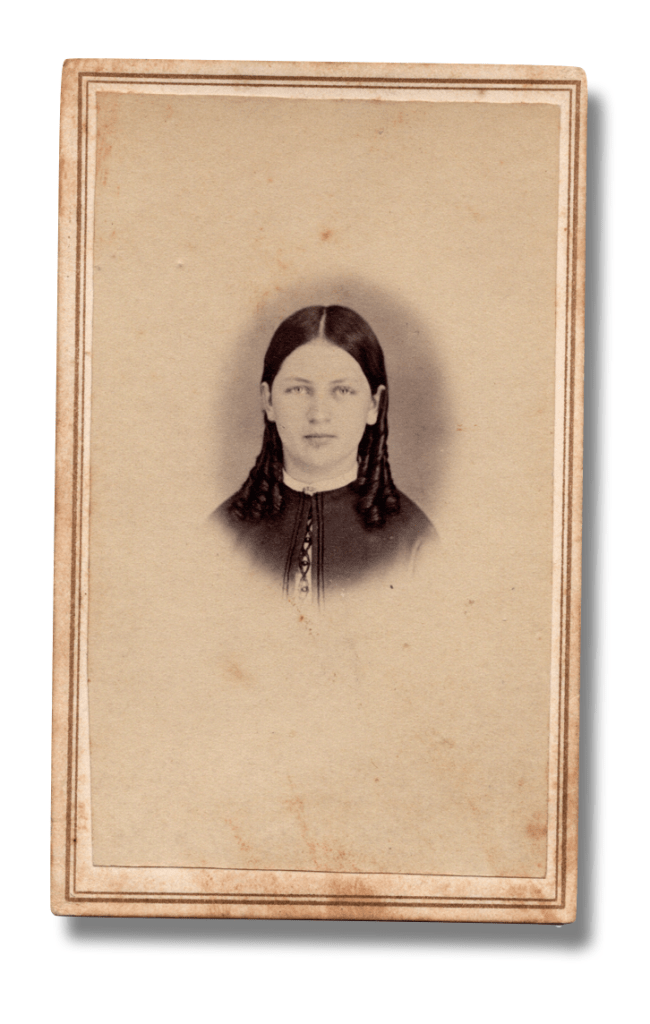
The following letter was written by Flora Angeline Brooks (1851-1947), the 12 year-old daughter of Thomas Martin Brooks (1803-1881) and Sarah Brown Chenowith (1808-1865) of Paris, Edgar county, Illinois. Flora wrote the letter to her brother James Allen Brooks (b. 1844). She also mentions her brother Henry Erastus Brooks (b. 1847). Flora married Rev. John C. Ely (1849-1920), a Presbyterian Minister. They were married in 1887 and later moved to Kentucky.
At the time that Flora wrote this letter, her brother James was serving in a home guard militia under the command of Capt. Mitchell Campbell Lilley (1819-1897) based out of Columbus, Ohio. Early in the war, Lilley served as Captain of Co. H, 46th Ohio Volunteer Infantry (OVI), but ill health forced him to resign from active service in January 1863 and return to Columbus where he took command a home guard militia for the duration of the war.
Flora’s letter contains some interesting news. She informs her brother of the competing Fourth of July celebrations hosted in Paris by both the Republican Party and the Democratic Party—the latter being predominantly composed of citizens with southern-leaning sympathies who she refers to as “butternuts.” According to a thesis by Scott Parkinson published in 1988 who studied the effects of the Civil War in Edgar county, “anti-war feelings did not come to a boil until late in the war” as the war dragged on in what was traditionally a Democratic, mostly southern-bred population. “In early February 1864, the growing agitation erupted into violence for the first time as Copperheads and furloughed soldiers clashed in Mattoon, Illinois, in what is known as the ‘Mattoon Incident.’ The editor of the Paris Times blamed the incident on Copperheads belong to the subversive secret society (Knights of the Golden Circle).” A similar event occurred in Paris later in February 1864 when soldiers of the 12th and 66th Illinois skirmished with Copperheads trying to seize an arsenal of weapons in the town.
Flora also mentions the turn out by organized home militia units to confront John Hunt Morgan as he made his raid through southern Indiana, Illinois, and Ohio during July 1863. She also describes the celebrations in Paris, Illinois, upon hearing the news of the surrender of Vicksburg—a great letter written 160 years ago this month.
[Note: This letter is from the personal collection of Greg Herr and was transcribed and published on Spared & Shared by express consent.]
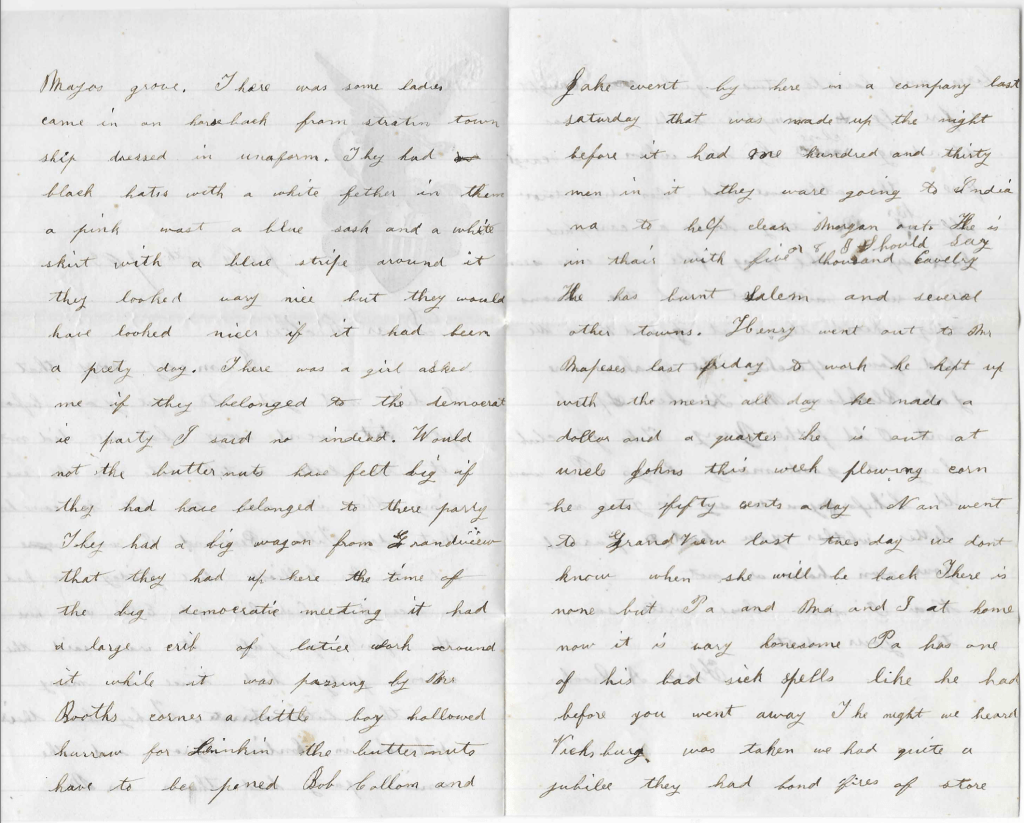
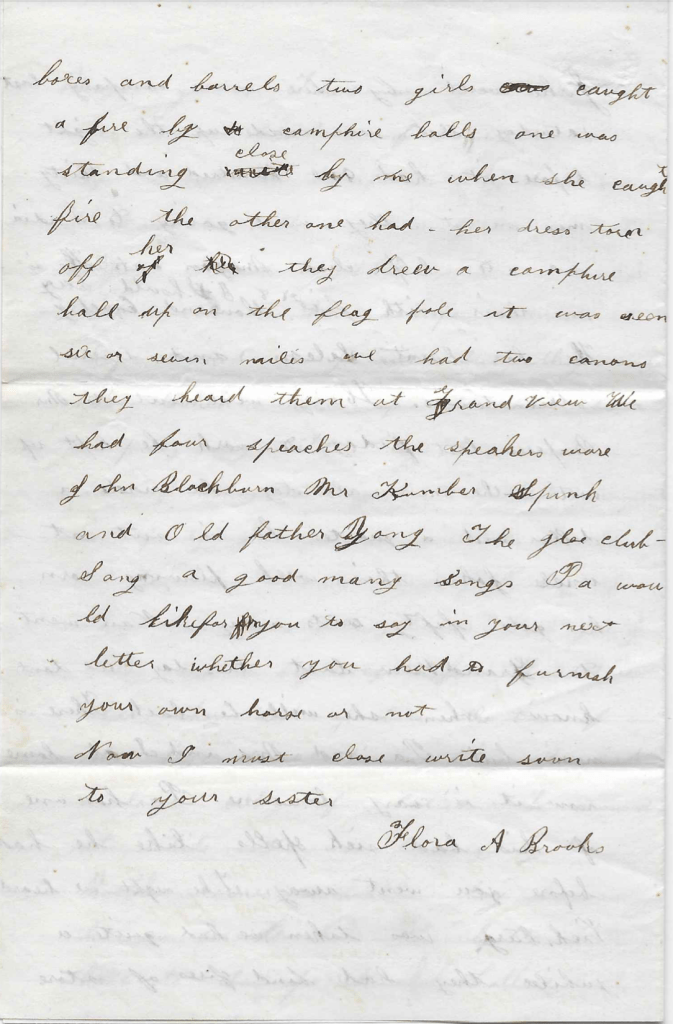
Transcription

[Illinois]
July 13th 1863
Dear Brother,
I am very sorry that I did not get to see you before you went away but we did not get the letter until late in the evening. Then it was too late to come home that day. Tilla Beaver and I were out to Mr. Elliott’s last Friday. We had a nice time. Charlie and Ellie were here the Fourth of July. It was said the Union Party had twice as many as the butternuts. They had their picnic in Conley’s Grove and the Union Party had their in Mr. Mayo’s Grove. 1
There was some ladies came in on horseback from Stratton township dressed in uniform. They had black hats with a white feather in them, a pink waist, a blue sash, and a white skirt with a blue stripe around it. They looked very nice but they would have looked nicer if it had been a pretty day. There was a girl asked me if they belonged to the Democratic Party. I said no indeed. Would not the butternuts have felt big if they had have belonged to their party. They had a big wagon from Grandview 2 that they had up here the time of the big Democratic meeting. It had a large crib of lattice work around it. While it was passing by the Booth’s corner, 3 a little boy hallowed, “Hurrah for Lincoln!” The butternuts have to be pissed.
Bob Collom and Jake went by here in a company last Saturday that was made up the night before. It had one hundred and thirty men in it. They were going to Indiana to help clean Morgan out. He is in there with five—or eight I should say—thousand cavalry. He has burnt Salem and several other towns.
Henry went out to Mr. Mapeses last Friday to work. He kept up with the men all day. He made a dollar and a quarter. He is out at Uncle John’s this week plowing corn. He gets fifty cents a day. Nan went to Grandview last Tuesday. We don’t know when she will be back. There is none but Pa and Ma and I at home now. It is very lonesome. Pa has one of his bad sick spells like he had before you went away.
The night we heard Vicksburg was taken we had quite a jubilee. They had bonfires of store boxes and barrels. Two girls caught a fire by camp fire balls. One was standing close by me when she caught fire. The other one had her dress torn off her. They drew a camp fire ball up on the flag pole. It was seen six or seven miles. We had two cannons. They heard them at Grandview. We had four speeches. The speakers were John Blackburn, 4 Mr. Kimber, [Solomon] Spink, and Old Father Young. The glee club sang a good many songs.
Pa would like for you to say in your next letter whether you had to furnish your own horse or not. Now I must close. Write soon to your sister, — Flora A. Brooks
1 “Mayo’s Grove” was probably the wooded block of ground between East Court and East Wood streets that Colonel May donated to the city. A school house was later built there.
2 Grandview is a small community some eight miles southwest of Paris, Illinois.
3 Walter Booth (1823-1881) kept a dry goods store in downtown Paris. He was a prominent citizen of the town, reelected to the town council many times and twice elected mayor.
4 John Widener Blackburn (1825-1894) was a lawyer in Paris, Edgar county, Illinois. He is mentioned in this letter to Abraham Lincoln.

 Spared & Shared 23