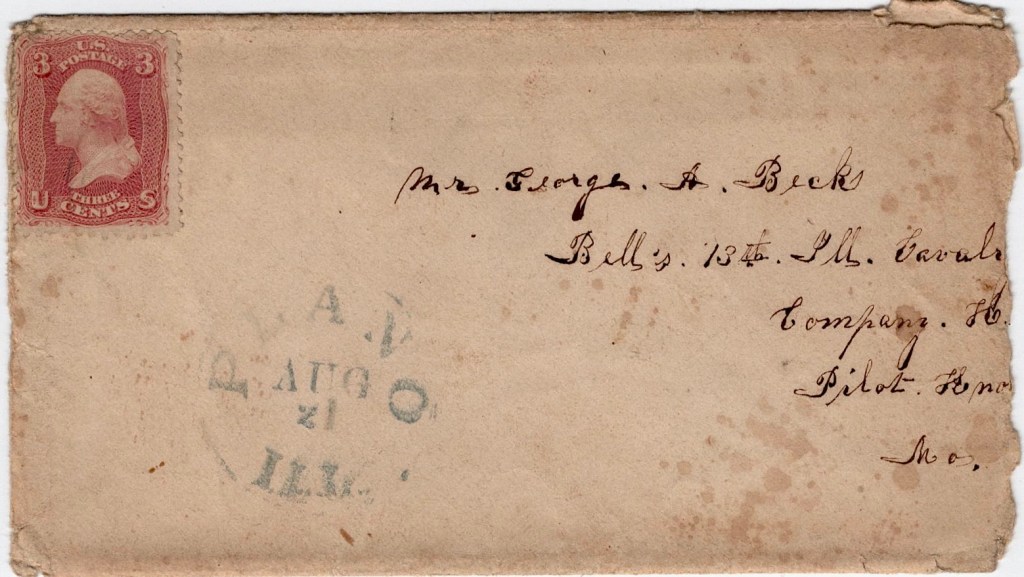
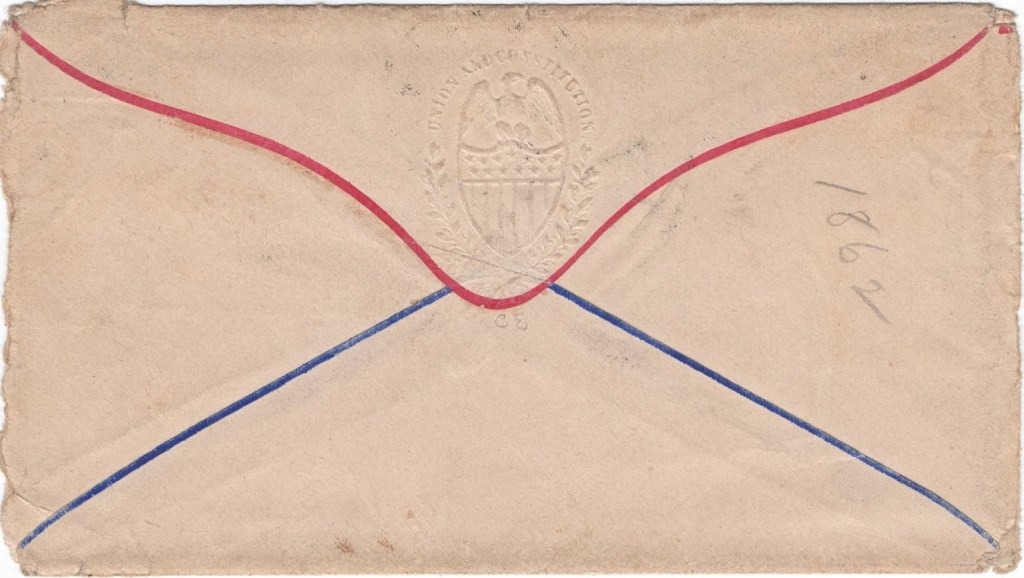
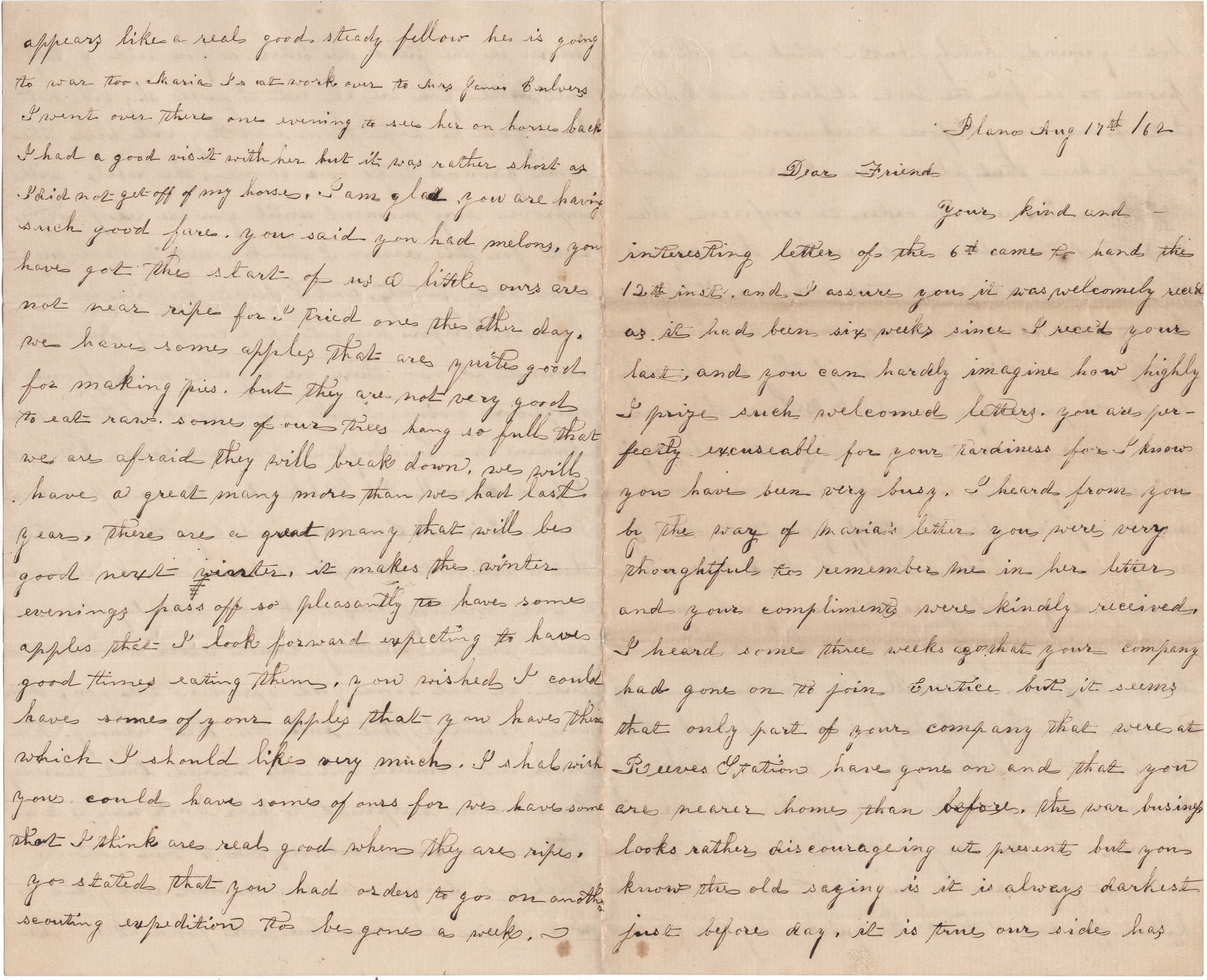
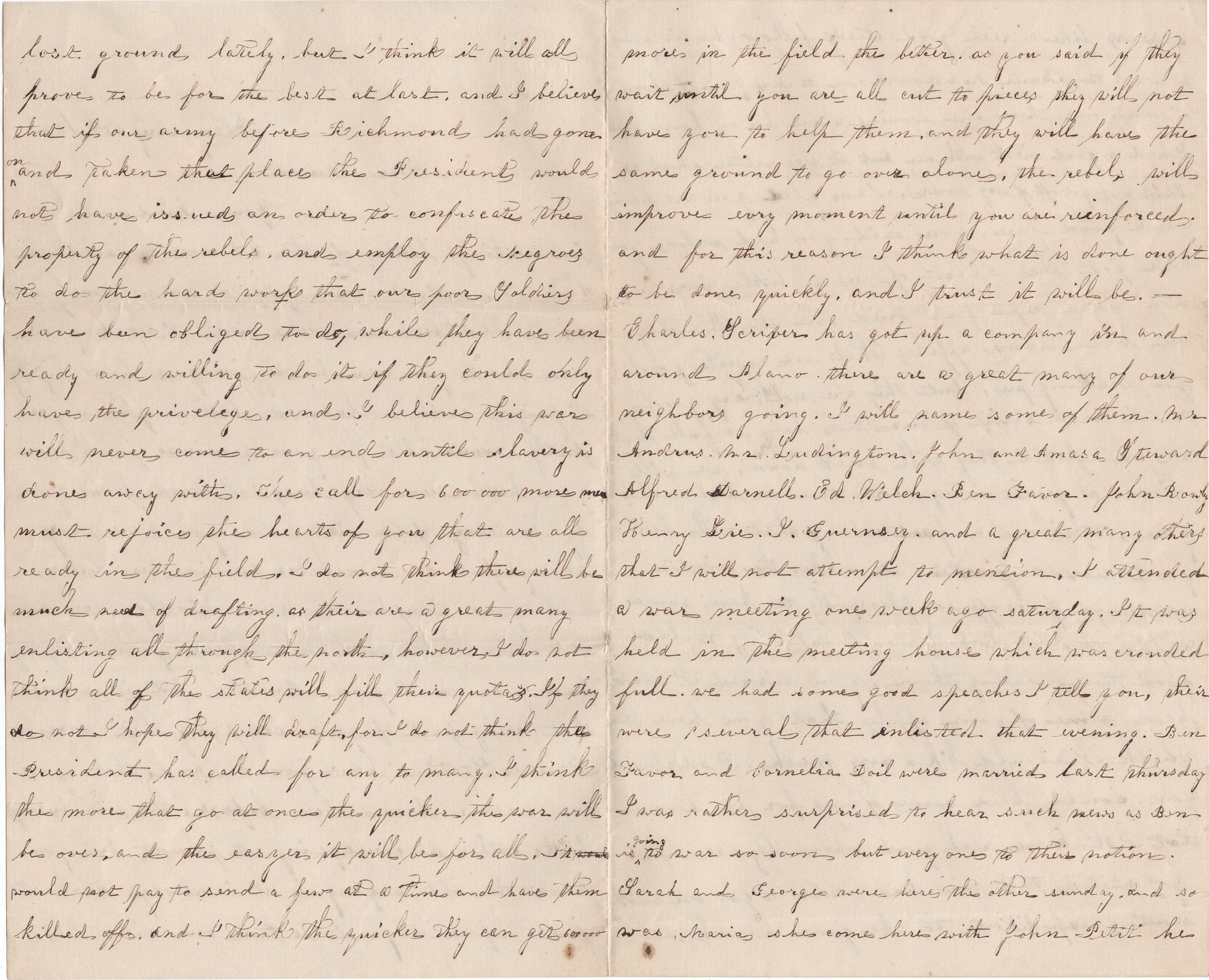
This unsigned letter was clearly written by a female from Plano, Illinois, who signed herself as a “friend” to George Anthony Beck (1838-1889), then serving in Co. H, 13th Illinois Cavalry, and encamped near Pilot Knob, Missouri. George’s father, Benjamin J. Beck, died on 20 August 1862 at the age of 48. With two of his younger brothers serving in the Civil War at the time, George may have wanted to return home after his father’s death and it’s noted that George was somehow able to be discharged on 31 August, 1862.
Since this is the only letter written by this woman, I can’t compare her handwriting to other correspondence of known origin but my hunch is that it was written by Caroline Elizabeth Tenney (1842-1920) of Plano who became George’s wife on 31 December 1863.
The letter speaks of the President’s call for volunteers in the fall of 1862 which resulted in the raising of a regiment in and around Plano that organized and mustered into service as Co. F, 127th Illinois Infantry, commanded by Capt. Charles Schryver of Big Rock. The names of several volunteers in this company are given.
T R A N S C R I P T I O N
Plano, Illinois August 17th 1862
Dear Friend,
Your kind and interesting letter of the 6th came to hand the 21th inst. and I assure you, it was welcomely received as it had been six weeks since I received your last and you can hardly imagine how highly I prize such welcomed letters. You are perfectly excusable for your tardiness for I know you have been very busy. I heard from you by the way of Maria’s letter. You were very thoughtful to remember me in her letter and your compliments were kindly received. I heard some three weeks ago that your company had gone on to join [Gen.] Curtis but it seems that only part of your company that were at Reeves Station have gone on and that you are nearer home than before.
The war business looks rather discouraging at present but you know the old saying, it is always darkest just before day. It is true our side has lost ground lately, but I think it will all prove to be for the best at last, and I believe that if our army before Richmond had gone on and taken that place, the President would not have issued an order to confiscate the property of the rebels and employ the negroes to do the hard work that our poor soldiers have been obliged to do, while they [the negroes] have been ready and willing to do it if they could only have the privileges. And I believe this war will never come to an end until slavery is done away with.
The call for 600,000 more men must rejoice the hearts of you that are already in the field. I do not think there will be much need of drafting as there are a great many enlisting all through the North. However, I do not think all of the states will fill their quotas. If they do not, I hope they will draft for I do not think the President has called for any too many. I think the more that go at once, the quicker this war will be over and the easier it will be for all. It would not pay to send a few at a time and have them killed off. And I think the quicker they can get 600,000 more in the field, the better. As you said, if they wait until you are all cut to pieces, they will not have you to help them and they will have the same ground to go over alone. The rebels will improve every moment until you are reinforced and for this reason I think what is done ought to be done quickly. And I trust it will be.
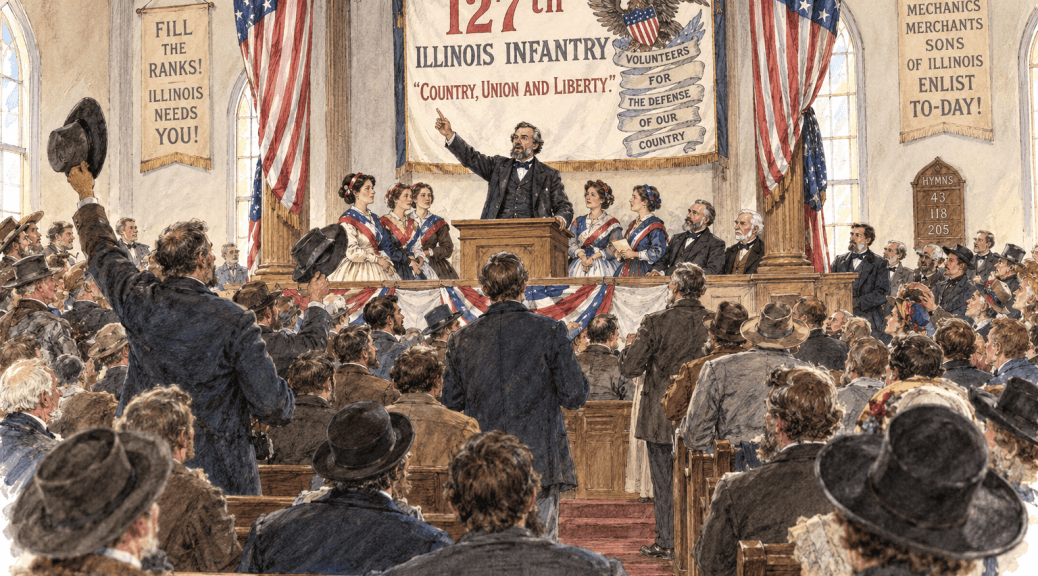
Charles Scriber [Schryver] has got up a company [Co. F, 127th Illinois Infantry] in and around Plano. There are a great many of our neighbors going. I will name some of them. Mr. Andrews, Mr. Ludington, John and Amasa Steward [Stuart], Alfred Darnell, Ed[ward] Welch, Ben[jamin K.] Favor, John Rowley, Henry Gies, I[chabod] Gurney, and a great many others that I will not attempt to mention. I attended a war meeting one week ago Saturday. It was held in the meeting house which was crowded full. We had some good speeches, I tell you. There were several that enlisted that evening. Ben[jamin Kimball] Favor and Cornelia Doil [Doyle] were married last Thursday [14 August 1862]. I was rather surprised to hear such news as Ben is going to war so soon but everyone to their notions.
Sarah and George were here the other Sunday and so was Maria. She comes here with John Petit. He appears a real good, steady fellow. He is going to war too. Maria is at work over to Mrs. James Culver’s. I went over there one evening to see her on horse back. I had a good visit with her but it was rather short as I did not get off my horse.
I am glad you are having such good fare. You said you had melons. You have got the start of us a little. Ours are not near ripe for I tried one the other day. We have some apples that are quite good for making pies but they are not very good to eat raw. Some of our trees hang so full that we are afraid they will break down. We will have a great many more than we had last year. There are a great many that will be good next winter. It makes this winter evenings pass off so pleasantly to have some apples that I look forward expecting to have good times eating them.
You wished I could have some of your apples that you have there which I should like very much. I shall wish you could have some of ours for we have some that I think are real good when they are ripe. You stated that you had orders to go on another scouting expedition to be gone a week…[rest of letter is missing]
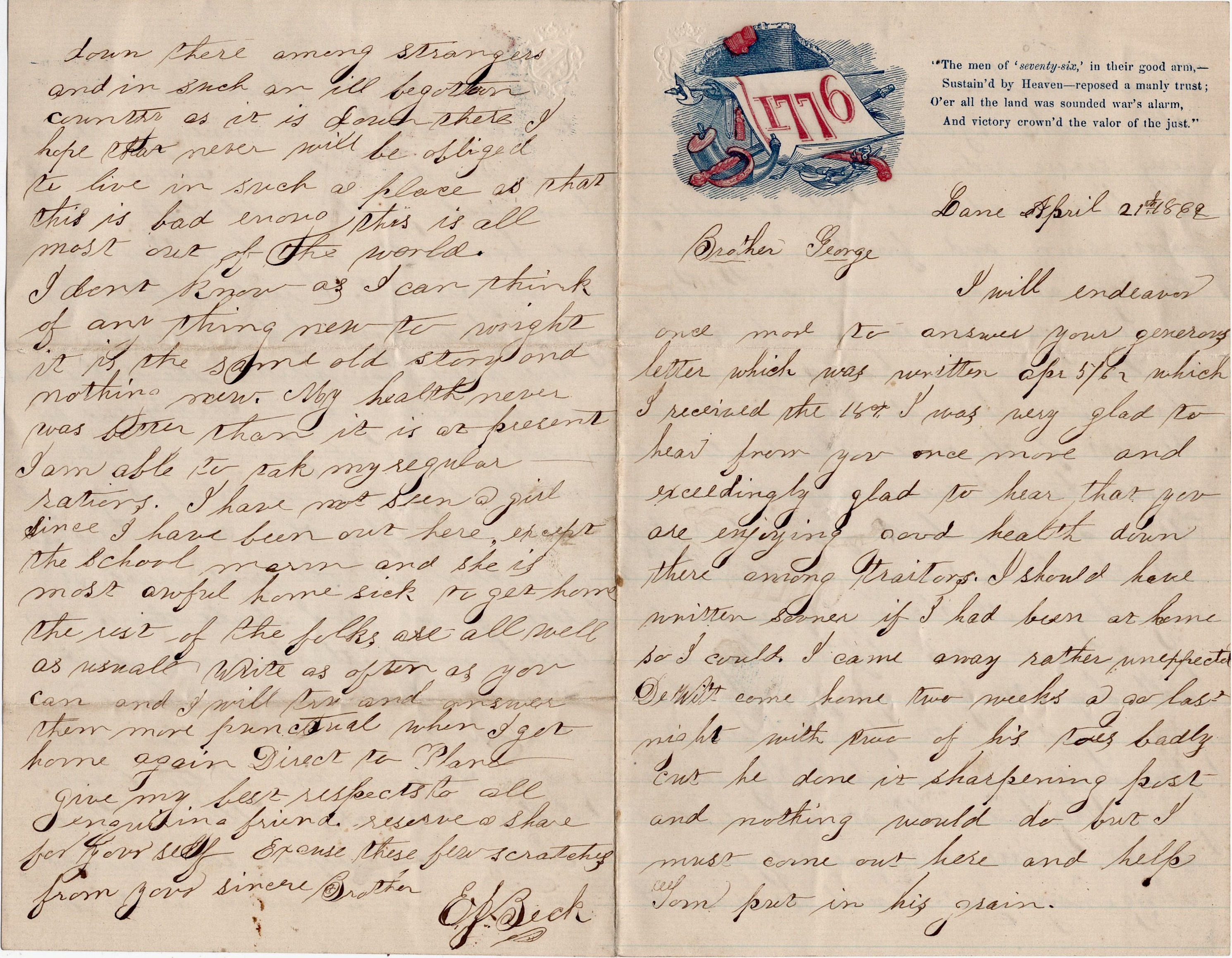
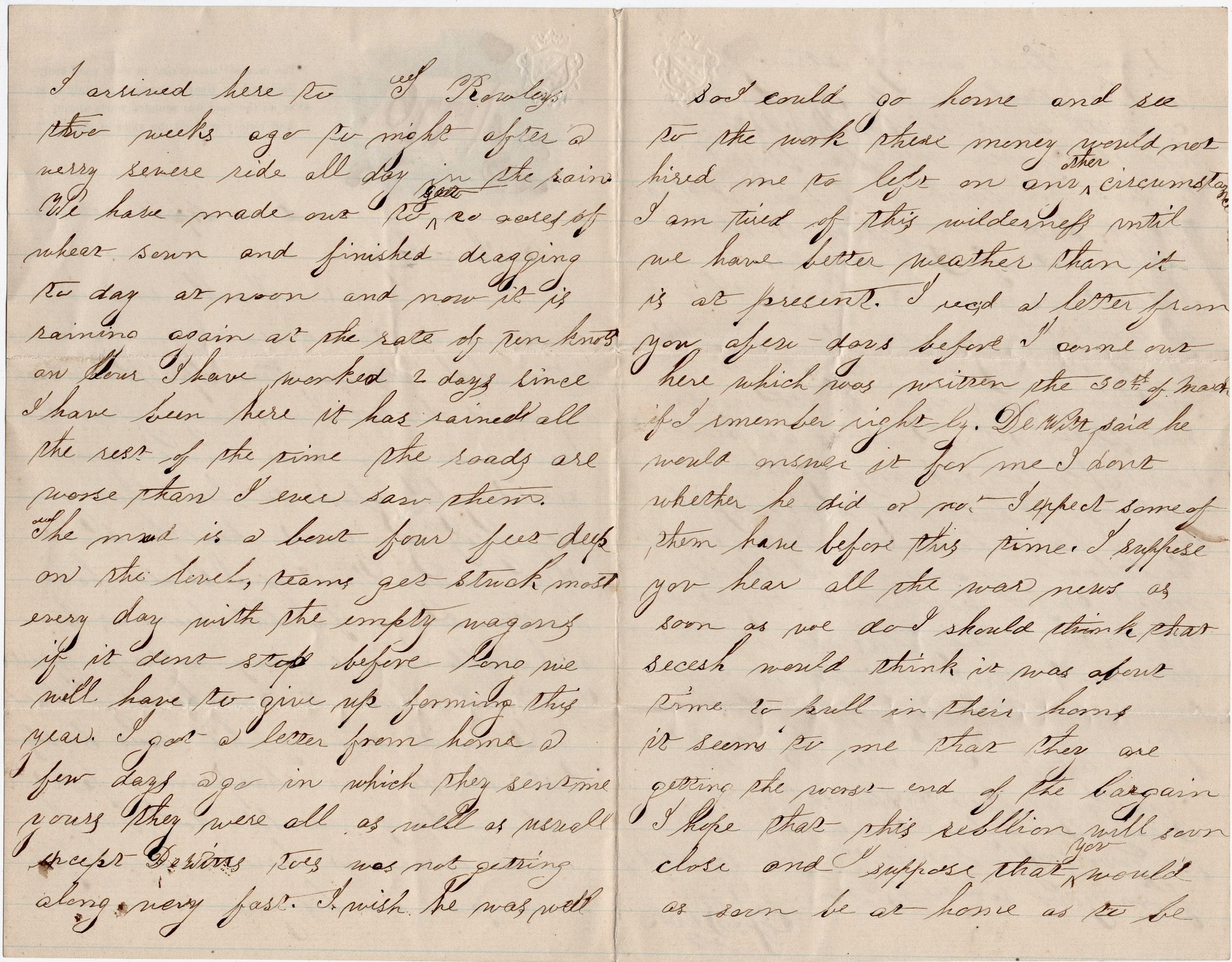
The following letter was written by Joel E. Beck (b. 1842), the son of Benjamin J. Beck (1814-1862) and Mary Ann Walrath (1814-1881) of Plano, Kendall county, Illinois. He wrote the letter to his older brother, Sgt. George Anthony Beck (1838-1889) who was serving at the time in Co. H, 13th Illinois Cavalry, having enlisted on 31 December 1861. He mentions his brother DeWitt Clinton Beck (1840-1898) a couple of times in the letter.
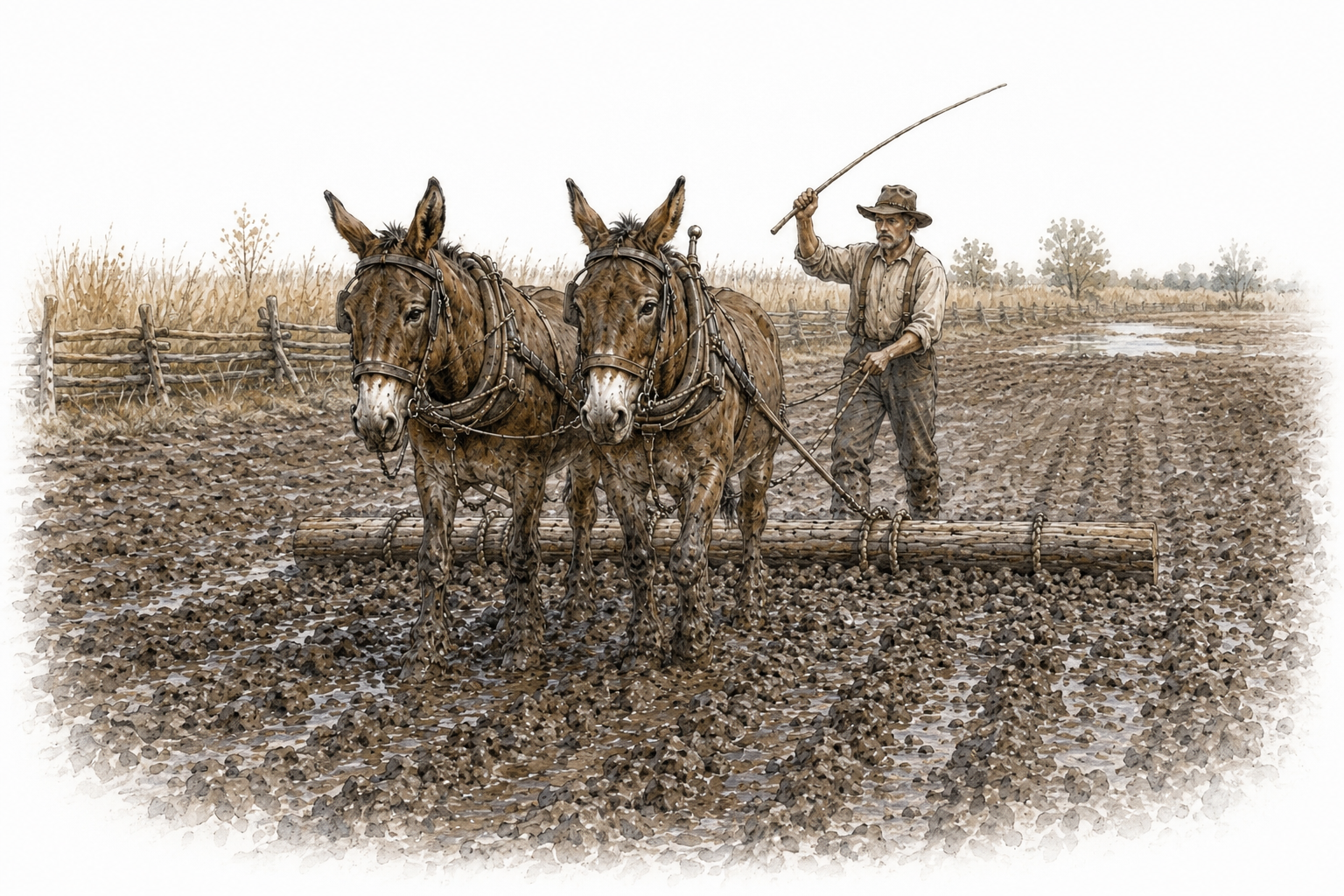
Joel’s letter reveals that he was assisting someone named Thomas, likely his brother-in-law, with wheat farming on his land. The letter is dated from Lane, but the state isn’t specified. It is believed to refer to Lane in DeWitt County, Illinois, located about halfway between Springfield and Champaign, nearly 150 miles from Plano. This region, known as the Grand Prairie, features vast areas of deep-rooted prairie grasses in a rolling landscape with wetlands. Due to its poor drainage, many early settlers avoided it, deeming it too swampy and unhealthy. Farming there would have been quite muddy in springtime, earning it the labels of “wilderness” or “ill begotten country.”
“We have made out to get 20 acres of wheat sown and finished dragging today at noon and now it is raining again at the rate of ten knots an hour….If it don’t stop before long, we will have to give up farming this year.”
T R A N S C R I P T I O N
Lane April 21st 1862
Brother George,
I will endeavor once more to answer your generous letter which was written April 5th, 1862 which I received the 18th. I was very glad to hear from you once more and exceedingly glad to hear that you are enjoying good health down there among traitors. I should have written soon if I had been at home so I could. I came away rather unexpectedly. DeWitt came home two weeks ago last night with two of his toes badly cut. He done it sharpening posts and nothing would do but I must come out here and help Tom put in his grain.
I arrived here to T. Prowley’s two weeks ago tonight after a very severe ride all day in the rain. We have made out to get 20 acres of wheat sown and finished dragging today 1 at noon and now it is raining again at the rate of ten knots an hour. I have worked two days since I have been here. It has rained all the rest of the time. The roads are worse than I ever saw them. The mud is about four feet deep on the level. Teams get stuck most every day with the empty wagons. If it don’t stop before long, we will have to give up farming this year.
I got a letter from home a few days ago in which they sent me yours. They were all as well as usual except DeWitt’s toes was not getting along very fast. I wish he was well so I could go home and see to the work there. Money would not have hired me to left on any other circumstances. I am tired of this wilderness until we have better weather than it is at present.
I received a letter from you a few days before I came out here which was written the 30th of March if I remember rightly. DeWitt said he would answer it for me. I don’t [know] whether he did or not. I expect some of them have before this time. I suppose you hear all the war news as soon as we do. I should think that secesh would think it was about time to pull in their horns. It seems to me that they are getting the worst end of the bargain. I hope that this rebellion will soon close and suppose that you would as soon be at home as to be down there among strangers and in such an ill begotten country as it is down there. I hope we never will be obliged to live in such a place as that. This is bad enough. This is almost out of the world.
I don’t know as I can think of anything new to write. It is the same old story and nothing new. My health never was better than it is at present. I am able to take my regular rations. I have not seen a girl since I have been out here except the school marm and she is most awful homesick to get home. the rest of the folks are all well as usual. Write as often as you can and I will try and answer them most punctual when I get home again. Directto Plano. Give my best respects to all enquiring friends. Reserve a share for yourself. Excuse these scratches. from your brother, — E. J. Beck
1 Dragging the field after sowing crops was required to cover the seed and was accomplished typically with a harrow but in resource-constrained locations, farmers may have used repurposed items like heavy wooden logs or chains. It must have been extremely difficult to accomplish this in muddy fields.
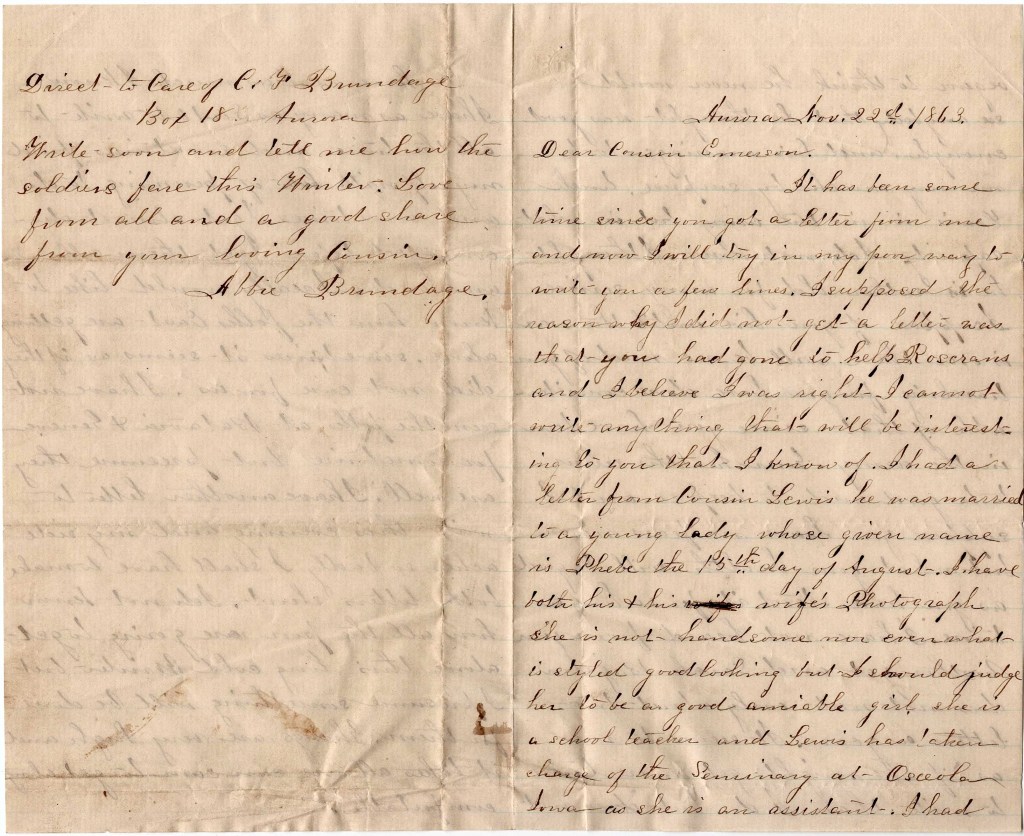
The following Aurora, Illinois home front letter was written by 19 year-old Abbie Rosalie (Hall) Brundage (1844-1926), the wife of Charles F. Brundage (1842-1903). The couple were newly married and had no children. County records indicate they were united in marriage on 13 April 1863 in Kane county, Illinois. Abbie was born in Worcester, Massachusetts, the daughter of John Sidney Hall (1818-1901) and Abigail Hasting (1818-1923) who also resided in Aurora, Illinois, where her father was employed as a carpenter/carriage maker. Abbie’s husband had served in Co. I, 11th Illinois Infantry early in the war as a 3-month volunteer.
Abbie wrote the letter to her cousin, John “Emerson” Anderson (1833-1896), the son of John May and Parney (Hastings) Anderson of Oakdale, Worcester county, Massachusetts. Emerson enlisted on 25 May 1861 as a private in Co. D, 2nd Massachusetts Infantry. He was taken prisoner on 24 May 1862 during the battle of Winchester but was paroled in June 1862 and promoted to sergeant, mustering out of the regiment in mid-July 1865. The 2nd Mass Vols. participated in the battles of Cedar Mountain, Antietam, Chancellorsville, Gettysburg, Resaca, Kennesaw Mountain, Siege of Atlanta, March to the Sea, Savannah, and others.
The letter was penned just three days after President Lincoln delivered his Gettysburg Address.
T R A N S C R I P T I O N
Aurora [Kane county, Illinois] November 22d 1863
It has been some time since you got a letter from me and now I will try in my poor way to write you a few lines. I supposed the reason why I did not get a letter was that you had gone to help Rosecrans and I believe I was right. I cannot write anything that will be interesting to you that I know of.
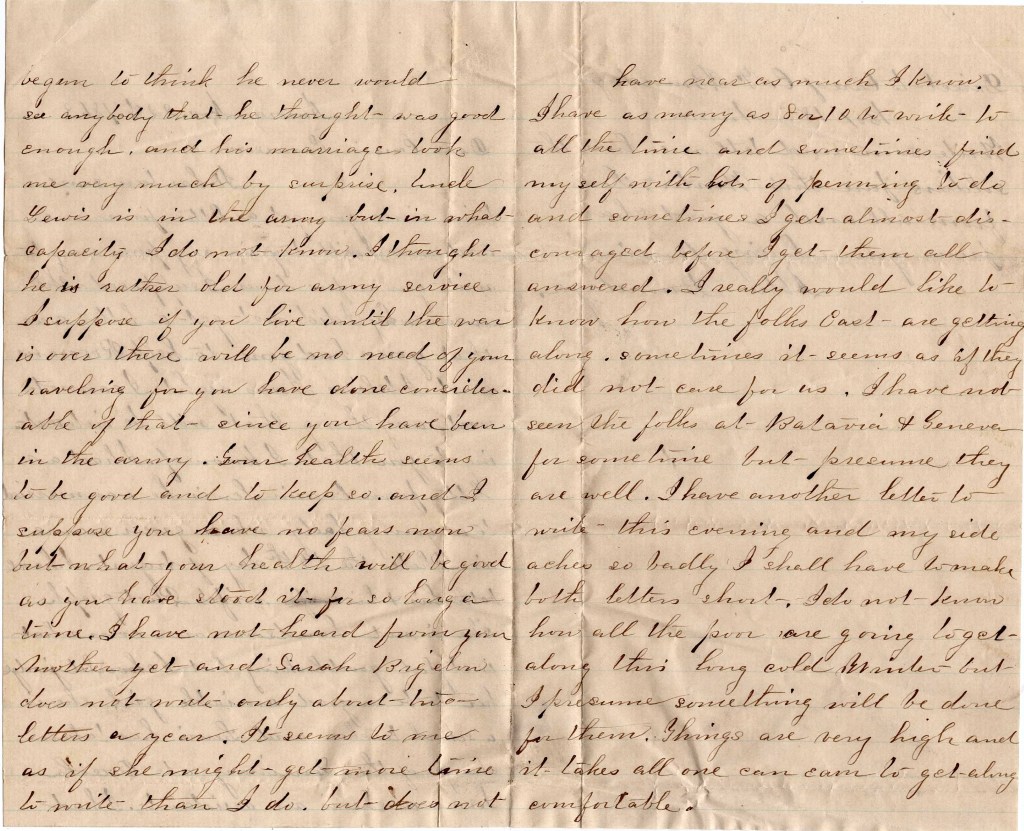
I had a letter from cousin Lewis [Marble Hastings]. 1 He was married to a young lady whose given name is Phebe [Arnold] the 15th day of August. I have both his and his wife’s photograph. She is not handsome nor even what is styled good-looking, but I should judge her to be a good amiable girl. She is a school teacher and Lewis has taken charge of the Seminary at Osceola, Iowa, and she is an assistant. I had begun to think he never would see anybody that he thought was good enough, and his marriage took me very much by surprise. Uncle Lewis 2 is in the army but in what capacity, I do not know. I thought he is rather old for army service.
I suppose if you live until the war is over, there will be no need of your traveling for you have done considerable of that since you have been in the army. Your health seems to be good and to keep so, and I suppose you have no fears now but what your health will be good as you have stood it for so long a time.
I have not heard from your mother yet and Sarah Bigelow does not write—only about two letters a year. It seems to me as if she might get more time to write than I do but does not have near as much I know. I have as many as 8 or 10 to write to all the time and sometimes find myself with lots of penning to do and sometimes I get almost discouraged before I get them all answered. I really would like to know how the folks East are getting along. Sometimes it seems as if they did not care for us. I have not seen the folks at Batavia & Geneva [Illinois] for some time but presume they are well.
I have another letter to write this evening and my side aches so badly I shall have to make both letters short. I do not know how all the poor are going to get along this long cold winter but I presume something will be done for them. Things are very high and it takes all one can earn to get along comfortable.
Direct to Care of C. F. Brundage, Box 18, Aurora
Write soon and tell me how the soldiers fare this winter. Love from all and a good share from your loving cousin, — Abbie Brundage
1 Lewis Marble Hastings, Jr. was born 18 April 1837 at West Boyleston, Mass. He came to Iowa in 1858 where he began public school teaching. In 1863 he was married to Phoebe Arnold of Garden Grove, Decatur county, Iowa. He was a pioneer in the development of the public school system of Iowa. In 1864 he organized the public schools of the city of Otumwa, which were previoulsly ungraded. He remained there until 1873 when he became President of the Iowa State Teacher’s Association. From 1873 to 1882 he was engaged in public schools in Illinois (West Aurora). He then returned to Iowa in 1882, moving to Iowa City in 1888.
2Lewis Marble Hastings, Sr, (1813-1901) of Decatur county, Iowa. He was married to Margaret Green (1811-1878). During the Civil War, Lewis served in Co. C, 9th Iowa Cavalry but was discharged with injury in 1865.
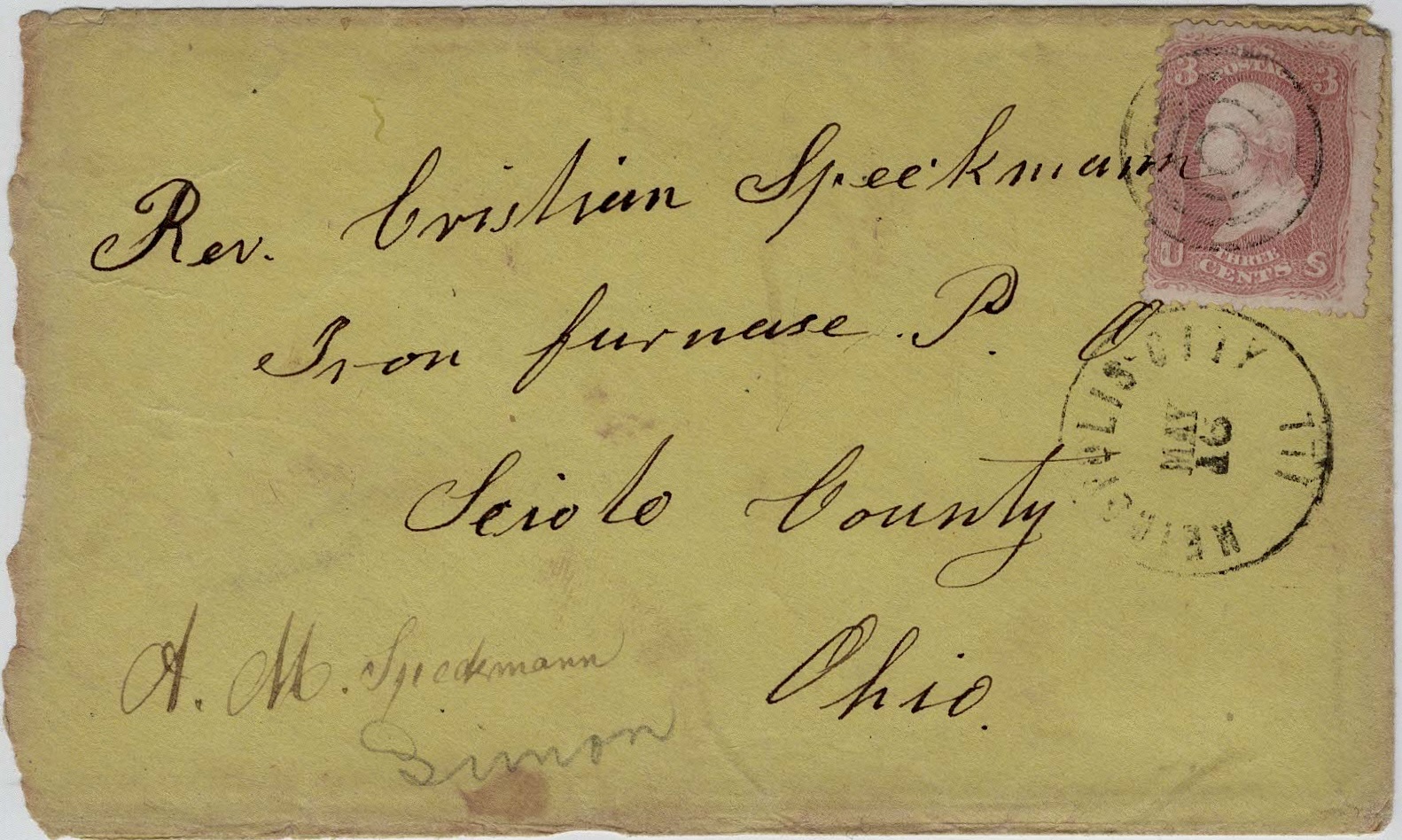
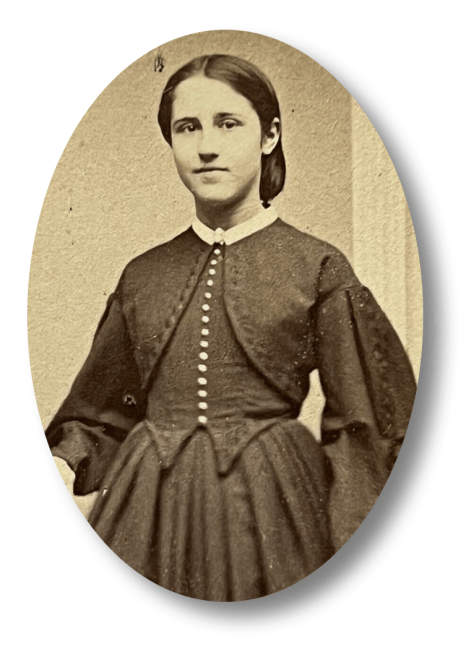
The following letter was written by 25 year-old Catharine Wilhelmina (Speckmann) Bramkamp (1840-1928), the wife of 36 year-old German-emigrant William H. Bramkamp (1828-1900) of Massac county, Illinois. According to a Speckman family tree, William’s full name was Heinrich Friedrich Wilhelm Bramkamp. Catharine wrote the letter to her brother, Rev. John August Christian Speckmann (1837-1914) of Iron Furnace, Scioto county, Ohio, who was married to Amelia Miller Speckmann in 1858. Catharine mentions one of her children in the letter, Charles Conrad Bramkamp who was born on 20 August 1864.
Massac county, Illinois, borders the Ohio River just opposite Paducah, Kentucky. The town of Bramkamp, Germany, where William was born is located in the region of Lower Saxony approximately 55 miles south of the industrial center Bremen.
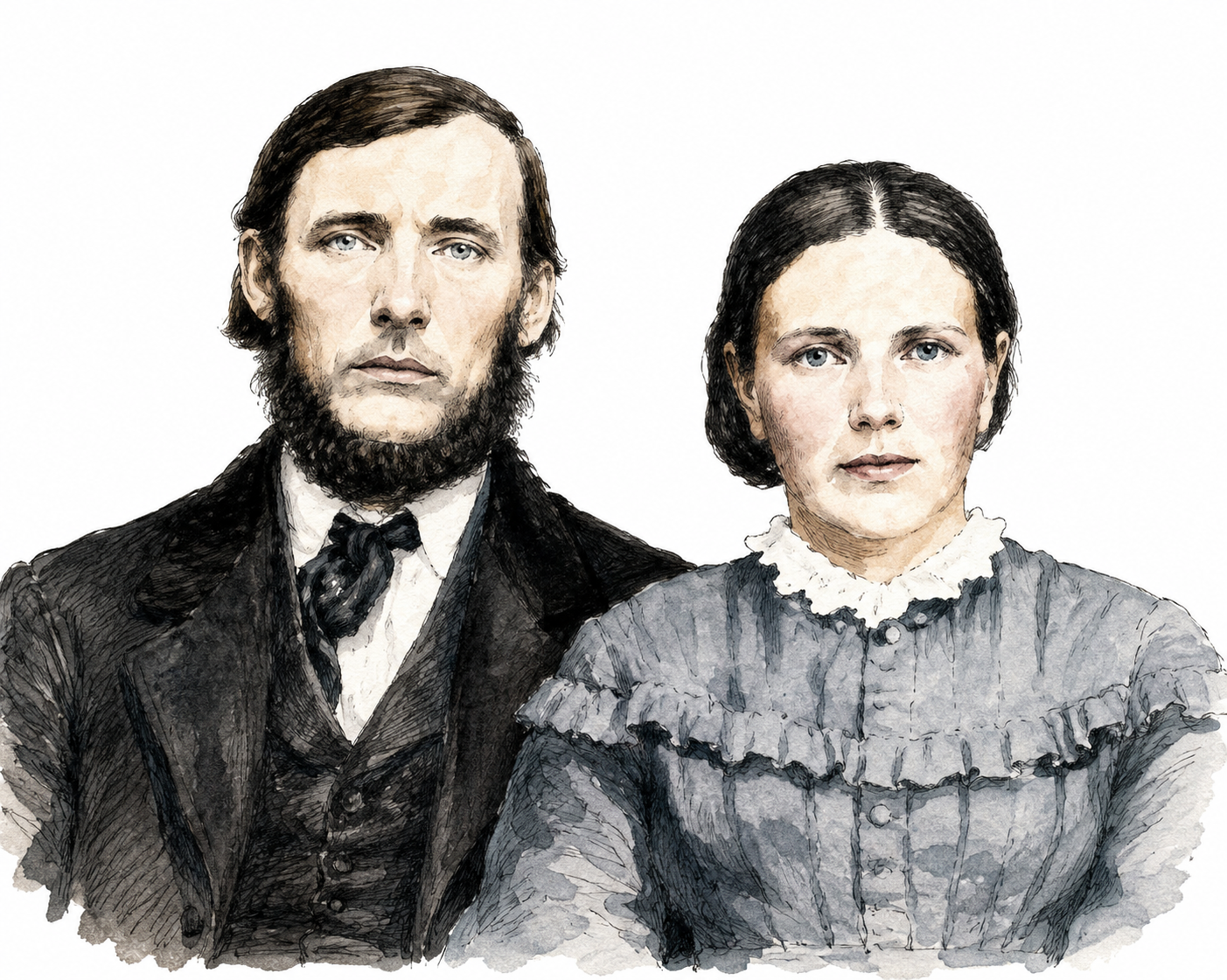
Heinrich Friedrich Wilhelm Bramkamp and his wife, Catharine Wilhelmina Speckmann of Massac county, Illinois. Watercolor based on tiny thumbnail images of them on Ancestry.com
[Editor’s Note: The first draft of this transcript was kindly prepared by Abbey Weber Jones.]
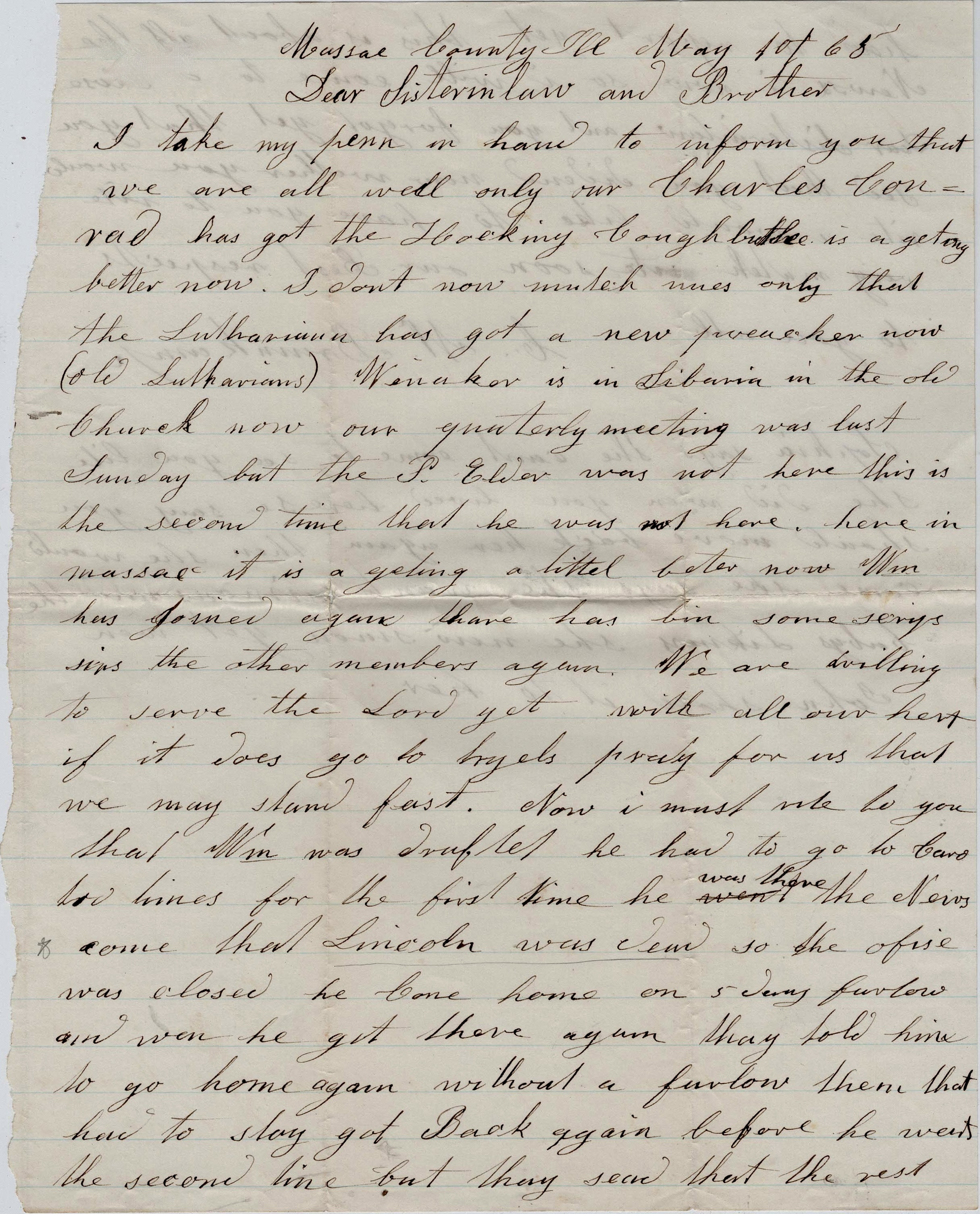
T R A N S C R I P T I O N
Massac County, Illinois May 10th [18]65
Dear Sister-in-law and Brother,
I take my pen in hand to inform you that we are all well, only our Charles Conrad has got the hacking cough. But he is getting better now. I don’t know much news—only that the Lutherans has got a new preacher now (Old Lutherans). Winaker is in Liberia in the Old Church now. Our quarterly meeting was last Sunday but the P[residing] Elder was not here. This is the second time that he was not here.
Here in Massac, it is getting a little better now. [My husband] William has joined again. There has been some sins [among] the other members again. We are willing to serve the Lord yet with all our heart [even] if it does go to trials. Pray for us that we may stand fast.
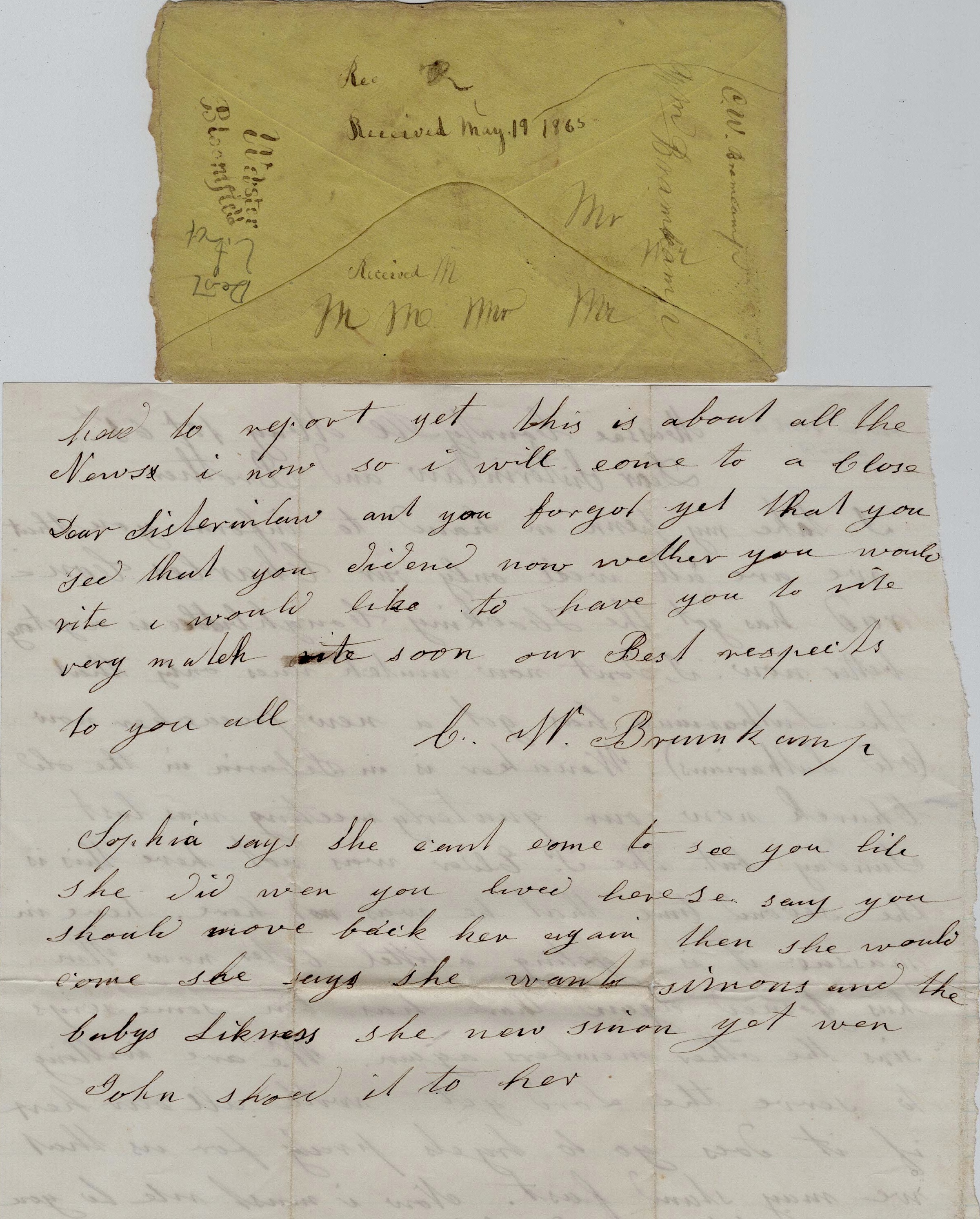
Now I must write you that William was drafted. He had to go to Cairo two times for the first time he was there, the news came that Lincoln was dead so the office was closed. He came home on 5 day furlough and when he got there again, they told him to go home again without a furlough. Them that had to stay got back again before he went the second time but they said that the rest have to report yet. This is about all the news I know, so I will come to a close.
Dear Sister-in-law—and you forgot yet that you said that you didn’t know whether you would write. I would like to have you to write very much. Write soon. Our best respects to you all, — C. W. Bramkamp
Sophia says she can’t come to see you like she did when you lived here. She says you should move back here again; then she would come. She says she wants Simons and the baby’s likeness. She knew Simon yet, when John showed it to her.
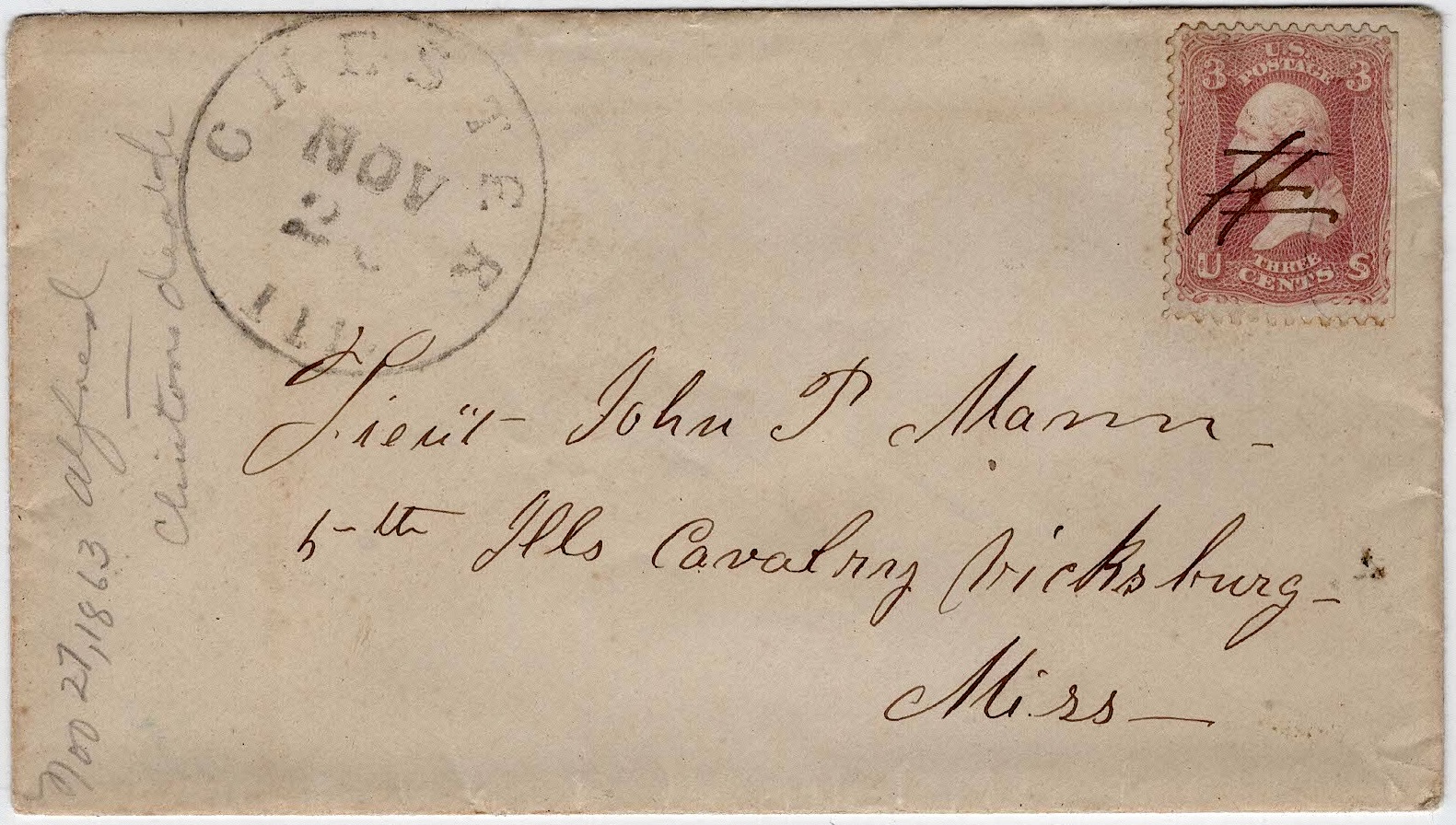
This Illinois home front letter was written by Alfred Matthews Mann (1837-1912) to his brother, John Preston Mann (1822-1908) who was serving in the 5th Illinois Cavalry. They were the sons of John Beattie Mann (1796-1881) and Albina Bloomer Balch (1797-1882) of Randolph County, Illinois. The letter was datelined from “Pleasant Ridge” near Kaskaskia on 27 November 1863.
John and Albina had five sons that volunteered to serve the Union cause in the Civil War. They were John Preston (“J. P.”) Mann (b. 1822) of the 5th Illinois Cavalry—to whom they addressed this letter, Robert “Clinton” Mann (b. 1824) who served in the 22nd Illinois Infantry and was mortally wounded in the Battle of Chickamauga, James “Luther” Mann (b. 1826) who served briefly in the 80th Illinois Infantry, Jonathan [“Jonta”] Balch Mann (b. 1828) who served in the 80th Illinois Infantry, and Calvin Anderson Mann (b. 1833) who served in the 5th Illinois Cavalry. All survived except Clinton.
When John and Albina settled in Randolph county in the late 1820s, Kaskaskia was the county seat. It remained so until the flood of 1844 forced the relocation of the county seat to Chester—a Mississippi river port about halfway between Cape Girardeau and St. Louis. During the Civil War, the citizens of Randolph county were deeply divided, many of the residents having come from and still had relatives living in Kentucky or other slave-holding states. Located in the region called “Little Egypt,” Randolph county was characterized by strong Democratic (“Copperhead”) sentiment and anti-war agitation. A sizable German population helped to turn public sentiment around in the middle of the war, as stated in this letter.
Alfred became a Presbyterian minister and later moved to Osawatomie, Kansas. He was married to Sallie Hood.
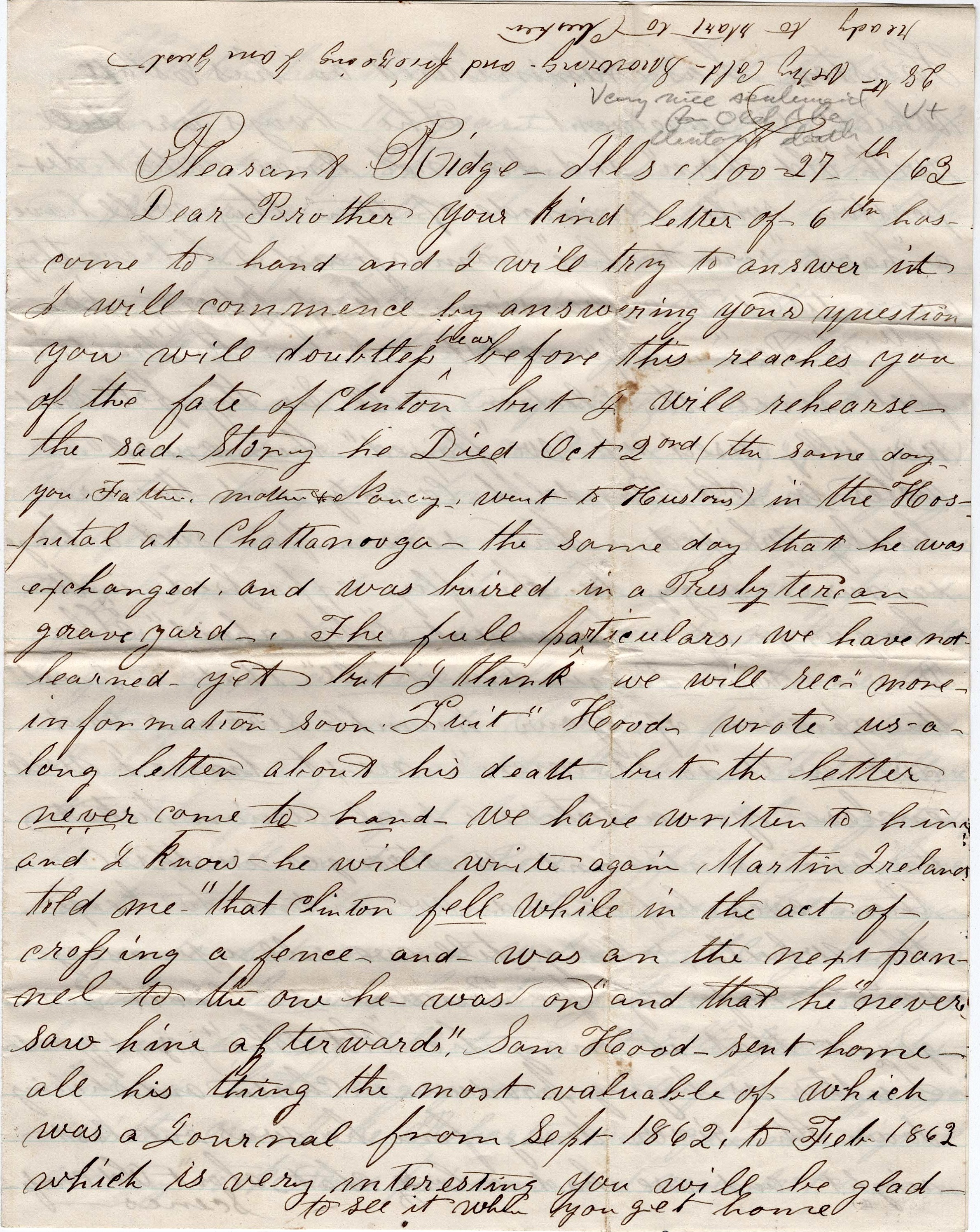
T R A N S C R I P T I O N
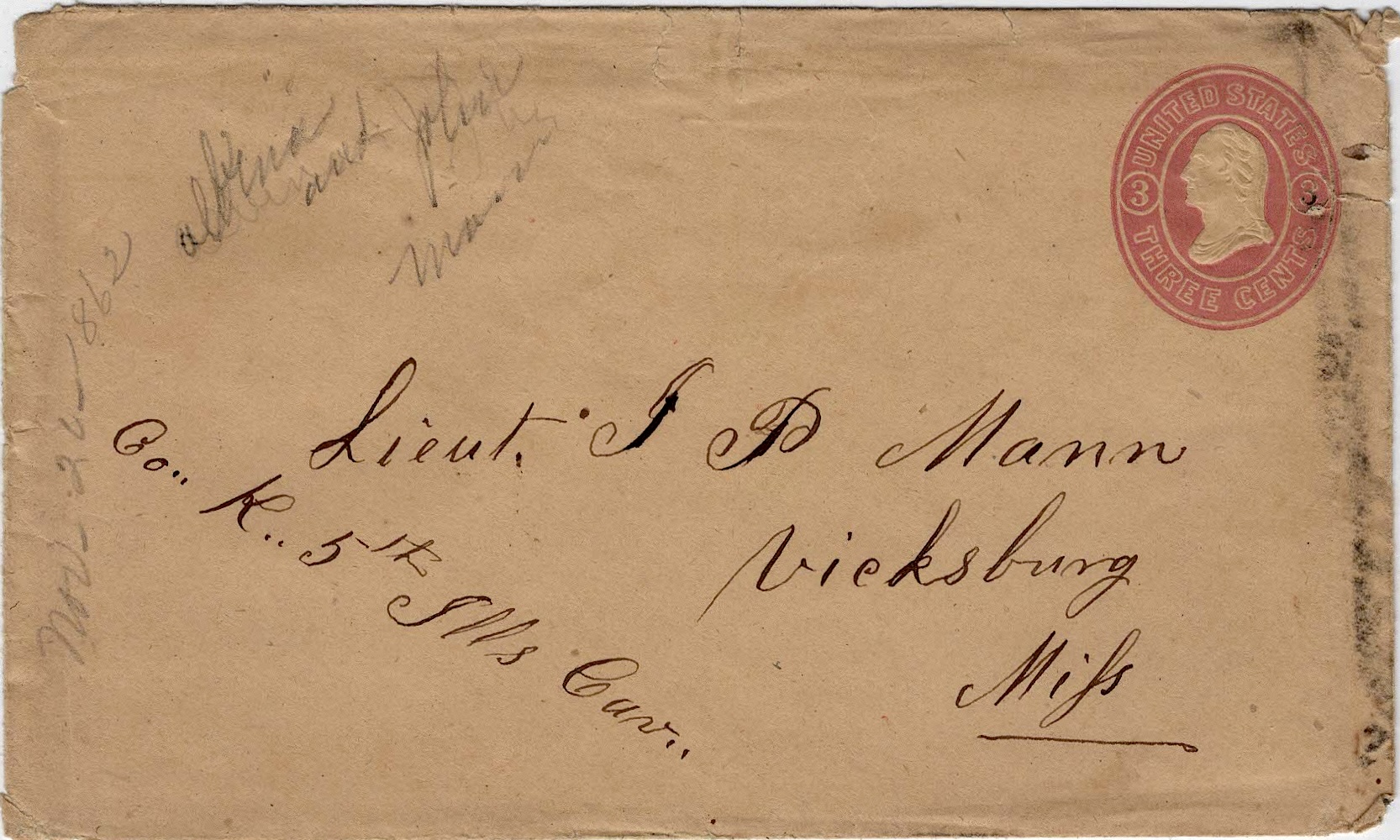
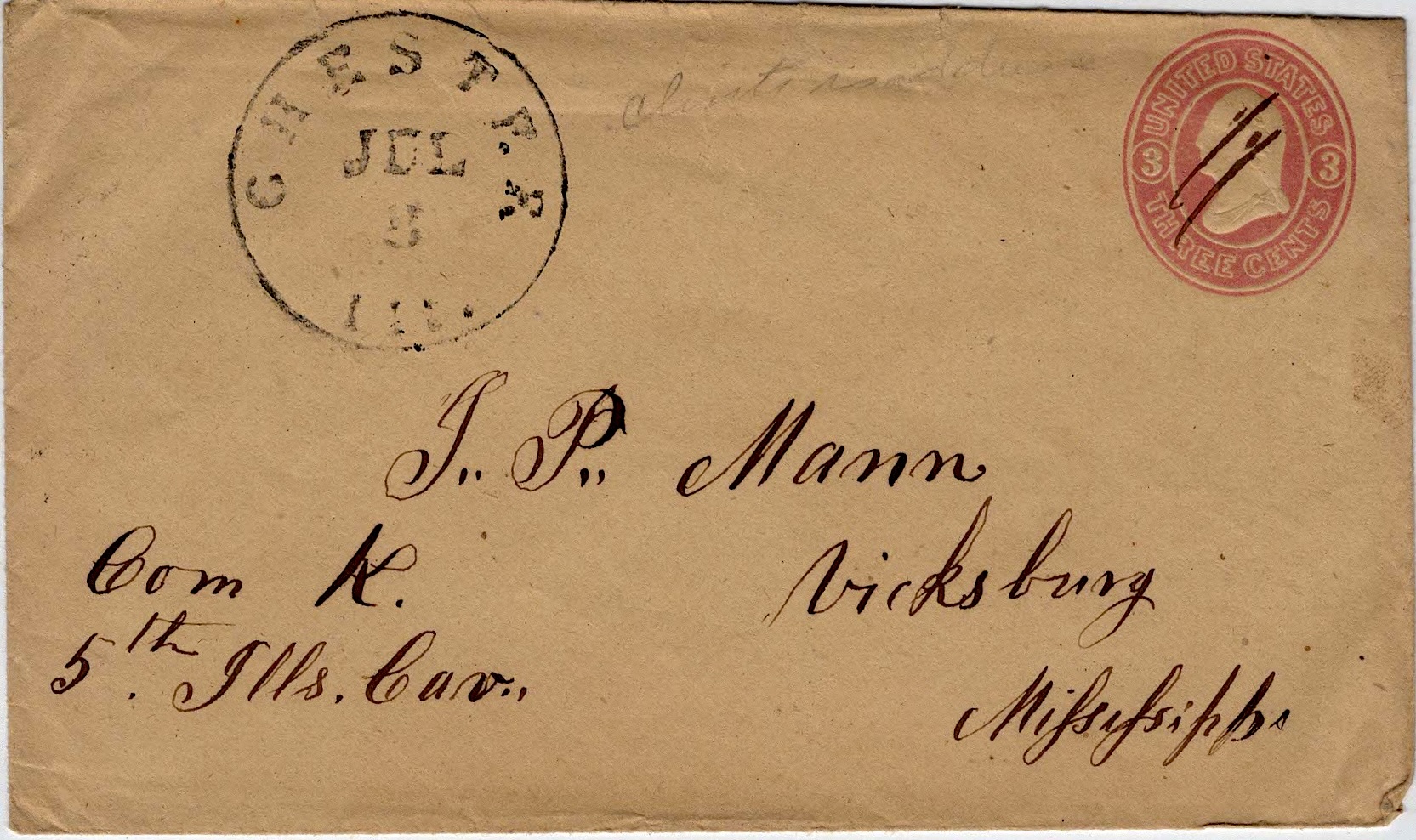
Addressed to Lieut. John P. Mann, 5th Illinois Cavalry, Vicksburg, Mississippi
Pleasant Ridge, Illinois November 27, 1863
Dear Brother,
Your kind letter of 6th has come to hand and I will try to answer it. I will commence by answering your question. You will doubtless hear before this reaches you of the fate of Clinton but I will rehearse the sad story. He died October 2nd (the same day you, Father, Mother, & Nancy went to Huston’s) in the hospital at Chattanooga—the same day that he was exchanged, and was buried in a Presbyterian graveyard. The full particulars we have not learned yet but I think we will receive more information soon. Lieutenant Hood wrote to us a long letter about his death but the letter never came to hand. We have written to him and I know he will write again. Martin Ireland told me that “Clinton fell while in the act of crossing a fence and was on the next panel to the one he was on” and that he “never saw him afterward.” Sam Hood sent home all his things, the most valuable of which was a journal from Sept. 1862 to February 1863 which is very interesting. You will be glad to see it when you get home.
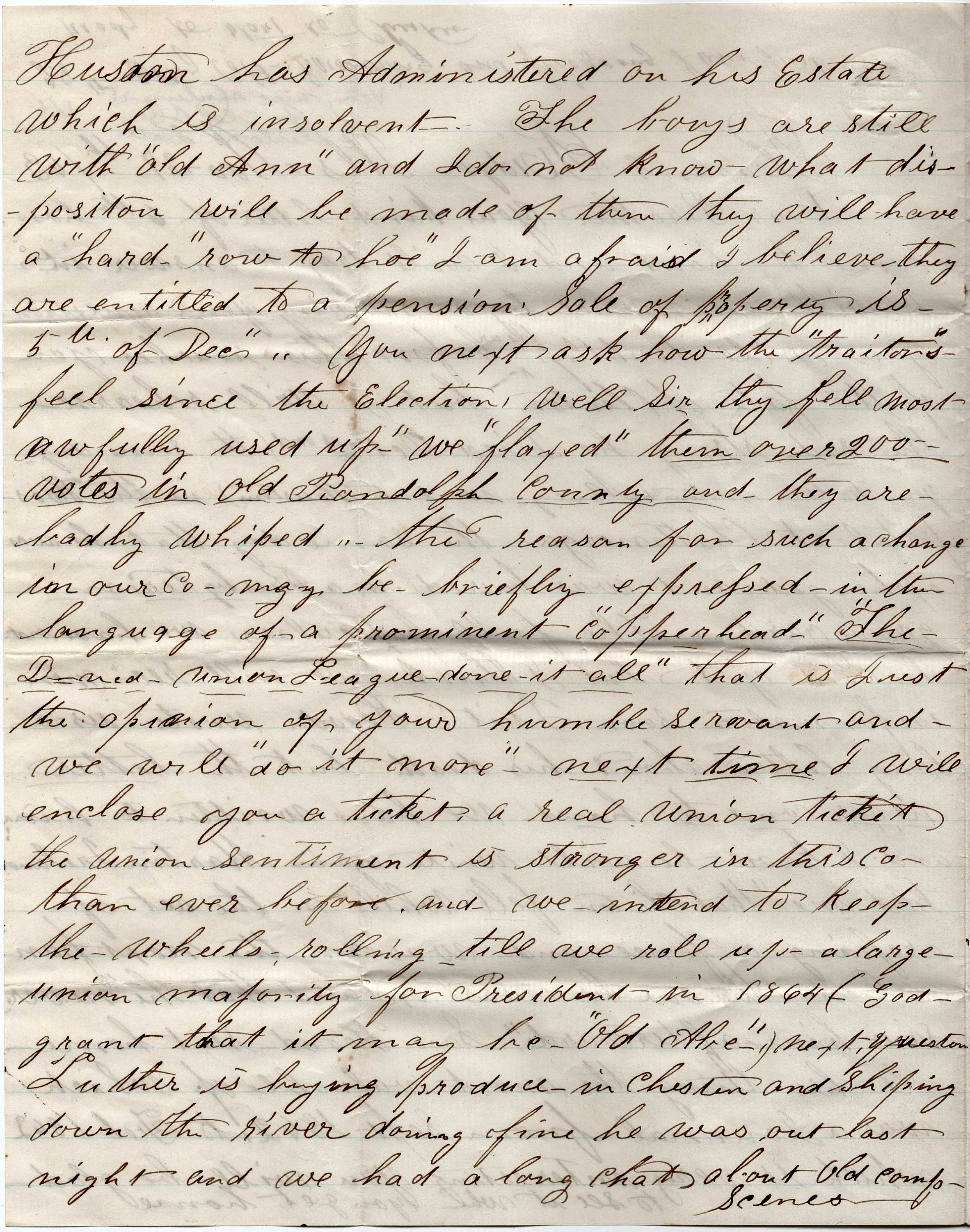
Huston has administered on his estate which is insolvent. The boys are still with “Old Ann” and I do not know what disposition will be made of them. They will have a “hard row to hoe” I am afraid. I believe they are entitled to a pension. Sale of property is 5th of December.
You next ask how the “traitors” feel since the election. Well Sir, they feel most awfully used up. We “flaxed” them over 200 votes in Old Randolph County and they are badly whipped. The reason for such a change in our county may be briefly expressed in the language of a prominent “Copperhead,”—“the damned Union League done it all.” That is just the opinion of your humble servant and we will “do it more” next time. I will enclose you a ticket—a real Union ticket. The Union sentiment is stronger in this county than ever before and we intend to keep the wheels rolling till we roll up a large Union majority for President in 1864 (God grant that it may be “Old Abe”).
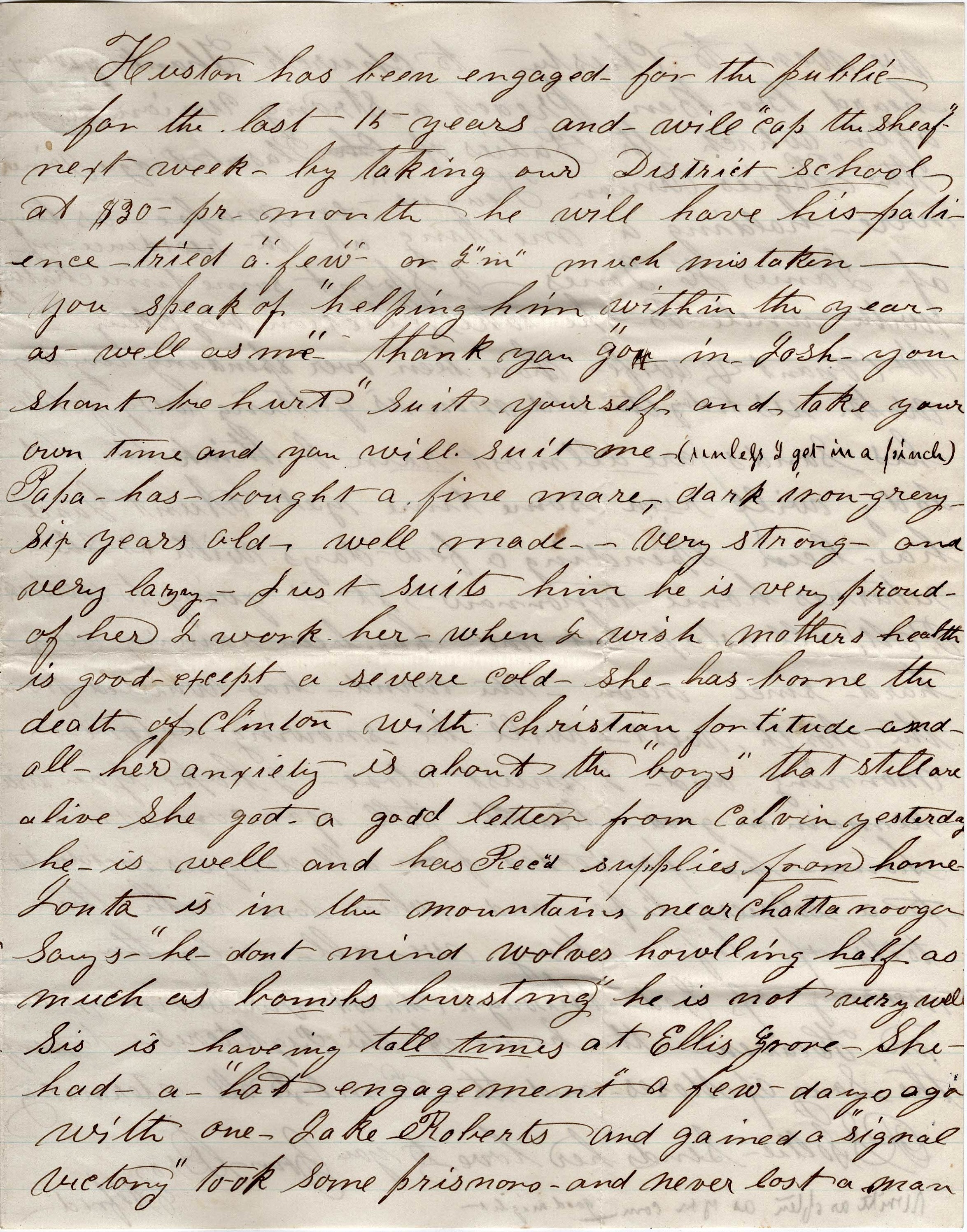
Next question. Luther is buying produce in Chester and shipping down the river—doing fine. He was out last night and we had a long chat about old camp scenes. Huston has been engaged for the public for the last 15 years and will “cap the sheaf” next week by taking our District School at $30 per month. He will have his patience tried “a few” or I’m much mistaken. You speak of “helping him within the year—as well as me.” Thank you—“Go in Josh, you shant be hurt.” Suit yourself and take your own time and youwill suit me (unless I get i a pinch).
Papa has bought a fine mare—very strong and very lazy. Just suits him. He is very proud of her. I work her when I wish. Mother’s health is good except a severe cold. She has borne the death of Clinton with Christian fortitude and all her anxiety is about the “boys” that still are alive. She got a good letter from Calvin yesterday. He is well and has received supplies from home. Jonta is in the mountains near Chattanooga. Says he “don’t mind wolves howling half as much as bombs bursting.” He is not very well. Sis is having tall times at Ellis Grove. She had a “hot engagement” a few days ago with one Jake Roberts and gained a “signal victory.” Took some prisoners and never lost a man.
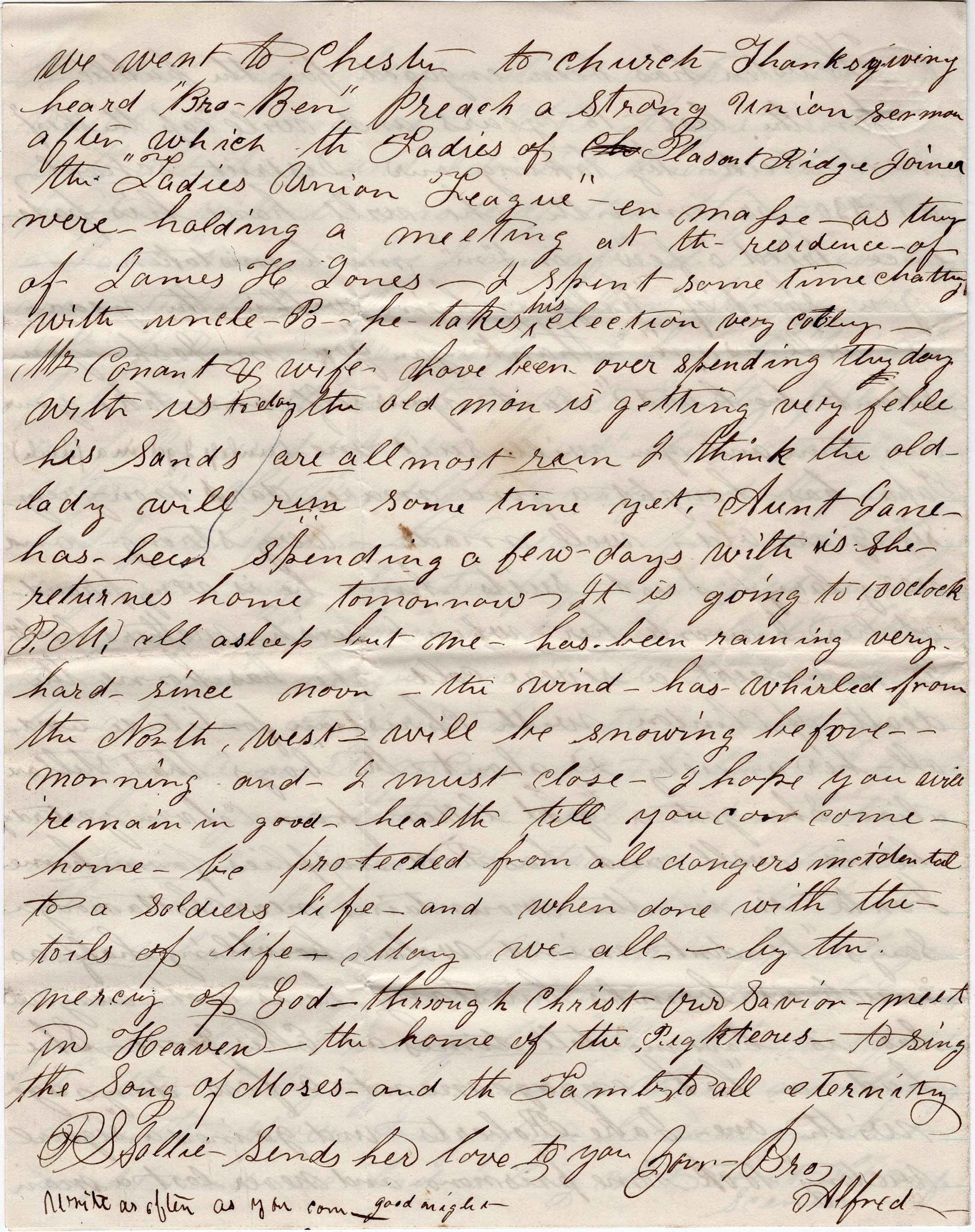
We went to Chester to church Thanksgiving. Heard “Bro-Ben” preach a strong Union sermon after which the Ladies of Pleasant Ridge joined the “Ladies Union League” en-masse as they were holding a meeting at the residence of James H. Jones. I spent some time chatting with Uncle B. He takes his election very cooley. Mr. Conant & wife have been spending the day with us today. The old man is getting very feeble. His sands are almost run, I think. The old lady will run sometime yet. Aunt Jane has been spending a few days with us. She returns home tomorrow.
It is going to 10 o’clock p.m.—all asleep but me. Has been raining very hard since noon. The wind has whirled from the northwest—will be snowing before morning and I must close. I hope you will remain in good health till you can come home—be protected from all dangers incidental to a soldier’s life. May we all, by the mercy of God, through Christ our Savior, meet in Heaven—the home of the righteous—to sing the Song of Moses and the Lamb, to all eternity.
P. P. Sallie sends her love to you. Your brother, — Alfred
The following Illinois home front letter was written by John Beattie Mann (1796-1881) and Albina Bloomer Balch (1797-1882) of Randolph County to their son, 41 year-old John Preston Mann (1822-1908) who was serving in the 5th Illinois Cavalry. The letter was datelined from the family homestead they called “Pleasant Hill” near Kaskaskia on 20 November 1863. John was a blacksmith by trade, having moved to Randolph county, Illinois, from Rockville, Parke county, Indiana, in 1827 and settling at Pleasant Hill in 1831.
John and Albina had five sons that volunteered to serve the Union cause in the Civil War, They were John Preston (“J. P.”) Mann (b. 1822) of the 5th Illinois Cavalry—to whom they addressed this letter, Robert “Clinton” Mann (b. 1824) who served in the 22nd Illinois Infantry and was mortally wounded in the Battle of Chickamauga, James “Luther” Mann (b. 1826) who served briefly in the 80th Illinois Infantry, Jonathan [“Jonta”] Balch Mann (b. 1828) who served in the 80th Illinois Infantry, and Calvin Anderson Mann (b. 1833) who served in the 5th Illinois Cavalry. All survived except Clinton.
When John and Albina settled in Randolph county in the late 1820s, Kaskaskia was the county seat. It remained so until the flood of 1844 forced the relocation of the county seat to Chester—a Mississippi river port about halfway between Cape Girardeau and St. Louis. During the Civil War, the citizens of Randolph county were deeply divided, many of the residents having come from and still had relatives living in Kentucky or other slave-holding states. Located in the region called “Little Egypt,” Randolph county was characterized by strong Democratic (“Copperhead”) sentiment and anti-war agitation. A sizable German population helped to turn public sentiment around in the middle of the war, as stated in this letter.
T R A N S C R I P T I O N
Addressed to Lieut. J. P. Mann, Co. K, 5th Illinois Cavalry, Vicksburg, Mississippi
Pleasant Hill [near Kaskaskia, Illinois] November 20, 18633
Our dear son,
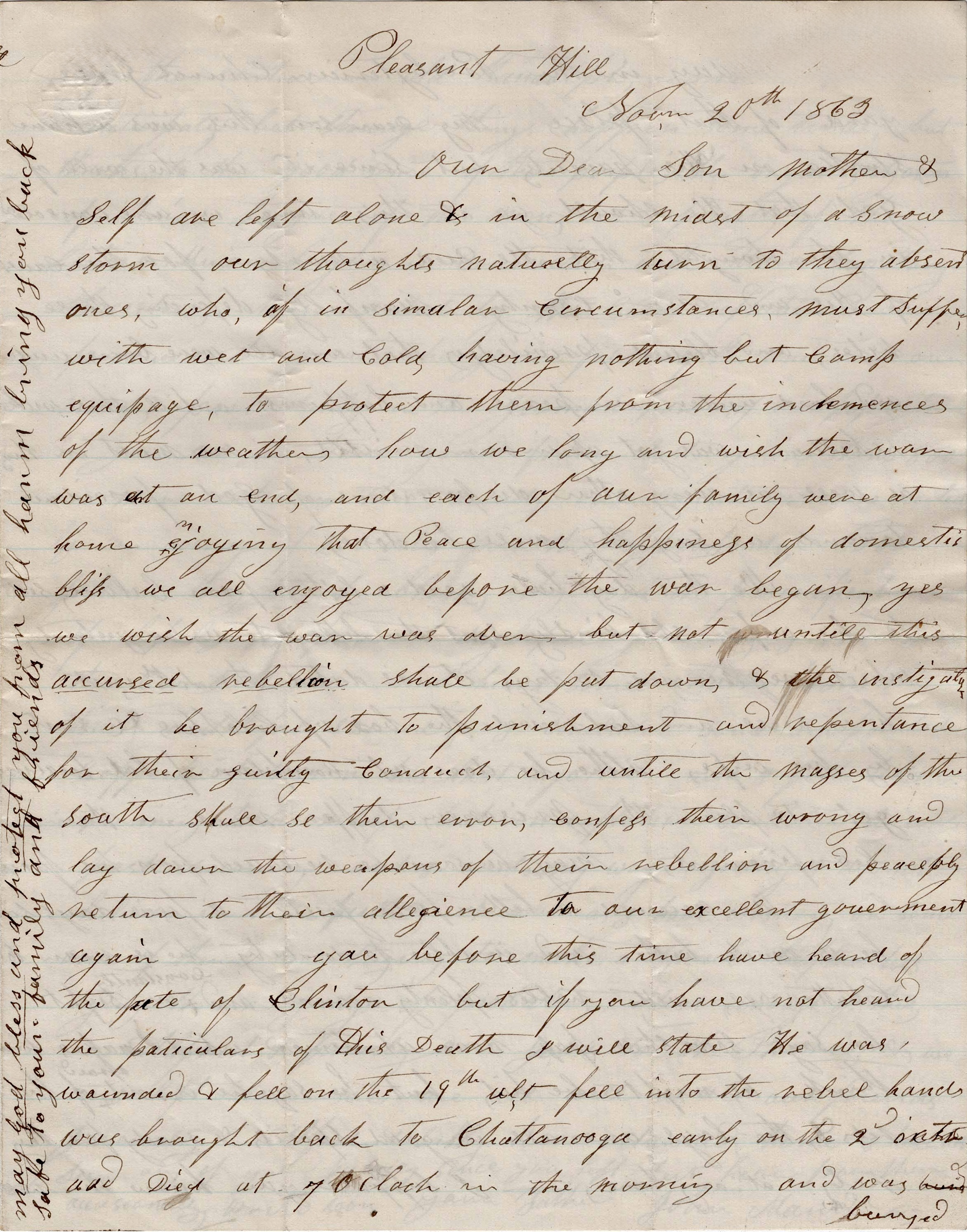
Mother and self are left alone & in the midst of a snow storm, our thoughts naturally turn to the absent ones, who, if in similar circumstances, must suffer with wet and cold, having nothing but camp equipage to protect them from the inclemencies of the weather. How we long and wish the war was at an end and each of our family were at home enjoying that peace and happiness of domestic bliss we all enjoyed before the war began. Yes, we wish the war was over but not until this accursed rebellion shall be put down & the instigators of it be brought to punishment and repentance for their guilty conduct, and until the masses of the South shall see their error, confess their wrong, and lay down the weapons of their rebellion and peaceably return to their allegiance to our excellent government again.
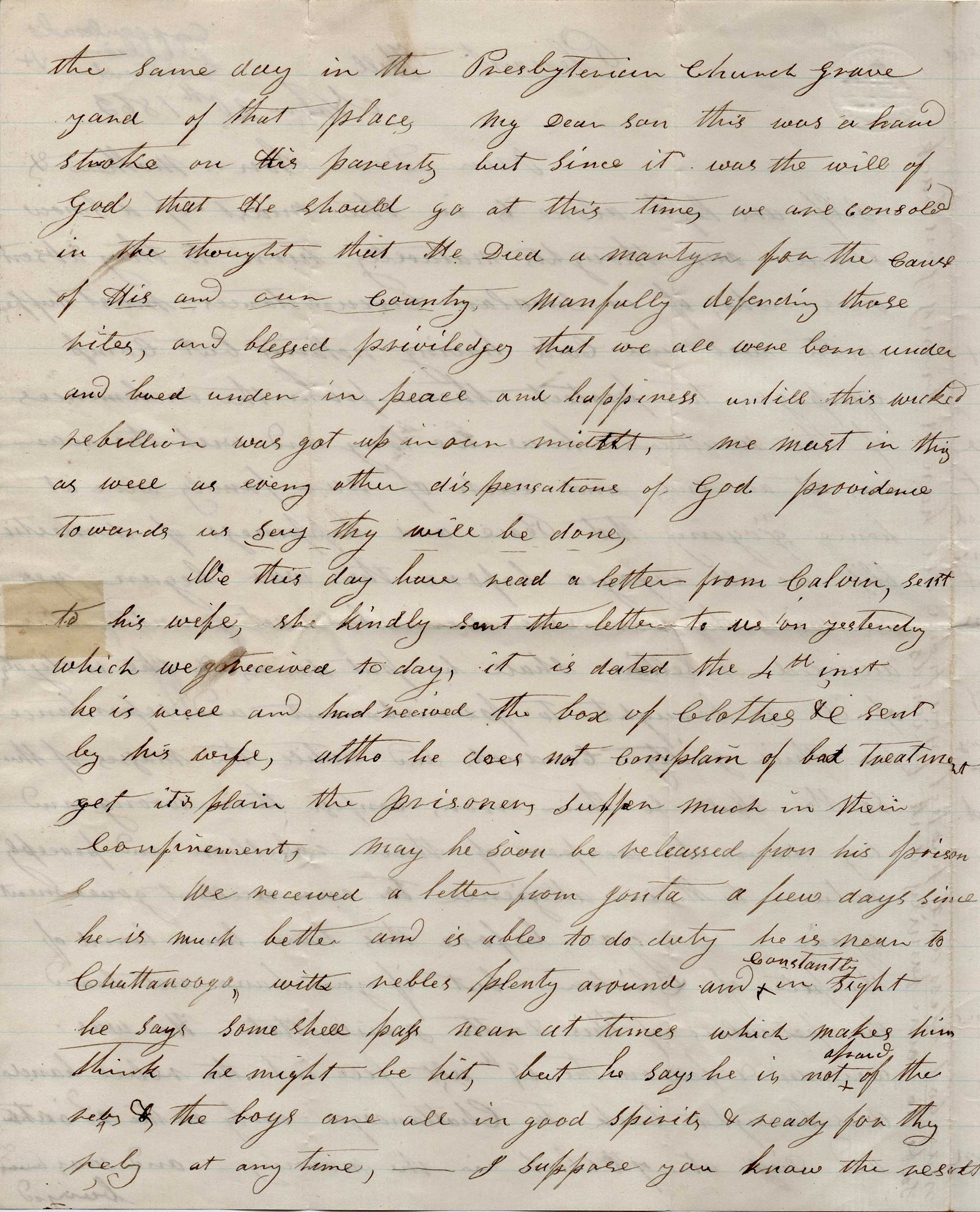
You before this time have heard of the fate of [your brother] Clinton but if you have not heard the particulars of his death, I will state. He was wounded on the 19th ult. [at the Battle of Chickamauga], fell into the rebel hands, was brought back to Chattanooga early on the 2nd October, and died at 7 o’clock in the morning and was buried the same day in the Presbyterian Church grave yard of that place. My dear son, this was a hard stroke on his parents but since it was the will of God that he should go at this time, we are consoled in the thought that he died a martyr for the cause of his and our own country, manfully defending those rights and blessed privileges that we all were born under and lived under in peace and happiness until this wicked rebellion rebellion was got up under our midst. We must in this—as well as every other dispensation of God’s providence towards us—say, “thy will be done.”
We this day have read a letter from [your brother] Calvin sent to his wife. She kindly sent the letter to us on yesterday which we received today. It is dated the 4th inst. He is well and had received the box of clothes &c. sent by his wife. Although he does not complain of bad treatment [at Libby Prison], yet it’s plain the prisoners suffer much in their confinement. May he soon be released from his prison.
We received a letter from [your brother] Jonta [Jonathan] a few days since. He is much better and is able to do duty. He is near to Chattanooga with rebels plenty around and constantly in sight. He says some shells pass near at times which makes him think he might be hit but he says he is not afraid of the rebs & the boys are all in good spirits & ready for the Rebs at any time.
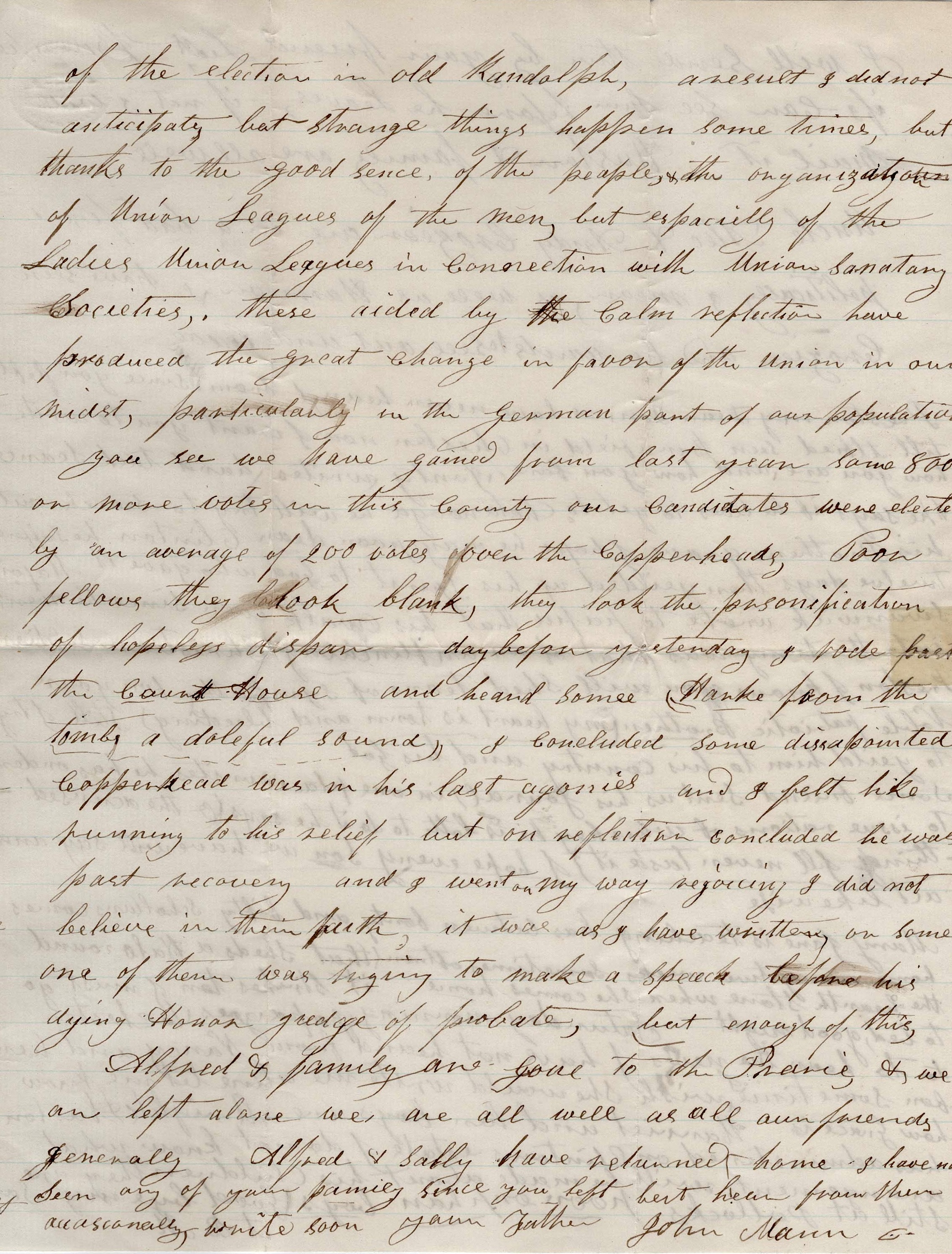
I suppose you know the result of the election in Old Randolph [County]—a result I did not anticipate but strange things happen some times. But thank s to the good sense of the people, the Organization of Union Leagues of the men, but especially of the Ladies Union Leagues in connection wit hthe Union Sanitary Societies, these aided by calm reflection have produced the great change in favor of the Union in our midst, particularly in the German part of the population. You see we have gained from last year some 800 or more votes inn this county, Our candidates were elected by an average of 200 votes over the Copperheads. Poor fellows! They look blank. They took the personification of hopeless despair.
Day before yesterday I rode past the Court House and heard some Hark from the tombs—a doleful sound. I concluded some disappointed Copperhead was in his last agonies and I felt like running to his relief. But on reflection, concluded he was past recovery and I went on my way rejoicing. I did not believe in their [ ]. It was as I have written, as if someone of them was trying to make a speech before his dying honor judge of probate—but enough of this.
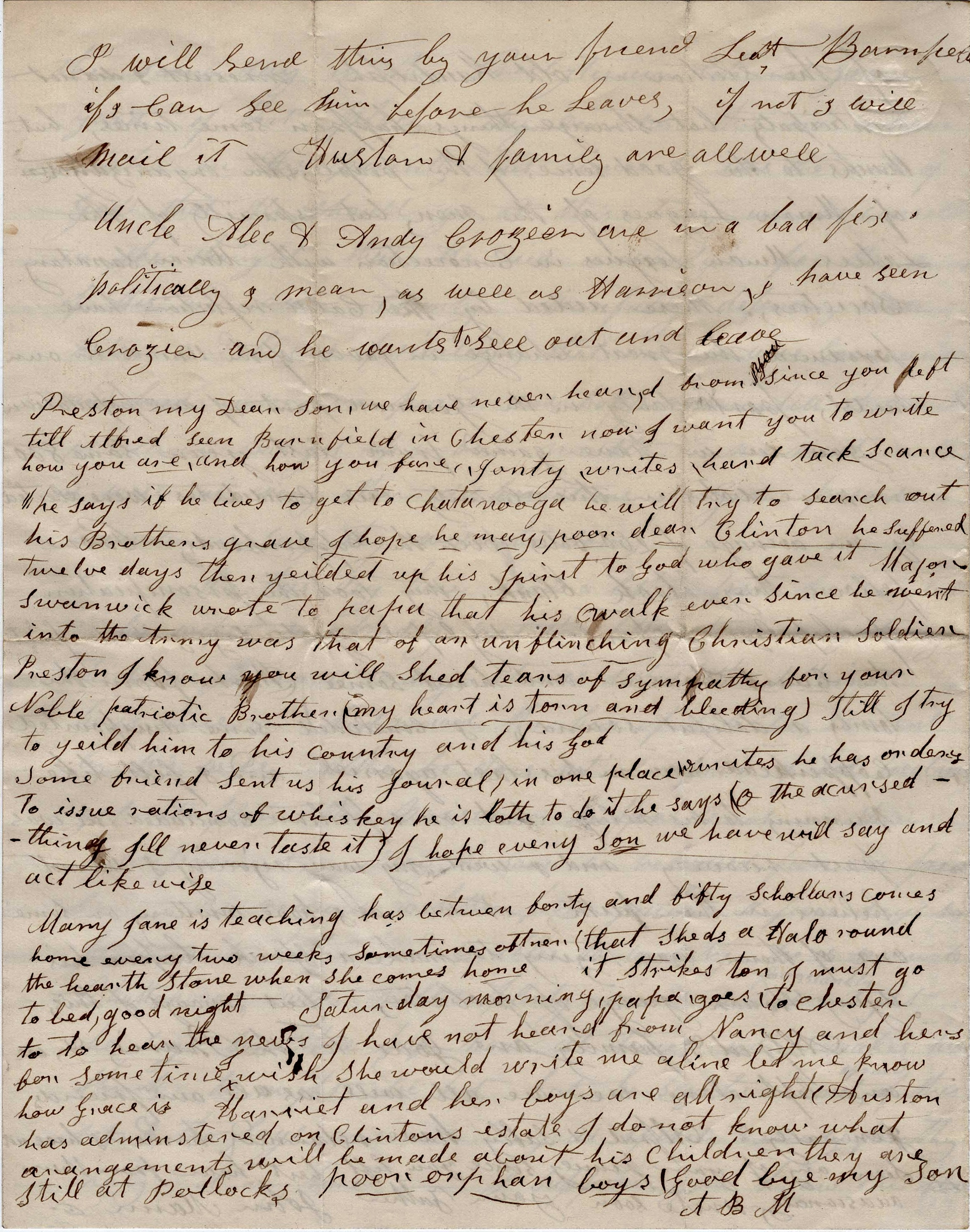
I will send this by your friend, Lt. [Thomas Henry] Barnfield if I can see him before he leaves. If not, I will mail it. Houston and family are all well. Uncle Alec & Andy Crozier are in a bad fix—politically I mean, as well as Harrison. I have seen Crozier and he wants to sell out and leave. [Your father]
[in another hand]
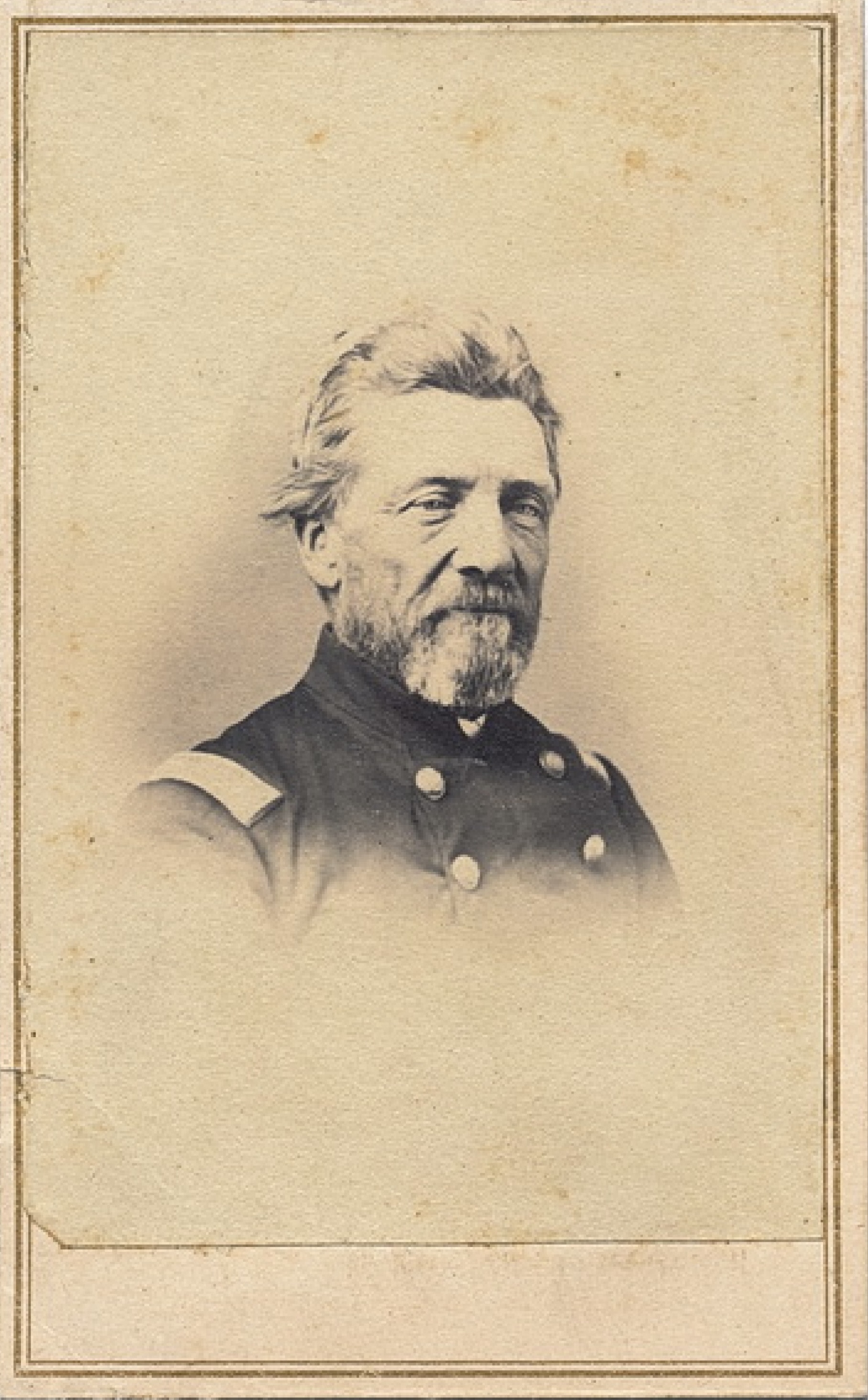
Major Francis Swanwick, 22nd Illinois Infantry (Civil War Image Shop)
Preston, my dear son, we have never heard from you since you left till Alfred seen Barnfield in Chester. Now I want you to write how you are and how you fare. Junty writes that hard tack is scarce. He says if he lives to get to Chattanooga, he will try to search out his brother’s grave. I hope he may. Poor dear Clinton. He suffered twelve days, then yielded up his spirit to God who gave it. Major [Frank] Swanwick wrote to papa that his walk, ever since he went into the Army, was that of an unflinching Christian soldier. Preston, I know you will shed tears of sympathy for your noble, patriotic brother (my heart is torn and bleeding). Still I try to yield him to his country and his God. Some fried sent us his journal. In one place he writes he has orders to issue rations of whiskey. He is loathe to do it [and] he says, “Oh the accursed thing! I’ll never taste it.” I hope every son we have will say and act likewise.
Mary Jane is teaching. Has between forty and fifty scholars. Comes home every two weeks—sometimes oftener (that sheds a halo round the hearth stone when she comes home.) It strikes ten [and] I must go to bed. Good night.
Saturday morning. Papa goes to Chester to hear the news. I have not heard from Nancy and hers for some time. I wish she would write me a line and let me know how Grace is. Harriet and her boys are all right. Houston has administered on Clinton’s estate. I do not know what arrangements will be made about his children. They are still at Pollock’s. Poor orphan boys. Goodbye my son, — A. B. M.
Wm. Houston Mann as he might have looked in 1863 based upon an image taken around 1900.
The following Illinois home front letters were written by William “Houston” Mann (1820-1907), the son of John Beattie Mann (1796-1881) and Albina Bloomer Balch (1797-1882) of Randolph County. Houston wrote both letters to his brother, 41 year-old John Preston Mann (1822-1908) who served from 31 August 1861 to 27 October 1865 in the 5th Illinois Cavalry along with another brother, 30 year-old Calvin Anderson Mann (1833-1902). Both brothers were officers, Calvin rising to the rank of Captain of Co. K. During the seige of Vicksburg, Capt. Calvin Mann led a detachment of 40 men on a daring raid behind enemy lines that resulted in his capture. See Mann’s Raid. Houston was married in 1843 to Martha Pettit and lived until 1884 on the homestead near Kaskaskia he fondly called “Pleasant Ridge.” He afterward moved to Salina, Kansas, where he died in 1907.
Letter 1
[Editor’s Note: William “Houston” Mann wrote this letter to his younger brother, John Preston Mann (1822-1908) who served in the 5th Illinois Cavalry with another brother, Calvin Anderson Mann (1833-1902). John P. Mann was married to Nancy Clendenin Mann (1829-1912) adn they lived in Liberty (now Rockwood), Illinois on the Mississippi River 70 miles south of St. Louis. John served in the 5th Illinois Cavalry from 1861 to 1864, rising to 2nd Lieutenant, Company K, and regimental commissary. Because he saw little action and was stationed only a few days’ journey downriver, John Mann was able to preserve all of Nancy’s letters. These letters offer scholars a chance to study all aspects of life on the homefront from the perspective of a woman who watched the war’s traffic steam past her front porch. Nancy kept John connected to their four daughters and consulted him about the family finances. She also depicted political tensions in a town where many families had southern ties, while their neighbors provided shelter to runaway slaves on the Underground Railroad. Nancy’s letters to her husband are preserved in the Mann Family Papers at the Southern Illinois University archive in Carbondale.]
Addressed to J. P. Mann, Vicksburg, Mississippi
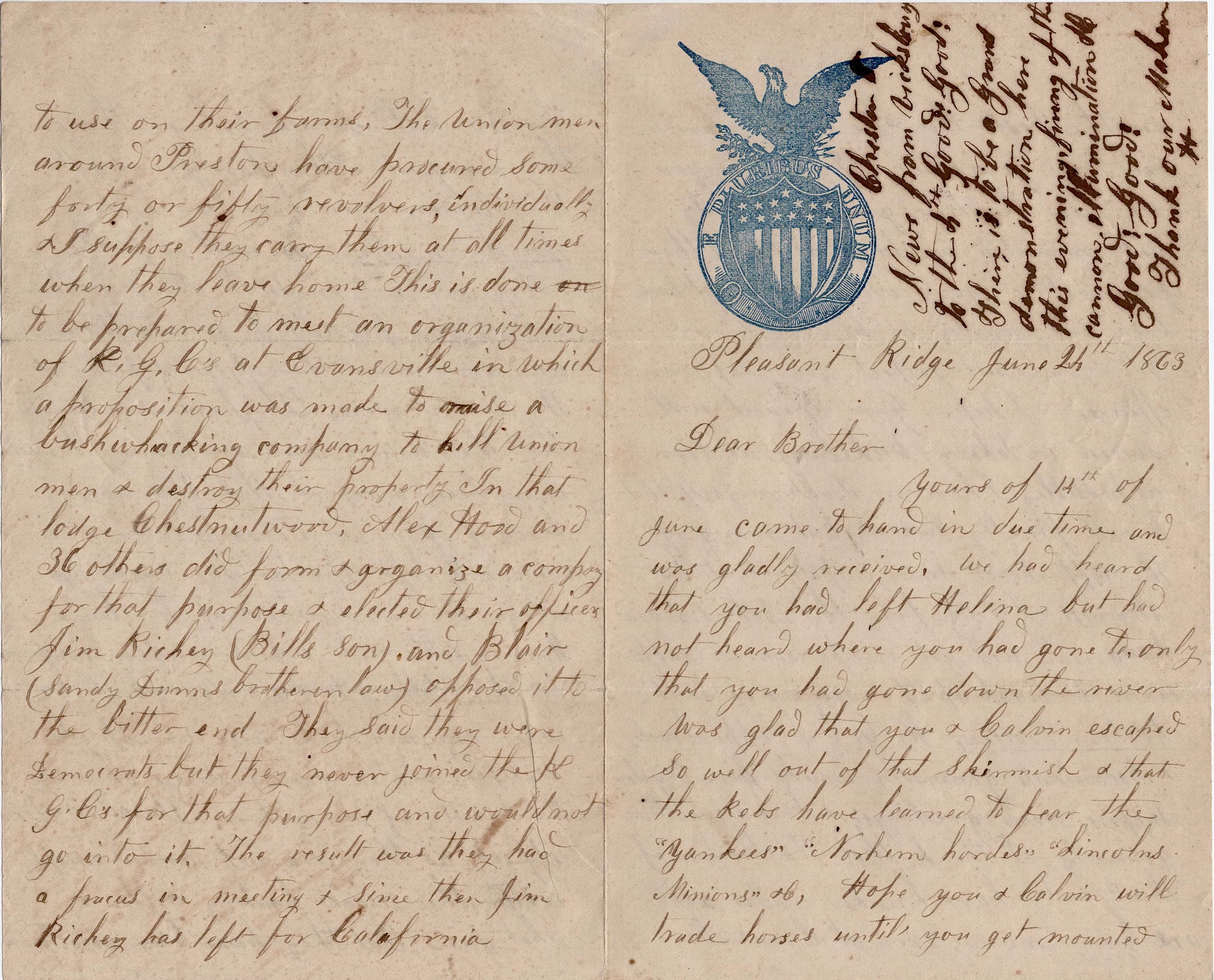
“Pleasant Ridge” [homestead near Kaskaskia, Randolph county, Illinois] June 24th I863
Dear Brother [John Preston Mann],
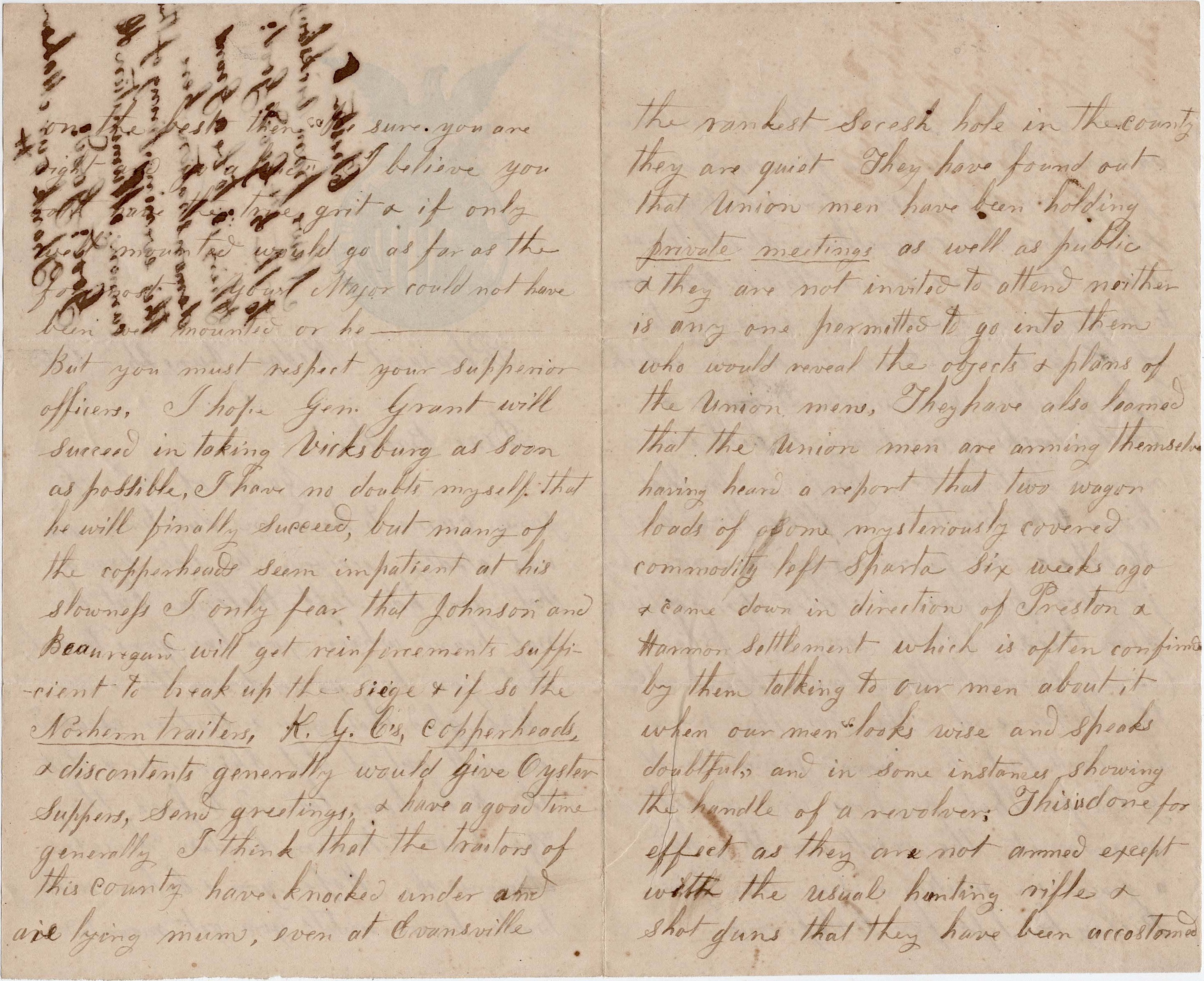
Yours of 14th of June came to hand in due time and was gladly received. We had heard that you had left Helena but had not heard where you had gone to—only that you had gone down the river. Was glad that you & Calvin [5th Illinois Cavalry] escaped so well out of that skirmish & that the Rebs have learned to fear the “Yankees,” “Northern Hordes,” “Lincoln’s Minions” &c. Hope you & Calvin will trade horses until you get mounted on the best. To be sure, you are right and in a [illegible]. I believe you both have the true grit & if only well mounted, would go as far as the foremost. Your Major could not have been well mounted or he——-
But you must respect your superior officers. I hope Gen. Grant will succeed in taking Vicksburg as soon as possible. I have no doubts myself that he will finally succeed, but many of the copperheads seem impatient at his slowness. I only fear that Johnston and Beauregard will get reinforcements sufficient to break up the siege & if so, the Northern traitors, K. G. C’s [Knights of the Golden Circle], Copperheads, & discontents generally would give oyster suppers, send greetings, & have a good time generally. I think that the traitors of this country have knocked under and are lying mum—even at Evansville, the rankest Secesh hole in the county they are quiet. They have found out that Union men have been holding private meeting as well as public & they are not invited to attend. Neither is anyone permitted to go into them who would reveal the objects & plans of the Union men.
They have also learned that the Union men are arming themselves, having heard a report that two wagon loads of some mysteriously covered commodity left Sparta six weeks ago & came down in direction of Preston and Harmon settlement, which is often confirmed by them talking to our men about it when our men “looks wise and speaks doubtful” and in some instances showing the handle of a revolver. This is done for effect as they are not armed except with the usual hunting rifle & shot guns that they have been accustomed to use on their farms. The Union men around Preston have procured some forty or fifty revolvers, individually, & I suppose they carry them at all times when they leave home. This is done to be prepared to meet an organization of K. G. C.’s at Evansville in which a proposition was made to raise a bushwhacking company to kill Union men & destroy their property. In that lodge, Chestnutwood, Alex Hood, & 36 others did form & organize a company for that purpose & elected their officers, Jim Richey (Bill’s son) and Blair (Sandy Dunn’s brother-in-law) opposed it to the bitter end. They said they were Democrats but they never joined the K. G. C.’s for that purpose and would not go into it. The result was they had a fracas in meeting & since then Jim Richey has left for California.
News from Vicksburg to the 4th—Good! Good! There is to be a Grand Demonstration here this evening, firing of the cannon, illumination &c Good! Good! Thank our Maker.
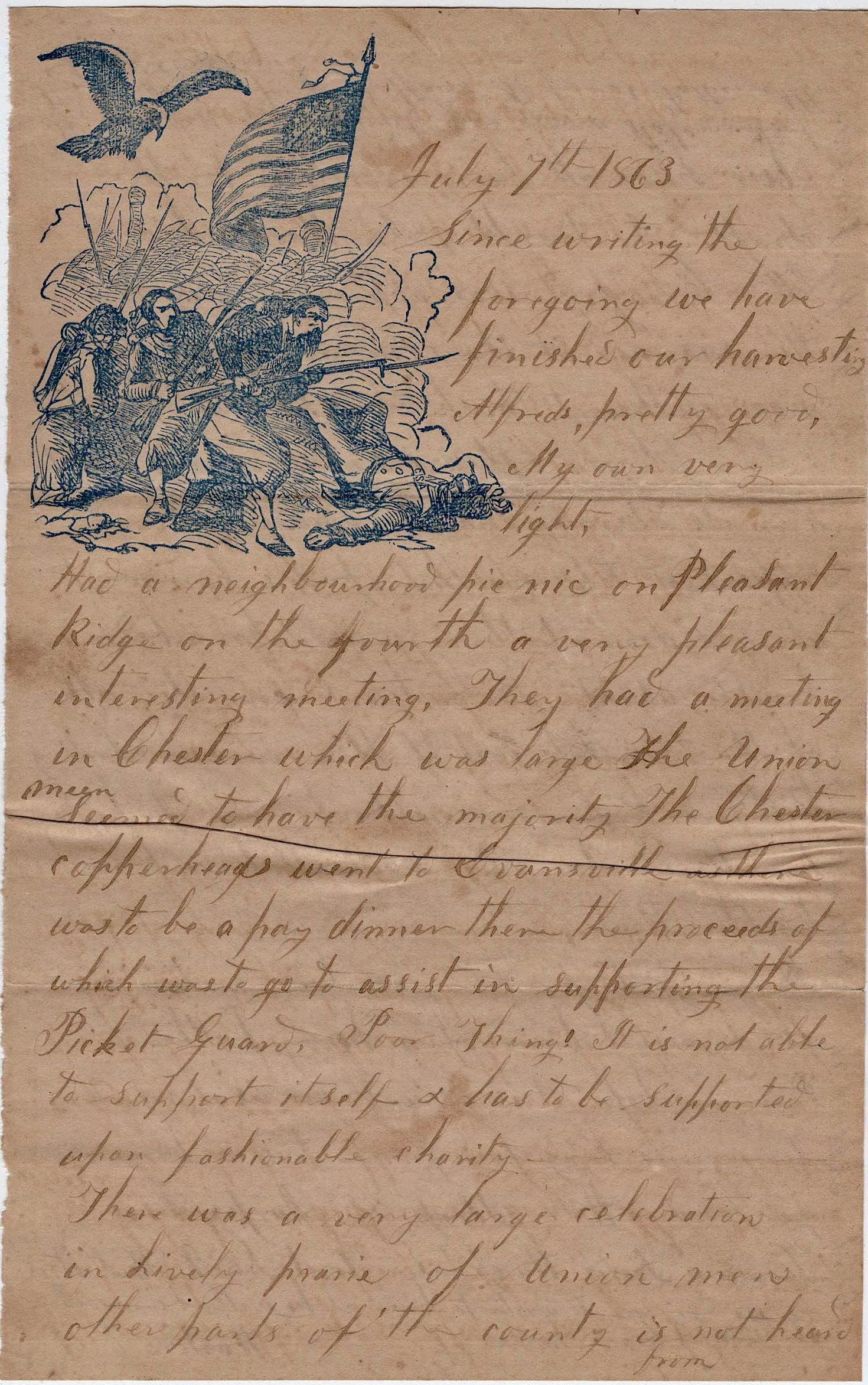
July 7th I863. Since writing the foregoing we have finished our harvesting. Alfred’s pretty good My own very light. They had a meeting in Chester which was large. The Union men seemed to have the majority. The Chester copperheads went to Evansville as there was to be a pay dinner there, the proceeds of which was to go to assist in supporting the Picket Guard. Poor thing! It is not able to support itself & has to be supported upon fashionable charity. There was a very large celebration in Lively Prairie of Union men. Other parts of the county is not heard from.
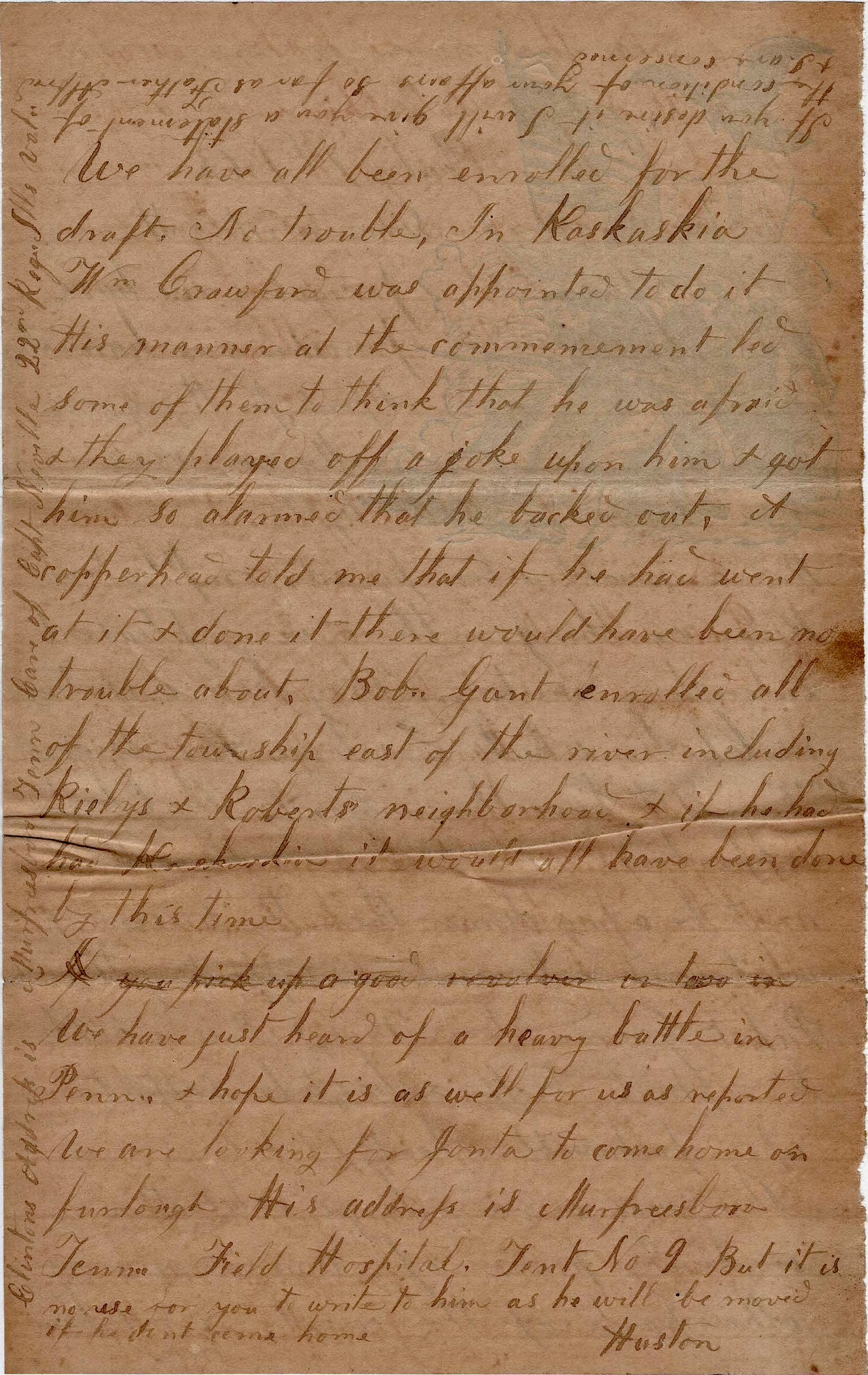
We have all been enrolled for the draft. No trouble. In Kaskaskia, William Crawford was appointed to do it. His manner at the commencement led some of them to think that he was afraid & they played off a joke upon him & got him so alarmed that he backed out. A copperhead told me that if he had went at it & done it, there would have been no trouble about. Bob Gant enrolled all of the township east ofthe river including Reily’s and Roberts’ neighborhood & if he had his [illegible], it would all have been done by this time.
We have just heard of a heavy battle in Pennsylvania & hope it is as well for us as reported. We are looking for [brother] Jonta [Jonathan Balch Mann, 80th Illinois Infantry] to come home on furlough. His address is Murfreesboro, Tennessee Field Hospital, Tent No. 9. But it is no use for you to write him as he will be moved if he don’t come home. — Huston
[Brother] Clinton’s 1 address is Murfreesboro, Tennessee, Care of Capt. Nevill, 22nd Regt. Illinois Vols.
1 Robert Clinton Mann (1824-1863) served in the 22nd Illinois Infantry and was wounded in the Battle of Chickamauga in September 1863. He died of his wounds on 2 October 1863.
Letter 2
Pleasant Ridge January 29, 1864
Dear Brother,
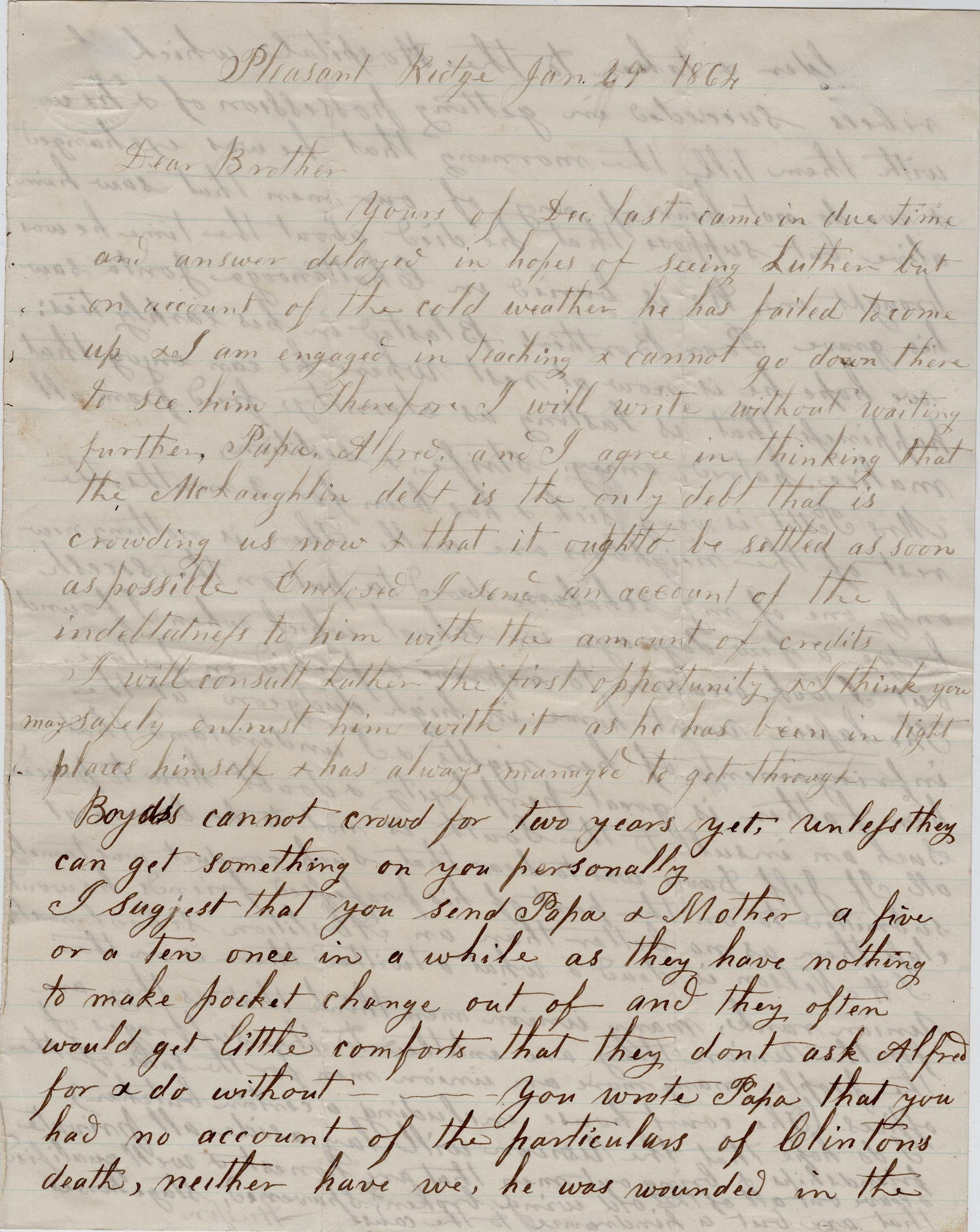
Yours of the December last came in due time and answer delayed in hopes of seeing Luther but on account of the cold weather he has failed to come up. I am engaged in teaching & cannot go down there to see him. Therefore, I will write without waiting further. Papa, Alfred & I agree in thinking that the McLaughlin debt is the only debt that is crowding us now & that it ought to be settled as soon as possible. Enclosed I send an account of the indebtedness to him with the amount of of credits. I will consult Luther the first opportunity & I think you may safely entrust him with it as he has been in tight places himself & has always managed to get through.
Boyd’s cannot crowd for two years yet, unless they can get something on you personally. I suggest that you send Papa & Mother a five or a ten once in a while as they have nothing to make pocket change out of and they often would get little comforts that they don’t ask Alfred for & do without.
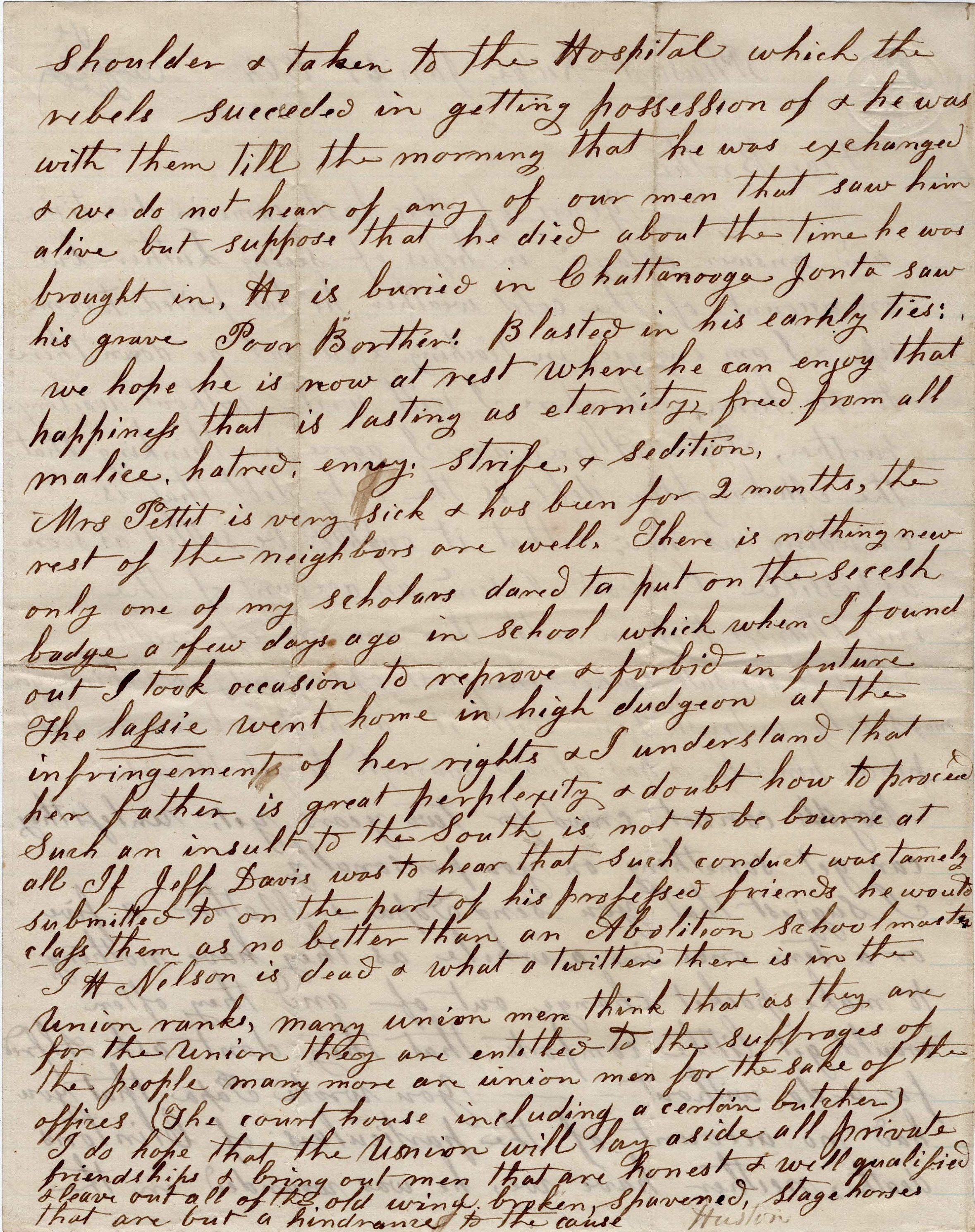
You wrote Papa that you had no account of the particulars of Clinton’s death. Neither have we. He was wounded in the shoulder and taken to the hospital which the rebels succeeded in getting possession of & he was with them till the morning that he was exchanged & we do not hear of any of our men that saw him alive but suppose that he died about the time he was brought in. He is buried in Chattanooga. Jnta [Jonathan] saw his grave. Poor brother! Blasted in his earthly ties. We hope he is now at rest where he can enjoy that happiness that is lasting as eternity, free from all malice, hatred, envy, strife, and sedition.
Mrs. Pettit is very sick & has been for two months. The rest of the neighbors are well. There is nothing new—only one of my scholars dared to put on the secesh badge a few days ago in school which when I found out, I took occasion to reprove & forbid in future. The lassie went home in high dudgeon at the infringement of her rights & I understand that her father is [in] great perplexity & doubt how to proceed. Such an insult to the South is not to be borne at all. If Jeff Davis was to hear that such conduct was tamely submitted to on the part of his professed friends, he would class them as no better than an Abolition Schoolmaster.
J. H. Nelson is dead and what a twitter there is in the Union ranks. Many Union men think that as they are for the Union, they are entitled to the suffrages of the people. Many more are Union men for the sake of the offices (the court house including a certain butcher). I do hope that the Union will lay aside all private friendships & bring out men that are honest & well qualified & leave out all of the old wind broken, shavened, stage horses that are but a hundrance to the cause. — Houston
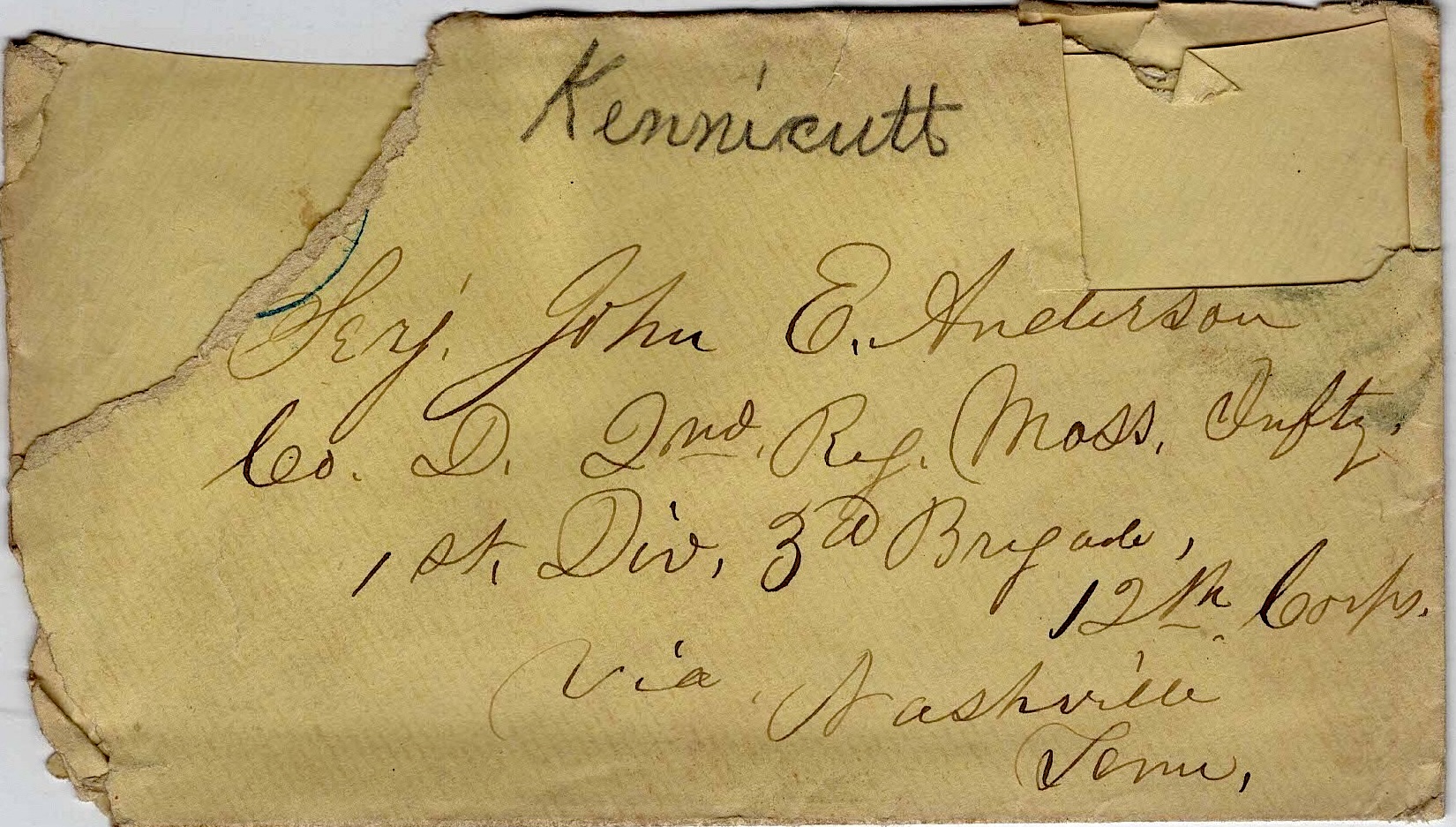
The following letters were written by Benjamin S. Kennicott (1817-1877) of Waukegan, Illinois. In the 1850 US Census, Benjamin—a native of Saratoga county, New York—was enumerated in Waukegan with his wife, Jane (b. 1822), and two children, Melissa (1842-1860) and John (b. 1846). At that time, his occupation was given as a bookkeeper. When he wrote these letters in late 1863, he was most likely a widower, but he remarried in April 1868 to Helen M. Edgecomb (1835-1928), the daughter of John Edgecomb (1803-1878) and Abby Gates (1806-1893) who outlived him by 50 years.
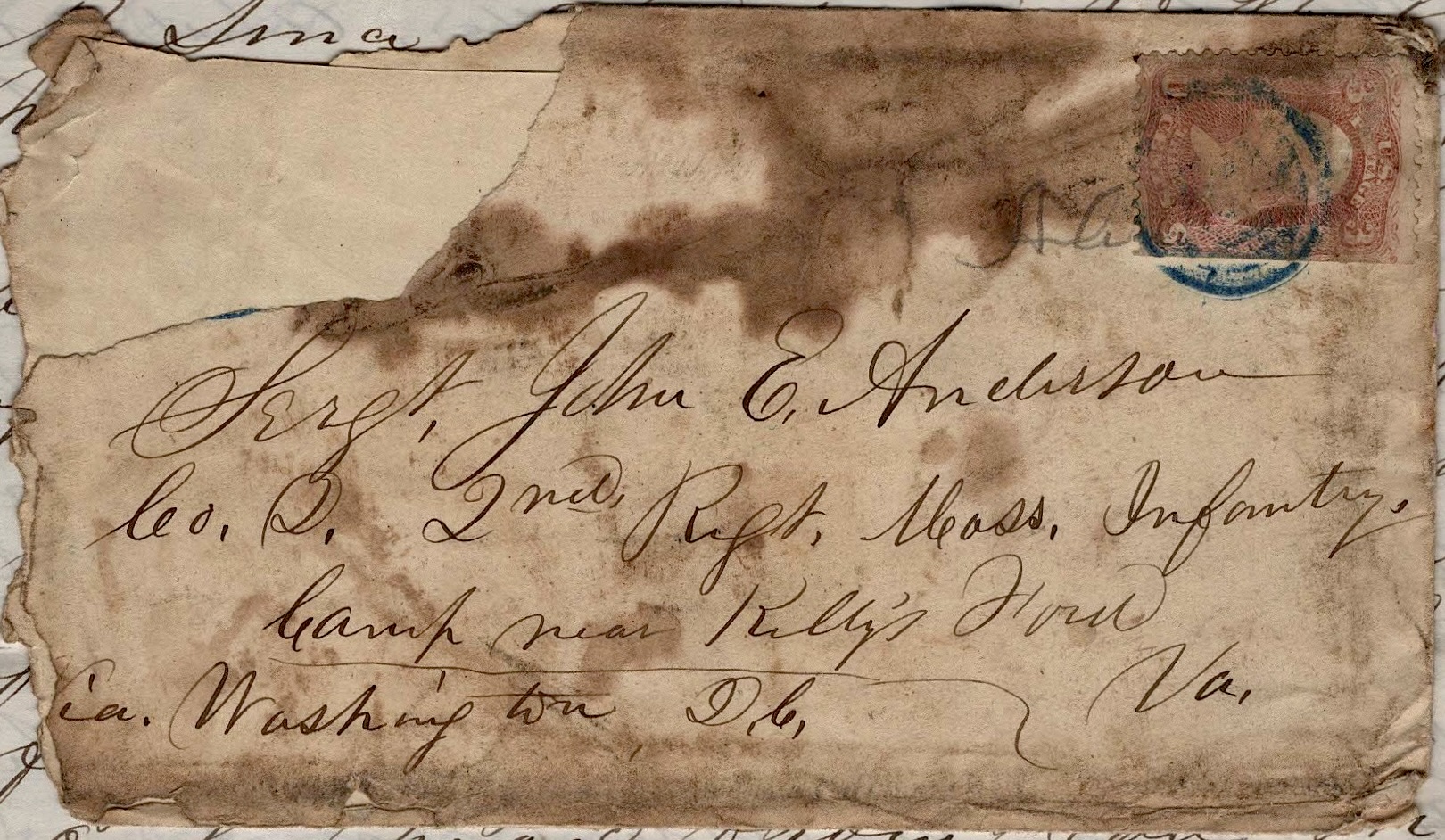
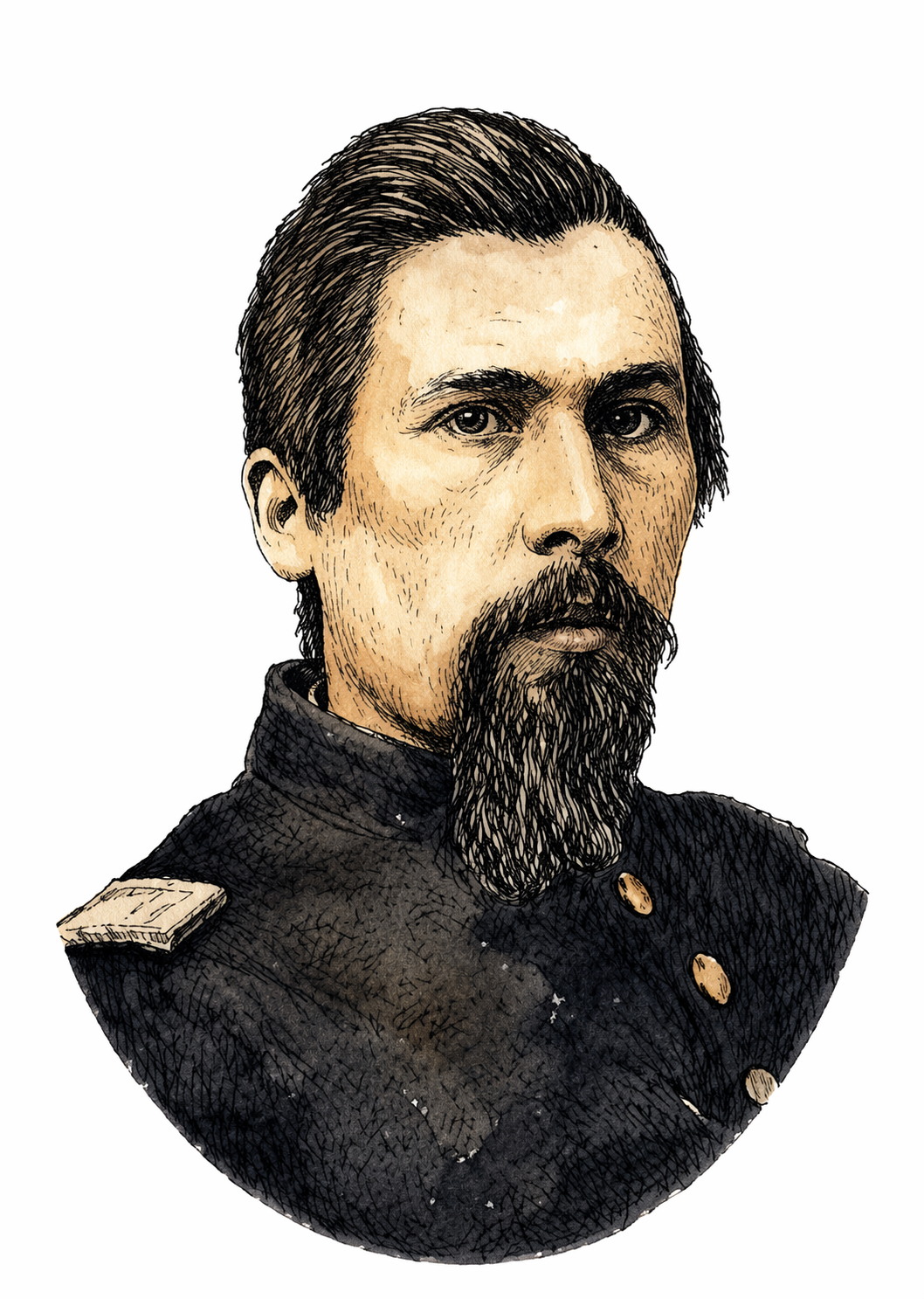
Benjamin wrote the letters to his friend John “Emerson” Anderson. At the time of the August 1863 letter, Emerson was serving in Co. D, 2nd Massachusetts Infantry and probably at the regimental camp near Kelly’s Ford, Virginia. The letter provides us with a good description of Waukegan, Illinois, where Emerson Anderson once worked as a boot maker in the S. S. Greenleaf & Company, boot & shoe manufacturing firm.
The letter of December 1863 was sent to Emerson after his regiment was transferred from the Army of the Potomac to the western theatre.
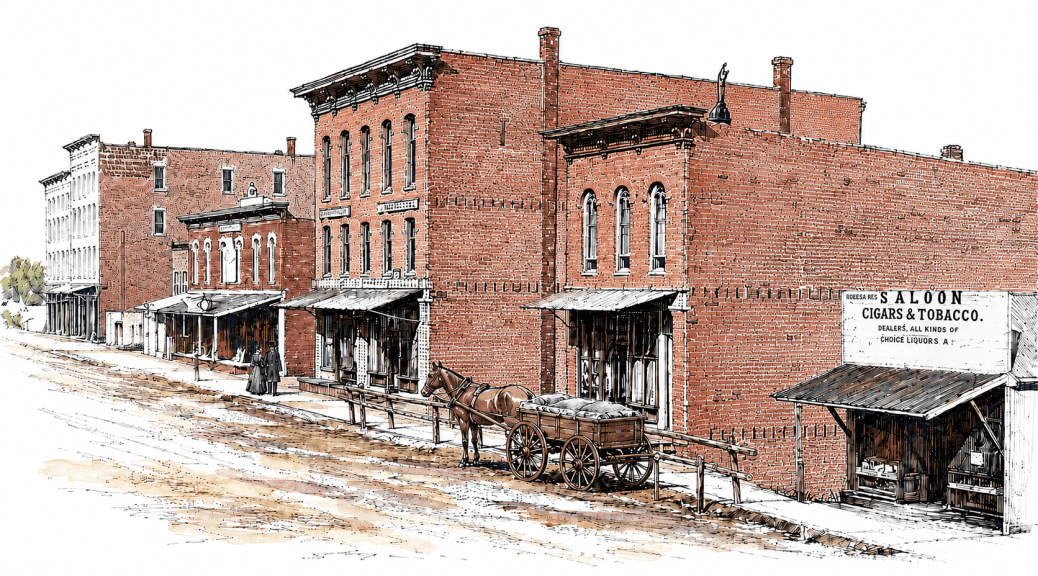
Genesee Street became the primary business street in Waukegan, Illinois, in the 1860s.
Letter 1
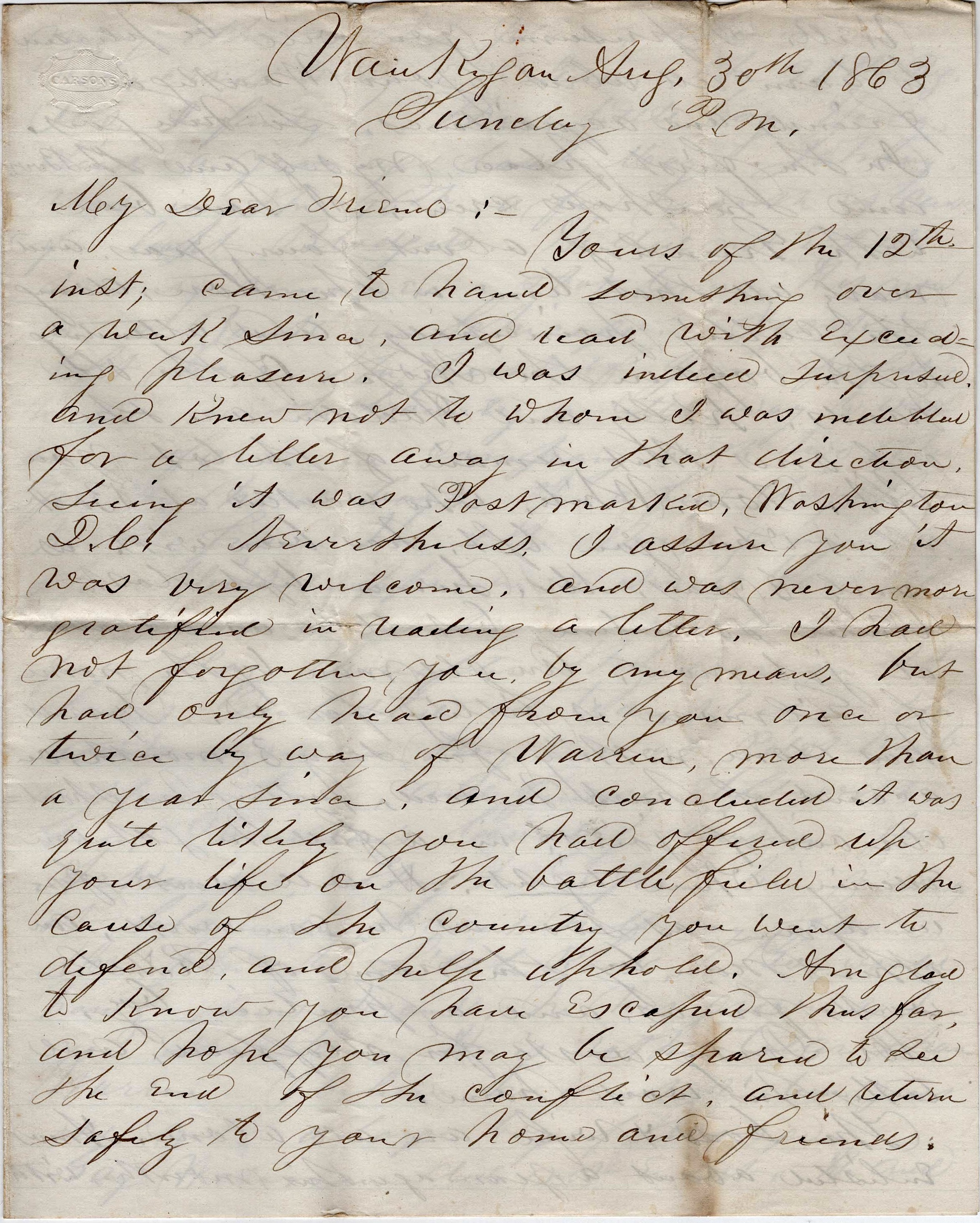
Waukegan [Lake County, Illinois] Sunday p.m., August 30th 1863
My dear friend,
Yours of the 12th inst., came to hand something over a week since and read with exceeding pleasure. I was indeed surprised and knew not to whom I was indebted for a letter away in that direction, seeing it was postmarked Washington D. C. Nevertheless, I assure you, it was very welcome and was never more gratified in reading a letter. I have not forgotten you by any means, but had only heard from you once or twice by way of Warren more than a year since and concluded it was quite likely you had offered up your life on the battlefield in the cause of the country you went to defend and help uphold. Am glad to know you have escaped thus far and hope you may be spared to see the end of the conflict and return safely to your home and friends.
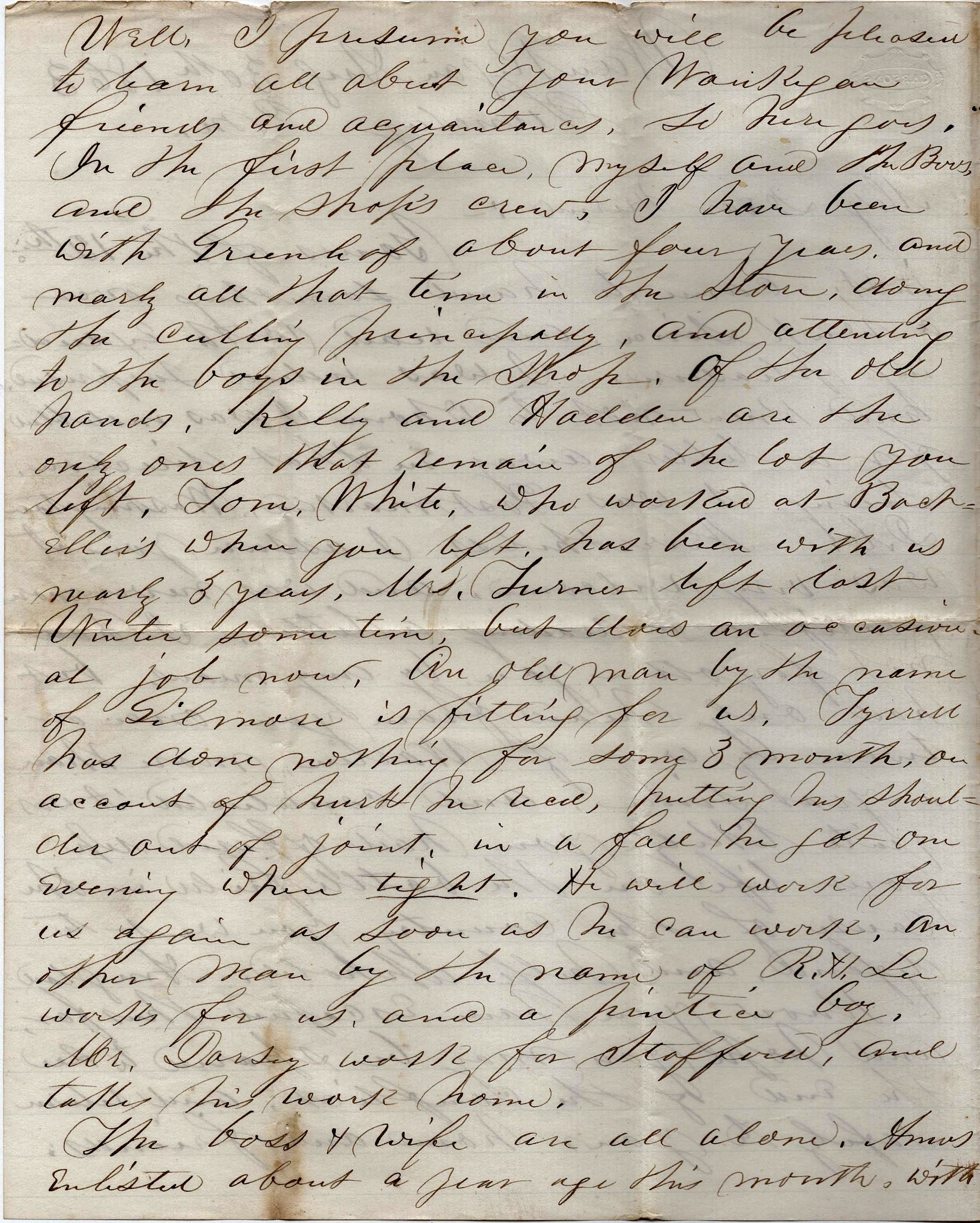
Well, I presume you will be pleased to learn all about your Waukegan friends and acquaintances, so here goes. In the first place, myself and the Boss and the shop’s crew. I have been with [Samuel Smith] Greenleaf 1 about four years and nearly all that time in the store doing the cutting principally and attending to the boys in the shop. Of the old hands, Kelly and Hadden are the only ones that remain of the lot you left. Tom White, 2 who worked at Bachellor’s when you left, has been with us nearly three years. Mr. Turner left last winter some time, but does an occasional job now. An old man by the name of [David A.] Gillmore is fitting for us. [Edward] Tyrell 3 has done nothing for some three months on account of hurt he received putting his shoulder out of joint in a fall he got one evening when tight. He will work for us again as soon as he can work. Another man by the name of R. H. Lee works for us and an apprentice boy. Mr. Dorsey works for Stafford and takes his work home.
Capt. Asiel Z. Blodgett (1832-1916) of Co. G, 96th Illinois Infantry, from Waukegan, IL.
The boss & wife are all alone. Amos [Greenleaf] 4 enlisted about a year ago this month with many others in this place and is in Rosecrans’ army in Tennessee—the 96th Regiment Illinois Infantry. Their little boy, Henry, died a year ago last May. Johnny 5 was in the 96th a few months as cook for Capt. [A. Z.] Blodgett. He did not enlist so only remained a short time. He is now in a bank in Chicago. Franklin 6 left home the first of June professing to go in the country a little way to work on a farm in company with two other putty hand boys. In a few days, they heard from him & the others going down the Mississippi in a small boat they had procured in some way and in a few days thereafter they were in St. Louis, enlisted as teamsters in the Government service. They were at Pilot Knob [Missouri] a short time and finally left with Gen. Davidson’s Cavalry Division for Arkansas. They heard from him yesterday ay Clarendon, about half way from Memphis to Little Rock. You would hardly know Frank, he has grown so since you saw him. He is rather taller than Warren. I believe he is not sixteen years old yet—a large boy of his age.
Gay Wiseman 7 did not enlist. He and all his family are Copperheads—the old man in particular. Gay does not live in Waukegan now, nor does George [Wiley Wiseman], his brother. Mr. Clarkson, C. Morse, Eugene Payne 8, A[siel] Z. Blodgett, and many others enlisted from Waukegan, many of whom probably you did not know. Nelson Roorbach 9 is now in Chicago—rather a worthless sort of a fellow.
[George] Grant lives in Mattoon, Coles county, Illinois. His son, Robert, is in Chicago and doing well, I believe. He has improved greatly since you saw him. Old Scott (Sally Ann) lives where he did and keeps boarders and is doing better than he has for many years. His daughter Mary plays the melodeon at the Episcopal Church at a salary of 50 dollars per year.
My boy Johnny is in Waukegan and works at the Waukegan House. He is now 17 years old and almost as large as I am. He is all I have left. Daughter [Melissa] died three years ago last July. I boarded round at Taverns for three or four years but am now at a private family—Beecher Hitchcock’s, whom no doubt you remember.
Waukegan has improved somewhat since you left and is improving as much or more this season than any since you left. The business is leaving the street we are on and going more on Genesee Street towards the Waukegan House. Nine brick stores are now building on that street. Business is very good It has been for some time past. Boot and Shoe Making is better than when you were here, and there is more demand for workmen and at improved wages. We seldom see a tramping “Jur” [Journeyman?] nowadays. The war seems to have taken all the loose shoemakers. Stock is very high and consequently the manufactured articles have advanced a good deal. Kip boots 11 sell for four and a half dollars, f 5 1/2, Fr. f. 6 1/2, and other articles in proportion. Crops came in good & everything brings a good price. Farmers are nearly all getting rich.
How long is it since you left Waukegan? I’ve forgotten entirely. I have not been 3 miles from the store in as many years and not as far as Chicago in five years, and have not been absent from the store half a day since I came here to work. Indeed, I go scarcely anywhere and see but little of the world outside of Waukegan. I may spend the remainder of my days here for aught I know to the contrary. It seems more like home than any place I know of and I am reluctant to go again amongst strangers so I do the best I can to be contented with my lot and take everything philosophically.
I believe I have now written all that’s needful in one letter and hope if this reaches you, you will write again speedily. I hope that “stray bullets will not wipe you out” but that you may see Waukegan again before I die. Any enquiries you may make of persons & things, I shall be glad to attend to, and post you in regard to what is doing in all this “upon round about.”
Please accept of my best wishes for your welfare and safety and believe me ever thy friend, — B. S. Kennicott
[to] John E. Anderson
1 Samuel Smith Greenleaf (1818-Aft1900), was the son of Flavel Greenleaf (1791-1850) and Eunice Smith (1794-1847). He was the owner of S. S. Greenleaf & Co., “manufacturers and dealers in boots, shoes, leather and findings” in Waukegan.
2 Thomas Francis White (1826-1879), was born in Sligo, Ireland, and came to the United States in 1847, settling first in Haverhill, Massachusetts. He moved to Waukegan, Illinois, in 1854 and worked as a bootmaker for S. S. Greenleaf in 1860. In March 1864, he mustered into the Chicago Mercantile Independent Light Battery and served until July 1865.
3 Edward Tyrell (1835-1863) was born in Ireland and came to the United States in 1848, settling first in Brooklyn. After a few years in Utica, New York, he came to Waukegan where prior to 1856. He was a shoemaker for the S. S. Greanleaf & Co.
4 Amos Greenleaf (1836-1914) was the son of Flavel Greenleaf (1791-1850) and Eunice Smith (1794-1847) of Oakland county, Michigan. Amos served as a sergeant in Co. G, 96th Regiment Illinois Infantry. In 1860, Amos was enumerated as a 24 year-old clerk in Waukegan, Illinois.
5 Johnny Flavel Greenleaf (1845-1887) was the son of Samuel Smith Greenleaf (1818-1915) of Waukegan, Illinois.
6 Samuel Franklin Greenleaf (1847-1933) was the son of Samuel Smith Greenleaf (1818-1915) of Waukegan, Illinois.
7 Gaius (“Gay’) Wiseman (1833-1918) was born in Gainesville, Wyoming county, New York. He came with his parents, James Wiseman (1799-1879) and Orril Lawrence (1804-1884), to Waukegan, Illinois, in the 1840s and married Mary Yeager in 1858. He was a tinner in Waukegan until 1863 when he left town and settled in Sycamore, DeKalb county, Illinois, employed by R. Ellwood and also the Haight Brothers.
8 Eugene Beauharnais Payne (1835-1919) of Seneca Falls, New York, came to Waukegan with his parents in 1837. In the Civil War, Eugene joined the Waukegan Zouaves who were eventually made part of the 37th Illinois Infantry. Eugene was made the captain of Co. C. He rose in rank to command the regiment and later made a Brigadier General.
9 Nelson Roorbach (1818-1904) was a shoemaker who lived in his later years in Chicago but was buried in Waukegan.
10 George Grant (1817-1891), a native of Scotland, was enumerated in 1850 and 1860 working as a shoemaker in Waukegan. His son, Robert Daniel Grant (1841-1911) lived in Chicago.
11 “Kip boots” in 1863 refers to durable, long-legged boots made from “kip leather”—a hide from a young cow, smaller than a full-grown ox but larger than a calf. These were commonly worn during the American Civil War era and were highly prized for their durability in heavy mud.
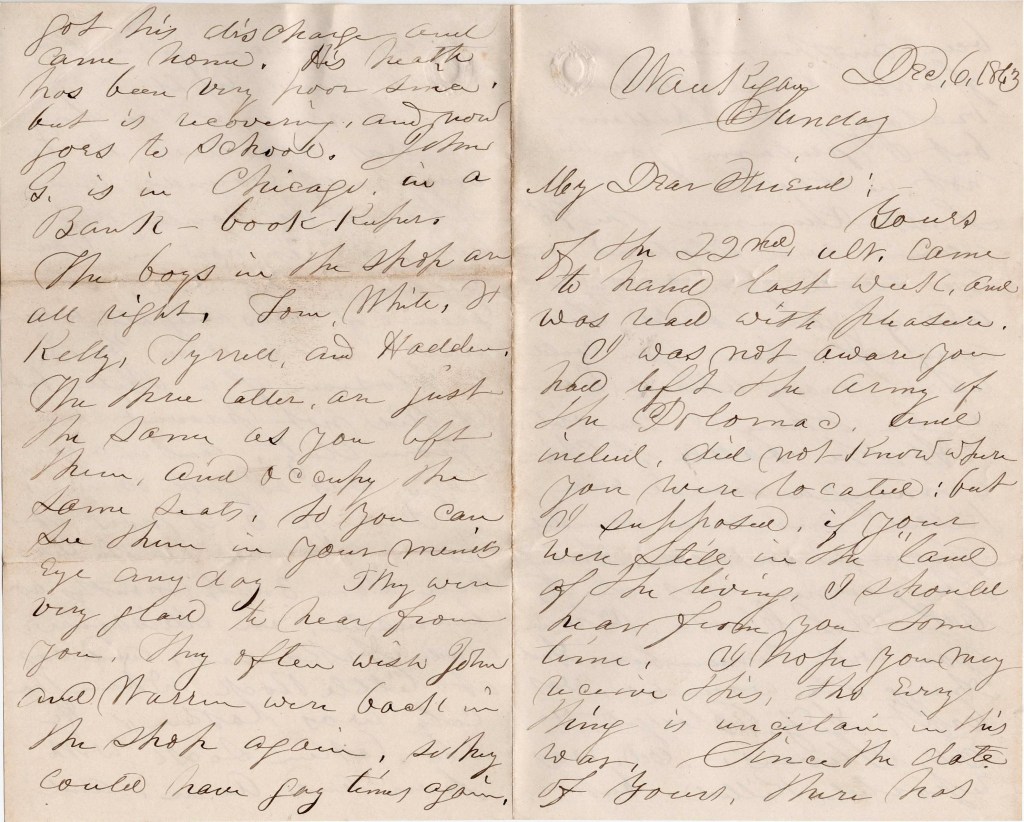
Letter 2
Waukegan, [Lake county, Illinois] Sunday, December 6, 1863
My dear friend,
Yours of the 22nd ultimo came to hand last week and was read with pleasure. I was not aware you had left the Army of the Potomac and indeed, did not know where you were located, but I supposed if you were still in the land of the living, I should hear from you sometime. I hope you may receive though everything is uncertain in this war.
Lieut. Colonel Isaac. L. Clarke, 96th Illinois
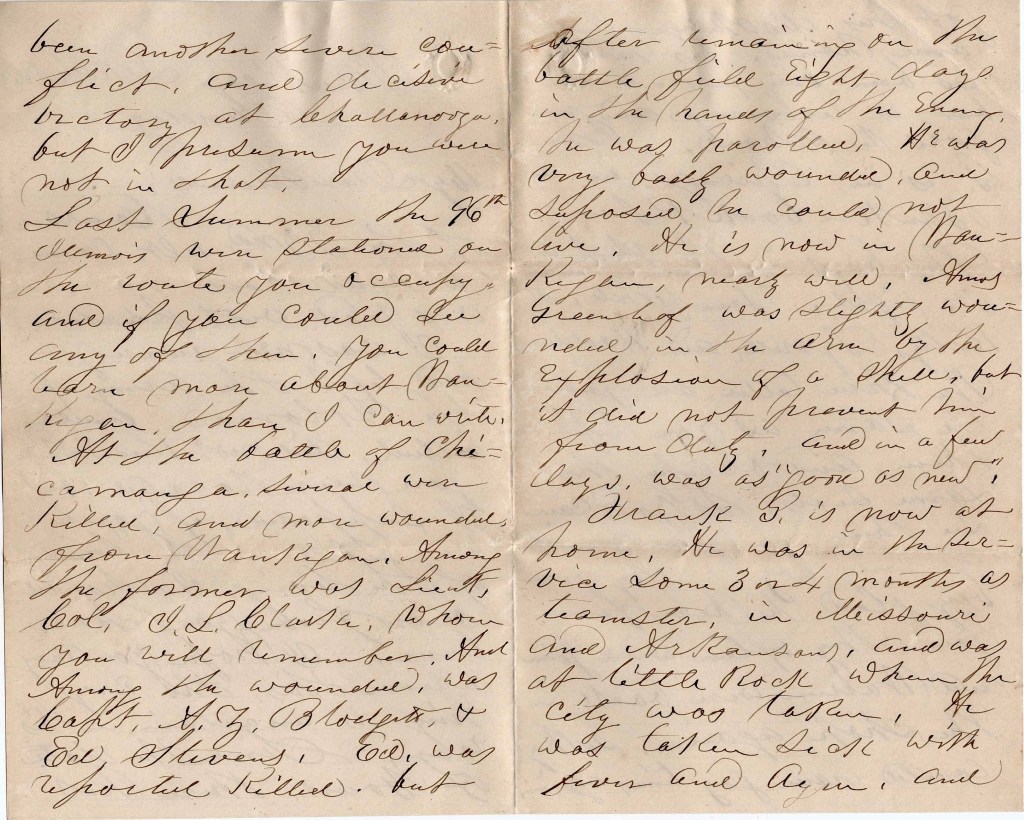
Since the date of yours, there has been another severe conflict and decisive victory at Chattanooga but I presume you were not in that. Last summer the 96th Illinois were stationed on the route you occupy and if you could see any of them, you could learn more about Waukegan than I can write. At the Battle of Chicakamauga, several were killed, and more wounded from Waukegan. Among the former was Lieut. Colonel I[saac] L. Clarke whom you will remember. And among the wounded was Capt. A[siel] Z. Blodgett & Ed[mund] Stevens. Ed was reported killed but after remaining on the battlefield eight days in the hands of the enemy, he was paroled. He was very badly wounded and supposed he could not live. He is now in Waukegan, nearly well. 1 Amos Greenleaf was slightly wounded in the army by the explosion of a shell but it did not prevent him from duty and in a few days was as “good as new.”
Frank G[reenleaf] is now at home. He was in the service some three or four months as teamster in Missouri and Arkansas and was at Little Rock when the city was taken. He was taken sick with fever and ague and got his discharge. His health has been very poor since but is recovering and now goes to school. John G[reenleaf] is in Chicago in a bank [as] bookkeeper.
The boys in the shop are all right. Tom White, F. Kelly, Tyrell and Hadden. The three latter are just the same as you left them, and occupy the same seats. So you can see them in your mind’s eye any day. They were very glad to hear from you. They often wish John and Warren were back in the shop again so they could have gay times again.
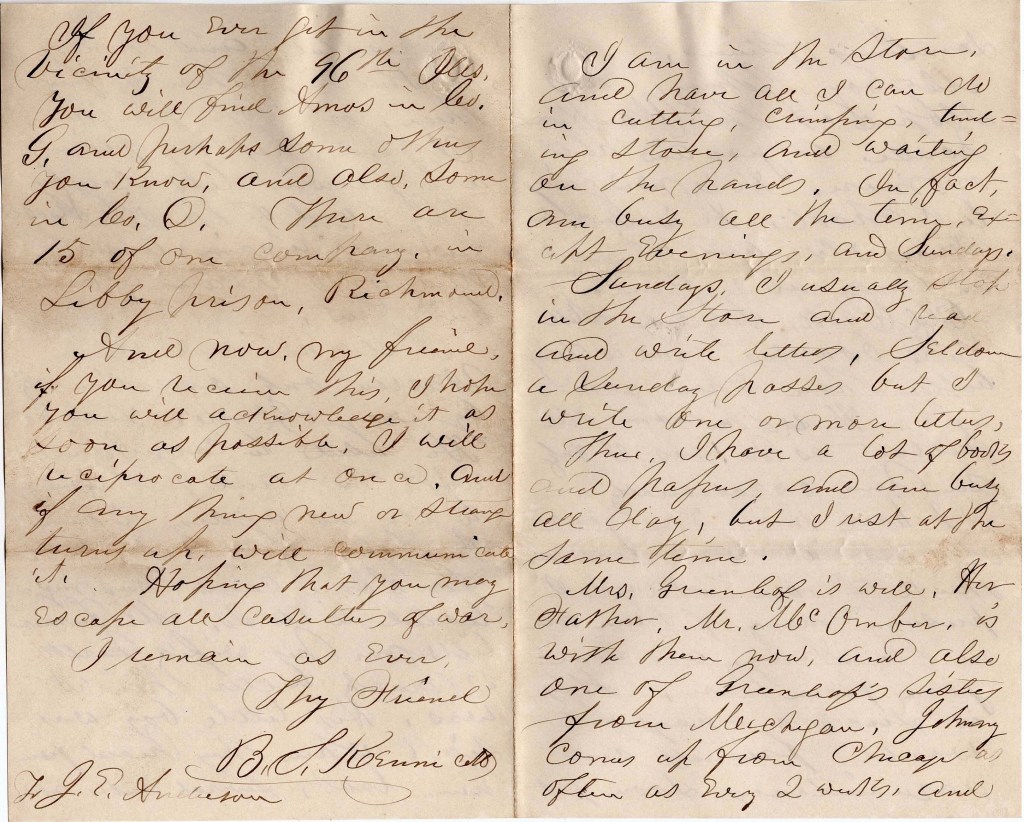
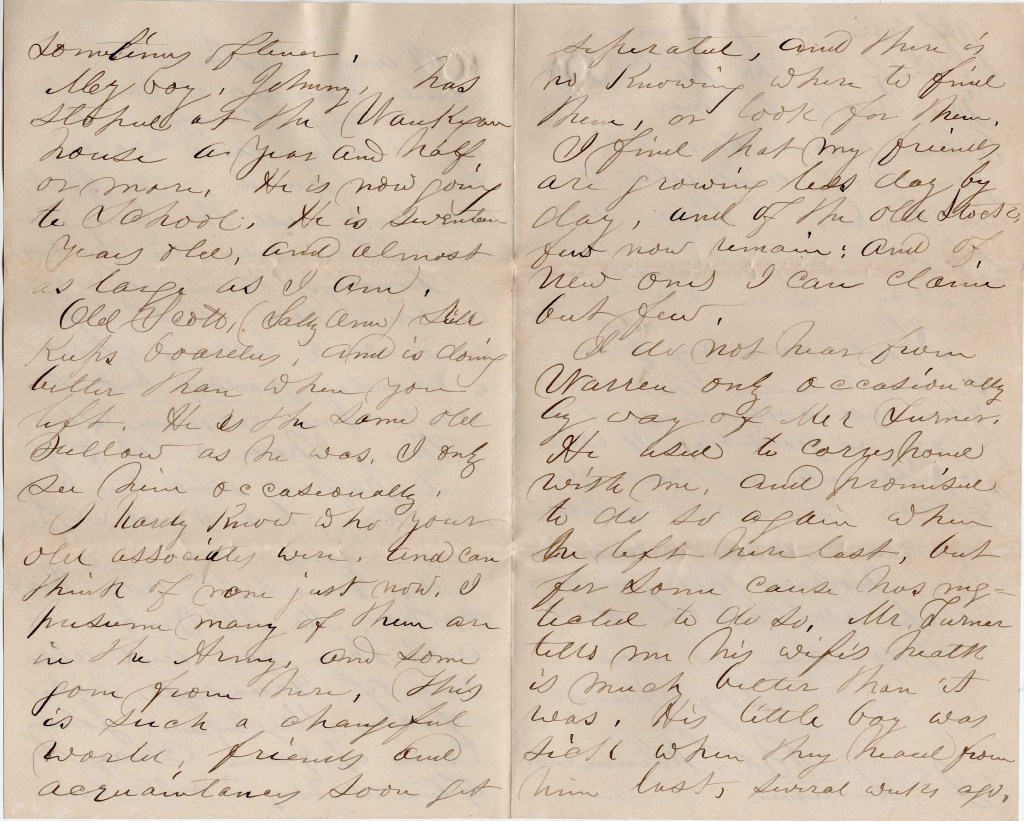
I am in the store and have all I can do in cutting, crimping, tending stove, and waiting on the hands. In fact, am busy all the time except evenings and Sundays. Sundays I usually stop in the store and read and write letters. Seldom a Sunday passes but I write one or more letters. Then I have lots of books and papers and am busy all day, but I rest at the same time.
Mrs. Greenleaf is well. Her Father—Mr. McOmber—is with them now and also one of Greenleaf’s sisters from Michigan. Johnny Conus up from Chicago as often as every two weeks, and sometimes oftener.
My boy, Johnny, has stopped at the Waukegan House a year and a half or more. He is now going to school. He is seventeen years old and almost as large as I am. Old Scott (Sally Ann) still keeps boarders and is doing better than when you left. He is the same old fellow as he was. I only see him occasionally.
I hardly know who your old associates were and can think of none just now. I presume many of them are in the army, and some gone from here. This is such a changeful world—friends and acquaintances soon get separated and there is no knowing where to find them, or look for them. I find that my friends are growing less day by day and of the old stock, few now remain. And of new ones, I can claim but few.
I do not hear from Warren only occasionally by way of Mr. Turner. He used to correspond with me and promised to do so again when he left here last, but for some cause has neglected to do so. Mr. Turner tells me his wife’s health is much better than it was. His little boy was sick when they heard from him last several weeks ago.
If you ever get in the vicinity of the 96th Illinois [Infantry], you will find Amos [Greenleaf] in Co. G and perhaps some others you know, and also, some in Co. D. There are 15 in one company in Libby Prison, Richmond.
And now, my friend, if you receive this, I hope you will acknowledge it as soon as possible. I will reciprocate at once. And if anything new or strange turns up, will communicate it. Hoping that you may escape all casualties of war, I remain as ever thy friend, — B. S. Kennicutt
To J. E. Anderson
1 “Edmund Stevens, who had been hurt by the shell that disabled Lieutenant Clarkson, fought on until shot through the body. He was left for dead upon the field, but subsequently revived; was exchanged in a few days, and eventually recovered, although never again able to take his place in the field.” [Source: Regimental History]
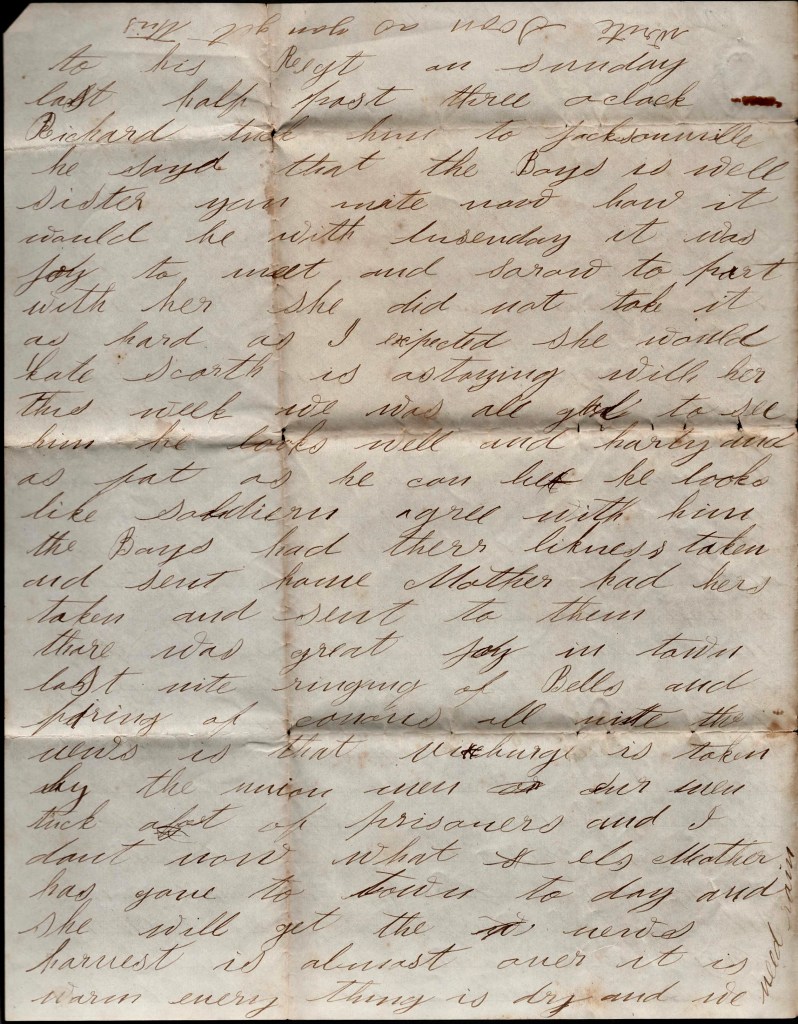
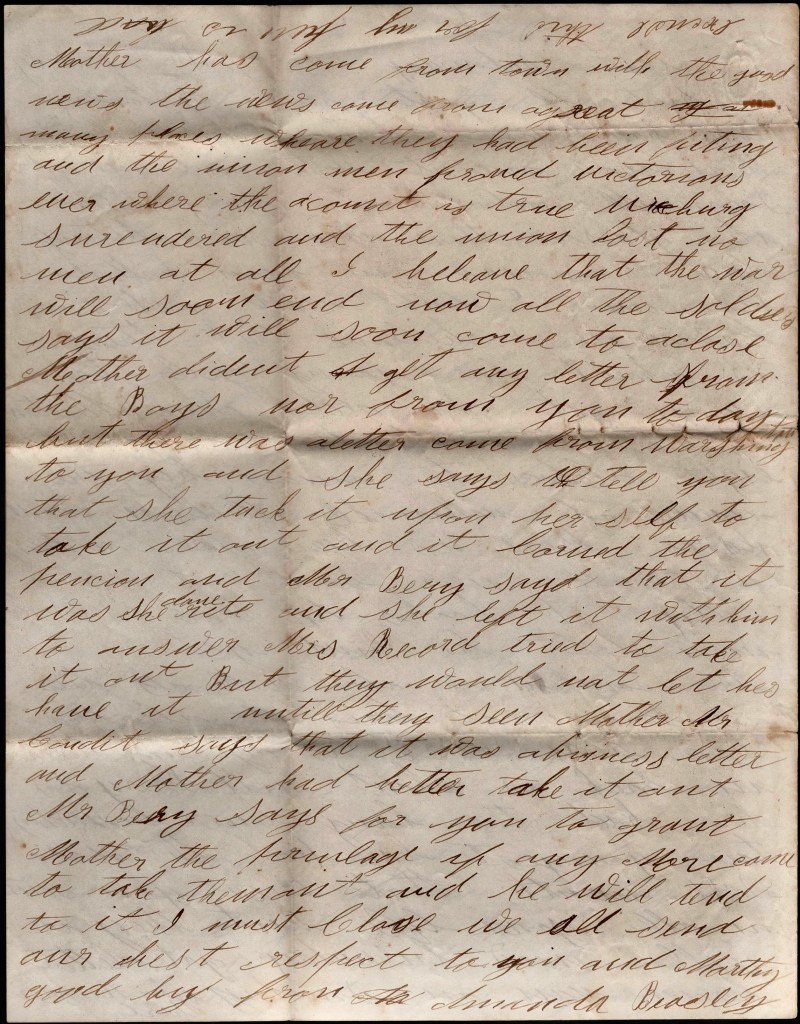
The following letter was written by 15 year-old Amanda A. Beasley (1848-1931), the daughter of James H. Beasley (1804-1854) and Hannah Cowgill (1811-Aft1880) of Winchester, Scott county, Illinois. She wrote the letter to her sister Nancy “Catherine” (Beasley) Record, the widow of Lawrence M. Record (1829-1862). Lawrence was the son of Rev. John A Record (1802-1858) and Lucy W. McManus (1809-1886) of Winchester, Scott county, Illinois. Lawrence was killed on 6 April 1862 at the Battle of Shiloh while serving in Co. H, 14th Illinois Infantry. Catherine and Lawrence were living in Macoupin county, Illinois, when he enlisted; they had one child named Martha (b. 27 May 1856).
In her letter, Amanda refers to several siblings. She speaks of the severe illness of her brother Benjamin F. Beasley (1846-1918). She mentions her brother Richard Beasley (b. 1844). She speaks of her sister Lucinda Ellen (Beasley) Obermyer (1938-1927) having an opportunity to see her husband Peter Obermeyer (1834-1921) who served in Co. D, 129th Illinois Infantry, home on a 15 -day furlough. She also had two brothers (the “Boys”) who also served in Co. D, 129th Illinois Infantry; they were James Beasley (1840-1903) and George A. Beasley (1843-1924).
Transcription
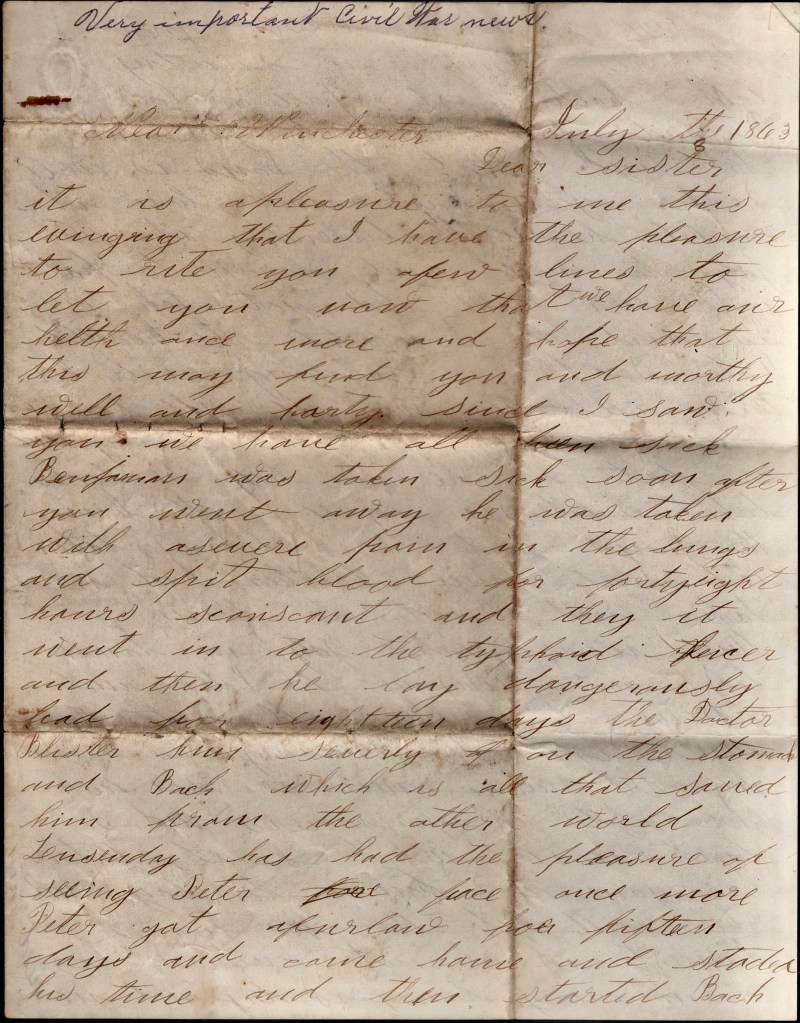
Near Winchester [Scott county, Illinois] July 8th 1863
Dear Sister,
It is a pleasure to me this evening that I have the pleasure to write you a few lines to let you know that we have our health and more and hope that this may find you and Worthy well and hearty. Since I saw you we have all been sick. Benjamin was taken sick soon after you went away. He was taken with a severe pain in the lungs and spit blood for forty-eight hours [ ] and then it went into the typhoid fever and then he lay dangerously bad for eighteen days. The doctor blister[ed] him severely on the stomach and back which is all that saved him from the other world.
Lucinda has had the pleasure of seeing Peter’s face once more. Peter got a furlough for fifteen days and came home and stayed his time and then started back to his regiment on Sunday last [at] half past three o’clock. Richard took him to Jacksonville. He said that the Boys is well. Sister, you might know how it would be with Lucinda. It was joy to meet and sorrow to part with her. She did not take it as hard as I expected she would.
Kate Scorth is a staying with her this week. We was all glad to see him. He looks well and hearty and as fat as he can be. He looks like soldiering agrees with him. The Boys had their likeness taken and sent home. Mother had hers taken and sent to them.
There was great joy in town last night—ringing of bells and firing of cannons all night. The news is that Vicksburg is taken by the Union men. Our men took a lot of prisoners and I don’t know what else. Mother has gone to town today and she will get the news.
Harvest is almost over. It is warm. Everything is dry and we need rain.
Last Saturday, the Fourth of July passed off quite still in town. They had no celebration here but there was one at Exeter and one at Jacksonville and one at Glasgow. At Glasgow there was some fighting done. There was one man killed. His name I don’t know. 1
Well Catherine, I believe that there is a chance for young girls to marry yet for old Jane Martin 2 is to be married this evening at eight o’clock to a man by the name of Nathaniel Wilson from Glasgow. There has been several weddings went off ever since I wrote. Lately it looks like there is some men left behind yet.
The connection is all well as far as I know at present. All that has been sick is a getting better. In fact, is about well. Becky has had the lung fever. Her two youngest have had the worst sore mouth that ever you saw in all your life but they are well now. Lucinda got a letter from you on Sunday when I was there.
Mother has come from town with the good news. The news came from a great many places where they had been fighting and the Union men proved victorious everywhere. The account is true—Vicksburg surrendered and the Union lost no men at all. I believe that the war will soon end now. All the soldiers say it will soon come to a close. Mother didn’t get any letter from the Boys nor from you today but there was a letter came from Washington to you and she says to tell you that she took it upon herself to take it out and it contained the pension and Mr. Berry said that it was she done right and she left it with him to answer. Mrs. [Lucy] Record tried to take it out but they would not let her have it until they seen Mother. Mr. Condit says that it was a business letter and Mother had better take it out. Mr. Berry says for you to grant Mother the privilege if anymore come to take the money and he will tend to it.
I must close. We all send our best respects to you and Martha. Goodbye. From Amanda Beasley
1 I could not find any information regarding this incident in Glasgow, Scott county, Illinois, on the 4th of July 1863. It may have been a conflict arising between a Unionist and a Copperhead (Peace Democrat).
2 Nancy “Jane” Martin (1836-1911) was the daughter of James & Nancy Martin of Scott county, Illinois. Jane was 26 years of age when she married in July 1863 in Scott county to Nathaniel Wilson. This was considered “old” by 19th Century standards. Her obituary claims she grew up in Alsey, Scott county, Illinois. Nathaniel died about 1890.
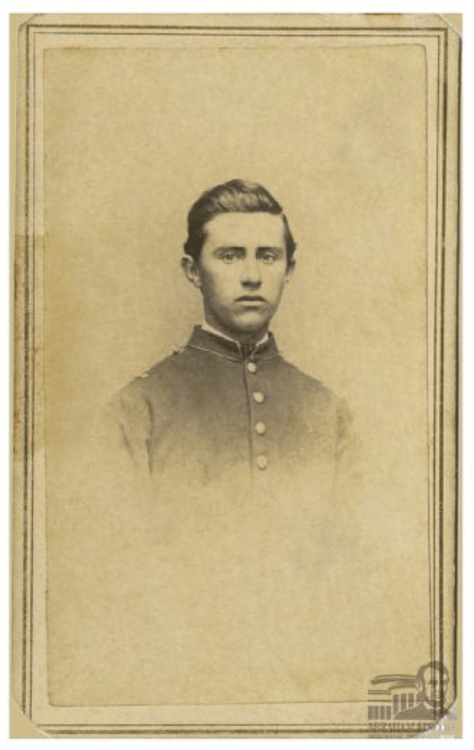
I could not find an image of Lewis but here is one of George J. Gordon who served in Co. C, 77th Illinois Infantry (Lincoln Presidential Library)
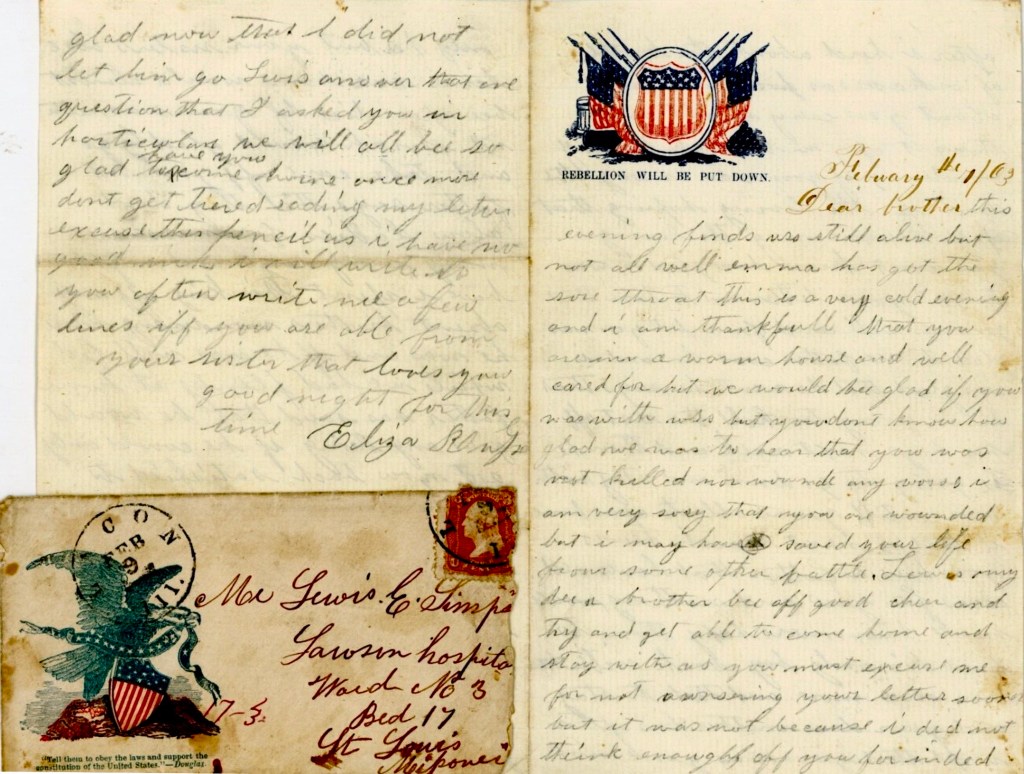
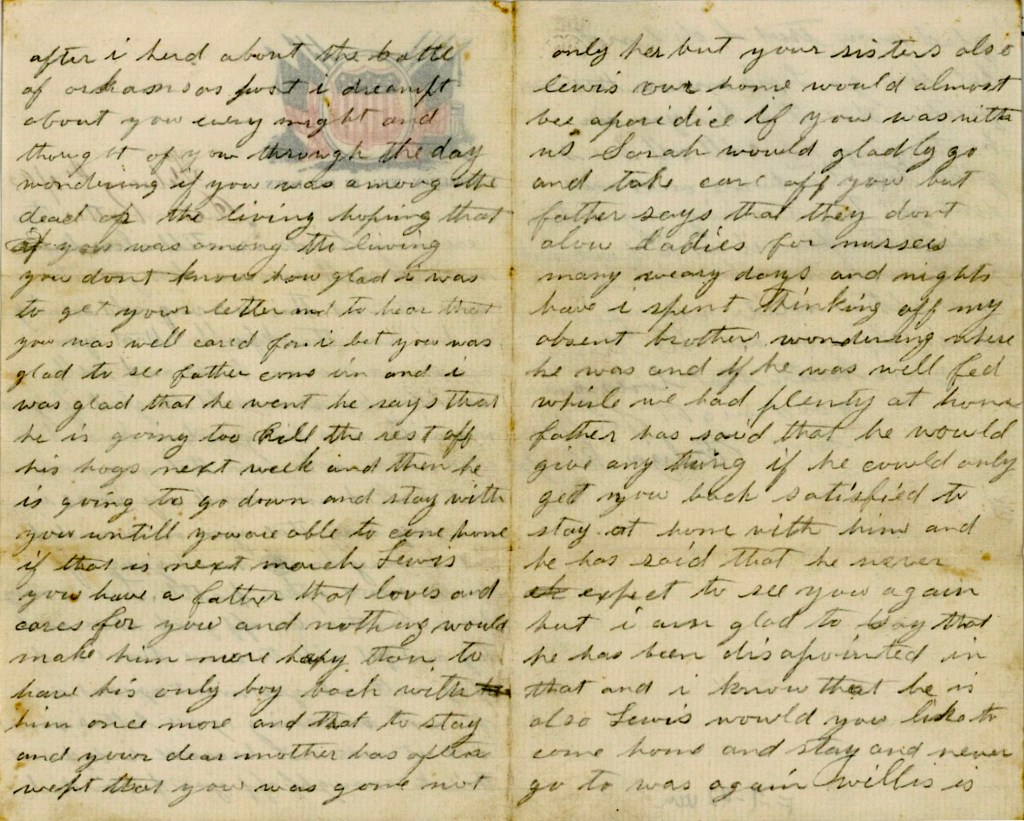
The following letter was written by Eliza (Simpson) Russell to her younger brother, Lewis Edward Russell (1846-1924). Eliza was married in 1858 to Willis Russell (18xx-1870). Lewis and Eliza were two of at least 11 children born to Edward Simpson (1799-1887) and Hatta Maria Ward (1810-1899) of Magnolia, Putnam county, Illinois. Lewis had three brothers who died relatively young, leaving him the only surviving son at the time of his enlistment, when only 16 years old, in Co. B, 77th Illinois Infantry on 22 August 1862.
From this letter we learn that Lewis was in the Battle of Arkansas Post on 11 January 1863. The 77th Illinois was in the thick of the fight and later claimed they were the first to scale the fort’s parapets. The 77th suffered six men killed in the battle, with another 39 wounded. Lewis was one of those wounded and was subsequently treated at Lawson Hospital in St. Louis, Missouri. He was discharged from the service on 12 August 1863. Lewis lived near Henry, Illinois, until 1916 when he moved to Hollywood, California.
Transcription
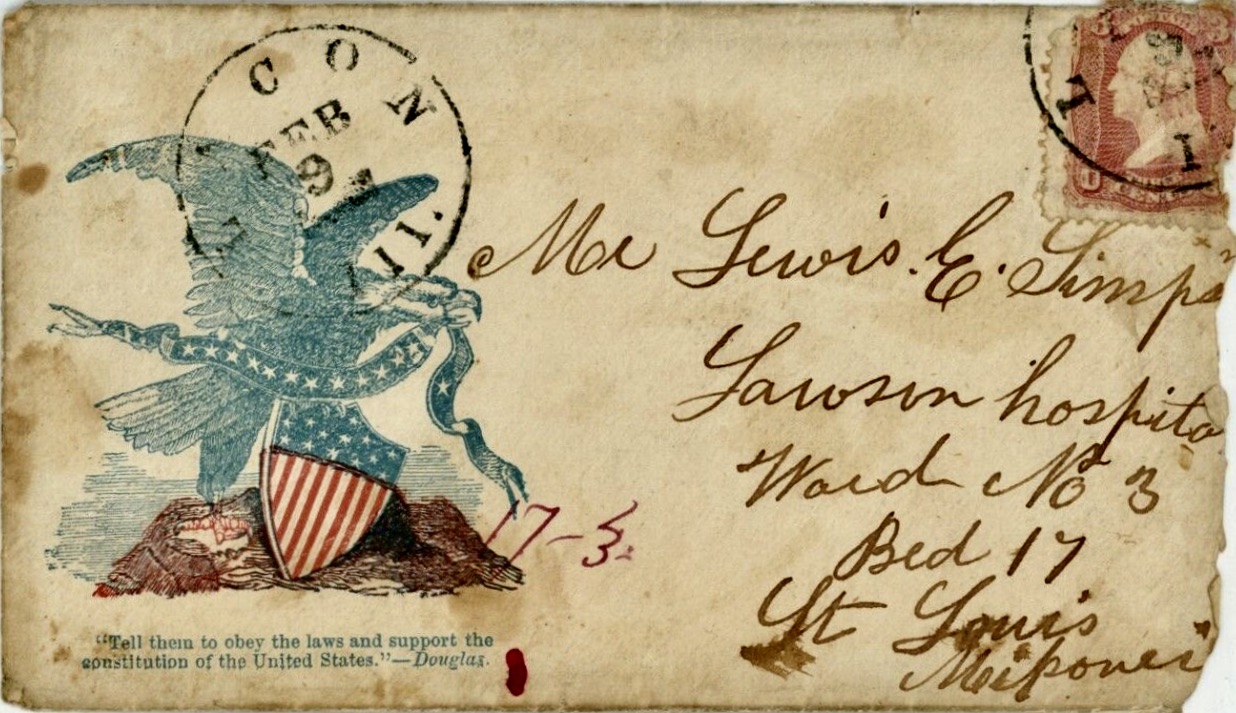
Addressed to Mr. Lewis E. Simpson, Lawson Hospital, Ward No. 3, Bed 17, St. Louis, Missouri
February 7, 1863
Dear Brother,
This evening finds us still alive but not all well. Emma has got the sore throat. This is a very cold evening and I am thankful that you are in a warm house and well care for but we would be glad if you was with us. But you don’t know how glad we was to hear that you was not killed nor wounded any worse. I am very sorry that you are wounded but it may have saved your life from some other battle.
Lewis, my dear brother, be of good cheer and try and get able to come home and stay with us. You must excuse me for not answering your letters sooner but it was not because I did not think of you for indeed, after I heard about the battle of Arkansas Post, I dreamt about you every night and thought of you through the day, wondering if you was among the dead or the living, hoping that you was among the living. You don’t know how glad I was to get your letter and to hear that you was well cared for. I bet you was glad to see father come in and I was glad that he went.
He says that he is is going to kill the rest of his hogs next week and then he is going to go down and stay with you until you are able to come home if that is next March. Lewis, you have a father that loves and cares for you and nothing would make him more happy than to have his only boy back with him once more and that to stay. And your dear mother has often wept that you was gone—not only her, but your sisters also. Lewis, our home would almost be a paradise if you was with us. Sarah would gladly go and take care of you but father says that they don’t allow ladies for nurses.
Many weary days and nights have I spent thinking of my absent brother, wondering where he was and if he was well fed while we had plenty at home. Father has said that he would give anything if he could only get you back satisfied to stay at home with him and he has said that he never expects to see you again. But I am glad to say that he has been disappointed in that and I know that he is also. Lewis, would you like to come home and stay and never go to war again?
[My husband,] Willis is glad now that I did not let him go. Lewis, answer that question that I asked you in particular. We will all be so glad to have you come home once more. Don’t get tired reading my letter. Excuse this pencil as I have no good ink. I will write to you often. Write me a few lines if you are able. From your sister that loves you, good night for this time.