

The following letter was written by 40 year-old Henry Frost Waring (1796-1874), the son of Thaddeaus Waring (1746-1826) and Deborah Frost (1753-1844). Henry was married in 1818 to Sarah W. Osborn and a second time in 1844 to Amelia Frances Weed. He worked as a merchant in New York City early in his career. By the time of the 1860 US Census, he was working as an “agent” of some kind in Green Bay, Wisconsin.
Henry wrote this letter to his niece, Deborah Frost Chadeayne (1805-1870), the daughter of Mary Waring (1782-1855) and Daniel Chadeayne (1773-1834) of Orange county, New York. Deborah was married on 19 August 1836 to Henry Peter Husted (b. 1804) in New York City.
In this April 1836 letter, written from the City Hotel in Savannah, Georgia, where he had resided for six months engaged in his naval stores business, Henry wrote his niece a few lines about the City of Savannah—the streets, the inhabitants, the climate, and (curiously) of visiting the Jewish graveyard.
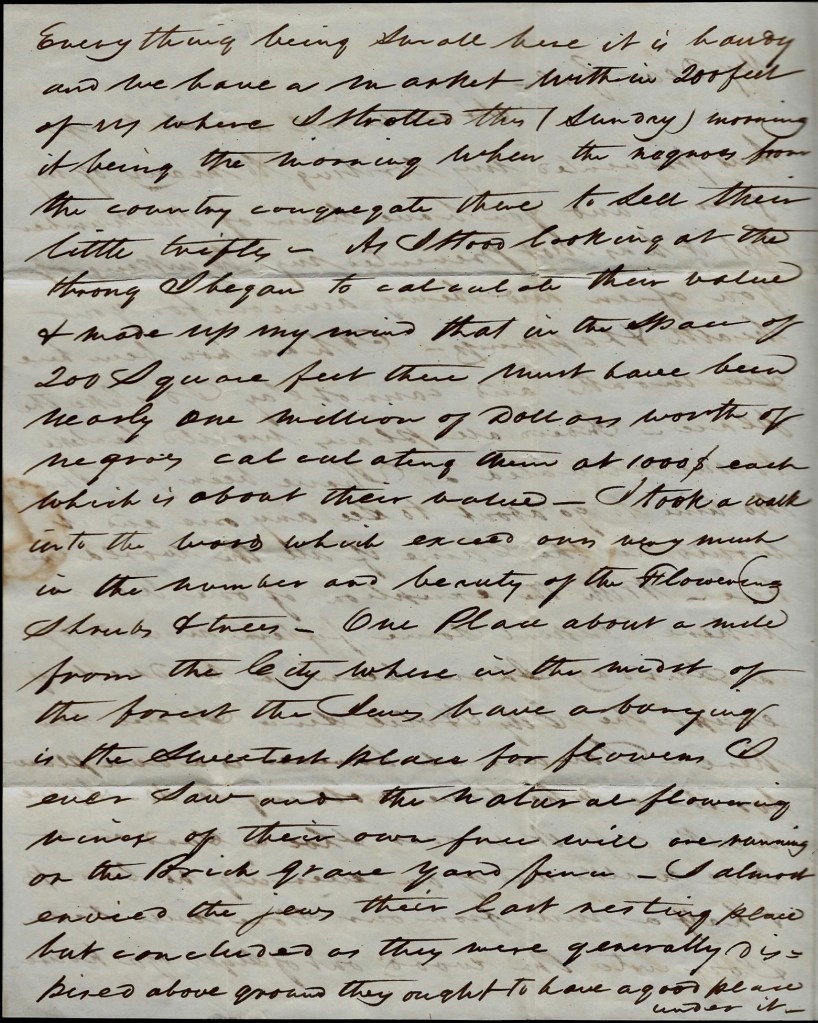
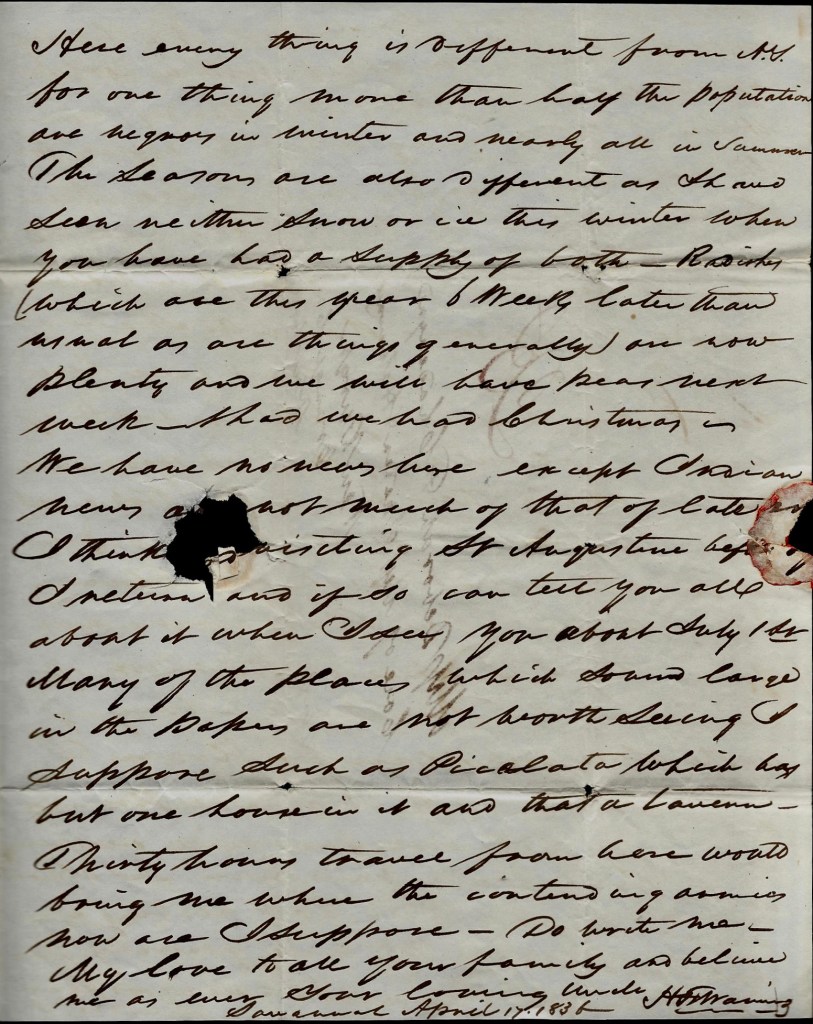
Transcription
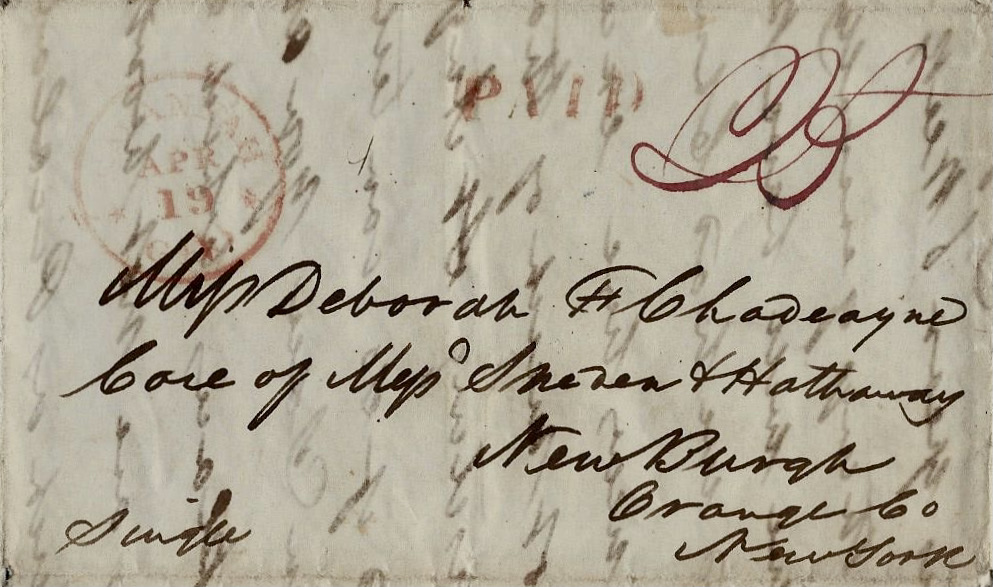
Savannah, [Georgia]
April 17, 1836
My dear girl,
Hards work and sickness has prevented my writing to many of my friends and you have been of the number, but it has not prevented my thinking of you often and being anxious for your health and happiness. I have been here six months and cannot say I dislike the place—indeed, all places would be alike to me situated as I have been for I have no time to fo about to see anyone and it would be the same if all the world lived here. With the exception of one house where I spent some fifteen minutes of a Sunday, I have been in no dwelling except the City Hotel since I have been here.
Savannah, however, is a dull place for those who have nothing to do. If one walks out it is over shoe in sand and no side walks and of an evening no lamp & half a mile from our store will take you into the wood out of sight of a house. Everything being small here, it is handy and we have a market within 200 feet of us where I strolled this (Sunday) morning, it being the morning when the negroes from the country congregate there to sell their little trifles.
As I stood looking at the throng, I began to calculate their value & made up my mind that in the space of 200 square feet, there must have been nearly one million of dollars worth of negroes calculating them at $1000 each which is about their value.
I took a walk into the wood which exceed ours very much in the number and beauty of the flouring shrubs and trees. One place about a mile from the City where in the midst of the forest the Jews have a burying is the sweetest place for flowers I ever saw and the natural flowering vines of their own free will are running on the brick grave yard fence. I almost envied the Jews their last resting place but concluded as they were generally despised above ground, they ought to have a good place under it. 1
“I almost envied the Jews their last resting place but concluded as they were generally despised above ground, they ought to have a good place under it.”
— Henry Frost Waring, 17 April 1836
Here everything is different from New York. For one thing, more than half the population are negroes in winter and nearly all in summer. The seasons are also different as I have seen neither snow or ice this winter when you have had a supply of both. Radishes (which are this year 6 weeks later than usual as are things generally) are now plenty and we will have peas next week.
We have no news here except Indian news 2 and not much of that of late and I think of visiting St. Augustine before I return and if so, can tell you all about it when I see you about July 1st. Many of the places which sound large in the papers are not worth seeing, I suppose, such as Picolata [Florida] which has but one house in it and that a tavern. Thirty hours travel from here would bring me where the contending armies now are, I suppose. Do write me. My love to all your family and believe me as ever your loving uncle, — H. F. Waring
Savannah, April 17, 1836
1 “Established by Mordecai Sheftall on August 2, 1773 from lands granted him in 1762 by King George III as a parcel of land that “shall be, and forever remain, to and for the use and purpose of a Place of Burial for all persons whatever professing the Jewish Religion.”
2 Henry is referring to the Second Seminole War (1835-1842) provoked by President Jackson signing the Indian Removal Act. The Seminole Indians refused to leave Florida and throughout 1836, led by Osceola, the Seminoles attacked plantations, outposts, and supply lines, and they stymied several efforts by the United States to subdue them.


 Spared & Shared 23