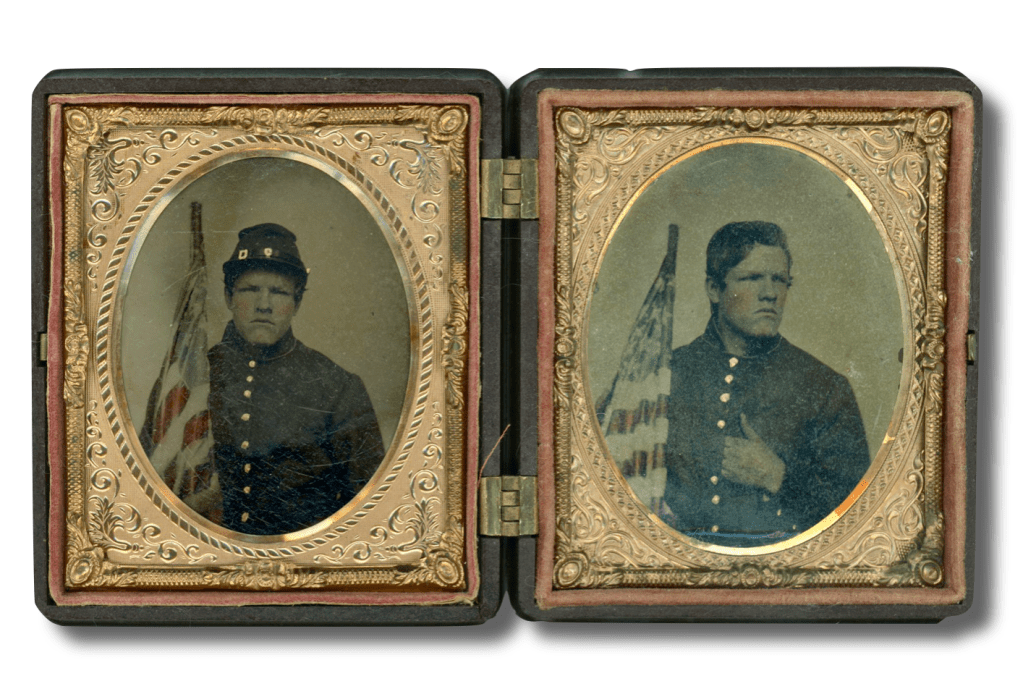
The following letters were written by 18 year-old Jonathan S. Ebling (1844-1925), the son of Jacob G. Ebling (1821-1860) and Maria Stamm (1813-1883) of Berks county, Pennsylvania. Jonathan wrote the first letter to his sister Mary E. Ebling (1845-1870) not long after his enlistment in Co. G, 151st Pennsylvania Infantry. This regiment was raised in the fall of 1862 and mustered for nine months’ Federal service on 4 November 1862 at Harrisburg.
The regiment did not experience their first engagement with the enemy until the Chancellorsville Campaign while they were attached to Reynold’s 1st Corps. The corps duty during the campaign was to create a diversion near Fredericksburg while the rest of Hooker’s army made a flank move on the rebels. But when rebel batteries opened on the 1st Corps from across the Rappahannock river, some men of the untested 151st to break ranks and run for cover. The 1st Corps later guarded the river crossing at United States Ford while Union troops were withdrawn.
The regiment finally had the opportunity to test its mettle at the Battle of Gettysburg where they were engaged in the first day’s fighting on McPherson Ridge and later, on the third day, in repulsing Pickett’s charge. Days later, they were discharged from duty, their term of service expired. After the war, they were sometimes referred to as the “Schoolteachers’ Regiment” due to its war-time enrollment of at least sixty teachers.
Letter 1
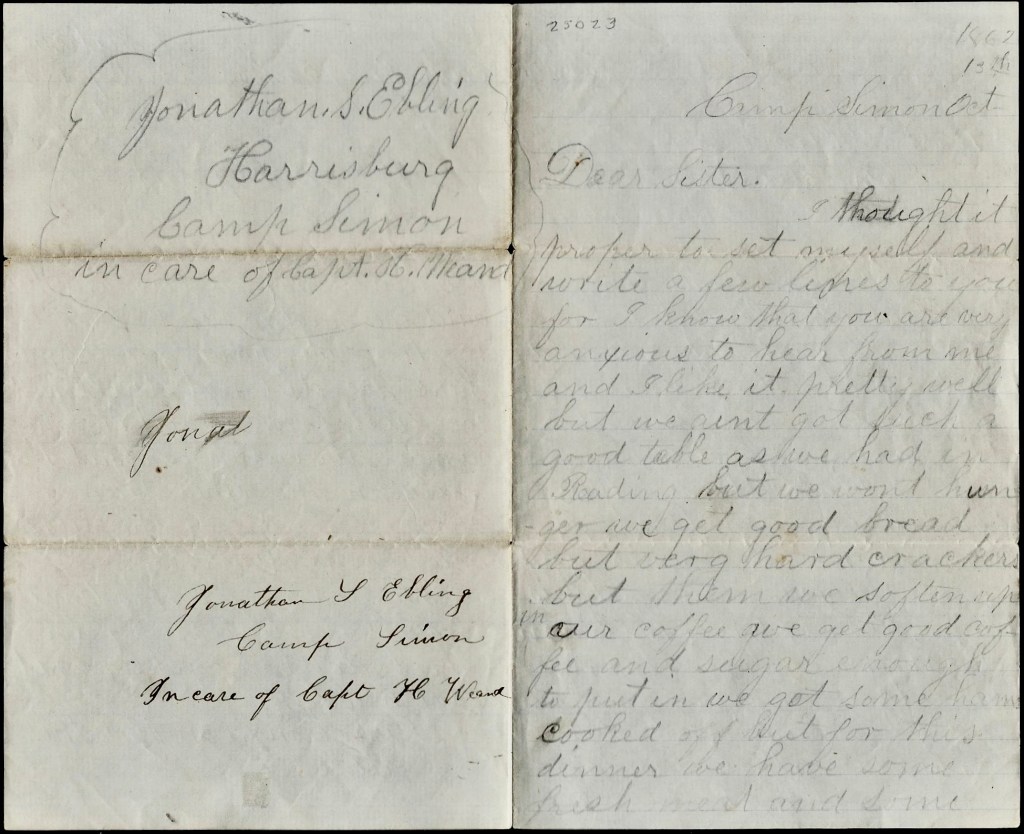
Camp Simon
October 13th 1862
Dear Sister,
I thought it proper to set myself and write a few lines to you for I know that you are very anxious to hear from me and I like it pretty well but we ain’t got such a good table as we had in Reading. But we won’t hunger. We get good bread but very hard crackers. But them we soften up in our coffee. We get good coffee and sugar enough to put in. We have got some ham cooked off but for this dinner we have some fresh meat and some potatoes and we get bean soup and rice [ ] and soup.
There was about 7,000 soldiers came in the camp on Sunday that were gone up to Chambersburg on Saturday and night.
I would not take ten dollars for all that I have seen already if I should not see it. We have tents where we live in and each one is got a new good blanket and there is six in each tent. I and George Kershner and Lewis Kershner and Christian Koenig and William Stamm and Jonathan Kreitz. We six are at home in one tent and your cakes we eat on Sunday dinner. They all said they were so good but we can buy cakes and pies and all such kind of things. We have a store in the camp. But our uniforms, we can’t tell when we [will] get them.
On Sunday we had a preacher and we had a kind of a meeting. We have good times here. We did not drill yet. We just loaf about in the camp. Our camp is about one mile on the other side of Harrisburg near the Susquehanna River.
This is all for this time. I will write soon again but don’t forget to write soon back. Directions on the other side.
Jonathan S. Ebling, Camp Simon, Harrisburg, in care of Capt. H. Weand

Letter 2
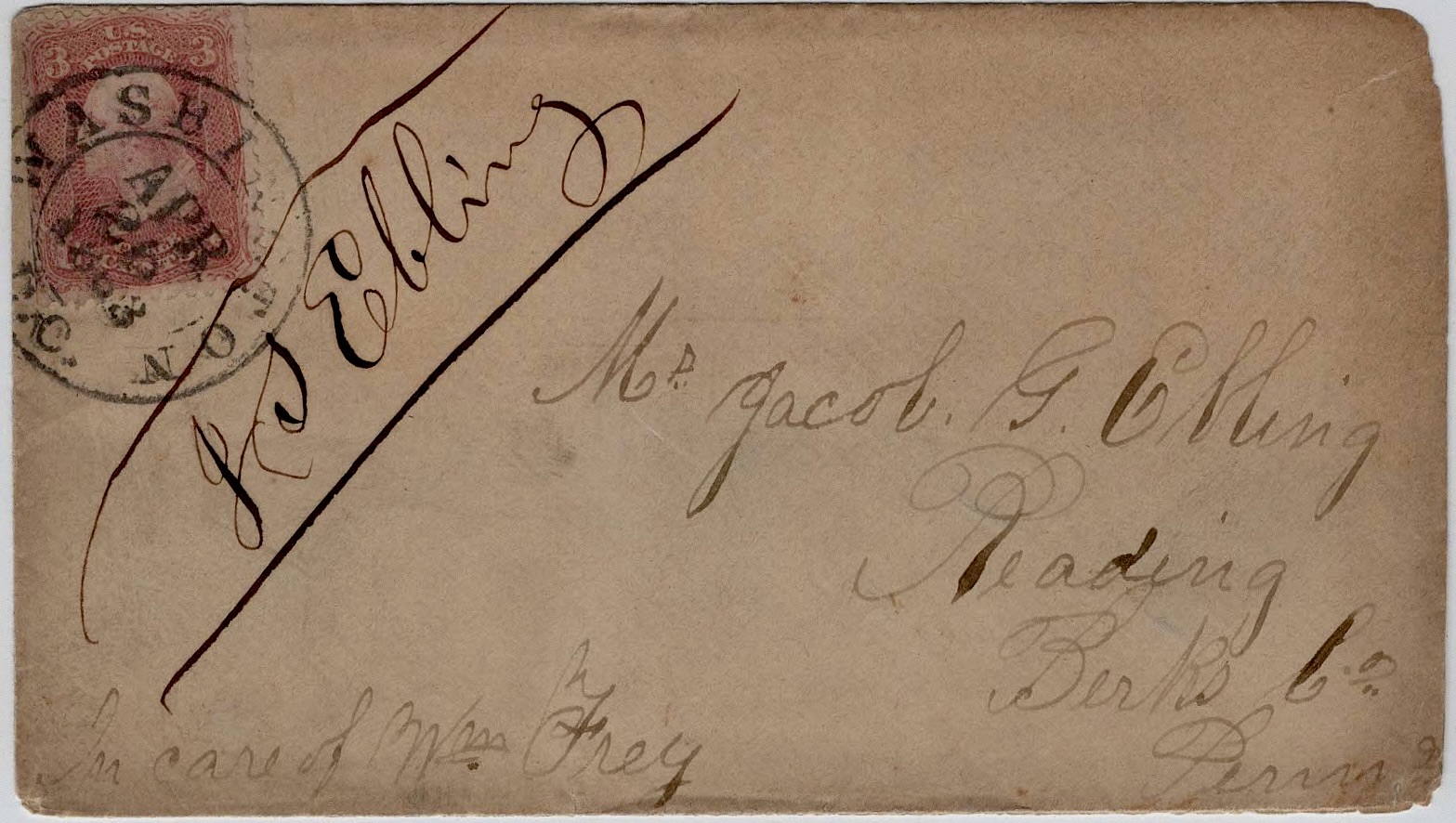
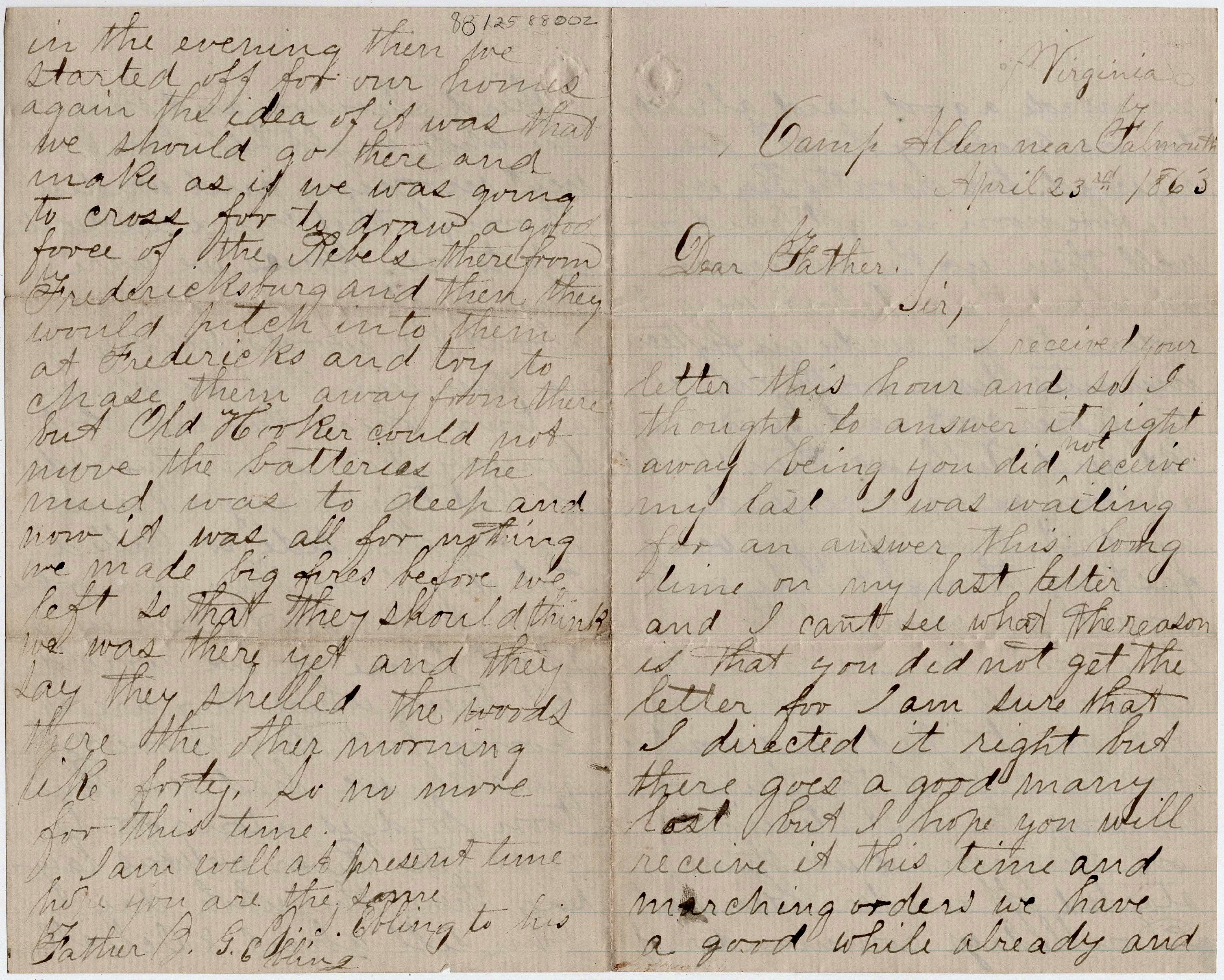
Camp Allen near Falmouth, Virginia
April 23, 1863
Dear Father,
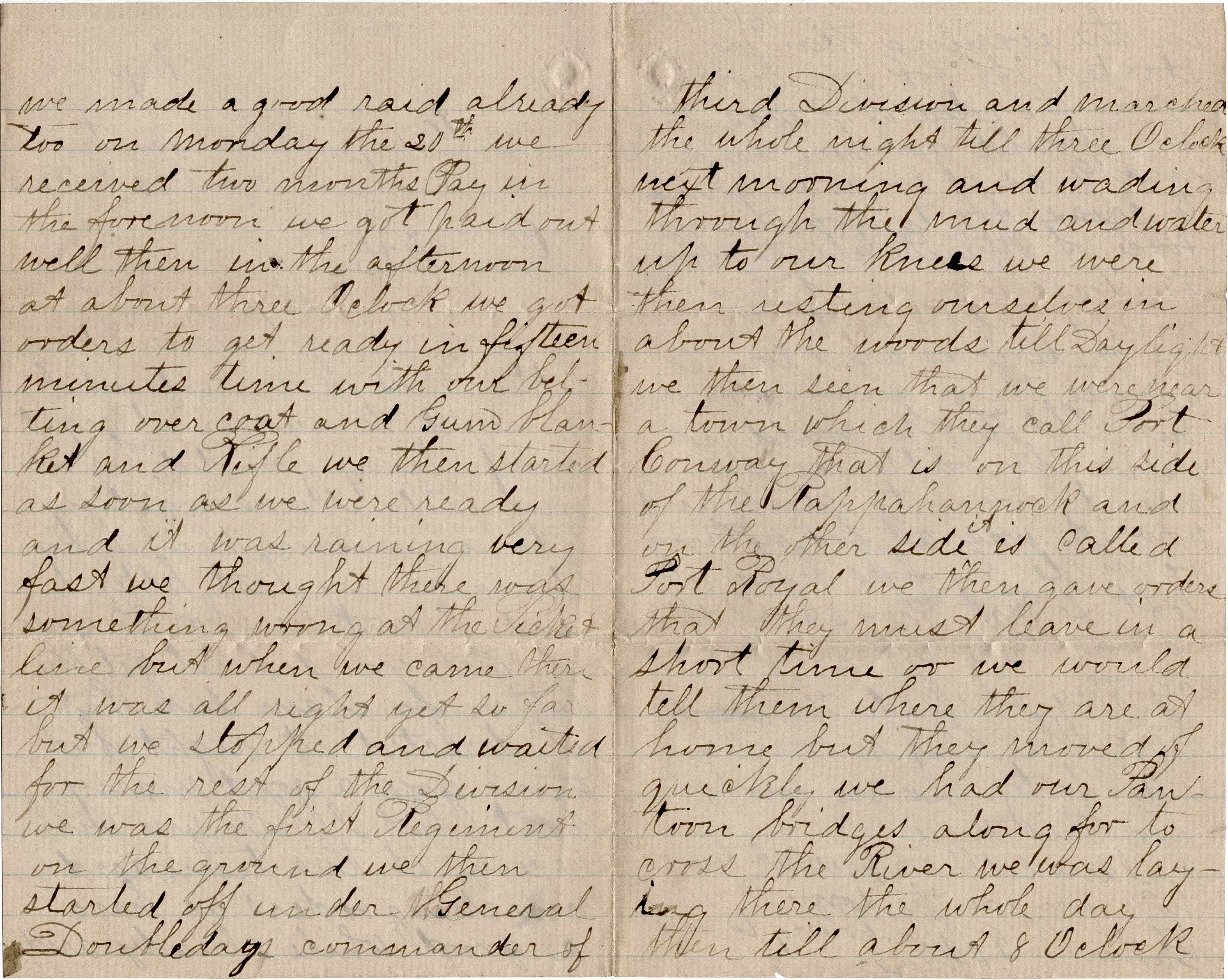
Sir, I received your letter this hour and so I thought to answer it right away being you did not receive my last, I was waiting for an answer this long time on my last letter and I can’t see what the reason is that you did not get the letter for I am sure that I directed it right. But there goes a good many lost. But I hope you will receive it this time and marching orders we have a good while already and we made a good raid already too. On Monday the 20th we received two months pay in the forenoon we got paid out.
Well then in the afternoon at about three o’clock we got orders to get ready in fifteen minutes time with our belting overcoat and gum blanket and rifle. We then started as soon as we were ready and it was raining very fast. We thought there was something wrong at the picket line but when we came there, it was all right yet so far but we stopped and waited for the rest of the Division. We was the first regiment on the ground. We then started off under General Doubleday, commander of the 3rd Division, and marched the whole night till 3 o’clock next morning and wading through the mud and water up to our knees.
We were then resting ourselves in about the woods till daylight. We then seen that we were near a town which they call Port Conway that is on this side of the Rappahannock and on the other side is called Port Royal. We then gave orders that they must leave in a short time or we would tell them where they are at home but they moved off quickly. We had our pontoon bridges along for to cross the river, We was laying there the whole day then till about 8 o’clock in the evening, then we started off for our homes again. The idea of it was that we should go there and make as if we was going to cross for to draw a good force of the Rebels there from Fredericksburg and then they would pitch into them at Fredericksburg and try to chase them away from there but Old Hooker would not move the batteries. The mud was too deep and now it was all for nothing.
We made big fires before we left so that they should think we was there yet and they say they shelled the woods there the other morning like forty. So no more for this time.
I am well at present time. Hope you are the same. — J. S. Ebling
To his father, J. G. Ebling