
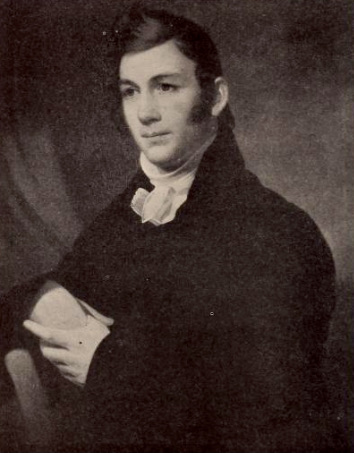
The following letter was written by Col. Frederick A. Schley (1789-1858), the son of John Jacob Schley (1751-1829) and Anna Maria Shellman (1754-1843) of Frederick, Maryland. Frederick’s first wife was Eliza Asbury McCannon (1794-1816) with whom he married in 1812. The “Mrs. McCannon” mentioned in the first paragraph would have been Frederick’s mother-in-law, Anna (1760-1838). Frederick had a long legal career in Frederick and was at one time the law partner of Roger Taney—the Supreme Court Chief Justice best remembered for handing down the Dred Scott decision.
Frederick wrote the letter to George Towers Dunbar, Sr. (1774-1843), the son of Joseph Thomas Dunbar (1818-18010 and Henrietta Carpenter (17xx-1801) of Baltimore county, Maryland. George was married to Frances McCannon (1788-1868), making Frederick and George brothers-in-law.
Frederick’s letter speaks of purchasing a young negro named “Dan” who “is a very smart, active boy, and with a Master who would occasionally trounce him with ‘the cat of nine tails’ would make an excellent servant.” Slavery would not be abolished in Maryland until the end of the Civil War.
Transcription
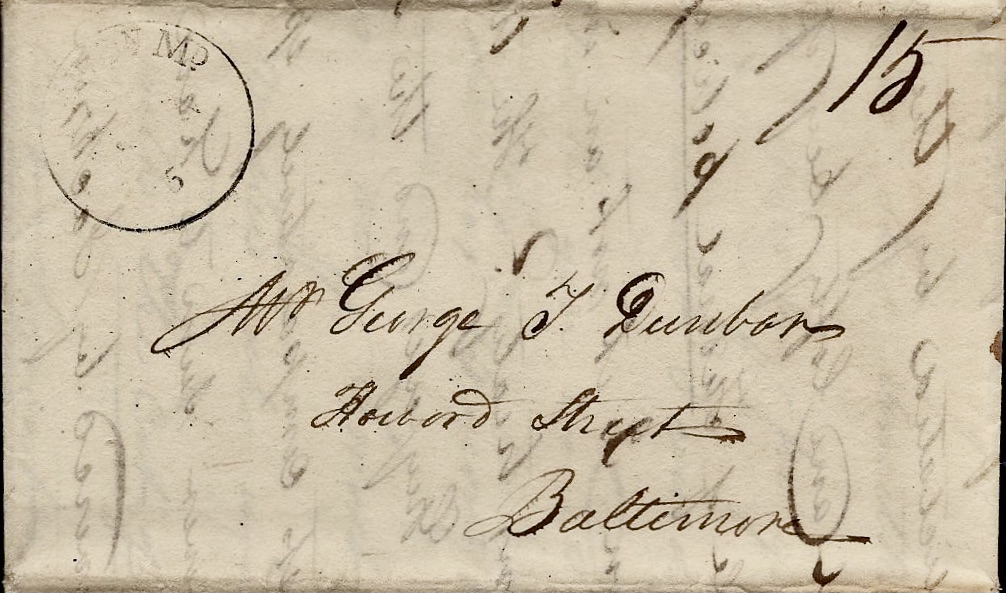
Frederick [Maryland]
January 4, 1815
My dear Sir,
I have been anxiously waiting to hear from you whether Mr. Betts accepted my proposition or what he has said and done relative to it. Also whether Stewart called & paid you $125 as he promised me he would, And further whether you have succeeded yet in procuring house for Mrs. McCannon or whether you have any prospect of getting one this winter. The old lady is as you well know extremely anxious to settle herself and have her children with her. If you can’t get a house for her, I think she had better rent Doctor Colegate’s for one year during which time a desirable situation may probably offer and you can then purchase for her.
I understand sugar has fallen very much in price. If so, will you be so good as to purchase 150 or 200 lbs. and send me a Bill of it. I will then send by some waggoner for it and forward you the amount of “Saline” paper which I understand is 3 percent above par.
Mrs. Dunbar said something to me about purchasing a negro boy for you. If you want one, I have no doubt I could get one. I, however, think you would do well to purchase “Dan,” who has 15 years to serve from the estate. He is a very smart, active boy, and with a Master who would occasionally trounce him with “the cat of nine tails” would make an excellent servant. If I had not my Jacob who I will never sell, I would purchase him myself. He is worth 40 Henrys. Suppose you take him upon trial for a week or two. Isaac Shriver wants to buy him but I would rather sell him to you.
If my house is not sold and any person will give you $6800 for it, you can sell.
You have no doubt seen and read with the proud and gratifying feelings of an American the treaty dictated by the gallant Decatur to the cruel and lofty Dey of Algiers. There is a sample of Federal Policy for you. What think you? Is it not an improvement [over?] Jefferson’s treaty? The treaties made with [ ] face, Grey-eyes, and the Shooting Tiger excite little interest comparatively speaking. Our “red brethren” however seem to have been completely outmaneuvered by Jackson to the Southward, and to have got much less advantageous terms than the Kickapoos and other Northern tribes. Poor Devils. I wish they were all in a better world for I much fear we shall never be able to keep them quiet in this. 1
My love to Mrs. D. and believe me yours, sincerely, — Frederick A. Schley
1 This is a reference to Commodore Stephen Decatur’s Algerian Treaty which, once ratified, ended the Second Barbary War. The treaty was repudiated by Dey Omar Agha of Algeria, however, and it was several more years before a final treaty was ratified. Frederick contrasts that treaty against the treaties made between the US Government and the Native American Tribes. See Treaties of Portage des Sioux.


 Spared & Shared 23
Is he
LikeLike
Is he suggesting that Dan be beaten to be kept ‘obedient?’
LikeLike
Yes. A “cat o’nine tails” was a lash.
LikeLike