
The following letter was written by James Abell Dunbar (1816-1852). He was married in 1840 to Ann Elizabeth Eugenia Langley (1823-1879). James wrote the letter from New Orleans where he was temporarily domiciled and employed in the sale of Cooking Stoves under the name of Dunbar & Company with its office at No. 59 Tehoupitoulas Street.
James’s letter was written during the Panic of 1837 and is the reason that business was “dull” and resulting in numerous financial embarrassments to businessmen. Jackson’s veto of a National Bank was also the cause of differences in valuation of money which lead to speculators playing State banks against each other, as mentioned in the closing paragraph.
James wrote the letter to his father, George Towers Dunbar, Sr. (1774-1843), the son of Joseph Thomas Dunbar and Henrietta Carpenter of Baltimore county, Maryland.

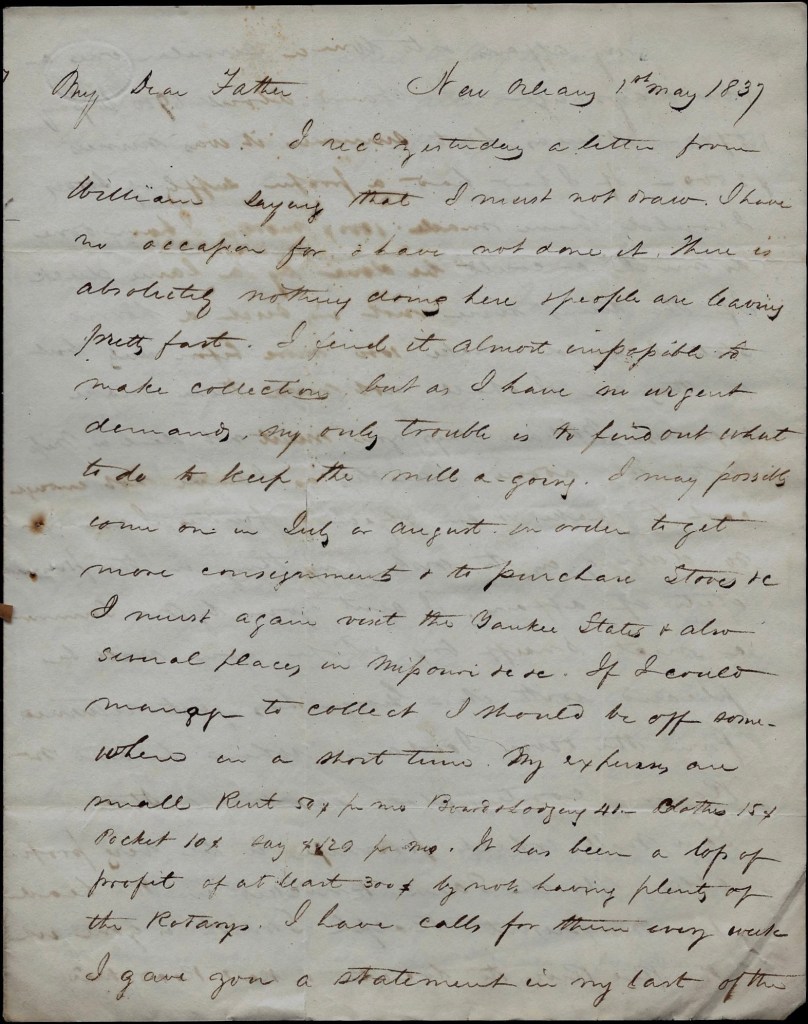
Transcription
New Orleans, [Louisiana]
1st May 1837
My dear father,
I received yesterday a letter from William saying that I must not draw, I have no occasion for I have not done it. There is absolutely nothing doing here & people are leaving pretty fast. I find it almost impossible to make collections but as I have no urgent demands, my only trouble is to find out what to do to keep the mill a going. I may possibly come on in July or August in order to get more consignments & to purchase stoves, &c. I must again visit the Yankee States & also several places in Missouri, &c. &c. If I could manage to collect I should be off somewhere in a short time. My expenses are small—rent $50 per month, board & lodging 41, clothes $15, pocket $10—say $120 per month. It has been a loss of profit of at least $300 by not having plenty of Rotarys [Rotary Cooking Stoves]. I have calls for them every week. I gave you a statement in my last of the state of my affairs & to William a similar one a few days ago. It stands about 6900 to pay $5700—whereas last summer it was minus $2500. If I had had a proper supply of stoves I could have made $1000 or more. I have done as much as could be done by a lame duck.
If the times were not in such a horrid state, I could make 1000 more before July but as they are, I shall not more than make expenses. William says “you must not deal in Mississippi notes.” The advice is needless as I have not enough cash to make it an object & further I am not so daring as to risk anything in the present state of affairs. I sent you by Mr. Sumner a neat snuff box & hope you will be pleased with it. George has just returned from the river Jordan where he and Mr. Ranny contemplate erecting a steam saw mill which promises to be very profitable. Uncle Sam knocked in the head for the present.
Ralph Smith is gone up the Red River to locate a railroad and will probably be married to Miss Leocarde Baham in the fall. 1
Love to all & do not let the bad times have an effect on your spirits. There’s no use in it.
Your son, — James
2nd. The dullness of business, George’s going away and the hardness of collections have made me quite melancholy today.
A young man of highly ([William C.] Reynolds) respectable connections who some time since murdered a man by the name of [Jules] Barré, yesterday shot himself in prison to avoid the fate he saw coming. George will relate the particulars. A man by the name of Cadiche was hung a few days ago for the murder of a Spaniard. Refer to George for particulars. A negro was hung about 10 days ago for attempting to kill several persons who seized him. I hope to hear of every murderer high or low, paying the forfeit.
May 3rd. Theodore Nicolet, merchant, shot himself today. Gen. Jackson or Van Buren will have to answer for it as it was caused by his being ruined by the derangement of business. Mr. Lemonier shot himself a few days ago a few minutes after he had heard of the death of his mother. These things are done & forgotten in one day or so.
The merchants, or rather some merchants, make money by drawing a few thousand specie at one bank & sell to another at 2.5 premium. $5000 at two operations a day make $250. 6 days 1500. 12 days 2010, &c. &c. Some one will get bit most abominably. I expect we shall see some Bank of Maryland sort of blown up before long.
1 Ralph S. Smith (1806-1883) of Chatham, Connecticut, was married in St. Tammany county to Leocardie Baham (1809-1848) on 5 August 1837. In 1850, Ralph resided in Alexandria, Louisiana, and owned 42 slaves.


 Spared & Shared 23
I didn’t understand this reference so I looked it up. May 3rd. Theodore Nicolet, merchant, shot himself today.
Gen. Jackson or Van Buren will have to answer for it as it was caused by his being ruined by the derangement of business.
It turns out that 1837 was an economic depression similar to the Great Depression. It lasted into the 1840’s. Andrew Jackson was President. The paper said, “Theodore Nicolet of 88 Bourbon Street shot himself. Theodore Nicolet, a merchant of great eminence, shot himself yesterday. He was inticated to the deed by the present commercial embarrassments, his business being seriously affected .
As for Cadiche. There’s a mistake in the letter. The guy may have been reading the New Orleans Bee newspaper.
There’s a correction published in a New York paper, citing the New Orleans Bee, correcting itself that the name of the individual executed was Tibbetts, and not Cadiche, as stated by the Bee. Cadiche was one of the jurymen who tried the case. The Tibbets case appears in the Kentucky Gazette. He was executed on the May 28th in New Orleans.
Didn’t find the negro/slave hanged story…
LikeLike
Thanks Daniel. I should have mentioned the Panic of 1837 as the reason that business was “dull” and resulting in numerous financial embarrassments. Jackson’s veto of a National Bank was also the cause of differences in valuation of money which lead to speculators playing State banks against each other.
LikeLike