
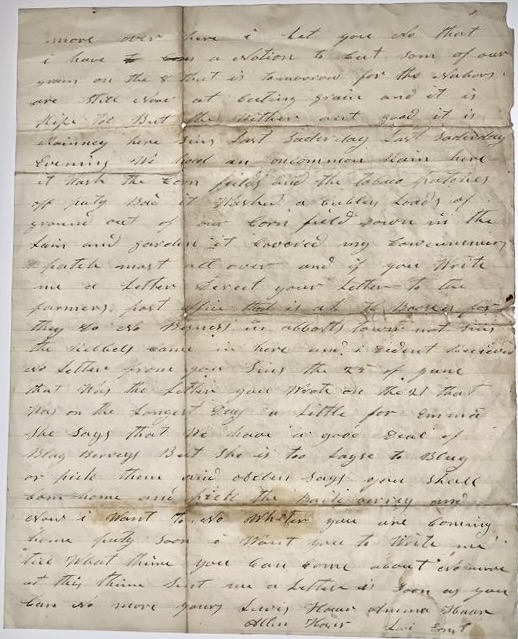
The following letter was written by Louisa (Spangler) Haar (1824-1882), the wife of Isaac Haar (1818-1874) of Paradise township, York county, Pennsylvania. Louisa wrote the letter to her 46 year-old husband who was drafted in November 1862 and mustered into Co. C, 166th Pennsylvania Infantry (Drafted Militia). Isaac became ill in the winter and was hospitalized in January 1863—too ill to return to his regiment until 20 July 1863 and he was discharged a week later. Their children were named Emma (b. 1852), Annie (b. 1854), Amanda (b. 1856), and Allen (b. 1860) whose names appear at the end of the letter, though somewhat difficult to read due to the resolution of the image.
The letter was datelined 7 June 1863 but this was clearly a mistake; it should have been dated 7 July 1863—a few days after the Battle of Gettysburg which is described in the letter. In her letter, Louisa informs her husband of the passage of Gen. Early’s army through Gettysburg on the way to York, and then of the fights at Hanover and Gettysburg, followed by the heavy rains.
This letter is from the private collection of Jeff Hilsmeier who sent me photographs of it for transcription and publication on Spared & Shared.
Transcription
[Paradise Township, York county, Pennsylvania]
June [July] 7th 1863
Dear husband,
Here I let you know that I and the children are all well at this present [time] and we hope that these few lines will and may find you in the same state of health. Further, I let you know that we had bad times here this week past. The rebels came through here on the [2]7th of June and went as far as York and then came back as far as Hanover on the 29th and there they had a fight and then from Hanover they went to Gettysburg and there they pound[ed] on us for about 3 days and it is said that our men killed about 35,000 rebels and took about 15,000 prisoners and it is aid that the rebels killed and wounded about 12 or 15,000 of our men.
And now the rebels are in Emmitsburg [Maryland] about 12 miles above Gettysburg and they say they are fixing for another battle and the rebels went up through Dover township and took most all the horses and through here they took a good many too but not so very much as some other places. And they keep the York fellows pretty hard. They say they made the York boys make up 25,000 dollars so as they didn’t burn down the town and they made it up more over here.
I let you know that I have a notion to cut some of our grain on the 8th, that is tomorrow, for the neighbors are still none at cutting grain and it is ripe too, but the weather ain’t good. It is raining here since last Saturday. Last Saturday evening we had an uncommon rain here. It wash the cornfields and the tobacco patches off pretty bad. It washed a couple loads of grain out of our corn field down in the lane and garden. It covered my [ ] patch most all over and if you write me a letter, direct your letter to the farmers post office that is at the [ ] for they do no business in Abbottstown—not since the rebels came in here, and I didn’t receive no letter from you since the 25th of June. That was the letter you wrote on the 21st. That was the longest day.
A little for Emma. She says that we have a good deal of blueberries but she is too lazy to pick them and Ogden says you shall come home and pick the blue berries. And now I want to know whether you are coming home pretty soon. I want you to write me and tell what time you can come about. No more at this time. Send me a letter as son as you can. No more. Yours, Louisa Haar and [names of her children].

 Spared & Shared 23
Okay, what is being described in the letter did take place in June of 1863, not July. On June 26th, 1863 Early’s men, under Gordon arrive in Gettysburg. Early is on his way towards York. They leave Gettysburg, basically on the morning of June 27th. At some point Early hears fighting in Hanover but that’s JEB Stuart’s cavalry fight against the Federal cavalry. To the best of my knowledge, Early doesn’t go to Hanover. What they are doing is striking for the wooden bridge at Wrightsville, Pa. which is burned by Federal militia forces to prevent them from going over the Susquehanna and onto Harrisburg. Then they turn back when they can’t get over the river.
LikeLike
Agree. But the letter was date June 7, 1863 and I said this was an error; it should have July 7, 1863. And the author doesn’t know the various forces in Lee’s army so they were assumed to be the same forces returning.
LikeLike
Just based on the blueberry reference i would say this is July…June 7th would be way early in the season and the abundance mentioned would be more likely in July when the season is more active.
LikeLike
As I said, it was obviously written in July, not June, as it describes the Battle of Gettysburg which took place 1-3 July 1863.
LikeLike
Thanks for taking the time to figure this one out. You’re absolutely right about the mistake in the date; I’ve done the same thing writing checks. One of the interesting aspects of a letter like this one is that we get to see things through the eyes of a civilian, non-combatant onlooker. And of course, what she reports is only that tiny portion of events that she personally sees or hears from someone else, a sort of “key-hole” view that will inevitably contain all kinds of misconceptions. It’s all true, “from a certain point of view.”
LikeLike
My great-grandmother’s father, Jacob Swartz, was in the same company as Isaac Haar- 166th, company C.
LikeLike