
The following letters were written by Capt. Richard Watson Musgrove (1840-1914), the son of James Musgrove (1798-1878) and Ann Donker (1802-1879) of Bristol, New Hampshire.

Richard entered the service in August 1862 as a corporal in Co. D, 12th New Hampshire Infantry, was appointed sergeant, Mar. 17, ’63; first sergeant, Feb. 1, ’64; was at battles of Fredericksburg, Chancellorsville (where he had one musket shattered and another knocked from his hands), at Gettysburg (where he carried the state colors on the third day’s fight), and at Wapping Heights. When the regiment was stationed at Point Lookout, he was detailed for duty at the camp for prisoners of war, where he had charge of 1,000 men, all a later was sergeant of the provost guard at Gen. Gilman Marston’s brigade headquarters; discharged, Apr. 23, ’64, to accept promotion, and Apr 24, ’64, was appointed first lieutenant of Co. D, 1st Regt. U. S. Vol. Inf., a regiment, organized by Gen. Butler, and composed of prisoners of war who had taken the oath of allegiance and enlisted into the service of the Union; appointed captain of Co. I, same regiment, Aug. 13, ’64, and mustered out, May 21, ’66, after a service of three years and nine months. While in this regiment, he served three months in Norfolk, Va., as provost guard, and the balance of the time on the northwest and western frontiers, being stationed one year at Fort Ridgely, Minn. In the fall of ’65, his company with three others opened what is now the Smoky Hill route of the Union Pacific railroad, from Atchison, Kan., to Denver, Col. In winter of ’65-6, he was stationed at what is now Fort Wallace, Kansas, over 300 miles from the nearest settlement on the east. (Source: History of Bristol, N. H., vol. I, p. 208.)
In his letter of 4 October 1864, Richard mentioned hearing of the death of his younger brother, Adam Clark (“Abbott”) Musgrove (1842-1864). Abbott enlisted as a Private serving the Union Army in Halfmoon, Saratoga, New York on 21 Jul 1862. On 20 August 1862 he enlisted in Co. H, New York 115th Infantry Regiment. Abbott was killed in action and mustered out of service as a Corporal on 16 Aug 1864 in Deep Bottom Run, Henrico, Virginia.
Richard wrote the letters to Abigail (“Abbie”) Blake (1844-1911). Abbie married Rodolphus M. Locke (1839-1883) in November 1870.
Readers are also referred to a blog post on “Our War” describing Musgrove’s experience at the Battle of Chancellorsville when he was a sergeant in Co. D, 12th New Hampshire Volunteers. See Our War, 6 May 2014.
Letter 1
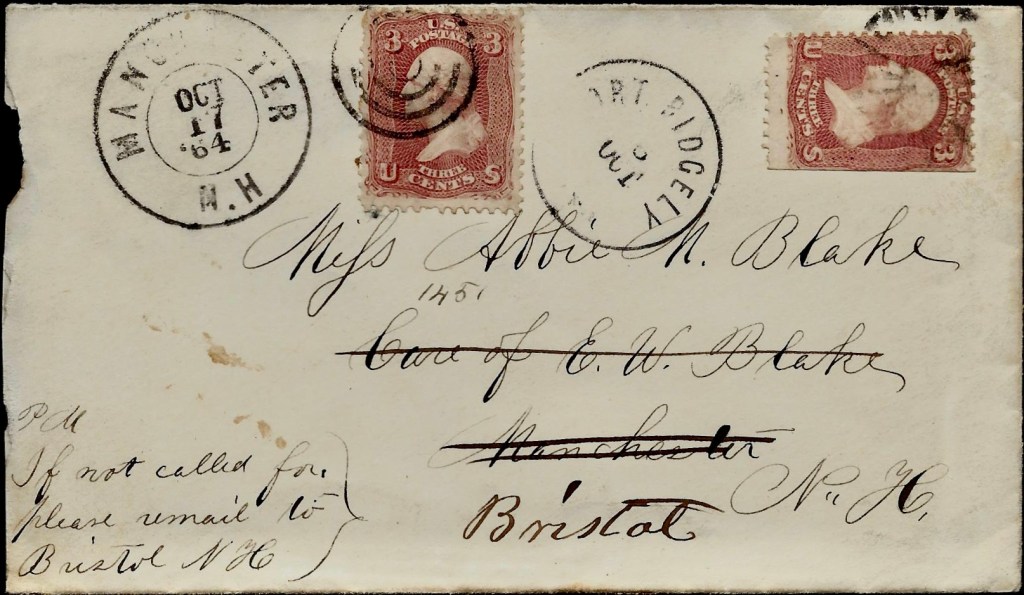
Fort Ridgely, Minnesota
October 4th 1864
Friend Abbie,
I presume you have concluded by this time that I have forgotten you, but such is not the case. I have thought of you often and wondered that you did not write. By the last mail, however, the mystery was explained by the arrival of your letter bearing date of July 3rd directed to Norfolk Va,
As I did not leave there till the middle of August, I do not see why I did not receive it before I left there but it was anxious to find me, and followed me to Milwaukee, Wisconsin, to Madison, then to St. Paul, Minnesota, to Fort Snelling and then here. I have been at all these places and am now stopping here, but how long I shall remain here I know not.
My 2nd Lieut. is now gone to Fort Wadsworth, Dakota Territory, with 40 men of my company as a guard for a train of supplies going to Fort Wadsworth. I expected to go myself with the whole company and remain there during the winter, but I am pleased at the prospect of remaining here. We are now 120 miles west of St. Paul. There is not but one or two houses within fifteen miles of here so I am far enough out of the world. But we should be worse off at Fort Wadsworth which is 180 miles west of here and not a habitation within 150 miles of there. Wild animals of all description—buffaloes, bears, wolves, and Indians are very numerous and troublesome, but I should not care for them. I do not like, however, to be so far from friends. Here we get a mail three times a week. There we should have one only once a week. I had just as leave go there next summer and expect we shall go further west then—probably on an expedition against the Indians.
I suppose you was aware of the death of my brother long before I was, as I did not know that he was dead till about three weeks ago, but looked in each mail for a letter from him, little thinking that I had received my last from him. Of course I feel very badly about his early fall. I miss his letters, always cheerful and hopeful, and I shall miss him very much when I get home as I hope to some day. But I am proud to think that he died so noble a death in the service of his country and I have the fact to cheer me that he died a christian soldier and while I mourn his loss, I am cheered at the thought that he is at rest where war is unknown, and that if I am faithful to my God, I may one day meet him above, although I can never more see his face upon earth. It would be a pleasure in some respects to be at home at this time to mourn with those there, or I would esteem it a great privilege to hear his funeral sermon preached, but as this cannot be, I will try and bow submissively to this heavy affliction and may his death result in good to me and us all.
It has been so long since you wrote your last that I hardly know where to direct [your letter] but I guess I will direct this to Manchester as you said nothing about leaving there and I hope you will receive it. I thank you for the little gift enclosed in your letter. I will try and heed its warning voice, and if you fail to hear from me for a long time, you must not think that I have forgotten you but attribute it to some such cause as delayed me now, or maybe I shall not have an opportunity to write as I am very much of the time on the move. So if you do not get a prompt answer, just write again and I hope they will get round even if they are delayed three months.
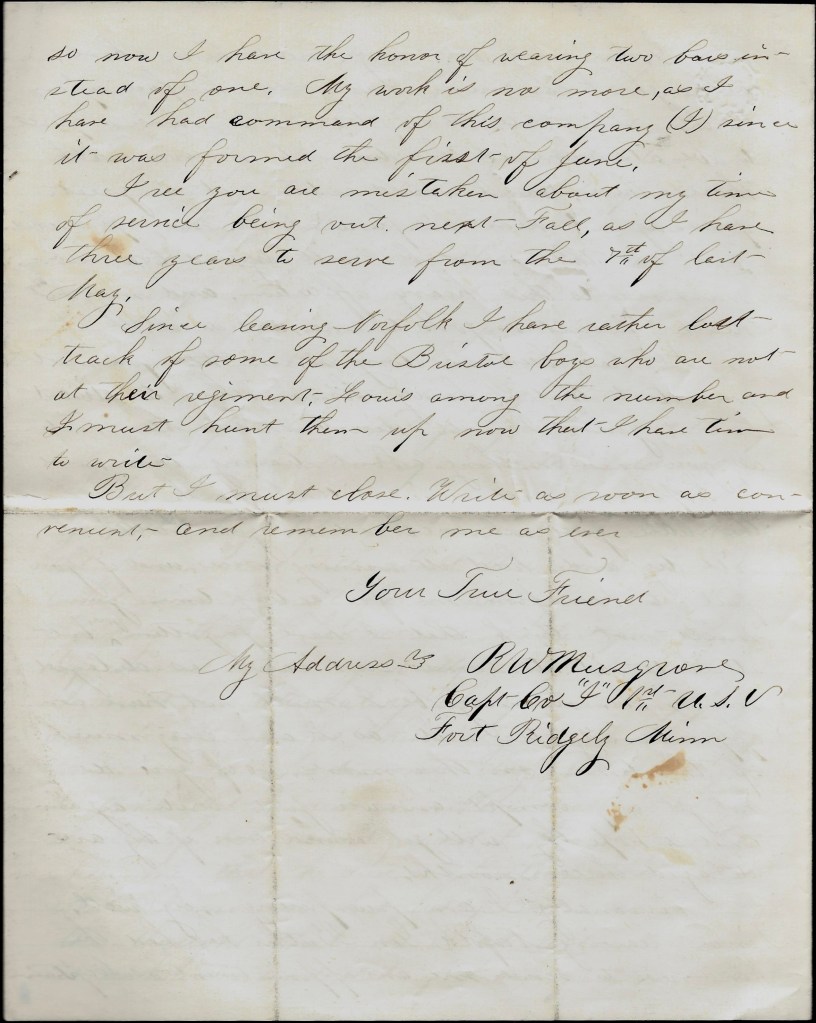
Personally I am prospering very well since leaving Norfolk. Gen. Butler has had the kindness to send me an appointment as Captain so now I have the honor of wearing two bars instead of one. My work is no more, as I have had command of this company (I) since it was formed the first of June.
Since leaving Norfolk, I have rather lost track of some of the Bristol boys who are not at their regiment, Louis among the number, and I must hunt them up now that I have tome to write. But I must close. Write as soon as convenient and remember me as ever. Your true friend.
My address is R. W. Musgrove, Capt. Co. I, 1st USV. Fort Ridgely, Minnesota


Letter 2
Fort Ridgely, Minnesota
December 7th 1864
Dear Friend,
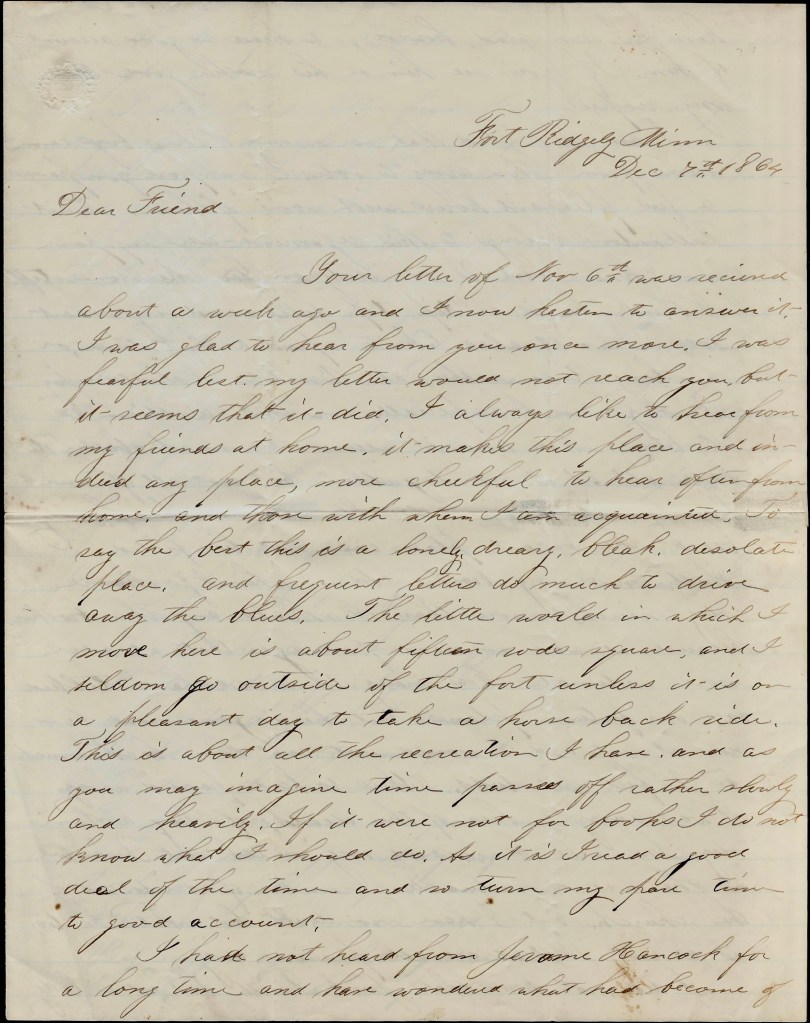
Your letter of Nov. 6th was received about a week ago and I now hasten to answer it. I was glad to hear from you once more. I was fearful lest my letter would not reach you, but it seems that it did. I always like to hear from my friends at home. It makes this place and indeed any place, more cheerful to hear often from home, and those with whom I am acquainted. To say the best, this is a lonely, dreary, bleak, desolate place, and frequent letters do much to drive away the blues. The little world in which I move here is about fifteen rods square, and I seldom go outside of the fort unless it is on a pleasant day to take a horse back ride. This is about all the recreation I have, and as you may imagine, time passes off rather slowly and heavily. If it were not for books, I do not know what I should do. As it is, I read a good deal of the time and so turn my spare time to good account.
I had not heard from Jerome Hancock for a long time and have wondered what had become of him. I am glad, however, to hear so good account of him. If you see him or his mother, give them my respects.
I am very glad that so many of the boys came home from the army to vote. I suppose you passed a few pleasant hours with some of them. Lieut. Fullonton belongs to this regiment—as I suppose you know, but is on duty on Gen. [____ston’s] Staff. I think he is a tip top fellow and very smart too. I would like to spend a short time, or a long time rather, atBristol. I should enjoy it very much—especially now that William is at home. You know it seems so much better to have all at home together, but not all of our family will again assemble around the family board. The vacant place cannot be filled. I shall miss my brother Adam when I go home very much, more than I should any other brother because we were so near of an age that we were more intimate. How many times we have talked over our future plans. But he is gone now. He is now at rest and I would not call him back much as I feel his loss. Others too have passed away. I was sorry to hear of the death of Mary Woolson very. She will be missed very much at Brostol as she was a valuable member of society and of the church. But I have no doubt but what she too is at rest. Thus we are all passing away.
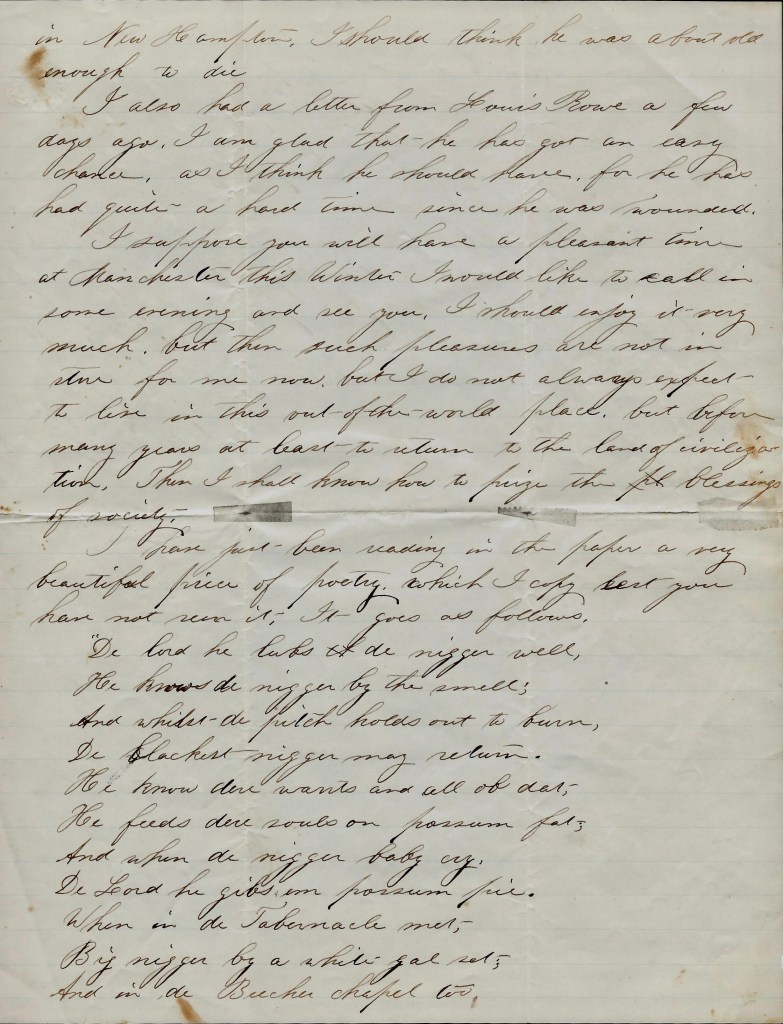
I do not know that Jack Smith had just a lady in New Hampton. I should think he was about old enough to die.
I also had a letter from Louis Rowe a few days ago. I am glad that he has got an easy chance as I think he should have, for he has had quite a hard time since he was wounded.
I suppose you will have a pleasant time at Manchester this winter. I would like to call in some evening and see you. I should enjoy it very much. But then such pleasures are not in store for me now, but I do not always expect to live in this out-of-the-world place. But before many years at least to return to the land of civilization. Then I shall know how to prize the blessings of society.
I have just been reading in the paper a beautiful piece of poetry which I copy lest you have not seen it. It goes as follows.
“De lord he lubs de nigger well,
He knows de nigger by the smell;
And whilst de pitch holds out to burn,
De blackest nigger may return.
He knows dere wants and all of day,
He feeds dere souls on possum fat;
And when de nigger baby cry,
De Lord he gibs ’em possum pie.
When in de Tabernacle met,
Big nigger by a white gal set;
And in de Beecher Chapel too,
De nigger habs a good front pew.
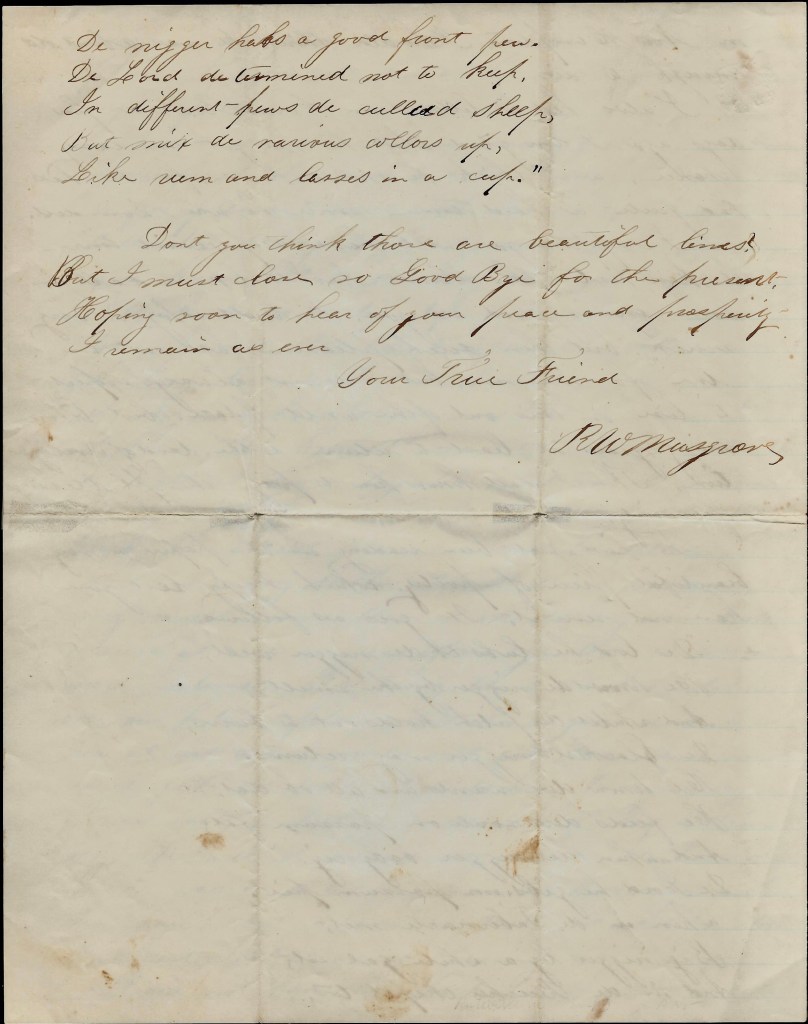
De Lord determined not to keep.
In different pews de cullerd sheep,
But mix de various collors up,
Like rum and lasses in a cup.”
Don’t you think those are beautiful lines? But I must close so goodbye for the present. Hoping soon to hear of your peace and prosperity, I remain as ever your true friend, — R. W. Musgrove

 Spared & Shared 23