Category Archives: 12th New Hampshire Infantry

1863: Arthur St. Clair Smith to Frank J. Robinson

Arthur St. Clair Smith later in war when serving as Captain of Co. K, 12th New Hampshire Infantry

The following letter was writen by Arthur St. Clair Smith (1841-1895) of Co. G, 12th New Hampshire Infantry. Arthur was the oldest son of Joshua R. and Clarissa C (Crockett) Smith. “Arthur St. Clair left the academy at New London in 1861, and went home to enlist, but his widowed mother, his father having been accidentally killed in California three years before, persuaded him to return to his school, where he impatiently remained until the new call for troops in 1862, when “I could no longer study.” as he says, “and went home again to enlist.” Assisted by Adjutant-General Colby, he enlisted forty or fifty men for Company G, but waiving his claim to rank was elected first sergeant, instead of lieutenant, as he might have been. His brother, Henry J., of the same company, was killed at Gettysburg.”

“In all the battles of the regiment to Cold Harbor, but Gettysburg and Wapping Heights, when he was still suffering from a severe wound received in arm at Chancellorsville, where his equipments were perforated with bullets. At Cold Harbor he was struck five times, being wounded twice, and having musket or grape shot through hat, haversack, and coat. He says: “I shall never forget my ambulance ride with Captain Shackford from Cold Harbor to White House landing.” Rejoined the regiment after the Siege of Petersburg, was present at the battle of Bermuda Hundred, and led a provisional battalion, that he commanded for a while, into Richmond. Of Captain Smith’s services at Danville, Va., see pages 302 and 310, chapter XV.”

“After the war he received the degree of L. L. B., from the Albany Law School, N Y., and settled in Cedar Rapids, Iowa. He has been judge of the municipal court, and was elected to the legislature by several thousand plurality though a candidate of the minority. He died December 19, 1895.” [Source: Find-A-Grave]

Arthur wrote his letter to his cousin, Frank J. Robinson (1843-Aft1892), the son of Joseph Wells Robinson (1816-1864) and Matilda G. Crockett (1811-1863) of Lake Village (now Lakeport), Laconia, Belknap county, New Hampshire.

T R A N S C R I P T I O N
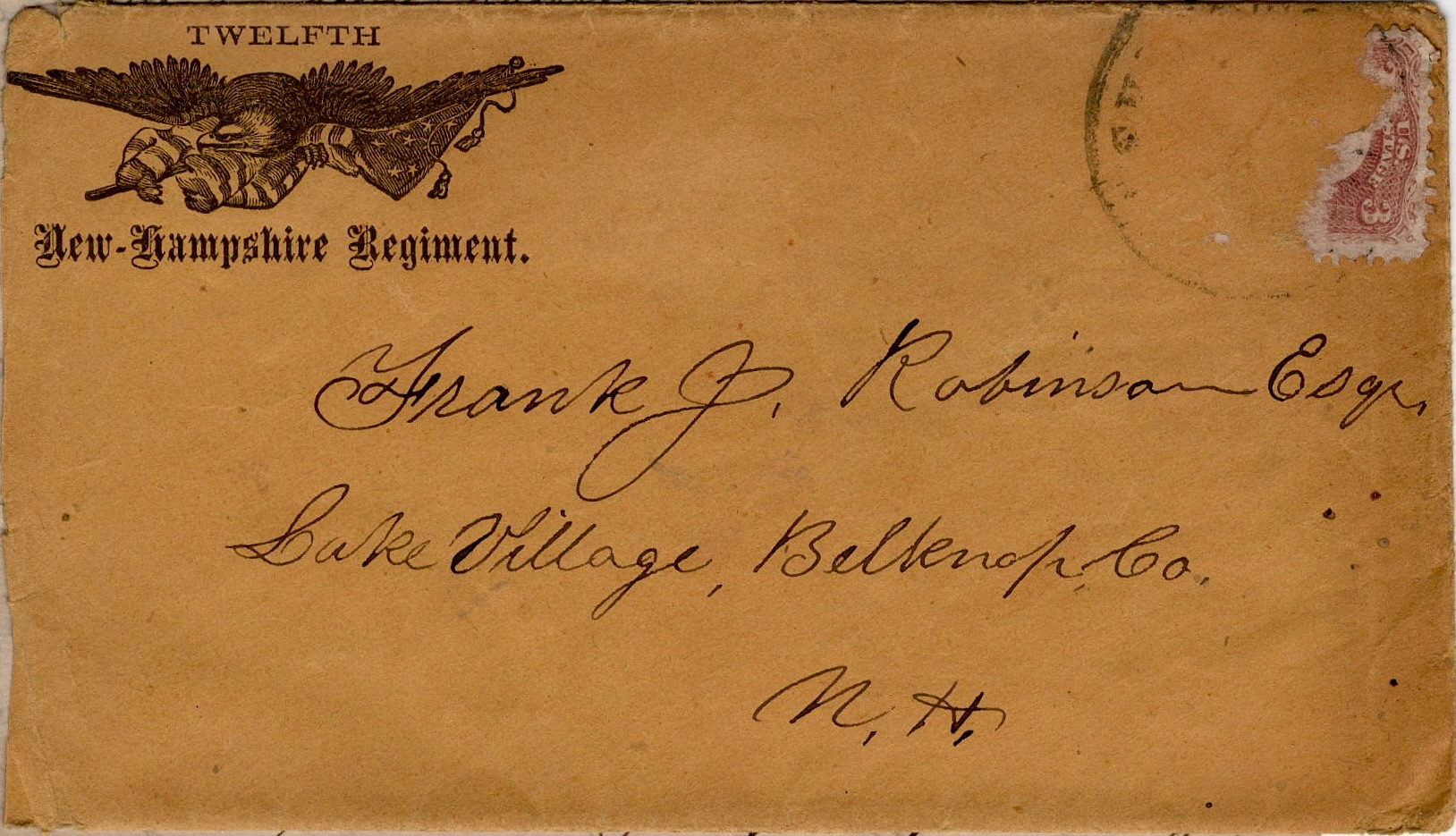
12the New Hampshire Regiment
Camp near Falmouth
January 27, 1863

Cousin Frank,

Your letter came to hand in due time after date and I thought that I would write you immediately so that you would not have a good reason to complain as before. When I got your letter we were under marching orders and I thought that I would wait until after we had arrived at some point or accomplished something before I wrote you. Well, we have arrived at some point—viz: the same place we started from, but have not accomplished much that I can see.

We broke camp Wednesday noon, leaving the sick on the old ground. We went forth as we supposed to battle, the company [Co. G] numbering all told 49 men—the rest having been left sick at different points on our route. Capt. [Charles W.] Chase did not go with us as he fell when we left Fredericksburg and burst himself so badly that he has not done duty since and I very much doubt if he ever will be able to take part in an active campaign.

We had two lieutenants with us—viz: Lieut. [Edwin E.] Beede, our former sergeant-major. He was promoted over Lieut. [John S.] Veasey and such a row as it made. Veasey resigned at once and it made a row all around the camp. When Veasey handed in his resignation to headquarters, the Colonel was in Washington, and the Lieut.-Colonel was commanding the regiment (and it was his business having Veasey jumped). Lieut.-Col. [John F.] Marsh ordered him under arrest and took his sword away. That made another row among the officers.

Well when Col. [Joseph H.] Potter came back and found what had been done, he sent for Veasey and said it was a mistake on the part of Gov. Berry brought about partly by his own negligence that it was done and said that the course of the Lieut.-Col. was not approved of by him. He also apologized to Veasey for the occurrence and told him that in the end that he would be better off then as though he had been promoted this time. He is acknowleged to be the best 2nd Lieut. in the regiment. The men all like him.

Wel the Colonel gave the Lieut.-Col. such a reprimand that he took his bed and has not appeared in public and I hear that he has got a furlough and all the line officers and men hope it is perpetual. He is fairly hated by them all for his treatment of them. I heard that Col. Potter called him a God damned fool and gave him a blowing up that was big. As for Lieut. Beede, he is smarter than Veasey and will make the company what it ought to be—the best in the regiment.

Well Col. Potter being acting as Brigadier General, he put our regiment on the right of his brigade and told the Major that he would not put him where he would not go himself so we went out under Major [George D.] Savage. It made officers and men feel very badly (for I don’t believe that there is another regiment that thinks more of its Colonel that our soes of Col. Potter) because Col. Potter was taken way from us. He does not draw the full amount of pay that he is entitled to from the government, but gives it to it which cannot be said of many of its officers I guess.

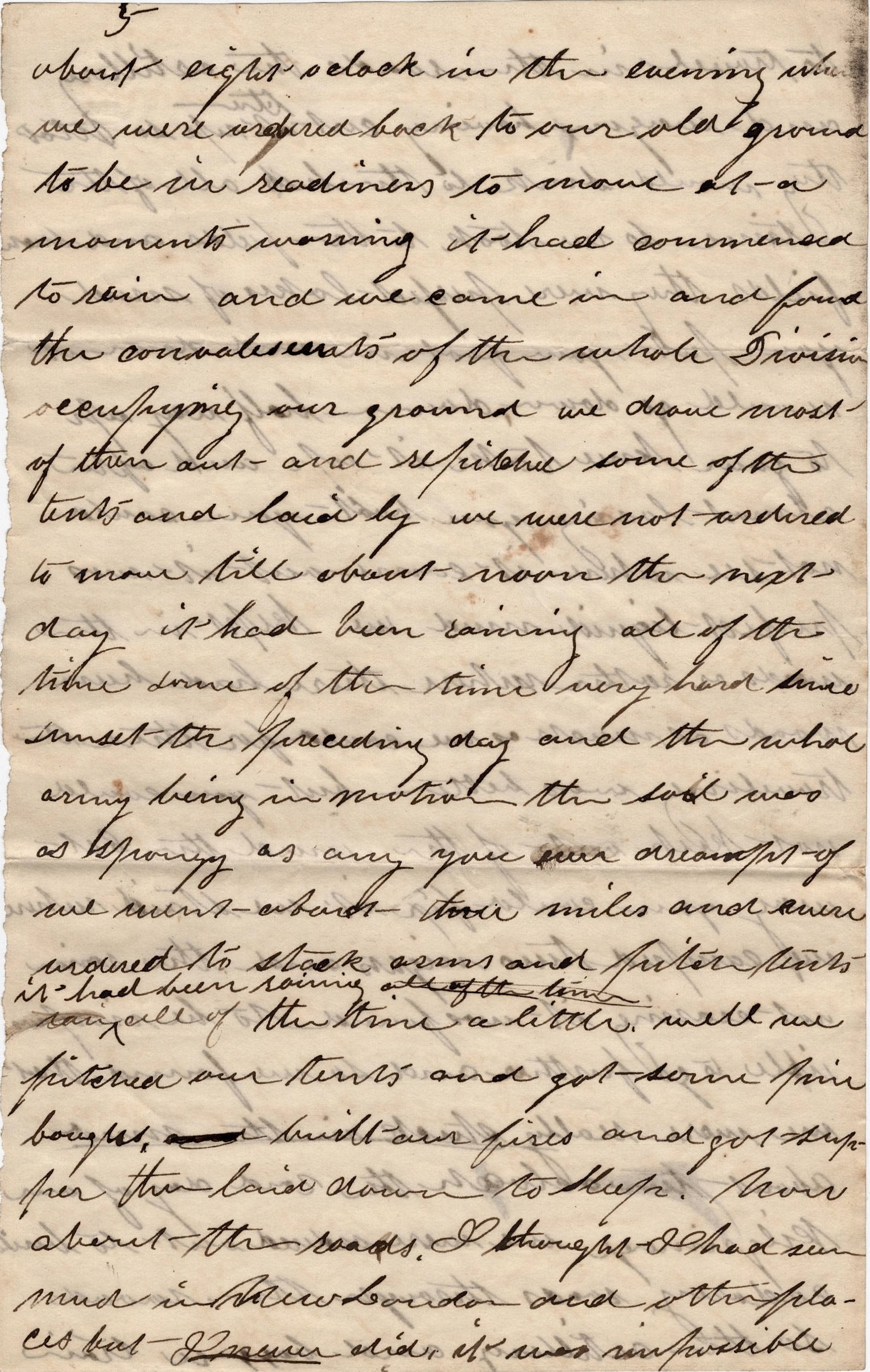
Well, having arrived at this point, I will tell you in a few words what we did. We started as I told you about noon and went out about half a mile in heavy marching order and waited till about eight o’clock in the evening when we were ordered back to our old ground to be in readiness to move at a moment’s warning. It had commenced to rain and we came in and found the convalescents of the whole Division occupying our ground. We drove most of them out and repitched some of the tents and laid by. We were not ordered to move till about noon the next day. It had been raining all of the time, some of the time very hard since sunset the preceding day and the whole army being in motion, the soil was as spongy as any you ever dreamed of. We went about three miles and were ordered to stack arms and pitch tents. It had been raining all the time a little. Well we pitched our tents andgot some pine boughs, built our fires, and got supper, then laid down to sleep.

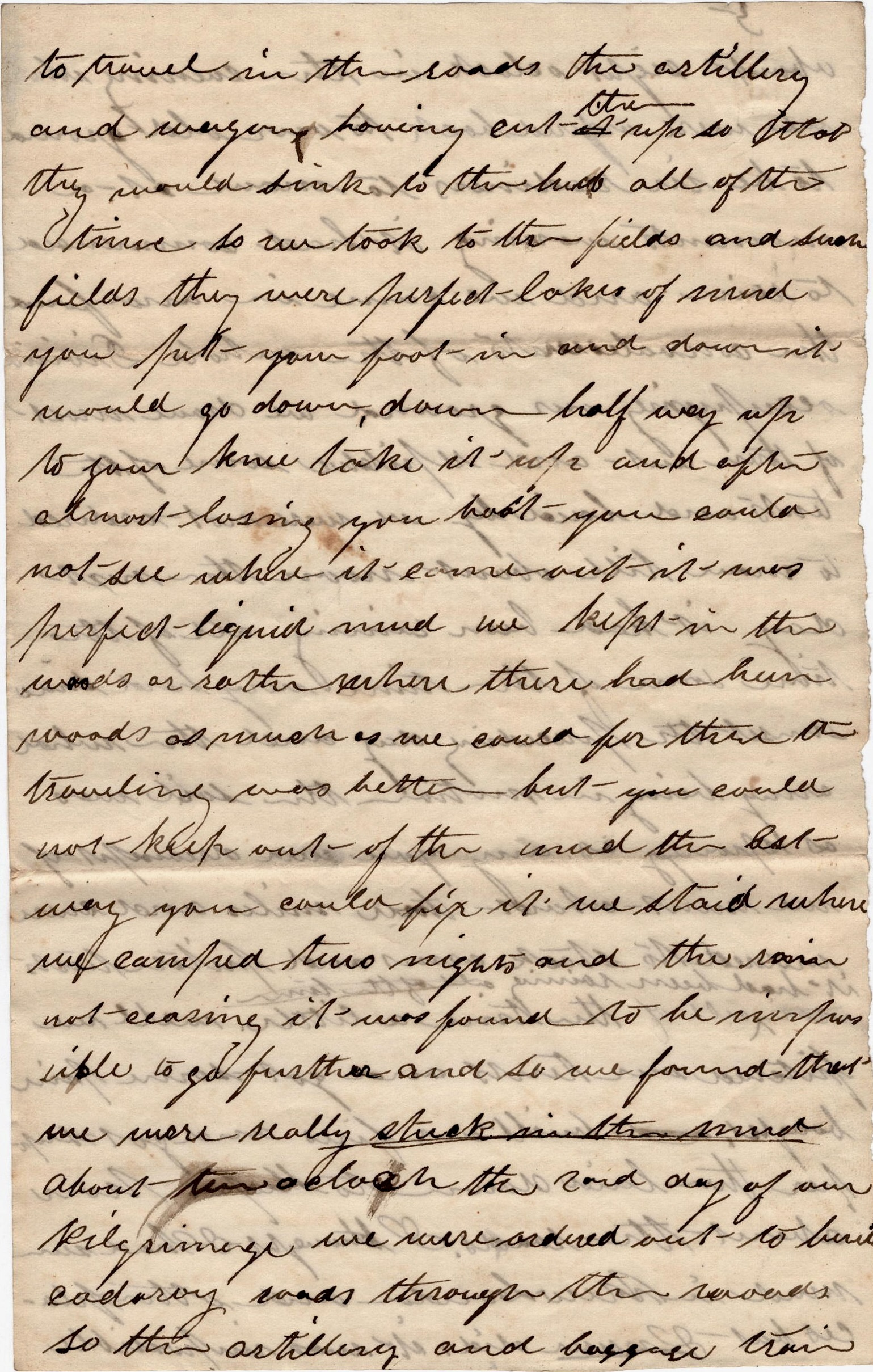
Now about the roads. I thought I had seen mud in New London and other places but I never did. It was impossible to travel in the roads, the artillery and wagons having cut them up so that they would sink to the hubs all the time so we took to the fields and such fields! They were perfect lakes of mud. You put your foot in and down it would go—down, down, half way up to your knee. Take it up and often almost losing your boot. You could not see where it came out, it was perfect liquid mud. We kept in the woods or rather where there had been woods as much as we could for there the traveling was better, but you could not keep out of the mud the best way you could fix it.

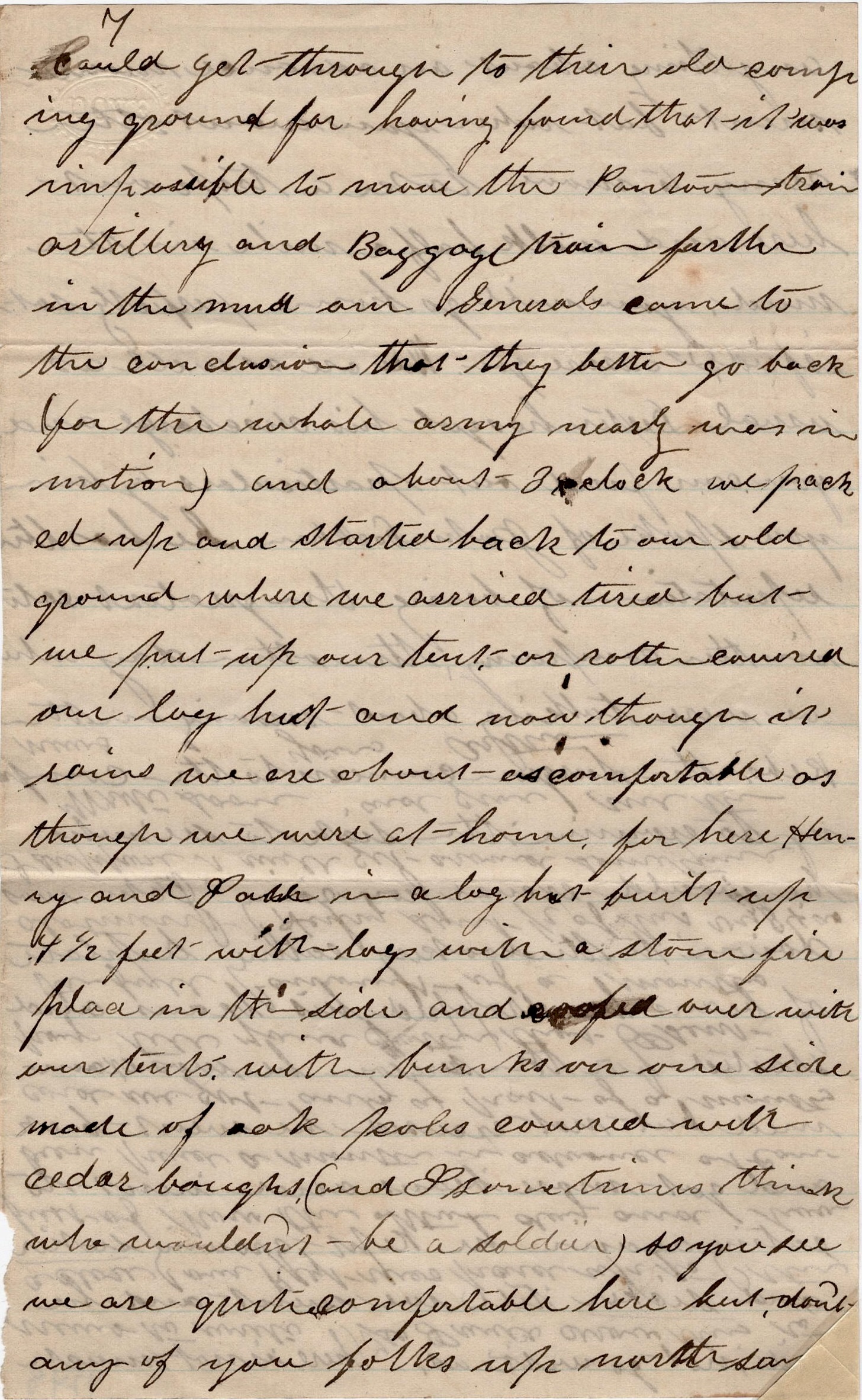
We staid where we camped two nights and the rain not ceasing, it was found to be impossible to go further and so we found that we were really stuck in the mud. About ten o’clock the 2nd day of our pilgrimage, we were ordered out to build corduroy roads through the woods so the artillery and baggage train could get through to their old camping ground for having found that it was impossible to move the pontoon train, artillery andbaggage train further in the mud, our generals came to the conclusion that they better go back (for the whole army was in motion) and about 3 o’clock we packed up and started back to our old ground where we arrived tired but we put up our tent, or rather covered our log hut and nowm though it rains, we are about as comfortable as though we were at home for here Henry and I are in a log hit built up 4.5 feet with logs with a stone foreplace in the side and covered over with our tents with bunks onone side made of oak poles covered with cedar boughs (and I sometimes think who wouldn’t be a soldier!).

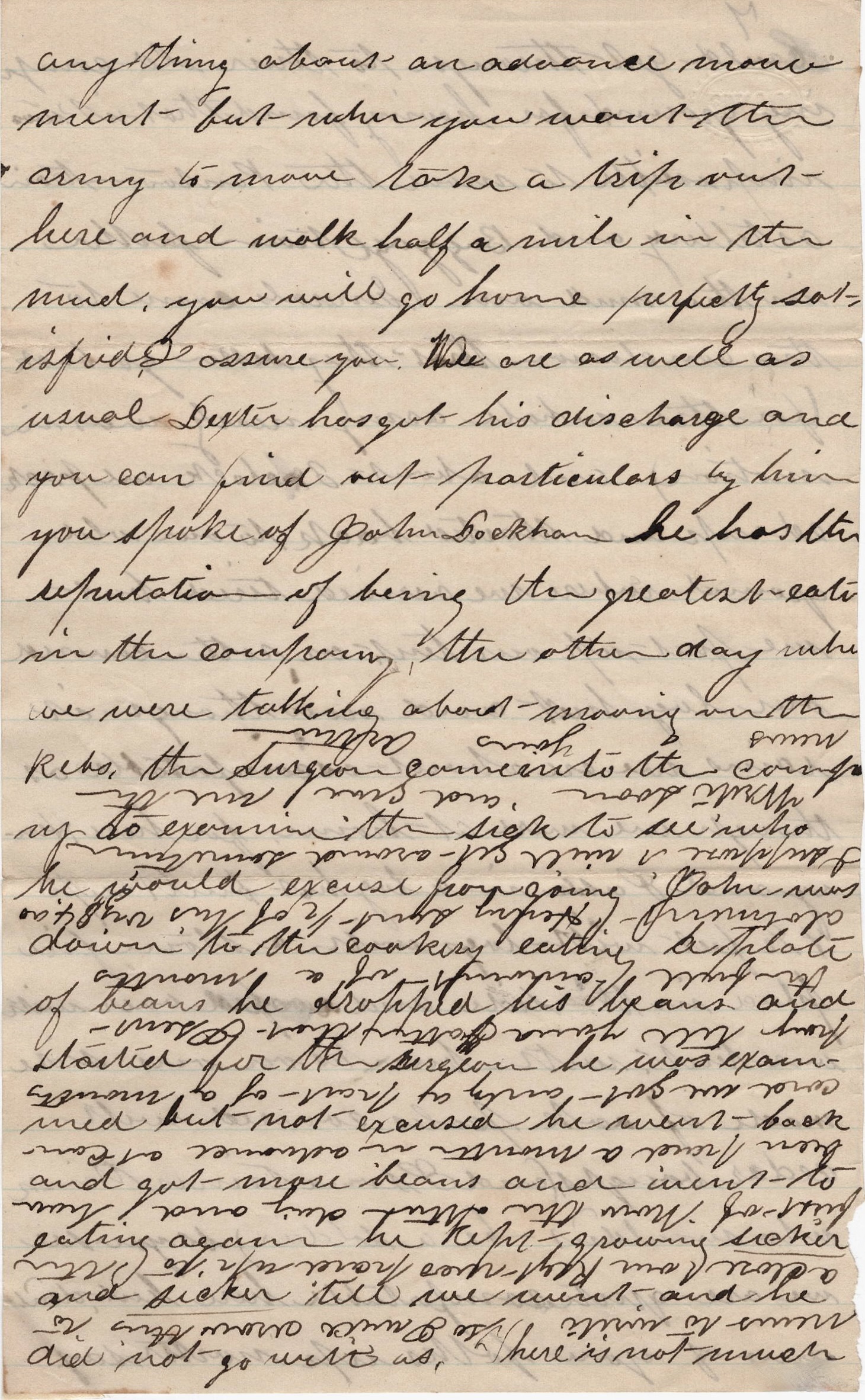
So you see we are quite comfirtable here but don’t any of you folks up North say anything about our advance movement but when you want the army to move, take a trip out here and walk half a mile in the mud. You will go home perfectly satisfied, I assure you.

We are as well as usual. Dexter has got his discharge and you can find out particulars by him. You spoke of John Dockham. He has the reputation of being the greatest eater in the company. The other day when we were talking about moving on the Rebs, the surgeon come to the company to examine the sick to see who he would excuse from going. John was down to the cookery eating a plate of beans. He dropped his beans andstarted for the surgeon. He was examined but not excused. He went back and got more beans and went to eating again. He kept growing sicker and sicker till we went and he did not go with us.

There is not much news to write so I will draw this to a close. Our regiment was paid up to the first of November. At Concord we got only a part of a month’s pay. Tell your father that I sent the full amount of a month’s allotment. Henry sent half of his—viz: $4. I suppose I will get around sometime. Write soon and give me the news. Yours, — Arthur
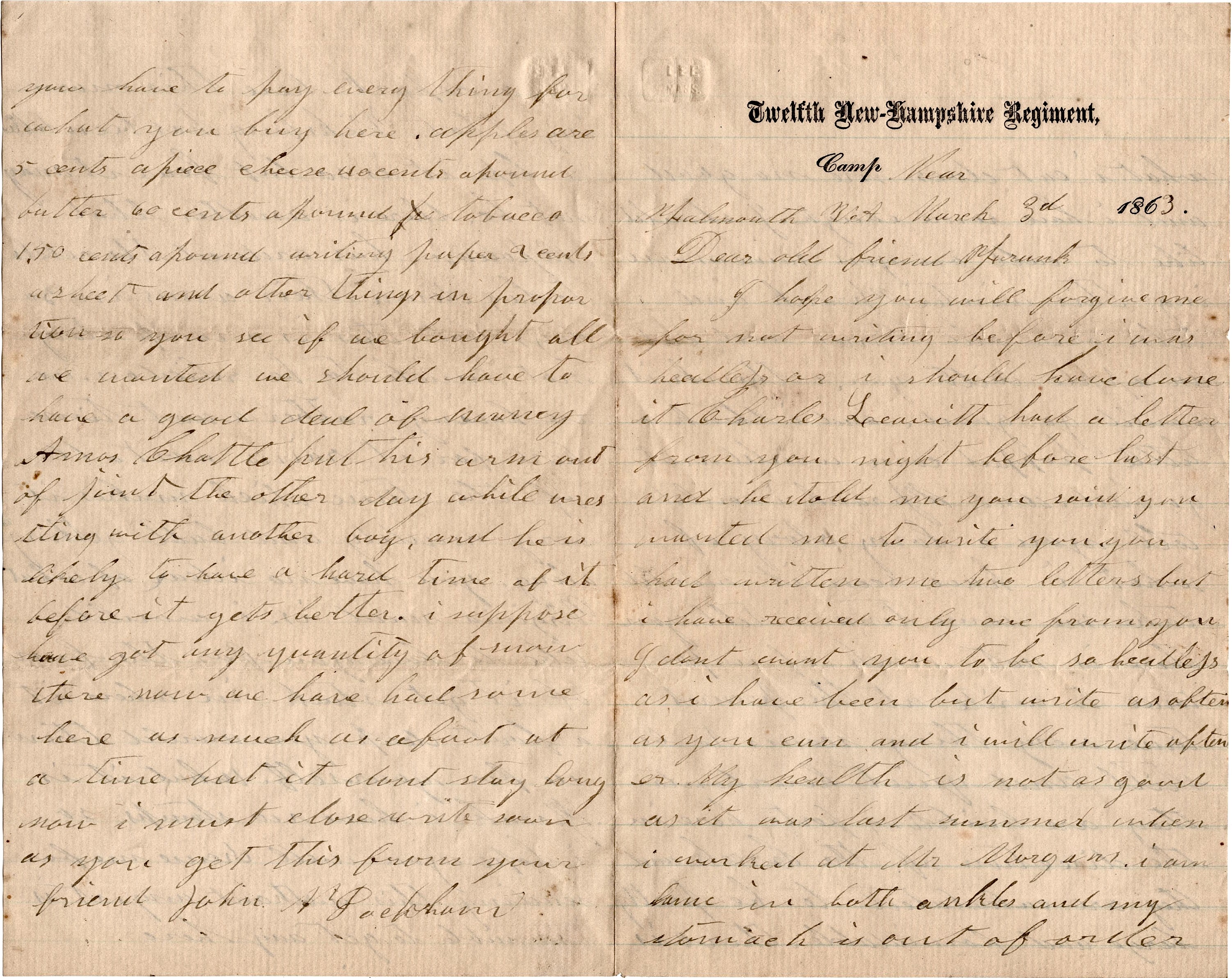
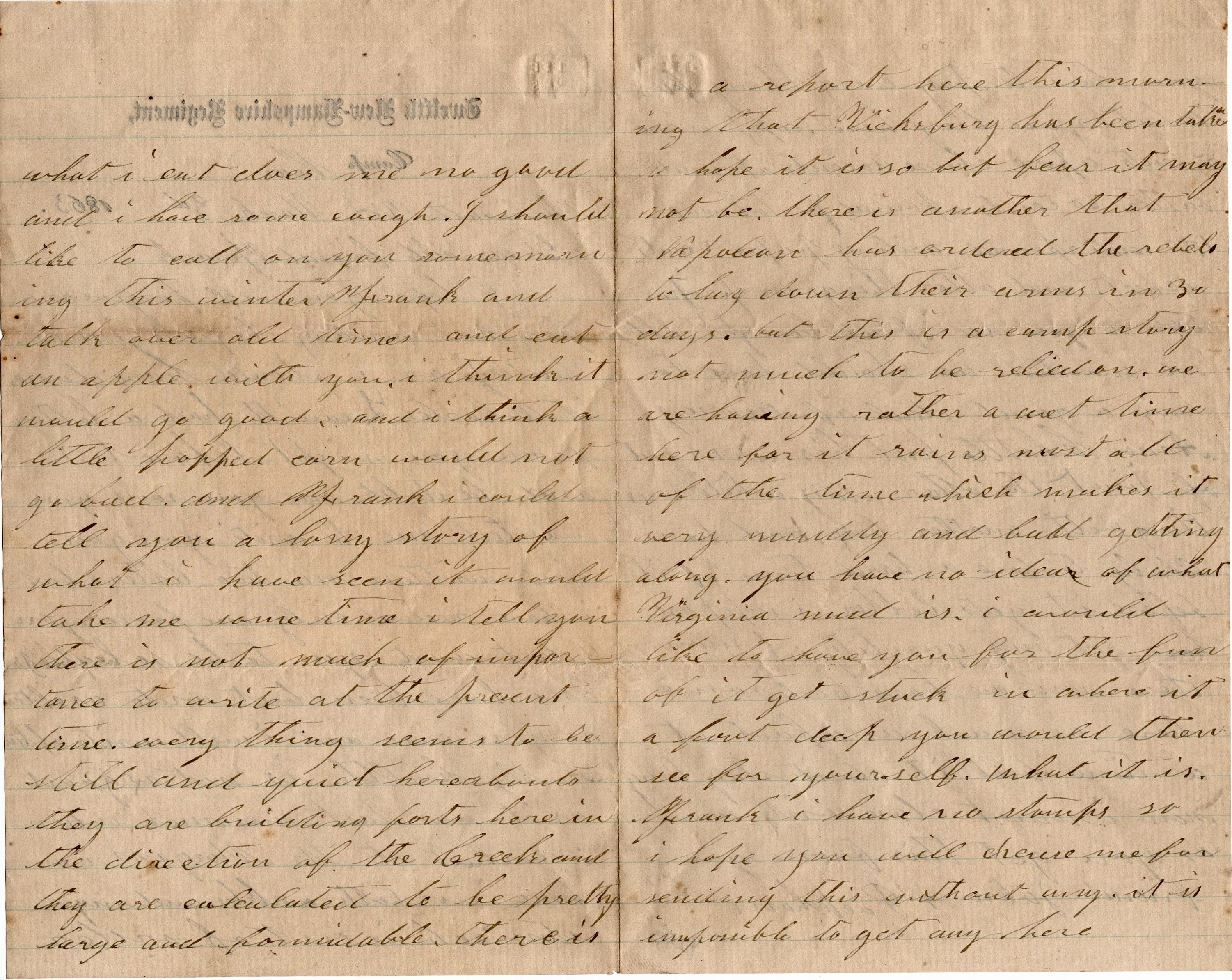
1863: John N. Dockham to Frank J. Robinson

This letter is only signed “Arthur” but I’m confident he served in Co. D, 12th New Hampshire Infantry and there are only two soldiers with that name—Arthur L. Hannaford (1844-1935) and Arthur Kimball (1839-1910), both residents of Belknap county, New Hampshire. I feel confident it’s one of these two but am leaning toward Arthur Hannaford simply because he was closer in age to Amos Chattle, mentioned in the letter, and to the letter’s recipient. Arthur was the son of Alfred Hannaford (1806-1875) and Lurana Sawyer Smith (1809-1876) of Sanbornton. After the war he was employed as a carpenter.
The following letter was written by John N. Dockham who was 23 years old when he enlisted in Co. G, 12th New Hampshire Infantry in August 1862 ; b. Gilford; age 23; res. Charlestown, Mass., credited to Gifford; mustered out June 21, ’65. Post Office address., Gilford.

He wrote his letter to his friend Frank J. Robinson (1843-Aft1892), the son of Joseph Wells Robinson (1816-1864) and Matilda G. Crockett (1811-1863) of Lake Village (now Lakeport), Laconia, Belknap county, New Hampshire.

Dockham’s parents were Morse Brown Dockham (1812-1918) and Matilda R. Saltmarsh (1818-1856).

T R A N S C R I P T I O N

Directed to Frank J. Robinson, Lake Village, New Hampshire

12th New Hampshire Regiment
Camp near Falmouth, Va.
March 3rd 1863

Dear old friend Frank,

I hope you will forgive me for not writing before. I was heedless or I should have done it. Charles Leavitt had a letter from you night before last and he told me you said you wanted me to write you. You had written me two letters but I have received only one from you. I don’t want you to be so heedless as I have been but write as often as you can and I will write oftener.

My health is not as good as it was last summer when I worked at Mr. Morgan’s. I am lame in both ankles and my stomach is out of order. What I eat does me no good and I have some cough. I should like to call on you some morning this winter, Frank, and talk over old times and eat an apple with you. I think it would go good and I think a little popped corn would not go bad. And Frank, I could tell you a long story of what I have seen. It would take me some time, I tell you.

There is not much of importance to write at the present time. Everything seems to be still and quiet hereabouts. They are building forts here in the direction of the creek and they are calculated to be pretty large and formidable. There is a report here this morning that Vcksburg has been taken. I hope it is so but fear it may not be. There is another that Napoleon has ordered the rebels to lay down their arms in 30 days but this is a camp story not much to be relied on.

We are having rather a wet time here for it rains most all of the time which makes it very muddy and bad getting along. You have no idea of what Virginia mud is. I would like to have you for the fun of it get stuck in where it is a foot deep. You would then see for yourself what it is.

Frank, I have no stamps so I hope you will excuse me for sending this without any. It is impossible to get any here. You have to pay every thing for what you buy here. Apples are 5 cents apiece. Cheese 40 cents a pound. Butter 60 cents a pound. Tobacco $1.50 cents a pound. Writing paper 2 cents a sheet and other things in proportion. So you see, if we bought all we wanted, we should have to have a good deal of money.

Amos Chattle 1 put his arm out of joint the other day while wrestling with another boy and he is likely to have a hard time of it before it gets better. I suppose [you] have got any quantity of snow there now. We have had some here—as much as a foot at a time. But it don’t stay long now.

I must close. Write soon as you get this. From your friend — John N. Dockham
1 Amos Chattle (1844-1919) was the son of Thomas and Nancy (Bowman) Chattle of Laconia, Belknap county, New Hampshire. He served in Co. D, 12th New Hampshire Infantry. The history of the regiment states that “he received a fracture of the right elbow by being accidentally thrown down during the winter before Chancellorsville, from the effects of which he was afterwards discharged. Before this he promised to make one of the best of soldiers, but thus early had to succumb to the inevitable. His father and brother Horace were in the 8th New Hampshire.” The former died of sickness at Camp Stevens, La., and the latter was killed at Port Hudson. Another brother, Noah, served in the 15th New Hampshire and was also killed at Port Hudson.
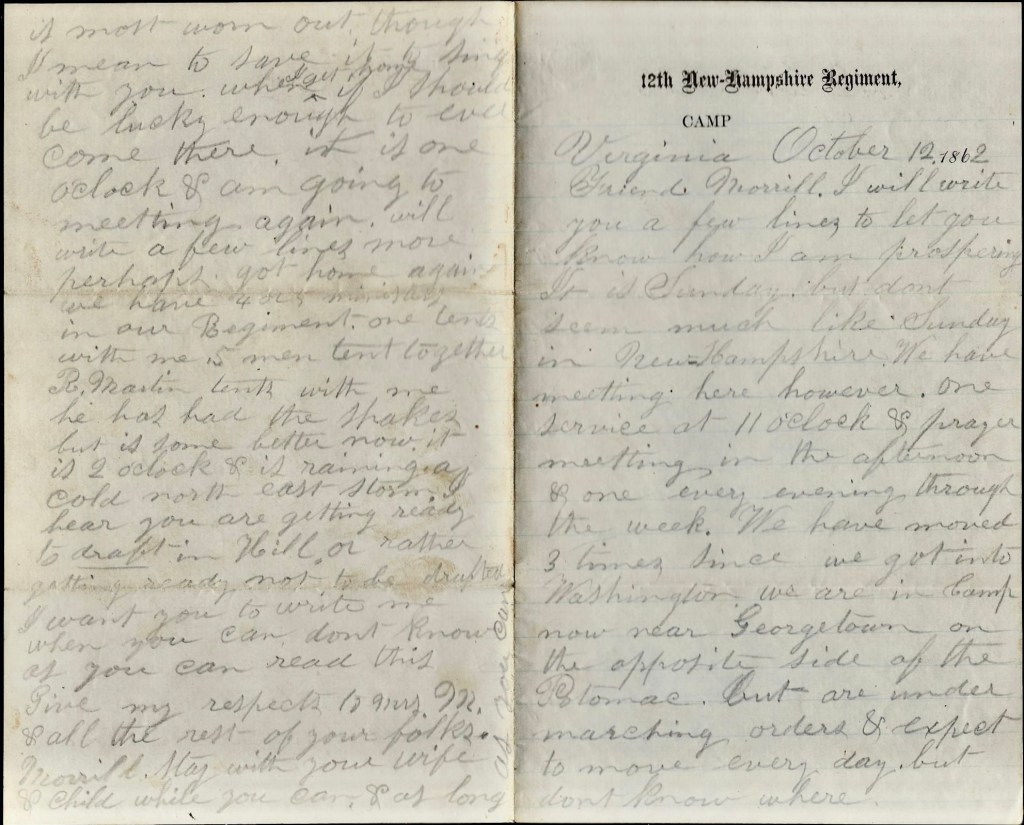
1862: William Henry Straw to Wilbur Henry Morrill

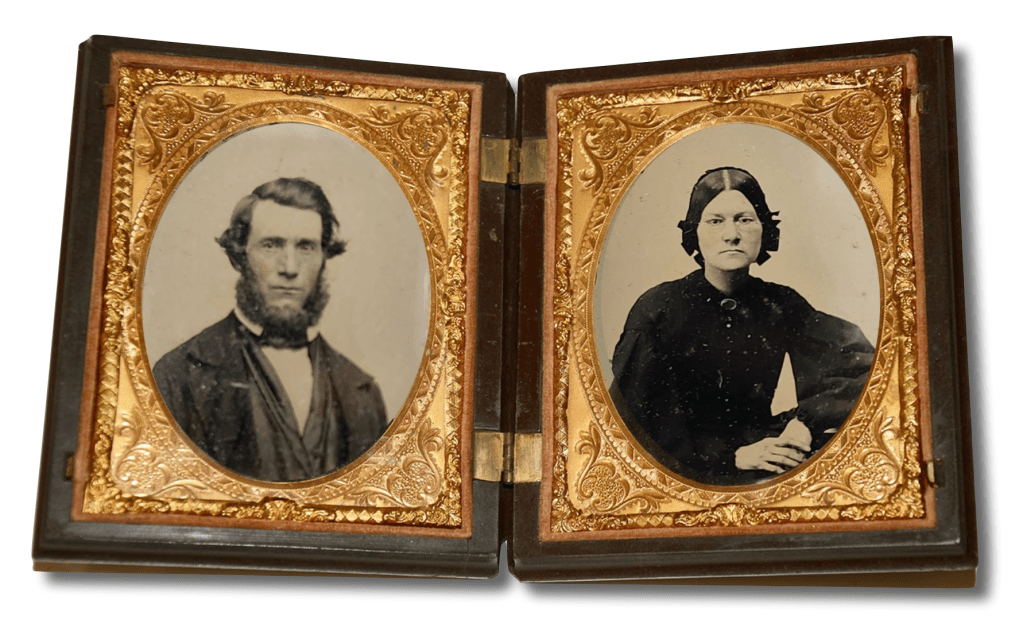
William Henry Straw was a 33 year-old farmer from Hill, Grafton county, New Hampshire when he voluntarily enlisted on 14 August 1862 to serve as a corporal in Co. D, 12th New Hampshire Infantry. His father, Sargent Straw (1783-1871) was still living at the time, but his mother, Priscilla Bennett Sanborn (1794-1858) had already passed on. Staying home to tend the farm and their two young children was William’s wife, Caroline (“Callie”) (Thorne) Straw (1833-1889).

William wrote this letter to his hometown friend, Wilbur Henry Morrill (1836-1908) who was married in 1859 to Ann Woodford in August 1859 and had a young son of 18 months. It was datelined from the regiment’s camp opposite Georgetown in Virginia where they had recently arrived. In less than a week they would receive orders to move to Point of Rocks, Maryland, and then see their first action at the Battle of Fredericksburg.

Sometime during the winter 1862-63, William fell victim to typhoid fever and he died on 20 June 1863 at Alexandria, Virginia—his singing voice silenced forever.

William Henry Straw and Caroline Leighton (Thorne) Straw of Hill, Grafton Co., N. H.

Transcription

Addressed to W. H. Morrill, Hill, New Hampshire

12th New Hampshire
[In camp opposite Georgetown in] Virginia
October 12, 1862

Friend Morrill,

I will write you a few lines to let you know how I am prospering. It is Sunday but don’t seem much like Sunday in New Hampshire. We have meeting here, however. One service at 11 o’clock, & prayer meeting in the afternoon, & one every evening through the week.

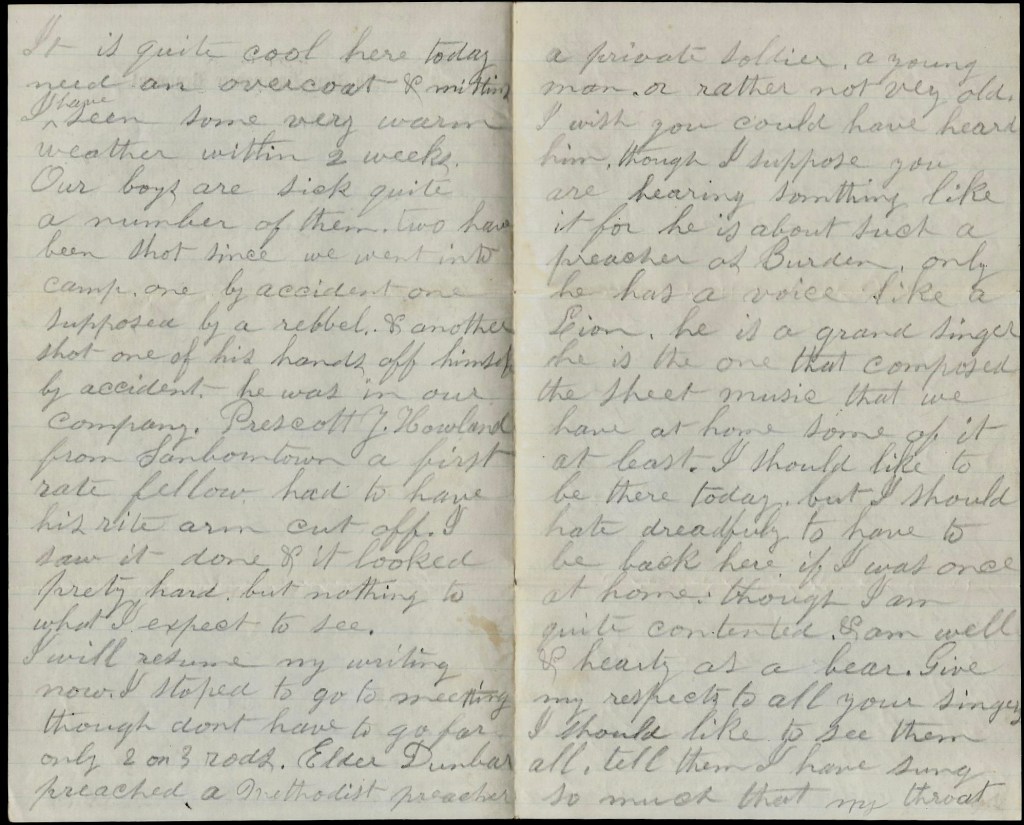
We have moved three times since we got into Washington. We are in camp now near Georgetown on the opposite side of the Potomac but are under marching orders & expect to move every day but don’t know where. It is quite cool here today—need an overcoat and mittens. I have seen some very warm weather within two weeks. Our boys are quite sick—a number of them. Two have been shot since we went into camp, one by accident, one supposed by a rebel. And another shot one of his hands off himself by accident. He was in our company—Prescott Y. Howland 1 from Sanbornton, a first rate fellow. Had to have his right arm cut off. I saw it done and it looked pretty hard, but nothing to what I expect to see.

I will resume my writing now. I stopped to go to meeting though don’t have to go far—only two or three rods. Elder Dunbar preached—a Methodist preacher, a private soldier, a young man, or rather not very old. I wish you could have heard him though I suppose you are hearing something like it for he is about such a preacher as Burden, only he has a voice like a lion. He is a grand singer. He is the one that composed the sheet music that we have at home—some of it at least.

I should like to be there today but I should hate dreadfully to have to be back here if I was once at home, though I am quite contented & am well & hearty as a bear. Give my respects to all your singers. I should like to see them all. Tell them I have sung so much that my throat is most worn out though I mean to save it to sing with you when I get home—if I should be lucky enough to ever come there.

It is one o’clock & am going to meeting again. Will write a few lines more perhaps. Got home again. We have 4 or 5 ministers in our regiment. One tents with me. Five men tent together. R[obert] Martin tents with me. He has had the shakes but is some better now. It is 2 o’clock and is raining. A cold northeast storm.

I hear you are getting ready to draft in Hill, or rather getting ready not to be drafted. I want you to write me when you can. Don’t know if you can read htis. Give my respects to Mrs. Morrill & all the rest of your folks. Morrill, stay with your wife and child while you can & as long as you can.

I have seen Hattie Knox’s brother twice since we got here. Saw him last Friday in Washington. He was going to his regiment Saturday. He had a slight wound in the finger. Have seen quite a number from our way. Don’t many of them think much of the war. Hope you will excuse this poor writing for haven’t anything to write on or sit on. We live just like pigs and if dirt will make us happy, we shall all enjoy good health. From your friend, — W. H. Straw

[P.S.] Tell Gusta Marshall that [James] Frank [Marshall] is well & hearty now & is growing fat. It is Monday now—cold and stormy. It rained all night. Some of the boys woke up and found themselves swimming around like ducks. Please write all the news about drafting &c. Ed Cilley was here Friday and Saturday. Looks well & hearty. I sent a letter to Cally yesterday. I have sent 4 since I left Concord. I got one from home Wednesday. Some of the boys have a letter from Hill most every day. Direct your letter o Wm. H. Straw, Co. D, 12th Regiment N. H. Vols., Washington D. C.


1 Prescott Young Howland (1828-1876) was 33 years old when he enlisted as a corporal in Co. D, 12th New Hampshire Infantry. We learn from Straw’s letter than Howland accidentally shot his own hand off which necessitated an amputation of his right forearm. As a consequence, he was discharged from the service on 22 November 1862.

1864: Richard Watson Musgrove to Abbie M. Blake

The following letters were written by Capt. Richard Watson Musgrove (1840-1914), the son of James Musgrove (1798-1878) and Ann Donker (1802-1879) of Bristol, New Hampshire.

Capt. Richard Watson Musgrove

Richard entered the service in August 1862 as a corporal in Co. D, 12th New Hampshire Infantry, was appointed sergeant, Mar. 17, ’63; first sergeant, Feb. 1, ’64; was at battles of Fredericksburg, Chancellorsville (where he had one musket shattered and another knocked from his hands), at Gettysburg (where he carried the state colors on the third day’s fight), and at Wapping Heights. When the regiment was stationed at Point Lookout, he was detailed for duty at the camp for prisoners of war, where he had charge of 1,000 men, all a later was sergeant of the provost guard at Gen. Gilman Marston’s brigade headquarters; discharged, Apr. 23, ’64, to accept promotion, and Apr 24, ’64, was appointed first lieutenant of Co. D, 1st Regt. U. S. Vol. Inf., a regiment, organized by Gen. Butler, and composed of prisoners of war who had taken the oath of allegiance and enlisted into the service of the Union; appointed captain of Co. I, same regiment, Aug. 13, ’64, and mustered out, May 21, ’66, after a service of three years and nine months. While in this regiment, he served three months in Norfolk, Va., as provost guard, and the balance of the time on the northwest and western frontiers, being stationed one year at Fort Ridgely, Minn. In the fall of ’65, his company with three others opened what is now the Smoky Hill route of the Union Pacific railroad, from Atchison, Kan., to Denver, Col. In winter of ’65-6, he was stationed at what is now Fort Wallace, Kansas, over 300 miles from the nearest settlement on the east. (Source: History of Bristol, N. H., vol. I, p. 208.)

In his letter of 4 October 1864, Richard mentioned hearing of the death of his younger brother, Adam Clark (“Abbott”) Musgrove (1842-1864). Abbott enlisted as a Private serving the Union Army in Halfmoon, Saratoga, New York on 21 Jul 1862. On 20 August 1862 he enlisted in Co. H, New York 115th Infantry Regiment. Abbott was killed in action and mustered out of service as a Corporal on 16 Aug 1864 in Deep Bottom Run, Henrico, Virginia.

Richard wrote the letters to Abigail (“Abbie”) Blake (1844-1911). Abbie married Rodolphus M. Locke (1839-1883) in November 1870.

Readers are also referred to a blog post on “Our War” describing Musgrove’s experience at the Battle of Chancellorsville when he was a sergeant in Co. D, 12th New Hampshire Volunteers. See Our War, 6 May 2014.

Letter 1

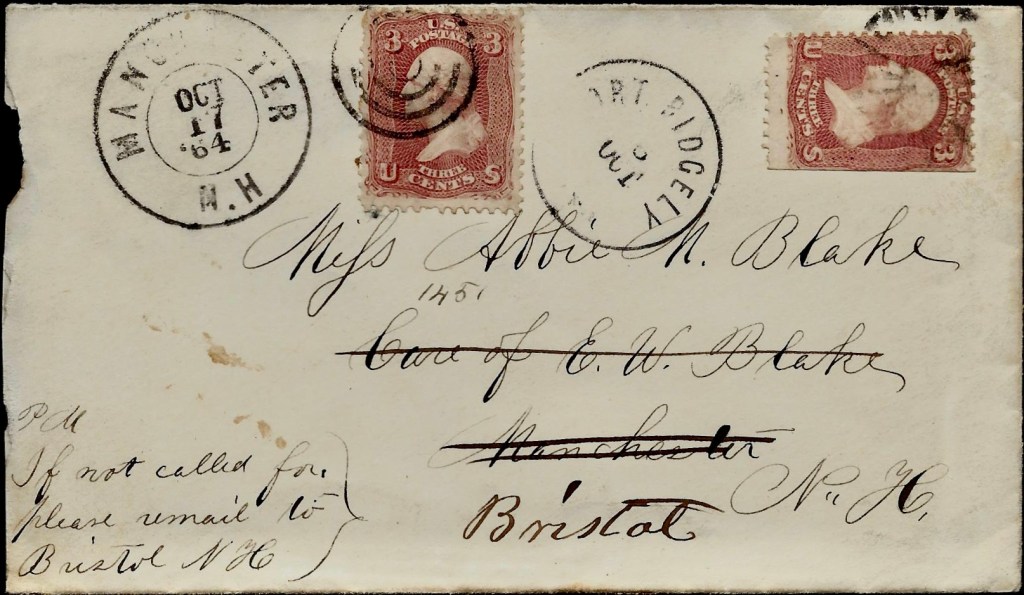
Addressed to Miss Abbie M. Blake, Bristol, New Hampshire

Fort Ridgely, Minnesota
October 4th 1864

Friend Abbie,

I presume you have concluded by this time that I have forgotten you, but such is not the case. I have thought of you often and wondered that you did not write. By the last mail, however, the mystery was explained by the arrival of your letter bearing date of July 3rd directed to Norfolk Va,

As I did not leave there till the middle of August, I do not see why I did not receive it before I left there but it was anxious to find me, and followed me to Milwaukee, Wisconsin, to Madison, then to St. Paul, Minnesota, to Fort Snelling and then here. I have been at all these places and am now stopping here, but how long I shall remain here I know not.

My 2nd Lieut. is now gone to Fort Wadsworth, Dakota Territory, with 40 men of my company as a guard for a train of supplies going to Fort Wadsworth. I expected to go myself with the whole company and remain there during the winter, but I am pleased at the prospect of remaining here. We are now 120 miles west of St. Paul. There is not but one or two houses within fifteen miles of here so I am far enough out of the world. But we should be worse off at Fort Wadsworth which is 180 miles west of here and not a habitation within 150 miles of there. Wild animals of all description—buffaloes, bears, wolves, and Indians are very numerous and troublesome, but I should not care for them. I do not like, however, to be so far from friends. Here we get a mail three times a week. There we should have one only once a week. I had just as leave go there next summer and expect we shall go further west then—probably on an expedition against the Indians.

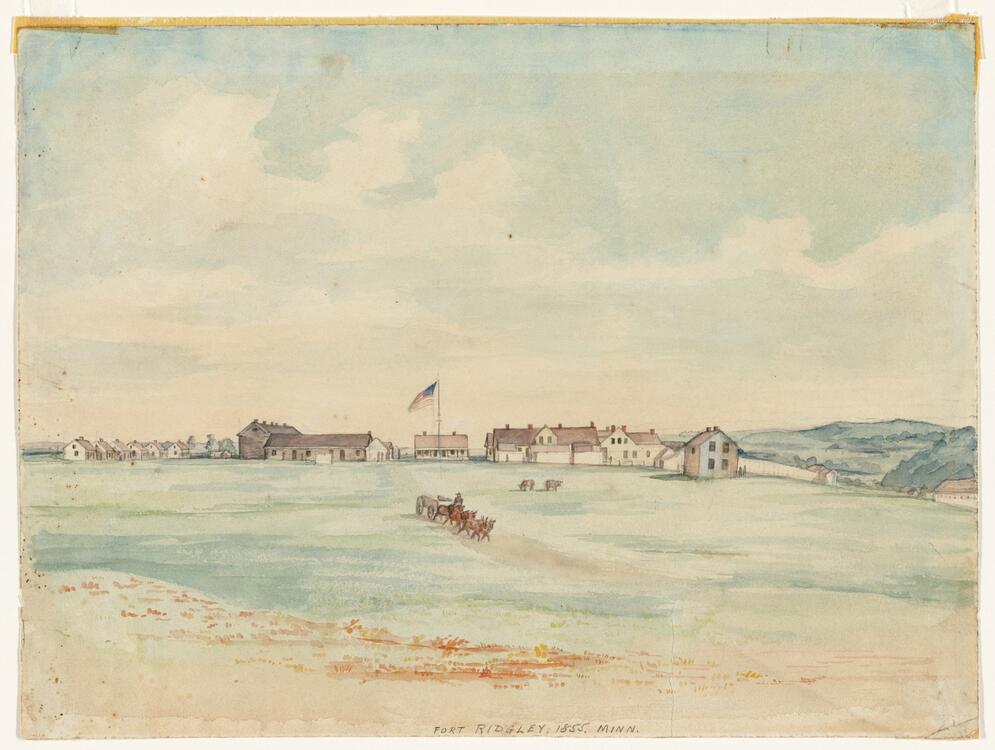
Fort Ridgely, Watercolor by Alfred Sully

I suppose you was aware of the death of my brother long before I was, as I did not know that he was dead till about three weeks ago, but looked in each mail for a letter from him, little thinking that I had received my last from him. Of course I feel very badly about his early fall. I miss his letters, always cheerful and hopeful, and I shall miss him very much when I get home as I hope to some day. But I am proud to think that he died so noble a death in the service of his country and I have the fact to cheer me that he died a christian soldier and while I mourn his loss, I am cheered at the thought that he is at rest where war is unknown, and that if I am faithful to my God, I may one day meet him above, although I can never more see his face upon earth. It would be a pleasure in some respects to be at home at this time to mourn with those there, or I would esteem it a great privilege to hear his funeral sermon preached, but as this cannot be, I will try and bow submissively to this heavy affliction and may his death result in good to me and us all.

It has been so long since you wrote your last that I hardly know where to direct [your letter] but I guess I will direct this to Manchester as you said nothing about leaving there and I hope you will receive it. I thank you for the little gift enclosed in your letter. I will try and heed its warning voice, and if you fail to hear from me for a long time, you must not think that I have forgotten you but attribute it to some such cause as delayed me now, or maybe I shall not have an opportunity to write as I am very much of the time on the move. So if you do not get a prompt answer, just write again and I hope they will get round even if they are delayed three months.

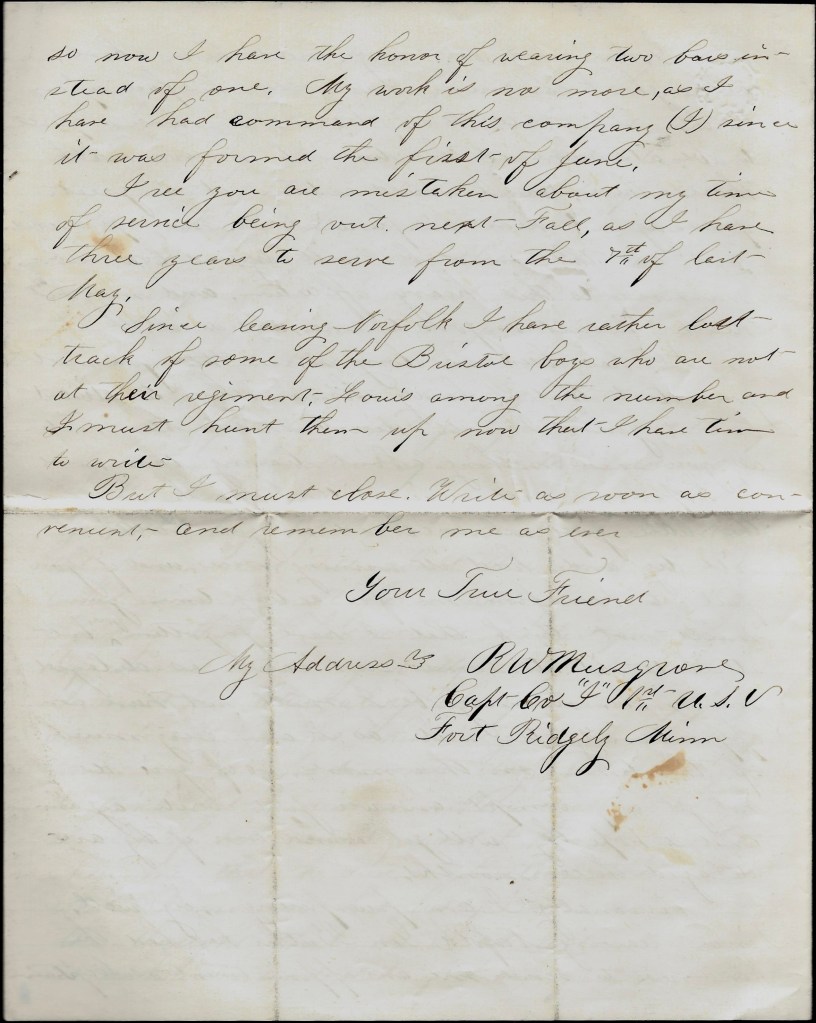
Personally I am prospering very well since leaving Norfolk. Gen. Butler has had the kindness to send me an appointment as Captain so now I have the honor of wearing two bars instead of one. My work is no more, as I have had command of this company (I) since it was formed the first of June.

Since leaving Norfolk, I have rather lost track of some of the Bristol boys who are not at their regiment, Louis among the number, and I must hunt them up now that I have tome to write. But I must close. Write as soon as convenient and remember me as ever. Your true friend.

My address is R. W. Musgrove, Capt. Co. I, 1st USV. Fort Ridgely, Minnesota


Letter 2

Fort Ridgely, Minnesota
December 7th 1864

Dear Friend,

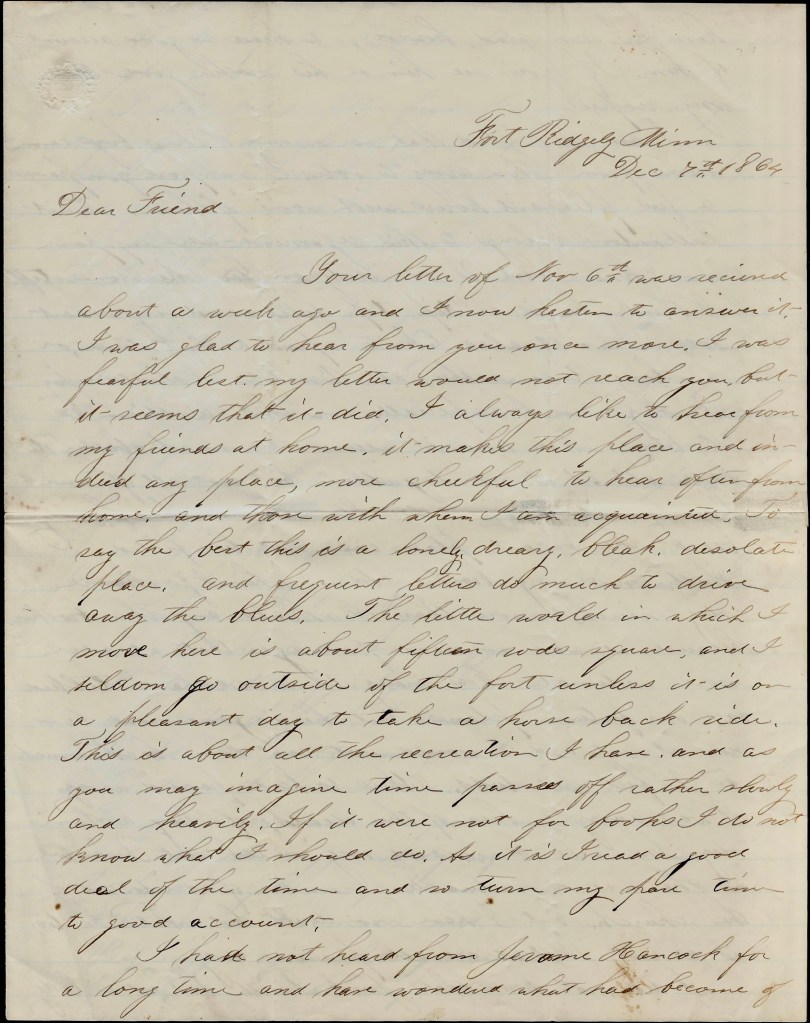
Your letter of Nov. 6th was received about a week ago and I now hasten to answer it. I was glad to hear from you once more. I was fearful lest my letter would not reach you, but it seems that it did. I always like to hear from my friends at home. It makes this place and indeed any place, more cheerful to hear often from home, and those with whom I am acquainted. To say the best, this is a lonely, dreary, bleak, desolate place, and frequent letters do much to drive away the blues. The little world in which I move here is about fifteen rods square, and I seldom go outside of the fort unless it is on a pleasant day to take a horse back ride. This is about all the recreation I have, and as you may imagine, time passes off rather slowly and heavily. If it were not for books, I do not know what I should do. As it is, I read a good deal of the time and so turn my spare time to good account.

I had not heard from Jerome Hancock for a long time and have wondered what had become of him. I am glad, however, to hear so good account of him. If you see him or his mother, give them my respects.

I am very glad that so many of the boys came home from the army to vote. I suppose you passed a few pleasant hours with some of them. Lieut. Fullonton belongs to this regiment—as I suppose you know, but is on duty on Gen. [____ston’s] Staff. I think he is a tip top fellow and very smart too. I would like to spend a short time, or a long time rather, atBristol. I should enjoy it very much—especially now that William is at home. You know it seems so much better to have all at home together, but not all of our family will again assemble around the family board. The vacant place cannot be filled. I shall miss my brother Adam when I go home very much, more than I should any other brother because we were so near of an age that we were more intimate. How many times we have talked over our future plans. But he is gone now. He is now at rest and I would not call him back much as I feel his loss. Others too have passed away. I was sorry to hear of the death of Mary Woolson very. She will be missed very much at Brostol as she was a valuable member of society and of the church. But I have no doubt but what she too is at rest. Thus we are all passing away.

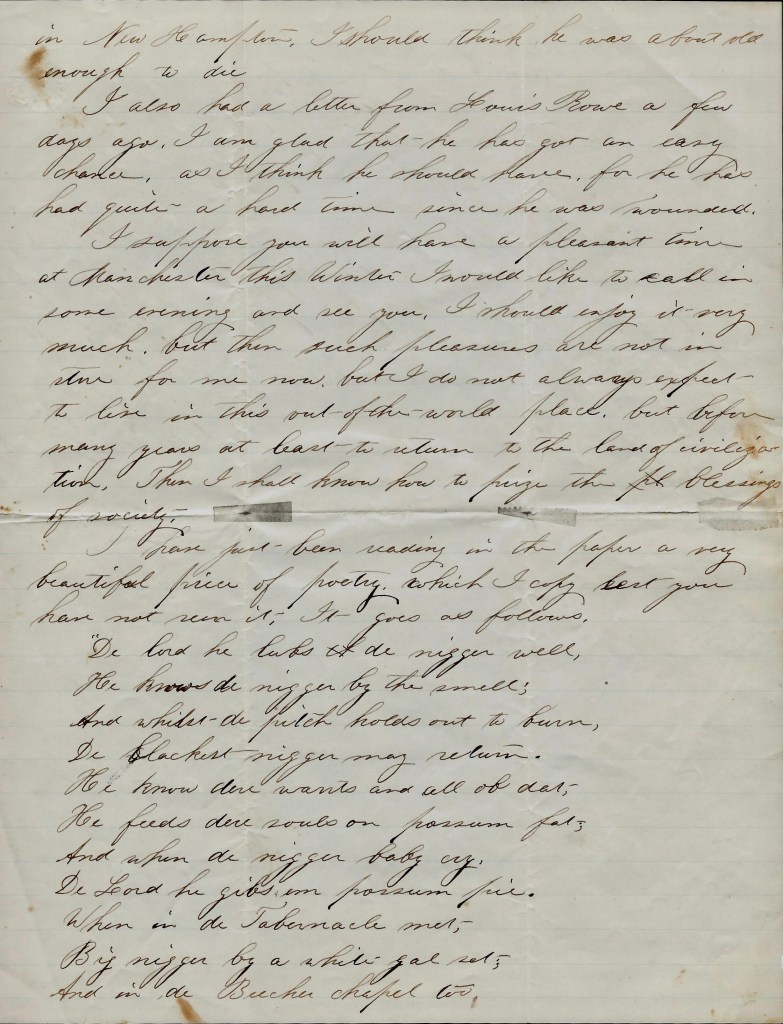
I do not know that Jack Smith had just a lady in New Hampton. I should think he was about old enough to die.

I also had a letter from Louis Rowe a few days ago. I am glad that he has got an easy chance as I think he should have, for he has had quite a hard time since he was wounded.

I suppose you will have a pleasant time at Manchester this winter. I would like to call in some evening and see you. I should enjoy it very much. But then such pleasures are not in store for me now, but I do not always expect to live in this out-of-the-world place. But before many years at least to return to the land of civilization. Then I shall know how to prize the blessings of society.

I have just been reading in the paper a beautiful piece of poetry which I copy lest you have not seen it. It goes as follows.

“De lord he lubs de nigger well,
He knows de nigger by the smell;
And whilst de pitch holds out to burn,
De blackest nigger may return.

He knows dere wants and all of day,
He feeds dere souls on possum fat;
And when de nigger baby cry,
De Lord he gibs ’em possum pie.

When in de Tabernacle met,
Big nigger by a white gal set;
And in de Beecher Chapel too,
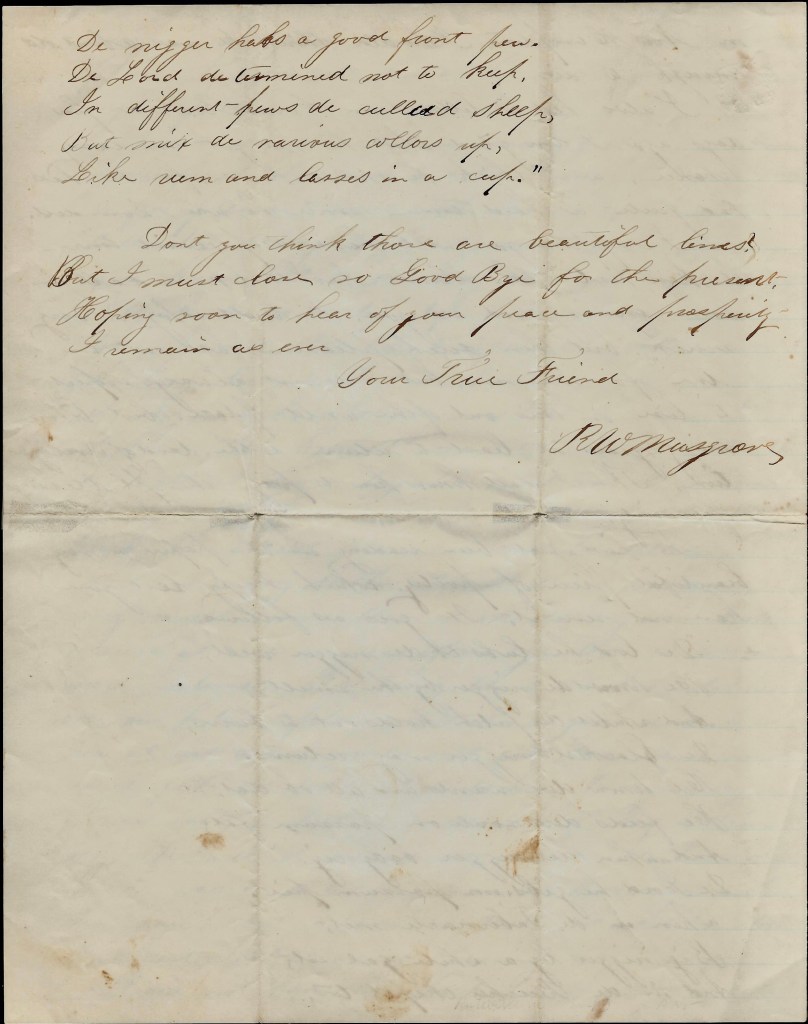
De nigger habs a good front pew.

De Lord determined not to keep.
In different pews de cullerd sheep,
But mix de various collors up,
Like rum and lasses in a cup.”

Don’t you think those are beautiful lines? But I must close so goodbye for the present. Hoping soon to hear of your peace and prosperity, I remain as ever your true friend, — R. W. Musgrove

1863: Joseph T. Cotton to his Family

Pvt. Joseph T. Cotton, Co. B, 12th New Hampshire

The following letters were written by Joseph T. Cotton (1836-1878), a native of Gilmanton, Belknap county, New Hampshire, who enlisted in Co. B, 12th New Hampshire Infantry in August 1862 and served in the ranks as a private until he was severely wounded at the Battle of Chancellorsville on 3 May 1863. He was discharged for disability a year later at David’s Island in New York Harbor. Joseph was married on 23 August 1862, just days after his enlistment but before he was mustered into the service. He married Sarah A. Varney (1842-1920).

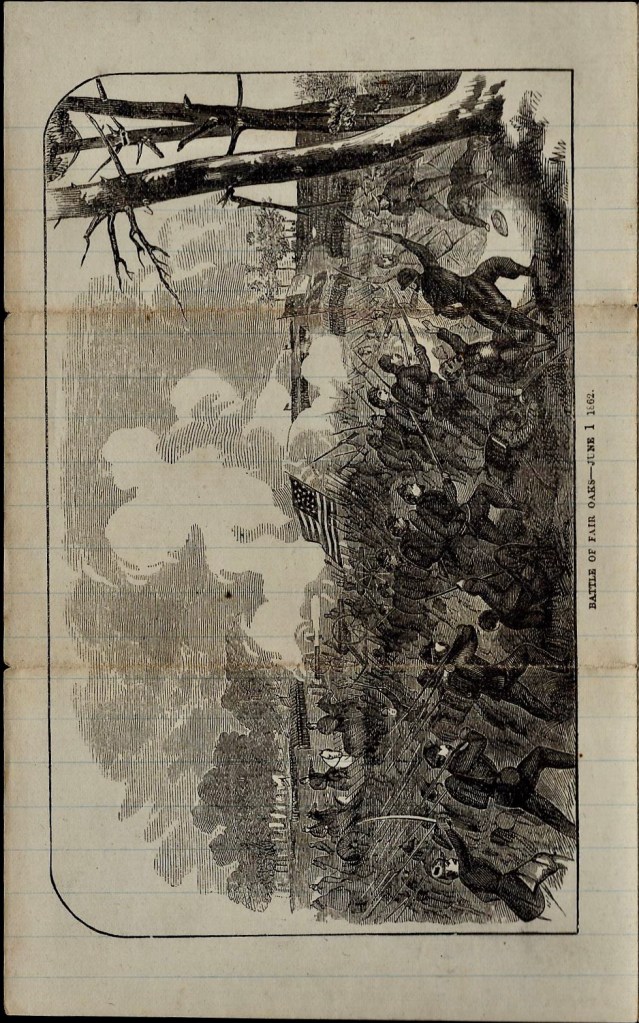
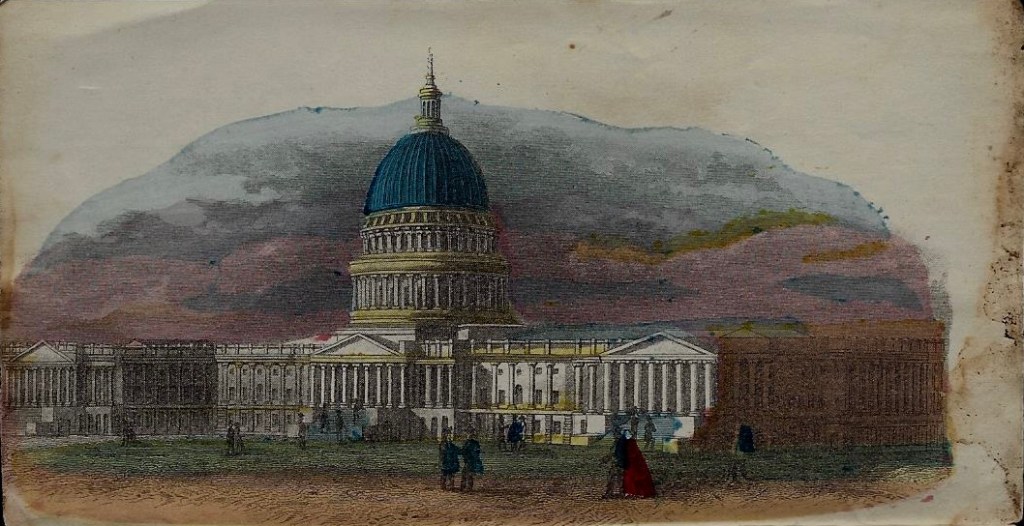
In the wartime letters, Cotton discusses very little in the way of war news but speaks mainly of his leg wound the treatment he received for it at two different hospitals in Washington D. C. All but one of the letters were written by Cotton while he was hospitalized. Two of the letters were written on impressive stationary—one has a colorized engraving of the newly completed Capitol Building (with rotunda) in Washington D. C. The other, on the verso of the letter itself, bears an engraved scene of charging soldiers entitled “Battle of Fair Oaks- June 1st 1862.” 

Joseph T. Cotton was described in the 12th NH regimental history as a “good, brave soldier, a kind neighbor, and a true-hearted man.”


Letter 1

Twelfth New Hampshire Regiment
Camp near Fredericksburg, [Virginia]
February 10, 1863

Dear Brother,

I received your letter a few days ago. Was glad to hear from you and that you were all well and that I can say the same. My health is good—fat as a hog—and I am well contented now.

We have rather cold weather. We have had a foot of snow at a time but it did not last long. We had a great rain after it and then we had to take the mud so you can see that we have to take all kinds of weather.

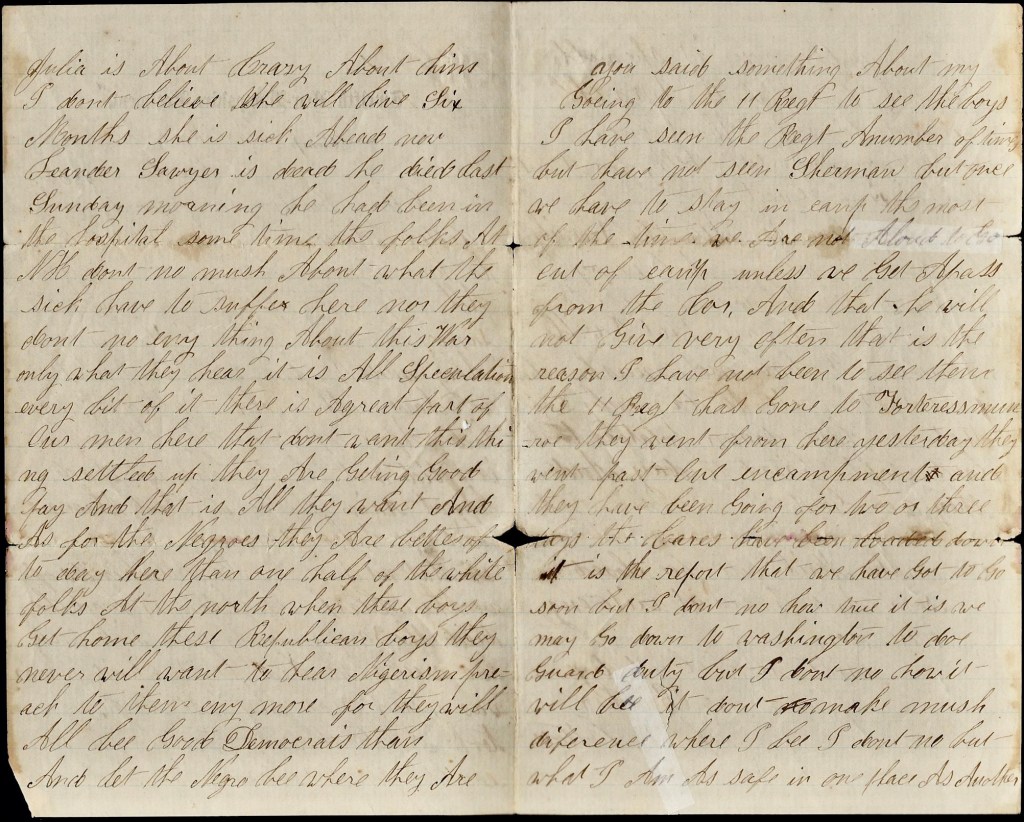
Clark Leighton is dead—only two weeks. He had the typhoid fever. Was very sick last week. we took as good care of him as we could for the chance we had. Julia is about crazy about him. I don’t believe she will live six months. She is sick abed now.

Leander Sawyer is dead. He died last Sunday morning. He had been in the hospital some time. The folks at New Hampshire don’t know much about what the sick have to suffer here nor they don’t know anything about this war—only what they hear. It is all speculation—every bit of it. There is a great part of our men here that don’t want this thing settled up. They are getting good pay and that is all they want. And as for the Negroes, they are better off today here than one half of the white folks at the North. When these boys get home—these Republican boys, they never will want to hear Niggerism preached to them anymore for they will all be good Democrats then and let the Negro be where they are.

You said something about my going to the 11th Regiment to see the boys. I have seen the regiment a number of times but have not seen Sherman but once. We have to stay in camp the most of the time. We are not allowed to go out of camp unless we get a pass from the Colonel and that he will not give very often. That is the reason I have not been to see them. The 11th Regiment has gone to Fortress Monroe. They went from here yesterday. They went past our encampment and they have been going for two or three days. The cars has been loaded down. It is the report that we have got to go soon but I don’t know how true it is. We may go down to Washington to do guard duty, but I don’t know how it will be. It don’t make much difference where I be. I don’t know but what I am as safe in one place as another.

How is Mother now? Is she well now? Tell her that I am well and not to worry about me more than she can help for I am having good times now. Give my love to all the family. I want to see you all very much. I want you to write to me as often as you can and I will answer. I have not much news to write today—only that we have drawn potatoes and soft bread today and they were good.

The mail will be closed soon and I cannot write any more now. write soon. Goodbye brother, — J. T. Cotton


Letter 2

Stationery with lithograph of the Battle of Fair Oaks, 1 June 1862

St. Aloysius Hospital, 1 Washington D. C.
July 6th 1863

Dear Mother,

I thought perhaps you would like to hear from me today and I will write you a few lines to let you know that my leg is doing well. It don’t gain very fast but is doing well as can be expected.

Have you heard from Smith since you got to Gilmanton? I have not heard from him but expect a letter soon. I had a letter from Betsy the other day. She had a bad cold then. Well, Mother, I don’t know as there is anything more to write now. Give my love to Aunt P. Hope she is better than when she wrote. So goodbye, Mother. Write to me often and I will [too].

1 St. Aloysius Hospital was located in wooden barracks in the St. Aloysius Church. When St. Aloysius General Hospital closed, its patients were sent to Stanton and Harewood hospitals. The barracks then became the hospital for Quarter Master Department employees. George M. Anderson’s article describes how the parishioners of St. Aloysius rallied to rapidly build barracks near St. Aloysius church so that it would not be used as a hospital after the military requisitioned it. The Catholic clergy felt that allowing the military to use the church itself would violate its sanctity.


Letter 3

Colorized lithograph of US Capitol on stationery

St. Aloysius Hospital
Washington [D. C.]
July 26, 1863

Dear Mother and Aunt,

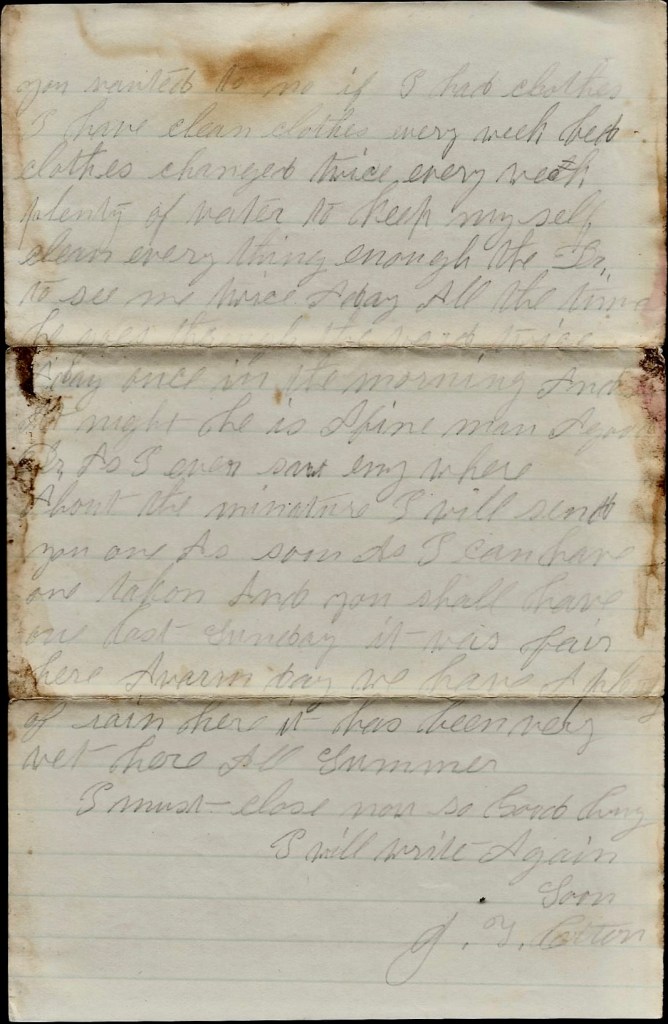
I received your letter last Thursday. Was glad to hear from you and that you were gaining in health. My health is good. My leg is doing well but cannot tell when I can come home. It is gaining slow. If the bone [fragments] all come out, it will soon get well but my courage is good. I have made up my mind to be contented until I can come home. I hope it will be next month.

Mother, don’t get tired waiting to see me for you are more comfortable than I am. You wanted to know if I had clothes. I have clean clothes every week, bedclothes changed twice every week, plenty of water to keep myself clean, everything enough, the doctor to see me twice a day all the time. He goes through the ward twice a day—once in the morning and at night. He is a fine man—as good a doctor as I ever saw anywhere.

About the miniature, I will send you one as soon as I can have one taken. And you shall have one. Last Sunday it was fair here—a warm day. We have a plenty of rain here. It has been very wet here all summer.

I must close so goodbye. I will write again soon, — J. T. Cotton


Letter 4

St. Aloysius Hospital
Washington D. C.
July 21, 1863

Dear Mother,

My leg is feel better today and I thought I would write you a few lines. I had it cut open the other day and the small bones keep coming out. There has eight pieces come out now. It never will get well until the pieces are all out. It will be a long time before the leg will get well. My courage is good and you must keep yours the same. Mother, I have good care enough to eat and everything that I cannot get here, there is two women here in the city that is from New Hampshire—one from Gilmanton. They come to look after me. The bring me wine jelly, underclothes, or anything else that I need. They brought me a pair of flannel shirts. Now don’t worry about me, Mother.

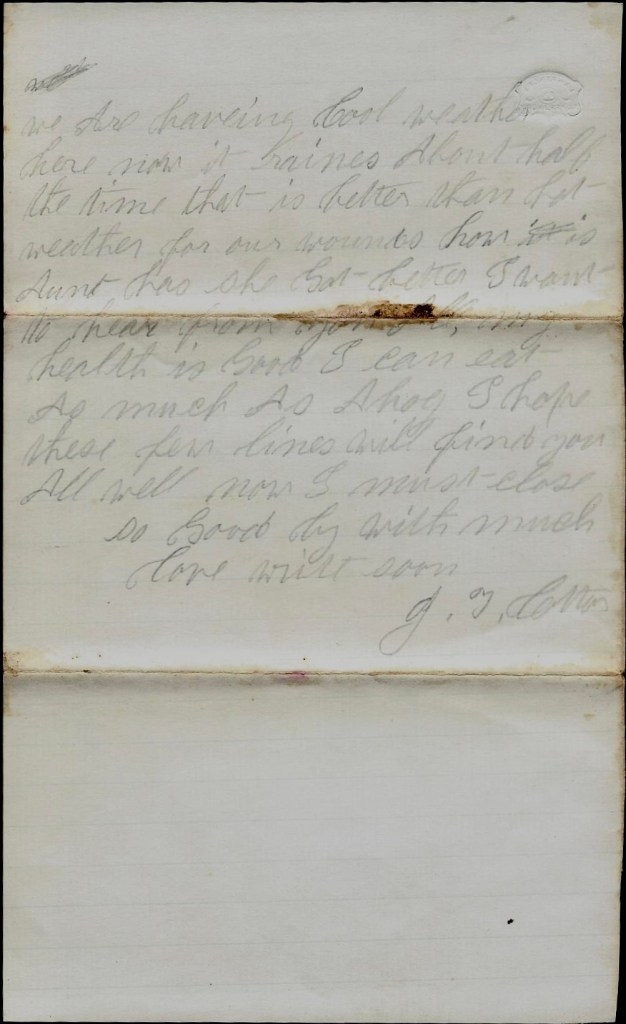
We are having cool weather here now. It rains about half the time. That is better than hot weather for our wounds.

How is Aunt? Has she got better? I want to hear from you all. My health is good. I can eat as much as a hog. I hope these few lines will find you all well. Now I must close, so goodbye with much love. Write soon. — J. T. Cotton


Letter 5

St. Aloysius Hospital
Washington D. C.
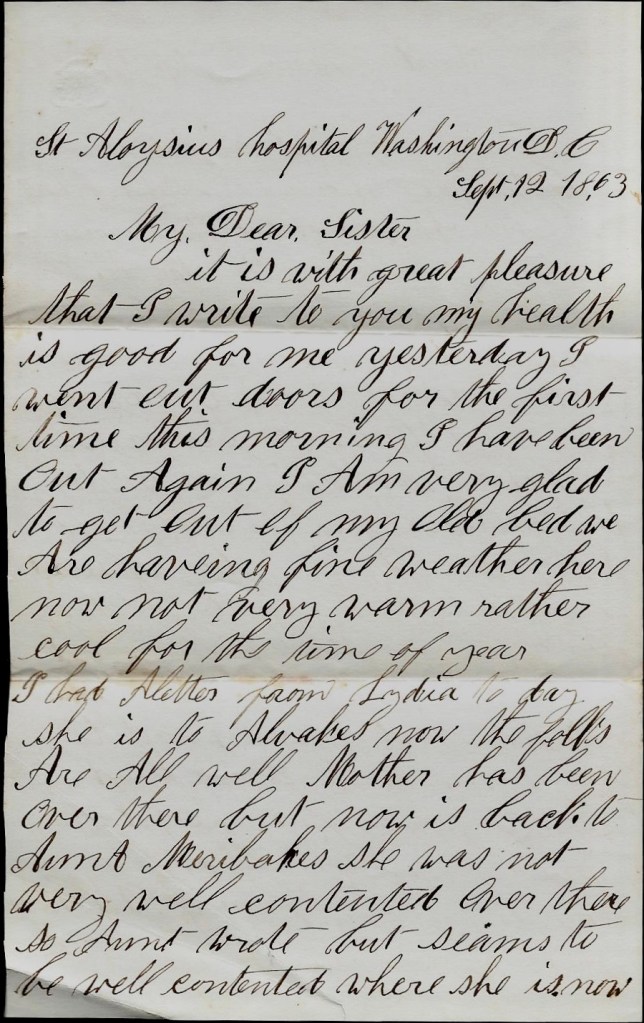
September 12, 1863

My Dear Sister,

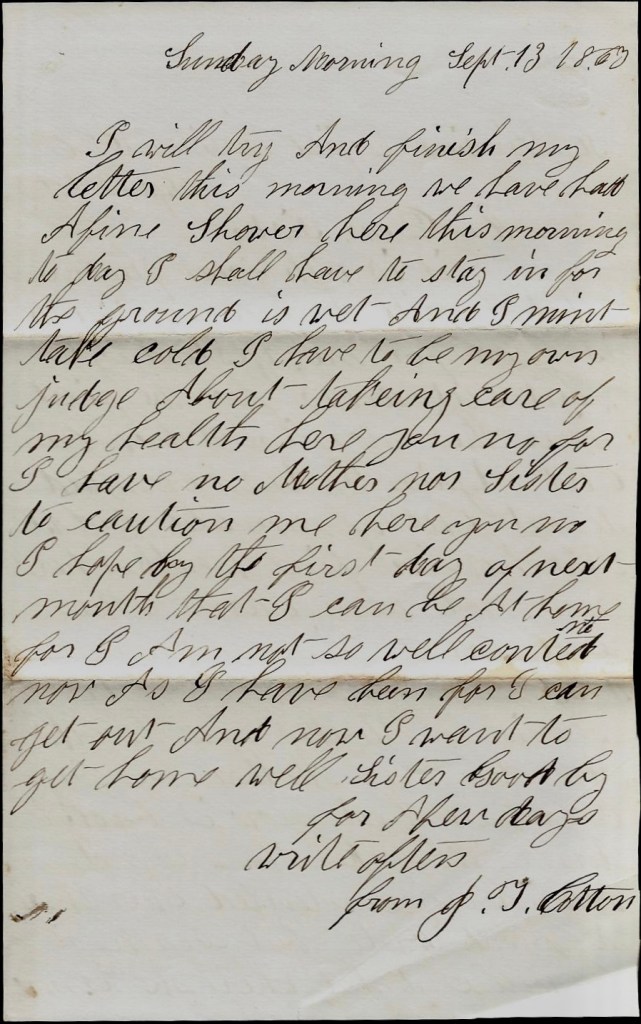
It is with great pleasure that I write to you. My health is good for me. Yesterday I went out doors for the first time. I this morning I have been out again. I am very glad to get out of my old bed. We are having fine weather here now. Not very warm. Rather cool for this time of year.

I had a letter from Lydia today. She is to Alvah’s now. The folks are all well. Mother has been over there but now is back to Aunt Meribakes. She was not very well contented over there so Aunt wrote but seems to be well contented where she is now.

Sunday morning, September 13, 1863

I will try and finish my letter this morning. We have had a fine shower here this morning. Today I shall have to stay in for the ground is wet and I might take cold. I have to be my own judge about taking care of my health here, you know. I hope by the first day of next month that I can be at home for I am not so well contented now as I have been for I can get out. And now I want to get home. Well, sister, goodbye for a few days. Write often. From J. T. Cotton


Letter 6

St. Aloysius Jospital
Washington D. C.
September 30, 1863

Dear Mother,

I will write you a few lines to let you know that my health is good. My leg is doing well. My name is going in this week to headquarters for my furlough. I will write you in a few days again to let you know when I can come home. Keep good courage, Mother and Aunt.

There is no news to write today. I thought I would write you a few lines to let you know I was well. Goodbye from — J. T. C.


Letter 7

St. Aloysius Hospital
Washington D. C.
October 14, 1863

Dear Mother,

I will try to write you a few lines to let you know that my health is good. My leg is about the same as when I wrote before. If nothing happens to me, I shall be at home next week, I think, but don’t worry if I don’t come. You know I have to wait for their motion. They can give me a furlough when they are a mind to. We privates can not do as we are a mind to [but] have to wait for them.

Give my love to Aunt Meriball and take a good share yourself, Mother.

From J. T. Cotton

If anything happens that I cannot come next week, I will write and let you know about it. Goodbye Mother. I can not write but a few lines this morning. I have got to write to Sarah and Betsey.


Letter 8

Harwood Hospital
Wahington D. C.
October 20th 1863

Dear Sister,

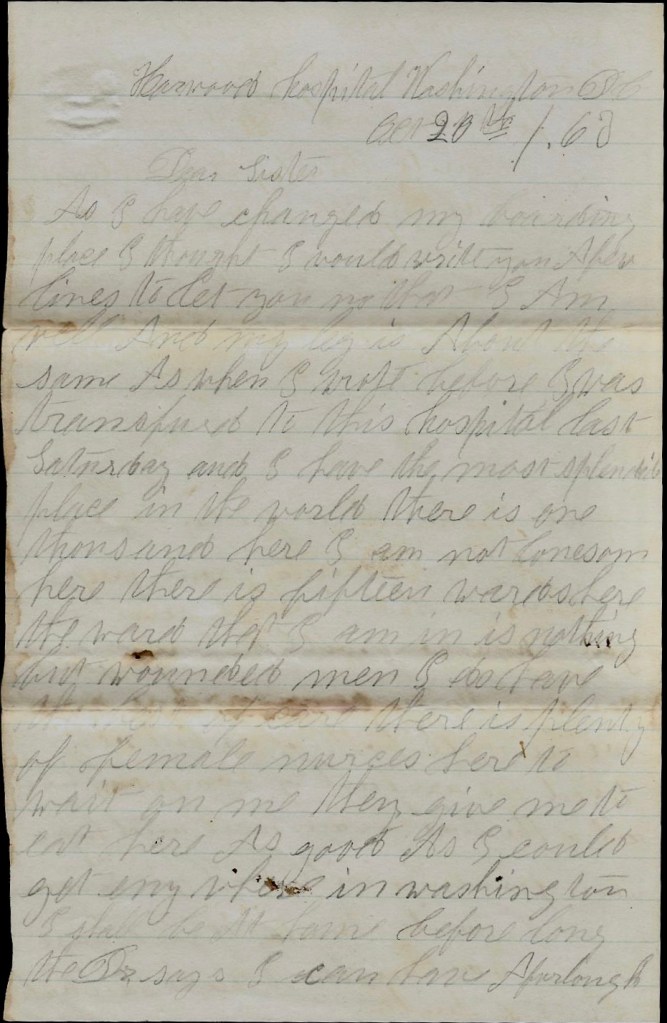
As I have changed my boarding place, I thought I would write you a few lines to let you know that I am well and my leg is about the same as when I wrote before. I was transported to this hospital last Saturday and have the most splendid place in the world. There is one thousand here. I am not lonesome here. There is fifteen wards here. The ward that I am in is nothing but wounded men. I do have the best of care. There is plenty of female nurses here to wait on me. They give me to eat here as good as I could get anywhere in Washington. I shall be at home before long. The Dr. says I can have a furlough soon but I am going to try for my discharge before I come. What [do you] think of that? Don’t expect to get it but can try, you know. Well, be of good courage. I will come some time.

Direct your letters to Harewood Hospital, Ward [?]

Write to me often. Goodbye sister, from J. T. Cotton


Letter 9

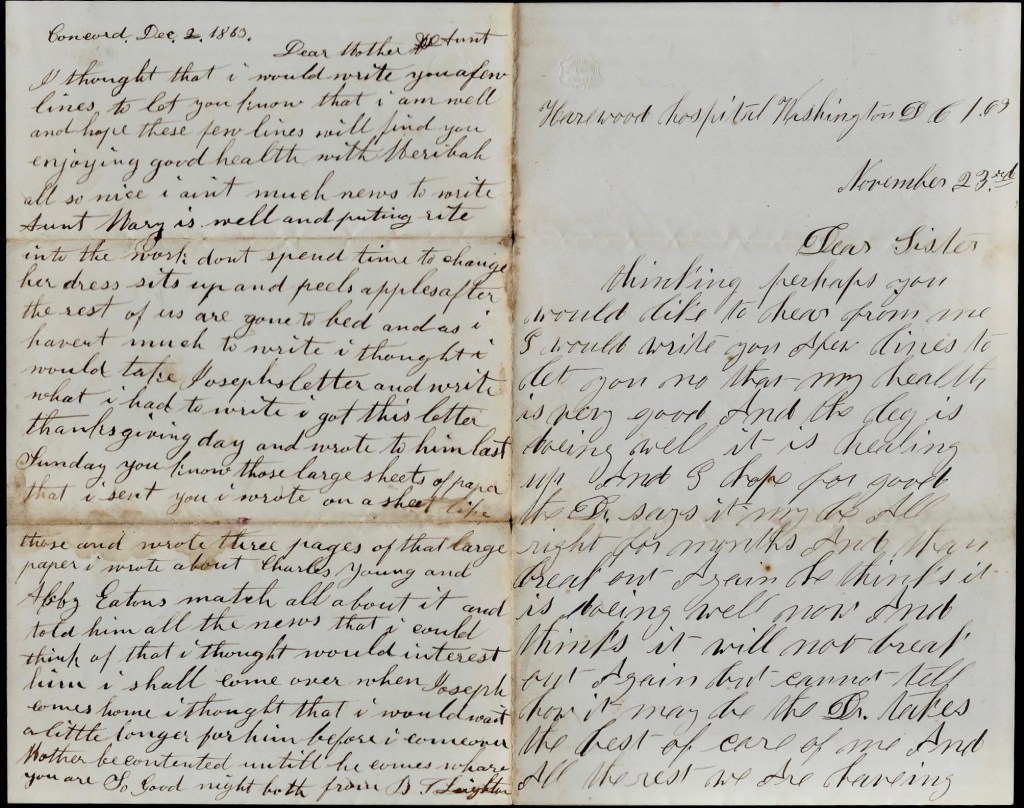
Harewood Hospital
Washington D. C.
November 23rd 1863

Dear Sister,

Thinking perhaps you would like to hear from me, I would write you a few lines to let you know that my health is very good and the leg is doing well. It is healing up and I hope for good. The Dr. says it may be all right for months and then break out again. He thinks it is doing well now and thinks it will not break out again but cannot tell how it may be. The Dr. takes the best of care of me and all the rest.

We are having fine weather here now. The folks are haying here now. I expect that itis very cold to New Hampshire now. It is time for it there.

I had a letter from Smith. They are all well. Alvah and Minnie have been down to see them. Lydia has gone to Massachusetts again. I had a letter from Mother and Meribal. They are well but Mother feels disappointed about my coming home. I hope that I can get home soon this year or the first of next. it is now most seven months that I have been in the hospital. That is long enough for anyone.

How does Sarah feel about me. I write for her to keep good courage about me and hope she will. That will make me feel better than to have her get down-hearted about me. She writes to me often. She wants me to come home soon as I can but you know that I am better off here than anywhere at present for they know what to do for me. I think that I am sure of my discharge when the leg gets healed good but I don’t think that I ever can work on a farm anymore. It will be too hard for me. But Iam not afraid but what there will be a way for me to get my living. That don’t trouble me any—not in the least.

Sylvester Gale was here to see me the other day. He has gone back to Concord now. He is detailed from the regiment. He is in some kind of business there in Concord.

Well, Sister, you must write to me often. Give my love to Aunt and all the friends that I may have in Concord. Yours with much love. From — Joseph T. Cotton


Letter 10

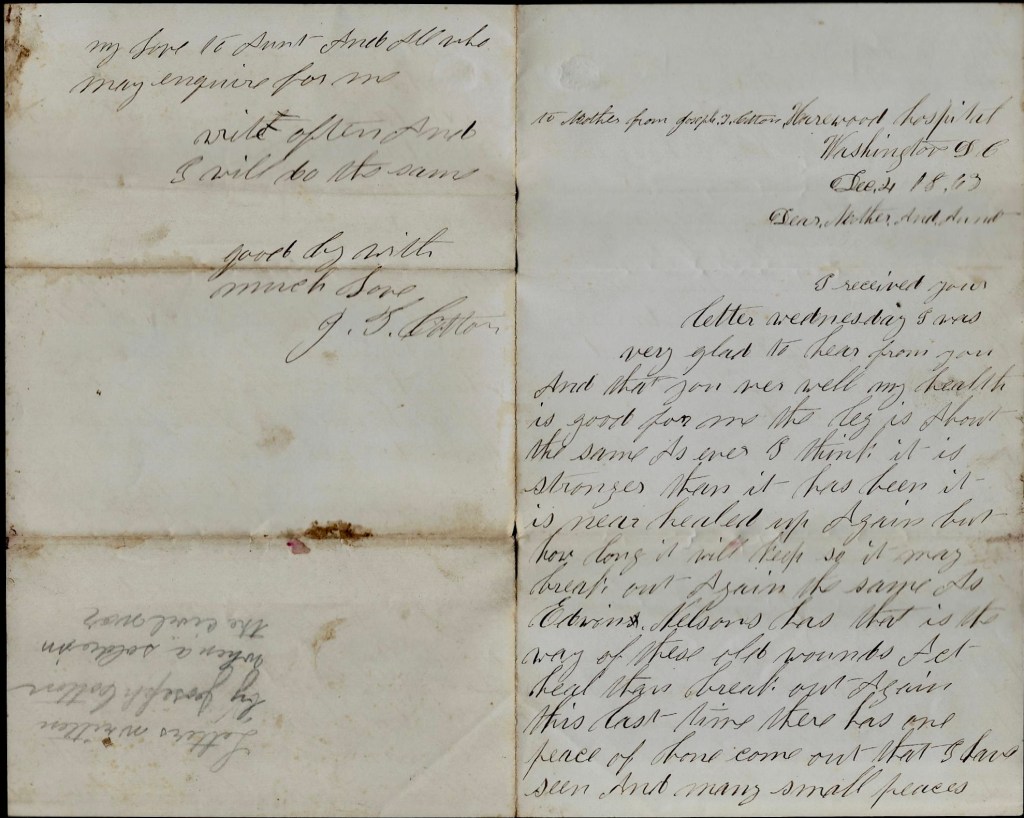
Harewood Hospital
Washington D. C.
December 4, 1863

Dear Mother and Aunt,

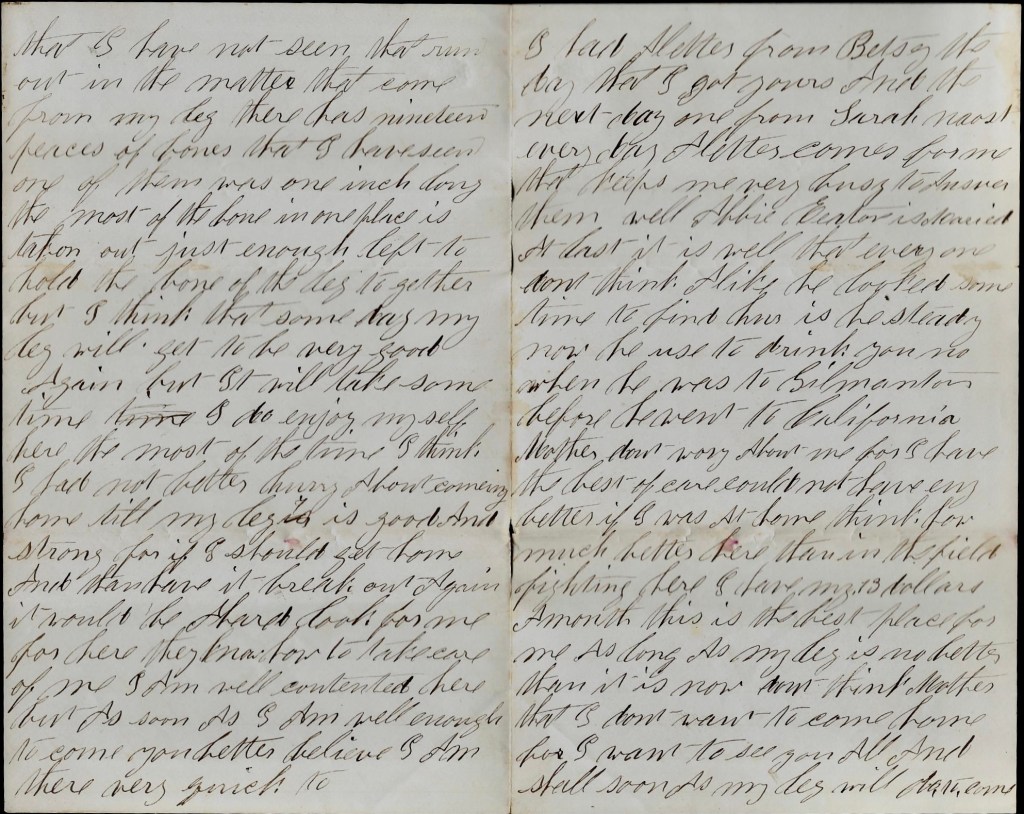
I received your letter Wednesday. I was very glad to hear from you and that you were well. My health is good for me. The leg is about the same as ever. I think it is stronger that it has been. It is near healed up again but how long it will keep so, it may break out again the same as Edwin Nelson’s has. That is the way of these old wounds. Get healed, then break out again. This last time there has one piece of bone come out that I have seen and many small pieces that I have not seen that run out in the matter that comes from my leg. There has nineteen pieces of bones that I have seen. One of them was one inch long. The most of the bone is one place is taken out—just enough left to hold the bone of the leg together. But I think that some day my leg will get to be very good again. But it will take some time.

I do enjoy myself here the most of the time. I think I had not better hurry about coming home till my leg is good and strong for if I should get home and then have it break out again, it would be a hard look for me for here they know how to take care of me. I am well contented here but as soon as I am well enough to come, you better believe I am there—very quick too.

A had a letter from Betsy the day that I got yours and the next day one from Sarah. Most every day a letter comes for me that keeps me very busy to answer them. Well, Abbie Easton is married at last. It is well that everyone don’t think alike. He looked some time to find her. Is he steady now? He use to drink, you know, when he was to Gilmanton before he went to California.

Mother, don’t worry about me for I have the best of care. Could not have any better if I was at home. Think how much better here than in the field fighting. Here I have my 13 dollars a month. This is the best place for me as long as my leg is no better than it is now. Don’t think, Mother, that I don’t want to come home for I want to come home and see you all and shall soon as my leg will allow.

My love to Aunt and all who may enquire for me. Write often and I will do the same. goodbye with much love, — J. T. Cotton


Letter 11

Harewood Hospital
Washington D. C.
December 28, 1863

Dear Mother and Aunt,

I received your kind letter a few days ago. I was glad to hear from you for sometimes I feel very lonesome and then I like to get letters. That cheers me up some.

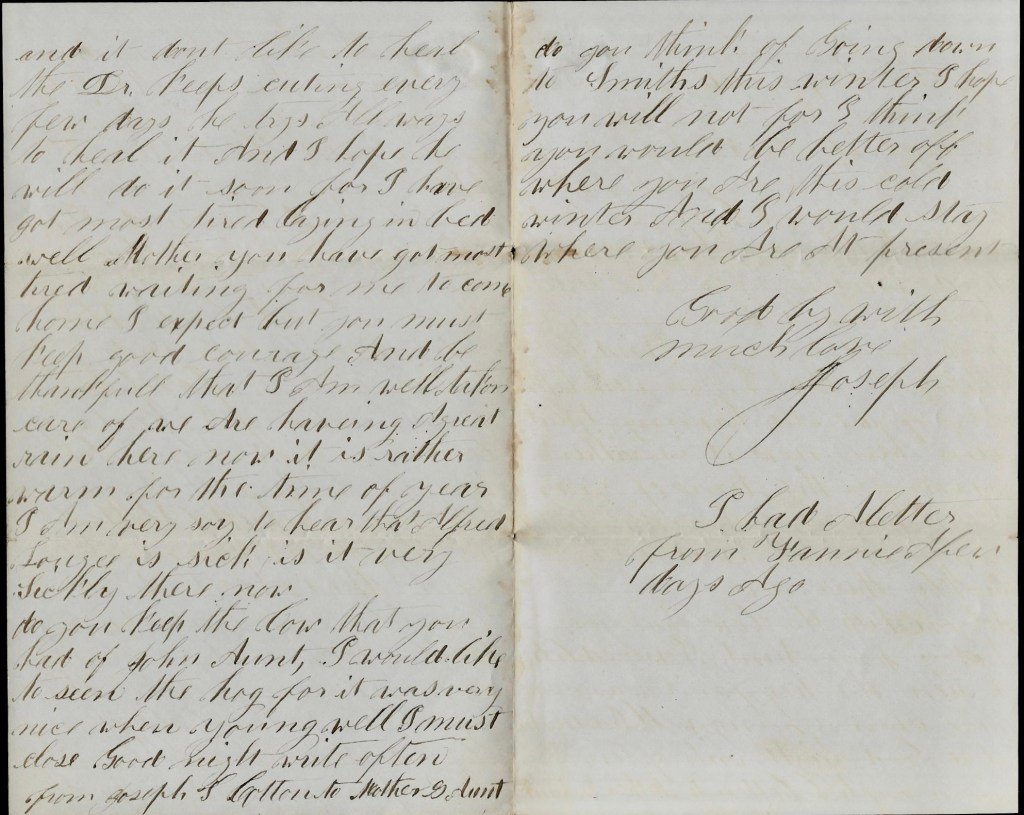
Well, about the leg. It is about the same as ever. It don’t trouble me but every little. Now that is not to pain me much. The trouble is the calf of my leg is sore now. There is an opening under the skin and it don’t like to heal. The Dr. keeps cutting every few days. He tries all ways to heal it and I hope he will do it soon for I have got most tired laying in bed.

Well, Mother, you have got most tired waiting for me to come home I expect but you must keep good courage and be thankful that I am well taken care of.

We are having a great rain here now. It is rather warm for the time of year. I am very sorry to hear that Alfred Lougee is sick. Is it very sickly there now?

…Goodbye, with much love, — Joseph