
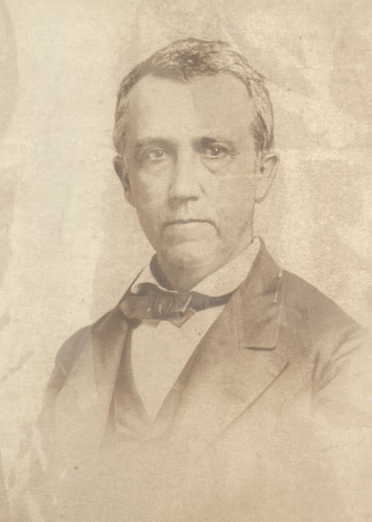
The following letter was written by 46 year-old John Reid, Jr. (1816-1885) to his second wife, Maria Frances (Thompson) Reid (1832-1875). John was the son of Maj. John Reid and Elizabeth Branch Maury. Maj. Reid was aide-de-camp and military secretary to Gen. Andrew Jackson during the British and Indiana War and was with him in New Orleans. John Reid, Jr. was born on the Major’s farm (called “Tree Lawn”) near Franklin, Williamson county, Tennessee.
In 1860, John Jr. was enumerated as a lawyer in Nashville, Davidson county, Tennessee. Adding a note to his letter was Frank T. Reid (1845-1923), John’s son by his first marriage to Margaret Louise Trimble (1821-1849). Frank indicates in his note that he had not yet enlisted in the Confederate service. According to muster rolls, Frank enlisted on 13 February 1863 at Columbia, Tennessee, as a sergeant in Capt. John W. Morton Jr.’s Company, Tennessee Artillery. He was later transferred to Co. F, 4th Tennessee Cavalry as orderly sergeant.
John wrote the letter while visiting with his brother William Steptoe Reid, a large slaveholder in Williamson county, Tennessee. We learn that William had recently sold out and intended to relocate to Georgia. William was married at the time to his second wife, Sarah Claiborne Maury (1829-1912). In the letter, we learn that John Jr. and his son Frank intended to go to Murfreesboro on 31 December 1862. If they did, they would have ridden right into the Battle of Stones River.
I can’t find any evidence that John Reid ever served in the Confederate army. I did find him mentioned in an article published on 6 February 1864 in the National Aegis under the title, “The Amnesty Proclamation in Tennessee” which may or may not be propaganda: “The Union says also that Hon. John Reid, formerly a senator from Davidson County in the state legislature, and an able lawyer, has returned from Dixie, and accepted the President’s amnesty proclamation. He advises all others to follow his example as the Confederacy must go to the dogs. If John Bell doesn’t want to be conscripted, notwithstanding his age, Mr. Reid says he will be compelled also to come in.”
Transcription

Warren county [Tennessee]
December 29th 1862
My dear wife,
I am at my brothers & as Mr. Stovall goes to Sumner tomorrow, I avail myself of the opportunity to write you again. I wrote to you about two weeks ago & gave my letter to Mr. Charles Cantrill to send it to you. Did you get it? I have not heard a word from you since I left except through Mr. Gill. The letter you wrote by Mrs. Bond did not reach me. She was overhauled by the Yankees and destroyed your letter.
In my letter to you I stated in substance that you must be the judge whether you remained longer in Gallatin or come south; that if you were not molested nor likely to be by the Yankees, it would be probably more prudent to remain longer where you were. Otherwise you ought to come by the first opportunity that presented itself, if God in His mercy gave you the chance. Of course I would rather have you with me, if I consulted only my desires, but I do not know how long the Southern army will or can remain in Murfreesboro.
My brother has sold his place here and will love his family as soon as he can to Georgia. Frank & I are both well and expect to leave here for Murfreesboro day after tomorrow. I think of you & the baby constantly. I am all the time uneasy & unhappy about you. I pray God this state of things will not continue long. Write me the first & every opportunity that presents itself. I hope I will get a letter from you when I reach Murfreesboro. I write this letter on my cap & must close. I send you my best and warmest love & pray that I may be permitted before long to see you.
Kiss George for me and tell him not to forget his Pa. Love to all the family, — Jno. Reid

Dear Ma, No doubt you are somewhat surprised to find that I am still here at Uncle Will’s—and not in the army. If I could have had things my own way, you may be assured I would have been there ere this. However, I design starting to Murfreesboro day after tomorrow—Wednesday. I will write to you by every opportunity and hope you or George will drop me a line now and then. How I would like to see little Dumdoodle. I pray God that I may shortly. Give my love to all. Goodbye, — Frank Reid

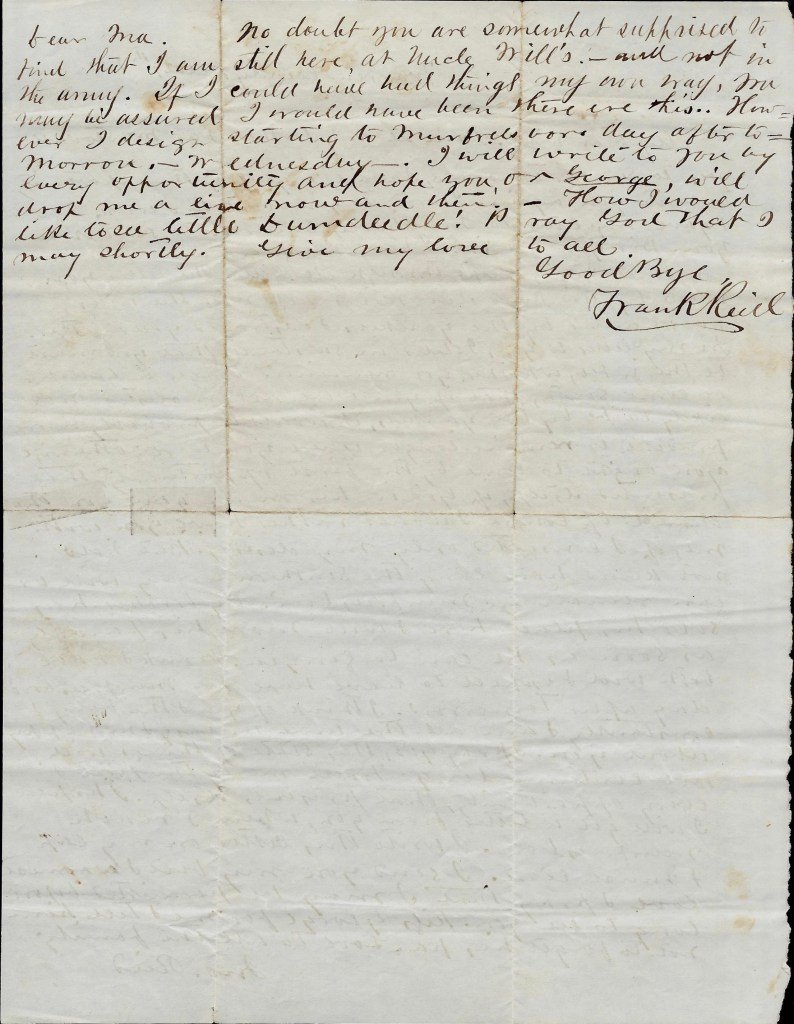


As of April 7, 2024 the letter above is in my possession. What at first appears to be little more than a letter relating family matters during the Civil War actually proves upon closer examination to be a letter revealing much more than domestic data. We are first drawn to the date and location of the letter. The letter was written just two days before the beginning of what is known as the Stones River Battle and the location where it was penned put John Jr. and his son Frank in the virtual eye of the storm. How they removed themselves from danger is not known. Also, the fact that a benign letter from wife to husband (as mentioned in the letter) had to be “destroyed” by its carrier so “yankees” would not intercept it not only shows the degree of control Union troops held over Southern citizens in the area but exposes the degree of fear many Southerners felt under that control. In addition to the general trepidation one would naturally experience during a war, John Jr. appears to have been specifically concerned with his wife’s safety under Union occupation…he uses the word “molested” to depict what deprivations she could possibly be subjected to at the hands of those they considered to be invaders and suggested she move further south if need be. John Jr.’s son, Frank, as recorded elsewhere, joined the Confederate army several months after the letter was written and served first in Morton’s Artillery and then elsewhere throughout the remainder of the war. The letter itself is a truly fascinating bit of Civil War history. No, it’s not a Stonewall Jackson letter or a Jefferson Davis letter but I’m nevertheless happy to own it and add it to my modest collection of Civil War memorabilia. Many thanks for taking the time to read this additional information. FWS
LikeLike