

The following letters were written by Perrin Veber Fox (1821-1910) while serving as Captain of Co. D, 1st Michigan Engineers and Mechanics. This regiment was one of three engineering regiments raised in 1861, the other two being Missouri (August 1861) and New York (September 1861). Engineering regiments are often left off of many Order of Battles, but their contribution to campaigns were vital from a logistics point of view; repairing/building railroads, bridges and blockhouses; and destroying enemy communication lines, railroads and bridges. Engineering units like the First Michigan were often caught up in attacks from enemy guerrillas and cavalry skirmishes.
Perrin was the son of Bryan Benjamin Fox (1787-1865) and Hannah Shepherd (1796-1885) of Antwerp, Jefferson county, New York. At the time of the 150 US Census, Perrin was married to Louisa Maria Newton (1823-1901) and working as a construction carpenter in Ridgeway, New York. Without his family, he was in California for four years attempting to make his fortune but returned to take his family to Grand Rapids, Kent county, Michigan, where the 1860 US Census found him resuming his trade as a master carpenter.
The Bancroft Library at U.C. Berkeley holds three original letters to his wife written during his time in the California goldfields. Other letters written by Fox are held at private and university libraries. Several, including “P. V. Fox to wife, April 13, 1862” are held by the private collection of John Gelderloos, Grand Rapids, Michigan. The Bentley Library at the University of Michigan holds three 1863 letters to his wife. The Stevenson Railroad Museum Depot, Stevenson, Alabama, holds “Letter P. V. Fox to wife, May 29, 1894.” Finally, the “Diary of Captain Perrin V. Fox, original volume dating 1 January 1862 to 10 January 1863” is held by the Ray Smith Manuscript Collection, Special Collections and Archives, Seymour Library, Knox College, Galesburg, Illinois.
Letter 1

Lebanon, Kentucky
December 28th 1861
My Dear Ida,
I have not heard from you since I last wrote, nor even since we left Marshall, [Michigan]. I wrote you that our regiment was divided into four detachments. Ours is the 2nd Division and was the first to leave camp. We struck our tents at 5 o’clock a.m. on Christmas & were at the depot with all our effects before seven. The train was not made up & we were delayed in starting but got off between 8 & 9 o’clock. We passed through some very good country & some poor enough. The people look & dress very differently from those of our own state. The conversation is quite as dissimilar. But their buildings are poorest of all—chimneys outside, and no paint on a very large majority of the buildings. The contrabands amuse the boys in various ways & are the subjects of many quaint remarks as they pass on their way to market with ox teams which they ride bare back, & guide with a single rope fastened to the horns. Some drive mule teams from four to six in number, riding the rear wheel mule & guide the whole with a single line on the near leader. Many are on foot & present an interesting picture for those who descant so largely upon the happy condition of the slave.
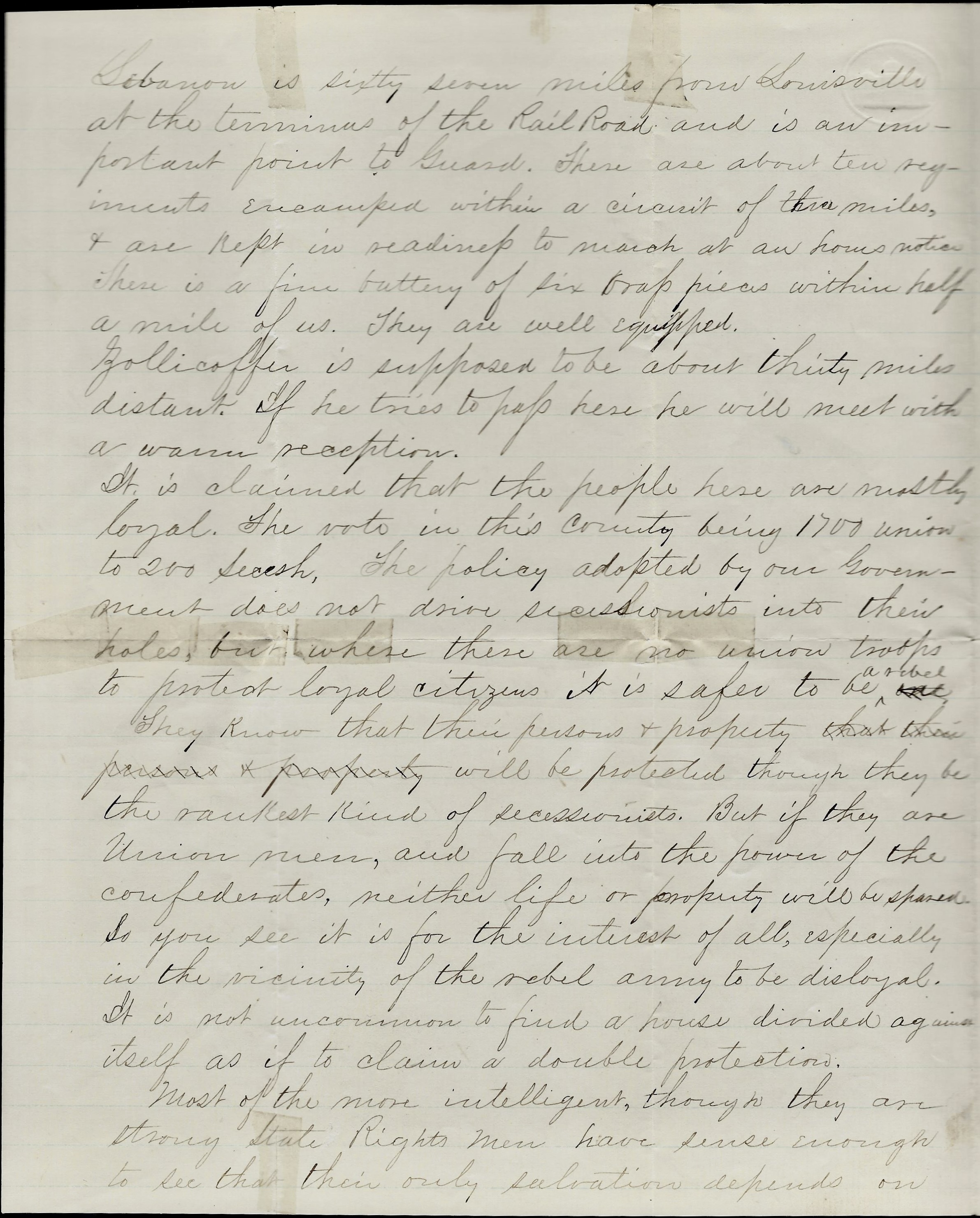
Lebanon is sixty seven miles from Louisville at the terminus of the railroad and is an important point to guard. There are about ten regiments encamped within a circuit of three miles, & are kept in readiness to march at an hour’s notice. There is a fine battery of six brass pieces within half a mile of us. They are well equipped. Zollicoffer is supposed to be about thirty miles distant. If he tries to pass here, he will meet with a warm reception.
It is claimed that the people here are mostly loyal—the vote in this county being 1700 union to 200 secesh. The policy adopted by our Government does not drive secessionists into their holes, but where there are no union troops to protect loyal citizens, it is safer to be a rebel. They know that their persons & property will be protected though they be the rankest kind of secessionists. But if they are Union men, and fall into the power of the confederates, neither life or property will be spared. So you see it is for the interest of all—especially in the vicinity of the rebel army—to be disloyal. It is not uncommon to find a house divided against itself as if to claim a double protection. Most of the more intelligent, though they are strong state rights men, have sense enough to see that their only salvation depends on the maintenance of the Union.
There is a pretty sensitive question to touch with nearly all—viz: the confiscation of slaves. And it is really a delicate one. The laws of Kentucky provide that no slave shall be manumitted on her soil. Now I believe it is desired by the slave owners to have the slaves of secessionists confiscated by governmental authority. What will it then do with them? Give them their liberty here regardless of the laws of this state & the rights of loyal citizens? And would it not materially affect their interest to give a portion their liberty? Then comes the nicest point. If the government interferes with the local interest of a state by depriving some of its citizens of their property even if they are disloyal, is it not bound to protect its loyal subjects in the possession of the same kind of property? And will it not thereby commit itself on the very question so long and so strongly urged by the politicians of the South, that the General Government ought to recognize & protect property in slaves? When this is done let the rebels throw down their arms & claim for the states that have not seceded their rights under the constitution & the great point is gained. The point settled that the government recognizes & protects slave property of course they can take it when they choose.
I hope Congress will not undertake to settle the question but will give the commanders of the several departments liberty to use some discretion & whenever they find disloyal subjects or out & out rebels, make them bear a large proportion of the expenses by calling on them for forages, provisions, stock, &c. to the full amount of their ability, & if necessary for the public good, secure their persons. It is rather hard for the defenders of one country to submit to insults from those they protect without the power to make an example of them.
You perceive I have written at random, giving a hit here, another there, & not much anywhere—which will probably be the case until I get more accustomed to being interrupted every five words more or less. My health is good & the men are generally well. I await with anxiety a letter from you, hope it will come today. We are making out our muster rolls for pay & expect to get some “rino” very soon.
Direct to Louisville, Co. D, 1st Michigan Engineers & Mechanics.
Much love to yourself & the children. Ever yours — P. V. Fox



Letter 2

Murfreesboro, Tennessee
May 20, 1863
Dear Ida,
Yours of the 10th inst. duly came. You fear being disappointed about my getting home since the unfavorable result of the Battle of Fredericksburg. That with the peculiar condition of things, the uncertainty of the position, strength and designs of the evening, together with the large number of our line officers disabled and off duty, make it very certain that if I make an application for leave of absence now, it will be rejected. As soon as Capt. Crittenden returns, I shall try it unless there shall be strong reasons why I had better wait a little longer.
Captain Sligh’s company will probably be without an officer tomorrow. Both lieutenants have been sick—are better now. Lt. White left yesterday for home & Lt. Nevin’s papers went in today. Capt. Grant has been sick and leaves today for home. My health begins to fail and no doubt the warmer weather will so affect it as to make a change of climate necessary to my recovery. The strawberry season would be exceedingly beneficial to me.
Will Tryon tried to get a furlough but with other applications were returned not granted. It is said that the Governor is daily expected, but he has not got here yet.
The work on the fortifications progresses steadily but it will require several weeks to complete them. I will send this by Capt. Grant who will leave in a few minutes. He lives at Sandstone, Jackson county, and is acquainted with Henry’s people. Lt. Herkner sends his love to you but says I won’t write it. Ever yours, — P. V. Fox


Letter 3
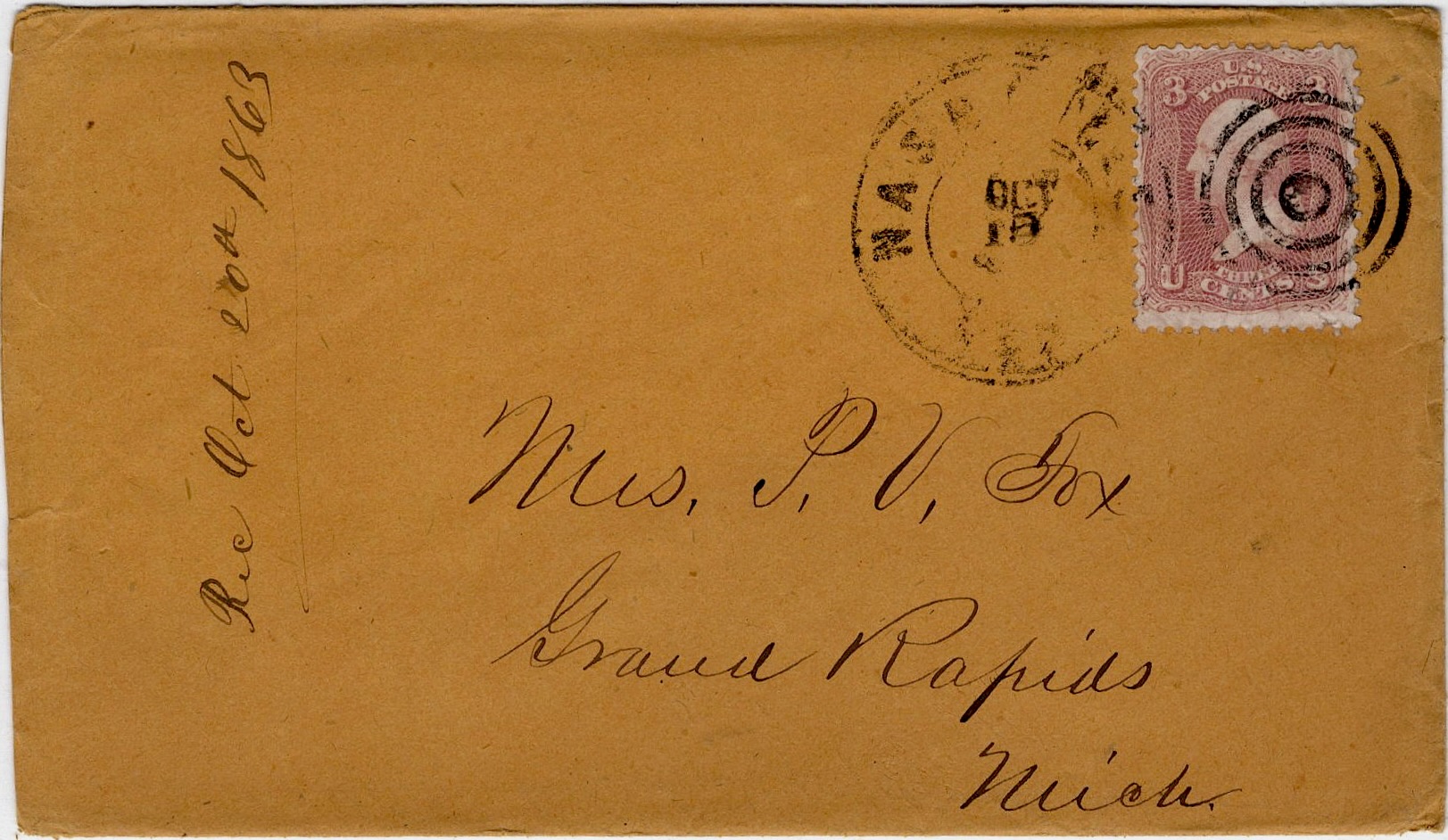
Chattanooga, Tennessee
October 2nd 1863
My dear Ida,
Yours of the 20th ult. came to me last night. I read it three times and came to the conclusion that you are growing more sentimental or are improving in the faculty to express happily the emotions of your heart or hearts. It has done me so much good to be reassured that I am all in all to you. It hardly seems possible that I can be so affected by hearing repeated what I so well know. But so it is & I can appreciate your yearning for expressions of love & sympathy.
I do not feel very well today having for the first time since we have been out, a recurrence of pain in my chest with spasmodic action internally. You know Dr. Botsford thought it rheumatic & I think it quite probable for I was out in the rain yesterday considerable getting siege guns across the river and got quite wet. I feel pretty comfortable this p.m. & will probably be all right tomorrow.
I have never been so pleasantly situated as now. Having command of two companies (I expect two more), I am often called to headquarters & consulted in reference to the work. Gen. [William] Rosecrans paid me a very nice compliment by putting me in charge of getting up 100 pontoon boats, giving me a “carte blanch” to take all I could find of material & to call for men and teams on Pioneers or others & they should report to me. There are two sawmills not in good repair to make the lumber [and] the nails, oakum, and pitch to come from Nashville. I have labored faithfully & I believe my efforts are appreciated. I am in a position to be trusted with more consideration than ever before.
Gen. Wagner commanding the Post seems very kind as are all the officers. If strict attention to business will preserve their good opinion, I mean to retain it.
Gen. Rosecrans often summons me to headquarters and has acted upon my suggestions in preference to Gen. Morton and others of higher pretensions than I dare assume. I have a nice little camp convenient to headquarters, work, and water. My tent is in the yard of Mrs. Major Bolling, Quartermaster on Gov. Harris’ staff. She wished me to put it there as a protection to the premises. She has only three children (expects another in a few days) & two servants. She has been with her husband during the war until the evacuation. Her home is in Nashville where she has maintained a high social position, being very wealthy. She is a very pleasant lady and careful not to say anything to wound the feelings of anyone. Gens. [James] Negley & [George D.] Wagner and other officers call on her. I go in and sit awhile occasionally & find it quite pleasant.
In my next, I will try to give you some idea of the scenery and surrounding country. Perhaps you have heard that Capt. Charles Newberry [Co. E, 11th Michigan Infantry] was killed at the Battle of Chickamauga. It was one of the hardest struggles of the war. They had been reinforcing several days & were determined to overpower by weight of numbers. What the next movement will be we may soon know. They cannot attack us successfully in front and it may be dangerous to try flanking. Love to the boys as well as yourself. — P. V. Fox


 Spared & Shared 23