
This incredible letter was written by John Fales (1841-1918), the son of John Smith Fales (1800-1861) and Charlotte Leland (1807-1850) of Sherburn, Middlesex county, Massachusetts—both parents dead by the time this letter was written in September 1861. He wrote the letter to his older sister, Charlotte Adelaide Fales (1832-1908), mentioning too a younger brother, Charles Leland Fales (1843-1902) who was serving in Co. B, 16th Massachusetts Infantry. From enlistment records we know that John stood 5′ 9″ tall, had brown hair, light eyes, and a fair complexion.
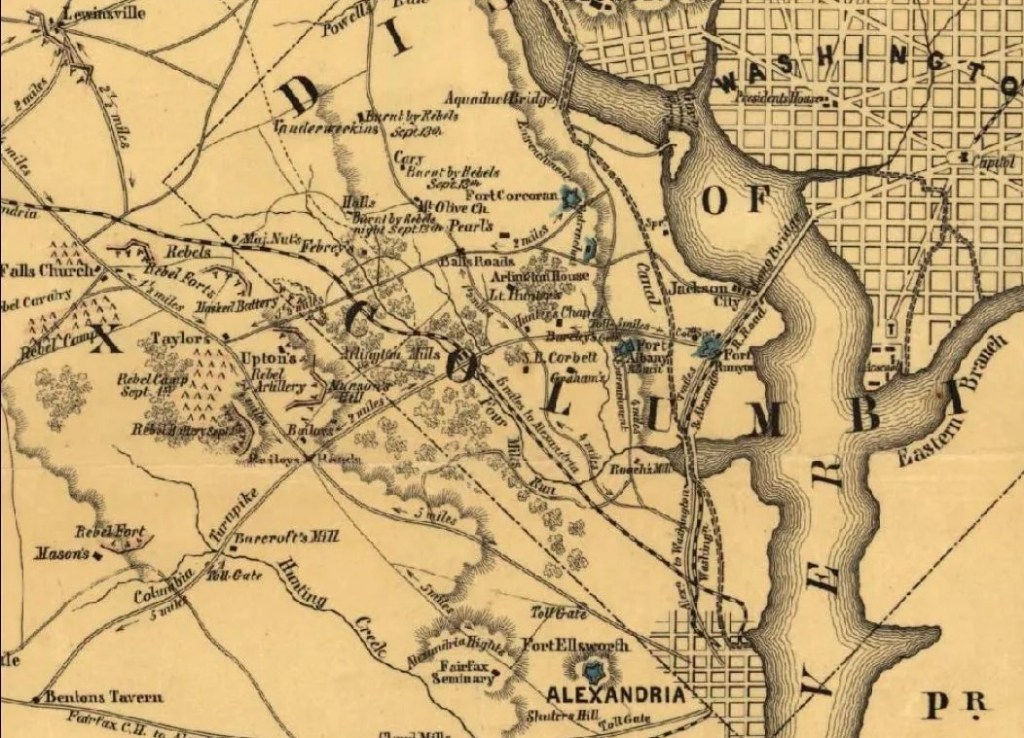
John wrote the letter while serving in the 3rd Light Artillery, Battery E, of the US Artillery (Regular Army)—commonly referred to as “Sherman’s Battery.” His enlistment was recorded as 17 April 1861 and his battery was mobilized and placed in a defensive position near Arlington Heights in late May. At least two of the guns were stationed at Pearl’s farm “north of the wagon road, half a mile east of Ball’s Crossroads” by early July. They were attached to William T. Sherman’s Brigade 1 of McDowell’s Army at the time of the Battle of Bull Run—their participation described by Captain Romeyn B. Ayres, who commanded the Battery at Bill Run, in the following after action report:
LIGHT COMPANY E, THIRD ARTILLERY,
Camp Corcoran, Virginia, July 25, 1861.
SIR: I have the honor to report the part taken in the battle of the 21st instant by this battery.
The battery advanced in the morning with the brigade to which it was attached—Col. W. T. Sherman’s—on the center route upon the front of the enemy’s position. The battery operated from this position at times upon the enemy’s batteries and troops as occasion offered. About noon I started with the brigade, as ordered, to cross the open ground, the run, and to rise the bluff, with a portion of the battery, one section being detached at this time, operating upon a battery to the left. On arriving at the run it at once was apparent that it was impossible to rise the bluff opposite with the pieces. I sent an officer immediately to report the fact to Colonel Sherman and ask instructions. I received for reply that I should use my discretion.
I immediately returned to the central position. I remained at this point, operating upon the enemy’s guns and infantry, till ordered by General Tyler to cover the retreat of the division with the battery. A body of cavalry at this time drew up to charge the battery. The whole battery poured canister into and demolished them. The battery moved slowly to the rear to Centreville.
I will add, that the coolness and gallantry of First Lieut. Dunbar R. Ransom on all occasions, and particularly when under fire of three pieces, with his section at short range, when the battery was about to be charged by a large body of cavalry, and also when crossing a broken bridge in a rough gully, and fired upon in rear by the enemy’s infantry, were conspicuous. The good conduct of First Lieut. George W. Dresser, Fourth Artillery, was marked, especially when threatened by cavalry, and at the ravine referred to above. Second Lieut. H. E. Noyes, cavalry, was energetic in the performance of his duties.
I lost four horses killed on 18th; two horses wounded on 18th; seven horses on 21st; three caissons, the forge, and a six-mule team and wagon (excepting one mule), on the 21st. I sent all these caissons, &c., ahead when preparing for the retreat, to get them out of the way. The fleeing volunteers cut the traces and took the horses of the caissons.
Very respectfully, your obedient servant, — R. B. AYRES, Captain, Fifth Artillery, Commanding Company E.

John datelined his letter from “Arlington Heights” on 5 September 1861. He indicates that the battery was near Fort Corcoran. More precisely the battery was positioned a quarter of a mile soutwest of W. Ross’ farm Rossyln.
Before the Civil War ended, John would enlist twice more in his country’s service. After his three years in Battery E, US Artillery, he reenlisted in Co. E, 60th Massachusetts Infantry on 16 July 1864 and served until 30 November 1864. Following that he reenlisted again in the 3rd Massachusetts Artillery and served until 1868. His military records indicate he was wounded once—at the Battle of Olustee (Florida) on 20 February 1864. In his later years, John worked in Boston as a locomotive fireman—a job that no doubt gave him the cataracts that plagued him in his later years, not to mention his loss of hearing.
[Note: This letter is from the personal collection of Megan Lynn and was transcribed and researched by Griff for publication on Spared & Shared with Megan’s consent.]
Transcription
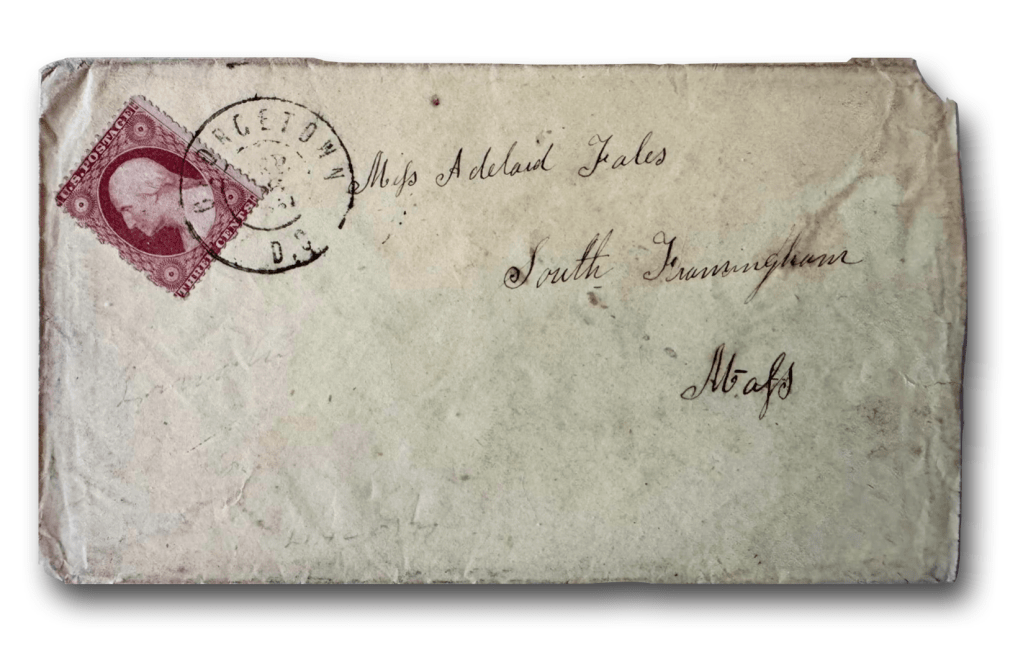
Arlington Heights
[Thursday] September 5th 1861
Dear Sister,
As I have a little time today, I thought I would write & let you know that I am safe & well. We are here in the same place but we have just got orders to get ready to move. I do not know where we are going but I expect we are going to advance on to Fairfax.
Mr. Lincoln reviewed us last Monday 2 & after the review he came to our camp & examined our rifle cannons. 3 He thanked us very kindly for our gallant conduct at the battle of Bulls Run & when he went away he went up to where our cook was getting dinner & took a brand of fire & lit his cigar & sit down and had a long talk with our captain. 4 He is a very pleasant talking man. Anyone would not think he was President of the United States if they did not know who he was.
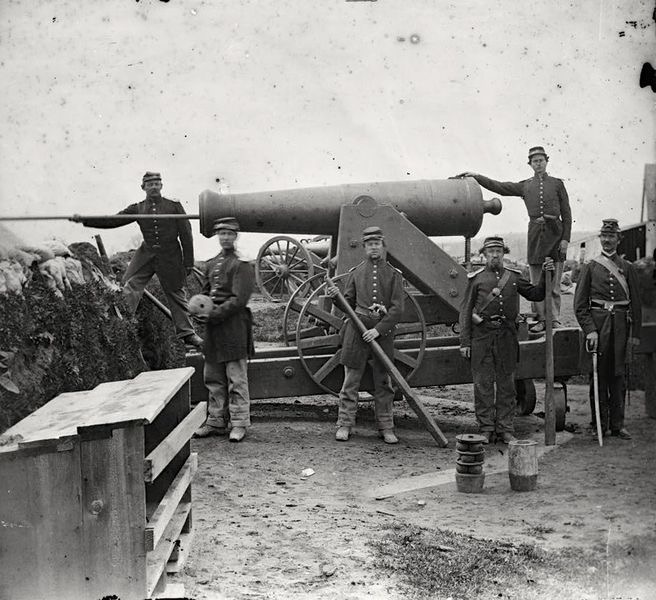
The 18th Massachusetts Regiment came over here from the city. 5 The Massachusetts soldiers are the best looking soldiers here. All the regiments here are at work every day. They are throwing up breastworks here in all direction & mounting heavy guns. Fort Corcoran has 8 guns which carry a 68 lb. ball & four 24-pounders. This fort commands the road from Georgetown to Fairfax & the Potomac. You can see all over the city of Washington. Our battery is about a quarter of a mile from this fort. It is large enough to hold 1500 men. I have got a picture of this fort but it does not look exactly as it does now.
I have not heard from [brother] Charlie yet. I do not know whether his regiment is in the city or not. We have got a large balloon here in our camp. He went up yesterday to take a look at the rebels. He could look right down onto them & see what they were doing. After he had been up a little while, the rebels fired a cannon ball at him but they could not reach him. He had ropes fixed to a large tree so that he would not blow away. 6
I have not anymore to write now. Remember me to all the folks. I am your affectionate brother, — John Fales
Footnotes
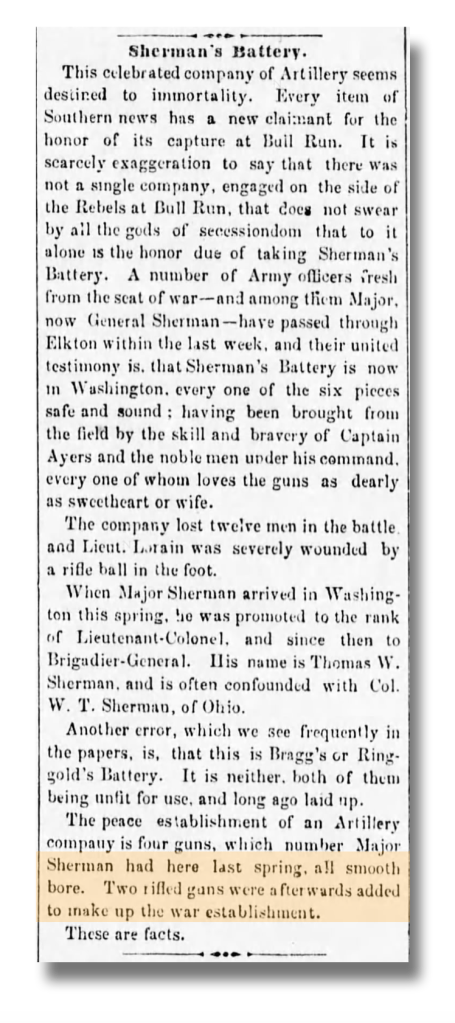
1 The celebrated Battery E of the 3rd US Regulars was led during the War with Mexico by Thomas West Sherman and it was often referred to as “Sherman’s Battery,” even when it was lead, as it was at Bull Run, by Capt. Romeyn B. Ayres. Adding greater confusion, the Battery was assigned to the command of Col. William Tecumseh Sherman just prior to the Battle of Bull Run. Ayres was at Old Point, Virginia, until 7 July 1861 when he was ordered to Washington to take command of “Sherman’s Battery.” His was the only artillery unit to save all of his guns from the battlefield and even brought off two others. Ayres was transferred to Philadelphia to recruit for the 5th US Artillery shortly afterward. [Daily National Democrat, 20 September 1861]
2 “Last Monday” would have been 2 September 1861. According to the Lincoln Log, Lincoln and Secretary Seward reviewed the 2nd & 5th Wisconsin Infantry Regiments of Gen. Rufus King’s Brigade [NY Times, 3 September 1861].
3 Sherman’s Battery went into the fight at Blackburn’s Ford and Bull Run with four smoothbore cannon—two 6-pounders and two 12-pounder field howitzers, as well as two 10-pounder Parrott rifles as a reserve. The Parrott rifle was still somewhat of a novelty in 1861. It was developed in 1860 and were easily recognized by the wrought-iron reinforcing band wrapped around the breech. They were simple for the gun crews to operate and could be mass produced inexpensively.
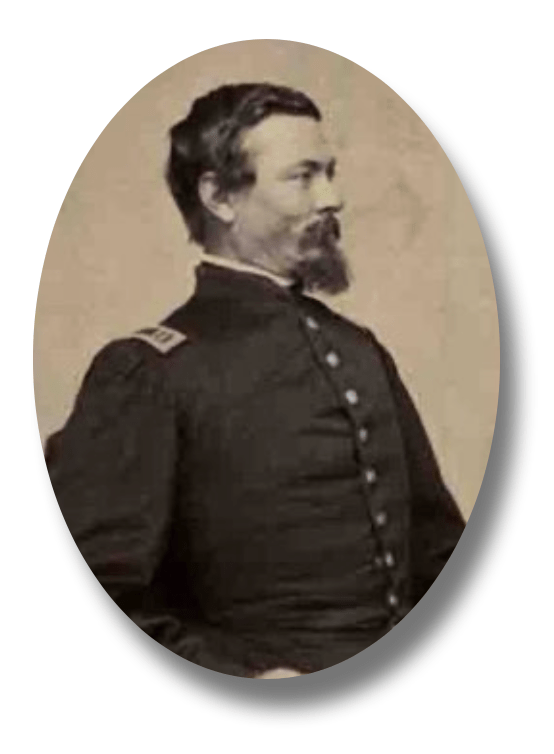
4 Though it was Capt. Romeyn B. Ayres of the 5th US Artillery who temporarily commanded the battery at Bull Run, by early August 1861 the battery was commanded by Capt. John H. Hamilton, West Point Class of 1847. Hamilton had received his promotion to captain in late April but he was in San Francisco at the time and he did not arrive in Washington D. C. until after the Battle of Bull Run. In short, it would have been Capt. Hamilton who enjoyed a cigar with President Lincoln, not Capt. Ayres.
5 The 18th Massachusetts was mustered into federal service on 27 August 1861 with eight companies. They were ordered on the 3rd of September to cross the Potomac and report to Gen. Fitz John Porter. They set up their camp near Fort Corcoran on ground previously occupied by the69th New York. Later in September they were moved to Hall’s Hill, then the outpost of the Union army.
6 Thaddeus Lowe’s newly created Balloon Corps was quite active prior to and after the Battle of Bull Run. On the day of the battle the balloon was accidentally ripped on the way to the battlefield so they were foiled in their ascension that day, but three days later, Lowe made an ascent at Fort Corcoran to look for an indications of a march on Washington by the Rebel army. Later that same day, he ascended again to check the Confederate bivouacs at Manassas and Centreville. To gain higher altitude for a better view, Lowe asked for the tethering cables to be released and the balloon drifted toward Alexandria where he was actually fired upon by Union troops thinking the Rebels were attacking by air. A number of ascents were made near Arlington Heights during August 1861 to keep an eye on the Rebel army’s movements. It was on August 29th at Ball’s Crossroads when Lowe’s balloon “Union” was fired on by a Rebel cannon commanded by Lt. Thomas Rosser of the New Orleans Washington Artillery from their position on Munson Hill. Though Fales could not have known it at the time, the Confederates attempted to send up its own “spy balloon” at Munson’s Hill on September 4th but the bag ripped before it could get off the ground. On September 5th, the date of Fale’s letter, it was reported that Union generals Irvin McDowell and Fitz-John Porter went up in Lowe’s balloon, and McClellan did likewise on September 7th. [See Arlington and Fairfax Counties: Land of Many Reconnaissance Firsts, by Dino A. Brugioni, published in Northern Virginia Heritage]


 Spared & Shared 23