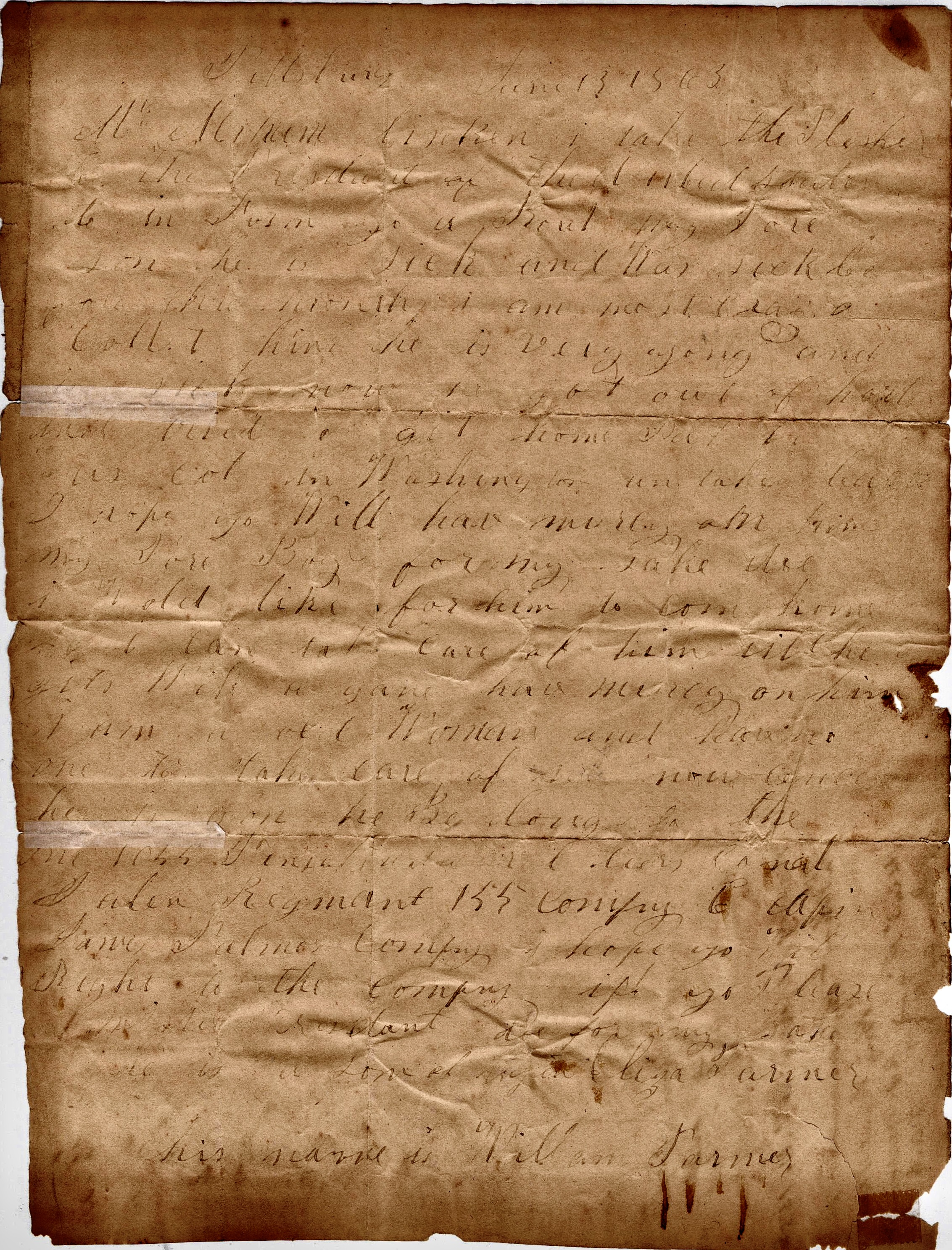
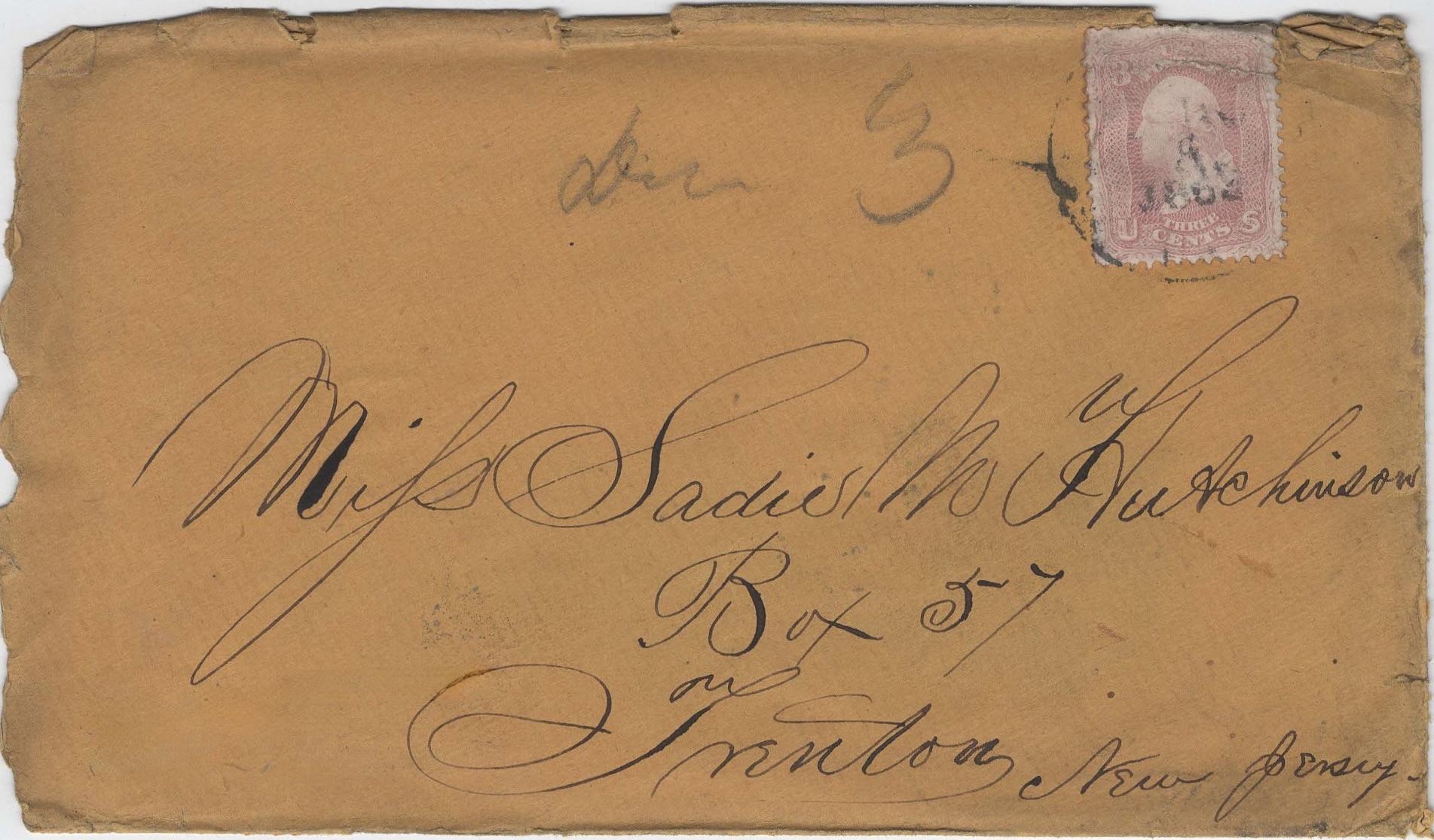
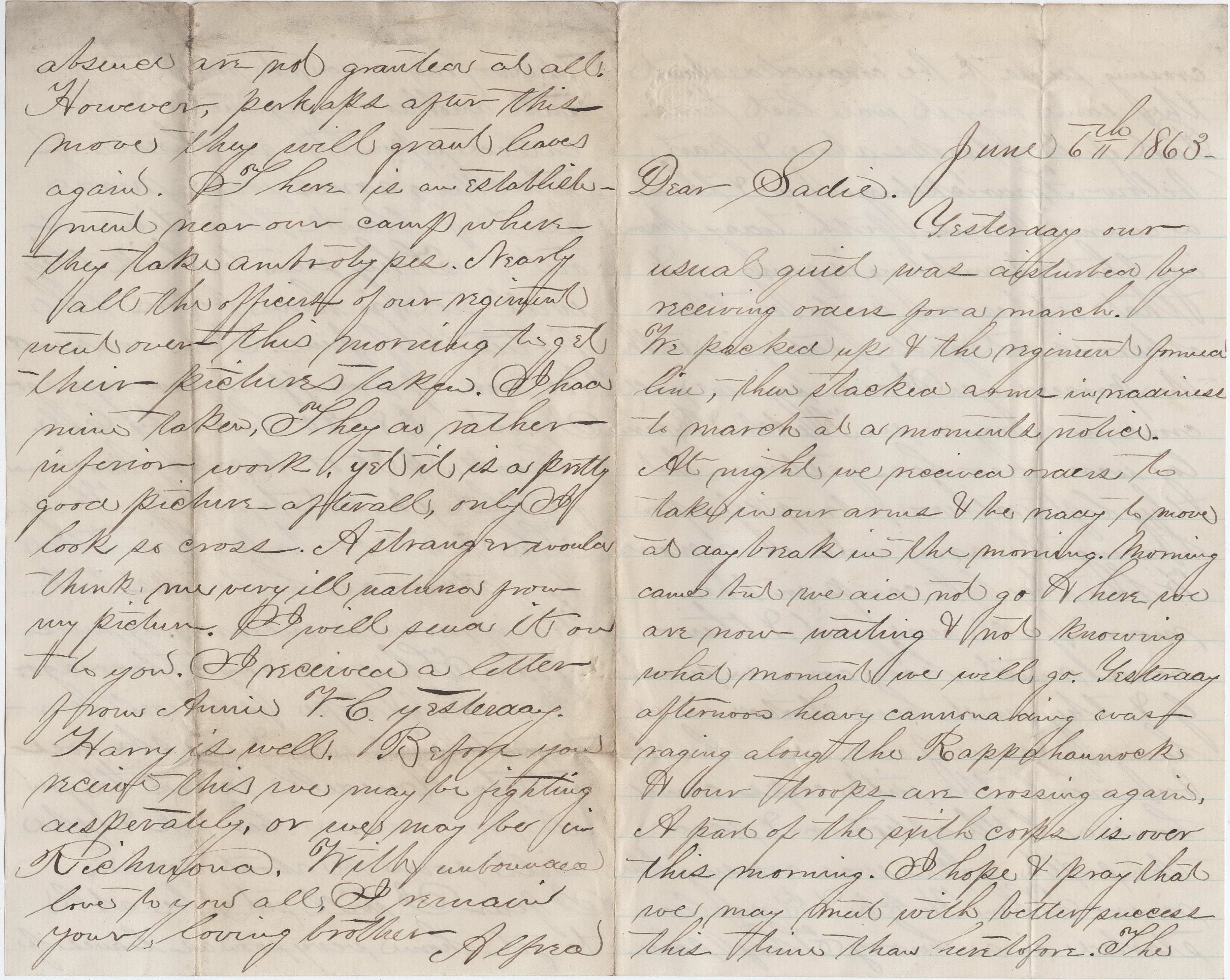
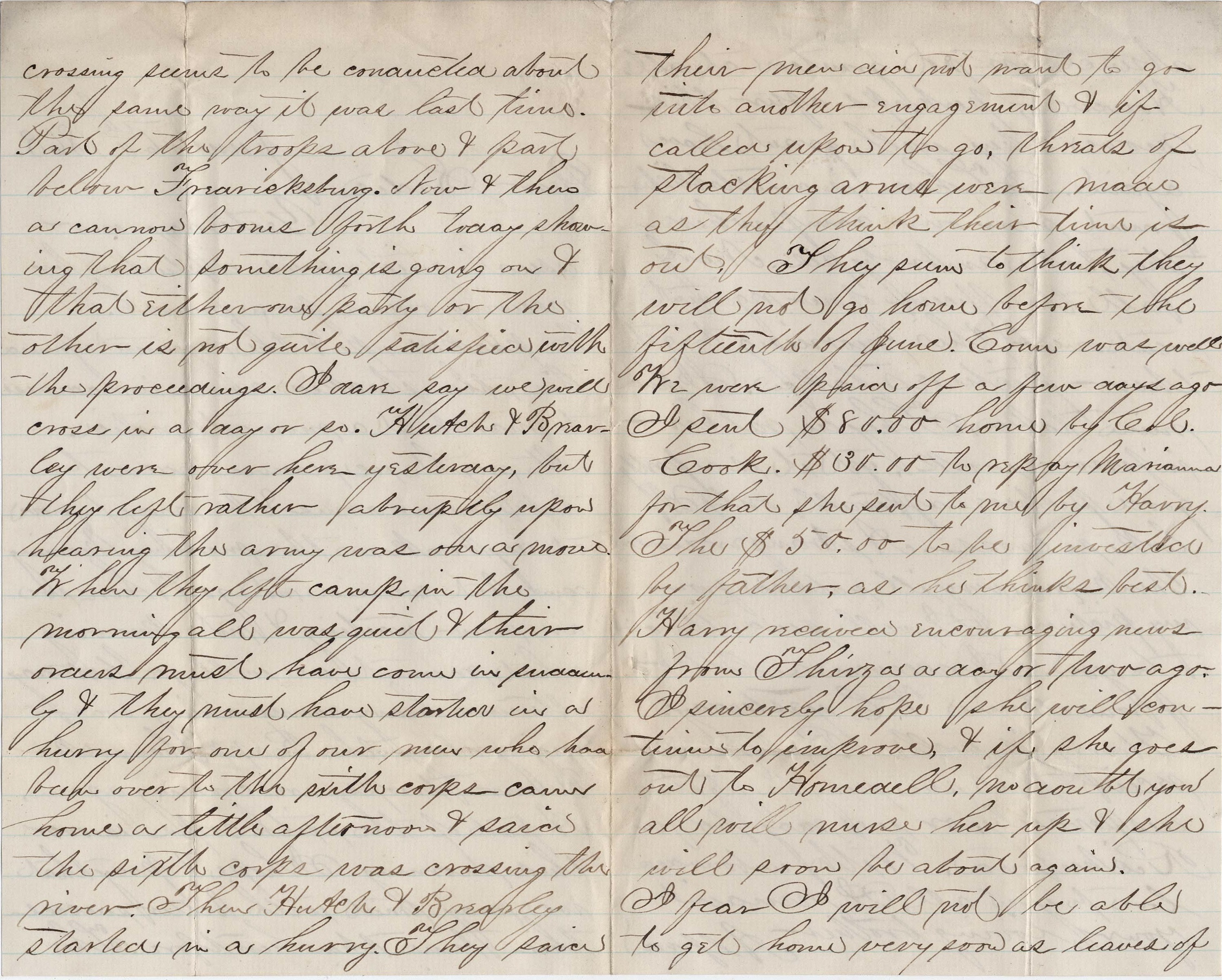
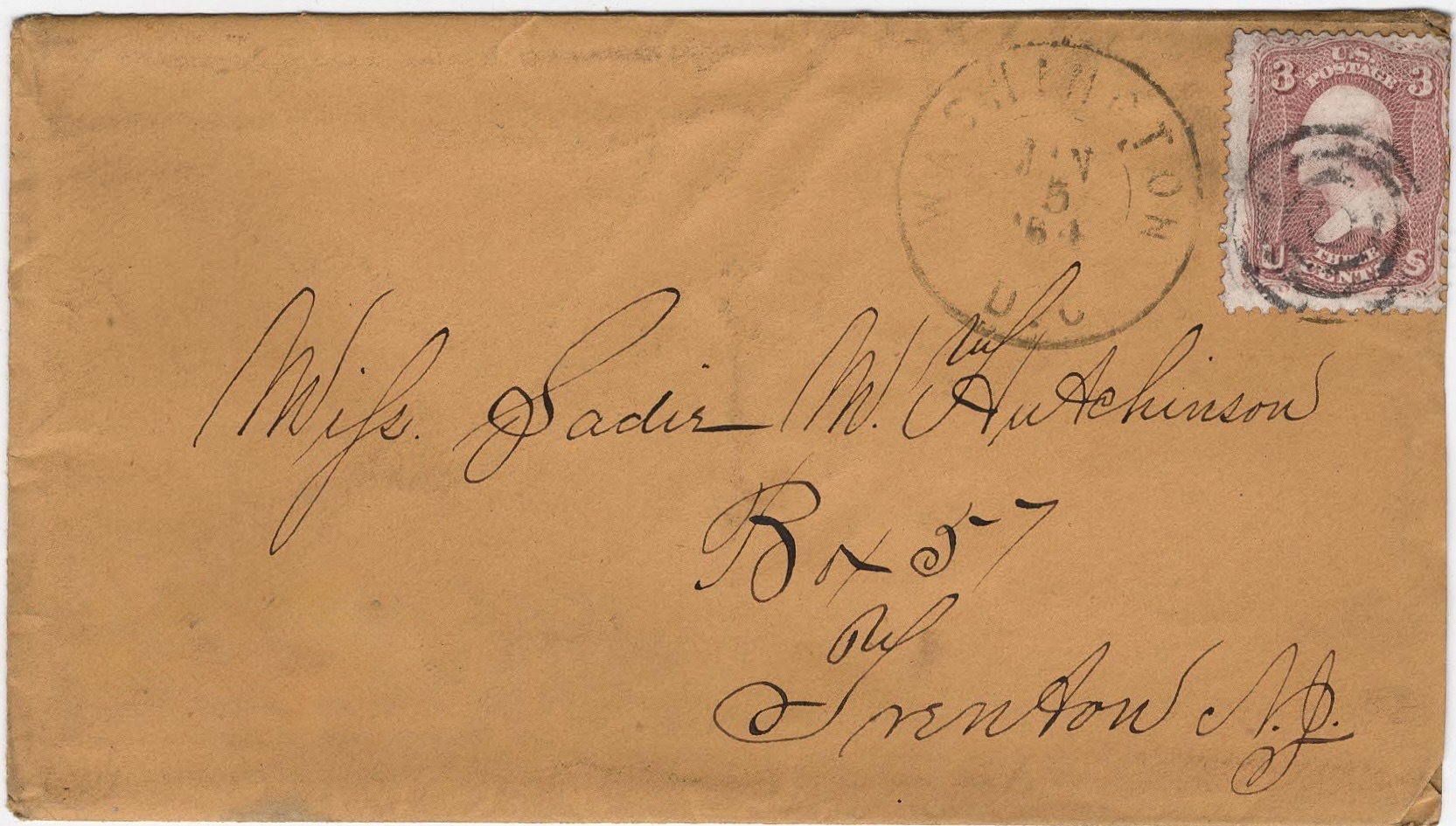
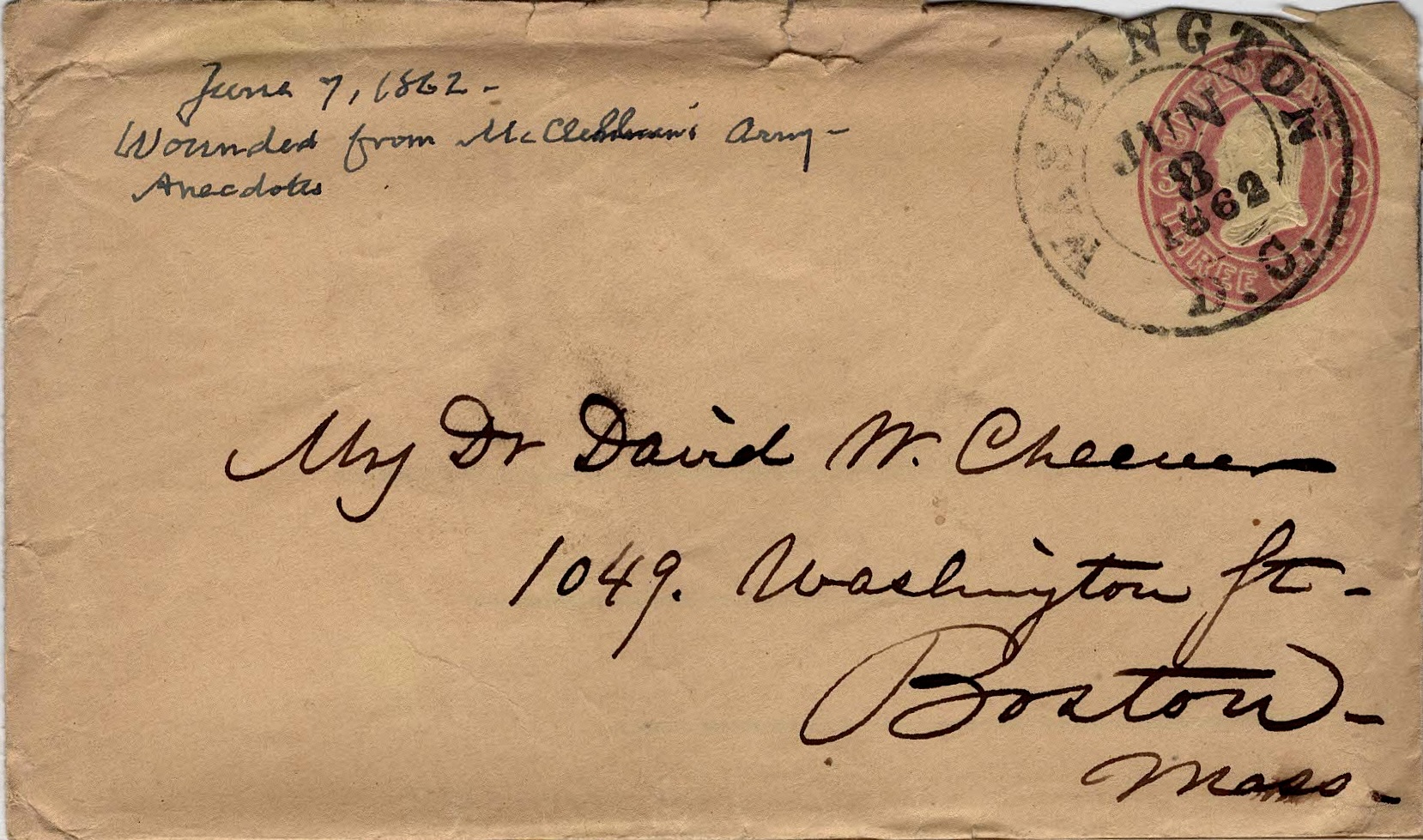
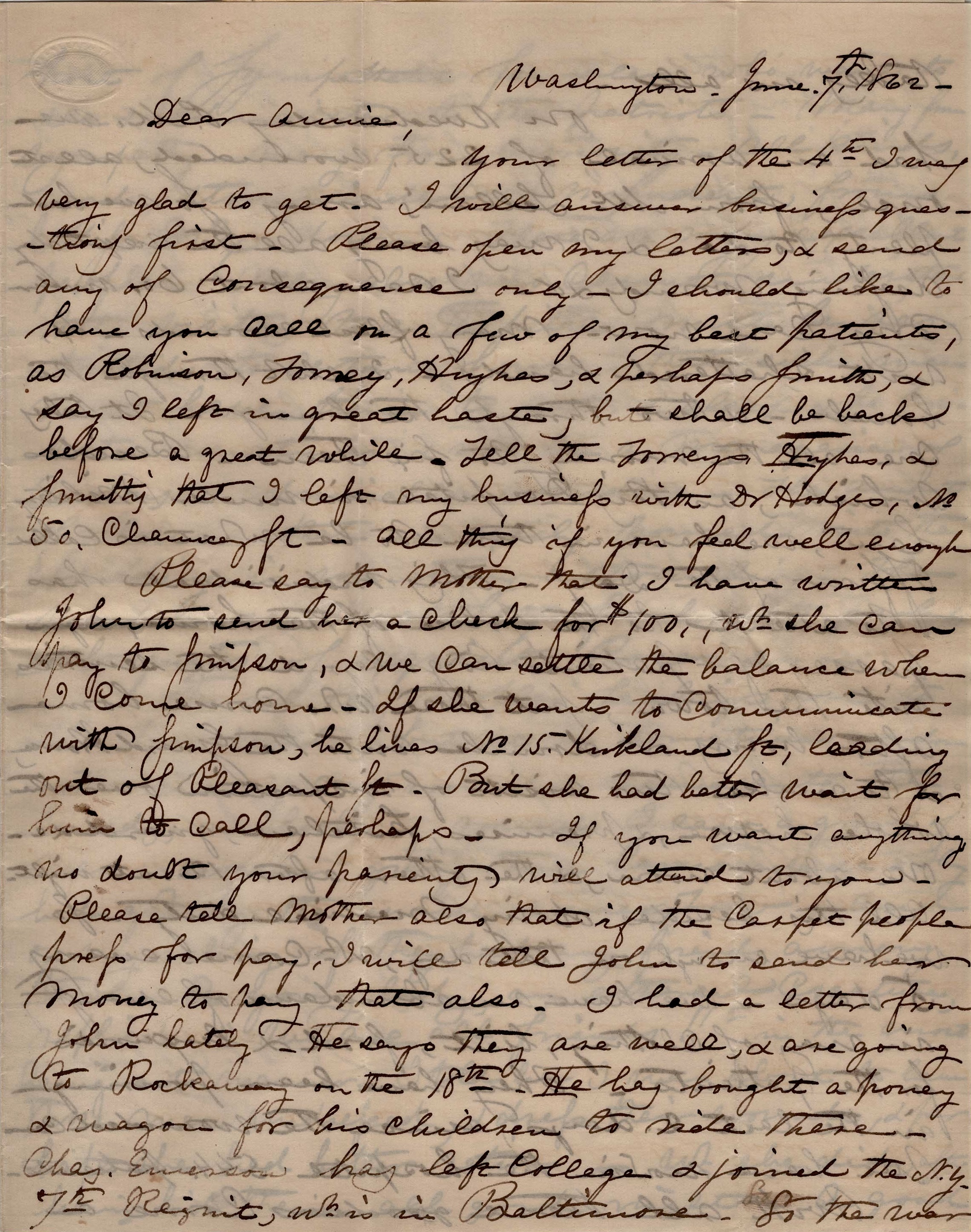
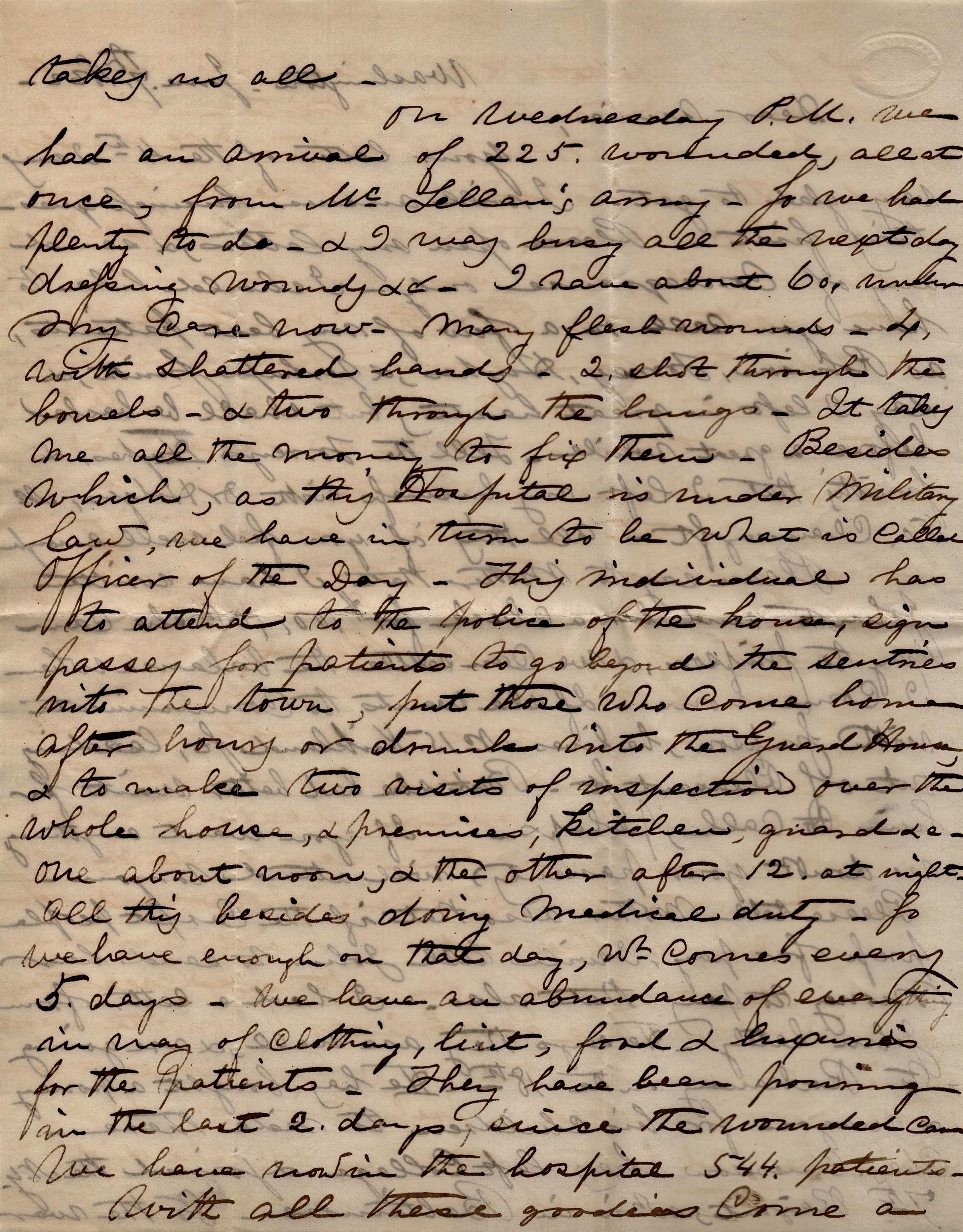
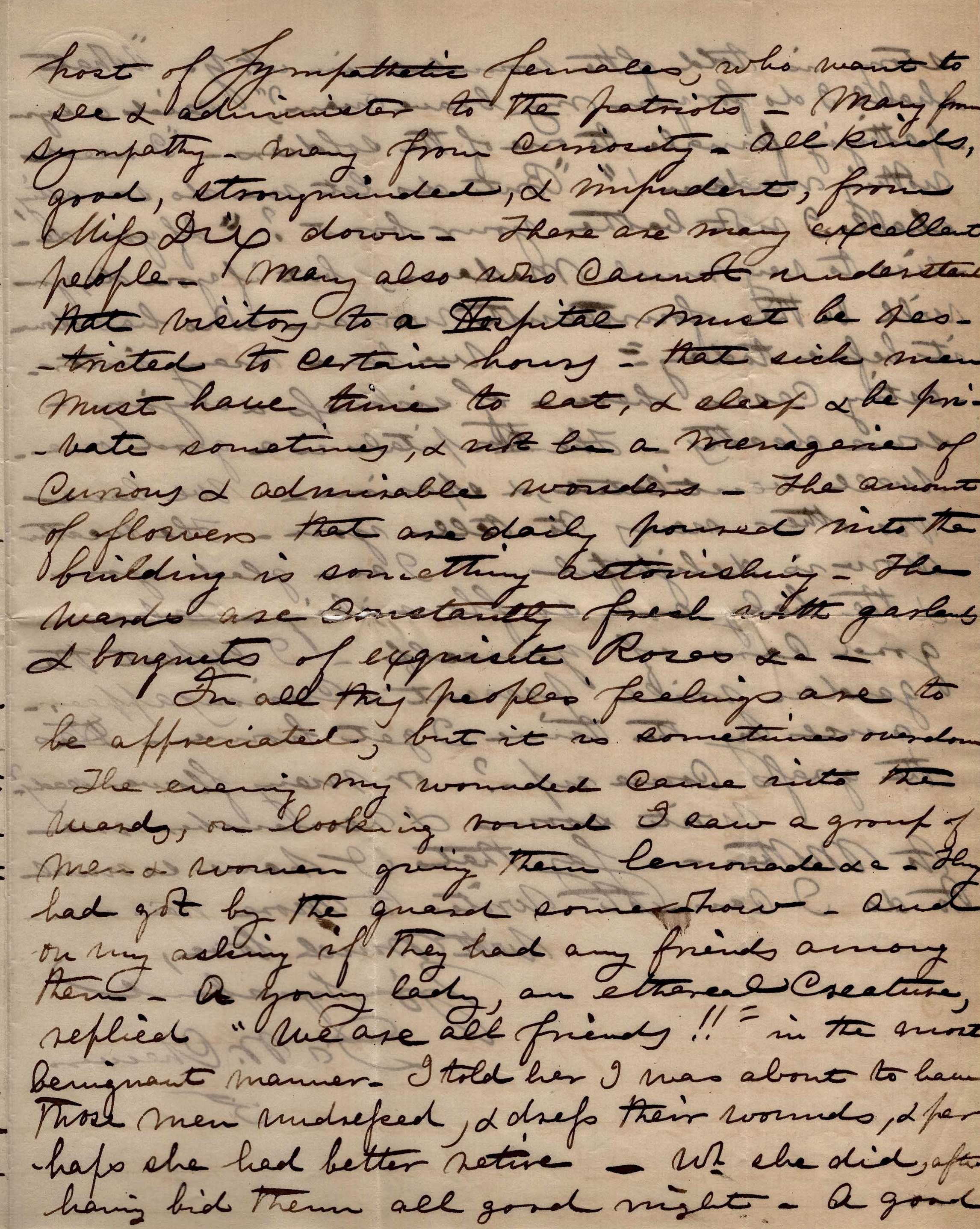
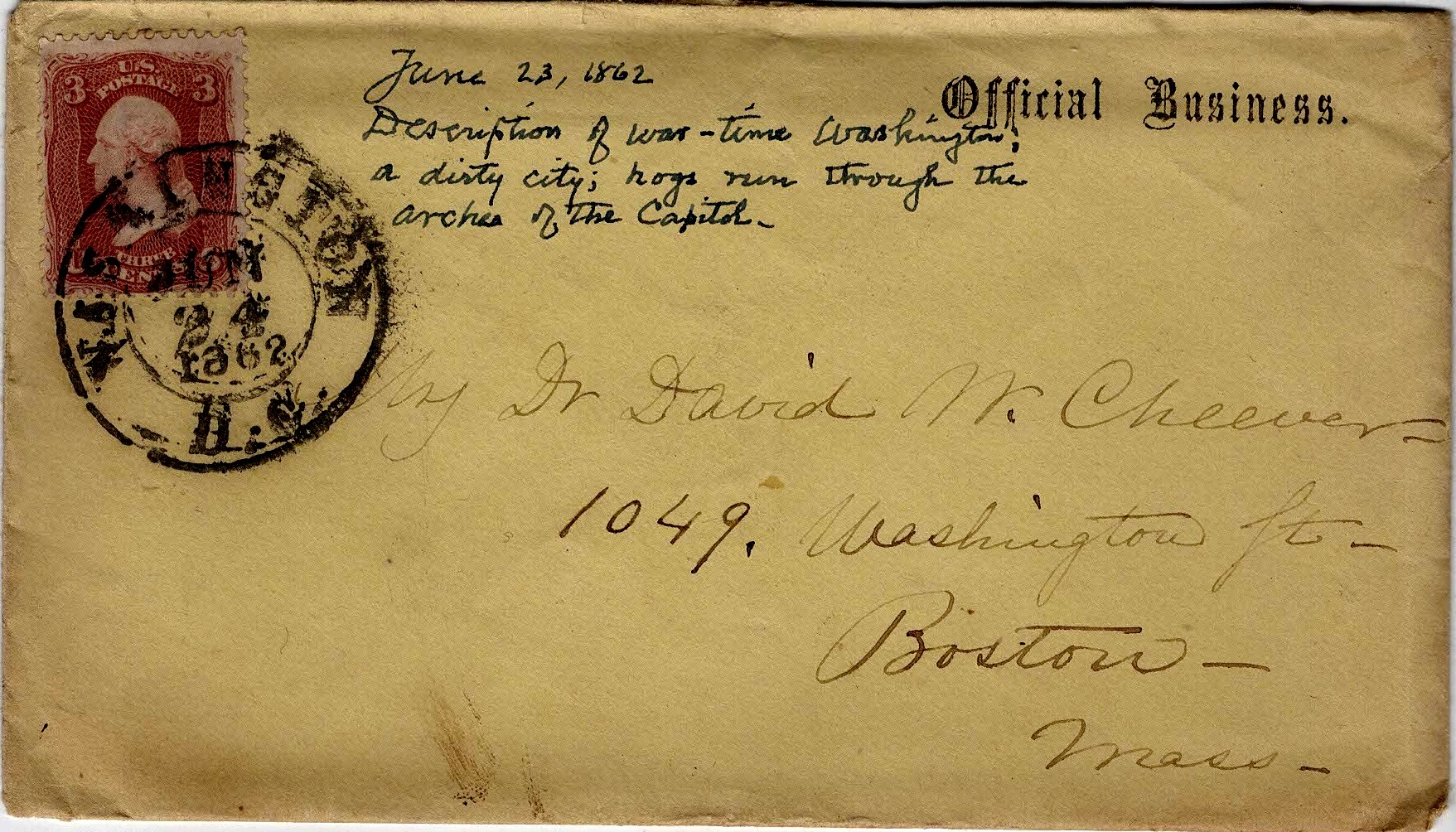
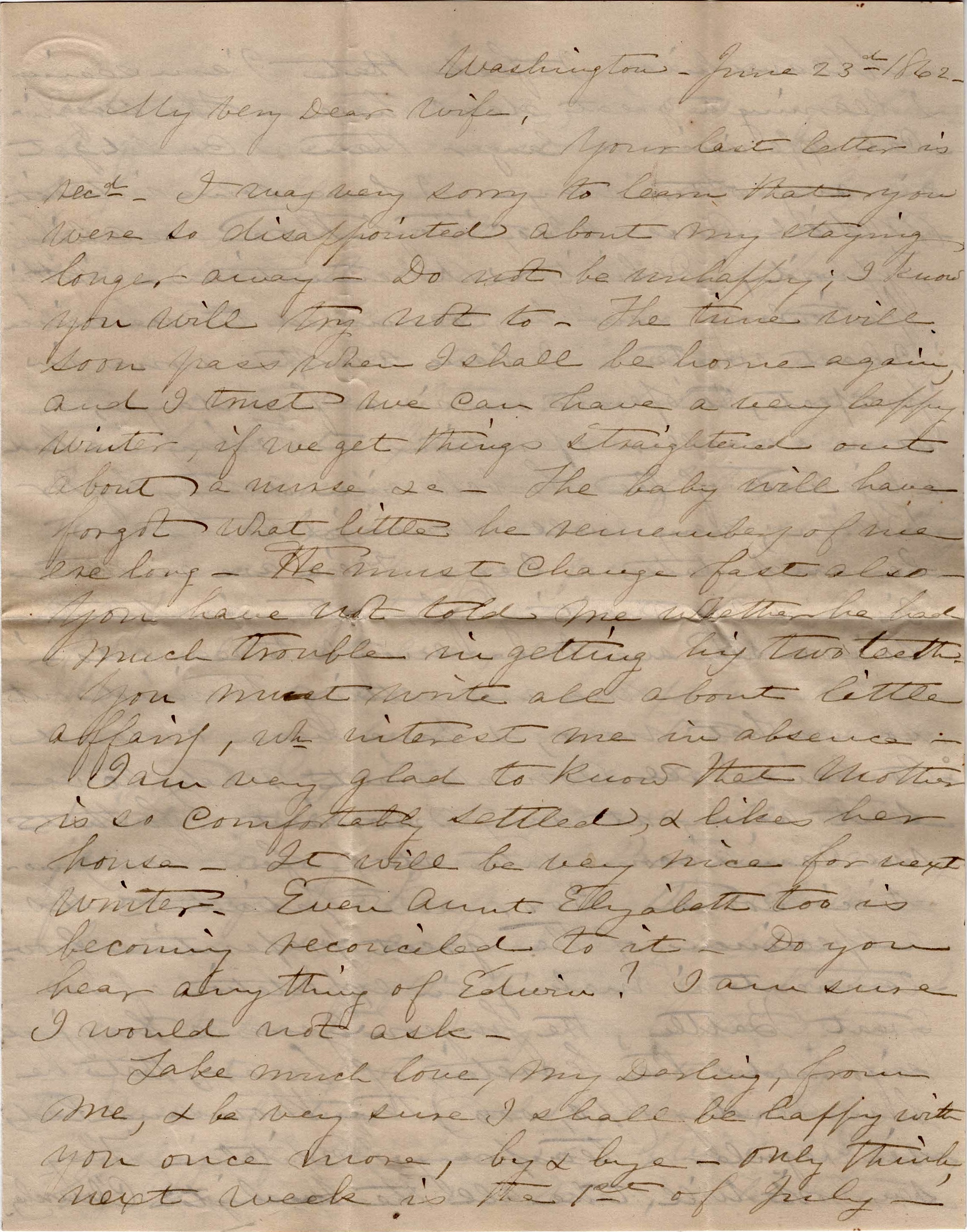
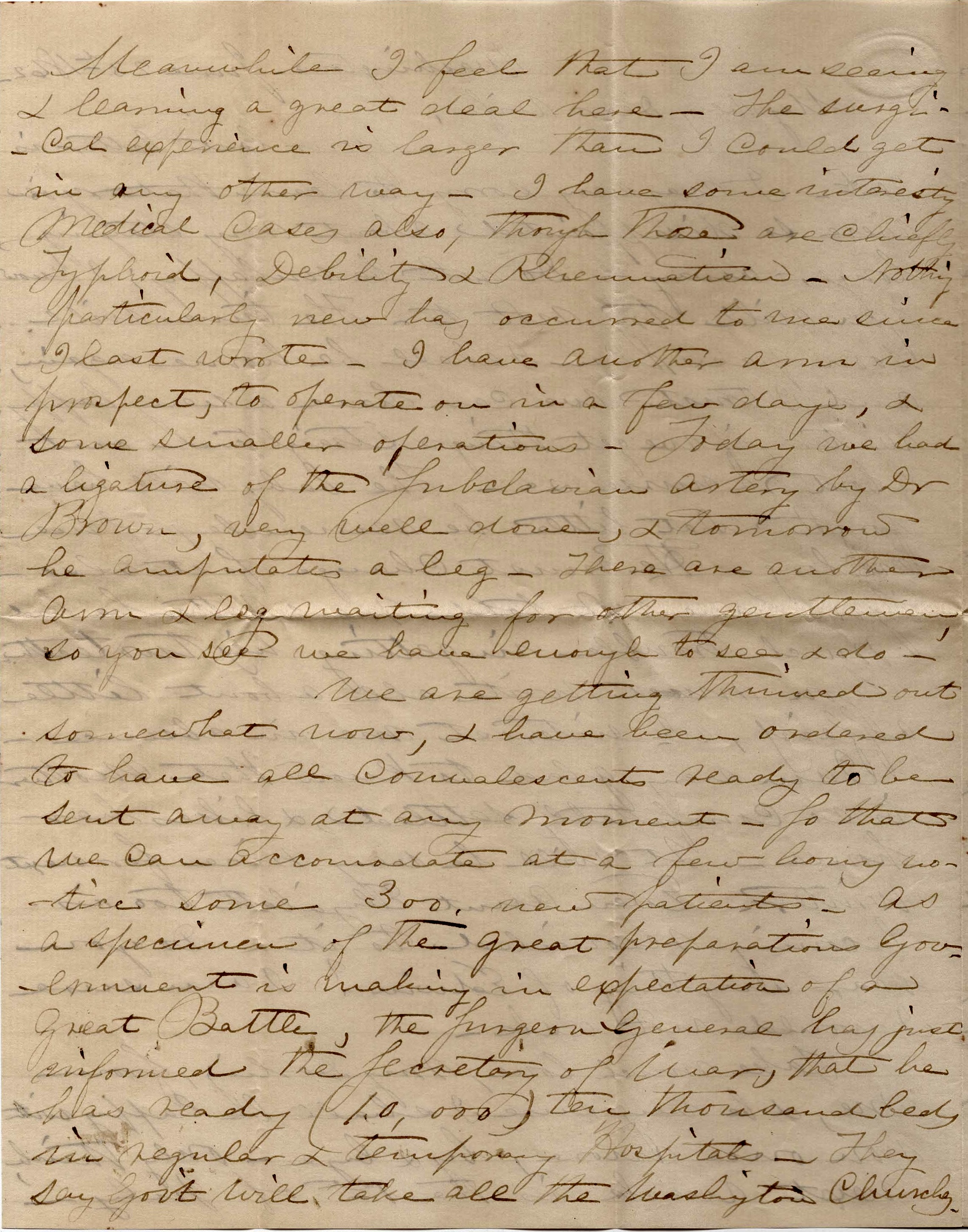
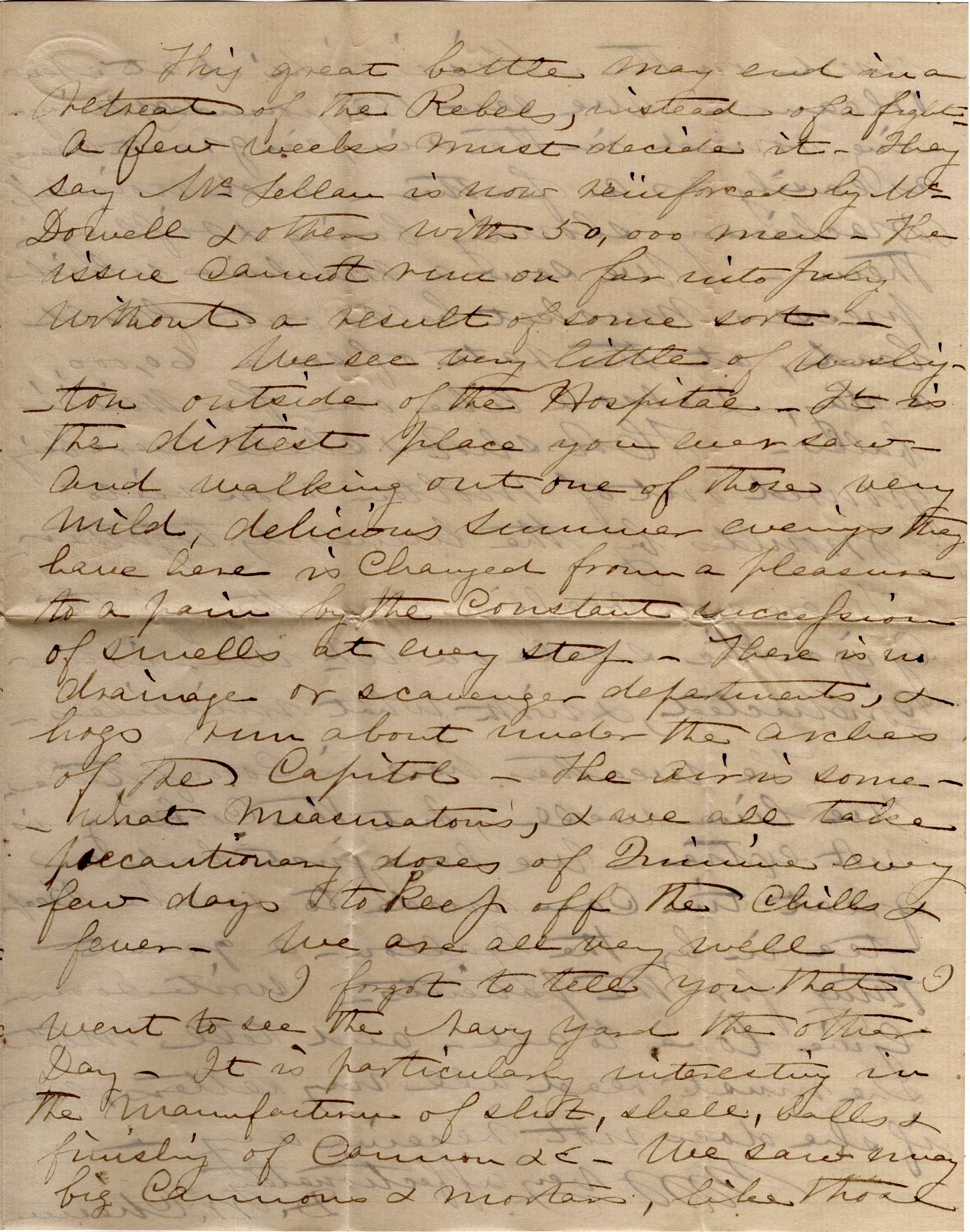
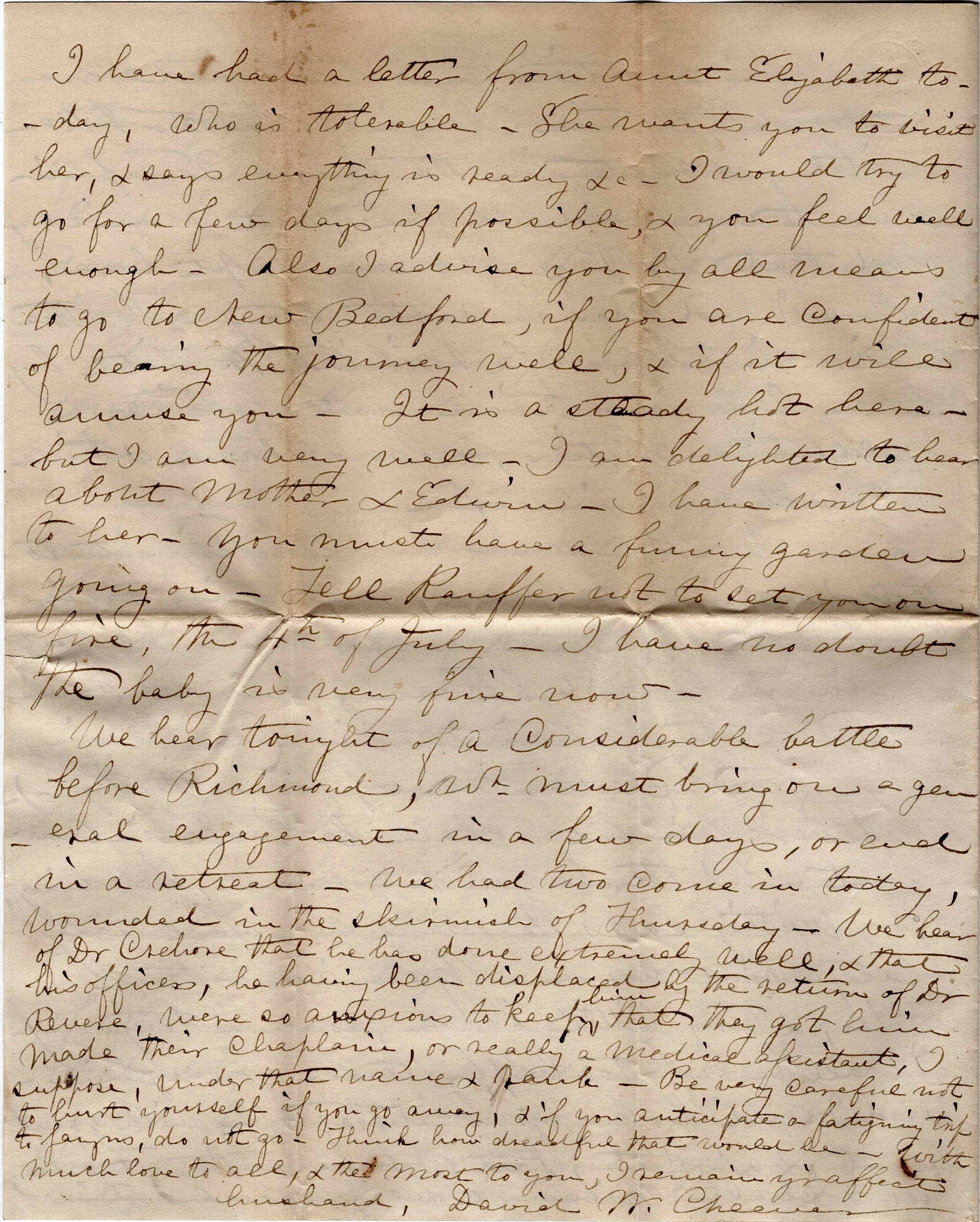
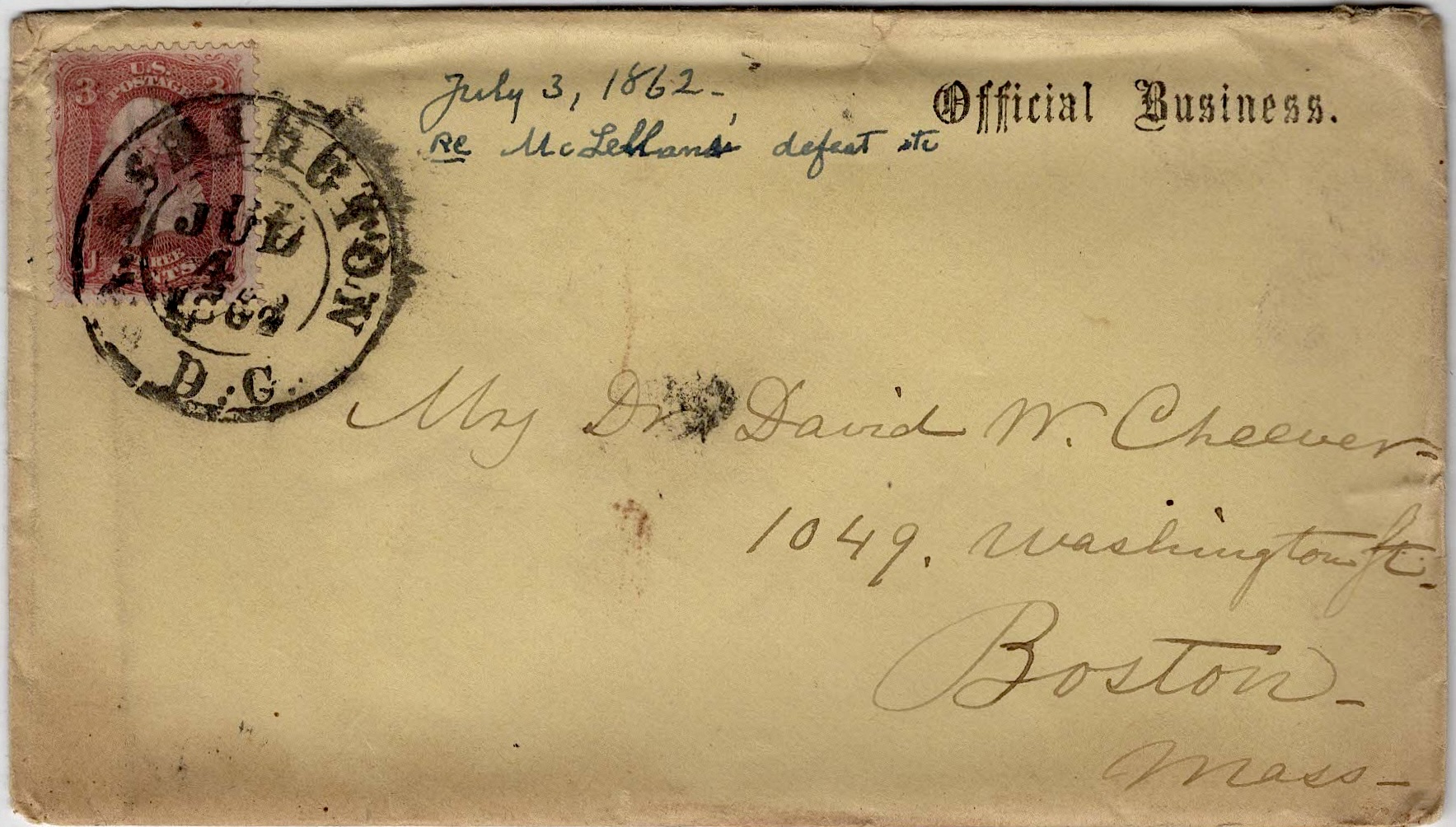
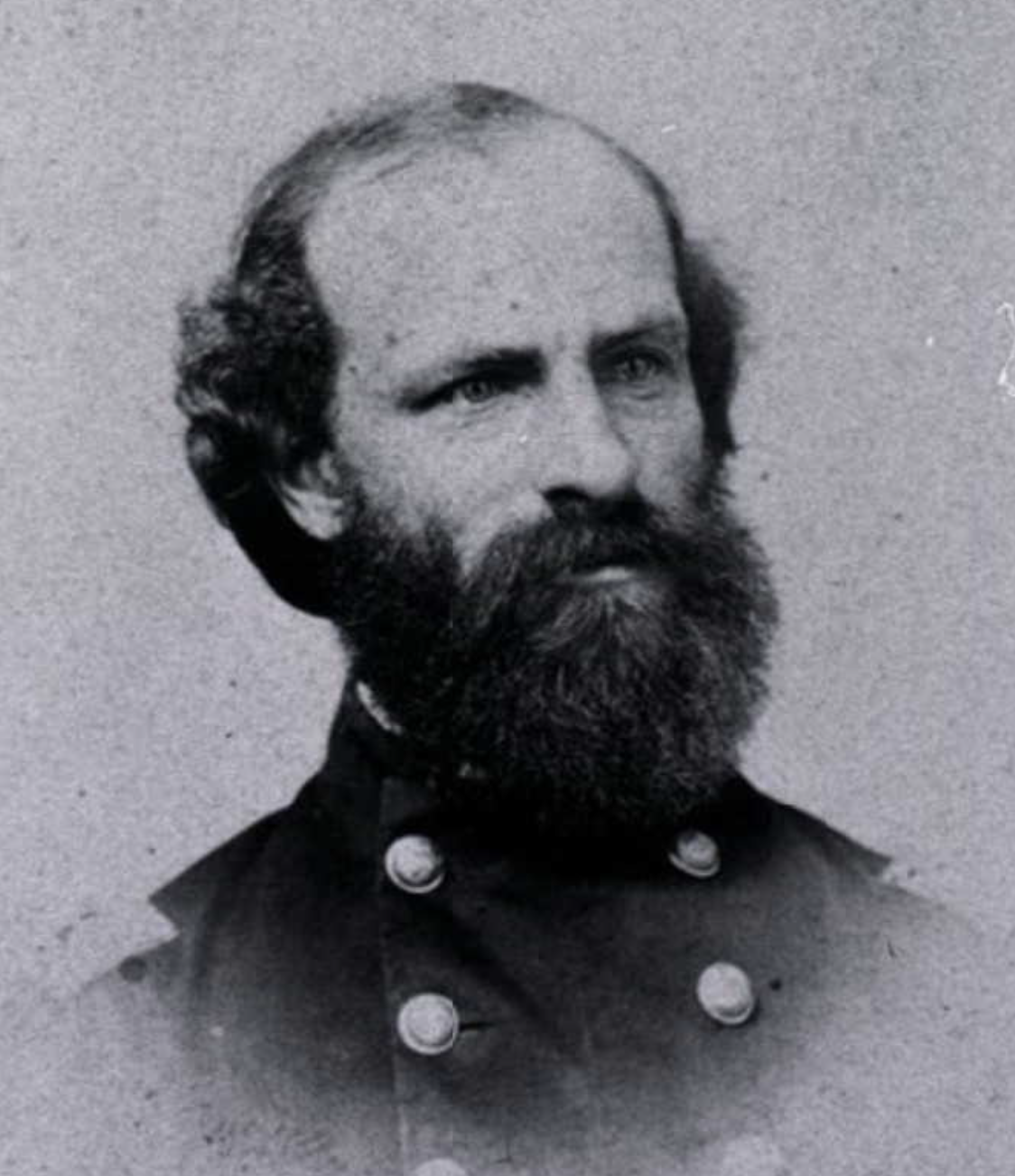
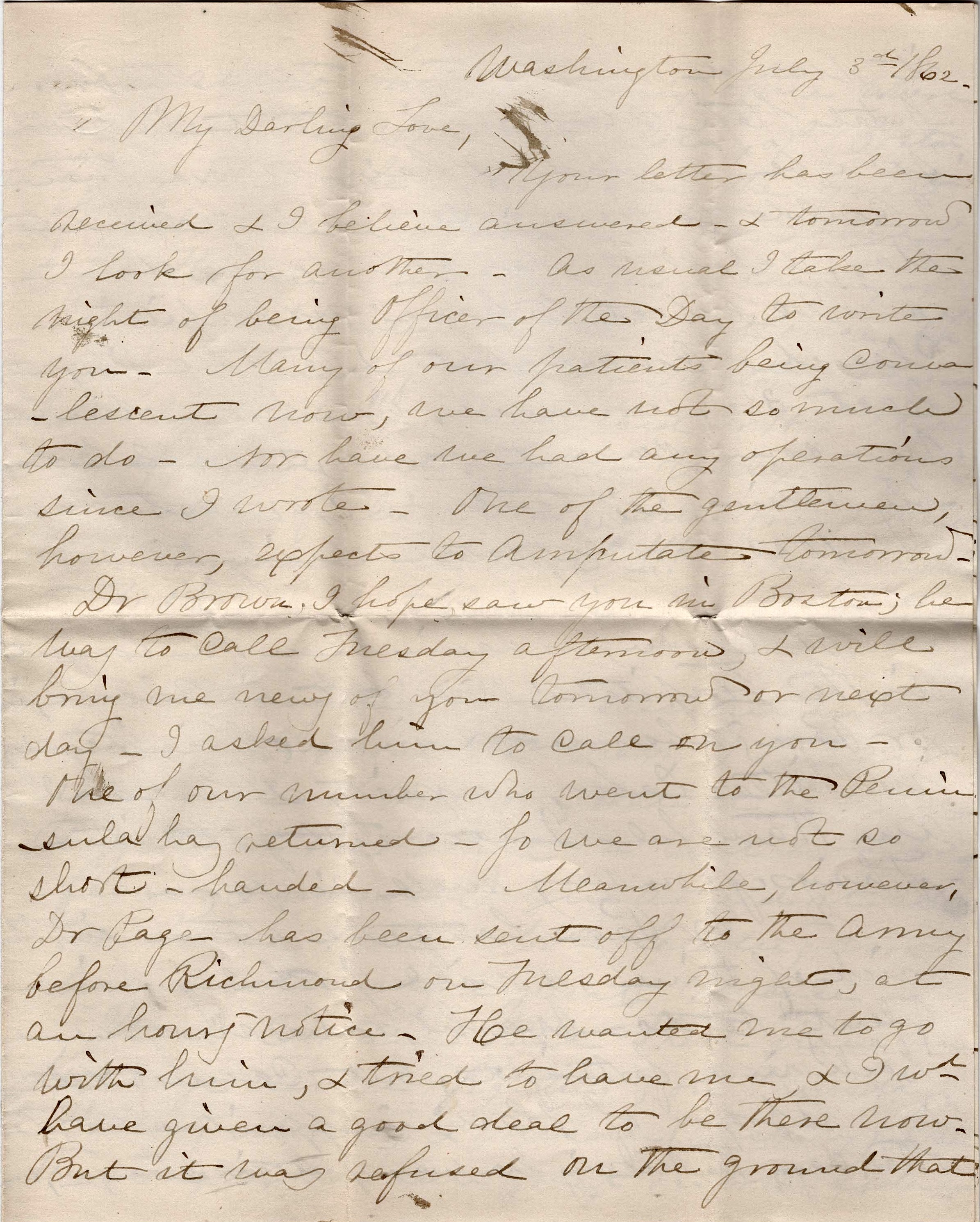
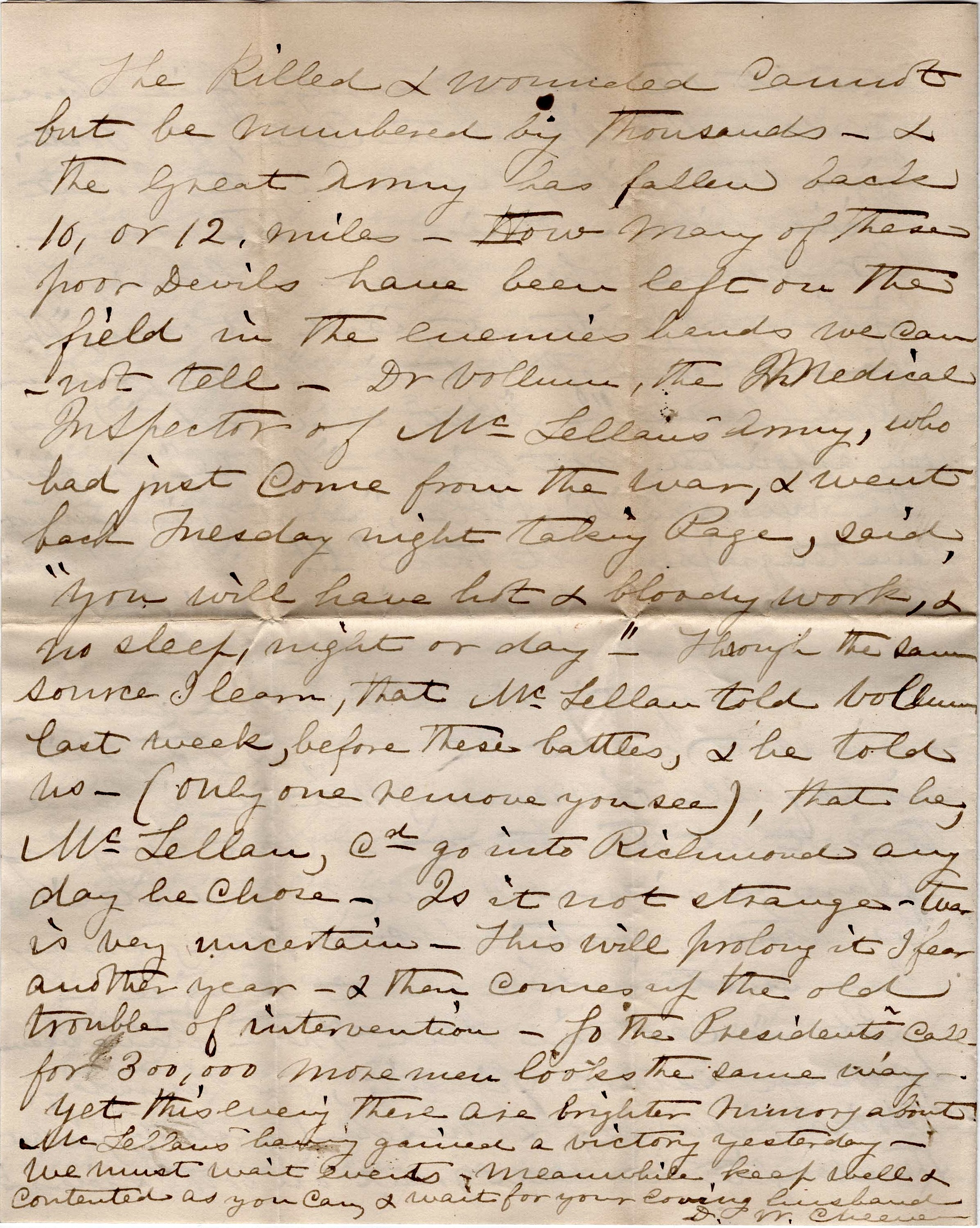
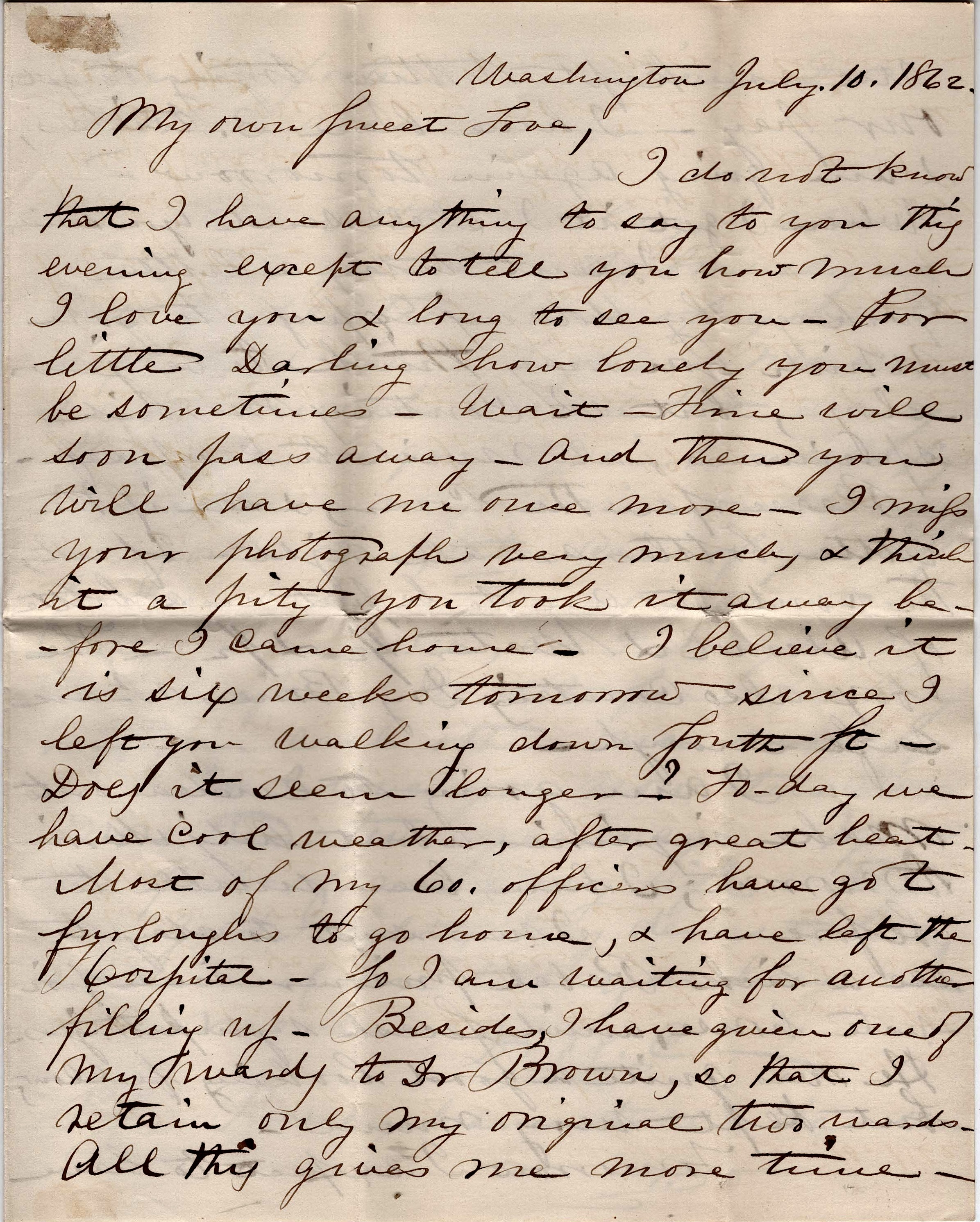
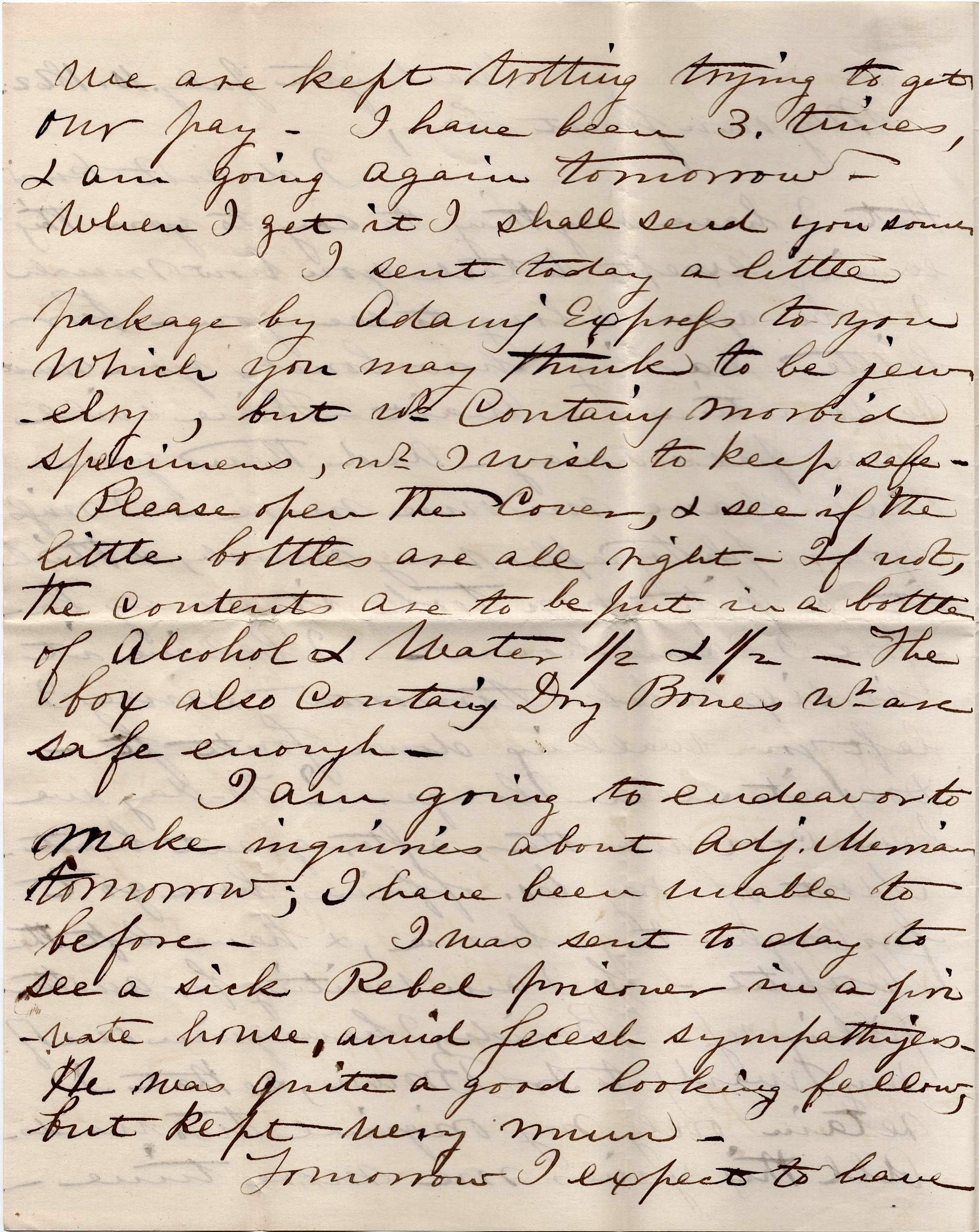
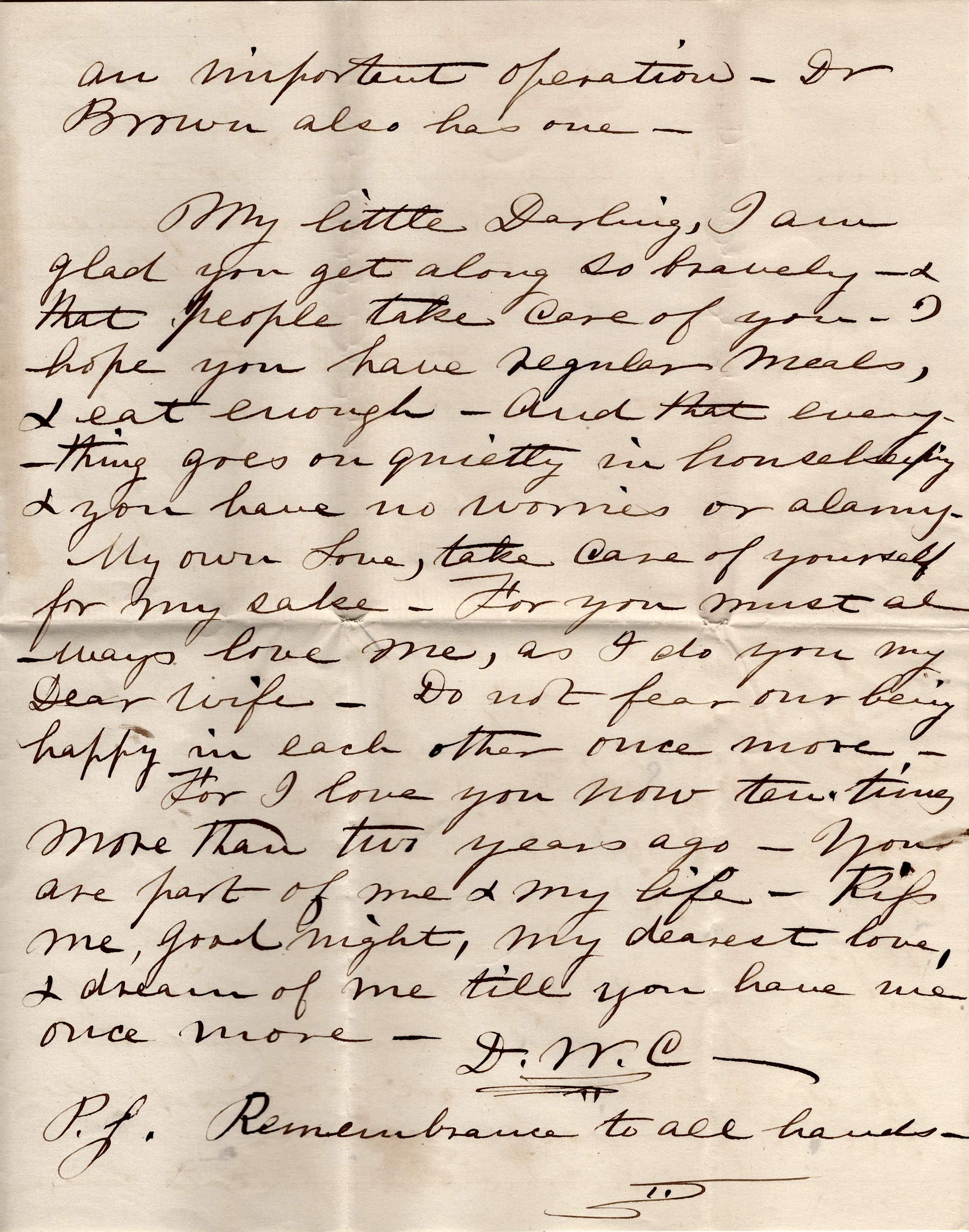
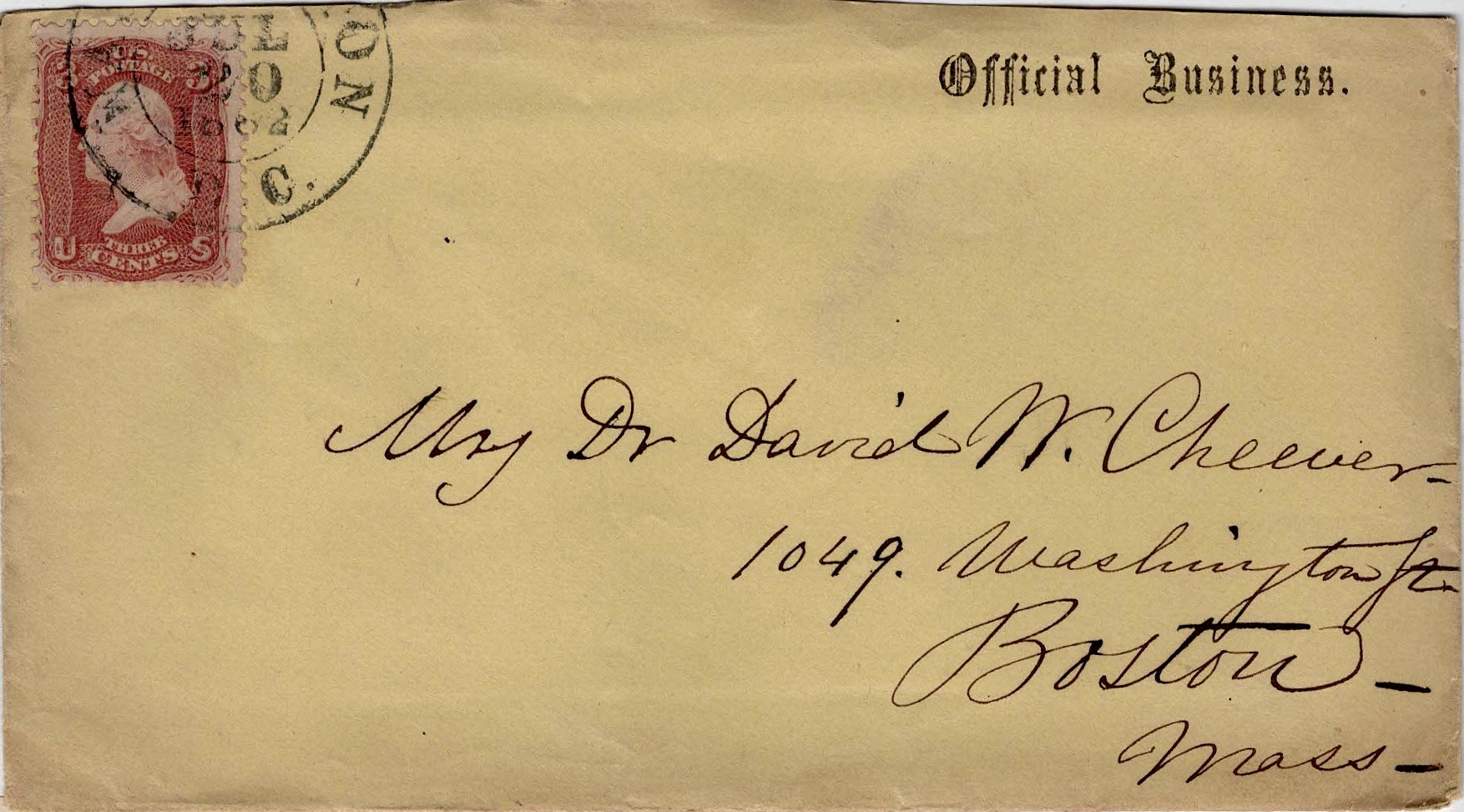
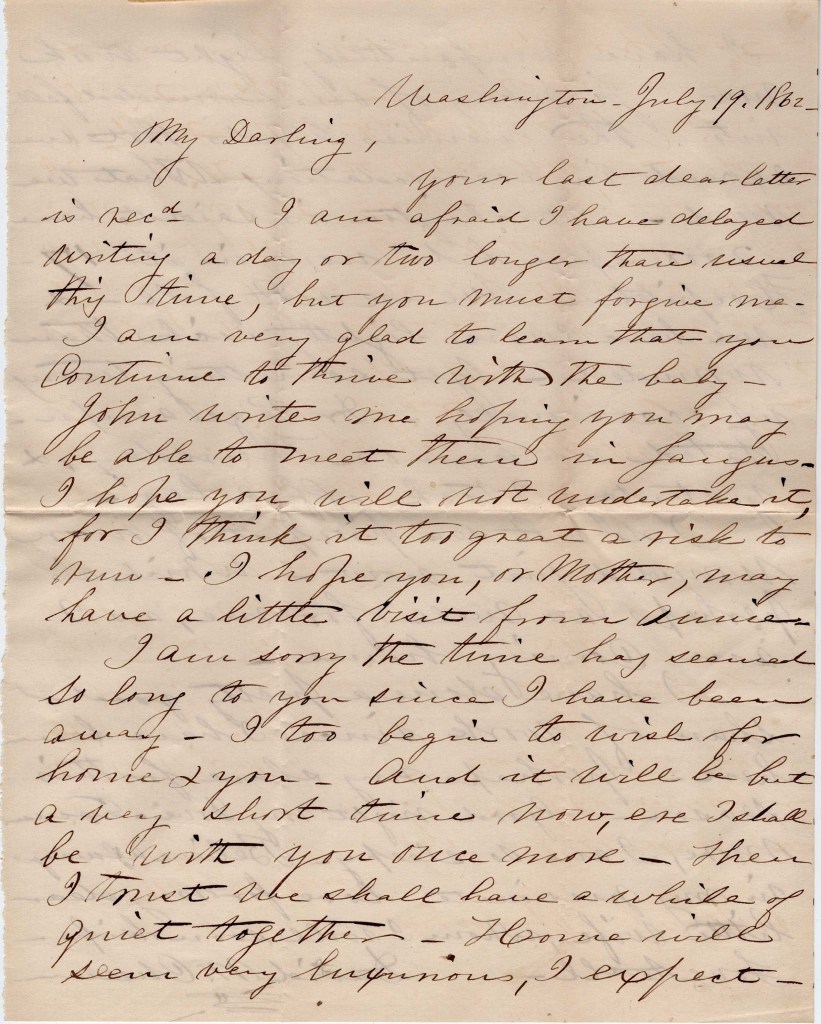
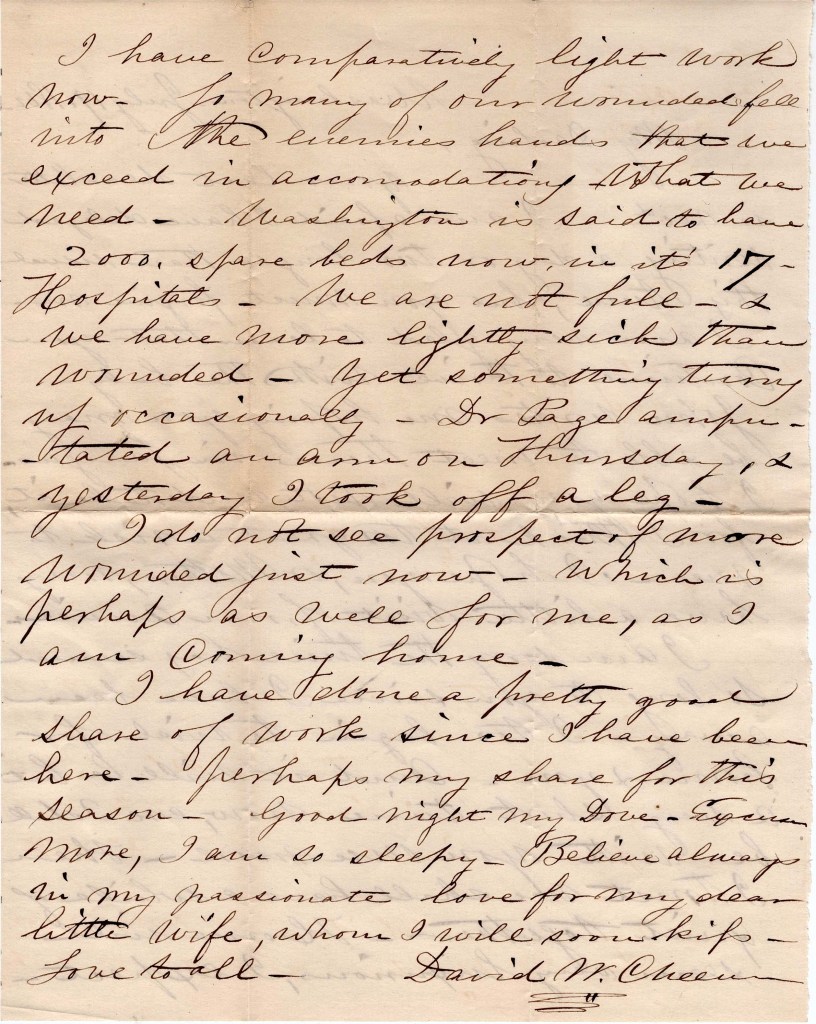
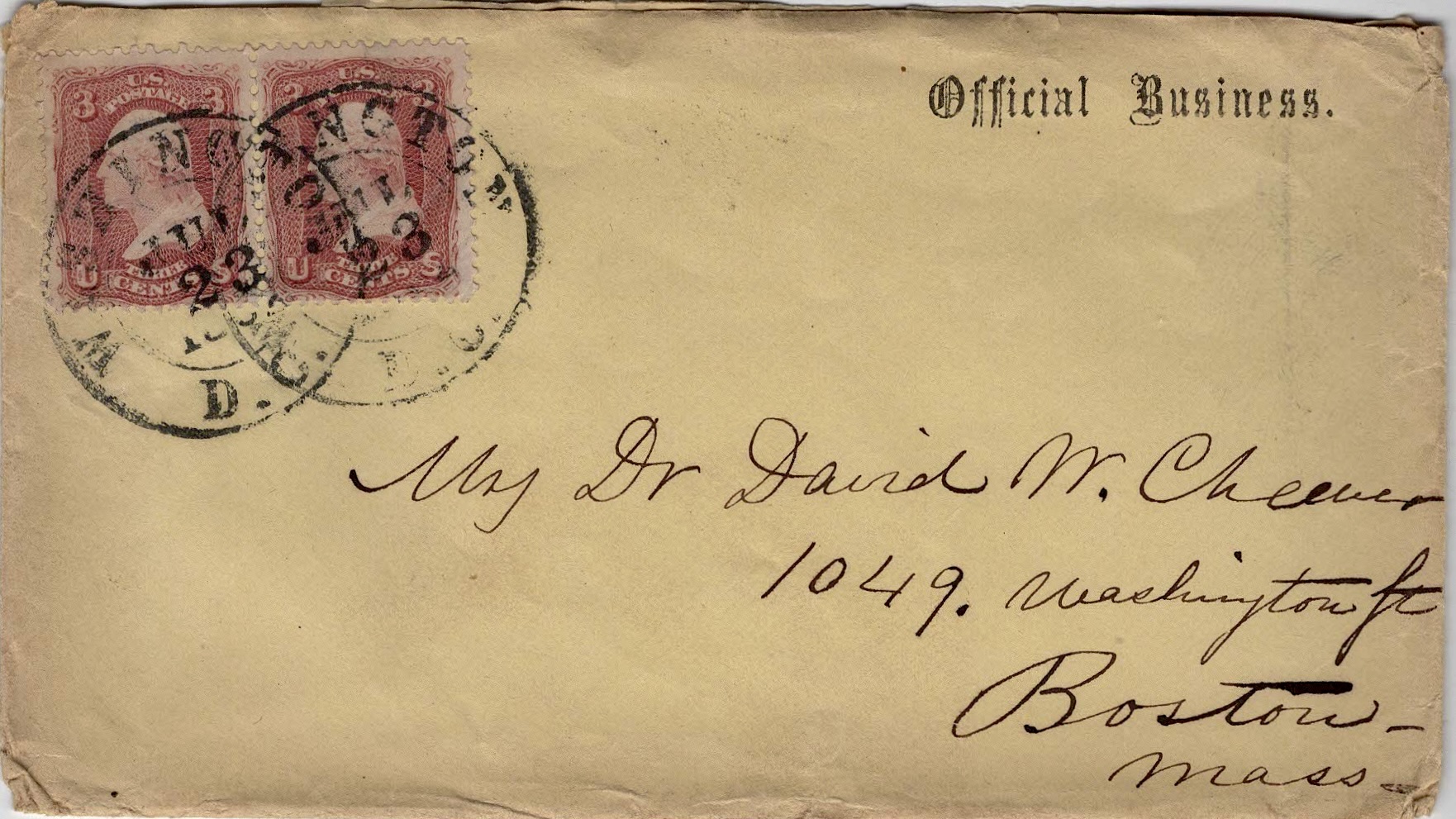
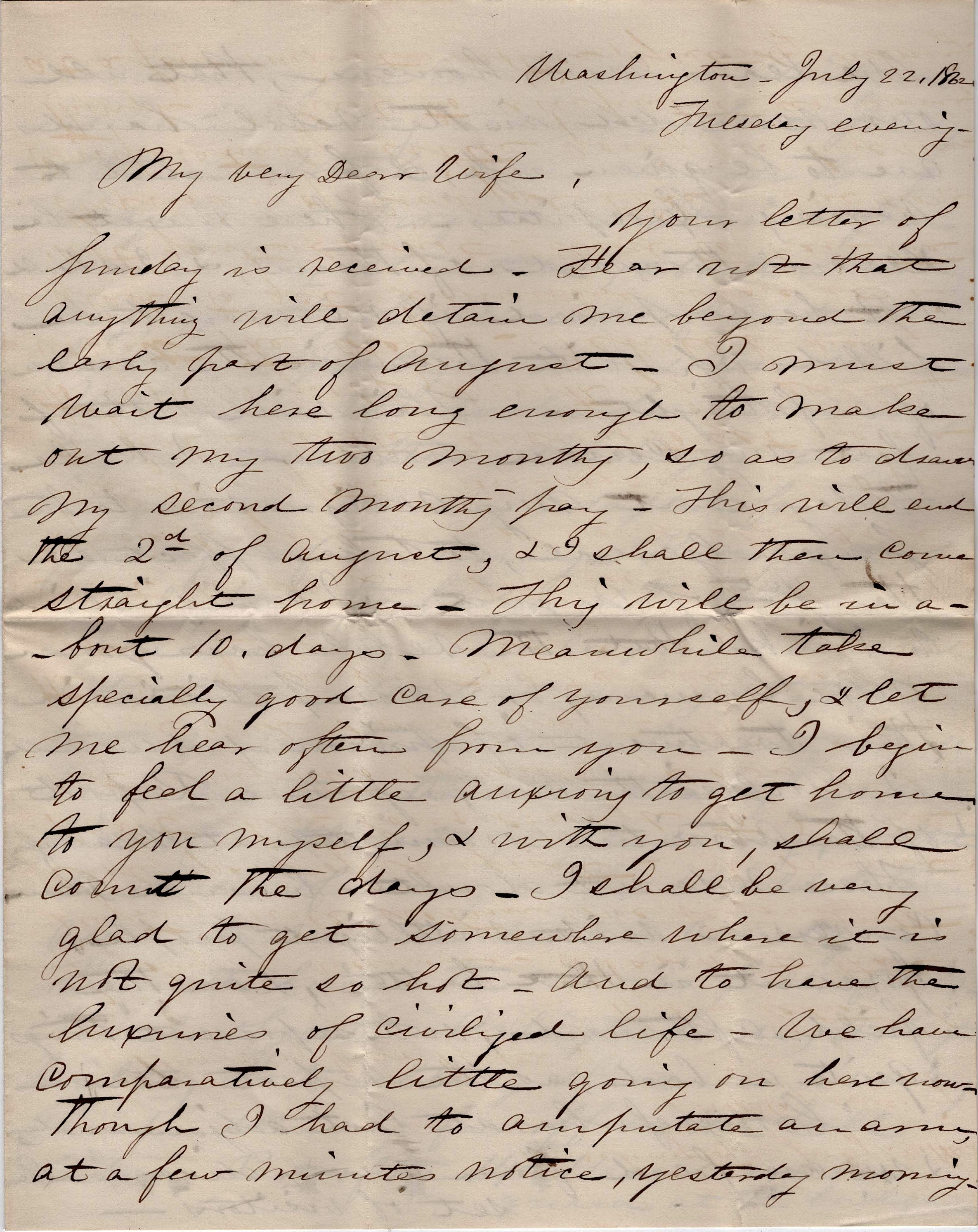
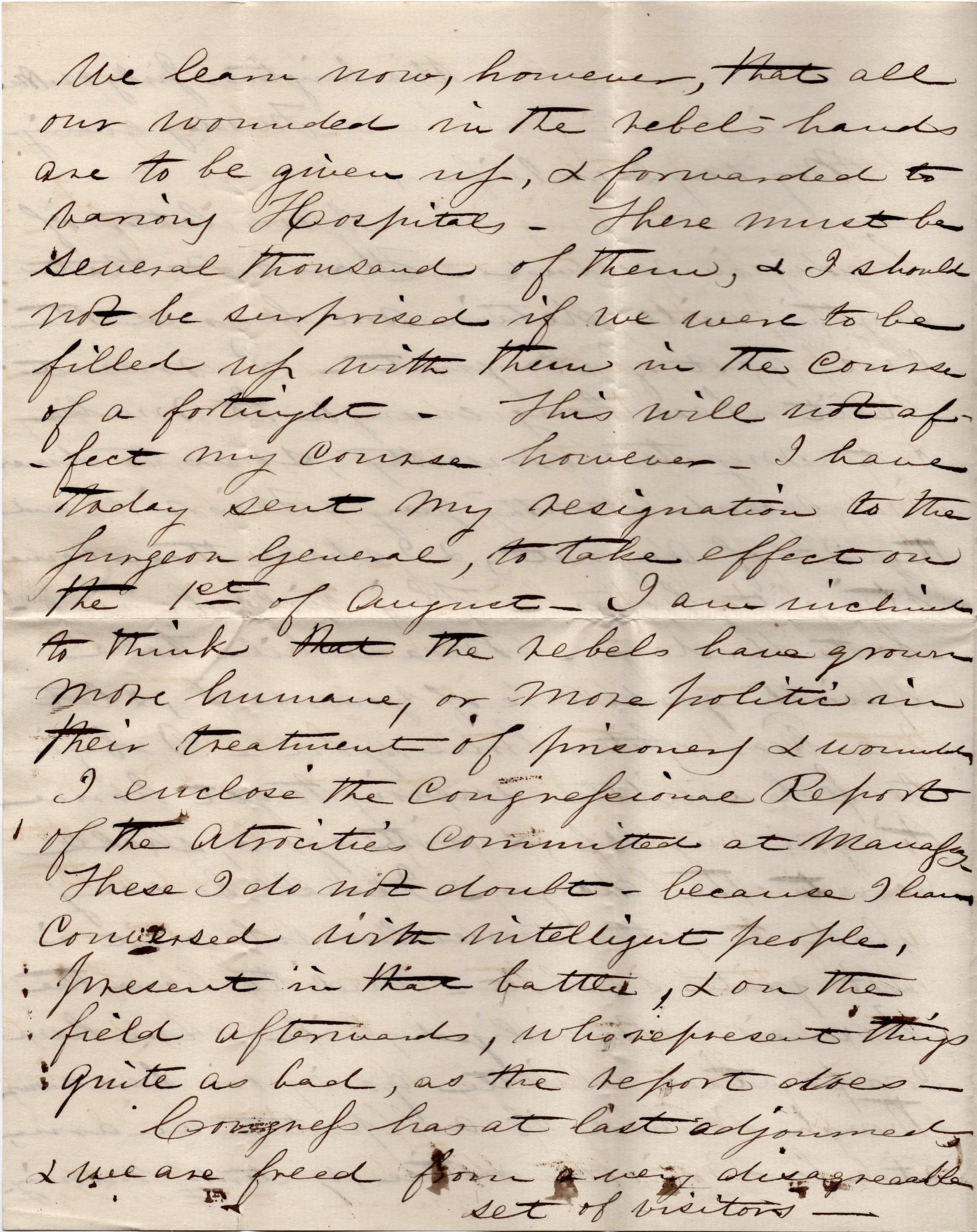
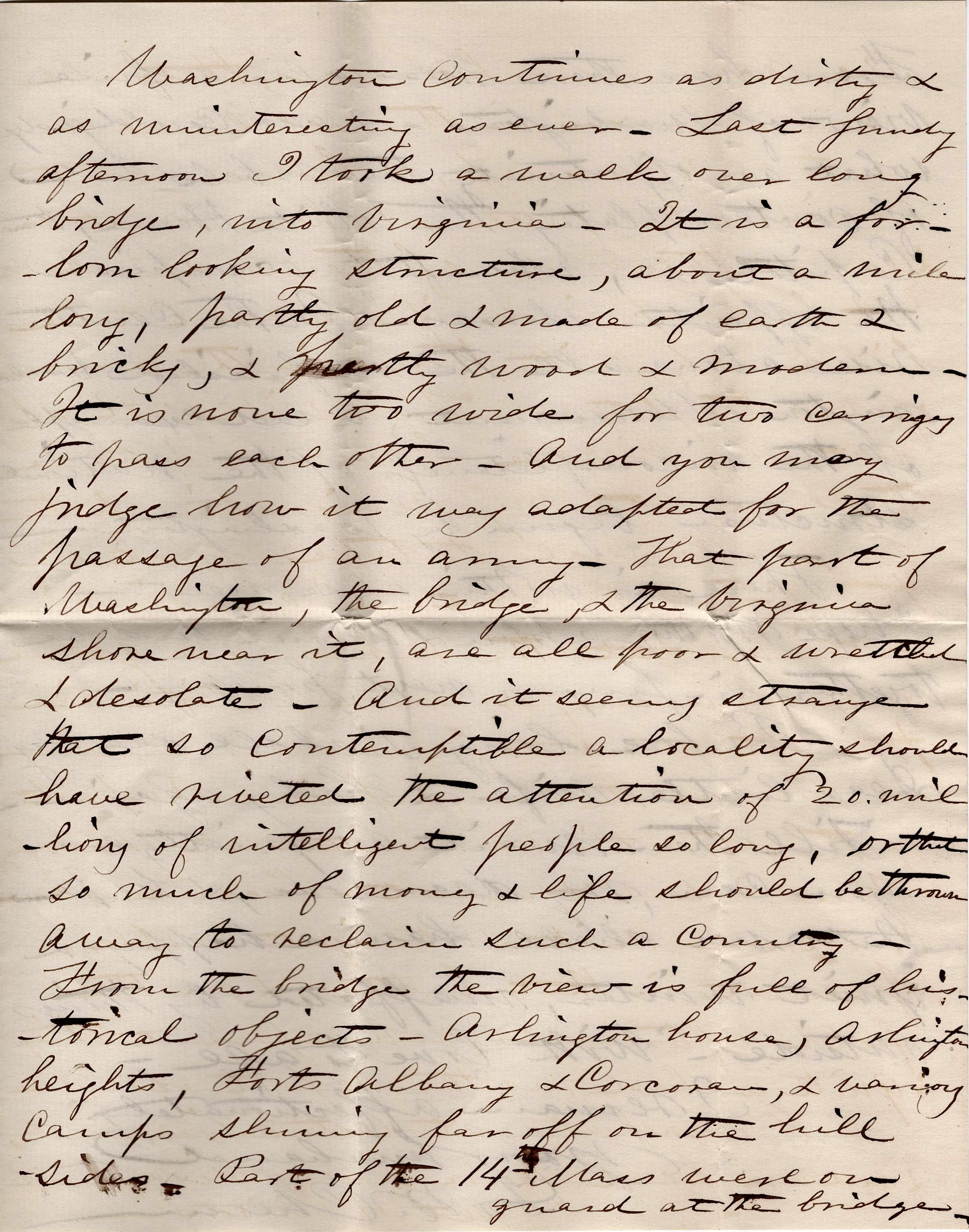
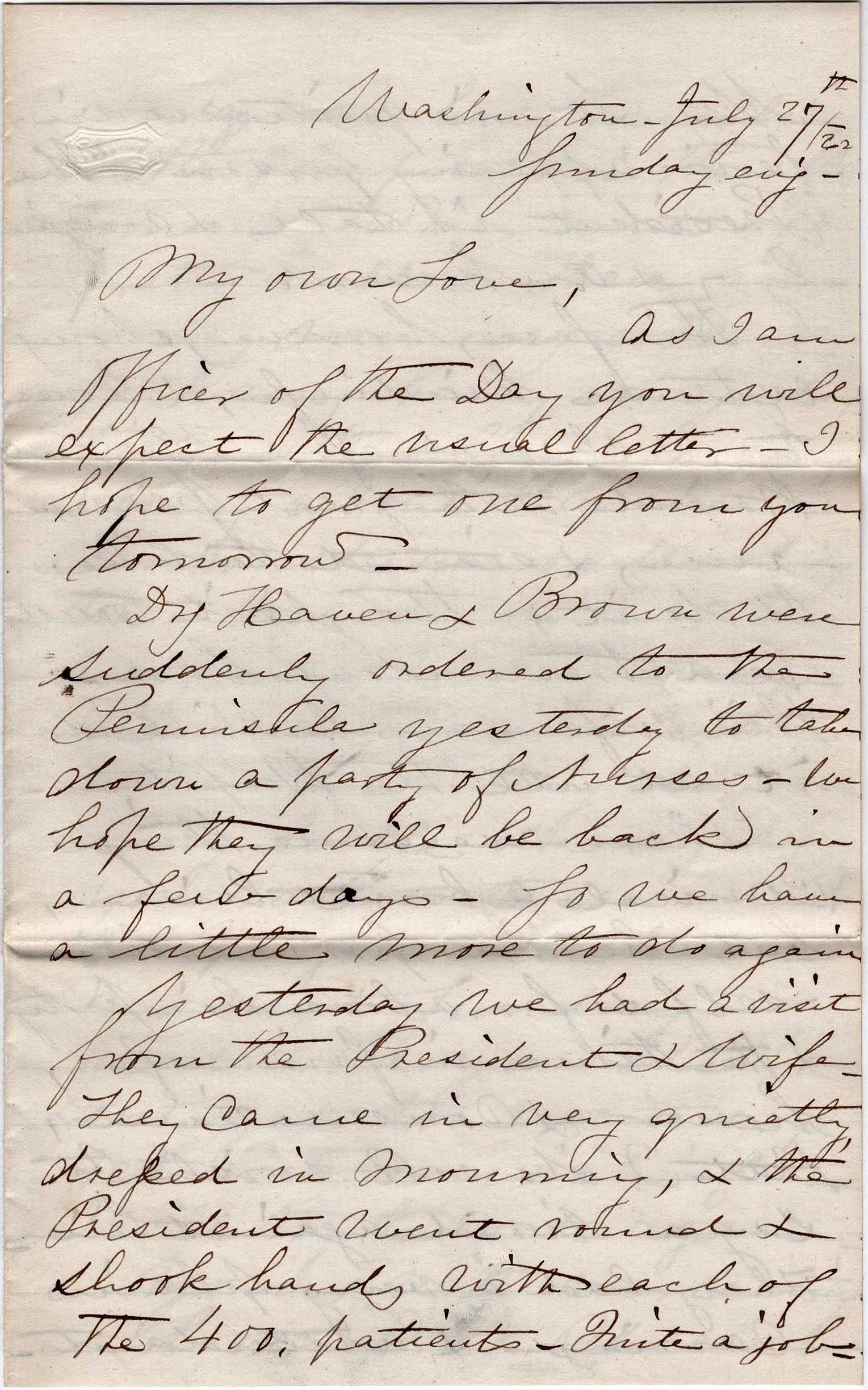
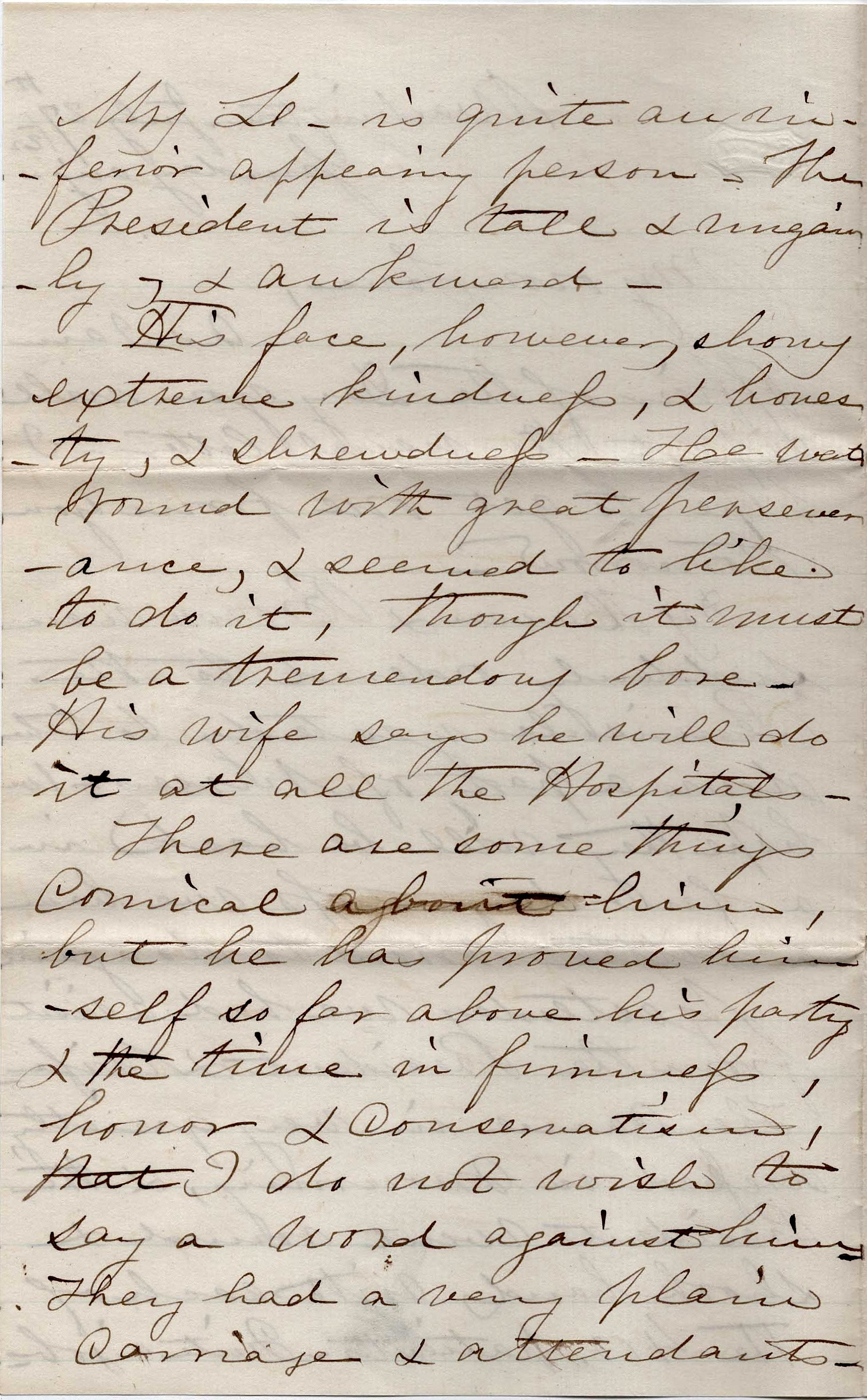
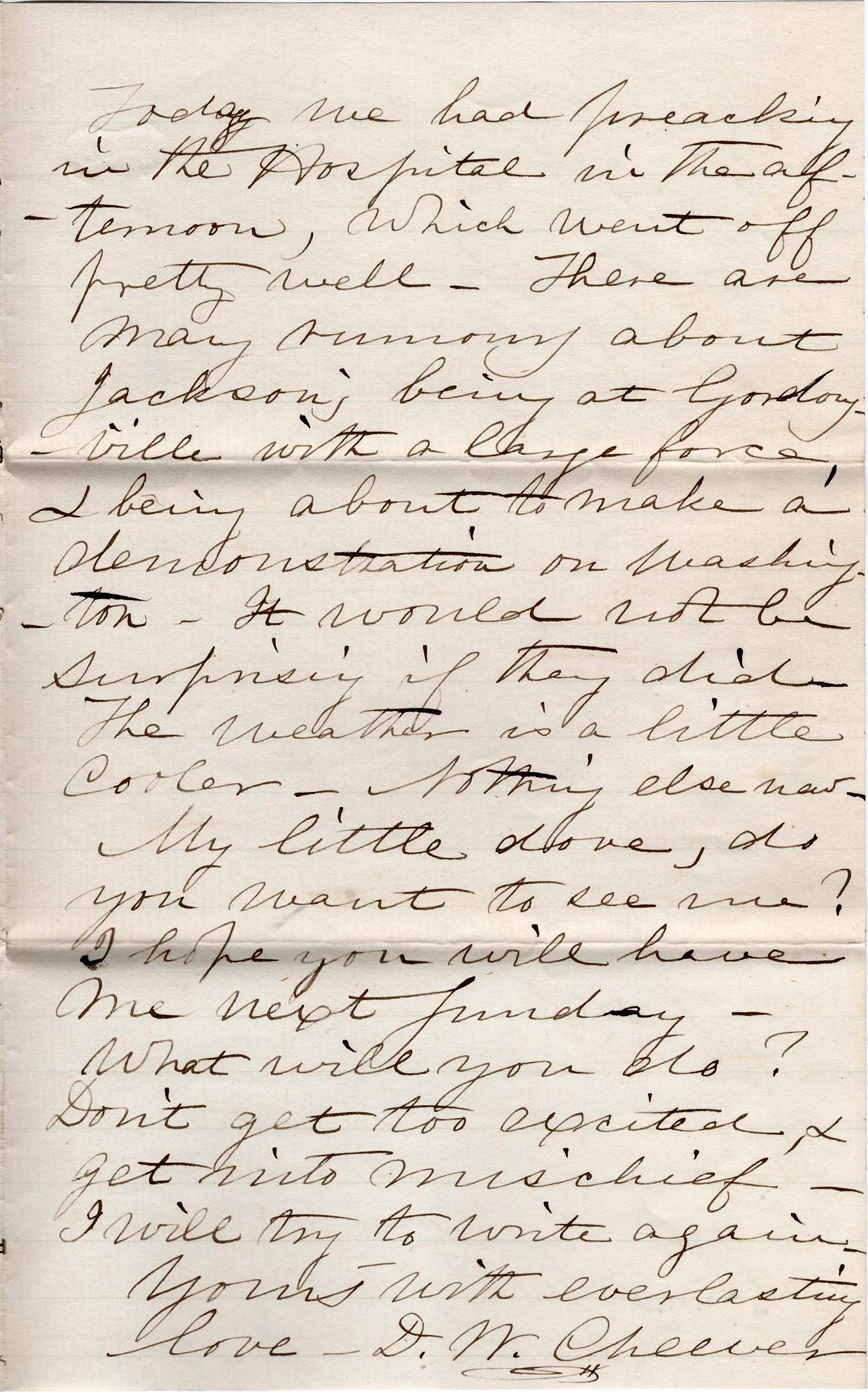
The following letter was written by Eliza Parmer of Pittsburgh to President Abraham Lincoln begging his mercy for the desertion of her youngest son, William Parmer of Co. C, 155th Pennsylvania. I can’t find a William Parmer in that company but I do see a William Henry Palmer (1845-1911) who enlisted on 22 August 1862 and was dishonorably discharged on 15 July 1865 from Dry Tortugas, Florida. This regiment was commanded by Capt. James Barclay Palmer (1838-1911) of Pittsburgh.
William Henry Palmer was the son of William Henry Palmer (1814-1864) and Eliza Victor Palmer (1812-1879) of Pittsburgh. In the 1860 US Census, this family was enumerated in Webster, Westmoreland county, Pennsylvania under the name Parmer. Living in the household at that time were the parents, William and Eliza Parmer (both age 46), John Parmer (age 24), Alfred Parmer (age 20). Victor Parmer (age 18), William Parmer (age 15), Isaac N. Parmer (age 12), George Parmer (age 8), Alice Parmer (age 6), and Eliza Parmer (age 18).
The muster rolls indicate that William deserted on 4 May 1863 at Sharpsburg, Maryland; this letter was written some six weeks later.
T R A N S C R I P T I O N
Pittsburgh [Pennsylvania] June 13, 1863
Mr. Abraham Lincoln,
I take the pleasure for the Preside of these United States to infom you about my son. He is sick and was sick before this month. I am most crazy about him. He is very young and is sick now. He got out of heart and tried to get home but he was caught in Washington and taken back. I hope you will have mercy on him—my poor boy—for my sake. I would like for him to come home so I can take care of him till he gets well again. Have mercy on him. I am an old woman and have no one to take care of me now since he is gone. He belongs to the One hundred 55th Pennsylvania, Company C—James Palmer’s Company. I hope you will write to the company if you please…[illegible]. — Eliza Parmer.
His name is William Parmer
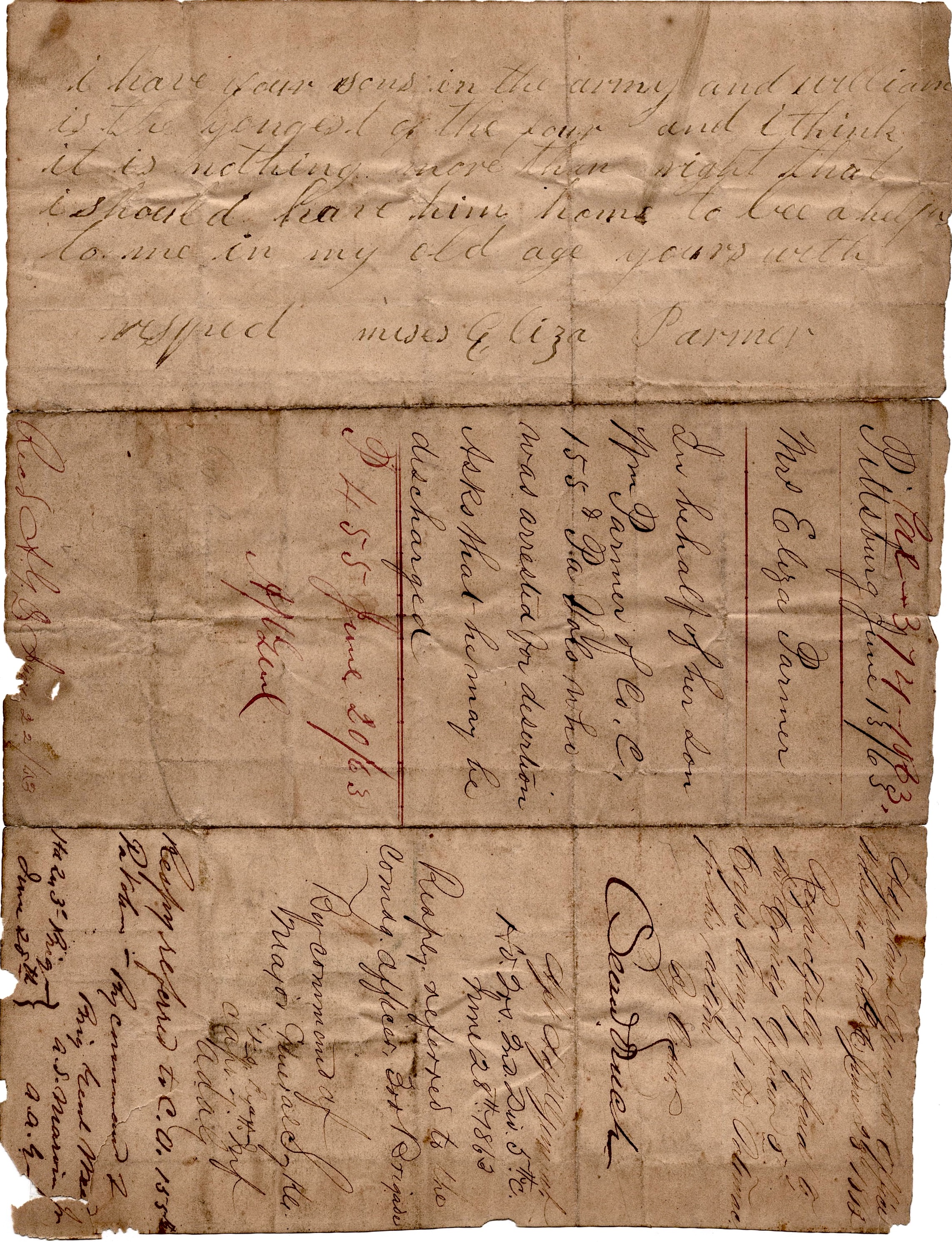
I have four sons in the army and William is the youngest of the four and I think it is nothing more than right that I should have him home to be a helper to me in my old age. Yours with respect. — Mrs. Eliza Parmer
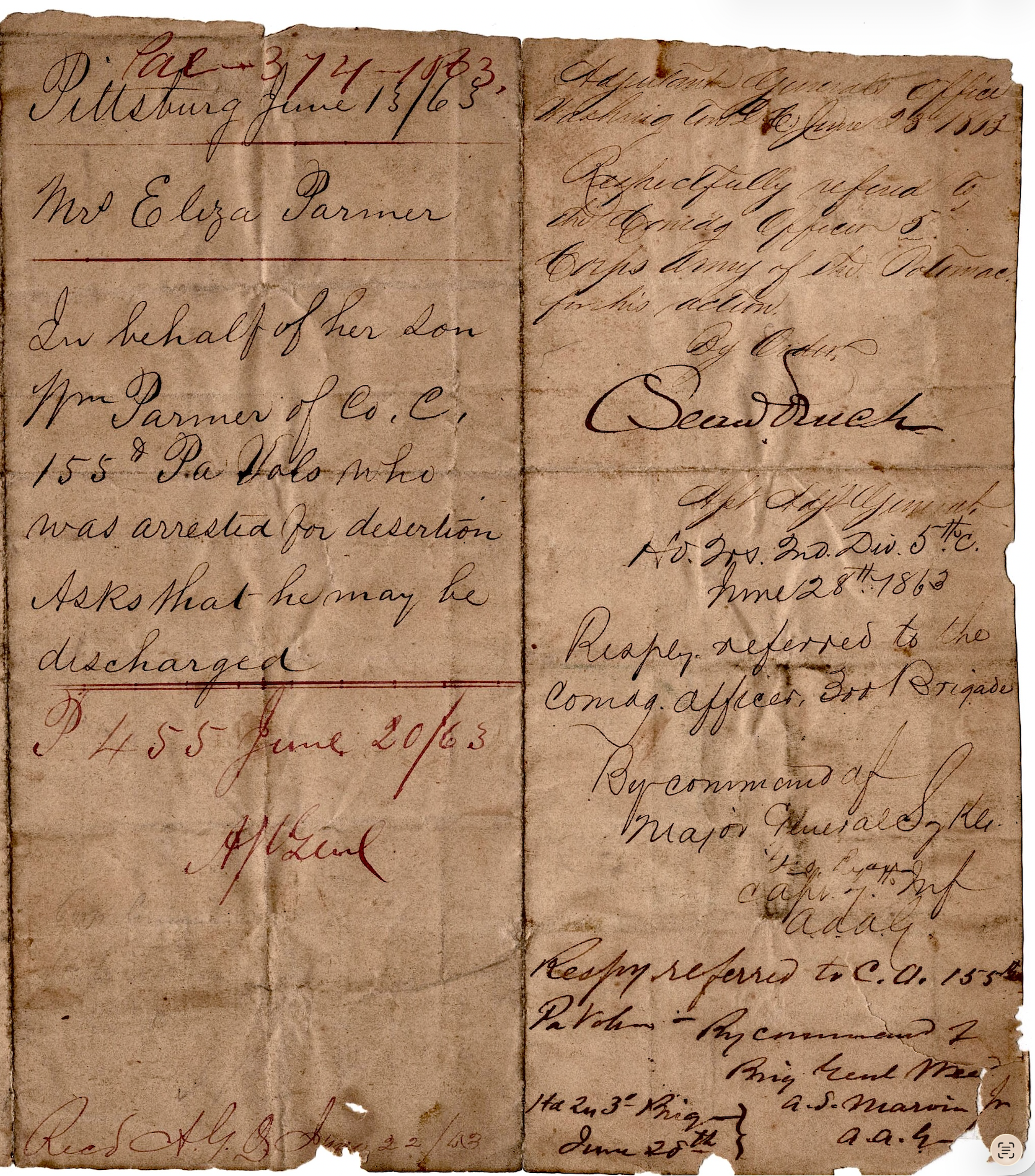
[Annotated on back of letter]
Mrs. Eliza Parmer. In behalf of her son, Wm. Parmer of Co. C, 155th Pa. Vol. who was arrested for desertion. Asks that he may be discharged.
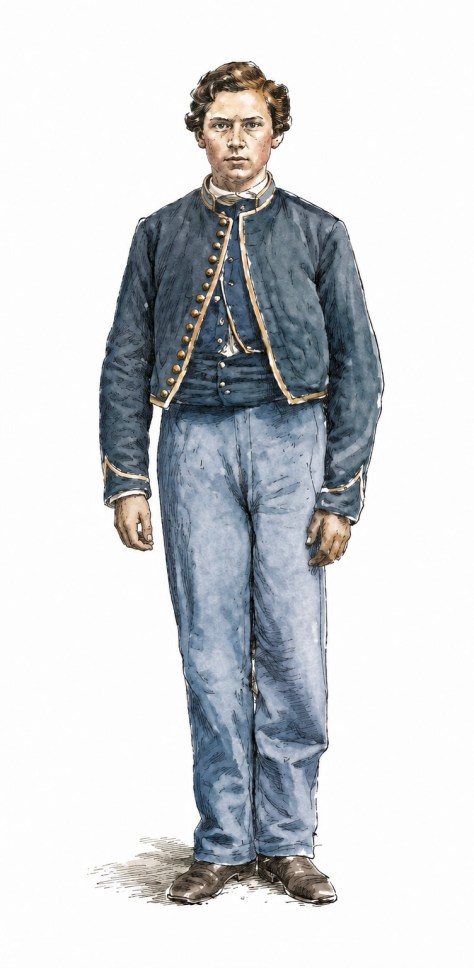
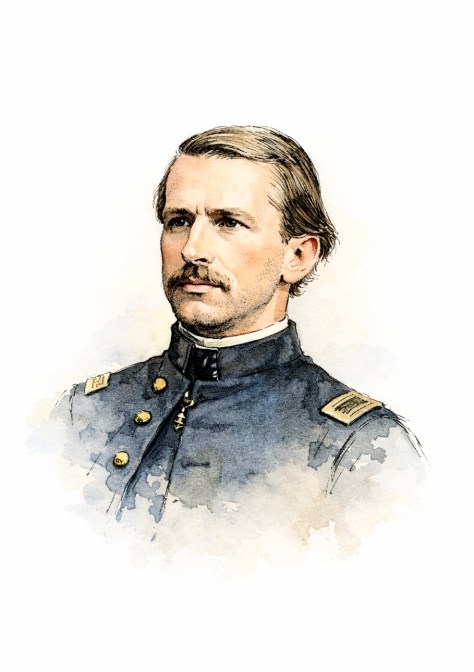
I could not find an image of John but here is a watercolor of Joseph K. Hayes of Co. K, 10th New Jersey Infantry (based on poor quality image in Civil War Photo Sleuth)
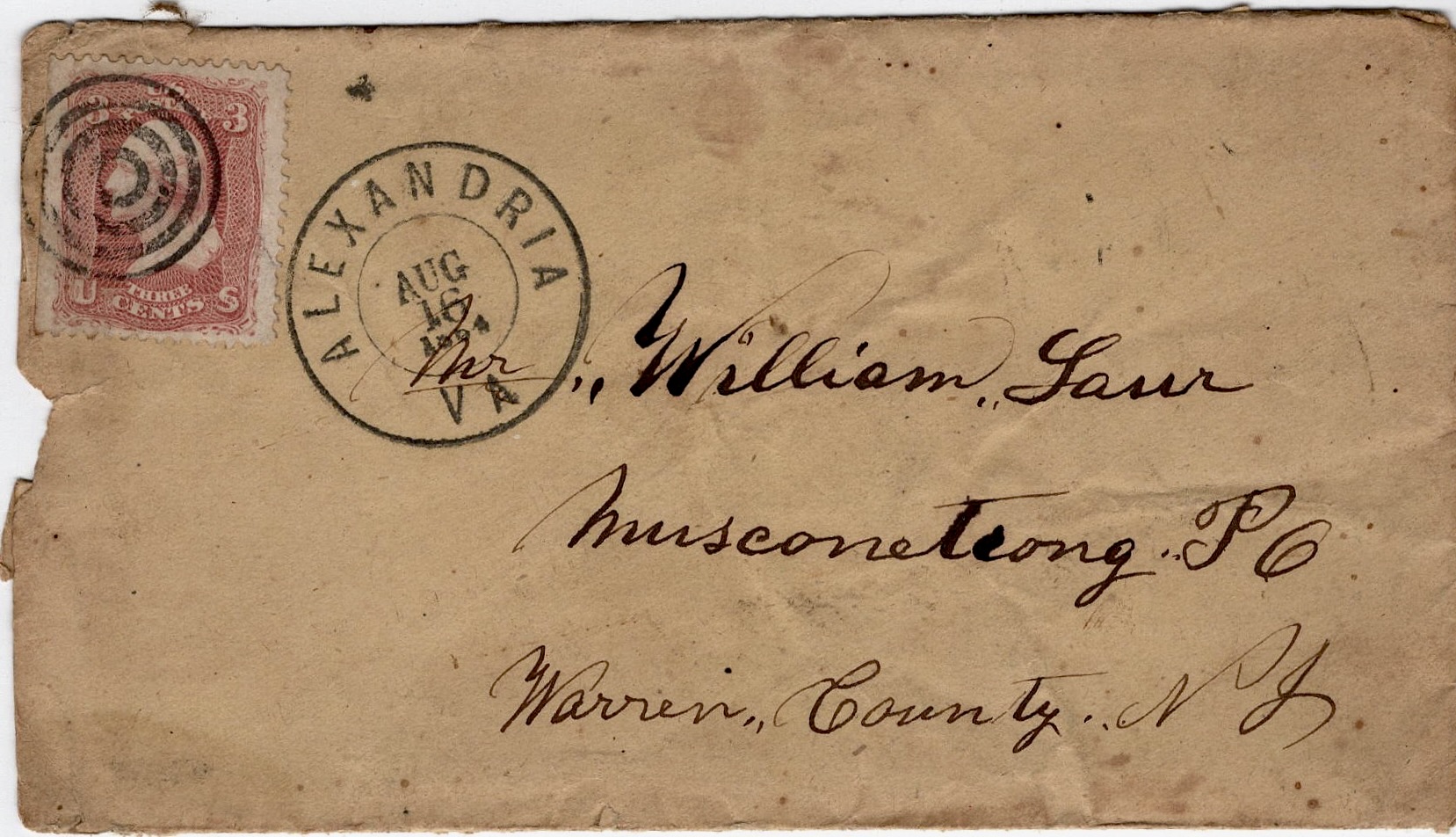
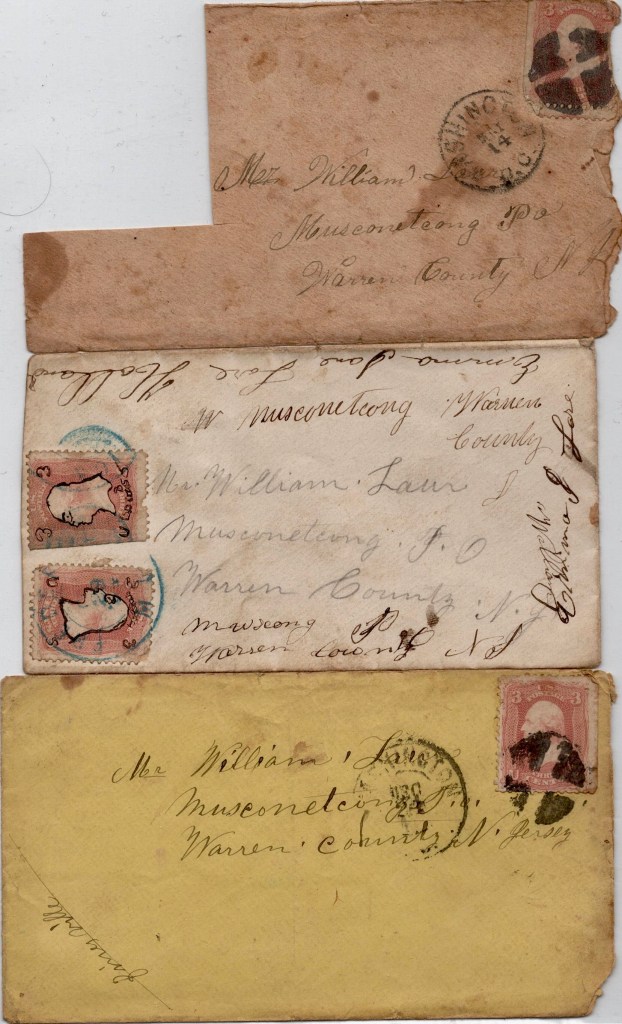
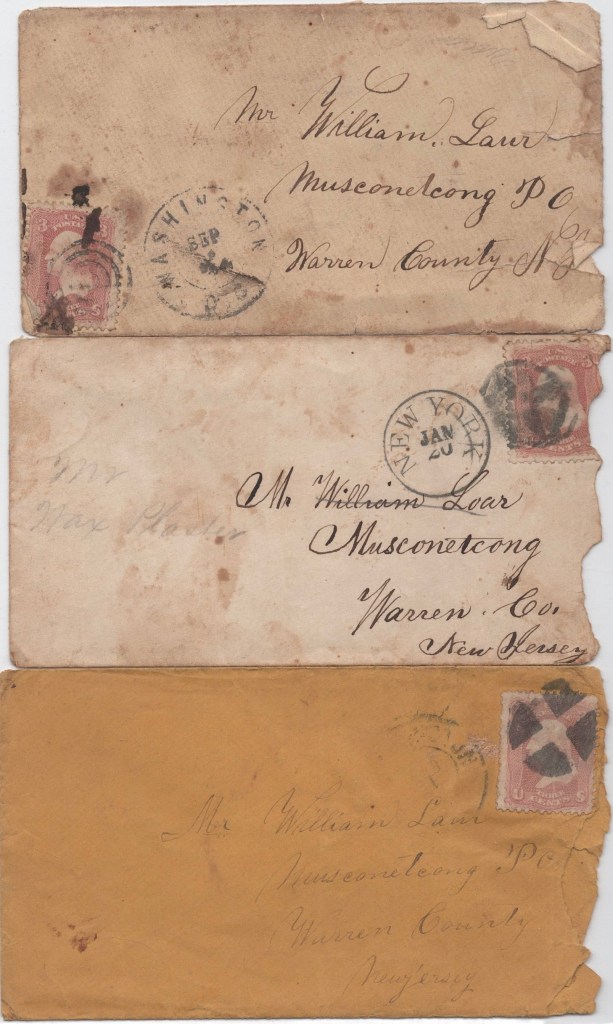
The following letters were written by John A. Laur while serving as a volunteer recruit in Co. H, 10th New Jersey Infantry. John’s family appears to have been inconsistent with the spelling of their surname, which was variously rendered as Laur, Loar, or Lore. On the family gravestones, including John’s, it is inscribed as Lore; however, military records list it as Laur. At the time he accepted a substantial bounty to enlist, John had only just turned 15 years old. It is likely that the recruiting officer was aware of John’s underage status, yet he proceeded to enlist him nonetheless. During this period of the war, acquiring recruits had become increasingly challenging. Nevertheless, census records provide consistent evidence confirming that John was born in August 1849. He officially entered the service in August 1864.
There is nothing in John’s 32 letters that suggests he was motivated by a spirit of patriotism to enlist. Rather, it appears that he enlisted for the adventure and for the money. We learn from one of his letters that John feared his 44 year-old father might be drafted and he encouraged his father to use the bounty he received for enlistment to pay for a substitute, if necessary.
John was the son of William Chard Lore (1820-1895) and Catharine Adams (1831-1898) of Warren county, New Jersey. John’s younger siblings, of whom he often mentions in his letters, were Emma J. (b. 1852), George (b. 1854), and Willie (b. 1863). After his time in the service, John seems to have taken employment as a laborer in the oil industry. He was enumerated in 1870 at Oilcreek, Venango county, Pennsylvania. He became an invalid before 1900 and died in 1923 at Alpha, New Jersey.
Letter 1
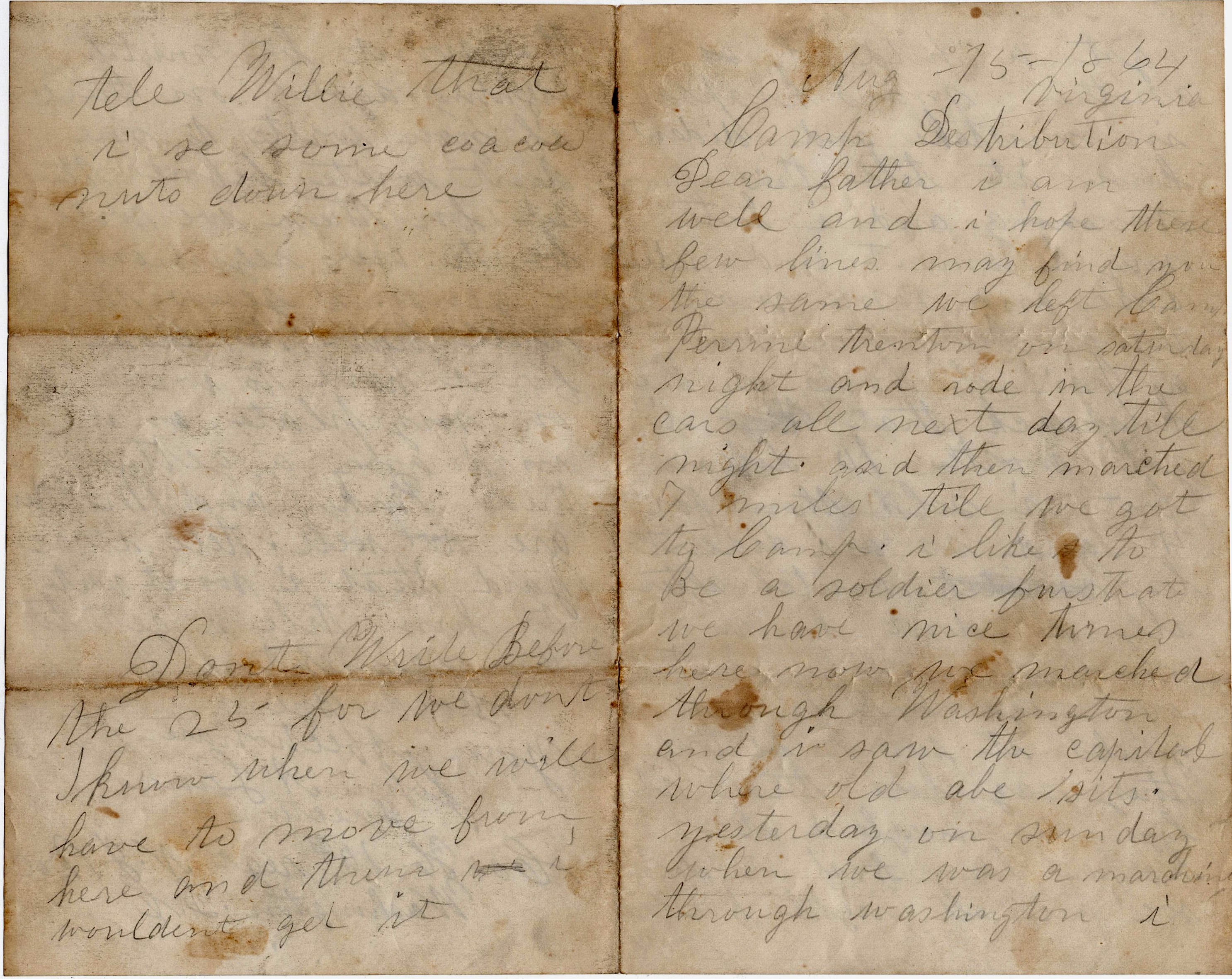
Camp Distribution, Virginia August 15, 1864
Dear father,
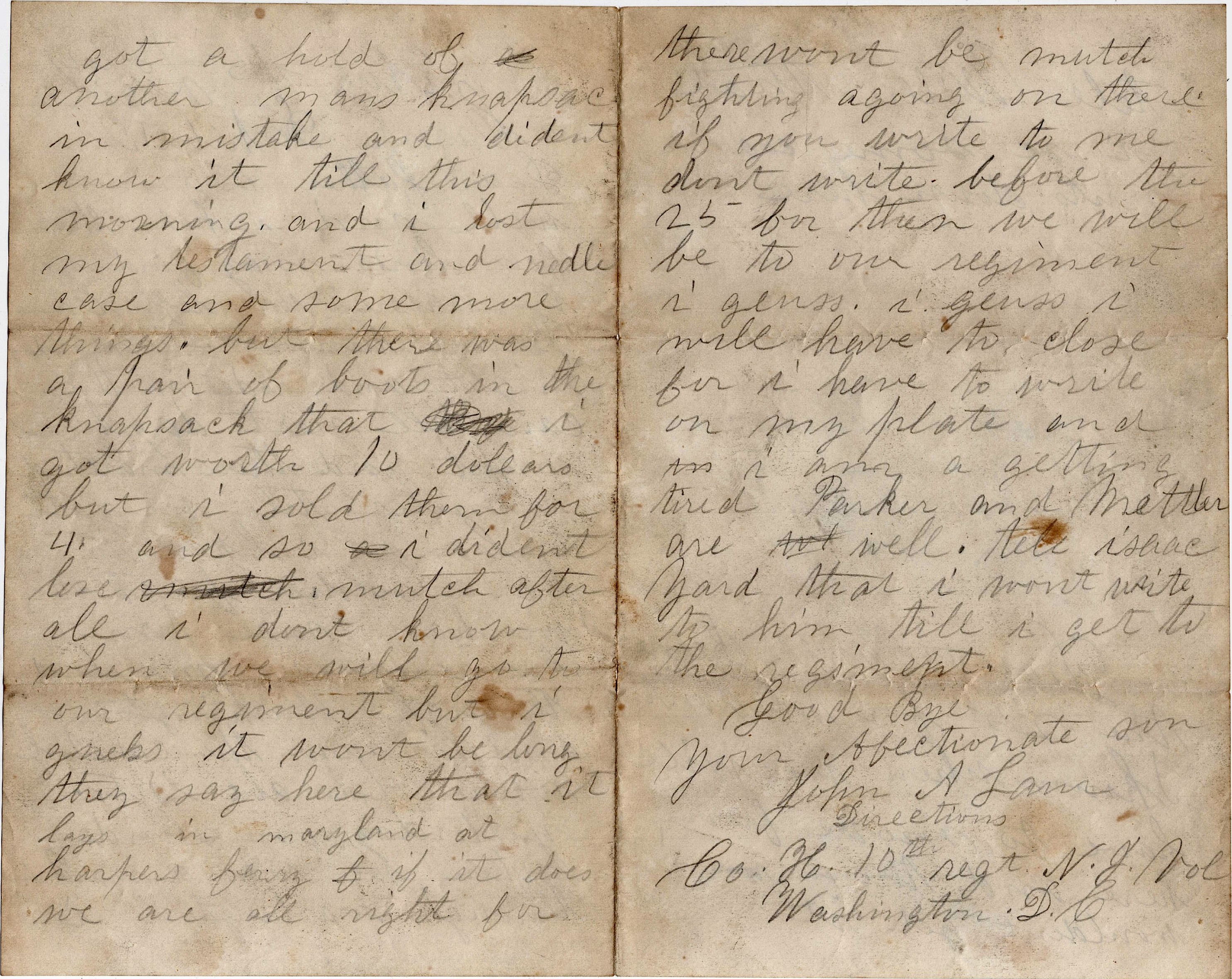
I am well and I hope these few lines may find you the same. We left Camp Perrine, Trenton, on Saturday night and rode in the cars all next day till night and then marched 7 miles till we got to camp. I like to be a soldier first rate. We have nice times here now. We marched through Washington and I saw the Capitol were Old Abe sits. Yesterday, on Sunday, when we was a marching through Washington, I got a hold of another man’s knapsack in mistake and didn’t know it till this morning and I lost my testament and needle case and some more things. But there was a pair of boots in the knapsack that I got worth 10 dollars, but I sold them for 4 and so I didn’t lose much after all.
I don’t know when we will go to our regiment but I guess it won’t be long. They say here that it lays in Maryland, at Harpers Ferry. If it does, we are all right for there won’t be much fighting a going on there. If you write to me, don’t write before the 25th for then we will be to our regiment I guess.
I guess I will have to close for I have to write on my plate and I am getting tired. [Jacob F.] Parker and [William S.] Mettler are well. Tell Isaac Yard that I won’t write to him till I get to the regiment. Goodbye. Your affectionate son, — John A. Laur
Directions: Co. H, 10 Regt. N. J. Vols. Washington, D. C. Tell Willie that I seen some cocoa nuts down here. Don’t write before the 25th for we don’t know when we will have to move from here and then I wouldn’t get it.
Letter 2
Camp Distribution, Virginia August 15, 1864
Dear Father,
I sit down to write a few lines to you to let you know that I am well and hope these few lines will find you all the same. Me and Jacob F. Parker and William S. Mettler are going to send our overcoats home for it is too warm to carry them now and we have no use for them now till it gets colder. Then I can draw another one, and besides, it will make you a good overcoat this winter. We will put a receipt in this letter and you show that to Brice Pursel and you can draw the box. You take the box over home and tear it open and you will find the name on each of our coats. Send Jacob F. Parker’s up to Haldron and William S. Mettler’s over to his home. We will put 50 cents in this letter. If it ain’t anough, write to me and we will send you more. And if it is to much, give it to Skid Mettler.
No more at present. Your affectionate son, — John A. Laur
Don’t write till the 25th of this month and then I think we will be to our regiment. I will write again before that time. I like it first rate. Goodbye to you all.
Letter 3
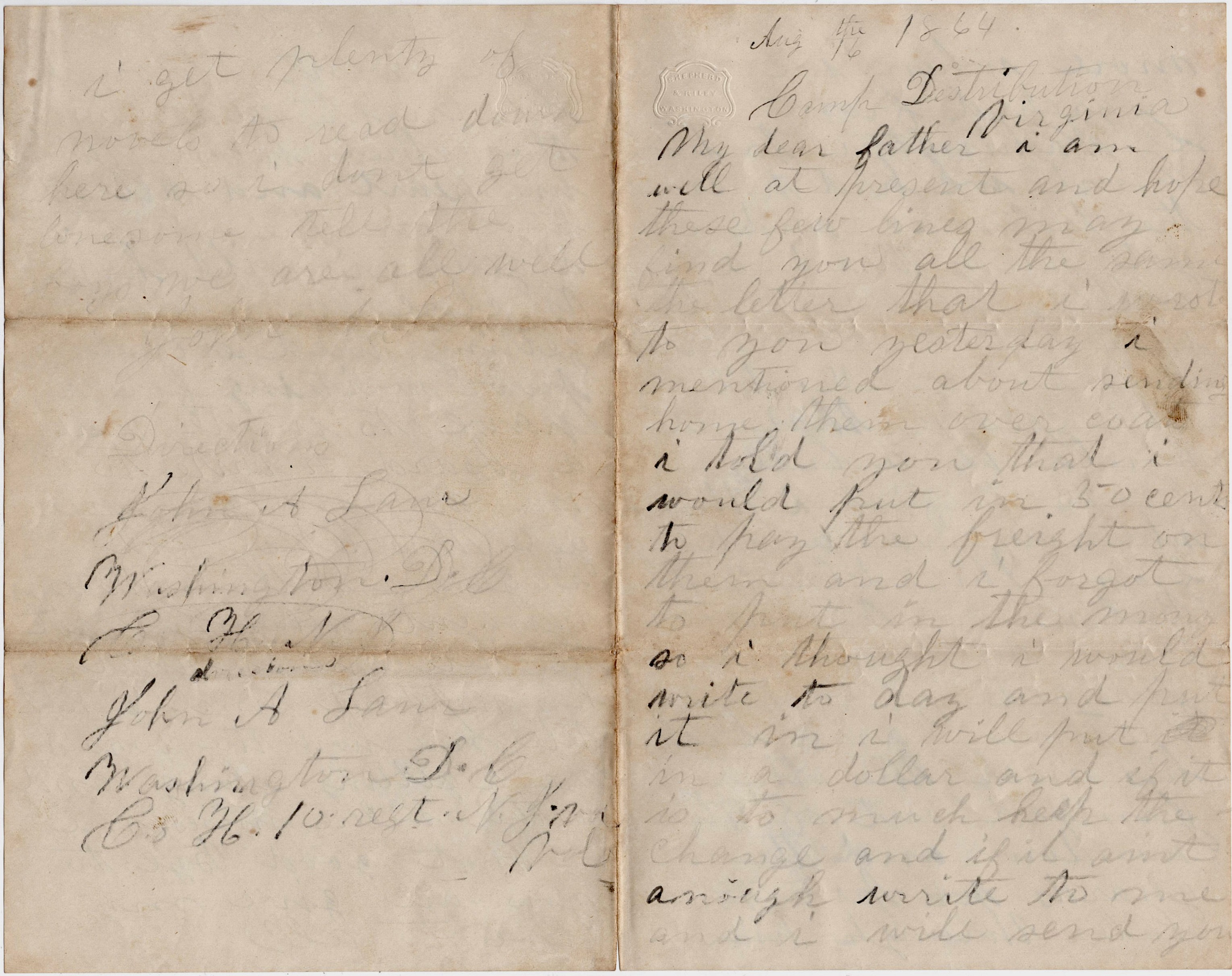
Camp Distribution, Virginia August 16, 1864
My dear father,
I am well at present and hope these few lines may find you all the same. The letter that I wrote to you yesterday, I mentioned about sending home them overcoats. I told you that I would put in 50 cent to pay the freight on them and I forgot to put in the money so I thought I would write today and put it in. I will put in a dollar and if it is too much, keep the change, and if it ain’t enough, write to me and I will send you more.
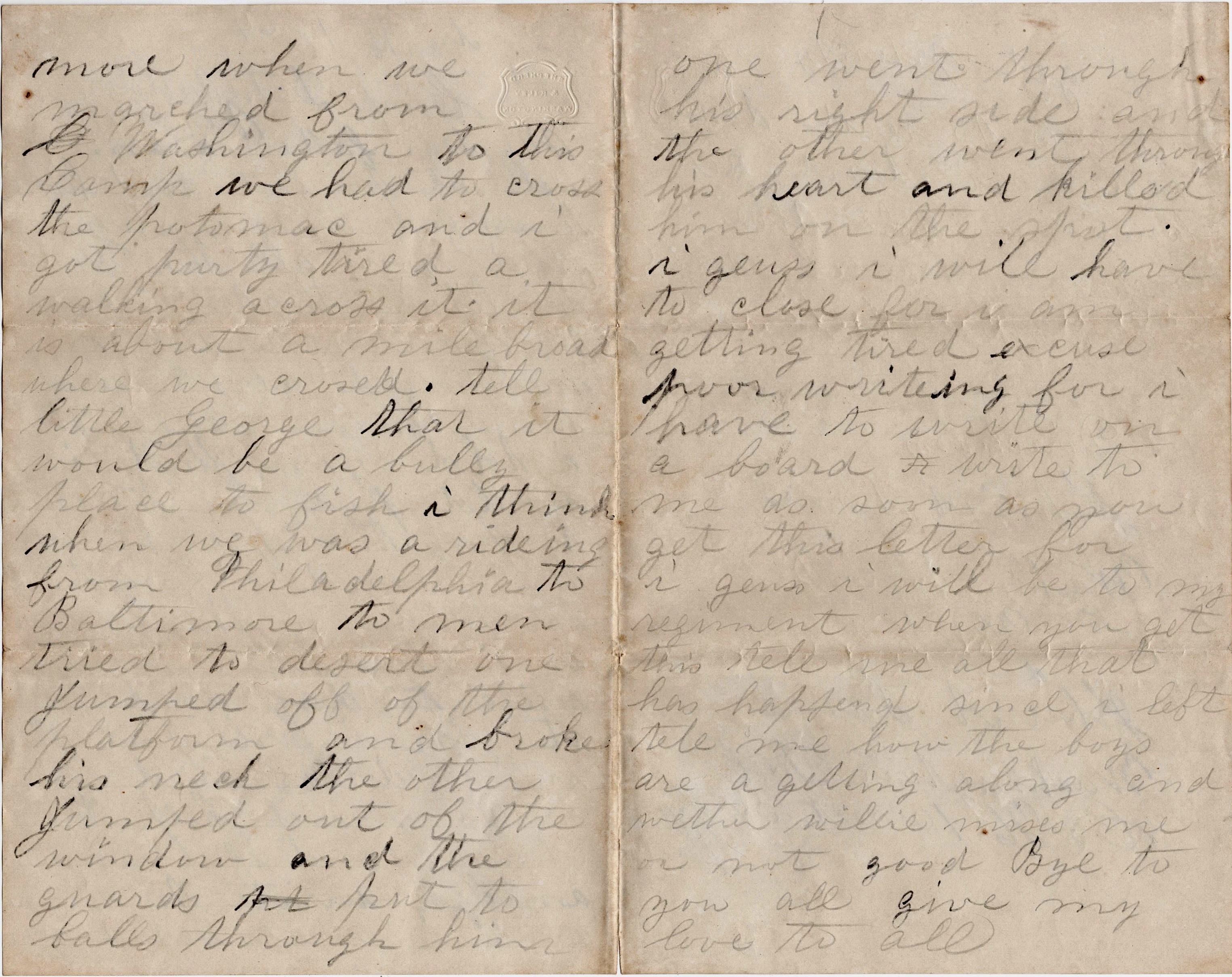
When we marched from Washington to this camp we had to cross the Potomac and I got purty tired a walking across it. It is about a mile broad where we crossed. Tell Willie & George it would be a bully place to fish, I think. When we was a riding from Philadelphia to Baltimore, two men tried to desert. One jumped off the platform and broke his neck. The other jumped out of the window and the guards put two ball through him. One went through his right side and the other went through his heart and killed him on the spot. 1
I guess I will have to close for I am getting tired. Excuse poor writing for I have to write on a board. Write to me as soon as you get this letter for I guess I will be to my regiment when you get this. Tell me all that has happened since I left. Tell me how the boys are a getting along and whether Willie misses me or not. Goodbye to you all. Give my love to all.
Directions: John A. Laur, Washington D. C., Co. H, 10 Regt. N. J. Vol.
1 By the time John enlisted in late 1864, many of the “recruits” and “draftees” were reluctant participants and officers escorting these men to the the Distribution Camp near Washington D. C. often kept them under guard. Some of the men who accepted large bounties to enlist or accepted money as substitutes for drafted men did so with every intention of deserting the first opportunity presented them. The men who tried to escape were probably “bounty jumpers.”
Letter 4
On Picket near Charlestown, Virginia August 30, 1864
My dear father,
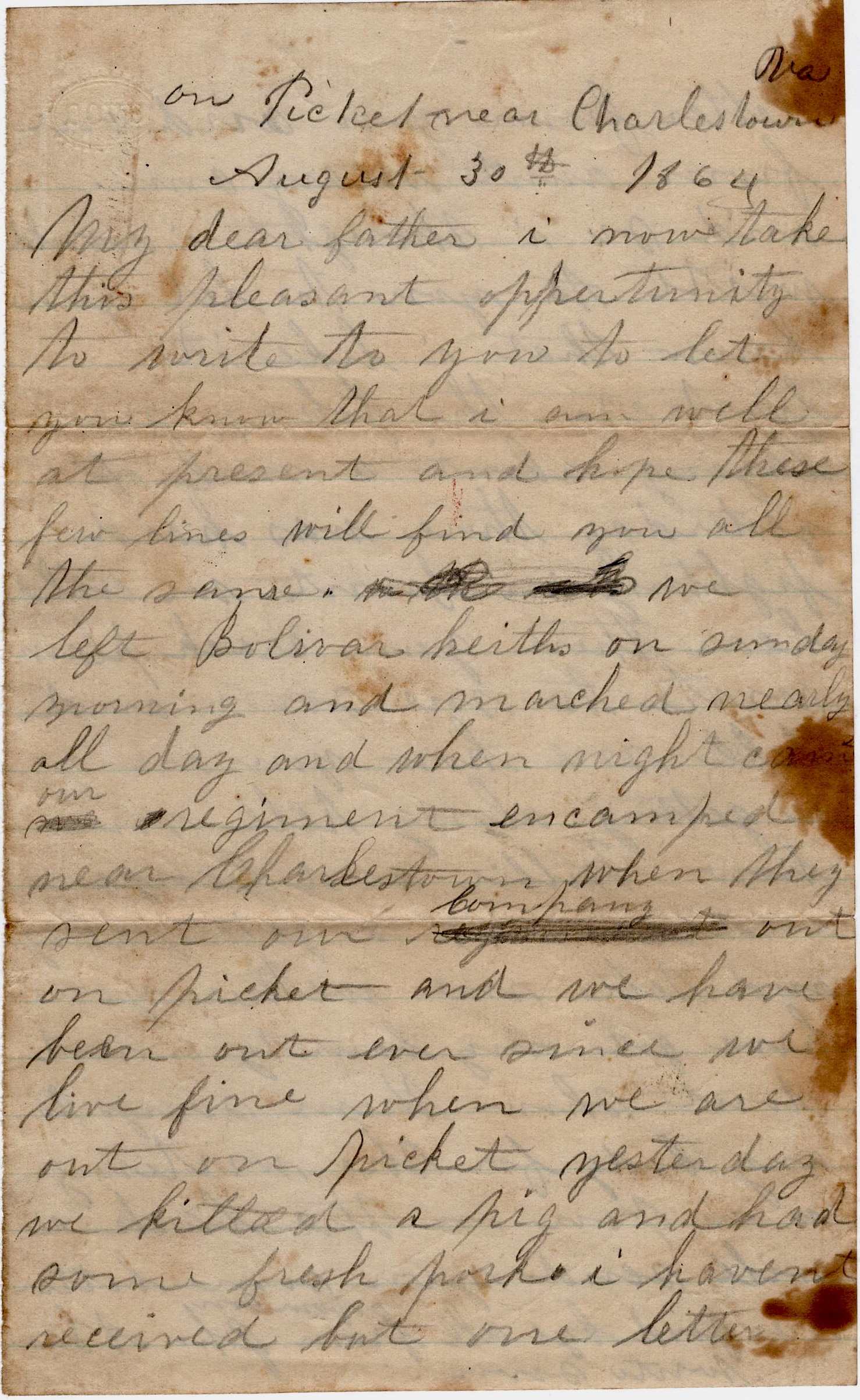
I now take this pleasant opportunity to write to write to you to let you know that I am well at present and hope these few lines will find you all the same. We left Bolivar Heights on Sunday morning and marched nearly all day and when night came, our regiment encamped near Charlestown when they sent our company out on picket and we have been out ever since. We live fine when we are out on picket. Yesterday we killed a pig and had some fresh pork.
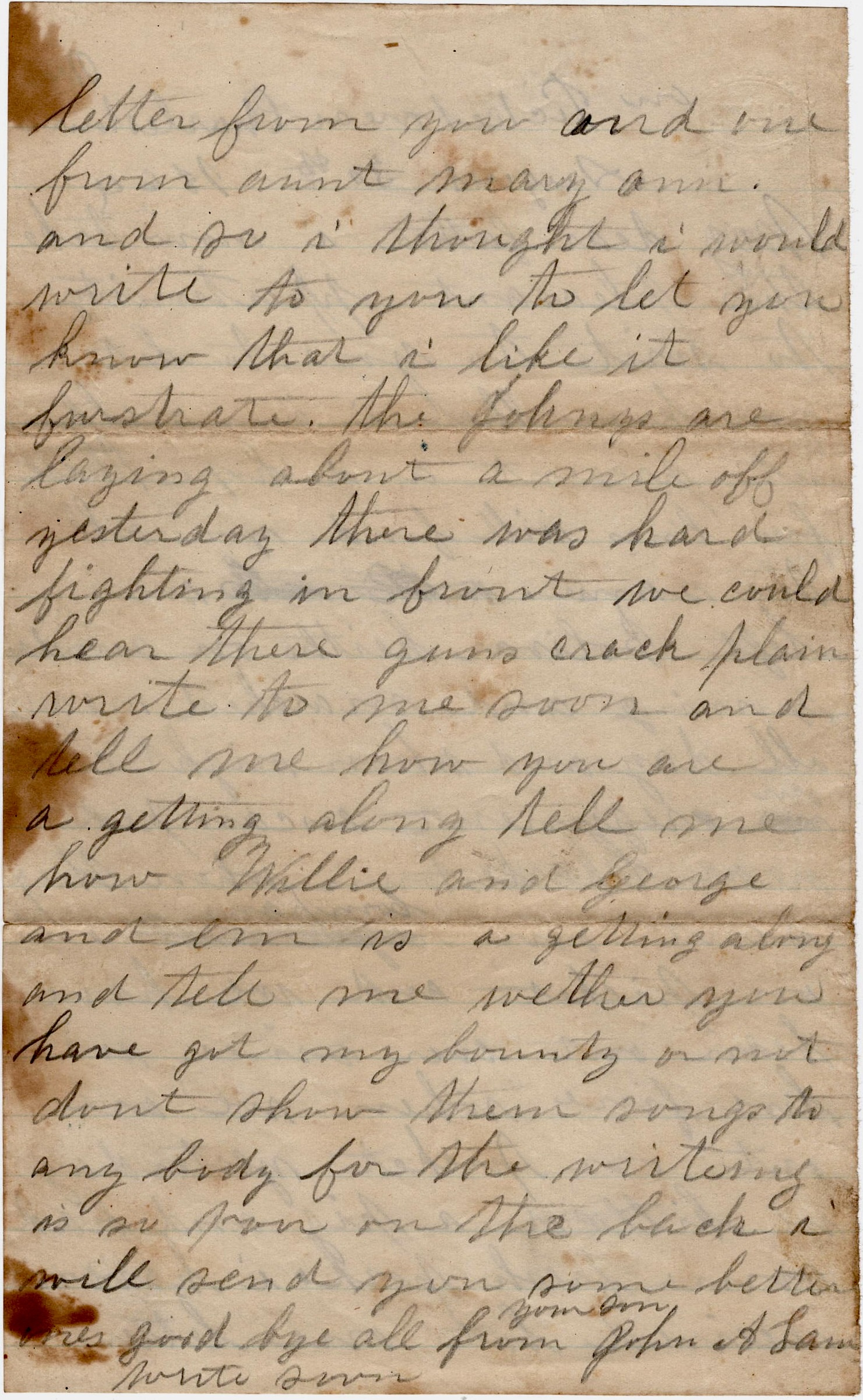
I havent received but one letter letter from you and one from Aunt Mary Ann and so I thought I would write to you to let you know that I like it first rate. The Johnnys are laying about a mile off. Yesterday there was hard fighting in front we could hear their guns crack plain.
Write to me soon and tell me how you are a getting along. Tell me how Willie and George and Em is a getting along and tell me whether you have got my bounty or not. Dont show them songs to anybody for the writing is so poor. On the back I will send you some better ones. Goodbye all. From your son, — John A Laur
Write soon.
Letter 5
In Camp near Charlestown, Virginia September 1, 1864
My dear father,
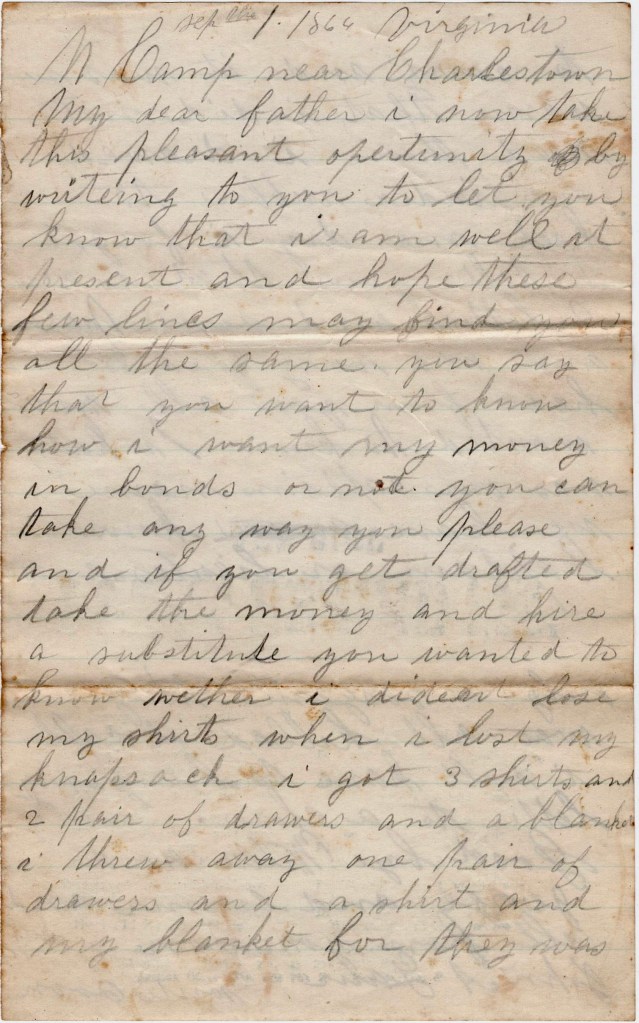
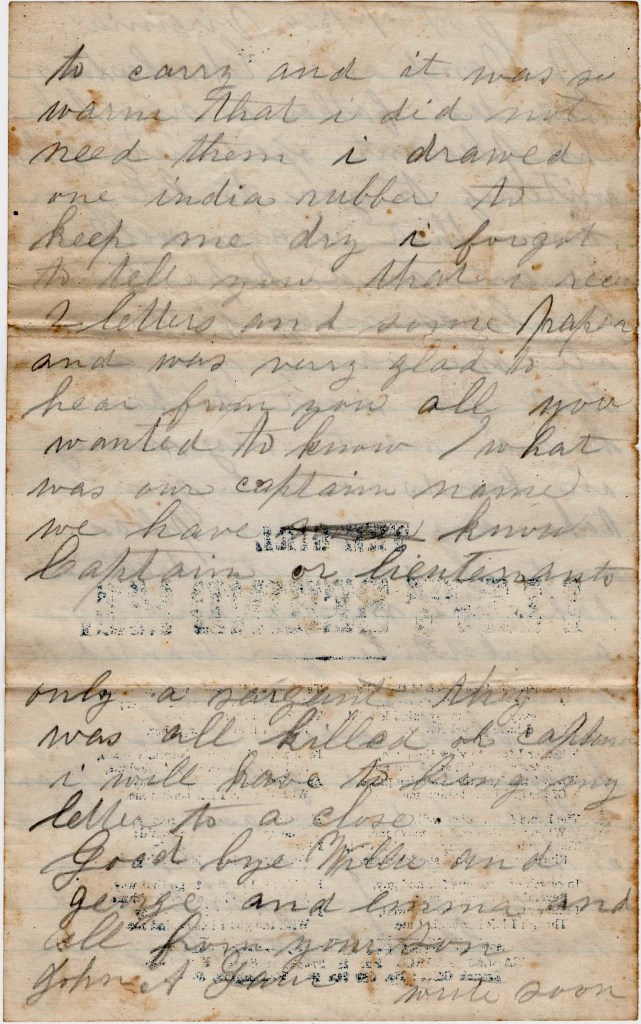
I now take this pleasant opportunity by writing to you to let you know that I am well at present and hope these few lines may find you all the same. You say you want to know how I want my money—in bonds or not. You can take [them] any way you please, and if you get drafted, take the money and hire a substitute. You wanted to know whether I didn’t lose my shirt when I lost my knapsack. I got 3 shirts, 2 pair of drawers, and a blanket. I threw away one pair of drawers and a shirt and my blanket for they was too [much to] carry and it was so warm that I did not need them. I drawed one India rubber to keep me dry.
I forgot to tell you that I received two letters and some paper and was very glad to hear from you all. You wanted to know what was our captain’s name. We have no captain or lieutenants—only a sergeant. They was all killed or captured.
I will have to bring my letter to a close. Goodbye Willie and George and Emma and all. From your son, — John A. Laur
Write soon.
Letter 6
September 3, 1864
My Dear father,
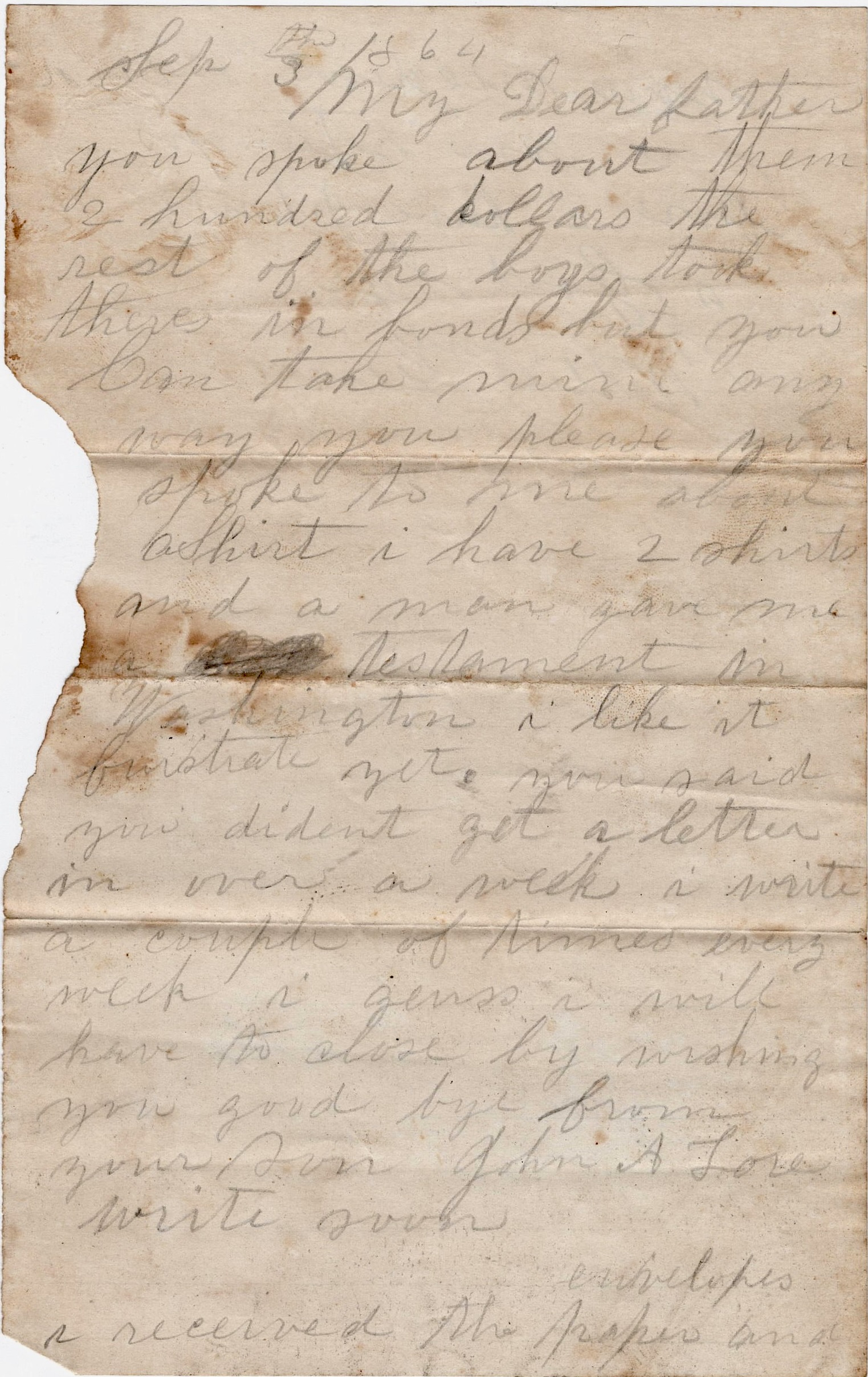
You spoke about them two hundred dollars. The rest of the boys took theirs in bonds, but you can take mine any way you please. You spoke to me about a shirt. I have two shirts and a man gave me a testament in Washington. I like it first rate yet. You said you didn’t get a letter in over a week. I write a couple of times every week. I guess I will have to close by wishing you goodbye. From your son, — John A. Laur
Write soon. I received the papers and envelopes.
Letter 7
Camp near Berryville, Virginia September 7, 1864
My dear parents,
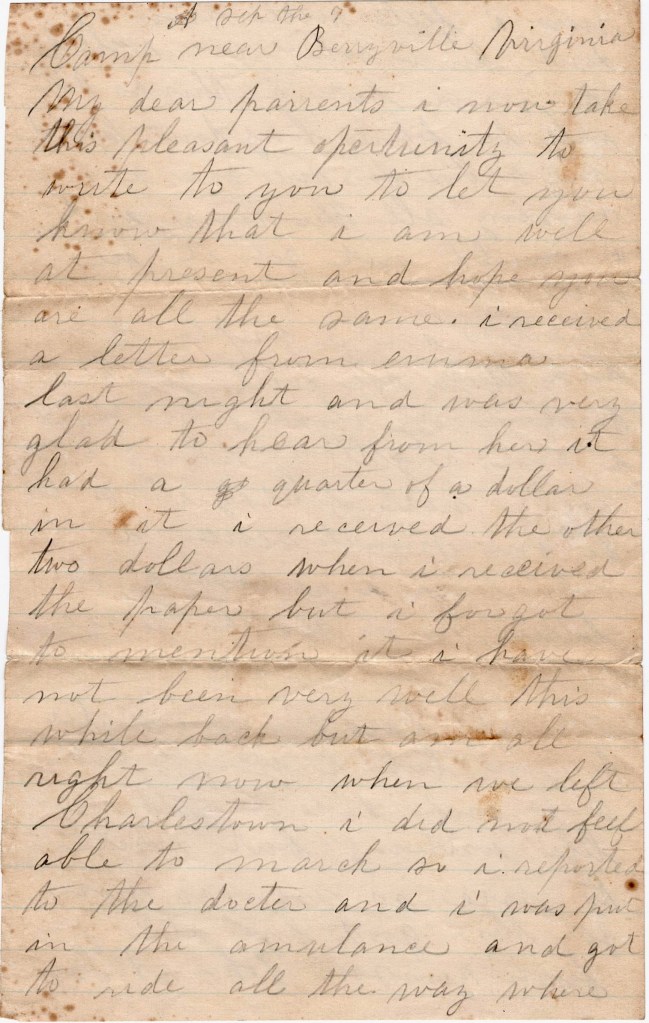
I now take this pleasant opportunity to write to you to let you know that I am well at present and hope you are all the same. I received a letter from Emma last night and was very glad to hear from her. It had a quarter of a dollar in it. I received the other two dollars when I received the papers but I forgot to mention it.
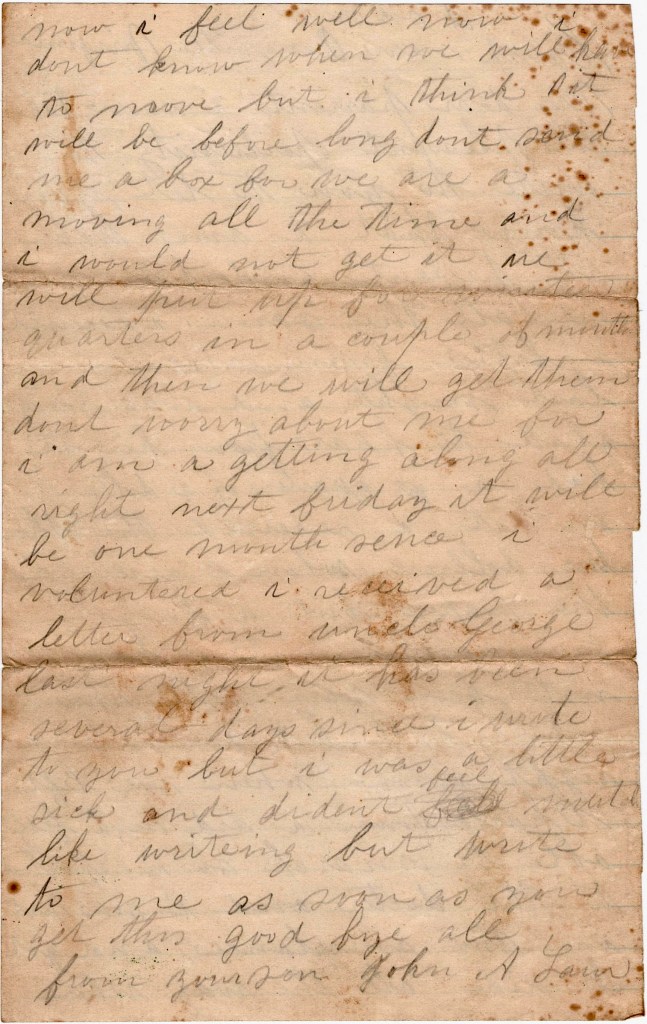
I have not been very well this while back but am all right now. When we left Charlestown, I did not feel able to march so I reported to the doctor and I was put in the ambulance and got to ride all the way where now I feel well now. I don’t know when we will have to move, but I think it will be before long. Don’t send me a box for we are a moving all the time and I would not get it. We will put up for winter quarters in a couple of months and then we will get them. Don’t worry about me for I am a getting along all right. Next Friday it will be one month since I voluntered.
I received a letter from Uncle George last night. It has been several days since I wrote to you but I was a little sick and didn’t feel much like writing. But write to me as soon as you get this. Goodbye all. From your son, John A. Laur
Letter 8
Camp near Berryville, Virginia September 11, 1864
My dear brother,
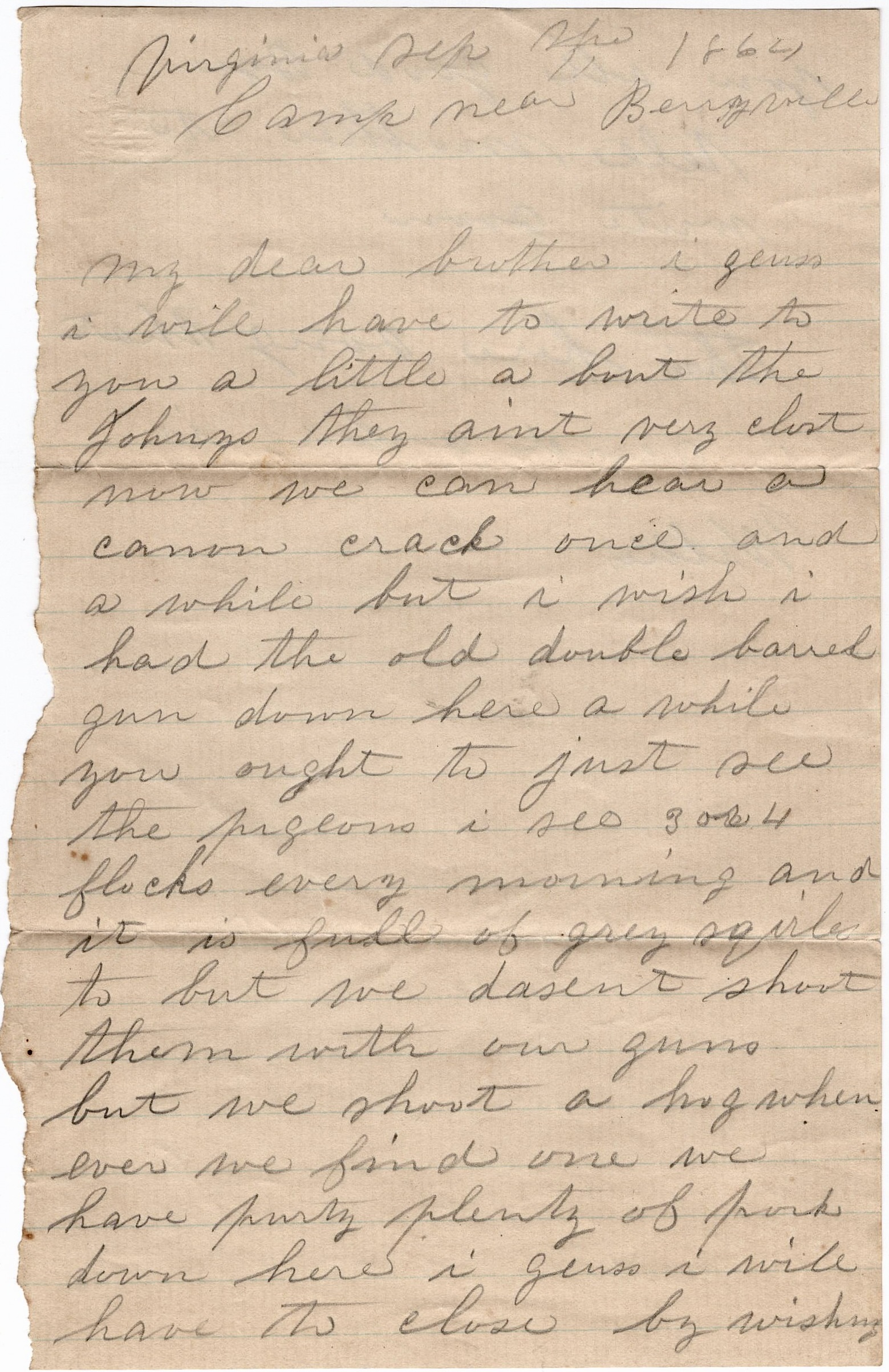
I guess I will have to write to you a little about the Johnnys. They aint very close now. We can hear a cannon crack once and a while, but I wish I had the old double barrel gun down here awhile. You ought to just see the pigeons. I see 3 or 4 flocks every morning and it is full of grey squirrels too. But we don’t shoot them with our guns. But we shoot a hog whenever we find one. We have purty plenty of pork down here.
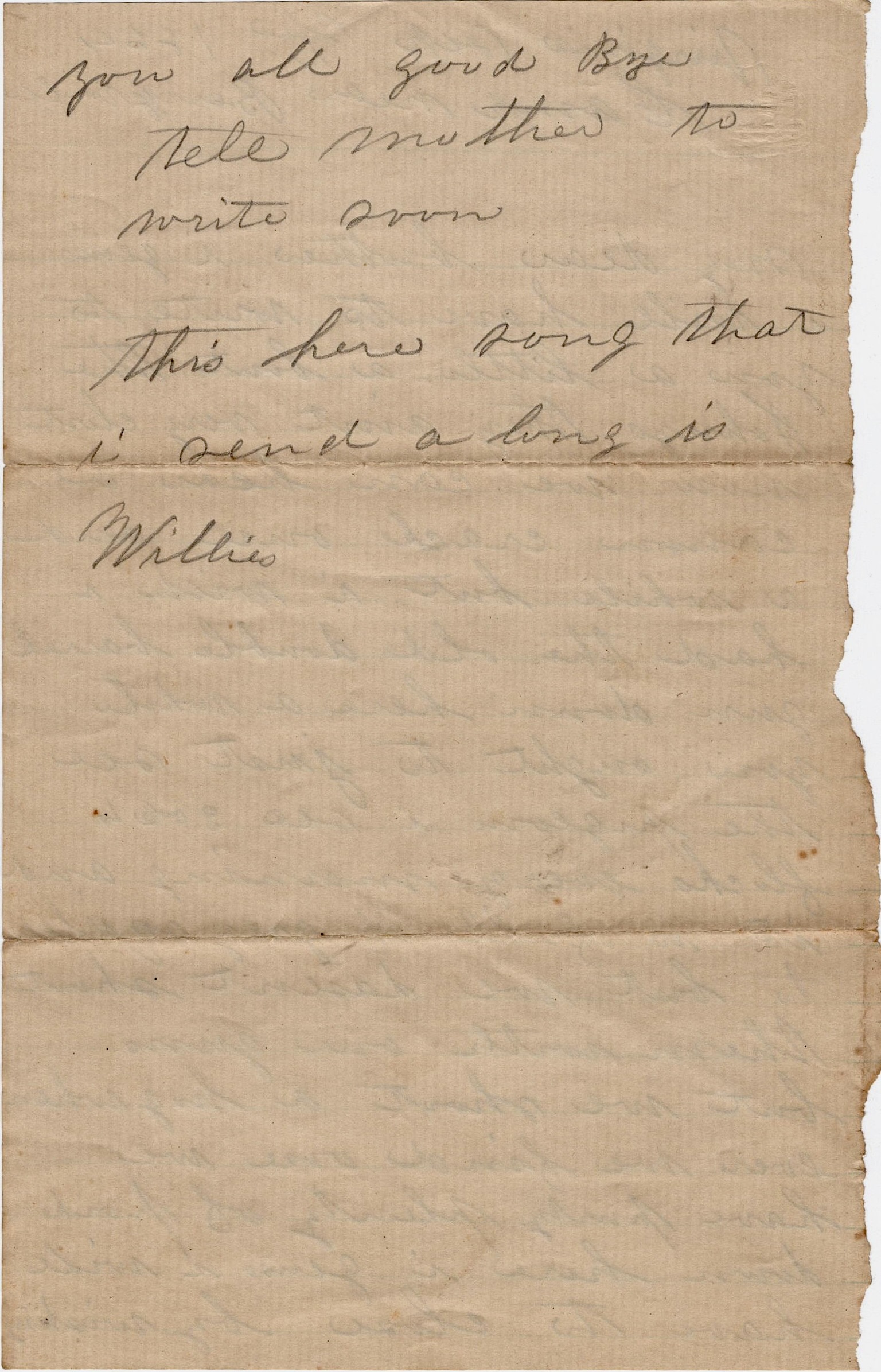
I guess I will have to close by wishing you all goodbye. Tell mother to write soon. This here song that I send along is Willie’s.
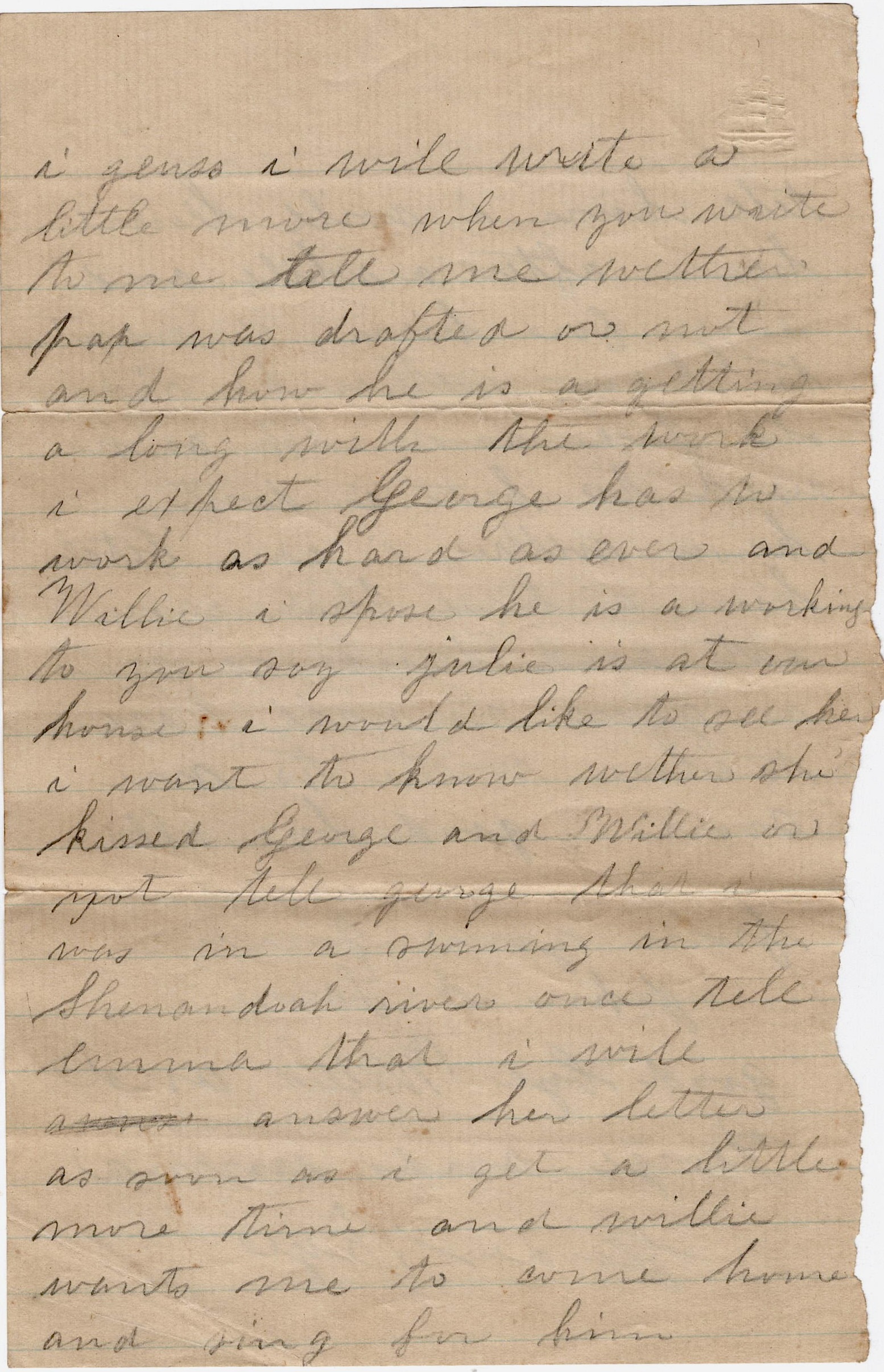
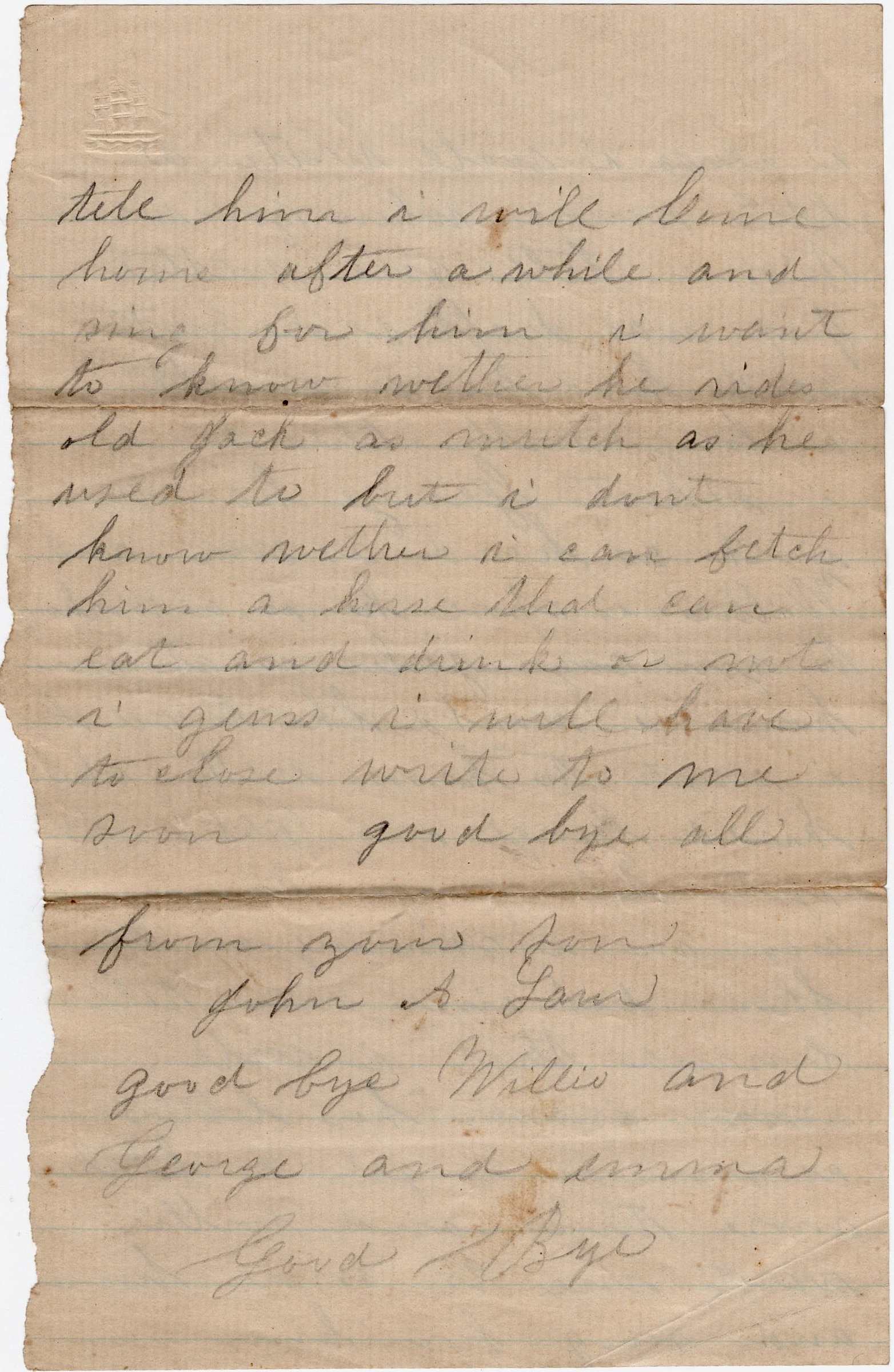
I guess I will write a little more. When you write, tell me whether Pap was drafted or not and how he is a getting along with the work. I expect George has to work as hard as ever and Willie I suppose he is a working too. You say Julie is at our house. I would like to know whether she kissed George and Willie or not. Tell George that I was in a swimming in the Shenandooah River once. Tell Emma that I will answer her letter as soon as I get a little more time. And Willie wants me to come home and sing for him? Tell him I will come home after awhile and sing for him. I want to know whether he rides Old Jack as much as he used to but I don’t know whether I can fetch him a horse that can eat and drink or not.
I guess I will have to close. Write to me soon. Goodbye all. From your son, — John A. Laur
Goodbye Willie and George and Emma. Goodbye.
Letter 9
Camp near Berryville, Virginia September 17, 1864
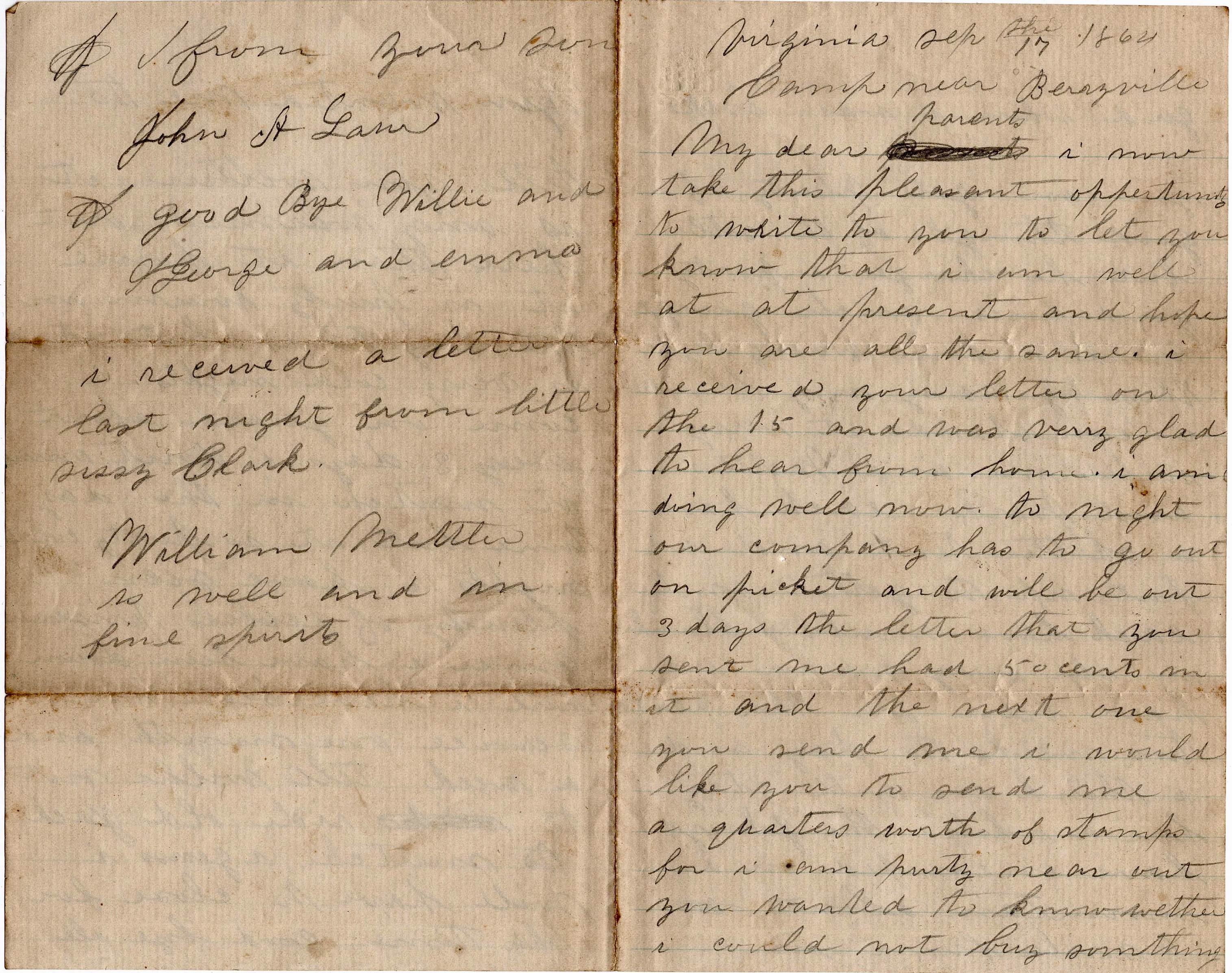
My dear parents,
I now take this pleasant opportunity to write to you to let you know that I am well at at present and hope you are all the same. I received your letter on the 15th and was very glad to hear from home. I am doing well now. Tonight our company has to go out on picket and will be out 3 days.
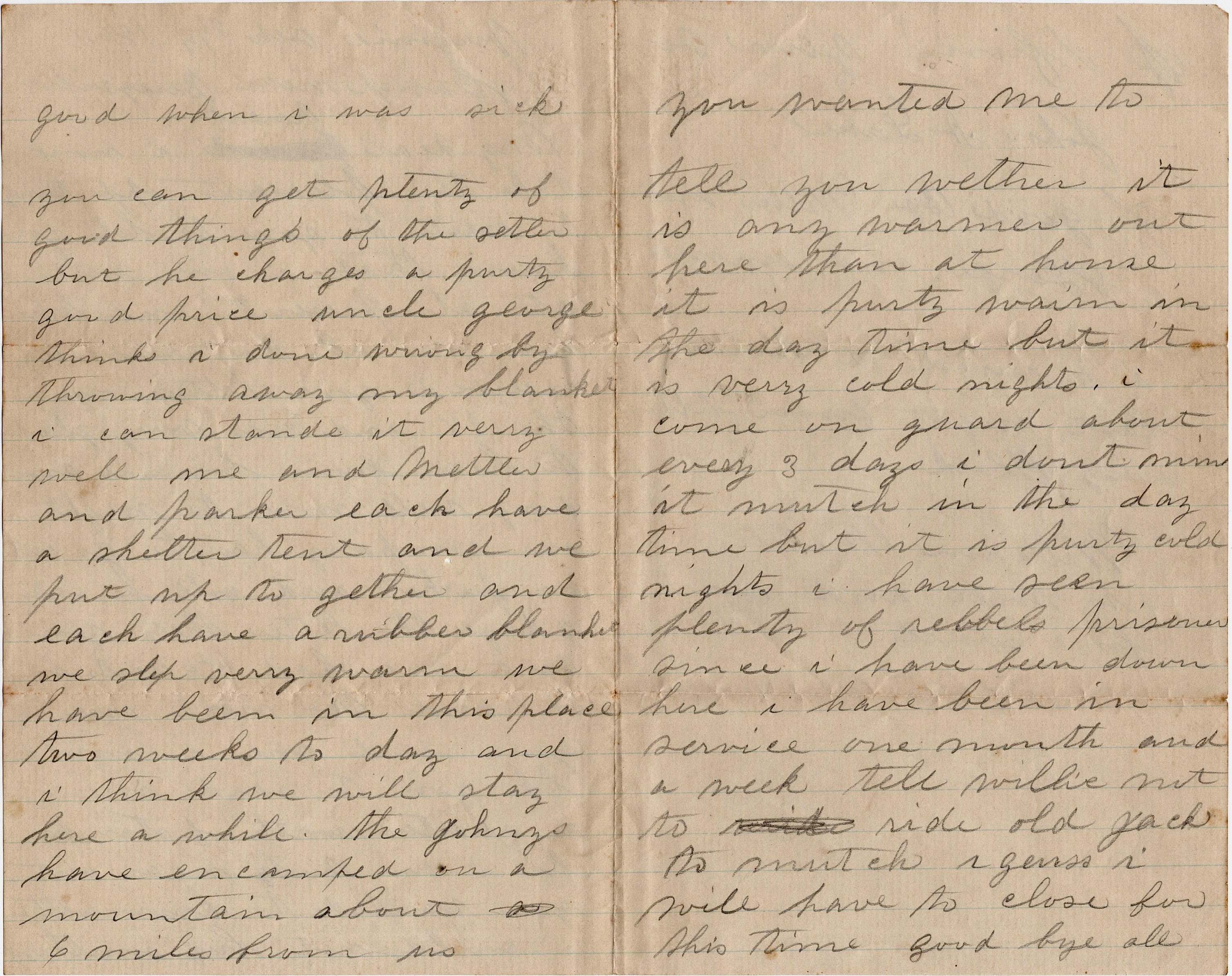
The letter that you sent me had 50 cents in it and the next one you send me I would like you to send me a quarter’s worth of stamps for I am purty near out. You wanted to know whether I could not buy something good when I was sick. You can get plenty of good things of the sutler but he charges a purty good price. Uncle George thinks I done wrong by throwing away my blanket. I can stand it very well. Me and [William] Mettler and [Jacob] Parker each have a shelter tent and we put up together and each have a rubber blanket. We sleep very warm.
We have been in this place two weeks today and I think we will stay a while. The Johnnys have encamped on a mountain about 6 miles from us.
You wanted me to tell you whether it is any warmer out here than at home. It is purty warm in the day time but it is very cold nights. I come on guard about every 3 days. I don’t mind it mutch in the daytime but it is purty cold nights. I have seen plenty of rebel prisoners since I have been down here. I have been in the service one month and a week. Tell Willie not to ride old Jack too much. I guess I will have to close for this time. Goodbye all. From your son, — John A Laur
Goodbye Willie and George and Emma. I received a letter last night from little sissy Clark. William Mettler is well and in fine spirits.
Letter 10
Martinsburg Hospital [Sometime early October, 1864?]
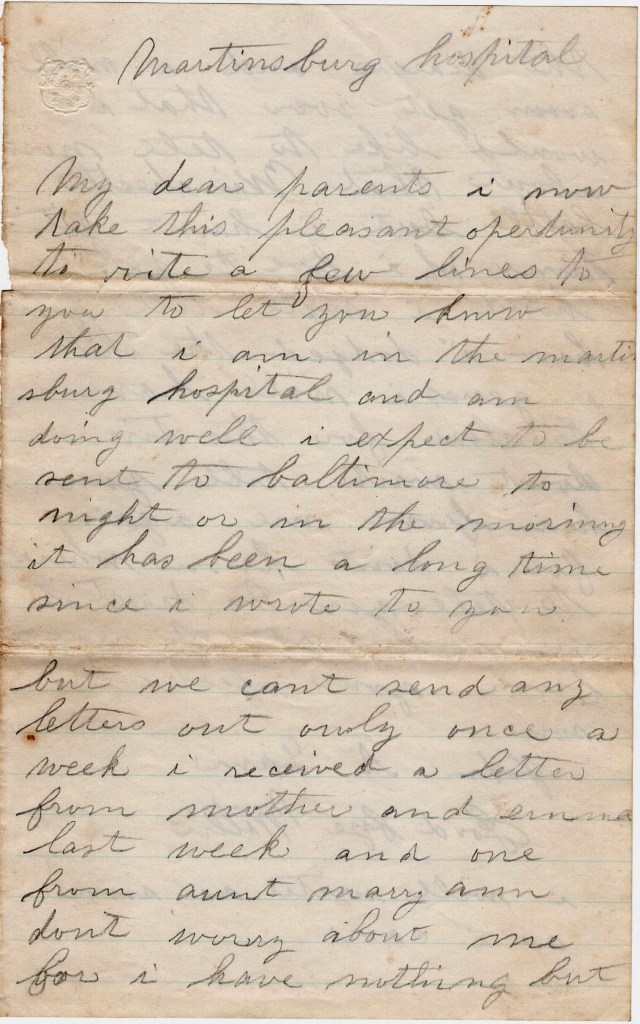
My dear parents,
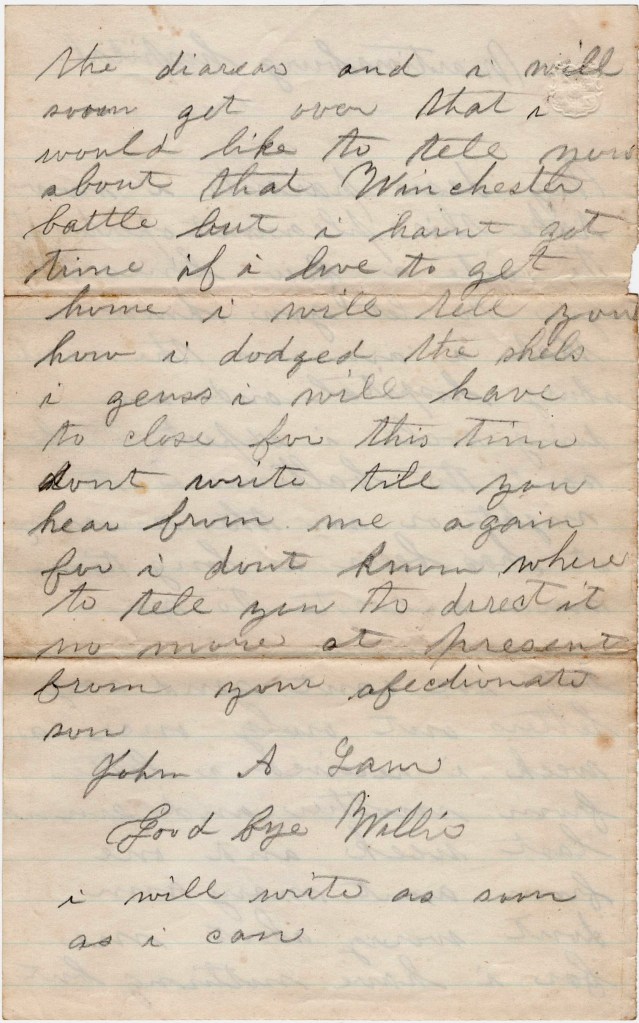
I now take this pleasant opportunity to write a few lines to you to let you know that I am in the Martinsburg Hospital and am doing well. I expect to be sent to Baltimore tonight or in the morning. It has been a long time since I wrote to you but we can’t send any letters out—only once a week. I received a letter from Mother and Emma last week and one from Aunt Mary Ann. Don’t worry about me for I have nothing but the diarrhea and I will soon get over that.
I would like to tell you about that Winchester battle but I hain’t got time. If I live to get home, I will tell you how I dodged the shells. I guess I will have to close for this time. Don’t write till you hear from me again for I don’t know where to tell you to direct it. No more at present. From your affectionate son, — John A Laur
Goodbye. Willie, I will write as soon as I can.
Letter 11
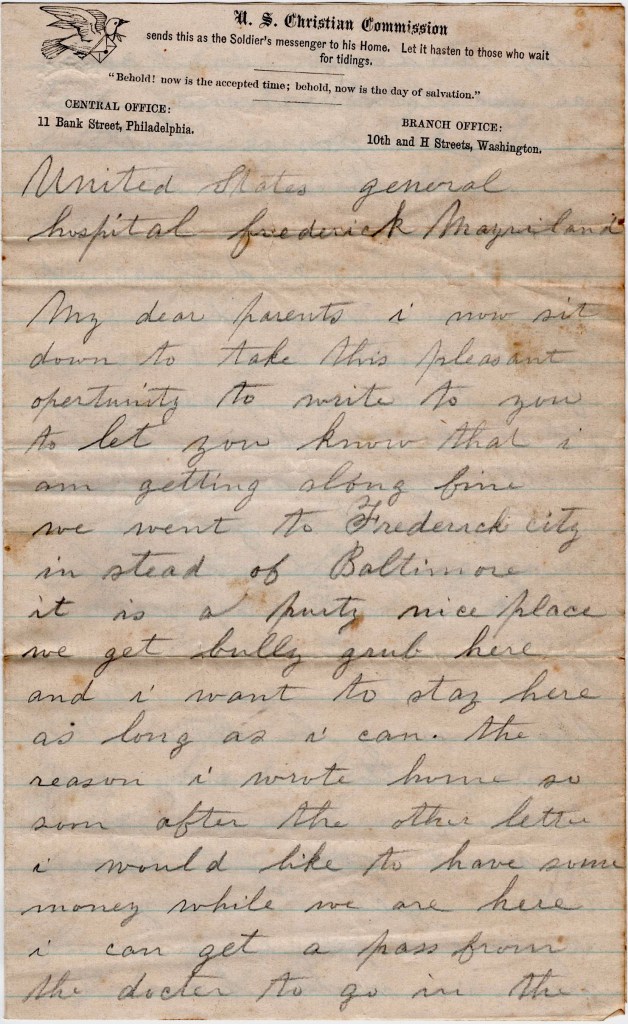
United States General Hospital Frederick, Maryland
My dear parents,
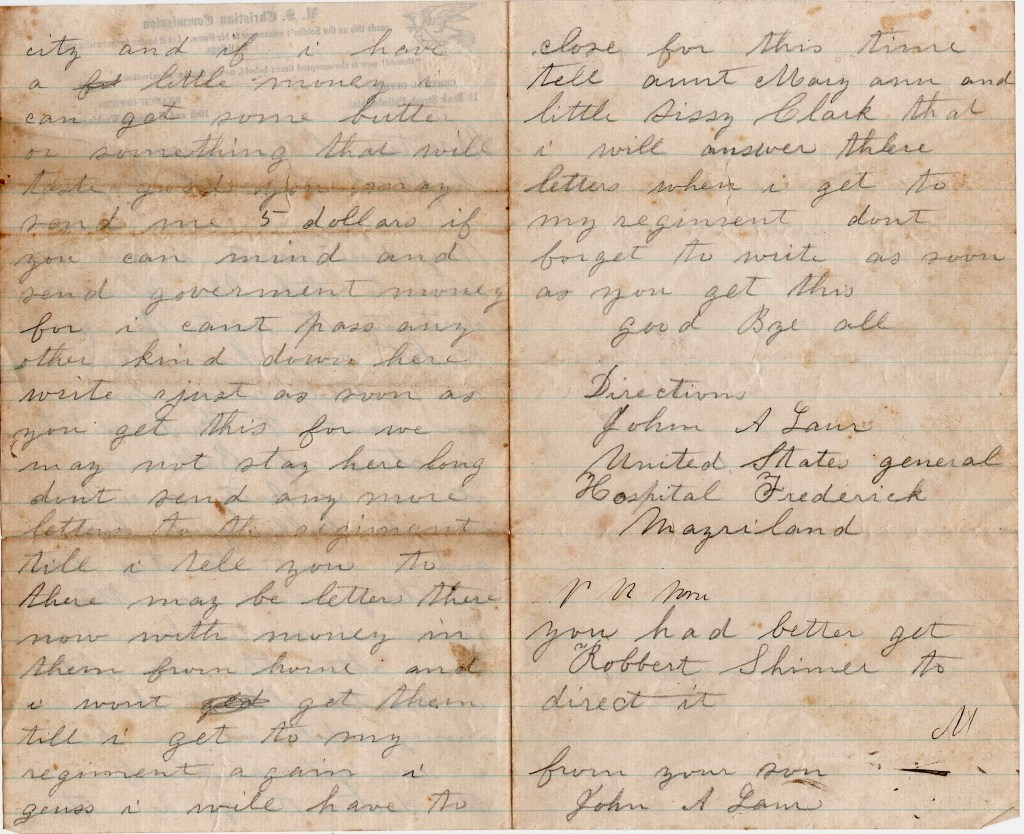
I now sit down to take this pleasant opportunity to write you to let you know that I am getting along fine. We went to Frederick City instead of Baltimore. It is a purty nice place and I want to stay here as long as I can. The reason I write home so soon after the other letter, I would like to have some money while we are here. I can get a pass from the doctor to go in the city and if I have a little money, I can get some butter or something that will taste good. You may send me 5 dollars if you can. Mind and send [only] government money for I can’t pass any other kind down here. Write just as soon as you get this for we may not stay here long. Don’t send any more letters to the regiment till I tell you to. There may be letters there now with money in them from home and I won’t get them till I get to my regiment again.
I guess I will have to close for this time. Tell Aunt Mary Ann and little Sissy Clark that I will answer their letters when I get to my regiment. Don’t forget to write as soon as you get this. Goodbye all. Directions: John A. Laur, United States General Hospital, Frederick Maryland. You had better get Robert Shimer to direct it. From your son, — John A Laur
Letter 12
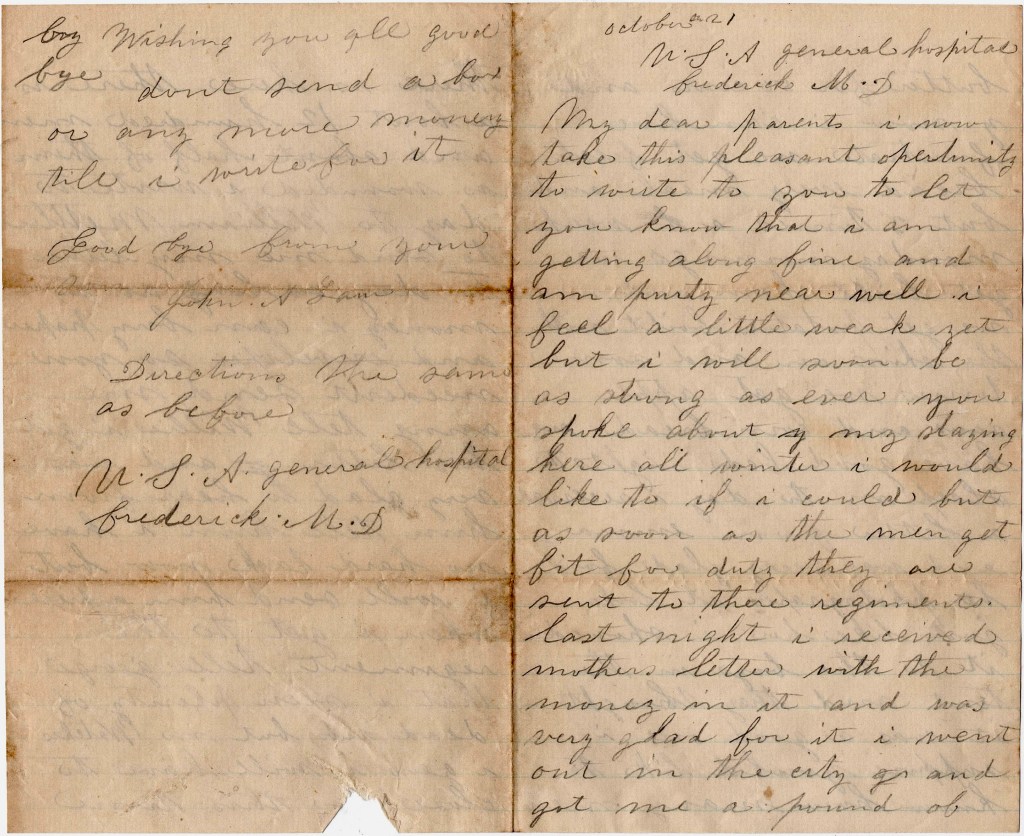
U. S. A. General Hospital Frederick, Maryland October 21, 1864
My dear parents,
I now take this pleasant opportunity to write to you to let you know that I am getting along fine and am purty near well. I feel a little weak yet but I will soon be as strong as ever. You spoke about my staying here all winter. I would like to if I could but as soon as the men get fit for duty, they are sent to their regiments.
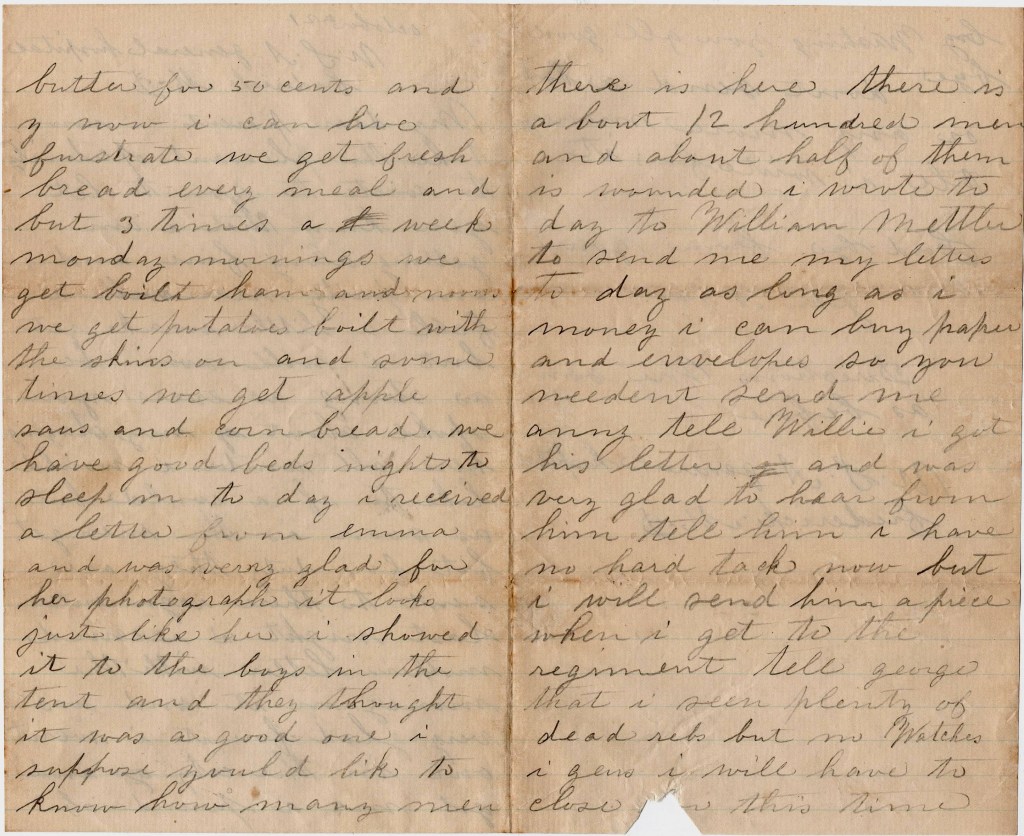
Last night I received mother’s letter with the money in it and was very glad for it. I went out in the city and get me a pound of butter for 50 cents and now I can live first rate. We get fresh bread every meal and but 3 times a week Monday mornings we get boiled ham and now we get potatoes boiled with the skins on, and sometimes we get apple sauce and corn bread. We have good beds nights to sleep in.
Today I received a letter from Emma and was very glad for her photograph. It looks just like her. I showed it to the boys in the tent and they thought it was a good one.
I suppose would like to know how many men there is here. There is about 12 hundred men and about half of them is wounded. I wrote today to William Mettler to send me my letters today. As long as I [have] money I can buy paper and envelopes, so you needn’t send me any. Tell Willie I got his letter and was very glad to hear from him. Tell him I have no hard tack now but I will send him a piece when I get to the regiment. Tell George that I seen plenty of dead rebs but no watches. I guess I will have to close this time by wishing you all goodbye. Don’t send a box or any more money till I write for it. Goodbye from your son, — John A. Laur
Directions the same as before: U.S.A. General Hospital, Frederick, MD
Letter 13
U.S.A. General Hospital, Frederick, Maryland October 29, 1864
My dear parents,
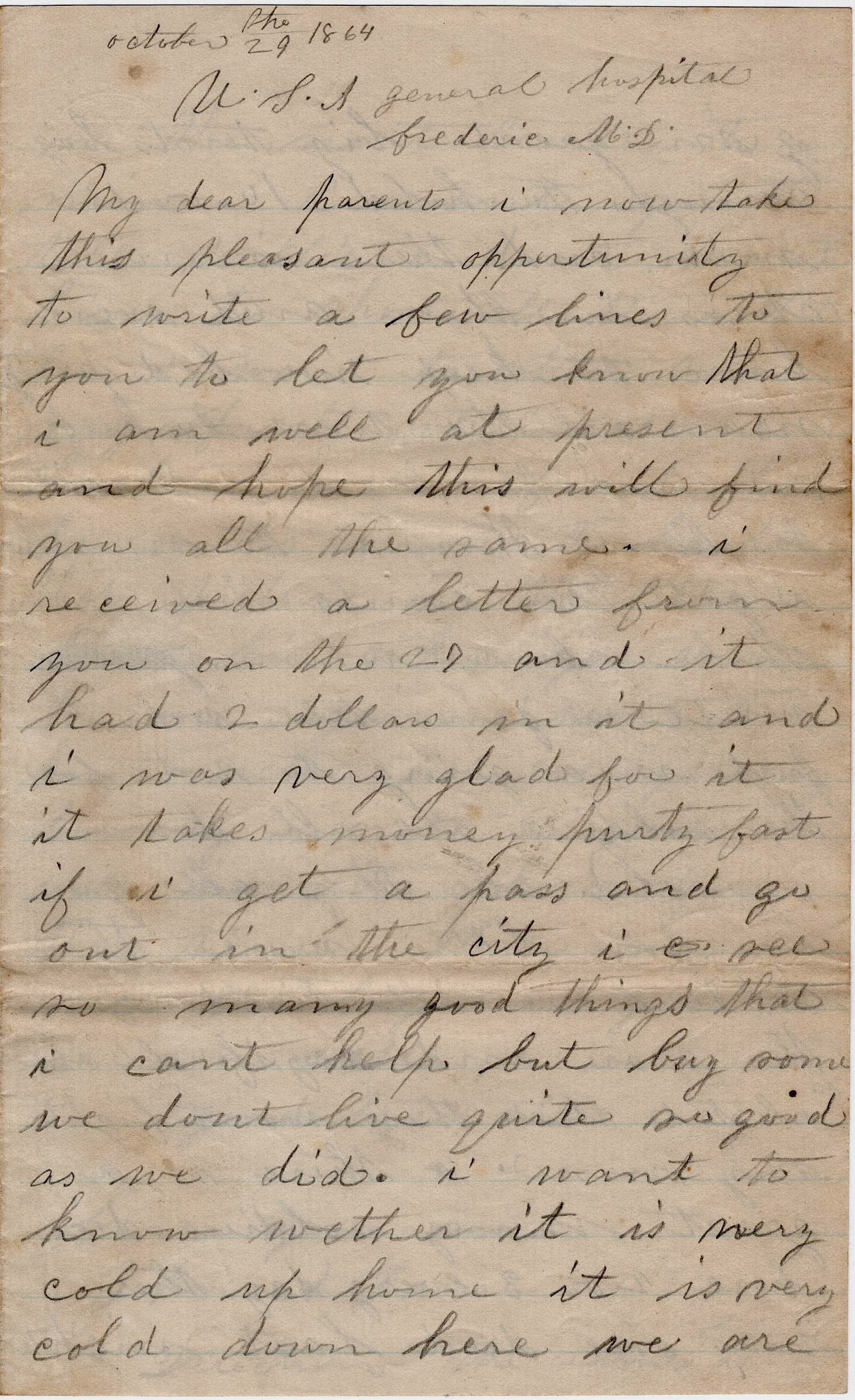
I now take this pleasant opportunity to write a few lines to you to let you know that I am well at present and hope this will find you all the same. I received a letter from you on the 27th and it had two dollars in it and I was very glad for it. It takes money purty fast if I get a pass and go out in the city [where] I see so many good things that I can’t help but buy some. We don’t live quite so good as we did.
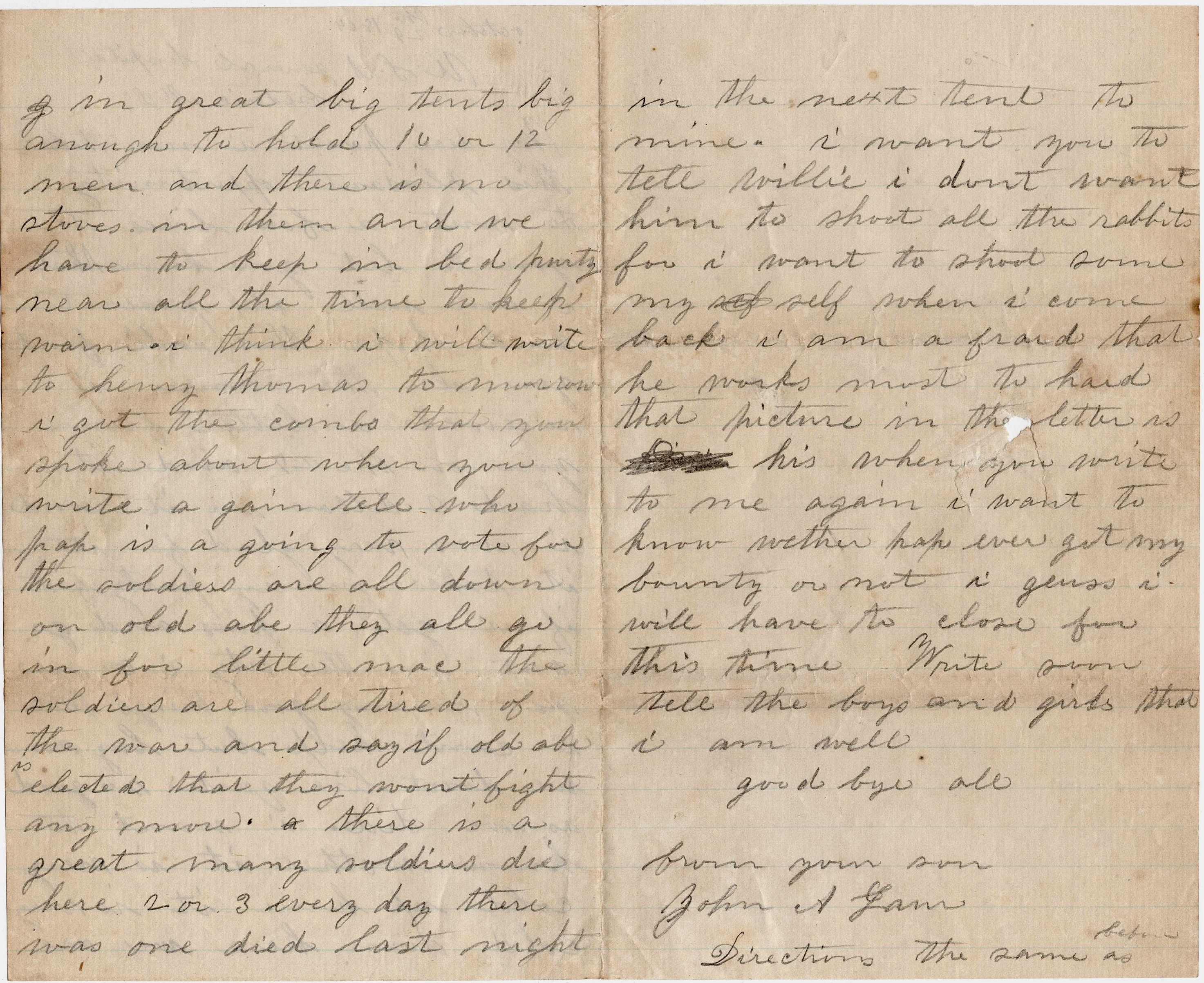
I want to know whether it is very cold up home. It is very cold down here. We are in great big tents—big enough to hold 10 or 12 men—and there is no stoves in them and we have to keep in bed purty near all the time to keep warm. I think I will write to Henry Thomas tomorrow. I got the combs that you spoke about.
When you write again, tell who pap is going to vote for. The soldiers are all down on Old Abe. They all go in for Little Mac. The soldiers are all tired of the war and say if Old Abe is elected, that they won’t fight any more. There is a great many soldiers die here—two or three every day. There was one died last night in the next tent to mine.
I want you to tell Willie I dont want him to shoot all the rabbits for I want to shoot some myself when I come back. I am afraid that he works most too hard. That picture in the letter is his. When you write to me again, I want to know whether pap ever got my bounty or not. I guess I will have to close for this time. Write soon. Tell the boys and girls I am well. Goodbye all. From your son, — John A. Laur Directions the same as before.
Letter 14
US General Hospital Frederick, Maryland November 19, 1864
My dear parents,
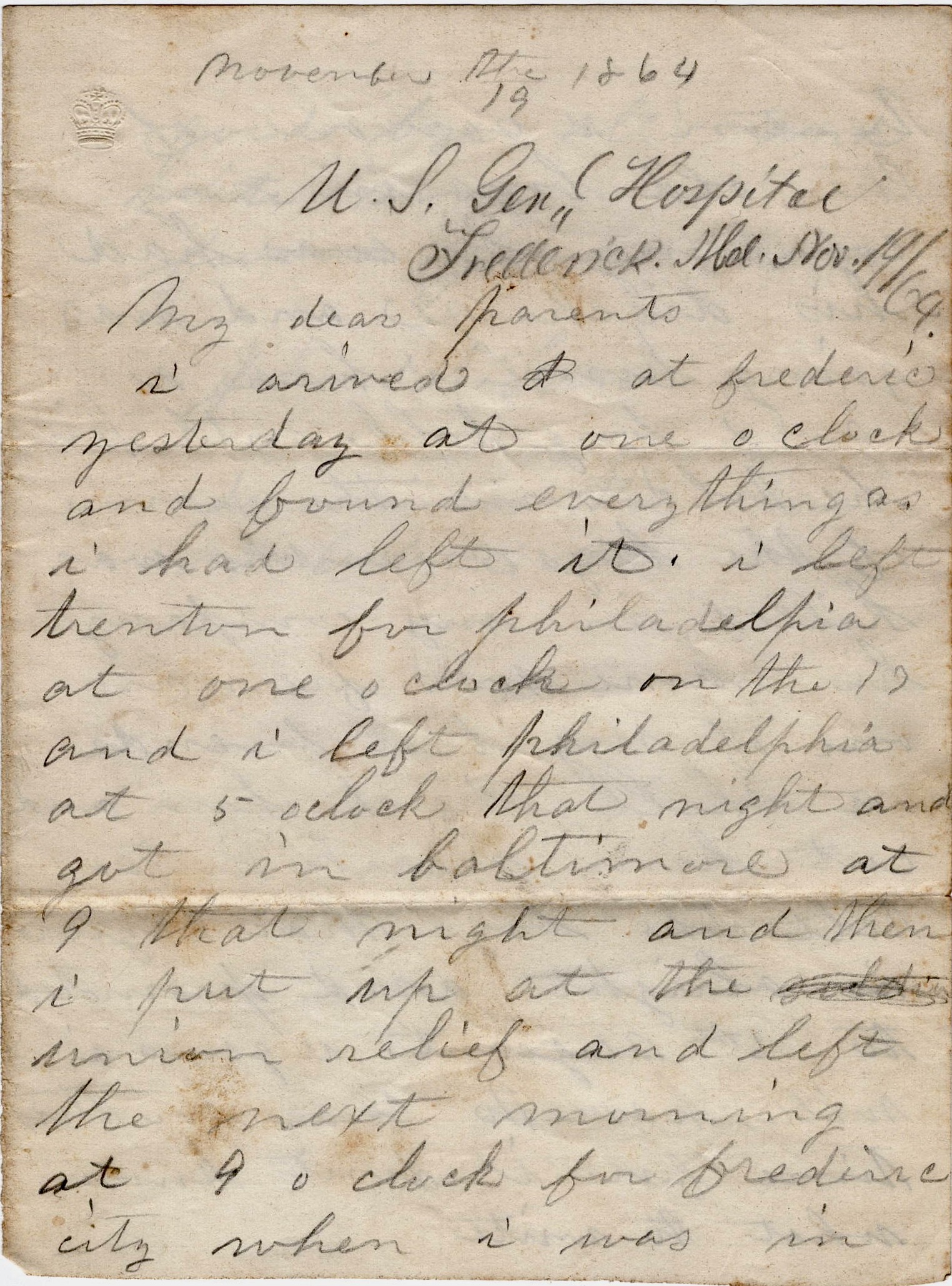
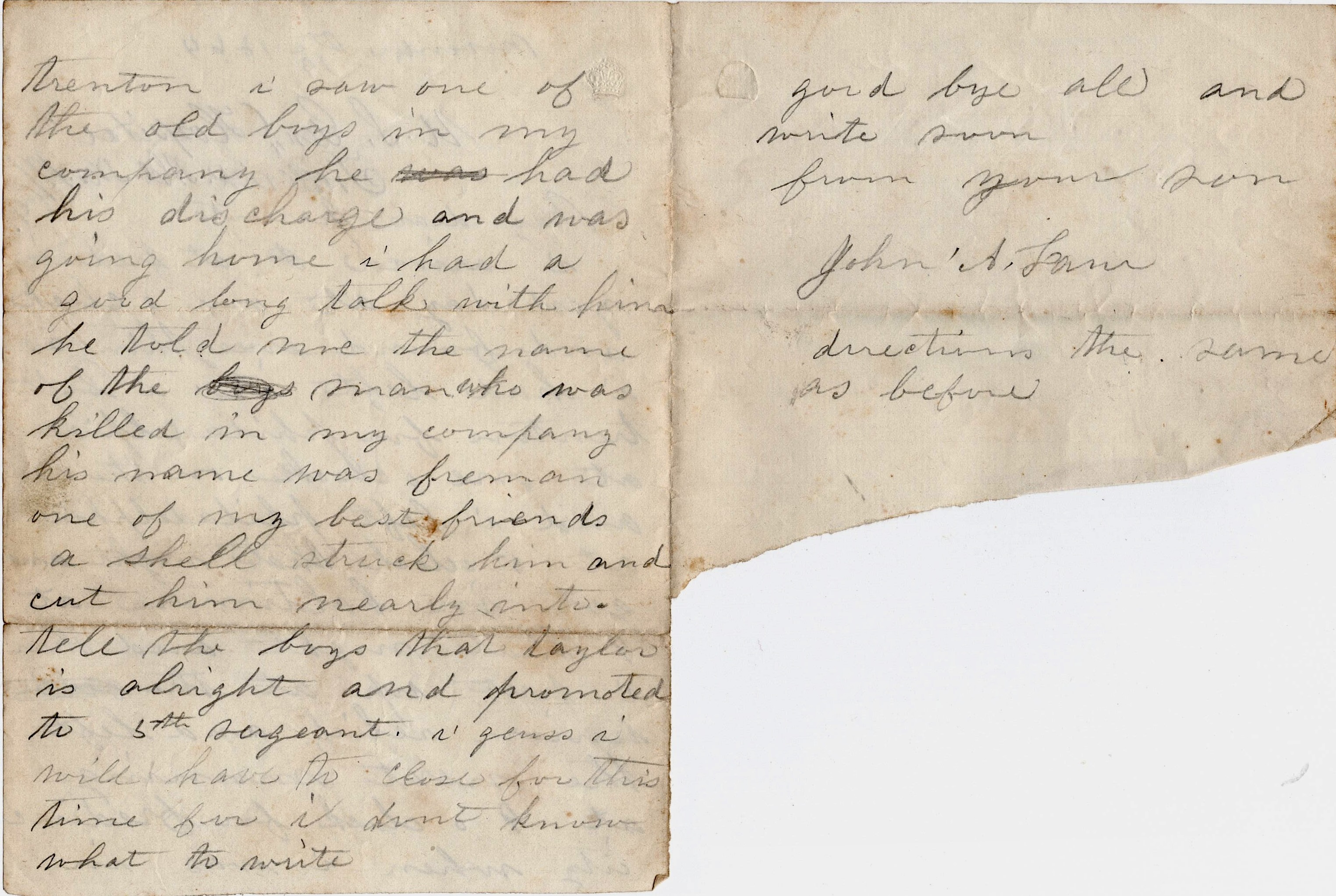
I arrived at Frederick yesterday at one o’clock and found everything as I had left it. I left Trenton for Philadelphia at one o’clock on the 17th and I left Philadelphia at 5 o’clock that night and got in Baltimore at 9 that night. And then I put up at the Union Relief and left the next morning at 9 o’clock for Frederick City. When I was in Trenton, I saw one of the old boys in my company. He had his discharge and was going home. I had a good long talk with him. He told me the name of the man who was killed in my company. His name was [Francis] Freeman—one of my best friends. A shell struck him and cut him nearly in two. 1
Tell the boys that Taylor is alright and promoted to 5th Sergeant. I guess I will have to close for this time for I don’t know what to write. Goodbye all and write soon. Your son, — John A. Laur
Directions the same as before.
1 Francis (“Frank”) H. Freeman was killed at the Battle of Cedar Creek on 19 October 1864. His illiterate wife, Hannah E. (Allen) Freeman, age 18, filed for a Widow’s Pension, claiming they were married on 14 January 1864 in Camden county, N. J. when she was 16 years old. The pension record states that Frank was “wounded in the bowels.” Curiously,Frank’s mother made an application for a “Dependent Mother Pension” claiming that Frank was never married even though Frank’s wife was living with her at the time of his death. An investigator from the Pension Office finally ruled in favor of the widow. Frank’s parent’s names were Charles Freeman and Mary B. Burt. Mary claimed that Frank’s father “ran away with another girl before Frank was four and never saw his father but once afterward.”
Letter 15
[Late November 1864]
My dear parents,
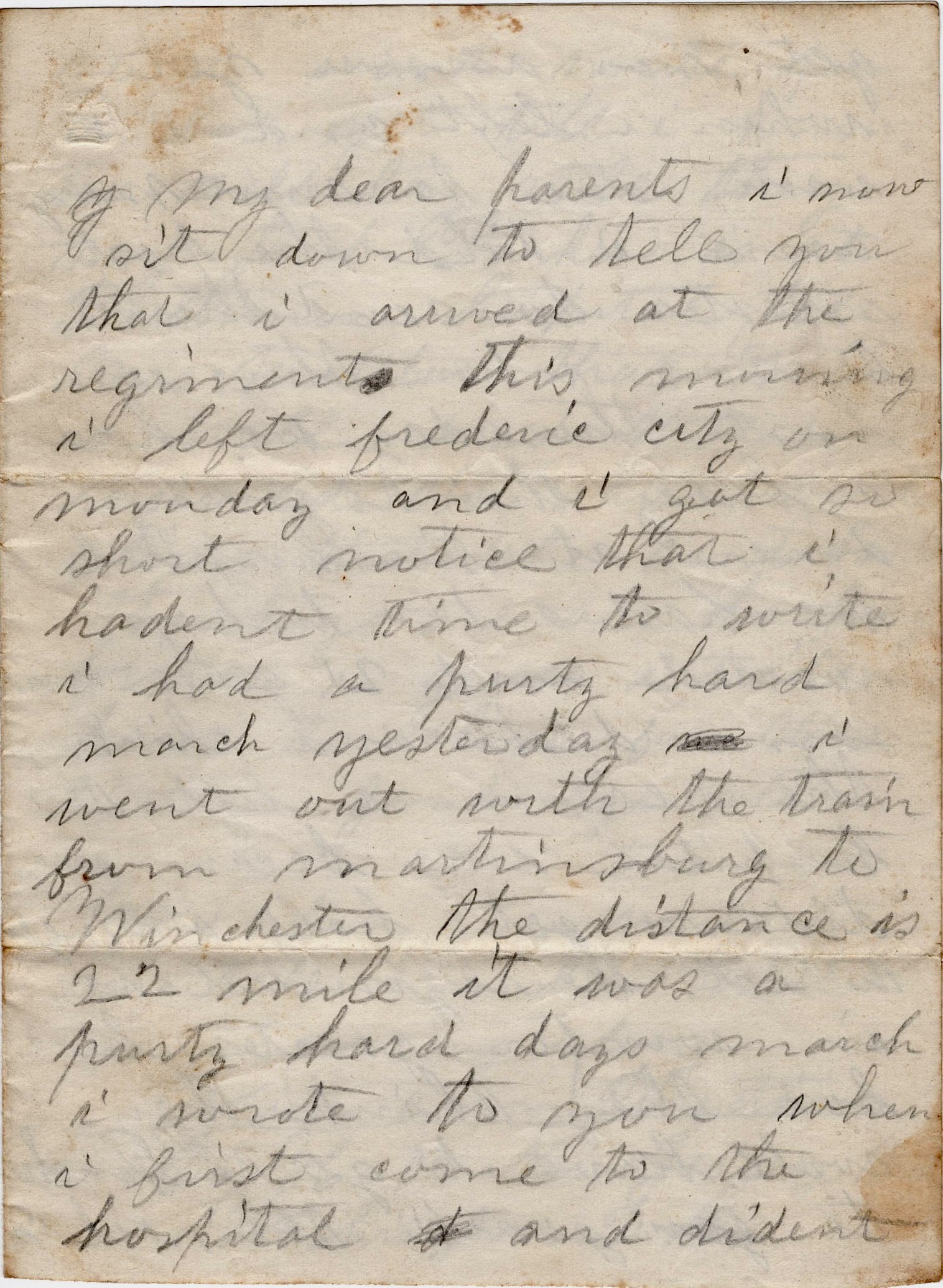
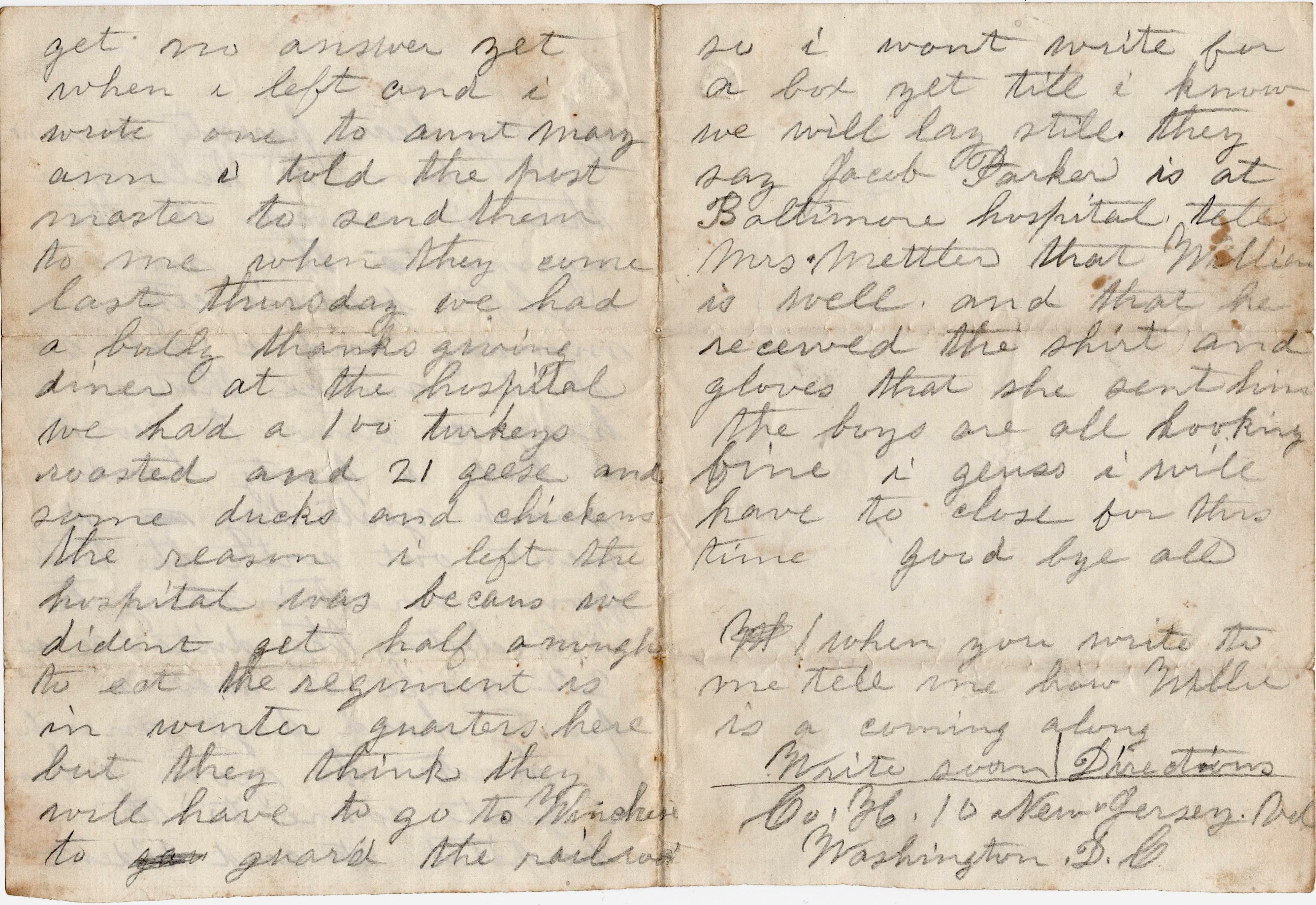
I now sit down to tell you that I arrived at the regiment this morning. I left Frederick City on Monday and I got so short notice that I hadn’t time to write. I had a purty hard march yesterday. I went out with the train from Martinsburg to Winchester. The distance is 22 miles. It was a purty hard day’s march. I wrote to you when I first come to the hospital and didn’t get no answer yet when I left and I wrote one to Aunt Mary Ann. I told the postmaster to send them to me when they come.
Last Thursday we had a bully Thanksgiving dinner at the hospital. We had 100 turkeys roasted and 21 geese and some ducks and chickens. The reason I left the hospital was because we didn’t get half anough to eat. The regiment is in winter quarters here but they think they will have to go to Winchester to guard the railroad so I won’t write for a box yet till I know we will lay still.
They say Jacob Parker is at Baltimore hospital. Tell Mrs. Mettler that William is well and that he received the shirt and gloves that she sent him. The boys are all looking fine. I guess I will have to close for this time. Goodbye all. When you write to me, tell me how Willie is a coming along. Write soon. Directions: Co. H. 10 New Jersey Vol., Washington DC
Letter 16
Camp near Petersburg December 7, 1864
My dear parents,
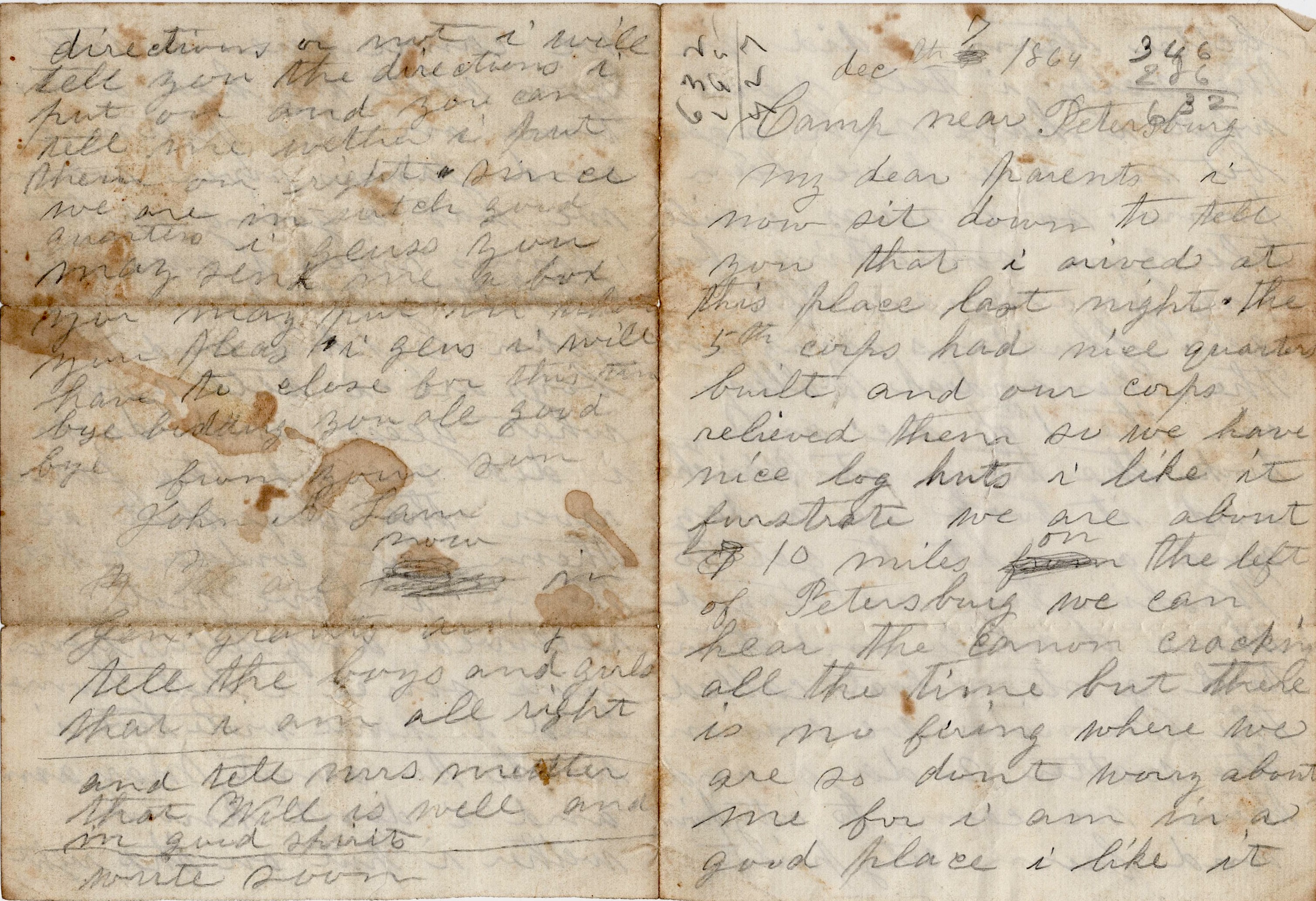
I now sit down to tell you that I arrived at this place last night. The 5th Corps had nice quarters built and our corps relieved them so we have nice log huts. I like it first rate. We are about 10 miles on the left of Petersburg. We can hear the cannon cracking all the time but there is no firing where we are so don’t worry about me for I am in a good place. I like it better than I did in the Valley. I tell you what, I have seen a good bit since I have been home.
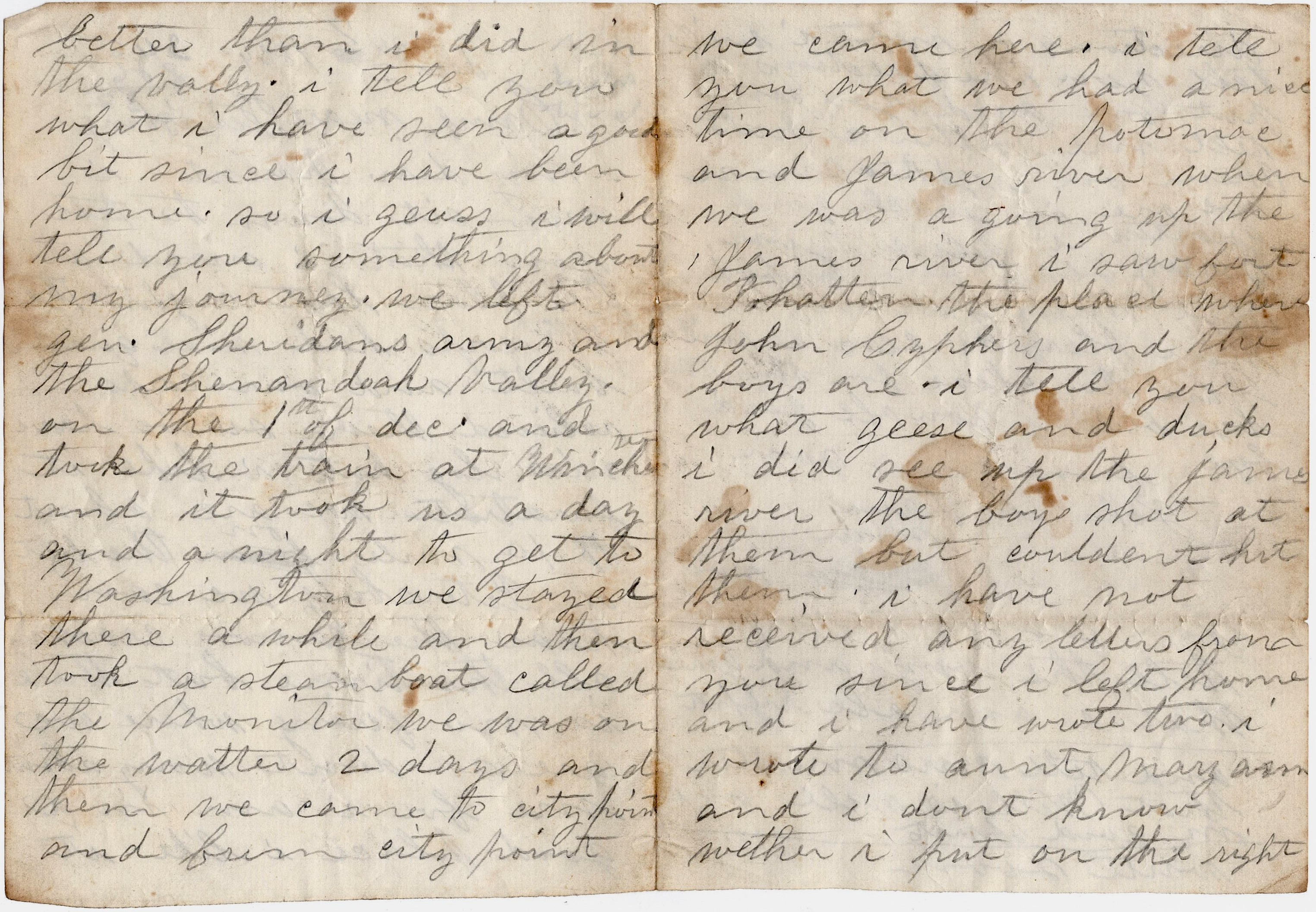
So I guess I will tell you something about my journey. We left Gen. Sheridan’s army and the Shenandoah Valley on the 1st of December and took the train at Winchester and it took us a day and a night to get to Washington. We stayed there a while and then took a steamboat called the Monitor. We was on the water two days and then we came to City Point and from City Point we came here. I tell you what, we had a nice time on the Potomac and James river. When we was a going up the James river, I saw Fort Pohattan—the place where John Cyphers and the boys are. I tell you what geese and ducks I did see up the James river. The boys shot at them but couldn’t hit them.
I have not received any letters from you since I left home and I have wrote two. I wrote to Aunt Mary Ann and I dont know whether I put on the right directions or not. I will tell you the directions I put on and you can tell me whether I put them on right. Since we are in such good quarters, I guess you may send me a box. You may put in what you please. I guess I will have to close for this time by bidding you all goodbye. From your son, John A. Laur
We are now in Gen. Grant’s army. Tell the boys and girls that I am all right and tell Mrs. Mettler that Will is well and in good spirits. Write soon.
Letter 17
Camp near Petersburg December 12, 1864
My dear parents,
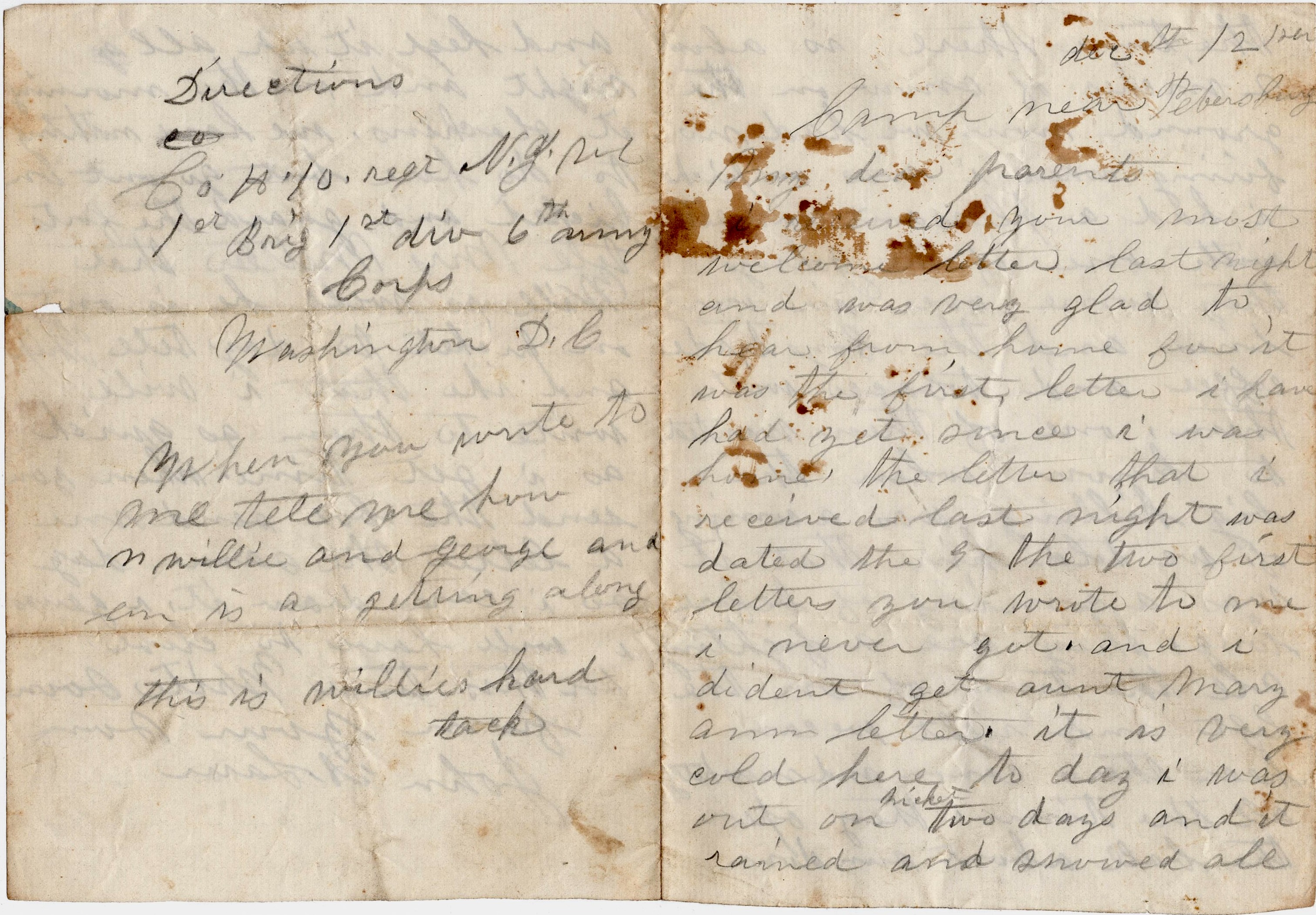
I received you most welcome letter last night and was very glad to hear from home for it was the first letter I have had yet since I was home [on furlough]. The letter that I received last night was date the 9th. The two first letters you wrote to me, I never got and I didn’t get Aunt Mary Ann’s letter [either].
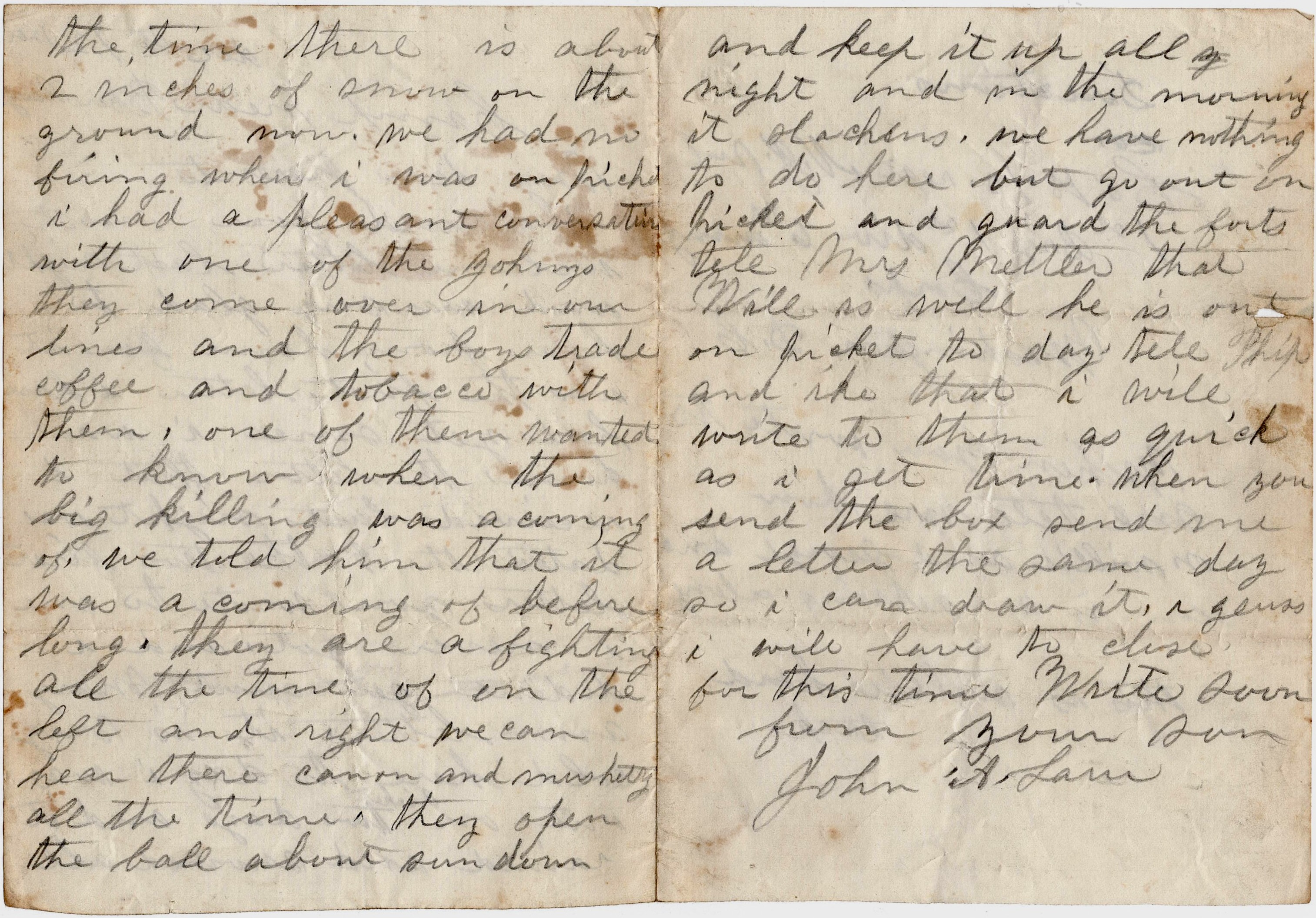
It is very cold here today. I was out on picket two days and it rained and snowed all the time. There is about 2 inches of snow on the ground now. We had no firing when I was on picket. I had a pleasant conversation with one of the Johnnys. They come over in our lines and the boys trade coffee and tobacco with them. One of them wanted to know when the big killing was a coming off. We told him that it was a coming off before long. They are a fighting all the time off on the left and right. We can hear their cannon and musketry all the time. They open the ball about sundown and keep it up all night and in the morning it slackens.
We have nothing to do here but go out on picket and guard the forts. Tell Mrs. Mettler that Will is well. He is out on picket today. Tell Phip and Ike that I will write to them as quick as I get time. When you send the box, send me a letter the same day so I can draw it. I guess I will have to close for this time. Write soon. From your son, — John A. Laur
Directions: Co. H, 10 Regt. N. J. Vol., 1st Brig., 1st Div., 6th Army Corps, Washington DC. When you write to me, tell me how Willie and George and Em is a getting along. This is Willie’s hard tack.
Letter 18
Camp near Petersburg December 19, 1864
My dear parents,
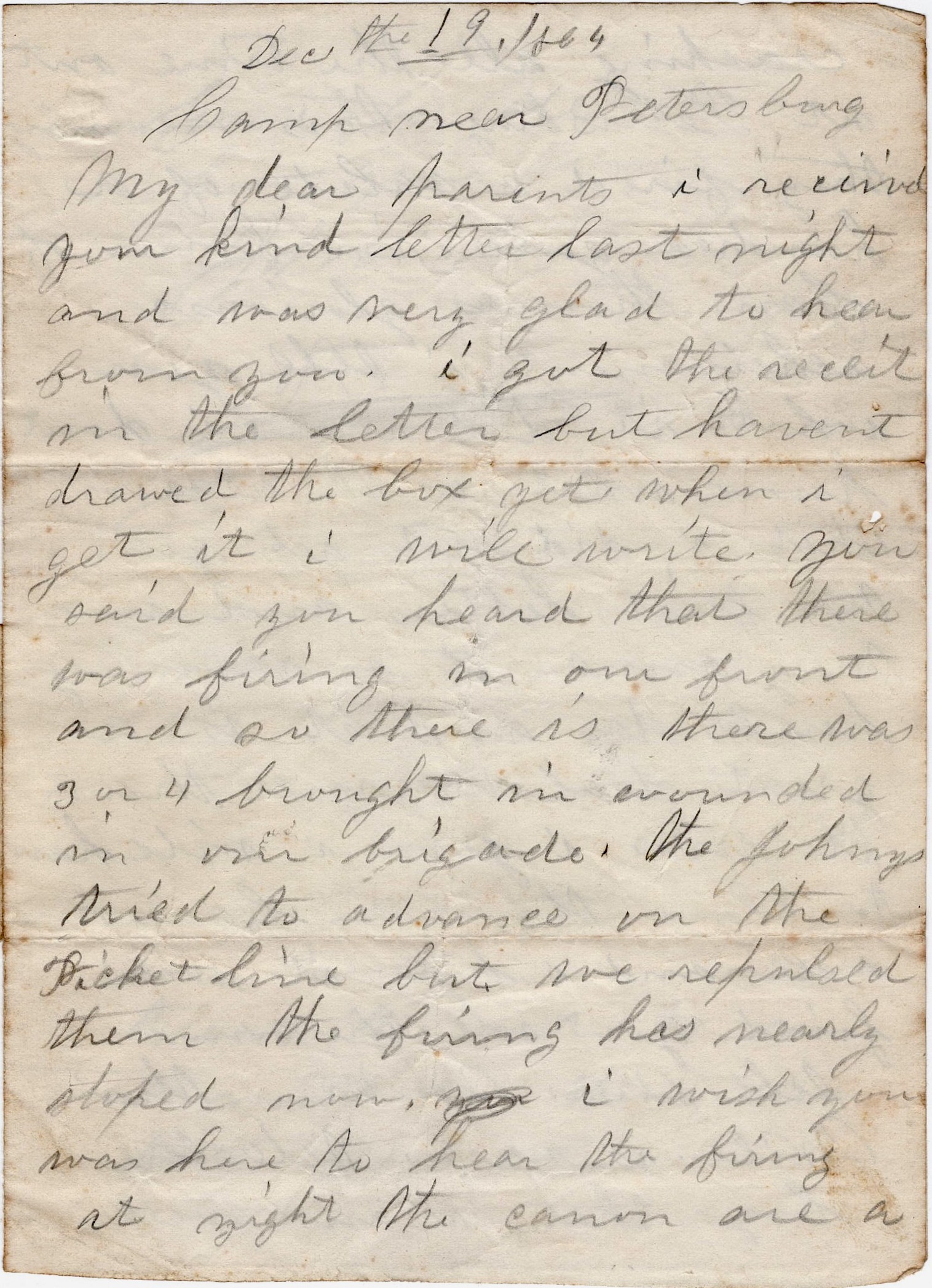
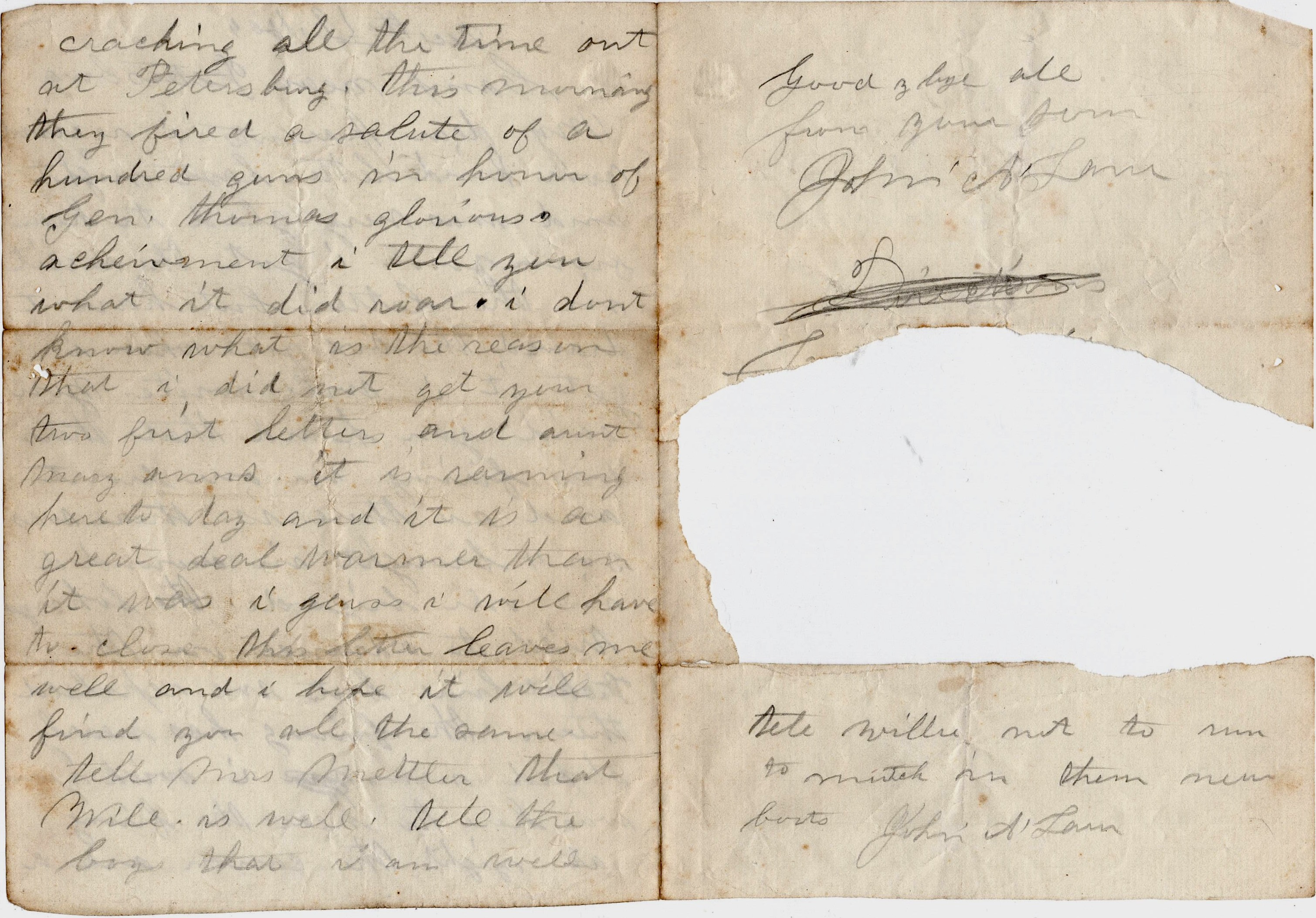
I received your kind letter last night and was very glad to hear from you. I got the receipt in the letter but haven’t drawed the box yet. When I get it, I will write you. You said you heard that there was firing in our front and so there is. There was 3 or 4 brought in wounded in our brigade. The Johnnys tried to advance on the picket line but we repulsed them. The firing has nearly stopped now. I wish you was here to hear the firing at night. The cannon are a cracking all the time out at Petersburg. This morning they fired a salute of a hundred guns in honor of Gen. Thomas’s glorious achievement. I tell you what, it did roar.
I don’t know what is the reason that I did not get your two first letters and Aunt Mary Ann’s. It was raining here today and it is a great deal warmer than it was. I will have to close. This letter leaves me well and I hope it will find you all the same. Tell Mrs. Mettler that Will is well. Tell the boys that I am well. Goodbye all, from your son — John A. Laur
Tell Willie not to run too much in them new boots. John A. Laur
Letter 19
Camp near Petersburg December 22, 1864
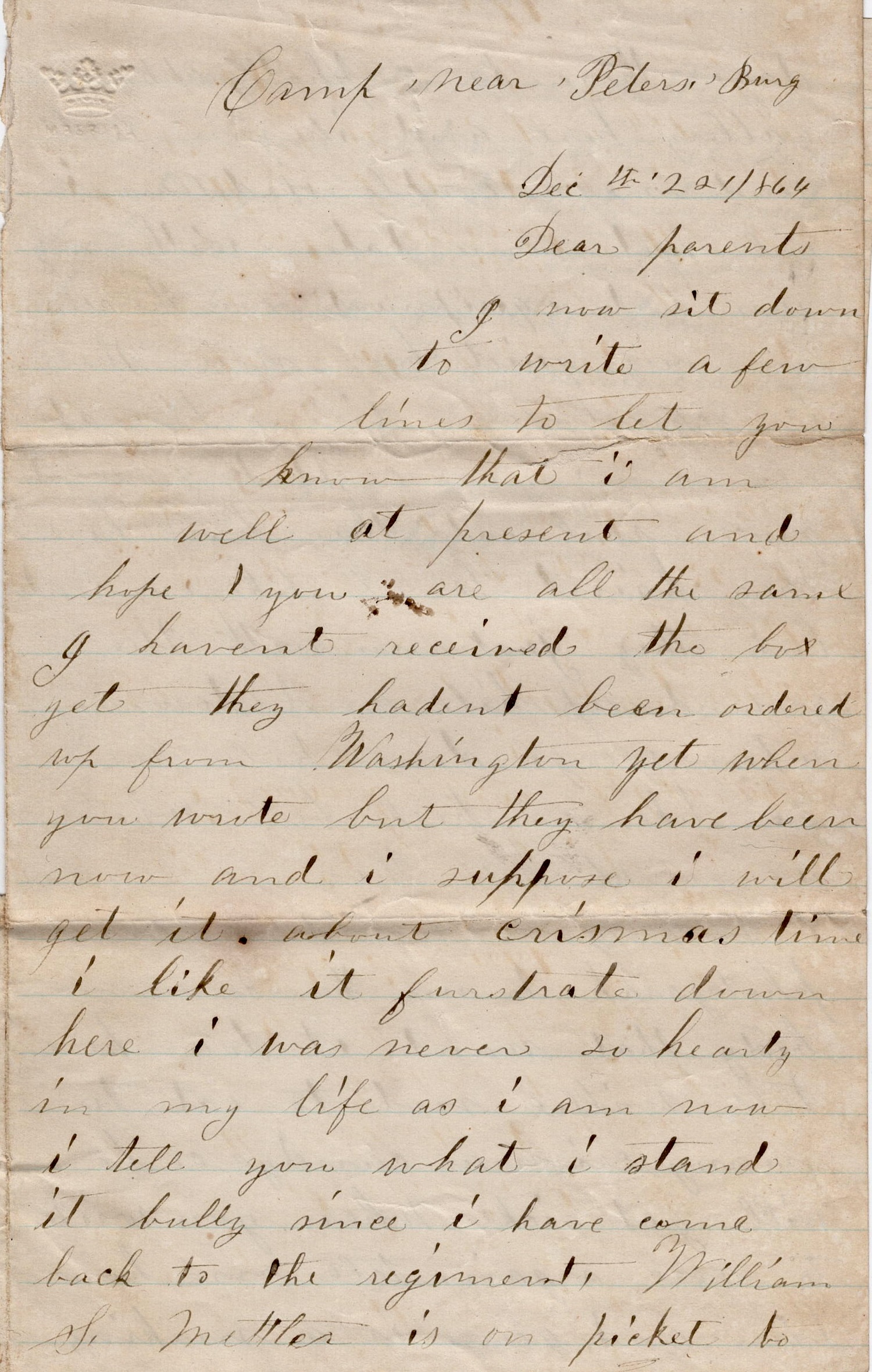
Dear parents,
I now sit down to write a few lines to let you know that I am well at present and hope you are all the same. I haven’t received the box yet. They hadn’t been ordered up from Washington yet when you wrote but they have been now and I suppose I will get it about Christmas time. I like it first rate down here. I was never so hearty in my life as I am now. I tell you what, I stand it bully since I have come back to the regiment.
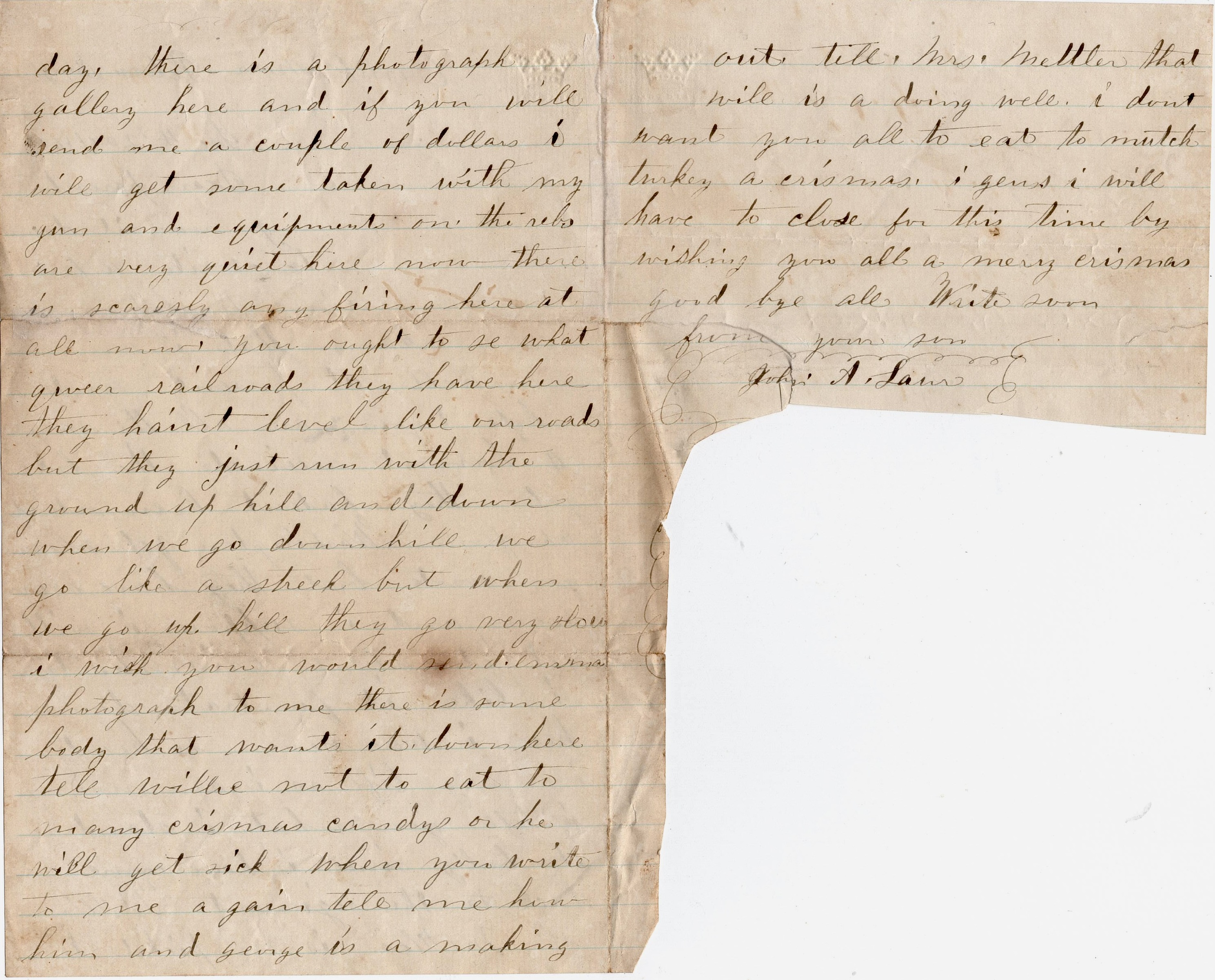
William S. Mettler is on picket today. There is a photograph gallery here and if you will send me a couple of dollars, I will get some taken with my gun and equipments on. The rebs are very quiet here now. There is scarcely any firing here at all now. You ought to see what queer railroads they have here. They hain’t like our roads but they just run with the ground, up hills and down. When we do down hill, we go like a streak. But when we go up hill, they go very slow. I wish you would send Emma’s photograph to me. There is somebody that wants it down here. Tell Willie not to eat too many Christmas candies or he will get sick. When you write to me again, tell me how him and George is a making out. Tell Mrs. Mettler that Will is a doing well. I dont want you all to eat too much turkey a Christmas. I guess I will have to close for this time by wishing you all a Merry Christmas. Goodbye all. Write soon. From your son, — John A. Laur
Letter 20
Camp near Petersburg December 25, 1864
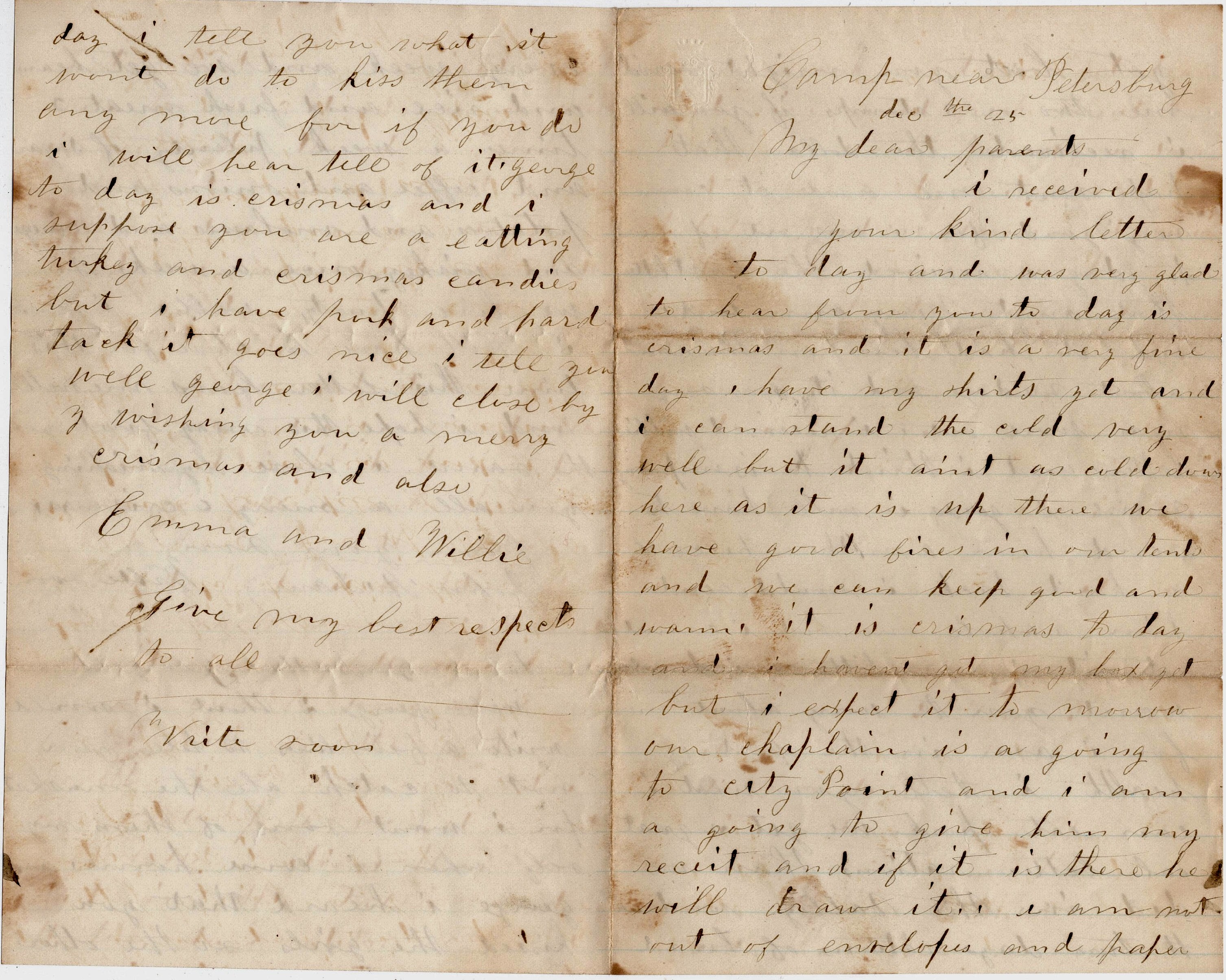
My dear parents,
I received your kind letter to day and was very glad to hear from you. Today is Christmas and it is a very fine day. I have my shirts yet and I can stand the cold very well but it ain’t as cold down here as it is up there. We have good fires in our tents and we can keep good and warm. It is Christmas today and I haven’t got my box yet but I expect it tomorrow. Our chaplain is a going to City Point and I am a going to give him my receipt and if it is there, he will draw it. I am not out of envelopes and paper yet but you might send me two or three stamps if you will. I received the dollar that pap sent me and it come very good for i was out of money.
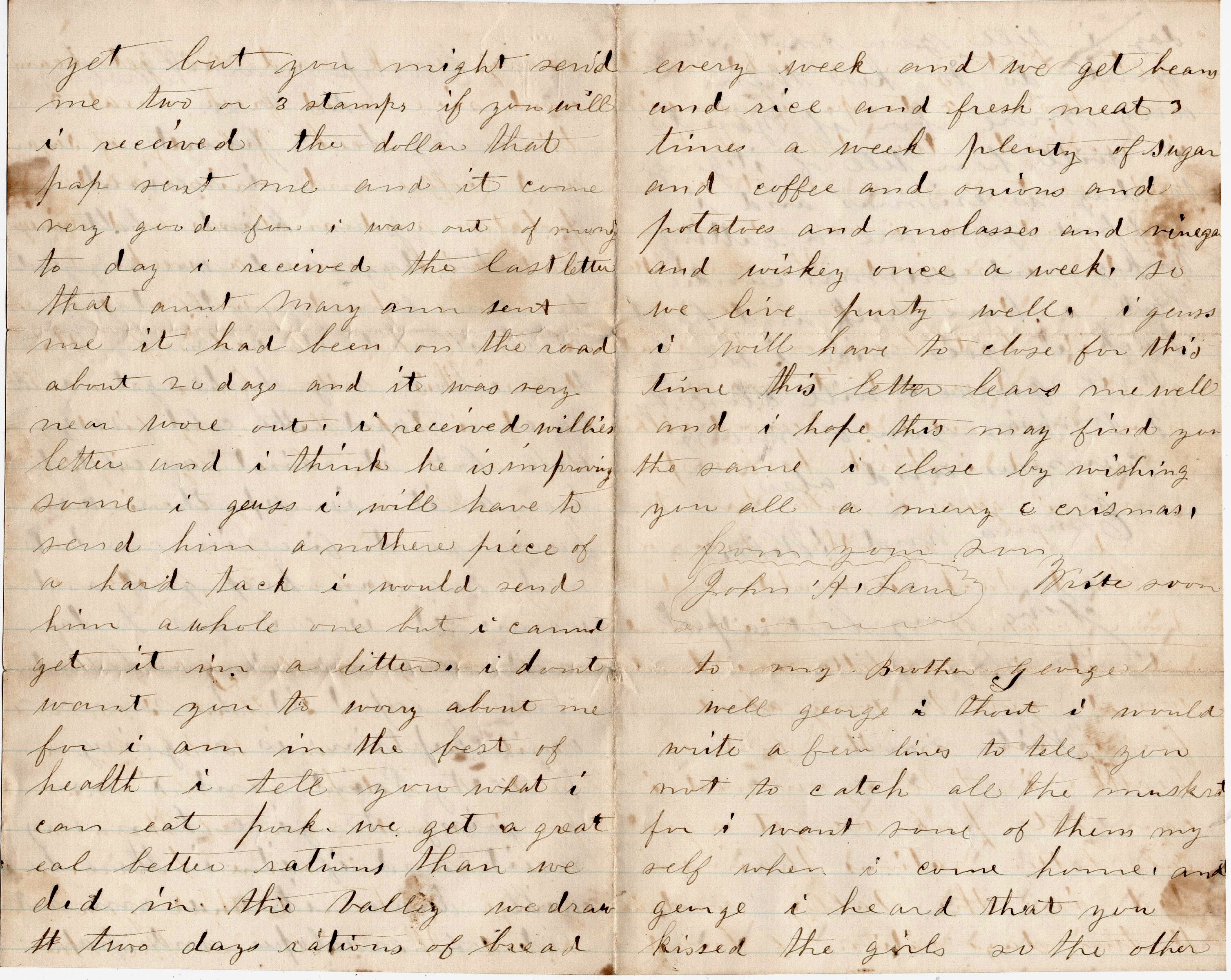
Today I received the last letter that Aunt Mary Ann sent me. It had been on the road about 20 days and it was very near worn out. I received Willie’s letter and I think he is improving some. I guess I will have to send him another piece of a hard tack. I would send him a whole one, but I cannot get it in a letter. I don’t want you to worry about me for I am in the best of health. I tell you what, I can eat pork. We get a great deal better rations than we did in the Valley. We draw two days rations of bread every week and we get beans and rice and fresh meat three times a week, plenty of sugar and coffee, and onions and potatoes and molasses and vinegar and whiskey once a week. So we live purty well.
I guess I will have to close for this time. This letter leaves me well and I hope this may find you the same. I close by wishing you all a Merry Christmas. From your son, — John A. Laur
Write soon.
To my brother George. Well George, I thought I would write a few lines to tell you not to catch all the muskrat for I want some of them myself when I come home. And George, I heard that you kissed the girls on the other day. I tell you what, it won’t do to kiss them anymore, for if you do, I will hear tell of it. George, today is Christmas and I suppose you are a eating turkey and Crristmas candies, but I have pork and hard tack. It goes nice, I tell you. Well, George, I will close by wishing you a Merry Christmas and also Emma and Willie. Give my best respects to all. Write soon.
Letter 21
Camp near Petersburg December 27, 1864
Dear Parents,
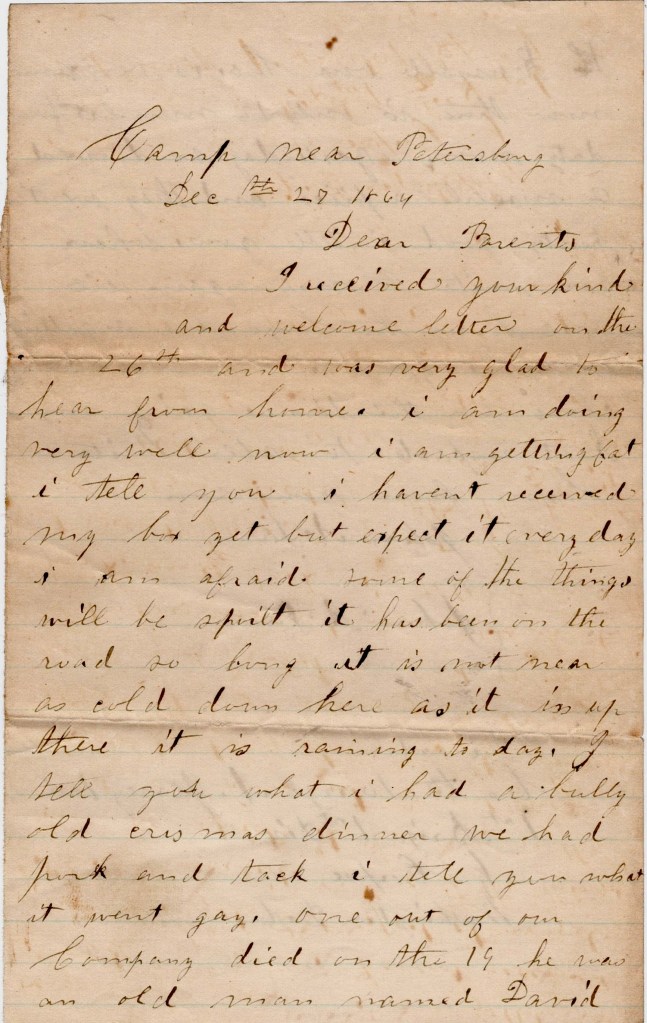
I received your kind and welcome letter on the 26th and was very glad to hear from home. I am doing very well now. I am getting fat, I tell you. I havent’ received my box yet but expect it everyday. I am afraid some of the things will be spoilt, it has been on the road so long. It is not near as cold down here as it is up there. It is raining today.
I tell you what, I had a bully old Christmas dinner. We had pork and tack. I tell you what, it went gay.
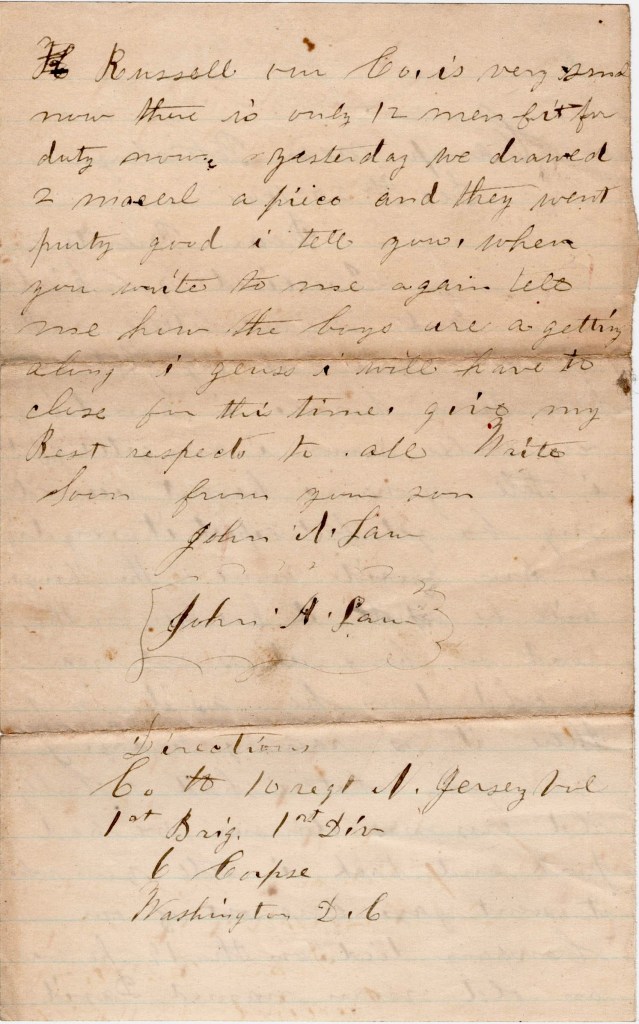
One out of our company died on the 19th. He was an old man named David Russell. Our company is very small now. There is only twelve men fit for duty now. Yesterday we drawed 2 mackerel apiece and they went purty good, I tell you.
When you write to me again, tell me now the boys are a getting along. I guess I will have to close for this time. Give my best respects to all. Write soon. From your son, John A. Laur
Directions: Co. H, 10th Regt. N. Jersey Vol., 1st Brig., 1st Div., 6th Corps, Washington DC
Letter 22
Camp near Petersburg January 5, 1865
My dear parents,
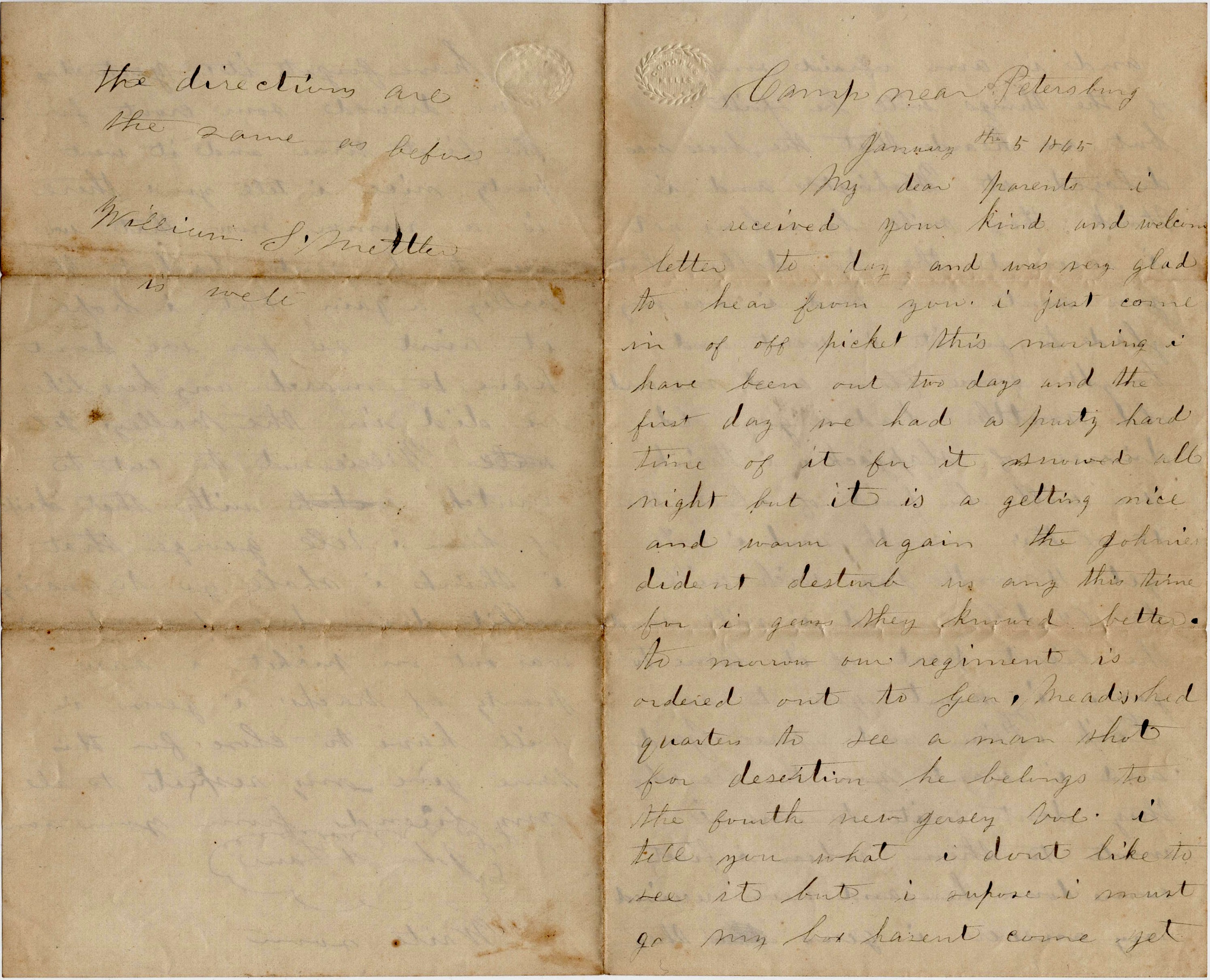
I received your kind and welcome letter today and was very glad to hear from you. I just come in off of picket this morning. I have been out two days and the first day we had a purty hard time of it for it snowed all night. But it is getting nice and warm again. The Johnnys didn’t disturb us any this time for I guess they knowed better.
Tomorrow our regiment is ordered to Gen. Meade’s Headquarters to see a man [Peter Cox] shot for desertion. He belongs to the 4th New Jersey Vols. I tell you what, I dont like to see it, but I suppose I must.
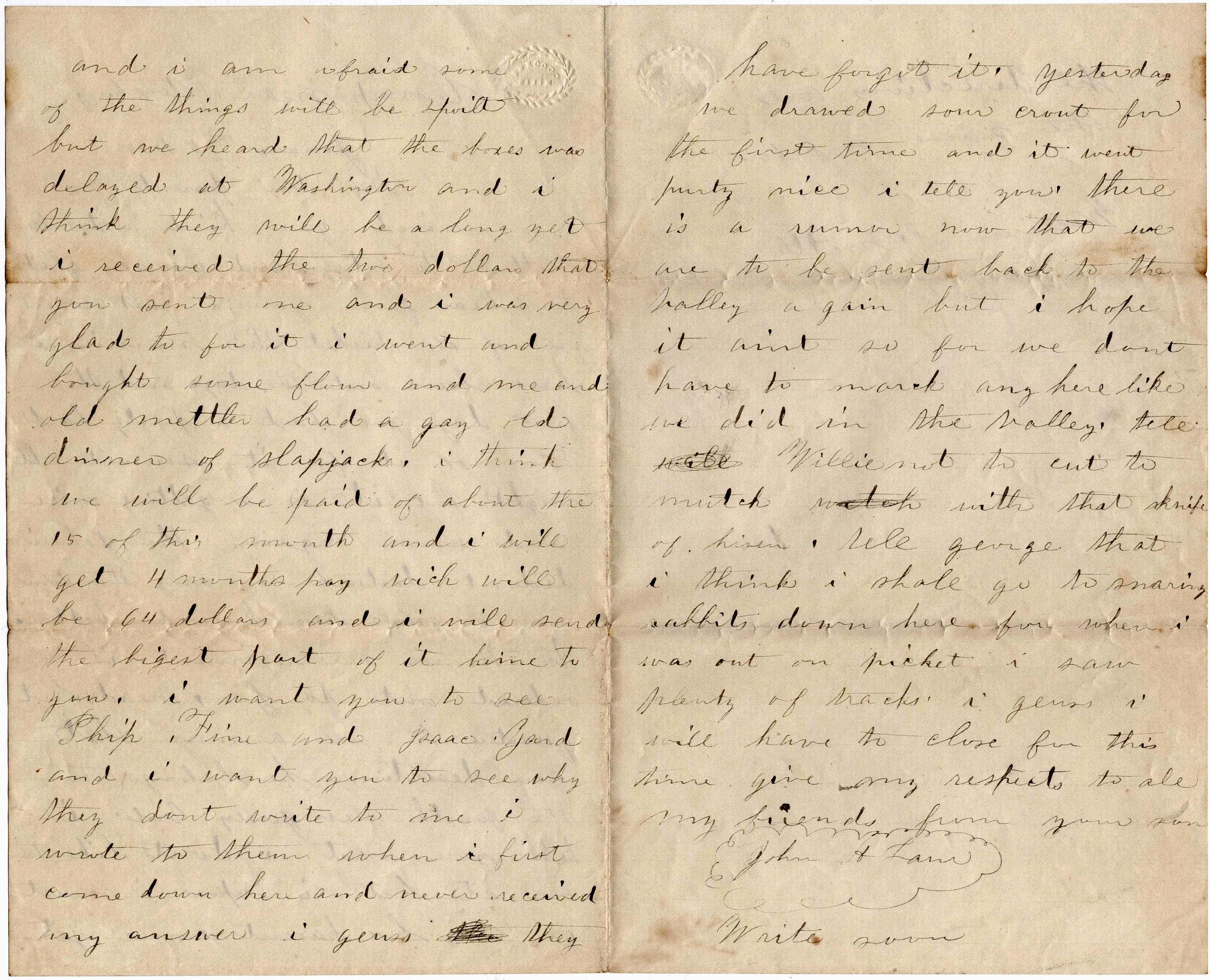
My box hasn’t come yet and I am afraid some of the things will be spoilt but we heard that the boxes was delayed at Washington and I think they will be along yet. I received the two dollars that you sent me and I was very glad too for it. I went and bought some flour and me and old Mettler had a gay old dinner of slapjacks. I think we will be paid off about the 15th of the month and I will get four months pay which will be 64 dollars, and I will send the biggest part of it home to you. I want you to see Phip Fine and Isaac Yard and I want you to see why they don’t write to me. I wrote to them when I first came down here and never received any answer. I guess they have forgot it.
Yesterday we drawed sour krout for the first time and it went purty nice, I tell you. There is a rumor now that we are to be sent back to the Valley again but I hope it ain’t so for we don’t have to march any here like we did in the Valley. Tell Willie not to cut too mutch with that knife of his. Tell George that I think I shall go to snaring rabbits down here for when I was out on picket, I saw plenty of tracks. I guess I will have to close for this time. Give my respects to all my friends. From your son, —John A. Laur
Write soon
Letter 23
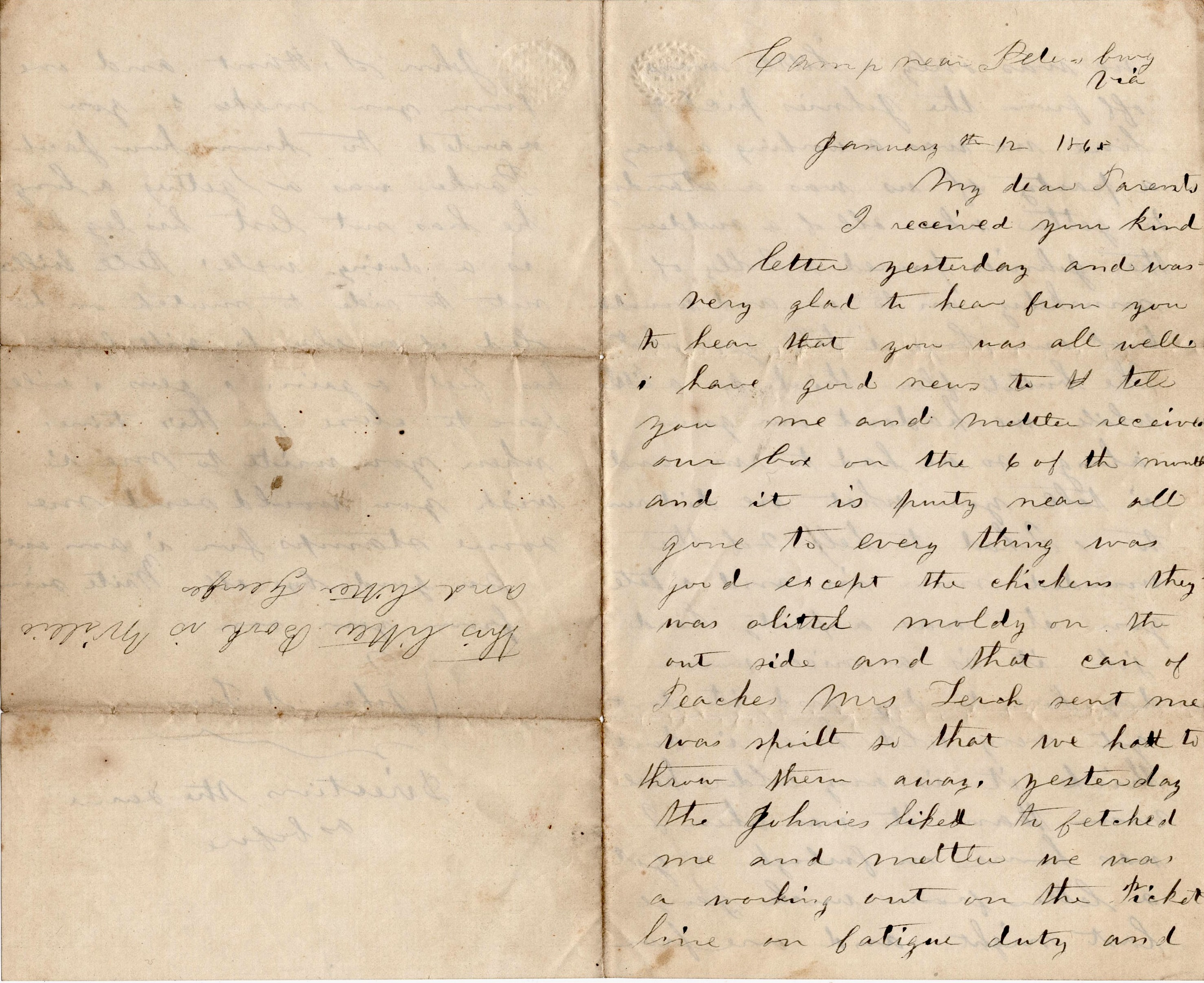
Camp near Petersburg January 12, 1865
My dear parents,
I received your kind letter yesterday and was very glad to hear from you to hear you was all well. I have good news to tell you. Me and Mettler received our box on the 6th of the month and it is purty near all gone too. Everything was good except the chickens. They was a little moldy on the out side, and that can of peaches Mrs. Lerch sent me was spoilt so that we had to throw them away.
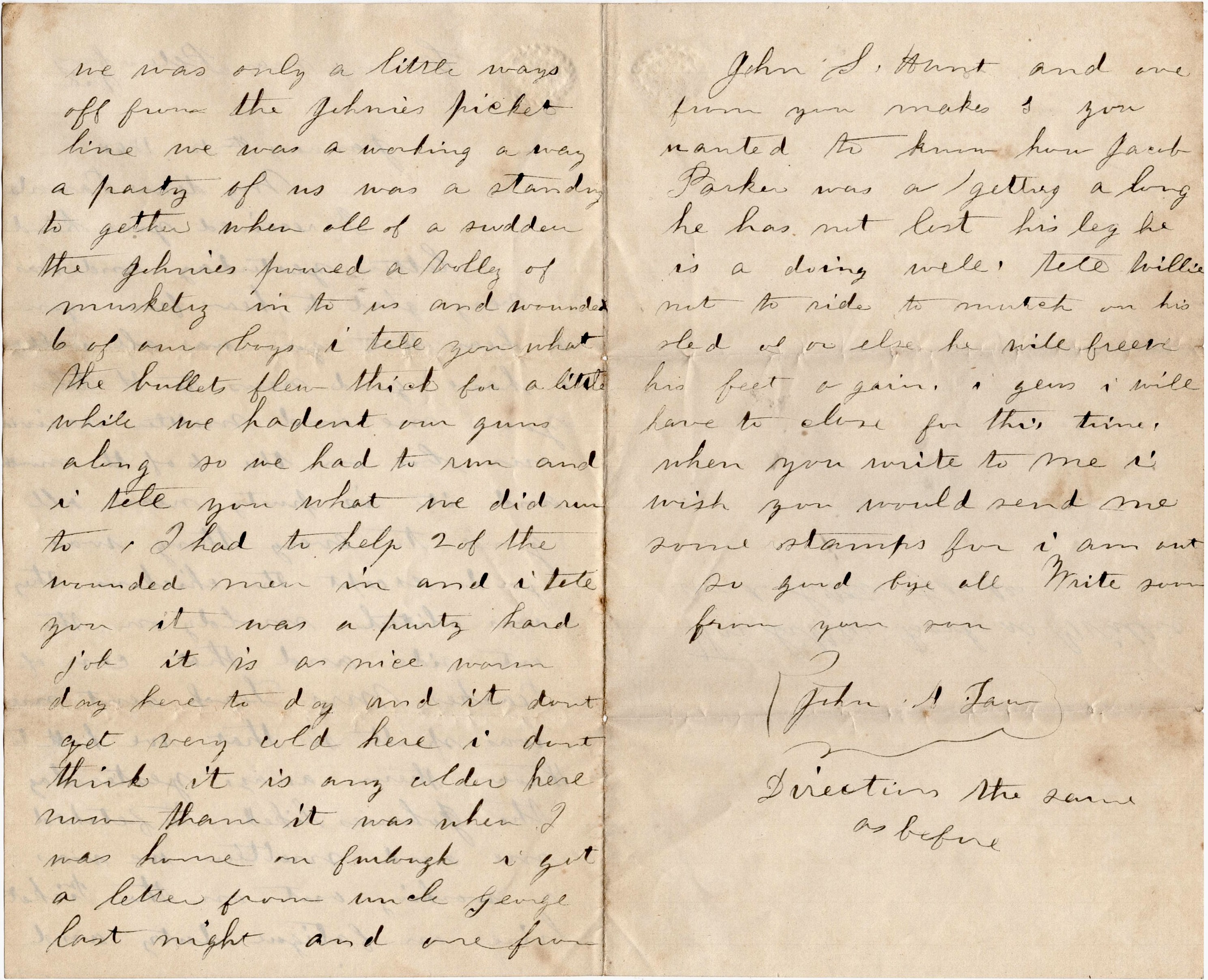
Yesterday the Johnnys like to fetched me and Mettler. We was a working out on the picket line on fatigue duty and we was only a little ways off from the Johnny’s picket line. [While] we was a working away, a party of us was a standing together when all of a sudden the Johnnys poured a volley of musketry into us and wounded six of our boys. I tell you what, the bullets flew thick for a little while. We hadn’t our guns along so we had to run and I tell you what, we did run too. I had to help two of the wounded men in and I tell you, it was a purty hard job.
It is a nice warm day here today and it don’t get very cold here. I don’t think it is any colder here now than it was when I was home on furlough. I got a letter from Uncle George last night and one from John S. Hunt and one from you makes three. You wanted to know how Jacob Parker was a getting a long. He has not lost his leg. He is a doing well.
Tell Willie not to ride too much on his sled or else he will freeze his feet again. I guess I will have to close for this time. When you write to me, I wish you would send me some stamps for I am out. So goodbye all. Write soon. From your son, — John A. Laur
Directions the same as before.
Letter 24
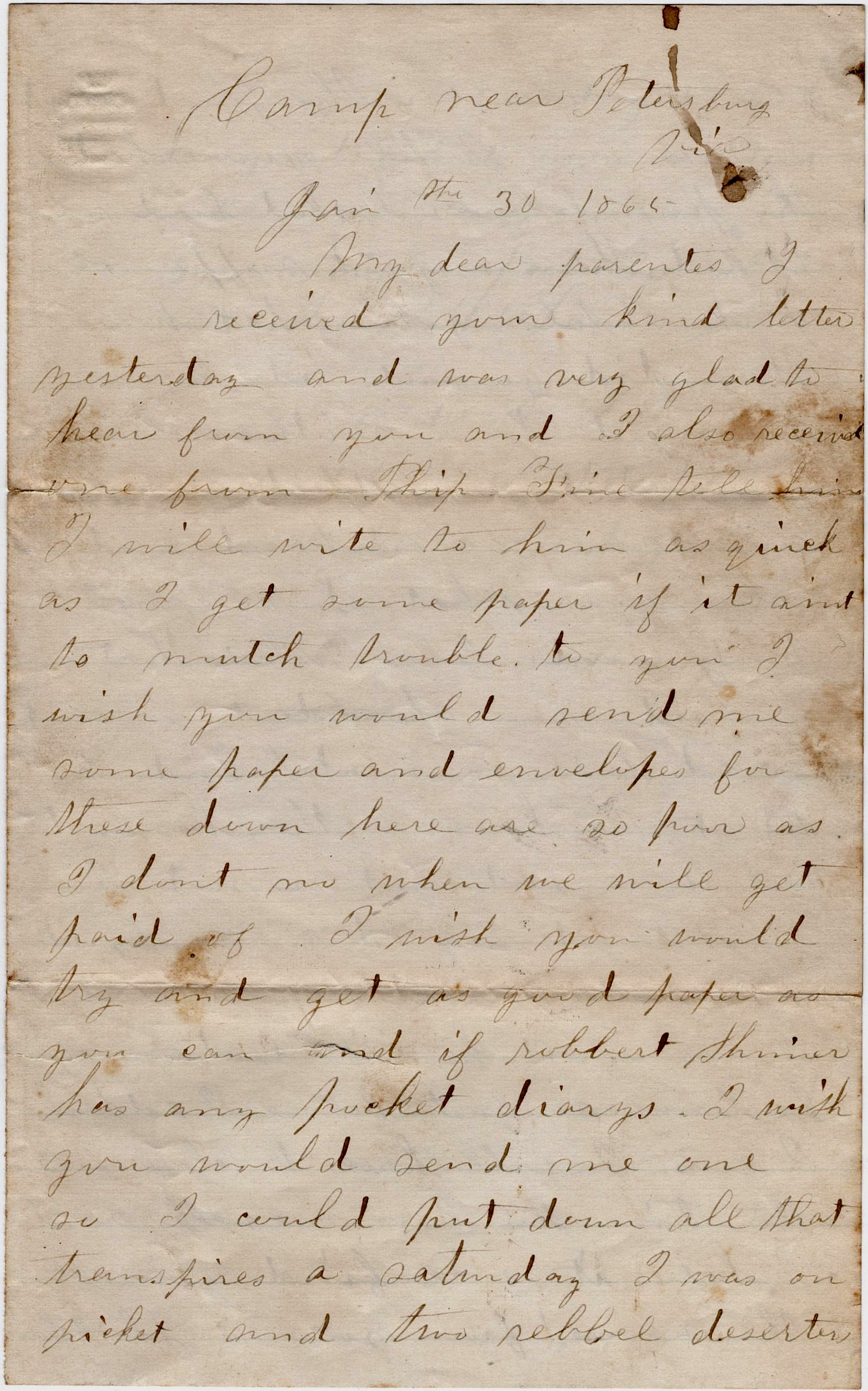
Camp near Petersburg January 30, 1865
My dear parents,
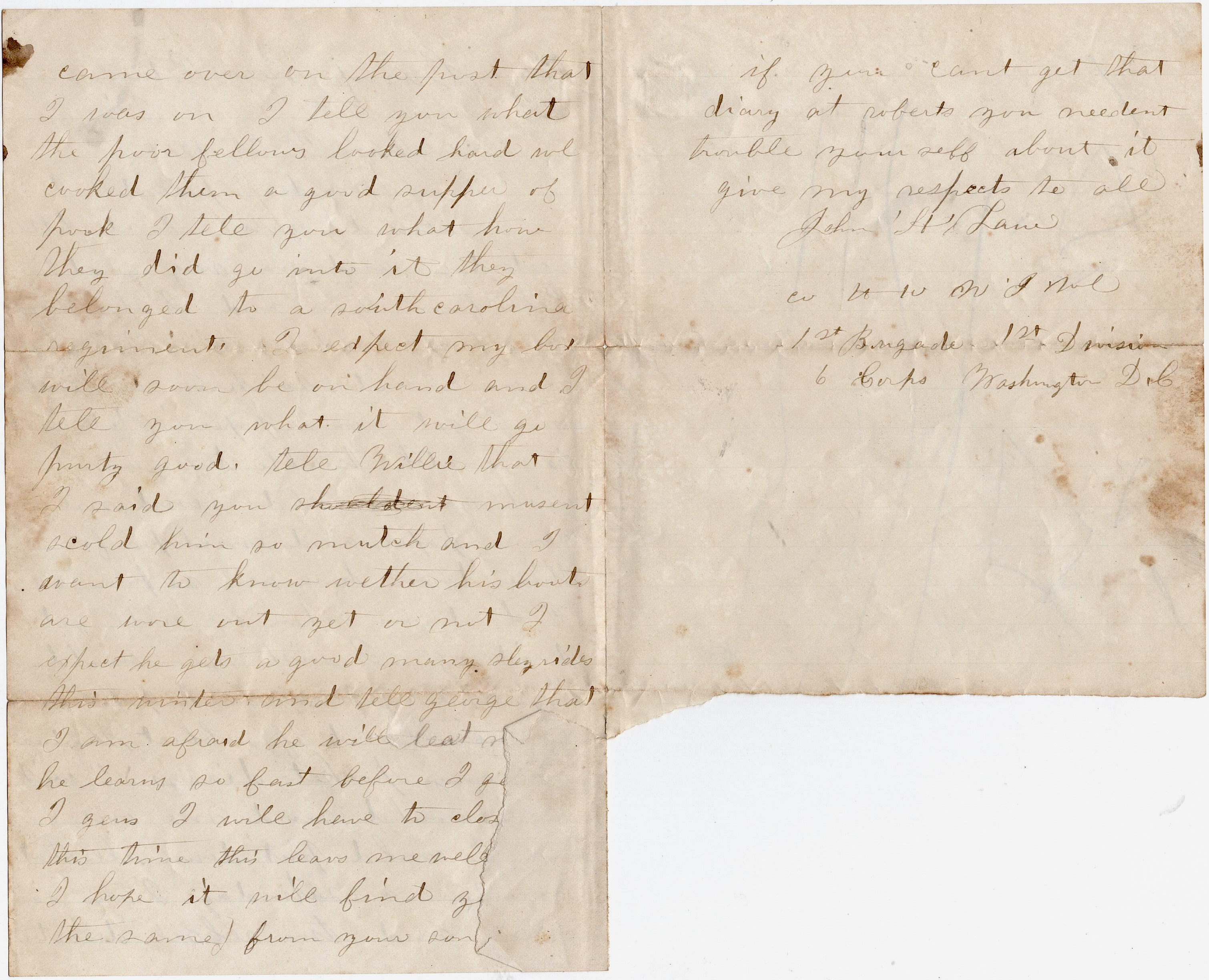
I received your kind letter yesterday and was very glad to hear from you and I also received one from Phip Fine. Tell him I will write to him as quick as I get some paper. If it ain’t too mutch trouble to you, I wish you would send me some paper and envelopes for these down here are so poor as I don’t know when we will get paid off. I wish you would try and get as good paper as you can and if Robert Shimer has any pocket diaries, I wish you would send me one so I could put down all that transpires.
Saturday I was on picket and two rebel deserters came over on the post I was on. I tell you what, the poor fellows looked hard. We cooked them a good supper of pork. I tell you what, how they did go into it. They belonged to a South Carolina regiment.
I expect my box will soon be on hand and I tell you what, it will go purty good. Tell Willie that I said you musn’t scold him so much and I want to know whether his boots are wore out yet or not. I expect he gets a good many sleigh rides this winter. And tell George that I am afraid he will beat me if he learns so fast before I get home. I guess I will have to close for this time. This leaves me well and I hope it will find you all the same. From your son, —John A. Laur
If you can’t get that diary at Robert’s, you needn’t trouble yourself about it. Give my respects to all. — John A. Laur
Letter 25
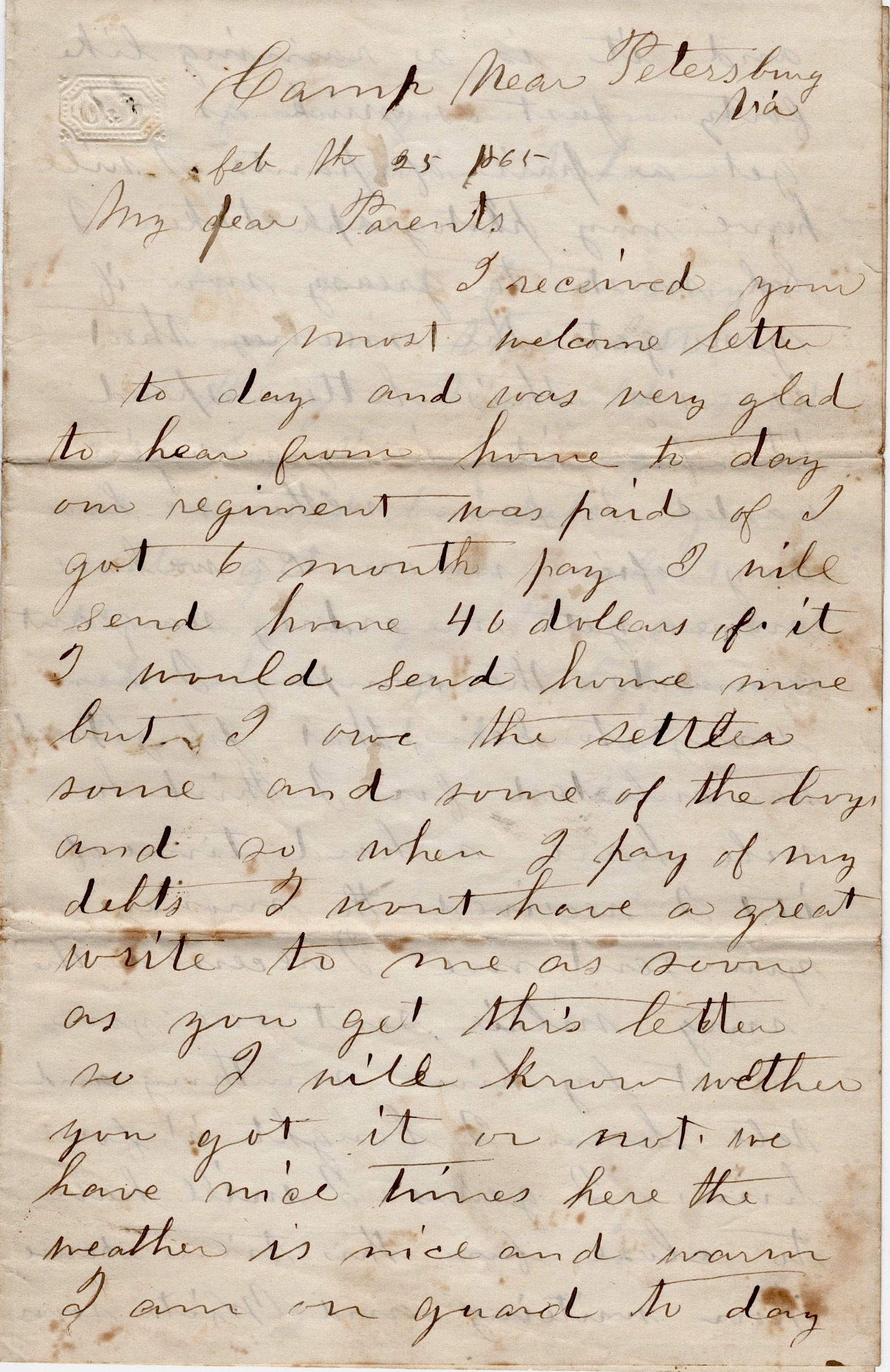
Camp near Petersburg Virginia February 25, 1865
My dear Parents,
I received your most welcome letter today and was very glad to hear from home. Today our regiment was paid off. I got 6 months pay. I will send home 46 dollars of it. I would send home more but I owe the sutler some and some of the boys and so when I pay off my debts, I won’t have a great [amount left]. Write to me as soon as you get this letter so I will know whether you got it or not.
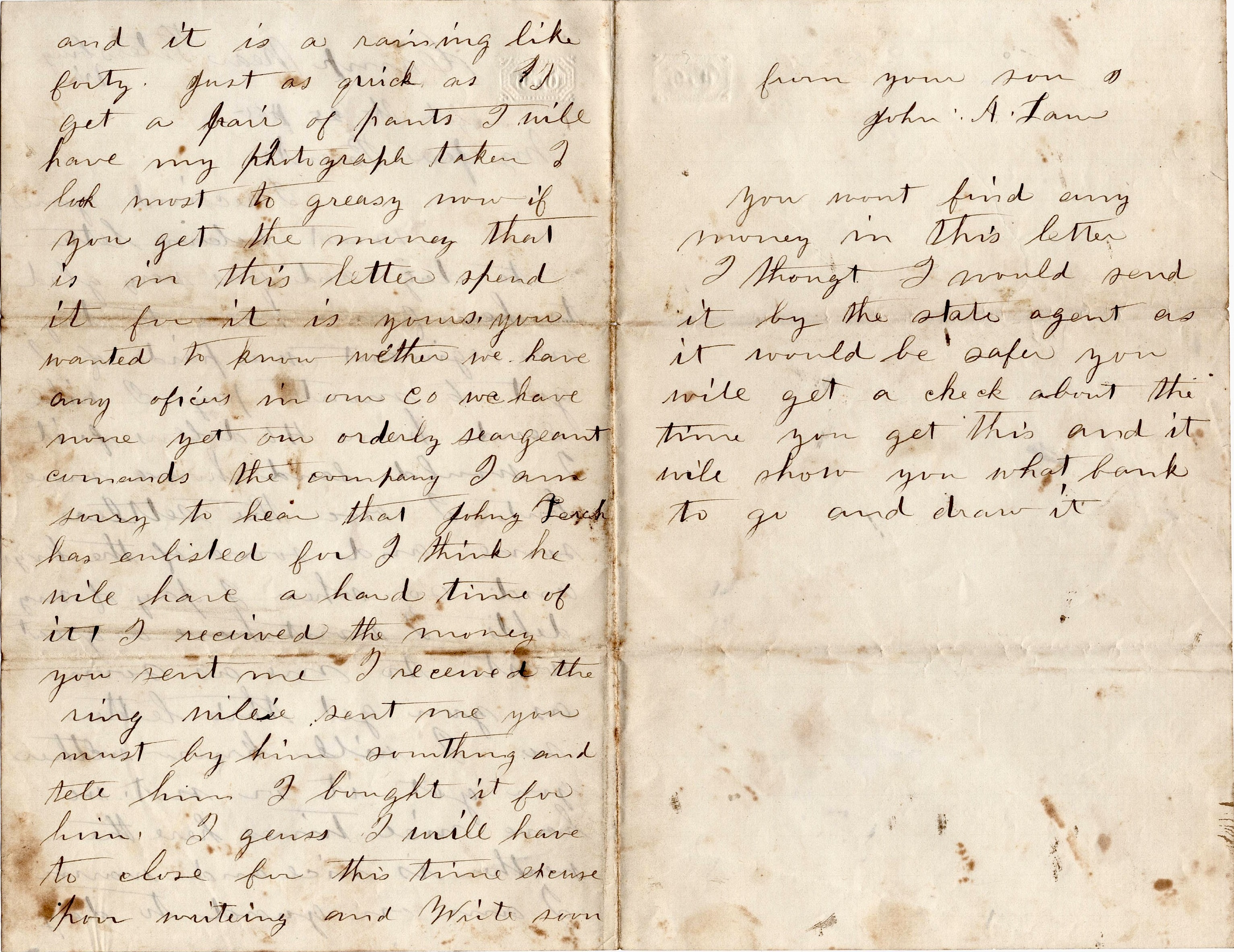
We have nice times here. The weather is nice and warm. I am on guard today and it is raining like forty. Just as quick as I get a pair of pants, I will have my photograph taken. I look most too greasy now. If you get the money that is in this letter, spend it, for it is yours.
You wanted to know whether we have any officers in our company. We have none yet. Our Orderly Sergeant commands the company.
I am sorry to hear that Johnny [ ] has enlisted for I think he will have a hard time of it. I received the money you sent me. I received the ring Willie sent me. You must buy him something and tell him I bought it for him. I guess I will have to close for this time. Excuse poor writing and write soon. From your son, — John A. Laur
You won’t find any money in this letter. I thought I would send it by the state agent as it would be safer. You will get a check about the time you get this and it will show you what bank to go and draw it.
Letter 26
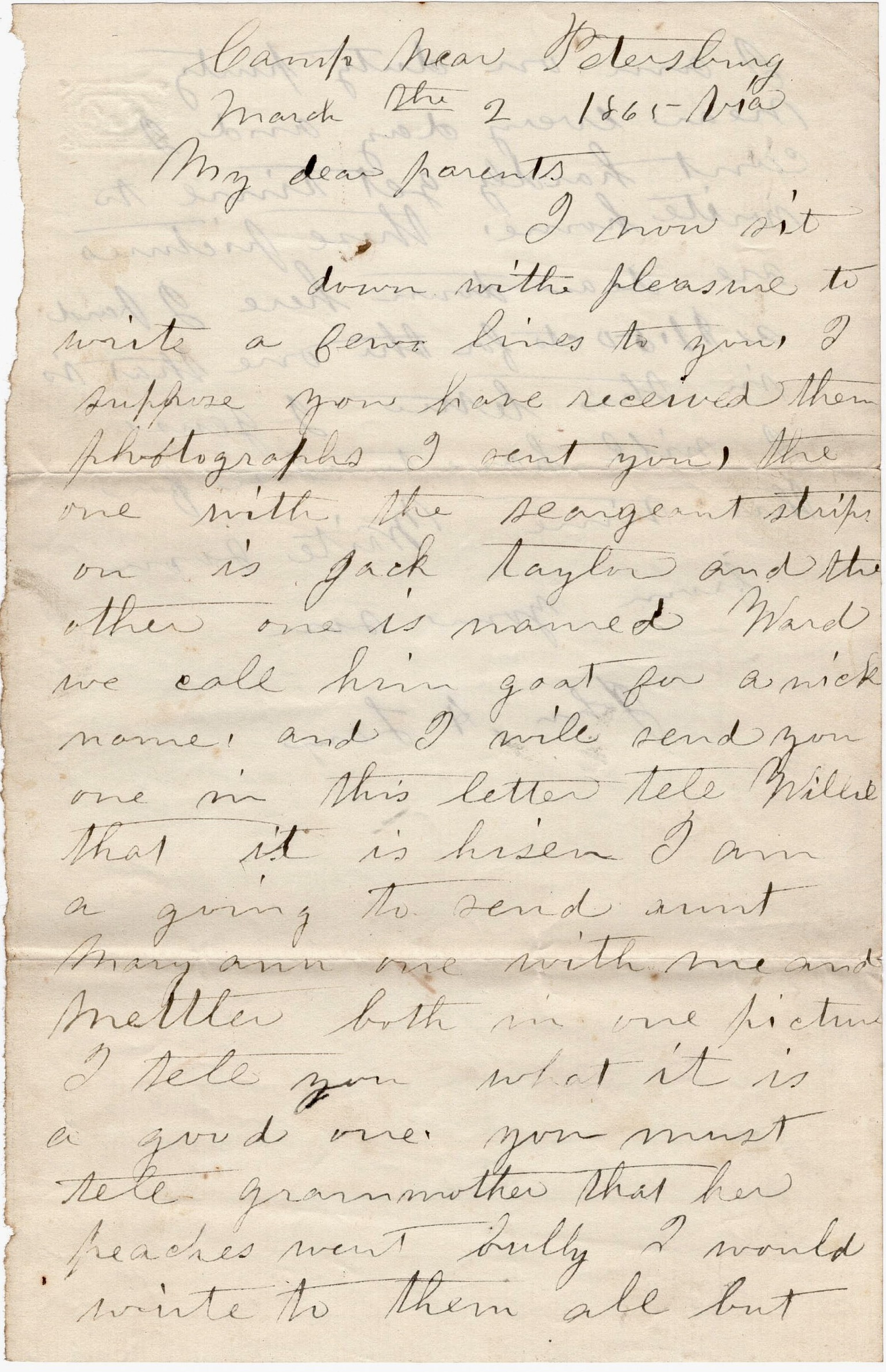
Camp Near Petersburg, Virginia March 2, 1865
My dear parents,
I now sit down with pleasure to write a few lines to you. I suppose you have received them photographs I sent you. The one with the sergeant stripes on is Jack Taylor and the other one is named Ward. We call him goat for a nickname and I will send you one in this letter. Tell Willie that it is his’n. I am a going to send Aunt Mary Ann one with me and Mettler both in one picture. I tell you what, it is a good one.
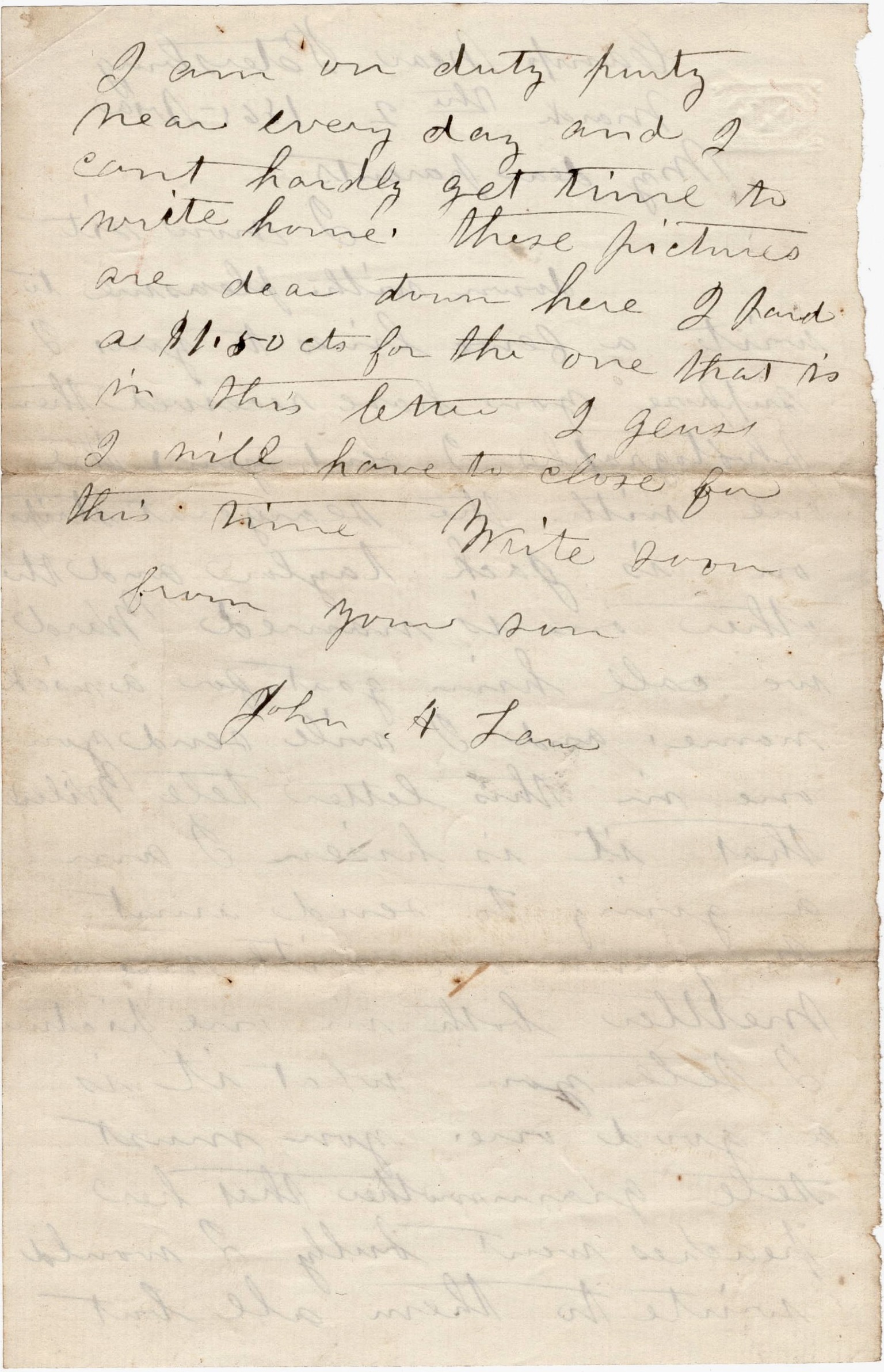
You must tell grandmother that her peaches went bully. I would write to them all but I am on duty purty near every day and I can’t hardly get time to write home. These pictures are dear down here. I paid a $1.50 for the one that is in this letter. I guess I will have to close for this time. Write soon. From your son, — John A. Laur
Letter 27
Camp Near Petersburg Virginia March 8, 1865
Dear Parents,
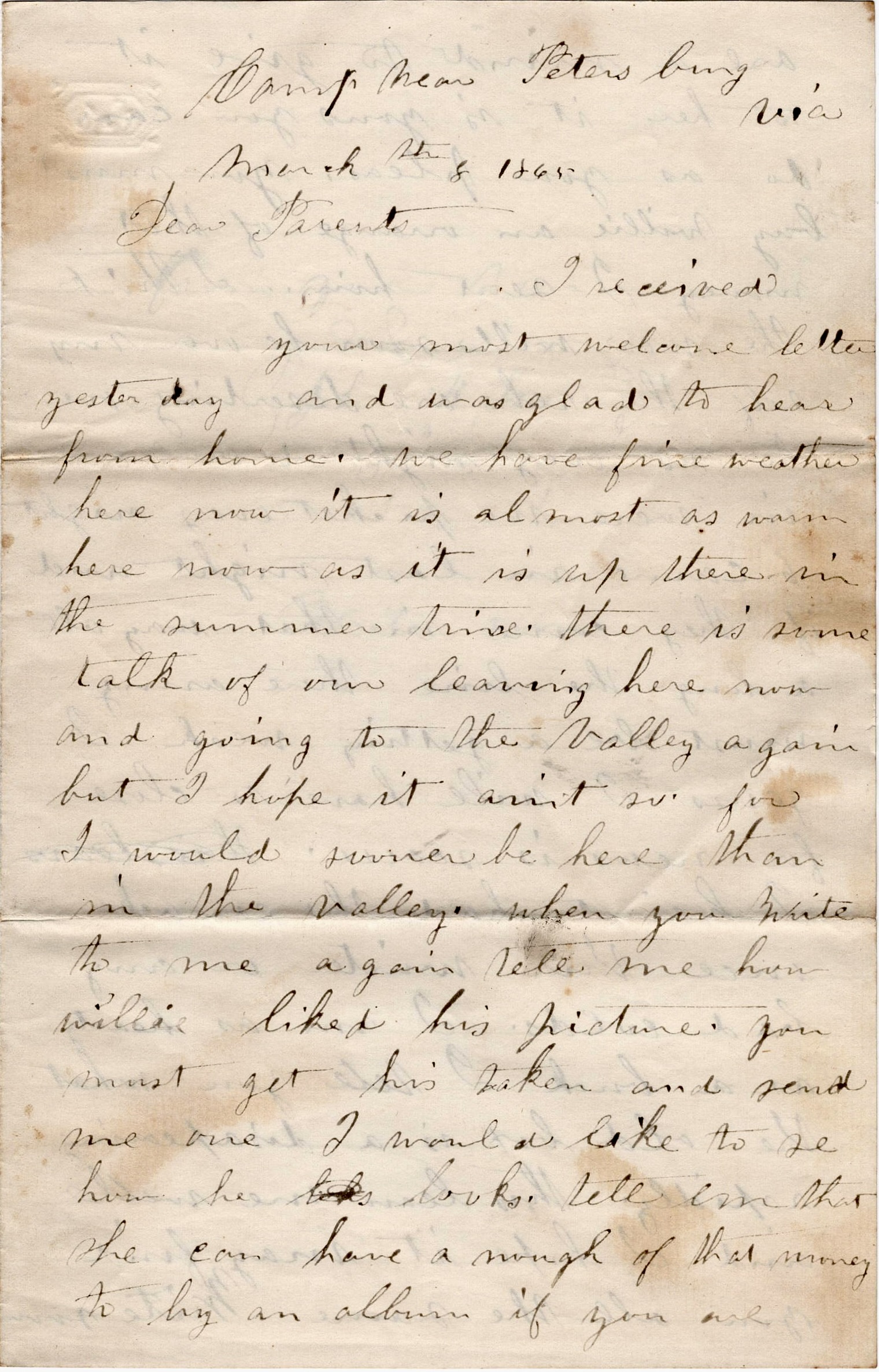
I received your most welcome letter yesterday and was glad to hear from home. We have fine weather here now. It is almost as warm here now as it is up there in the summer time.
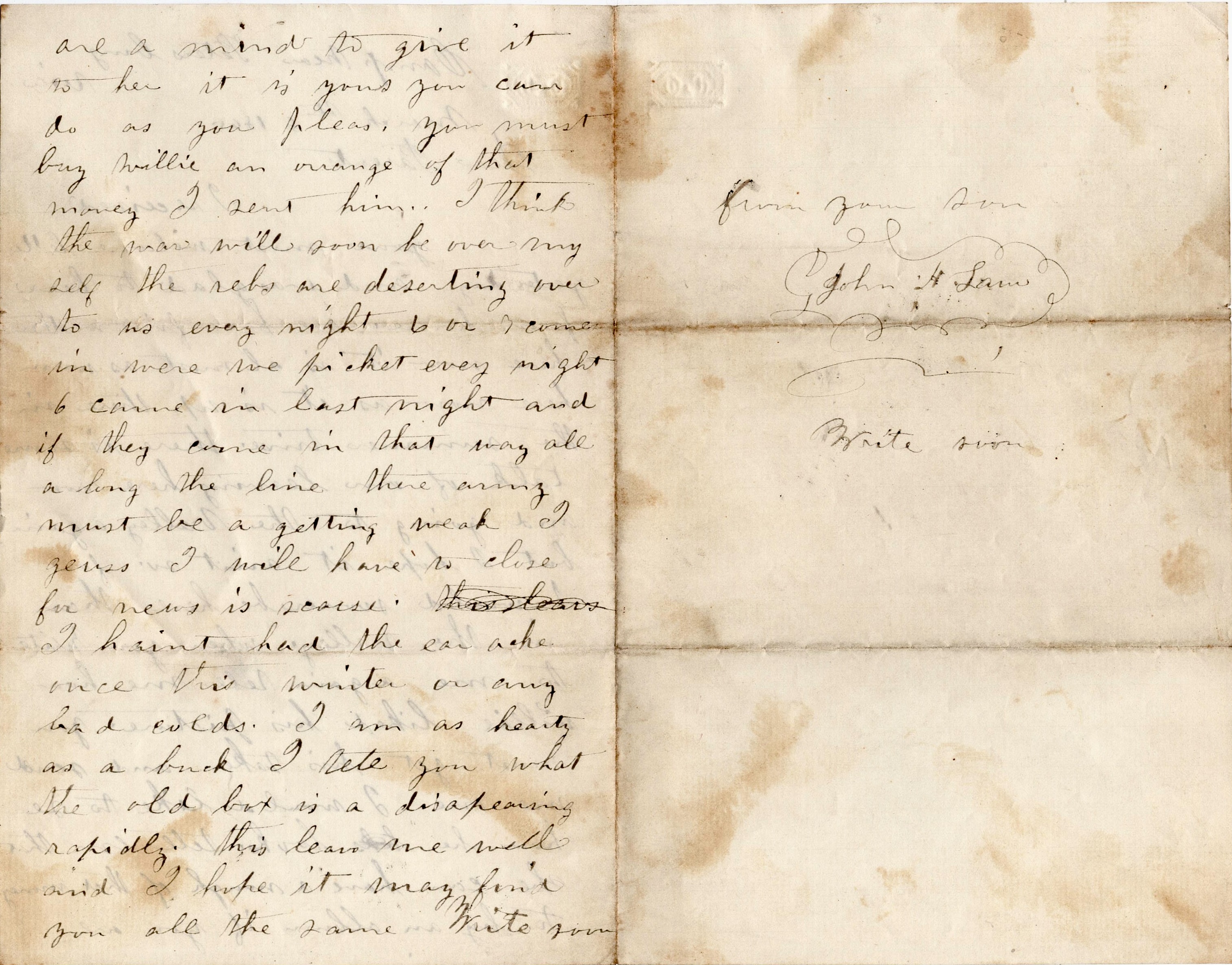
There is some talk of our leaving here soon and going to the Valley again but I hope it ain’t so for I would sooner be here than in the Valley. When you write to me again, tell me how Willie liked his picture. You must get his taken and send me one. I would like to see how he looks. Tell em that she can have enough of that money to buy an album if you are a mind to give it to her. It is yours—you can do as you please. You must buy Willie an orange of that money I sent him.
I think the war will soon be over myself. The rebs are deserting over to us every night. Six or seven come in were we picket every night. Six came in last night and if they come in that way all a long the line, their army must be getting weak.
I guess I will have to close for news is scarse. I hain’t had the earache once this winter or any bad colds. I am as hearty as a buck. I tell you what, the old box is a disappearing rapidly. This leaves me well and I hope it may find you all the same. Write soon. From your son, — John A. Laur
Write soon
Letter 28
Camp near Petersburg, Virginia March 19, 1865
My dear Parents,
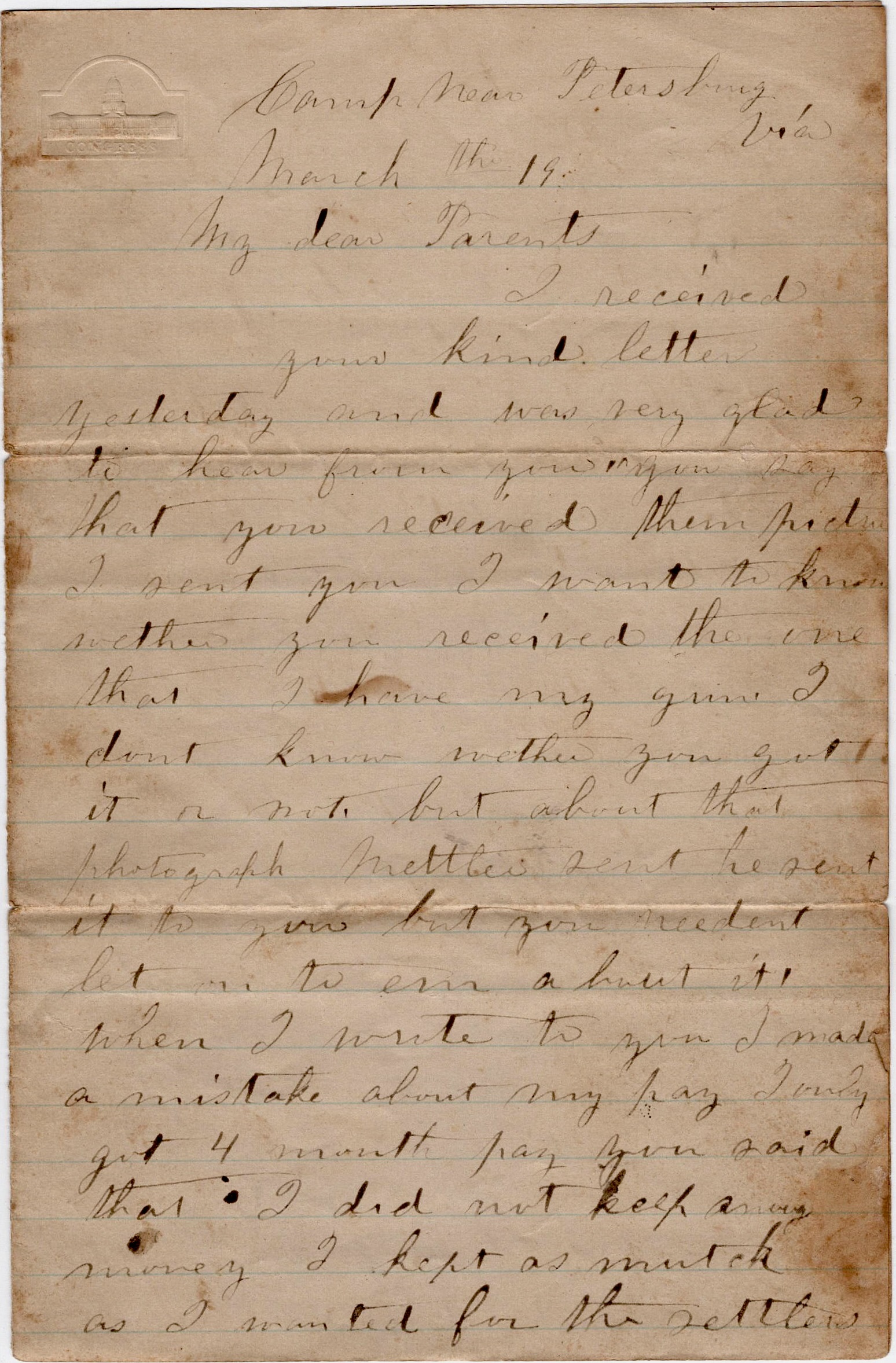
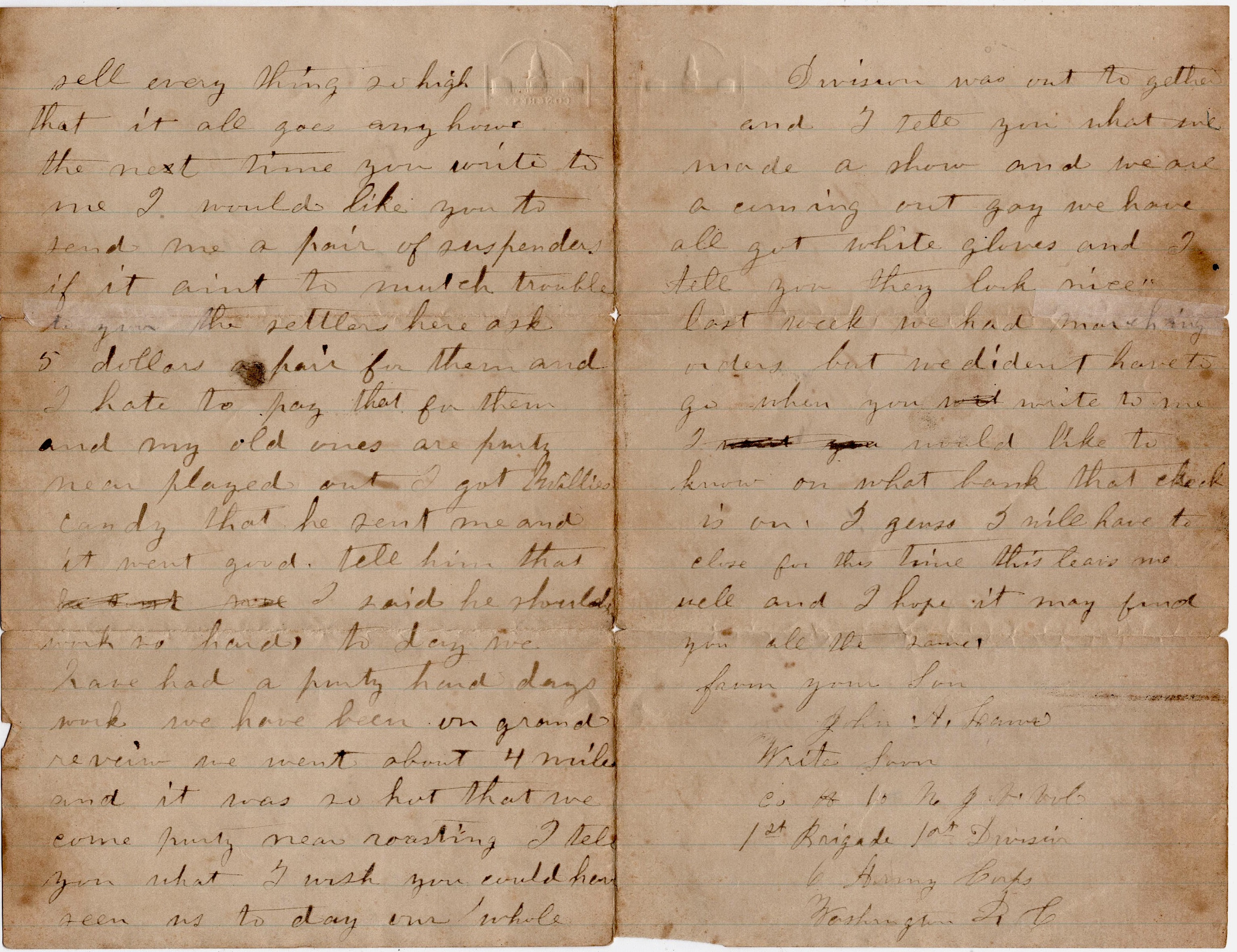
I received your kind letter yesterday and was very glad to hear from you. You say that you received them pictures I sent you. I want to know whether you received the one that I have my gun. I don’t know whether you got it or not. But about that photograph Mettler sent, he sent it to you but you needn’t let on to Em about it. When I wrote to you, I made a mistake about my pay. I only got four month’s pay. You said that I did not keep any money. I kept as much as I wanted for the sutler sells everything so high that it all goes anyhow. The next time you write to me, I would like you to send me a pair of suspenders if it ain’t to mutch trouble to you. The sutlers here ask 5 dollar a pair for them and I hate to pay that for them and my old ones are purty near played out.
I got Willie’s candy that he sent me and it went good. Tell him that I said he shouldn’t work so hard. Today we had a purty hard days work. We have been on review. We went about four miles and it was so hot that we come purty near roasting. I tell you what, I wish you could have seen us today. Our whole Division was out together and I tell you what, we made a show. And we are coming out gay. We have white gloves and I tell you, they look nice.
Last week we had marching orders but we didn’t have to go. When you write to me I would like to know on what bank that check is on. I guess I will have to close for this time. This leaves me well and I hope it may find you all the same. From your son, — John A. Laur
Write Soon. Co. H, 10 N. J. Vols., 1st Brigade, 1st Division, 6th Army Corps, Washington.
Letter 29
Camp Near Burksville Station, Virginia April 16, 1865
My dear Parents,
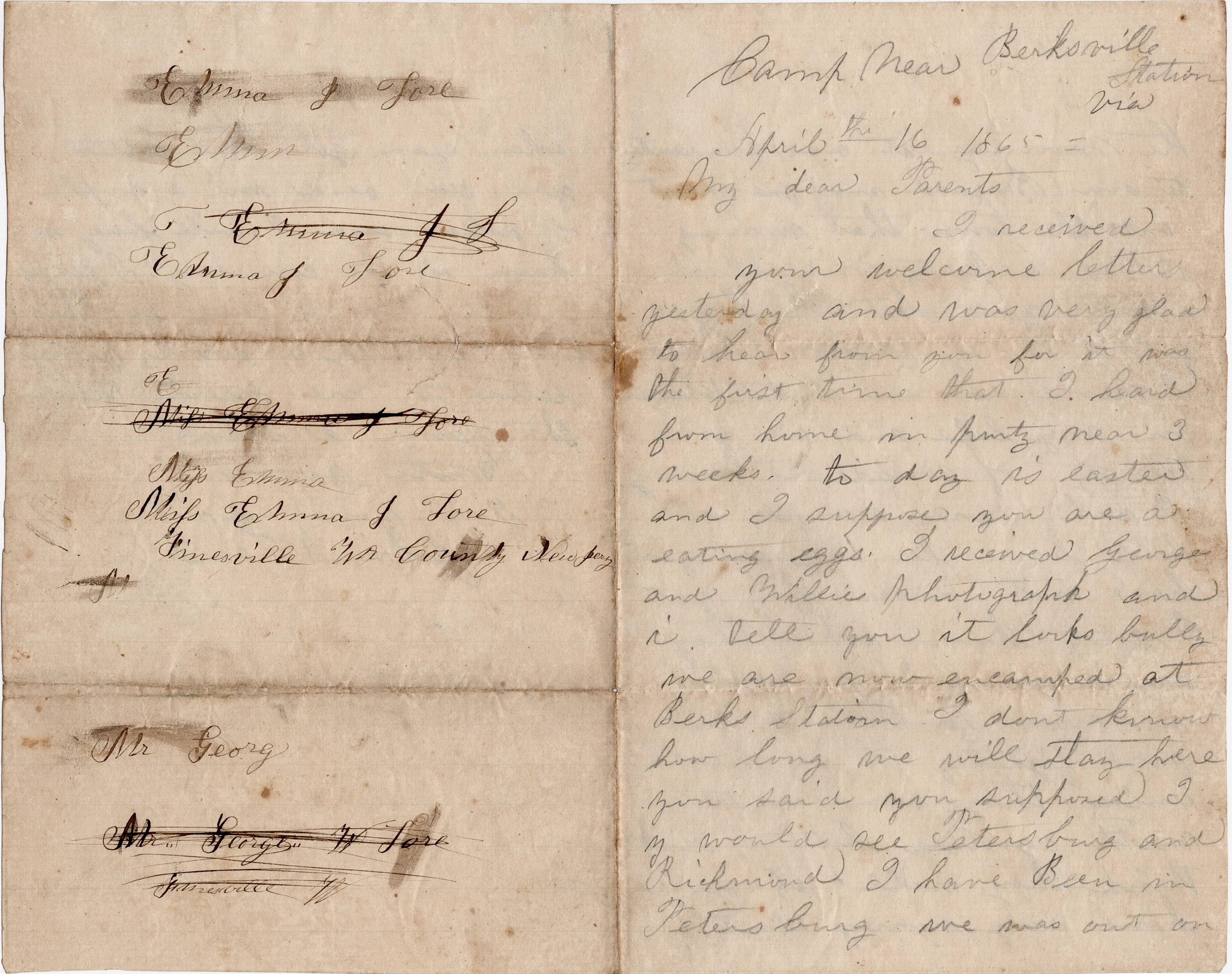
I received your welcome letter yesterday and was very glad to hear from you for it was the first time that I heard from home in purty near three weeks. Today is Easter and I suppose you are a eating eggs. I received George and Willie’s photograph and I tell you, it looks bully.
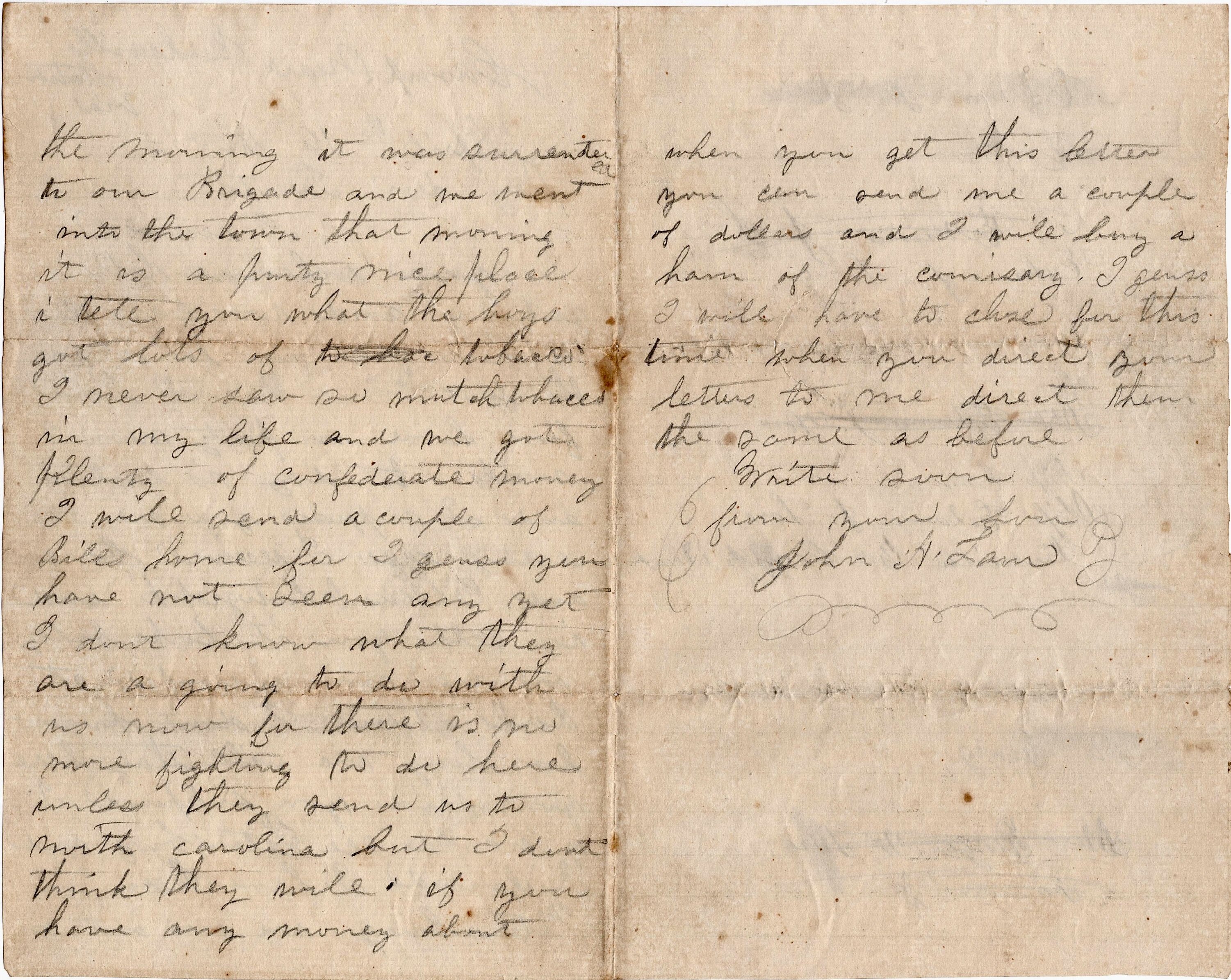
We are now encamped at Burke’s Station. I don’t know how long we will stay here. You said you suppose I would see Petersburg and Richmond. I have been in Petersburg. We was out on the morning it was surrendered to our Brigade and we went into the town that morning. It is a purty nice place. I tell you what, the boys got lots of tobacco. I never saw so much tobacco in my life and we got plenty of Confederate money [too]. I will send a couple of Bills home for I guess you have not seen any yet.
I dont know what they are a going to do with us now for there is no more fighting to do here unless they send us to North Carolina but I don’t think they will. If you have any money about when you get this letter, you can send me a couple of dollars and I will buy a ham of the commissary. I guess I will have to close for this time. When you direct your letters to me, direct them the same as before. Write soon. From your son, John A. Laur
Letter 30
Camp Near Danville, Virginia May 3, 1865
My Dear Parents,
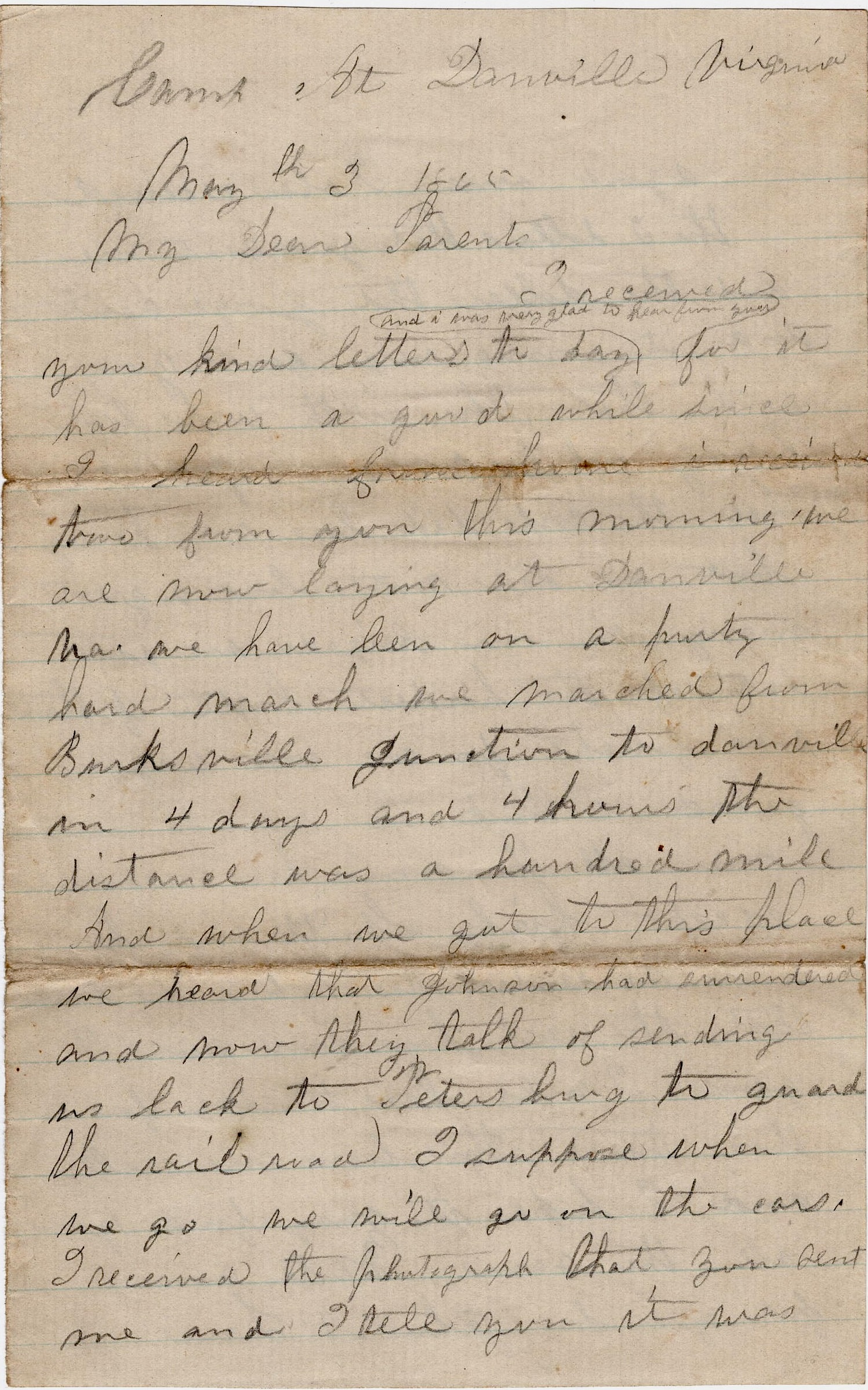
I received your kind letters to day for it has been a good while since I heard from home. I received two from you this morning.
We are now laying at Danville, Va. We have been on a purty hard march. We marched from Burksville Junction to Danville in four days and four hours. The distance was a hundred miles. And when we got to this place, we heard that Johnston had surrendered and now they talk of sending us back to Petersburg to guard the railroad. I suppose when we go, we will go on the cars.
I received the photograph that you sent me and I tell you, it was a good one. I also received the 2 dollars that you sent me and the dollar that George sent and it comes very good.
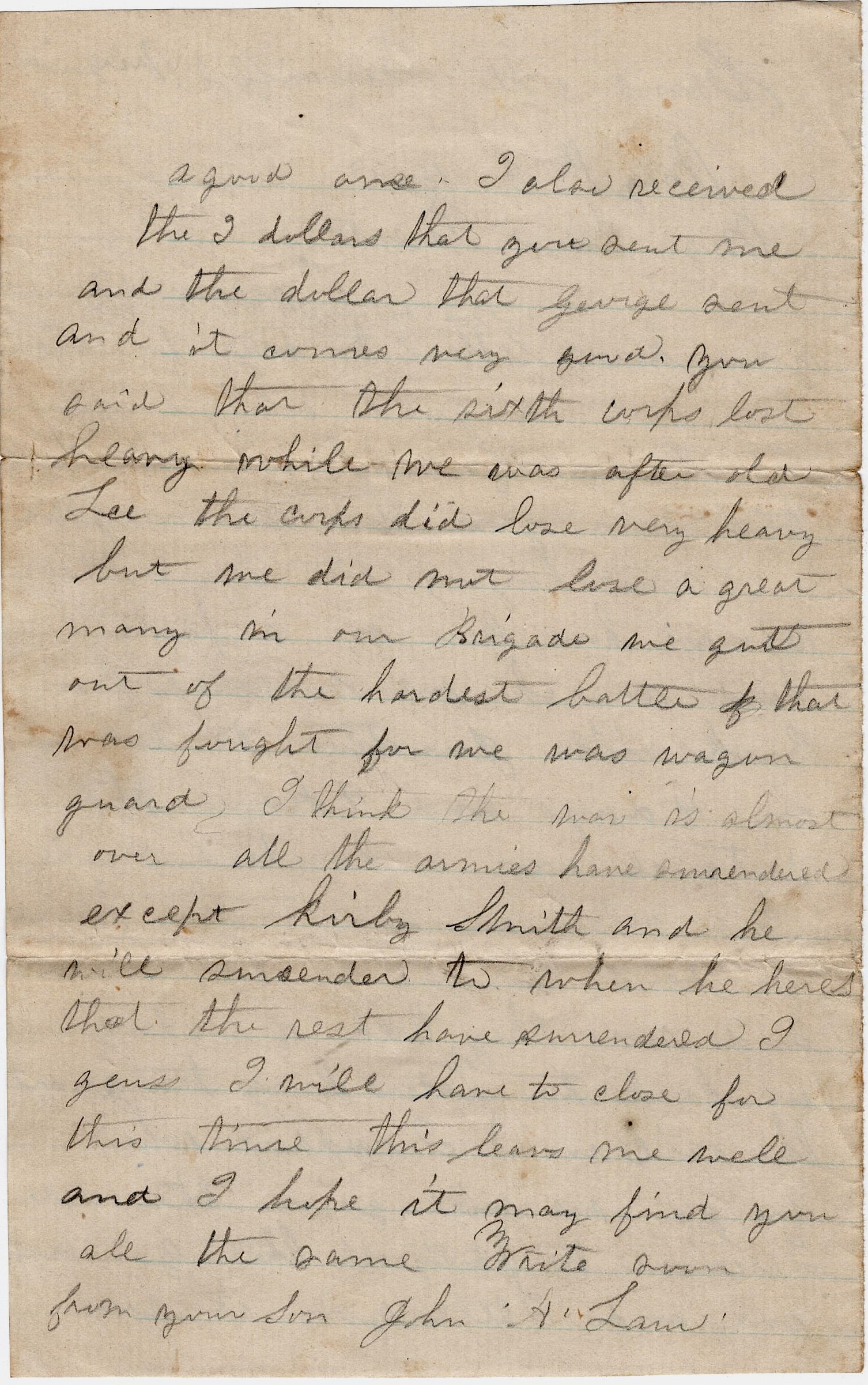
You said that the Sixth Corps lost heavy while we was after old Lee. The Corps did lose very heavy but we did not lose a great many in our Brigade. We got out of the hardest battle that was fought for we was wagon guard. I think the war is almost over. All the armies have surrendered except Kirby Smith and he will surrender too when he hears that the rest have surrendered. I will have to close for this time. This leaves me well and I hope it may find you all the same. Write soon. From your son, — John A. Laur
Letter 31
Camp near Petersburg May 11, 1865
My Dear Parents,
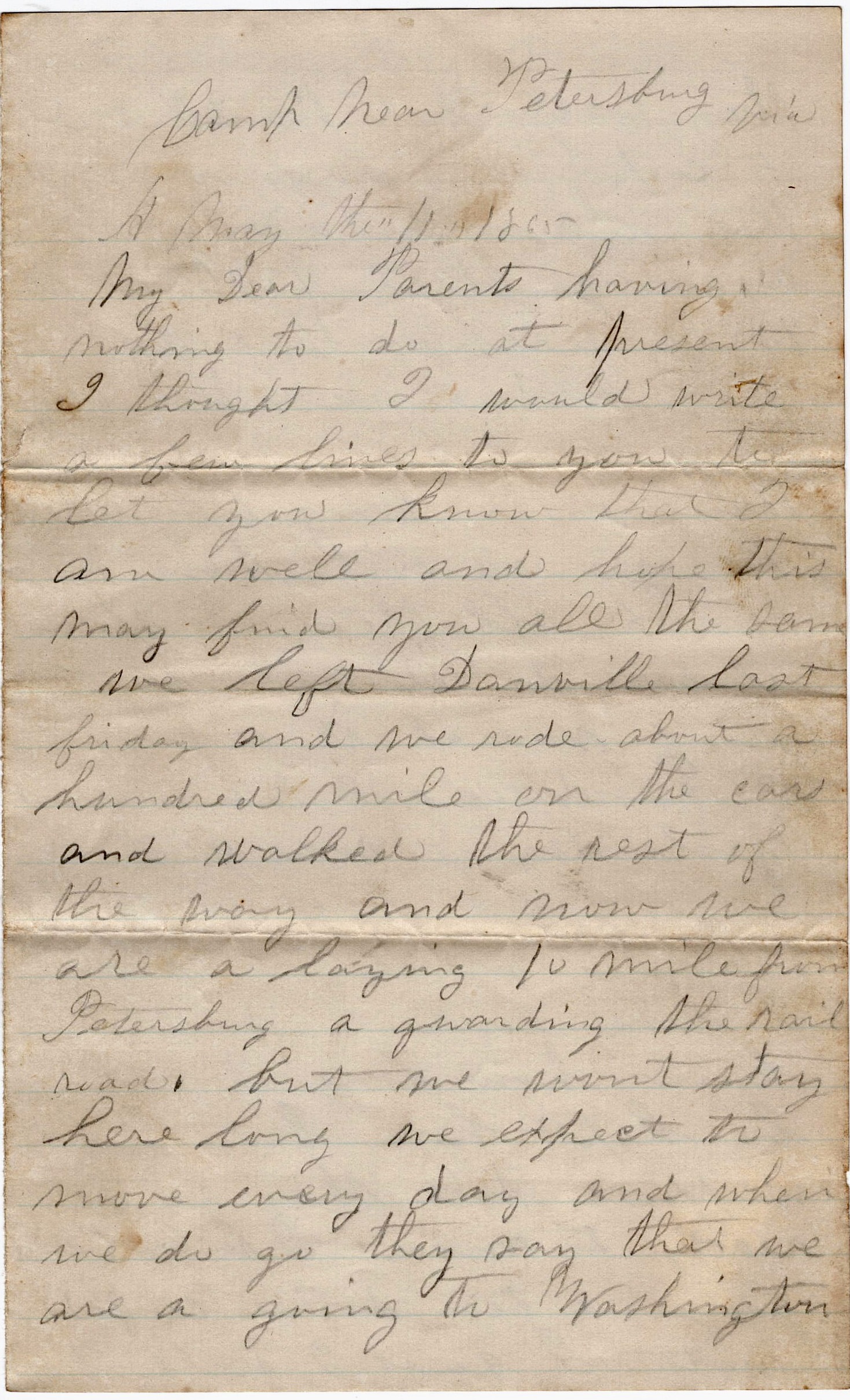
Having nothing to do at present, I thought I would write a few lines to you to let you know that I am well and hope this may find you all the same. We left Danville last Friday and we rode about a hundred mile on the car and walked the rest of the way and now we are a laying 10 miles from Petersbug a guarding the railroad. But we won’t stay here long. We expect to move every day and when we do go, they say that we are going to Washington. They say that the 2nd and 5th Corps are there now and that Sherman’s army is a going there too.
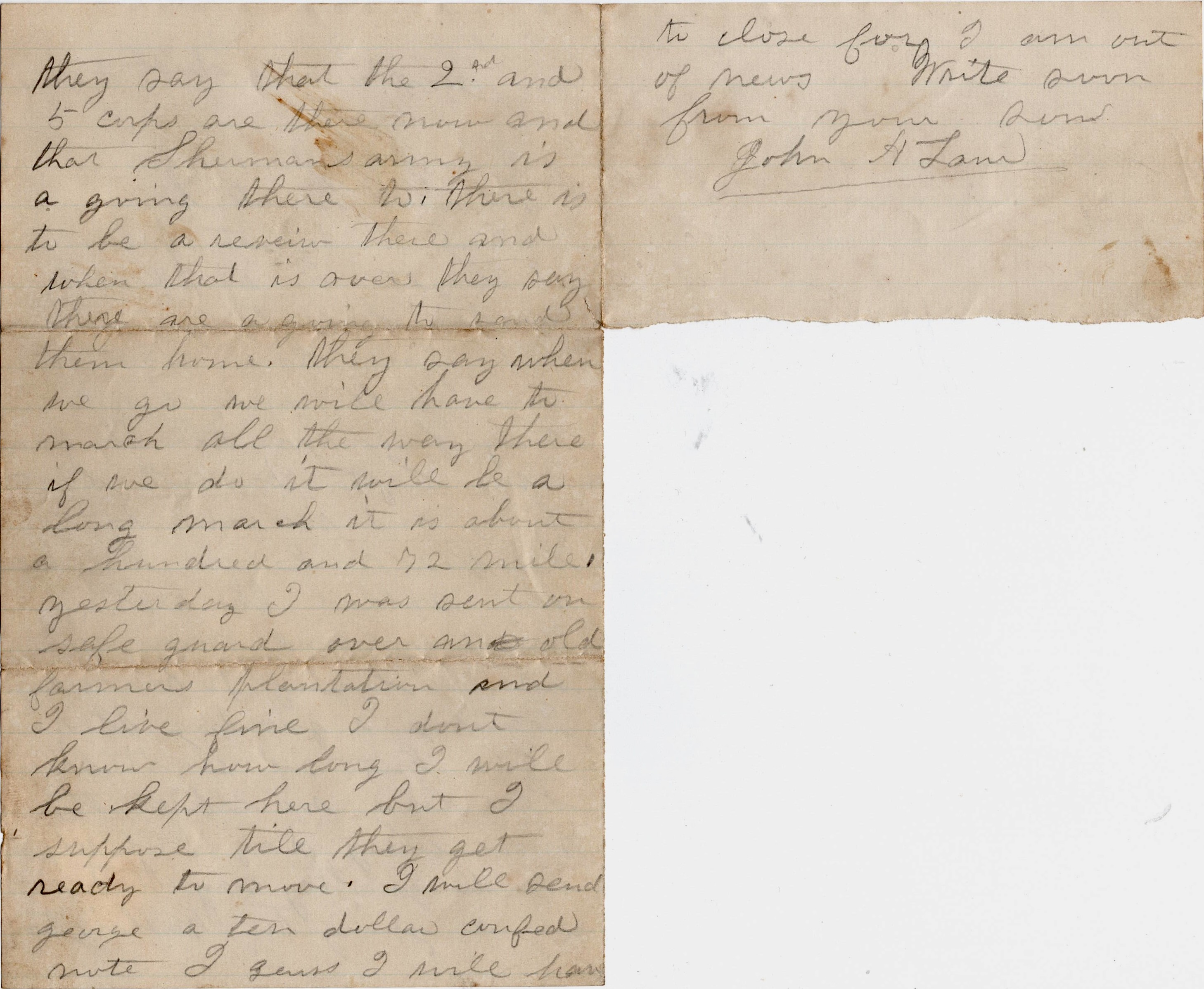
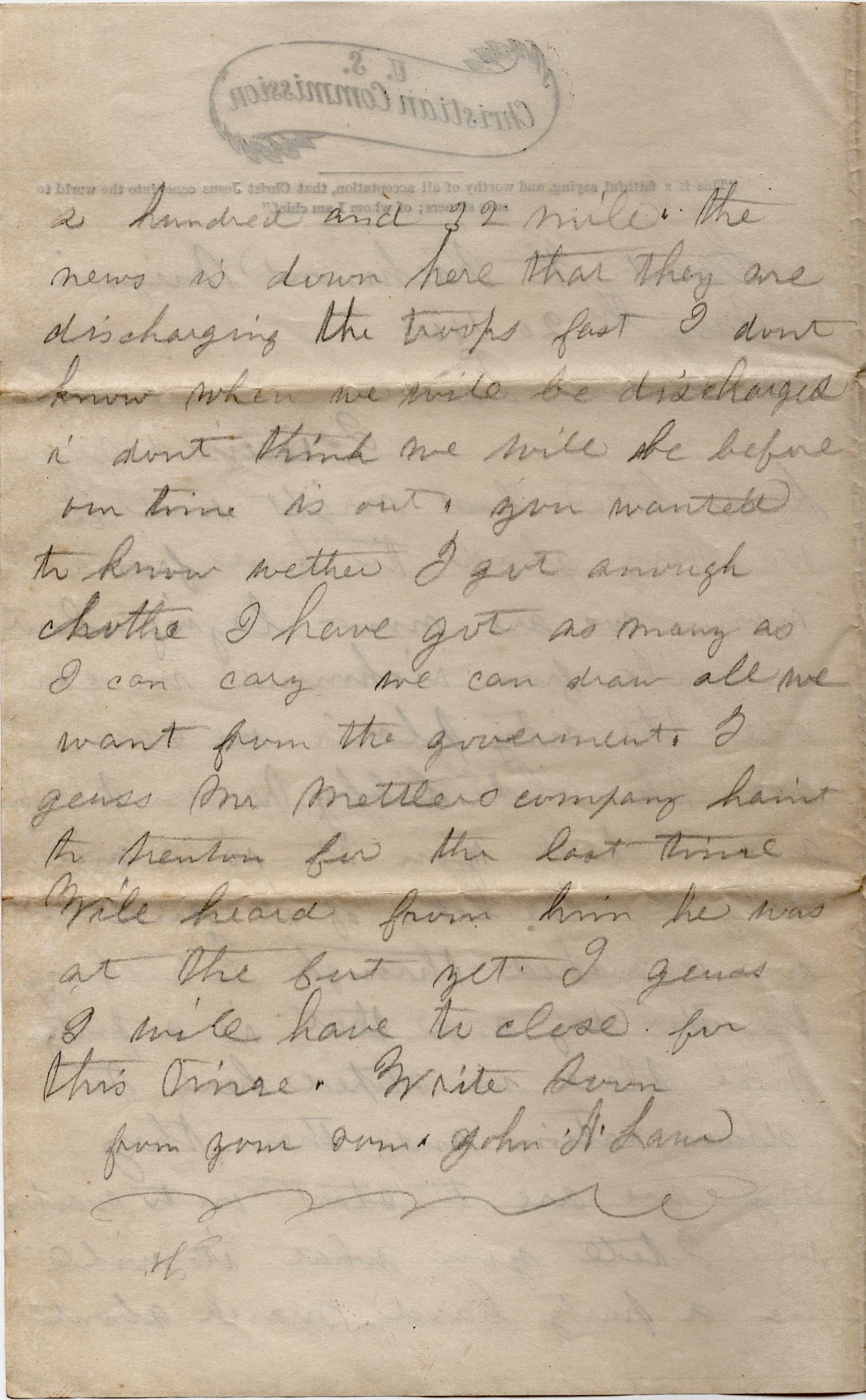
There is to be a review there and when that is over, they say they are going to send them home. They say when we go, we will have to march all the way there. If we do, it will be a long march. It is about a hundred and 72 miles.
Yesterday I was sent on safe guard over an old farmer’s plantation and I live fine. I don’t know how long I will be kept here but I suppose till they get ready to move. I will send George a ten dollar Confed[erate] note. I guess I will have to close for I am out of news.
Write soon. From your son, — John A. Laur
Letter 32
Camp at Richmond, Virginia May 20, 1865
My Dear Parents,
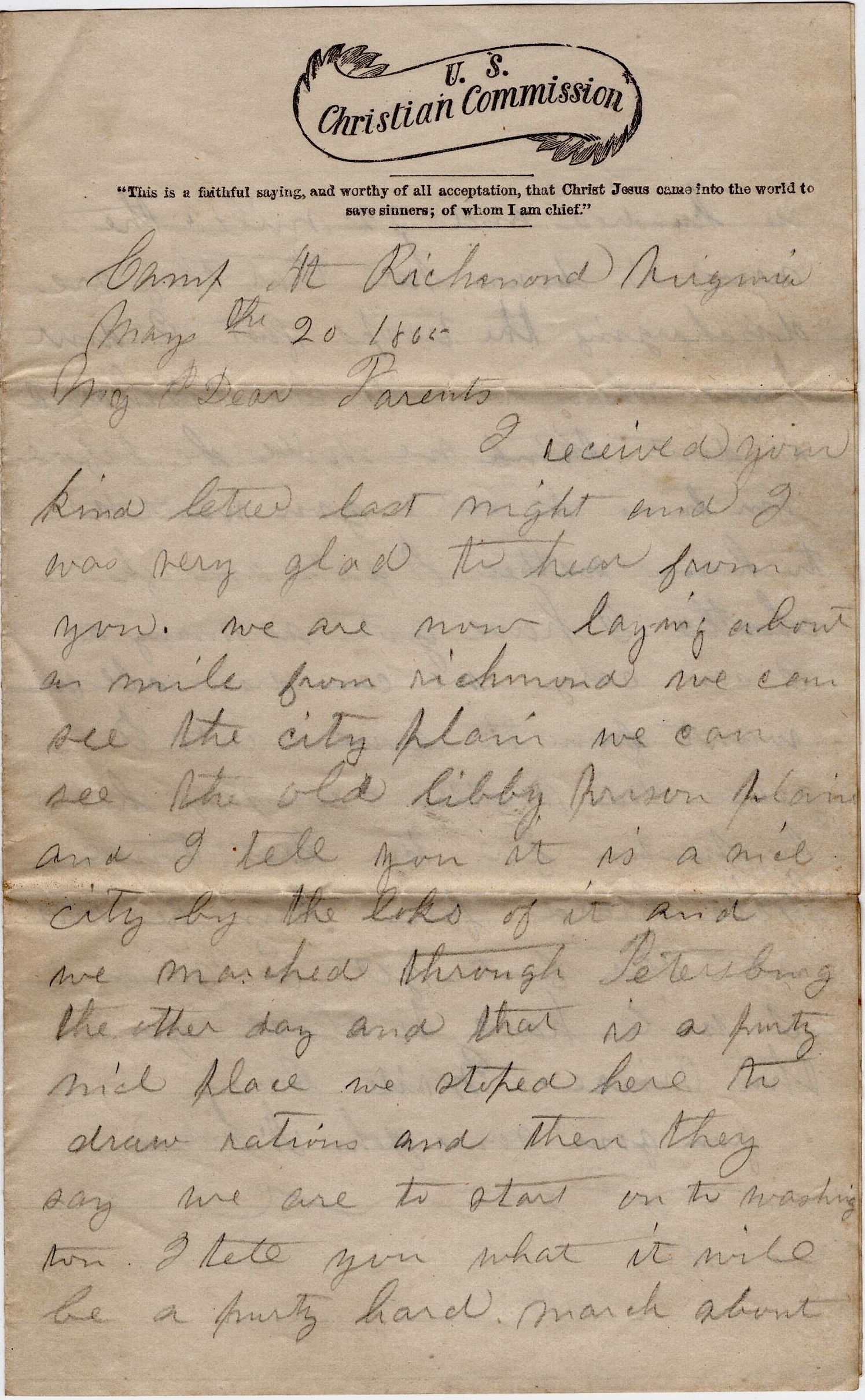
I received your kind letter last night and I was very glad to hear from you. We are now laying about a mile from Richmond. We can see the city plain. We can see Libby Prison plain and I tell you, it is a nice city by the looks of it. And we marched through Petersburg the other day and that is a purty nice place [too].
We stopped here to draw rations and then they say we are to start on to Washington. I tell you, it will be a purty hard march—about a hundred and 32 miles. The news is down here that they are discharging the troops fast. I don’t know when we will be discharged. I don’t think we will be before our time is out. You wanted to know whether I got enough clothes. I have got as many as I can carry. We can draw all we want from the goverment. I guess Mr. Mettler’s company hain’t to Trenton for the last time Will heard from him, he was at the fort yet. I guess I will have to close for this time. Write soon. From your son, — John A. Laur
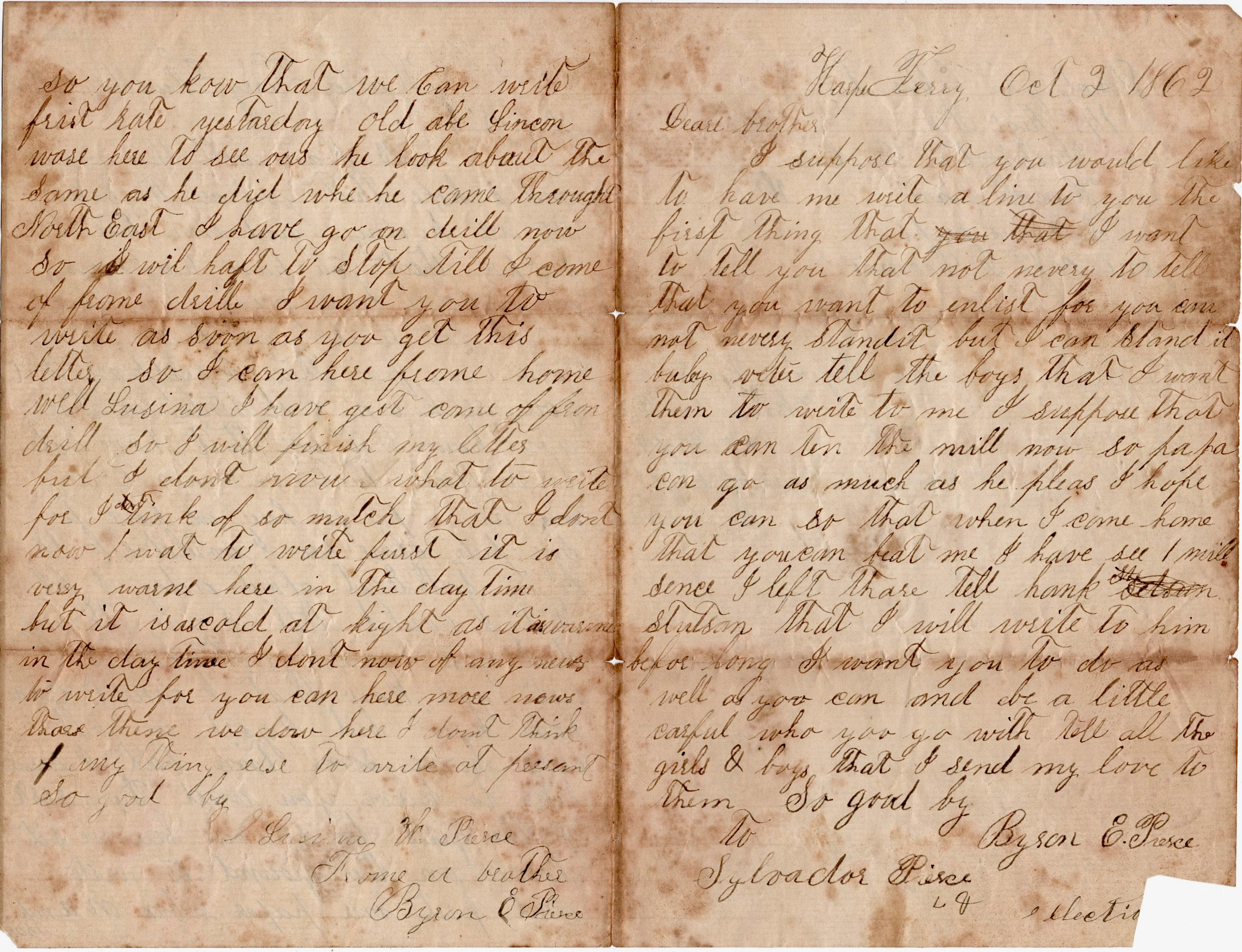
The following letter was written by Earl “Byron” Pierce (1842-1862), the son of Arnold Y. Pierce (1815-1891) and Wealthy Austin (1819-1902) of North East, Erie county, Pennsylvania. He wrote the letter to his siblings, Lucina Wealthy Pierce (1847-1953) and Salvador John Pierce (1844-1920).
Byron enlisted on 26 August 1862 to serve three years in Co. C, 145th Pennsylvania Volunteers. This letter was written barely over a month after his date of muster and only about ten weeks before he was killed on the battlefield at Fredericksburg on 13 December 1862. For the members of the 145th Pennsylvania, Fredericksburg was a bloody baptism of fire. Joining in the assault by the 2nd Corps, the regiment made a senseless charge against the Confederate line entrenched on Marye’s Heights that resulted in 226 casualties, nearly half of those that took the field.
My thanks to Abbey Weber Jones for providing me with a first draft of this transcript.
T R A N S C R I P T I O N
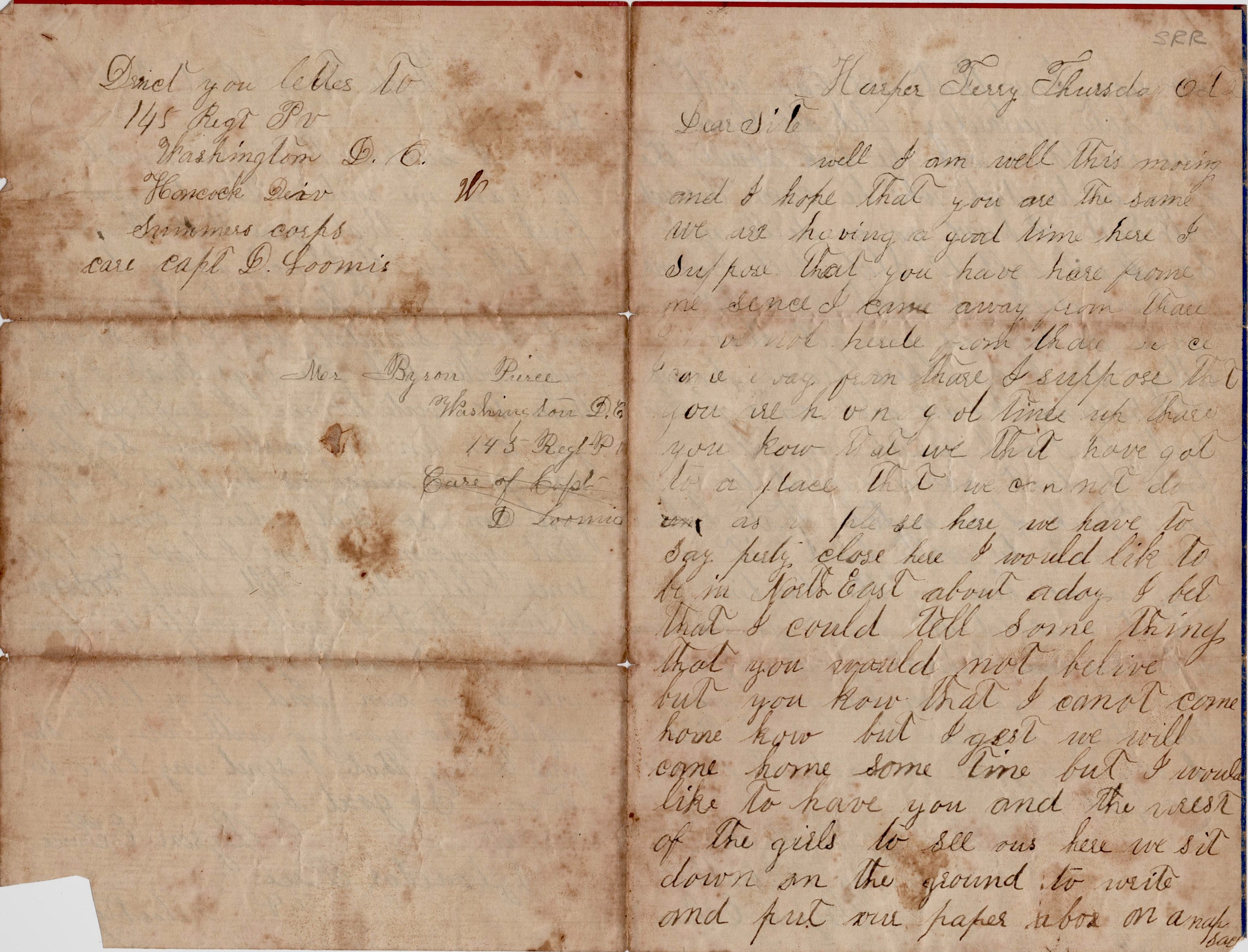
Harpers Ferry, [West Virginia] Thursday, Oct 2, [1862]
Dear Sister,
Well, I am well this morning and I hope that you are the same. We are having a good time here. I suppose that you have hear[d] from me since I came away from there. I have not heard from there since I came away from there. I suppose that you are having good times up there. You know that we have got to a place that we can not do as we please here. We have to stay perty close here. I would like to be in North East [Erie County, Pennsylvania] about a day. I bet that I could tell something that you would not believe but you know that I cannot come home now. But I guess we will come home some time. But I would like to have you and the rest of the girls to see us here. We sit down on the ground to write and put our paper on a box or a knapsack, so you know that we can write first rate.
Yesterday Old Abe Lincoln was here to see us. He look[ed] about the same as he did when he came through North East [Erie County, Pennsylvania]. 1
I have [to] go on drill now, so I will haft to stop till I come off from drill. I want you to write as soon as you get this letter so I can hear from home. Well, Lusina, I have gest come off from drill so I will finish my letter, but I don’t know what to write for I think of so much that I don’t know what to write first. It is very warm here in the day time, but it is as cold at night as it was in the day time. I don’t know of any news to write for you can hear more news there then we do here. I don’t think of anything else to write at present so goodbye. From a brother, — Byron E. Pierce
[to] Lusina W. Pierce
Harpers Ferry, [West Virginia] Oct 2, 1862
Dear brother,
I suppose that you would like to have me write a line to you. The first thing that I want to tell you [is] that ought never to tell that you want to enlist for you cannot never stand it. But I can stand it [much] better. Tell the boys that I want them to write to me. I suppose that you can ten[d] the mill now so papa can go [about] as much as he pleases. I hope you can so that when I come home, that you can beat me. I have see[n] one mill since I left there.
Tell Hank Stutson that I will write to him before long. I want you to do as well as you can and be a little careful who you go with. Tell all the girls & boys that I send my love to them. So, goodbye. — Byron E Pierce
[To] Salvador Pierce
Direct your letter to 145 Rgt Penn. Vol., Washington, D. C., Hancock’s Div., Sumner’s Corps, Care [of] Capt. D[yer] Loomis
1 About noon on Oct. 1, 1862, President Lincoln—traveling by rail from Washington—arrived at a stop across the Potomac River from Harpers Ferry, Va. He was to visit troops in the aftermath of the Battle of Antietam, fought two weeks earlier. The president walked into Harpers Ferry across a pontoon bridge since the bridge had been destroyed by the Confederates. See “A Hidden-In-Plain-Sight Linck to Lincoln?‘ by John Banks.
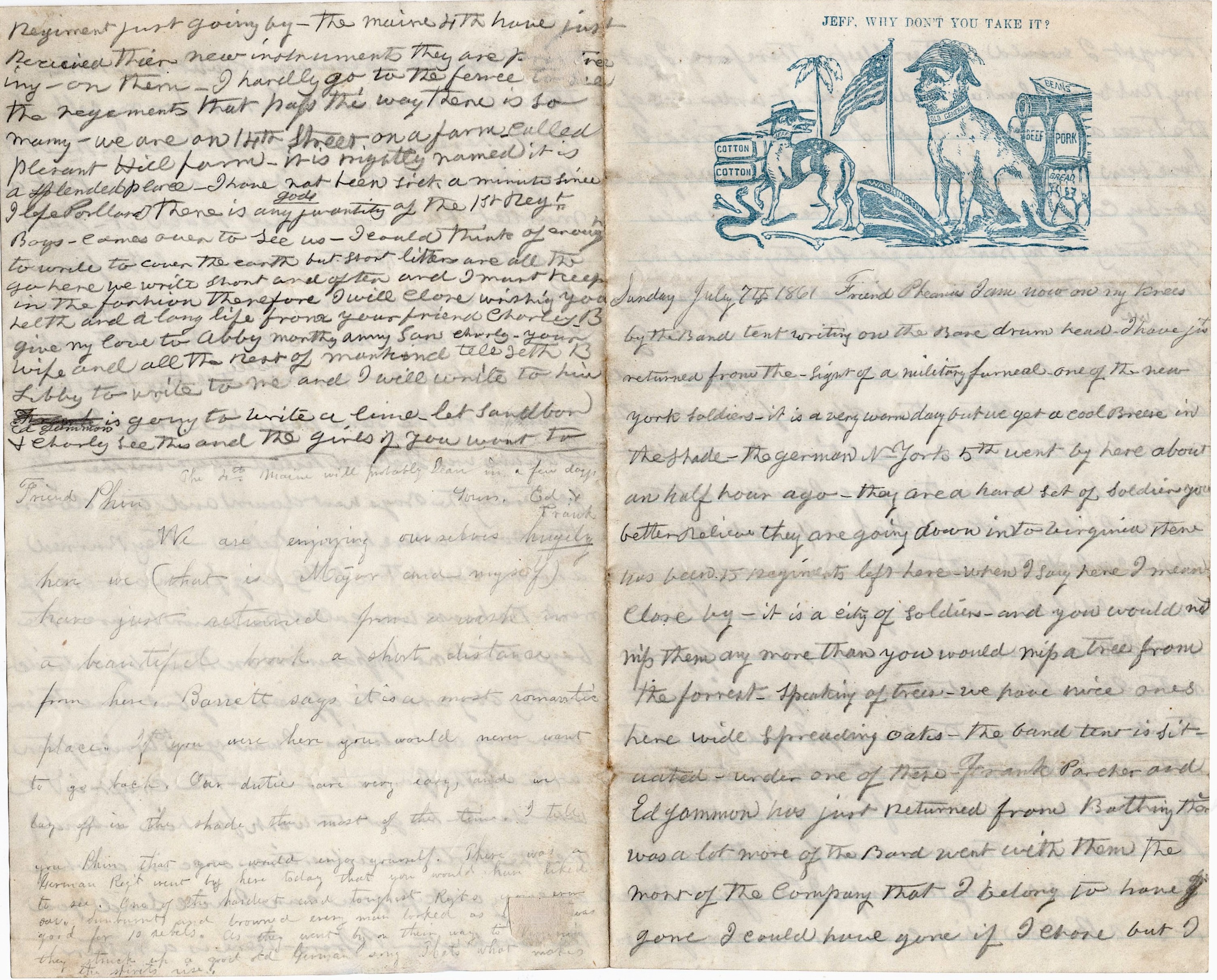
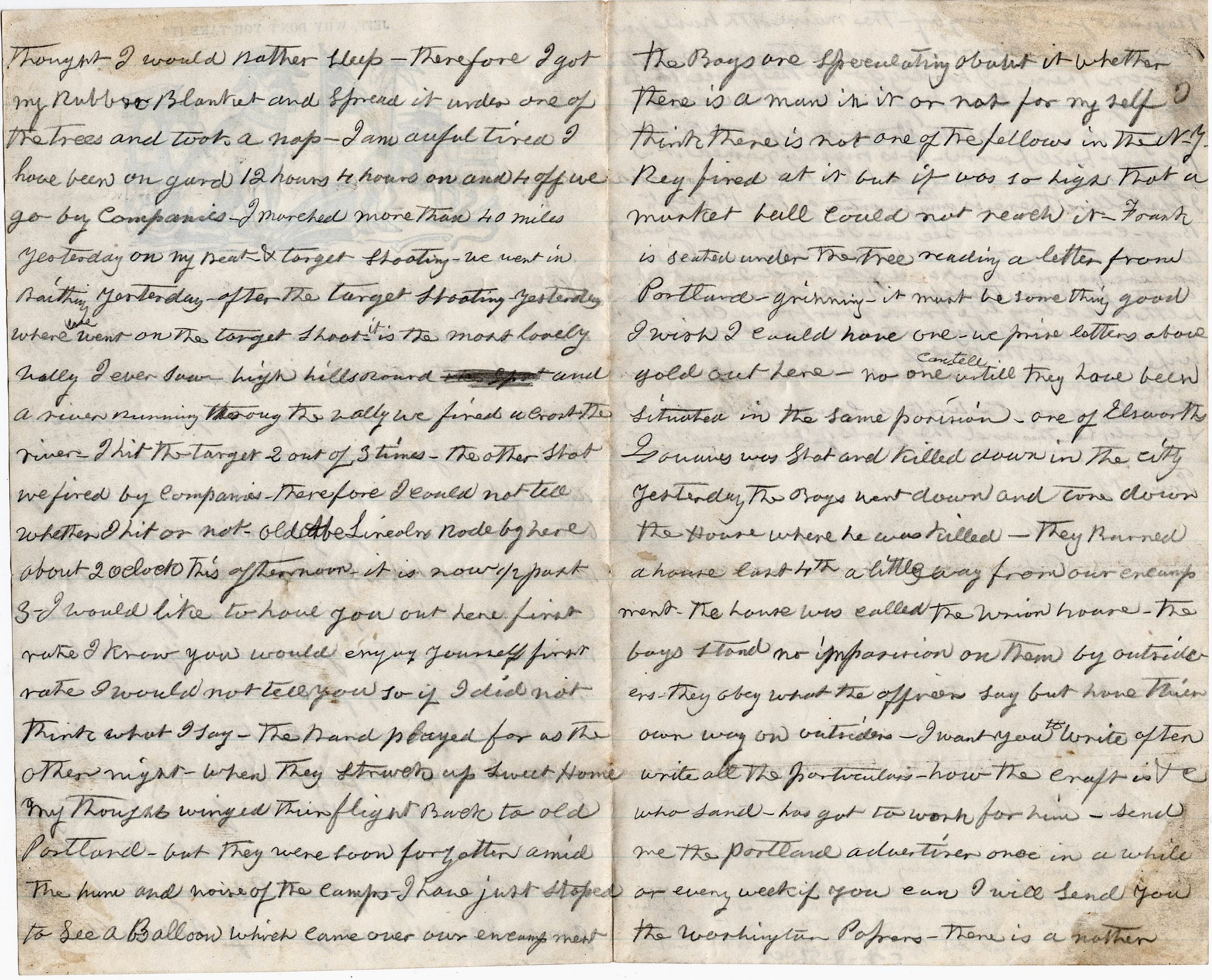
This letter was begin by Charles D. Barrett (1828-1896) and finished by Samuel Franklyn (“Frank”) Parcher and Edward M. Gammon; Frank doing the writing of the latter two. All three were members of the 5th Maine Infantry. Charles began his service as a private in Co. H but later transferred to the band, joining Frank and Ed who mustered in as principal musicians. The 5th Maine Infantry was formed in Portland, Maine, and were mustered into the service on 24 June 1861 and encamped on Meridian Hill north of Washington City in July. They moved their camp to Alexandria, Virginia, just prior to the Battle of Bull Run. At that time, they were attached to Howard’s Brigade, Heintzelman’s Division. After the battle, they set up camp near Fort Ellsworth in Alexandria.
T R A N S C R I P T I O N
Sunday, July 7, 1861
Friend Phineas,
I am now on my knees by the Band tent writing on the bare drum head. I have just returned from the dight of a military funeral—one of te New York soldiers. It is a very warm day but we have got a cool breeze in the shade. The German New York 5th went by here about a half hour ago. They are a hard set of soldiers, you better believe. They are going down into Virginia. 1 There has been 15 regiments left here. When I say here, I mean close by. It is a city of soldiers and you would not miss them any more than you would miss a tree from the forest.
Speaking of trees, we have nice ones here—wide spreading oaks. The band tent is situated under one of these. Frank Parcher and Ed Gammon has just returned from Battery. There was a lot more of the Band went with them. The most of the company that I belong to have gone. I could have gone if I chose but I thought I would rather sleep. Therefore I got my rubber blanket and spread it under one of the trees and took a nap. I am awful tired. I have been on guard 12 hours, 4 hours on and 4 off. We go by companies.
I marched more than 40 miles yesterday on my beat & target shooting, We went in bathing yesterday after the target shooting. Where we went on the target shoot is the most lovely valley I ever saw—high hills round and a river running through the valley. We fired across the river. I hit the target two out of three times. The other shot—we fired by companies, therefore, I could not tell whether I hit or not.
Old Abe Lincoln rode by here about two o’clock this afternoon. 2 It is now half past 3. I would like to have you out here first rate. I know you would enjoy yourself first rate. I would not tell you so if I did not think what I say. The Band plated for us the other night. When they struck up Sweet Home, my thought winged their flight back to Old Portland. But they were soon forgotten amid the hum and noise of the camps.
I have just stopped to see a balloon which came over our encampment. The Boys are speculating about it whether there is a man in it or not. For myself, I think there is not. One of the fellows in the New York Regiment fired at it but it was so high that a musket ball could not reach it. Frank is seated under the tree reading a letter from Portland—grinning. It must be something good. I wish I could have one. We prize letters above gold out here. No one can tell until they have been situated in the same position.
One of Ellworth’s Zouaves was shot and killed down in the city yesterday. The Boys went down and tore down the house where he was killed. They burned a house last 4th [of July] a little way from our encampment. The house was called The Union House. The Boys stand no imposition on them by outsiders. they obey what the officers say, but have their own way on outsides.
I want you to write often. Write all the particulars—how the craft is, &c. Who Sand has got to work for him. Send me the Portland [Daily] Advertiser once in a while or every week if you can. I will send you the Washington papers. There is another regiment just going by, The Maine 4th have just received their new instruments. They are practicing [?] on them. I hardly go to the fence to see the regiments that pass this way there is so many. We are on 14th Street on a farm called Pleasant Hill Farm. It is mightily named. It is a splendid place. 3
I have not been sick a minute since I left Portland. There is any quantity of the 1st Regiment Boys came over to see us. I could think of enough to write to cover the earth but short letters are all the go here. We write short and often and I must keep in the fashion. Therefore, I will close wishing you good health and a long life. From your friend, — Charley B.
Give my love to Abby [ ], your wife, and all the rest of mankind. Tell Seth B. Libby to write to me and I will write to him. Ed Gammon is going to write a line. Let Sandbor & Charley see this and the girls if you want to.
Friend Phin,
We are enjoying ourselves hugely here. We (that is, Meyor [?] and myself) have just returned from a walk in a beautiful brook a short distance from here. Barrett says it is a most romantic place. If you were here, you would never want to go back. Our duties are very easy and we lay in the shade the most of the time. I tell you, Phin, that you would enjoy yourself. There was a German Regiment went by here today that you would have like to see. One of the hardest and toughest regiments you ever saw. Sunburnt and browned, every man looked as though he was good for ten rebels. As they went by on their way to Virginia, they struck up a good old German song. That’s what makes the spirits rise! The 4th Maine will probably leave in a few days. Yours, — Ed [Gammon] & Frank [Parcher]
1 The 5th New York State Militia (also known as the Jefferson Guard) was composed almost entirely of German citizens from New York City. They broke camp on 7 July 1861 to join the forces mustering in Virginia under Gen. Robert Patterson.
2Lincoln and Sec. Seward spend two hours at Navy Yard. Extracts from Dahlgren Diary, John G. Nicolay Papers, Library of Congress, Washington, DC. [Source: Lincoln Log]
3 In 1861, “Pleasant Hill” was a prominent country estate and farm owned by the Holtzclaw family, situated along the 14th Street corridor in Washington City. As the Civil War began, this rural expanse was transformed by the Union Army into a fortified military position critical for the capital’s defense.
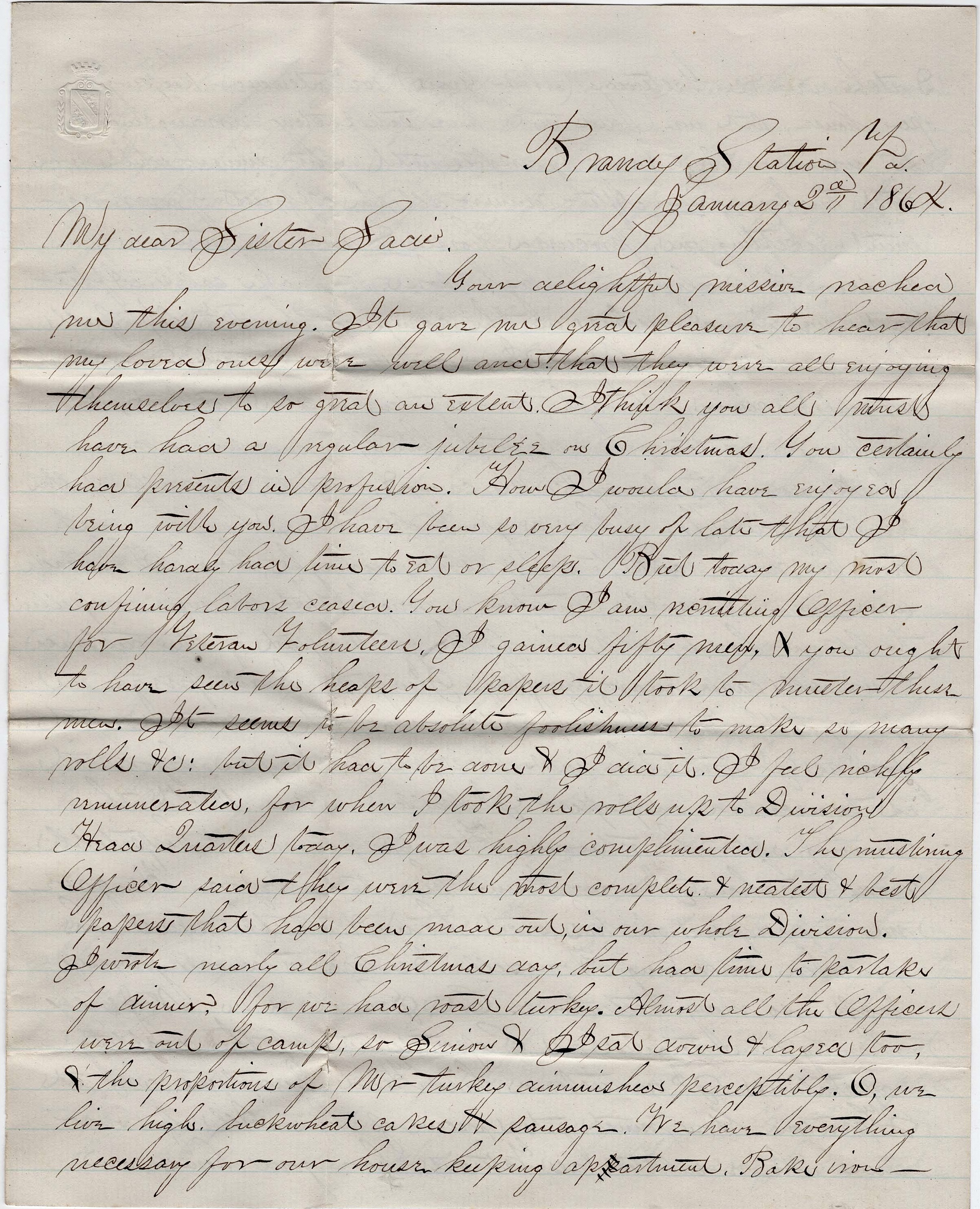
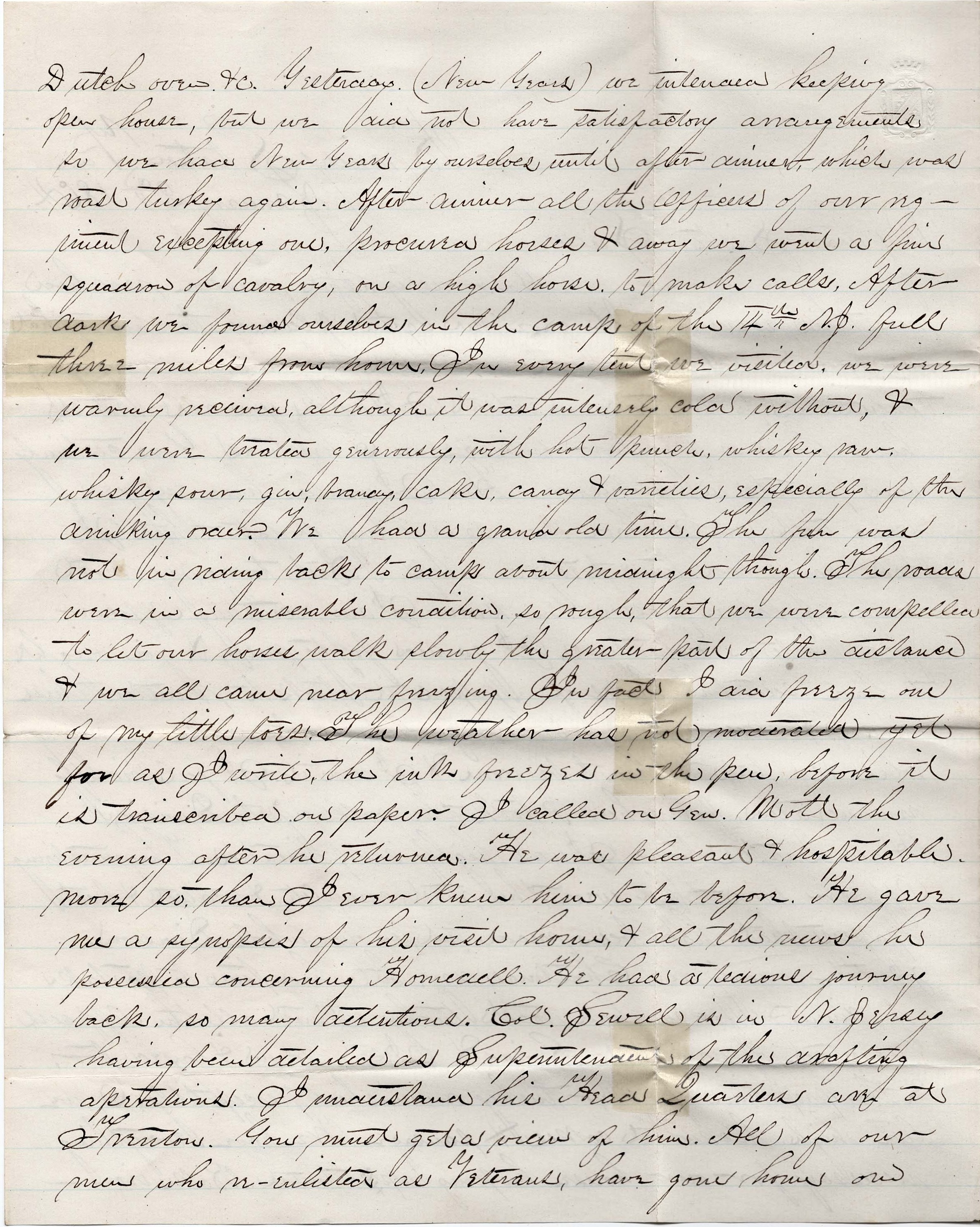
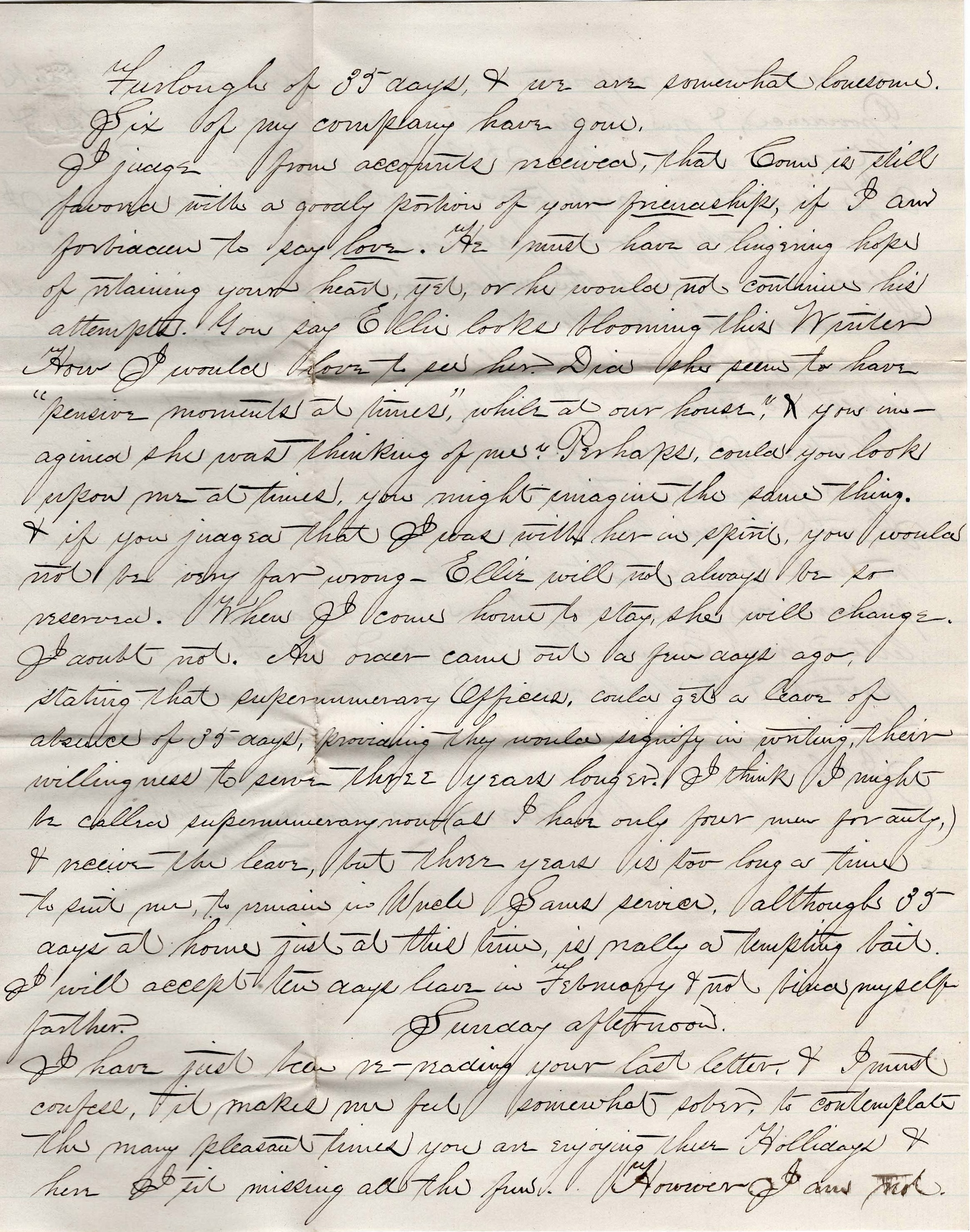
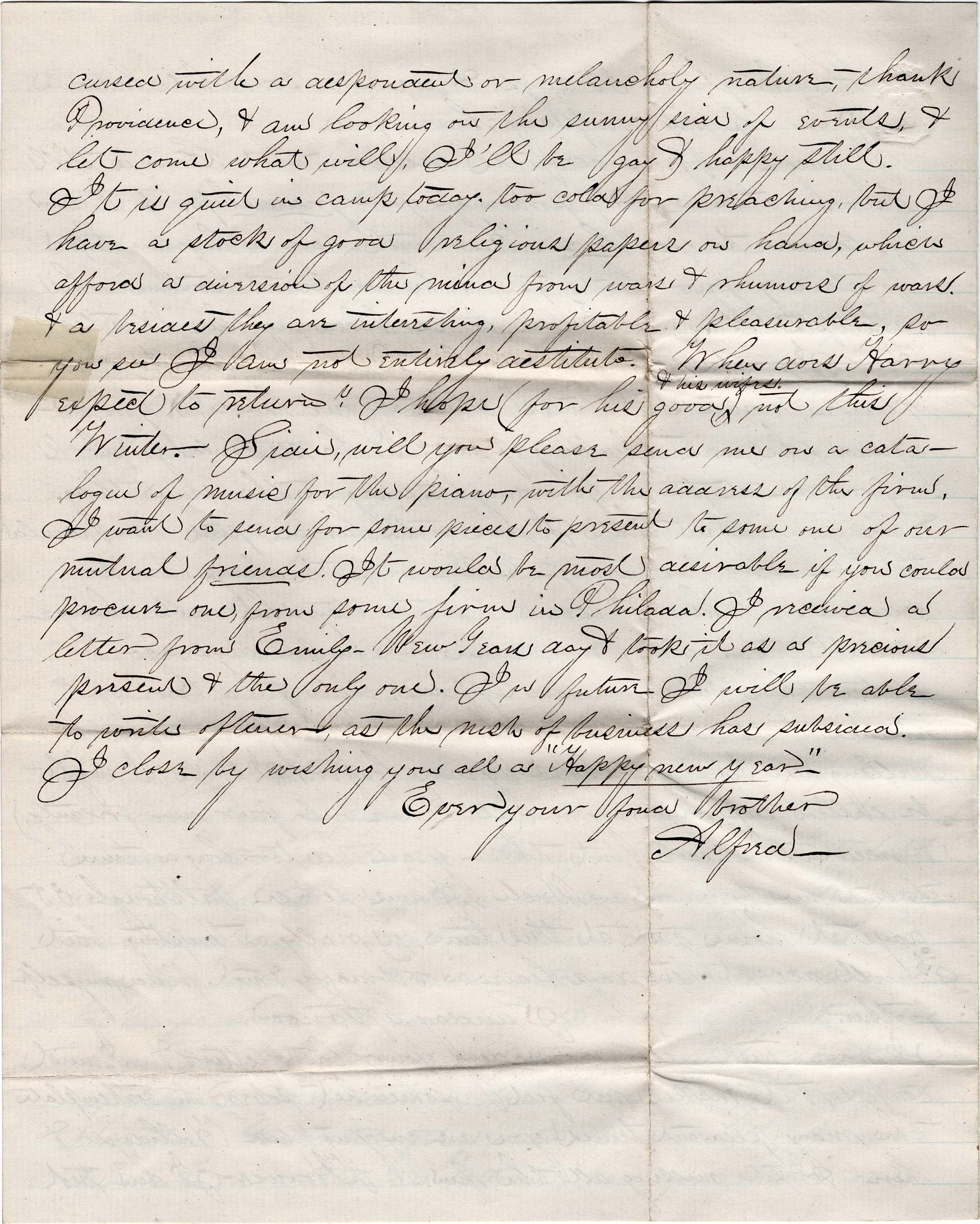
The following letter was composed by Jessie Ann Benton Frémont (1824-1902), the daughter of Missouri Senator Thomas Hart Benton and the spouse of General John Charles Frémont. It was inscribed on Jessie’s personal stationery, adorned with her monogram embossed at the top center of the first page. The letter was addressed to Schuyler Colfax, a distinguished member of the US House of Representatives whom she regarded as a political ally and supporter of her husband. She dispatched the letter in an effort to secure support for her forthcoming publication, entitled “The Story of the Guard: A Chronicle of the War.” In this work, she advocated for her husband and his distinguished bodyguard, particularly the “California Hundred”—a specialized volunteer cavalry unit. Her stated objective was to raise funds for the families of the soldiers within this unit, who had been denied pensions.
This letter resides in the personal collection of Peter G. Meyerhof, who has kindly provided me with a verified transcription for accuracy, along with comprehensive footnotes from his rigorous scholarly research. He has generously permitted the publication of the letter on Spared & Shared.
Evidence that Schuyler Colfax was a close, personal friend of President Lincoln can be found in the following letters published in Spared & Shared. See—1861-64: Letters of Charles M. Heaton.
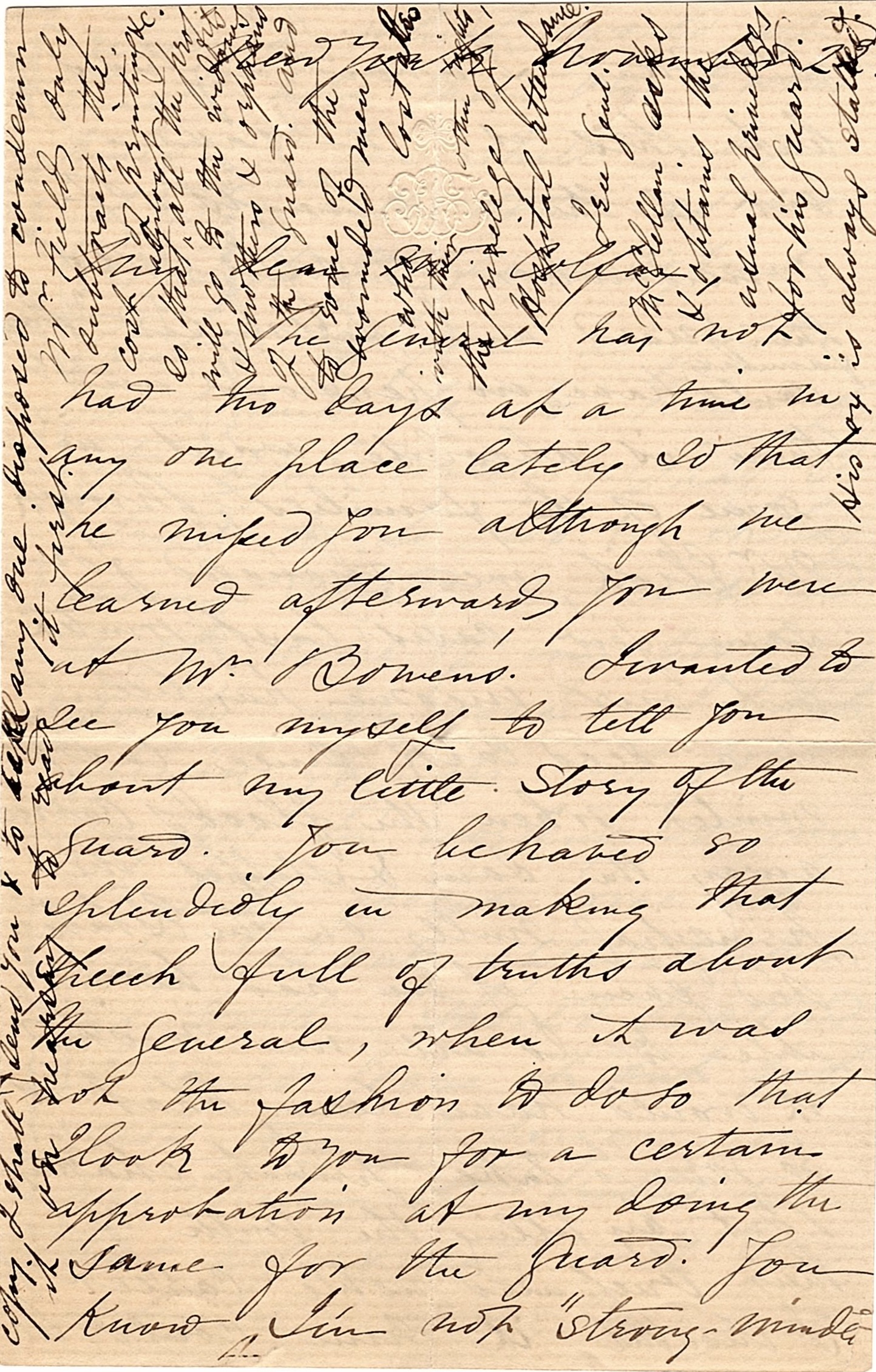
The General 3 has not had two days at a time in any one place lately so that he missed you although we learned afterwards you were at Mr. Bowen’s. 4 I wanted to see you myself to tell you about my little Story of the Guard. 5 You behaved so splendidly in making that speech 6 full of truths about the General, when it was not the fashion to do so that I look to you for a certain approbation at my doing the same for the Guard. You know I’m not “strong-minded” and that I avoid a fuss but this is a case out of the limits of consideration of self.
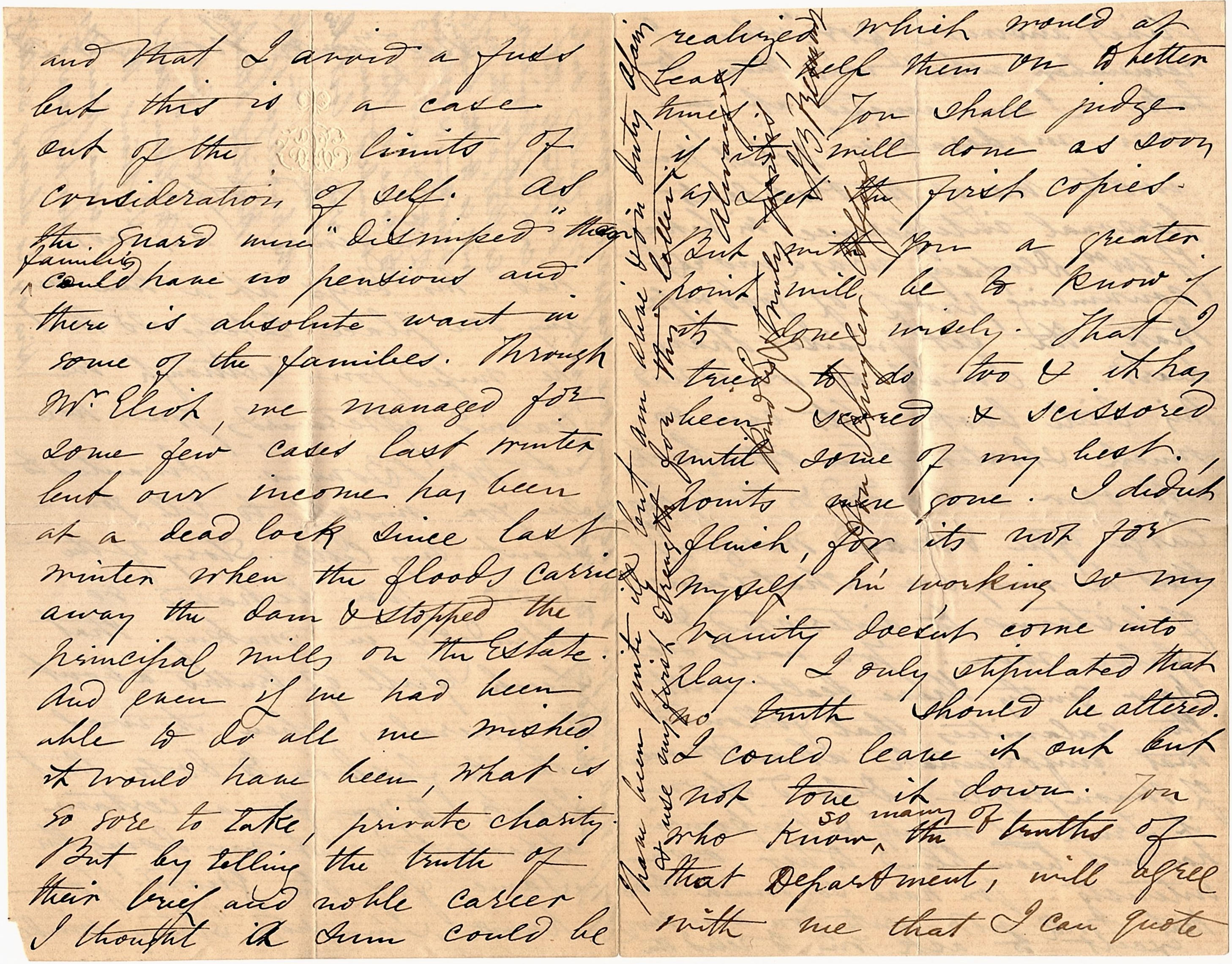
As the Guard were “dismissed” their families could have no pensions and there is absolute want in some of the families. Through Mr. Eliot, 7 we managed for some few cases last winter but our income has been at a dead lock since last winter when the floods carried away the dam and stopped the principal mills on the Estate. 8 And even if we had been able to do all we wished it would have been—what is so sore to take—private charity. But by telling the truth of their brief and noble career, I thought a sum could be realized which would at least help them on to better times. You shall judge if its well done as soon as I get the first copies. But with you a greater point will be to know if it’s done wisely. That I tried to do too and it has been scored and scissored until some of my best points were gone. I didn’t flourish, for it’s not for myself I’m working, so my vanity doesn’t come into play. I only stipulated that no truth should be altered. I could leave it out but not tone it down. You, who knows so many of the truths of that Department, will agree with me that I can quote Clive’s answer, for “when I remember what was there to take, I am amazed at my own moderation.” 9
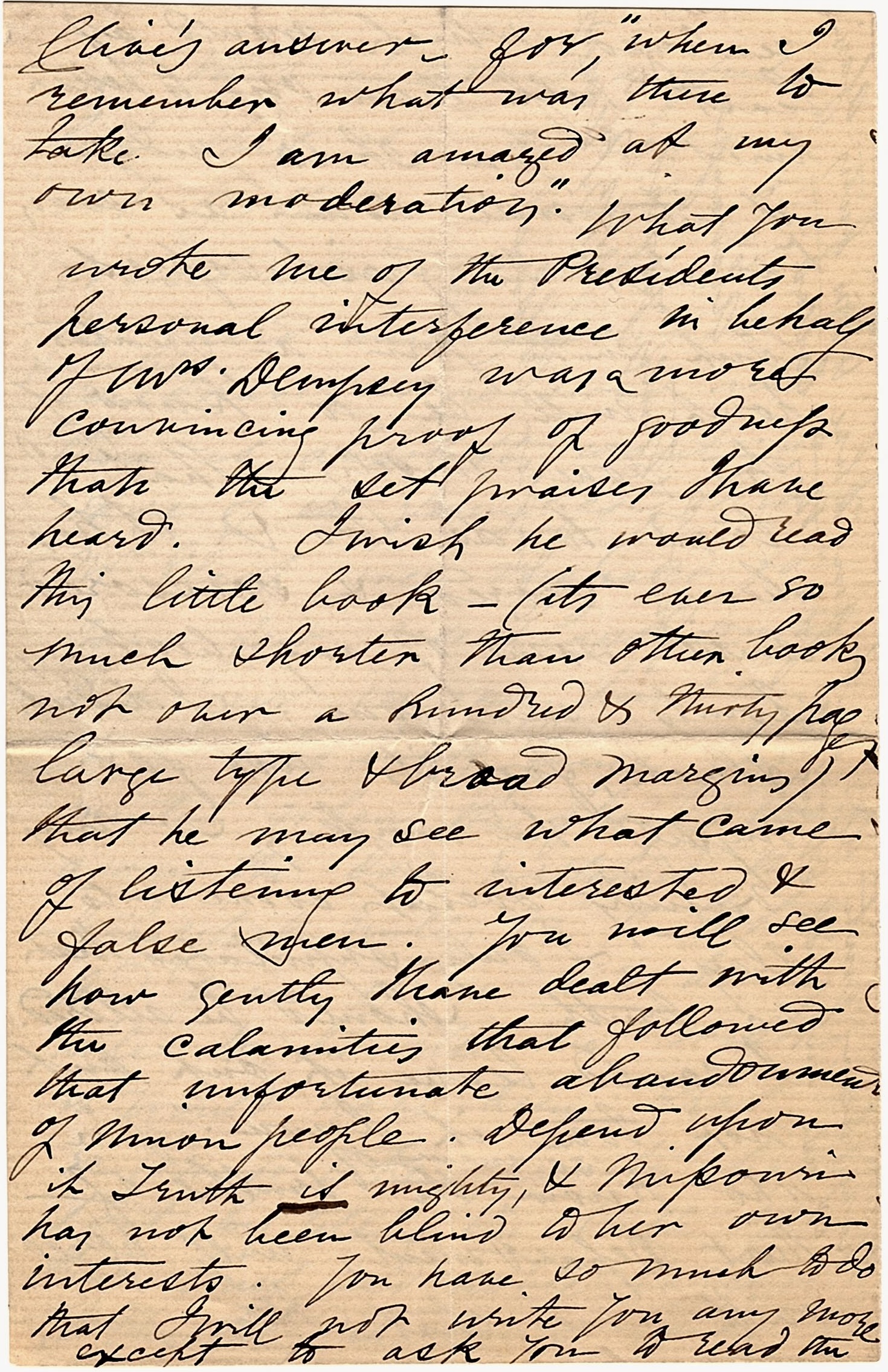
What you wrote me of the President’s 10 personal interference in behalf of Mrs. Dempsey 11 was a more convincing proof of goodness than the set praises I have heard. I wish he would read this little book—(its ever so much shorter than other books, not over a hundred and thirty pages, 12 large type and broad margins) that he may see what came of listening to interested and false men. 13 You will see how gently I have dealt with the calamities that followed that unfortunate abandonment of Union people. Depend upon it—Truth is mighty, and Missouri has not been blind to her own interests.
You have so much to do that I will not write you any more except to ask you to read the copy I shall send you and to tell any one disposed to condemn it on hearsay to read it first. Mr. Fields 14 only subtracts the cost of printing etc. so that almost all the profits will go to the widows and mothers and orphans of the Guard and to some of the wounded men who lost also with their other rights the privilege of Hospital attendance.
I see Genl. McClellan 15 asks and obtains the usual privileges for his Guard. His ox is always stalled.
I have been quite ill but am alive and on duty again and use my first strength for this letter. Always, kindly and truly yours, — J. B. Frémont
[to] Hon. Schuyler Colfax
1) Although the year 1862 does not appear in the letter (as was typical on most of her other letters), it can be determined from dating the publication information on The Story of the Guard, the speech of Colfax, and the California flood of 1862 as provided in notes # 5, 6, and 8 below.
2) Schuyler Colfax (1823-1885), Republican Congressman from Indiana, friend of the Frémonts, energetic opponent of slavery, and later Speaker of the House of Representatives (December 1863 to March 1869), and Vice President under U. S. Grant (1869-1873).
3) General John Charles Frémont (1813-1890), husband of Jessie Benton Frémont
4) Henry C. Bowen (1813-1896), New York abolitionist, Congregationalist, cofounder of the religious weekly, New York Independent, friend of Colfax and Frémont.
5) The Story of the Guard: A Chronicle of the War, by Jessie Benton Frémont, published by Ticknor and Fields, Boston 1863, written in December 1861 – early 1862 according to JBF in her book. Temporarily withheld from publication pending possible reassignment of General Frémont to active command (according to Sally Denton in her biography on JBF, Passion and Principle).
6) Fremont’s Hundred Days in Missouri. Speech of Schuyler Colfax, of Indiana, in Reply to Mr. Blair [Francis P. Jr.], of Missouri, delivered in the House of Representatives, March 7, 1862.
7) Rev. William Greenleaf Eliot (1811-1887), Unitarian minister, founder of Washington University of St. Louis, and grandfather of T. S. Eliot. He was to use the profits of this book to pay the wounded veterans as well as the widows and orphans of the Guard. Following the Battle of Wilson’s Creek, Rev. Eliot, appalled by the inadequate facilities to treat the Federal wounded in St. Louis, approached Jessie Fremont with a plan to aid the sufferers. Jessie had already sent for Dorothea Dix, the superintendent of female army nurses, to inspect the city’s facilities, and together they agreed to Eliot’s plan to form the Western Sanitary Commission. The Commission performed invaluable work during the war, establishing hospitals, providing nurses, and soliciting funds and supplies for soldiers and refugees. Jessie also formed the Frémont Relief Society, which later merged with the Ladies Union Aid Society. http://www.civilwarvirtualmuseum.org/medicine/hospitals-and-civilian-efforts/jessie-benton-fremont.php Also see Herr, Pamela, and Spence, Mary L., eds. (1993). The Letters of Jessie Benton Frémont. University of Illinois Press, Chicago, IL, p.244
8) “The Great Flood of 1862” occurred in January 1862 and affected the entire west coast following record rainfalls. The Estate refers to Las Mariposas, the estate of the Frémonts in California, upon which a large amount of gold ore was found, but which was vigorously contested by squatters. The Alta California (1-17-1862) reported, “the Benton Mills and dam have been ruined. The loss not less than $70,000” though the estate manager estimated the loss at $100,000 (Herr and Spence, 1993) p.313. The Benton Mills were on the south shore of the Merced River just east of Hall Hollow, which was at the very northern boundary of the Las Mariposas estate. There was a dam just to the east, across the Merced River. Frémont’s residence at Bear Valley was 3 miles to the south, which in turn was about 11 miles NE of Mariposa. Fremont sold his estate in June 1863 (H & S, 249), for $2 million in shares.
9) General Robert Clive (1725-1774), British officer who secured India for the British crown, later politician. In 1772 Parliament opened an inquiry into the East India Company’s practices in India. Clive’s political opponents turned these hearings into attacks on Clive. Questioned about some of the large sums of money he had received while in India, Clive pointed out that they were not contrary to accepted company practice, and defended his behavior by stating “I stand astonished at my own moderation” given opportunities for greater gain. http://en.wikipedia.org/wiki/Robert_Clive
10) Refers to President Abraham Lincoln. By the end of 1863, with General Frémont’s failure to be reappointed to active duty, the Frémont’s felt less favorably to Lincoln and increasingly blamed the influence of the Blairs.
11) The identity of Mrs. Dempsey and the act of charity by Lincoln on her behalf cannot be corroborated. It most likely suggested that Mrs. Dempsey appealed to Lincoln, begging mercy for her son who was sentenced for some military crime. Lincoln regularly commuted death sentences throughout the war. Dempsey was the name in some of these narratives; Murphy in others.
12) The book was actually 230 pages in length.
13) “Interested and false men” refers principally to Congressman and later General, and bitter political rival of Frémont (p. 77 and The Crisis, 1861)* Francis Preston Blair Jr. (1821-1875), Postmaster General Montgomery Blair (1813-1883), Attorney General Edward Bates (1793-1869) (The Crisis, 1861), * editor and Lincoln advisor Francis P. Blair Sr. (1791-1876), and Adjutant General Lorenzo Thomas (1804-1875), named as an enemy by Frémont (p. 86). The Blairs had been close friends of the Frémonts and supported his campaign for presidency in 1856 but turned intensely antagonistic during and after Fremont’s 1861 Missouri campaign when there was evidence that self-interest by the Blairs was influencing political decisions that affected Frémont.
14) James Thomas Fields (1817-1871). Junior partner with William Ticknor of Ticknor and Fields, publishers and booksellers. Also editor of The Atlantic Monthly.
15) General George Brinton McClellan (1826-1885) had just been removed from command of the Army of the Potomac for failing to pursue General Robert Lee after the recent battle of Antietam. “I have just read your dispatch about sore-tongued and fatigued horses, General. Will you pardon me for asking what the horses of your army have done since the Battle of Antietam that fatigues anything?” Lincoln to McClellan, October 25, 1862, Washington, D.C.
*The Crisis, Columbus Ohio, October 10, 1861
The Mariposa Land & Mining Co was organized in 1871 and incorporated in the state of New York. This is one of the several companies that were formed to operate John C. Fremont’s Mariposa Estate. Frémont spent six years after California statehood attempting to have his Mexican Land Grant validated under American Law. Finally, in 1856, the Supreme Court (Heydenfeldt was on the Court at that time; a conflict of interest???) restructured and approved of his original claim. Known as the Rancho Las Mariposas. The grant included the mineral rights not previously obtained over a property area of over 70 square miles. Frémont then reclaimed the property which had been illegally claimed and developed by others. He tried to obtain financing to continue to develop the mines on the property. However, the Civil War had started and in January 1863, Frémont, then a Major-General in the Union Army, sold Rancho Las Mariposas with its mines and infrastructure to Morris Ketchum, a New York City banker, who formed a public corporation, the Mariposa Company incorporated in 1863, and sold stock. Later that year, Frederick Law Olmsted, noted New York architect, came to Mariposa as superintendent for the Mariposa Company. Olmstead was not a mining expert however, he administered investments in stamp mills, tunnels, shafts, and the other infrastructure related to nearby mining towns. The Mariposa Company was incorporated in 1863 and by the next year had five mines and five mills operating. The richest gold quartz ore came from the Princeton Mine. By 1865, the Mariposa Company was bankrupt, Olmsted returned to New York, and mines were sold at a sheriff’s sale. (Ref. Newell D. Chamberlain, 1936, The Call of Gold: True Tales on the Gold Road to Yosemite, Gazette Press, Mariposa, California and The Mariposa Estate: its past, present and future. Comprising the official report of J. Ross Browne (U.S. commissioner) upon its mineral resources, transmitted to Congress on the 5th of March, 1868). The estate encompassed Bear Valley and was encircled by Mount Bullion on the east and the lower foothills of the Sierra Nevada on the west. The Merced River ran along the northern line of the property. The Mariposa Mining Company operated, with some difficulty and constant litigation over title to the estate, until 1874, when it was bought out by the newly formed Mariposa Land and Mining Company of California, which assumed complete ownership of the Mariposa Estate. This new company owned and managed all facets of life on the estate, including the mines, water power, quartz mills, mill dams, engines, ore houses, dwellings, and stores. The principal mines on the estate were the Princeton, Josephine, Pine Tree, Linda, Green Gulch, Mariposa, and Mount Ophir mines. Ore was treated at the Ophir Mills, located on the Merced River and powered by means of the Benton Dam (and, after 1900, by the Benton Mills hydroelectric power plant). (Ref. ABN VI-331 P395) [ California
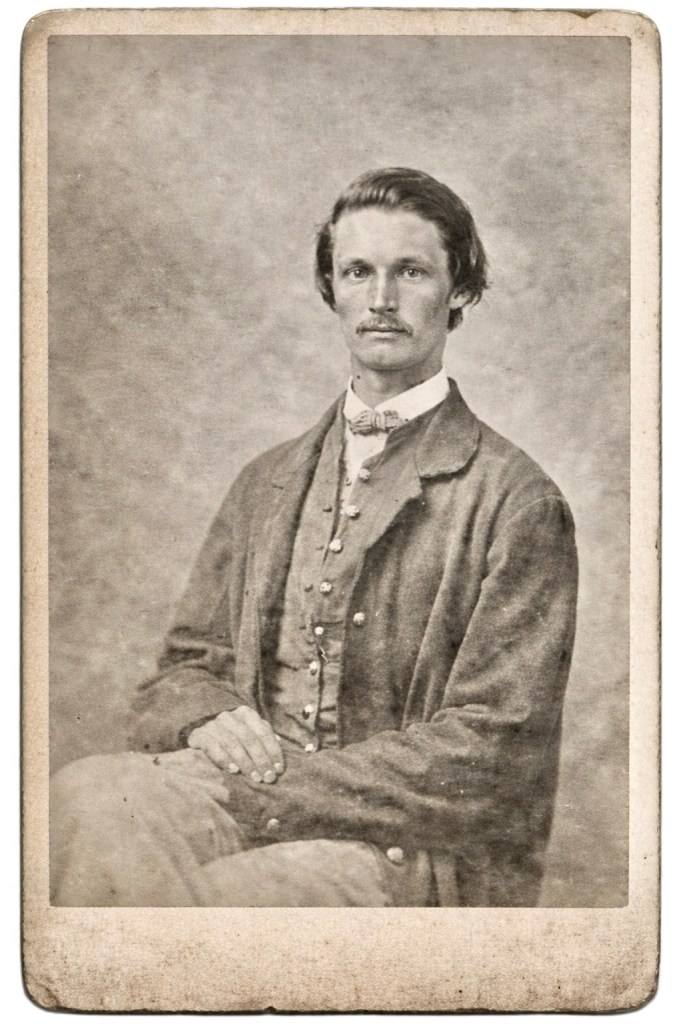
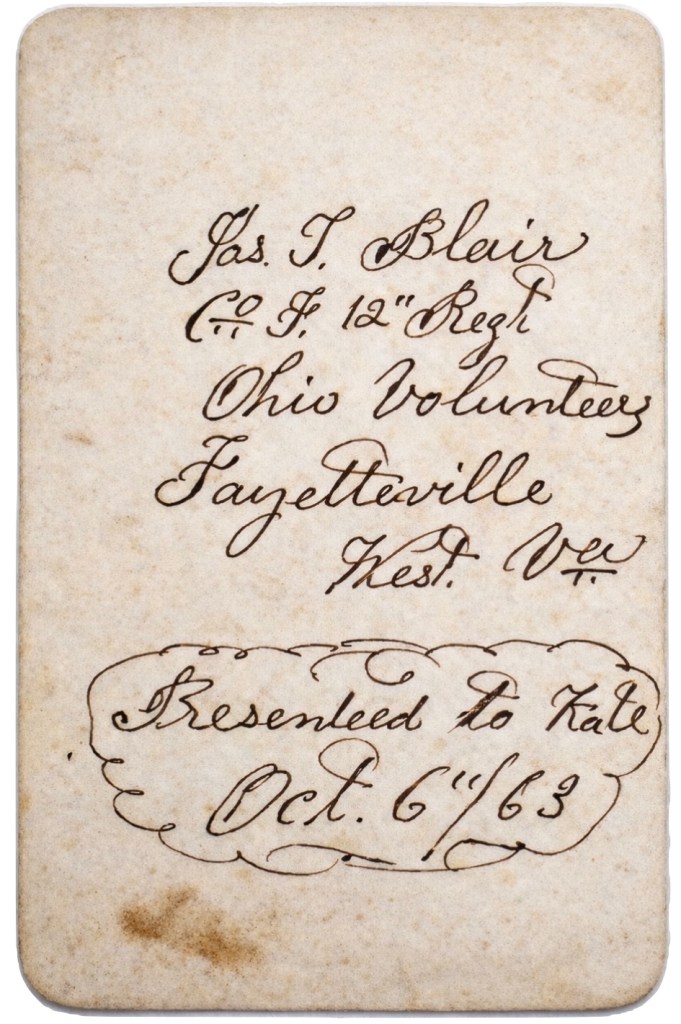
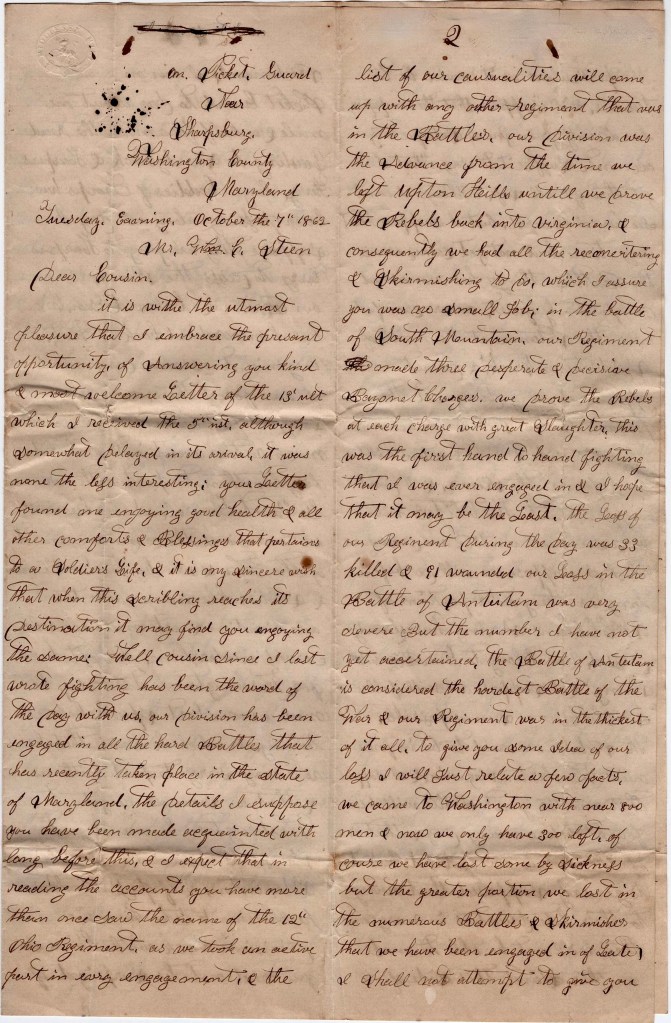
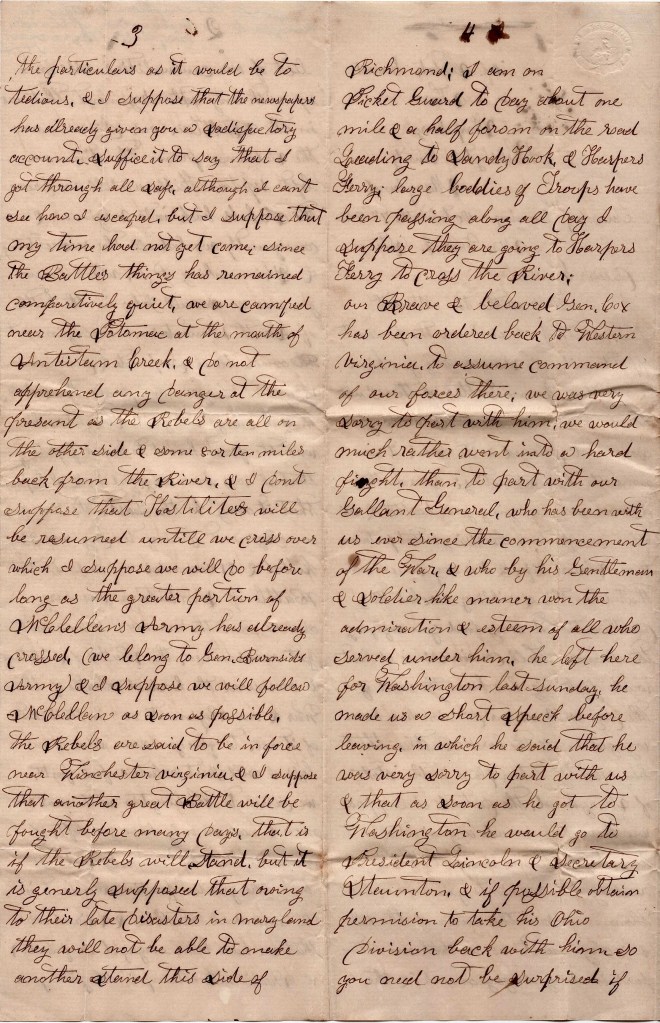
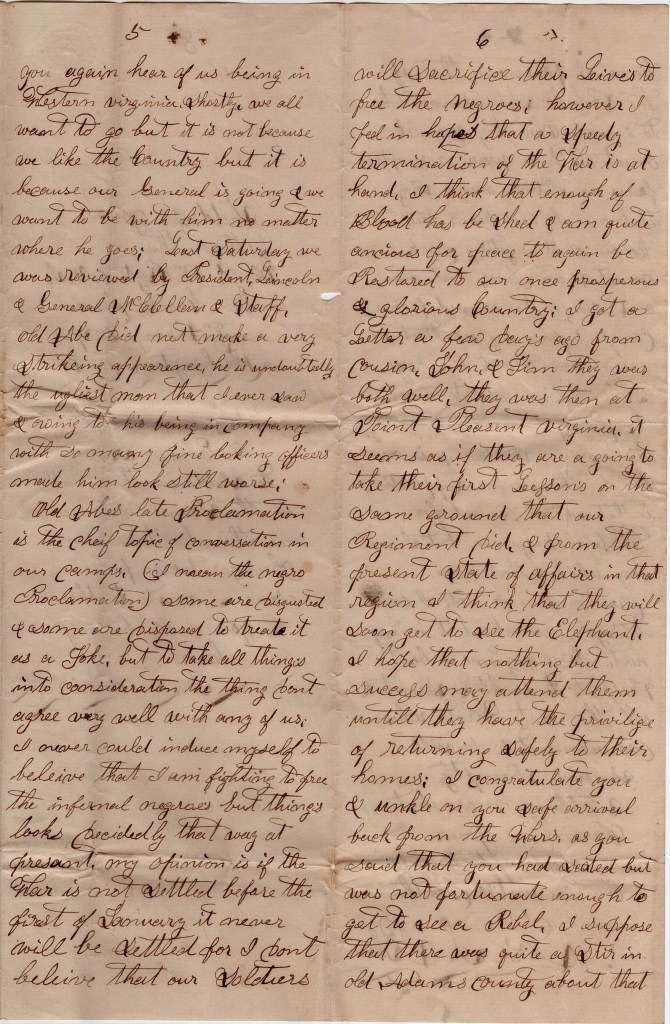
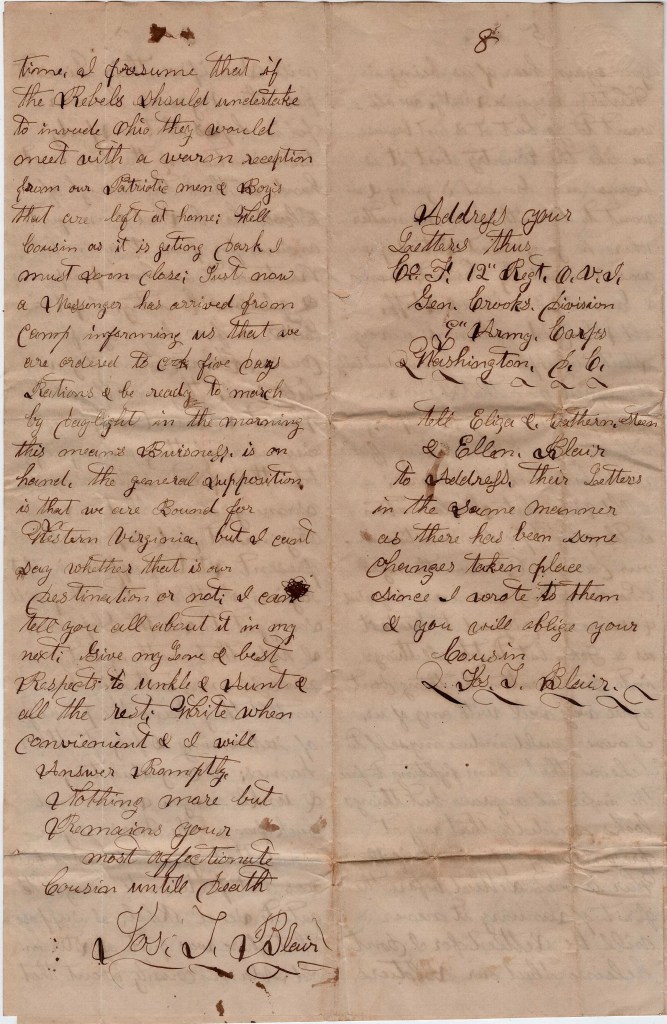
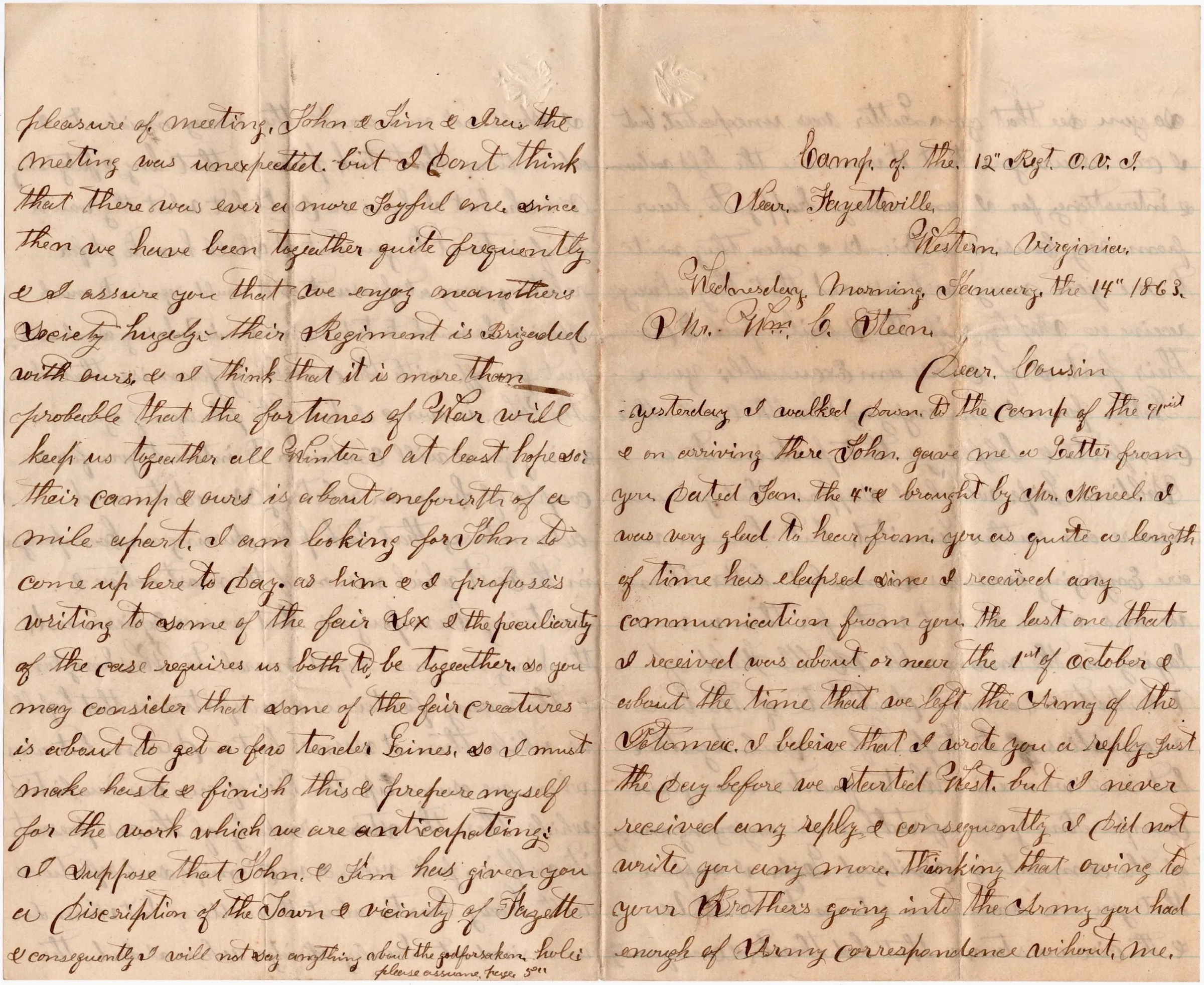
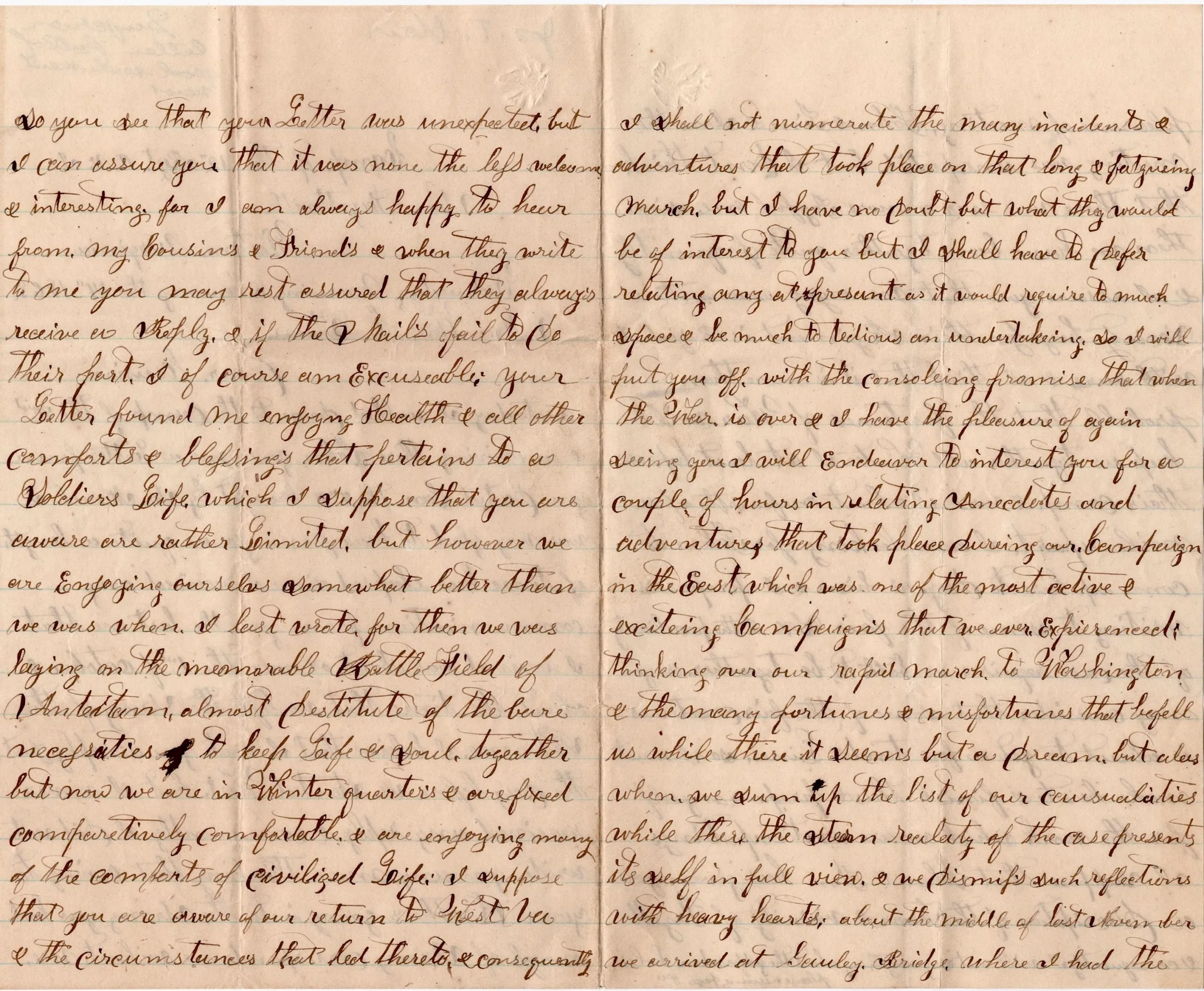
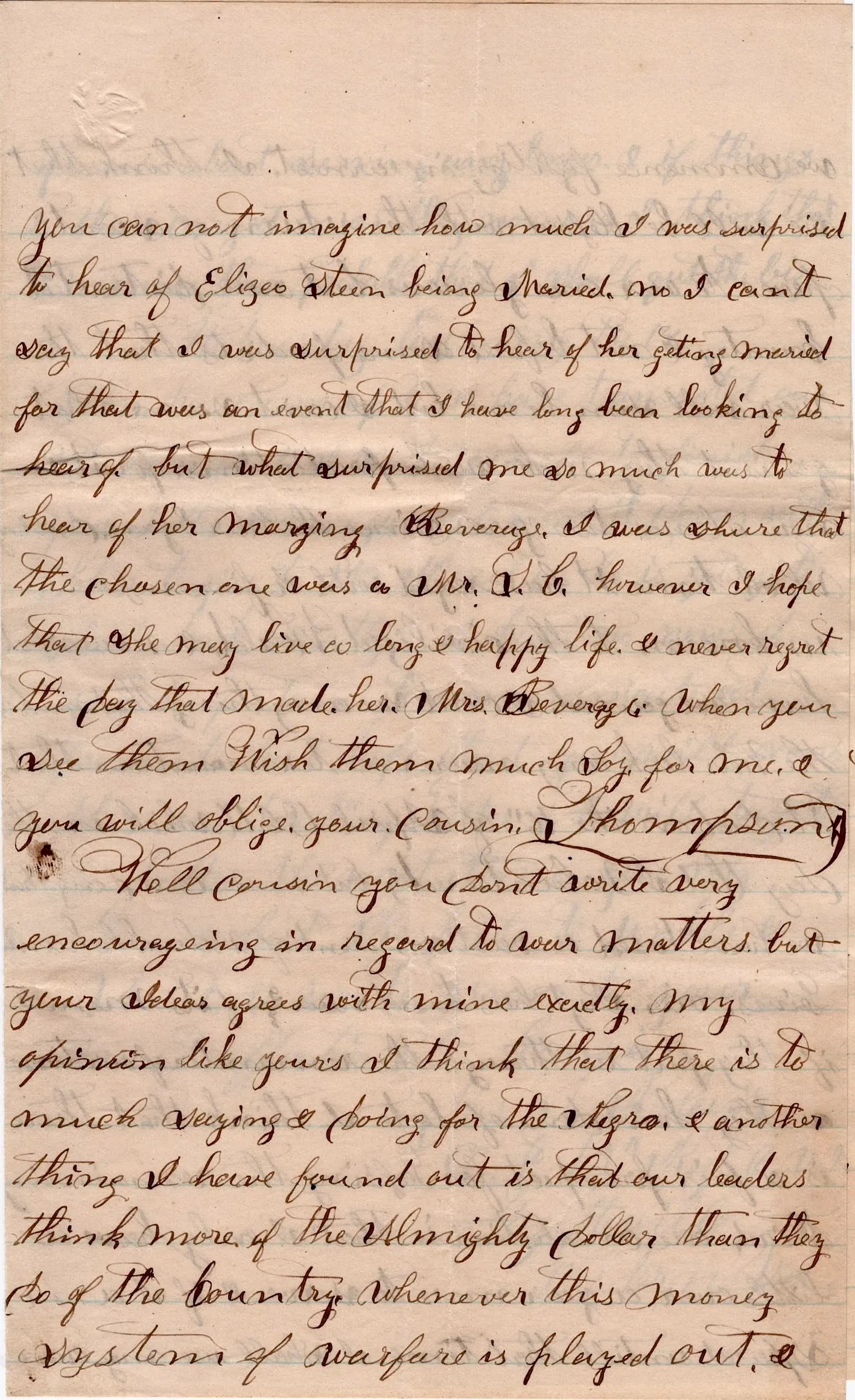
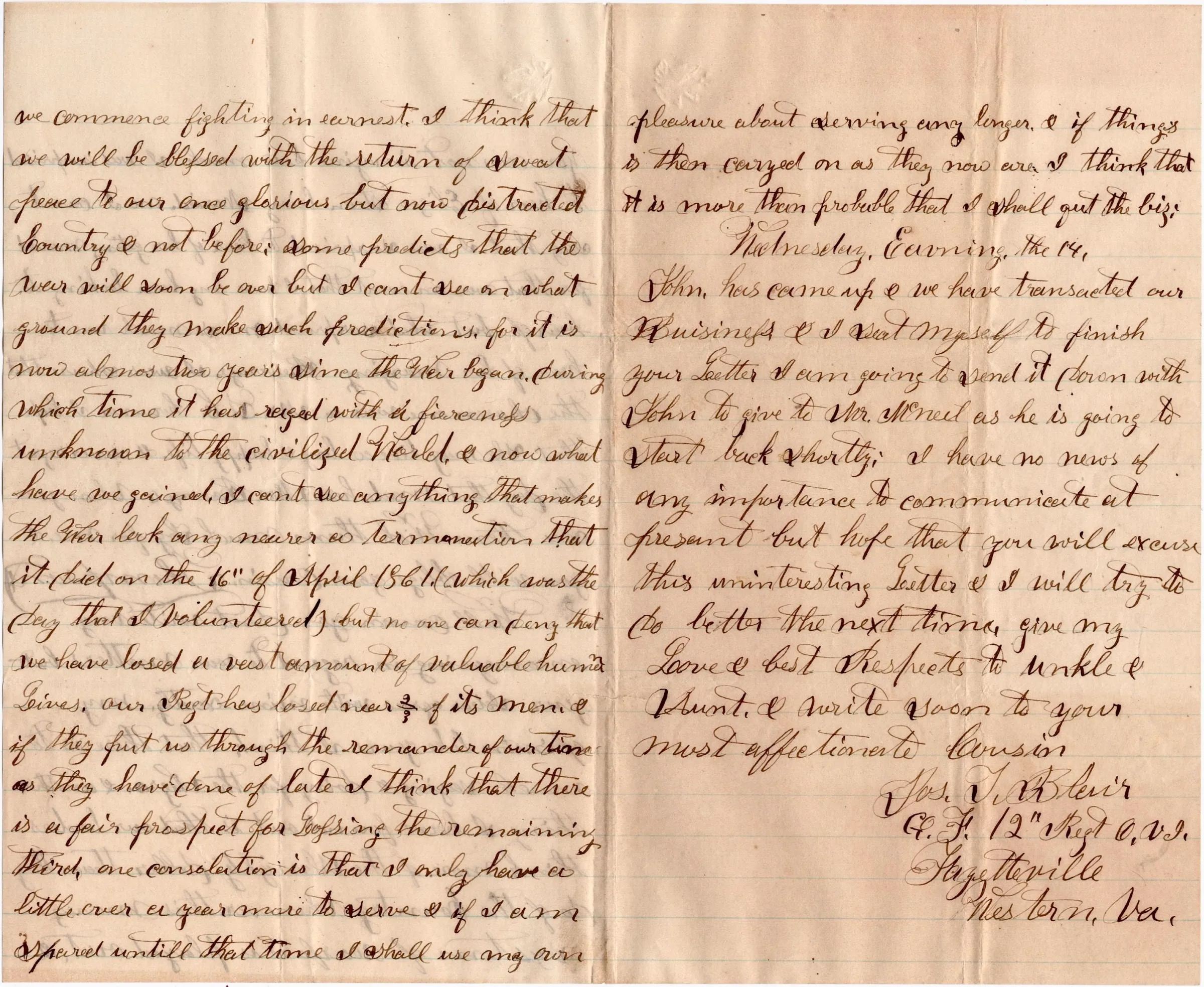
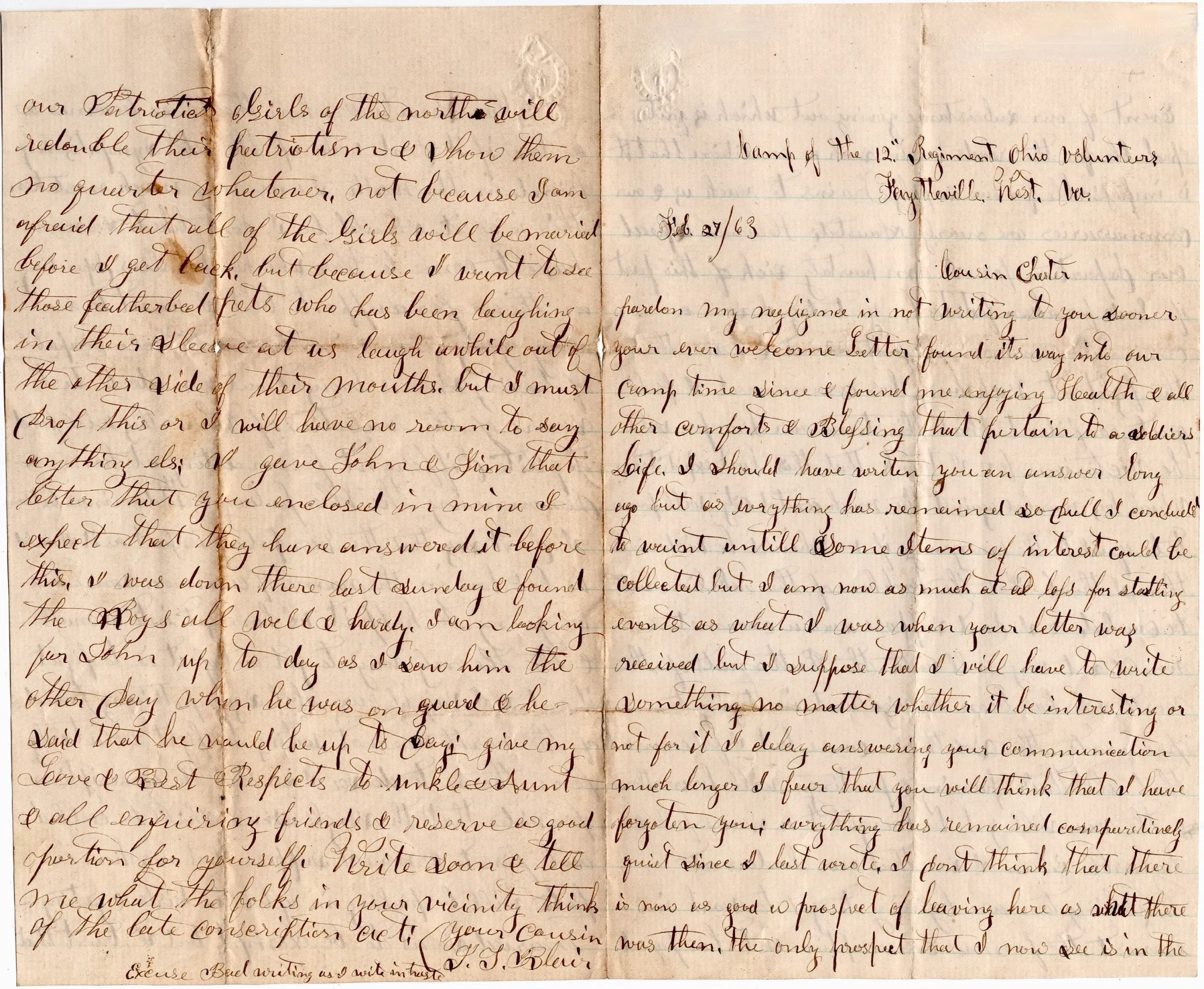
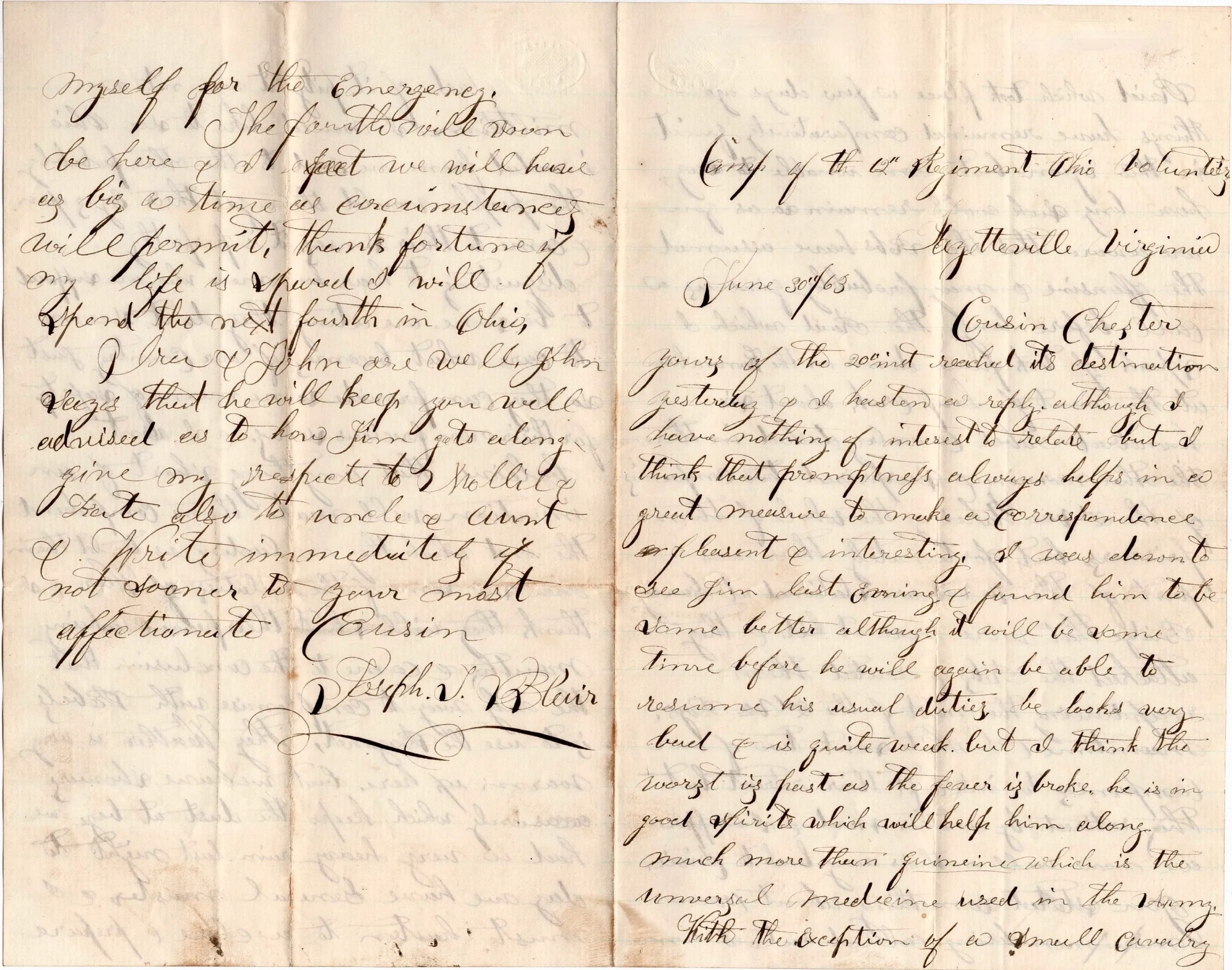
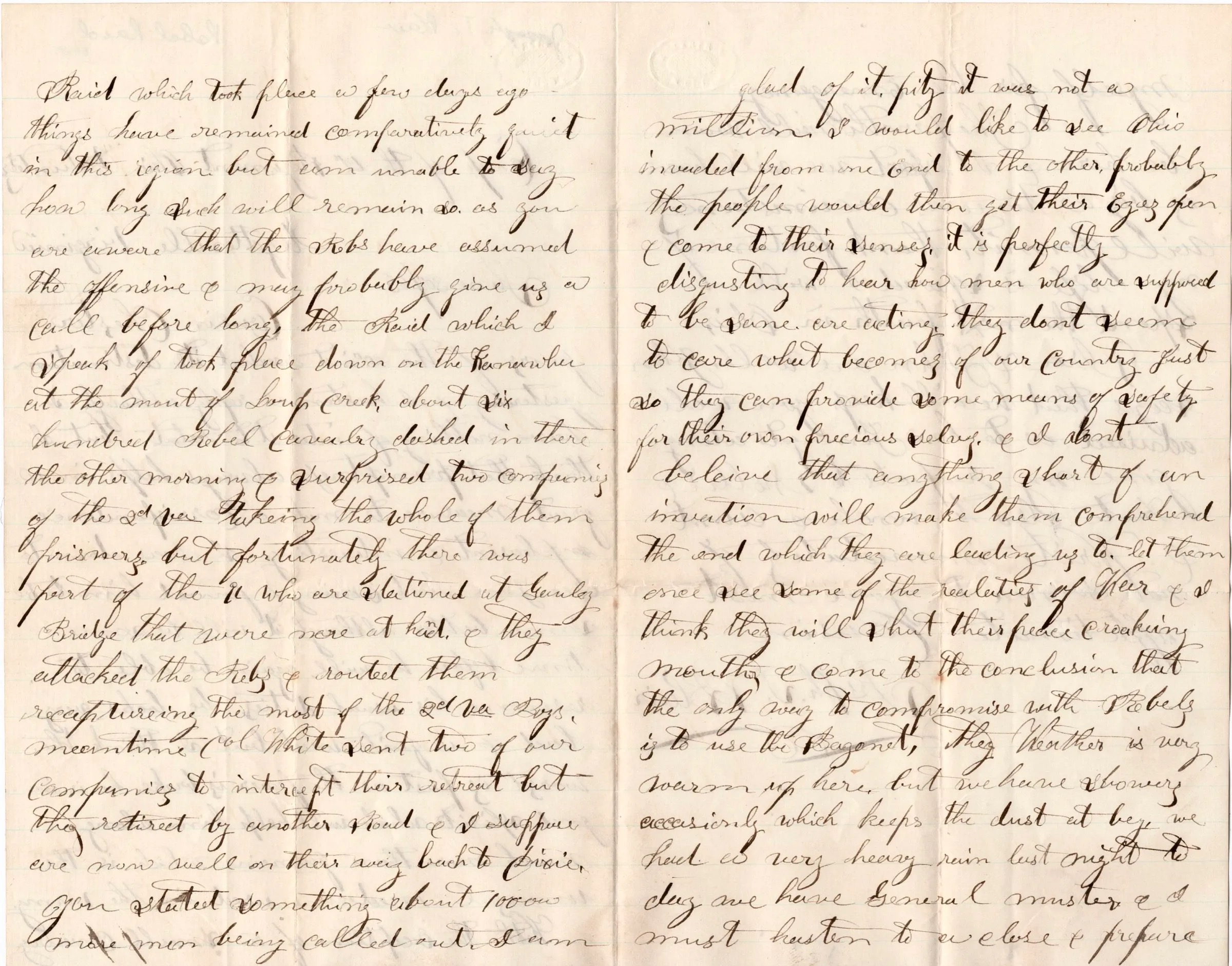
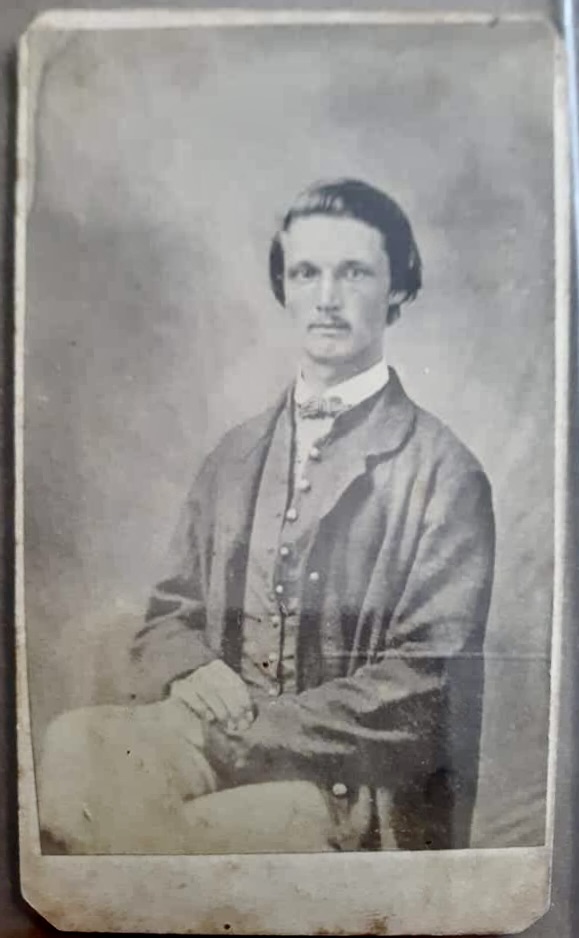
These letters were written by 19 year-old Joseph T. Blair (1843-1863) of Co. F, 12th Ohio Regiment. Joseph was the son of Samuel Blair (1820-1844) and Eliza Ann McClure (1819-1890) of Adams county, Ohio.
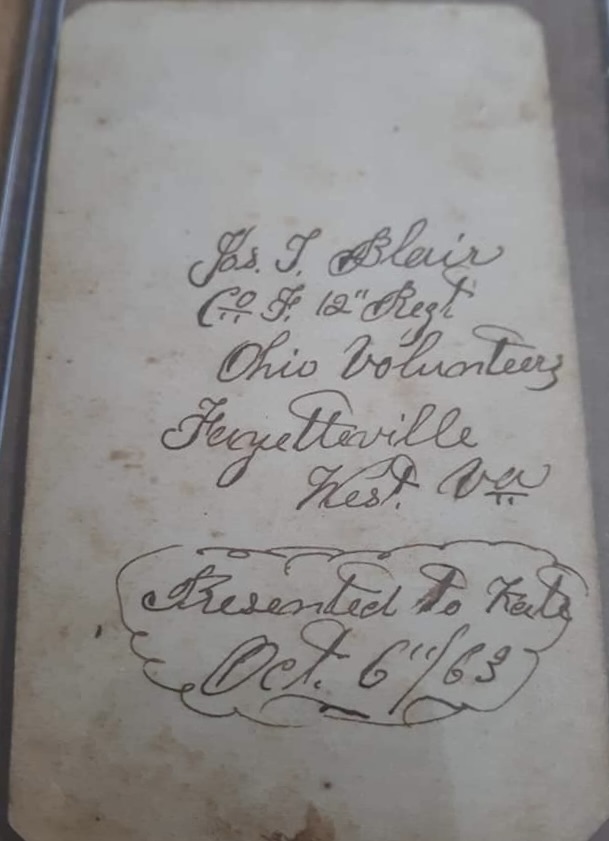
Joseph died on 10 November 1863 as a result of a gunshot wound received at the hands of guerrillas while scouting near Boyers Ferry on 31 October 1863. The CdV above picturing Joseph T. Blair was found on Facebook. The inscription in James’ own handwriting on the reverse of the card was written just a month before he was killed by guerrillas. The images were AI generated to sharpen them. The original images appear at the end of these letters.
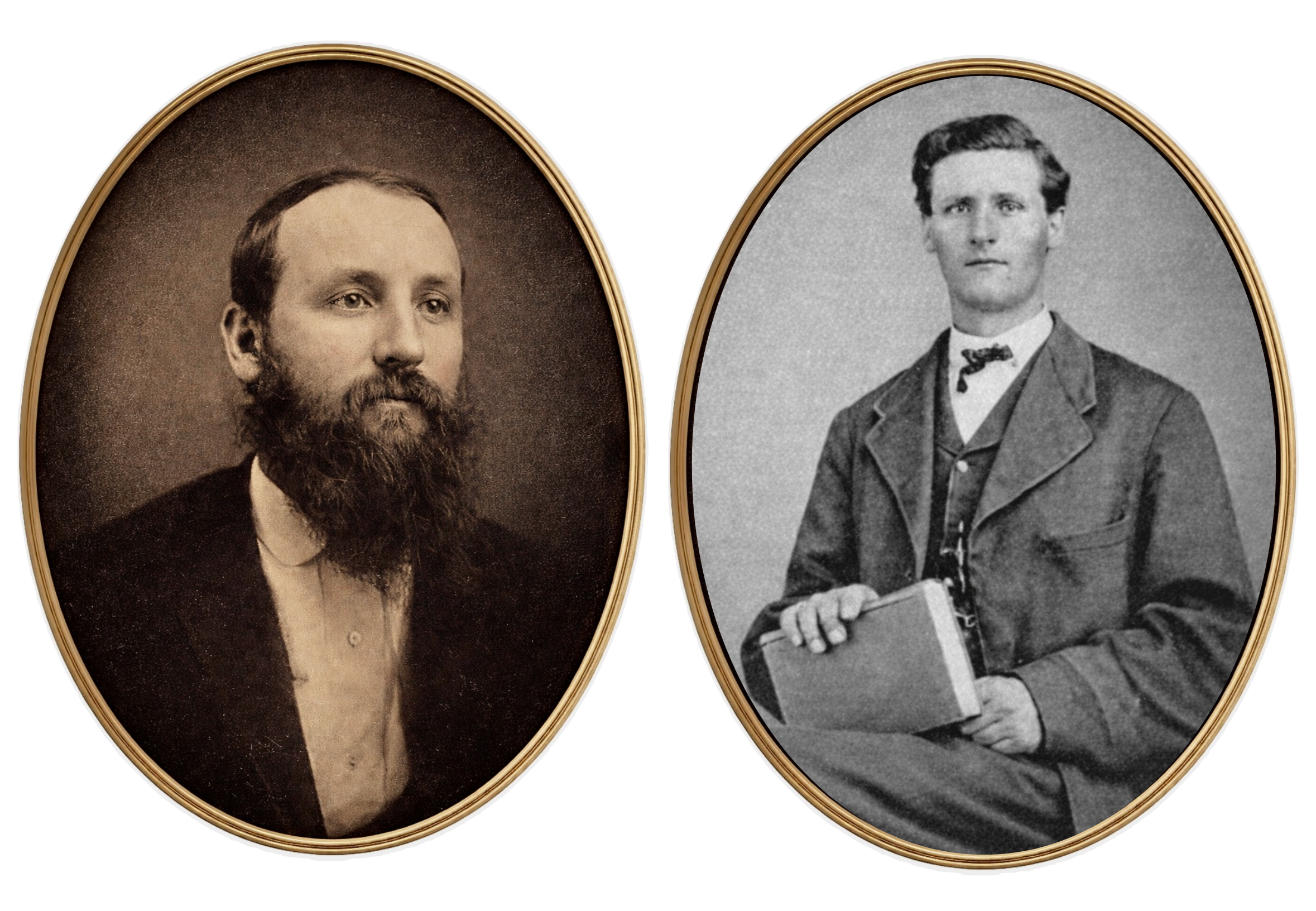
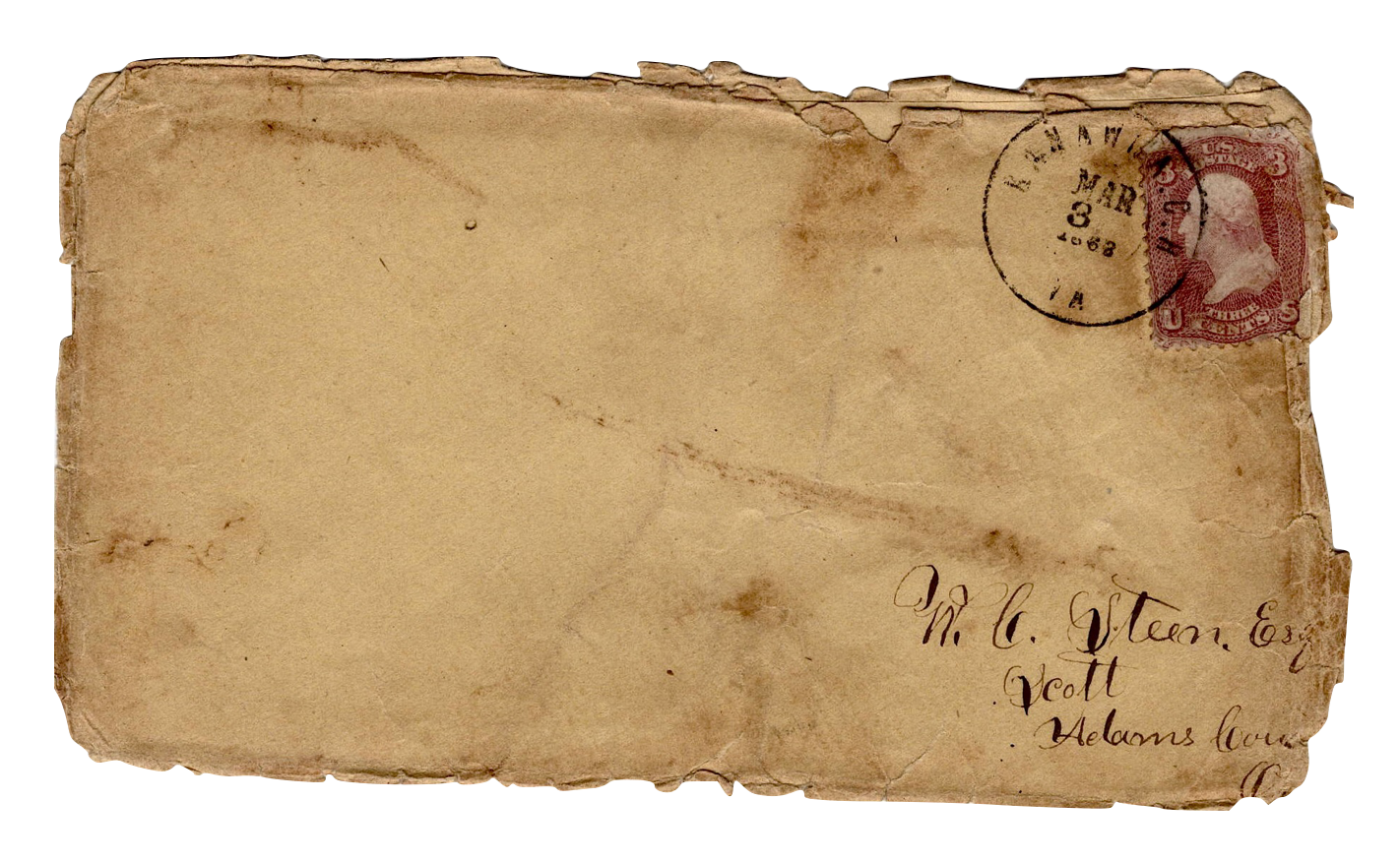
Joseph wrote these letters to his cousins, John Alexander Steen (1841-1918) and William “Chester” Steen (1845-1927). They were two of the sons of Alexander Boyd Steen (1813-1896) and Nancy Jane McClure (1821-1893) of Winchester, Adams county, Ohio.
Blair wrote the letters to his cousins, John Alexander Steen (left) and William Chester Steen.
Letter 1
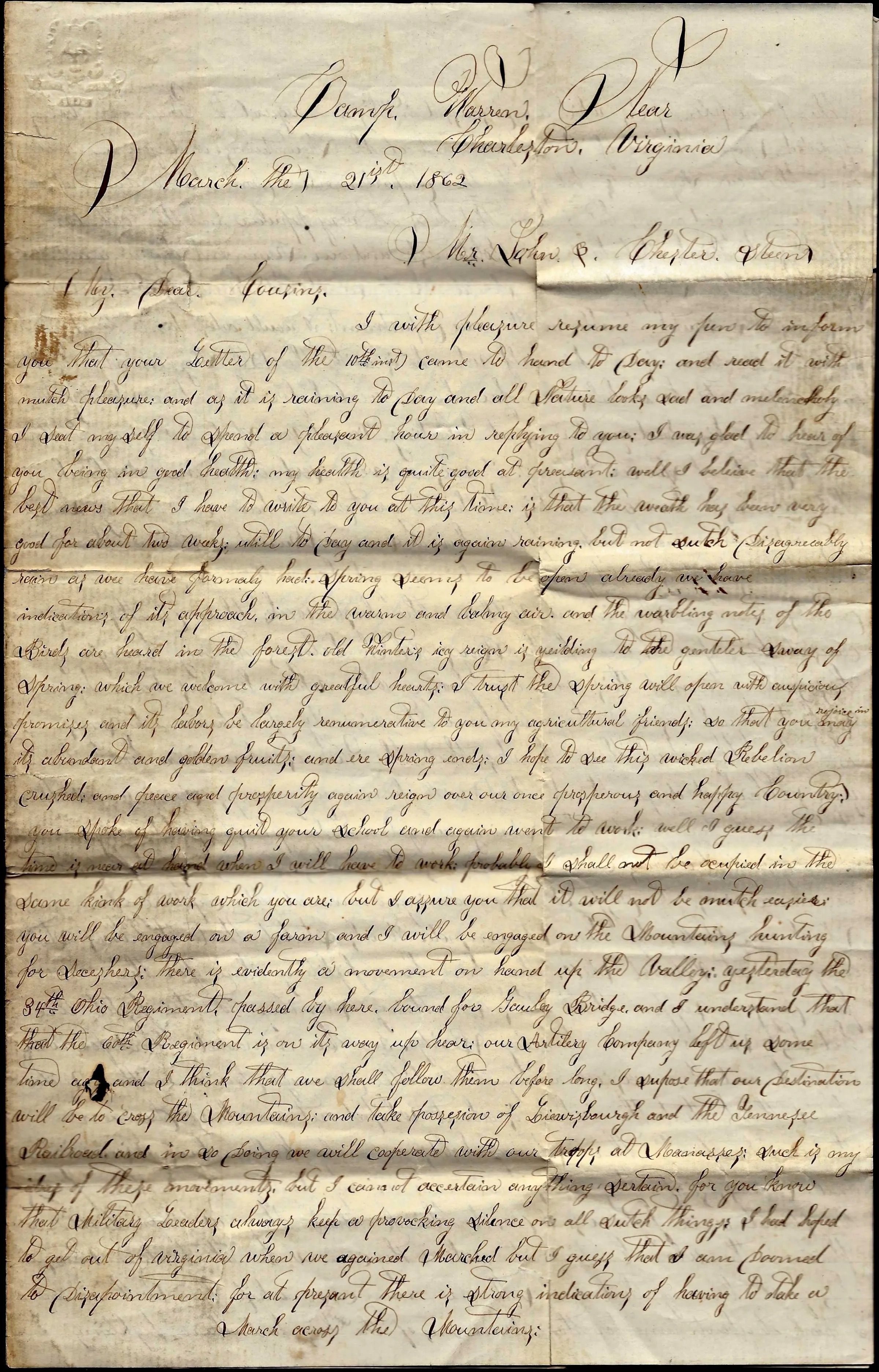
Camp Warren near Charleston, Virginia March the 21st 1862
Mr. John & Chester Steen My dear cousins,
I with pleasure resume my pen to inform you that your letter of the 10th inst. came to hand today and read it with much pleasure, and as it was raining today and all nature looks sad and melancholy, I seat myself to spend a pleasant hour in replying to you. I was glad to hear of you being in good health. My health is quite good at present.
Well, I believe that the best news that I have to write to you at this time is that the weather has been very good for about two weeks until today and it is again raining, but not such disagreeably rain as we formerly had. Spring seems to be open already. We have indications of its approach in the warm and balmy air and the warbling notes of the birds are heard in the forest. Old winter’s icy reign is yielding to the gentler sway of spring which we welcome with grateful hearts. I trust the spring will open with auspicious promises and its labors be largely remunerative to you, my agricultural friends, so that you may rejoice in its abundant and golden fruits, and ‘ere spring ends, I hope to see this wicked Rebellion crushed and peace and prosperity again reign over our once prosperous and happy country.
You spoke of having quit your school and again went to work. Well I guess the time is near at hand when I will have to work. Probably I shall not be occupied in the same kind of work which you are, but I assure you that it will not be much easier. You will be engaged on a farm and I will be engaged on the Mountains hunting for seceshers. There is evidently a movement on hand up the valley. Yesterday the 34th Ohio Regiment passed by here bound for Gauley Bridge and I understand that the 60th Regiment is on its way up here. Our Artillery company left us some time ago and I think that we shall follow them before long. I suppose that our destination will be to cross the mountains and take possession of Lewisburg and the Tennessee Railroad and in so doing, we will cooperate with our troops at Manassas. Such is my idea of these movements but I cannot ascertain anything certain for you know that military leaders always keep a provoking silence on all such things. I had hoped to get out of Virginia when we again marched, but I guess that I am bound to disappointment for at present there is strong indications of having to take a March across the mountains.
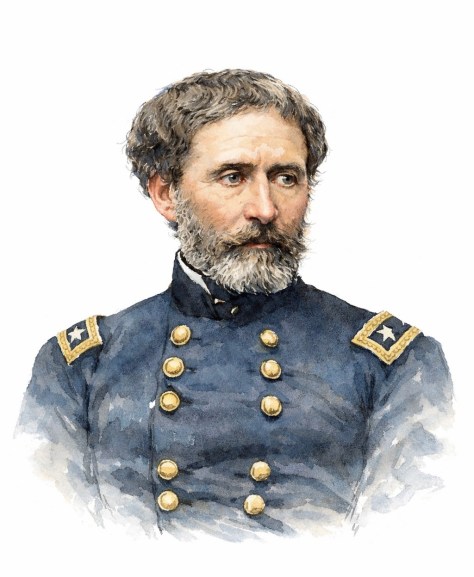
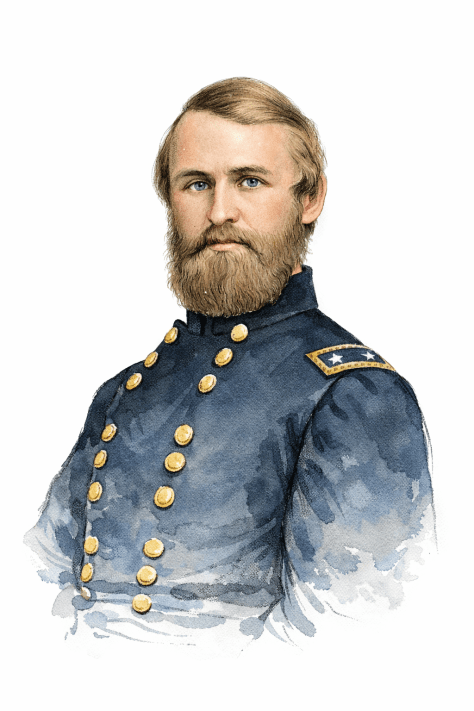
Major General John Charles Frémont
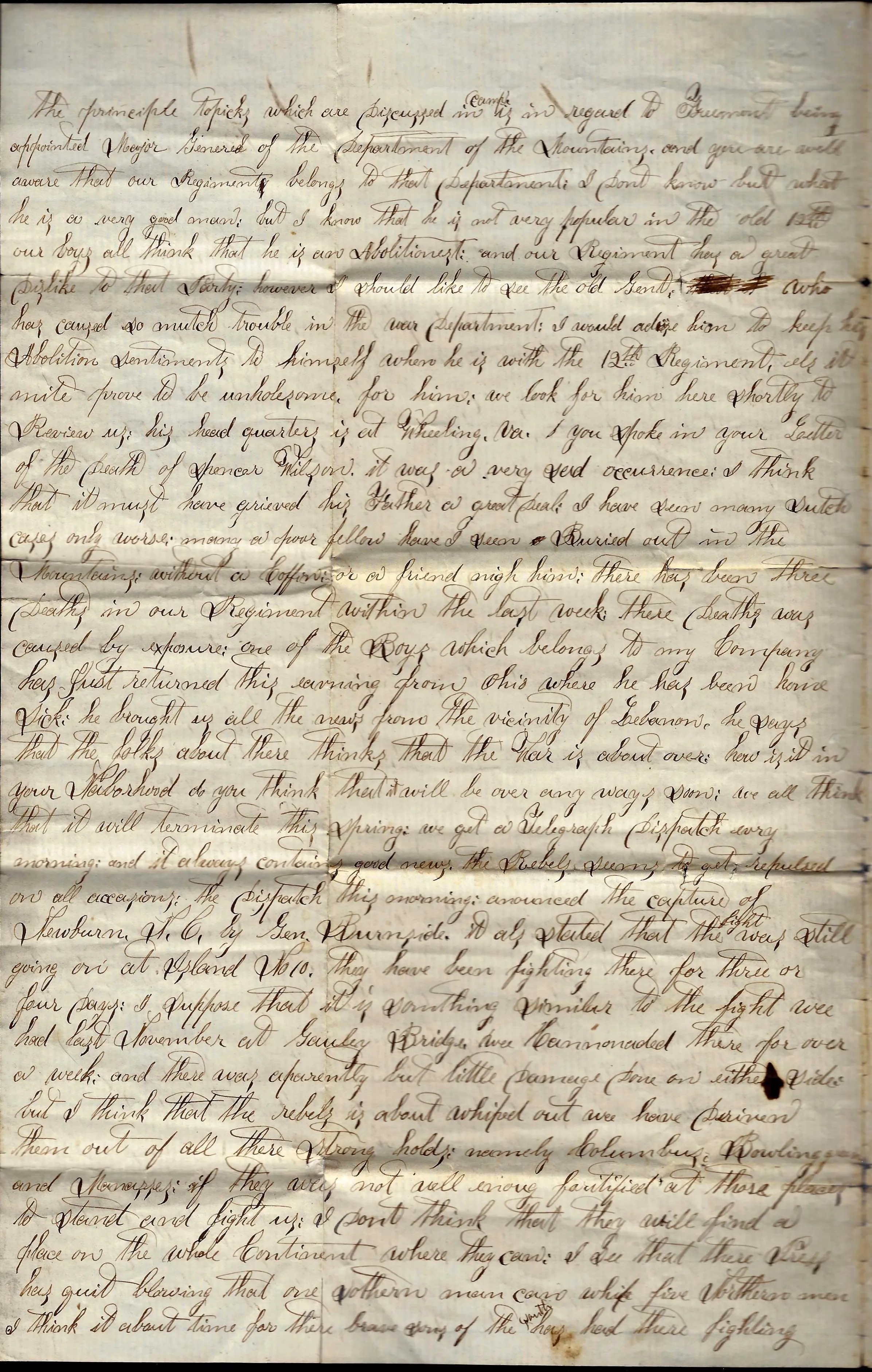
The principal topics which are discussed in camp is in regard to Frémont being appointed Major General of the Department of the Mountains, and you are well aware that our regiment belongs to that department. I don’t know but what he is a very good man, but I know that he is not very popular in the Old 12th. Our boys all think that he is an abolitionist and our regiment has a great dislike to that party. However, I should like to see the old gent who has caused so much trouble in the War Department. I would advise him to keep his abolition sentiment to himself when he is with the 12th Regiment, else it might prove to be unwholesome for him. We look for him here shortly to review us. His headquarters is at Wheeling, Va.
You spoke in your letter of the death of Spencer Wilson. ¹ It was a very sad occurrence. I think that it must have grieved his father a great deal. I have seen many such cases — only worse. Many a poor fellow have I seen buried out in the mountains without a coffin or a friend nigh him. There has been three deaths in our regiment within the last week. Their deaths was caused by exposure. One of the boys which belongs to my company has just returned this evening from Ohio where he has been home sick. He brought us all the news from the vicinity of Lebanon. He says that the folks about there thinks that the war is about over. How is it in your neighborhood? Do you think that it will be over anyways soon? We all think that it will terminate this spring. We get a telegraph dispatch every morning and it always contains good news. The Rebels seem to get repulsed on all occasions. The dispatch this morning announced the capture of Newbern, North Carolina, by Gen. Burnside. It also stated that the fight was still going on at Island No. 10. They have been fighting there for three or four days. I suppose that is something similar to the fight we had last November at Gauley Bridge. We cannonaded there for over a week and there was apparently but little damage done on either side. But I think that the rebels is about whipped out. We have driven them out of all their strongholds — namely Columbus, Bowling Green, and Manassas. If they are not well enough fortified at those places to stand and fight us, I don’t think that they will find a place on the whole continent where they can.
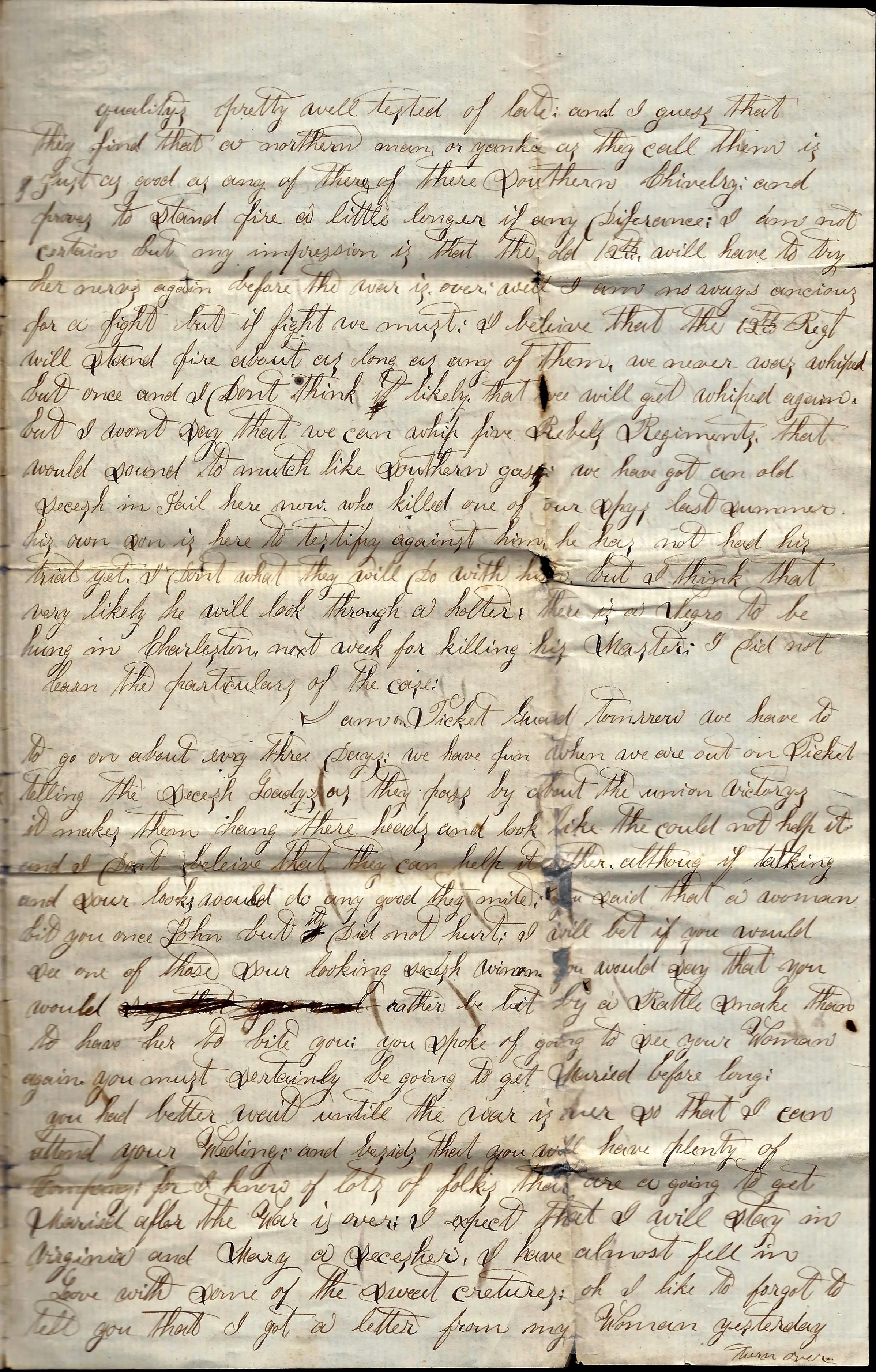
I see that their press has quit blowing that one Southern man can whip five Northern men. I think it about time for their brave sons of the South has had their fighting qualities pretty well tested of late, and I guess that they find a Northern man — or Yankee as they call them — is just as good as any of their Southern chivalry, and proves to stand fire a little longer if any difference. I am not certain but my impression is that the Old 12th will have to try her nerve again before the war is over.
Well, I am no ways anxious for a fight but if fight we must, I believe that the 12th Regiment will stand fire about as long as any of them. We never was whipped but once and I don’t think it likely that we will get whipped again, but I won’t say that we can whip five Rebel Regiments. That would sound too much like the Southern gas.
We have got an Old Secesh in jail here now who killed one of our spies last summer. His own son is here to testify against him. He has not had his trial yet. I don’t [know] what they will do with him but I think that very likely he will look through a halter. There is a Negro to be hung in Charleston next week for killing his master. I did not learn the particulars of the case.
I am on picket guard tomorrow. We have to go on about every three days. We have fun when we are out on picket telling the Secesh ladies as they pass by about the Union victories. It makes them hang their heads and look like they could not help it and I don’t believe that they can help it either although if talking and sour looks would do any good, they might. You said that a woman bit you once, John, but it did not hurt. I will bet if you would see one of these sour looking Secesh women, you would say that you would rather be bit by a rattle snake than to have her to bite you. You spoke of going to see your woman again. You must certainly be going to get married before long. You had better wait until the war is over so that I can attend your wedding and besides that you will have plenty of company for I know of lots of folks that are a going to get married after the war is over. I expect that I will stay in Virginia and marry a Secesher. I have almost fell in love with some of the sweet creatures.
Oh, I like to forgot to tell you that I got a letter from a woman yesterday. It was a nice one and a good long one too. It took me until midnight last night to write an answer. You know of course I took great pains in writing and composing it. Boys, that is the war. I have to spark these times __ to spend a portion of the night in writing to some pretty girl. What do you think of that mode of sparking? It is a first rate way when you can’t do any other way.
I got a letter from Ira the other day. He was hale and hearty and I should not wonder if he was in love up to the eyes. Well, cousins, I hardly ever commence a letter but what I fill the sheet of paper but you must excuse me this time for my fingers is crimping and I have been writing all day and now it is near bedtime. Tell Jim that I shall look to hear from him in your next. Give my best respects to Uncle and Aunt and all the family.
Nothing, but remain your cousin, — J. T. Blair
to J. A. Steen and W. C. Steen
Write soon.
¹ 1st Sgt. Spencer Wilson was the 19 year-old son of Congressman John Thomas Wilson of Adams county, Ohio. He served with the 33rd Ohio Infantry until his death at Louisville on 4 March 1862.
Letter 2
On Picket Guard near Sharpsburg, Washington county, Maryland Tuesday evening, October the 7th 1862
Mr. Wm. C. Steen, dear cousin,
It is with the utmost pleasure that I embrace the present opportunity of answering your kind and most welcome letter of the 13th ult. which I received the 5th inst. Although somewhat delated in its arrival, it was nonetheless interesting. Your letter found me enjoying good health & all other comforts & blessings that pertains to a Soldier’s Life, and it is my sincere wish when this scribbling reaches its destination, it may find you enjoying the same.
Well cousin, since I last wrote, fighting has been the word of the day with us. Our Division has been engaged in all the hard battles that has recently taken place in the State of Maryland, the details I suppose you have been made acquainted with long before this. And I expect that in reading the accountsm you have more than once saw the name of the 12th Ohio Regiment as we took an active part in every engagement and the list of casualties will come up with any other regiment that was in the battles.
Our Division was [in] the advance from the time we left Upton Hills until we drove the Rebels back into Virginia & consequently we had all the reconnoitering & skirmishing to do which, I assure you, was no small job. In the Battle of South Mountain, our regiment made three desperate and decisive bayonet charges. We drove the Rebels at each charge with great slaughter. This was the first hand to hand fighting that I ever was engaged in & I hope that it may be the last. The loss of our regiment during the day was 33 killed & 91 wounded. 1
The Battle of South Mountain, MD., Sunday, September 14, 1862. “The glorious charge of the 23rd & 12th Ohio Volunteers (College. Scammon) against the 23rd & 12th North Carolina, under the Rebel Gen. Garland, who was killed in the charge.”
Our loss in the Battle of Antietam was very severe but the number I have not yet ascertained. The Battle of Antietam is considered the hardest battle of the war & our regiment was in the thickest of it all. To give you some idea of our loss, I will just relate a few facts. We came to Washington with near 800 men & now we only have 300 left. Of course we have lost some by sickness but the greater portion we lost in the numerous battles & skirmishes that we have been engaged in of late. I shall not attempt to give you the particulars as it would be too tedious, & I suppose that the newspapers have already given you a satisfactory account. Suffice it to say that I got through all safe although I can’t see how I escaped. But I suppose that my time had not yet come. 2
Since the battles, things has remained comparatively quiet. We are camped near the Potomac at the mouth of Antietam Creek & do not apprehend any danger at the present as the Rebels are all on the other side & some 8 or q0 miles back from the river. And I don’t suppose that hostilities will be resumed until we cross over which I suppose we will do before long as the greater portion of McClellan’s Army has already crossed (we belong to Gen. Burnside’s Army) & I suppose we will follow McClellan as soon as possible. The Rebels are said to be in force near Winchester, Virginia, & I suppose that another great battle will be fought before many days—that is, if the Rebels will stand. But it is generally supposed that owing to their late disasters in Maryland, they will not be able to make another stand tis side of Richmond.
I am on Picket Guard today about one mile and a half from on the road leading to Sandy Hook & Harpers Ferry. Large bodies of troops have been passing along all day. I suppose they are going to Harpers Ferry to cross the river.
Gen. Jacob Dolson Cox
Our brave and beloved Gen. [Jacob Dolson] Cox 3 has been ordered back to Western Virginia to assume command of our forces there. We was very sorry to part with him. We would much rather went into a hard fight than to part with our gallant general who has been with us ever since the commencement of the war & who by his gentleman & soldier-like manner won the admiration & esteem of all who served under him. He left here for Washington last Sunday. He made us a short speech before leaving in which he said that he was very sorry to part with us and that as soon as he got to Washington, he would go to President Lincoln & Secretary Stanton & if possible obtain permission to take his Ohio Division back with him so you need not be surprised if you again hear of us being in Western Virginia shortly. We all want to go but it is not because we like the country. It is because our general is going & we want to be with him no matter where he goes.
Last Saturday we was reviewed by President Lincoln & General McClellan & staff. Old Abe did not make a very striking appearance. He is undoubtedly the ugliest an that I ever saw & owing to his being in company with so many fine looking officers made him look still worse.
Old Abe’s late Proclamation is the chief topic of conversation in our camp (I mean the negro proclamation). Some are disgusted & some are disposed to treat it as a joke, but to take all things into consideration, the thing don’t agree very well with any of us. I never could induce myself to believe that I am fighting to free the infernal negroes but things look decidedly that way at present. My opinion is if the war is not settled before the first of January, it never wil be settled for I don’t believe that our soldiers will sacrifice their lives to free the negroes. However, I feel in hopes that a speedy termination of the war is at hand. I think that enough of blood has been shed & am quite anxious for peace to again be restored to our once prosperous & glorious country.
I got a letter a few days ago from cousin John & Jim. They was both well. They was then at Point Pleasant, Virginia. It seems as if they are a going to take their first lessons on the same ground that our regiment did. And from the present state of affairs in that region, I think that they will soon get to see the elephant. I hope that nothing but success may attend them until they have the privilege of returning safely to their homes.
I congratulate you & uncle on your safe arrival back from the wars, as you said that you had seated but was not fortunate enough to get to see a Rebel. I suppose that there was quite a stir in Old Adams County about that time. I presume that if the Rebels should undertake to invade Ohio, they would meet with a warm reception from our patriotic men & boys that are left at home.
Well cousin, as it is getting dark, I must soon close. Just now a messenger has arrived from camp informing us that we are ordered to cook five days rations & be ready to march by daylight in the morning. This means business is on hand. The general supposition is that we are bound for Western Virginia but I can’t say whether that is our destination or not. I can tell you all about it in my next.
Give my love & best respects to uncle & aunt & all the rest. Write when convenient & I will answer promptly. Nothing more but remain your most affectionate cousin until death, — Jos. T. Blair
Address your letters thus. Co. F, 12th Regt. O. V. I., Gen. [George] Crook’s Division, 9th Army Corps, Washington D. C.
Tell Eliza & Catherine Steen & Ellen Blair to address their letters in the same manner as there has been some changes taken place since I wrote to them & you will oblige your cousin, — Jos. T. Blair
1 An after action report by Gen. Cox stated that the 12th OVI, in the center of the assault on South Mountain, “was obliged to advance several hundred yards over open pasture-ground, under a most galling fire from the edge of the woods which crowned the slope, and behind stone fences. The skirmishers of this regiment, advancing with admirable courage and firmness, drove in those of the enemy, and the regiment with loud hurrahs charged up the slope with the bayonet. The rebels stood firmly, and kept up a murderous fire until the advancing line was within a few feet of them, when they broke and fled over the crest into the shelter of a dense thicket skirting the other side.” [Source: Cox’s Official Reports, Antietam on the Web.]
2 In his after action report of the Battle of Antietam, Gen. Cox described the contested attempts of the 9th Army Corps to cross Burnside’s Bridge and eventually engage the enemy south of Sharpsburg where they met with initial success but were eventually overwhelmed by Rebel reinforcements. The 12th OVI held the extreme left of the Union line in the late afternoon assault, backing up the 16th Connecticut and the 4th Rhode Island.
3Gen. Jacob Dolson Cox, a former divinity student at Oberlin College, was a staunch abolitionist from Ohio who rose to the rank of major general. “Despite Cox’s inexperience, then-commander of Ohio’s forces, Major General George B. McClellan, came to appreciate his talents, giving him an independent command in western Virginia shortly after the outbreak of hostilities between the North and the South. In 1861 and 1862, Cox played a central role in taking and holding for the Union what would become the new state of West Virginia. Cox’s forces took the new state’s future capital, Charleson, in mid-1861, helping ensure Union control of West Virginia for the remainder of the war. In mid-1862, Cox transferred to the Army of the Potomac for the Maryland Campaign, and in a period of three weeks, he underwent a dizzying ascent to corps command. On 14 September, he initiated the successful first assault at the Battle of South Mountain, which was the Union’s first victory in many months. When IX Corps commander Major General Jesse Reno was killed at that battle, Cox succeeded him. Three days later, at the pivotal Battle of Antietam, Cox would be the tactical commander of the Union left wing, made up entirely of the IX Corps. There, his forces almost succeeded in sweeping General Robert E, Lee’s Army of Northern Virginia from the field. Only an unexpected assault on his left flank by Major General A.P. Hill’s division stopped Cox, though McClellan’s wrong-headed decision not to reinforce Cox at this critical moment sealed the Union’s fate that day.” [Source: The Army Historical Foundation, Jacob Dolson Cox]
Letter 3
Camp of the 12th Regt. O.V. I. Near Fayetteville, Western Virginia Wednesday morning, February 14, 1863
Mr. Wm. C. Steen, dear cousin,
Yesterday I walked down to the camp of the 91st & on arriving there John gave me a letter from you dated January 4th & brought by Mr. McNeel. I was very glad to hear from you as quite a length of time has elapsed since I received any communication from you. The last one that I received was about or near the 1st of October & about the time that we left the Army of the Potomac. I believe that I wrote you a reply just the day before we started west but I never received any reply & consequently I did not write anymore thinking that owing to your brother’s going into the army you had enough of army correspondence without me so you see that your letter was unexpected. But I can assure you that it was none the less welcome & interesting for I am always happy to hear from my cousins & friends & when they write to me, you may rest assured that they always receive a reply. And if the mails fail to do their part, I of course am excusable.
Your letter found me enjoying health & all other comforts & blessings that pertain to a soldier’s life which I suppose that you are aware are rather limited, but however we are enjoying ourselves somewhat better than we was when I last wrote for then we was laying on the memorable battlefield of Antietam, almost destitute of the bare necessities to keep life and soul together. But now we are i winter quarters and are fixed comparatively comfortable & are enjoying many of the comforts of civilized life. I suppose that you are aware of our return to West Virginia & the circumstances that led thereto & consequently I shall not numerate the many incidents and adventures that took place on that long & fatiguing march, but I have no doubt but what they would be of interest to you. But I shall have to defer relating any at present as it would require too much space & be must too tedious an undertaking so I will put you off with the consoling promise that when the war is over & I have the pleasure of again seeing you, I will endeavor to interest you for a couple of hours in relating anecdotes and adventures that took place during our campaign in the East which was one of the most active and exciting campaigns that we ever experienced.
Thinking over our rapid march to Washington & the many fortunes and misfortunes that befell us while there it seems but a dream. But alas, when we sum up the list of our casualties while there, the stern reality of the case presents itself in full view and we dismiss such reflections with heavy hearts. About the middle of November we arrived at Gauley Bridge where I had the pleasure of meeting John & Jim & Ira. The meeting was unexpected, but I don’t think that there was ever a more joyful one. Since then we have been together quite frequently & I assure you that we enjoy one another’s society hugely. Their regiment is brigaded with ours & I think that it is more than probable that the fortunes of war will keep us together all winter. I at least hope so. Their camp and ours is about one fourth of a mile apart. I am looking for John to come up here today as him and I propose writing to some of the fair sex and the peculiarity of the case requires us both to be together so you may consider that some of the fair creatures is about to get a few tender lines. So I must make haste and finish this & prepare myself for the work which we are anticipating. I suppose that John and Jim has given you a description of the town and vicinity of Fayette & consequently I will not say anything about the God forsaken hole.
You cannot imagine how much I was surprised to hear of Eliza Steen being married, No, I can’t say that I was surprised to hear of her getting married for that was an event that I have long been looking to hear of, but what surprised me so much was to hear of her marrying Beverage. I was sure that the chosen one was a Mr. S. C. However, I hope that she may live a long and happy life & never regret the day that made her Mrs. Beverage. When you see them, wish them much joy for me. I will oblige your cousin Thompson.
Well cousin, you don’t write very encouraging in regard to war matters but your ideas agree with mine exactly. My opinion like yours I think that there is too much saying and doing for the Negro. And another thing I have found out is that our leaders think more of the Almighty dollar than they do of the country. Whenever this money system of warfare is played out and we commence fighting in earnest, I think that we will be blessed with the return of sweet peace to our once glorious but now distracted country and not before. Some predicts that the war will soon be over but I can’t see on what ground they make such predictions for it is now almost two years since the war began during which time it has raged with a fierceness unknown to the civilized world. And now what have we gained? I can’t see anything that makes the war look any nearer to termination than it did on the 16th of April 1861 (which was the day I volunteered). But no one can deny that we have lost a vast amount of valuable human lives. Our regiment has lost near two-thirds of its men and if they put us through the remainder of our time as they have done of late, I think that there is a fair prospect for losing the remaining third. One consolation is that I only have a little over a year more to serve and if I am spared until that time, I shall us my own pleasure about serving any longer. And if things are then carried on as they now are, I think that is is more than probable that I shall quit the biz.
Wednesday evening, the 14th. John has come up and we have transacted our business and I seat myself to finish your letter. I am going to send it down with John to give to Mr. McNeel as he is going to start back shortly. I have no news of any importance to communicate at present but hope that you will excuse this uninteresting letter & I will try to do better the next time. Give my love and best respects to Uncle and Aunt, and write soon to your most affectionate cousin, — Joseph T. Blair, Co. F, 12th Regt. OVI, Fayetteville, Western Virginia
Letter 4
Camp of the 12th Regiment Ohio Volunteers Fayetteville, West Va. February 27, 1863
Cousin Chester,
Pardon my negligence in not writing to you sooner. Your ever welcome letter found its way into our camp time since & found me enjoying health & all other comforts & blessings that pertain to a soldier’s life. I should have written you an answer long ago but as everything has remained so dull, I concluded to wait until some items of interest could be collected but I am now as much at a loss for startling events as what I was when your letter was received. But I suppose that I will have to write something no matter whether it be interesting or not for if I delay answering your communication much longer I fear that you will think that I have forgotten you. Everything has remained comparatively quiet since I last wrote. I don’t think that there is now as good a prospect of leaving here as there was then. The only prospect that I now see is in the event of our subsistence giving out which is quite probable for the roads are in such a condition that it is impossible for our supply trains to reach us & our commissaries are nearly exhausted. Heaven speed our departure for I am heartily sick of this part of God’s forsaken footstool.
Yesterday I saw a Cincinnati Commercial of the 22nd inst. and I see that the fight at Vicksburg has commenced. I feel quite confident that this time our troops will be victorious for I think that this last expedition which has marched against the much coveted city will prove equal to the emergency. If we should be victorious there, I think that the backbone of the rebellion will be crushed & I don’t suppose such a circumstance would set very well with the Butternuts of the North who has been so vigilant in trying to promote the Southern cause. But I feel convinced that all their fuming and fretting will be overthrown & the war will yet be brought to a successful & honorable issue. I see that our leaders at Washington are beginning to get to work in earnest. The famous Conscription Act has passed the Senate & when that once becomes a law if it don’t wake up the rebel sympathizing friends in the North, I am very much mistaken. This is as it should be. I don’t like to see men have to come to war who has families depending on them for support, but I want to see every young man in the North who is capable of bearing arms brought out & made to taste some of the realities of war. They will find it quite different from sitting ay home & denouncing the war policy & the Administration. I can’t say that the war policy is just as it should be, but how in the name of common sense are we going to help it. We have got into a muss & the only way to get out of it is to fight it out & I say if our rebel sympathizing friends of the North are not willing to fight voluntarily, force them to do so.
I see that the conscription provides that the single men shall be called out first & now I suppose that our home pets will be pitching in after the girls & getting married so as to be exempt, but I trust that our patriotic girls of the North will redouble their patriotism & show them no quarter whatever—not because I am afraid that all of the girls will be married before I get back, but because I want to see those featherbed pets who has been laughing in their sleeve at us laugh awhile out of the other side of their mouths.
But I must stop this or I will have no room to say anything else. I gave John & Jim that letter that you enclosed in mine & expect that they have answered it before this. I was down there last Sunday and found the boys all well and hardy. I am looking for John up today as I saw him the other day when he was on guard & he said that he would be up today. Give my love to& best respects to Uncle & Aunt & all enquiring friends & reserve a good portion for yourself. Write soon and tell me what the folks in your vicinity think of the late Conscription Act. your cousin, — J. T. Blair
Excuse bad writing as I write in haste.
Letter 5
Headquarters District of Kanawha Fayette Court House, West Virginia Monday, March 30, 1863
Mr. W. C. Steen, dear cousin,
Your ever welcome, interesting communication of the 15th inst. found its way into our camp a few days since & this morning finds me seated for the express purpose of writing you a reply although I don’t expect that I shall be able to interest you very much for since I last wrote nothing of a very startling character has developed itself, but I can’t say how soon there may. To judge from present indications, it will not be many days before something more than ordinary will take place for we are almost hourly expecting an attack from how large a force I am unable to say. But it is reasonable to expect that it is much larger than ours for our force at present consists of only two parts of regiments of infantry & two batteries of light artillery. But I feel confident that we shall be able to whip five to one, or at least hold them in check until reinforcements arrive. But if they should even compel us to abandon this place altogether, I don’t think that there would be very much advantage gained on their side & not much lost on ours for this is not an important point in a military view it is only held as an outpost for the defense of the Kanawha Valley.
Today all is activity in camp. We are moving 15 days rations inside of the fort preparatory fora siege. Whether it will come to this or not, I can’t say, but sincerely hope that it will not for I don’t like the idea of being besieged. Our regiment has never yet fought inside of fortifications & I hope that we will never have to for it seems to me too much like following the example of Jeff Davis & Co., but if they advance on us soon as every possibility indicates, we will have to rely on our fortifications to protect us from total annihilation.
I suppose that you are aware that the 91st Regiment has left here. I was sorry to see them leave for I have spent many pleasant hours with them during this long and dreary winter (that is with John, Jim & Ira and some more of my old acquaintances) but probably we may get together again before long as they have not went to distant parts. They only went down to the Kanawha Falls to relieve the 23rd Regiment that was doing garrison duty at that place. The distance from here to there is only 12 miles so you see that we are not very far apart after all. I received one letter from John, Jim & Ira since they left. They was in good health and seemed to be much better satisfied with their situation there than what they was while here and they have good reasons to be so for they are in a much better place than this. I don’t think there is much possibility for us to get out of this part of God forsaken footstool unless we are driven out for the roads are fastly improving and provision is arriving rapidly. There is some talk of an advance in the direction of Cumberland Gap but it will not be undertaken before the first of May & not then unless we are reinforced.
I see that Gen. Burnside has arrived in Cincinnati & taken command of the Department of the Ohio. This is just what I like to hear. I don’t think that a more competent person could have been found to fill that important place. He is energetic & we may soon expect active service. Well I can’t say that I am very anxious for a fight but I am getting very tired of this monotonous camp life of inactivity. We only have one more year to serve and during that year I want to see all of the sights. I want to go south & serve through an active campaign there & then I will be satisfied. Probably I will get my satisfaction. Time will prove all things.
The health of our camp is not as good as we could wish. We have had more death by sickness in our regiment since we came here than we ever had before. I can’t see what is the cause unless it is on account of the water which is of a very inferior quality. You said that you had heard that Alec Blair was in the hospital. It is so. Poor Alec. He is in a pretty bad fix. He is in the hospital up here. I was down to see him yesterday. He looks pretty bad. I visit him quite frequently & do all I can to keep him in good spirits as this is one of the greatest object of a sick soldier. He expects to get a furlough before long. I think that he should be discharged for his constitution is of too delicate a nature to stand the hardships which pertain to a soldier’s life.
A thousand thanks to you cousin Chester for the introduction to my cousin Mary B. Although introductions on paper is not as satisfactory as the original way, yet it will do very well under the present existing circumstances as no better means can be adopted. I must hurry this scribbling to a close to write my newly introduced cousin a letter for I am anxious to become better acquainted with her. I was very glad to hear of you having such a good time at that party which you was speaking about & more than glad to hear you having the good fortune to fall in love with one Miss Barefoot. But I must caution you not to exult too much over your success for it will probably prove a misfortune to you if your soldier brother John should hear of your proceedings.
Chester, you and I don’t understand the Conscription Law alike. As I understand, the first draft will include all unmarried men between the ages of 20 and 35 years. Am I not right? I think if you will carefully examine the law, you will find that I am. You said that you had heard some say that they would die before they would go to war. They were quite patriotic indeed but you may be sure when they said that they was only gassing. I perceive that the Butternuts are all very loud in their threats what they will do, but they never can muster courage enough to carry them into execution. Is not this so? I suppose that you read about the little affair which took place some time ago in Noble county, Ohio. I read an account of it in the Cincinnati Daily Commercial of the 23rd inst. This clearly demonstrated what the Butternuts would do if they could carry out their designs by threats but they could not muster courage to back those threats to the last argument which is to arms. This is just as it will be in all cases. They will no doubt boast considerable what they intend to do but in my opinion they will never assume courage enough to fire on anybody of us soldiers that may be sent into the disaffected districts to maintain order and enforce the law.
The weather is most beautiful and spring like today. I hope that we will have no more of this disagreeable March weather which has been so prevalent out here for the last two or three weeks. As you asked me to excuse your bad writing, I will agree to more than do so if you will only condescend to excuse this, although I have no excuse to make of having sore hands as you had. The only excuse which I have to offer is of getting in too much of a hurry & you will believe when I tell you that only 40 minutes has expired since I commenced this so you need not be surprised if you find a great many mistakes. Give my love and best respects to Uncle & Aunt and all the family. Write immediately if not sooner to your affectionate cousin, — Jos. T. Blair
Letter 6
Fayette Court House, West Virginia April 29, 1863
My dear cousin Chester,
I with pleasure embrace the present opportunity to acknowledge the receipt of your ever welcome and interesting communication of the 19th inst. which I received a few days since. I was very glad to hear from you and to learn that you was yet enjoying the blessing of health. My health remains as good as I could wish & hoping that when this reaches you it may find you the same.
I shall proceed to tell how matters and things are progressing in this part of the so called Southern Confederacy but first let me advise you not to build your imagination too high and be expecting to hear something of a startling character for if you do, you will be sadly disappointed for I have no exciting news to communicate at present. Nothing worthy of notice has developed itself since I last wrote. Old Fayetteville & vicinity remains as peaceful and calm as a slumbering infant in its cradle. But how long our quietude will remain undisturbed I can’t say. To judge from what rumor says, one would think that we would have been attacked long ago, for it has long been reported that the Rebels are marching against us from Princeton & Raleigh & a score of other places too numerous to mention. But yet nothing of a hostile disposition has made its appearance. I almost wish that they would come for I am willing for anything that will relieve this dull monotony of inactive camp life.
Deserters are coming in from the enemy very fast during the last five days. There has over twenty come in and give themselves up declaring that they are disgusted with the Confederacy. They represent their army in a very bad condition in regard to provisions. They say that they don’t get half enough to eat but there is no confidence to be put in what a deserter says. If a man is mean enough to desert his country, he is also mean enough to lie. Don’t you think so? My opinion on such matters is this. I don’t think that there is any principle about a deserter no matter which side he belongs to.
I got a letter yesterday from John & Jim & Ira. They was well with the exception of John who has been complaining for some time but I guess that there is nothing very serious the matter. They are now at Summerville which is about 45 miles from here so you see that we are getting pretty well separated. But I expect that we will get together again during our summer campaign.I hope so for I would like to see the boys again before I quit the service. But if I don’t get to see them summer, I will be disappointed for this is my last summer—for the infantry service at any rate. I now only have a little over 11 months to serve until I will again be free & if I conclude to again enter the service, I shall enlist in the Navy for I have had quite enough of the army & I have a strong inclination for to try a life on the waters for awhile at any rate.
I got a letter from home the other day stating that sister was no better & that she wanted me to come home and see here. I would like very much to do so but I fear that it will be impossible for I have been trying for the last week to get a furlough but have not yet succeeded & no very favorable prospects of succeeding either. My captain is at Charlestown on business but I am looking for him back in a few days and then I will get him to intercede for me and probably I will succeed in getting a leave of absence for ten or twelve days. I shall try my best at any rate for from what I can here, Elizabeth is not long for this world & I should like very much to see her once more. But if it is God’s will that we should never meet again on earth, I trust that we may be prepared to meet in heaven where parting will be no more…
Your affectionate cousin, — Joseph T. Blair
Letter 7
Cousin Chester,
Yours of the 20th inst. reached its destination yesterday & I hasten a reply although I have nothing of interest to relate but I think that promptness always helps in a great measure to make a correspondence pleasant & interesting. I was down to see Jim last evening & found him to be some better although it will be some time before he will again be able to resume his usual duties. He looks very bad & is quite weak but I think the worst is past as the fever is broke. He is in good spirits which will help him along much ore than quinine which is the universal medicine used in the army.
With the exception of a small cavalry raid which took place a few days ago, things have remained comparatively quiet in this region but am unable to say how long such will remain so as you are aware that the Rebs have assumed the offensive and may probably give us a call before long. The raid which I speak of took place down on the Kanawha at the mouth of Loup Creek. About 600 Rebel cavalry dashed in there the other morning and surprised two companies of the 2nd Virginia taking the whole of them prisoners but fortunately there was part of the 91st who was stationed at Gault Bridge that were near at hand and they attacked the Rebs and routed them, recapturing the most of the 2nd Virginia boys. Meantime Col. White sent two of our companies to intercept their retreat but they retired by another road & I suppose are now well in their way back to Dixie.
You stated something about 100,000 more men being called out. I am glad of it. Pity it was not a million. I would like to see Ohio invaded from one end to the other. Probably the people would get their eyes open & come to their senses. It is perfectly disgusting to hear how men who are supposed to be sane are acting. They don’t seem to care what becomes of our country just so they can provide some means of safety for their own precious selves. I don’t believe that anything short of an invasion will make them comprehend the end which they are leveling us to. Let them once see some of the realities of war and I think they will shut their peace croaking mouth and come to the conclusion that the only way to compromise with Rebels is to use the bayonet.
The weather is very warm up here but we have showers occasionally which keeps the dust at bay. We had a very heavy rain last night. Today we have general muster & I must hasten to a close and prepare myself for the emergency.
The 4th [of July] will soon be here & I expect we will have as big a time as circumstances will permit. Thank fortune if my life is spared I will spend the next 4th in Ohio.
Ira and John are well. John says that he will keep you well advised as to how Jim gets along. Give my respects to Mollie & Kate. Also to Uncle and Aunt & write immediately if not sooner to your most affectionate cousin, — Joseph T. Blair
“PVT Joseph T. Blair was “killed by bushwhackers” near Fayetteville, WV while riding with on November 10, 1863, so he may never have come up against Mosby’s Ranger. there is no doubt that some of his comrades did later on!”
Lt. Alfred Bergen Hutchinson of 5th N. J. Vols. (AI sketch drawn from tiny image on Ancestry.com)
These letters were written by Alfred Bergen Hutchinson (1840-1921), the son of George A. Hutchinson (1810-1885) and Ida Van Nest Bergen (1813-1851) of Trenton, Mercer county, New Jersey. Alfred enlisted on 19 August 1861 in the 5th New Jersey Infantry and was promoted through the ranks to 2nd Lieutenant of Co. D. When Alfred first enlisted, he entered in Co. E with his brother-in-law, Captain Henry Harrison Woolsey (1836-1864).
The 5th New Jersey Volunteer Infantry Regiment was organized at Camp Olden, Trenton, New Jersey, in July 1861, and was mustered in on August 22, 1861. It participated in a number of important engagements, including the Battle of Fair Oaks, Seven Pines, Malvern Hill, Second Battle of Bull Run, Fredericksburg, Chancellorsville, Gettysburg, the Wilderness, Spotsylvania Court House, Cold Harbor, and the Siege of Petersburg.
Alfred wrote all three letters to his younger sister, Sarah M. Hutchinson (1842-1897). Many more of Hutchinson’s Civil War letters can be found in the Special Collections of Chapman University. See Hutchinson & Woolsey, 1861-1888.
Letter 1
Addressed to Miss Sadie M. Hutchinson, Trenton, New Jersey
Camp near Falmouth April 14th, 1863
Dear Sister Sadie
This is a charming spring morning & I imagine I can see you all at Homedell walking about the yard, or some of you sitting in the house with windows hoisted. How I would love to be with you enjoying this splendid weather.
Last week we had a Grand Review. President Lincoln came down & reviewed several corps at the same time. I would give a great deal to have you see such a review. Although I have seen several Grand Reviews, it does not fail to awaken the ideas to the grandeur & vastness of the event. It takes hundreds of acres to give enough room for the troops. The ground is rather uneven & as far as we could see were the troops & flags—a perfect sea of men. You would hardly think there were so many men in the United States. The column passes the President by divisions front—that is, two companies abreast. In this way, regiment after regiment passes & hours are consumed or nearly a day passes & the one who reviews them is tired waiting for all to pass.
Your interesting letter came last night but I had been expecting it several days. You said you expected to hear of our moving every day. Your expectation will soon be realized for we are under marching orders. Our orders came this morning. Every officer & man are to carry eight days rations with them. What do you think of that? The men are ordered to leave nearly all their clothing with the Quartermaster & carry their rations in their knapsacks. The officers are to leave their extra clothing also & to carry their rations the best way they can.
The whole cavalry force left yesterday & also some infantry. It is expected that these forces will get in the rear of the enemy & then we will attack them in front. I hope we may be successful & capture & destroy the whole rebel force in Virginia. As we go out again, I feel the danger we must be subjected to, but God is my shield. I know if we call upon Him, He is ever ready to hear. His eye is upon us at all times, in prosperity and adversely, in security and in danger.
My chum, Lieut. Flannigan, will send on the order & his discharge & wishes father to draw his state pay & send it on by Adams Express. Put it in an envelope and direct it to Lieut. J[ohn] M. Flannigan, Co. K, 5th New Jersey Volunteers. Even if we move, the express company will keep it all safe until he calls for it. He wishes it sent without delay. Harry is well.
Now, dear sister, I must close. Give unbounded love to all the dear ones and I am as ever your own brother, — Alfred
Letter 2
[Camp near Falmouth] June 6th, 1863
Dear Sadie,
Yesterday our usual quiet was disturbed by receiving orders for a march. We packed up & the regiment formed line, then stacked arms in readiness to march at a moment’s notice. At night we received orders to take in our arms and be ready to move at daybreak in the morning. Morning came but we did not go & here we are now, waiting & not knowing what moment we will go.
Yesterday afternoon heavy cannonading was raging along the Rappahannock & our troops are crossing again. A part of the 6th Corps is over this morning. I hope & pray that we may meet with better success this time than heretofore. The crossing seems to be conducted about the same way it was last time. Part of the troops above and part below Fredericksburg. Now and then a cannon booms forth today showing that something is going on & that either one part of the other is not quite satisfied with the proceedings. I dare say we will cross in a day or so.
Hutch and Breasley were over here yesterday but they left rather abruptly upon hearing the army was on a move. When they left camp in the morning, all was quiet & their orders must have come in suddenly & must have started in a hurry for one of our men who had been over to the 6th Corps came home a little after noon & said the 6th Corps was crossing the river. Then Hutch and Breasley started in a hurry. They said their men did not want to go into another engagement & if called upon to go, threats of stacking arms were made as they think their time is out. They seem to think they will not go home before the 15th of June. Conn was well.
We were paid off a few days ago. I sent $80 home by Col. Cook, $30 to repay Marianna for that she sent to me by Harry. The $50 to be invested by father as he thinks best. Harry received encouraging news from Thirza a day or two ago. I sincerely hope she will continue to improve & if she goes out to Homedell, no doubt you all will soon be about again. I fear I will not be able to get home very soon as leaves of absence are not granted at all. However, perhaps after this move they will grant leaves again.
There is an establishment near our camp where they take Ambrotypes. Nearly all the officers of our regiment went over tis morning to get their pictures taken. I had mine taken. They are rather inferior work yet is it a pretty good picture after all, only I look so cross. A stranger would think me very ill-natured from my picture. I will send it on to you.
I received a letter from Annie V. C. yesterday. Harry is well. Before you receive this, we may be fighting desperately, or we may be in Richmond. With unbounded love to you all, I remain your loving brother, — Alfred
Letter 3
Brandy Station, Virginia January 2nd 1864
My dear sister Sadie,
Your delightful missive reached me this evening. It gave me great pleasure to hear that my loved ones at home were well and that they were all enjoying themselves to so great an extent. I think you all must have had a regular jubilee on Christmas. You certainly had presents in profusion. How I would have enjoyed being with you. I have been so very busy of late that I have hardly had time to eat or sleep. But today my most confining labors ceased. You know I am recruiting officer for Vetran volunteers. I gained fifty men & you ought to have seen the heaps of papers it took to muster these men. It seems to be absolute foolishness to make so many rolls, &c., but it had to be done & I did it. I feel richly remunerated for when I took the rolls up to the Division Headquarters today, I was highly complimented. The mustering officer said they were the most complete & neatest & best papers that had been made out in our whole division. I wrote nearly all CHristmas day but had time to partake of dinner for we had roast turkey. Almost all the officers were out of camp so Simon & I sat down and layed to & the proportions of Mr. turkey diminished perceptibly.
We live high on buckwheat cakes & sausage. We have everything necessary for our housekeeping apartment—bake iron, dutch oven, &c. Yesterday (New Years) we intended keeping open house, but we did not have satisfactory arrangements so we had New Years by ourselves until after dinner which was roast turkey again. After dinner, all the officers of our regiment excepting one, procured horses & away we went, a fine squadron of cavalry on a high horse to make calls. After dark we found ourselves in the camp of the 14th New Jersey, a full three miles from home. In every tent we visited, we were warmly received although it was utterly cold without & we were treated generously with hot punch, whiskey raw, whiskey sour, gin, brandy, cake, candy & varieties—especially of the drinking order. We had a grand old time. The fun was not in riding back to camp after midnight though. The roads were in a miserable condition, so rough that we were compelled to let our horses alk slowly the greater part of the distance & we all came near freezing. In fact, I did freeze one of my little toes.
The weather has not moderated yet for as I write, the ink freezes in the pen before it is transcribed on paper. I called on Gen. Mott the evening before he returned. He was pleasant & hospitable, more so than I ever knew him to be before. He gave me a synopsis of his visit home & all the news he possessed concerning Homedell. He had a tedious journey back, so many detentions. Col. Sewell is in New Jersey having been detailed as Superintendent of the drafting operations. I understand his headquarters are at Trenton. You must get a view of him. All of our men who reenlisted as veterans have gone home on furloughs of 35 days & we are somewhat lonesome. Six of my company have gone.
I judge from accounts reviewed that Conn is still favored with a goodly portion of your friendship, if I am forbidden to say love. He must have a lingering hope of retaining your heart yet or he would not continue his attempts. You say Ellie looks bloming this winter. How I would love to see her. Does she seem to have pensive moments at times while at our house? And you imagined she was thinking of me? Perhaps, could you look upon me at times, you might imagine the same thing & if you judged that I was with her in spirit, you would not be very far wrong. Ellie will not always be so reserved. When I come home to stay, she will change, I doubt not.
An order came out a few days ago stating that supernumerary officers could get a leave of absence of 35 days providing they would signify in writing their willingness to serve three years longer/ I think I might be called supernumerary now as I have only four men for duty, and receive the leave. But three years is too long a time to suit me to remain in Uncle Sam’s service, although 35 days at home just at this time is really a tempting bait. I will accept ten days leave in February & not bind myself further.
Sunday afternoon. I have just been re-reading your last letter & I must confess it makes me feel somewhat sober to contemplate the many pleasant times you are enjoying these holidays & here I sit missing all the fun. However, I am not cursed with a despondent or melancholy nature, than Providence, & am looking on the sunny side of events & let come what will. I’ll be gay & happy still.
It is quiet in camp today—too cold for preaching, but I have a stock of good religious papers on hand which afford a diversion of the mind from wars & rumors of wars, and besides, they are interesting, profitable, and pleasurable. So you see I am not entirely destitute. When does Harry expect to return. I hope (for his good & his wife’s) not this winter.
Sadie, will you please send me a ccatalogue of music for the pianom with the address of the firm. I want to send for some pieces to present to some of our mutual friends. It would be most desirable if you could procure one, from some firm in Philadelphia. I received a letter from Emily New Years day & took it as a precious present & the only one. In future I will be able to write oftener as the rush of business has subsided. I close by wishing you all a Happy New Year. Ever your fond brother, — Alfred
Without investing more time, I’m unable to attribute this letter to any specific family. The author was “Sam” and his wife was “Julia.” He wrote the letter from Reading—probably Massachusetts—and his mother lived far away—possibly in or near Rockford, Illinois. We know that Sam raised sheep and sold his wool to market. We also know that Sam did not share the Antislavery views of his Governor nor of the Lincoln Administration. There are other names mentioned in his letter that may be clues to the identity of his siblings.
The letter provides us with a viewpoint that was not particularly unusual among the northern population during the American Civil War. Clearly Sam would have voted for the Democratic Ticket advocating for peace on any terms—the Constitution as it was; the Union as it was. In other words, in 1864 he probably voted for George McClellan. Many began to believe that Lincoln was unequal to the task at hand. Sam most likely would have been a conscientious objector based on his religious beliefs though this did not exempt him from federal draft laws and he would have been compelled to pay for a substitute or face imprisonment.
This cartoon appeared in Harper’s Magazine in January 1863. It captures the mood of a significant segment of the northern population.
T R A N S C R I P T I O N
Reading [Middlesex county, Massachusetts?] March 1st 1863
Dear Mother,
How do you do? How goes the times this curious winter? We have had an open winter here without any sleighing—not one good day of sleighing yet & March is stealing upon us. We are well and trying to enjoy ourselves the best we can in this ungodly war. I call it so because the devil rules the whole thing & there is no prospect of peace as I see while Old Abe Lincoln is at the helm.
Peace is better than war anytime & in every place better in a family—better in a neighborhood. I had rather be called a coward than to fight & then be disapproved of God. If you can find any command of the Savior to fight, just write to me, the place, and do it quick. Peace is better under any circumstance whatever. Maybe you think me a Quaker & so I am in this respect. I think we are not converting the world very fast just now. We have always had peace & plenty under the old democracy & would to God we had it now.
Talk about honor—not one word of it. All they are trying to do is to build up the Abolition party & make money, and unless we stop soon we shall surely wreck on a rocky shore in a strange land. I do not know when I may be called. We hear that a law is passed to take just who they please. But most of the folks here think there will be some serious times about then. Yet we have some hope of peace.
We have picked up a few little notions to send you & you will find them at the Express Office in Rockford. Charges are all paid & you please to send us a letter with all the good news from your own family & all the rest that will entertain Sam & wife. My taxes this year were bout $13. We will have taxes enough to pay aside from three times as much to pay on all we buy. But such are the results of war.
Ellen, write won’t you? Mary C. & Henry owe us a letter & we want it too right away. I have not heard from Horatio & Edmunds in some time. If you have, please give me the news. Times are perhaps as they are with you. I am wintering about 100 sheep and hope to get a good price for wool & yet if the war would stop, I would willingly give it away. One of our neighbors was drafted & had to give $190 to get a man in his place. If a man does not want to make sure work of dying in 9 months, then he don’t want to go to war.
We have got an abolition Governor & that’s mean. I will send you a paper now and then if you would like it. I would have been glad to sent you some green apples but they would have froze. I will try and send you some in the fall if we all live so long. Express charges are high & it is not always sure to send by railroad companies. I should be glad to let you have a good many things if you lived anywhere near. Take things on th bright side & may all try to live so as to meet in the better land. Respects to all. So now good night. — Sam & Julia
The following letters were written in 1862 by 31 year-old Dr. David Williams Cheever (1831-1915), a graduate of the Harvard Medical School where he later taught [see biographical sketch]. Cheever wrote the letters while serving as a surgeon at the Judiciary Square Hospital in Washington D. C. during the summer of 1862. This hospital was sometimes called the “Washington Infirmary.” It consisted of “commodious frame buildings” erected on the square after the burning of the first infirmary in November 1861. The new buildings were opened in April 1862.
In his letters, Cheever mentions a colleague, Dr. Frank Brown—an 1861 graduate of the Harvard Medical School. Brown mentions Cheever in a 16 June 1862 letter I transcribed in 2014 (see 1862: Francis Henry Brown to Charles Francis Wyman) which reads as follows: “Yesterday while at dinner, we received orders for one or two surgeons from our hospitals to proceed immediately to a church near the station to take charge of a large number of wounded from [Gen’l James] Shield’s Division near Winchester. So Dr. [David Williams] Cheever and I hurried our two ambulances with nurses, boys, orderlies of all kinds, instruments, soup, coffee & brandy, & went full gallop for the place. We found on arrival by some negligence our orders had been delivered too late and we had to come back. The wounded had been carried to other hospitals.”
Though President Lincoln and his wife are frequently noted for their visits to various hospitals around Washington D.C. during the war, the specific account written by Cheever in his letter of 27 July 1862 is remarkable for its details on the President’s interactions with the soldiers and his impressions on both President and Mrs. Lincoln.
Dr. Cheever wrote these letters to his wife, Anna C. (Nichols) Cheever with whom he married in 1860.
Letter 1
Washington June 7th 1862
Dear Annie,
Your letter of the 4th I was very glad to get. I will answer business questions first. Please open my letters & send any of consequence only. I should like to have you call on a few of my best patients, as Robinson, Tomey, Hughes, & perhaps Smith, and say I left in great haste, but shall be back before a great while, Tell the Tomey’s, Hughes, & Smith’s that I left my business with Dr. Hodges, No. 50, Chauncey Street. All things if you feel well enough.
Please say to Mother that I have written John to send her a check for $100 which she can pay to Simpson & we can settle the balance when I come home. If she wants to communicate with Simpson, he lives No. 15 Kirkland St. leading out of Pleasant Street. But she had better wait for him to call, perhaps. If you want anything, no doubt your parents will attend to you. Please tell Mother also that if the carpet people press for pay, I will tell John to send her money to pay that also.
I had a letter from John lately. He says they are well and are going to Rockaway on the 18th. He has bought a pony and wagon for his children to ride there. Charles Emerson has left college and joined the New York 7th Regiment which is in Baltimore. So the war takes us all.
On Wednesday p.m. we had an arrival of 225 wounded, all at once, from McClellan’s army, so we had plenty to do & I was busy all the next day dressing wounds, &c. I have about 60 under my care now. Many flesh wounds—four with shattered hands, two shot through the bowels, and two through the lungs. It takes me all the morning to fix them. Besides which, as this hospital is under military law, we have in turn to be what is called Officer of the Day. This individual has to attend to the police of the house, sign passes for patients to go beyond the sentries into the town, put hose who come home after hours or drunk into the guard house, and to make two visits of inspection over the whole house & premises, kitchen, guard, &c.—one about noon and the other after 12 at night. All this besides doing medical duty. So we have enough on that day which comes ever five days.
We have an abundance of everything in way of clothing, lint, food and luxuries for the patients. They have been pouring in the last two days since the wounded came. We have now in the hospital 544 patients. With all these goodies come a host of sympathetic females who want to see and administer to the patriots—many from sympathy, many from curiosity—all kinds, good, strong, strong-minded, & impudent, from Miss Dix down. There are many excellent people. Many also who cannot understand that visitors to a hospital must be restricted to a certain hours—that sick men must have time to eat and sleep and be private sometimes, & not be a menagerie of curious & admirable wonders. The amount of flowers that are daily poured into the building is something astonishing. The wards are constantly fresh with garlands & bouquets of exquisite roses &c.
In all this, people’s feelings are to be appreciated, but it is sometimes overdone. The evening my wounded came into the ward, on looking round I saw a group of men and women giving them lemonade &c. They had got by the guard somehow, and on my asking if they had any friends among them, a young lady—an ethereal creature—replied, “We are all friends!!” in the most benignant manner. I told her I was about to have those men undressed & dress their wounds & perhaps she had better retire, which she did after having bid them all good night.
A good story is told of the wounded in New York. “What shall I do for you my brave man?” said a sympathizing female to one of the soldiers. “I need nothing, madam!” “But do let me do something. Shall I not bathe your brow?” “If you desire to very much, madam, but if you do, you will be the fourteenth woman who has done it before today.”
We have many interesting cases here of sickness and injury—some deaths. The hospital is a good one. Well ventilated and spacious. We have no other news to tell you. The weather now is delightful. I am glad you and the baby are so flourishing. Take good care of yourself. I expect the garden will present a curious appearance by the time I get home. Has the grass come up? or many flower seeds?
Write soon and remember me to Mother. Say that I have so much to do I cannot write to more than one. With much love, your husband, — D. W. Cheever
Letter 2
Washington June 16, 1862
My dear love,
Your letters of the 11th and 13th are received. I am very much obliged to you for them both. I have delayed one day in replying, both because I have been very busy, and because I wished to give the question about my returning a mature consideration. This I have done & have come to the conclusion to stay here. Such advantages as I now have are unequaled elsewhere and I consider it worth the sacrifice of a new family to remain & improve them. I know that you are well willing to endure my absence, and as long as things go on well with you and remain advantageous here, I shall stay up to a certain time. You may, therefore, say to the gentleman that I feel it my duty to stay here just now, and cannot limit myself to return on the 1st of July, though it is not improbable that I may be back early in that month. I am very sorry & have thought a good deal of it, but it is decided now. Don’t tell Mother.
The government is making vast preparations for wounded from the expected battle of Richmond. Yet is may not come. If things become uninteresting, I may be back in two or three weeks after all. I shall not stay after the 1st of August.
On Saturday, you will be glad to learn I did my first operation. It was tying the carotid artery which is ranked among the capital or more important operations, as those are called, who success or failure involves life. I got along very well for a first time and the result promises to be successful. The case was that is a man shot through the neck and face in whom bleeding came on & could be checked in no other way. Two days before, Dr. Page tied the axillary & yesterday one of the other gentlemen amputated and arm, all for secondary hemorrhage., which comes on sometimes when the wound begins to slough.
We work hard. Fortunately a cool day has made us all feel better today. It was very hot Saturday and Saturday evening. To give you some idea of how we are kept moving, I will give you my experience from Friday night to Sunday night.
Friday night at 12, I was called to check the bleeding of this man which I did for the time. Saturday I was called by my boy at 6.30 as I have done every morning, & in order to get through my work, I make my medical visit to a medical ward before breakfast, and my surgical dressing visit in the forenoon. While at breakfast I was called again to my bleeding friend, when we tied the carotid. Then I had to make my surgical visit and dressing to 40, which with the amount of suppuration & heat going on is pretty laborious. I was Officer of the Day also and had to sign papers and all passes for the men who wanted to go out, visit the whole house, and inspect every scullery, ward, water closet & settle rows with the cooks, put the drunks &c. in the guard house, write up a hospital record of my cases, make an evening visit to my wards & wind up the day by making the grand rounds through every room, all round outside, to the guard, &c. after 12 at night.
It was a hot, but moonlight night, & going along to one place, I found the sentinel asleep & succeeded in taking his musket away unperceived & carried it off which is regarded as a great feat. I had another sentinel posted & the sleeper locked up & then went to bed. I was very sorry for the poor devil, but it was my duty to do it. He will be punished somehow. Our guard is growing slack and we are going to have a new one.
Sunday morning at 6.30 again, [worked] hard until near 12 at noon when the weekly General Inspection come, and all the officers go round together, following the head one and inspect and poke out corners and behind beds and blow up and find all the fault necessary. The hospital looks nice Sunday, I assure you, and indeed every day. It is scrubbed and mopped daily. The only difficulty is in getting clothes enough & washed fast enough to change 500 men often enough as many are wounded, &c. The way we use up bandages and supplies would astonish you. 500 loaves of bread, a keg of butter, and a barrel or 30 dozen of eggs every day, and other things in proportion. We have an abundance.
Sunday I was late at dinner because I was called off to do something in the ward. At dinner came an order to send a medical officer with nurses &c., to dress 300 wounded in a church, just arrived. I was sent with Dr. Brown as assistant, but on getting there found only five who had not been removed to other hospitals. Those five I took here and had three in my ward to attend to that evening. Then I went to bed.
Now I am going out for a little walk—first time for two days. I am very well. Love to mother. Yours affectionately, — D. W. C.
Letter 3
Washington June 19, 1862
My dear little wife,
Here we are again, “Officer of the Day” and it is so hard to keep awake until 12 when one is tired that I am going to try the expedient of writing to you. Your welcome letter with the photography came duly to hand. I think one very good and have it pinned up over my table in my chamber. I am very glad to have even this memento of you to look at. I assure you, it is very pleasant to see when one is tired. It makes me feel very easy that you take my absence so bravely & that you are really getting along so smoothly. I trust you will continue to do so while I stay here.
I had a very pleasant letter from your brother Richard offering me any services in his power. I have answered it and also written to Demy [?] about the class supper. I don’t know of any other business that needs attending to now. Please keep me informed of how much I lose in calls, &c. and do not economize but make yourself comfortable.
I was going to tell you in my last of my experience in going to a church after wounded. We received orders to send an efficient medical officer at once with nurses, dressings, &c. to the church to take care of wounded. Dr. Page sent me with Dr. Brown as assistant, and three nurses, surgical fixings, a pail of soup, and one of coffee, &c. in an ambulance. As I have already told you, we found all had been removed but five, but we had a very ludicrous time removing them. We found a crowd extending out into the middle of the street composed mainly of ladies. Two of the patients were very sick. One laid out in front of the altar, one sitting up, and the next laid out on boards & mattresses laid over the tops of the pews. The persistence and wrath of that crowd against their being moved anywhere were astonishing. They wanted them kept there and to stay there & nurse them. All sorts of messes were around, including a huge saucepan with about a gallon of gruel. Wine and brandy were being poured into the sick in great profusion and the soldier who was sitting up with a ball through his arm began to feel so set up that he said he guessed he was well off where he was, and he would stay there.
I had two ambulances, stretchers, and a guard of six men with corporal. Those best off I put in the ambulance and had the two sickest carried up all the way by hand on the stretchers by the guard. The ladies besought me to leave them there for them to nurse all night, but finally yielded to my obedience to my orders, which told me to take all there were left to the hospital. All sorts of luxuries were forced upon the sick ones. Someone shoved a bed pan into our ambulance just as it started and one old lady tried to force upon me a bottle of lemon syrup with a rag stopper. However, off they went at last. I had to stay to see if any more were coming & detailed Dr. Brown to go up with the men on stretchers. Poor Brown! he had a sweet procession of citizens up through the streets of a Sunday afternoon following the cortege.
I stayed there two mortal hours & I answered about 500 questions in that time. There is no doubt these people were very kind & the soldiers have been shamefully neglected somehow. They arrived the evening before by railroad from Shields’ Division & no news of their coming being known, had to stay in the cars all night, or go into the church. All were fed by the citizens and many taken into private houses for the night. You have seen perhaps that the surgeon in charge of them has been dismissed from the service for alleged neglect. It is hard to say whose fault is was.
Congratulate me that I did a grand operation yesterday of amputation at the shoulder joint. It came out well & is thought one of the bigger operations—much more than a common amputation of arm or leg. I had the whole surgical staff to assist and a big fuss generally. There was no alternative for the man but amputation or death—gangrene having extended to within 6 inches of the shoulder.
Today Dr. Brown had a hemorrhage & may tie a big artery soon. So we go. We have received orders to hold all our convalescents & lighter cases ready to send away at any time to make room for others.
Love to all. Yours, — D. W. C.
Letter 4
Washington June 23, 1862
My very dear wife,
Your last letter is received. I was very sorry to learn that you were so disappointed about my staying longer away. Do not be unhappy; I know you will try not to. The time will soon pass when I shall be home again, and I trust we can have a very happy winter if we get things straightened out about a nurse, &c. The baby will have forgot what little he remembers of me ere long. He must change fast also. You have not told me whether he had much trouble in getting his two teeth. You must write all about little affairs which interest me in absence. I am very glad to know that Mother is so comfortably settled & likes her house. It will be very nice for next winter. Even Aunt Elizabeth too is becoming reconciled to it. Do you hear anything of Edwin? I am sure I would not ask.
Take much love, my darling, from me and be very sure I shall be happy with you once more, by and bye. Only think, next week is the 1st of July.
Meanwhile I feel that I am seeing and learning a great deal here. The surgical experience is larger than I could get in any other way. I have some interesting medical cases also, though those are chiefly typhoid, debility, & rheumatism. Nothing particularly new has occurred to me since I last wrote. I have another arm in prospect to operate on in a few days, and some smaller operations. Today we had a ligature of the subclavian artery by Dr. Brown, very well done. And tomorrow he amputates a leg. There are another arm and leg waiting for other gentlemen so you see we have enough to see and do.
We are getting thinned out somewhat now and have been ordered to have all convalescents ready to be sent away at any moment so that we can accommodate at a few hours notice some 300 new patients. As a specimen of the great preparations government is making in expectation of a great battle, the Surgeon General has just informed the Secretary of War that he has ready then thousand of beds in regular & temporary hospitals. They say government will take all the Washington churches.
This great battle may end in a retreat of the Rebels instead of a fight. A few weeks must decide it. They say McClellan is now reinforced by McDowell and others with 50,000 men. The issue cannot run on far into July without a result of some sort.
We see very little of Washington outside of the Hospital. It is the dirtiest place you ever saw. And walking out one of those very mild, delicious summer evenings they have here is changed from a pleasure to a pain by the constant succession of smells at every step. There is no drainage or scavenger departments, and hogs run about under the arches of the Capitol. The air is somewhat miasmatous, and all take precautionary doses of quinine every few days to keep off the chills & fever. We are all very well.
I forgot to tell you that I went to see the Navy Yard the other day. It is particularly interesting in the manufacture of shot, shell, balls and finishing of cannon &c. We saw many big cannons and mortars, like those used on the Mississippi & at New Orleans. We saw 150 pounders swinging round in the air in great cranes as easily as a feather, and noiseless machinery slowly boring and rifling them. We saw a machine which presses musket balls out of cold lead at the rate of some 60,000 a day, and also a like one for Minié balls. Hot shot and shell were being poured out of molten iron into moulds by the hundreds together. Here you realize something of the gigantic scale on which war is now conducted and with what missiles.
The weather here is comfortable. We live well but the cooking is not extra. We have just had a great tin can made to make beef tea in by the gallon—a great things for the patients. Write soon. Give love to all and tell Mother she must read all my letters even if she does not receive any.
Yours very affectionately, — D. W. Cheever
Letter 5
Washington Sunday evening, June 29, 1862
My very dear wife,
Your letters are all received and I have been trying several days to answer them, but have really had not a moment when I did not feel too tired out to write. You may excuse me when you learn that we are temporarily very short handed of surgeons—one having been sent with McClellan’s army and the other, Dr. Brown, having gone to Boston for a week’s furlough to see his wife who is sick. So we have only four to do the work of six, and besides, have to be Officer of the Day every three days. As usual, I take the biggest slice of work, having 5 wards to carry on instead of two, but I have made two amputations out of this little dodge, one of which—an arm—I did yesterday, and the other—a leg—I took off this afternoon. Both are doing well. I may say I lamed them by the work I have done. Within the last fortnight I have taken off a finger, removed three of the bones of the foot, tied the carotid, and done three amputations, one shoulder joint, one arm, and one leg—4 capital operating & 2 or 3 minor ones.
Within the same space of time, other gentlemen here have done 4 amputations, tied two large arteries, and removed sundry fragments of bone, making in all in this hospital 7 amputations and three large arteries, besides lesser operations in two weeks. At all of these I have assisted so you see we have had lively work with surgery, besides receiving 50 new patients who were sick.
Dr. Alfred Haven did his first operation—amputating a leg—three days ago and got along very well. The big boys have got in the way of coming down to criticize the youthful operators, and yesterday I had a distinguished audience composed of the Medical Director of this District, the Medical Inspector, and other dignitaries. One of our number, the next day after his operation was witnessed, was ordered to take charge of another hospital, and yesterday the same compliment was paid to me. But I am very glad that Mr. Page got me kept here where I had much rather stay, for the officer in charge of a Military Hospital has a very laborious time with official and executive duties & less chance & time to practice himself.
Calvin Gates Page, Harvard Class of 1852 (from the 1922 Yearbook).
Dr. [Calvin Gates] Page 1 sends his compliments to you and says that I am not going back until the war is over, or he will put me in the guard house, wives and babies to the contrary notwithstanding (he having heard of the expected event from Mrs. Page). Never fear but I shall be back in August. I thank you very much, darling, for writing so as to make me feel very easy about home. You are a true wife and my little love comme toujours [as ever]. I shall be only too happy to see you again. And I send home your photography with great regret & a protect that I have another at once for I shall miss it very much.
I have had a letter from Aunt Elizabeth today who is tolerable. She wants you to visit her and says everything is ready, &c. I would try to go for a few days if possible & you feel well enough. Also, I advise you by all means to go to New Bedford if you are confident of bearing the journey well, and if it will amuse you. It is steady hot here but I am very well. I am delighted to hear about Mother and Edwin. I have written to her. You must have a funny garden going on. Tell Rauffer not to set you on fire the 4th of July. I have no doubt the baby is very fine now.
We hear tonight of a considerable battle before Richmond which must bring on a general engagement in a few days or end in a retreat. We had two come in today wounded in the skirmish of Thursday. We hear of Dr. Crehove [?] that he has done extremely well and that his officers, he having been displaced by the return of Dr. Revere, were so anxious to keep him that they got him made their chaplain, or really a medical assistant, I suppose, under that name and rank.
Be very careful not to hurt yourself if you go away, and if you anticipate a fatiguing trip to Saugus, do not go. Think how dreadful that would be. With much love to all & the most to you, I remain your affectionate husband, — David W. Cheever
P. S. In the Boston Med. & Surgical Journal for Thursday last (June 26th) is published a letter I wrote Dr. Dale about the hospital. 2 It is published nearly opposite the Adams House. Your brother might get it for you.
1 Calvin Gates Page, Sr. (1829-1869) was a practicing physician in Boston when the Civil War began. He was married to Susan Haskell Keep (1830-1895) and was the father of three children at the time he offered his services as a surgeon at the Judiciary Square Hospital. In August 1862, he was commissioned as Assistant Surgeon in the 39th Massachusetts Infantry and served until mid-November 1863.
2The letter appears below:
Letter 6
Washington July 3rd 1862
My darling love,
Your letter has been received & I believe answered, and tomorrow I look for another. As usual I take the night of being Officer of the Day to write you. Many of our patients being convalescent now, we have not so much to do. Nor have we had any operations since I wrote. One of the gentlemen, however, expects to amputate tomorrow. Dr. Brown, I hope, saw you in Boston. He was to call Tuesday afternoon & will bring me news of you tomorrow or next day. I asked him to call on you.
One of our number who went to the Peninsula returned so we are not so short-handed. Meanwhile, however, Dr. [Calvin] Page has been sent off to the army before Richmond on Tuesday night at an hour’s notice. He wanted me to go with him and tried to have me & I would have given a good deal to be there now, but it was refused on the ground that it would not do to weaken the hospital staff anymore & that I should soon be needed & have more than I could do here. So I was ordered to stay and shall endeavor to do my duty.
We expect to have our hospital cleared of convalescents & to take in at least 300 wounded by and bye. We have now some vacant beds & shall probably receive 50 wounded tomorrow or next day. 1,000 are expected daily.
Dr. [Alfred] Haven, having been the longest in the hospital, was left in charge in Dr. Page’s absence, and in an office requiring no little labor, anxiety & fuss, I am thankful I have not got it. Things go on very well so far. Dr. Page has gone down in the nick of time & will probably find plenty to do. We hope he may be back in a fortnight but cannot tell.
Apropos of having appointment the other day, the morning he was put in charge, we were at the Surgeon General’s Office where we saw the immortal Cole of Boston, bigger than life, and surveying the Great Officials like a Prince. He asked Dr. Haven where he was, and learning of his new appointment, said at once, “Oh yes! We heard of that in Boston, and were much pleased.” “But,” said Dr. Haven, “I was only appointed last evening.” “Well,” replied the never-failing Cole, “Some friend must have telegraphed it then!” Query? When? to Boston and back to Cole in Washington?
Everything is in such an uncertain state about the war, and the air is so full of rumors that it is hard to get at the truth. But everybody fears—and indeed, I am afraid it is too true—that McClellan’s army has sustained a great reverse. It is certain that there have been four days severe fighting, on Thursday, Friday, Monday & Tuesday (yesterday) and that the slaughter has been great on both sides. The killed and wounded cannot but be numbered by thousands & the Great Army has fallen back 10 or 12 miles. How many of these poor devils have been left on the field in the enemies hands we cannot tell.
Dr. Edward Perry Vollum (1827-1902), Medical Inspector in McClellan’s Army of the Potomac during the Peninsula Campaign. McClellan told him just prior to the Seven Days Battles that he could “go into Richmond any day he chose.”
Dr. [Edward Perry] Vollum, the Medical Inspector of McClellan’s army, who had just come from the war and went back Tuesday night taking Page, said, “You will have hot & bloody work and no sleep, night or day.” Through the same source I learn that McClellan told Vollum last week before these battles, & he told us (only one remove, you see), that he—McClellan—could go into Richmond any day he chose. Is it not strange—war is very uncertain. This will prolong it I fear another year, and then comes up the old trouble of [foreign] intervention. So the President’s call for 300,000 more men looks the same way. Yet this evening there are brighter rumors about McClellan’s having gained a victory yesterday. We must wait events. Meanwhile, keep well and contented as you can & wait for your loving husband, — D. W. Cheever
Letter 7
Washington July 10, 1862
My own sweet love,
I do not know that I have anything to say to you this evening except to tell you how much I love you and long to see you. Poor little darling, how lonely you must be sometimes. Wait. Time will soon pass away and then you will have me once more. I miss your photograph very much & think it a pity you took it away before I came home. I believe it is six weeks tomorrow since I left you, walking down Fourth Street. Does it seem longer?
Today we have cool weather after great heat. Most of my 60 officers have got furloughs to go home and have left the hospital so I am waiting for another filling up. Besides, I have given one of my wards to Dr. Brown so that I retain only my original two wards. All this gives me more time. We are kept trotting trying to get our pay. I have been three times and am going again tomorrow. When I get it, I shall send you some.
I sent today a little package by Adam’s Express to you which you may think to be jewelry, but which contains morbid specimens which I wish to keep safe. Please open the cover and see if the little bottles are all right. If not, the contents are to be put in a bottle of alcohol and water half and half. The box also contains dry bones which are safe enough.
I am going to endeavor to make inquiries about Adj. Merriam tomorrow; I have been unable to before. I was sent today to see a sick Rebel prisoner in a private house amid secesh sympathizers. He was quite a good looking fellow but kept very mum.
Tomorrow I expect to have an important operation. Dr. Brown also has one.
My little darling, I am glad you get along so bravely and that people take care of you. I hope you have regular meals & eat enough and that everything goes on quietly in housekeeping & you have no worries or alarms. My own love, take care of yourself for my sake, for you must always love me as I do you, my dear wife. Do not fear our being happy in each other once more. For I love you now then times more than two years ago. You are part of me & my life. Kiss me good night, my dearest love, and dream of me till you have me once ore. — D. W. C.
P. S. Remembrance to all hands.
Letter 8
Washington July 19, 1862
My darling,
Your last dear letter is received. I am afraid I have delayed writing a day or two longer than usual this time but you must forgive me. I am very glad to learn that you continue to throve with the baby. John writes me hoping you may be able to meet them in Saugus. I hope you will not undertake it, for I think it too great a risk to run. I hope you or Mother may have a little visit from Annie.
I am sorry the time has seemed so long to you since I have been away. I too begin to wish for hime and you. And it will be but a very short time now, ere I shall be with you once more. Then I trust we shall have a while of quiet time together. Home will seem very luxurious, I expect.
I have comparatively light work now. So many of our wounded fell into the enemies hands that we exceed in accommodations what we need. Washington is said to have 2,000 spare beds now in its 17 hospitals. We are not full and we have more lightly sick than wounded. Yet something turns up occasionally. Dr. Page amputated an arm on Thursday & yesterday I took off a leg. I do not see prospect of more wounded just now, which is perhaps as well for me as I am coming home.
I have done a pretty good share of work since I have ben here—perhaps my share for this season. Good night my dove. Excuse more, I am so sleepy. Believe always in my passionate love for my dear little wife whom I will soon kiss. Love to all. — David W. Cheever
Letter 9
Washington Tuesday evening, July 22, 1862
My very dear wife,
Your letter of Sunday is received. Fear not that anything will detain me beyond the early part of August. I must wait here long enough to make out my two months so as to draw my second month’s pay. This will end the 2nd of August & I shall then come straight home. This will be in about ten days. Meanwhile, take specially good care of yourself and let me hear often from you. I begin to feel a little anxious to get home to you myself, and with you shall count the days. I shall be very glad to get somewhere where it is not quite so hot, and to have the luxuries of civilized life.
We have comparatively little going on here now though I had to amputate an arm at a few minute’s notice yesterday morning. We learn now, however, that all our wounded in the rebels’ hands are to be given up and forwarded to various hospitals. There must be several thousand of them and I should not be surprised if we were to be filled up with them in the course of a fortnight. This will not affect my course, however. I have today sent my resignation to the Surgeon General to take effect on the 1st of August. I am inclined to think that the rebels have grown more humane or more politic in their treatment of prisoners & wounded. I enclose the Congressional Report of the Atrocities committed at Manassas. These I do not doubt because I have conversed with intelligent people present in that battle & on the field afterwards who represent things quite as bad as the report does.
Congress has at last adjourned and we are freed from a very disagreeable set of visitors. Washington continues as dirty and as uninteresting as ever. Last Sunday afternoon I took a walk over Long Bridge into Virginia. It is a forlorn looking structure about a mile long, partly old and made of earth and bricks, and partly wood and modern. It is none too wide for two carriages to pass each other, and you may judge how it may be adapted for the passage of an army. That part of Washington, the bridge, and the Virginia shore near it, are all poor and wretched and desolate. And it seems strange that so contemptible a locality should have riveted the attention of 20 millions in intelligent people so long, or that so much of money & life should be thrown away to reclaim such a country.
The Long Bridge from the Virginia shoreline; US Capitol at far right. Ca. 1863
From the bridge the view is full of historical objects—Arlington house, Arlington Heights, Forts Albany & Corcoran, and various camps shining far off on the hillsides. Part of the 14th Massachusetts were on guard at the bridge. From here there was also a fine view of Washington, and one could judge what an opportunity the rebels had of contemplating the White House, the Capitol, &c. when they occupied the opposite shores. In the center rises above all the unfinished Washington Monument—a sad example of the incompleteness of the National structure begun by Washington.
There is nothing else new. I hope Mother and John & Annie may be together in Saugus next Sunday. Before long I shall see my dear little wife and baby again. Till then, wait as quietly as you can, my dear love. I hope that we shall have a happy & quiet winter, unaffected by things outside. With love to all. I remain affectionately your husband, — D. W. Cheever
Letter 10
Washington Sunday evening, July 27, 1862
My own love,
As I am Officer of the Day, you will expect the usual letter. I hope to get one from you tomorrow.
Drs. [Alfred] Haven and [Frank] Brown were suddenly ordered to the Peninsula yesterday to take down a party of nurses. We hope they will be back in a few days so we have a little more to do again.
Newspaper drawing depicting Lincoln’s visit to the Depot Field Hospital near City Point, Va. (Courtesy New York State Library)
Yesterday we had a visit from the President & wife. 1 They came in very quietly, dressed in mourning, & the President went round & shook hands with each of the 400 patients. Quite a job. 2
Mrs. L[incoln] is quite an inferior appearing person. The President is tall & ungainly & awkward. His face, however, shows extreme kindness, & honesty, & shrewdness. He went round with great perseverance, & seemed to like to do it, though it must be a tremendous bore. His wife says he will do it at all the hospitals. There are some things comical about him but he has proved himself so far above his party & the time in firmness, honor & conservatism that I do not wish to say a word against him. They had a very plain carriage & attendants.
Today we had preaching in the hospital in the afternoon, which went off pretty well. There are many rumors about Jackson’s being at Gordonsville with a large force, & being about to make a demonstration on Washington. It would not be surprising if they did.
My little dove, do you want to see me? I hope you will have me next Sunday. What will you do? Don’t get too excited & get into mischief. I will try to write again. Yours with everlasting love, — D. W. Cheever
2The hospitals were sometimes part of the afternoon rides taken by Mr. & Mrs. Lincoln. One observer noted: “Mr. Lincoln’s manner was full of the geniality and kindness of his nature. Wherever he saw a soldier who looked sad and ‘down-hearted,’ he would take him by the hand and speak words of encouragement and hope. The poor fellows’ faces would lighten up with pleasure when he addressed them, and he scattered blessings and improved cheerfulness wherever he went.” [Source: Charles Bracelen Flood, 1864: Lincoln at the Gates of History, p. 101.]
This letter was written by John M. Thornton (1838-1917), the orphaned son of Charles Thornton (1790-1856) and Frinda Severance (1801-1849). He wrote the letter to his sister, Elizabeth Olivia (Thornton) Davis (1834-1876), the wife of Henry Lafayette Davis (1826-1900). In 1860, when he was 22, he was enumerated in the household of James Harper of Poultney, Rutland county, Vermont, where he was employed as a farm hand.
John would have been 23 when he enlisted in the late summer of 1861 to serve in Co. I, 5th Vermont Infantry.
When John was 78 years old, he “committed suicide by hanging himself with a rope in the barn at the home of Mrs. J. N. Thomas in Forestdale where he boarded.” He was buried in Pine Hill Cemetery in Brandon, Vt.
The 5th Vermont was brigaded with other Vermont Regiments in the “Vermont Brigade” and made their camp near Lewinsville, Virginia, late in 1861. They spent the winter in canvas tents. (Vermont Historical Society)
T R A N S C R I P T I O N
Camp Griffin camp near Lewinsville south of chain bridge 3 miles November 28, 1861
Dear Sister,
I thought that I would write and let you know that I am not quite as well as usual. We are a great many of us sick here. They die off pretty fast. There has seventeen died out of this regiment.
We had a Grand Review the seventeenth [should be 20th] of this month. There was between eighty and a hundred thousand men here that day. We saw McClellan and Uncle Abe was there with his body guards with him. One of them fell off from his horse but he was not hurt much. They was saluted from all directions by the soldiers. Uncle Abe rode with his hat in hand. The Prince of Paris [Prince de Joinville of France] was here that day. He had the most splendid horse that I ever saw. He [the horse] was a very prompett [?] fellow. He was milk white. He had black eyes. He was an easy traveler and the Prince was an easy rider.
The Grand Review of the Army of the Potomac was held at Bailey’s Crossroads, Virginia, in eastern Fairfax County on 20 November 1861. Among those in attendance was President Abraham Lincoln. (Harper’s Weekly)
We stayed there most of the day, then we came home. We were pretty tired. The next day we went out on a scouting and traveled five miles farther but we did not see anything of them. We stayed there till most night, then we came home again. We saw lots of brush tents that the rebels had encamped in. There was loose straw that had been stored to dry which they had been drove from their brush houses which was too bad cause the weather was not cold enough to freeze them to death.
You must give my respects to [ ]. This likeness was taken in cloudy day and it don’t look very well for that reason. I have sent some money to the Bank of Rutland, I received a letter from [brother] Francis and he sends me a paper every week. I received your letter from Henry [Davis] all safe.
We have not moved yet and the weather is pretty cold here now [to be] in cloth tents. We are holding Thanksgiving here today but we have no turkeys. Write as soon as you get this. From your affectionate brother, — J. M. Thornton