
The letter below was written by John Deering, Jr. (1842-1915), the son of Capt. John G. Deeering, Sr. (1806-1875) and Mary Downing Bachelder (1806-18xx) of Saco, Maine. John, Jr. started at Bowdoin College in 1860, but then joined as a private in Co. K, 13th Maine Infantry in December 1861 and served until 16 August 1862. He had to leave due to a disability, no doubt related to an accident while working as a clerk in the partially constructed custom office at New Orleans. According to his biographical sketch in a family history, he fell through a scuttle in the custom house roof and dropped thirty feet, but somehow managed to survive the fall.

Following his discharge, he worked for a time in the Treasury Department and earned a degree from the Columbia College Law School in 1866. His obituary, published in the Lewiston Sun on 1 December 1915, claims that he “saw the assassination of President Lincoln and heard the last speech by the President, made from a window of the White House three days before he was shot…He was employed as a clerk in the Treasury Department at the time and continued in that department more than 15 years.”
By the time of the 1880 US Census, John had left his government job and returned to Saco, Maine, where he practiced law and worked as a pension agent. He married Lizzie H. Chase (1844-1894) in August 1866.
[Note: This unpublished letter resides in the Virginia Museum of History and Culture in Richmond. See Stacy Family Papers, 1802-1889, 51 items. Mss1ST124a.]
Transcription
Washington [District of Columbia]
January 10, 1865
Dear William,
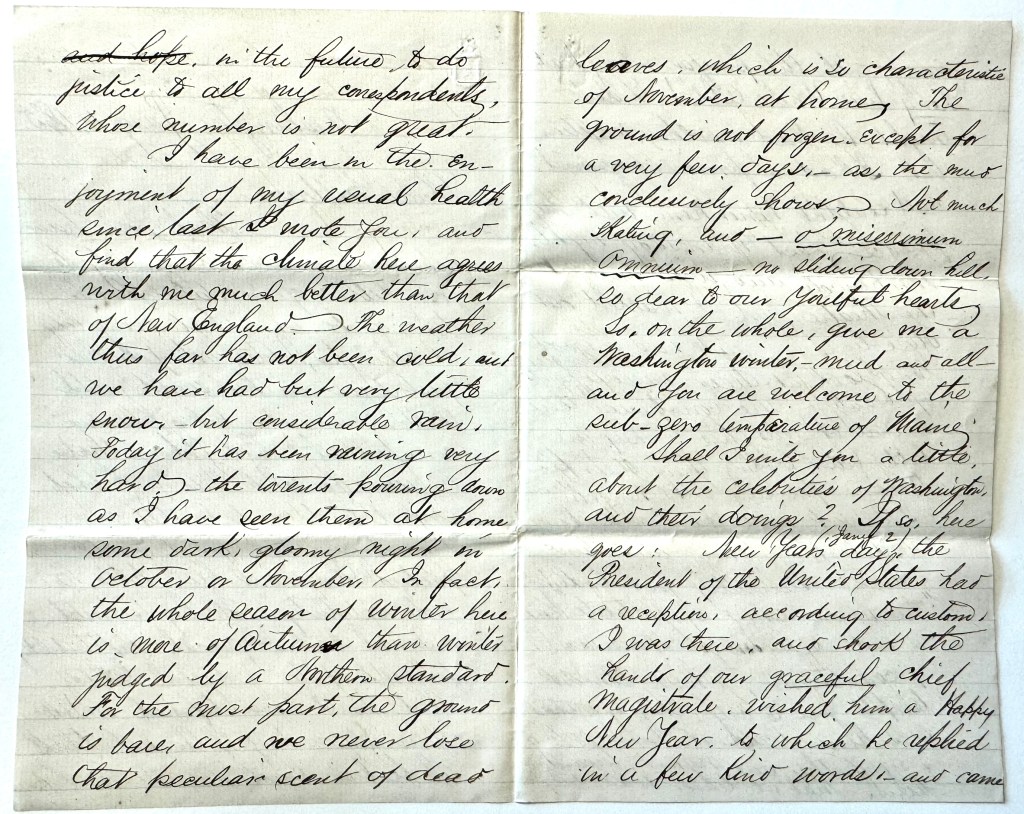
That you have not ere this received a reply to your letter of December 6th proves two facts—viz: that everybody at all times does not get his just dies in this world, and that I am not a punctual correspondent. But I always have a reason for what I do and what I fail to do, and in this case, I must say that for a month past, I have not been able to write or study. It has seemed a moral and physical impossibility for me to write a decent letter and so I have deferred what is usually a very pleasant task. I feel a reaction now, and hope in the future to do justice to all my correspondents whose number is not great.
I have been in the enjoyment of my usual health since last I wrote you, and find that the climate here agrees with me much better than that of New England. The weather thus far has not been cold, and we have had but very little snow—but considerable rain. Today it has been raining very hard—the torrents pouring down as I have seen them at home some dark, gloomy night in October or November. In fact, the whole season of winter here is more of autumn than winter judged by a Northern standard. For the most part, the ground is bare, and we never lose that peculiar scent of dead leaves which is so characteristic of November at home. The ground is not frozen except for a very few days as the mud conclusively shows. Not much skating and—O miserrimum omnium—no sliding downhill, so dear to our youthful hearts. So, on the whole, give me a Washington winter—mud and all—and you are welcome to the sub-zero temperatures of Maine.
Shall I write you a little about the celebrities of Washington and their doings? If so, here goes. New Years day (Jany. 2) the President of the United States had a reception, according to custom. I was there and shook the hands of the graceful Chief Magistrate, wished him a Happy New Year, to which he replied in a few kind words, and came away with the prayer in my heart, “Long live Uncle Abe!” Last night he had another reception but I had a prior engagement and couldn’t honor him with my presence. Last Wednesday night, Mr. Lincoln and wife were at the Theatre, and I walked out close by them, and had a good long look at their various points of beauty. The conclusion there arrived at was this: They are both better looking than their pictures—especially Mrs. Lincoln. I do not call the President a bad-looking man, and think Mrs. Lincoln decidedly good-looking. “Our honored Chief Magistrate” has a sad, despairing expression of countenance, which almost tempts you to cry. Anyone that sees him cannot help feeling a sympathy and regard towards him. That at least was my experience, and others speak in a similar strain.
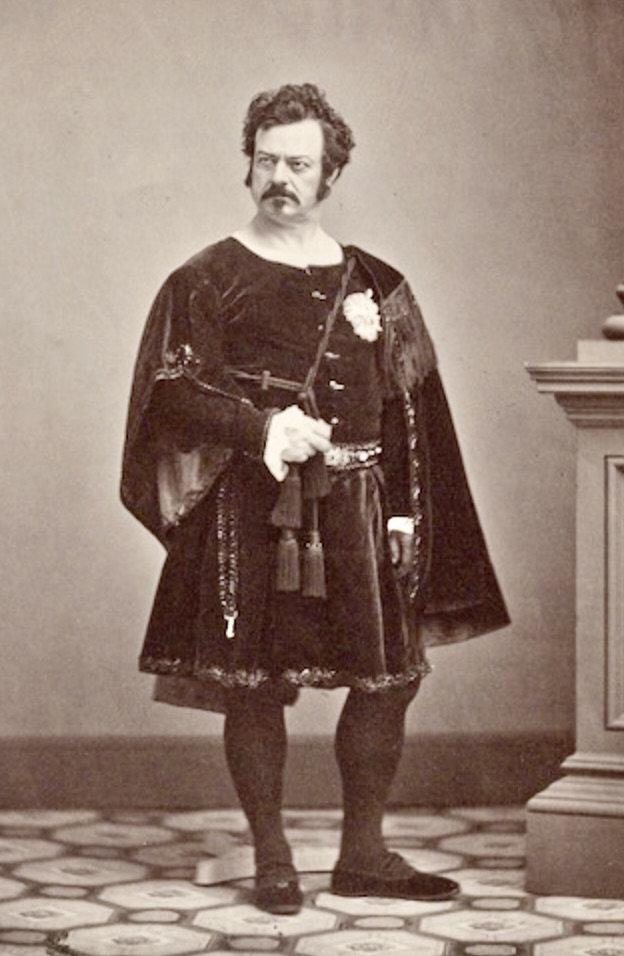
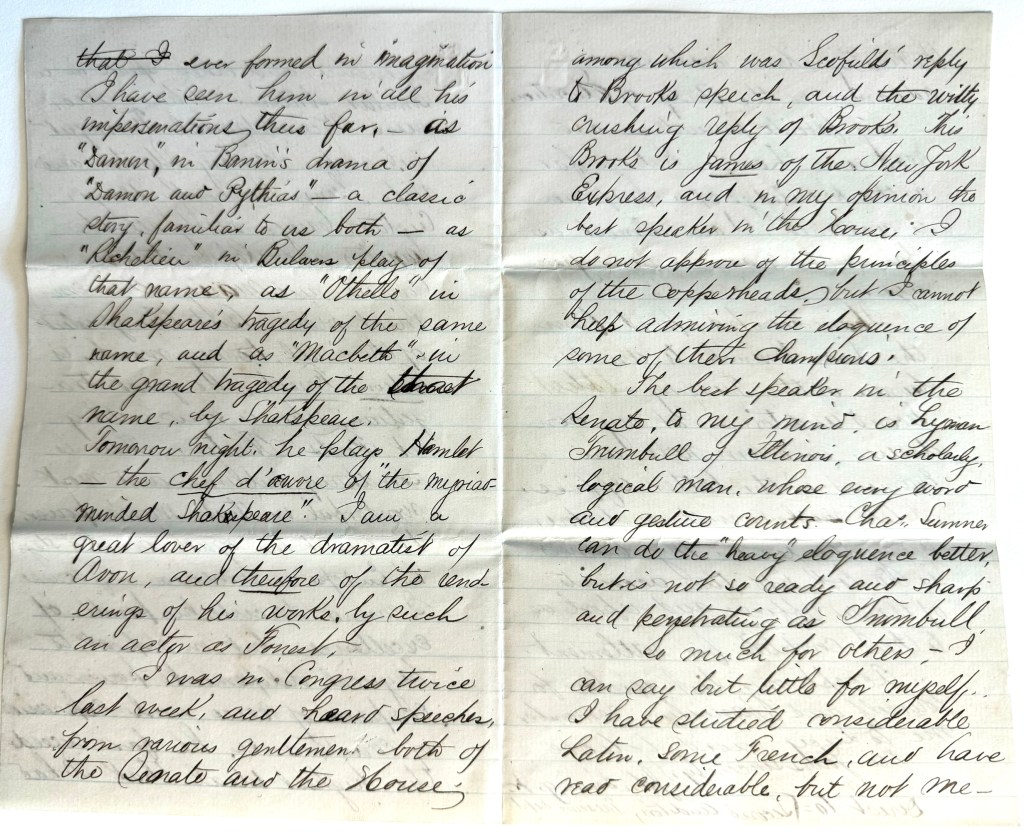
I have also seen Vice-Admiral Farragut and wife, Secretary Staton and wife, Gens. Hancock, Meigs, Custer, Casey, nearly all the Senators and Representatives in Congress, and many other eminent men. But the greatest of them all, to my mind, is Edwin Forrest, the great tragedian, who is now acting at Ford’s Theatre. There is something sublime and most wonderful in that man’s power. He hasn’t his equal on the stage in Europe or America. Of course I cannot describe his points of excellence, but in respect to physical development, power and compass of voice, and expression of countenance, he far exceeds the highest ideal that I had ever formed in imagination. I have seen him in all his impersonations thus far, as “Damon” in Banim’s drama of “Damon and Pythias”—a classic story, familiar to us both; as “Richelieu” in Bulwer’s play of that name; as “Othello” in Shakespeare’s tragedy of the same name; and as “Macbeth” in the grand tragedy of that name by Shakespeare. Tomorrow night he plays Hamlet—the chef d’amour of “the myriad minded Shakespeare.” I am a great lover of the dramatist of Avon, and therefore of the renderings of his works by such an actor as Forrest.
I was in Congress twice last week, and heard speeches from various gentlemen both of the Senate and the House, among which was [Glenni William] Scofield’s reply to [James] Brooks’ speech, and the witty, crushing reply of Brooks. This Brooks is James of the New York Express, and in my opinion the best speaker in the House. I do not approve of the principles of the Copperheads but I cannot help admiring the eloquence of some of their champions. 1
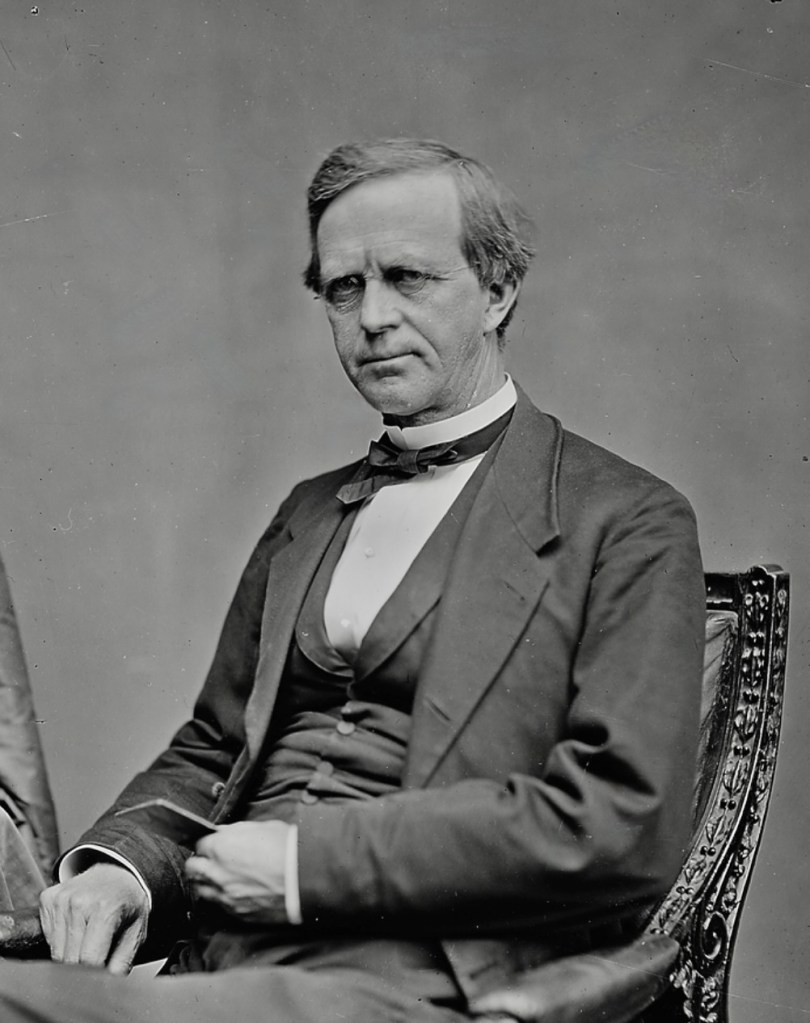
The best speaker in the Senate, to my view, is Lyman Trumbull of Illinois, a scholarly, logical man, whose every word and gesture counts. Charles Sumner can do the “heavy” eloquence better, but is not so ready and sharp and penetrating as Trumbull.
So much for others, I can say but little for myself. I have studied considerable Latin, some French, and have read considerable, but not methodically. Have made some advance in the study of Elocution—my favorite pursuit—and read some law. But as far as the knowledge of a profession is concerned, I am almost as far in the rear as four years ago.
I have been transferred from the Loan Branch to another Bureau of the Treasury—the Second Auditor’s—at my own desire, and am now an Examiner in the latter office. I like as well as before to say the least. My business is to look into the accounts of Army Office and report as to their condition for settlement.
Accept my best wishes for yourself and family. Remember me to Lucy and believe me yours sincerely, — John Deering, Jr.
Direct to Second Auditor’s, Treasury Department
1 This repartee between Scofield and Brooks is covered in the New York Times edition on 7 January 1865. James Brooks (1807-1873) represented NYC in the House of Representatives for seven consecutive terms, moving from the Whig to the Democratic Party and an outspoken critic of the Lincoln Administration. He died in office in 1873 while under scrutiny and formal censure for attempted bribery in connection to the Credit Mobilier scandal.


 Spared & Shared 23