
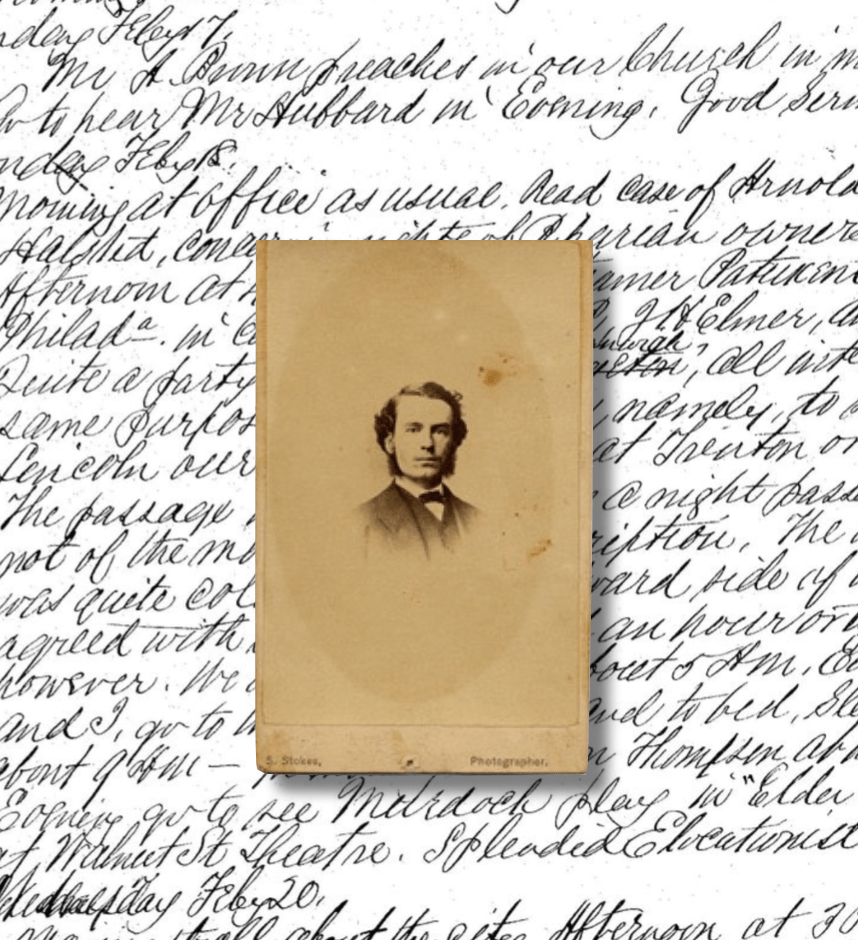
The following diary was kept by William Elmer Potter (1840-1896), the son of James Boyd Potter (1796-1865) and Jane Barron (1798-1855) of Bridgeton, Cumberland county, New Jersey. After attending public schools, William attended Harmony Academy where he remained until 1854. He then became a pupil at the West Jersey Academy during its first session, under the tutorship of Professors Snyder and Stevenson, but in October of 1857, having determined upon the law as a profession, entered the office of Hon. John T. Nixon. He remained until September 9, and the same month became a student of the law school of Harvard University. From this school he graduated in January, 1861, with the degree of L.L.B., and in September of the same year entered the junior class of Princeton College.
In July 1862, William put his collegiate studies aside and accepted a commission as 2nd Lieutenant in Co. K, 12th New Jersey Infantry and mustered into the service of the United States as such Sept. 4, 1862. He was promoted to a first lieutenancy of the same company and regiment Aug. 6, 1863, and to the captaincy of Company G Feb. 4, 1864. Capt. Potter became brevet major United States Volunteers for meritorious services, May 1, 1865, by promotion of the President of the United States, and was, in 1866, commissioned aide-de-camp to Governor Marcus L. Ward, of New Jersey, with the rank of lieutenant-colonel, upon whose staff he served for three years.
During this period Col. Potter was present in the following engagements: Chancellorsville, Gettysburg, Auburn, Bristow Station, Blackburn’s Ford, Locust Grove, campaign of Mine Run, Morton’s Ford, Wilderness, Cold Harbor, Petersburg, Deep Bottom, Crater, Deep Bottom (second engagement), Reams’ Station, Boydton Road, assault and capture of Petersburg, Rice’s Station, and Appomattox Court-House. By an order from headquarters, Twenty-fourth Army Corps, in company with five other officers, he was detailed to deliver the colors surrendered by Gen. Lee’s army, seventy-six in number, to Hon. Edwin M. Stanton, of the War Department, at Washington, which ceremony occurred on May 1, 1865. He was the only New Jersey officer present on this occasion.
During the period of time that William recorded the page of the diary presented below, he appears to have been living at home in Bridgeton, Cumberland county, New Jersey, and working as a clerk in the county court house, possible for the sheriff’s department.
[Note: This diary is housed at the Princeton University Library but has not been previously transcribed and published. See William E. Potter Diary, 1859-1862]
Transcription
Monday, February 11, 1861—As usual at office. Evening call at Mrs. Reeds. She at present is in Newcastle. See Mr. & Mrs. B. F. E. Call at Dr. William Elmer’s. Ladies not at home. Call at R[obert] S[hute] Bucks’. 1 See the young ladies. Invite me to Dancing Party at their house tomorrow evening.
Tuesday, February 12—Nothing occurs. Receive today from Messrs. Cromelien & Co. account against Joshua C. Surran to collect if the thing be possible, which query? Nothing happens of moment. Do not go up to R. S. B.’s to the little assemblage this evening. Have some reading to do.
Wednesday, February 13—Day passes as usual at office. Evening call at Jonathan Elmer’s. Meet Miss S. H. B. Play backgammon and other games. Have most pleasant evening.
Thursday, February 14—Nothing unusual occures. “Sociable” meets this evening at H. B. Lupton’s. Do not go however. Play game of chess with Frank in which I am beaten. Tennessee has gone for the Union by a majority of more than fifty thousand. The home of Jackson has again proved her devotion to the Union which he loved so well. Weather most unpleasant. Walking miserable. Evening damp and disagreeable. The winter climate of South Jersey is most uncomfortable.
Friday, February 15—Day as usual at office. Nothing of importance.
Saturday, February 16—Nothing occurs worth noting. Read anatomy, &c.
Sunday, February 17—Mr. A. Bunn preaches in church in morning. Go to hear Mr. ]Joseph W.] Hubbard [Presbyterian Church] in evening. Good sermon.
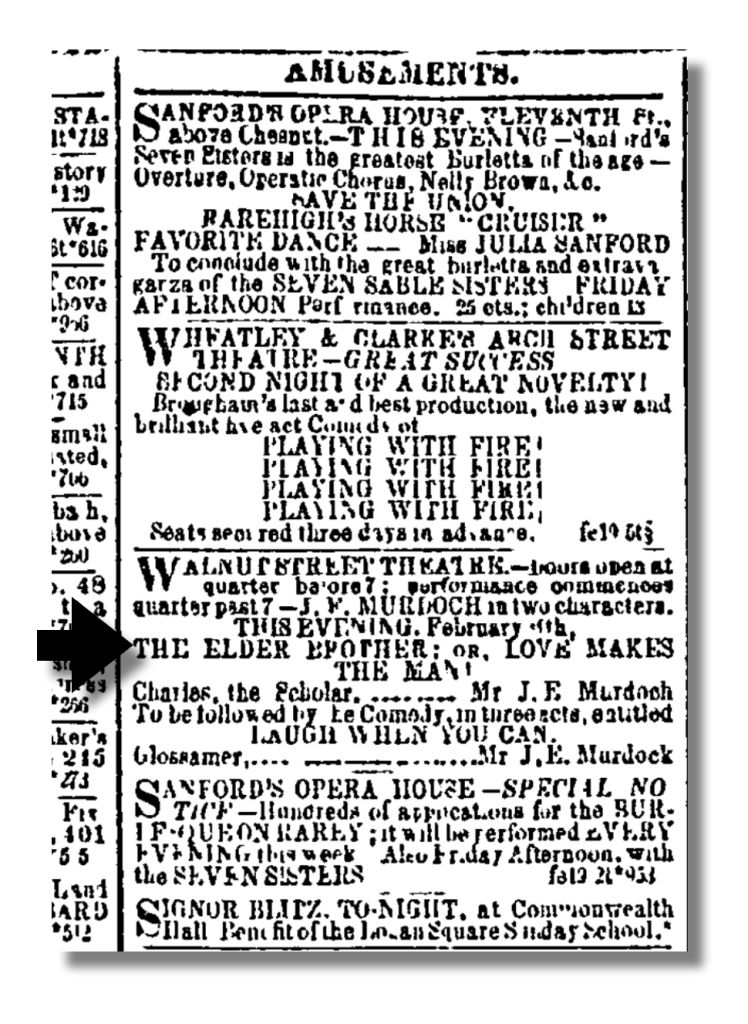
Monday, February 18—Morning at office as usual. Read case of Arnold vs. Mandy, 1 Halsted, concerning rights of Riparian owners. Afternoon at 4 pm leave in steamer Patuxent for Philadelphia in company with C. M. R., J. H. Elmer, and others. Quite a party joins us at Greenwich, all intent on same purpose with ourselves—namely, to see Mr. Lincoln, our Executive-elect, at Trenton or Philadelphia. The passage in the boat, being a night passage, was not of the most pleasant description. The weather was quite cold and the windward side of the boat agreed with the weather. I got an hour or two’s sleep, however. We arrive in Philadelphia about 5 a.m. Elmer, Riley, and I go to the Union Hotel and to bed. Sleep until about 9 a.m. In morning call on Thompson at his offfice. Evening go to see [James Edward] Murdock play in “Elder Brother” at Walnut St. Theatre. Splendid elocutionist.
Wednesday, February 20—Morning stroll about the city. Afternoon at 3 p.m. leave Kensington Depot for Trenton. Here we find most of our Cumberland Party who had gone up in the morning train. Evening, visit those celebrated rooms of Camden & Amboy Company, Nos. 10, Trenton House, and 7, American House. Am introduced to E. H. Stevens, Esq., General Cook, Hon. T. Jones Yorke and other worthies of like or lesser ilk. Many amusing things occur during the evening and we have on the whole a very lively time.
1 Robert Shute Buck (1802-1877) of Bridgeton, Cumberland county, New Jersey, was apprenticed to a miller at an early age. At 23, he entered politics as a Whig and was elected to the office of county sheriff. He then entered into the manufacture of bone buttons, and in 1836, entered into the iron business—the Cumberland Nail & Iron Company. He was married to Caroline James and their children included Sarah (“Sallie”) Buck, born 1838, and Clara Reeves Buck, (b. 1843), both mentioned in the diary pages that follow.

Thursday, February 21—Only limited number of tickets having been issued to admit persons to the Capitol, there was of course a great demand for them. Through the kind assistance of F. F. Patterson, Esq., we were admitted as a Special Reporter, on the platform close to the chair of the President of the Senate. Adjoining me were the Philadelphia Committee who had come thus far to meet Mr. Lincoln.
Mr. Lincoln and part of his suite entered about 12:15 and was introduced to President of Senate who welcomed him in a short address. Mr. Lincoln in a finely modulated voice replied, speaking of his early interest in the revolutionary struggle in New Jersey, &c. in a speech of between five and ten minutes in length. His is a very tall man, standing if I am not mistaken about six feet three inches high. His countenance bears the impress of grave and earnest thought, as well as of great coolness and determination. But when he begins to speak, how his whole face lights up with one of the most pleasant and heartfelt smiles that we have ever seen. I pray the Supreme Being who presides over the destinies of nations, and old individuals, that this grave, earnest, thoughtful, determined man, may prove, if need be, a second Washington to our Country. If there be anything in physiognomy—and experience has proven that there is—he is the man for the present crisis.
Mr. Lincoln dined at the Trenton House. Our party left Trenton at 1:32 p.m., arriving in city about 3:30 p.m. Elmer, Riley, and I go to Continental. Mr. Lincoln arrives in Philadelphia about 4 p.m., and at Continental about 6 p.m. makes short address from balcony to vast crowd assembled in front of Hotel. Evening receives citizenry in parlor of Continental. I retire early—i. e., about 12 p.m.
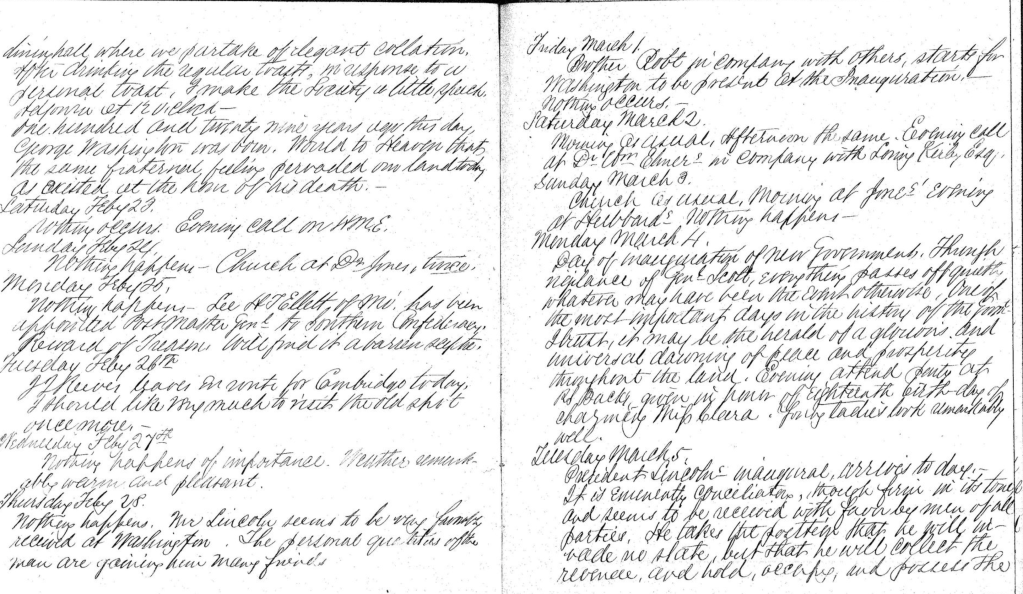
Friday, February 22—This morning at sunrise, Mr. Lincoln raised American flag to staff over Independence Hall. I do not go on account of crowd. Start for home at 9 a.m. Riley and Elmer do not go. In stage, W. G. N., P. Luellam, E. M. Hood, and others. Have quite lively ride. Stars & Stripes floating at crossroads. Cheer them in one or two instances as we ride by. Arrive home about 3:30 p.m. Evening attend Celebration of Washington Society of Andeton, in their Hall at Hotel of E. Deor’s & Son. Quite a large number of their friends present. President of Society, J. Leslie Lupton, reader of Washington’s Address, Henry Jordan; Orator of evening, William Cox. Cox speaks very well. Short addresses made by Judge Elmer & Rev. Mr. Hubbard. After which we adjourn to the dining hall where we partake of elegant collation. After drinking the regular toasts, in response to a personal toast, I make the Society a little speech. Adjourn at 21 o’clock. One hundred and twenty-nine years ago this day, George Washington was born. Would to Heaven that the same fraternal feeling pervaded our land today as existed at the hour of his death.

Saturday, February 23—Nothing occurs. Evening call on H. M. E.
Sunday, February 24—Nothing happens.Church at Dr. Jones, twice.
Monday, February 25—Nothing happens. See H[enry] T. Ellett of Mi[ssissippi]. Has been appointed Postmaster General to Southern Confederacy. Reward of treason. Will find it a barren scepter.
Tuesday, February 26—J. J. Reeves leaves en route for Cambridge today. I should like very much to visit the old spot once more.
Wednesday, February 27—Nothing happens of importance. Weather remarkably warm and pleasant.
Thursday, February 28—Nothing happens. Mr. Lincoln seems to be very favorably received at Washington. The personal qualities of the man are gaining him many friends.
Friday, March 1—Brother Robert in company with others starts for Washington to be present at the Inauguration, Nothing occurs.
Saturday, March 2—Morning as usual. Afternoon the same. Evening call at Dr. Eben Elmer’s in company with Loring Kirby, Esq.
Sunday, March 3—Church as usual. Morning at Jones’. Evening at Hubbard’s Nothing happens.
Monday, March 4—Day of Inauguration of new government. Through vigilance of General Scott, everything passes off quietly, whatever may have been the event otherwise. One of the most important days in the history of the government. I trust it may be the herald of a glorious and universal dawning of peace and prosperity throughout the land. Evening attend party at R. S. Buck’s given in honor of eighteenth birthday of charming Miss Clara. Young ladies look remarkably well.
Tuesday, March 5—President Lincoln’s inaugural arrives today. It is eminently conciliatory, though firm in its tone, and seems to be received with favor by men of all parties. He takes the position that he will invade no state, but that he will collect the revenue and hold, occupy and possess the property of the United States. The address is characterized by great ability, as well as conciseness. Its general effect cannot be anything but pacific.
Wednesday, March 6—Day nothing happens. Evening call at Miss H. M. E.’s.
Thursday, March 7—Nothing occurs. Southern papers are endeavoring to consider Lincoln’s Inaugural a declaration of war. One thing is very true, that as Mr. Lincoln’s remarks—there will be no war unless the government is attacked. If humanity is to be disgraced, civilization checked and Christianity overshadowed, by an internecine war upon this continent, it should be the prayer of the good in all lands, in light or darkness, on the battlefield or in the councils, that God will defend his unalterable right. And who can doubt that such right lies upon the side of the government.
Friday, March 8—Hon. Jno. T[hompson] Nixon returns from Washington last night. Today finish [John Henry] Stephens’ [book] on Pleading [in Civil Actions]. Commenced February 25, 1861 being third time that I have red it. Evening at home.
Saturday, March 9—Day as usual. Nothing happens. Weather March-like. Write letters to R. G. Thompson and to Father. Evening call at R. S. Buck’s. Miss Clara entertains me, Sallie being out. Have a pleasant evening.
Sunday, March 10—Morning attend Mr. Hubbard’s church. Mr. Davis of Deerfield preaches good sermon. Evening Dr. Jones.’ Rumored that small pox is in town. H. E. Hughes, Esq., has the varioloid. I was vaccinated last Thursday.

Monday, March 11—Day as usual. Do not feel very well in morning. Think that I do not exercise enough. Evening at home. Read [James] Parton’s Jackson, Vol. III., Grote’s Greece, Vol. I. Jackson’s life gives one a good insight into the political history of the country from 1823 until Jackson’s death. The critics call it the best biography written in the country. Vide Atlantic Monthly for March.
Tuesday, March 12—Day as usual at office. Evening at home. Read Parton’s Jackson, Grote’s Greece. Nothing occurs. Rumored that troops will be withdrawn from Fort Sumpter. Trust that it may be incorrect.
Wednesday, March 13—Morning at office. Afternoon meeting of congregation to decide whether we are to enlarge our old church or not. Decided so to do by vote of fifty-two to fourteen. Old subscription collected under former vote of congregation to build church on west side of creek, ordered to be annulled. Parties who paid their money in, ordered to be paid back. Amusing scenes occurred. Weather warm. Evening lecture Dr. Jones. Call afterwards in H. M. E.

Thursday, March 14—Morning as usual. Also afternoon. Day damp and cold. Nothing occurs during day. Yesterday made a most solemn vow. Evening pleasant “Sociable” at Mrs. W. G. N.’s
Friday, March 15—Day as usual. Nothing of importance occurs. Evening call with Loring Kirby, Esq., on Miss Lillie Sheppard. See herself and sister Jennie. Have pleasant chat. Afterwards call at R. S. B[uck’s]. See the two young ladies [Clara & Sallie]. Home.
Saturday, March 16—Day as usual. J. B. B[owen] returns from Philadelphia with degree of M. S. Evening call at Dr. Wm. E’s. Have not been able to read much by gas light for some days. Eyes are growing weak, I fear.
Sunday, March 17—Morning Mr. Davis of Deerfield preached at Dr. Jones’ church. Most excellent sermon. Finest by far that I have heard since my return home. Evening go to hear Mr. Hubbard.
Monday, March 18—Day as usual. Cold and in afternoon comes on to snow with every appearance of hard storm. Evening at home. J[ohn] T[hompson] Nixon leaves for Washington.
Tuesday, March 19—Snow several inches deep this morning, with every appearance of continuation. Sleighs out. Afternoon, Jno. B[uck] Bowen 1 calls after me with horses & sleigh to go sleighing with the Misses Buck. Good time but poor sleighing.
Wednesday, March 20—Morning at office. J. S. M. quite unwell. Quite busy drawing declarations, &c. &c. On looking over Curtis’ History of Constitution a few days since, with a view to ascertain Hamilton’s views on our Constitution, found that in the convention he stated his opinion to be (Vol. II, page 113): 1st, That he believed the British Constitution was the best form of government the world had then produced, citing the praise bestowed on it by Hecker “That it is the only government which unites public strength, with individual security.” 2nd, That he was equally convinced that none but a republican form could be attempted in this country, or would be adapted to our situation. 3rd, That he proposed to look to the British Constitution for nothing but those elements of stability and permanency which a republican system requires, and which may be incorporated into it, without changing its characteristic principles. Curtis gathers this summary of his opinions from the Brief of Hamilton works, Vol. II, 409., collated with Madison’s Report and Judge Yates’ Minutes,
Since Wednesday last, it has been a dark week with me. I a great trouble pressed me down. I trust that a kind and merciful God may cause it soon to pass away from our family. It is said, in old tradition, that there is a ghost in every house. This may be the mere embodiment of the idea that every family has their own peculiar subject of anxiety and distress. This last week, I shall always remember as a sad period. It has witnessed for myself, however, a most important resolution. God help me to keep it.
1 Dr. John Buck Bowen (1839-1888) was the son of Dr. William Smith Bowen (1802-1872) and Martha Hawthorn Buck (1814-1847) of Bridgeton, Cumberland county, New Jersey. John later served as an Assistant Surgeon in the 34th New Jersey Infantry.

The papers today bring the news, which is some measure rumor has forestalled, that the orders for the evacuation of Fort Sumpter have at length been issued. This will be received with sorrow by many, and can be justified on the ground that if it is done as a military move only.
Thursday, March 21—Day as usual. Snows all morning. Quite wintry for this time in March. Evening call with Jno. B. B[owen]. at Dr. Wm. Elmer’s. Also at R. S. B[uck’s]. Not able to read on account of eyes at night.
Friday, March 22—Morning as usual at office. Nothing happens of very much importance. Evening call at Charles E. Elmore’s. See himself and wife. President Lincoln has appointed Mr. [William Lewis] Dayton Minister to France. This has deservedly caused great rejoicing in New Jersey.
Saturday, March 23—Day passes at office, Nothing unusual occurs. Read Williams Exec. as usual. Afternoon in company with Jno. S. Mitchell, ride out to Wildwood. Visit Railroad which begins to assume the appearance of a reality. Evening at home.
Sunday, March 24—Church at Dr. Jones’ morning & evening. Nothing happens of importance. Sermons dullish. Weather clear.
Monday, March 25—Day as usual. Evening with article of Chronicle on the “Defect in our Government.” Take ground that its great defect is the want of internal strength. Do not read much this evening. Receive letter from Thompson.
Tuesday, March 26—Day as usual. Call on Miss Sallie B[uck] Have very pleasant evening. Nothing occurs today of importance.
Wednesday, March 27—Day as usual. Evening attend little company at Jno. B. Bowen’s. Quite a number there. Seem to enjoy themselves, one and all.
Thursday, March 28—Day as usual at office. Still reading, William’s Executors. Nothing important occurs. Evening “Sociable.” Meet at D. P. Elmer’s. I attend. Pleasant evening. Moonlight walk afterwards.
Friday, March 29—Pleasant weather. Sunshine prevails for once at least over the storm. Morning nothing occurs. Evening call in H. M. E. Lizzie L. & Maggie, Elmer call. Pleasant evening. Affairs of our Nation grow no better. The present position of an American citizen is, that he is secure under the protection of his government, all over the world, except within the borders of the United States. A loyal citizen may be murdered in South Carolina, and by the state authorities too, for expressing his allegiance to the United States, and our general government cannot punish the offenders.

Saturday, March 30—Morning as usual. Nothing happens of interest. Evening spent at Sarah’s. F. F. Westcott, Esq., of Cedarville being there. Also Miss Sallie H. B[uck]. Pleasant evening.
Sunday, March 31—Morning church at Dr. Jones.’ Take dinner at Sarah;s with F. F. W[estcott] After dinner walk out with him as far as Shiloh Bridge. Evening church at Dr. Jones.’ Have resolved today if possible to enter Princeton College in the summer. I shall regret it all my life if i enter upon the duties of my profession without a collegiate education—not that a collegiate education is indispensable to success, but because the want of it must in the nature of things, be severely felt through life. One does not feel that confidence in himself that he otherwise would. At least, such is my experience. I do not feel entitled to demand of Father, after all his kindness to me, this additional favor, but if he will send me, I will most gladly go.
Weather pleasant today, though windy as usual. Tomorrow is April 1st. The month of March has slipped by most rapidly—so rapidly indeed that it seems that one can hardly realize that it has come and gone.
Monday, April 1st—Morning as usual. Speak to Father concerning my going to college. He says he will take time to consider it. I do not know what decision he may give, but hardly think he will refuse me when he sees that I really desire to go. Rainy day. April begins in a cool, disagreeable mood.
Receive today, pamphlet from J. J. Reeves, Esq., containing Parson’s discourse on Constitution of United States delivered before Law School, March 7, 1861, as introduction to his course on Constitutional Law. Evening home.
Tuesday, April 2nd—Pleasanter than yesterday. At work nearly all day writing Sheriff’s Deeds. Evening at home. Read Parton’s Life of Jackson. Is an admirably written biography giving an insight into the political history of the country which I have obtained nowhere else.
Wednesday, April 3rd—Morning clear and bright. Have placed today in the front part of this diary the remarks of Alexander H. Stephens, V. President of the revolutionary government in the South, concerning the principles upon which said government is founded. He abandons the old untenable ground that slavery is a national institution, and lays down the proposition that under the new government, slavery is recognized as the fundamental basis of the government. He says, “that the prevailing ideas entertained by Jefferson and most of the leading statesmen at the time of the formation of the constitution, were that the enslavement of the African was in violation of the laws of nature; that it was wrong in principle, socially, morally, and politically. These ideas, however, were fundamentally wrong. Our new government is founded upon exactly the opposite idea; its foundations are laid, its cornerstone rests upon the great truth, that the negro is not equal to the white man. That slavery, subordination to the superior race, is his natural and moral condition. This, our new government, is the first in the history of the world based upon this great physical, philosophical and moral truth.”

Such is the testimony of Alexander H. Stephens, the leafing statesman of the South. The government of the United States is founded upon the eternal basis of Freedom, the revolutionary government has for its base and cornerstone the principle that human bondage is the only true condition of a perfect government. It has taken the world six thousand years to make this discovery at all, and we trust it will be longer than that ere it abandons one inch beyond its present position. The two governments are before the world, one based upon freedom, the other on slavery. Can there be any doubt concerning their future history?
Wrote to James J. Reeves at Cambridge. Evening spend with Jno. S. Mitchell at his house. We read Carlyle’s Essay on Burns—a most beautiful production. Pass an unusually pleasant evening.
Thursday, April 4th—Day opens finely, clear and bright, with just sufficient breeze to make the atmosphere bracing. How one’s pulse beats upon a morning like this when walking in the open air. How bright the future seems, how clear is the brain. So much does our intellectual, yes, even our moral feeling depend upon our physical condition. Ill health makes many a misanthrope, while on the other hand, a sound physical organization, and an abundance of animal spirits, enables many persons to exceed the great mass of their fellows in pursuits for which intellectually speaking, they are by no means peculiarly fitted. Evening attend the exhibition of the students of West Jersey Academy in Grosscup’s Hall. On the whole, the students perform well. My nephew, Boyd. N., declaims well. Bridgeton Brass Band makes its first appearance in a public meeting. They were only organized about the middle of November last and already are quite proficient, playing some thirty tunes. the Hall was much crowded with the friends of the Academy and everything passed off pleasantly.
Friday, April 5th—Morning as usual at office. Nothing happens. Afternoon 4:45 p.m., walk up to Tumbling Down with Oring Kirby. In coming down on Race side, see some ladies waving handkerchief on other sie to which we reply by waving our own. Take tea at W. G. N.’s. Evening pass at R. S. Bucks with Miss Sallie. Clara absent.

Saturday, April 6th—Morning office as usual. Pleasant day. Afternoon at office. Write letter to George T. Slack, Esq., at Cambridge. Papers today bring us the news that Government is preparing to assert and defend its rights. It has the sympathy of the civilized world and the support of eighteen millions of freemen. God grant us all the disposition, the heart and hand, to play a patriotic part in the coming struggle. Mail today to W. Cromelieu & Co., 721 Market Street, Philadelphia the account against Joshua Surran, Esq., sent me some time since for collection. Surran having no property, and not paying, it is impossible to do anything with it. Evening call with Miss S[allie] H. B[uck] and Lillie S. Very pleasant evening.
Sunday, April 7th—Church at Dr. Jones’ morning & evening. Good sermon in morning. In evening after church walk with C. M. R. as far as Academy. Nothing occurs important.
Monday, April 8th—Morning dull and cloudy. At office as usual. Evening attend the Sabbath School Concert. Afterwards walk out with H. M. E. and make a call at her house.
Tuesday, April 9th—Father gives me no answer as yet with regard to my entering college in August. Very perplexing to know what is my fate.
Wednesday, April 10th—Let this day be marked with a white stone. Father today told me to go to college if I so desired. How kind it is in my Father thus to offer me every advantage. I shall do my utmost to improve the opportunity thus given me. I feel assured that I can appreciate a college course at this time much better than ever before. Read 1st Volume of Williams’ Executors to page 267. Here most probably will begin an interruption on my legal studies. I lay them temporarily aside with regret mingling with my pleasure. I have enjoyed the study of law since my first entrance in it more than any study which I ever pursued. I feel that I have only entered the outer courts of the great temple of jurisprudence, but even here, I can discern how fair is its architecture, how magnificent its proportion’s. Evening studying at home.
Thursday, April 11th—Study morning…Evening at home.
Saturday, April 12—Morning study at home. Read thirty lines…After dinner, walk down to the wharf to witness launching of the new schooner. Through some accident, she does not go off. The papers today bring us the tidings that the rebels opened their fire upon Fort Sumpter. The war commenced upon Friday last, Who, oh who, knows the ending thereof?

Sunday, April 13th—Nothing of importance happens.
Monday, April 14th—All excitement. Fort Sumpter surrendered, or rather was evacuated after forty hours continual bombardment. The excitement in Philadelphia is terrible. All united for the government. President issues a proclamation calling for seventy-five thousand of the militia of the United States to suppress the insurrection. Response being made all over the country.
Tuesday, April 15—Excitement increasing. But one feeling in the North—to support our flag at all hazards!
Wednesday, April 16—Excitement still increasing. Volunteer companies being raised constantly. New York appropriated three millions of money and is to raise thirty thousand volunteers.
Thursday, April 17—No particular news. Excitement intense.
Friday, April 18—Massachusetts regiment arrived in Philadelphia.
Saturday, April 19—Start this morning for Philadelphia in early line to Glassboro. Arrived in Philadelphia about 10 a.m. People greatly excited about the attack made by mob in Baltimore upon Massachusetts troops. Several of Mass. troops killed. They fire upon mob killing a number. Pennsylvania troops also attacked. Being unarmed, they are forced to return to Philadelphia. The attack upon the unarmed troops has greatly excited the Philadelphians as well as the whole country. The North has become so fully aroused that nothing but the omnipotent hand of God can stay their vengeance. Evening walk about the city with Thompson and John B[uck] Bowen. J. B. B. spends the night with me at hotel.
Sunday, April 20—Morning walk about city. Afternoon go with Thompson to Jno. Chambers’ church. Evening go with Thompson and Bowen to hear Wadsworth. No being in his pulpit, we do not stay. Great excitement at Continental [Hotel]. Meet Robert there.

Rumor of arrival of three hundred thousand improved arms from Europe. Philadelphia presents today almost the appearance of a vast military camp. The public squares full of troops drilling the whole day through as also were the various [ ].
Monday, April 21—Morning do errands about the city. Afternoon at 3 p.m., start for home. Arrive per New Jersey Railroad and Glassboro stage, about 8 p.m. Find that a large meeting was held in Bridgeton on Saturday evening. Resolved to raise funds to support the families of volunteers. Company is being raised. Numbers already fifty-six men. Greatest excitement in Bridgeton that I have ever seen.
Tuesday, April 22—At home all day. Nothing of importance except the military excitement. Was measured while in the city for coat at Ethan Thompson’s. Vest & pants. At parties at southeast corner 6th & Market. Frank unwell.
From April 22nd to May 11th. Most stirring period in our country’s history. Troops called out by President. Three hundred thousand men arriving in North. Cannot recount in this diary the events.
Wednesday, May 8th—Today presentation of flag to “Cumberland Grays” by ladies of Bridgeton too place. P. T. Jones, Esq., of Philadelphia, made address in behalf of ladies. I received it on part of the company un few remarks. Grosscup’s Hall crowded. See Chronicle of May 11th.
From May 11th to June 23—Great events occurring in country. Make one or two visits to Philadelphia.
June 24, Monday—Start for Princeton to be examined for admission to Junior Class. W. E. Lufton also. J. Leslie, Superintendent for Admission to Sophomore. I stop at Philadelphia, go to Trenton at 6 P.M. Meet them there having returned from the examination.
Tuesday, June 25—Am today examined by Prof. Cameron in Greek…Latin…Mathematics. Am admitted.
Wednesday, June 26—Pass to Princeton with W. Elmer & friends. Commencement today.
Thursday, June 27—Stop in Trenton. See grand review of three regiments of volunteers at Camp Olden by Gov. Olden and staff. Stop at Continental at Philadelphia.

Friday, June 28—Reach home. Nothing new.
…..
Wednesday, July 17—Meet Wm. Keighler, Esq. of Baltimore on cars. Find his views have changed since last winter. Now almost if not entirely secessionist. Arrive in Washington at 6 p.m. Put up at Ebbitt House, not being able o get into Willard’s. Evening pass in room of Messrs. [John Thompson] Nixon and [John L. N.] Stratton. Army of Union made advance on Fairfax today.
Thursday, July 18—Pass in visiting Patent Office, Capitol, etc. In Congress, Mr. Nixon introduced us to Emerson Etheridge, [Robert] Mallory of Kentucky, Col. Crittenden of do. [Charles] Delano of Mass., Frank P. Blair of Mo., &c. Etheridge most agreeable conversationalist.
Friday, July 19—Visit Alexandria, now occupied by our troops. Deserted city. Houses closed. Grass growing in streets. Secessionists plenty but silent. Three secessionists in a Slave Pen taken night before at Bulls Run. Return to Washington, hire hack, and cross Long Bridge into Virginia. Visit Forts Runyon, Albany, and Corcoran, Arlington House, headquarters at present of New York 8th commanding beautiful view of Washington and the Potomac. Return to Washington, visit Capitol. Evening spend with Messrs. Stratton and Nixon.

Saturday, July 20th—Start for W at 4:15 a.m. Reach Philadelphia at 10:30 a.m. Start for Bridgeton at 3 p.m., arriving at home much pleased with visit at 7 p.m.
Sunday, July 21—Nothing of particular importance occurs in Bridgeton.
Monday, July 22nd—Learn that great battle occurred yesterday between our forces and the rebels. Our army after driving enemy before them until 4 p.m. were repulsed. Enemy was too much exhausted to pursue or else were not aware of our condition. Great slaughter on both sides.
Tuesday, July 23—Troops pouring into Washington from all directions. Gen. McClellan has been sent for from Western Virginia and will assume command at once. The country seems to be recovering from the first alarm, and considers our repulse in the light of salutary lesson. It appears that with a force of at most fifty thousand men under McDowell, we attacked 90,000 in their entrenchments. No wonder that we did not succeed. Yet even under these disadvantages we were nearly victorious. If the reserve of 18,000 men under Col. Miles had been ordered up promptly, we would have gained the day, for at the very time we retired, the enemy was falling back along his whole lines.
From Tuesday, July 23 to Wednesday August 13th, nothing of importance occurs to me personally. Great events are occurring with such rapidity in the country at large that I find it impossible to chronicle them here. Time passed principally in boating, riding, loafing, and other like employments. Impossible to study on vacation and under a July sun.

 Spared & Shared 23