
The following letters were written by Thomas C. Edwards (b. 1835) who served in Co. B, 8th New York Heavy Artillery. The regiment was organized at Lockport, New York as the 129th New York Volunteer Infantry and mustered on August 22, 1862, for three years service under the command of Colonel Peter Augustus Porter. Because heavy artillery regiments were needed for the defenses of Baltimore, the regiment was converted from infantry on October 3, 1862, and became the 8th New York Heavy Artillery on December 19, 1862. Companies L and M joined the regiment at Baltimore in February 1864.
Thomas C. Edwards—Age, 25 years. Enlisted, July 29, 1862, at Lockport; mustered in as corporal, Co. B, 129th Infantry, July 29, 1862 (which became the Eighth Heavy Artillery, December 19, 1862), to serve three years; promoted sergeant, April 25, 1863; quartermaster-sergeant, February 1, 1865; mustered out with company, June 5, 1865, at Munsons Hill, Va., as Thomas C. Edwards.
See also—1862-63: Thomas Edwards, 8th New York Heavy Artillery
See also—1864: Thomas Edwards to Amanda J. Edwards
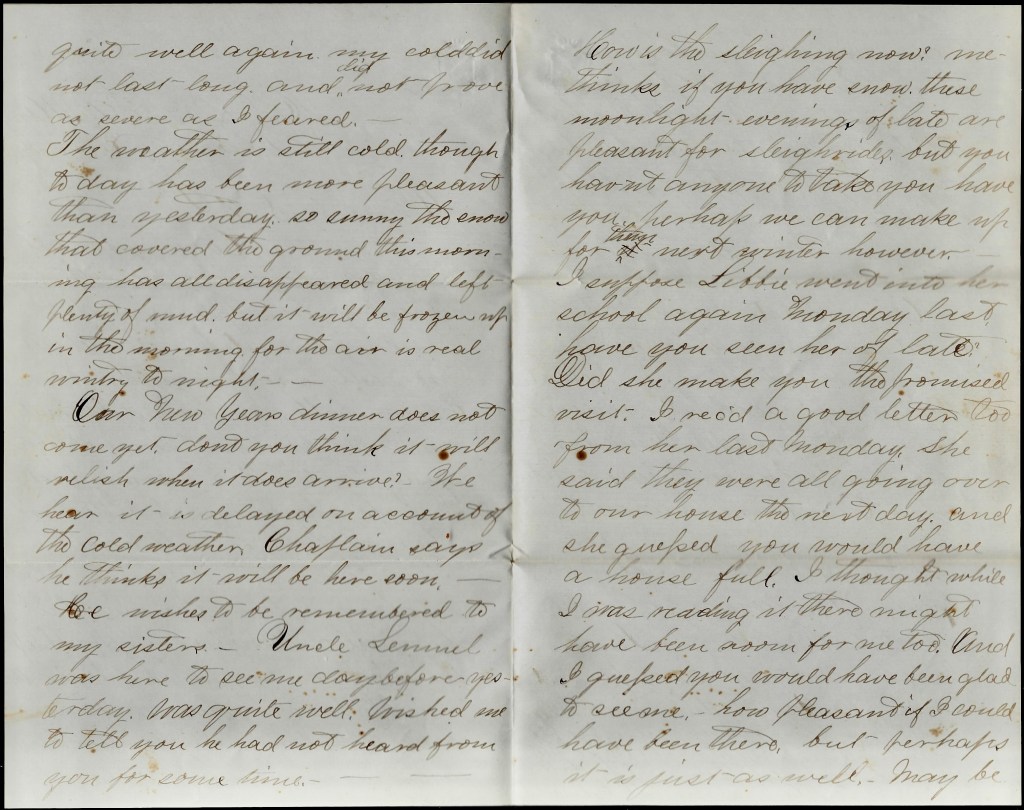
Letter 1

Headquarters 8th New York Artillery
Thursday evening, January 5, 1865
Dearest Sister,
Are you all at home usually well this evening? How pleasant if I could just step in and see you all a few minutes. Is Elvira better? I have felt quite anxious about her since I received your last letter Monday last. I hope she is much better ere this. I hope I will have another letter this evening. I looked for one last evening but the mail did not come. Perhaps the river or bay is so filled with ice the boat is delayed some. I shall look anxiously for another letter from home.
I am quite well again. My cold did not last long and did not prove as severe as I feared. The weather is still cold though today has been more pleasant that yesterday—so sunny the snow that covered the ground this morning has all disappeared and left plenty of mud, but it will be frozen up in the morning for the air is real wintry tonight.
Our New Years dinner does not come yet. Don’t you think it will relish when it does arrive? We hear it is delayed on account of the cold weather. Chaplain says he thinks it will be here soon. He wishes to be remembered to my sister. Uncle Lemuel was here to see me day before yesterday. Was quite well. Wished me to tell you he had not heard from you for some time.
How is the sleighing now? Me thinks if you have snow these moonlight evenings of late are pleasant for sleigh rides, but you haven’t anyone to take you have you? Perhaps we can make up for them next winter however. I suppose Libbie went into her school again Monday last. Have you seen her of late? Did she make you the promised visit? I received a good letter too from her last Monday. She said they were all going over to our house the next day and she guessed you would have a house full. I thought while I was reading it there might have been room for me too. And I guessed you would have been glad to see me. How pleasant if I could have been there, but perhaps it is just as well. Maybe I can come home some other time when it will be just as pleasant. I hope I shall not be so disappointed of a furlough again. They will be granting them again by & by, I presume. I shall try once more for one.
Am glad to hear of the good meeting on the Ridge. How are they progressing of late? Hope great good may be done there. It is sad to think Mr. Hawley’s people should be so destitute when Clark might do well if he would, hope he will try & do better. Does old Mr. H. live with Richard and how is his health now? How do Mr. Lewis’s people get along? Is Sophia attending the Union this winter? Am glad Mr Goodridge’s young people are attending school & like it so well. My kind regards to them and all the friends. Love to all at home. — T. C. Edwards

Letter 2
Headquarters 8th New York Artillery
January 9th 1865
Dearest Sister,
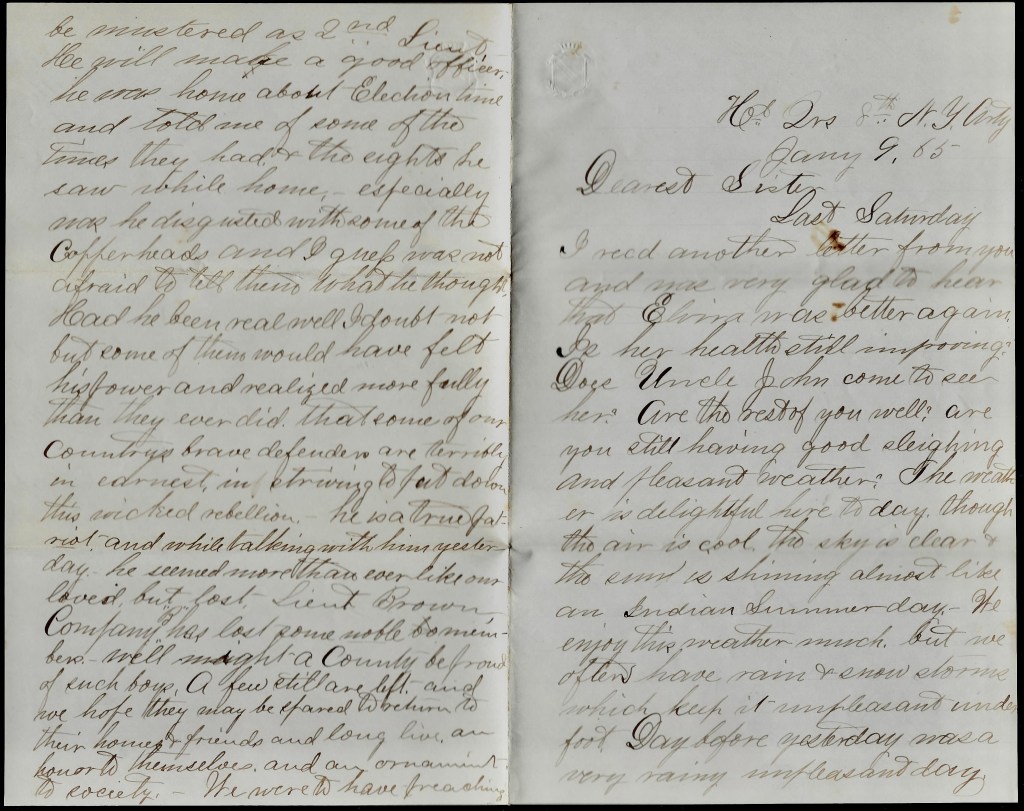
Last Saturday I received another letter from you and was very glad to hear that Elvira was better again. Is her health still improving? Does Uncle John come to see her? Are the rest of you well? Are you still having good sleighing and pleasant weather? The weather is delightful here today. Though the air is cool, the sky is clear & the sun is shining almost like an Indian Summer day. We enjoy this weather much but we often have rain and snowstorms which keep it unpleasant underfoot. Day before yesterday was a very unpleasant day and the day before that was equally cold & unpleasant.
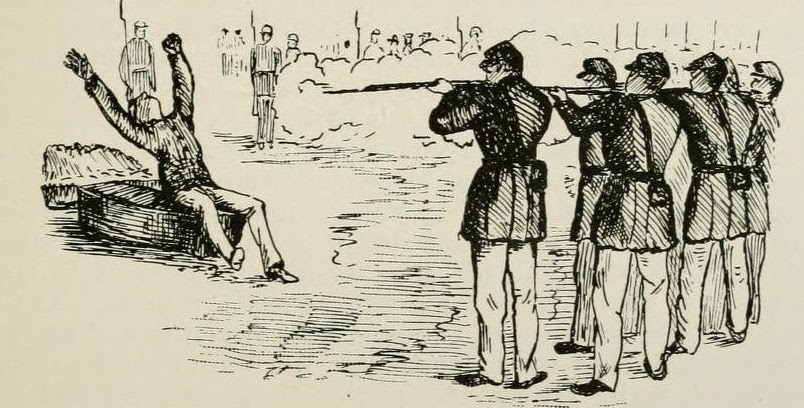
That morning we were called out to see a man shot. It was a very sad day to us and we do not care to see another such sight. The prisoner was a member of the 184th Pennsylvania 1 and was shot for desertion, or attempted desertion and exposing to the enemy our strength and plans. Our whole Division were out and formed in a square in a large field. He was brought up in a wagon, sitting on his coffin and was driven around the square while a band played the death march. He was then taken to the grave near the center of the field and sat upon his coffin blindfolded while twelve muskets were aimed at his heart. As they fired he fell dead but the scene was too terrible to witness and many strong men—men who had braved many battles, men who had stood firm while the bullets whizzed around them cutting down their fellows on their right and left—were now overcome by the sight and as the guns flashed and the poor victim fell, they fainted and fell as if they too had been shot. Though the sight was sad. we believe it will have a good effect upon all who witnessed it, for we doubt if any who witnessed it would now wish to desert.
My health is still good and I am enjoying myself well. Frank[lin J.] Fellows returned to us yesterday and I had a good chat with him. He was severely wounded at Cold Harbor. Has a commission now and today has gone to be mustered as 2nd Lieutenant. He will make a good officer. He was home about election time and told me of some of the times they had & the sights he saw while home—especially was he disgusted with some of the Copperheads and I guess was not afraid to tell them what he thought. Had he been real well, I doubt not but some of them would have felt his power and realized more fully than they ever did that some of our country’s brave defenders are terribly in earnest in striving to put down this wicked rebellion. He is a true patriot and while talking with him yesterday, he seemed more than ever like our loved but lost Lieut. Brown. Company B has lost some noble members. Well might a country be proud of such boys. A few still are left and we hope they may be spared to return to their homes & friends and long live, an honor to themselves and an ornament to society.
We were to have preaching yesterday but the air was so cold our Chaplain only sung and prayed with us. He says we are to have a house built for our meeting by next Sabbath. Last evening I got hold of the November number of the Atlantic Monthly & read “Leaves from an officer’s journal” and some other very interesting pieces. I like to read the Atlantic. Herbert has it quite often and he furnishes me a good amount of reading. He is a great reader and a fine boy. One of the little drummer boys is with us now too—Charlie Sanborn, another fine boy. He is not very small though. Is 16 years old, is rather tall, slim, with dark hair and bright, black eyes. His talk and actions make me think of Harvey and sometimes when he laughs, I almost think it is my brother. He was also enlisted with Company A. 2 He is now out with Herbert planting trees—evergreens around our little cabin. It will look very pretty and neat. Many of the boys have fixed their houses and the streets very nice. I wish you could see our little city here. It does not look much like an old pine forest now.
Have you seen Libbie since you wrote New Years? I received another letter from her yesterday. She was very sorry you were so disappointed. Said they started to make you a visit but the storm increased so & their horse became so tired they had to turn round and go home again. Am rejoiced to hear of the good meetings you are having at the Ridge. Hope they ay continue & great good may be done there. How good the news that Mrs. Button has sought and found the Savior. It must seem good to see them in church and to hear them speak of God’s goodness and mercy. I hope Mr. and Mrs. Gaul may also find the Savior. I would like to go with you to some of those good meetings.
The gathering at Uncle Seneca’s must have been pleasant, was it not? Was Elvira well enough so you could go? The Christmas tree must have been a fine one. A letter Eugene received from Lucy states that Merritt purchased the cane for Uncle & Uncle gave Merritt a very nice family bible. No doubt they all had a joyous time.
It is time for supper now so I must bid you goodbye again. I forgot to tell you our New Years dinner has not arrived yet. Love to you all, — T. C. Edwards
1 See the execution of Michael Wert, 184th Pennsylvania Infantry.
2 Charles Edward Sanborn (b. September 1847) claimed to be 18 years old when he enlisted on 14 February 1863, at Le Roy, New York. He mustered in as private, Co. A, February 17, 1863, to serve three years; promoted musician, date not stated; transferred to Co. K, Tenth Infantry, June 5, 1865; also borne as C. E. Sanborn.


Letter 3
On board steamer Daniel Webster
Near Fortress Monroe
Saturday morn, January 28, 1865
Dearest Sister and loved ones,
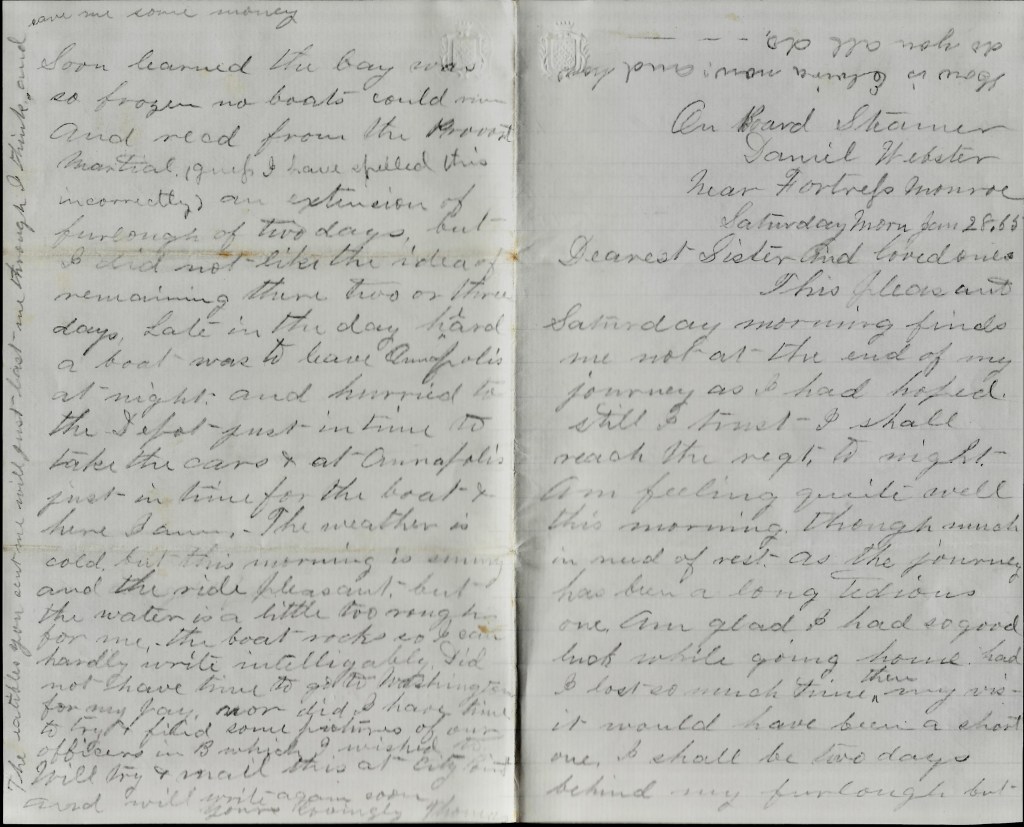
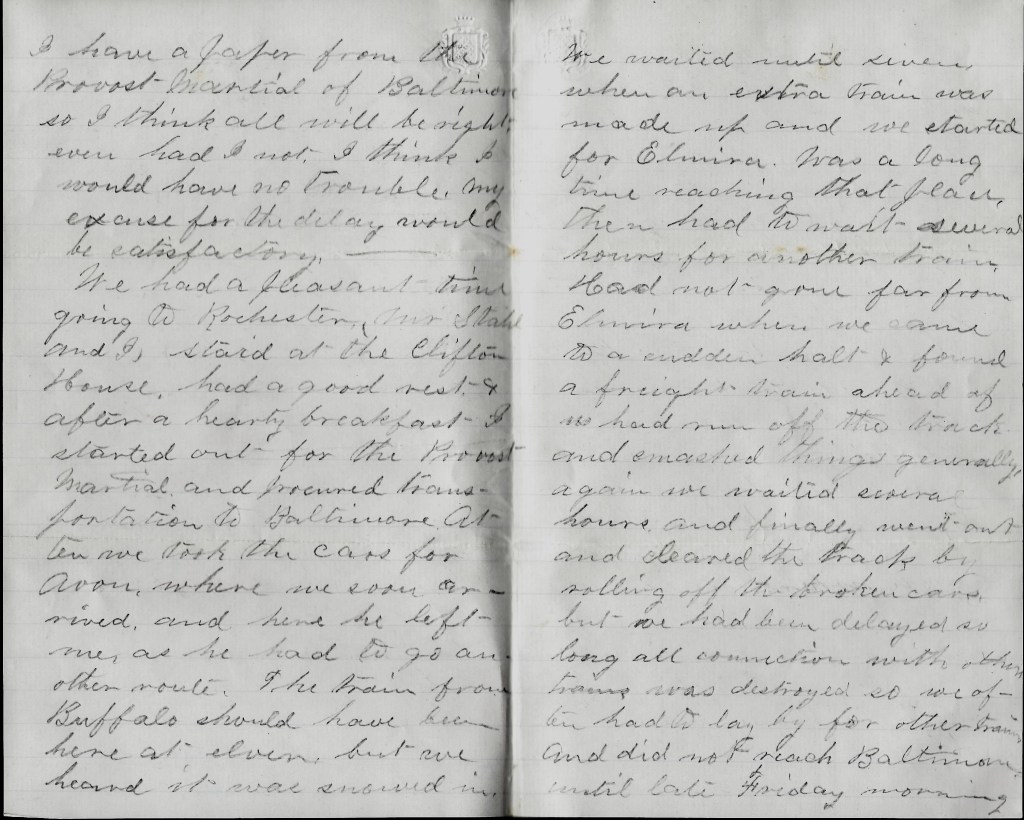
This pleasant Saturday morning finds me not at the end of my journey as I had hoped. Still I trust I shall reach the regiment tonight. Am feeling quite well this morning though much in need of rest as the journey has been a long, tedious one. Am glad I had so good luck while going home. Had I lost so much time then my visit would have been a short one. I shall be two days behind my furlough but I have a paper from the Provost Marshal of Baltimore so I think all will be right. Even had I not, I think I would have no trouble. My excuse for the delay would be satisfactory.
We had a pleasant time going to Rochester. Mr. Stahl and I staid at the Clifton House. Had a good rest and after a heart breakfast I started out for the Provost Martial and procured transportation to Baltimore. At ten we took the cars for Avon where we soon arrived, and here he left me, as he had to go on another route. the train from Buffalo should have been here at eleven but we heard it was snowed in. We waited until seven when an extra train was made up and we started for Elmira. Was a long time reaching that place. Then had to wait several hours for another train. Had not gone far from Elmira when we came to a sudden halt and found a freight train ahead of us had run off the track and smashed things generally. Again we waited several hours and finally went out and cleared the track by rolling off the broken cars but we had been delayed so long all connection with other trans was destroyed so we often had to lay by for other trains and dd not reach Baltimore until late Friday morning.
Soon learned the bay was so frozen no boats could run and received from the Provost Martial (guess I have spelled this incorrectly) an extension of furlough of two days. But I did not like the idea of remaining there two or three days. Late in the day, heard a boat was to leave Annapolis at night and hurried to the depot just in time to take the cars and at Annapolis just in time for the boat and here I am.
The weather is cold but this morning is sunny and the ride pleasant. But the water is a little too rough for me. The boat rocks so I can hardly write intelligibly. Did not have time to go to Washington for my pay nor did I have time to try and find some pictures of our officers in [Co.] B which I wished to. Will try and mail this at City Point and will write again soon. Yours lovingly, — Thomas
The eatables you sent me will just last me through I think and save me some money. How is Elvira now and how do you all do?
Letter 4
My soldier home
Monday eve, January 30, 1865
Dearest sister,
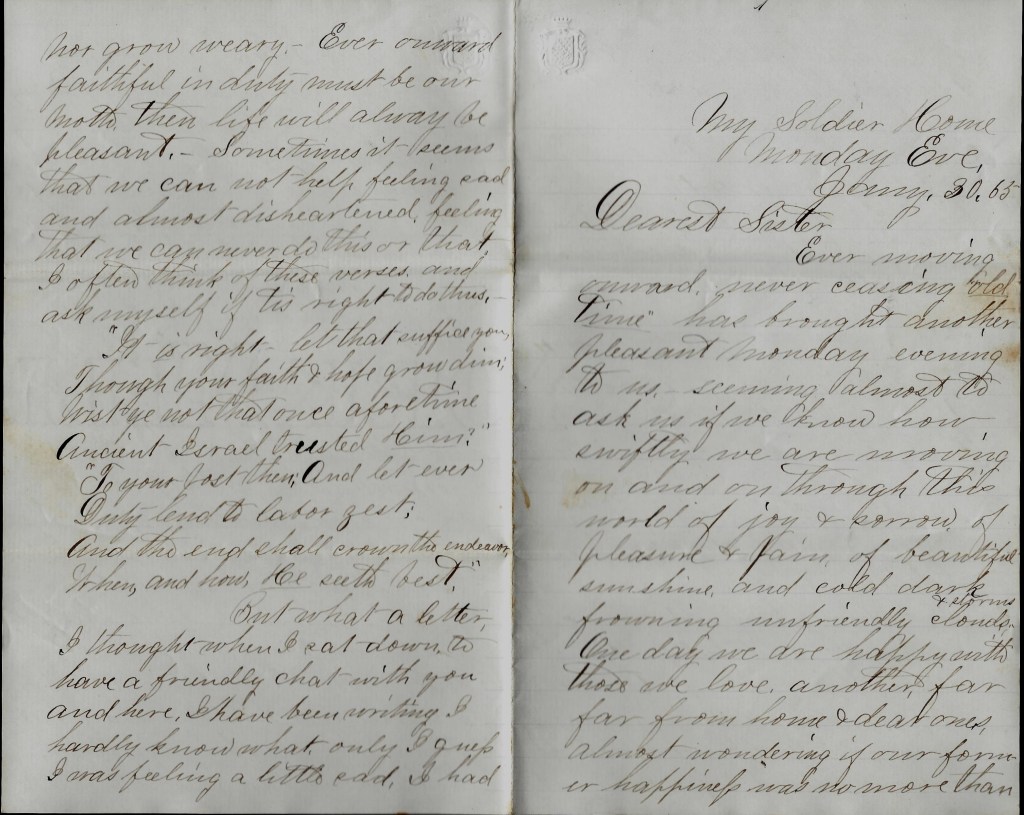
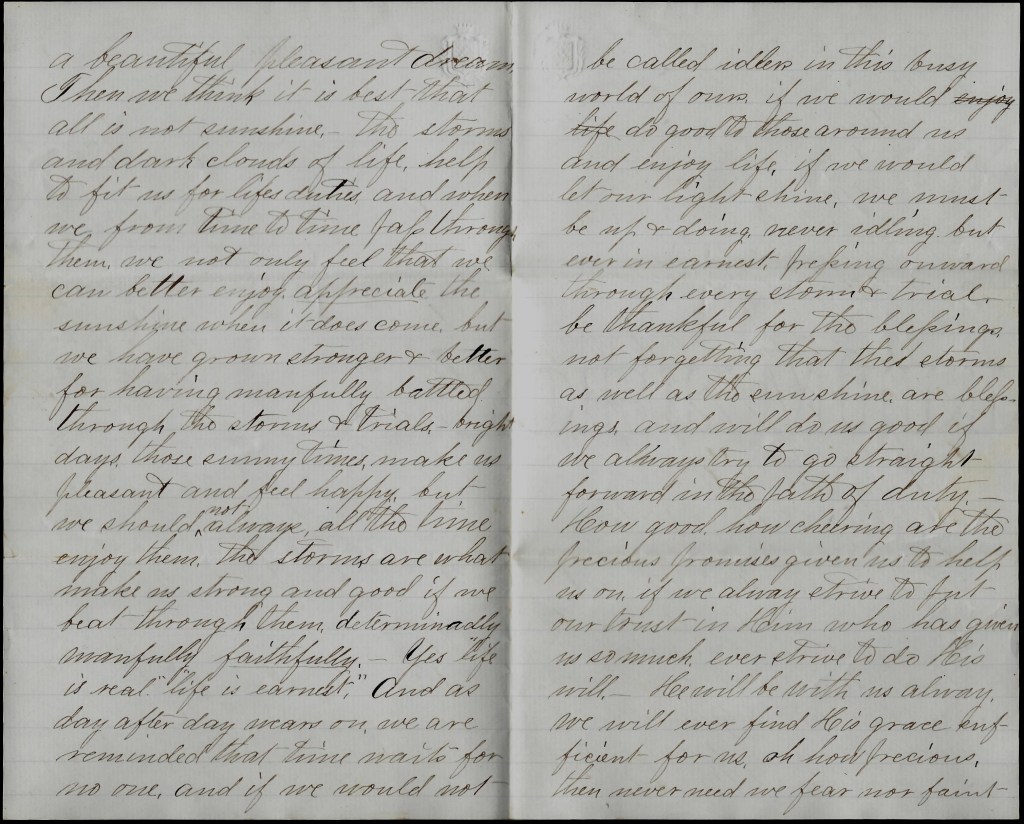
Ever moving onward, never ceasing old time has brought another pleasant Monday evening to us, seeming almost to ask us if we know how swiftly we are moving on and on through this world of joy & sorrow of pleasure & pain, of beautiful sunshine, and cold dark frowning unfriendly clouds & storms. One day we are happy with those we love, another, far far from home & dear ones, almost wondering if our former happiness was no more than a beautiful, pleasant dream. Then we think it is best that all is not sunshine. The storms and dark clouds of life help to fit us for life’s duties, and when we from time to time pass through them, we not only feel that we can better enjoy, appreciate the sunshine when it does come. But we have grown stronger & better for having manfully battled through the storms & trials…
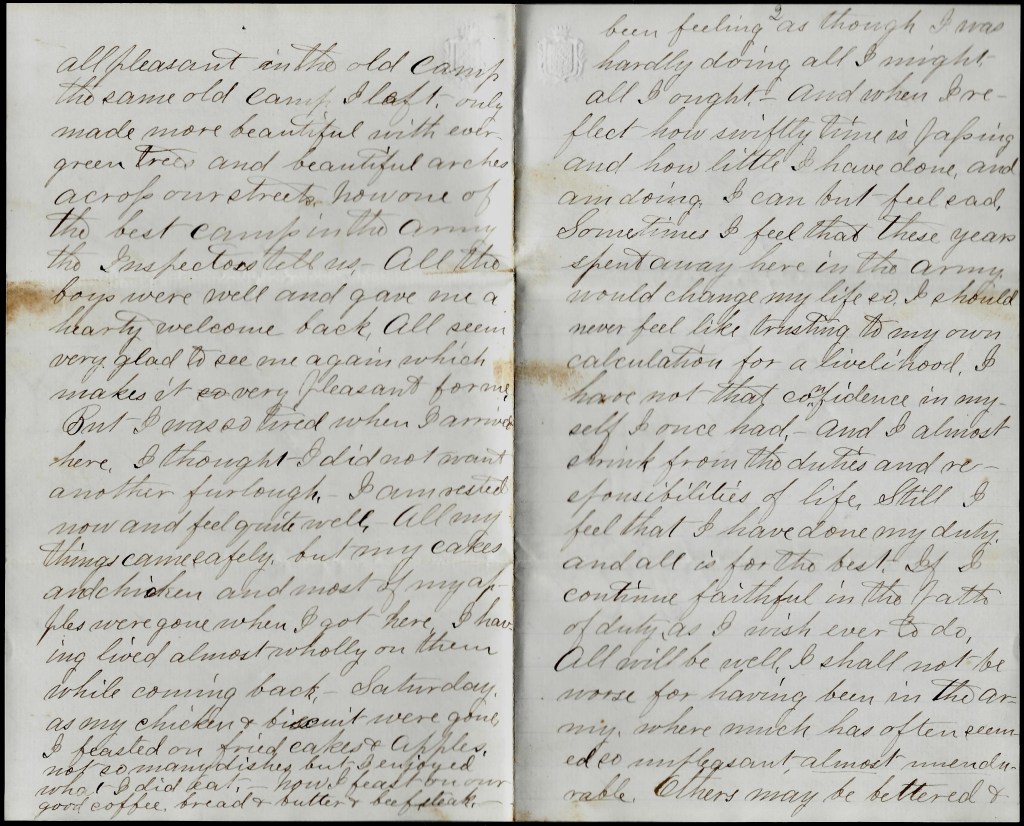
I feel that these years spent away here in the army would change y life so I should never feel like trusting to my own calculation for a livelihood. I have not that confidence in myself I once had and I almost shrink from the duties adn responsibilities of life. Still I feel that I have done my duty and all is for the best. If I continue faithful in the path of duty, as I wish ever to do, all will be well. I shall not be worse for having been in the army where much has often seemed so unpleasant, almost unendurable. Others may be bettered & I shall be better myself He who has blessed and kept me thus far will bless & keep me still, and I shall not be worse, nor in ought be a loser by having tried to do my duty now, by leaving home and business to help save our country.
Well, how do you all do tonight? Is Elvira better? Does she sit up more than she did? …Her soldier brother was not very kind. I fear that he did not take her out once while he was at home but tell her he is sorry he was so naughty. She must forgive him this time and he will try and do better…How is the sleighing now? The air is a little warmer here, they say, than while I was at home. Today has been clear and so pleasant. Was ever such a day seen North? How good that we are here instead of in the cold, northern clime. The morning was cold and frosty so we needed our overcoats & mittens when we drew rations early this morning, but at noon the cold & frost has gone and we hardly needed any coat or even a fire to keep us comfortable. How different from home. No snow here and scarce any mud just now. All day the dust flies almost as the snow does at home.
I wrote to you while coming down on the boat of my delays and unpleasant journey. I arrived here safely late Saturday night and found all pleasant in the old camp—the same old camp I left, only made more beautiful with evergreen trees and beautiful arches across our streets. [We] have one of the best camps in the army, the Inspectors tell us.
All the boys are well and gave me a hearty welcome back. All seem very glad to see me again which makes it very pleasant for me. But I was so tired when I arrived here. I thought I did not want another furlough. I am rested now and feel quite well. All my things came safely but my cakes and chicken and most of my apples were gone when I got here, I having lived almost wholly on them while coming back. Saturday as my chicken & biscuit were gone, I feasted on my fried cakes and apples, not so many dishes but I enjoyed what I did eat. How I feast on our good coffee, bread & butter & beef steak.
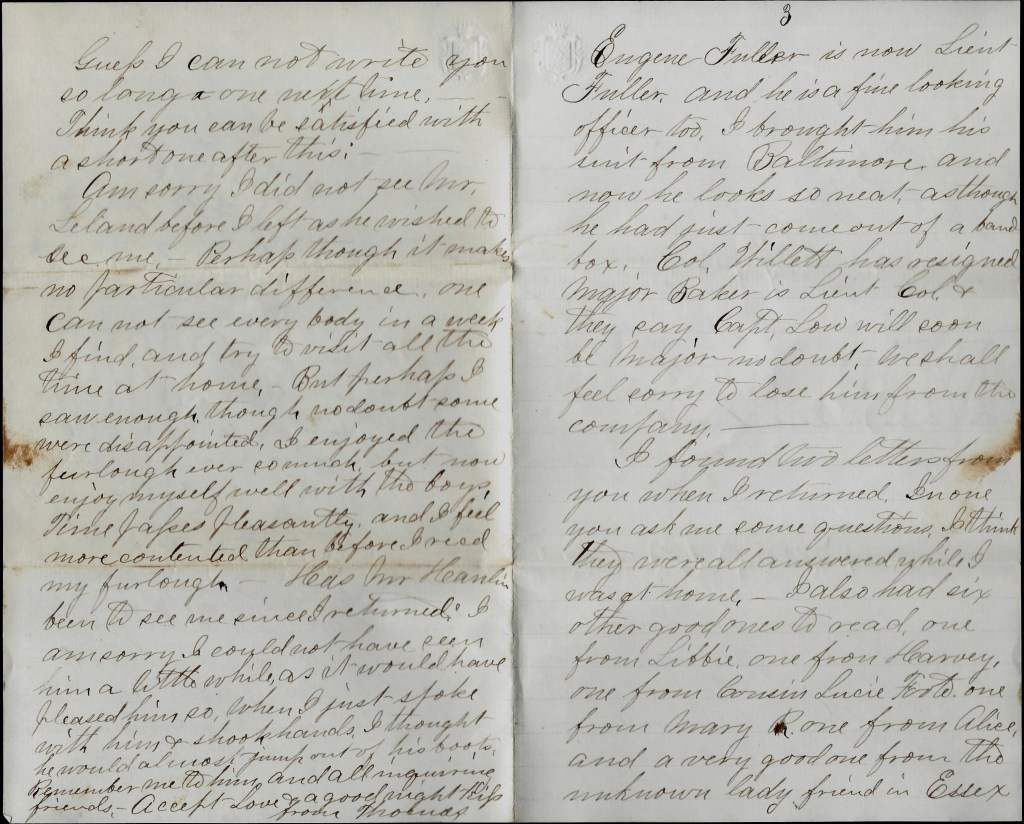
Eugene Fuller is now Lieut. Fuller and he is a fine-looking officer too. I brought him his suit from Baltimore and now he looks so neat, as though he had just come out of a band box. Col. Willett has resigned. Major Baker is Lieutenant-Colonel & they say Capt. Low will soon be Major, no doubt. We shall feel sorry to lose him from the company.
I found two letters from you when I returned. In one you ask me some questions. I think they are all answered while I was at home. I also had six other good ones to read…one from the unknown lady friend in Essex.She is a Baptist minister’s daughter, she says. Her father preaches there. She has two sisters and but one brother. He is in the army. Says she does not often write to strangers but will write to me because I am a soldier and she concludes by my letter I am a gentleman too. Ha! Ha! (I guess I feel a little flattered) Says they call her “the little abolitionist” because she cannot think just as some of her copperhead neighbors do & sometimes talks pretty plain to them. Well, I guess she is a pretty good girl and does not want to see our government destroyed by traitors…
Am sorry I did not see Mr. Leland before I left as he wished to see me. Perhaps though it makes no particular difference. One cannot see everybody in a week, I find, and try to visit all the time at home. But perhaps I saw enough, though, no doubt some were disappointed. I enjoyed the furlough ever so much, but now enjoy myself well with the boys. Time passes pleasantly and I feel more contented than before I received my furlough…
Accept love and a good night kiss from, — Thomas


Letter 5

Near Petersburg, Va.
February 7, 1865
Tuesday morn.
Dearest Sister,
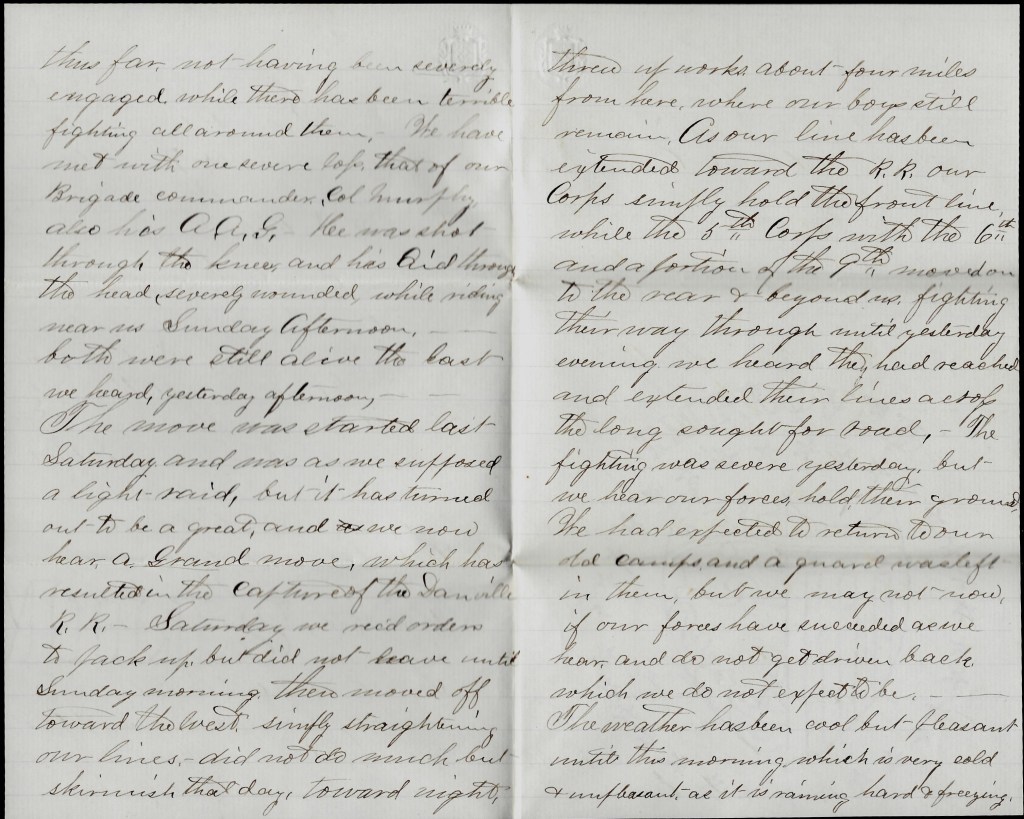
Our forces have been moving again so I am a little behind my usual time of writing and I don’t know when I can mail this but I will improve the few minutes of spare time I now have that you may know how we are. I am still save and well All of our regiment were safe when I left them last night though they have seen some fighting since Sunday morning, or all except two who were slightly wounded—one of Co. F and one of Co. H. Our Brigade have been wonderfully preserved this far, not having been severely engaged while there has been terrible fighting all around them. We have met with one severe loss—that of our Brigade Commander, Col. Murphy. Also his A. A. G. He was shot through the knee and his Aide through the head, severely wounded, while riding near us Sunday afternoon. Both were still alive the last we heard yesterday afternoon.
The move was started last Saturday and was as we supposed a light raid, but it has turned out to be a great, and we now hear, a Grand move, which has resulted in the capture of the Danville Railroad. Saturday we received orders to pack up but did not leave util Sunday morning, then moved off toward the west, simply straightening our lines. Did not do much but skirmish that day. Toward night, threw up breastworks about four miles from here where our boys still remain. As our line has been extended toward the railroad, our Corps simply hold the front line while the 5th Corps with the 6th and a portion of the 9th moved on to the rear & beyond us, fighting their way through until yesterday evening we heard they had reached and extended their lines across the long sought after road.
The fighting was severe yesterday but we hear our forces hold their ground. We had expected to return to our old camps and a guard was left in them but we may not now if our forces have succeeded as we hear, and do not get driven back, which we do not expect to be.
The weather has been cool but pleasant until this morning which is very cold & unpleasant, as it is raining hard & freezing. The roads are pretty good but I fear they will be heavy now for a time and perhaps will delay farther advance. As the Commissary Department have not moved, I have not remained with the regiment all the time. Have been with or near them most of the day and return to my old house at night. Herbert has remained here all the time.
I have been looking for a letter for two or three days but have received none since Thursday last. Are you all usually well? How is Elvira? I hope better. Hope I will hear from you soon. Also from Libbie. I will write again soon as convenient. With love to you all. I am as ever your affectionate brother, — T. C. Edwards

Letter 6

Camp near Petersburg, Va.
Friday eve., February 10, 1865
Dear Sister,
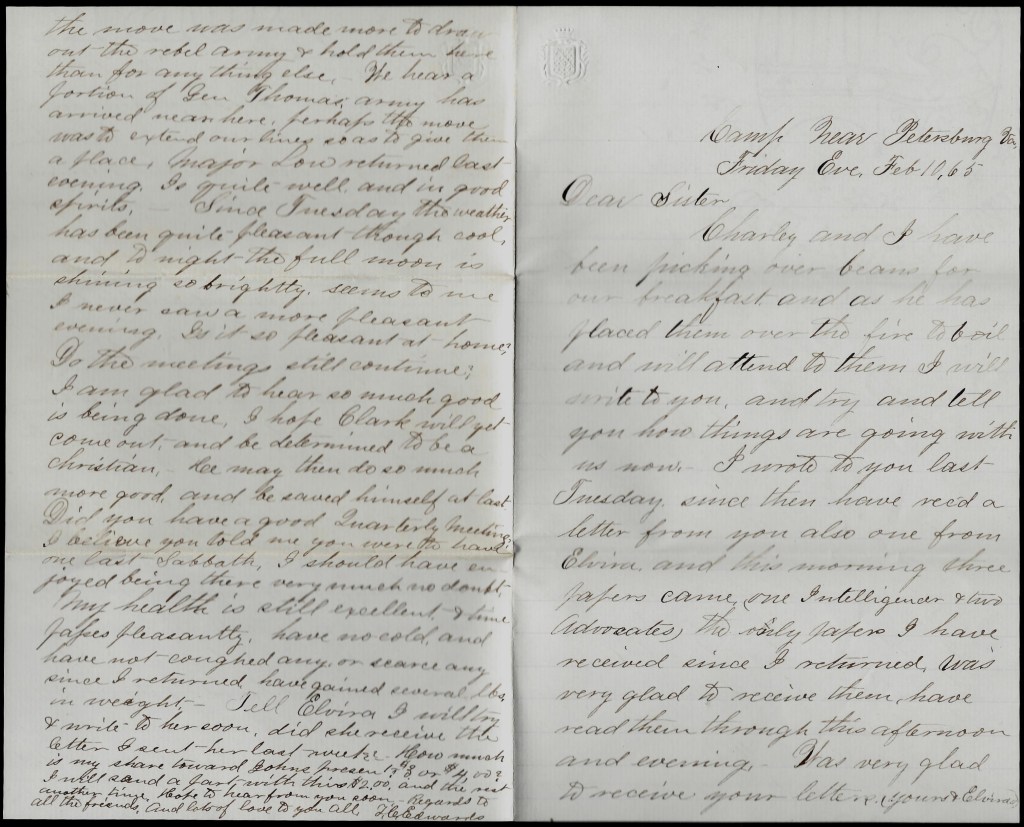
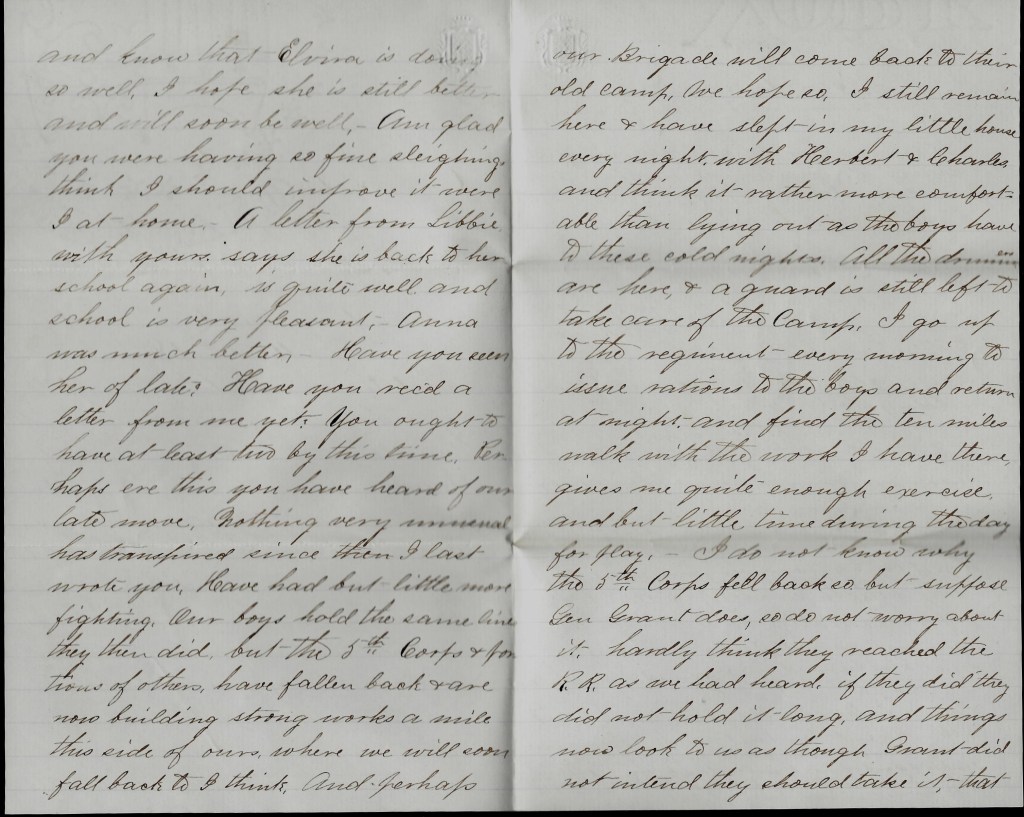
Charley and I have been picking over beans for our breakfast and as he has placed them over the fire to boil and will attend to them, I will write to you and try and tell you how things are going with us now. I wrote to you last Tuesday. Since then have received a letter from you also one from Elvira, and this morning three papers came (one Intelligencer and two Advocates), the daiy papers I have received since I returned. Was very glad to receive them. Have read them through this afternoon and evening. Was very glad to receive your letters (yours and Elvira’s) and know that Elvira is doing so well. I hope she is still better and will soon be well. Am glad you were having so fine sleighing. Think I should improve it were I home. A letter from Libbie with yours says she is back to her school again, is quite well and school is very pleasant. Anna was much better. Have you seen her of late?…
Nothing very unusual has transpired since I last wrote you. Have had but little more fighting. Our boys hold the same line they then did, but the 5th Corps & portions of others have fallen back and are now building strong works a mile this side of ours, where we will soon fall back to, I think, and perhaps our Brigade will come back to their old camp. We hope so.
I still remain here and have slept in my little house every night with Herbert & Charles and think it rather more comfortable than lying out as the boys have to these cold nights. All the drummers are here & guard is still left to take care of the camp. I go up to the regiment every morning to issue rations to the boys and return at night and find the ten mile walk with the work I have there gives me quite enough exercise and but little time during the day for play.
I do not know why the 5th Corps fell back so but suppose Gen. Grant does, so do not worry about it. Hardly think they reached the railroad as we had heard. If they did, they did not hold it long and things now look to us as though Grant did not intend they should take it, that the move was made more to draw out the rebel army & hold them here than for anything else. We hear a portion of Gen. Thomas’ army has arrived near here. Perhaps the move was to extend our lines so as to give them a place. Major Low returned last evening. Is quite well and in good spirits. Since Tuesday the weather has been quite pleasant though cool and tonight the full moon is shining so brightly. Seems to me I never saw a more pleasant evening. Is it so pleasant at home? Do the meetings still continue? I am glad to hear so much good being done. I hope Clark will yet come out and be determined to be a Christian. He may then do so much more good, and be saved himself at last. Did you have a good quarterly meeting?…
My health is still excellent & time passes pleasantly. Have no cold and have not coughed any or scarce any since I returned. Have gained several pounds in weight…
Regards to all the friends and lots of love to you all, — T. C. Edwards
Letter 7
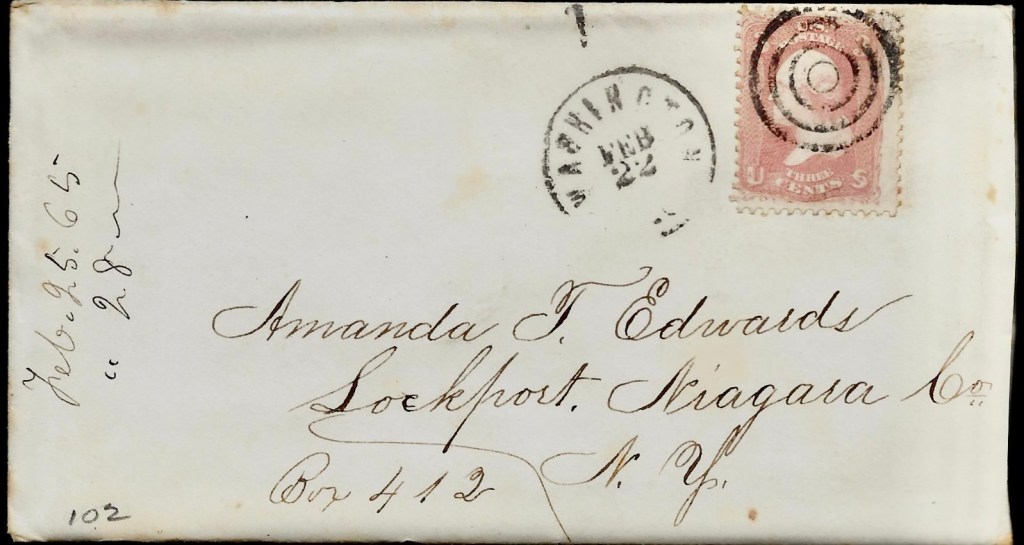
Sabbath Evening
February 19th 1865
Dearest Sister,
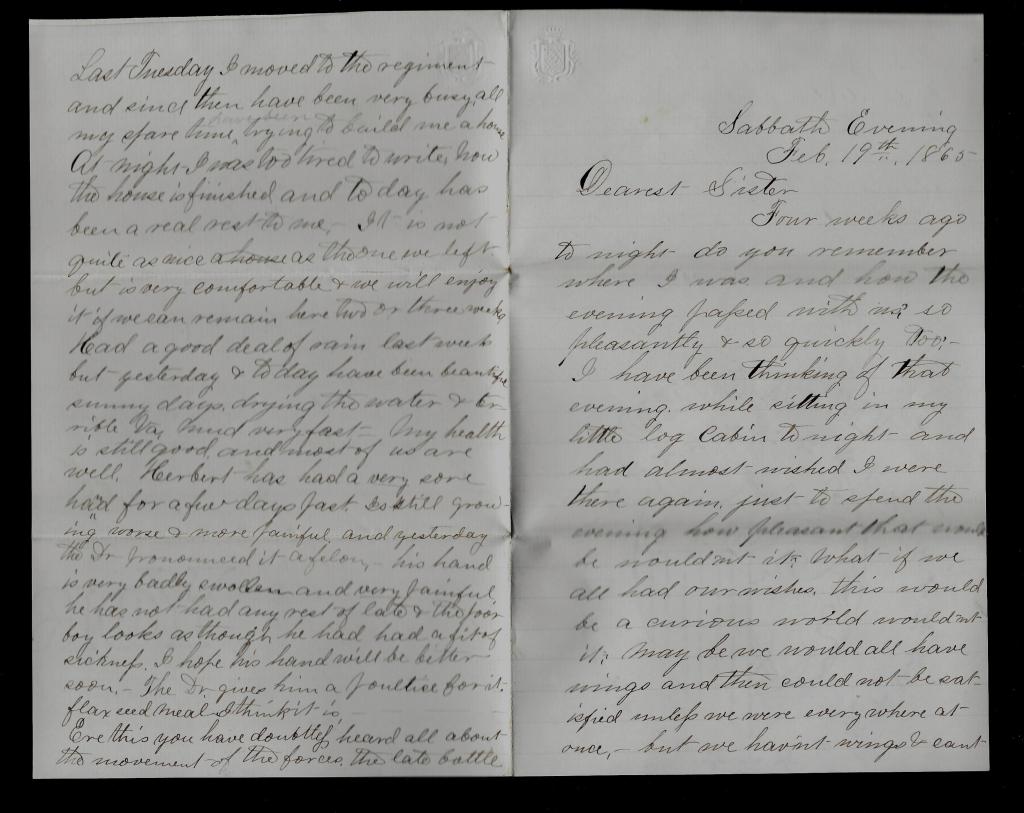
Four weeks ago tonight, do you remember where I was and how the evening passed with us? So pleasantly & so quickly too. I have been thinking of that evening while sitting in my log cabin tonight and had almost wished I were there again just to spend the evening. How pleasant that would be, wouldn’t it? What if we all had our wishes. This would be a curious world, wouldn’t it? Maybe we would all have wings and then could not be satisfied unless we were everywhere at once. But we haven’t wings & can’t be everywhere all the time so must be contented just where we are & try & be just what we should be, what God made us & intended we should be, men and not birds or beasts. Yes, we can be happy whenever we may be, always happy, if we always trust our all with Jesus, ever remembering that “He doeth all things well.” “All things work together for good to them that trust in the Lord.”
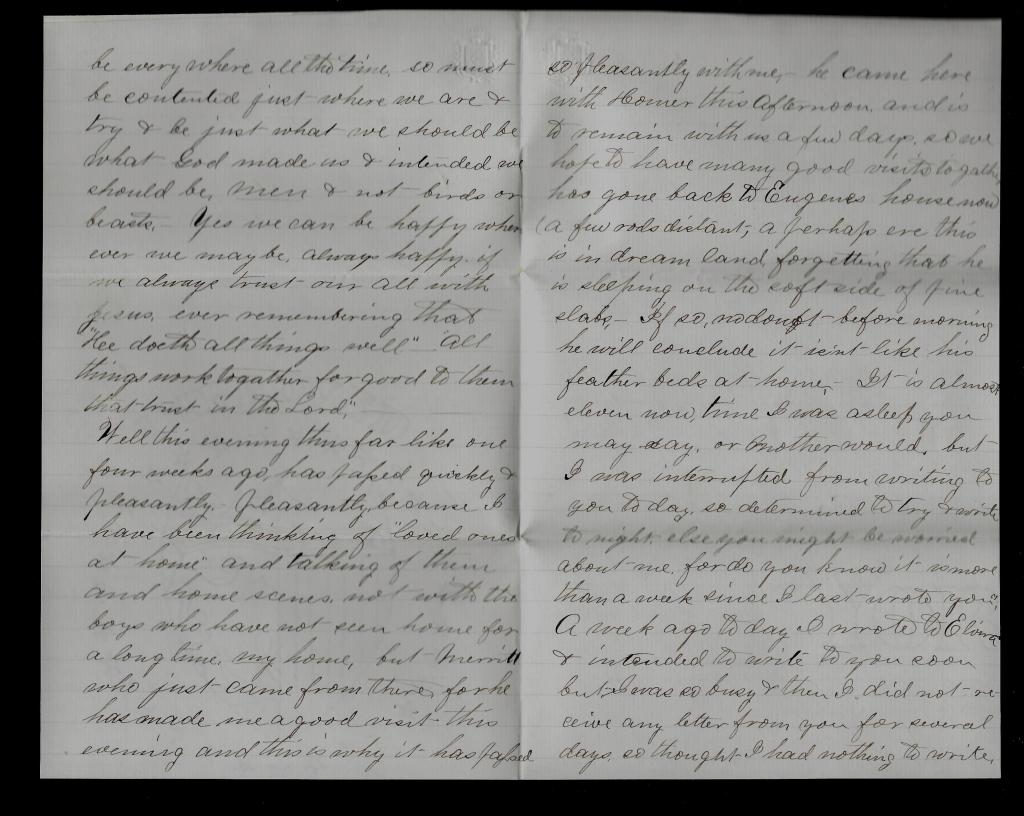
Well, this evening thus far like one four weeks ago, has passed quickly and pleasantly—pleasantly because I have been thinking of “loved ones at home” and talking of them and home scenes, not with the boys who have not seen home for a long time, my home, but Merritt, who just came from there for he has made me a good visit this evening and this is why it has passed so pleasantly with me. He came here with Homer this afternoon and is to remain with us a few days, so we hope to have many good visits together. Has gone back to Eugene’s house now (a few rods distant) and perhaps ere this is in dream land, forgetting that he is sleeping on the soft side of pines slabs. If so, no doubt before morning he will conclude it isn’t like his feather beds at home. It is almost eleven now. Time I was asleep, you may say, or mother wound, but I was inrerrupted from writing to you today, so determined to try & write tonight, else you might be worried about me for do you know it is more than a week since I last wrote you?…
Last Tuesday I moved to the regiment and since then have been very busy all my spare time. Have been trying to build me a house. At night, I was too tired to write. Now the house is finished and today has been a real rest to me. It is not quite as nice a house as the one we left but is very comfortable & we will enjoy it if we can remain here two or three weeks. Had a good deal of rain last week but yesterday & today have been beautiful, sunny days, drying up the water & terrible Virginia mud very fast. My health is still good and most of us are well. Herbert has had a very sore hand for a few days past. Is still growing worse & more painful and yesterday the Dr. pronounced it a felon. His hand is very badly swollen and very painful. He has not had any rest of late & the poor boys looks as though he had had a fit of sickness. I hope his hand will be better soon. The Dr. gives him a poultice for it—flax seed meal I think it is.
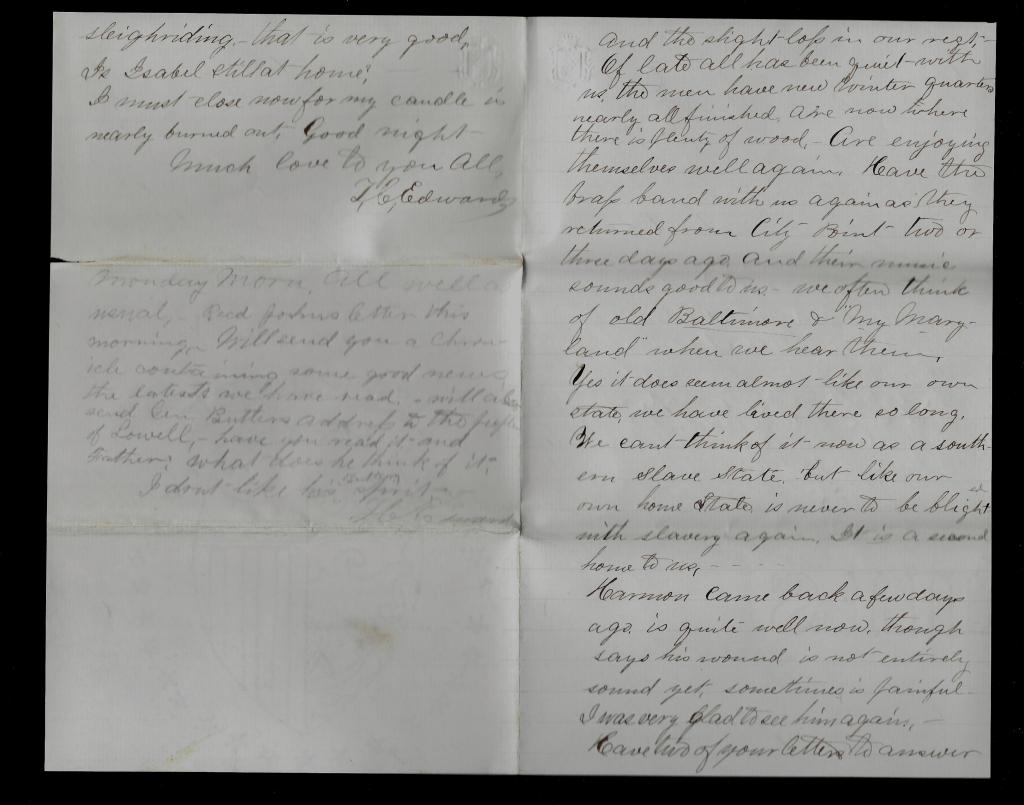
Ere this you have doubtless heard all about the movement of the forces, the late battle, and the slight loss in our regiment. Of late, all has been quiet with us. The men have new winter quarters nearly all finished, are now where there is plenty of wood. Are enjoying themselves well again. Have the brass band with us again as they returned from City Point two or three days ago, and their music sounds good to us. We often think of Old Baltimore & My Maryland when we hear them, Yes, it does seem almost like our own state, we have lived there so long. We can’t think of it now as a southern slave state but like our own home state is never to be blighted with slavery again. It is a second home to us.
Harmon came back a few days ago. Is quite well now though says his wound is not entirely sound yet. Simetimes is painful. I was very glad to see him again.
…Hope the Free Methodists will not disturb the meetings more. It is too bad that they can’t attend to their own affairs. Do you hear from or have you seen Harvey of late? He hasn’t written to me yet. Tell Louisa I am very much obliged for those [Christian] Advocates. I like to read them. I see by looking over your letter you did not notice any word misspelled. Do you remember how I spelled Marshal in speaking of the Provost Marshal? That was it. So some of the ladies near you find someone to take them sleigh riding? That is very good. Is Isabel still at home? I must close now for my candle is nearly burned out. Good night. Much love to you all. — T. C. Edwards
Monday morning. All well as usual. Received John’s letter this morning. Will send you a Chronicle containing some good news—the latest we have read. Will also send Gen. Butler’s address to the people of Lowell. Have you read it? and Father? What does he think of it? I don’t like his spirit. — T. C. Edwards

Letter 8
In our new camp
Thursday afternoon, February 23rd 1865
Dearest Sister,
Was very glad to receive another good letter from you—also one from Elvira yesterday. Glad Elvira is still gaining and that the rest of you are well….And Monroe’s letter this morning tells me that Uncle I has really sold the old homestead for $100 per acre, that they are all feeling very badly about it & wish something would happen that the man would not take it. I wish so too for it is too bad for that place to be sold out of the connection.
Most of us are well and time passes pleasantly. Came near moving yesterday but did not go at last and will not now I guess. Had a great time rejoicing when we heard officially of the fall of Columbia and Charleston. The old camps far & near rang again & again with the shouts of the thousands who are determined to see the end of this wicked rebellion. It is said the rebels here are preparing for some move. We don’t know what it is, but their movements are being closely watched.
Of late the weather is warm and spring like and the light warm rain this morning will set the grass to growing, I think. Heard the frogs singing last night for the first time and the singing of the little birds today reminds us that spring is near at hand. Yes, spring is not far distant now and soon summer will be here wit all its loveliness. we welcome the pleasant spring and summer too, and with your flowers and fruits bring us lovely peace that our nation may rejoice once more. We feel to take new courage everyday. We will hope on and strive on and ere long our efforts will be crowned with great success.
You remember I wrote of Herbert’s hand, don’t you? It is not so painful now, is very badly swollen though and his arm too. the Dr. says it is the worst felon he ever saw. I fear Herbert will lose some of his fingers if not his hand. hardly think he will help me any more very soon. He endures it like a hero. Does not think of going to the hospital. We try to take good care of him, Charley & I, and he would much rater remain with us. Sees the Dr. every day.
So Eugene writes home queer things, does he? And you wonder what is the matter with Lieut. Burns. I wonder that Eugene should have written home anything of that. It was but a little affair at the most and should not have been mentioned out of the regiment. We think Burns did not do wrong. The Colonel in his haste placed him and three other lieutenants under arrest for a little thing which he repented of in a day or two afterward. All is right now. Most of the officers think Burns and the others did right, just as they would have done in similar circumstances. Nothing should be reported to try to injure any of the officers.
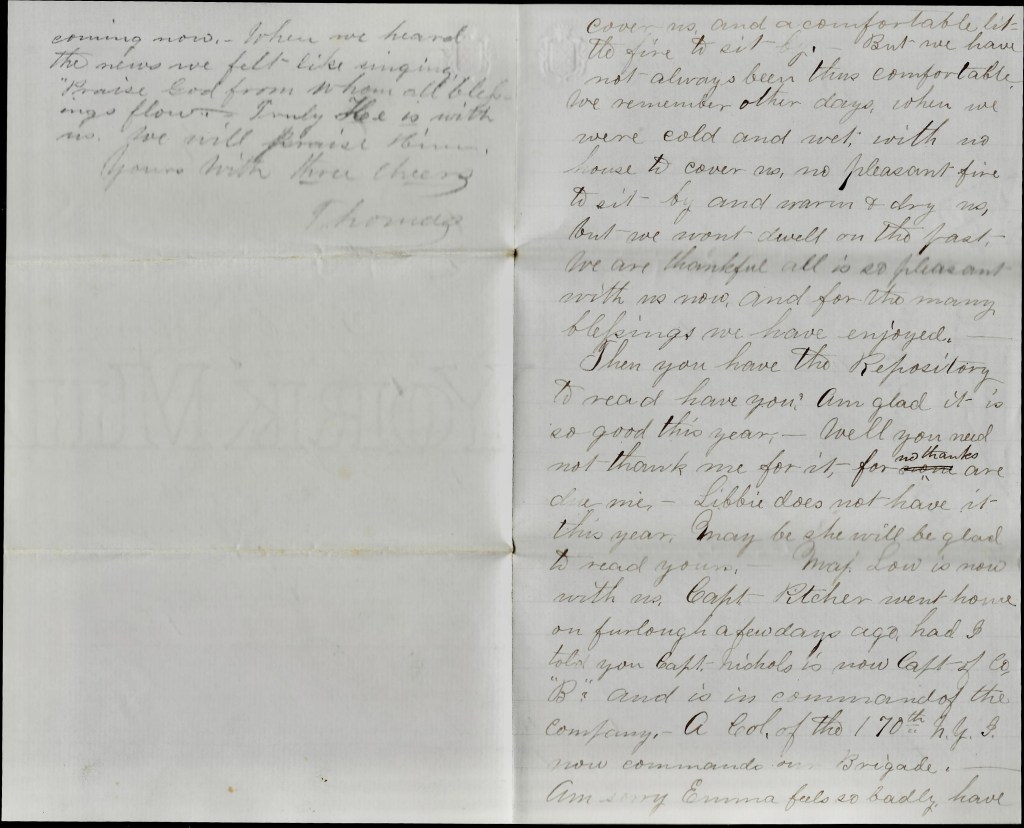
Evening. I had intended to finish and mail this this afternoon but I had to leave it to attend to drawing rations. Had rather a wet time of it but it was so warm the rain did not hurt us any. Is still raining some and it sounds very pleasant pattering lightly on our little tent roof. How pleasant to have a nice little house to cover us and comfortable little fire to sit by. But we have not always been this comfortable. we remember other days when we were cold and wet with no house to cover us—no pleasant fire to sit by and warm and dry us. But we won’t dwell on the past. We are thankful all is so pleasant with us now and for the many blessings we have enjoyed.
Then you have the [Ladies] Repository to read, have you? Am glad it is so good this year…
ajor Low is now with us. Capt. Pitcher went home on furlough a few days ago. Had I told you Capt. Nichols is now captain of the company? A colonel of the 170th New York Infantry now commands our Brigade…
Do the meetings still continue? I hope much more good may be done there. Do the Nazarites try to trouble them anymore? Do they hold meetings in Pendleton now? Do you hear anything more of Uncle Daniel making you a visit the coming spring?…
With lots of love to you all, your loving brother, — Thomas
Friday afternoon. Is quite pleasant. Heard very heavy firing toward Petersburg this morning and since learned it was a salute for the capture of Wilmington. What cheering news. Victory after victory seems fast coming in now. When we heard the news we felt like singing, “Praise God from whom all blessings flow.” Truly He is with us. We will praise Him. Yours with three cheers. – Thomas



Letter 9
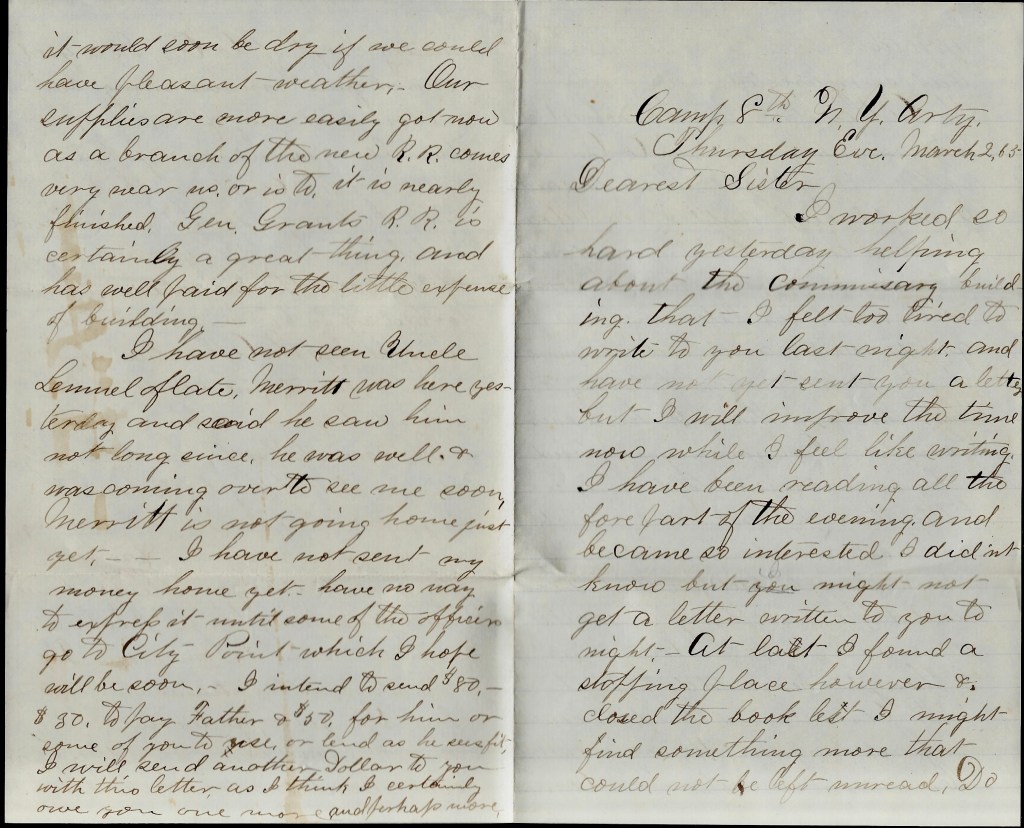
Camp 8th New York Artillery
Thursday eve, March 2, 1865
Dearest Sister,
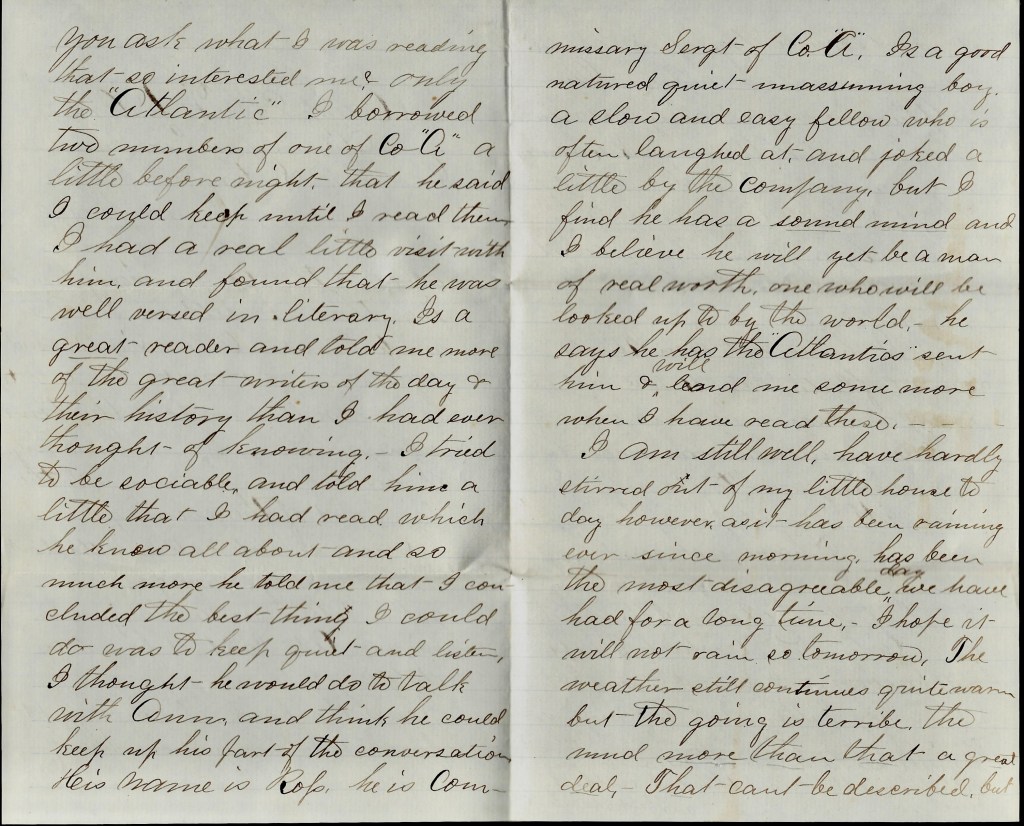
I worked so hard yesterday helping about the commissary building that I felt too tired to write to you last night and have not yet sent you a letter but I will improve the time now while I feel like writing. I have been reading all the forepart of the evening and become so interested I didn’t know but I might not get a letter written to you tonight. At last I found a stopping place, however, & closed the book lest I might find something more that could not be left unread. Do you ask what I was reading that so interested me? Only the Atlantic. I borrowed two numbers of one of Co. A a little before night that he said I could keep until I read them. I had a real little visit with him and found that he was well versed in literary. He is a great reader and told me more of the great writers of the day & their history than I had ever thought of knowing. I tried to be sociable and told him a little that I had read which he knew all about and so much more he told me that I concluded the best thing I could so was to keep quiet and listen. I thought he would do to talk with Ann and think he could keep up his part of the conversation. His name is Ross. 1 He is commissary sergeant of Co. A. Is a good-natured, quiet, unassuming boy—a slow and easy fellow who is often laughed at and joked a little by the company but I find he has a sound mind and I believe he will yet be a man of real worth—one who will be looked up to by the world. He says he has the Atlantics sent him & will lend me some more when I have read these.
I am still well. Have hardly stirred out of my little house today, however, as it has been raining ever since morning. Has been the most disagreeable day we have had for a long time. I hope it will not rain so tomorrow. The weather still continues quite warm but the going is terrible—the mud, more than that a great deal that can’t be described, but it would soon be dry if we could have pleasant weather. Our supplies are more easily got now as a branch of the new railroad comes very near us, or is to. It is nearly finished. Gen. Grant’s railroad is certainly a great thing and has well paid for the little expense of building.
I have not seen Uncle Lemuel of late. Merritt was here yesterday and said he saw him not long since. He was well and was coming over to see me soon. Merritt is not going home just yet.
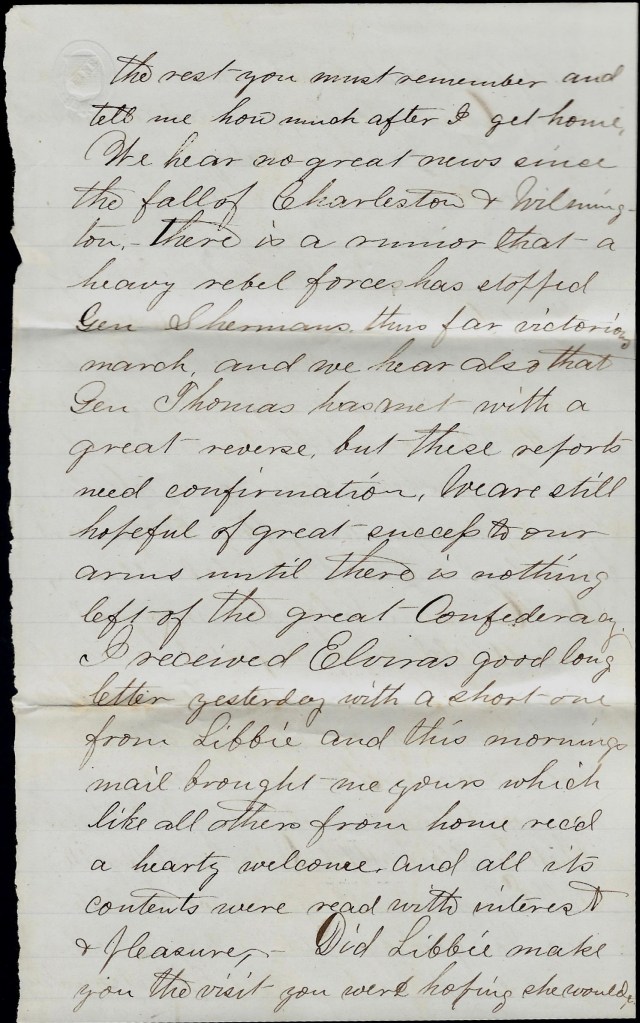
I have not sent my money home yet. Have no way to express it until some of the officers go to City Point which I hope will be soon. I intend to send $80; $30 to pay father & $50 for him or some of you to use or lend as he sees fit. I will send another dollar to you with this letter as I think I certainly owe you one more (and perhaps more). The rest you must remember and tell me how much after I get home.
We hear no great since the fall of Charleston & Wilmington. There is a rumor that a heavy rebel force has stopped Gen. Sherman’s thus far victorious march and we hear also that Gen. Thomas has met with a great reverse but these reports need confirmation. We are still hopeful of great success to our arms until there is nothing left of the great Confederacy.
I received Elvira’s good long letter yesterday with a short one from Libbie and this morning’s mail brought me yours which like all others from home received a hearty welcome and all its contents were read with interest and pleasure. Did Libbie make you the visit you were oping she would? I hope she did, and Mrs. Button also. Am glad you had a pleasant visit there and at Wesley’s. It is too bad you were too late to see Mr. Parsons. I did not see him while I was at the Falls.
Major (Lieut.-Col. I should say) Holmes has not been very well for a few days past but it better now. You have received another letter from me by this time, have you not? And have you heard from Harvey or Ann? Harvey doesn’t write very often. Have you heard from John? I have not of late. Hope I will soon.
So Herman Leland is married? Merritt told me he expected he would be soon. I hope he has a good wife and I too wish them much joy. Though she may not now be a Christian, if he lives right, he may soon be the means of leading here to the Savior. I hope he will be faithful. Did mother go to Royalton> Tell Elvira I will try and answer her letter soon. Now goodbye until I write again. With a great deal of love to you all, affectionately, — Thomas
1 Henry C. Ross (1839-1913) of Shelby, Orleans county, New York.—Enlisted, July 21, 1862 and mustered in as corporal, Co. A, 129th Infantry, August 11, 1862 (which became the 8th Artillery, December 19, 1862), to serve three years; promoted quartermaster-sergeant, March 31, 1864; reduced to sergeant, date not stated; mustered out with company, June 5, 1865, at Munsons Hill, Va. Henry was married on 20 August 1862, the day before he left to join his regiment, to Caroline (“Carrie”) Mason (1840-1913). After the war, Henry labored as a farmer and a school teacher. Later in life he moved with his family to Berrien county, Michigan.

Letter 10
Old Camp
Monday evening
March 6th 1865
Dearest Sister,
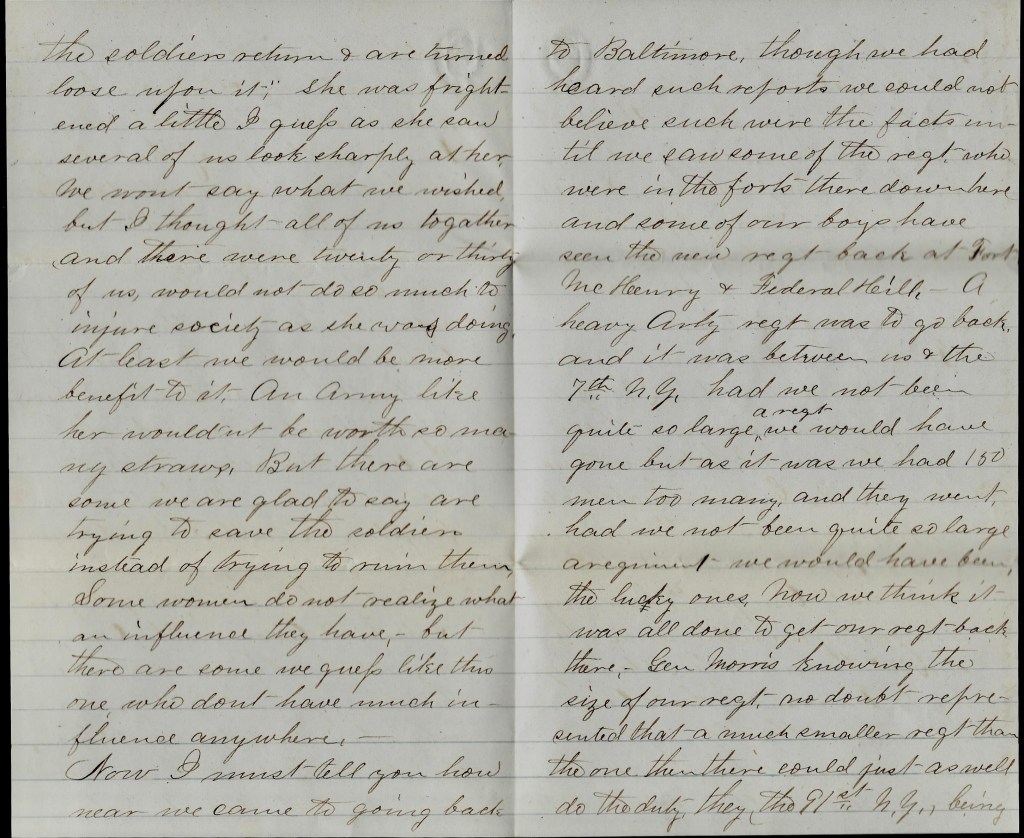
What say you to a little chat this evening? Think you it is time I wrote again? Well then, sister, I will try and talk a little while. I have felt quite lonely this evening as Herbert & Charley were both away visiting but they are here now. Herbert [is] reading by my side as usually is, and Charley 1—bright sparking black-eyed Charley—is sitting near the fire talking a little now and then, whittling a little, and again drumming away with his fingers for he is a drummer boy you know. He is a good drummer too. I like our little friend more and more as I become better acquainted with him. He is a noble boy, or man, you would call him now as he is almost a man grown. He was a little boy when he came to us at Federal Hill a few months after we came out, but his home was not very pleasant for him, I guess. He has told me something of his history which may not be uninteresting to you. He lived in Rochester when small but for a few yeas past has lived not very far from that City in a little country village. Has a rich father who has petted him too much perhaps, he being the youngest and the only son. In short, he has been the pet of the family, I should say, but like too many boys has had his own way and been too much in loose society. Has but one sister now, he says. He used to have two but Frankie is all that’s left him now. She is a noble girl, I guess, and thinks a great deal of her brother. He often speaks of her, often receives letters from her. He sometimes speaks of his mother but not often, and then usually as though she did not expect much of her boy or if so, did not take the right way to make him try to do right. She would tell him she was afraid he was getting to be a bad boy, [that he] was “going to ruin,” and his grandmother often says, “Charley, won’t you stay at home with your poor old mother tonight?” and as he hastily ate his supper and started for the door she would say, “Well have your own way, you will yet come to the gallows.” &c. In short, they did not try to make home pleasant for him so he tried to find pleasure somewhere else. Says he used to drink & was a terrible boy. His father was sometimes very severe with him which made him act worse instead of better, and when they told him one night he had been drinking and whipped him, he ran away and enlisted in Co. A of our regiment as drummer, then being but fourteen or fifteen years old.
He said he thought when he got into the army he could smoke and drink when he wished & be a man. Now he says a loafer. After a time he made up his mind he would try and be somebody and for a long time has been a steady boy. Says he almost shudders now when he thinks of his past life and what he might have been had he remained at home. Thinks he will try and be a man now. Will go home a better boy than when he left and surprise his folks a little. He often speaks of their sending him to school and how he would run away & spend his time foolishly. Often says he can go home now & go to school gladly. This is another proof that being in the army need not, does not always make one worse. How many thousands there are who like Charley have been made better by being in the army. A few may be made worse but not all will be destroyed. Society will not be ruined when the volunteers return to their homes again. I shall never forget a remark I heard a young woman (not a lady) make to her friend while we were going from Rochester to Avon in the cars on my return. She sat near me & there were several soldiers near who she intended should hear. She said, “I don’t know what will become of society when the soldiers return and are turned loose upon it.” She was frightened a little I guess as she saw several of us look sharply at her. We won’t say what we wished but I thought all of us together—and there were twenty or thirty of us—would not do so much to injure society as she was doing. At least we would be more benefit to it. An army like her wouldn’t be worth so many straws. But there are some we are glad to say are trying to save the soldiers instead of trying to ruin them. Some woman do not realize what an influence they have, but there are some we guess like this one who don’t have much influence anywhere.
Now I must tell you how near we came to going back to Baltimore. Though we had heard such reports, we could not believe such were the facts until we saw some of the regiment who were in the forts there down here and some of our boys have seen the new regiment back at Fort McHenry and Federal Hill. A heavy artillery regiment was to go back and it was between us and the 7th New York. Had we not been quite so large a regiment, we would have gone but as it was, we had 150 men too many and they went. Has we not been quite so large a regiment, we would have been the lucky ones. Now we think it was all done to get our regiment back there. Gen. Morris, knowing the size of our regiment, no doubt represented that a much smaller regiment than one then there could just as well do the duty. They (the 91st New York) being 1900 strong and we but six hundred, but about that time we received 150 men from the 23rd Battery that just spoiled our fun & perhaps his too. we did not feel quite disappointed when we learned the facts but now try to think all is for the best as no doubt it is.
Today has been a very pleasant day but I think it will storm again soon. How is father now? I hope he will not be sick. Is Elvira’s health still improving? Has mother returned from Royalton and did she have a good visit? Am glad to hear George is in town again. Libbie writes she saw him at the cars when she was going to Tonawanda. Hope Ann will come out this Spring and make you a good visit. How much I should like to see them both.
Now I must close with love to you all & a good night kiss. I remain yours, &c., — Thomas
1 Charles Edward Sanborn (b. September 1847) claimed to be 18 years old when he enlisted on 14 February 1863, at Le Roy, New York. He mustered in as private, Co. A, February 17, 1863, to serve three years; promoted musician, date not stated; transferred to Co. K, Tenth Infantry, June 5, 1865. According to Find-A-Grave, Charley was the son of William Sanborn (1815-1899) and Elizabeth F. Bailey (1820-1902). An Ancestry.com source claims that two older sisters dies young—Emma and Susan. His sister Frances (“Frankie”) E. Sanborn (1846-1907) was a year older. A younger sister, Grace, only lived from 1850-1853, and there was actually a younger son, William, b. 1850, who lived until 1916.


Letter 11

My Soldier Home
Wednesday afternoon, March 8th 1865
Dearest Sister,
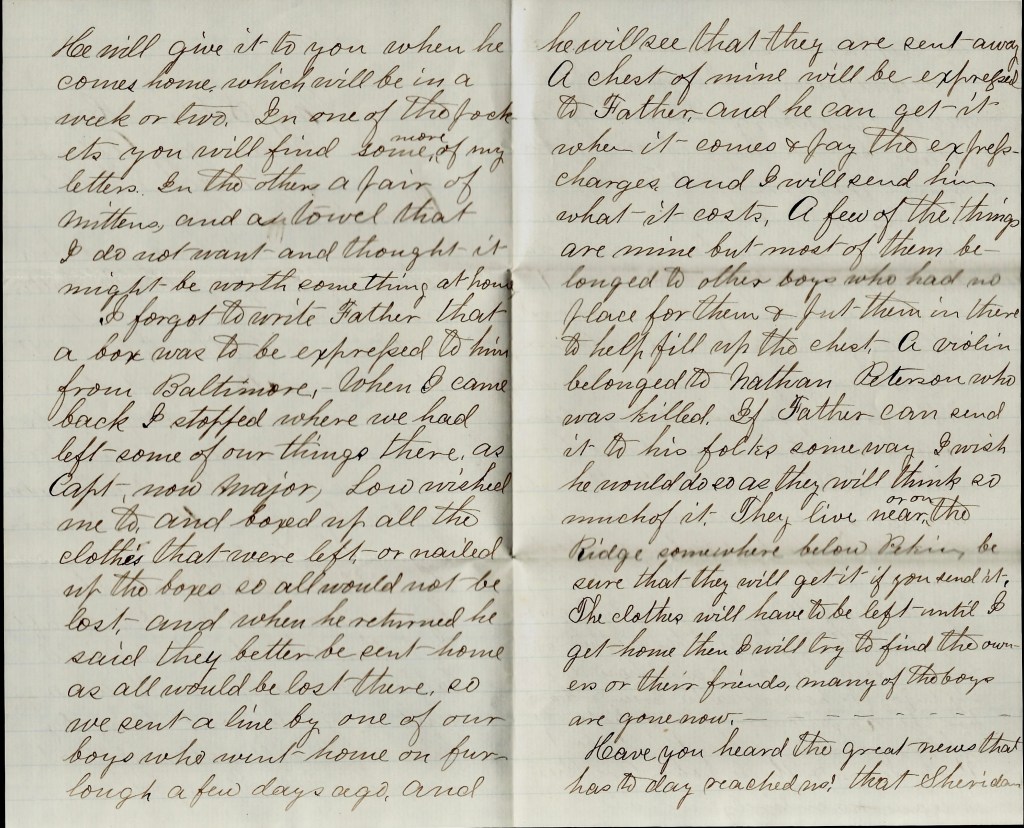
I have just finished writing a letter to father and thinking I can just as well send another letter with it, will write a part of one o you tonight & will perhaps finish it in the morning & send with his. I sent my money ($8-) by Merritt this morning as he started for Baltimore. He will send it on from there by mail or will send a draft to father, all of which I told father however. I also sent my overcoat home by him as I will not need that anymore this Spring. I think he will give it to you when he comes home which will be in a week or two. In one of the pockets you will find some more of my letters. In the other a pair of mittens and a towel that I do not want and thought it might be worth something at home.
I forgot to write father that a box was to be expressed to him from Baltimore. When I came back, I stopped where we had left some of our things there, as Captain—now Major—Low wished me to and boxed up all the clothes that were left, or nailed up the boxes so all would not be lost, and when he returned he said they better be sent home as all would be lost there. So we sent a line by one of our boys who went home on furlough a few days ago and he will see that they are sent away. A chest of mine will be expressed to father and he can get it when it comes & pay the express charges and I will send him what it costs. A few of the things are mine but most of them belonged to other boys who had no place for them and put them in there to help fill up the chest. A violin belonged to Nathan Peterson who was killed. If father can send it to his folks some way, I wish he would do so as they will think so much of it. They live near or on the Ridge somewhere below Pekin. Be sure that they will get it if you send it. The clothes will have to be left until I get home. Then I will try to find the owners or their friends. Many of the boys are gone now.
Have you heard the great news that has today reached us! that Sheridan has captured Early with several thousand men and is now on his way to Lynchburg. This is big to believe but we hope it will prove true.
We are about to move again as there has been two beautiful days but the heavy rain today has stopped that for the present. It has been raining very hard most of the day. Is as warm as summer.
I was very glad to receive another letter from you this morning. Also one from Elvira and one from Libbie. Libbie is much better than she was, having nearly recovered from the severe cold she had taken a short time ago. Likes her school thus far very well and is getting along finely, I guess. Has she written to you yet? Has mother returned from her visit> and how did she enjoy it? How is Hattie Green & all the Royalton friends. I hope she is better and well ere this. What about Uncle Seneca and Uncle John? Are they to leave us entirely? or will they settle again near us? I hope they will not leave us. Merritt said something about their settling in Lockport. He said they stayed with Uncle L. last night. Uncle was well. I have not seen him for a long time. Wish he would make me a visit soon. Merritt says he (Uncle) thinks they both missed it selling out as they did. Have you heard from me yet? You must have 3 or 4 letters ere this…
I think my letter is about finished now don’t you? Maybe I can add a little in the morning. Charley has tea ready so here goes the pen for knife and fork. Accept lots of love, — Thomas
Thursday morning. The sun is shining once more and the morning is beautiful but oh how muddy it is. It will be some time before the ground will be as dry as it was two days ago. I am still well and all is pleasant with us. We hear more great news that Lynchburg is ours, but don’t know how true it is.
Is George still in town? If so, give him my kind regards & tell him I am looking for that report of his. Remember me to all the friends. I will not send this with father’s letter as I had thought to as it will be too heavy I fear. With love to you all, I remain yours &c., — Thomas



Letter 12

My Soldier Home
Monday afternoon, March 13th 1865
Dearest Sister,
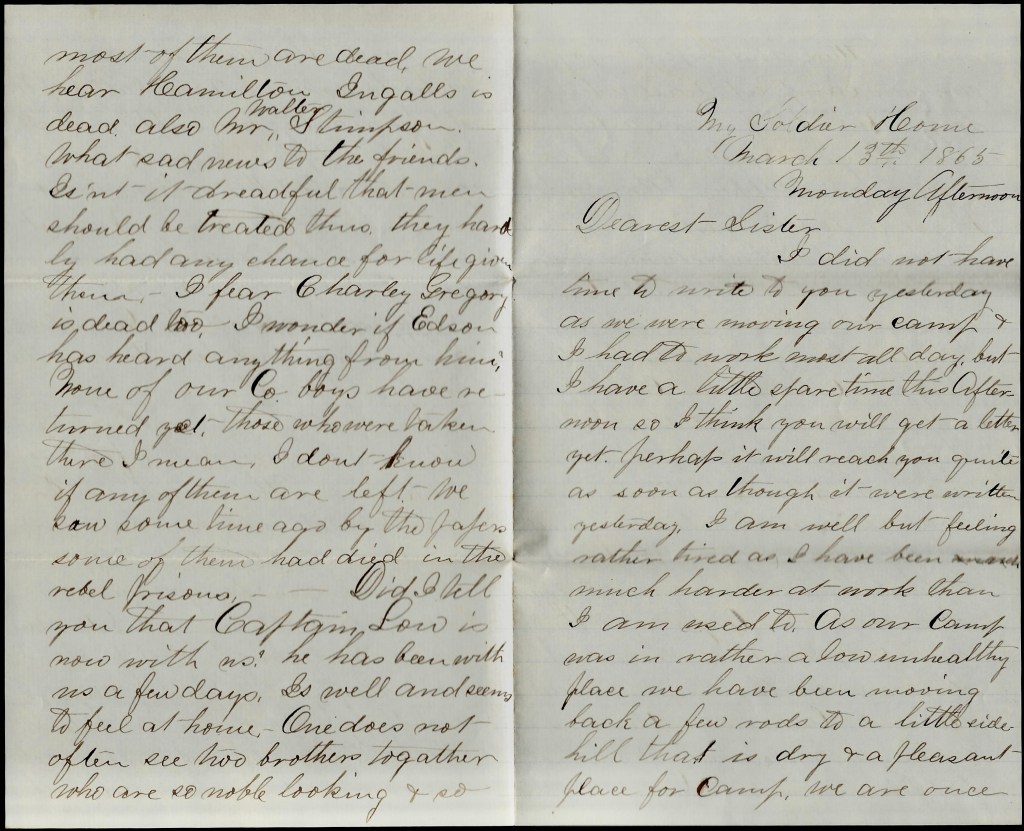
I did not have time to write to you yesterday as we were moving our camp & I had to work most all day but I have a little spare time this afternoon so I think you will get a letter yet. Perhaps it will reach you quite as soon as as though it were written yesterday. I am well but feeling rather tired as I have been much harder at work than I am used to. As our camp was in rather a low, unhealthy place, we have been moving back a few rods to a little side hill that is dry and a pleasant place for camp. We are once more settled and hope to enjoy our new camp at least a few days but if we have a few more such days as yesterday and today, I think we will be on the move.
This is a lovely warm spring day. The warm southwest wind is drying the roads very fast. Our regiment are now out on inspection, are being inspected by the Brigade commander (Col. of the 170th New York Infantry) and of late they are having a great deal of drill and reviews, which look a little like preparations for work when the weather and going will permit it. Last Saturday there was a grand review of most of our Corps and the 5th before Generals Grant, Meade, and some others, our worthy President and scores of ladies and gentlemen from Washington & elsewhere. It was not far from us near the Depot on this new road. The day was pleasant. The troops looked well and all passed off pleasantly. No doubt you will hear of it by the papers. It was a grand sight to those who had not seen much of the army. I was not there as I had to attend to drawing rations but I could see the troops and I afterward saw all the Generals as they rode past here to view the works in front of us.
The health of the regiment is usually good, I believe, but a few are sick. Among the number is Eugene Gould who has been unwell all winter & will soon have his discharge, we now hear. He will not get better here. Has a bad cough and spits blood considerably. I think if he can go North he will regain his health. We have heard from some of our boys who were taken at Reams Station but most of them are dead. We hear Hamilton Ingalls is dead. Also Mr. Walter Stimpson. What sad news to the friends. Isn’t it dreadful that men should be treated thus? They hardly had any chance for life given them. I fear CHarley Gregory is dead too. I wonder if Edson has heard anything from him? None of our company boys have returned yet. Those who were taken there, I mean. I don’t know if any of them are left. We saw some of them had died in the rebel prisons.
Did I tell you that Captain Low is now with us? He has been with us a few days. Is well and seems to feel at home. One does not often see two brothers together who are so noble looking and so noble officers as he & his brother James. They are noble men.
Yesterday morning I received a letter from you written the 5th and last evening another one written the 9th. The last came very quick, didn’t it? Also three papers yesterday morning were received. The Intelligencer, the American, and the Advocate. Many thanks for them all. I got time to read the papers some yesterday afternoon. The list of drafted, the news, and the two stories in the American which I thought were pretty good. Today one of the Christian Commission gave me the Advocate & Journal and the Methodist, both of this month so I will have more good reading. I see these two occasionally. Your letters brought me much good news though some sad….
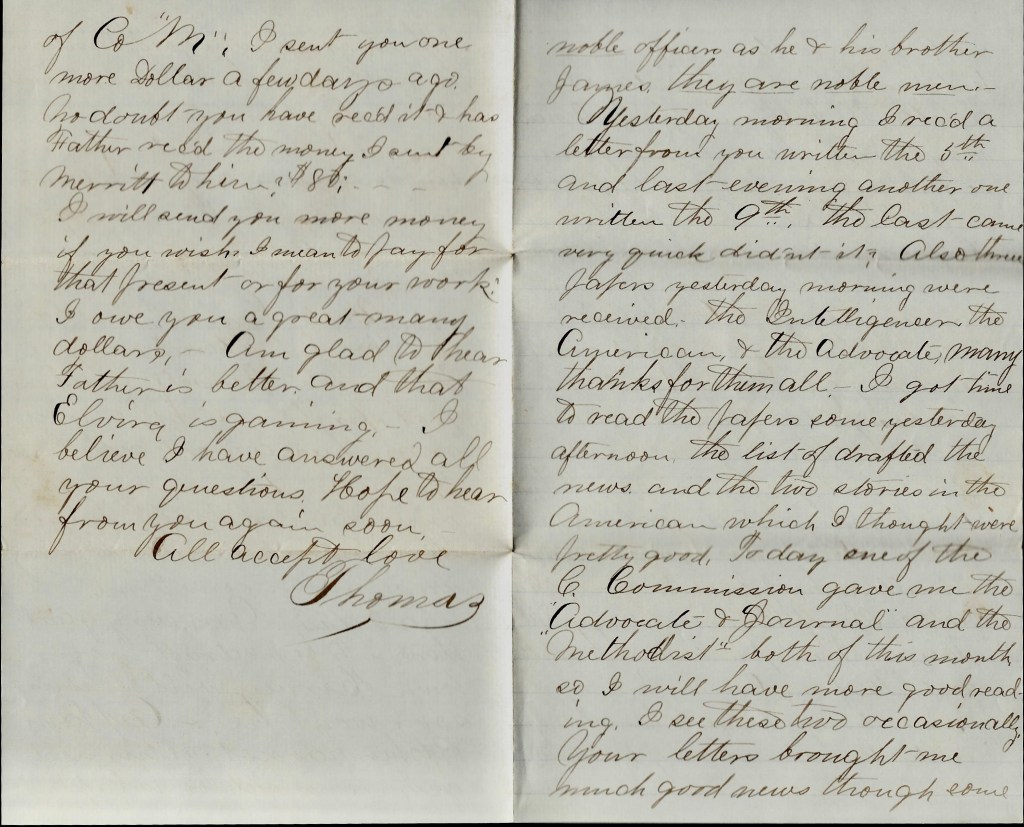
Am glad to hear that Uncle Seneca has bought a place so near us and that Uncle John does not go far away. I think Uncle John will do well in Lockport. Has Mr. Lewis succeeded in selling his place to Mr. Riley’s people? I wish they would buy father’s place…I think you must have had a good Donation. The people must have turned out well and been very liberal too.
I had to leave my letter for an hour or more to give out two days rations to the regiment but think I will yet have time to mail this evening. Uncle Lemuel has ben here too, but staid only a little while. Is well and in good spirits. I hope you may have a good visit in Royalton. You may have my share of maple sugar this time provided I may have yours some time. Will that do? Am very glad there is to be no draft in our town. Harvey will be home soon, won’t he? Captain Pitcher has not returned yet. He is sick too. Is captain of Co. M…
Hope to hear from you again soon. All accept love, — Thomas


Letter 13

Old Camp
Thursday p.m., March 16th 1865
Dear Sister,
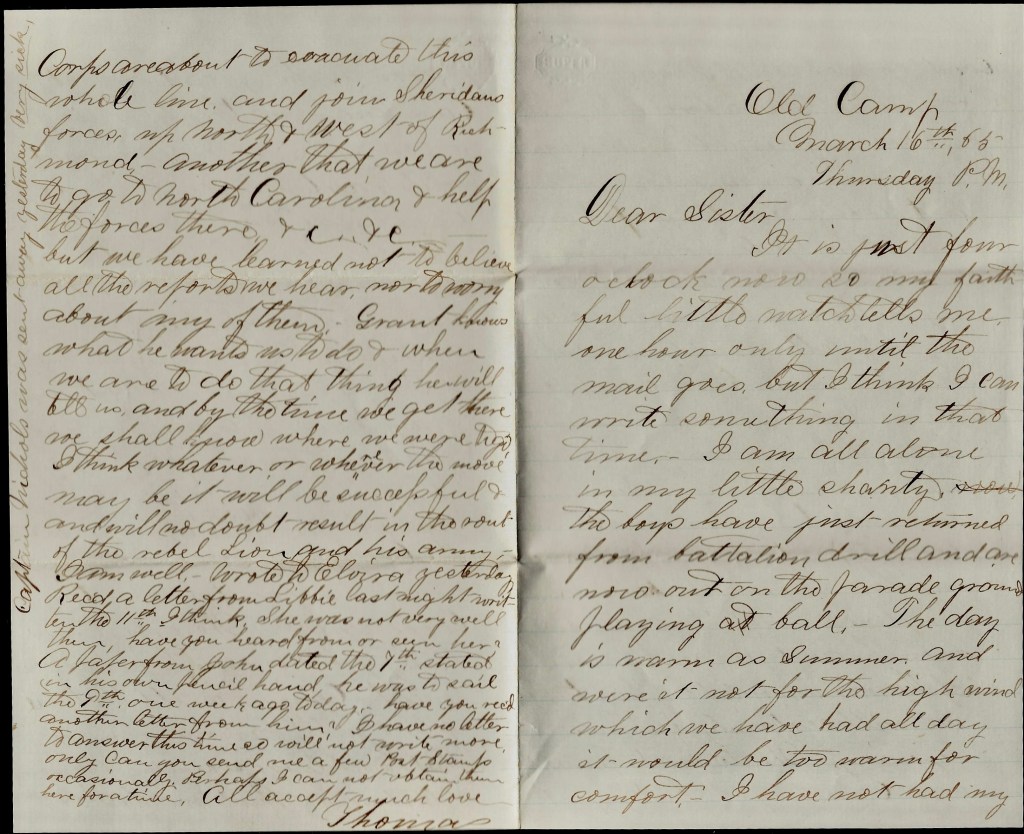
It is just four o’clock now so my faithful little watch tells me one hour only until the mail goes, but I think I can write something in that time. I am all alone in my little shanty. The boys have just returned from battalion drill and are now out on the parade ground playing ball. The day is warm as summer and were it not for the high wind which we have had all day, it would be too warm for comfort. I have not had my coat on nor could I wear it. We have not had a fire only to do our cooking, and then we sweat over it—like men mowing. My tent door is fastened open and anon the gale whirls in here tossing my papers & blowing in the dust, almost covering my letter sometimes. But it is so much more cool & comfortable I never mind that. Spring really seems upon us now and summer soon will be. How swiftly times ddoes fly. It won’t be long ere my three years will have expired, will it? Only five months and a week more. If the war is ended by that time, we will certainly feel like rejoicing.
We do not leave our camp yet but expect to soon as the great and last campaign, we think, is about to commence or to be renewed with greater vigor for we can hardly say the one of a year ago has ceased yet. The sutlers are sent away, the sick and lame have gone back, and everything that might hinder us being put out of the way. The whole army is being prepared for the great struggle that is soon to come on. Men who were detailed away from us & the Corps are fast being relieved and sent back to the Corps again. We expect something great is soon to take place and the camp is all the time filled with various rumors that the rebels are evacuating Petersburg & Richmond, that we, the 2nd, 5th, and 6th Corps are about to evacuate this whole line and join Sheridan’s forces up north and west of Richmond. Another, that we are to go to North Carolina & help the forces there, &c. &c. But we have learned not to believe all the reports we hear, nor to worry about any of them.
Grant knows what he wants us to do & when we are to do that thing, he will tell us and by the time we get there, we shall know where we were to go. I think whatever or wherever the move may be, it will be successful & will no doubt result in the rout of the rebel lion and his army.
I am well. Wrote to Elvira yesterday. Received a letter from Libbie last night written the 11th, I think. She was not very well then. Have you heard from or seen her? A paper from John dated the 7th stated in his own pencil hand he was to sail the 9th, one week ago today. Have you received another letter from him? I have no letter to answer this time so I will not write more. Only can you send me a few postage stamps occasionally perhaps? I cannot obtain them here for a time. All accept my love, — Thomas
Capt. Nichols was sent away yesterday very sick.

Letter 14
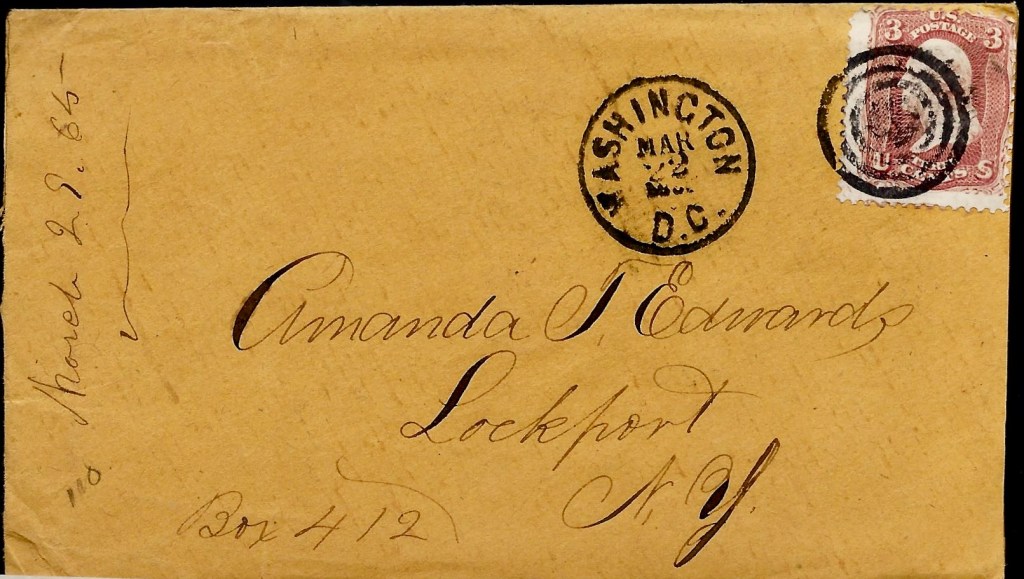
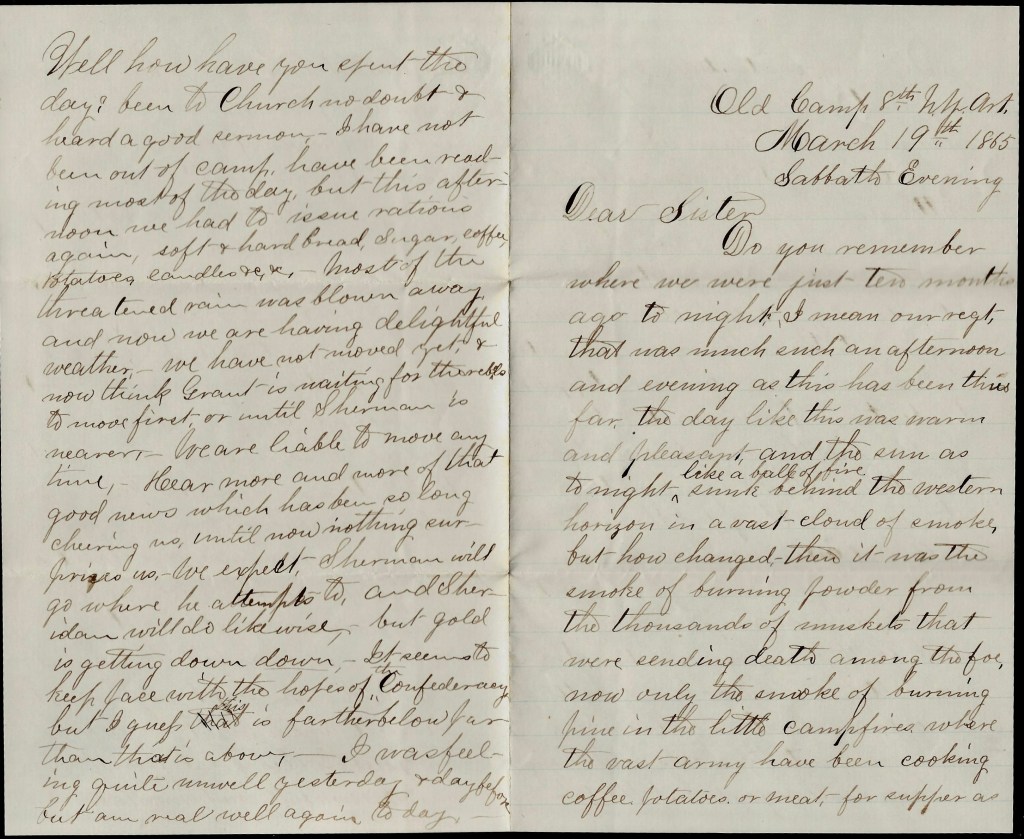
Old Camp 8th New York Artillery
Sabbath evening, March 19th 1865
Dear Sister,
Do you remember where we were just ten months ago tonight? I mean our regiment. That was much such an afternoon and evening as this has been thus far. The day like this was warm and pleasant and the sun as tonight—like a ball of fire sunk behind the western horizon in a vast cloud of smoke. But how changed. Then [Battle of Spotsylvania Court House] it was the smoke of burning powder from the thousands of muskets that were sending death among the foe. Now only the smoke of burning pine in the little campfires where the vast army have been cooking coffee, potatoes, or meat for supper as quietly and contentedly I dare say as though no enemy were near us, anxious to drive us from our quiet camp. That was our first battle and never shall we forget the feelings we experienced while we were rushing on toward the enemy at a double quick, approaching nearer and nearer to the terrible roar of musketry that filled our ears & almost stopped the beatings of our hearts at time.
First we saw the wounded come hobbling back, then the dying and dead lying on the ground. Then we heard the zip of the rebel ball and anon would see a comrade fall. But on and on we went through the swamp and over the hill, for the enemy were retreating. Then we halted, formed in line of battle, and charged with a yell across a corn field into the woods and thought to take a hill beyond, but the Johnnies had halted there and when we had passed nearly through the woods, they have us such a shower of bullets we were glad to lie down behind a low fence. But the fence did not keep the bullets away. One and another and another of our comrades were wounded and carried away, and as ball after ball whizzed close & closer past us, making us root the ground, do you wonder we wished we were anywhere else but there. Then we looked to Him who alone was able to keep us, and prayed Him to spare us. We were spared and though we have since been where danger & death was thick around us, thanks to His great name, He has kepy us through them all, and tonight we do feel to rejoice in His great goodness and mercy, & more fully trust our all with Him.
Well, how have you spent the day? been to church no doubt & heard a good sermon. I have not been out of camp. Have been reading most of the day, but this afternoon we had to issue rations again, soft and hard bread, sugar, coffee, potatoes, candles, &c. &c. Most of the threatened rain was blown away and now we are having delightful weather.
We have not moved yet & now think Grant is waiting for the rebs to make the move first, or until Sherman is nearer. We are liable to move any time. Hear more and more of that good news which has been so long cheering us, until now nothing surprises us. We expect Sherman will go where he attempts to, and Sheridan will do likewise. But gold is getting down, down. It seems to keep pace with the hopes of the Confederacy, but I guess this is farther below for that is above. I was feeling quite unwell yesterday & day before but am real well again today.
Received your letter with Elvira’s in due time. Also one from Harvey and one from Lucy. Harvey was quite well. Lucy’s brought the good news that the old homestead was back again and the writings burned, which was good news to me, I assure you. She said Monroe was quite sick. I hope he is better now and well.
Have you been to Royalton yet? Have you seen any of Mr. Stahl’s people or heard from Libbie? I have had no letter of late. I hope she is not sick. You are losing some of the old neighbors, I see. I wish father could sell too now. We do not hear from Capt. Nichols of late so do not know how he is. I have no more to write tonight. Much love to you all, and a kiss, — Thomas


Letter 15
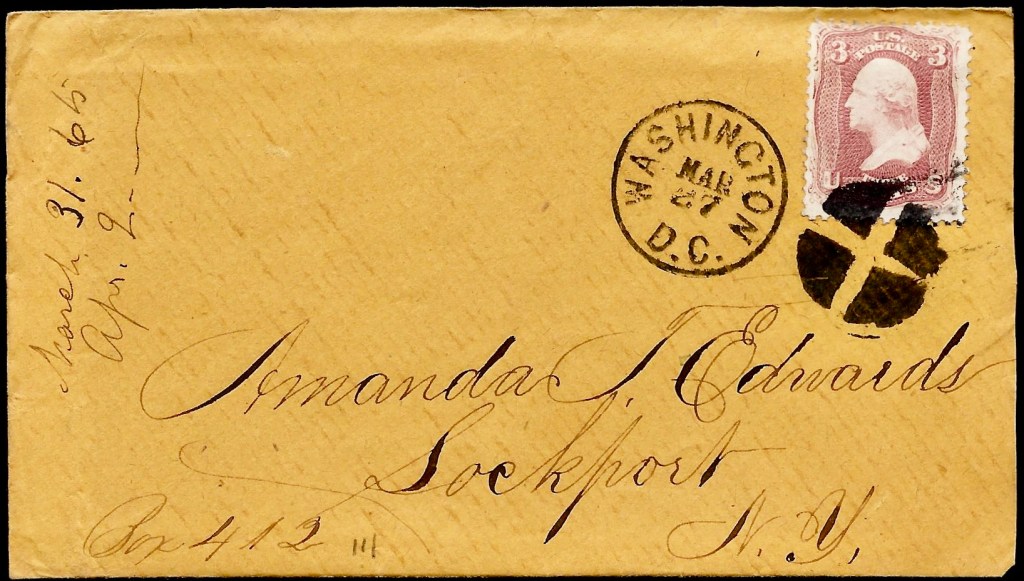
Camp 8th New York Artillery
Friday afternoon, March 24, 1865
Dear Sister,
I have no letter to answer this time so may not write you a very long one but I will write something for you will want o hear from me. I am well as usual and time passes pleasantly. We do not move yet, and hear nothing more about it of late. Had another review of the Corps yesterday at the station before Gen. Humphreys who commands the Corps and several northern ladies and gentlemen were there. Though the wind blew almost a gale covering the troops with dust, they did splendidly and I thought as I saw them column after column moving along, I thought I never saw a grander sight. They were nearly half the afternoon passing the station. I wish you could have seen them. Then you might know something of the grand old army Gen. Grant has here—an army that Lee well may fear.
News from Sherman is still good. We hear he has reached Goldsboro and joined Schofield. He is slowly advancing on Richmond and we think he will join us ere long. Then well may the rebels think their cause hopeless. The end of the war is not far distant. Many of the papers think we will not see any more hard fighting. We hope we may not.
We are having more pleasant weather now but the air is quite cool today—more like winter than any day we have had in a long time. We don’t receive much of a mail of late they say on account of the great freshet at the North. I have not had one letter in a whole week. I think something must be the matter. I hope I will hear from you tonight. How is the great freshet now? Has the snow all disappeared? Is Harvey at home? Have you been to Royalton yet? Lucy wrote me that Uncle Seneca had the old homestead back again and Uncle John was to take half of it. Have you heard anything from John? I hope he arrived at New Orleans safely. No doubt I will hear from you soon and will then know all the news.
I hope father is well, and mother, and Elvira is still gaining. Do you hear anything from Libbie? I will try and write more next time when I hope to have a letter to answer. Yours as ever, — Thomas C. Edwards, Sergt. 8th Artillery


Letter 16

Camp 8th New York Artillery
Saturday eve., March 25th 1865
Dear Sister,
Though it is very near midnight now, I don’t feel like sleeping so will try and talk a little time with you. The Spring Campaign seems to have opened in earnest and no doubt you will soon hear stirring news from this old army. Early this morning we were aroused by the roar of artillery and though it was some miles away, I think I never heard more heavy. Then we had orders to pack up and fall behind our breastworks. Soon the firing commenced nearer us, to the right, some of the time in sight, and all day the roar of musketry has been terrible—especially just before night. I think I never before heard such a dreadful, continual roar of musketry as this. It was mostly to the right of us two or three miles, in front of the 3rd Division of our Corps, and the 5th Corps. Our Division have not been severely engaged as we are left to hold the rear line of our works. A few pickets have been out and some of our men were captured this morning. Major Low was sent out with them and they were ordered to advance and did so a mile or more when they unexpectedly found the Johnnies behind them. The 5th Corps pickets on their left failing to connect with them as they had not advanced and thus they (the rebs) came onto them. They made a rush back, most of them succeeding in reaching our main lines again. One of our company, a new man, was taken with seven or eight others of the regiment. One of Co. K was shot dead by the rebs. I believe none others were hurt though they poured a pretty good fire into the boys. Major just made his escape and that was all. Said they had him surrounded & told him to surrender but he didn’t “see it.” They sent the bullets after him but they didn’t hit him.
The first fighting commenced near Petersburg. We hear the Johnnies made the attack and finally broke through our lines and captured two of our forts near where we were last fall. [See Pre-dawn attack on Fort Stedman] But they were soon driven back with terrible loss in killed and wounded and two thousand made prisoners. Soon after daylight our line was advanced a little to the right of us and we hear the first line of Johnnies’ works, a fort and 500 men were captured. Soon the Johnnies massed & tried to retake that lost and all day they have worked desperately but have gained nothing. So we hear, and this is all the news we have had to day. No doubt you will hear of it soon by the papers and it may be different. It has been all excitement today, packing up, giving out rations, listening to the almost deafening roar of musketry and artillery, and hearing the wonderful rumors that have reached us.
It has been a wonderful day and tomorrow perhaps will be a more wonderful one. Perhaps the army will do something now. Some think we have not been doing much. I have not taken down my tent yet and will not before tomorrow. The regiment are behind the breastworks near us. Are still safe except those few this morning and are in the best of spirits.
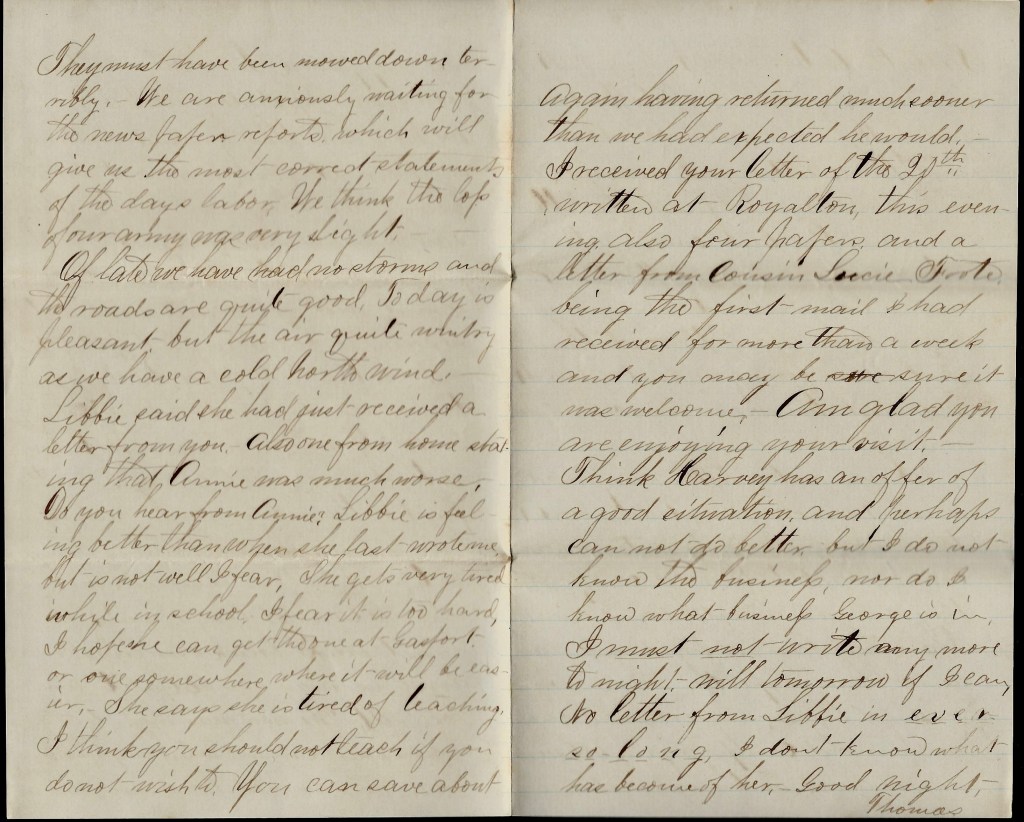
Captain Nichols is back with us again having returned much sooner than we had expected he would. I received your letter of the 20th written at Royalton this evening. Also four papers and a letter from cousin Lucy Foote, being the first mail I had received more than a week and you may be sure ot was welcome. Am glad you are enjoying your visit. Think Harvey has an offer of a good situation and perhaps cannot do better, but I do not know what business George is in. I must not write any more tonight. will tomorrow if I can. No letter from Libbie in ever so long. I don’t know what has become of her. Good night. — Thomas
Sabbath afternoon. I have just finished my dinner of coffee, bread and butter, and boiled beef tongue. Have read three letters just received and will now try and finish the letter commenced last evening. One letter was from you written the 16th and one from Libbie. You may be sure I was very glad to read them, and hear from you dan Libbie. It is almost two weeks since I had heard from her.
I was not a little surprised when I awoke just at day light this morning to hear the regiment coming back to their old camp where they are now all settled and quiet. There has been no fighting today as we had expected there would be and the army are now back in their old camps again, all seeming as quiet as though nothing had happened. The Rebels will not soon forget yesterday’s work, I guess. We now hear they gained nothing by their attacks and lost in all nearly ten thousand men. They say we might have advanced here and perhaps taken the railroad but Grant did not seem to want us to. He seemed to be willing to fight it out on this line and Lee did yesterday just what he wanted him to do. If we can believe reports, two or three more such charges on the part of the rebels would destroy their army. Lee is becoming desperate. Grant has him in a vice where he cannot long remain. He must break our line & drive us away or evacuate and lose all. We now hear that 4,000 prisoners were captured when they broke our lines and the rebel dead were piled in heaps. They must have been mowed down terribly. We are anxiously waiting for the newspaper reports which will give us the most correct statements of the days labor. We think the loss of our army was very light.
Of late we have had no storms and the roads are quite good. Today is pleasant, but the air quite wintry as we have a cold north wind…
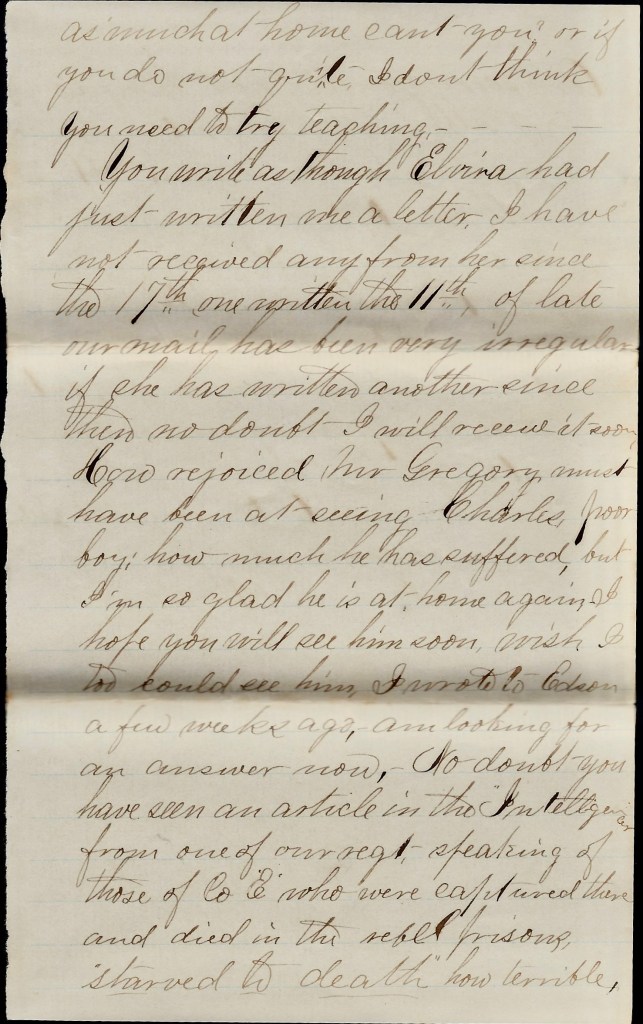
How rejoiced Mr. Gregory must have been at seeing Charles—poor boy. How much he has suffered. But I’m so glad he is at home again. I hope you will see him soon. Wish I too could see him. I wrote to Edson a few weeks ago. Am looking for an answer now. No doubt you have seen an article in the Intelligencer from one our regiment speaking of those of Co. E who were captured there and died in the rebel prisons “starved to death”—how terrible.
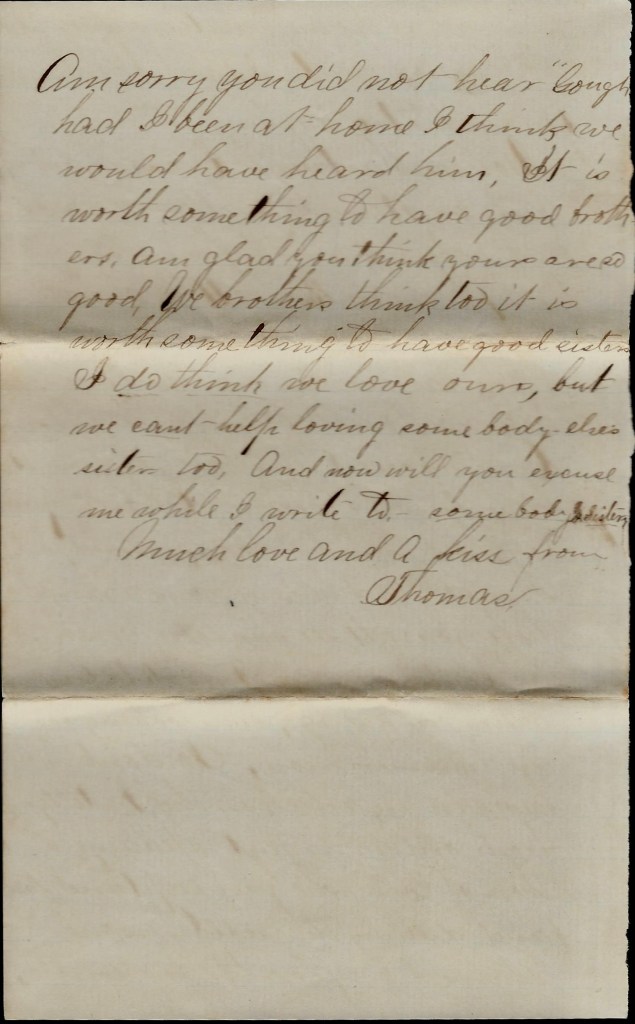
Am sorry you did not hear Gough. Had I been at home, I think we would have heard him. It is worth something to have good brothers. Am glad you think yours are so good. We brothers think too it is worth something to have good sisters. I do think we love ours, but we can’t help loving somebody else’s sister too. And now will you excuse me while I write to somebody’s sisters? Much love and a kiss from, — Thomas



Letter 17

Old Camp 8th [N. Y. ] Artillery
Tuesday eve., March 28th 1865
Dear Sister,
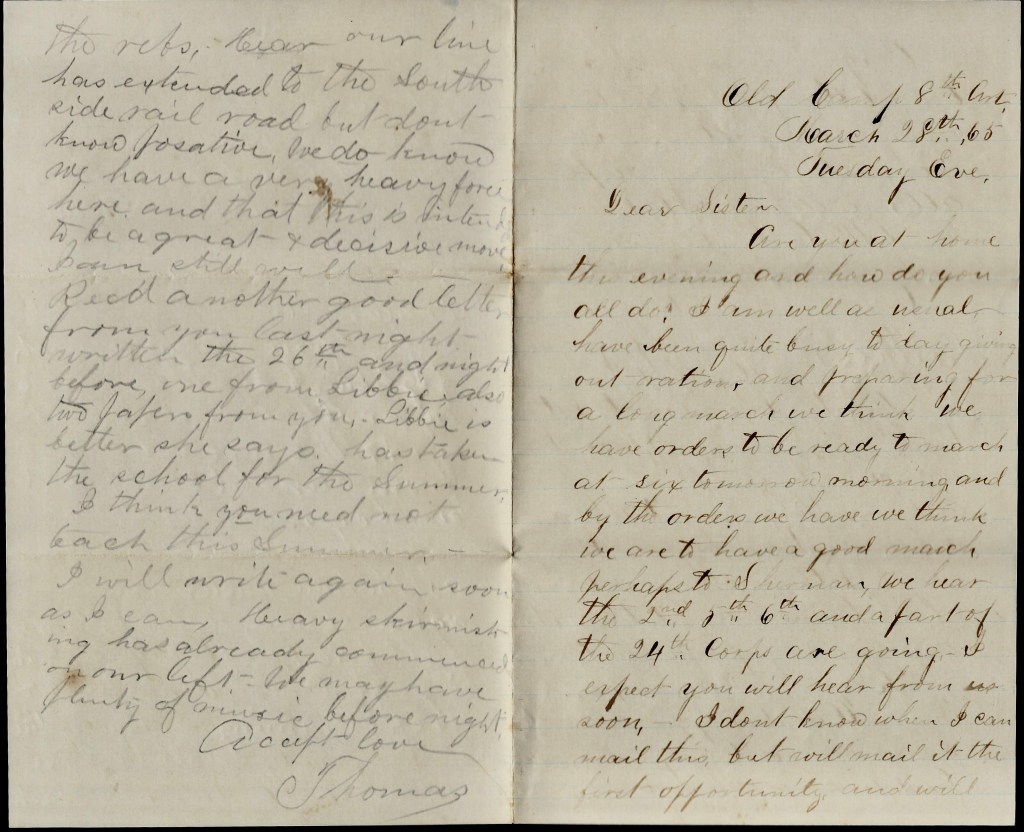
Are you at home this evening and how do you all do? I am well as usual. Have been quite busy today giving out rations and preparing for a long march, we think. We have orders to be ready to march at six tomorrow morning and by the orders we have, we think we are to have a good march, perhaps to Sherman. We hear the 2nd, 5th, 6th and part of the 24th Corps are going. I expect you will hear from us soon. I don’t know when I can mail this but will mail it the first opportunity and will write again as soon as I can. Your letter from Royalton giving me so great news was received last evening. Hope all are doing well. I mean the little Amanda and her mother. Merritt is rich now…
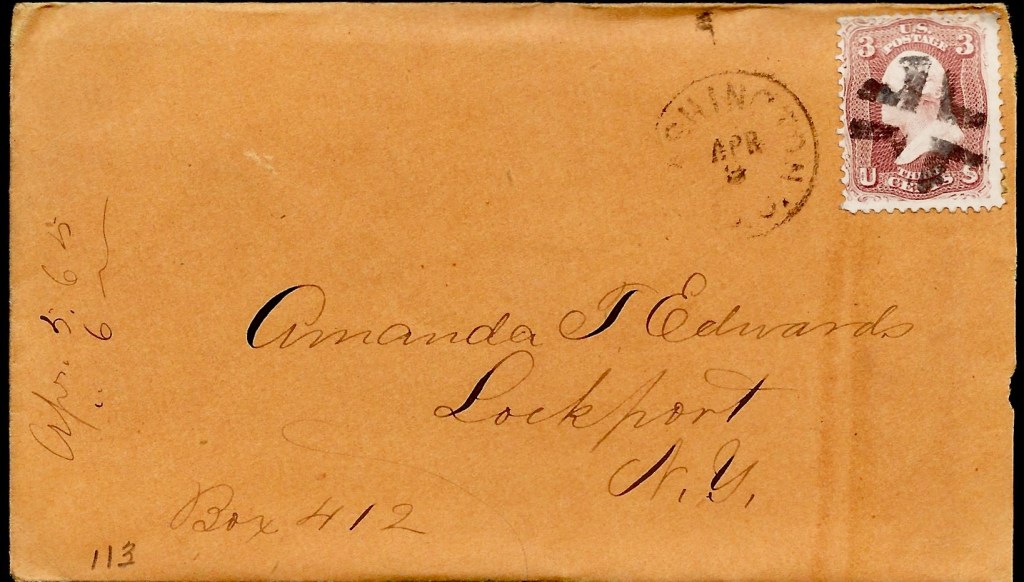
You say something about father’s letting out part of his farm. Who is to take it? and how much do they work, &c. I am anxious to know all about it, you see. I cannot write anymore now. Good night with love & a kiss. — Thomas
Friday morning. I have not yet had an opportunity to mail this so will add a little. We left camp Wednesday morning as expected and since have heard enough of the roar of musketry & artillery. Our boys are still safe. Have not had much fighting to do. The 5th Corps on our left have done most of it. We are not far from our old camp and our boys have not yet had much marching to do. Are all the time under arms & advance slowly as the Johnnies fall back. It has been raining hard most all the time & is still raining but never the less our army are all the time advancing and driving back the rebs. Hear our line has extended to the Southside Railroad but don’t know positive. We do know we have a very heavy force here and this is intended to be a great & decisive move.
I am still well. Received another good letter from you last night, written the 26th and night before, one from Libbie, also two papers from you. Libbie is better, she says, Has taken the school for the summer. I think you need not teach this summer.
I will write again soon as I can. Heavy skirmishing has already commenced on our left. We may have plenty of music before night. Accept love, — Thomas

Letter 18
Camp in the field
Saturday p.m., April 1st 1865
Dear Sister,
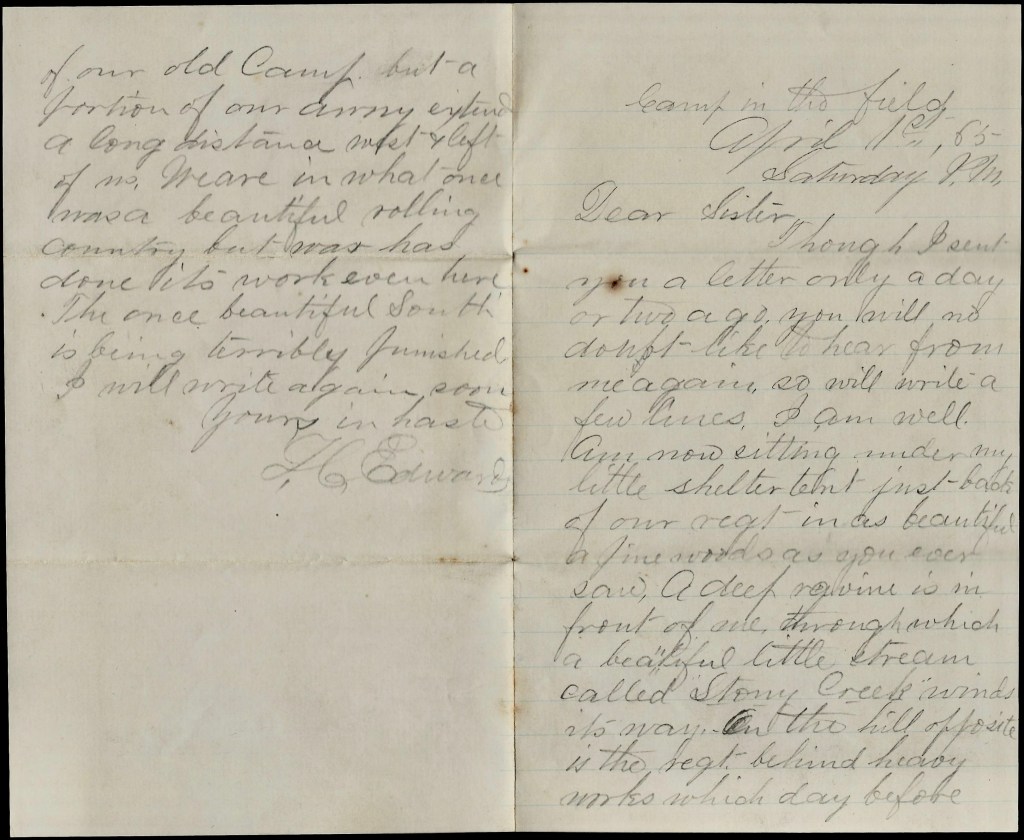
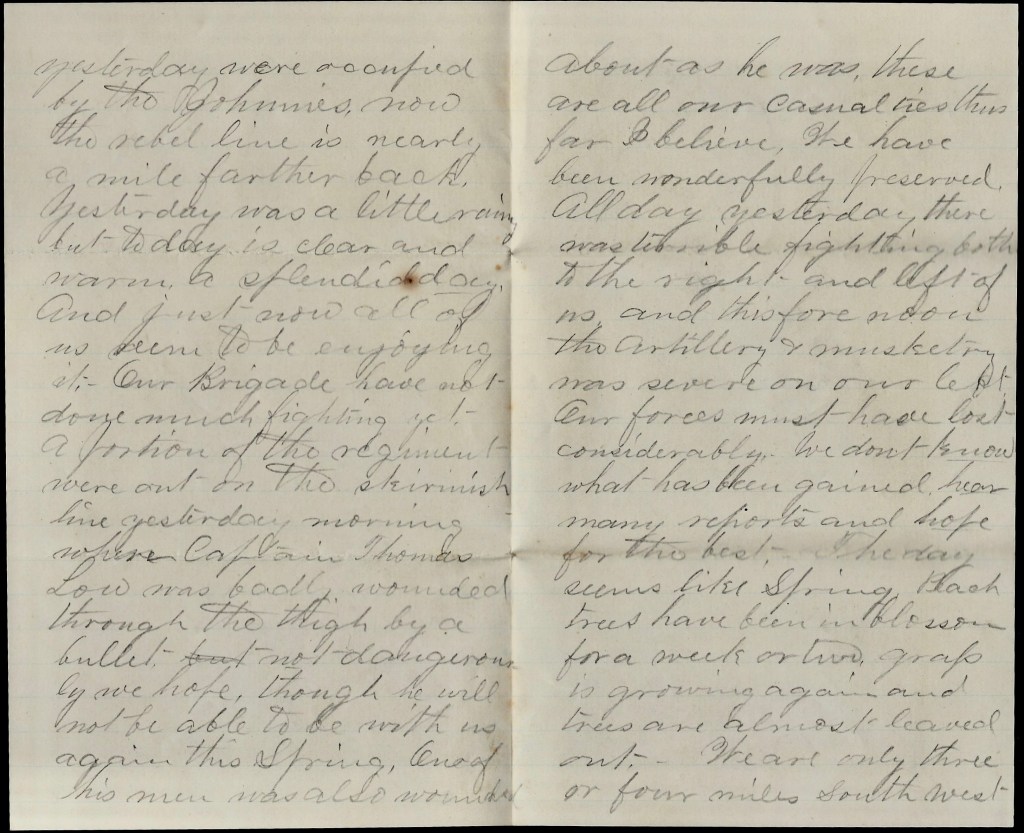
Though I sent you a letter only a day or two ago, you will no doubt like to hear from me again so will write a few lines. I am well. Am now sitting under my little shelter tent just back of our regiment in as beautiful a fine woods as you ever saw. A deep ravine is in front of me through which a beautiful little stream called “Stony Creek” winds its way. On the hill opposite is the regiment behind heavy works which day before yesterday were occupied by the Johnnies. Now the rebel line is nearly a mile farther back.
Yesterday was a little rainy but today is clear and warm—a splendid day. And just now all of us seem to be enjoying it. Our Brigade have not done much fighting yet. A portion of the regiment were out on the skirmish line yesterday morning where Captain Thomas Low was badly wounded through the thigh by a bullet—not dangerously we hope, though he will not be able to be with us again this spring. One of his men was also wounded about as he was. These are all our casualties thus far, I believe. We have been wonderfully preserved.
All day yesterday there was terrible fighting, both to the right and left of us and this forenoon the artillery and musketry was severe on our left. Our forces must have lost considerably. We don’t know what has been gained. Hear many reports and hope for the best. The day seems like spring. Peach trees have been in blossom for a week or two. Grass is growing again and trees are almost leafed out. We are only three or four miles southwest of our old camp but a portion of our army extends a long distance west and left of us. We are in what once was a beautiful rolling country, but war has done its work even here. The once beautiful South is being terribly punished. I will write again soon. Yours in haste, — T. C. Edwards
Letter 19
Near Burkesville, Virginia
Saturday p.m., April 15th 1865
Dearest sister,
Again I gladly improve the little opportunity given me to write home for I am well aware you are all anxious to know how it is with the absent soldier boy. That kind Providence who has ever been with me still blesses me with good health and strength equal to all emergencies. I have hardly seen a sick hour since I left our old camp. How thankful I am for good heath. Though we have seen some pretty hard times of late, have had some hard marching to do through mud that cannot be described some of the time, I have not fallen behind once; have stood all better than ever before. All have kept up well perhaps because we were after the last of the rebellion. I hardly think we could have done so well had we not thought we should have Lee soon or destroy his army. We hardly thought of taking him with his whole and never was such shouting as when the news came to us that Sunday afternoon that he had surrendered with his whole army. I never before saw so excited an army. We now feel satisfied—feel that we were not working for nought. And though we sometimes went supperless to bed after a long, weary day’s march, and found ourselves in the mud and water when we awoke in the morning, we care not for it now. Now all is well and well can the army afford to take a little rest.
Some days were a little rainy; the roads were bad & we marched so fast the supplies could not keep up with us. And two days we were without anything to eat except a little we picked up on the way, and two days while we were coming from Lynchburg, it was the same as the trains hand some back to Burkesville too soon. Two nights were quite rainy and when we awoke in the morning, many of us were lying in the water. All were too tired to mind the rain during the night. Now our Corps are resting here near Burkesville. We don’t know how long we will remain here but think only a few days. Think we will soon go to Petersburg or Richmond. We would like to see those cities that have so long withstood our showers of iron hail.
I presume you know as much by the papers of our march & successes as I can tell you. I have not seen a paper except one of the 5th since we started. We had some rain [but] still the weather was favorable for us. After Lee was captured, we had the hardest rain. It held off well until then. Yesterday was a beautiful day but today is cold and rainy—a real northeast storm/ We had a very large mail here awaiting our return an many had a joyous time reading letters. There were 10 waiting for me and seven papers…I received a letter from John written the 29th of March the 19th, it was. He was well. Was then at Key West but expected to leave for New Orleans soon. Two letters from you, two from Libbie, one from Della, one from Alice, and one from Mary Robinson.
But perhaps you would be more interested in a sketch of our great and successful journey to Lynchburg than anything else I can write. If I could only see you, I might talk as long as you would wish to hear. I could tell you a great many things which I cannot write—a great many little incidents that I cannot now put on paper.
Thursday, no it was Saturday, the 1st of April, I wrote you last. Then the 5th Corps with Sheridan were tugging away on our left, trying to turn back the enemy’s right. All day we heard them cheering & banging away at a great rate. Saturday night we laid down under the trees behind our strong breastworks to sleep but we could not sleep much for ere long the cannons commenced their terrible booming and toward morning the roar with now and then cracking of musketry was almost deafening. I never before heard so heavy firing. In th morning we had orders to advance & heard the 6th Corps had carried the rebel lines in front of them. The 24th Corps on our right had already gone over their works & as cheer after cheer came from them, we knew the enemy were fleeing.
Orders came for our boys to go and away they went with a cheer. A swamp was crossed, then came several rods of bushes and fallen trees to creep through & over but all was soon passed. Lieut. Young of Co. G with a few of his men first reached the rebel fort & captured 13 men and two cannon in it. Other prisoners were taken. The whole line was broken. A portion of the rebel right were cut off & afterward captured. The rest were pushed back in confusion upon Petersburg.
Soon Gen. Meade with his staff came along. We marched to the Boydton Plank Road, then advanced on Petersburg. There was no great cheering, no great demonstration, but every man felt that it was truly a great an eventful day in the Nation’s history. On we marched, not halting until we came in sight of the City. Then on a side hill about three miles from it we rested and listened to the still booming cannon of our gunboats. What a sight was before us. here our whole Corps massed. A litte in advance was the 24th and beyond them a long line of battle said to be the 6th Corps, while on our right were the long lines of rebel works and their great forts that had been so long thundering against us, holding us back/ But they were ours now and we were wondering what the rebels would do next. An hour has passed and word comes that Petersburg is ours. We smile, a few cheer a little—not much, for we had expected all this.
We turn about and hear we are to go toward the railroad to support hte 5th Corps who are trying with Sheridan to capture the rebel force that was cut off. The distant cannon tell how hard they are now at work. Hour after hour passes away. the sun has nearly set. The roar of artillery has died away and the 2nd Corps halt for the night, cook their coffee, eat the bacon they captured at the little station a few miles back, display the great rolls of tobacco also taken there, and talk of the prisoners released there, and the great work of the day. It is late when we go to sleep that night but we sleep soundly and are awake early in the morning & soon ready for another move.
Hear the rebel force is nearly all captured by Sheridan and we turn toward Petersburg again. Hear we are to go into the City but we halted three or four miles from it and soon hear that the rebs have evacuated Richmond & the whole force are making for Danville. The 6th Corps passes going southwest, then a division of the 25th Colored. Then we turn & follow down the railroad. Halt a little before night near the railroad, some ten or fifteen miles from Petersburg. See Gen. Grant & Gen. Meade riding by & cheer them as we have not cheered before. Hear our Brigade is left behind to guard the train—Sheridan’s cavalry train, and go into camp for the night near it where Gen. Sheridan the day before fought & captured several thousand rebels. See many dead horses around us.
Are called up before we have hardly gone to bed to pack up and be ready to march. Our train is ready to move but it cannot yet [as] the road is so blocked up. Ever since we stopped it has been filled with wagons, men & teams. Our train don’t start so we lie down and get a little sleep. It is almost daylight before the train can start. Marched hard all day, hardly stopping to eat. Pass a good many reb prisoners and see a great many broken down and burned rebel wagons. Did not get much rest at night.
Early Wednesday morning [April 5th] joined our Division & Corps again. Afternoon came to the Danville road & find the 5th Corps entrenched on it between Lee & Burkesville. Our boys build works that afternoon & we hear we are in front of Lee & he may attack us before morning. See a whole train pass that has just been captured by Sheridan’s cavalry. Also six guns & nine battle flags with a great many prisoners. See Gen. Sheridan twice that afternoon.
Early Thursday morning [April 6th] find the rebs had gone toward Lynchburg & we were soon after them again. All day our advance are skirmishing with their rear guard. Some of the time we are very near them. Find the road more than before strung with old broken down wagons and some burned and many things, hospital stores, &c., strung along the road. Late at night we halted for a rest. Were up again early Friday morning [April 7th] and after them without our breakfast for we had nothing to eat now—only what we might pick up. A few of us went out foraging & before noon we brought in bacon, chickens, turkeys, meal, flour, &c. &c. Some had no breakfast. I had a late one. A little meal pudding with sugar for I too had been through many of the houses on the way. Found some molasses and had bacon & molasses for dinner. Killed two old hens & that night had splendid boiled chicken for supper but it was mostly broth for we couldn’t get the chicken tender. Lived about so the next day, then drew a few rations.

Early Friday morning we struck the Lynchburg Railroad and saw the rebel train in the distance. Followed the railroad down a little way when we came to the High Bridge. It is the greatest work I ever saw and I think is nearly a half mile in length—22 span of 100 feet each and 150 feet or more below the Appomattox winds its way. Here the rebs tried to make a stand [see Battle of High Bridge] & when we first came up we could distinctly see the skirmishing in the valley below, 50 rods [275 yards] from each other perhaps were the two lines firing at each other as though they were not killing human beings. I saw the rebel officers ride back and forth cheering their men on and for a time they advanced, all the time yelling & howling like so many wolves. Now and then one fell but they did not seem to care for him. Steadily they came on toward our men & were driving them back until ours received reinforcements & artillery was brought into position which gave them a few good shots and sent them reeling & running back. But they had fired the great bridge & four span of the noble work was burned before our men could stop the progress of the flames.
Again our whole forces were advancing. The rebel train had moved away & the long rebel line of battle we saw away on the hill had disappeared in the woods. I was not far from our line of skirmishers then and soon saw the rebel cavalry firing on them as they retreated over a second hill. Then the rebs made another halt on a hill beyond & again I saw them charge on & capture a part of our skirmish line. We could see the little village of Farmville a little beyond them and soon saw a long line of our cavalry from another road come down a side hill and charge down upon it. A few cannon shots, a short rattle of musketry, then the Yankee cheers and running rebs told us the place was ours. We saw the rebs in front of us retreat in haste for they were now nearly surrounded.
Then we advanced again but alas; we had lost one who had been with us this far & so earnest all the morning. Gen. Smith who commanded one of the Brigades of our Division & had commanded our Division was killed while trying to reform the skirmishing here. All were sad. The 3rd Brigade had lost a noble commander—one who was loved by the whole division and the Nation had lost a young but brave, ambitious, noble officer.
We soon reached a hill near Farmville & massed there to rest & take dinner. Saw the cavalry division march through the village & advance beyond, disappearing in the beautiful pine woods, but the rebs opened them [with] a masked battery & secreted infantry gave them a shower of bullets that sent hem flying back out of the woods with broken ranks and many riderless horses. Then we saw such a cavalry fight as we had never seen before, but it did not last long. The rebs were soon driven back and again the cavalry went in.
We went a little farther that afternoon when we came up to the enemy entrenched and for a time could not go farther. The 1st Division from our Corps were ordered to charge the works and did so but only lost heavily without accomplishing anything. That night we did not sleep much. Early the next morning found the rebs had gone so on after them we went, overtaking them a little after noon. All the time they continued to throw away everything which might impede their progress–wagons, clothing. & piles of ammunition. All the time they were losing heavily and we knew they could not stand it long.
Saturday afternoon [April 8th] we did not try to drive them—only followed them for we heard by the distant artillery firing that some other Corps was hard at work. Just before night we halted on a towering hill and took supper. Thought to remain here over night but were soon ordered to march again and most all night we kept on tramping. Hear we now have the rebs in a trap that will be hard for them to get out. Sheridan on their left, Gen. Thomas in the front entrenched, and we close behind them.
Early in the morning [April 9th] we were up & on again, all the time hearing very heavy cannonading in front of us away in the distance. About ten a.m., Gen. Meade rode past us in his carriage. He was looking very unwell. We heard he was sick. Soon we halted & heard Gen. Meade & Lee were having a consultation. Many said Lee would surrender & all were full of excitement. A little after noon, it might have been, news came that Lee had surrendered with his whole army. We hoped so, but could hardly believe it. The excitement was all the time increasing and cheer after cheer was given. Soon we saw an officer and his staff ride by a a full gallop toward the 6th Corps who were massed a little back of us. They were wild with excitement and made the hills echo with their cheers. Gen. Meade soon came riding back on horseback with his hat swinging in his hand, cheering away and looking as though he never had been sick. 1
Our Corps were massed by Brigades and as he and his staff rode up and down through our lines we could hardly contain ourselves. All seemed nearly wild. I never before saw the army so excited. Hats, caps, knapsacks, haversacks, canteens, cups & shoes were thrown high in air, & the earth almost shook with cheers. A salute was fired by the artillery and all the afternoon there was great excitement. That was a Sunday never to be forgotten by us. And what a week the past one had been to us. One week before we had just broken the rebel lines at Petersburg.
Sunday night we rested as we had not before & felt almost new the next morning. Rested all day Monday. Saw Uncle Lemuel & sent a letter home by him. Tuesday we left camp & quietly started on our return to Burkesville where we arrived after a few days marching & are still resting. Hear we are to march again soon, we think for Petersburg. Some say we are to go farther south but we hope not. We feel that we have done well here and would now rather stay in Virginia.
All of us are feeling well, all hoping we may soon have peace and return quietly to our homes & once more exchange the sword for the plow. Rumor says all who enlisted in ’62 will soon be discharged as soon as the 1st of May at the longest. We wish it might be so but fear not. I should like to be home by that time. I could then get something done this summer.
But I have written enough for once, haven’t I? I will write again as soon as I can. With much love to you all, I am as ever, — Thomas
1 “About five [o’clock] came Major Pease. “The Army of Northern Virginia has surrendered!” Headed by General Webb, we gave three cheers, and three more for General Meade. Then he mounted and rode through the 2nd and 6th Corps. Such a scene followed as I can never see again. The soldiers rushed, perfectly crazy, to the roadside, and there crowding in dense masses, shouted, screamed, yelled, threw up their hats and hopped madly up and down! The batteries were run out and began firing, the bands played, the flags waved. The cheering was such that my very ears rang. And there was General Meade galloping about and waving his cap with the best of them!” [Source: With Grant & Meade: From the Wilderness to Appomattox, by Theodore Lyman, 1994.


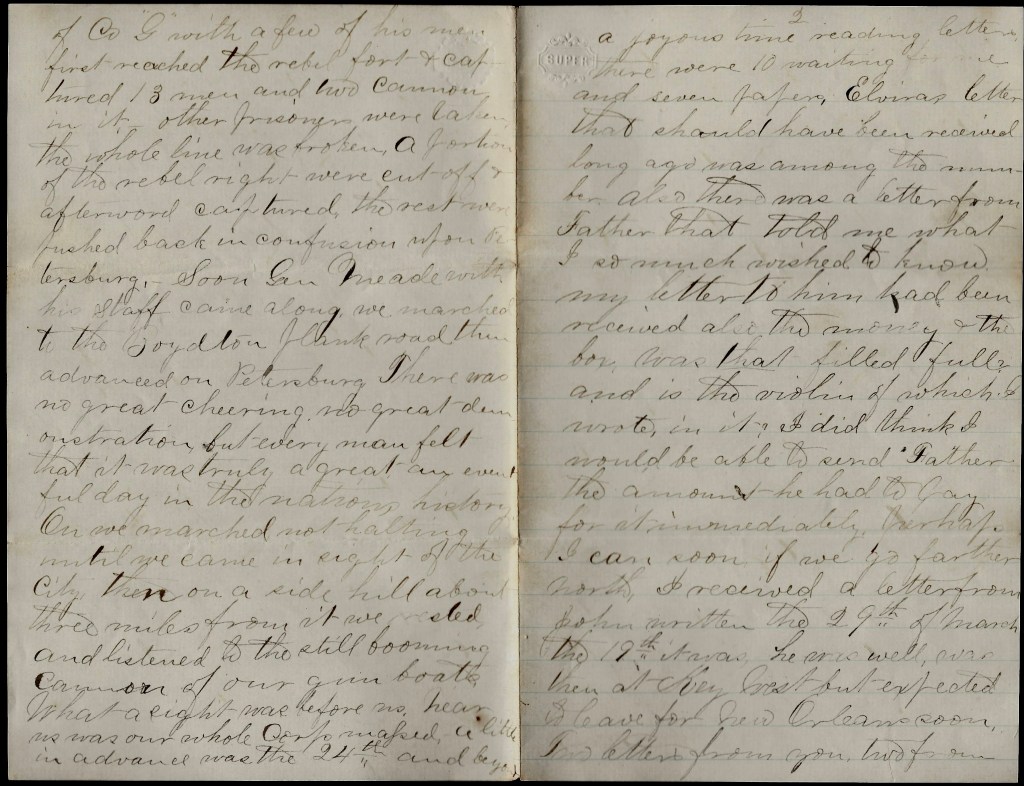
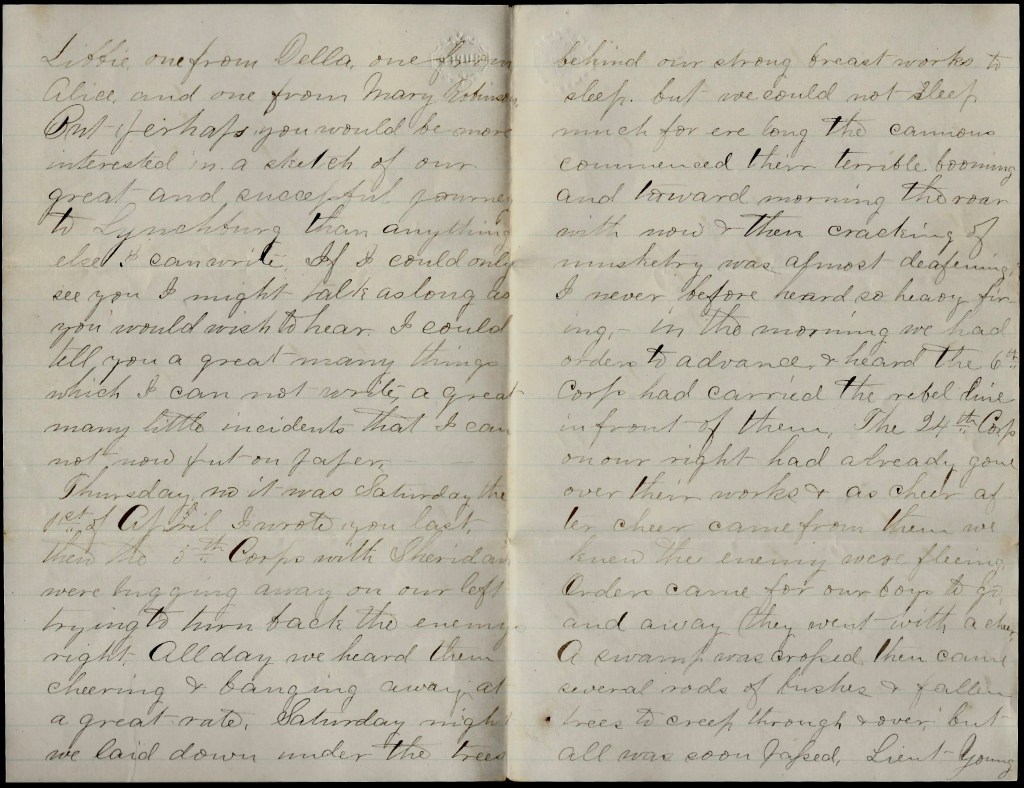

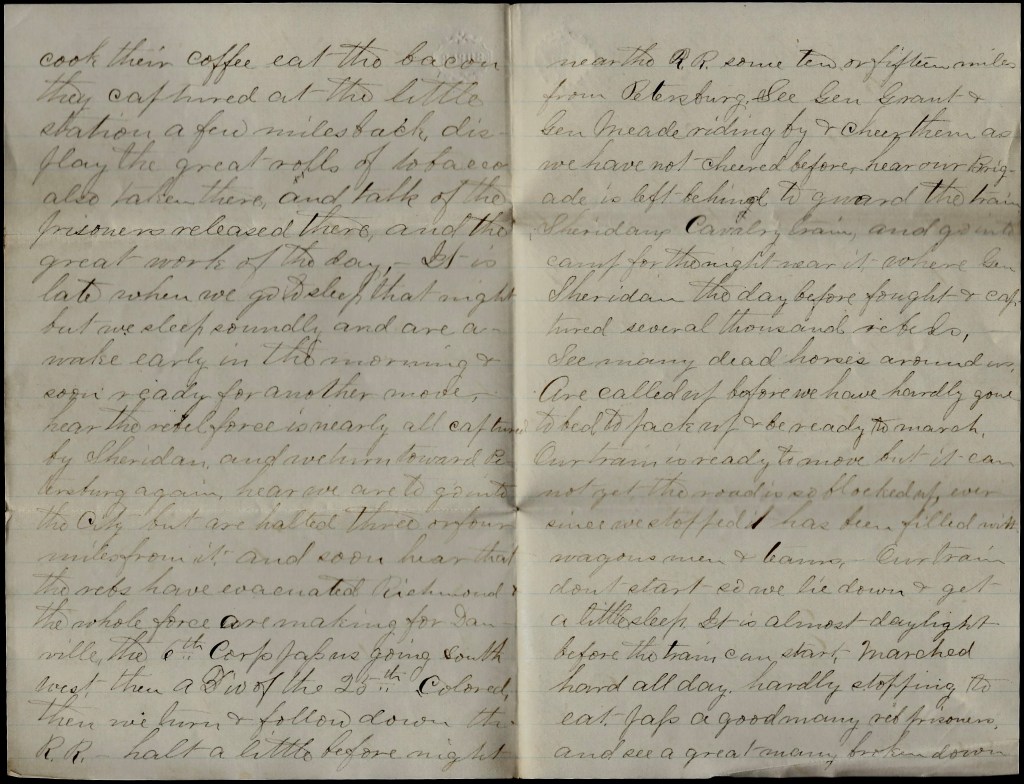


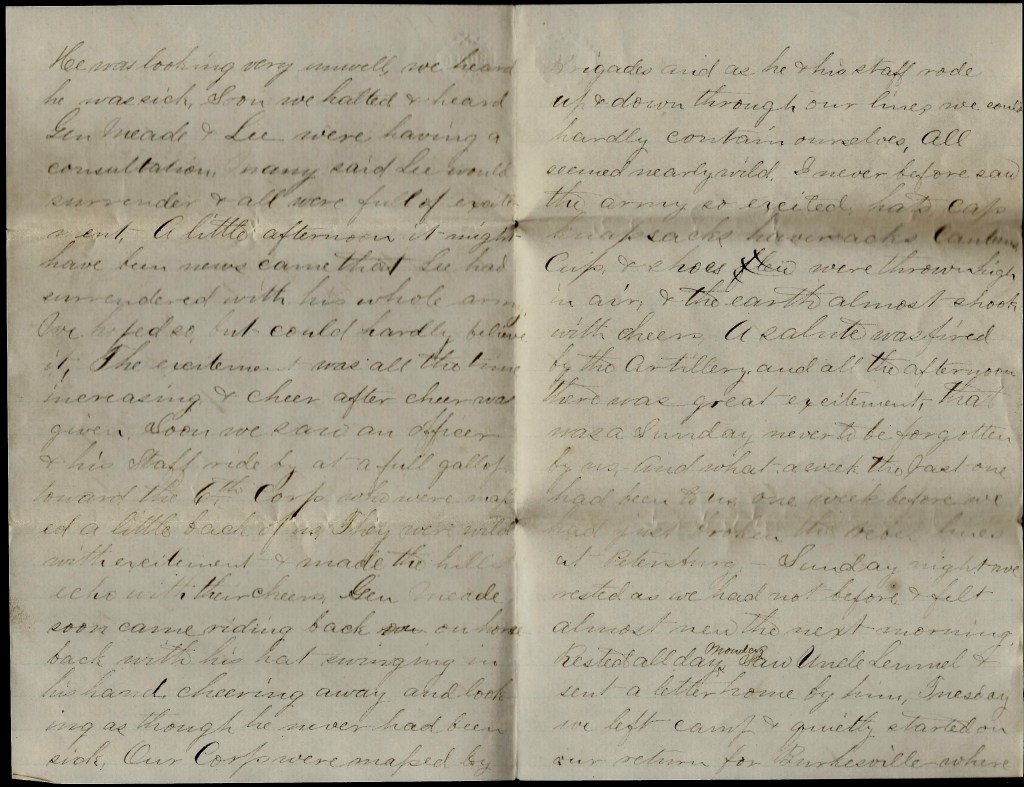
 Spared & Shared 23