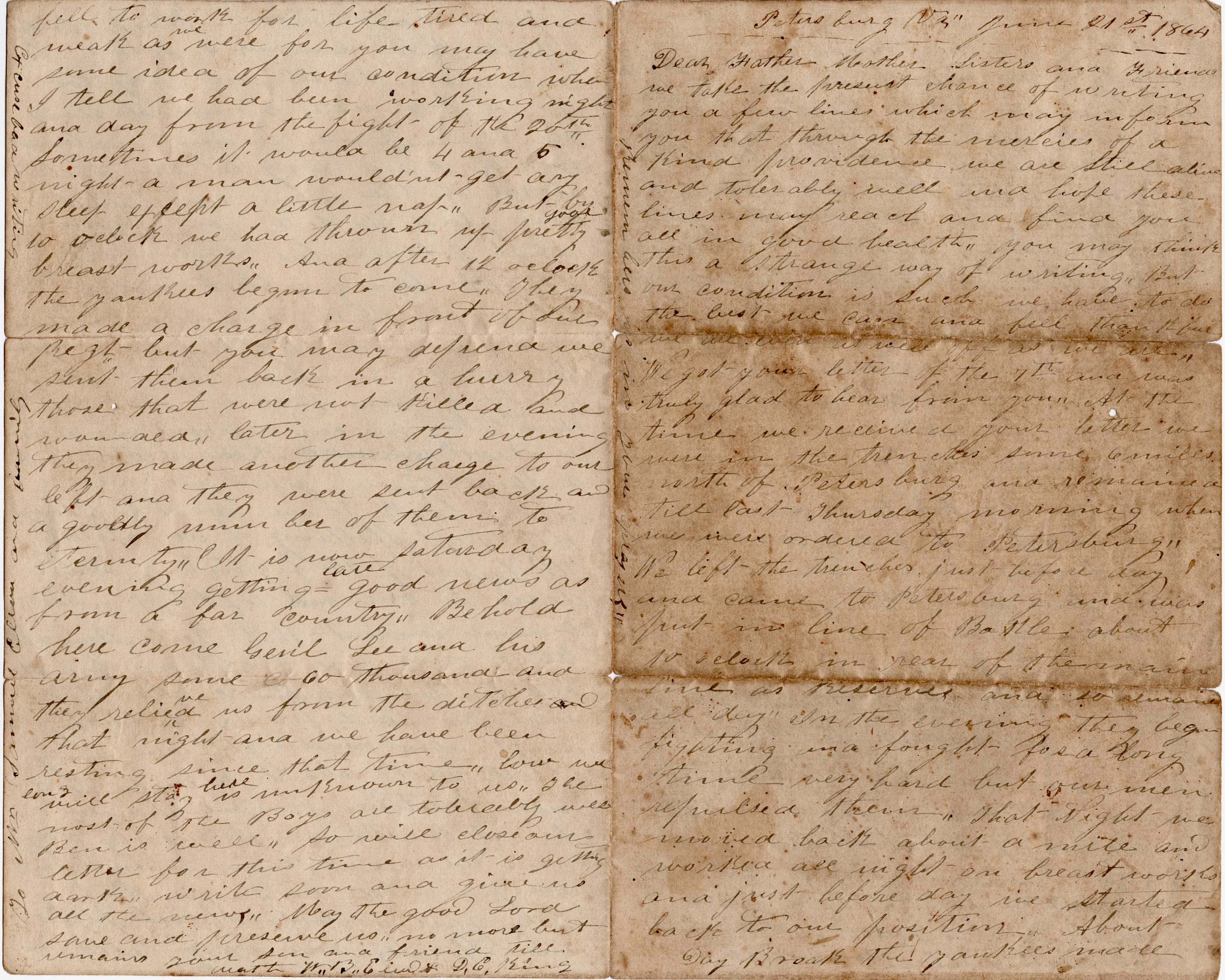
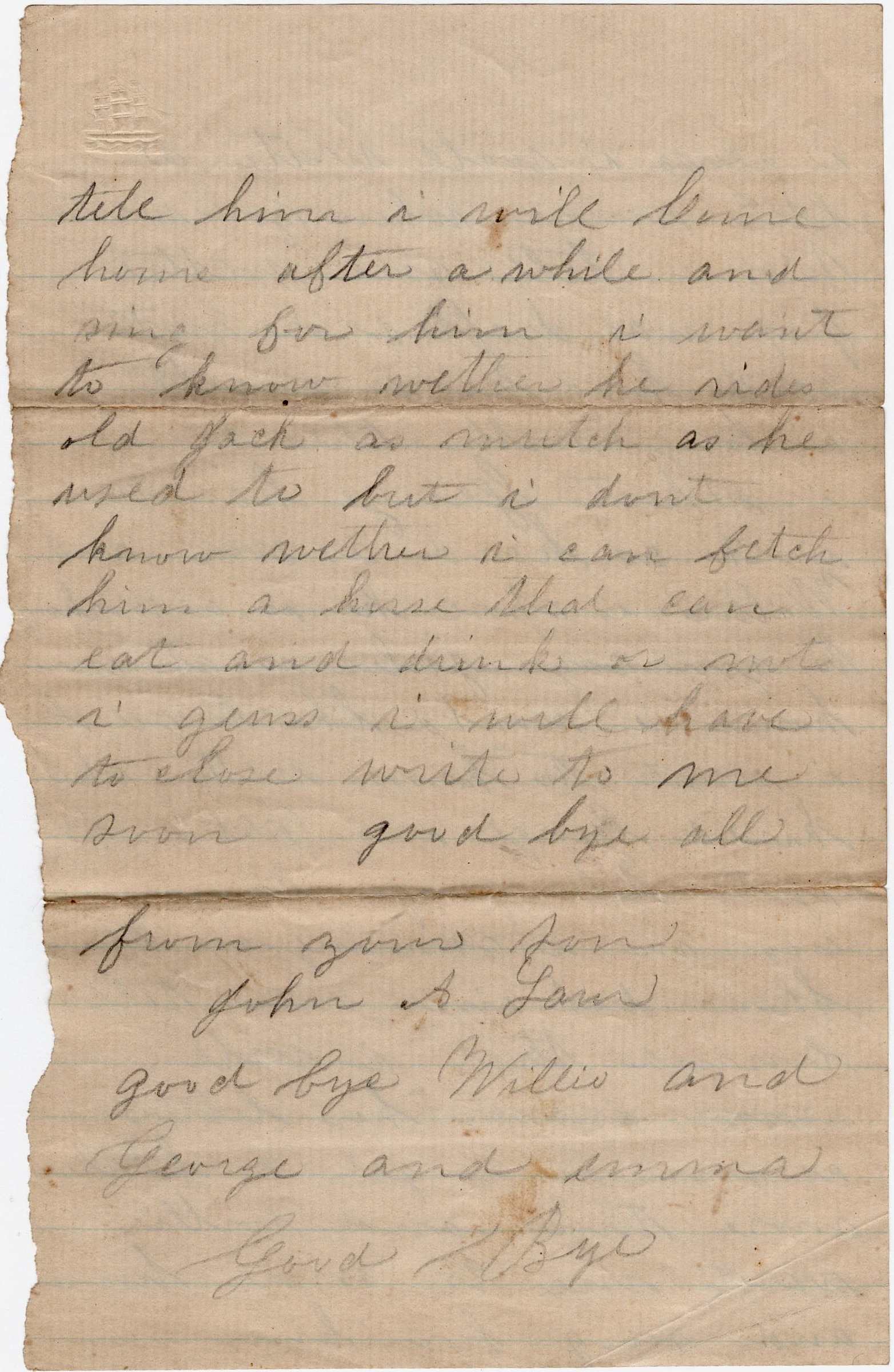
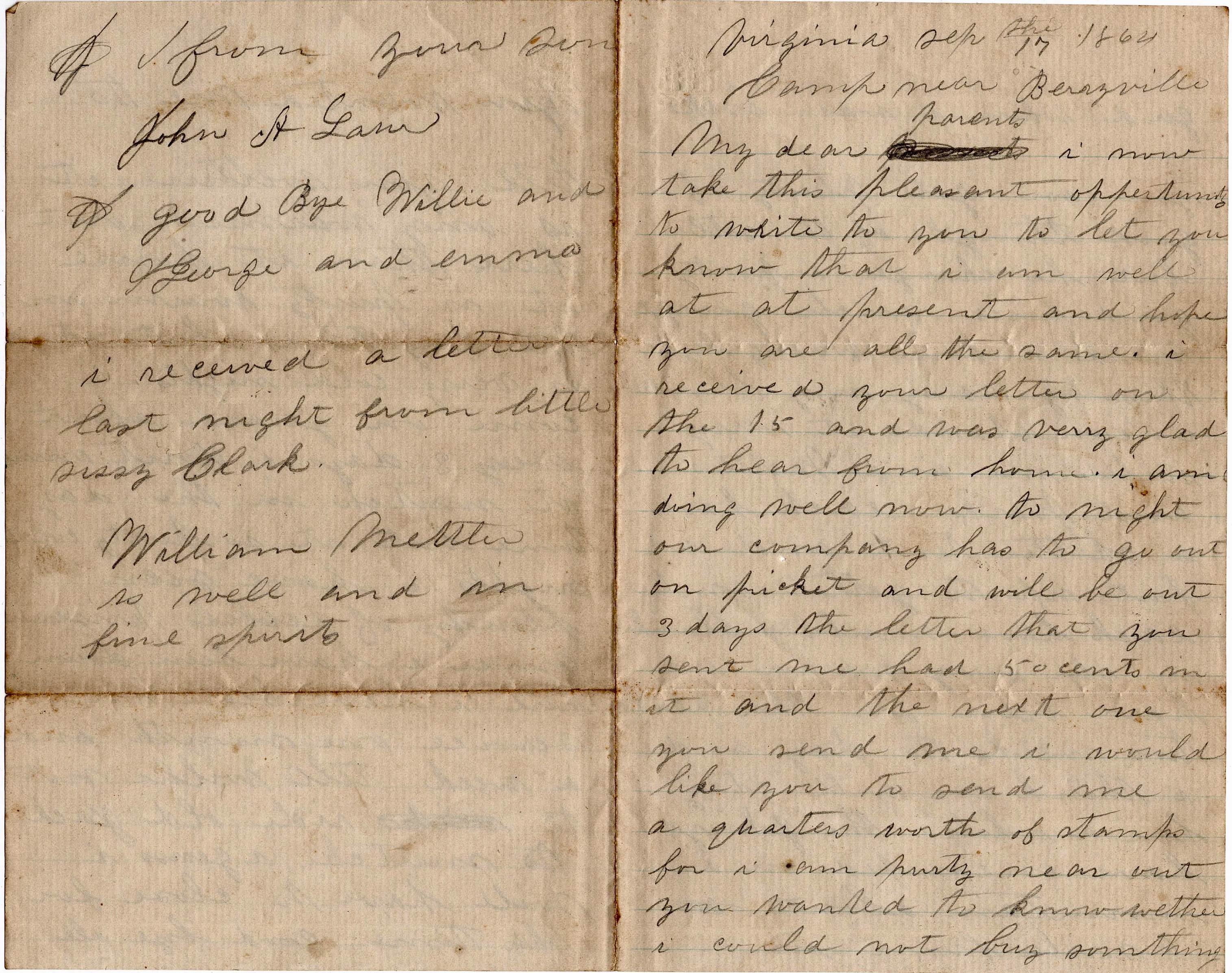
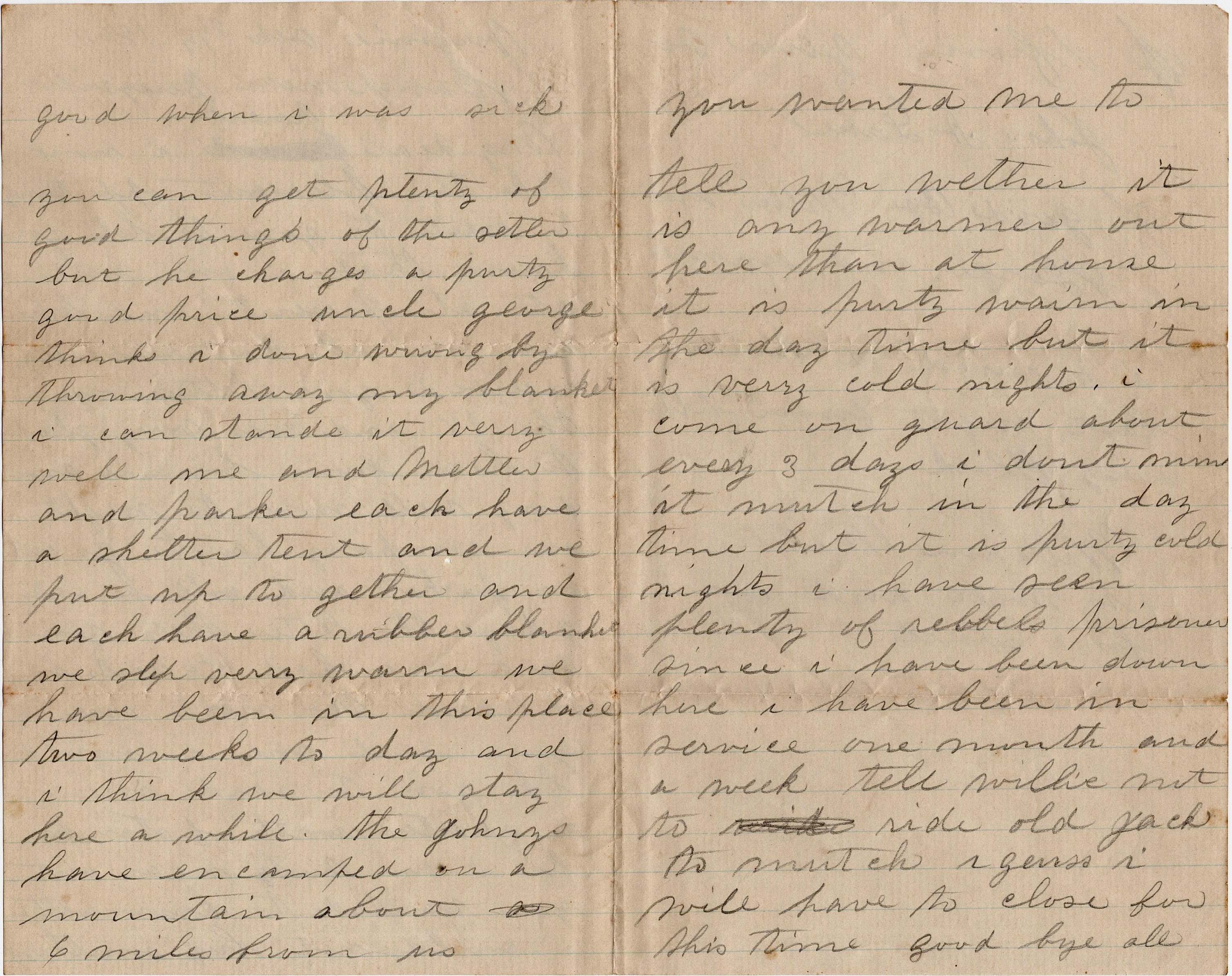
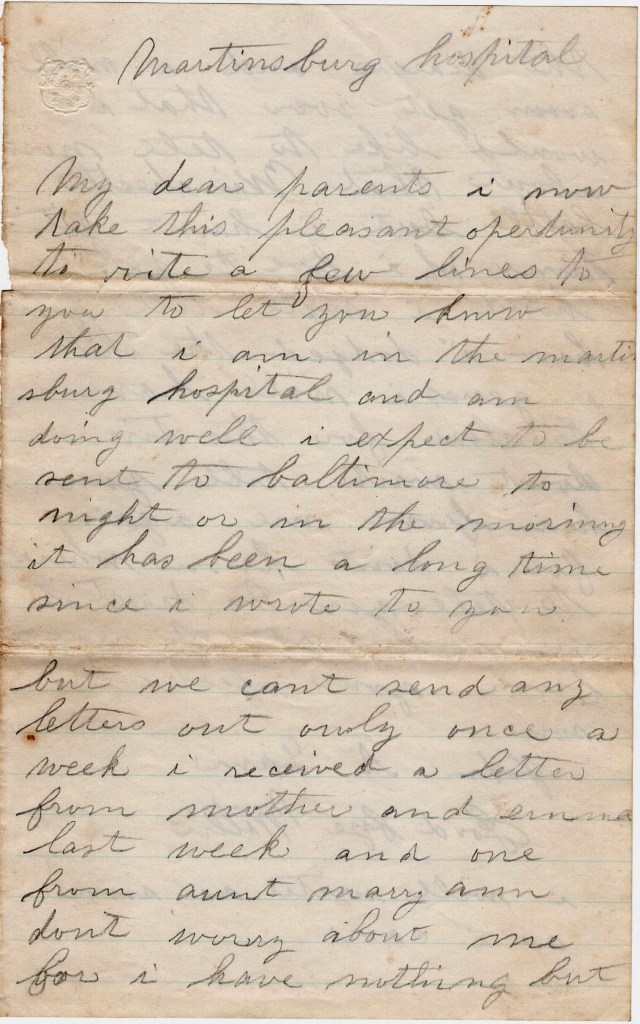
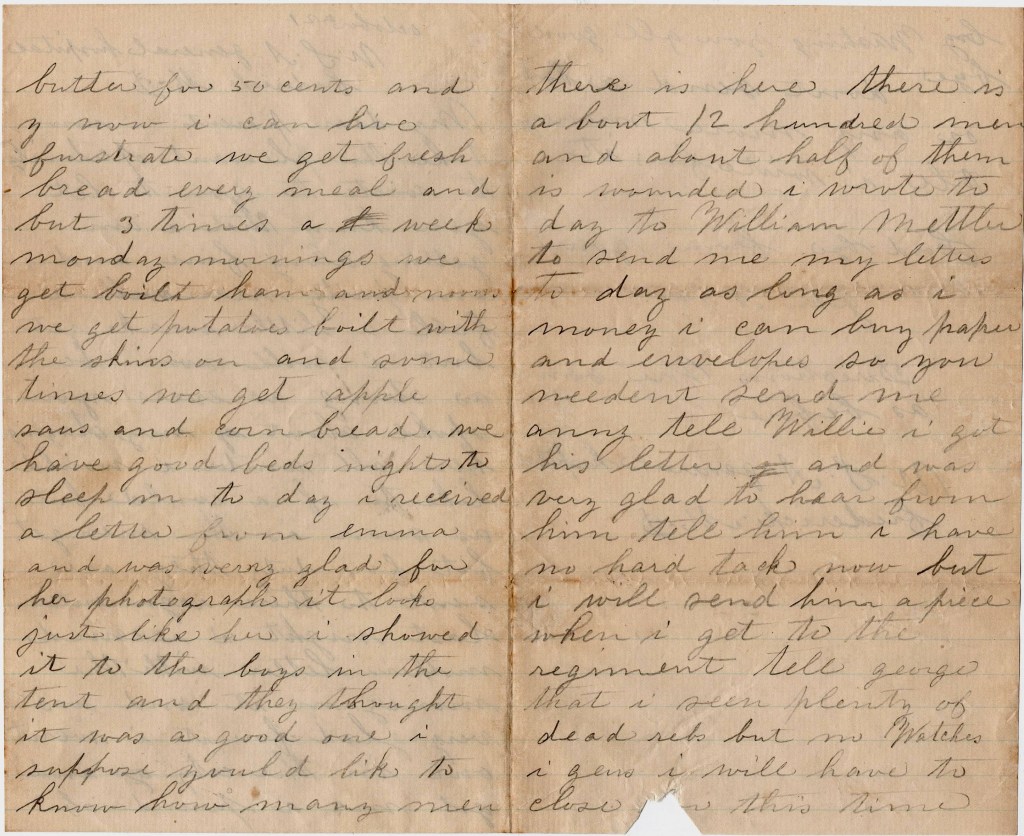
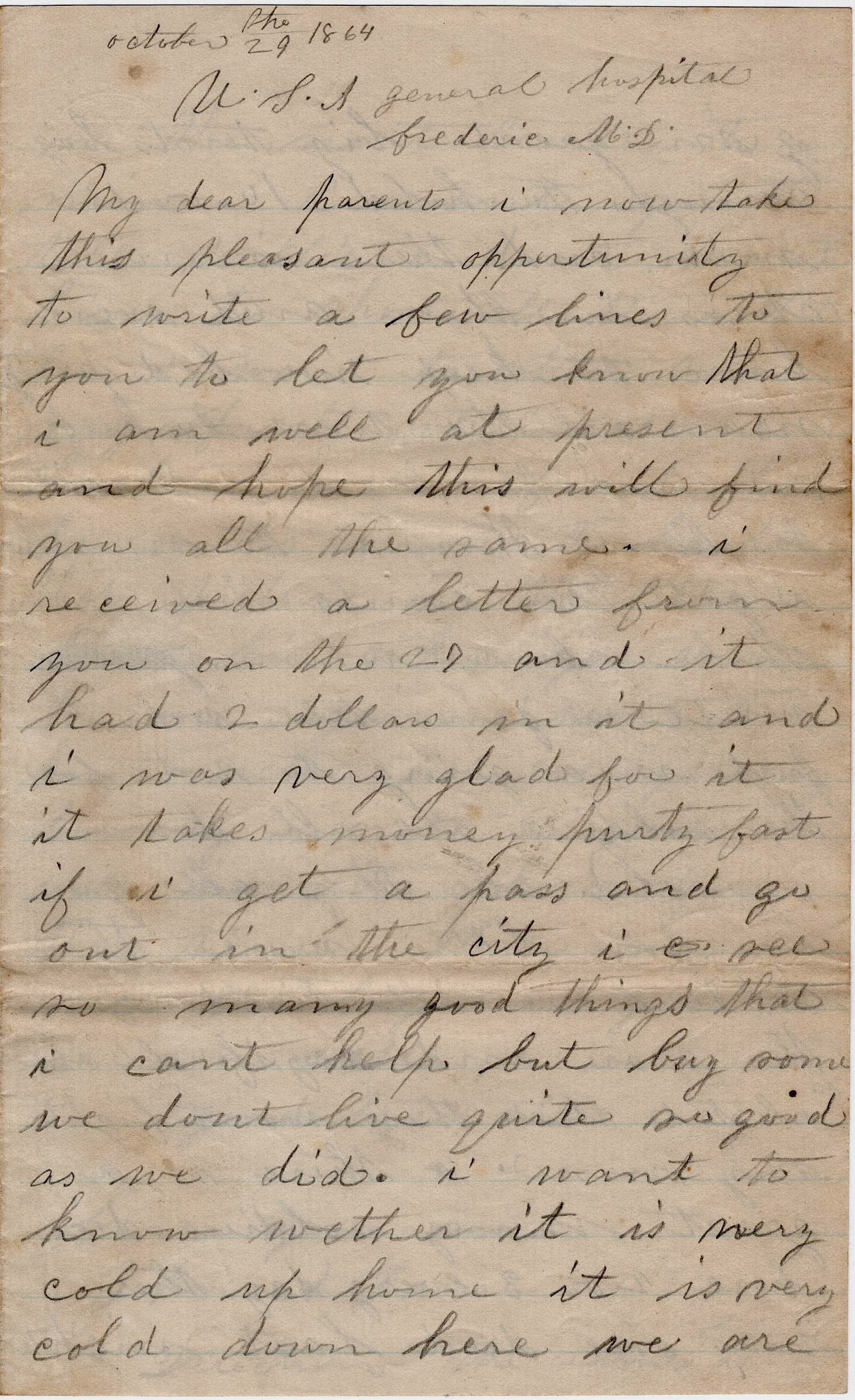
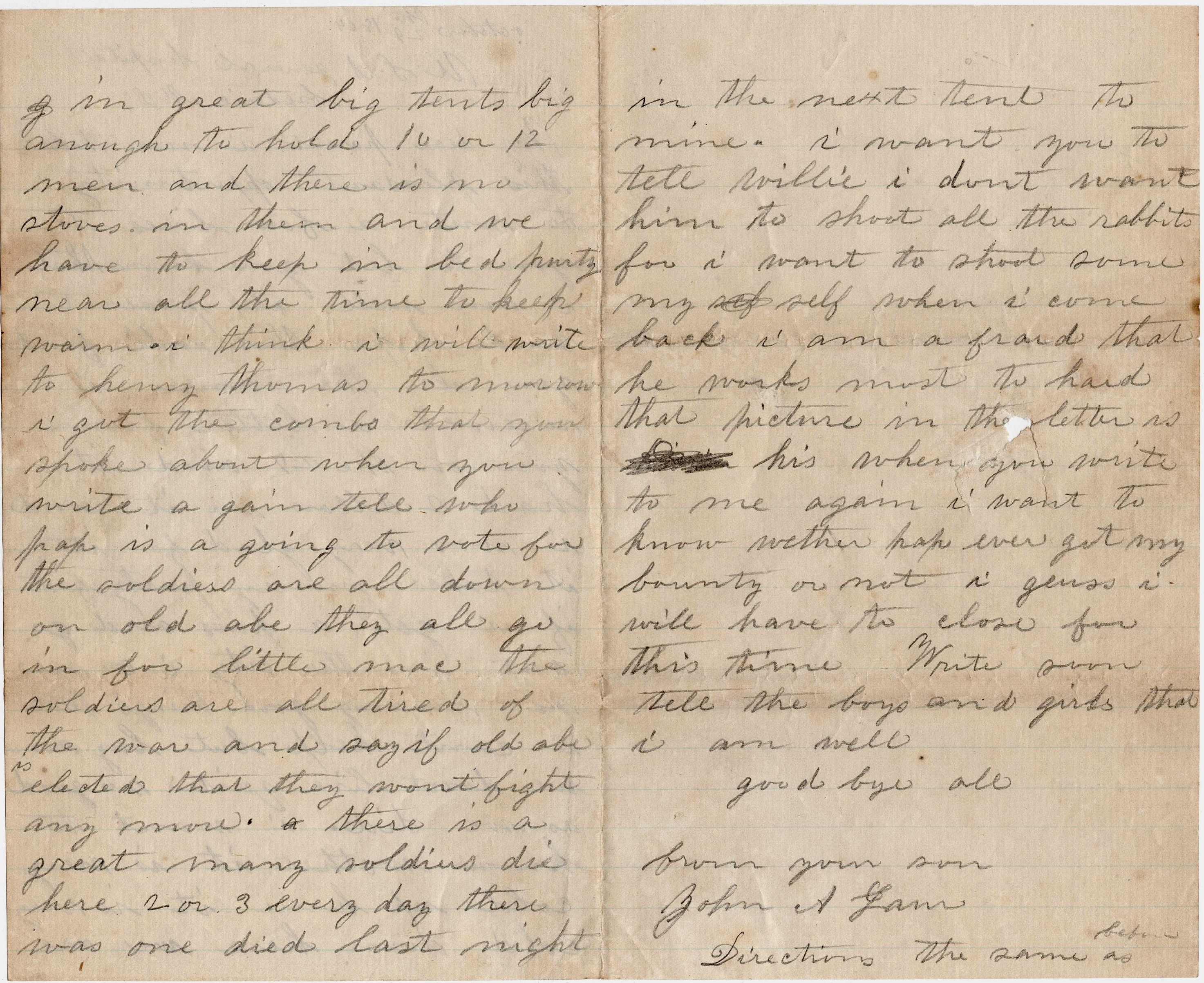
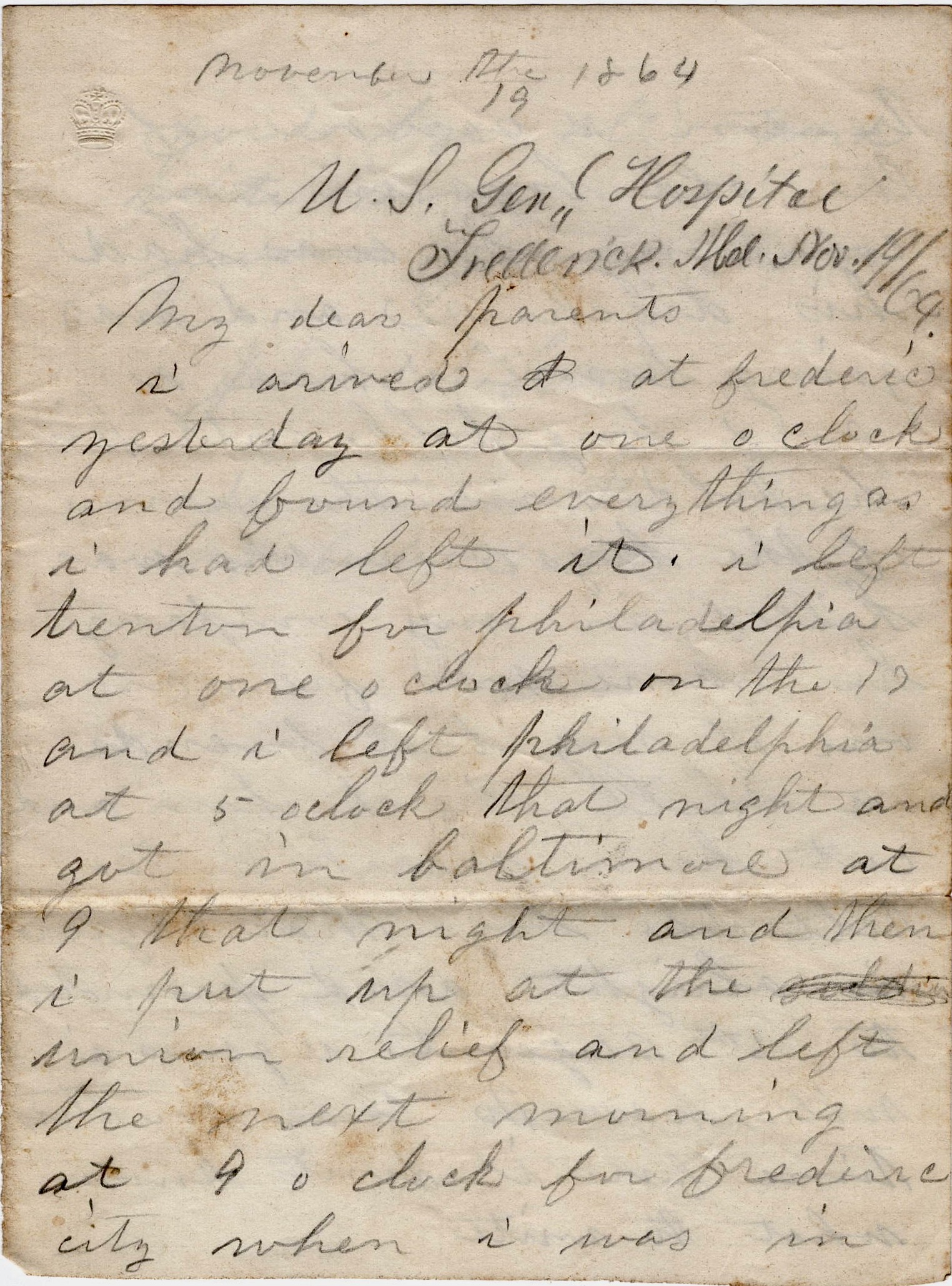
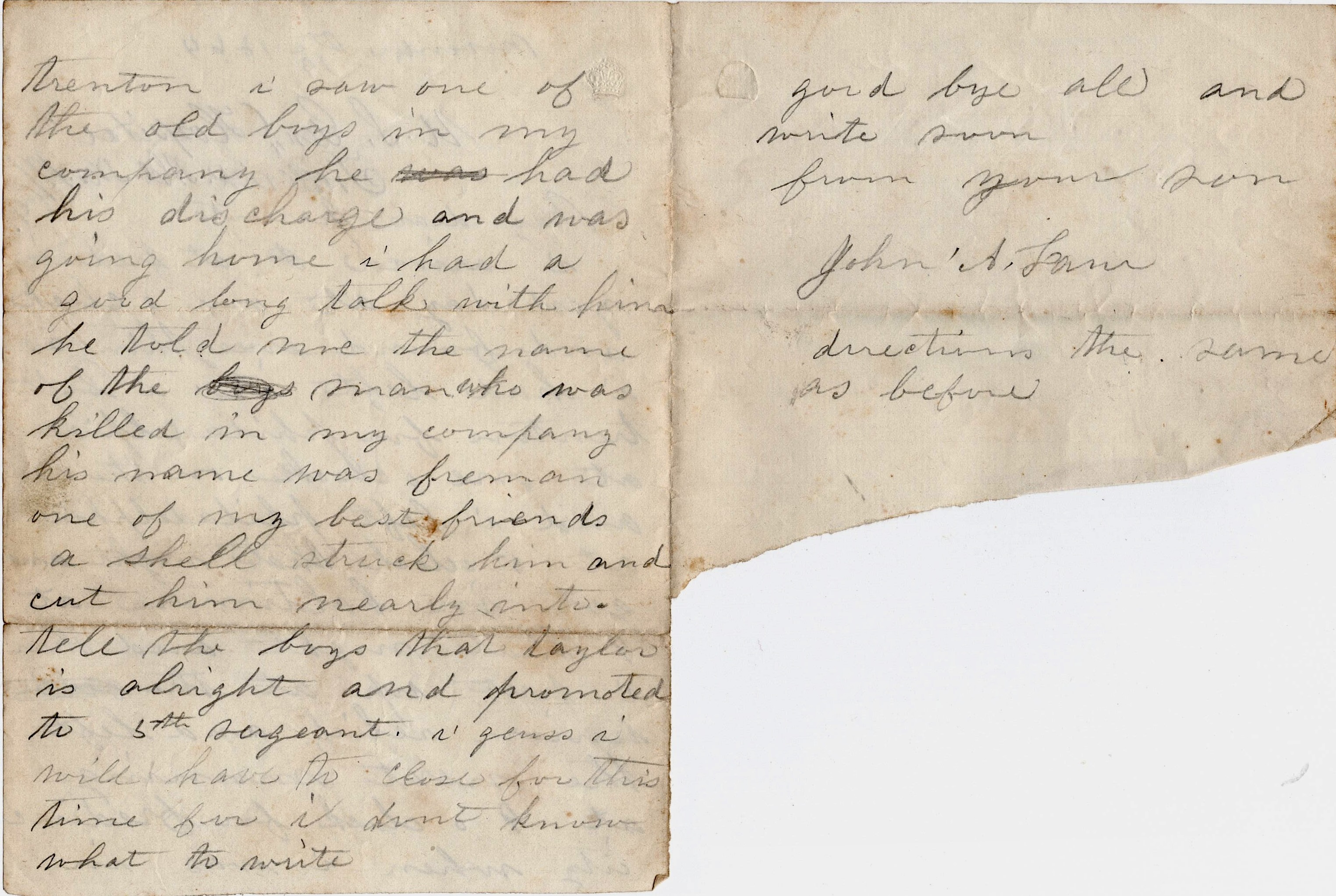
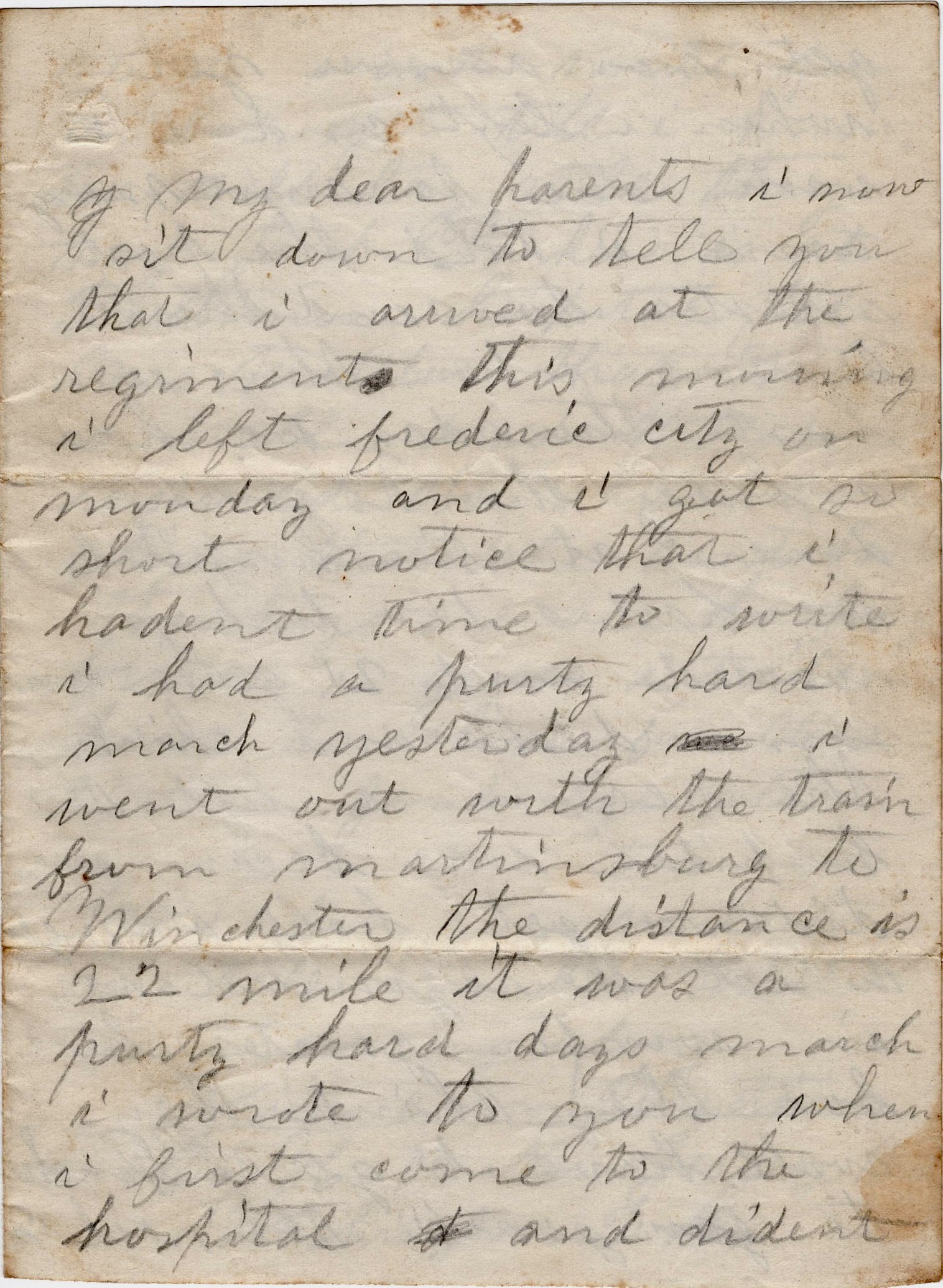
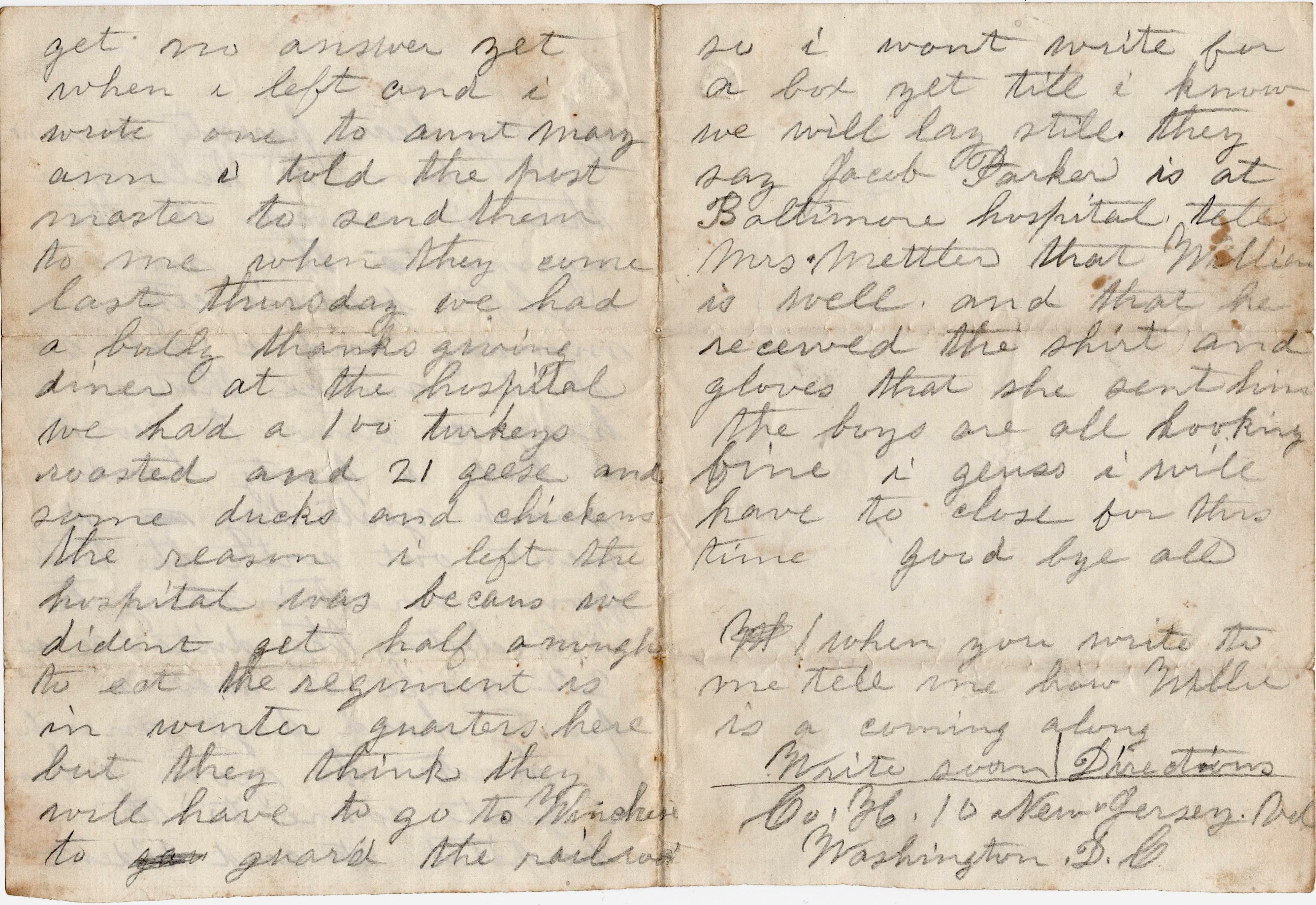
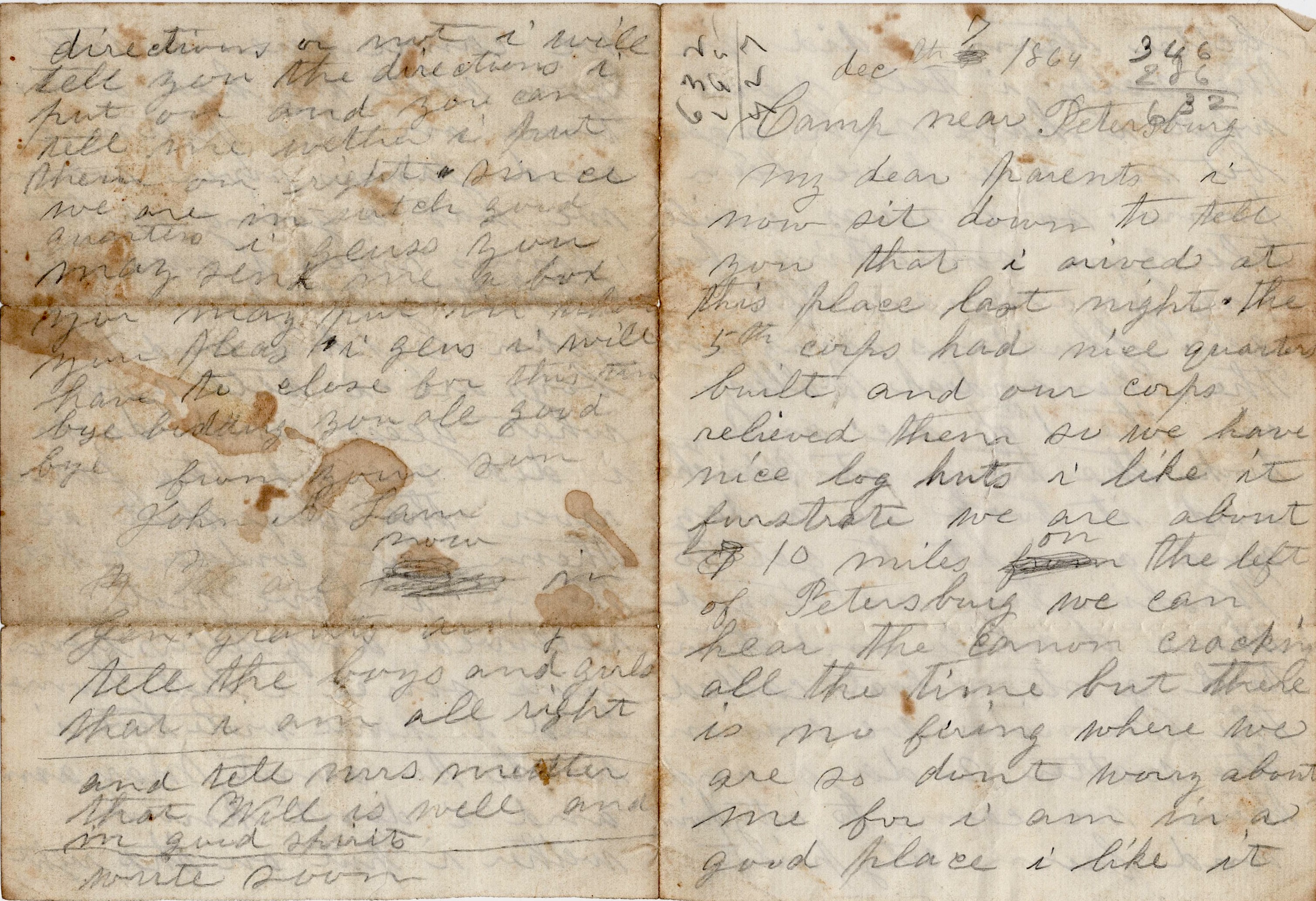
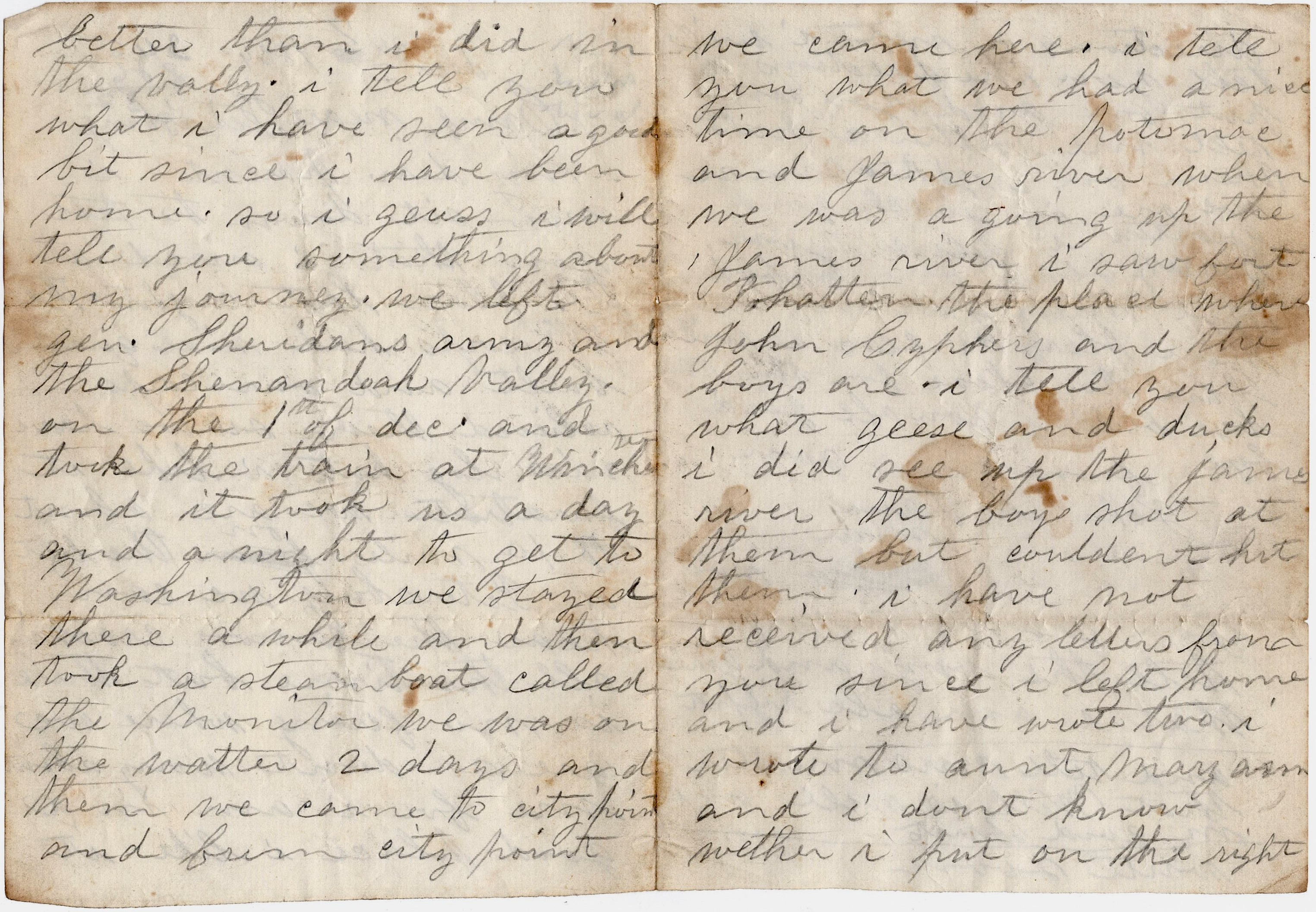
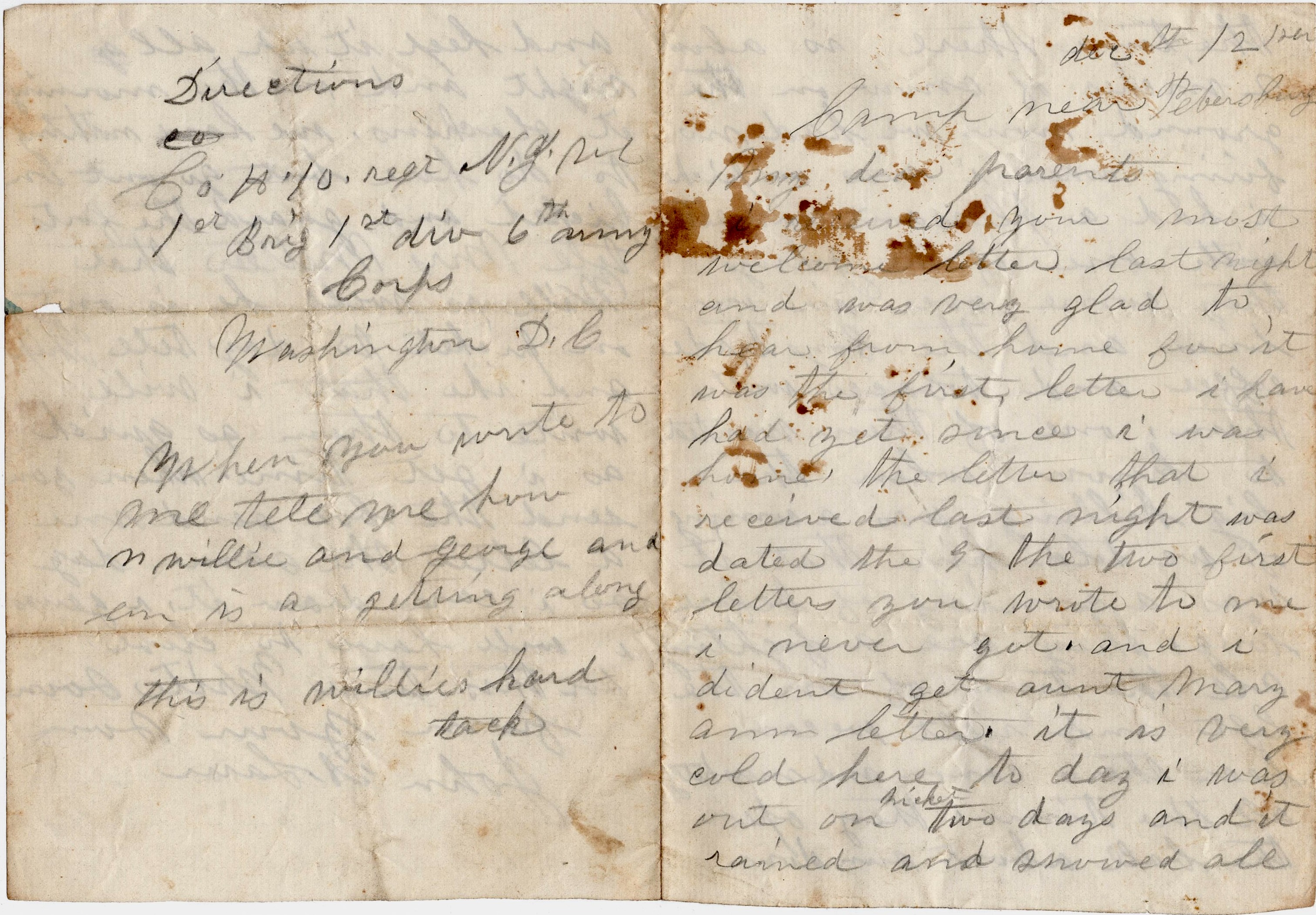
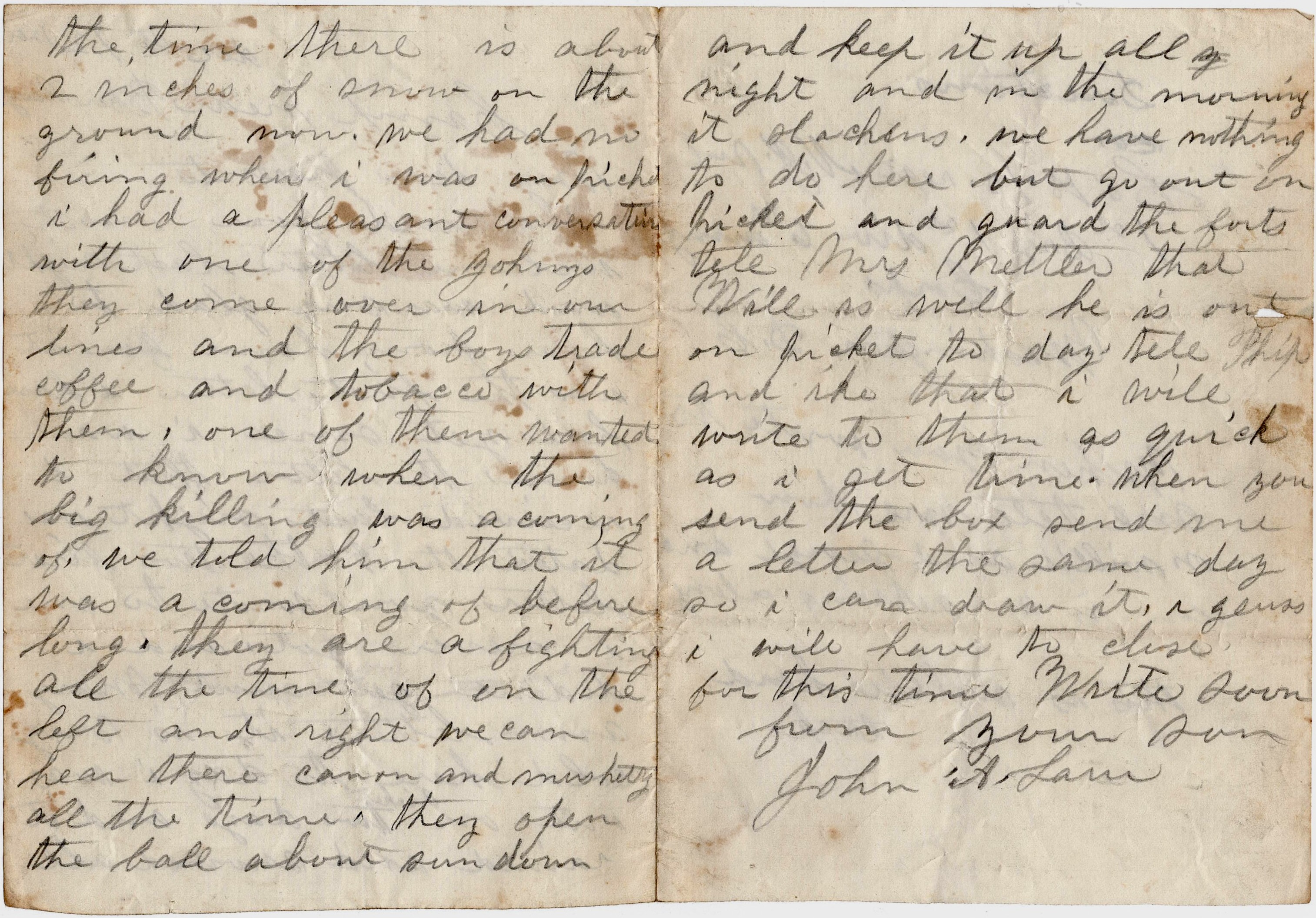
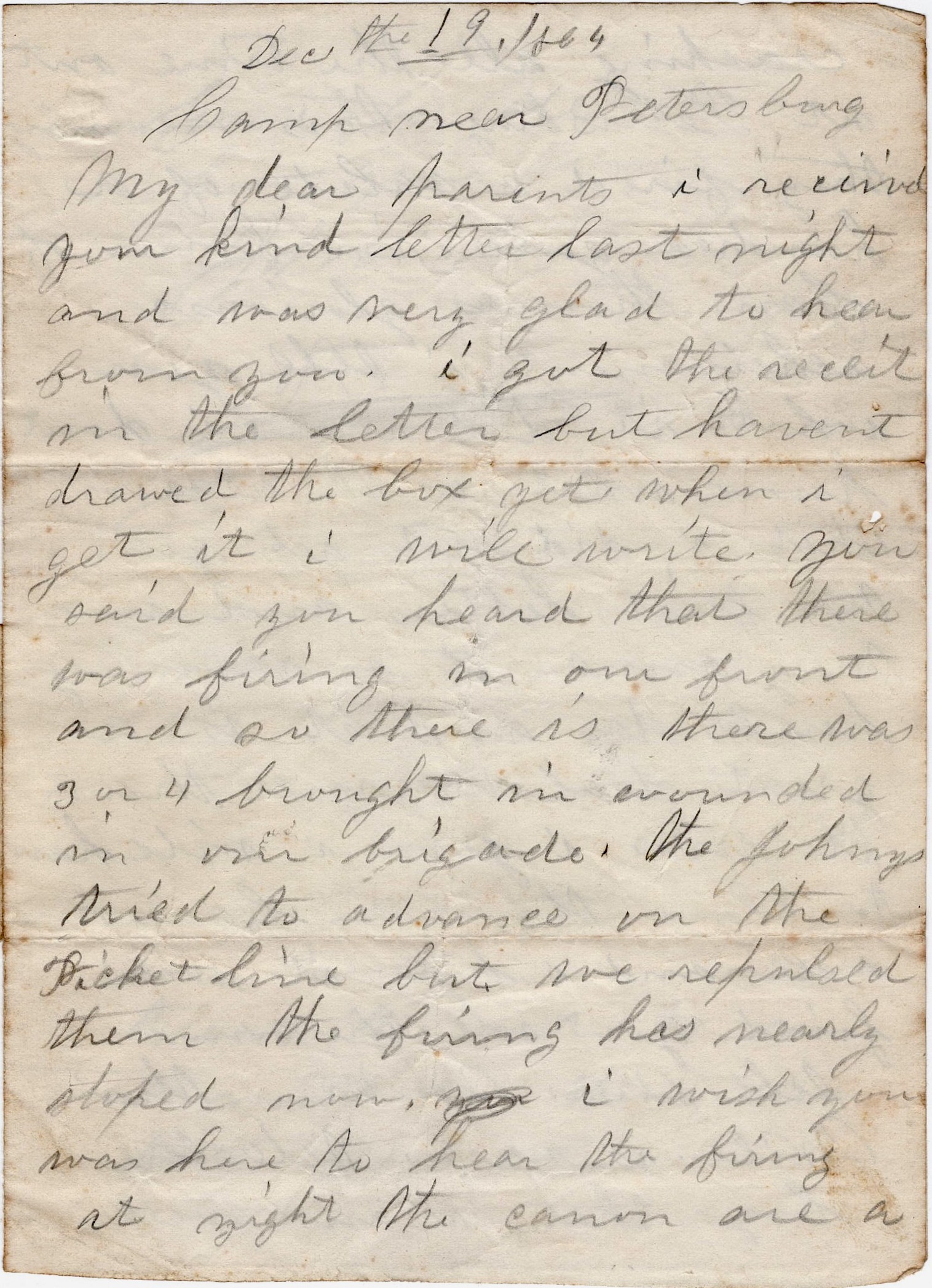
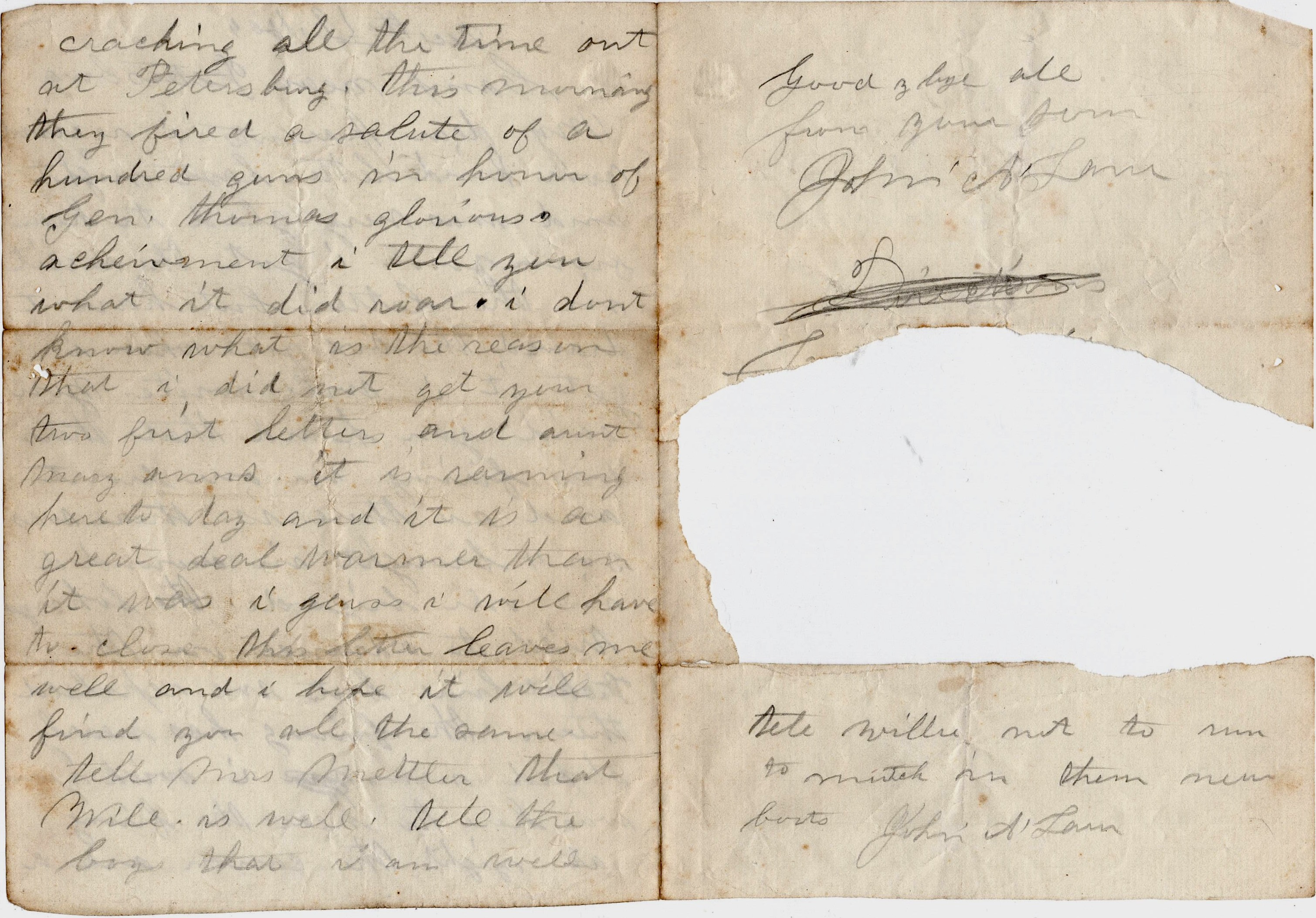
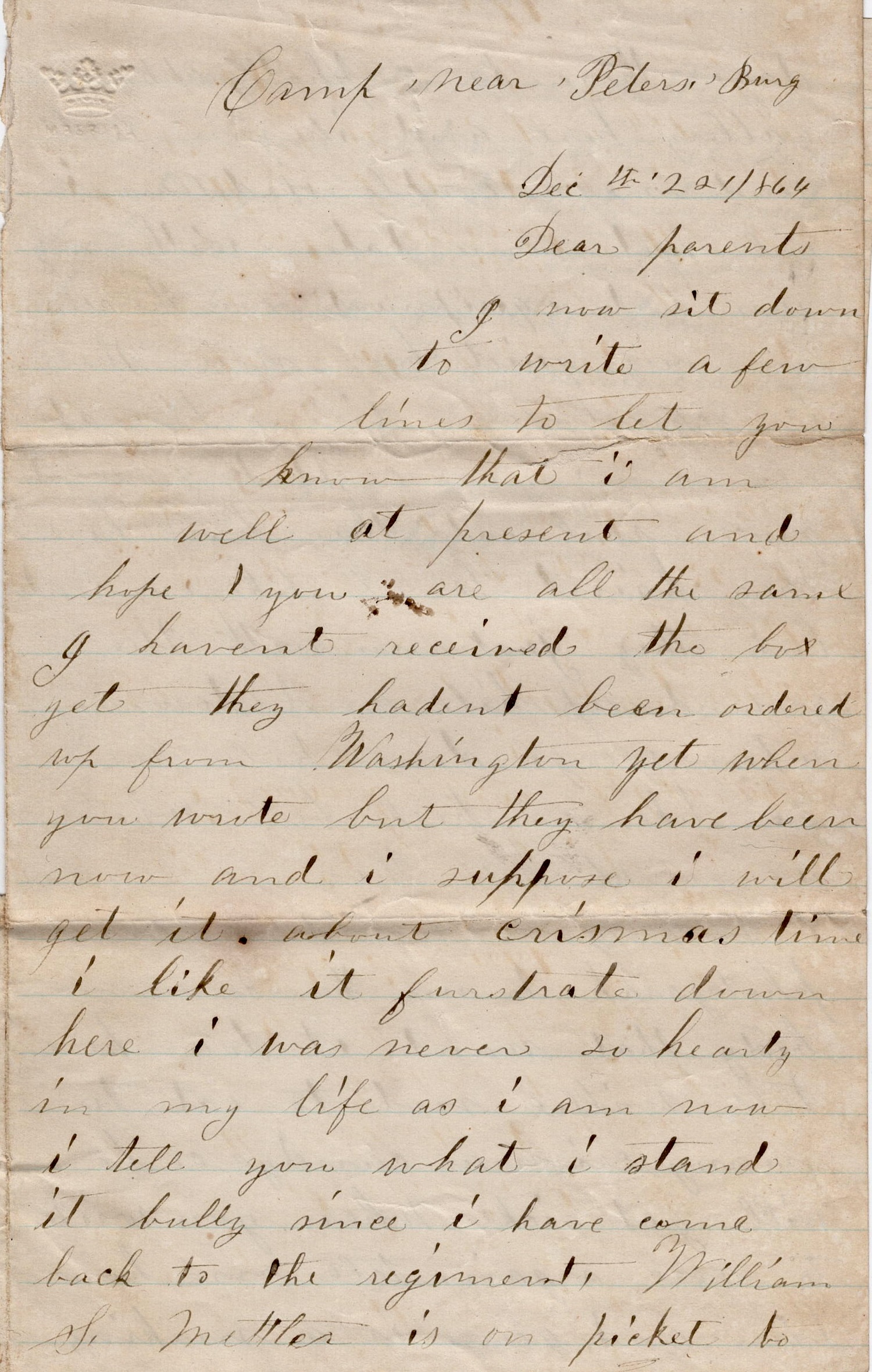
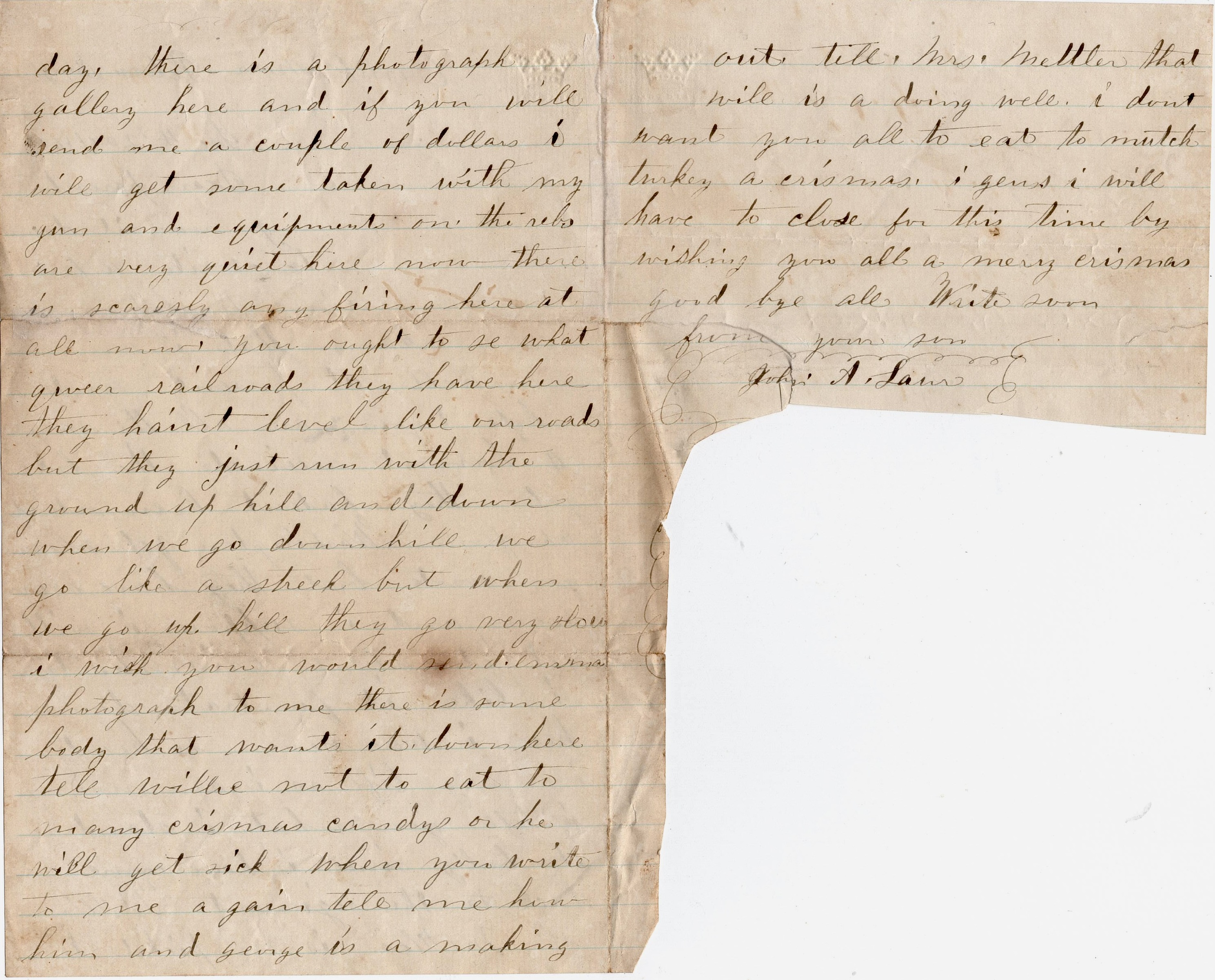
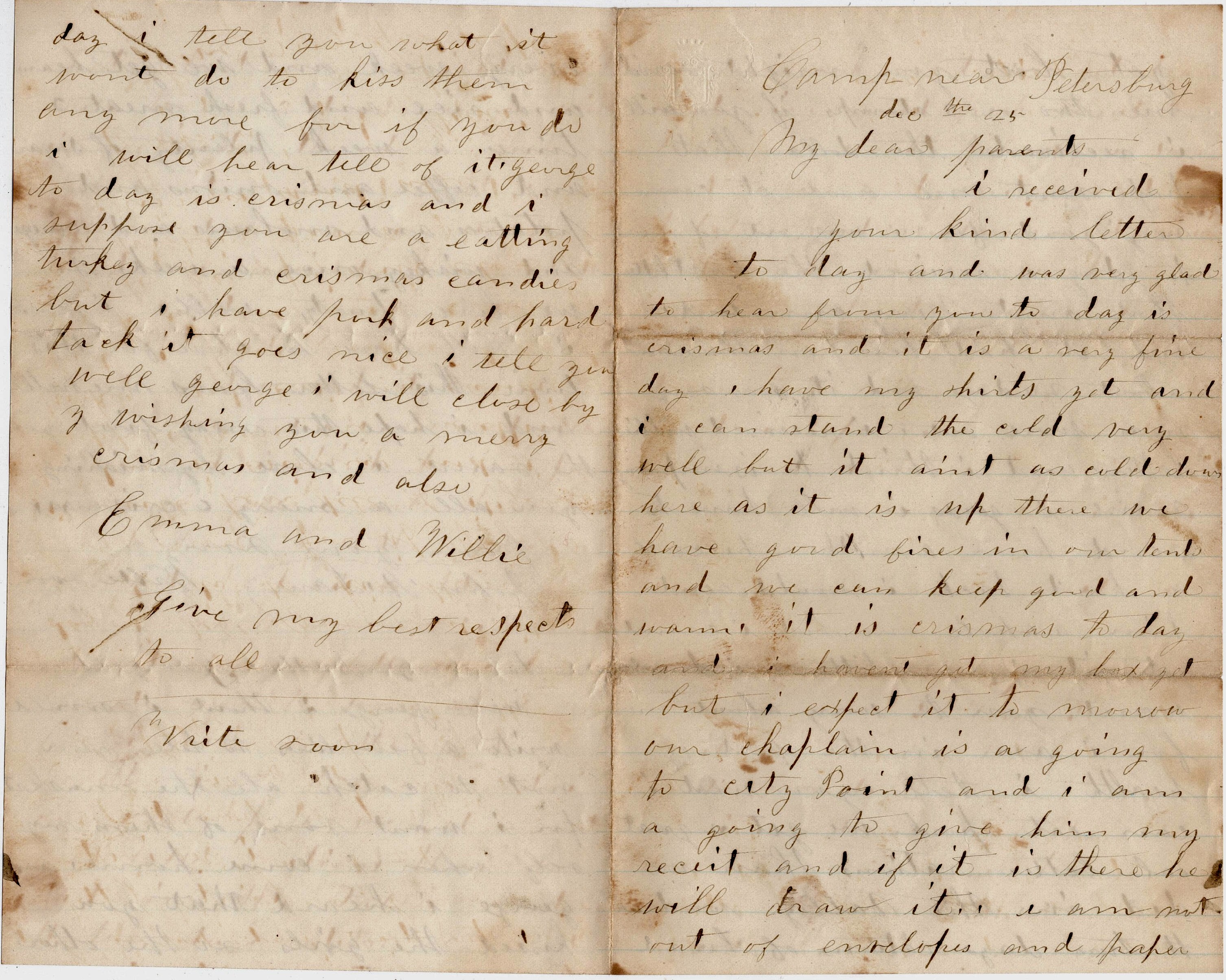
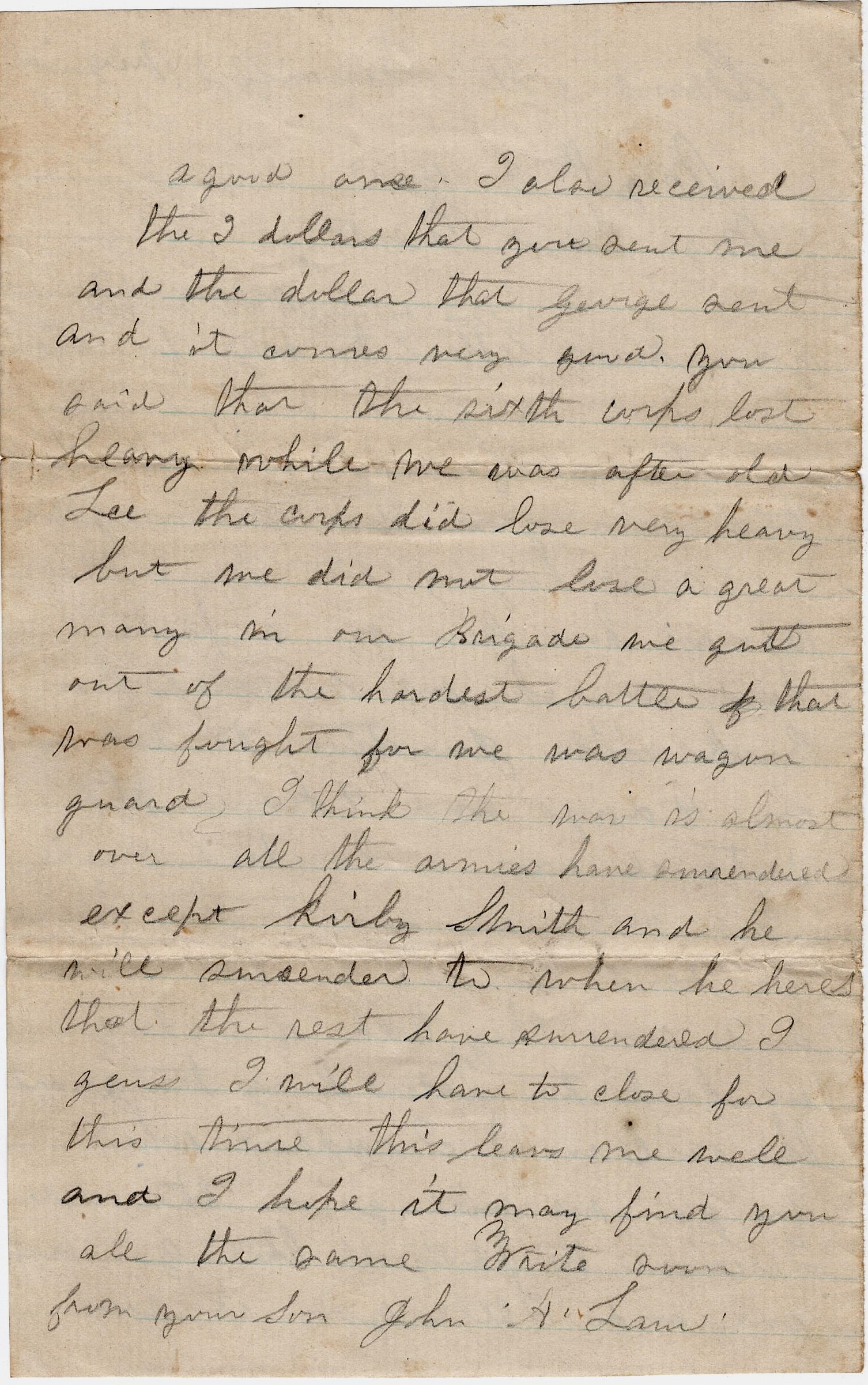
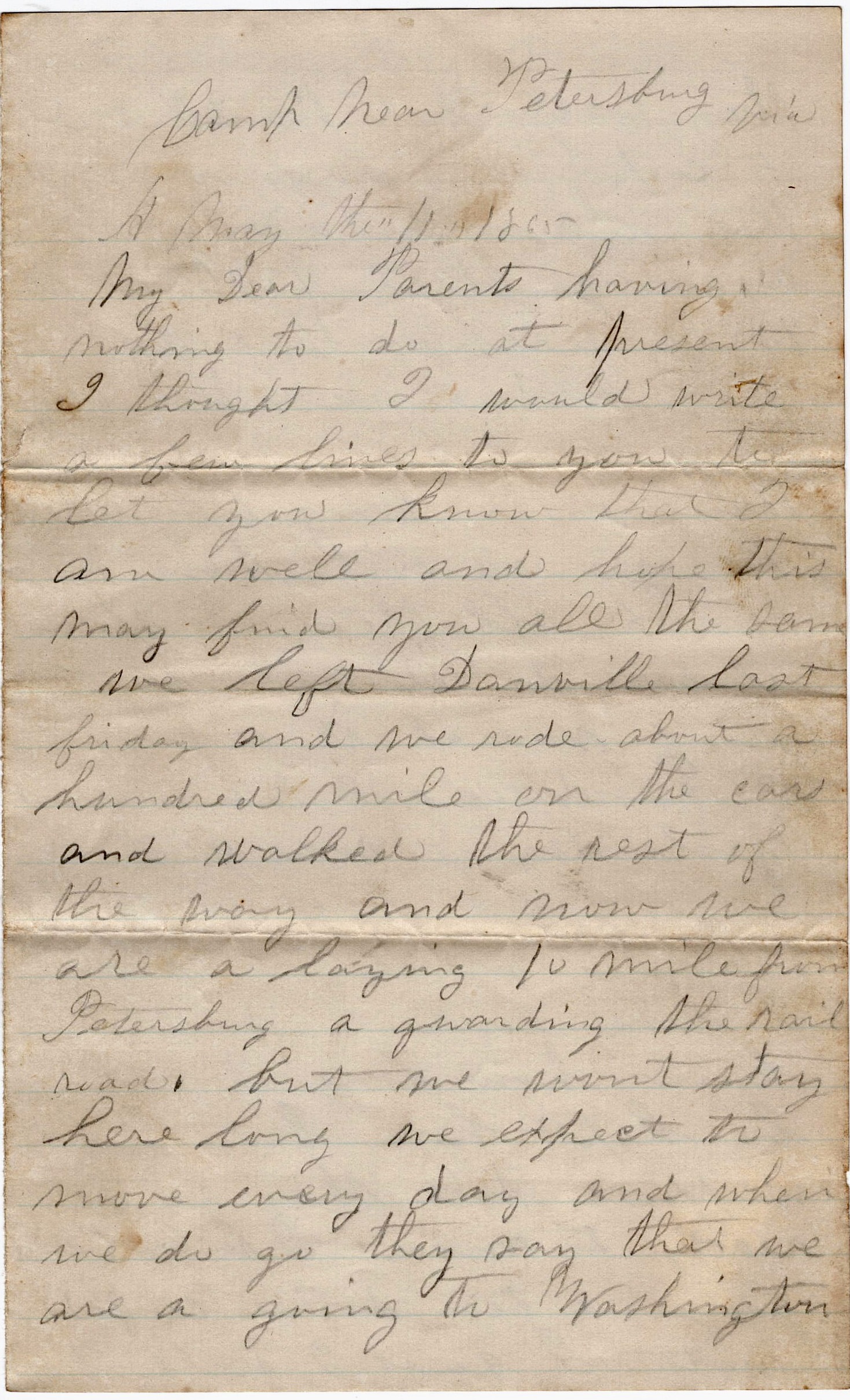
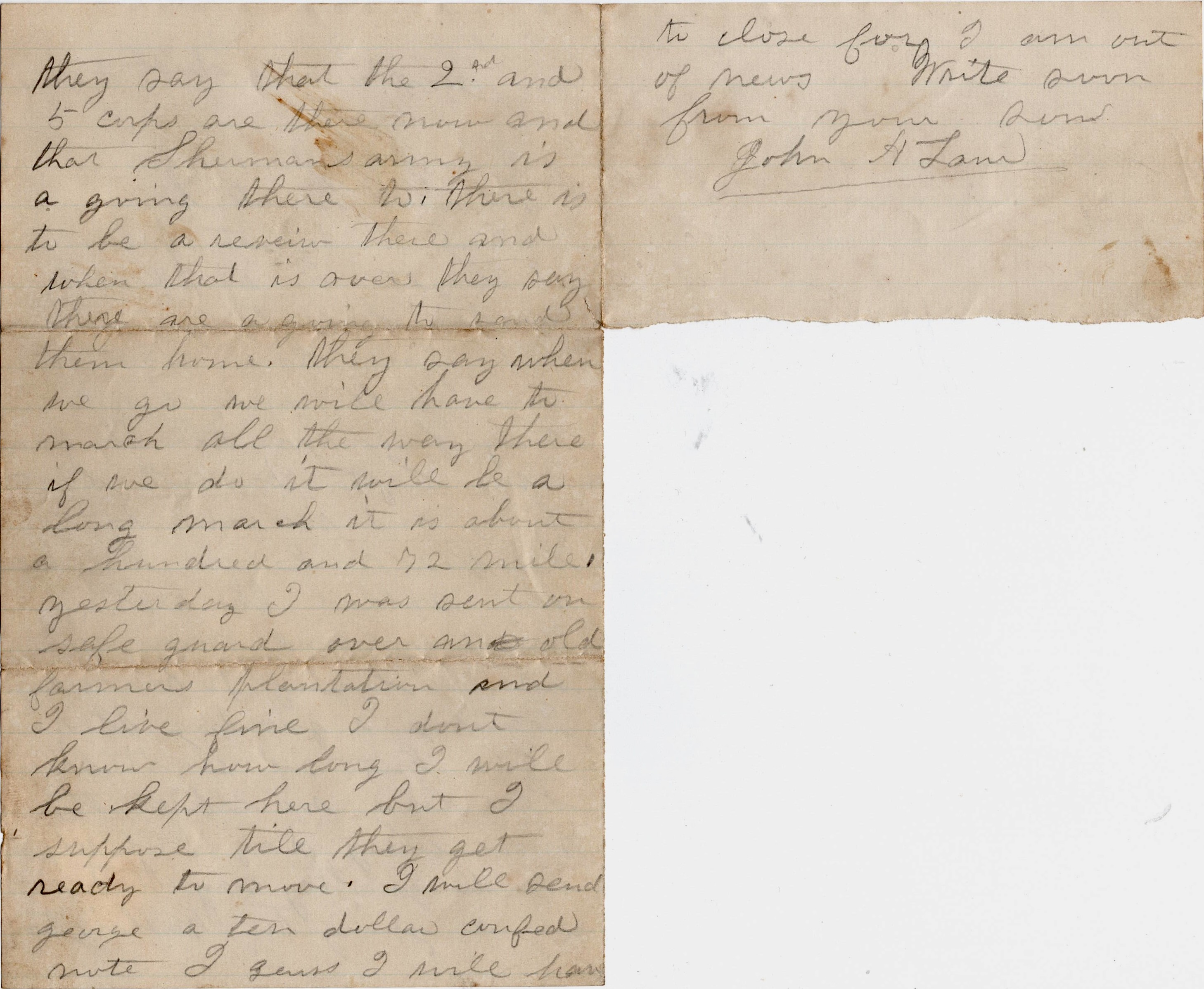
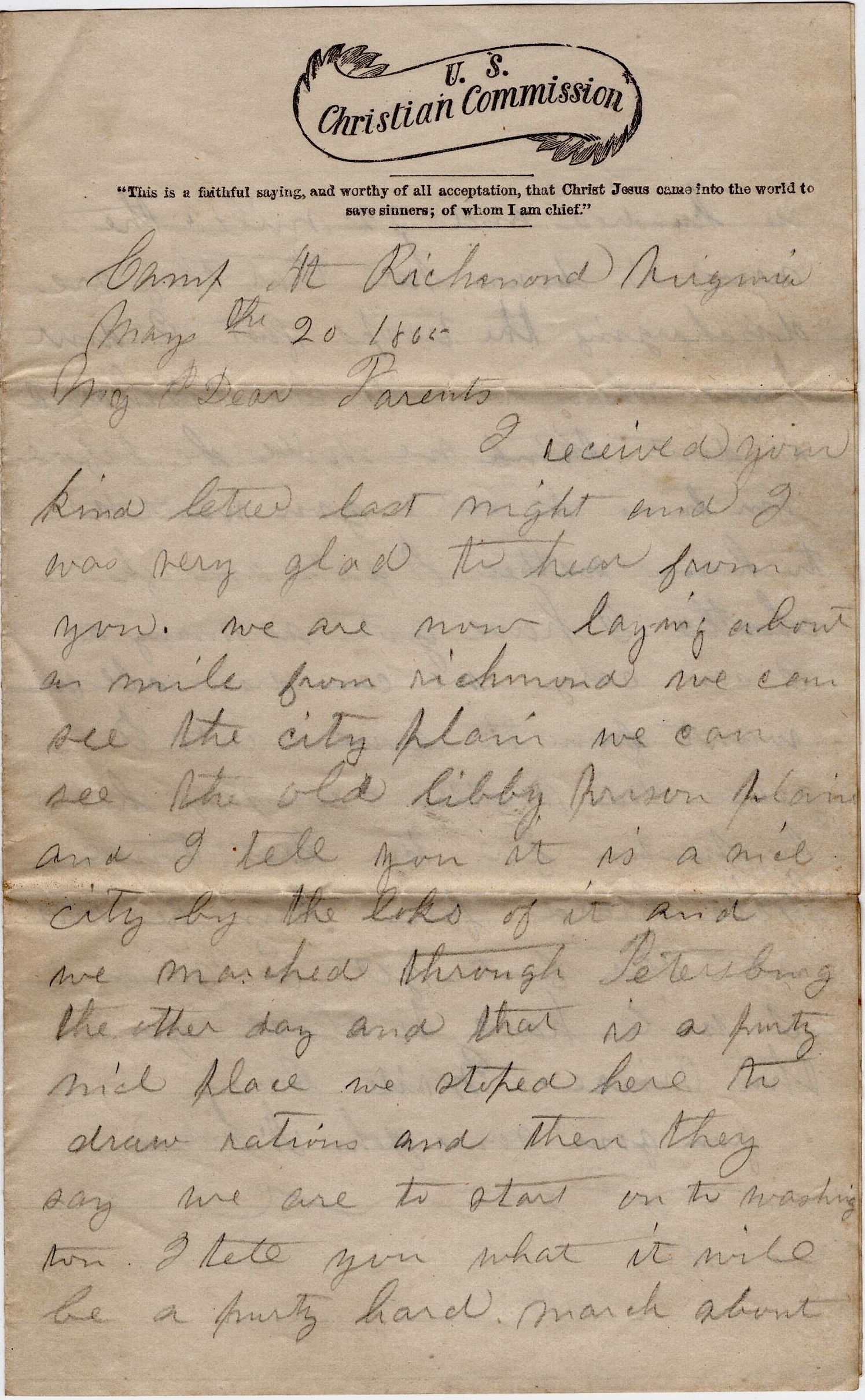
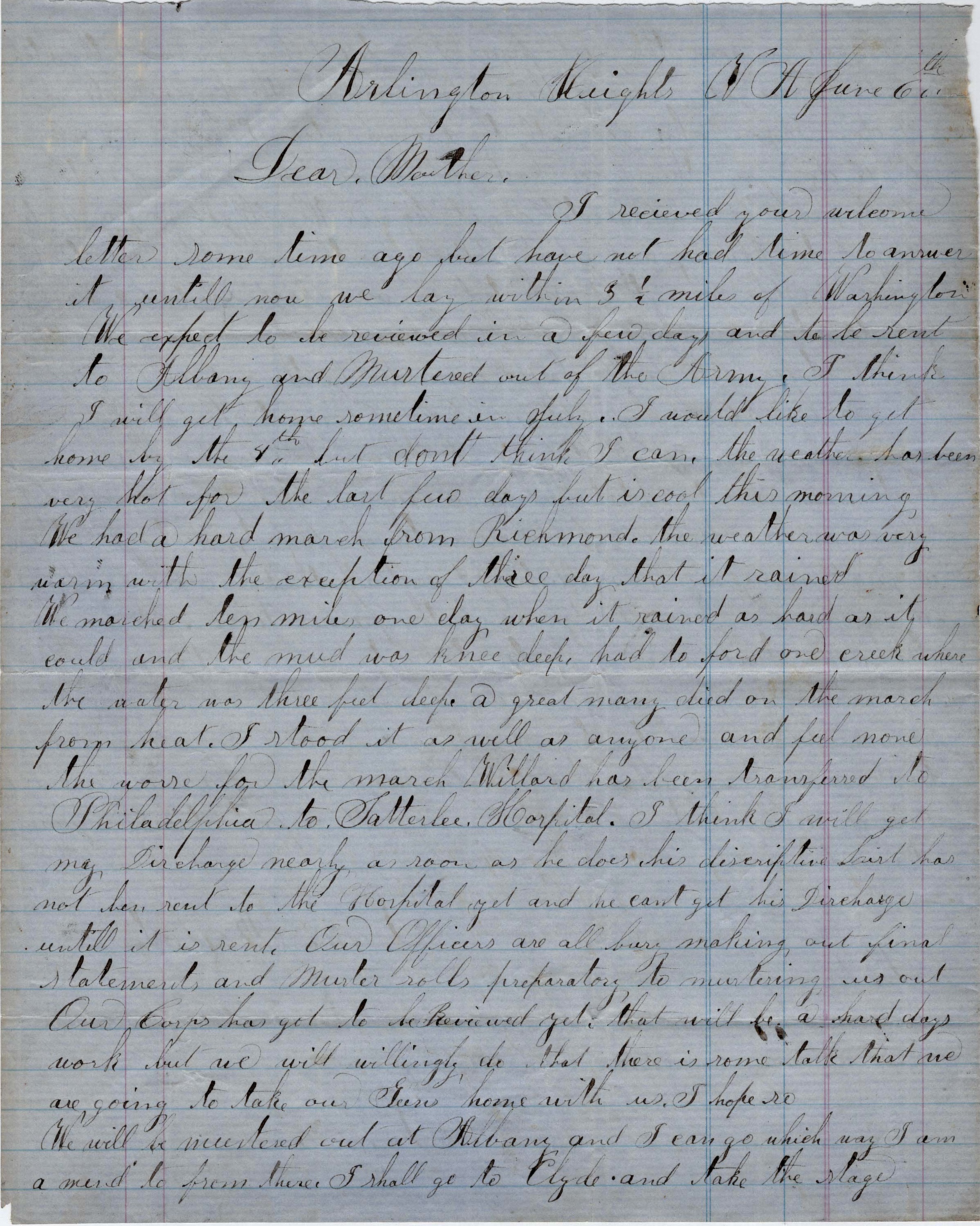
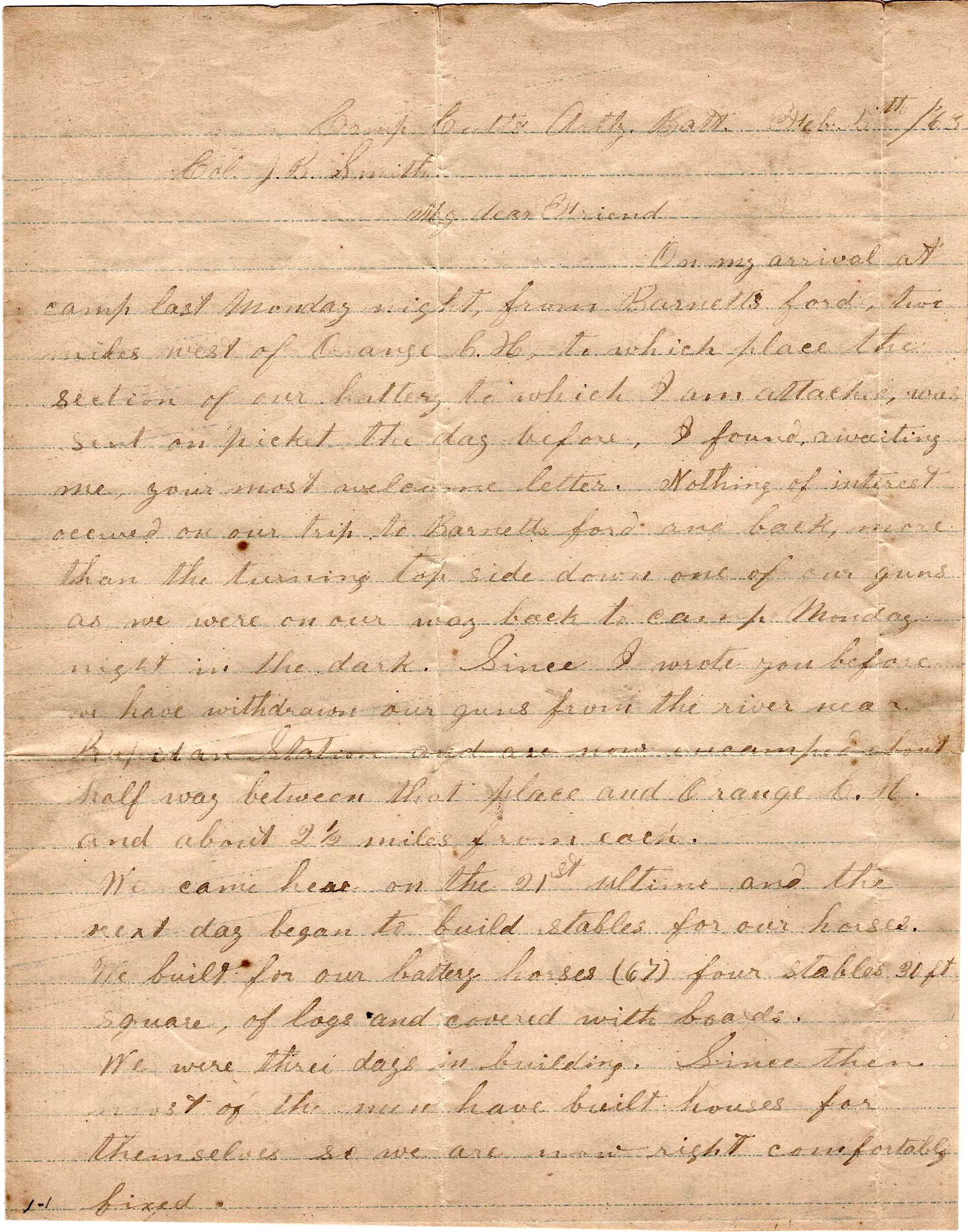
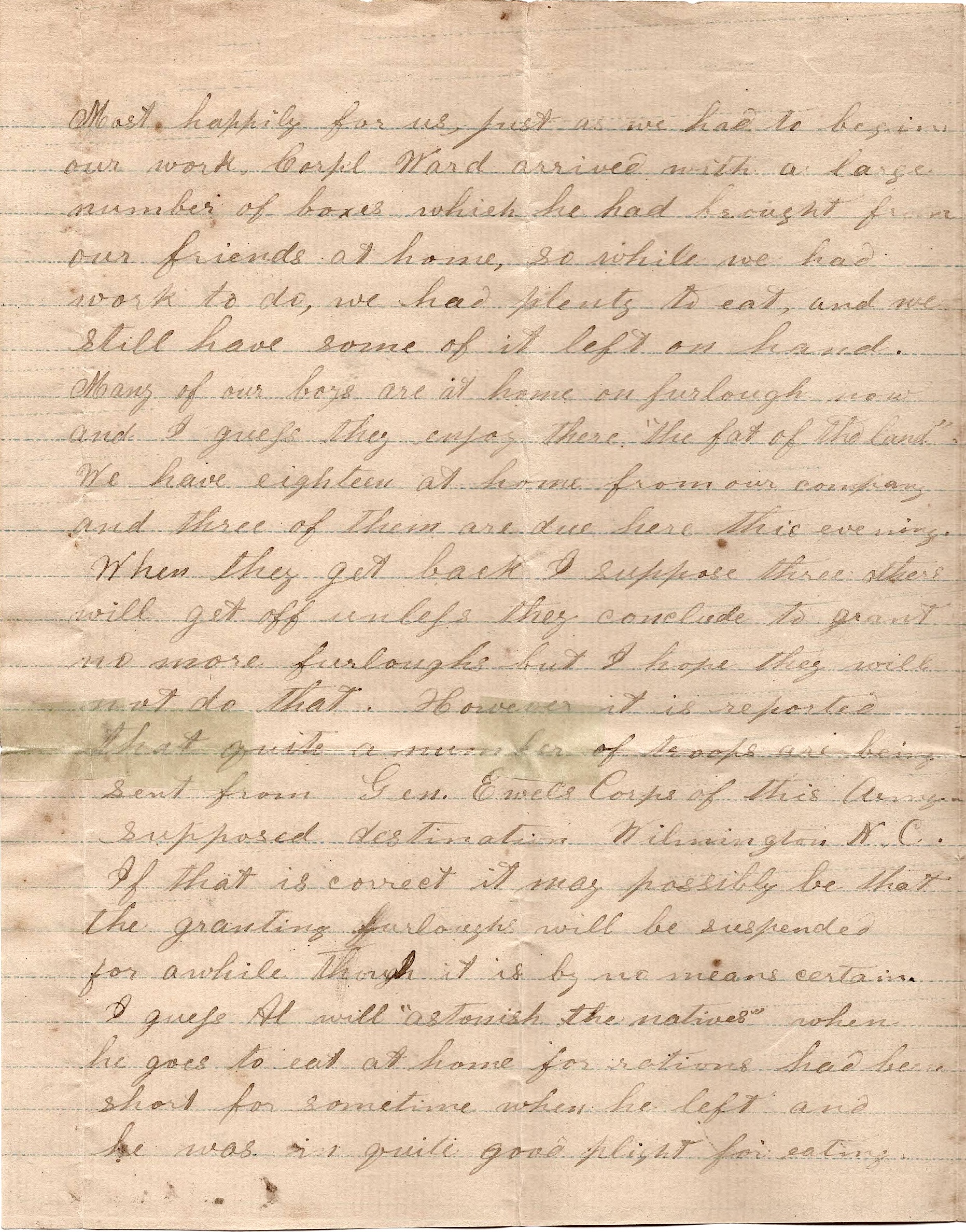
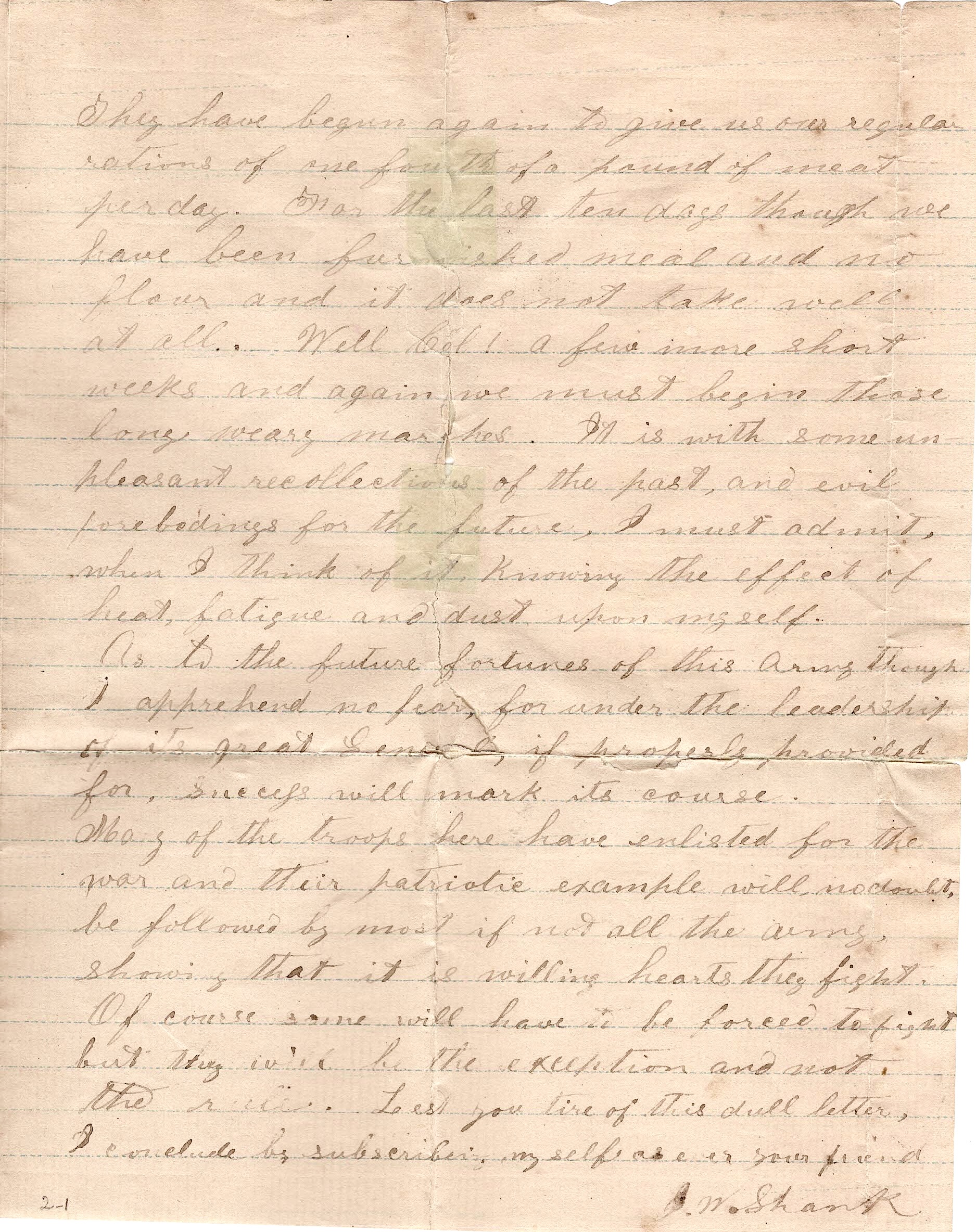
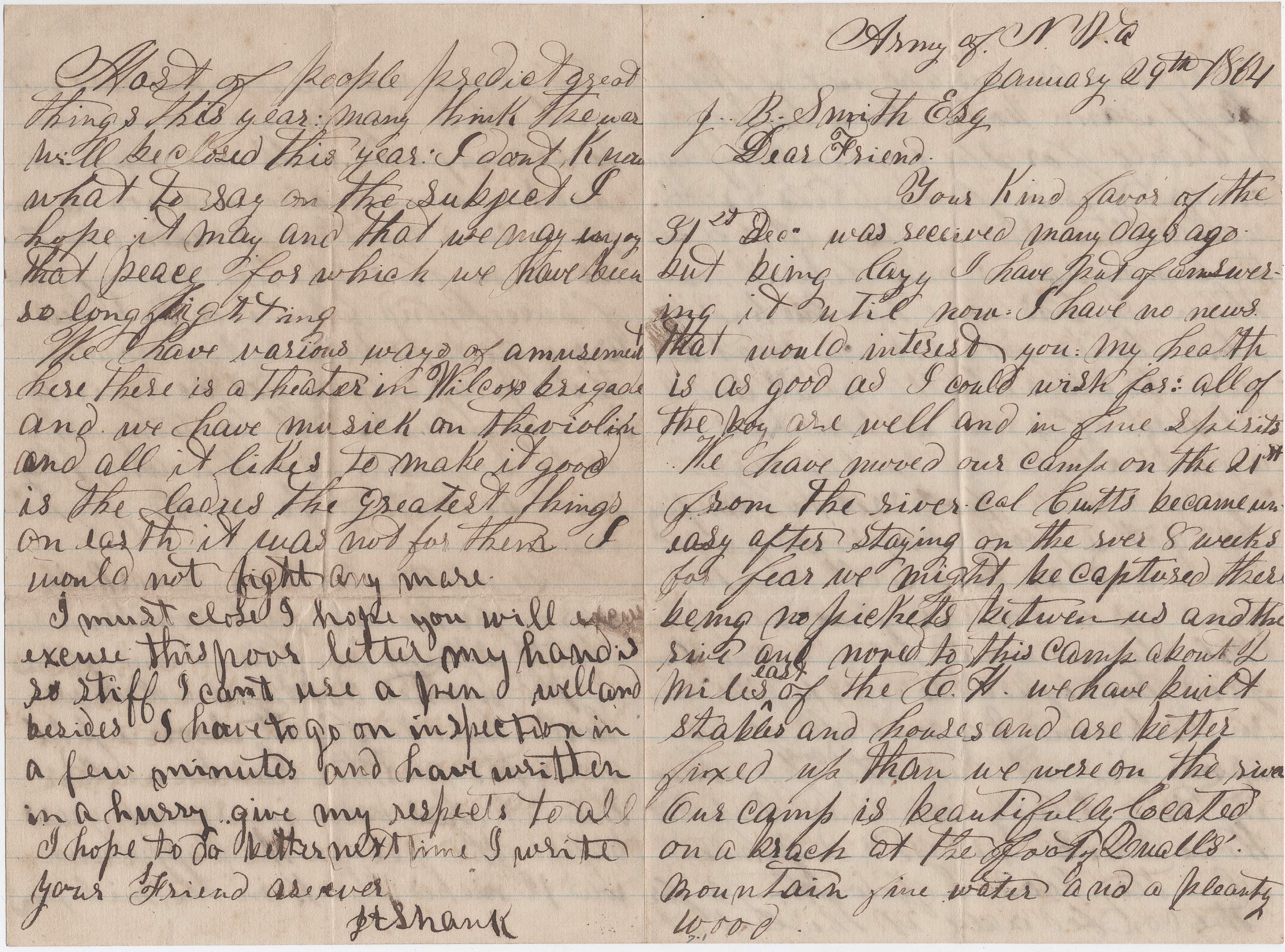
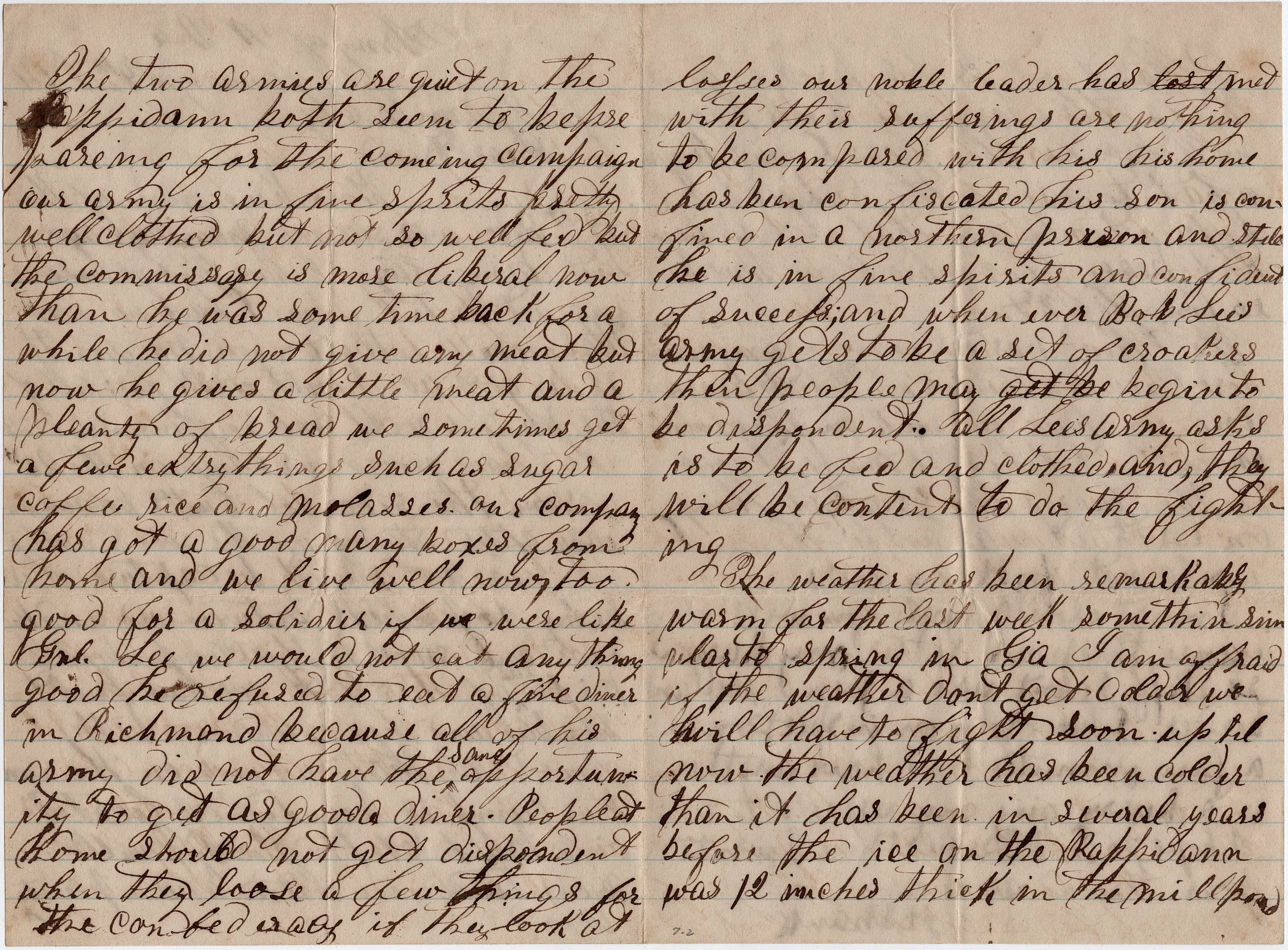
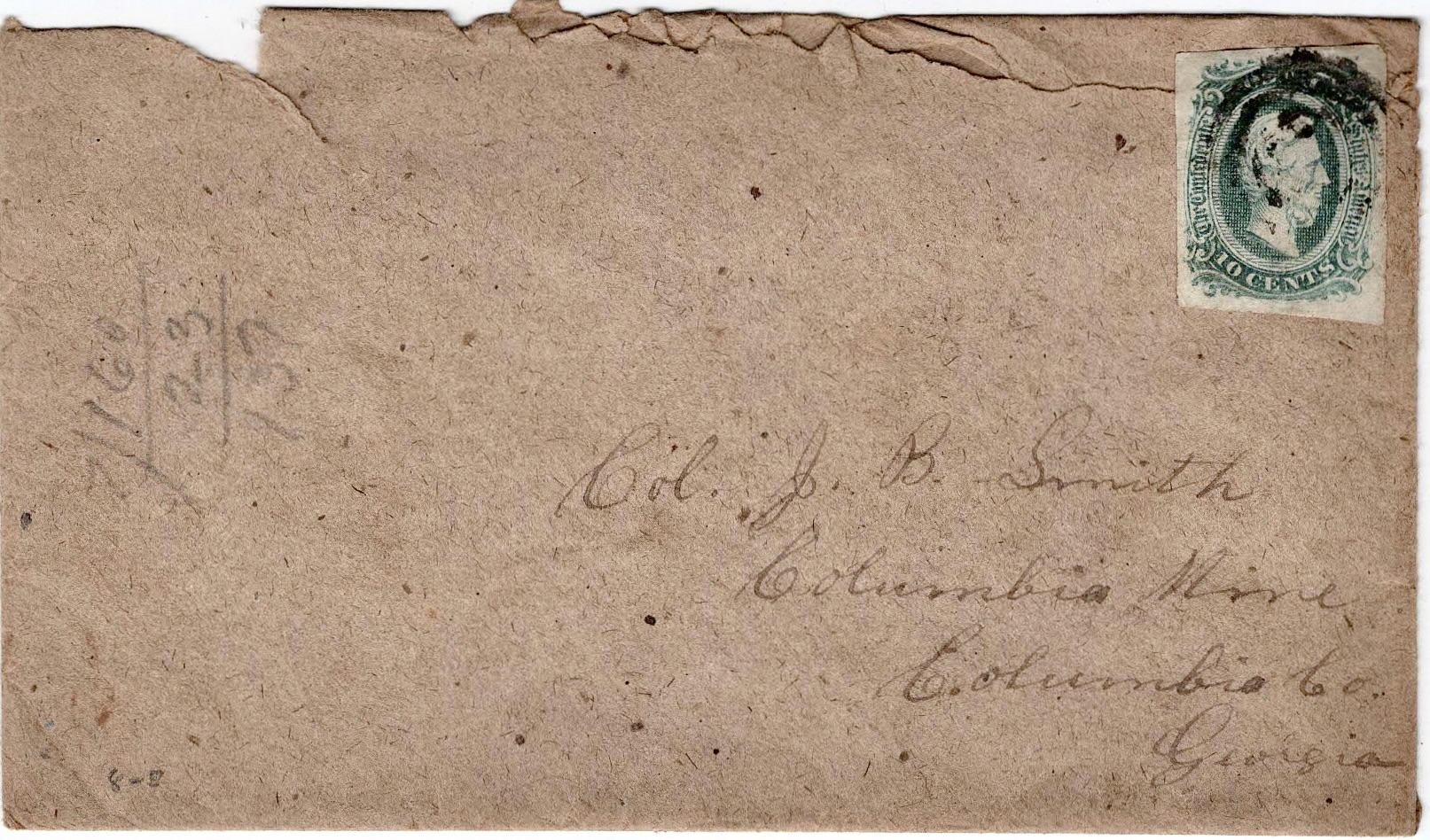
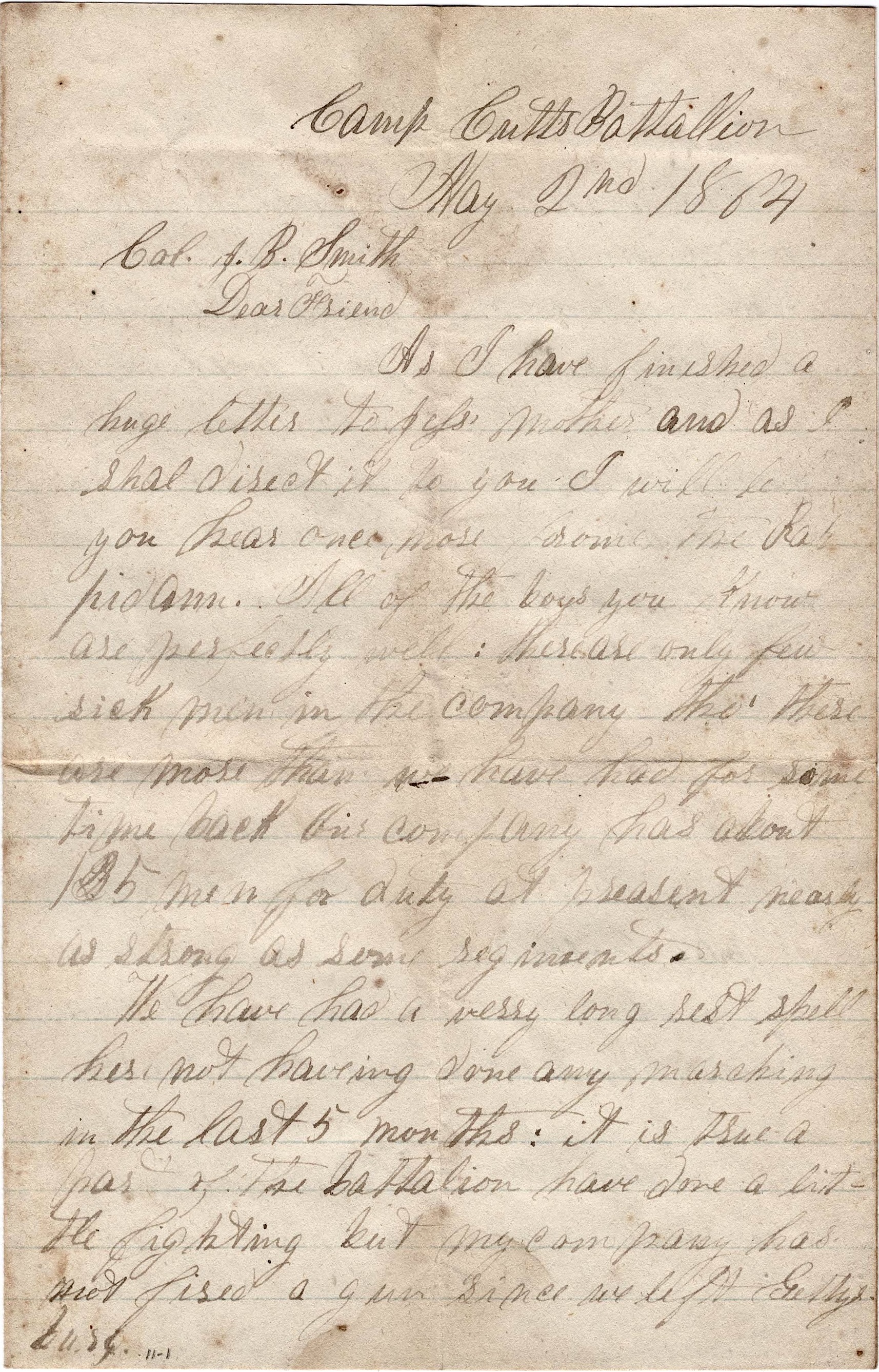
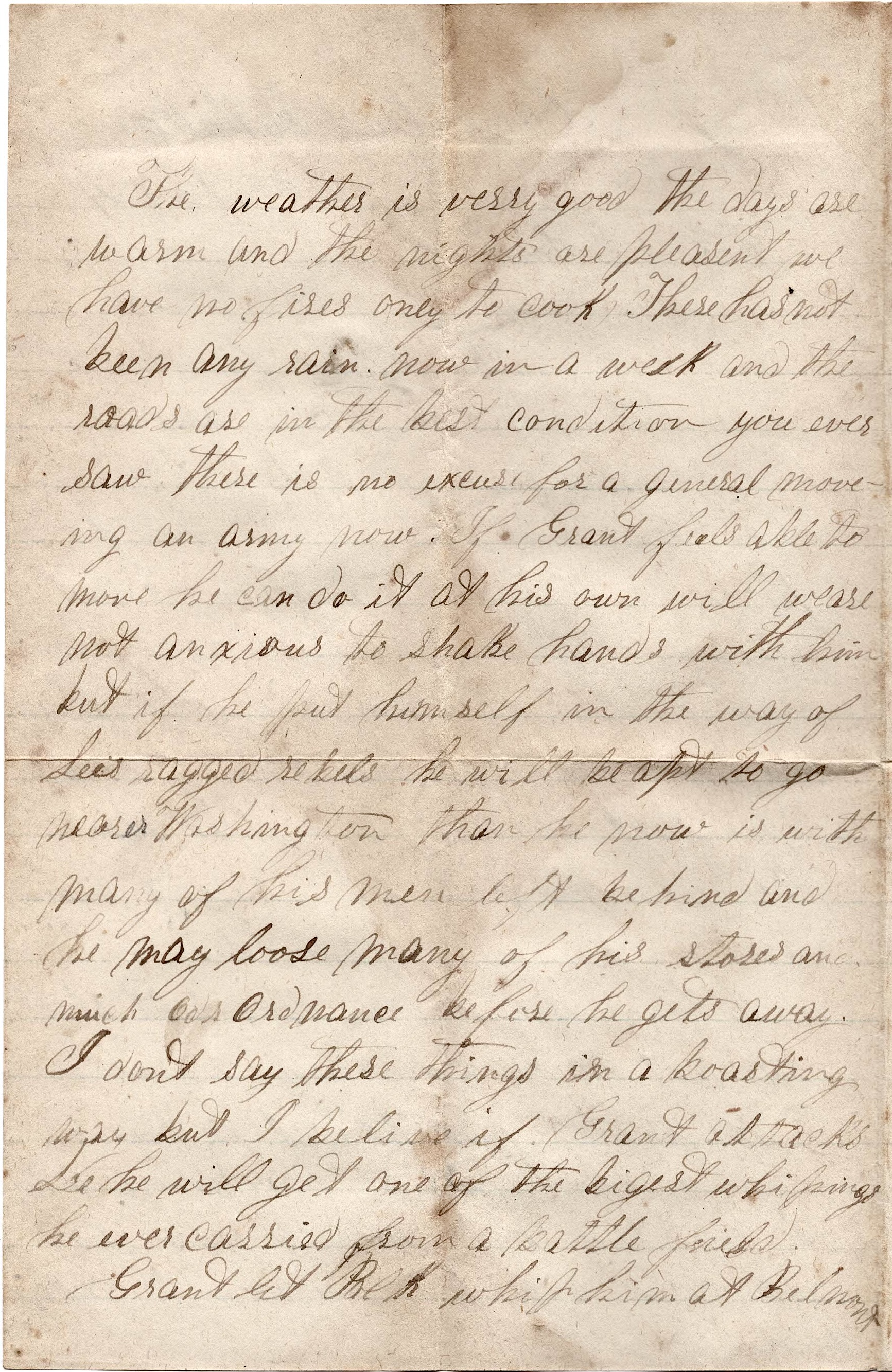
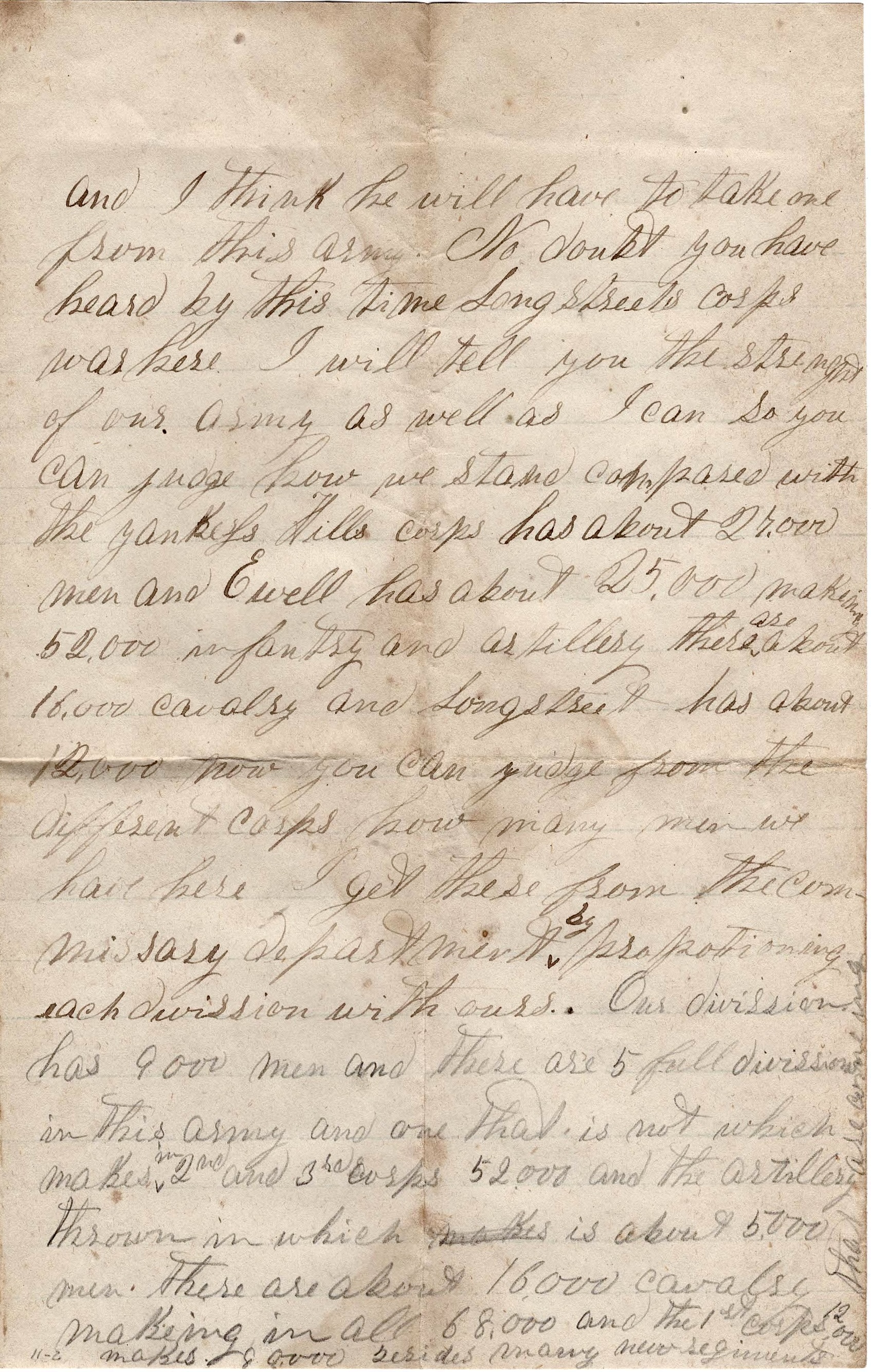
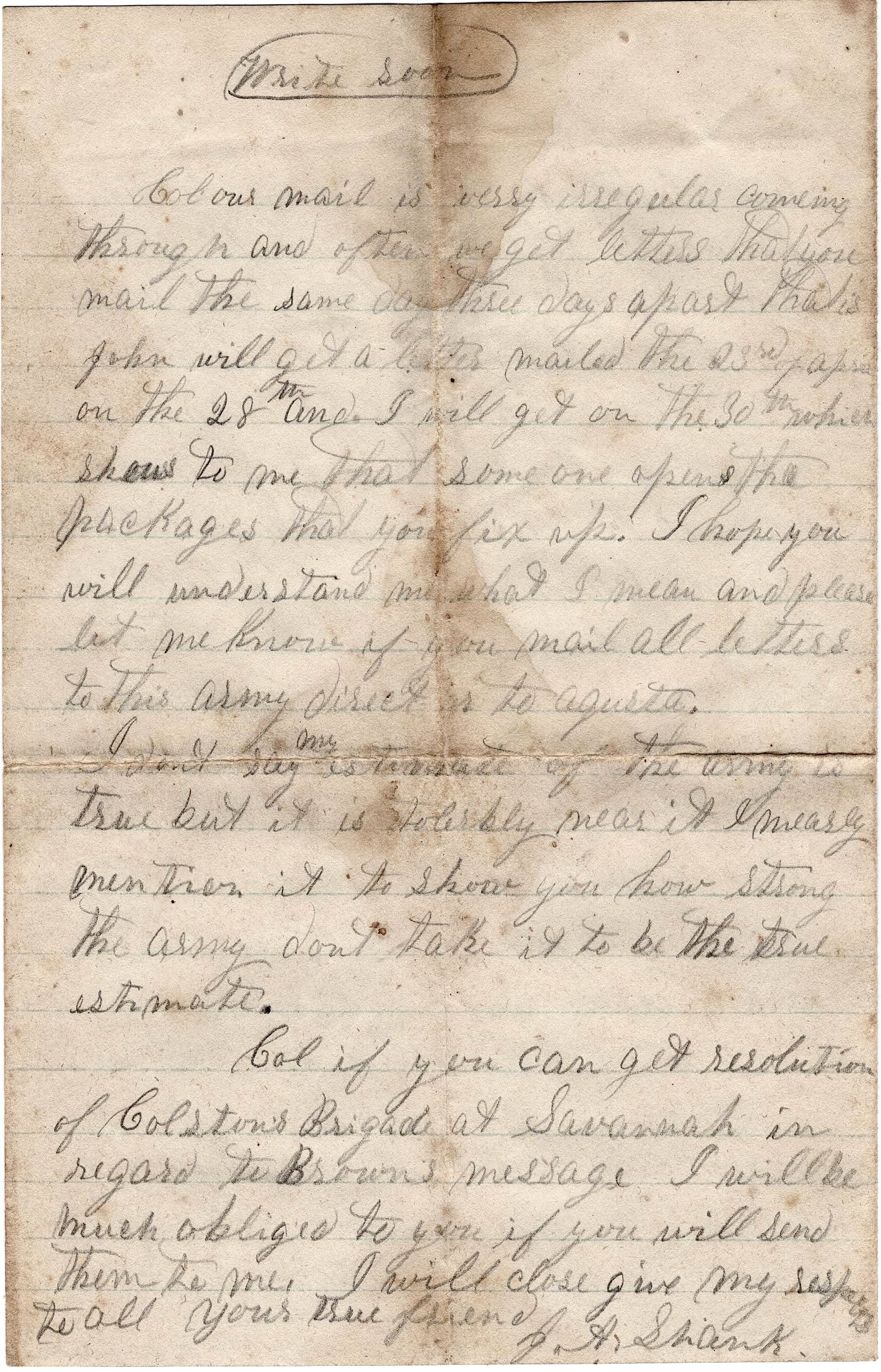
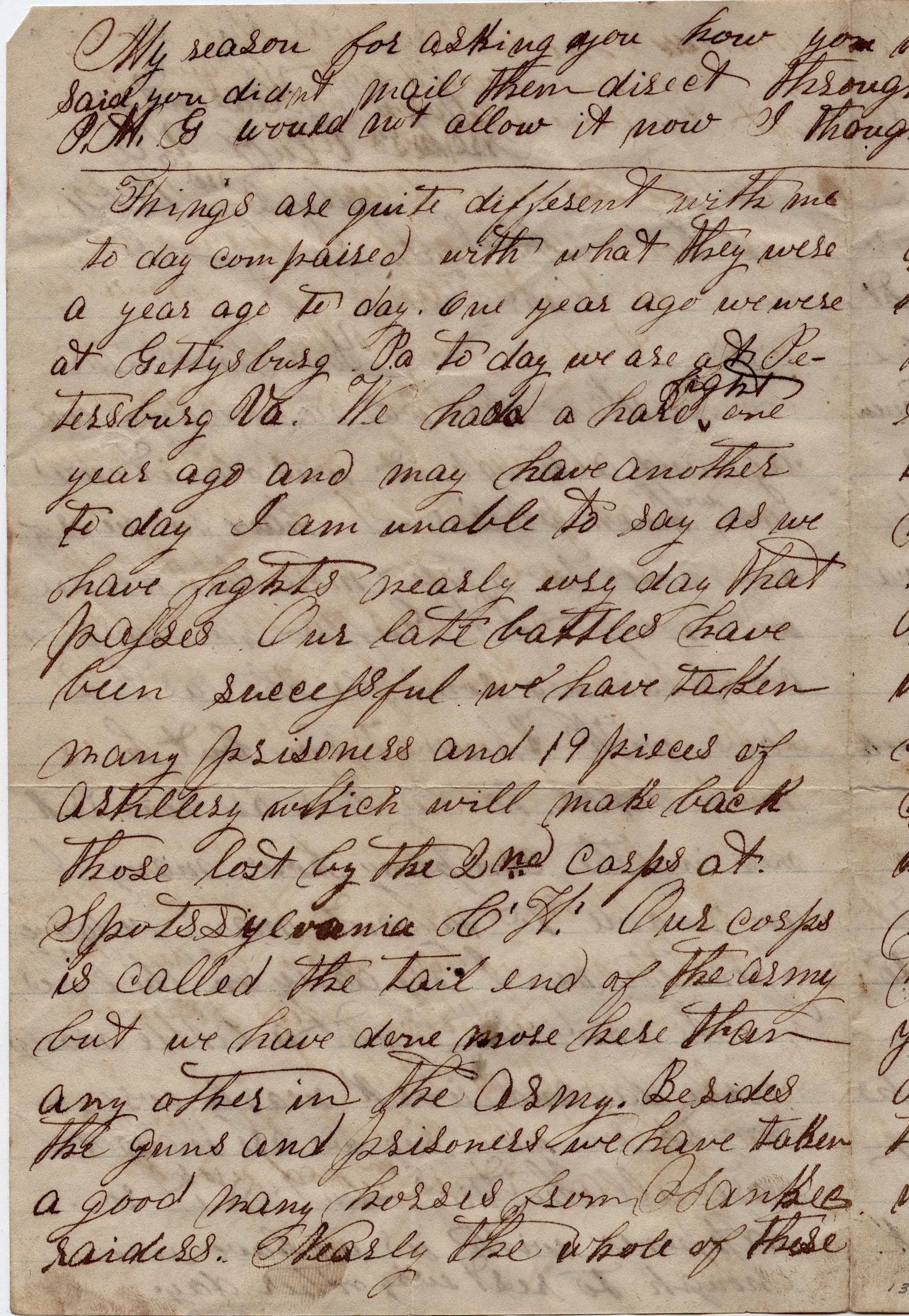
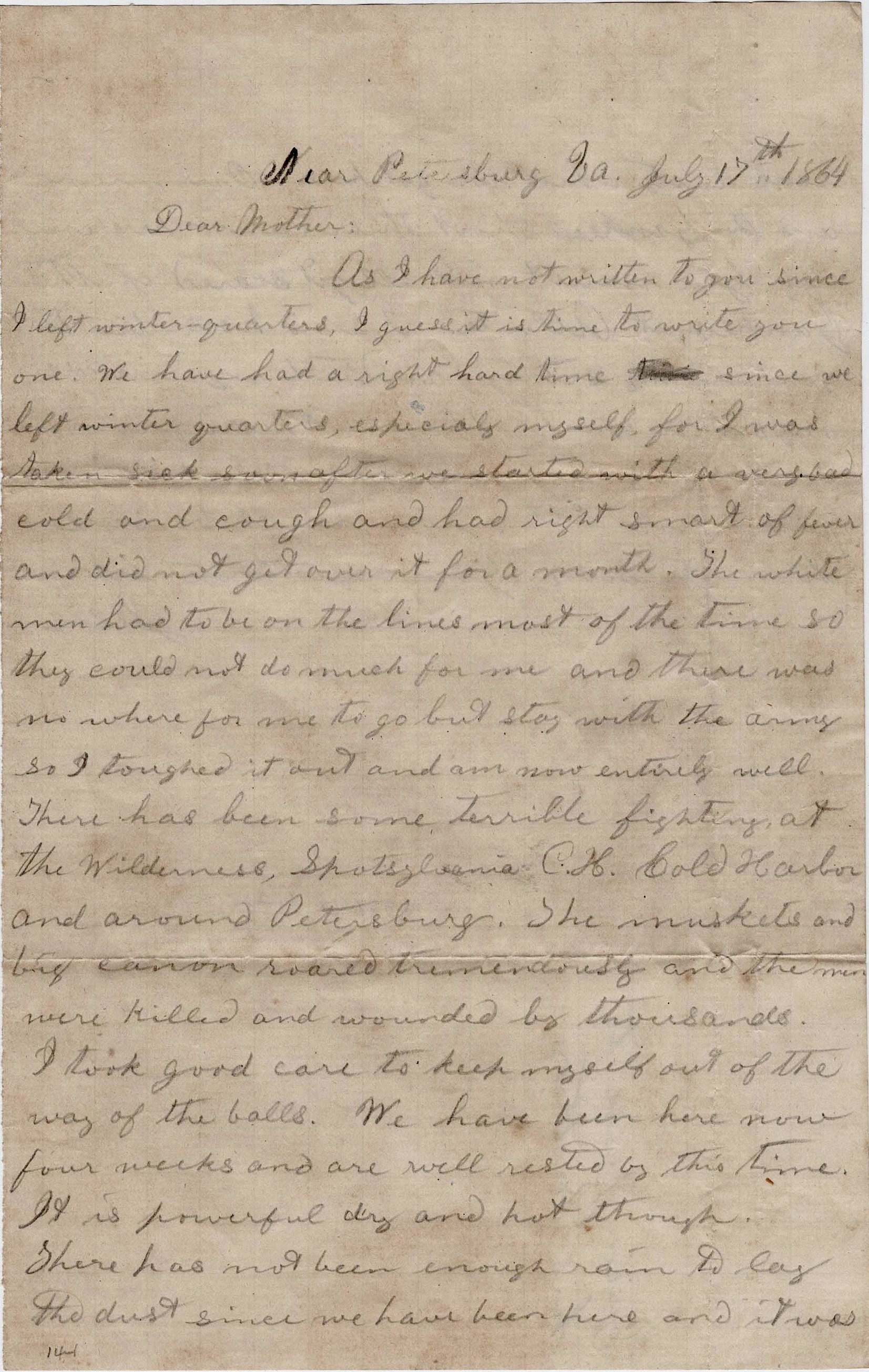
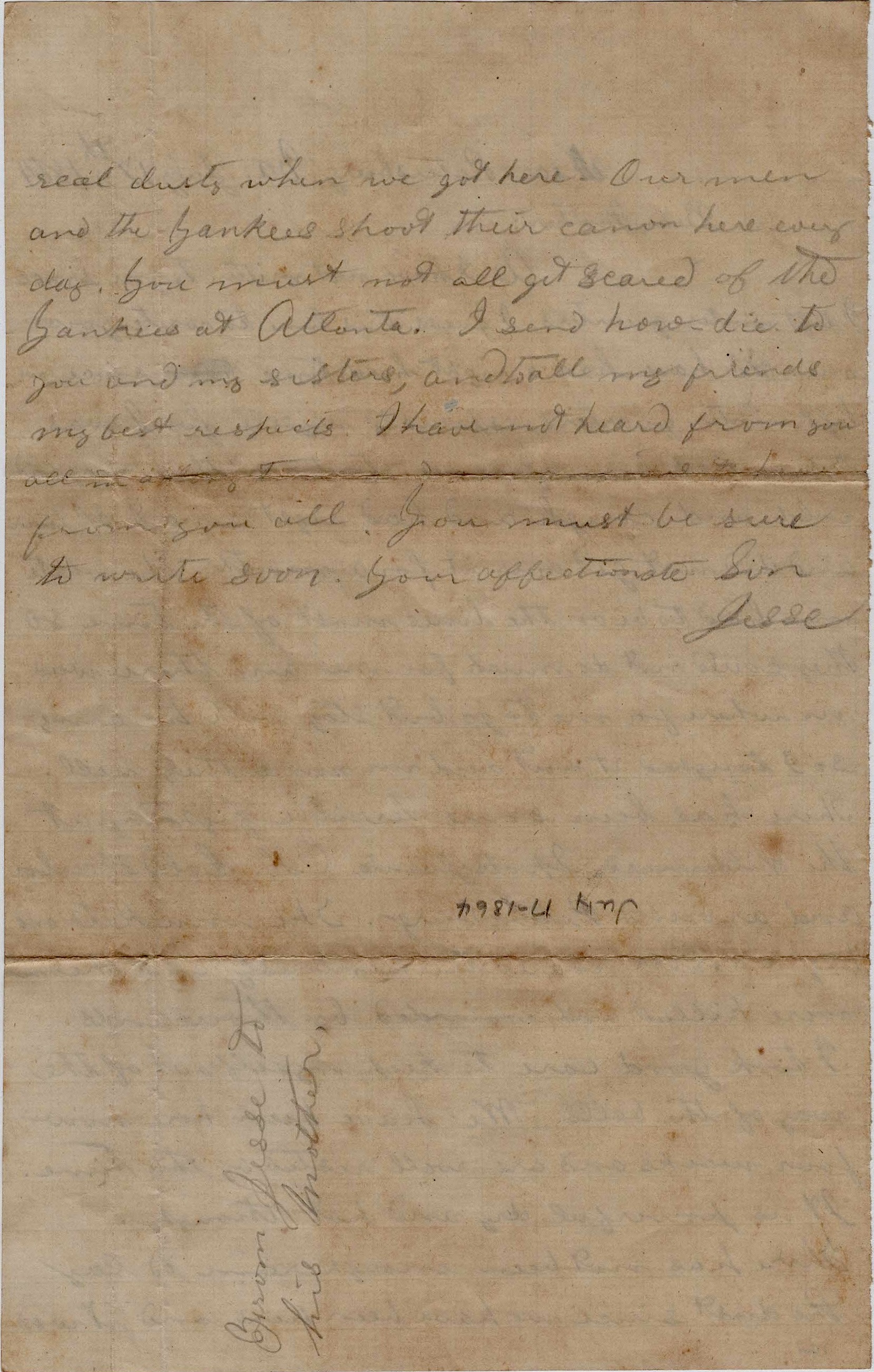
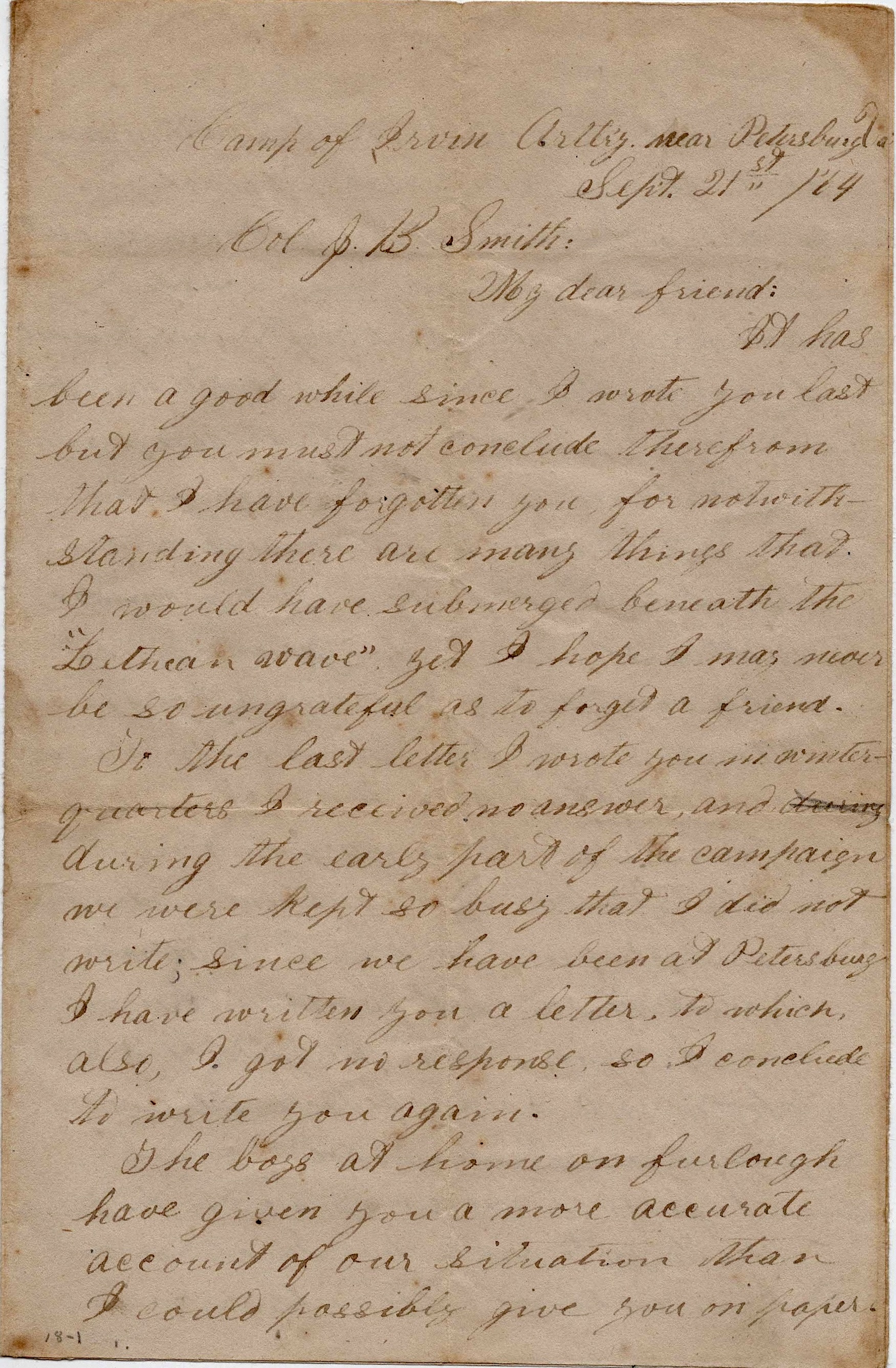
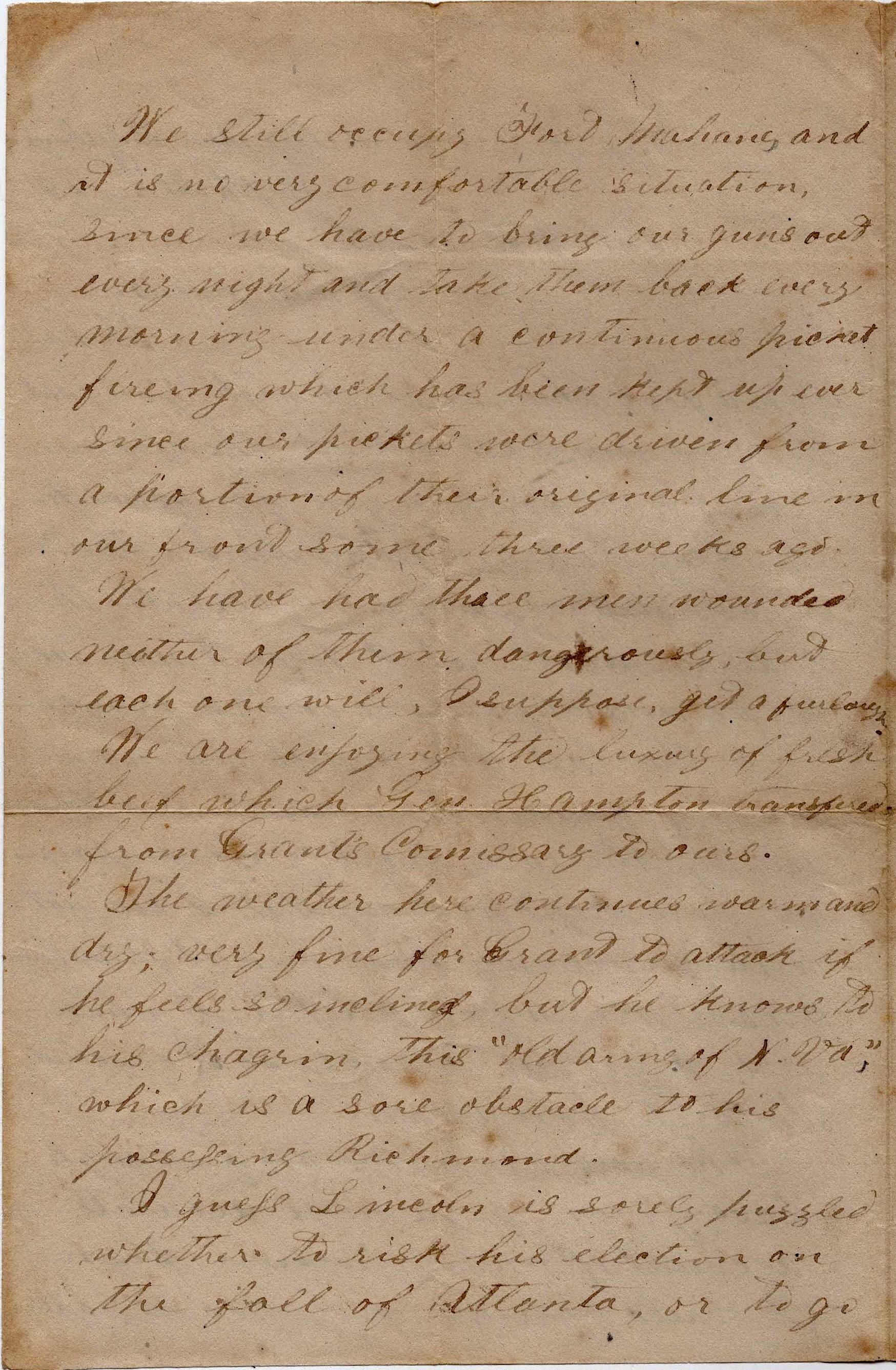
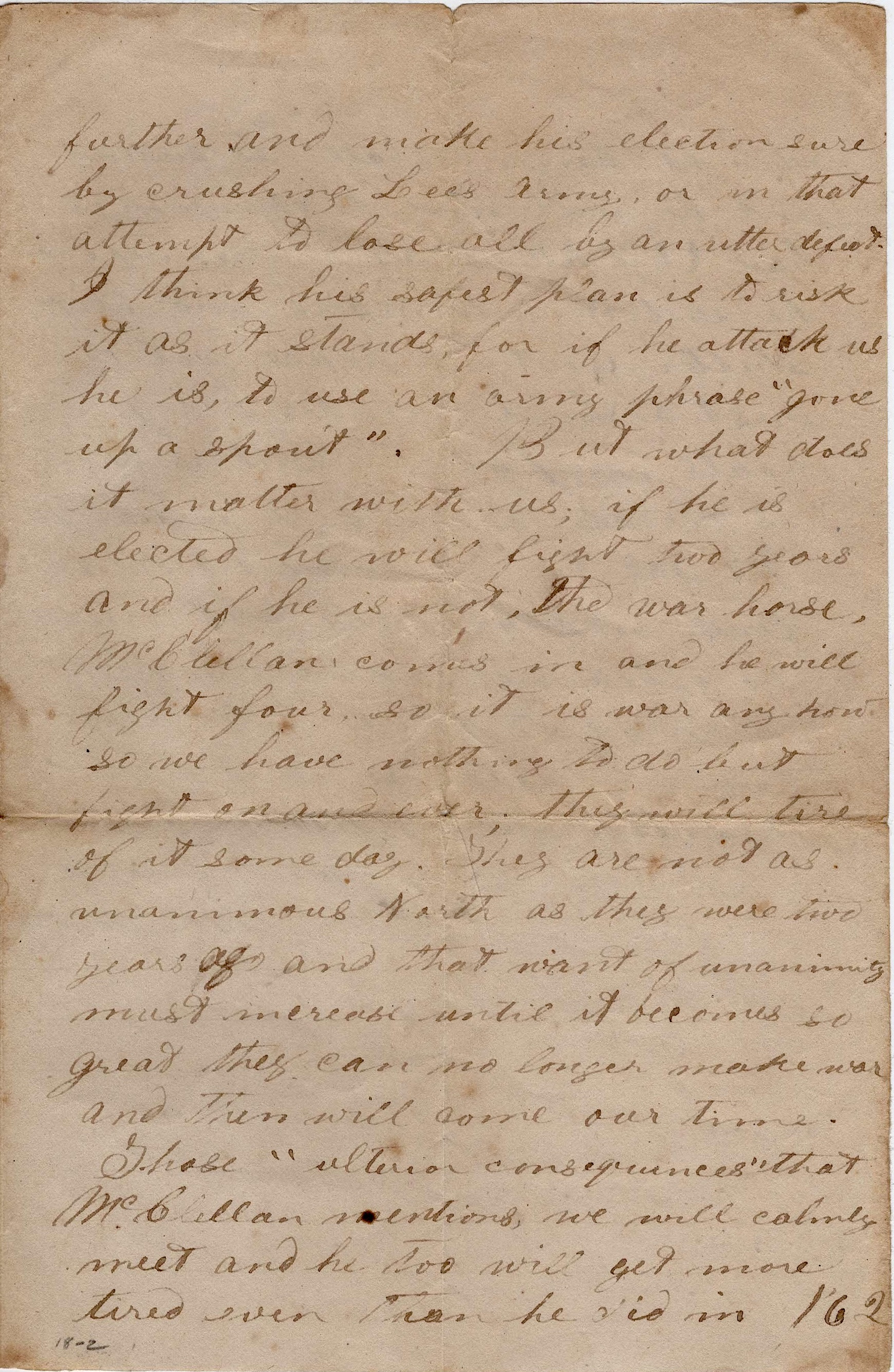
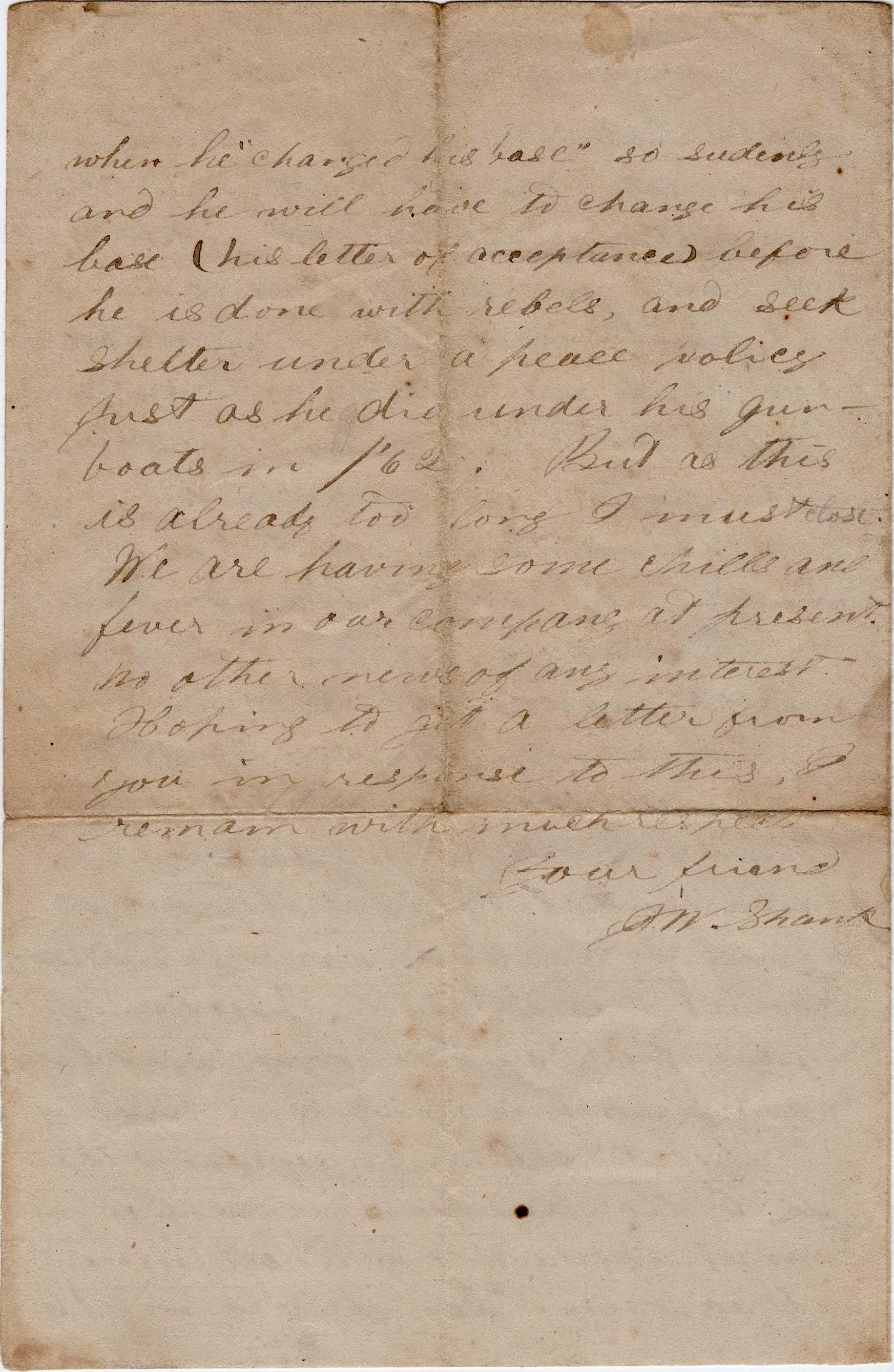
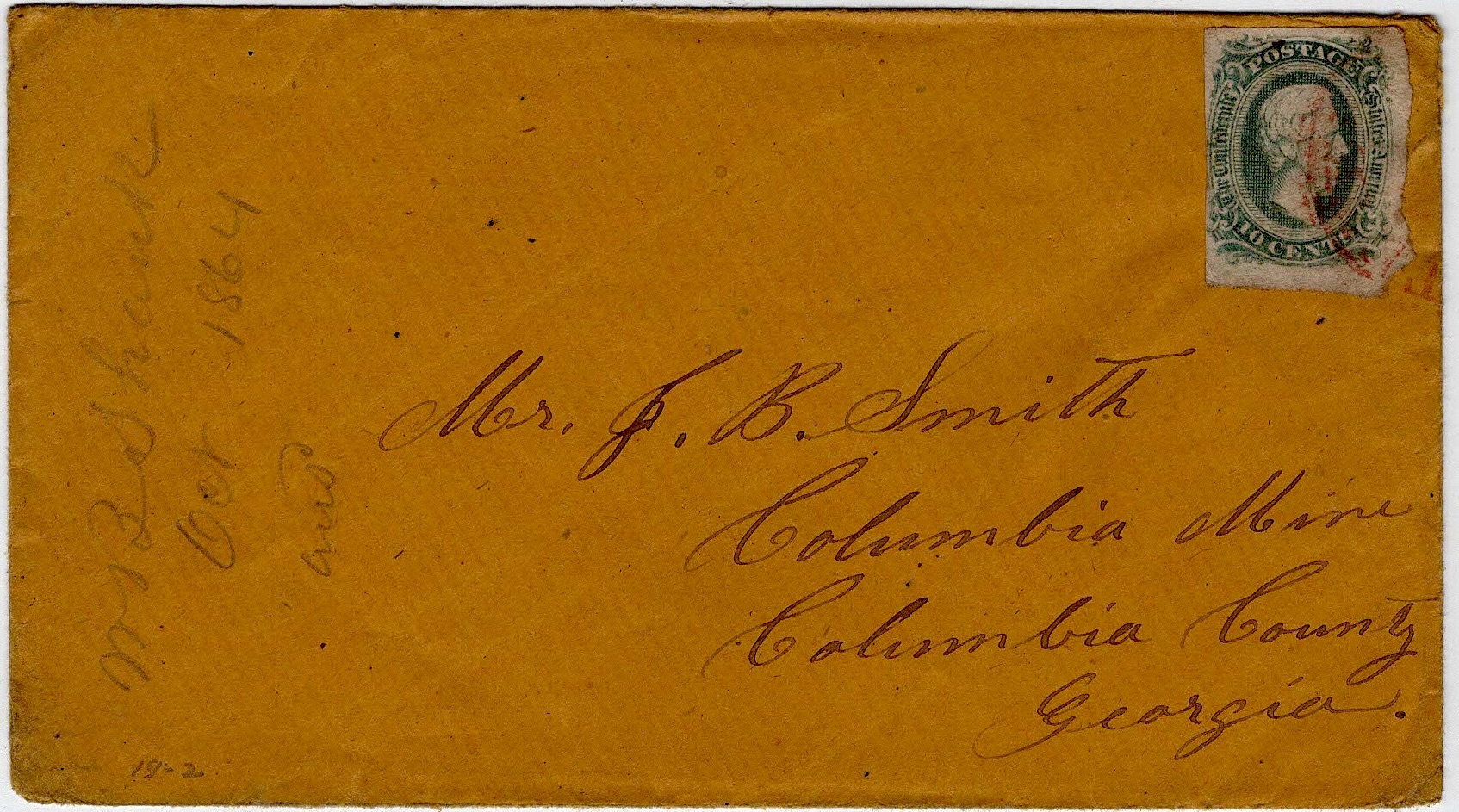
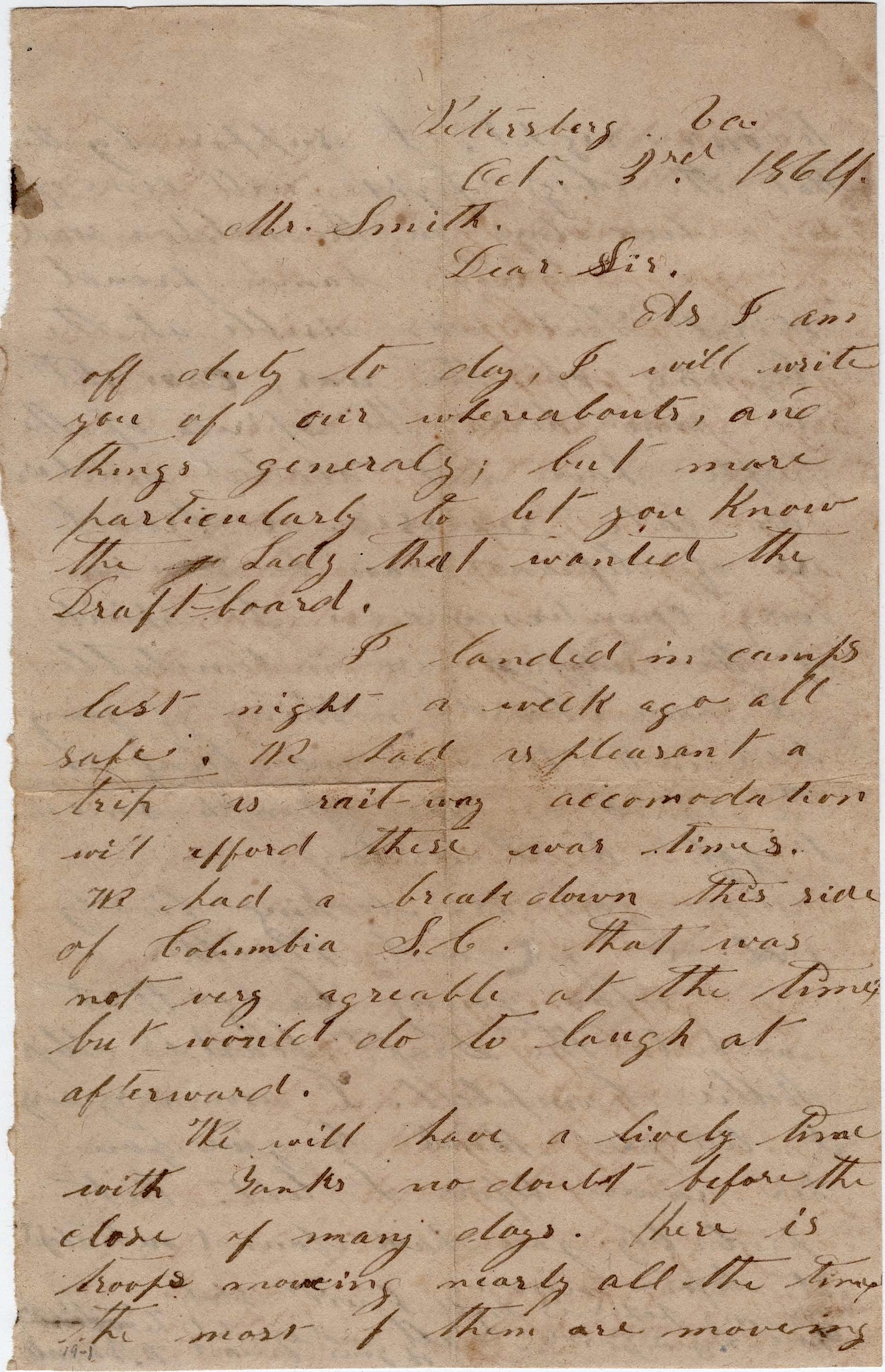
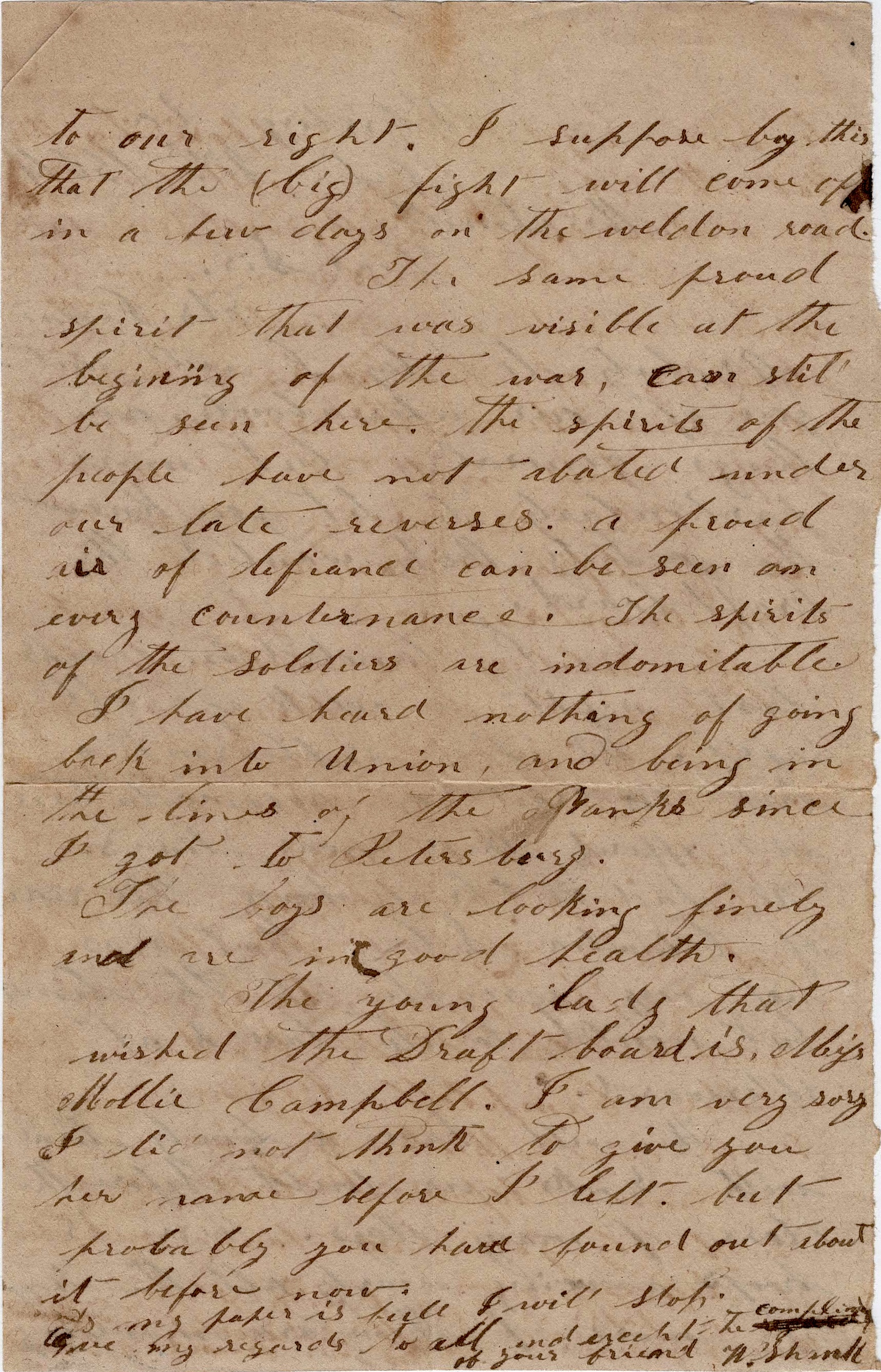
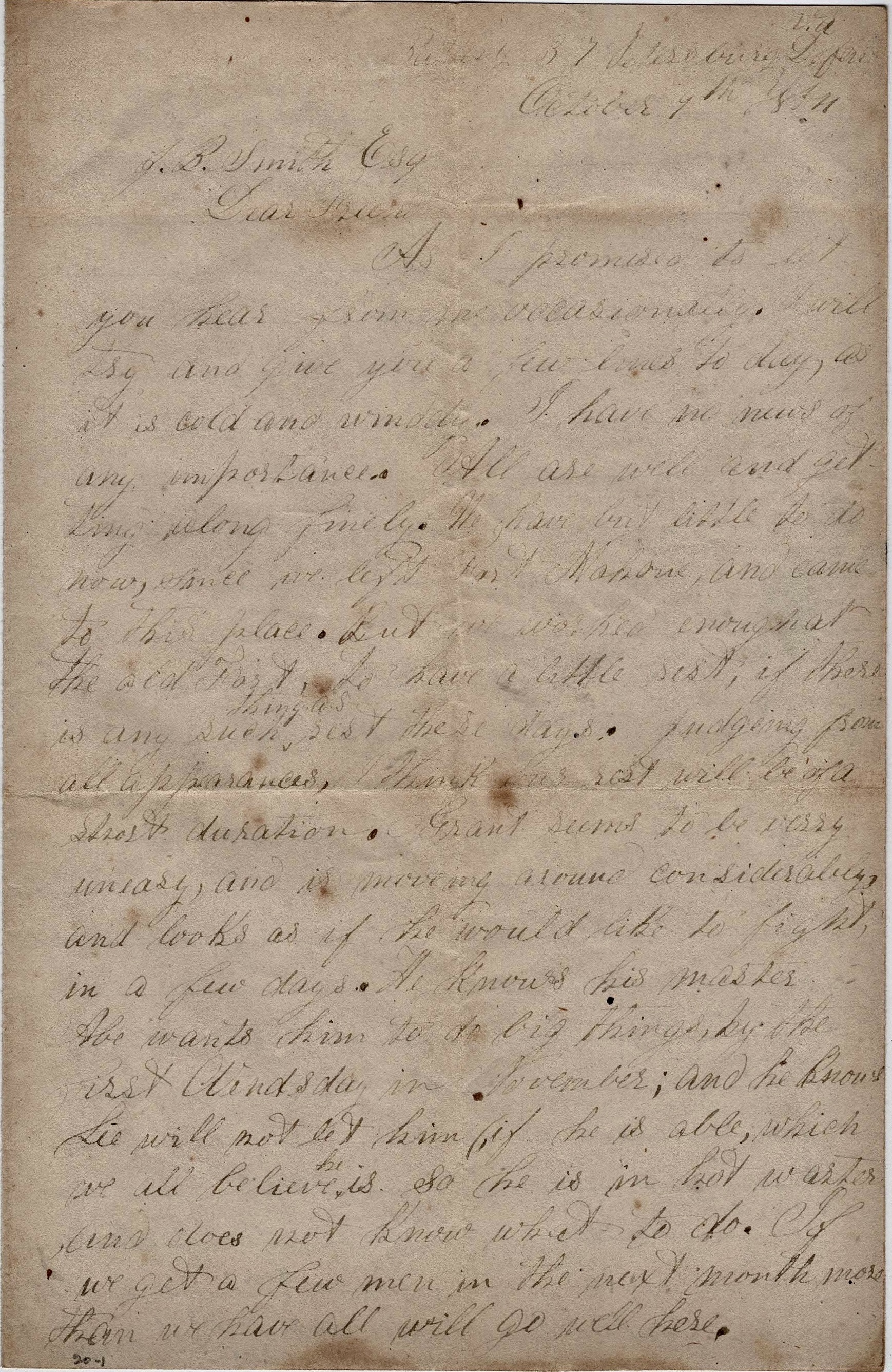
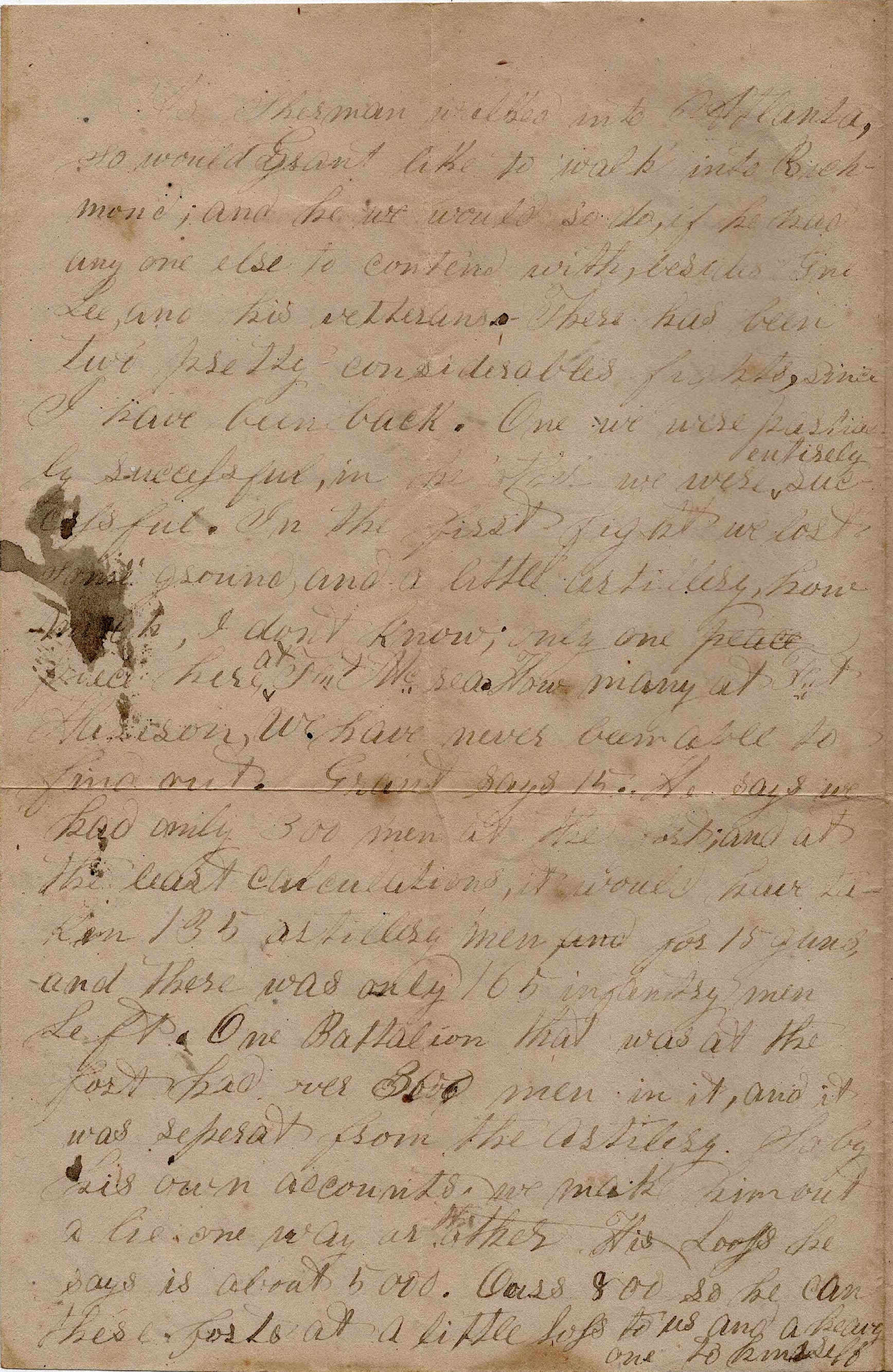
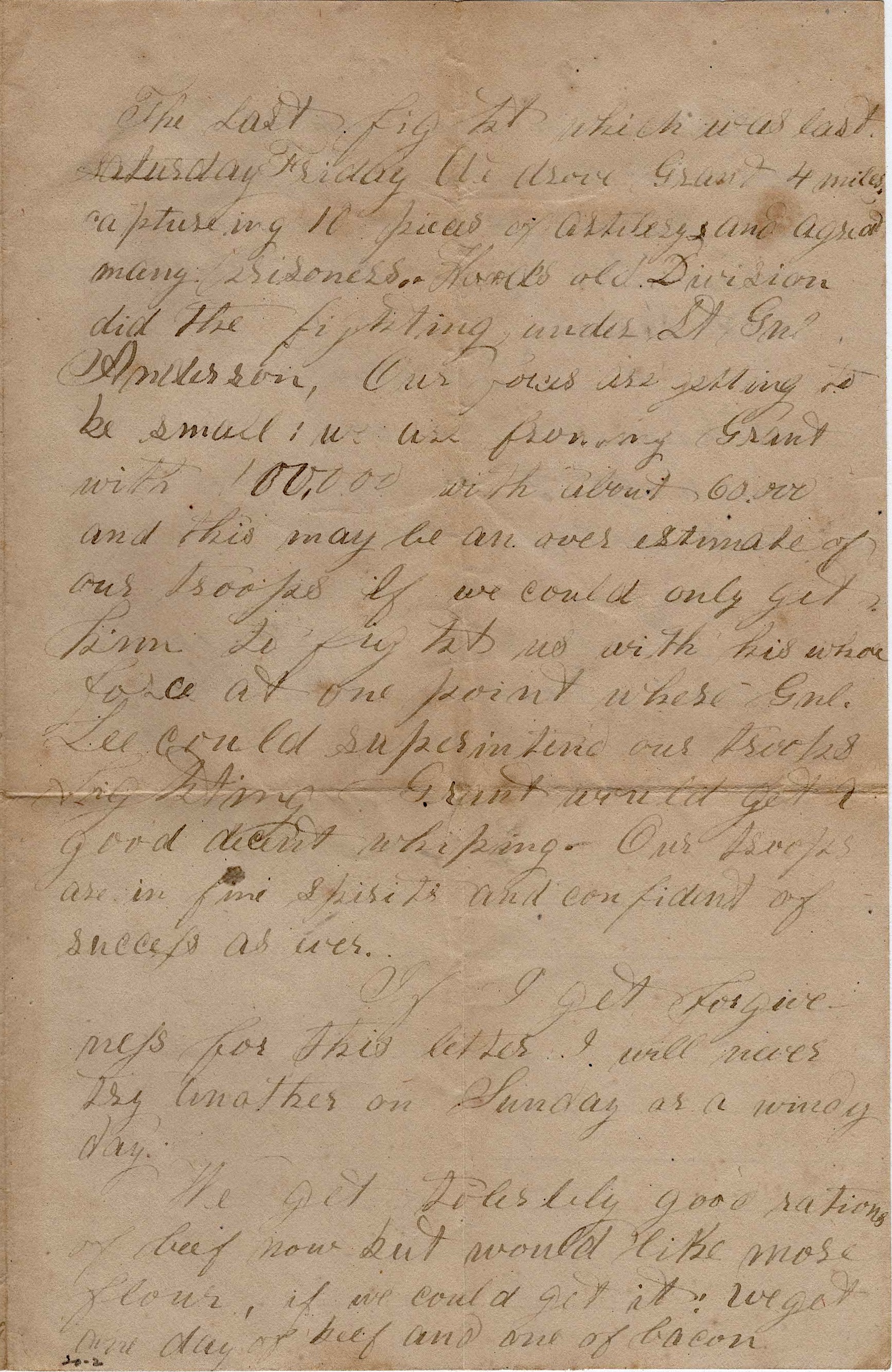
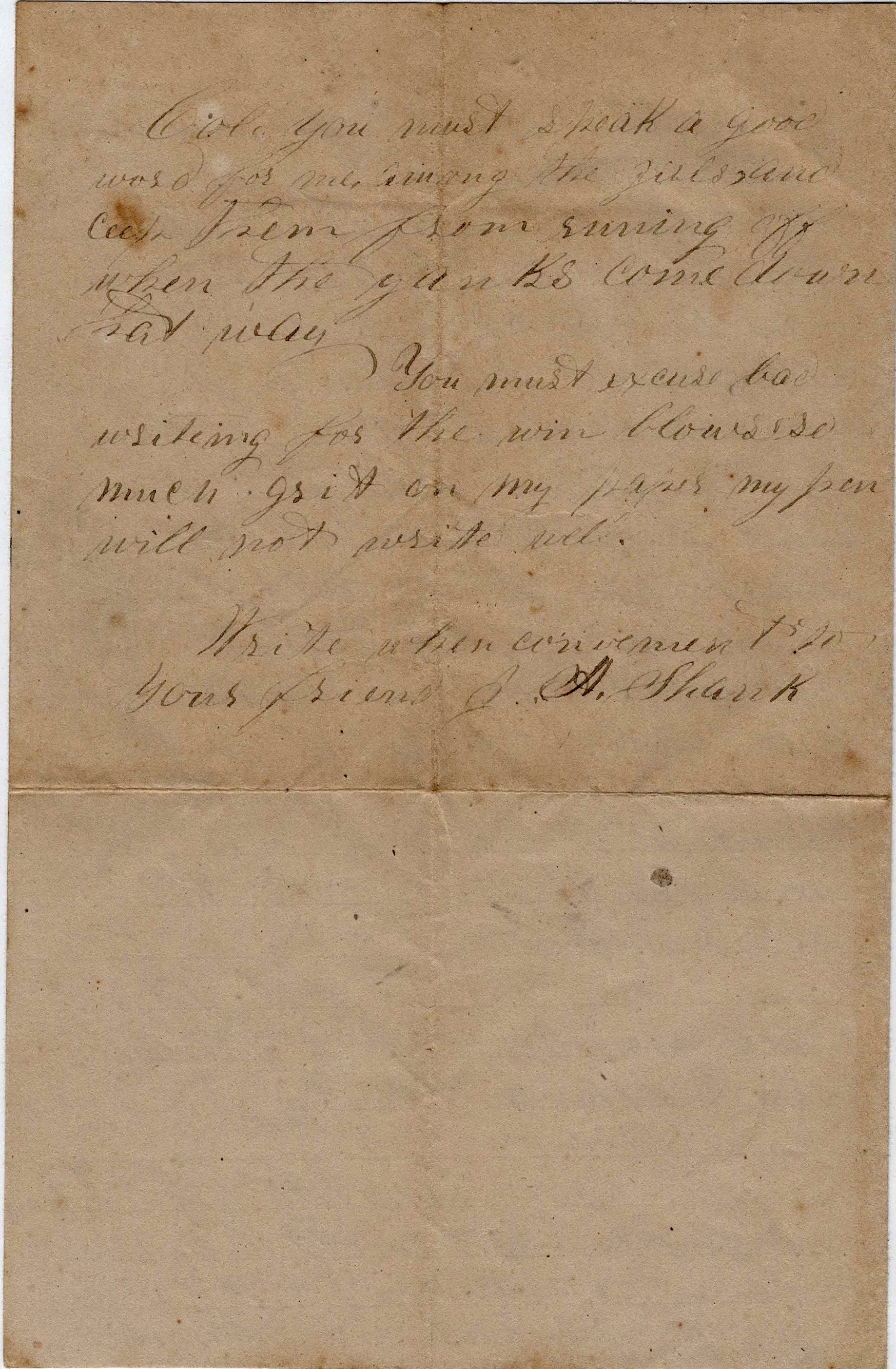
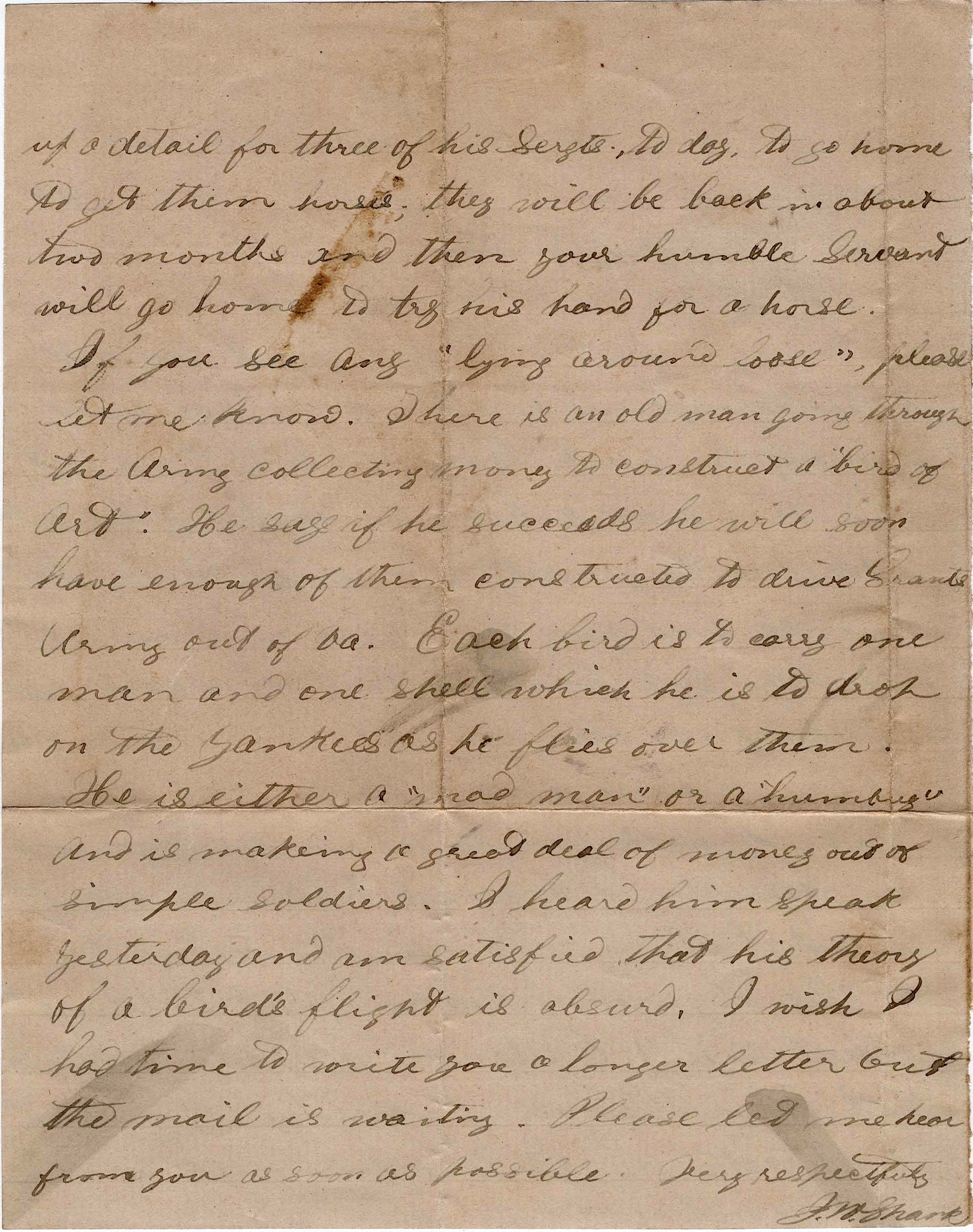
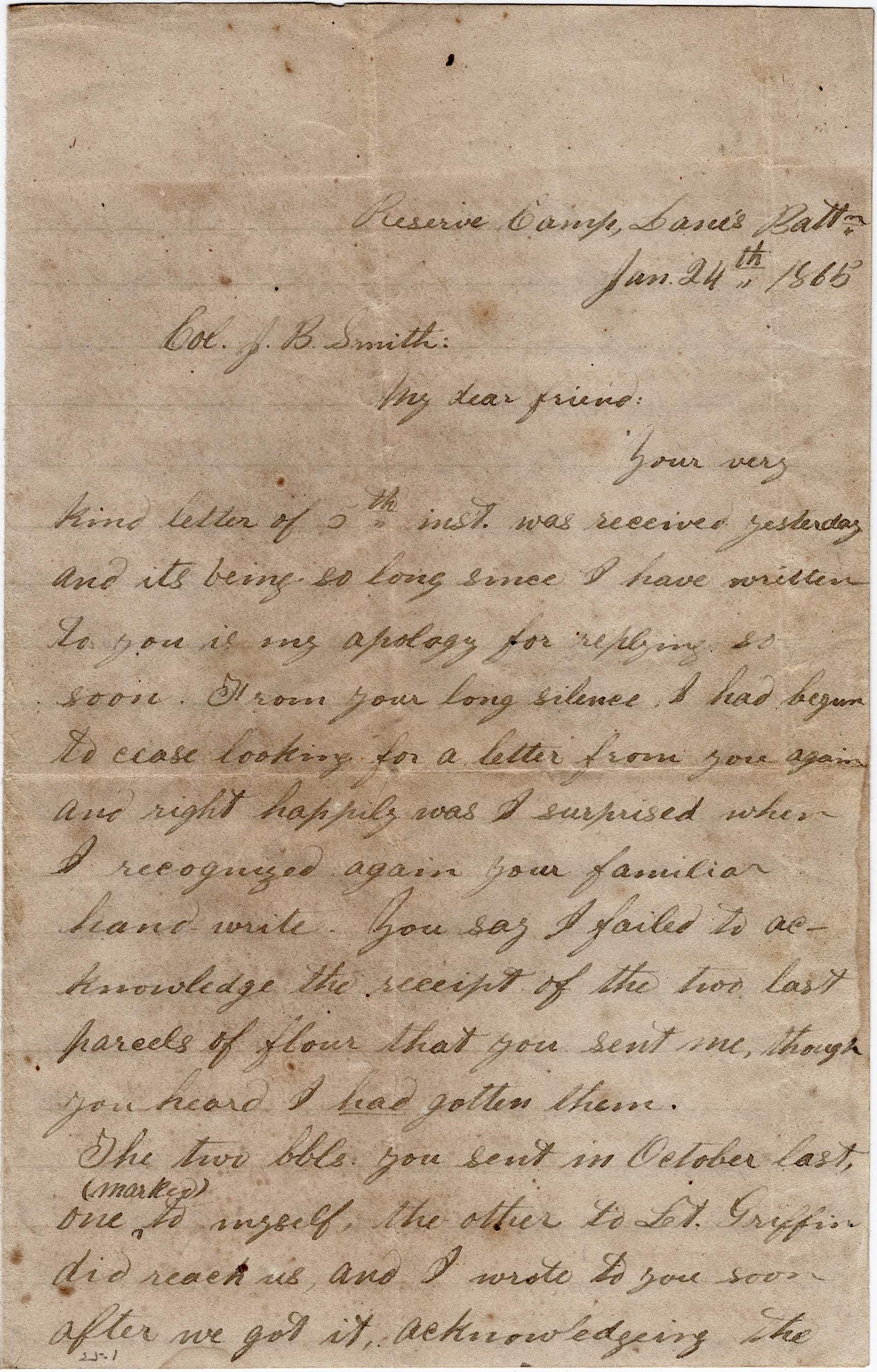
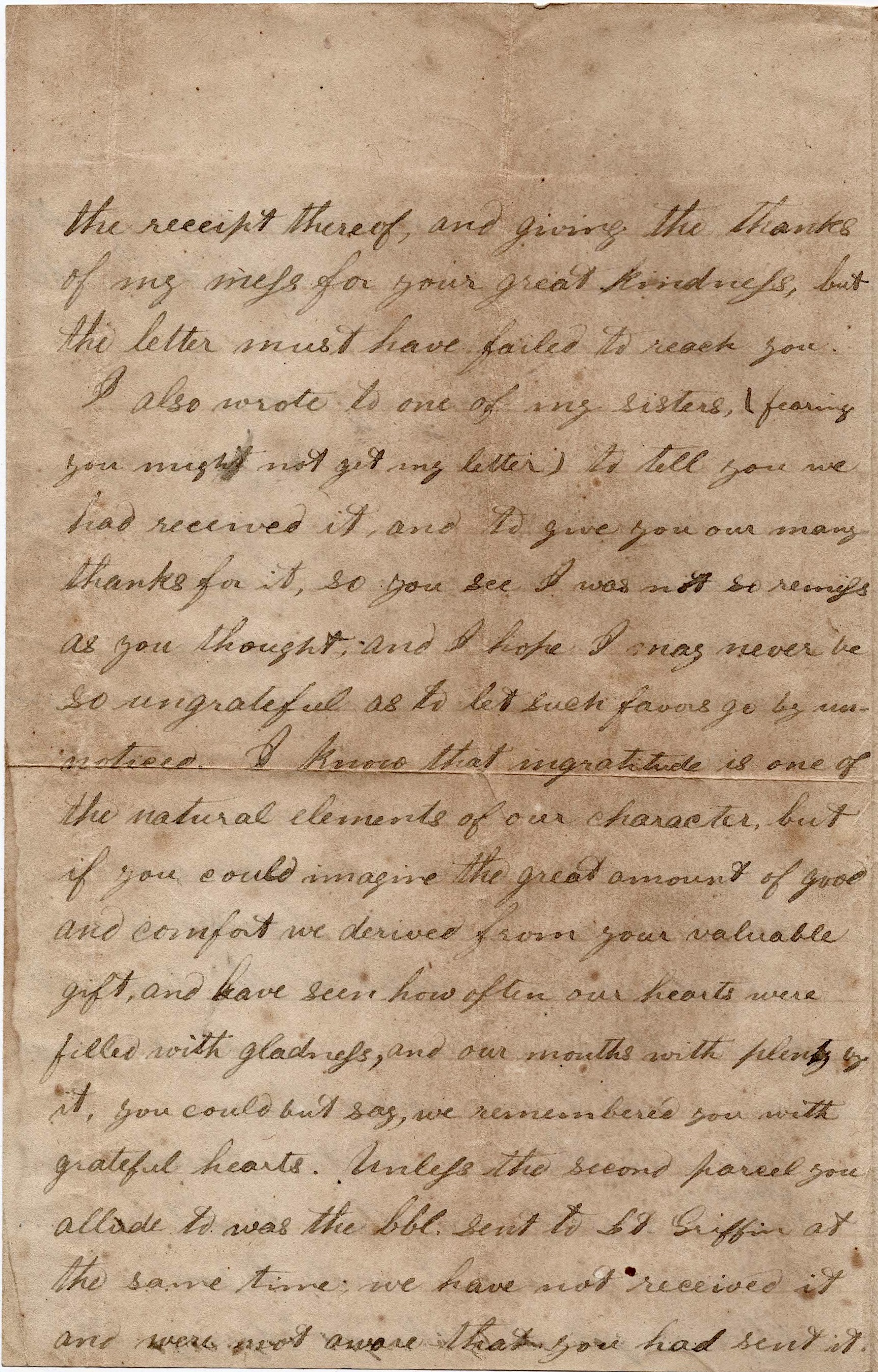
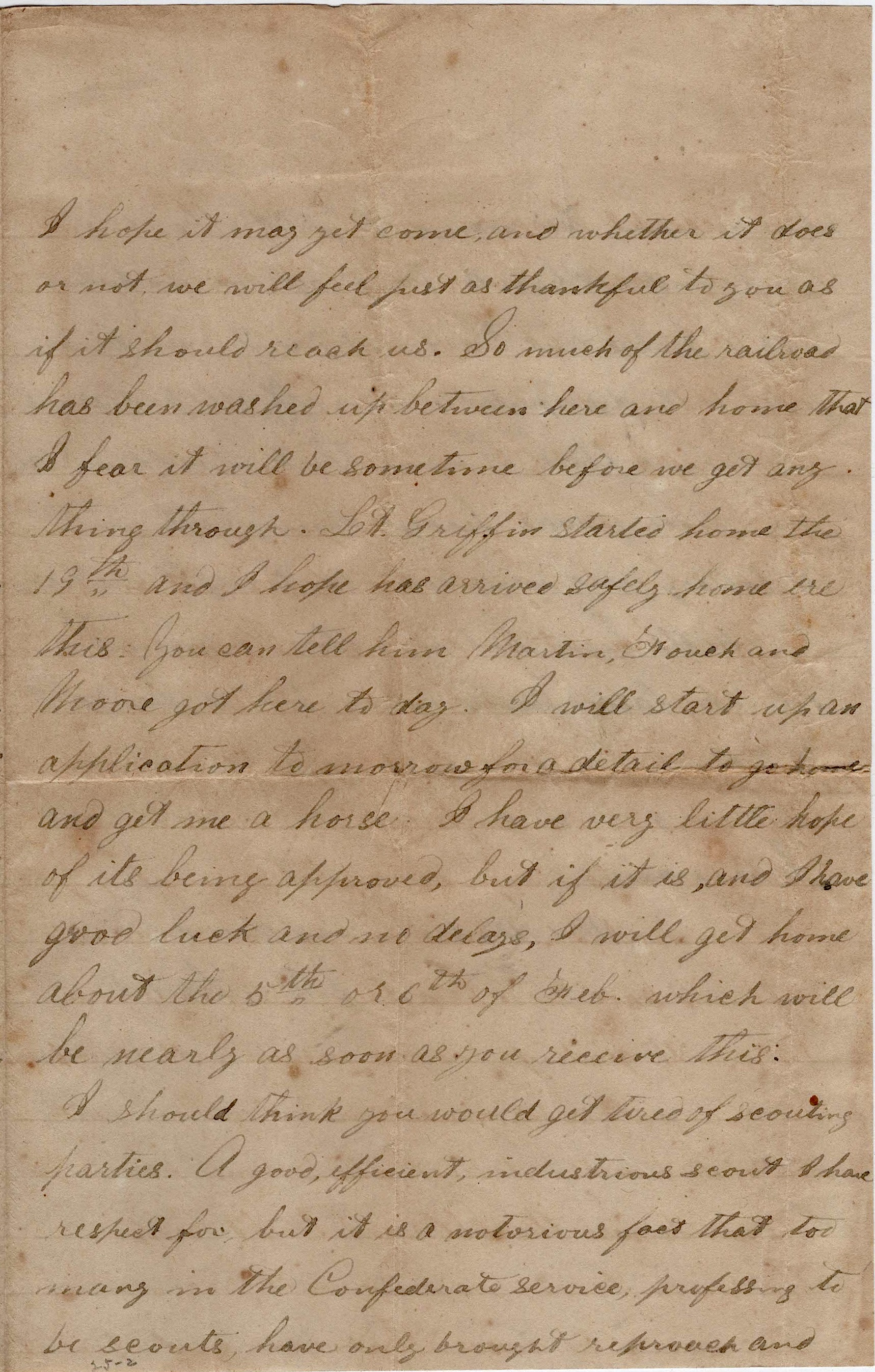
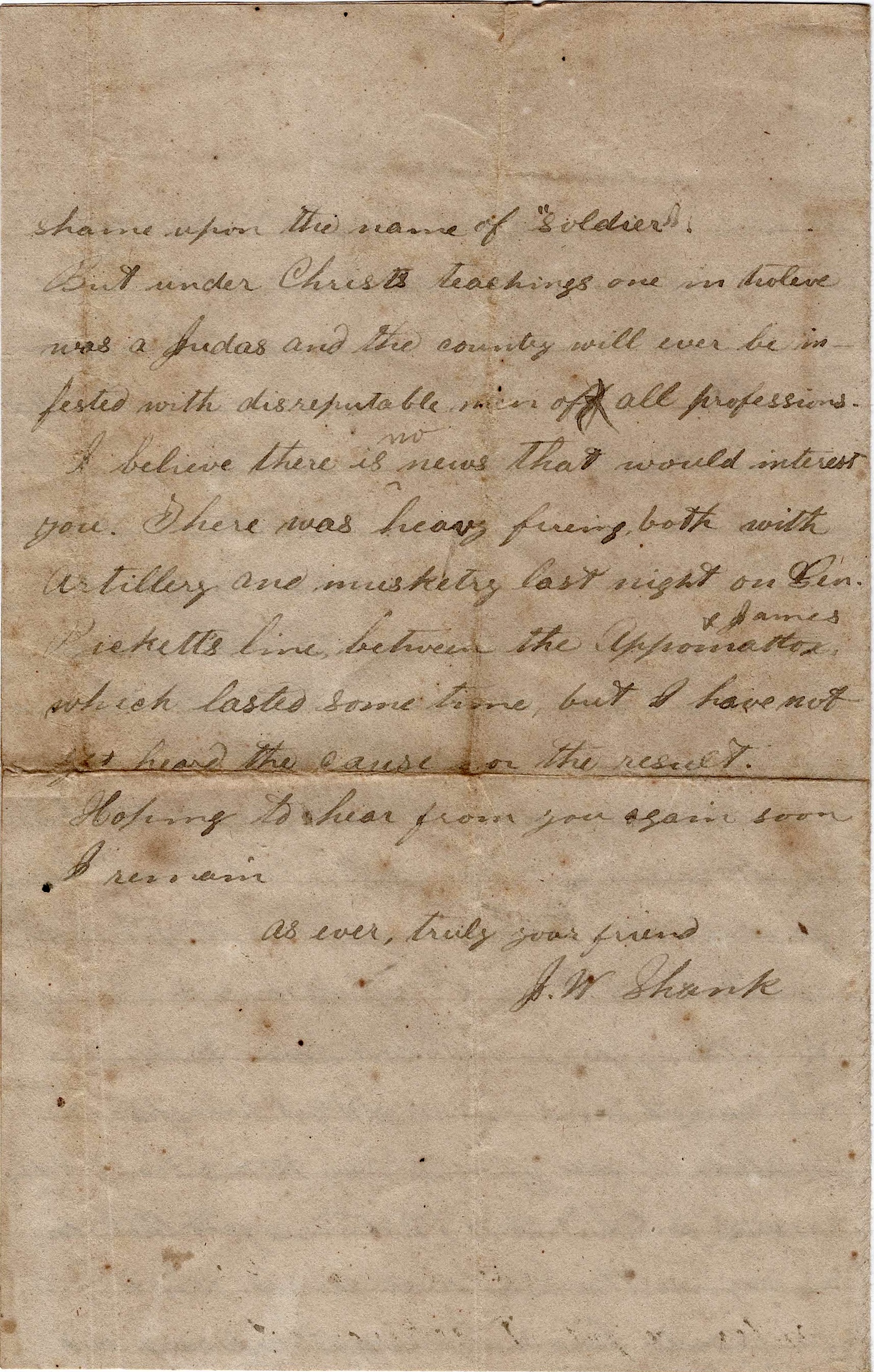
The author of this letter was William B. Elrod (1825-Aft1873), the son of Samuel Elrod (1797-1885) and Mildred (“Milly”) Gurthey (1799-1888) of Mountain Springs, Anderson County, South Carolina. William enlisted in Co. D, 18th South Carolina Infantry late in 1861. In signing the letter, William added the name of Drury “Edward” King (1839-1915), a comrade in Co. D who served as his 2nd Lt. and came from the same vicinity in Anderson county. Samuel’s Last Will & Testament (Ancestry.com), signed in 1873 by his mark, confirms that both William B. and Benjamin (“Ben”) Douthit Elrod (1831-1879) were his sons and Drury Edward King was his son-in-law. Drury married Nellie Caroline (“Carrie”) Elrod (1839-1917) in 1866. A letter written by Edward King to his aunt, Elizabeth Barkley is housed at the Atlanta History Center. It speaks of the hardships endured by the soldiers towards the end of the war.
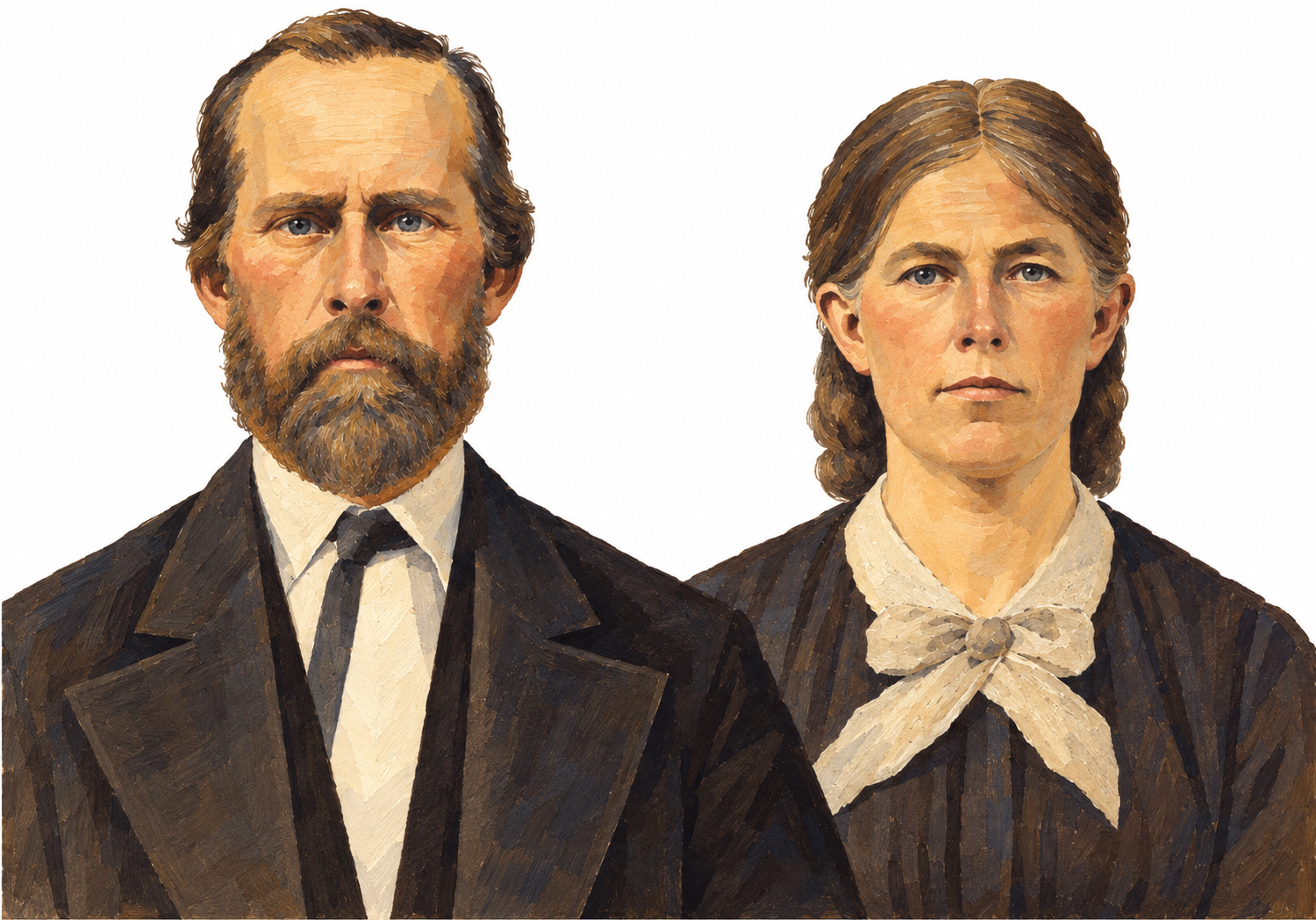
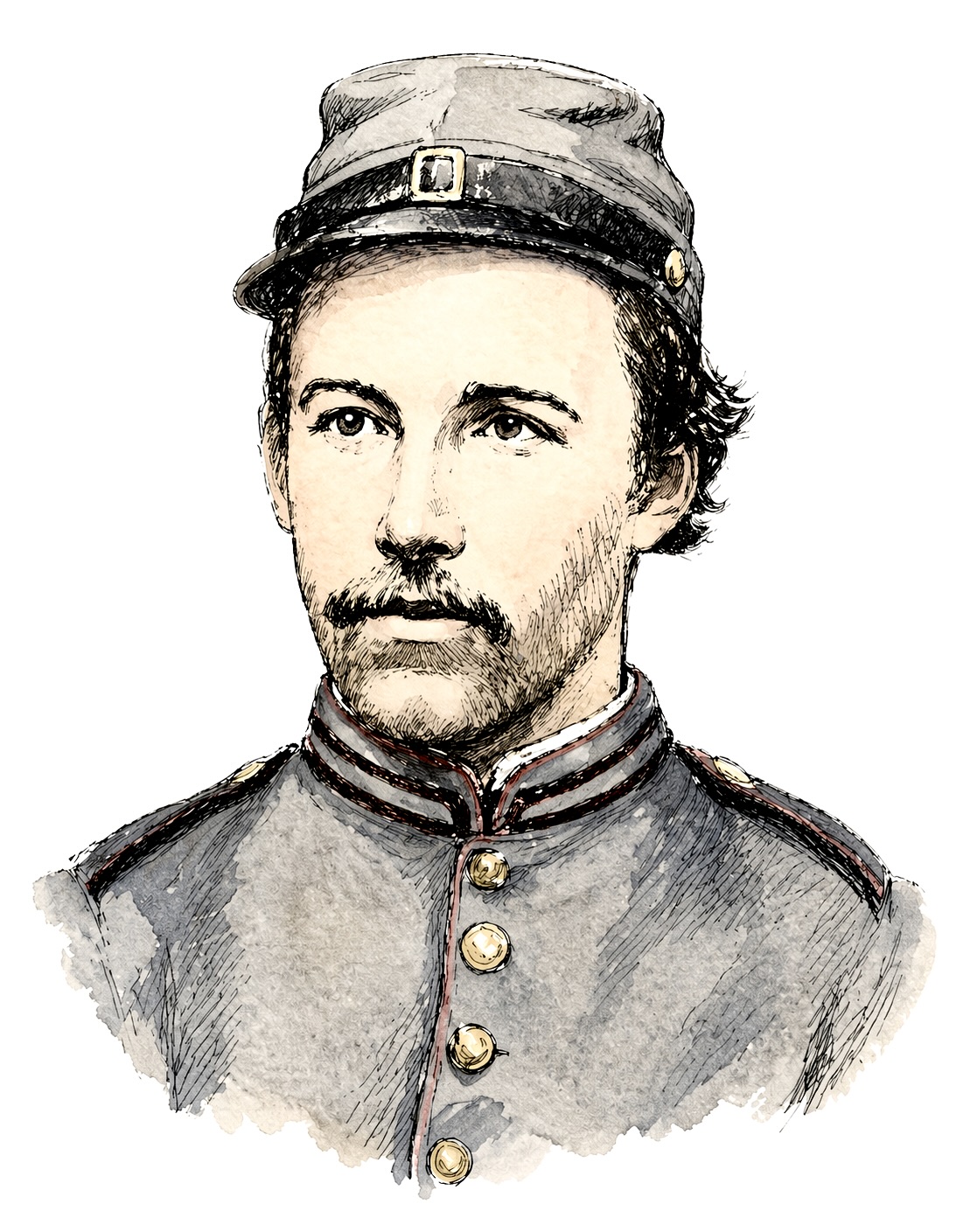
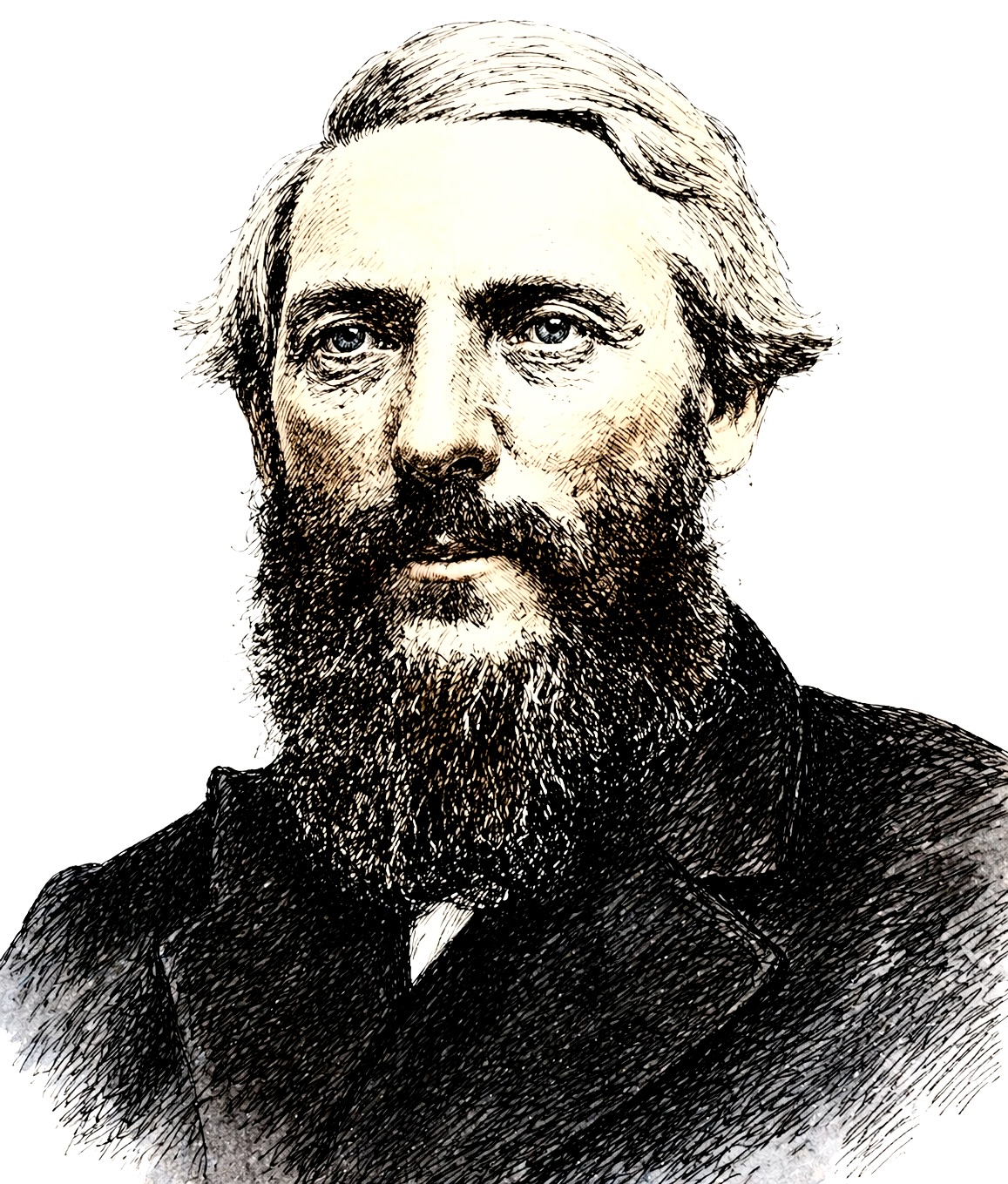
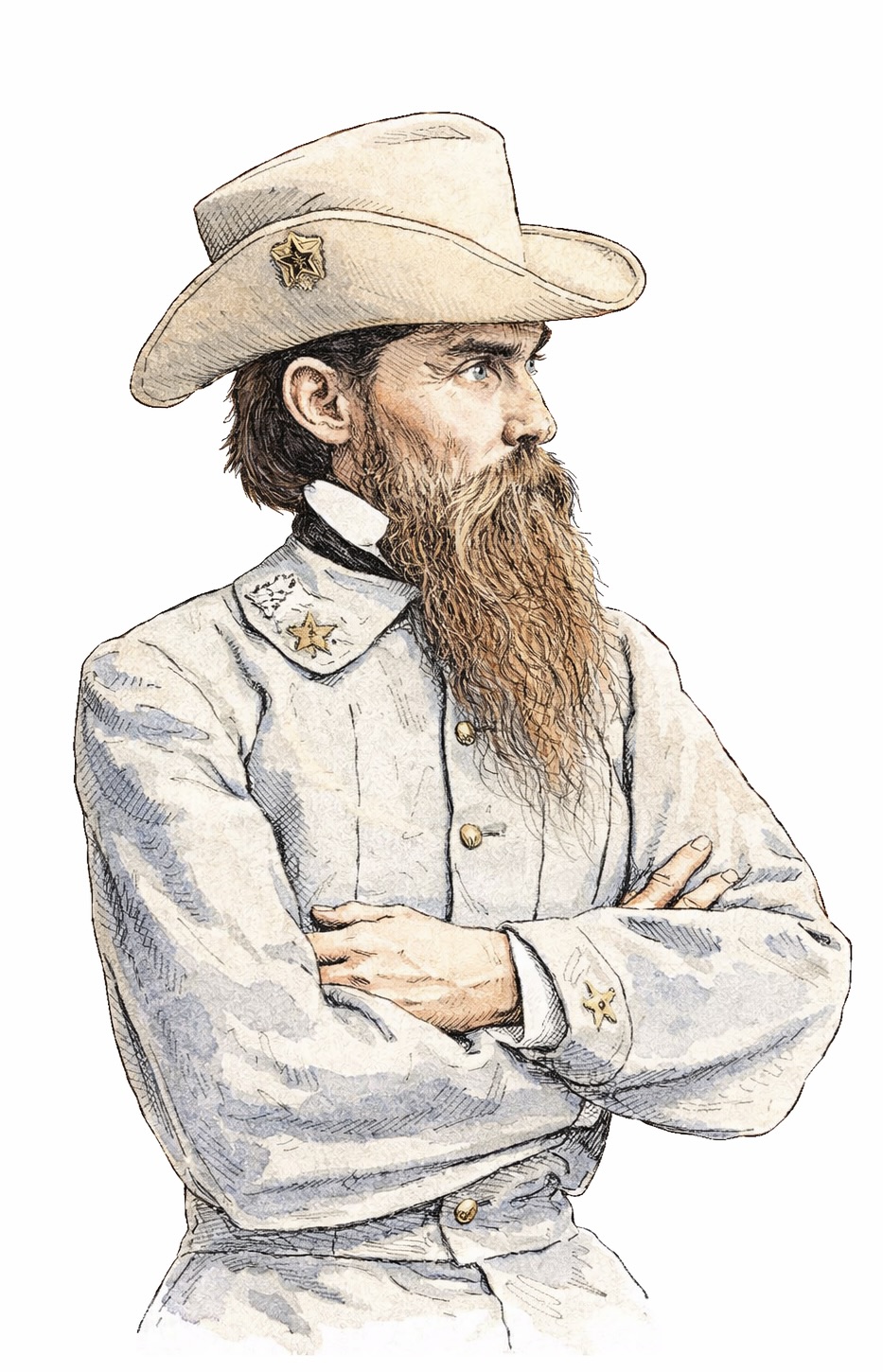
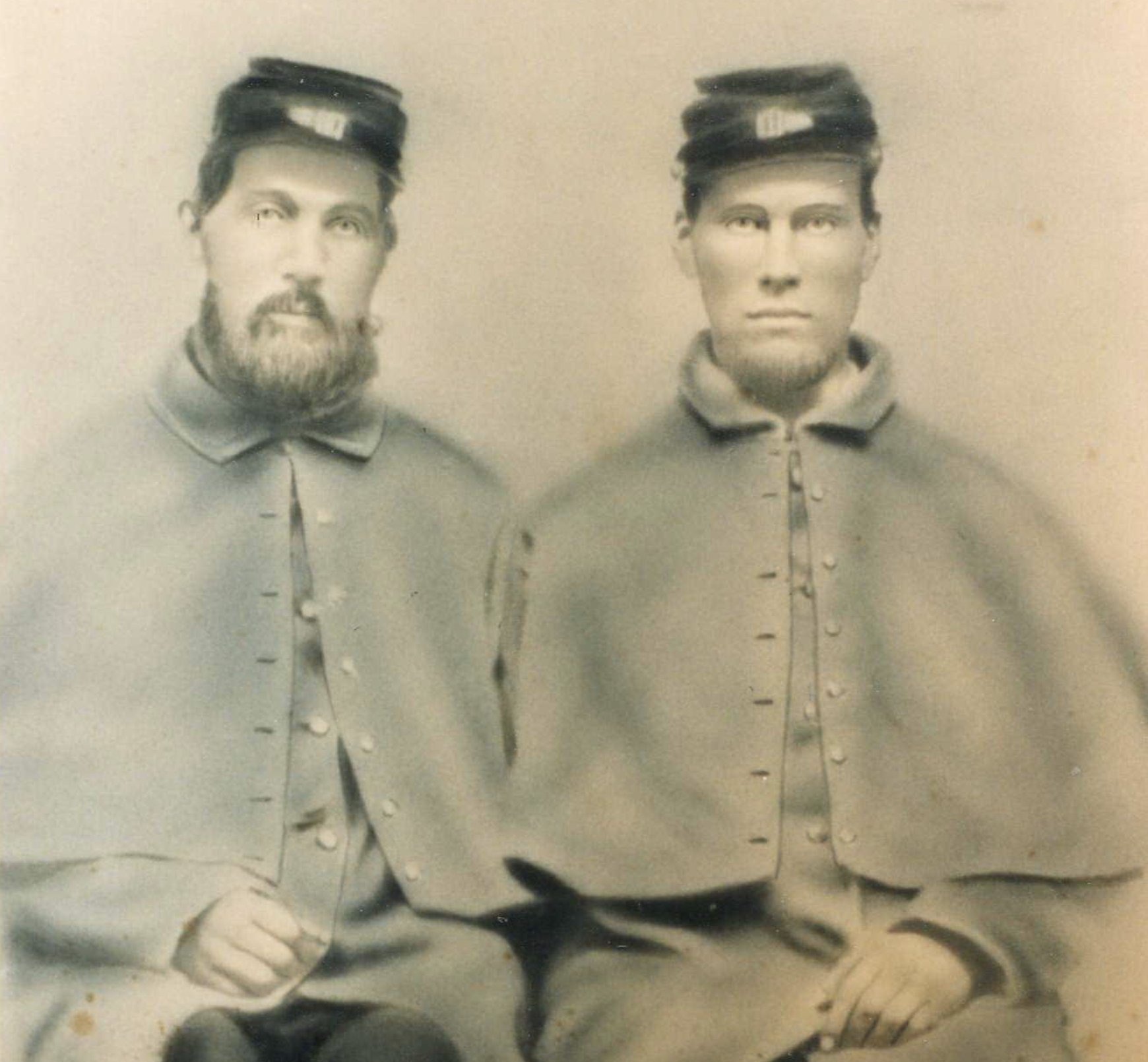
A postwar rendering of Drury Edward King and his wife, Carrie (Elrod) King
The 18th South Carolina was part of Elliott’s South Carolina Brigade Brigade which belonged to Brig. Gen. Bushrod Johnson’s Division. The content of this letter pertains to the movements of the regiment as Confederate troops were shifted south towards Petersburg from the Howlett line to confront Grant’s flank movement across the James River at Weyanoke Point on 14 June 1864. Some six weeks later the 18th South Carolina, alongside the 22nd South Carolina, would find themselves holding Elliott’s Salient in the Petersburg defenses when the Union Army detonated the mine beneath their works, disabling more than 200 of its men and killing 108 from the 18th South Carolina alone. [See Co. D Roster]
I wish to thank my friend Brett Schulte of The Siege of Petersburg Facebook page for assistance in nailing down the regiment and the identities of the two soldiers who signed their names to this letter. He tells me that he used the new Google Gemini Argon as his research tool for this task.
T R A N S C R I P T I O N
Petersburg, Virginia June 21st 1864
Dear Father, Mother, Sisters & Friends,
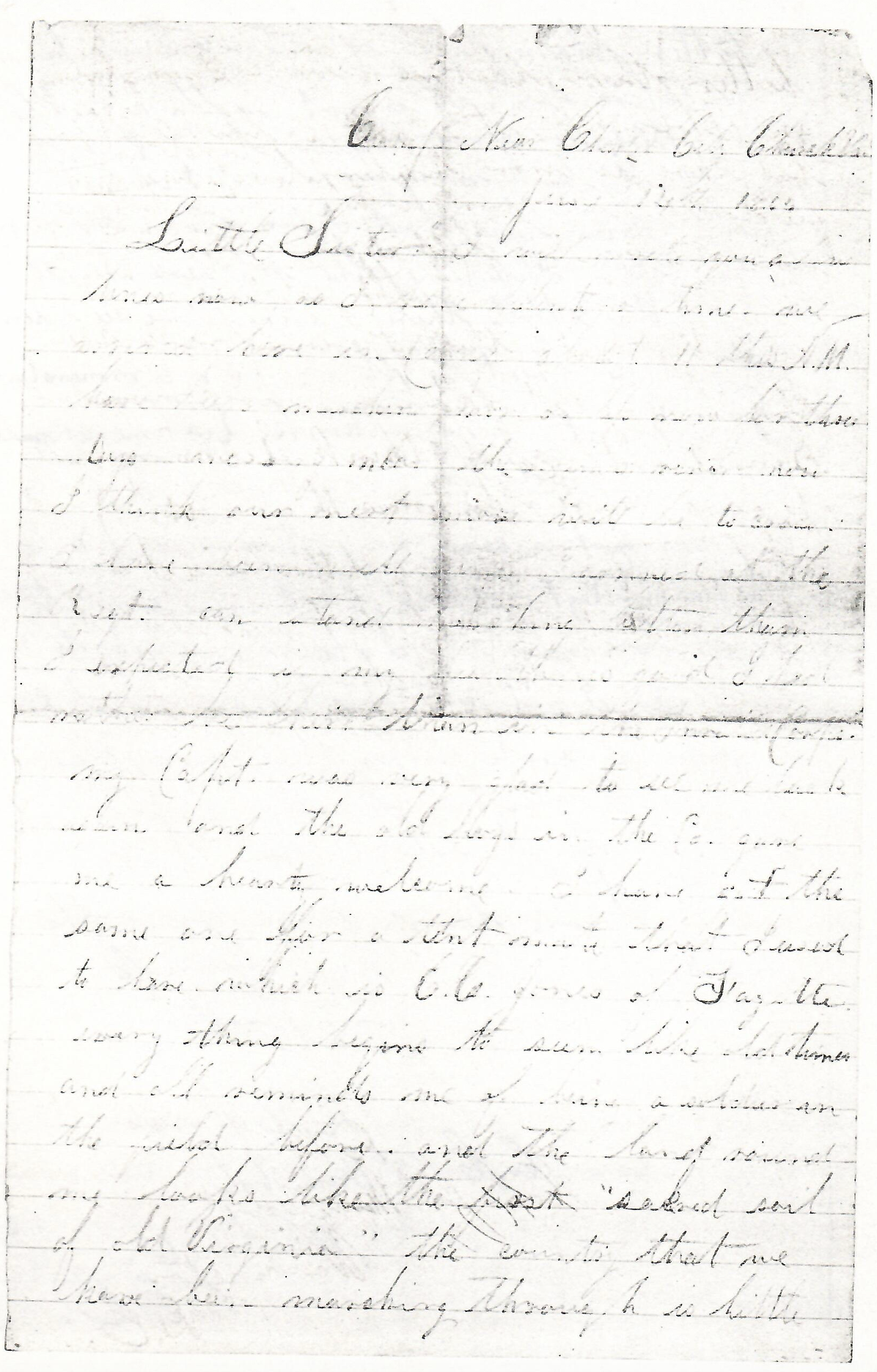
We take the present chance of writing you a few lines which may inform you that through the mercies of a kind Providence we are still alive and tolerably well and hope these lines may reach and find you all in good health. You may think this a strange way of writing, but our condition is such we have to do the best we can and feel thankful we are even as well off as we are. We got your letter of the 7th and was truly glad to hear from you. At the time we received your letter, we were in the trenches some 6 miles north of Petersburg and remained till last Thursday morning [16 June] when we were ordered to Petersburg.
We left the trenches just before day and came to Petersburg and was put in line of battle about 10 o’clock in rear of the main line as reserves and so remained all day. In the evening they began fighting and fought for a long time very hard but our men repulsed them. That night we moved back about a mile and worked all night on breastworks and just before dat we started back to our position.
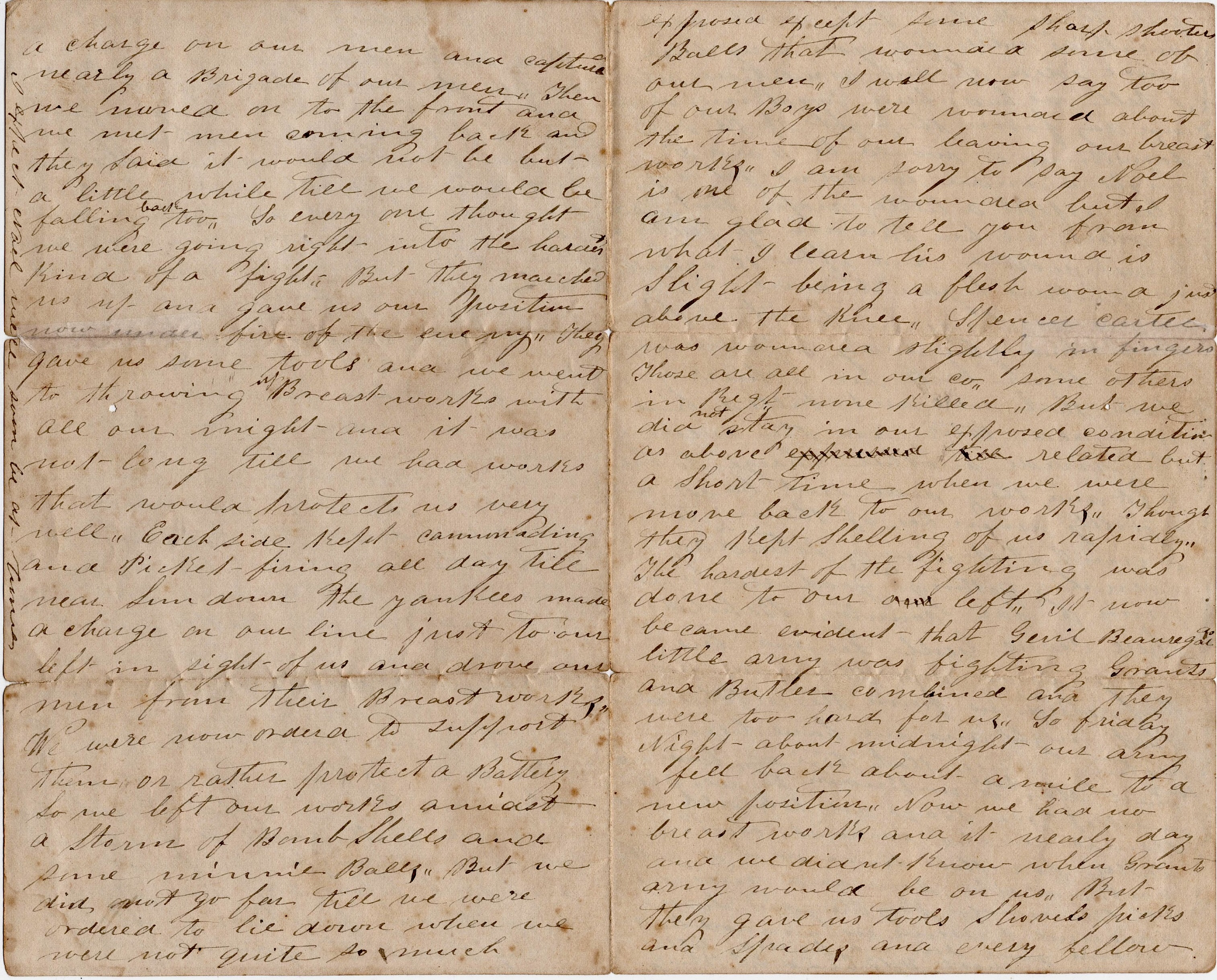
About day break [17 June] the Yankees made a charge on our men and captured nearly a brigade of our men. 1 Then we moved on to the front and we met men coming back and they said it would not be but a little while till we would be falling back too. So everyone thought we were going right into the hardest kind of a fight. But they marched us up and gave us our position now under fire of the enemy. They gave us some tools and we went to throwing up breastworks with all our might and it was not long till we had our works that would protect us very well. Each side kept cannonading and picket firing all day till near sun down. The Yankees made a charge on our line just to our left in sight of us and drove our men from their breastworks. We are now ordered to support them, or rather protect a battery. So we left our works amidst a storm of bomb shells and come minié balls. But we did not go far till we were ordered to lie down where we were not quite so much exposed except some sharpshooters balls that wounded some of our men
I will now say two of our boys were wounded about the time of our leaving our breastworks. I am sorry to say Noel is one of the wounded but I am glad to tell you from what I learn, his wound is slight—being a flesh wound just above the knee. Spencer Carter 2 was wounded slightly in fingers. Those are all [the wounded] in our company. Some others in the regiment were killed.
But we did not stay in our exposed condition as above related but a short time when we were moved back to our works though they kept shelling of us rapidly. The hardest of the fighting was done to our left. It now became evident that Gen. Beauregard’s little army was fighting Grant’s and Butler’s combined [army] and they were too hard for us. So Friday night [17 June], about midnight, our army fell back about a mile to a new position.
Now we had no breastworks and it [was] nearly day [break on 18 June] and we didn’t know when Grant’s army would be on us. But they gave us tools—shovels, picks, and spades—and every fellow fell to work for life, tired and weak as we were for you may have some idea of our condition when I tell you we had been working night and day from the fight of the 20th. 3 Sometimes it would 4 and 5 nights a man wouldn’t get any sleep except a little nap. But by 10 o’clock we had thrown up pretty good breastworks. And after 12 o’clock the Yankees begun to come. They made a charge in front of our regiment but you may depend we sent them back in a hurry—those that were not killed and wounded. Later in the evening they made another charge to our left and they were sent back and a goodly number of them to eternity.
It is now late Saturday evening [and we are] getting good news as from a far country. Behold, here comes General Lee and his army—some 60,000—and they relieved us from the ditches that night and we have been resting since that time. How long we will stay here is unknown to us. The most of the boys are tolerably well. [Brother] Ben [Elrod] is well.
So will close our letter for this time as it is getting dark. Write soon and give us all the news. May the good Lord save and preserve us. No more but remain your son and friend till death. — W. B. Elrod & D. E. King
Remember us in your prayers. Excuse bad writing. I expect Noel will soon be at home.
1 This is undoubtedly a reference to the dawn attack of June 17, 1864 in which Union troops under General James H. Potter (of the 9th Corps) broke through Confederate lines at Hickory Hill and captured roughly 600 individual Confederate prisoners, four cannons, and five flags.
2 Thomas “Spencer”Carter (1832-1907) served as a private in Co. D, 18th South Carolina. He’s a little hard to track down because his name, apparently, was actually Thomas Spencer Cartee but frequently spelled in civil and military records as Carter. An image of Spencer (with all of his fingers) and his family can be found on Find-A-Grave.That site gives his parents as Caleb Wade Cartee (1790-1871) and Elizabeth Slaton (1800-1879).
3 Probably a reference to the fighting at Ware Bottom Church on May 20, 1864.
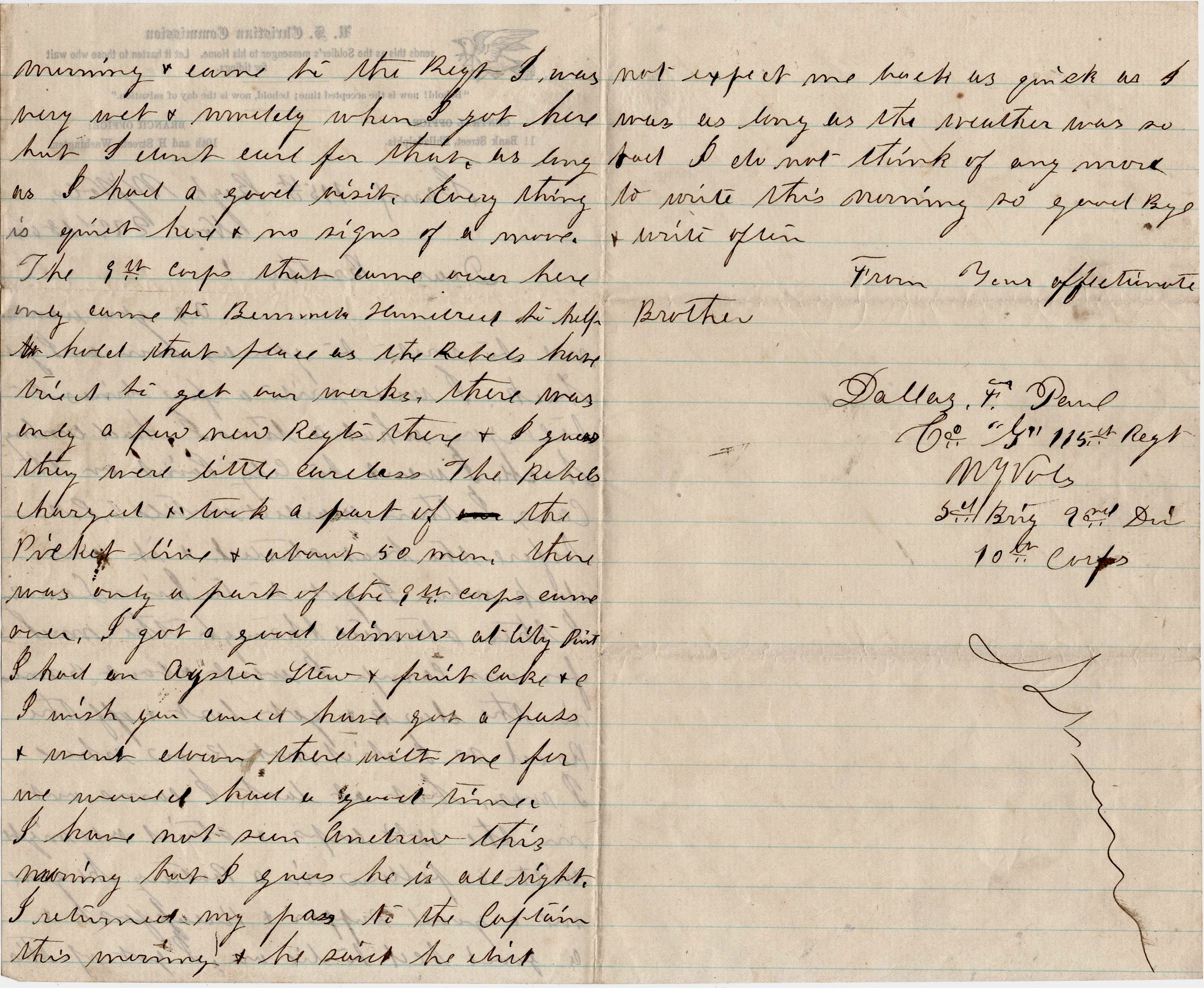
The following letter was written by Dallas Fraker Paul (1845-1889) who enlisted on 6 August 1862 when he was 18 years old to serve three years in the 115th New York Infantry. He mustered in as a musician in Co. G on 20 August 1862 and in less than a month he was taken prisoner with most of his regiment when they were surrendered to Stonewall Jackson’s army at Harper’s Ferry. Like his comrades he was paroled and sent to Camp Douglass in Chicago to await his exchange. Dallas survived the war. He mustered out with his company on 17 June 1865 at Raleigh, North Carolina.
Dallas was the son of Philip Paul (1821-1856) and Catherine Baker (1821-1850) of Saratoga county, New York. He wrote the letter to his younger (17 year-old) brother, Addison Seymour Paul (1847-1934) who was recruited into Co. D, 95th New York Infantry. At the time this letter was written in late November 1864, the 95th N. Y. was serving in the 5th Army Corps while the 115th N. Y. was serving in the 10th Army Corps. Dallas’ letter describes returning from a visit to visit his brother during the Siege of Petersburg.
T R A N S C R I P T I O N
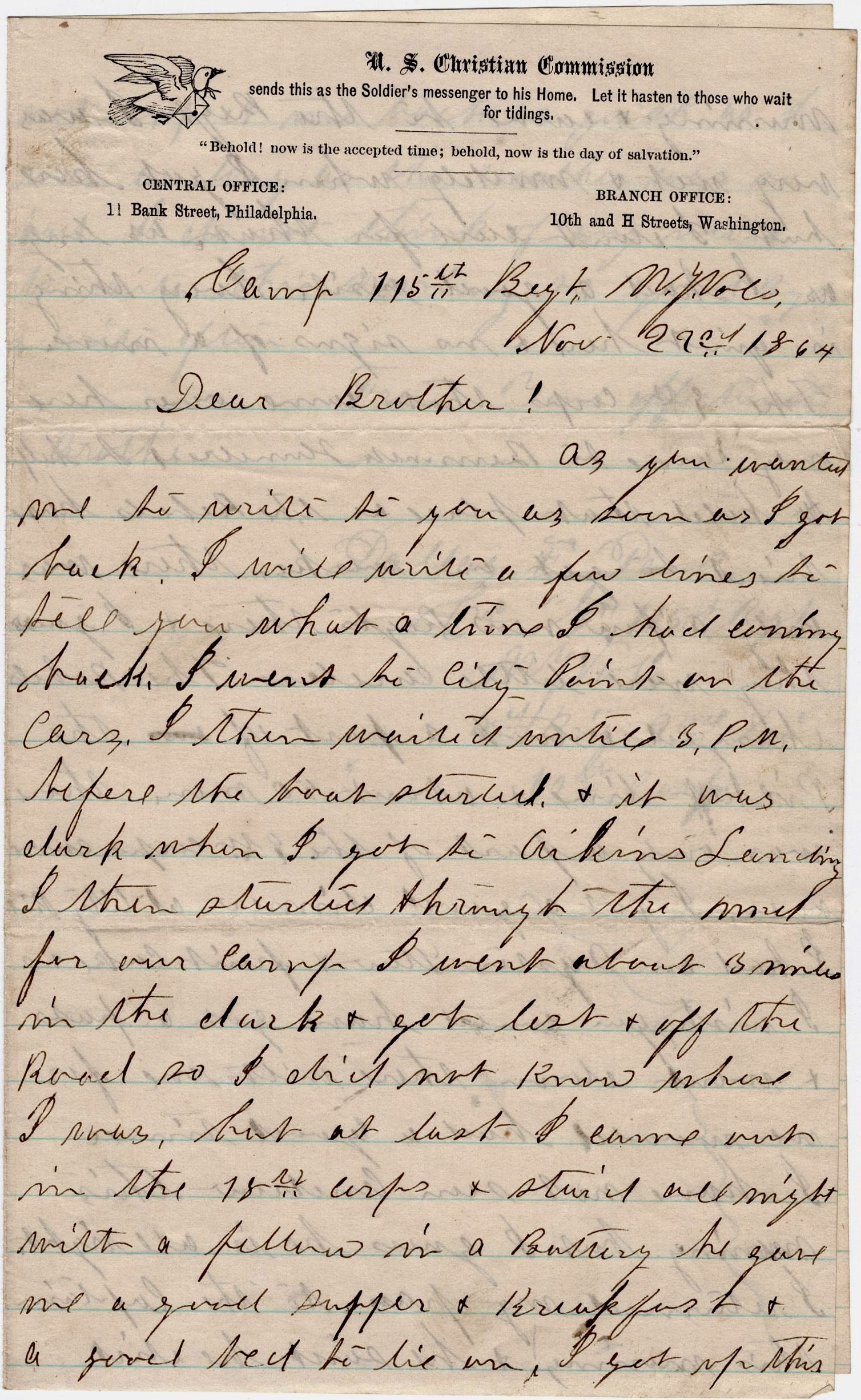
Camp 115th Regt. N. Y. Vols.
November 22nd 1864
Dear Brother! As you wanted me to write to you as soon as I got back, I will write a few lines to tell you what a time I had coming back. I went to City Point on the cars. I then waited until 3 p.m. before the boat started & it was dark when I got to Aiken’s Landing. I then started through the mud for our camp. I went about 3 miles in the dark & got lost & off the road so I did not know where I was. But at last I came out in the 18th Corps & stayed all night with a fellow in a Battery. He gave me a good supper & breakfast & a good bed to lie on. I got up this morning & came to the regiment. I was very wet & muddy when I got here but I don’t care for that as long as I had a good visit.
Everything is quiet here & no signs of a move. The 9th Corps that came over here only came to Bermuda Hundred to help hold that place as the Rebels have tried to get our works. There was only a few new regiments there and I guess they were a little careless. The rebels charged and took a part of the picket line & about 50 men. There was only a part of the 9th Corps came over.
I got a good dinner at City Point. I had an oyster stew and fruit cake, &c. I wish you could have got a pass & went down there with me for we would had a good time. I have not seen Andrew this morning but I guess he is all right. I returned my pass to the Captain this morning & he said he did not expect me back as quick as I was as long as the weather was so bad.
I do not think of anymore to write this morning so goodbye & write often. From your affectionate brother, — Dallas F. Paul
Co. G, 115th Regt., New York Cols., 2nd Brigade, 2nd Division, 10th Corps.
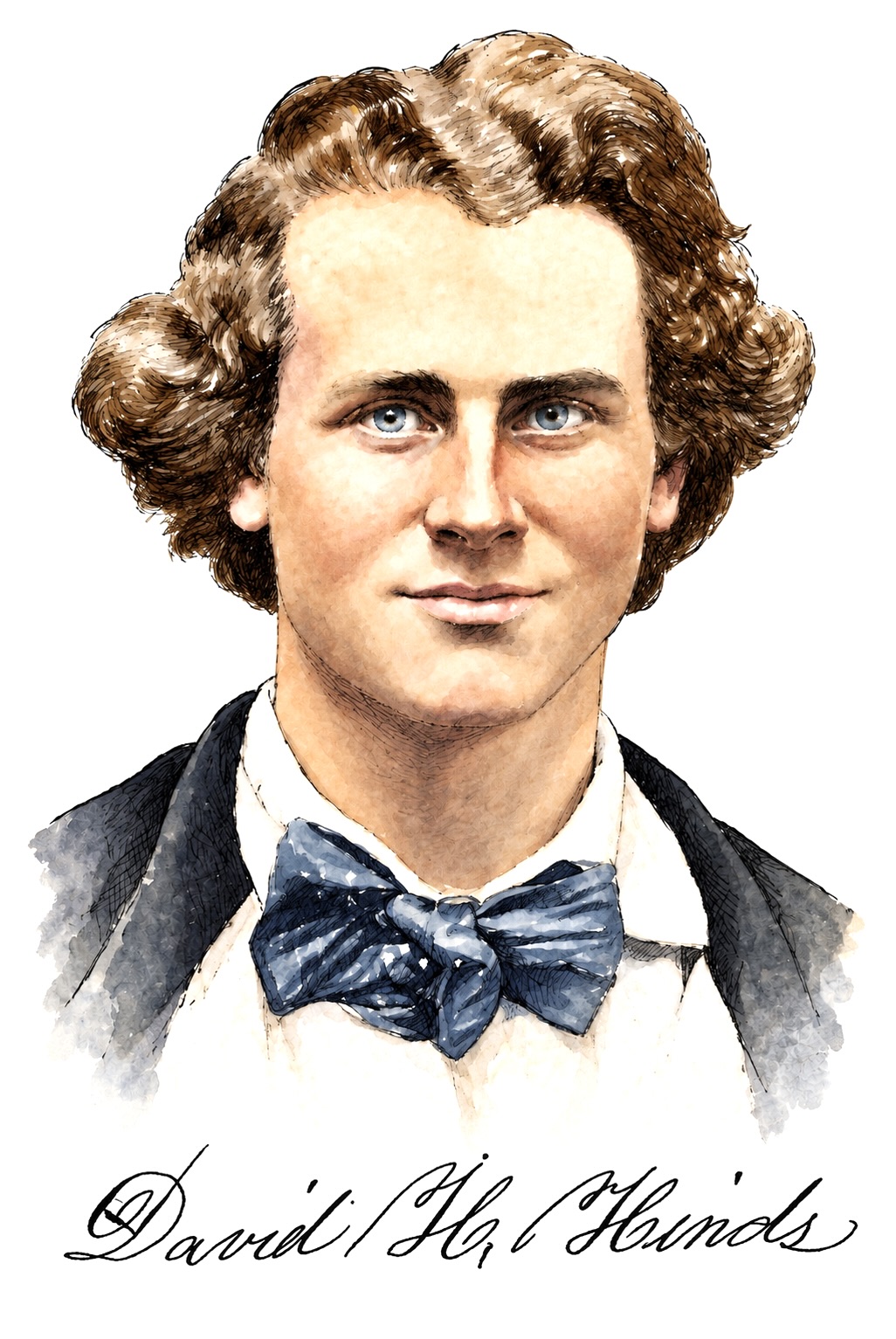
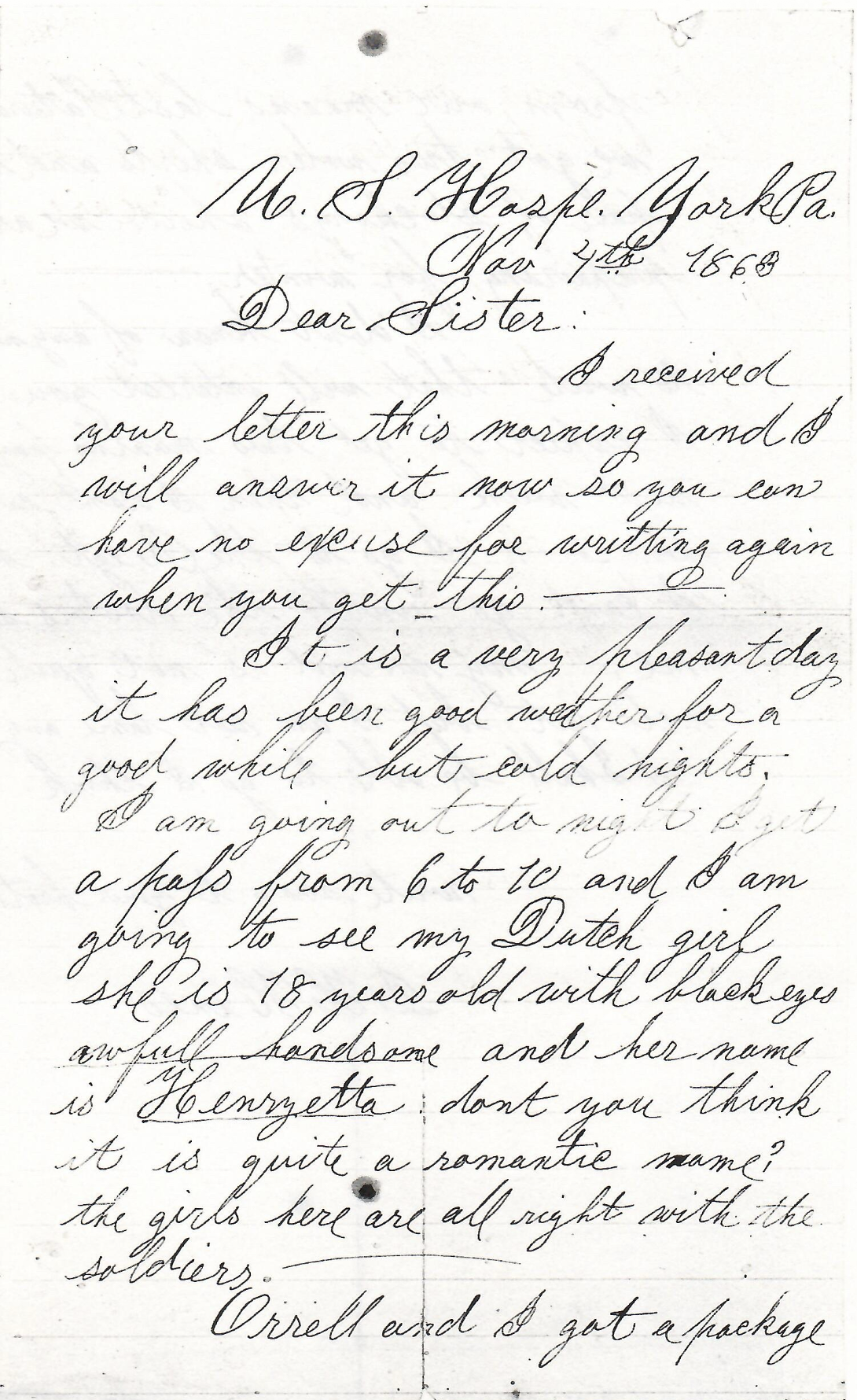
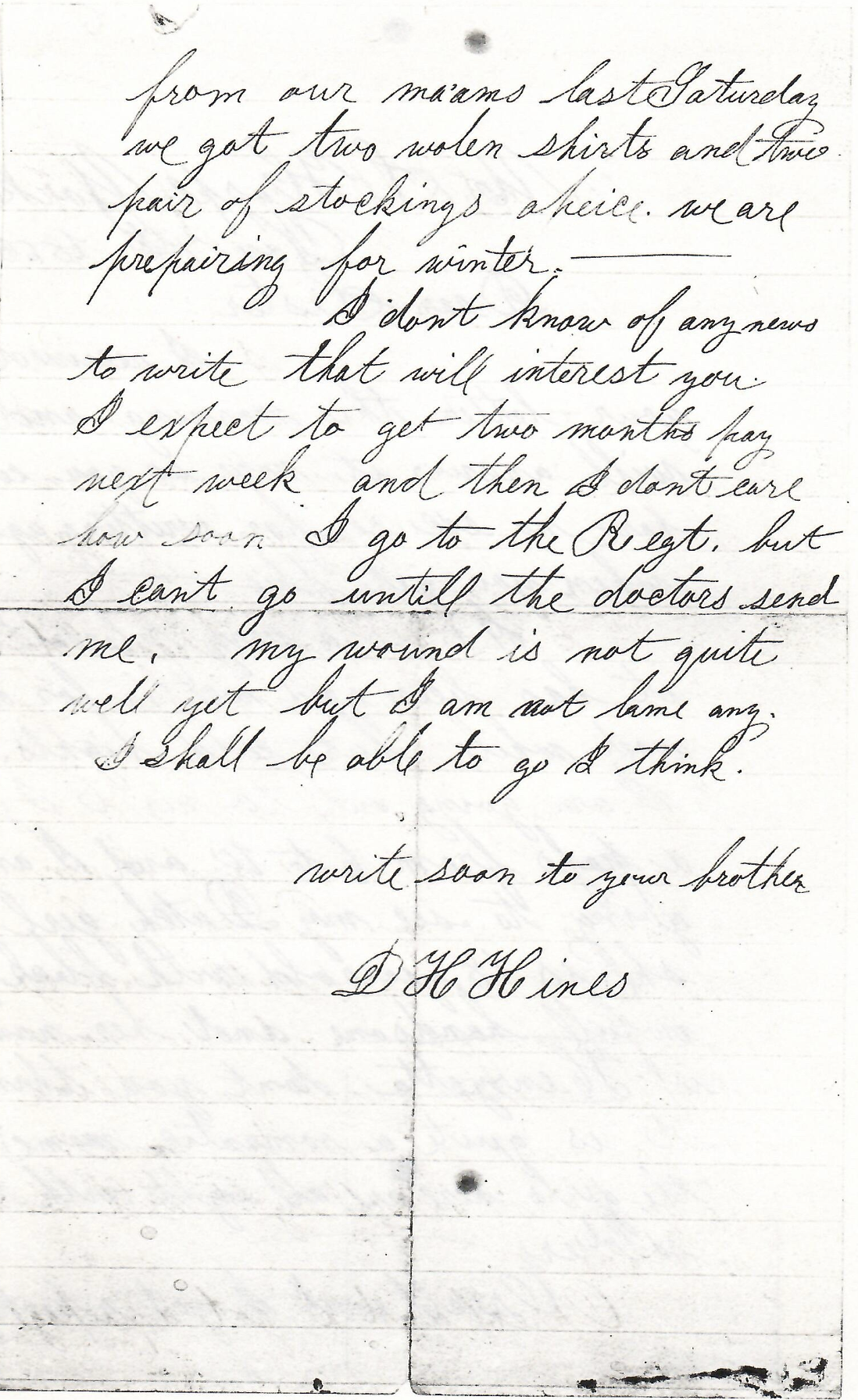
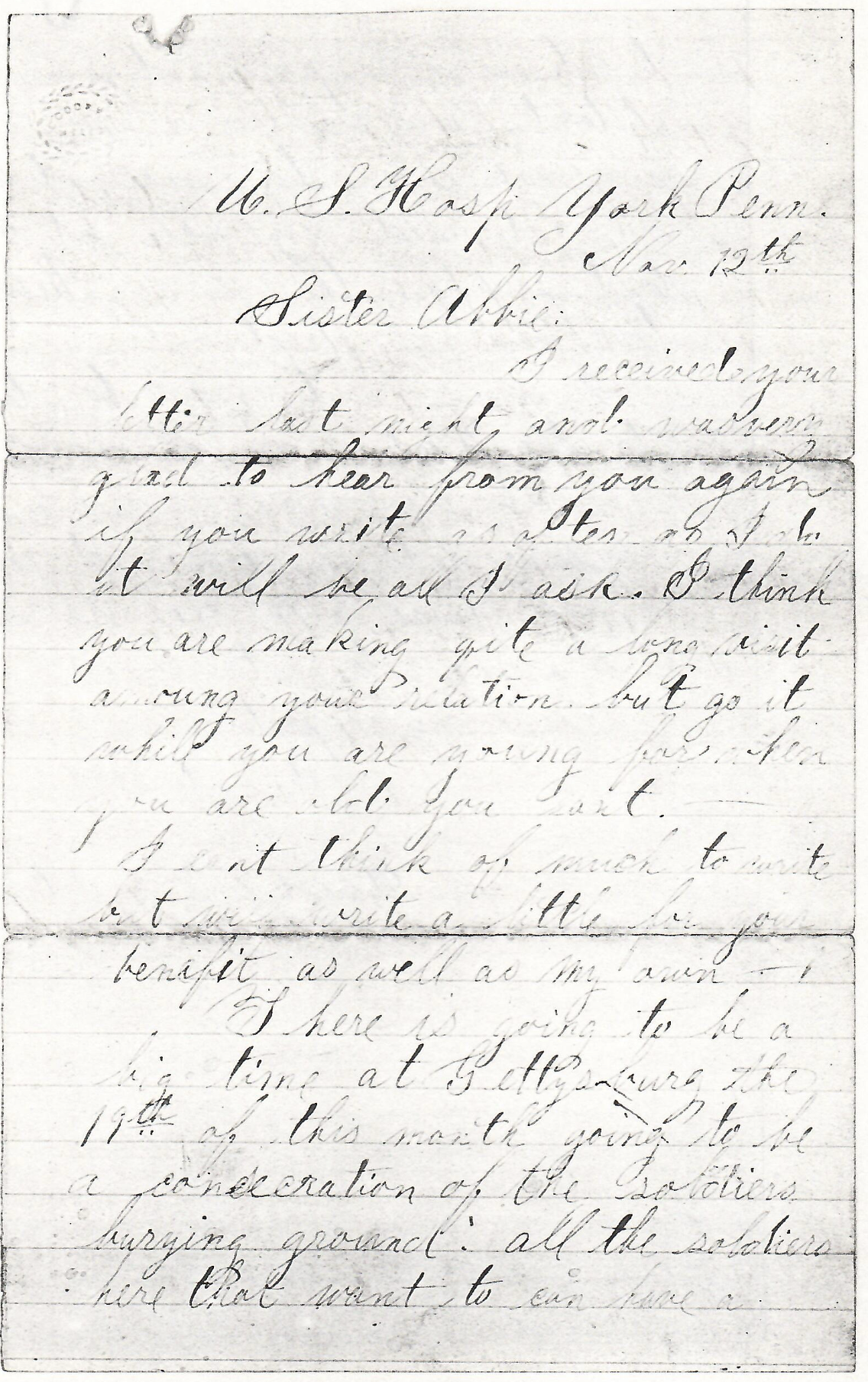
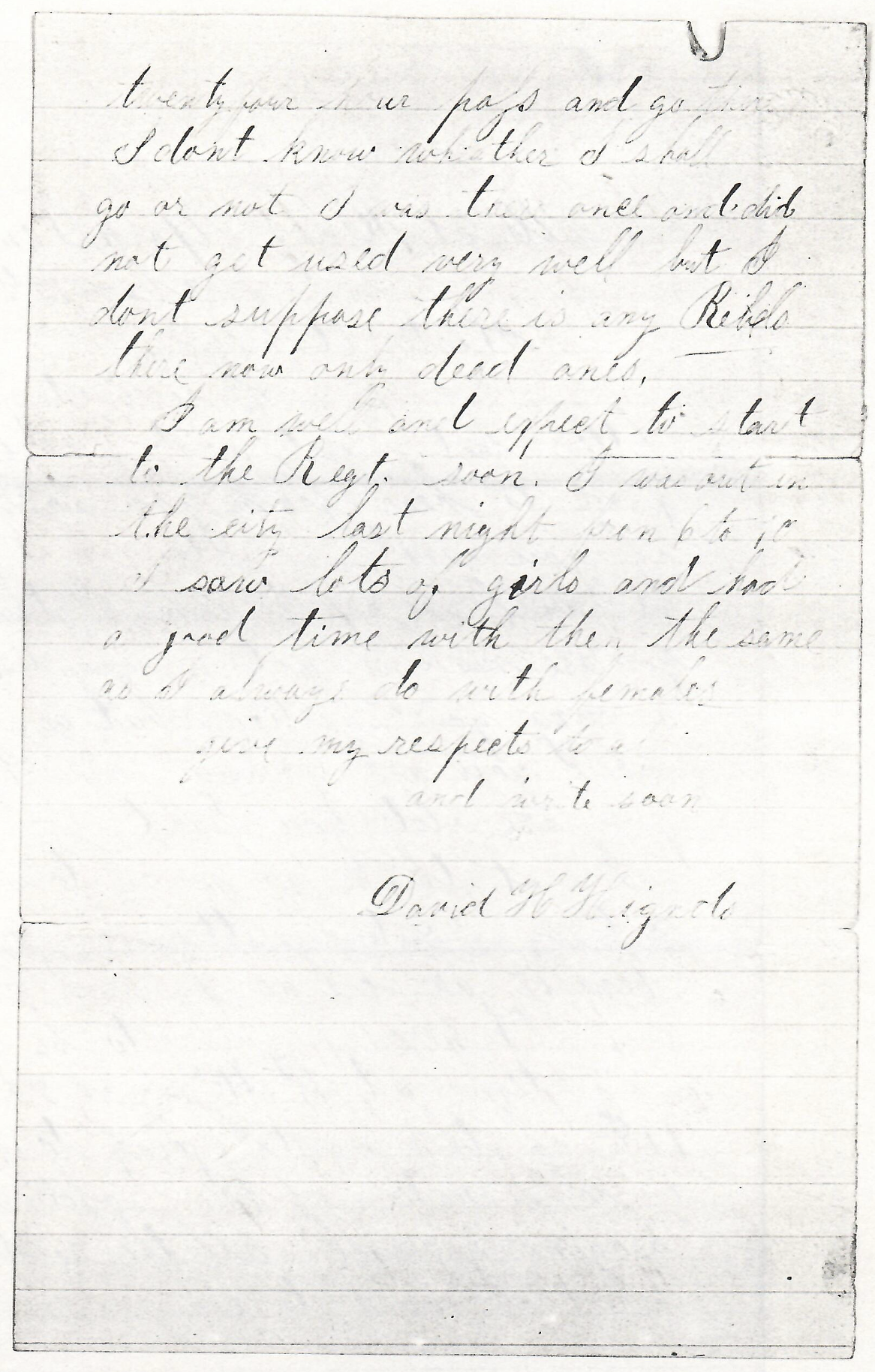
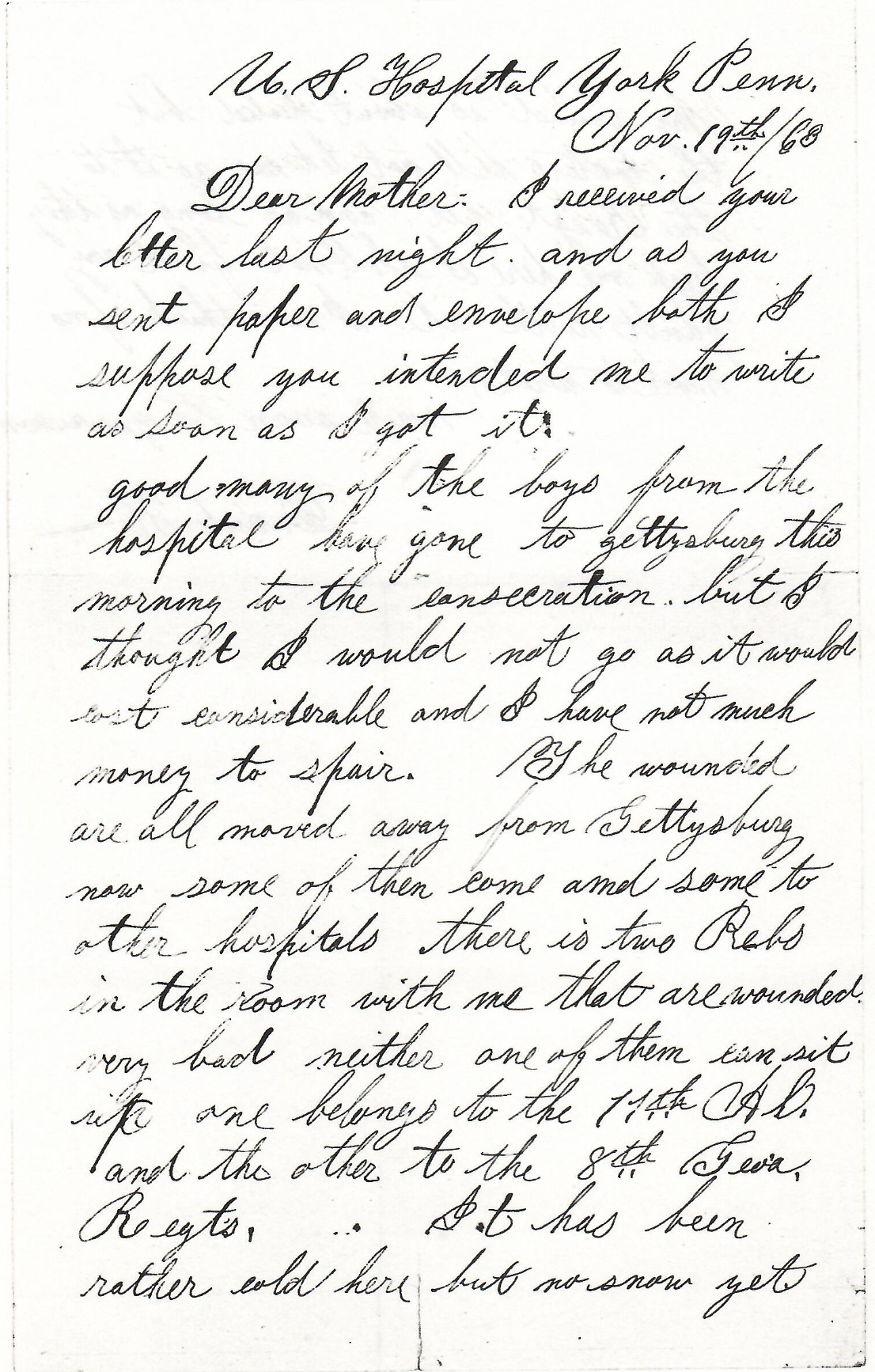
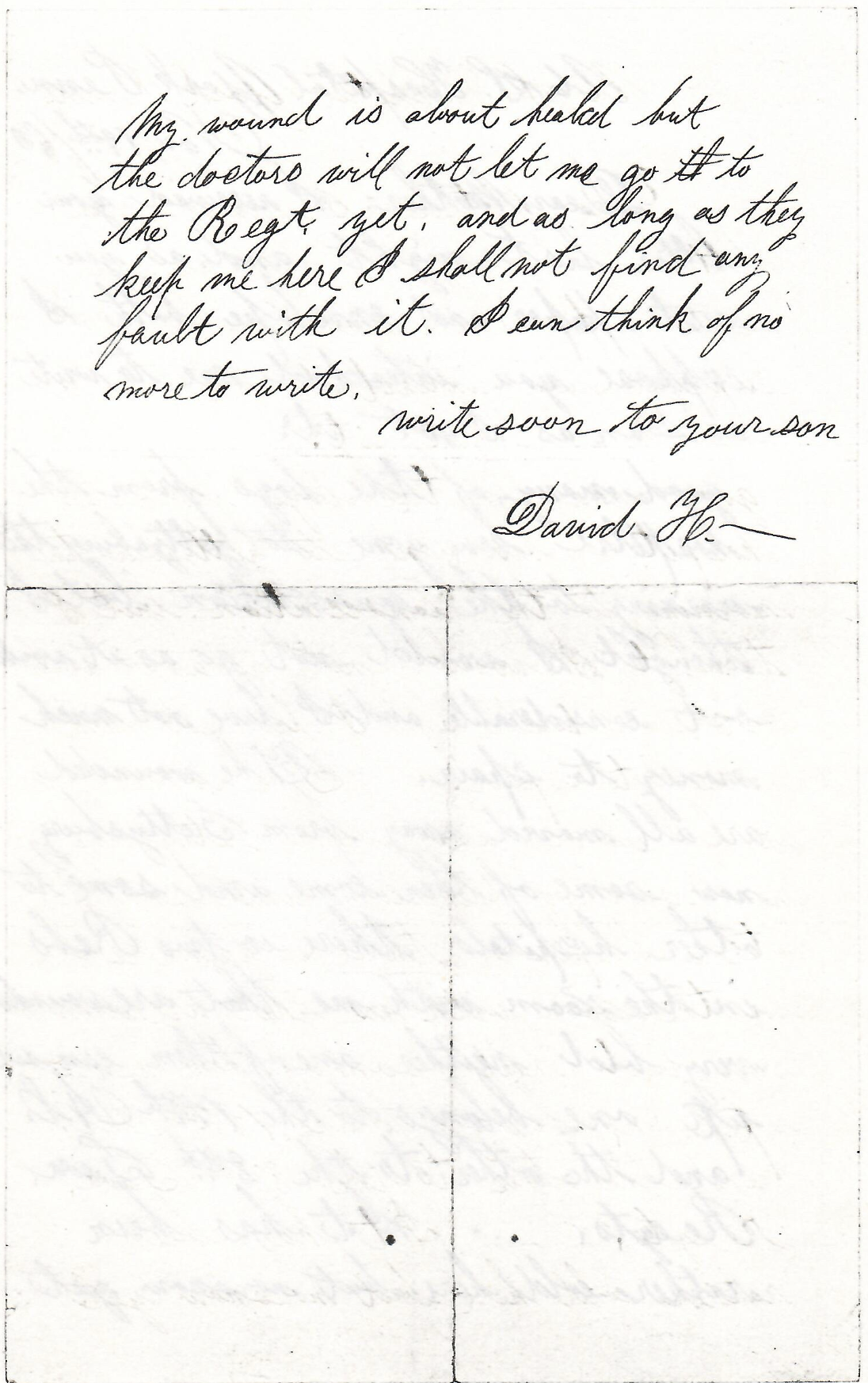
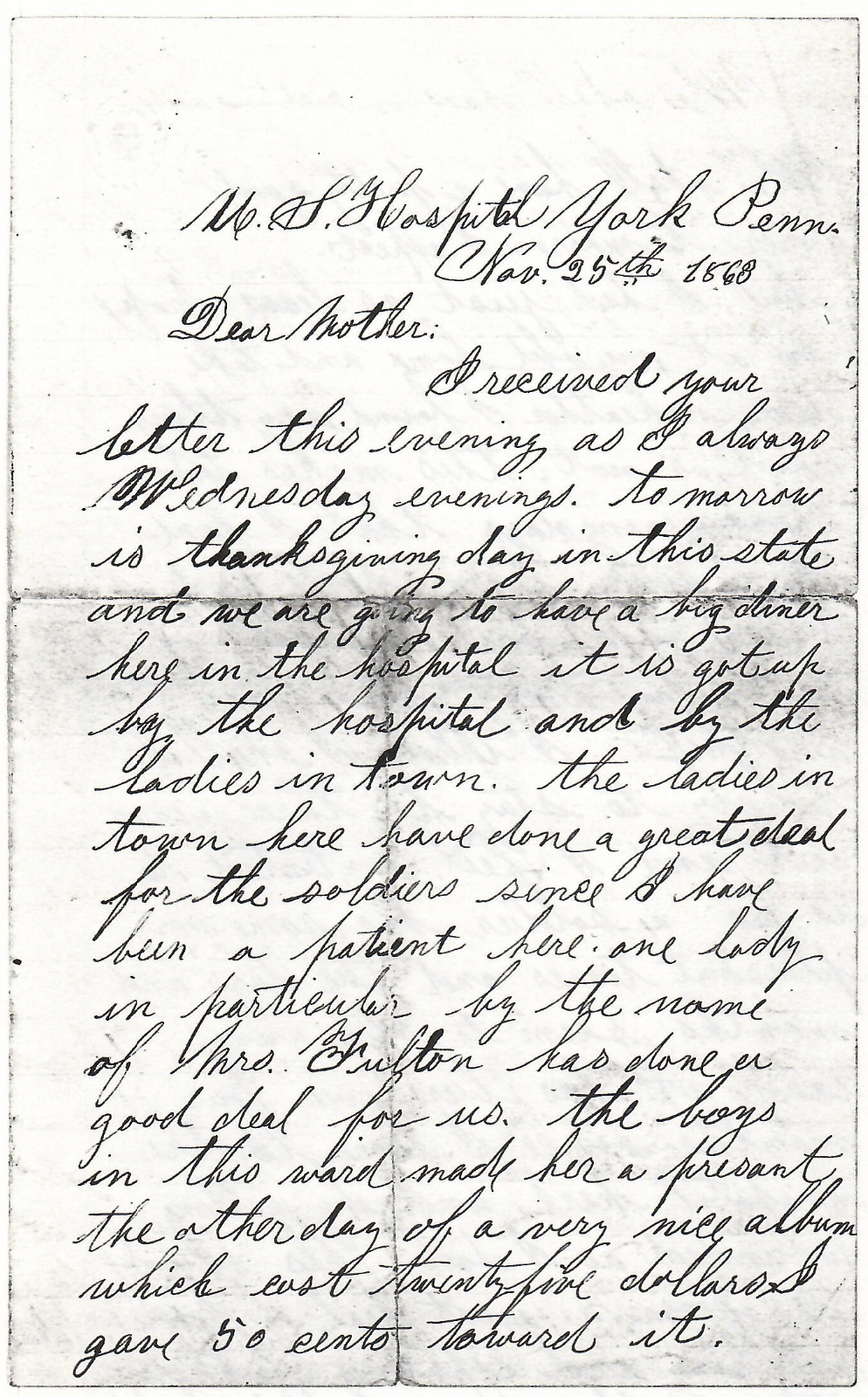
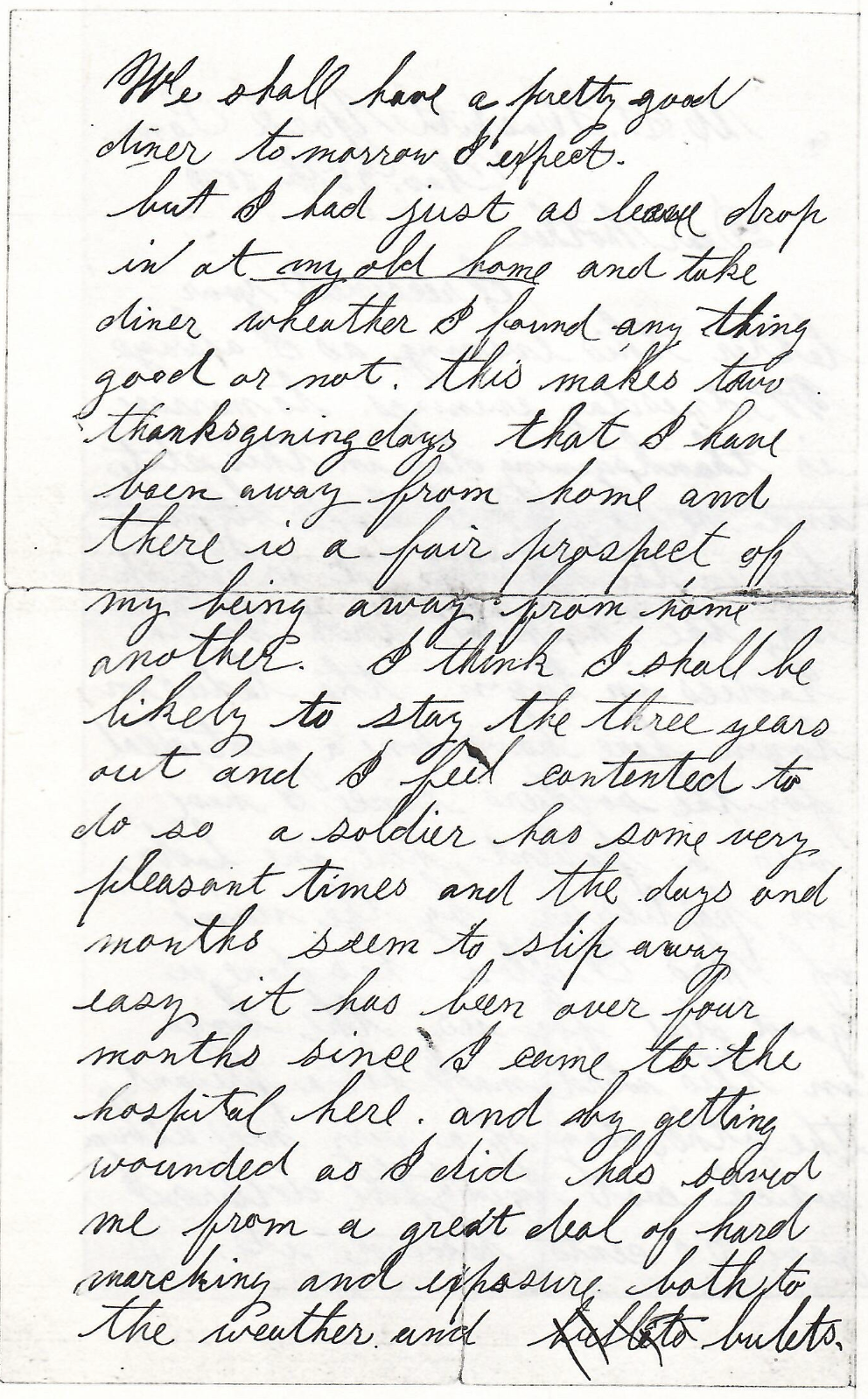
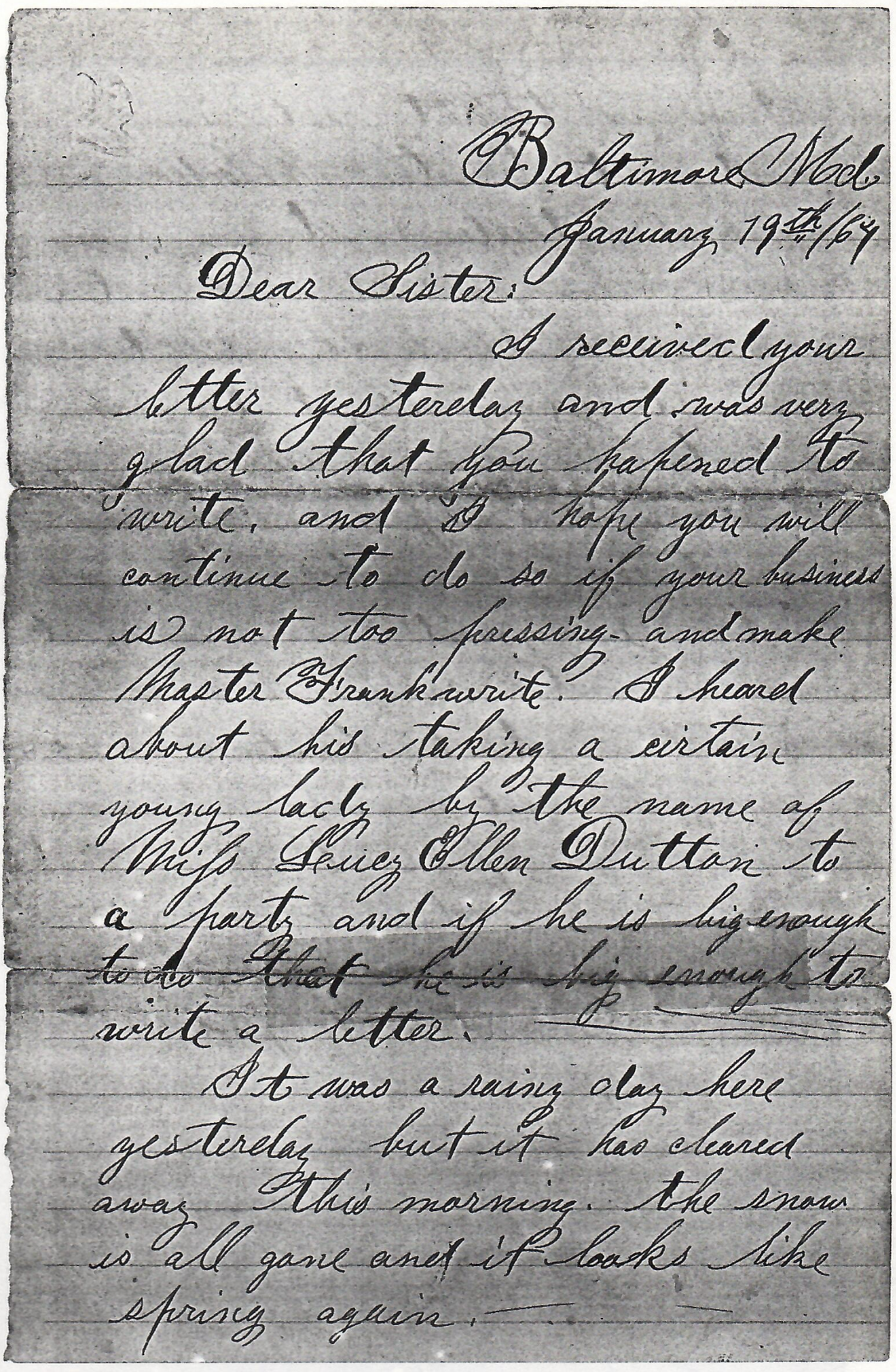
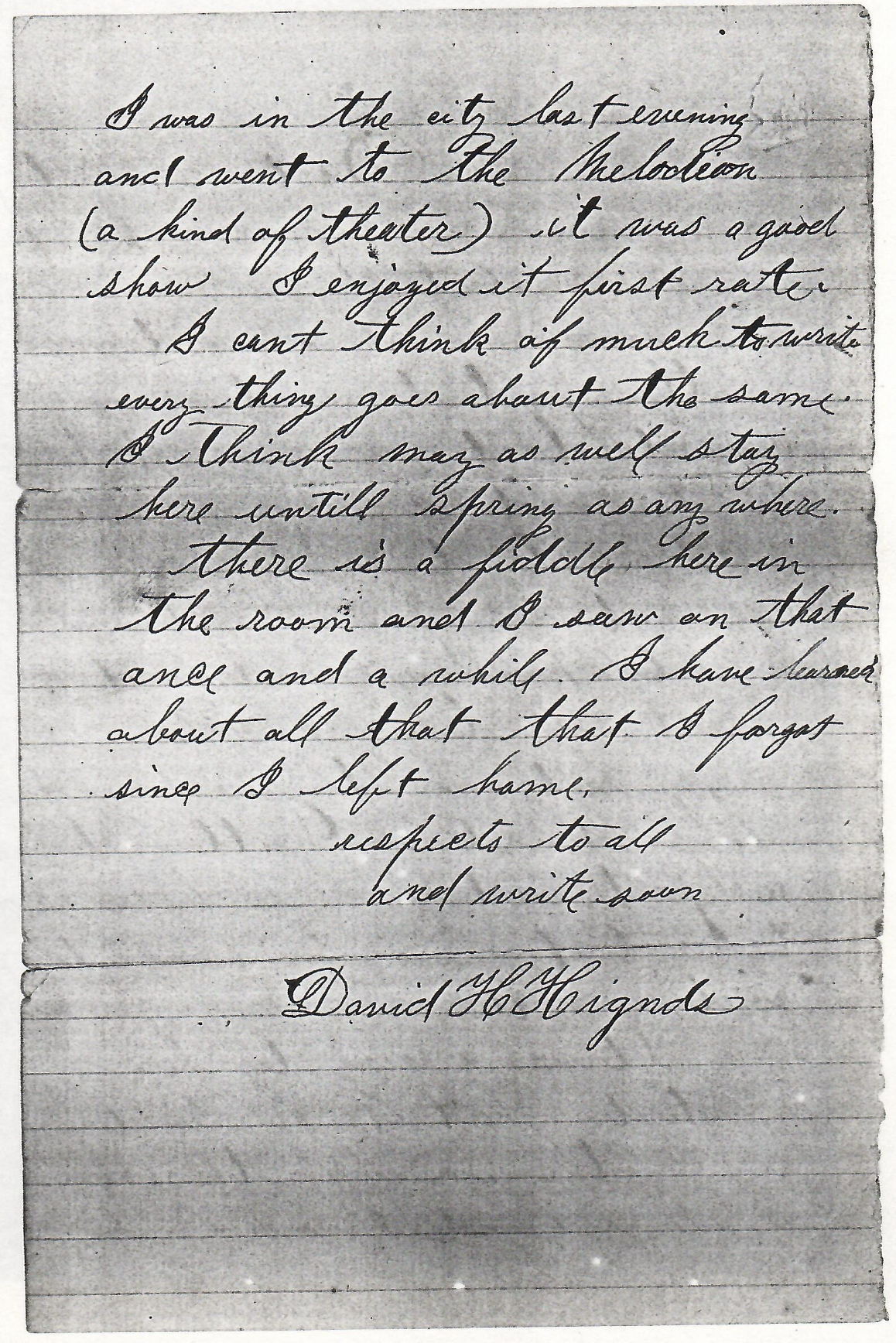
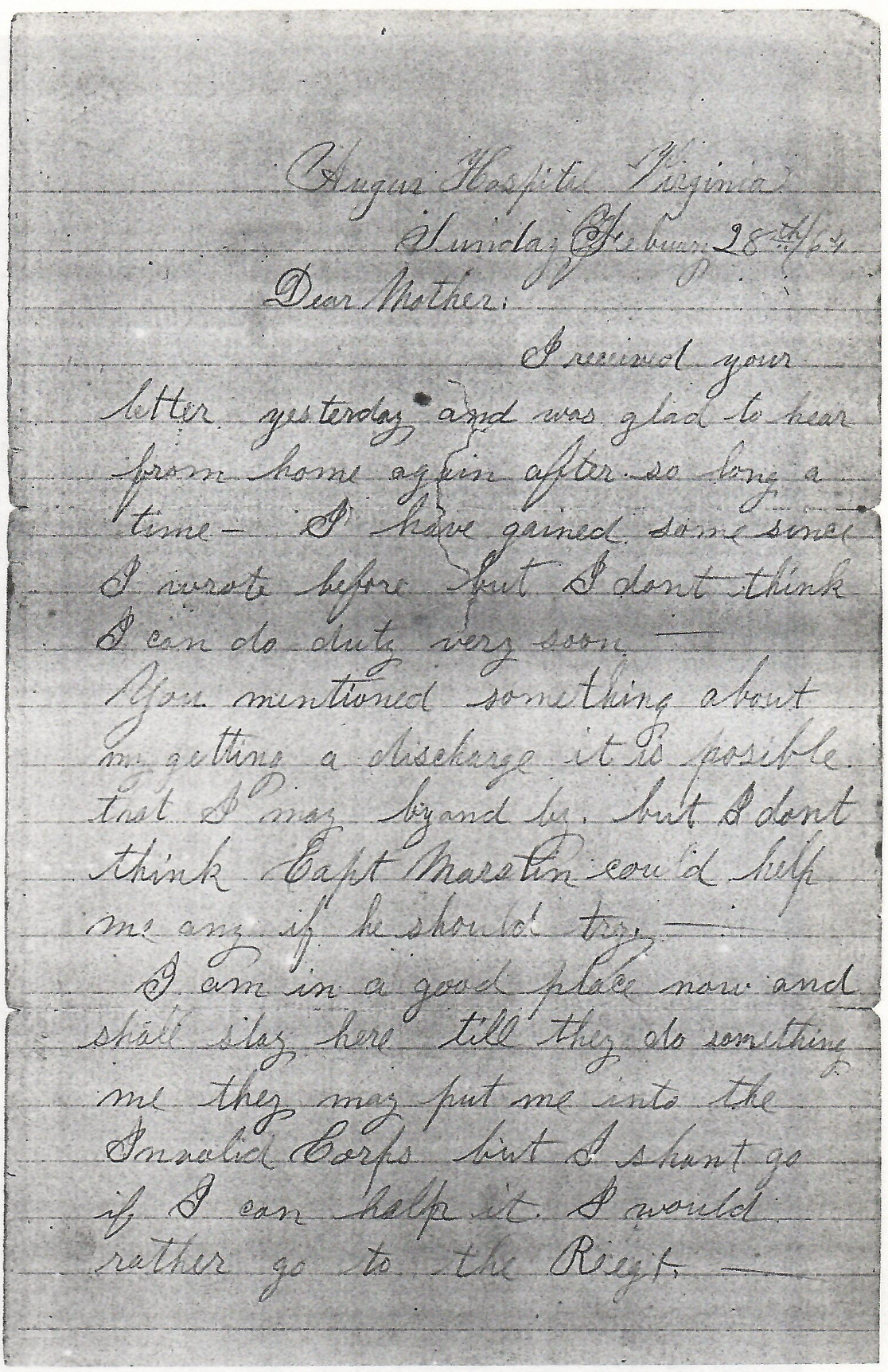
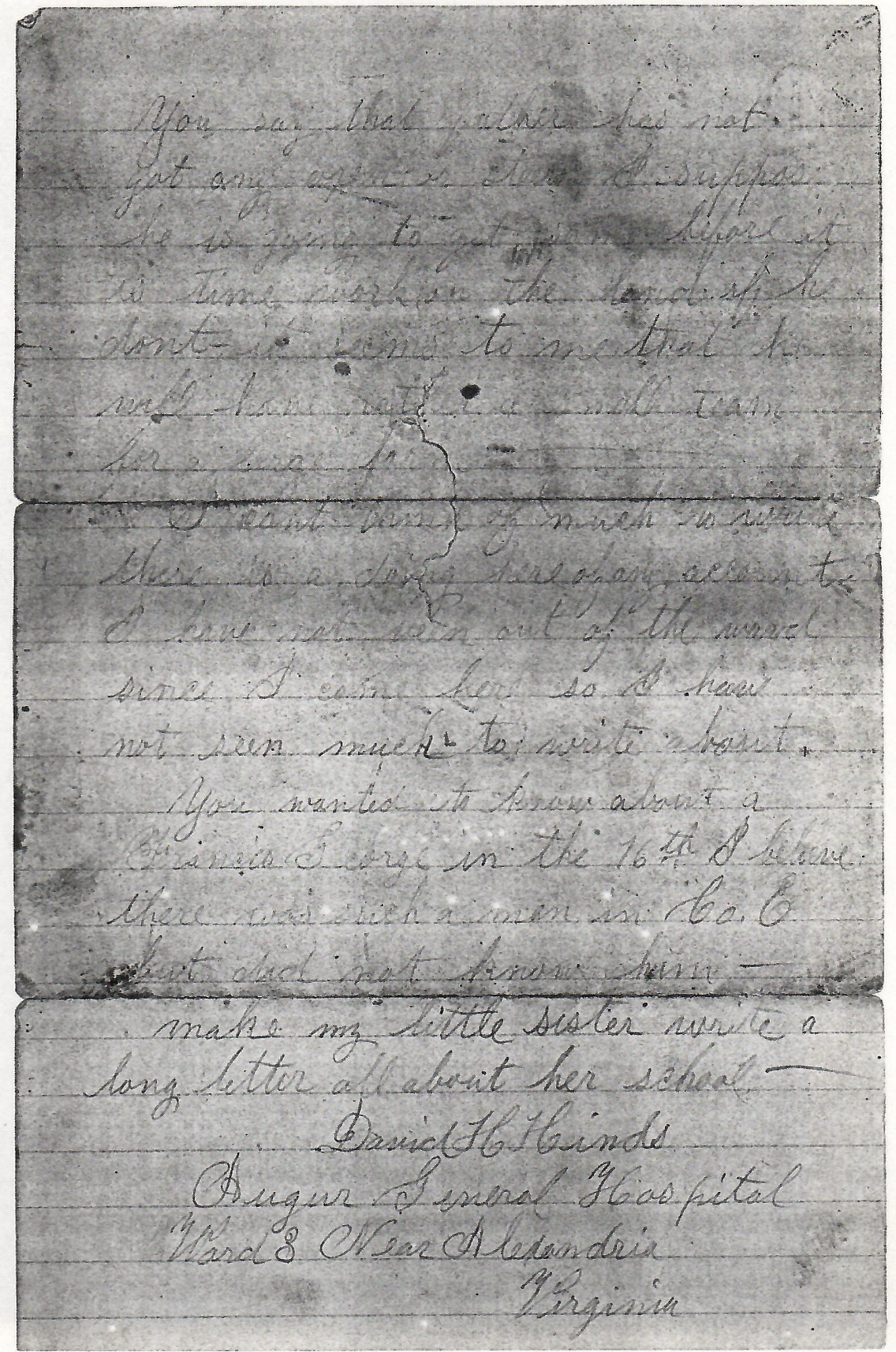
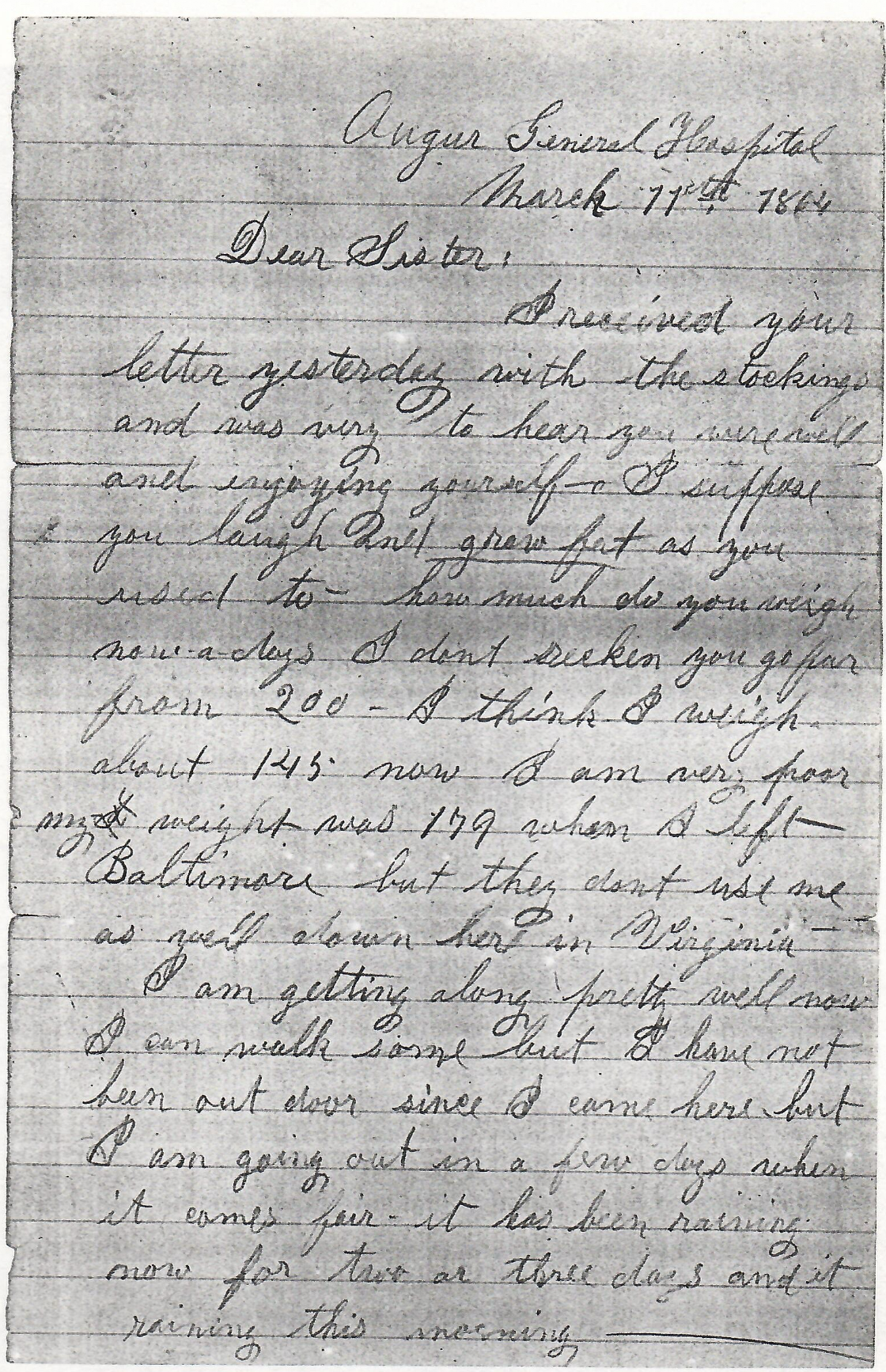
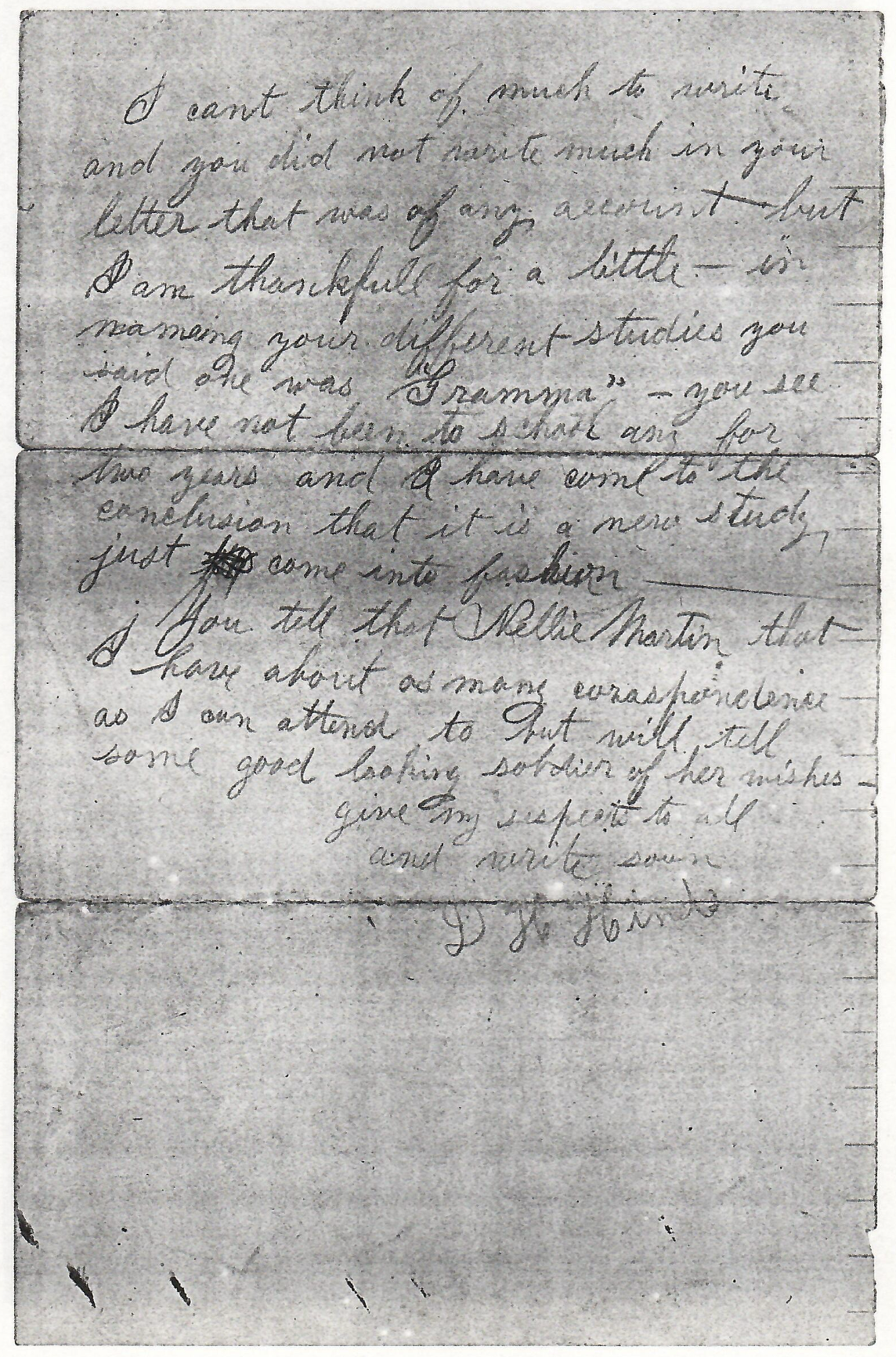
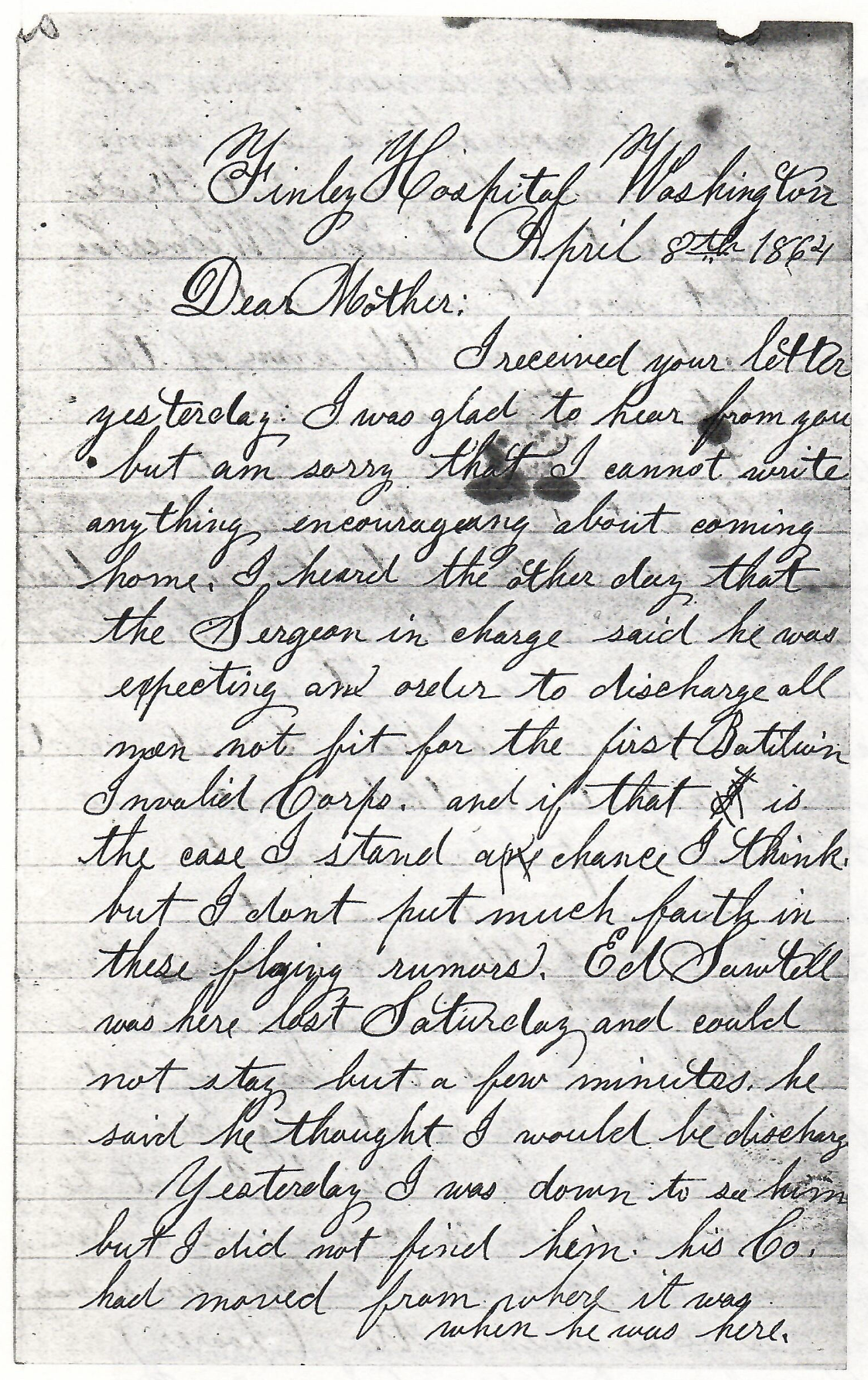
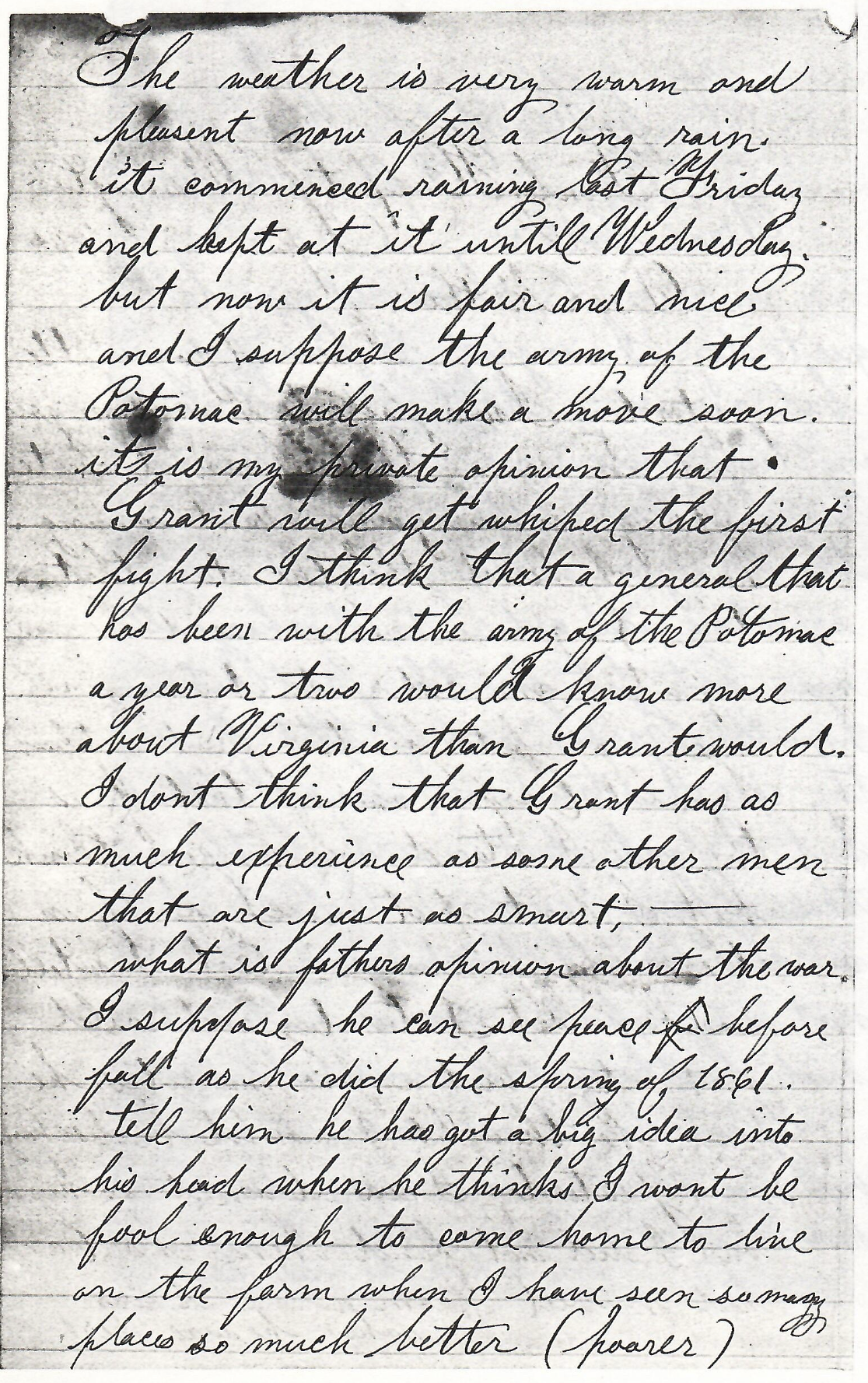
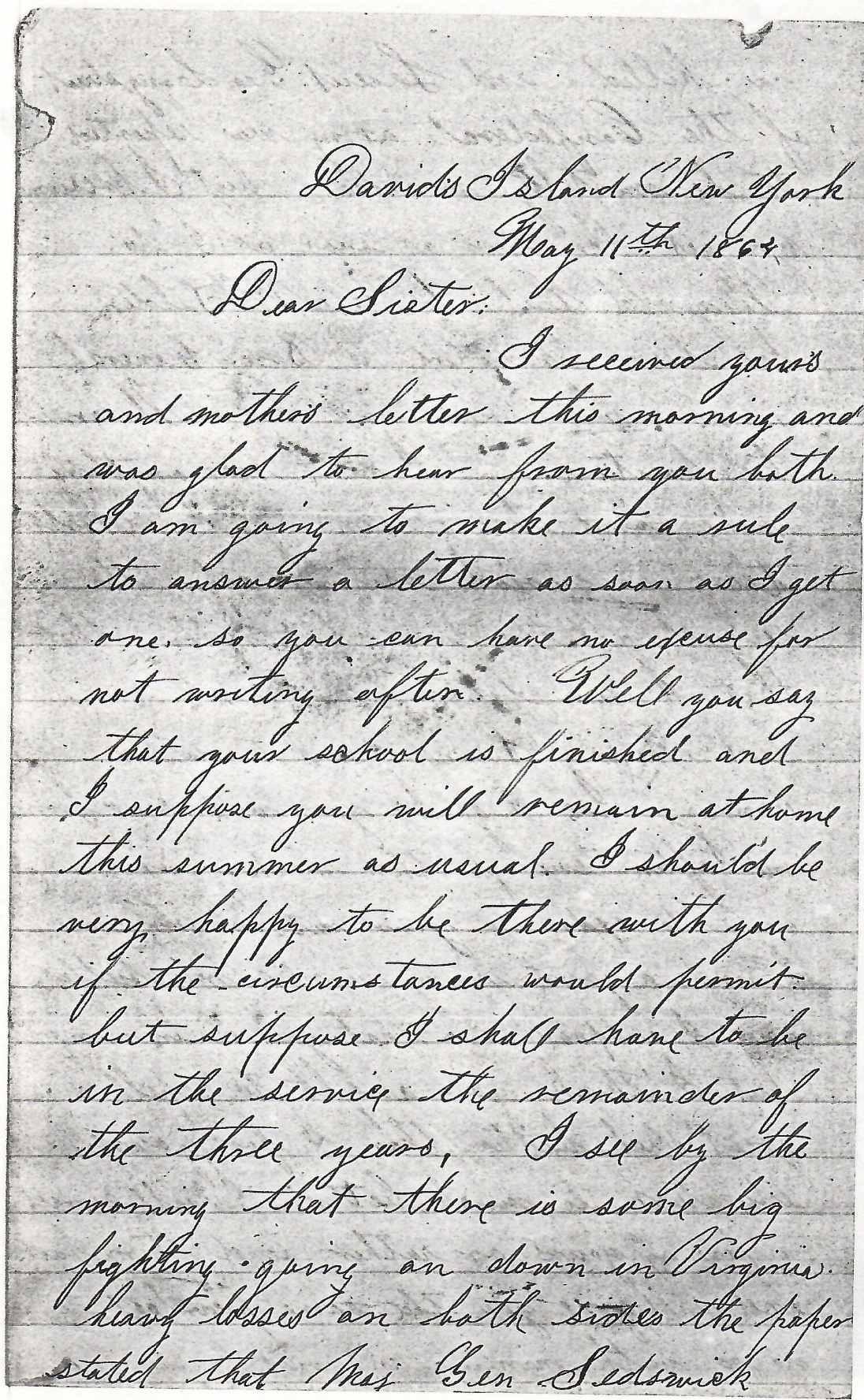
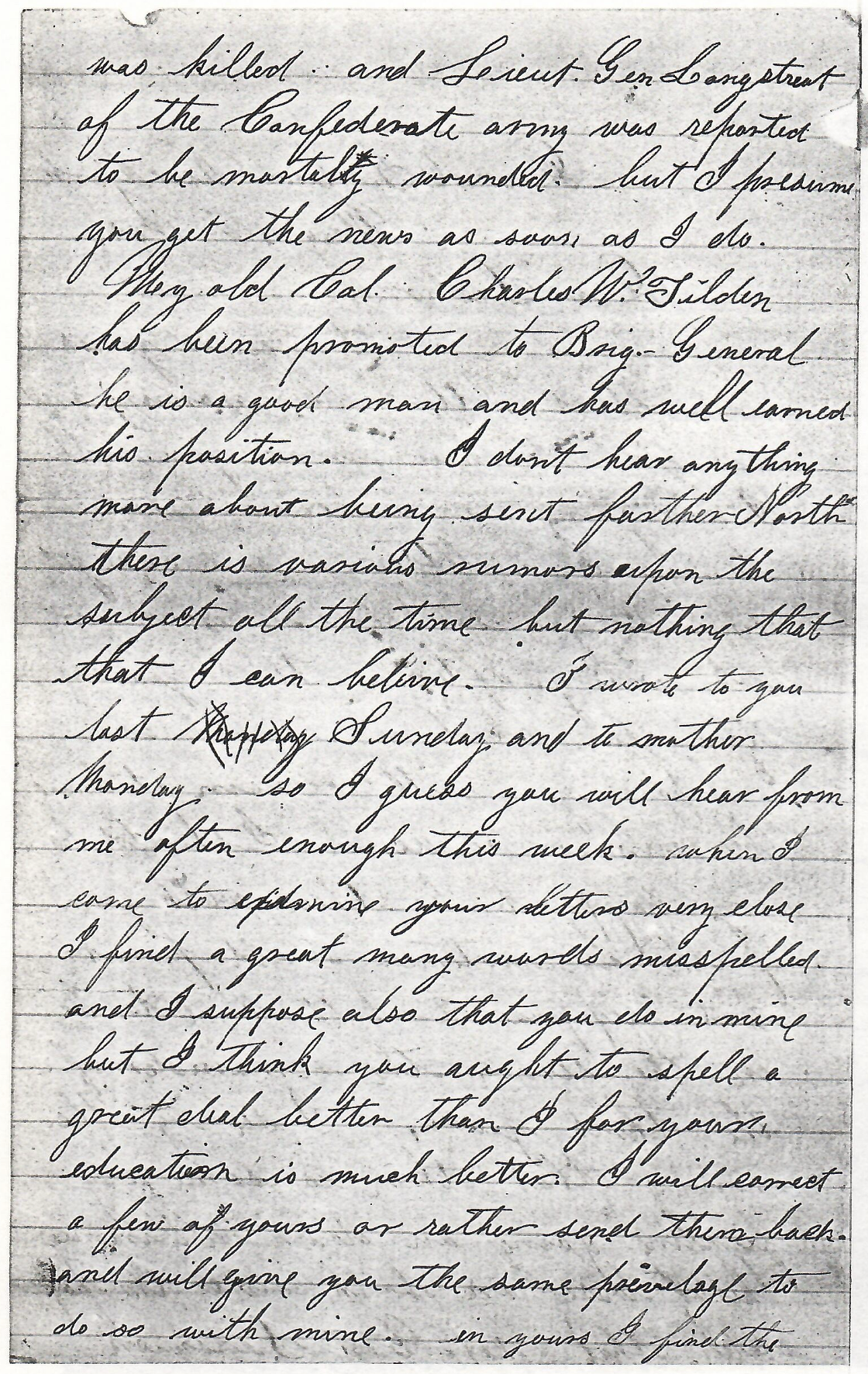
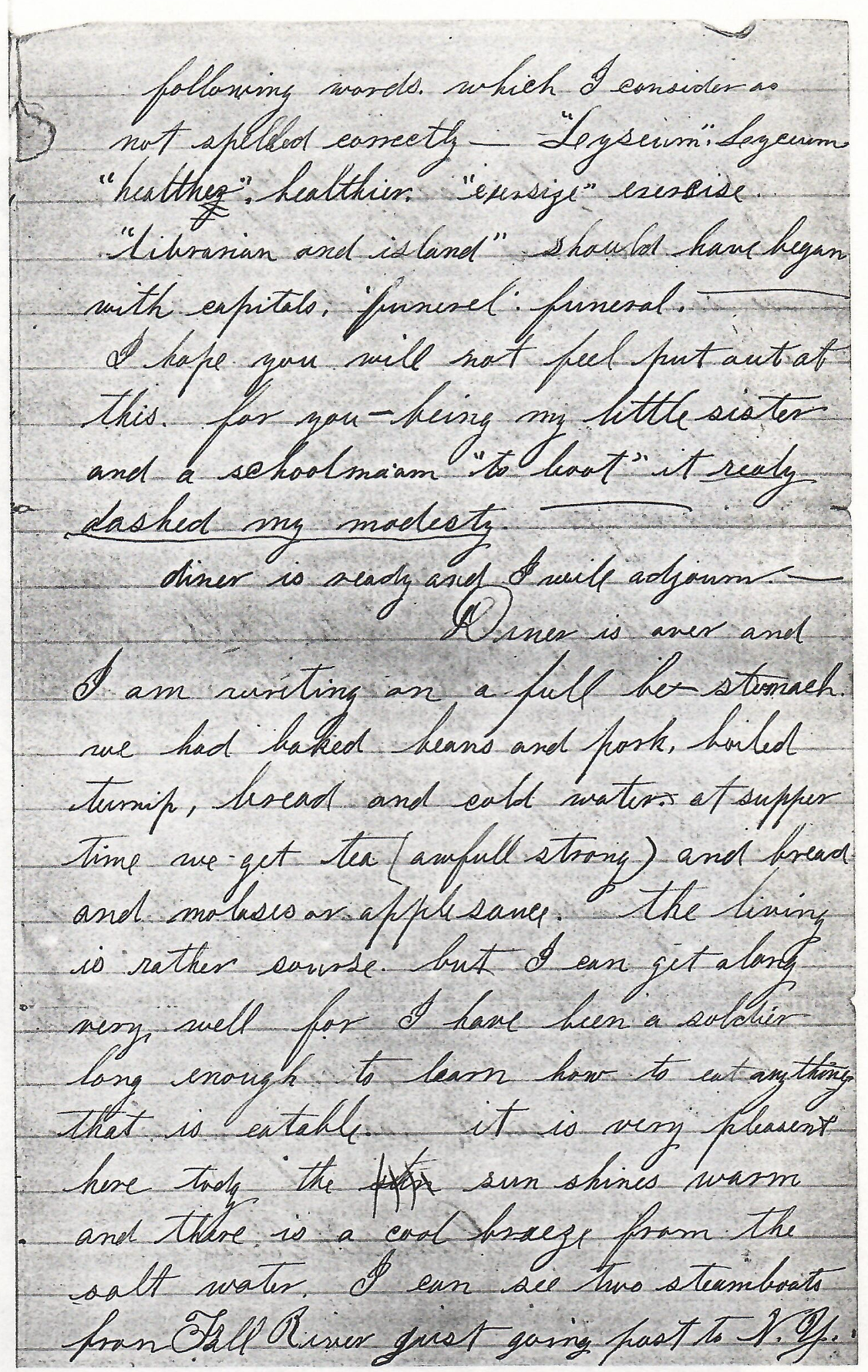
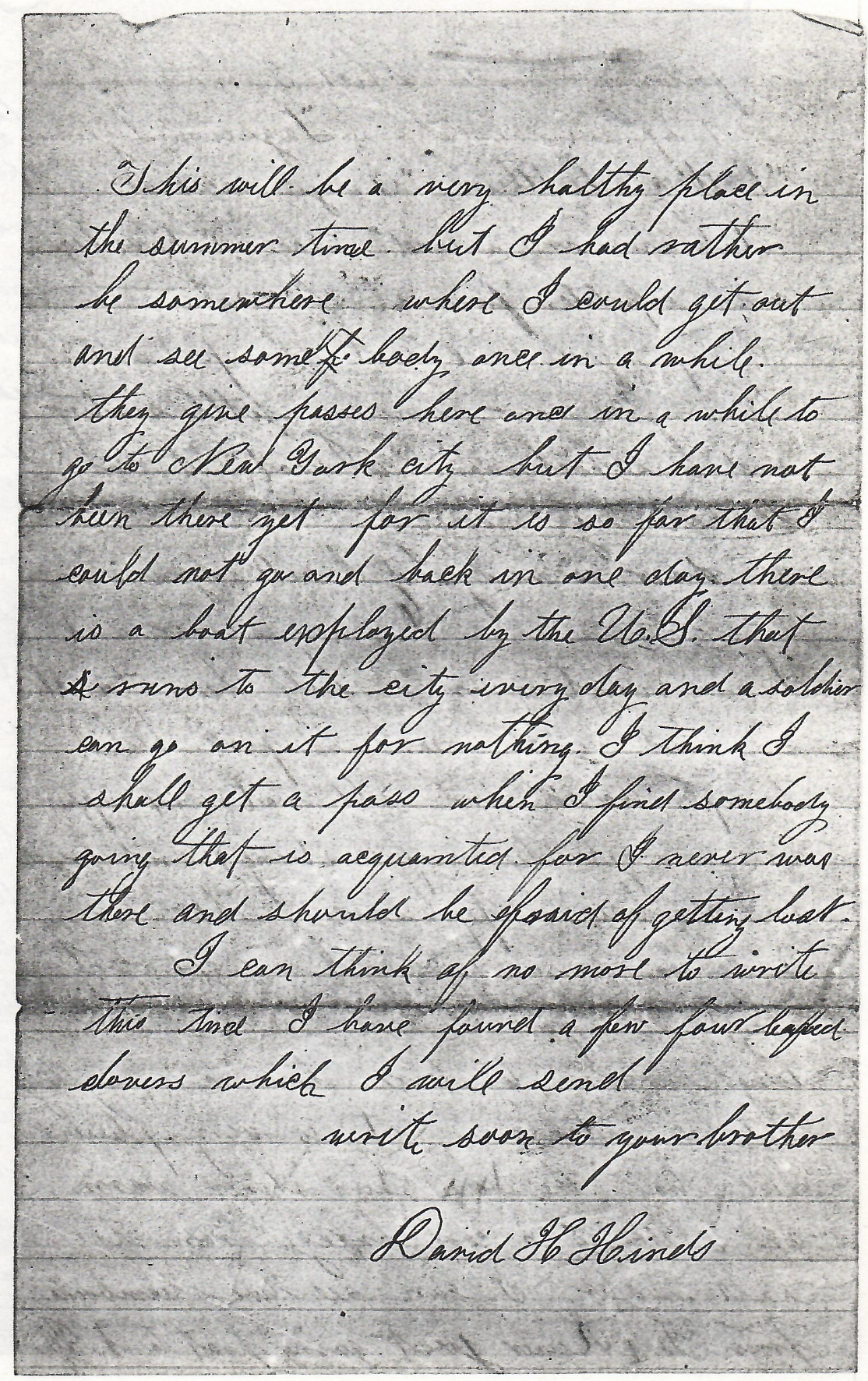
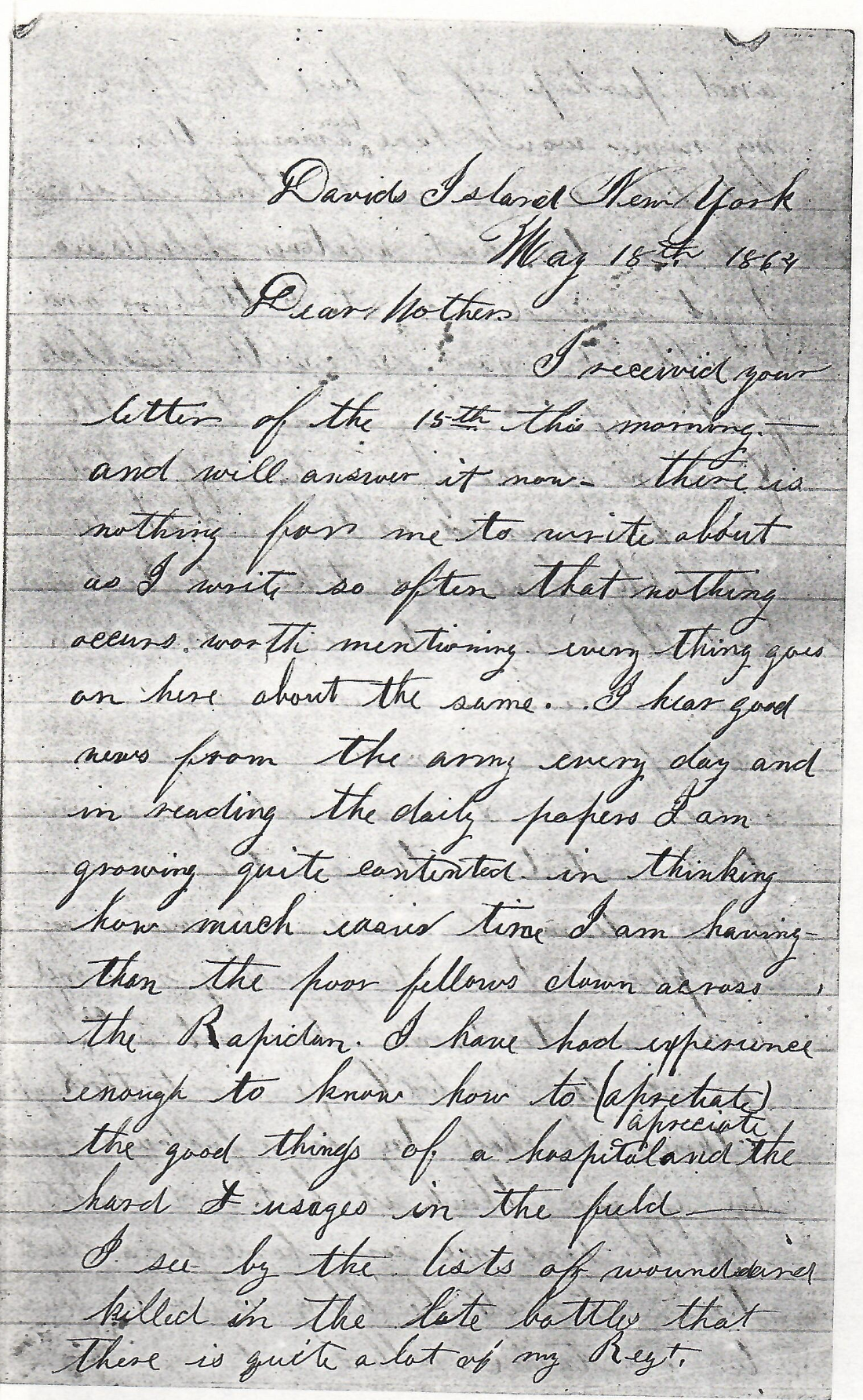
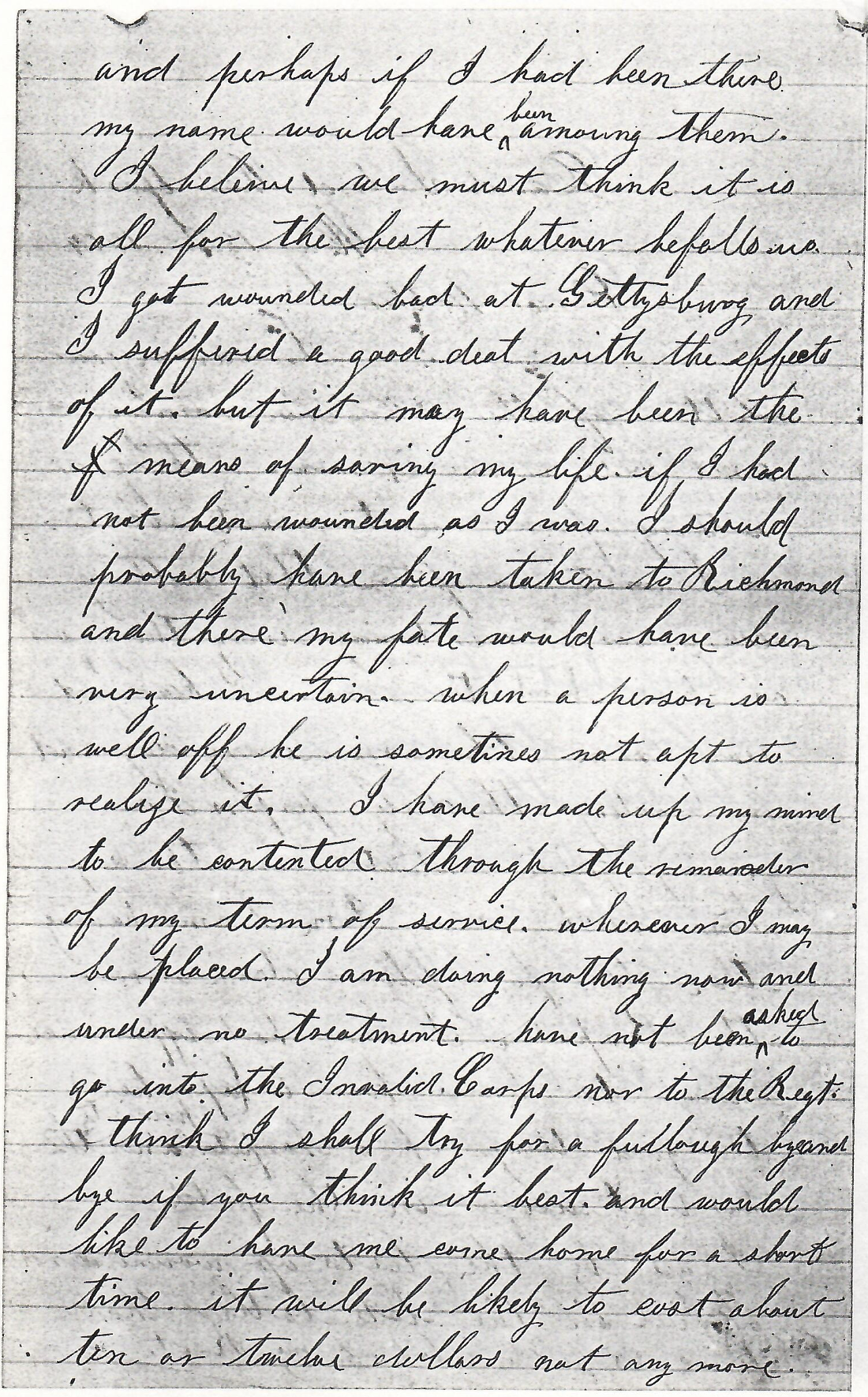
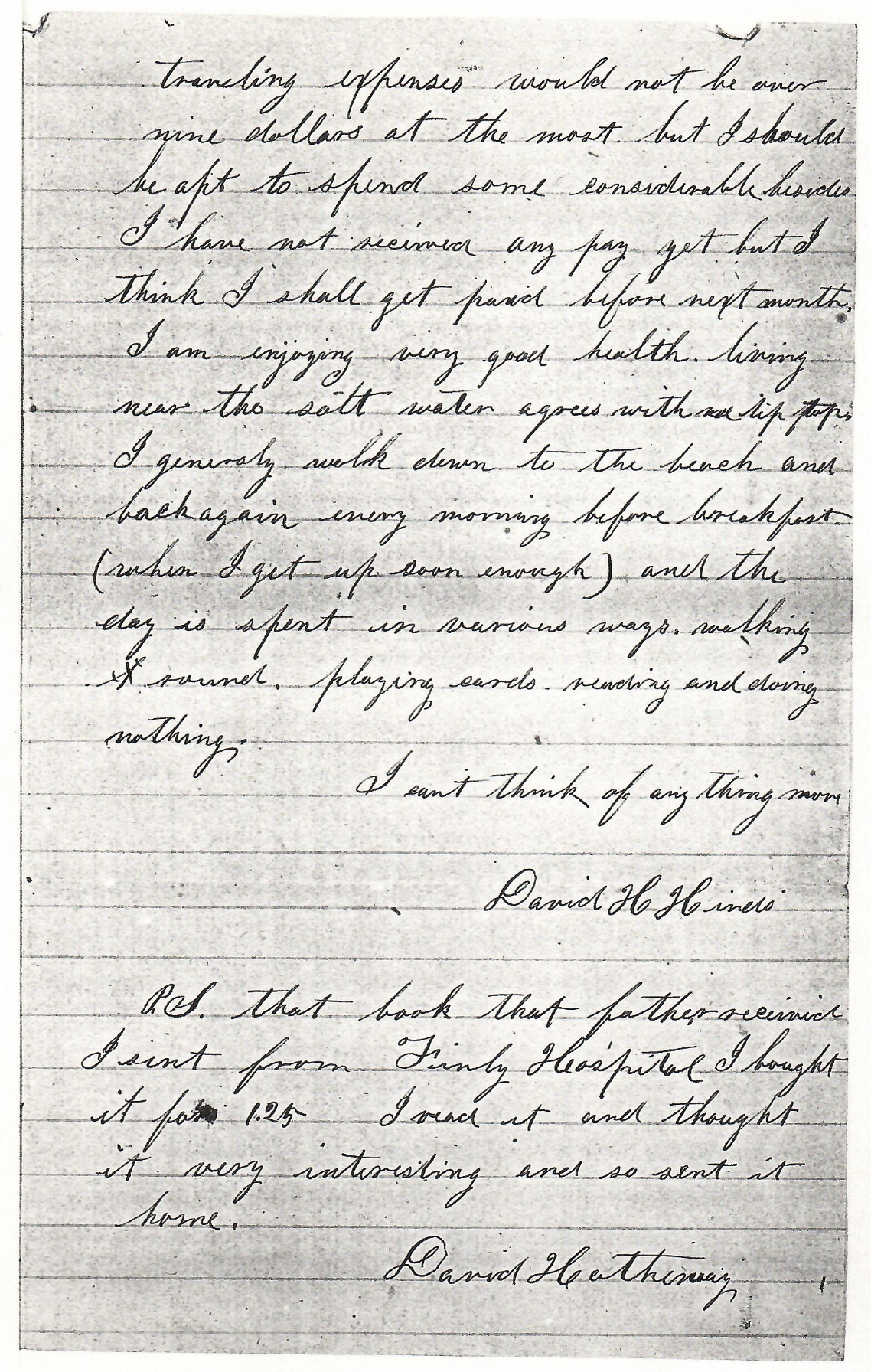
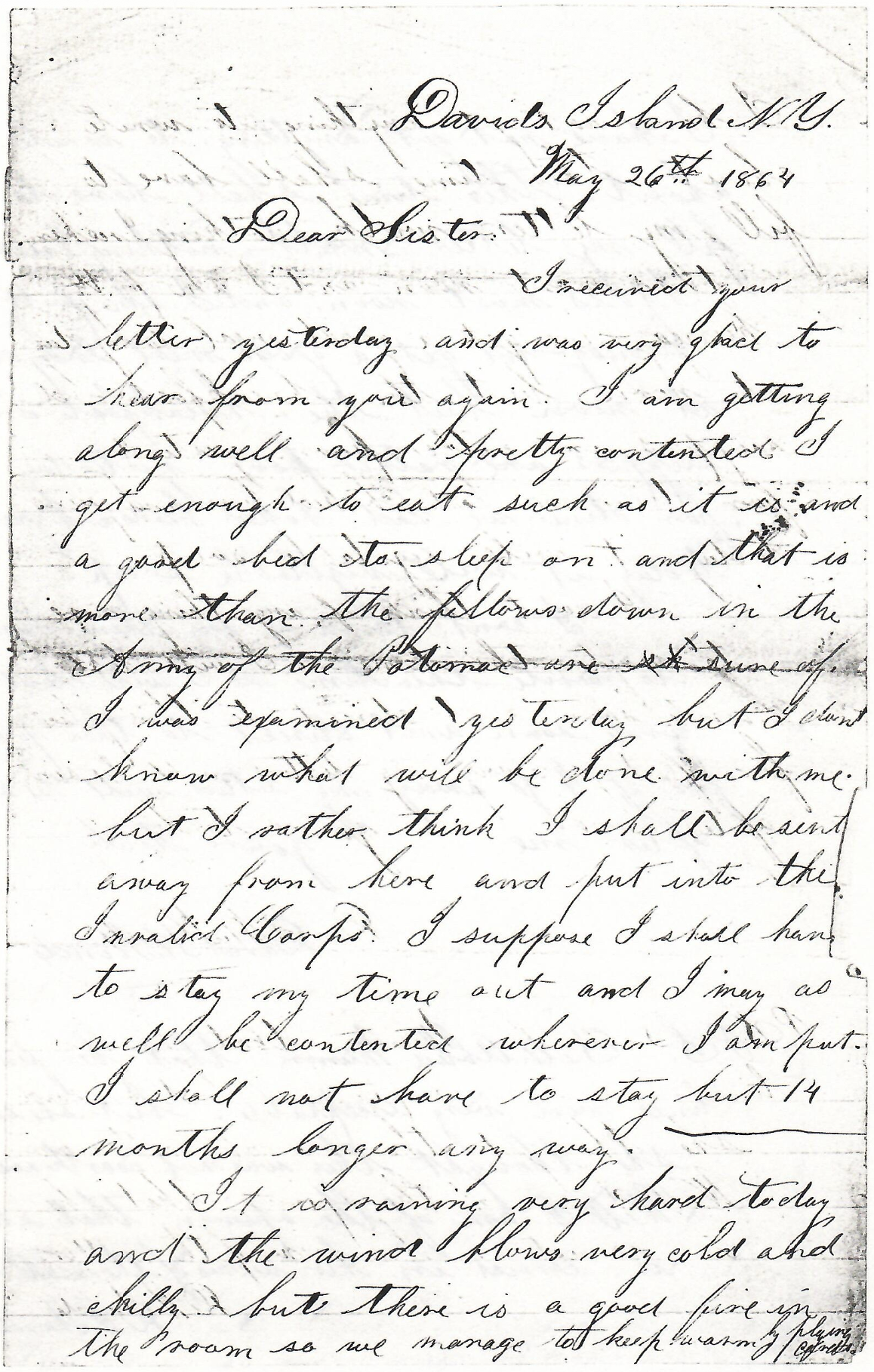
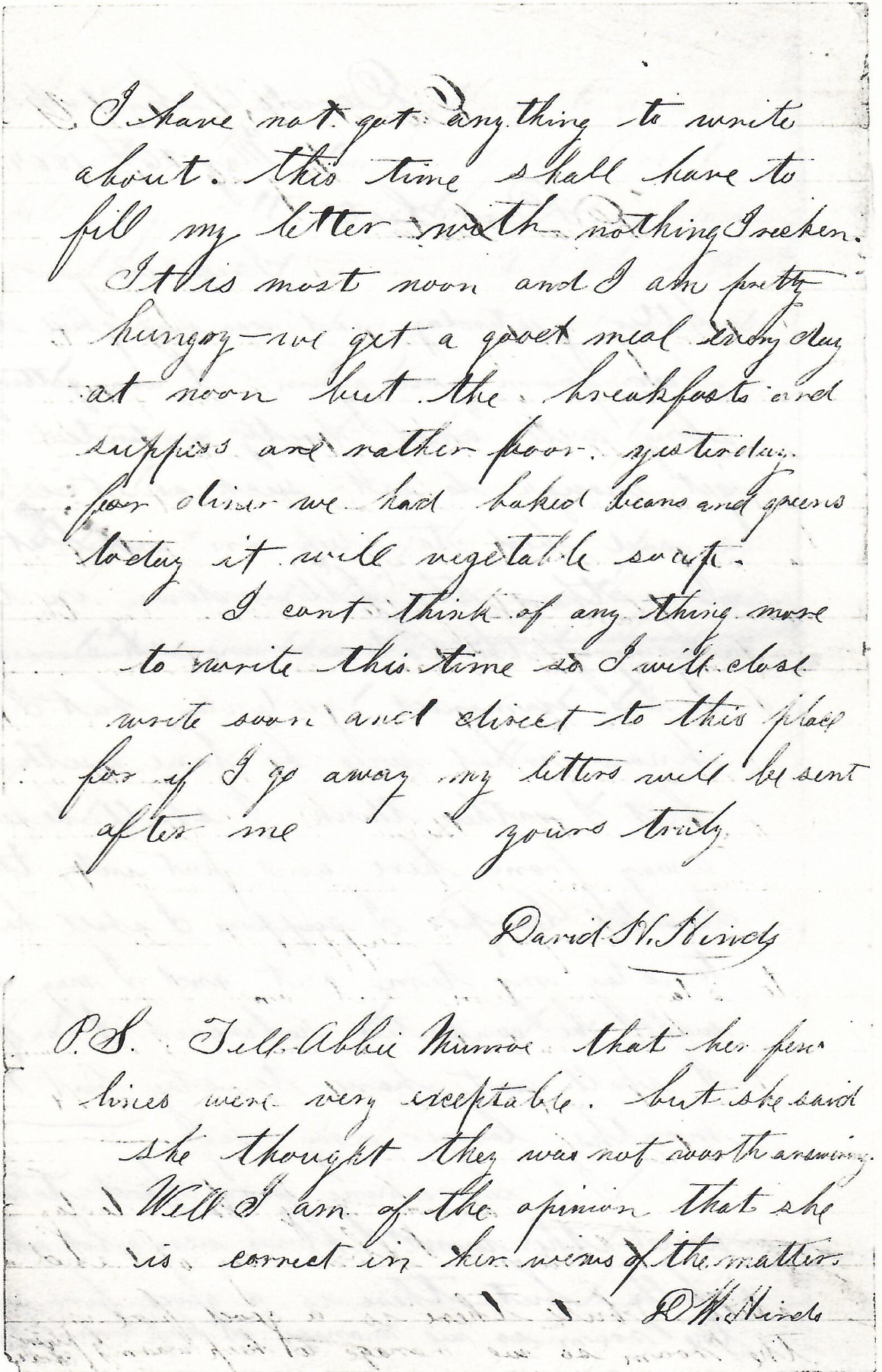
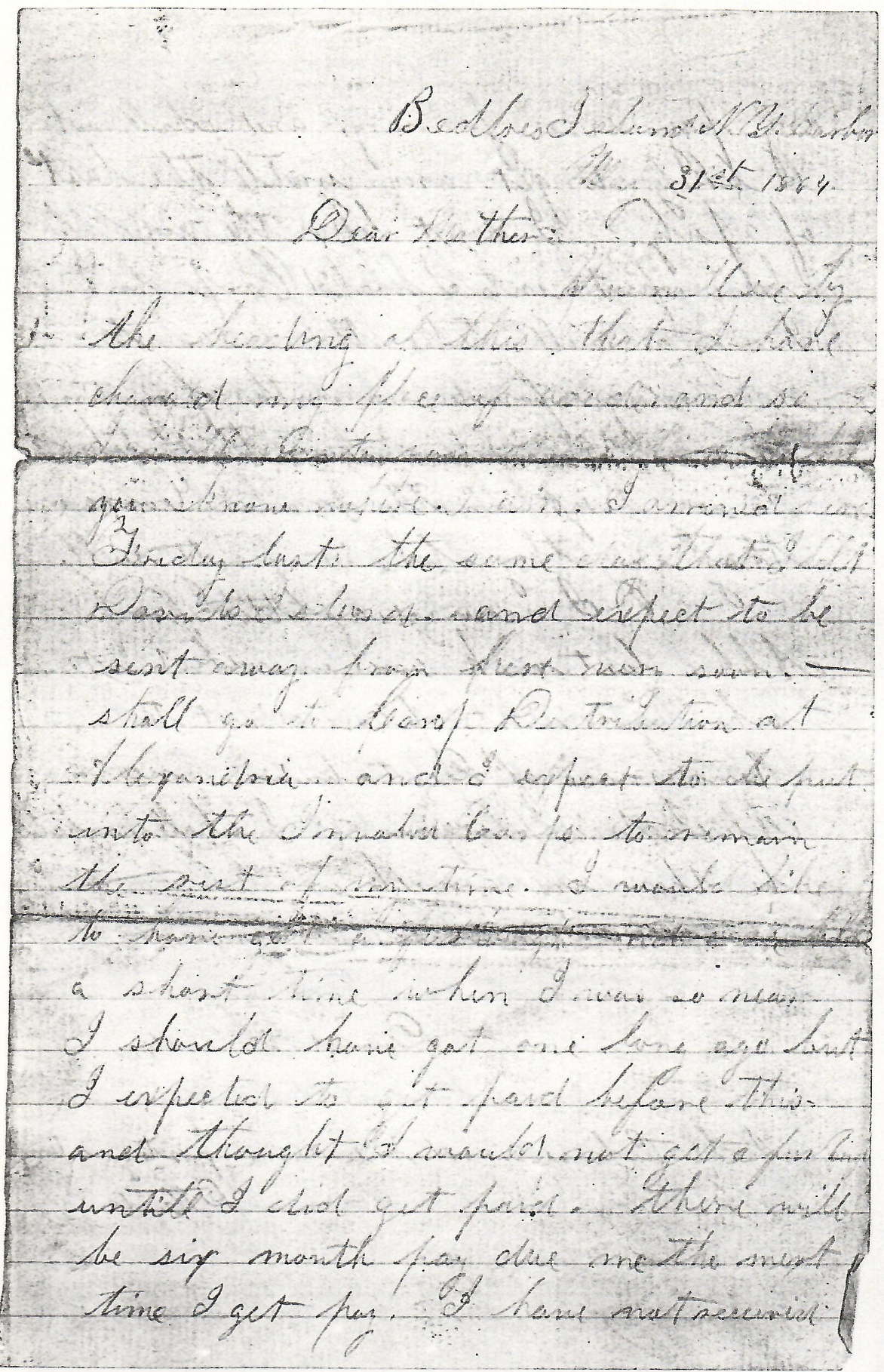
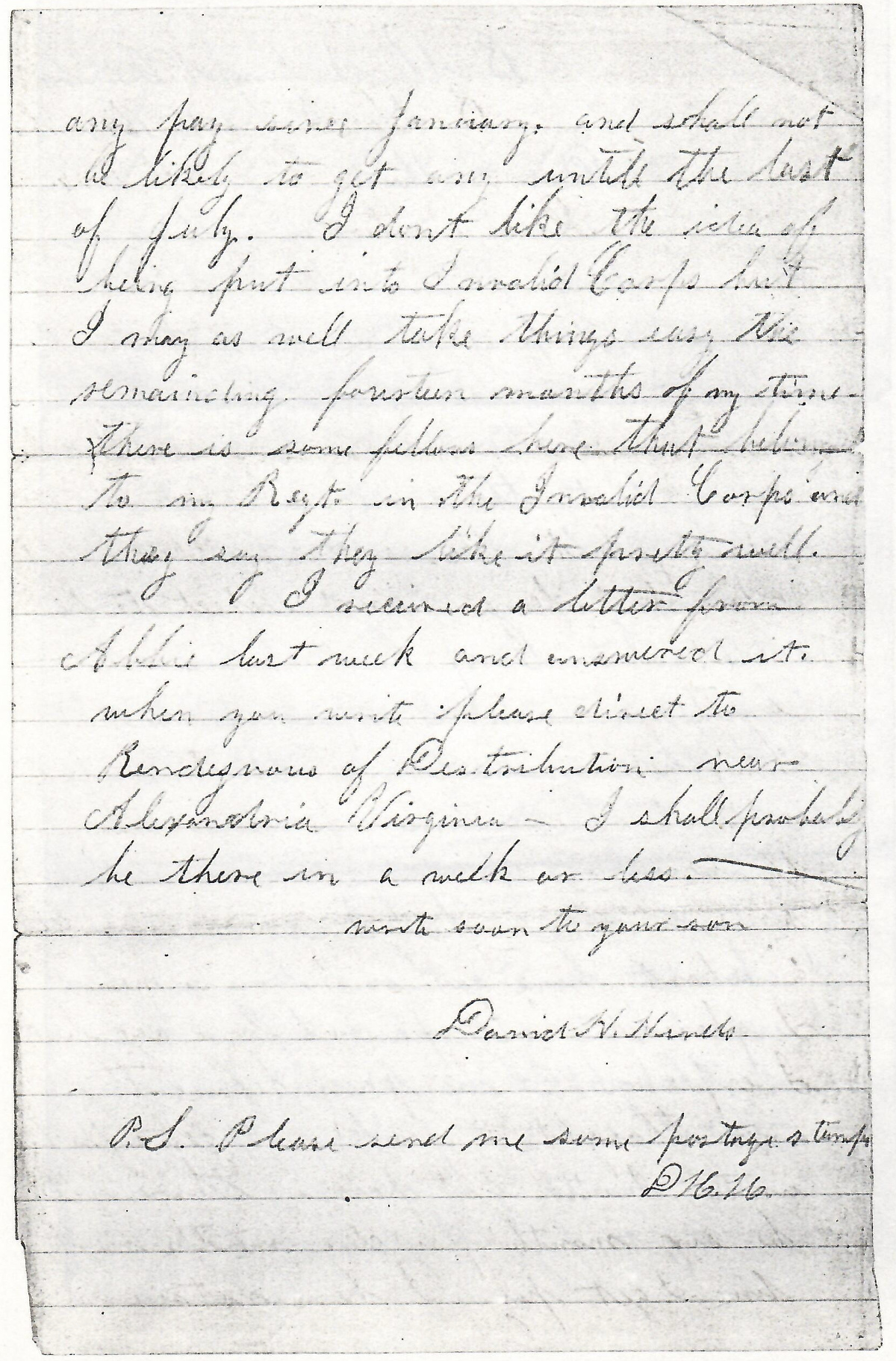
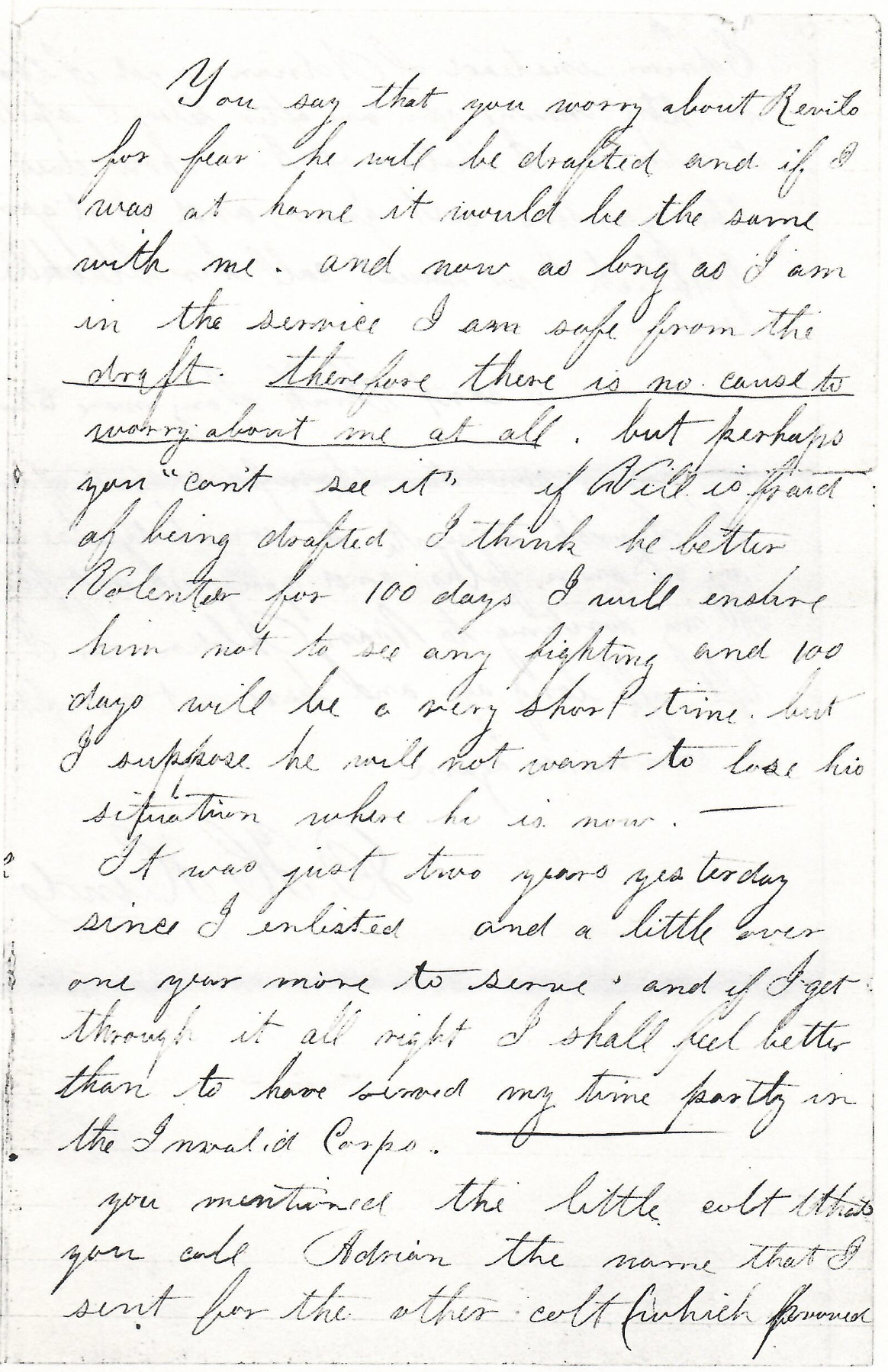
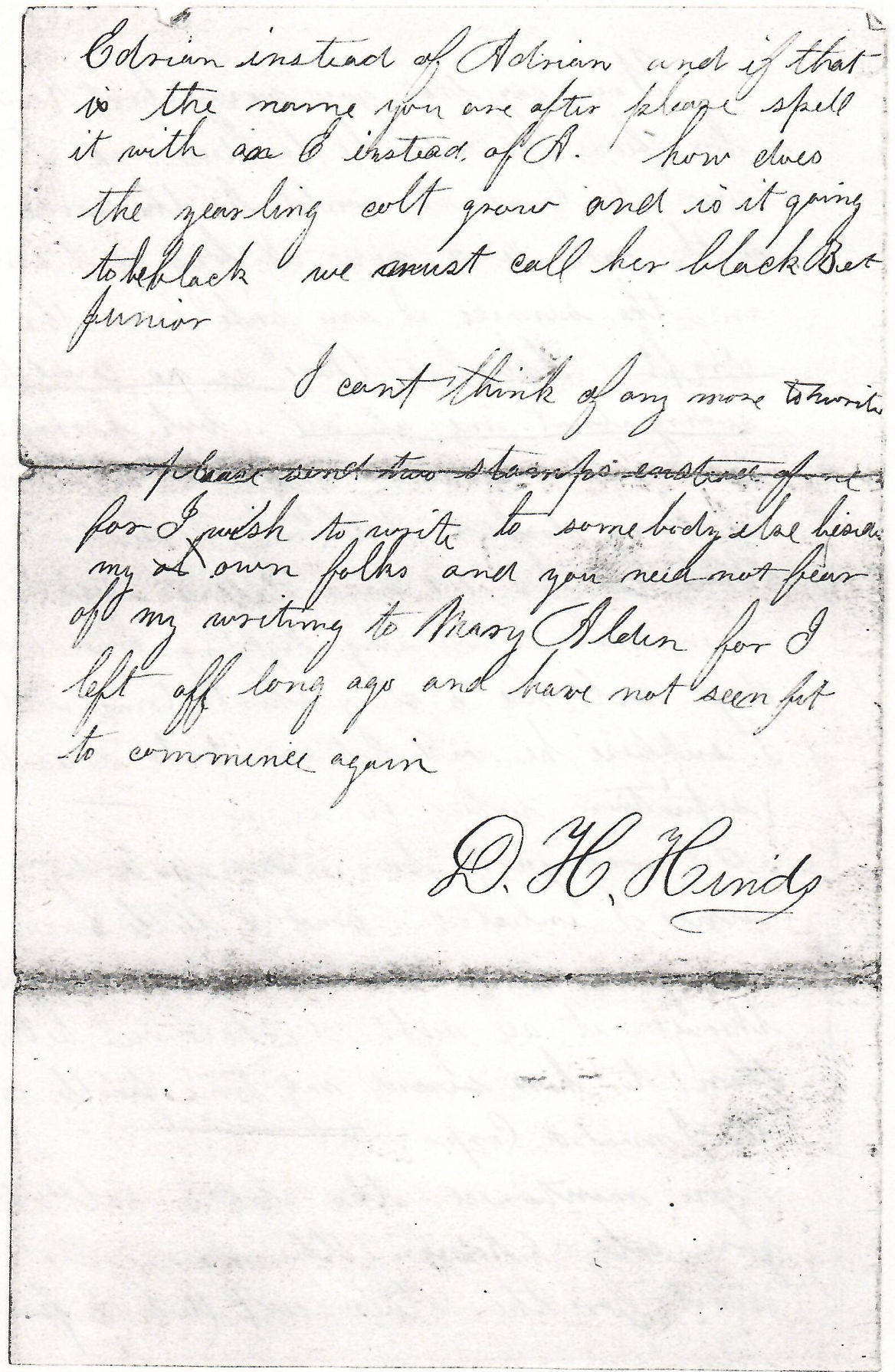
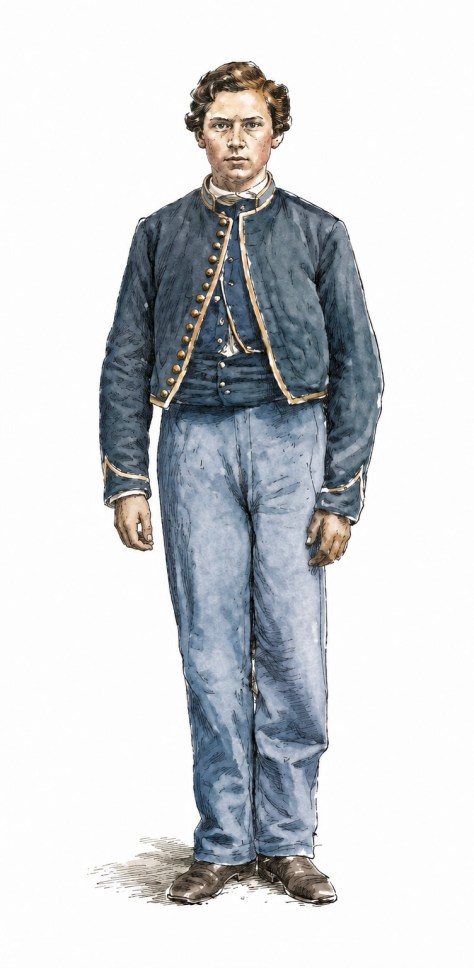
The following letters were penned by David Hathaway Hinds (1844-1864) of East Livermore, Androscoggin county, Maine—a small, tight-knit and deeply patriotic rural community. Though historically and yet largely agricultural, the arrival of the Androscoggin Railroad a decade before the Civil War was opening new markets and industrializing the economy. Because so many young men like David enlisted to fight in the Civil War, many farms faced a severe labor shortage, forcing women, children and even elderly grandparents to pick up the workload. Unlike many families in the 19th Century, David’s parents—Elkanah Leonard Hinds (1811-1888) and Mary Hathaway (1816-1887)—did not have many children. The 1860 US Census that they had only five. They were in birth order: Revillo or “Vill” (b. 1841), Abigail or “Abbie” (b. 1842), David (b. 1844), Frank (b. 1848), and John (b. 1858).
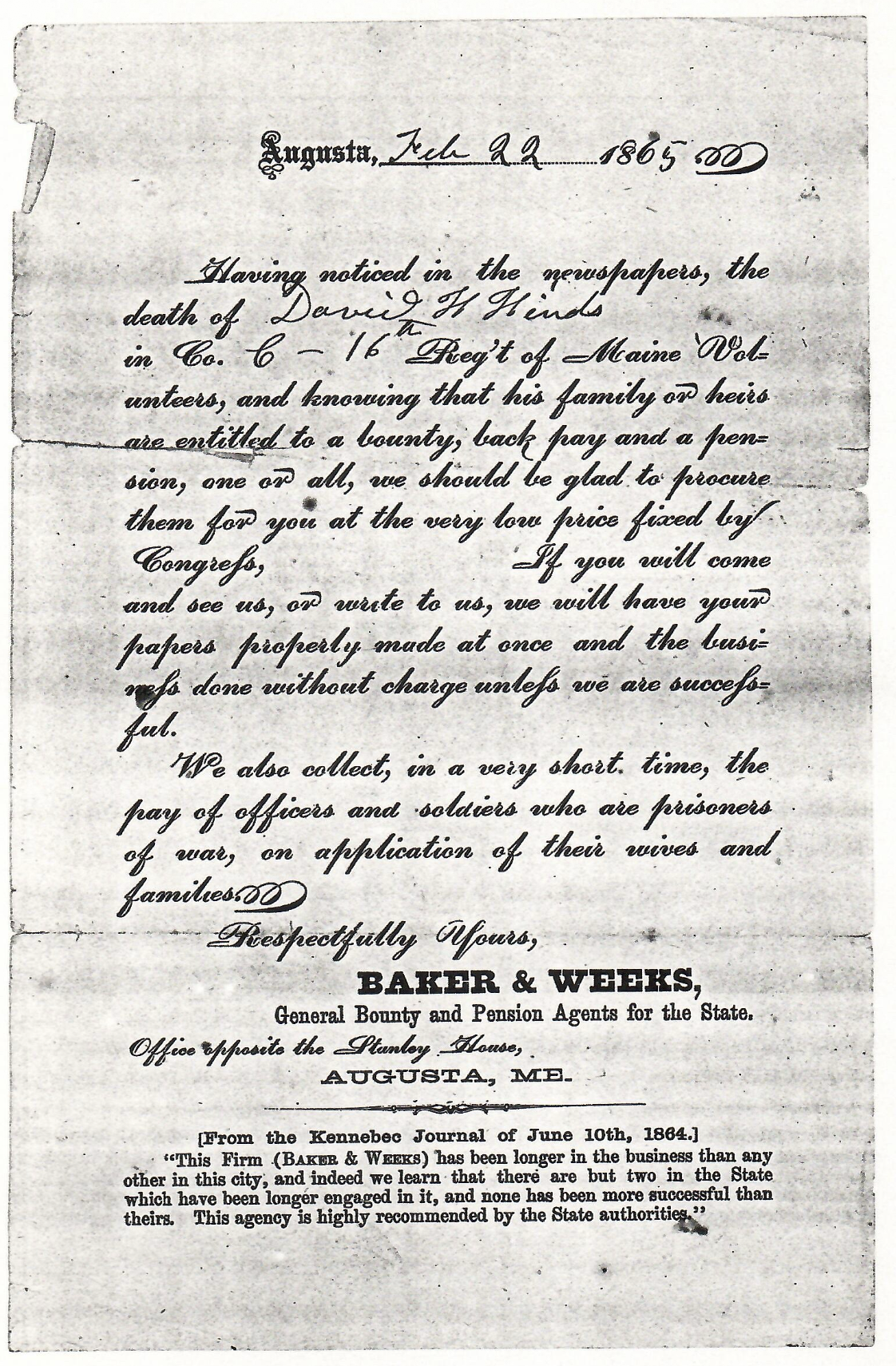
When David reached the age of 18, he enlisted on 14 August 1862 in Company C of the 16th Maine Infantry. He sustained wounds during the Battle of Gettysburg, where the 298 members of his regiment received the perilous order to maintain their position on Oak Ridge at all costs to facilitate the retreat of the Union’s 1st Corps—an order executed with unwavering commitment, resulting in near annihilation for the regiment. The surviving soldiers, David among them, continued to fight in the Overland Campaign. After nearly a year spent in hospitals, David steered clear of the Invalid Corps and rejoined his regiment in June 1864. He was with them until 19 August 1864, when he was captured in the 2nd Battle of the Weldon Railroad. Tragically, he succumbed to death three months later while imprisoned in Salisbury, North Carolina. No memoir, no biography recounts the life of this young man; only a collection of letters, cherished and preserved by his family, tells of his valor and sacrifice. Thus, David stands as the solitary voice articulating his personal narrative of loyalty and service to his country in the 16th Maine.
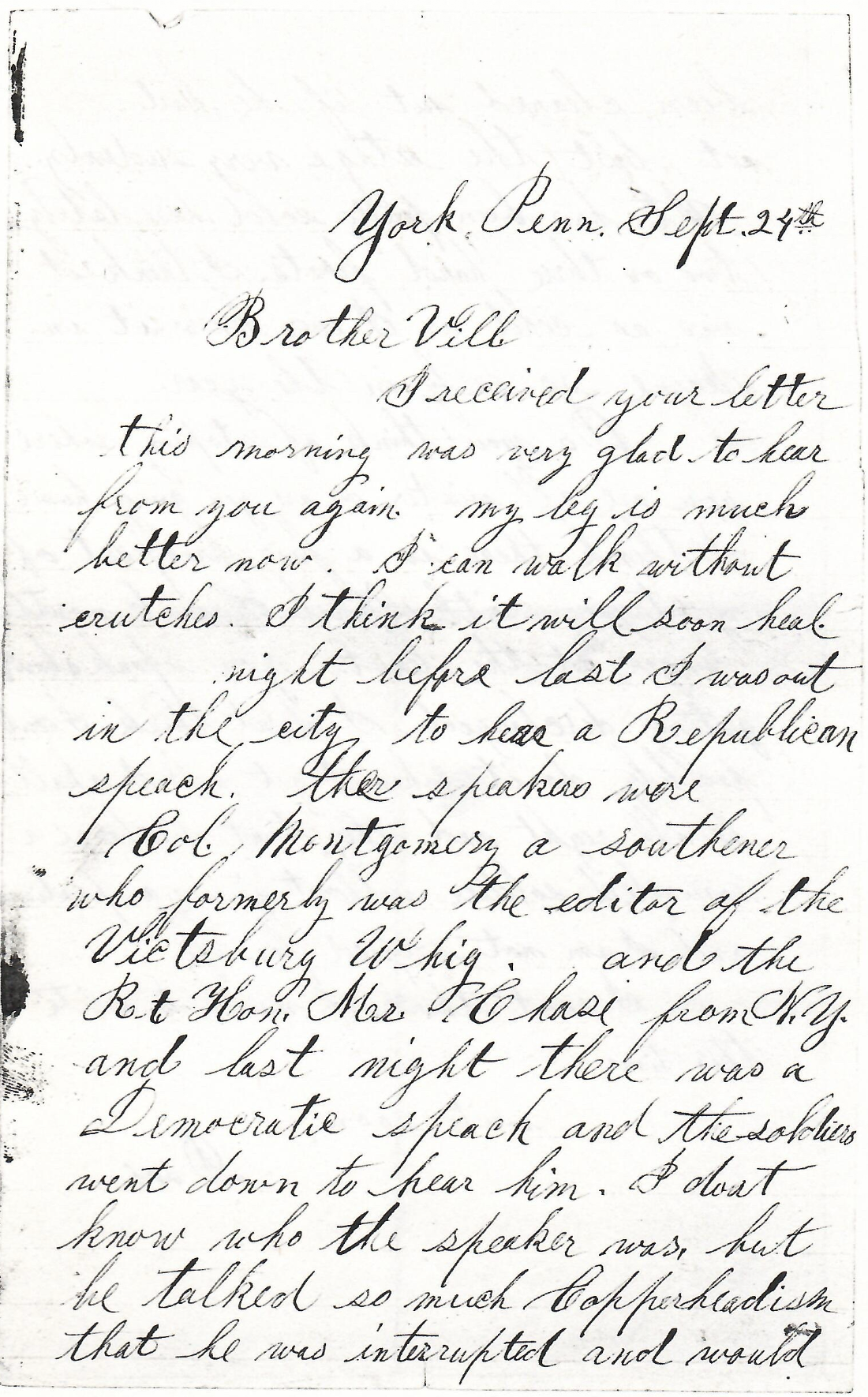
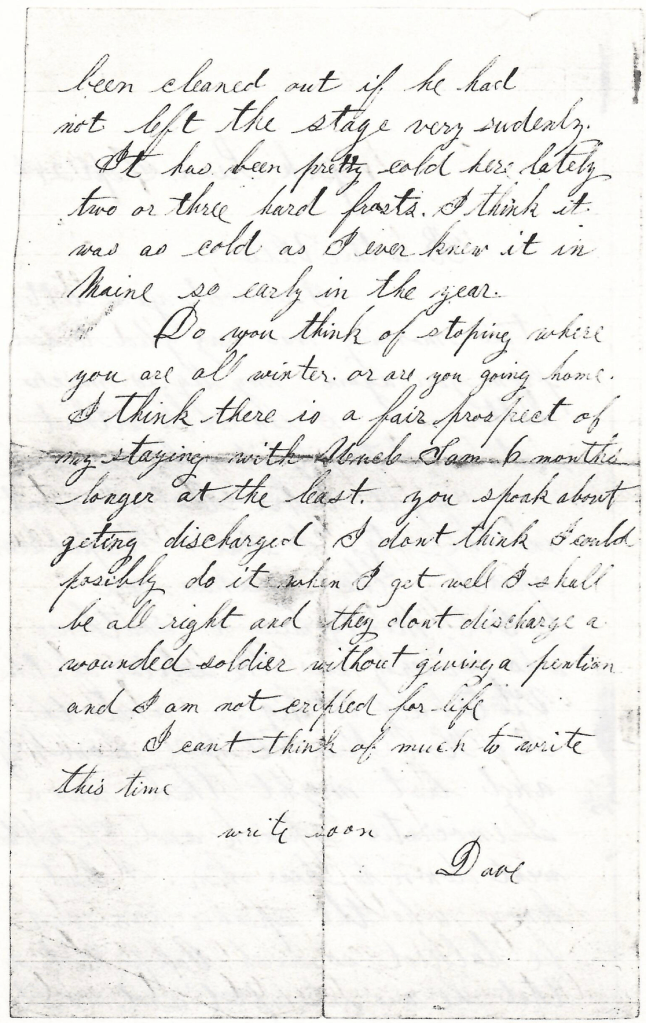
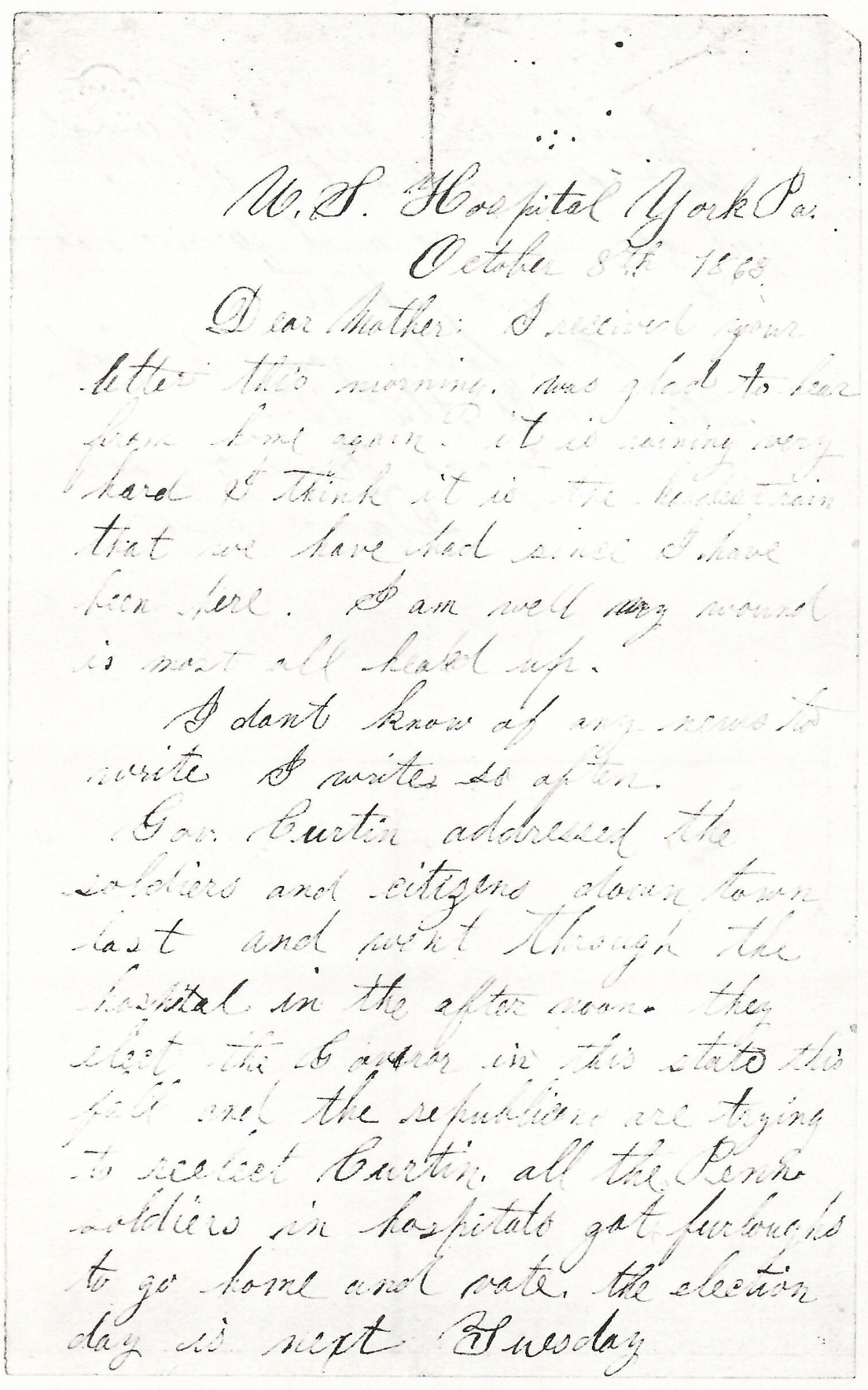
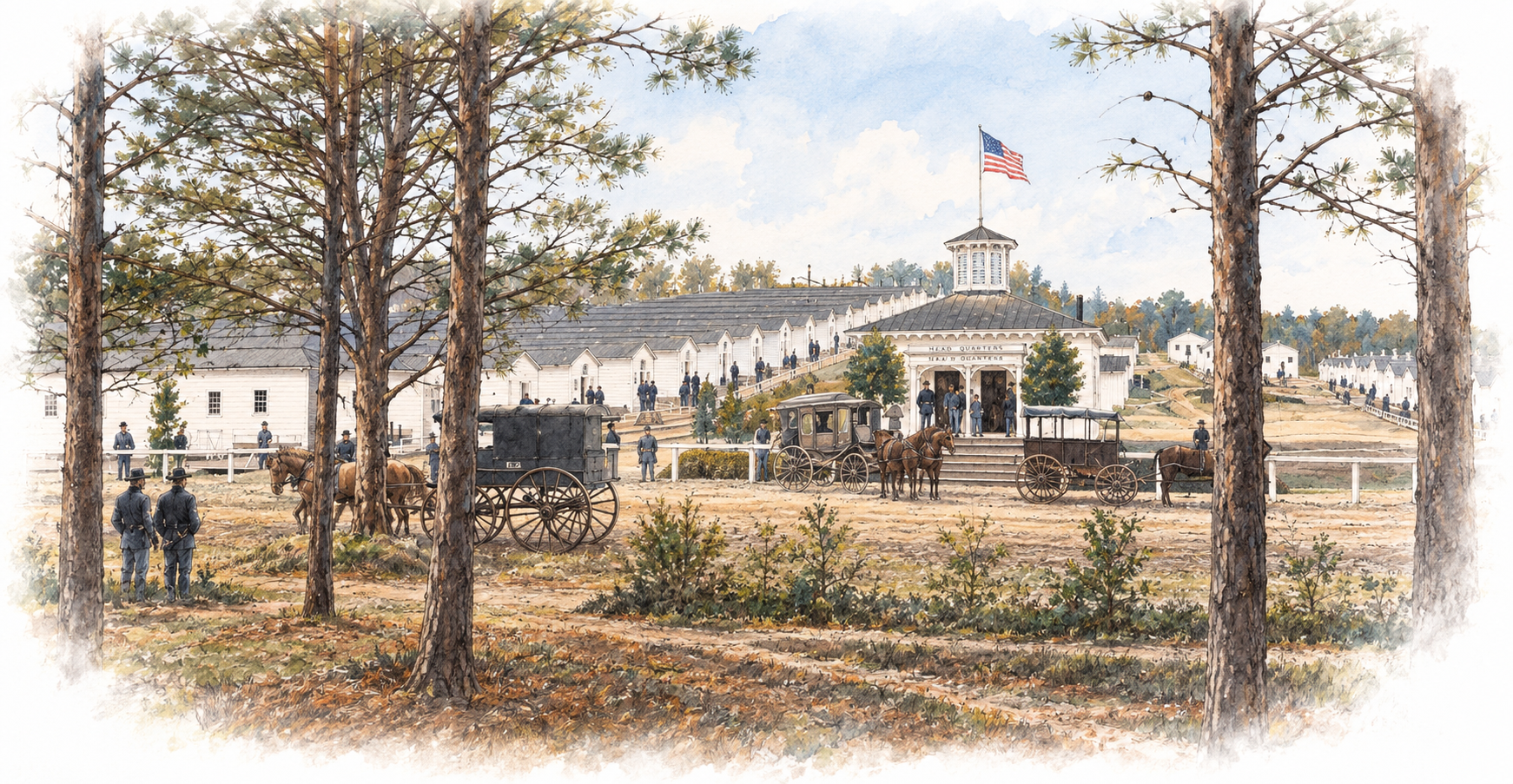
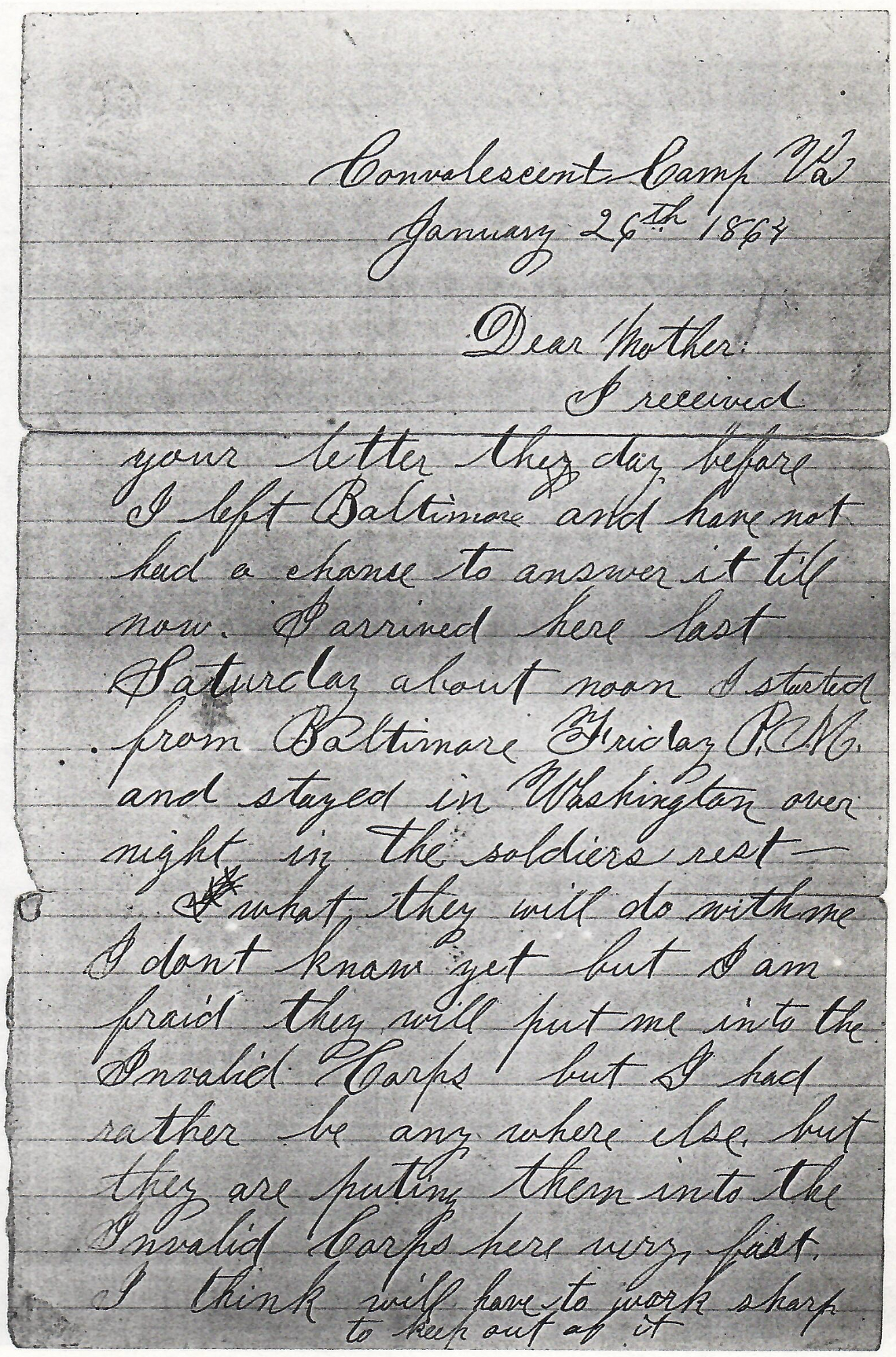
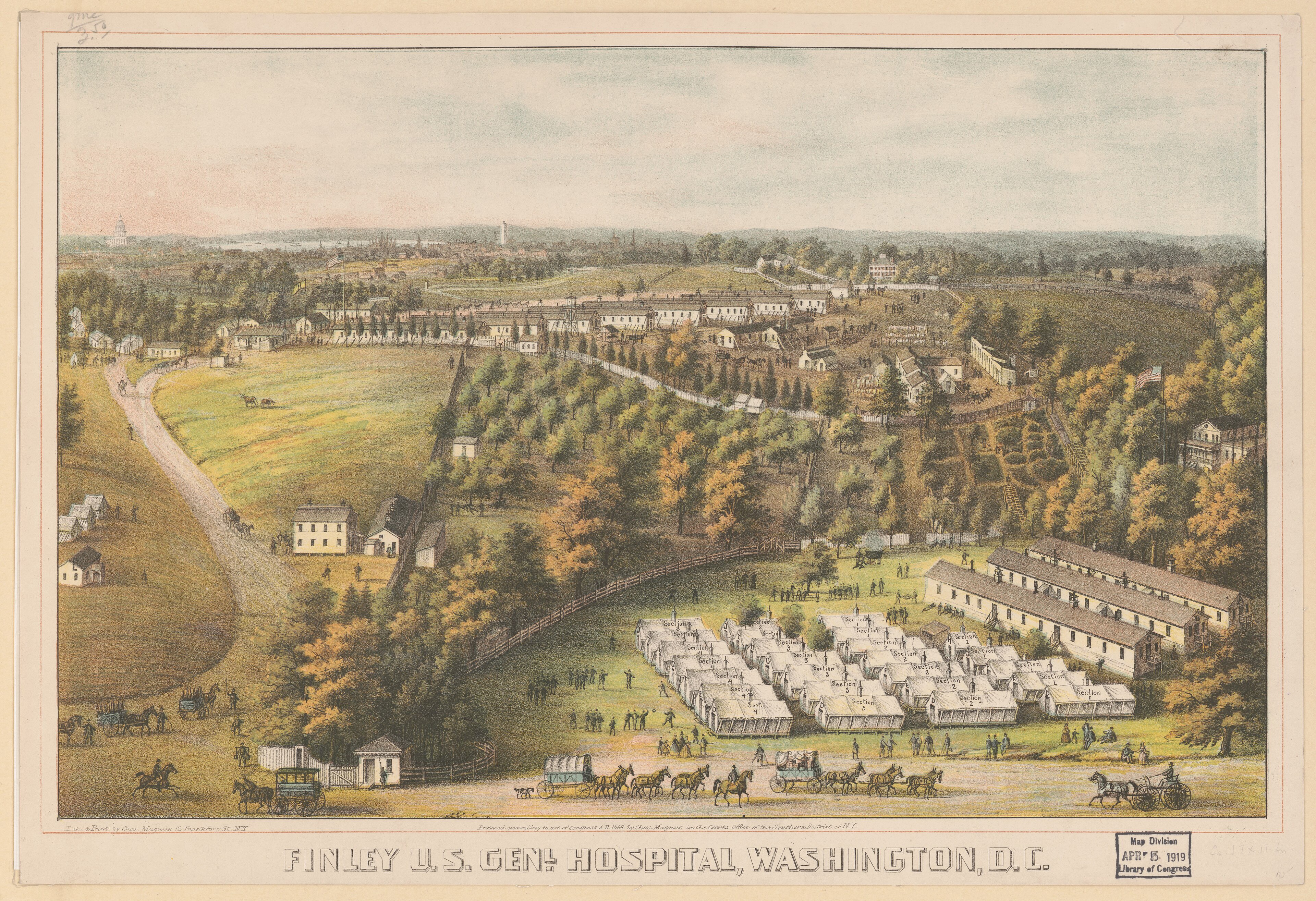
There are 58 letters in this collection, a great many of them written from hospitals at Gettysburg, York, Baltimore, Washington City, David’s Island, and Bedloe’s Island, as well as at the Convalescent Camp and Distribution Camp in Virginia. Though these were not written at the front, David shares interesting observations of the scenes and sights before him.
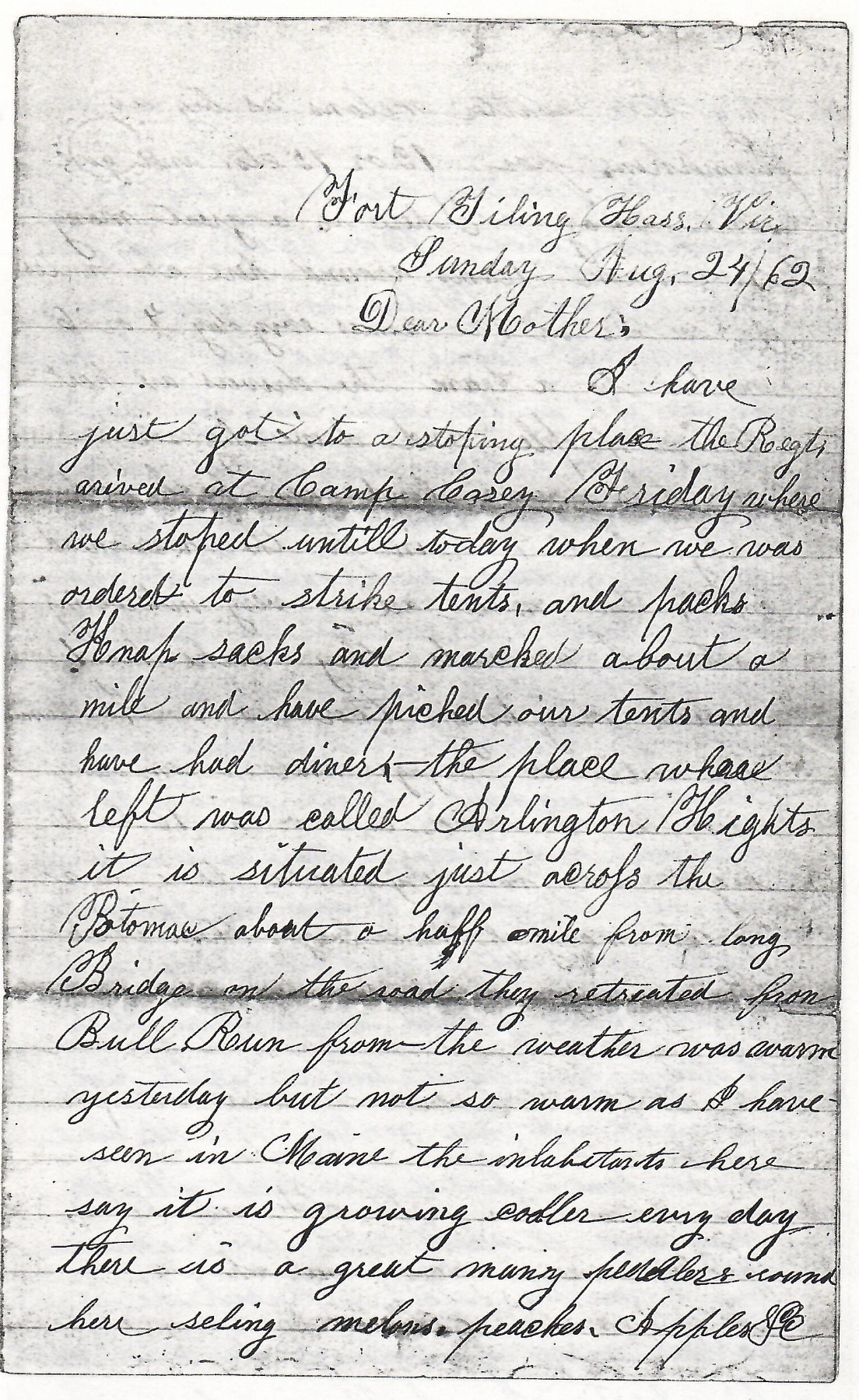
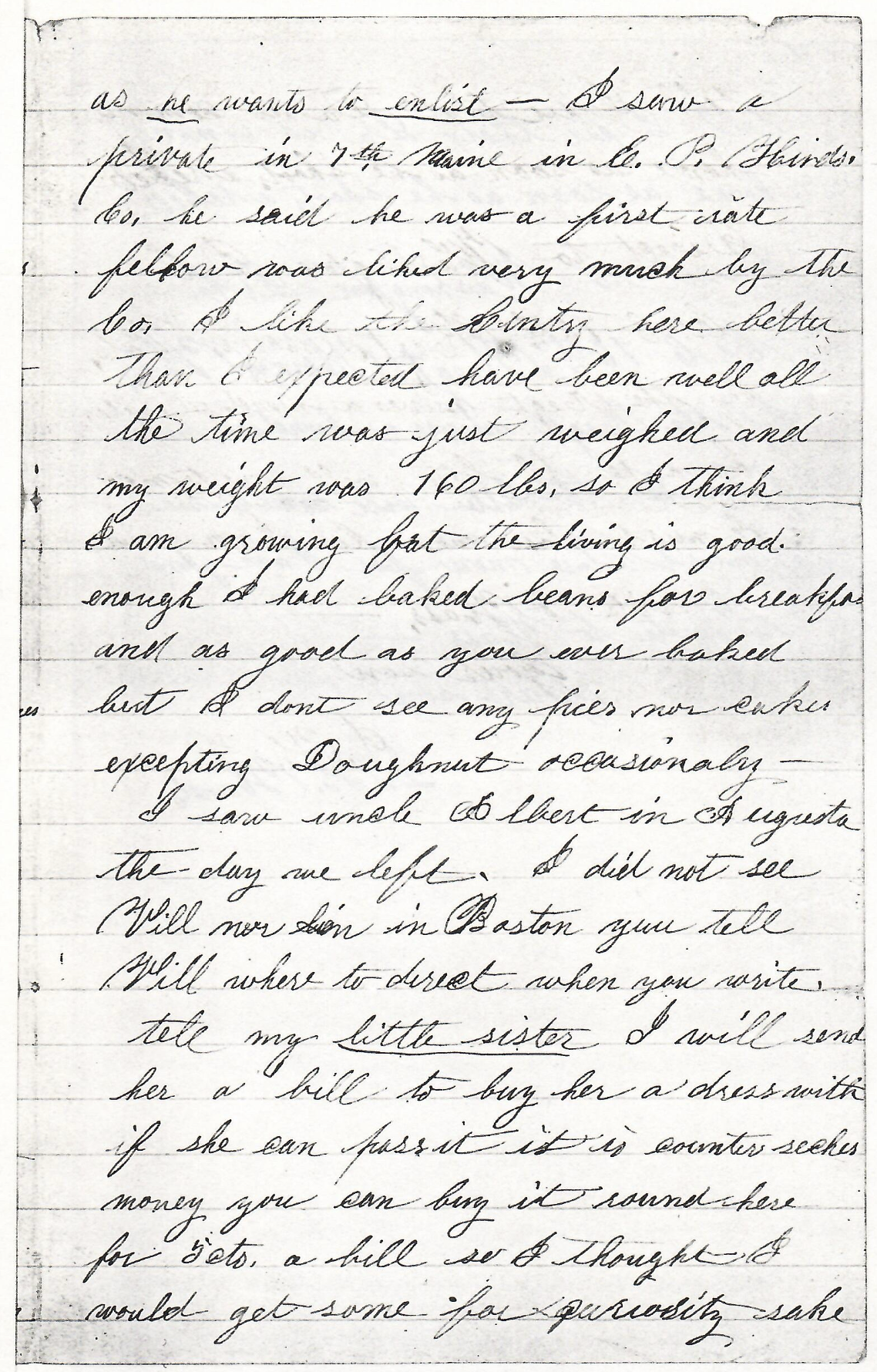
Fort Tillinghast, Virginia Sunday, August 24, 1862
Dear Mother,
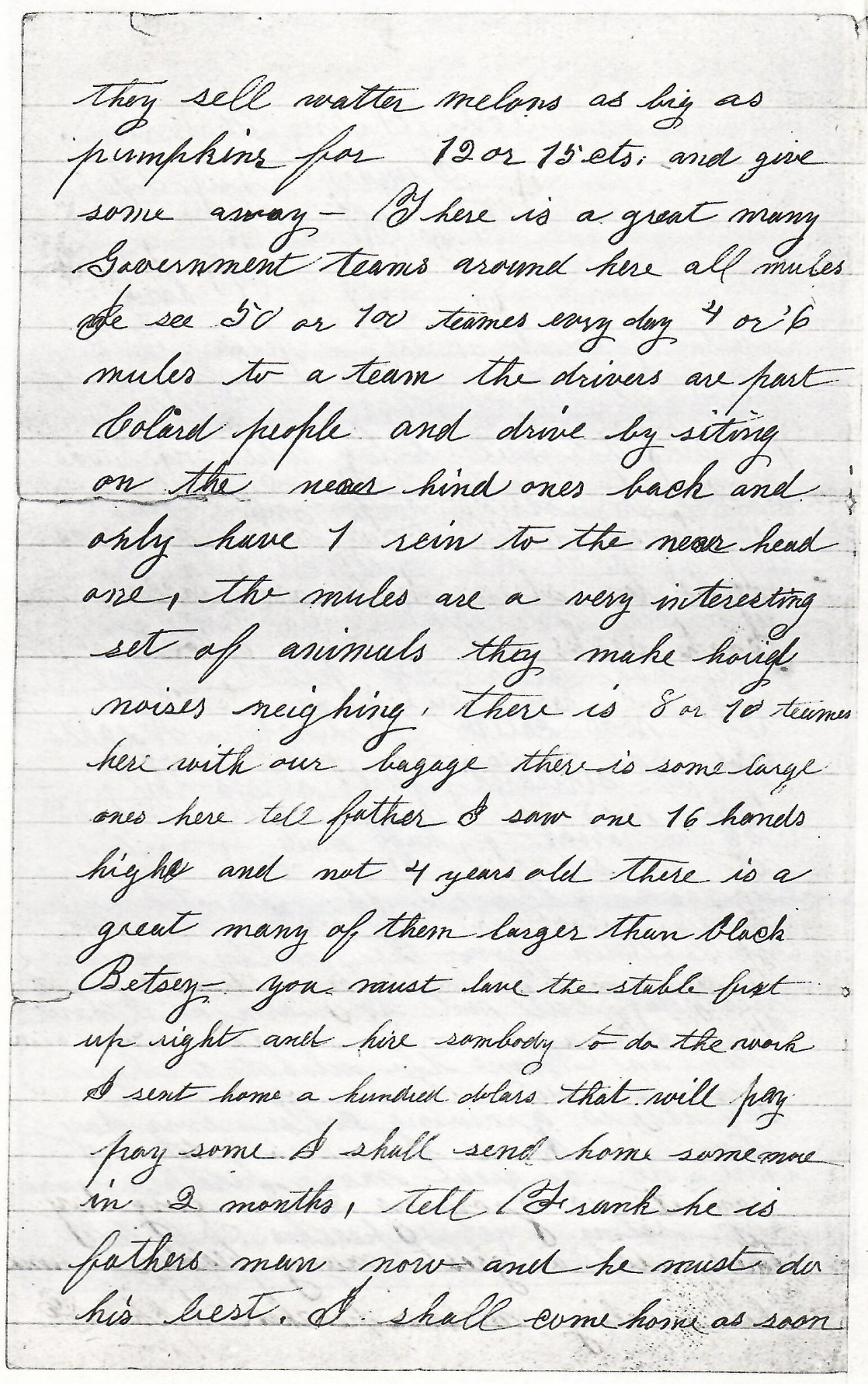
I have just got to a stopping place. The regiment arrived at Camp Casey Friday where we stopped until today when we was ordered to strike tents and pack knapsacks and marched about a mile and have pitched our tents and have had dinner. The place we left was called Arlington Heights. It is situated just across the Potomac about a half mile from Long Bridge on the road they retreated from Bull Run from. The weather was warm yesterday but not so warm as i have seen in Maine. The inhabitants here say it is growing cooler every day. There is a great many peddlers round here selling melons, peaches, apples, &c. They sell watermelons as big as pumpkins for 12 or 15 cents and give some away.
There is a great many government teams around here—all mules. We see 50 or 100 teams every day, four or six mules to a team. The drivers are part colored people and drive by sitting on the near hind one’s back and only have one rein to the near head one. The mules are a very interesting set of animals. they make horrid noises neighing. There is eight or ten teams here with our baggage. There is some large ones here. Tell father I saw one 16 hands high and not 4 years old. There is a great many of them larger than Black Betsy. You must have the stable put up right and hire somebody to do the work. I sent home a hundred dollars that will pay some. I shall send home some more in two months. Tell Frank he is father’s man now and he must do his best. I shall come home as soon as he wants to enlist.
I saw a private in the 7th Maine in E. P. Hinds’ company. He said he was a first rate fellow [and] liked very much by the company. I like the country here better than I expected. Have been well all the time. Was just weighed and my weight was 160 pounds so I think I am growing fat. The living is good enough. I had baked beans for breakfast and as good as you ever baked. But I don’t see any pies nor cakes excepting doughnuts occasionally.
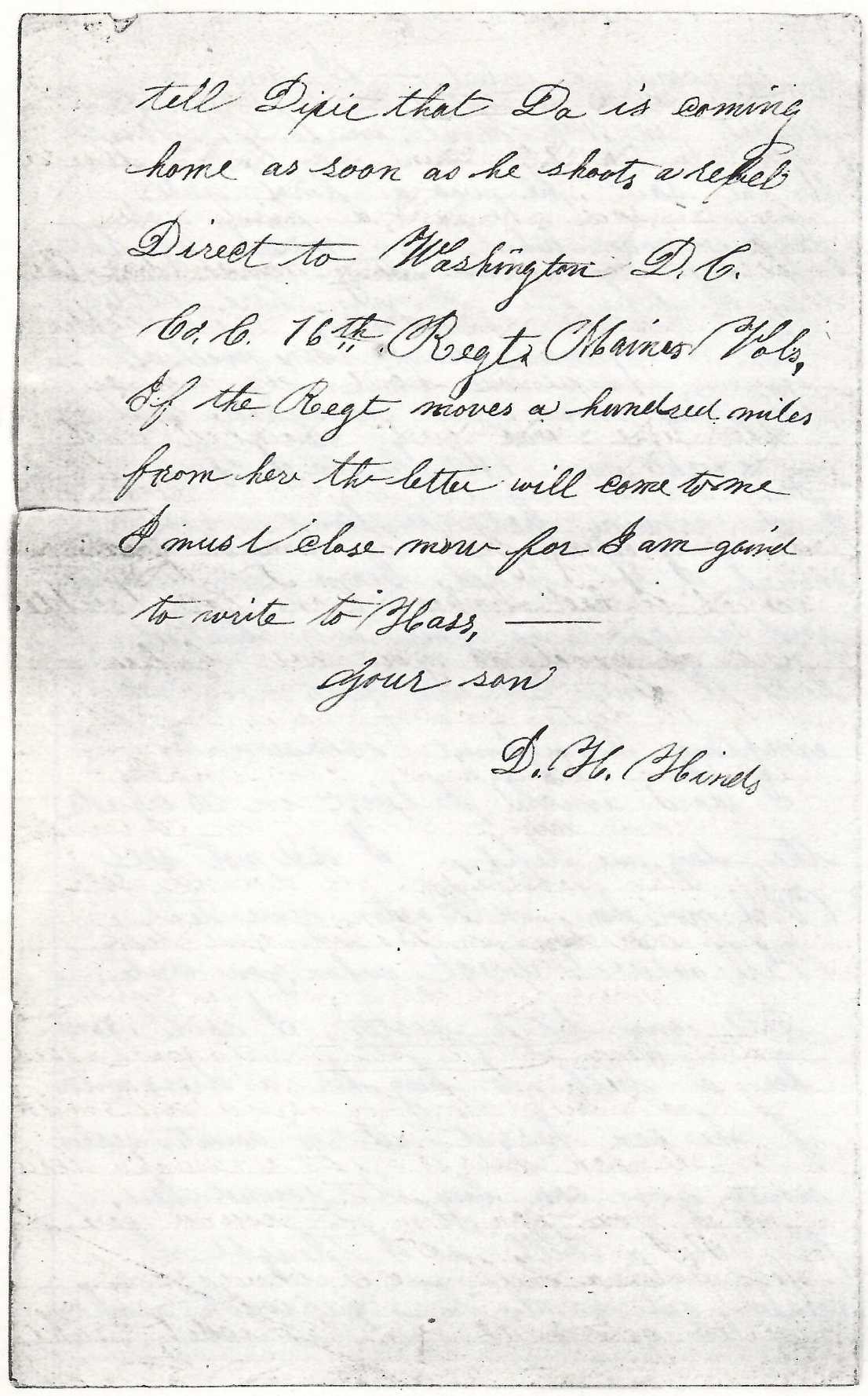
I saw Uncle Albert in Augusta the day we left. I did not see Vill nor Lin [?] in Boston. You tell Vill where to direct when you write. Tell my little sister I will send her a bill to buy her a dress with if she can pass it. It is counter[feit] secesh money. You can buy it round here for 5 cents a bill so I thought I would get some for curiosity sake.
Tell Dixie that Da [David] is coming home as soon as he shoots a rebel. Direct to Washington, D. C., Co. C, 16th Regt., Maine Volunteers. If the regiment moves a hundred miles from here, the letter will come to me. I must close now for I am going to write to Hoss [?]. Yours son, — D. H. Hinds
Letter 2
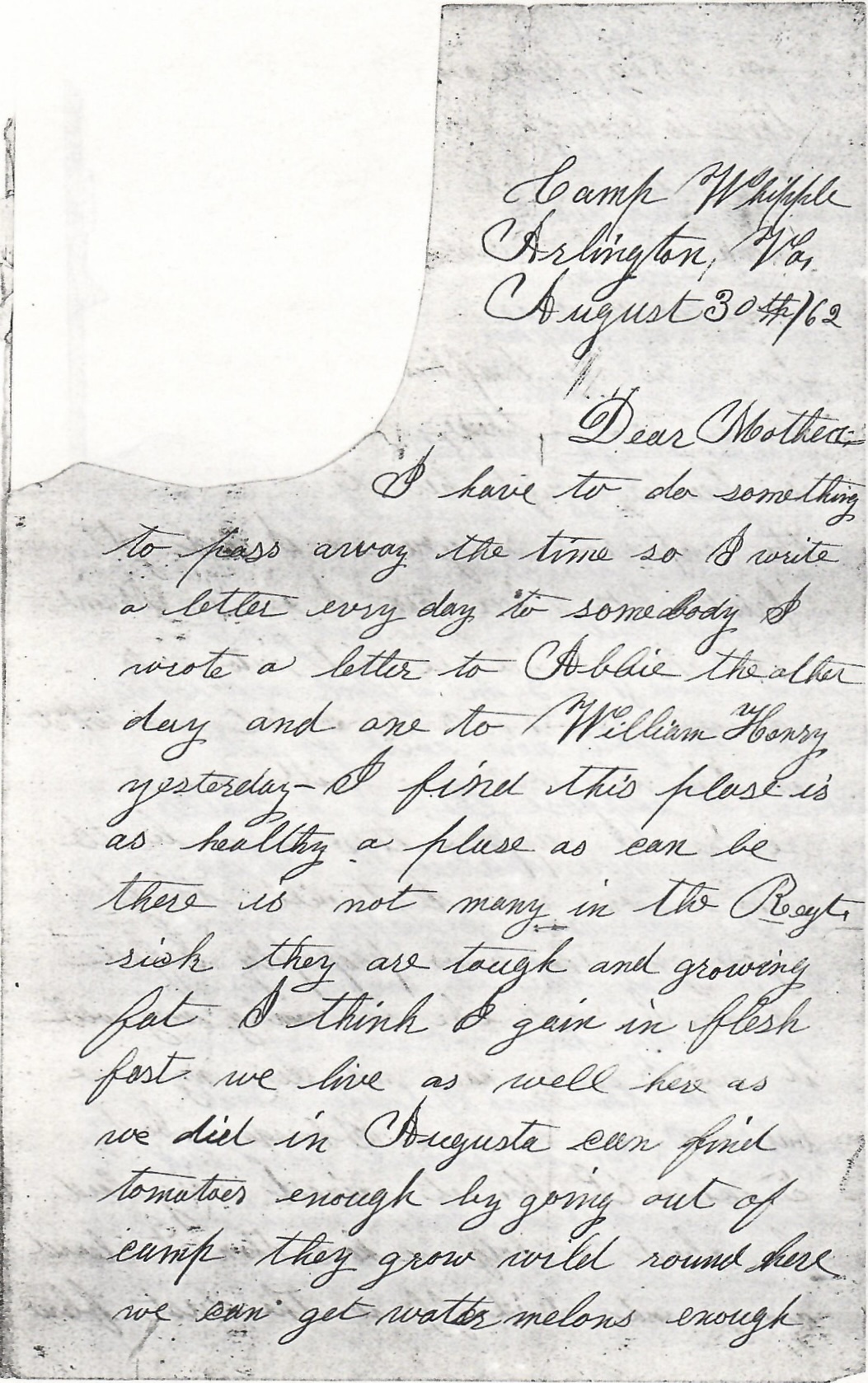
Camp Whipple Arlington, Virginia August 30th 1862
Dear Mother,
I have to do something to pass away the time so I write a letter every day to somebody. I wrote a letter to Abbie the other day and one to William Henry yesterday.
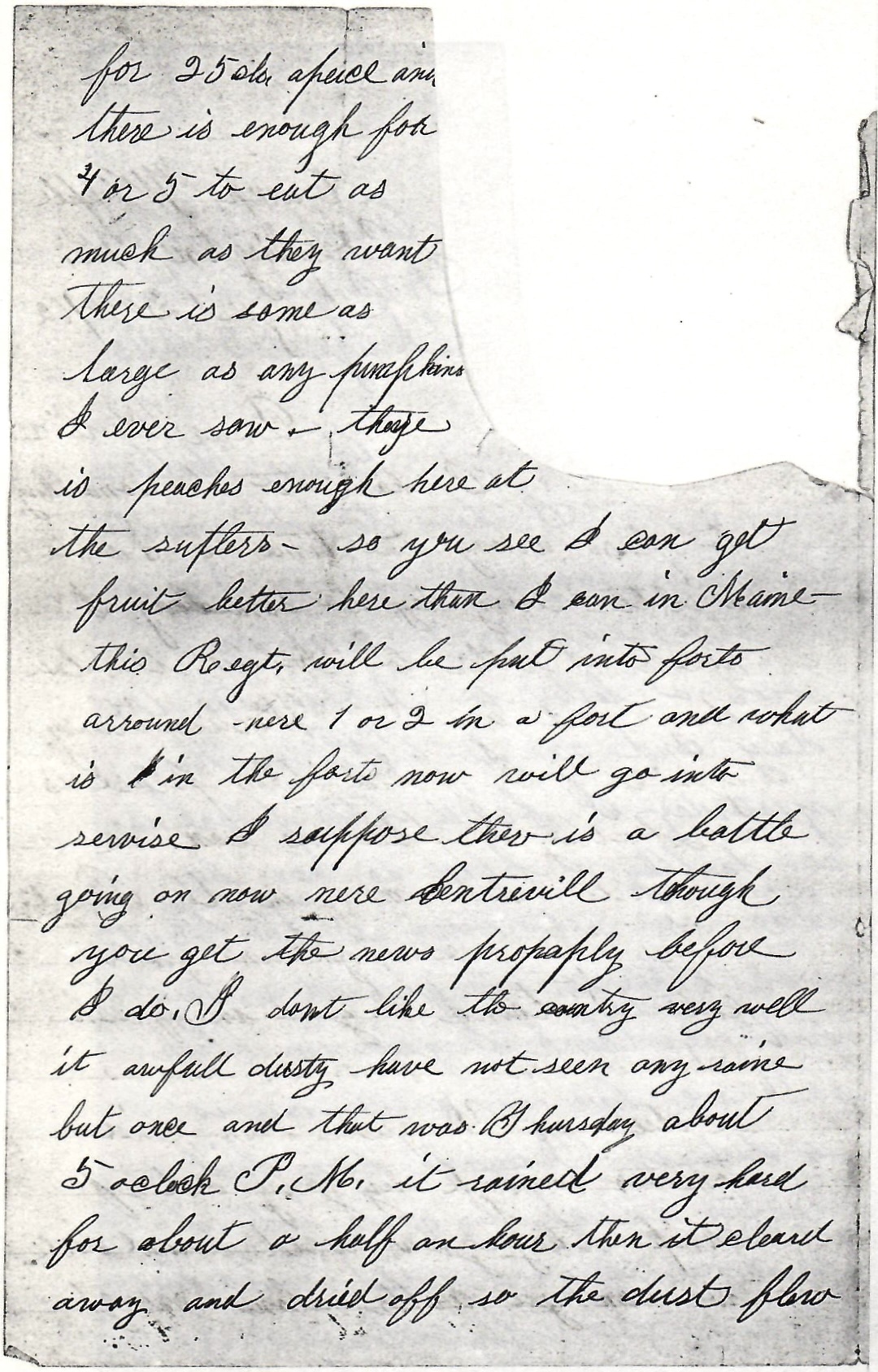
I find this place as healthy a place as can be. There is not many in the regiment sick. They are tough and growing fat, I think. I gain in flesh fast. We live as well here as we did in Augusta. Can find tomatoes enough by going out of camp. They grow wild round here. We can get watermelons enough for 25 cents a piece and [paper torn]…There is peaches enough here at the sutlers so you see I can get fruit better here than I can in Maine. This regiment will be put into forts around here—one or two in a fort and what is in the forts now will go into service. I suppose there is a battle going on now near Centreville though you get the news probably before I do. I don’t like the country very well. It’s awfully dusty. Have not seen any rain but once and that was Thursday about 5 o’clock p.m. It rained very hard for about a half an hour, then it cleared away and dried off so the dust flew [paper torn] day as well as ever.
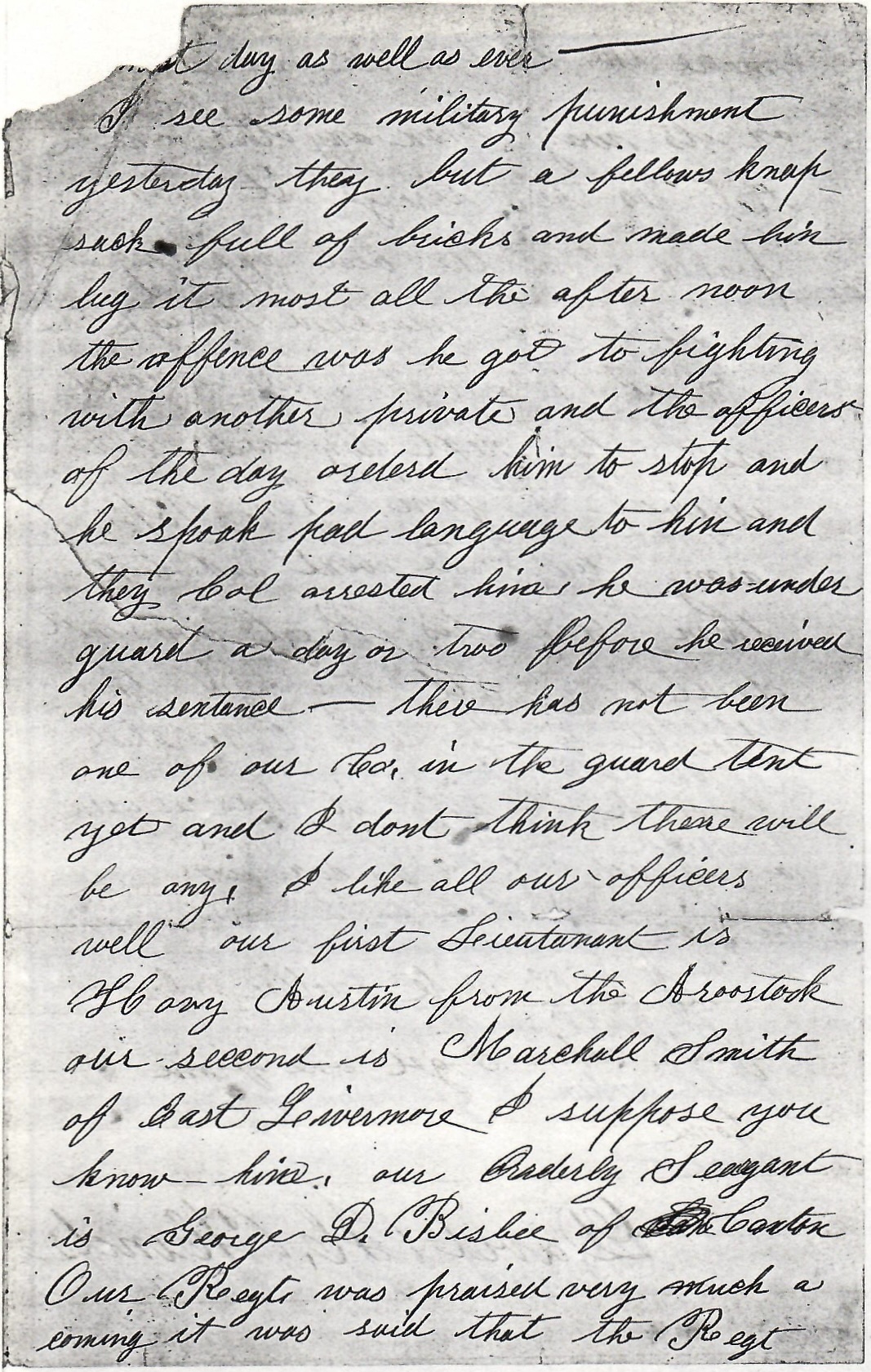
I seen some military punishment yesterday. They put a fellow’s knapsack full of bricks and made him lug it most all the afternoon. The offense was he got to fighting with another private and the Officer of the Day ordered him to stop and he spoke bad language to him and the Colonel arrested him. He was under guard a day or two before he received his sentence. There has not been one of our company in the guard tent yet and I don’t think there will be any.
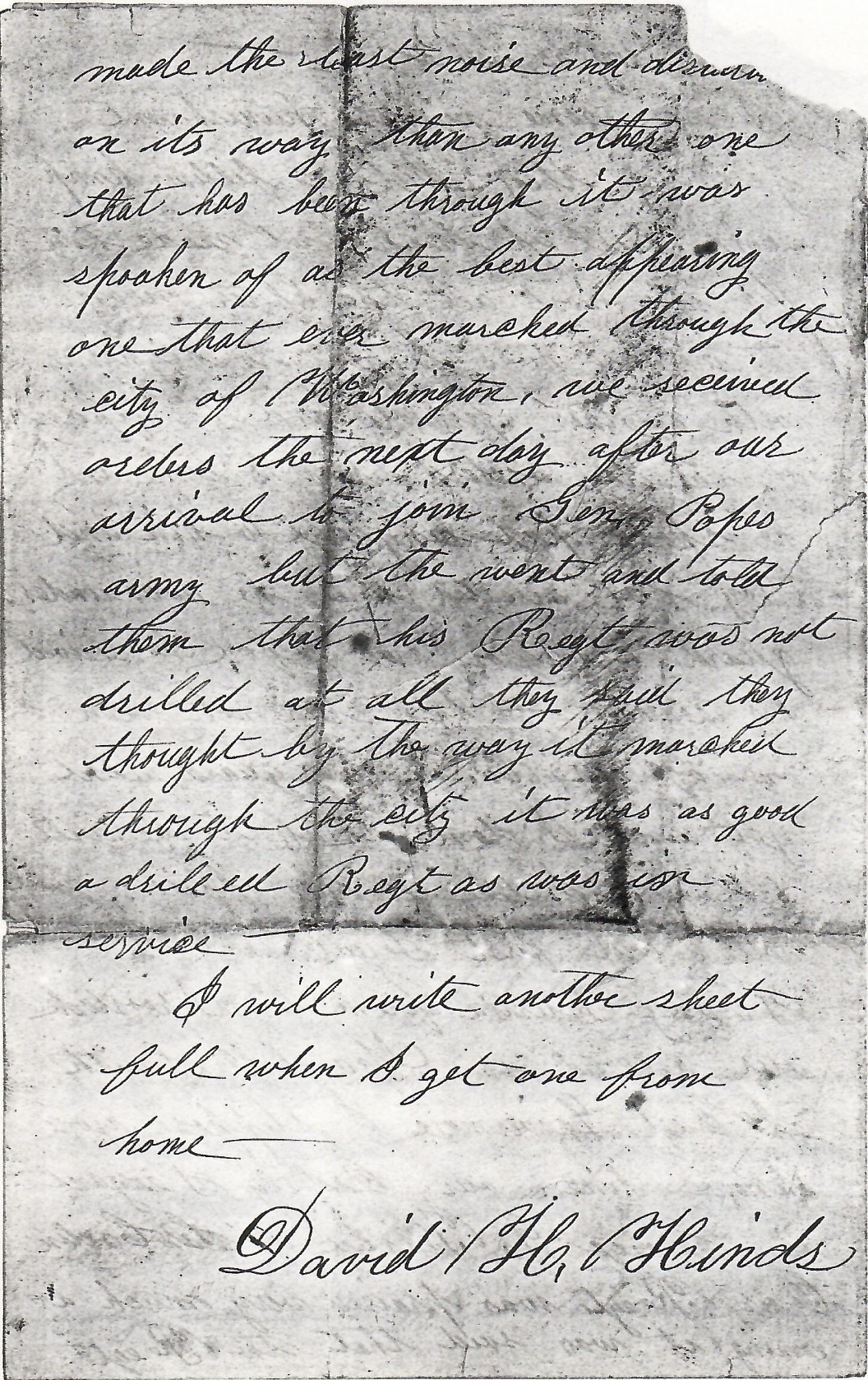
I like all our officers well. Our 1st Lieutenant is Harry Austin from the Aroostook. Our 2nd [Lieutenant] is Marshall Smith of East Livermore. I suppose you know him. Our Orderly Sergeant is George D. Bisbee of Caxton. Our regiment was praised very much a coming. It was said that the regiment made the least noise and [paper torn] on its way than any other one that has been through. It was spoken of as the best appearing one that ever marched through the City of Washington.
We received orders the next day after our arrival to join Gen. Pope’s Army but they went and told them that his regiment was not drilled at all. They said they thought by the way it marched through the city it was as good a drilled regiment as was in the service.
I will write another sheet full when I get one from home. — David H. Hinds
Letter 3
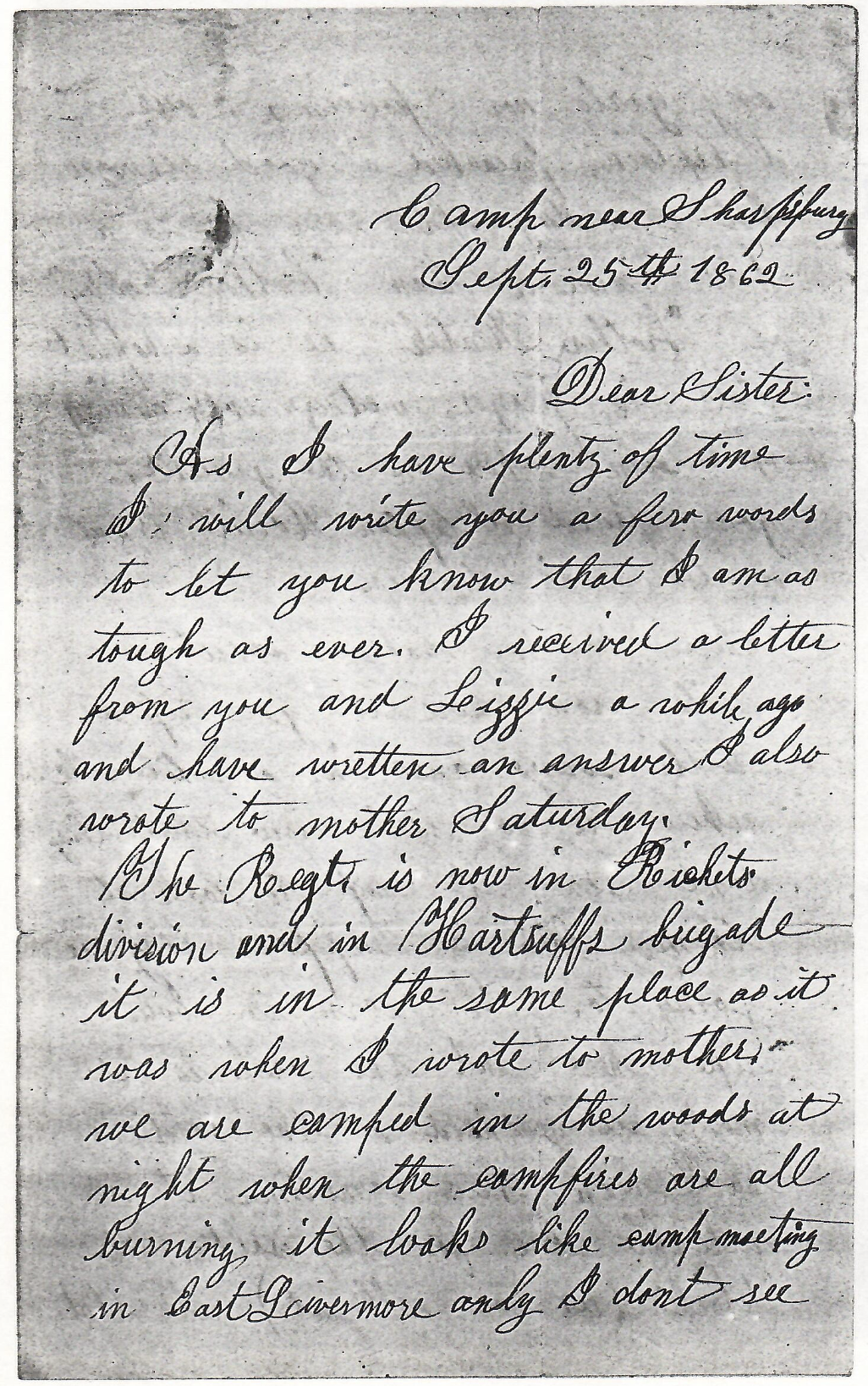
Camp near Sharpsburg [Maryland] September 25th 1862
Dear Sister,
As I have plenty of time, I will write you a few words to let you know that I am as tough as ever. I received a letter from you and Lizzie a while ago and have written an answer. I also wrote to mother Saturday.
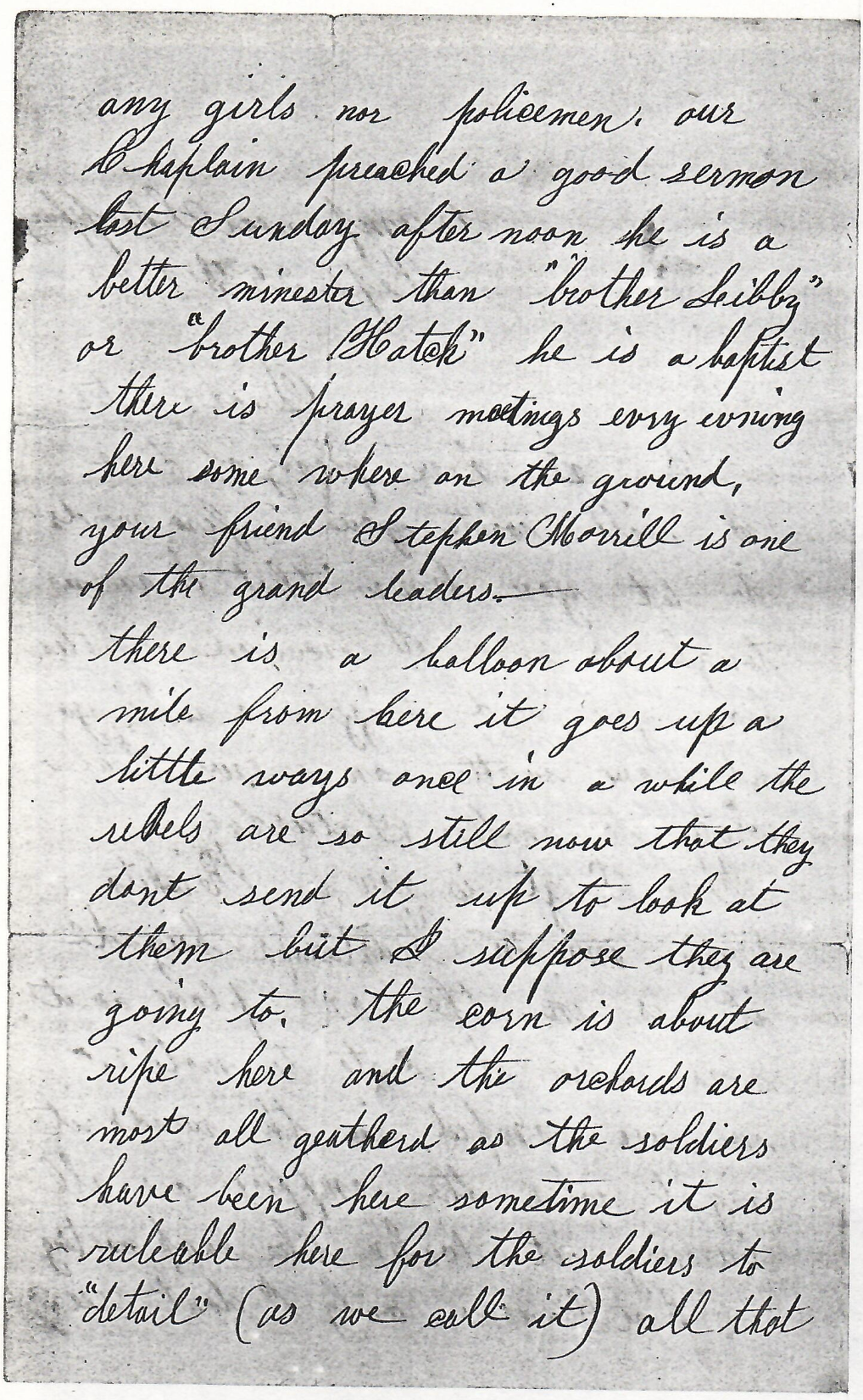
The regiment is now in Rickett’s Division and in Hartsuff’s Brigade. It is in the same place as it was when I wrote to mother. We are camped in the woods. At night when the campfires are all burning, it looks like a camp meeting in East Livermore, only I don’t see any girls nor policemen. Our chaplain preached a good sermon last Saturday afternoon. He is a better minister than “brother Libby” or “brother Hatch.” He is a Baptist. There is prayer meetings every evening here somewhere on the ground. Your friend Stephen Morrill is one of the grand leaders.
There is a balloon about a mile from here. It goes up a little ways once in a while. the rebels are so still now that they don’t send it up to look at them but I suppose they are going to.
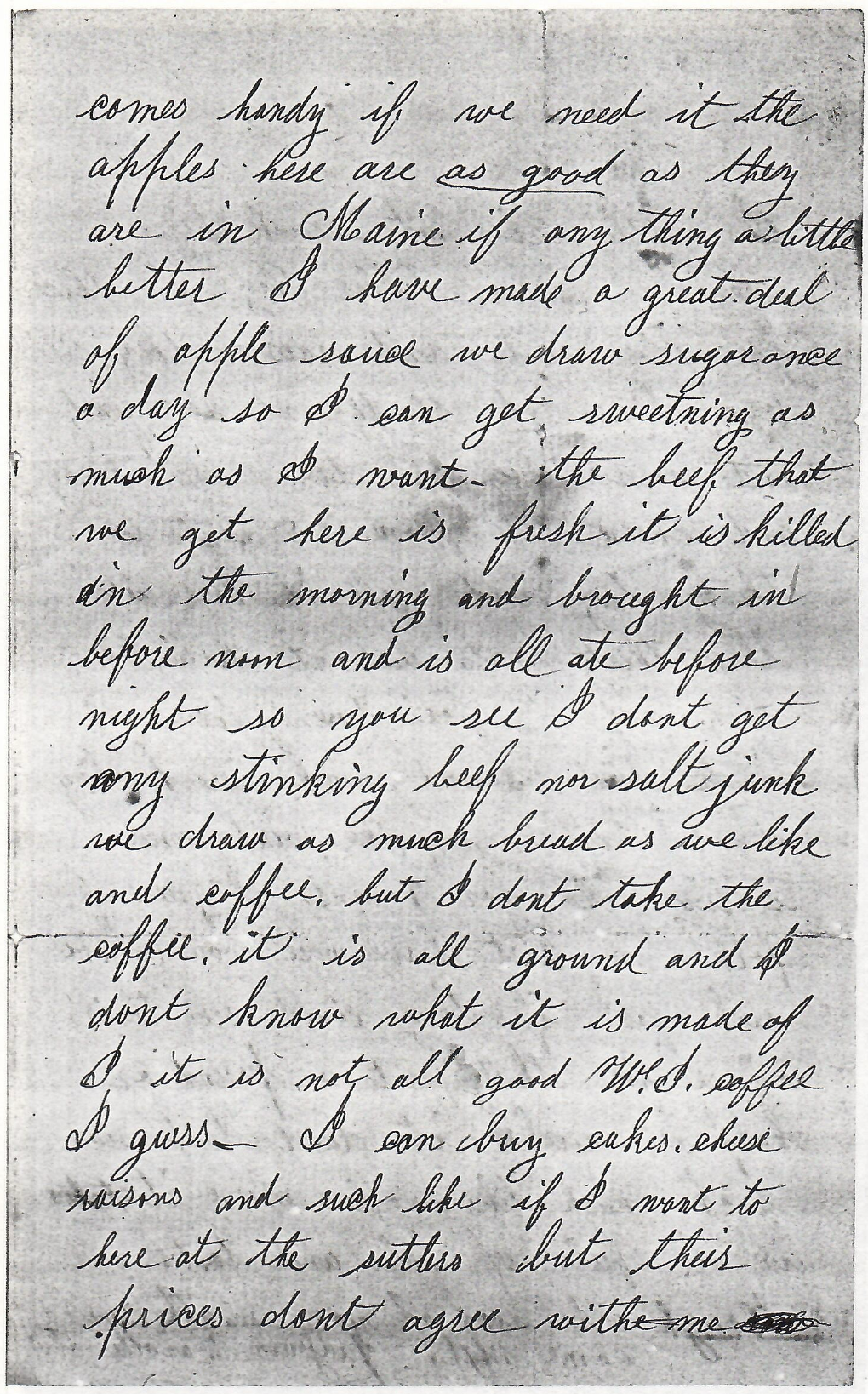
The corn is about ripe here and the orchards are most all gathered. As the soldiers have been here some time, it is ruleable here for the soldiers to “detail” (as we call it) all that comes handy if we need it. The apples here are as good as they are in Maine—if anything, a little better. I have made a great deal of apple sauce. We draw sugar once a day so I can get sweetening as much as I want. The beef that we get here is fresh. It is killed in the morning and brought in before noon and is all are before night so you see I don’t get any stinking beef nor salt junk. We draw as much bread as we like, and coffee. It is all ground and I don’t know what it is made of. It is not all good. W. I. [West Indies] coffee I guess.
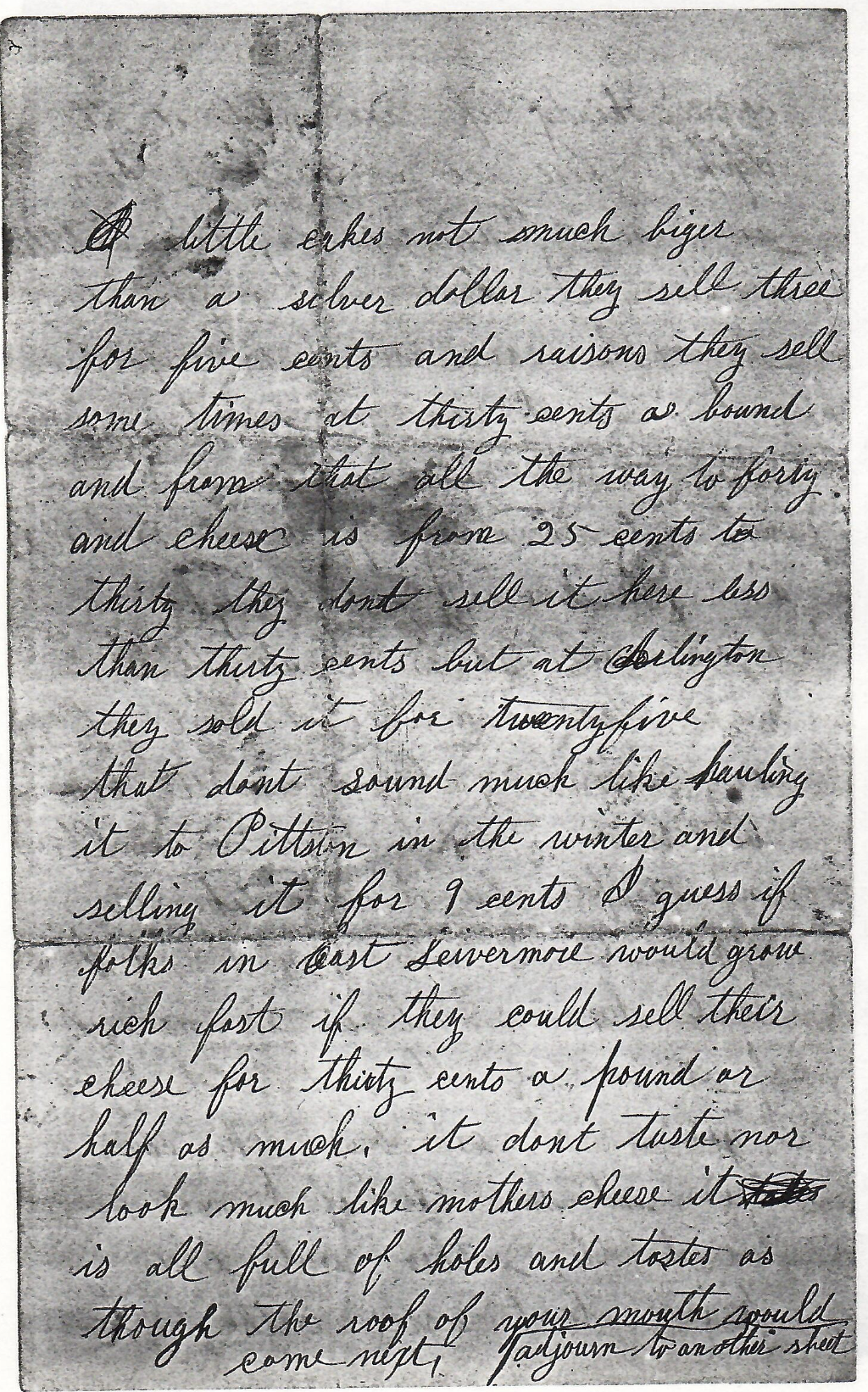
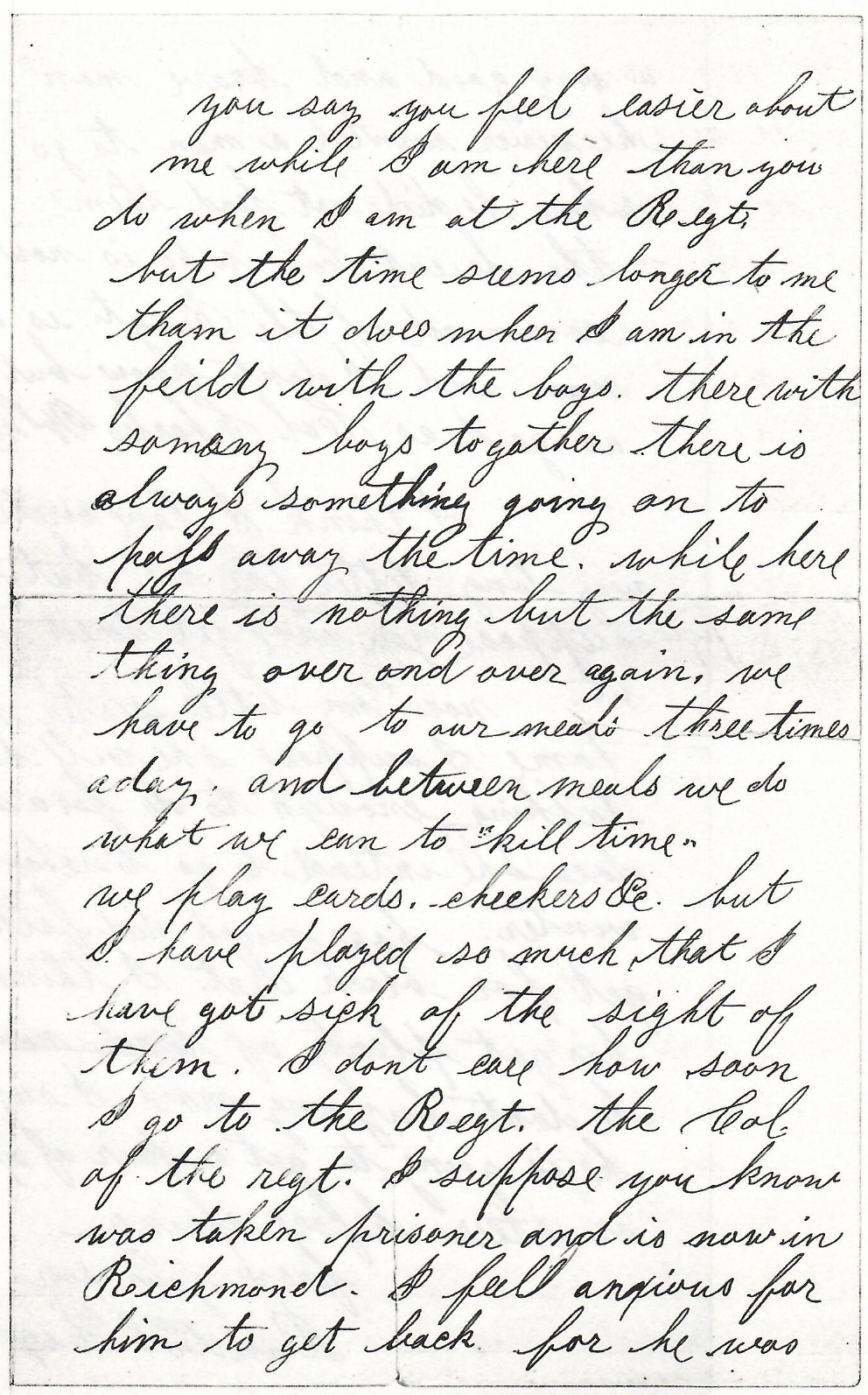
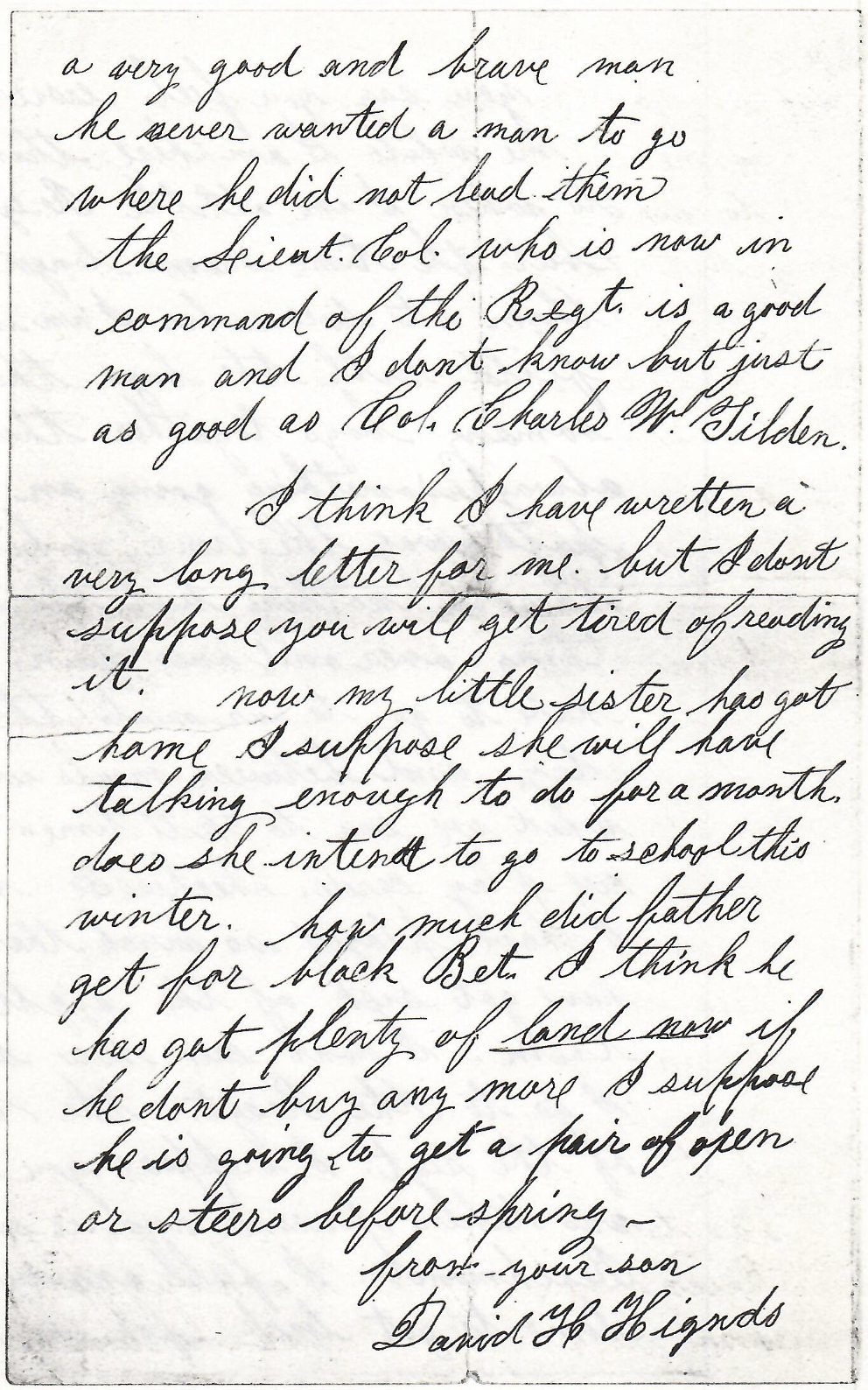
I can buy cakes, cheese, raisons, and such like if I want to here at the sutlers’ but their prices don’t agree with me. Little cakes not much bigger than a silver dollar, they sell three for five cents, and raisons they sell some times at thirty cents a pound. and from that all the way to forty, and cheese is from 25 cents to 30. They don’t sell it here less than 30 cents but at Arlington they sold it for 25. That don’t sound much like hauling it to Pittston in the winter and selling it for 9 cents. I guess folks in East Livermore would grow rich fast if they could sell their cheese for 30 cents a pound or half as much. It don’t taste nor look much like mother’s cheese. It is all full of holes and tastes as though the roof of your mouth would come next. [rest of letter is missing]
Letter 4
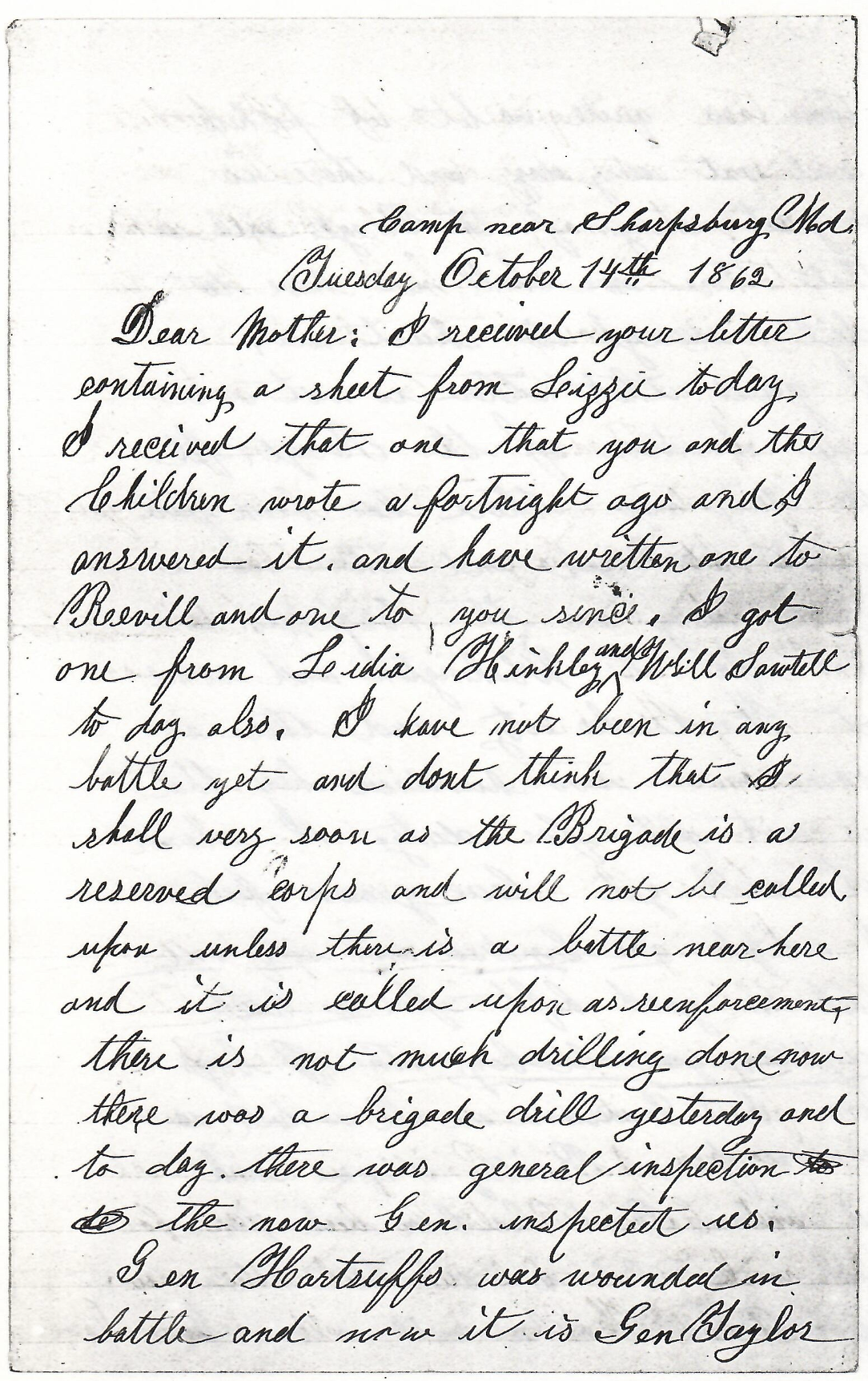
Camp near Sharpsburg, Maryland Tuesday, October 14th 1862
Dear Mother,
I received your letter containing a sheet from Lizzie today. I received that one that you and the children wrote a fortnight ago and I answered it and have written one to Revill and one to you since. I got one from Lydia Hinkley and Will Sawtelle today also.
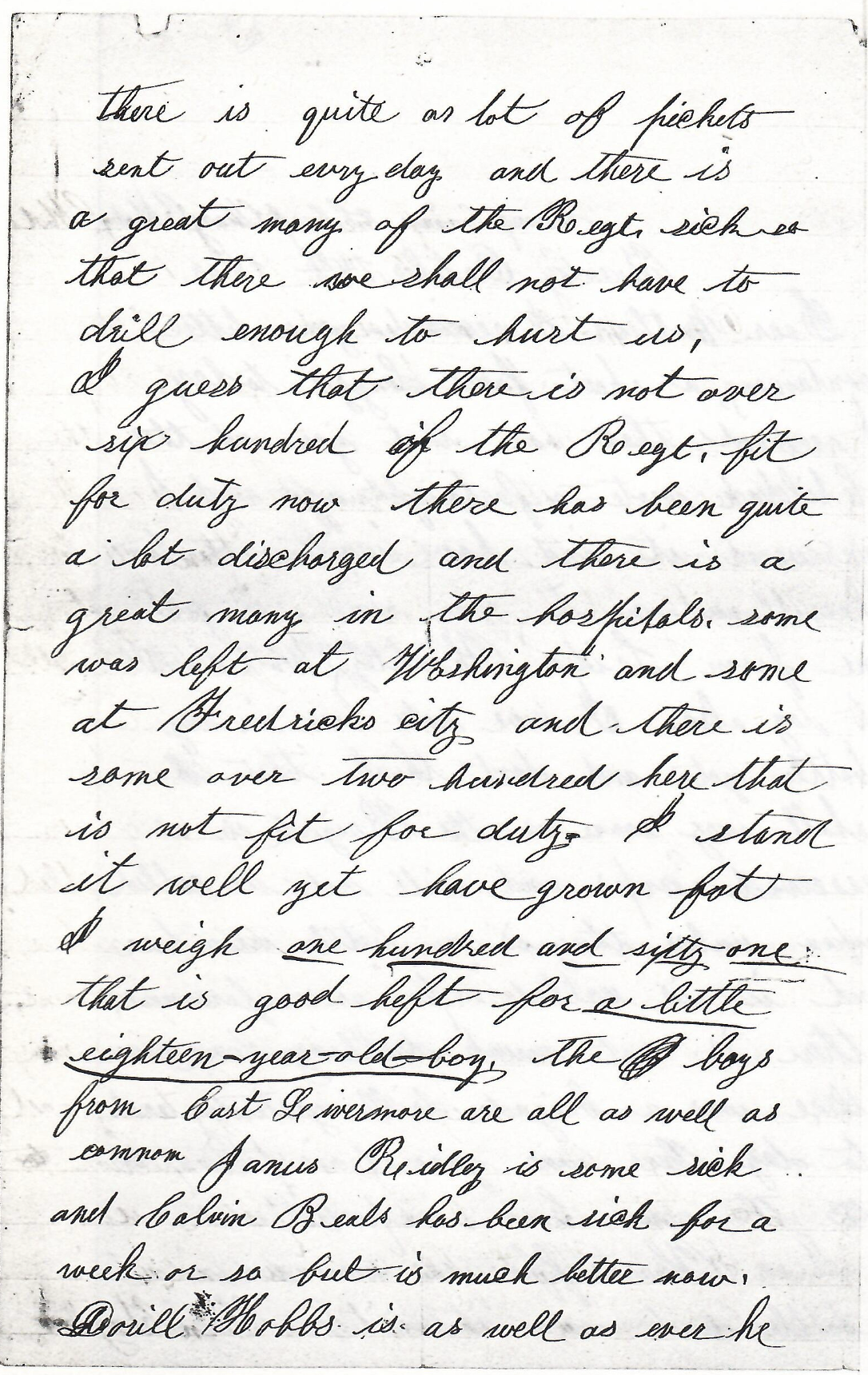
I have not been in any battle yet and don’t think that I shall very soon as the Brigade is a reserve corps and will not be called unless there is a battle near here and it is called upon as reinforcement. There is not much drilling done now. There was a brigade drill yesterday and today there was general inspection. The new general inspected us. Gen. Hartsuff was wounded in battle and now it is Gen. Taylor. There is quite a lot of pickets sent out every day and there is a great many of the regiment sick so that we shall not have to drill enough to hurt us. I guess that there is not over six hundred of the regiment fit for duty now. There has been quite a lot discharged and there is a great many in the hospitals. Some was left at Washington and some at Frederick City. And there is some over two hundred here that is not fit for duty. I stand it well yet. Have grown fat. I weigh one hundred and sixty-one. That is good heft for a little 18 year-old boy.
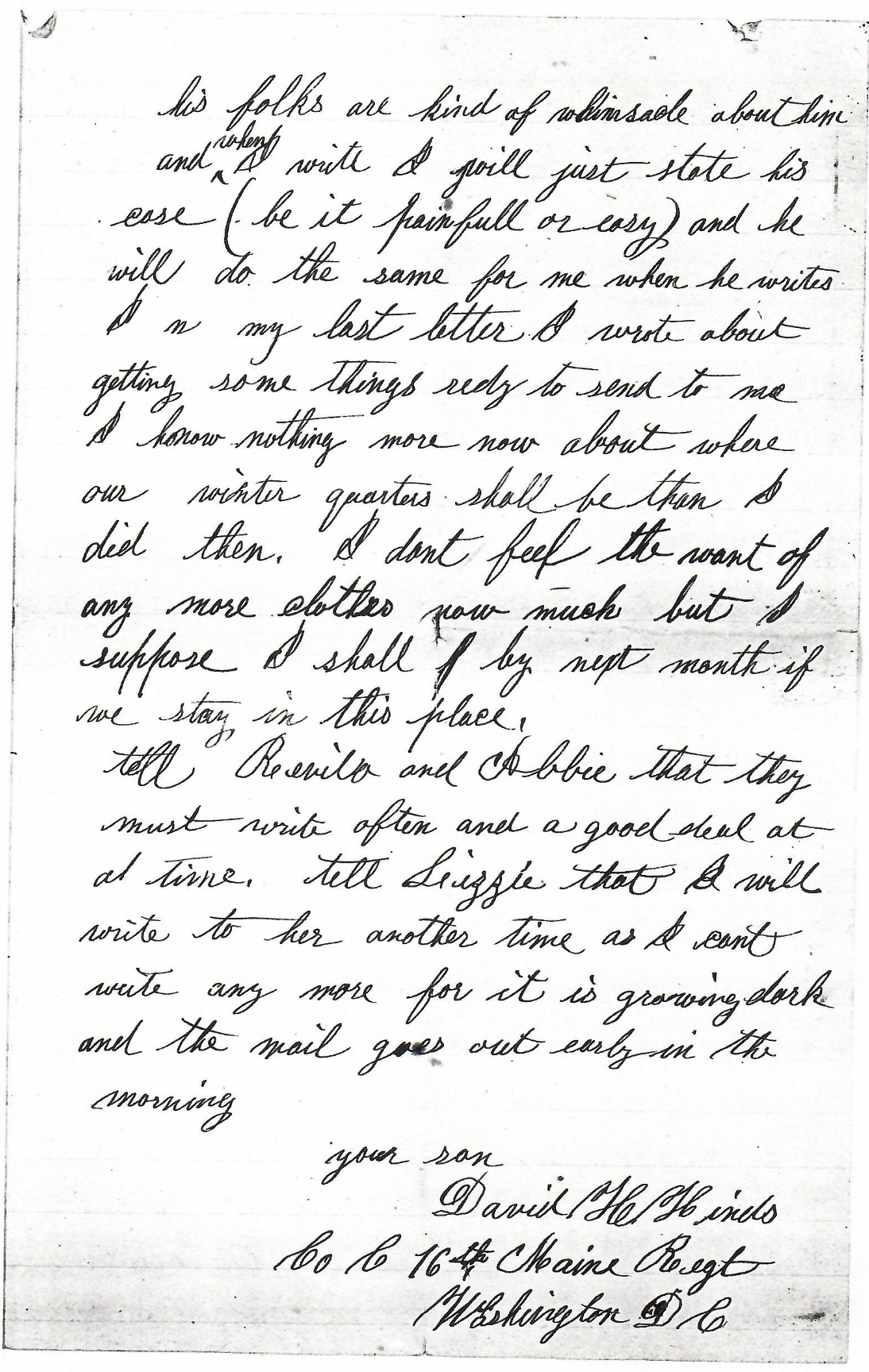
The boys from East Livermore are all as well as common. James Ridley is some sick and Calvin Beals has been sick for a week or so but is much better now. Dorill[us] Hobbs is as well as ever. His folks are kind of worried about him and when I write, I will just state his case (be it painful or easy) and he will do the same for me when he writes.
In my last letter I wrote about getting somethings ready to send to me. I know nothing more now about where our winter quarters shall be than I did then. I don’t feel the want of any more clothes now much but I suppose I shall by next month if we stay in this place.
Tell Revillo and Abbie that they must write often and a good deal at a time. Tell Lizzie that I will write to her another time as I can’t write any more for it is growing dark and the mail goes out early in the morning.
Your son, — David H. Hinds Co. C, 16th Maine Regt. Washington D. C.
Letter 5
October 17th 1862
Dear Sister,
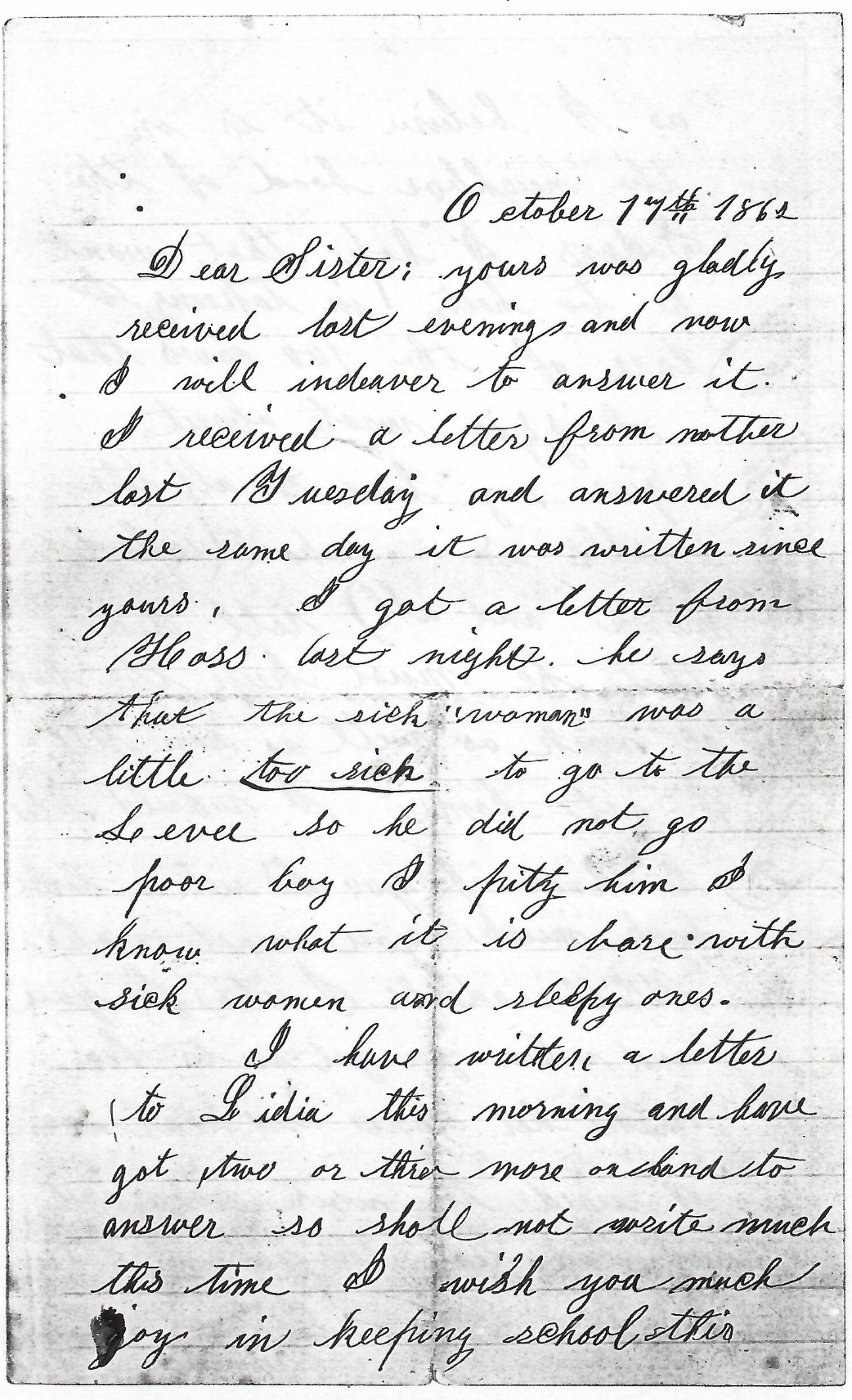
Yours was gladly received last evening and now I will endeavor to answer it. I received a letter from mother last Tuesday and answered it the same day. It was written since yours. I got a letter from Hoss last night. He says that the sick “woman” was a little too sick to go to the levee so he did not go. Poor boy. I pity him. I know what it is to [ ] with sick women and sleepy ones.
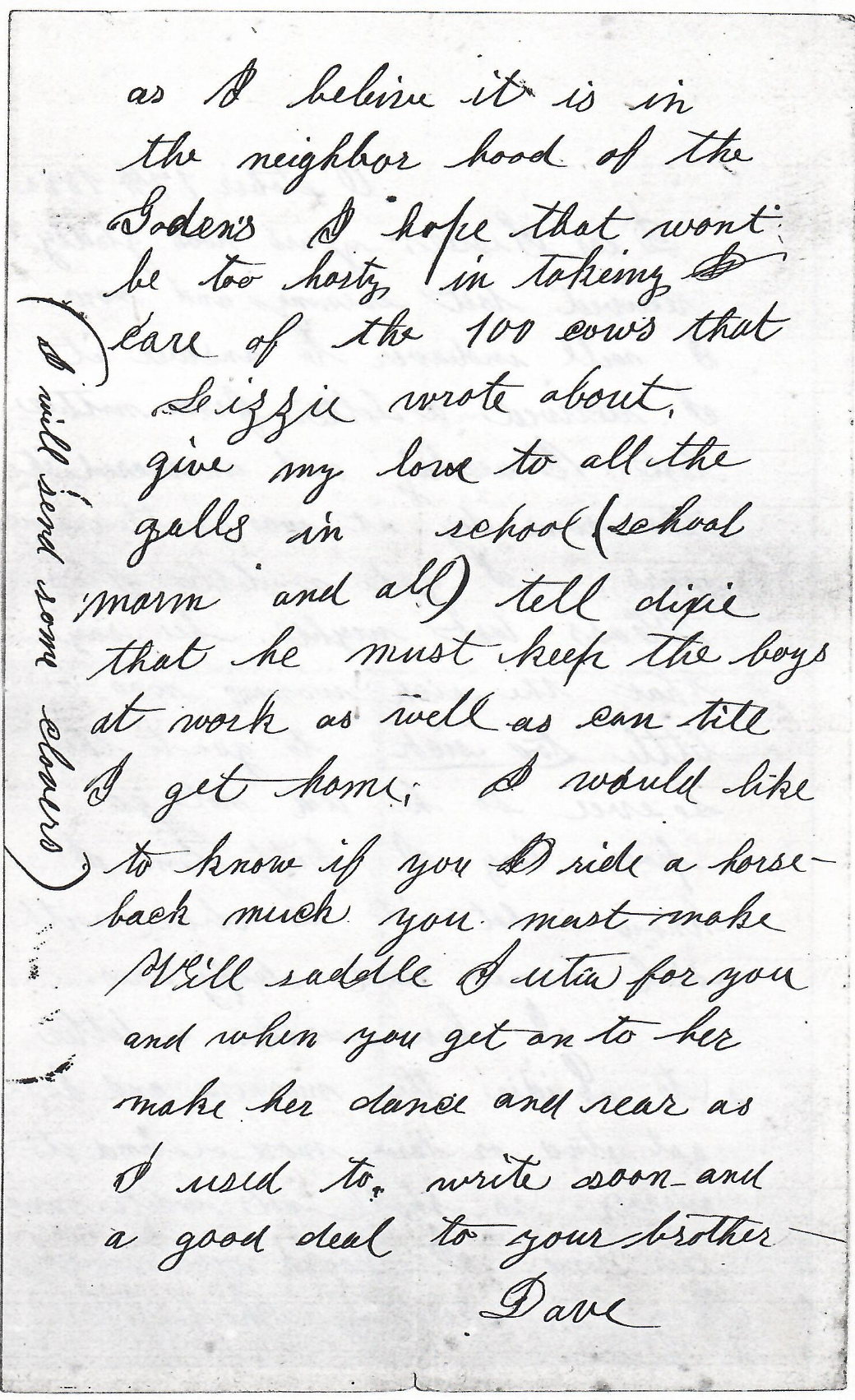
I have written a letter to Lydia this morning and have got two or three more on hand to answer so shall not write much this time. I wish you much joy in keeping school this [fall] as I believe it is in the neighborhood of the Goden’s. I hope that won’t be too hasty in taking care of the 100 cows that Lizzie wrote about. Give my love to all the galls in school (school marm and all). Tell Dixie that he must keep the boys at work as well as he can till I get home. I would like to know if you ride a horseback much. You must make Vill saddle Julia for you and when you get on to her, make her dance and rear as I used to. Write soon and a good deal to your brother. — Dave
Letter 6
On picket 3 miles from Warrenton [Virginia] Saturday, November 8th [1862]
Dear Sister,
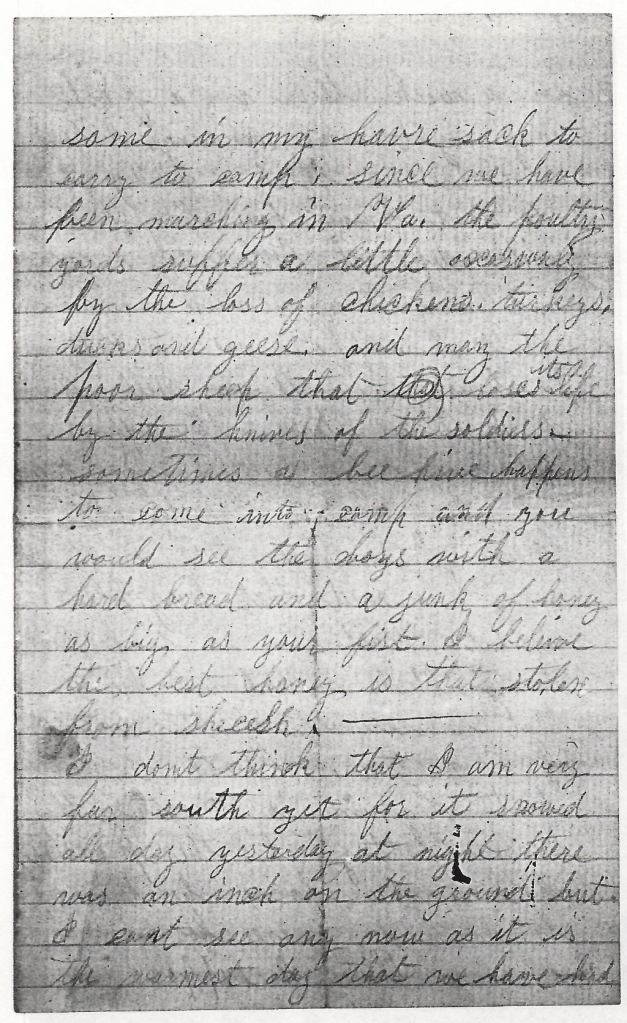
The last letter I got was one from Mother dated the 30th. I have written an answer to it. I suppose I shall find one in camp from you when I get there. I am on picket here in the woods 3 miles from camp. Came out last night. Are having a good time. Have eaten as much as a peck of shagbarks. They grow here in all quantities and descriptions and a great lot of other nuts. I helped catch two hogs last night and we have had plenty of fresh pork for breakfast and diner and have some in my haversack to carry to camp. Since we have been marching in Virginia, the poultry yards suffer a little occasionally by the loss of chickens, turkeys, ducks and geese and many the poor sheep that loses its life by the knives of the soldiers. Sometimes a bee hive happens to come into camp and you would see the boys with a hard bread and a hunk of honey as big as your fist. I believe the best honey is that stolen from the secesh.
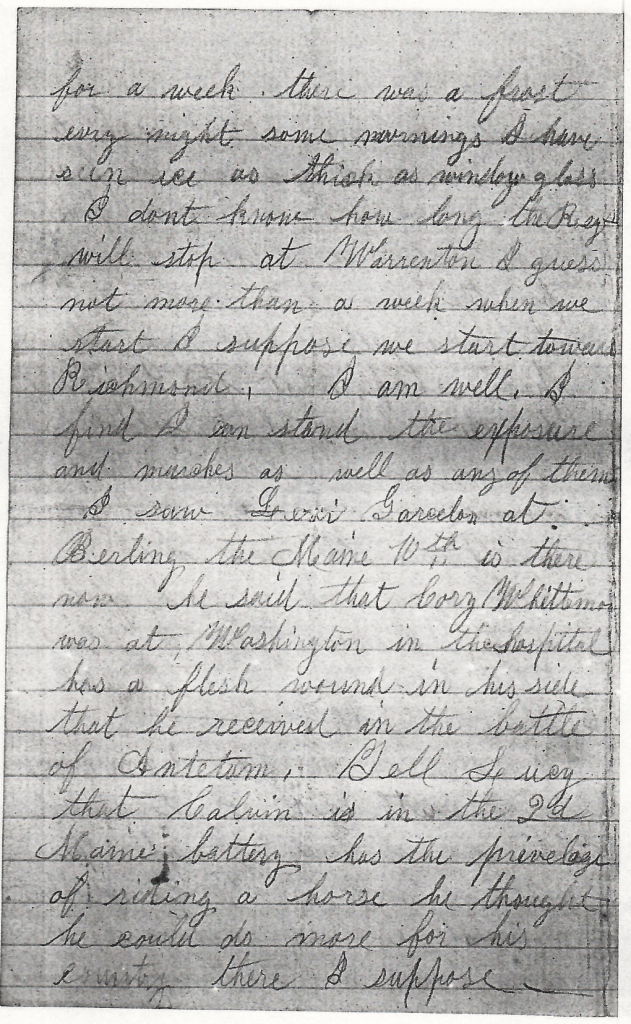
I don’t think that I am very far south yet for it snowed all day yesterday. At night there was an inch on the ground. But I can’t see any now as it is the warmest day that we have had for a week. There was a frost every night. Some mornings I have seen ice as thick as window glass.
I don’t know how long the regiment will stop at Warrenton. I guess not more than a week. When we start, I suppose we start towards Richmond. I am well. I find I can stand the exposure and marches as well as any of them. I saw Levi Garcelon at Berlin [now Brunswick]. The Maine 10th is there now. He said that [Eben] Cory Whittemore was at Washington in the hospital has a flesh wound in his side that he received in the battle of Antietam. Tell Lucy that Calvin [Beals] is in the 2nd Maine Battery [and] has the privilege of riding a horse. He thought he could do more for his country there I suppose.
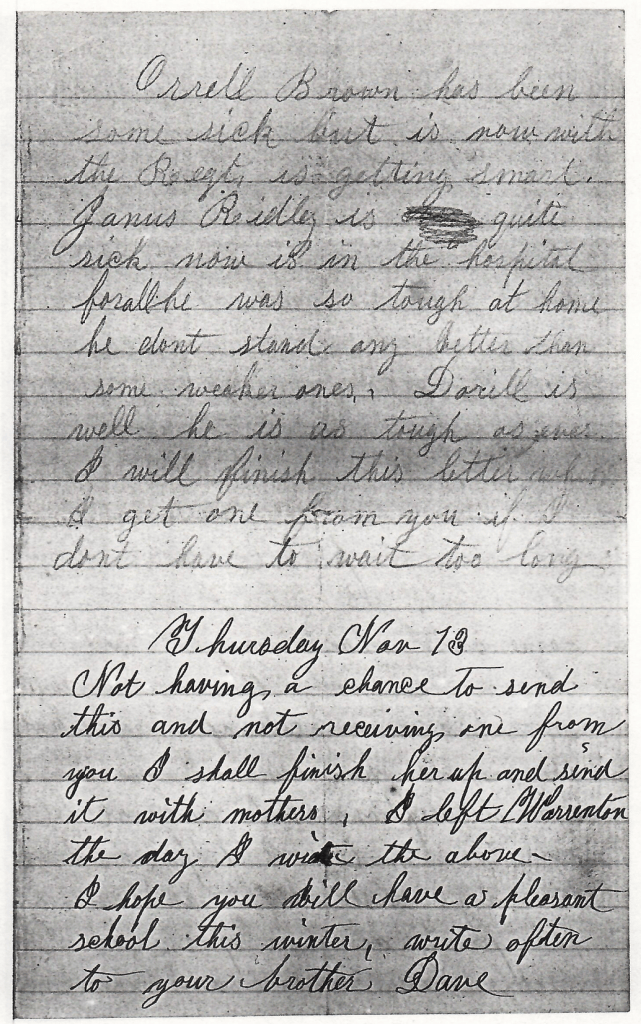
Orrel Brown has been some sick but is now with the regiment. He is getting smart. James Ridley is quite sick now [and] is in the hospital. For all he was so tough at home, he don’t stand any better than some weaker ones. Darill is well. He is as tough as ever. I will finish this letter when I get one from you if I don’t have to wait too long.
Thursday Nov 13—Not having a chance to send this and not receiving one from you, I shall finish her up and send it with mother’s. I left Warrenton the day I wrote the above. I hope you will have a pleasant school this winter. Write often to your brother, — Dave
Letter 7
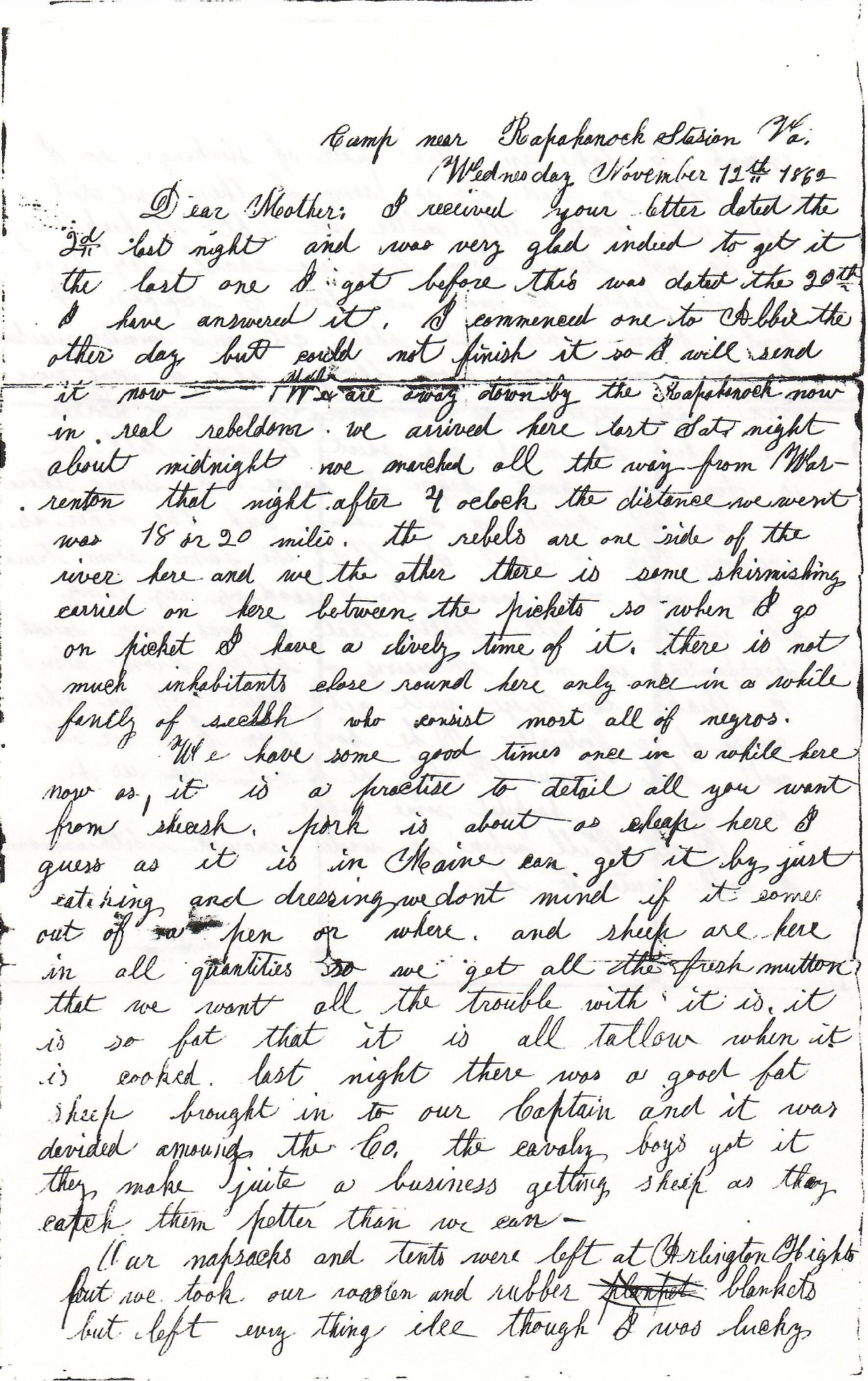
Camp near Rappahannock Station, Va. Wednesday, November 12th 1862
Dear Mother,
I received your letter dated the 2nd last night and was very glad indeed to get it. The last one I got before this was dated the 20th. I have answered it. I commenced one to Abbie the other day but could not finish it so I will send it now.
We are away down by the Rappahannock now in real rebeldom. We arrived here last Saturday night about midnight. We marched all the way from Warrenton that night after 4 o’clock. the distance we went was 18 or 20 miles. the rebels are on one side of the river here and we the other. there is some skirmishing carried on here between the pickets so when I go on picket, I have a lively time of it. There is not much inhabitants close round here—only one in a while a family of secesh who consist most all of negroes.
We have some good times once in a while here now as it is a practice to detail all you want from secesh. Pork is about as cheap here I guess as it is in Maine. We can get it by just catching and dressing. We don’t mind if it comes out of a pen or where, and sheep are here in all quantities so we get all the fresh mutton that we want. All the trouble with it is it is so fat that it is all tallow when it is cooked. Last night there was a good fat sheep brought in to our captain and it was divided around the company. The cavalry boys got it. They make quite a business getting sheep as they catch them better than we can.
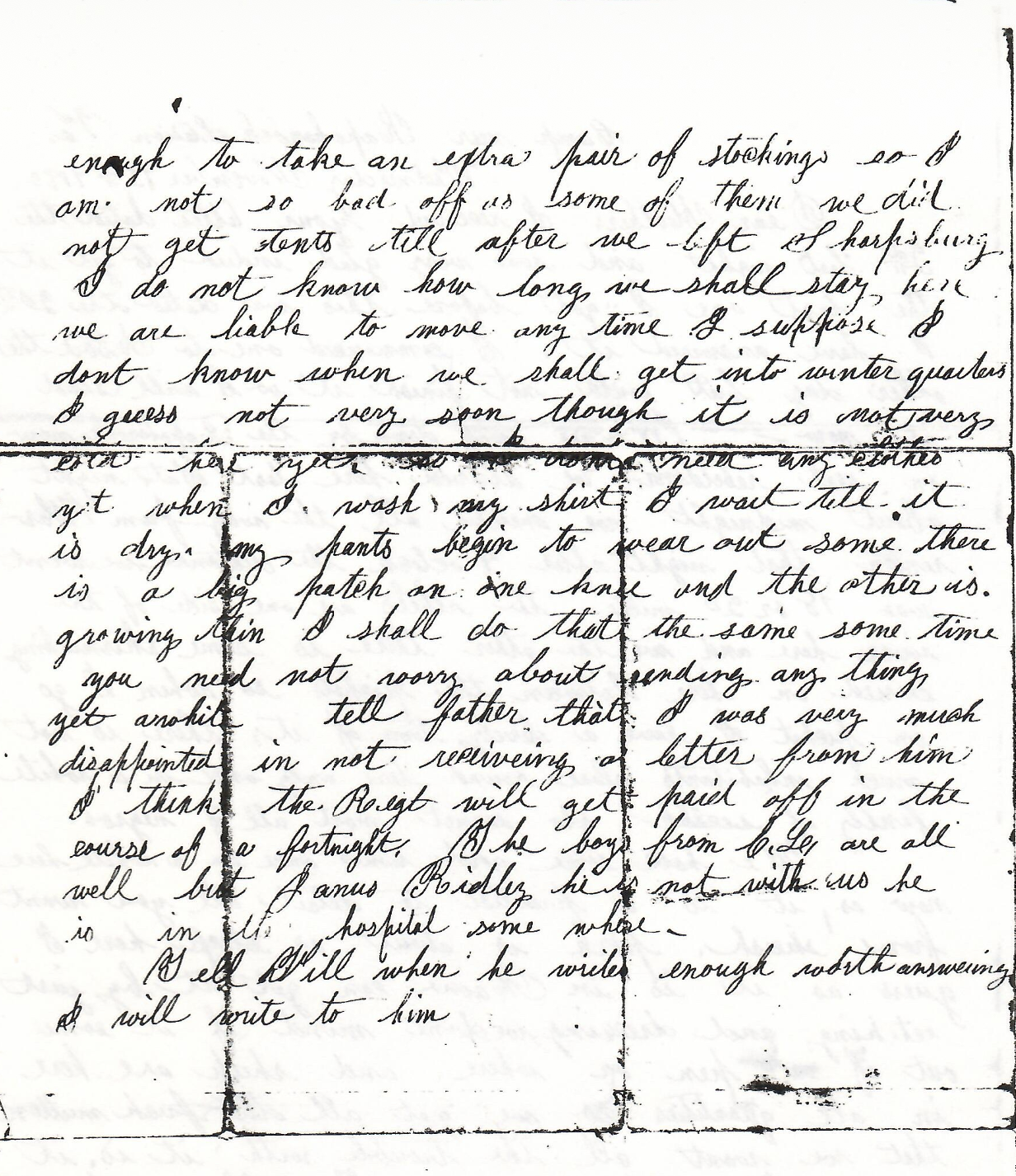
Our knapsacks and tents were left at Arlington Heights but we took our woolen and rubber blankets but left everything else though I was lucky enough to take an extra pair of stockings so I am not so bad off as some of them. We did not get tents till after we left Sharpsburg. 1
I di not know how long we shall stay here. We are liable to move any time, I suppose. I don’t know when we shall get into winter quarters. I guess not very soon though it is not very cold here yet so I don’t need any clothes yet. When I wash my shirt, I wait till it is dry. My pants begin to wear out some. There is a big patch on one knee and the other is growing thin. I shall do that the same sometime. You need not worry about sending anything yet awhile.
Tell father that I was very much disappointed in not receiving a letter from him. I think the regiment will get paid off in the course of a fortnight. The boys from East Livermore are all well but James Ridley. He is not with us. He is in the hospital somewhere.
Tell Vill when he writes enough worth answering, I will write to him.
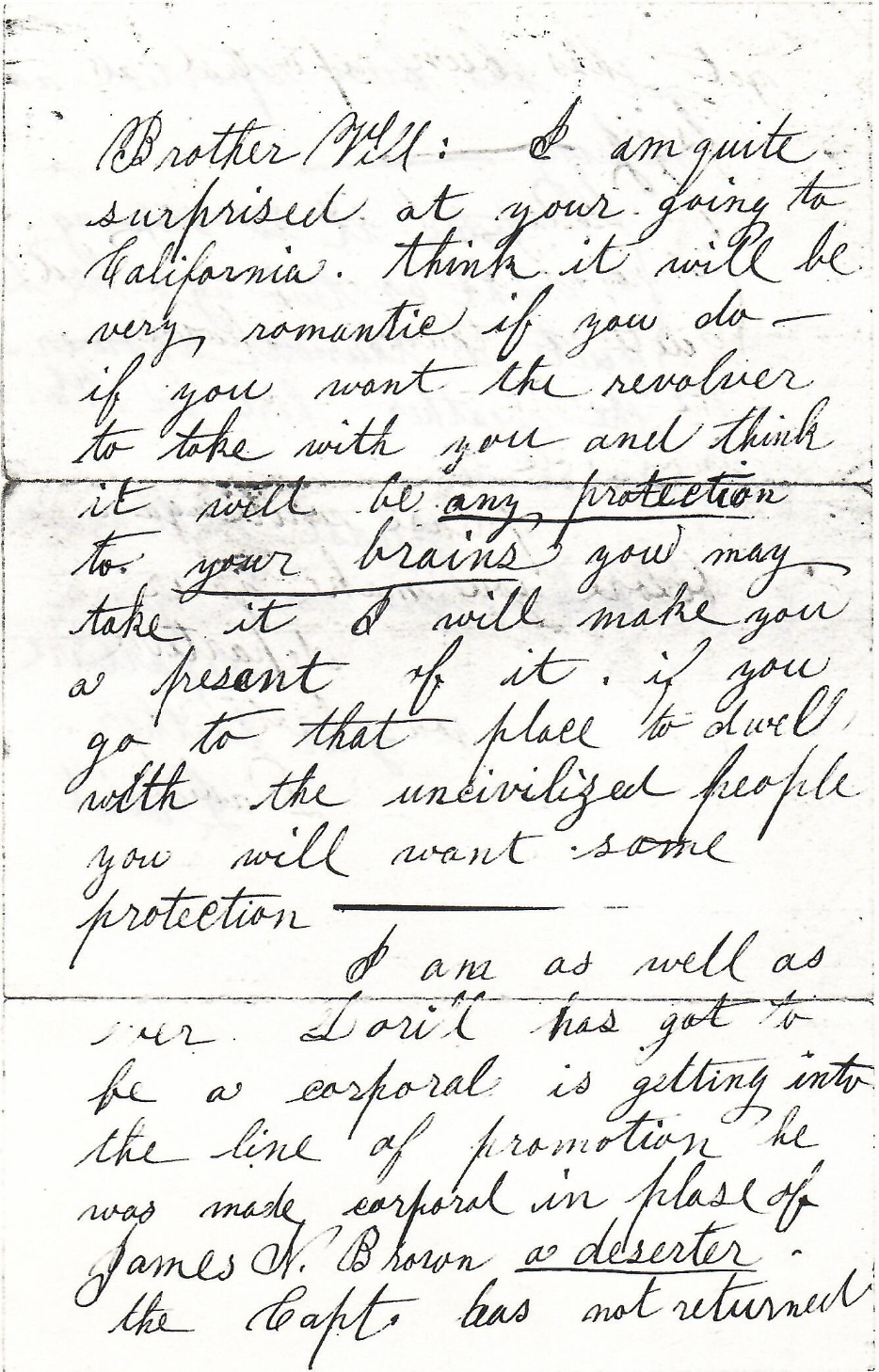
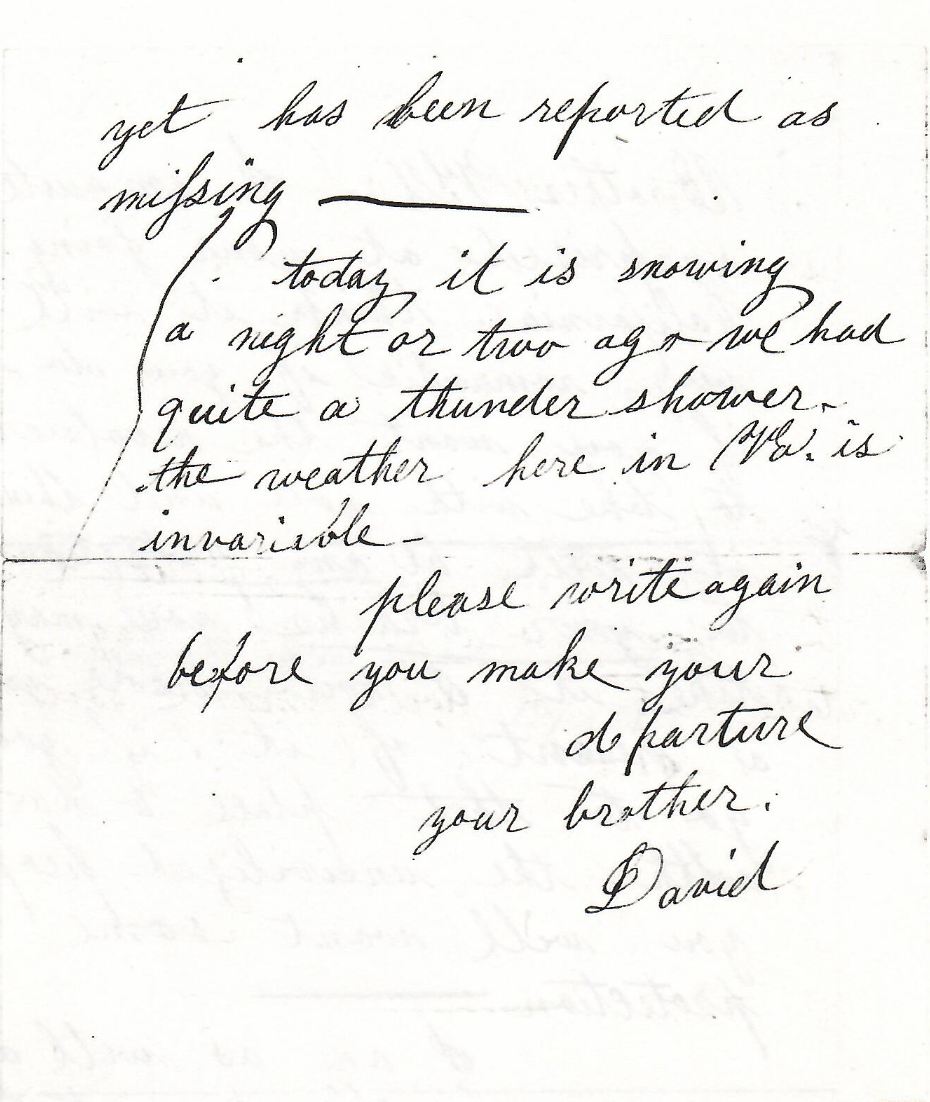
Brother Vill—I am quite surprised at your going to California. Think it will be very romantic if you do. If you want the revolver to take with you and think it will be ant protection to your brains, you may take it. I will make you a present of it. If you go to that place to dwell with the uncivilized people, you will want some protection. I am as well as ever. Dorill[us Hobbs] has got to be a corporal [and] is getting into the line of promotion. He was made corporal in place of James N. Brown, a deserter. The captain has not returned yet. Has been reported as missing. Today it is snowing. A night or two we had quite a thunder shower. Their weather here in Virginia is invariable. Please write again before you make your departure. Your brother, — David
1 David’s letter speaks on the regiment having only their blankets and no tents. They marched and camped through much of the wet autumn weather in 1862 without tents, overcoats, or proper gear, and were forced to wrapt themselves in blankets to sleep at night. This situation was so striking that other regiments sometimes mocked them and called them the “Blanket Brigade.”
Letter 8
Rappahannock Station Sunday, November 16th
Dear Sister,
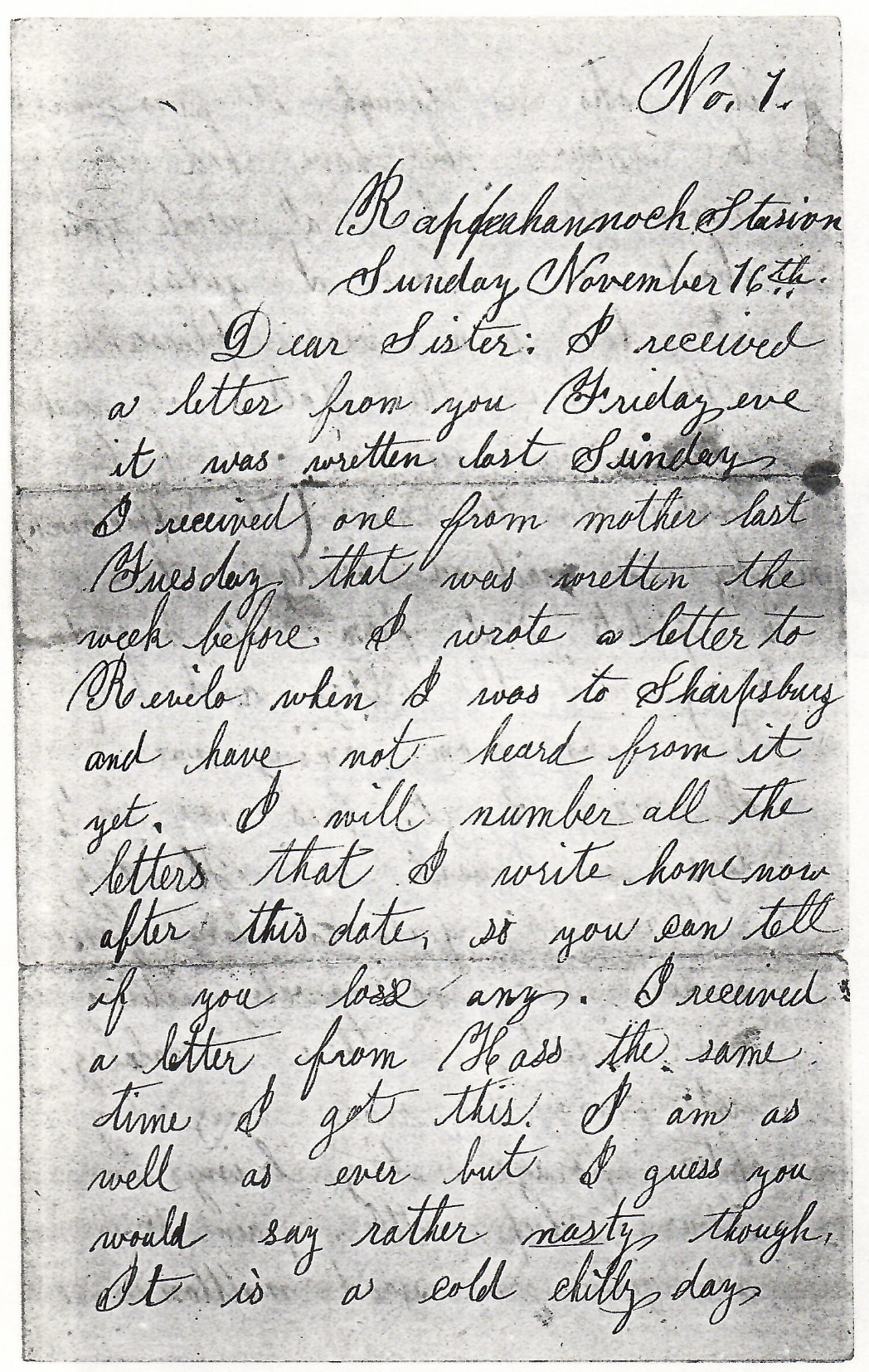
I received a letter from you Friday eve. It was written last Sunday. I received one from mother last Tuesday that was written the week before. I wrote a letter to Revillo when I was to Sharpsburg and have not heard from it yet. I will number all the letters that I write home now after this date so you can tell if you lose any. I received a letter from Hoss the same time I got this.
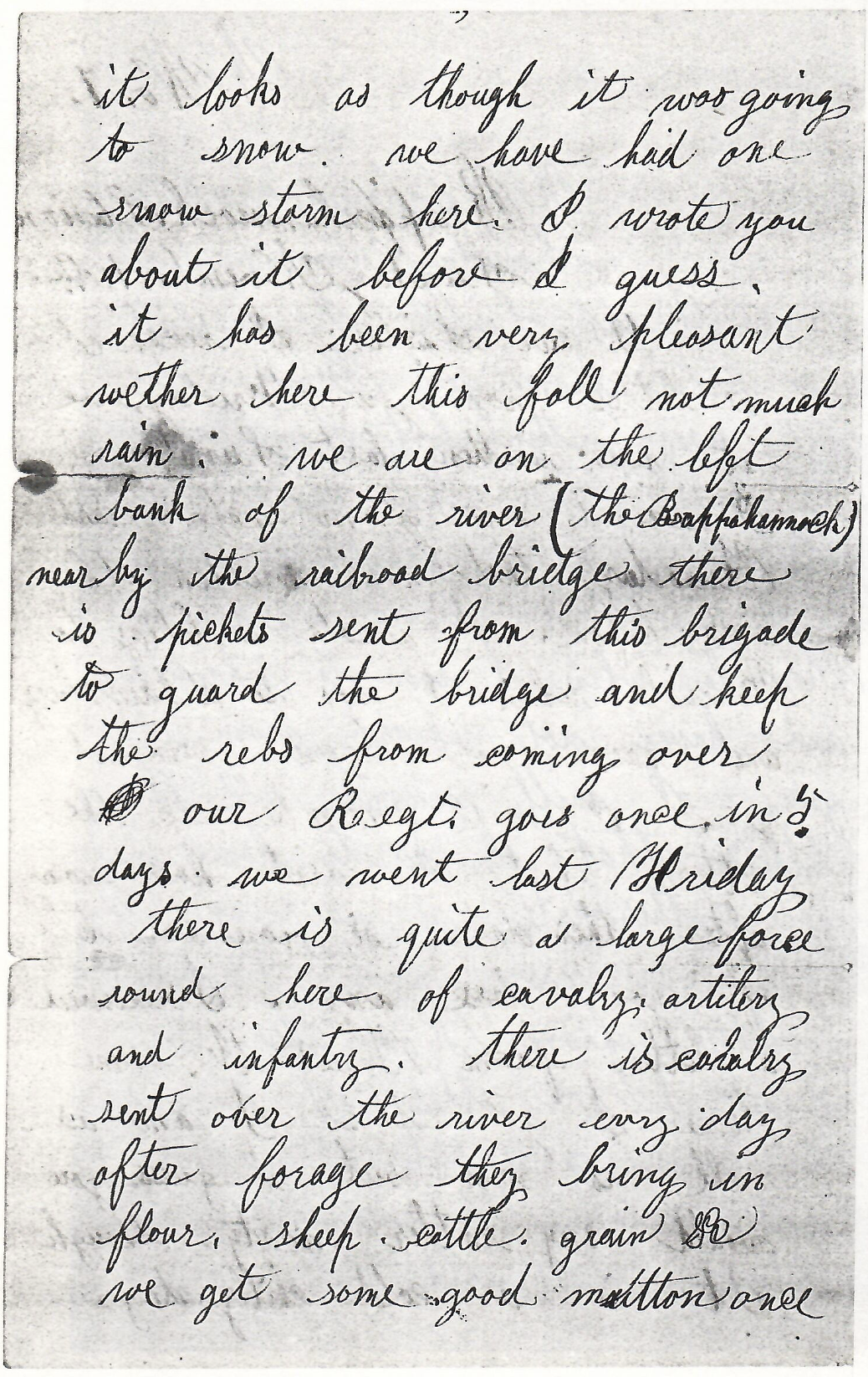
I am as well as ever but I guess you would say rather nasty though. It is a cold, chilly day. It looks as though it was going to snow storm here. I wrote you about it before, I guess. It has been very pleasant weather here this fall—not much rain.
We are on the left bank of the river (the Rappahannock) near by the railroad bridge. There is pickets sent from this brigade to guard the bridge and keep the rebs from coming over. Our regiment goes once in five days. We went last Friday. There is quite a large force round here of cavalry, artillery, and infantry. There is cavalry sent over the river every day after forage. The bring in flour, sheep, cattle, grain, &c. We get some good mutton once in a while. It is the biggest half grease. The sheep out here are very fat.
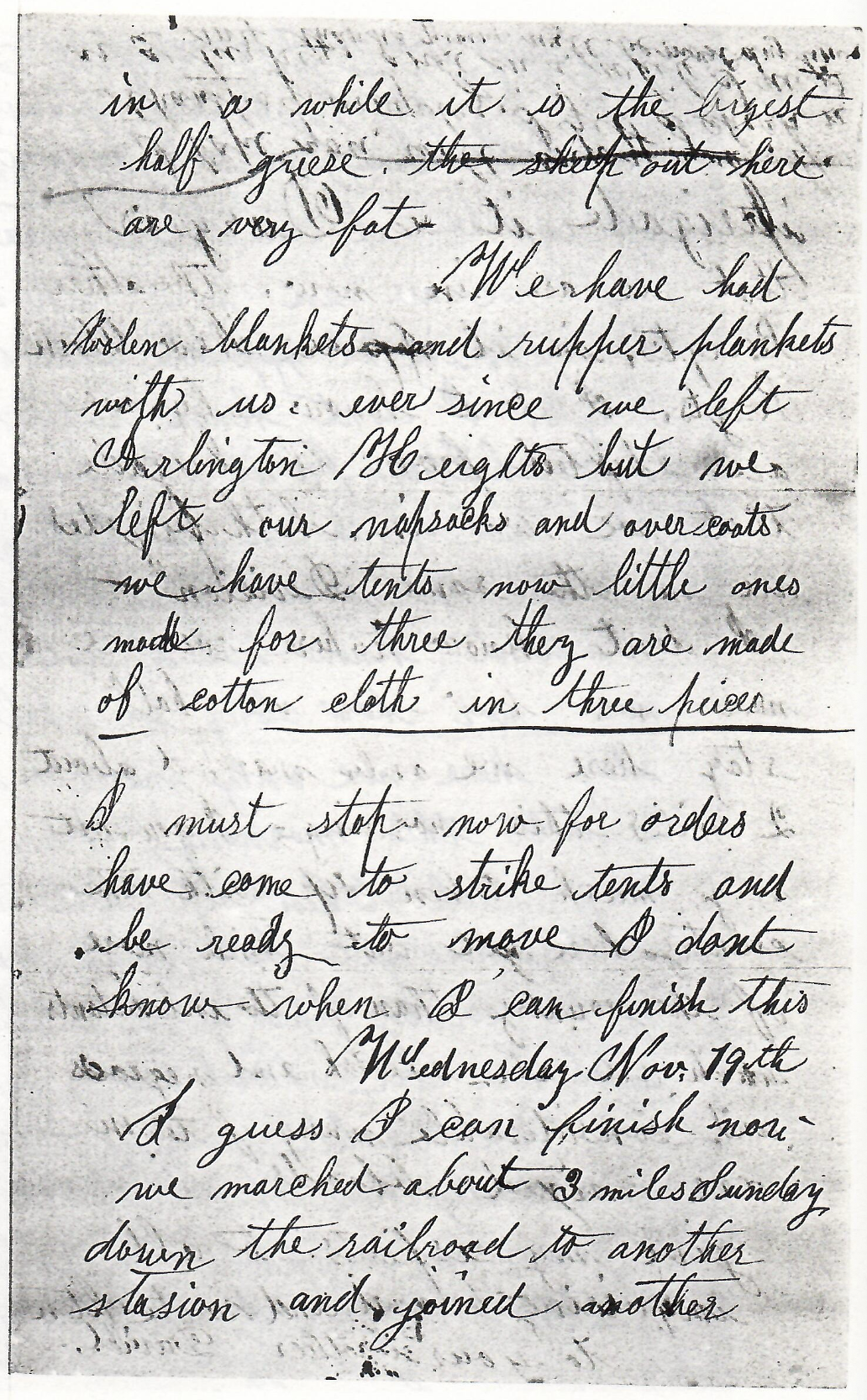
We have had woolen blankets and rubber blankets with us ever since we left Arlington Heights but we left our knapsacks and overcoats. We have tents now—little ones made for three. They are made of cotton cloth in three pieces.
I must stop now for orders have come to strike tents and be ready to move. I don’t know when I can finish this.
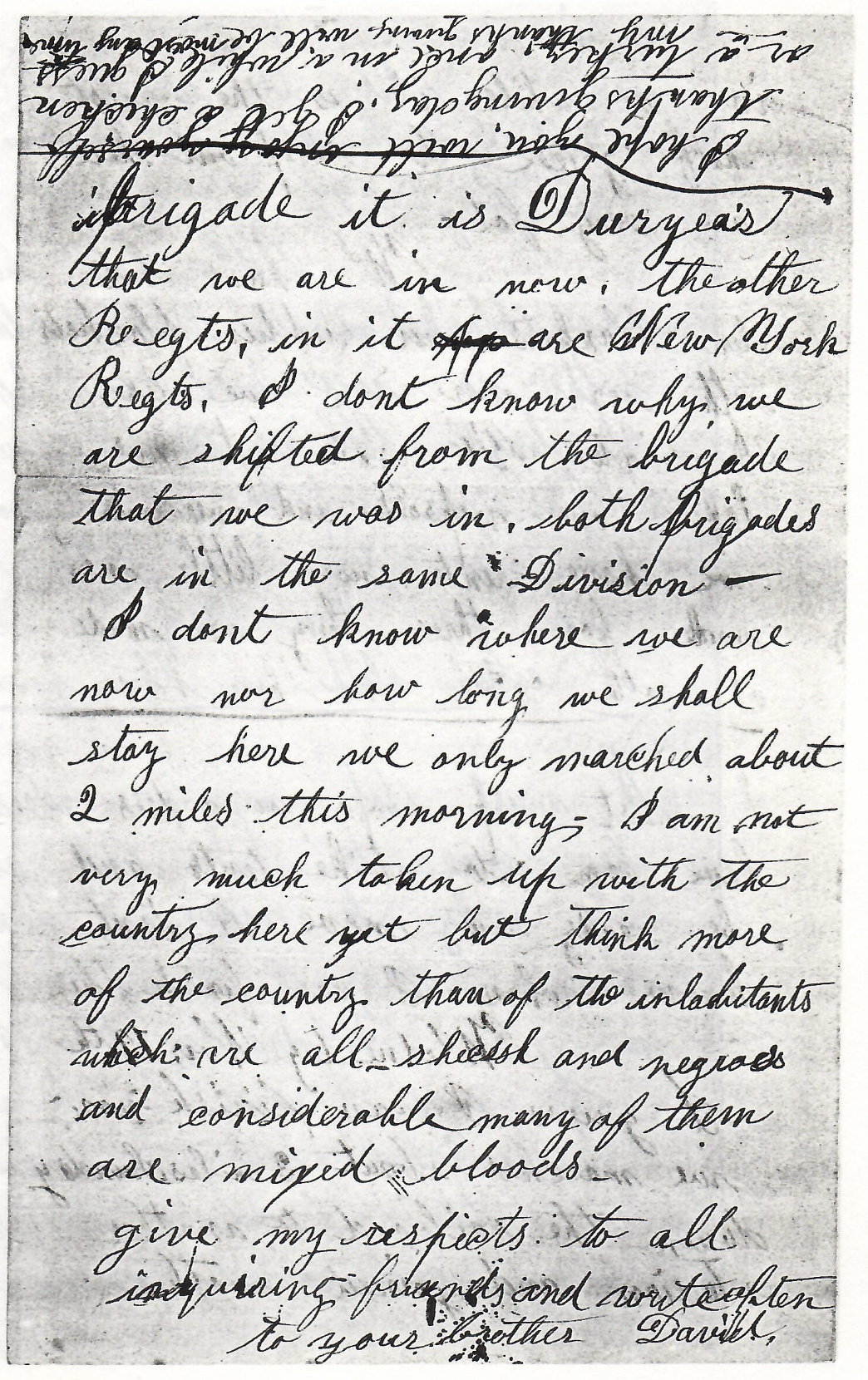
Wednesday, November 19th 1862—-I guess I can finish now. We marched about three miles Sunday down the railroad to another station and joined another brigade. It is Duryea’s that we are in now. The other regiments in it are [all] New York regiments. I don’t know why we are shifted from the brigade that we was in. Both brigades are in the same division.
I don’t know where we are now nor how long we shall stay here. We only marched about two miles this morning. I am not very n=much taken up with the country here yet but think more of the country than of the inhabitants which are all secesh and negroes and considerable many of them are mixed breeds.
Give my respects to all inquiring friends and write often to your brother, — David
I hope you will enjoy yourself Thanksgiving Day. I get a chicken or a turkey once in a while. I guess my Thanksgiving will be most anytime.
Letter 9
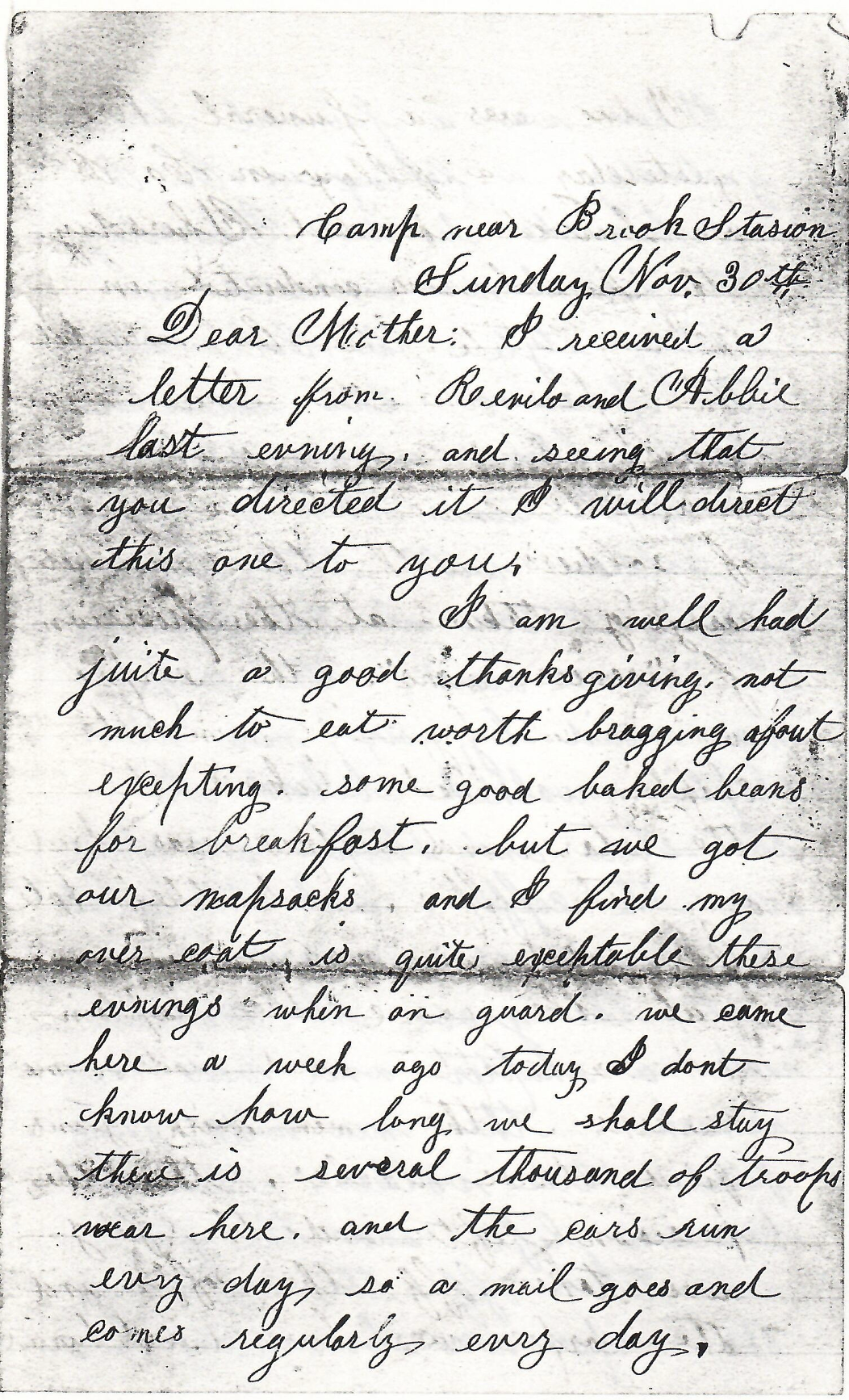
Camp near Brook Station Sunday, November 30th [1862]
Dear Mother,
I received a letter from Revillo and Abbie last evening, and seeing that you directed it, I will direct this one to you.
I am well. Had quite a good Thanksgiving. Not much to eat worth bragging about excepting some good baked beans for breakfast. But we got knapsacks and I found my overcoat. It’s quite acceptable these evening when on guard. We came here a week ago today. I don’t know how long we shall stay. There is several thousands of troops here and the cars run every day so a mail goes and comes regularly every day.
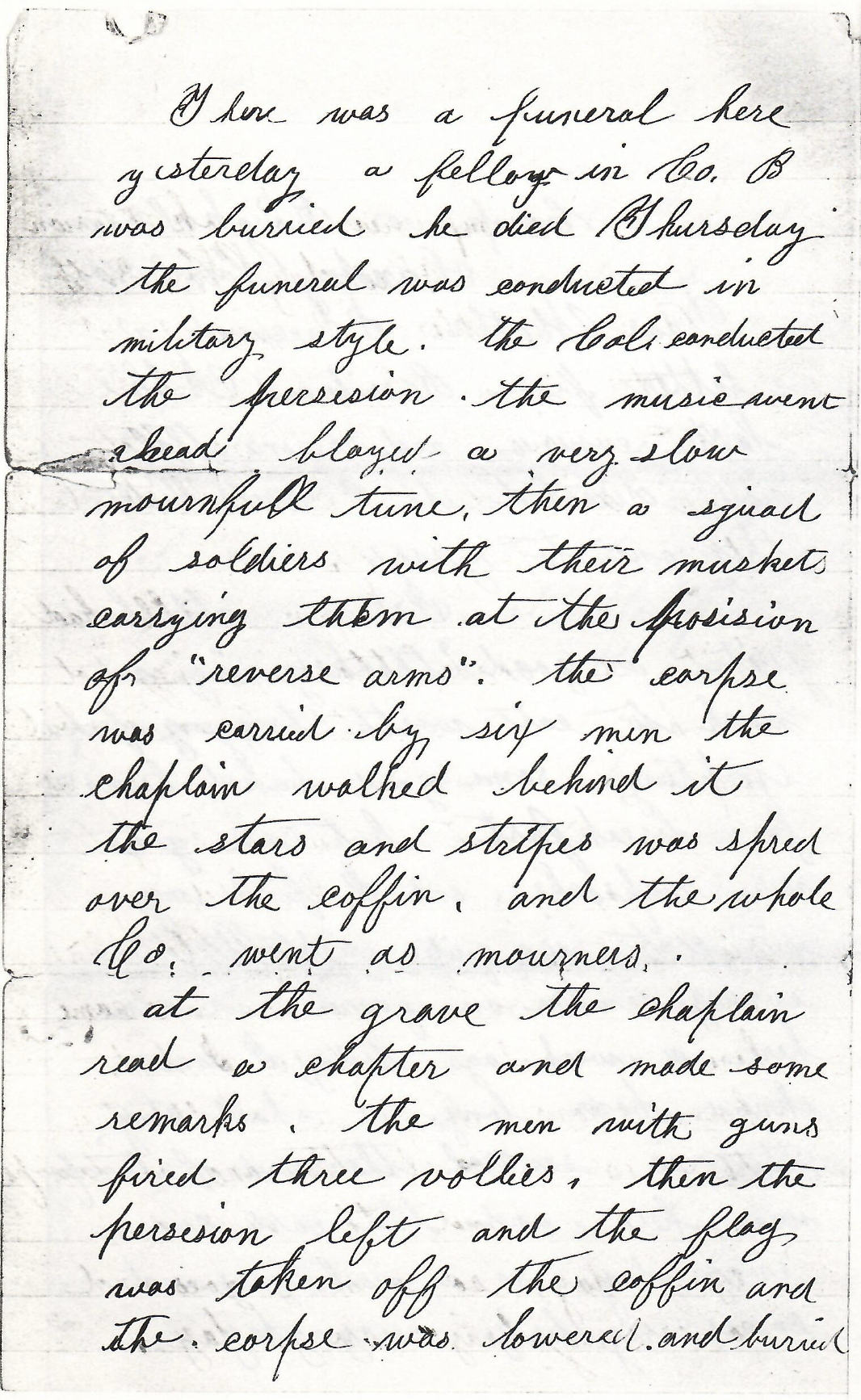
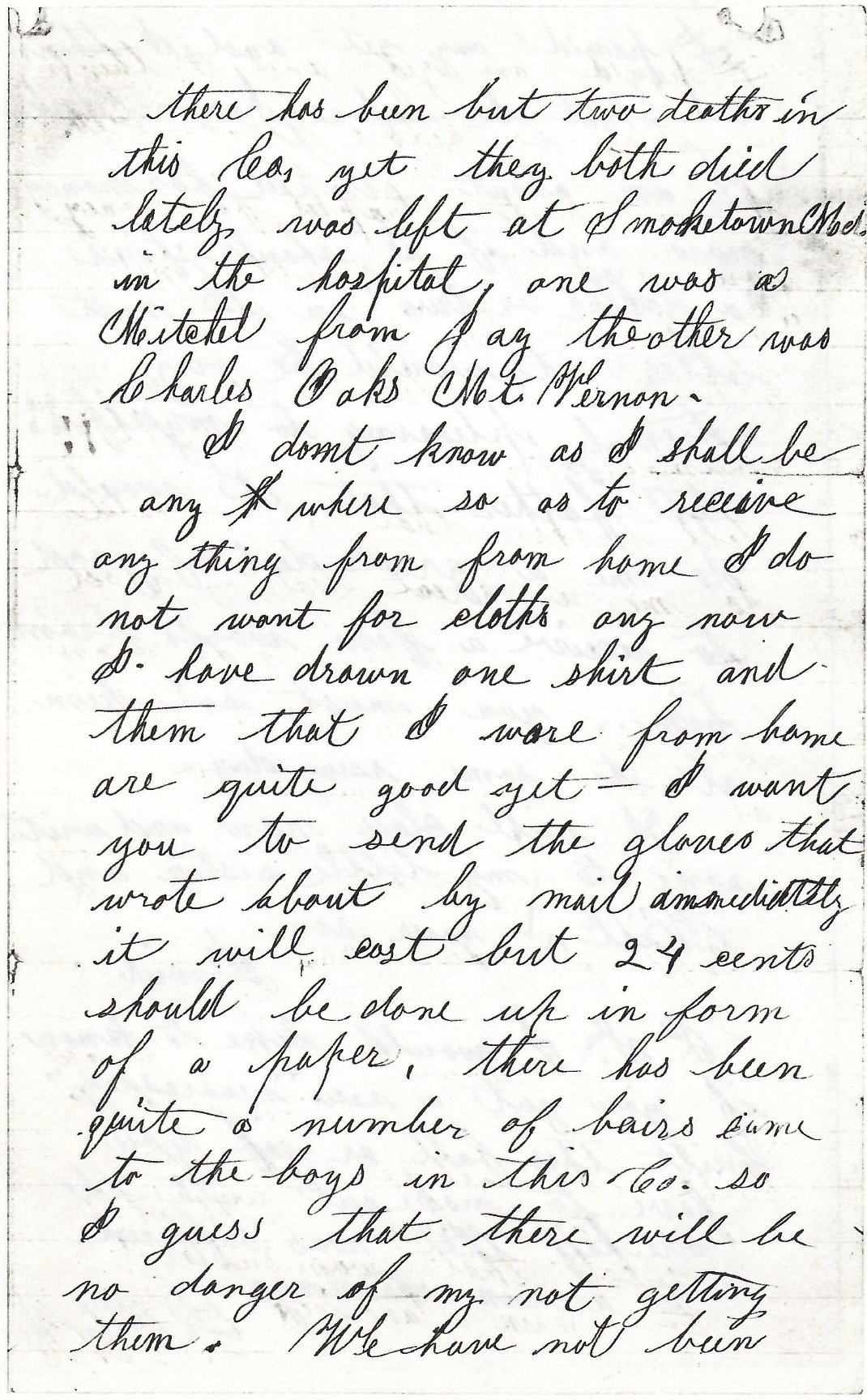
There was a funeral here yesterday—a fellow in Co. B was buried. He died Thursday. The funeral was conducted in military style. The Colonel conducted the procession. The music went ahead [and] played a very slow mournful tune. Then a squad of soldiers with their muskets, carryingthem at the position of “reverse arms.” The corpse was carried by six men. The chaplain walked behind it. The stars and strips was spread over the coffin and the whole company went as mourners. At the grave the chaplain read a chapter and made some remarks. The men with guns fired three volleys. Then the procession left and the flag was taken off the coffin and the corpse was lowered and buried. There has been but two deaths in this company yet. They both died lately. Was left at Smoketown, Maryland, in the hospital. One was a Mitchell from Jay. The other was Charles Oaks, Mt. Vernon.
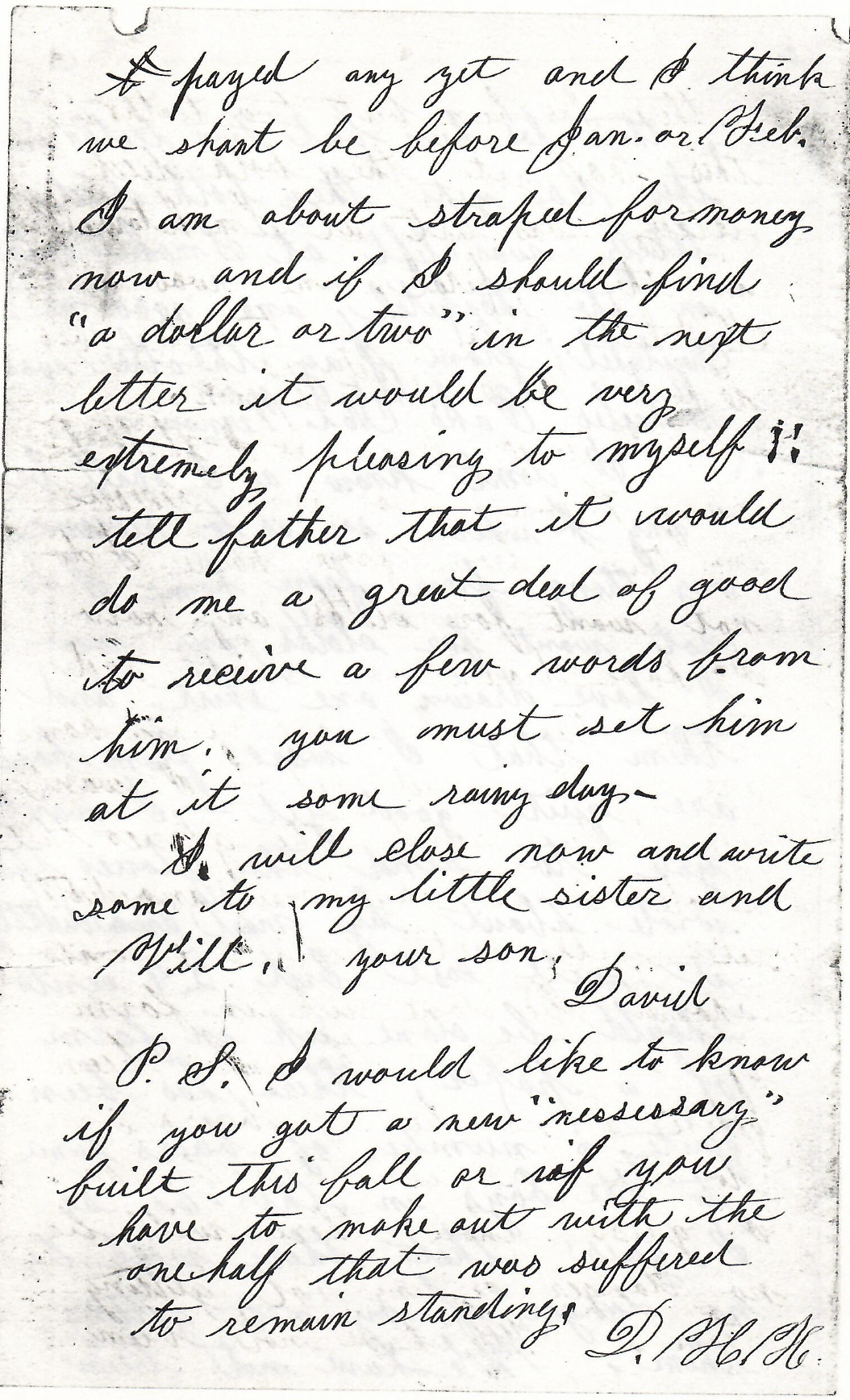
I don’t know as I shall be anywhere so as to receive anything from home. I do not want for clothes any now. I have drawn one shirt and them that I wore from home are quite good yet. I want you to send the gloves that [I] wrote about by mail immediately. It will cost but 24 cents. Should be done up in form of a paper. There has been quite a number of boxes come other the boys in this company so I guess that there will be no danger of my not getting them. We have not been paid any yet and I think we shan’t be before January or February. I am about strapped for money now and if I should find a “dollar or two” in the next letter, it would be very extremely pleasing to myself!
Tell father that it would do me a great deal of good to receive a few words from him. You must set him at it some rainy day. I will close now and write some to my little sister and Vill. Yours son, — Davis
P. S. I would like to know if you got a new “necessary” built this fall or if you have to make out with the one half that was suffered to remain standing. — D. H. H.
Letter 10
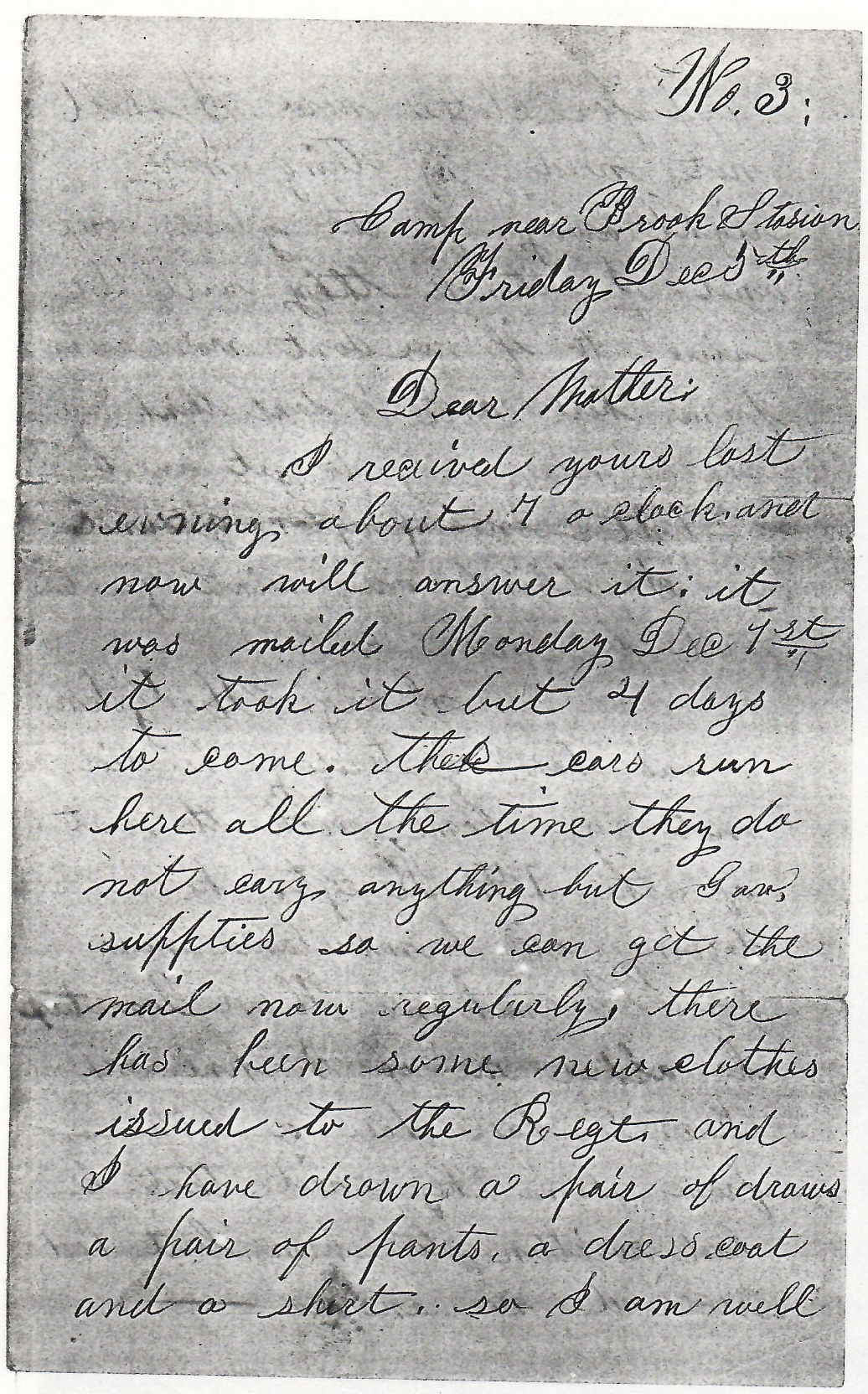
Camp near Brook Station Friday, December 5, 1862
Dear Mother,
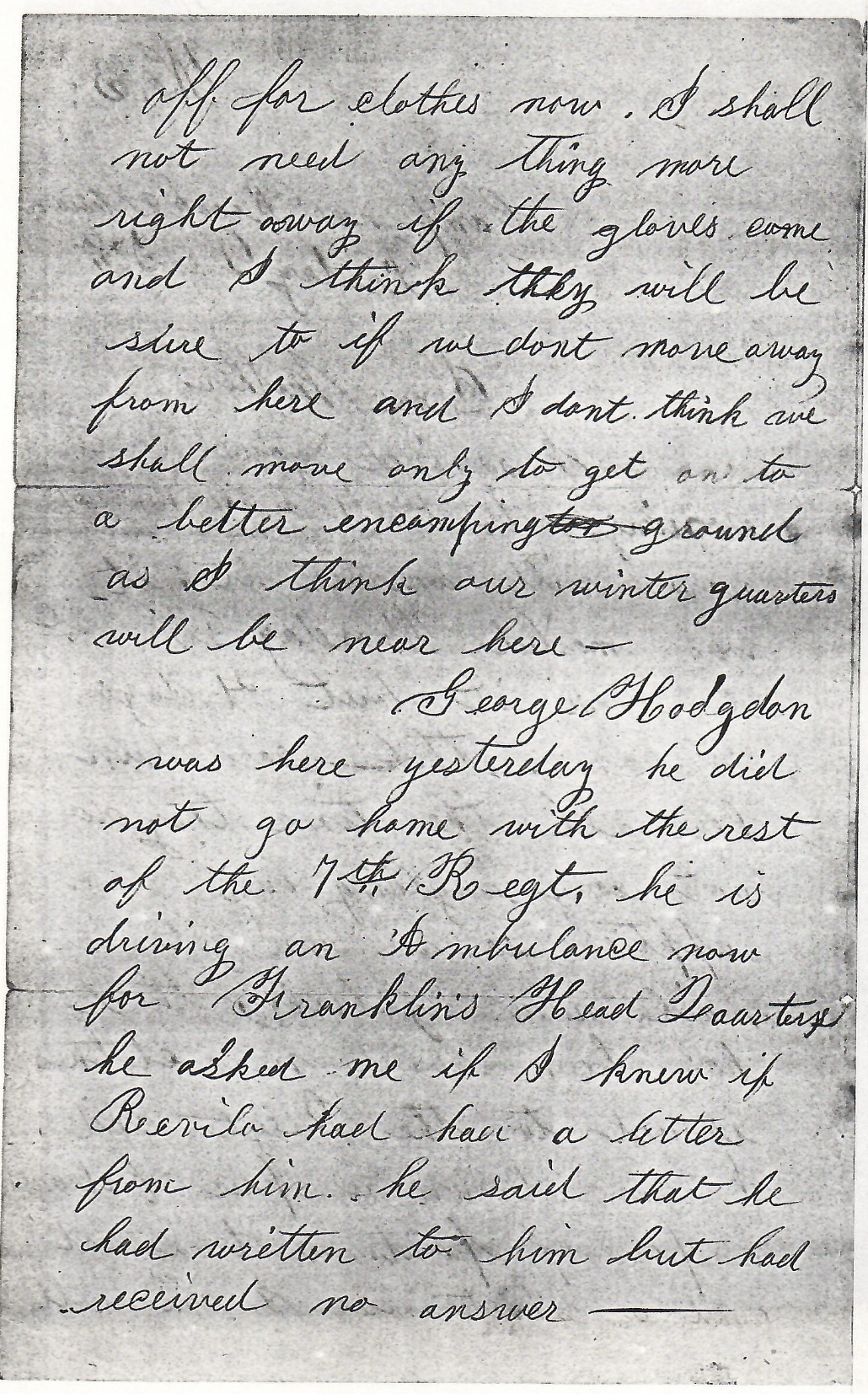
I received yours last evening about 7 o’clock and now will answer it. It was mailed Monday, December 1st. It took but four days to come. The cars run here all the time. They do not carry anything but government supplies so we can get the mail now regularly. there has been some new clothes issued to the regiment and I have drawn a pair of drawers, a pair of pants, a dress coat, and a shirt so I am well off for clothes now. I shall not need anything more right away if the gloves come—and I think they will be sure to if we don’t move away from here. And I don’t think we shall move, only to get a better camping ground as I think our winter quarters will be near here.
George Hodgdon was here yesterday. He did not go home with the rest of the 7th [Maine] Regiment. He is driving an ambulance now for Franklin’s Headquarters. He asked me if I knew Revillo had had a letter from him. He said that he had written to him but had received no answer.
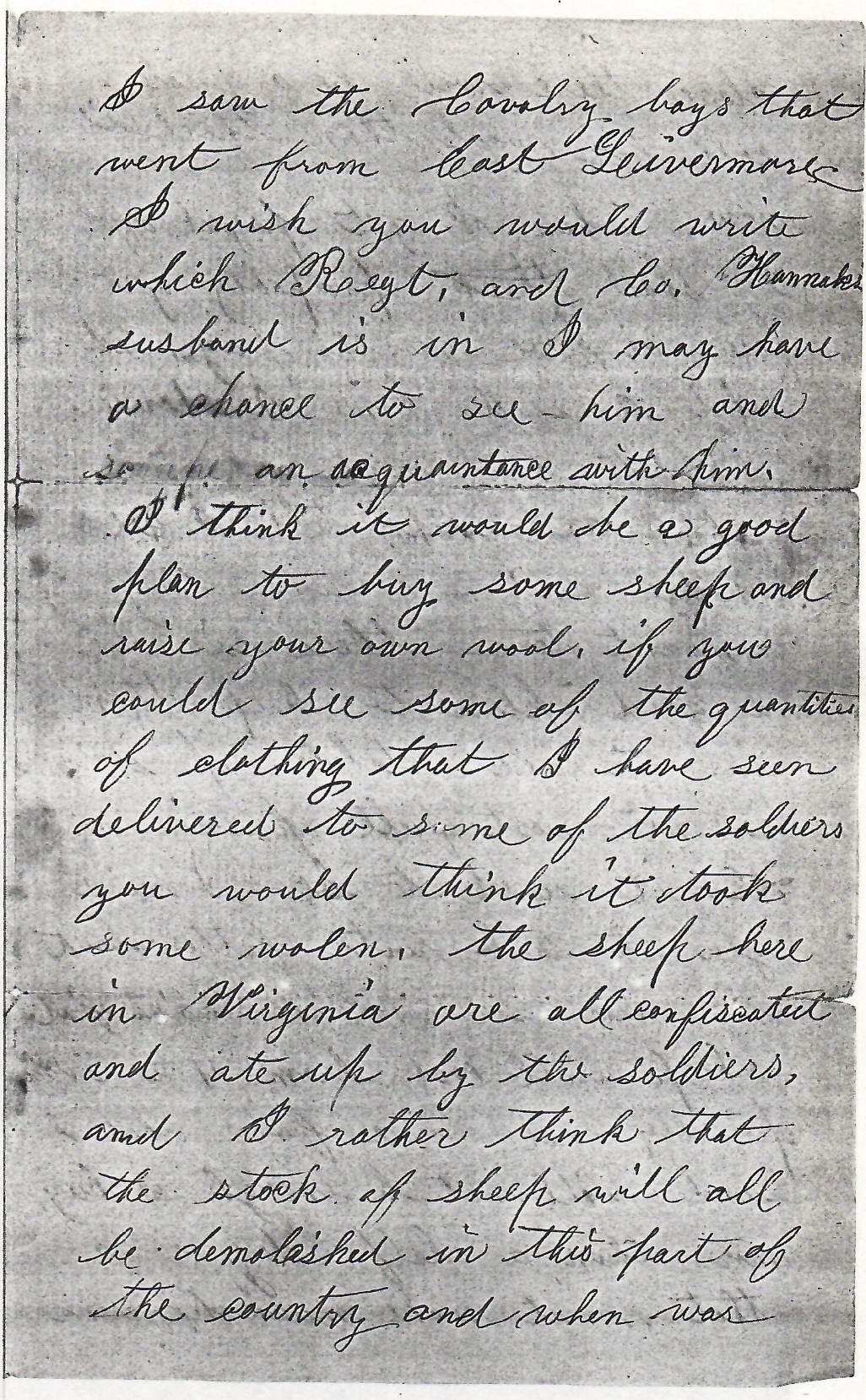
I saw the cavalry boys that went from East Livermore. I wish you would write which regiment and company Hanna’s husband is in. I may have a chance to see him and strike an acquaintance with him.
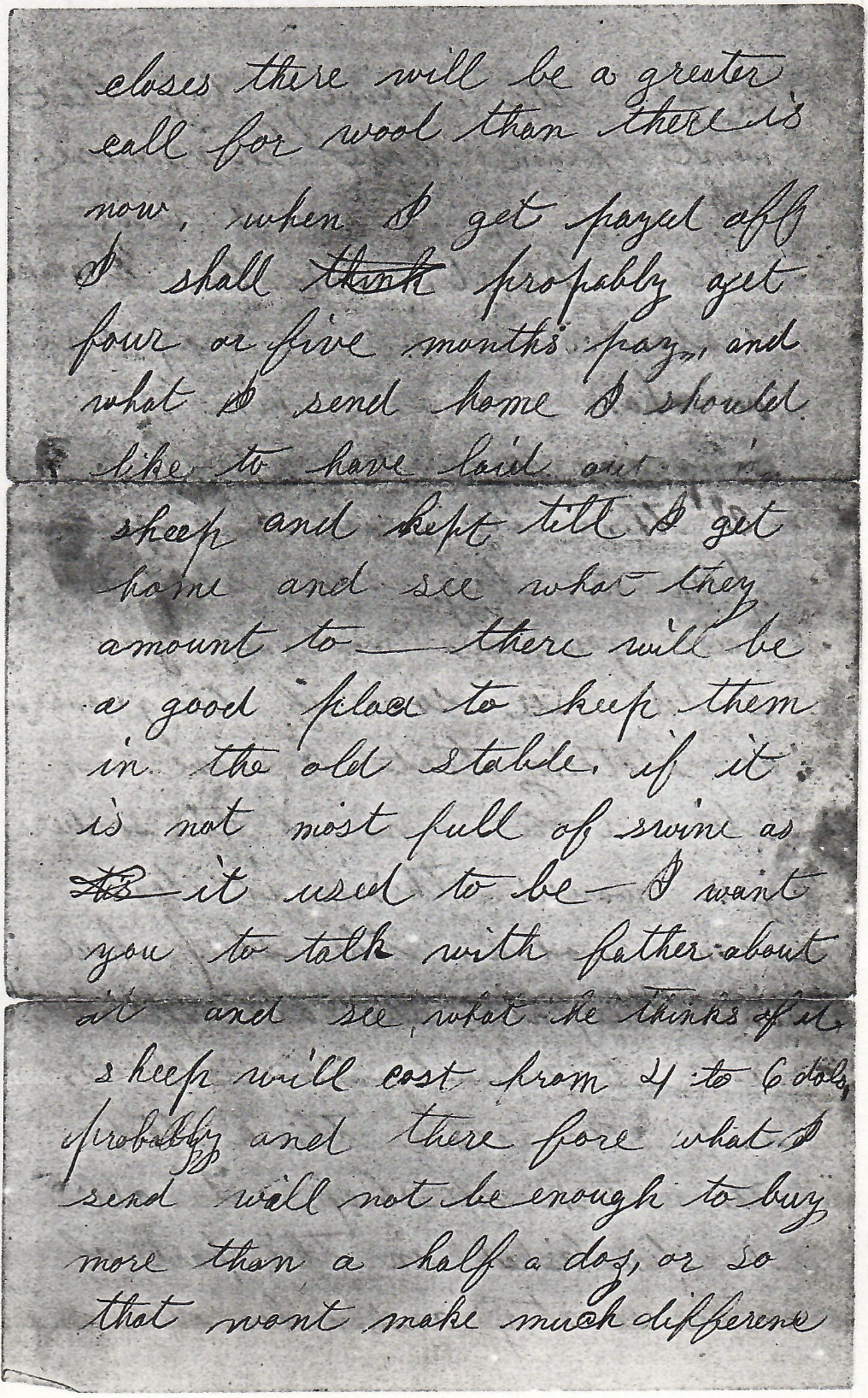
I think it would be a good plan to buy some sheep and raise your own wool. If you could see some of the quantities of clothing that I have seen delivered to some of the soldiers, you would think it took some wool. The sheep here in Virginia are all confiscated and ate up by the soldiers and I rather think that the stock of sheep in this part of the country and when war closes there will be a greater call for wool than there is now.
When I get paid off, I shall probably get four or five months pay and what I send home I should like to have laid out in sheep and kept till I get home and see what they amount to. There will be a good place to keep them in the old stable if it is not full of swine as it used to be. I want you to tell father about it and see what he thinks of it. Sheep will cost from 4 to 6 dollars probably and therefore what I send will not be enough to buy more than a half a dozen or so. That won’t make much difference. [remainder of letter missing].
Letter 11
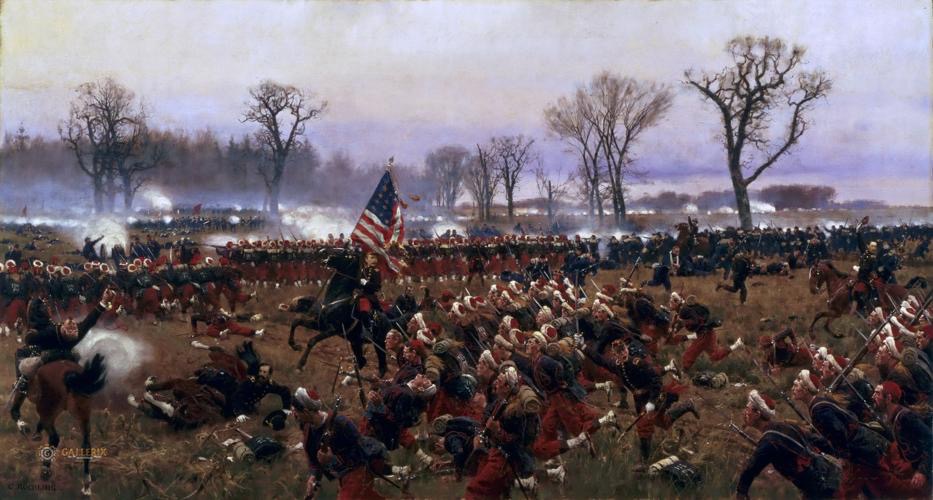
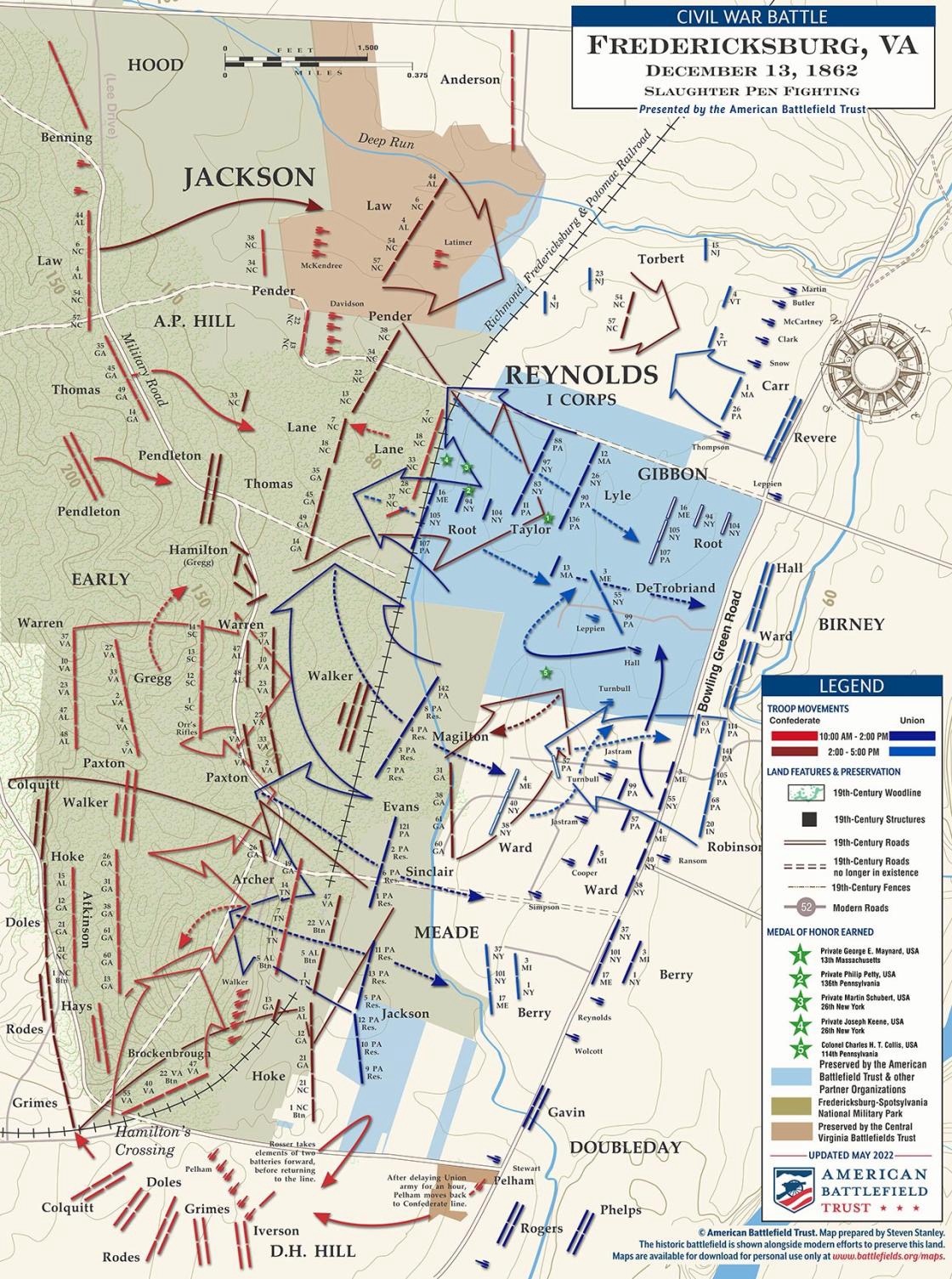
[Editor’s Note: In the letter that follows, David describes the fighting by the 16 Maine on the Union left flank at the Slaughter Pen Farm under the command of General George Meade. On 13 December 1862 they charged across an open muddy field towards a heavily defended Confederate line entrenched along the Richmond, Fredericksburg & Potomac Railroad embankment. In a ferocious “bulldog” effort, they actually broke through the Confederate line, suffering a devastating 54% casualty rate but winning the deep respect of the entire Army of the Potomac. See Horror and Heroism at the Slaughter Pen Farm by Kristopher D. White.]
Camp near Fredericksburg, Virginia Thursday, December 18th [1862]
Dear Mother,
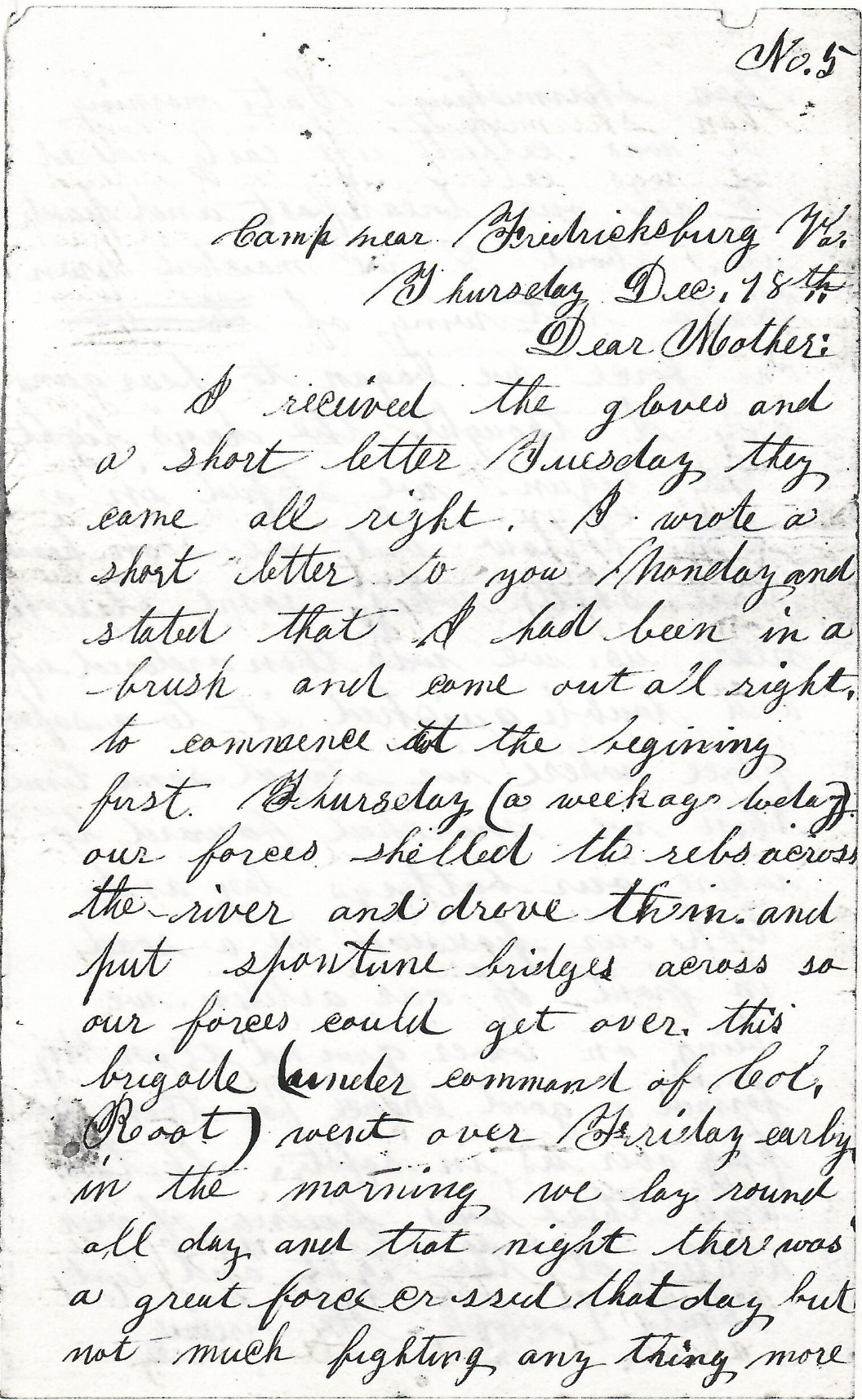
I received the gloves and a short letter Tuesday. They came all right. I wrote a short letter to you Monday and stated that I had been in a brush and came out all right.
To commence at the beginning (a week ago today), our forces shelled the rebs across the river and drove them and put spontune [pontoon] bridges across so our forces could get over. This brigade (under command of Col. Root) went over Friday early in the morning. We lay round all day and that night there was a great force crossed that day, but not much fighting—anything more than skirmishing.
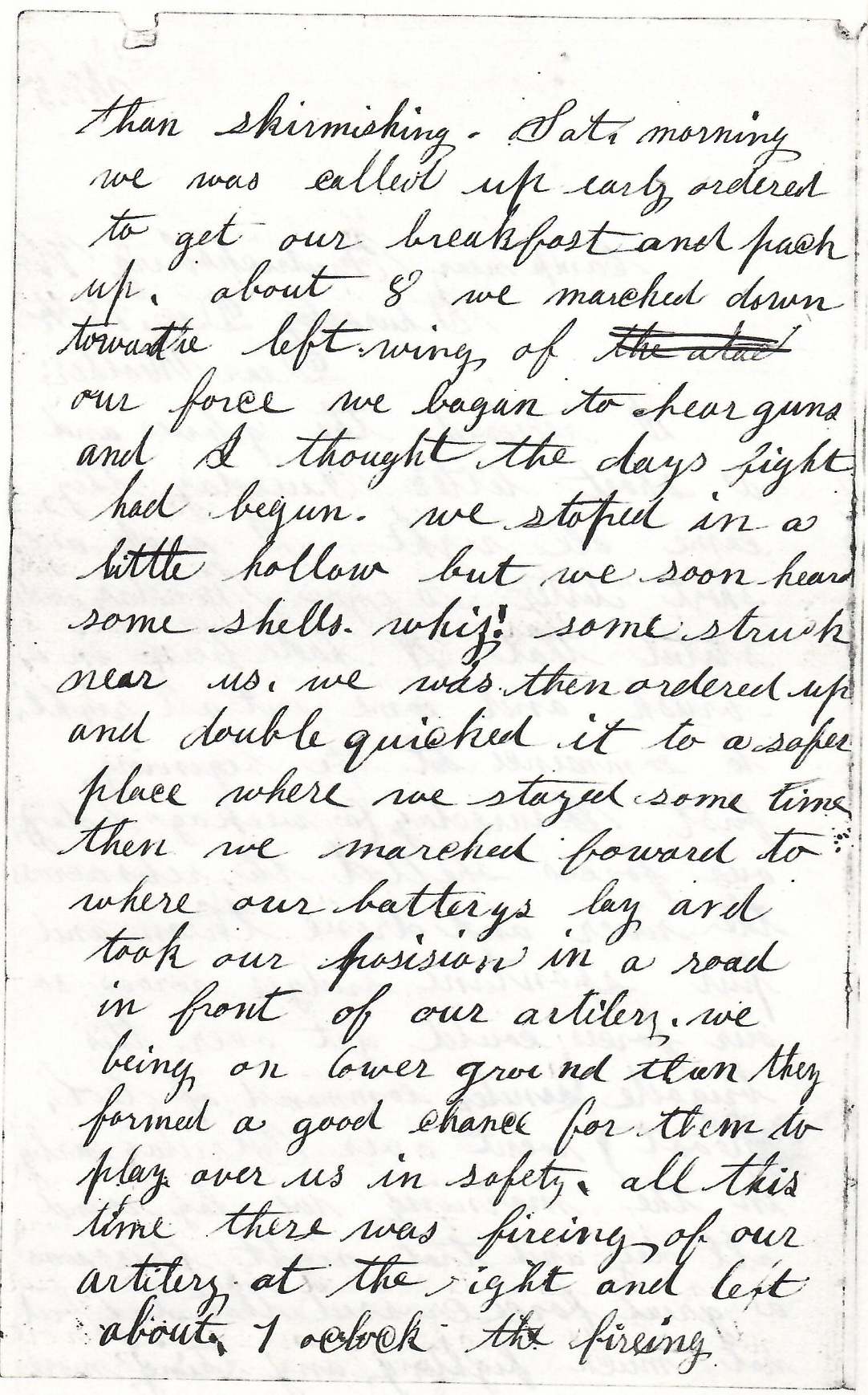
Saturday morning we was called up early, ordered to get our breakfast and pack up. About 8 we marched down toward the left wing of our force. We began to hear guns and I thought the day’s fight had begun. We stopped in a little hollow but we soon heard some shells whiz! Some struck near us. We was then ordered up and double-quicked it to a safer place where we stayed some time. Then we marched forward to where our batteries lay and took our position in a road in front of our artillery [where] we, being on lower ground than they, formed a good chance for them to play over us in safety. All this time there was firing of our artillery at the right and left.
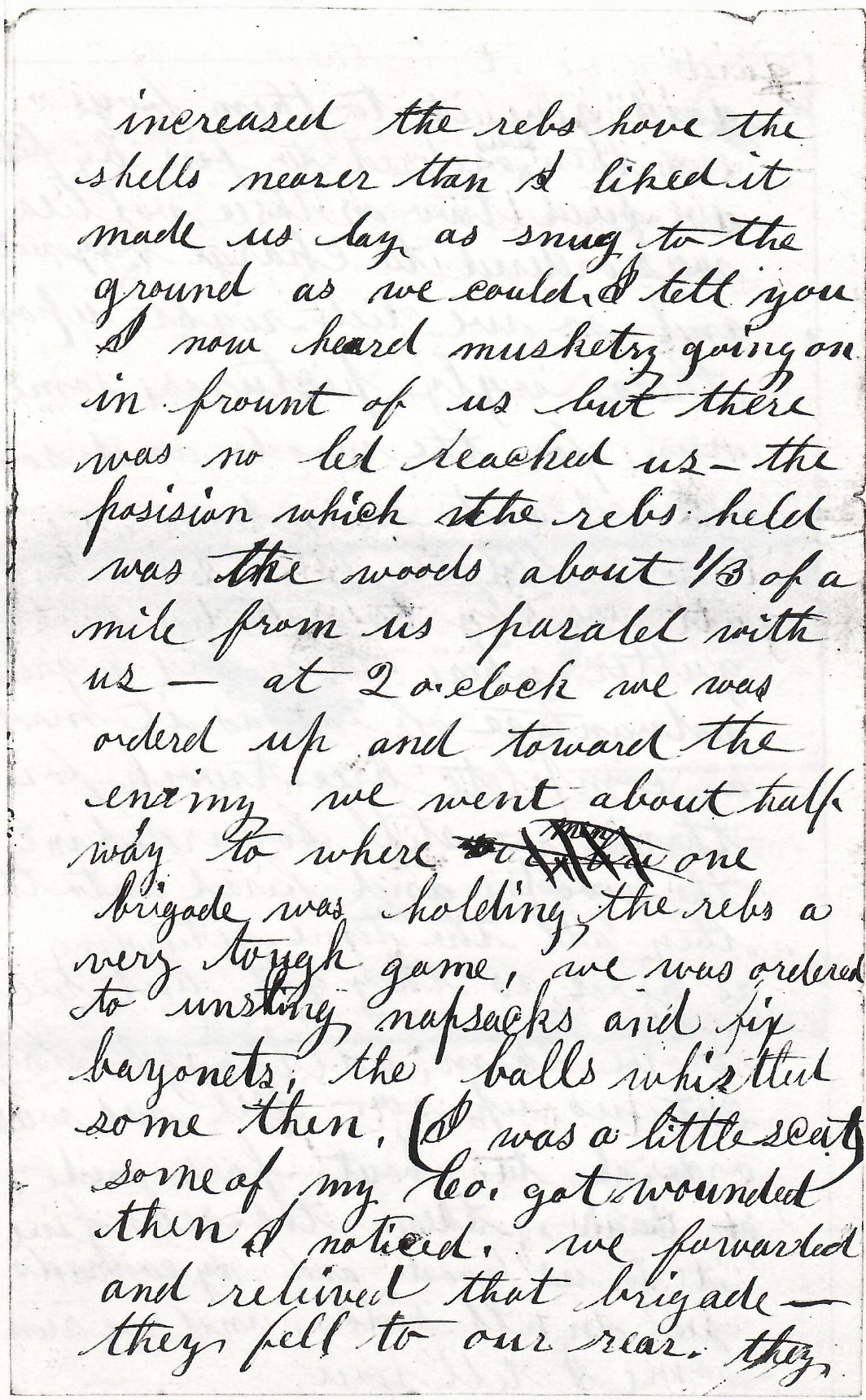
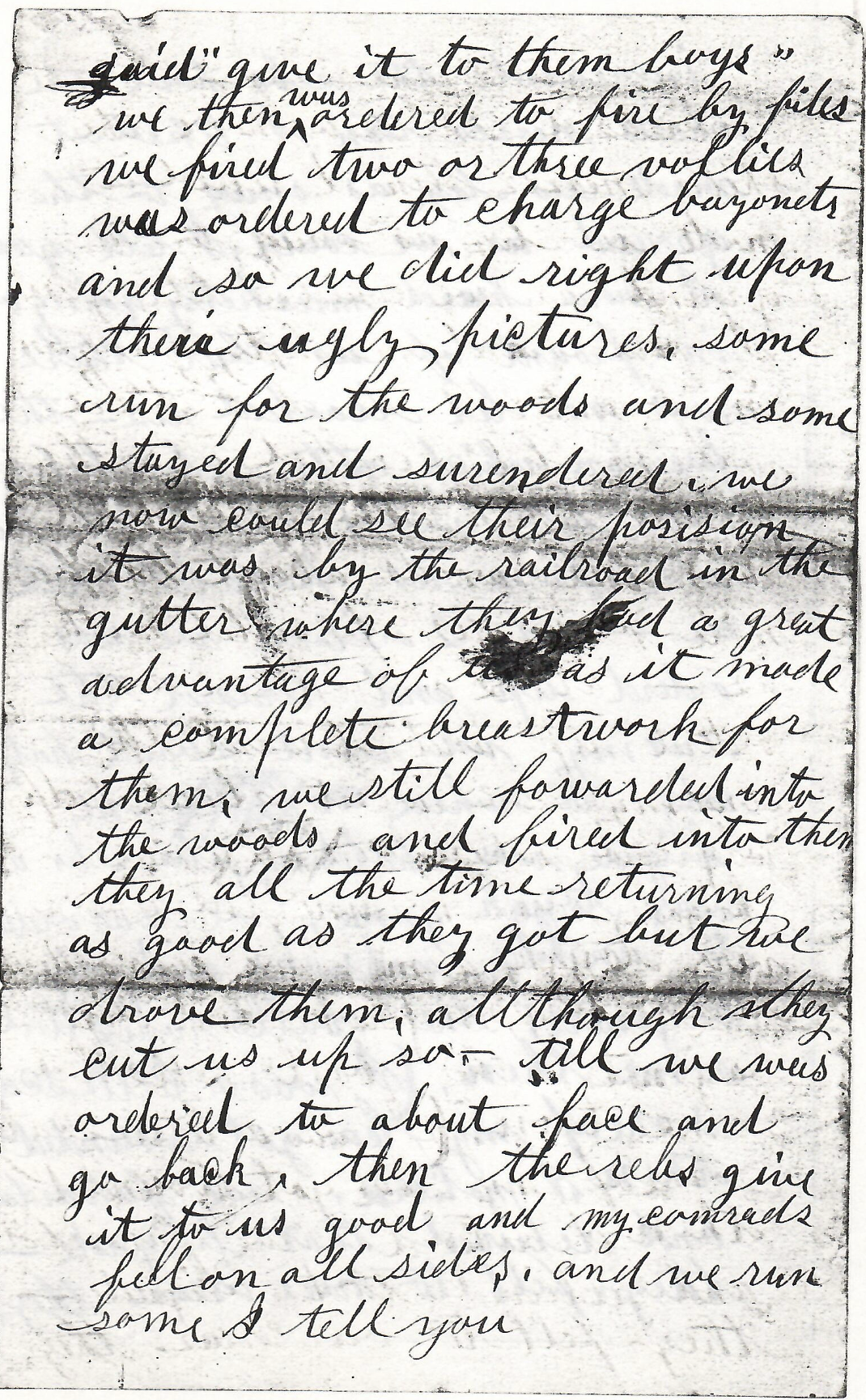
About 1 o’clock the firing increased. The rebs have the shells [landing] nearer than I liked it [which] made us lay as snug to the ground as we could, I tell you. I now heard musketry going on in front of us but there was no lead reached us. The position which the rebs held was the woods about one-third of a mile from us, parallel with us. At 2 o’clock we was ordered up and toward the enemy we went, about halfway to where one brigade was holding the rebs a very tough game. We was ordered to unsling knapsacks and fix bayonets. The balls whistled some then (I was a little scared). Some of my company got wounded then I noticed. We forwarded and relieved that brigade—they fell to our rear. They said, “Give it to them boys!”
We then was ordered to fire by files. We fired two or three volleys, was ordered to charge bayonets, and so we did, right upon their ugly pictures. Some run for the woods and some stayed and surrendered. We now could see their position [more clearly]. It was by the railroad in the gutter where they had a great advantage of us as it made a complete breastwork for them. We still forwarded into the woods and fired into them, they all the time returning as good as they got, but we drove them although they cut us up so till we was ordered to about face and go back. Then the rebs give it to us good and my comrades fell on all sides and we run some, I tell you.
Letter 12
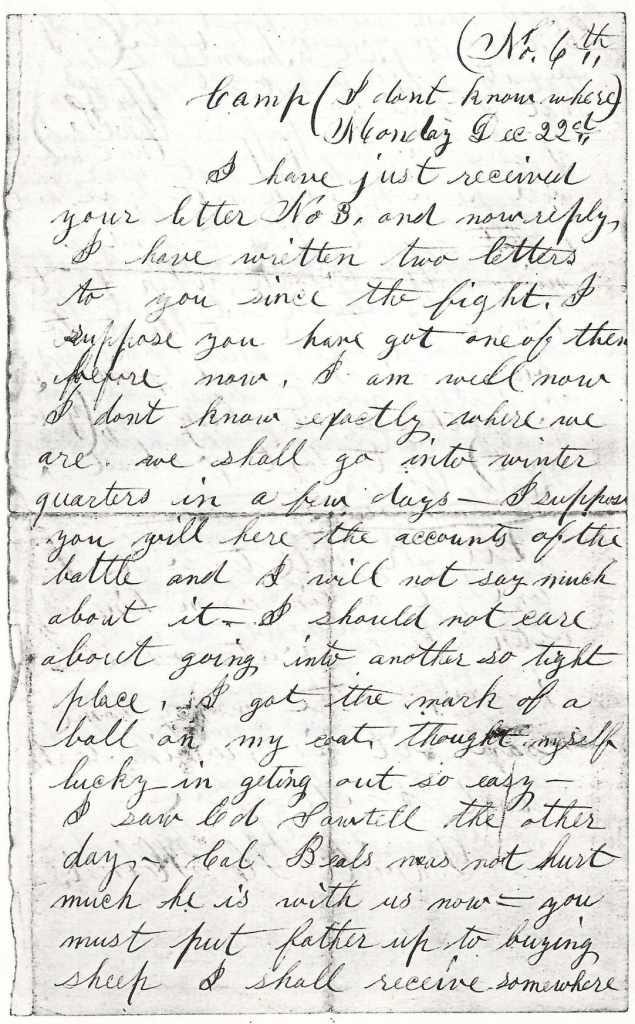
Camp (I don’t know where) Monday, December 22nd, [1862]
I have just received your letter No. 3 and now reply. I have written two letters to you since the fight. I suppose you have gone one of them before now. I am well now. I don’t know exactly where we are. We shall go into winter quarters in a few days.
I suppose you will hear the accounts of the battle and I will not say much about it. I should not care about going into another so tight place. I got the mark of a ball on my coat, thought myself lucky in getting out so easy. I saw Ed Sawtelle the other day. Cal[vin] Beals was not hurt much. He is with us now.
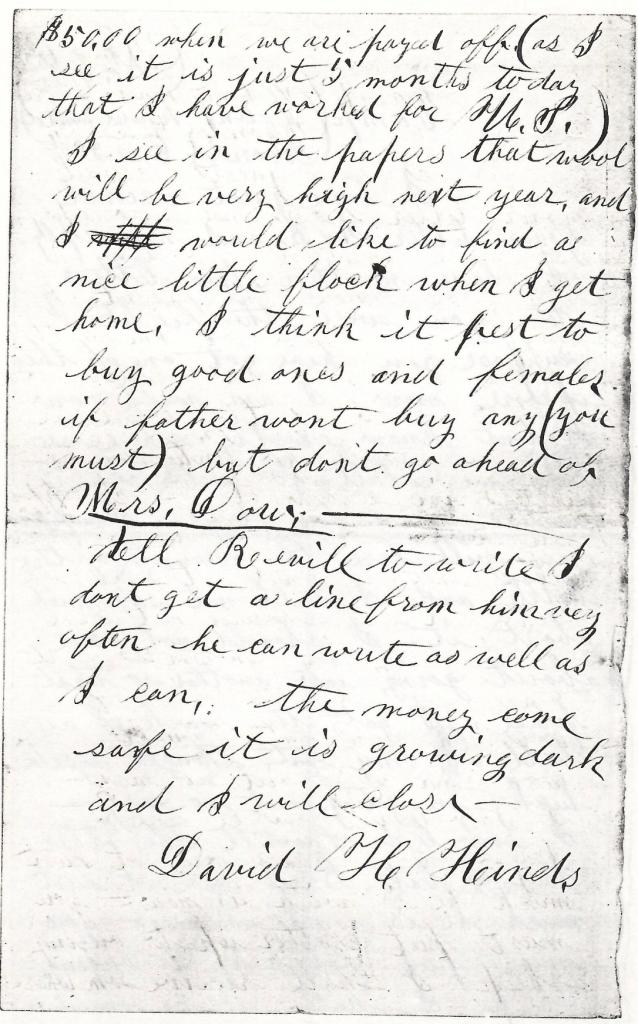
You must put father up to buying sheep. I shall receive somewhere around $50 when we are paid off (as I see it, it is just 5 months today that I have worked for U. S.). I see in the papers that wool will be very high next year and I would like to find a nice little flock when I get home. I think it best to buy good ones and females. If father won’t buy any, you must. But don’t go ahead of Mrs. Dow.
Tell Revill to write. I don’t get a line from him very often. He can write as well as I can. The money come safe. It is growing dark and I will close. — David H. Hinds
Letter 13
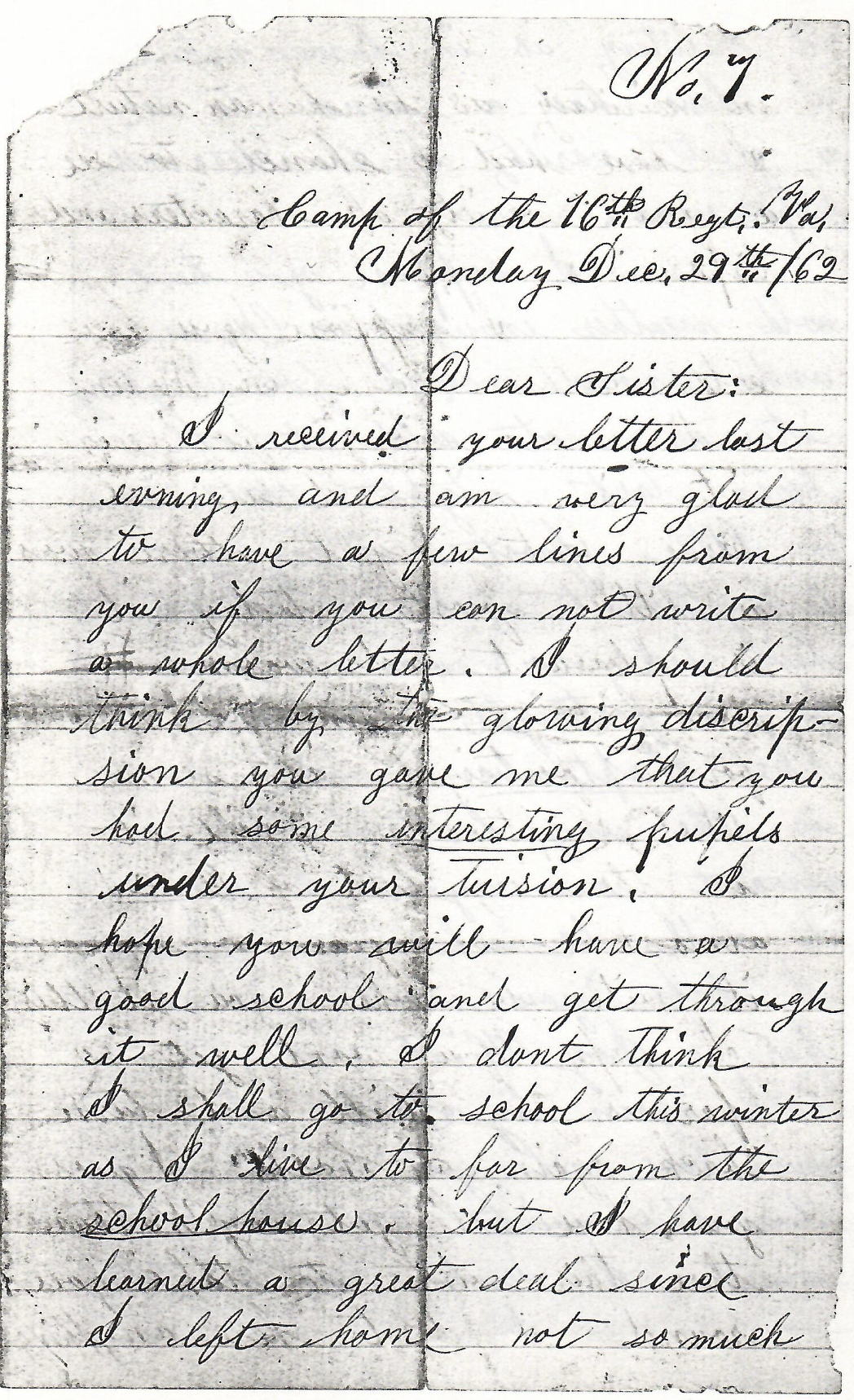
Camp of the 16th Regiment, Virginia Monday, December 29th 1862
Dear Sister,
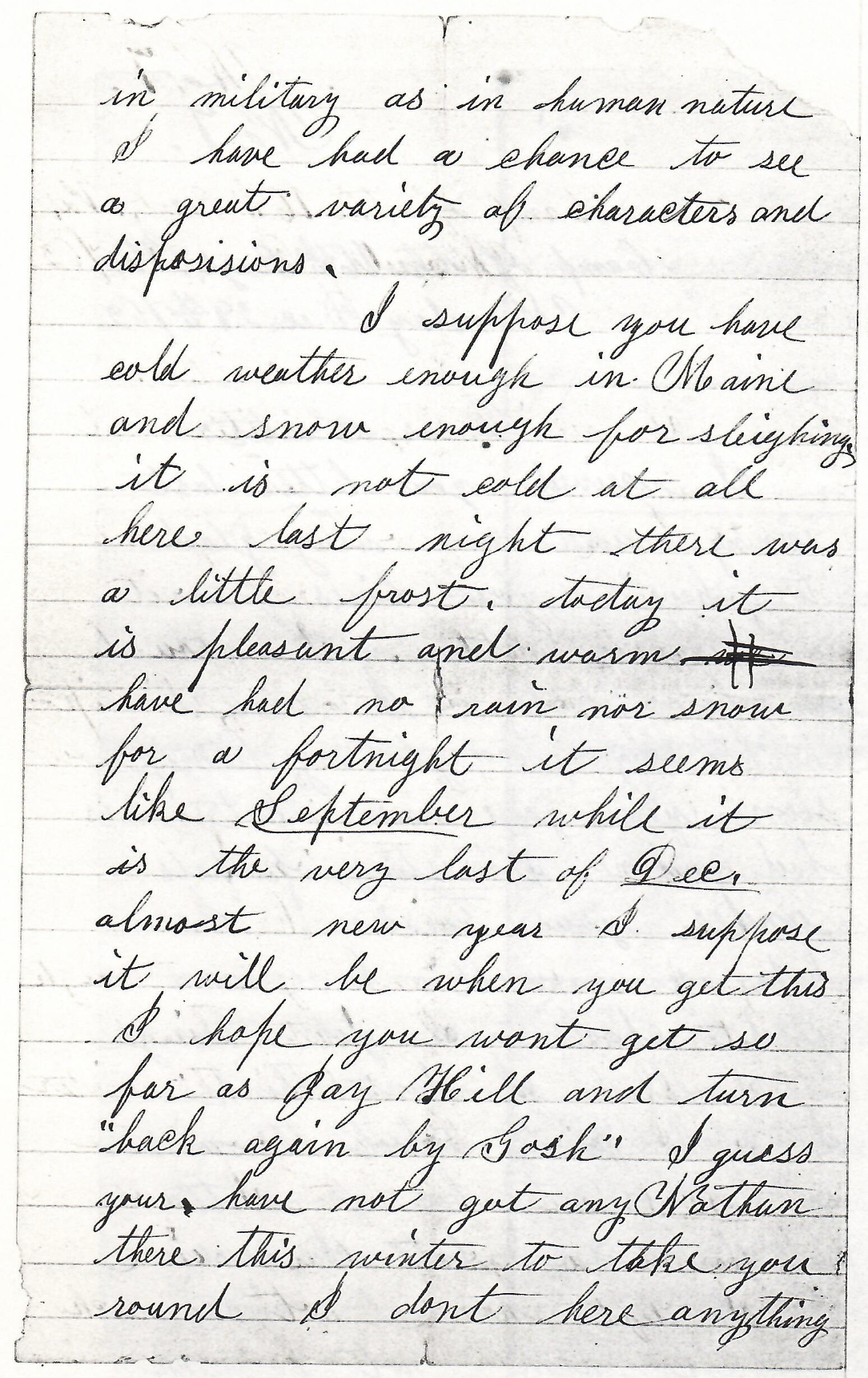
I received your letter last evening and am very glad to have a few lines from you [even] if you cannot write a whole letter. I should think by the glowing description you gave me that you had some interesting pupils under your tuition. I hope you will have a good school and get through it well. I don’t think I shall go to school this winter as I live too far from the schoolhouse. But I have learned a great deal since I left home—not so much in military as in human nature. I have had a chance to see a great variety of characters and dispositions.
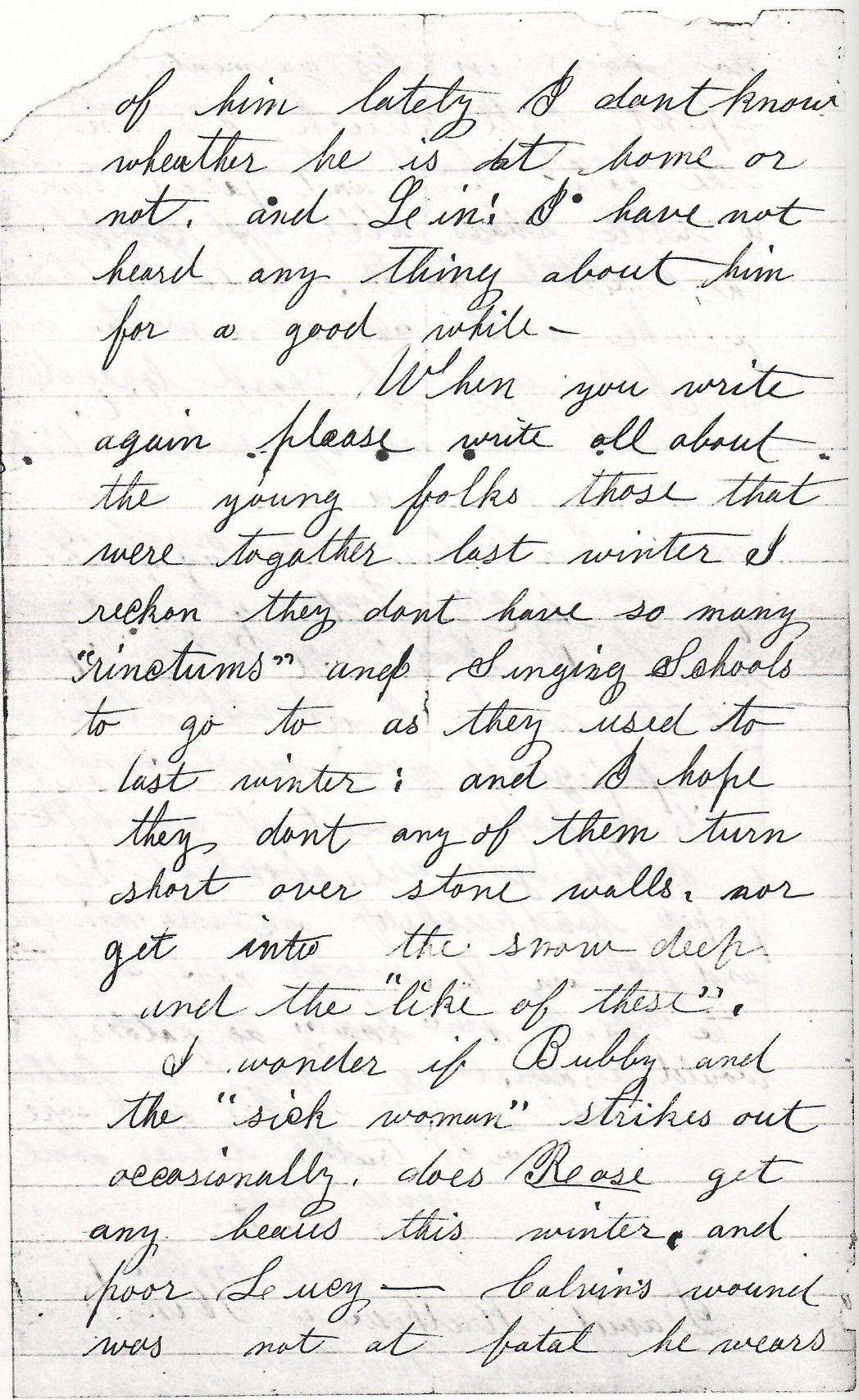
I suppose you have cold weather enough in Maine and snow enough for sleighing. It is not cold at all here. Last night there was a little frost. Today it is pleasant and warm. Have had no rain nor snow for a fortnight. It seems like September while it is the very last of December—almost New Years. I suppose it will be when you get this. I hope you won’t get so far as Jay Hill and “turn back by gosh.” I guess you have not got any Nathan there this winter to take you round. I don’t hear anything of him lately. I don’t know whether he is at home or not and Lin: I have not heard anything about him for a good while.
When you write again, please write all about the young folks—those that were together last winter. I reckon they don’t have so many “rinctums” and singing schools to go to as they used to last winter. AndI hope they don’t any of them turn short over stone walls, nor get into the snow deep and the “like of these.”
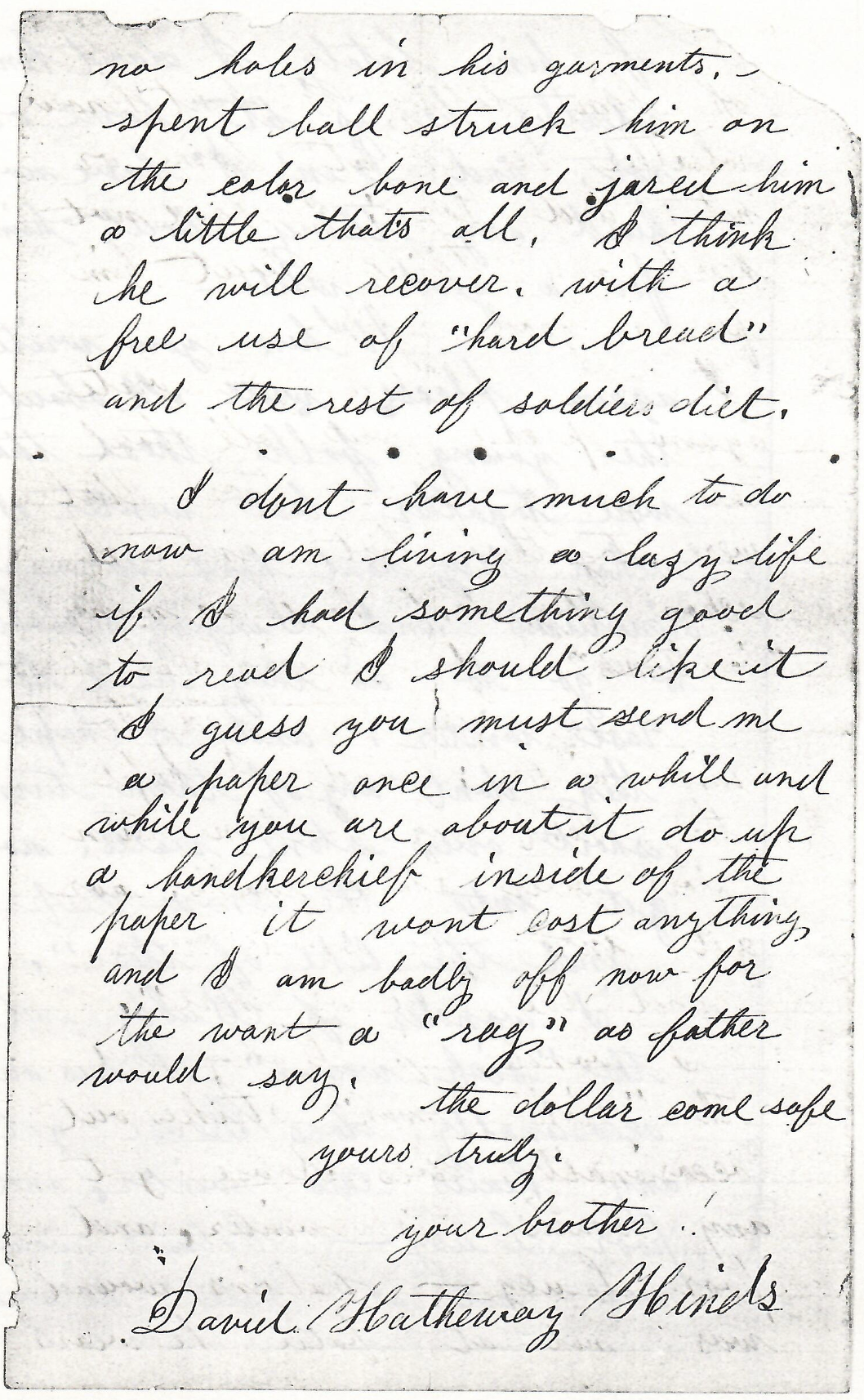
I wonder if Bubby and the “sick woman” strikes out occasionally. Does Rose get any beau’s this winter? And poor Lucy. Calvin [Beal]’s wound was not at [all] fatal. He wears no holes in his garments. A spent ball struck him on the collar bone and jarred him a little, that’s all. I think he will recover with a free use of “hard bread” and the rest of soldier’s diet.
I don’t have much to do now. Am living a lazy life. If I had something good to read, I should like it. I guess you must send me a paper once in a while and while you are about it, do up a handkerchief inside of the paper. It won’t cost anything. And I am badly off now for the want of a “rag” as father would say. The dollar came safe. Yours truly. Your brother, — David Hatheway Hinds
Letter 14
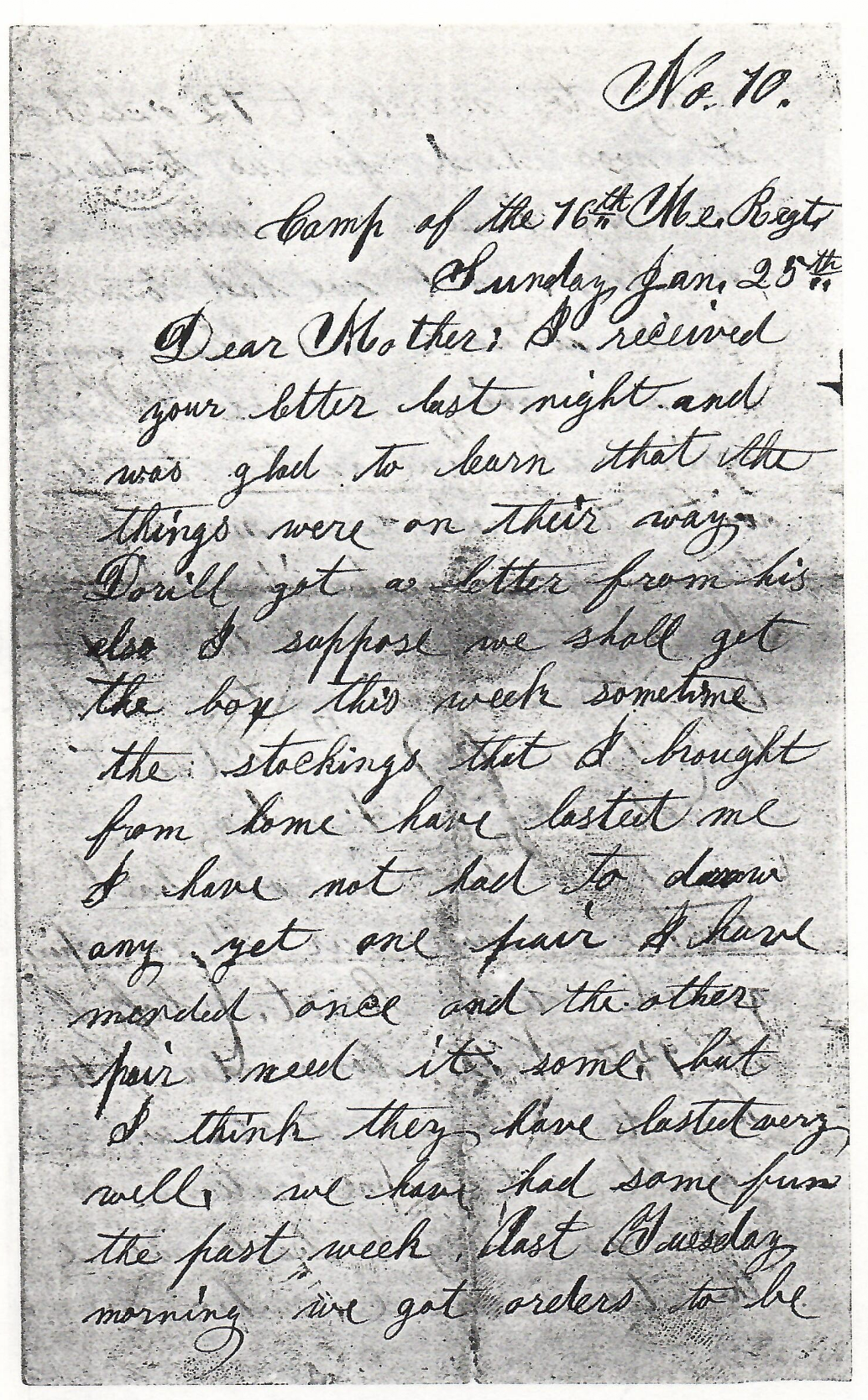
Camp of the 16th Maine Regiment Sunday, January 25th [1863]
Dear Mother,
I received your letter last night and was glad to learn that the things were on their way. Dorill[us Hobbs] got a letter from his [mother] also. I suppose we shall get the box this week sometime. The stockings that I bought from home have lasted me. I have not had to draw any yet. One pair I have mended once and the other pair needs it some but I think they have lasted very well.
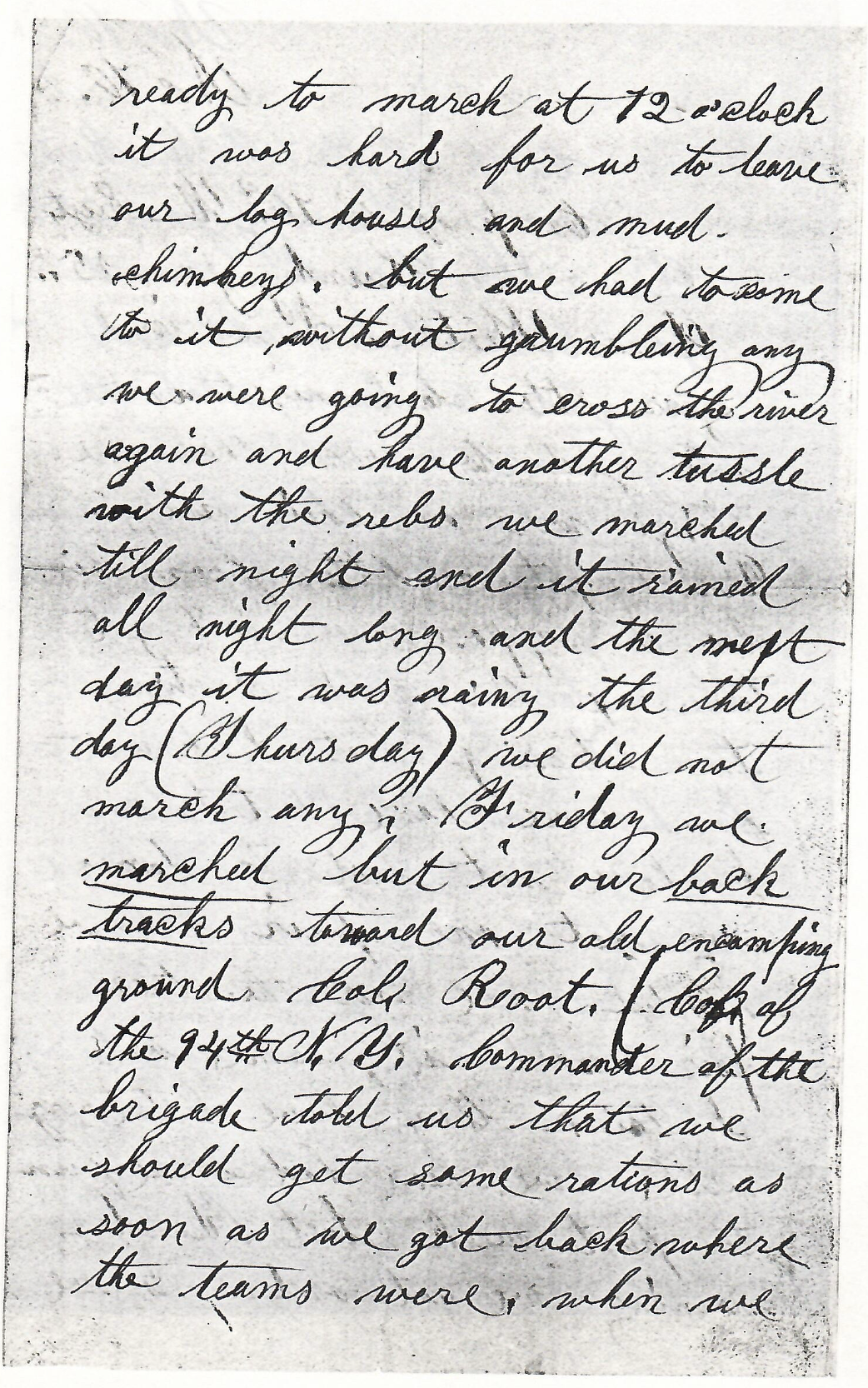
We have had some fun the past week. Last Tuesday morning we got orders to be ready to march at 12 o’clock. It was hard for us to leave our log houses and mud chimneys but we had to come to it without grumbling any. We were going to cross the river again and have another tussle with the rebs.
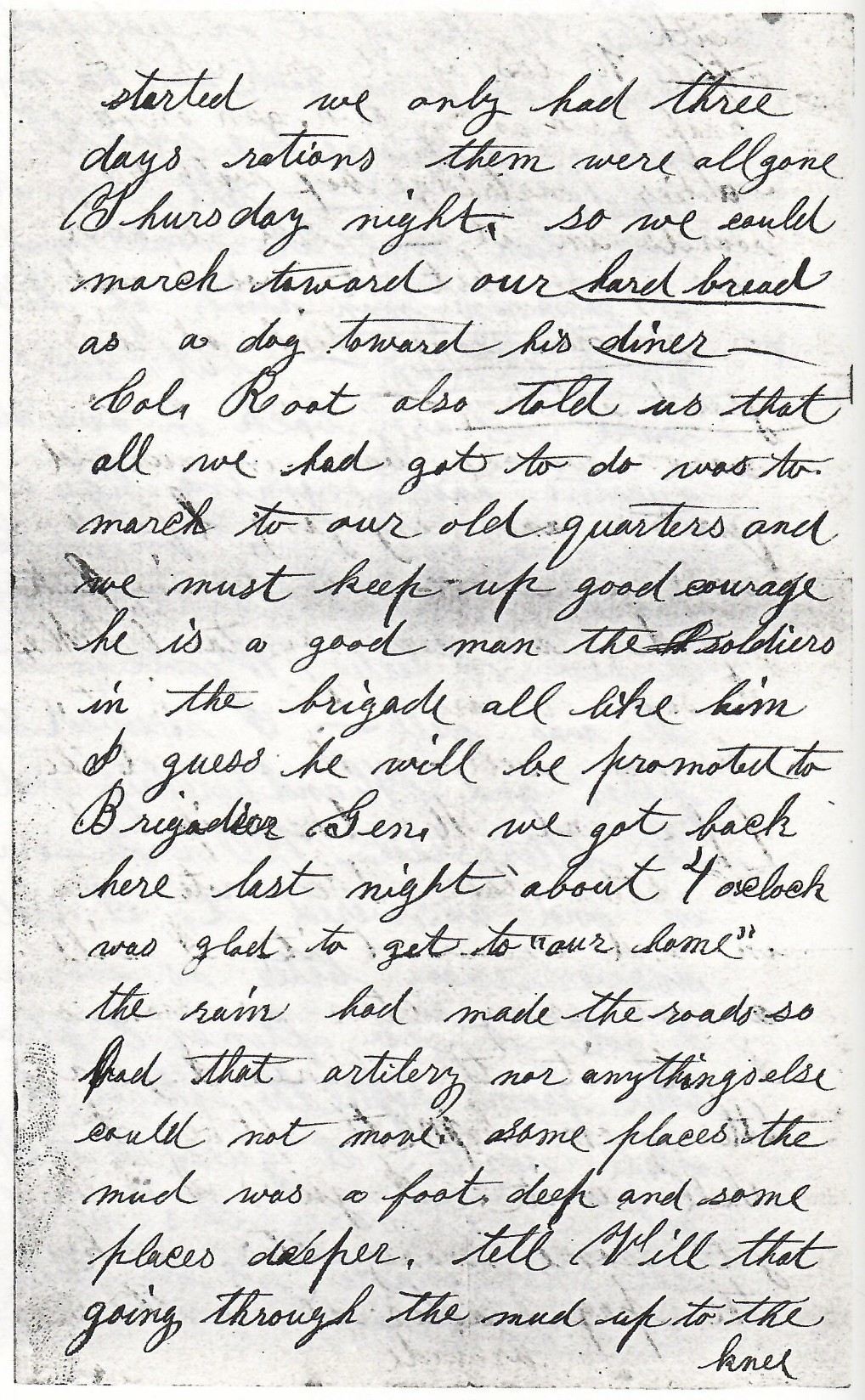
We marched till night and it rained all night long adn the next day it was rainy. The third day (Thursday) we did not march any. Friday we marched but in our back tracks toward our old camping ground. Col. [Adrian Rowe] Root (Col. of the 94th New York, commander of the Brigade), told us that we should get some rations as soon as we got back where the teams were. When we started we only had three days rations. Them were all gone Thursday night so we could march toward our hard bread as a dog toward his dinner. Col. Root also told us that all we had got to do was to march to our old quarters and we must keep up good courage. He is a good man. The soldiers in the brigade all like him. I guess he will be promoted to Brigadier General.
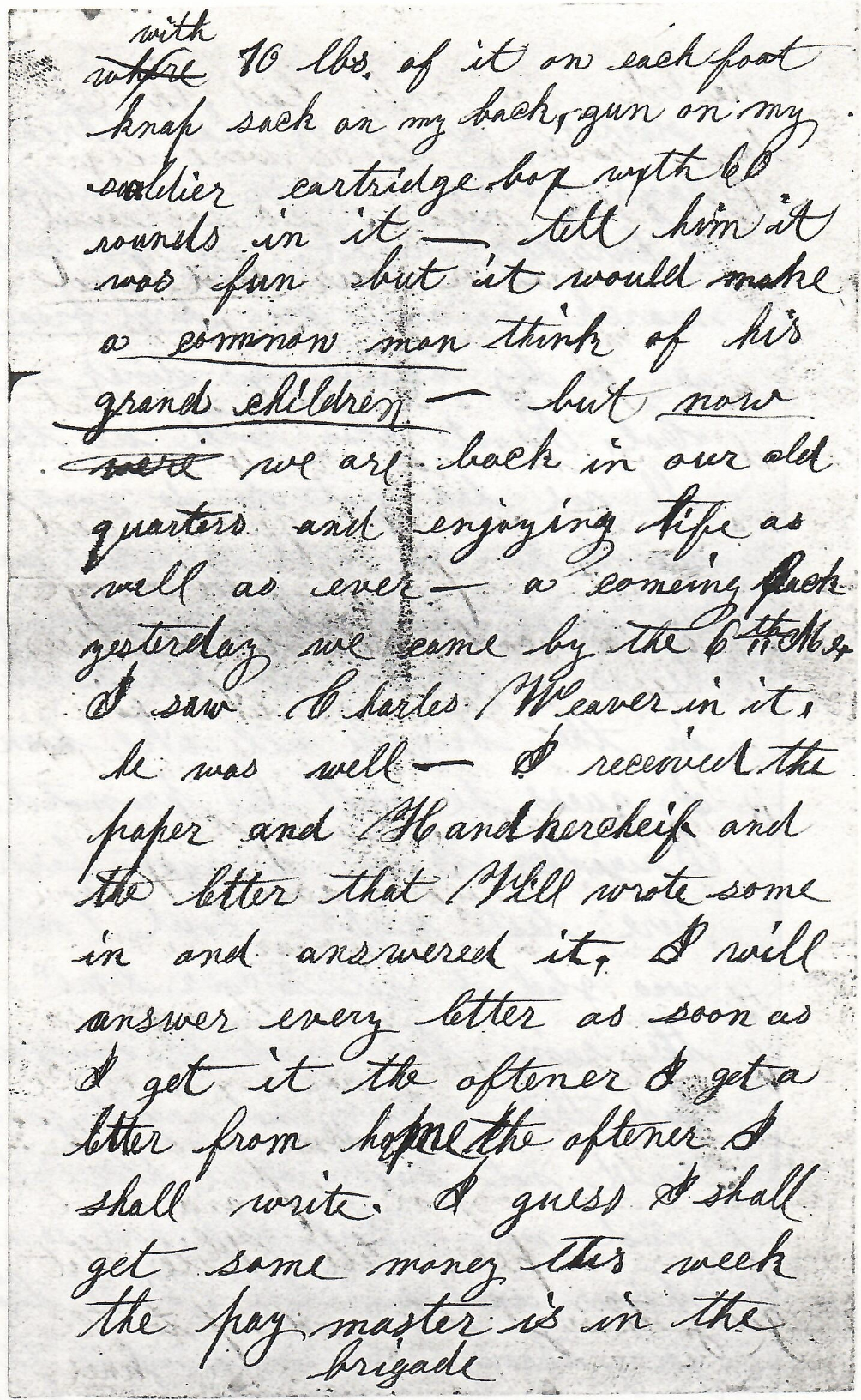
We got back here last night about 4 o’clock. Was glad to get to “our home.” The rain had made the roads so bad that artillery nor anything else could not move. Some places the mud was a foot deep and some places deeper. Tell Will that going through the mud up to the knee with 10 pounds of it on each foot, knapsack on my back, gun on my shoulder, cartridge box with 60 rounds in it—tell him it was fun. But it would make a common man think of his grand children. But now we are back in our old quarters and enjoying life as well as ever.
Coming back yesterday, we came by the 6th Maine [Regiment]. I saw Charles Weaver in it. He was well. I received the paper and handkerchief and the letter that Will wrote some in and answered it. I will answer every letter as soon as I get it. The oftener I get a letter from home, the oftener I shall write. I guess I shall get some money this week. The paymaster is in the brigade.
Letter 15
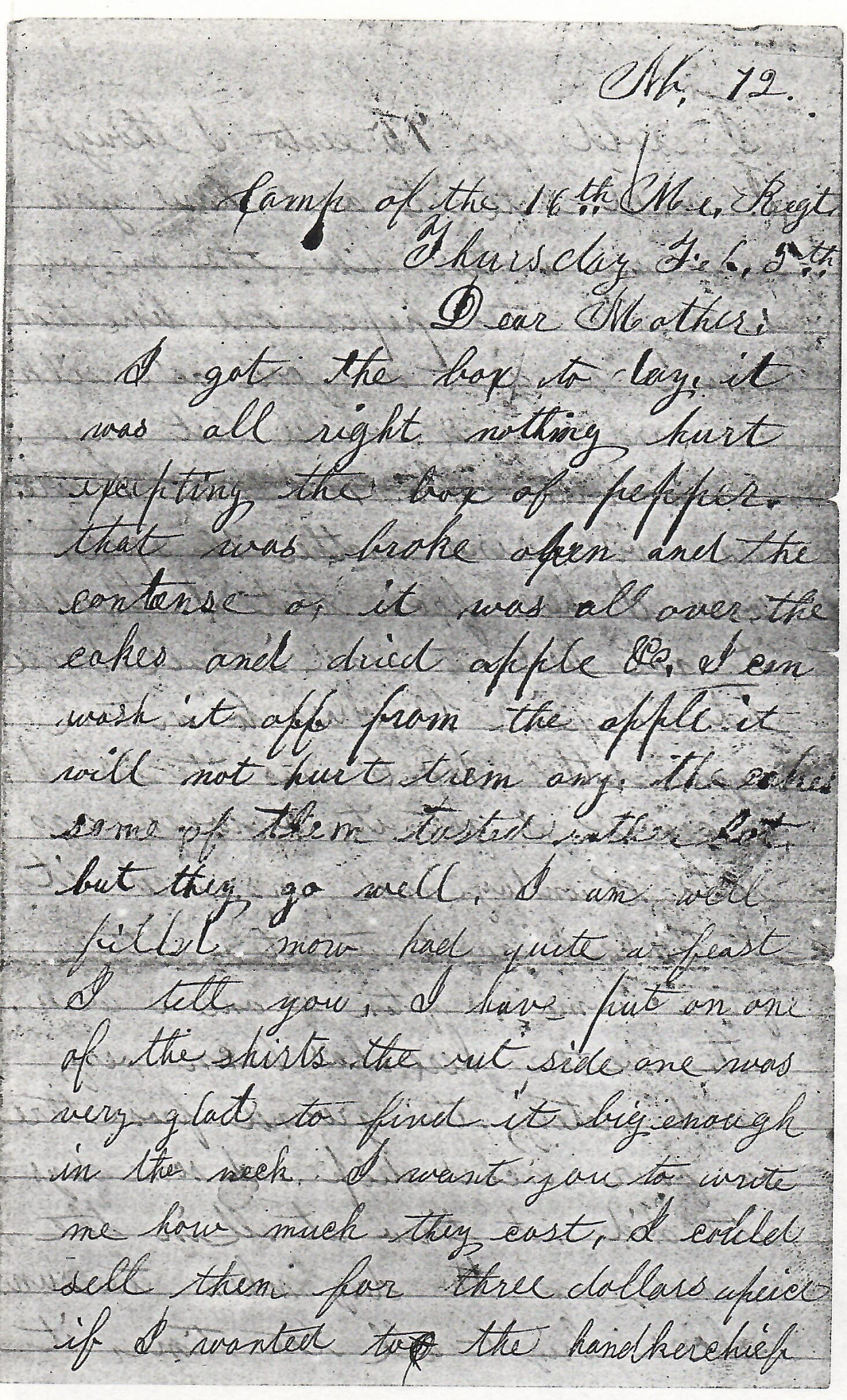
Camp of the 16th Maine Regiment Thursday, February 5th [1863]
Dear Mother,
I got the box today. It was alright. Nothing hurt excepting the box of pepper. That was broke open and the contents was all over the cakes and dried apples, &c. I can wash it off from the apples. It will not hurt them any. The cakes—some of them—tasted rather hot but they will go well. I am well filled now. Had quite a feast, I tell you.
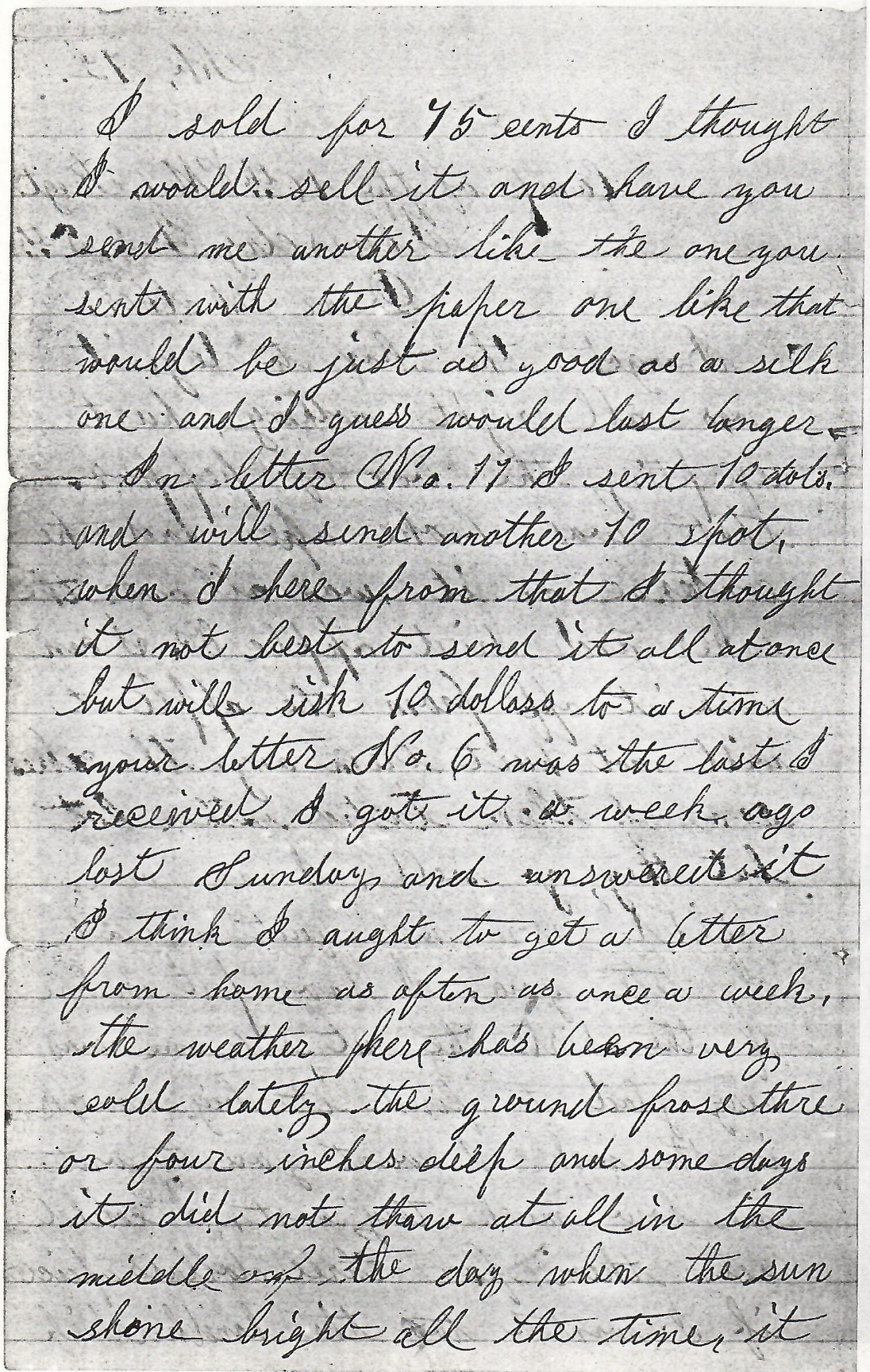
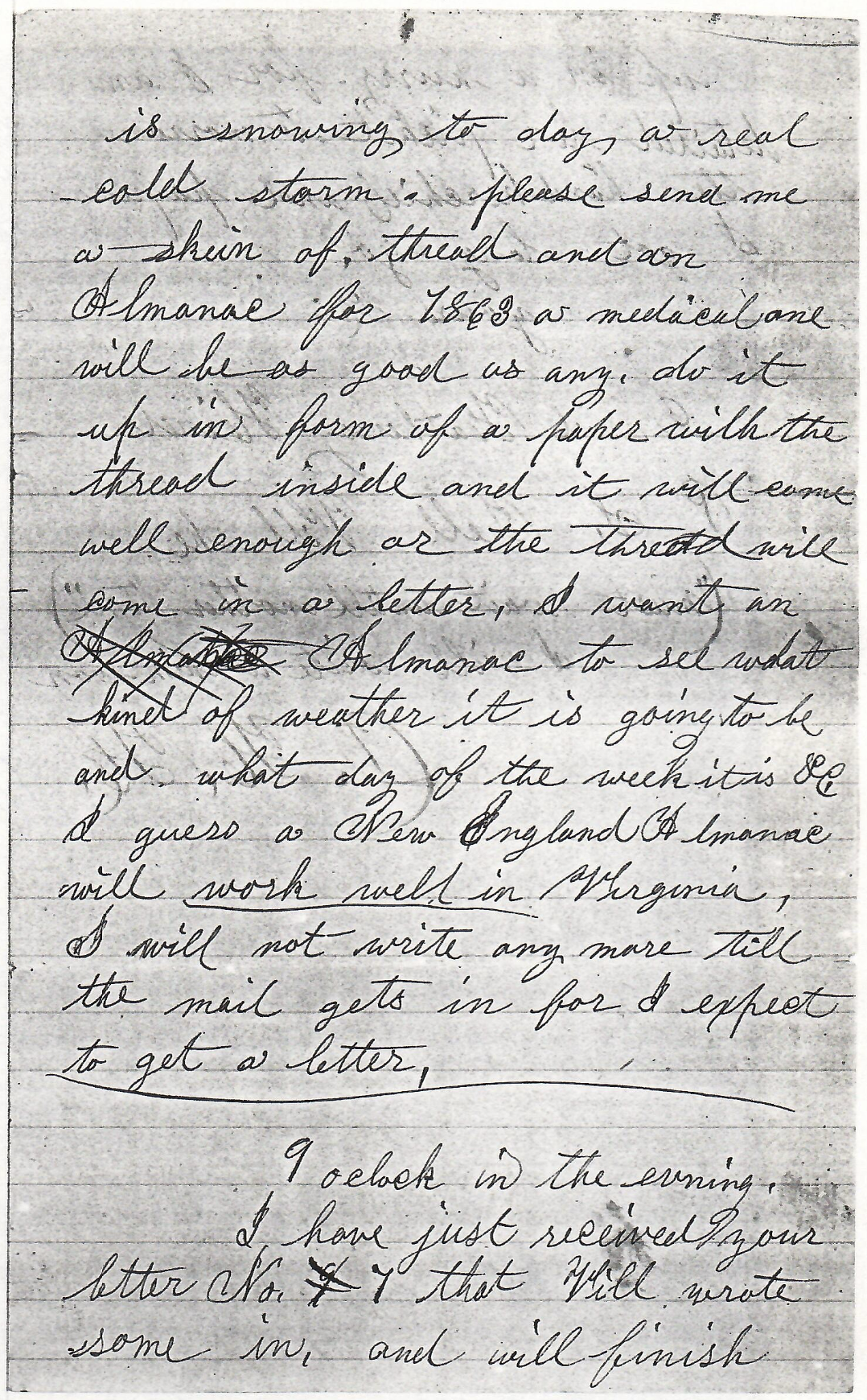
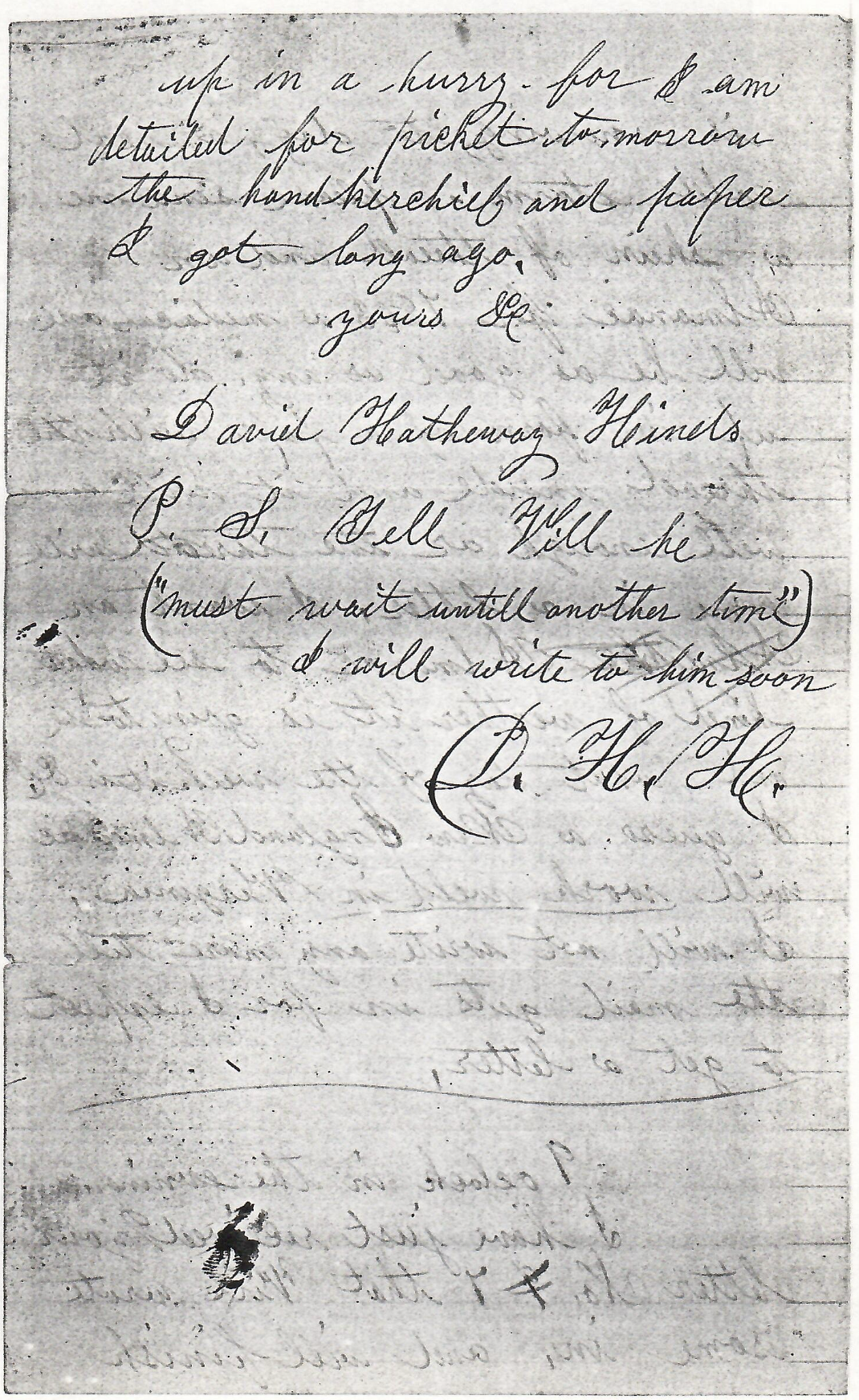
I have put on one of the shirts—the outside one. Was very glad to find it big enough in the neck. I want you to write me how much they cost. I could sell them for three dollars apiece if I wanted to. The handkerchief I sold for 75 cents. I thought I would sell it and have you send me another like the one you sent with the paper. One like that would be just as god as a silk one and I guess would last longer.
In letter No. 11 I sent 10 dollars and will send another 10 spot when I hear from that. I thought it not best to send it all at once but wil risj 10 dollars to a time. Your letter No. 6 was the last I received. I got it a week ago last Sunday and answered it. I think I ought to get a letter from home as often as once a week.
The weather here has been very cold lately. The ground froze three or four inches deep and some days it did not thaw at all in the middle of the day when the sun shone all the time. It is snowing today—a real cold storm. Please send me a skein of thread and an Almanac for 1863. A medical one will be as good as any. Do it up in form of a paper with the thread inside and it will come well enough. Or the thread will come in a letter. I want an Almanac to see what kind of weather it is going to be and what day of the week it is, &c. I guess a New England Almanac will work well in Virginia.
I will not write anymore till the mail gets in for I expect to get a letter.
9 o’clock in the evening. I have just received your letter No. 7 that Vill wrote some in and will finish up in a hurry for I am detailed for picket tomorrow. The handkerchief and paper I got long ago. Yours, &c. — David Hatheway Hinds.
P. S. Tell Vill he “must wait until another time.” I will write to him soon. — D. H. H.
Letter 16
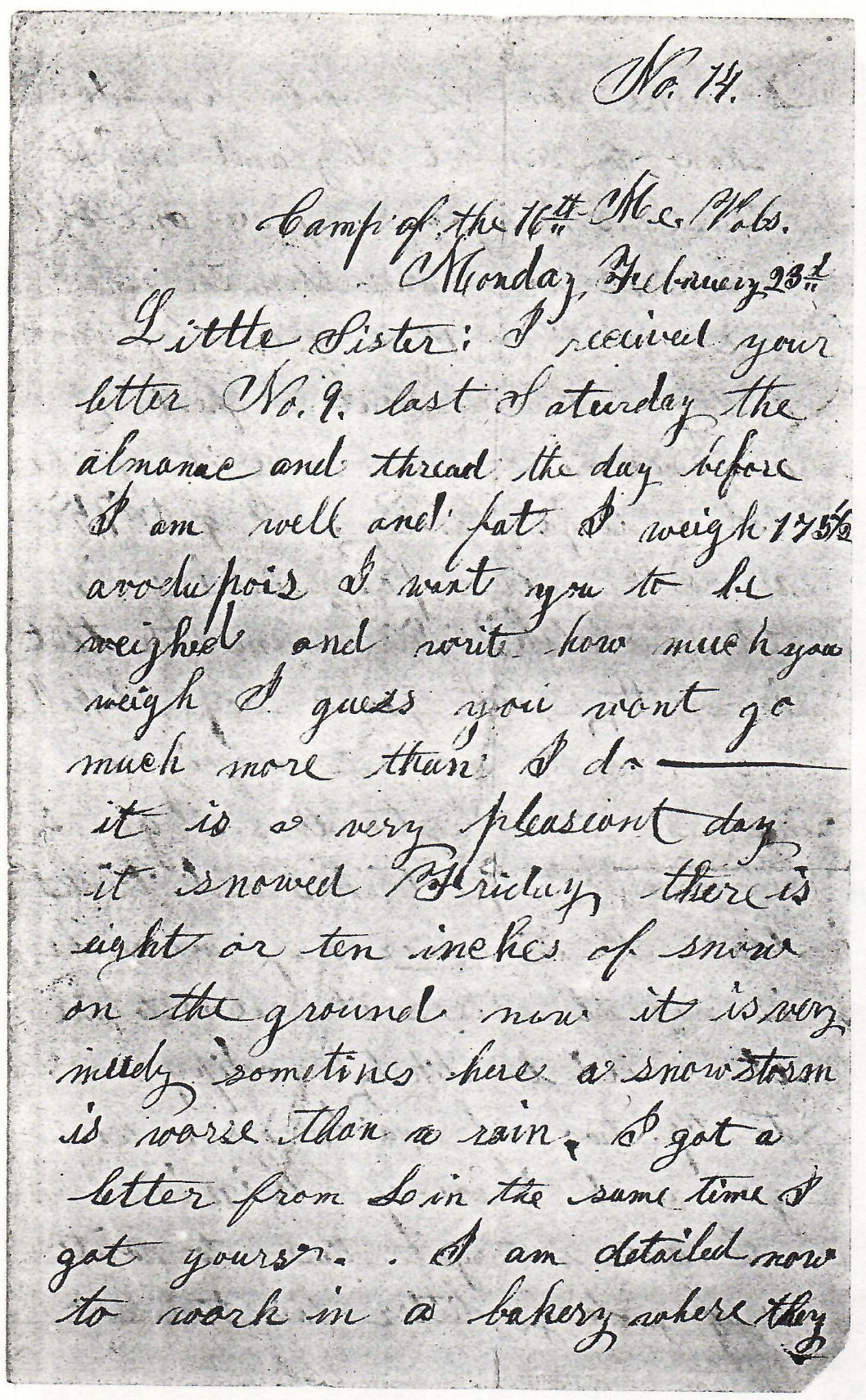
Camp of the 16th Maine Vols. Monday, February 23rd [1863]
Little sister,
I received your letter No. 9 last Saturday, the almanac, and thread the day before. I am well and fat. I weight 175 and a half avodupois [avoirdupois]. I want you to be weighed and write how much you weigh. I guess you won’t go much more than I do.
It is a very pleasant day. It snowed Friday. There is eight or ten inches of snow on the ground now. It is very muddy sometimes here. A snowstorm is worse than a rain.
I got a letter from Lin the same time I got yours.
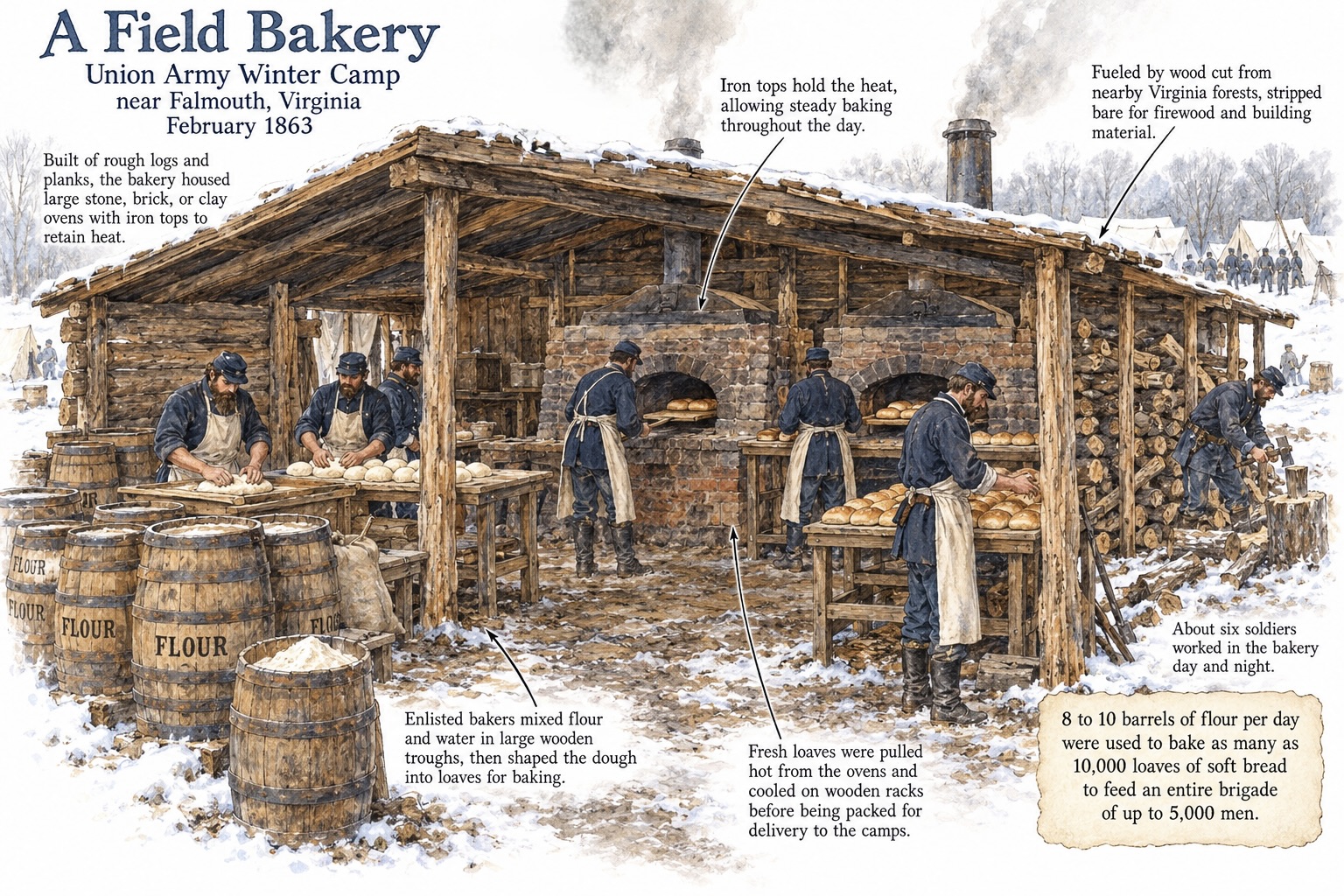
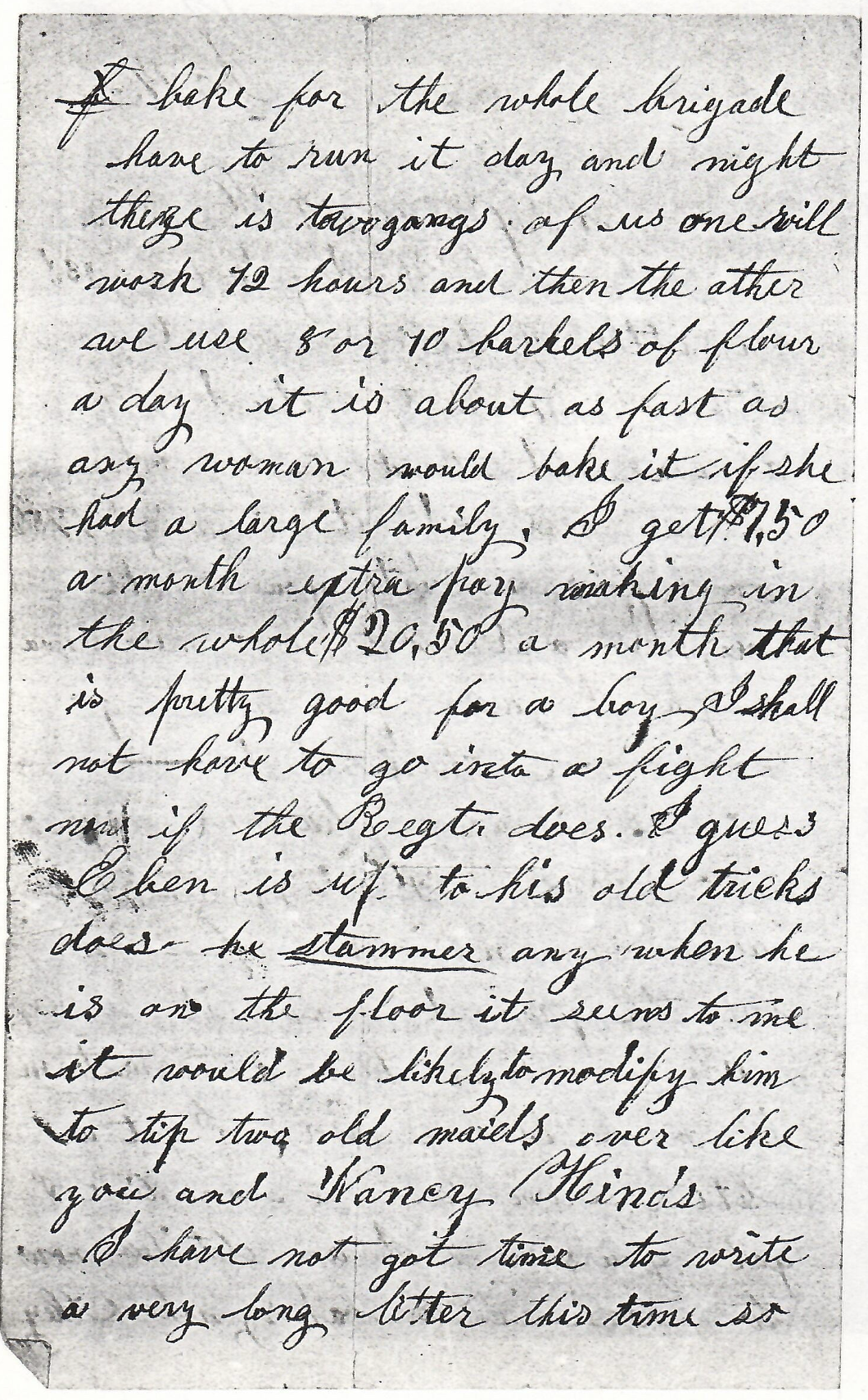
I am detailed now to work in a bakery where they bake for the whole brigade. Have to run it day and night. There is two gangs of us. One will work 12 hours and then the other. We use 8 or 10 barrels of flour a day. It is about as fast as any woman would bake it if she had a large family. I get $7.50 a month extra pay, making in the whole $20.50 a month. That is pretty good for a boy. I shall not have to go into a fight now if the regiment does.
I guess Eben is up to his old tricks. Does he stammer any? When he is on the floor, it seems to me it would be likely to modify him to tip two old maids over like you and Nancy Hinds.
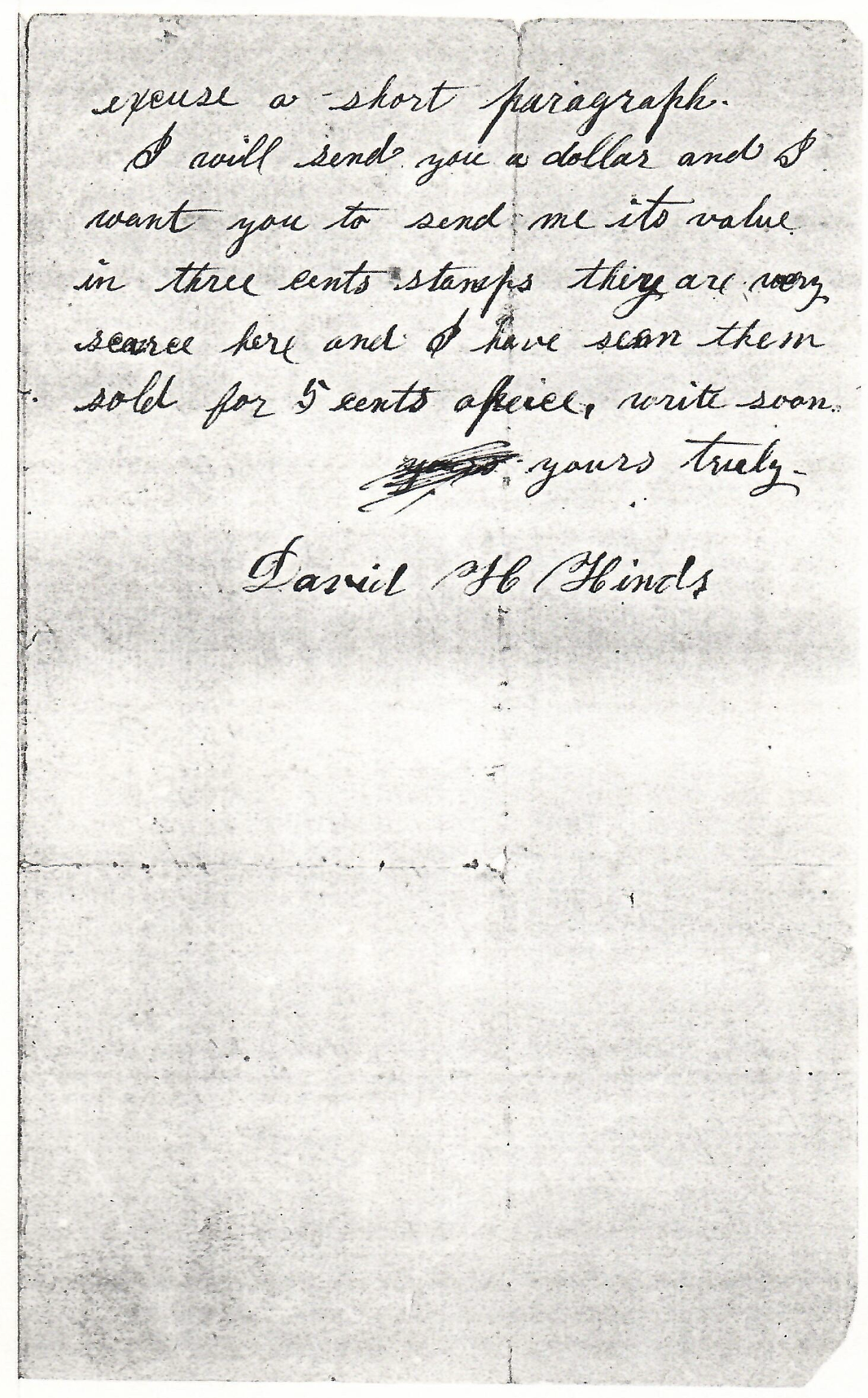
I have not time to write a very long letter this time so excuse a short paragraph. I will send you a dollar and I want you to send me its value in three sent stamps. They are very scarce here and I have seen them sold for 5 cents apiece. Write soon. Yours truly. — David H. Hinds
Letter 17
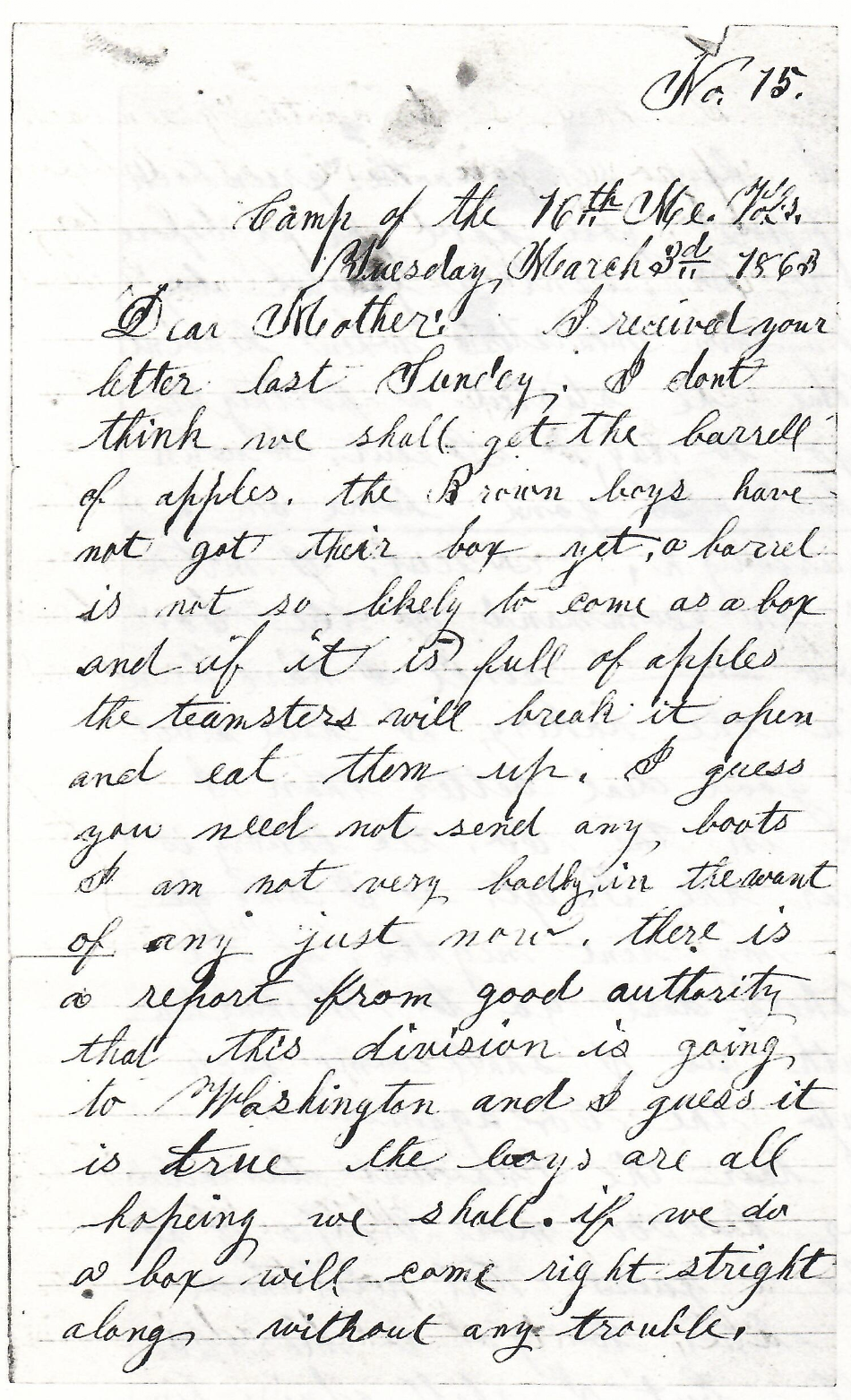
Camp of the 16th Maine Vols. Tuesday, March 3rd, 1863
Dear Mother,
I received your letter last Sunday. I don’t think we shall get the barrel of apples. The Brown boys have not got their box yet. A barrel is ot likely to come as a box and if it is full of apples, the teamsters will break it open and eat it up. I guess you need not send any boots. I am not very badly in the want of any just now.
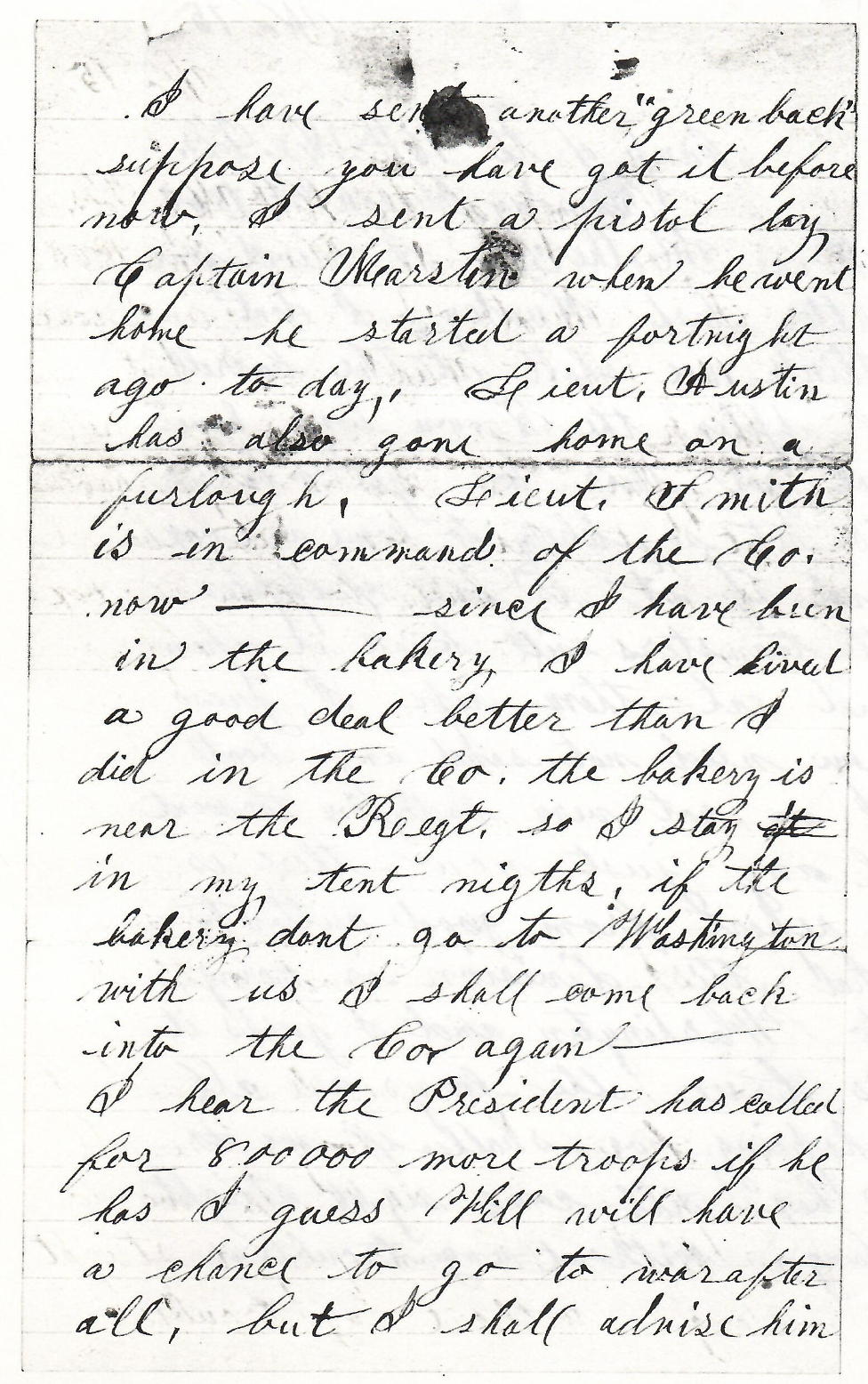
There is a report from good authority that this division is going to Washington and I guess it is true. The boys are all hoping we shall. If we do, a box will come right straight along without any trouble. I have sent another “greenback.” Suppose you have got it before now. Capt. [Daniel] Marston, when he went home, he started a fortnight ago today. Lieut. [Hovey] Austin has also gone home on a furlough. Lieutenant [Marshall] Smith is in command of the company now.
Since I have been in the bakery, I have lived a good deal better than I did in the company. The bakery is near the regiment so I stay in my tent nights. If the bakery don’t go to Washington with us, I shall come back into the company again.
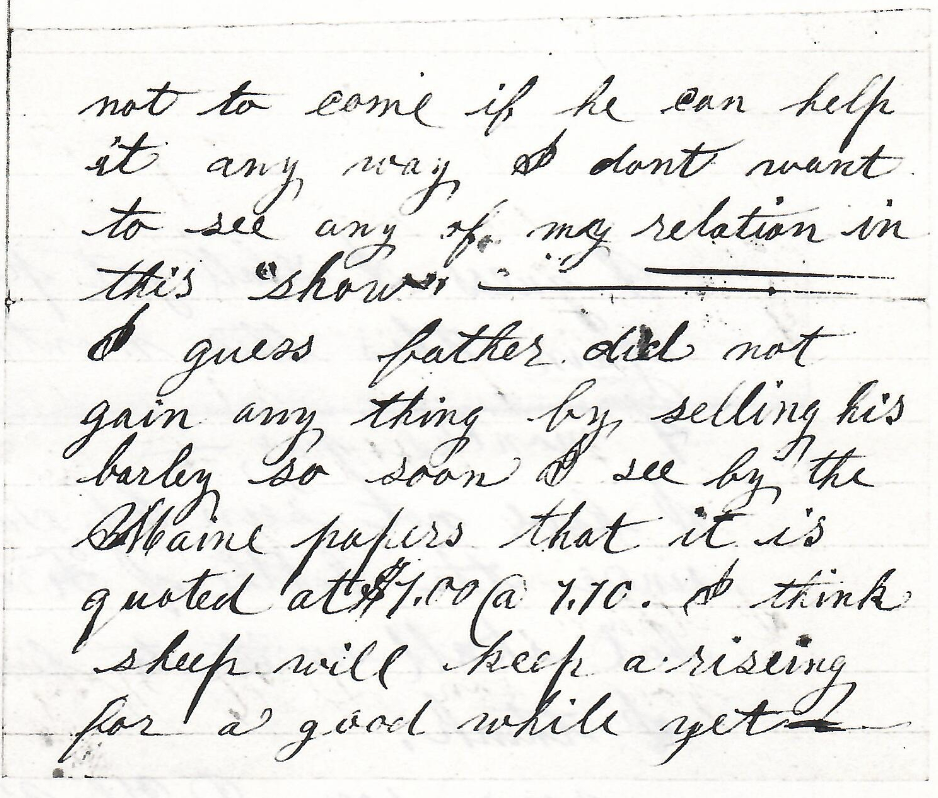
I hear the President has called for 800,000 more troops. If he has, I guess Vill will have a chance to go to war after all. But I shall advise him not to come if he can help it any way. I don’t want to see any of my relation in this “show.”
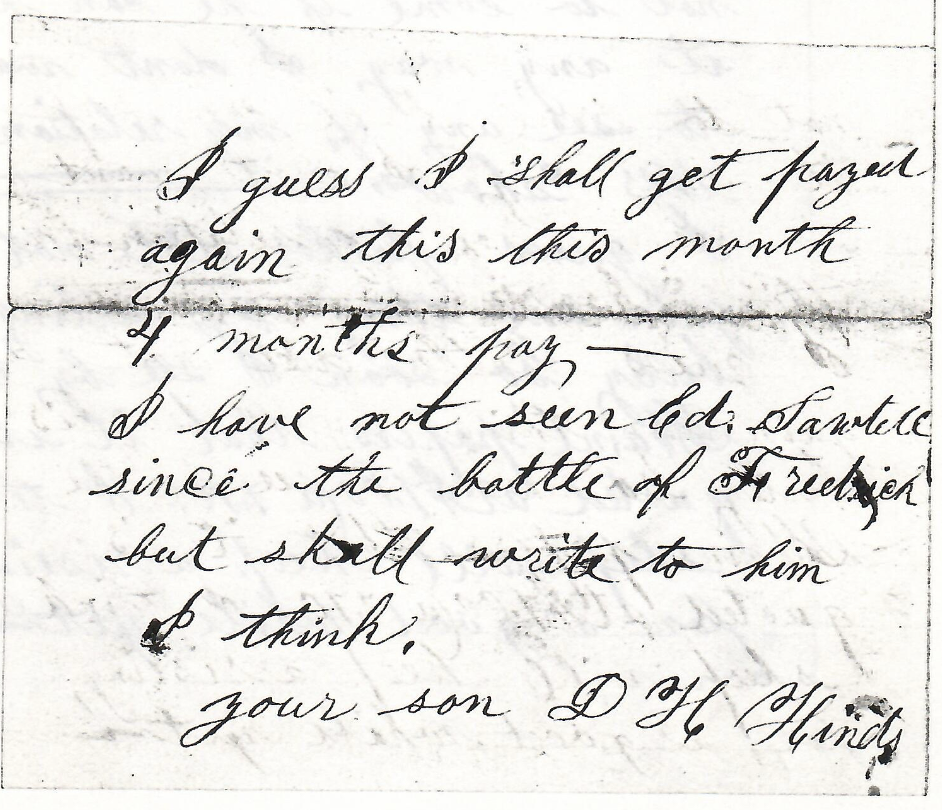
I guess father did not gain anything by selling his barley so soon. I see by the Maine papers that it is quoted at$1.00 @ 1.10. I think sheep will keep a rising for a good while yet. I guess I shall get paid again this month four months pay.
I have not seen Ed Sawtelle since the Battle of Fredericksburg but shall write to him, I think. Your son, — D. H. Hinds
Letter 18
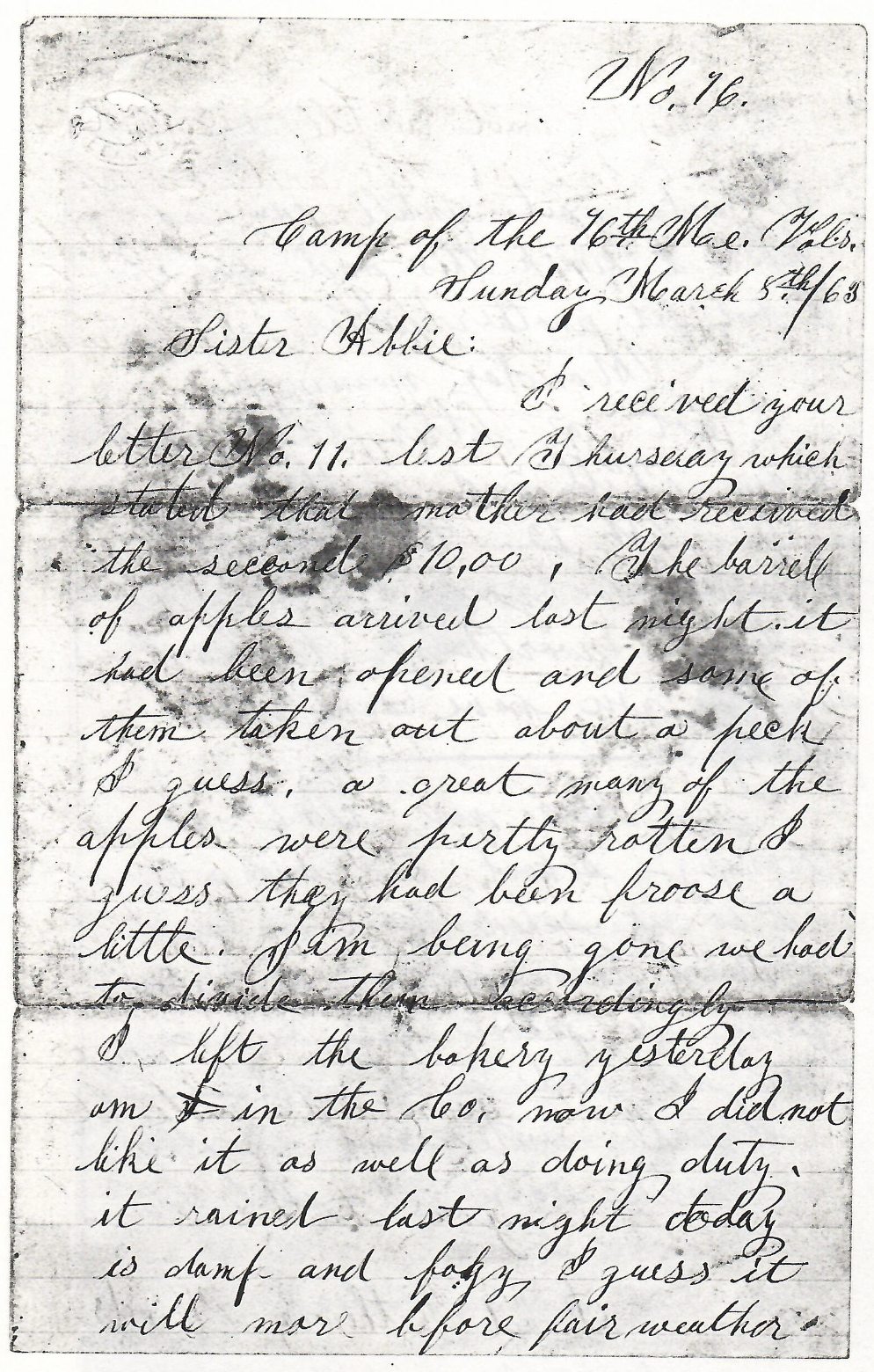
Camp of the 16th Maine Vols. Sunday, March 8th 1863
Sister Abbie,
I received your letter No. 11 last Thursday which stated that mother had received the second $10. The barrel of apples arrived last night. It had been opened and some of them taken out—about a peck I guess. A great many of the apples were pretty rotten. I guess they had been froze a little. Jim being gone, we had to divide them accordingly.
I left the bakery yesterday. Am in the company now. I did not like it as well as doing duty. It rained last night. Today it is damp and foggy. I guess it will [rain] more before fair weather. I will wait until evening before I finish this and see if I don’t get another letter.
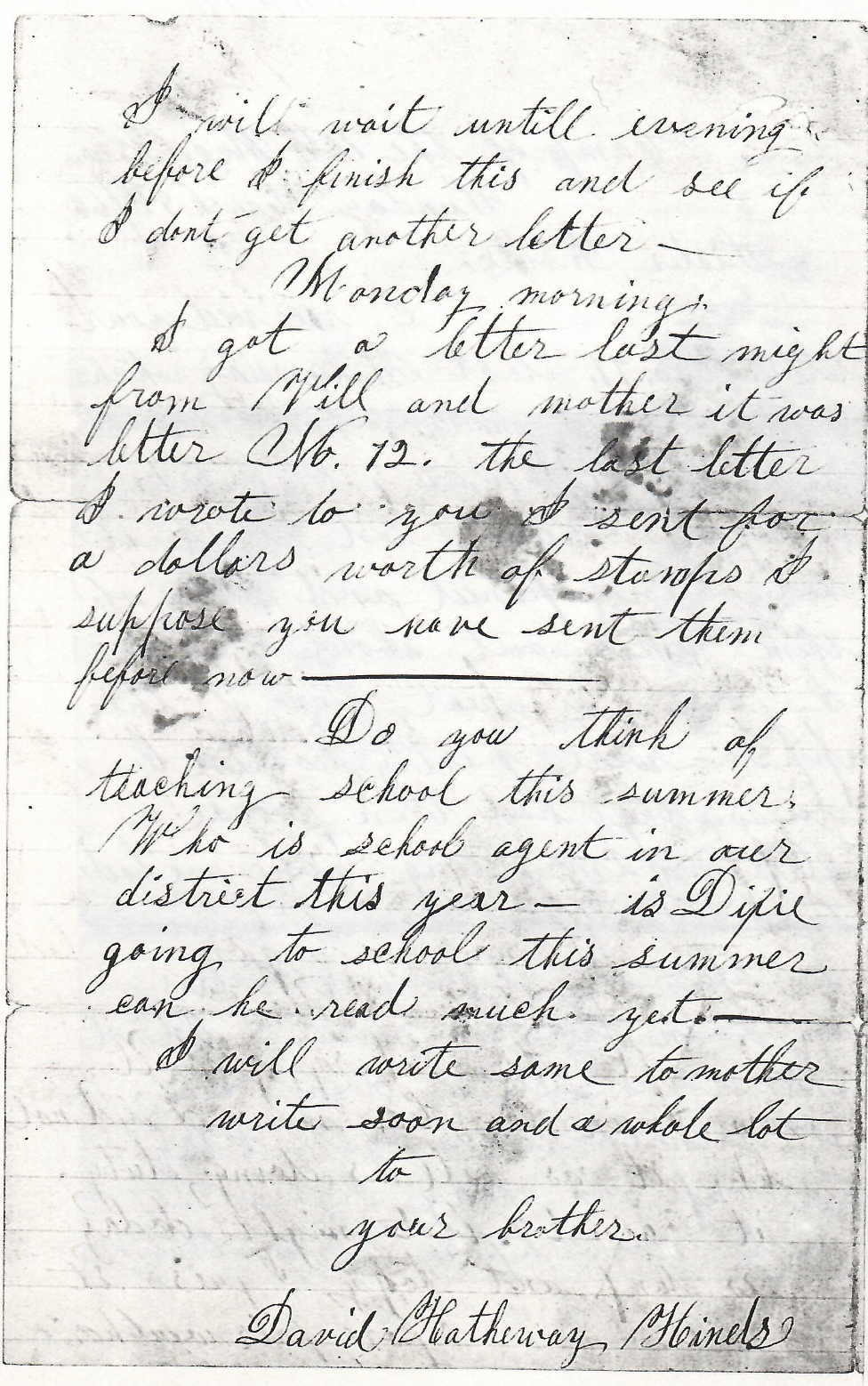
Monday morning. I got a letter last night from Vill and mother. It was letter No. 12. The last letter I wrote to you I sent for a dollar’s worth of stamps. I suppose you have sent them before now.
Do you think of teaching school this summer? Wjis is school agent in our district this year? Is Dixie going to school this summer? Can he read much yet? I will write some to mother. Write soon and a whole lot to your brother, — David Hatheway Hinds
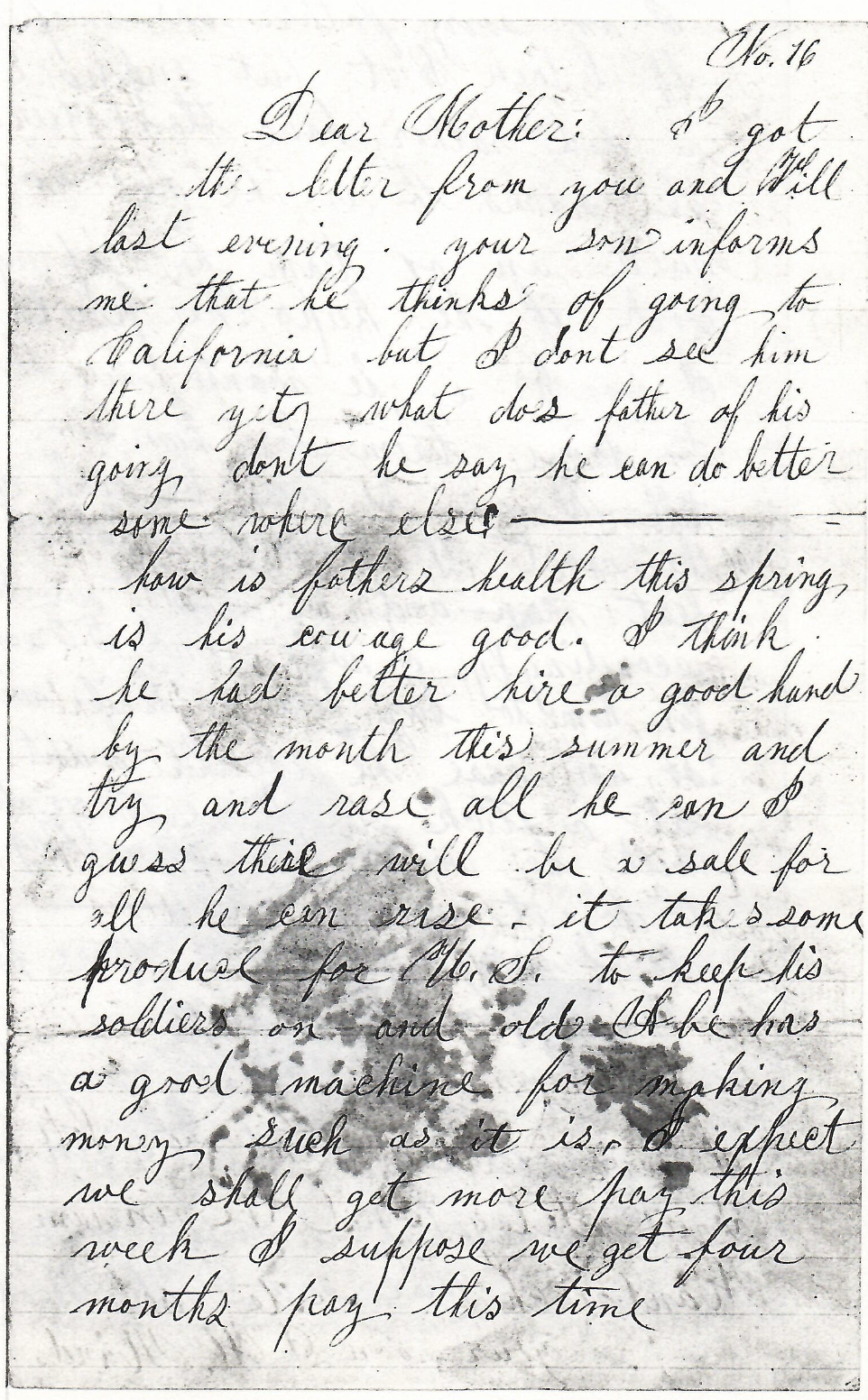
Dear mother, I got the letter from you and Vill last evening. Your son informs me that he thinks of going to California but I don’t see him there yet. What does father [think] of his going? Don’t he say he can do better somewhere else?
How is father’s health this spring? Is his courage good? I think he had better hire a good hand by the month this summer and try and raise all he can. I guess there will be a sale for all he can raise. It takes some produce for U. S. [Uncle Sam] to keep his soldiers on and Old Abe has a good machine for making money—such as it is. I expect we shall get more pay this week. I suppose we get four months pay this time.
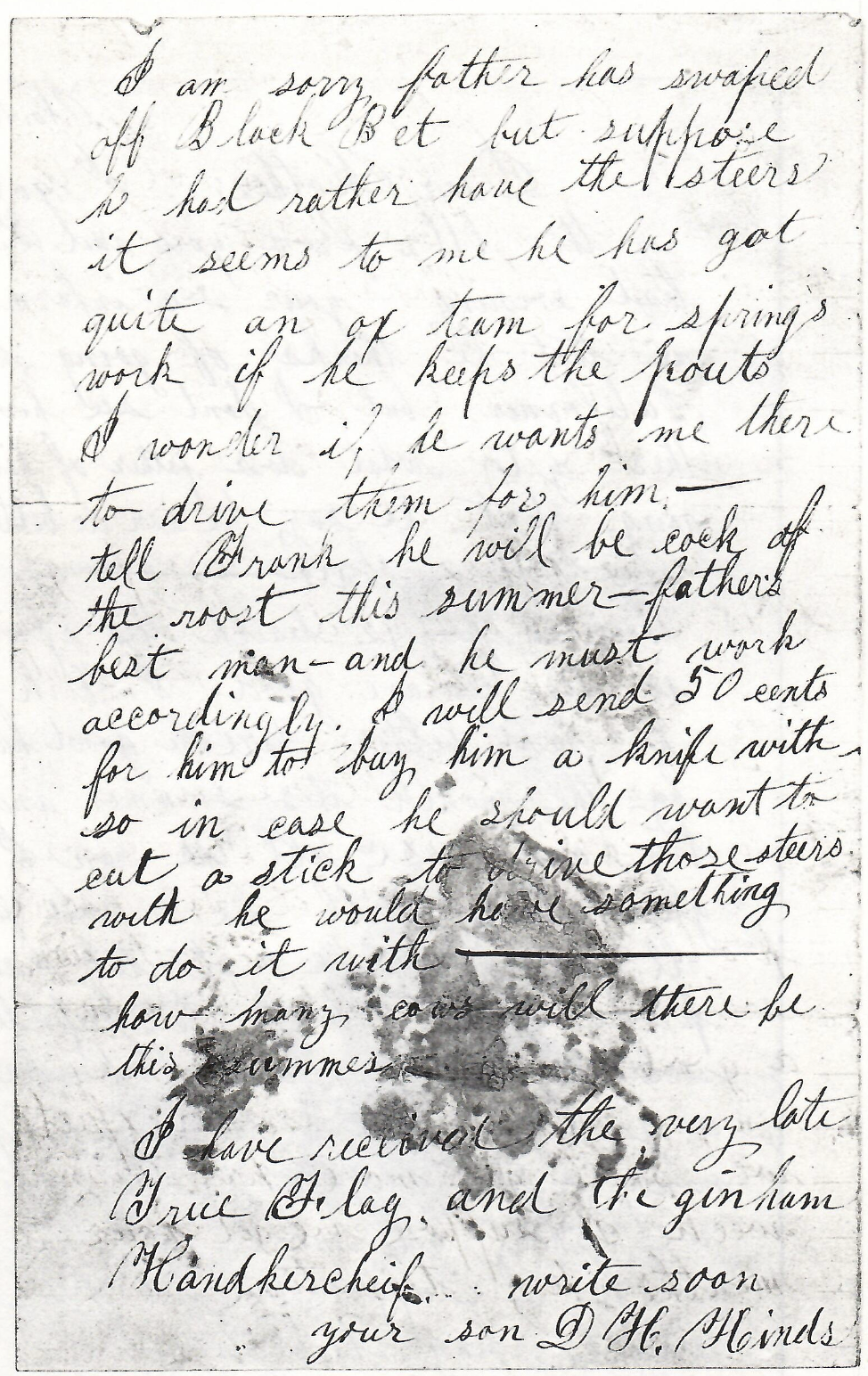
I am very sorry father has swapped off Black Bet but suppose he had rather have the steers. It seems to me he has got quite an ox team for spring work if he keeps the pouts [foals?]. I wonder if he wants me there to drive them for him.
Tell Frank he will be cock of the roost this summer—father’s best man—and he must work accordingly. I will send 50 cents for him to buy him a knife with so in case he should want to cut a stick to drive those steers with he would have something to do it with. How many cows will there be this summer?
I have received the very late [Boston] True Flag and the gingham handkerchief. Write soon. Your son, — D. H. Hinds.
Letter 19
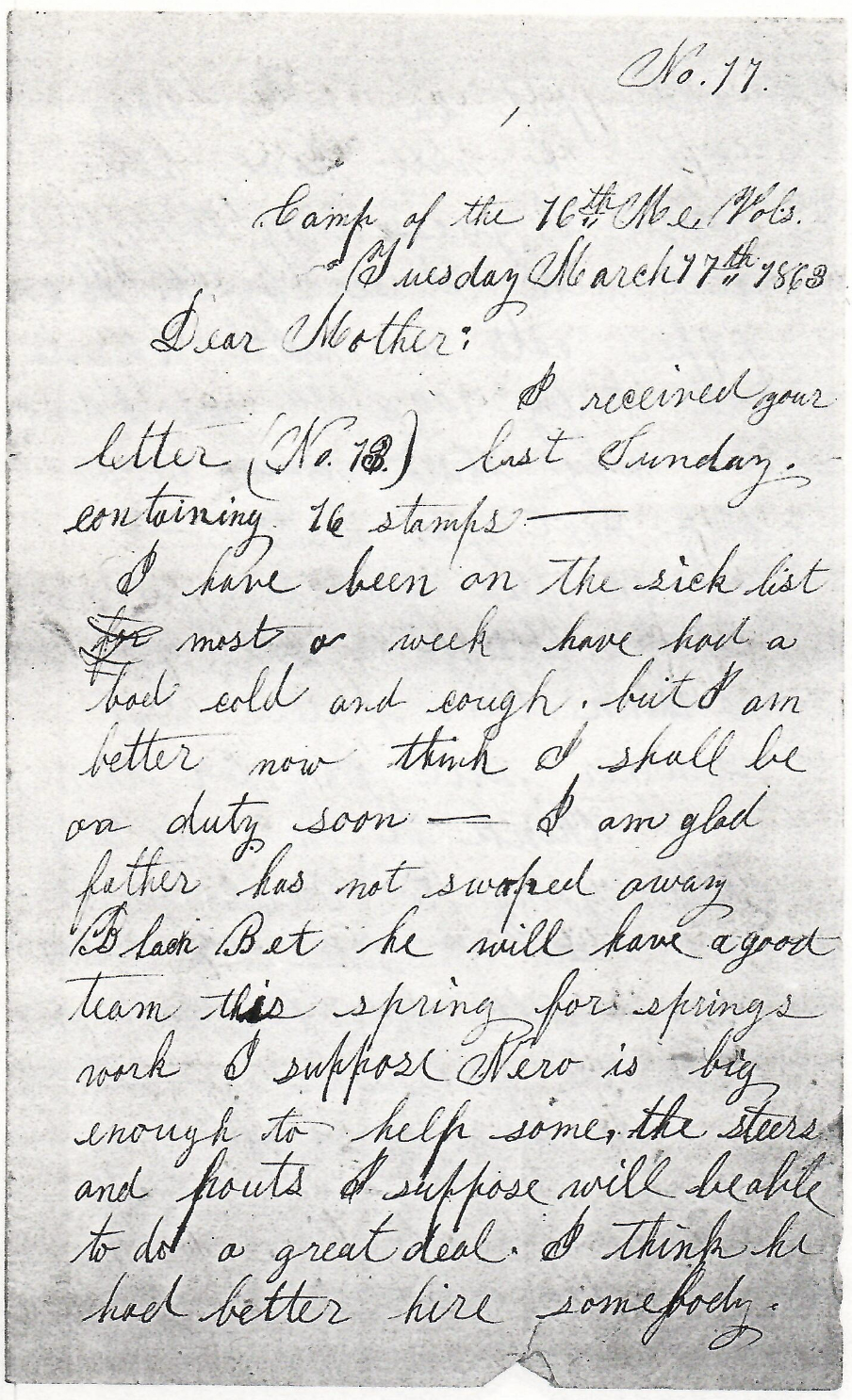
Camp of the 16th Maine Vols. Tuesday, March 17th 1863
Dear Mother,
I received your letter (Bo. 13) last Sunday containing the 16 stamps.
I have ben on the sick list most a week. Have had a bad cold and cough but I am better now. Think I shall be on duty soon.
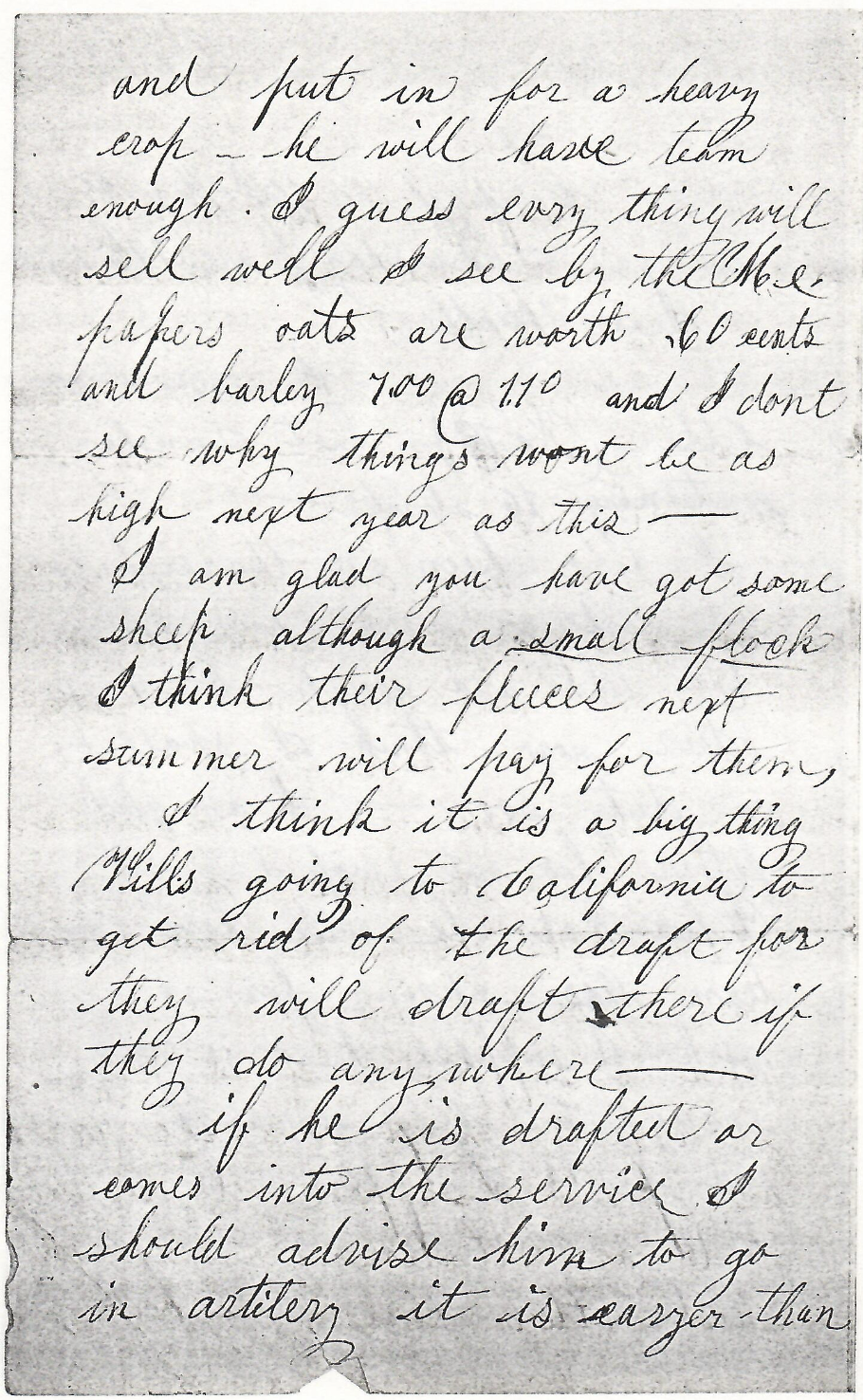
I am glad father has not swapped away Black Bet. He will have a good team this spring for spring work. I suppose Nero is big enough to help some. The steers and foals I suppose will be able to do a great deal. I think he had better hire somebody and put in for a heavy crop. He will have team enough. I guess everything will sell well. I see by the Maine papers oats are worth 60 cents and barley 1.00 @1.10 and I don’t see why things won’t be as high next year as this.
I am glad you have got some sheep although a small flock. I think their fleces next summer will pay for [keeping] them.
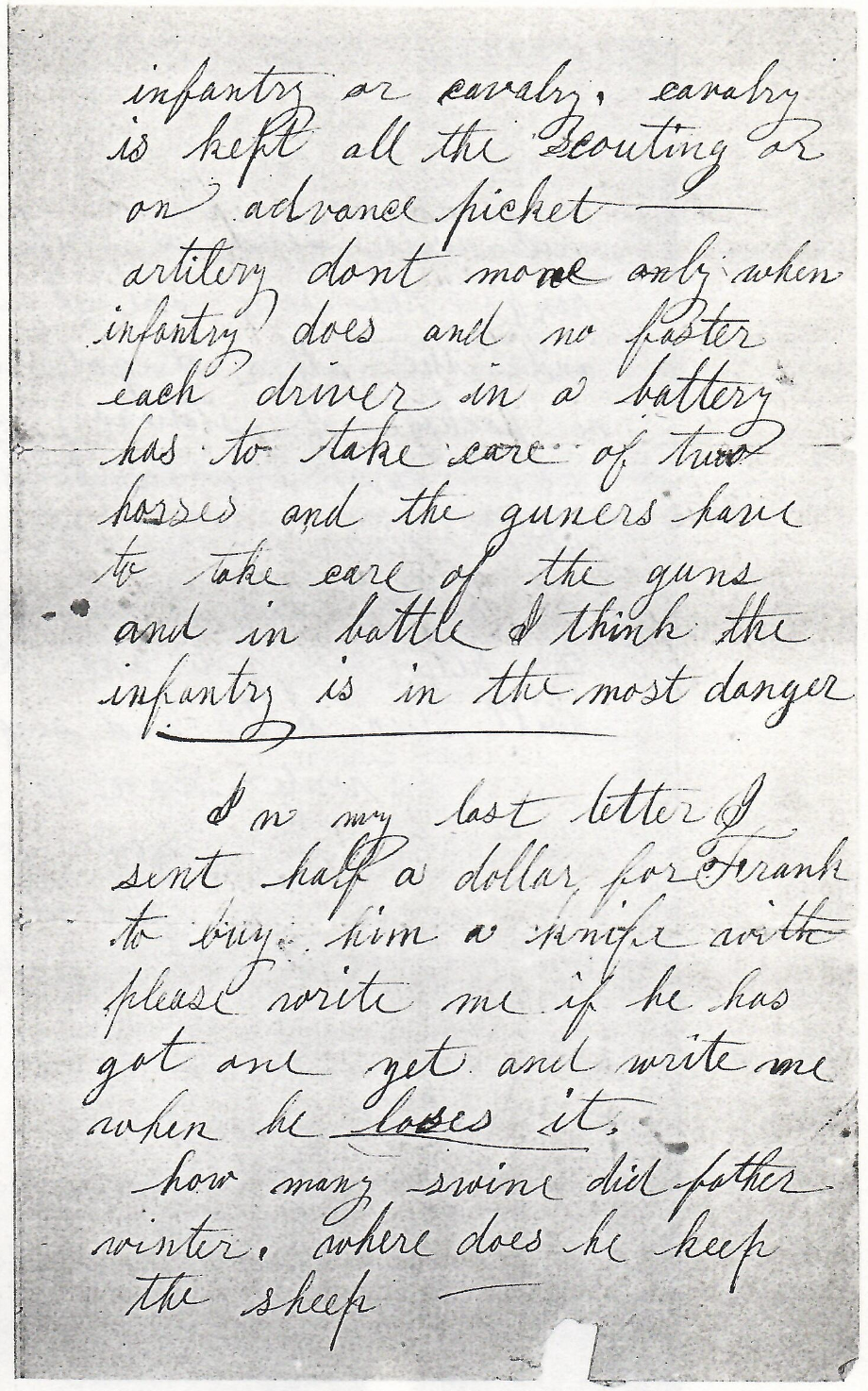
I thin kit is a big thing—Vill’s going to California to get rid of the draft for they will draft there if they do anywhere. If he is drafted or comes into the service, I should advise him to go in artillery. It is easier than infantry or cavalry. Cavalry is kept all the [time] scouting or on advanced picket. Artillery don’t move—only when infantry does, and no faster. Each driver in a battery has to take care of two gorses and the gunners have to take care of the guns and in battle, I think the infantry is in the most danger.
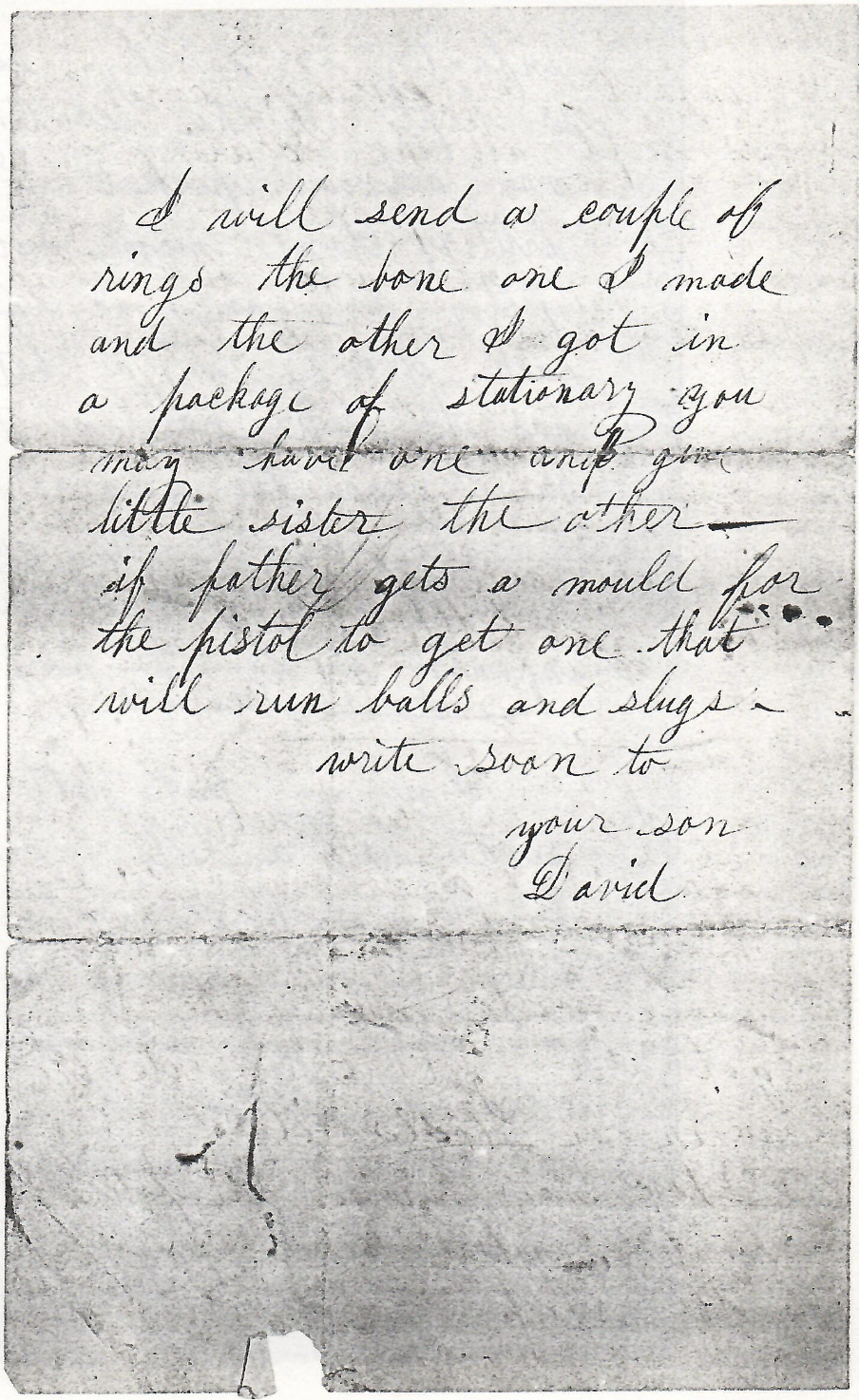
In my last letter I sent half a dollar for Frank to buy him a knife with. Please write me if he has got one yet and write me when he loses it. How many swine did father winter? Where does he keep the sheep? I will send a couple of rings. The bone one I made and the other I got in a package of stationery. You may have one and give little sister the other. [Tell] father if he gets a [bullet] mold for the pistol, to get one that will run balls and slugs. Write soon to your son, — David
Letter 20
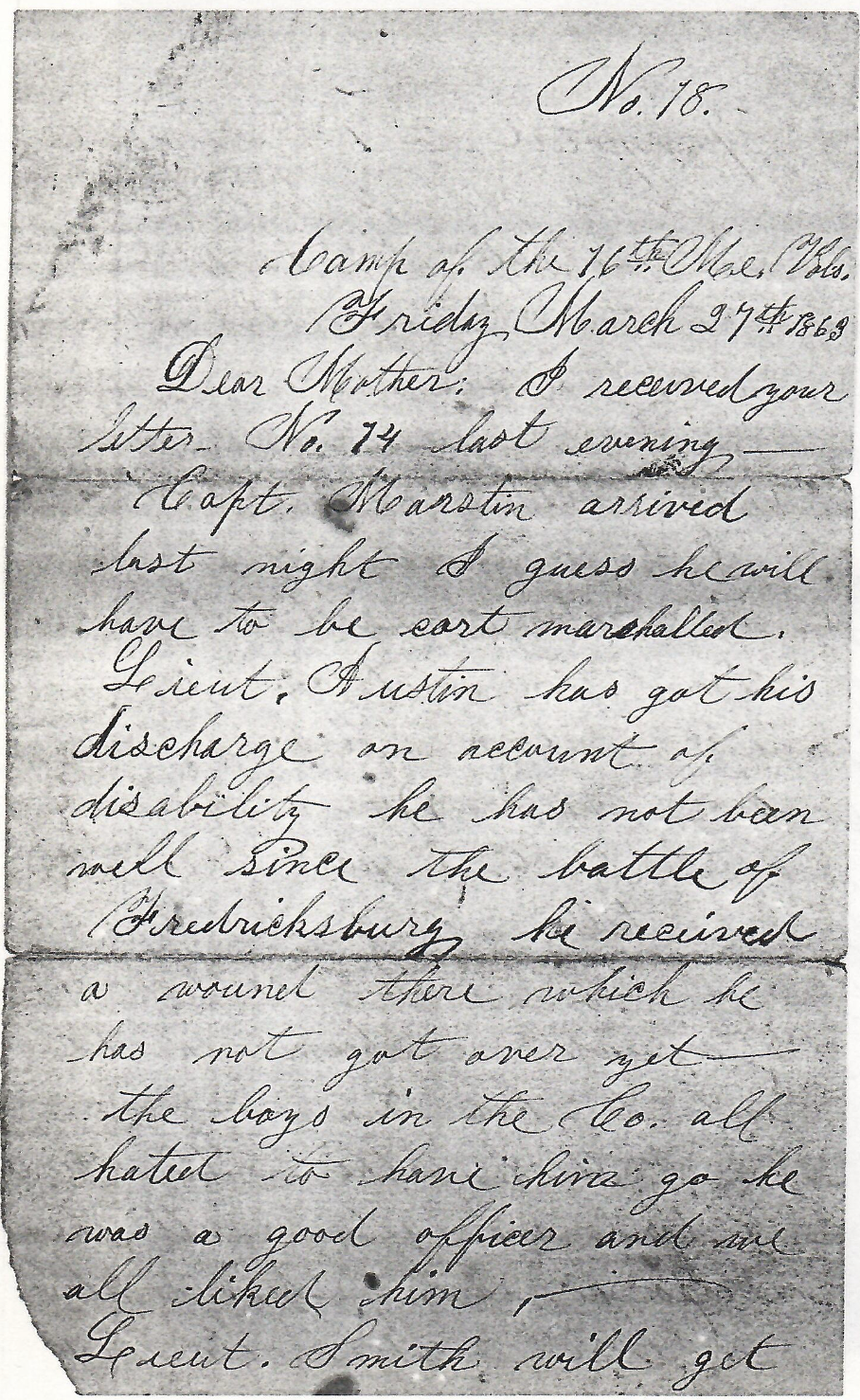
Camp of the 16th Maine Vols. Friday, March 27th 1863
Dear Mother,
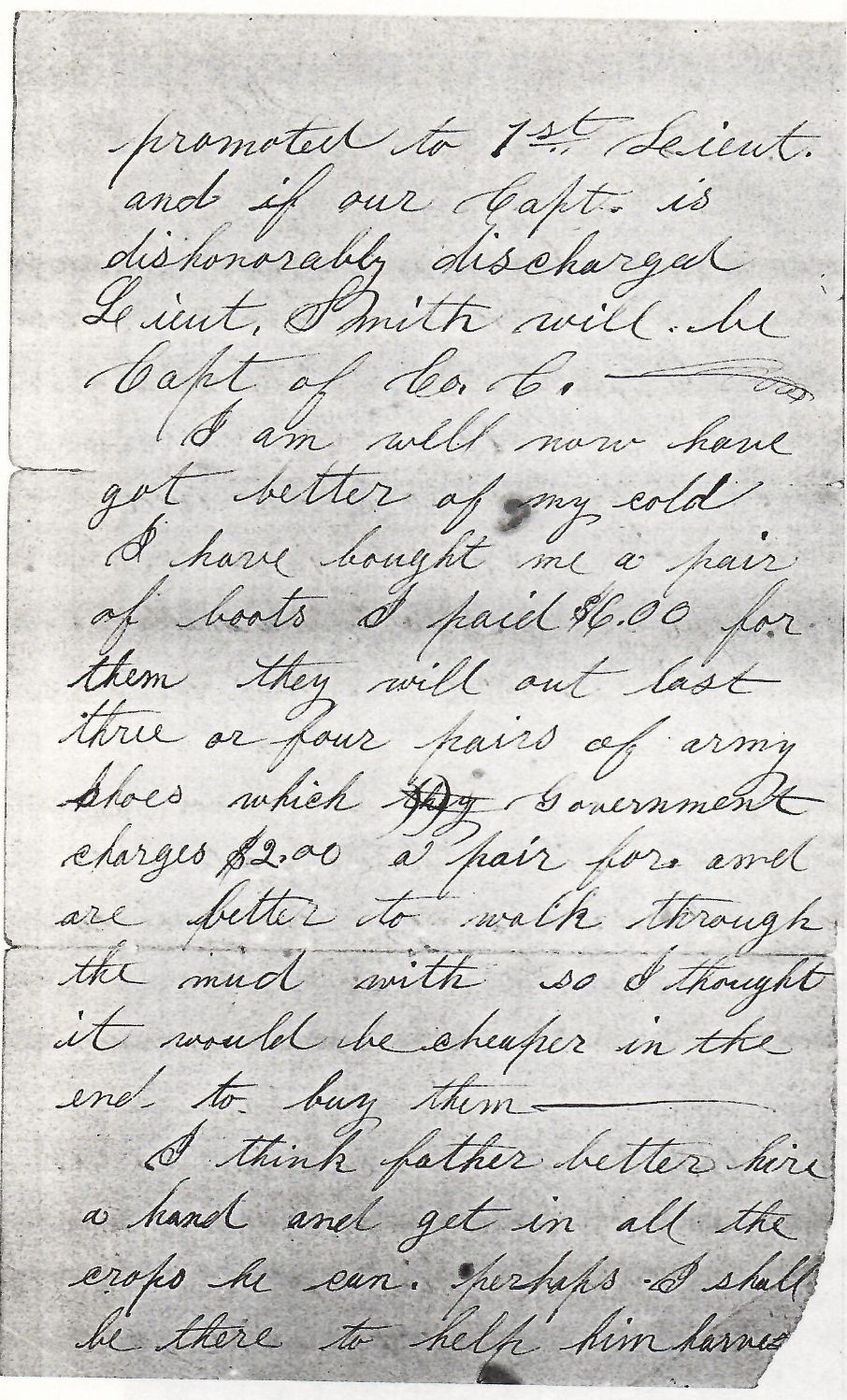
I received your letter (No. 14) last evening. Capt. Marston arrived last night. I guess he will have to be court martialed. Lieut. Austin has got his discharge on account of disability. He has not been well since the Battle of Fredericksburg. He received a wound there which he has not got over yet. The boys in the company all hated to have him go. He was a good officer and we all liked him. Lieutenant Smith will get promoted to 1st Lieutenant and if our Capt. is dishonorably discharged, Lieutenant Smith will be Captain of Co. C.
I am well now. Have got better of my cold. I have bought me a pair of boots. I paid $6 for them. They will outlast three or four pairs of army shoes which the government charges $2 a pair for and are better to walk through the mud with so I thought it would be cheaper in the end to buy them.
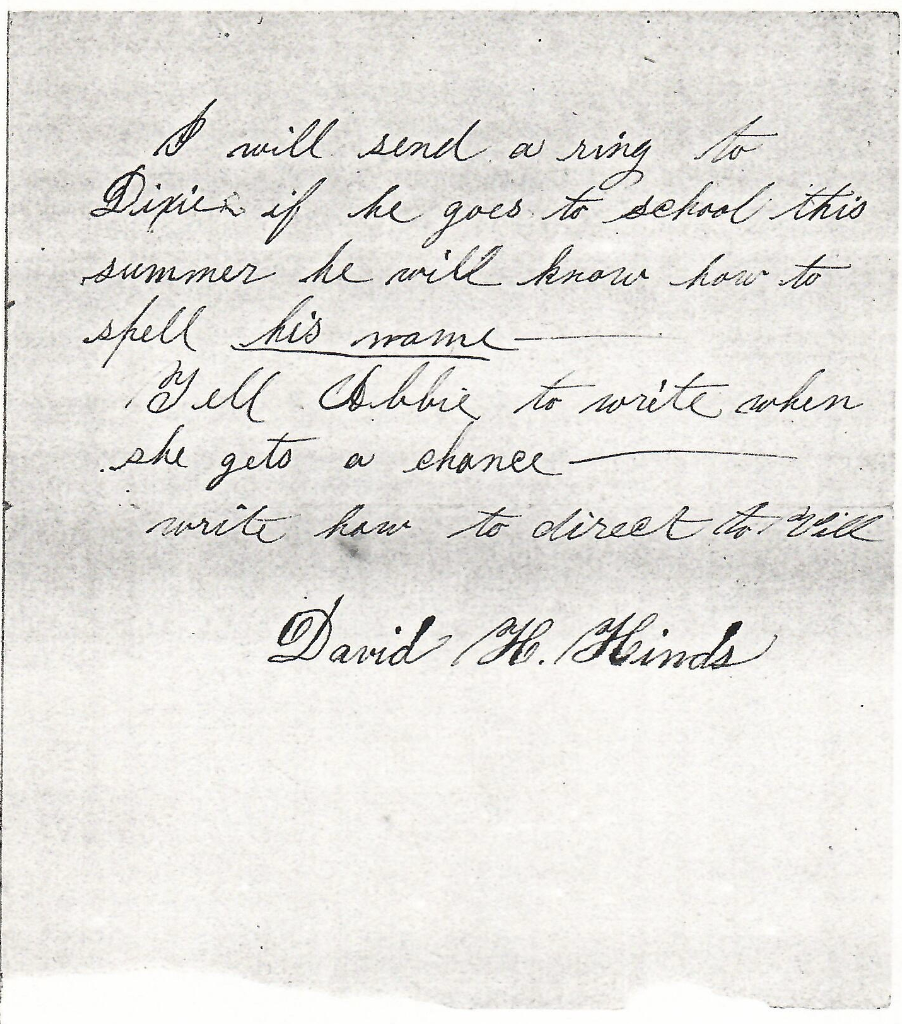
I think father better hire a hand and get in all the crops he can. Perhaps I shall be there to help him harvest. I will send a ring to Dixie if hegoes to school this summer. He will know how to spell his name. Tell Abbie to write when she gets a chance. Write how to direct to Ville. — David H. Hinds
Letter 21
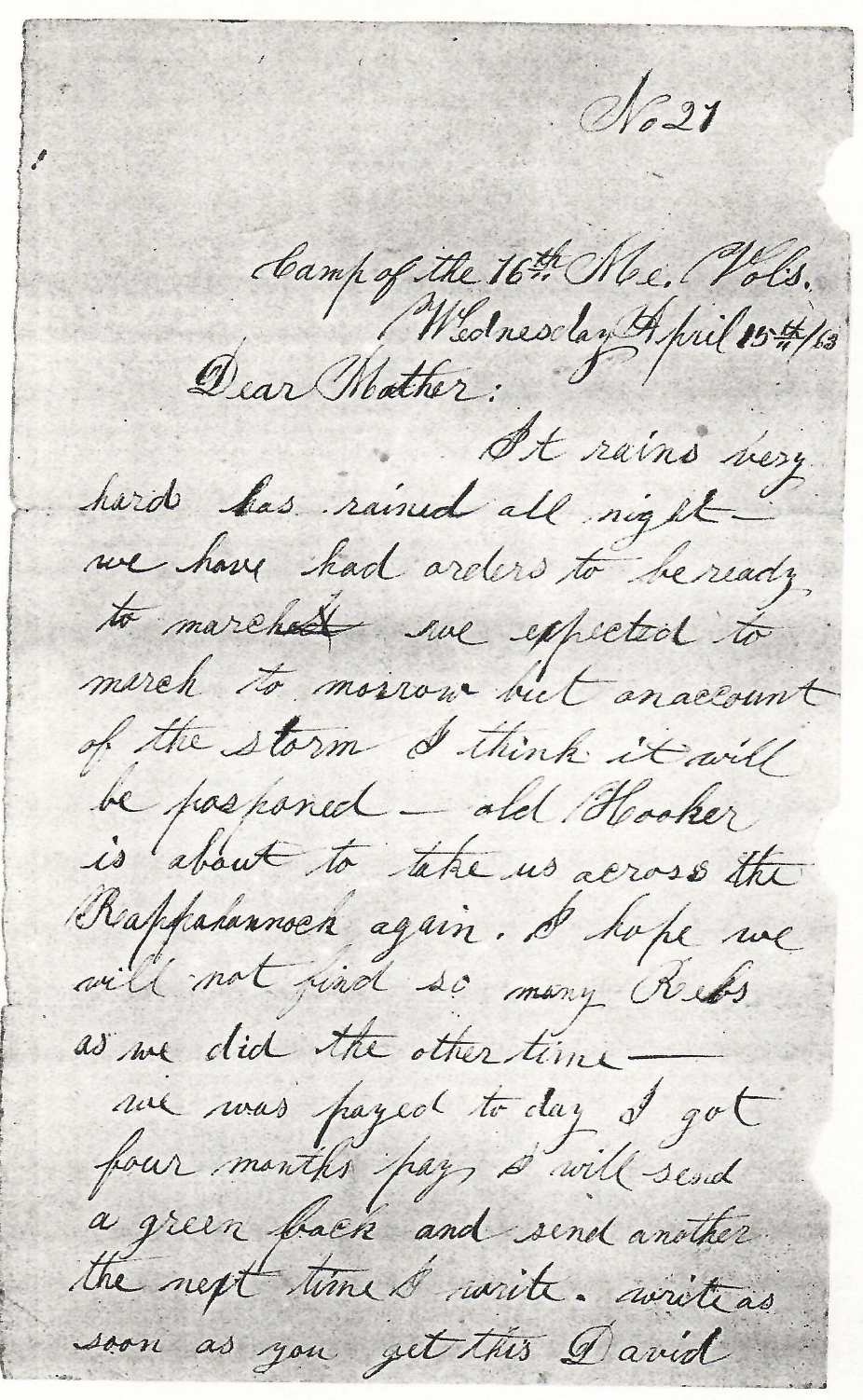
Camp of the 16th Maine Vols. Wednesday, April 15th 1863
Dear Mother,
It rains very hard. Has rained all night. We have had orders to be ready to march. We expected to march tomorrow but on account of the storm, I think it will be postponed. Old Hooker is about to take us across the Rappahannock again. I hope we will not find so many Rebs as we did the other time.
We was paid today. I got four months pay. I will send a greenback and send another the next time I write. Write as soon as you get this. — David
Letter 22
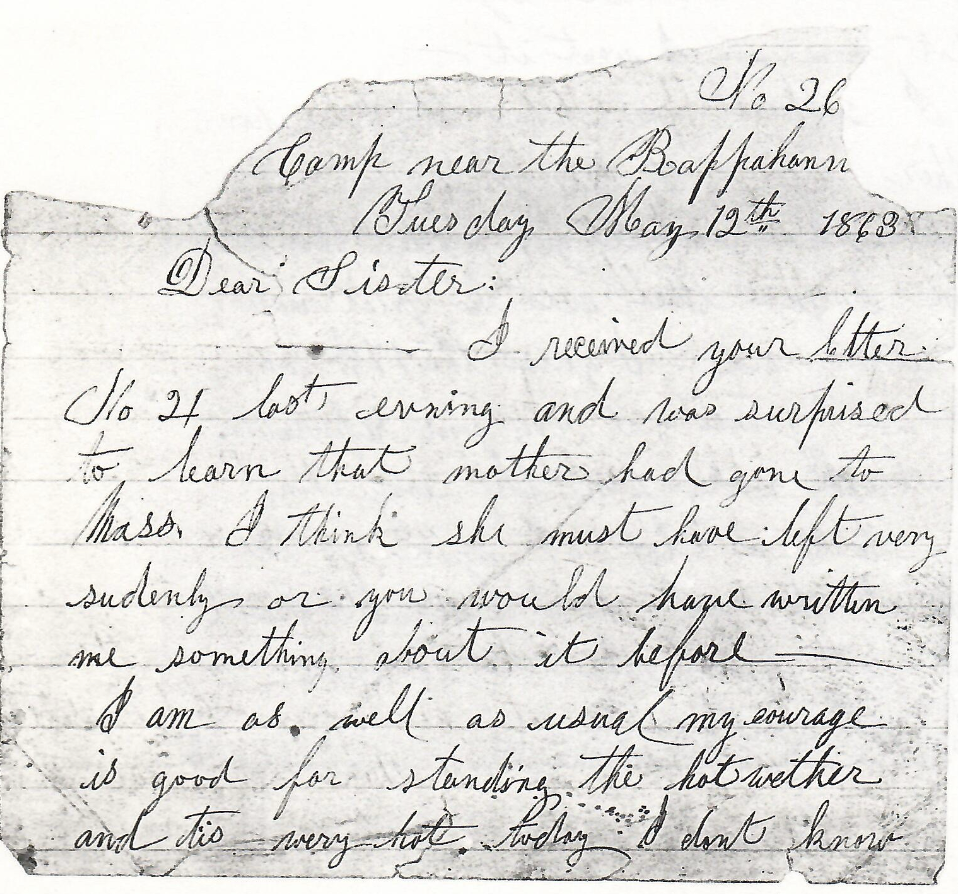
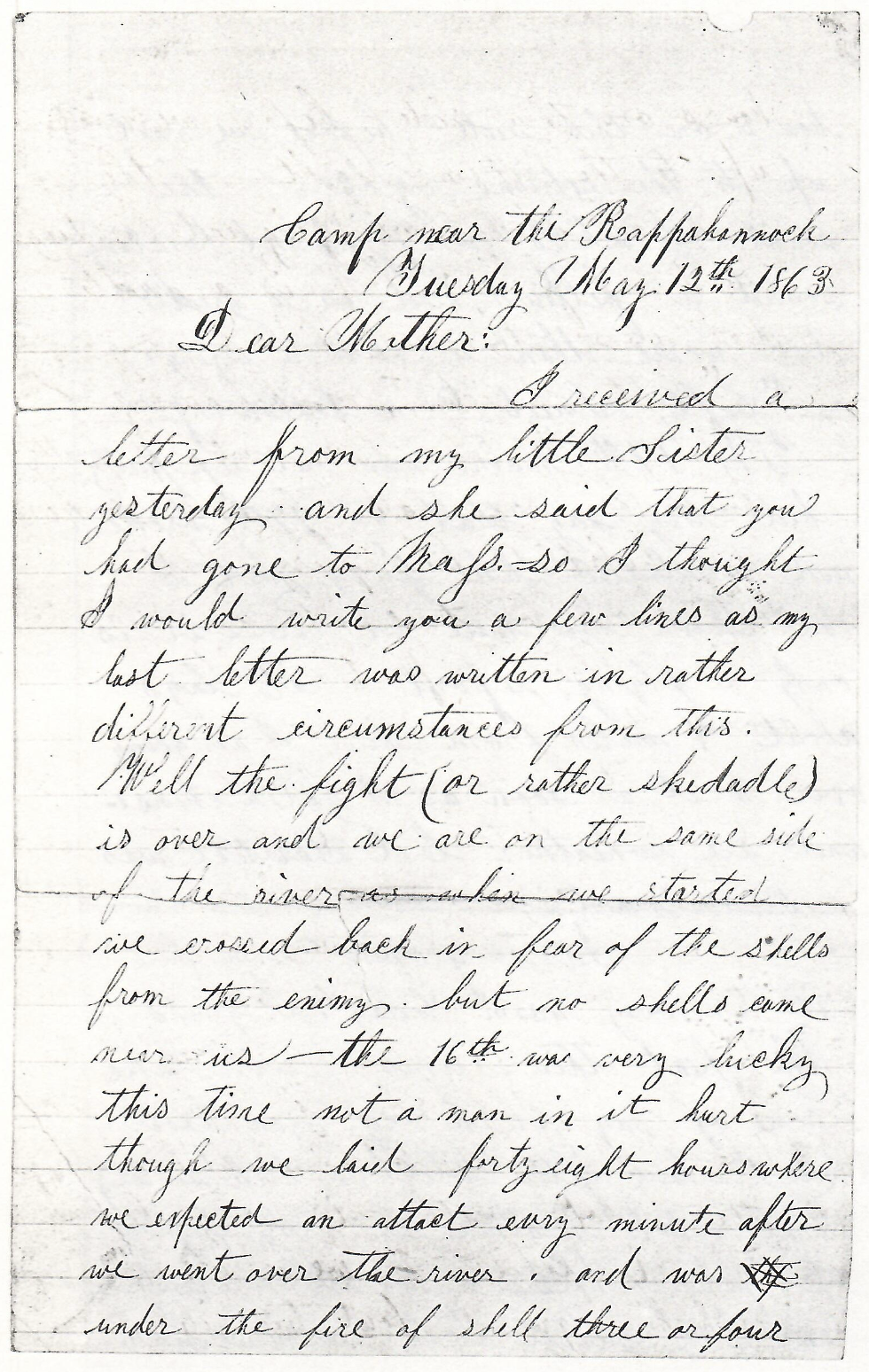
Camp near the Rappahannock Tuesday, May 12th 1863
Dear Sister,
I received your letter No. 21 last evening and was surprised to learn that mother had gone to Massachusetts. I think she must have left very suddenly or you would have written me something about it before.
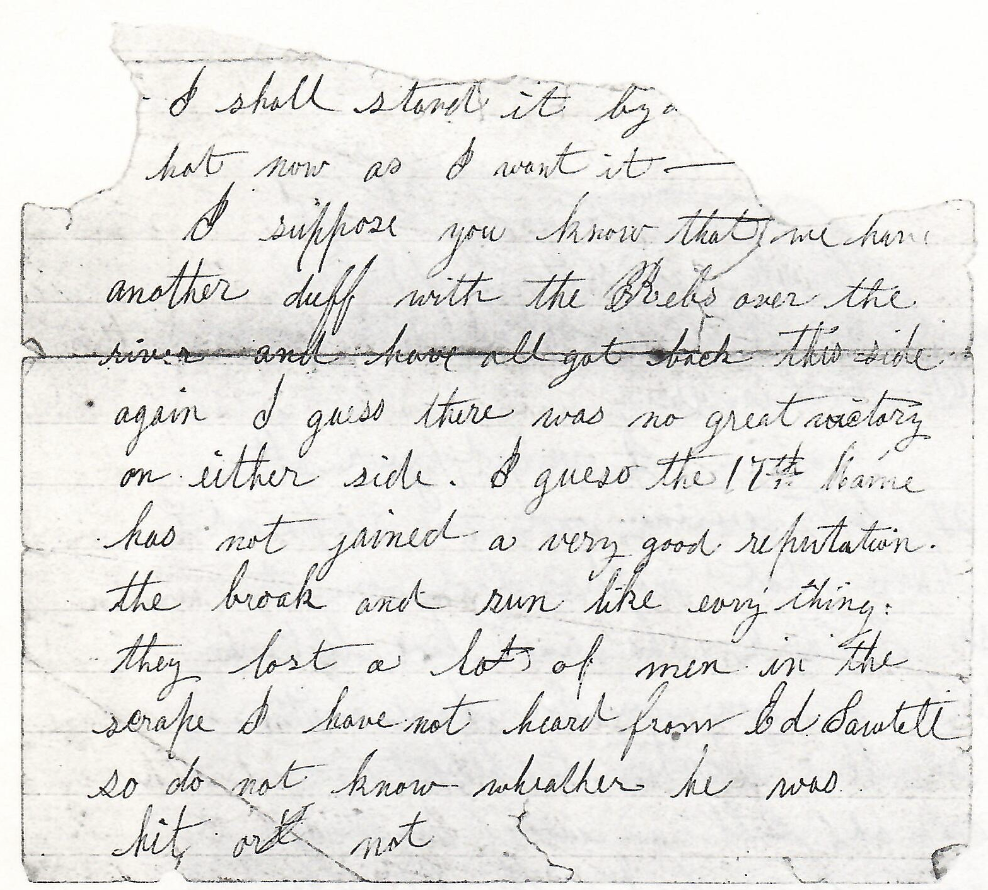
I am as well as usual. My courage is good for standing the hot weather and tis very hot today. I don’t know how I shall stand it by [summer as it is as] hot now as I want it.
I suppose you know that we have [had] another duff with the Rebs over the river and have all got back this side again. I guess there was no great victory on either side. I guess the 17th Maine has not gained a very good reputation. They broke and run like everything. They lost a lot of men in the scrape. I have not heard from Ed Sawtelle so do not know whether he was hit or not.
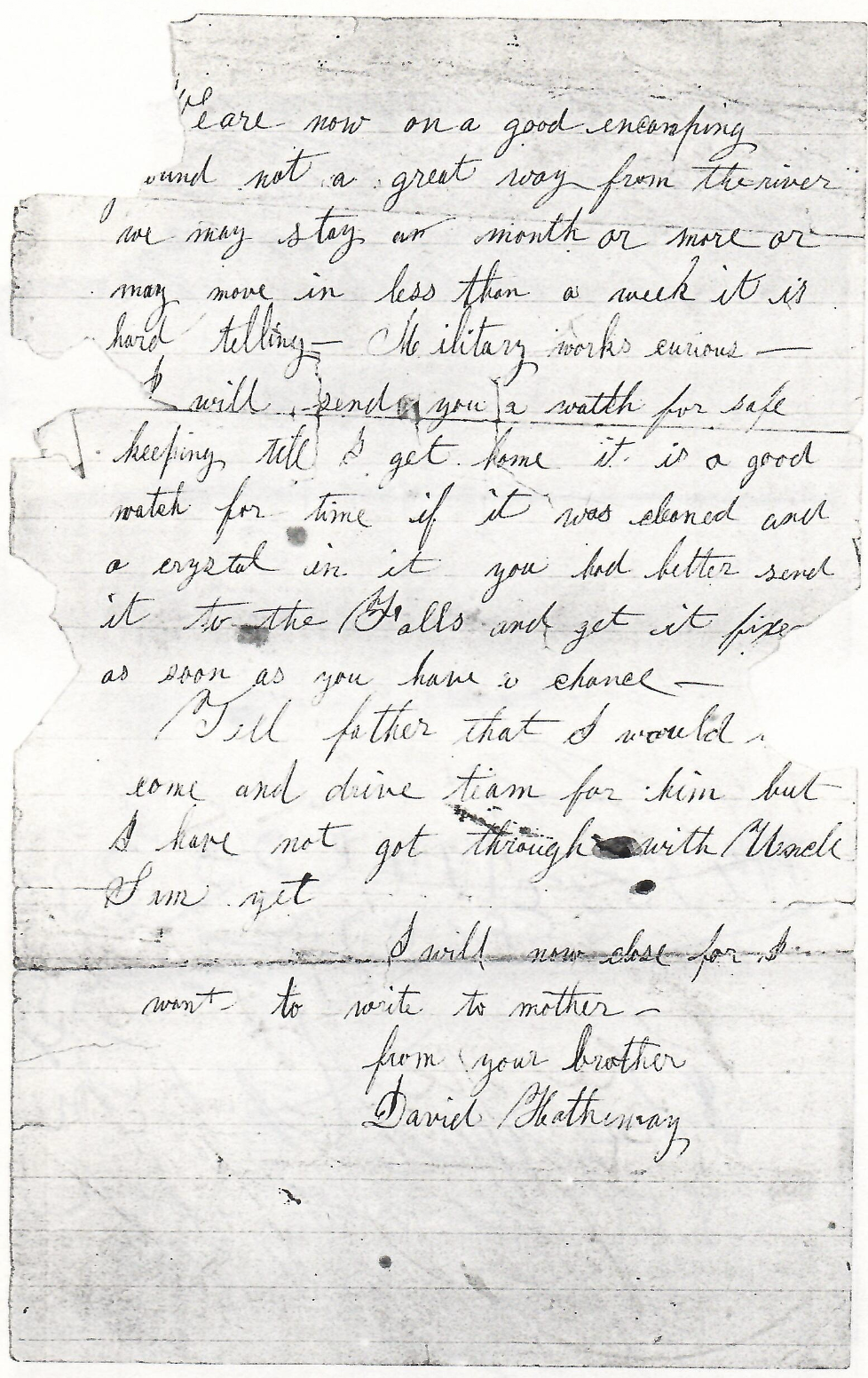
We are now on a good camping ground not a great way from the river. We may stay a month or more or may move in less than a week. It is hard telling. Military works curious.
I will send you a watch for safe keeping till I get home. It is a good watch for time if it was cleaning and a crystal [put] in it. You had better send it to the Falls and get it fixed as soon as you have a chance.
Tell father that I would come and drive them team for him but I have not got through with Uncle Sam yet. I will now close for I want to write to mother. From your brother, — David Hatheway [Hinds]
Letter 23
Camp near Rappahannock Tuesday, May 12th, 1863
Dear Mother,
I received a letter from my little sister yesterday and she said that you had gone to Massachusetts so I thought I would write you a few lines as my last letter was written in rather different circumstances from this.
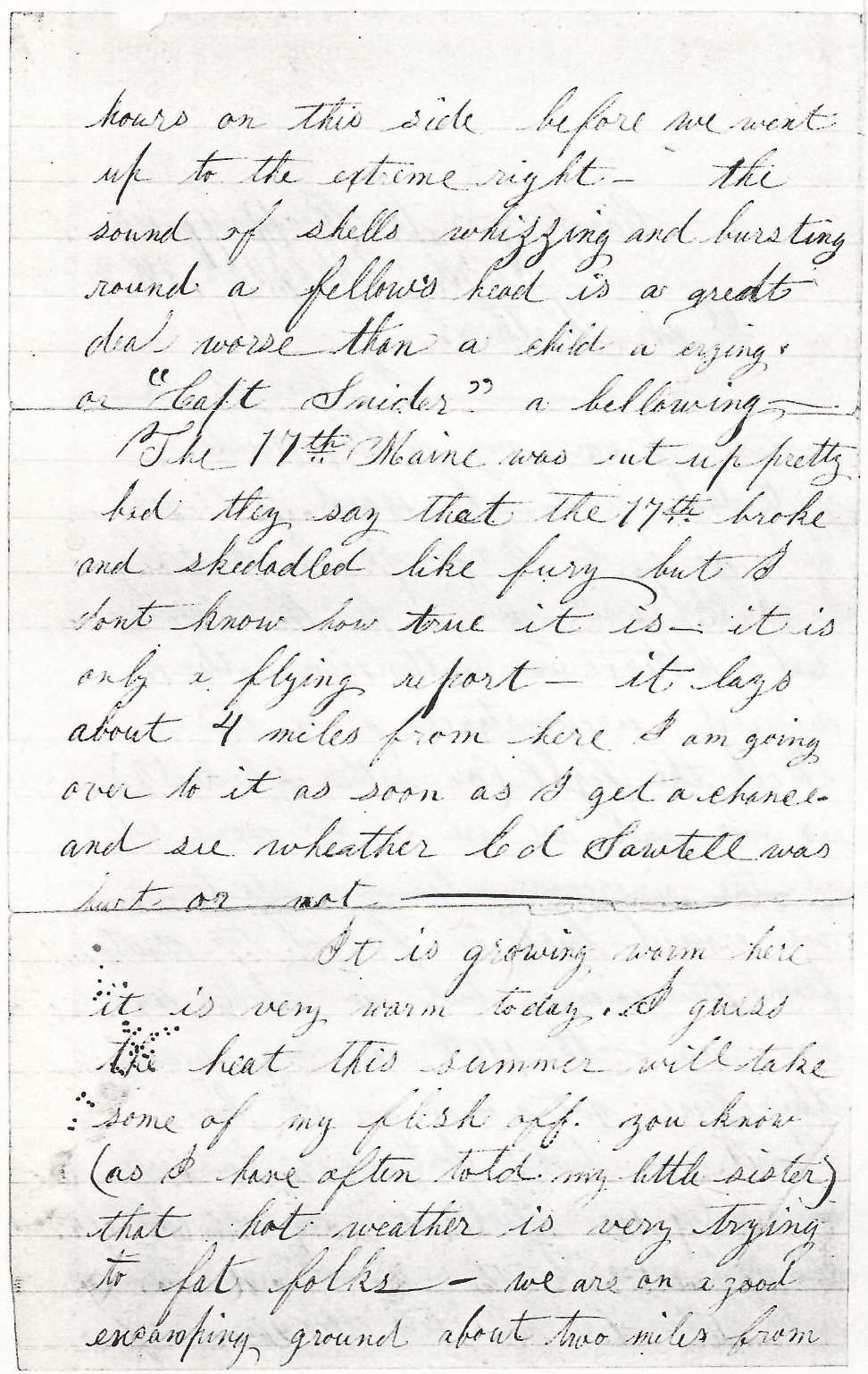
Well, the fight (or rather skedaddle) is over and we are on the same side of the river as when we started. We crossed back in fear of the shells from the enemy but no shells came near us. The 16th [Maine] was very lucky this time. Not a man in it hurt though we laid 48 hours where we expected an attack every minute after we went over the river and was under the fire of shell three or four hours on this side before we went up to the extreme right. The sound of shells whizzing and bursting round a fellow’s head is a great deal worse than a child a crying or “Capt. Snider” a bellowing.
The 17th Maine was cut up pretty bad. They say that the 17th broke and skedaddled like fury but I don’t know how true it is. It is only a flying report. It lays about four miles from here. I am going over to it as soon as I get a chance and see whether Ed Sawtelle was hurt or not.
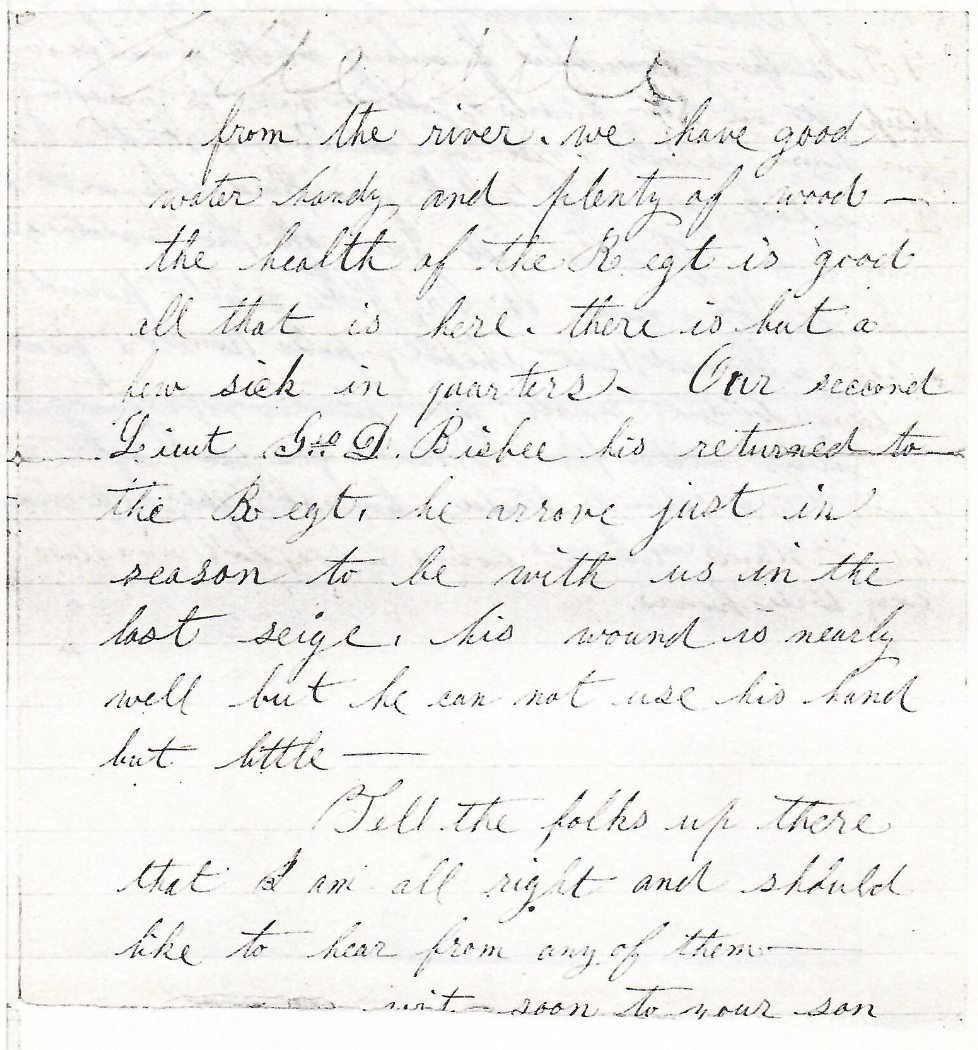
It is growing war, here. I ti s very warm today. I guess the heat this summer will take some of the flesh off. You know (as I have often told y little sister) that hot weather is very trying to fat folks. We are on a good camping ground about two miles from the river. We have good water handy and plenty of wood. The health of the regiment is good—all that is here. There is but few sick in quarters.
Our 2nd Lieutenant George D. Bisbee has returned to the regiment. He arrived just in season to be with us in the last siege. His wound is nearly well but he cannot use his hand but little.
Tell the folks up there that I am all right and should like to hear from any of them. Write soon to your son — David
Letter 24
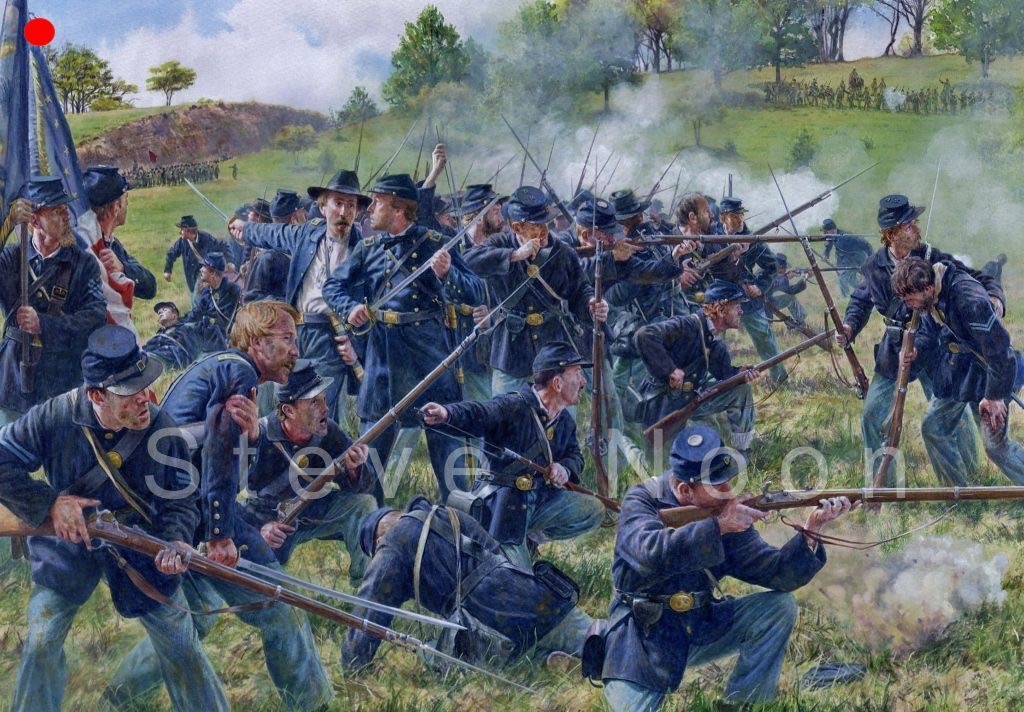
The brilliant artistry of Steve Noon depicts the 16th Maine holding back Rhodes’s Confederate Division with less than 300 rifles, slowly withdrawing from Oak Ridge toward Cemetery Hill. “After 20 minutes, surrounded and with no hope of escape, the regiments flags were torn to shreds to prevent their capture and Tilden defiantly snapped his sword at the hilt before he and the remaining 163 officers and men under his command surrendered.”
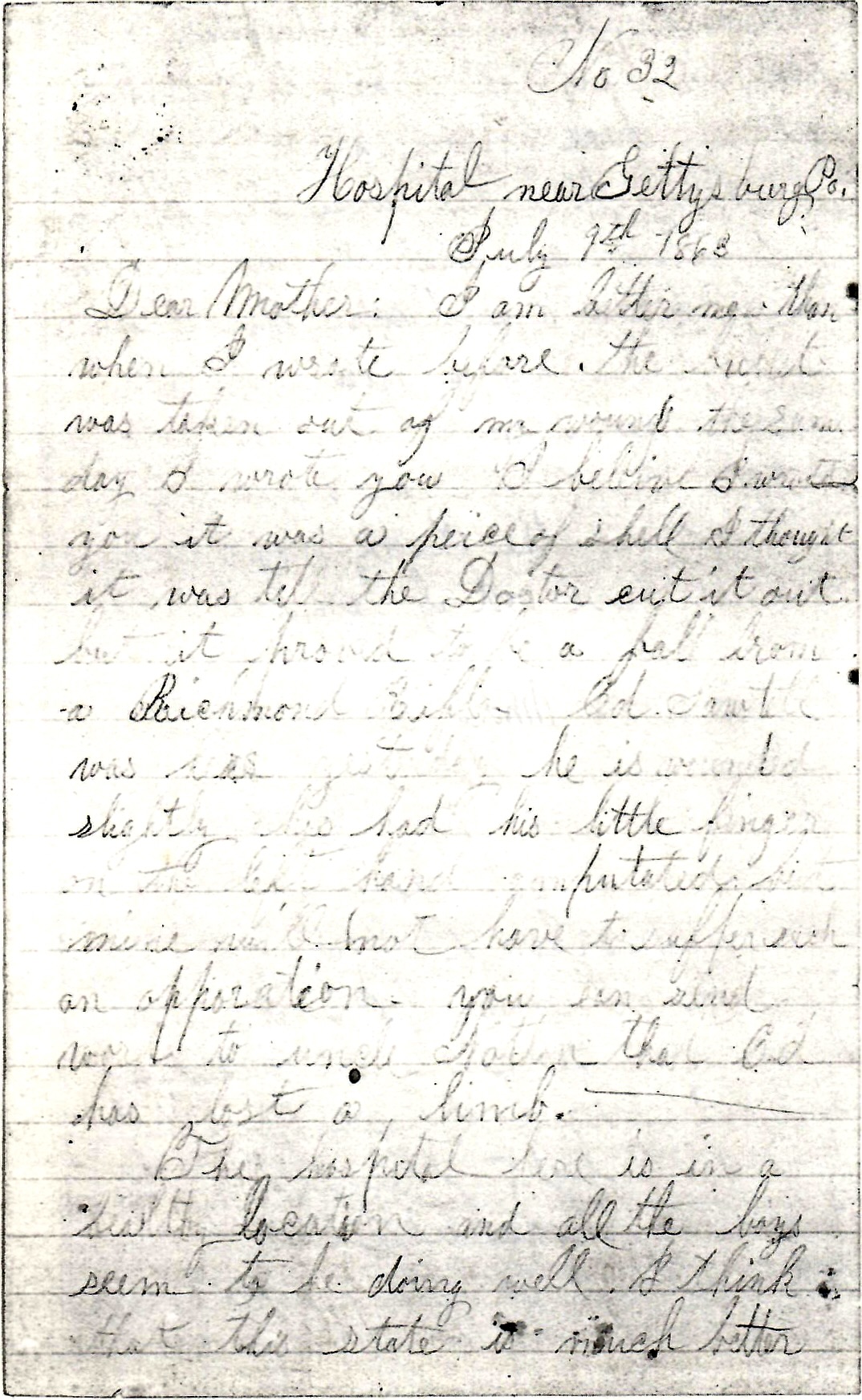
Hospital near Gettysburg, Pennsylvania July 9th 1863
Dear Mother,
I am better now than when I wrote before. The bullet was taken out of my wound the same day I wrote you. I believe I wrote you it was a piece of shell. I thought it was till the doctor cut it out. But it proved to be a ball from a Richmond rifle. Ed Sawtelle was here yesterday. He is wounded slightly. He had his little finger on the left hand amputated but mine will not have to suffer such an operation. You can send word to Uncle Nathan that Ed has lost a limb. 1
The hospital here is in a healthy location and all the boys seem to be doing well. I think that this state is much better than Virginia for a hospital this time of the year. The folks round here bring in a great deal of stuff for the wounded soldiers. I think we shall be moved from here before a great while. Then I can get letters from you but you should not write any number of the regiment. I expect it is a great way from here.
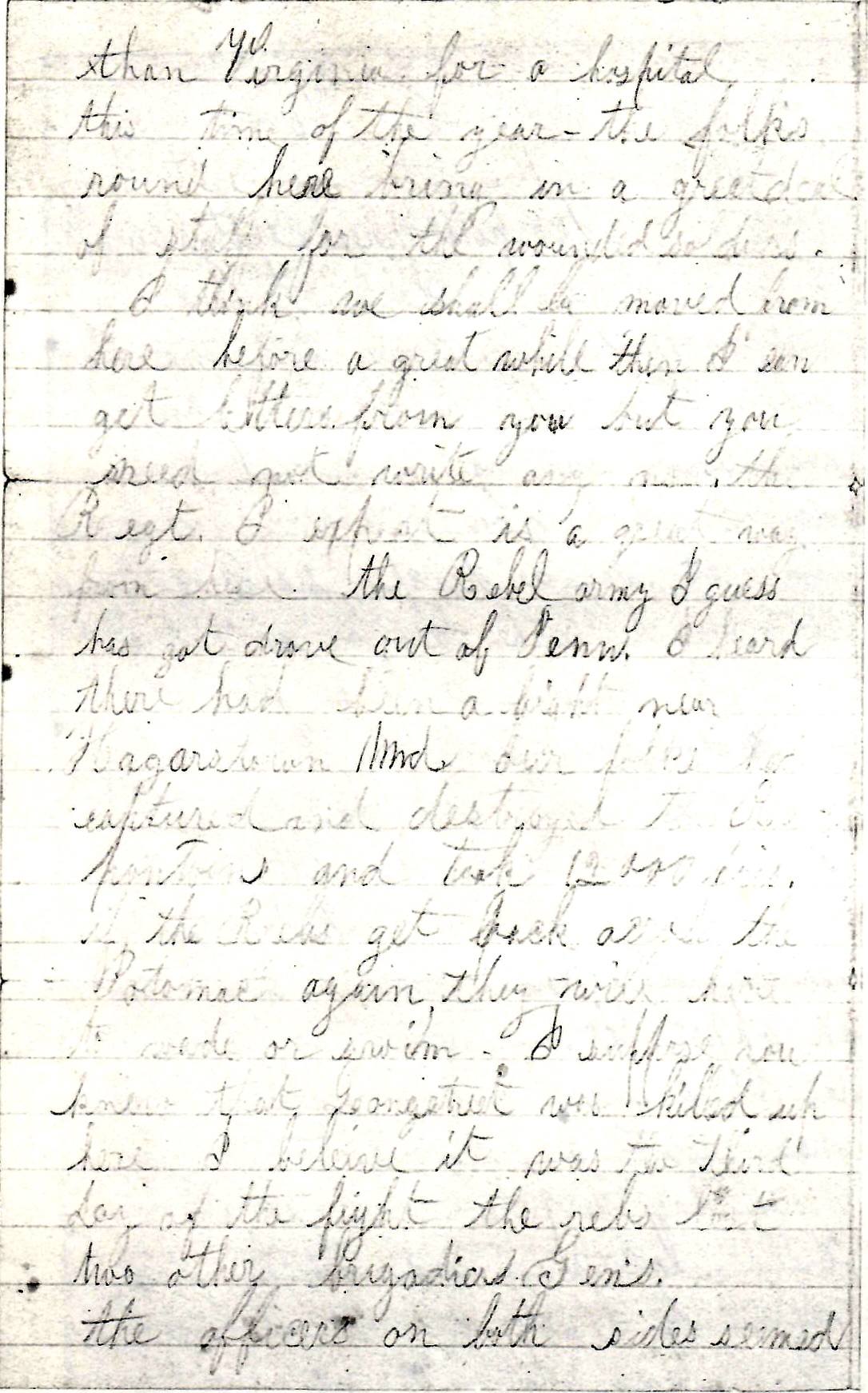
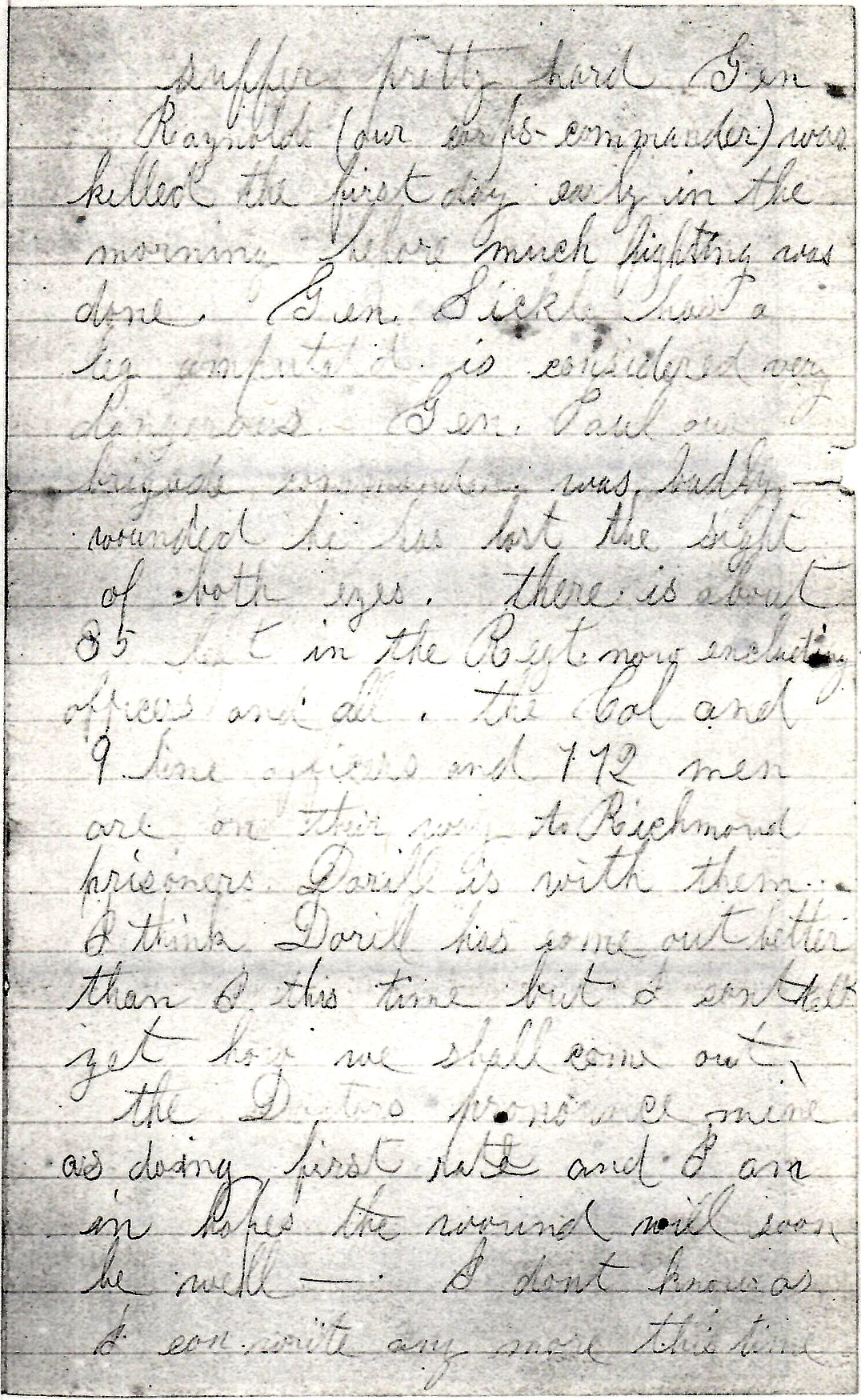
The Rebel army, I guess, has got drove out of Pennsylvania. I heard there had been a fight near Hagerstown, Maryland. Our folks have captured and destroyed two Rebel pontoons and took 12,000 prisoners. If the Rebs get back across the Potomac again, they will have to wade or swim. I suppose you knew that Longstreet was killed up here. I believe it was the third day of the fight. The Rebs two other brigade generals. The officers on both sides seemed to suffer pretty hard. Gen. Reynolds (our Corps Commander) was killed the first day early in the morning before much fighting was done. Gen. Sickles has a leg amputated [and] is considered very dangerous. Gen. Paul, our Brigade commander, was badly wounded. He has lost the sight of both eyes. There is about 85 left in the regiment now including officers and all. The Colonel and 9 line officers and 112 men are on their way to Richmond prisoners. Dorill[us] Hobbs] is with them. I think Dorill[us] has come out better than I this time but I can’t tell yet how we shall come out. 2
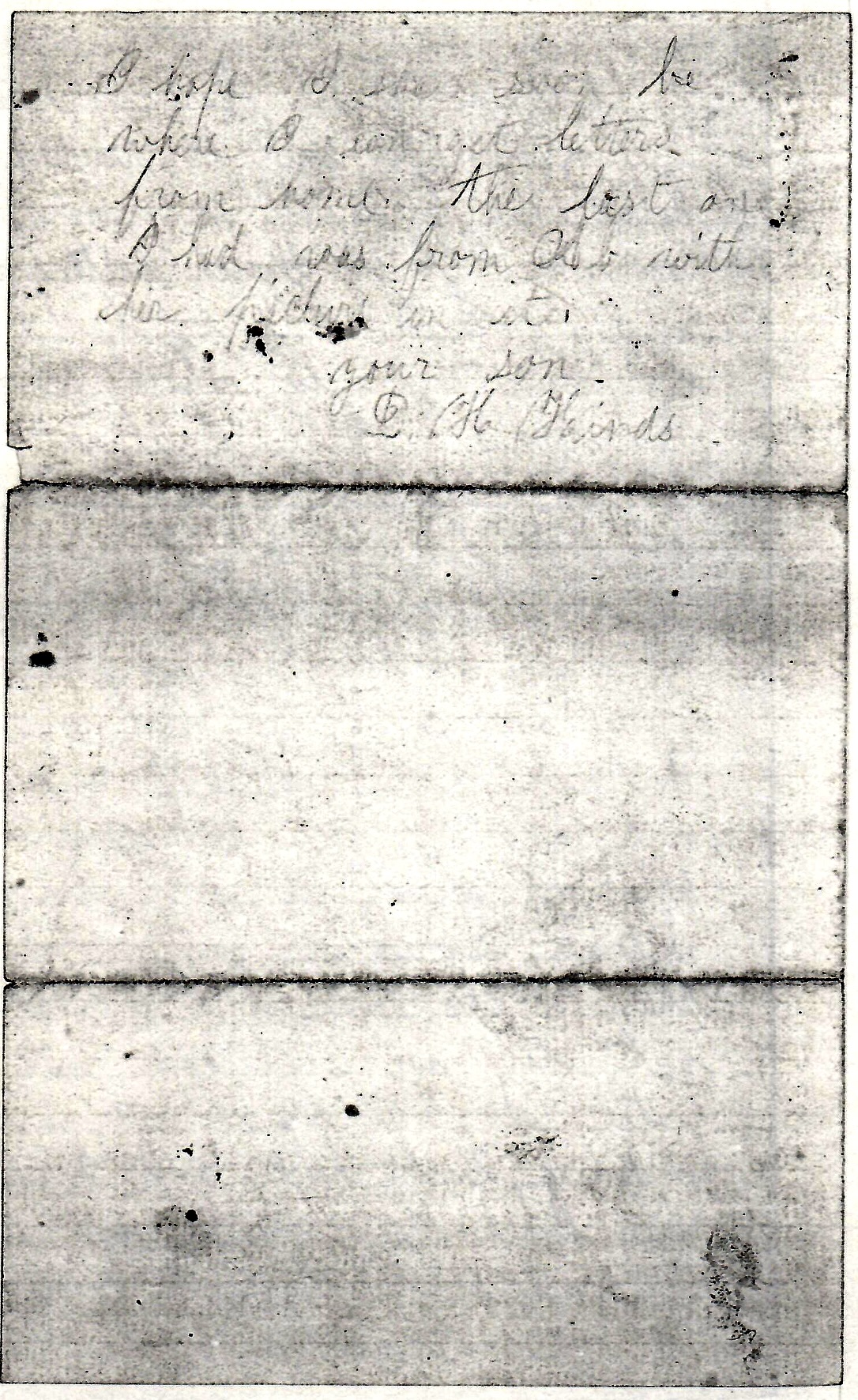
The doctors pronounce mine as doing first rate and I am in hopes the wound will soon be well. I don’t know as I can write anymore this time. I hope I shall soon be where I can get letters from home. The last one I had was from Abbie with her picture in it. Your son, — D. H. Hinds
1 Zephaniah Eddy Sawtelle (1839-1887) was the son of Nathan Hale Sawtelle (1800-1872) and his first wife, Olive Whitman (1800-1836) of Turner, Androscoggin county, Maine. After his first wife died, Nathan married Maria Hinds (1807-1898). Ed served in Co. F, 17th Maine Infantry from August 1862 to June 1864.
2 Dorillus Hobbs served with David in Co. C, 16th Maine Infantry. He was one of the 159 men from the regiment taken prisoner by the Confederates in the desperate stand on the first day of Gettysburg. He was sent to prison in Richmond, Virginia, where he died in captivity in November 1863—a year earlier than David.
Letter 25
In hospital near Gettysburg, Pennsylvania Sunday, July 12th 1863
Dear sister,
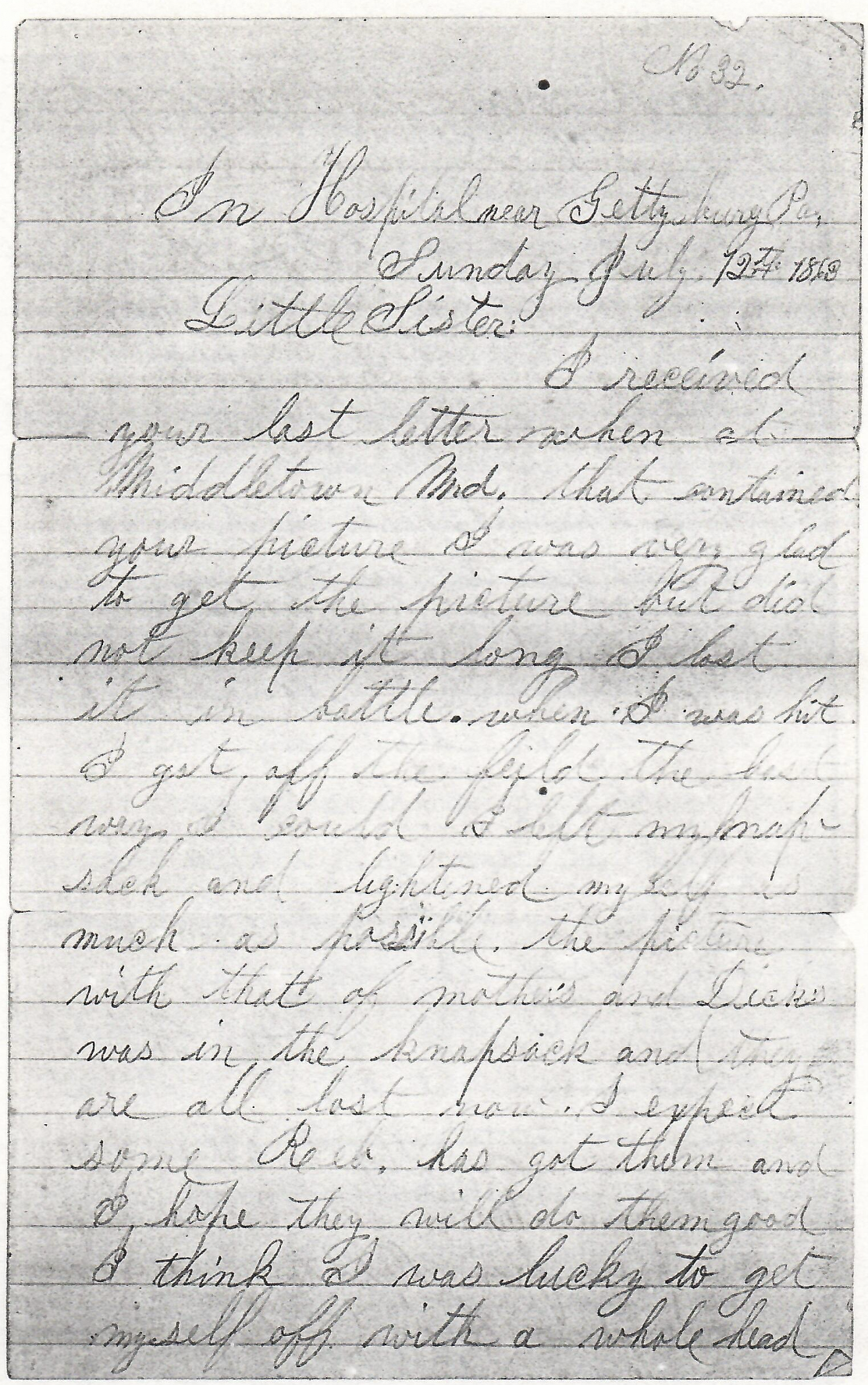
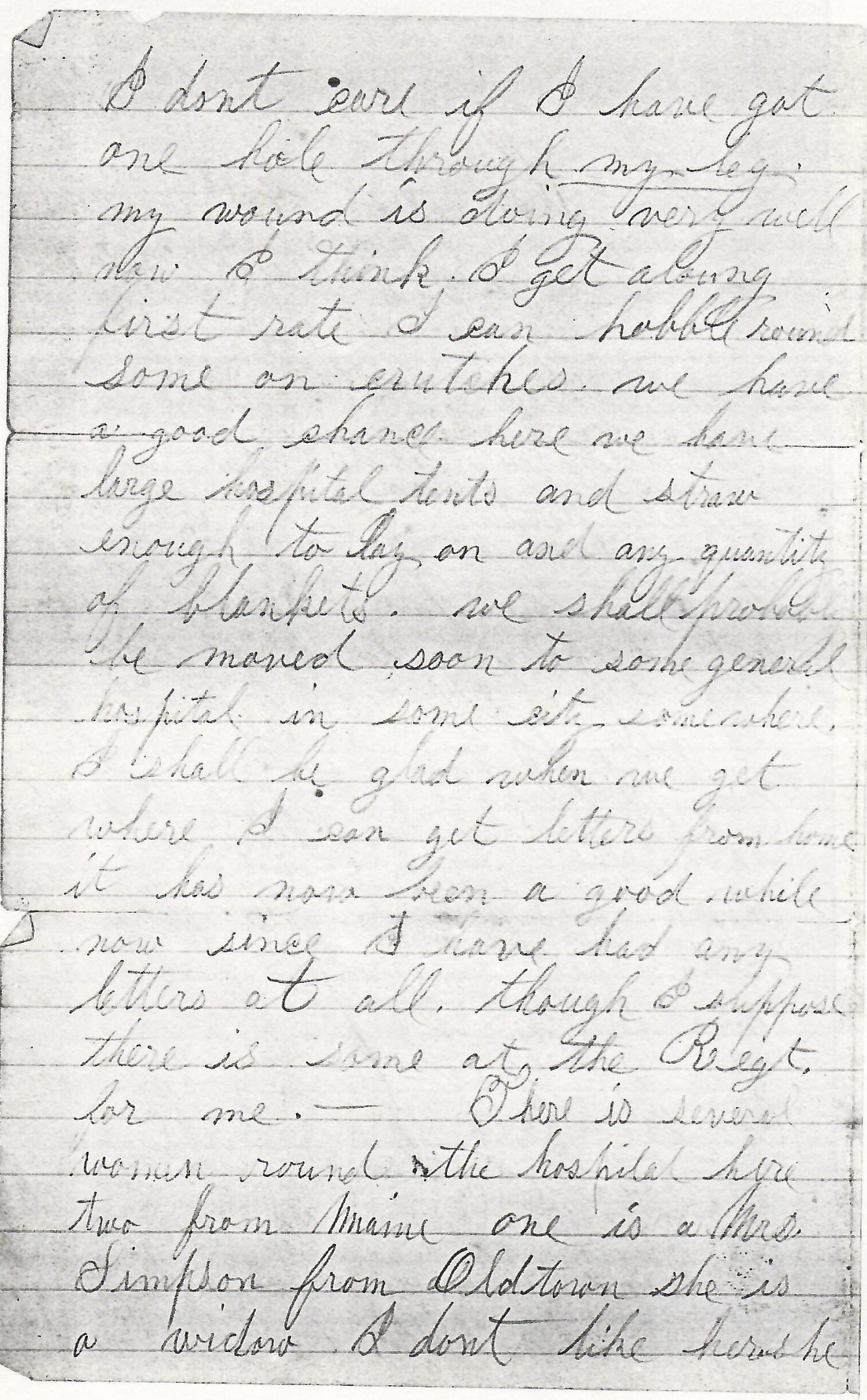
I received your last letter when at Middletown, Maryland, that contained your picture. I was very glad to get the picture but did not keep it long. I lost it in battle when I was hit. I got off the field the best way I could. I left my knapsack and lightened myself as much as possible. The picture with that of mother’s and Dick’s was in the knapsack and they are all lost now. I expect some Reb has got them and I hope they will do them good. I think I was lucky to get myself off with a whole head. I don’t care if I have got one hole through my leg. My wound is doing very well now. I think I get along first rate. I can hobble round some on crutches. We have a good chance here. We have large hospital tents and straw enough to lay on and any quantity of blankets. We shall probably be moved soon to some general hospital in some city somewhere. I shall be glad when we get where I can get letters from home. It has now been a good while since I have had any letters at all though I suppose there is some at the regiment for me.
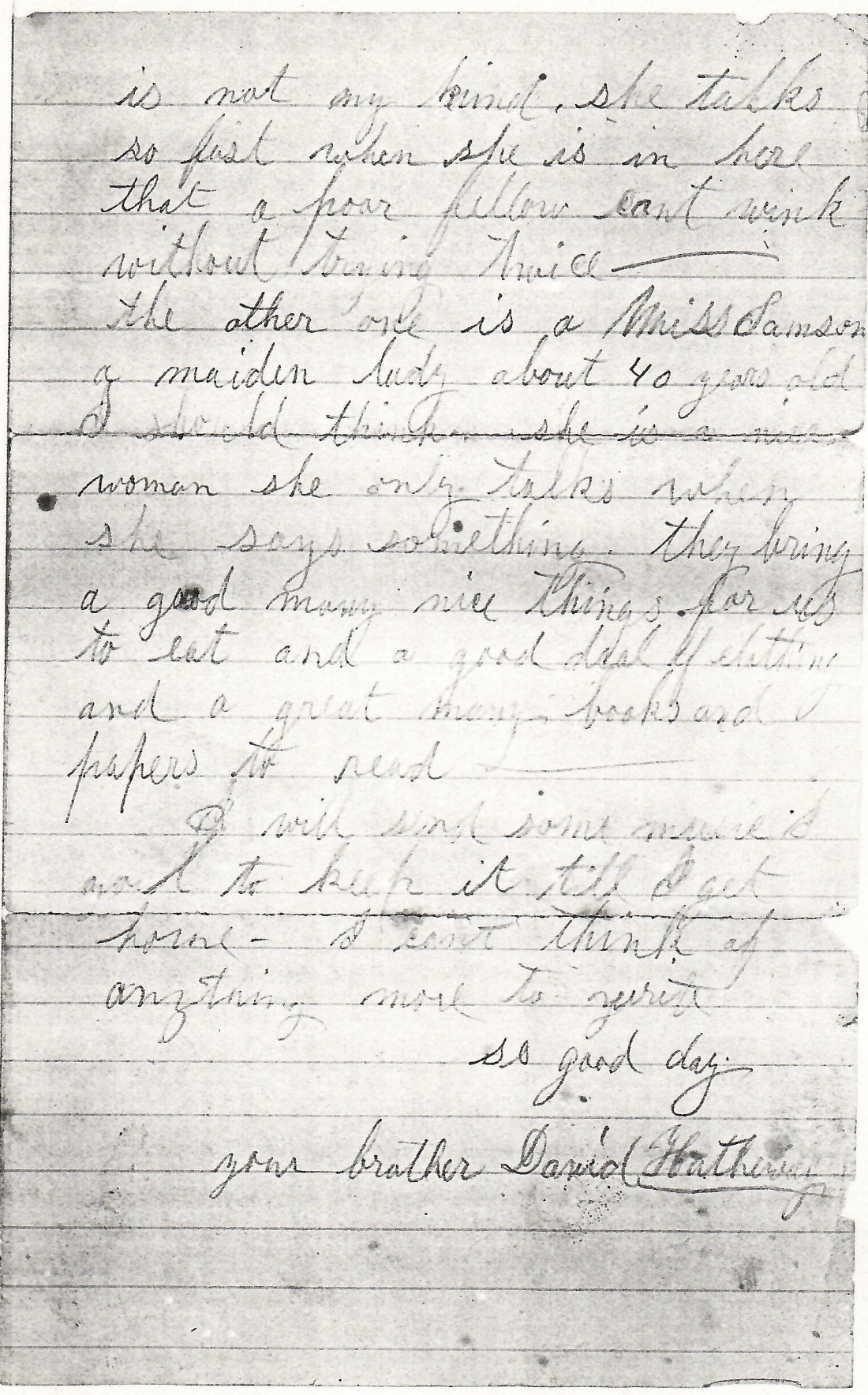
There is several women round the hospital here—two from Maine. One is Mrs. Simpson from Old Town. She is a widow. I don’t like her. She is not my kind. She talks so fast when she is in here that a poor fellow can’t wink without trying twice. The other one is a Miss Lamson [Samson?], a maiden lady about 40 years old I should think. She is a nice woman. She only talks when she says something. They bring a good many nice things for us to eat and a good deal of clothing and a great many books and papers to read. 1
I will send some music. I want [you] to keep it till I get home. I can’t think of anything more to write. So good day. Your brother, — David Hatheway [Hinds]
1 These ladies may have been sponsored by the Maine Soldiers’ Relief Association. One such lady was known to be Sarah Smith Sampson of Bath, Maine, who’s husband Charles served as a captain in the 3rd Maine Infantry. She spent four intensive weeks at Gettysburg nursing the wounded after the battle.
Letter 26
York, Pennsylvania Monday, July 20th [1863]
Dear Mother,
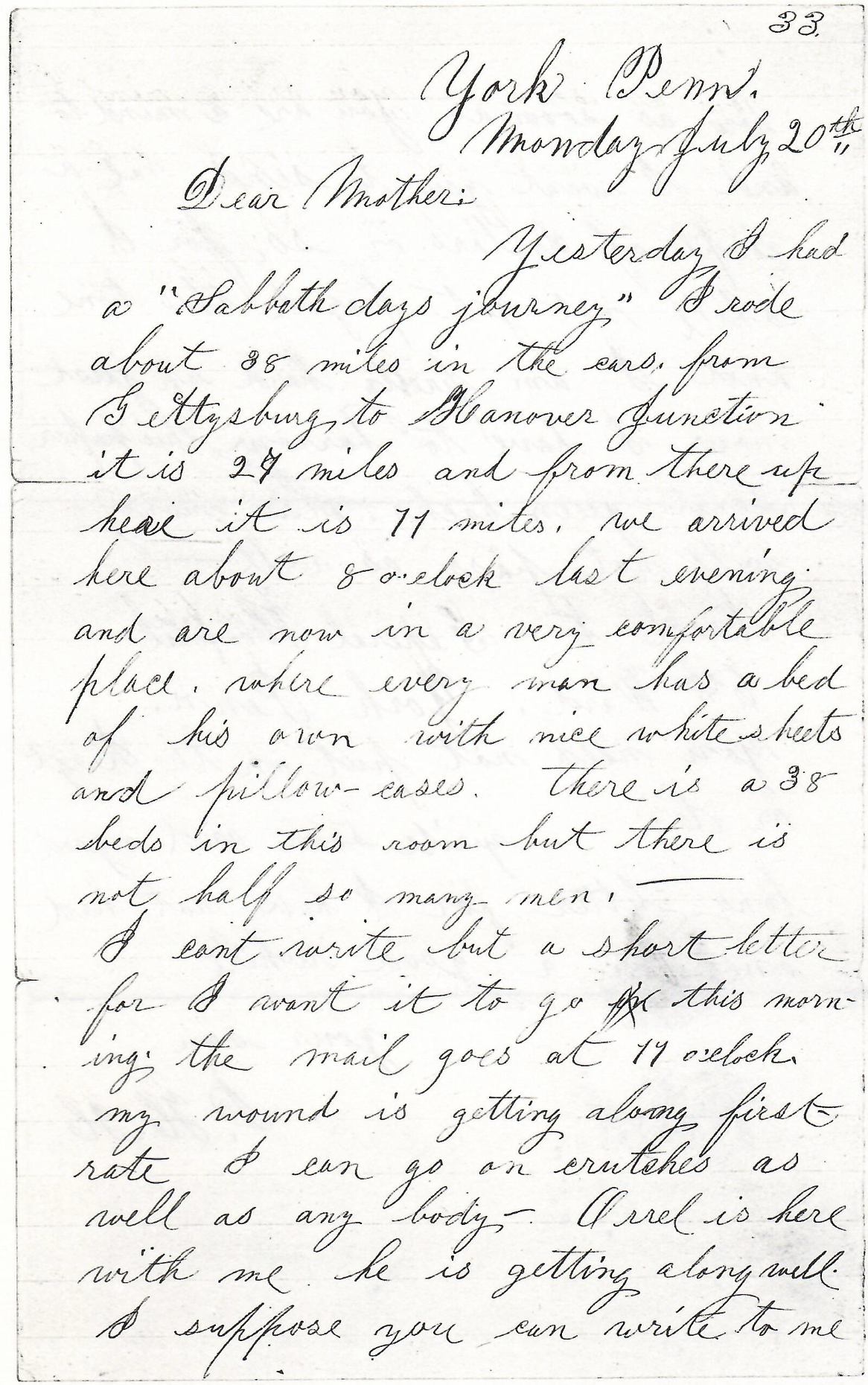
Yesterday I had a “Sabbath Day’s journey.” I rode about 38 miles in the cars from Gettysburg to Hanover Junction. It is 27 miles and from there up here it is 11 miles. We arrived here about 8 o’clock last evening and are now in a very comfortable place where ever man has a bed of his own with nice white sheets and pillow cases. There is 38 beds in this room but there is not half so many men.
I can’t write but a short letter for I want it to go this morning. The mail goes at 11 o’clock.
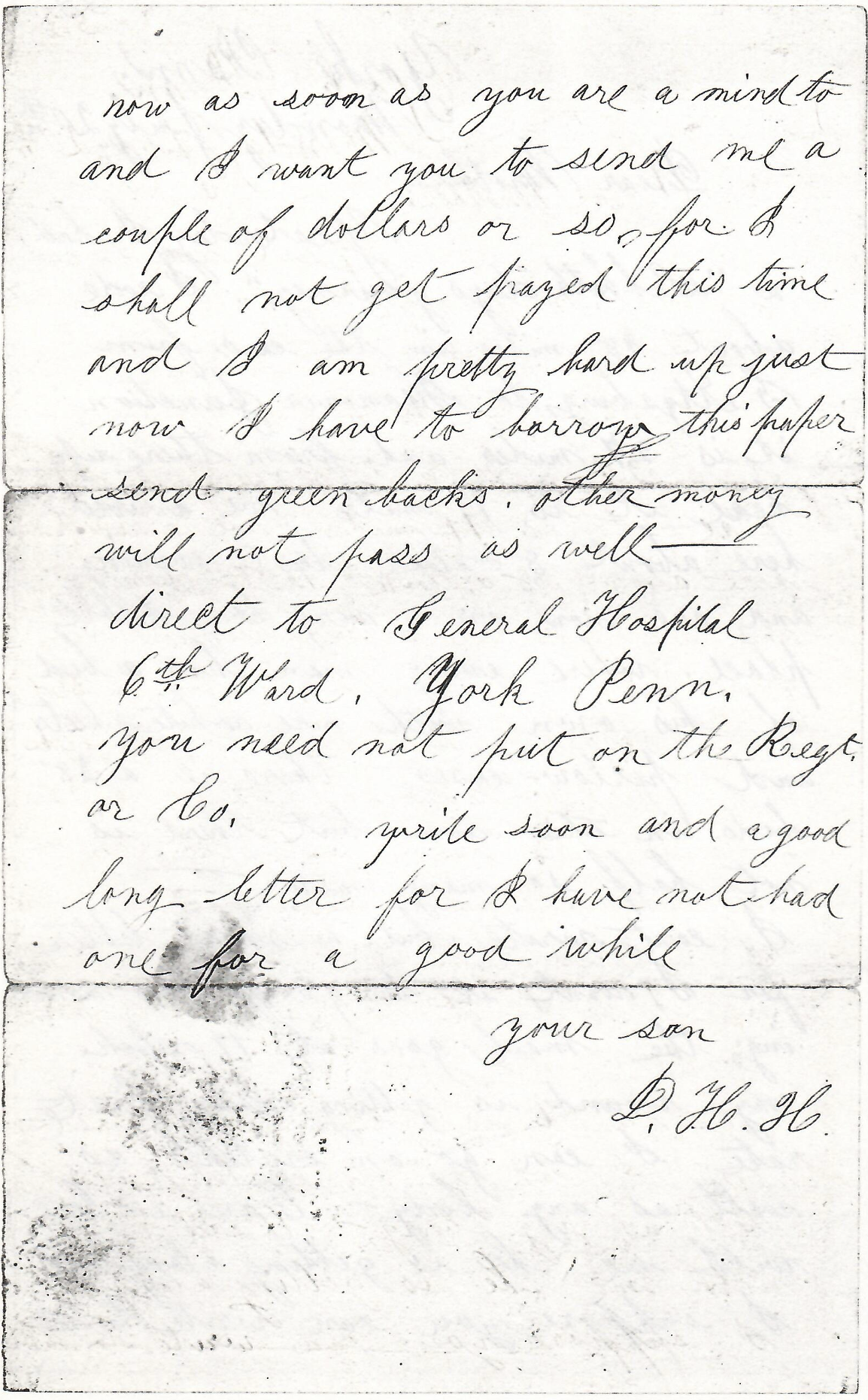
My wound is getting along first rate. I can go on crutches as well as anybody. Orrel [Orvel Brown] is here with me. He is getting along well. I suppose you can write to me now as soon as you are a mind to and I want you to send me a couple of dollars or so for I shall not get paid this time and I am pretty hard up just now. I have to borrow this paper. Send greenbacks. Other money will not pass as well. Direct to General Hospital, 6th Ward, York, Pennsylvania. 1 You need not put on the regiment and company. Write soon and a good long letter for I have not had one for a good while. Your son, — D. H. H.
1 The US General Hospital at York, Pennsylvania was described by Pvt. James Mills Smith of Co. G, 149th New York Infantry shortly after his arrival there at the same time as David. On 25 July 1863 he wrote: “Our hospital is simple, a piece of ground in the form of a square containing perhaps 20 acres & bounded on two sides by a double row of one story buildings & on the other 2 by a high & close board fence; & was originally designed & used for a camp ground & barracks for soldiers & consequently in accommodations & comfort is I suppose far inferior to most or all regular General Hospitals. The rooms are low and ill ventilated, there is not a tree or bush in the ground, & the number of seats outside the building is very small. When I first arrived here we had about 1150 patients & now we must have many more & consequently on many accounts we fare worse than we would with fewer patients, previous to the battle of Gettysburgh that number was 160. Fortunately for wounded men we have had cool cloudy weather most of the time since the battle. These is a Post Office & small soldiers library on the ground. In about the centre of our enclosure there is an open shed under which they have lately conveyed a few benches, & religious meetings are held there in the evenings & on Sundays. York contains about 8000 inhabitants & seems to have a fine agricultural country around it. Our hospital buildings are divided into wards & the wards into rooms: our room contains 40 patients, none them very badly wounded & most of them doing well; we have 3 nurses to take care of us & the room, & the Dr. comes around occasionally. Every man who is considered well enough can obtain a pass to go (out) into town once in 3 days, between the hours of 1 & 5 P.M. In other Hospitals I am told furloughs can be easily obtained & passes more easily frequented & for a longer time that here. Here they say it is useless to ask for a furlough, but I did not design to ask for one but would have much preferred to have gone to some Hospital in Philadelphia or New York.”
Letter 27
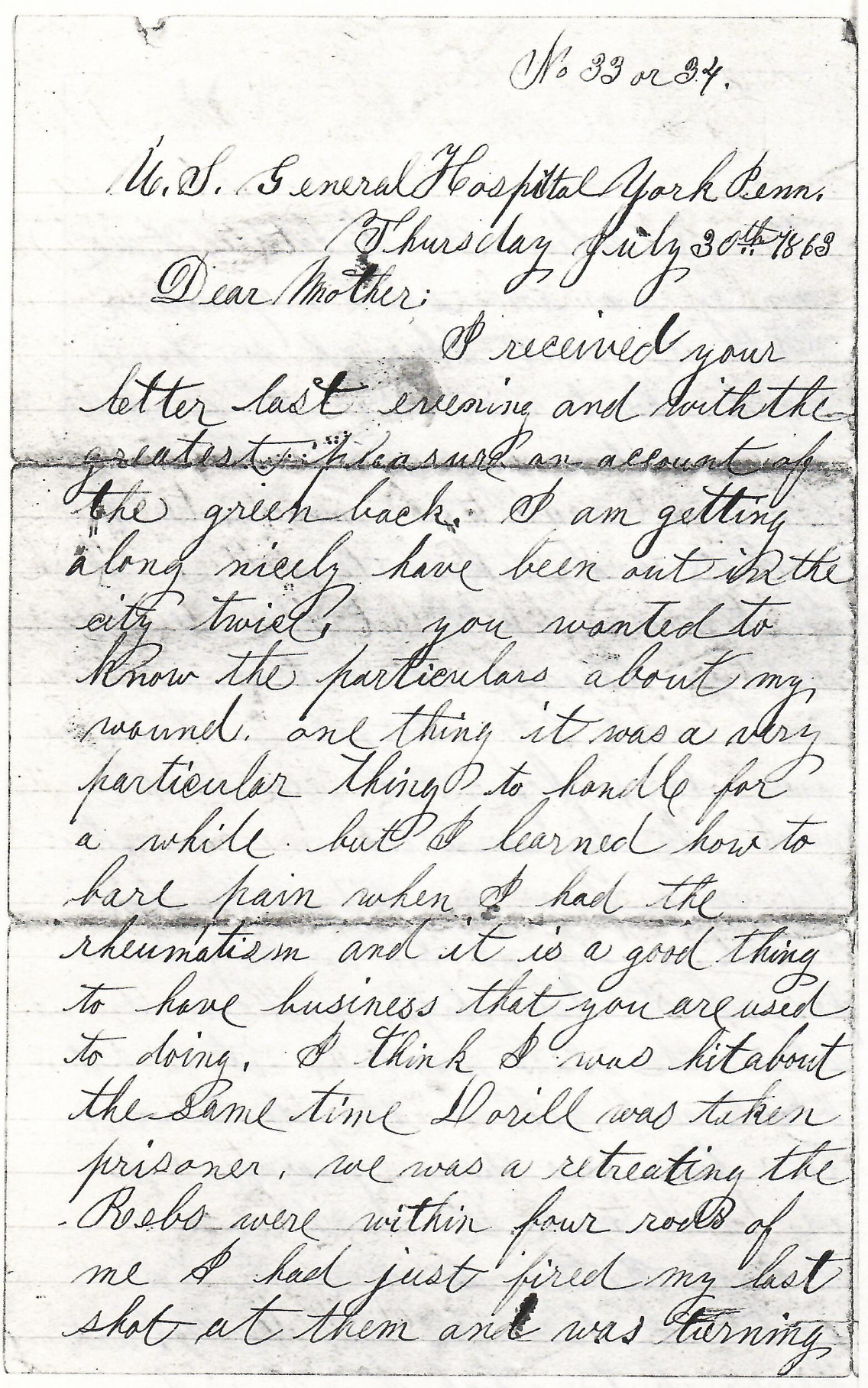
U. S. General Hospital York, Pennsylvania July 30th 1863
Dear Mother,
I received your letter last evening and with te greatest pleasure on account of the greenback. I am getting along nicely. Have been out in the city twice.
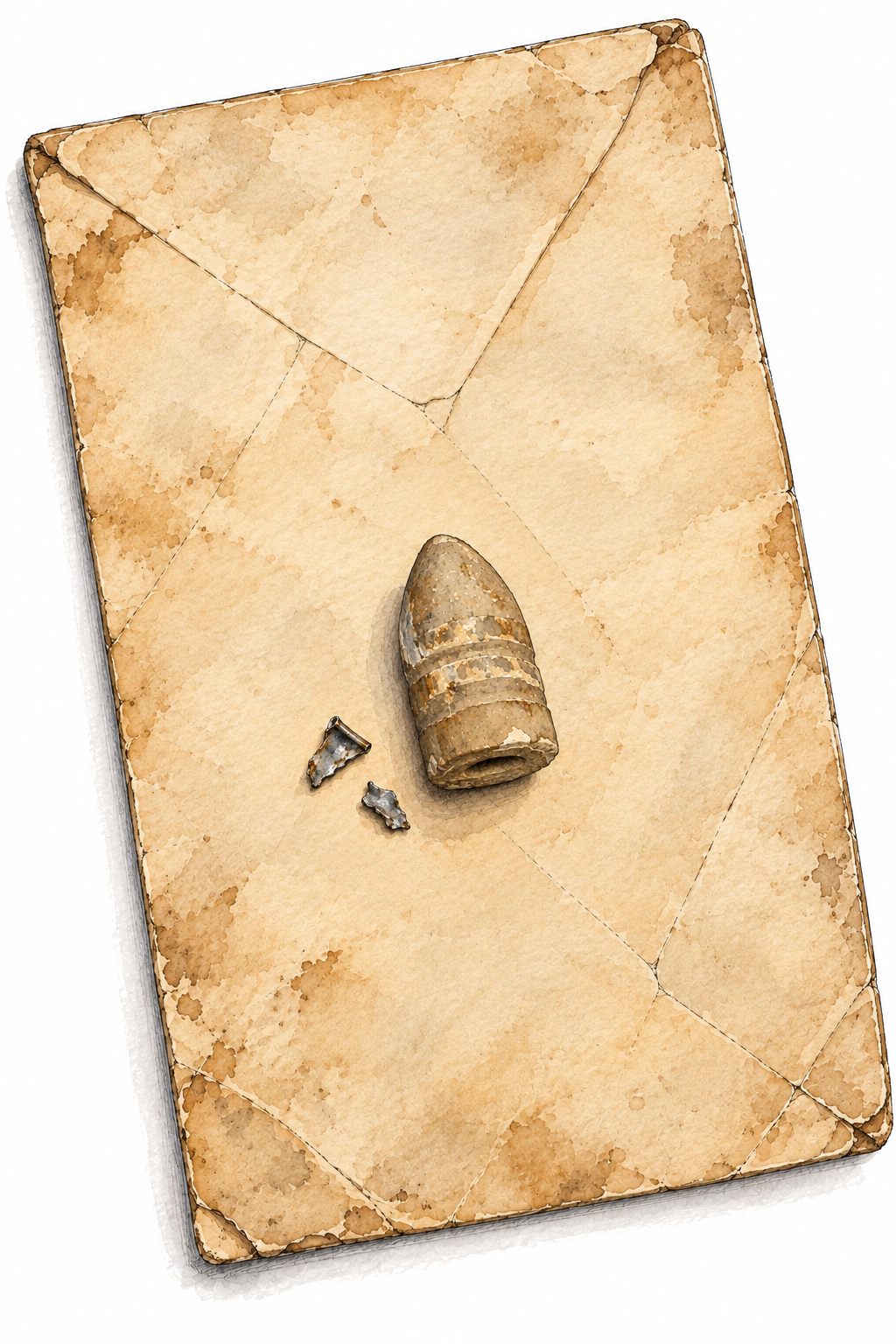
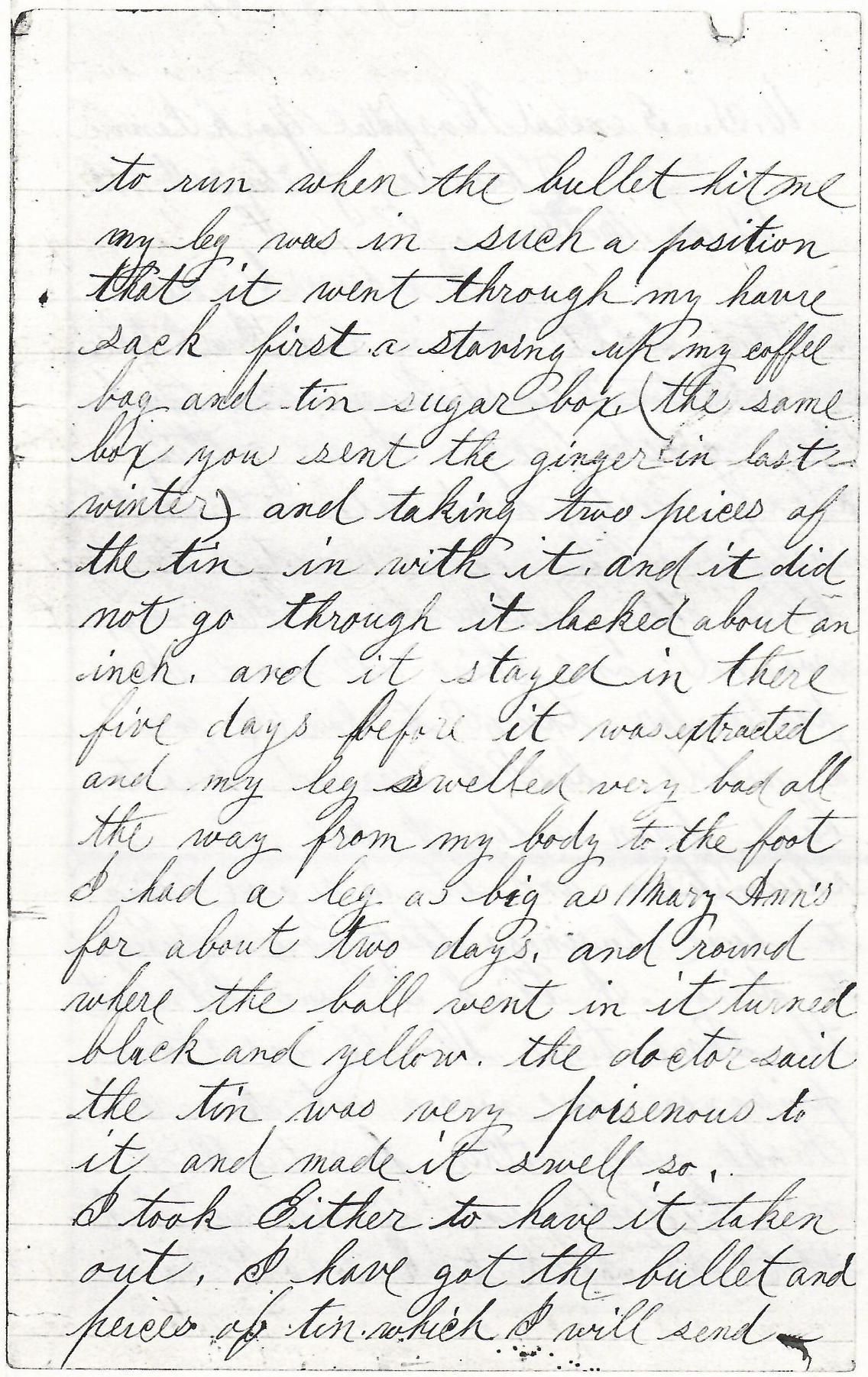
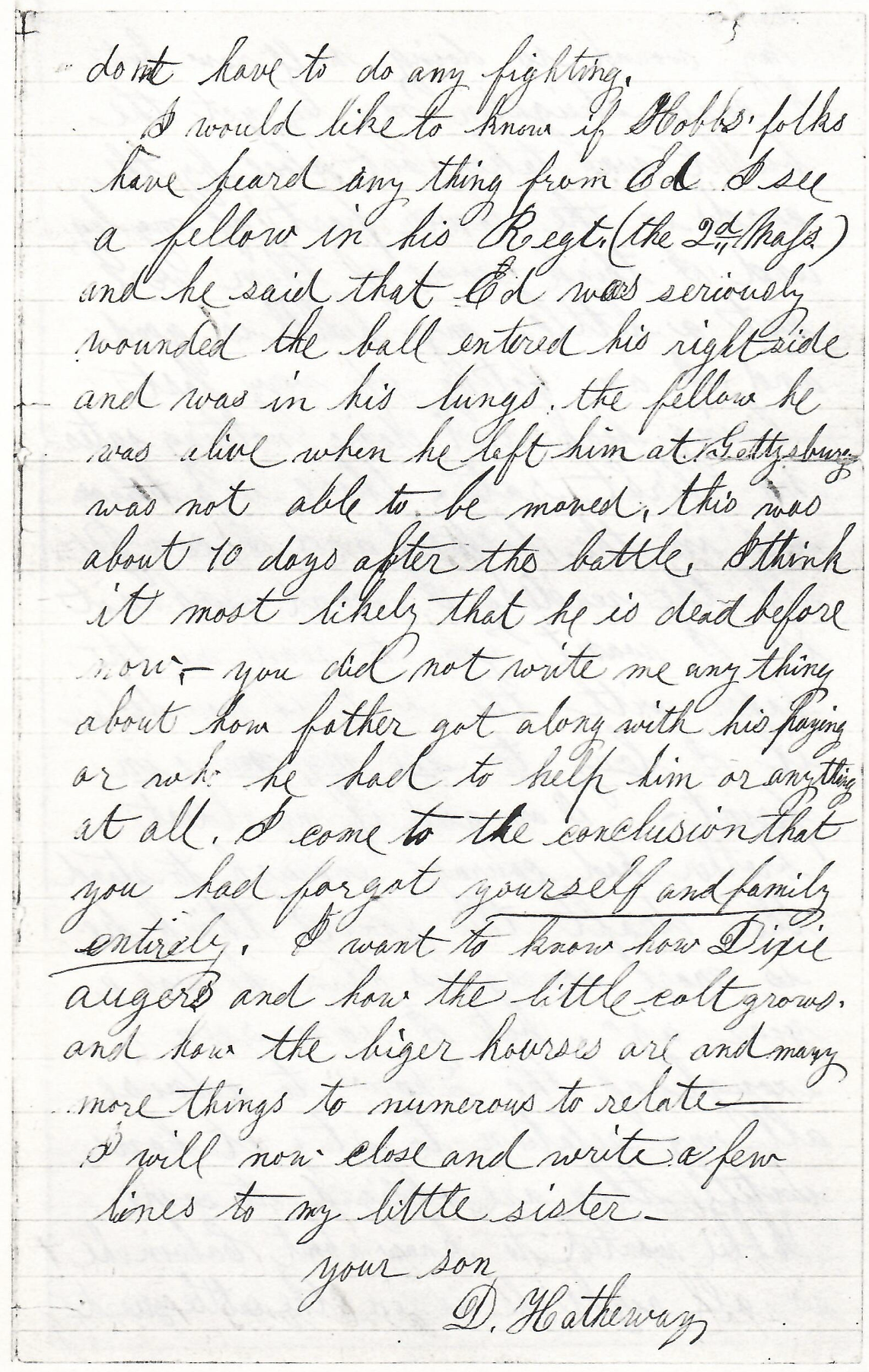
You wanted to know the particulars about my wound. One thing—it was a very particular thing to handle for awhile but I learned how to bear pain when I had the rheumatism and it is a good thing to have business that you are used to doing. I thin I was hit about the same time Dorill[us] was taken prisoner. We was a retreating. The rebs were within four rods [22 yards] of me. I had just fired my last shot at them and was turning to run when the bullet hit me. My leg was in such a position that it went through my haversack first, stoving up my coffee bag and tin sugar box (the same box you sent the ginger in last winter) and taking two pieces of tin in with it, and it did not go through—it lacked about an inch—and it stayed in there five days before it was extracted and my leg is swelled very bad all the way from my body to the foot. I had a leg as big as Mary Ann’s for about two days and round where the ball went in. It turned black and yellow. The doctor said the tin very poisonous to it and made it swell so.
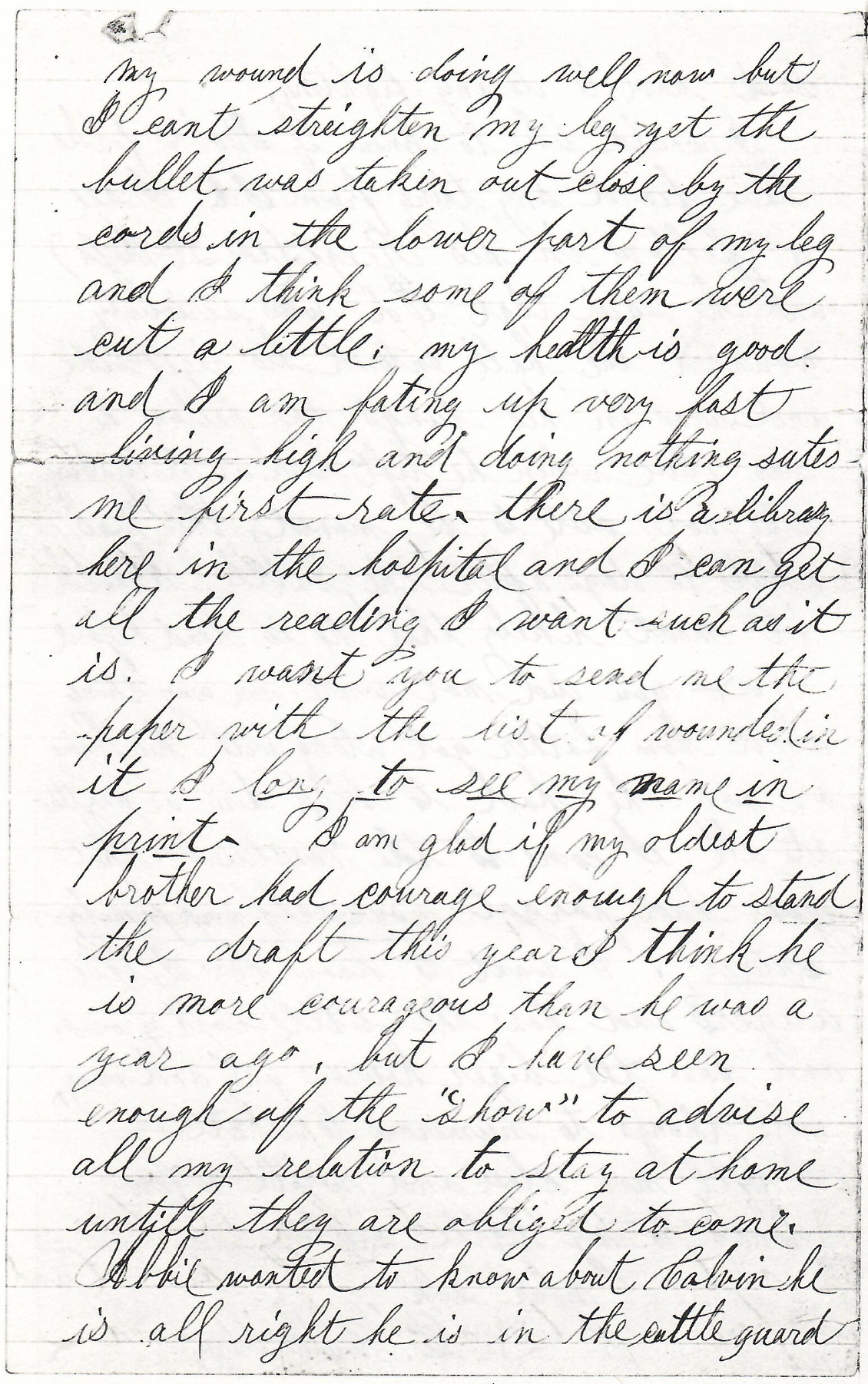
I took ether to have it taken out. I have got the bullet and pieces of tin which I will send [home]. My wound is doing well now but I can’t straighten my leg yet. The bullet was taken out close by the cords in the lower part of my leg and I think some of them were cut a little. My health is good and I am fatting up very fast, living high and doing nothing suits me first rate.
There is a library here in the hospital and I can get all the reading I want—such as it is. I want you to send me the paper with the list of wounded in it. I long to see my name in print. I am glad if my oldest brother had courage enough to stand the draft this year. I think he is more courageous than he was a year ago. But I have seen enough of the “show” to advise all my relation to stay at home until they are obliged to come.
Abbie wanted to know about Calvin [Beals]. He is all right. He is in the cattle guard [and] don’t have to do any fighting. I would like to know if Hobbs’ folks have heard anything from Ed. I see a fellow in his regiment (the 2nd Massachusetts) and he said that Ed was seriously wounded. The ball entered his right side and was in his lungs. The fellow [said] he was alive when he left him at Gettysburg [but] was not able to be moved. This was about ten days after the battle. I think it most likely that he is dead before now.
you did not write me anything about how father got along with his haying or who he had to help him or anything at all. I came to the conclusion that you had forgot yourself and family entirely. I want to know how Dixie augurs and how the little colt grows and how the bigger horses are and many more things too numerous to relate.
I will now close and write a few lines to my little sister. Your son, — D. Hatheway
Letter 28
York, Pennsylvania Thursday, August 6th 1863
Dear Mother,
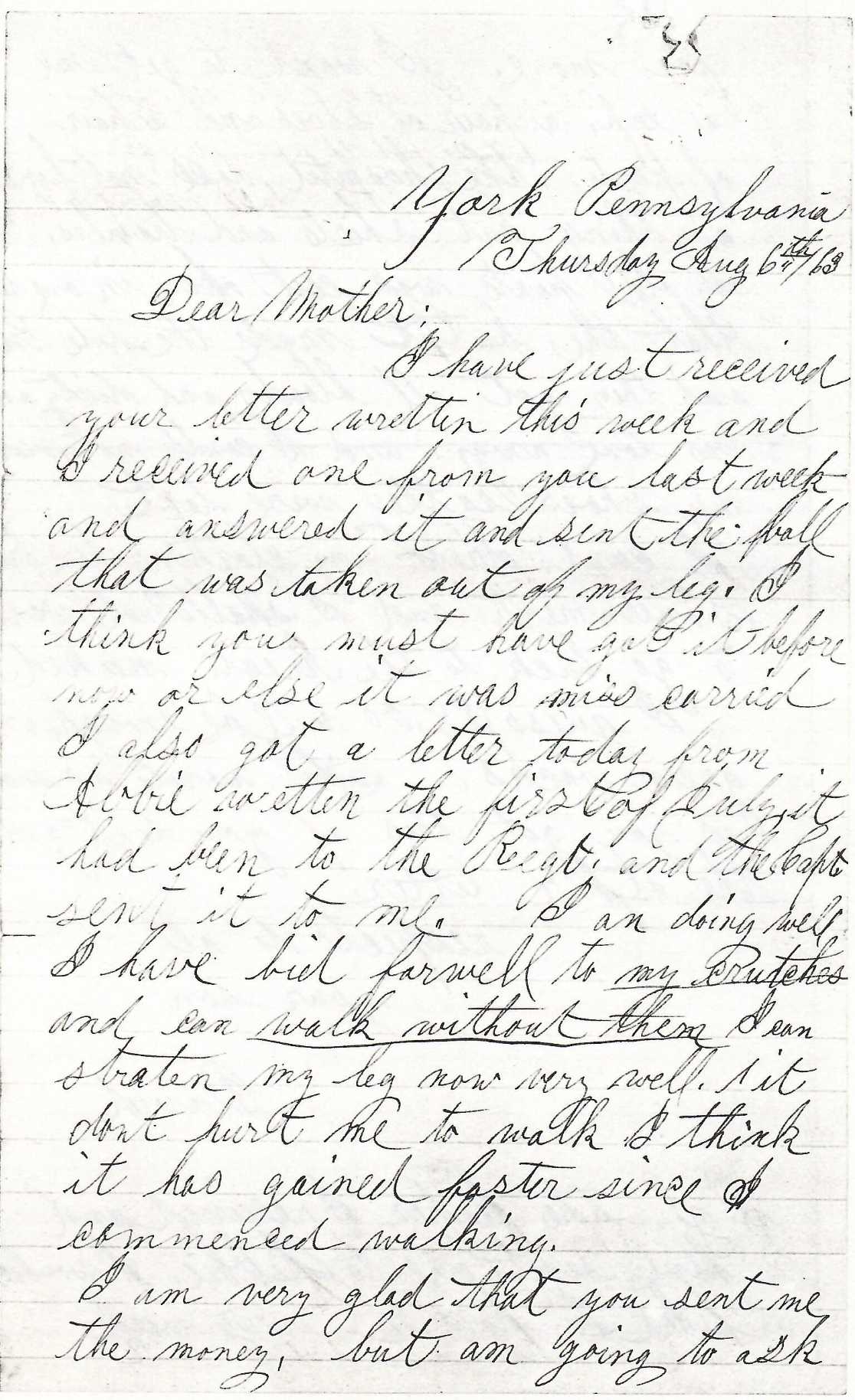
I have just received your letter written this week and I received one from you last week and answered it and sent the ball that was taken out of my leg. I think you must have got it before now or else it was miss carried. I also got a letter today from Abbie written the 1st of July. It had been sent to the regiment and the Captain sent it to me.
I am doing well. I have bid farewell to my crutches and can walk without them. I can straighten my leg now very well. It don’t hurt me to walk. I thin kit has gained faster since I commenced walking.
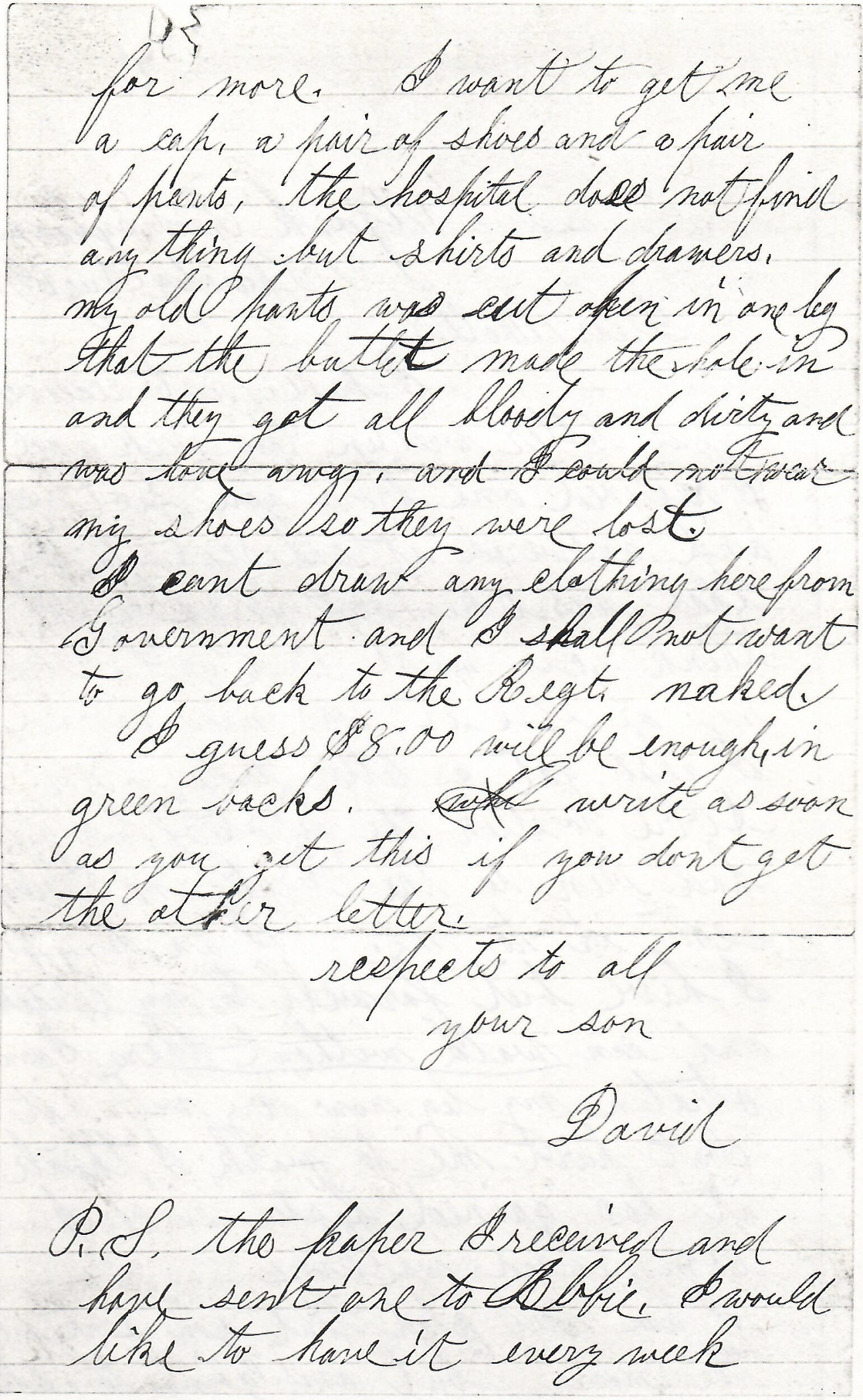
I am very glad that you sent me the money but am going to ask for more. I want to get me a cap, a pair of shoes, and a pair of pants. The hospital does not find anything but shirts and drawers. My old pants was cut open in one leg that the bullet made the hole in and they got all bloody and dirty and was thrown away and I could not wear my shoes so they were lost.
I can’t draw any clothing here from the government and I shall not want to go back to the regiment naked. I guess $8 will be enough in greenbacks. Write as soon as you get this if you don’t get the other letter. Respects to all. Your son, — David
P. S. The paper I received and have sent are to Abbie. I would like to have it every week.
Letter 29
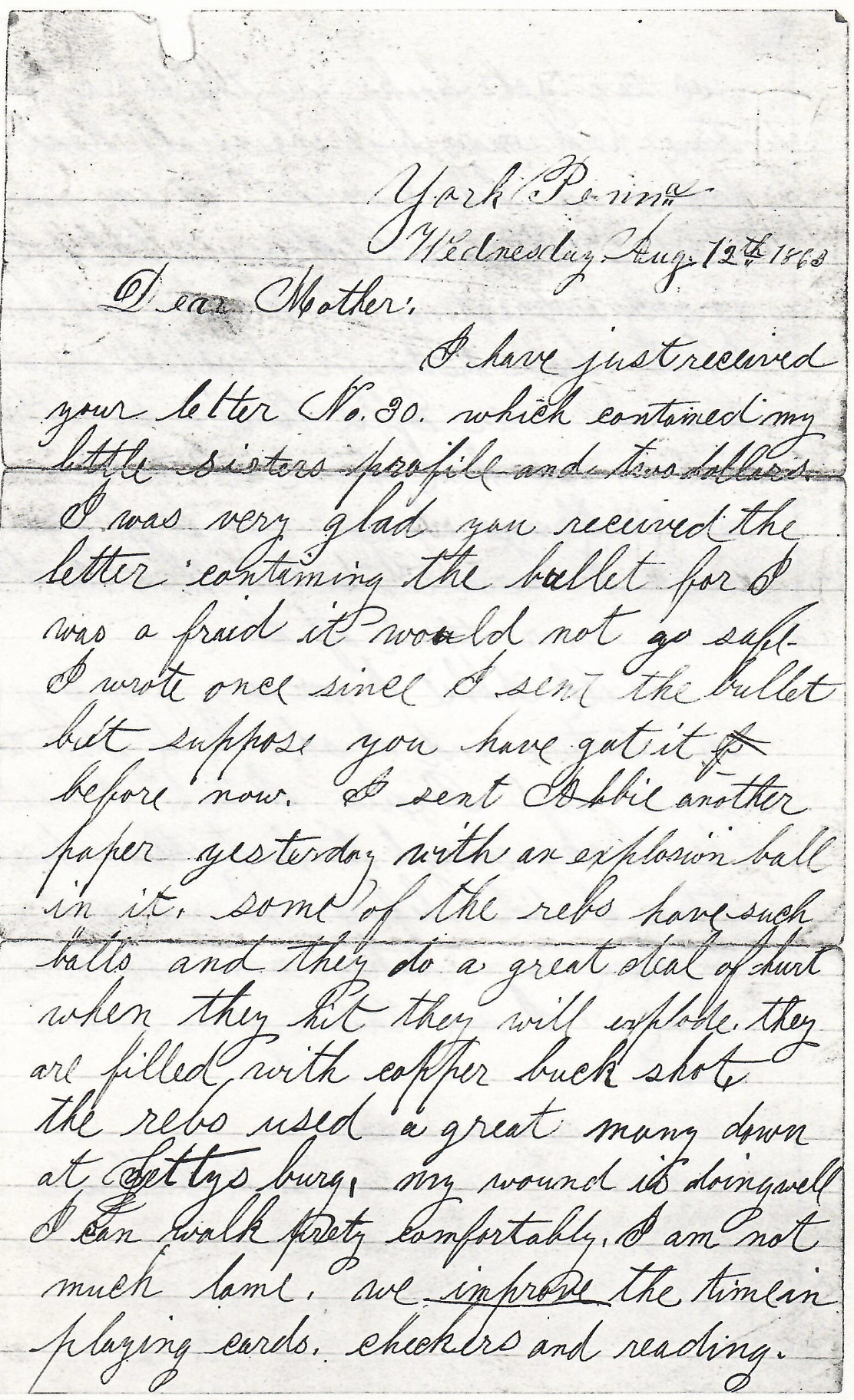
York, Pennsylvania Wednesday, August 12th 1863
Dear Mother,
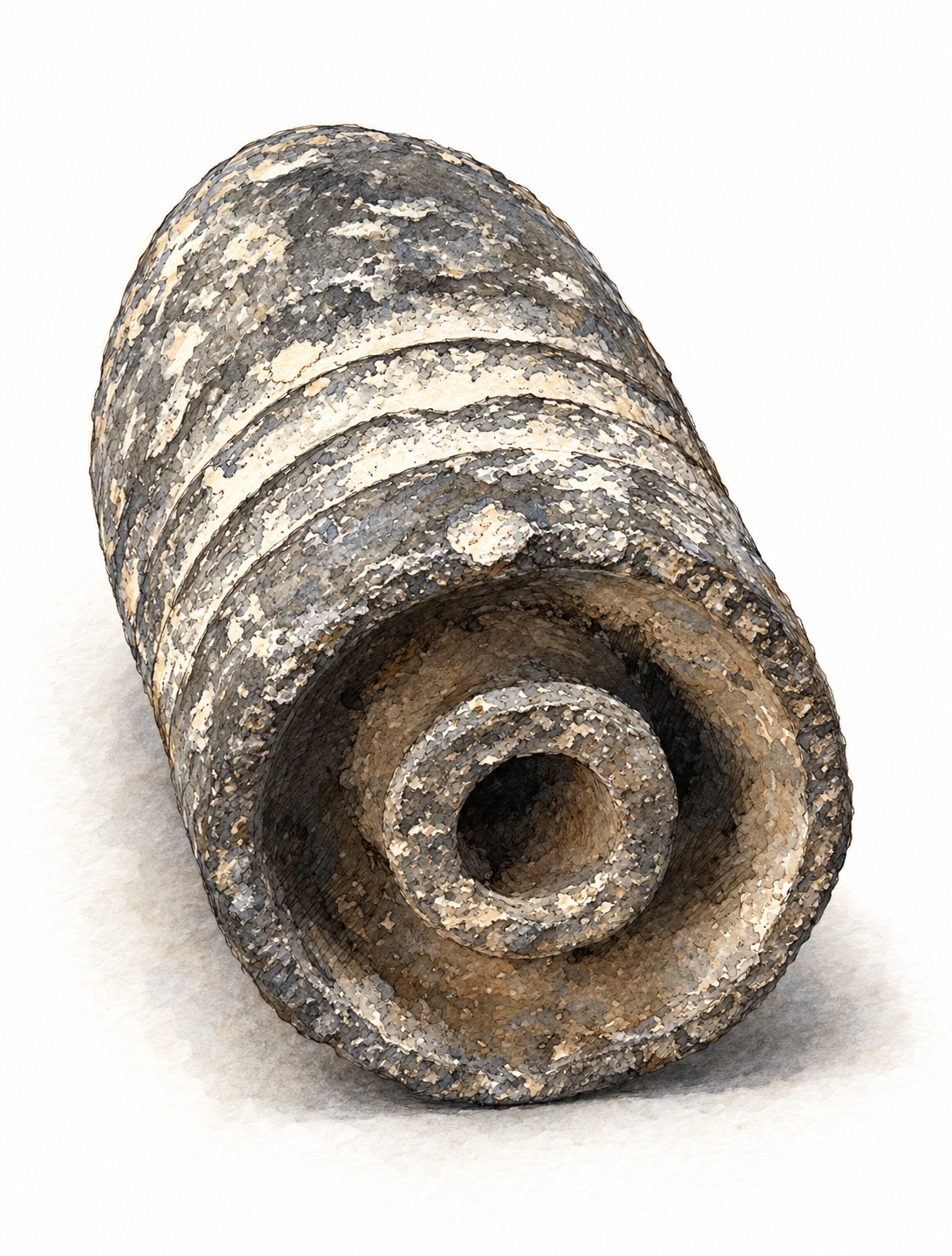
An explosion bullet found on Culp’s Hill.
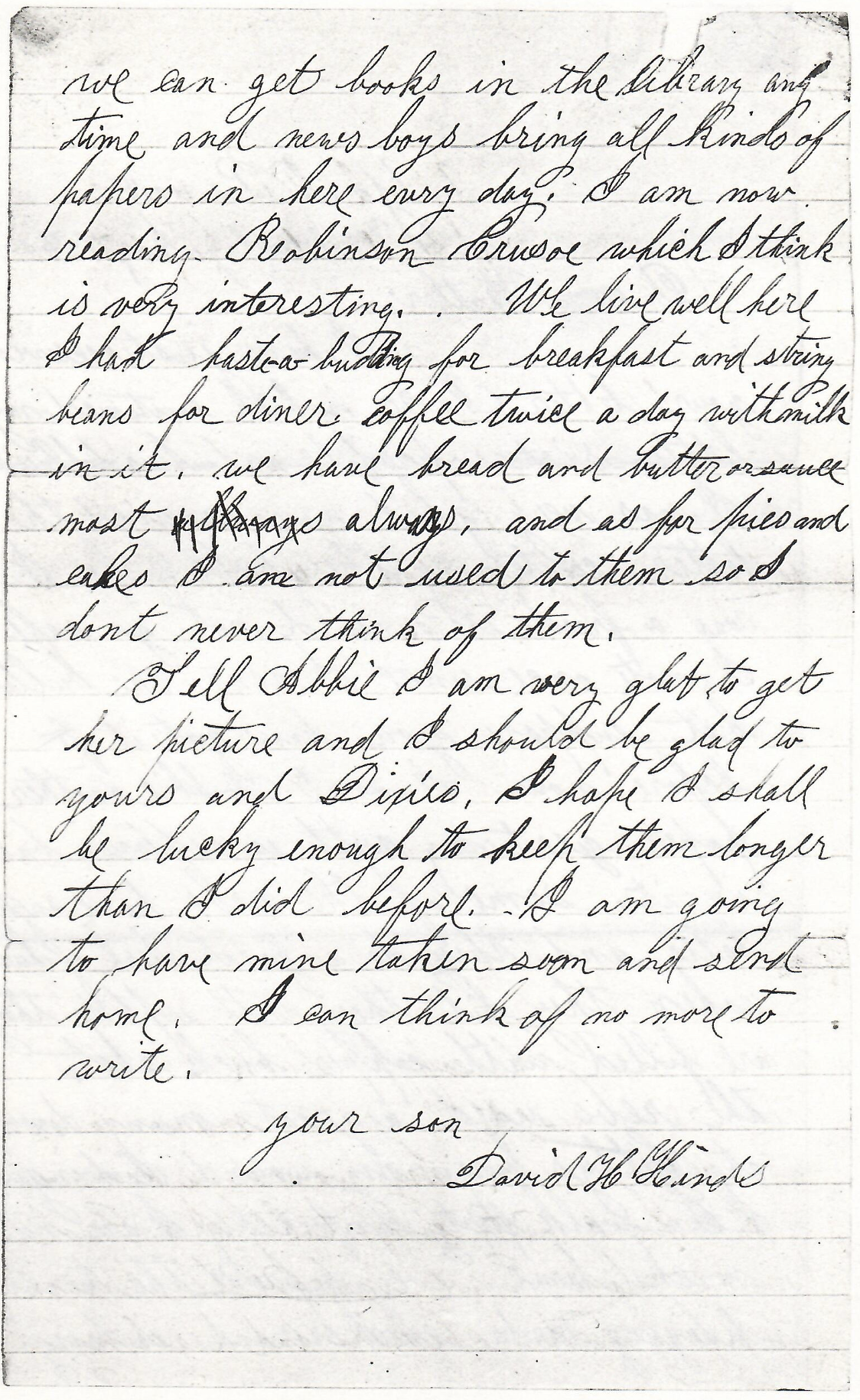
I have just received your letter No. 30 which contained my little sister’s profile and two dollars. I was very glad you received the letter containing the bullet for I was afraid it would not go safe. I wrote once since I sent the bullet but suppose you have got it before now. I sent Abbie another paper yesterday with an explosion ball in it. Some of the rebs have such balls and they do a great deal of hurt. When they hit, they will explode. They are filled with copper buck shot. The Rebs used a great many down at Gettysburg. 1
My wound is doing well. I can walk pretty comfortably. I am not much lame. We improve the time in playing cards and checkers and reading. We can get books in the library any time and newsboys bring all kinds of papers in here every day. I am now reading Robinson Crusoe which I think is very interesting.
We live well here. I had hasty pudding for breakfast and string beans for dinner. Coffee twice a day with milk in it. We have bread and butter or sauce most always and as for pies and cakes, I am not used to them so I don’t never think of them.
Tell Abbie I am very glad to get her picture and I should be glad to get yours and Dixies. I hope I shall be lucky enough to keep them longer than I did before. I am going to have mine taken soon and sent home. I can think of no more to write. Your son, — David H. Hinds
1 The “explosion ball” David refers to was probably the .58 caliber Gardiner Explosive Bullet. It combined a unique design featuring a powder-filled copper chamber inside a pewter or lead shell. When fired, a fuse at the base of the bullet would ignite, detonating the inner copper vessel a few seconds later to spray deadly fragments.
Letter 30
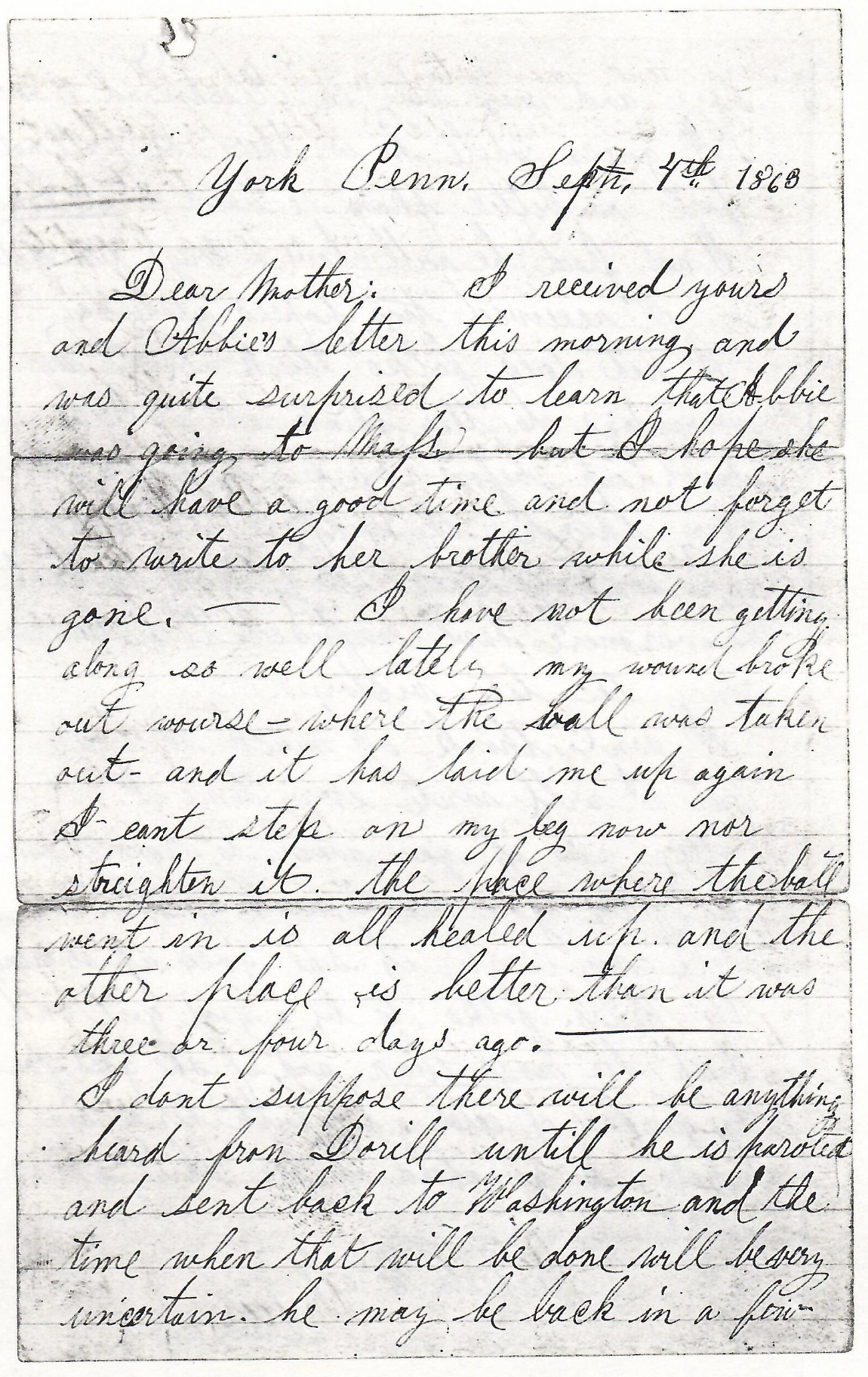
York, Pennsylvania September 4th 1863
Dear Mother,
I received yours and Abbie’s letter this morning and was quite surprised to learn that Abbie was going to Massachusetts but I hope she will have a good time and not forget to write to her brother while she is gone.
I have not been getting along so well lately. My wound broke out worse where the ball was taken out and it has laid me up again. I can’t step on my leg now nor straighten it. The place where the ball went in is all healed up and the other place is better than it was three or four days ago.
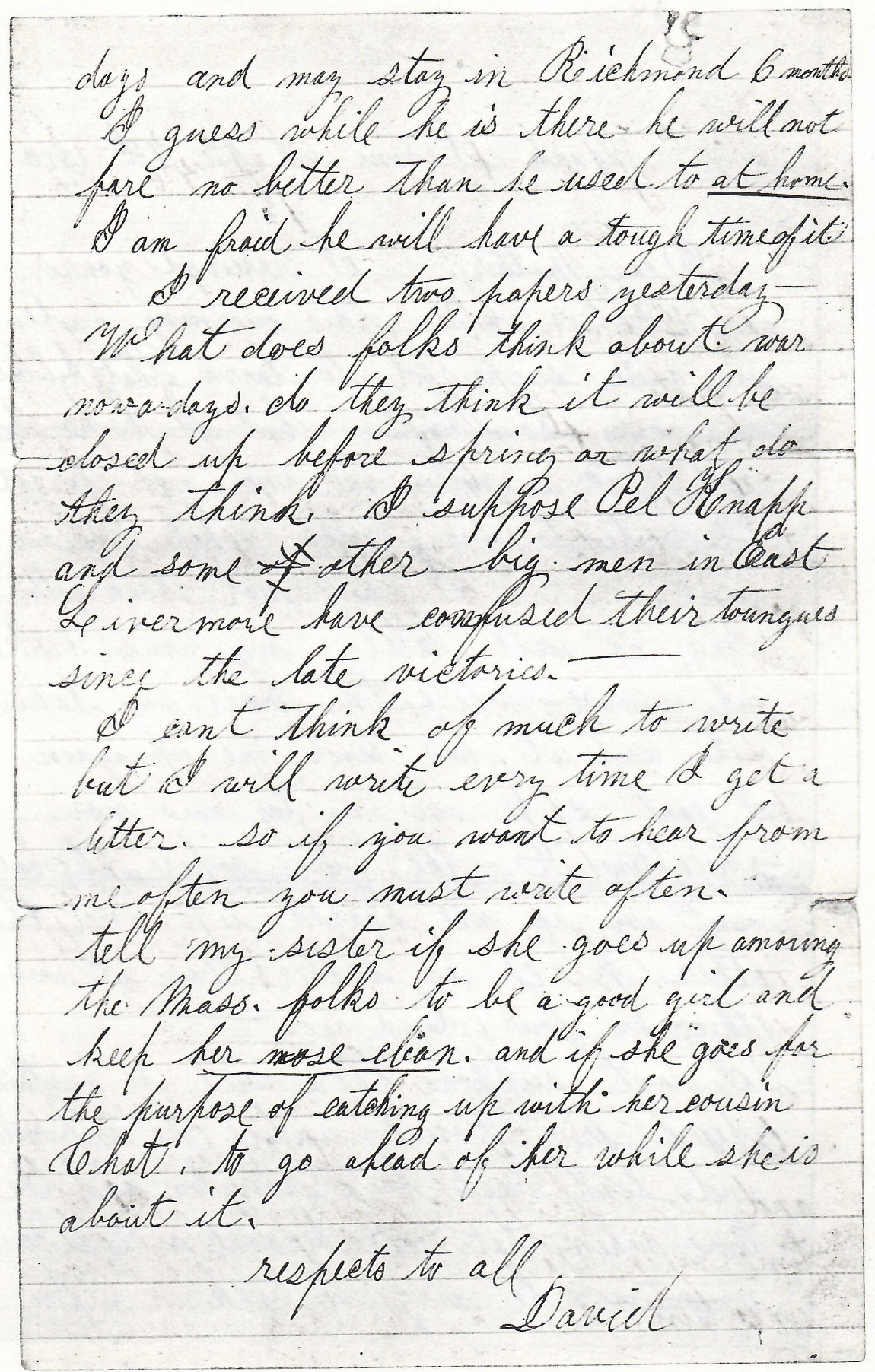
I don’t suppose there will be anything heard from Dorill[us] until he is paroled and sent back to Washington and the time when that will be done will be very uncertain. He may be back in a few days and may stay in Richmond 6 months. I guess while he is there he will not fare better than he used to at home. I am afraid he will have a tough time of it.
I received two papers yesterday. What does folks think about war now-a-days? Do they think it will be closed up before spring or what do they think? I suppose Pel Knapp and some other big men in East Livermore have confused their tongues since the late victories.
I can’ think of much to write but I will write every time I get a letter. So if you want to hear from me oftener, you must write often. Tell my sister if she goes up among the Massachusetts folks, to be a good girl and keep her nose clean and if she goes for the purpose of catching up with her cousin Chat, to go ahead of her while she is about it. Respects to all, — David
Letter 31
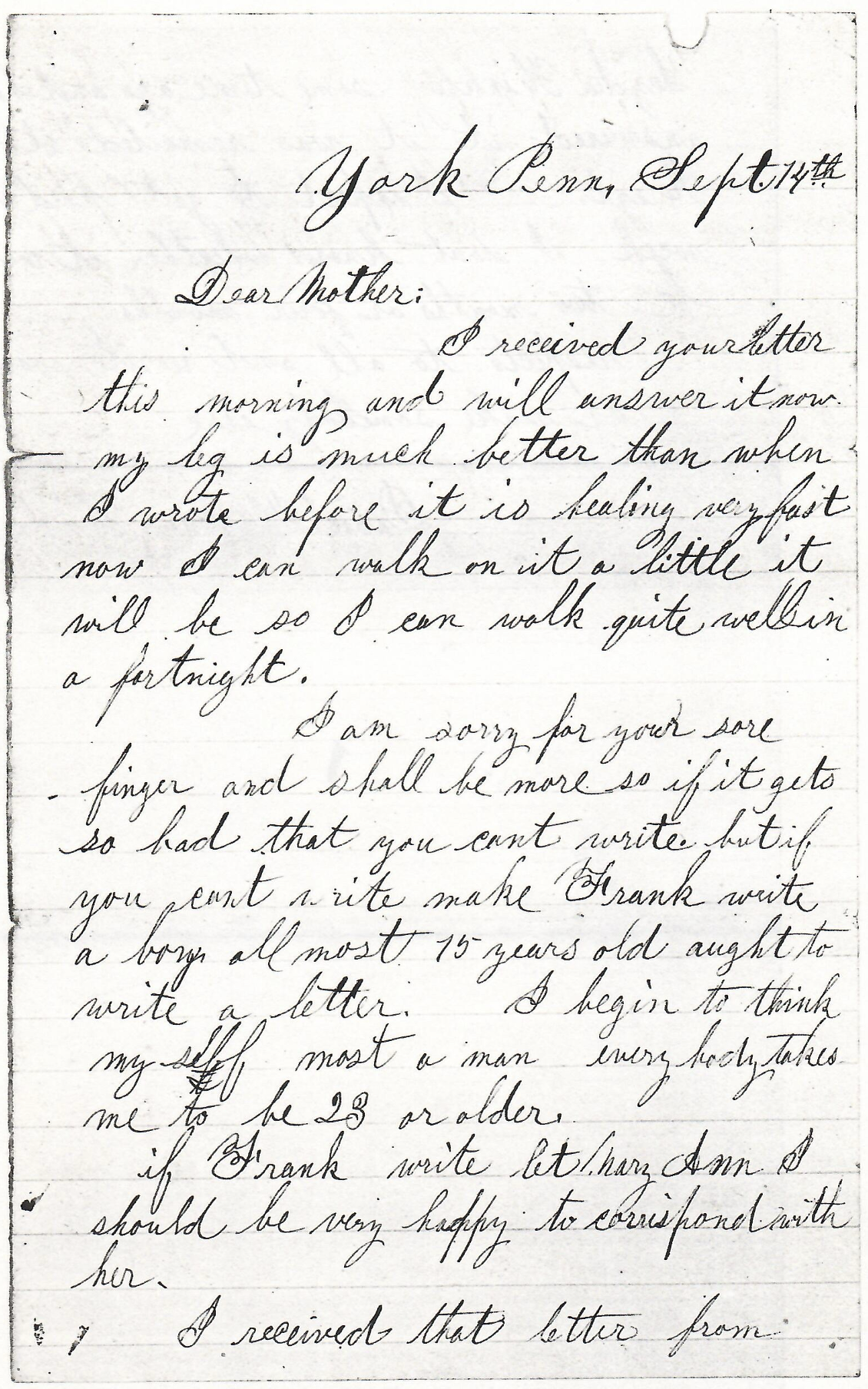
York, Pennsylvania September 14, [1863]
Dear Mother,
I received your letter this morning and will answer it now. My leg is much better than when I wrote before. It is healing very fast now. I can walk on it a little. It will be so I can walk quite well in a fortnight.
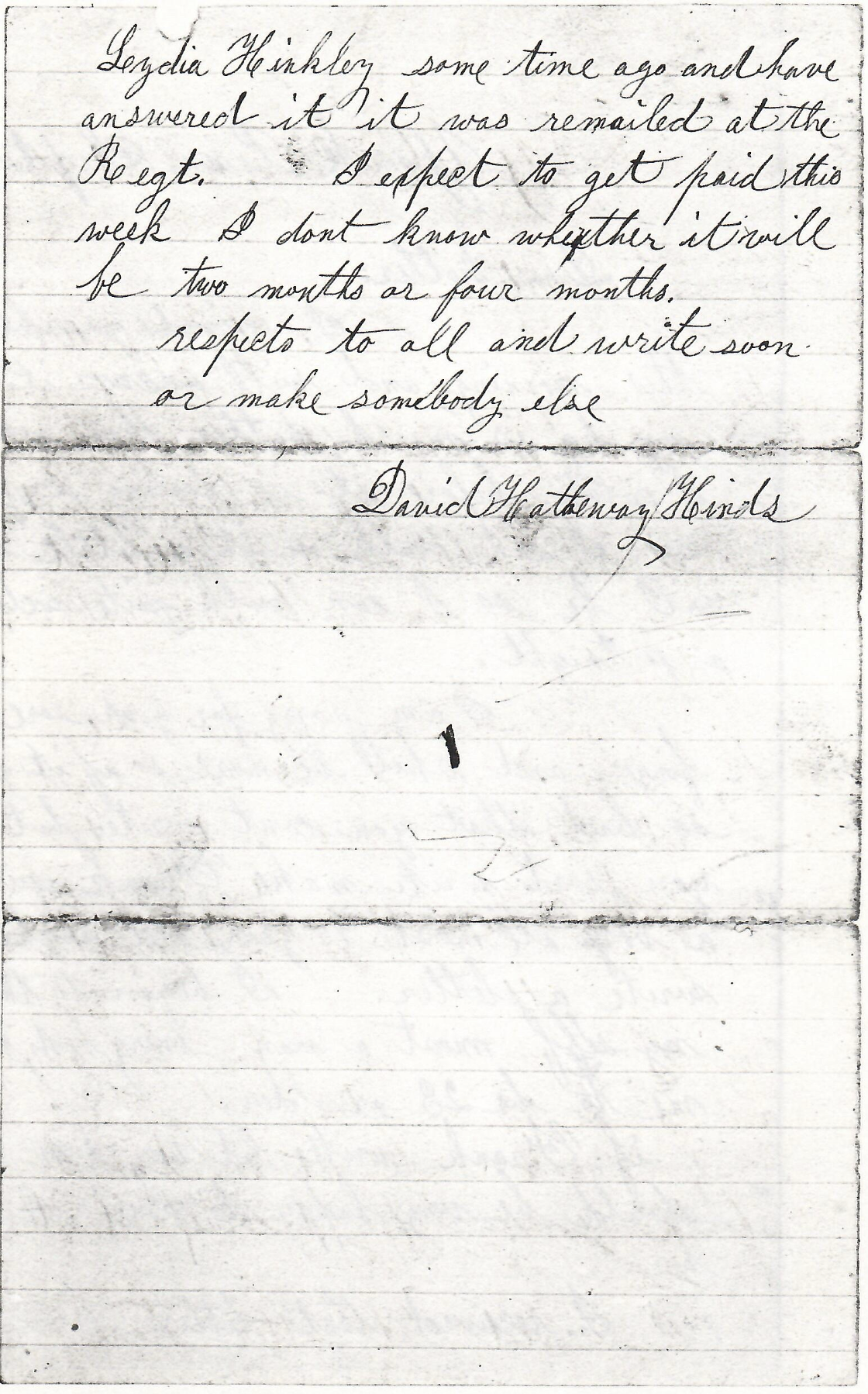
I am sorry for your sore finger and shall be more so if it gets so bad that you can’t write. But if you can’t write, make Frank write. A boy most 15 years old ought to write a letter. I begin to think myself most a man, Everybody takes me to be 23 or older. If Frank [won’t] write, let Mary Ann. I should be very happy to correspond with her.
I received that letter from Lydia Hinkley some time ago and have answered it. It was remailed at the regiment. I expect to get paid this week. I don’t know whether it will be two months or four months. Respects to all and write soon or make somebody else. — David Hatheway Hinds
Letter 32
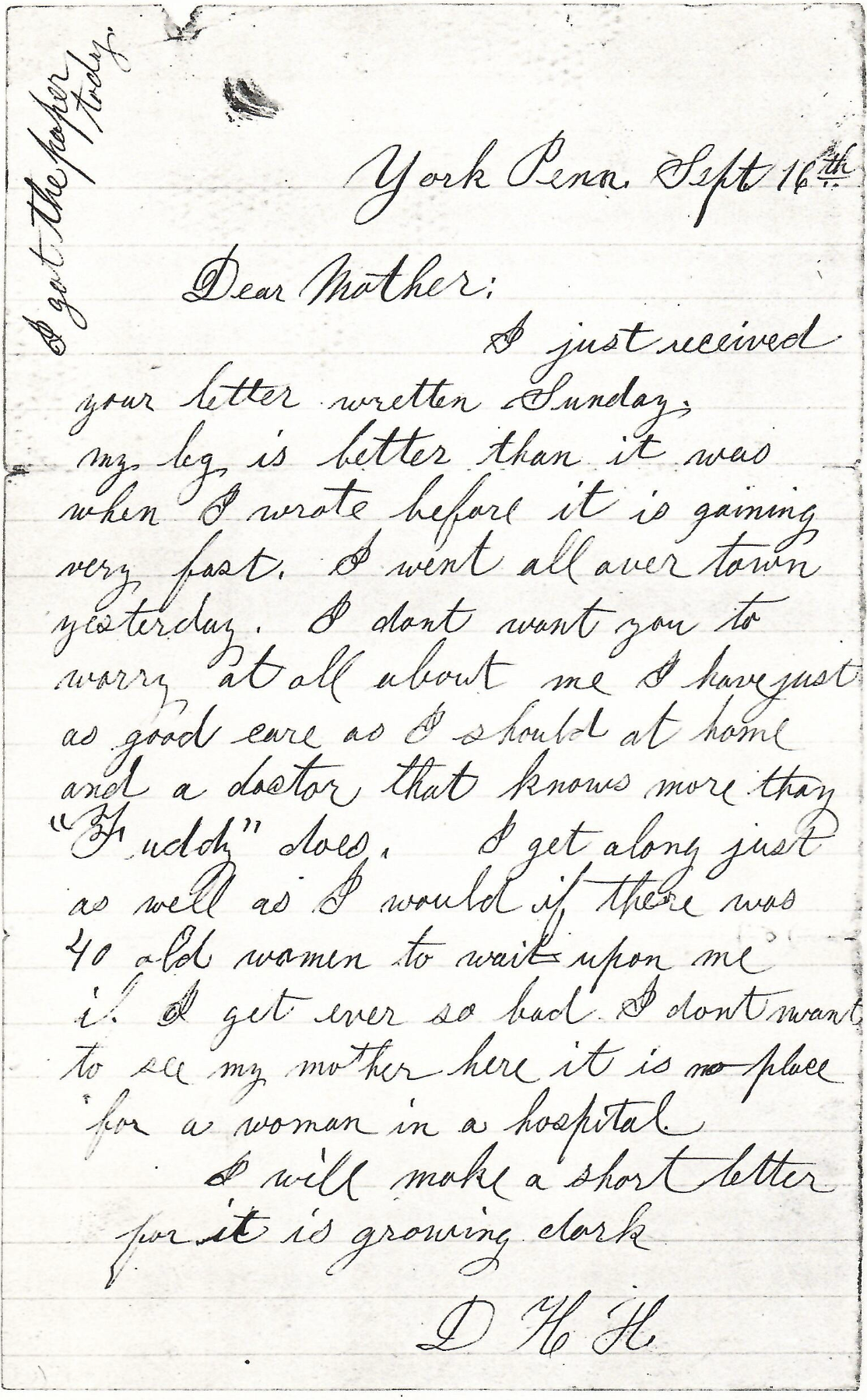
York, Pennsylvania September 16, [1863]
Dear Mother,
I just received your letter written Sunday. My leg is better than it was when I wrote before. It is gaining very fast. I went all over town yesterday. I don’t want you to worry at all about me. I have just as good care as i should at home and a doctor that knows more than “Fuddy” does. I get along as well as I would if there was a 40 year-old woman to wait upon me. If I get ever so bad, I don’t want to see my mother here. It is no place for a woman in a hospital.
I will make a short letter for it is growing dark. — D. H. H.
I got the paper today.
Letter 33
York, Pennsylvania September 21, 1863
Dear Mother,
I just received your letter of the 18th. I am glad to hear from you often but am afraid you worry too much, You wish me to write just as I am and I will. I have always done so ever since I was wounded. One hole in my leg has been all healed up about three weeks. The other hole heals slowly but I have got so I walk without crutches. I am in good health. My health has been good ever since I been here. I weigh 170 pounds.
I don’t think there is any prospect of getting a furlough. Your writing to the Surgeon in charge won’t help the matter any. There is no furlough given to men in hospitals now, ordered by the Secretary of War.
I got a letter from you last Wednesday and answered it. I don’t want you to think of coming to me or sending anyone. You would do me no good if you were here. I have been away from home a year and ought to know how to take care of myself.
I was very glad to get Dick’s picture. I am going to get mine taken as soon as I get paid. Has father weaned the cold yet. Does he have one to help cut corn? There was a hard frost here last night—as hard as I ever saw in Maine at this time of the year.
I will write as often as I receive a letter. — David H. Hinds
Letter 34
York, Pennsylvania September 24 [1863]
Brother Vill,
I received your letter this morning [and] was very glad to hear from you again. My leg is much better now. I can walk without crutches. I think it will soon heal.
Night before last I was out in the city to hear a Republican speech. The speakers were Col. [Frederick] Montgomery—a southerner who formerly was the editor of the Vicksburg Whig, 1 and [also] the Right Honorable Mr. Chase from New York. And last night there was a Democratic speech and the soldiers went down to hear him. I don’t know know who the speaker was but he talked so much Copperheadism that he was interrupted and would have been cleaned out if he had not left the stage very suddenly. 2
It has been pretty cold here lately. Two or three hard frosts. I think it was as cold as I ever knew it in Maine so early in the year.
Do you think of stopping where you are all winter or are you going home? I think there is a fair prospect of my staying with Uncle Sam six months longer at the least. You spoke about getting discharged. I don’t think I could possibly do it when I get well. I shall be all right and they don’t discharge a wounded soldier without giving a pension and I am not crippled for life.
I can’t think of much to write this time. Write soon. — Dave
1 Col. Frederick Montgomery, unlike many of his peers in Mississippi, “strongly opposed secession and maintained a fierce allegiance to the Union. Because of his outspoken views, he was proscribed and essentially forced into exile by Confederate authorities. Around 1862, he was permitted or managed to escape into Union lines. Northern newspapers at the time famously compared his release to that of Parson Brownlow (the pro-Union editor of the Knoxville Whig). Throughout 1863 and 1864, Col. Montgomery toured the North—including Illinois, Wisconsin, Ohio, and New York—giving highly popular lectures under the auspices of the Union League. He spoke eloquently about the internal realities of the rebellion, his personal acquaintance with Jefferson Davis, and the harsh treatment of Southern Unionists. Newspapers described him as an incredibly witty, sarcastic, and powerful orator who could move crowds from tears to roaring laughter.” [Source: https://museum.dmna.ny.gov/unit-history/conflict/us-civil-war-1861-1865/counties-state-new-york-during-war-rebellion/erie-county-new-york-civil-war/erie-county-new-york-civil-war-newspapers-draft-and-conscription]
2 Pennsylvania was in the midst of fiercely contested gubernatorial election at the time of this letter. Incumbent Governor Andrew Curtin faced the Democratic challenger George Washington Woodward. York county leaned heavily Democratic and most of the locals opposed Lincoln’s wartime policies, particularly emancipation and conscription.Citizens from York county even passed a resolution condemning the Lincoln Administration: “Resolved: — That Abraham Lincoln, President of the United States, has perverted this government, from the constitutional one heretofore established and administered, into a military despotism as absolute and oppressive as that of the Czar of Russia. He has, by military violence, overthrown the government of Sovereign States, of this union and established others in their stead, subservient to himself. He has in those states, unscrupulously arrested and imprisoned men without any charge of crime and without any authority of law, whenever they stood in the way of his designs. He has by similar violence dragged the Judges of State Courts, from the bench, degraded them from their official positions, and subjected them to brutal and barborous treatment, for no cause except, that of a firm and faithful discharge of their duties according to their consciences and oaths of office. He has overthrown the supremacy of the civil laws of the land, and established military power in their place; abolished the right of trial by Jury; instructed his officers and minions to refuse obedience to the civil process of the courts of law, and resisted the enforcement of such process by violence. He has caused, thousands of men, women and children, free citizens of these States, to be illegally seized and transported to public Bastiles, where he has kept them immersed in loathsome dungeons, far from their homes and families, and beyond the limits of their States, and afterwards, at his own caprice turned them out of prison, without accusation, trial or judgement, and without reparation for the injury. He has suppressed newspapers, letters and documents, and denied their transmission, through the government mails, has established an odious censorship, over the telegraph and press, has converted these great means for the circulation of public intelligence into instruments for the accomplishment of unjust and partizan purposes, and has denied to the free citizens of this country, the liberty of speech and of the press. He has ordered illegal searches and seizures of persons and papers, has condemned freemen unheard, & without trial according to law, and has inflicted on them cruel, unusual and illegal punishments. He has transformed the public armed forces of the nation from a means of public warfare, into a partisan police, for the execution of tyrannical and unconstitutional edicts, against those who disapproved his administration. He has destroyed the freedom of elections, by placing whole States under martial law, stationing armed men at the polls, and permitting none to vote except his own political partizans. He has perverted the war, which was originally waged for the purpose of restoring the Supremacy of the constitution over the Seceded States, into an unholy and unconstitutional crusade against Slavery, and for the freedom of the negro; and for this purpose, has armed the Slaves of the Southern people against their masters, incited them to insurrection, and to the perpetration of the most horrible atrocities, has plundered their property, burned their homes, and ravaged and laid waste their country.”Curtin only managed to win his re-election by a major influx of absentee ballots from soldiers in the field, but York county went for Woodward.
Letter 35
U. S. Hospital, York, Pennsylvania October 8th 1863
Dear mother,
I received your letters this morning [and] was glad to hear from home again. It is raining very hard. I think it is the hardest rain that we have had since I have been here. I am well. My wound is most all healed up.
I don’t know of any news to write, I write so often.
Gov. Curtin addressed the soldiers and citizens down town last [ ] and went through the hospital in the afternoon. They elect the Governor in this state this fall and the Republicans are trying to reelect Curtin. All the Pennsylvania soldiers in hospitals get furloughs to go home and vote. The election day is next Tuesday.
I will send home Abbie’s picture that I brought out with me. It has seen so much service that it is about spoilt. Is father going to beef the pouts this fall?
Yours, &c. Write soon. — David Hatheway
Letter 36
U. S. Hospital, York, Pennsylvania October 14th [1863]
Dear Mother,
Anna Elizabeth Dickinson “had a voice like a bull…and quite good looking.”
I received your letter last night. We get paid today. I will send some money. I am well and fat. The Amy of the Potomac have had a little fight and I see by the papers that some of the regiment are wounded. Last Friday evening the Right Honorable Miss [Anna Elizabeth] Dickinson from Philadelphia addressed the soldiers and citizens here upon the crisis of the times & Gov. Curtin [also]. She spoke very well. She had a voice like a bull. She is a young woman of Irish descent, not far from 22 years old, I should think, and quite good looking. I suppose you have heard of her before. I did not fancy her much myself. I think the females better display their talents some[where] else besides the public. 1
I have been talking with Orrel [Brown] about sending for a box of things and he thinks we had better send together and if I thought Darill[us] would get [paroled and sent] to the regiment as soon as I do, would send some things for him in the same box. But I guess he won’t get back very soon. I want three pair of stockings and two outside shirts—either red or gray flannel. You need not send anything to eat. Send it to either one of us by Adams Express and it will come clear to our room. Better send it as soon as you can conveniently.
I will send a greenback. write soon. — D. H. H.
1 Many male politicians were reluctant to enter Copperhead dominated regions of Pennsylvania like York county to stump for Gov. Curtin’s reelection but Miss Anna Elizabeth Dickinson was not. She was a 20 year-old Philadelphia Quaker who wore her hair short and delivered her speeches with fierce sarcasm, blistering rhetoric, and unflinching moral conviction. She pushed publicly the idea of arming Black men to fight for the Union and likened the war to a holy crusade against the sin of human bondage. Democratic journalists ridiculed her for claiming an intellectual equality with men.
Letter 37
U. S. Hospital, York, Pennsylvania October 21st [1863]
Dear Mother,
I just received your letter written Sunday. I wrote you a letter last week sending you some money. I just write a short letter for I have got leave of the Doctor to go out in the city this evening.
I am getting along well but I shall not be in a hurry to go to the regiment. Orrel [Brown] is well but his wound is getting along slowly. I think there was a bone broken in his foot. He can’t walk much on his foot yet. I weighed myself yesterday and go just 179 pounds. That is big enough for a boy. Respects to all and write soon. — David H. Hinds
I got a letter from Abbie last week.
Letter 38
“I was out last evening to see a torchlight procession given in honor of the [re]election of Gov. Curtin. It was a big time. The soldiers joined with the citizens. I think there was as man as two thousand lights carried and the windows in the houses were all lighted so it made a grand sight.”
U. S. Hospital, York, Pennsylvania October 30, [1863]
Dear Mother,
I received your letter last night. I was out last evening to see a torchlight procession given in honor of the [re]election of Gov. Curtin. It was a big time. The soldiers joined with the citizens. I think there was as man as two thousand lights carried and the windows in the houses were all lighted so it made a grand sight. 1
I got four months pay this time. I sent you ten and Abbie ten and I have bought me some clothes and that used some of it and I want to keep some with me. I don’t want you to keep any account of what I send home. All that I send home before I am of age, I will give for my time.
We have not got the box yet but I suppose we shall get it today or tomorrow.
Who keeps the school this winter? When is Thanksgiving? Is father going to sell the Pouts this fall?
I got a letter from Abbie last Monday. She seems to be having a good time. I can think of no more to write. Your son, — David Hatheway
1 Governor Andrew Gregg Curtin was reelected on 13 October 1863. He defeated Democratic challenger George W. Woodward by only 15,000 votes statewide.
Letter 39
U. S. Hospital, York, Pennsylvania November 4th 1863
Dear sister,
I received your letter this morning and I will answer it now so you can have no excuse for writing again when you get this.
It is a very pleasant day. It has been good weather for a good while but cold nights. I am going out tonight. I got a pass from 6 to 10 and I am going to see my Dutch girl. She is 18 years old with black eyes—awful handsome—and her name is Henrietta. Don’t you think it is quite a romantic name? The gir;s here are all right with the soldiers.
Orrel [Brown] and I got a package from our ma’ams last Saturday. We got two woolen shirts and two pair of stockings apiece. We are preparing for winter.
I don’t know of any news to write that will interest you. I expect to get two months pay next week and then I don’t care how soon I go to the regiment but I can’t go until the doctor sends me. My wound is not quite well yet but I am not lame any. I shall be able to go, i think. Write soon to your brother, — D. H. Hines
Letter 40
U. S. Hospital, York, Pennsylvania November 12th [1863]
Sister Abbie,
I received your letter last night and was very glad to hear from you again. If you write as often as i do, it will be all I ask. I think you are making quite a long visit among your relation [in Massachusetts]. but go ot while you are young for when you are old, you can’t.
I can’t think of much to write but will write a little for your benefit as well as my own.
There is going to be a big time at Gettysburg the 19th of this month. [There is] going to be a consecration of the soldier’s burying ground. All the soldiers here that want to can have a 24-hour pass and go there. I don’t know whether I shall go or not. I was there once and did not get used very well but I don’t suppose there is any Rebels there now—only dead ones.
I am well and expect to start to the regiment soon. I was out in the city last night from 6 to 10. I saw lots of girls and had a good tie with them—the same as I always do with females. Give my respects to all and write soon. —David H. H.
Letter 41
U. S. Hospital, York, Pennsylvania November 19th 1863
Dear Mother,
I received your letter last night and as you sent paper and envelope both, I suppose you intended me to write as soon as I got it.
A good many of the boys from the hospital have goe to Gettysburg this morning to the consecration but I thought I would not go as it would cost considerable and I have not much money to spare. The wounded are all moved away from Gettysburg now. Some of them come [home] and some to other hospitals. 1
There is two Rebs in the room with me that are wounded very bad—neither of them can sit up. One belongs to the 11th Alabama and the other to the 8th Georgia regiments. 2
It has been rather cold here but no snow yet.
My wound is about healed but the doctors will not let me go to the regiment yet and as long as they keep me here, I shall not find any fault with it. I can think of no more to write. Write soon to your son, — David H.
1 There is a letter in the Brown Family file at the Jacksonville Public Library (Florida) that was written by a wounded soldier in the US Hospital at York, PA, who made the trip to Gettysburg as mentioned by David. The author of the letter was “Johny”—otherwise unknown. It was datelined, “Ward 8 or 9, York, Pa., US Gen. Hospital, November 20th 1863.” The body of the letter reads:
Beloved Wife and Children,As I am in a pretty good state of health considering my disease, and somewhat lonesome, I thought I would drop you a line this evening, giving you the events of the few past days. We were informed Monday last that there would be transportation for 60 delegates to go to Gettysburg to be present at the Dedication of the National Cemetery. We went over the road free of charge. We started at two o’clock in the morning of Thursday last. We did not get to Gettysburg until eleven o’clock a.m. We then formed in line and marched to the cemetery. There was perhaps 10,000 people present. The vast assemblage was addressed by the Hon. Edward Everett, and Abraham Lincoln. We then put off around the old battlefield, and see all that could be seen after so short a time line [?] the most of the relics are picked up along ago. We left Gettysburg at eleven o’clock last evening and arrived here at 6 this morning. Well, I cannot think of much to write [describes an enclosed $20 bill]. Well, I hope to hear from you soon, have rec’d no letter from you since Sunday or Monday. This from your most affectionate husband Johny. Give my love to father, mothers, sisters and brothers. May this go safe and benefit you accordingly. Yours forever, Johny [Source: Civil War Talk, March 2021]
2 It’s curious that David reports two seriously wounded Rebels in his “room” as the Dr. Henry Palmer, chief surgeon of the York General Hospital famously refused to admit wounded Confederate prisoners, leaving it to sympathetic local civilian doctors in York to treat wounded Southerners in the Odd Fellows Hall on South George Street. [Source: Scott Mingus, “Gettysburg Confederate Casualties buried in York, PA”]
Letter 42
U. S. Hospital, York, Pennsylvania November 25th 1863
Dear Mother,
I received your letter this evening as I always [do on] Wednesday evenings. Tomorrow is Thanksgiving day at this state 1 and we are going to have a big dinner here in the hospital and by the ladies in town. The ladies in town here have done a great deal for the soldiers since I have been a patient here. One lady in particular by the name of Mrs. Fulton has done a good deal for us. The boys in this ward made her a present the other day of a very nice album which cost 25 dollars. I gave 50 cents toward it. 2
We shall have a pretty good dinner tomorrow I expect. But I had just as leave drop in at my old home and take dinner whether I found anything good or not. This makes two Thanksgivings that I have been away from home and there is a fair prospect of my being away from home another. I think I shall be likely to stay the three years out and I feel contented to do so. A soldier has some very pleasant times and the days and months seem to slip away easy. It has been over four months since I came to the hospital here and by getting wounded as I did, have saved me from a great deal of hard marching and exposure, both to the weather and bullets.
You say you feel easier about me while I am here than you do when I am at the regiment. But the time seems longer to me than it does when I am in the field with the boys. There with so many boys together, there is always something going on to pass away the time. While here there is nothing but the same thing over and over again. We have to go to our meals three times a day and between meals we do what we can to “kill time.” We play cards, checkers, &c. but I have played so much that I have got sick of the sight of them.
I don’t care how soon I go to the regiment. The Colonel of the regiment, I suppose you know, was taken prisoner and is now in Richmond. I feel anxious for him to get back for he was a very good and brave man. He never wanted a man to go where he did not lead them. The Lieut. Colonel who is now in command of the regiment is a good man and I don’t know but just as good as Col. Charles W. Tilden.
I think I have written a very long letter for me but I don’t suppose you will get tired of reading it.
Now my little sister has got home, I suppose she will have talking enough to do for a month. Does she intend to go to school this winter? How much did father get for Black Bet? I think he has got plenty of land now if he don’t buy any more. I suppose he is going to get a pair of oxen or steers before spring. From your son, — David H. Hignds [Hinds]
1 Until November 1863, Thanksgiving was celebrated on different dates in different states, usually set by the Governors and timed with the autumn harvest in late November or early December. President Lincoln set the date in 1863 to urge national unity during the Civil War. Congress didn’t set the holiday as the 4th Thursday of November until 1941.
2 This may have been Ann (Grace) Fulton (1811-1876), the widow of Thomas Hamilton Fulton (1807-1851) who was enumerated in York with three of her children at the time of the 1860 US Census. Her youngest and only surviving son David was 17 when he enlisted in Co. B, 209th Pennsylvania in September 1864.
Letter 43
I find they celebrate Christmas different from the way they do at home. They are firing guns and fire crackers all day and all night long. Every boy big enough to walk had a tin trumpet and kept tooting all day. They made a real Fourth of July of it.
Baltimore, Maryland Sunday, December 27th 1863
Dear Mother,
I received your letter last evening and will answer it now. I don’t get a letter as soon as I did in York, Pennsylvania.
We had a splendid dinner here Christmas. We had oysters and any quantity of pies. I was out in the city in the afternoon and evening and I find they celebrate Christmas different from the way they do at home. They are firing guns and fire crackers all day and all night long. Every boy big enough to walk had a tin trumpet and kept tooting all day. They made a real Fourth of July of it.
It has been pretty cold here the past week—cold enough to make skating on the ponds—but today it is raining hard. I think it will be a long storm. It will be nice to make mud down in Virginia but I shall not be there to wallow through it.
You wanted to know what I done with all my money. Well, when I was paid last, I got two months pay and I did not send any home because I was in hopes to get a furlough. I want it to pay my fare home. But I have not got a furlough yet. I can get one here for ten days but that will give me just time enough to go home and say “goodbye” and I thought that would not pay.
Revillo (“Vill”) Leonard Hinds (1840-1921) and his “famous mustache.”
I have spent money rather freely since I have been in the hospital but a soldier has a hard time in the field and I believe he better enjoy some of his money when he can. Probably I shall go to the regiment soon where I can’t spend any money.
What does Vill think about enlisting now? Is he going to face the conscription? Every letter that I get from the vicinity of E. Livermore, I hear about his famous mustache. One of my correspondents said it was “decidedly ornamental to his noble physiognomy.” And please tell him he will greatly oblige me by sending me his picture with his mustache on.
I guess I have written enough upon that subject so will close. Write soon to your son, — David H. Hinds
Letter 44
Baltimore, Maryland January 14, 1864
Dear Mother,
I received your letter last evening and hope I shall not have to wait two weeks for a letter again. So I will answer this one this morning so as to set you a good example.
I am gettin along well. I want to go to the regiment as soon as I can but I hear they are not going to send any more away until spring. I like staying here well enough but I am very apt to spend money too fast and I think the best thing I can do is to go to the regiment and there a fellow can’t spend his money for there is nothing to be bought.
You say that a part of the regiment has [re]enlisted for three years longer. Do you think I had better do so? If the war should close, I think soldiering would be fun but as it is now, it is not very nice to be a soldier.
You wanted to know whether my leg was as strong as the other or not. I don’t think it is quite now but I think it will be in the course of time. I should go into the Invalid Corps but I don’t fancy it much. If times was as they were a year and a half ago, I could get discharged but as it is now, I don’t think I can.
I can’t think if any more to write. Write soon to your son, — David H. Hignds [Hinds]
Letter 45
Baltimore, Maryland January 19th 1864
Dear Sister,
I received your letter yesterday and was very glad that you happened to write and I hope you will continue to do so if your business is not too pressing. And make Master Frank write [too]. I heard about his taking a certain young lady by the name of Miss Lucy Ellen Dutton to a party and if he is big enough to do that, he is big enough to write a letter.
It was a rainy day here yesterday but it has cleared away this morning. The snow is all gone and it looks like spring again.
I was in the city last evening and went to the Melodeon (a kind of theatre). It was a good show. I enjoyed it first rate. 1
I can’t think of much to write. Everything goes about the same. I think I may as well stay here until spring as anywhere. There is a fiddle here in the room and I saw on that once in a while. I have learned about all that I forgot since I left home. Respects to all and write soon, — David H. Hignds [Hinds]
1 The Melodeon theatre in Baltimore staged the production “Take It or Leave It” as a burlesque to a sold out audience on 18 January 1864. The venue was located on East Baltimore Street next to the bridge.
Letter 46
Convalescent Camp, Virginia
Convalescent Camp, Virginia January 26th 1864
Dear Mother,
I received your letter the day before I left Baltimore and have not had a chance to answer it till now. I arrived here last Saturday about noon. I started from Baltimore Friday p.m. and stayed in Washington over night in the Soldier’s Rest.
What they will do with me, I don’t know yet but I am afraid they will put me into the Invalid Corps. But I had rather be anywhere else. But they are putting them into the Invalid Corps here very fast. I think I will have to work sharp to keep out of it.
This is a pretty nice place. There is nice barracks and we have good straw beds to sleep on but they are pretty strict. A soldier has to keep himself straight or he is put into the guard house.
It is most supper time and I must close. Don’t write until you hear from me again and that will be when I know my destination. — David H. Hinds
Letter 47
Convalescent Camp Hospital, Virginia February 19th 1864
Dear Mother,
It has been a long time since I have written to you—the longest I think since I left home. But I think I have a good excuse. In my last letter I told you I would write again when I knew my destination. Well, I have found it out to my sorrow. I came to this hospital the 2nd of this month where I have had a sweet time with the rheumatism. For about ten days, I was entirely helpless—the same as I was when I had it before. This time it is true, I did not have a mother and sister to take care of me and make my bed up soft. But I was cared for better than I expected. Whenever I wanted to be moved or wanted anything, there was someone ready to wait upon me—either a nurse or a night watch—and I had a pretty soft bed, a straw tick, and a hair mattress on the top of it so I had it quite comfortable considering. And one thing, I have a great deal better doctor than ever William B. Small [of East Livermore] dared to be.
I am quite comfortable now. The pain and aches have about left me. I sit up and can walk some and don’t mean to have exercise and get worse again. I get good living and the doctor says I am gaining fast.
I don’t know of any news to write so will stop. Direct to Augur General Hospital, 3rd Ward, Virginia
I received your letter written the 25th ult. remailed at Baltimore. write soon as I have not heard from home in a long time. Your son, — D. H. Hinds
Letter 48
Augur Hospital, Virginia Sunday, February 28th 1864
Dear Mother,
I received your letter yesterday and was glad to hear from home again after so long a time. I have gained some since I wrote before but I don’t think I can do duty very soon. You mentioned something about my getting a discharge. It is possible that I may by and by but I don’t think Capt. [Daniel] Marston could help me any if he should try.
I am in a good place now and shall stay here till they do something [with] me. They may put me into the invalid Corps but I shan’t go if I can help it. I would rather go to the regiment.
You say that father has not got any oxen or steers. I suppose he is going to get some before it is time to work on the land. If he don’t, it seems to me that he will have rather a small team for such a large farm.
I can’t think of much to write. There is nothing doing here of any account. I have not been out of the ward since I came here so I have not seen much to write about.
You wanted to know about a Francis George in the 16th. I believe there was such a man in Co. E but did not know him. 1
Make my little sister write a long letter about her school.
— David H. Hinds, Augur General Hospital, Ward 3, Near Alexandria, Virginia
1 Francis George of Leeds, Maine, was 21 when he enlisted in Co. E, 16th Maine Infantry. He was detailed as a hospital nurse during his time in the service.
Letter 49
Augur General Hospital March 11th 1864
Dear Sister,
Abigail (Abbie”) Hinds (1842-1911) must have been overweight all her life.
I received your letter yesterday with the stockings and was very glad to hear you were well and enjoying yourself. I suppose you laugh and grow fat as you used too. How much do you weigh now-a-days? I don’t reckon you go far from 200. I think I weigh about 145 now. I am very poor. My weight was 179 when I left Baltimore but they don’t use me as well down here in Virginia.
I am getting along pretty well now. I can walk some but I have not been out door since I came here. But I am going out in a few days when it comes fair. It has been raining now for two or three days and it’s raining this morning.
I can’t think of much to write and you did not write much in your letter than was of any account. But I am thankful for a little. In naming your different studies, you said one was “Gramma.” You see I have not been to school any for two years and I have come to the conclusion that it is a new study just come into fashion.
You tell that Nellie Martin that I have about as many correspondents as I can attend to but will tell some good looking soldier if she wishes. Give my respects to all and write soon. — D. H. Hinds
Letter 50
Finley Hospital, Washington April 8th 1864
Dear Mother,
I received your letter yesterday. I was glad to hear from you but am sorry that I cannot write anything encouraging about coming home. I heard the other day that the Surgeon-in-charge said he was expecting an order to discharge all men not fit for the 1st Battalion Invalid Corps and if that is the case, I stand a chance, I think, but I don’t put much faith in these flying rumors. Ed Sawtelle was here last Saturday and could not stay but a few minutes. He said he thought I would be discharged. Yesterday I was down to see him but I did not find him. His company had moved from where it was when he was here.
The weather is very warm and pleasant now after a long rain. It commenced raining last Friday and kept at it until Wednesday but now it is fair and nice and I suppose the Army of the Potomac will make a move soon. It is my private opinion that Grant will get whipped the first fight. I think that a general that has been with the Army of the Potomac a year or two would know more about Virginia than Grant would. I don’t think that Grant has as much experience as some other men that are just as smart.
What is father’s opinion about the war? I suppose he can see peace before fall as he did in the spring of 1861. Tell him he has got a big idea into his head when he thinks I won’t be fool enough to come home to live on the farm when I have seen so many places so much better (poorer).
I don’t think of much to write. I don’t hear of any news nor anything else. I have not got any pay since February and shall get four months next time. — David H. Hinds
Letter 51
Finley Hospital, Washington D. C. Sunday April 17th, [1864]
Dear Mother,
I received your letter yesterday morning and was glad to hear from you [even] if it was a short letter. I have just been to dinner. We had boiled mutton soup, potatoes, onions, bread, and apple pie. We get pie every Sunday for dinner. We get better living than in any other hospital that I ever was in. I am doing a little light duty here now and I think I shall stay here as long as I can if I can’t do anything any better. I wrote a letter to Abbie day before yesterday for I thought I should not get one from you as I most always get one that is written [on] Sunday the next Wednesday or Thursday.
It is quite warm here today but it rained hard yesterday. It has been very rainy here this spring and the roads are bad and muddy now. They call this a warm country but the seasons don’t make out to be any longer after all. It has not been so that the farmers could do much of anything on land yet and it looks as though they could not do much very soon. I should want to be in the State of Maine rather than here to live by farming.
My rheumatism is getting better every day and I believe it will be as well for me to stay in the service a spell longer as it would be to come home. I don’t think I should be able to do much this summer if I was at home but here my pay goes on the same whether I am sick or well. And I get board and clothes too. I try to be as contented as I can, and it is no disgrace to be a soldier three years. You need not be afraid of me going to the regiment. I don’t think I could get there anyway. I asked the doctors to send me the other day—told them I had rather go there than into the Invalid Corps—but they said they would not send me and that I was not fit to go.
Revillo sent me a little pocket diary a while ago and I am keeping a journal now and an account of all the money that i spend. He says that business is very good in Boston and I think he is doing as well if not better soldiering.
I hope that Frank don’t want to enlist. If he does, I will give him some advice upon the subject. I think he had better wait until I get out of it anyway. I suppose Dixie is quite a boy now. He will have to go to school alone this summer. Is his little sister going to keep school this summer or not? I want to know who the town of East Livermore has for town officers. You never have wrote anything about the March meeting.
Tell Frank if he will write me a letter, I will send him something. — David H. Hinds
Letter 52
David’s Island, New York May 11th 1864
Dear Sister,
I received yours and other’s letter this morning and was glad to hear from you both. I am going to make it a rule to answer a letter as soon as I get one so you can have no excuse for not writing after. Well you say your school is finished and I suppose you will remain at home this summer as usual. I should be very happy to be there with you if the circumstances would permit but suppose I shall have to be in the service the remainder of three years.
I see by the morning [paper] that there is some big fighting going on down in Virginia. Heavy losses on both sides. The paper stated that Maj. Gen. Sedgwick was killed and Lieut. Gen. Longstreet of the Confederate army was reported to be mortally wounded. But I presume you get the news as soon as I do.
My old Col. Charles W. Tilden has been promoted to Brigadier General. He is a good man and has well earned his position. I don’t hear anything more about being sent farther north. There is various rumors upon the subject all the time but nothing that I can believe.
I wrote to you last Sunday and to mother Monday so I guess you will hear from me often enough this week. When I come to examine your letters very close, I find a great many words miss-spelled and I suppose also that you do in mine. But I think you ought to spell a great deal better than I for your education is much better. I will correct a few of yours or rather send them back and will give you the same privilege to do so with mine. In yours I find the words which I consider as not spelled correctly. “Lyseum” Lyceum. “healther” healthier, “exersize” exercise, “librarian and island” should have began with capitals, “funerel” funeral. I hope you will not feel put out at this for you, being my little sister and a schoolma’am “to boot,” it really dashed my modesty.
Dinner is ready and I will adjourn. Dinner is over and I am writing on a full stomach. We had baked beans and pork, boiled turnip, bread and cold water. At supper time we get tea (awful strong) and bread and molasses or applesauce. The living is rather course but I can get along very well for I have been a soldier long enough to learn how to eat anything that is eatable.
It is very pleasant here today. The sun shines warm and there is a cool breeze from the salt water. I can see two steamboats from Fall River just going past to New York. This will be a very healthy place in the summer time but I had rather be somewhere where I could get out and see somebody once in a while, to go to New York City. But I have not been yet for it is so far that I could not go and get back in one day. There is a boat employed by the U. S. that runs to the city every day and a soldier can go on it for nothing. I think I shall get a pass when I find somebody going that is acquainted [with the city] for I never was there and should be afraid of getting lost.
I can think of no more to write this time. I have found a few four leaf clovers which I will send. Write soon to your brother, — David H. Hinds
Letter 53
David’s Island. New York May 18th 1864
Dear Mother,
I received your letter of the 15th this morning and will answer it now. There is nothing for me to write about as I write so often that nothing occurs worth mentioning. Everything goes on here about the same. I heard good news from the army every day and in reading the daily papers I am growing quite contented in thinking how much easier time I am having than the poor fellows down across the Rapidan. I have had experience enough to know how to appreciate the good things of a hospital and the hard usages in the field. I see by the lists of wounded and killed in the late battles that there is quite a lot of my regiment and perhaps if I had been there, my name would have been among them.
I believe we must think it is all for the best whatever befalls us. I got wounded bad at Gettysburg and I suffered a good deal with the effects of it, but it may have been the means of saving my life. If I had not been wounded as I was, I should probably have been taken to Richmond and there my fate would have been very uncertain. When a person is well off, he is sometimes not apt to realize it. I have made up my mind to be contented through the remainder of my time of service, wherever I may be placed. I am doing nothing now and under no treatment. I have not been asked to go into the Invalid Corps nor to the regiment. I think I shall try for a furlough by and by if you think it best and would like to have me come home for a short tie. It will be likely to cost about ten or twelve dollars—not any more. Traveling expenses would not be over nine dollars at the most but I should be apt to spend some considerable besides.
I have not received any pay yet but I think I shall get paid before next month. I am enjoying very good health. Living near the salt water agrees with me tiptop. I generally walk down to the beach and back again every morning before breakfast (when I get up soon enough) and the day is spent in various ways—walking round, playing cards, reading and doing nothing. I can’t think of anything more. — David H. Hines
P. S. That book that father received I sent from Finley Hospital. I bought it for $1.25. I read it and thought it very interesting and so sent it home.
Letter 54
David’s Island, N. Y. May 26th, 1864
Dear Sister,
I received your letter yesterday and was very glad to hear from you again. I am getting along well and pretty contented. I get enough to eat—such as it is—and a good bed to sleep on and that is more than the fellows down in the Army of the Potomac are sure of.
I was examined yesterday but I don’t know what will be done with me. But I rather think I shall be sent away from here and put into the Invalid Corps. I suppose I shall have to stay my time out and I may as well be contented wherever I am put. I shall not have to stay but 14 months longer anyway.
It is raining very hard today and the wind blows very cold and chilly but there is a good fire in the room so we manage to keep warm by playing cards.
I have not got anything to write about this time. Shall have to fill my letter with nothing, I reckon.
It is most noon and I am pretty hungry. We get a good meal every day at noon but the breakfasts and suppers are rather poor. Yesterday for dinner we had baked beans and greens. Today it will be vegetable soup.
I can’t think of anything more to write this time so I will close. Write soon and direct to this place for if I go away, my letters will be sent after me. Yours truly, — David H. Hinds
P. S. Tell Abbie Munroe that her few lines were very acceptable she she said she thought they was not worth answering. Well I am of the opinion that she is correct in her views of the matter.
Letter 55
Bedloes Island N. Y. Harbor May 31st 1864
Dear Mother:
You will see by the heading of this that I have changed my place of board and so I will write you a few lines to let you know where I am. I arrived here Friday last, the same day that I left David’s Island and expect to be sent away from here very soon. I shall go to Camp Distribution at Alexandria and I expect to be put into the Invalid Corps to remain the rest of my time. I would like to have got a furlough to come home a short time when I was so near. I should have got one long ago but I expected to get paid before this and thought I would not get a furlough until I did get paid. There will be six months pay due me the next time I get pay. I have not received any pay since January and shall not be likely to get any until the last of July.
I don’t like the idea of being put into the Invalid Corps but I may as well take things easy the remaining fourteen months of my time. There is some fellows here that belonged to my regiment in the Invalid Corps and they say they like it pretty well.
I received a letter from Abbie last week and answered it. When you write, please direct to Rendezvous of Distribution near Alexandria Virginia. I shall probably by there in a week or less. Write soon to you son, — David H. Hinds
P. S. Please send me some postage stamps.
Letter 56
Camp near Charles City Courthouse, Virginia June 14th, 1864
Little sister,
I shall write you a few lines now as I have plenty of time. We arrived here in camp about 11 this morning. Have been marching more or less now for three days. We are very near the James River now. I think our next move will be to cross.
I have been well since I arrived at the regiment. Can stand marching better than I expected. I had rather be here than in the Invalid Corps. My captain was very glad to see me back again and the old boys in the company gave me a hearty welcome. I have got the same one for a tent mate that I used to have which is C C. Jones of Fayettte. Everything begins to seem like old times and all reminds me of being a soldier in the field before and the land round me looks like the “sacred soil of old Virginia.” The country that we have been marching through is little better than it is between Fredericksburg and Alexandria. It is not so thinly settled but there is more timber land and the fields all look more fertile. It is pretty warm down here but I can stand the heat first rate.
I believe the soldiers are all in better spirits than I ever before see them. They have great faith in our commander Gen. Grant and think Richmond will be ours before this month is out.
I have not received any letters since I came to my regiment. Those that were sent to Camp Distribution I shall be likely to lose as I did not stop there only 24 hours before I wrote to mother when I was out on White House Landing. Suppose she has received it before now. Write soon to your brother, — D. H. Hinds, Co. C, 16th Maine Vols. , Washington D. C.
Letter 57
Camp near Petersburg, Virginia July 18th 1864
Dear mother,
I have not received a letter for more than a week but I will try and write as often as every week whether I receive a letter or not.
We remain in the same place as when I wrote before and are fortifying stronger every day. Have been here at work on a fort for almost a fortnight and it is not entirely finished yet. It is four hundred feet square and will contain twenty or more large guns and mortars when it is completed and fully mounted. There is a detail from the regiment every day to work on it and the other regiments in the Brigade are in the fort and work as much as we do, while we are just in front of the fort behind breastworks. 1
There has been a negro brigade at work on the fort and they do about as much as two white soldiers. They stand the heat better and don’t understand how to shirk as well as we do. It was very amusing to me to stand and watch then and hear them talk and gass one another. They make a great deal of sport and there is some pretty bright fellows among them.
Our picket duty here is very pleasant. The lines of pickets are not a hundred yards apart and the Johnnies and our fellows are very friendly toward each other. They are talking and trading together all the time. I swapped a knife (worth about 25 cents) the other day for tobacco and sold the tobacco for $2. There has been no shooting for more than ten days and they are always in plain sight of one another and on both sides they have agreed to fire the first shots high in case they should have orders to fire.
There is deserters coming in from the Rebs every day. Two hundred in one squad came in together up in Burnside’s Corp., farther to our right. One came in to our brigade yesterday.
I am all right. My health is very remarkably good. Virginia agrees with me first rate. I will write no more tonight for I expect a letter in tonight’s mail and will not mail this until the mail comes in. Goodbye for now, — D. H. Hinds
Tuesday morning. Dear sister, As I expected I got a letter last night and it was from you. I was very glad to hear from you and that father is getting along so well with his haying. I would like to know what father’s political views are. Is he going in for the reelection of President Lincoln? I think it would be a big step toward losing the war to elect some other man that is just as smart. I can’t write any more this morning for I have to go on fatigue very soon. There are two letters that you have not received—one to you and one to mother. Give my respects to all and write soon to your brother, — D. H. Hinds
1 The fort that the 16th Maine helped to build in July 1864 was Fort Sedgwick (called Fort Hell by the troops). It was located right along the Jerusalem Plank Road and was subject to constant Confederate artillery fire. The “negro brigade” was likely from Brig. Gen. Edward Ferrero’s Fourth Division.
Letter 58
Camp near Petersburg, Virginia July 23rd 1863
Dear Mother,
I received your letter of the 17th last evening. Also one from Abbie Saturday which I answered. Everything goes on about the same here as usual/ We had a nice rain last Friday—the first that we have had since I got back to the regiment. It is pleasant now and not so war as it has been. We shall not have much more warm weather this year.
Our camp is in a healthy place and we get good water. My tent is well fixed up. My bunk is built about a foot from the ground and covered with boughs so it lays as soft as a bed of feathers. We have a good chance to fo our washing and plenty of soap and we have drawn new clothing, all that we needed, so we are now very clean and comfortable. We draw soft bread, potatoes, onions, and dried apples, and then we draw some things from the Sanitary Commission such as pickles, sauerkraut, &c. The army is fed very well—much better than it ever was before. I have enjoyed myself much better since I got back to my regiment than while I was away.
Lieut. [Marshall S.] Smith was heard from yesterday. He is a prisoner in Richmond. Was taken near the Wilderness. He will be likely to have a hard time. 2nd Lieutenant George D. Bisbee of this company who was taken at Gettysburg is with him.
We are expecting to be paid very soon. I shall get six months pay and some balance on clothing. It will be over a hundred dollars if I get the whole at once.
The fort that we have been building is most done but the guns are not all mounted on it yet. They will be very soon, I think.
You say that you worry about Revillo for fear he will be drafted and if I was at home, it would be the same with me. And now as long as I am in the service, I am safe from the draft. Therefore there is no cause to worry about me at all. But perhaps you “can’t see it.” If Vill is afraid of being drafted, I think he better volunteer for 100 days. It will ensure him not to see any fighting and 100 days will be a very short time. But I suppose he will not want to lose his situation where he is now.
It was just two years yesterday since I enlisted and a little over one year more to serve, and if I get through it all right, I will feel better than to have served my time partly in the Invalid Corps.
You mentioned the little colt that you call Adrian—the name that I sent for the other colt (which proved Edrian instead of Adrian) and if that is the name you are after, please spell it with an E instead of an A. How does the yearling cold grow and it is going to be black? We must call her Black Bet Junior.
I can’t think of any more to write. Please send two stamps instead of one for I wish to write to somebody else besides my own folks and you need not fear of my writing to Mary Alden for I left off long ago and have not seen fit to commence again. — D. H. Hinds
I could not find an image of John but here is a watercolor of Joseph K. Hayes of Co. K, 10th New Jersey Infantry (based on poor quality image in Civil War Photo Sleuth)
The following letters were written by John A. Laur while serving as a volunteer recruit in Co. H, 10th New Jersey Infantry. John’s family appears to have been inconsistent with the spelling of their surname, which was variously rendered as Laur, Loar, or Lore. On the family gravestones, including John’s, it is inscribed as Lore; however, military records list it as Laur. At the time he accepted a substantial bounty to enlist, John had only just turned 15 years old. It is likely that the recruiting officer was aware of John’s underage status, yet he proceeded to enlist him nonetheless. During this period of the war, acquiring recruits had become increasingly challenging. Nevertheless, census records provide consistent evidence confirming that John was born in August 1849. He officially entered the service in August 1864.
There is nothing in John’s 32 letters that suggests he was motivated by a spirit of patriotism to enlist. Rather, it appears that he enlisted for the adventure and for the money. We learn from one of his letters that John feared his 44 year-old father might be drafted and he encouraged his father to use the bounty he received for enlistment to pay for a substitute, if necessary.
John was the son of William Chard Lore (1820-1895) and Catharine Adams (1831-1898) of Warren county, New Jersey. John’s younger siblings, of whom he often mentions in his letters, were Emma J. (b. 1852), George (b. 1854), and Willie (b. 1863). After his time in the service, John seems to have taken employment as a laborer in the oil industry. He was enumerated in 1870 at Oilcreek, Venango county, Pennsylvania. He became an invalid before 1900 and died in 1923 at Alpha, New Jersey.
Letter 1
Camp Distribution, Virginia August 15, 1864
Dear father,
I am well and I hope these few lines may find you the same. We left Camp Perrine, Trenton, on Saturday night and rode in the cars all next day till night and then marched 7 miles till we got to camp. I like to be a soldier first rate. We have nice times here now. We marched through Washington and I saw the Capitol were Old Abe sits. Yesterday, on Sunday, when we was a marching through Washington, I got a hold of another man’s knapsack in mistake and didn’t know it till this morning and I lost my testament and needle case and some more things. But there was a pair of boots in the knapsack that I got worth 10 dollars, but I sold them for 4 and so I didn’t lose much after all.
I don’t know when we will go to our regiment but I guess it won’t be long. They say here that it lays in Maryland, at Harpers Ferry. If it does, we are all right for there won’t be much fighting a going on there. If you write to me, don’t write before the 25th for then we will be to our regiment I guess.
I guess I will have to close for I have to write on my plate and I am getting tired. [Jacob F.] Parker and [William S.] Mettler are well. Tell Isaac Yard that I won’t write to him till I get to the regiment. Goodbye. Your affectionate son, — John A. Laur
Directions: Co. H, 10 Regt. N. J. Vols. Washington, D. C. Tell Willie that I seen some cocoa nuts down here. Don’t write before the 25th for we don’t know when we will have to move from here and then I wouldn’t get it.
Letter 2
Camp Distribution, Virginia August 15, 1864
Dear Father,
I sit down to write a few lines to you to let you know that I am well and hope these few lines will find you all the same. Me and Jacob F. Parker and William S. Mettler are going to send our overcoats home for it is too warm to carry them now and we have no use for them now till it gets colder. Then I can draw another one, and besides, it will make you a good overcoat this winter. We will put a receipt in this letter and you show that to Brice Pursel and you can draw the box. You take the box over home and tear it open and you will find the name on each of our coats. Send Jacob F. Parker’s up to Haldron and William S. Mettler’s over to his home. We will put 50 cents in this letter. If it ain’t anough, write to me and we will send you more. And if it is to much, give it to Skid Mettler.
No more at present. Your affectionate son, — John A. Laur
Don’t write till the 25th of this month and then I think we will be to our regiment. I will write again before that time. I like it first rate. Goodbye to you all.
Letter 3
Camp Distribution, Virginia August 16, 1864
My dear father,
I am well at present and hope these few lines may find you all the same. The letter that I wrote to you yesterday, I mentioned about sending home them overcoats. I told you that I would put in 50 cent to pay the freight on them and I forgot to put in the money so I thought I would write today and put it in. I will put in a dollar and if it is too much, keep the change, and if it ain’t enough, write to me and I will send you more.
When we marched from Washington to this camp we had to cross the Potomac and I got purty tired a walking across it. It is about a mile broad where we crossed. Tell Willie & George it would be a bully place to fish, I think. When we was a riding from Philadelphia to Baltimore, two men tried to desert. One jumped off the platform and broke his neck. The other jumped out of the window and the guards put two ball through him. One went through his right side and the other went through his heart and killed him on the spot. 1
I guess I will have to close for I am getting tired. Excuse poor writing for I have to write on a board. Write to me as soon as you get this letter for I guess I will be to my regiment when you get this. Tell me all that has happened since I left. Tell me how the boys are a getting along and whether Willie misses me or not. Goodbye to you all. Give my love to all.
Directions: John A. Laur, Washington D. C., Co. H, 10 Regt. N. J. Vol.
1 By the time John enlisted in late 1864, many of the “recruits” and “draftees” were reluctant participants and officers escorting these men to the the Distribution Camp near Washington D. C. often kept them under guard. Some of the men who accepted large bounties to enlist or accepted money as substitutes for drafted men did so with every intention of deserting the first opportunity presented them. The men who tried to escape were probably “bounty jumpers.”
Letter 4
On Picket near Charlestown, Virginia August 30, 1864
My dear father,
I now take this pleasant opportunity to write to write to you to let you know that I am well at present and hope these few lines will find you all the same. We left Bolivar Heights on Sunday morning and marched nearly all day and when night came, our regiment encamped near Charlestown when they sent our company out on picket and we have been out ever since. We live fine when we are out on picket. Yesterday we killed a pig and had some fresh pork.
I havent received but one letter letter from you and one from Aunt Mary Ann and so I thought I would write to you to let you know that I like it first rate. The Johnnys are laying about a mile off. Yesterday there was hard fighting in front we could hear their guns crack plain.
Write to me soon and tell me how you are a getting along. Tell me how Willie and George and Em is a getting along and tell me whether you have got my bounty or not. Dont show them songs to anybody for the writing is so poor. On the back I will send you some better ones. Goodbye all. From your son, — John A Laur
Write soon.
Letter 5
In Camp near Charlestown, Virginia September 1, 1864
My dear father,
I now take this pleasant opportunity by writing to you to let you know that I am well at present and hope these few lines may find you all the same. You say you want to know how I want my money—in bonds or not. You can take [them] any way you please, and if you get drafted, take the money and hire a substitute. You wanted to know whether I didn’t lose my shirt when I lost my knapsack. I got 3 shirts, 2 pair of drawers, and a blanket. I threw away one pair of drawers and a shirt and my blanket for they was too [much to] carry and it was so warm that I did not need them. I drawed one India rubber to keep me dry.
I forgot to tell you that I received two letters and some paper and was very glad to hear from you all. You wanted to know what was our captain’s name. We have no captain or lieutenants—only a sergeant. They was all killed or captured.
I will have to bring my letter to a close. Goodbye Willie and George and Emma and all. From your son, — John A. Laur
Write soon.
Letter 6
September 3, 1864
My Dear father,
You spoke about them two hundred dollars. The rest of the boys took theirs in bonds, but you can take mine any way you please. You spoke to me about a shirt. I have two shirts and a man gave me a testament in Washington. I like it first rate yet. You said you didn’t get a letter in over a week. I write a couple of times every week. I guess I will have to close by wishing you goodbye. From your son, — John A. Laur
Write soon. I received the papers and envelopes.
Letter 7
Camp near Berryville, Virginia September 7, 1864
My dear parents,
I now take this pleasant opportunity to write to you to let you know that I am well at present and hope you are all the same. I received a letter from Emma last night and was very glad to hear from her. It had a quarter of a dollar in it. I received the other two dollars when I received the papers but I forgot to mention it.
I have not been very well this while back but am all right now. When we left Charlestown, I did not feel able to march so I reported to the doctor and I was put in the ambulance and got to ride all the way where now I feel well now. I don’t know when we will have to move, but I think it will be before long. Don’t send me a box for we are a moving all the time and I would not get it. We will put up for winter quarters in a couple of months and then we will get them. Don’t worry about me for I am a getting along all right. Next Friday it will be one month since I voluntered.
I received a letter from Uncle George last night. It has been several days since I wrote to you but I was a little sick and didn’t feel much like writing. But write to me as soon as you get this. Goodbye all. From your son, John A. Laur
Letter 8
Camp near Berryville, Virginia September 11, 1864
My dear brother,
I guess I will have to write to you a little about the Johnnys. They aint very close now. We can hear a cannon crack once and a while, but I wish I had the old double barrel gun down here awhile. You ought to just see the pigeons. I see 3 or 4 flocks every morning and it is full of grey squirrels too. But we don’t shoot them with our guns. But we shoot a hog whenever we find one. We have purty plenty of pork down here.
I guess I will have to close by wishing you all goodbye. Tell mother to write soon. This here song that I send along is Willie’s.
I guess I will write a little more. When you write, tell me whether Pap was drafted or not and how he is a getting along with the work. I expect George has to work as hard as ever and Willie I suppose he is a working too. You say Julie is at our house. I would like to know whether she kissed George and Willie or not. Tell George that I was in a swimming in the Shenandooah River once. Tell Emma that I will answer her letter as soon as I get a little more time. And Willie wants me to come home and sing for him? Tell him I will come home after awhile and sing for him. I want to know whether he rides Old Jack as much as he used to but I don’t know whether I can fetch him a horse that can eat and drink or not.
I guess I will have to close. Write to me soon. Goodbye all. From your son, — John A. Laur
Goodbye Willie and George and Emma. Goodbye.
Letter 9
Camp near Berryville, Virginia September 17, 1864
My dear parents,
I now take this pleasant opportunity to write to you to let you know that I am well at at present and hope you are all the same. I received your letter on the 15th and was very glad to hear from home. I am doing well now. Tonight our company has to go out on picket and will be out 3 days.
The letter that you sent me had 50 cents in it and the next one you send me I would like you to send me a quarter’s worth of stamps for I am purty near out. You wanted to know whether I could not buy something good when I was sick. You can get plenty of good things of the sutler but he charges a purty good price. Uncle George thinks I done wrong by throwing away my blanket. I can stand it very well. Me and [William] Mettler and [Jacob] Parker each have a shelter tent and we put up together and each have a rubber blanket. We sleep very warm.
We have been in this place two weeks today and I think we will stay a while. The Johnnys have encamped on a mountain about 6 miles from us.
You wanted me to tell you whether it is any warmer out here than at home. It is purty warm in the day time but it is very cold nights. I come on guard about every 3 days. I don’t mind it mutch in the daytime but it is purty cold nights. I have seen plenty of rebel prisoners since I have been down here. I have been in the service one month and a week. Tell Willie not to ride old Jack too much. I guess I will have to close for this time. Goodbye all. From your son, — John A Laur
Goodbye Willie and George and Emma. I received a letter last night from little sissy Clark. William Mettler is well and in fine spirits.
Letter 10
Martinsburg Hospital [Sometime early October, 1864?]
My dear parents,
I now take this pleasant opportunity to write a few lines to you to let you know that I am in the Martinsburg Hospital and am doing well. I expect to be sent to Baltimore tonight or in the morning. It has been a long time since I wrote to you but we can’t send any letters out—only once a week. I received a letter from Mother and Emma last week and one from Aunt Mary Ann. Don’t worry about me for I have nothing but the diarrhea and I will soon get over that.
I would like to tell you about that Winchester battle but I hain’t got time. If I live to get home, I will tell you how I dodged the shells. I guess I will have to close for this time. Don’t write till you hear from me again for I don’t know where to tell you to direct it. No more at present. From your affectionate son, — John A Laur
Goodbye. Willie, I will write as soon as I can.
Letter 11
United States General Hospital Frederick, Maryland
My dear parents,
I now sit down to take this pleasant opportunity to write you to let you know that I am getting along fine. We went to Frederick City instead of Baltimore. It is a purty nice place and I want to stay here as long as I can. The reason I write home so soon after the other letter, I would like to have some money while we are here. I can get a pass from the doctor to go in the city and if I have a little money, I can get some butter or something that will taste good. You may send me 5 dollars if you can. Mind and send [only] government money for I can’t pass any other kind down here. Write just as soon as you get this for we may not stay here long. Don’t send any more letters to the regiment till I tell you to. There may be letters there now with money in them from home and I won’t get them till I get to my regiment again.
I guess I will have to close for this time. Tell Aunt Mary Ann and little Sissy Clark that I will answer their letters when I get to my regiment. Don’t forget to write as soon as you get this. Goodbye all. Directions: John A. Laur, United States General Hospital, Frederick Maryland. You had better get Robert Shimer to direct it. From your son, — John A Laur
Letter 12
U. S. A. General Hospital Frederick, Maryland October 21, 1864
My dear parents,
I now take this pleasant opportunity to write to you to let you know that I am getting along fine and am purty near well. I feel a little weak yet but I will soon be as strong as ever. You spoke about my staying here all winter. I would like to if I could but as soon as the men get fit for duty, they are sent to their regiments.
Last night I received mother’s letter with the money in it and was very glad for it. I went out in the city and get me a pound of butter for 50 cents and now I can live first rate. We get fresh bread every meal and but 3 times a week Monday mornings we get boiled ham and now we get potatoes boiled with the skins on, and sometimes we get apple sauce and corn bread. We have good beds nights to sleep in.
Today I received a letter from Emma and was very glad for her photograph. It looks just like her. I showed it to the boys in the tent and they thought it was a good one.
I suppose would like to know how many men there is here. There is about 12 hundred men and about half of them is wounded. I wrote today to William Mettler to send me my letters today. As long as I [have] money I can buy paper and envelopes, so you needn’t send me any. Tell Willie I got his letter and was very glad to hear from him. Tell him I have no hard tack now but I will send him a piece when I get to the regiment. Tell George that I seen plenty of dead rebs but no watches. I guess I will have to close this time by wishing you all goodbye. Don’t send a box or any more money till I write for it. Goodbye from your son, — John A. Laur
Directions the same as before: U.S.A. General Hospital, Frederick, MD
Letter 13
U.S.A. General Hospital, Frederick, Maryland October 29, 1864
My dear parents,
I now take this pleasant opportunity to write a few lines to you to let you know that I am well at present and hope this will find you all the same. I received a letter from you on the 27th and it had two dollars in it and I was very glad for it. It takes money purty fast if I get a pass and go out in the city [where] I see so many good things that I can’t help but buy some. We don’t live quite so good as we did.
I want to know whether it is very cold up home. It is very cold down here. We are in great big tents—big enough to hold 10 or 12 men—and there is no stoves in them and we have to keep in bed purty near all the time to keep warm. I think I will write to Henry Thomas tomorrow. I got the combs that you spoke about.
When you write again, tell who pap is going to vote for. The soldiers are all down on Old Abe. They all go in for Little Mac. The soldiers are all tired of the war and say if Old Abe is elected, that they won’t fight any more. There is a great many soldiers die here—two or three every day. There was one died last night in the next tent to mine.
I want you to tell Willie I dont want him to shoot all the rabbits for I want to shoot some myself when I come back. I am afraid that he works most too hard. That picture in the letter is his. When you write to me again, I want to know whether pap ever got my bounty or not. I guess I will have to close for this time. Write soon. Tell the boys and girls I am well. Goodbye all. From your son, — John A. Laur Directions the same as before.
Letter 14
US General Hospital Frederick, Maryland November 19, 1864
My dear parents,
I arrived at Frederick yesterday at one o’clock and found everything as I had left it. I left Trenton for Philadelphia at one o’clock on the 17th and I left Philadelphia at 5 o’clock that night and got in Baltimore at 9 that night. And then I put up at the Union Relief and left the next morning at 9 o’clock for Frederick City. When I was in Trenton, I saw one of the old boys in my company. He had his discharge and was going home. I had a good long talk with him. He told me the name of the man who was killed in my company. His name was [Francis] Freeman—one of my best friends. A shell struck him and cut him nearly in two. 1
Tell the boys that Taylor is alright and promoted to 5th Sergeant. I guess I will have to close for this time for I don’t know what to write. Goodbye all and write soon. Your son, — John A. Laur
Directions the same as before.
1 Francis (“Frank”) H. Freeman was killed at the Battle of Cedar Creek on 19 October 1864. His illiterate wife, Hannah E. (Allen) Freeman, age 18, filed for a Widow’s Pension, claiming they were married on 14 January 1864 in Camden county, N. J. when she was 16 years old. The pension record states that Frank was “wounded in the bowels.” Curiously,Frank’s mother made an application for a “Dependent Mother Pension” claiming that Frank was never married even though Frank’s wife was living with her at the time of his death. An investigator from the Pension Office finally ruled in favor of the widow. Frank’s parent’s names were Charles Freeman and Mary B. Burt. Mary claimed that Frank’s father “ran away with another girl before Frank was four and never saw his father but once afterward.”
Letter 15
[Late November 1864]
My dear parents,
I now sit down to tell you that I arrived at the regiment this morning. I left Frederick City on Monday and I got so short notice that I hadn’t time to write. I had a purty hard march yesterday. I went out with the train from Martinsburg to Winchester. The distance is 22 miles. It was a purty hard day’s march. I wrote to you when I first come to the hospital and didn’t get no answer yet when I left and I wrote one to Aunt Mary Ann. I told the postmaster to send them to me when they come.
Last Thursday we had a bully Thanksgiving dinner at the hospital. We had 100 turkeys roasted and 21 geese and some ducks and chickens. The reason I left the hospital was because we didn’t get half anough to eat. The regiment is in winter quarters here but they think they will have to go to Winchester to guard the railroad so I won’t write for a box yet till I know we will lay still.
They say Jacob Parker is at Baltimore hospital. Tell Mrs. Mettler that William is well and that he received the shirt and gloves that she sent him. The boys are all looking fine. I guess I will have to close for this time. Goodbye all. When you write to me, tell me how Willie is a coming along. Write soon. Directions: Co. H. 10 New Jersey Vol., Washington DC
Letter 16
Camp near Petersburg December 7, 1864
My dear parents,
I now sit down to tell you that I arrived at this place last night. The 5th Corps had nice quarters built and our corps relieved them so we have nice log huts. I like it first rate. We are about 10 miles on the left of Petersburg. We can hear the cannon cracking all the time but there is no firing where we are so don’t worry about me for I am in a good place. I like it better than I did in the Valley. I tell you what, I have seen a good bit since I have been home.
So I guess I will tell you something about my journey. We left Gen. Sheridan’s army and the Shenandoah Valley on the 1st of December and took the train at Winchester and it took us a day and a night to get to Washington. We stayed there a while and then took a steamboat called the Monitor. We was on the water two days and then we came to City Point and from City Point we came here. I tell you what, we had a nice time on the Potomac and James river. When we was a going up the James river, I saw Fort Pohattan—the place where John Cyphers and the boys are. I tell you what geese and ducks I did see up the James river. The boys shot at them but couldn’t hit them.
I have not received any letters from you since I left home and I have wrote two. I wrote to Aunt Mary Ann and I dont know whether I put on the right directions or not. I will tell you the directions I put on and you can tell me whether I put them on right. Since we are in such good quarters, I guess you may send me a box. You may put in what you please. I guess I will have to close for this time by bidding you all goodbye. From your son, John A. Laur
We are now in Gen. Grant’s army. Tell the boys and girls that I am all right and tell Mrs. Mettler that Will is well and in good spirits. Write soon.
Letter 17
Camp near Petersburg December 12, 1864
My dear parents,
I received you most welcome letter last night and was very glad to hear from home for it was the first letter I have had yet since I was home [on furlough]. The letter that I received last night was date the 9th. The two first letters you wrote to me, I never got and I didn’t get Aunt Mary Ann’s letter [either].
It is very cold here today. I was out on picket two days and it rained and snowed all the time. There is about 2 inches of snow on the ground now. We had no firing when I was on picket. I had a pleasant conversation with one of the Johnnys. They come over in our lines and the boys trade coffee and tobacco with them. One of them wanted to know when the big killing was a coming off. We told him that it was a coming off before long. They are a fighting all the time off on the left and right. We can hear their cannon and musketry all the time. They open the ball about sundown and keep it up all night and in the morning it slackens.
We have nothing to do here but go out on picket and guard the forts. Tell Mrs. Mettler that Will is well. He is out on picket today. Tell Phip and Ike that I will write to them as quick as I get time. When you send the box, send me a letter the same day so I can draw it. I guess I will have to close for this time. Write soon. From your son, — John A. Laur
Directions: Co. H, 10 Regt. N. J. Vol., 1st Brig., 1st Div., 6th Army Corps, Washington DC. When you write to me, tell me how Willie and George and Em is a getting along. This is Willie’s hard tack.
Letter 18
Camp near Petersburg December 19, 1864
My dear parents,
I received your kind letter last night and was very glad to hear from you. I got the receipt in the letter but haven’t drawed the box yet. When I get it, I will write you. You said you heard that there was firing in our front and so there is. There was 3 or 4 brought in wounded in our brigade. The Johnnys tried to advance on the picket line but we repulsed them. The firing has nearly stopped now. I wish you was here to hear the firing at night. The cannon are a cracking all the time out at Petersburg. This morning they fired a salute of a hundred guns in honor of Gen. Thomas’s glorious achievement. I tell you what, it did roar.
I don’t know what is the reason that I did not get your two first letters and Aunt Mary Ann’s. It was raining here today and it is a great deal warmer than it was. I will have to close. This letter leaves me well and I hope it will find you all the same. Tell Mrs. Mettler that Will is well. Tell the boys that I am well. Goodbye all, from your son — John A. Laur
Tell Willie not to run too much in them new boots. John A. Laur
Letter 19
Camp near Petersburg December 22, 1864
Dear parents,
I now sit down to write a few lines to let you know that I am well at present and hope you are all the same. I haven’t received the box yet. They hadn’t been ordered up from Washington yet when you wrote but they have been now and I suppose I will get it about Christmas time. I like it first rate down here. I was never so hearty in my life as I am now. I tell you what, I stand it bully since I have come back to the regiment.
William S. Mettler is on picket today. There is a photograph gallery here and if you will send me a couple of dollars, I will get some taken with my gun and equipments on. The rebs are very quiet here now. There is scarcely any firing here at all now. You ought to see what queer railroads they have here. They hain’t like our roads but they just run with the ground, up hills and down. When we do down hill, we go like a streak. But when we go up hill, they go very slow. I wish you would send Emma’s photograph to me. There is somebody that wants it down here. Tell Willie not to eat too many Christmas candies or he will get sick. When you write to me again, tell me how him and George is a making out. Tell Mrs. Mettler that Will is a doing well. I dont want you all to eat too much turkey a Christmas. I guess I will have to close for this time by wishing you all a Merry Christmas. Goodbye all. Write soon. From your son, — John A. Laur
Letter 20
Camp near Petersburg December 25, 1864
My dear parents,
I received your kind letter to day and was very glad to hear from you. Today is Christmas and it is a very fine day. I have my shirts yet and I can stand the cold very well but it ain’t as cold down here as it is up there. We have good fires in our tents and we can keep good and warm. It is Christmas today and I haven’t got my box yet but I expect it tomorrow. Our chaplain is a going to City Point and I am a going to give him my receipt and if it is there, he will draw it. I am not out of envelopes and paper yet but you might send me two or three stamps if you will. I received the dollar that pap sent me and it come very good for i was out of money.
Today I received the last letter that Aunt Mary Ann sent me. It had been on the road about 20 days and it was very near worn out. I received Willie’s letter and I think he is improving some. I guess I will have to send him another piece of a hard tack. I would send him a whole one, but I cannot get it in a letter. I don’t want you to worry about me for I am in the best of health. I tell you what, I can eat pork. We get a great deal better rations than we did in the Valley. We draw two days rations of bread every week and we get beans and rice and fresh meat three times a week, plenty of sugar and coffee, and onions and potatoes and molasses and vinegar and whiskey once a week. So we live purty well.
I guess I will have to close for this time. This letter leaves me well and I hope this may find you the same. I close by wishing you all a Merry Christmas. From your son, — John A. Laur
Write soon.
To my brother George. Well George, I thought I would write a few lines to tell you not to catch all the muskrat for I want some of them myself when I come home. And George, I heard that you kissed the girls on the other day. I tell you what, it won’t do to kiss them anymore, for if you do, I will hear tell of it. George, today is Christmas and I suppose you are a eating turkey and Crristmas candies, but I have pork and hard tack. It goes nice, I tell you. Well, George, I will close by wishing you a Merry Christmas and also Emma and Willie. Give my best respects to all. Write soon.
Letter 21
Camp near Petersburg December 27, 1864
Dear Parents,
I received your kind and welcome letter on the 26th and was very glad to hear from home. I am doing very well now. I am getting fat, I tell you. I havent’ received my box yet but expect it everyday. I am afraid some of the things will be spoilt, it has been on the road so long. It is not near as cold down here as it is up there. It is raining today.
I tell you what, I had a bully old Christmas dinner. We had pork and tack. I tell you what, it went gay.
One out of our company died on the 19th. He was an old man named David Russell. Our company is very small now. There is only twelve men fit for duty now. Yesterday we drawed 2 mackerel apiece and they went purty good, I tell you.
When you write to me again, tell me now the boys are a getting along. I guess I will have to close for this time. Give my best respects to all. Write soon. From your son, John A. Laur
Directions: Co. H, 10th Regt. N. Jersey Vol., 1st Brig., 1st Div., 6th Corps, Washington DC
Letter 22
Camp near Petersburg January 5, 1865
My dear parents,
I received your kind and welcome letter today and was very glad to hear from you. I just come in off of picket this morning. I have been out two days and the first day we had a purty hard time of it for it snowed all night. But it is getting nice and warm again. The Johnnys didn’t disturb us any this time for I guess they knowed better.
Tomorrow our regiment is ordered to Gen. Meade’s Headquarters to see a man [Peter Cox] shot for desertion. He belongs to the 4th New Jersey Vols. I tell you what, I dont like to see it, but I suppose I must.
My box hasn’t come yet and I am afraid some of the things will be spoilt but we heard that the boxes was delayed at Washington and I think they will be along yet. I received the two dollars that you sent me and I was very glad too for it. I went and bought some flour and me and old Mettler had a gay old dinner of slapjacks. I think we will be paid off about the 15th of the month and I will get four months pay which will be 64 dollars, and I will send the biggest part of it home to you. I want you to see Phip Fine and Isaac Yard and I want you to see why they don’t write to me. I wrote to them when I first came down here and never received any answer. I guess they have forgot it.
Yesterday we drawed sour krout for the first time and it went purty nice, I tell you. There is a rumor now that we are to be sent back to the Valley again but I hope it ain’t so for we don’t have to march any here like we did in the Valley. Tell Willie not to cut too mutch with that knife of his. Tell George that I think I shall go to snaring rabbits down here for when I was out on picket, I saw plenty of tracks. I guess I will have to close for this time. Give my respects to all my friends. From your son, —John A. Laur
Write soon
Letter 23
Camp near Petersburg January 12, 1865
My dear parents,
I received your kind letter yesterday and was very glad to hear from you to hear you was all well. I have good news to tell you. Me and Mettler received our box on the 6th of the month and it is purty near all gone too. Everything was good except the chickens. They was a little moldy on the out side, and that can of peaches Mrs. Lerch sent me was spoilt so that we had to throw them away.
Yesterday the Johnnys like to fetched me and Mettler. We was a working out on the picket line on fatigue duty and we was only a little ways off from the Johnny’s picket line. [While] we was a working away, a party of us was a standing together when all of a sudden the Johnnys poured a volley of musketry into us and wounded six of our boys. I tell you what, the bullets flew thick for a little while. We hadn’t our guns along so we had to run and I tell you what, we did run too. I had to help two of the wounded men in and I tell you, it was a purty hard job.
It is a nice warm day here today and it don’t get very cold here. I don’t think it is any colder here now than it was when I was home on furlough. I got a letter from Uncle George last night and one from John S. Hunt and one from you makes three. You wanted to know how Jacob Parker was a getting a long. He has not lost his leg. He is a doing well.
Tell Willie not to ride too much on his sled or else he will freeze his feet again. I guess I will have to close for this time. When you write to me, I wish you would send me some stamps for I am out. So goodbye all. Write soon. From your son, — John A. Laur
Directions the same as before.
Letter 24
Camp near Petersburg January 30, 1865
My dear parents,
I received your kind letter yesterday and was very glad to hear from you and I also received one from Phip Fine. Tell him I will write to him as quick as I get some paper. If it ain’t too mutch trouble to you, I wish you would send me some paper and envelopes for these down here are so poor as I don’t know when we will get paid off. I wish you would try and get as good paper as you can and if Robert Shimer has any pocket diaries, I wish you would send me one so I could put down all that transpires.
Saturday I was on picket and two rebel deserters came over on the post I was on. I tell you what, the poor fellows looked hard. We cooked them a good supper of pork. I tell you what, how they did go into it. They belonged to a South Carolina regiment.
I expect my box will soon be on hand and I tell you what, it will go purty good. Tell Willie that I said you musn’t scold him so much and I want to know whether his boots are wore out yet or not. I expect he gets a good many sleigh rides this winter. And tell George that I am afraid he will beat me if he learns so fast before I get home. I guess I will have to close for this time. This leaves me well and I hope it will find you all the same. From your son, —John A. Laur
If you can’t get that diary at Robert’s, you needn’t trouble yourself about it. Give my respects to all. — John A. Laur
Letter 25
Camp near Petersburg Virginia February 25, 1865
My dear Parents,
I received your most welcome letter today and was very glad to hear from home. Today our regiment was paid off. I got 6 months pay. I will send home 46 dollars of it. I would send home more but I owe the sutler some and some of the boys and so when I pay off my debts, I won’t have a great [amount left]. Write to me as soon as you get this letter so I will know whether you got it or not.
We have nice times here. The weather is nice and warm. I am on guard today and it is raining like forty. Just as quick as I get a pair of pants, I will have my photograph taken. I look most too greasy now. If you get the money that is in this letter, spend it, for it is yours.
You wanted to know whether we have any officers in our company. We have none yet. Our Orderly Sergeant commands the company.
I am sorry to hear that Johnny [ ] has enlisted for I think he will have a hard time of it. I received the money you sent me. I received the ring Willie sent me. You must buy him something and tell him I bought it for him. I guess I will have to close for this time. Excuse poor writing and write soon. From your son, — John A. Laur
You won’t find any money in this letter. I thought I would send it by the state agent as it would be safer. You will get a check about the time you get this and it will show you what bank to go and draw it.
Letter 26
Camp Near Petersburg, Virginia March 2, 1865
My dear parents,
I now sit down with pleasure to write a few lines to you. I suppose you have received them photographs I sent you. The one with the sergeant stripes on is Jack Taylor and the other one is named Ward. We call him goat for a nickname and I will send you one in this letter. Tell Willie that it is his’n. I am a going to send Aunt Mary Ann one with me and Mettler both in one picture. I tell you what, it is a good one.
You must tell grandmother that her peaches went bully. I would write to them all but I am on duty purty near every day and I can’t hardly get time to write home. These pictures are dear down here. I paid a $1.50 for the one that is in this letter. I guess I will have to close for this time. Write soon. From your son, — John A. Laur
Letter 27
Camp Near Petersburg Virginia March 8, 1865
Dear Parents,
I received your most welcome letter yesterday and was glad to hear from home. We have fine weather here now. It is almost as warm here now as it is up there in the summer time.
There is some talk of our leaving here soon and going to the Valley again but I hope it ain’t so for I would sooner be here than in the Valley. When you write to me again, tell me how Willie liked his picture. You must get his taken and send me one. I would like to see how he looks. Tell em that she can have enough of that money to buy an album if you are a mind to give it to her. It is yours—you can do as you please. You must buy Willie an orange of that money I sent him.
I think the war will soon be over myself. The rebs are deserting over to us every night. Six or seven come in were we picket every night. Six came in last night and if they come in that way all a long the line, their army must be getting weak.
I guess I will have to close for news is scarse. I hain’t had the earache once this winter or any bad colds. I am as hearty as a buck. I tell you what, the old box is a disappearing rapidly. This leaves me well and I hope it may find you all the same. Write soon. From your son, — John A. Laur
Write soon
Letter 28
Camp near Petersburg, Virginia March 19, 1865
My dear Parents,
I received your kind letter yesterday and was very glad to hear from you. You say that you received them pictures I sent you. I want to know whether you received the one that I have my gun. I don’t know whether you got it or not. But about that photograph Mettler sent, he sent it to you but you needn’t let on to Em about it. When I wrote to you, I made a mistake about my pay. I only got four month’s pay. You said that I did not keep any money. I kept as much as I wanted for the sutler sells everything so high that it all goes anyhow. The next time you write to me, I would like you to send me a pair of suspenders if it ain’t to mutch trouble to you. The sutlers here ask 5 dollar a pair for them and I hate to pay that for them and my old ones are purty near played out.
I got Willie’s candy that he sent me and it went good. Tell him that I said he shouldn’t work so hard. Today we had a purty hard days work. We have been on review. We went about four miles and it was so hot that we come purty near roasting. I tell you what, I wish you could have seen us today. Our whole Division was out together and I tell you what, we made a show. And we are coming out gay. We have white gloves and I tell you, they look nice.
Last week we had marching orders but we didn’t have to go. When you write to me I would like to know on what bank that check is on. I guess I will have to close for this time. This leaves me well and I hope it may find you all the same. From your son, — John A. Laur
Write Soon. Co. H, 10 N. J. Vols., 1st Brigade, 1st Division, 6th Army Corps, Washington.
Letter 29
Camp Near Burksville Station, Virginia April 16, 1865
My dear Parents,
I received your welcome letter yesterday and was very glad to hear from you for it was the first time that I heard from home in purty near three weeks. Today is Easter and I suppose you are a eating eggs. I received George and Willie’s photograph and I tell you, it looks bully.
We are now encamped at Burke’s Station. I don’t know how long we will stay here. You said you suppose I would see Petersburg and Richmond. I have been in Petersburg. We was out on the morning it was surrendered to our Brigade and we went into the town that morning. It is a purty nice place. I tell you what, the boys got lots of tobacco. I never saw so much tobacco in my life and we got plenty of Confederate money [too]. I will send a couple of Bills home for I guess you have not seen any yet.
I dont know what they are a going to do with us now for there is no more fighting to do here unless they send us to North Carolina but I don’t think they will. If you have any money about when you get this letter, you can send me a couple of dollars and I will buy a ham of the commissary. I guess I will have to close for this time. When you direct your letters to me, direct them the same as before. Write soon. From your son, John A. Laur
Letter 30
Camp Near Danville, Virginia May 3, 1865
My Dear Parents,
I received your kind letters to day for it has been a good while since I heard from home. I received two from you this morning.
We are now laying at Danville, Va. We have been on a purty hard march. We marched from Burksville Junction to Danville in four days and four hours. The distance was a hundred miles. And when we got to this place, we heard that Johnston had surrendered and now they talk of sending us back to Petersburg to guard the railroad. I suppose when we go, we will go on the cars.
I received the photograph that you sent me and I tell you, it was a good one. I also received the 2 dollars that you sent me and the dollar that George sent and it comes very good.
You said that the Sixth Corps lost heavy while we was after old Lee. The Corps did lose very heavy but we did not lose a great many in our Brigade. We got out of the hardest battle that was fought for we was wagon guard. I think the war is almost over. All the armies have surrendered except Kirby Smith and he will surrender too when he hears that the rest have surrendered. I will have to close for this time. This leaves me well and I hope it may find you all the same. Write soon. From your son, — John A. Laur
Letter 31
Camp near Petersburg May 11, 1865
My Dear Parents,
Having nothing to do at present, I thought I would write a few lines to you to let you know that I am well and hope this may find you all the same. We left Danville last Friday and we rode about a hundred mile on the car and walked the rest of the way and now we are a laying 10 miles from Petersbug a guarding the railroad. But we won’t stay here long. We expect to move every day and when we do go, they say that we are going to Washington. They say that the 2nd and 5th Corps are there now and that Sherman’s army is a going there too.
There is to be a review there and when that is over, they say they are going to send them home. They say when we go, we will have to march all the way there. If we do, it will be a long march. It is about a hundred and 72 miles.
Yesterday I was sent on safe guard over an old farmer’s plantation and I live fine. I don’t know how long I will be kept here but I suppose till they get ready to move. I will send George a ten dollar Confed[erate] note. I guess I will have to close for I am out of news.
Write soon. From your son, — John A. Laur
Letter 32
Camp at Richmond, Virginia May 20, 1865
My Dear Parents,
I received your kind letter last night and I was very glad to hear from you. We are now laying about a mile from Richmond. We can see the city plain. We can see Libby Prison plain and I tell you, it is a nice city by the looks of it. And we marched through Petersburg the other day and that is a purty nice place [too].
We stopped here to draw rations and then they say we are to start on to Washington. I tell you, it will be a purty hard march—about a hundred and 32 miles. The news is down here that they are discharging the troops fast. I don’t know when we will be discharged. I don’t think we will be before our time is out. You wanted to know whether I got enough clothes. I have got as many as I can carry. We can draw all we want from the goverment. I guess Mr. Mettler’s company hain’t to Trenton for the last time Will heard from him, he was at the fort yet. I guess I will have to close for this time. Write soon. From your son, — John A. Laur
The accompanying map is believed to have been created by David J. Dann (1840-1902), whose signature is located in the lower right corner. David’s parents were English immigrants residing in Effingham, Illinois, during 1861 when David initially enlisted for a three-month term in Company G of the 11th Illinois Infantry. In 1864, he re-enlisted in Company I of the 38th Wisconsin Infantry. Muster rolls confirm that he enlisted on August 16, 1864, and was mustered out on June 2, 1865. At that juncture, he listed Janesville, Wisconsin, as his residence. David married Eliza Q. Holmes on November 30, 1863, although the marriage ultimately ended in divorce. In his later years, following his retirement, David referred to himself as a “Painter.”
Map shared by the courtesy of its owner, Jim Rivest
The map does not bear a date on its front, and if a date is present on the reverse, it remains inaccessible at this moment due to the map being contained within a frame. Nonetheless, it must have been created subsequent to the Flag of Truce on 29 January 1865, during which Alexander Stephens and Robert Hunter, serving as Peace Commissioners, were permitted to cross the Union siege lines at Petersburg. It is noteworthy that just above the center of the map, the point marked “where Stephens and R. Hunter crossed” is indicated immediately above the Union picket line.
In the History of the 38th Wisconsin, it was written: “Received Rebel Peace Commissioners Stephens, Hunter, Campbell and Hatch through lines under flag of truce January 29, 1865.”
“On January 29, a Confederate officer with a flag of truce interrupted the Siege of Petersburg to announce the passage of the three Confederate peace commissioners. Soldiers from both armies cheered. On February 1, Seward dropped off a copy of the new amendment in Annapolis, then departed with the River Queen for Fort Monroe.” Source: https://en.wikipedia.org/wiki/Hampton_Roads_Conference
Lincoln greets Peace Commissioners.
History records that Confederate peace commissioners Alexander Stephens and Robert M. T. Hunter, accompanied by John A. Campbell, crossed the Union picket lines in late January 1865 at Aiken’s Landing on the James River in Virginia. They traveled under a flag of truce to meet with Union General Ulysses S. Grant at his headquarters in City Point, Virginia. Subsequently, they proceeded to Hampton Roads to engage in the historic yet ultimately unproductive Hampton Roads Conference with President Abraham Lincoln aboard the steamboat River Queen on February 3, 1865.
MYSTERY
Following the signature of David J. Dann, the letters “Del” appear to have been inscribed; however, the rationale behind this inscription remains unclear unless it constitutes a fragment of a larger word. To the best of our knowledge, he had no affiliations with the State of Delaware.
Lewis Mason Foster (1846-1912) served with Co. C, 9th New York Heavy Artillery. He enlisted as a private in 1862. He became a corporal in November 1864. He mustered out with his regiment in July 1865. At the time of his enlistment, Foster was 18, suggesting he was born about 1844. Prior to the war, he lived in Conquest, NY. He was the son of Chandler and Amelia Pierce Foster.
The Special Collections and University Archives at Virginia Tech has one letter written by Foster in their collection to his mother in December 1864. Written near Petersburg, Virginia, Foster’s note describes his regiment’s travels from the Shenandoah Valley to the Petersburg area. He writes of the defenses of the nearby fort in detail, daily activities, and food and rations supplied to the troops. He also talks about living on the site of previous battles and building winter quarters there: “The boys have accidentally dug up dead Johnnies when they have been building their houses and there is lots of solid shot, shell and bullets and pieces of muskets laying around all over the ground.”
Over the years I’ve transcribed quite a number of letters by member of the 9th New York Heavy Artillery and published them on Spared & Shared:
I received your welcome letter last night and I hasten to answer it. Will has gone to the hospital. Went about ten days ago. I don’t know where he is. He promised to write to me as soon as he got where he could get a letter back.
We have advanced our picket line in front of our fort. It took some hard fighting to do it. The line was advanced Saturday. Yesterday everything was quiet but this morning about four o’clock the Rebs tried to get our lines back, but they didn’t make it out. Our company went in the fight, but lay in the fort. The bullets and shells flew into the fort but didn’t hurt anyone ver bad. Co. L of our regiment worked a Battery of 30-pounder Parrott guns and made some of the best shots that were made on the whole line. They silenced two of the Johnnies’ forts. They fired one shot that went through an embrasure in one of the Reb’s forts and dismounted one of the Reb’s guns and blowed up their caissons of ammunition. It was a pretty hard fight for a picket line fight.
Our men got so close to the Reb’s camp that they killed some of the Johnnies right in camp. A solid shot struck in our fort, bounded, and went out again without hurting anyone. This morning a Minié bullet struck one of our boys on the back of the neck and knocked him down but he got up all right. The force of the ball was spent. I went out yesterday where the hardest fighting was. There was lots of dead Johnnies all shot through the head—one Colonel, one Lieutenant-Colonel, and one Captain.
Willard did not get any pay. His Descriptive List didn’t come, I don’t know what is the matter with him but I think it is the acclimating process. He is not used to the climate yet and everyone has to have their turn some time or another. I got a letter from Lute and Cornelia this morning. Rube escaped the draft. Send me a county paper if you can get one with the list of the drafted in Wayne county. According to all accounts, the water must be very high in York State. It has delayed the mail on account of the railroads being washed away.
It is a very fine day [here]. A bullet went through my house Saturday but there was no one in it. You will get notice when that money I sent gets to the Depot. I don’t know what Depot it will go to. They will send it to the nearest one. I sent the receipt. Did you get it? I had the money directed to you. The Chaplain took it to City Point for me. I wrote a letter to [ ] some time ago. Did he get it? Has he found a place yet?
The sharpshooters are popping away out in front but I must close. Give my best regard to Grandpa and John. Don’t be uneasy about Will. He may come out all right yet. Write soon. Your loving boy, — Lewis
Fort Fisher near Petersburg, Virginia
1 Fort Fisher was a major Union siege fort on the southwest side of the City of Petersburg at the intersection of present-day Church Road and Flank Road. It was built after the September 1864 Battle of Peeble’s Farm. It is now part of the Petersburg National Battlefield’s Western Front and is stop number 3 on their driving tour.
Letter 2
Arlington Heights, Va. June 6, [1865]
Dear Mother,
I received your welcome letter some time ago but have not had time to answer it until now. We lay within three and a half miles of Washington. We expect to be reviewed in a few days and to be sent to Albany and mustered out of the army. I think I will get home sometime in July. I woul like to get home by the 4th but don’t think I can. The weather has been very hot for the last few days but is cool this morning.
We had a hard march from Richmond.The weather was very warm with the exception of three days that it rained. We marched ten miles one day when it rained as hard as it could and the mud was knee deep. Had to ford one creek where the water was three feet deep. A great many died on the march from heat. I stood it as well as anyone and feel none the worse for the march. Willard has been transferred to Philadelphia to Satterlee Hospital. I think I will get my discharge nearly as soon as he does. His Descriptive List has not been sent to the hospital yet and he can’t get his discharge until it is sent. Our officers are all busy making out final statements and muster rolls preparatory to mustering us out.
Our Corps has got to be reviewed yet. That will be a hard day’s work but we will willingly do that. There is some talk that we are going to take our guns home with us. I hope so. We will be mustered out at Albany and I can go which way I am a mind to from there. I shall go to Clyde and take the stage. I shall go home the first place I go to (I have not got the itch but I have got now and then a greyback [lice] as the boys call them. I don’t know what you call the Camp Itch. I never read any of it. Do you think I had best to buy me a suit of clothes at Syracuse or wait until I get home?
We will get no pay until we get to Albany and get our discharges. Then we will get all that is due us. The men that enlisted in our regiment in 1863 have got to stay a while yet. Old soldiers whose times expire before the 1st of October will be discharged immediately. The rest will be kept. There is but 32 old boys left in our company of 100.
I spent half of a day looking around the City of Richmond. I visited Libby Prison, Castle Thunder, the Statehouse, and various noted places in the City. There has been millions of dollarsworth of property destroyed there. A great many nice houses destroyed and all the government buildings and four or five bridges across the James river.
Some of the boys that have got to stay after we are discharged are beginning to get homesick already. I don’t think I should get homesick if I had to stay my time out. Well, I must close as the company are drawing clothes and I want a new shirt and pair of pants. Write soon. Give my best respedcts to all enquiring friends. From your loving son, — Lewis M. Foster
P. S. Send me $5 in your next. Send it right away as we may leave here ibuprofen a couple of weeks. — Lewis
An AI generated image of Joseph A. Shank, 11th Georgia Artillery, based on a post war sketch of him.
The following letters were written by members of the Shank family who served in the Confederate army with the Sumter Flying Artillery, a.k.a. the 11th Georgia Artillery, during the Civil War. Eleven of them were written by Sgt. John West Shank (1839-1875) and two of them by John’s younger brother, Pvt. William Baxter Shank (b. 1845). John and William were the sons of Felix Shank (1800-1874) and Mary Leverette of Wilkes county, Georgia. There are also seven letters by their cousin, Pvt. Joseph (“Joe”) A. Shank (1843-1912), the son of George and Theresa Leverette of Wilkes county. Joseph’s letters are, perhaps, the most descriptive of the lot. Though Joseph’s educational opportunities were limited, he acquired a very good English education and later studied at the Southern Baptist Theological Seminary in Greenville, South Carolina, enabling him to engage in the ministry.
Col. Joseph Belknap Smith
All of the letters were written to Col. Joseph Belknap (“J. B.”) Smith (1815-1898), the son of Joseph Nicholas Smith (1771-1857) and Polly Emerson (1784-1868) of Strafford county, New Hampshire. Joseph Belknap Smith (1802-1916) was a speculator and one of the founders of the Columbia Mining Company in eastern Georgia, not far from the Savannah river, where gold mining had been going on since the 1820s. By the 1850s, the mining operations required capital and equipment to extract the gold from veins deep in the ground. It also required steady labor for digging, hauling, and washing the ore—a labor that was supplied principally by slaves. The slaves were either owned outright by investors or hired from local slaveholders, of which there were many in the area. For example, Felix Shanks and his brother George owned 50 slaves between them, some of whom may have been hired by Smith seasonally. Smith’s operations at Columbia included a stamp mill and ore-processing machinery, producing as much as $2 million in gold before the Civil War (roughly 4 tons of gold). Records held in the Duke University Archives indicate that he employed about 120 enslaved laborers and processed 10 tons of ore per day.
Joseph Belknap Smith home on the Little River, now under water due to the Strom Thurmond Dam.
“J. B.” Smith was married and widowed twice before the Civil War. He was married a third time in April 1865 to Jane Septima (“Sep”) Shank (1841-1912), the sister of John and William Shank—thus securing the preservation of these Shank family letters. The Smith and Shank families lived in Wilkes county near the Little River—the dividing line between Wilkes and McDuffie county. Columbia gold-mining operations were in McDuffie county south of the river (see map below).
There are also two letters included that were written by Joe Shank on behalf of a slave named Jesse Day who was owned by Joseph B. Smith but hired by Joe to serve as his mess cook in the battery. The letters don’t reveal Jesse’s age but both were addressed to his mother.
Finding collections of letters such as these by Confederate soldiers is becoming incredibly difficult—especially ones that convey such a strong optimism for victory throughout the entire war. The following paragraph, written in late March 1865, reveals just how strongly the Shank family felt right up to the bitter end: “This army is in fine spirits. It has expressed its determination to carry this Confederacy through the struggle to independence or perish in a common heap. The blood of our fellow comrades cries for revenge from a hundred battlefields. I hope never to see a Confederate soldier that can look upon the green graves and bleaching bones of those comrades who have fallen on every battlefield from the Potomac to Mexico, and say they have died to no purpose. A desolated country with the charred ruins of once proud mansions, and desecrated temples call to us for protection. The tears of widows, and orphans, and the tears of outraged and insulted maidens appeal to us and we must not—cannot—refuse them protection. To these and the dictates of conscience, we can’t turn a deaf ear.”
Index to letters:
John West Shank letters: 1, 2, 4, 5, 8, 9, 13, 15, 19, 20, 21 Joseph A. Shank letters: 6, 7, 10, 11, 14, 17, 18 William Baxter Shank Letters: 16, 22 Jesse Day (slave) Letters: 3, 12
Letter 1
Addressed to Col. J. B. Smith, Columbia Mine, Georgia
Camp Cutts Artillery Battalion February 5th 1863
Col. J. B. Smith,
The stamp used on this envelope & others in this collection was an 1863 10 cent Jefferson Davis, Confederate States stamp.
My dear friend, on my arrival at camp last Monday night from Barnett’s Ford two miles west of Orange Court House to which place the section of our battery to which I am attached was sent on picket the day before, I found a waiting for me your most welcome letter. Nothing of interest occurred on our trip to Barnett’s Ford and back more than turning top side down one of our guns as we were on the way back to camp on Monday night in the dark.
Since I wrote you before, we have withdrawn our guns from the river near Rapidan Station and are now encamped about halfway between that place and Orange Court House and about two and a half miles from each. We came here on the 21st ultimo and the next day began to build stables for our houses. We built for our battery horses (67) four stables 30 feet square, of logs and covered with boards. We were three days in building. Since then, most of the men have built houses for themselves so we are now right comfortably fixed.
Most happily for us, just as we had to begin our work, Corporal Ward arrived with a large number of boxes which he had brought from our friends at home, so while we had work to do, we had plenty to eat and we still have some of it left on hand. Many of our boys are at home on furlough now and I guess they enjoy there “the fat of the land.” We have eighteen at home from our company and three of them are due here this evening. When they get back, I suppose three others will get off unless they conclude to grant no more furloughs but I hope they will not do that. However, it is reported that quite a number of troops are being sent from Gen. Ewell’s Corp of this army—supposed destination Wilmington, North Carolina. If that is correct, it may possibly be that the granting furlough will be suspended for a while though it is by no means certain. I guess Al will “astonish the natives” when he goes to eat at home for rations had been short for some time when he left and he was in quite good plight for eating.
They have begun again to give us our regular rations of one fourth of a pound of meat per day. For the last ten days though we have been furnished meal and no flour and it does not take well at all. Well, Colonel, a few more short weeks and again we must begin those long weary marches. It is with some unpleasant recollections of the past, and evil forebodings for the future, I must admit when I think of it, knowing the effect of heat, fatigue and dust upon myself. As to the future fortunes of this army though, I apprehend no fear, for under the leadership of its great General, if properly provided for, success will mark its course.
Many of the troops here have enlisted for the war and their patriotic example will, no doubt, be followed by most if not all the army, showing that it is willing hearts they fight. Of course some will have to be forced to fight but they will be the exception and not the rules. Lest you tire of this dull letter, I conclude by subscribing myself as your friend. — J. W. Shank
Letter 2
Camp four miles from Gordonsville, Virginia August 27th 1863
Col. J. B. Smith,
Dear friend, in accordance with my promise, I will write you this morning. I arrived in camp one mile from Orange Court House last Saturday evening, which was just three days from the time I left Augusta. I was not in the best humor when I got there though, for I had bad luck on the way. I lost both my boxes at Wilmington and have not heard from them since. I wrote to the agent there to forward them to Richmond and I may yet get them. When I got to Richmond, Jesse let my bottle of cod liver oil fall and break, which I prozed so much as a present from yourself and from which I expected to derive so much benefit. So you see the fates seemed to be against me.
On reaching camp though, I found most of the boys in good health and most excellent spirits. The fight at Gettysburg has not in the least demoralized them but on the other hand, this army would be glad to meet Meade’s army again in battle. This army cannot be whipped and it would do some of “those blue people” in Georgia good, and rebuke them soundly, if they could go through this army and see the spirit and determination that pervades it. Some men at home have actually begun to contemplate the probability of a failure on the part of the Southern Confederacy but no such idea is entertained here amongst the soldiers. If she does go under, the fault is not ours.
I believe no fight is expected here in some time. The army is resting and recruiting its horses. We left our camp near Orange Court House last Monday and came to this camp where we find good grazing to recruit our horses which are in a worse condition than I ever saw them. The horses [we] got in Pennsylvania do not stand service and many of them have “played out.” The men can get a few green apples now and we can buy green corn at 6.25 cents per ear.
We are going to have a big green apple dumpling for dinner today. I forgot to tell you before I left home that I could not get one bit of dried fruit in my box. So many little bundles were sent in that I got very little in for myself. There has been a religious revival in the battalion recently and several in the company have professed religion. We had a chaplain a few weeks ago but he turned out to be such a “slow coach” that he was petitioned to resign or “move his washing” and he agreed to do the latter. Lieut. Calloway of our battalion preaches to us but is nearly worn down at it. We have services twice each day. Some of those lay preachers might do good work here if they would come out an be men.
Hoping to get an occasional letter from you, I will close. Yours most respectfully, — J. W. Shank
P. S. I send enclosed a letter from Jesse to his mother.
Letter 3
Camp near Orange Court House, Virginia September 29th 1863
Dear Mother,
I wrote you a letter a short time after I came out here but have not received an answer to it yet so I will write you another. This leaves me well. I am living with Lieut. Griffin now taking care of the offices’ horses. Mr. Shank’s mess had a servant and he hired me to Lieut. Griffin for two months. I want you to send me twenty dollars by mail as soon as you can. We have not had any fight much here since I got back here. There has been two or three little fights but our company was not in them. We have had some right cool weather here and there was a right good frost last Wednesday morning. Th nights are cool now but it is warm in the day.
We get a good peach dumpling to eat right often out here and plenty of sugar with it, but there are so many pretty gals out here we can hardly eat for studying about them. I wrote you before I would soon be married but there are so many pretty ones, I can’t male a choice. Tell all the gals they must not think hard of me for not calling on them while I was there for they hurried me off so soon I did not have time to see them. I will try and see them all next time.
You must be sure and write to me soon. Direct your letter in care of Sergt. J. W. Shank, Irvin Artillery, Col. Vutts’ Battalion, Richmond, Virginia
Your affectionate son, — Jesse
Letter 4
Camp near Welford’s Ford [Hazel River] November 4th 1863
Col. J. B. Smith,
Dear Sir, as I promised to send you a drawing or representation of our new Confederate flag, I will now do so having failed to send it in a letter which I wrote to you soon after I came out, which, by the way, has not been answered—or at least I have not received a reply—and but for fulfilling my promise, I don’t know that I should now write for there is an utter dearth of news and in consequence, of course, must fail to interest you.
We have had a good long march since I wrote to you before but we did not have enough fighting to make it interesting. Our battery did not go further north than Bristoe Station. All the country I saw north of the Rappahannock is a desert waste, bring stripped of all fencing and nearly every house being burnt & no crops at all growing. Even the churches are tirn down by the enemy to build their bunks of.
We have now had two weeks of rest being encamped on the south side of the river near Brandy Station and 5 or 6 miles from Culpeper Court House. We have had fine grazing for our horses and they have improved some but other food for them is rather scarce.
I send enclosed a letter for Jesse to his mother. He has never received a letter from her yet and is very anxious to get one. He thinks probably she gets someone else than you to write them and they may not be properly directed and wishes you to say to her to be sure and have them correctly backed.
In the drawings I have sent you—Figure 1—1, 2,3, 4 is the battle flag proper which was adopted in the fall of 1861 after the first Battle of Manassas and has a yellow binding but when combined with the white to form our national flag the yellow binding is left out.
Figure 2—A. B. C. D. is the national flag in which the battle flag A, b, c, d has the yellow binding left out. I do not know that I have the exact proportion of the battle flag to the national flag but it is the same as it was with the original flag—the “stars and bars.”
Please let me hear from you soon. Very respectfully, – J. W. Shank
Letter 5
Rapidan Station, Virginia December 15th 1863
Col. J. B. Smith,
Dear sir, as we did not have a definite understanding as to how long I was to have the service of Jesse, I have given my note up to the first of January only, for the same, but being under the impression that I was to havethem longer of I chose, please let me know at your earliest opportunity if I am to have them next year and on the same terms, He is in good health and I have him comfortably clothed and an very well pleased with him and want him next year. Yours most respectfully, — J. W. Shank
$60 hire & usual clothes.
Letter 6
Camp near Rapidan Station, Virginia December 21st 1863
J. B. Smith, Esq.
Dear friend, as there is nothing in camp to do today, I will try to amuse myself by writing, hoping you will excuse me for not writing oftener. It has been nearly a year since I had a letter from you and I did not answer so you acted right by not writing any more. I hope you will pardon me for being so negligent about writing.
There is nothing exciting in the army now. Our battery is on the out lines about 600 yards rear of the picket line. There are no Yanks nearer than 4 miles of us. The boys are all well. My health never was better than it is now. I hardly know what sickness is until some times I have neuralgia either in my hip or face.
We are enjoying ourselves finely now. We have pretty good huts with good brick chimneys. We sit around our fires as big as if we were at home for such life as we now live we will live a good while without a change in affairs. But my only hope is to fight until the Yanks are satisfied to let us alone. When I get ready to submit to Lincoln’s rule, I want to die and not live any longer. Some may say give up but I say never as long as any of us live.
We have been living pretty high for the last week of good things that the old folks sent us from home. You have no idea how the boys welcome a box from home. They had as soon see it as someone from home. I would like to see you very much if you could make it convenient to come up any time.
We are having some pretty cold weather. The ground is hard frozen this morning and will be all day. It’s cloudy and I think it will snow before night and I have got to stand guard in it tomorrow night as cold as it may be. The enemy has to be watched. Our camp is on the river above the railroad, about a mile from wood so you see we have to haul our wood or go without. We have only one wagon and it is kept busy all of the time. And if the weather gets bad, we will suffer for wood or make fences suffer, which is plentiful all around us. — J. A. Shank
You must write to me soon and let me know how you get along with the widows and old maids which are so numerous now in that neighborhood. I would like to be with them Christmas, if no longer. I must close. You must excuse my mistakes and bad writing. Your friend, — J[oseph] A. Shank
Letter 7
Army of Northern Virginia January 29th 1864
J. B. Smith, Esq.
Dear friend, you kind favor of the 31st December was received many days ago but being lazy, I have out off answering it until now. I have no news that would interest you. My health is as good as I could wish for. All of the boys are well and in fine spirits.
We have moved our camp on the 21st from the river. Col. Cutts became uneasy after staying on the river 8 weeks for fear we might be captured, there being no pickets between us and the river and moved to this camp about two miles east of the [Orange] Court House. We have built stables and houses are better fixed up than we were on the river. Our camp is beautifully located on a branch at the foot of Quarles Mountain—fine water and plenty of wood.
The two armies are quiet on the Rapidan. Both seem to be preparing for the coming campaign. Our army is in fine spirits, pretty well clothed, but not so well fed, but the commissary is more liberal now than he was some time back. For a while, he did not give any meat but now he gives a little meat and a plenty of bread. We sometimes get a few extra things such as sugar, coffee, rice and molasses. Our company has got a good many boxes from home and we live well now—too good for a soldier.
“Whenever Bob Lee’s army gets to be a set of croakers, then people may begin to be despondent.”
If we were like Gen. Lee, we would not eat anything good. He refused to eat a fine dinner in Richmond because all of his army did not have the same opportunity to get as good a dinner. People at home should not get despondent when they lose a few things for the Confederacy. If they look at the losses our noble leader has met with, their sufferings are nothing to be compared with his. His home has been confiscated. His son is confined in a northern prison and still he is in fine spirits and confident of success. And whenever Bob Lee’s army gets to be a set of croakers, then people may begin to be despondent. All Lee’s army asks is to be fed and clothed and they will be content to do the fighting.
The weather has been remarkably warm for the last week—something similar to spring in Georgia. I am afraid if the weather don’t get cooler, we will have to fight soon. Up till now the weather has been colder than it has been in several years before. The ice on the Rapidan was 12 inches thick in the mill pond.
Most of the people predict great things this year. Many think the war will be closed this year. I don’t know what to say on the subject. I hope it may and that we may enjoy that peace for which we have been so long fighting.
We have various ways of amusement here. There is a theater in Wilcox’s Brigade and we have music on the violin and all it lacks to make it good is the ladies—the greatest things on earth. If it was not for them, I would not fight any more.
I must close. I hope you will excuse this poor letter. My hands is so stiff I can’t use a pen well, and besides I have to go in inspection in a few minutes and have written in a hurry. Give my respects to all. I hope to do better next time I write. Your friend as ever, — J[oseph] A. Shank
Letter 8
Camp Cutts’ Artillery March 19th 1864
Col. J. B. Smith,
My dear friend, your letter of the 7th ult. was received in due time and but for the fact that I had written to you just a few days previous to its reception, I should have answered it earlier. The barrel and box that you said had started to us arrived two days ago. They were a long time on the road and the weather having turned much warmer, the sausage—as you feared—were spoiled. The flour and meal though were fresh and good—far superior to any that we have had since those “good old days” when we ate almost wholly from your own mills. You will please accept many thanks from myself and mess mates for these good things. And should it ever be your fortune to be placed in our situation, though away from access to relatives and friends of your youth, may you have found friends in the “sunny climes of the South”, even in Old Georgia, who will prove as true to, and be as mindful of you as you have been of us, and send you like tokens of friendship. You can imagine how much we appreciate the flour when I tell you that we have drawn nothing scarcely but meal for two months and even had it been all meal such as you sent us, would be quite a treat compared with the coarse, branny, unsifted meal that we get.
In the way of news, there is positively nothing in this quarter. Furloughs have been suspended for the present, but for what reason we do not know unless it be to use all means of transportation south of Richmond for bringing supplies as Virginia soldiers are still allowed furloughs and transportation as far south as Petersburg.
The weather has been remarkably dry for some time and the roads are in excellent condition. Hoping to hear from you again soon, I remain truly your friend, — J. W. Shank
Letter 9
Camp Cutts’ Artillery May 1st 1864
Col. J. B. Smith,
Dear friend, your letters of the 12th and 21st inst. [ult.] have both been received, but coming in such close proximity, I had not time to answer the first before the other came so I will make one answer suffice for both. The boxes you forwarded us have not yet arrived but we expect them to reach here soon.
There is nothing in the way of news here that you do not get in the newspapers. The same old stale phrase, “All quiet on the Rapidan” is still current. Some of the Yankee cavalry did make a demonstration across the Roberson River a few days ago upon the strength of which our battery and Capt. Patterson’s of our Battalion had to leave our comfortable beds at 2 o’clock a.m. and repair to Barnett’s Ford, but everything soon quieted down and we returned to camp.
We have had fine weather for some time now and the roads are in excellent condition for moving armies. This army has been put in good trim. All extra baggage has been reduced to thirty pounds. Two divisions—[Lafayette] McLaws’s and [Charles] Field’s of Longstreet’s army [1st Corps] are near here and ready to take a hand in any little excitement that may come off here soon. I guess from the way the Northern papers foam over the Fort Pillow and Plymouth affairs, it won’t be wholesome in a fellow to be captured this campaign. 1 They now lift their hands in “holy horror” at what they term barbarity and ask when did they ever exercise such cruelty. To hear them tell it, they have been very kind to us and we had better desist from provoking them to acts of cruelty by way of retaliation. For them to talk of retaliation when they inaugurate the system is a farce which we can all understand and know how to meet.
It again devolves upon this grand old Army of Virginia to lower the enemy’s proud boastings. It knows its mission and will fulfill it by knocking the props from under their boasted chieftain and last great bubble Grant, and whipping “the finest army on the planet.”
As preaching hour is near at hand, I will close, hoping to hear from you soon. I remain, most truly, your friend, — J. W. Shank
1 Northern papers were filled at the time with reports of the “atrocities” committed by Rebel troops at Fort Pillow near Memphis, Tennessee, and at Plymouth, North Carolina, where Black soldiers were killed following their surrender.
Letter 10
Camp Cutts’ Battalion May 2nd 1864
Col. J. B. Smith,
Dear friend, as I have finished a huge letter to Jess’ mother and as I shall direct it to you, I will let you hear once more from the Rapidan. All of the boys you know are perfectly well. There are only a few sick men in the company though there are more than we have had for some time back. Our company has about 125 men for duty at present—nearly as strong as some regiments.
We have had a very long rest spell here, not having done any marching in the last five months. It is true a part of the battalion have done a little fighting but my company has not fired a gun since we left Gettysburg.
The weather is very good. The days are warm and the nights are pleasant. We have no fires—only to cook. There has not been any rain now in a week and the roads are in the best condition you ever saw. There is no excuse for a general moving an army now. If Grant feels able to move, he can do it at his own will. We are not anxious to shake hands with him, but if he puts himself in the way of Lee’s ragged rebels, he will be apt to go nearer Washington than he now is with many of his men left behind and he may lose many of his stores and much ordnance before he gets away. I don’t say these things in a boasting way but I believe if Grant attacks Lee, he will get one of the biggest whippings he ever carried from a battlefield. Grant let Polk whip him at Belmont and I think he will have to take one from this army.
No doubt you have heard by this time Longstreet’s Corps was here. I will tell you the strength of our army as well as I can so you can judge how we stand compared with the Yankees. Hill’s Corp has about 27,000 men and Ewell has about 25,000, making 52,000 infantry and artillery. There are about 16,000 cavalry and Longstreet has about 12,000 now. You can judge from the different corps how many men we have here. I get these from the commissary department by proportioning each division with ours. Our division has 9,000 men and there are 5 full divisions in this army and one that is not which makes in the 2nd and 3rd Corps, 52,000 and the artillery thrown in which is about 5,000 men. There are about 16,000 cavalry making in all 68,000 and the 1st Corps makes 80,000 besides many new regiments that are coming.
Colonel, our mail is very irregular coming through and after we get letters that you mail the same day three days apart. That is, John will get a letter mailed the 23rd of April on the 28th and I will get on the 30th which shows to me that someone opens the packages that you fix up. I hope you will understand me what I mean and please let me know if you mail all letters to this army direct or to Augusta.
I don’t say my estimate of the army is true, but it is tolerably near it. I merely mention it to show you how strong the army [is]; don’t take it to be the true estimate.
Colonel, if you can get resolution of Colston’s Brigade at Savannah in regard to Brown’s message, I will be much obliged to you if you will send them to me. I will close. Give my respects to all. Your true friend, — J[oseph] A. Shank
Letter 11
Mount Pleasant or Archer’s Bluff, Virginia July 2nd 1864
Col. J. B. Smith,
Dear friend, your kind letter of the 11th of May was received a day or two ago and although it was old, it was read with much pleasure. I have no news of any note to write more than all are well except. Lt. Griffin. He has been complaining some for the last two days with rheumatism but he is much better today. There are some sick men in the company. How many I am unable to say [but] not many judging from the men I see daily on the lines.
We have to fight a little most every day and work nearly every night so you see we are engaged nearly all the time but it so happened with us we have men enough to rest every other day. Things are quite different with me today compared with what they were a year ago today. One year ago we were at Gettysburg, Pennsylvania. Today we are at Petersburg, Virginia. We had a hard fight one year ago and may have another today, I am unable to say as we have fights nearly every day that passes. Our late battles have been successful. We have taken many prisoners and 19 pieces of artillery which will make back those lost by the 2nd Corps at Spotsylvania Court House.
Little Billy Mahone “is a small man, talks very fine, and is ugly enough to scare any set of men that did not know him.”
Our Corps is called the tail end of the army but we have done more here than any other in the army. Besides the guns and prisoners we have taken a good many horses from Yankee raiders. Nearly the whole of those captured have been by Mahone’s Division—as good a division as there is in the army & formerly was Anderson’s. [William, or “Little Billy”] Mahone is a small man, talks very fine, and is ugly enough to scare any set of men that did not know him. He is very sociable and will talk with a private as quick as he would with a Lt. General. He is much liked by his men.
The enemy has shelled this town a good deal. There has been some women killed—mostly black women. I have not heard of any man being killed yet. Our battery has to fire on the battery that fires on the town but we don’t do much with it as it is a good works.
No one from our neighborhood has been hurt yet. The casualties in our battalion are heavier here than they were at any other point we have fought at. Our company has lost two very fine soldiers here. They both were good men. Gus Cleveland from our county was killed on the 24th of June and Corporal Cumming from Louisiana was killed on the 28th, both by pieces of shell. One was struck in the back and the other in the face. The other two companies have lost a man each and there has been some 8 or 10 wounded—mostly slight except one or two. We get a plenty to eat and are doing pretty well.
I must close as my stamps are out. I shall have to frank my letter. Your affectionate friend, — J[oseph] A. Shank
My regards to all. Write when you can.
Letter 12
Near Petersburg, Virginia July 17th 1864
Dear Mother,
As I have not written to you since I left winter quarters, I guess it is time to write you one. We have had a right hard time since we left winter quarters—especially myself, for I was taken sick soon after we started with a very bad cold and cough and had right smart of fever and did not get over it for a month. The white men had to be on the lines most of the time so they could not do much for me and there was no where for me to go but stay with the army. So I toughed it out and am now entirely well.
There has been some terrible fighting at the Wilderness, Spotsylvania C. H., Cold Harbor, and around Petersburg. The muskets and big cannon roared tremendously and the men were killed and wounded by thousands. I took good care to keep myself out of the way of the balls. We have been here now four weeks and are well rested by this time. It is powerful dry and hot though. There has not been enough rain to lay the dust since we have been here and it was real dusty when we got here. Our men and the Yankees shoot their cannon here every day. You must not all get scared of the Yankees at Atlanta. I send howdy to you and my sisters and to all my friends my best respects. I have not heard from you all in a long time. I would like to hear from you all. You must be sure to write soon. Your affectionate son, — Jesse
From Jesse to his mother.
Letter 13
Near Petersburg, Virginia August 5th 1864
Col. J. B. Smith,
Dear friend, it has been a long long time since I got a letter from you; not since I left winter quarters I know, but Joe tells me you say you wrote me two letters to which you received no reply so it must have been the fault of the mails for I did not receive yours, and on the other hand wrote you two or three after the last I got from you. Hoping the mail may not prove so unreliable again, I will write you another.
Today is the Sabbath and even Grant seems disposed to respect it, not a gun having been fired that I have heard up to this hour (11 a.m.). There was a considerable little fight across the river Friday evening but you will get all the particulars of that in the papers before this reaches you. There has been less shelling than usual on our lines for the last week. Our company now mans seven guns of which four are 10-pounder Richmond Parrotts, two are 30-pounder Parrotts, and one is a 3-inch Yankee rifle. They are scattered along a line heretofore occupied by our battery, four of Capt. Ross’ guns and four of Capt. Penick’s—the two latter having been moved to other points.
Grant and his army have “played out” and “all is right” in this department. If Hood can bring Sherman’s campaign to a head as Lee has brought Grant’s, we will be “all right side up with care,”—at least for some time to come. We get all sorts of rumors from there. One was current in camp yesterday that some Yankee cavalry were lurking near Barnett Station on the Georgia Railroad but not much credence was given to it.
This army is now reaping some of the fruits of Early’s success—fresh beef that he captured in Maryland and Pennsylvania being issued to us every alternate day. The summer has been so dry here that vegetables are scarce. Nearly all the green apples have been eaten and black berries are all gone.
Gen. Lee is again granting furloughs at the rate of 2 to every 100 men. Two of our men—Eli Smith and Toby Norman—left about a week ago and I guess are now seeing a fat time. I guess you will see Fee at home before you see this as he was to have left Richmond for home yesterday morning on sick furlough, so says Irvin’s negro boy John who saw him there the day before. He is a lucky fellow to get furloughs, this being the third time he has been home. We want to give Jesse a furlough the next time any one from our company gets a furlough and will take him along and bring him back.
Write to me as soon as you can conveniently. Your friend, — J. W. Shank
Letter 14
In Line of Battle Near Petersburg, Virginia August 9th 1864
Dear Colonel, your kind favor of the 28th July was received a few days ago which was read with much pleasure. I have no news of any interest to write you more than we are well and getting along finely. Tom Shank thought he would try an experiment blowing up flies yesterday morning, but did not succeed so well, he poured powder on fire, and burnt his face and right hand. He is not badly burnt. The Dr. says he will be well in a few days. It is not a bad burn by any means. His eyes are not hurt. The experiment is not a very dangerous one, but it don’t pay to get the fuzz scratched of to kill a few flies.
The fighting has nearly played out here. There may be a few more mines sprung a charge or two more made on our lines, but I don’t think there will be another general attack here. The opinion of most of the men (in the army) is the plains of Manassas will be stained with the blood of many men fighting—one for liberty, and the other for money. One side will be the flower of the South: on the other the officious of the world. There will be some heavy fighting in the [Shenandoah] Valley this year.
Grant has well nigh played out. He is the only man that has ever fought as this army wanted him to fight. The morale in the army is as good as it ever was (except in (Wilcox’s Division). I don’t know what to think of them. Wilcox is a good officer and one that I liked, but his men don’t have any confidence in him. He has two North Carolina Brigades, one South Carolina (Gregg’s old Brigade), and Thomas’ Georgia Brigade. The North Carolinas Brigades are pretty good fighters, but the other two are not and I think the fault lies in the Brigade commanders.
This army is not as well fed as I like to see for there is hardly bread enough issued to it. Meat and coffee rations are sufficient, but seven pints of meal is not enough for a man in one week, when Negros used to get 16 a week, and say they did not get enough to eat. The weather is very warm and vegetables are hard to get.
2½ p.m. As I have taken a good dinner, I will try to finish my letter. I have heard no news since morning. There was a heavy explosion at half past 12 in the neighborhood of City Point—supposed to be one of the enemy’s boats that had run afoul of a torpedo (in the James). I hope it was Grant’s whole fleet. If it was not a boat, it was a magazine of some sort for there was a good deal of powder used in the explosion. We have had some rain today and hope we will get more.
J. W. [Shank] says he has never received your letters but will write soon. Excuse my short and poorly written letter. My pen gave out and I had to finish with a pencil. Give my respects to all. Your affectionate friend, — Joe S[hank]
Letter 15
Camp of Irvin Artillery near Petersburg, Virginia September 21st 1864
Col. J. B. Smith,
My dear friend, it has been a good while since I wrote you last but you must no conclude therefrom that I have forgotten you for notwithstanding there are many things that I would have submerged beneath the “Lethean wave,” yet I hope I may never be so ungrateful as to forget a friend.
To the last letter I wrote you in winter quarters, I received no answer and during the early part of the campaign, we were kept so busy that I did not write.. Since we have been at Petersburg, I have written you a letter, to which, also, I got no response so I conclude to write you again.
The boys at home on furlough have given you a more accurate account of our situation than I could possibly give you on paper. We still occupy Fort Mahone and it is no very comfortable situation since we have to bring our guns out every night and take them back every morning under a continuous picket firing which has been kept up ever since our pickets were driven from a portion of their original line in our front some three weeks ago. We have had three men wounded, neither of them wounded dangerous, but each one will, I suppose, get a furlough.
We are enjoying the luxury of fresh beef which Gen. Hampton transferred from Grant’s commissary to ours.
The weather here continues warm and dry—very fine for Grant to attack if he feels so inclined. But he knows to his chagrin this “Old Army of Northern Virginia” which is a sore obstacle to his possessing Richmond.
I guess Lincoln is sorely puzzled whether to risk his election on the fall of Atlanta or to go further and make his election sure by crushing Lee’s army, or in that attempt to lose all by an utter defeat. I think his safest plan is to risk it as it stands for if he attacks us, he is—to use an army phrase,”gone up a spout.” But what does it matter with us if he is elected. He will fight two years and if he is not [elected], the war horse McClellan comes in and he will fight four. So it is war anyhow. So we have nothing to do but fight on as ever. They will tire of it some day. They are not as unanimous North as they were two years ago and that want of unanimity must increase until it becomes so great they can no longer make war and then will come our time.
Those “ulterior consequences” that McClellan mentions, we will calmly meet and he too will get more tired even than he did in ’62 when he “changed his base” so suddenly and he will have to change his base (his letter of acceptance) before he is done with rebels and seek shelter under a peace policy just as he did under his gunboats in ’62.
But as this is already too long, I must close. We are having some chills and fever in our company at present. No other news of any interest. Hoping to get a letter from you in response to this. I remain with much respect your friend, — J. W. Shank
Letter 16
Petersburg, Virginia October 3rd 1864
Mr. Smith,
Dear sir, as I am off duty today, I will write you of our whereabouts and things generally, but more particularly to let you know the lady that wanted the draft board.
I landed in camp last night a weeks ago all safe. We had as pleasant a trip as railway accommodations will afford these war times. We had a breakdown this side of Columbia, South Carolina, that was not very agreeable at thetime, but would do to laugh at afterward.
We will have a lively time with the Yanks no doubt before the close of many days. There is troops a moving nearly all the time. The most of them are moving to our right. I suppose by that the big fight will come off in a few days on the Weldon Railroad.
The same proud spirit that was visible at the beginning of the war can still be seen here. The spirits of the people have not abated under our lates reverses. A proud air of defiance can be seen on every countenance. The spirits of the soldiers are indomitable. I have heard nothing of going back into the Union, and being in the lines of the Yanks since I got to Petersburg. Theboys are looking finely and are in good health.
The young lady that wished the draft board is Miss Mollie Campbell. I am very sorry I did not think to give you her name before I left, but probably you have found out about it before now.
As my paper is full, I will stop. Give my regards to all and accept the compliments of your friend, — W[illiam Baxter] Shank
Letter 17
Battery 37. Petersburg, Defenses, Va. October 9th, 1864
J. B. Smith. Esq.,
Dear sir, as I promised to let you hear from me occasionally, I will try and give you a few lines today as it is cold and windy. I have no news of any importance. All are well and getting along finely. We have but little to do now since we left Fort Mahone and came to this place. But we worked enough at the old fort to have a little rest, if there any such thing as rest these days. Judging from all appearances, I think our rest will be of a short duration. Grant seems to be very uneasy and is moving around considerably and looks as if he would like to fight in a few days. He knows his master Abe wants him to do big things by the first Wednesday in November, and he knows Lee will not let him (if he is able, which we all believe he is) so he is in hot water and does not know what to do. If we get a few men in the next month more than we have, all will go well here.
As Sherman walked into Atlanta, so would Grant like to walk into Richmond. And he would so do if he had anyone else to contend with besides Gen. Lee and his veterans. There has been two pretty considerable fights since I have been back. One we were partially successful in. The other we were entirely successful. In the first fight we lost some ground and a little artillery. How much, I don’t know. Only one piece here at Fort McRea. How many at Fort Harrison we have never been able to find out. Grant says 15. He says we had only 300 men at the fort and at the least calculations, it would have taken 135 artillery men for 15 guns and there was only 165 infantry men left. One Battalion that was at the fort had over 3600 men in it, and it was separate from the artillery. So by his own accounts, we make him out a lie one way or another. His loss, he says, is about 5,000. Ours 800, so he can these forts be a litle loss to us and a heavy one to himself?
The last fight which was last Friday, we drove Grant 4 miles, capturing 10 pieces of artillery and a great many prisoners. Hood’s old division did the fighting under Lt. Gen. [George T.] Anderson. Our forces are getting to be small. We are fronting Grant with 100,000 with about 60,000 and this may be an over estimate of our troops. If we could only get him to fight us with his whole force at one point where Gen. Lee could superintend our troops fighting, Grant would get a good, decent whipping. Our troops are in fine spirits and confident of success as ever.
If I get forgiveness for this letter, I will never try another on Sunday or a windy day.
We get tolerably good rations of beef now but would like more flour if we could get it. We got one day of beef and one of bacon.
Colonel, you must speak a good word for me among the girls and keep them from running off when the Yanks come down that way. You must excuse bad writing for the wind blows so much grit on my paper, my pen will not write well.
Write when convenient to your friend, — J[oseph] A. Shank
Letter 18
Petersburg, Virginia November 7th 1864
Dear Mother,
As I have not written to you since I left home. I thought I would let you hear from me once more. I am well and hope you are enjoying a singular blessing.
Send my socks first chance you have. Tell Mr. Bussy’s girls howdy and that I would have written to them before now, but the girls of Petersburg occupy my attention so as to give me but little time to think of them.
If you want me to come home Christmas, you will have to let me have a part of this year’s wages to pay my way. You must let me know what you will do about it.
I want you and Mr. Smith to send me a box as soon as you can. Put in some sorghum, peas, butter and meat of any you have.
Having no other news, I close. Your affectionate son, –Jesse Day to his Mother
Colonel, you will excuse me for not writing you a letter. I have no news to write. We are well and getting along as well as could be expected. The weather is cool and cloudy. Yesterday morning we had a “pretty high frost” as we term it at Petersburg, ad thick ice.
The barrels of flour arrived a few days ago for which you have the thanks of your friend, — J. A. Shank
Col., please send this to Jesse’s mother as soon as it is convenient. Nothing more at present. Your true friend, — J. A. S.
Letter 19
Reserve Camp, Lane’s Battalion December 6th 1864
Col. J. B. Smith,
My dear friend, I saw Jess a few days ago and he told me he had hired himself to Lieut. Early of the 48th Georgia Regiment. He showed me a letter which Lieut. Early addressed to yourself and which he said he would send you, in which he promises to pay Jess $30 per month and clothing for the year. As Iam responsible to you for him when his time with me is out, I wish you to let me know as soon as possible if I must turn him over to Lieut. Early or send him home. Mr. Hyman of our company tells me that Lieut. Early is a very nice man.
I believe there is no news here of much interest. Capt. Wingfield will send up a detail of three of his sergeants today to go home to get them horses. They will be back in about two months and then your humble servant will go home to try his hand for a horse. If you see any “lying around loose,” please let me know.
There is an old man going through the army collecting money to construct a “bird of art.” He says if he succeeds, he will soon have enough of them constructed to drive Grant’s army out of Virginia. Each bird is to carry one man and one shell which he is to drop on the Yankees as he flies over them. He is either a “mad man” or a “humbug” and is making a great deal of money out of simple soldiers. I heard him speak yesterday and am satisfied that his theory of a bird’s flight is absurd.
I wish I had time to write you a longer letter but the mail is waiting. Please let me hear from you as soon as possible. Very respectfully, — J. W. Shank
Letter 20
Reserve Camp, Lane’s Battalion January 24th 1865
Col. J. B. Smith,
My dear friend, your very kind letter of 5th inst. was received yesterday and its being so long since I have written to you is my apology for replying so soon. From your long silence I had begun to cease looking for a letter from you again and right happily was I surprised when I recognized again your familiar hand write. You say I failed to acknowledge the receipt of the two last parcels of flour that you sent me though you heard I had gotten them. The two barrels that you sent in October last, one marked to myself, the other to Lt. Griffin, did reach us and I wrote to you soon after we got it, acknowledging the receipt thereof and giving the thanks of my mess for your great kindness, but the letter must have failed to reach you. I also wrote to one of my sisters (fearing you might no get the letter) to tell you we had received it and to give you our many thanks for it, so you see I was not so remiss as you thought. And I hope I may never be so ungrateful as to let such favors go by unnoticed. I know that ingratitude is one of the natural elements of our character but if you could imagine the great amount of good and comfort we derive from your valuable gift, and have seen how often our hearts were filled with gladness, and our mouths with plenty by it, you could but say, we remember you with grateful hearts.
Unless the second parcel you allude to was the barrel sent to Lt. Griffin at the same time, we have not received it and were not aware that you had sent it. I hope it may yet come and whether it does or not, we will feel just as thankful to you as if it should reach us. So much of the railroad has been washed up between here and home that I fear it will be some time before we get anything through. Lt. Griffin started home the 19th and I hope has arrived safely home ere this. You can tell him Martin, Fouch, and Moore got here today. I will start up an application tomorrow fora detail to get home and get me a horse. I have very little hope of it being approved but if it is, and I have good luck and no delays, I will get home about the 5th or 6th of February which will be nearly as soon as you receive this.
I should think you would get tired of scouting parties. A good, efficient, industrious scout I have respect for, but it is a notorious fact that too many in the Confederate service professing to be scouts have only brought reproach and shame upon the name of ‘soldier.” But under Christ’s teachings one in twelve was a Judas and the country will ever be filled with disreputable men of all professions.
I believe there is no news that would interest you. There was heavy firing both with artillery and musketry last night on Gen. Pickett’s line between the Appomattox and the James which lasted some time, but I have not heard the cause or the result. Hoping to hear from you again soon, I remain as ever, truly your friend, — J. W. Shank
Letter 21
At Home February 30th 1865
Colonel,
You will please accept my kindest thanks for the jug of whiskey you sent me. I shall have some glorious drinks over it. I send you the jug back as it is just as convenient to empty it now as anytime. Do not harbor any regrets at not giving me an egg-nog yesterday as I only take them at morning and night, so you see I am not behind. Again, thanking you for the whiskey, I remain as ever your friend, truly, — J. W. Shank
Letter 22
Petersburg, Virginia March 20th 1865
Col. J. B. Smith,
Dear sir, your letter of the 8th of February was received two or three weeks since. I should have written you sooner had the road been open. I heard yesterday that the mail was now being carried to Augusta. I hope the mail may be more regular in the future, for we certainly get very dull and lonely when we get no letters. It is really hard on those fellows that have Dinas down South to be deprived of hearing from them. Fortunately for me I have never become entangled in the meshes of female attractiveness.
We have had a very dull time for the last month. We cannot get the war news until it is getting old. The papers are not allowed to publish any news from the Carolinas for fear of giving information to the enemy. Grant, it has been said, gets the Richmond papers by the time they are dry.
I heard some very good news from Carolina today, if it proves to be the truth. I think Sherman has under taken a hopeless task. I believe he will be forced to abandon the interior of Carolina unless he is reinforced. Grant is as quiet as a sleeping babe. Sheridan has failed to carry out his part of the program, and Sherman can’t come to time. I reckon Gen. Grant can find consolation in getting on a big bust [drinking spree].
This army is in fine spirits. It has expressed its determination to carry this Confederacy through the struggle to independence or perish in a common heap. The blood of our fellow comrades cries for revenge from a hundred battlefields. I hope never to see a Confederate soldier that can look upon the green graves and bleaching bones of those comrades who have fallen on every battlefield from the Potomac to Mexico, and say they have died to no purpose. A desolated country with the charred ruins of once proud mansions, and desecrated temples call to us for protection. The tears of widows, and orphans, and the tears of outraged and insulted maidens appeal to us and we must not—cannot—refuse them protection. To these and the dictates of conscience, we can’t turn a deaf ear.
We received some time since a quantity of clothing from the Quartermaster of Georgia. The material the clothing is made of is substantial but very rough. The cutting and making of the clothes are certainly very badly done, but as it has become very common, I reckon nearly everyone will use this expression—-“they are good enough for a soldier.” If we take the sewing the Ladies of Georgia did on those suits as a measure of their appreciation of us or our service, we soldiers are certainly considerable below par, but we are nevertheless not discouraged on that account. I once thought those sewing societies were prompted by patriotic motives, but I ceased to entertain any such idea. I believe there are a few Ladies that attach themselves to such associations from pure and patriotic motives, together with a sense of duty, but a good portion of them associate themselves with sewing societies so that their names may be seen on the books of the society and to have it generally known that they belong to such a society. The consequence is they are indifferent as to the quantity or or quality of the work they do.
I attended church in the city yesterday and had the pleasure of seeing a goodly member of the fair daughters of the Old Dominion. Some of them are really beautiful. I will send this through by Lt. Harper. I suppose it will make the trip sooner than by mail. Remember me to my friends. As ever your friend, — W[illiam B.] Shank
These letters were written by Lt. William Henry Thurston (1838-1924), the son of Isreal Thurston (1809-1888) and Abigail Persing (1817-1892) of Shamokin, Pennsylvania. William worked as a blacksmith before he enlisted and was mustered into service on July 8, 1861 as a private with the Forty-Third Regiment, Battery F, 1st Pennsylvania Light Artillery. He was promoted to 1st Lieutenant on April 22, 1865 and mustered out with the Battery on June 9, 1865.
He wrote the last two letters to his fiancé, Laura Morgan (1845-1928), whom he married in 1865. Laura was the daughter of John Campbell Morgan (1818-1887) and Mary Catharine Weimer (1825-1885) of Sunbury, Northumberland county, Pennsylvania.
At Gettysburg, Capt. Robert B. Ricketts brought 144 men to the field on 2 July 1863 serving six Ordnance Rifles. During the battle they suffered 6 killed, 14 wounded, and three missing. They took a position on Benner’s Hill and at dusk they repulsed a Rebel assault upon the battery in desperate hand-to-hand combat after every round of canister had been fired. The newspaper clipping indicates that Thurston was recognized for his bravery in the action.
Letter 1
[Note: This letter is from the collection of Robert May and was made available for transcription and publication of Spared & Shared by express consent.]
Camp near Rappahannock Station August 6, 1863
My friend Louisa,
Yours of the 1st August came to hand this evening. I am much pleased to hear from you again but I am sorry to hear that you are not well. I hope you will be all right soon. I am well and the men in our company are, in general, healthy. The weather is very warm. We can’t hardly live, water is poor and scarce. I would like to have a goo drink of water from home.
I am thankful to you for sending me the directions to Henry. I will write to him this evening. I have not received any letters from home lately. The last I heard from them they were all well. I suppose you have some fine times having picnics and parties. I would love to see my friends all once more but when, if ever, it will happen.
I suppose you will and have heard of the great Battle of Gettysburg. I received a slight wound in my shoulder but it is almost well and I am doing duty again for which I feel thankful. We expect to have more fights soon. Our men are fighting every day.
I must soon close my poor and short letter and you must excuse me. My paper is poor but the best that I can get so you must excuse it. When you get this, please answer and tell me all the good news. Give my love and best to your family and friends. From your friend, — W. H. Thurston
Direct Battery F, 1st Pennsylvania Artillery, 2nd Army Corps, Washington D. C.
Letter 2
Camp near Petersburg January 8, 1865
My own dear Laura,
I am now writing in Fort Stedman — the battery is moved. Lieut. [John F.] Campbell, Headquarters, is here. ¹ [Lt. Henry] Wireman is in Battery 11 & my section is in Battery 14. I am staying with Lieut. Campbell to spend the evening and tell him of home. I did not arrive in camp until 12 m. today. They thought me lost. I am quite well this evening but my thoughts wander homewards. Months must elapse before I will become of my trip. I wish more to come more than ever. Was it not for the pleasant time I spent with you, I would almost regret coming. Still I must try and forget it and be more content.
The weather is quite cool but no snow. Mud has been abundant until last night when the ground froze solid. Piquet firing has abated to some extent — quiet prevails along the entire line save an occasional shot fired by some sleepless sentries.
I have no news to relate from the Army. [John] F. Campbell has a bad cold. [Henry] Wireman, I think, is writing a letter to Amelia, and poor W. to L. They have asked so many questions that I am tired. I have declined answering until tomorrow. You should have seen the boys flock around me. I was tired shaking hands. All had questions to ask. Poor fellows — how I wish they could all go home and pass a pleasant time. They seemed to think I had seen all their friends when I had no more than seen a few and breathed the pure air in Old Pennsylvania. That seemed to give them some pleasure and to hear me tell what I had seen and done. I could not tell them all. No neither could I tell them what my sad heart experienced when I paced them ever memorable steps toward the depot and when the train hurried me from her who I so tenderly love. The present crowded my mind to such an extent that I could scarcely overcome them when I gave you the parting kiss. No one could tell what I felt. I could not bear it but I was not unprepared to meet its advent. I thought of returning before I came home and knew it required a stout heart and strong mind under circumstances to overcome it. But I am back again and must think of something else part of the time.
I intend going out visiting next week to see Brother ² and Lieut. [Lemuel] Shipman ³ and some more of my friends. I will tell you all about it when I return.
I suppose you have received your New Years gift ‘ere this. I did not know what to send you that might please you. I seen them and thought them pretty. They are called an Indian fan, made at Niagara Falls. Say providing you don’t like it, it will do to look at and think of poor me.
Laura, say, I have been telling the boys what nice times I had when at home. I think I told them I helped to devour one half score of turkeys and gooses and more hens and roosters than I could remember — a pretty story, don’t you think, for me.
Ad in the Daily National Inteligencer for Ford Theatre on Monday, 2 January 1865: Damon & Pythias featuring Edwin Forest played.
I left Sunday, or Monday morning, 2d January 1865. Did not [feel] well. After a tiresome ride, I arrived at Baltimore by 6½ P.M. I immediately looked after a [omni]bus to convey me to Washington Depot. I did not look long when I heard a darkey cry out at the top of his voice, “Did way for Washington!” I soon found myself quite comfortably seated in a stage coach when the driver cracked his whip and soon landed us safe to our awaiting train. I had scarcely seated myself when the train started. The train arrived there 7½ o’clock. I mounted an [omni]bus and went to the United States Hotel. Supper was waiting. I ate some and then started in company with some officers for Ford’s Theatre. The plays were good but I did not enjoy them for reasons I have stated. I went back to the hotel and went to bed but could not sleep much.
After breakfast, I went to the Provost Marshal to procure a pass to join my company when to my surprise I received an order to report to Rendezvous of Distributions and take a detachment of men to City Point. Here my trouble commenced — to be responsible for a lot of men I could not think of but I reported on Tuesday, the 3rd. It was quite dark when I arrived at the camp. Here I met Luther Harrison. He was good company for me. He asked all about you. He told me that you had written a line to him in his mother’s letter which was right that you should so so. Well, I remained that night and the 4th and the 5th until 12 o’clock m. when I started with 88 men for Alexandria to take the mail boat for City Point. We arrived there [Alexandria] at 3 P.M. Here came the tug of war. A____ the mail boat is out of repair and you must wait another day, and since I am getting blind with sick headache, the men helped me back to the Soldier’s Rest. Then I wished for some one to rest my weary head. I was so sick I thought I could not live. One of the men went out and found me a place to sup at the hotel. They put me to bed [and] I soon fell in a stout sleep and did not awake till sunrise when I felt much better.
I had a good warm breakfast. I did not go out much as it rained all day. We remained in the City till 3 P.M., Jan. 6th when we spied the Dictator gliding over the blue waters of the far-famed Potomac [river]. She moored alongside the Quay and soon we were all on board and off she steamed for Dixie. Soon it grew quite dark, fog commenced to hover around us, and the Captain anchored the boat until the fog disappeared. About 11 A.M. we got under way and the next I knew the boat run aground on a sand bar and here we lay till 9½ A.M., 7th January. After strenuous exertions the boat started on its perilous journey. We soon came out in the Bay [where] the winds seemed to be all abroad [and] dashed against the vessels side, shaking her from stem to stern. She reeled and rolled. The passengers became sick. I was compelled to lie down but our little Bark seemingly was destined to outride the storms which threatened to swallow up our noble little ship with so many precious souls and land in safe on shore. We arrived at City Point at 4 A.M. this morning. O, I was so glad.
Monday [January] 9th 1865
I will write a few lines more and close my poor rambling letter. The sun shines warm and bids fair to be a pleasant day. I am so homesick this morning. I wish more for home than when I started but I hope to become more reconciled in a few days. The Boys in my Section are putting me up a house and I must go and superintend the job. Campbell expects to come home soon. He also looks for his Captaincy every day.
I will enclose ten dollars which you will please give to your Papa for me. He paid my subscription for the Democrat and I forgot when I left to pay him. I will write to him soon. Remember me to Grier’s family and yours. The letter you had reference to I found here when I came — also a number of others.
I must now close. Please write soon. Don’t forget to tell me when you received the last billing and anything that could be interesting to me. I still remain yours with much love. — W. H. Thurston
Lieut. Battery F, 1st Pa. Artillery, 2nd Corps, Washington D. C.
¹ Lt. John F. Campbell (1840-1902) succeeded Ricketts as the captain of the Forty-Third Regiment, Battery F, 1st Pennsylvania Light Artillery, in April 1865. He is buried in Augustaville, Northumberland county, Pennsylvania. John Campbell was most likely a distant cousin of Laura Morgan’s whose fraternal grandmother was Charity Campbell.
² Possibly Silas Thurston (1842-1923) who served withe “Bucktails” in the 149th Pennsylvania Volunteers.
³ Lt. Lemuel Shipman (b. 1838) of Sunbury, Pennsylvania, entered the service as first sergeant of Co. D, 3d Pennsylvania Heavy Artillery, 152nd Pennsylvania, in October 1862. He was promoted to lieutenant in May 1864.
Letter 3
Headquarters Battery No. 14 February 25th 1865
Dear Laura,
Yours of the 19th came to hand last night. I was pleased to hear from you again. I am well as usual and will not complain. I wrote to you on the 23rd which no doubt you will get ‘ere this. I had not heard from you in so long and I thought it my duty to write. I still remain in Battery No. 14 and expect to stay some time although we have marching orders. But I think I will not move for some time to come.
I had the honor of firing a shotted salute yesterday in honor of the fall of Wilmington, North Carolina. There were a large crowd of men collected to witness it. I had no accident and it went all well and good. The Army seems to be in good cheer and I think the next fight we make will be a telling blow to the Rebs. We will have some hard fights but I think ’tis safe to say the end is drawing nigh. The Rebels are deserting by hundreds which must soon deplete their ranks. They are without a doubt hungry and tired of fighting. They are also ragged and dirty with forlorn looks and are objects of pity.
Two men had their heads blown off yesterday close here with mortar shells — members of the 51st Pennsylvania. They lay in their tents sleeping at the time which this death monster fell among them. It was a shell 8 inches in diameter which exploded with a great noise. ¹
I am sorry to hear that Becca B. is not so happy as she once was but I suppose ’tis with them like many others — the honeymoon has past into the shades of oblivion and that long expected life of bliss has not been realized. But this generally happens when least anticipated. Those who think they can best agree soonest dispute and live unpleasant, but I hope ’twill not be so with me and some one.
I perceive you don’t like to sit up at a wake. I have a wake all the time. There are plenty of dead buried only a few feet from my tent that fell on the 17th June 1864, but we are used to this and don’t think of it.
Don’t forget to tell Miss Huldah she had better get them teeth and spell me that answer or I will wool her as __ fate.
You say your good old friend Ellen came to see you once, and she talked over my pictures. She must have admired them. What has become of Louisa and John? I did not see them last winter. I seen Ellen at the party at home but had no chance to talk with her. I suppose she is the same as of old.
I must close and go to camp for supper. ‘Tis raining fast and I will get a little wet but no matter. I am used to the storms of Old Virginia.
Remember me kindly to all your family. Also Grier’s. I will look for an answer soon. I remain your best friend and devoted W.
— Lieut. W. H. Thurston, Batty F, 1st Pa. Art.
¹ One of the two soldiers was John Blyler (1845-1865) who enlisted in Co. G, 51st Pennsylvania in February 1864. He was the son of Absalom Blyler (1803-1863) and Catharine Heimback (1812-1857) of Penns Creek, Snyder county, Pennsylvania. A Certificate of Death for Blyler states that he was “killed by enemy by a piece of mortar shell passing directly through his head while in his tent in camp in front of Petersburg, Va. on February 24th 1865.
A GAR carte-de-visite of Chester H. Ballard (Chris Maldonado Collection)
Chester Hamilton Ballard (1843-1916) enlisted in Co. A of the 37th Massachusetts Infantry in August 1862. “Organized at Camp Briggs, and comprised mainly of men recruited in the four western counties of the state, the 37th Massachusetts was sent to the vicinity of Washington, D.C., via Fort Hamilton, N.Y., but it was some time before they found a definite corps assignment. Once attached to the 6th Corps of the Army of the Potomac, however, they soon found themselves involved in the thick of the war. Joining the main body of the army in the Blue Ridge in November, they participated in the Battle of Fredericksburg, helping to lead the crossing of the Rappahannock on December 11th, and covering the retreat on the 15th.
After overwintering near White Oak Church, the 37th participated in the assault on Marye’s Heights (2nd Fredericksburg) on May 3rd, and were engaged on the following day at the Battle of Salem Church. Later in the summer, they were rushed into action at Gettysburg, arriving to participate in the action on July 3rd, and were then ordered to New York City to quell the draft riots.
Battle flags of the 37th Massachusetts Infantry at Boston State House
Their most memorable action, however, may have been during the Wilderness-Spotsylvania campaigns in May 1864. Thrown into confusion at the Battle of the Wilderness, the regiment lost 54 men, and a few days later that lost another 32 at the Bloody Angle in Spotsylvania. The 37th Infantry remained in the vicinity of Petersburg, suffering continual losses in both men and morale, until ordered to help repel Jubal Early’s raid on Washington late in the summer. Newly equipped with Spencer seven-shot repeating rifles, the regiment pursued Early into the Shenandoah Valley and was placed under Philip Sheridan’s command during the fall campaign of 1864. They were engaged at Charles Town and the 3rd Battle of Winchester, before being returned to the Petersburg front in December. Though their ranks were greatly reduced, the 37th remained active until the final battles of the war in the east, including the final assault on Petersburg, Sailor’s Creek, and Appomattox Court House.”
Chester was born in Brookline, Vermont, the son of Alexander H. Ballard. He spent his early life in Brookline and in Ludlow, Massachusetts. When the war began, Chester was engaged n the grocery and meat business in Springfield and ten days before his 19th birthday he mustered into the 37th Massachusetts. He was promoted to Orderly Sergeant before the close of the war. After he mustered out of the service at war’s end, he went to Chicopee and entered the grocery business again.
Fourteen of Chester’s letters can be found in the University of Michigan’s William L. Clements Library. See Chester H. Ballard papers, 1862-1864.
T R A N S C R I P T I O N
Near Petersburg [in camp near Warren Station] January 15, 1865
Dear Parents,
Sunday night again and I never miss a Sunday. We have been very busy all day and I could not get time until this evening. First we had a rigid inspection at 10 a.m. This lasted until noon. Then we had to make out a list of clothing wanted in this company. This occupied all the time until time for dress parade. Then it was time to get supper so you see every day is nearly alike. There is no rest Sunday any more than any day.
There has been considerable firing along the lines today—more than any day since we came back, but has been none in front of us. All is very quiet in front of our lines. The pickets are very friendly. Lieut. [David M.] Donaldson is on picket today.
The picture I sent you was not a borrowed one. It is a picture of Miss Laura V. Arnold of Winchester and belongs to me.
We have now had four or five days of splendid weather. The roads are in very good condition and if this continues, Grant might be getting up a reconnoissance in force. I hope not at present. I do not want to have the campaign commence very early this spring. I have seen about enough campaigning. Perhaps you do not know that I am a veteran of 16 pitched battles. All of them lasted over 6 hours and 10 over 3 days. We have lain 38 days under artillery fire and in good musket range. There are but six original members of Co. A who have been through all the campaigns, and probably some of those six will fall before our 7 months are up as it is said a soldier’s average number of battles is five.
News? I have none. There is not any in the regiment. There is nothing but roll calls, drills, inspections and dress parade. Any of them would not interest you without you could see them and do not me only to get over them as soon as possible and it is getting time to close. Remember to write often. With my love, — Chester
Monday morning, January 16th
I received Father’s letter of the 12th after I had got through and was very glad to hear from you.
How did you hear we were short of rations? I have never said a word about it but then it is so. We never lived as short as we are this winter. I do not know the reason. We get about 3 days rations every five, but we are promised every few days to get better the next time. If you are a mind to send me a small box, I think I should get it. They come to the regiment every few days but do not put yourselves to much trouble or expense to get one up. But there goes the drum for drill. Will write in a few days. — Chester
The following letters were written by Simeon Terry Miner (1839-1902) of Geonoa, Cayuga county, New York, while serving as a private, in Co. F, 16th New York Heavy Artillery. He had previously served in Battery I of the 3rd New York Light Artillery. He reenlisted in the 16th “Heavies” in January 1864, imagining perhaps that he would only see garrison duty in some eastern seaboard fortress but Grant broke up this large regiment and chose to use them as infantrymen and in the summer of 1864. He mustered out with the company on 21 August 1865, at Washington, D. C. Simeon was the orphaned son of Edson T. Miner (1804-1848) and Eliza Ann Rich (18xx-1845). He wrote the letters to his cousin, Alice Avery, of Genoa.
In July, 1864, seven companies of the 16th New York Heavy Artillery were assigned to the 2nd brigade, Terry’s (1st) division, 10th Corps, and two companies to the 1st brigade, 3d division, same corps. On Aug. 9, 1864, when Gen. Butler called for volunteers to cut the Dutch gap canal through the peninsula in the James river near Farrar’s island, with a view to outflanking the enemy’s batteries and the obstructions in the river, Cos. A, B, C, F, G and K responded, and 600 men were selected from them to perform the perilous task. During the progress of the work, they were exposed to the enemy’s fire, and only protected themselves by throwing up the dirt from the canal as fast as possible, living in “gopher holes” along the river bank. They were withdrawn after several of the men had been killed and wounded, though Maj. Strong still continued in charge of the work and Maj. Prince in command of the battalion.
In Oct., 1864, seven companies were heavily engaged with Terry’s division at Darbytown road, sustaining a loss of II killed and 54 wounded, and in the action at the same place a few days later lost 13 killed and wounded. From July 27 to Dec, 1864, when the regiment was before Petersburg and Richmond, it sustained constant small losses, aggregating 30 killed, wounded and missing. From Dec, 1864, Cos. A, B, C, F, G and K served in the 1st division, 24th corps, and another detachment in the artillery brigade, same corps, engaging with some loss at Fort Fisher, the Cape Fear intrenchments. Fort Anderson, and near Wilmington, N. C. In July, 1865, the various detachments of the regiment were united and on Aug. 21, 1865, commanded by Col. Morrison, it was mustered out at Washington, D. C.
Joseph and Victor Piquet who served together in Co. L, 16th New York Heavy Artillery
Letter 1
Addressed to Miss Alice Avery, Genoa, Cayuga county, New York
Front Line of Defenses Near Bermuda Hundred August 20th 1864
Cousin Alice,
Your welcome letter of the 12th was received this morning. You are mistaken about our position. We are not in front of Petersburg but are with Butler’s Army about six or seven miles from that place, but can hear all the artillery firing. Our position is on the extreme right of Butler’s line of works. The fleet lies in the James river close to us. The Rebs’ works are about 500 or 600 yards in front of where we now camp.
The regiment has been badly split up since I wrote you last. Six hundred of our men have been away doing Engineer duty, leaving only about 250 here. We are in one of the extreme outposts away in front of the main lines of works—nothing between us and the Rebs but our picket line. (The batteries on our right have just opened fire.)
Take a map of the James river and find Turkey Bend. Just above it you will find a place called Dutch Gap. Close to this gap the river makes a sharp bend to the south. On this bend our (Butler’s) works commence and run by zig zag south till they come to the Appomattox. You will notice these works run in a line parallel to the Richmond & Petersburg road which the rebs have to keep strongly guarded or our force will sever one of their main lines of communication, but they have still one more line left—it is the Danville road.
A heavy battle was fought day before yesterday on the north side of the James. It was very heavy. We could hear the cannons & the musketry. The smoke was very plain to be seen. We could not see the lines of battle but could plainly see the bursting shells. We are afraid our men were driven back but have no news to be relied upon. The people at home know more than we do. We know nothing—only what we can see and hear. If we hear heavy firing, we know nothing of the result till northern papers announce it.
We are led to believe from accounts that reach us from home that there will be difficulty in enforcing the draft. Many of our men are very much disheartened by the present military condition and if they could by any means get clear of the army, nothing could induce them to reenter the army—not even force. The rank and file, or those I have heard speak, are very bitter on the present Administration and it is my opinion the present head of the government could not get one in four of the votes of the New York and New England troops. Such is their dislike of the present Cabinet and its doings. Nothing but a change will satisfy them. Many begin to talk of giving up the contest as a bad job. Grant is fast losing the confidence of the men. There is too much President making.
Last night there was very heavy [firing] at Petersburg. We don’t know the cause.
What was the reason of Mr. Boughton coming home? Did his health give out or was there some other reason for it?
In regard to money matters, my object was to get it in some shape that the depreciation of Government stocks and Bank security would not reduce its original value.
I have just heard from one of our men who has been over the James that the heavy firing I mentioned was an attempt of the Rebs to take works from our Corps (10th) which they had taken the day or two before. They held it but the Division is badly cut up. Our regiment is now under marching orders but we don’t know whether we shall go to the regiment or not.
All day yesterday and today it has rained. Last night was very bad. Our tents consist of two pieces of light canvas buttoned together. These are thrown over a pole and fastened to the ground by stakes. In marching, these tents are taken apart and each man carries half a tent. These are the famous shelter tents. The pieces are about five feet square. Some of them linen—others of cotton. The canvas is about the heft and thickness of two thicknesses of heavy sheeting.
Our men have lost two killed besides having several wounded. I have not heard the number from other regiments. I wrote to Orlando a few days ago. Tell me in your answer if he received it. A letter from me goes to all of you. Write soon. Direct as before & to the 10th Corps. — S. T. Miner
Letter 2
With 10th Corps in Field October 30th 1864
Dear cousin Alice,
Your welcome letter of October 23rd I received this morning. I was glad to get it. Today is Sunday and quite a gloomy one too (although the day is bright) if reports be true. Report has it that Grant has lost heavily and has been repulsed. The loss is said to be eight thousand. If that be so, things look pretty black for us in this quarter. Wherever we advance we always find an equal number of Rebels. We are all getting sick of this, I tell you. Although the armies seem to meet with some success in other parts, the reverse seems to be the case here. What the reason is, I cannot tell.
If Grant is defeated, the price of gold will again go up and we have the contest prolonged for another year. The disloyal faction will come out boldly with their operations and sooner or later, I fear we must give in. I have got the blues like thunder over such prospects as our men talk over. What little U.S. stock I have, I shall sell. I think the value is steadily reducing and I am shaky in my faith. I hardly know what to do. If the present financial policy of the government is continued, repudiation must come we all fear. We are becoming States Rights men, as regards money matters. Just think of it, a dollar will hardly buy a man enough to make a respectable lunch from, and more of the same kind coming everyday. This the government has to pay full price of gold for. This course, if persisted in will smash us sure.
The men of McClellan ideas are feeling quite fine over our defeat. This Army was also engaged and obliged to retreat although the loss was not as heavy as on the south side of the river. You people at home do not fully understand the feeling in the Army. The men are fast becoming “Peace at any price.” More than two-thirds of our regiment follow that cry. Honor and patriotism have actually played out with a large portion of them. The only thing that keeps man here is the feeling for their friends at home. I fear the election of Lincoln will cause a great deal of bad feeling & desertion.
You say you wish you could take a peek at me. You would find me sitting in a little tent not high enough to stand in, with a portfolio on my knee writing to you. We have a small fireplace in one corner which keeps us quite comfortable. Our bed consists of pine boughs spread on the ground and covered with a rubber blanket. The nights are quite cold, many times have quite heavy frosts.
How do the people feel toward the soldiers? Our men think the office holders only want them for a handle, then will kick them aside after rising. The late frauds in soldiers’ votes goes strongly to confirm the idea. My opinion is that it is but little more than politics that keeps the war going. Rich contractors playing their points to rob the men of the Army supported by the Administration on the one side and gold gamblers sustained by Democratic papers and men on the other.
I really wish I could be with you to enjoy your big bin of apples & potatoes for I really need something of the kind to keep me healthy and cannot get it. I guess you will pronounce this a genuine Copperhead epistle so I’ll not write anymore this time but wait till I hear further from Grant’s repulse. Do not neglect to write to me because I feel pretty blue on government affairs.
Write soon. Direct as usual. — S. T. Miner
Letter 3
Camp 16th New York Artillery Near Fort Fisher, N. C. January 17th 1865
Cousin Alice,
You have doubtless heard of the capture of the famous Fort Fisher, the main defense of Wilmington. I am well and feel pretty good considering the rough treatment of the voyage.
On the morning of January 3rd, we got orders to march in heavy orders. The same day at eleven, we left camp and arrived at Bermuda 100 in the midst of a bad snowstorm. The Brigade encamped in the woods and passed anything but a pleasant night. Here we remained till the morning of the 5th when we embarked, our detachment going on the steamer Weybosset. The Fleet arrived at Fort Monroe the same evening. Early the next morning the Fleet of Transports started for Admiral Porter’s Fleet which we reached on the third day after starting. During the time going round Hatteras we had a pretty rough time of it.
The day after joining Porter’s Fleet off Beaufort, North Carolina, a severe blow came on which lasted 36 hours. It was the hardest I ever saw. The transports were obliged to put to sea where they remained till the blow was over. A man couldn’t stand on the deck unless he held to some part of the ship.
On the 10th the transports joined the Navy and the combined fleet started to Fort Fisher where they arrived on the morning of the 12th and landed, our Brigade being the last to land. During the 13th and 14th the Iron Ships slowly bombarded the Fort while the Army was getting artillery ashore and getting into position. On the morning of the 15th, the heavy ships moved into position and opened fire. This last till about three in the afternoon when a charge was made by the ARmy and sailors & marines landed to the purpose. This charge lasted from three till one the next morning. It was a continuation of charges and resulted in the capture of the Fort and 2600 men. One magazine was exploded by our men [through] carelessness which buried a large part of the 169th New York Regiment.
What the next move will be, we cannot tell. Some of the gunboats have got into the river but they have to move very cautious on account of torpedoes. The Fort is very strong and the Rebels say we can take the City of Wilmington, this being the principal defense. More as it happens.
Direct to Det. 16th Artillery, Co. F, Fort Fisher, N. C., via Washington D. C.
— Terry
The Assault and Capture of Fort Fisher, January 19, 1865. Harper’s Weekly, February 4, 1865. page 72