

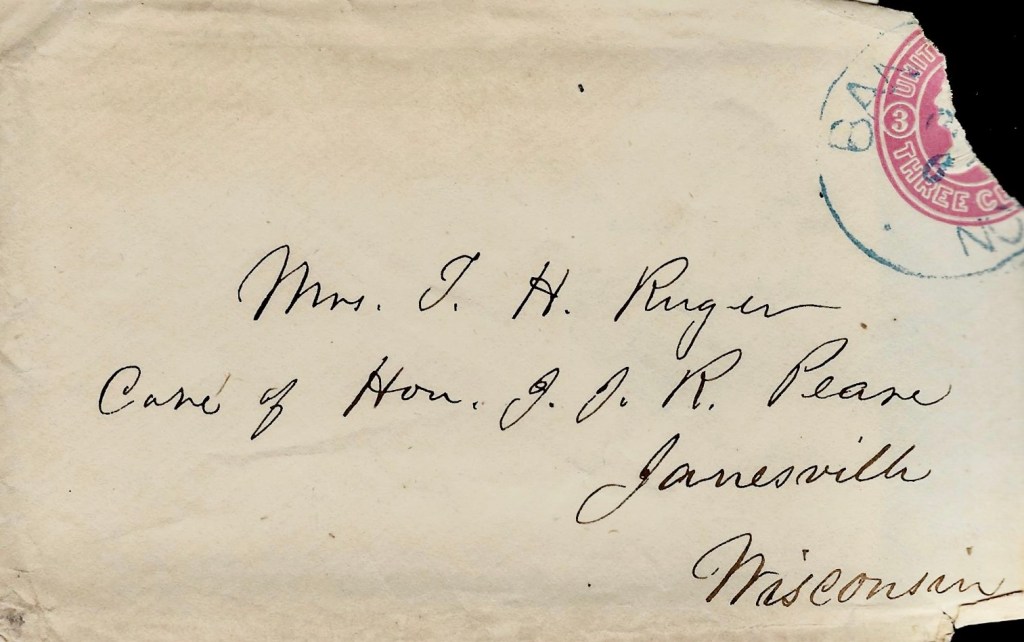
The following letter was written by Brig. General Thomas Howard Ruger (1833-1907). In 1854 he graduated from the U.S. Military Academy at West Point, and then embarked on a long and distinguished career in the military. After a brief commission with the U.S. Army Corps of Engineers, Ruger practiced law in Janesville, Wisconsin. In June 1861, he was assigned as lieutenant colonel of the 3rd Wisconsin Regiment, he rose to the rank of brigadier general, commanded a contingent in the Rappahannock maneuvers, and aided in the containment of the 1863 New York draft uprising. On November 30, 1864, he was promoted to major general for his admirable service in the Battle of Franklin. After serving as colonel of the 33rd Infantry in the U.S. Army, Ruger again was commended for his courageous service in the Battle of Gettysburg and was commissioned a brigadier general. On January 17, 1868, Major General George W. Meade, commander of the 3rd Military District, forced Governor Charles J. Jenkins out of office. Meade then appointed Ruger to serve as Governor of Georgia, a position he held until June 28, 1868. The following year, Ruger was appointed to supervise a board of U.S. officers in Atlanta, examining the qualifications of select members of the Georgia Legislature. From 1871 to 1876, he served as the superindent of the U.S. Military Academy, and was the commander of the Department of the South and West, serving until 1885. Two years after being promoted to major general, Ruger retired from active military duty. Governor Thomas H. Ruger died on June 3, 1907.
This letter to his wife was penned a couple of weeks after the Battle of Antietam and after having been introduced to President Lincoln who visited the battlefield afterward. Ruger’s impression of the President was not exactly favorable though he postulated correctly that history would be a better judge of the man. “Exact justice of opinion will be more surely found among thinking, candid men after the present condition of things has passed away and the results are seen,” he wrote.
Transcription
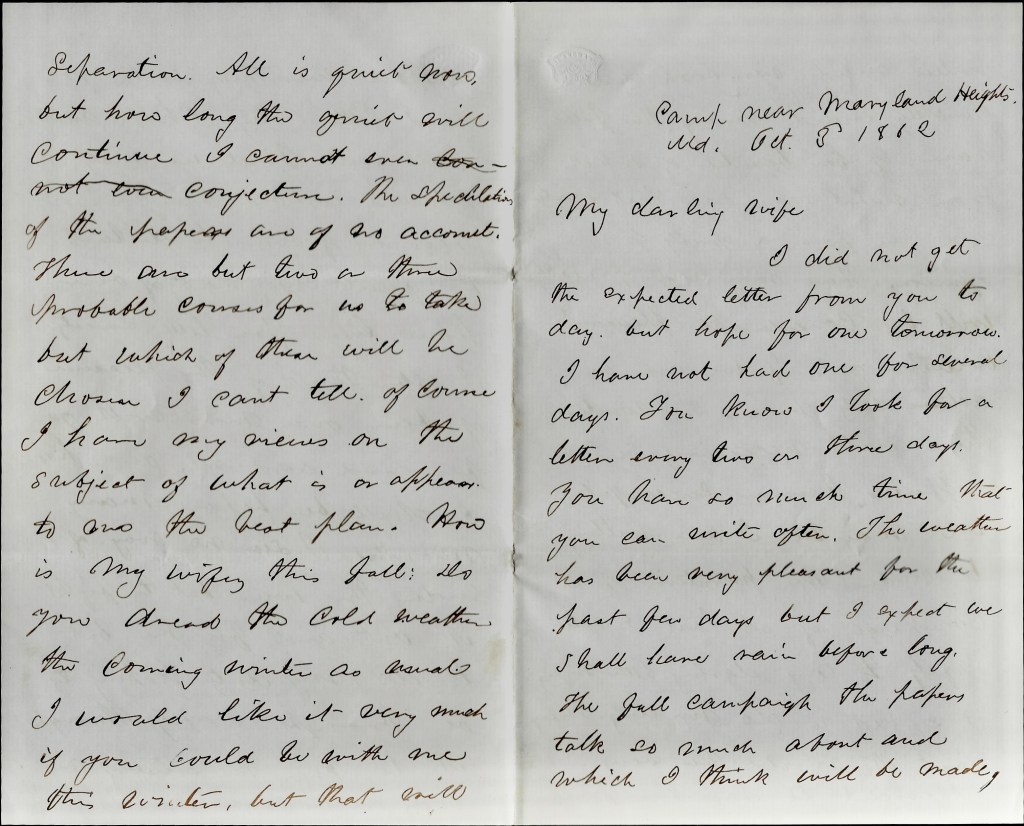
Camp near Maryland Heights, Maryland
October 3d 1862
My darling wife,
I did not get the expected letter from you today but hope for one tomorrow. I have not had one for several days. You know I look for a letter every two or three days. You have so much time that you can write often.
The weather has been very pleasant for the past few days but I expect we shall have rain before long. The fall campaign the papers talk so much about and which I think will be made unless made very soon and quickly ended, will be made during the fall rains, of the beauties of which from what you saw last winter you can form a pretty good opinion. There may and probably will be considerable pleasant weather yet. If we are on active duty during the winter, there will necessarily be much suffering, however successful we may be. I am willing to undergo the privations of a campaign if at last I return safely to my darling little wifey, but it would be very pleasant to pass this fine fall weather with you and little Patey. I hope another fall will find us nicely situated without any war or rumors of war to disturb the quiet enjoyment of our home life.
You little sweetie. I often think of the pleasure of being once more with you for good and all, and hope I shall be before many months. I see no way of ending this war but to fight it out, and for me but to do my duty hoping to be brought safely through it to enjoy the society of my wifey all the more for the long separation.
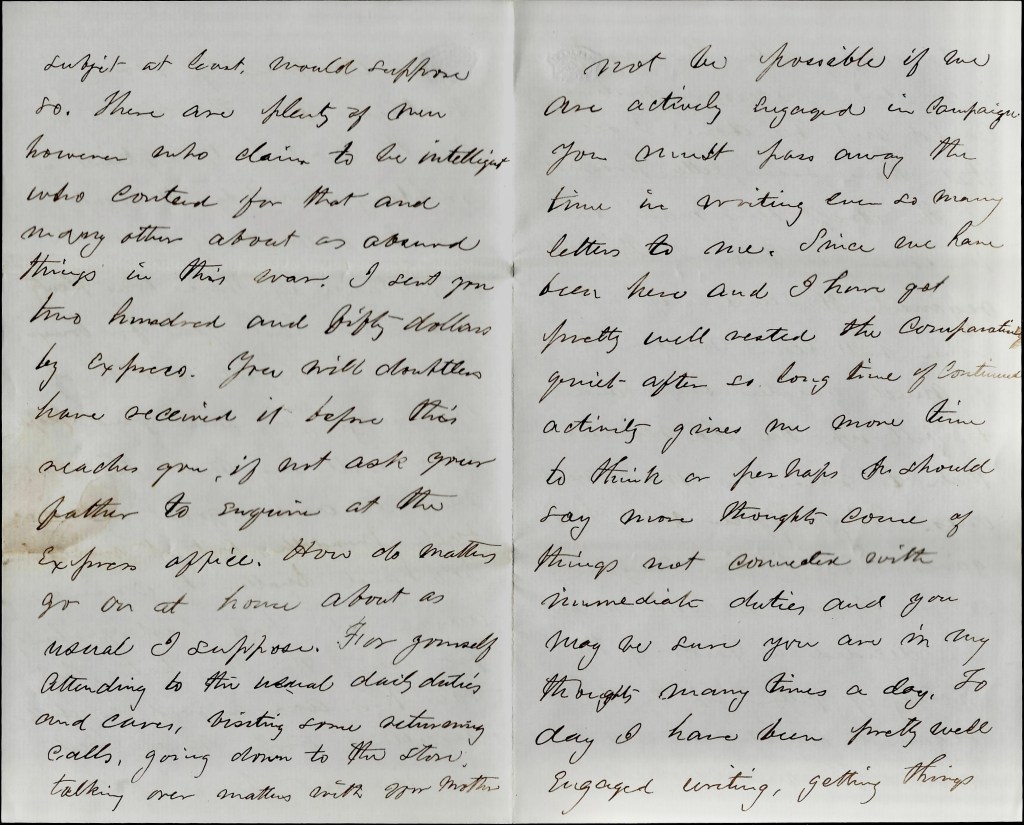
All is quiet now, but how long the quiet will continue, I cannot even conjecture. The speculation of the papers are of no account. There are but two or three probable courses for us to take but which of them will be chosen, I can’t tell. Of course I have my views on the subject of what is or appears to be the best plan.
How is my wifey this fall? Do you dread the cold weather the coming winter as usual. I would like it very much if you could be with me this winter but that will not be possible if we are actively engaged in campaign. You must pass away the time in writing ever so many letters to me. Since we have been here and I have got pretty well rested, the comparative quiet after so long time of continued activity gives me more time to think or perhaps I should say more thoughts come of things not connected with immediate duties, and you may be sure you are in my thoughts many times a day. Today I have been pretty well engaged writing, getting things in shape after the long time when even necessary writing could not be done. I see that there seems little prospect of the draft being made in Wisconsin to fill up the old regiments. It seems as if we never will learn wisdom. It is of much greater importance to fill up the old regiments than to raise so many new ones. Every officer who has given his opinion, everyone whose opinion is worth much, has decided in favor of the policy of filling up the old regiments, but still it is not done. The new regiments are composed of good material but the officers are for the most part deficient in military knowledge. It would not be a matter of so much importance if there was plenty of time as last year for bringing the new troops into a state of efficiency.
You will find people who say that they don’t need it and a great deal more such twaddle, but it would be a hard matter to convince anyone who had had opportunity for seeing the thing tested, that raw troops are as good as drilled & disciplined troops. No one but an ignorant person on that subject at least would suppose so. There are plenty of men, however, who claim to be intelligent who contend for that and many other about as absurd things in this war.
I sent you two hundred and fifty dollars by Express. You will doubtless have received it before this reaches you. If not, ask your father to enquire at the Express Office. How do matters go on at home? About as usual I suppose. For yourself attending to the usual daily duties and cares, visiting some returning calls, going down to the store, talking over matters with your mother and Hattie, talking a great deal to Patey and watching her girlish pranks, thinking a great deal about Howard, reading the papers for war news, watching for a letter from me and hoping that all this may end and you will soon be in your own house with your husband. The picture makes you a very loving wife and is somewhat flattering to myself, but it is true, is it not wifey, you little sweet. Just imagine a good kissing.
You see I have written quite a letter. I almost forgot to tell you that the President was here yesterday. I had the honor of being introduced and hearing him tell several stories. You have heard of the Presidential inclination for stories. Old Abe is a good man but darling, not a great man for these times, which latter remark may be somewhat objectionable as implying that what is great under some circumstances may not be under others. Perhaps President Lincoln has done as well, all things considered as anyone would. The fact is, Helen, we cannot judge as truly as people will who are not actors in, and witnesses of the present scenes. Exact justice of opinion will be more surely found among thinking, candid men after the present condition of things has passed away and the results are seen.
Give my love to all. Take good care little Patey, three years and a half old by the time this reaches you, which outs me in mind of the day three days from now. Would I not like to drop in for a visit. Write often, very often, darling. With very much love, your affectionate husband, — Howard



 Spared & Shared 23