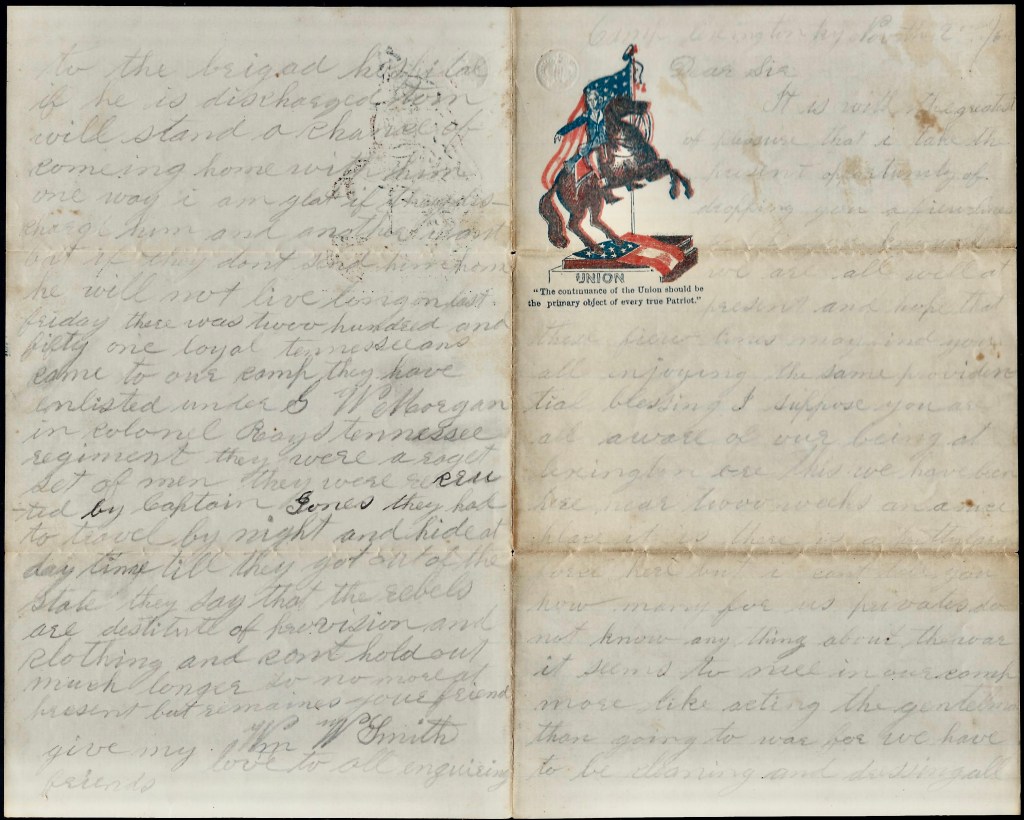

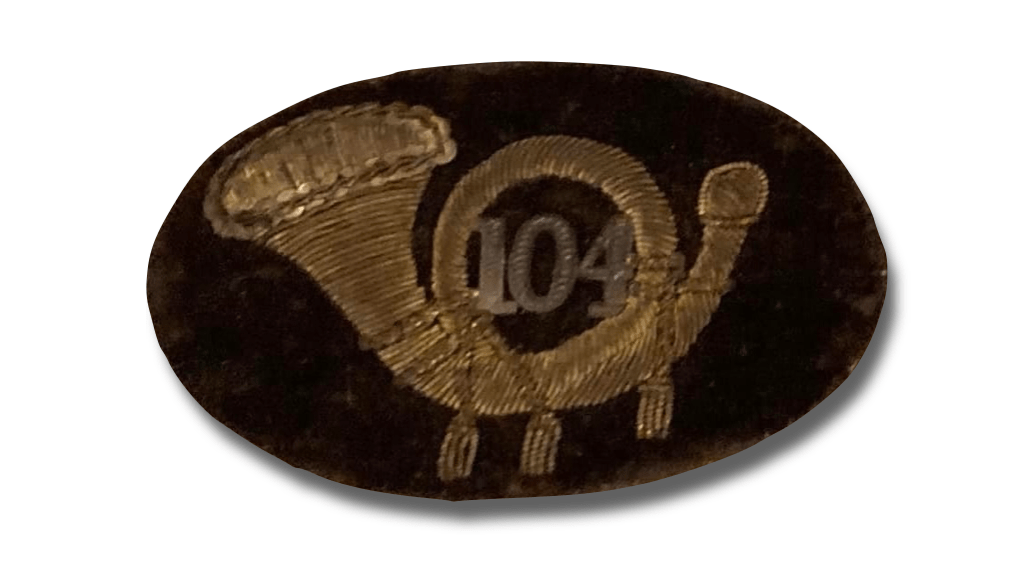
The following letter was written by William Wendel Smith (1842-1908), the son of Charles Smith (1807-1879) and Rebecca Weaver (1808-1885) of Stark county, Ohio—formerly of Perry county, Pennsylvania. William was 20 years old and working as an apprentice to learn the carriage maker’s trade from Robert Latimer in Canton when he mustered into Co. B, 104th Ohio Infantry in August 1862. On May 31, 1864, he was shot in the arm during the Battle of Dallas (Georgia). On Nov. 30, 1864, he was captured during the Battle of Franklin (Tennessee). Initially held at Cahaba Prison (Alabama), he was transferred to notorious Andersonville Prison (Georgia) in early 1865. He was freed as part of a prisoner exchange on April 1, 1865.
On April 27, 1865, he was among an estimated 2,400 home-bound Union soldiers, former POWs and other passengers aboard the badly overcrowded S.S. Sultana, a steamboat, when it exploded in the Mississippi River near Memphis, killing about 1,600. William Wendel Smith suffered burns but survived. After his return to Stark County, Ohio, he became a farmer.
The identity of the letter’s recipient is not revealed in the letter but it was found in a collection of letters addressed to Henry Shanafelt, Jr. (1827-1893) of Greentown, Stark county, Ohio, so we presume that he was the “Dear Sir.”
Transcription
Camp Lexington, Kentucky
November 12th 1862
Dear Sir,

It is with the greatest of pleasure that I take the present opportunity of dropping you a few lines to let you know that we are all well at present and hope that these few lines may find you all enjoying the same providential blessing. I suppose you are all aware of our being at Lexington ere this. We have been here near two weeks and a nice place it is. There is a pretty large force here but I can’t tell you how many for us privates do not know anything about the war. It seems to me in our camp more like acting the gentleman than going to war for we have to be cleaning and dressing all the time. One day we get orders to clean our brass and guns and put on our best clothes for inspection, and another for review, and so it goes. Instead of marching on and fighting the battles that must be fought before this war is over, we are kept here dress and fixing up for review or some other darned kind of view until our ranks are thinned by sickness and death. And the rebels are gone and we must march after them but far enough behind so as not to get any booty from them. It seems to me as if our generals was afraid of this war closing too soon and they not making enough to fill their pockets. But I think they have got a general [William S. Rosecrans] at the head of the Cumberland Army that will not fail to capture Bragg’s Army if he gets such a chance as Buell had.
We had a snow on last Saturday night six inches deep. It was pretty cold on Sunday but it cleared off on Monday and it has been pretty warm since. But today it is trying to rain. It looks as if it would succeed.
The talk is in our regiment that they are going to take our tents from us and give us little rubber tents large enough for three and them we must carry. About that time, I will sleep out in the big tent before I will carry one. Daniel France 1 has not been well for some time but he is now soon fit for duty. I think J[ohn] W. Raber 2 will be discharged from service for disability. He has been sent to the Brigade Hospital. If he is discharged, Tom will stand a chance of coming home with him. One way I am glad if they discharge him and another won’t but if they don’t send him home, he will not live long.
On last Friday there was two hundred and fifty-one loyal Tennesseans came to our camp. They have enlisted under G. W. Morgan in Colonel [Daniel Mack] Ray’s Tennessee Regiment. 3 They were recruited by Captain Jones. They had to travel by night and hide at daytime till they got out of the State. They say that the rebels are destitute of provision and clothing and can’t hold out much longer.
So no more at present but remain your friend. Give my love to all enquiring friends. — Wm. W. Smith
1 Daniel France was detailed as blacksmith in engineer battalion, 23rd Army Corps, April 4, 1864.
2 John W. Raber (1838-1930) was from Greentown, Stark county, Ohio, which is where Henry Shanafelt (believed to be the letter’s recipient) lived during the Civil War.
3 Daniel Mack Ray was born in Yancy County North Carolina on March 27, 1833. He grew up in Sevier County, Tennessee later receiving his academic education in Burnsville, North Carolina and Dandridge, Tennessee. After his education was complete, he worked as a school teacher, and was living in east Tennessee when the war broke out. With the outbreak of the Civil War, he remained loyal to the Union, and joined the Army after a year of clandestine work behind enemy lines in eastern Kentucky, blowing up bridges and obstructing the invading rebel armies. According to one obituary, Ray organized neighbors to burn several railroad bridges in order to delay pro-southern forces entering the state. He then made his way to Flat Lick, Kentucky, to enlist in the Union army, receiving a commission on October, 10 1862 as First Lieutenant and Adjutant of the 3rd Tennessee Infantry, U.S., part of the Army of Ohio, resigning from that unit six months later to take a commission as Colonel of the 2nd Tennessee Cavalry, U.S., on August 6, 1862 with whom he served with for the remainder of his extensive war service commanding a brigade in Sheridan’s Atlantic campaign under Major General David S. Stanley and Colonel Edward M. McCook.