
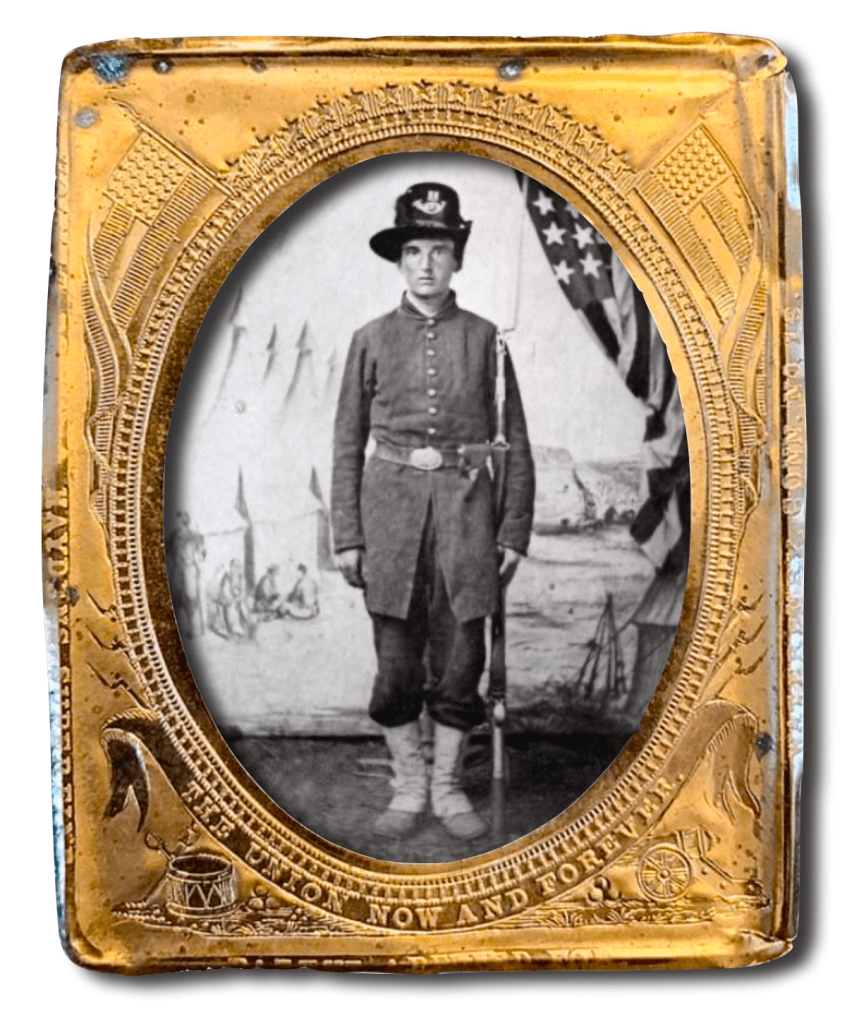
The following letters were written by Elon Francis Brown (1839-1869), the son of James Brown (1799-1856) and Malvina F. Howe (1809-1897) of Sun Prairie, Dane county, Wisconsin. Elon wrote the letters to his sister, Malvina S. (Brown) McCrea (1833-1884) and her husband Daniel McCrea (1824-Aft1863) of Monroe, Adams county, Wisconsin.
Elon was 22 years old when he enlisted on 19 May 1861 to serve as a private in Co. H, 2nd Wisconsin Volunteers. He was wounded in the Battle of Antietam on 17 September 1864 but recovered and in late July 1864 he was commissioned a Captain in Co. D, 45th USCT. He remained with the 45th USCT until 4 November 1864 when he was mustered out of the service.
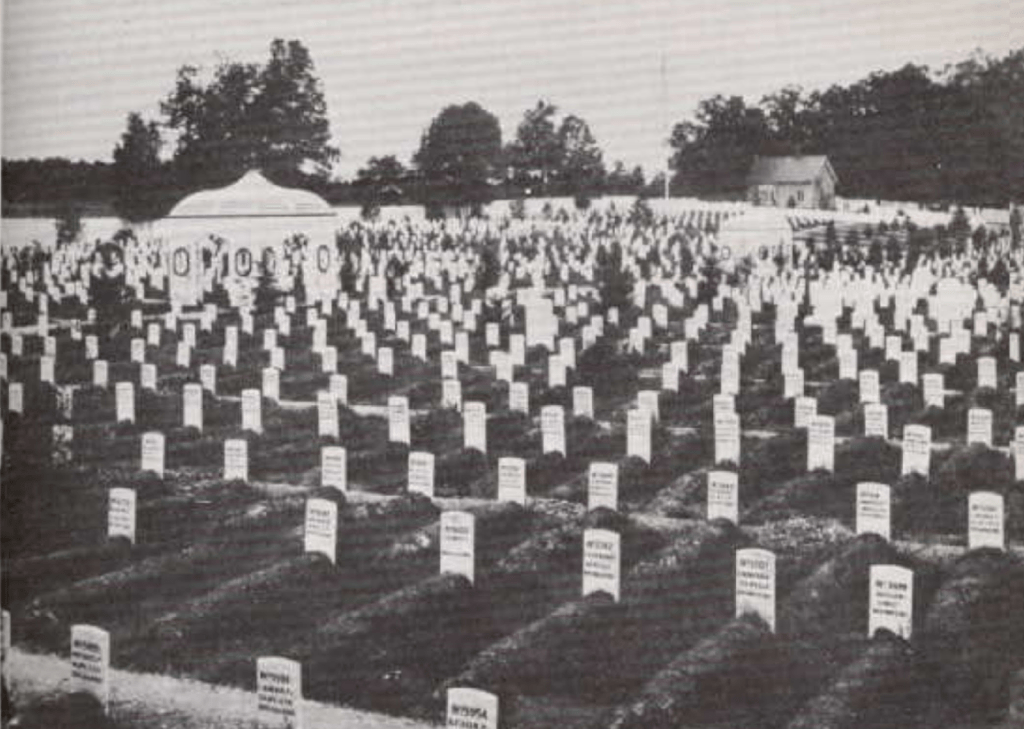
Elon’s letter of March 1864 is particularly poignant as it describes visiting the grave of his younger brother, James B. Brown (1844-1862) who enlisted in September 1861 to serve in Co. B, 7th Wisconsin (Iron Brigade) and was mortally wounded in the fighting at Brawner’s Farm on 28 August 1862. He died on 16 December 1862 and was buried in the National Cemetery at the Soldiers’ Home in D. C., Grave No. 2447.
It should be noted that Elon kept diaries while he was in the service. Two are archived at:
1—Elon’s Diary (April 28-June 27, 1863) giving his experiences in the battles of Chancellorsville, Fredericksburg, Second Bull Run, and a later description of Gettysburg can be found at the University of Wisconsin, Madison. Also includes a sketch map of northeastern Virginia and Maryland. The photographs are of Brown in his uniform and a portrait of Brown. Also included is a notebook in which Brown recorded items of interest such as population statistics of the “loyal” and “disloyal” states, poems and sayings, various Civil War reports and chronicles, and historic world events generally relating to world conflicts.
2—Elon F[rancis] Brown. “Daily Journal,” transcribed with additional notes and explanations from pocket memoranda kept while a member of Co. H, 2nd Regiment, Wisconsin Infantry. The transcription was done while Brown lay wounded in a U. S. Army hospital in Frederick, Maryland, beginning March 15, 1864. It covers the years 1863-4. 214 p. Microfilmed from the original in the pos- session of Leonard Lipman, through Frank Sperduto. Rutgers University.
[Note: The following photocopies of Elon’s letters are archived at the Kenosha Civil War Museum and were made available for transcription and publication on Spared & Shared by express consent.]
Letter 1
Camp of the 2nd Wisconsin Vols.
Near Aquia Creek, Va.
February 5, 1863
Dear Brother & Sister,
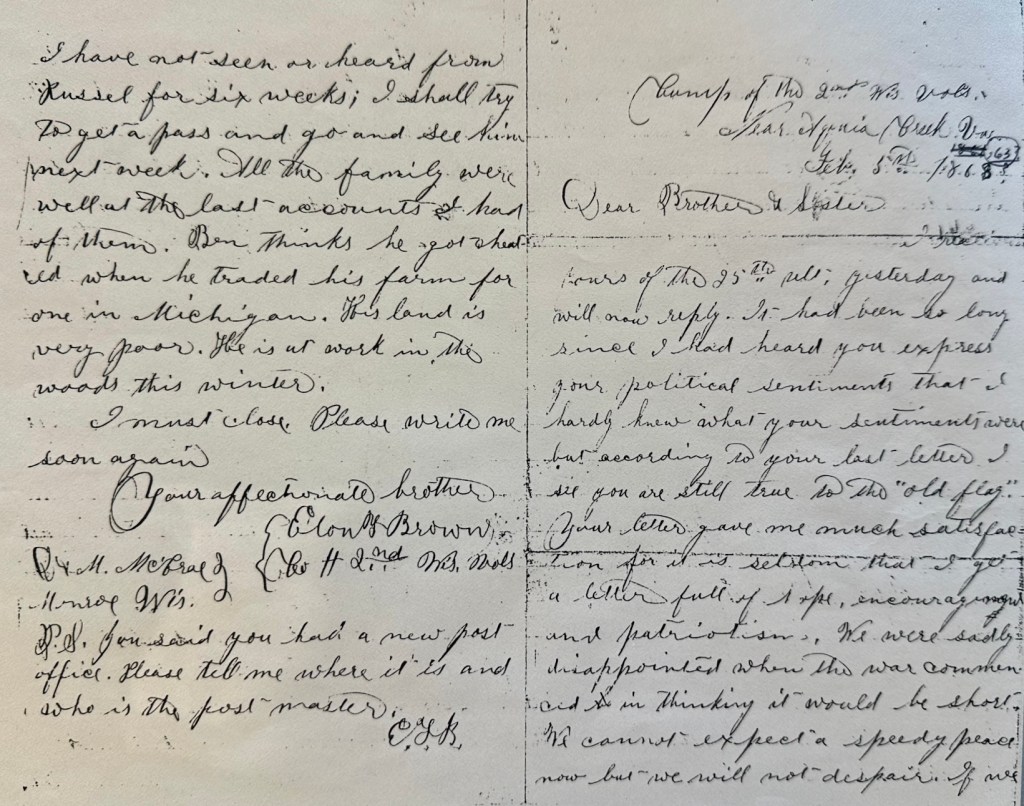
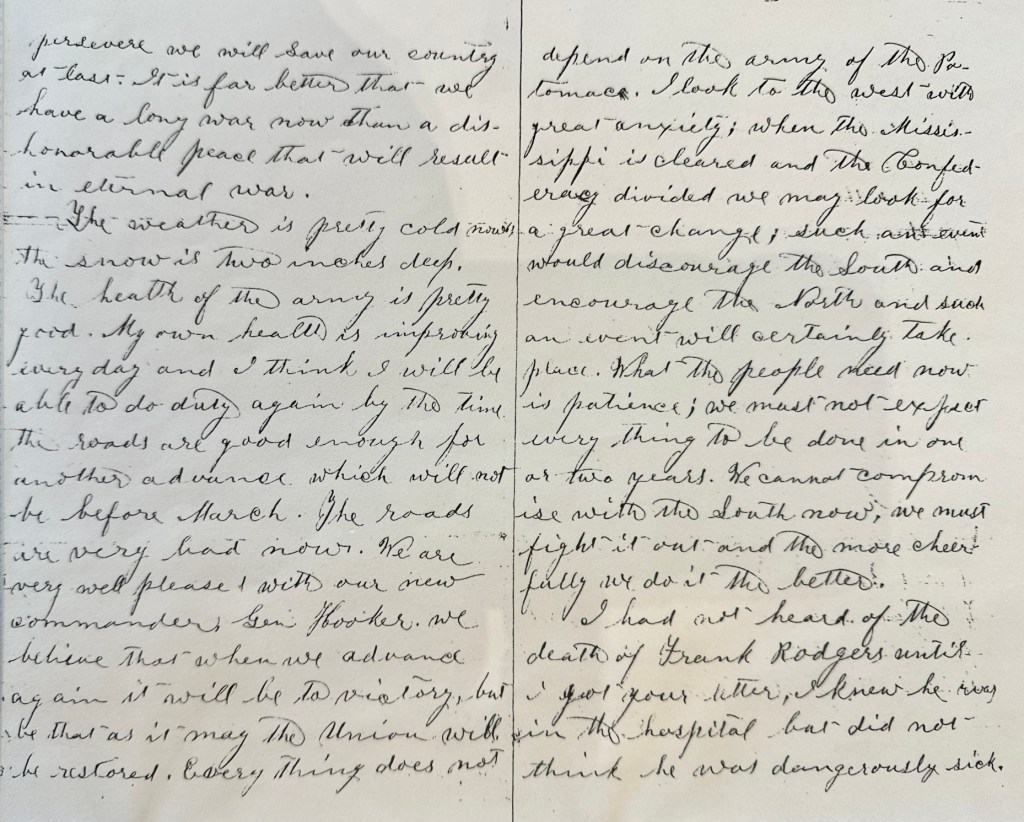
I received yours of the 25th ult. yesterday and will now reply. It had been so long since I had heard you express your political sentiments that I hardly knew what your sentiments were, but according to your last letter I see you are still true to the “old flag.” Your letter gave me much satisfaction for it is seldom that I get a letter full of hope, encouragement, and patriotism. We were sadly disappointed when the war commenced in thinking it would be short. We cannot expect a speedy peace now but we will not despair. If we persevere, we will save our country at last. It is far better that we have a long war now that a dishonorable peace that will result in eternal war.
The weather is pretty cold now. The snow is two inches deep. The health of the army is pretty good. My own health is improving every day and I think I will be able to do duty again by the time the roads are good enough for another advance which will not be before March. The roads are very bad now.
We are very well pleased with our new commander, Gen. Hooker. We believe that when we advance again, it will be to victory. But be that as it may, the Union will be restored. Everything does not depend on the Army of the Potomac. I look to the West with great anxiety. When the Mississippi is cleared and the Confederacy divided, we may look for a great change. Such an event would discourage the South and encourage the North and such an event will certainly take place. What the people need now is patience. We must not expect everything to be done in one or two years. We cannot compromise with the South now. We must fight it out and the more cheerfully we do it the better.
I had not heard of the death of Frank Rodgers until I got your letter. I knew he was in the hospital but did not think he was dangerously sick. I have not seen or heard from Russell for six weeks. I shall try to get a pass and go and see him next week. All the family were well at the last accounts I had of them. Ben thinks he got cheated when he traded his farm for one in Michigan. His land is very poor. He is at work in the woods this winter.
I must close. Please write me soon again. Your affectionate brother, – Elon F. Brown, Co. H, 2nd Wisconsin Vols.
D. & M. McCrae, Monroe, Wisconsin
P. S. You said you had a new post office. Please tell me where it is and who is the post master. — E. F. B.
Letter 2
Camp 2nd Wisconsin Vols.
Near Aquia Creek, Va.
March 1st 1863
Dear Brother & Sister,
I have just received your letters of the 14th & 16th of February containing the sorrowful—aye—heart-rending news of the death of our sister. I know not what to write—my heart is stunned and I as myself is it reality. The tidings were so unexpected that the blow struck with double force. I feel as if weeping would relieve me but the fountain of my tears are dry. Alas! How fragile and short and brittle is the thread that binds us to earth adn liable to snap at any moment. Our sister has but gone a short time before us; we must all soon try the realities of that untried world from which no traveler ever yet returned. But we need not go in the dark; our great Creator has given us a “light to our feet and a lamp to our path” if we will only accept it. He has given us His hold word which contains a guide through life and a guide through the “dark valley and shadow of death.” We are reminded by our sister’s death that life at longest will be short. Let us then take warning. The admonition is to us and it speaks in thundering tones, “Prepare for all must go.” Shall we turn unmoved from the scene and wait another and another of our number falls before we think of preparing? No! Let us give our hearts to God now adn “halt between two opinions” no longer. One great struggle with “self”, one firm resolve, a casting all on the strong arm of God and all is over and we rest in a Savior’s arms. Accept it now; the morrow may be too late. God grant that in your answer I may be able to read the glowing words, “Let others do as they may, but as for me and my house, we will serve God.”
McCrae, I recollect the last time I saw you. Your mind was almost made up to become a Christian but you were putting it off for a more “convenient season.” That season will never come. Delay no longer. Now is the time. God help you.
You say you had not received an answer to your last letter when you wrote. I answered it February 5th and I presume you have received it before now.
I have not seen Russell for nearly three months though I have been trying to get a pass to go and see him for some time. I think I will have a chance to see him soon. I heard from him a short time ago; he was sick then but I did not hear what the matter was.
My health is now quite good and I think I could stand a pretty hard march. The roads, however, are in very bad condition and an advance will be impossible for some time. There is a rumor in camp that our corps is to be sent to South Carolina this spring. I do not give much credit to the report, yet it may be true. I am sure I don’t care whether it is true or not. I had a leave go there as anywhere else. We are sure of hard fare and hard fighting wherever we go.
Vina, will you please write the particulars of Lucinda’s death to Eliza. I know but very little about it and it would be improper for me to write it if I did. I do not know the feeling between you and Eliza but if old differences are not forgotten, I ask that they may be. Let us be as brothers and sisters should be and not like strangers. Eliza’s address is: Pent Water, Ocean county, Michigan.
Give my love to the children. George is old enough to write me a letter. I would like to have him do so. With many wishes for your welfare, I remain your loving brother, — Elon F. Brown, Co. H, 2nd Wisconsin Vols
[to] D & M. McCrae


Letter 3
U. S. Gen. Hospital
Frederick, Maryland
March 18th, 1864
My Dear Sister,
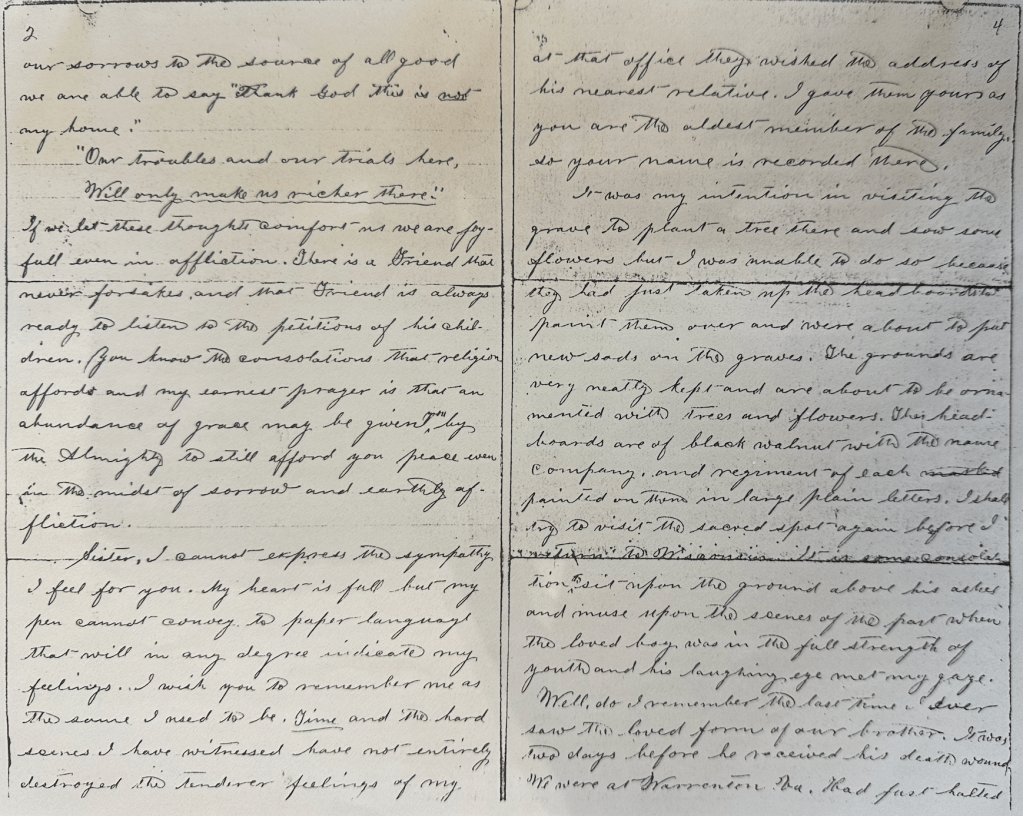
Your very affectionate and welcome letter was received late last evening and early this morning I seat myself to reply. I cannot express in words my thanks for the treasure it contains, for, my dear sister, the assurances of your remembrance and sisterly love awaking as it does emotions of the tenderest kind, is a treasure which cannot be over-prized. It was with deep sorrow that I read your account of your sickness as well as that of little Alice. Tis truly hard to be thus alone and in such affliction, and one comfort only can we have in such cases; that is the thought that this earth, this vale of sorrow, is not our final abode. If we look up through our sorrows to the source of all good, we are able to say, “Thank God this is not my home.”
“Our troubles and our trials here,
Will only make us richer there.”
If we let these thoughts comfort us, we are joyful even in affliction. There is a Friend that never forsakes, adn that Friend is always ready to listen to the petitions of his children. You know the consolations that religion affords and my earnest prayer is that an abundance of grace may be given you by the Almighty to still afford you peace even in the midst of sorrow and earthly affliction.
“Time and the hard scenes I have witnessed have not entirely destroyed the tender feelings of my nature and my heart still beats with the same love toward my brothers and sisters that it did when we all met around the same fireside, and passed the hours in childish prattle, knowing nothing of the coldness of this world.”
— Elon F. Brown, 18 March 1864
Sister, I cannot express the sympathy I feel for you. My heart is full. But my pen cannot convey to paper language that will in any degree indicate my feelings. I wish you to remember me as the same I used to be. Time and the hard scenes I have witnessed have not entirely destroyed the tender feelings of my nature and my heart still beats with the same love toward my brothers and sisters that it did when we all met around the same fireside, and passed the hours in childish prattle, knowing nothing of the coldness of this world. Those days have flown but brighter ones are coming. O let us rejoice that we may yet meet and spend an eternity of bliss together.
Since I last wrote you I have been to Washington where I spent six days. Nearly two days of that time I spent looking for the grave of our brother James. I at last found it and now have the number of it so that I can visit it again without trouble if I have an opportunity. He is buried in Grave No. 11, Range 2, Block 3 W at the Old Soldiers’ Home burial ground about three miles north of the Capitol at Washington D. C. I also got a certificate of his death and burial at the Burial REcord Office. In filling up the books at that office they wished the address of his nearest relative. I gave them yours as you are the oldest member of the family so your name is recorded there.
It was my intention in visiting the grave to plant a tree there and sow some flowers but I was unable to do so because they had just taken up the head boards to paint them over and were about to put new sods on the graves. The grounds are very neatly kept and are about to be ornamented with trees and flowers. Their headboards are of black walnut with the name, company, and regiment of each painted on them in large plain letters. I shall try to visit the sacred spot again before I return to Wisconsin. It is some consolation to sit upon the ground above his ashes and muse upon the scenes of the past when the loved boy was in the full strength of youth and his laughing eye met my gaze.
Well do I remember the last time I ever saw the loved form of our brother. It was two days before he received his death wound. We were at Warrenton, Virginia. Had just halted after a hard march of fifteen miles. We were then in the immediate presence of the enemy and for three days had been almost constantly skirmishing with them. You recollect it was on the “Pope Retreat.” As soon as we halted he came over where I was (his regiment was just across the road from mine) and we walked out to one side and had about half an hour’s conversation. The bugle sounded and we had to separate and hurry to our arms. We shook hands as we parted for we expected to move forward into battle immediately. I turned again and looked at him thinking, “shall I ever see him again?” He also turned again and looked at me and I doubt not his feelings were the same as mine. We had to hurry to our posts and our eyes never met again. Nor can they meet until the grave is opened and we rise clothed in the robes of heaven.
Your reference to the death scene when our sister passed away was touching [missing page]
My dear sister, I thought I had finished on the last half sheet but I think of a thousand things more to say and I must mention a few of them. My health is now pretty good and I shall leave the hospital by the middle of next week, I think. So when you get this, you may consider me as fit for duty. I may possibly be mistaken about going away and so you may direct your letter as before and if I am gone, it will be forwarded to me. I am now on the last three months of my three years term of service. That will soon be gone but whether I shall then return to Wisconsin, I can’t tell. I am very anxious to see you and all the rest of the family but you know I wish to go to school two or three years and I think I can do better in New England than Wisconsin and I have not money to spend in traveling for pleasure. I don’t know yet what I will do but must make up my mind soon. I received a letter from Robert last night. It was rather strange that I.. [missing page]
Pardon me for sending these scraps of paper. I thought I could finish on half a sheet but I could not. I have enough more to say to fill another sheet but here is enough to tire you out once. I hope you will be able to read it though it is poorly written. I shall write again in a few weeks. Let me hear from you soon again if possible.



Griff, I note that Elon died shortly after the end of the war in 1869. Would you happen to know the cause of his death? Was it at all related to his injuries suffered during the conflict? Curious, Rob (“Ivan Jack Dove”)
LikeLike