
With more time I could probably identify these female correspondents but they most certainly lived in Mississippi and their “men folk” were in the Confederate service.
Transcription
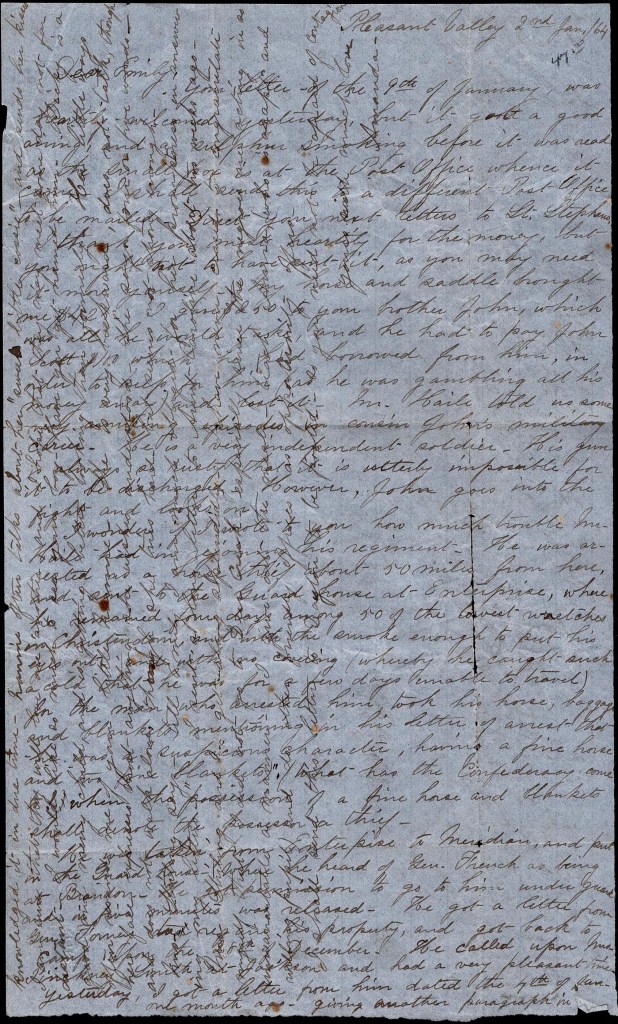
Pleasant Valley [Mississippi]
January 2nd, 1864
Dear Emily,
Your letter of the 9th of January was heartily welcomed yesterday, but it got a good airing and a sulphuric smoking before it was read as the smallpox is at the Post Office whence it came. I shall send this to a different Post Office to be mailed. Direct your next letters to Lt. Stephens. I thank you most heartily for the money, but you ought not to have sent it as you may need it more yourself. My horse and saddle brought me $425. I gave $250 to your brother John, which was all he would take, and he had to pay John Scott $100 which he had borrowed from him in order to keep for him as he was gambling all his money away and lost it. Mr. Haile told us some very amusing episodes in cousin John’s military career. He is a very independent soldier. His gun is always so rusty that it is utterly impossible for it to be discharged. However, John goes into the fight and looks on.
I wonder if I wrote to you how much trouble Mr. Haile had in rejoining his regiment. He was arrested as a horse thief about 50 miles from here and sent to the guard house at Enterprise where he remained four days among 50 of the lowest wretches in Christendom, and with the smoke enough to put his eyes out and with no covering (whereby he caught such a cold that he was for a few days unable to travel) for the man who arrested him took his horse, baggage, and blankets, mentioning in his letter of arrest that he was a suspicious character, having a fine horse and two fine blankets. What has the Confederacy come to when the possession of a fine horse and blankets shall denote the possessor a thief.
He was taken from Enterprise to Meridian and put in the guard house where he heard of Gen. French as being at Brandon. He got permission to go to him under guard and in five minutes was released. He got a letter from Gen. Forney to regain his property and got back to Camp Pony the 28th of December. He called upon Mrs. Pinckney Smith at Jackson and had a very pleasant time. Yesterday, I got a letter from him dated the 4th of January—one month ago—giving another paragraph in the chapter of misfortunes, which is far worse than all.
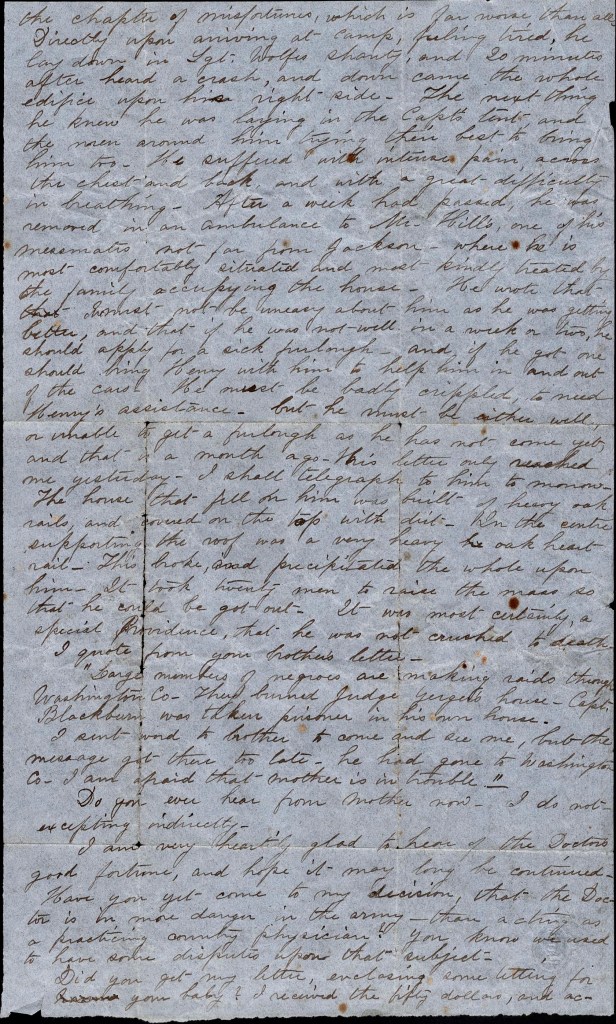
Directly upon arriving at camp, feeling tired, he lay down in Sgt. Wolf’s shanty and 20 minutes after heard a crash and down came the whole edifice upon his right side. The next thing he knew he was laying in the Captain’s tent and the men around him trying their best to bring him to. He suffered with intense pain across the chest and back and with a great difficult in breathing. After a week had passed, he was removed in an ambulance to Mr. Hill’s—one of his mess mates not far from Jackson—where he is most comfortably situated and most kindly treated by the family occupying the house. He wrote that I must not be uneasy about him as he was getting better, and that if he was not well in a week or two, he should apply for a sick furlough, and if he got one should bring Henry with him to help him in and out of the cars. He must be badly crippled to need Henry’s assistance but he must be either well or unable to get a furlough as he has not come yet and that is a month ago. His letter only reached me yesterday. I shall telegraph to him tomorrow. The house that fell on him was built of heavy oak rails and covered on the top with dirt. In the center, supporting the roof, was a very heavy oak heart rail. This broke and precipitated the whole upon him. It took twenty men to raise the mass so that he could be got out. It was most certainly a special providence that he was not crushed to death.
I quote from your brother’s letter – “Large members of negroes are making raids through Washington County. They burned Judge [William] Yerger‘s house. Captain Blackburn 1 was taken prisoner in his own house. I sent word to brother to come and see me but the message got there too late—he had gone to Washington Co. I am afraid that mother is in trouble.”
Do you ever hear from Mother now? I do not excepting indirectly. I am very heartily glad to hear of the Doctor’s good fortune and hope it may long be continued. Have you yet come to my decision that the Doctor is in more danger in the army than acting as a practicing country physician? You know we used to have some disputes upon that subject.
Did you get my letter enclosing some letting [?] for your baby? I received the fifty dollars, and acknowledged it in due time. Nannie often talks about her “sweet little Cassie” and sends her kisses. I am sure that they will love one another and I hope that they may meet someday not far distant. I would like so much to see your boy. Have you yet named him? Ducky is a good and merry child and is getting better looking than formerly. Her little ways often remind me of your little Nannie. She is very backward and does not talk, though her face expresses most anything she wishes understood. She says four or five words and does not walk alone though she tries hard but seems not strong enough. Mrs. Starling and I get along splendidly. I have never ceased to congratulate myself that I did not go to Deer Creek—especially since the negroes are acting in so unaccountable a manner. I give out the meal, teach Anna (who is an apt and willing pupil) and do other friendly offices as opportunity offers. I shall send this letter to Dayton to be posted so you need not be afraid of contagion. Yours with much love, — Amanda
1 Possibly George T. Blackburn (1825-1870). He married Mary Bell Johnson in 1859 in Washington county, Mississippi. He served in Co. O in the 28th Cavalry. Buried in Lexington, Fayette county, Mississippi.
 Spared & Shared 23