
This letter was penned by Ransom Baldwin Moore (1818-1880), the son of Charles Moore (1783-1846) and Uretta Vernon (1788-1855) of Saratoga county, New York. An obituary informs us that Ransom came to Troy in 1837 where he engaged in the dry goods business at No. 9 Cannon Place. He 1843 he entered into partnership with E. & H. Merriam, book and stationery dealers, who, under the firm name of Merriam, Warren & Co., carried on business. H. B. Nims bought out Merriam in 1853 and partnered with Moore until 1869 when Moore retired.
Ransom’s letter, written when 21 or 22 years old, provides a detailed account of a hike to “Dry River,” prompting me to investigate the significance of this location, as my Google searches returned no relevant results pertaining to a site near Troy, New York. However, upon examining historical newspapers, I uncovered an article from the American Traveller dated 15 March 1836, which referenced a “singular ravine often called the Dry River” located on the west side of the Hudson. Additionally, an article from 1849 discussed the “deep gorges of Dry River” situated north of West Troy. Perhaps this is the area where Ransom and his companion hiked.
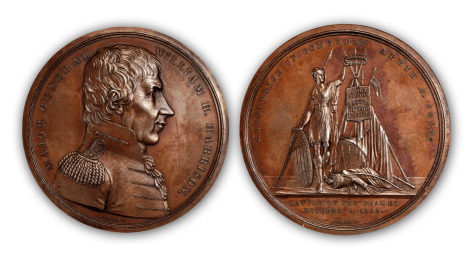
The letter was written on stationery that advertised the sale of a medal commemorating the service of Gen. William Henry Harrison (then a candidate for the Presidency) and the Battle of the Thames, 5 October 1813, during the War of 1812.
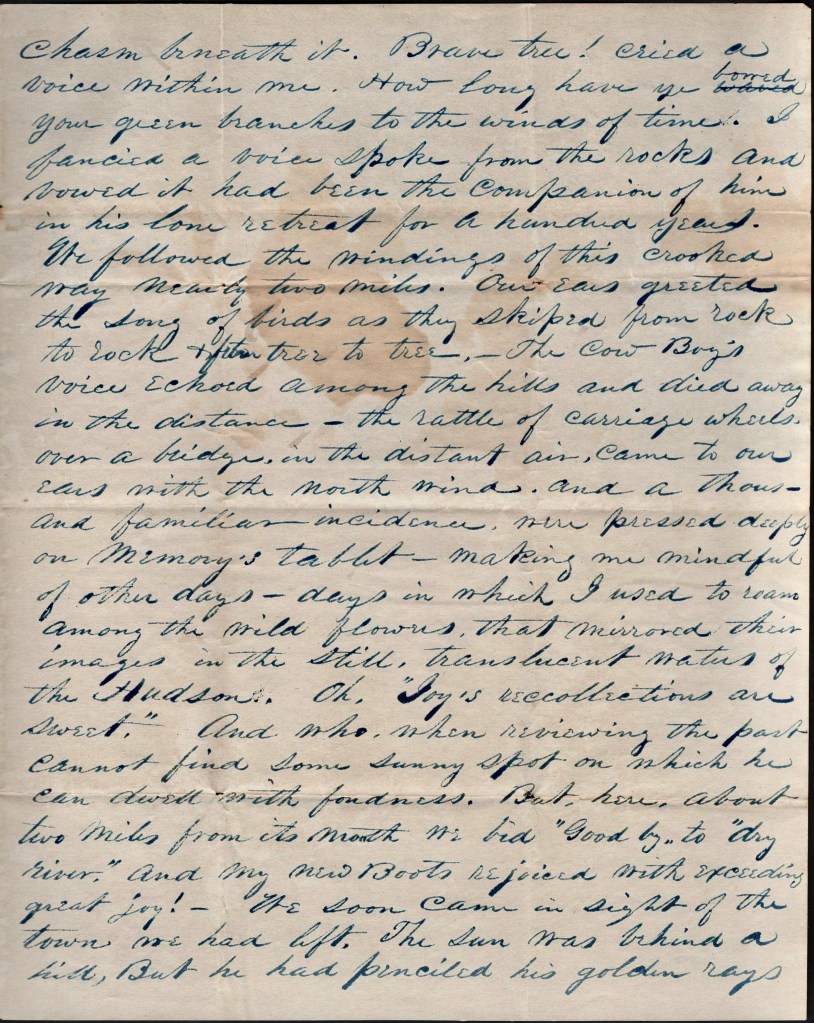
Transcription

Troy [New York]
June 1, 1840
To N. Noble, Esqr.,
After taking tea with a friend in West Troy, we mutually agreed to take a tramp to “Dry River.” Each obtained a cigar—these being ignitedm we put off. As we proceeded in the main street we were nearly suffocated with dust, which was caused by the rapid whirl of omnibuses & vehicles. However, we soon passed from this “durance vile” to a more pleasant and delightful course.
The wind blew gently from the North which was truly refreshing and enlivening. “the wavy fields” of grain and delicious odor from “verdant hills” and “flowery vales,” threw a halo of beauty and delight upon all we looked upon. As we approached the entrance of the “Dry” Stream which we were about to ascend, I saw a field of clover—green, rank, and thrifty. It sent forth “fragrance delectables.” As I beheld it, I had :immortal longings” within me. And for what? is the inquiry. Not for death that I might be buried there. But to be buried in such a place when dead. But after all, I think it of little consequence when one is buried after life is rendered up.
Our course was westward. When we had gone about half a mile, we turned to the north, proceeded a short distance and then entered “dry river.” Now, we lost sight of the pleasant and undulating scenery, the beholding of which had given me new life, and had filled my soul with new imaginings. We soon entered among the rocks whose steep, craggy and sombre heights shut out much of the resplendent light of day’s all glorious ring. As we continued our winding course, we lost sight of the pleasant landscape over which we had just passed.
A large giant like tree attracted my attention. It waved its bows on the verge of a precipice, as if unmindful of the awful chasm beneath it. Brave tree! cried a voice within me. How long have ye bowed your green branches to the winds of time. I fancied a voice spoke from the rocks and vowed it had been the companion of him in his lone retreat for a hundred years.
We followed the windings of this crooked way nearly two miles. Our ears greeted the song of birds as they skipped from rock to rock and from tree to tree. The cow boy’s voice echoed among the hills and died away in tyhe distance. The rattle of carriage wheels over a bridge in the distant air came to our ears with the north wind, and a thousand familiar incidents were pressed deeply on memory’s tablet, making me mindful of other days—days in which I used to roam among the wild flowers that mirrored their images in the still, translucent water of the Hudson.
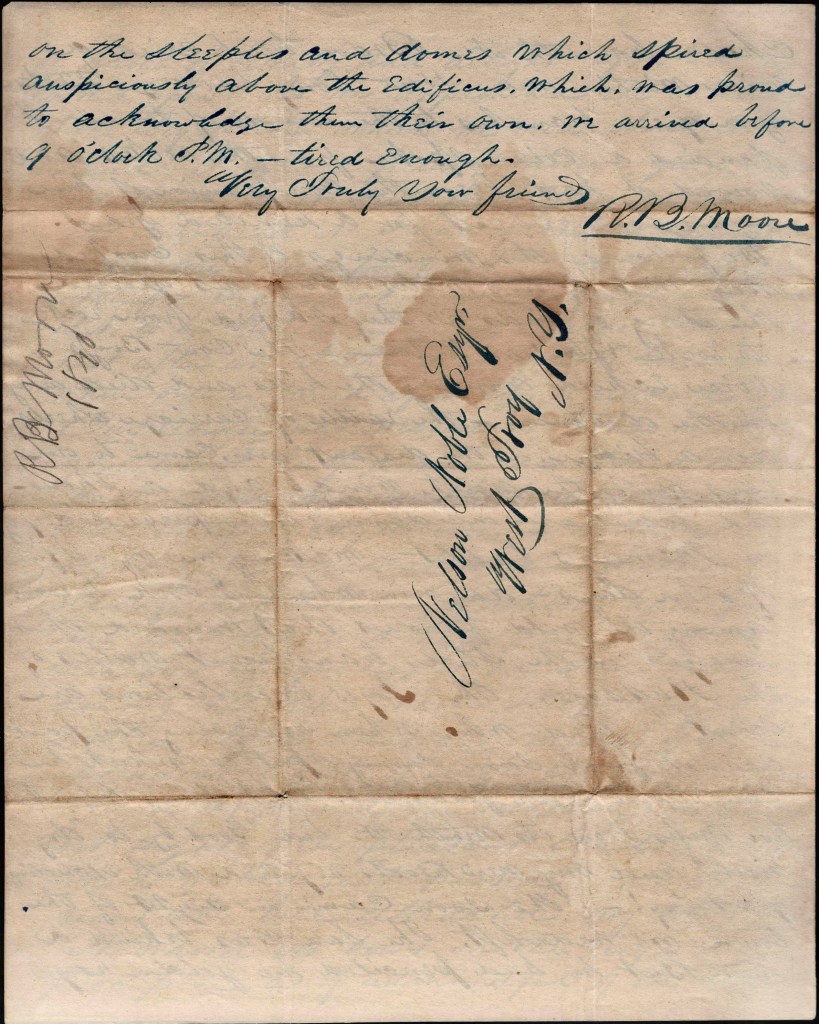
Oh, “Joy’s recollections are sweet.” And who, when reviewing the past cannot find some sunny spot on which he can dwell with fondness. But here, about two miles from the mouth, we bid “goodbye” to “dry river,” and my new boots rejoiced with exceeding great joy! We soon came in sight of the town we had left. The sun was behind a hill but he had enciled his golden rays on the steeples and dome which spired auspiciously above the edifices, which, was proud to acknowledge them their own. We arrived before 9 p’clock p.m. tired enough.
Very truly your friend, — R. B. Moore


 Spared & Shared 23