

The following letter was written by 33 year-old Margaret Vail (Kelley) Lester (1830-1917), the daughter of David Kelley (1806-1876) and his first wife, Charity Herrick (1806-1832) of Danby, Rutland county, Vermont. David Kelley later moved to DuPage county, Illinois. Margaret was married in April 1848 in DuPage county, Illinois, to James Franklin Lester (1824-1899). In the 1860 US Census, Margaret and James were residing in Marengo, McHenry county, Illinois, where James was employed as a farm laborer and a carpenter. An obituary for Margaret (The Daily Times, Davenport, Iowa, June 28, 1918) informs us that Margaret was born at Danby Four Corners, Vermont, and came to Illinois with her parents when she was 15 years old. She had been educated in the Castleon Seminary in Vermont and entered the teaching profession. Once married, the couple had two children—Emma Frances who died at the age of 16, and James Henry who died in 1917.
Margaret wrote the letter to her half-brother, Thomas Benton Kelley who was serving in Co. E, 8th Illinois Cavalry at the time.
What truly shines in this letter is Margaret’s bold articulation of the argument for women’s equality, challenging the status quo with fierce clarity.
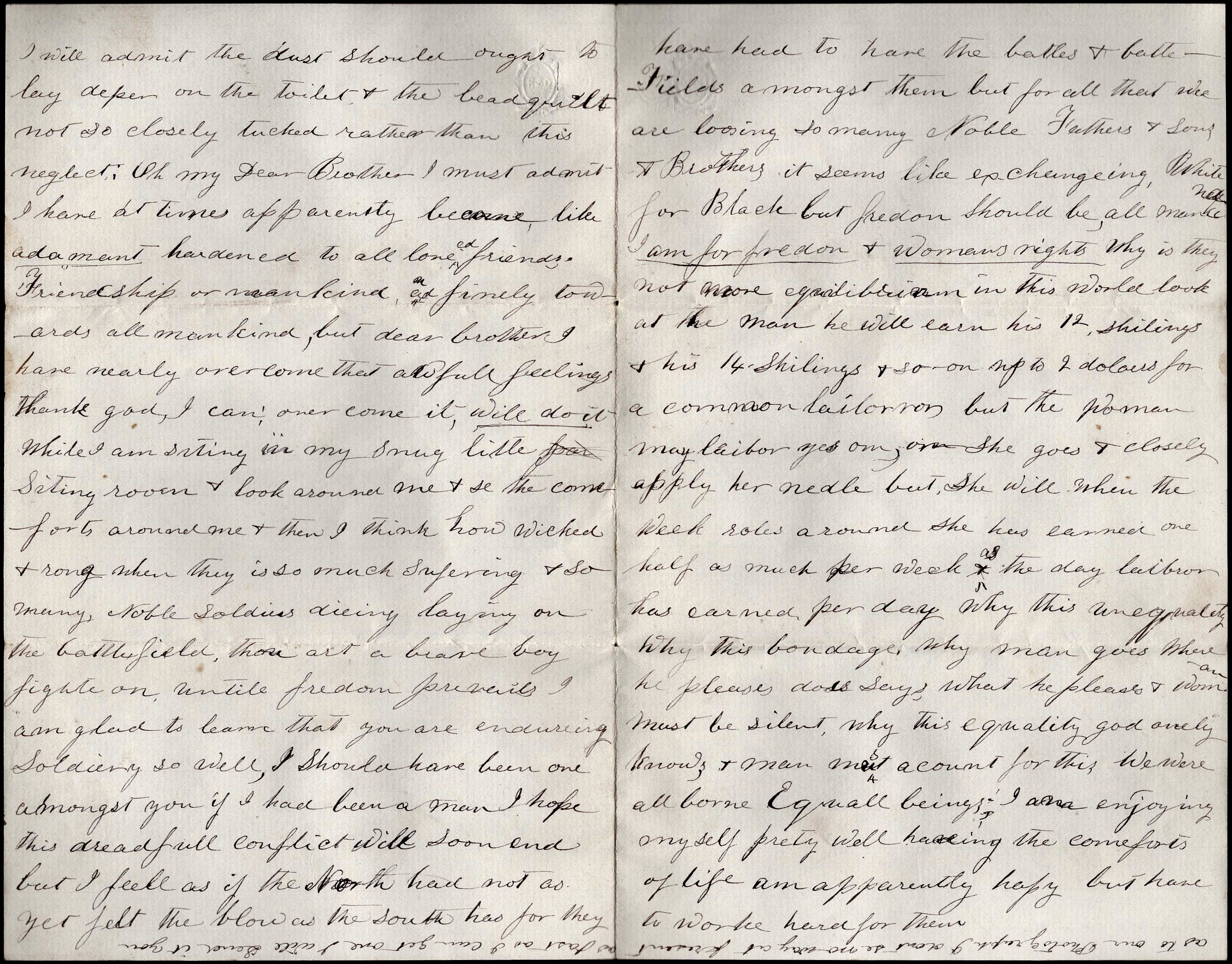
Transcription
November 26, 1863
My dear neglected brother,
Thanksgiving eve & I cannot rest on my pillow another night before I pen you a few broken lines. I have written so little for a year back. It has become a task instead of a pleasure. Is it a possible thing? I will call it a task. No dear, brother, it is not so. But I have apparently made it so. But noble sir, I am with you in imagination, hour after hour, & many a meal do I feel as if my dear good brothers could share with me.
Oh, I have written many & many imagined epistles to you. I am almost sure sometimes I never will be forgiven for my cold neglect. But a promise for the future. My best wishes to Mary. I expect she feels my cold neglect, but come here & see what I have to pass through with & you would not wonder. I will admit the dust should ought to lay deeper on the toilet & the bed quilt not so closely tucked rather than this neglect.
Oh my dear brother, I must admit I have at times apparently become like adamant hardened to all loved friends, friendship or mankind, and finally towards all mankind. But dear brother, I have nearly overcome that awful feelings. Thank God, I can overcome it. Will do it. While I am sitting in my snug little sitting room & look around me & see the comforts around me. And then I think how wicked & wrong when there is so much suffering & so many noble soldiers dying, laying on the battlefield.
Thou art a brave boy. Fight on until freedom prevails. I am glad to learn that you are enduring soldiery so well. I should have been one amongst you if I had been a man. I hope this dreadful conflict will soon end but I feel as if the North had not as yet felt the blow as the South has, for they have had to have the battles & battle fields amongst them. But for all that, we are losing so many noble fathers & sons & brothers. It seems like exchanging White for Black. But freedom should be [for] all mankind. I am for freedom & Womans’ rights. Why is there not more equilibrium in this world? Look at the man. He will earn his 12 shillings & his 14 shillings & so on, up to 2 dollars for a common laborer, but the woman may labor, yes, on and on she goes, & closely apply her needle, but she will, when the week rolls around, she has earned one half as much per week as the day laborer has earned per day. Why this inequality? Why this bondage? Why man goes where he pleases? Does say what he pleases & a woman must be silent? Why this inequality? God only knows & man must account for this. We were all borne equal beings & I am enjoying myself pretty well, having the comforts of life, am apparently happy, but have to work hard for them.
I will return to my thanksgiving supper. We were invited out to one of our neighbors to supper. Enjoyed it much—the whole family. I hope my dear brother was where he could enjoy the necessary comforts if no more. Be patient, for thou shalt be blessed by well doing. Henry’s folks I hardly have seen or heard from for the last three months as usual. I guess the babe, Jane Charity, has been sick all the fall.
I have one boarder & a great deal company & it does seem as if I never should have any respite. Besides, Emma & myself take in work. She goes to school & her studies are crushing her. She is not very stout. She is very industrious. She often speaks of you & of Mary & Mittie, but she is not at home or she would write. She will write soon. Her correspondence is quite extensive. Emma is one good girl & Henry is another T. B. Kelley right over. He would go to the war & who would blame me if I was old enough. That is him to a dot. I have not seen father for nearly a year. It is a year last fall since I was home. E[mma] & Henry was there this fall. Mother, I guess, carries on the hotel & Father stays on the farm a great deal. E. Parish’s sister says mother has the blues. Gets quite hystericky. I believe Pa is a going to move Annetta back to the depot somewhere. I shall go to Henry’s before long. Come home as soon as your time is out or as soon soon as you can.
I hope you will excuse James for not writing. It is not for any ill will. Pleas accept his best wishes. He has a brother at Fort Jackson. Edson [Sportnoble?] was brought home a corps. He was poisoned by the physician by a sponge that was used by a man with erysipelas which caused his death. The doctor’s brother-in-law wanted his office. From your sister M [ ] Lester. My best wishes to M. E. Jones. Tell him we thank him for his photograph & Emma will write to you both soon. Goodbye.
As to our photograph, I don’t see no way at present. As fast as I can get one, I will send it you.

 Spared & Shared 23