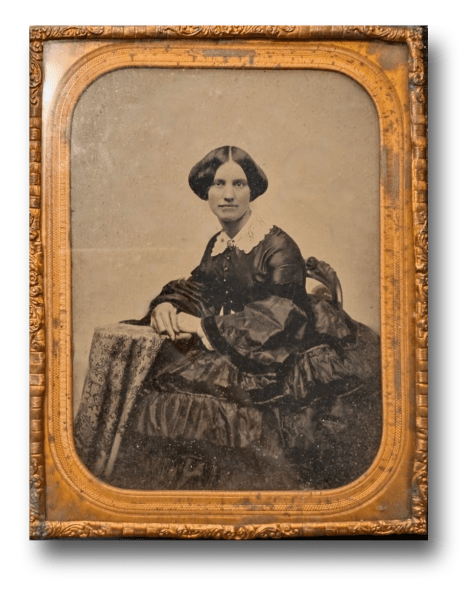
This letter was written by a young woman with the initials C. C. P. and who was most likely a resident of Rahway, New Jersey in 1859. We learn from the letter that she was traveling with a large party of other young women and gentlemen up the Mississippi River in the spring of 1859. She mentions missing her “babies” so I presume she was a married woman though she does not say anything of a husband. She also refers to a man named “Murray” who was traveling with them, perhaps as leader of the party. Might this have been Rev. Nicholas Murray, a leader in the Presbyterian church in New Jersey?
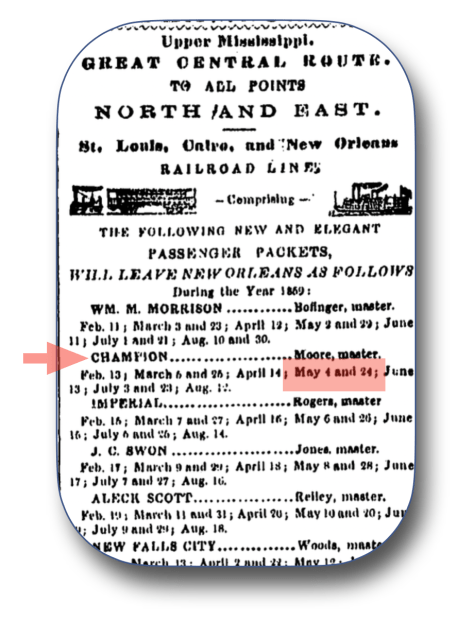
Even without knowing her identity, however, the letter provides us with interesting information about the Passenger Packet named Champion, captained by Enos B. Moore, that operated regularly between New Orleans and St. Louis in the 1857-1861 period. The author gives us a description of some of the ship’s features and of the luxuries afforded steamboat travelers just prior to the Civil War. She also mentions the spring freshet and the difficulties of getting ashore through the muddy floodwaters at Vicksburg.
Steamer Champion typically made the journey from New Orleans up the Mississippi River to St. Louis in four days but may have taken a little longer on this trip due to the strength of the current.

Flood on the Mississippi river in 1859
T R A N S C R I P T I O N

Addressed to Mrs. Mary M. DeGraw, Rahway, New Jersey
Steamer Champion
Mississippi River
May 8, 1859
My Dear Mary,
I do not know what to think of your long silence in any other way than that you have gone to Philadelphia. I have not had one letter from home yet, and only heard in New Orleans by telegraph. Tonight we expect to get letters from Memphis. We telegraphed at Vicksburg to have them sent to the boat so that we could go on to St. Louis instead of stopping.
We are having such a very pleasant trip on the river. Indeed, it puzzles me to think sometimes that I am on the river. We have such a very pleasant party of about 20 ladies and a dozen gents. We have a very handsome piano on board and nearly all the ladies play. We dance, play cards, sew a little, run up stairs in the pilot’s room to see the sights, and do almost anything to enjoy ourselves.
The Captain [Enos Bascomb Moore] 1 has just been married and has his bride [Maria (Pratt) Moore] on board. They are very pleasant indeed. Yesterday the clerk [Duvall W. Young] took us in the pantry—quite a large room where the good things are kept—and treated us to cake, fruit, and nuts.
Night before last we sat up till after twelve so as to go on shore at Vicksburg and such sport you never saw. The Mississippi is very high—30 feet higher than it usually is—so that the lower part of the city was all over flowed. We stepped on the wharf and from there to planks, from them on an old scow over the street and then more planks. From them we started up hill. The clerk of the boat was with us with a lantern so there was no danger of our being left. The streets were all nicely lighted with gas but we could not see much of the city.
The saloon of the Champion is 230 feet long and furnished beautifully. At night when the chandeliers are all lighted, it would be almost impossible to imagine yourself on the water. All the passengers are the same as though they had been acquainted always—so very sociable. The girls carry on with Murray as though they had known him before. Yesterday they had his hat, so he put on another one and one of the young ladies said to him she did not know he owned another hat. They dress same as at the hotel. We have fine large staterooms with closets and double beds.
I do not know as you will be able to read this letter if such a scrawl can be called one. I am writing on my lap and the boat jars and shakes so that I cannot do any better. Please tell Aunt Phebe you have heard from me if you are in Rahway.
Murray send his love to you and hopes you are well. It does not seem much like Sunday, they keep up such a chatter with their tongues and laugh so loudly as though they cared for no one. I am very anxious to see my babies once more. Do not think with all my talking of fun and frolic I forget them for I assure you I do not. We expect to arrive at Memphis at midnight and expect to arrive at St. Louis on Wednesday. We do not know what route we shall take for home yet. We have everything so nice to eat here—everything you can think of. I smell the cake cooking for tea now. We have the most beautiful biscuit and muffins ever tasted, The cook is going to show me how to make them and then you shall have some when I come home.
Yours affectionately, — C. C. P.
1 “Captain Enos Bascomb Moore (1823-1903) spent his life piloting steamboats on the Mississippi and Ohio Rivers. He was born in 1823 to Levi and Amanda Moore. He spent his childhood on a small farm on the banks of the Ohio River, seven miles below Portsmouth. Enos and his three brothers gravitated towards river work. Enos’ daughter Mary Moore wrote in her family memoir, “Enos, who had graduated from the country school, was planning to study law at Delaware College, when a chance flatboat loaded with flour and New Orleans bound, lured him aboard; the other two brothers followed and soon all four were careering on the Mississippi.” The oldest brother William left home first and got a job working out of New Orleans for Captain R.C. Young, who operated several boats on the lower Mississippi. Not long after, William sent for Enos, and later the youngest brother Samuel. Enos’ first job was as a night watchman on the boat. Shortly afterwards he became a licensed pilot. William began chartering and operating boats on the Yazoo River, in Mississippi, and Enos invested in his enterprises. Together they built the steamer Hope, and many of the diary entries in this collection refer to money Enos sent to fund these endeavors.
Enos continued to pilot riverboats for Captain Young until the blockade went up at Cairo in 1861. During this period he captained the R.C. Young, which caught fire in 1855, and later (1857) the Champion with Young’s son Duvall as clerk. At the start of the war, Enos and William liquefied their assets, sold the Champion, scuttled their steamer Hope, and reportedly retreated to St. Louis with $80,000 in gold. In 1863 the brothers bought a half interest in the foundry and boiler-yard in Portsmouth Ohio. The following year they bought a fourth interest in the packet Bostonia, and in 1866 bought an additional eighth interest. In subsequent years they bought the other half interest in the foundry and machine works and merged their holdings with other pilots to form the Cincinnati, Portsmouth, Big Sandy & Pomeroy Packet Company. William managed business while Enos and Samuel piloted boats on the river. The Packet Company ran six boats, the Bostonia, Fleetwood, Telegraph, Bonanza, Morning Mail, and steamer Ohio. The side-wheeler Bonanza was the largest boat on the Ohio river at the time. The wooden hull was 265ft in length by 43ft in width, with a depth of 7ft. The ship dominated river traffic around Cincinnati from the time it was built in 1876, until the construction of the Chesapeake and Ohio Railway in the early 1890’s. Enos designed the boat and supervised its construction, then captained the vessel until he retired in 1889. Enos was married in Yazoo City, on 9 February 1859, to teacher Maria Prime Pratt (1829-1865), a native of Washington County, New York. Maria died in 1865, leaving behind two daughters, Frances and Mary.” [Source: St. Louis Mercantile Library, P-84 Captain Enos N. More Diaries & Correspondence]

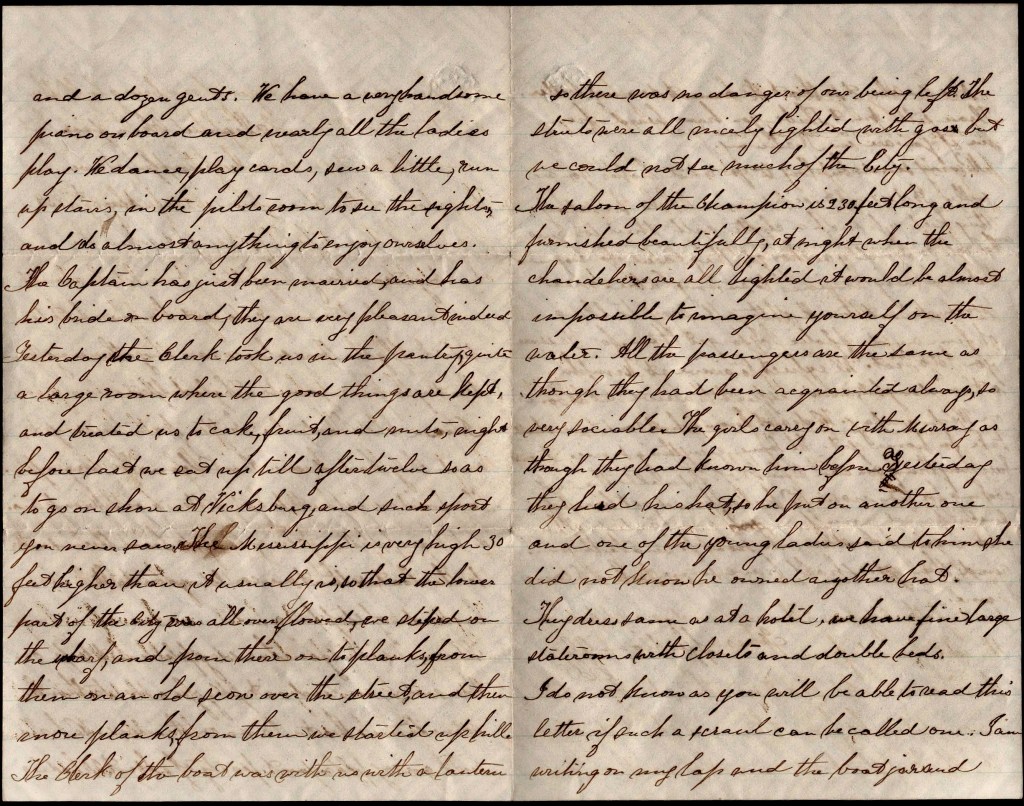


C.C.P writes to Mary DeGraw, “They dress the same as at the hotel”. She might be referring to Mary’s hotel. I think Mary is Maria DeGraw, wife of John DeGraw, proprietor of Mantion? Manchin? House (Its scribbled sideways in the 1860 census) in Rahway, New Jersey. Sorry, haven’t figured out the others.
LikeLike
Agree. I had that figured out. Just don’t know who the author is yet.
LikeLike