
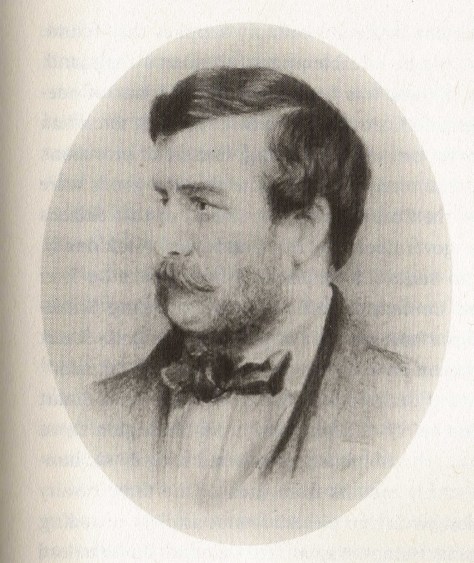
This letter was written by Frank Hampton (1829-1863), the son of Wade Hampton II (1791-1858) and Anna Fitzsimmons (1794-1833). He was the younger brother of Wade Hampton III (1818-1902) of greater fame. Frank and Wade were the largest and wealthiest plantation owners in South Carolina prior to the Civil War. While Wade led Hampton’s Legion (infantry), Frank served as the Lt. Colonel of the 2nd South Carolina Cavalry. He was later mortally wounded at Brandy Station during the Gettysburg Campaign.
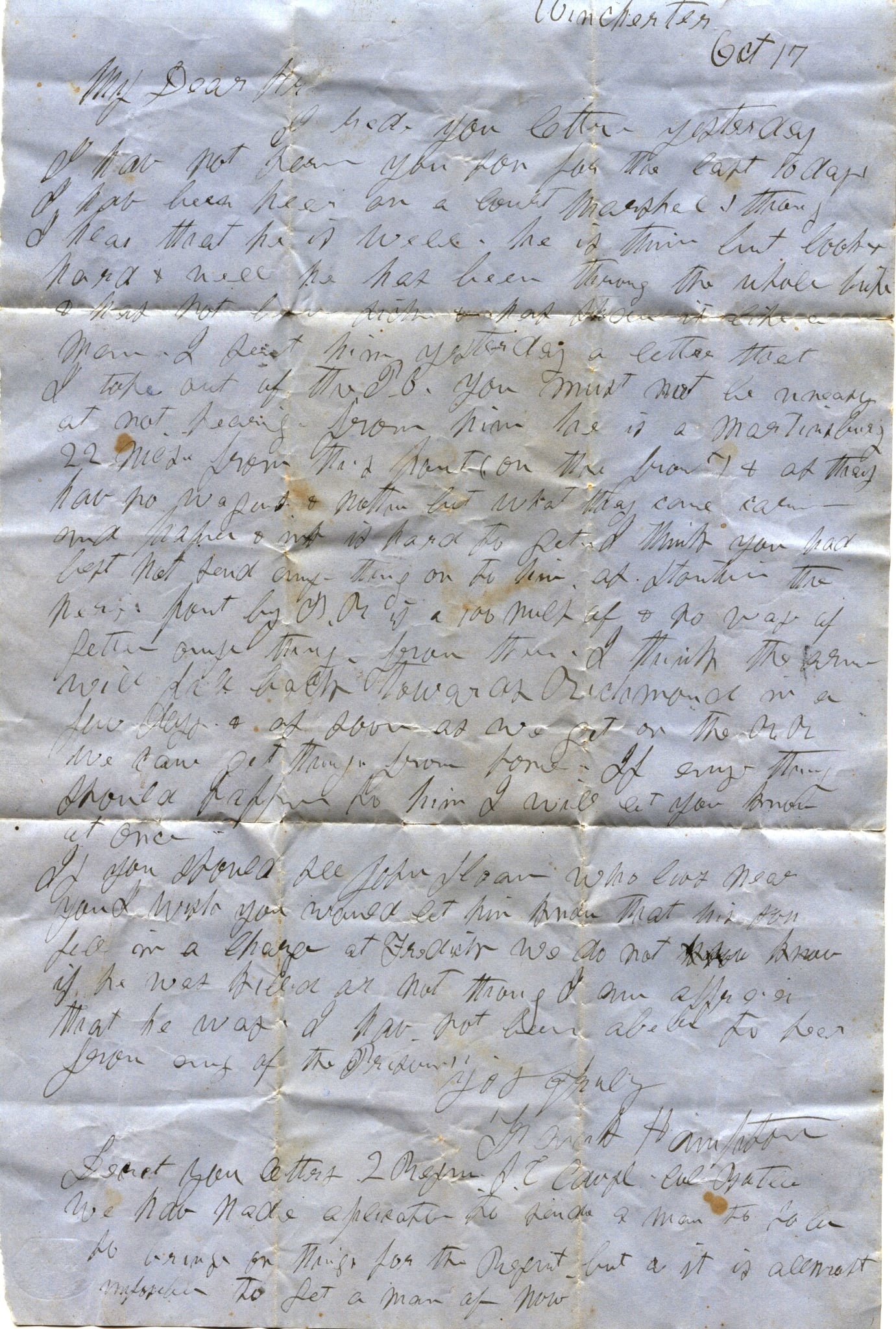
In his letter, Frank responds to an enquiry from General of S. C. Militia, William Hopkins, of Richland County, South Carolina—Frank’s home county—regarding the whereabouts and safety of his son, David Hopkins who served in Frank’s regiment. The letter was dated Oct. 17th, exactly one month after the Battle of Sharpsburg where the 2nd South Carolina Cavalry participated in yhe fighting in the West Woods. Frank assured him that his son was okay and was with the regiment in Martinsburg, Virginia, and without access to mail. Before closing his letter, he asks Hopkins to inform Mr. Sloan that John W. Sloan, a private in Co. C, 2nd South Carolina Cavalry, fell in a cavalry charge at Frederick, Maryland, on 12 September and that he was likely dead.
The 2nd Cavalry Regiment was organized during the summer of 1862 by consolidating the 4th South Carolina Cavalry Battalion and the Cavalry Battalion of Hampton’s South Carolina Legion. The unit served under the command of Generals Hampton, M. C. Butler, P.M.B. Young, and Gary. It fought with the Army of Northern Virginia at Second Manassas, South Mountain, Sharpsburg, Fredericksburg, Brandy Station, Second Winchester, Upperville, Gettysburg, Bristoe, Mine Run, Todd’s Tavern, The Wilderness, Ground Squirrel Church, and Brooks’ Church. In May, 1864, the Infantry Battalion of Hampton’s South Carolina Legion was mounted and united with the 2nd Cavalry. It was then redesignated the Hampton South Carolina Cavalry Legion.
Note: This letter is from a private collection (RM) and was made available for transcription and publication on Spared & Shared by express consent.
T R A N S C R I P T I O N
Winchester [Virginia]
October 17 [1862]
My dear sir,
I received your letter yesterday. I have not seen your son for the last 10 days. I have been here on a court martial though I hear that he is well. He is thin but looking hard & well. He has been through the whole fight and has not been sick & has stood it like a man. I sent him yesterday a letter that I took out of the post office. You must not be uneasy at not hearing from him. He is in Martinsburg 22 miles from this post on the front and as they have no post & nothing but what they can carry, and paper & ink is hard to get. I think you had best not send anything on to him as [ ] is a 100 miles off and we have give up getting anything from them [?] I think the army will fall back towards Richmond in a few days & as soon as we get on the railroad we can get through from home. If anything should happen to him I will let you know at once.
If you should see John [W.] Sloan who lives near you, I wish you would let him know that his son fell in a charge at Frederick [on 12 September 1862]. We do not know if he was killed or not though I am afraid that he was. I have not been able to hear from any of the regiment. Yours truly, — Frank Hampton
Direct your letters to 2nd South Carolina Cavalry, Col. [Matthew C.] Butler. We have made application to send a man to S. Carolina to arrange for things for the regiment but it is almost impossible to let a man off now.
 Spared & Shared 23
My 2-great uncle Tom Jeffers was in the 2nd South Carolina Cavalry. When the regiment reached Martinsburg, it was several weeks before he could find the time, the paper, and the ink to write home. He also hoped the regiment would eventually fall back towards a spot where they could get their mail.
My uncle did not write much about Col. Frank Hampton, as he was in Company B, and his own colonel was Matthew Butler. But he did let his folks know about Frank Hampton’s death after the battle of Brandy Station: “The loss to our Regiment is severe and greatly felt by all, although the casualties were but few. Col Hampton tho not bright as an officer was kind and generous to a fault and was much beloved by his men.”
I think Tom did not mean that Frank Hampton was not a smart man, as the family did not use the word “bright” in that context. I believe he meant that Frank was more humble and quiet-mannered than most high-ranking officers. His own brother General Wade Hampton was a shining rock-star. Matthew Butler was a swashbuckler.
LikeLike