The following letter was written by Thomas Winset (1838-1863), who enlisted as a corporal in Company K of the 19th Indiana Infantry on July 29, 1861. He subsequently rose to the rank of sergeant. Thomas met his end at Gettysburg in the afternoon of July 1, 1863, as he and his fellow soldiers in the 19th Indiana—part of the esteemed Iron Brigade—valiantly resisted and repelled the Confederate assault in Herbst’s Woods during the first day’s engagement, striving to gain precious time for additional corps of the Army of the Potomac to reach the battlefield. William Murray of Co. K witnessed the death of Sgt. Winset who was killed instantly when he was shot in the forehead. Murray was standing only two feet away from him at the time and later described the fighting: “The slaughter in our ranks became frightful, beyond description. The dead lay piled up on the ground, and the shrieks and groans of the wounded was too horrible for contemplation.”
By the time of the Battle of Gettysburg, the Iron Brigade had established a formidable reputation as a fierce adversary, having endured the trials of Second Bull Run, South Mountain, Antietam, Fredericksburg, and Chancellorsville. They were distinguished throughout the conflict as the “Black Hats,” a name derived from the black Hardee hats of the 1858 model that were issued to Regular Army soldiers, contrasting with the blue forage caps worn by the majority of other Union Army units.
Thomas was the son of Gilbert P. Winset (1811-1898) and Emma Dodson (1818-1872) of Selma, Delaware county, Indiana.

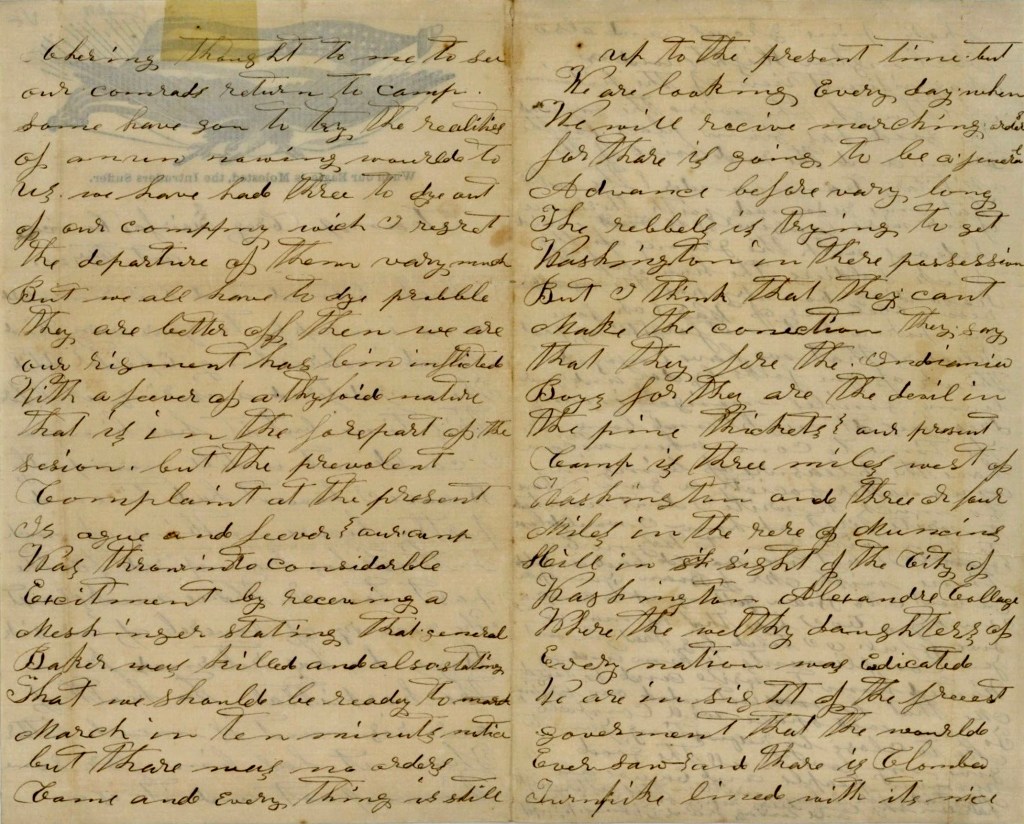
T R A N S C R I P T I O N

Camp Craig, Fairfax County, Va.
October 25th 1861
Much beloved and ever remembered one,
In reply to your very kind and interesting epistle dated the 8th, I deferred answering it before this time but it has been so I could not until now partly because I haven’t had time and partly because nothing of much interest has transpired for the past two or three weeks except the recovery of several of our sick boys has returned from the hospital.
The health of our regiment is much better than it has been for some time past and it is a cheering thought to me to see our comrades return to camp. Some have gone to try the realities of an unknowing world, to viz: we have had three to die out of our company which I regret the departure of them very much. But we all have to die. Probably they are better off than we are. Our regiment has been inflicted with a fever of a typhoid nature that is in the forepart of the session, but the prevalent complaint at the present is ague and fever.
Our camp was thrown into considerable excitement by receiving a messinger stating that General Baker was killed [see Battle of Ball’s Bluff] and also stating that we should be ready to march in ten minutes notice but there was no orders came and everything is still up to the present time. But we are looking every day when we will receive marching orders for there is going to be a general advance before very long. The rebels is trying to get Washington in their possession but I think that they can’t make the connection. They say that they fear the Indiana Boys for they are the devil in the pine thickets.
Our present camp is three miles west of Washington and three or four miles in the rear of Munson’s Hill in the sight of the City of Washington [and] Alexandria College where the wealthy daughters of every Nation was educated. We are in sight of the freest government that the world ever saw and there is Columbia Turnpike lined with its nice shady pine groves and also Arlington Heights and a magnificent view of the Potomac. Although the wise, the song and the good [?] has given place for the drum and the rude noise of the military commander, the walls that once resounded with the eloquence of our wise lawgivers is now made hideous with the groans of the sick soldiers [and] the houses of the resounding country has the resemblance of war.
Oh Jane, you spoke about not forgetting past pleasures that we have enjoyed. I think of you folks by day and your loving smiles mingle in my dreams at night and I long for the time to come when we can have the pleasure of being in one another’s society again.
I have so much to write, I don’t know what to write first. Oh, how I would love to been with you to Wayne county. I’ll bet we would have had a nice time with Mr. J. Bean. You spoke about Mr. Bean getting up to campaign in Wayne county. I hope that he may be successful. I told Lige that you sent your compliments to him and wanted him to write and he fold me that he intended on writing to you. Well, space will compel me to close by requesting you to give my love to all the good Union people and excuse all mistakes for I have written this after night. Pardon my long delay. Reply soon. Your true and loving friend, — Thomas Winset