
The following letters were written by George Thomas Sifleet (1842-1863) who came to the United States from Frindsbury, Kent, England, with his parents in 1854. The family settled in Ulster county, New York, initially but then relocated to Vienna, Grundy county, Illinois.

George enlisted in Co. D, 127th Illinois Infantry in mid-August 1863. At the time of his enlistment, he was described as a single farmer, standing just north of 5 foot 2 inches, with grey eyes and light hair. He mustered into the United States service on 5 September 1862 and was with his regiment until 25 April 1863 when he died of disease at Young’s Point, Louisiana.
George had an older brother who served in the 36th Illinois Infantry but was mortally wounded at the Battle of Stones River and died on 8 January 1863.
Here are some other letters by members of the 127th Illinois previous transcribed and published on Spared & Share. One of them includes a diary.
James R. Maxwell, Co. D, 127th Illinois (5 Letters)
Robert Marsden, Co. E, 127th Illinois (62 Letters & Diary)
Letter 1
Memphis, Tennessee
November 17 [1862]
Dear Father and Mother and Sister,
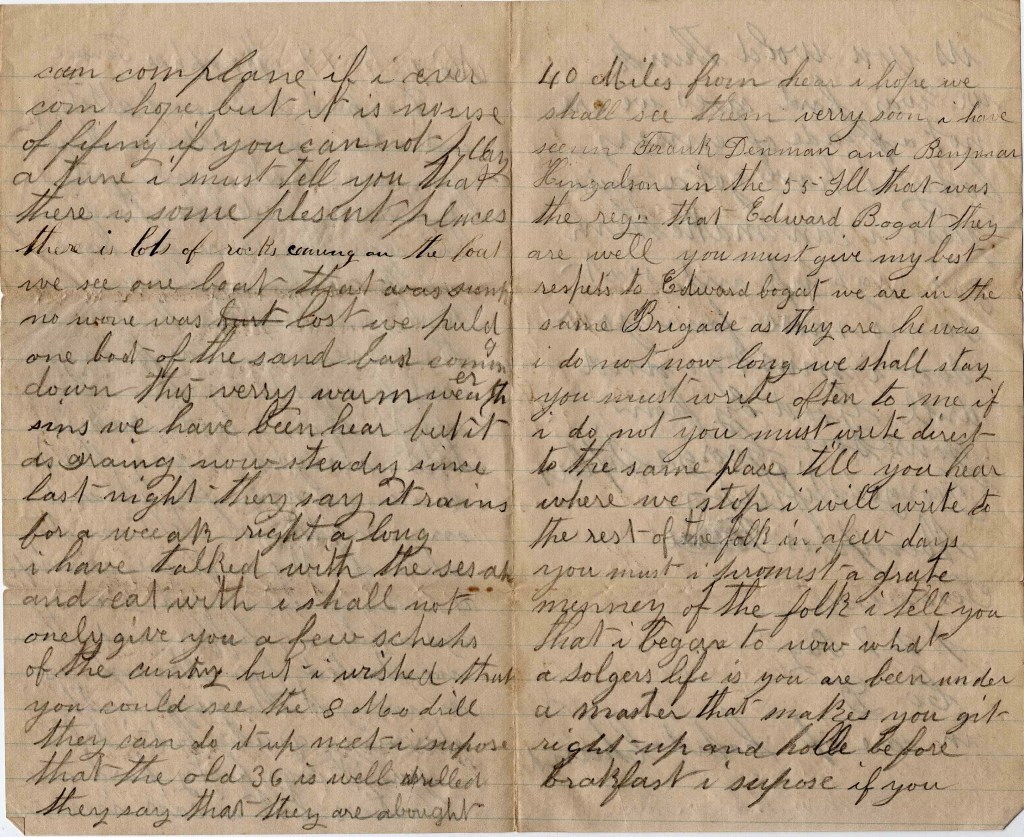
I now sit down to let you know that I am well at present and hope these may find you the same.
We have got to a stopping place and that is Memphis & close to the river, We was two days and two nights on the river with two or three hard crackers. Talk about living. That is no name for it. And one night we stopped on the shore of Missouri and we [ ] four hives of bees and two or three hogs and one heifer and then we started for Memphis so we got through with starving quite but I tell you, it was pretty hard us. But I can never complain if I ever come home. But it is no use of fifing if you cannot play a tune.
I must tell you that there is some pleasant places. There is lots of rocks. Coming on the boat we seen one boat that was sunk. No one was lost. We pulled one boat off the sand bar coming down. This [is] very warm weather since we have been here but it is raining now steady since last night. They say it rains for a week right along.
I have talked with the secesh and eat with. I shall not only give you a few sketches of the country but I wished that you could see the 8th Missouri drill. They can do it up neat. I suppose that the Old 36th [Illinois] is well drilled. They say that they are about 40 miles from here. I hope we shall see them very soon. I have seen Frank Denman and Benjamin Hingalson in the 55th Illinois. That was the regiment that Edward Bogat [joined]. They are well. You must give my best respects to Edward Bogat. We are in the same brigade as they are he was.
I d not know [how] long we shall stay. You must write often to me [even] if I do not. You must write and direct to the same place till you hear where we stop. I will write to the rest of the folk in a few days. I promised a great many of the folk. I tell you that I begin to know what a soldier’s life is. You are been under a master that makes you get right up and holler before breakfast.
I suppose if you would see us you would think we was hard cases. We are not afraid of anybody. I have got a nice gun. I can make them get right up and seat. So no more form your son. I must go and drill. Goodbye from your son, — George Sifleet
127th Regiment, Co. D, in care of Capt. Chand, Memphis, Tennessee

Letter 2
On the Mississippi
January 18, [1863]
Dear father and mother,
I now sit down to let you know that I am well and hope these few lines may find you enjoying the same blessing. I received your letter last night and was glad to hear that you was well and sorry to hear that James was sick but I hope he is getting better. We have been on the boat about one month. We are getting tired of it. I suppose John Whybrow is having good times this winter but they are putting us through. We have been in two battles in two weeks—both of them on Sunday. We have started back for there again with a larger fleet.
They say that General Grant’s army is a going there to support us. I hope it is so. I hope we not get whipped but I think we will either whip them or they shall whip us and it will be a hard fight. We are a going within about 30 miles of there and go in camp for a while.
I must tell you that the mail does not go very often. I wrote a letter to Emmy McConnell two or three days but I have not sent it yet. But I will send it with this and you will give it to her. You must tell her that if she will not wait and have a soldier that she must take what she can get—some old bachelor or other.
After we took Arkansas Post we took what we could and tore down the breastworks and burned up all the buildings and went down the White River to the Mississippi river and we went up that about 30 miles to get off a hospital boat which had been there 48 hours. We worked all night getting coal off. Then in the morning we hauled her off and we came back and now have started down the river.
I must go and wash. I can tell you where I spent my Christmas. On the boat. And on New Year’s we left the battlefield for the boat. I tell you, we was still that night and the next day we left. I would like to of be[en] there on New Years and Christmas with you. I would like some sausage meet with you, I tell you that.
I wish that this abolition war was over and the Negroes was with their master for father, they are no account to any man. The better you use them, the lazier they are for we have got a number of them on the boat. They lay under the boilers. You have to drive them or they will not go or do anything. The quicker this war is over the better.
So goodbye from your son, — George Sifleet
To Mr. and Mrs. Sifleet. God bless you all.


Letter 3
Young’s Point, Louisiana
February 17, 1863
Dear father and mother and sister,
I now sit down to let you know that I am well at present and hope these few lines may find you in good health. It commenced raining two days ago and it is a raining yet. It is very muddy so that we cannot hardly getaround to cook anything. Our tents leaked yesterday.
I do not know of much news to write. We have not done anything here yet—only dig on the canal. It does[n’t] seem to amount to much yet.
The mail came in last [night] about dark. I got two letters—one from Lizzy and the other from William Fellingham. I was sorry to hear that John Whybrow was dead. I suppose that you do not see anything about the war a coming to a close.
Our captain is a Major now in this regiment—that is, he is Acting Major. Our Major has gone and left us and so as the Colonel and his son left us that that we have not but a Lieutenant Colonel. We hear lots of reports that we cannot believe. The most of the soldiers are all sick of it. They say they do not care what becomes of the government and the Negroes or anything else. I do not see any more signs of the war a coming to a close than there was one year ago. But I think it will last long. It has been going on long enough [and] I think so do the soldiers.
I do not know what to write about. I do not know how long we shall stay here. The tent is crowded full. The boys are in the tent. I hope we shall leave here soon if it keeps a raining all the time. The boys are not in very good spirits but they are a getting sick of it.
I would like to get a paper once in a while. We have not go any pay yet. We begin to need it. I wish you would send me 50 cents worth of postage stamps in a letter. I write a good many letters and that takes stamps. I would like some of your sausages and bread and butter. I would like it very much. John Whybrow and Alexander Tomson has had a very good place to stay in Otyway [?]. George is well. He is a writing to his brother and sister. I got your letter last night and never was a more glad a boy to get a letter than I was any time.
I must draw my letter to a close. From your only [son], — George Sifleet
To Father and Mother and sister Sifleet
Give my best respects to Mr. and Mrs. Searink [?] and all enquiring friends. From your son, — George Sifleet


Letter 4
[Opposite] Vicksburg
February 21 [1863]
Dear father and mother,
I now sit down to let you know that I am well and hope these few lines may find you well as to say it leaves me at present. I thought I would tell you how I feel this morning. I feel as though I would like to take a few warm biscuits and a few mash potatoes and some eggs and so on. I have just been to breakfast. I had a piece of bread. It was good. We get one loaf every other day and there is about enough in one loaf for one meal if a man is hungry. We get plenty of hard tack and pork and coffee but I do not drink much of that.
I have got a cold now. Tell father I would like to know how his horses get along. I would like to see them.
We do not appear to be making any point here yet. I suppose we are waiting to get good and ready. We fire at them once in a while. I heard some very hard firing. I guess that our gunboats came back. Whenever the boats go by, they fire their best. One of our mortars have been a firing at the City. Our company is out on picket, the most of them. They will come in this morning and it is a raining very hard this morning and it looks as though it was a going to be a rainy day. The boys are a playing cards and dominoes and everything else but George and myself does not know one card from another. Some of the boys begin to need some clothes very soon. My clothes is pretty good yet.
Father, my boots stand it well. Some of the boys paid 6 and 7 dollars for boots and they are about gone. My boots has one little hole in the side. I take good care of them. George is a coming now. I hope you will write a long letter. When you write, tell me what father is a doing and mother, send me a tin of biscuit and a few potatoes and so on.
You must [excuse] my poor writing for I have no place to write, only on my knee. I will write as often as I can. I can’t find much fault now for I get a letter most every time the mail comes. They say the mail is a coming today. I hope to get a letter from [home].
There is so much foul news a going. Some think we are going to Chicago to guard prisoners but I think there is no such good news. The boys is in pretty good health now but this is a muddy hole. George sends his best respects to you. Some seem to think they are evacuating Vicksburg. I do not know what to think of it. Goodbye for this time. From your son, — Geo. T. S.


Letter 5
Young’s Point, La. in front of Vicksburg
March 13, 1863
Dear father and mother,
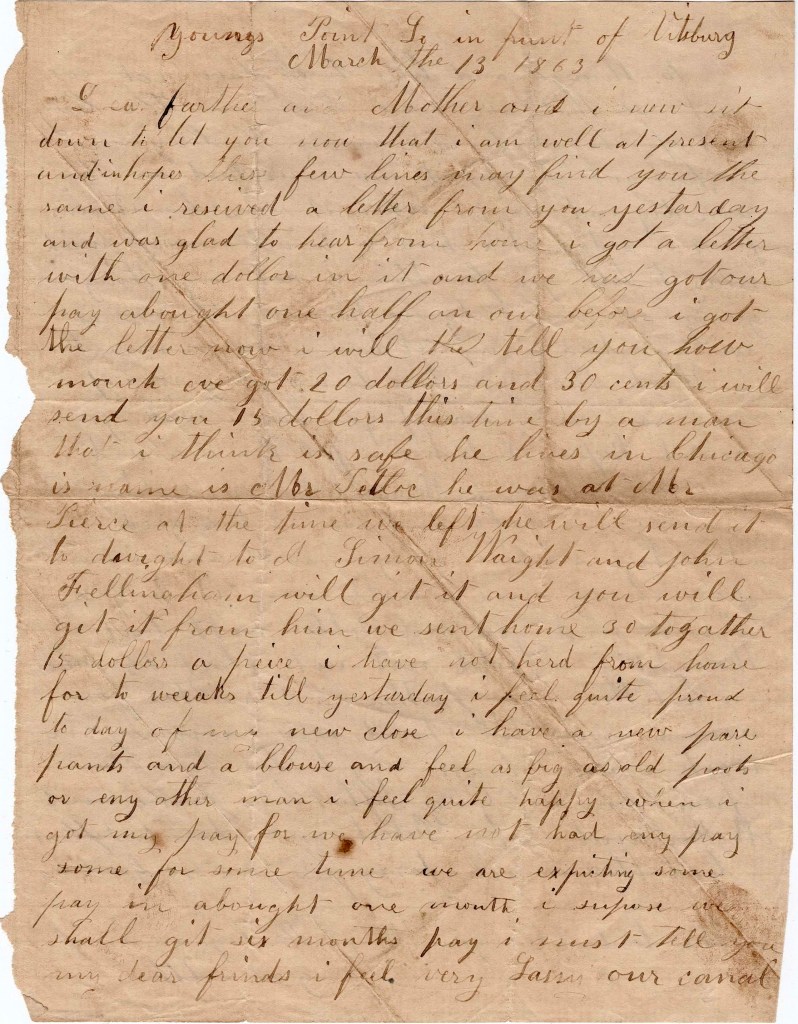
I now sit down to let you know that I am well at present and in hopes these few lines may find you the same. I received a letter from you yesterday and was glad to hear from home. I got a letter with one dollar in it and we had got our pay about one half an hour before I got the letter. Now I will tell you how much we got—$20 and 30 cents. I will send you 15 dollars this time by a man that I think is safe. He lives in Chicago. His name is Mr. Tetloc. He was at Mr. Pierce at the time we left. He will send it to Dwight to Simon Waight and John Fellingham will get it and you will get it from home. We sent home 30 together, 15 dollars apiece.
I have not heard from home for two weeks till yesterday. I feel quite proud today of my new clothes. I have a new pair of pants and a blouse and feel as big as old Poots or any other man. I feel quite happy when I got my pay for we have not had any pay for some time. We are expecting some pay in about one month. I suppose we shall get six months pay.
I must tell you my dear friends, I feel very lucky. Our canal broke through and like to drowned us out so that we had to get on the levy out of the water. We are on the levy now. We have got it stopped now. I worked in the rain day and night. When it rains here, it rains for two or three days at a time.
I do not know of much news to tell you for there is not anything a going on now—only working on the canal. We have had a very wet time for some time. I think that you have been sending some of your rain down here. If you have, I wish you would keep it to home for this is a wet place down [here].
Now father, I hope you will get my money safe and use it to a good advantage which I know you will and [if] I can spare any you any more, I will send it to you. I will send you one dollar with [this] but I thought I would not risk that 15 dollars in a letter. Now Father and Mother, you know I never did spend my money in waste. I must draw my letter to a close.
From your son, — George Sifleet
To his father and mother and sister Robert and Sarah Sifleet. God bless us all. Pray for me. So goodbye. The lord bless you all. The boys are in good health.

Letter 6
Young’s Point, La.
March 23, [1863]
Dear father and mother and sister,
I now sit down to let you know that I am well and hope these few lines may find you the same. It has been a raining all day and night. I got your letter last night the 22nd of March. The regiment are gone on a scout. I went with them up the river [but] I did not feel like marching through mud and water so some of us came back. We are in our tents. The boys went off with only five days rations with them. They have been gone one week. They went up the river about 40 miles and then got off the boats. There was only five boats with them. I do not know what it means without it is to cut off their communications or to fight.
They have been fighting some 15 miles from here. We took it with our gunboats. The place is named Warrington. We are a getting them very near surrounded.
I suppose you have got that money by this time. It is very cold this morning. I must quit for this time.
Now here goes for some more. There has two or three gunboats run the [river] blockade since we have been here. We have stopped digging on the canal. There is a dredge a digging in it and the rebs fire a gun once in a while. Their shot comes within 60 rods of us here.
They are a going to draft but they cannot take Father this time.
I do not know what to think about Vicksburg but Grant takes it slow. Maybe it is the safe way to do it. Father, the old saying is slow and sure. There is not many troops here now. They are all over. Some of them are where we was before.
I write very fast and you must read it fast and then you will understand it.
I saw three Rebels that came over from Vicksburg and they say they do not like our big heavy guns. I am glad they do not. I wish they was all that way. They would soon quit. George and me got five letters between us two. We got one mail while we was on the boat but we could not answer it. I cut out some nice pictures and rolled them up and sent them home. I got them on a big plantation.
Thank you for the stamps and paper but I have paper. I will send it back with some scribbling. It is quite pleasant. I do not know when the mail will leave. Maybe soon.
Al Still has gone on the hospital boat. He was sick but was getting better. Amos Parker is dead. He died—I am not sure what day he died. So no more. From your son, — George Sifleet
To his father and mother and sister. God bless you all. Goodbye.


 Spared & Shared 23