Category Archives: Grant’s Canal

1863: Isaac Thorn Bishop to Victoria A. Bishop

Isaac Thorn Bishop, Co. C, 55th Illinois Vols.

The following letters were written by Isaac Thorn Bishop (1844-1920), a native of Somers, Kenosha county, Wisconsin, who was working as a dry goods clerk in Kenosha when he volunteered for service as a private in Battery B, 2nd Illinois Light Artillery Regiment. He was quickly transferred, however, to Co. C, 55th Illinois Infantry and joined the regiment following their transfer to the western theater. He saw extensive combat during the Vicksburg Campaign, and wrote an account of the Battle of Arkansas Post in a letter to his sister on 14 January 1863 [see Letter 1 transcript below from The Telegraph-Courier, 12 February 1863 via Newspapers.com].

In the summer of 1863, while at Young’s Point, opposite Vicksburg, they helped to dig the canal which was usually called by the soldiers, “Grant’s Ditch.” Isaac then fought with his regiment from Grand Gulf to Raymond, and next at Champion Hills, Black River Bridge, and in the siege of Vicksburg. During the siege of Vicksburg he was assigned special duty in the Ordnance Department of the 15th Army Corps. After the capitulation of Vicksburg, he was transferred to the Post Ordnance Department. In January 1864, he was assigned to duty in the Ordnance Department, Military Division of the Mississippi, located at Nashville, Tenn., by order of Lieut. Gen. U.S. Grant, where he remained until the close of the War, in May 1865.

Isaac wrote all of these letter to his older sister, Victoria A. Bishop (1841-1903) who never married and most likely deserves the credit for having preserved her brother’s letters.

See also—1863: Jacob Bishop to Isaac Thorn Bishop, published in 2015 on Spared & Shared 9.

Other letters by member of Co. C, 55th Illinois Vols. published on Spared & Shared include:
Augustus C. Goakey, Co. C, 55th Illinois (3 Letters)
Thomas Goakey, Co. C, 55th Illinois (7 Letters)
Henry H. Joslin, Co. C, 55th Illinois (1 Letter)

Letter 1

On board the Southwestern
January 14th 1863.

Dear sister,

Since I wrote to you last I have been through another bloody battle, and have been through hardships and trials that would wreck the strongest frame of man. But I can put up with it because we have had such good luck.

We sailed up the Arkansas river about 150 miles; stopped about five miles below Fort Arkansas Post, (this is an old military post—the oldest fort in the United States, having been built before the Revolutionary war) and landed our forces Saturday morning; 25,000 infantry, four companies of cavalry, 10 batteries, and four iron-clad gunboats. We marched slowly along until within about a half mile of the Rebel lines, drove in their pickets, and then the order came for the 55th [Illinois] to deploy as skirmishers and advance. It was getting pretty dark then, so that we could not see ten rods. All that we could see to aim at was the flash of their guns. After we had gone about fifty yards, we stopped and kept up a continual fire.

There happened to be a large stump right before me when we stopped, and I just dropped down behind that where I was safe, and loaded and fired as fast as I could. I can tell you, it looked pretty to see the bomb shells fly over us and burst, but we had not been there long before they got the range on us with their artillery, and then—boom, boom—went the shells right amongst us. One hit and burst right on a man’s hip that lay a little way from me and tore him up dreadfully. And then a piece struck the man lying next to me and wounded him. Then the Colonel drew us back a little way, and stopped firing for that night.

Sunday morning—as it is a rule for the northern army not to fight on Sunday—we did not make the attack but at one o’clock, the rebels began to throw shot and shell at as, and you know the yankees could not stand that, and so we let into them. Our gunboats threw shell into the Fort from the river and we shelled them from the land, at the same time advancing towards their breastworks, and everyone that attempted to shoot would fall. We fired at them so fast that they could not get time to [reload and] shoot.

When we got within about 20 rods [110 yards] of the breastworks, one of our regiments laid down and crept along on our bellies We did not get up to fire, but would load and then roll over on our backs, and fire. We worked it in that way about one hour, and then the firing began to cease a little, and we jumped up to see what was the matter, and to our surprise, they had run up the white flag to surrender. Then our men gave three cheers and all was still as death for a moment—except the groans of the dying and wounded—and then we surrounded them to see what we had got. We marched them into the fort, and as they went in,
they piled up their arms at the door.

Well now I will tell you what we got: nine thousand stands of arms—most of them the best of Enfield rifles, seven thousand prisoners, and as near as I can find out, about one million bushels of corn and meal, every horse and mule they had, all their commissary goods and wagons, cartridge boxes, belts, any quantities of sugar, molasses, beet &c., three siege guns, 132-pounders, 20 pieces of light artillery, and a boat load of ammunition. Perhaps you remember of reading about the rebels taking a boat loaded with ammunition a short time ago? Well we took all that back again and considerable more with it.

But the joke comes now on the rebels. The next morning after the battle, two regiments of reinforcements and the stage with four horses came in and we took them; so you can see we made a clean sweep of everything. I got a nice dirk knife and scabbard which I am going to send home the first chance l can get. Also some secesh letters by which you will see how things are going in Texas.

Monday morning. I visited the battlefield before breakfast. I thought Vicksburg was a dreadful sight, but it was nothing like this; our artillery just tore them all to pieces. I will tell you a few of the horrible sights I saw on the field. First about their artillery. The battery on the left had only two horses left out of twenty-four. I saw one cannon with six splendid gray horses hitched to it, but they were all blowed to pieces with balls, and the caisson that belonged to it had four dead ones hitched to it; their horses were nearly all killed. Our guns threw shot so thick that the rebels were obliged to leave their guns and go to their breastworks.

Now to the men. The first was a man with his head all gone but just his face. I thought that was dreadful but the next was four lay side by side, one was cut open from his hips to his shoulders, the next was one with both legs off at the knees, right by his side was one that his hips and legs were about four feet from the rest of his body, the next was one that a shel had struck and cut one arm off and set fire to his clothes, and it burnt him all over to a crisp. One more and I will stop, and that was three brothers lay together, two of them were struck by our balls and the other seeing both his brothers dead he drew his revolver and shot himself. They lay side by side just where they fell.

Your affectionate brother, — Isaac Bishop


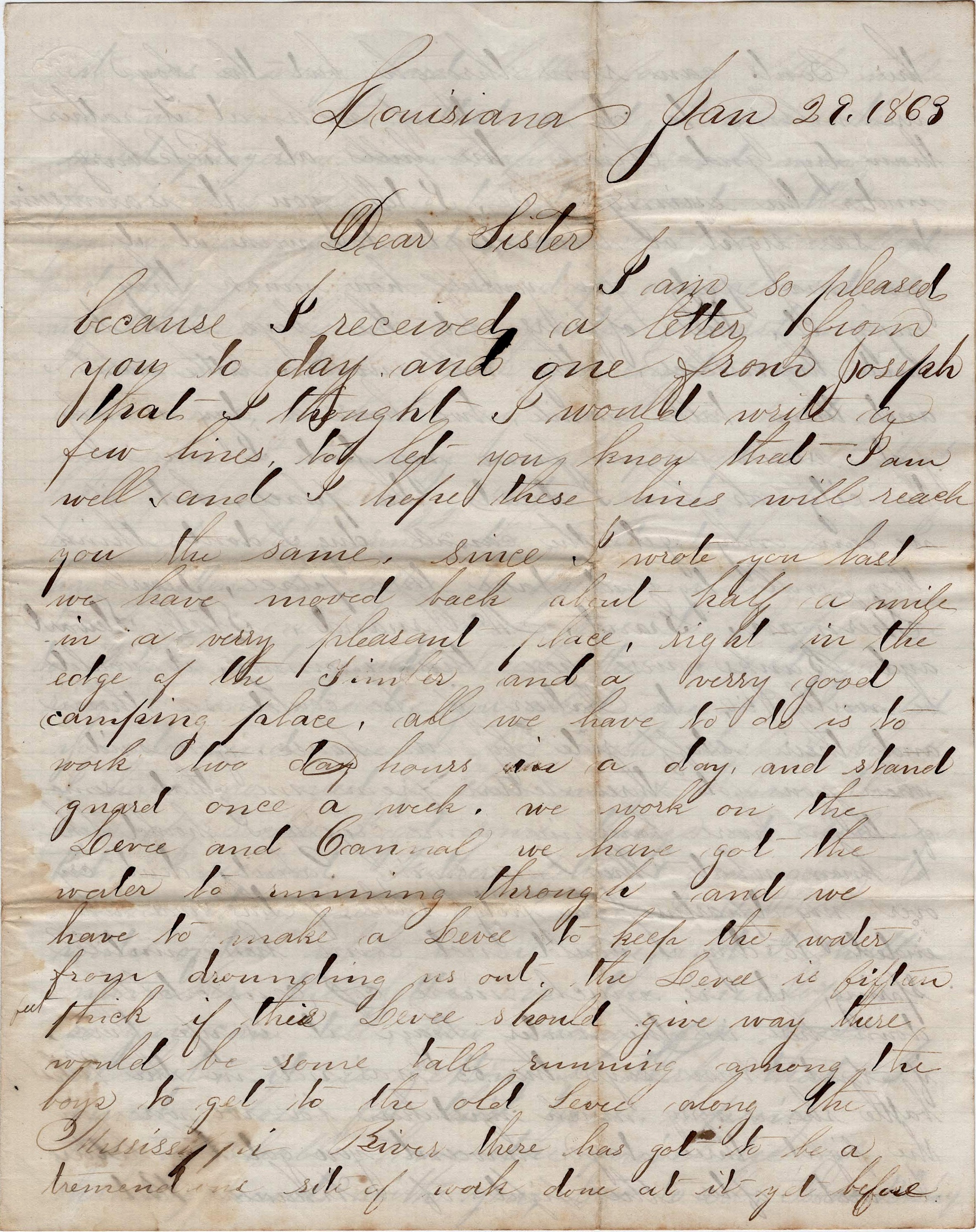
Letter 2

Louisiana
January 29, 1863

Dear Sister,

I am so pleased because I received a letter from you today and one from Joseph that I thought I would write a few lines to let you know that I am well and I hope these lines will reach you the same.

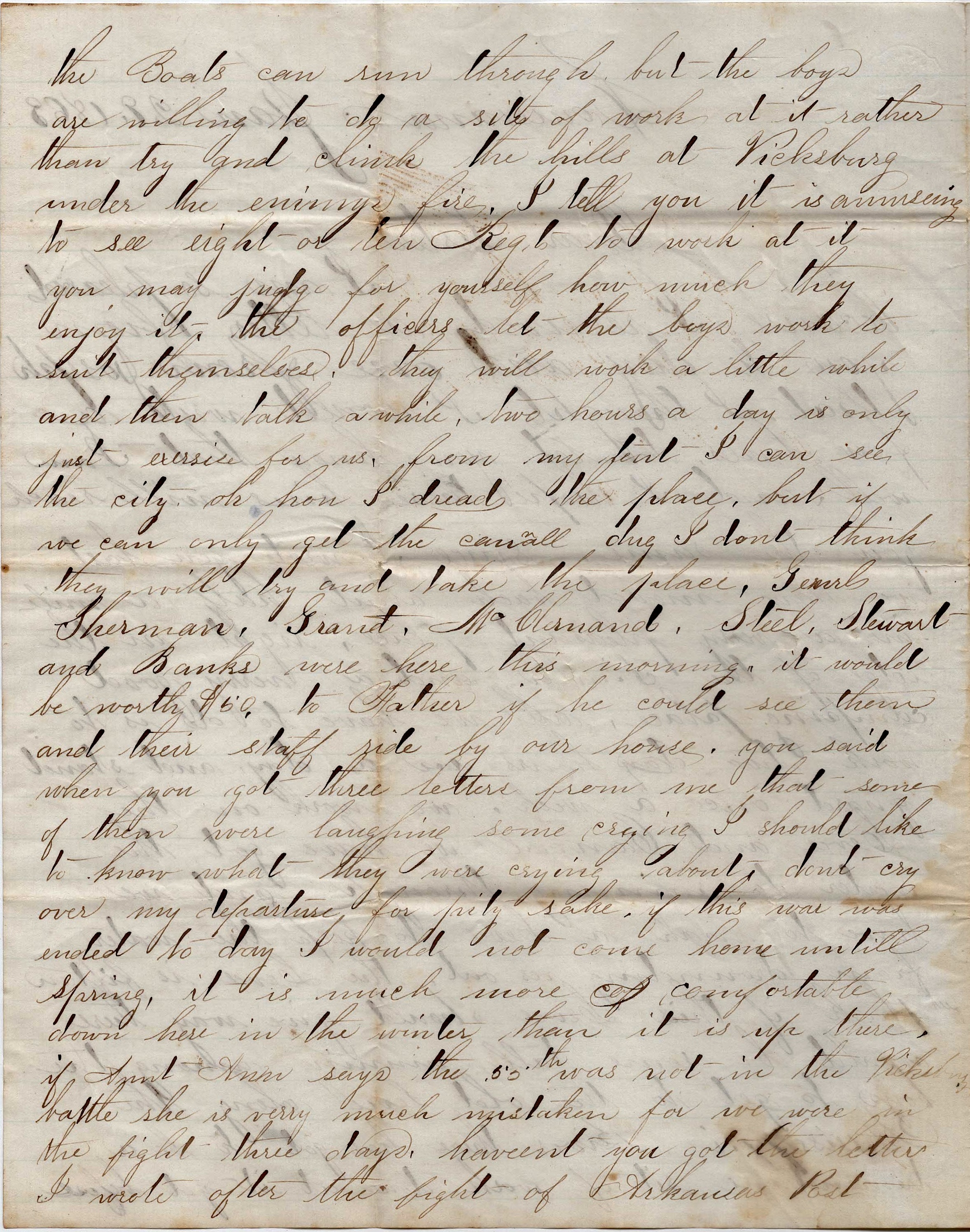
Since I wrote you last, we have moved back about half a mile in a very pleasant place right in the edge of the timber and a very good camping place. All we have to do is to work two day hours in a day and stand guard once a week. We work on the levee and canal. We have got the water to running through and we have to make a levee to keep the water from drowning us out. The levee is fifteen feet thick. If this levee should give way, there would be some tall running among the boys to get to the old levee along the Mississippi river. There has got to be a tremendous sight of work done at it yet before the boats can run through but the boys are willing to do a sight of work at it rather than try and climb the hills at Vicksburg under the enemy’s fire. I tell you, it is amusing to see eight or ten regiments to work at it. You may judge for yourself how much they enjoy it. The officers let the boys work to suit themselves. They will work a little while and then talk awhile. Two hours a day is only just exercise for us.

From my tent I can see the city. Oh how I dread the place. But if we can only get the canal dug, I don’t think they will try and take the place. Generals Sherman, Grant, McClernand, Steel, Stewart and Banks were here this morning. It would be worth $50 to Father if he could see them and their staff ride by our house. You said when you got three letters from me that some of them were laughing, some crying. I should like to know what they were crying about. Don’t cry over my departure for pity sake. If this war ended today, I would not come home until spring—it is much more comfortable down here in the winter than it is up there.

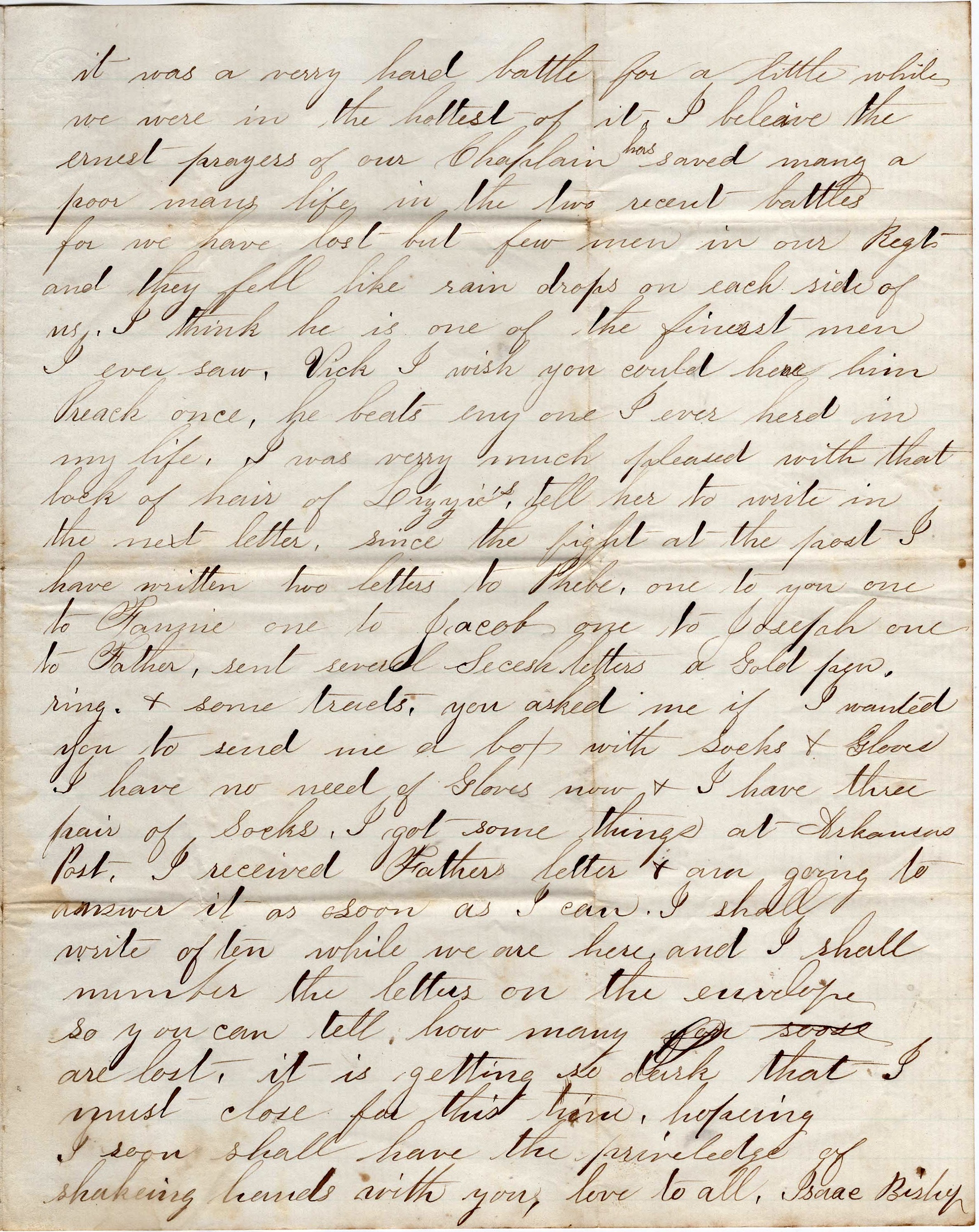
If Aunt Ann says the 55th was not in the Vicksburg battle, she is very much mistaken for we were in the fight three days. Haven’t you got the letter I wrote after the fight at Arkansas Post [dated Jan. 14th]? It was a very hard battle for a little while. We were in the hottest of it. I believe the earnest prayers of our chaplain [Milton Lorenzo Haney 1] has saved many a poor man’s life in the two recent battles for we have lost but two men in our regiment and they fell like rain drops on each side of us. I think he is one of the finest men I ever saw. Vick, I wish you could hear him preach once. He beats anyone I ever heard in my life. I was very much pleased with that lock of hair of Lizzie’s. Tell her to write in the next letter.

Since the fight at the Post, I have written two letters to Phebe, one to you, one to Fannie, sent several secesh letters, a gold pen, ring, and some [religious] tracts. You asked me if I wanted you to send me a box of socks and gloves. I have no need of gloves now and I have three pair of socks. I got some things at Arkansas Post. I received Father’s letter and am going to answer it as soon as I can. I shall write often while we are here and I shall number the letters on the envelopes so you can tell how many are lost.

It is getting so dark that I must close for this time hoping I soon shall have the privilege of shaking hands with you. Love to all. — Isaac Bishop

1 The chaplain of the 55th Illinois Infantry was a Methodist named Milton Lorenzo Haney (1825-1922). He was known as the “fighting chaplain” and was awarded the Medal of Honor while voluntarily carrying a musket in the ranks during the fighting on 22 July 1864 before Atlanta.
Letter 3

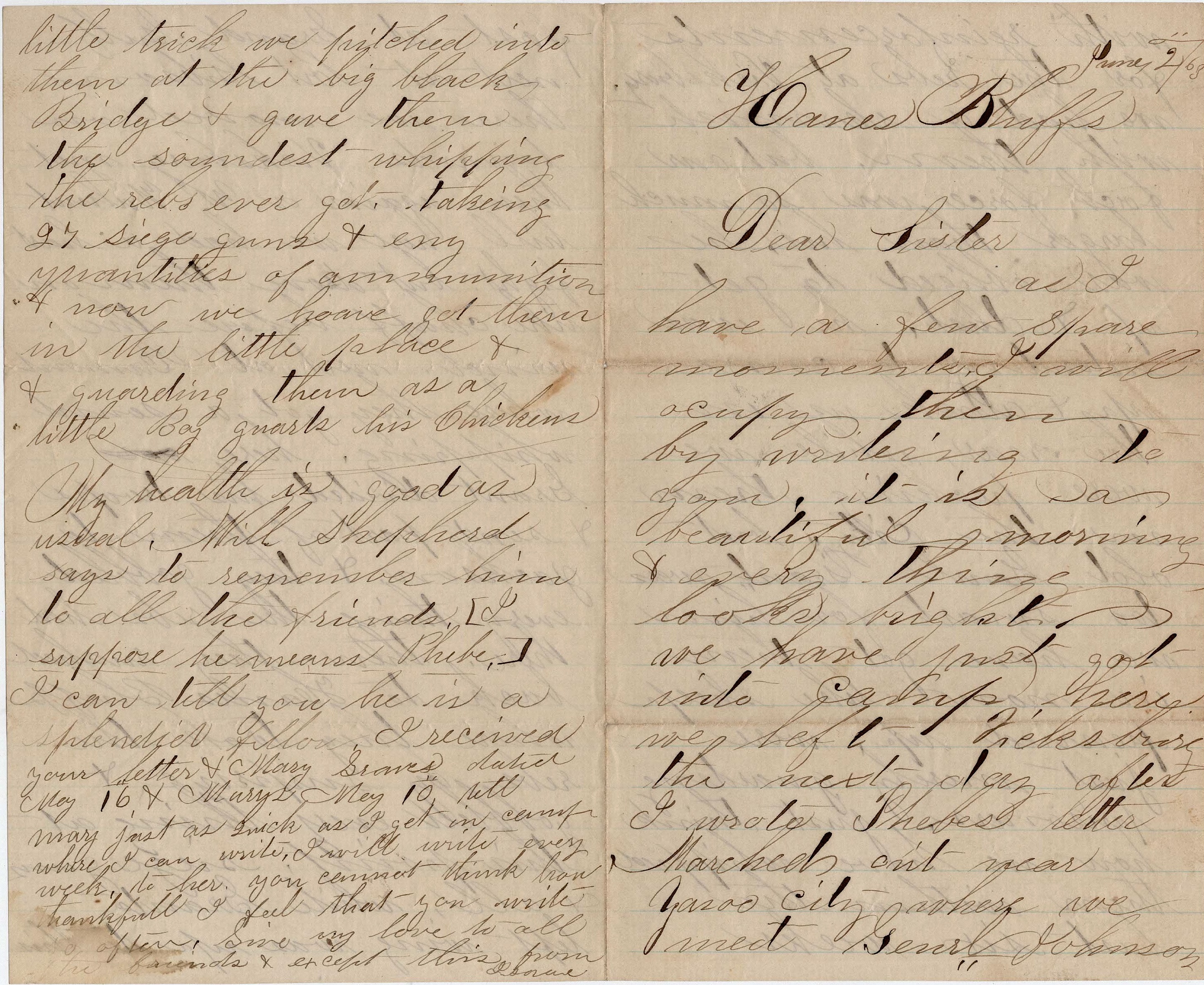
Haines Bluff
June 2, 1863

Dear Sister,

As I have a few spare moments, I will occupy them by writing to you. It is a beautiful morning and everything looks bright. We have just got into camp here. We left Vicksburg the next day after I wrote Phebe’s letter, marched out near Yazoo City where we met Gen. Johnston with reinforcements for the rebs at Vicksburg. We had a skirmish with them but our force was so much larger than his, he was obliged to get up & dust. He was intending to come up & attack us in the rear which we were pecking them in the city, but old Gen. Grant was too smart for him. We have got them in now like sheep penned up. We’re just merely guarding prisoners.

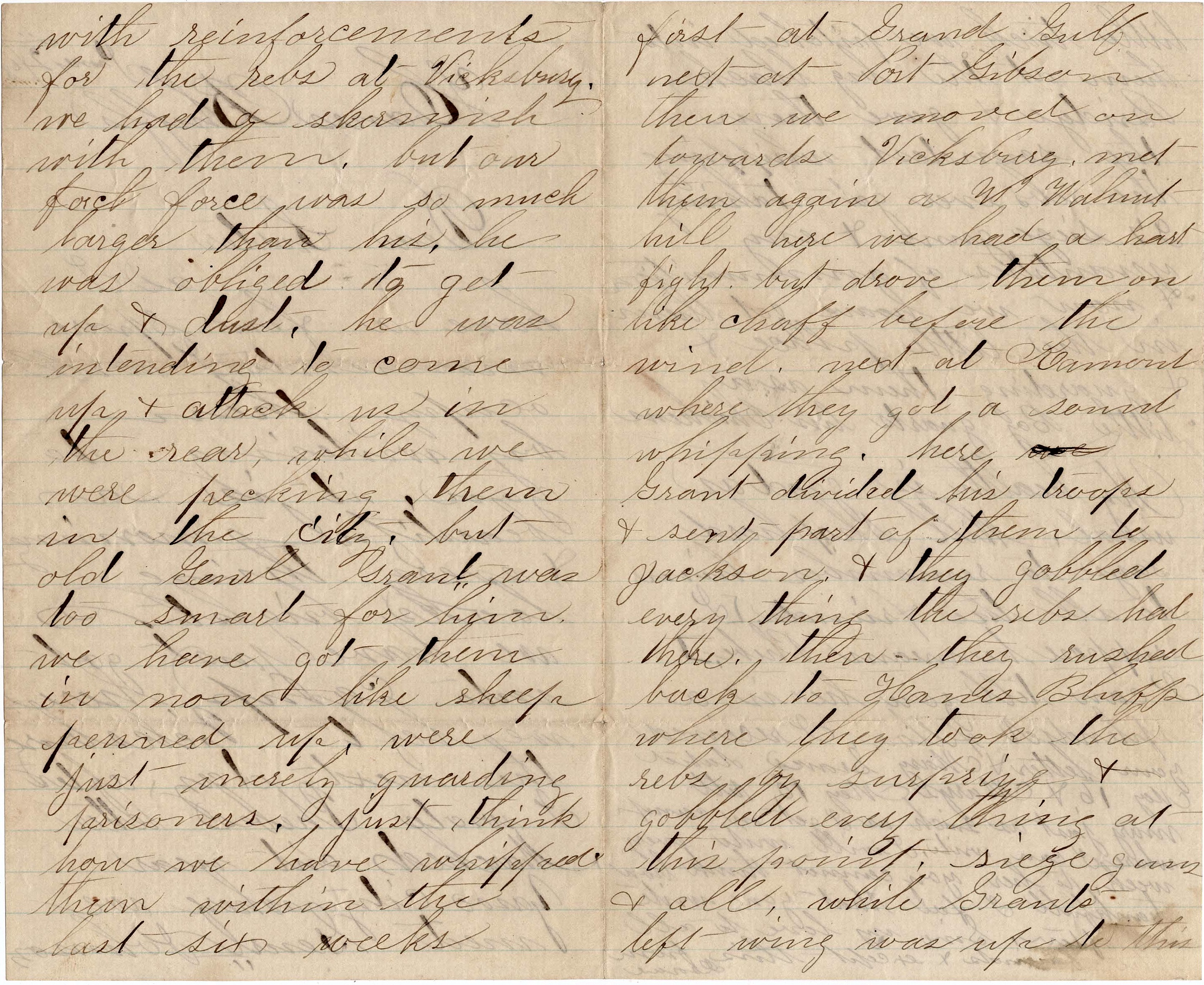
Just think how we have whipped them within the last six weeks. First at Grand Gulf, next at Port Gibson, then we marched on towards Vicksburg, met them again at Walnut Hill. Here we had a hard fight but drove them on like chaff before the wind. Next at Raymond where they got a sound whipping. Grant divided his troops and sent part of them to Jackson & they gobbled every thing the rebs had there. Then they rushed back to Haines Bluff where they took the rebs by surprise & gobbled everything at this point, siege guns and all. While Grant’s left wing was up to this little trick, we pitched into them at the Big Black Bridge and gave them the soundest whipping the rebs ever got, taking 27 siege guns and any quantity of ammunition. And now we have got them in the little place & guarding them as a little boy guards his chickens.

My health is good as usual. Will Shepherd says to remember him to all the friends (I suppose he means Phebe). I can tell you he is a splendid fellow. I received your letter & Mary Graves’ dated May 16th and Mary L’s May 10th. Tell Mary just as quick as I get in camp where I can write, I will write every week to her. You cannot think how thankful I feel that you write so often. Give my love to all friends and accept this from, — Isaac
Letter 4

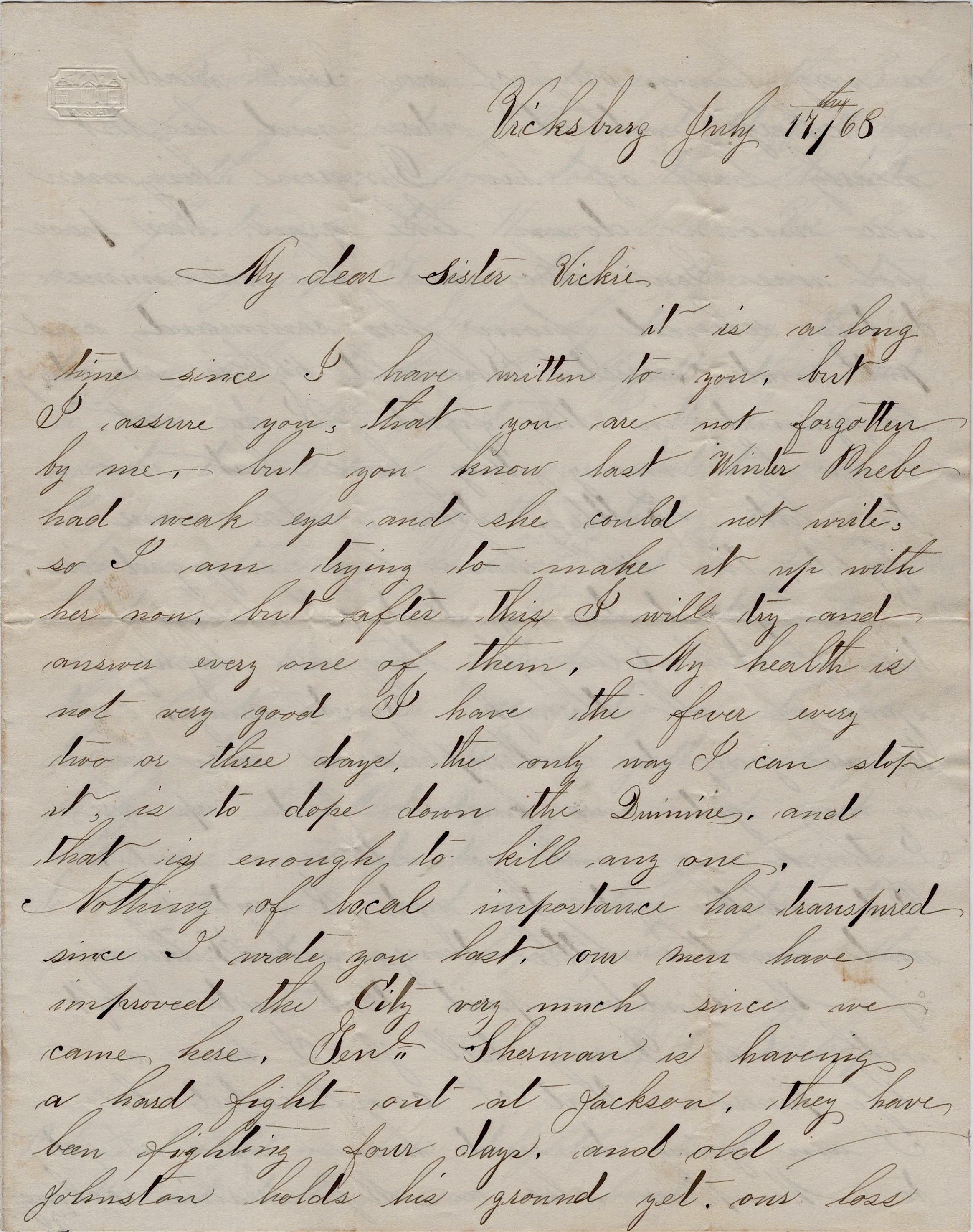
Vicksburg [Mississippi]
July 17, 1863

My dear sister Vickie,

It is a long time since I have written to you but I assure you that you are not forgotten by me. But you know last winter Phebe had weak eyes and she could not write, so I am trying to make it up with her now. But after this, I will try and answer every one of them. My health is not very good. I have the [malarial] fever every two or three days. The only way I can stop it is to dope down the quinine and that is enough to kill anyone.

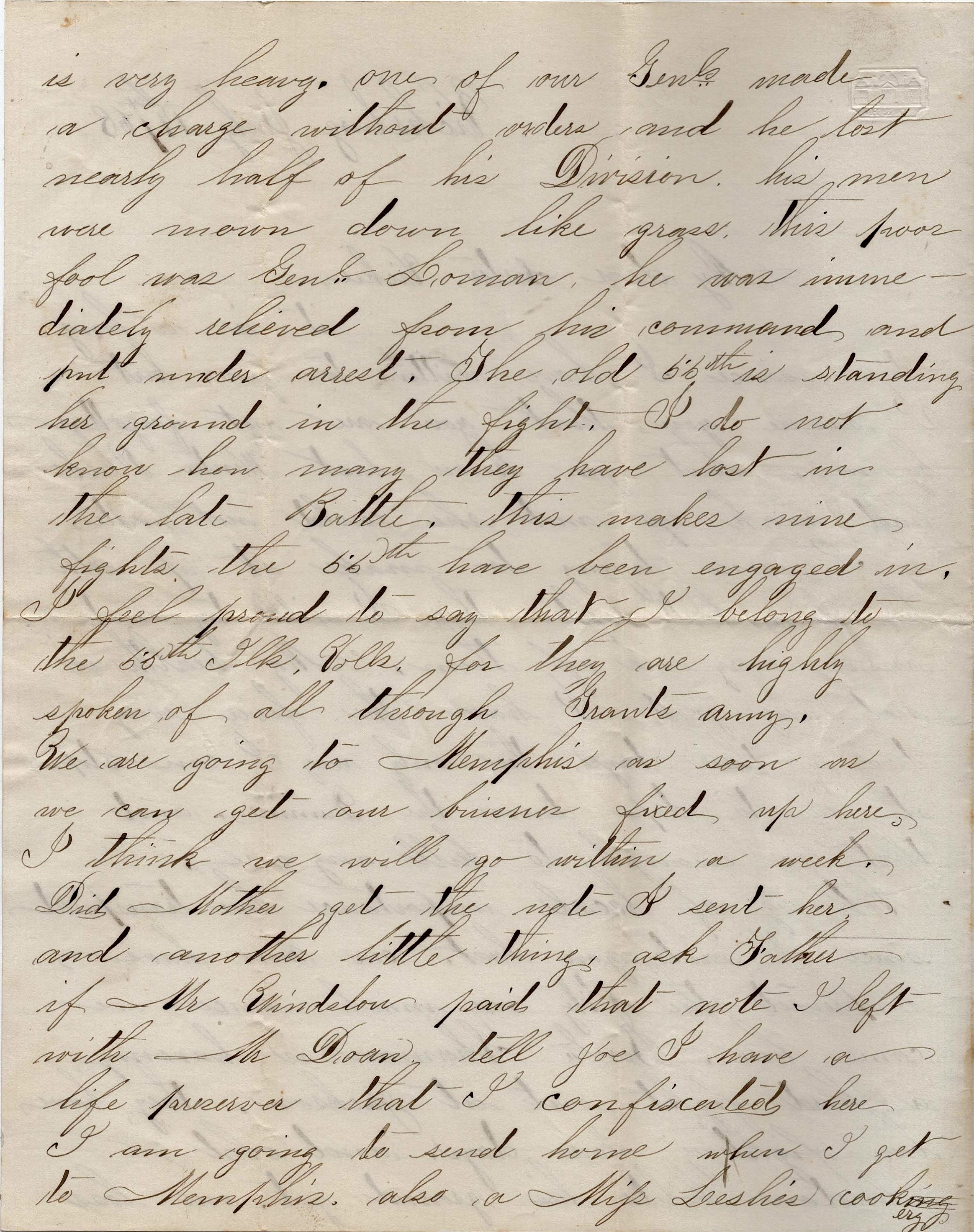
Nothing of local importance has transpired since I wrote you last. Our men have improved the city very much since we came here. Gen. Sherman is having a hard fight out at Jackson. They have been fighting four days and old Johnston holds his ground yet. Our loss is very heavy. One of our generals made a charge without orders and he lost nearly half of his division. His men were mown down like grass. This poor fool was Gen. [Jacob Gartner] Lauman. He was immediately relieved from his command and put under arrest.

The Old 55th [Illinois] is standing her ground in the fight. I do not know how many they have lost in the late battle. This makes nine fights the 55th have been engaged in. I feel proud tp say that I belong to the 55th Illinois Vols. for they are highly spoken of all through Grant’s army.

We are going to Memphis as soon as we can get our business fixed up here. I think we will go within a week. Did Mother get the note I sent her? And another little thing, ask Father if Mr. Windslow paid that note I left with Mr. Doan. Tell Joe I have a life preserver that I confiscated here [that] I am going to send home when I get to Memphis. Also a Miss Leslie’s Cookery Book for you and several other books. When you write, tell what coffee & sugar is worth now. How does the mustard in front of the house look?

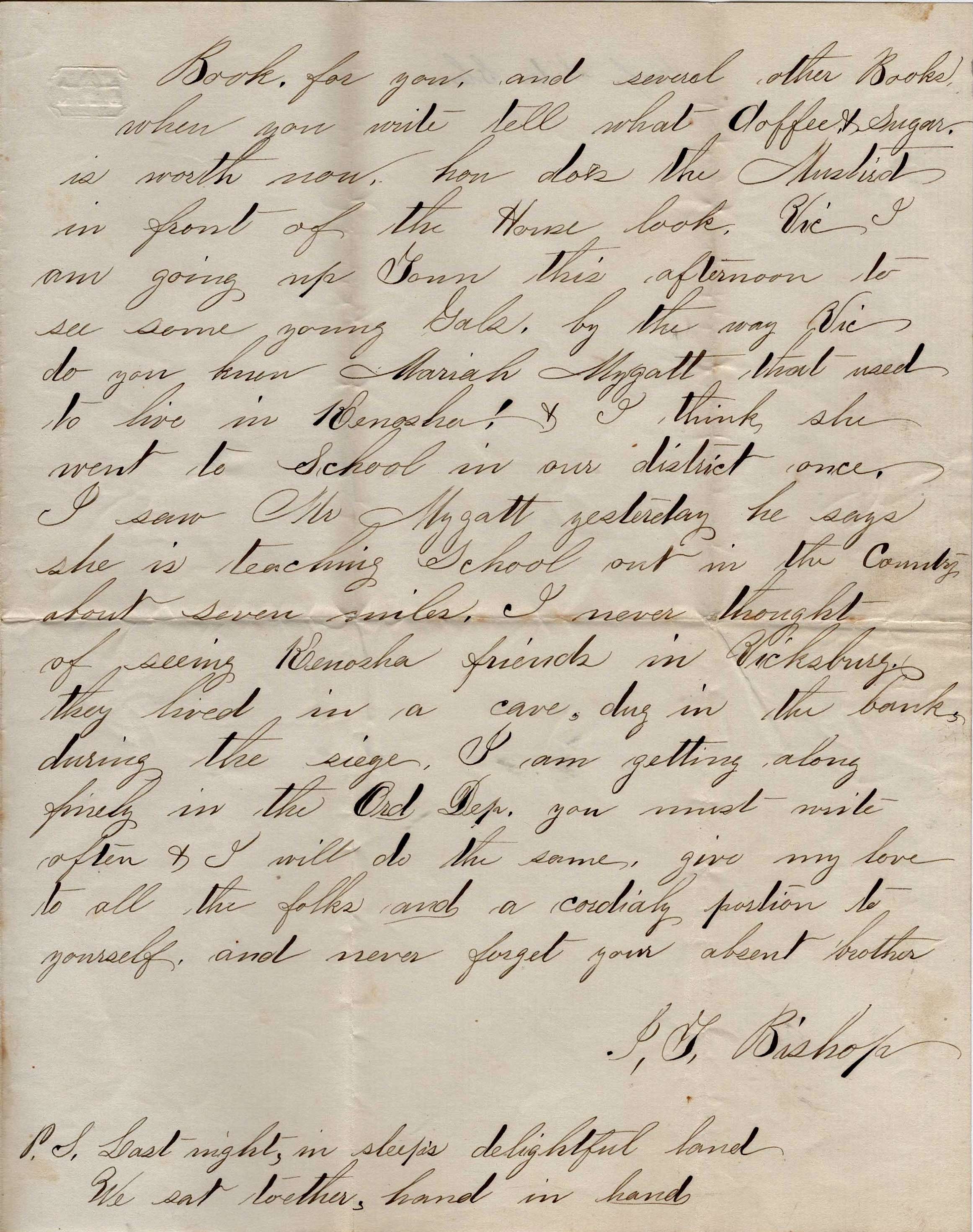
Vic, I am going up town this afternoon to see some young gals. By the way, Vic, do you know Mariah Mygatt that used to live in Kenosha? I think she went to school in our district once. I saw Mr. Mygatt yesterday. He says she is teaching school out in the country about 7 miles. I never thought of seeing Kenosha friends in Vicksburg. They lived in a cave dug in the bank during the siege. I am getting along finely in the Ordnance Department. You must write often and I will do the same. Give my love to all the folks and a cordially portion to yourself. and never forget your absent brother, — I. T. Bishop

P. S. Last night in sleep’s delightful land, we sat together, hand in hand.
1862-63: George Thomas Sifleet to his Parents

The following letters were written by George Thomas Sifleet (1842-1863) who came to the United States from Frindsbury, Kent, England, with his parents in 1854. The family settled in Ulster county, New York, initially but then relocated to Vienna, Grundy county, Illinois.

I could not find an image of George but here is one of Robinson Barr Murphy who also served in the 127th Illinois Infantry. He was later awarded the Medal of Honor in the Battle of Atlanta (Julian Burley Collection)

George enlisted in Co. D, 127th Illinois Infantry in mid-August 1863. At the time of his enlistment, he was described as a single farmer, standing just north of 5 foot 2 inches, with grey eyes and light hair. He mustered into the United States service on 5 September 1862 and was with his regiment until 25 April 1863 when he died of disease at Young’s Point, Louisiana.

George had an older brother who served in the 36th Illinois Infantry but was mortally wounded at the Battle of Stones River and died on 8 January 1863.

Here are some other letters by members of the 127th Illinois previous transcribed and published on Spared & Share. One of them includes a diary.

James R. Maxwell, Co. D, 127th Illinois (5 Letters)
Robert Marsden, Co. E, 127th Illinois (62 Letters & Diary)


Letter 1

Memphis, Tennessee
November 17 [1862]

Dear Father and Mother and Sister,

I now sit down to let you know that I am well at present and hope these may find you the same.

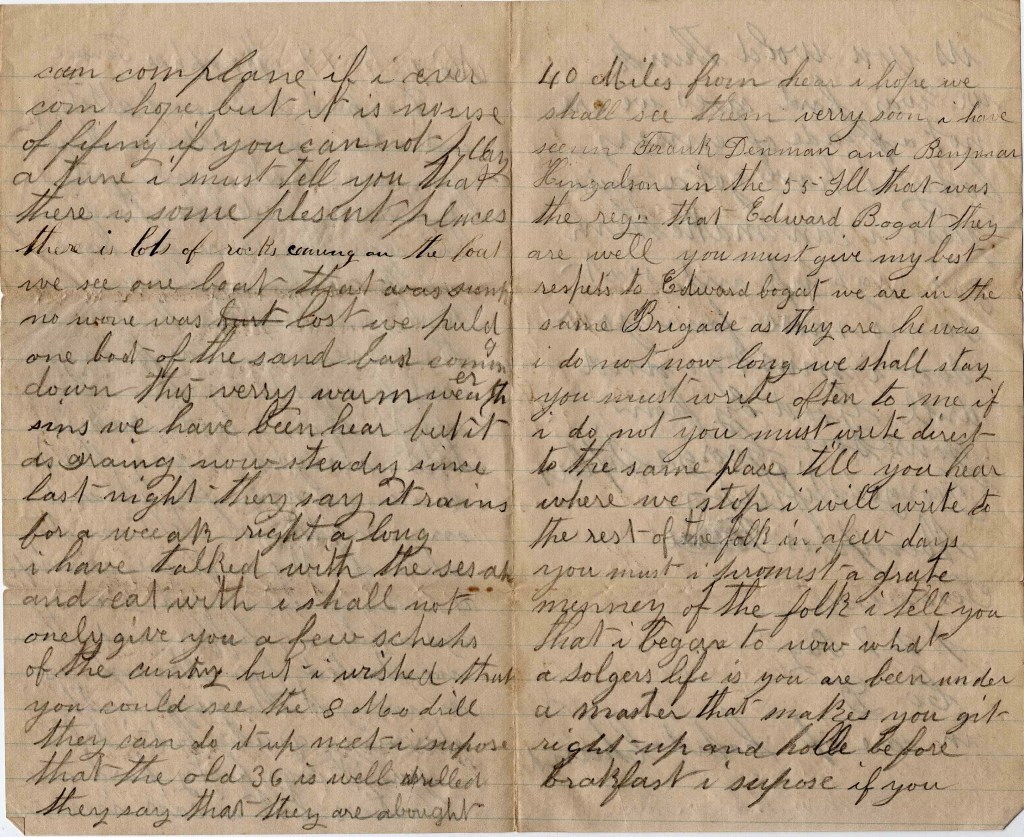
We have got to a stopping place and that is Memphis & close to the river, We was two days and two nights on the river with two or three hard crackers. Talk about living. That is no name for it. And one night we stopped on the shore of Missouri and we [ ] four hives of bees and two or three hogs and one heifer and then we started for Memphis so we got through with starving quite but I tell you, it was pretty hard us. But I can never complain if I ever come home. But it is no use of fifing if you cannot play a tune.

I must tell you that there is some pleasant places. There is lots of rocks. Coming on the boat we seen one boat that was sunk. No one was lost. We pulled one boat off the sand bar coming down. This [is] very warm weather since we have been here but it is raining now steady since last night. They say it rains for a week right along.

I have talked with the secesh and eat with. I shall not only give you a few sketches of the country but I wished that you could see the 8th Missouri drill. They can do it up neat. I suppose that the Old 36th [Illinois] is well drilled. They say that they are about 40 miles from here. I hope we shall see them very soon. I have seen Frank Denman and Benjamin Hingalson in the 55th Illinois. That was the regiment that Edward Bogat [joined]. They are well. You must give my best respects to Edward Bogat. We are in the same brigade as they are he was.

I d not know [how] long we shall stay. You must write often to me [even] if I do not. You must write and direct to the same place till you hear where we stop. I will write to the rest of the folk in a few days. I promised a great many of the folk. I tell you that I begin to know what a soldier’s life is. You are been under a master that makes you get right up and holler before breakfast.

I suppose if you would see us you would think we was hard cases. We are not afraid of anybody. I have got a nice gun. I can make them get right up and seat. So no more form your son. I must go and drill. Goodbye from your son, — George Sifleet

127th Regiment, Co. D, in care of Capt. Chand, Memphis, Tennessee


Letter 2

On the Mississippi
January 18, [1863]

Dear father and mother,

I now sit down to let you know that I am well and hope these few lines may find you enjoying the same blessing. I received your letter last night and was glad to hear that you was well and sorry to hear that James was sick but I hope he is getting better. We have been on the boat about one month. We are getting tired of it. I suppose John Whybrow is having good times this winter but they are putting us through. We have been in two battles in two weeks—both of them on Sunday. We have started back for there again with a larger fleet.

They say that General Grant’s army is a going there to support us. I hope it is so. I hope we not get whipped but I think we will either whip them or they shall whip us and it will be a hard fight. We are a going within about 30 miles of there and go in camp for a while.

I must tell you that the mail does not go very often. I wrote a letter to Emmy McConnell two or three days but I have not sent it yet. But I will send it with this and you will give it to her. You must tell her that if she will not wait and have a soldier that she must take what she can get—some old bachelor or other.

After we took Arkansas Post we took what we could and tore down the breastworks and burned up all the buildings and went down the White River to the Mississippi river and we went up that about 30 miles to get off a hospital boat which had been there 48 hours. We worked all night getting coal off. Then in the morning we hauled her off and we came back and now have started down the river.

I must go and wash. I can tell you where I spent my Christmas. On the boat. And on New Year’s we left the battlefield for the boat. I tell you, we was still that night and the next day we left. I would like to of be[en] there on New Years and Christmas with you. I would like some sausage meet with you, I tell you that.

I wish that this abolition war was over and the Negroes was with their master for father, they are no account to any man. The better you use them, the lazier they are for we have got a number of them on the boat. They lay under the boilers. You have to drive them or they will not go or do anything. The quicker this war is over the better.

So goodbye from your son, — George Sifleet

To Mr. and Mrs. Sifleet. God bless you all.


Letter 3

Young’s Point, Louisiana
February 17, 1863

Dear father and mother and sister,

I now sit down to let you know that I am well at present and hope these few lines may find you in good health. It commenced raining two days ago and it is a raining yet. It is very muddy so that we cannot hardly getaround to cook anything. Our tents leaked yesterday.

I do not know of much news to write. We have not done anything here yet—only dig on the canal. It does[n’t] seem to amount to much yet.

The mail came in last [night] about dark. I got two letters—one from Lizzy and the other from William Fellingham. I was sorry to hear that John Whybrow was dead. I suppose that you do not see anything about the war a coming to a close.

Our captain is a Major now in this regiment—that is, he is Acting Major. Our Major has gone and left us and so as the Colonel and his son left us that that we have not but a Lieutenant Colonel. We hear lots of reports that we cannot believe. The most of the soldiers are all sick of it. They say they do not care what becomes of the government and the Negroes or anything else. I do not see any more signs of the war a coming to a close than there was one year ago. But I think it will last long. It has been going on long enough [and] I think so do the soldiers.

I do not know what to write about. I do not know how long we shall stay here. The tent is crowded full. The boys are in the tent. I hope we shall leave here soon if it keeps a raining all the time. The boys are not in very good spirits but they are a getting sick of it.

I would like to get a paper once in a while. We have not go any pay yet. We begin to need it. I wish you would send me 50 cents worth of postage stamps in a letter. I write a good many letters and that takes stamps. I would like some of your sausages and bread and butter. I would like it very much. John Whybrow and Alexander Tomson has had a very good place to stay in Otyway [?]. George is well. He is a writing to his brother and sister. I got your letter last night and never was a more glad a boy to get a letter than I was any time.

I must draw my letter to a close. From your only [son], — George Sifleet

To Father and Mother and sister Sifleet

Give my best respects to Mr. and Mrs. Searink [?] and all enquiring friends. From your son, — George Sifleet


Letter 4

[Opposite] Vicksburg
February 21 [1863]

Dear father and mother,

I now sit down to let you know that I am well and hope these few lines may find you well as to say it leaves me at present. I thought I would tell you how I feel this morning. I feel as though I would like to take a few warm biscuits and a few mash potatoes and some eggs and so on. I have just been to breakfast. I had a piece of bread. It was good. We get one loaf every other day and there is about enough in one loaf for one meal if a man is hungry. We get plenty of hard tack and pork and coffee but I do not drink much of that.

I have got a cold now. Tell father I would like to know how his horses get along. I would like to see them.

We do not appear to be making any point here yet. I suppose we are waiting to get good and ready. We fire at them once in a while. I heard some very hard firing. I guess that our gunboats came back. Whenever the boats go by, they fire their best. One of our mortars have been a firing at the City. Our company is out on picket, the most of them. They will come in this morning and it is a raining very hard this morning and it looks as though it was a going to be a rainy day. The boys are a playing cards and dominoes and everything else but George and myself does not know one card from another. Some of the boys begin to need some clothes very soon. My clothes is pretty good yet.

Father, my boots stand it well. Some of the boys paid 6 and 7 dollars for boots and they are about gone. My boots has one little hole in the side. I take good care of them. George is a coming now. I hope you will write a long letter. When you write, tell me what father is a doing and mother, send me a tin of biscuit and a few potatoes and so on.

You must [excuse] my poor writing for I have no place to write, only on my knee. I will write as often as I can. I can’t find much fault now for I get a letter most every time the mail comes. They say the mail is a coming today. I hope to get a letter from [home].

There is so much foul news a going. Some think we are going to Chicago to guard prisoners but I think there is no such good news. The boys is in pretty good health now but this is a muddy hole. George sends his best respects to you. Some seem to think they are evacuating Vicksburg. I do not know what to think of it. Goodbye for this time. From your son, — Geo. T. S.


Letter 5

Young’s Point, La. in front of Vicksburg
March 13, 1863

Dear father and mother,

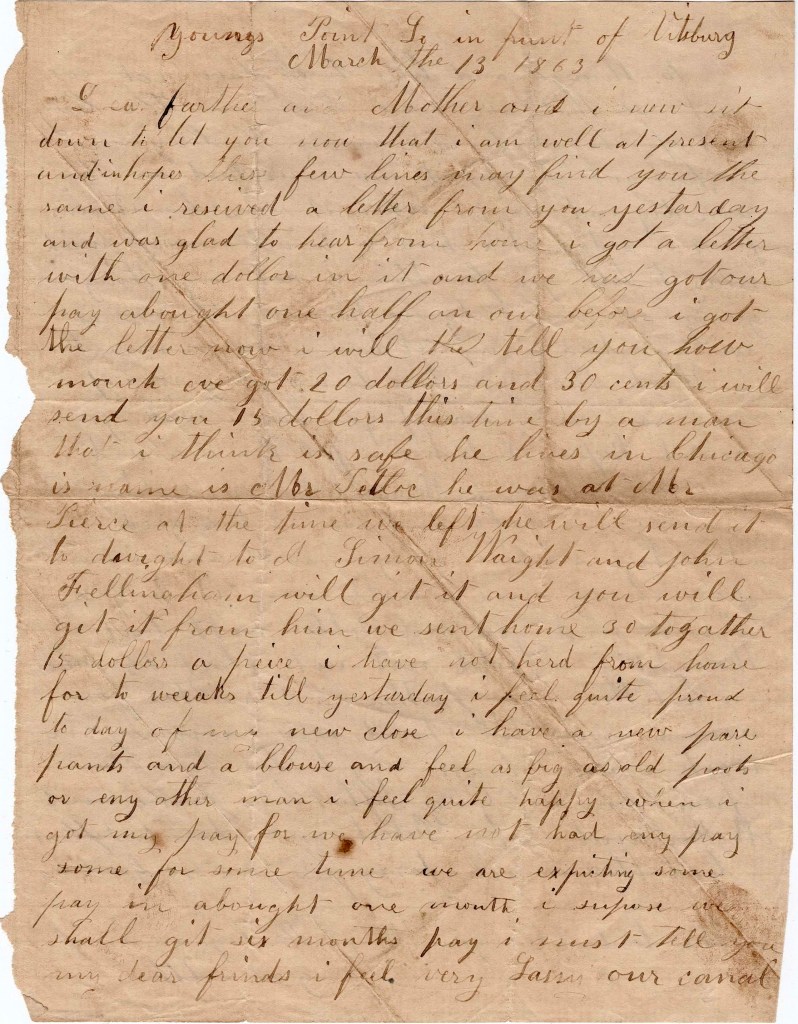
I now sit down to let you know that I am well at present and in hopes these few lines may find you the same. I received a letter from you yesterday and was glad to hear from home. I got a letter with one dollar in it and we had got our pay about one half an hour before I got the letter. Now I will tell you how much we got—$20 and 30 cents. I will send you 15 dollars this time by a man that I think is safe. He lives in Chicago. His name is Mr. Tetloc. He was at Mr. Pierce at the time we left. He will send it to Dwight to Simon Waight and John Fellingham will get it and you will get it from home. We sent home 30 together, 15 dollars apiece.

I have not heard from home for two weeks till yesterday. I feel quite proud today of my new clothes. I have a new pair of pants and a blouse and feel as big as old Poots or any other man. I feel quite happy when I got my pay for we have not had any pay for some time. We are expecting some pay in about one month. I suppose we shall get six months pay.

I must tell you my dear friends, I feel very lucky. Our canal broke through and like to drowned us out so that we had to get on the levy out of the water. We are on the levy now. We have got it stopped now. I worked in the rain day and night. When it rains here, it rains for two or three days at a time.

I do not know of much news to tell you for there is not anything a going on now—only working on the canal. We have had a very wet time for some time. I think that you have been sending some of your rain down here. If you have, I wish you would keep it to home for this is a wet place down [here].

Now father, I hope you will get my money safe and use it to a good advantage which I know you will and [if] I can spare any you any more, I will send it to you. I will send you one dollar with [this] but I thought I would not risk that 15 dollars in a letter. Now Father and Mother, you know I never did spend my money in waste. I must draw my letter to a close.

From your son, — George Sifleet

To his father and mother and sister Robert and Sarah Sifleet. God bless us all. Pray for me. So goodbye. The lord bless you all. The boys are in good health.


Letter 6

Young’s Point, La.
March 23, [1863]

Dear father and mother and sister,

I now sit down to let you know that I am well and hope these few lines may find you the same. It has been a raining all day and night. I got your letter last night the 22nd of March. The regiment are gone on a scout. I went with them up the river [but] I did not feel like marching through mud and water so some of us came back. We are in our tents. The boys went off with only five days rations with them. They have been gone one week. They went up the river about 40 miles and then got off the boats. There was only five boats with them. I do not know what it means without it is to cut off their communications or to fight.

They have been fighting some 15 miles from here. We took it with our gunboats. The place is named Warrington. We are a getting them very near surrounded.

I suppose you have got that money by this time. It is very cold this morning. I must quit for this time.

Now here goes for some more. There has two or three gunboats run the [river] blockade since we have been here. We have stopped digging on the canal. There is a dredge a digging in it and the rebs fire a gun once in a while. Their shot comes within 60 rods of us here.

They are a going to draft but they cannot take Father this time.

I do not know what to think about Vicksburg but Grant takes it slow. Maybe it is the safe way to do it. Father, the old saying is slow and sure. There is not many troops here now. They are all over. Some of them are where we was before.

I write very fast and you must read it fast and then you will understand it.

I saw three Rebels that came over from Vicksburg and they say they do not like our big heavy guns. I am glad they do not. I wish they was all that way. They would soon quit. George and me got five letters between us two. We got one mail while we was on the boat but we could not answer it. I cut out some nice pictures and rolled them up and sent them home. I got them on a big plantation.

Thank you for the stamps and paper but I have paper. I will send it back with some scribbling. It is quite pleasant. I do not know when the mail will leave. Maybe soon.

Al Still has gone on the hospital boat. He was sick but was getting better. Amos Parker is dead. He died—I am not sure what day he died. So no more. From your son, — George Sifleet

To his father and mother and sister. God bless you all. Goodbye.

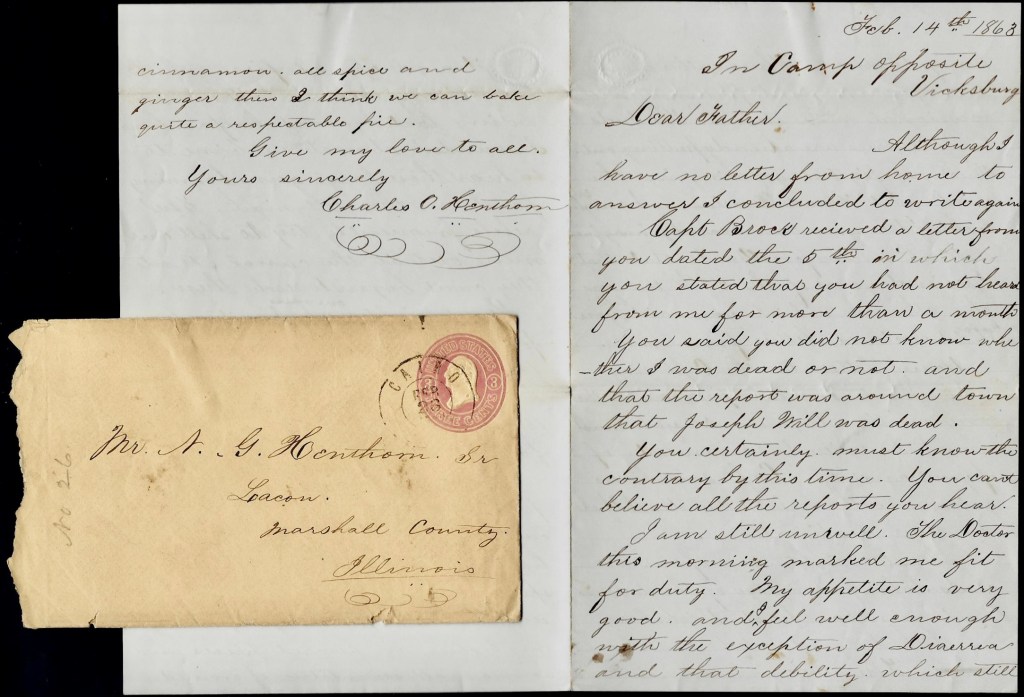
1863: Charles Otto Henthorn to Nelson George Henthorn

The following letters were written by Charles Otto Henthorn (1841-1910), the son of Nelson George Henthorn (1810-1890) and Elizabeth C. Moeller (1815-1887) of Lacon, Marshall county, Illinois. of Co. B, 77th Illinois Infantry. Charles’ parents were married in Licking county, Ohio, but had relocated to Marshall county, Illinois, prior to the 1840 US Census.

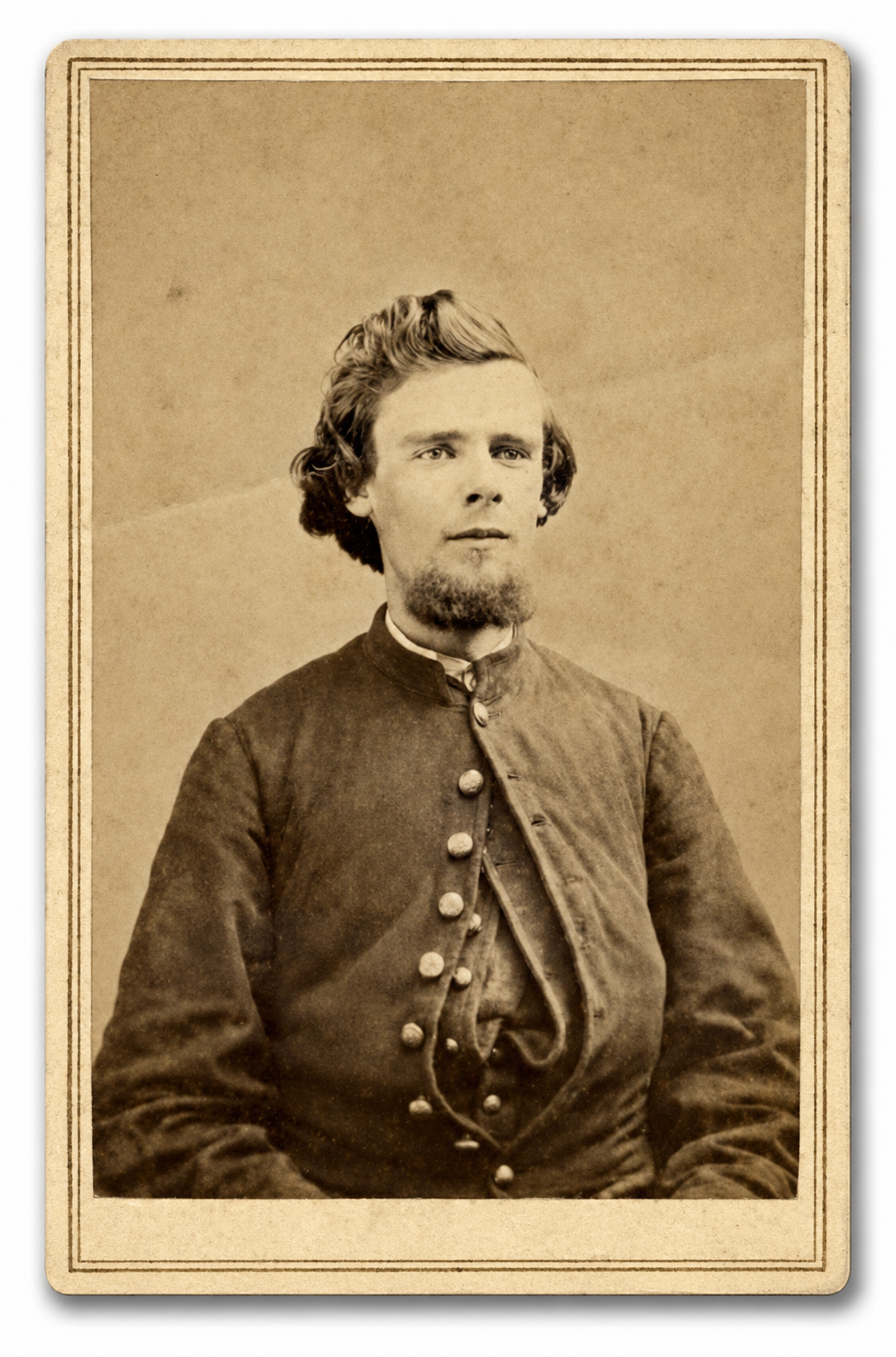
I could not find an image of Charles but here is a CDV of William G. Boman who served in Co. B, 77th Illinois Infantry (Photo Sleuth)

Charles enlisted in Co. D, 77th Illinois Infantry during the Civil War. Many of his letters are housed in the William L. Clements Library at the University of Michigan. Charles is described in that collection as “an unusually powerful writer and provides thoughtful, evocative descriptions of the events unfolding around him. His observations on the varied roles of African Americans in the army are particularly noteworthy. They are depicted in several ways: as informers on Confederate sympathizers hiding from the Union Army, as victims of racism and southern hatred, and as highly motivated and effective soldiers at the Battle of Milliken’s Bend. Henthorn appears to have a much more positive attitude toward blacks than many of his fellow soldiers, and he appears equally to be aware of this fact. Equally interesting are Henthorn’s descriptions of the land itself, including fine descriptions of towns in Indiana and Ohio, and of evacuated plantations in Louisiana. He makes several references to hostile southern attitudes toward the Union troops, and describes an instance of pillaging by members of his regiment. There are two second-hand accounts of battles, the Battles of Richmond and Milliken’s Bend, but by and large, there is very little martial content in Henthorn’s letters. He is instead at his best in his reflections on the effect of the conflict on the soldiers and civilians. The final two letters in the collection provide (respectively) an insight into the depth of Henthorn’s religiously held pro-Union, anti-slavery views, and an account of a copperhead rally in Lacon during the 1864 presidential election which featured a coffin containing a likeness of Lincoln with buzzards flying overhead…Like many soldiers in his regiment, Henthorn was striken with illness during the Vicksburg Campaign, and spent seven weeks in the Van Buren Hospital at Milliken’s Bend, La., before being sent to St. Louis for convalescence. This series of correspondence essentially ends when Henthorn leaves the south, however the regimental history for the 77th Illinois records Henthorn as mustering out only at the end of the war.”

Although Charles is carried on the Muster rolls of Co. B as Charles O. Henthorn, there is also a Charles O. Hawthorn on the rolls of Co. D which is also the company commanded by Capt. Robert Brock and the other privates mentioned in this letter. Henthorn, not Hawthorn, is the surname that Charles wrote on his letter and envelope. Because of the other names mentioned in this letter, I’m going to assume Charles was in Company D.

Letter 1

In Camp opposite Vicksburg
January 31st 1863

Dear Father,

I received a letter yesterday from you stating that you had not received a letter from me since leaving Memphis. I have written four since the one to George while going down the river the first time. In [it] I told him he might have the skates and gun. Then I think I wrote one to you from a place called Milliken’s Bend, 25 miles from Vicksburg. Then I wrote you one on the 4th of January—the same day that Goodrich opened his box—informing you that i had received the letter containing the five dollars and also the boots and box of notions. I do not wonder that you are all uneasy though I suppose some of my letters have reached home before yours reached me. There even may be a possibility that mine may have been miscarried or misplaced. While on the boat, I was too unwell to feel much like writing. Besides, the jar of the boat rendered it difficult. I shall try to write oftener.

All the time that I have been sick, there has not been a day but what I could walk around. Our regiment left the boat on the 24th of January (on which some of us had stayed over a month) and marched down the river to our present camp ground—a distance of 3 or four miles. I could not keep up with the regiments with my accoutrements on so had to fall behind and take my time for it.

We have some bright and shiny days here though the principal part of the time has been cloudy and rainy since we came into camp. I am still unwell and unfit for duty but have good and accommodating messmates—Will Fenn, Joseph Will, Martin Hoagland, &c.

The mails now is quite irregular and sometimes far between in going up. I hope you may receive all my letters. I think I got all of yours. I hope soon to become entirely well. The most that troubles me is the diarrhea—very common in the camp. A baker with an army bake oven has been engaged to bake light bread for the regiment. We got our first today. You can have a fine view of Vicksburg from the top of the levee. 

February 2nd, This morning two of our gunboats ran the blockade of the water batteries. There was a brisk cannonade for over half an hour. It sounded quite interesting. You will perceive from my handwriting that my hand is nervous.

Yours sincerely with love to all. — C. O. Henthorn


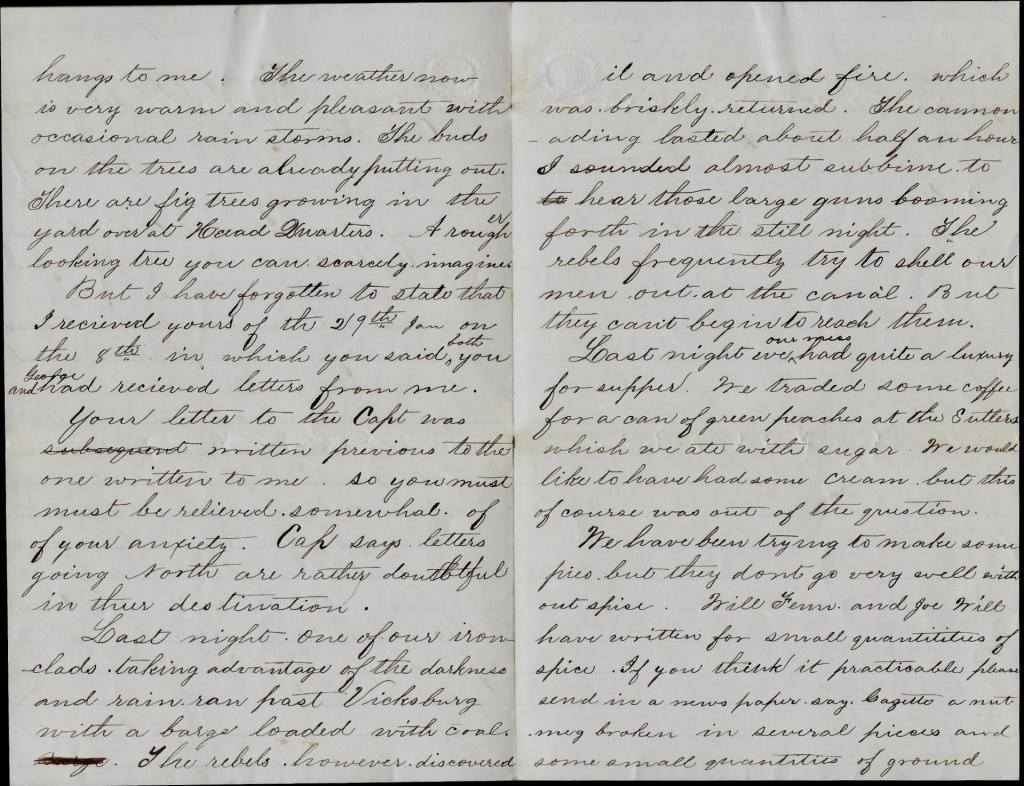
Letter 2

In Camp Opposite Vicksburg
February 14th 1863

Dear Father,

Although I have no letter from home to answer, I concluded to write again. Capt. [Robert H.] Brock [of Co. D] received a letter from you dated the 5th in which you stated that you had not heard from me for more than a month. You said you did not know whether I was dead or not and that the report was around town that Joseph Will was dead. You certainly must know the contrary by this time. You can’t believe all the reports you hear.

I am still unwell. The doctor this morning marked me fit for duty My appetite is very good and I feel well enough with the exception of diarrhea and that debility which still hangs to me.

The weather now is very warm and pleasant with occasional rain storms. The buds on the trees are already putting out. There are fig trees growing in the yard over at Headquarters. A rougher looking tree you can scarcely imagine.

But I have forgotten to state that I received yours of the 29th January on the 8th inst. which you said both you and George had received letters from me. Your letter to the Captain was written previous to the one written to me so you must be relieved somewhat of your anxiety. Captain says letters going North are rather doubtful in their destination.

Last night one of our ironclads 1 taking advantage of the darkness and ran ran past Vicksburg with a barge laded with coal. The rebels, however, discovered it and opened fire which was briskly returned. The cannonading lasted about half an hour. It sounded almost sublime to hear those large guns booming forth in the still night. The rebels frequently try to shell our men out at the canal but they can’t begin to reach them.

Last night we (our mess) had quite a luxury for supper. We traded some coffee for a can of green peaches at the sutler’s which we ate with sugar. We would like to have had some cream but this of course was out of the question. We have been trying to make some pies but they don’t go very well without spice. Will Fenn and Joe Will have written for small quantities of spice. If you think it practicable, please send in a newspaper—say Gazette—a nutmeg broken in several pieces and some small quantities of ground cinnamon, all spice and ginger. Then I think we can bake quite a respectable pie.

Give my love to all. Yours sincerely, — Charles O. Henthorn


1 USS Indianola, a 511-ton ironclad river gunboat, was built at Cincinnati, Ohio. Commissioned in an incomplete state in September 1862 to defend Cincinnati against a threatened Confederate attack, she was ready for active service in January 1863. Sent to join the Mississippi Squadron north of Vicksburg, she ran past the guns of that fortress city on 13 February 1863 in an effort to cut off Confederate supply lines.