
The following letter was written by John Whitehead (1820-1864), a 44 year-old English-born tinsmith of Chester, Warren county, New York. He was married in January 1851 to Elizabeth Ann Richardson (b. 1819 in N. York State) and had at least three children ranging in age from 7 to 22 living in his household in 1860, the youngest being John Elam Whitehead (1852-1937).
John began his military service in August 1862 when he was recruited into Co. G, 22nd New York Infantry. When that regiment mustered out in June 1863, he was transferred to Co. C of New York’s 93rd Regiment to complete his three year enlistment. He was wounded in the opening action in the Wilderness but recovered to join his regiment during the siege of Petersburg. He was killed in action on 27 October 1864 near Hatcher’s Run on the Boydton Plank Road near Petersburg, just 5 days after writing this letter to his wife and son. Muster rolls inform us that he was shot through the bowels and lived about 45 minutes before he died. It is presumed he was buried on the battlefield near where he fell.
This letter is from the collection of Sharon Hall and was made available for transcription and publication on Spared & Shared by express consent.
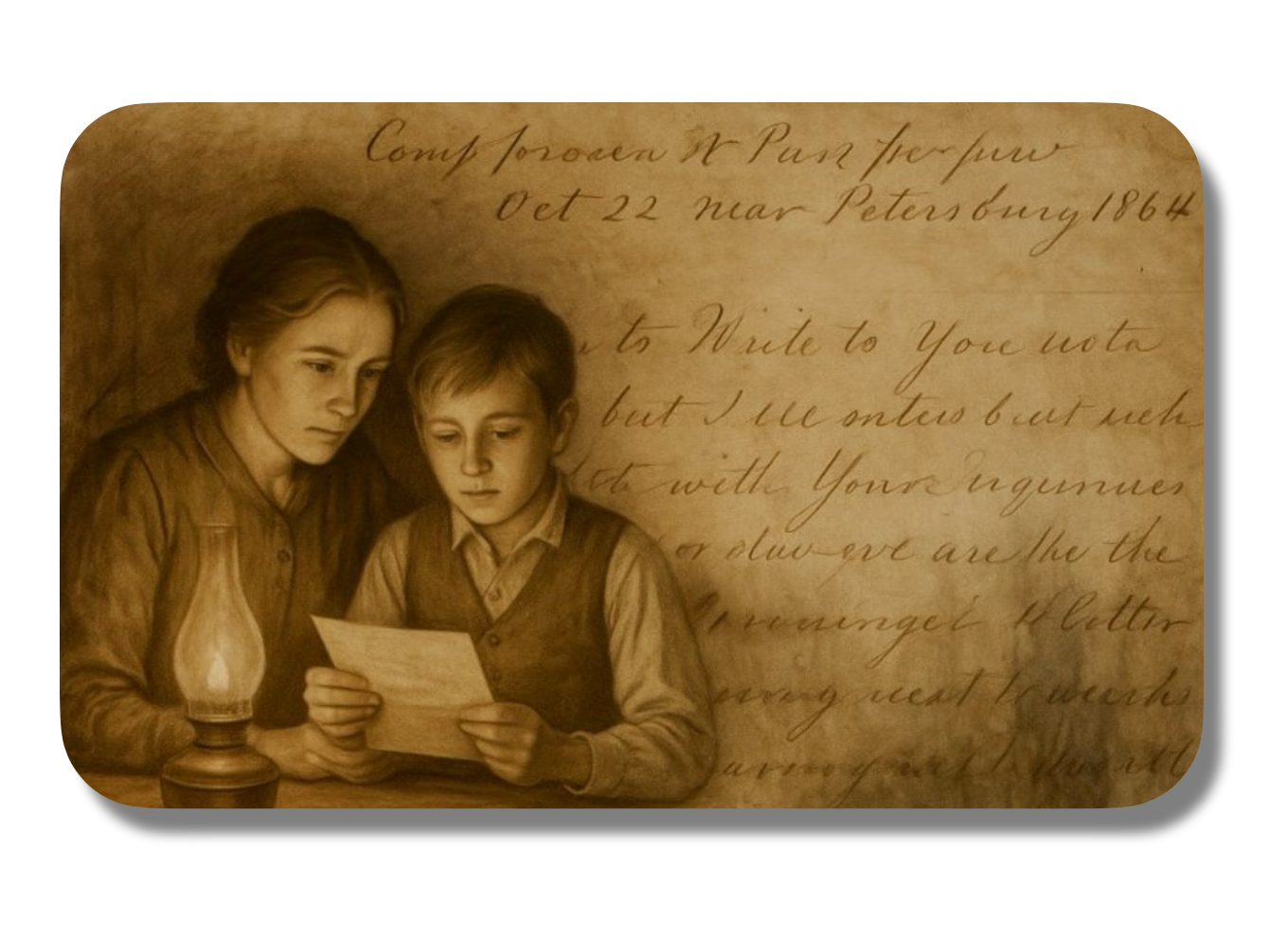
T R A N S C R I P T I O N
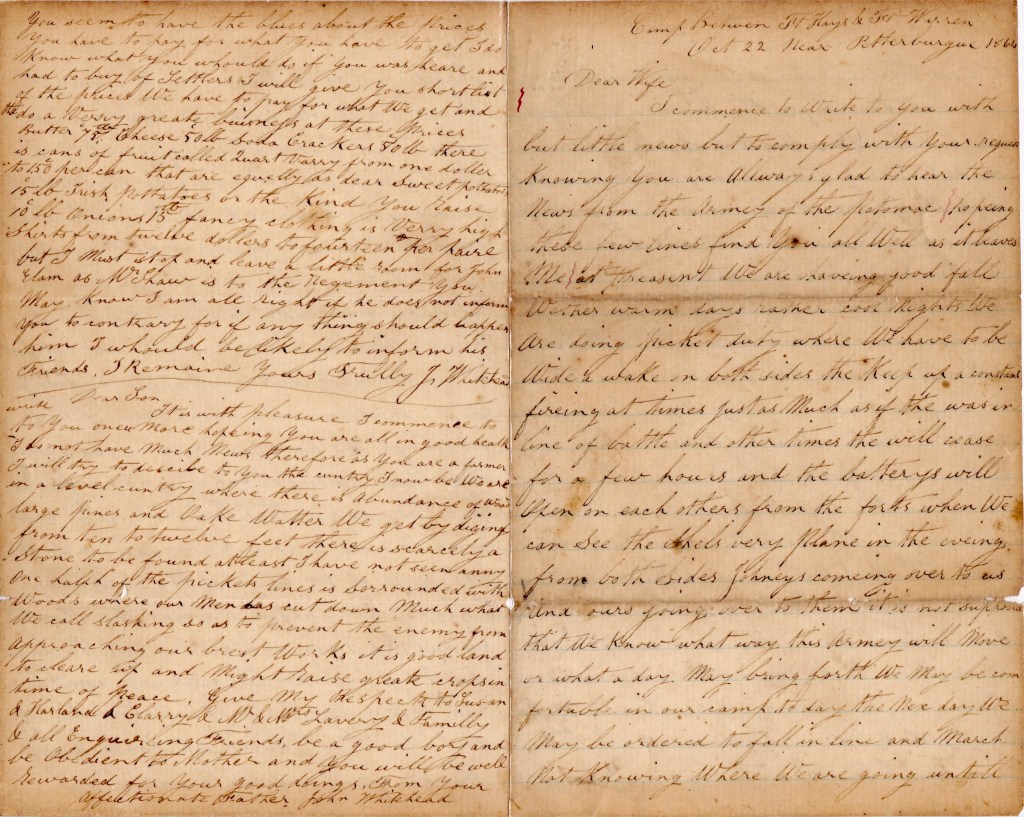
Camp between Ft. Hays and Ft. Warren
Near Petersburg, [Virginia]
October 22, 1864
Dear Wife,
I commence to write to you with but little news but to comply with your request knowing you are always glad to hear the news from the Army of the Potomac, hoping these few lines will find you all well as it leaves me at present. We are having good fall weather—warm days—rather cool nights. We are doing picket duty where we have to be wide awake on both sides. They keep up a constant firing at times, just as much as if they was in line of battle, and other times they will cease for a few hours and the batteries will open on each other from the forts when we can see the shells very plain in the evening from both sides. Johnnies coming over to us and ours going over to them.
It is not supposed that we know what way this army will move or what a day may bring forth. We may be comfortable in our camp today, [and] the next day we may be ordered to fall in line and march, not knowing where we are going until we get there. So this is the way our army goes. But it is all for the Union. It is not for me to dictate how this war should be carried on, but many times I cannot help thinking how things are managed and it is good school to see the various characters and dispositions of mankind. There are many selfish and void of principles of any good but to fraud the government, while there are others that are always in their place and are true to themselves and their country. While I may say there is quite an army between here and the City of New York—able bodied men playing off in the hospitals, while we have men at [the] front, if they had their just dues, would be at the hospital or have their discharge. I cannot begin to pen down the money frauds and impositions on this government. But we have men that care no more for our cause than Old Jeff Davis. [They care] no more than to make money and rob our government all they can. But I must stop before you get tired out of patience on this subject.
“…I am for the Union and Old Abe with strong faith that he will be our next President. I do not know what you feel or think but it is cheering to me to think, if health permit, that we may be free once more and return to our home…”
— John Whitehead, 93rd New York Vols., 5 days before he was killed
I will not write much on politics. If I do, I would not know when to stop until this sheet was filled. But I will say so far that I am for the Union and Old Abe with strong faith that he will be our next President. I do not know what you feel or think but it is cheering to me to think, if health permit, that we may be free once more and return to our home to look back at the last two years. To me it seems but a short space of time although we have seen some sad scenes in that time amongst our neighbors [and] friends. But the hopes that this war will soon come to a close and knowing I am on the last year of the term of my enlistment, I have got so I begin to count the months by and by. I am in hopes this war will come to an end before my term of enlistment is up, but we must cheer up, hoping all things will end well and soon.
You seem to have the blues about the prices you have to pay for what you have to get. I do[n’t] know what you would do if you was here and had to buy off sutlers. I will give you a short list of the prices. We have to pay for what we get and they do a very great business at these prices. Butter 75 cents, cheese 50 cents a pound, soda crackers 50 cents per pound/ There is cans of fruit called Quart Varry from one dollar to $1.50 per can that are equally as dear. Seet potatoes 15 cents a pound, Irish potatoes or the kind you raise 10 cents a pound, onions 15 cents a pound. Fancy clothing is very high. Shirts from 12 dollars to 14 per pair. But I must stop and leave a little room for John Elam as Mr. Shaw is to the regiment. You may know I am alright if he does not inform you to the contrary for if anything should happen to him, I would be likely to inform his friends. I remain yours truly, — J. Whitehead
Dear Son, it is with pleasure I commence to you once more hoping you are all in good health. I do not have much news, therefore as you are a farmer, I will try to describe to you the country I now be. We are in a level country where there is abundance of wood—large pines and oak. Water we get by digging from ten to twelve feet. There is scarcely a stone o be found—at least I have not seen any. One half of the picket lines is surrounded with woods where our men has cut down, much what we call slashing so as to prevent the enemy from approaching our breastworks. It is good land to clear up and might raise great crops in times of peace.
Give my respects to Susan & Harland & Clarry & Mr. & Mrs. Lavery & Family & all enquiring friends, Be a good boy and be obedient to Mother and you will be well rewarded for your good doings. From your affectionate father, — John Whitehead

 Spared & Shared 23