
The following letters were written by George Safford, Jr. (1842-1877), the son of George Safford (1794-1882) and Mahala Hutton (1763-1847) of Centre township, Lafayette county, Wisconsin. He wrote the letter to his younger brother, Albert Walter Safford (1844-1928) who was in Rockford, Illinois, at the time and later became a Congregational minister.
George enlisted in mid-August 1862 and was mustered in as a corporal in Co. B, 23rd Wisconsin Infantry. He mustered out of the regiment nearly three years later on 4 July 1865 at Mobile, Alabama.
Note: These letters are from the personal collection of Greg Herr and were made available for transcription and publication by express consent.

Letter 1
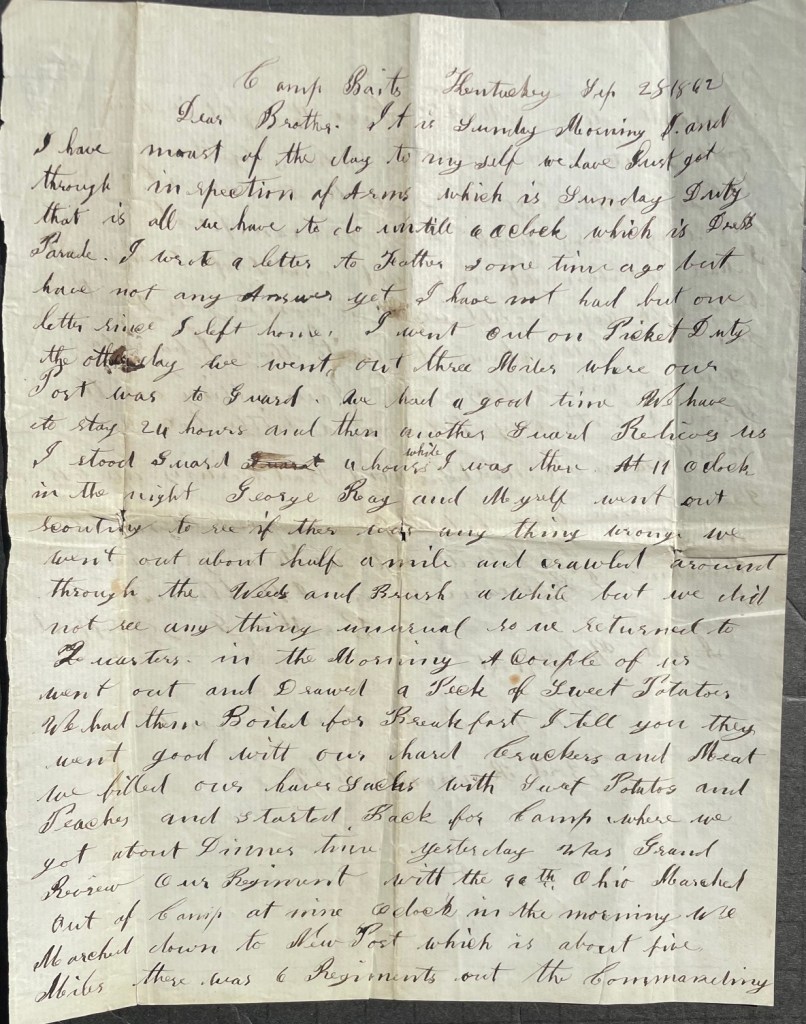
Camp Bates, Kentucky [@ 6 miles from Cincinnati, OH)
September 28, 1862
Dear Brother,
It is Sunday morning and I have most of the day to myself. We have just got through inspection of arms which is Sunday duty. That is all we have to do until 6 o’clock which is Dress Parade.
I wrote a letter to Father some time ago but have not any answer yet. I have not had but one letter since I left home. I went on picket duty the other day. We went out three miles where our post was to guard. We had a good time. We have to stay 24 hours and then another guard relieves us. I stood guard 4 hours while I was there at 11 o’clock at night. George Ray and myself went out scouting to see if there was anything wrong. We went out about half a mile and crawled around in the weeds and brush awhile but we did not see anything unusual so we returned to quarters. In the morning a couple of us went out and drawed a peck of sweet potatoes. We had them boiled for breakfast. I tell you, they went good with our hard crackers and meat. We filled our haversacks with sweet potatoes and peaches and started back for camp where we got about dinner time.
Yesterday wsa Grand Review. Our regiment with the 96th Ohio marched out of camp at nine o’clock in the morning. We marched down to New Post which is about five miles. There was 6 regiments out. The Commanding General was Major General Wright. It was quite a sight to see so many soldiers together.
I like soldiering very ewll so far. It is not very easy work any you can fit it. I have not been sick any yet and I hope I may not be. I wish you would write as soon as you get this. You have a better chance to write than I have so you can write a longer letter. I am sitting on the ground with my paper on a little box. You must excuse all mistakes and bad writing unless you see some very bad blunder, and then tell me of it. I will not write any more this time. I remain your affectionate brother, — George Safford
to Albert W. Safford
P. S. Direct to Cincinnati, 23rd Regiment Wisconsin Vols.

Letter 2

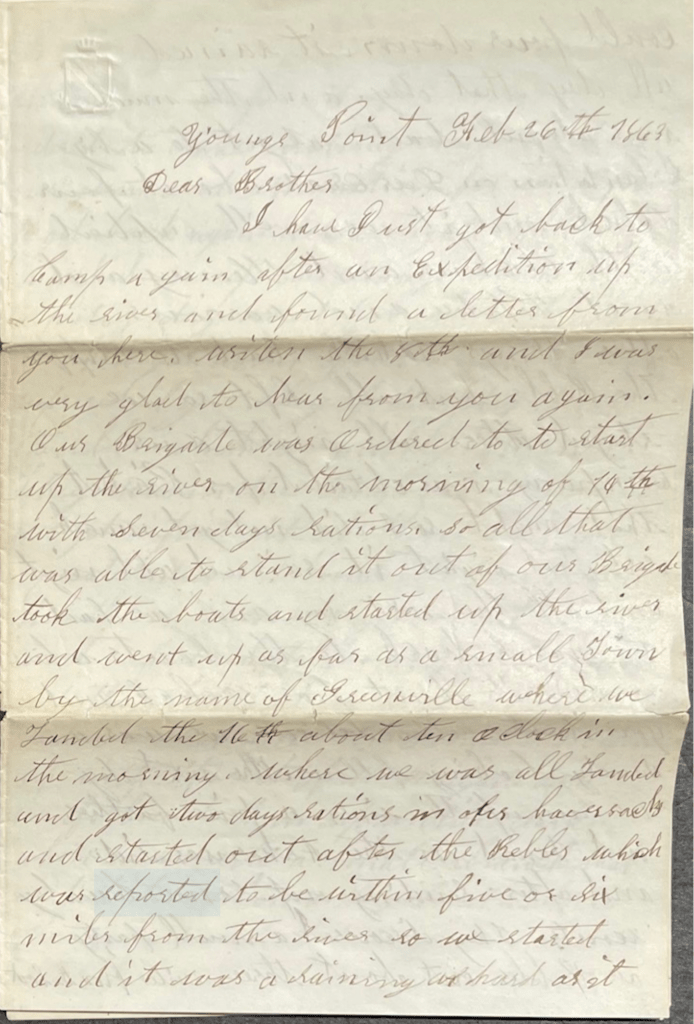
Young’s Point
February 26th 1863
Dear Brother,
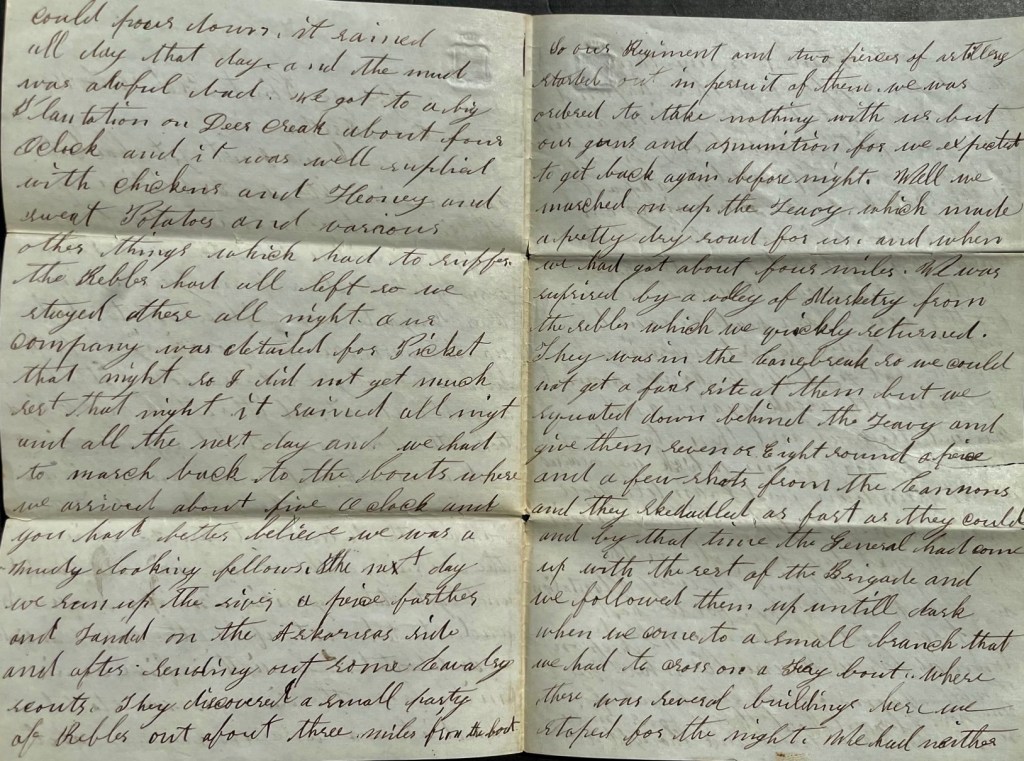
I have just got back to camp again after an expedition up the river and found a letter from you again. Our Brigade was ordered to start up the river on the morning of the 14th with seven days rations, so all that was able to stand it out of our Brigade took the boats and started up the river and went up as far as a small town by the name of Greenville where we landed the 16th about ten o’clock in the morning, where we was all landed and got two days rations in our haversacks and started out after the Rebels which was reported to be within five or six miles from the river. So we started and it was a raining as hard as it could pur down. It rained all day that day and the mud was awful bad.
We got to a big plantation on Deer Creek about four o’clock and it was well supplied with chickens and honey and sweet potatoes and various other things which had to suffer. The Rebels had all left so we stayed there all night. Our company was detailed for picket that night so I did not get much rest that night. It rained all night and all the next day ad we had to march back to the boats where we arrived about five o’clock and you had better believe we was a muddy-looking [set of] fellows.
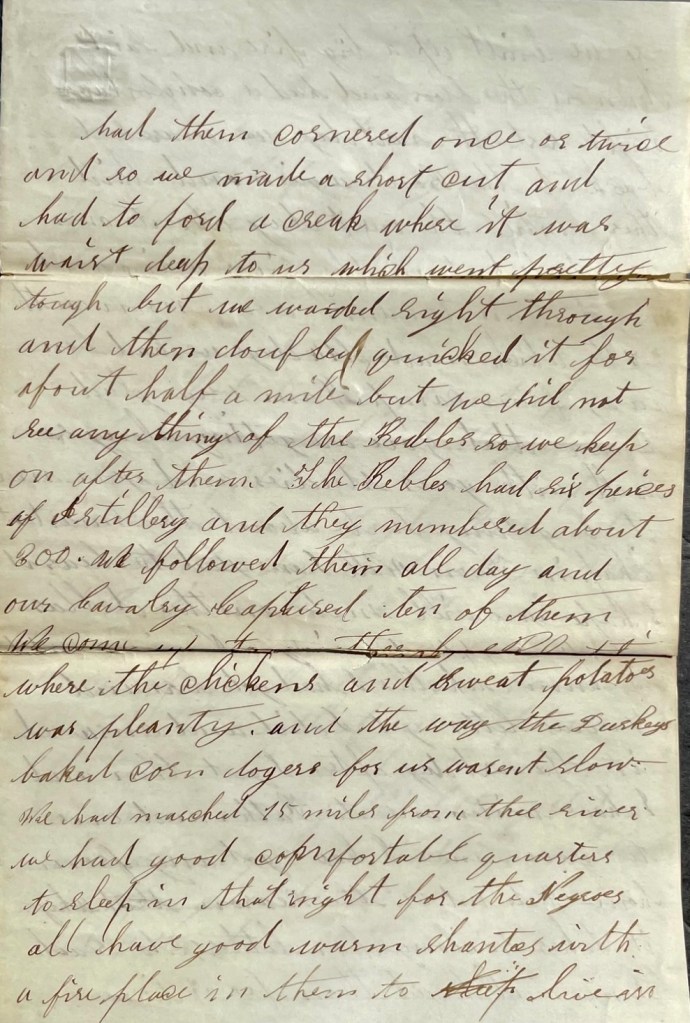
The next day we run up the river a piece further and landed on the Arkansas side and after sending out some cavalry scouts, they discovered a small part of rebels out about three miles from the boat. So our regiment and two pieces of artillery started out in pursuit of them. We was ordered to take nothing with us but our guns and ammunition for we expected to get back again before night. Well we marched on up the levy which made a pretty dry road for us and when we had got about four miles, we was surprised by a volley of musketry from the rebels which we quickly returned. They was in the canebrake so we could not get a fair sight at them but we squatted down behind the levy and give them seven or eight rounds apiece and a few shots from the cannons and they skedaddled as fast as they could and by that time the General had come up with the rest of the Brigade and we followed them up until dark when we come to a small branch that we had to cross on a ferry boat where there was several buildings. Here we stopped for the night. We had neither our coats, blankets or anything to eat for supper but there happened to be a nice lot of hogs running around which we pitched into pretty lively and made our supper and breakfast on fresh pork.
In the morning our cavalry brought in one piece of artillery which they captured from the Rebs. We did not follow them any farther for they was so far ahead we could not catch them. The next morning after ew had fired off all the houses around, we crossed the creek again and burned the boat and then started back to the boats again which we reached about sundown and I can tell you I relished my supper with a good will.
Well the next day we run down the river apiece stopping at every plantation we come to for forage for we had about run out of rations. We kept on down as far as Greenville where we landed again for we got wind of some more rebs out about three or four miles. So after them we started and thought we had them cornered once or twice and so we made a short cut and had to ford a creek where it was waist deep to us which went pretty tough. But we waded right through and then double quicked it for about half a mile but we did not see anything of the Rebels so we kept on after them. The Rebels had six pieces of artillery and they numbered about 300. We followed them all day and our cavalry captured ten of them. We came up to the same plantation where the chickens and sweet potatoes was plenty and the way the darkeys baked corn dodgers for us wasn’t slow. we had marched 15 miles from the river. We had good comfortable quarters to sleep in that night for the Negroes all have good warm shanties with a fireplace in them to live in so we built up a big fire and laid down on the floor and had a comfortable night’s rest.
The next day we marched back to the boats gain and laid there until the next day. About noon we started down the river again and we got down to camp about noon on the 27th which made 14 days we had been away from camp.
I am very glad to hear that you are getting along so well with your studies and you must be getting to be about the smartest chap in town. Well, I am glad to hear it. I hope you will make another dollar at the 1st opportunity. Nannie [Chamberlain] wanted to know whether I had got hers and [ ‘s] letter yet. I did and answered it the next day after I got them and I have written one to Father and one to you since I have got any from home. I do not see the reason why it takes so long for letters to reach home and to get them from home.
It has been so wet and muddy down here that it makes it very sickly. Our regiment does not number over 250 men able for duty. There is only about 25 men in our company fit for duty now. I have been able to do my duty so far and I hope I may as long as I remain in the army. We have lost two boys out of our company by sickness. They died in the hospital tent in camp. Their names was Taylor Beer and James Buss. Taylor lived in Wiota and Buss lived at Cottage Inns. They [page creased] the company. I suppose you have heard of the death of our captain [Charles M. Waring] before this letter will get there.
I commenced writing this letter yesterday and last night Mr. Woodbury got back to camp again. He give me a paper and letter from Father and sister and I was very glad to hear from home again. We have been mustered again today. It is the last day of February. I do not know when we will get any pay. It may be we will get some before long but it is rather doubtful. I think it is a shame to keep us out of our pay so long. There is six months wages due us now and I know Father stands in need of it as much as anyone. I can get along very well without money as long as I keep my health. I hope you will [get] along some way until I can send some money to help live on.
I do not know whether we will ever attack Vicksburg or not. The Rebels captured one of our gunboats the other day. The name of the boat was the Queen of the West. I think I have written a good long letter and I want you to answer it promptly. Tell Mary I will write to her soon. Give my love to all the folks. I must close for want of room. You need not send any more paper very soon for I can manage to get it here. No more at present. From your affectionate brother, — George Safford



Letter 3
Mississippi near Vicksburg
May 27, 1863
Dear Brother
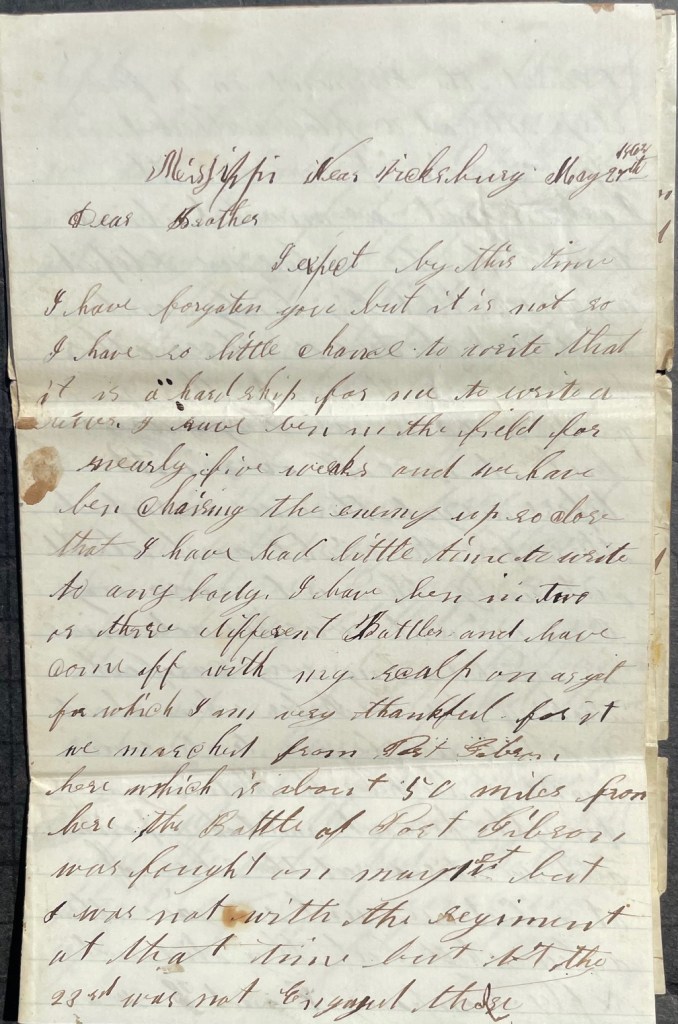
I expect by this time [you think] I have forgotten you but it is not so. I have so little chance to write that it is a hardship for me to write a letter. I have been in the field for nearly five weeks and we have been chasing the enemy up so close that I have had little time to write to anybody. I have been in two or three different battles and have come off with my scalp on as yet for which I am very thankful for it.
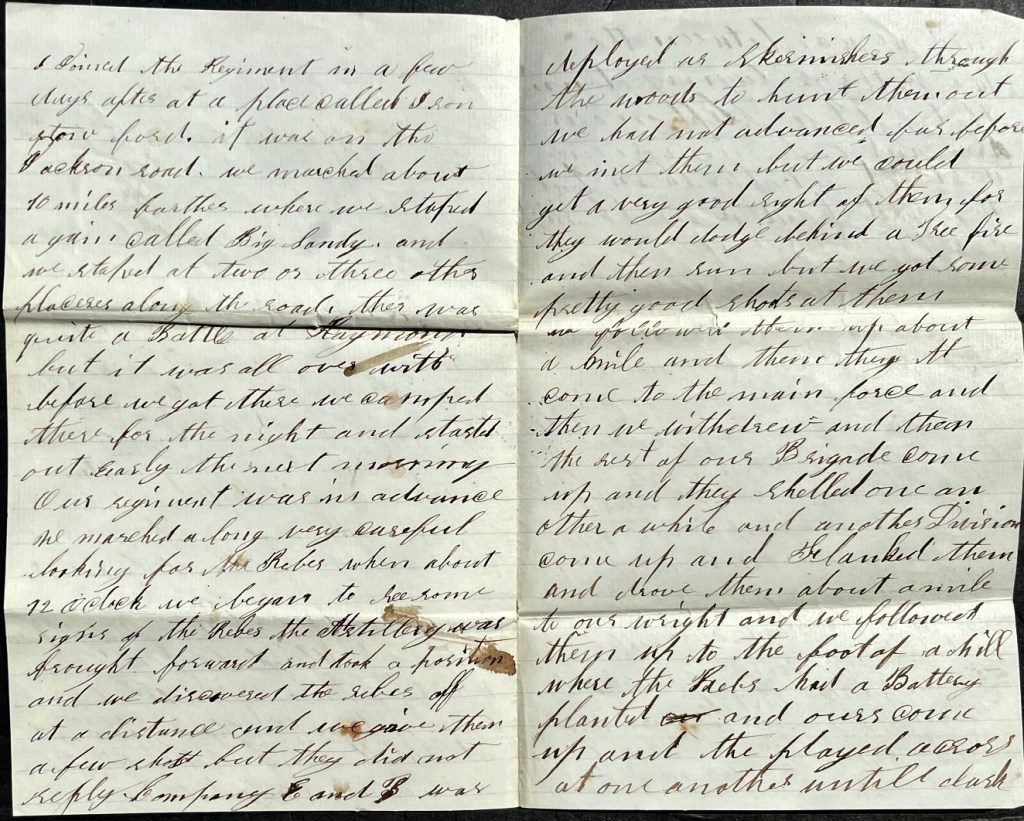
We marched from Port Gibson here which is about 50 miles from here. The Battle of Port Gibson was fought on May 1st but I was not with the regiment at that time but the 23rd [Wisconsin Infantry] was not engaged there. I joined the regiment in a few days after at a place called Iron Store Ford. It was on the Jackson Road. We marched about ten miles farther where we stopped again [at a place] called Big Sandy and we stopped at two or three other places along the road. There was quite a battle at Raymond but it was all over with before we got there. We camped there for the night and started out early the next morning.
Our regiment was in advance. We marched along very careful looking for the Rebs when about 12 o’clock we began to see some signs of the Rebs. The artillery was brought forward and took a position and we discovered the Rebs off at a distance and we gave them a few shots but they did not reply. Company E and B was deployed as skirmishers through the woods to hunt them out.
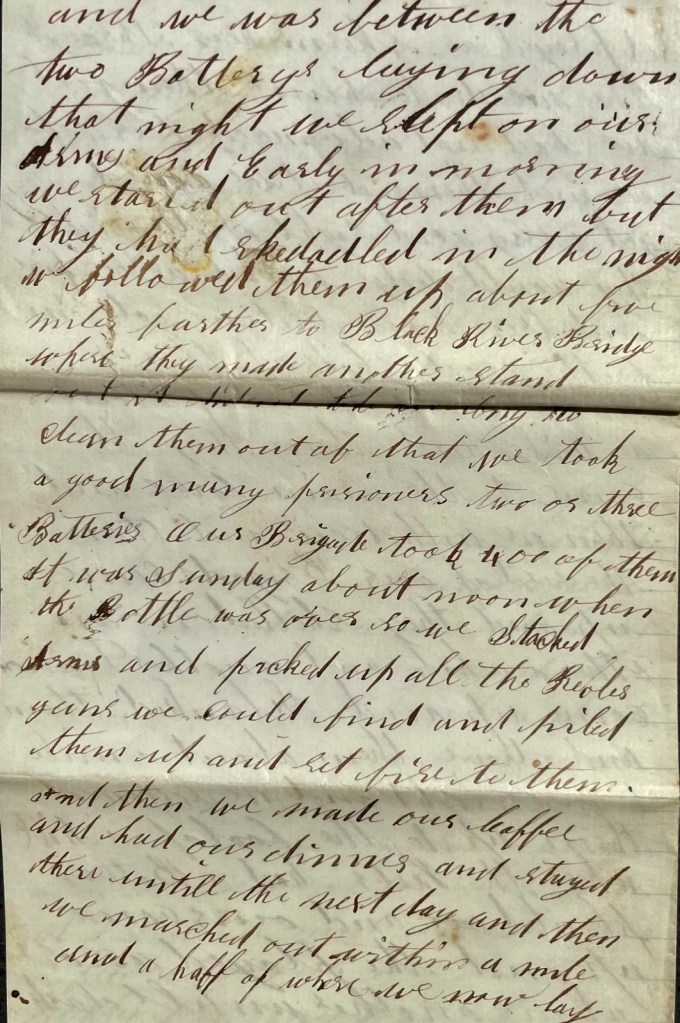
We had not advanced far before we met them but we could [not] get a very good sight of them for they would dodge behind a tree, fire, and then run. But we got some pretty good shots at them. We followed them up about a mile and then they come to the main force and then we withdrew. And then the rest of the Brigade came up and they shelled one another awhile and another Division came up and flanked them and drove them about a mile to our right. And we followed them up to the foot of a hill where the Rebs had a battery planted and ours come up and they played across at one another until dark and we was between the two batteries laying down.
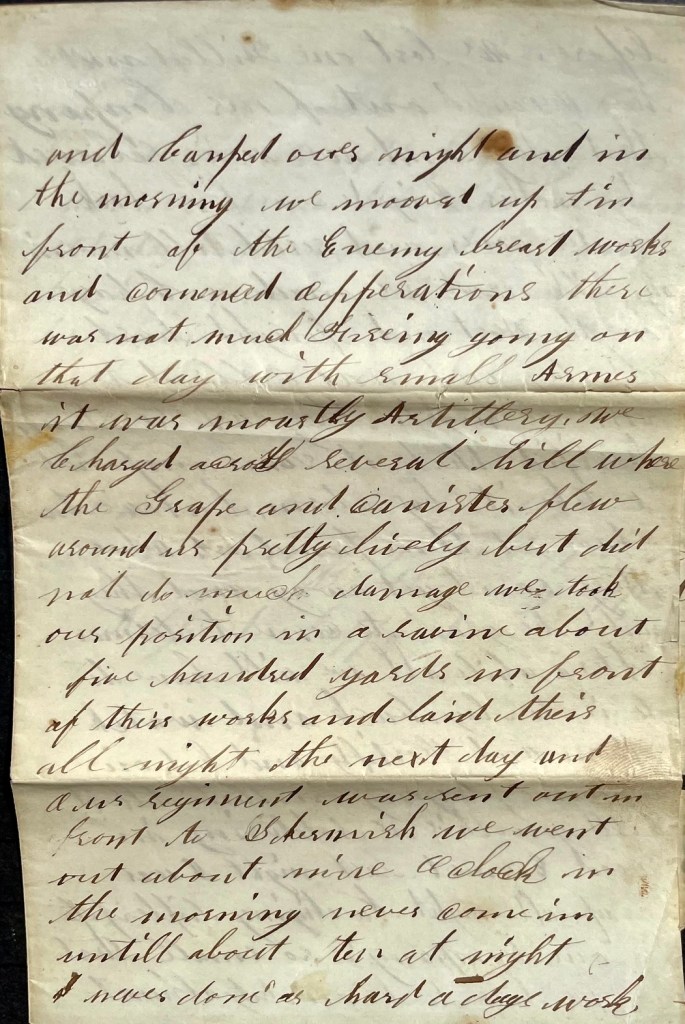
That night we slept on our arms and early in the morning we started out after them but they had skedaddled in the night. We followed them up about fives miles farther to Black River Bridge where they made another stand but it didn’t take long to clean them out of that. We took a good many prisoners, [and] two or three batteries. Our brigade took 400 of them. It was Sunday aboit noon when the battle was over so we stacked arms and picked up all the Rebs’ guns we could find and piled them up and set fire to them and then we made our coffee and had our dinner and stayed there until the next day. And then we marched out within a mile and a half of where we now lay and camped over night and in the morning we moved up in front of the enemy breastworks and commenced operations. There was not much firing going on that day with small arms. It was mostly artillery. We charged across several hills where the grape and canister flew around us pretty lively but did not do much damage. We took our position in a ravine about five hundred yards in front of their works and laid there all night.
The next day our regiment was sent out in front to skirmish. We went out about nine o’clock in the morning and never come in until about ten at night. I never done as hard a day’s work before. We lost one killed and two wounded out of our company that day and we was relieved by another brigade. We fell back under cover and rested till morning.
The 22nd we made a charge on the fort and fought hard all day and was obliged to retire at night. 1 They are so strongly fortified that it seems impossible to take it by storm but we have got them penned in where they can’t get away and they will be glad to come to terms after a while. All we will have to do is to lay back and watch them and fortify and keep out cannons playing on them. Albert, I tell you this is soldiering in good earnest. Last night I was up all night a digging rifle pits. Our company is so small that we have to be on duty almost every night. We have lost two killed and four wounded so we have but 15 privates fit for duty.
I was over to see Al Chamberlain yesterday. His regiment is camped about a quarter of a mile from here. He is well and sends his best respects to all the folks. Mason told me he saw Edmund Pettit [14th Wisconsin] got his finger shot off. It is getting dark now so I will have to close. Write soon to your affectionate brother, — George Safford
To Albert Safford
1 On May 22, 1863, after a four-hour artillery bombardment, Union forces launched a three-pronged assault on the Vicksburg defenses. The 23rd Wisconsin, along with other units, attacked the north face of the 2nd Texas Lunette on Baldwin’s Ferry Road. While they managed to plant their colors close to the Confederate works, the attack was ultimately repulsed.

 Spared & Shared 23