This letter was written by George Orme (1834-1928) of Aurora, Illinois, while serving in Co. H, 124th Illinois Infantry. George mustered into the regiment at Aurora on 10 September 1862 and mustered out on 15 August 1865. Census records inform us that George was a native of Surrey, England and that he emigrated to the US about 1840-41 with his parents, Thomas Orme and Martha Ward. George was married in April 1858 to Minerva H. Miller (1841-1923) in Kane county, Illinois.
After the war, George relocated to Saunders county, Nebraska, where he lived out his days as a farmer.
The 124th Illinois Infantry (a.k.a., the “Excelsior Regiment”) recruited its members from a number of counties, including Henry, Kane, McDonough, Sangamon, Jersey, Adams, Wayne, Cook, Putnam, Pike, Mercer, and Christian. George wrote this letter shortly after the Siege of Vicksburg but his regiment has seen action at Raymond and Champion Hill before digging in at Vicksburg. I found a diary written by another member of Co. H, 124th Illinois that I have posted after George’s letter that will give readers a better idea of the regiment’s activities leading up to the letter. During this period, they were in Logan’s Division and McPherson’s Corps. It was said of them that “they were never driven from a position, and never attempted to take a position and failed.”
This letter was made available by Loren Lindahl for transcription and publication on Spared & Shared by express consent. The original has been gifted to the Saunders County Historical Society to be forwarded to the National Battlefield at Vicksburg.
Barracks of the 124th Illinois Infantry at Vicksburg
T R A N S C R I P T I O N
Vicksburg July 8th 1863
Dear wife,
Here I am jotting down a few lines to you by way of letting you know that I am all right and hope that these [lines] will find you the same. We have got keeping house once more. We have our tents and our cooking utensils so that it begins to look like living once more after being without them for two months and over. I tell you, we know how to appreciate a little comfort.
When I wrote to you last, I was in something of a hurry and did not have time to write many particulars about this place but today I thought I would sit down and give you all the news together—so here it is, on secesh paper right from the City of Vicksburg.
To commence with, we have about 30 thousand prisoners here and such times as we have trading with them, you never seen. Minerva, it almost makes me think that I am up North for you know that when there is any chance for trading, that I am around. Well, the secesh will trade for anything that comes from the North and pay big for it. Most of them have lots of money but it is all secesh. They will give five dollars of their money for one of ours and are glad to get the chance. They will sell anything they have for coffee or Lincoln money. There is more than half of them that says that they will never fight again for we have shown them how they have been humbugged with their leaders and our officers have given them all seperate paroles so that they can go hope if they want to. Their officers wanted them to be paroled in companies so that they could keep them together but the men would not be fooled with them for we had talked the thing over with them and they are bound to go home. They are picking up all the coffee they can get. They will [give] one dollar per pound for it to carry home with them for they say that they have not had any for over a year.
They say that they are much disappointed with us for we use them more like friends than enemies and when they look at the way we live and our clothes and horses and everything that we have, it makes them wonder how their leaders could be such rascals to lie to them in the way they have. I think that we have given Old Secesh a blow this time for we have hurt their cause more by using their men in the way we have than if we had shot every man of them for they will go home and tell their neighbors how we used them and that we are not fighting them to take their rights from them but to protect them in their rights as citizens of the Union. They start for home today.
Now then, my dear, I have given you some of the news about the rebs. Not I [will] say a word about other matters. In the [first] place, I would like it if you could send me some butter when Mr. [Lieut.] Potter comes back. Tell Ma that I never wanted some of make of butter so bad in all my life as I do at the present. We are drawing some soft butter and if we could get a little butter, Oh how good it would go with us. You can’t think how bad it makes me feel every time I think of the trouble you went to in fitting up that box of stuff and then for me to never get a smell of it. Hain’t it provoking to think of it?
I heard from James Newell day before yesterday. He is about three miles from here and he told one of our boys that he saw in town that we would come over as soon as he can to see me. There is strong talk of our being stationed here for guard. I hope it will be so for them there will be some chance for us to get furloughs to come home.
In your letters, you have never said anything about James Miller. I heard about him yesterday. His Captain thought he must be lost or he would have come to his company. I heard from a man that was in Vicksburg at the time that the boats run through that Jim was taken prisoner the next day. He knew him in Aurora three years ago. I am somewhat acquainted with him. It is the man that Old Pat sold the old house to. He is an Irishman. Bill will know who he is. He is going to come back to Aurora as soon as he can get money enough to carry him back. He says that they put him in prison because he would not enlist and he told me that the night before we got to this place, they came in the night and took the last cow he had and killed her and he could not say a word and they wouldn’t even give him secesh money for her. They told him he was a damned federal and their money would not do him any good for they intended to leave shortly and that would be good enough pay for him. Well we have got and I suppose that he will have to feed the folks here for they have nothing to eat and nothing [to] buy with.
I have got a couple of nice rings for you as trophies—one from Champion’s Hill and the other I got here.
Now Kitty, don’t forget to see Potter before he comes back and send my boots for I do need them bad. I must close for supper is ready. So goodbye till next time. Yours truly, — George
Charles H. Snedecker
Diary of Charles Henry Snedecker of Aurora who also served in Co. H, 124th Illinois Infantry with George Orme. I’ve included that portion of Charles’ diary from late May to mid-July 1863. Source: Find-A-Grave
MAY, 1863 26th Pleasant weather. Quite extensive Rifle Pits were dug by our troops last night. Canonading and Sharpshooting as usual. No advance today. Mailed letter No. 30.
27th Co. H and two other Co. s from the 124th detailed last night to work on fortifications in front of “Shirleys house” Worked till daybreak and went back to quarters a tired sett. Nothing unusual today. Weather warm and clear.
28th Weather fair. Received letter No. 22 from home. Sent home letter No. 31. Today men are at work throwing up intrenchments in front of our Regt. Co. H detailed to go out to the rear on Picket. Went out 3 or 4 miles on the Bridgeport road. Got to our Post just after sundown. Dust in the road two or three inches deep.
29th Weather fair and warm. Went out and gathered Plums and Blackberries. Plums are very plenty both white and red. In the afternoon we were moved out a mile or so farther and were reinforced by two more companies. Heavy firing in the direction of Vicksburg this morning. Had Plum Sauce and Blackberries and sugar for Supper.
30th Fair and warm. Alarm by the sentinels twice in the night. The reserve called into line both times, and the last time we marched out beyond the outposts to reconnoitre, but not being able to discover any enemy, we marched back and laid down on our Arms. Nothing more occurred to alarm us. Our sentinels said that they saw men with guns moving around. Got some Mulberries and stewed them. We were relieved at 5 P.M. by 5 companies of the 10th Mo. Arrived in camp at 7 o’clock.
31st Sunday. Clear and hot. Was aroused at 2 1/2 o’clock this morning by our Artillery opening fire on the Rebs. It was kept up for an hour a perfect roar after which it gradually ceased. Some cannonading all through the day. The Rebels fired a few shots in return.
JUNE, 1863 1st Clear and hot. Artillery firing every half hour through the night. Very heavy cannonading at 3 A.M. Two more “Parrott Guns” planted in front of our Regt. during the night. Wrote a letter to Mrs. Lennox informing her of her Husbands death. One of McAlisters 24 pound howitzers charged down the hill through our companys shanties, tearing some of them down and scattering things generally, but fortunately without hurting any one. Co. H detailed on Picket.
2nd Clear and warm. Went on Picket at 3 P.M. in the Rifle Pits. The Rebs tried to capture a Battery on our left, but were repulsed. There was a large fire in Vicksburg about midnight. I could distinctly hear the fire bells ringing in the city. I drew a pair of Shoes, 1 pair of socks, a shirt, Hat and Rubber Blanket. Our Artillery played a lively tune on the Rebels about Sundown. The “Lombard Brothers” were here and sang the “Battle Cry of Freedom.”
3rd Still camped on the hill. Weather warm. Cannonading and sharpshooting as usual. Co. H detailed on Picket.
4th Weather warm. Nothing but the usual routine.
5th Warm. A moveable car for sharpshooters was put up last night. It is mounted on wheels and protected by cotton bales. It was put up in front of the Rebel fort. Co. H detailed on Picket.
6th Very oppressive weather. Was quite un-(well) all night and through the day. Wrote letter No. 32.
7th Sunday. Sick with a hard cold. Co. H detailed on Picket at night. Weather hot.
8th Warm again. Our Mortar Boats shelled the city all night. One man in Co. B Killed, and one of Co. H wounded in the leg just at night.
9th Warm. One 9 inch Siege Gun came up today. Our whole Regt. on Picket. Chas. Titsworth of Co. H wounded while on Picket.
10th Rainy. Received letter No. 23 and one from Mother. Not much cannonading, but very lively sharpshooting.
11th Pleasant. One 9 inch Siege Gun mounted and at work battering down “Fort Hill.”
12th Pleasant. The Rebels have thrown a few shells towards our “Big Gun”, but has not hurt any body yet. Got a letter from Bro. George.
13th Clear. Washed my clothes. Our Regt. exchanged their old guns for new Enfield Rifles. The Regt. detailed for sharpshooting and Picket to go in at 6 1/2 A.M. tomorrow and stay on duty 24 hours.
14th Warm. Sunday. “Philips” of Co. C wounded in the face. I was detailed to stand on Picket at night outside the breastworks. The Rebs threw quite a number of 9 inch shells some of which struck very close to our Hospital.
15th Rainy in the morning pleasant the rest of the day. Wrote a letter to Bro. George. Co. H to go on fatigue duty tomorrow at 4 A.M.
16th Pleasant. Co. H aroused at 3A.M. to go for fatigue duty on the trench leading to the Rebel Fort. In the afternoon they threw two “Hand Grenades” at us from the Fort. They fell short 50 feet and exploded doing no damage. We are now within 100 feet of the Fort.
17th Fair. Several 9 inch shells bursted over our camp today. One piece weighing two or three pounds struck about 5 feet from where I was sitting. No one was struck by them. Very heavy cannonading part of the day. I had a billious attack.
18th A large fire in the city last night. The Rebs opened a gun on our right from behind a cotton Fort. Our Gunners shelled them and set their fort on fire. Got letter No. 24.
19th Weather warm. Wrote letter No.23 (33) and posted it. Got some canebrakes and make a bed. Regt. ordered to be ready for sharpshooting tomorrow morning.
20th Regt. ordered into line at 4 A.M. and marched into the intrenchments. Artillery commenced firing at the same time all along the line and continued without intermission till 10 A.M. We were kept in the trench till near noon, when we were put on duty sharpshooting. A Squad of men at work digging into the side of the Fort. One of the 45 Ills. shot dead on the top of the Fort, while trying to shoot inside. One of Co. Es men shot through both thighs accidentally by our own sharpshooters.
21st Sunday. Carpenter and myself on Picket last night in the extreme advance. Hand Grenades were thrown at us, from the Fort. We were relieved about 5 A.M. by the 23d Ind. Quite a number of shot & shell was thrown into our camp today, but no one was hurt. Wrote a letter to Mother and mailed it. Weather warm.
22nd Fair. Last night a bullet passed through Carpenters Rubber Blanket and G. Ormes boot they were on the top of our shanty. Very rapid sharpshooting on our right this morning. The Rebs fired by volleys. I was detailed to go after Lumber for Hospital Bunks, but could not get any inside of the Picket lines. Saw the remains of a large rebel camp.
23rd Detailed as Guard to the Paymaster. We received two months pay, up to May 1st. The Rebs fired several solid shot into our camp today. One of which cut the ridge pole of Lieut. Howards tent in two, and smashed up Co. Hs oven. Nobody hurt.
24th Rainy last night. There was quite a sharp engagement on our left between 10 and 12 last night. It lasted over an hour. Major Pattison paid me $8.35 for my subsistence money. Sent $26.00 by Express to my Wife in New Haven. The 124th Regt. are out sharpshooting and on Picket. Our Gunboats and Mortar-boats are shelling the town pretty lively.
25th Warm. Wrote letter No. 34. Our Co. stood Picket last night in the hole that was dug into the Fort. Between 3 and 4 P.M. we were ordered into the trenches, soon after which the Fort blew up making a breach in one end of it. The 45th Ills. advanced and took possession of the outside of the breach and opened a brisk fire on the rebels. They were relieved after two hours or more by the 31st Ills. and they by others so that a continual fire was kept up all night. The Lieut. Col. of the 45(th) was badly wounded and the Major was killed. The Lieut. Col. of the 31st was severely wounded in the side and arm by a Hand Grenade. The 124th went to Quarters and slept on Arms.
26th Had a good rest. Got up at daylight and got Breakfast. Co.s I and H ordered to the breach about 7 A.M. and staid one hour firing over the bank into the Fort and rifle pits as fast as we could load. One of the 45th Ills. was killed and one of Co. I 124th badly wounded while we were out this time. From this time till near night the 124th were fighting in the breach by reliefs. Near sundown we were ordered to fall back to the Rifle Pits. The Rebels threw Hand Grenades among us killing some and wounding a great many of our Regt. quite a number of whom were badly mangled. The miners were at work all day digging another mine to blow it up again. We were relieved at night by the 3d Brigade.
27th Warm. Our Regt. laid in camp today and rested. The Boys were pretty well tired out. I was unwell with a fever. Our troops did not fight in the breach today as the position could be held just as well from the rifle Pits. Hand Grenades were thrown both by our men and the rebs. In yesterdays action our Regt. lost 49 in killed and wounded. Two were killed outright and two have since died and there are several more that will probably die soon. Co. H had 7 wounded most of them slightly. None killed.
28th Sunday. Very warm. Nothing unusual going on today. Reported sick.
29th Warm. Lieut. Potter and David Smith got furloughs and started for the river this morning. Got letter No. 25 from my Wife. Had my hair cut.
30th Co. mustered for pay. Wrote letter No. 35. The 124th detailed for Picket and sharp shooting. Our Engineer Corps have made a wooden Mortar for throwing hand Grenades. It does the work first rate.
JULY, 1863 1st Last night the Rebels rolled a gunpowder keg with a 13 inch shell in the middle of it and the balance of the keg filled with powder over the parapet and into the breach. No one was there at the time so that it did no damage, but the explosion was terrific making the ground tremble in our camp. About noon today the mine being ready was exploded, throwing high into the air an immense body of dirt, Timbers &c. Several men Rebs were blown up. Three Reb soldiers and three negroes that were digging for our powder were thrown outside of the fort and landed near our works, The three white men and two of the negroes died. The other negro was more scared than hurt. He said that he went up into the air about two miles. The Rebels were seen very busy in digging immediately after the explosion, It was thought that they were digging out those that were buried up. Our Regt. occupied the Rifle Pits ready for action in case of an emergency. Our Artillery poured into the fort a perfect storm of Shell, Grape, and Canister. We were relieved about 6 P.M. Weather very warm.
2nd Weather warm. Detailed for fatigue to remove timbers from the breach in the Fort preparatory to starting another mine. Saw one of the little “Wooden Mortars” at work throwing 12 pound shell into the Fort. It works nicely. It takes but an ounce and a half of powder for a charge. There is quite sharp firing on our left. The Rebs are firing by Volleys.
3rd The Rebels raised a flag of truce at 8 A.M. Firing ceased till between two and three P.M. when it was resumed for an hour or so, when the Rebs again raised the white flag and firing again ceased. Guards were placed between the two Armies by both sides. They were in some places but a few feet apart. I saw a Union and a Secesh soldier drilling each other on the parapet of the fort. The Generals of both armies held a conference under the shade of an Oak tree between the two lines.
4th Independence day. The most quiet fourth of July that I ever knew. Not a gun was fired all through the night. 6 O.clock A.M. The Generals are now together under the “Oak tree” talking up the terms of the surrender of Vicksburg. 7 A.M. Word has come that Vicksburg is ours and that we are to march in at 10A.M. and take possession of the city. A good enough fourth of July celebration for us. I was detailed for Guard duty on the line of Rebel Rifle Pits. Our troops marched in at noon. The Band struck up “Yankee Doodle” as they passed through the Fort. The Rebels have holes and caves dug in the ground in every direction to protect themselves against our shells. The Rebs are starved out and our Boys are giving them Hard Bread and Bacon which they thankfully receive and eat as if they was hungry. They had to eat mule meat and were living on quarter rations. Our sharpshooters have riddled their sandbags pretty thoroughly.
5th Sunday. All quiet through the day till near night, when the captured Arms were fired off by a detail made for that purpose. A caisson was blown up accidentally by some men throwing cartridges into the fire. No one was hurt by it. The Prisoners are the most of them very friendly with our Boys, mixing in with them and eating at our tents, talking, exchanging canteens, and trading generally. They are buying a good deal of coffee which is a great treat to them, as they got none in the Army. Our tents and camp equipage that was left at “Millikens Bend” on the 25th of April came up today. I was not relieved from guard till near 8 o’clock P M. Our Govt. issued rations to the prisoners today. Weather very warm.
6th Went on fatigue duty. A Rebel Lieutenant ate breakfast with us. Wrote letter No. 36 to my Wife. Took a stroll along the fortifications on our right. Saw the effect of some of our shots on the Rebel Artillery. I saw one Parrott Gun with three feet of the muzzle knocked off and a number of wheels disabled.
7th Lying around camp and fixing up the tent. Got some Confederate money and sent part of it home. A few citizens came into town today.
8th Detailed on fatigue to load the captured Arms on board the “Metropolitan” 100, 000 stand of Arms are estimated to have been captured here. Saw the “Lady Bowen” a 10 pound Parrott Gun on the Boat. This was a “pet” with the Rebs. Took a walk along the River and saw two of the “Big Guns.” Also saw our Gunboat “Cincinnati” which was sunk by the Rebs. Nearly every house in the city has the mark of one or more of our shells.
9th On fatigue this morning. Detailed for Picket at night. Our Regt. had Dress Parade this afternoon. Went into a tent with Stickel and put up a bunk in it.
10th The Paroled prisoners are going out in squads on their own hook. They appear to be well pleased at the prospect of going home. Weather very warm. Sick today. Some of them were caught carrying powder out with them and now they all have to be searched.
11th The Rebs commenced marching out in a body early this morning, but as they had to be searched they did not get out till afternoon. I found a stocking leg with about a pound of powder tied up in it by one of the Rebs. He had thrown it out to prevent having it found on his person. It is reported that Pemberton sunk 1500 stand of Arms in the River after the surrender.
12th Sunday. Another large body of Rebs marching out this morning. It is reported that all the Negroes are sent back, they not being considered as “Private Property.”
13th It is said that many of the paroled prisoners have come back inside of the lines to take the oath of allegiance. Heavy details are made from our Brigade to fill up the trenches that we dug during the siege. Our Boys are all on duty every day either fatigue or Picket. Weather warm.
The following letter was written by Benjamin Franklin Welker (1836-1911) of New Albany, Floyd county, Indiana, who enlisted in Co. C, 23rd Indiana Infantry on 27 July 1861 and served until 23 July 1865. Ben was the son of Daniel Welker (1787-1860) and Nancy Ragan (1791-1853)—both parents deceased before the Civil War began. In 1867, Ben married Mary Augusta Bruder (1847-1919).
A history of the regiment, written by Lt. Shadrack K. Hooper, claimed that “there were few regiments in the War of the Rebellion whose service was more continuous, more constantly at the front, more frequently on the firing line, than that of the 23rd Regiment, Indiana Volunteer Infantry. During its four years of service, lacking but six days, it was continuously in the field, and it is questionable whether there was any regiment whose campaign was more extensive or covered so vast a territory as that of the 23rd, when it is considered that in leaving its rendezvous at New Albany, Indiana, for the field, it marchewest and during the succeeding four years accomplished a complete circle of fully 3,000 miles, returning home from the east, and at no time retracing its steps except in detours from its great circular journey, and that during its period of service it participated in practically all the campaigns of the armies of Generals Grant and Sherman.”
Ben wrote his letter from the battle lines in the rear of Vicksburg in mid-June 1863. The marker of the 23rd Indiana Infantry is located on Union Avenue 200 yards north of the Shirley House. During the Vicksburg Campaign, the regiment fought at Port Gibson and Raymond, making a notable charge at Raymond where it lost a third of its engaged men but captured prisoners. The 23rd Indiana was also present at Champion’s Hill and participated in the attack and capture of Jackson, Mississippi. At the siege of Vicksburg, the regiment was in the front line and lost 55 men killed and wounded. They were called upon with the 45th Illinois to storm Fort Hill after the explosion of the mine on 25 June 1863 in front of Vicksburg (see image below).
T R A N S C R I P T I O N
Camp in battle line in the rear of Vicksburg State of Mississippi June 19th 1863
Dear Sister,
I will again try to write you a few more lines to inform you how I am getting along, &c.
As regards my wounds, I have nearly recovered from their effects with the exception of a cough and spitting of blood which that shell wound in my breast occasioned. But the doctor still things he can cure me without much trouble. I am back with the regiment again but I have no company duty to perform. I have been assigned to the post office department and all I have to do is to take charge of the mail which is very light duty. But still I have the privilege of fighting if I wish to which I am going to do on all occasions.
I am a little like old Parson Brownlow—I intend to fight the rebs till hell freezes over and then fight them on the ice. But don’t judge from this that I am becoming an Abolitionist—far from it, I assure you. But I am for the Constitution and the Union.
We have been fighting them here for thirty-one days. I think the rebs are about out of grub. No doubt but they would like to get away from here but there is no chance for them to get out. Old Pemberton will have to make an unconditional surrender of everything. I don’t wonder at them for fighting as long as they can. But I will leave this subject for the present as I suppose you hear the news in the papers.
The weather is so miserable warm that I can hardly stand it. I fear it is going to be very sickly after a while but still our boys have their health very well so far. While I am writing, the bomb shells are whistling over my head. We are only about two hundred yards from the enemy’s batteries. We have holes dug in the side of the hills to run in under ground so when we are out and the bum [bomb] shells come flying at us, we strike for our holes in the ground.
But I must draw to a close. I want you to send me fifty postage stamps. I have to keep them in the post office here and I can’t always get them here. I don’t like to trouble you but still I would like to have them if you will please send them. I received all that you sent before.
I will now close by saying write soon and often and give me the news in full. My compliments to David and all other relations and friends in general. Write, write, write. Your brother, — Ben F. Welker
I could not find an image of Rinaldo but here is a watercolor drawn from an image of James M Sparling of the same company. (Iowa Civil War Images)
The following letter was written by Rinaldo M. Whitlock (1830-1871) of Jessup, Buchanan county, Iowa, who enlisted when he was 31 years old in Co. C, 9th Iowa Infantry. He entered as a private and mustered out of the service on 18 July 1865 as a corporal at Louisville, Kentucky.
The 9th Iowa Infantry played an important role in the Vicksburg campaign, including the Battle of Jackson in mid-May 1863. They sustained 121 casualties in that campaign. As stated in the letter, immediately after the surrender of Vicksburg on 4 July 1863, they were marched out to take part in the re-siege and capture of Jackson, Mississippi, in mid-July.
Rinaldo married Maria Jane Engle in January 1867 in Black Hawk county, Iowa. He died in June 1871 at the age of 40 and was buried in Poyner Cemetery in Black Hawk county. Maria filed for a Widow’s Pension in May 1874.
T R A N S C R I P T I O N
Directed to Levi B. Goss, Jessup, Buchanan county, Iowa. Includes poem, “God Save the Union”
Camp Black River Bridge September 6th 1863
Mr. & Mrs. Goss, dear friends,
I will now try to write a few lines to you in answer to yours of July 5th. I hope you will excuse me for not writing before. I have been cooking most of the time since yours came to hand and it takes most of my time in doing my work. My health is not very good at this time. I have not been as healthy since I was taken sick last fall as it was before but I do duty most of the time.
We are now camped twelve miles east of Vicksburg on the Jackson and Vicksburg Railroad. The cars run to this place but no further. There is no force here now—only Sherman’s Corps (15th Corps).
Sunday, September 13th, 1863. I now try to write a few lines more as I did not finish it before. Nothing of importance has transpired since I began this. The weather is very fine but hot. There is a great deal of sickness in the regiment at this time but not many deaths. It is mostly fever and ague. I have had one turn at it.
You say that you had a great celebration on the 4th [of July]. I think that your celebration was not of as much of importance than ours but we did not enjoy ours a great while for we had marching orders that night and started the next morning at three o’clock for Jackson. So you see they did not give us much rest.
Two of our company are home on a furlough. Their time is out to be back to the regiment but learn that they are very sick. Their names are Nelson Bennett and George Harrington.
Our religious privileges are not very good. We have no chaplain. We have two prayer meetings a week. There is but few that attends. I have not time to write more this time. You must excuse my bad writing for I have written in a great hurry. Please write as soon as you get this. From your friend, — Rinaldo Whitlock
The following letter was written by 1st Lieutenant Richard Welling Burt (1823-1911) of Co. I, 76th Ohio Volunteer Infantry. Richard mustered into the regiment in October 1861 as a 2nd Lieutenant in Co. G. He was promoted to 1st Lieutenant of Co. I in January 1863. He was wounded at the Battle of Resaca on 14 May 1864 but recovered and was promoted to Captain of Co. H prior to mustering out in July 1865.
Richard was the son of Foght Burt 91799-1886) and Elizabeth Welling (1803-1877) of Coshocton, Ohio. He was married in 1848 to Malona Evans (1826-1873). He was the editor of The Coshocton Age, “but shortly before the breaking out of the Civil war he removed to Newark and afterward enlisted in the old 76th Regiment, which was composed almost exclusively of Licking county men. He served throughout the war and was a gallant soldier.”
The Pentagraph of Peoria Ill., says of the death of Captain Burt: “Captain Richard W. Burt, one of the oldest and most prominent residents of Peoria, a veteran of the Mexican and Civil wars, died suddenly at the home of his daughter, Mrs. Julius S. Starr, 111 West Armstrong Avenue, Saturday, July 8, aged 89 years. Capt. Burt was twice married, his first wife dying in 1872. At the death of his second wife, in 1891, he took up his residence with his daughter, Mrs Starr and continued a member of that household until his death. He was a man scrupulously honest and honorable, gentle, kindly and brave, and his death is being mourned by the entire community. The flag on the government building flys at half mast in his honor, a tribute that is peculiarly fitting to a man who loved his country with exalted fervor and twice offered his life for its defense.”
Siege of Vicksburg, 22nd day of siege June 9, 1863
My Dear Wife.
While engaged in eating an excellent supper last night, our Orderly Sergeant brought me a letter from you of date May 31st, finished June 1st. It was an excellent letter—such an one as it does a soldier and loving husband’s heart good to read, and I hope you will not weary in writing and sending these joy-inspiring missives. By the blessing of our Heavenly Father, our lives have been preserved during twenty-two days of the siege. Neither Philip, Jairus or myself having got even a scratch.
We keep throwing up earthworks every day and night to make us more safe from the enemy’s missiles of death. I have done a great deal of work myself with the pick and shovel to make the Captain and myself more secure from danger, and I am constantly urging it upon the boys in our company to do the same. I regard it as recklessness and foolhardiness not to do so, but there are some so reckless and lazy that they use no such precautions. Yesterday a fine young man of our company was shot under his left eye and the ball came out of the back of his neck. I feared that it was a fatal wound, but here is hopes of his recovery, and he is in good spirits. And when the captain went to see him at the hospital, he remarked, “Who wouldn’t be a soldier?” There was a low place in the rifle pit which I had spoken of several times, but the boys kept neglecting to do the work necessary to make themselves safe and which would have saved poor Jarman from being wounded. 1 Last night they went to work and threw up the earthwork.
We still remain on the same hill we first occupied and are still besieging the enemy. The 25th Iowa are between us and the river and some of them behind a mound of earth so close that they can throw stones in the enemy’s works. They think they can roll a shell into the enemy’s water battery and are going to try it. It is the one that we are in the most danger from and I hope they may succeed.
We sent to Young’s Point for our tent and trunks and they came to hand yesterday. We have got our tent up and slept in it last night—the first time we have slept in a tent since we left Milliken’s Bend more than a month [ago]. I found a cot that had been left behind in one of our camps on our march, and I had it brought along on the cart we hauled our baggage on, and I have it fixed up so that it makes the best bed I have had since I have been in the army, I believe I described our kitchen to you in a former letter. We have a place dug out of the side of the hill for our tent, near the kitchen, and out of range of the enemy’s sharp shooters.
So you see we are getting along very comfortably right here in sight and within talking distance of the enemy. Five deserters came over to our camp night before last—all Tennesseans. They don’t think the Rebs can hold out long. Their officers keep encouraging them by telling them that we have only 6 days rations and that our supplies are cut off. I think we shall be in Vicksburg by next Sunday, but it may be not for three weeks.
We hear that Banks has them surrounded in the same way at Port Hudson, and is besieging them.
Danny Miskimen visited me only a day or two since and had not been taken prisoner as reported but his regiment has since been up to Memphis with prisoners taken at the battles in the rear of Vicksburg. Either Jairus or me write to you every two or three days and if either of us meet with any harm, you will be immediately informed of it. I will write some to Isaac on another sheet. Remaining as ever your loving husband, — R. W. Burt
1 William S. Jarman served in Co. I, 76th IVI.He survived his wound and lived until 30 June 1926. He died at East Hartford, Connecticut.
The following letters were written by Isaac Thorn Bishop (1844-1920), a native of Somers, Kenosha county, Wisconsin, who was working as a dry goods clerk in Kenosha when he volunteered for service as a private in Battery B, 2nd Illinois Light Artillery Regiment. He was quickly transferred, however, to Co. C, 55th Illinois Infantry and joined the regiment following their transfer to the western theater. He saw extensive combat during the Vicksburg Campaign, and wrote an account of the Battle of Arkansas Post in a letter to his sister on 14 January 1863 [see Letter 1 transcript below from The Telegraph-Courier, 12 February 1863 via Newspapers.com].
In the summer of 1863, while at Young’s Point, opposite Vicksburg, they helped to dig the canal which was usually called by the soldiers, “Grant’s Ditch.” Isaac then fought with his regiment from Grand Gulf to Raymond, and next at Champion Hills, Black River Bridge, and in the siege of Vicksburg. During the siege of Vicksburg he was assigned special duty in the Ordnance Department of the 15th Army Corps. After the capitulation of Vicksburg, he was transferred to the Post Ordnance Department. In January 1864, he was assigned to duty in the Ordnance Department, Military Division of the Mississippi, located at Nashville, Tenn., by order of Lieut. Gen. U.S. Grant, where he remained until the close of the War, in May 1865.
Isaac wrote all of these letter to his older sister, Victoria A. Bishop (1841-1903) who never married and most likely deserves the credit for having preserved her brother’s letters.
Other letters by member of Co. C, 55th Illinois Vols. published on Spared & Shared include: Augustus C. Goakey, Co. C, 55th Illinois (3 Letters) Thomas Goakey, Co. C, 55th Illinois (7 Letters) Henry H. Joslin, Co. C, 55th Illinois (1 Letter)
Letter 1
On board the Southwestern January 14th 1863.
Dear sister,
Since I wrote to you last I have been through another bloody battle, and have been through hardships and trials that would wreck the strongest frame of man. But I can put up with it because we have had such good luck.
We sailed up the Arkansas river about 150 miles; stopped about five miles below Fort Arkansas Post, (this is an old military post—the oldest fort in the United States, having been built before the Revolutionary war) and landed our forces Saturday morning; 25,000 infantry, four companies of cavalry, 10 batteries, and four iron-clad gunboats. We marched slowly along until within about a half mile of the Rebel lines, drove in their pickets, and then the order came for the 55th [Illinois] to deploy as skirmishers and advance. It was getting pretty dark then, so that we could not see ten rods. All that we could see to aim at was the flash of their guns. After we had gone about fifty yards, we stopped and kept up a continual fire.
There happened to be a large stump right before me when we stopped, and I just dropped down behind that where I was safe, and loaded and fired as fast as I could. I can tell you, it looked pretty to see the bomb shells fly over us and burst, but we had not been there long before they got the range on us with their artillery, and then—boom, boom—went the shells right amongst us. One hit and burst right on a man’s hip that lay a little way from me and tore him up dreadfully. And then a piece struck the man lying next to me and wounded him. Then the Colonel drew us back a little way, and stopped firing for that night.
Sunday morning—as it is a rule for the northern army not to fight on Sunday—we did not make the attack but at one o’clock, the rebels began to throw shot and shell at as, and you know the yankees could not stand that, and so we let into them. Our gunboats threw shell into the Fort from the river and we shelled them from the land, at the same time advancing towards their breastworks, and everyone that attempted to shoot would fall. We fired at them so fast that they could not get time to [reload and] shoot.
When we got within about 20 rods [110 yards] of the breastworks, one of our regiments laid down and crept along on our bellies We did not get up to fire, but would load and then roll over on our backs, and fire. We worked it in that way about one hour, and then the firing began to cease a little, and we jumped up to see what was the matter, and to our surprise, they had run up the white flag to surrender. Then our men gave three cheers and all was still as death for a moment—except the groans of the dying and wounded—and then we surrounded them to see what we had got. We marched them into the fort, and as they went in, they piled up their arms at the door.
Well now I will tell you what we got: nine thousand stands of arms—most of them the best of Enfield rifles, seven thousand prisoners, and as near as I can find out, about one million bushels of corn and meal, every horse and mule they had, all their commissary goods and wagons, cartridge boxes, belts, any quantities of sugar, molasses, beet &c., three siege guns, 132-pounders, 20 pieces of light artillery, and a boat load of ammunition. Perhaps you remember of reading about the rebels taking a boat loaded with ammunition a short time ago? Well we took all that back again and considerable more with it.
But the joke comes now on the rebels. The next morning after the battle, two regiments of reinforcements and the stage with four horses came in and we took them; so you can see we made a clean sweep of everything. I got a nice dirk knife and scabbard which I am going to send home the first chance l can get. Also some secesh letters by which you will see how things are going in Texas.
Monday morning. I visited the battlefield before breakfast. I thought Vicksburg was a dreadful sight, but it was nothing like this; our artillery just tore them all to pieces. I will tell you a few of the horrible sights I saw on the field. First about their artillery. The battery on the left had only two horses left out of twenty-four. I saw one cannon with six splendid gray horses hitched to it, but they were all blowed to pieces with balls, and the caisson that belonged to it had four dead ones hitched to it; their horses were nearly all killed. Our guns threw shot so thick that the rebels were obliged to leave their guns and go to their breastworks.
Now to the men. The first was a man with his head all gone but just his face. I thought that was dreadful but the next was four lay side by side, one was cut open from his hips to his shoulders, the next was one with both legs off at the knees, right by his side was one that his hips and legs were about four feet from the rest of his body, the next was one that a shel had struck and cut one arm off and set fire to his clothes, and it burnt him all over to a crisp. One more and I will stop, and that was three brothers lay together, two of them were struck by our balls and the other seeing both his brothers dead he drew his revolver and shot himself. They lay side by side just where they fell.
Your affectionate brother, — Isaac Bishop
Letter 2
Louisiana January 29, 1863
Dear Sister,
I am so pleased because I received a letter from you today and one from Joseph that I thought I would write a few lines to let you know that I am well and I hope these lines will reach you the same.
Since I wrote you last, we have moved back about half a mile in a very pleasant place right in the edge of the timber and a very good camping place. All we have to do is to work two day hours in a day and stand guard once a week. We work on the levee and canal. We have got the water to running through and we have to make a levee to keep the water from drowning us out. The levee is fifteen feet thick. If this levee should give way, there would be some tall running among the boys to get to the old levee along the Mississippi river. There has got to be a tremendous sight of work done at it yet before the boats can run through but the boys are willing to do a sight of work at it rather than try and climb the hills at Vicksburg under the enemy’s fire. I tell you, it is amusing to see eight or ten regiments to work at it. You may judge for yourself how much they enjoy it. The officers let the boys work to suit themselves. They will work a little while and then talk awhile. Two hours a day is only just exercise for us.
From my tent I can see the city. Oh how I dread the place. But if we can only get the canal dug, I don’t think they will try and take the place. Generals Sherman, Grant, McClernand, Steel, Stewart and Banks were here this morning. It would be worth $50 to Father if he could see them and their staff ride by our house. You said when you got three letters from me that some of them were laughing, some crying. I should like to know what they were crying about. Don’t cry over my departure for pity sake. If this war ended today, I would not come home until spring—it is much more comfortable down here in the winter than it is up there.
If Aunt Ann says the 55th was not in the Vicksburg battle, she is very much mistaken for we were in the fight three days. Haven’t you got the letter I wrote after the fight at Arkansas Post [dated Jan. 14th]? It was a very hard battle for a little while. We were in the hottest of it. I believe the earnest prayers of our chaplain [Milton Lorenzo Haney 1] has saved many a poor man’s life in the two recent battles for we have lost but two men in our regiment and they fell like rain drops on each side of us. I think he is one of the finest men I ever saw. Vick, I wish you could hear him preach once. He beats anyone I ever heard in my life. I was very much pleased with that lock of hair of Lizzie’s. Tell her to write in the next letter.
Since the fight at the Post, I have written two letters to Phebe, one to you, one to Fannie, sent several secesh letters, a gold pen, ring, and some [religious] tracts. You asked me if I wanted you to send me a box of socks and gloves. I have no need of gloves now and I have three pair of socks. I got some things at Arkansas Post. I received Father’s letter and am going to answer it as soon as I can. I shall write often while we are here and I shall number the letters on the envelopes so you can tell how many are lost.
It is getting so dark that I must close for this time hoping I soon shall have the privilege of shaking hands with you. Love to all. — Isaac Bishop
1 The chaplain of the 55th Illinois Infantry was a Methodist named Milton Lorenzo Haney (1825-1922). He was known as the “fighting chaplain” and was awarded the Medal of Honor while voluntarily carrying a musket in the ranks during the fighting on 22 July 1864 before Atlanta.
Letter 3
Haines Bluff June 2, 1863
Dear Sister,
As I have a few spare moments, I will occupy them by writing to you. It is a beautiful morning and everything looks bright. We have just got into camp here. We left Vicksburg the next day after I wrote Phebe’s letter, marched out near Yazoo City where we met Gen. Johnston with reinforcements for the rebs at Vicksburg. We had a skirmish with them but our force was so much larger than his, he was obliged to get up & dust. He was intending to come up & attack us in the rear which we were pecking them in the city, but old Gen. Grant was too smart for him. We have got them in now like sheep penned up. We’re just merely guarding prisoners.
Just think how we have whipped them within the last six weeks. First at Grand Gulf, next at Port Gibson, then we marched on towards Vicksburg, met them again at Walnut Hill. Here we had a hard fight but drove them on like chaff before the wind. Next at Raymond where they got a sound whipping. Grant divided his troops and sent part of them to Jackson & they gobbled every thing the rebs had there. Then they rushed back to Haines Bluff where they took the rebs by surprise & gobbled everything at this point, siege guns and all. While Grant’s left wing was up to this little trick, we pitched into them at the Big Black Bridge and gave them the soundest whipping the rebs ever got, taking 27 siege guns and any quantity of ammunition. And now we have got them in the little place & guarding them as a little boy guards his chickens.
My health is good as usual. Will Shepherd says to remember him to all the friends (I suppose he means Phebe). I can tell you he is a splendid fellow. I received your letter & Mary Graves’ dated May 16th and Mary L’s May 10th. Tell Mary just as quick as I get in camp where I can write, I will write every week to her. You cannot think how thankful I feel that you write so often. Give my love to all friends and accept this from, — Isaac
Letter 4
Vicksburg [Mississippi] July 17, 1863
My dear sister Vickie,
It is a long time since I have written to you but I assure you that you are not forgotten by me. But you know last winter Phebe had weak eyes and she could not write, so I am trying to make it up with her now. But after this, I will try and answer every one of them. My health is not very good. I have the [malarial] fever every two or three days. The only way I can stop it is to dope down the quinine and that is enough to kill anyone.
Nothing of local importance has transpired since I wrote you last. Our men have improved the city very much since we came here. Gen. Sherman is having a hard fight out at Jackson. They have been fighting four days and old Johnston holds his ground yet. Our loss is very heavy. One of our generals made a charge without orders and he lost nearly half of his division. His men were mown down like grass. This poor fool was Gen. [Jacob Gartner] Lauman. He was immediately relieved from his command and put under arrest.
The Old 55th [Illinois] is standing her ground in the fight. I do not know how many they have lost in the late battle. This makes nine fights the 55th have been engaged in. I feel proud tp say that I belong to the 55th Illinois Vols. for they are highly spoken of all through Grant’s army.
We are going to Memphis as soon as we can get our business fixed up here. I think we will go within a week. Did Mother get the note I sent her? And another little thing, ask Father if Mr. Windslow paid that note I left with Mr. Doan. Tell Joe I have a life preserver that I confiscated here [that] I am going to send home when I get to Memphis. Also a Miss Leslie’s Cookery Book for you and several other books. When you write, tell what coffee & sugar is worth now. How does the mustard in front of the house look?
Vic, I am going up town this afternoon to see some young gals. By the way, Vic, do you know Mariah Mygatt that used to live in Kenosha? I think she went to school in our district once. I saw Mr. Mygatt yesterday. He says she is teaching school out in the country about 7 miles. I never thought of seeing Kenosha friends in Vicksburg. They lived in a cave dug in the bank during the siege. I am getting along finely in the Ordnance Department. You must write often and I will do the same. Give my love to all the folks and a cordially portion to yourself. and never forget your absent brother, — I. T. Bishop
P. S. Last night in sleep’s delightful land, we sat together, hand in hand.
Readers wanting to know more about the 113th Illinois may want to dig into this 561 page book published in 2009. I have it in my library and found it quite comprehensive.
The following letters were written by George Cook (b. 1841) of Crete, Will county, Illinois, who enlisted 1 October 1862 as a private in Co. A, 113th Regiment Illinois Volunteers. He mustered out of the regiment in June 1865.
George wrote most of his letters to his older brother, Thomas Cook (b. 1838) of Crete. They were the children of William Cook (1810-1890) and Elizabeth Atkinson (1803-1863).
These letters are from the personal collection of Ryan Martin and were offered for transcription and publication on Spared & Shared by express consent.
[Editor’s Note: the header image is a picture of the 113th Illinois taken in Memphis.]
Letter 1
Memphis, Tennessee December 15, 1862
Thomas Cook,
Dear brother, I now take my seat to pen you a few lines to inform you that I am well, hoping these few lines will find you the same, and Father and Mother I hope are well and getting along with your fall work well. I should have wrote to you before but I have not had time.
We left Memphis on the 26th of November on a march and we have been marching ever since. Well, in the first place I will say that the roads are very muddy and it has been hard traveling. It never snows here in winter but it rains most awful sometime. I know December is their winter month so it is in the middle of winter here and about two feet of mud to sleep in. But that’s nothing.
In the second place I will say that in addition to the mud, we have some awful hills to climb which is good work for the mules and makes very slow traveling. Six miles a day is a hard day’s march and take till ten o’clock at night to do it at that.
We went from Memphis to Germantown—a very pleasant town—but we left it mostly in the shape of ashes. Then we left and went down into Mississippi after Price and his army. Price was encamped on the Tallahatchie River but when we got there, the bird had flown and burned the bridge so we could not follow him. But we went to work and built a bridge in three days so as to cross the river. Then our men had a little brush with him and we took three hundred prisoners. Now Price has gone to Vicksburg and we did not follow him any further.
We went from the [Talla]hatchie River to Holly Springs, the hilliest road ever you see, but Holly Springs is a very handsome place when you get there. But everything is going to rack [and ruin]. The soldiers destroy everything—they burn houses and fences and crops and all—everything. There is not 80 rods of good fence in the whole country.
We went from Holly Springs back again to Memphis, but how long we shall stay here I cannot say. I think not long. I think we shall go down the river to Vicksburg in a few days. We came back yesterday, the 14th of December, making a trip of 18 days. As for me, I stand the marching very well but there was about half of the regiment that give out. The hardest part is after marching all day in a heavy rain with your supper of crackers in your pocket to have them all spoilt with the wet and have to lay down in the mud without any supper. But mud makes a soft bed to sleep on.
The country out here is all timber and very heavy timber too, from one end to the other. Wherever I have been, it is one vast forest—no openings at all—nothing but trees and stumps. All the large plantations have been cleaned up by the colored people. Some of the large farmers have as many as two or three hundred slaves on their plantations. There was one day 140 slaves left one man and came into our regiment and came with us to Memphis—quite a loss for the man. But then it could not be helped.
Levi [James] and Darton [?] are well and stand soldiering very well. [Sgt.] Henry Case has been sick ever since we came here but he is getting better now. He did not go with is on our march. He stayed in the hospital in Memphis. He is getting better fast.
When you get this, please write. Direct your letters to George Cook, in care of Capt. George R. Clark, Co. A, 113th Regt. Ills. Vol. , Memphis, Tennessee.
If you put these directions on your letters, I will get them. Now I want you to be sure to write and write soon and tell me how you all get along with your work. How near you have got through husking corn and how you get along with plowing and how George Hill gets along with his work and tell me if you have thrashed and how your grain turned out and how you get along with shelling corn and how all the folks get along. I want to hear some news. I am so lonesome here. Tell George Hill to send me a few lines too and let me know how he makes it go. Tell me if you have had any snow yet. I get along very well. Money is no good here for you cannot buy anything with it—not even postage stamps. I have offered ten cents for a postage tamp to put on this letter but could not so I have to send it without and you will have to pay it yourself. Tell me how Mother gets along with her work and if her health is good. Tell Mother that I should like to have her mince pie to eat. Tell her that I think I shall be home in time to have some of the strawberries next summer. Give my respects to George Hill and my love o Father and Mother and keep some for yourself. Please write, — George Cook
To Thomas Cook
Letter 2
In front of Vicksburg State of Louisiana January 25, 1863
Dear Brother,
I now seat myself to write you a few lines to let you know that I am still able to eat my allowance, hoping you are the same. When I wrote to Father last, I was at Napoleon, State of Arkansas. Now I am in Louisiana in front of Vicksburg. We landed here on the 22nd. The weather is very rainy and muddy. We are at present engaged in digging a canal to as to get out gunboats below Vicksburg. We have thrown up breastworks and planted our cannons so as to defend ourselves for we are in reach of the enemy’s guns. They throw two or three shells everyday but have done no damage yet though they come very close to us. We have a good view of the City and we can see their boats as they run up and down the river. Our guns put a hole through one of them yesterday. Then the enemy gave us a few shell but done no damage.
We are getting new troops everyday. The officers say that it will take about three weeks to dig this canal. I am gaining strength every day since we left the boat. I received your letter on the 24th with the stamps in it. All was safe.
When we was in Vicksburg before, I came across Orin Alford. [Orrin T. Alfred, Co. I, 13th Ill.] He is [in] the 13th Illinois Regiment. This is the first fight he was in. He is 3rd Sergeant of his company. Also Anson Tuttle [Tuthill] is in the same company with Orrin. He ia a large stout fellow. I had a long talk with him yesterday.
We have to work night and day almost, Sundays and week days all the same. No difference. I tell you, there is not much fun in it as some folks think there is. I wish that Dan Hewes [Hughs?] was in my place about two weeks and see how he would like it. I think he would have a belly full of it. I know that if I was home again, I would wait for a draft before I would go a step. This is all I have time to write at present. Write soon and tell me all the news and what kind of times you have. Write long letters for they are the only comfort I get here. I send my love to Father and Mother and you give my respects to George Hill and tell him to write a few lines to me. I think Father done well with his horse. — George Cook
We have no snow here yet. It is muddy all winter long. The ground never freezes at all. We are ten hundred miles below Cairo—pretty well down in Rebeldom. I think when we take Vicksburg, that our fighting will be done in the West. What they are doing in the East, I do not know for we cannot get hold of a paper to read. We just have been ordered out to go to digging in that old ditch again and I must hurry up and eat my dinner which is a plate of beans with nothing to it.
Write as often as you can for we can get your letters better than you can get ours. I shall write as often as I have a chance if I live and if I die. May God bless you all. Goodbye.
Letter 3
[Expedition to Rolling Fork, Mississippi, via Muddy, Steele’s and Black Bayous and Deer Creek]
Headquarters 113th Regt. Illinois Vols. Young’s Point, Louisiana March 28, 1863
Thomas Cook,
Dear brother, I received your letter last night and was very glad to hear from you but was very sorry to hear that Mother is sick. I am glad to hear that the rest are all well. I am well at present though I have had some hard times since I last wrote to you. I should have wrote home before this for I should have got your letter had I been in camp but we have been on a march for 11 days. We was ordered up on the morning of the 17th of March at about 4 o’clock in the morning with one day’s rations in our knapsacks and our blankets on our shoulders and [told] to leave all the rest of our things in camp. So with out guns and 40 rounds of cartridges in our cartridge boxes, we started under cover of a heavy fog.
We marched four miles when we got on board of the steamboats and started up the river. The swift-footed steamers soon brought us to land 15 miles up the river. Everybody was wondering where we was going to and what we was going to do up here with only one day’s rations along with us. Gen. Stuart went on shore, looked around a spell, and then ordered the boats to lay to for the night.
Well in the morning our grub had run out. Gen. Stuart ordered us to go on up the river to see if we could get anything to eat. We run up the river about 15 miles and landed at a handsome plantation. Here our company was ordered to go ashore to kill some beef. We killed one cow and a lot of sheep and started back to the rest of the boats. We got there about 5 o’clock, having been all day with[out] a mouthful of anything to eat. We got there about dark. [Received but] a chunk of beef with[out] anything to [go with] it—no salt, no pepper, no bread.
The next morning after making our breakfast out of beef again, we started to march through the woods. We went about one mile when we came to some more boats in the woods—a funny place for steamboats to be—but the water was high and had run through a ravine about like that seventy. Here we stayed all night with nothing for supper. In the morning we got another day’s rations of crackers. These all went up for breakfast. We went on board the boats and run up the Black river about twenty miles. This is the finniest river you ever saw. The water looks like ink—black as a nigger’s face. Well we landed a little before dark and marched about two miles to where we camped.
There was a large plantation. Corn was up about a foot. The Negroes never thought of us coming out there. Here we had to lay down without any supper but I was about starved out and so I went into a nigger hut here. They was roasting a chicken which I confiscated with a large Johnny Cake and made out a good supper.
The next morning we got another day’s rations of crackers and started on a march. We marched on quick step all day till about 4 o’clock in the afternoon when we troops was attacked by the Rebels. We was thrown into line of battle and ordered to advance. The you ought to have seen the coats and blankets go scattered in every direction. Here I lost my blanket. We soon put them to flight and after running through the woods after them for about two hours, we brought up in the road again. Here we soon learned that the rebels was about ten thousand strong [and] about 5 miles in our advance. This was a stunner and we made up our minds that we had better retreat.
Here we was without anything to eat and within five miles of a large force so off we started on a quick retreat, We went till ten o’clock when we lay down to rest. Here is commenced to rain and it rained good and strong. We have no such rains up North. We killed a hog and roasted it over the fire in the morning for breakfast when we started on in the mud and water and rain. Here my boots failed to keep me dry for every step I went in over the tops. In this style, we paddled all day lay down in the mud at night and slept sound as a brick, the rain falling all night.
The next day we got about near to where we could get some more hard crackers which was grabbed at and no grumbling. In the afternoon, the sun came out fine and we partly got our clothes dry. At night we made our beds and expected to get a good night’s sleep but our pickets were drove in and we was ordered to fall into line of battle. In this way, we stood all night. The next morning we marched on board of the boat again. Here I lay down and liied to slept myself to death. Here we got some pies and some butter and after running round two days, we got back to Young’s Point on the night of the 27th and here I got your letter. What we will do next, I do not know.
Vicksburg is not taken yet nor is it likely to be taken yet awhile. The Rebels have shelled us out of the canal so it is a failure as I always thought it would [be] after so much labor and so many lives been lost by sickness by being down in this swamp. They talk about starving out the Rebels. If some of these big bugs would come down here and see some of the plantations on the Black river and all through the South stocked with cattle and hogs and chickens, geese and turkeys—every plantation is stocked with poultry, and the woods and fields are [ ] with cattle and hogs. They talk about living off of the enemy and eating them out of house and home. They have not see the corn cribs that line the roads wherever you go. We may feed our army horses at their corn cribs and feed our soldiers on their stock, and still there is stock enough in the South to feed both armies and keep them a going for years yet. They have got corn enough to make corn bread and they have got meat enough to eat. The Southern army lives better today than the Northern army. Every place we go to, every plantation has ten or twelve nigger huts on it and in every hut on the plantation, you will find from one to two barrels of molasses and sugar. Why the other day I went into an old log hut. It looked some like John Cole’s blacksmith ship. In this I found one barrel of salt, three barrels of the best salted ham, one barrel of molasses, and one of sugar and a barrel of sides ad a bout 15 bushels of potatoes. The old reb himself was in his nice house with about a hundred slaves around him. I got a canteen of sides and a handful of salt. This was all that we must touch. A litle while after this, we was attacked by the enemy and then our Generals say, “Well Boys, we will soon starve them out.”
Capt. [George] Clark has come back. He has been promoted to Major. He did not bring the other companies with him adn he says that he thinks that we will all go to Springfield in a little while. If we do, I shall come home as soon as we get there.
You said in your letter that George Shipley was going to get married. Write and tell me if she is good looking or not. Tell him when you see him that I wish him a happy life and if I was home, I would dance at his wedding. He had better wait till I come home but it is getting dark and I must close. Write soon. Tell George Hill to write. Give my respects to all. Much love to all—to Mother, to Father, and to yourself. I trust Mother will be [better] when you get this. I think Father is going in on trading horses.
Letter 4
On the Field in the Rear of Vicksburg Headquarters 113th Regt. Ill. Vols. June 14, 1863
Thomas Cook,
Dear brother, I once more take the opportunity of writing you a few lines to let you know that I am well at present. Hoping these few lines will find you the same.
We are now laying on the field in the rear of Vicksburg digging rifle pits waiting for the rebs to give up their arms and come with us to Chicago. But they do not like the plan very well. How long they will hold out, no one can tell. It can’t be very long though. I think we will be in Vicksburg by the 4th of July at the furthest calculation. Gen. Grant says that he can take the place in three hours but he does not want to lose so many men and Grant knows what he is doing. We have lost men enough now. There is one or two gets killed every day while on duty.
The young man that I slept with all winter was killed yesterday. 1 He was a corporal and we had just gone upon the works to help to move a gun. I was standing close by his side and we was looking across through a hollow at the Rebel’s stockade when the bullet came, hitting him in the left side, cutting his inwards and lodged inside. When the ball hit him, he staggered forward onto his face and rolled over on his back. [That’s] when he said, “Boys, I am killed.” He lived about half an hour after he was shot. So they are getting picked off one at a time through the lines.
I wrote you the other day a few lines with a lead pencil. I do not know whether you would get it or not and if you did, maybe you could not read it. Levi James 2 was wounded in the fight. He has gone to Memphis to the hospital. The other Thornton boys are all well.
Write as soon as you get this and tell me all the news—how you get along with your farming. Tell me where Father is. You said nothing about him in your last letter and what he is doing, Tell him to write a few lines too. And George Hill—how he gets along with his work. I wish I was there to help you with your work. Tell me all about Mother and where she is buried and what was the matter with her. Forgive me if I do soil this sheet with a few tears for I can’t help it. I will say no more. Tell me if you have heard from Uncle Oats lately and if you know where John Oats is. There is a great many Ohio troops came down here lately and if I knew what regiment he was in, I might find him.
Much love to all. — George Cook
To Thomas Cook
1 Possibly William Ferrell of Chicago who served in Co. A with George. The roster states that he was killed on 14 June 1863 at Vicksburg, Mississippi.
2 Levi H. James (1844-1912) was the son of George B. James.
Letter 5
Corinth, Tennessee [Mississippi] August 12, 1863
Thomas Cook.
Dear brother, I once more take the pleasure of writing you a few lines to let you know that I am well as this leaves me, hoping this letter will find you the same.
Our regiment has gone to Corinth to recruit up a little, There is out of our five companies, 164 sick in the hospital. I am in the hospital as nurse for the sick. There is two men in our company fit for duty. The rest are all sick. This is a good healthy place and a handsome country. Apples are 5 cents a dozen, and peaches all you want for nothing. Milk and butter scarce. Plenty of watermelons as large as you can lift.
We got our last pay before we left Vicksburg. Did you or Father ever get the money I allotted home? When you wrote, you never said anything about it and I never heard whether you got ot or not. When you write, let me know and how much you have received. Write and tell me how you get along with your harvesting. I suppose you have got all through with [it] long ago.
This is a great country for potatoes. They grow very large and they raise a great deal of corn in the South. Out at Jackson in Mississippi, I rode through one field of corn in one plantation [where] there was ten thousand acres in it—quite a small field.
There is some talk of making cavalry out of us and if we stay down here, I hope they will. But there is a good show for our coming up North before long.
How do you get along with the draft up North? I suppose the boys are getting a little scared again. I do not think they will draft much in Illinois. Every regiment in the field now is almost from Illinois. Write and tell me what kind of teams you have got. I suppose that Father has got through going with the horse and is at home now. If we come up North, why of course I will come home. I can get a furlough here and come home if we do not go North but it will cost a little too much for me.
This is all I have got to write this time. Write soon. Write all the news. Give my love to Father and keep a share for yourself. Tell Father to write a few lines in your next. Levi James has got his discharge. I think he will lose his arm. I saw him at Milliken’s Bend as we came up the river. Martin Pierson is in the hospital and so is all the Thornton boys.
— George Cook
Direct your letters as before to Memphis to follow the regiment. — George Cook
Letter 6
Corinth, Mississippi September 16th [1863]
Thomas Cook,
Dear brother, it is with pleasure that I take my pen in hand to write you a few lines to inform you that I am well as this leave me hoping it will find you the same. I had a hard sick spell which took some of the flesh off of me but I am coming up again. I received your kind letter this morning and was glad to hear from you and that you was well and getting along with your farming so well. You say that oats and wheat are good. I am glad to hear it. I have not seen a good crop of wheat or oats since I left home. The South is the place to raise corn. I rode through one field that had two thousand acres in it—a good patch for our troops to take care of this fall to feed their teams over this winter.
You said that potatoes are small this year. There is plenty out here and large ones at that. I should like to have been at the show at Thornton with you but I am many miles away. I think I could have rode the mule. I have rode a good many since I have ben in the South and never got throwed yet.
I heard that Miss Young is married. She wrote me a letter in June that she was going to be married and wanted me to tell Levi of it and to talk with him and not think it strange. I wish I could have a good talk with you. I could tell you a good deal about them. I don’t blame her for marriage though I think she might have got a young man. She married just to spite Levi. Levi showed me all her letters she sent to him and she sent him her picture and he broke it as soon as he got it. He was glad she was married. I think that her and Levi was promised to each other. Please say nothing about this to anyone for Levi told all about her and showed me her letters as a secret and would not have it known for anything that I had said a word. I could tell more about them but I guess I will not at present for he never told [Martin] Pierson a thing or showed him a thing. Levi gave me her picture. I have had it ever since last winter. I saw Levi as we came up the river to Memphis. He was at Milliken’s Bend in the hospital. His arm was very bad.
You say that Orrin Alfred is at home. I saw Orrin at Jackson about two months ago. He looked well. He married a girl in Missouri at Rolla. Alvey Parks was at Vicksburg also but I did not see him. Charley Wilder from Thornton saw him out there. You say that Clark Holbrook knocked old man Gray down. Clark is getting smart in his old age. I should think that if he feels so much like fighting, that he would come to the war and knock a little. It would do him good. A few such men and we would whip the South. I think Clark is married, ain’t he? You said that Father was in Chicago and got 20 dollars from me. We have ben paid up to the 1st of July and they say that we will get no more pay till the 1st of January. You talk as thougfh you was a going to housekeeping this fall. I hope you will send me a piece of the wedding cake. I wish I was out there to shivaree you a little. I would make you think the South was coming. But pray, where is the bride going to be?
I should like to have you send me yours and her picture so I can see what she looked like/ I got a letter from Father the other day and answered it Write as soon as you get this and tell me the news and please send me some postage stamps. Give my best respects to all who may enquire after me and tell them that I am all right yet. Write and tell me how the draft is getting along in your part and what they think about the war and when it will close. There is a great many of the South coming over and joining our side. There is two or three regiments at Corinth.
Give my love to Father and keep a share for yourself. Direct your letters to Corinth, Mississippi. Co. A, 113th Regt. Illinois. — George Cook
Letter 7
Corinth, Mississippi October 4, 1863
Thomas Cook,
Dear brother, I received the letter from Uncle and Aunt that you sent to me and was very glad to hear from them and that they were all well and was glad to hear from you. I had been looking for a letter some time from you and one from Father. I see that John Oats has got to be Lieutenant. I received a paper from you on Thursday last and was very glad to get it as papers here are very scarce, the Union soldiers having pulled down all printing establishments that had Southern principles. Our Colonel has returned from the North. He looks as if the North agreed with him and I have no doubt but what it would agree with some of the rest of us if we could only get up there. The Colonel has got command of the post at Corinth. He took command on the first of October. So you see that there is a good chance for us to stay here a spell yet. I expect that the regiment will move into town and do Provist Guard duty this winter.
I am still in the hospital doing duty [as nurse]. I am well and able to eat my allowance at present. We have plenty to eat and of that, what is good we have good bread and plenty of potatoes though they are rather small, plenty of ham and beans without end. Onions by the bushel. We have pie for supper, tea and coffee. We have been very scarce of water. Yesterday it rained all day and filled the cistern up so we have plenty at present to use. The hospital is close to the regiment so that I can see the boys every day. The boys from Thornton are well. They have good frame barracks to live in this winter if they do not have to leave them and tramp round again as we did last winter. We have plenty of clothes to wear. I just have drawn a new suit throughout. There is a good deal of stir here just now about the pending battle. They are sending out all the troops that have been lying here through the summer to reinforce Rosecrans at Chattanooga and troops from Vicksburg are passing through here every day [and on] every train of cars from Memphis. There is going to be a hard fought battle somewhere near Chattanooga this fall.
Our old Army Corps is coming here to Corinth to garrison the place and let the Eastern army catch up with us. They have got a long way behind in their fighting. I guess that we will have to and take Charleston for there has not been any battles here of late. All that is done in the East at Charleston, Fort Wagner, and Morris Island, Fort Sumter, and those places that they have been cracking away at ever since the war has begun. I hope that this fall will finish up all the fighting so that the soldiers can get home in time to help to do the spring work. But I am afraid it will not.
Rosecrans is falling back into Tennessee again. He had a fight with Bragg [at Chickamauga] and got flaxed out and had to fall back with heavy losses. This is discouraging. I believe that there is one thing sure. and that is this—that this war would close in 30 days if a Brigadier General did not get anymore pay than a private. It is the pay our head generals is getting that is keeping this war up so long. Stop their pay and then the war will stop—and in a hurry too. THe war would play out quick. But as long as men are getting $25 or 30 dollars a day for doing nothing and all the whiskey they can drink, they are not in any hurry to close the war. They are making too much money out of the government. They say that it takes a long while to settle a national affair, and so it does. But what is the use of 75,000 able bodied men sitting on their marrow bones for twelve large months and not do a stroke of anything? I know that the South could have been whipped long ago if they had only gone ahead instead of standing still and drilling and digging ditches that never did nor never will do them a cent’s worth of good—just killing the men off and that all the good it does.
A man with a strap on each shoulder and a bar across it can get a furlough home but a private can’t come it. Yet they must wait another year first and then they will see about it. I suppose that you have made a great improvement since I was at home and taken yourself a wife. I wonder if you heard any tin pans and cow bells and leg chains jingle round the house about that time when you was spliced [married]. Write and tell me when you was married and who married you.
They are raising negro regiments as fast as they can. They have got four or five here in Corinth. They will do guard duty and take a good deal of work off of the soldiers’ hands.
Write as soon as you get this and tell me if you have thrashed yet and if you have, how much grain you had. I expect that you are busy plowing now and it will soon be cornhusking time. It wil soon be winter. We had a frost last night. They days are very warm and fine but the nights are getting chilly and cold. The Rebs made a raid last night and burnt a railroad bridge between here and Memphis. This may stop the mail a few days but not long. There are some rumors that the Rebs are laying back in the woods thinking of making an attack on this place but I guess that there is not much danger at present. We are prepared for them. Let them come.
Our regiment drew new guns last week. They are good ones so the Reb had better look out how close he comes to one of us. We had good meetings out here—preaching every night, and there is some good preachers too. I heard one old man—a Johnny Rebel—preach one Sunday. He was as good a preacher as I ever heard. I dread the coming of winter more than I think I would up North. Up there it freezes up and you have sleighing. Here it never freezes up hard enough to hold a man up and it is rain instead of snow and knee deep in mud all winter. A person is all the time wet and has wet feet and is all the time chilly when he is out.
I heard that Jane Hughs was married. Tell me whether it is so or not. If so, who she married. I have not heard a word from Levi James for two months. I wish you would tell me if he has got home yet. I expect that John Hood is about as good as married. I understand that he runs that old buggy upon the ridge very often to see you know who—I mean the girl that lived with brother Smith’s last winter and in the spring when she went home. She wrote Levi a letter which I had the honor of reading. She said that Crete was a very hard place and that she was glad to say that there was one good family living in Crete and that was Dr. [Samuel] Hood’s. She said that they always showed her the kindest attention and always tried to make her feel at home and she said that John was a fine man and that John wanted to enlist and go to fight for his country so bad but his Father could not spare him. He had such a large farm to work and John had to tend to that and he felt very bad over it.
Levi was sick at the time he got this letter and it made him a little made and he asked me to answer it for him which I done to the best of my ability. And it is the last letter ever I wrote to her and the last one I shall write though I got one the other day from her and Lydia. Well Levi furnished pen and ink and a sheet of paper somewhat larger than this and at work I went filling the sheet full and more too. I told her my experience from the earliest period of my existence up to the present moment. I gave her my views on politics and on the present war and a man’s duty to his country in her hour of danger. What if Dr. Hood has got a large farm? He has got Tom and Sam, two of the best men in the town. I told her that Mr. Hood when the draft was talked of so strong, found time to spare John to let him go into Chicago and draw out rotten sausages into the flat and then go home and tell round the lie that his Johnny had got to be clerk in a hardware store and as soon as the danger of the draft was over, Johnny found time to go home again. She didn’t like the way I talked about my politics and I guess she didn’t like the way I talked about John. And in the next place, there was too much for her. And what kind of an answer do you think I got? Well, sir, she went to work and got a Chicago Times paper and clipped it in two, sent me the one half and Levi the other with a note complimenting me on being such a good politician and that if I had a mind to write her a sheet all about the war, that she would het it printed in the Chicago Times. Well, as I did not wish to disgrace myself by having a piece of my writing come out in a Copperhead paper, I concluded that I would not write any more letters to young girls so that put an end to my writing there. Now if John wants to enlist so bad and his father had got such a large farm that he can’t spare him, I will exchange places with him. He may com out here and soldier and I will come home and take care of the place. I know that I should feel very bad if I was at home and couldn’t enlist and I suppose he does the same. You can tell the Dr. that if John wants to enlist, send him down here and I will make the change with him for one year. I could take care of the girls if nothing more. 1
This is about all that I can find time to write and my sheet of paper is very nigh full. I trust that the neighbors are all well. Crete has made quite a change since I left. Everybody is getting married very fast. Has Harvey Myrick got married to the Allen gurl yet? It is about time.
Give my best respects to all you may enquirer after me. Tell them that I am all right. Tell Father to write. He has not answered my last letter yet. Maybe he did not get it. Write soon. Wrote long letters. Write often. Much love to all and a good share for yourself. Tell Father to write. From your brother, — George Cook
Write soon.
1 This long paragraph refers to Dr. Samuel Hood (1815-1908) and his son, John James Hood (1840-1926) of Crete, Will county, Illinois. Public records show that John Hood never served in the Civil War. Dr. Hood’s other sons were Thomas Hood (b. 1852) and Samuel Hood (b. 1853).
Letter 8
Chewalla, Tennessee November 4, 1863
Dear Father,
I take my pen in hand to pen you a few rough lines in an awful hurry in answer to your welcome letter which came to hand on the 3rd. I was glad to hear from home and to hear that you are all well. I am well of course. So are all the Thornton boys.
We are at present at Chewalla doing picket duty on the outside post, and I had a great time with two guerrillas. They came to my post and wanted me to pass them through the lines. They said that they had deserted the Rebel army. I would not let them in and then they wanted to sneak back into the woods. Then I told them that they could not go. Then they was going anyhow so I cocked my old gun on them and made them stand in the middle of the road till the Sergeant of the Guard came. Then we marched them into camp and turned them over to the commander of the post. He sent them to Corinth for winter quarters.
This is a lonesome place. Not much of anything going on. Our barracks are half a mile from the Memphis & Charleston Railroad. There is no trading to be done—only with the few citizens that come to our lines. The women folk come to the lines two days in every week—Tuesdays and Saturdays. These two are trading days. Their produce is a few chickens which look as if the war had some effect upon them. They in general are more bones than meat. They fetch in some butter and a good deal of butter milk worth 30 cents a pound. And they fetch in some potatoes which is worth one dollar and a half a bushel. And they sometimes fetch in a few eggs. Some of the eggs are fresh and some have chickens in them. We get the one with chickens in as cheap as those without. We trade them salt and pork sowbelly, rice, flour, coffee, and such things as these which we have left of our rations. Yesterday I traded 30 pounds of flour for two bushels of potatoes. I made a good trade. I have got the pot on boiling and I am going to have a good dinner out of potatoes, pepper, salt, [and] a piece of corn bread that I paid a dime for. But last night the mice eat about half of it up so the corn bread part will be scarce. A piece of sow belly, a cup of water, will make my dinner and it is a meal good enough for a king or old Abe Lincoln himself.
This is about all that I have to write unless it is something on the war. I think that the war must soon close or there will be a great suffering in the South amongst the poor folks. There is a great many already suffering. Very few raised anything this summer and the few that did raise any have had them most all destroyed so that they are dependent upon our lines for their support. They have hardly any clothes to wear. Most all go bare footed. They have poor houses to live in. All the good ones have been burnt to the ground in the beginning of the war and the folks had to move into the nigger shanties. Things in the South look rather scanty at present and Jeff Davis thinks so too, I guess. He is already hunting a mouse hole to crawl out of and I think he had better for there is hundreds of his own men that would shoot him if they had a good chance.
Letter 9
Memphis, Tennessee May 20, 1864
Thomas Cook,
Dear brother, I take great pleasure in again penning you a few lines in answer to your welcome letter which came to hand this morning by the due course of mail. I am glad to hear that you are all well. I am well and cheerful and am constantly thinking of the good time coming when this cruel war is over when I can come home again and see all my old friends. That time, I trust, is not far distant for I believe that Grant will be successful in taking Richmond. And when we get Richmond, I think that it will about close up the war.
We are having good times now in camp. But that will soon be over for we are under marching orders. How soon we will move or where we do not know. The weather here is very warm.
Well Thomas, one year ago yesterday we was fighting at Vicksburg and yesterday we was fighting over a keg of beer. Thomas, tell me in your next letter how far you live from Peotone.
I think that the fall that Mary had must have of been a fall from grace. But you have not told me who the father of the child is. Give my respects to George Hill and tell him to write to me. Give my well wishes to all who may enquire after me. My pen is very poor so you will excuse me from writing anymore at present. The boys from Thornton are all well. Write soon and direct as before, — George Cook
I could not find an image of any member of the 61st Tennessee Infantry in uniform though this image appeared in Military Images Magazine as an “Unidentified Tennessee Confederate.”
James Knox Polk Sayler (1839-1919) was raised in Greene County, Tennessee, the son of John Sayler (1808-1879) and Mary (“Polly”) Fink (1809-1895). After attending Milligan College, Sayler joined Co. A of the 61st Tennessee Mounted Infantry Regiment (Confederate) as a private in mid-November 1862. The unit was dispatched immediately to Mississippi, where they spent time in Jackson and Vicksburg. On July 4, 1863, the 61st Tennessee was present at Vicksburg and was surrendered as part of Major General M. L. Smith’s Division. According to his muster rolls, he was absent on parole until 30 April 1864 but there is no record of his returning to the ranks after that date. After the war, Sayler returned home to Greene County, where he became a professor at a school in Romeo. Sayler died in 1919 and is buried in Greene County.
Serving in the same company with James were two brothers, Jacob (“Jake”) F. Sayler (1842-1863), and John R. Sailer (1841-1891). Jake did not survive the war. He enlisted at the same time as James but was in the ranks and was taken prisoner at the Battle of Big Black River Bridge on 17 May 1863. According to Jake’s muster rolls, he was taken to Fort Delaware, arriving there on 15 June 1863, then transferred to Point Lookout, Maryland, where he died of disease in October 1863. His name appears on a plaque (“J. F. Saylor”) in the Point Lookout Confederate Cemetery. According to John’s muster rolls, he deserted on 17 May 1863, the day of the Battle of Big Black River Bridge, and apparently never returned to the regiment.
The letters comprising this small collection were primarily exchanged between John Sayler (1808-1879) of Greene County, Tennessee, and his sons, James and Jacob, during their service in the 61st Tennessee Infantry. With the exception of a correspondence from Grenada, Mississippi, dated late December 1862, all other letters from the sons (primarily James) were penned in the vicinity of Vicksburg. The home front correspondences of John Sayler prominently mention numerous family names that will be familiar to individuals with deep roots in Greene County. Moreover, these letters illuminate the prevailing conflicts in Eastern Tennessee, a region marked by divided loyalties during the war.
More of James K. P. Sayler’s correspondence, writings and speeches, bills, contracts, and other papers can be found in The James K. P. Sayler Papers, 1857-1943, at the Special Collections & University Archives at the University of Tennessee, Knoxville. The correspondence dating after 1861 contains many letters from Sayler and his brother John, both of whom served as Confederate soldiers during the war, to their family in Greeneville. Sayler, who served in the Vicksburg, Mississippi, area, provides descriptions of camp life as well as information on military movement and battles.
Addressed to J. K. P. Sayler, Care of Capt. Dodd, Co. A, Pitt’s Regiment Tennessee Volunteers, Vaugh’s Brigade, Jackson, Mississippi
Greene county, State of Tennessee Friday night, December 19th 1862
Dear sons,
I take htis present opportunity of writing a few lines to inform you that we are all well at present, hoping that these few lines may find you both enjoying the same state of health. I want you to write to me as often as you can get the time to do it. I like to hear from you every week and I will write every week if I can.
The news is that Jefferson Davis is gone home or down the country. What for, I do not know. I heard that he, Davis, made a speech in Knoxville. I’d like to see his speech and hear what he spoke on. Write to me what you would like to hear from [me] or anything you would like to have. I’d like to hear from Samuel Spencer and John Davis and all the company. Tell my best respects to Captain Dodd.
We are all doing the best we can these hard times. Oh that God would bless our land again but we are a sinful people and has brought this war upon us by sin and therefore I want you to pray both for me and help me to bear my trials and troubles that I have in this world. But by the grace of God, I try to bear them all.
We have some very cold weather at present. The nights froze everything till the water are very low yet the crick does not run. So no more at present, only remain your affectionate father until death, — John Sayler
Letter 2
[Immediately after being mustered into Confederate service the regiment was placed in Brigadier General John C. Vaughn’s Brigade, along with the 60th and 62nd Tennessee Regiments, and ordered to Mississippi, arriving at Jackson, Mississippi late in November, 1862. These three regiments remained together in Vaughn’s Brigade throughout the war.]
Grenada, Mississippi Saturday morning, December 20th 1862
Mr. John Sayler & family Dear Parents, brothers & sisters
I take up my pen this morning to drop a few lines for your perusal and information. I am well this morning and hope and sincerely desire that this will find you all enjoying the great blessing of good health. I received yours of December 6th on last Saturday and answered it on Sunday and sent it by the hand of Rev. W. H. Crawford.
On Tuesday we received orders to cook two days rations and it was reported we were to go to Columbus, Mississippi. On Wednesday we got orders to proceed to Grenada so we left in the morning. The boil on brother Jacob’s neck was so that he could not carry his knapsack, haversack, &c. with ease or convenience so he in company with several others stayed in charge of the tents. He was in good health otherwise. We left the following men of our company at Jackson, Mississippi: Arch Campbell, Abe Lane, William Stonecifer, J. F. Sayler, Henry H. Cox, W[illiam] H. Kelsey, P. F. Farris, &c. &c. in charge of the tents.
We got to this place on Thursday morning and pitched our fires on the west side of the city. It was reported at Jackson that the Yankees had taken this place. We now have many rumors as to the situations of the Yankees. Some says they are about fifteen miles from here, others that our cavalry under Gen. Earl Van Dorn had made a circuit of 50 miles without finding the enemy. I know not which is correct. Neither, I expect.
We are ordered this morning to cook 3 days rations. Some think we are going to Columbus, others think we are going to Vicksburg. Our Brigade is in Maj. Gen. Maury’s Division.
Maj. Gen. Sterling Price on horseback; though the artist did not accurately depict Price’s “robust form.”He weighed, reportedly, about 300 pounds.
On yesterday, Maury’s Division was reviewed by the “Scipio” of the West—Maj. Gen. “Sterling Price.” He presents a fine appearance on horseback. He is of a robust form, pleasing appearance, gray hairs, yet he appears hale and hearty. I think a great deal of him. You know I always admired him but I think more of him now, if it be possible, than I ever did before. I expect we will be required to face the enemy before long, yet it may be months. In this world of uncertainty, we cannot tell what a day may bring forth. Little did I think a month ago that we should make the trip we have and be at this place. I am as well satisfied as I expected. We have had plenty to eat till yesterday our rations were short. We are ordered to the fortifications.
Saturday evening, 3 o’clock. We went out to the fortifications this morning and returned to camp about 1 o’clock. It was reported the Yanks were advancing and that a battle was expected. Some think it was to try the courage of the men. Col. [Fountain E.] Pitts 1 made a few remarks before we marched out. He wanted Tennesseans to be true to their former renown and if any had lost their courage, he gave them permission to retire from the ranks. None, however, was so dastardly as to accept of the proposition. I know not when we will have a battle but I expect it will occur before long.
We have 6 divisions at Grenada—about 50,000. The number of the Feds are supposed to be about 50,000. I will now close for the present. Write at your convenience. Direct as heretofore. With my best wishes for your welfare, I remain your affectionate son, — J. K. P. Sayler
Sunday morning, December 21st Grenada, Mississippi
Dear parents,
I am well this morning. I hope this will find you all well. I would love to see you all and enjoy the pleasure of your society and talk about the past and tell you my thoughts of what I have seen. Though it is with anxiety, trials and sorrow that we are separated, yet, if by the blessing of a kind Providence, I should be permitted to return, I would not regret it. It is a great school, yet the duties are hard.
Where we are now encamped, the land is rolling and the water is better than at any place we have been since we left Henderson’s. The most of the places where we have ben the land was low and the water bad. The country here is generally level. Between here and Jackson is some as good land as I ever saw. We are about 104 miles from Jackson. The company, mostly, love this place better than Jackson.
Our mail starts in a short time so I will close. Give my respects to all my friends. With my prayer to God that peace may shortly come, I am your loving son, — J. K. P. Sayler
1 Fountain Elliott Pitts (1808-1874) was an American Methodist minister and Confederate chaplain. He established Methodist missions in Brazil and Argentina in 1835–1836. During the Civil War, Pitts joined the Confederate States Army, first as a chaplain in the 11th Tennessee regiment for six months, and later as a colonel in the 61st Tennessee regiment in the Great Smoky Mountains. He also fought “Federal gunboats for about five months at Vicksburg.” He became known as “Fighting Parson.” After the war, he was the first pastor of the McKendree Church (later known as the West End United Methodist Church) in Nashville, Tennessee.
Letter 3
[The regiment’s first action of any consequence was at the Battle of Chickasaw Bayou and Chickasaw Bluffs, outside Vicksburg, December 6-29, 1862. Vaughn’s Brigade held the abattis on the left wing of the defenses. The 60th was detached to Brigadier General S. M. Barton’s Brigade on the third day of the fighting, the 62nd to Brigadier General Stephen D. Lee’s Brigade on the second day, leaving he 61st to hold the abattis. Lieutenant General J. C. Pemberton’s report stated the heavy abattis prevented the approach of the enemy except with sharpshooters who advanced continuously, but were met with firmness by be East Tennesseans. The regiment suffered only four casualties. In this battle the Federals suffered heavy losses.]
Vicksburg, Mississippi December 26th 1862
John Sayler, Esq. Dear Father,
As we have changed our location, I deem it my duty to write a few lines to you. We left Granada on the 23rd and came to Jackson on the 24th. I found Jacob considerably improved. On yesterday (Christmas) we arrived at Vicksburg. I and Jacob are both enjoying pretty good health. The boil on Jacob’s neck was quite bad but it is now getting well. We are now together here and in fine spirits. I wish, hope and sincerely desire that this letter will reach you and find you all in good health.
I received your letter of December 6th at Jackson on the 13th. Since then I have received none. Our moving about so often I presume is the cause. I am very anxious to hear from home, yet, I will patiently wait. I saw Jacob E. Wells, Celin Armentrout, and William Robertson on yesterday. They were all well. Buck Armentrout looks as well as I ever saw him. Jake Wells looks tolerably well. Today I saw Cyrus Armentrout. 1 He has had the chills and is very weak. They were all up here at our tents. They are encamped about one half of a mile from where we are. If I get an opportunity I intend to go to see them.
Last night we got orders to cook three days rations and be ready at short notice. Consequently, I have little time for visiting. An attack upon this place is daily expected. And now, the roar of cannon, like that of distant thunder, is distinctly heard. There has been firing of cannon for two or three days up on the Yazoo river. They destroyed the buildings on the plantation of Capt. Johnson. Yesterday I could see the smoke of the gunboats plain and today the smoke is visible more distinctly. The Yanks intend making a desperate effort to capture this place, above and below the city, by land and by water. It is said by some they have 60 gunboats above while others estimate them at one-third that number. It matters not how many they have. They can’t take it by water, if they can take it at all. The natural conformation of the country is such as to render it easy of defense. One hill succeeds another. And upon each hill, cannon are planted and entrenchments dug for the protection of the infantry. Large cannons are plenty.
I don’t know the number of our troops at this place. They are variously estimates. [Some say] about 20,000. [It’s] reported that Gen. Holmes is crossing with 12,000 reinforcements. I know not how soon I will be called upon to enter the battlefield, nor what will be my fate. But be it as it may, I am resigned to the will of an over-ruling Providence in whom I have an abiding confidence. Our destiny is not wholly in our own hand. There are some things we can avoid, whilst there are others we cannot. Those we cannot avoid, we must endure, and we should do so with cheerfulness. May the God of Mercy comfort you all in these times of troubles, and when our race is run, may we all be saved in Heaven for the Redeemer’s sake, is the prayer of your most affectionate son, — J. K. P. Sayle
Sunday evening, December 28th Vicksburg, Mississippi
Dear Father,
We are well today though a little tired. On night before last we were ordered to the fortifications and yesterday morning we went out on picket. This morning we had a picket skirmish. Nobody hurt on our side. I don’t know whether any of the enemy was injured or not. There has been some fighting up on the Yazoo River ever since we come here which was on Christmas day. They are now shelling this place. The shells are falling near our fortifications, not more than three hundred yards from where we are. Two of Crawford’s Regiment was wounded by a shell.
There was hard fighting yesterday and today up near the Yazoo. No decisive result as yet. I expect we will have hot work shortly. May the Lord protect us.
I received two of your letters yesterday—December 14th and 19th—which gave me much satisfaction. I was glad to hear that you were well. Hope this will find [you] in good health. I sent you a letter by Parson Crawford which I presume you got. Then I sent one from Grenada on last Sabbath. I hope you will receive them both. It affords us much pleasure to hear from home. I have plenty of everything necessary for a soldier. Camp life agrees with us tolerably well. We have plenty to eat and have had the most of the time. Corn bread and beef mostly, rice, sugar, molasses, bacon, picked pork, crackers, and sweet potatoes. We have had no wheat bread since we left Tennessee. But I expect it is better for us to have corn bread than wheat bread.
Our officers are kind to us. Lts. Byerly & Britton are unwell. Capt. [I. Nathan] Dodd is in pretty good health. He was considerably excited today. Lt. Kelsey was quite sick. Our men like Col. Pitts better every day. Lt. Col. [J. G.] Rose is loved by all. I have nothing of interest to you to write of about our boys. Write about our neighbors progress, the news you have, and anything you think would be interesting. Small events that occur about home, it gives us pleasure to hear. I must close. If I am permitted by an all-wise Providence to escape the danger to which I am exposed, I’ll write in a few days. My best love to all. Yours son, — J. K. P. Sayler
1 Cyrus Armentrout served in Capt. Lynch’s Tennessee Light Artillery. He was among the members of the unit surrendered at Vicksburg on 4 July 1863.See his parole papers below.
Letter 4
In camp near Vicksburg, Mississippi Sunday evening, January 4, 1862 [should be 1863]
Dear Parents,
I take up my pen for the purpose of writing a few lines to you. We are enjoying tolerable good health with the exception of pain in the back and legs from exposure while out on picket duty. We are better today and I hope ere long we will be entirely well. Bro. J. F. Sayler has a boil on the other side of his neck.
I hope this will find you all enjoying the great blessing of good health, and surrounded with the comforts of life. I am well aware that your trials and sorrows are many and that they are hard to endure, but God has promised to be with us in six trials, and in the seventh not to forsake us. Our only protection and comfort that is sure not to fail us, is a firm dependence and reliance upon the Lord. We are surrounded with many temptations and often do things we ought not to do, and omit things we ought to performm but if they are not too great, we have an Advocate with the Father who is willing to forgive the penitent.
In my last letter I informed you that we had a picket skirmish with the pickets of the enemy on last Sunday morning. I wrote then that nobody was hurt on our side. Since then I have ascertained we lost one killed—J. F. McConnell. Wednesday evening an armistice for four hours was received from the enemy. We then got his body. The main battle was away up the river and ended on Tuesday. The losses are variously estimated. I expect you will get as true account as we have. Anyway, we repulsed them and they retired to their gunboats.
I extract the following from my journal.
Monday, December 29th. Our company deployed along the road. One half the company detailed for picket, including me and brother. Rained nearly all night. Suffered from the cold. Firing during the “day.”
Tuesday, 30th. Picket firing commenced soon after day light and continued during the most of the day. We fell back about 200 yards, Penty of the balls whizzed by us, yet, by the grace of God and the blessing of a kind Providence we were preserved. A battle going above most of the day, Our artillerists threw a few shells and the Feds fell back but soon returned to first line. At dar, received by Co. F, Capt. Alexander. Went to our tents. W. McAnus left this evening for the hospital at Jackson. Stayed all night.
Wednesday, 31st. Deployed along the road as skirmishers. Suffering from pain in the legs. Dr. Brumly gave me a pill but it do perceptibly good. At 1 o’clock armistice proposed by the Feds, &c. At night relieved by Col. Bradford’s regiment. Saw Thomas Luster, Samuel Wells, and St. Dunwoody—all well, Returned to tents.
January 1st. Dr. Brumly thought if possible I had better walk out to the regiment. Gave no medicine. Made my way out with difficulty. Pain in legs all day. Silence during the day. Near sundown our batteries fired a few shots. Gen. Vaughn received official [dispatch] of a Confederate victory near Murfreesboro, Tennessee, resulting in the capture of 4,000 prisoners, 31 pieces of artillery, 400 stands of arms, 2 Brig. Gen. and a large number of wagons. Our loss heavy. The enemy’s much greater. Went to camp with difficulty.
January 2nd. At camps unable for duty. Pain in legs, head, back, &c. At night, rained in torrents, &c.
January 3rd. At camps. Company in camps. Rained all day. Went to Brumly for a dose of salts. Had none. At night took a dose of “Jamaica Ginger” and in the morning was much better.
Today we are better. I and Jacob & Felix Brown went down to where Lynch’s Artillery is stationed. We saw Cyrus Armentrout and J. E. Wells. Buck was on guard. They are all in tolerable good health. Jacob and Cyrus are improving. Buck is appointed a corporal. We also saw T. Luster and Adjt. Hawkins & Jacob Couch of Crawford’s Regiment. Thomas J. Fink is sick at Jackson.
The sun is about down and I must close. Give my respects to G. O. Wells and my friends, Dear sisters, receive our best love. Give brother John and Margaret 1 our most affectionate regards. Write as soon as you receive this. You may direct to Jackson as before as some think we will leave here shortly. However, I don’t believe it. But it will come as soon anyhow. Your affectionate sons, — J. K. P. Sayler [and] J[acob] F. Sayler
Mr. P. N. Correll, respected friend,
I take up my pen to redeem my promise. I am in tolerable health and hope this will find you in good health. I was in a picket fight and came out uninjured. I am as well satisfied as I expected. I would be better satisfied if I was with you and knocking around among the pretty girls of Tennessee. I want you to write to me how you are getting along and how the girls are enjoying themselves and particularly how Miss Martha is doing, and whether you have went to see her yet or not. Write as soon as you receive this. Your loving friend, — J[acob] F. Sayler
1 John R. Saylor (1841-1891) married Margareta Ann Hendry (1841-1906) on 23 May 1862 in Greene county, Tennessee. The surname on his headstone is spelled “Saylor.”
Letter 5
Greene county, State of Tennessee 11 January 1863
My dear sons,
I again take up my pen to write a few lines to you both to inform you that we are all well at present, hoping that these few lines may find you both enjoying good health. I can inform you that I received your letter of December 26th. I was glad to hear that you were both alive and well and in fine spirits. I can inform you that the bridges was burnt across Holston river and across Watauga river by the Yanks. They took all the guards prisoners that guarded the bridges and paroled them. They say that there was about four thousand of them. There were five regiments of these thieving abolitionists. One was an East Tennessee renegade tory regiment under the command of Col. Jim Carter. 1 One was the 7th Ohio, one the 9th Pennsylvania, one the 2nd Michigan, all under the command of Brig. Gen. Sam Carter, the infamous tory and renegade from East Tennessee.
I can inform you that Lafayette Jeffers was to see me today. The neighbors are all well. The conscripts are in the country doing no good. Since the bridge was burnt, they are getting very impudent and they go to meeting. If there isn’y something done with them, the people can’t live in this country. They steal horses, bees and chickens and everything they can get. Joseph Maury is at home and all the Carters. I saw two of the Carters—Alphus and Henry. I saw John Hendrey and Alex. Cooter go past my house this morning. They are going to and fro.
January 12. I again take my pen in hand to write a few more lines. We are all well this morning. Two of the girls were vaccinated and John R. Sayler was vaccinated. He is afraid to venture out. Rebecca Sayler and Mary Sayler was the two girls that was vaccinated. The small pox has been in Greeneville. There was three that died.
John Rush was shot and has since died. We had another battle at Murfreesboro and it is reported that James B. Johnson is wounded and Isaac Wheeler also wounded in the thigh. We are all doing the best we can these hard times but there is one consolation, we must put our trust in God—the giver of all good. My prayer is that God will protect you all in time of trouble. In six trials he will be with you and in the seventh, he will not forsake you.
Tell Dodd that John R. Sayler is not able to travel. As quick as he is able to come, he will if he can stand it. I must bring my letter to a close. Only remain your affectionate father, — John Sayler
1 “In late December, 1862, Brig. Gen. Samuel P. Carter led 1200 cavalrymen into East Tennessee from Kentucky to raid the East Tennessee and Virginia Railroad. On December 30, Carter moved rapidly from Blountville to Union and, without wasting time, dispatched Col. Walker and a strong force to Carter’s Depot, about ten miles west of Union, to burn the railroad bridge across the Watauga River. Riding along the railway line, Walker and his cavalrymen fortuitously intercepted a locomotive advancing to investigate reports of Union activity at Union, capturing Col. Robert Love, who commanded about 200 Confederate troops defending Carter’s Depot. The northern raiders then reversed the train and rode it back into the station, where Love’s men deployed to meet them. Col. Walker immediately ordered a charge, which broke the Confederate line, sending the defenders scampering towards a nearby copse of woods. Two companies of the Ninth Pennsylvania under Maj. W. P. Roper set out in pursuit, capturing and killing many Confederates before they reached safety. Union losses were slight—two killed and at least three wounded. The Confederate force lost 12 to 16 killed, with a like number wounded. There may have been more wounded men who fled into the woods. Following the skirmish, Union troops quickly fired the railroad bridge before destroying arms, stores and equipment found onsite. They had a little fun with the captured locomotive, which was gingerly rolled out onto the burning trestle where it dropped into the river when the bridge collapsed, taking out part of a stone pier in the process. With the task of destruction largely complete, Samuel Carter, sensing that his luck might be running out as forces inexorably began to converge on his position, decided the time was ripe for a return to Kentucky. During the early morning hours of December 31, the cavalry column mounted up and headed north to Kingsport, having been almost continuously in the saddle for three days.” [Source: Carter’s Raid]
Letter 6
Camp near Vicksburg, Mississippi January 17th 1863
Mr. John Sayler & family Dear parents and sisters,
After anxiously waiting for two or three days with the expectation of receiving a letter from home, and not receiving any, I take up my pen to write a few lines to you. I and Jacob are in tolerable good health with the exception of rheumatic pains in the legs. We have not been able for service for two weeks. I hope this will find you all enjoying good health.
There is considerable sickness in the Brigade—mostly dysentery. I am of the opinion that the beef we have to eat, and the water we have to drink, is the cause of it. I have not suffered very much with it as I have eat but little beef.
It snowed here on the night of the 15th and has been cold ever since. It fell to the depth of about an inch. It is nearly all disappeared this evening. It has been clear and sunshiny all of today.
We heard today that John Rush had died from the wounds inflicted by the Provost Marshal. We also heard that Charles Hays had been shot.
Vicksburg is mostly situated among the hills. It is a tolerably nice city. There are plenty of stores, livery stables, and other establishments at this place, but goods are scarce and high. Paper is worth $2 per quire. Envelopes are worth $1 a pack. Other things in proportion. This place is well fortified for about 18 miles along the river—from Port Hudson up to the Yazoo river. The people and country are indebted to the energy and perseverance of Col. [William T.] Withers for the splendid fortifications on the Yazoo river, by the means of which the Yankees were repulsed. In the late battle of this place, Gen. [Stephen D.] Lee 1 commanded the forces upon the field. Our regiment was upon the extreme left wing, and done some hard skirmishing. Crawford’s [60th Tennessee] & Rowan’s [62nd Tennessee] Regiments was immediately upon our right. They suffered some more than our regiment did.
F. W. Earnest, our regimental quartermaster, has gone to Richmond, Virginia. Several sent money home by him, but, I did not know whether to run the risk or not.
The wood we have to burn is bad and hard to get. The water is mixed with sand and is of a sweetish taste. The river water is the best, but it is too far to carry. Our boys buy a good deal to eat and pay a high price for it. A meal costs from $1 to $1.50. Sweet potatoes are worth $2 per bushel, butter $1.25 a pound, and we can’t get any at that. I would love to have some but I know of no way to obtain it. I presume we will have to subsist on the same diet we have been living on all the time, but a change of diet would be quite agreeable.
I hope to hear from you soon. I wrote to G. O. Wells from Jackson, but have got no answer yet. Your affectionate son, — J. K. P. Sayler
1 Colonel Stephen Dill Lee performed meritorious service at the Battle of Sharpsburg on the bloodiest day in American history, playing a prominent role in the defense of the Dunker Church, Cornfield, and the West Woods. After the morning fight, his unit was moved across the battlefield and unlimbered near the town of Sharpsburg, helping to repel the Union attack across Burnside Bridge. Following the Battle of Sharpsburg, President Davis inquired of Robert E. Lee to select his most accomplished and efficient artillery officer for duty in Mississippi. Lee chose Stephen Dill Lee. Assigned to General Pemberton’s western army defending Vicksburg, Colonel Lee received a promotion to brigadier general on November 6, 1862. He was ordered to take command of General Pemberton’s artillery at Vicksburg. At the Battle of Champions Hill, Lee was wounded in the shoulder and subsequently taken prisoner when Vicksburg fell on July 3, 1863. General Lee was exchanged and paroled on October 3, 1863. [Source: Stephen D. Lee Institute]
Letter 6
State Tennessee, Greene county Thursday morning, January 29th 1863
Dear sons,
I again take up my pen to write a few lines to you both that we are all well at present hoping that this may find you both well. I hope and trust that the pains may leave you. I received your letter dated January 10th on the 27th inst. We all rejoiced to hear that you are both alive and in tolerable good health. You wrote in your last letter about the raid. I state as near the fact as I have heard, they burnt one bridge and tried to burn the other one and was hurried so that they cut the other down, They captured one engine and put it on the bridge and run it into the river. They took a great many horses and left their broken down horses and left in a hurry, They have not been heard of since.
We have four company at gass shed and one regiment at Greenville from Florida. There is no school at Morelock, either at Hatley School house. Fayette Jeffries is teaching in the Dunkard Church. The neighbors are all well as far as I know, B. Knight was at my house since you left. Knight is a true Southern as ever. Jacob Justice is doing tolerable well when I saw him last. I heard that Pitt’s Regiment was in the battle at Vicksburg and he lost one man, Jacob wrote that I had done with them sinful steers I sold dock. He brung me about sixty dollars. The soldier got him the other steer I have yet. I have killed my hogs. They were tolerable fat. My horses are doing pretty well. I have a good deal of hay yet. I have not fed any husk yet. My straw stack is whole yet. I have a little fodder and some wheat yet.
A few lines from your mother. She wants you to take care of yourselves and take a little pepper. If you have not got [any], try to get some. It would be good for your health. My prayer to God is that he will protect you through all your trials and troubles in this present world. You are dear to me and far from home. Try to bear it patiently. I have thought a many time of your writing novels. Your travels now put me in mind of them.
Everything here is very high. Beef from 9 to 10 cents a pound, pork 25 cents a pound, corn from $1.50 to $2, pies atr 50 cents apiece.
I heard that we gained a great victory at Vicksburg or so stated in the papers. Our loss was small. That of the enemy about 15 hundred to two thousand of hhis best troops, It secured for us some fifteen hundred of the best guns. It placed in our possession five stands of colors and five hundred Yankee prisoners and drove the enemy away from the place. I got my news out of the Athens Post. I was in Greenville and saw two trains as full of Yankees as both could be and on the top as thick as could be sat. They were Yankee prisoners and were taken at Murfreesboro and sent to Richmond. And I heard another train full went up. St. [St. Clair] Armentrout saw them going up. I saw an advertisement for the conscripts to meet on the 5th of February and bring their blankets with them.
So no more at present. Write as soon as this comes to hand and may God bless you both adn save us all is my prayer. Amen. — John Sayler
Letter 7
Greene county, State of Tennessee February 10th 1863
Dear Sons,
I again take up my pen to write a few lines to you both that we are all well at present, hoping that these few lines may find you both enjoying better health than you were when you wrote last. I received your letter dated [January] 22nd. I received it 7th of February and was sorry to hear that you both were afflicted with the rheumatic pains. You must try and bear it patiently as you can. Don’t get out of heart. Put your trust in God. He will protect you in six trials and in the 7th he will not forsake you. My trials and troubles are many but I try to endure them all as well as I can for these troubles will all have an end for by grace are we saved through faith and that not of myself for it is the gift of God.
I can inform you that Jacob Justice is in tolerable health and his family is well. He said that B. Knight family were all well. A. J. Cornell’s family are all well. D. Miller’s family are all well. R. H. Morelock was at home. I saw him. He looked fat and hearty and is well satisfied. He has gone to his company. John Nead stated all night with us last week. George O. Well is in tolerable health.
The soldiers have left Gasses Shed, all but a few sick and a few well ones to wait on them. Joseph Hendrey’s family are all well. John has left so said. I have not saw T. N. Sayler since he left. The soldiers have caught some of the conscripts. Caught Hugh Key 1 and John Reynolds and Ely Henricks. They caught Reynolds and Key in a ground hole.
We have had some cold weather and snow. The winter will soon be over and spring is coming. Oh how delightful it is to see the grass a coming. We are all doing the best we can. The girls have been weaving for Miss Armentrout. They have got her piece out and they are putting in a piece for themselves. I have not killed my other steer yet. He is getting very fat. I expect to kill him shortly.
I have wrote every week except one. I will write every week if I can. I like to hear from you both. Jacob, you writ some too as often as you can. It gives us all a great deal of satisfaction to talk to each other by letter for that is all the chance we have now. I have wrote eight letters now. May the Lord bless and save us all is [my] prayer. I must close for the present. Only remain your affectionate father, — John Sayler
1 Hugh Key (1840-1900) later served in the 1st Tennessee Cavalry, Co. I, (Union). He was the son (or possibly grandson) of David Key and Jemima Casteel of Cross Anchor, Greene county, Tennessee.
Letter 8
Near Vicksburg, Mississippi Tuesday, February 10, 1863
Dear Parents,
I embrace the present opportunity of sending you a few lines by the hand of Col. Bullen. I and my brother Jacob are in moderate health. I hope most sincerely that this will find you all enjoying good health [and] also enjoying the pleasures of life. Health is good in the army. If it was only possessed by a greater number of individuals. I saw Mathias Nead yesterday. He called at our tent to see us. He was enjoying tolerable health. He had been afflicted to some extent with the diarrhea. He is “prescriptionist” in Crawford’s Regiment. I have not seen Thomas Fink or William Pickens for several days. They were then only in moderate health.
There is very little news afloat now. Yesterday it was rumored that the Yankees were leaving, yet, last night our regiment was ordered out to the trenches. A great deal of the movements are to try the men. It is said that “Old Dad Price” has arrived here. It is also said that a Division of Mississippians are ordered here and some think that we will therefore be relieved from this place and sent back to Tennessee. Some go so far as to assert that Gen. Pemberton said that “Vaughn’s Brigade” would be in Tennessee in three weeks, and that it would be drenched in blood. These are the reports in camp but they are only reports.
There are firing of cannon now and our regiment goes out. I expect the enemy are trying to pass with a gunboat or it may be a general engagement impending.
I send home a book entitled, “The History of Romulus.” I hope you will all read it. I feel confident it will interest Hannah and Margaret. It’s mixed, however, a great deal with mythology. He is celebrated in mythology as the son of the Vestal Virgin, Sylvia Rhea, and in history as the “Founder of Rome”—the city that in after years was termed the “mistress of the world.”
I send enclosed $22 in money, $10 in Confederate bill. You can apply it to any purpose you think will pay the best. If you save any, save the S. C. State money and spend the Confederate money. Jacob sends $20. We could send more but we need some along and then I thought it would be enough to risk at one time. Anyhow, hope it will reach you in safety.
Tuesday evening. All is quiet this evening. There was nothing of importance occurred today. Our regiment returned to camp about 1 o’clock. The company drawed their wages this evening for two months and 12 days. $26.40.
I hope you will write soon. With the best wishes for your welfare, I close for the present. Your most loving and affectionate son. — James K. P. Sayler
Camp near Vicksburg February 10, 1863
Dear Parents,
It is with great pleasure that I take the present opportunity to write a few lines to you again to let you know that I am well except the same old hurting in my back and my leg. I hope these few lines will find you all well.
I can inform you we have had some very winter weather here but warm and pleasant at present. The sweet merry songs of birds make it appear like spring today here.
We expect a fight here before long. Our regiment are out in the batteries today. We are prepared for them here. If they attack us, we will give them blixon here. We will whip them worse than we did before if the Lord be with us.
We received $26.40 cents of our wages and I enclose & send you a $20 bill. You can dispose of as you see proper. — Jacob F. Sayler
Dear sisters, a word to you. You can tell the Lincolnite gals that I love them as well as I ever did & that is awful well. I want you all to write to me as often as you can. Tell brother John R. Sayler I want him & Margaret to write to me. I would like to receive a few lines from him occasionally. The sun id down and I must close. Give my best respects to all my friends. So no more at present. Write soon. — J. F. Sayler
Letter 9
Camp near Vicksburg, Mississippi Sunday evening, February 22nd 1863
Dear Father,
By the grace of God and through His merciful providence, we are still in the land of the living, enjoying a moderate portion of health and some of the blessings of life. We were made quite happy a few moments ago by the reception of your very kind and affectionate letter of February 10th. We were glad to hear that you were all well and pray to God that this will find you enjoying good health.
Our boys are all improving except those who have lately taken the mumps. None as yet has had them very severe. I was glad to hear that my neighbors were well.
The ram, or gunboat “Queen of the West” that passed by here on the 2nd of February was captured up the Red River by Capt. Kelso of the C. S. Army on the 17th inst.
The Yankees commenced shelling Vicksburg on last Wednesday (18th) evening and shelled it on Thursday until 5 o’clock p.m. when our large guns at the lower batteries fired a few shots at their mortar boat when it retired from the contest and up to the present has not renewed it. Their shelling effected nothing except damaging a few buildings and wounding a few persons, &c. This morning there was a number of salutes fired up on the river to celebrate the anniversary of the birthday of George Washington, the “Father of the Country.” “He who was first in war, first in peace, and first in the hearts of his countrymen.”
At about 12 o’clock heavy firing was heard up towards the mouth of the Yazoo river, supposed to be an engagement of gunboats. It is reported that the Confederates launched five gunboats at Yazoo City a few days ago and some are of the opinion that they were trying to come down. Their gunboats and transports are in full view, leaving and returning almost every day. Their fleet looks like a town upon the water, the smoke stacks appearing like black trees with the tops broken off.
Both sides are using a great deal of energy for the struggle that is impending—the one for the defense of this city; the other for its reduction. Our authorities are confident of their ability to defend this place. They are decided on one point: they never will surrender. It appears as though nature formed this place for a city of easy defense. High hills line the river for several miles on which our dangerous cannons frown defiantly.
The days star of peace and liberty is about to dawn upon our beloved land. The true men of the North West are beginning to utter their sentiments and show their opposition to this bloody and unnatural war and cry for “peace.” Under the leadership of Vallandigham, a numerous party appears, and old Greeley, when at Washington, says the cry was an “Eastern Confederacy”—a “Republic of the West,” &c. The legislature of Illinois proposes a “Peace Convention” to be held at Louisville, Kentucky. Thus the ball is rolling onward. God speed the return of peace and the cause of rational liberty.
We have had no mail here since last Tuesday (as some of the bridges between here and Jackson were washed away) until today. Hence, this will be a few days later than usual. I must now close as I desire to send it today and look for another in a short time. My best love to mother and sisters. Also to J. R. and Margaret. Excuse bad writing as I finish in haste. Now, may the God of love and mercy be and remain with us all. In the hands of filial affection, your most devoted and loving son, — J. K. P. Sayler
Letter 10
Addressed to James K. P. Sayler, Care of Capt. Dodd, Co. A, Pitt’s Regiment Tenn. Volunteers, Vaughn’s Brigade, Vicksburg, Mississippi
State of Tennessee, Greene County February 25, 1863
Dear Sons,
I received your letter of January 24th and one January 30th and one February 6th and one February 10th, which gave us a great deal of satisfaction to hear that you both were alive and in tolerable health. I received them on Monday 23rd. I was so glad to hear from you again. I can inform you that we are all well at present, hoping that these few lines may find you both in better health than you was last when we heard from you.
I can inform you that the money you sent come safe but for any else came nothing. You wrote that you sent a book—the History of Romulus. I have not got it yet. What has become of it, I do not know though I may get it yet. I can inform you that I got the Athens Post tolerable regular ever since you sent for it. I wish you could get some good paper. You can read the Holy Bible, that good old book—the best of all books.
The conscripts are all absent and gone but where to, I know not. I got the money that you sent. Was forty-two dollars in one letter that Lloyd Bullen brought, and twenty dollars in another letter that. L. Britten brought. It came safe.
Write to me for what you sent it for and that will do. I must bring my letter to a close. I will write again soon. You both must write as often as you can, May God have mercy on us all is my prayer for Jesus’ sake. Excuse for not writing more at present. I am in a hurry. So no more—only remaining your affectionate father until death, — John Sayler
Letter 11
Greene county, State of Tennessee March 1, 1863
Dear Sons,
Through the kind mercy of God, I again take my pen in hand to write to you to let you know that we are all well at present hoping that this may find you both in good health. The soldiers had taken J. R. Sayler down to Lien Creek bridge and he stayed there all night and the next day I went down and they give him a furlough for a few days and he went home again the third time and then he was transferred to Lieut. [Daniel] Britton’s command. John reported to Lt. Britton. We went to Mr. Britton’s house. He is a gentleman about his house. He treated us well. I saw Robard Brown’s sister at Lt. [Daniel] Britton’s. She is a nice looking lady. You can tell Robard she is well. I saw Col. Bullin and he told me that the book you sent was at his house and he would bring it to Greeneville as soon as he could think of it. I saw James Jackson. He said that the soldiers were in tolerable health.
We have a great deal of bad weather, a heap of rain. It is very muddy here at present. The roads are bad. Me and John was at your uncle Jacob Fink. He is not st strong a Union [man] as he was but Jane is a Lincolnite in full. They are all well. I hear that Samuel Fink had joined the Dunkard Church but William Fink is just the same old Lincolnite as ever. They have it a going here that you soldiers have nothing to eat but mule meat and are all starving to death but Lt. Britton told me that there is enough for the army for nine months. Britton says that it is rough sometimes. Beef is poor. He said you have sugar and rice and molasses and peas.
Monday morning, March 2nd. I again seat myself to write a few more lines to let you both know that we have not forgotten you. We love to hear from you both and how you are a getting along. Jacob Justice was well last week. I have not heard from B. Knight for a few weeks. George O. Wells was well far as I know of.
I have plenty of hay yet. I have not fed many of my husk yet. I think I will have nearly enough of corn and wheat to do us till harvest. My wheat looks tolerable well. My rye looks fine. My oats is little yet though it may come out. I have three sows and eight pigs. They look well at present. My horses look tolerable well. My cattle look bad.
I must bring my letter [to a close]. May the God of love and peace bless and save us all is my prayer. Write soon and I will do the same. So no more, only remaining your affectionate father, — John Sayler
Letter 12
Camps near Vicksburg, Mississippi March 10, 1863
Dearly beloved Father,
I am under the pleasant obligation of acknowledging the reception of your kind letter of the 1st and 2nd of March, which arrived yesterday. I was happy to hear that you was all well; and that Jacob Justis, G. O. Wells, and the neighbors generally were in good health. I can inform you that I am enjoying moderate health, some better than when I wrote before. I hope this will find you embowered in health’s purest and most delightful domain. Dwelling there tho’ fed on a crust, is better than to live in a house of knickknacks and sickness accompanying it.
I am pleased to hear that Col. Bullen had taken my book safe and tat you would get it.Though not very large, it is seldom found. Glad that Uncle Jacob is not so strong Union! William is past recovery, I reckon. William Pickens told me he had heard Samuel had joined the Dunkards. Hope you will continue to get the “Athens Post” regularly. I read the best of books [Bible] some, and other publications. The Psalms are my favorite. THey suit my mind & heart. Day before yesterday we drawed salted pork. The sick got flour and bacon. We have plenty of meal, sugar, peas, rice and molasses. This is a fact. Beef is generally poor. A man will not starve on what we get. True, a man of a delicate stomach would rather have butter, chickens, &c. &c.
I was glad to hear you had plenty of feed and provisions, that your stock looked well except the cattle. They will be apt to improve when grass comes. You have enough of hogs for one hand. Glad to hear wheat and rye looked well. There is none to be seen here. The leaves are getting green on the trees; we still have a great deal of rain. I tell you our cannons roared last night. It is thought a gunboat passed. It is reported a fight is now going on at Port Hudson. If they pass that place, it won’t be long before an attack is made here. But you will get the news in the paper by telegraph sooner than by letter. For the present, I close. May God protect and save us all is the prayer of your loving and affectionate son, — J. K. P. Sayler
Dear sisters, as it is rainy today, you will have to excuse my failure to answer your letters separately. I was glad to hear from you and hope you will write whenever you can. I was glad to hear of your reading a good deal. Read history and study grammar. I would love to be with you. It would make me as happy as it would you to spend those evening hours with you. But we cannot enjoy that pleasure so let us be as contented as we can. I send “Liberty” by Lt. Kelsey to Mary. You must write soon. Your loving brother, — James K. P. Sayler
Letter 13
Camp near Vicksburg, Mississippi Tuesday morning, March 17, 1863
Dearly beloved Father,
Your kind letter of March 8th came to hand yesterday evening, and by the tender mercies of a kind and loving Providence, I am permitted this beautiful spring morning to employ my pen to communicate a few lines for your perusal and consideration. I was glad to hear that you were all well and doing well. I can inform you that we are enjoying tolerably good health at present. I have nearly recovered from my spell of the mumps. I hope to be able for duty in a few days. I most sincerely desire that this will find you all in the enjoyment of good health. It gives is a great deal of pleasure to read your letters and converse together through the medium of writing. I love to read the kind words that my sisters wrote and hope they will write every opportunity they have. It will improve their hand at writing as well as afford us much satisfaction. I also hope that mother and Sarah and Rebecca will write whenever they can, or get you to write for them. We love to hear from you all. It gives us comfort and encouragement.
I am glad you got the book I sent, and that you loved to read it. Jacob F’s boots would last a good while if they were mended. He has not wore his new boots yet. It was bad weather when he bought them but since then the weather has been more mild. My shoes are pretty good yet. They are worn very little. This country is not bad on shoes, being of a sandy nature, it is not long muddy. I sold thew last of my tobacco at Grenada. I am not able to inform you how much I made on it. I sold some at 60 cents a plug and some at 75 cents a plug. I reckon I gained some $5 or $6—about enough to pay me for my trouble. It appears that everything has got very high in Greene county as well as at other places. Eggs is worth $2 a dozen here, butter $2 a pound, chickens $2 apiece, corn $1.50 a bushel (is what the Government pays) and other things in proportion. We have plenty of bacon now, if it only continues.
I saw Henry S. Stewart, my old teacher, last Saturday. He was in good health. George Monteith is well. He is in Latrobe’s Battery of field artillery. Dolphus M. White was here last Sunday. He was in good health. Wells & Armentrout’s were in tolerable good health at last accounts. I have not heard from W. Pickens or Thomas Fink for several days. Crawford’s [60th Tennessee] Regiment is camped about 1 mile from here. Our company is in about as good health as usual. John Davis is well. A. A. Campbell has had the varialoid or small pox. He has been out at the hospital two or three weeks. He is getting nearly well. None others have taken it yet. As it has been some time, I hope none will.
We are expecting Lt. [Daniel] Britton to arrive in a week or so as we have been informed he was to start yesterday. We do not know whether we will go to Tennessee shortly or not. It is very sultry here this evening.
The enemy’s fleet attempted to pass Port Hudson but were repulsed, except two gunboats, one of which was burnt to the water’s edge, and the other crippled. So report has it.
An early attack is expected at Greenwood up on the Yazoo. Gen. Loring is in command of our forces at that place and I hope he will be able to meet successfully any attack. It is said the Yankees threatening that place number 14,000. Gen. Price is sent to Arkansas. The great struggle for the Mississippi Valley is near at hand. May the God of Battles give us a victory in this stern conflict, and may it bring about a speedy peace. I would love to hear about our situation at Cumberland Gap, &c.
Enclosed I send a tract entitled, “A Mother’s parting words to her soldier boy,” as I expect you would all love to read it. We get tracts to read occasionally and they give us great comfort at times, while others contain themes for thought and reflection and a considerable amount of information.
My watch has got out of fix and sometimes I wish it was at home, and if we stay down here, I have no use for my overcoat. But I will manage all to the best advantage under the circumstances. I was glad to hear you had bought you a pair of breech lands. You got them cheap if they are good. Who did you get them from? I reckon you have been plowing in the new field next to Jo Hendrey’s. What are you putting in the bottoms where you had corn? Write about affairs generally. What would you all say to our joining Lynch’s Company of Artillery? Or is there any company in Tennessee you would rather we would join? We are satisfied in our company but don’t know whether we can stand marching or not. If we were sure our regiment would go back to Tennessee, we would rather stay in it. Give us your views.
Tell T. F. Jeffries I received a piece of his poetry in a letter to A. J. Grubbs, and that I anxiously await another. Give P. M. Correll our best respects, and tell him to write to us whenever he can. Sisters, you must not forget to write. May God guard, guide, and protect us in this our day of trouble, and if it be consistent with his holy will, enable us to meet again at home to spend many a joyful hour in each other’s society, and finally get home in Heaven, is the sincere desire of your devoted son, — J. K. P. Sayler
Letter 14
Greene county, State of Tennessee March 20th 1863
Dear sons,
By the help of God, I am permitted to write again to let you know that we are all well at present without the exception of the piles that I am plagued with. I am suffering at the time through. I am doing my work as usually. I received your letters of February 22nd that was received with gladness and joy to hear that you both was getting better. I hope that you both will recover and get well again in a few weeks. I was glad to see that Jacob F. Sayler wrote a few lines to us all.
Well, as far as I know, the soldiers are gathering the conscripts. The report is that Jackson A. Smith is shot and Reuben Neel, he is shot in the leg, and Smith through the back. Both was alive when heard from. I saw R. H. Morelock on the 18th of March. He is well. Him and the Battalion was over on Laurel [?] and caught some and killed some and moved all the women and children out and fed all the grain that they had in there. I want you to write a few lines to Fayette Jeffries in Caton [?] to see whether he can read it or not. He wonders how you got to be such a scholar. He asked whether you had studied Greek or the Spanish or Latin. Write a few lines in Latin on a strip of paper and send it to him.
I like to know how the Regiment likes Col. Pitts or not. My best respects to all my friends. I have plowed the stubble field next to the big road. George O. Wells and wife was at our house last Sunday. They were both well. We have five lambs, two sets of twins. The one a pretty sight. My sheep are doing well and my hogs are doing tolerable well for the chase they have.
I have not seen John B. Correll since he left. He has not been home since he left, He is still at Big Creek Gap. He wrote that he was well and P. H. Babb was fatter than he ever saw him in his life.
I can inform you that J. R. Sayler has planted three bushel of potatoes and made some garden. J. R. will come with Lt. Britton. I have not saw him since the 25th of February when me and John R. was at his house. He is to let J. R. know when he is to start.
J. F. Sayler, write as often as you can. J. K. P. Sayler, write as often as you can. I like to hear from you every week. I cannot write as often as I would like to for I have not the chance to write for at night I am too tired to sit down and write. You must forgive me for not doing my duty. May God bless and save us all is my prayer. So no more at present. Only your affectionate father until death, — John Sayler
March 20th 1863
Dear brothers, I seat myself to drop you a few words. I am well and I hope this will reach you in good health. I am now waiting on Britton to go back. I expect he will go soon. I have nothing of importance to write. If we all live, I expect to see you both shortly. Give my best respects to all the boys. So I must close, only remain your affectionate brother until death, — John R. Sayler
Letter 15
Camps near Vicksburg, Mississippi April 1st 1863
Dear parents and sisters,
I seat myself this beautiful morning to let you know that I am enjoying tolerable good health at present. I can inform you that I am about well of the mumps. I hope when I get over them that I will have my health better than I have had before down here. I hope when this comes to hand, it will find you all well.
I can inform you that some of the Yankees’ boats are in sight of us yet though they are very cautious to keep out of reach of our guns for they will bark when they come close enough. I was glad to hear your sheep was doing so well & your hogs. I was glad to hear you had the stubble field plowed & getting along so well with your work. I would like to be there at Easter to win all the eggs I could for I han’t eat but one since I left home & it costs [ ].
I han’t anything of any importance to write to you, only the trees and grass looks as green as it will get so I must close my brief letter. I will try and write oftener than I have been. Give my best respects to all enquiring friends. I want you all to write as often as you can get the chance to do so. No more at present, only remaining your son and brother until death, – Jacob F. Sayler
Letter 16
Camp near Vicksburg, Mississippi April 6, 1863
Dear Father,
I am again permitted to write a few lines to you. I received your letter dated March 27th and mailed at Bull’s Gap. March 29th on last Saturday, which gave me great joy and pleasure to hear from you and that all was in good health, except yourself. I was sorry to hear that you was suffering with the piles. I hope you will soon recover. I am in moderate health. Some days I feel tolerably well, and of others I suffer considerably. I am quite weak and have done no duty lately. If I had good water now and plenty of wheat bread, I think I would gain some strength. I had biscuits for breakfast this morning. The flour cost 60 cents a pound. It and good pork sop and rice coffee made me a very good breakfast.
Our company has been out at town as commissary guard ever since last Tuesday. Brother Jake F. went out Thursday morning. He was well this morning. Yesterday, I suppose, was Easter, but poor “Jim” had no eggs. Jake bought some in town for his breakfast, Corporal Stout told me. They cost $1.50 at $2 per dozen. Biscuits $1 @ $1.50 a dozen. Butter $1.50 @ $2 a pound. Green onions 33.33 @ [ ] a dozen. Several persons in our company has got provisions from home, yes, in the whole Brigade. Quartermaster Stephens brought them. Mostly flour, bacon, eggs, butter, onions, &c. &c. They all deem them a treasure and would not sell of them for any consideration. I don’t attempt to blame them for as apt as not, I would be as selfish.
There is no news of general interest to send you. The Yankee fleet up the river have nearly all disappeared. I do not know where they have gone, but I expect up on the Yazoo. Their fleet of boats on the Tallahatchie river to Sunflower Creek, then through Hushpecauna Bayou to the Yazo river, up above Greenwood. If they could open a passage by this route, it would give them several advantagesm but I presume our generals will throw osbstacles in the way to thwart their designs. An engagement up in that portion of the country is expected before long. From Snyder’s Bluff to Greenwood is the line of expected battle. A great many troops have passed by here going up. The 29th and 36th Georgia Regiments went up on Saturday.
You will write about all the neighbors. How William Ross and family are doing. You can tell them that his brother George is well. Jacob Couch was here yesterday. He was well. J. E. Wells was here last Wednesday. He was in good health. Buck Armentrout is not well. Cyrus had got better and went on duty and took another chill. William Robertson passed by here today. You will write how old William Brown is and the folks generally. Tell John R. to write if he is still at home. Tell him to work as long as he remains.
I hear today that Capt. Henshaw is dead. I hear that he got home. I sent my watch by him which I hope you have got before now. I get your letters in a week generally and it appears it takes mine two weeks or more to reach you. I cannot tell the cause. I was glad to hear what you all was doing Thanksgiving Day. I read and wrote a letter to you. Mother and sisters write to us. Your children and brothers would love to hear from you. Father, write as often as you can. With the hope that this will find you all in good health, I close. May the blessing of God rest and abide with us now and forever is the prayer of your loving son, — J. K. P. Sayler
Letter 17
Greene county, State of Tennessee April 19, 1863
Dear sons,
Through the kind mercy of an overruling providence, I am again permitted to write a few lines to let you know that we are all well. I have got better of the piles at present, hoping that this letter may find you all in good health.
John R. left on the first day of April and we have not heard from him since he left home. I received two letters on the 12th of April. The one was dated March 27th; the other was April 1st. I have got No. 21. That is the last number we have received. Oh how glad it made our hearts to hear that our boys are well and doing tolerable well. I can tell you that the Lincolnites had taken Wash Smith but he has come back, They have also taken George E. Jorgel and another man by the name of Woods and have not been heard of since the war taken on. What has become of them is not known. What they will do next is not known.
I received your letters today dated April 6th. They gave us a great of satisfaction to hear from our children. I received the Vicksburg Daily Whig that you sent. There was nothing wrote on it by my name. The neighbors are generally well. William Brown is crazy yet. Lewis Brown went and give himself up and give security for ten thousand dollars, so I heard. David Brown is at home. James R. Baily is well. B. Night was the last time I saw him. Jacob Justice was in tolerable health. William Justice is a wagoner in government service and the other William Justice is a wagoner too in government service. Sherlwood Hatley has moved to Doctor Young’s place where Spencer’s live and A. Johnson has moved where Hatley left. Aaron Woods has moved to old William Brown. William Ross and family are well as far as I know. John Baxter is not well yet. He gets no better.
A few words for Margaret Ann Saylor to [her husband] John R. Saylor to let you know that she had a daughter on 12th day of April but it was dead born. I had Miss Canter with her and Doctor Young. He done all he could to save it but alas, it is gone to world of spirits. J. R., don’t fret for it is far better off than we are. Margaret is doing as well as can be expected for the time. She has been sitting up. The neighbors has been very good to come to see us. We have buried it at Gass Shed. It was his request to have it buried there. It was at head of Sarah W. Brown’s grave. It was a pretty child. It favored J. R. James Kebler made its coffin. Daniel Miller carried the corpse to the graveyard. Me and Hendrey girls and two of John H. Brown’s girls and three of our girls and A. I. Connell and I. Hendrey was at the burying and John Brown, Lydia and Catherine was at the wake and have been up to see us once since to see us.
I must bring my letter to a close. Write soon. I cannot write as often as I would. I cannot get them to mail as quick as I would wish to. I will write as often as I can. Don’t get out of patience. May God bless us all and save us is my prayer. — John Sayler
Here I send you some of its hair and some of that it was buried in for you to see. So no more at present. Only remaining your affectionate wife until death. — Margaret Ann [Hendry] Saylor
Letter 18
[Editors Note: I did not transcribe the following letter which was co-written on 3 May 1863 by Rebecca and Margaret Sayler to their brothers.]
The following letters were written by George Safford, Jr. (1842-1877), the son of George Safford (1794-1882) and Mahala Hutton (1763-1847) of Centre township, Lafayette county, Wisconsin. He wrote the letter to his younger brother, Albert Walter Safford (1844-1928) who was in Rockford, Illinois, at the time and later became a Congregational minister.
George enlisted in mid-August 1862 and was mustered in as a corporal in Co. B, 23rd Wisconsin Infantry. He mustered out of the regiment nearly three years later on 4 July 1865 at Mobile, Alabama.
Note: These letters are from the personal collection of Greg Herr and were made available for transcription and publication by express consent.
George Safford, “From George to Nannie M. Chamberlain” Taken when in service 1862. Photographed by A. D. Kytle, Main Street, Baton Rouge, La. (Greg Herr Collection)
Letter 1
Camp Bates, Kentucky [@ 6 miles from Cincinnati, OH) September 28, 1862
Dear Brother,
It is Sunday morning and I have most of the day to myself. We have just got through inspection of arms which is Sunday duty. That is all we have to do until 6 o’clock which is Dress Parade.
I wrote a letter to Father some time ago but have not any answer yet. I have not had but one letter since I left home. I went on picket duty the other day. We went out three miles where our post was to guard. We had a good time. We have to stay 24 hours and then another guard relieves us. I stood guard 4 hours while I was there at 11 o’clock at night. George Ray and myself went out scouting to see if there was anything wrong. We went out about half a mile and crawled around in the weeds and brush awhile but we did not see anything unusual so we returned to quarters. In the morning a couple of us went out and drawed a peck of sweet potatoes. We had them boiled for breakfast. I tell you, they went good with our hard crackers and meat. We filled our haversacks with sweet potatoes and peaches and started back for camp where we got about dinner time.
Yesterday wsa Grand Review. Our regiment with the 96th Ohio marched out of camp at nine o’clock in the morning. We marched down to New Post which is about five miles. There was 6 regiments out. The Commanding General was Major General Wright. It was quite a sight to see so many soldiers together.
I like soldiering very ewll so far. It is not very easy work any you can fit it. I have not been sick any yet and I hope I may not be. I wish you would write as soon as you get this. You have a better chance to write than I have so you can write a longer letter. I am sitting on the ground with my paper on a little box. You must excuse all mistakes and bad writing unless you see some very bad blunder, and then tell me of it. I will not write any more this time. I remain your affectionate brother, — George Safford
to Albert W. Safford
P. S. Direct to Cincinnati, 23rd Regiment Wisconsin Vols.
Letter 2
Addressed to Albert W. Safford, Rockford, Winnebago county, Illinois
Young’s Point February 26th 1863
Dear Brother,
I have just got back to camp again after an expedition up the river and found a letter from you again. Our Brigade was ordered to start up the river on the morning of the 14th with seven days rations, so all that was able to stand it out of our Brigade took the boats and started up the river and went up as far as a small town by the name of Greenville where we landed the 16th about ten o’clock in the morning, where we was all landed and got two days rations in our haversacks and started out after the Rebels which was reported to be within five or six miles from the river. So we started and it was a raining as hard as it could pur down. It rained all day that day and the mud was awful bad.
We got to a big plantation on Deer Creek about four o’clock and it was well supplied with chickens and honey and sweet potatoes and various other things which had to suffer. The Rebels had all left so we stayed there all night. Our company was detailed for picket that night so I did not get much rest that night. It rained all night and all the next day ad we had to march back to the boats where we arrived about five o’clock and you had better believe we was a muddy-looking [set of] fellows.
The next day we run up the river a piece further and landed on the Arkansas side and after sending out some cavalry scouts, they discovered a small part of rebels out about three miles from the boat. So our regiment and two pieces of artillery started out in pursuit of them. We was ordered to take nothing with us but our guns and ammunition for we expected to get back again before night. Well we marched on up the levy which made a pretty dry road for us and when we had got about four miles, we was surprised by a volley of musketry from the rebels which we quickly returned. They was in the canebrake so we could not get a fair sight at them but we squatted down behind the levy and give them seven or eight rounds apiece and a few shots from the cannons and they skedaddled as fast as they could and by that time the General had come up with the rest of the Brigade and we followed them up until dark when we come to a small branch that we had to cross on a ferry boat where there was several buildings. Here we stopped for the night. We had neither our coats, blankets or anything to eat for supper but there happened to be a nice lot of hogs running around which we pitched into pretty lively and made our supper and breakfast on fresh pork.
In the morning our cavalry brought in one piece of artillery which they captured from the Rebs. We did not follow them any farther for they was so far ahead we could not catch them. The next morning after ew had fired off all the houses around, we crossed the creek again and burned the boat and then started back to the boats again which we reached about sundown and I can tell you I relished my supper with a good will.
Well the next day we run down the river apiece stopping at every plantation we come to for forage for we had about run out of rations. We kept on down as far as Greenville where we landed again for we got wind of some more rebs out about three or four miles. So after them we started and thought we had them cornered once or twice and so we made a short cut and had to ford a creek where it was waist deep to us which went pretty tough. But we waded right through and then double quicked it for about half a mile but we did not see anything of the Rebels so we kept on after them. The Rebels had six pieces of artillery and they numbered about 300. We followed them all day and our cavalry captured ten of them. We came up to the same plantation where the chickens and sweet potatoes was plenty and the way the darkeys baked corn dodgers for us wasn’t slow. we had marched 15 miles from the river. We had good comfortable quarters to sleep in that night for the Negroes all have good warm shanties with a fireplace in them to live in so we built up a big fire and laid down on the floor and had a comfortable night’s rest.
The next day we marched back to the boats gain and laid there until the next day. About noon we started down the river again and we got down to camp about noon on the 27th which made 14 days we had been away from camp.
I am very glad to hear that you are getting along so well with your studies and you must be getting to be about the smartest chap in town. Well, I am glad to hear it. I hope you will make another dollar at the 1st opportunity. Nannie [Chamberlain] wanted to know whether I had got hers and [ ‘s] letter yet. I did and answered it the next day after I got them and I have written one to Father and one to you since I have got any from home. I do not see the reason why it takes so long for letters to reach home and to get them from home.
It has been so wet and muddy down here that it makes it very sickly. Our regiment does not number over 250 men able for duty. There is only about 25 men in our company fit for duty now. I have been able to do my duty so far and I hope I may as long as I remain in the army. We have lost two boys out of our company by sickness. They died in the hospital tent in camp. Their names was Taylor Beer and James Buss. Taylor lived in Wiota and Buss lived at Cottage Inns. They [page creased] the company. I suppose you have heard of the death of our captain [Charles M. Waring] before this letter will get there.
I commenced writing this letter yesterday and last night Mr. Woodbury got back to camp again. He give me a paper and letter from Father and sister and I was very glad to hear from home again. We have been mustered again today. It is the last day of February. I do not know when we will get any pay. It may be we will get some before long but it is rather doubtful. I think it is a shame to keep us out of our pay so long. There is six months wages due us now and I know Father stands in need of it as much as anyone. I can get along very well without money as long as I keep my health. I hope you will [get] along some way until I can send some money to help live on.
I do not know whether we will ever attack Vicksburg or not. The Rebels captured one of our gunboats the other day. The name of the boat was the Queen of the West. I think I have written a good long letter and I want you to answer it promptly. Tell Mary I will write to her soon. Give my love to all the folks. I must close for want of room. You need not send any more paper very soon for I can manage to get it here. No more at present. From your affectionate brother, — George Safford
Letter 3
Mississippi near Vicksburg May 27, 1863
Dear Brother
I expect by this time [you think] I have forgotten you but it is not so. I have so little chance to write that it is a hardship for me to write a letter. I have been in the field for nearly five weeks and we have been chasing the enemy up so close that I have had little time to write to anybody. I have been in two or three different battles and have come off with my scalp on as yet for which I am very thankful for it.
We marched from Port Gibson here which is about 50 miles from here. The Battle of Port Gibson was fought on May 1st but I was not with the regiment at that time but the 23rd [Wisconsin Infantry] was not engaged there. I joined the regiment in a few days after at a place called Iron Store Ford. It was on the Jackson Road. We marched about ten miles farther where we stopped again [at a place] called Big Sandy and we stopped at two or three other places along the road. There was quite a battle at Raymond but it was all over with before we got there. We camped there for the night and started out early the next morning.
Our regiment was in advance. We marched along very careful looking for the Rebs when about 12 o’clock we began to see some signs of the Rebs. The artillery was brought forward and took a position and we discovered the Rebs off at a distance and we gave them a few shots but they did not reply. Company E and B was deployed as skirmishers through the woods to hunt them out.
We had not advanced far before we met them but we could [not] get a very good sight of them for they would dodge behind a tree, fire, and then run. But we got some pretty good shots at them. We followed them up about a mile and then they come to the main force and then we withdrew. And then the rest of the Brigade came up and they shelled one another awhile and another Division came up and flanked them and drove them about a mile to our right. And we followed them up to the foot of a hill where the Rebs had a battery planted and ours come up and they played across at one another until dark and we was between the two batteries laying down.
That night we slept on our arms and early in the morning we started out after them but they had skedaddled in the night. We followed them up about fives miles farther to Black River Bridge where they made another stand but it didn’t take long to clean them out of that. We took a good many prisoners, [and] two or three batteries. Our brigade took 400 of them. It was Sunday aboit noon when the battle was over so we stacked arms and picked up all the Rebs’ guns we could find and piled them up and set fire to them and then we made our coffee and had our dinner and stayed there until the next day. And then we marched out within a mile and a half of where we now lay and camped over night and in the morning we moved up in front of the enemy breastworks and commenced operations. There was not much firing going on that day with small arms. It was mostly artillery. We charged across several hills where the grape and canister flew around us pretty lively but did not do much damage. We took our position in a ravine about five hundred yards in front of their works and laid there all night.
The next day our regiment was sent out in front to skirmish. We went out about nine o’clock in the morning and never come in until about ten at night. I never done as hard a day’s work before. We lost one killed and two wounded out of our company that day and we was relieved by another brigade. We fell back under cover and rested till morning.
The 22nd we made a charge on the fort and fought hard all day and was obliged to retire at night. 1 They are so strongly fortified that it seems impossible to take it by storm but we have got them penned in where they can’t get away and they will be glad to come to terms after a while. All we will have to do is to lay back and watch them and fortify and keep out cannons playing on them. Albert, I tell you this is soldiering in good earnest. Last night I was up all night a digging rifle pits. Our company is so small that we have to be on duty almost every night. We have lost two killed and four wounded so we have but 15 privates fit for duty.
I was over to see Al Chamberlain yesterday. His regiment is camped about a quarter of a mile from here. He is well and sends his best respects to all the folks. Mason told me he saw Edmund Pettit [14th Wisconsin] got his finger shot off. It is getting dark now so I will have to close. Write soon to your affectionate brother, — George Safford
To Albert Safford
1 On May 22, 1863, after a four-hour artillery bombardment, Union forces launched a three-pronged assault on the Vicksburg defenses. The 23rd Wisconsin, along with other units, attacked the north face of the 2nd Texas Lunette on Baldwin’s Ferry Road. While they managed to plant their colors close to the Confederate works, the attack was ultimately repulsed.
I could not find an image of Richard but here’s a tintype of Pvt. Joel B. Barefoot of Co. F, 37th Alabama Infantry.(Alabama Confederate Images)
The following letters were written by Pvt. Richard J. Kent (1839-1863) who enlisted in Co. G, 37th Alabama Infantry on 24 April 1862 at Auburn, Lee county, Alabama. Richard was married to Martha July Stenson (1842-1910) on 11 October 1859 in Chambers county, Alabama. Richard was wounded during the siege of Vicksburg, shot just under the collar bone. He died a few days later on 2 July 1863 in a Vicksburg hospital.
Richard had two younger brothers who served with him in the same company—John T. Kent (1841-1862) and Absolom B. Kent (1844-1921). The former died of disease on 27 March 1863 at Vicksburg; the latter survived the war.
I have downloaded some images of enlisted men who served in the 37th Alabama Infantry from the Alabama Confederate Images page on Facebook. I have found it to be an excellent resource.
Letter 1
Montgomery, Alabama May 31, 1862
Dear wife,
I now take my seat to write to you to let you know that I am well at the present time and have been ever since I left home. I have nothing of importance to write to you at the present. We started for Corinth on Thursday last and got to Montgomery and struck camp where we are now and expect to stay until Monday when we will take up the line of march for Corinth if orders is correct and we get no further orders.
Pvt. Elias Wiley Wright, Co. H, 37th Alabama Infantry. Wright enlisted on 29 August 1862 in Lawrenceville, Alabama. He became a POW when Vicksburg, Mississippi capitulated to Federal forces in July 1863, but he was soon paroled. His wife Susan died in 1864, leaving their 6 children destitute. Elias wrote a letter attempting to be discharged from the military early in 1865. But the war soon ended. Wright died in 1897 and is buried in Hartford, Geneva County, Alabama. (Alabama Confederate Images)
We have got our uniforms, such as they are. They look like negro cloth. We have no knapsacks nor canteens as yet nor no bounty money. Some of them says that we will get it before we leave here though I don’t think so. I am as well satisfied as you could expect to be where I am and in the camps though I want to go to Corinth as we have started or some other place. I don’t like the city of Montgomery so far as I have saw as yet. I want to go to Hilliard’s Legion this evening if I can get off and see how I like the rest of the town and see how I like his Legion.
Joe Chambers and several of the boys has been to see us since we have come here. I haven’t nothing very interesting since I left. Only the night we got here I heard the prettiest music that I ever heard on the boat. I have nothing of importance, only I want to see you the worst in the world though I am deprived of that privilege and I don’t know at the present when I can have the privilege of coming home though I want to come as soon as possible. It would be the greatest pleasure to me in the world to get to come home before we get off to Corinth or any other place.
So I must come to a close for the present. May the God of all grace be with you and bless and sanctify and preserve you and keep you from all the evils of the world. And if we meet no more in this world, that we may the well assured…[end of letter missing]
Letter 2
Lowndes county, Mississippi June 29, 1862
Dear wife,
I today take my seat to drop you a few lines to inform you that I received your letter by mail and read it to my sorrow for I made a mistake in reading it. I thought that you stated that father was dead which gave me much sorrow and trouble for was very low at the time that I received the [letter] with the relapse from the measles at that time. I had the hardest kind of agues every night and fever in the day to pay up. I was taken on the 15th—the same day that you wrote your letter and from then till Wednesday or Thursday night I had an ague after which I suffered a great deal. The pain was so severe that I wore a mustard plaster for four hours one evening and it didn’t blister nor release the pain so next morning just at the peep of day I had two plasters fixed up and had one put on my breast and the other on my right side which I let stay on till sundown and the pain was so severe that they made a knot on my side too, the size of hen’s egg or not quite as large. After I had taken off the blister, I asked the doctor—I mean Smith—to examine it and he says, “Hant you had a lick there?” I told him no, that it was from the pain that the knot was there. He said when I got well that he would cure them knots. I never said anything but I [wanted to tell the] old fellow when I get well, there will [be] no knot there for you to cure until the pains come again.
Absolom landed here last Wednesday the 25th, I think it was. I received your letter then which I was compelled to lay aside until yesterday evening when I took it and read it with pleasure not not with half the pleasure that I would have [if I] spent the time with you for it does seem to me that one hour with you would be like a lifetime of enjoyment. I could sit and talk with you with the greatest pleasure.
I have been sick as I have said before. I have lay in the tents two weeks today and my hip bones is rubbed my hip almost right raw. I went out this morning up to my tent about fifty or sixty yards for the first time. I feel that I am a mending as fast as can be expected to be as low as I was. I do hope and trust that God has been with me in my afflictions and that He will raise me to a state of pure health. I received yours and the hair which I will try to do as you requested me. Tell Puss Williamson that Jack has been sick ever since he left Montgomery though not laid up. Tell her that sometime past—I don’t remember the day—that he was taken with the pneumonia and has been very low. He is on the men but not able to walk. I think if he will take care of hisself, that he will be up in a few days.
I landed here last Wednesday and I thought that I would wait a day or two to see how things was. I am as well satisfied as you could expect to be here. I have seen better land and better crops that I thought there was in the Southern Confederacy. I saw one fish at Mobile that would [weigh?] 400 lbs. I thought that I would send you two of the scales that you [could] see them. I want you to write to me as soon as you get this letter and write all the news you have. So nothing more till I hear from you. — Richard J. Kent
Letter 3
Lowndes county, Mississippi July 19, 1862
Dear Wife,
I this evening take my seat to write to you to let you hear from me. I wrote to you the 17th and give it to Ans Roberson to carry to Cusseta [Chambers county, Alabama] but he hant started yet and is going to start in the morning—him or Mr. Sudler one—and I thought that I would write a few lines this evening that you might hear later news from us. I am still improving. I have got so that I can walk up in camp one time more and I feel pretty well except my hands and knees. My hands feel dead and when I have any weight on them, they feel like there was a thousand pins a sticking in them. And my knees feels about the same way when I start to walk though I can tolerable well with a stick.
I want to see you the worst in the world though I am deprived of the privilege of that enjoyment for I would consider it a great enjoyment to me to see you and all the connections and talk with you. It would be the greatest pleasure to me in the world if it was so that I could come home. But there is no chance to get off on a furlough. The only chance is to get a discharge. Sometimes I think I would apply for a discharge but I don’t know as yet that I will do it. In that case, I thought that I would just let everything alone a few days till I got a little more strength and then I thought if my breast didn’t get better, I would go to the doctor and tell him that if he didn’t sure me, that I couldn’t stand the camps. I can’t get a long breath without putting my hands to my breast and if it is not cured, I shall not be able for service here.
Ab[solom] is well or is about if he don’t eat too much and I hope that he won’t do that. He does the most of our cooking for us. Tell Williams folks that Jack has been very bad off since you was here. The doctor says he will give him a discharge and I think that they will have it ready by the time he gets able to come. [ ] is on the mend and has been ever since you left. He has been up here but once since you left…Tell Williams folks to tell George Davis’s wife too that he is well.
So I must close by saying to you that I want to see you and the baby the worst in the world. I want you to write to me as soon as you get this letter and write how rain has been there and write how crops is. So nothing more till I hear from you. — R. J. Kent
Letter 4
Columbus, Mississippi August 4, 1862
Dear Wife,
I today take my seat to write to you to let you hear from me. I ain’t well yet though I am still on the mend slowly, thought it is slow indeed for I do gain strength the slowest in the world. I can scarcely get over a pair of steps five or six steps high to go to the well.
John landed here the 31st day of July. He was well as you could expect, I reckon. When he got here the morning that he got here, I left the camp for the hospital in town and I han’t seen him since though I have heard from him every day. This morning Capt. [Warner W.] Meadors came up to see us. He says that John is doing pretty well. I said that I had went to the hospital so I have not because I was so bad off but to try to get something sone for my side and breast and I have got nothing done as yet. I think that I should try the doctor to let me go back to camps this evening if it don’t rain.
Ab[salom Kent] has been pretty sick though he is now up and about and has quit taken medicine and I hope that he will be well in a few days. We had a good rain here last Thursday night and we have had rain off and on ever since. Yesterday we had a hard rain down at the camps.
I want you to write how rain has been there and tell Par to write how crops is there in part of the country. Tell them that I want to see them all the most in the world. I want to see you and the baby [Margaret] the worst in the world. It would be the greatest pleasure to me to sit and talk with you for one hour for it does seem like it is a long time to stay away from you. I want to come home to see you but it does look like the chance is bad. I will come as soon as I can get off.
I received your letter you sent by [brother] John and read it with pleasure. It filled my heart with love and gratitude. The one that you wrote on that little piece of paper, I can’t write anything to you about in this letter. I will write you an answer to that in a day or two as soon as I can get to camps where I can get paper and envelopes and I will write to you and back it in your name. Back your letters as you have been at before. So goodbye till I hear from you, — R. J. Kent
to M. J. Kent
Letter 5
Itawamba county, Mississippi August 12, 1862
Dear Wife,
I today take my pen in hand to drop you a few lines to let you hear from me. I have nothing of importance to write to you, only I do want to say to you that I ain’t well yet. I am better though. I am weak and have pains in my ankles when I walk. I hant done any duty yet more than help raise tents and cook. John is doing tolerable well. He went out on drill this morning for the first time. The ergeant got here yesterday from Columbus. He says that the Boys is doing very well and I think from that that Ab[solom] will be with us in a few days for I want to see him. When I left him there was nothing the matter with him—only pains. I hope that they were not reumatism as I thought they was at first.
Jack Williamson is dead. The doctor said he thought that was the name though he wasn’t certain for he didn’t see him. But he then thought that it was so. He died noght before last if it is so.
General Sterling Price, nicknamed “Old Pap” by his men.
I wrote to you before that we had orders to move and I didn’t know where but we are now at Saltillo in Mississippi. We are in 30 or 35 miles of the Yankee army and I can’t tell how soon we may be closer for we are under Old General Price and all his army is here, or nearly so.
I wrote to you that I would answer the little letter that you wrote to me but I hant time this morning. I will say to you that I want to see you the worst in the world. When I get to studying about you and the baby, I hardly can help crying though I hope though it is the will of God, and if it is, I know that all things will work for good to them that love Him. I want to come home to see you and all the connections. Tell Mother that I want to see her and all the family very bad and that I would write to her this morning if I had time. But the mail starts off now and if I miss this mail, I can’t send my letter before next week so I must come to a close. So goodbye for the present. Write to me as soon as you get this letter and write all the news you have. Direct your letters to Saltillo, Mississippi. — R. J. Kent
To Mrs. M. J. Kent
To Mr. Richard J. Kent, Mississippi, Saltillo P. O., 37th Reg. Alabama Vol. in the care of Captain W[arner] W. Meadors, Col. [James Ferguson] Dowdell commanding.
Letter 6
Saltillo, Mississippi August 18th 1862
Dear Wife,
I take my seat to write to let you know that I am about the same old seven and six, only I feel a little worse for the last two or three days. I ain’t went to duty yet and I don’t know when I shall if I don’t get better.
We are still at Saltillo but I can’t say how long we will be here for we are expecting to move every day. The Yanks is cutting down the corn up above us here and destroying everything they can. I heard yesterday that our cavalry was ordered to advance up near the enemy. The number of miles that they were to be from the enemy, I don’t recollect, but I think it was in four miles of the enemy, and if they do, we will have to move up there to protect them. The officers says that they are looking for a fight every day anyhow but I think that is all false for the Yanks is 16 or 17 miles off. They doubled the guards yesterday morning and made as many more post round the camps as they were before which look very suspicious that there was something out too. I don’t know that there is anything of the sort depending. I hope there is not for I ain’t able to march not to go for a battle either.
Ab[solom] reached here last night just after we hay lay down. He has had the rheumatism very bad and has them yet. He can hardly straighten his left arm this morning though I hope it won’t be long before he will get well again. John is here. He was very sick last night though he is up and out on drill this morning.
I want to see you very bad for it does seem to me the longest time I ever saw, though when I think of the duties of my country and the welfare and happiness of my family and the promises of God that we shall meet either in this world or in the world to come, it gives the greatest encouragement of anything else at present. Tell Father and Mother that I want to see them and all the family very bad but I am deprived of the privilege of that enjoyment at this time though I hope to live to get home once more and to see you all alive once more in this world. If not, if God shall see fit to take me from time to eternity, either by sickness or by the enemy’s musket balls, I hope to see you all in the heavens above where pain and parting will be no more.
So I must come to a close for the present. May the blessings of God be with you and bear you up in all your troubles, trials, and afflictions in this life and at last when shallop be no more, may the God of all be with you in that trying hour of death and at last receive your spirit up to heaven to praise Him through eternal ages, world without end, amen.
—Richard J. Kent to Mrs. M. J. Kent
Letter 7
Okolona, Mississippi August 26, 1862
Dear Wife,
I this morning take my seat to drop you a few lines to let you hear from me and to let you know that I am still in the land of the living though i am not well. I have severe pains in my side and breast at times. I am at the hospital in Okolona though not worse off than I was when I was at home. I can go where I please if I had the chance and eat more than ever I did in my life. I was sent here last Sunday morning and the doctor came round Monday morning and prescribed for me and I have taken a dose of medicine this morning. I don’t know whether he will do me any good or not but I thought he will cure me for I know that I want to get well and enjoy good health once more if ever anybody did.
Ab[solom] is here too. He came here when I did. He was very sick for a few days before we left camps though he is now doing very well—only weakness. He says he feels very well. He can knock about and eat tolerable hearty though the doctor is giving him medicine. But I think that he won’t need medicine but a few days. John was well when we left camps with the exception of running off at the bowels and I hant heard from him since. I wish I knowed how he is so that I could write to you. Tell Mother how we are and that I want to see them all very bad though I am deprived of that privilege at this time.
I want to see you the worst in the world for it does seem to me that it would be the greatest joy to see you that I ever enjoyed. But when I think of the cause for which I came here, it makes me bear it all with patience, and to hope that if I ain’t permitted to meet you in this world, to meet you in Heaven [where] peace and parting is no more.
I received the letter you sent in Puss Steon’s letter. Abe Williams got the letter and broke it open in a crowd and when he taken it out, I saw my name on it and I taken it. I was glad to get to read it though Mr. Williams had told me how you all was getting on. Tell Mr. Williams that Toby was sick when I left camps though not down. Write to me as son as you get this letter and write how Hunt is getting on. Write and direct your letter to Okolona, Mississippi, General Hospital, Ward No. 16. I will write down here the back as you must back it.
To Mr. Richard J. Kent, General Hospital Ward No. 16, Okolona P. O., Mississippi
And so I must come to a close for this time. Write soon and her Par to write to me too for I want to hear from him. Tell Mother to not get mad with me because I don’t write her a special letter for I intend to write her a letter if I can get a chance. So goodbye till I hear from you. — R. J. Kent
Letter 8
Baldwyn, Mississippi September 9, 1862
Dear wife,
I take my seat to write to you to let you know that I am yet among the living. I have got so as I can do duty one time more. I weight 100 and 42 lbs and am as well as common when I am at home. I have nothing of importance to write to you at present, only me and Ab[solom] came from the hospital last Saturday and Sunday morning our Brigade started to move and we all came with it and we are now at Baldwyn, 24 miles below Corinth, and I don’t think that we will lay here but a few days before we take up the line of march for Corinth and they say that there is 40 thousand Yankees there. Our Brigade is No. 4 1 and we are going to give up our muskets and draw Enfield rifles today and then we will be armed as well as any brigade in the Confederacy ad will be ready to try the Yankees as far as one trip anyhow if we get the worst end of the bargain. But I am yet of the same opinion that I was when I left home for I don’t think that they ever will be able to make much off of us for I am still of the opinion that we can stand it as long as they can if God will be with us. But if He be against us, I hope that the war may come to a close some way or another. But God grant that we may have success in battle and that it may not be long before the glorious and happy time of the peace and joys of home may return. And God grant that there may be no more wars in our land.
Pvt. William Leonard Dorman, Company I, 37th Alabama Infantry. Dorman, a resident of Chambers County, enlisted on 13 May 1862 in Auburn, Alabama. On 3 October 1862 he was wounded, and subsequently captured, at the Battle of Corinth, Mississippi. The wound resulted in the amputation of his left arm. After recovering, he was on detached duty enlisting conscripts in 1863 before being given a medical discharge from the military in 1864. Dorman survived the war, died in 1901, and is buried in Chambers County, Alabama. (Alabama Confederate Images)
John and Absolom is both got the diarrhea but is up and about. We marched from Saltillo up here day before yesterday which liked to have got us but we made out to get here. There was five Yankees and a negro prisoners brought in here last night of which they say that the negro says he was the chaplain of the 34th Ohio Regiment. 2 I don’t say that it is so for I didn’t see them myself, but I saw them that said that they did and I have no right to dispute it. I would be glad to come across a little bunch of Yanks just to get one or two shots at them.
I want to see you all very bad for I hant had no letter from you since Mr. Williams was out here and I have wrote one or two letters to you since. I want you to write to me as soon as you get this letter and write all the news you have and direct your letters to Baldwyn, Mississippi. Tell Mother and all the connection that I would be glad to see them but I am deprived of that privilege now but I am in hopes that I won’t always be for I hope to get home some day or another. May God bless you and be with you and uphold you in all your trials and afflictions. So nothing more till I hear from you. — R. J. Kent
1 The Fourth Brigade included the 37th Alabama, the 36th, 37th, and 38th Mississippi, and Lucas’s Missouri Battery.
2The 34th Ohio Infantry (Piatt’s Zouaves) was on duty in western Virginia at the time so I think it’s unlikely these Yankees were prisoners from that regiment. It’s possible I have misinterpreted the regiment designation, however. I could also not find any record of a Black chaplain serving a Union regiment until at least 1863.
Iuka, Mississippi
Letter 9
Baldwyn [Mississippi] September 25, 1862
Dear wife,
I this morning take the time to write to you to let you know that I am well as this time and I hope that these few lines may find you and all the family well and doing well. I have nothing of importance to write to you at this time, only we left Baldwyn as I wrote before and went to Iuka which was taken without the firing of a gun and a great deal of government stores, but the feds reinforced and came back on us and we lay in line of battle five days and night in succession till Friday last, the 19th, when they got so near us that we attacked them and fought for two hours and a half which was till after dark when we drove them back and taken nine pieces of artillery that they say has been charged time and again and never was taken before.
Pvt. Benjamin Robert Bryan, Company C, 37th Alabama Infantry. Bryan enlisted on 2 April 1862 in Leon, Alabama. He was killed on 11 June 1863 during the Siege of Vicksburg, Mississippi. (Alabama Confederate Images)
The firing ceased and we lay on the battleground right in the lines where the enemy first formed their lines though their numbers was 50 or 75 thousand or upwards. Our loss in killed and wounded and missing is said to be about one thousand while there is said to be 7000. Though notwithstanding all of that, General Price thought it best to vacate the place and we left Saturday morning and they were shelling the town before we got out of it. We burnt the cotton before we left and the Yanks followed us the first day till in the evening when they came up with our rear guards when we had another little fight and killed 90 of them at one fire, when the enemy fell back and we hant seen them since and we marched back to Baldwyn where we are at this time. We are going to move from this place in a day or two but I don’t know where to.
I will tell you something of the battle. John was left at the hospital when we started up there and Ab[solom] went with us but he was taken sick and wasn’t in the fight. I was in the fight from the beginning to the end of it though I didn’t get hurt. But there was four bullet holes cut through my coat, but didn’t hurt me. I wanted to see the battlefield the next morning in day time but I didn’t get the chance to see it.
I want to see you the worst in the world. If I could see you I could tell you a great deal more than I can write. We lost our knapsacks and all we had but what we had on. But as good luck would have it, I left one shirt and one pair of pants in a box here at this place which I will get this evening if nothing happens. Ab[solom] lost all he had too. I want you to fix me one good thick shirt and one pair of pants and one pair of drawers and a good woolen vest if you can—one that will fit Par well will fit me. And two pair of socks for I hant got but the pair that I have got on. You can send them by Mr. Welch the last of next month. He is bringing boxes to the regiment then. I will write to you again before he comes back. Try to have them ready if you can. — R. J. Kent
In the fighting at Corinth on October 4, 1862, the 37th Alabama charged on the Union right’s flank in the area under the red circle, driving the Union forces back as shown.
Letter 10
Mississippi October 11, 1862
Dear wife,
I take my pen in hand to write to you to let you hear from me adn to tell you of my trip and trials since i wrote to you last. I am well and I hope that these few lines may find you and all of the rest of the family enjoying the same like blessings. I have nothing that is very good to write to you, only I hant heard from you since I wrote to you last.
1st Sgt. Thomas J. Strickland, Company B and Company C, 37th Alabama Infantry. He enlisted in Daviston, Tallapoosa County, Alabama on 15 March 1862. He served until the end, surrendering in North Carolina in 1865. In this image, he is wearing English imported military gear. (Alabama Confederate Images)
We started on a march the next morning after I wrote to you last and have been marching ever since. We went from Baldwyn to Corinth and yesterday was a week ago we got up there and attacked the enemy in their breastworks Friday morning when we drove them back, captured several pieces of artillery, and drove them back into town. Our loss was very heavy on Friday and Friday night we lay in line of battle on the side of the railroad right at the edge of town. Saturday morning we made a charge on the enemy and we had to charge another breastwork and battery which we had to face for about a half of a mile right through an open field which we done and taken it with much loss of men but we taken it and drove them back into town into their forts where they fought us rapidly and we had to charge them again and it was about three or four hundred yards from the breastworks to the fort right in as close a place as you most ever saw. And they had one fort on our right and a heavy battery on our left playing on us from both sides and one fort in front pouring grape canister [ ] and cannon balls in on us from both sides and in front, almost as thick as hail which we had to march through to the fort, which we did, and drove them back again into another fort that they had where they fought us for some time. And [then] they thought they would charge us and run us back but we held our position against them till we saw that their force was too strong for us when we was ordered to retreat, when we retreated back and I thought that they would get the last one of us but there was a few of us left that was left.
We came back Saturday and Sunday till in the evening when they thought that they would cut us off at a creek where we had another little fight but our Brigade was not in that very much. We fired one round only and we turned and taken another road and made our escape to this place. I went through it all and didn’t get a scratch. Ab[solom] went to the hospital from Baldwyn and I hant heard from him since. John started with us and went with us till the last night before we got to Corinth and I left him and John Weaver with the wagons sick, and I hant seen him since and I don’t know how he is now or where he is. Some says that they think that he is taken prisoner or is dead but I have heard from last Sunday evening just before night coming along the road but I didn’t get the chance to see him myself. But I am in hopes that he has missed the road and gone to Baldwyn. If he is, he will write to you. If not, I will write you word the next letter that I write to you.
We lost our captain in the battle and Lieutenant [S. M.] Robertson lost his left arm. I want you to tell Mrs. William that Toby is dead. Tell him that I didn’t see him killed nor hant seen him yet but from what I can find out, he is dead. There is a man said that he saw him shot. He said that he was struck with a grape shot and shot the back of his head off. I know that if that be so, that he is dead. Tell Mrs. Harmon that John is well. Tell Mrs. Holloway that Jim is with us and is well. Tell her that the old man has been at the hospital and has been for a long time. I wrote to you before that I wanted you to send some clothes by Mr. W. Welch and I do yet. Send me one pair of pants and, one pair of drawers, one shirt, and two or three pair of socks and one vest if you can get it made. Tell Mother to send John and Ab[solom] some clothes too for Ab lost all his clothes. I don’t know what to tell you to send him. Tell Par to try to fix up a box and pack them all together and mark all that is put in it and if Mrs. Harmon wants to send John anything, to put it in too and carry the box to Cusseta the 3rd morning in November and he said he would be there to take charge of it and bring it to me wherever I am. Tell Mrs. Harmon to send John two shirts and to mark them so that we can know them. If you can, I want you to have it in Cusseta so that he can bring it to me for I need the clothes.
I want you to write to me as soon as you get this letter and write all the news you have. So nothing more, only I remain your affectionate husband until death. — Richard J. Kent
To Mrs. Martha J. Kent
Letter 11
Holly Springs, Mississippi October 17, 1862
Dear Wife,
I take my seat to write to you to let you know that I am well as common and I hope that these few lines may find you and all the rest of the family well and doing well. I have nothing of much importance to write more than I wrote to you in my letter the other day, We taken the trip to Corinth as I wrote to you and fought Friday and Saturday at Corinth till we retreated and we came back Saturday evening and camped and Sunday we marched on till about one o’clock when we came to the creek where we had to fight them again, which we did as gallant as ever soldiers did till our train got started and then we continued the retreat on with the wagons to protect them and we marched on the biggest part of the night to get to the forks of the road where we thought they would try to cut us off. But we succeeded in getting there first and camped the rest of the night. Then we marched on till we got to this place where we are now, 6 miles below Holly Springs on the Mississippi Central Railroad. But I don’t know how long we will stay here for we got orders night before last to be ready to march at any moment’s warning. But we may stay here a week or two yet for all I know, and I am in hopes that we will for I want to rest and recruit up a while before we start to march again for I never was as more broke down and more out in my life.
We left John at the creek Sunday before last as I wrote to you before and I wrote that it was expected that they were taken prisoners but I hoped not. But I was mistaken for John and John Weaver was both taken last Monday was a week ago by the Yanks and carried to Bolivar and kept them till the other day when they got paroled and they brought them back 5 miles this side of Legrange where they delivered them up to our officers and they brought them down to Holly Springs and have them as pass and told them to go to their regiment as quick as they could which they did. They got here last night about 9 o’clock and I was glad to see them. They are both sick yet but able to be about though they are paroled and will have to stay here for they say that we have got more prisoners than they have and in consequence of that, they say that they were exchanged as they were paroled at Iuka. And after all that, [ ] deserted since to bring them back for three is some that has deserted or gone and we don’t know where to. [ ] has deserted and gone on home claiming to be wounded which is not so for Peter Frederick left him late on Sunday evening and he wasn’t hurt then nor he didn’t stand up in the fight as a man ought to. He wasn’t in the fight at all. We have but one officer in our company and it is Peter Frederick and we elected him yesterday. Ab[solom] came in from the hospital yesterday and he is not well yet but is able to get about.
I want to see you and all of the family very bad and I want you to write to me as soon as you get this letter and write how you are getting along. I got a letter for John yesterday morning which I read with pleasure and was glad to hear that you was all well. Write and direct your letters to Holly Springs, Mississippi, and send us them clothes by Mr. W. Welch. He told me to tell you to have them in Cusseta the 3rd morning in November and I want you to try and have them the time to start that morning for if you don’t, I will fail to get them. — R. J. Kent
Letter 12
Tupelo, Mississippi November 15, 1862
Dear and affectionate wife,
I this morning take my pen in hand to let you know that I hant forgot you yet. I am well, all except my knees. The have been swelled up for three days and nights and have me so that I can scarcely get about. I hope that these lines may find you and all of the family well and doing well.
The Raleigh Standard, 5 November 1862
I want to see you and all of the rest of the family very bad but I am deprived of that privilege at this time. But I hope that I won’t be long for I think that there is a going to be a rebellion before long if that law is put in force for I think that this army is almost ready to rebel anyhow. There is a great many that swears that they won’t fight under General [John Creed] Moore again for the way he acted at Corinth for I said all the time that if he had attacked the enemy on the right as he promised to do, we would have been there now for we had the enemy drove back from the breastworks when we was ordered to retreat and Dr. Austin has been to the regiment and he says that the Yank general told him that they were in full retreat when we was ordered to retreat. Then they stopped and come back. If the men stands up to what they say, this war can’t keep on much longer the way it is going on and I hope that they will be as good as their word for I want this war to close some way or another and I hope that it won’t be long before it does for if the black flag is raised as it is said it will be, I think it will put an end to the war for I didn’t leave my home to come here and fight under no such laws and I don’t think that I shall now at this time for I don’t think that it is right to fight under no such flag.1
I want you to pray for me that I may come through safe and get home once more to enjoy your presence once more for it would be the greatest pleasure to me to get to see you once more in this world. I received the box that Mr. Welch brought to me last night and also your letter that you sent and read it with pleasure to hear from you and to hear that you was well and that Margaret was well. And I felt like I would give the world to see you and her also. I got one pair of pants, one pair of drawers, one shirt, one pair of socks, and one suit for John and Ab all but socks and two pair of socks for them and John Harmons clothes also. The bread that was in the box was all spoiled on the account of Mr. Welch’s having to stop for the Yankees was after us and we was retreating and they wouldn’t let him come up the road till we got stopped which was a good idea and I was glad of it for I was afraid that he would come to us and he would have everything and lose it again. But I have got them now and I will try to keep them if I can.
Ab[solom] is here in camps but he is very weak in the back yet, He worked on detail yesterday for the first time. He has got his clothes too and John’s is here and him in the hospital. But I intend to send his back to him by Mr. Welch. He was very sick the last time I heard from him.
Gen. John Creed Moore (1824-1910)
We are building breastworks here to defend ourselves if the enemy should attack us here at this place. If they don’t get in behind us.
So I must come to a close for this time. May God [bless] you and comfort you is my prayer for His name sake. I intend to try to come home between now and next month if I can get off and can live. So nothing more till I hear from you. So goodbye for this time. — Mr. Richard J. Kent
to Mrs. Martha J. Kent.
I forgot to tell you where to write to me. Direct your letter to Tupelo, Mississippi.
Tupelo, Mississippi November 15, 1862
Dear father and mother and all the rest,
I seat myself this evening to write to you to inform you that I am well at this time except my knees. They have been swelled up for three days and nights and pain me so that I can hardly get up when I am down. I hope that these lines may find you all well and doing well. I want to see you and all of the rest of the family the worst in the world but I am deprived of the privilege yet this time. But I hope it won’t be long before I shall enjoy the privilege of seeing you and enjoying your presence once more in this life for I think that if the laws that is trying to be put in force that it will close and that soon or else there will be a rebellion before very long for I don’t think that this army is a going to stand up to the laws if they go on the way that we hear that they are going.
The Potter Journal, Coudersport, PA, 12 November 1862
I received the box by Mr. Welch and all the clothes and provisions last night and the letters also. Ab[solom] is here in camps but his back is weak yet. He was on detail yesterday for the first time. He has got his clothes. John is at the hospital but I intend to send his clothes to him as Mr. Welch goes back.
We are building breastworks here to defend ourselves in the place of charges but I am in hopes that we won’t have to fight them any more. I want you to write to me as soon as you get this letter and direct your letter to Tupelo, Mississippi. I want you to pray for me and John and Ab[solom] that we may get through safe and I get home safe once more that we may enjoy your presence once more in this life. May the God of all grace and comfort be with you and all of the family to bless and comfort you in all of your trials, troubles and afflictions of this life. So goodbye for this time. — J. R. Kent to Mr. Isiah Kent
1 The notion of fighting under the Black Flag seems to have been born out of President Lincoln’s announced intention to issue the Emancipation Proclamation. It was reported that one of the Confederate regiments in the Battle of Corinth carried a black flag in the last charge. The standard bearer was said to have been riddled with bullets and unburied after the battle, left to rot in the hot sun, his body propped up against a stump holding the black. Most Christian soldiers like Richard Kent, found the idea of fighting under a Black flag repulsive and vowed to throw down their arms first. [Source: Philadelphia Public Ledger, 12 November 1862]
Letter 13
Durant, Mississippi December 1, 1862
Dear wife,
I seat myself this morning to drop you a few lines to inform you that I am well except my knees. They ain’t but very little better, if any, and the doctor says that I have got the jaundice but I don’t feel sick.
Pvt. John Summers, Co. G, 37th Alabama Infantry. Summers enlisted on 10 May 1862 in Auburn, Alabama and served as the regimental color bearer. He became a POW when Vicksburg, Mississippi capitulated to Federal forces in July 1863, but he was soon paroled. At the Battle of Missionary Ridge in Chattanooga, Tennessee on 25 November 1863, Summers “had the flag staff shot from his hands; He seized the colors again, and waving them aloft, continued in the charge. Although the valiant color-bearer was wounded in the charge and captured, the flag was rescued and retained by the regiment, carried throughout the Atlanta campaign, and brought home after the surrender in North Carolina by Lt. Col. William F. Slaton.” Summers survived his wound and his time as a POW and was exchanged before the war ended. He survived the war, died on 15 February 1896, and is buried in Lee County, Alabama.(Alabama Confederate Images)
I left the regiment the day after Mr. Ervin started home. I sent you a letter by him. When I left camps, Ab[solom] was complaining of his back a right smart and his bowels running off but I hant heard from him since so I can’t tell you how he is though I am in hopes that he has got well. I hant heard from John since I wrote to you before. I thought that I would go to Jackson before this but I can’t get to go there nor nowhere else.
I am in Durant, Mississippi, in the hospital and I don’t know how long I shall stay here but I think that I shall stay here till I get well if they don’t send me off nor the Yankees don’t come down here. It is reported that they are a fighting at [Tupelo] where I left them and if they are, my notion is that the enemy will flank them and cut them off which it is suspicioned that they have got round this morning for there is seven trains due down the road this morning and there ain’t nary one come yet.
I would be glad to know how things are working up there this morning if I could and I can’t wait to see you the worst in the world but I can’t get off to come home now for they won’t give me no furlough to come home and I don’t know when I can get to come now. I would give all the money that I have got to get to come home if it would do any good. I intend to come the first time that I can get the chance if I live. I want you to do the best you can till I get to come and I shall pray for you that God bless you and comfort you in all your trials, troubles and afflictions of this life for it is through the mercies and blessing of God that we are permitted to live and we should be thankful to Him and pray to Him to continue to bless and comfort us. I want to see you the worst in the world and I intend to see you if I live and you live for it does seem to me that one month is as long as a year. It is my desire to live so that if we should not meet any more in this world that we may meet in that which is to come where we can spend an eternity in praising God the Father and the Son and Holy Ghost—three in one—for He says in the Holy Scriptures that they who live and walk uprightly shall enter into His Kingdom, and on the other hand He says they that do wickedness shall be cast into a lake that burns with fire and brimstone for ever and ever. Should we then not try to live so that when we come to die, we may be accepted of Him?…I feel for one that this present world is only punishment sent on us for our disobedience and transgressions for I feel that I have sinned against God and His laws…My opinion is that if we as a people and as a Nation would pray to God earnestly desiring that this war and strife that is among us should be removed, that God would cause peace and morality to abound throughout the land.
I must come to a close for this time by saying to you to write to me as soon as you get this. Write all the news you have. Direct your letter to Durant, Mississippi. Tell Mrs. [H____ ] that Jim was well when I left the regiment. Tell her that the old man is here at the hospital where I am and says he thinks that he is getting better. So goodbye till I hear from you. — Richard J. Kent to Mrs. Martha J. Kent
Letter 14
Durant, Mississippi December 4, 1862
Dear wife,
I this morning seat myself to write to you to let you know how I am and where I am. I am at the hospital at Durant, Mississippi, and I am well, all except my knees and legs and my back and side. They pain me powerfully this morning and I have got the jaundice a little but not very bad as yet. I can’t tell you nothing more about [my brothers] Ab[solom] and John than I wrote the other day. Ab is with the regiment and I can’t get no news from there. And John is at Jackson, or he was there the last time I heard from him.
I have some little war news to write to you. Our army is falling back from Tupelo without firing but two guns and I saw a man from there yesterday that told me that the Yankees shelled our army night before last at Oxford eight miles this side of our breastworks. They are falling back to Grenada and it is supposed that they would take no stand there for it is said that they will continue to fall back until they get down below here to Jackson before they stand to fight the enemy unless they cut us off adn they are trying to do that as hard as they can. And if they do get in below our army, there will be some hard fighting done if all our men don’t desert for they are deserting every day. I heard the other day that there wasn’t but sixty men deserted out of one company and they say that they are deserting constantly from the army and there was one man deserted out of our ward last night that lived one hundred miles from here at Columbus, Mississippi.
I expect to stay here if I don’t get no better and the doctor don’t send me off anyhow and if I do stay here till they come here, I intend to go with them if I can walk at all for I wish that I was with them now and I am a great mind to try to get to them for I ain’t satisfied by no means at all to be here and them there. But I know if I was there and the Yankees was to get after us close as they have been after us, that they would catch me for I know that I can’t run as I did from Corinth and I don’t want to get in the hands of the enemy if I can help it though I do want to be with the boys to help them out if they should have to fight.
Mr. [James David] Hadaway received a letter from home this morning dated the 25th of December which I read with pleasure to hear that they were all well and I was more than glad to hear from you and to hear that you had a fine son and was doing well too. I am sorry that I was not there to be with you. I would have given all the money that I have made since I have been out to have been with you and no one ccan tell what I would give to yet to see you and your sweet little babe now for I know it is as sweet as it can be as well as if I had seen it. I knowed that there was something the matter at home and told Mr. Hadaway the other day that there was something the matter at home for I couldn’t go to sleep without dreaming some thing or another about home and I was very uneasy and couldn’t rest through the day for studying about you.
You wanted me to send you a name for the baby. I must say to you that I hant at this time got no name particular for it or in other words, I don’t know that I am very choice in names. I will just say to you to name it to suit yourself as I can’t be there. I want to see you the worst I ever wanted to see anybody in my life for I can’t be satisfied no where nor at no place all through the day for you ain’t off of my mind as much as one hour through the day nor hant been for some time. I have even wanted to see you so bad but it is out of my power to get to come home now until this fight is over if I can get to then. So I must close for this time. So goodbye till I hear from you. — Mr. Richard J. Kent
to Mrs. Martha J. Kent
Letter 15
Grenada, Mississippi December 17, 1862
Dear wife,
I seat myself this morning to drop you a few lines to inform you that I am well at this time, all except my knees. I though that they were well and came from the hospital and had to march eight miles to camps and six miles back yesterday and it has made me nearly as bad as ever. And we are expecting to march now at this time but I don’t know where to nor which way. We may go up the railroad towards Hatchee Bridge where we retreated from, but I don’t think that we will for I don’t think that we will stay to fight but very little till we get down to Jackson. I think we may stay here till the Yankees comes and give them a little fight and then run to Jackson for it is what General Pemberton said when he first stopped here—that he would stop and give them a little fight and then retreat to Jackson and there take stand and fight them there. And I don’t believe that we will fight them much before we do get there. But it is the general opinion of the army that we will fight them here at this place but I don’t think that there will be much damage done here at this place. They are sending the sick off this morning.
John and Ab[solom] is both here but John is going to start back to Jackson on the account of not being exchanged. Ab[solom] is well—all but the diarrhea. He is going to stay here with the army at the present. I have not received nary letter from you since Mr. Welch came and I have wrote 5 or 6 since and I want to hear from you the worst in the world. I heard from you through Mr. Hadaway’s letter but it wasn’t half as much satisfaction to me as if I had got a letter from you myself. The letter stated that you had a fine son and you wanted me to send you a name for it. I want you to name it to suit yourself as I can’t get to come home for there is no chance for me to get to come home now and I don’t know when there will be. But not until the army gets settled again and there is no telling when that will be.
I want to see you the worst in the world for it does seem to me that if I could get to see you that it would be the greatest enjoyment to me in this world. I must come to a close for John has got to start. I want you to write to me and direct your letters to Jackson, Mississippi, and if I don’t get there, John will send it to me wherever I am for there is no telling now where I will be. So nothing more till I hear from you. So goodbye for this time. — Richard J. Kent
to Mrs. Martha J. Kent
I would write more if I had time so I want you to write to me how you are a getting along.
Letter 16
Camp Rogers [near] Grenada, Mississippi December 23, 1862
My dear and affectionate wife,
I seat myself this morning the 23rd of December to inform you that I am as well as common. I have very severe pains in my side and breast though not bad enough to lay up for it and I was vaccinated [for small pox] last Monday was a week ago and my arm is getting very sore. Ab[solom] is complaining this morning of feeling like he was going to have a chill and John is at Jackson and I hant heard from him since he went there. I hant got nothing of very much importance to write to you at this time more than I want to see you very bad but I am deprived of the privilege now at this time. But I hope that it won’t be long before we get to meet and live in peace and harmony together through this life and live together in the world to come where we can live and sing the praise of God our Redeemer through all eternity. And I hope that if we ain’t permitted to meet no more in this world, that you will pray for you and me that we may meet in the blessed paradise of God.
I want you to send me one bed quilt by Mr. Welch if you can spare it. He is going to start from Cusseta the 15th of January and tell Mother that Ab[solom] says he wants here to send him some butter and eggs and some sausages. We are living pretty well now. We draw pork and beef now and cornbread but we don’t get no flour at all. We have drawed our money and I have got some money to send to you as soon as I can get a safe chance. I will send it by Mr. Welch when he comes or sooner if I get a safe chance. We was to draw two months wages today but when the pay roll master came, he didn’t have the pay roll fixed and so I don’t know when we will get it now. I want you to do the best you can and try to get along for I don’t know when I can get the chance to come home for it is now nearly Christmas and there ain’t no chance of coming home and there is so much deserting that they have got very tight all at once. I intend to come home as soon as I can if I live that long, and I hope that I will for I don’t yet feel like I will be killed in a battle and I have been in some very close places since I left home.
I would be glad if the war would close without another fight for I ain’t as anxious as I was when I left home to. I though I knowed the evil of this war before I left home and it has turned out just about as I expected so I ain’t deceived at all. I want you to write to me as soon as you get this letter and write how Margaret is and how she is getting along and right how much she has growed. Right how much she weighs and write how the baby is and if you have named it, and if you have, what you have named it.
I would be the gladdest in the world to see it and if I could get the chance to come home. So I must come to a close for this time. So nothing new—only I remain your affectionate husband until death. Goodbye for this time. — R. J. Kent
Write to me and direct your letter to Grenada, Mississippi.
Camp Rodgers near Grenada, Miss. December 23, 1862
Dear father and mother and all,
I seat myself this evening to drop you a few lines to inform you that I am as well as common, all except that I have stated in my letter. Only my jaw is swelled a right smart and hurts me very much. And I think that I am taken the mumps. I weighed this morning and weighed one hundred and seventy-eight lbs. Tell Mat that I forgot to tell her how much I weighed. I want to see you the worst in the world. I want you to write to me as soon as you get this letter and write all about the affairs of our state and write all the news…– R. J. Kent
Letter 17
Vicksburg, Mississippi January 10, 1863
Dear wife,
I seat myself to write you a few lines. I want to see you the worst in the world but I am deprived of that privilege for I am far away in the army and no chance of getting to come home. You wrote to me that they were a going to take the women and carry them to someplace and make them work. I tell you to stay at home and if anybody dare undertake to move you, I want you to just tell him to tend to his business if he has any for you have to work for what you got. I want you to do the best you can till I get to come home for I am coming some day or other but I don’t see how long it will be before I can get the chance.
You wrote to me to send you a lock of my hair. I will try to do. I hant never got to but one place where I could have my combertops taken and that was at Jackson and I had the mumps and I wouldn’t have it taken so I hant got to sent it to get nor I don’t know when I can get the chance to have it taken again but if I ever do, I intend to have it and send it to you.
So I must close for this time by saying goodbye till I hear from you . — Richard J. Kent
To Mrs. Martha J. Kent
Vicksburg, Mississippi January 10, 1863
Dear Mother,
I seat myself this morning to write to you to inform you ogf my health. I ain’t well today nor have been for some time but am up and about and am with my regiment at this time and I hope that these few lines may find you well. I want to see you very bad but I am deprived of the privilege that I once enjoyed for I once could go to see everyone I pleased and stay as long as I pleased, but now I can’t fo at all. I have to stay right in camps and can’t get to see no one but those here with me. We was once a happy people when we could all stay at home and go to meeting and sing and pray together. It was a happy time to enjoy to go to meeting and meet each other there and talk of the love of God and of His grace and comforts for the little hope that I have in God is about all the comfort that I have here. It bears me up in my afflictions and troubles of this life. It gives me comfort amid the darkest trials and enables me to bear them and not complain. When I think what Christ suffered for me well before I drawed my breath, I think of His suffering and think why should I not suffer a little when He brings it on me for the suffering of this life will only work out for us [ ] of glory. — Richard J. Kent
Letter 18
Camps near Vicksburg, Mississippi February 7, 1863
My dear and affectionate wife,
I seat myself this morning to write to you to let you know that I am well at this time and I hope that when these lines come to hand that they may find you well and doing well. I have nothing of much importance to write to you at this time more than I received a letter from you of the date on the 13th and one of the 18th and was glad to hear from you and to hear that you was well. And I received a letter from Par dated the 31st and was glad to hear that they were all well and doing well. Mr. Welch got here yesterday and brought our boxes and I got mine and my quilt and two pair of socks and Ab[solom] got his butter and paper and sausages and John Harmon got his quilt and socks and butter. John and Ab[solom] is both here and well, or Ab is well and John is not well for his is down nearly all the time with them pains.
I was at town yesterday to help load our boxes and I found out that they were expecting the Yanks to land their forces in town every day and the people was moving out as fast as they could and they were moving the ammunition from the depot as fast as they could. But their hant been no [ ] since Wednesday morning but the Yanks is in plain view from town and their boats look like a town in the river and they ran one by town the other morning and it is lying in sight down the river. 1
Col. [James F.] Dowdell got back yesterday from home and George Davis and Syl[vania] Burney got here yesterday morning. you wrote too that George Davis said that I toted Ab[solom] from Iuka. I did not tote him but he held round my neck and walked that way till about three o’clock in the evening and a Lt. Col. let him ride his horse about three miles and we got him in a ambulance wagon and sent him on till we stopped that night and next morning I went and got him and carried him back and put him in our wagon and sent him on to Baldwyn and from there to the hospital. But he is well and as fat as he can be and I am fat and enjoy better health than I have for five or six years before till a day or two ago. I have taken the worst cough in the world and I cough myself nearly to death sometimes.
You wrote that Margaret Ann weighed 32 lbs. and the baby weighted 13 and I was glad to hear that they were growing so well and I would be the gladdest in the world to see you and them too if I could get the chance.
The cannons has begun to fire down towards town but I don’t think there will be be any fight now. Col. Dowdell says that he thinks that we will all be at home in three months or ninety days and I am in hopes that it will be so for I know that I never was as tired of anything before in all my life as I am of this war. I want to see you the worst in the world, I feel like if I could just get to see you and be with you one hour that it would be the greatest pleasure to me in the world. And I intend to try to get a furlough as soon as this fight is decided here at this place for there ain’t no use to try till it is decided. But I think maybe I can get one after it is over, if I live.
You wrote to me that Mr. Brish and [ ] was [illegible] and you said Joe Porter [?] and I was sorry to hear it but it is the way we all have to go sooner or later. So I want you to pray to God for me and look to Him for help and protection through this life and at last to receive you in Heaven where you can praise Him through all eternity, world without end. So farewell.
1 On 2 February 1863, Admiral Porter sent Charles Ellet aboard “Queen of the West” past the batteries at Vicksburg to judge the strength of their defenses.
Letter 19
Camp Timmons, 1 Vicksburg, Mississippi February 12, 1863
My dear and affectionate wife,
I seat myself this evening to drop you a few lines to let you hear from me once more though it hant been but a few days ago Mr. Welch [ ]. I thought that I would send you a few lines to let you know that I am well at this time and I hope that these few lines my find you well. I have enjoyed better health for the last month than I have in 6 or 7 years but I now feel the effects of the pneumonia right smart. John is here but he is sick and has been ever since he started to Corinth, but he has been able to walk about the most of the time and he is able to walk about the camps now but that is all and I am afraid that he won’t be able to do nothing as long as he stays here. Ab[solom] is as well as he can be and as fat as a bear and as mischievous as ever.
We are expecting a fight here at this place every day. Our regiment went out on picket last night two miles from here right at the bend of the river above town and I stood guard right by the edge of the water and if you will go to someone that has a map, they can show you right where we stood last night for it was right at the bend of the river. And this morning we were ordered to fall in lines of battle if the alarm of a cannon was heard and about twelve o’clock they fired three guns and we fell in lines at the word, but we didn’t leave camp for we got news to stay in camp and we are here yet and drilled this evening but I expect that about Saturday or Sunday we will have it good fashion for I do believe that the Yankees intend to fight us here before they quit this place.
I suppose that Joe Smith is [ ] town but I hant seen him and I suppose that he says that any smart man can get a furlough and [ ] will be when he gets [ ] if he stays in this army for it will take more than one time crying furloughs here for I suppose that he wrote for a furlough [ ] that he may cry tears as much as he pleased. But it won’t do any good for if it would, I would [illegible]….decided if I live to get through it and I hope I will for I do hope that God will let me live and get home once more.
So I want you to talk to God for help and protection in this life and at last to [ ] your spirit to heaven where you can shout and praise His name through all eternity…Goodbye for this time. So fare you well till I see you. — Mr. Richard J. Kent
To. Mrs. Martha J. Kent
1 Camp Timmons was located on Haynes Bluff. The camp was described on 31 January 1863 by a member of the 42nd Alabama as “a very low wet swampy place” and “very disagreeable when it rains.” — Private James A. Ferguson [source: http://www.rootsweb.com/~allamar/CWletters.html.]
Letter 20
Camp Timmons [on Haynes Bluff] near Vicksburg, Mississippi February 26, 1863
My dear and affectionate wife,
I seat myself to drop you a few lines to let you hear from me once more and to tell you that I am well as common at this time. I have nothing of much importance to write more than I want to see you the worst in the world, It would be the greatest pleasure to me to get to see you and the children for I know that I do want to be with you and enjoy your presence and company once more. But I can’t tell when I will get the chance to come home for we are still expecting a fight here every hour. We are called out in line of battle about every other night but I don’t know whether we will have any here at this place. It is said that we have taken two gunboats down below town but I can’t say that it is so for I don’t know. But I am in hopes that is.
We had to stand picket last night on the river and it rained and was a terrible night and it has been raining all day today and part of the time as hard as I ever saw in rain in my life.
I received a letter from you a few days ago that was wrote the 12th of January but I hant received once since Mr. Welch came, and I want to get one from you the worst in the world for I sent you fifty-five dollars in a letter by him and I want to know whether you have got it or not. And I want ot hear how you are getting along.
So I must close my letter and I will write you a good one as soon as I get an answer from you. So may God of all grace and comfort be with you to bless and comfort you amid all your trials and troubles of this life. — Richard J. Kent
To Mrs. Martha J. Kent
Letter 21
Camp Timmons, Vicksburg, Mississippi March 3, 1863
My dear and affectionate wife,
I seat myself this evening to drop you a few lines to let you know that I am well at this time and I hope that when these lines come to hand that they may find you well and doing well. I have nothing of much importance to write to you at this time more than I received your letter this evening of the date of the 20th and was glad to hear that you wrestled well. But I was sorry to hear that Emily had been sick. You wrote that Par has sold Crockett for ninety dollars and I was glad to hear it for I was afraid that I couldn’t pay that note this winter. I have sent you 55 dollars by Mr. Welch and if there is more than you are obliged to have, I want you get Par to pay Pink McGinty for them hogs. But I want you to keep enough for you to make out on if there is enough. I will send you some more as soon as I draw again, if I live to draw anymore.
We are still expecting a fight here every day. Our company is on picket at this time and I am with it and we have to wade the water for a half mile from ankle deep to half the calf to get here and to go back after rations for we have to stay out on picket a week at the time. And we have to go back for rations every two days and I am afraid that it will make us all sick. But it has to be done or give this place up to the Yankees from the Chickasaw Bayou to the Yazoo river and I don’t want them to get nary foot of land that I can help for I had much rather drive them back one foot than for them to advance one inch. There is something out but I don’t know what it is for the Yankees sent a flag of truce to our men day before yesterday and yesterday our men sent a flag of truce to them and Old General Price came down and was riding round but I don’t know what it is for. But there is something out sure as the world stands. It may be that they are a going to put us back under Old Pap and I don’t want to go under him for I believe that if we do, that he will take us to Missouri and I don’t want to go. 1
I got John’s letter also of 22nd and broke it open and read it. You may tell Mat Smith that Joe’s regiment is just below town but I hant seen him for I can’t get the chance to go down there. But I saw Jep and John Reese in town one day and they said that he was there and was well. I want to go and see all the boys as quick as I can get the chance.
Ab[solom] is here with me and is well. John is in Vicksburg at the hospital. He went there week before last and I hant heard from him since for they would not let me to go to see him before we come on picket and I can’t go till I get off. But I intend to go as soon as I get off picket and then I will write to you again. I want you to write to me as soon as you get the letter I sent by Mr. Welch and write to me whether you got the money that I sent by him or not for I want to know as soon as I can. And write often for I want to get a letter from you every week so I can know how you are getting along. Write to me whether [rest of letter missing].
1 “Pemberton also was about to lose a corps commander—Gen. Sterling Price. Price wanted to return to his native Missouri and carry Missouri troops with him, but Pemberton was much too impressed with the Missourians to let them go. Richmond supported Pemberton’s decision, and Price departed, leaving his beloved troops behind.” [Source: The Campaign for Vicksburg]
Letter 22
Fort Pemberton 1 April 5, 1863
My dear and affectionate wife,
I seat myself this blessed Sabbath morning to write to you to let you know that I am well at this time and I hope that when these lines come to hand that they may find you all well and doing well. I have nothing of much importance to write to you at this time more than I received your letter yesterday evening. It was good to hear from you and to hear that you were all well. You wrote that you had wrote eight letters since Mr. Welch was here and I have received four and I was glad to hear that you had received the money that I sent you. And you said that Ab[solom] wrote that we had nothing to eat but beef and [ ] but I can tell you that we have bread and have had all the time and we [illegible]… and get bread and meat a plenty and some syrup and sugar and I am in hopes that we will get a plenty as long as the war lasts for I do think that it will soon come ot a close for it is thought that this battle will about decide the question if we can hold this place, and I think that we will hold it for General Loring says he will hold it at all hazard. 2 And I think that we have got it fixed so that we can hold it without much trouble and we are still at work both [illegible, paper torn]… of Greenwood but I don’t know whether it was hte Yankees or our people.
Day before yesterday we moved out of the fort up in an old field and just as we got stopped and all sitting down and standing huddled up, there was a shell or a ball came over and struck the ground right among us missing General Loring about four or five feet. I was on camp guard at the time and it didn’t pass me more than right or ten steps but I don’t think that the Yankees knowed that we was there. Neither do I think that they intended to come where it did for I think that they were just trying their guns and it just happened to come across there for they had shot two or three before and the shells bursted up above us. Consequently I think that it was a accident shot and a lucky one on our side for it didn’t hurt no one at all.
You wrote that [our daughter] Margaret Ann was as sweet as she could be and I know that she is also. You said that [our son] John Thomas was sweet and the smartest little boy in the country for you said that he could sit up by hisself and growed very fast and I was glad to hear it and to hear that Margaret Ann was well for you wrote in the last letter that I got from you that she had been very sick and you had had the doctor with her. But I am in hopes that you won’t have to have the doctor with her no more with none of [remainder illegible, paper torn]
1 Fort Pemberton, located near Greenwood, Mississippi, was a Confederate stronghold that the Union forces attempted to capture but failed. The fort, situated on a narrow strip of land between the Tallahatchie and Yazoo Rivers, repelled multiple Union attacks in March and early April, effectively halting the Yazoo Pass expedition.
2 Gen. William Wing Loring was sent to support Pemberton at Vicksburg in December 1862. In February 1863, he was ordered to keep the Federals from moving up the Tallahatchie River, Loring and his men built Fort Pemberton, which was located on a narrow neck of land between that river and the Yazoo. To further hamper the bluecoats, he had the Star of the West (the same ship that had unsuccessfully tried to relieve Fort Sumter in January of 1861) sunk across the Tallahatchie, blocking any advance. On March 11, the Federals opened fire, but found their shells did little damage to the cotton-bale and earth fort. With only three cannon, Loring and his men turned away the Union flotilla, which included two ironclads. During the battle, Loring earned the nickname “Old Blizzards” by shouting “Give them blizzards, boys, give them blizzards!” above the din of the cannon. (Renowned for his excitability and temper, one of Loring’s men once commented that the general could “curse a cannon up hill without horses.”) By early April, Loring had driven the Federals back up the river. [Source: William Wing Loring]
Letter 23
Warrenton, Mississippi May 8, 1863
Dear wife,
I seat myself to write to you to inform you that I am as well as common and hope that when these lines coexist to hand, that they mat find you well and enjoying the best of God’s blessings. I have nothing of much importance to write to you at this time more than I received your kind letter of the date of the 27th and read it with pleasure to hear from you and to hear that you was all well for it has been nearly 12 months since I saw you or heard from you, only by letter, and it looks like the longest time that I ever saw for I want to come home so bad and I am still in hopes that it won’t be long till I will have the opportunity of coming home and that to stay.
We are now eight miles below Vicksburg on the Mississippi river at Warrenton and have been expecting a fight here ever since we have been here but we hant had it yet. Our men had a little fight with the enemy the day before we got here down on the Big Black [river] and it was reported that Woods’ Regiment was cut all to pieces but I have learned better sense for I can’t hear of but two men being wounded and as they went on down there, the men fell out of ranks and straggled off instead of going in on fighting for their country. After we got here and put out pickets, they found three or four of them that had stopped and put up at a negro quarter and was staying there and then made them get away from but I don’t know where they went to then and I am sorry that the Alabamans hant got no more patriotism about them than that for if there was ever a time that their assistance was needed, it is now.
Last Sunday night [3 May 1863] we was out on picket on the bank of the river and three transport boats started to pass Vicksburg and we sunk one and burned two of them and just at day the two that was on fire came floating down the river in a blaze all over and we taking some prisoners. But I don’t know how many.1
Ab[solom] is with me and is as [ ] and saucy as a bear. Tell Mrs. Harmon that John is here and well and looks as well as she ever saw him. Tell Mother htat I want to see her very bad and also tell your grandmother that I want to see her and I am in hopes that it won’t be long before I can get to come home and see you all once more in this life.
So I must come to a close by saying tell Mother that she wrote o me to see if there was any chance to send John home and you may tell her that there is [no] chance for me to bring him for it has been tried [ ] but if they could send anyone from home, he could be cured but that would cost a great deal. Tell her that if I could, I would bring him home with the greatest of pleasure but they won’t let me off to come no way at all. So I want you to continue to look to God for help and protection through this life and finally at last, when times [ ] with you to receive your spirit in Heaven, to praise God through all eterniyt, world with[out] end. Write to me as soon as you get this letter and still direct your letter to Vicksburg, Mississippi.
Goodbye till I hear from you again. — Mr. Richard J. Kent
To Mrs. M. J. Kent
1 On Sunday, 3 May 1863, a tug and two barges loaded with stores for General Grant’s army attempt to bypass Vicksburg. The expedition was led by Capt. William H. Ward of Co. B, 47th OVI, and 37 volunteers from the 47th OVI and 27th Missouri. They shoved off from Milliken’s Bend and as soon as they came in range of the Vicksburg batteries, they were under constant fire. Capt. Ward wrote, “The scene was indescribably grand and awe-inspiring as we steamed slowly past the city amid the roar of more than a hundred guns, with their death-dealing missiles whistling and shrieking over and around us, and exploding on board, while the patter of bullets from the infantry resembled a fall of hail-stones. The barges were large and unwieldy; and as we could make only about six miles an hour at best, the enemy’s gunners were able to get our range accurately. We had been struck many times but not seriously damaged. The little tug seemed to bear a charmed life, for we passed several times within a hundred yards of the heaviest batteries.”
The moment the tugboat was hit by a shell.
“We had now been under fire three-quarters of an hour, and had reached a point below the city where ten minutes more meant safety. The steady ‘puff-puff’ of the little tug gave assurance that all was right, and we were beginning to indulge in mental congratulations on the success of the expedition, when a roar like the bursting of a volcano, caused the barges to rock as if shaken by an earthquake, and in an instant the air was filled with burning coals, flying timbers, and debris. A plunging shot from a heavy gun, stationed on an eminence far in the rear, had struck the tug and penetrated to the furnaces, where it exploded, blowing the boilers and machinery up through the deck, and completely wrecking the vessel. The blazing coals fell in a shower over both barges, setting fire to the bales of hay in hundreds of places at once. The enemy sent up a cheer upon witnessing our misfortune, and for a few minutes seemingly redoubled their fire. The tug went down like a plummet, while the barges were soon blazing wrecks, drifting with the eddying current of the river. No recourse remained but surrender, and the waving of a handkerchief from a soldier’s bayonet caused the firing to cease. The flames compelled the survivors to seek safety by taking to the water, and, having no boats, we floated off on bales of hay and found them surprisingly buoyant. The wounded were first cared for, and then all took passage on the hay-bale line.”
“The enemy now hailed us from shore, ordering us to come in and surrender, but, on learning that we had no boats, sent their own to our assistance, capturing all but one of the survivors. That one, Julius C. Conklin by name, was the only man in the party who could not swim. He managed, with the aid of a piece of wreckage, to reach the Louisiana shore unobserved by the enemy, and rejoined his company two days later. When all had been rescued and assembled in the moonlight under guard of Confederate bayonets, the roll was called, and just sixteen, less than half our original number, were found to have survived. Some of the scalded men were piteous sights to behold, the flesh hanging in shreds from their faces and bodies, as they ran about in excruciating agony, praying that something be done to relieve their sufferings. These, with the wounded, were speedily sent to a hospital, where some of them died the next day.” [Source: Civil War Talk]
I could not find an image of William but here is one of Gilbert Jedediah Stark who also served in Co. B, 32nd Ohio Infantry (Find-A-Grave)
The following letter was written by Corp. William Galbreath Snodgrass (1838-1915) of Co. B, 32nd Ohio Infantry. At the time this letter was penned from the Union entrenchments near Vicksburg in late May 1863, the 32nd Ohio was brigaded with the 8th & 81st Illinois, and the 7th Missouri in John D. Stevenson’s 3rd Brigade, of John Logan’s 3rd Division, in McPherson’s 17th Corps. William entered the service on 9 August 1861 as a private but was promoted to a corporal by March 1863 and mustered out as the 1st Sergeant of his company when he mustered out as a veteran in July 1865.
William was raised in Union county, Ohio, the son of Samuel Snodgrass (1804-1870) and Agnes Nancy Morrison (1813-1876). He addressed his letter to his cousin “Lib” but she is not further identified and no envelope accompanies the letter. The owner of the letter claims it was purchased in an estate sale in Ohio.
William’s highly entertaining and informative letter chronicles the movements of the 32nd Ohio from the time of their departure from Milliken’s Bend in late April to the end of May when they were laying siege to Vicksburg.
Transcription
Near Vicksburg [Mississippi] May 28th [1863]
Cousin Lib,
I received your letter a week ago last Sunday. We were on the march then and had stopped to rest and was sitting on the side of the road when the mail was fetched up and distributed. it was the first mail we had received for some time. We left Milliken’s Bend the 25th of April and have been on the move ever since. We have had several fights with the rebs and have whipped them pretty decently every time. I expect you have saw an account of what we have been doing since we left the river. Our Division (that is Logan’s) was in every fight. But we were very lucky We have only had one man wounded in our company yet and that was only a flesh wound. That was Isaiah Hamilton of Logan county. In the rounds, we took over 6,000 prisoners and about 70 pieces of artillery, 8 pieces of which our regiment with the 8th Illinois had the honor of taking.
We have a lot more of the rebs penned up here in Vicksburg which we intend shall not get away. We have a strong force clear around them. The right of our lines reach to the river above Vicksburg while the left reaches to the river below. Sherman’s Corps on the right, McPherson’s in the center, & McClernand on the left. We have been fighting them here for more than a week. There is nothing more than skirmishing going on now—that is, with the infantry. The artillery keeps a considerable of noise. They must be very scarce of ammunition for they have not fired a shot for 3 or 4 days that I have heard. Our skirmishers lay within 100 to 150 yards of their forts—some within 50 yards—and if they attempt to fire a piece, they shoot the gunners as fast as they come to their gun. And when a grayback sticks his head over the fort, gets it picked if he don’t take it back pretty soon.
We undertook to storm their forts but did not make it pay. We got a good many men killed in the attempt. It is fun to hear our boys and then talking to one another. They are pretty short of rations and our boys keep asking them how they would like to have a cracker or some coffee. Some of them say they have not had any coffee for so long they have forgot how it tastes and we ask them how much they would give for a daily paper. I think the Southern Confederacy is playing out pretty fast. Flour here sells at $125 per barrel and there is none hardly for that. There was only one family in Raymond that had any flour and that is a considerable of a place. We got the rebel mail there. Had a heap of fun reading them. I got a couple of rings out of one that some fellow was sending to his sweetheart. There were letters in there from all parts of te rebel army—some from Charleston, S. C., some from Bragg’s army, Vicksburg, Port Hudson, and a great many of them talk very discouraging and the most of them said they were pretty short of rations.
The women here are very sassy when our boys first come in but they generally get pretty humble. We have passed through some of the nicest country that I ever saw. We came past one of Jeff Davis’s plantations. The boys tore everything to pieces. The people here will learn one lesson before they are through with this rebellion—that is, when they are as well fixed as they were when this war commenced, that is to be contented with their lot.
Last Monday the rebs came out with a flag of truce. I do not know the object of it or anything about it but as soon as it came out our boys went up to the forts and the rebs came out and were talking together and joking, but they would not allow us to go inside of the fort. The flag came out about three o’clock and they did not do any fighting that day and some of our boys were over among the rebs until night. The most of them thought we had them. They said we could not take them by storm but we could starve them out. The was 3 or 4 over here in our camp and they offered a dollar apiece for crackers. the boys gave them a few. They say our shells are killing lots of their cattle and mules in there. They said we killed them faster than they could eat them.
The boys are all well. Will Mc 1 is all right. While we were in Raymond, he took possession of the printing office and done a big business while he stayed there. You said you had written two letters since you had got any from me but I never got it. No more. — Wm. G. Snodgrass
1 “Will Mc” was probably William Mosby McLane (b. 1839) who mustered out of the regiment at Chattanooga on 19 August 1864 after three years service.Draft registration records indicate that William was a “teacher” in Champaign county, Ohio, before he enlisted.He returned to Ohio until the close of the war then ventured west to help build railroads. McLain’s last job was with Texas & Pacific Railroad and there he died of heart disease September 8, 1873 in Gladewater, Texas at the age of 35. For a wonderful article on McLain, see “William McLain: On the Subject of Surrendering” appearing on Emerging Civil War, May 1, 2020.

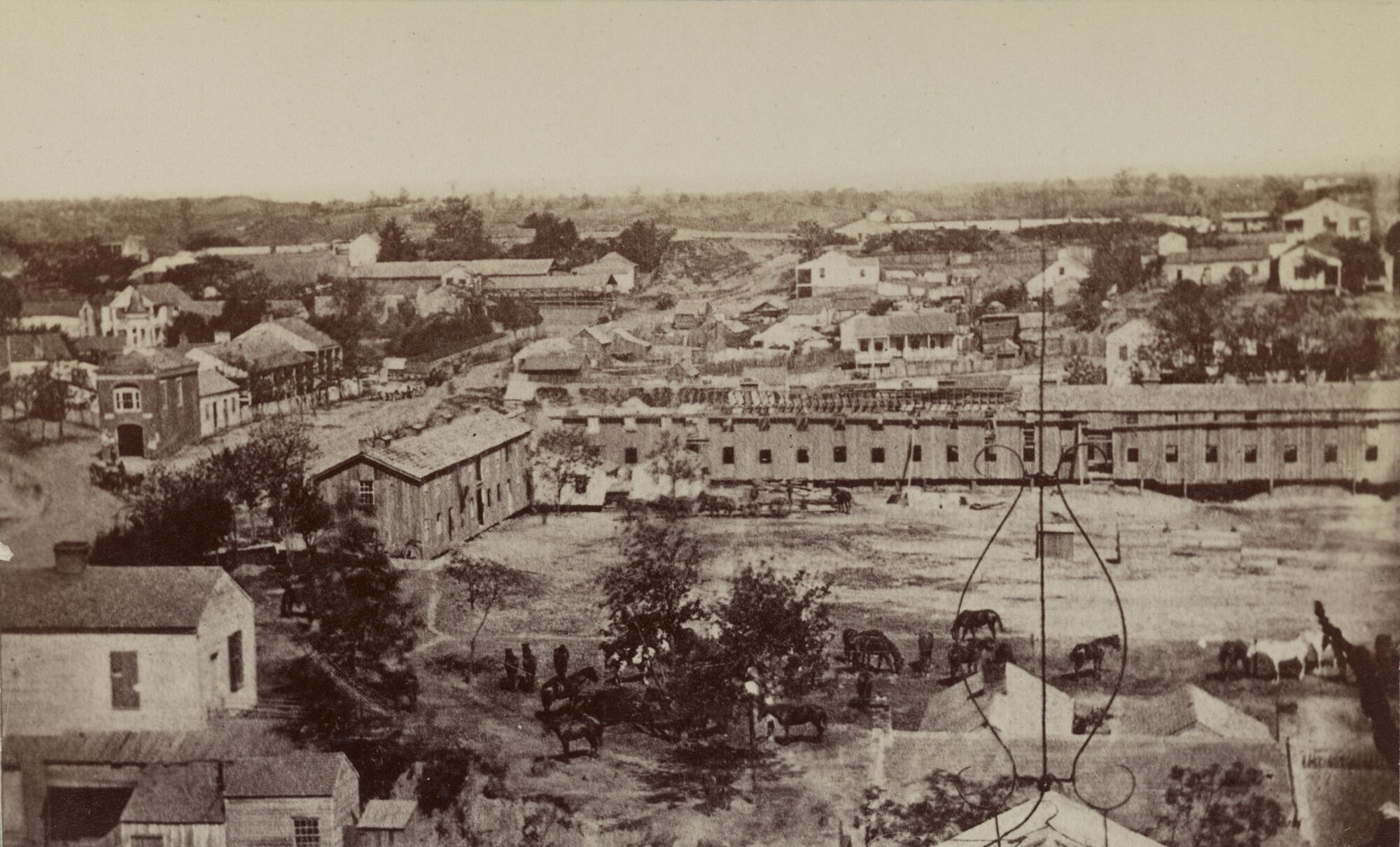
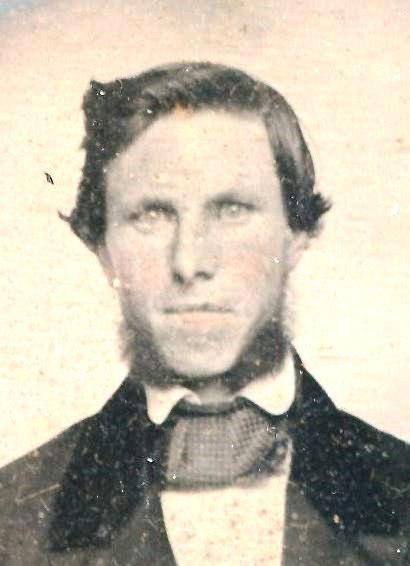
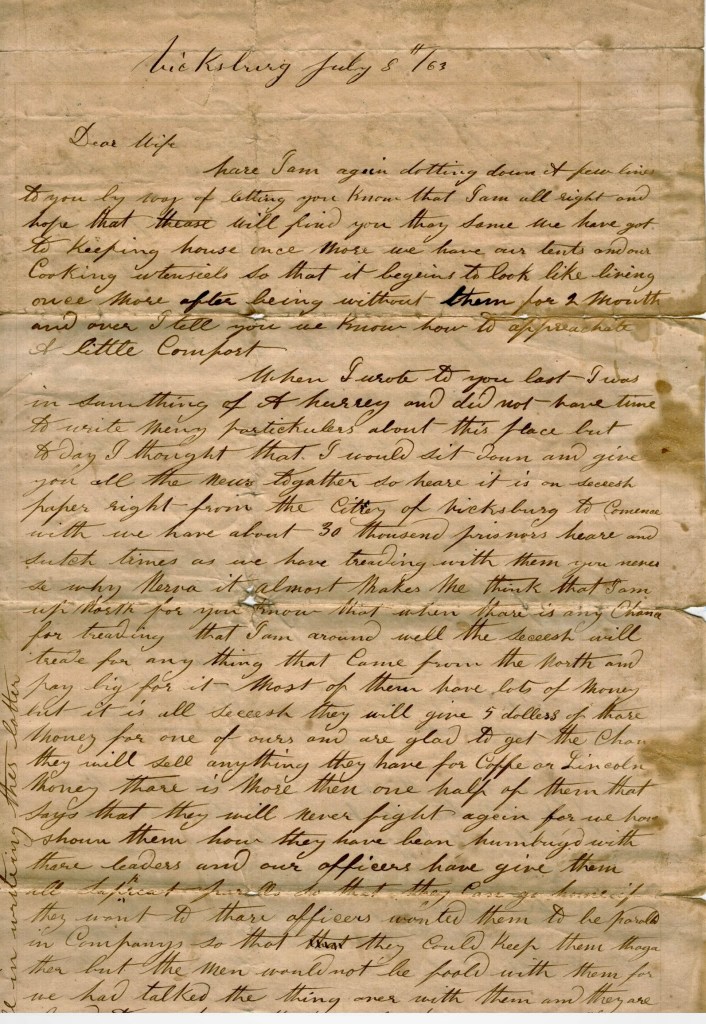
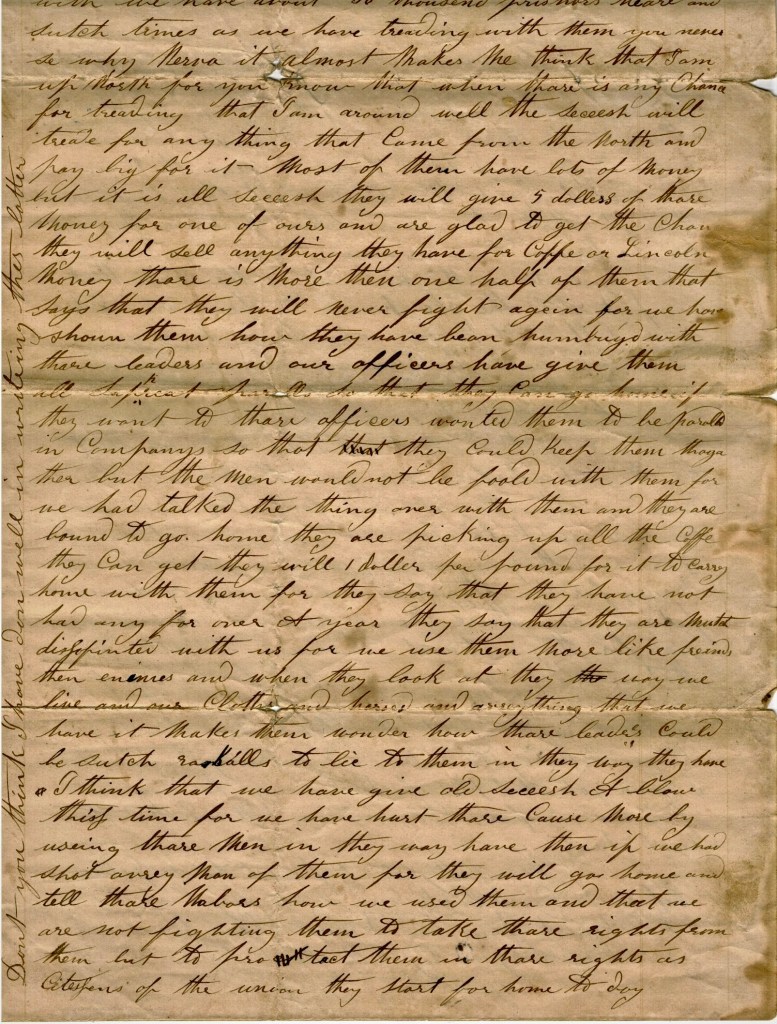
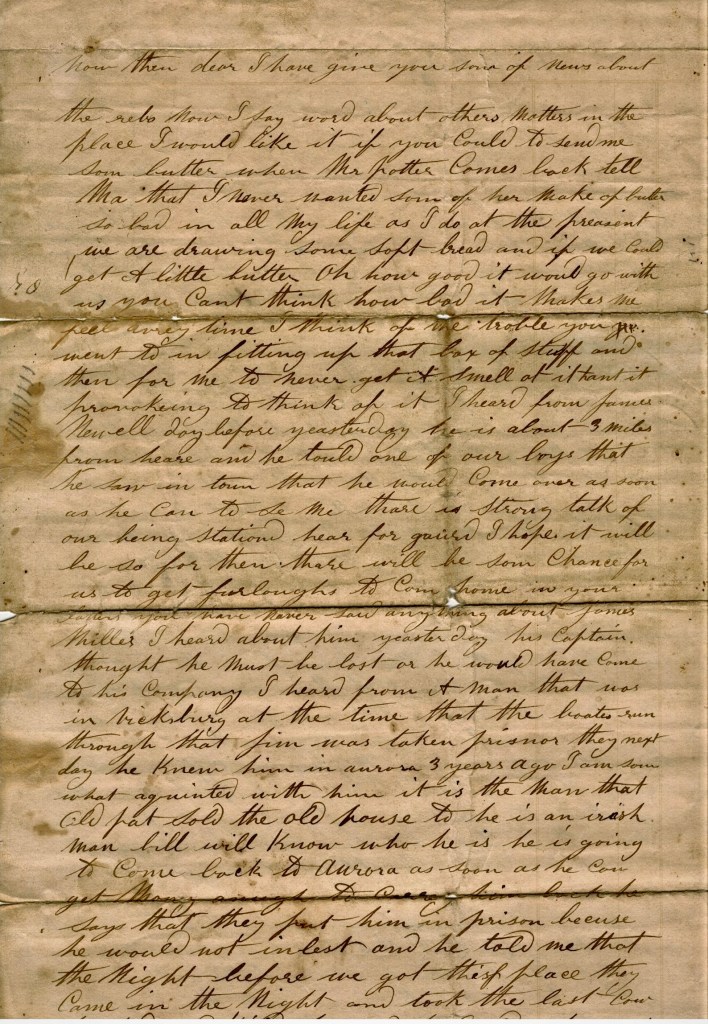
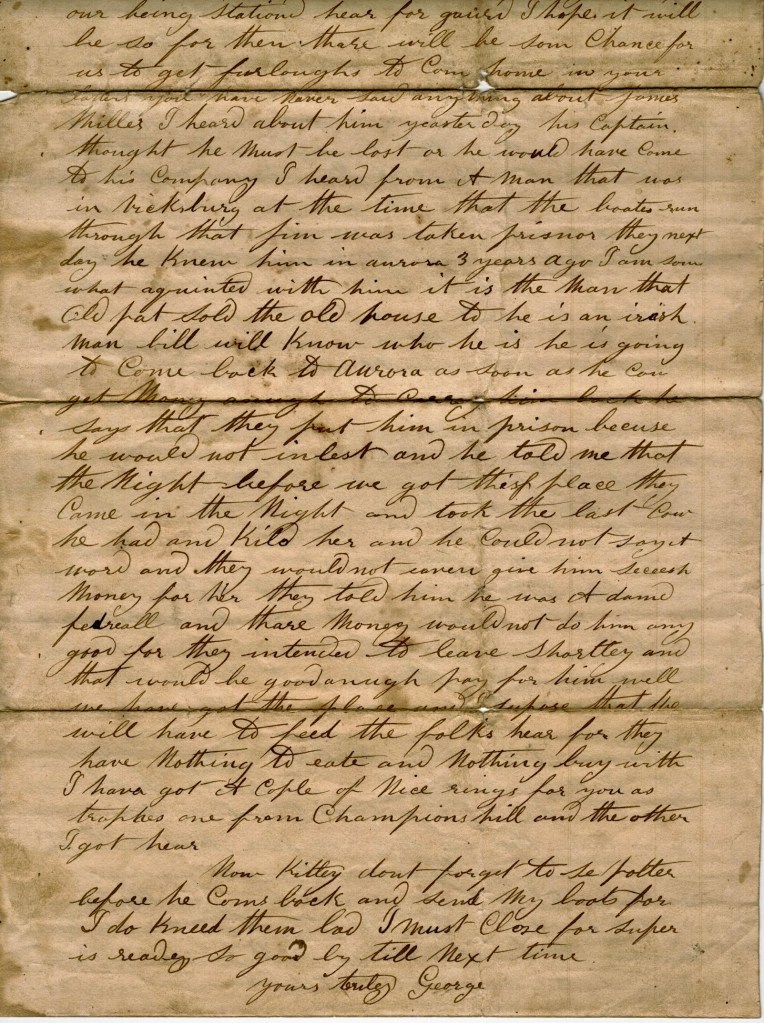
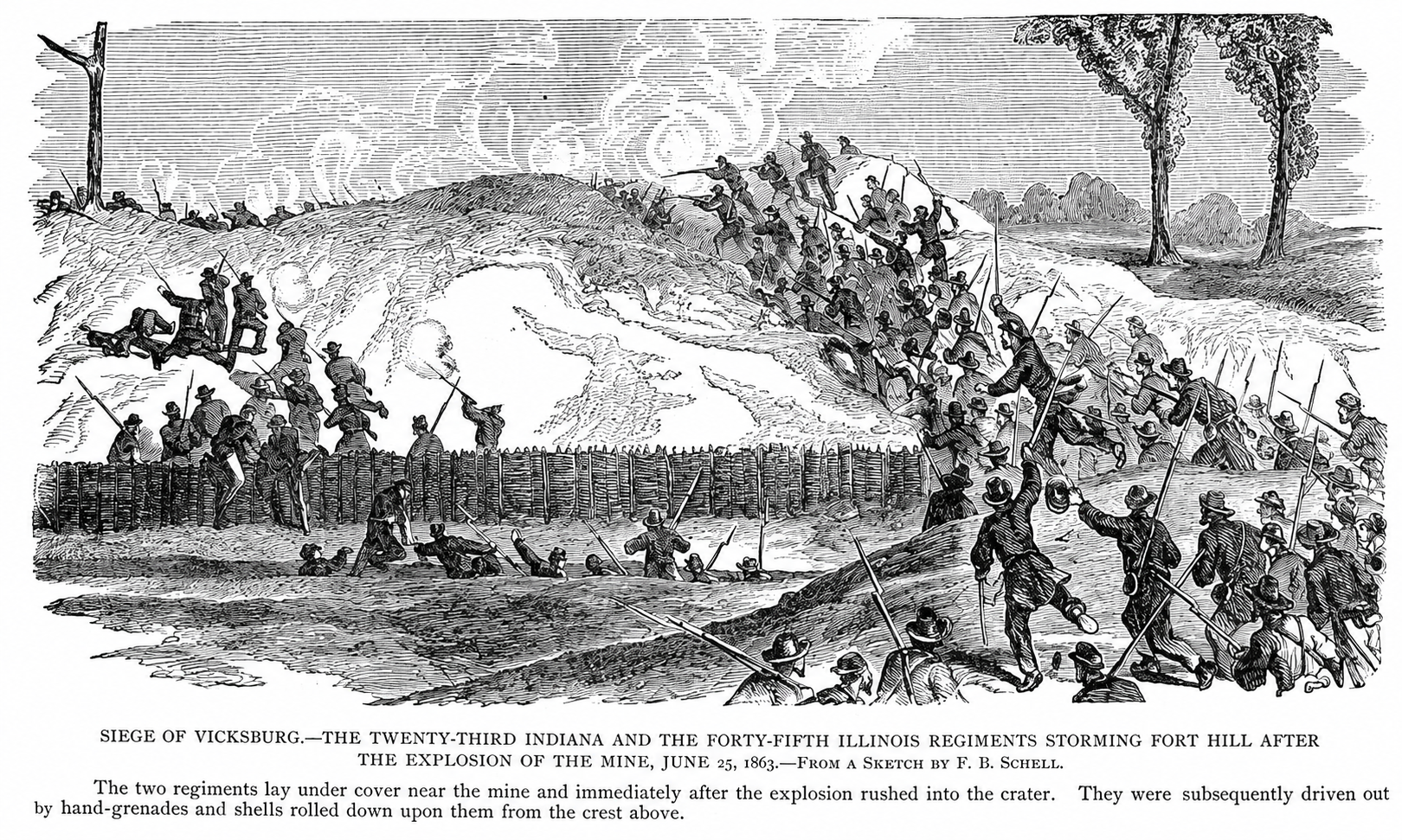
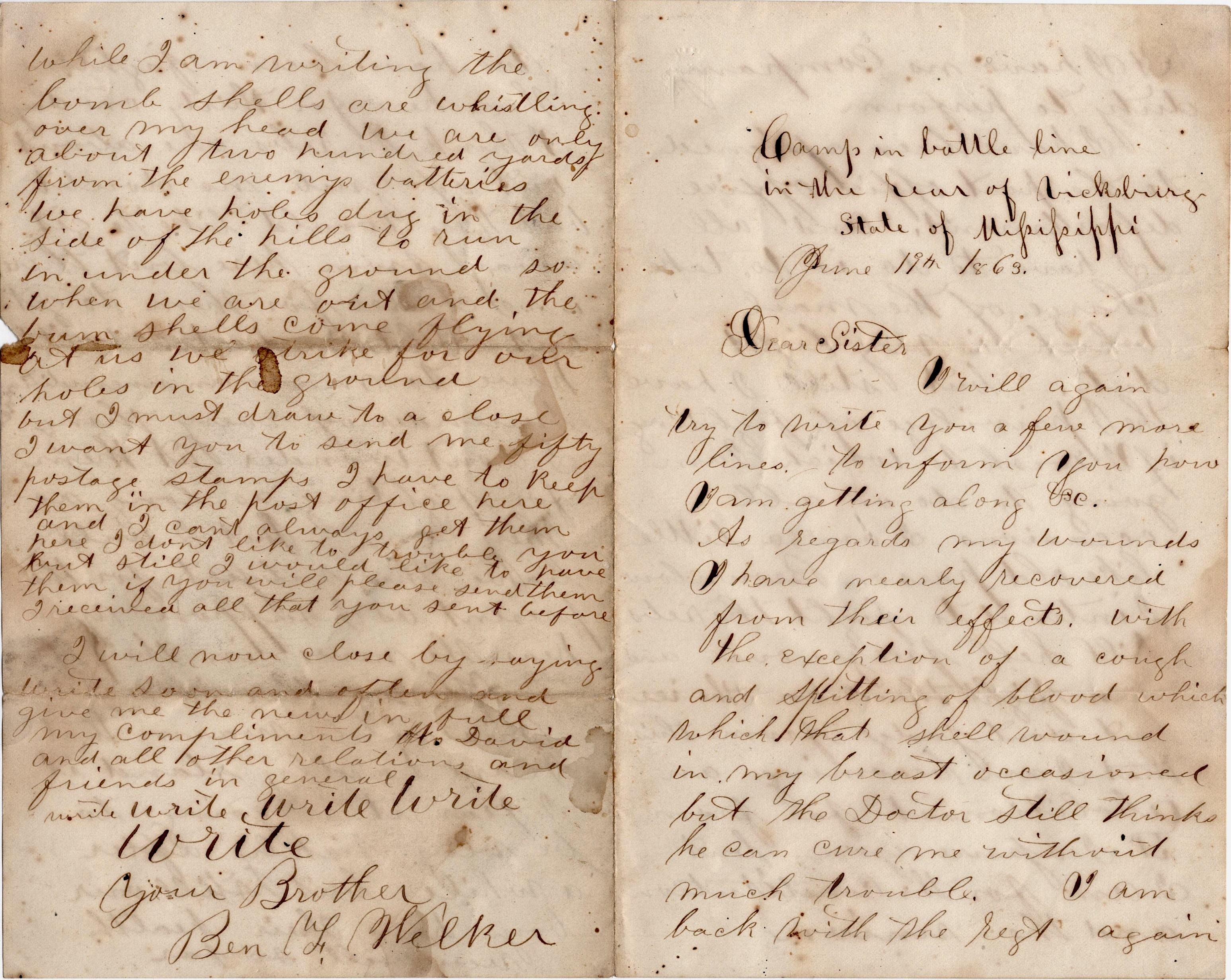


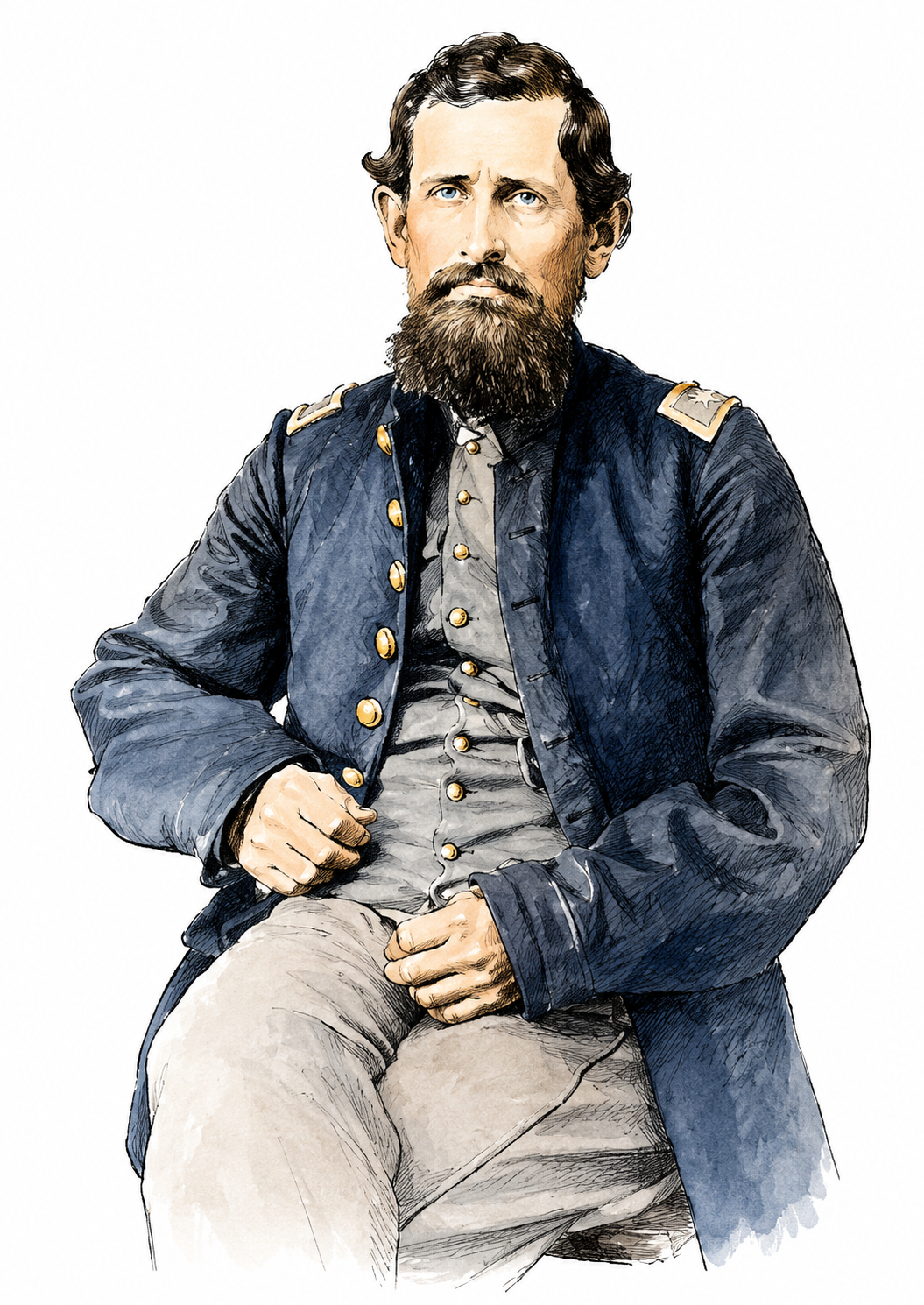
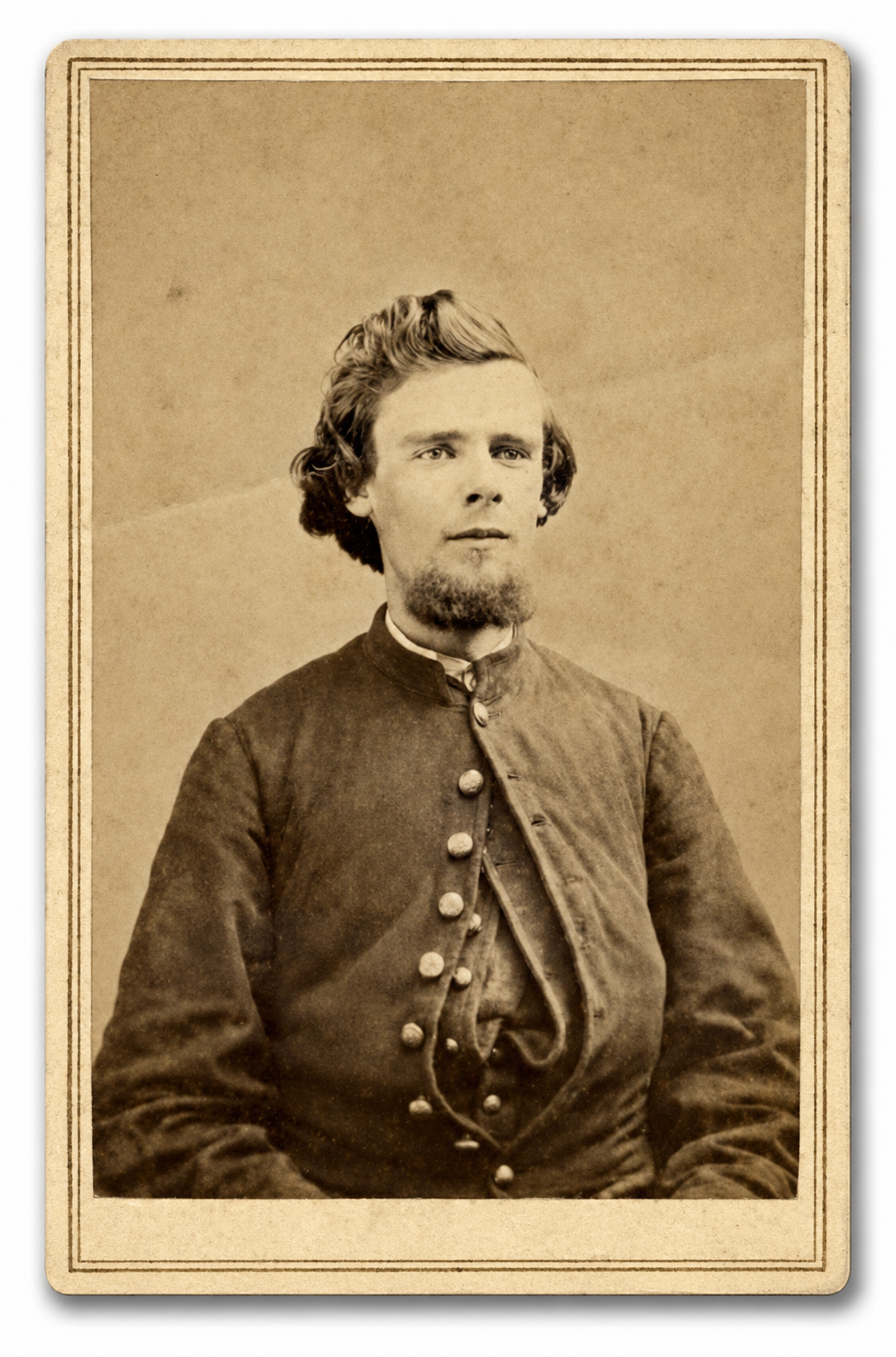
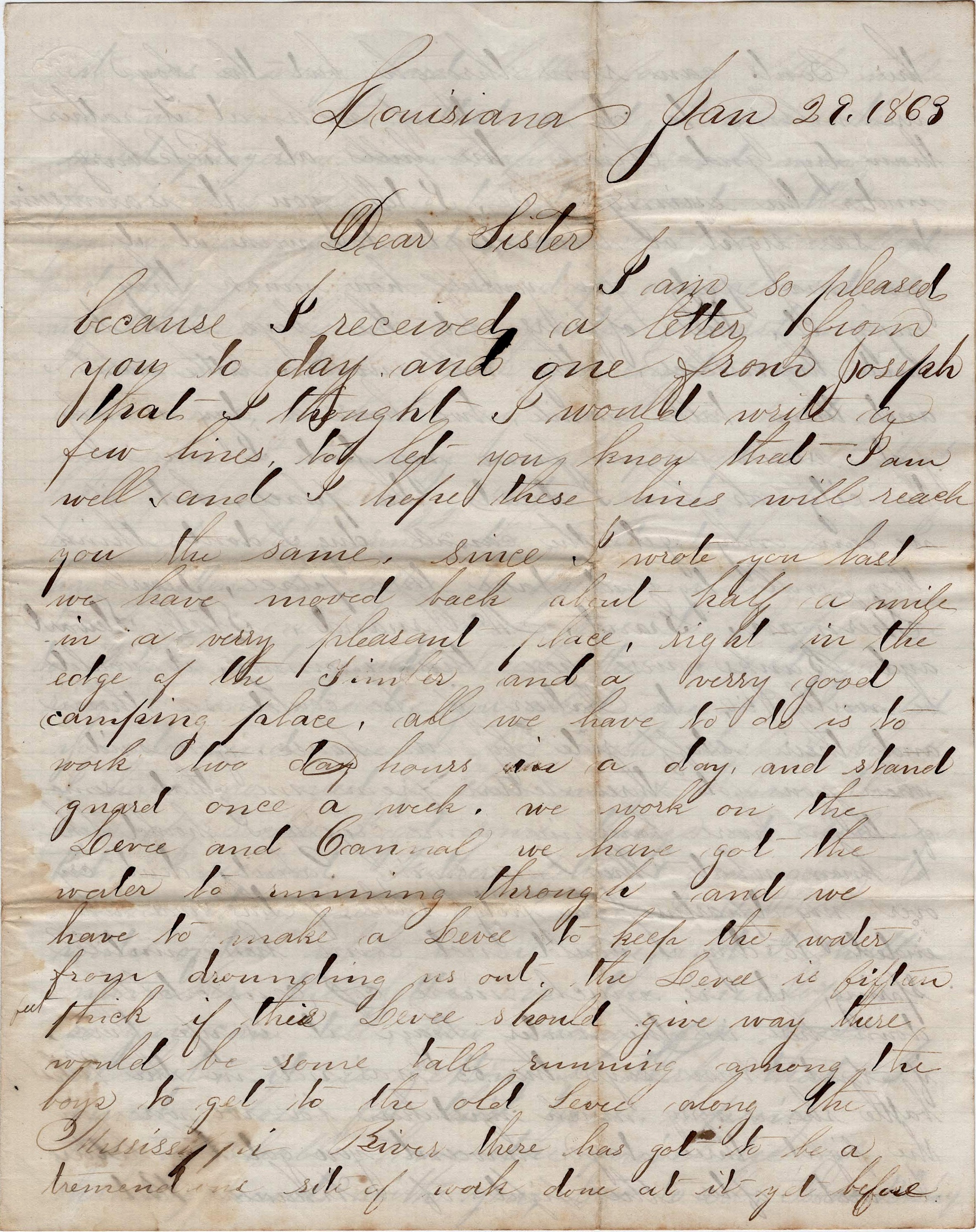
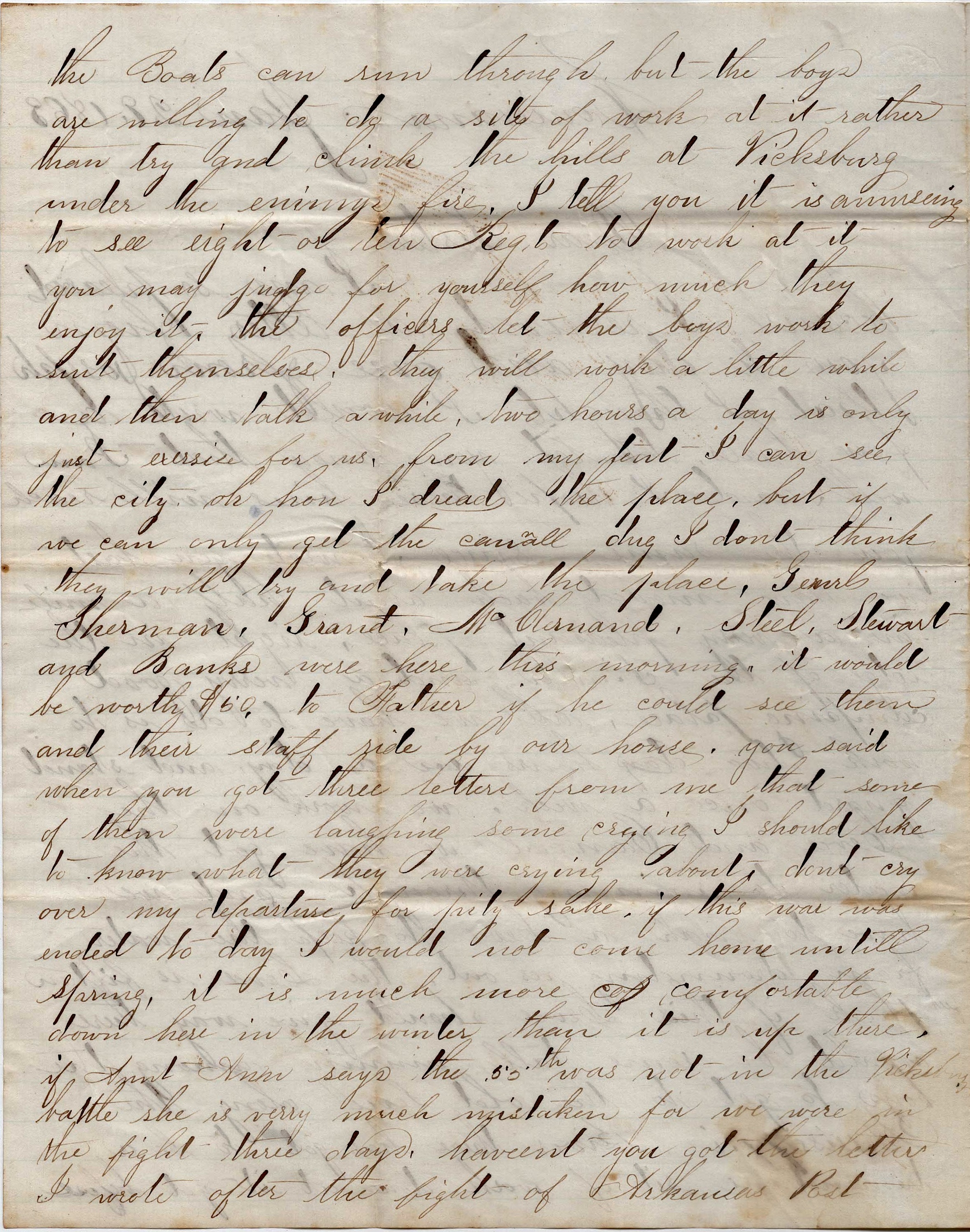
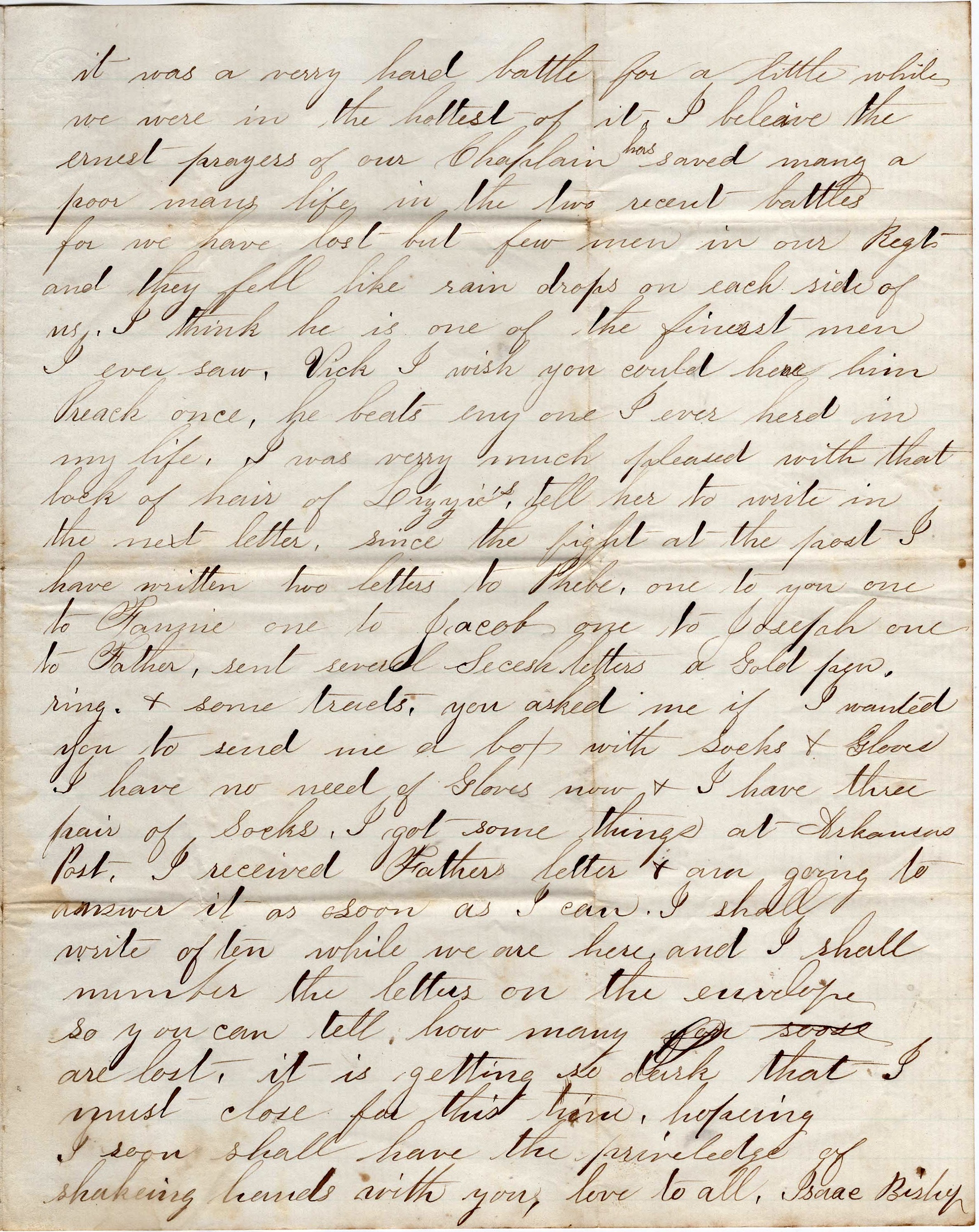
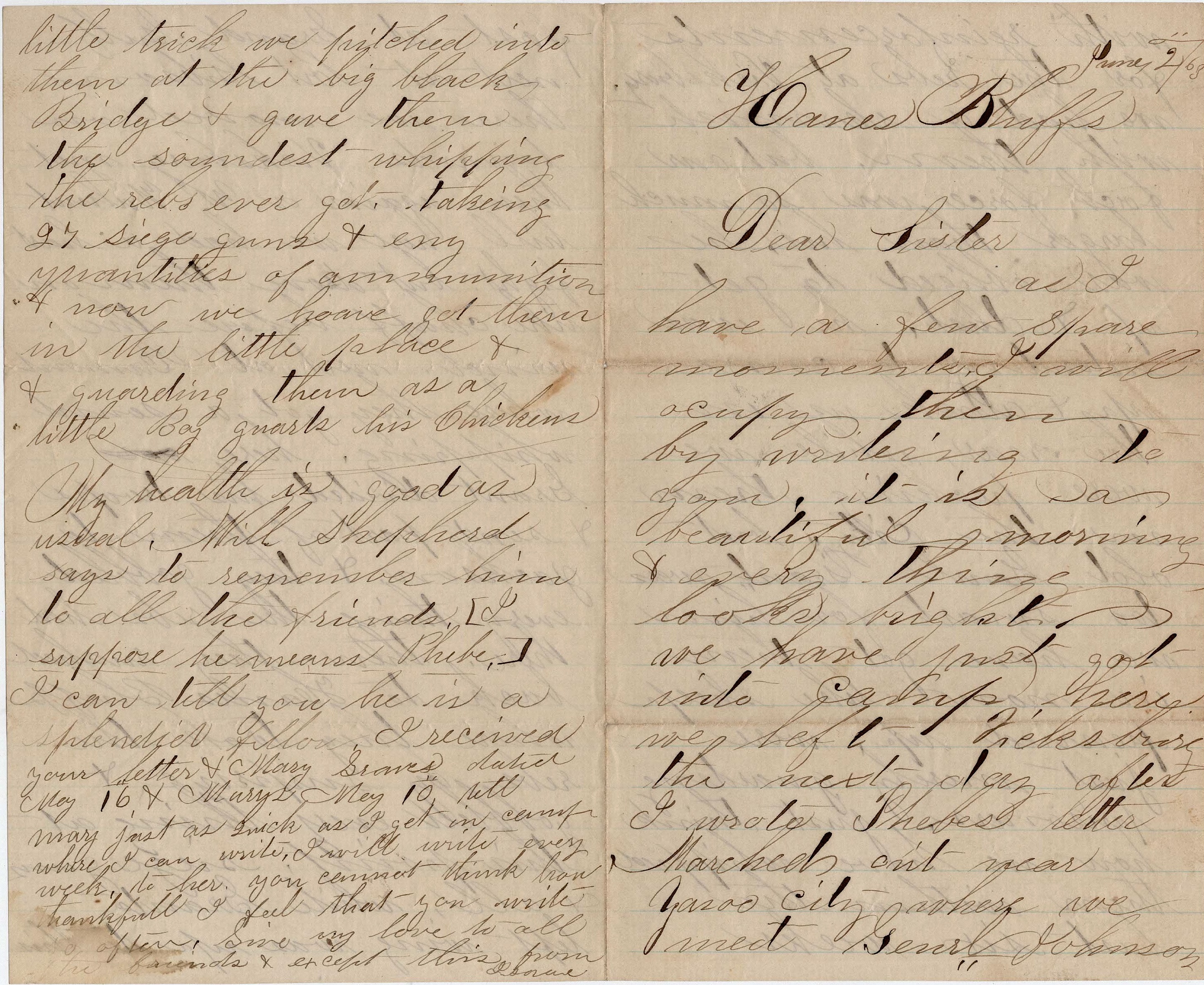
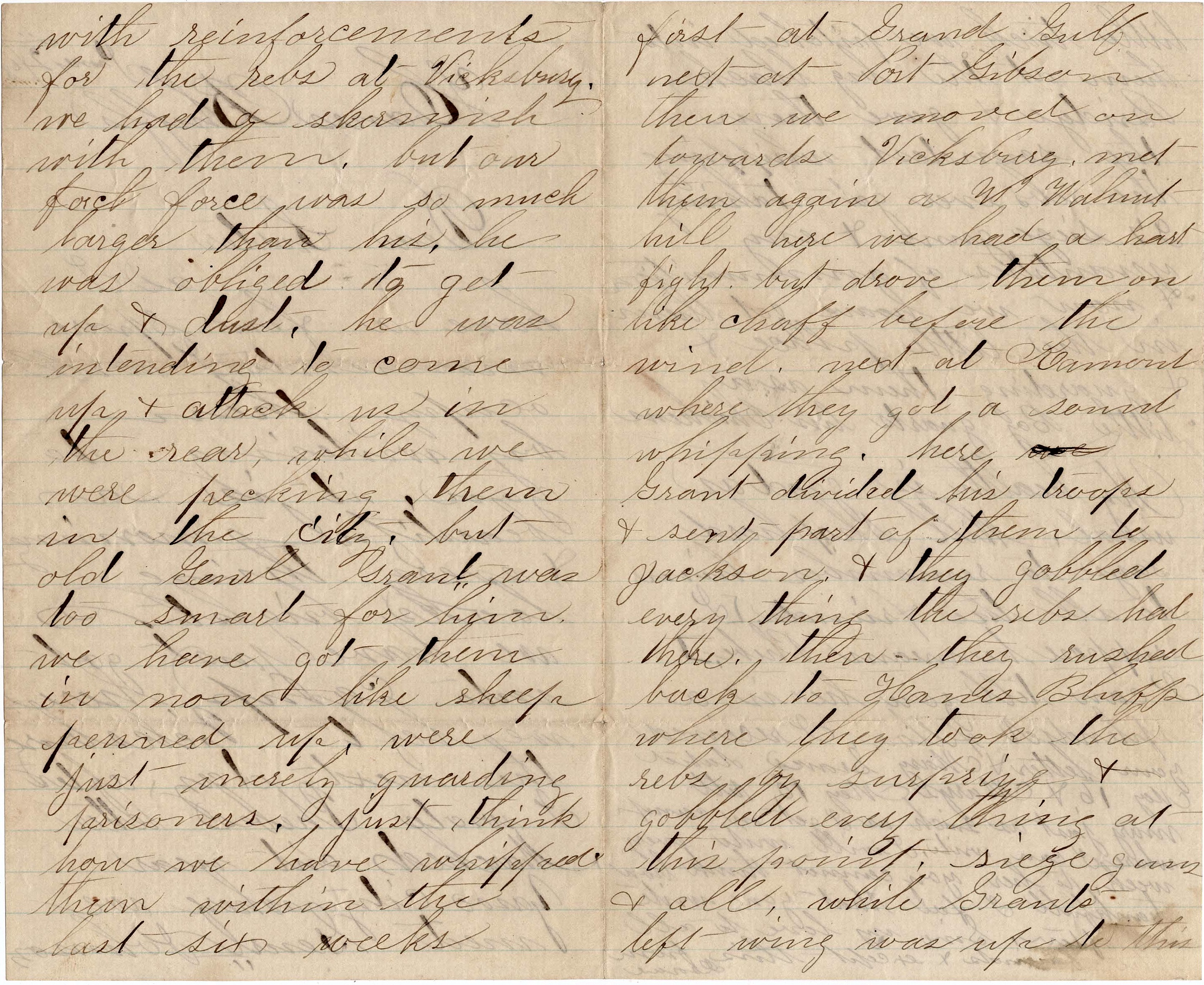
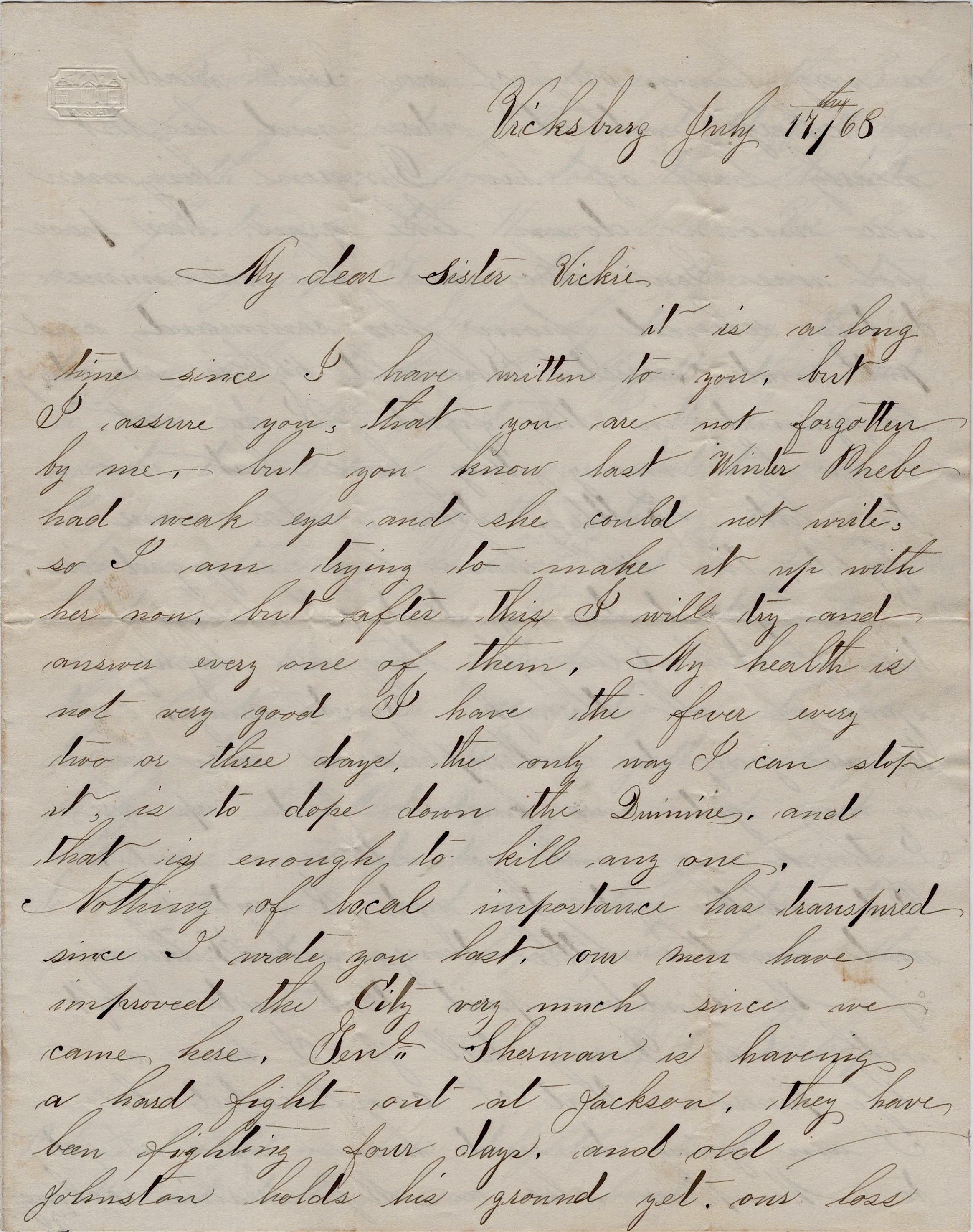
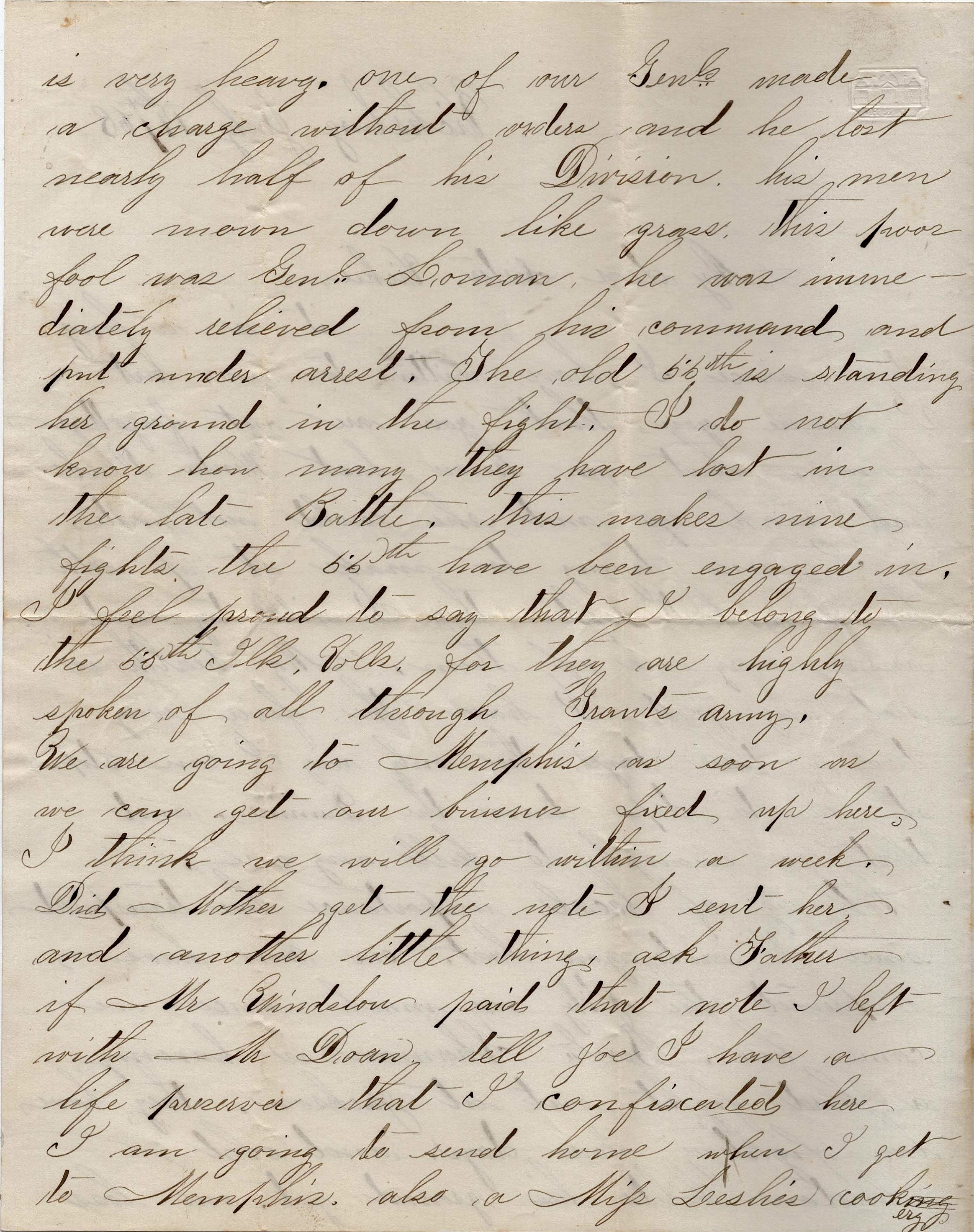
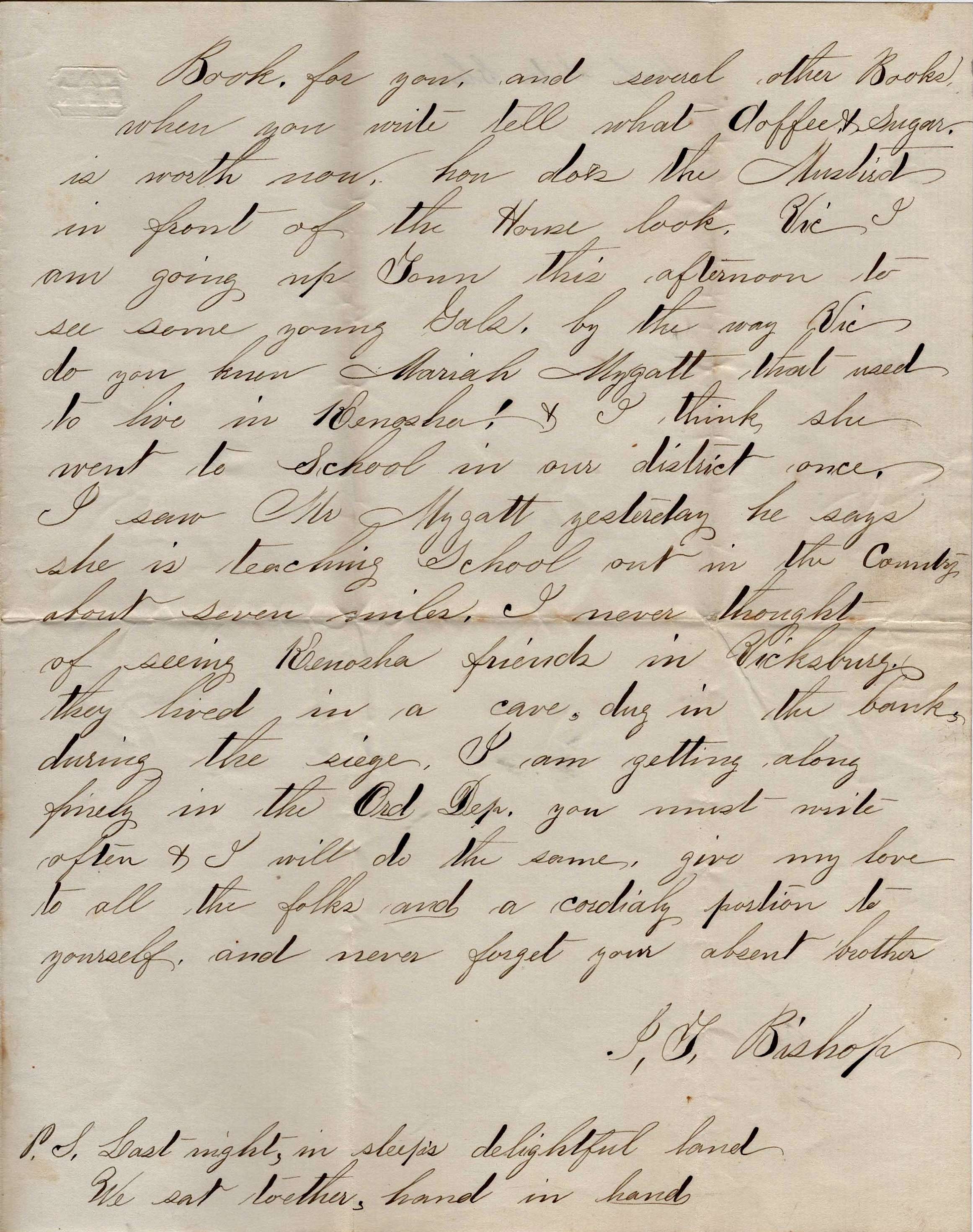

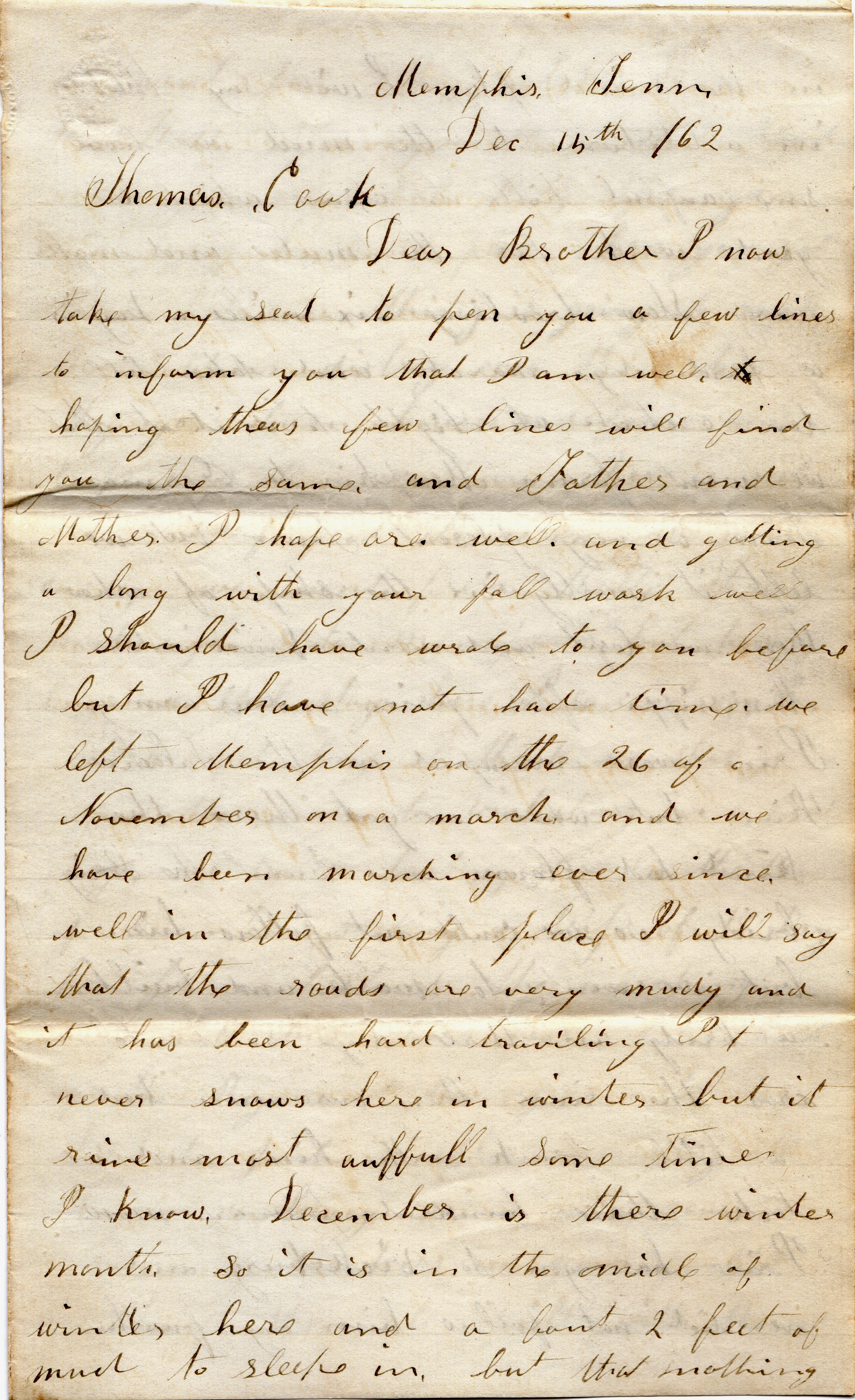


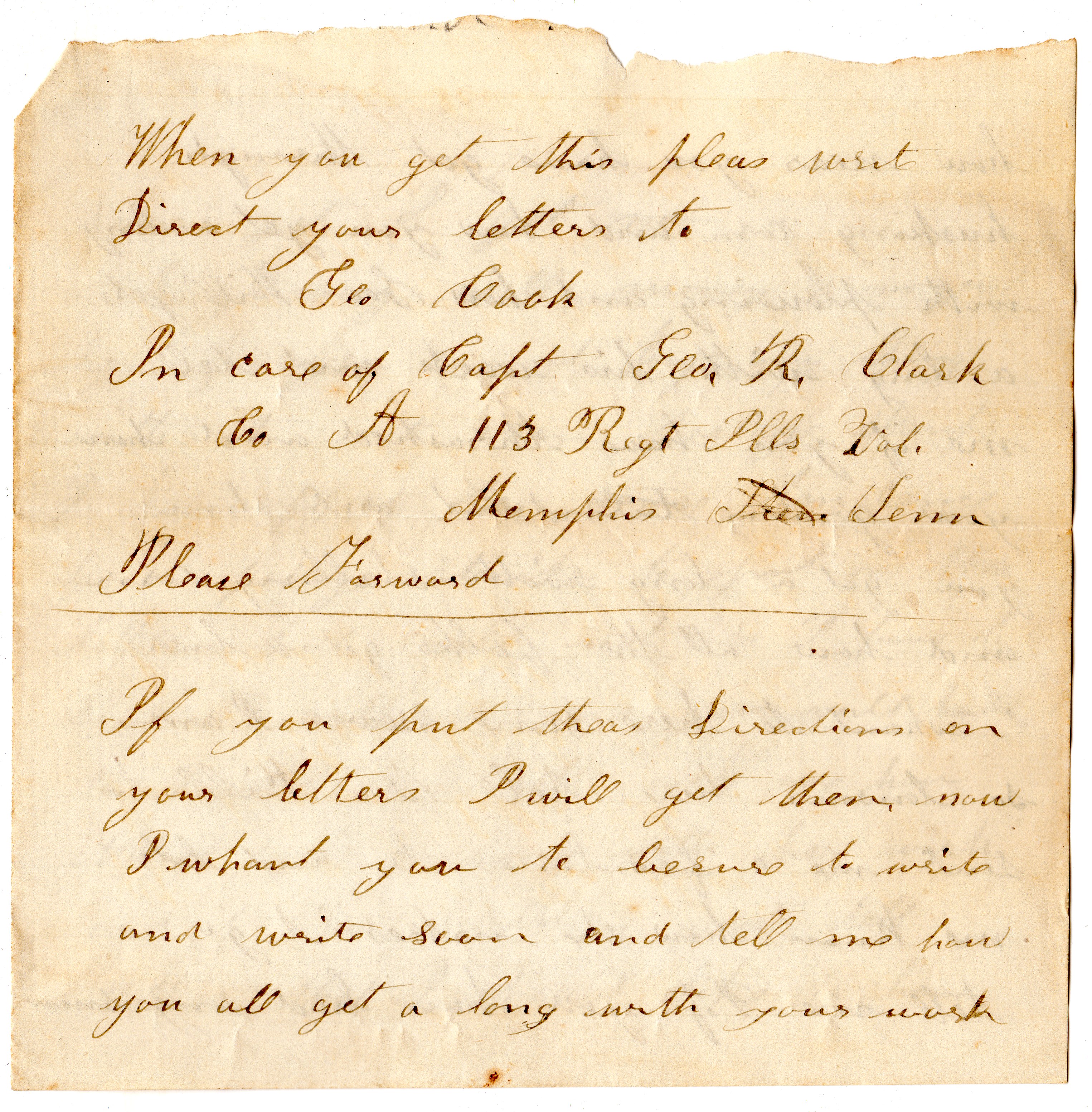
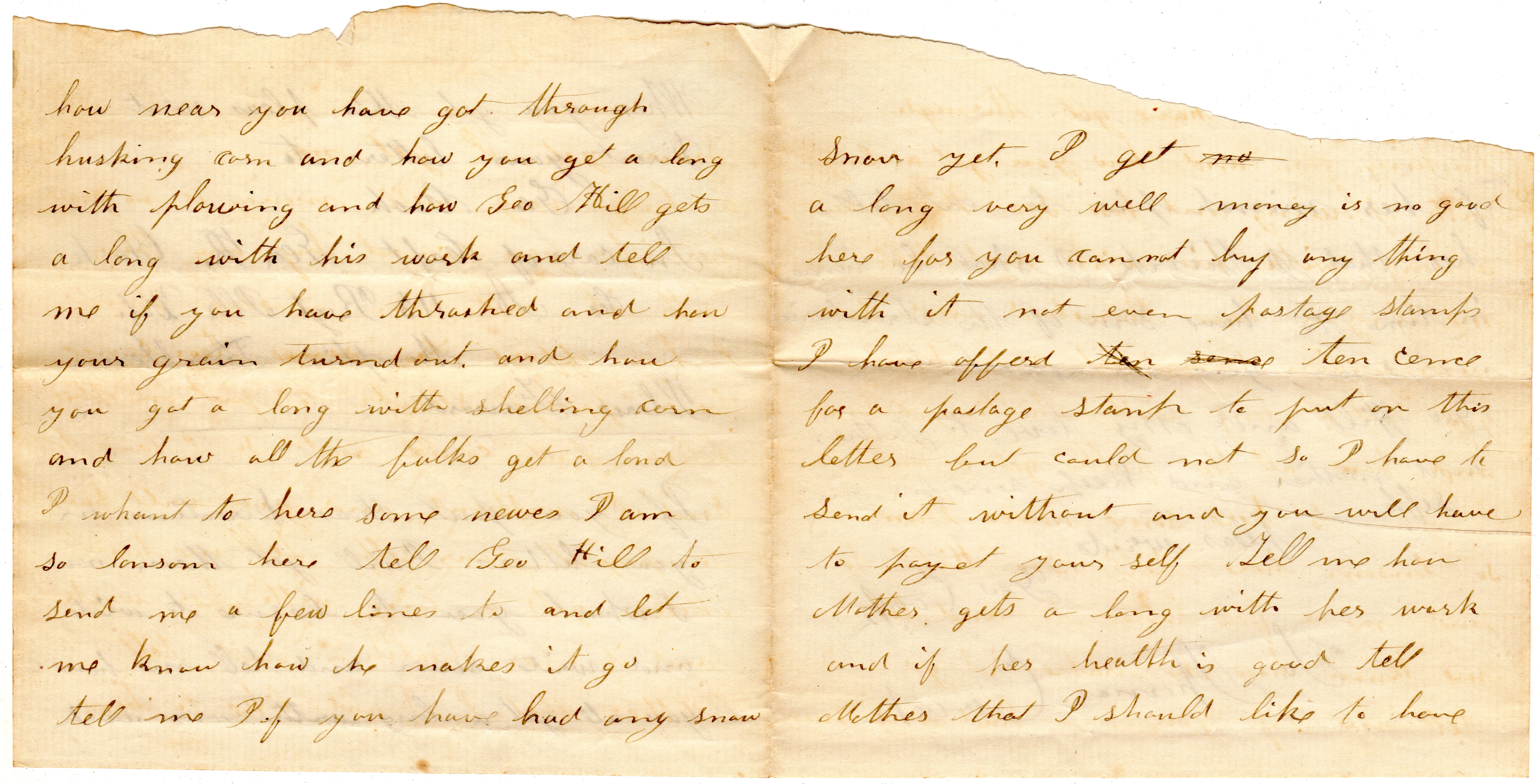
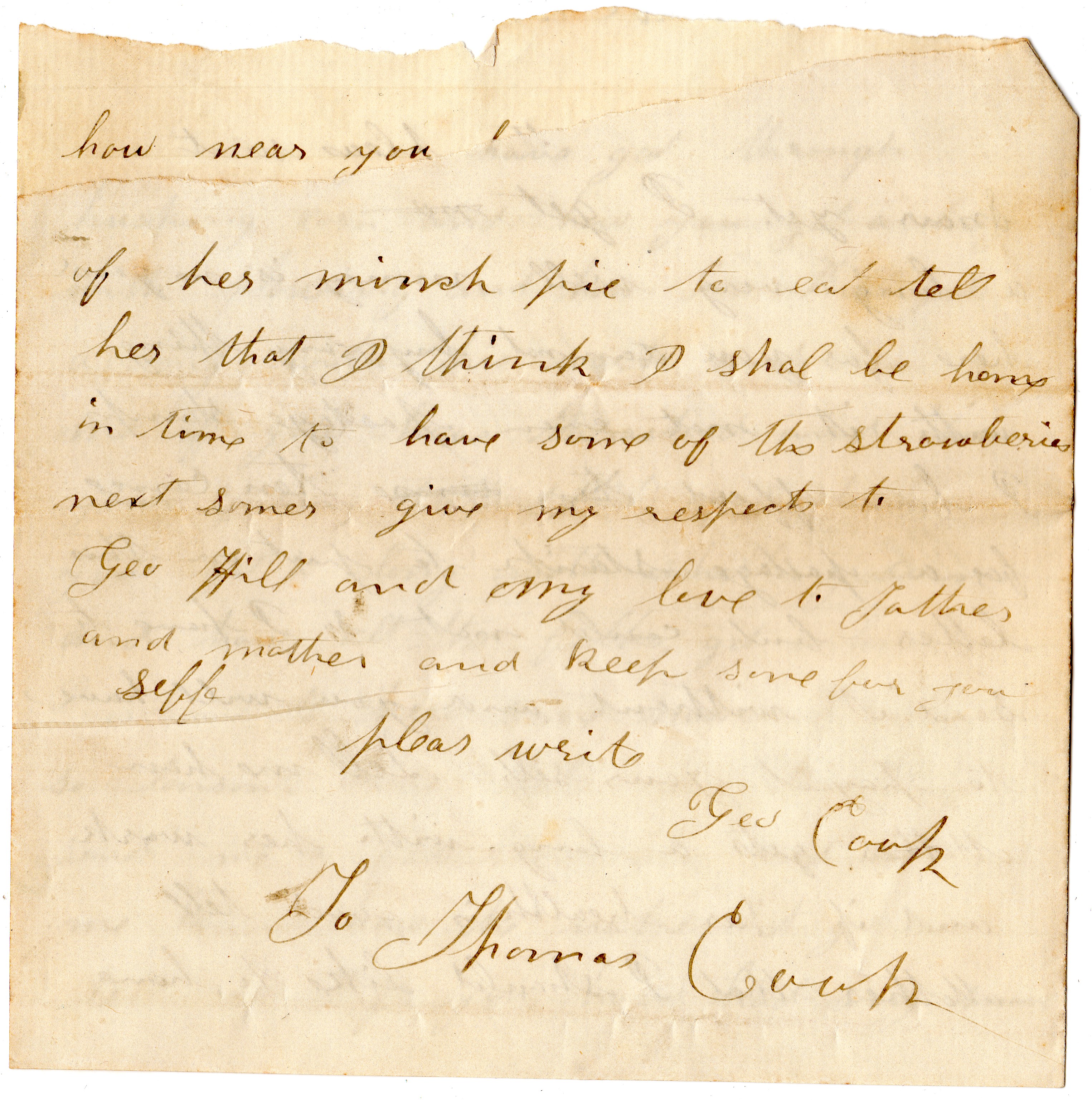
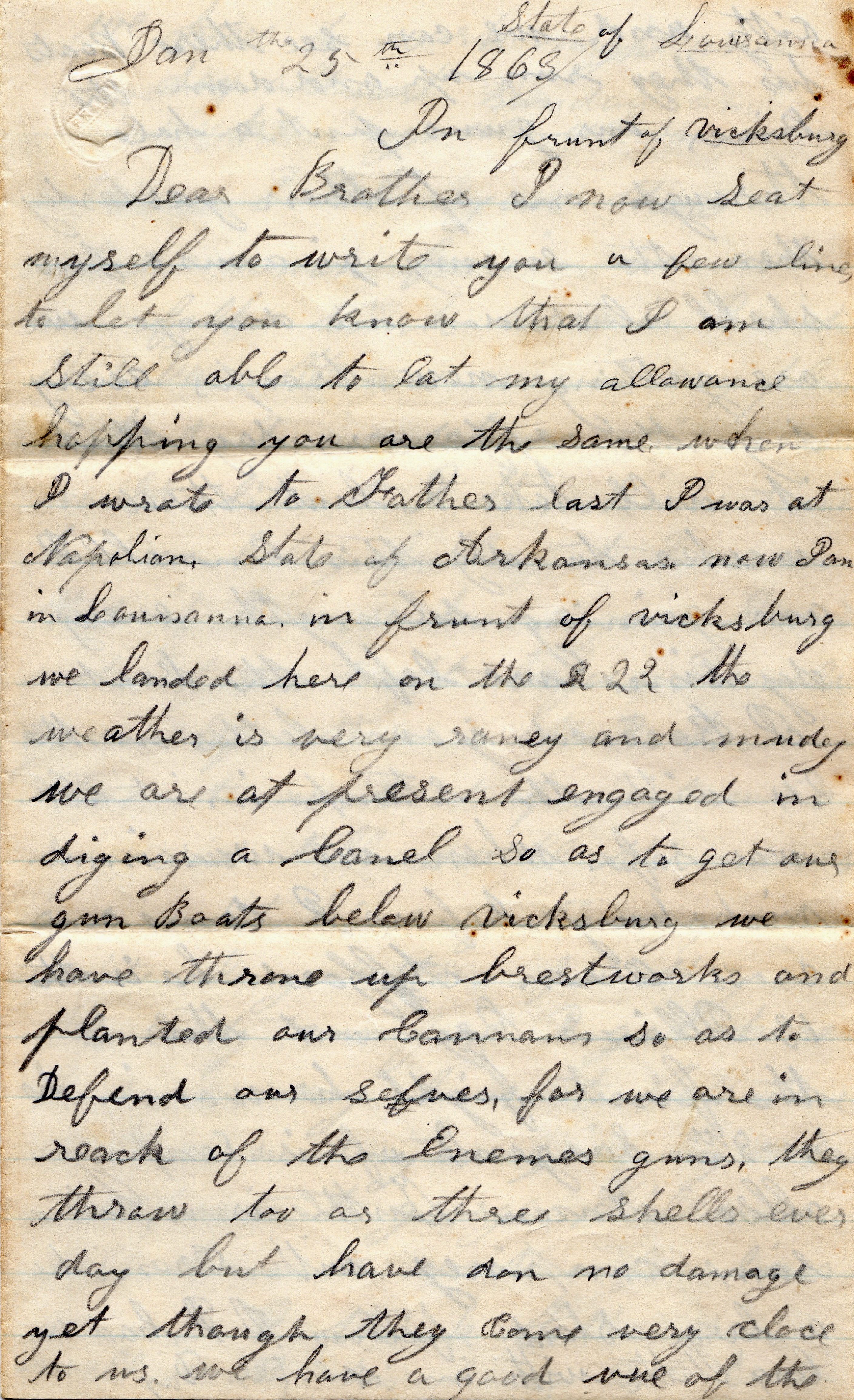
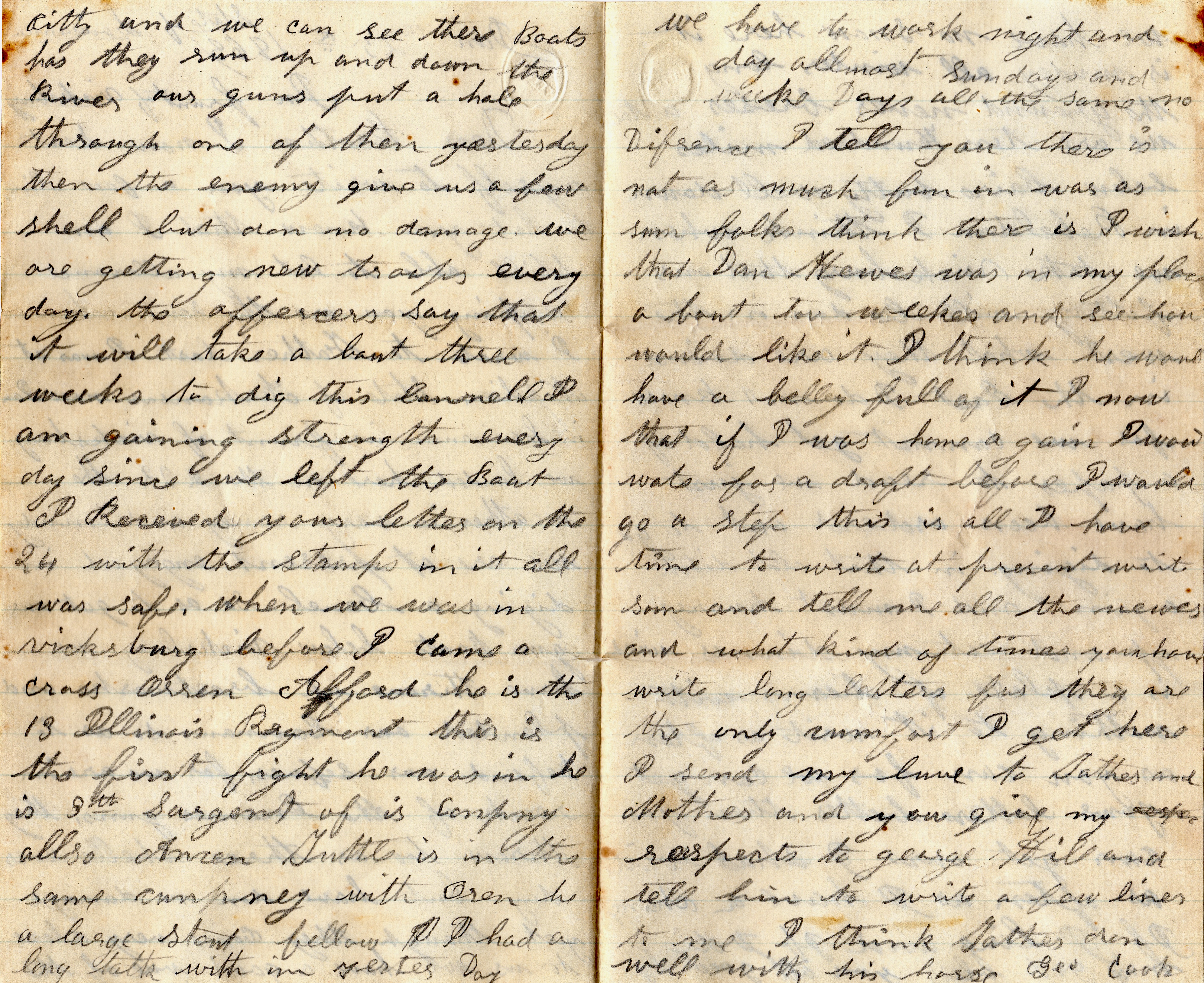

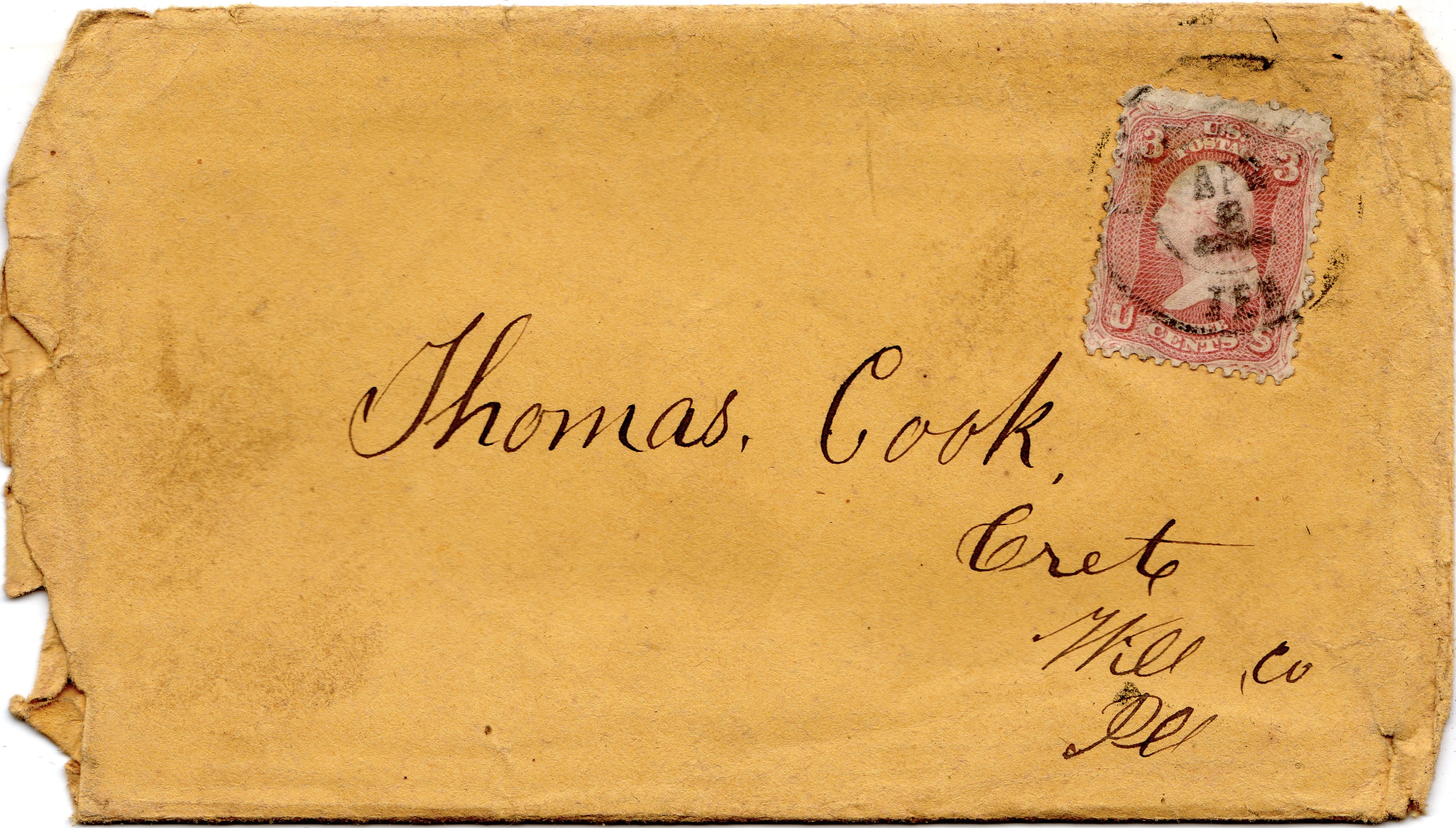


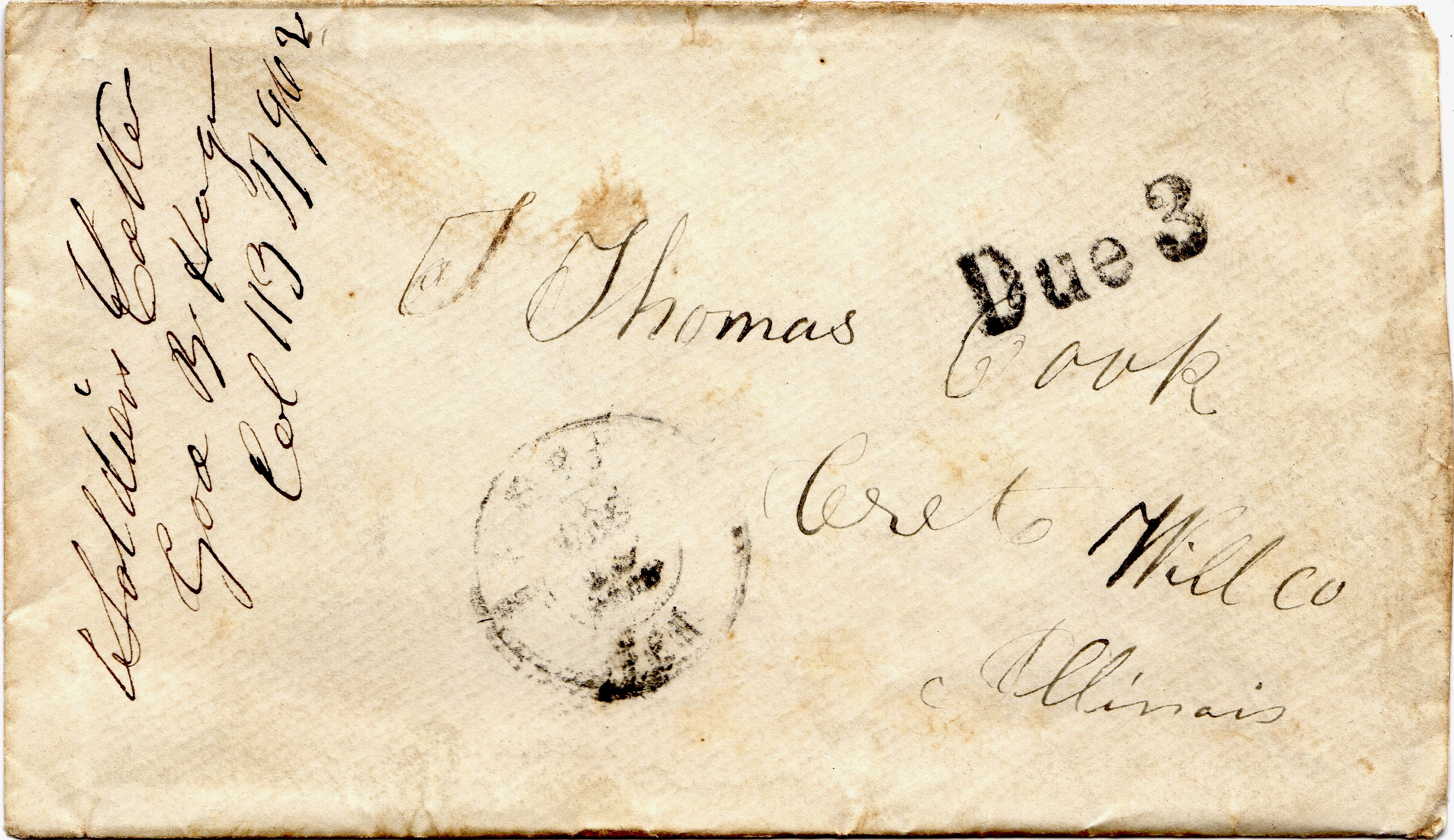
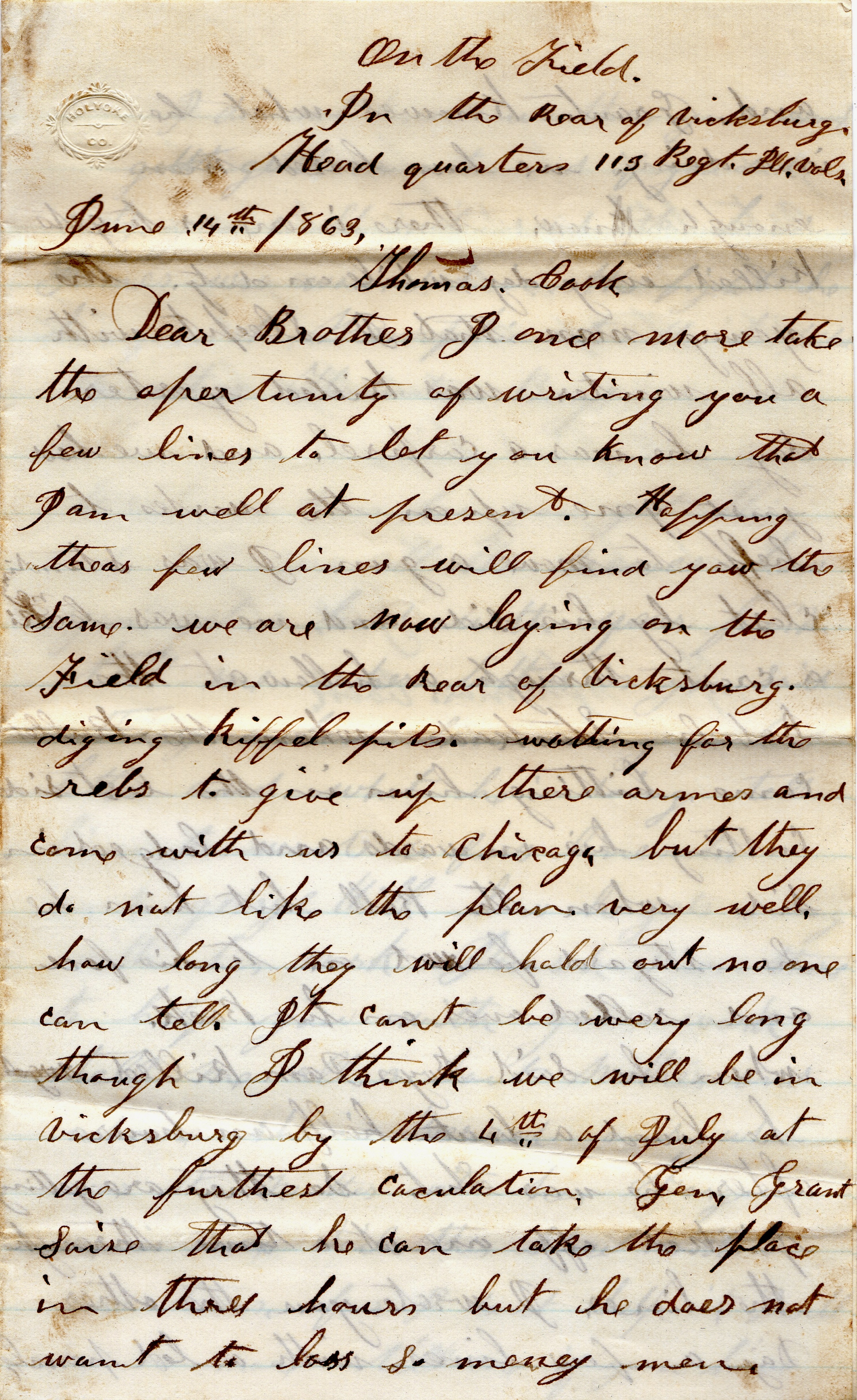
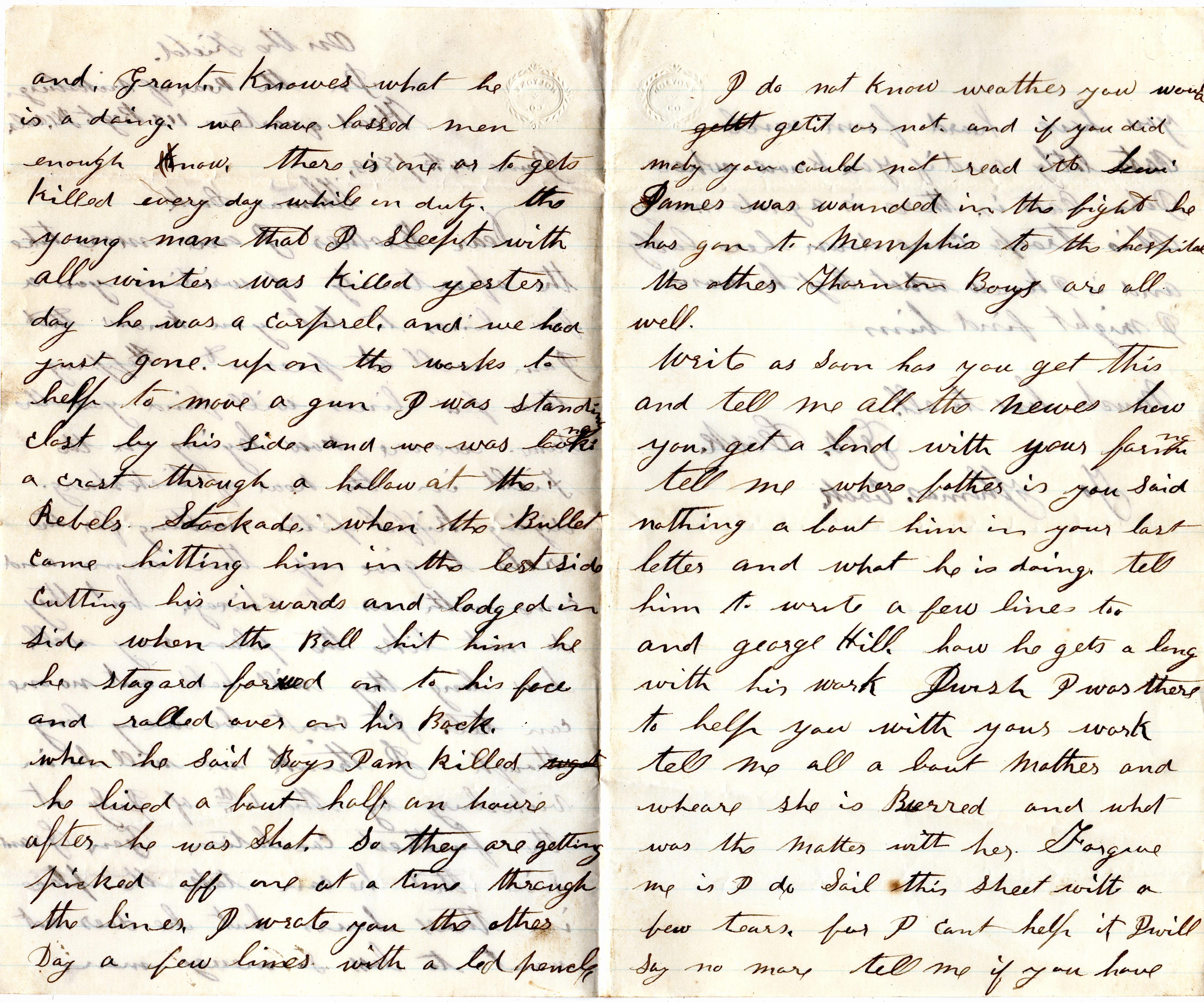
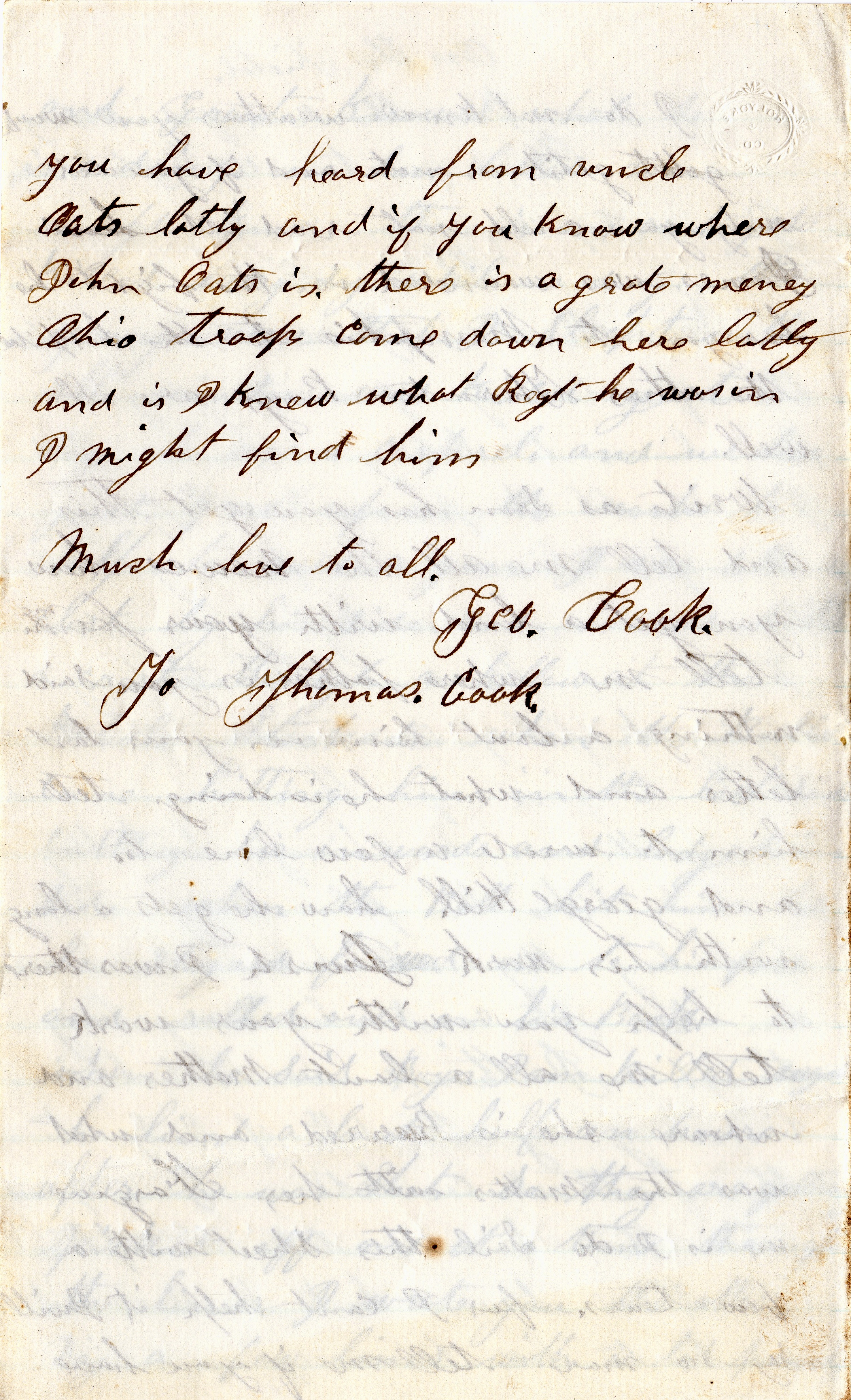



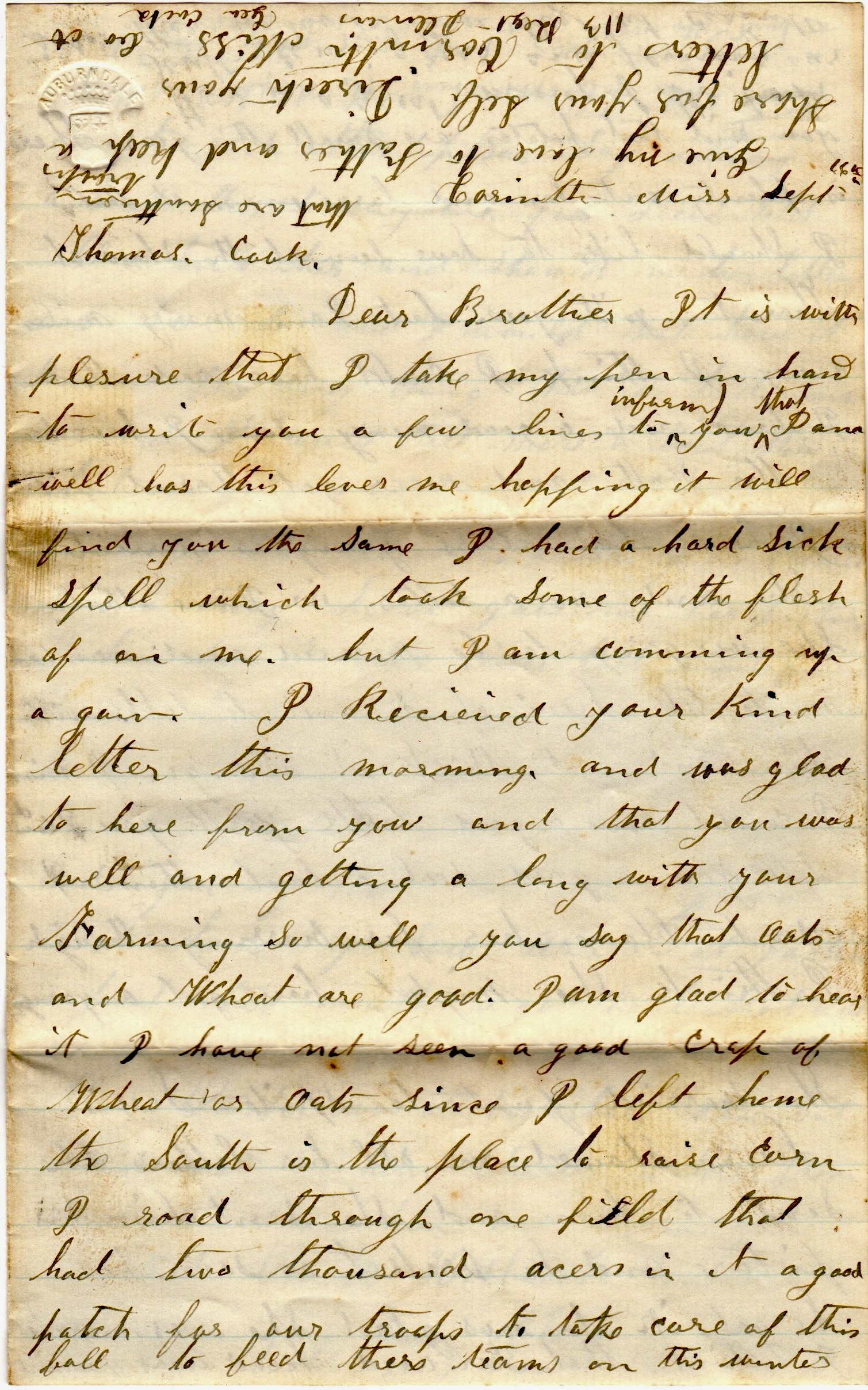

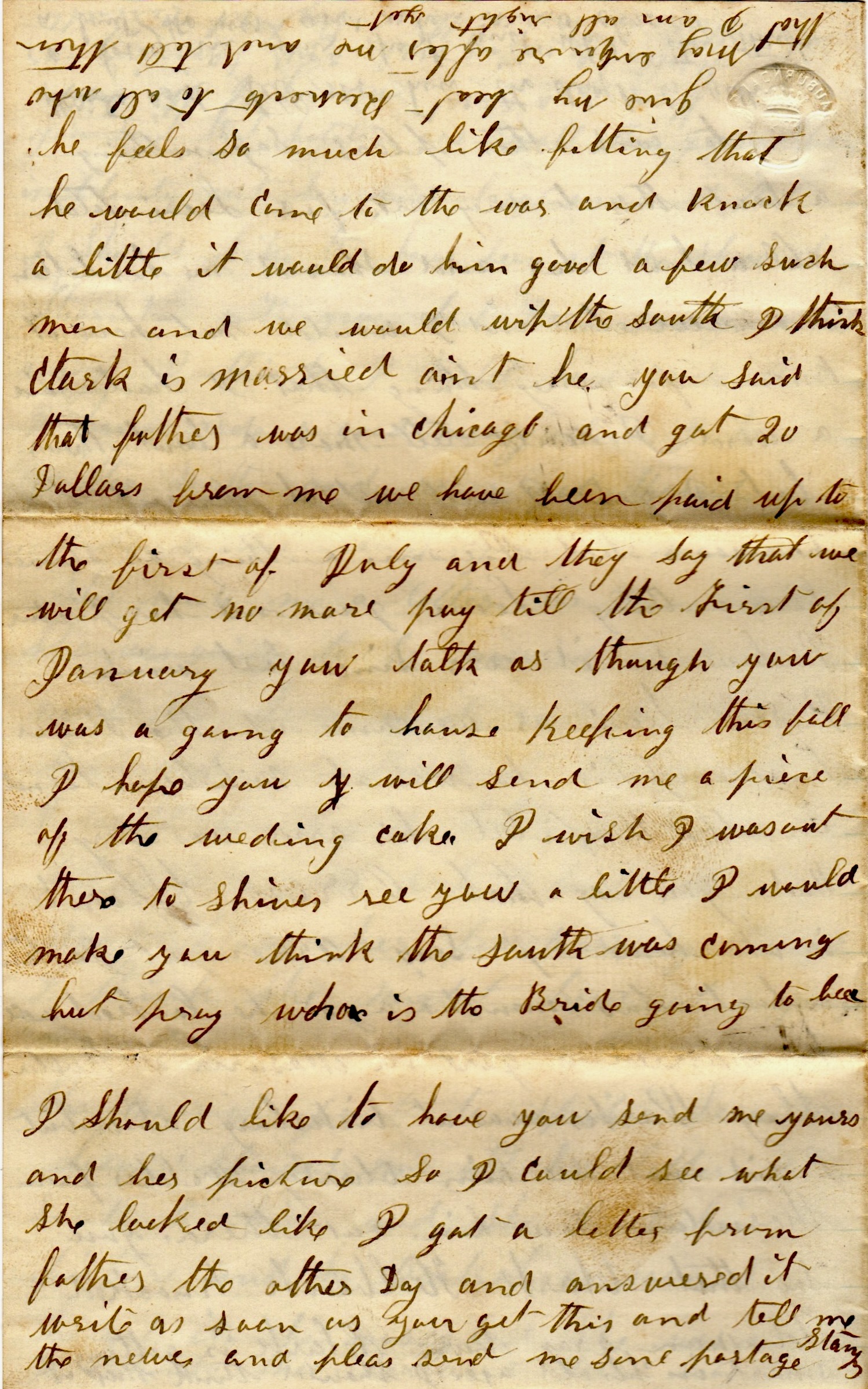

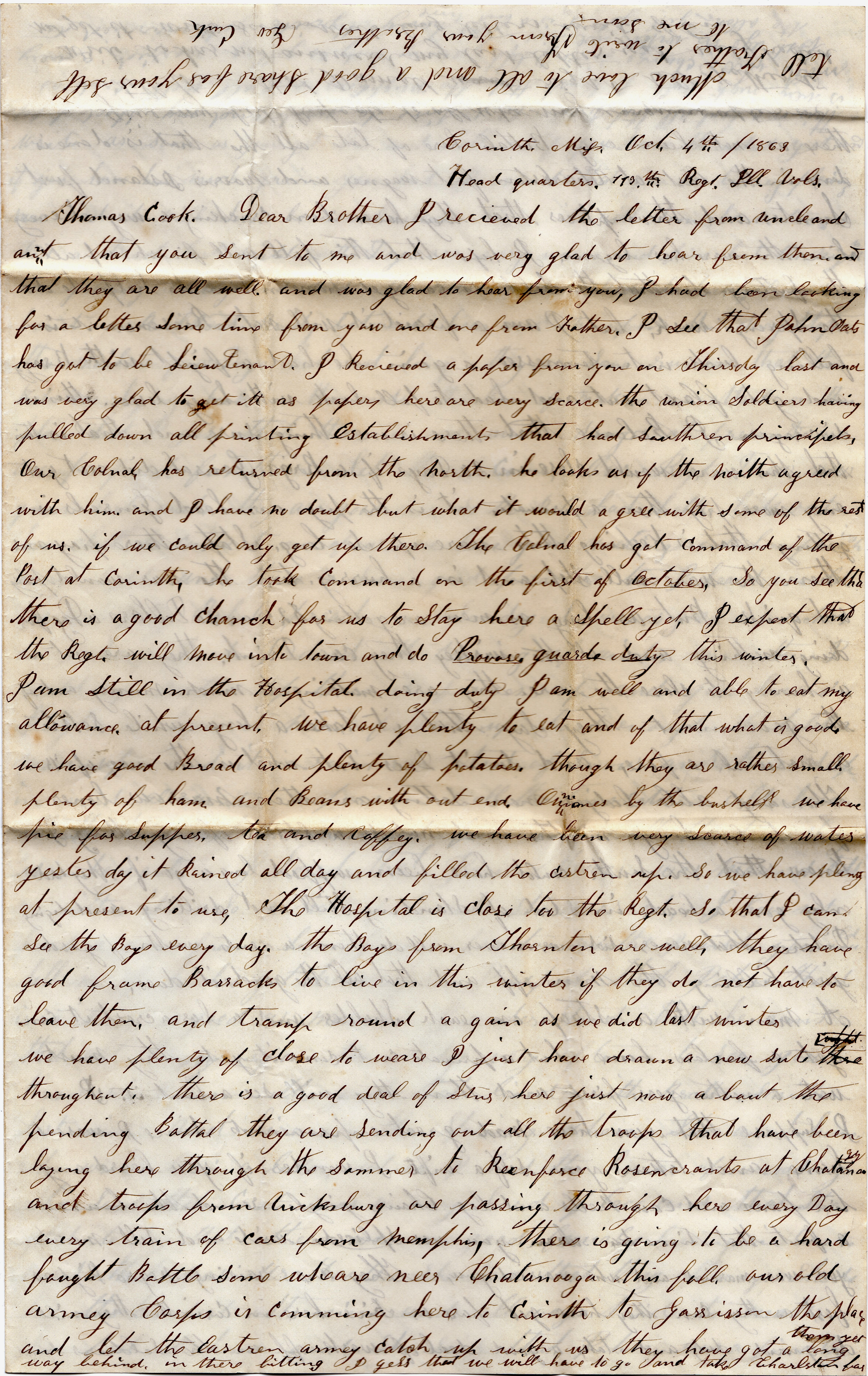

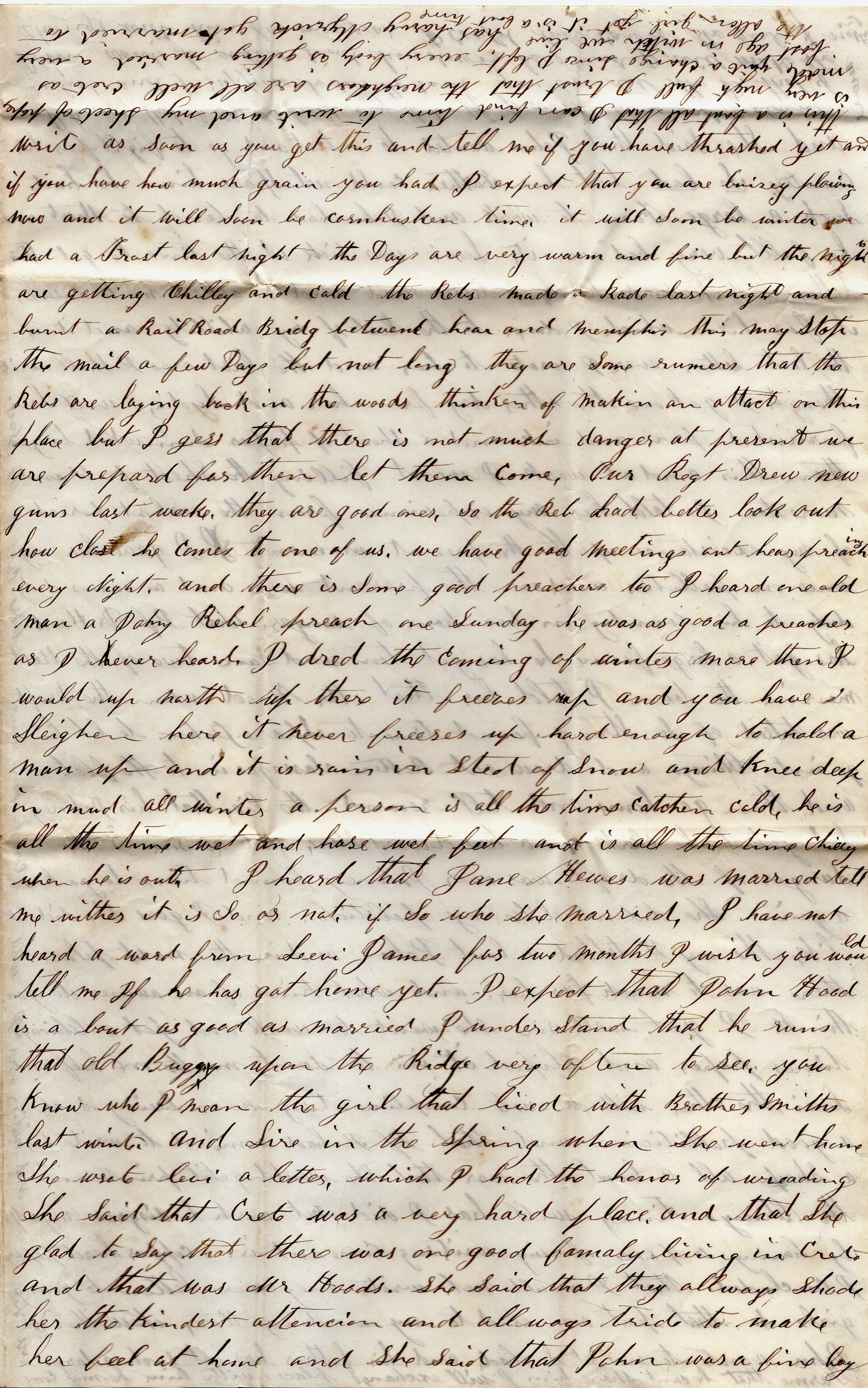
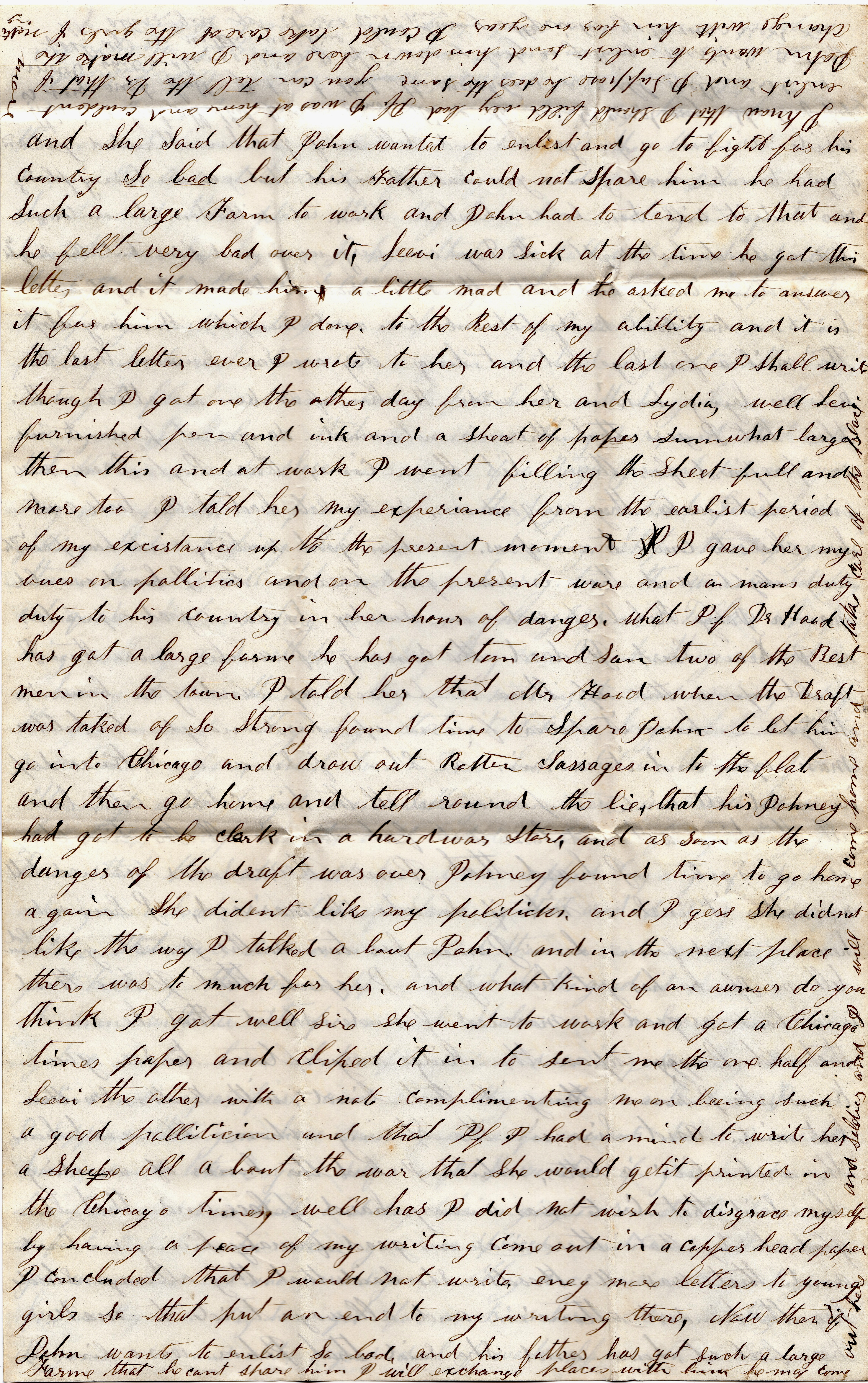

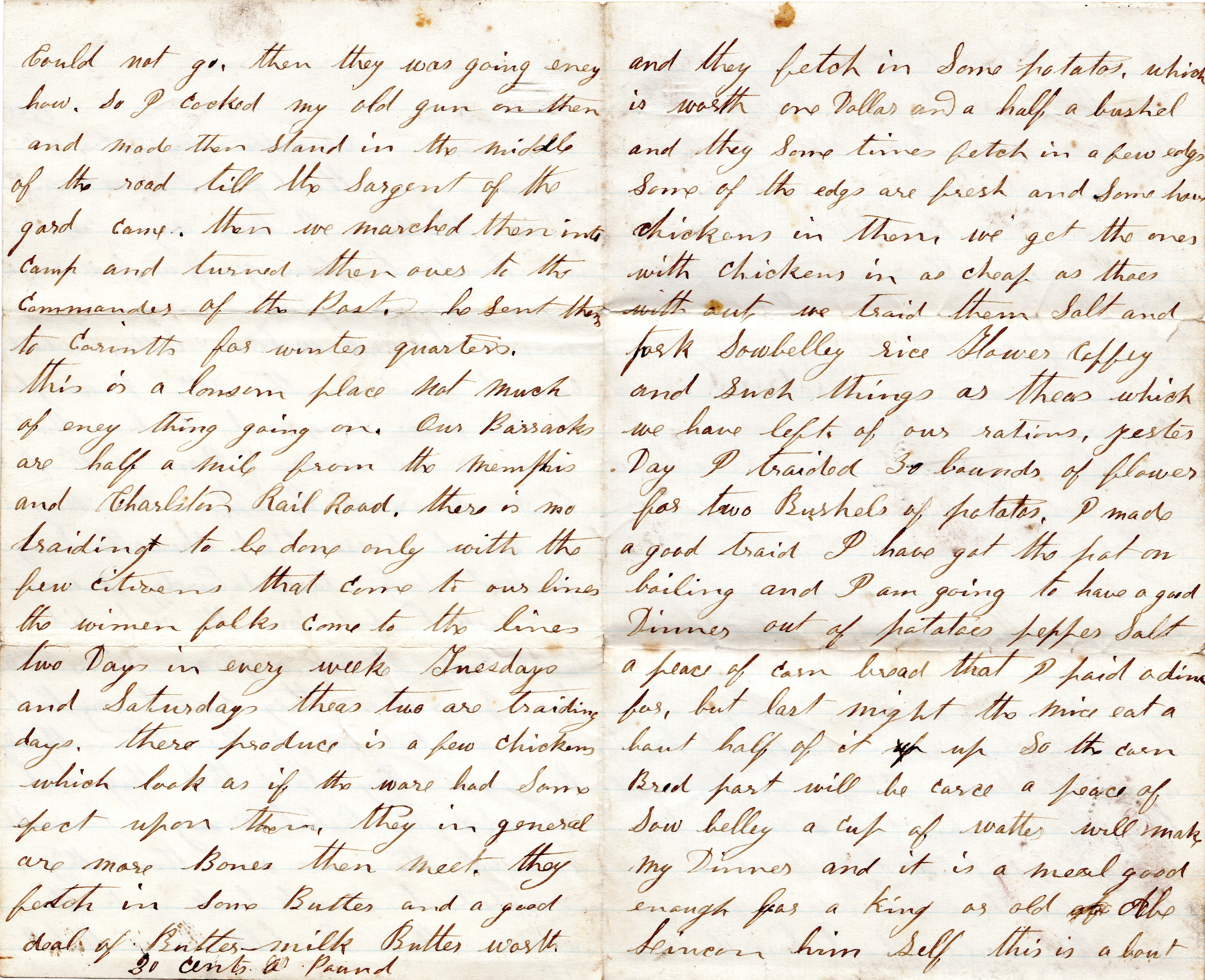









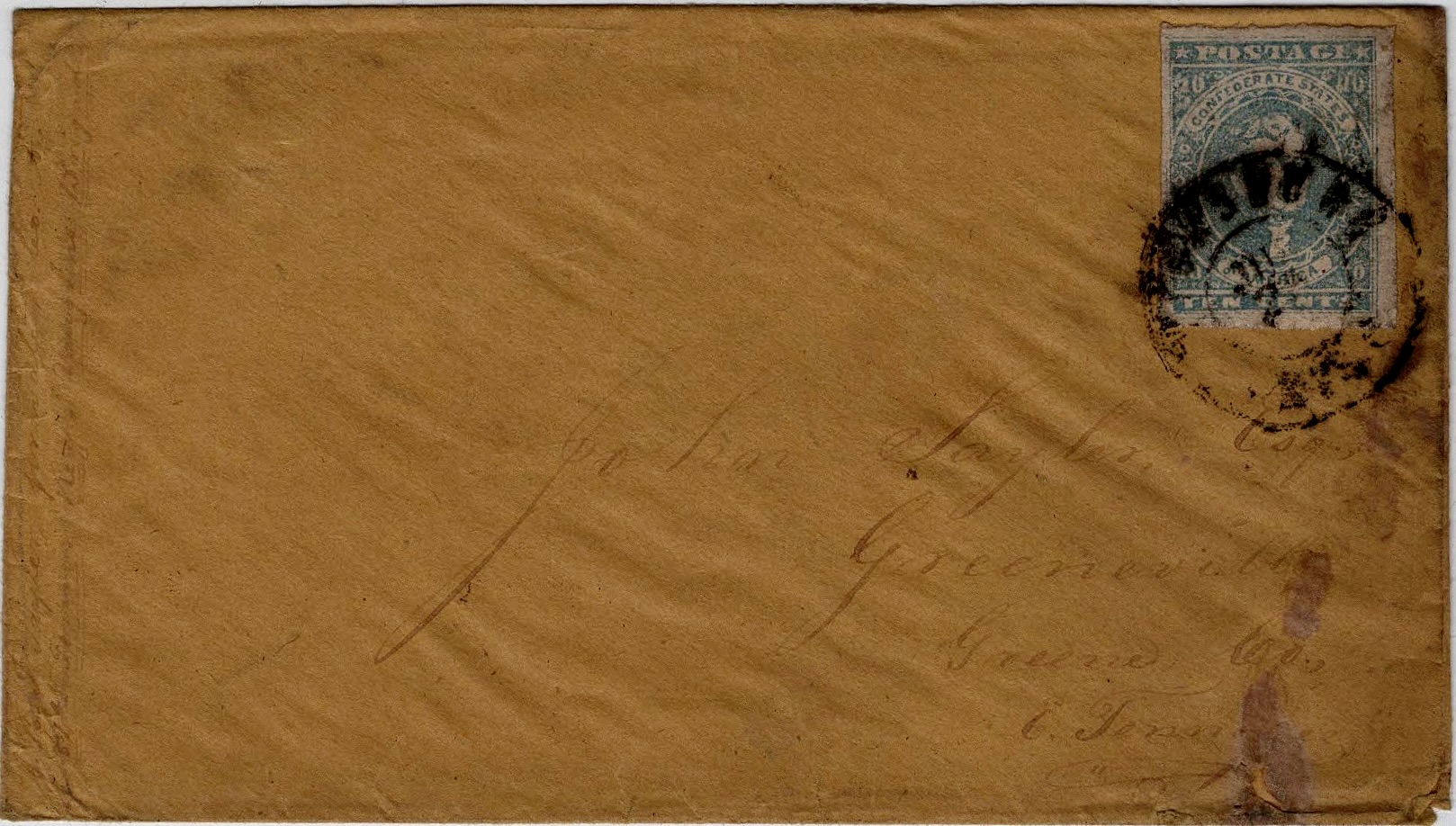

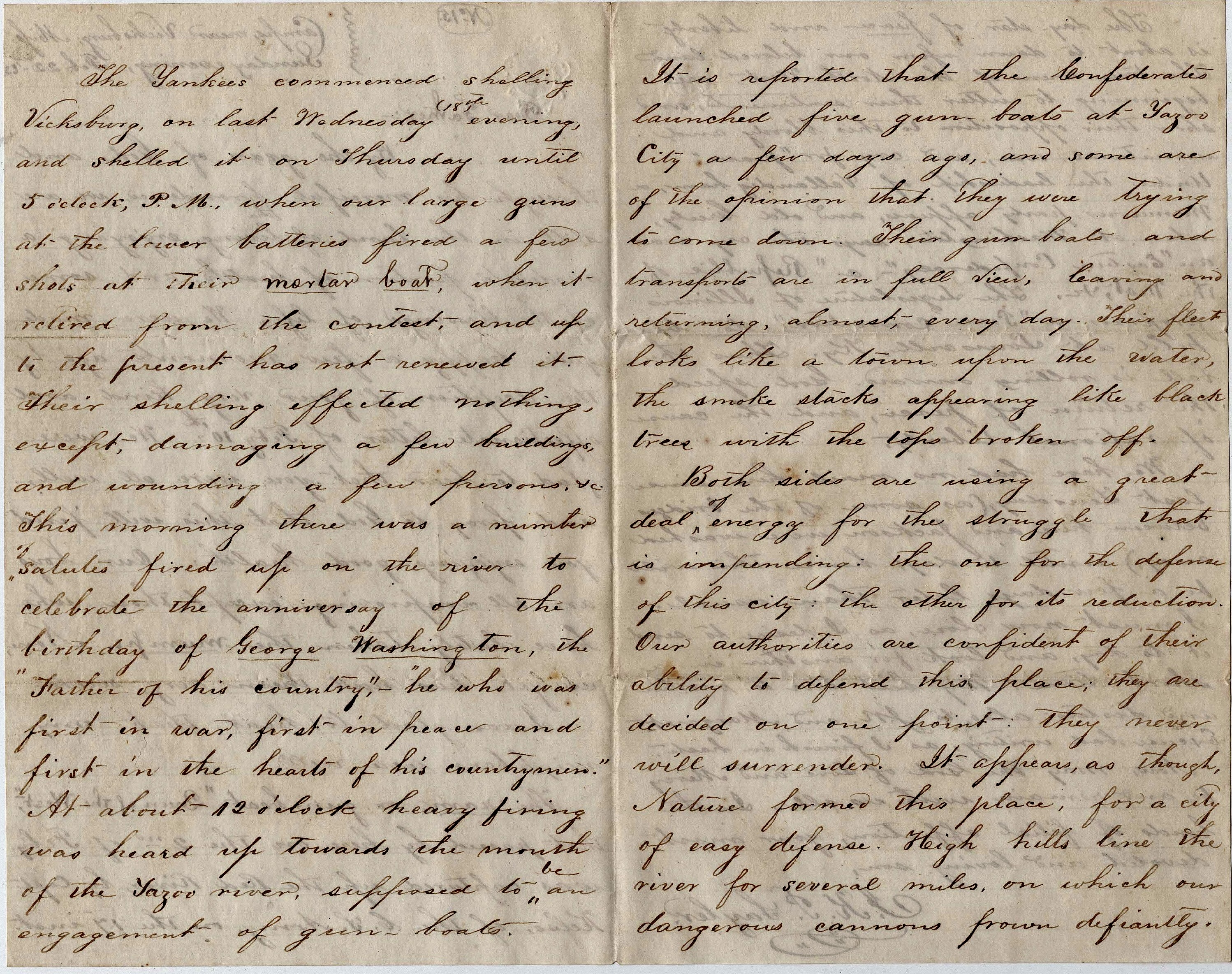
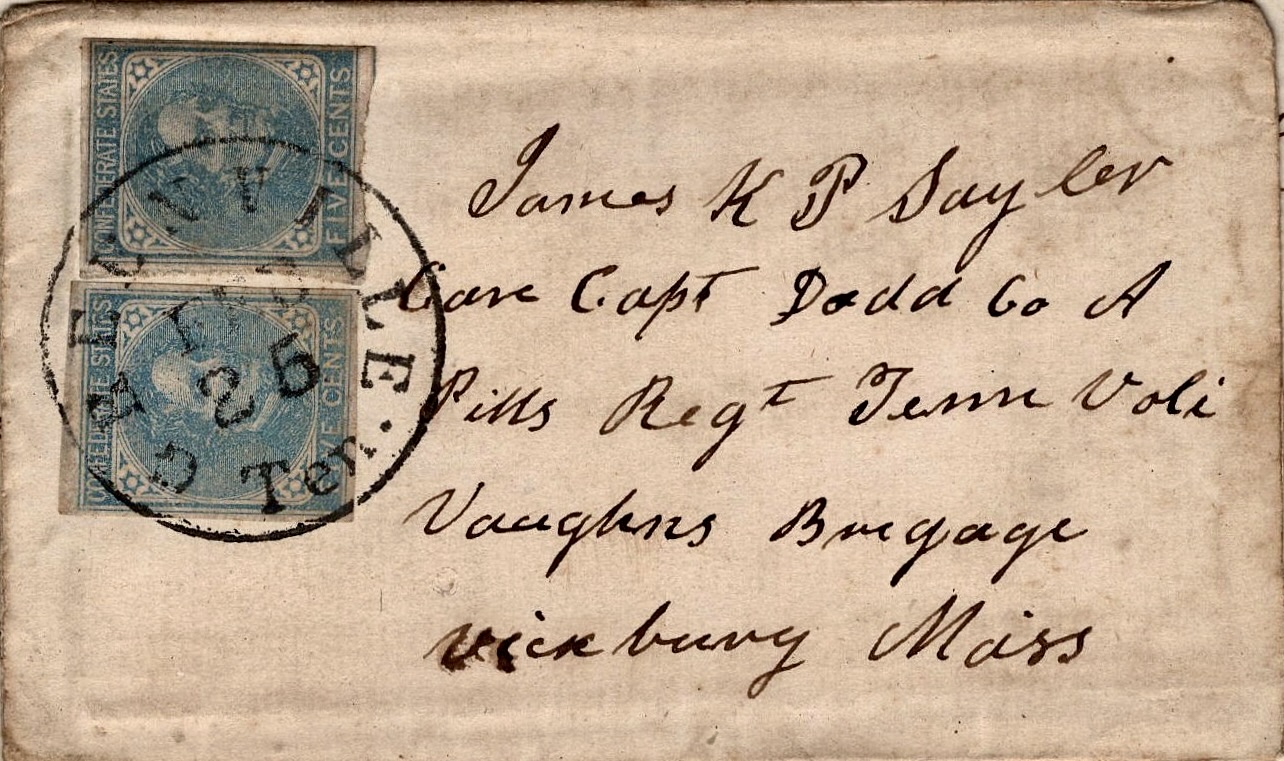

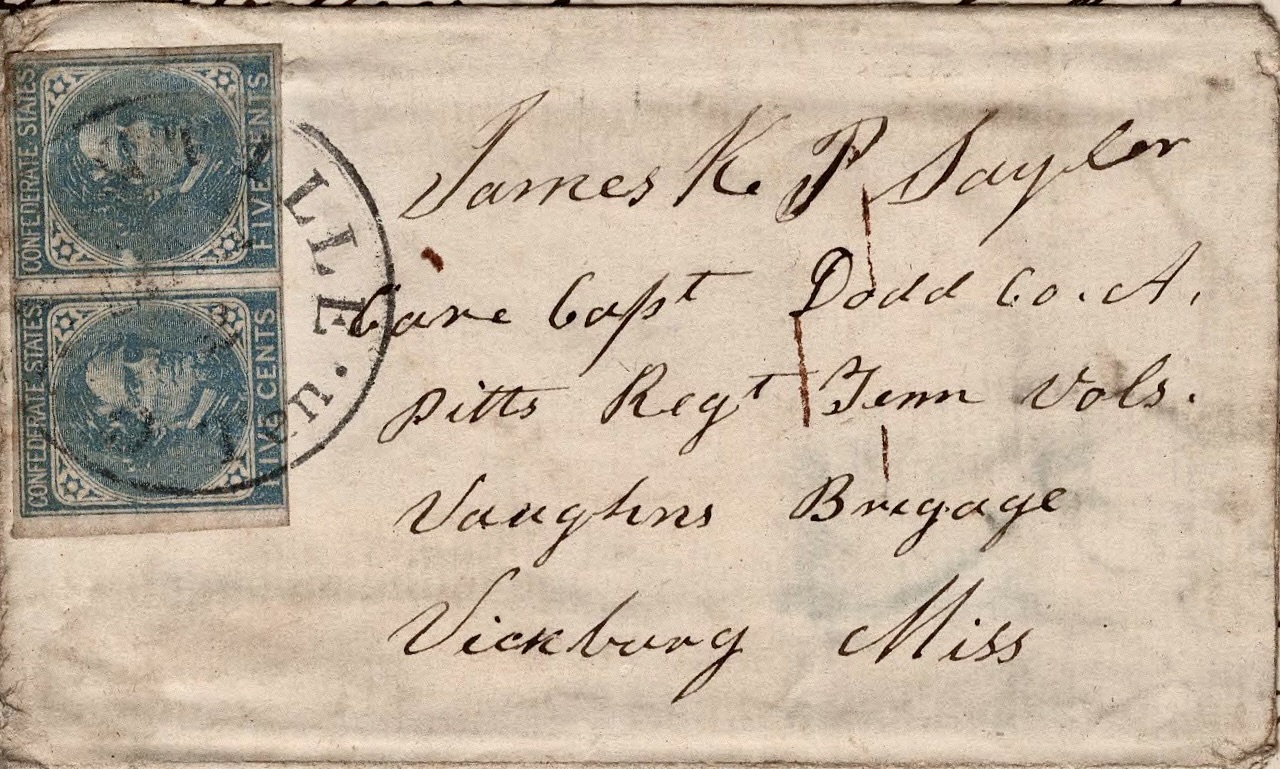




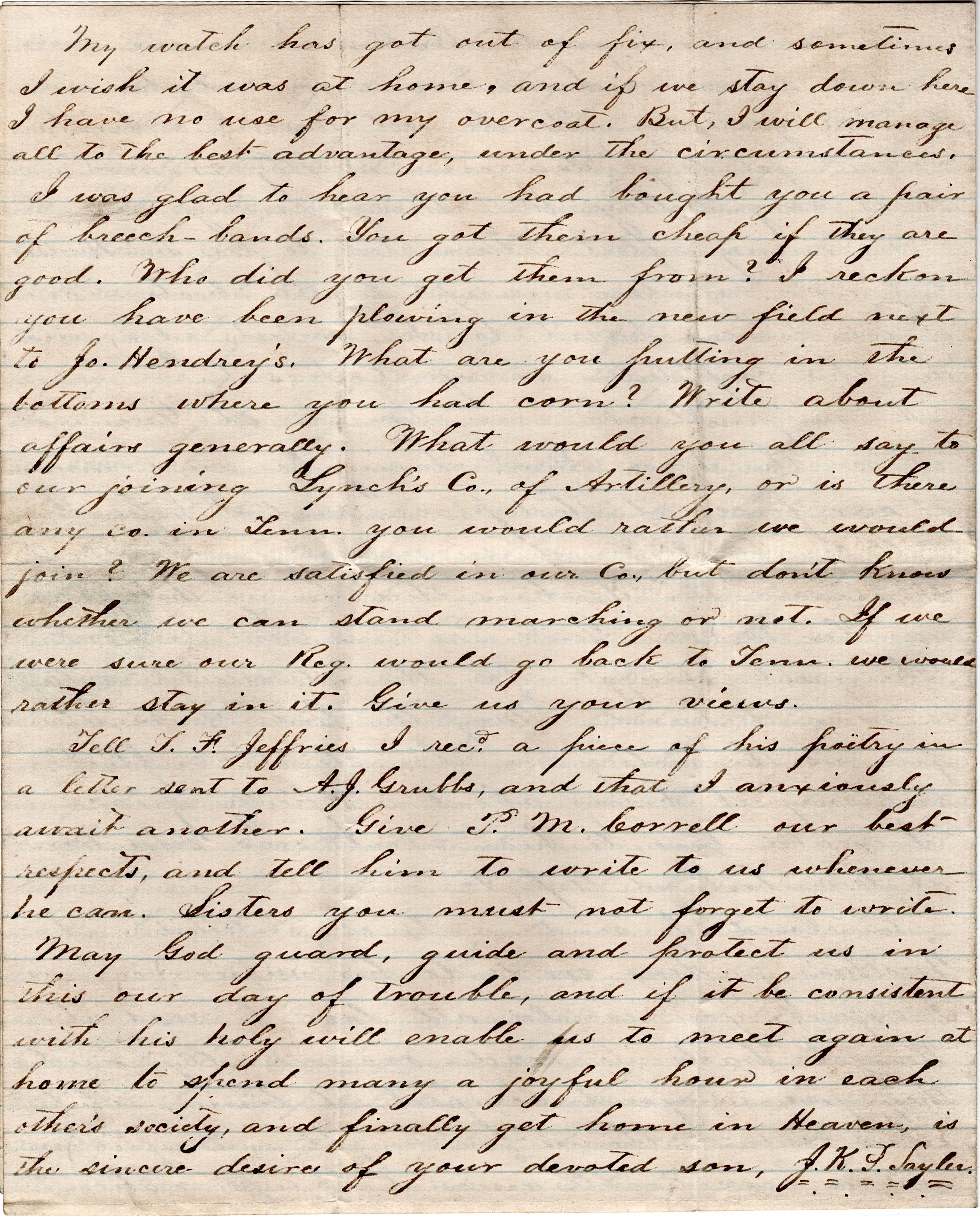
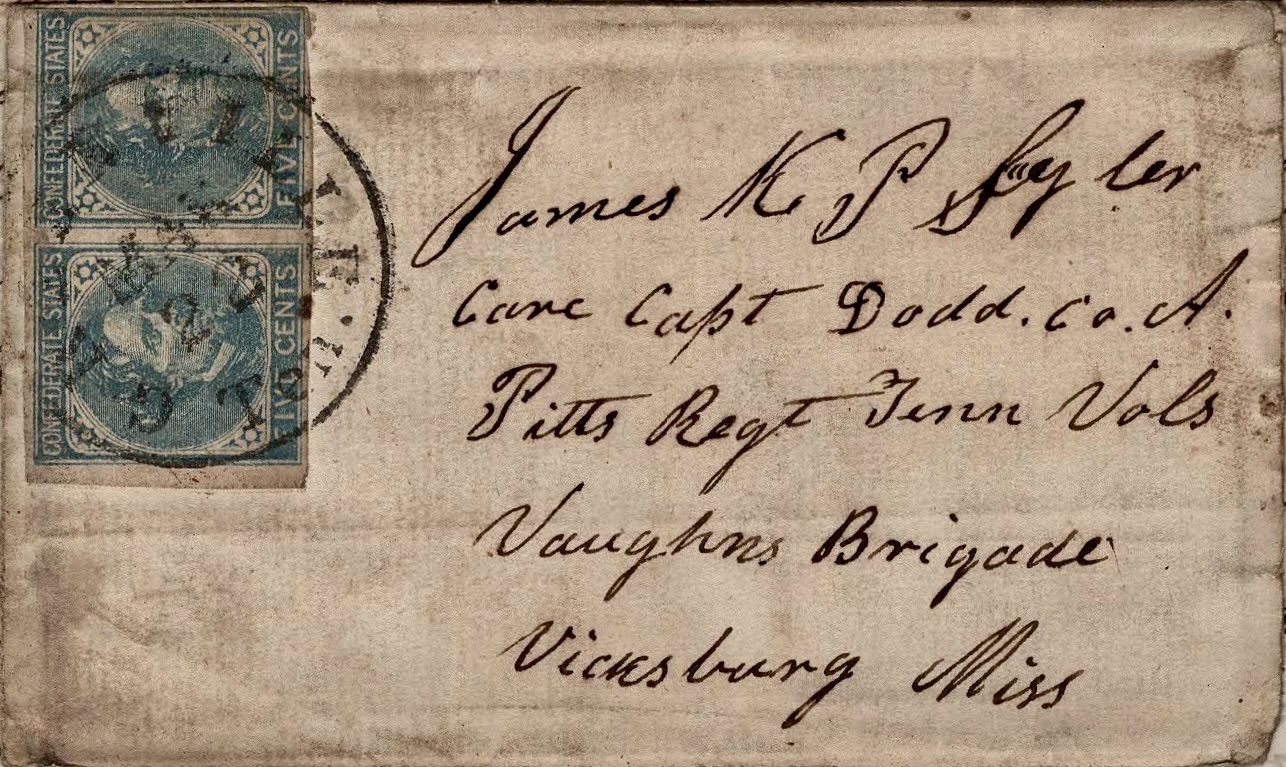
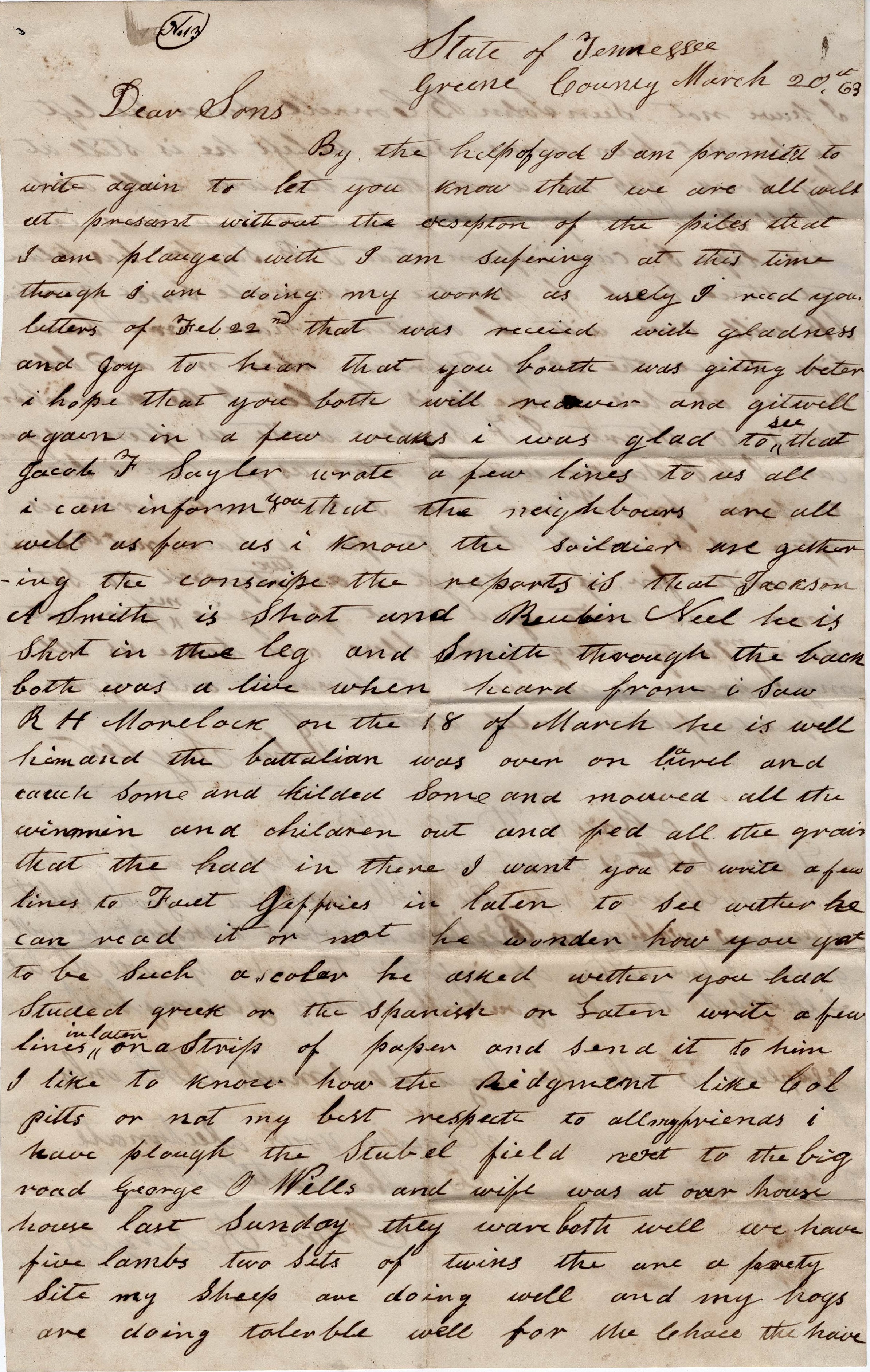


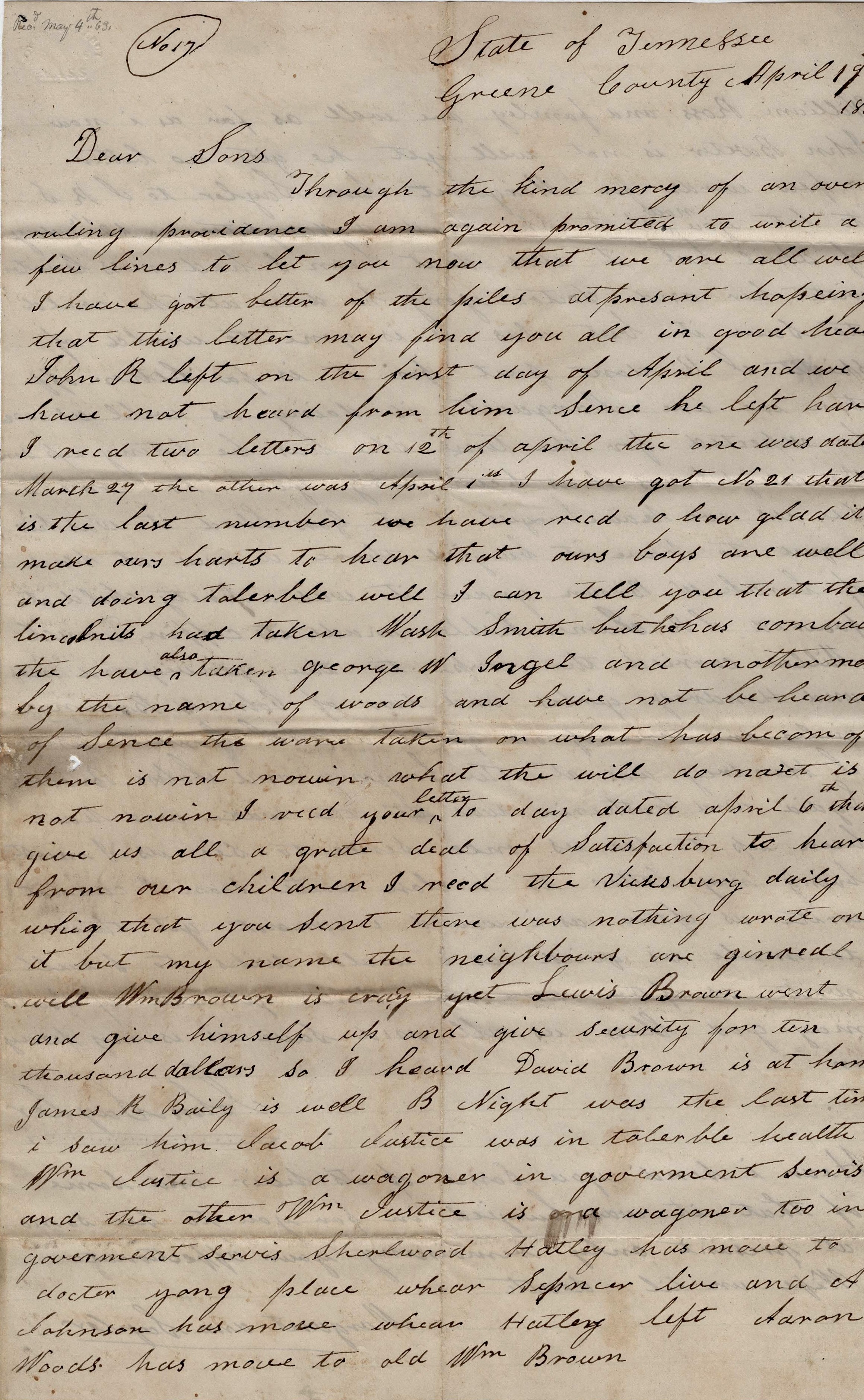


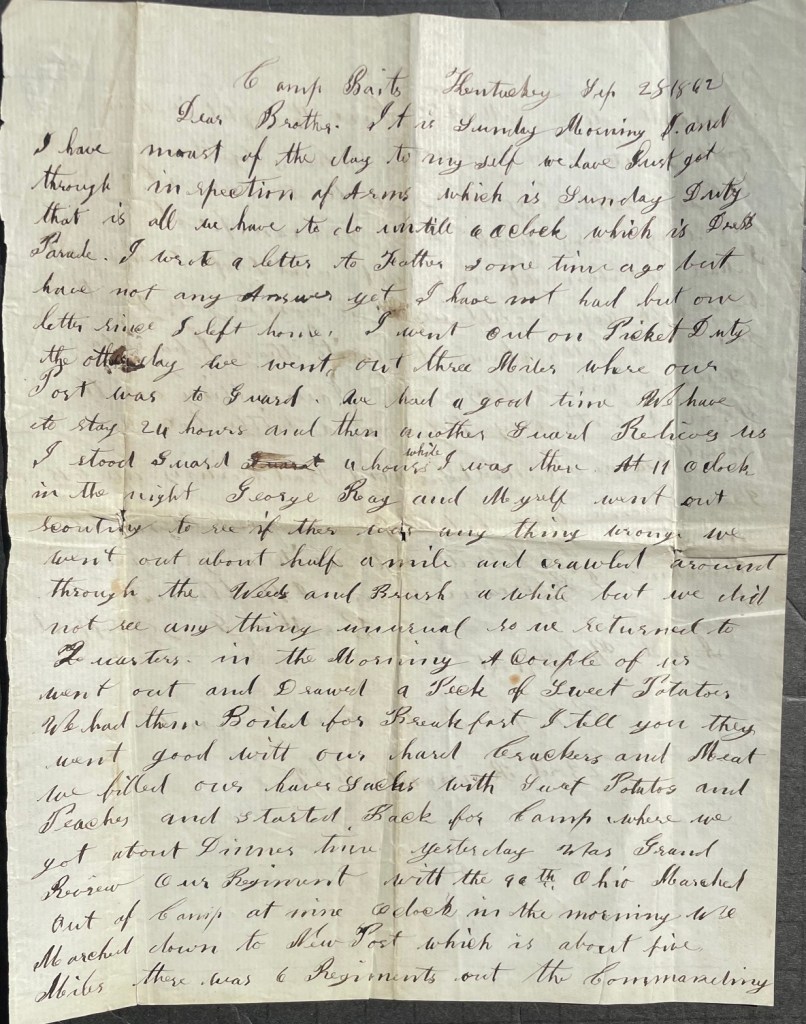


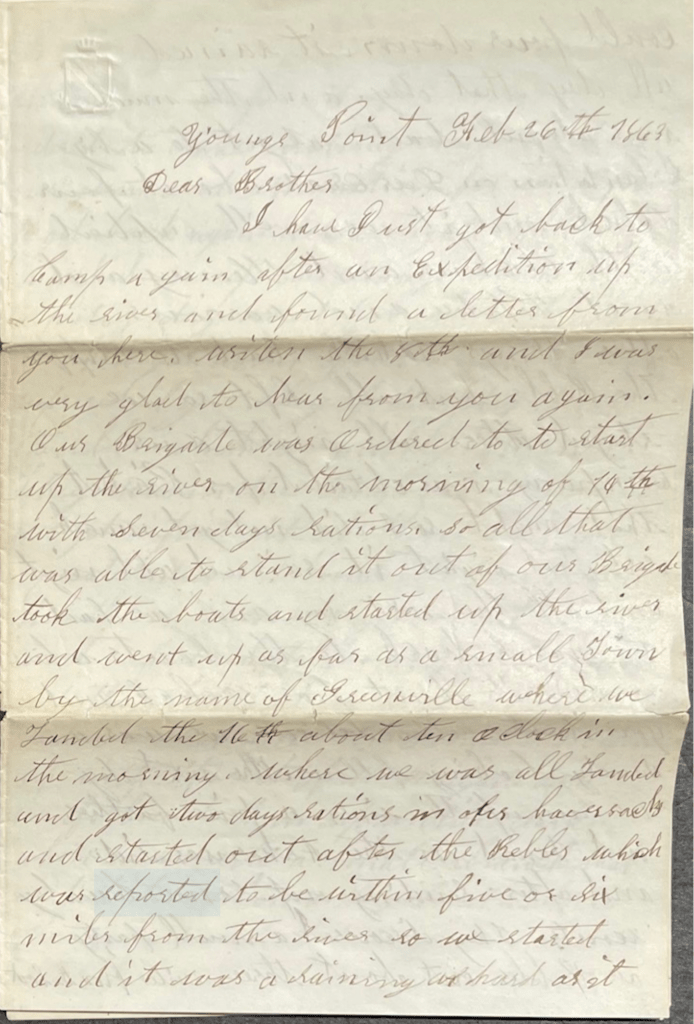
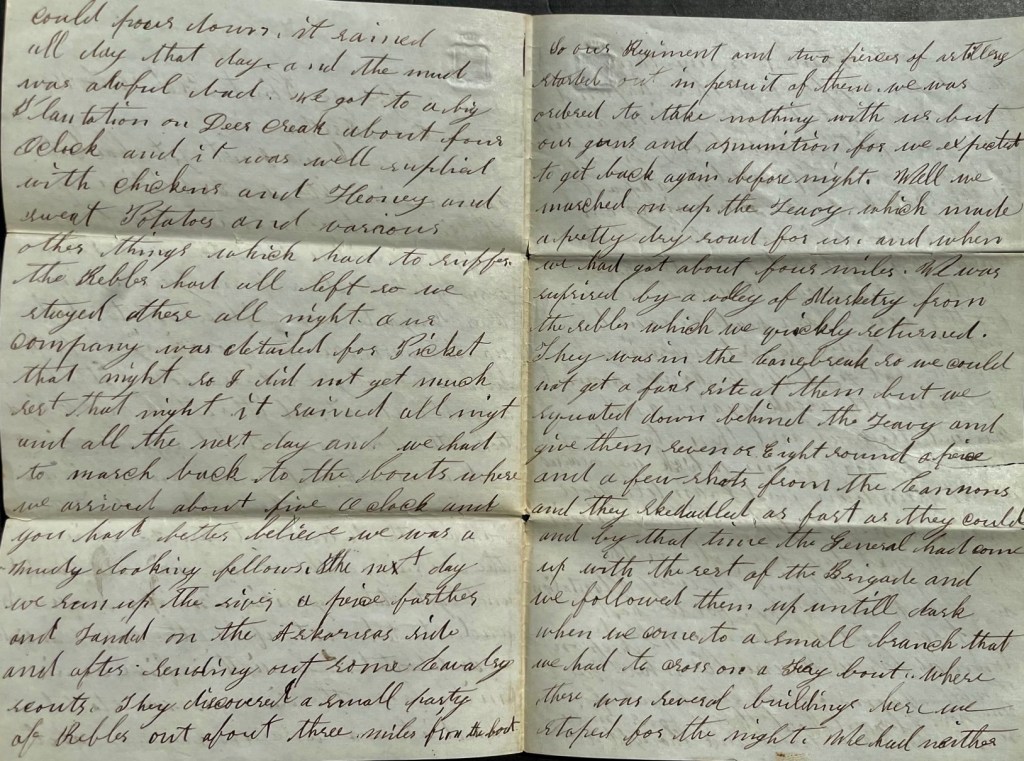

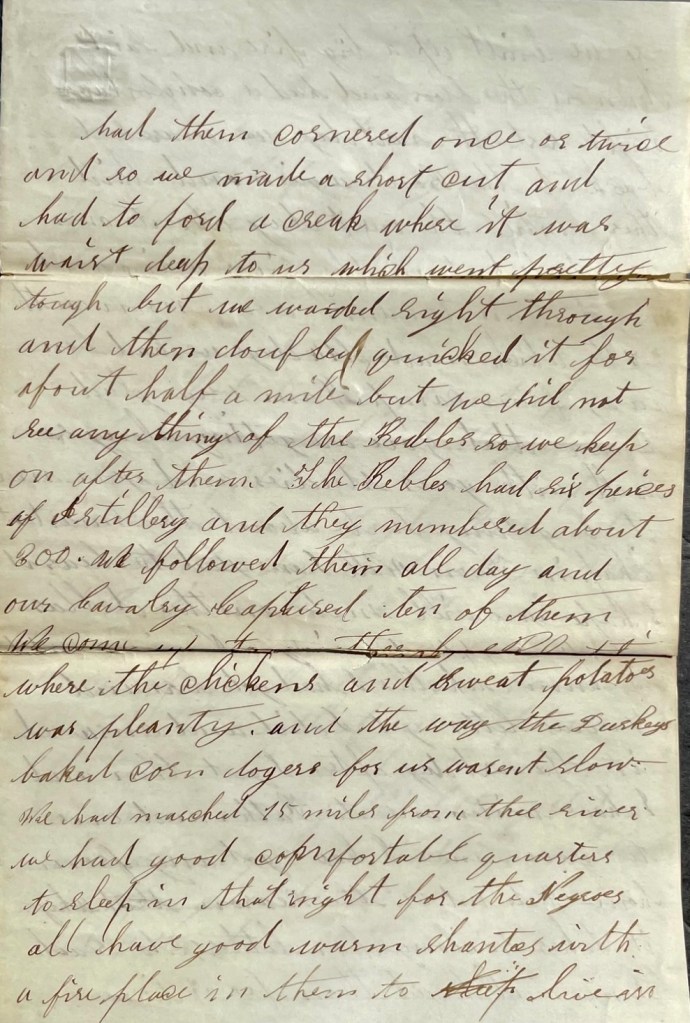


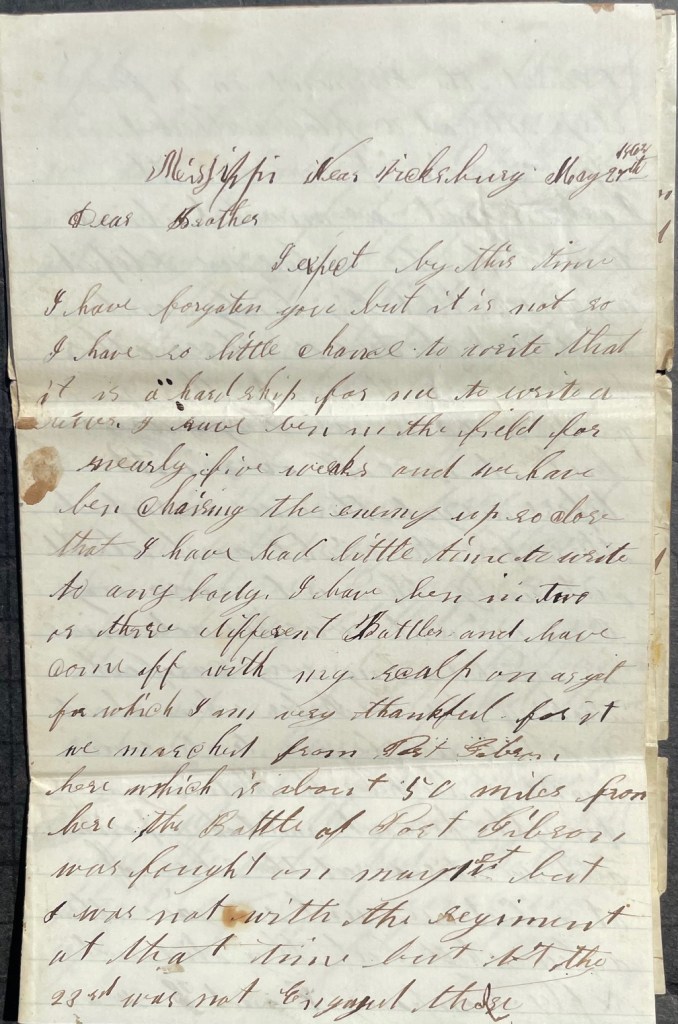
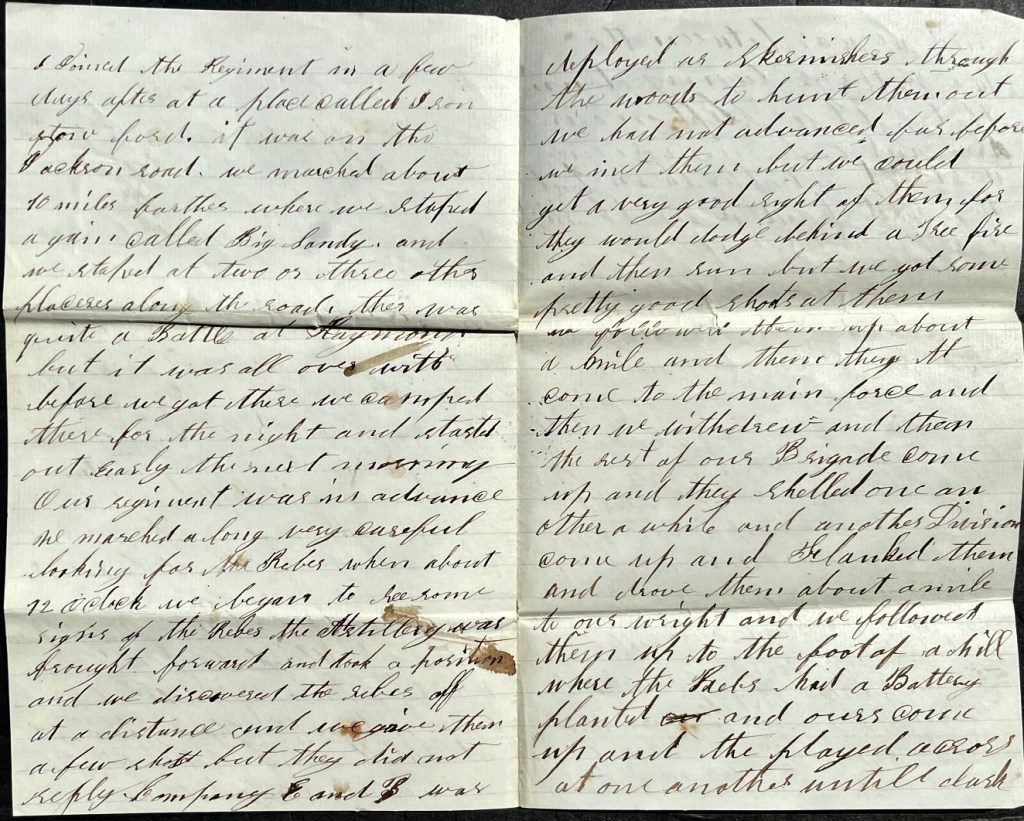
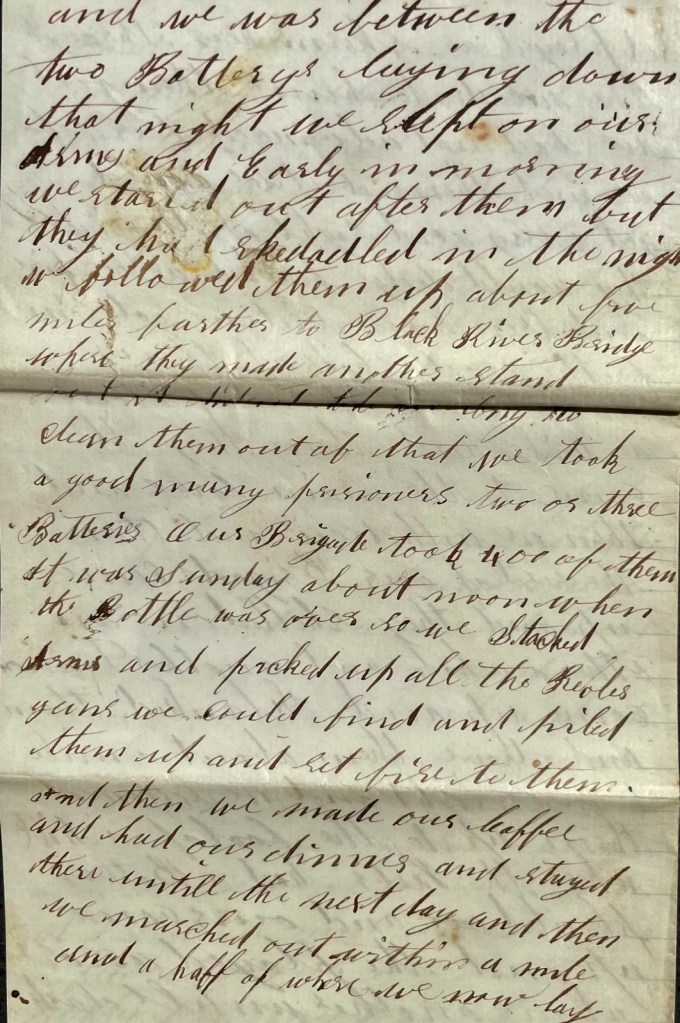
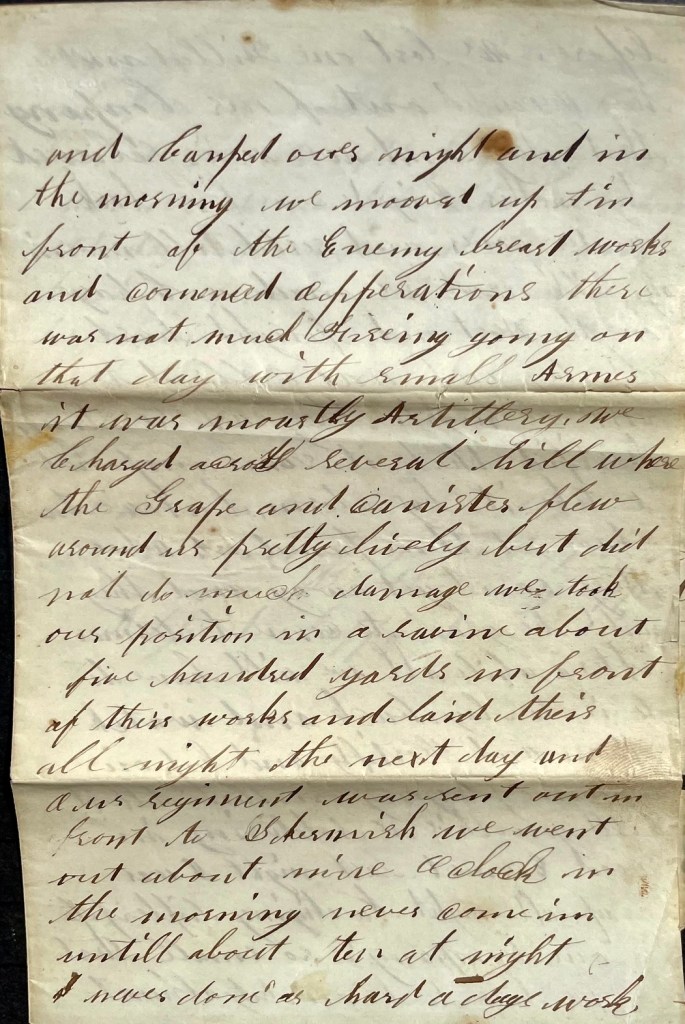




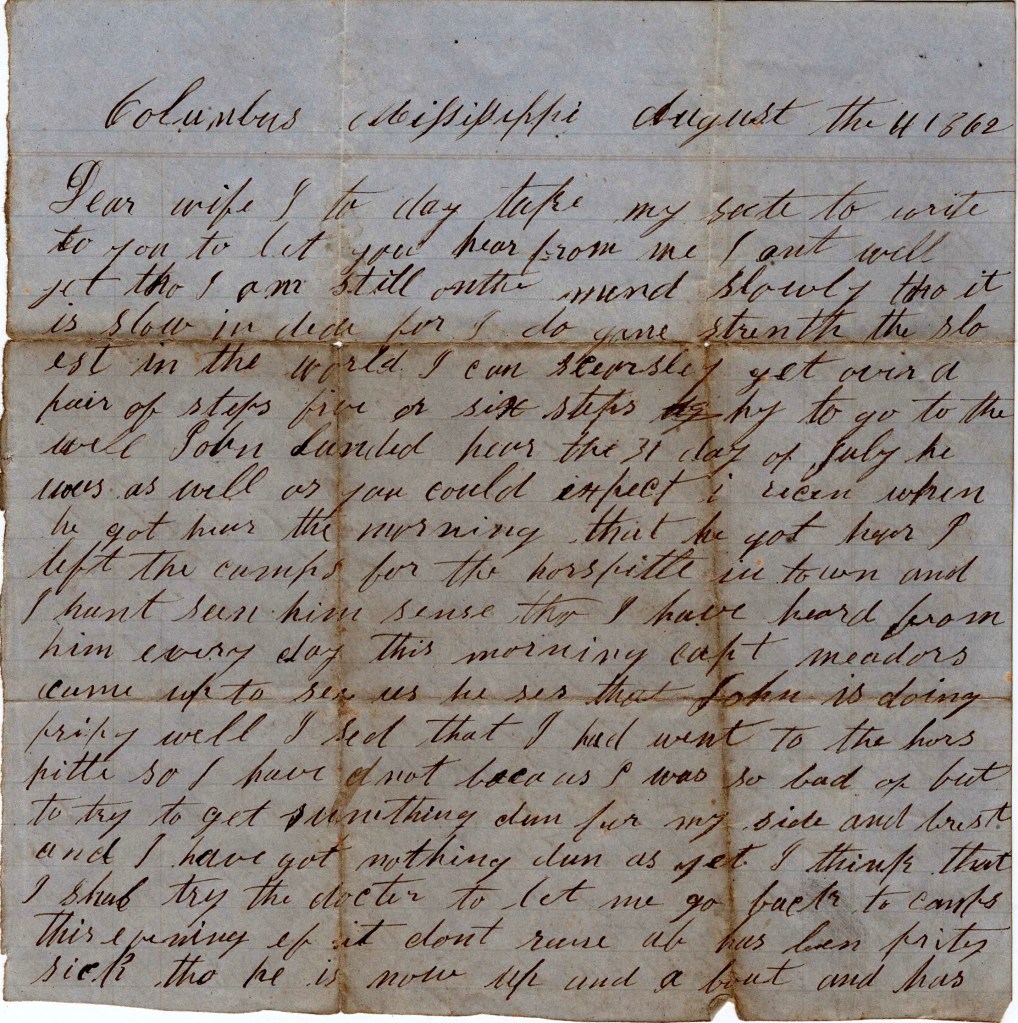
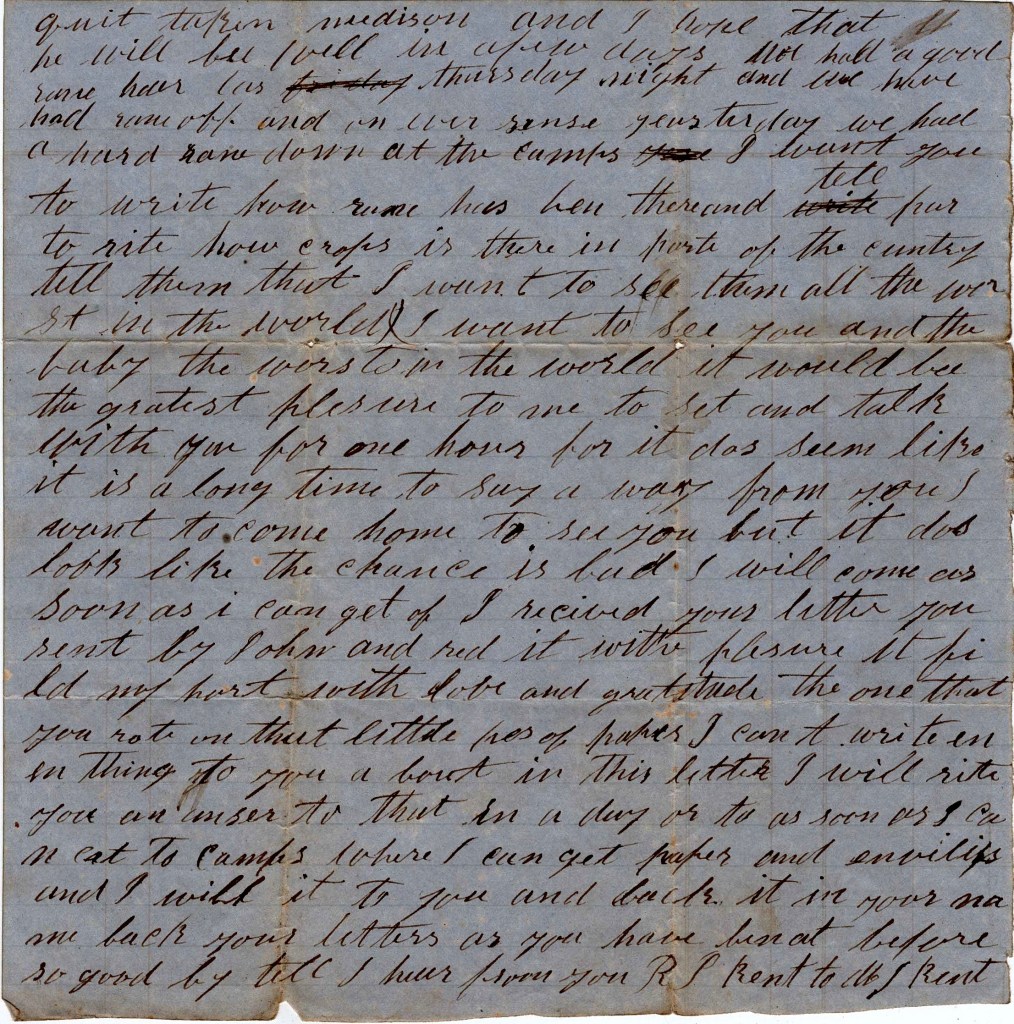


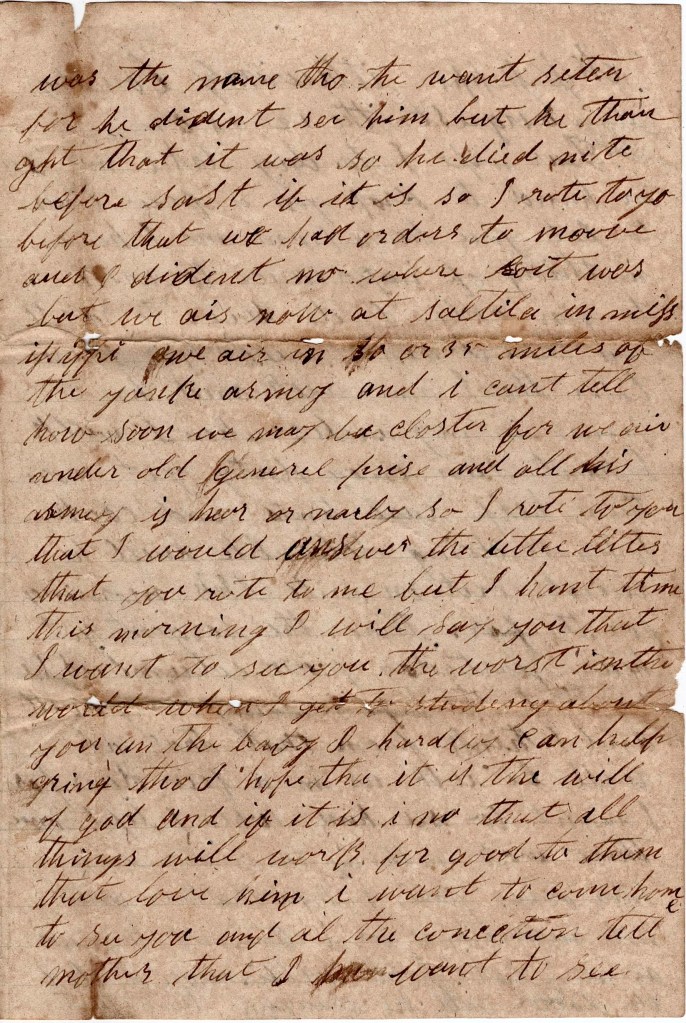
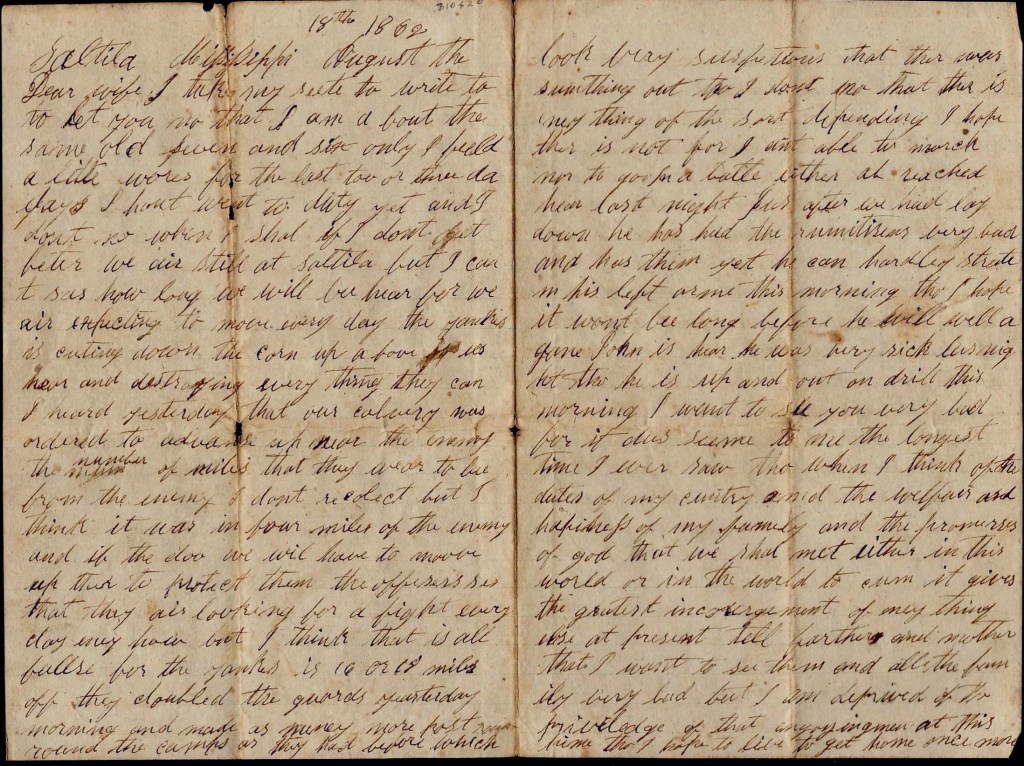

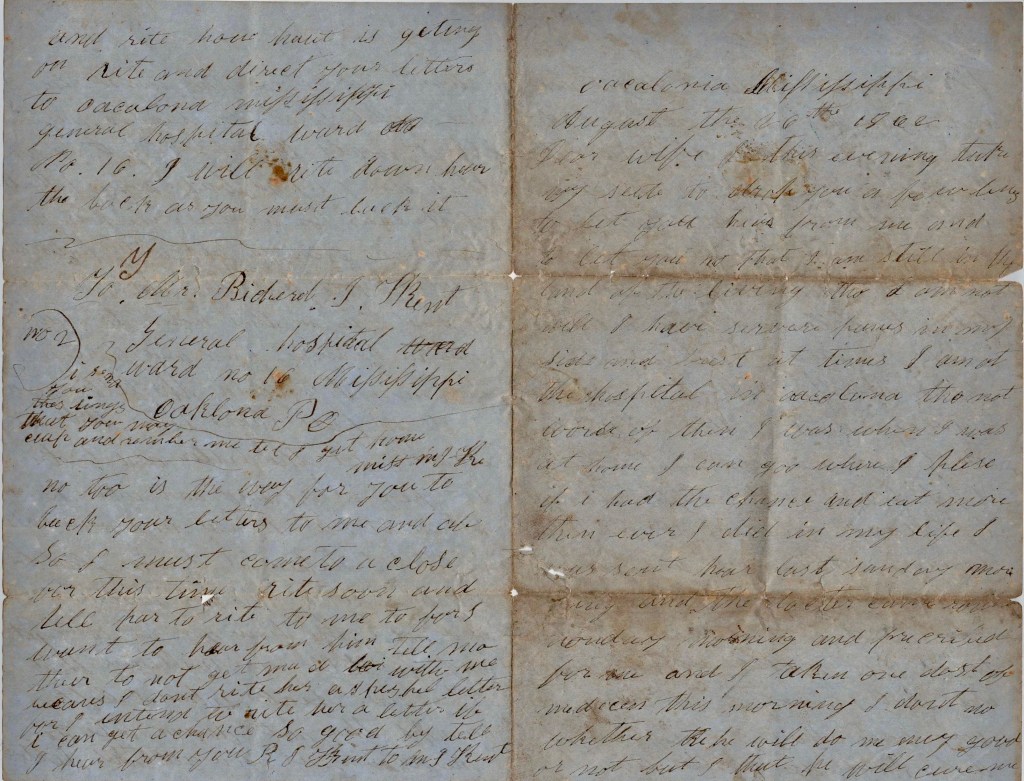

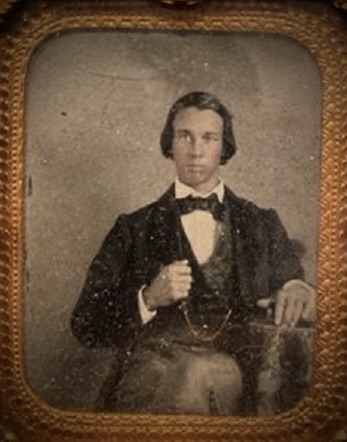

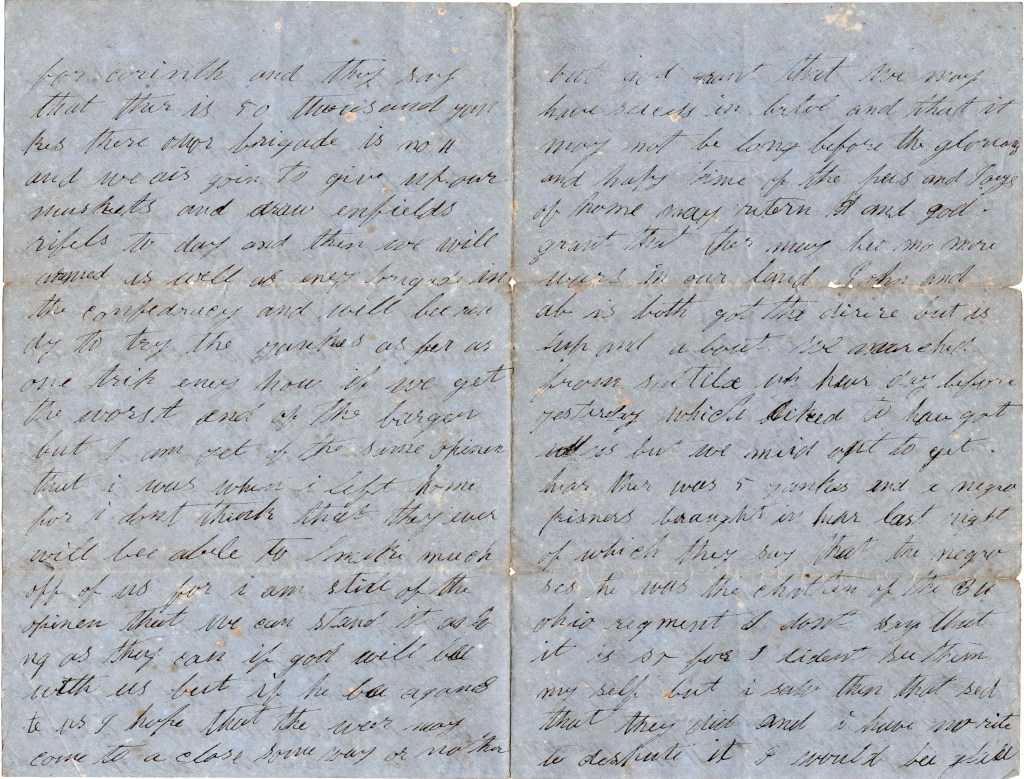

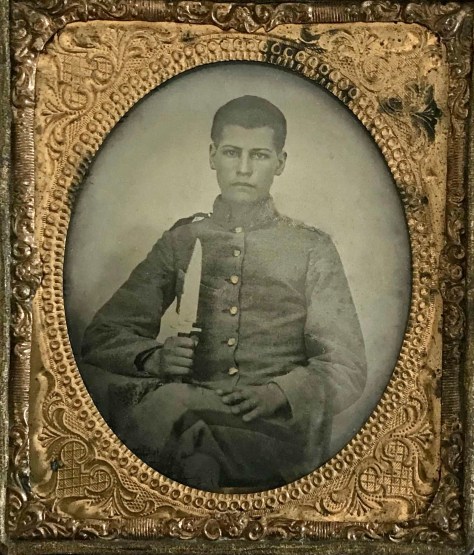


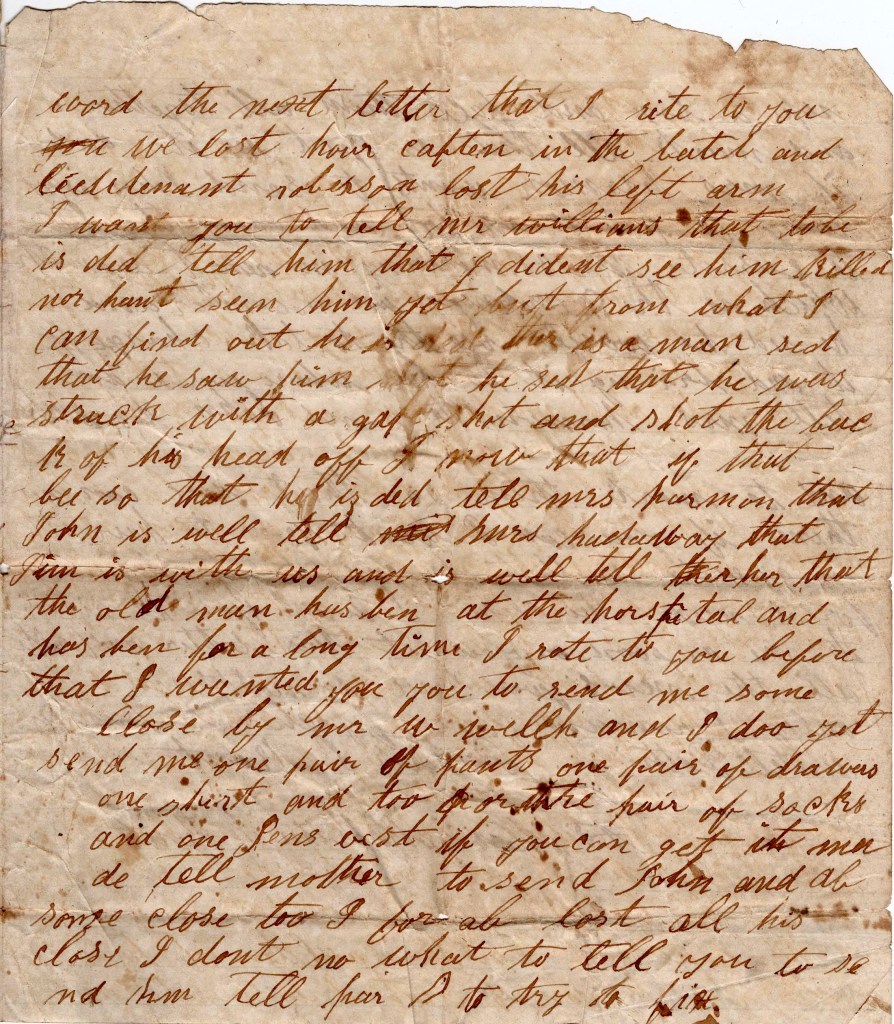

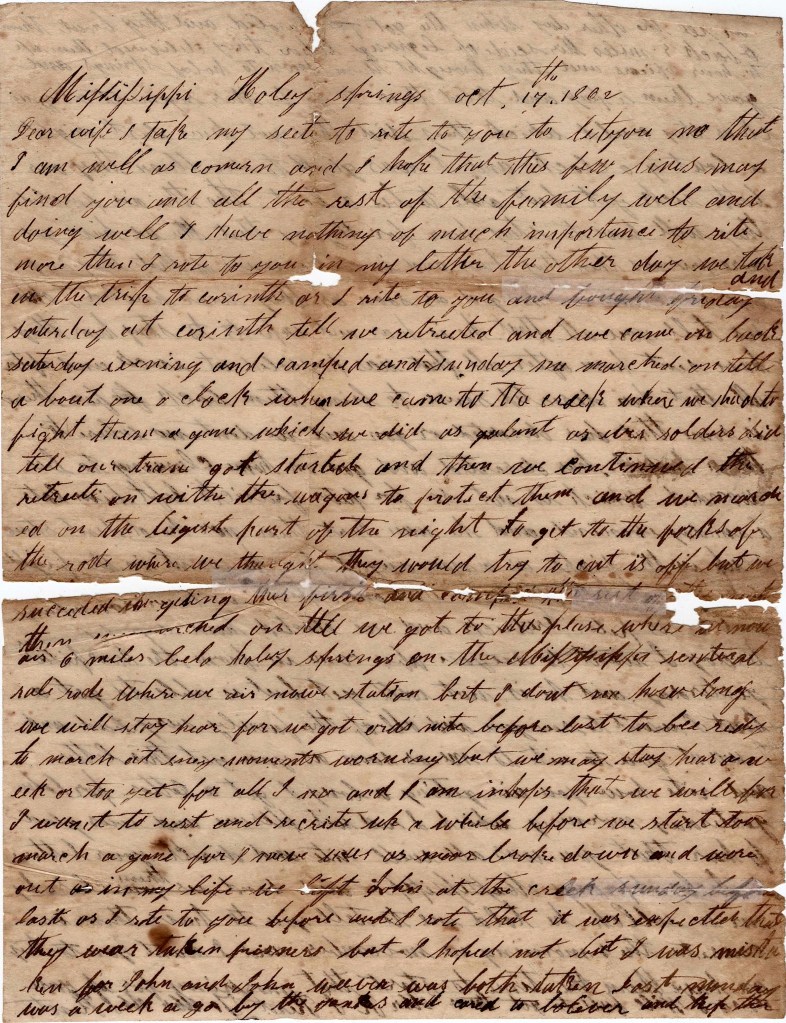
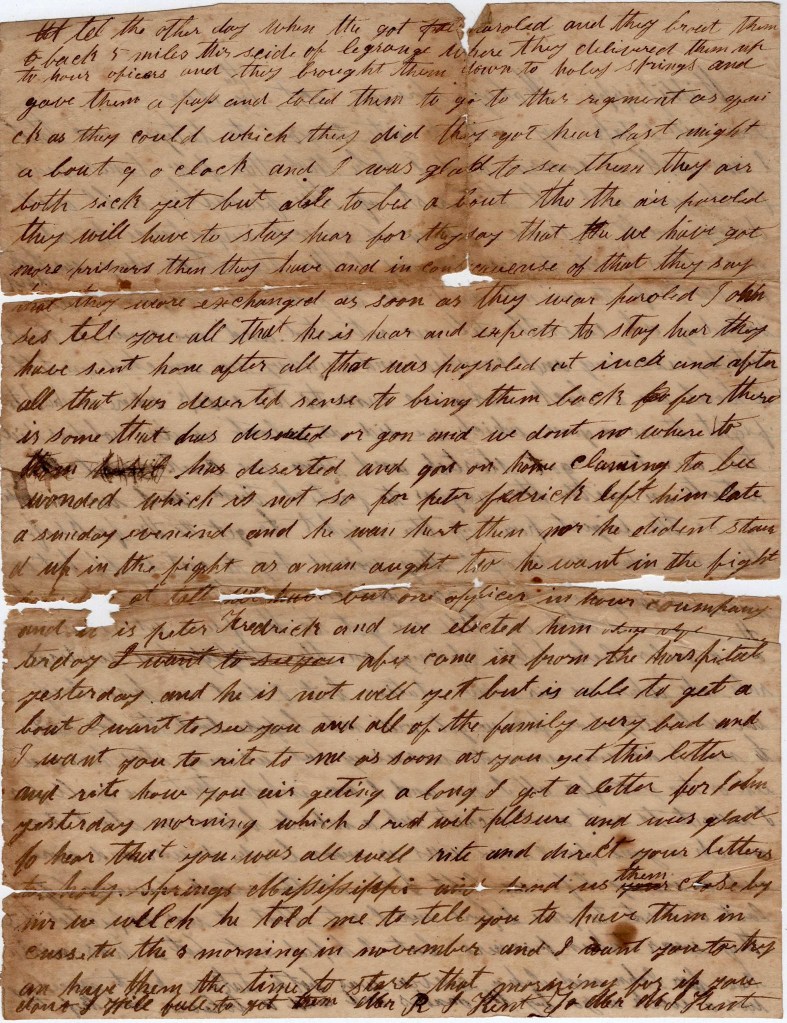
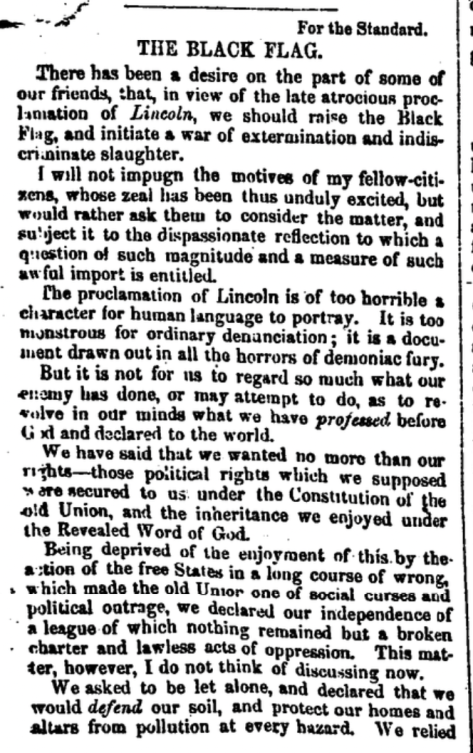
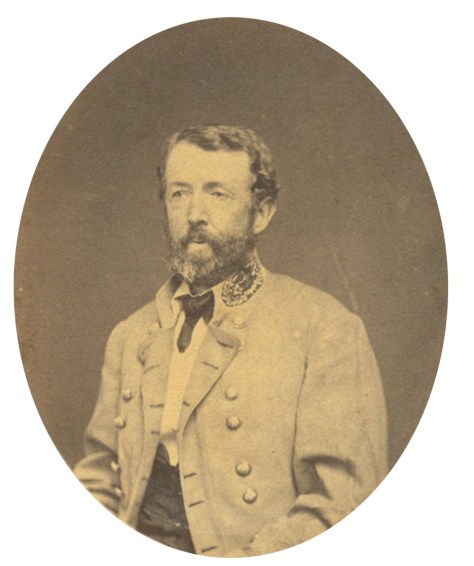

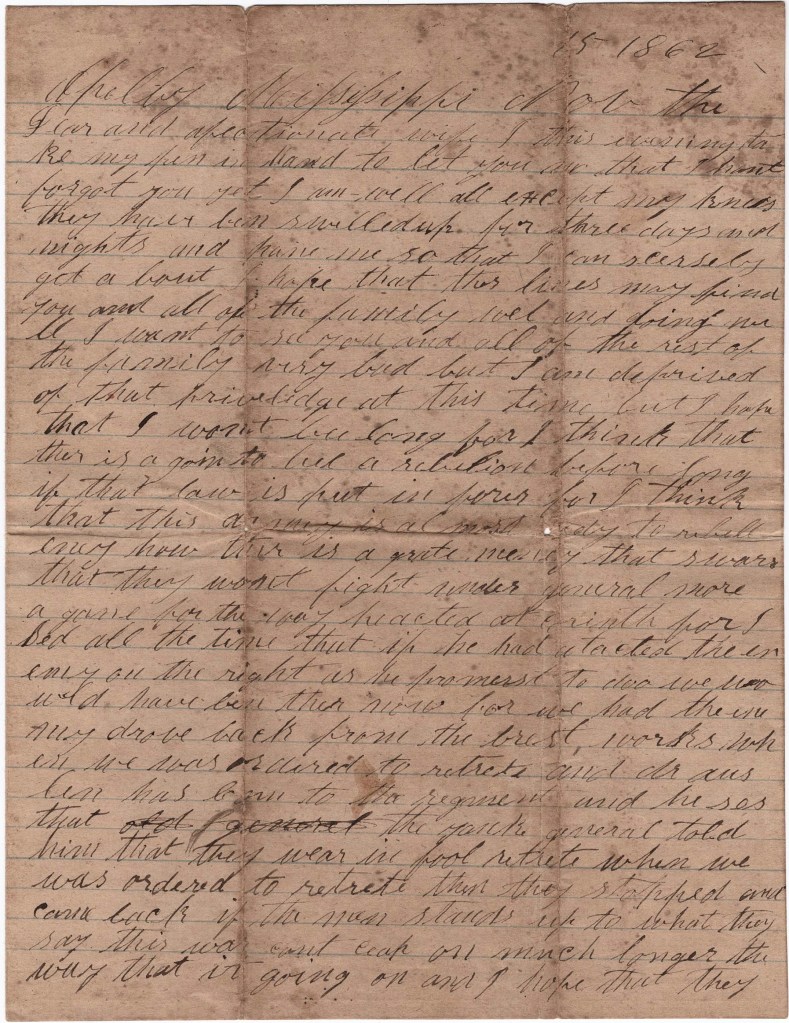
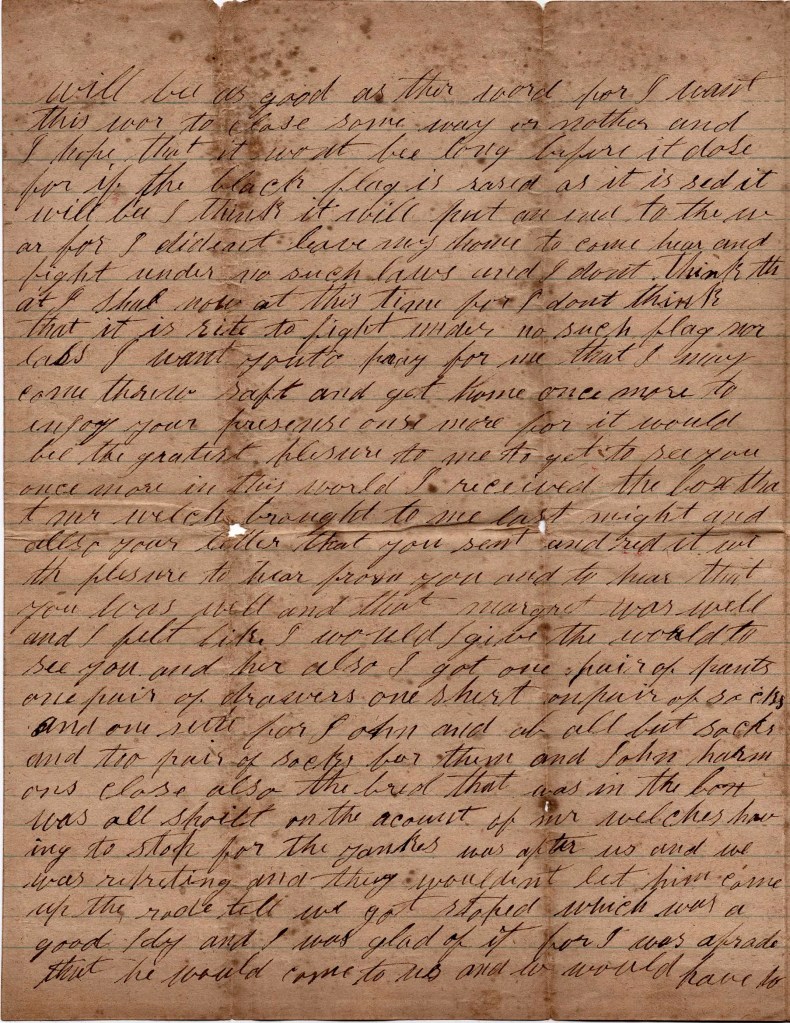

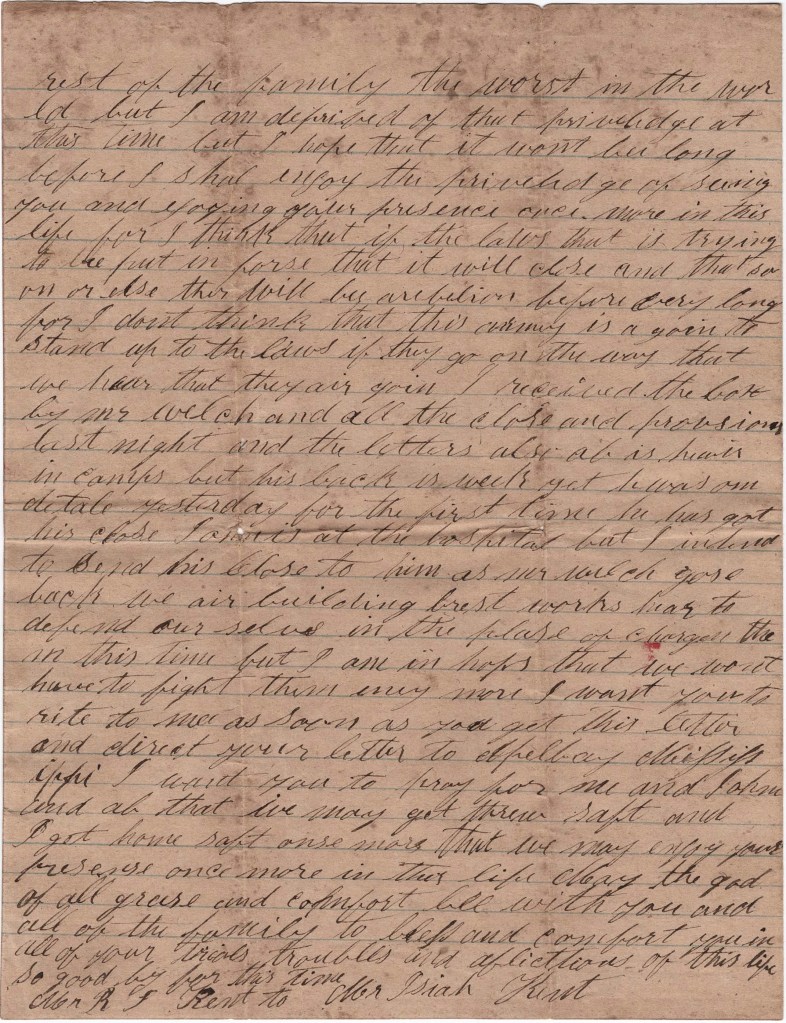
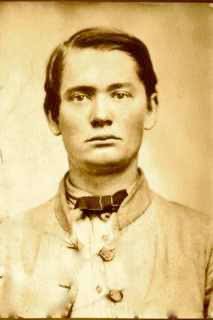

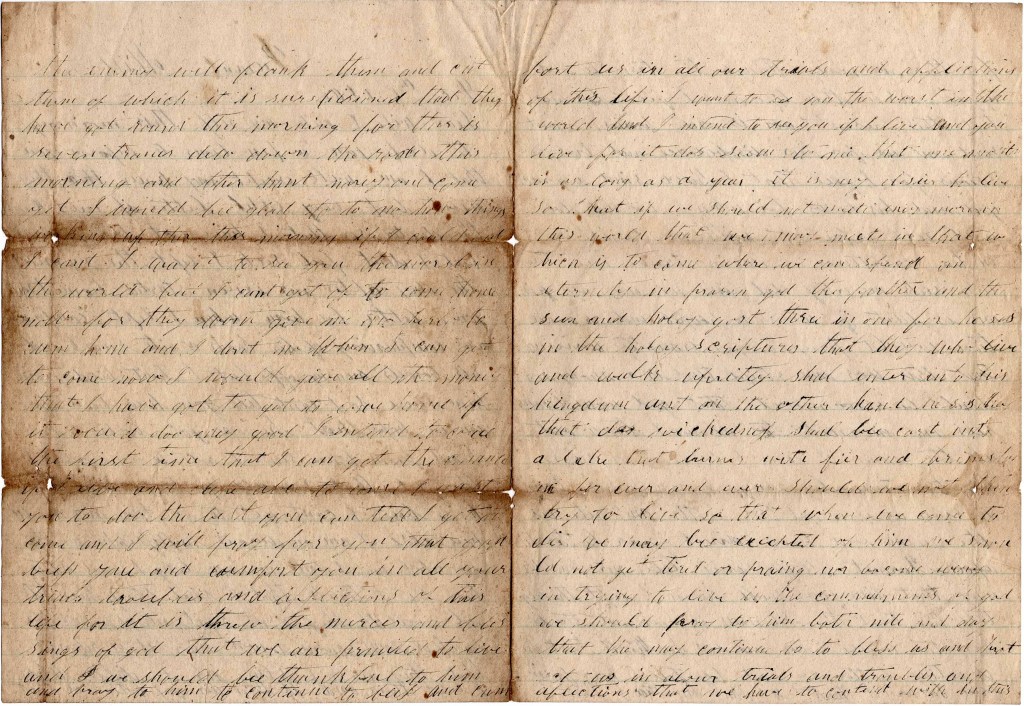
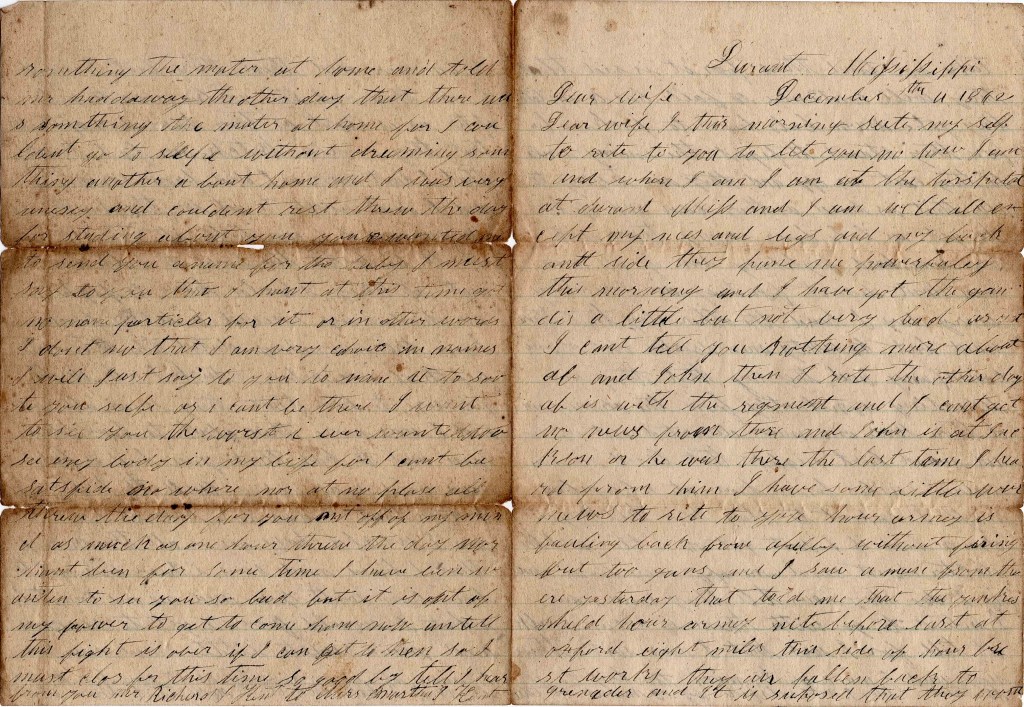
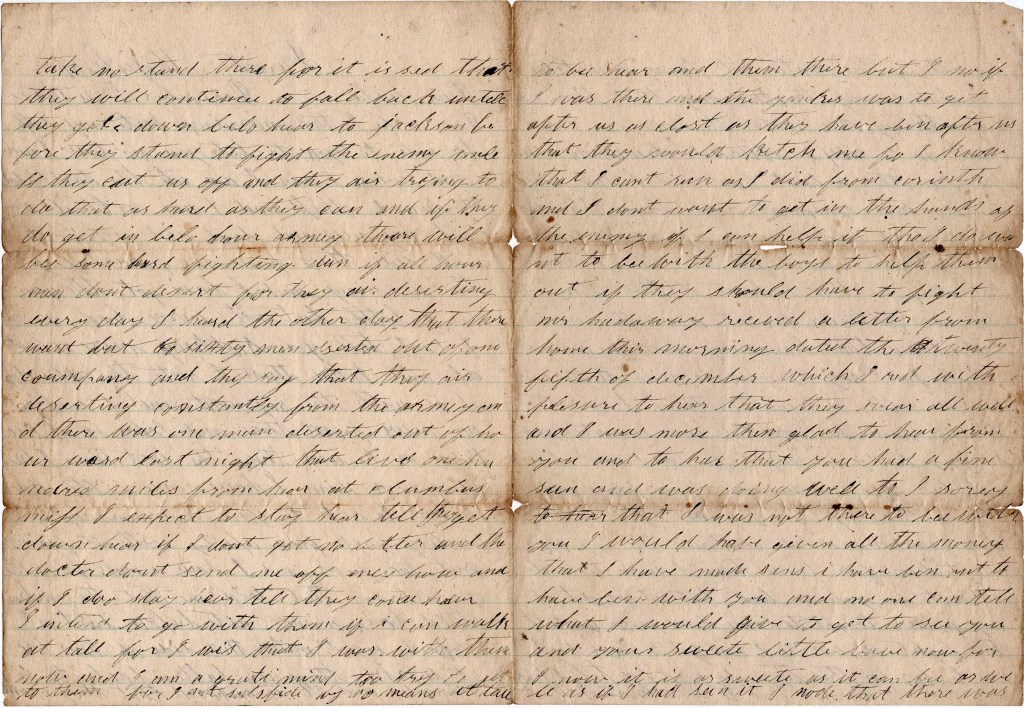



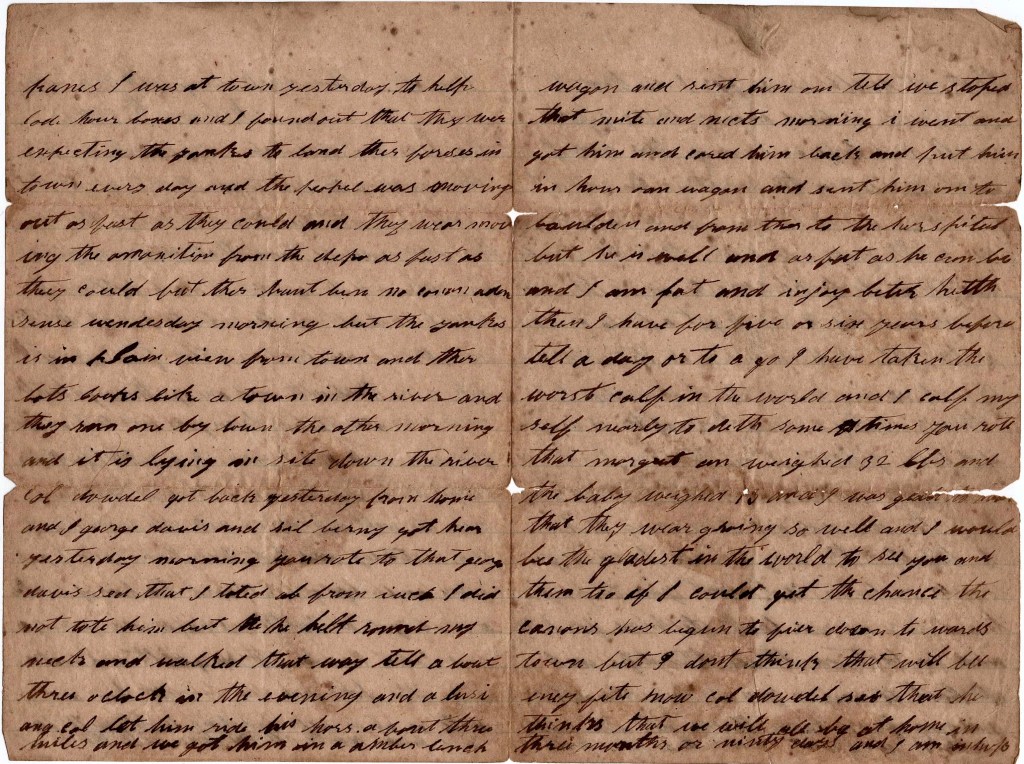


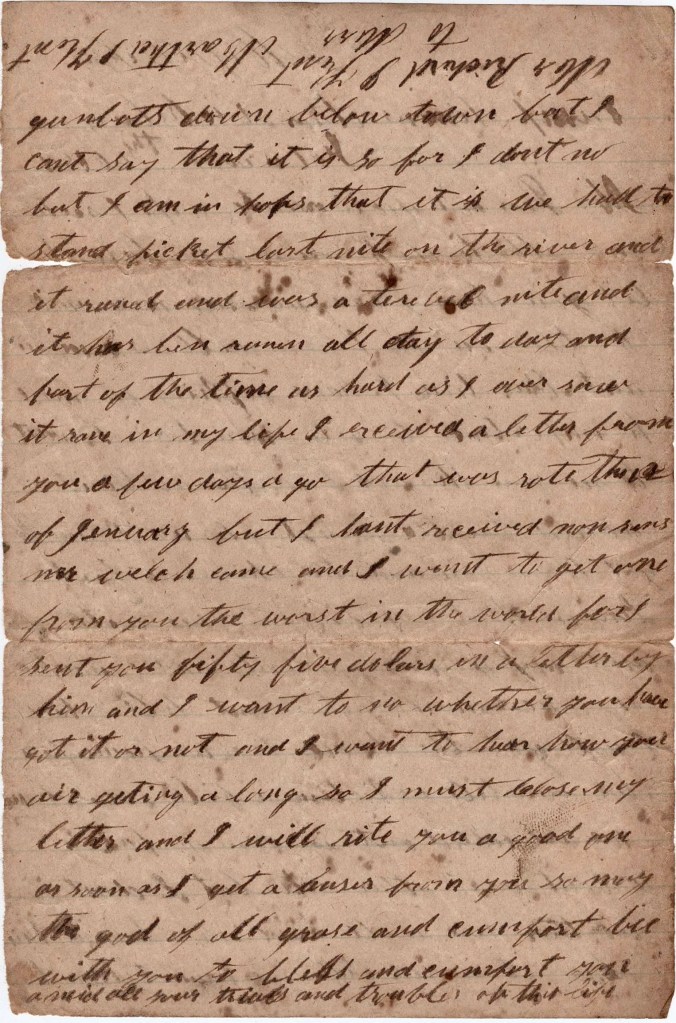


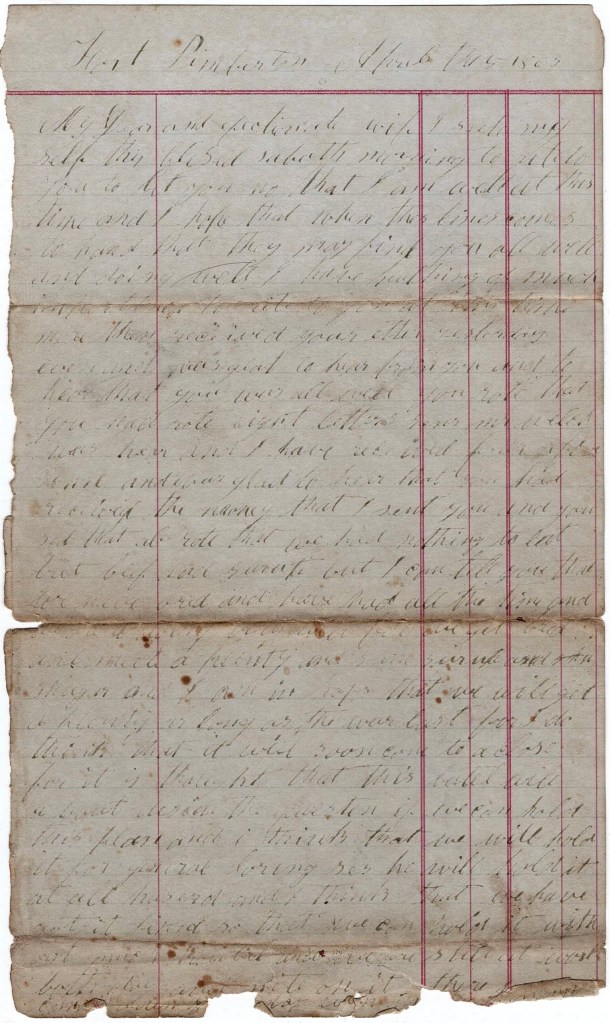


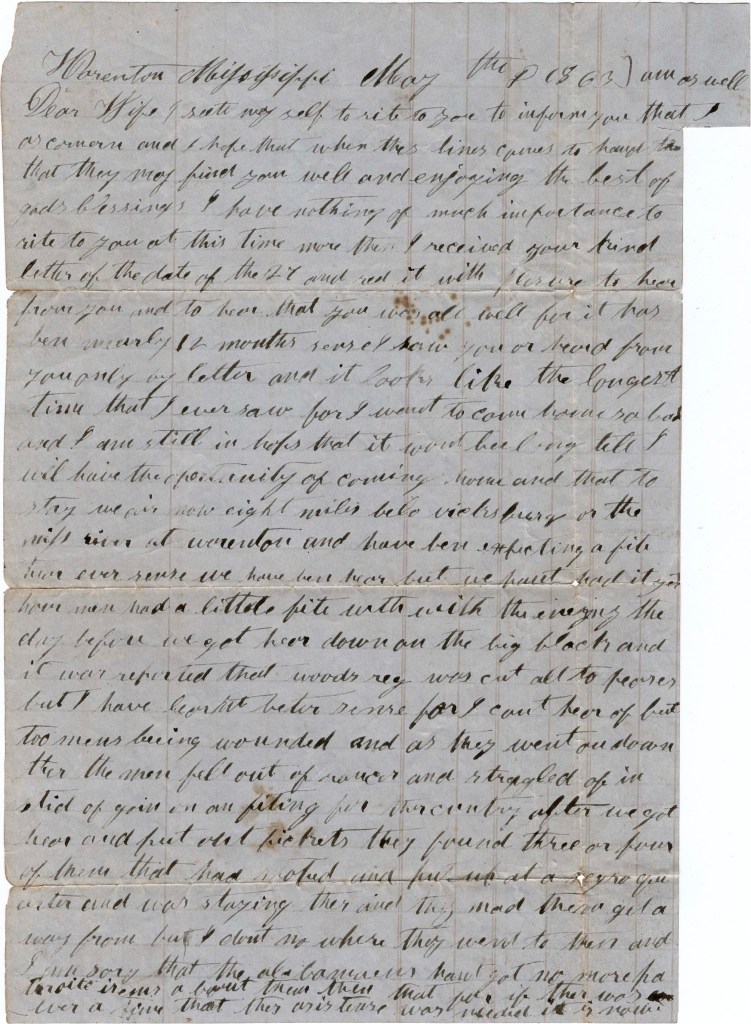
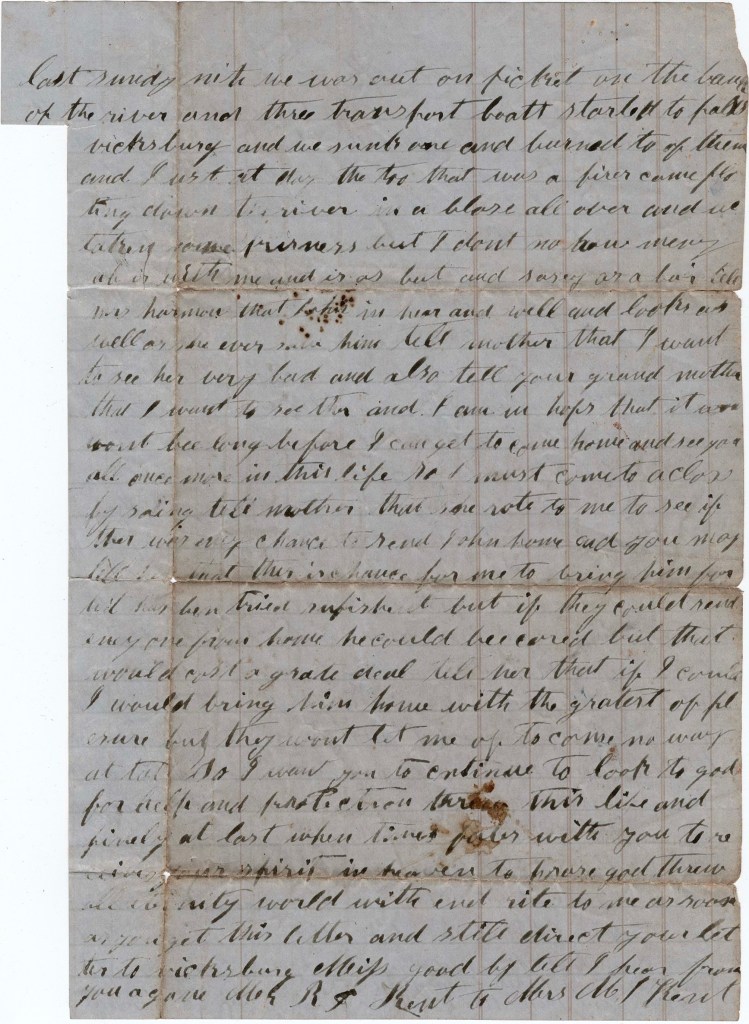
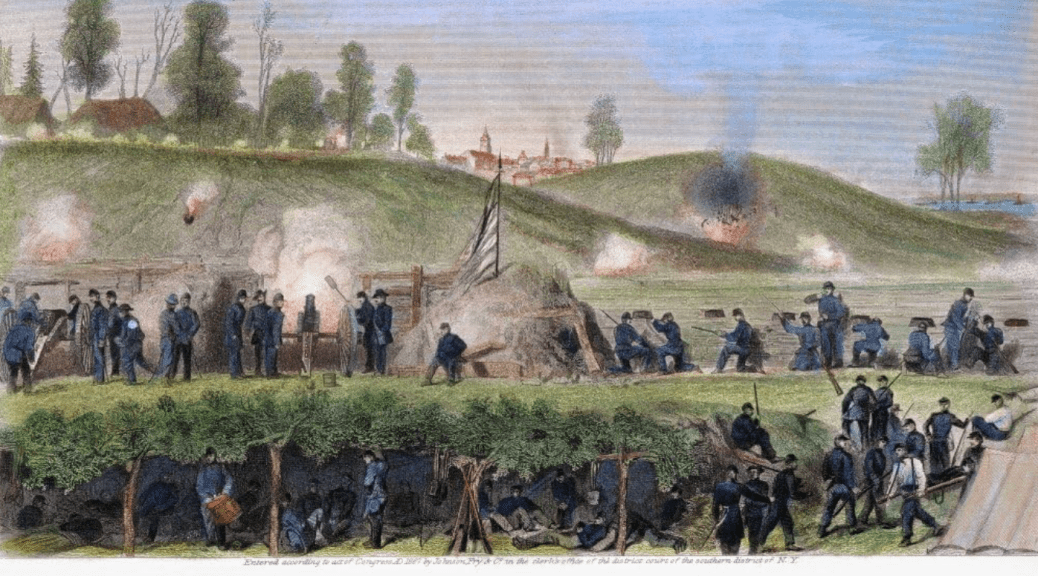
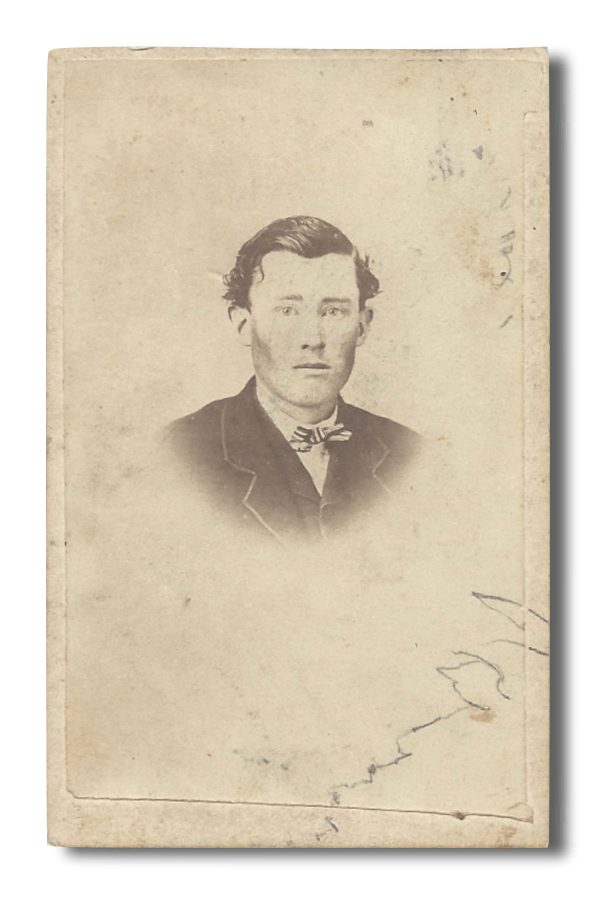

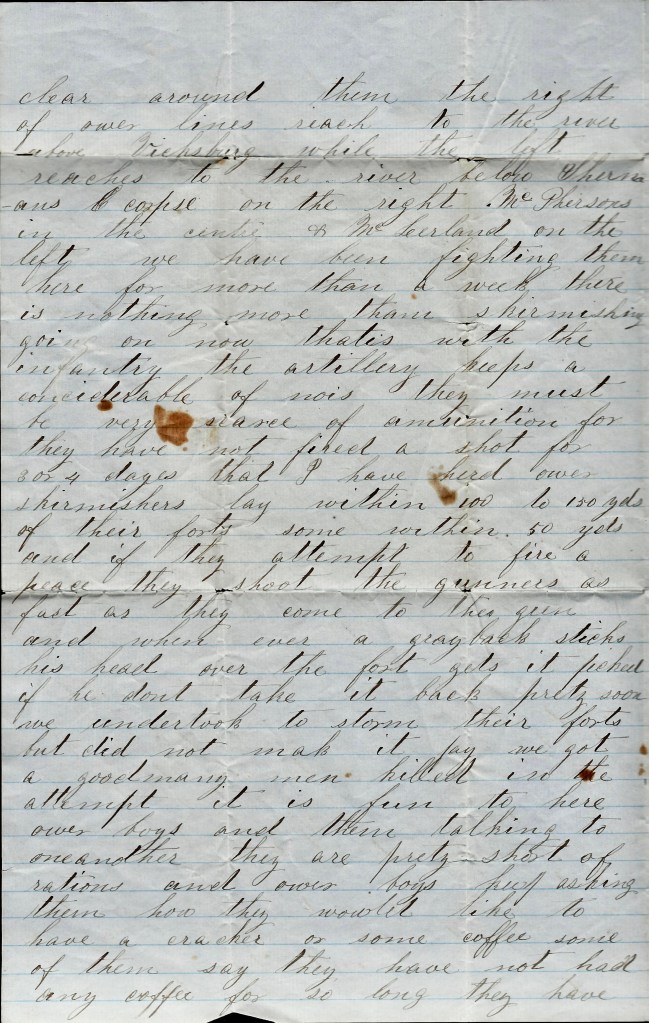


 Spared & Shared 23