
This letter was written by a student at Jefferson College in Canonsburg, Pennsylvania, named Thompson Campbell. Though I cannot prove it from the contents of this letter, I think there’s a good chance that he is the same Thompson Campbell (1811-1868) who came to this country with his parents from Ireland and settled in Chester county, Pennsylvania. Biographical sketches for Campbell don’t provide any details on his schooling until he was admitted to the bar in Pittsburgh, Pennsylvania, which is where this student says he was “at home” recently and where his correspondent, a friend, was also from.
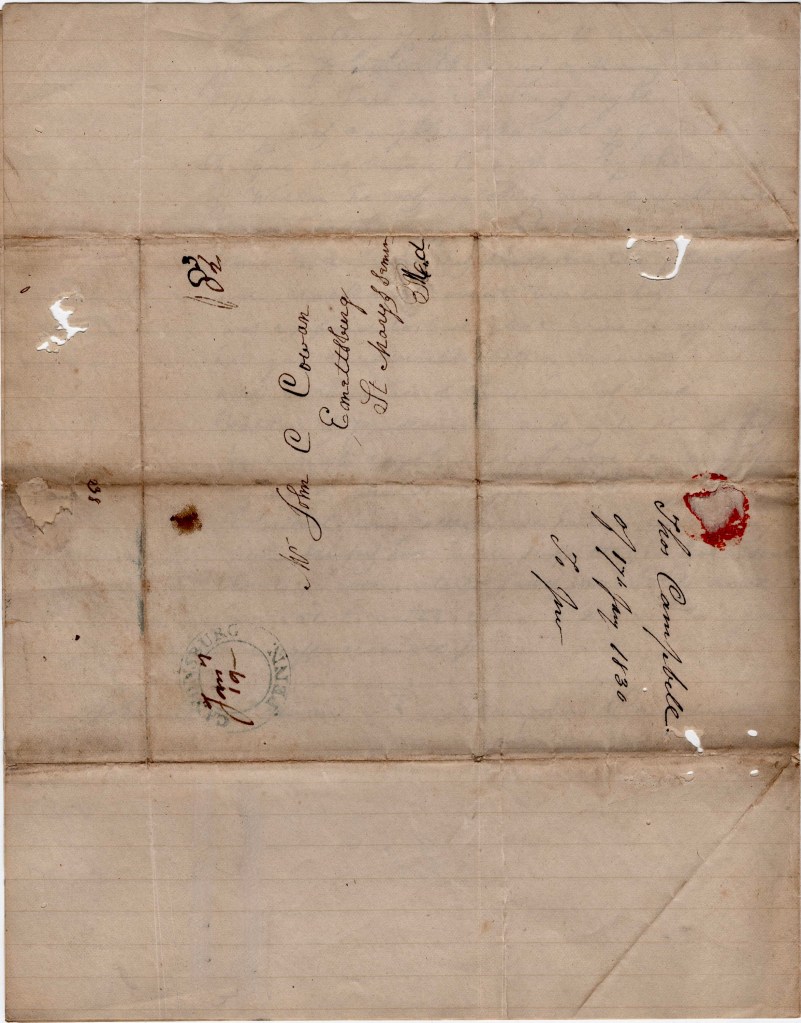
Thompson wrote the letter to John Conway Cowan (1815-1838) of Pittsburgh. He attended Mount St. Mary’s College in Emmitsburg, Maryland, and entered the seminary there He died at Havana, Cuba, in February 1838.
Campbell’s biographical sketch: “Born in Ireland in 1811; immigrated to the United States with his parents, who settled in Chester County, Pa.; attended the public schools; studied law; was admitted to the bar in Pittsburgh, Pa.; moved to Galena, Ill., and engaged in mining; secretary of state of Illinois from 1843 until he resigned in 1846; delegate to the State constitutional convention in 1847; elected as a Democrat to the Thirty-second Congress (March 4, 1851-March 3, 1853); unsuccessful candidate for reelection in 1852 to the Thirty-third Congress; delegate to the Democratic National Convention in 1852; appointed United States land commissioner for California by President Pierce in 1853 and served until he resigned in 1855; returned to Illinois; delegate to the Democratic National Convention at Charleston in 1860; elector at large on the Breckinridge and Lane ticket in 1860; returned to California and served in the California house of representatives as a member of the Union Party in 1863 and 1864; delegate to the Republican National Convention in 1864; died in San Francisco, Calif., December 6, 1868; interment in Laurel Hill Cemetery.”
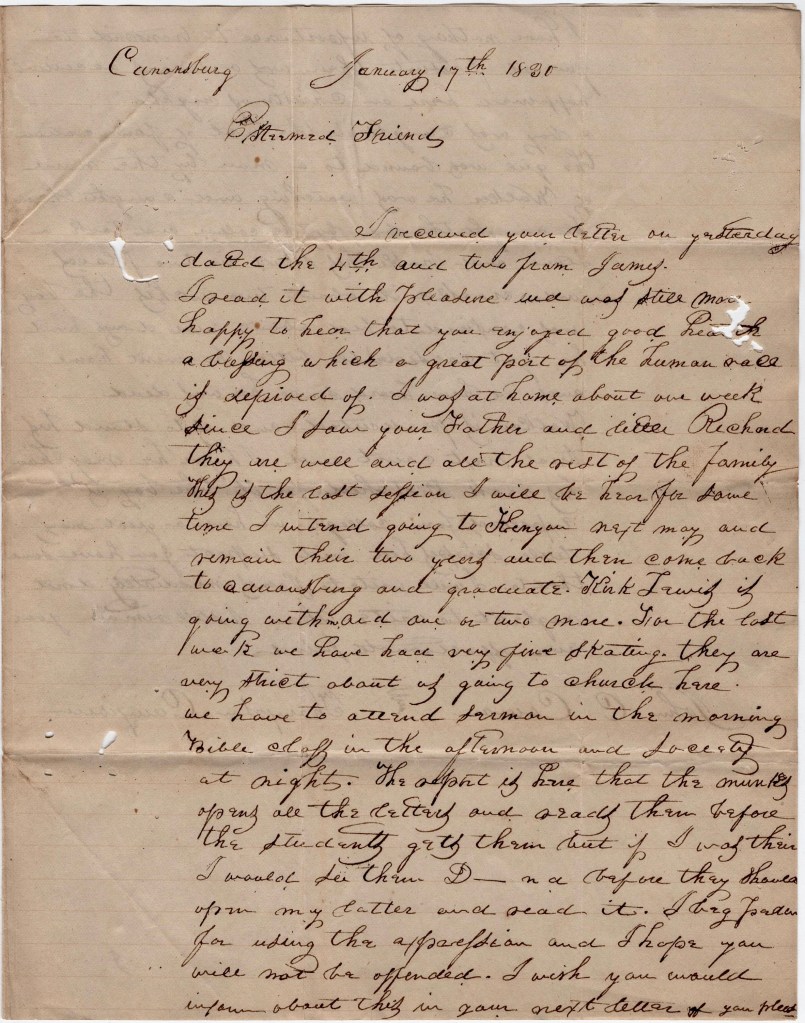
T R A N S C R I P T I O N
Canonsburg [Pennsylvania]
January 17th 1830
Esteemed Friend,
I received your letter on yesterday dated the 4th and two from James. I read it with pleasure and was still more happy to hear that you enjoyed good health—a blessing which a great part of the human race is deprived of. I was at home about one week since. I saw your Father and little Richard. There are well and all the rest of the family. This is the last session I will be here for some time. I intend going to Kenyon [College in Gambier, Ohio] next May and remain there two years and then come back to Canonsburg and graduate. Kirk Lewis is going with me and one or two more. For the last week we have had very fine skating. They are very strict about us going to church here. We have to attend sermon in the morning, bible class in the afternoon, and society at night. The report is here that the monks open all the letters and read them before the students get them but if I was there, I would see them damned before they should open my letter and read it. I beg pardon for using the expression and I hope you will not be offended. I wish you would inform about this in your next letter if you please.
I have nothing of importance to transmit to you at present. There was a serious accident happened here on Christmas night. A boy was caught in the act of fornication. The girl was bound to a man by the name of Walker. 1 He was watching and caught them. He caught the boy by the collar and took a stone and broke his skull in two places and cracked it about two inches. The boy was confined to bed about nine days and he got considerable better. He went home and we have heard since he was dead. Walker is prosecuted and is to stand his trial next court and I hope he may have his neck stretched for it. The boy is expelled from college.
We have a great many little scrapes here and suspect you have some there to. I will write to James immediately. Do not neglect to write. And I still remain your ever affectionate friend, — Thompson Campbell
To John C. Cowan
1 I couldn’t find any mention of this incident in local newspapers. However, there was a saddler named Moses Walker (1792-1855) who lived in Canonsburg at the time. It’s not surprising that the incident wasn’t reported, as such topics rarely appeared unless a pregnancy was involved, and legal action against offenders was uncommon. In 1830, fornication was illegal in Pennsylvania, so if the male offender had died, many would have considered that as justice served.

 Spared & Shared 23