The following letter was written by Percival Collins (1831-1872), the son of Isaac Collins (1787-1863) and Margaret Morris (1792-1832). Percival was married to Sarah (“Sallie”) Abbott Levick (1837-1881) on 5 October 1856 at the 12th Street Monthly Meeting in Philadelphia.
We learn from Percival’s letters that he was engaged in the strawboard manufacturing industry. Strawboard was a coarse cardboard that was made from cereal crop stalks such as wheat, rye or oat straw. The straw was chopped, softened with alkali, and beaten into wet sheets that were pressed flat and dried in a mill. It was used for making boxes, cartons, book covers, &c. The mill Colins was affiliated with was located in Atsion in Shamong township, Burlington county, New Jersey in the Pine Barrens region east of Philadelphia. It replaced a former iron furnace that closed there in 1853. Later, after the strawboard venture failed, it was converted into a cotton mill.
Percival’s letter also speaks of the “Great Consolidation frolic” which celebrated the merger of all the boroughs, townships, ad districts across Philadelphia county into a single municipal government. It was accomplished with the Act of Consolidation of 1854.”
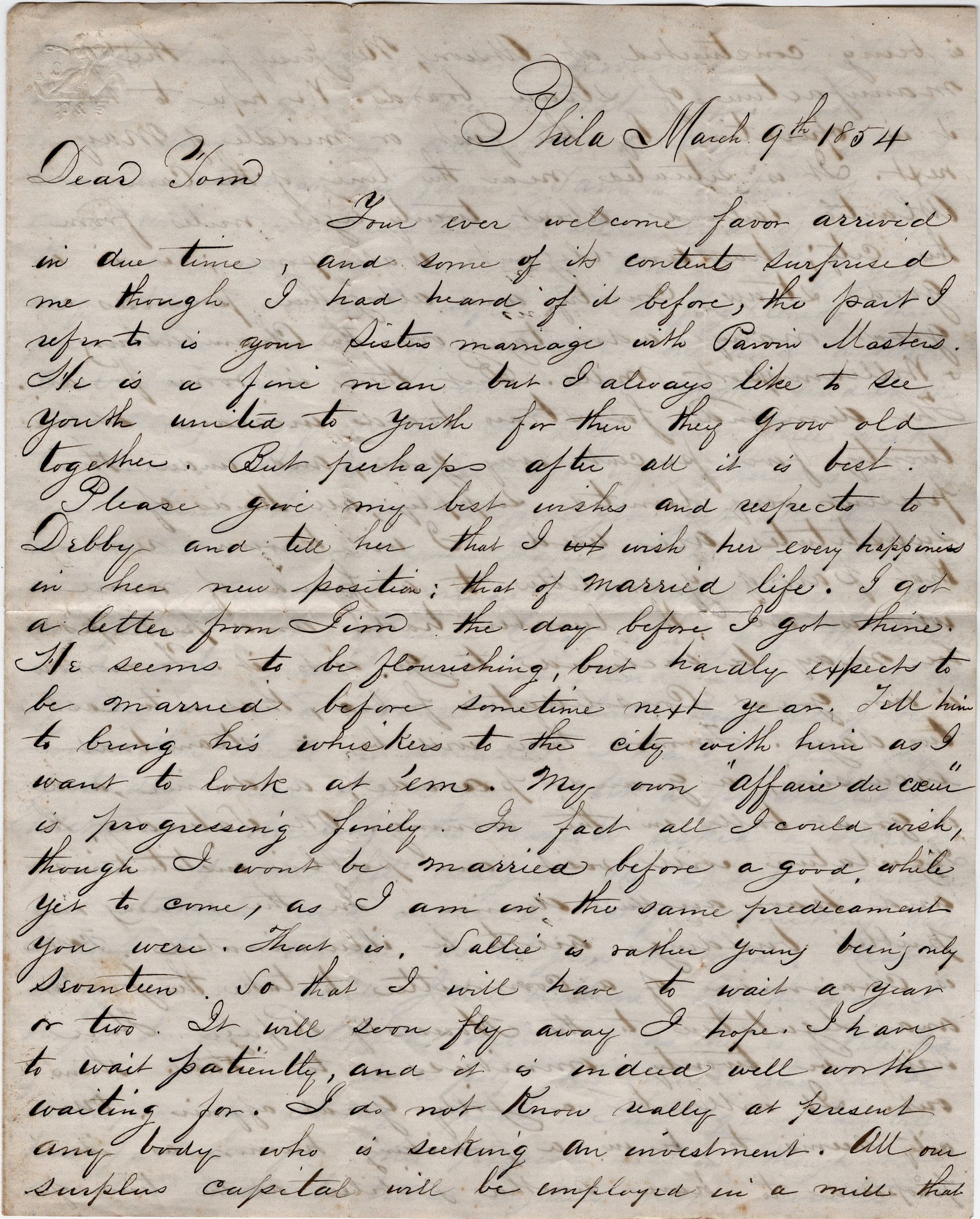
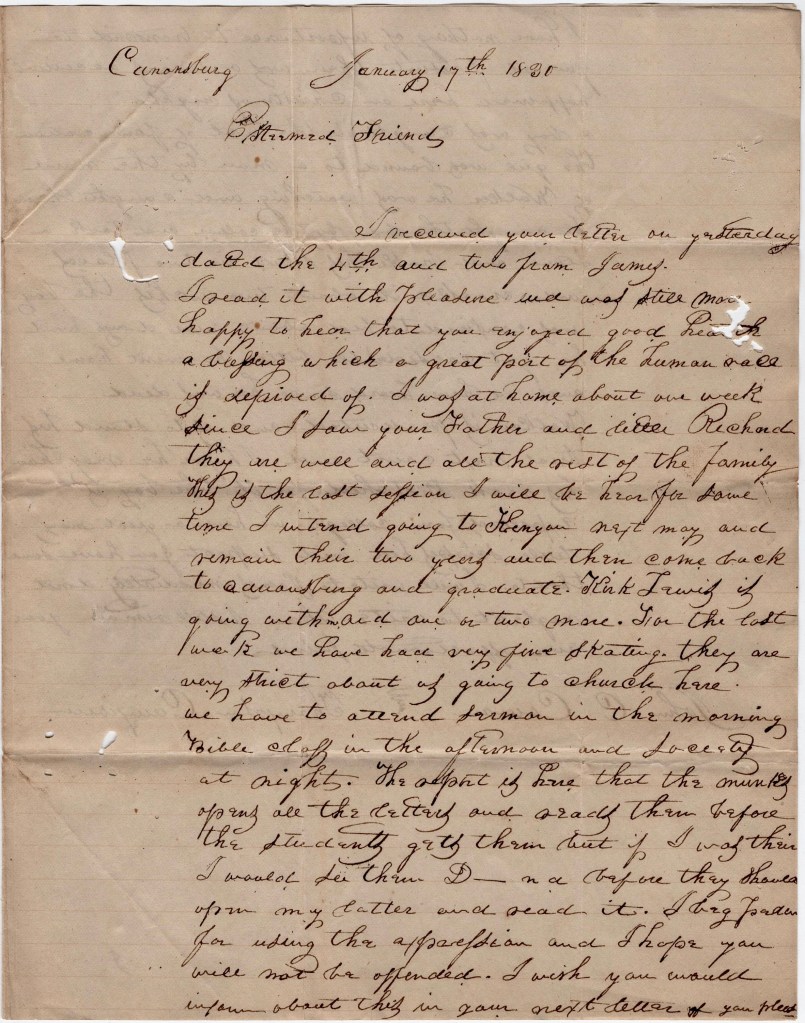
T R A N S C R I P T I O N
Philadelphia [Pennsylvania]
March 9th 1854
Dear Tom,
Your ever welcome favor arrived in due time, and some of its contents surprised me though I had heard of it before—the part I refer to is your sister’s marriage with Pavin Masters. He is a fine man but I always like to see youth united to youth for then they grow old together. But perhaps after all it is best. Please give my best wishes and respects to Debby and tell her that I wish her every happiness in her new position: that of married life.
I got a letter from Jim the day before I got thine. He seems to be flourishing, but hardly expects to get married before sometime next year. Tell him to bring his whiskers to the city with him as I want to look at ’em.
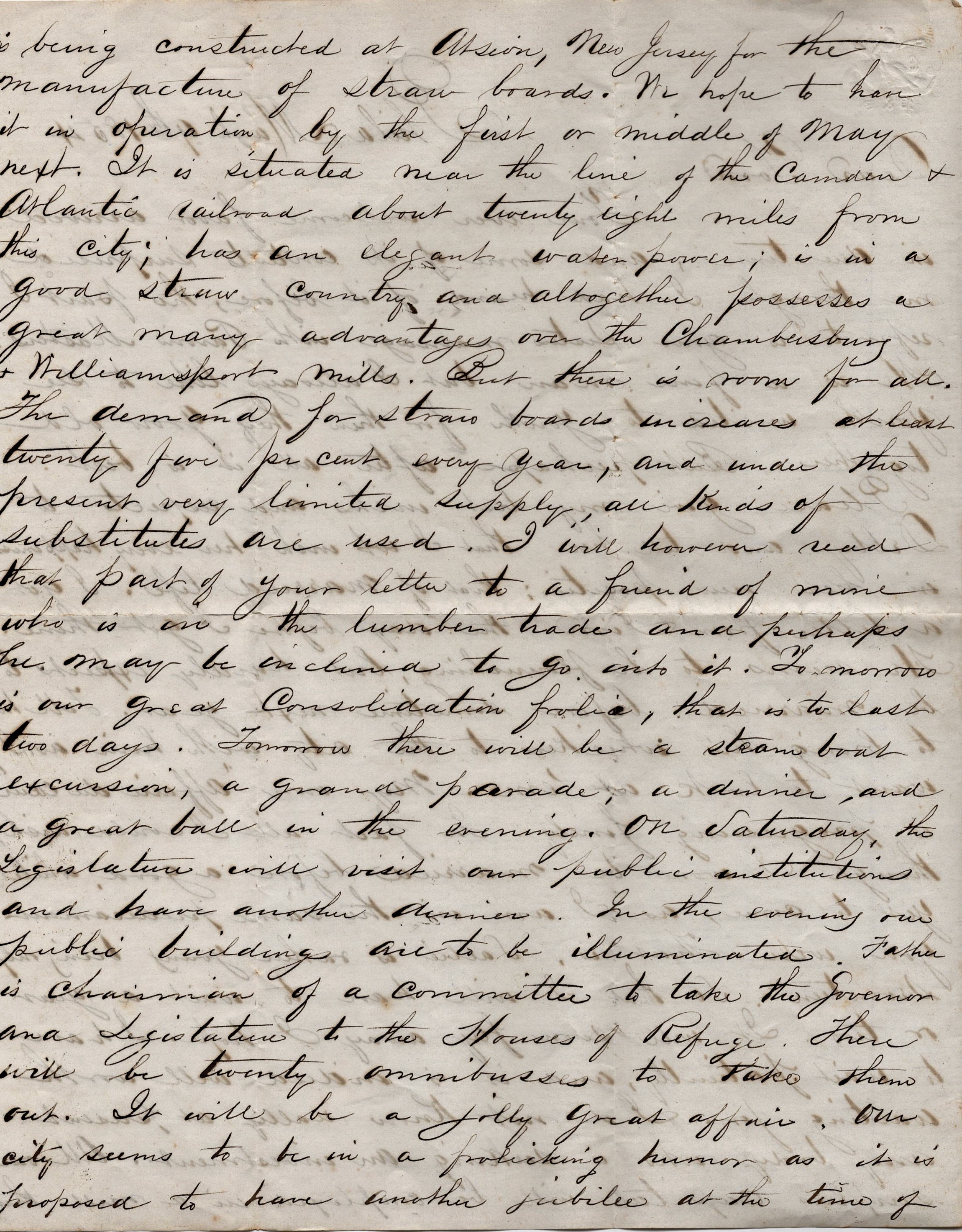
My own “affaire du coeur” is progressing finely. In fact all I could wish. though I won’t be married before a good while yet to come, as I am in the same predicament you were. That is, Sallie is rather young, being only seventeen. So that I will have to wait a year or two. It will soon fly away, I hope. I have to wait patiently and it is indeed well worth waiting for. I do not know really at present anybody who is seeking an investment. All our surplus capital will be employed in a mill that is being constructed at Atsion, New Jersey, for the manufacture of straw boards. We hope to have it in operation by the first or middle of May next. It is situated near the line of the Camden & Atlantic Railroad about 28 miles from this city; has an elegant workforce; is in a good straw country, and altogether posses a great many advantages over the Chambersburg & Williamsport mills. But there is room for all. The demand for straw boards increases at least 25 percent every year, and under the present very limited supply, all kinds of substitutes are used. I will, however, read that part of your letter to a friend of mine who is in the lumber trade and perhaps he may be inclined to go into it.
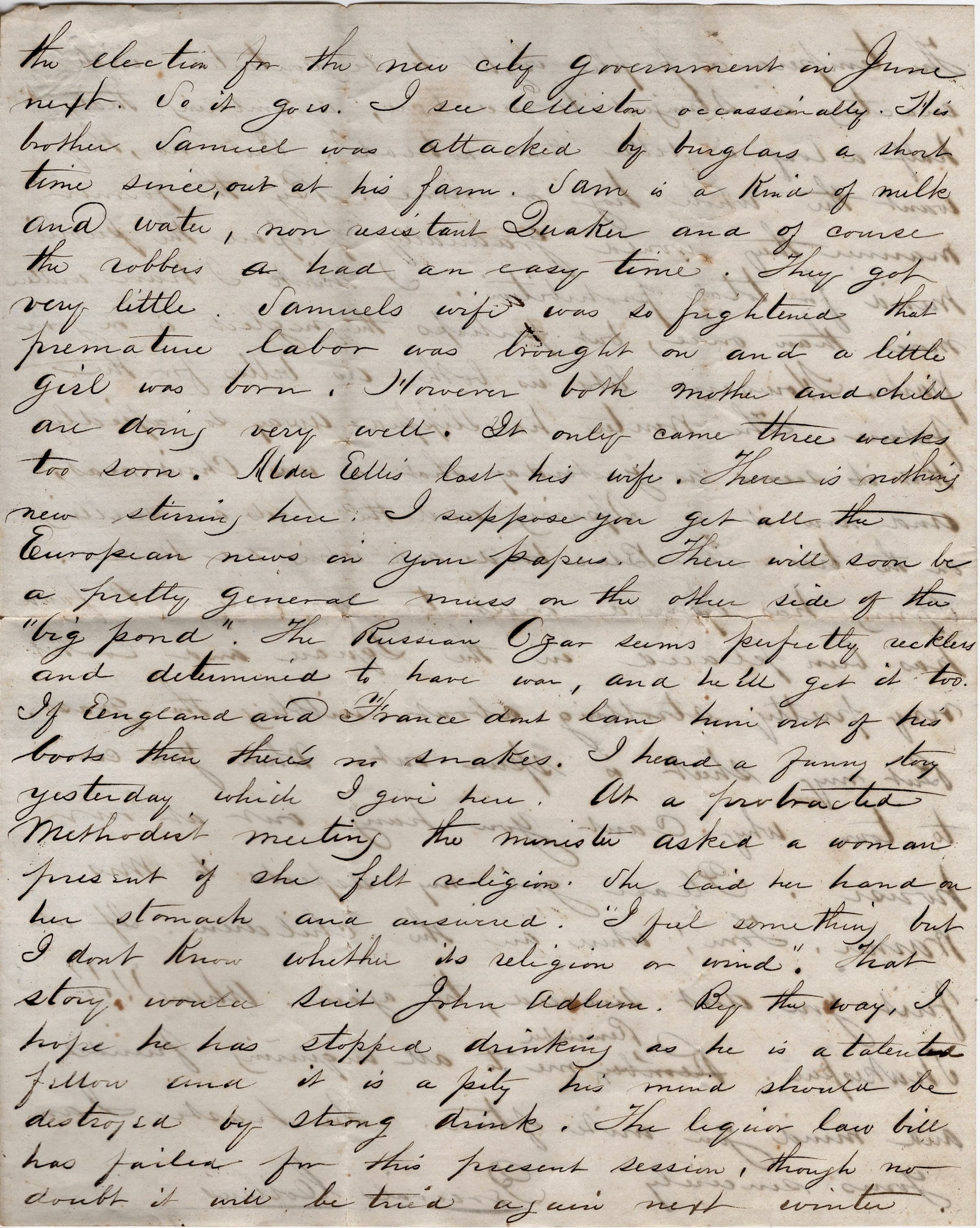
Tomorrow is our great consolidation frolic that is to last ten days. Tomorrow there will be a steam boat excursion, a grand parade, a dinner, and a great ball in the evening. On Saturday, the Legislature will visit our public institutions and have another dinner. In the evening our public buildings are to be illuminated. Father is chairman of a committee to take the Governor and Legislature to the Houses of Refuge. There will be twenty omnibuses to take them out. It will be a jolly grand affair. Our city seems to be in a frolicking humor as it is proposed to have another jubilee at the time of the election for the new city government in June next. So it goes.
I see Elliston occasionally. His brother Samuel was attacked by burglars as short time since at his farm. Sam is a kind of milk and water, non resistant Quaker and of course the robbers had an easy time. They got very little. Samuel’s wife was so frightened that premature labor was brought on and a little girl was born. However, both mother and child are doing very well. It only came three weeks too soon. Alder Ellis lost his wife. There is nothing new stirring here.
I suppose you get all European news in your papers. There will soon be a pretty general muss on the other side of the “big pond.” The Russian Czar seems perfectly reckless and determined to have war, and he’ll get it too. If England and France don’t lame him out of his boots, the there’s no snakes.
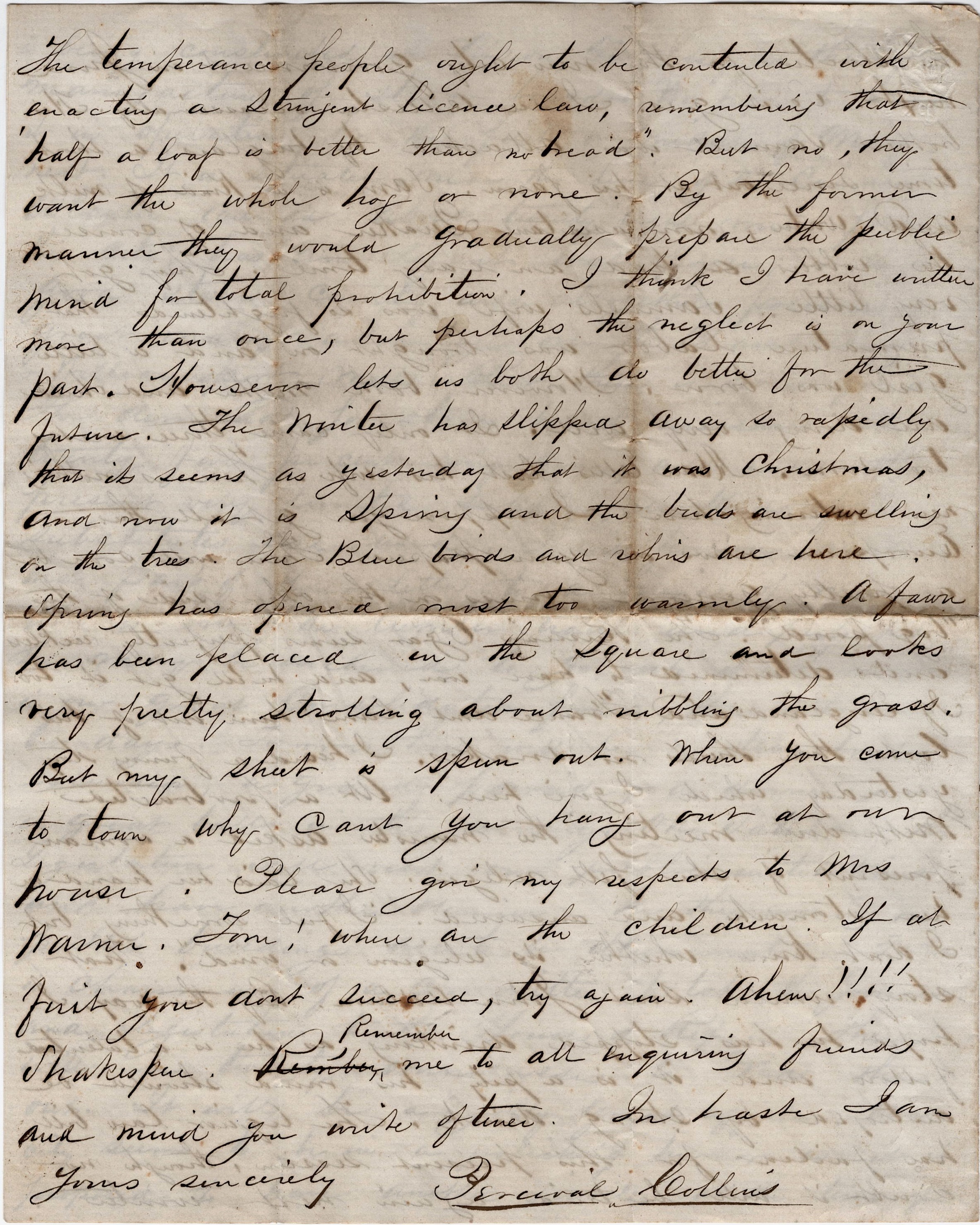
I heard a funny story yesterday which I give here. At a protracted Methodist Meeting the minister asked a woman present if she felt religion. She laid her hand on her stomach and answered, “I feel something, but I don’t know whether it’s religion or wind.” That story would suit John Adlum. By the way, I hope he has stopped drinking as he is a talented fellow and it is a pity his mind should be destroyed by strong drink. The liquor law bill has failed for this present session, though no doubt it will be tried again next winter. The temperance people ought to be contented with enacting a stringent license law, remembering that “half a loaf is better than no bread.” But no, they want the whole hog or none. By the former manner, they would gradually prepare the public mind for total prohibition.
I think I have written more than once, but perhaps the neglect is on your part. However, let us both do better for the future. The winter has slipped away so rapidly that it seems as yesterday that it was Christmas. And now it is Spring and the buds are swelling on the trees. The blue birds and robins are here. Spring has opened ,ost too warmly. A fawn has been placed in the Square and looks very pretty strolling about nibbling the grass.
But my sheet is spun out. When you come to town, why can’t you hang out at my house. Please give my respects to Mrs. Warner. Tom! where are the children? If at first you don’t succeed, try again. Ahem!!! Shakespeare. Remember me to all enquiring friends and mind you, write oftener. In haste, I am yours sincerely, — Percival Collins