
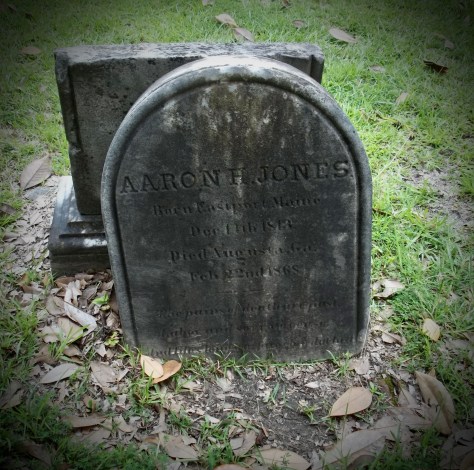
The following letter was written by Aaron Hayden Jones (1813-1868), the son of Stephen Jones (1784-1856) and Elizabeth Brackett Young (1789-1828) of Eastport, Washington county, Maine. Aaron was the oldest son of 11 children. Aaron and his younger brother Thomas Gleason Jones (1817-1869) were in the wholesale and retail provision business in Augusta, Georgia, prior to the Civil War.
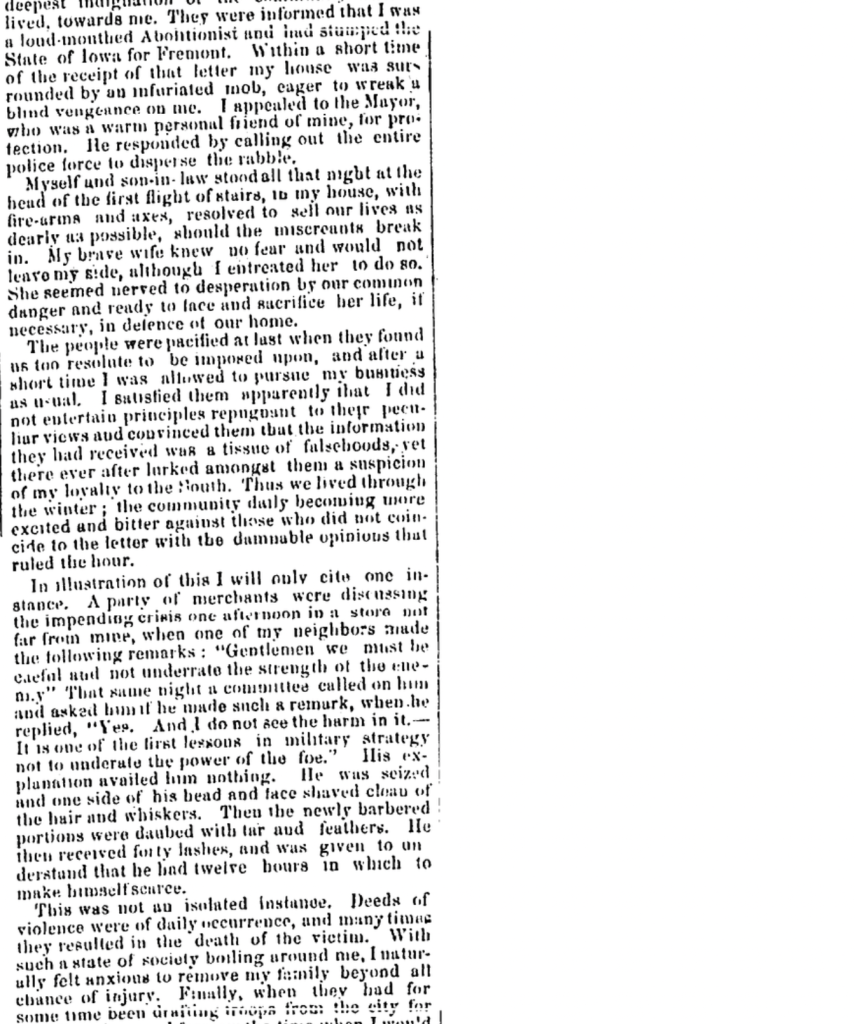
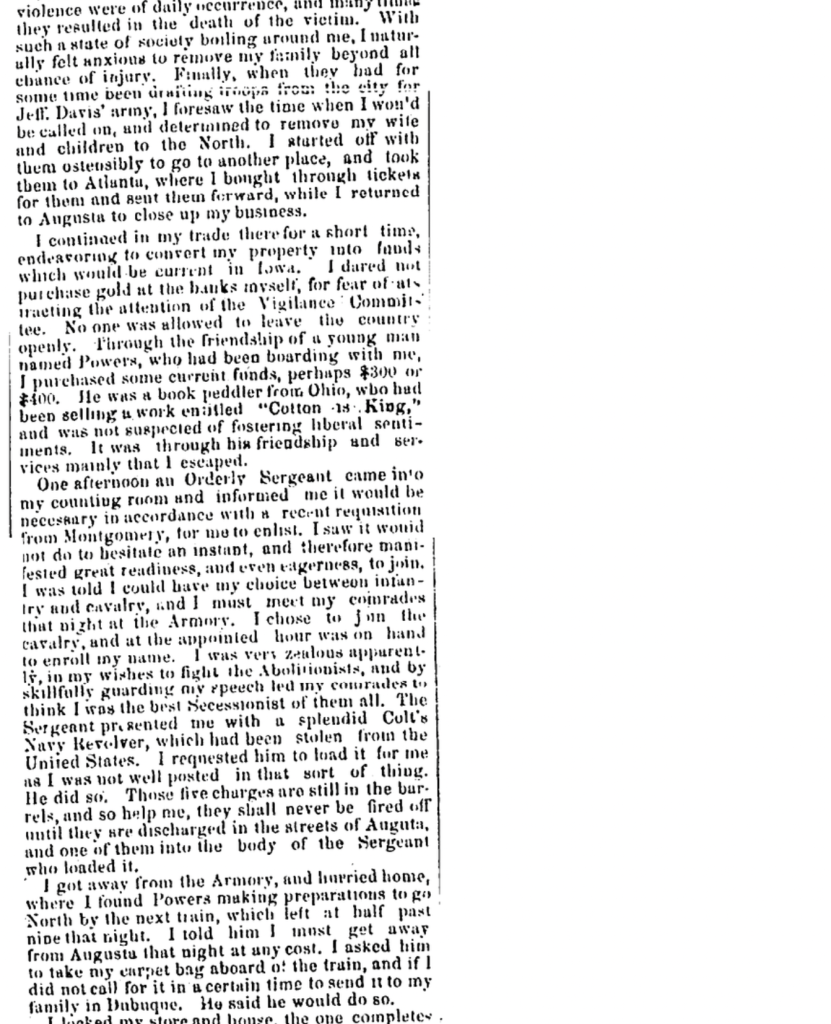
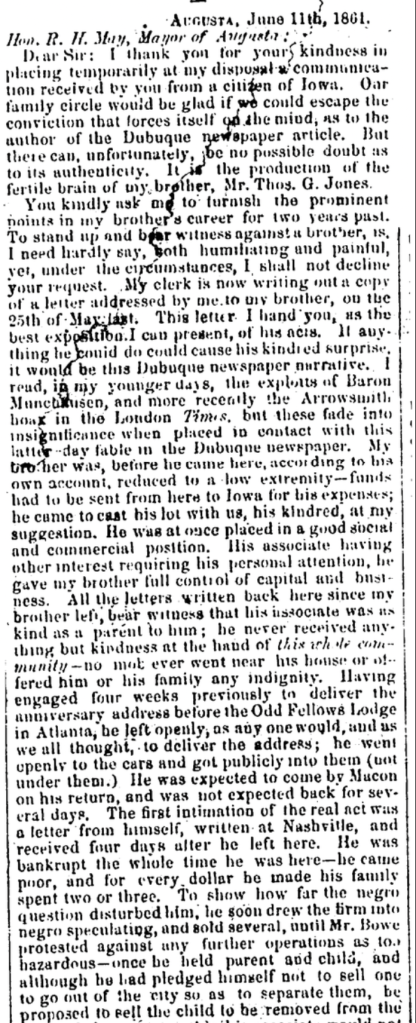
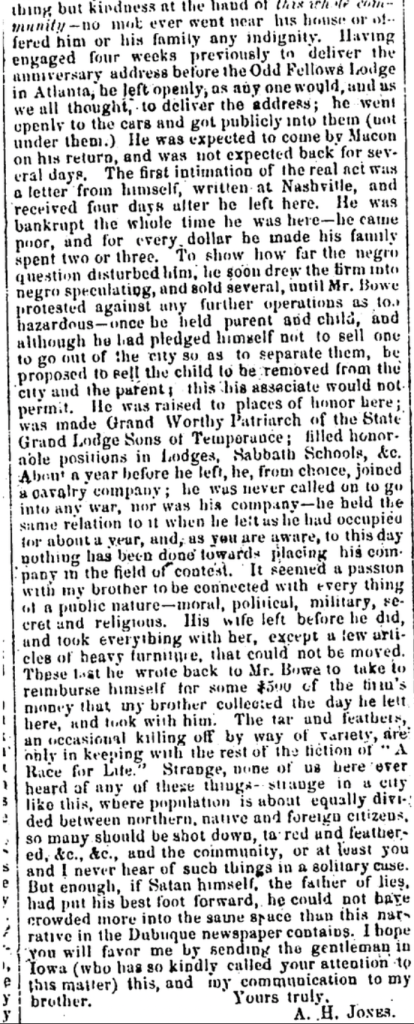
It seems Aaron and his brother Thomas worked in different firms, Thomas having previously operated in Dubuque, Iowa, before coming to Atlanta. A newspaper article published in a Dubuque newspaper in May 1861 under the title, “A Race for Life” contends that Thomas was driven out of Augusta under threat of being tarred and feathered because he was a “loud-mouthed Abolitionist” and was rumored to have stumped the State of Iowa for Fremont in 1856. He supposedly returned to Iowa having left all his assets behind. Once the citizens of Augusta read this article, they approached Aaron to attest to the veracity of this story. In response, Aaron wrote a letter to the editor of the Augusta paper, the Daily Constitutionalist (21 June 1861) refuting the “facts” in this story, alleging that Thomas was never a successful businessman and left Augusta penniless and in debt. He was no Abolitionist either, according to Aaron, and even speculated in the sale of slaves while living in Georgia. [See articles clipped from newspapers in footnotes below.]
Neither brother lived long after the war. Thomas moved his wife and children to Anoka, Minnesota, where he became a life insurance agent and died of “apoplexy” in 1869. Aaron appears to have maintained his business throughout the Civil War in Augusta but no doubt suffered as the prolonged war made keeping his shelves stocked more and more difficult. He died in 1868 at the age of 55. During the war, he filled the ranks occasionally with the Home Guard militia.
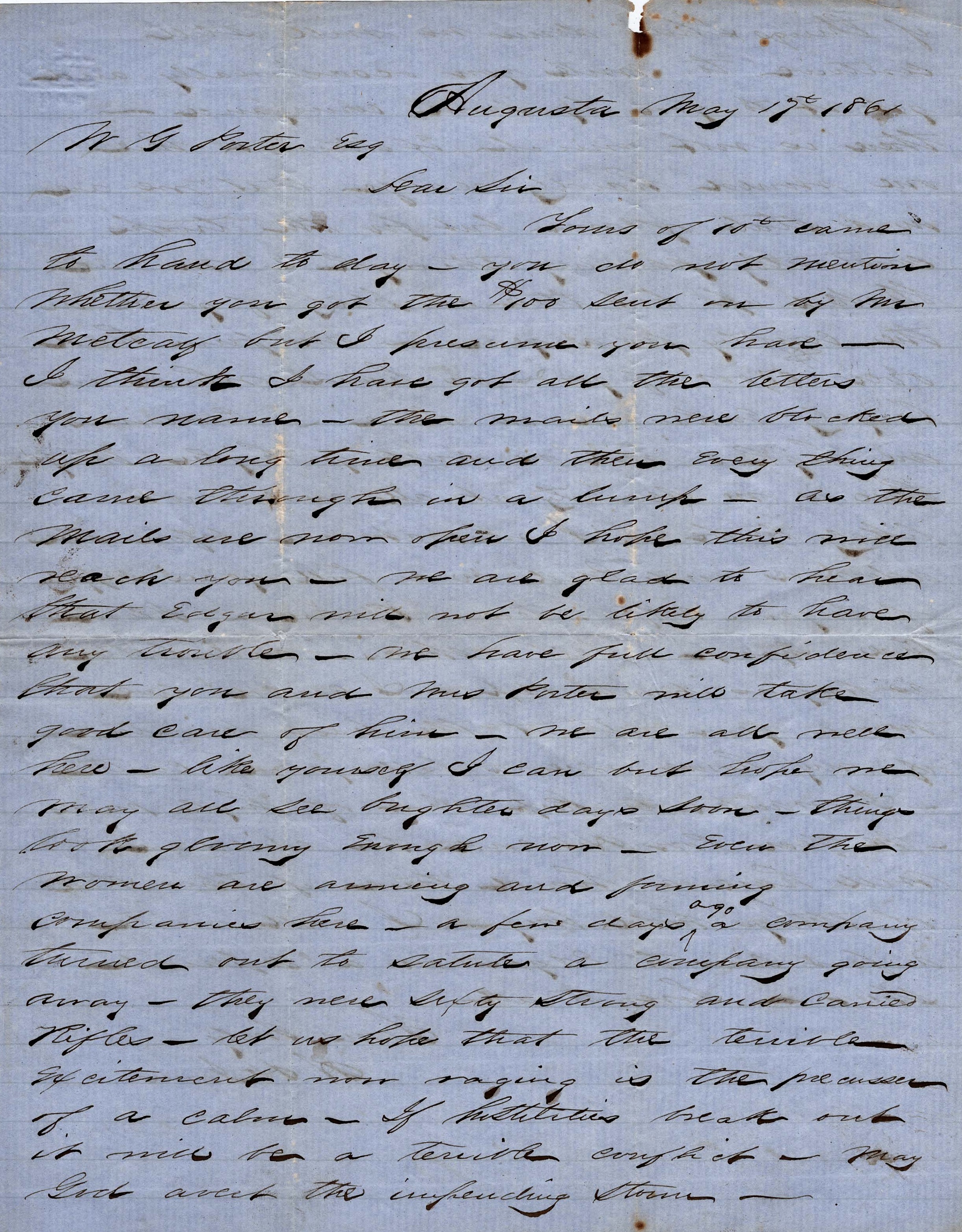
Aaron’s letter gives us a glimpse of Augusta in the first full month of the Civil War. His letter alludes to the disruption of the mails caused by the collapse of the mail delivery system in the South as well as the delivery of goods up the Savannah River. His letter also informs us of the formation of a women’s military organization in Augusta equipped and trained for home defense. I could not corroborate this claim from other accounts but believe Aaron’s statement to be factual based upon the evidence of other such companies being formed, the most notable and frequently referenced being Nancy Hart’s Militia formed in LaGrange, Troup County, Georgia. In 1861, when 1,300 men left LaGrange, leaving the town particularly vulnerable to Union attack because of its location midway between Atlanta and the Confederacy’s first capital at Montgomery, Alabama, two of the soldier’s wives—Nancy Hill Morgan and Mary Alford Heard—decided to form a female military company. Almost forty women attended, ready to do their part to defend their homes and families.
T R A N S C R I P T I O N
Augusta, [Georgia]
May 17th 1861
W. G. Porter, Esq.
Dear sir, yours of 10th came to hand today. You do not mention whether you got the $100 sent on by Mr. Metcalf but I presume you have. I think I have got all the letters you name. The mails were blocked up a long time and then everything came through in a lump. As the mails are now open, I hope this will reach you. We are glad to hear that Edgar will not be likely to have any trouble. We have full confidence that you and Mrs. Porter will take good care of him. We are all well here. Like yourself, I can but hope we may all see brighter days soon. Things look gloomy enough now. Even the women are arming and forming companies here. A few days ago a company [of women] turned out to salute a company going away. They were sixty strong and carried rifles.
Let us hope that the terrible excitement now raging is the precursor of a calm. If hostilities break out, it will be a terrible conflict. May God avert the impending storm. If things shut down, we will still continue to write you occasionally and get it to you by some conveyance.
There is not much excitement here. One would hardly realize that we are in a state of war but for the troops constantly passing through. We are blocked up but there are plenty of goods in the country for a year. One firm had over $50,000 of goods on hand which are largely enhanced in value. Provisions are high and with no doubt go higher though there is no scarcity at all and not likely to be. I went at once before the advance and laid in a full year’s supply of sugar, coffee, tea, bacon, flour, rice, syrup, salt, spices, and butter as long as it will keep. I could live now a year without the least privation if my house were a beleaguered castle. I wanted to keep clear of high prices.
We fear poor Het and her children will have a hard time if this state of things hold long. I will write a few lines to Edgar on a separate sheet. Love to all. Yours truly, — A. H. Jones

Footnotes:



 Spared & Shared 23