These letters were written by Mary Jane (“Jennie”) Cleland (1841-1929), the 22 year-old daughter of Arthur Cleland (b. 1803) and Mary Clark (b. 1814) of Defiance County, Ohio. Jennie’s father was born in Killy Leagh Parish, County Down, Ireland, and came to the United States with his parents in 1817, arriving on the schooner Vigilant. They landed at Wilmington, Delaware, and first resided at Pittsburgh, Pennsylvania, before moving to Jefferson County, Ohio.
Jennie wrote the letters to her younger brother, Corporal John W. Cleland (1843-18xx) who enlisted in Company F, 111th Ohio Ohio Infantry in September 1862 at age 19. He was promoted to 1st Sergeant in March 1863 about the time this letter was written. In April 1864, Sgt. Cleland was promoted to 2nd Lieutenant and in May 1865 to 1st Lieutenant. He was mustered out of the service with his company in June 1865 at Salisbury, North Carolina. After the war, I believe John moved to Decatur, Illinois.
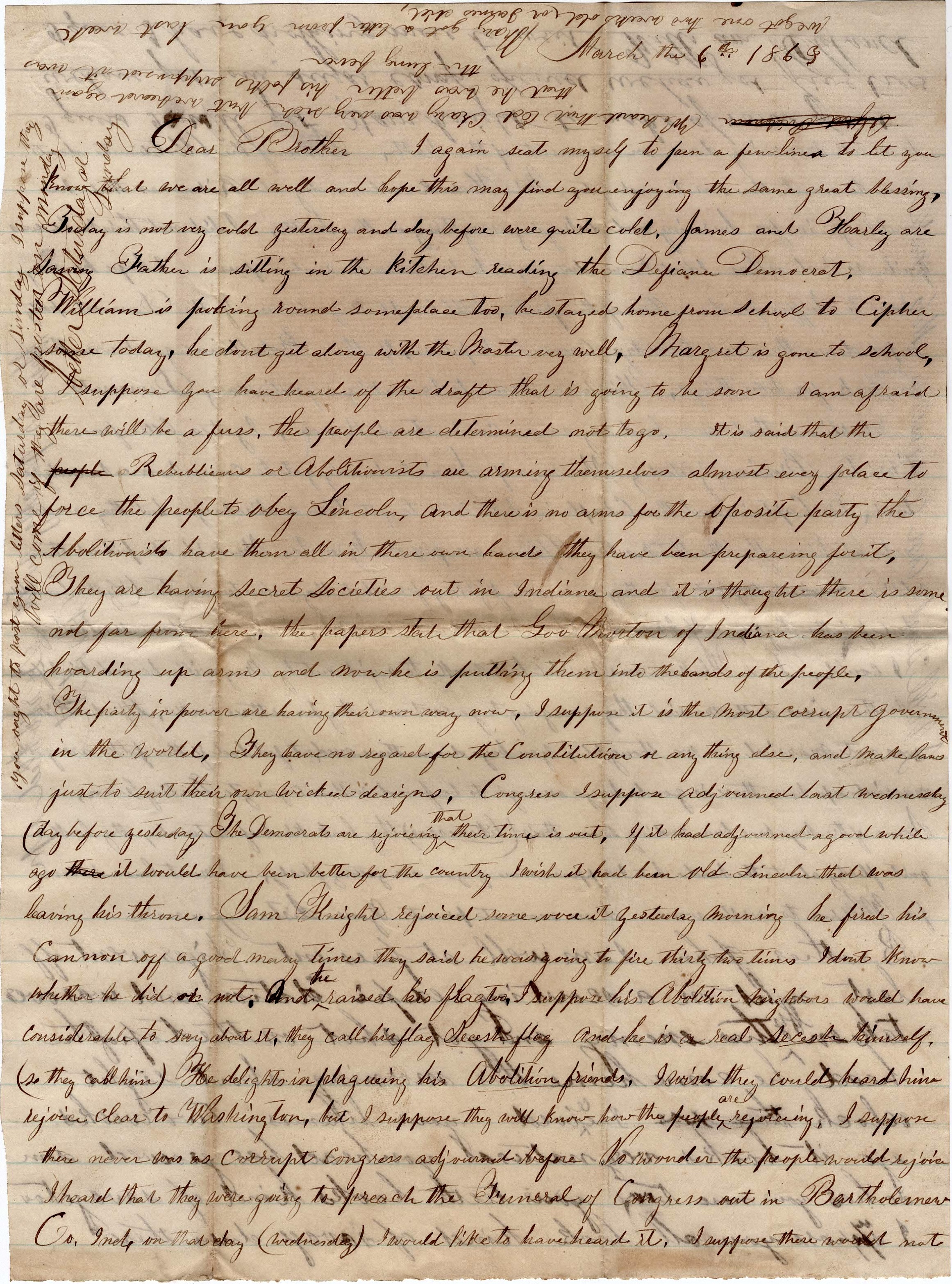
In her March 1863 letter, Jennie addresses the escalating discontent among the citizens toward the Lincoln Administration and its management of the war aimed at putting down the rebellion. Even prior to the onset of hostilities, Defiance County had shown a strong preference for the Democrats, evidenced by Lincoln securing only 43% of the votes in 1860 (it fell to 42% in 1864). However, Jennie admitted that after two years, “this war seems to be making a great many Democrats. A Republican that ever had any sense can’t stand it now.” She expressed her concerns regarding the forthcoming draft, asserting that “the people won’t stand for it.” More troubling, she alleged that the Republicans and the Abolitionists—including the Governor of Indiana—were engaging in the stockpiling of weaponry, thereby leaving the opposition defenseless. She characterized the government as “the most corrupt in the world,” with “no regard for the Constitution,” and contended that the ruling party was acting without restraint.
In her July 1863 letter, Jennie articulates her vehement criticism of Abolitionists, as well as the Union leadership, whom she perceives as incompetent and ineffectual in their efforts to secure victory in the war through combat. She asserts that soldiers should be disenfranchised, arguing that their perspectives are shaped solely by the Lincoln administration’s propaganda, thus depriving them of the varied voices from the opposition.
Back in 2014, I transcribed another of Jennie’s 1863 letters and published it in Spared & Shared 7. [see 1863: Mary Jane Cleland to John W. Cleland] It was datelined from the Cleland home on 13 April 1863. In that letter, she wrote a lot about the treatment of William (“Bill”) J. Knight of Defiance county—one of Andrews’ Raiders who became famous in the “The Great Locomotive Race.” Bill was orphaned at a young age and was raised by his grandfather, Jacob Knight, in Farmer Township, where the the Cleland family lived. Bill learned something about steam engines while working at his grandfather’s sawmill and as an engineer for the Atlantic and Great Western Railroad. While serving in Company E of the 21st Ohio Infantry, Bill volunteered for a secret mission to destroy the Western and Atlantic Railroad link to Chattanooga, effectively isolating Atlanta. On 12 April 1862, the volunteers boarded at north-bound train for Marietta, Georgia, and at a stop north of town, they uncoupled the passenger cars and stole the locomotive—The General—and three freight cars. They were pursued and eventually overtaken and captured near Ringgold, but not until after having destroyed track and cut telegraph communications. James Andrews, the leader of the men, and seven others were hung, while eight of the soldiers were exchanged for Confederate prisoners. Bill Knight was among the group of eight soldiers who managed to escape their captors, earning him the Medal of Honor for his bravery.
Over the last several years I’ve transcribed several of John W. Cleland’s Civil War letters that were sold off to numerous private collections. You can find his letters by following any of the Spared & Shared active links below:
John W. Cleland, Co. F, 111th Ohio (3 Letters)
John W. Cleland, Co. F, 111th Ohio (2 Letters)
John W. Cleland, Co. F, 111th Ohio (1 Letter)
Letter 1

[Farmer township, Defiance county, Ohio]
March 6, 1863
Dear brother,
I again seat myself to pen a few lines to let you know that we are all well and hope this may find you enjoying the same great blessing. Today is not very cold. Yesterday and day before were quite cold. James and Harley are sowing [grain]. Father is sitting in the kitchen reading the Defiance Democrat. William is poking round someplace too. He stayed home from school to cipher some today. He don’t get along with the Master very well. Margret is gone to school.
I suppose you have heard of the draft that is going to be soon. I am afraid there will be a fuss. The people are determined not to go. It is said that the Republicans or Abolitionists are arming themselves almost every place to force the people to obey Lincoln, and there is no arms for the opposite party. The Abolitionists have them all in their own hands. They have been preparing for it. They are having Secret Societies out in Indiana and it is thought there is some not far from here. The papers state that Gov. Morton of Indiana has been hoarding up arms and now he is putting them into the hands of the people. The party in power are having their own way now. I suppose it is the most corrupt government in the world. They have no regard for the Constitution or anything else, and make laws just to suit their own wicked designs.
Congress, I suppose, adjourned last Wednesday (day before yesterday). The Democrats are rejoicing that their time is out. If it had adjourned a good while ago, it would have been better for the country. I wish it had been Old Lincoln that was leaving his throne. Sam Knight 1 rejoiced some over it yesterday morning. He fired his cannon off a good many times. They said he was going to fire thirty-two times. I don’t know whether he did or not. And he raised his flag too. I suppose his Abolition neighbors would have considerable to say about it. They call his flag Secesh flag and he is a real Secesh himself (so they call him). He delights in plaguing his Abolition friends. I wish they could heard him rejoice clear to Washington, but I suppose they will know how the people are rejoicing. I suppose there never was a corrupt Congress adjourned before. No wonder the people would rejoice.
I heard that they were going to preach the funeral of Congress out in Bartholomew county, Indiana, on that day (Wednesday). I would like to have heard it. I suppose there would not be much mourning done on account of the death. Some of the Abolitionists don’t seem to want the war to end yet. Mr. [Joseph L.] Hosack said one day at Ridenour’s that he would go in for burning and destroying everything in the South. I did not think he was quite so bad as that. I don’t know what ought to be done with such a person. I hope he may have to suffer for it. One of the parties will be apt to go down. If the Democrat Party is put down, then our country’s course is hopeless. If the Republicans go down, then we may look for better things. This war seems to be making a great many Democrats. A Republican that ever had any sense, can’t stand it now.
I got a letter from Christie Browning yesterday. She says if Lewis had only got to come home, he might have lived. His captain and the chaplain both tried to get him a discharge, but they would not let him off. She thinks the officers are perfect tyrants. She said she pitied the soldiers for they were not fighting for what they volunteered to (viz: the Constitution but for the Negro). If I was a soldier, I would not reenlist. I would rather unlist if I could.
Dan Kleckner was married last week to a girl out by Maysville. He and his wife’s brother were both married. They were going to go East and stay two or three weeks. Alfred Ridenour was not married as we thought. You boys down there needn’t feel bad if the folks are getting married up here. There is good boys enough to be found without going to Bowling Green. Some of the boys have been sending home their likenesses. They look kind of natural. They look quite fleshy about the head, but I suppose some of you are getting fleshy. I must leave room for William to write some. So no more at present. Your sister, — Jennie
Brother John, I am well at present. Tiger went off last night on a scouting expedition and was overtaken by the enemy and got shot on the top of the head. He come home this morning about 8 o’clock. I received your likeness two weeks ago. It looks very natural. Your head has growed some. So has your nose too. Your teeth looks kind of savage too. I suppose you all look kind of savage down there. I guess I will get Sam Knight to make a frame for it. We have got our sugar camp opened. We have got five trees. I guess I have nothing more to write. — William Cleland
1 Samuel D. Knight (b. 1826) was a farmer in Farmer township, Defiance county, Ohio. He was appointed postmaster in 1850 and again in 1856 by Democratic administrations. In the 1860 US Census, he was enumerated in Farmer township with his wife Amanda (Johnson) Knight and five children; his occupation given as “mechanic.”


Letter 2
[The following letter comes from the personal collection of Jonathan White and was offered for transcription and publication on Spared & Shared by express consent.]
Monday morning
July 13, 1863
Dear Brother,
It is my turn to write again. I thought I would commence this morning. We have the harvest hands today again. They are cutting the field across the road from the house. They cut two days last week. They will most finish here tomorrow. Then they have some to cut at Ridenour’s. Wheat seems to be very heavy this year. Our folks think they will have a thousand bushel. The girls have to work out more this harvest than ever before. They have to rake and bind and help to make hay. I helped a little with the hay. Father and I hauled in four loads of hay last week when James and William were at Berean’s. You know that is something I never done before. I have to brag a little over it of course. I may have to help some more before the wheat is hauled in. Our hired hand ain’t much use. He is always sick when there is the most work to do and we can’t get any other now. He had the chills last week and I guess he has them yet.
We got your letter day before yesterday that you finished the 29th of June. I look a little for one Wednesday again. Anna Hill got one that was dated July 2nd. You were at Tourkinsville then. Maybe you are at Glasgow by this time.
I’ll bet you will have the Rheumatism after marching. There you were running away down pretty near to Tennessee and [John Hunt] Morgan up in the northern part of Kentucky. I heard he had got into Indiana but it may not be so. He is too smart for you fellows. He knows what he is doing all the time. Some of the rest don’t (that is, our officers). There is not very many smart generals in the Northern army because they won’t have any if they find he is worth anything. The war will not end by fighting. The Abolitionists say there is no way to end it but by fighting it out. But the majority (that is the democrats now) think it will never be ended in that way. They would get the hearty support of the people if things were carried on anything as they should be—that is, to restore the Union and preserve the Constitution and laws. But the leading men in power don’t want the Union and they don’t care for the Constitution. And the Democrats don’t want to support any such policy if they can help it.
There is no use in it. Everything seems to be against the North. I don’t know but they have been gaining some lately but not as much as they ought and I don’t believe the North will ever whip. They might as well settle it some other way than by fighting for it will have to be done at last anyway. There is nothing honorable about them. When the Southern armies destroy or take anything, they pay for it sometimes as well as they can. Of course some of them don’t care, but as a general thing I just believe they act more honorable than ours do. They destroy things often when it is not really necessary just because they hate the South. This is not the right kind of spirit. If they do wrong, that is no reason that we should do wrong to them.
The Abolitionists say now that if Vallandigham had not been in the South, the rebels would not have come into Pennsylvania. If that is so, then Old Abe is the traitor for sending him there to give them information. Little Val is traveling home again. He is in Canada, or was the latest account. I believe it would be better not to let the soldiers vote this fall. Jason Burbic thinks so too, because the soldiers most places only get to hear one side of the question (that is the Abolition side). Democratic papers are not allowed in the army very much. Grant’s army is the only one that Democrat papers get into, and it does the best business. Now why is this if Democratic papers demoralize the army. If they did not get so many nasty, lying Abolition papers, it would be better. And if the soldiers do get to vote, they will not be apt to be allowed to vote their sentiments. The Abolitionists have considerable to say about our pic-nic on the fourth. They call it a secesh dinner and that there was nothing fit to eat and that they were all drunk, &c. &c. &c. &c. If they can get up a better pic-nic let them do it.
I don’t hear much about E. M. Brown these times. He don’t get to write as much round here to the girls as he did. Poor little fellow, I know if there was going to be a battle, he would be sick. He would take some pills before the battle brakes. The Abolitionists have a great time here with the butternuts pulling them off the Democrats. Maybe some of the boys will get home on furlough again if you get back to Glasgow. We are all well and kicking round as usual. Your Sister — Jennie Cleland


